Cambridge IGCSE Sciences - Co-ordinated (Double) 0654 — 2016 Oct/Nov Paper 6 · Variant 2
0654/62/O/N/16 · 60 marks · ≈68 min
The question paper and its mark scheme, free to read here and free to download. This is Cambridge’s own paper, exactly as it was sat.
Question paper20 pages
Mark scheme5 pages
Answers below. Sit the paper first if you are practising.
Paper as text
Question paper, page 1
This document consists of 20 printed pages. DC (LK/CGW) 120564/6 © UCLES 2016 [Turn over Cambridge International Examinations Cambridge International General Certificate of Secondary Education * 1 7 3 8 9 8 3 3 0 9 * CO-ORDINATED SCIENCES 0654/62 Paper 6 Alternative to Practical October/November 2016 1 hour Candidates answer on the Question Paper. No Additional Materials are required. READ THESE INSTRUCTIONS FIRST Write your Centre number, candidate number and name on all the work you hand in. Write in dark blue or black pen. You may use an HB pencil for any diagrams or graphs. Do not use staples, paper clips, glue or correction fluid. DO NOT WRITE IN ANY BARCODES. Answer all questions. Electronic calculators may be used. You may lose marks if you do not show your working or if you do not use appropriate units. At the end of the examination, fasten all your work securely together. The number of marks is given in brackets [ ] at the end of each question or part question.
Question paper, page 2
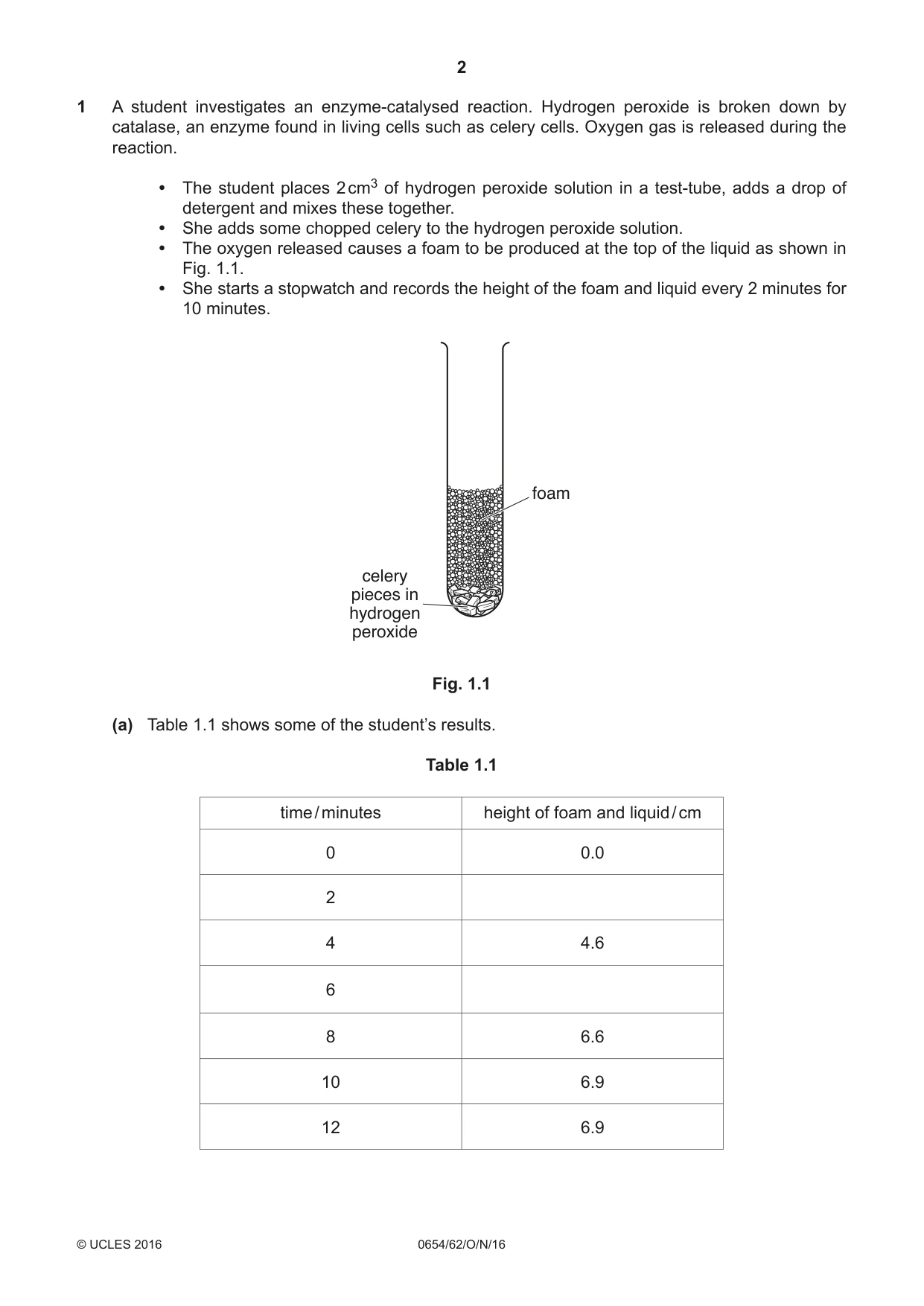
2 0654/62/O/N/16 © UCLES 2016 1 A student investigates an enzyme-catalysed reaction. Hydrogen peroxide is broken down by catalase, an enzyme found in living cells such as celery cells. Oxygen gas is released during the reaction. • The student places 2 cm3 of hydrogen peroxide solution in a test-tube, adds a drop of detergent and mixes these together. • She adds some chopped celery to the hydrogen peroxide solution. • The oxygen released causes a foam to be produced at the top of the liquid as shown in Fig. 1.1. • She starts a stopwatch and records the height of the foam and liquid every 2 minutes for 10 minutes. foam celery pieces in hydrogen peroxide Fig. 1.1 (a) Table 1.1 shows some of the student’s results. Table 1.1 time / minutes height of foam and liquid / cm 0 0.0 2 4 4.6 6 8 6.6 10 6.9 12 6.9
Question paper, page 3
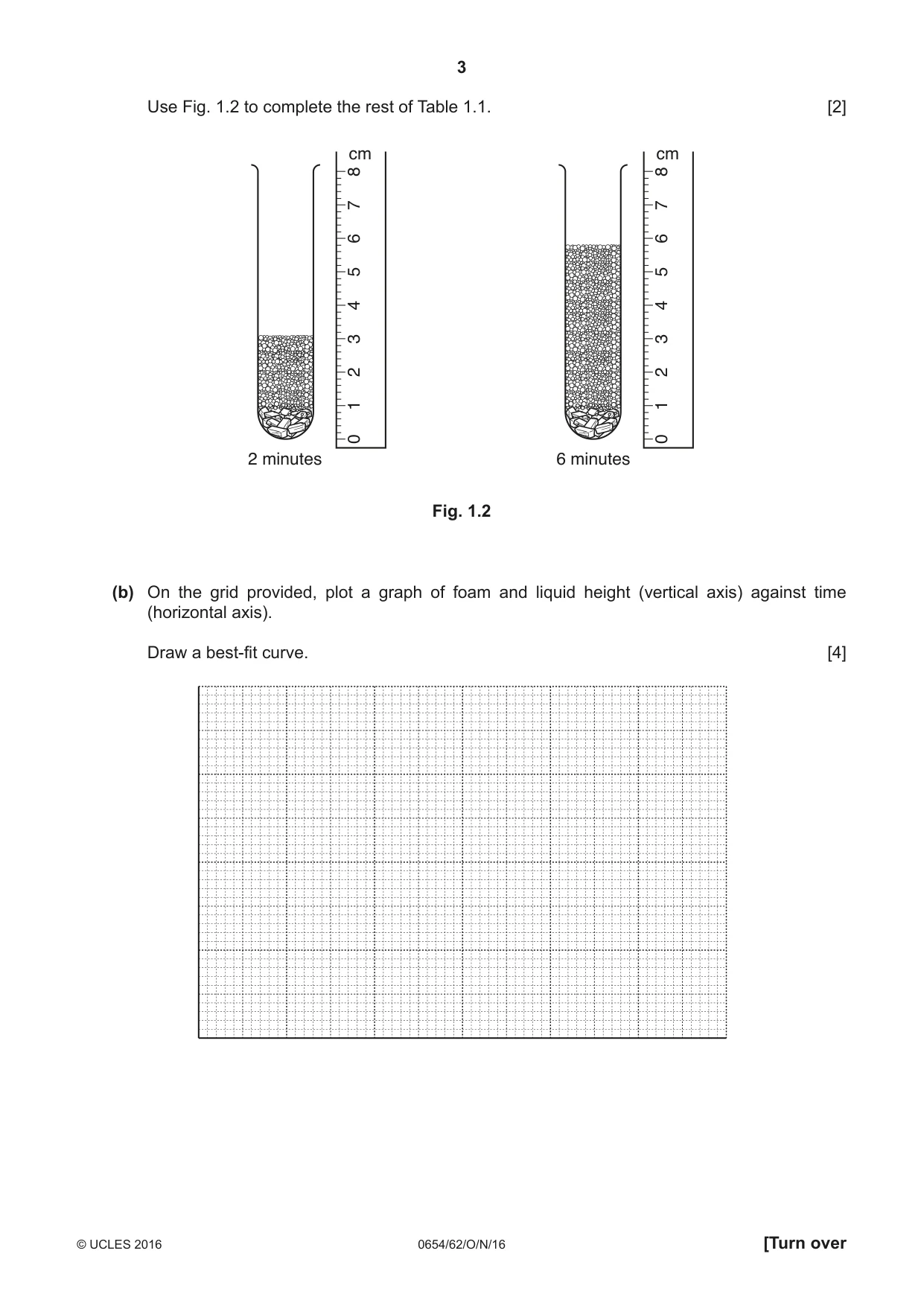
3 0654/62/O/N/16 © UCLES 2016 [Turn over Use Fig. 1.2 to complete the rest of Table 1.1. [2] 2 minutes cm 6 minutes 0 1 2 3 4 8 5 6 7 cm 0 1 2 3 4 8 5 6 7 Fig. 1.2 (b) On the grid provided, plot a graph of foam and liquid height (vertical axis) against time (horizontal axis). Draw a best-fit curve. [4]
Question paper, page 4
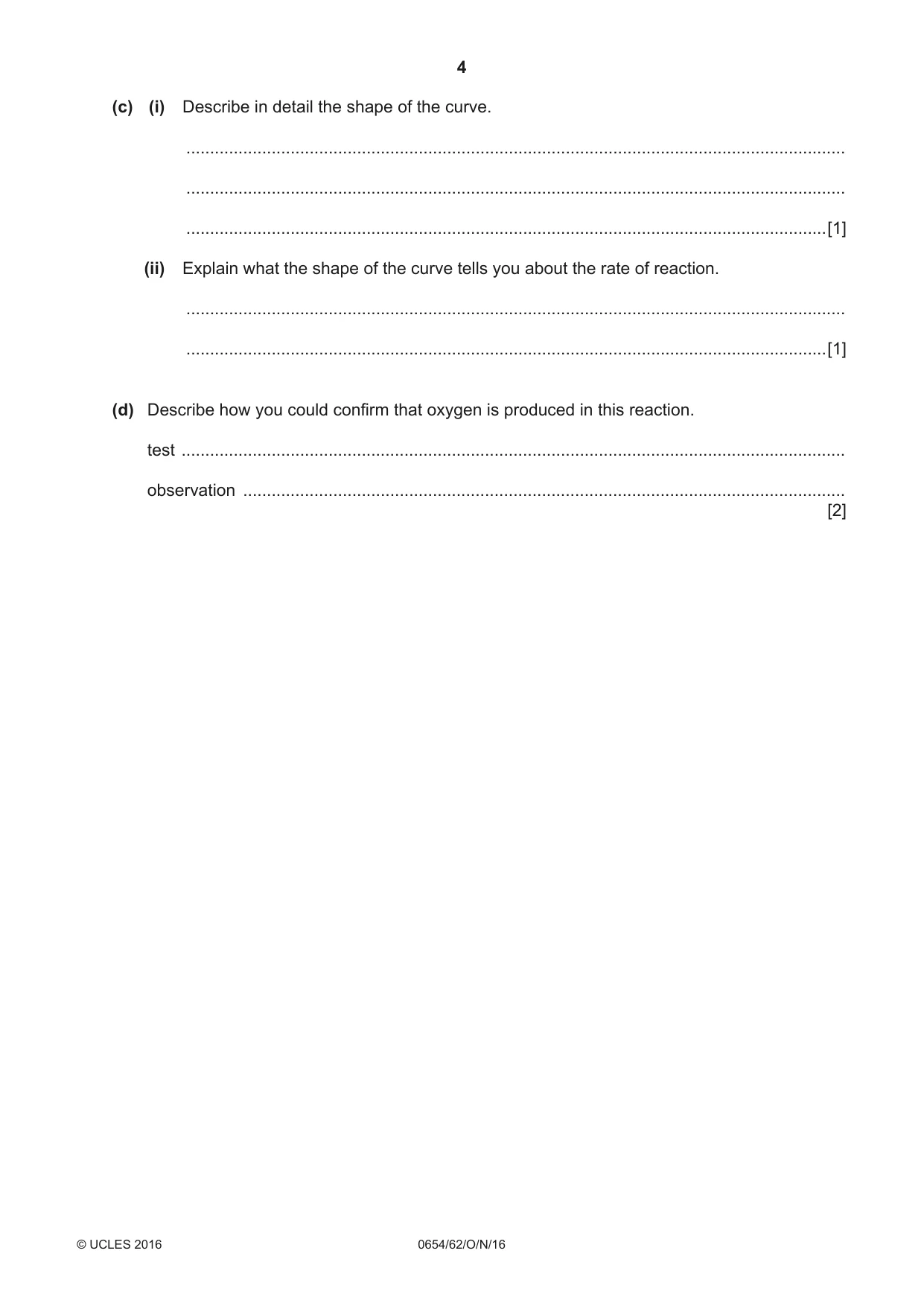
4 0654/62/O/N/16 © UCLES 2016 (c) (i) Describe in detail the shape of the curve. … … …[1] (ii) Explain what the shape of the curve tells you about the rate of reaction. … …[1] (d) Describe how you could confirm that oxygen is produced in this reaction. test … observation … [2]
Question paper, page 5
5 0654/62/O/N/16 © UCLES 2016 [Turn over Please turn over for Question 2.
Question paper, page 6
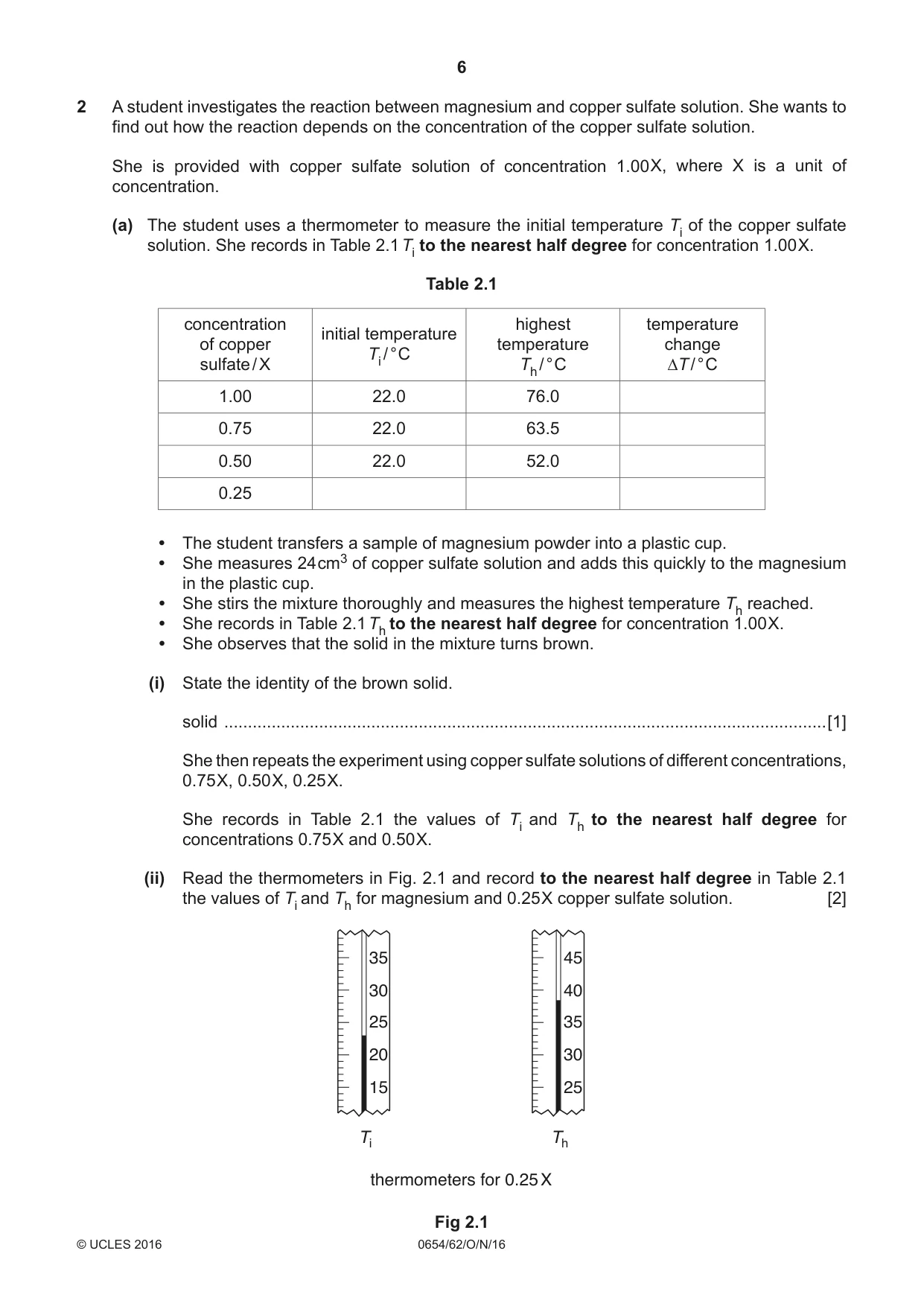
6 0654/62/O/N/16 © UCLES 2016 2 A student investigates the reaction between magnesium and copper sulfate solution. She wants to find out how the reaction depends on the concentration of the copper sulfate solution. She is provided with copper sulfate solution of concentration 1.00 X, where X is a unit of concentration. (a) The student uses a thermometer to measure the initial temperature Ti of the copper sulfate solution. She records in Table 2.1 Ti to the nearest half degree for concentration 1.00 X. Table 2.1 concentration of copper sulfate / X initial temperature Ti / ° C highest temperature Th / ° C temperature change ∆T / ° C 1.00 22.0 76.0 0.75 22.0 63.5 0.50 22.0 52.0 0.25 • The student transfers a sample of magnesium powder into a plastic cup. • She measures 24 cm3 of copper sulfate solution and adds this quickly to the magnesium in the plastic cup. • She stirs the mixture thoroughly and measures the highest temperature Th reached. • She records in Table 2.1 Th to the nearest half degree for concentration 1.00 X. • She observes that the solid in the mixture turns brown. (i) State the identity of the brown solid. solid …[1] She then repeats the experiment using copper sulfate solutions of different concentrations, 0.75 X, 0.50 X, 0.25 X. She records in Table 2.1 the values of Ti and Th to the nearest half degree for concentrations 0.75 X and 0.50 X. (ii) Read the thermometers in Fig. 2.1 and record to the nearest half degree in Table 2.1 the values of Ti and Th for magnesium and 0.25 X copper sulfate solution. [2] 35 30 25 15 20 45 40 35 25 30 thermometers for 0.25 X Th Ti Fig 2.1
Question paper, page 7
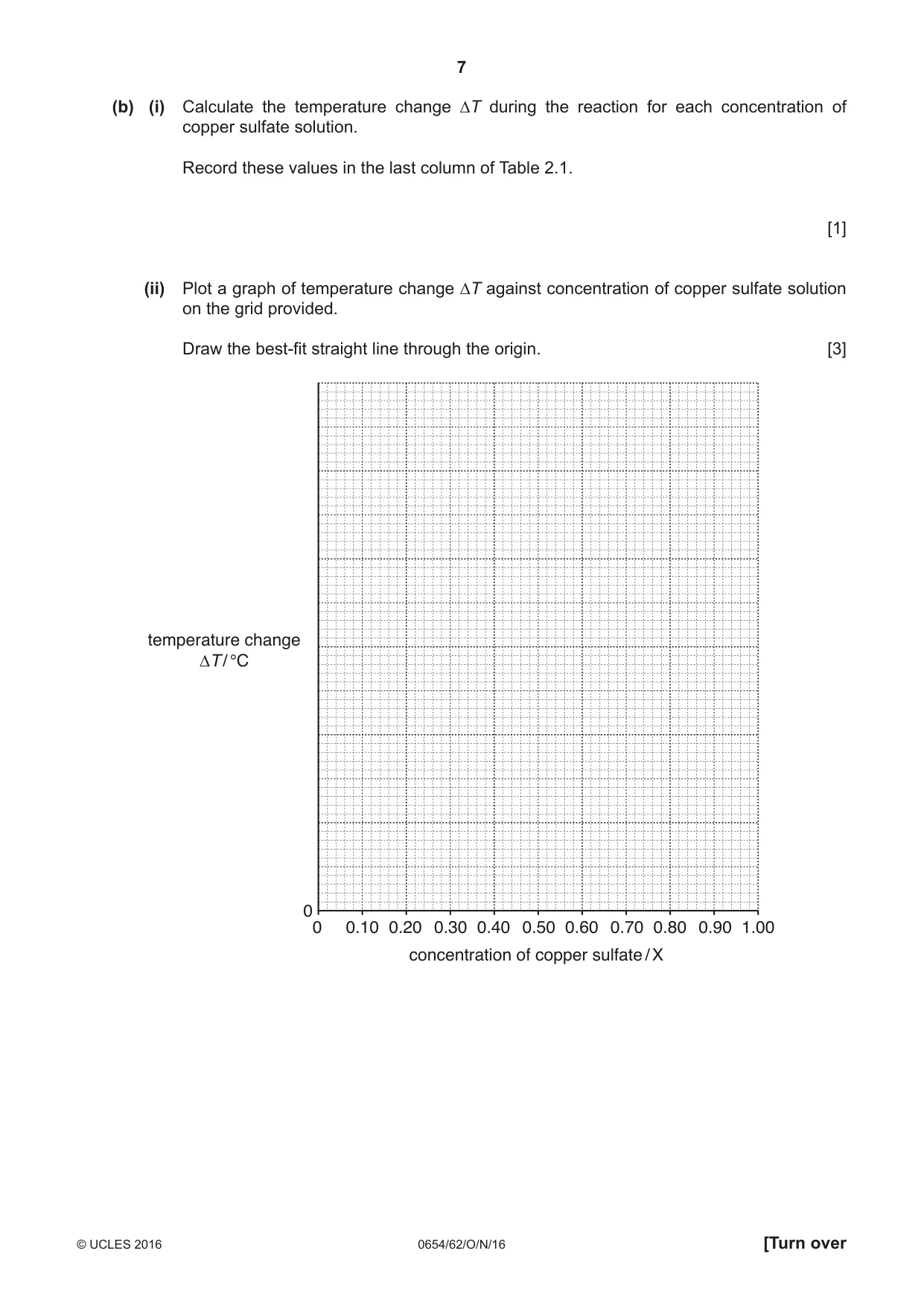
7 0654/62/O/N/16 © UCLES 2016 [Turn over (b) (i) Calculate the temperature change ∆T during the reaction for each concentration of copper sulfate solution. Record these values in the last column of Table 2.1. [1] (ii) Plot a graph of temperature change ∆T against concentration of copper sulfate solution on the grid provided. Draw the best-fit straight line through the origin. [3] temperature change ∆T / °C concentration of copper sulfate / X 0 0 0.20 0.40 0.60 0.80 1.00 0.10 0.30 0.50 0.70 0.90
Question paper, page 8
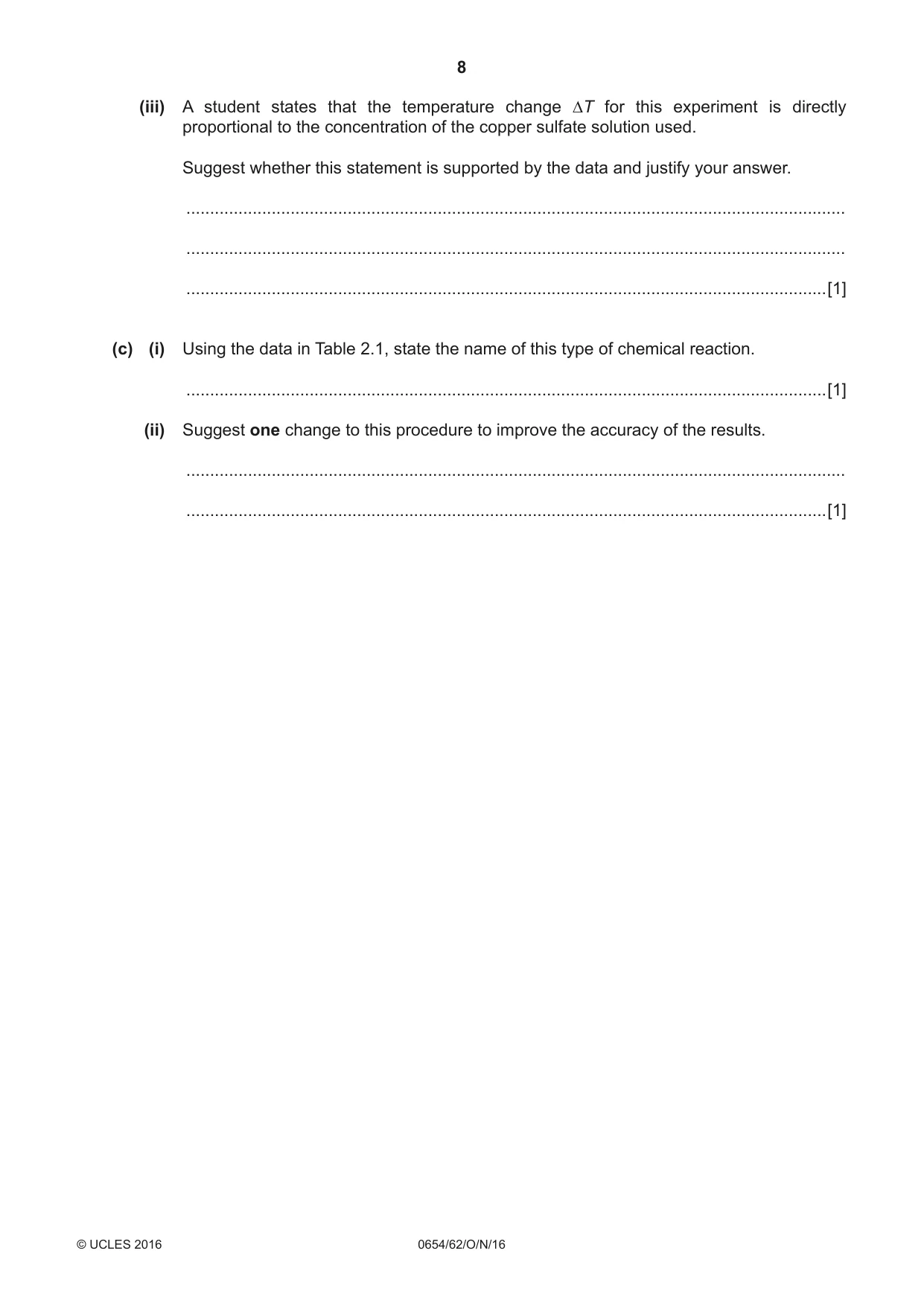
8 0654/62/O/N/16 © UCLES 2016 (iii) A student states that the temperature change ∆T for this experiment is directly proportional to the concentration of the copper sulfate solution used. Suggest whether this statement is supported by the data and justify your answer. … … …[1] (c) (i) Using the data in Table 2.1, state the name of this type of chemical reaction. …[1] (ii) Suggest one change to this procedure to improve the accuracy of the results. … …[1]
Question paper, page 9
9 0654/62/O/N/16 © UCLES 2016 [Turn over Please turn over for Question 3.
Question paper, page 10
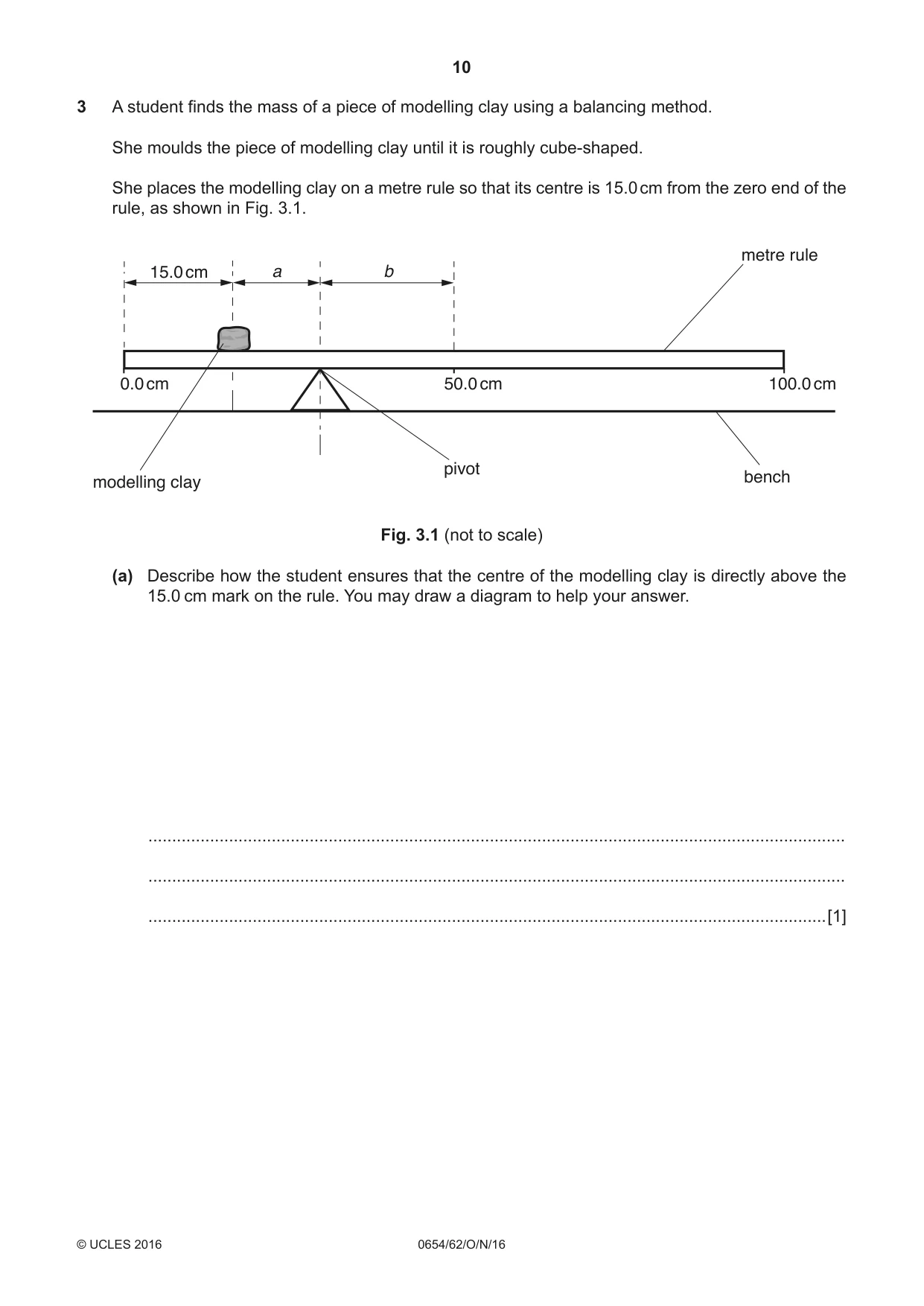
10 0654/62/O/N/16 © UCLES 2016 3 A student finds the mass of a piece of modelling clay using a balancing method. She moulds the piece of modelling clay until it is roughly cube-shaped. She places the modelling clay on a metre rule so that its centre is 15.0 cm from the zero end of the rule, as shown in Fig. 3.1. 0.0 cm 50.0 cm 100.0 cm 15.0 cm a b modelling clay pivot metre rule bench Fig. 3.1 (not to scale) (a) Describe how the student ensures that the centre of the modelling clay is directly above the 15.0 cm mark on the rule. You may draw a diagram to help your answer. … … …[1]
Question paper, page 11
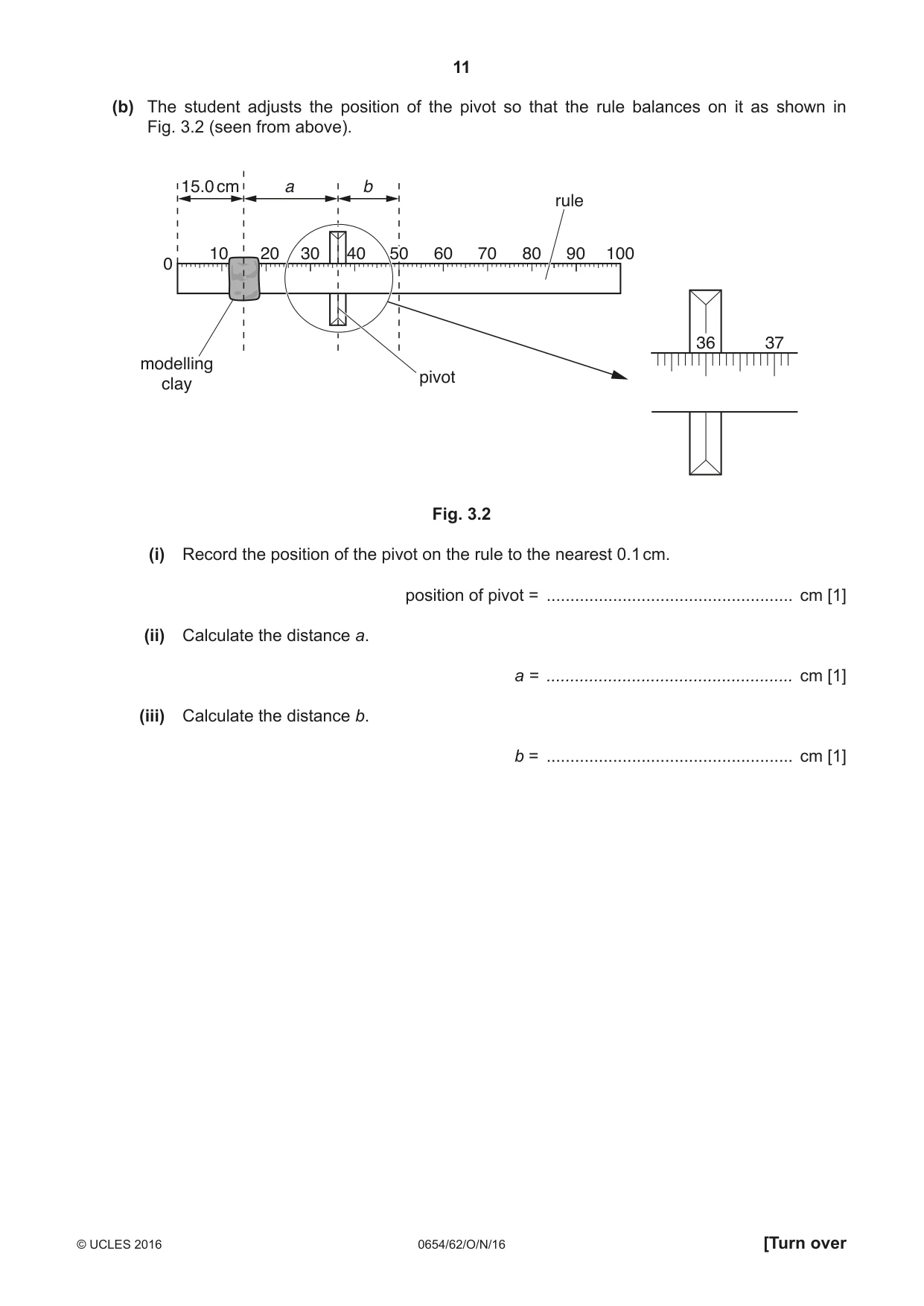
11 0654/62/O/N/16 © UCLES 2016 [Turn over (b) The student adjusts the position of the pivot so that the rule balances on it as shown in Fig. 3.2 (seen from above). 15.0 cm 0 modelling clay pivot a b 10 20 30 40 50 60 70 80 90 100 rule 37 36 Fig. 3.2 (i) Record the position of the pivot on the rule to the nearest 0.1 cm. position of pivot = … cm [1] (ii) Calculate the distance a. a = … cm [1] (iii) Calculate the distance b. b = … cm [1]
Question paper, page 12
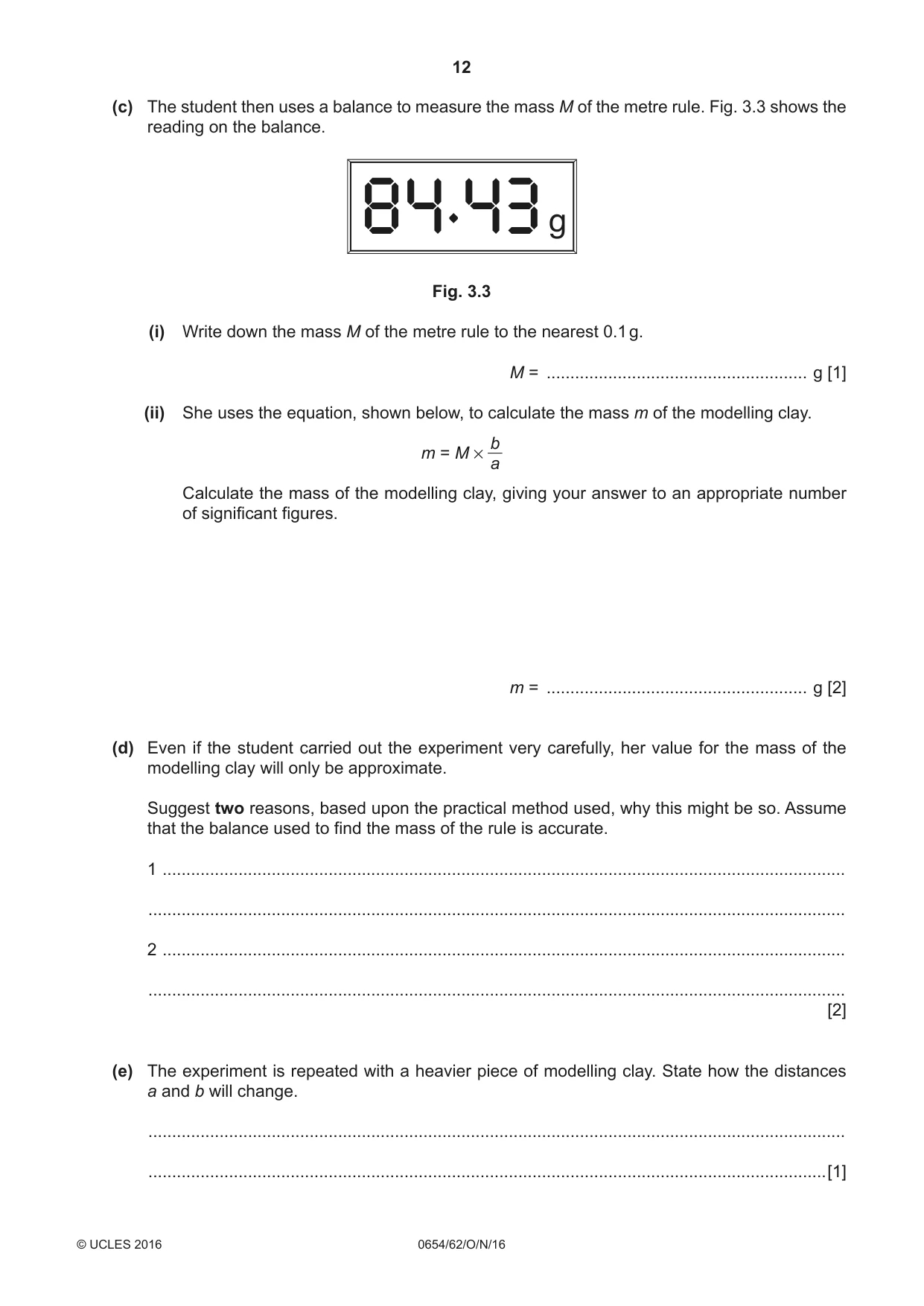
12 0654/62/O/N/16 © UCLES 2016 (c) The student then uses a balance to measure the mass M of the metre rule. Fig. 3.3 shows the reading on the balance. g Fig. 3.3 (i) Write down the mass M of the metre rule to the nearest 0.1 g. M = … g [1] (ii) She uses the equation, shown below, to calculate the mass m of the modelling clay. m = M × b a Calculate the mass of the modelling clay, giving your answer to an appropriate number of significant figures. m = … g [2] (d) Even if the student carried out the experiment very carefully, her value for the mass of the modelling clay will only be approximate. Suggest two reasons, based upon the practical method used, why this might be so. Assume that the balance used to find the mass of the rule is accurate. 1 … … 2 … … [2] (e) The experiment is repeated with a heavier piece of modelling clay. State how the distances a and b will change. … …[1]
Question paper, page 13
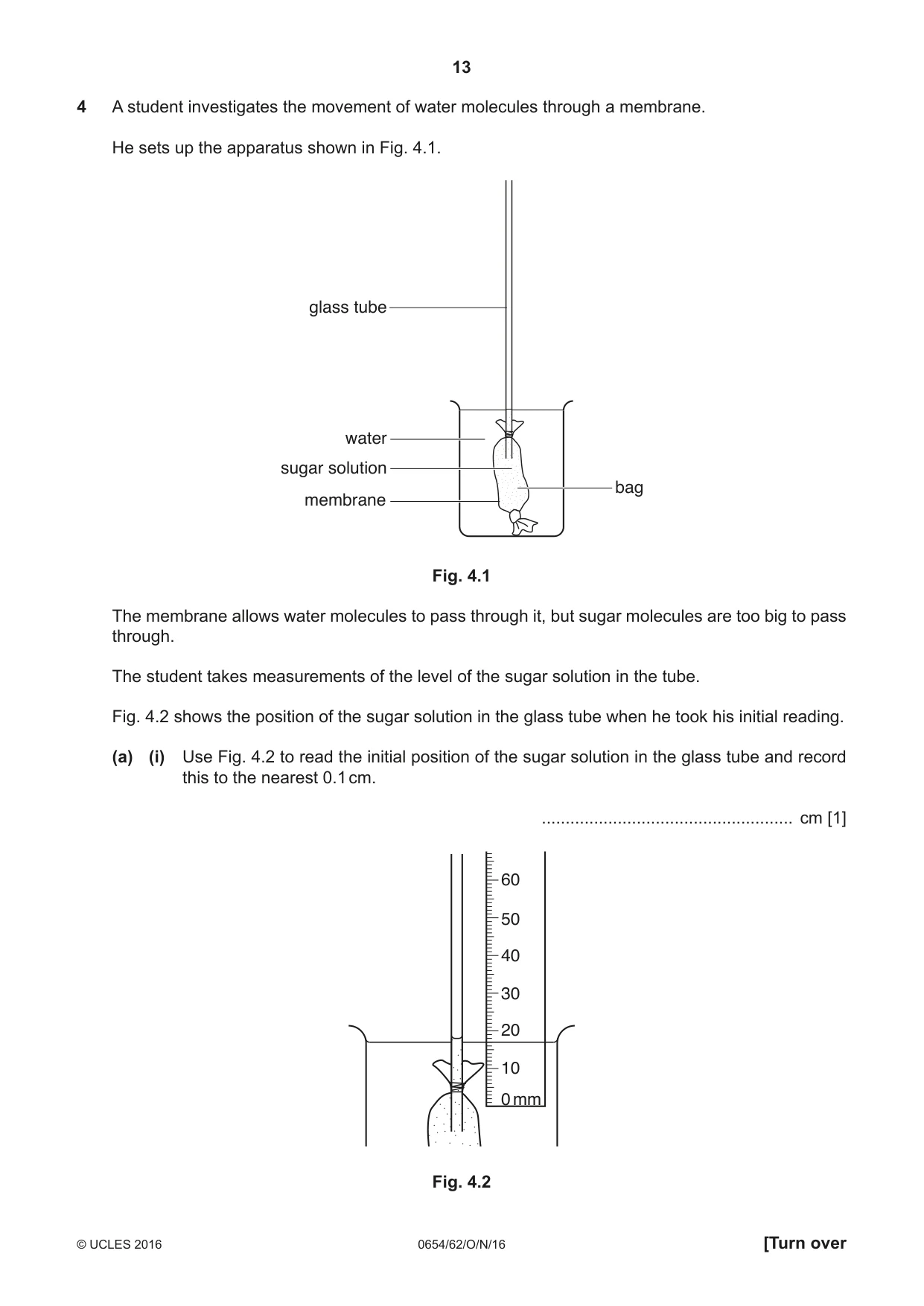
13 0654/62/O/N/16 © UCLES 2016 [Turn over 4 A student investigates the movement of water molecules through a membrane. He sets up the apparatus shown in Fig. 4.1. membrane sugar solution bag water glass tube Fig. 4.1 The membrane allows water molecules to pass through it, but sugar molecules are too big to pass through. The student takes measurements of the level of the sugar solution in the tube. Fig. 4.2 shows the position of the sugar solution in the glass tube when he took his initial reading. (a) (i) Use Fig. 4.2 to read the initial position of the sugar solution in the glass tube and record this to the nearest 0.1 cm. … cm [1] 10 0 mm 20 30 40 50 60 Fig. 4.2
Question paper, page 14
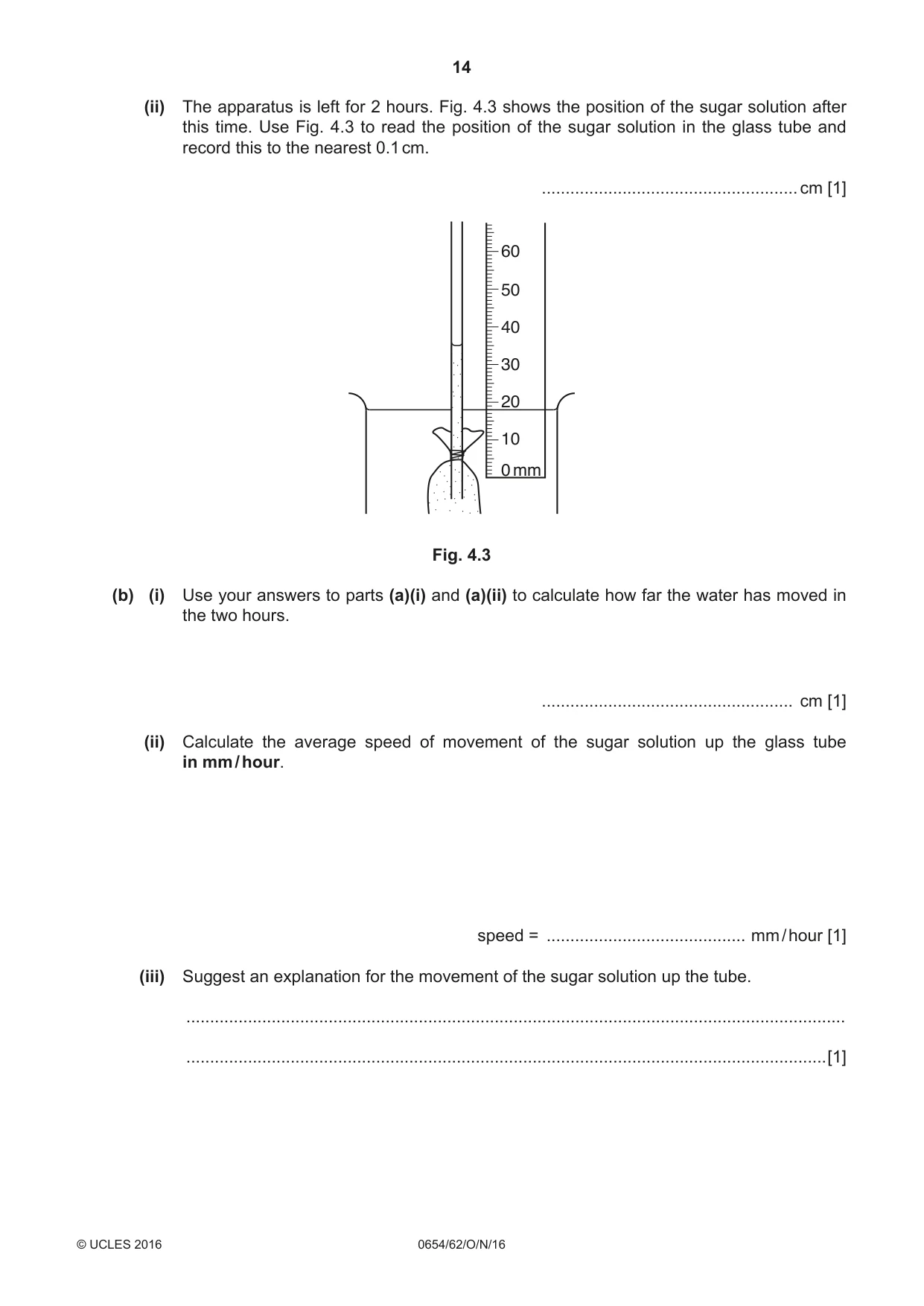
14 0654/62/O/N/16 © UCLES 2016 (ii) The apparatus is left for 2 hours. Fig. 4.3 shows the position of the sugar solution after this time. Use Fig. 4.3 to read the position of the sugar solution in the glass tube and record this to the nearest 0.1 cm. …cm [1] 10 0 mm 20 30 40 50 60 Fig. 4.3 (b) (i) Use your answers to parts (a)(i) and (a)(ii) to calculate how far the water has moved in the two hours. … cm [1] (ii) Calculate the average speed of movement of the sugar solution up the glass tube in mm / hour. speed = … mm / hour [1] (iii) Suggest an explanation for the movement of the sugar solution up the tube. … …[1]
Question paper, page 15
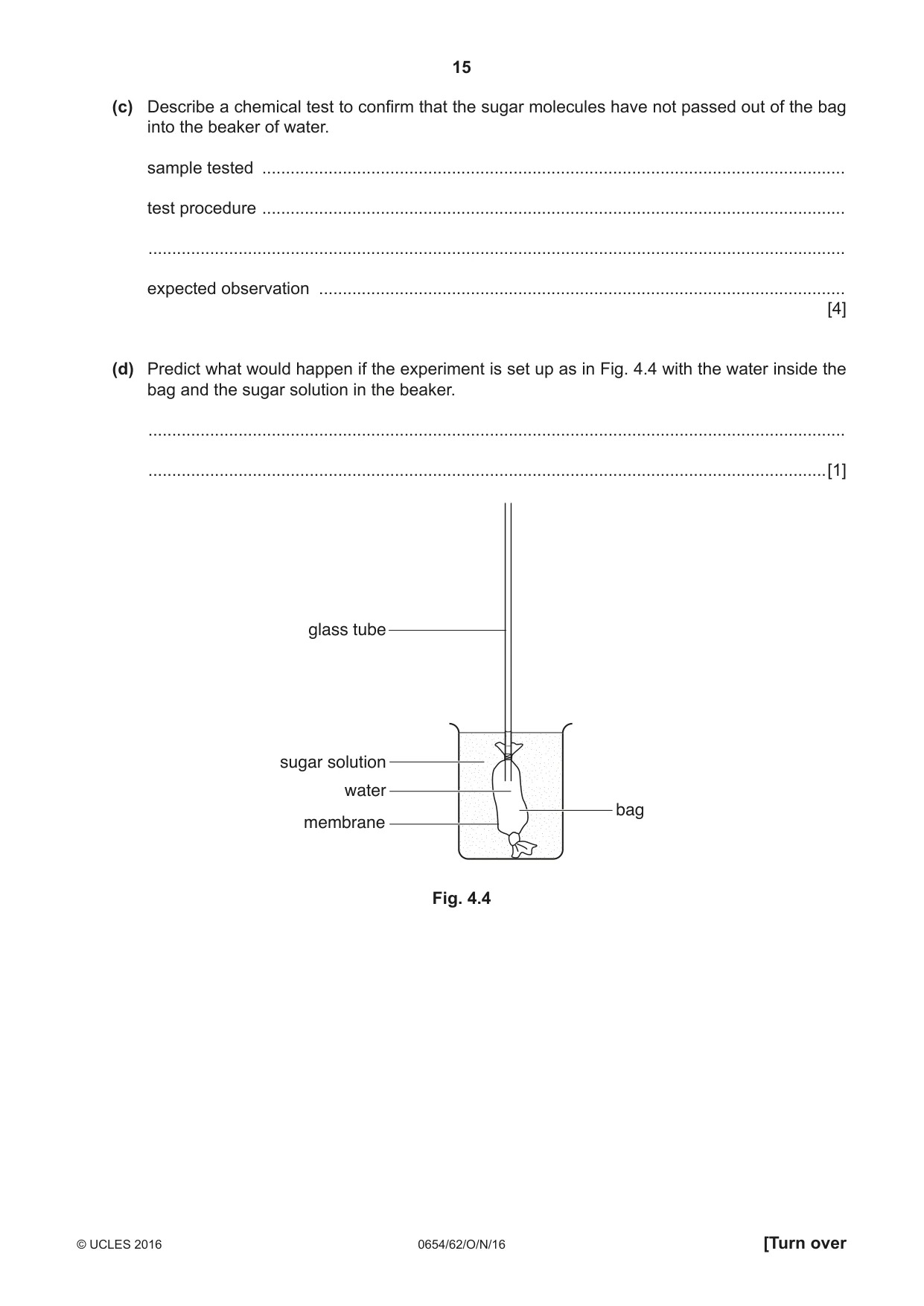
15 0654/62/O/N/16 © UCLES 2016 [Turn over (c) Describe a chemical test to confirm that the sugar molecules have not passed out of the bag into the beaker of water. sample tested … test procedure … … expected observation … [4] (d) Predict what would happen if the experiment is set up as in Fig. 4.4 with the water inside the bag and the sugar solution in the beaker. … …[1] membrane sugar solution water bag glass tube Fig. 4.4
Question paper, page 16
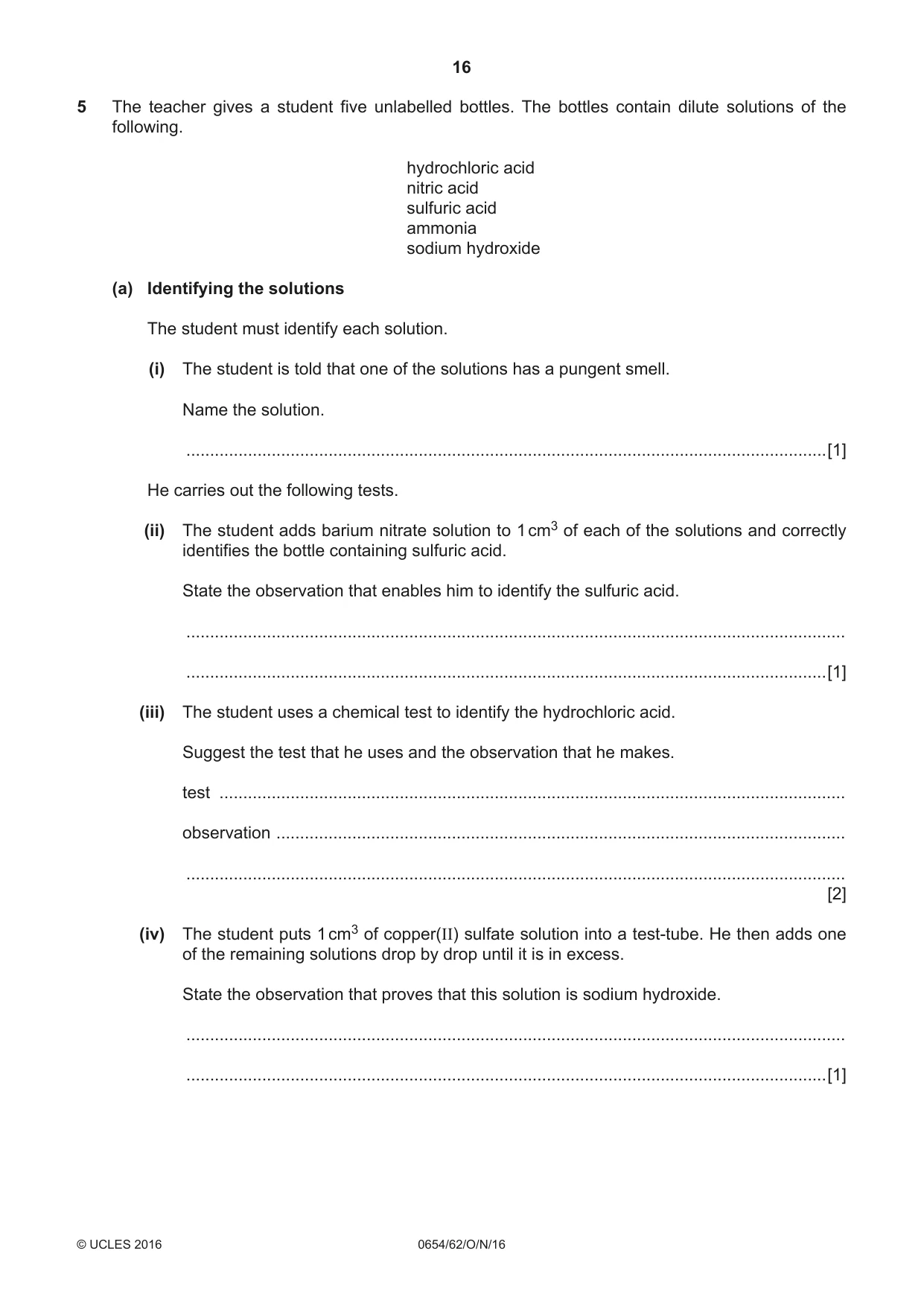
16 0654/62/O/N/16 © UCLES 2016 5 The teacher gives a student five unlabelled bottles. The bottles contain dilute solutions of the following. hydrochloric acid nitric acid sulfuric acid ammonia sodium hydroxide (a) Identifying the solutions The student must identify each solution. (i) The student is told that one of the solutions has a pungent smell. Name the solution. …[1] He carries out the following tests. (ii) The student adds barium nitrate solution to 1 cm3 of each of the solutions and correctly identifies the bottle containing sulfuric acid. State the observation that enables him to identify the sulfuric acid. … …[1] (iii) The student uses a chemical test to identify the hydrochloric acid. Suggest the test that he uses and the observation that he makes. test … observation … … [2] (iv) The student puts 1 cm3 of copper(II) sulfate solution into a test-tube. He then adds one of the remaining solutions drop by drop until it is in excess. State the observation that proves that this solution is sodium hydroxide. … …[1]
Question paper, page 17
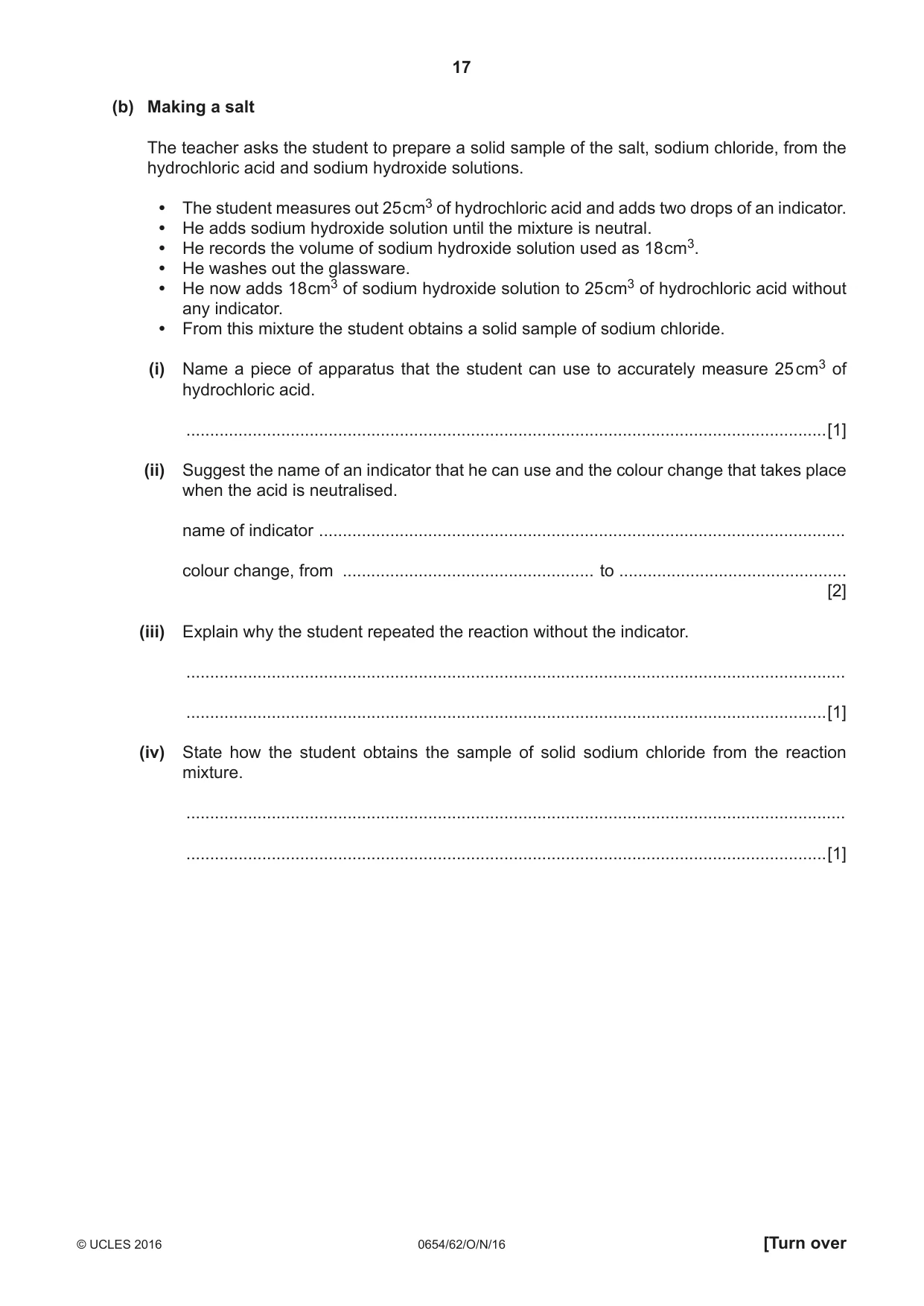
17 0654/62/O/N/16 © UCLES 2016 [Turn over (b) Making a salt The teacher asks the student to prepare a solid sample of the salt, sodium chloride, from the hydrochloric acid and sodium hydroxide solutions. • The student measures out 25 cm3 of hydrochloric acid and adds two drops of an indicator. • He adds sodium hydroxide solution until the mixture is neutral. • He records the volume of sodium hydroxide solution used as 18 cm3. • He washes out the glassware. • He now adds 18 cm3 of sodium hydroxide solution to 25 cm3 of hydrochloric acid without any indicator. • From this mixture the student obtains a solid sample of sodium chloride. (i) Name a piece of apparatus that the student can use to accurately measure 25 cm3 of hydrochloric acid. …[1] (ii) Suggest the name of an indicator that he can use and the colour change that takes place when the acid is neutralised. name of indicator … colour change, from … to … [2] (iii) Explain why the student repeated the reaction without the indicator. … …[1] (iv) State how the student obtains the sample of solid sodium chloride from the reaction mixture. … …[1]
Question paper, page 18
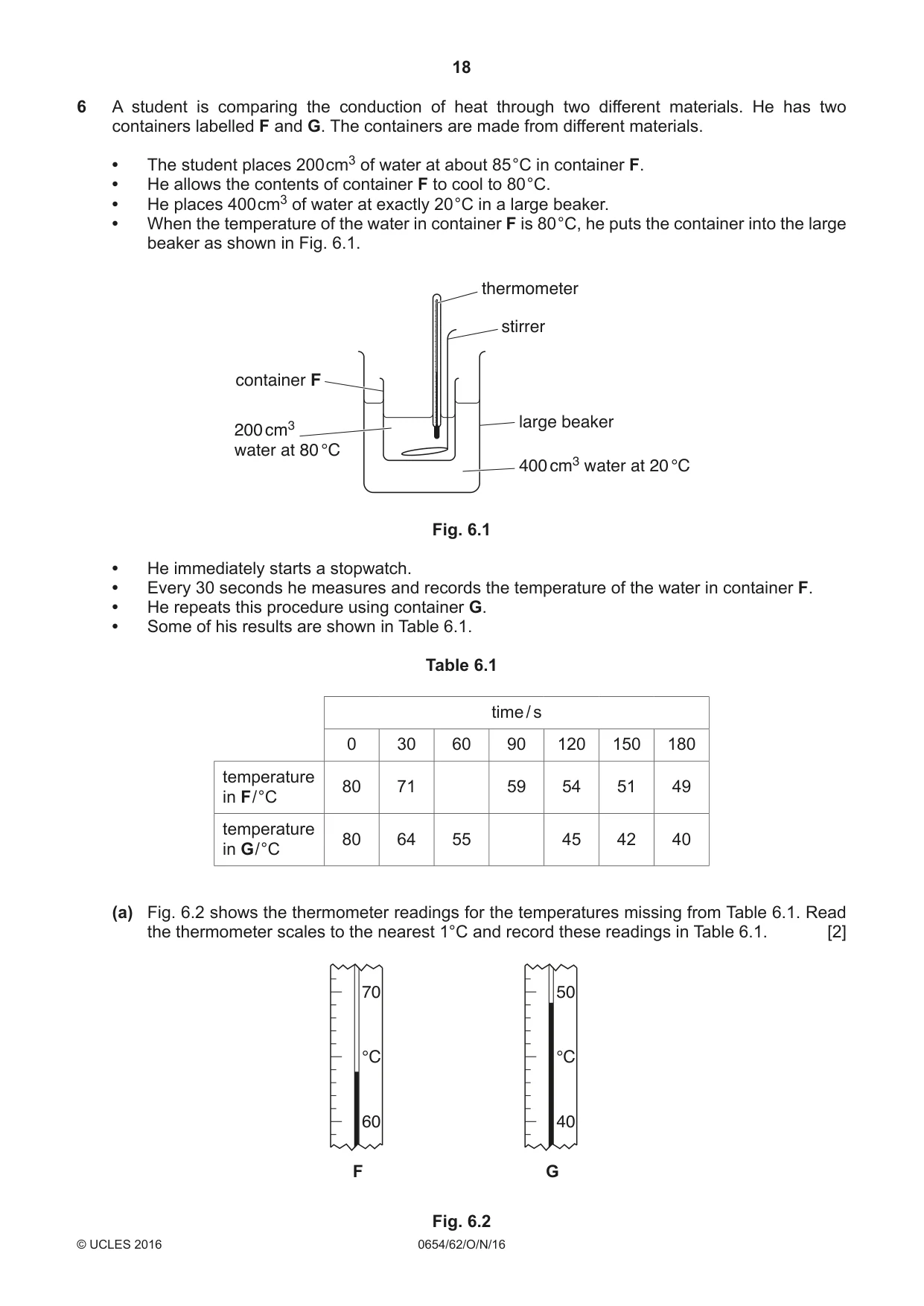
18 0654/62/O/N/16 © UCLES 2016 6 A student is comparing the conduction of heat through two different materials. He has two containers labelled F and G. The containers are made from different materials. • The student places 200 cm3 of water at about 85 °C in container F. • He allows the contents of container F to cool to 80 °C. • He places 400 cm3 of water at exactly 20 °C in a large beaker. • When the temperature of the water in container F is 80 °C, he puts the container into the large beaker as shown in Fig. 6.1. thermometer stirrer large beaker 400 cm3 water at 20 °C 200 cm3 water at 80 °C container F Fig. 6.1 • He immediately starts a stopwatch. • Every 30 seconds he measures and records the temperature of the water in container F. • He repeats this procedure using container G. • Some of his results are shown in Table 6.1. Table 6.1 time / s 0 30 60 90 120 150 180 temperature in F / °C 80 71 59 54 51 49 temperature in G / °C 80 64 55 45 42 40 (a) Fig. 6.2 shows the thermometer readings for the temperatures missing from Table 6.1. Read the thermometer scales to the nearest 1°C and record these readings in Table 6.1. [2] 50 40 70 60 °C °C G F Fig. 6.2
Question paper, page 19
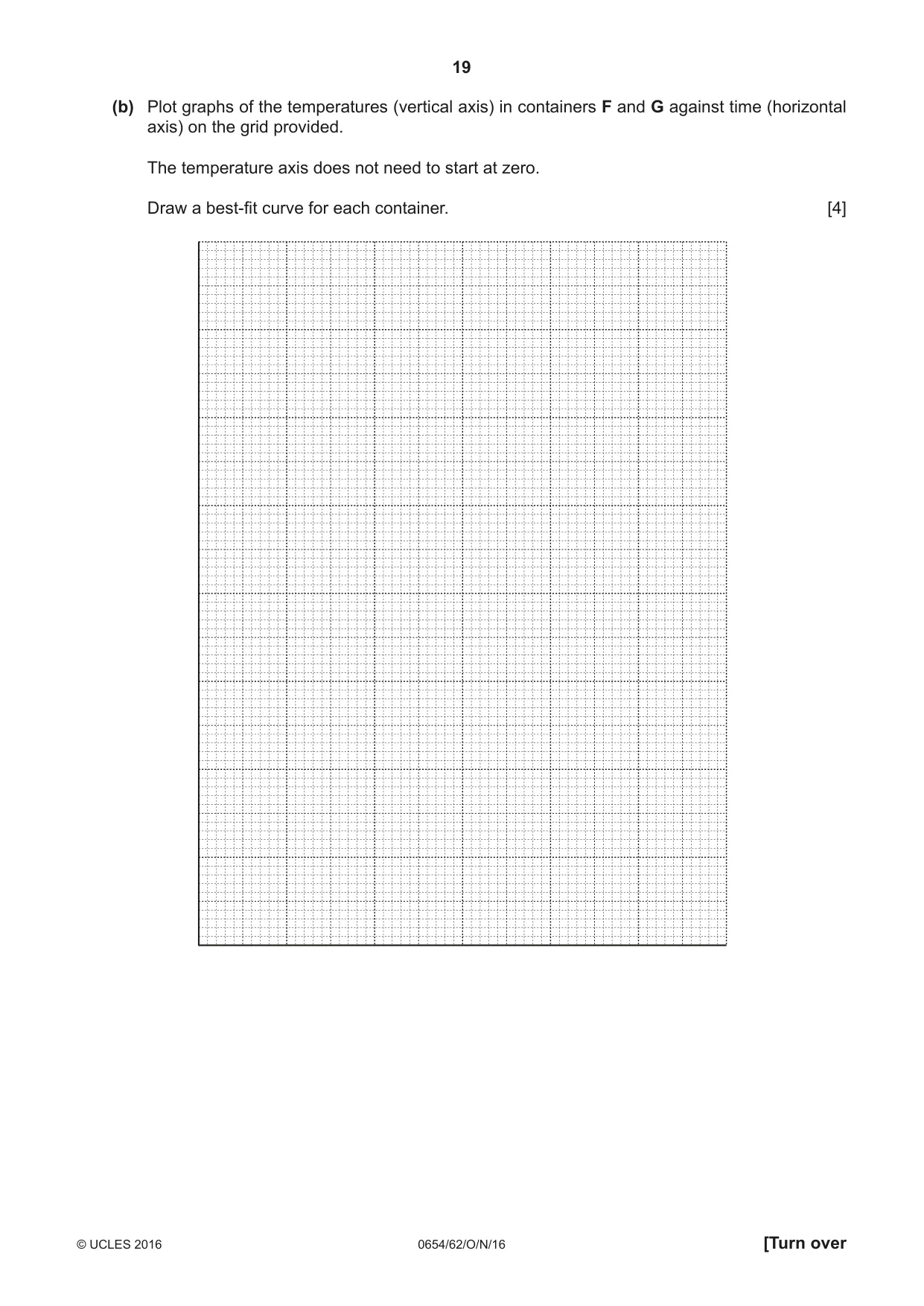
19 0654/62/O/N/16 © UCLES 2016 [Turn over (b) Plot graphs of the temperatures (vertical axis) in containers F and G against time (horizontal axis) on the grid provided. The temperature axis does not need to start at zero. Draw a best-fit curve for each container. [4]
Question paper, page 20
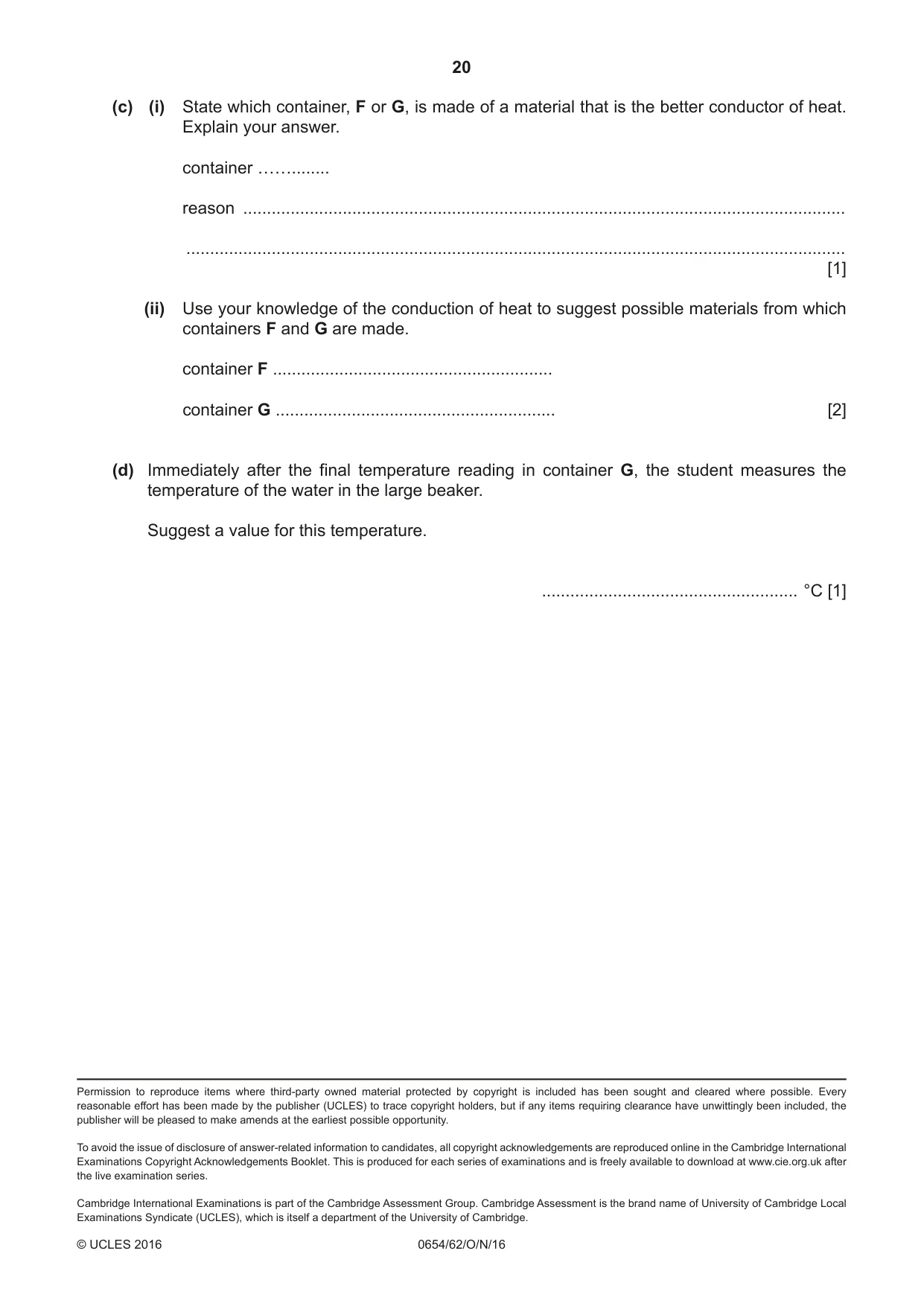
20 0654/62/O/N/16 © UCLES 2016 Permission to reproduce items where third-party owned material protected by copyright is included has been sought and cleared where possible. Every reasonable effort has been made by the publisher (UCLES) to trace copyright holders, but if any items requiring clearance have unwittingly been included, the publisher will be pleased to make amends at the earliest possible opportunity. To avoid the issue of disclosure of answer-related information to candidates, all copyright acknowledgements are reproduced online in the Cambridge International Examinations Copyright Acknowledgements Booklet. This is produced for each series of examinations and is freely available to download at www.cie.org.uk after the live examination series. Cambridge International Examinations is part of the Cambridge Assessment Group. Cambridge Assessment is the brand name of University of Cambridge Local Examinations Syndicate (UCLES), which is itself a department of the University of Cambridge. (c) (i) State which container, F or G, is made of a material that is the better conductor of heat. Explain your answer. container ……… reason … … [1] (ii) Use your knowledge of the conduction of heat to suggest possible materials from which containers F and G are made. container F … container G … [2] (d) Immediately after the final temperature reading in container G, the student measures the temperature of the water in the large beaker. Suggest a value for this temperature. … °C [1]
Mark scheme, page 1
® IGCSE is the registered trademark of Cambridge International Examinations. This document consists of 5 printed pages. © UCLES 2016 [Turn over Cambridge International Examinations Cambridge International General Certificate of Secondary Education CO-ORDINATED SCIENCES 0654/62 Paper 6 Alternative to Practical October/November 2016 MARK SCHEME Maximum Mark: 60 Published This mark scheme is published as an aid to teachers and candidates, to indicate the requirements of the examination. It shows the basis on which Examiners were instructed to award marks. It does not indicate the details of the discussions that took place at an Examiners’ meeting before marking began, which would have considered the acceptability of alternative answers. Mark schemes should be read in conjunction with the question paper and the Principal Examiner Report for Teachers. Cambridge will not enter into discussions about these mark schemes. Cambridge is publishing the mark schemes for the October/November 2016 series for most Cambridge IGCSE®, Cambridge International A and AS Level components and some Cambridge O Level components.
Mark scheme, page 2
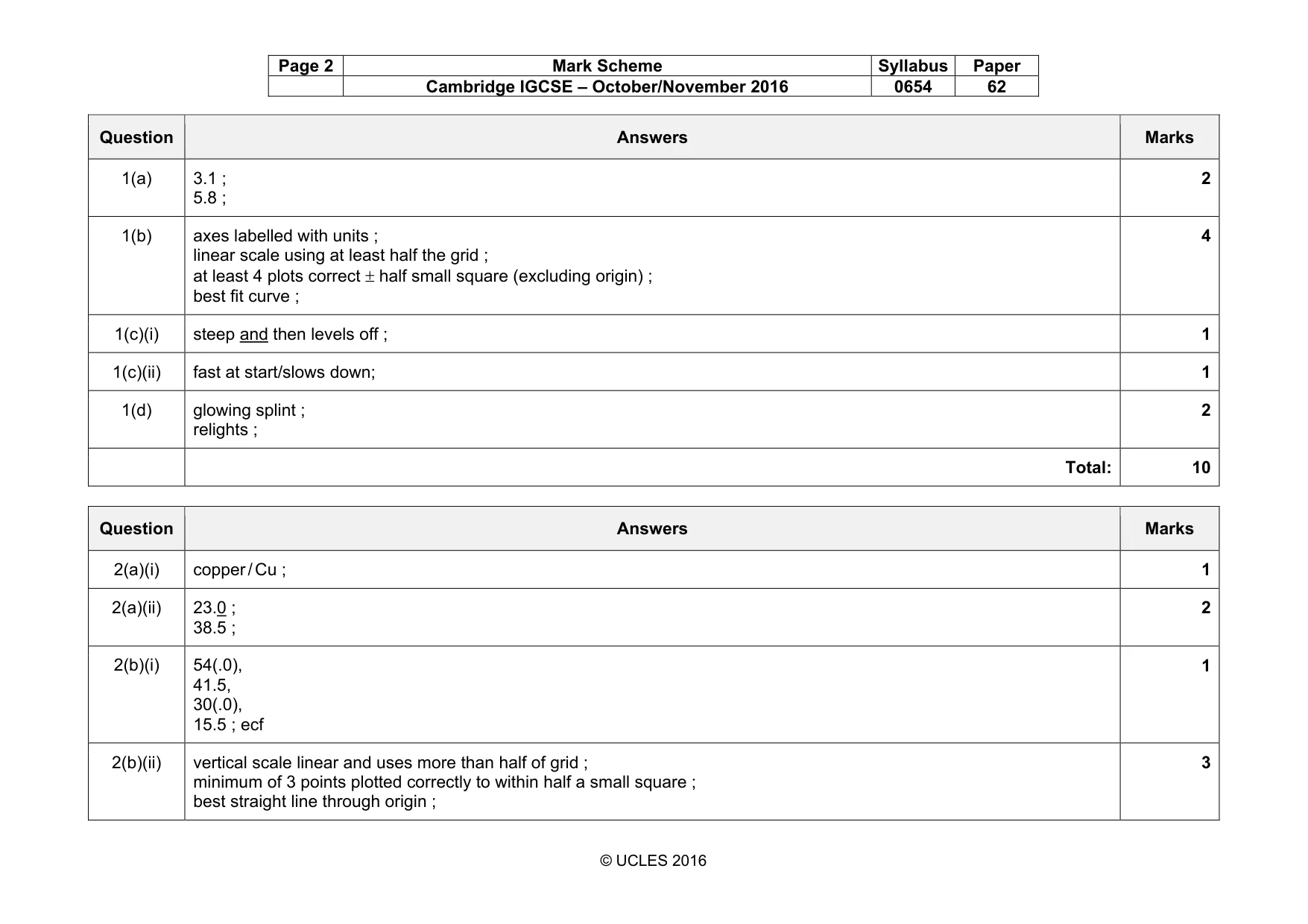
Page 2 Mark Scheme Syllabus Paper Cambridge IGCSE – October/November 2016 0654 62 © UCLES 2016 Question Answers Marks 1(a) 3.1 ; 5.8 ; 2 1(b) axes labelled with units ; linear scale using at least half the grid ; at least 4 plots correct ± half small square (excluding origin) ; best fit curve ; 4 1(c)(i) steep and then levels off ; 1 1(c)(ii) fast at start/slows down; 1 1(d) glowing splint ; relights ; 2 Total: 10 Question Answers Marks 2(a)(i) copper / Cu ; 1 2(a)(ii) 23.0 ; 38.5 ; 2 2(b)(i) 54(.0), 41.5, 30(.0), 15.5 ; ecf 1 2(b)(ii) vertical scale linear and uses more than half of grid ; minimum of 3 points plotted correctly to within half a small square ; best straight line through origin ; 3
Mark scheme, page 3
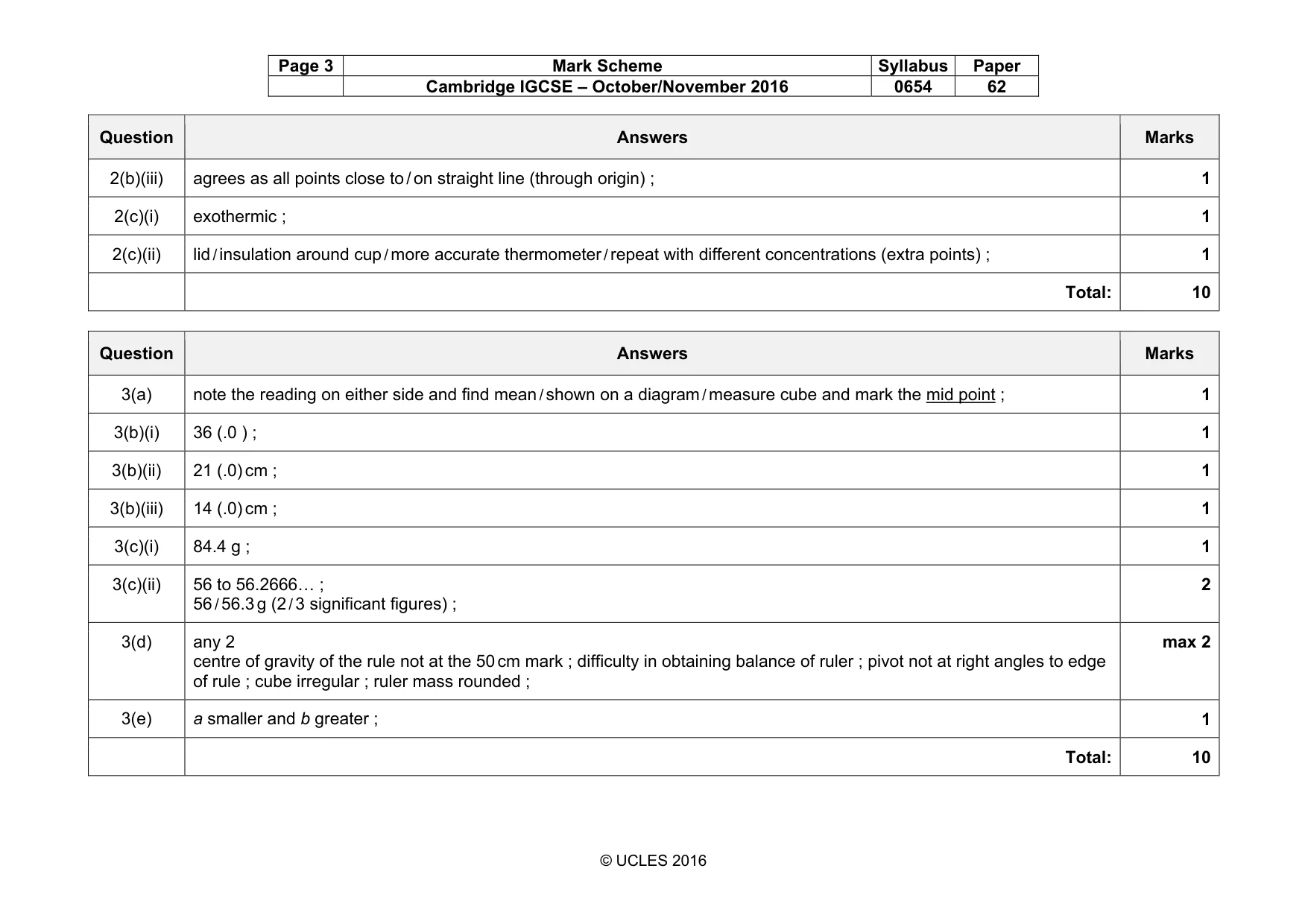
Page 3 Mark Scheme Syllabus Paper Cambridge IGCSE – October/November 2016 0654 62 © UCLES 2016 Question Answers Marks 2(b)(iii) agrees as all points close to / on straight line (through origin) ; 1 2(c)(i) exothermic ; 1 2(c)(ii) lid / insulation around cup / more accurate thermometer / repeat with different concentrations (extra points) ; 1 Total: 10 Question Answers Marks 3(a) note the reading on either side and find mean / shown on a diagram / measure cube and mark the mid point ; 1 3(b)(i) 36 (.0 ) ; 1 3(b)(ii) 21 (.0) cm ; 1 3(b)(iii) 14 (.0) cm ; 1 3(c)(i) 84.4 g ; 1 3(c)(ii) 56 to 56.2666… ; 56 / 56.3 g (2 / 3 significant figures) ; 2 3(d) any 2 centre of gravity of the rule not at the 50 cm mark ; difficulty in obtaining balance of ruler ; pivot not at right angles to edge of rule ; cube irregular ; ruler mass rounded ; max 2 3(e) a smaller and b greater ; 1 Total: 10
Mark scheme, page 4
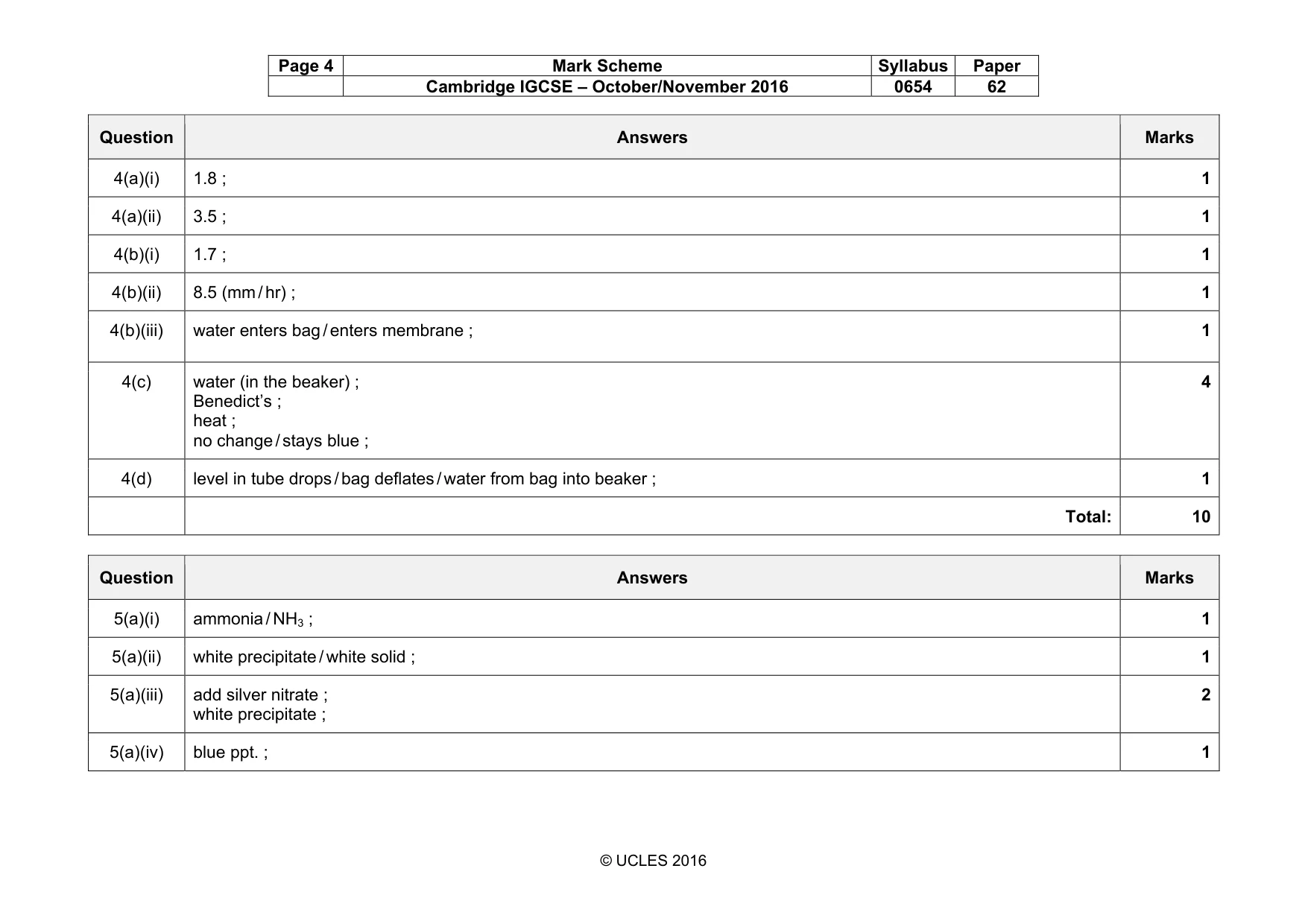
Page 4 Mark Scheme Syllabus Paper Cambridge IGCSE – October/November 2016 0654 62 © UCLES 2016 Question Answers Marks 4(a)(i) 1.8 ; 1 4(a)(ii) 3.5 ; 1 4(b)(i) 1.7 ; 1 4(b)(ii) 8.5 (mm / hr) ; 1 4(b)(iii) water enters bag / enters membrane ; 1 4(c) water (in the beaker) ; Benedict’s ; heat ; no change / stays blue ; 4 4(d) level in tube drops / bag deflates / water from bag into beaker ; 1 Total: 10 Question Answers Marks 5(a)(i) ammonia / NH3 ; 1 5(a)(ii) white precipitate / white solid ; 1 5(a)(iii) add silver nitrate ; white precipitate ; 2 5(a)(iv) blue ppt. ; 1
Mark scheme, page 5
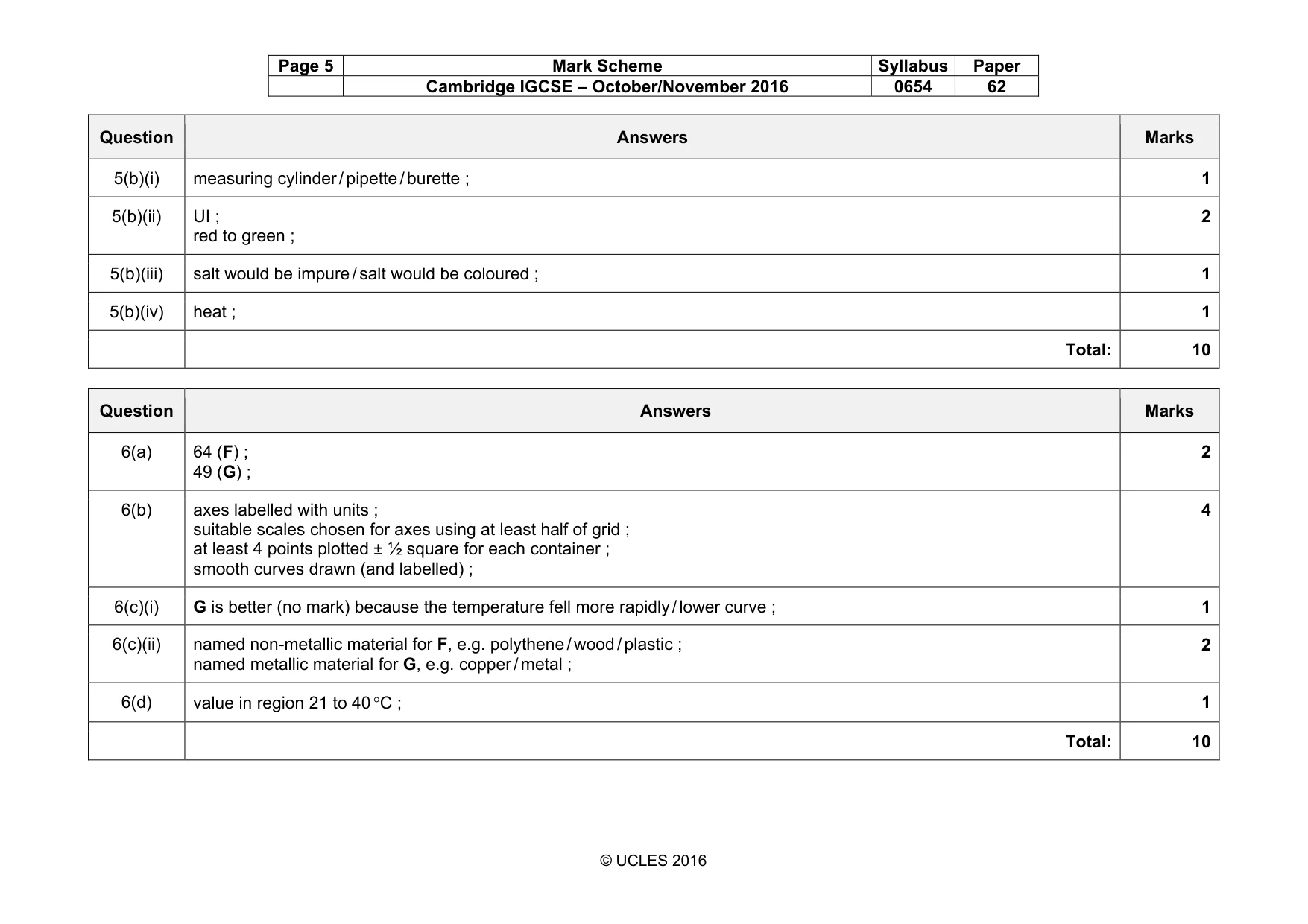
Page 5 Mark Scheme Syllabus Paper Cambridge IGCSE – October/November 2016 0654 62 © UCLES 2016 Question Answers Marks 5(b)(i) measuring cylinder / pipette / burette ; 1 5(b)(ii) UI ; red to green ; 2 5(b)(iii) salt would be impure / salt would be coloured ; 1 5(b)(iv) heat ; 1 Total: 10 Question Answers Marks 6(a) 64 (F) ; 49 (G) ; 2 6(b) axes labelled with units ; suitable scales chosen for axes using at least half of grid ; at least 4 points plotted ± ½ square for each container ; smooth curves drawn (and labelled) ; 4 6(c)(i) G is better (no mark) because the temperature fell more rapidly / lower curve ; 1 6(c)(ii) named non-metallic material for F, e.g. polythene / wood / plastic ; named metallic material for G, e.g. copper / metal ; 2 6(d) value in region 21 to 40 °C ; 1 Total: 10
What you needed in this session
Cambridge’s own grade thresholds for 2016 Oct/Nov, Paper 6 · Variant 2. A higher threshold means an easier paper — the bar moves with how the cohort did.