Cambridge IGCSE Sciences - Co-ordinated (Double) 0654 — 2015 Oct/Nov Paper 3 · Variant 1
0654/31/O/N/15 · 120 marks · ≈135 min
The question paper and its mark scheme, free to read here and free to download. This is Cambridge’s own paper, exactly as it was sat.
Question paper32 pages


Mark scheme8 pages
Answers below. Sit the paper first if you are practising.
Paper as text
Question paper, page 1
This document consists of 30 printed pages and 2 blank pages. DC (AC/SG) 102987/4 © UCLES 2015 [Turn over * 8 3 8 1 5 7 9 8 2 6 * CO-ORDINATED SCIENCES 0654/31 Paper 3 (Extended) October/November 2015 2 hours Candidates answer on the Question Paper. No Additional Materials are required. READ THESE INSTRUCTIONS FIRST Write your Centre number, candidate number and name on all the work you hand in. Write in dark blue or black pen. You may use an HB pencil for any diagrams, graphs, tables or rough working. Do not use staples, paper clips, glue or correction fluid. DO NOT WRITE IN ANY BARCODES. Answer all questions. Electronic calculators may be used. You may lose marks if you do not show your working or if you do not use appropriate units. A copy of the Periodic Table is printed on page 32. At the end of the examination, fasten all your work securely together. The number of marks is given in brackets [ ] at the end of each question or part question. Cambridge International Examinations Cambridge International General Certificate of Secondary Education
Question paper, page 2
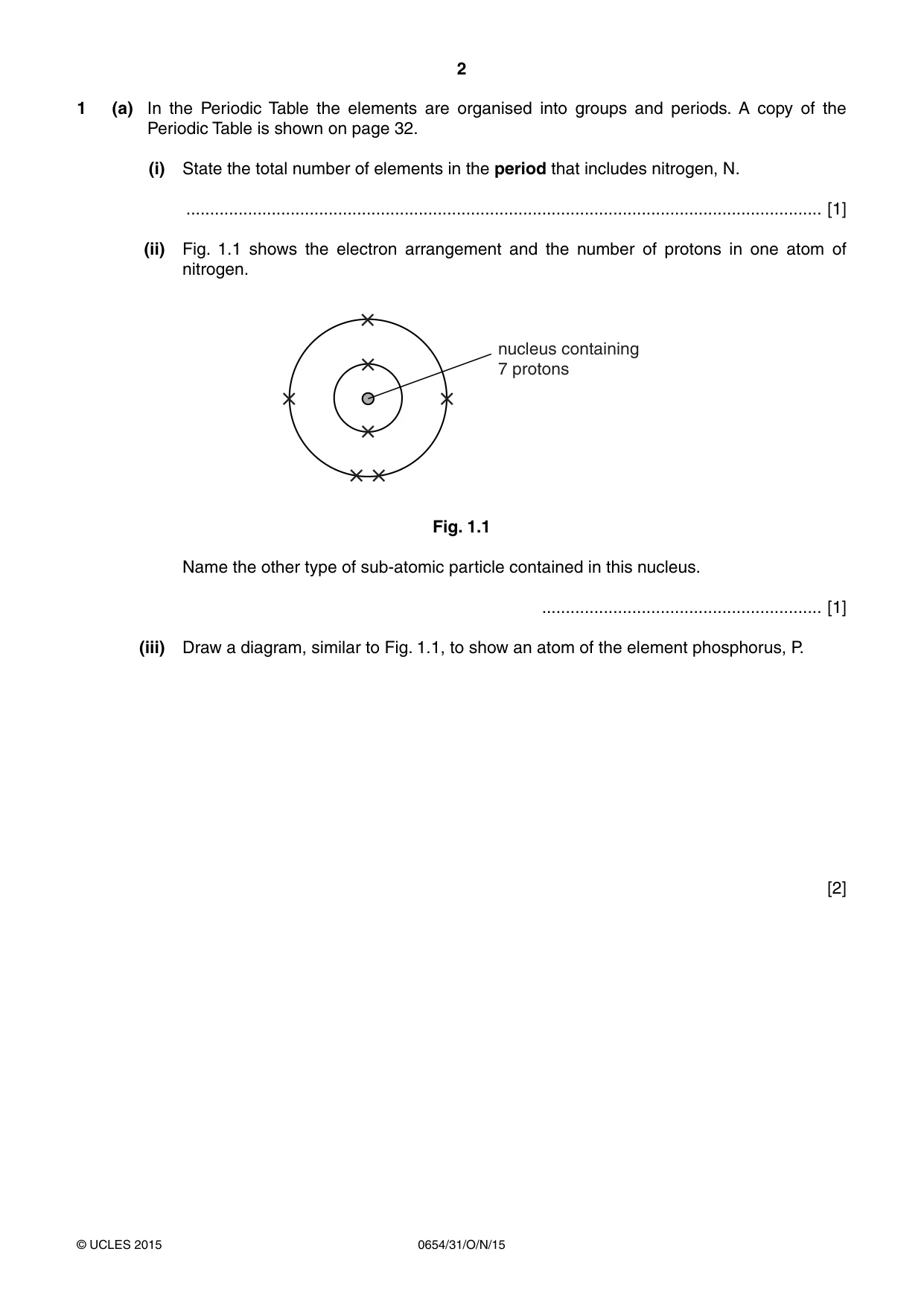
2 0654/31/O/N/15 © UCLES 2015 1 (a) In the Periodic Table the elements are organised into groups and periods. A copy of the Periodic Table is shown on page 32. (i) State the total number of elements in the period that includes nitrogen, N. … [1] (ii) Fig. 1.1 shows the electron arrangement and the number of protons in one atom of nitrogen. × × × × × × × nucleus containing 7 protons Fig. 1.1 Name the other type of sub-atomic particle contained in this nucleus. … [1] (iii) Draw a diagram, similar to Fig. 1.1, to show an atom of the element phosphorus, P. [2]
Question paper, page 3
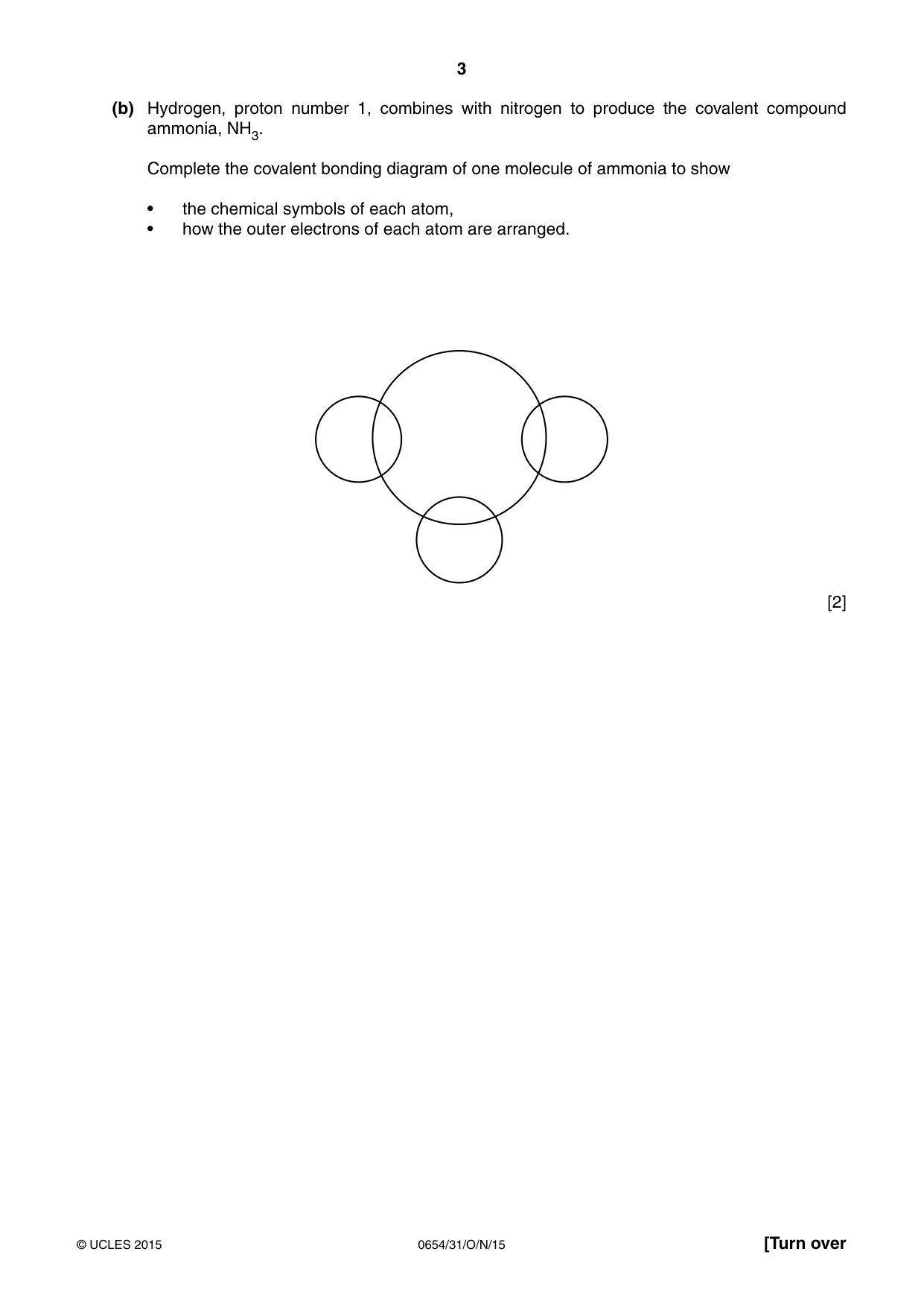
3 0654/31/O/N/15 © UCLES 2015 [Turn over (b) Hydrogen, proton number 1, combines with nitrogen to produce the covalent compound ammonia, NH3. Complete the covalent bonding diagram of one molecule of ammonia to show • the chemical symbols of each atom, • how the outer electrons of each atom are arranged. [2]
Question paper, page 4
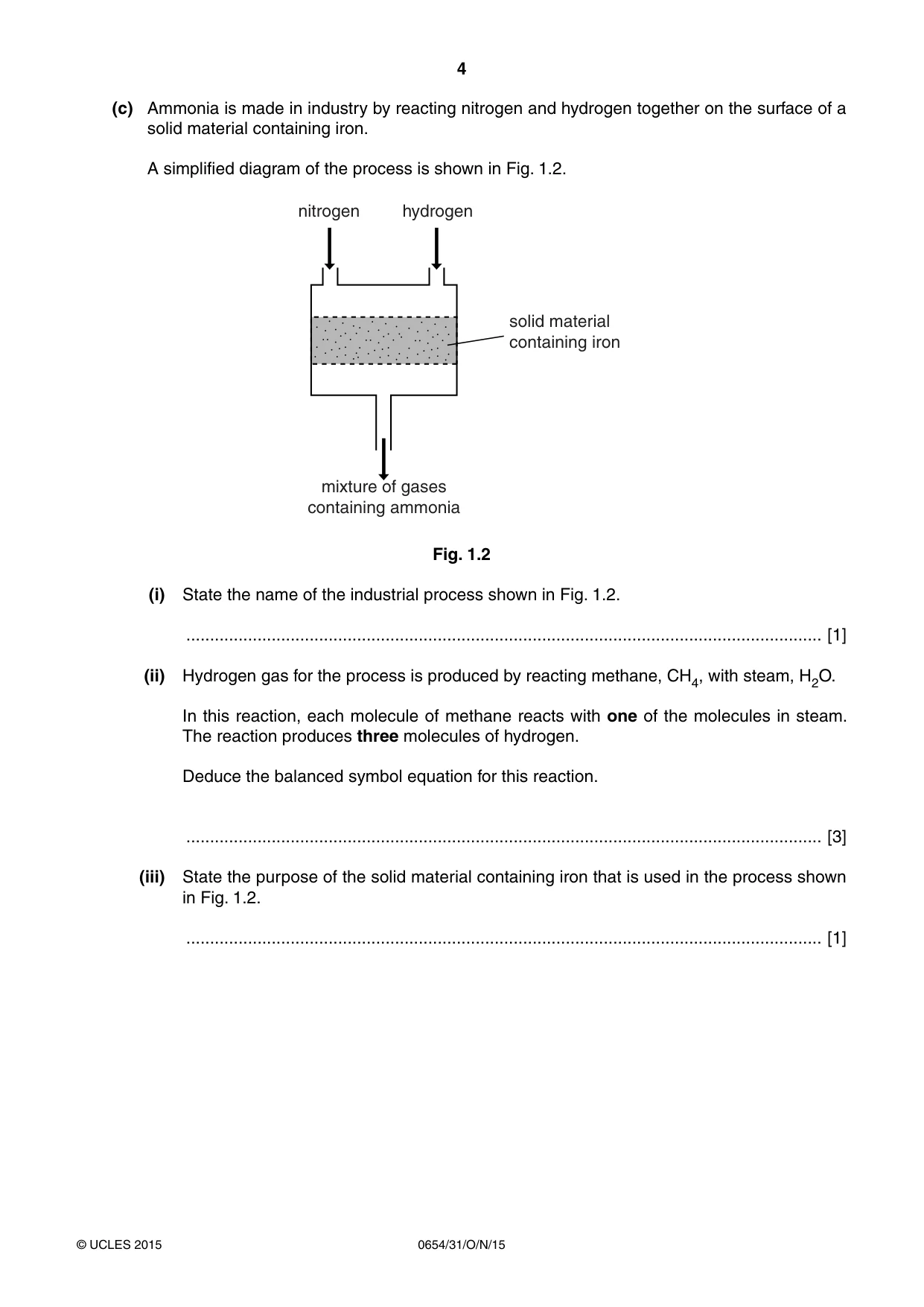
4 0654/31/O/N/15 © UCLES 2015 (c) Ammonia is made in industry by reacting nitrogen and hydrogen together on the surface of a solid material containing iron. A simplified diagram of the process is shown in Fig. 1.2. nitrogen hydrogen solid material containing iron mixture of gases containing ammonia Fig. 1.2 (i) State the name of the industrial process shown in Fig. 1.2. … [1] (ii) Hydrogen gas for the process is produced by reacting methane, CH4, with steam, H2O. In this reaction, each molecule of methane reacts with one of the molecules in steam. The reaction produces three molecules of hydrogen. Deduce the balanced symbol equation for this reaction. … [3] (iii) State the purpose of the solid material containing iron that is used in the process shown in Fig. 1.2. … [1]
Question paper, page 5
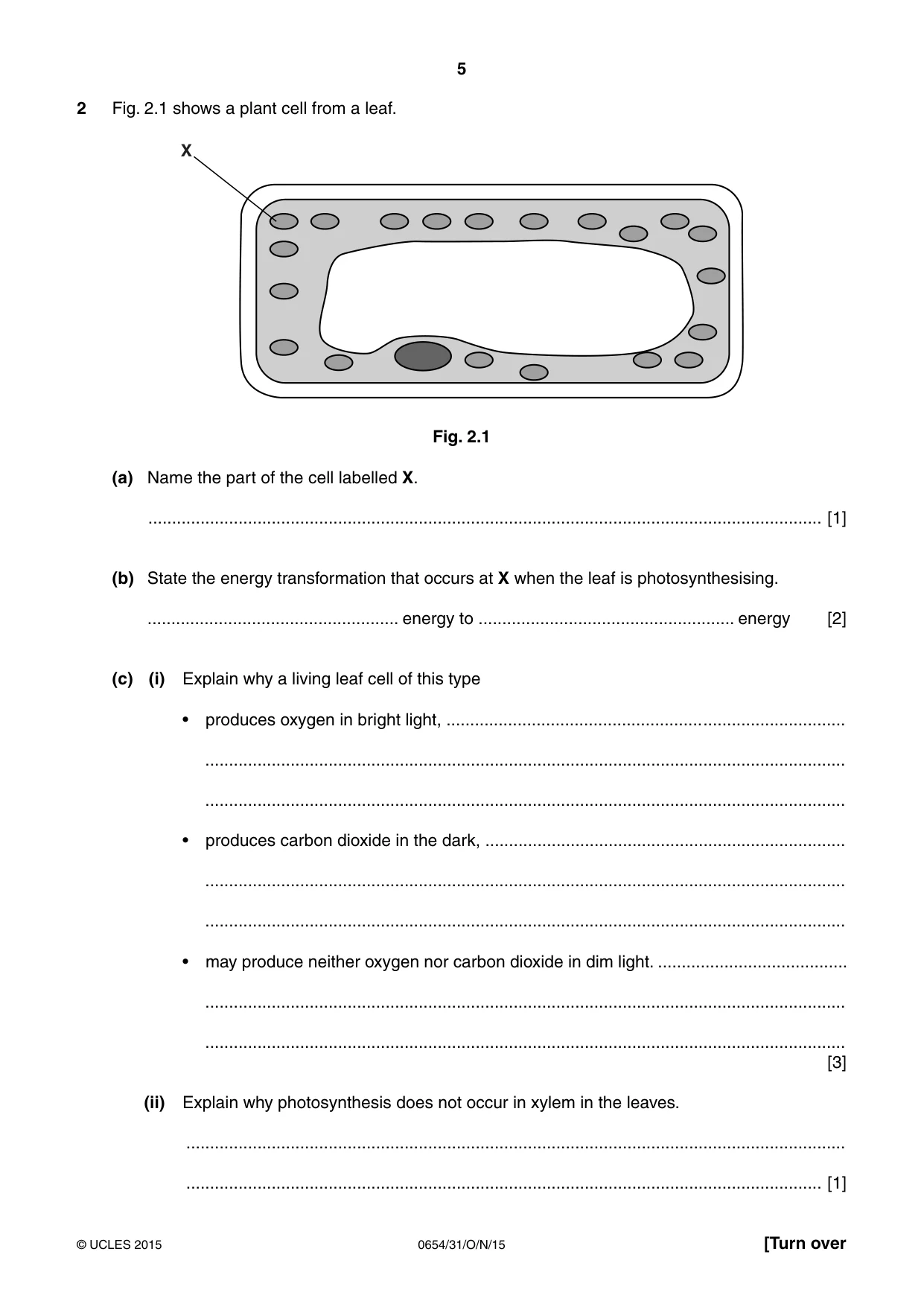
5 0654/31/O/N/15 © UCLES 2015 [Turn over 2 Fig. 2.1 shows a plant cell from a leaf. X Fig. 2.1 (a) Name the part of the cell labelled X. … [1] (b) State the energy transformation that occurs at X when the leaf is photosynthesising. … energy to … energy [2] (c) (i) Explain why a living leaf cell of this type • produces oxygen in bright light, … … … … • produces carbon dioxide in the dark, … … … … • may produce neither oxygen nor carbon dioxide in dim light. … … … [3] (ii) Explain why photosynthesis does not occur in xylem in the leaves. … … [1]
Question paper, page 6
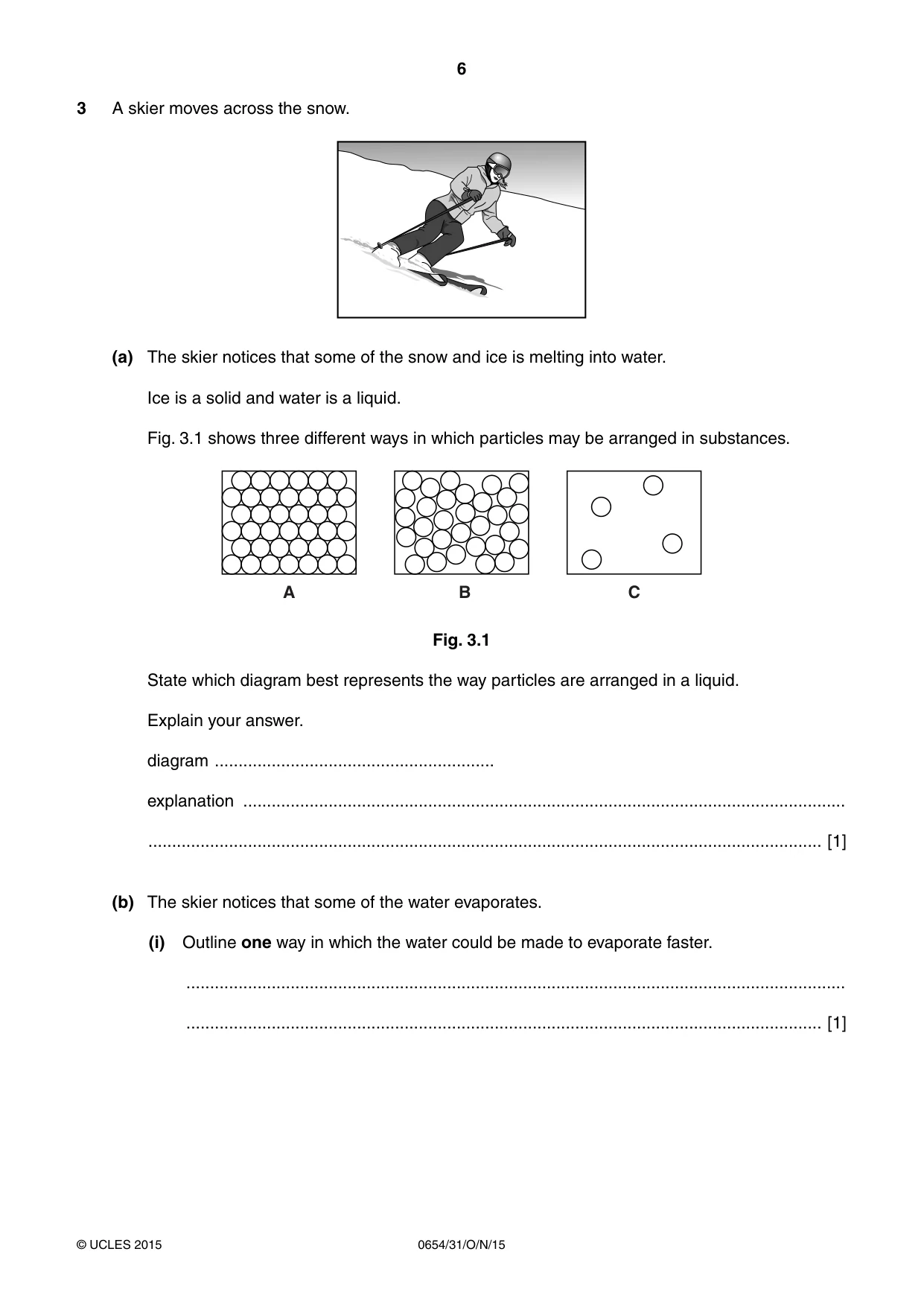
6 0654/31/O/N/15 © UCLES 2015 3 A skier moves across the snow. (a) The skier notices that some of the snow and ice is melting into water. Ice is a solid and water is a liquid. Fig. 3.1 shows three different ways in which particles may be arranged in substances. A B C Fig. 3.1 State which diagram best represents the way particles are arranged in a liquid. Explain your answer. diagram … explanation … … [1] (b) The skier notices that some of the water evaporates. (i) Outline one way in which the water could be made to evaporate faster. … … [1]
Question paper, page 7
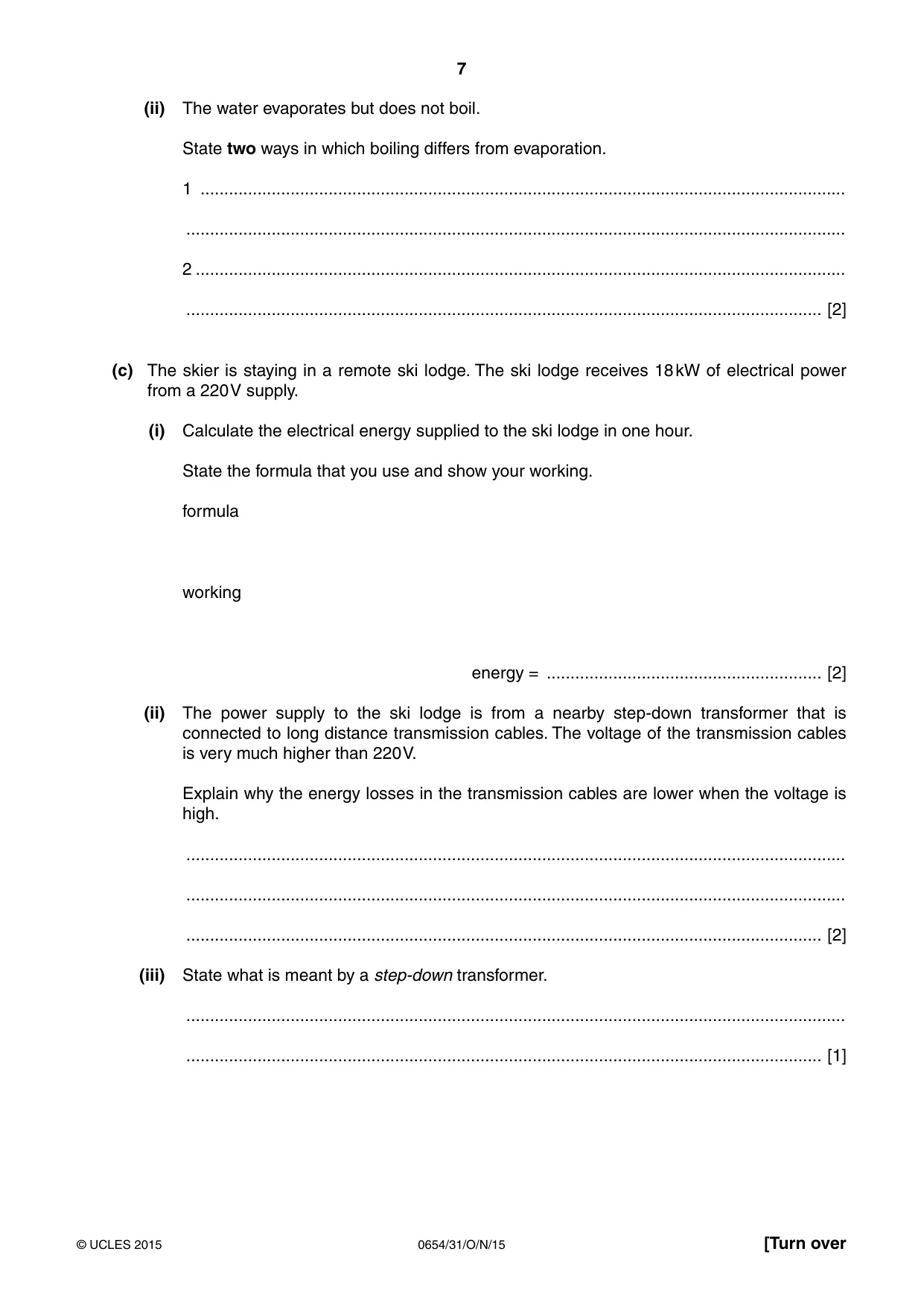
7 0654/31/O/N/15 © UCLES 2015 [Turn over (ii) The water evaporates but does not boil. State two ways in which boiling differs from evaporation. 1 … … 2 … … [2] (c) The skier is staying in a remote ski lodge. The ski lodge receives 18 kW of electrical power from a 220 V supply. (i) Calculate the electrical energy supplied to the ski lodge in one hour. State the formula that you use and show your working. formula working energy = … [2] (ii) The power supply to the ski lodge is from a nearby step-down transformer that is connected to long distance transmission cables. The voltage of the transmission cables is very much higher than 220 V. Explain why the energy losses in the transmission cables are lower when the voltage is high. … … … [2] (iii) State what is meant by a step-down transformer. … … [1]
Question paper, page 8
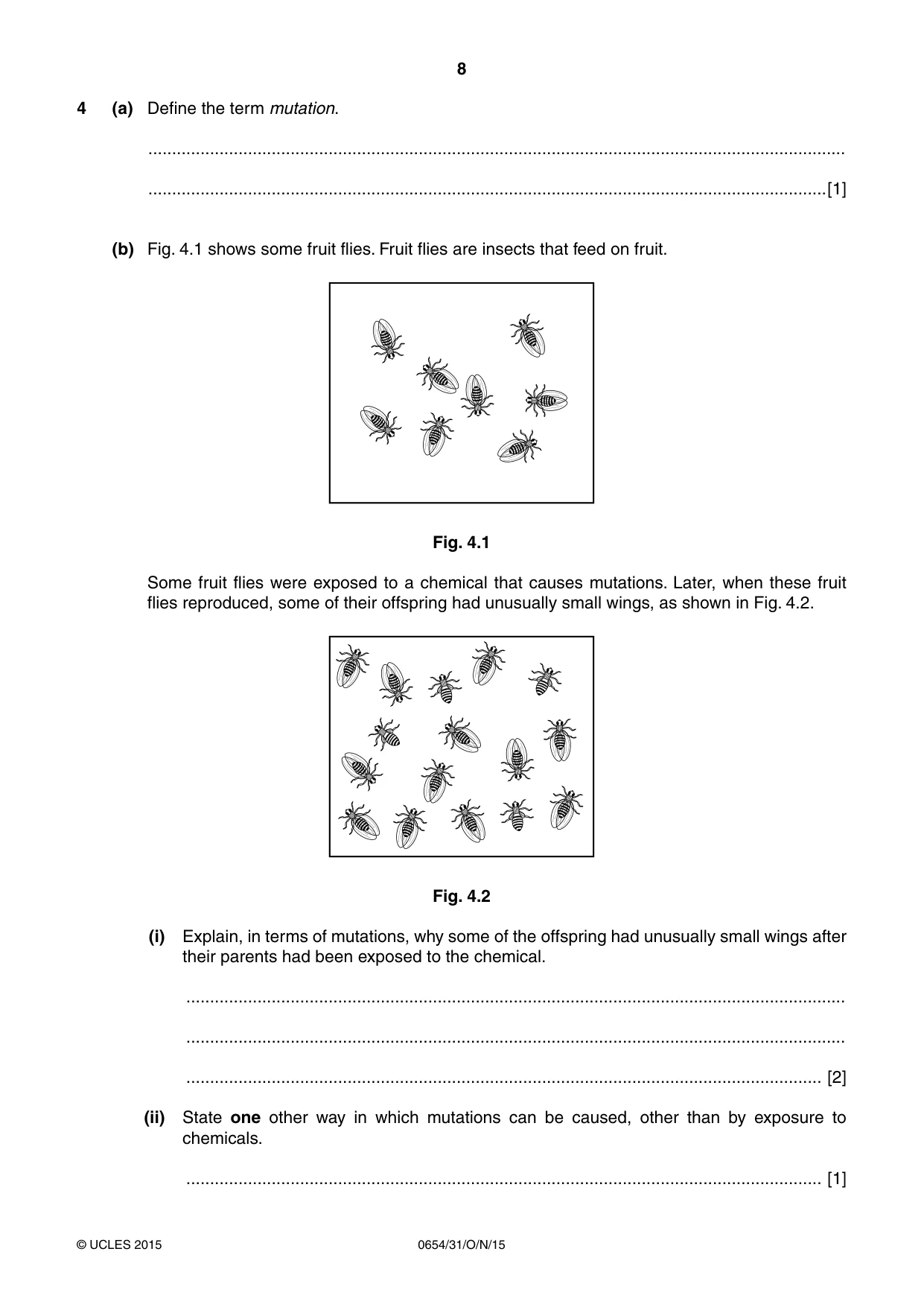
8 0654/31/O/N/15 © UCLES 2015 4 (a) Define the term mutation. … …[1] (b) Fig. 4.1 shows some fruit flies. Fruit flies are insects that feed on fruit. Fig. 4.1 Some fruit flies were exposed to a chemical that causes mutations. Later, when these fruit flies reproduced, some of their offspring had unusually small wings, as shown in Fig. 4.2. Fig. 4.2 (i) Explain, in terms of mutations, why some of the offspring had unusually small wings after their parents had been exposed to the chemical. … … … [2] (ii) State one other way in which mutations can be caused, other than by exposure to chemicals. … [1]
Question paper, page 9
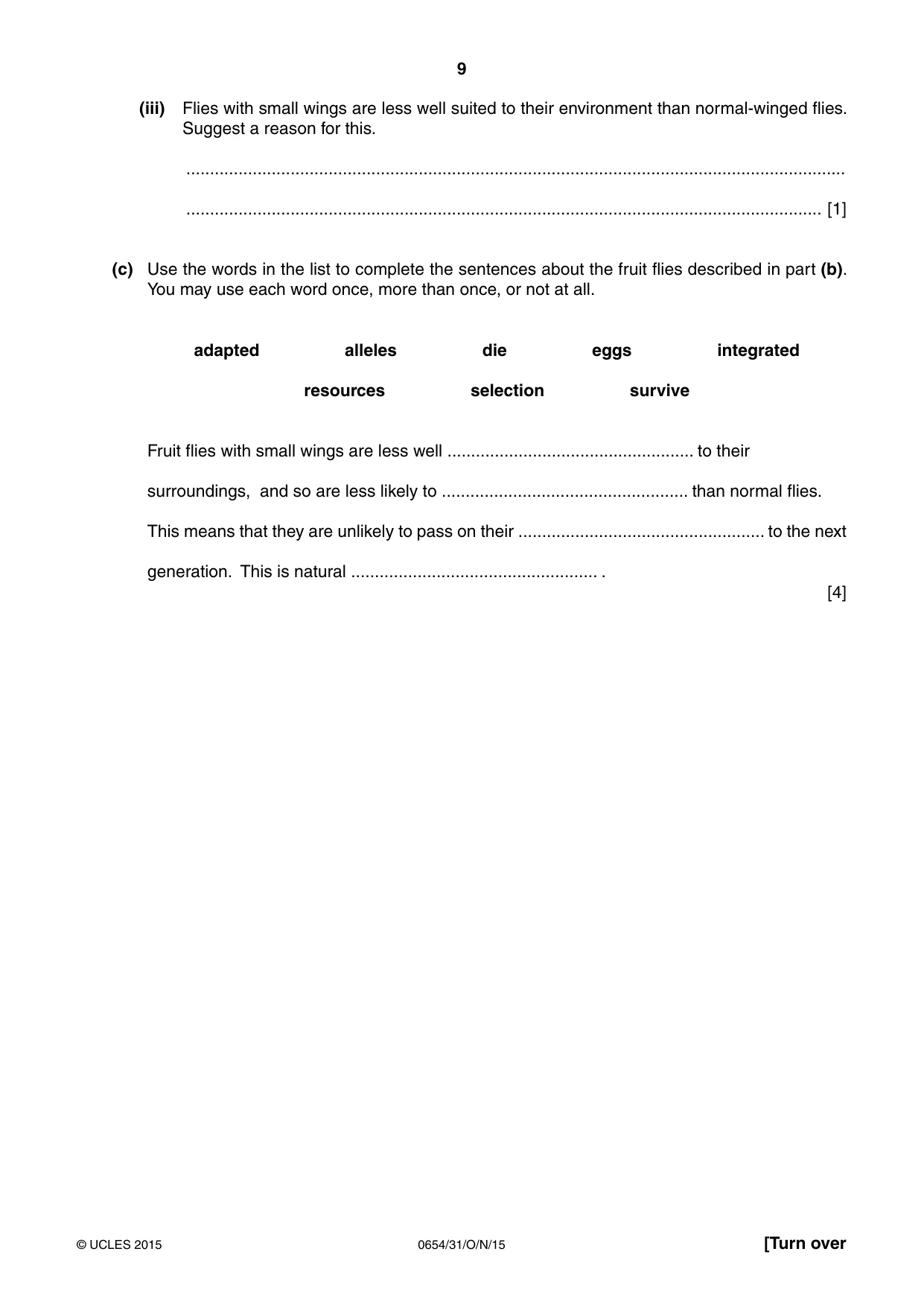
9 0654/31/O/N/15 © UCLES 2015 [Turn over (iii) Flies with small wings are less well suited to their environment than normal-winged flies. Suggest a reason for this. … … [1] (c) Use the words in the list to complete the sentences about the fruit flies described in part (b). You may use each word once, more than once, or not at all. adapted alleles die eggs integrated resources selection survive Fruit flies with small wings are less well … to their surroundings, and so are less likely to … than normal flies. This means that they are unlikely to pass on their … to the next generation. This is natural … . [4]
Question paper, page 10
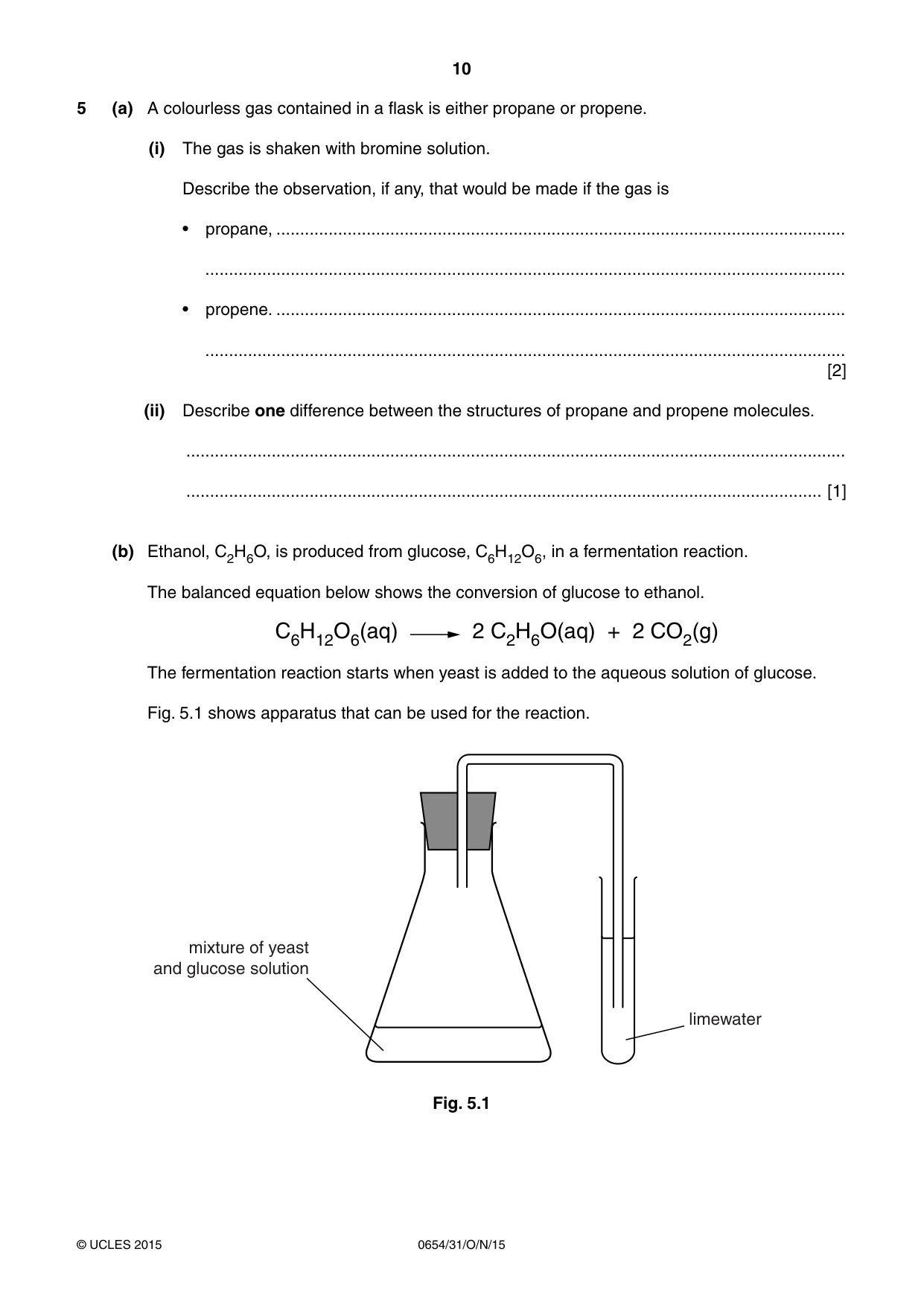
10 0654/31/O/N/15 © UCLES 2015 5 (a) A colourless gas contained in a flask is either propane or propene. (i) The gas is shaken with bromine solution. Describe the observation, if any, that would be made if the gas is • propane, … … • propene. … … [2] (ii) Describe one difference between the structures of propane and propene molecules. … … [1] (b) Ethanol, C2H6O, is produced from glucose, C6H12O6, in a fermentation reaction. The balanced equation below shows the conversion of glucose to ethanol. C6H12O6(aq) 2 C2H6O(aq) + 2 CO2(g) The fermentation reaction starts when yeast is added to the aqueous solution of glucose. Fig. 5.1 shows apparatus that can be used for the reaction. limewater mixture of yeast and glucose solution Fig. 5.1
Question paper, page 11
11 0654/31/O/N/15 © UCLES 2015 [Turn over (i) Describe how and explain why the appearance of the limewater changes during the fermentation reaction. change … explanation … … [2] (ii) Calculate the relative molecular mass of glucose, C6H12O6. Show your working. relative molecular mass = … [1] (iii) Calculate the mass of glucose that has to be dissolved in 5.0 dm3 of water to produce a solution whose concentration is 3.5 mol / dm3. Show your working. mass of glucose = …g [2] (c) (i) Name the element present in all amino acids but not in ethanol. … [1] (ii) Many different amino acids exist in nature. Name the compound that is formed when amino acids link together in a condensation polymerisation reaction. … [1]
Question paper, page 12
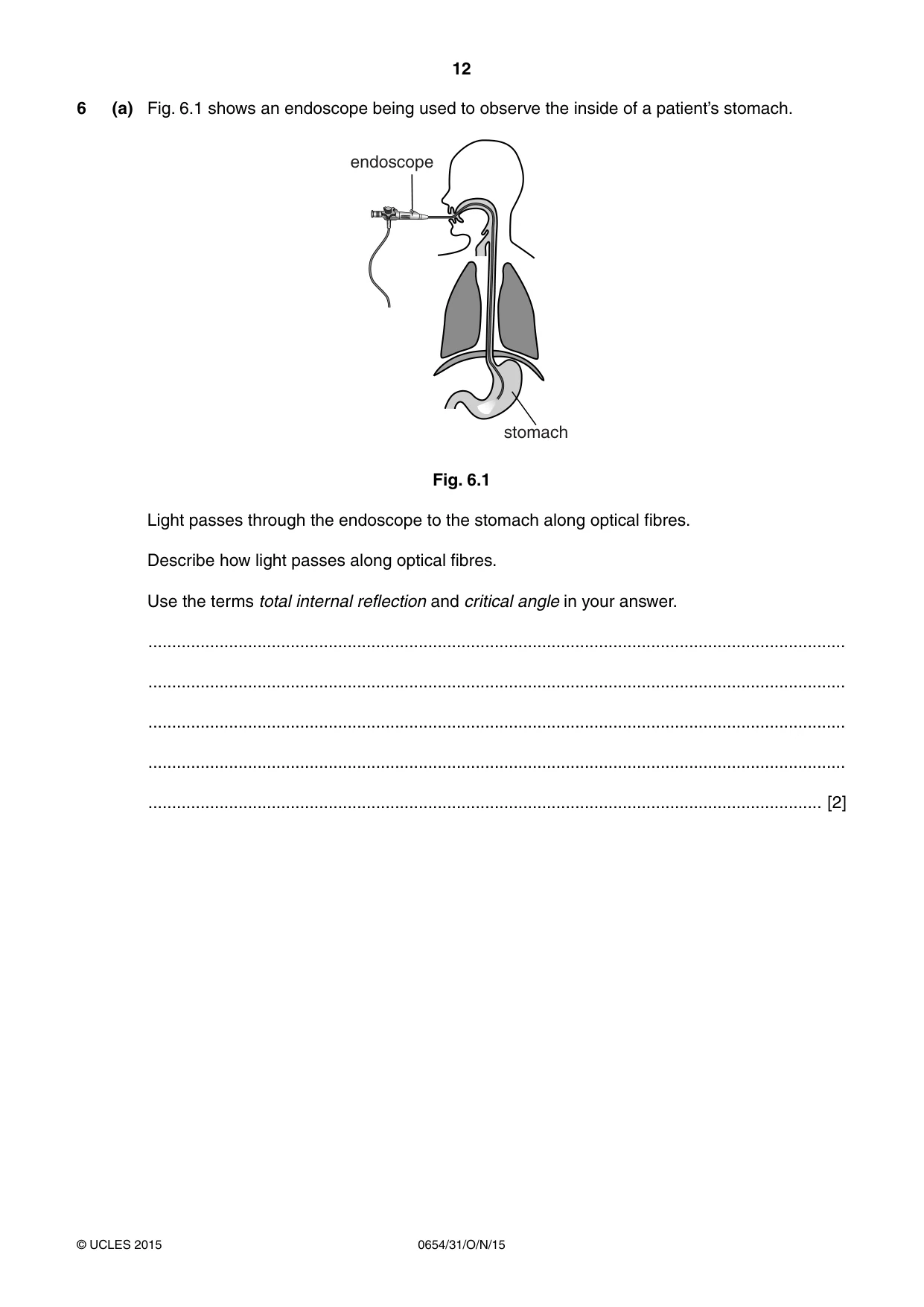
12 0654/31/O/N/15 © UCLES 2015 6 (a) Fig. 6.1 shows an endoscope being used to observe the inside of a patient’s stomach. endoscope stomach Fig. 6.1 Light passes through the endoscope to the stomach along optical fibres. Describe how light passes along optical fibres. Use the terms total internal reflection and critical angle in your answer. … … … … … [2]
Question paper, page 13
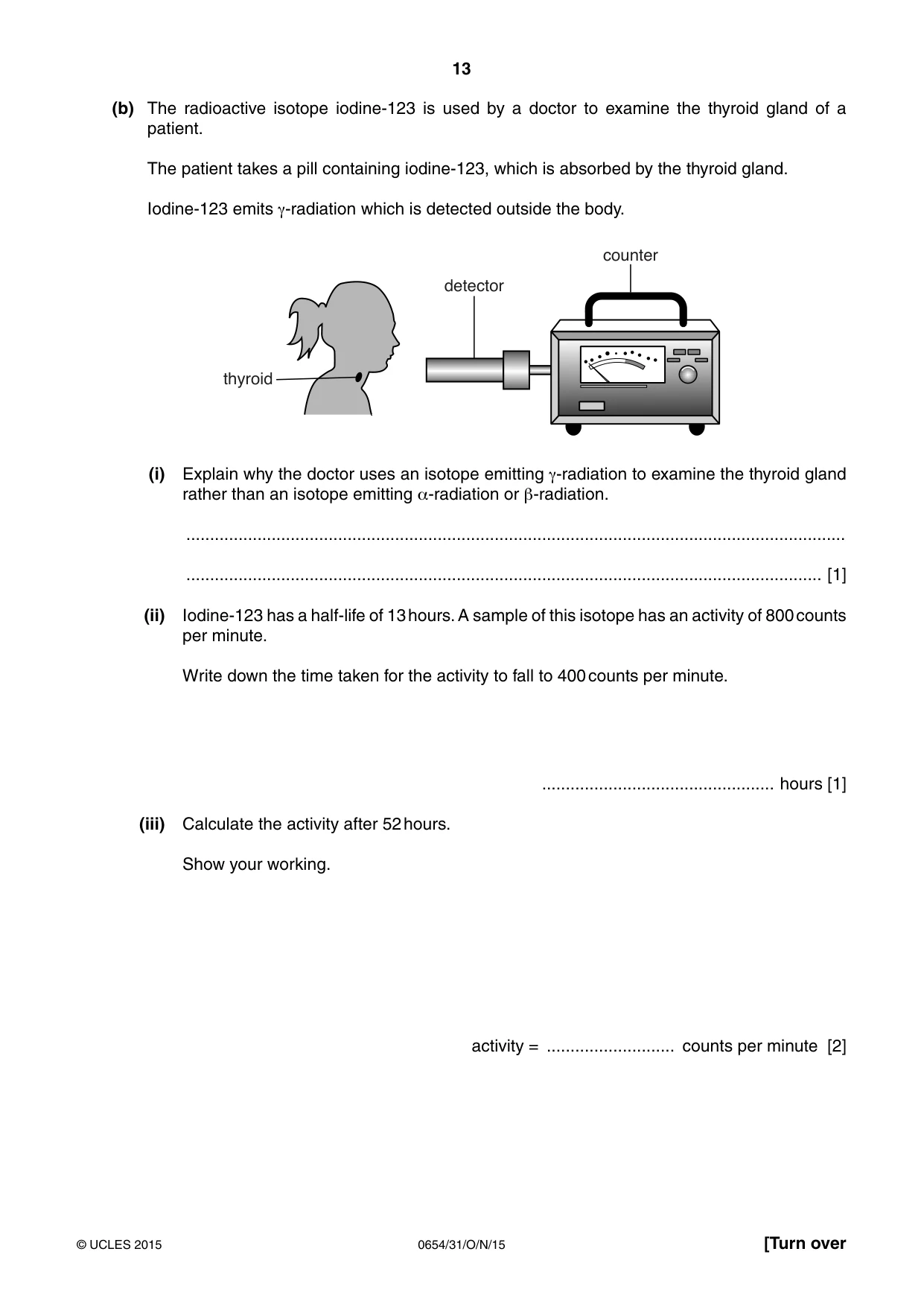
13 0654/31/O/N/15 © UCLES 2015 [Turn over (b) The radioactive isotope iodine-123 is used by a doctor to examine the thyroid gland of a patient. The patient takes a pill containing iodine-123, which is absorbed by the thyroid gland. Iodine-123 emits γ-radiation which is detected outside the body. detector counter thyroid (i) Explain why the doctor uses an isotope emitting γ-radiation to examine the thyroid gland rather than an isotope emitting α-radiation or β-radiation. … … [1] (ii) Iodine-123 has a half-life of 13 hours. A sample of this isotope has an activity of 800 counts per minute. Write down the time taken for the activity to fall to 400 counts per minute. … hours [1] (iii) Calculate the activity after 52 hours. Show your working. activity = … counts per minute [2]
Question paper, page 14
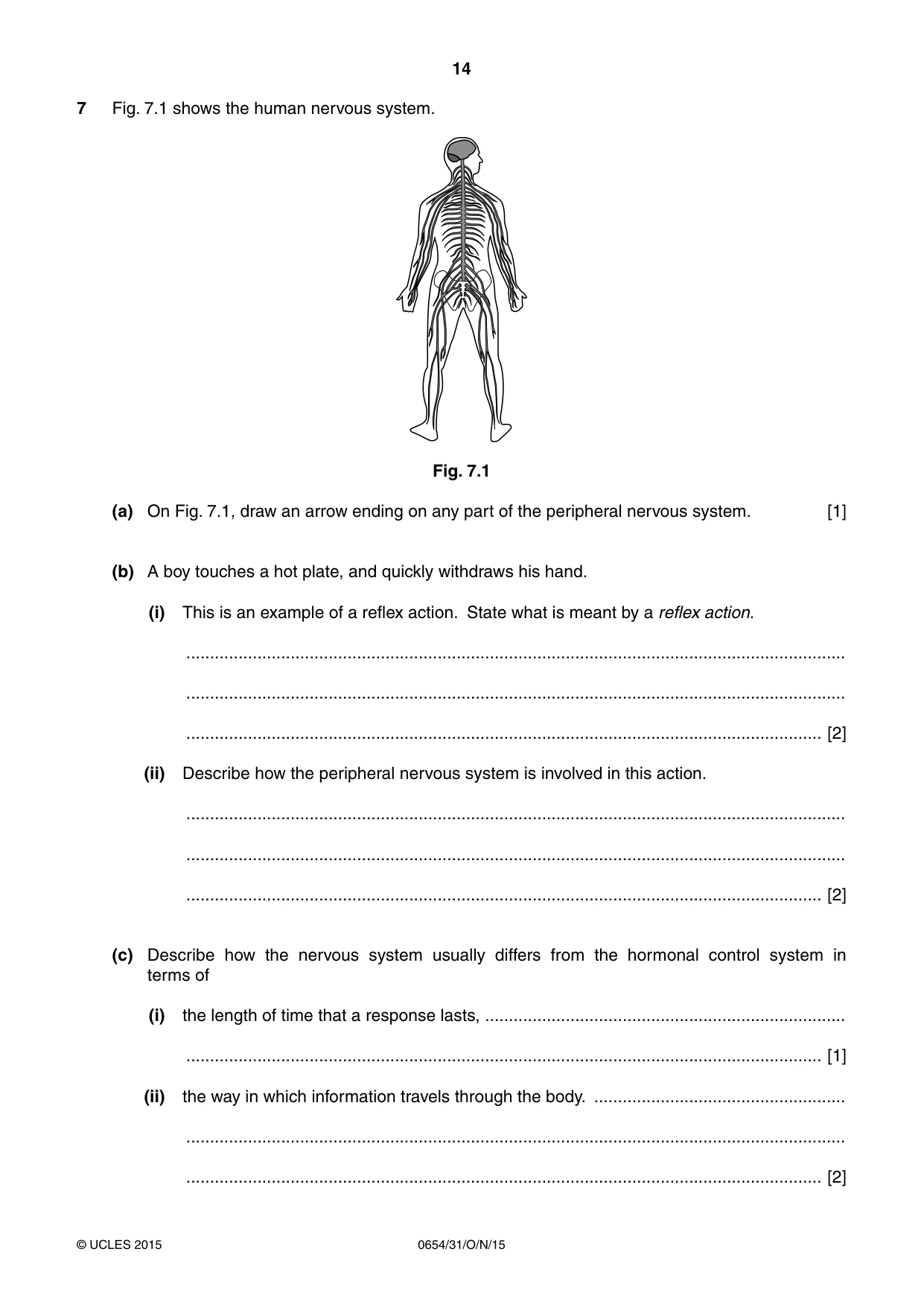
14 0654/31/O/N/15 © UCLES 2015 7 Fig. 7.1 shows the human nervous system. Fig. 7.1 (a) On Fig. 7.1, draw an arrow ending on any part of the peripheral nervous system. [1] (b) A boy touches a hot plate, and quickly withdraws his hand. (i) This is an example of a reflex action. State what is meant by a reflex action. … … … [2] (ii) Describe how the peripheral nervous system is involved in this action. … … … [2] (c) Describe how the nervous system usually differs from the hormonal control system in terms of (i) the length of time that a response lasts, … … [1] (ii) the way in which information travels through the body. … … … [2]
Question paper, page 15
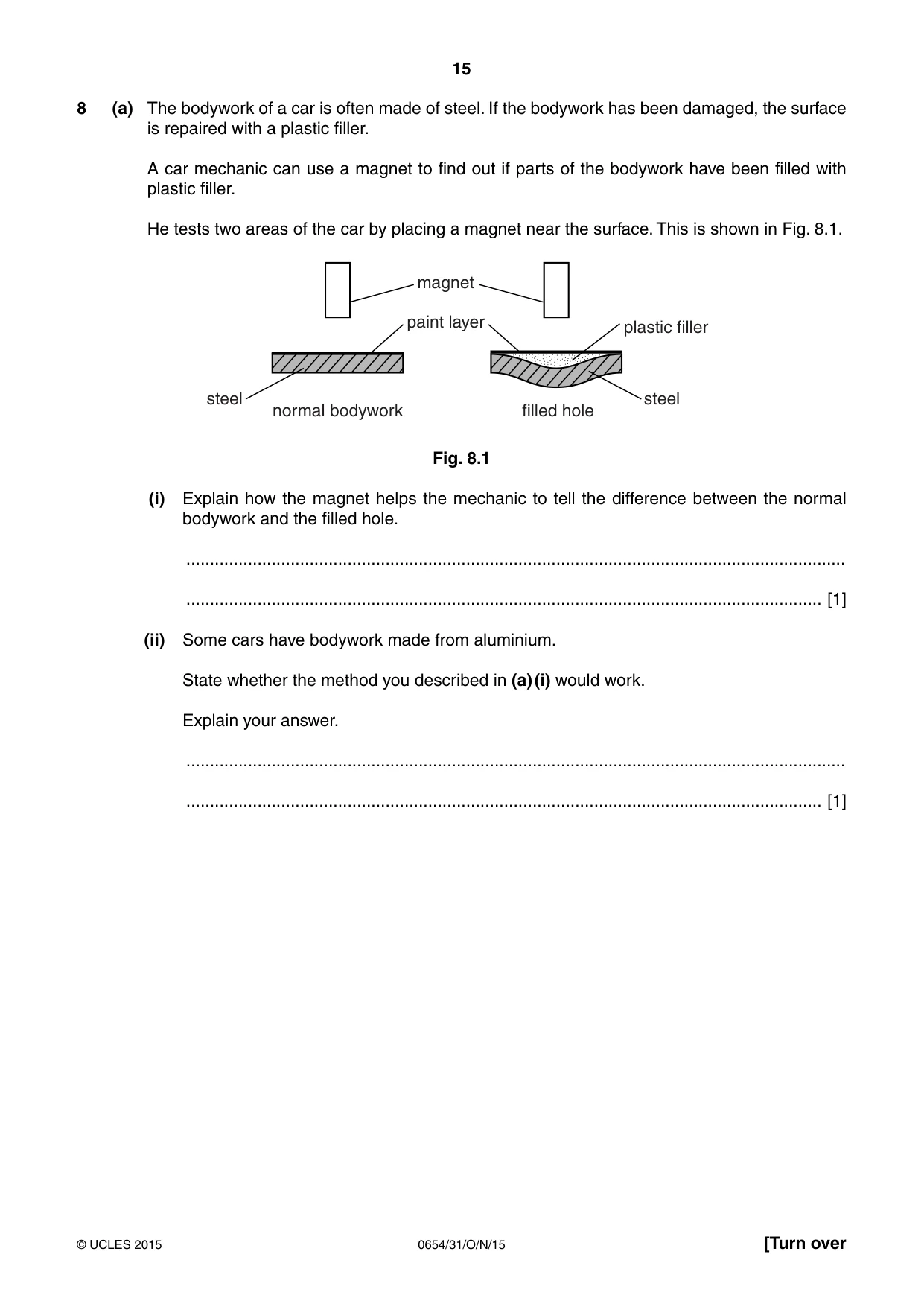
15 0654/31/O/N/15 © UCLES 2015 [Turn over 8 (a) The bodywork of a car is often made of steel. If the bodywork has been damaged, the surface is repaired with a plastic filler. A car mechanic can use a magnet to find out if parts of the bodywork have been filled with plastic filler. He tests two areas of the car by placing a magnet near the surface. This is shown in Fig. 8.1. magnet paint layer steel steel plastic filler normal bodywork filled hole Fig. 8.1 (i) Explain how the magnet helps the mechanic to tell the difference between the normal bodywork and the filled hole. … … [1] (ii) Some cars have bodywork made from aluminium. State whether the method you described in (a) (i) would work. Explain your answer. … … [1]
Question paper, page 16
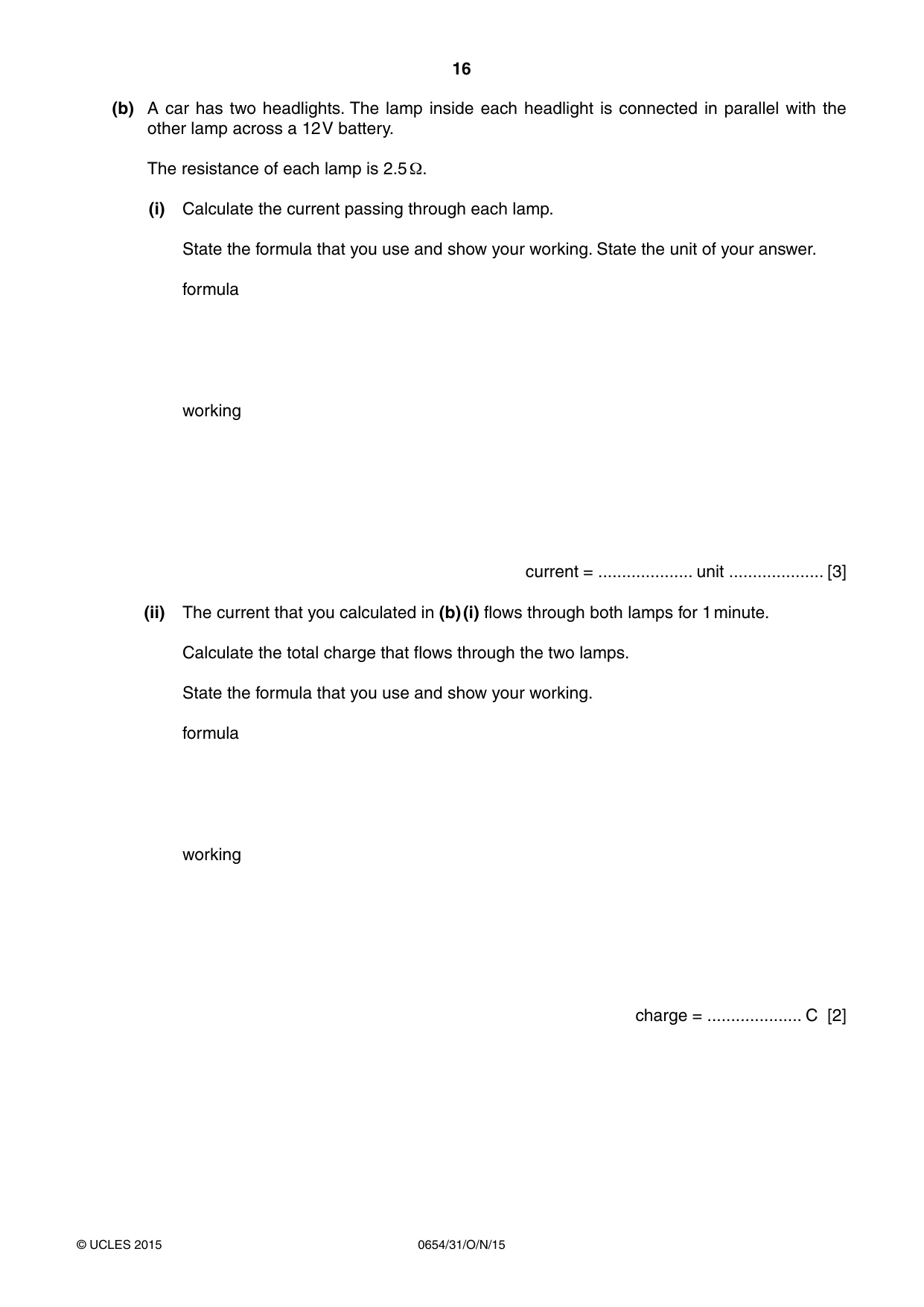
16 0654/31/O/N/15 © UCLES 2015 (b) A car has two headlights. The lamp inside each headlight is connected in parallel with the other lamp across a 12 V battery. The resistance of each lamp is 2.5 Ω. (i) Calculate the current passing through each lamp. State the formula that you use and show your working. State the unit of your answer. formula working current = … unit … [3] (ii) The current that you calculated in (b) (i) flows through both lamps for 1 minute. Calculate the total charge that flows through the two lamps. State the formula that you use and show your working. formula working charge = … C [2]
Question paper, page 17
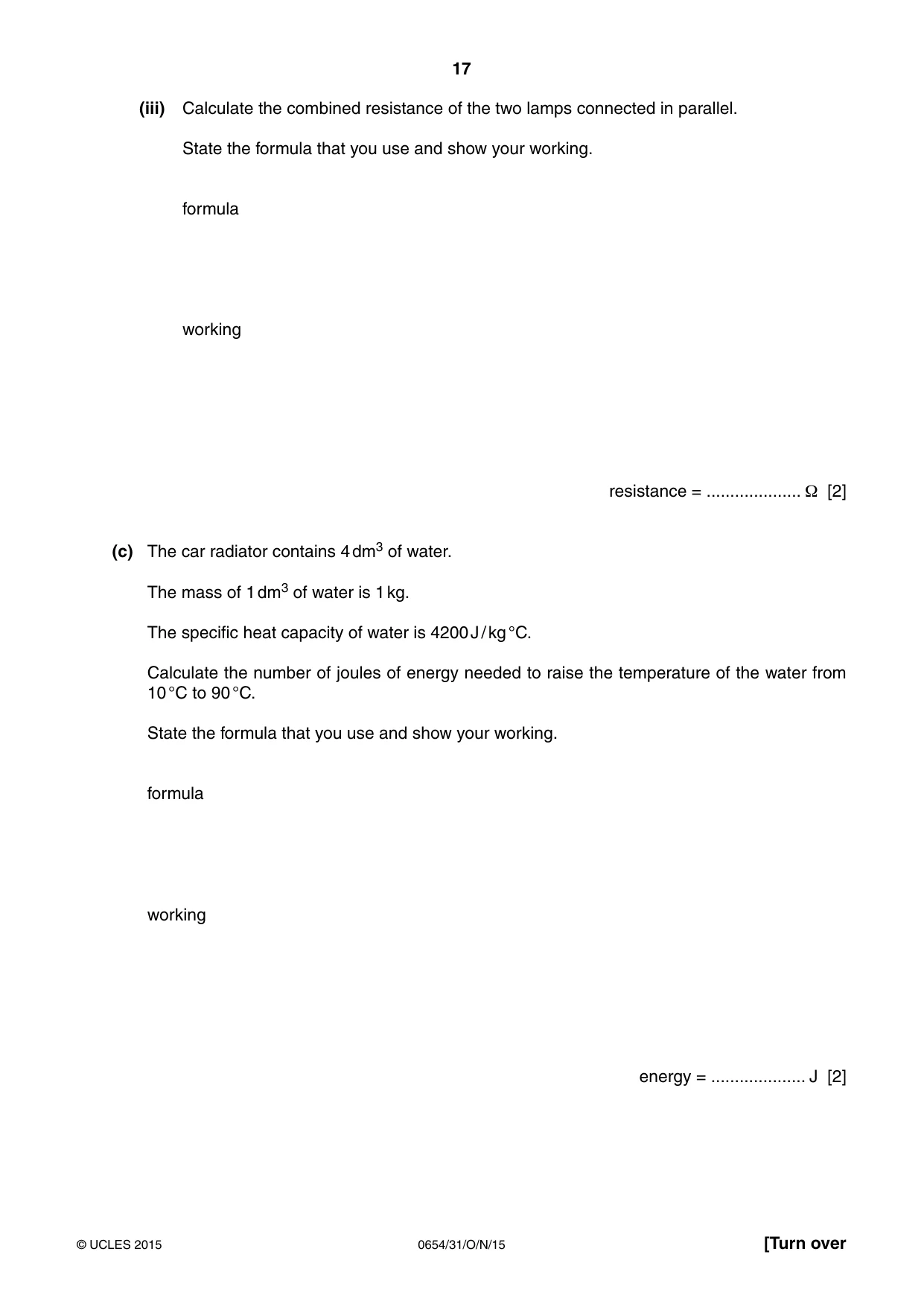
17 0654/31/O/N/15 © UCLES 2015 [Turn over (iii) Calculate the combined resistance of the two lamps connected in parallel. State the formula that you use and show your working. formula working resistance = … Ω [2] (c) The car radiator contains 4 dm3 of water. The mass of 1 dm3 of water is 1 kg. The specific heat capacity of water is 4200 J / kg °C. Calculate the number of joules of energy needed to raise the temperature of the water from 10 °C to 90 °C. State the formula that you use and show your working. formula working energy = … J [2]
Question paper, page 18
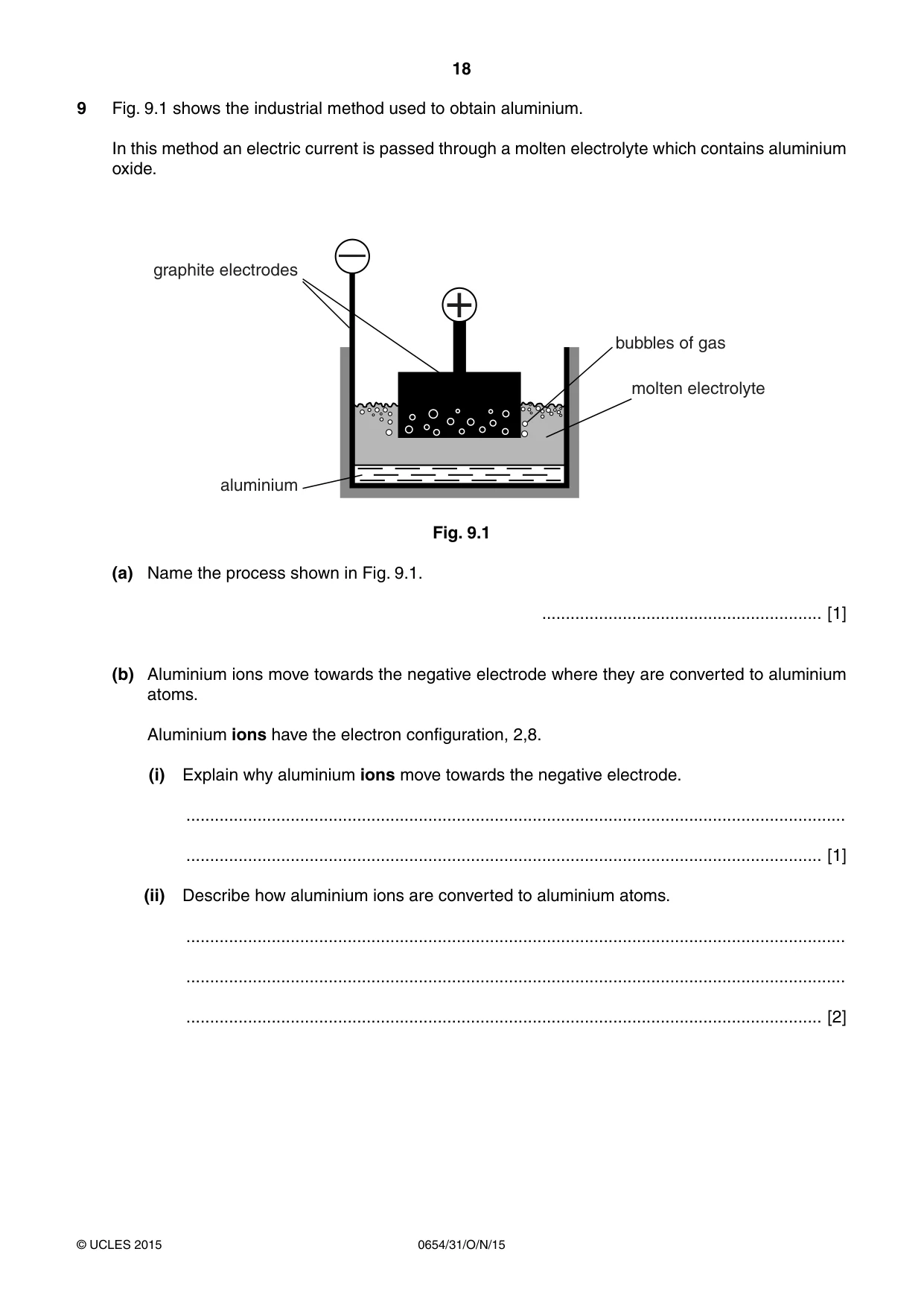
18 0654/31/O/N/15 © UCLES 2015 9 Fig. 9.1 shows the industrial method used to obtain aluminium. In this method an electric current is passed through a molten electrolyte which contains aluminium oxide. + _ graphite electrodes aluminium bubbles of gas molten electrolyte Fig. 9.1 (a) Name the process shown in Fig. 9.1. … [1] (b) Aluminium ions move towards the negative electrode where they are converted to aluminium atoms. Aluminium ions have the electron configuration, 2,8. (i) Explain why aluminium ions move towards the negative electrode. … … [1] (ii) Describe how aluminium ions are converted to aluminium atoms. … … … [2]
Question paper, page 19
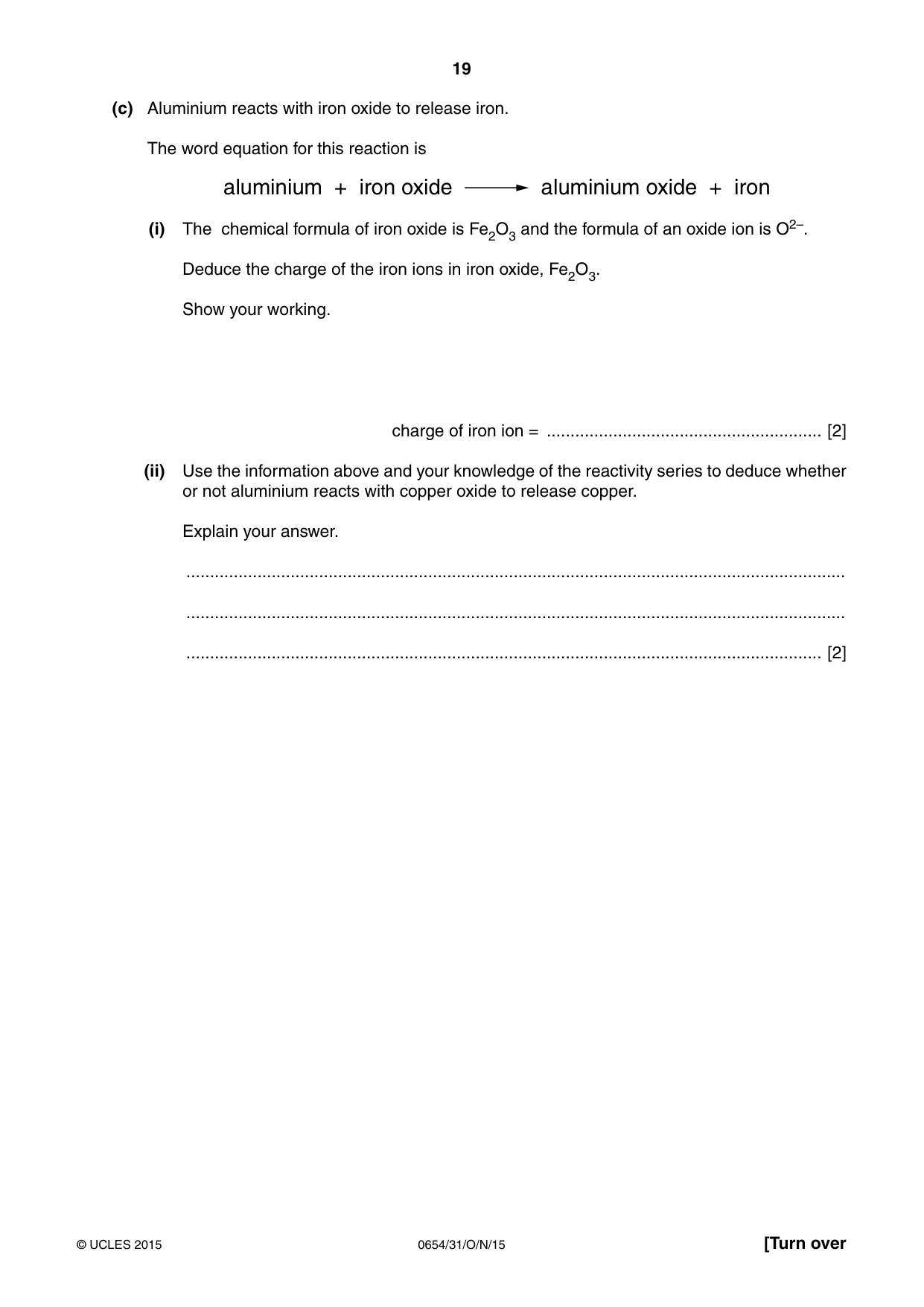
19 0654/31/O/N/15 © UCLES 2015 [Turn over (c) Aluminium reacts with iron oxide to release iron. The word equation for this reaction is aluminium + iron oxide aluminium oxide + iron (i) The chemical formula of iron oxide is Fe2O3 and the formula of an oxide ion is O2–. Deduce the charge of the iron ions in iron oxide, Fe2O3. Show your working. charge of iron ion = … [2] (ii) Use the information above and your knowledge of the reactivity series to deduce whether or not aluminium reacts with copper oxide to release copper. Explain your answer. … … … [2]
Question paper, page 20
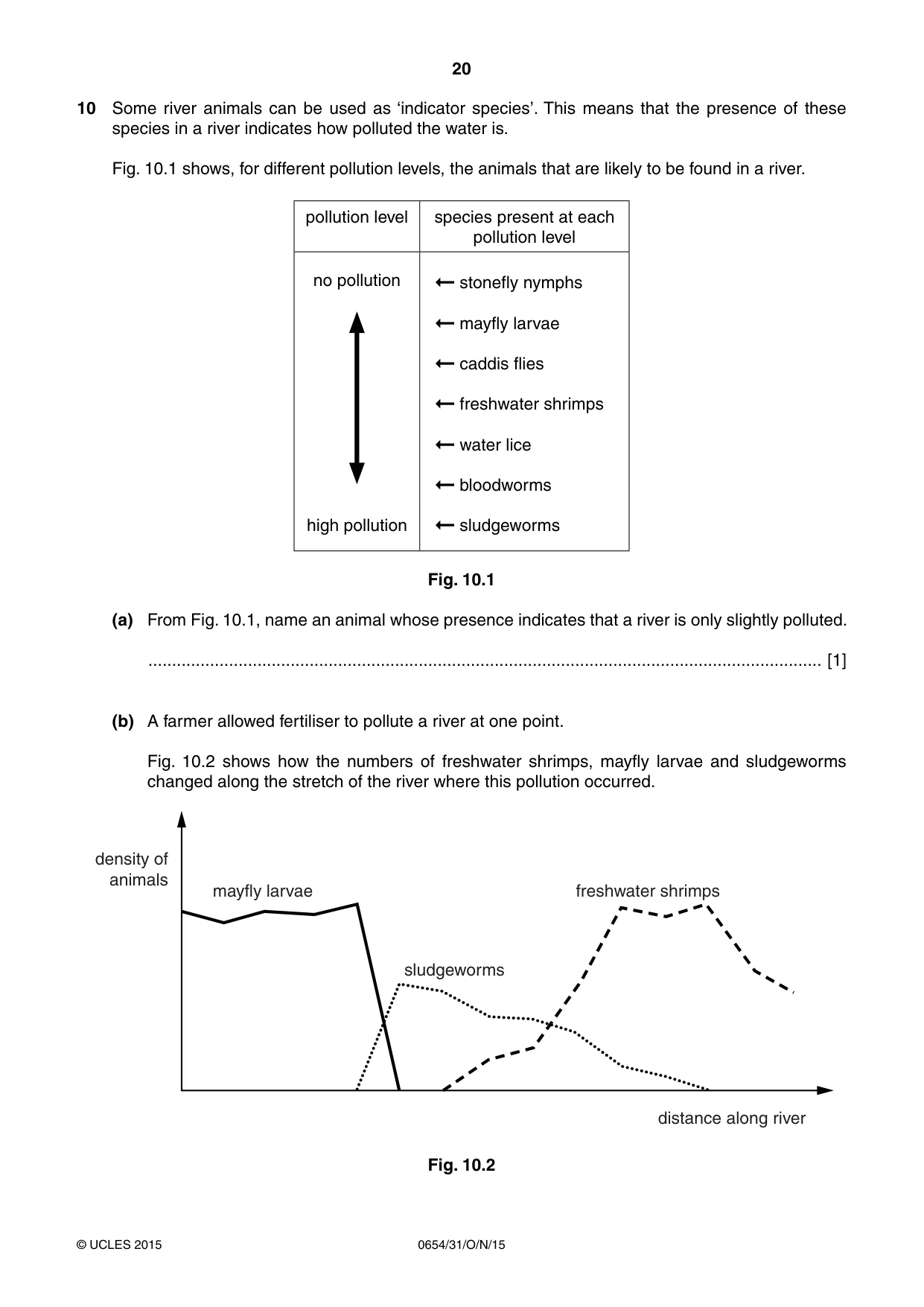
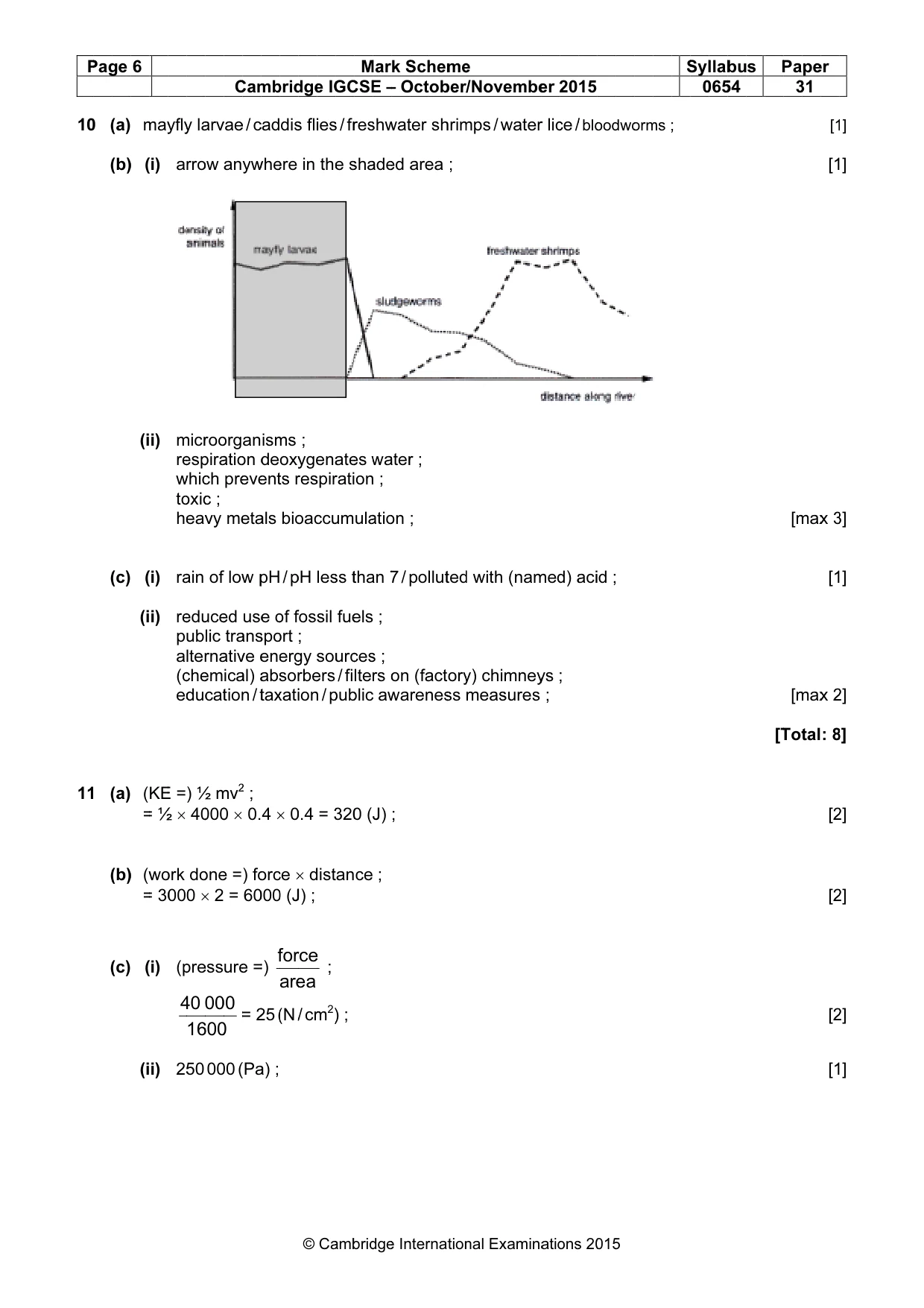
20 0654/31/O/N/15 © UCLES 2015 10 Some river animals can be used as ‘indicator species’. This means that the presence of these species in a river indicates how polluted the water is. Fig. 10.1 shows, for different pollution levels, the animals that are likely to be found in a river. pollution level species present at each pollution level no pollution ➞ stonefly nymphs ➞ mayfly larvae ➞ caddis flies ➞ freshwater shrimps ➞ water lice ➞ bloodworms ➞ sludgeworms high pollution Fig. 10.1 (a) From Fig. 10.1, name an animal whose presence indicates that a river is only slightly polluted. … [1] (b) A farmer allowed fertiliser to pollute a river at one point. Fig. 10.2 shows how the numbers of freshwater shrimps, mayfly larvae and sludgeworms changed along the stretch of the river where this pollution occurred. mayfly larvae sludgeworms freshwater shrimps distance along river density of animals Fig. 10.2
Question paper, page 21
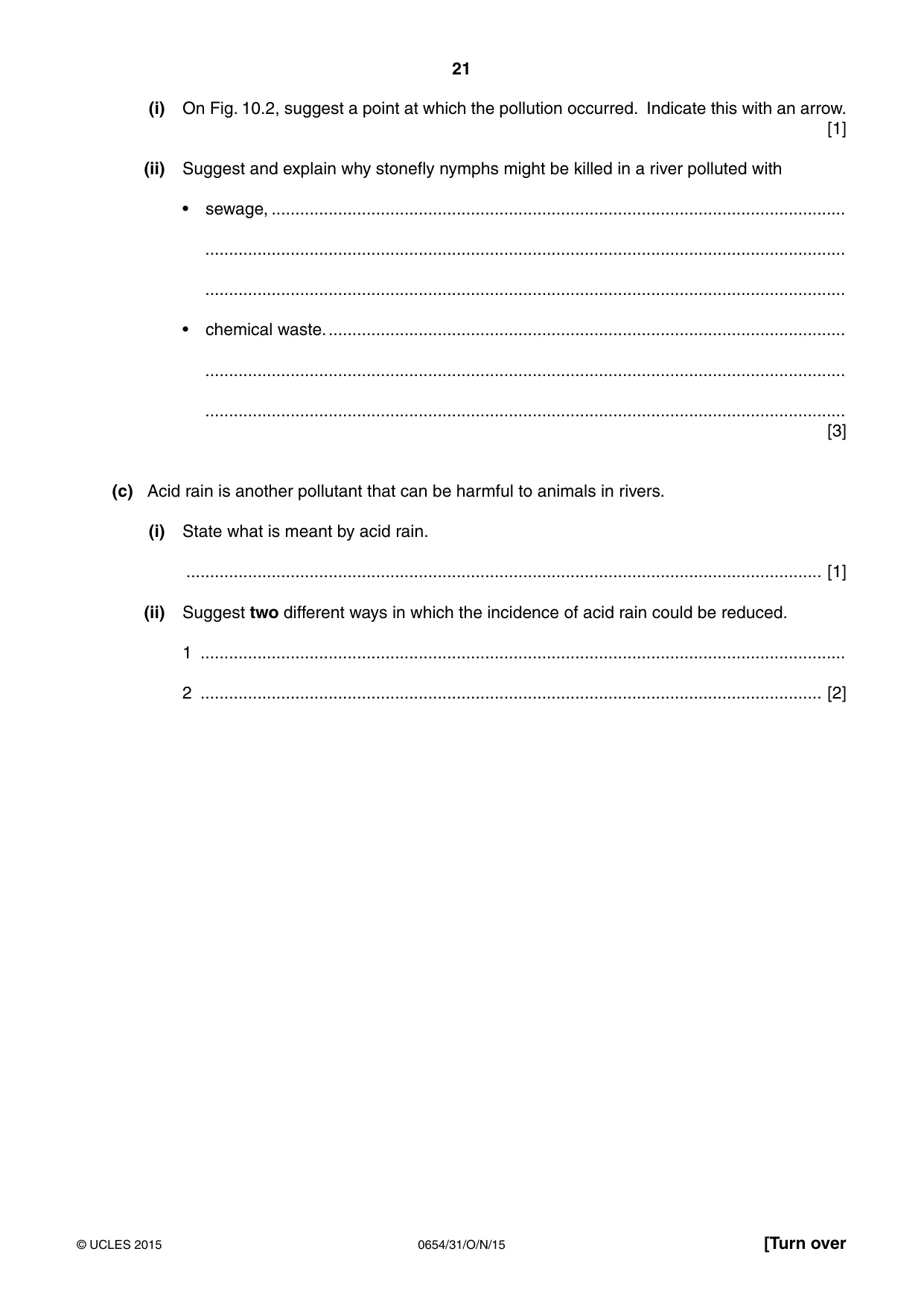
21 0654/31/O/N/15 © UCLES 2015 [Turn over (i) On Fig. 10.2, suggest a point at which the pollution occurred. Indicate this with an arrow. [1] (ii) Suggest and explain why stonefly nymphs might be killed in a river polluted with • sewage, … … … • chemical waste. … … … [3] (c) Acid rain is another pollutant that can be harmful to animals in rivers. (i) State what is meant by acid rain. … [1] (ii) Suggest two different ways in which the incidence of acid rain could be reduced. 1 … 2 … [2]
Question paper, page 22
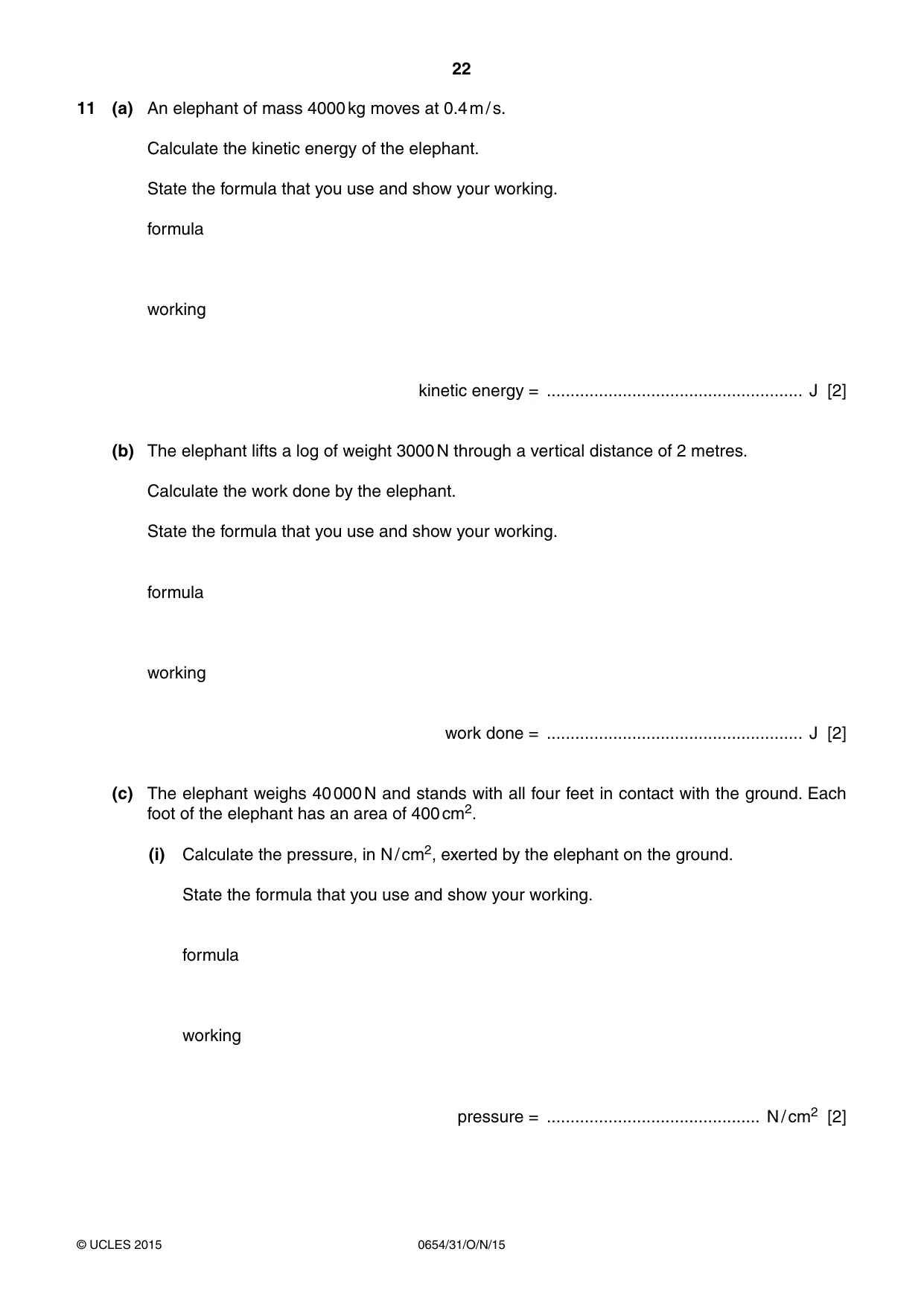
22 0654/31/O/N/15 © UCLES 2015 11 (a) An elephant of mass 4000 kg moves at 0.4 m / s. Calculate the kinetic energy of the elephant. State the formula that you use and show your working. formula working kinetic energy = … J [2] (b) The elephant lifts a log of weight 3000 N through a vertical distance of 2 metres. Calculate the work done by the elephant. State the formula that you use and show your working. formula working work done = … J [2] (c) The elephant weighs 40 000 N and stands with all four feet in contact with the ground. Each foot of the elephant has an area of 400 cm2. (i) Calculate the pressure, in N / cm2, exerted by the elephant on the ground. State the formula that you use and show your working. formula working pressure = … N / cm2 [2]
Question paper, page 23
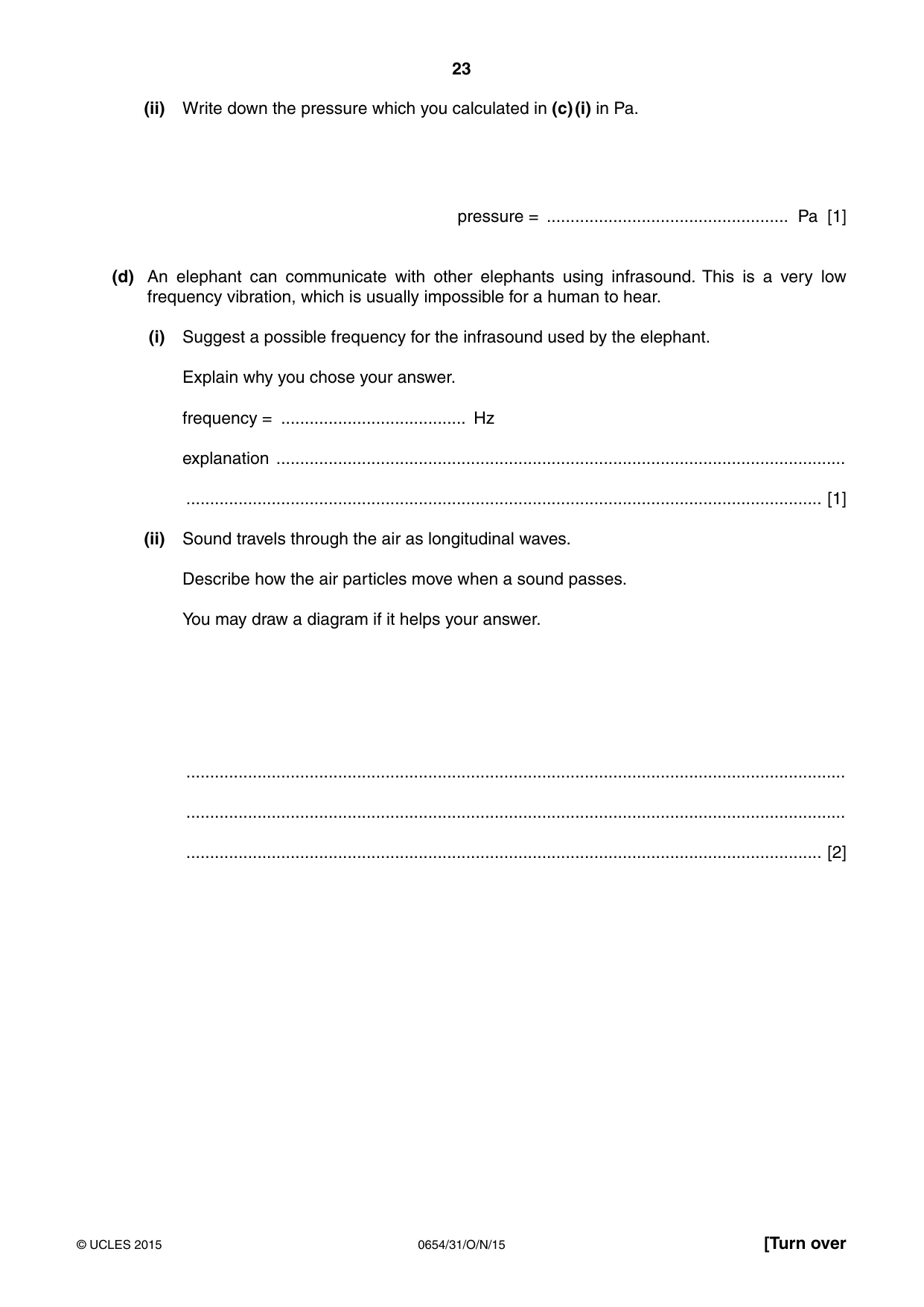
23 0654/31/O/N/15 © UCLES 2015 [Turn over (ii) Write down the pressure which you calculated in (c) (i) in Pa. pressure = … Pa [1] (d) An elephant can communicate with other elephants using infrasound. This is a very low frequency vibration, which is usually impossible for a human to hear. (i) Suggest a possible frequency for the infrasound used by the elephant. Explain why you chose your answer. frequency = … Hz explanation … … [1] (ii) Sound travels through the air as longitudinal waves. Describe how the air particles move when a sound passes. You may draw a diagram if it helps your answer. … … … [2]
Question paper, page 24
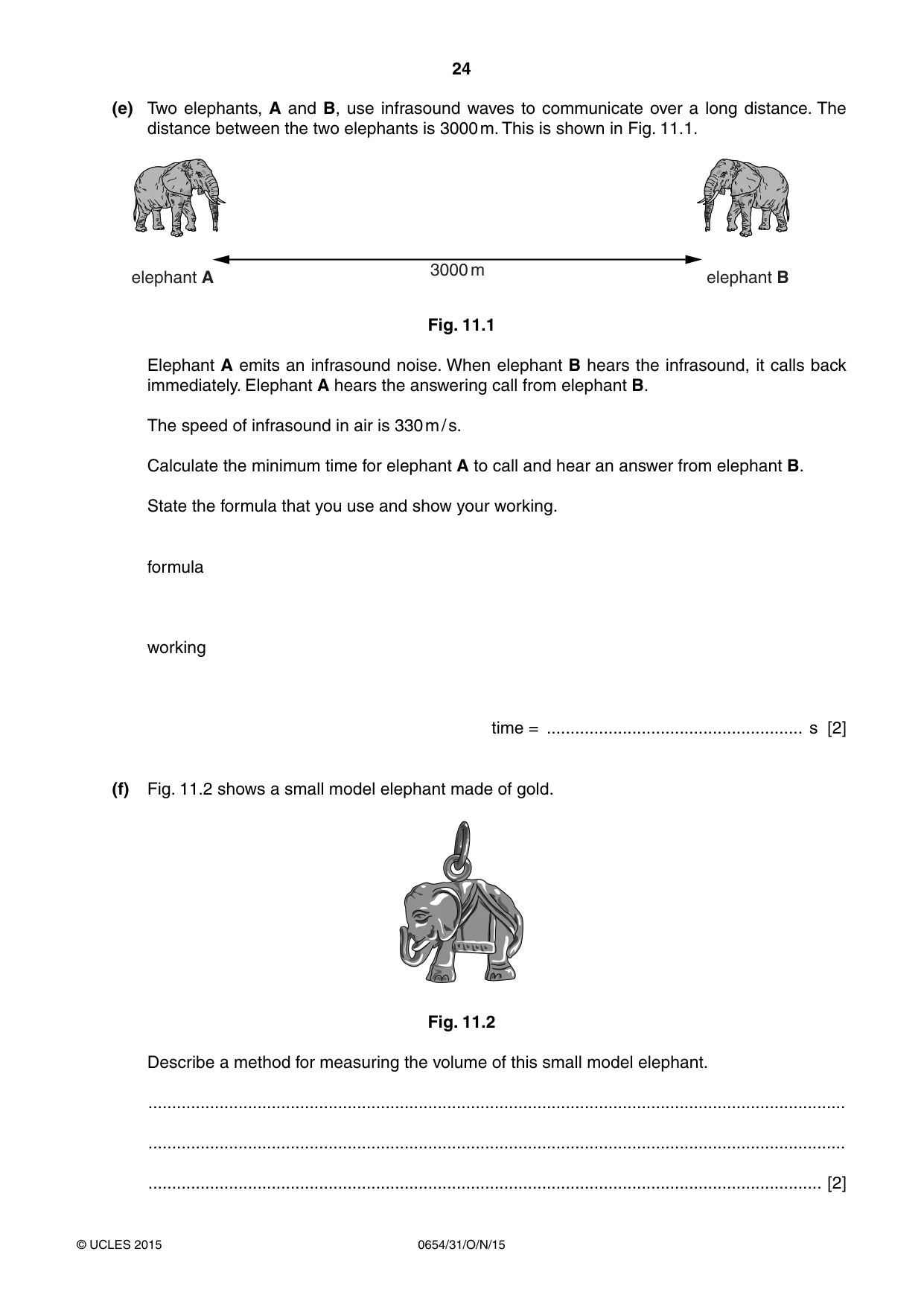
24 0654/31/O/N/15 © UCLES 2015 (e) Two elephants, A and B, use infrasound waves to communicate over a long distance. The distance between the two elephants is 3000 m. This is shown in Fig. 11.1. elephant A elephant B 3000 m Fig. 11.1 Elephant A emits an infrasound noise. When elephant B hears the infrasound, it calls back immediately. Elephant A hears the answering call from elephant B. The speed of infrasound in air is 330 m / s. Calculate the minimum time for elephant A to call and hear an answer from elephant B. State the formula that you use and show your working. formula working time = … s [2] (f) Fig. 11.2 shows a small model elephant made of gold. Fig. 11.2 Describe a method for measuring the volume of this small model elephant. … … … [2]
Question paper, page 25
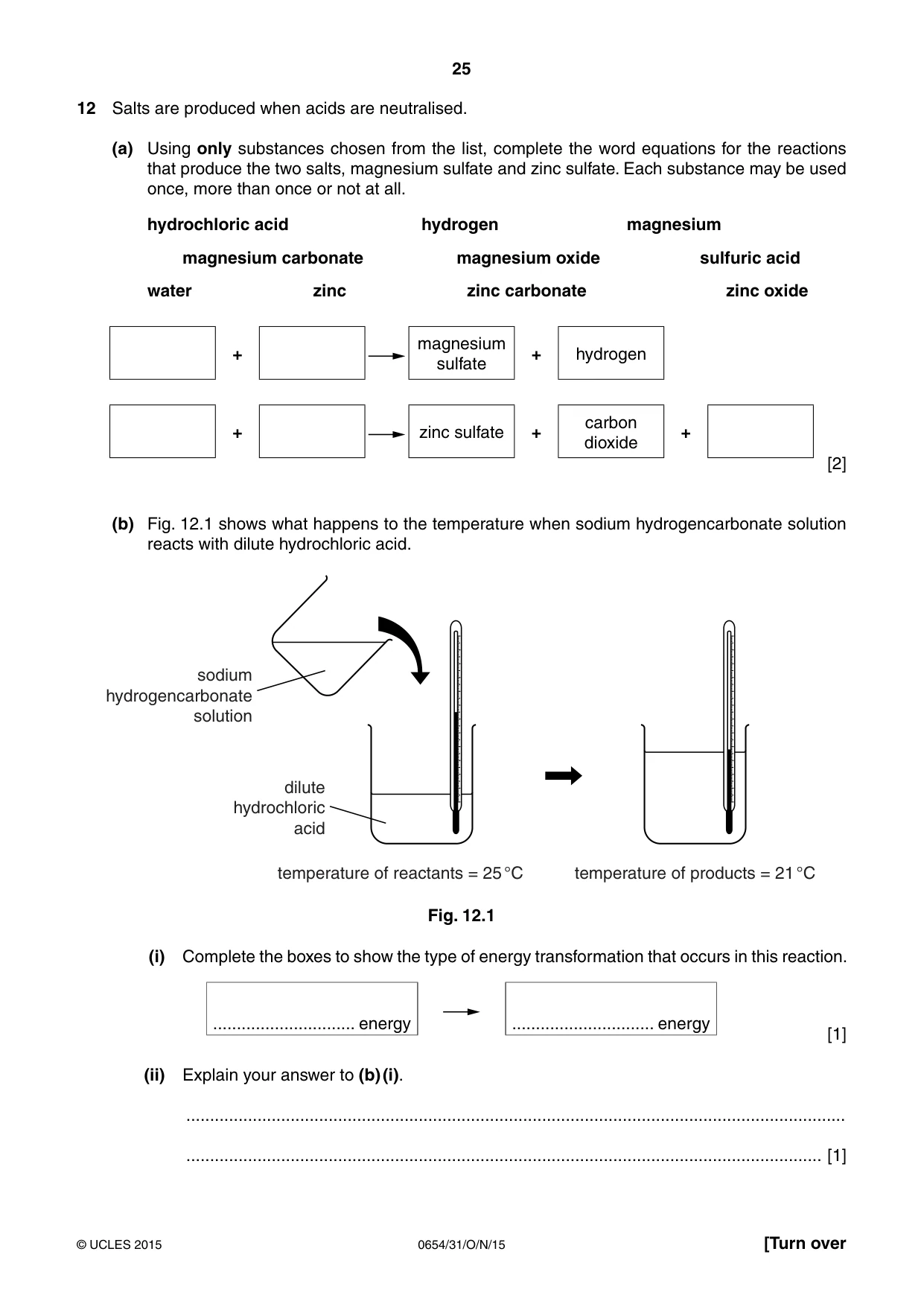
25 0654/31/O/N/15 © UCLES 2015 [Turn over 12 Salts are produced when acids are neutralised. (a) Using only substances chosen from the list, complete the word equations for the reactions that produce the two salts, magnesium sulfate and zinc sulfate. Each substance may be used once, more than once or not at all. hydrochloric acid hydrogen magnesium magnesium carbonate magnesium oxide sulfuric acid water zinc zinc carbonate zinc oxide + magnesium sulfate + hydrogen + zinc sulfate + carbon dioxide + [2] (b) Fig. 12.1 shows what happens to the temperature when sodium hydrogencarbonate solution reacts with dilute hydrochloric acid. sodium hydrogencarbonate solution dilute hydrochloric acid temperature of reactants = 25 °C temperature of products = 21 °C Fig. 12.1 (i) Complete the boxes to show the type of energy transformation that occurs in this reaction. … energy … energy [1] (ii) Explain your answer to (b) (i). … … [1]
Question paper, page 26
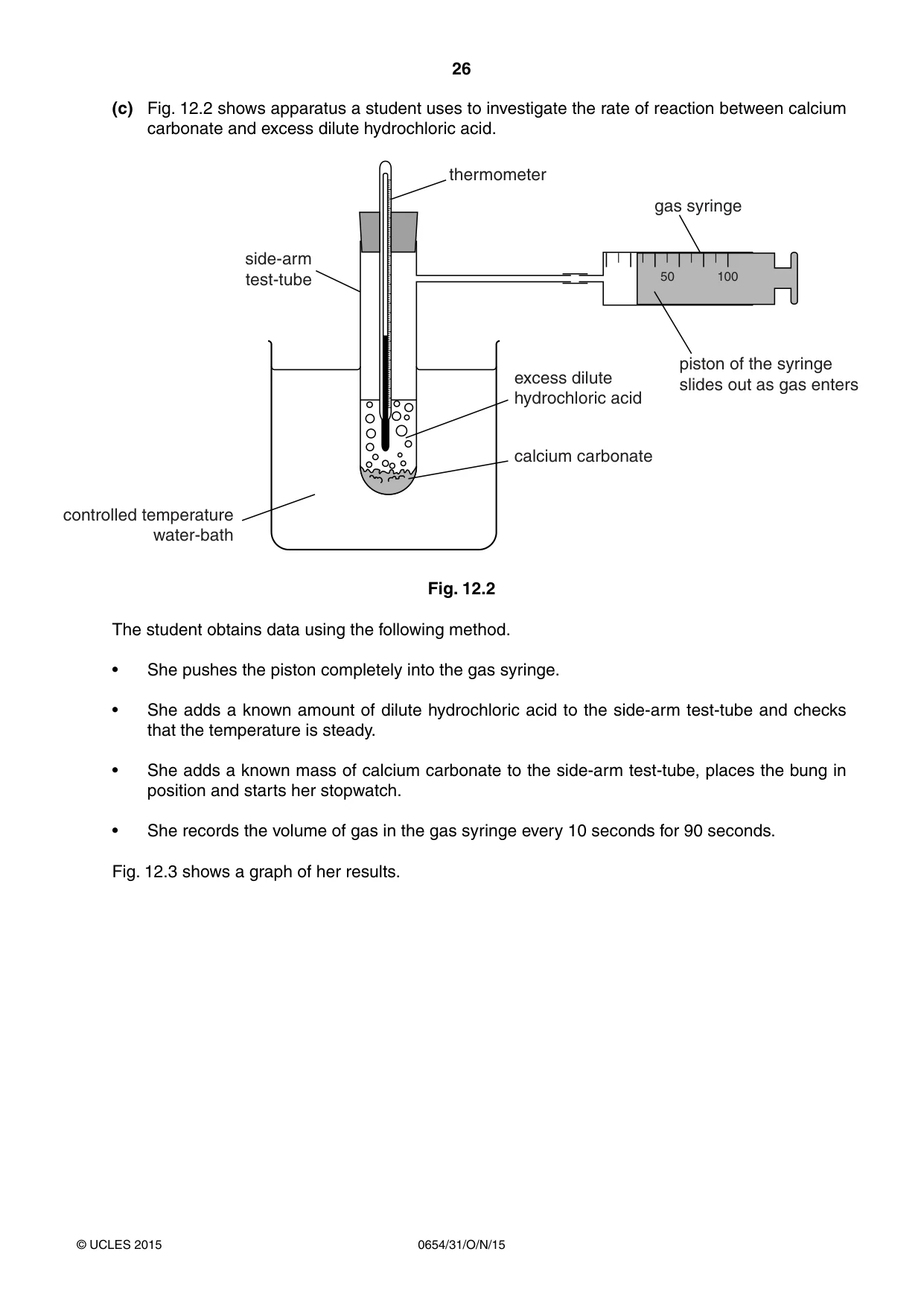
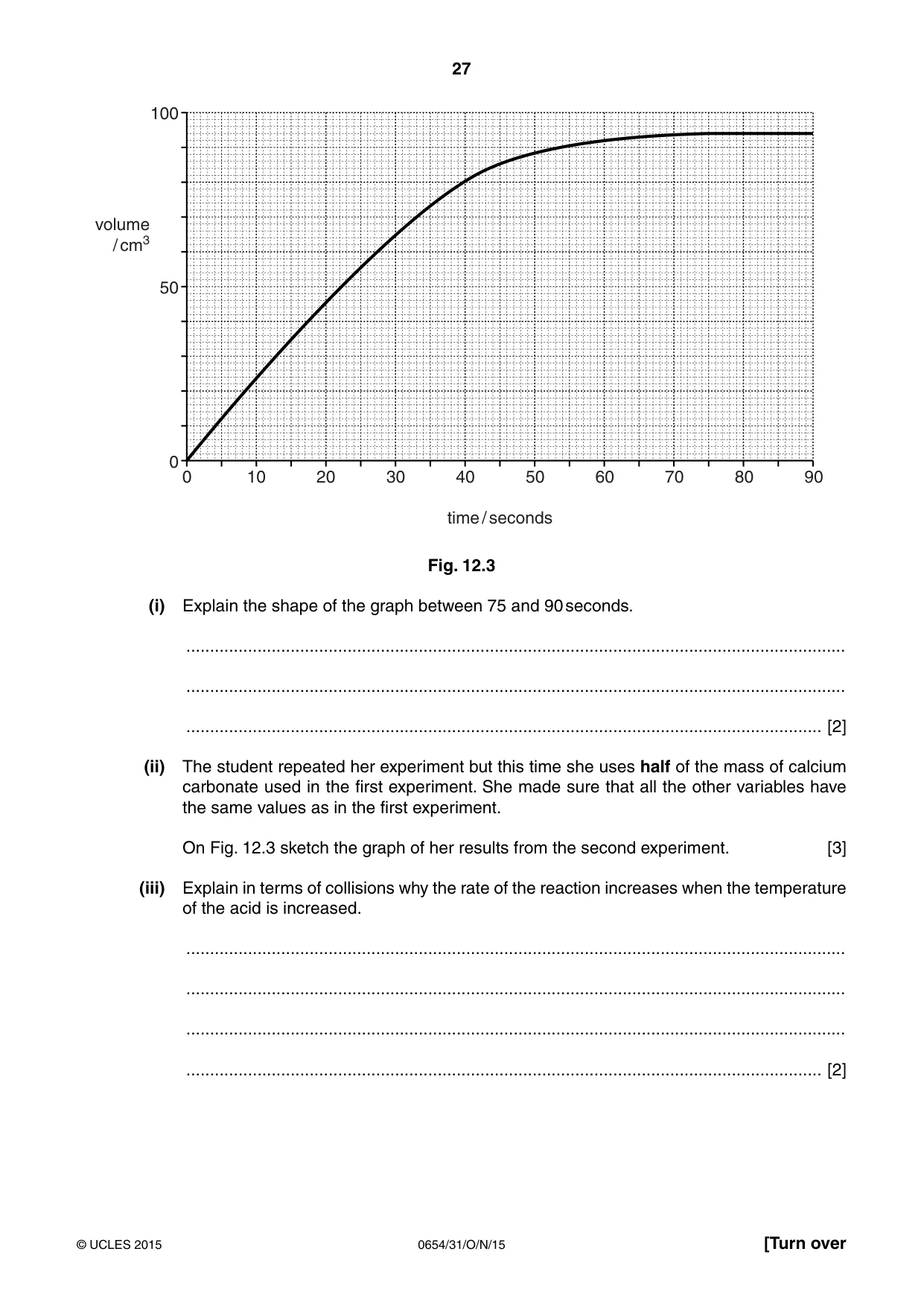
26 0654/31/O/N/15 © UCLES 2015 (c) Fig. 12.2 shows apparatus a student uses to investigate the rate of reaction between calcium carbonate and excess dilute hydrochloric acid. 50 100 gas syringe piston of the syringe slides out as gas enters excess dilute hydrochloric acid calcium carbonate thermometer side-arm test-tube controlled temperature water-bath Fig. 12.2 The student obtains data using the following method. • She pushes the piston completely into the gas syringe. • She adds a known amount of dilute hydrochloric acid to the side-arm test-tube and checks that the temperature is steady. • She adds a known mass of calcium carbonate to the side-arm test-tube, places the bung in position and starts her stopwatch. • She records the volume of gas in the gas syringe every 10 seconds for 90 seconds. Fig. 12.3 shows a graph of her results.
Question paper, page 27
27 0654/31/O/N/15 © UCLES 2015 [Turn over 100 50 0 0 10 20 30 40 50 60 70 80 90 time / seconds volume / cm3 Fig. 12.3 (i) Explain the shape of the graph between 75 and 90 seconds. … … … [2] (ii) The student repeated her experiment but this time she uses half of the mass of calcium carbonate used in the first experiment. She made sure that all the other variables have the same values as in the first experiment. On Fig. 12.3 sketch the graph of her results from the second experiment. [3] (iii) Explain in terms of collisions why the rate of the reaction increases when the temperature of the acid is increased. … … … … [2]
Question paper, page 28
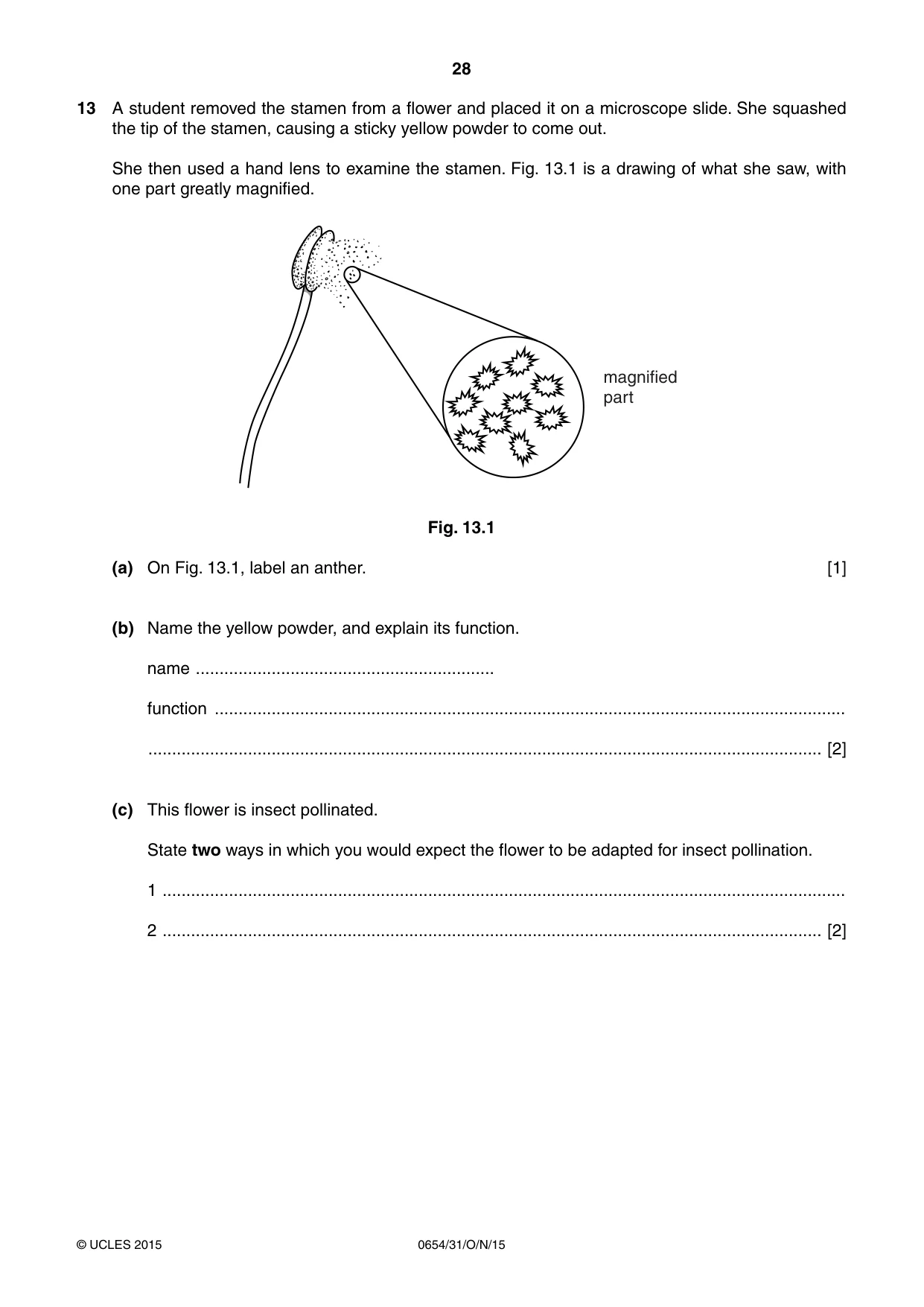
28 0654/31/O/N/15 © UCLES 2015 13 A student removed the stamen from a flower and placed it on a microscope slide. She squashed the tip of the stamen, causing a sticky yellow powder to come out. She then used a hand lens to examine the stamen. Fig. 13.1 is a drawing of what she saw, with one part greatly magnified. magnified part Fig. 13.1 (a) On Fig. 13.1, label an anther. [1] (b) Name the yellow powder, and explain its function. name … function … … [2] (c) This flower is insect pollinated. State two ways in which you would expect the flower to be adapted for insect pollination. 1 … 2 … [2]
Question paper, page 29
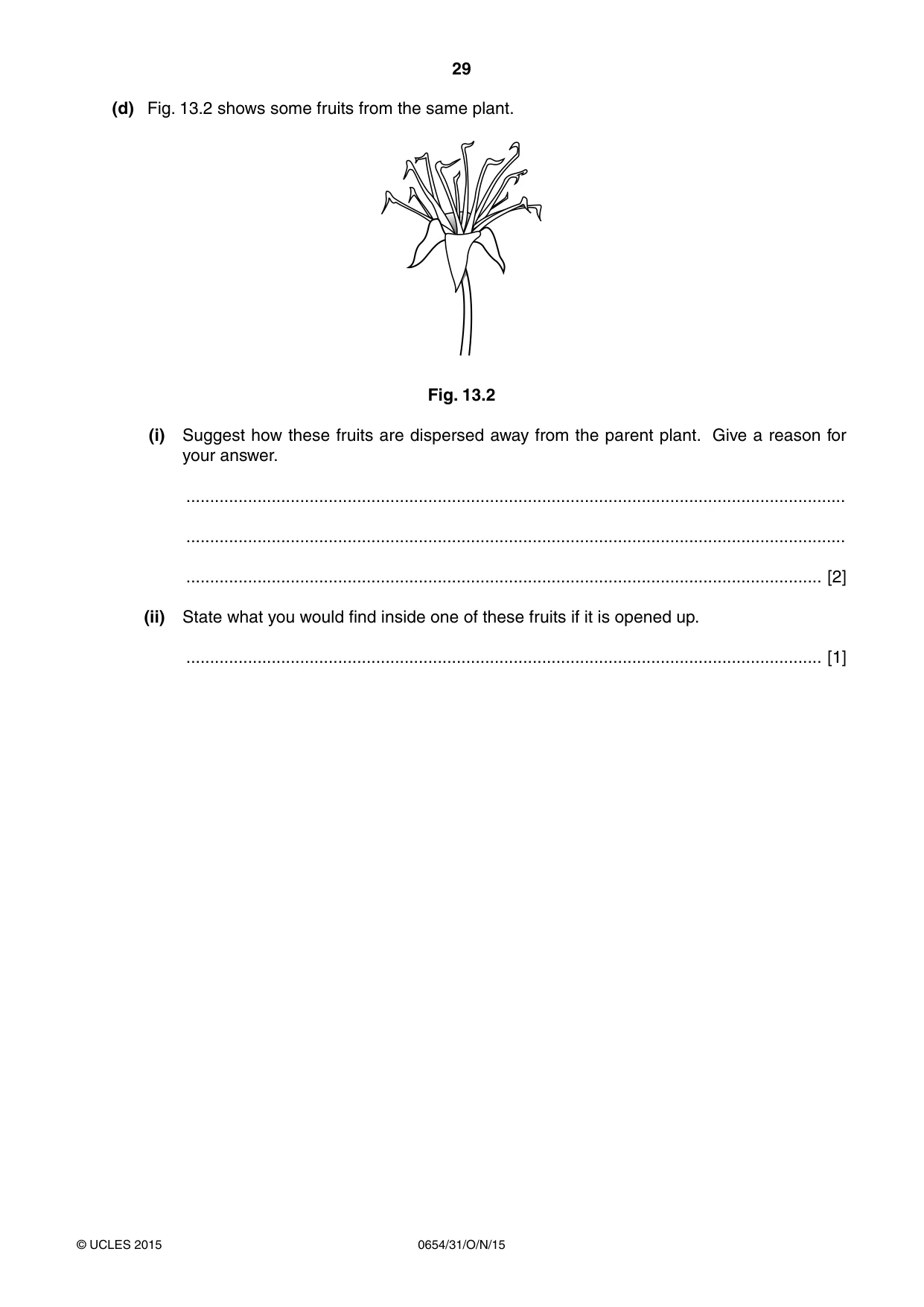
29 0654/31/O/N/15 © UCLES 2015 (d) Fig. 13.2 shows some fruits from the same plant. Fig. 13.2 (i) Suggest how these fruits are dispersed away from the parent plant. Give a reason for your answer. … … … [2] (ii) State what you would find inside one of these fruits if it is opened up. … [1]
Question paper, page 30
30 0654/31/O/N/15 © UCLES 2015 BLANK PAGE
Question paper, page 31
31 0654/31/O/N/15 © UCLES 2015 BLANK PAGE
Question paper, page 32
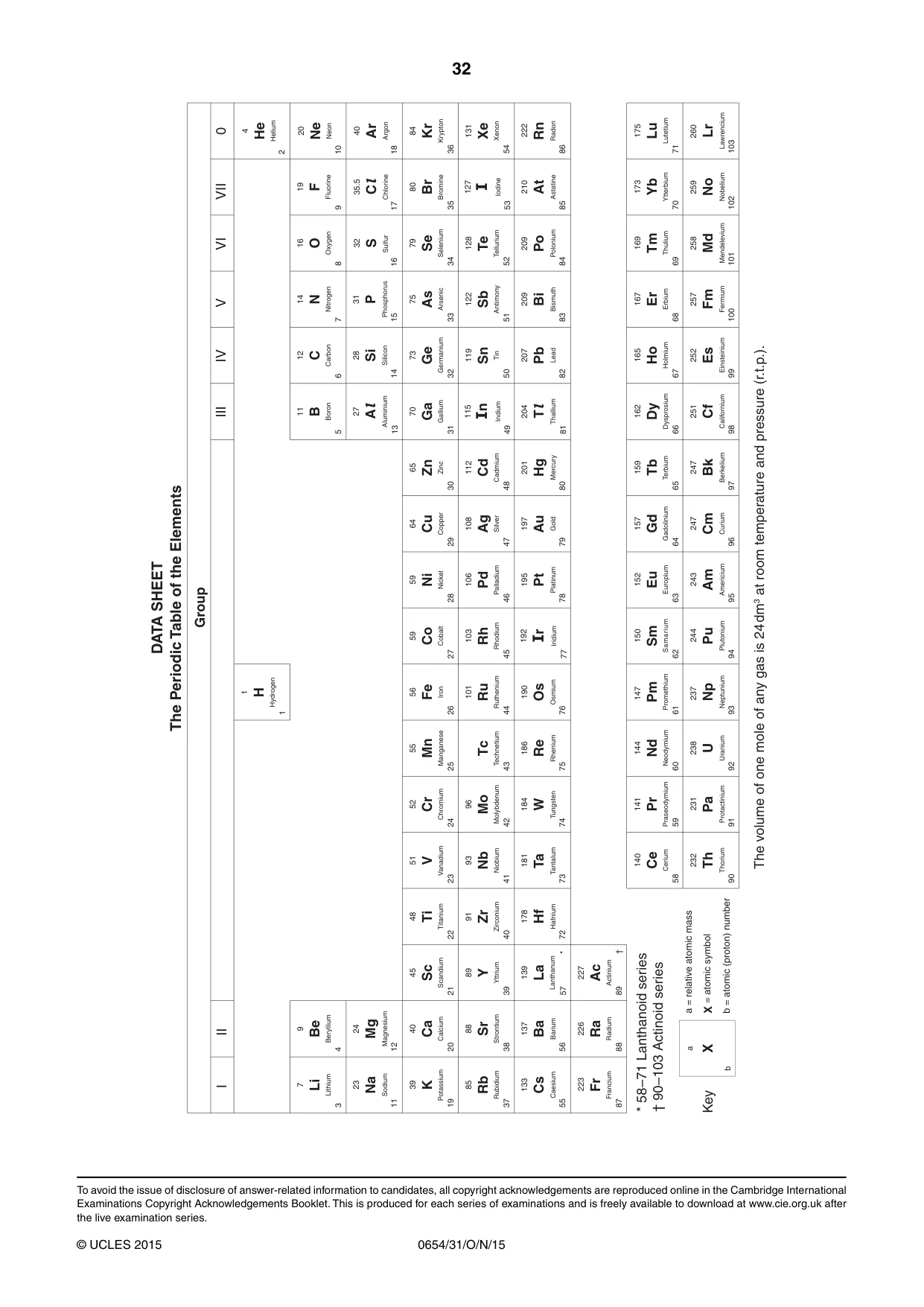
32 0654/31/O/N/15 © UCLES 2015 To avoid the issue of disclosure of answer-related information to candidates, all copyright acknowledgements are reproduced online in the Cambridge International Examinations Copyright Acknowledgements Booklet. This is produced for each series of examinations and is freely available to download at www.cie.org.uk after the live examination series. Group The Periodic Table of the Elements 140 Ce Cerium 58 141 Pr Praseodymium 59 144 Nd Neodymium 60 Pm Promethium 61 150 Sm Samarium 62 152 Eu Europium 63 157 Gd Gadolinium 64 159 Tb Terbium 65 162 Dy Dysprosium 66 165 Ho Holmium 67 167 Er Erbium 68 169 Tm Thulium 69 173 Yb Ytterbium 70 175 Lu Lutetium 71 232 Th Thorium 90 Pa Protactinium 91 238 231 147 237 244 243 247 247 251 252 257 258 259 260 U Uranium 92 Np Neptunium 93 Pu Plutonium 94 Am Americium 95 Cm Curium 96 Bk Berkelium 97 Cf Californium 98 Es Einsteinium 99 Fm Fermium 100 Md Mendelevium 101 No Nobelium 102 Lr Lawrencium 103 1 H Hydrogen 1 7 Li Lithium 3 23 Na Sodium 11 24 Mg Magnesium 12 40 Ca Calcium 20 45 Sc Scandium 21 48 Ti Titanium 22 51 V Vanadium 23 52 Cr Chromium 24 55 Mn Manganese 25 56 Fe Iron 26 59 Co Cobalt 27 59 Ni Nickel 28 64 Cu Copper 29 65 Zn Zinc 30 70 Ga Gallium 31 27 Al Aluminium 13 11 B Boron 5 12 C Carbon 6 14 N Nitrogen 7 16 O Oxygen 8 19 F Fluorine 9 28 Si Silicon 14 31 P Phosphorus 15 32 S Sulfur 16 35.5 Cl Chlorine 17 40 Ar Argon 18 20 Ne Neon 10 4 He Helium 2 73 Ge Germanium 32 75 As Arsenic 33 79 Se Selenium 34 80 Br Bromine 35 84 Kr Krypton 36 39 K Potassium 19 88 Sr Strontium 38 89 Y Yttrium 39 91 Zr Zirconium 40 93 Nb Niobium 41 96 Mo Molybdenum 42 Tc Technetium 43 101 Ru Ruthenium 44 103 Rh Rhodium 45 106 Pd Palladium 46 108 Ag Silver 47 112 Cd Cadmium 48 115 In Indium 49 119 Sn Tin 50 122 Sb Antimony 51 128 Te Tellurium 52 127 I Iodine 53 131 Xe Xenon 54 137 Ba Barium 56 139 La Lanthanum 57 * 178 Hf Hafnium 72 181 Ta Tantalum 73 184 W Tungsten 74 186 Re Rhenium 75 190 Os Osmium 76 192 Ir Iridium 77 195 Pt Platinum 78 197 Au Gold 79 201 Hg Mercury 80 204 Tl Thallium 81 207 Pb Lead 82 209 209 210 222 Bi Bismuth 83 Po Polonium 84 At Astatine 85 Rn Radon 86 Fr Francium 87 227 Ac Actinium 89 † 9 Be Beryllium 4 I II III IV V VI VII 0 85 Rb Rubidium 37 133 Cs Caesium 55 226 223 Ra Radium 88 a X b a = relative atomic mass X = atomic symbol b = atomic (proton) number Key DATA SHEET * 58–71 Lanthanoid series † 90–103 Actinoid series The volume of one mole of any gas is 24dm3 at room temperature and pressure (r.t.p.).
Mark scheme, page 1
® IGCSE is the registered trademark of Cambridge International Examinations. CAMBRIDGE INTERNATIONAL EXAMINATIONS Cambridge International General Certificate of Secondary Education MARK SCHEME for the October/November 2015 series 0654 CO-ORDINATED SCIENCES 0654/31 Paper 3 (Extended Theory), maximum raw mark 120 This mark scheme is published as an aid to teachers and candidates, to indicate the requirements of the examination. It shows the basis on which Examiners were instructed to award marks. It does not indicate the details of the discussions that took place at an Examiners’ meeting before marking began, which would have considered the acceptability of alternative answers. Mark schemes should be read in conjunction with the question paper and the Principal Examiner Report for Teachers. Cambridge will not enter into discussions about these mark schemes. Cambridge is publishing the mark schemes for the October/November 2015 series for most Cambridge IGCSE®, Cambridge International A and AS Level components and some Cambridge O Level components.
Mark scheme, page 2
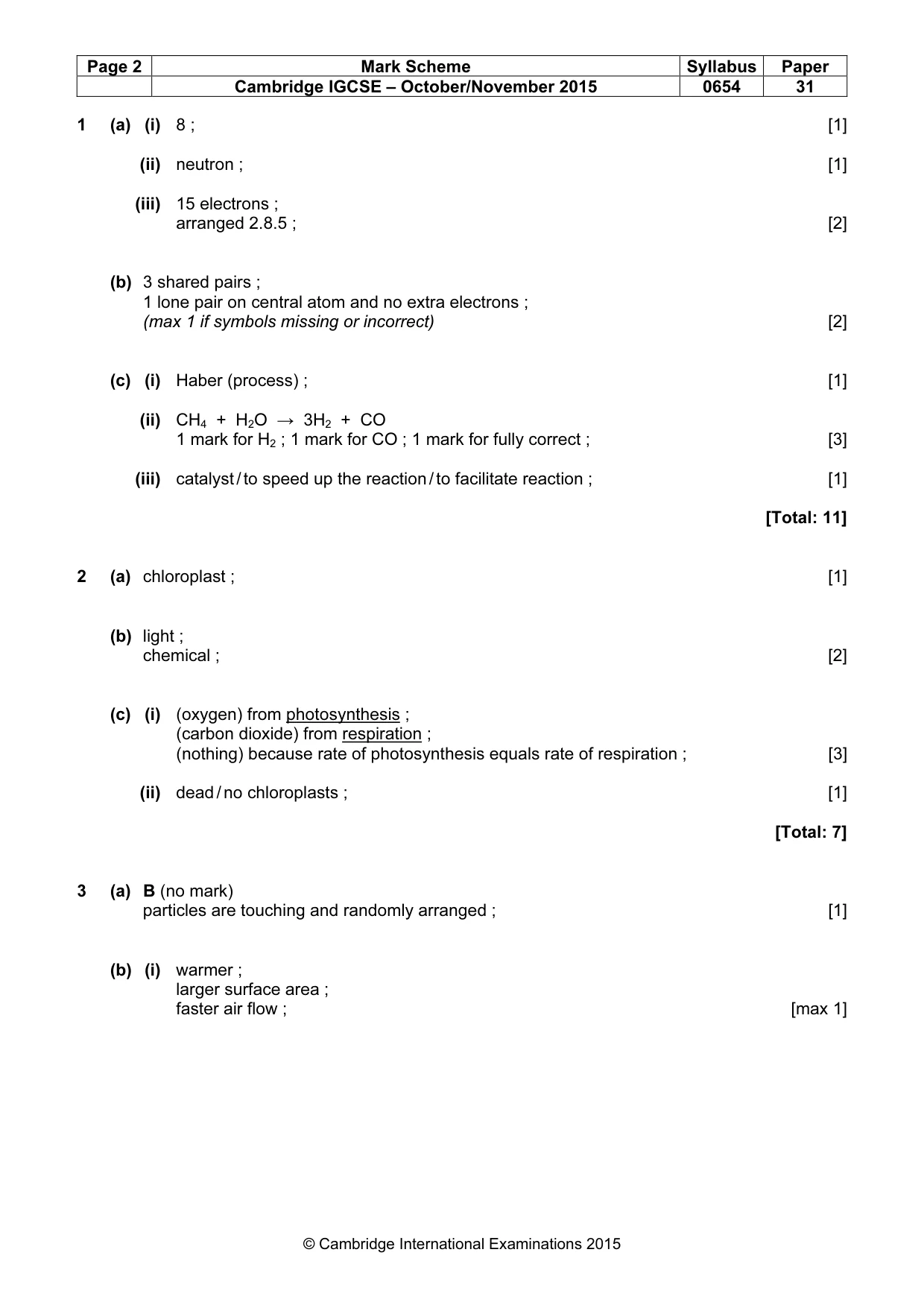
Page 2 Mark Scheme Syllabus Paper Cambridge IGCSE – October/November 2015 0654 31 © Cambridge International Examinations 2015 1 (a) (i) 8 ; [1] (ii) neutron ; [1] (iii) 15 electrons ; arranged 2.8.5 ; [2] (b) 3 shared pairs ; 1 lone pair on central atom and no extra electrons ; (max 1 if symbols missing or incorrect) [2] (c) (i) Haber (process) ; [1] (ii) CH4 + H2O → 3H2 + CO 1 mark for H2 ; 1 mark for CO ; 1 mark for fully correct ; [3] (iii) catalyst / to speed up the reaction / to facilitate reaction ; [1] [Total: 11] 2 (a) chloroplast ; [1] (b) light ; chemical ; [2] (c) (i) (oxygen) from photosynthesis ; (carbon dioxide) from respiration ; (nothing) because rate of photosynthesis equals rate of respiration ; [3] (ii) dead / no chloroplasts ; [1] [Total: 7] 3 (a) B (no mark) particles are touching and randomly arranged ; [1] (b) (i) warmer ; larger surface area ; faster air flow ; [max 1]
Mark scheme, page 3
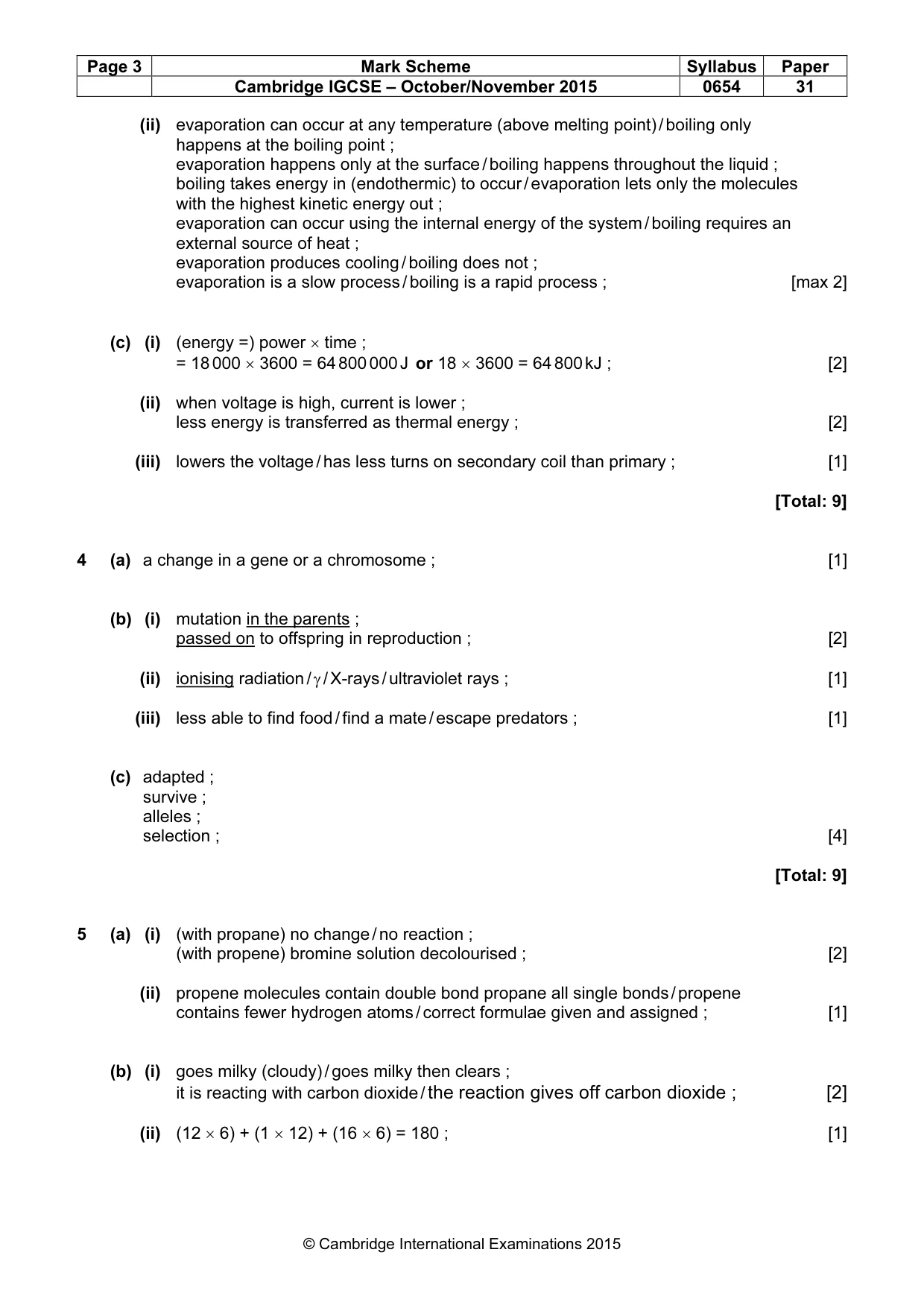
Page 3 Mark Scheme Syllabus Paper Cambridge IGCSE – October/November 2015 0654 31 © Cambridge International Examinations 2015 (ii) evaporation can occur at any temperature (above melting point) / boiling only happens at the boiling point ; evaporation happens only at the surface / boiling happens throughout the liquid ; boiling takes energy in (endothermic) to occur / evaporation lets only the molecules with the highest kinetic energy out ; evaporation can occur using the internal energy of the system / boiling requires an external source of heat ; evaporation produces cooling / boiling does not ; evaporation is a slow process / boiling is a rapid process ; [max 2] (c) (i) (energy =) power × time ; = 18 000 × 3600 = 64 800 000 J or 18 × 3600 = 64 800 kJ ; [2] (ii) when voltage is high, current is lower ; less energy is transferred as thermal energy ; [2] (iii) lowers the voltage / has less turns on secondary coil than primary ; [1] [Total: 9] 4 (a) a change in a gene or a chromosome ; [1] (b) (i) mutation in the parents ; passed on to offspring in reproduction ; [2] (ii) ionising radiation / γ / X-rays / ultraviolet rays ; [1] (iii) less able to find food / find a mate / escape predators ; [1] (c) adapted ; survive ; alleles ; selection ; [4] [Total: 9] 5 (a) (i) (with propane) no change / no reaction ; (with propene) bromine solution decolourised ; [2] (ii) propene molecules contain double bond propane all single bonds / propene contains fewer hydrogen atoms / correct formulae given and assigned ; [1] (b) (i) goes milky (cloudy) / goes milky then clears ; it is reacting with carbon dioxide / the reaction gives off carbon dioxide ; [2] (ii) (12 × 6) + (1 × 12) + (16 × 6) = 180 ; [1]
Mark scheme, page 4
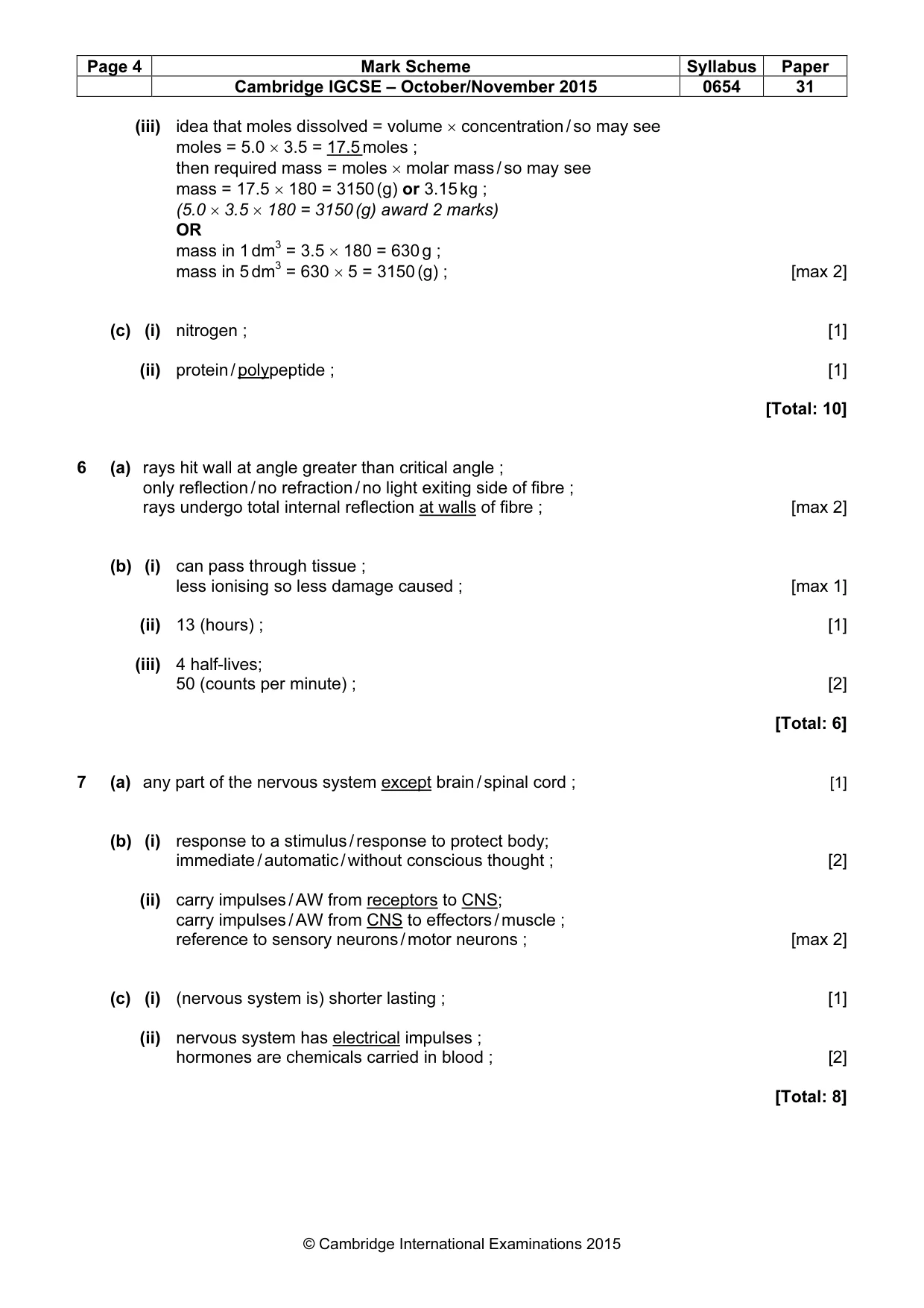
Page 4 Mark Scheme Syllabus Paper Cambridge IGCSE – October/November 2015 0654 31 © Cambridge International Examinations 2015 (iii) idea that moles dissolved = volume × concentration / so may see moles = 5.0 × 3.5 = 17.5 moles ; then required mass = moles × molar mass / so may see mass = 17.5 × 180 = 3150 (g) or 3.15 kg ; (5.0 × 3.5 × 180 = 3150 (g) award 2 marks) OR mass in 1 dm3 = 3.5 × 180 = 630 g ; mass in 5 dm3 = 630 × 5 = 3150 (g) ; [max 2] (c) (i) nitrogen ; [1] (ii) protein / polypeptide ; [1] [Total: 10] 6 (a) rays hit wall at angle greater than critical angle ; only reflection / no refraction / no light exiting side of fibre ; rays undergo total internal reflection at walls of fibre ; [max 2] (b) (i) can pass through tissue ; less ionising so less damage caused ; [max 1] (ii) 13 (hours) ; [1] (iii) 4 half-lives; 50 (counts per minute) ; [2] [Total: 6] 7 (a) any part of the nervous system except brain / spinal cord ; [1] (b) (i) response to a stimulus / response to protect body; immediate / automatic / without conscious thought ; [2] (ii) carry impulses / AW from receptors to CNS; carry impulses / AW from CNS to effectors / muscle ; reference to sensory neurons / motor neurons ; [max 2] (c) (i) (nervous system is) shorter lasting ; [1] (ii) nervous system has electrical impulses ; hormones are chemicals carried in blood ; [2] [Total: 8]
Mark scheme, page 5
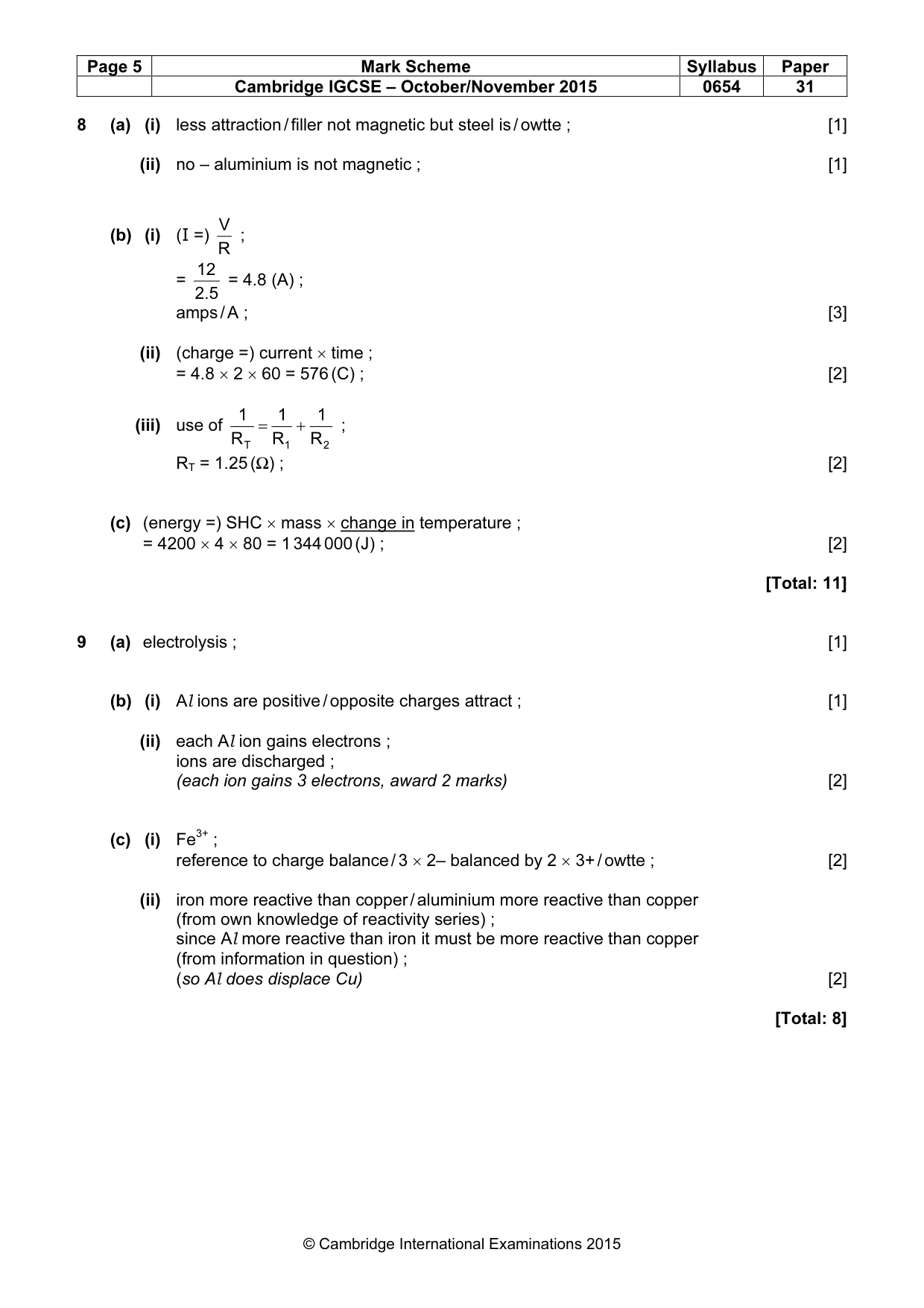
Page 5 Mark Scheme Syllabus Paper Cambridge IGCSE – October/November 2015 0654 31 © Cambridge International Examinations 2015 8 (a) (i) less attraction / filler not magnetic but steel is / owtte ; [1] (ii) no – aluminium is not magnetic ; [1] (b) (i) (I =) R V ; = 2.5 12 = 4.8 (A) ; amps / A ; [3] (ii) (charge =) current × time ; = 4.8 × 2 × 60 = 576 (C) ; [2] (iii) use of 2 1 T R 1 R 1 R 1 + = ; RT = 1.25 (Ω) ; [2] (c) (energy =) SHC × mass × change in temperature ; = 4200 × 4 × 80 = 1 344 000 (J) ; [2] [Total: 11] 9 (a) electrolysis ; [1] (b) (i) Al ions are positive / opposite charges attract ; [1] (ii) each Al ion gains electrons ; ions are discharged ; (each ion gains 3 electrons, award 2 marks) [2] (c) (i) Fe3+ ; reference to charge balance / 3 × 2– balanced by 2 × 3+ / owtte ; [2] (ii) iron more reactive than copper / aluminium more reactive than copper (from own knowledge of reactivity series) ; since Al more reactive than iron it must be more reactive than copper (from information in question) ; (so Al does displace Cu) [2] [Total: 8]
Mark scheme, page 6
P 10 11 Pag 0 ( ( ( ( ( ( ge (a) (b) (c) (a) (b) (c) 6 m ) ( (i ( (i ( = ) (w = ( (i may (i) i) (i) i) KE = ½ wo = 30 (i) i) yfly a m re w to he ra re p a (c ed E = ½ × ork 00 (p 4 25 y la rro micr esp whic oxic eav ain edu ub lter che duc ) ½ 40 do 0 × pre 16 40 50 arv ow roo pira ch c ; vy of uce lic rna em cat ½ m 000 one × 2 ess 600 00 00 C vae an org atio pre me f low ed tra ativ ica tion mv2 0 × e = = ure 0 00 = 00 ( Cam e / c yw an on d eve eta w p use ans ve e al) a n / t 2 ; 0. ) fo 60 e = = 2 (Pa mb cad whe ism de ent als pH e o spo ene abs tax 4 × orc 000 =) f 25 ( a) ; brid dis ere ms oxy ts r bio / p of f ort erg sor xati × 0 ce × 0 (J are for (N / dge © s fli in ; yge res oac pH foss ; gy s rbe ion 0.4 × d J) ; ea rce / cm e IG Ca ies the ena spir ccu les sil sou ers n / p = 3 dist e ; m2) GC amb s / fr e s ate rati um ss t fue urc / fi pub 320 an ) ; M CSE brid res sha es w on ula tha els ces lter blic 0 (J ce Mar E – dge shw ade wa ; atio an 7 ; s ; rs o c aw J) ; k S – O e In wat ed a ater on 7 / p on wa ; Sch Oct nter ter are r ; ; pol (fa ren hem ob rnat sh ea llut act nes me ber/ tion hrim ; ted ory ss e /No nal mps d w y) c me ove Ex s / w with chi eas em xam wa (n mn sur mbe mina ter am ney res er 2 atio r lic med ys ; 20 ons ce / d) a ; 15 s 20 / blo aci 015 ood id ; 5 dworms ; S ; Syl 0 llab 065 bu 54 s P [T Pa 3 [m [m Tot pe 31 max max tal er [1 [1 x 3 [1 x 2 : 8 [2 [2 [2 [1 ] ] 3] ] 2] 8] 2] 2] 2] ]
Mark scheme, page 7
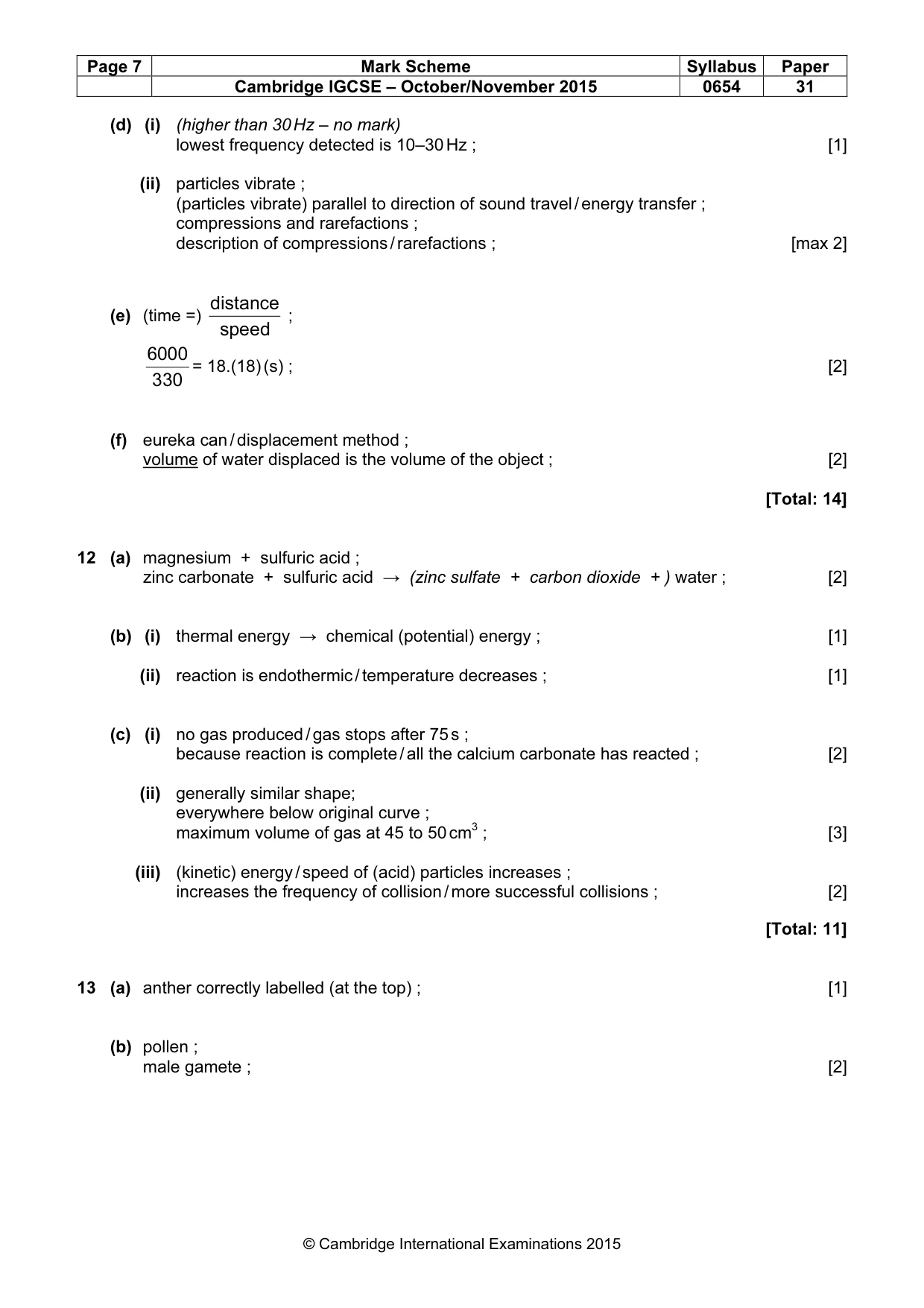
Page 7 Mark Scheme Syllabus Paper Cambridge IGCSE – October/November 2015 0654 31 © Cambridge International Examinations 2015 (d) (i) (higher than 30 Hz – no mark) lowest frequency detected is 10–30 Hz ; [1] (ii) particles vibrate ; (particles vibrate) parallel to direction of sound travel / energy transfer ; compressions and rarefactions ; description of compressions / rarefactions ; [max 2] (e) (time =) speed distance ; 330 6000 = 18.(18) (s) ; [2] (f) eureka can / displacement method ; volume of water displaced is the volume of the object ; [2] [Total: 14] 12 (a) magnesium + sulfuric acid ; zinc carbonate + sulfuric acid → (zinc sulfate + carbon dioxide + ) water ; [2] (b) (i) thermal energy → chemical (potential) energy ; [1] (ii) reaction is endothermic / temperature decreases ; [1] (c) (i) no gas produced / gas stops after 75 s ; because reaction is complete / all the calcium carbonate has reacted ; [2] (ii) generally similar shape; everywhere below original curve ; maximum volume of gas at 45 to 50 cm3 ; [3] (iii) (kinetic) energy / speed of (acid) particles increases ; increases the frequency of collision / more successful collisions ; [2] [Total: 11] 13 (a) anther correctly labelled (at the top) ; [1] (b) pollen ; male gamete ; [2]
Mark scheme, page 8
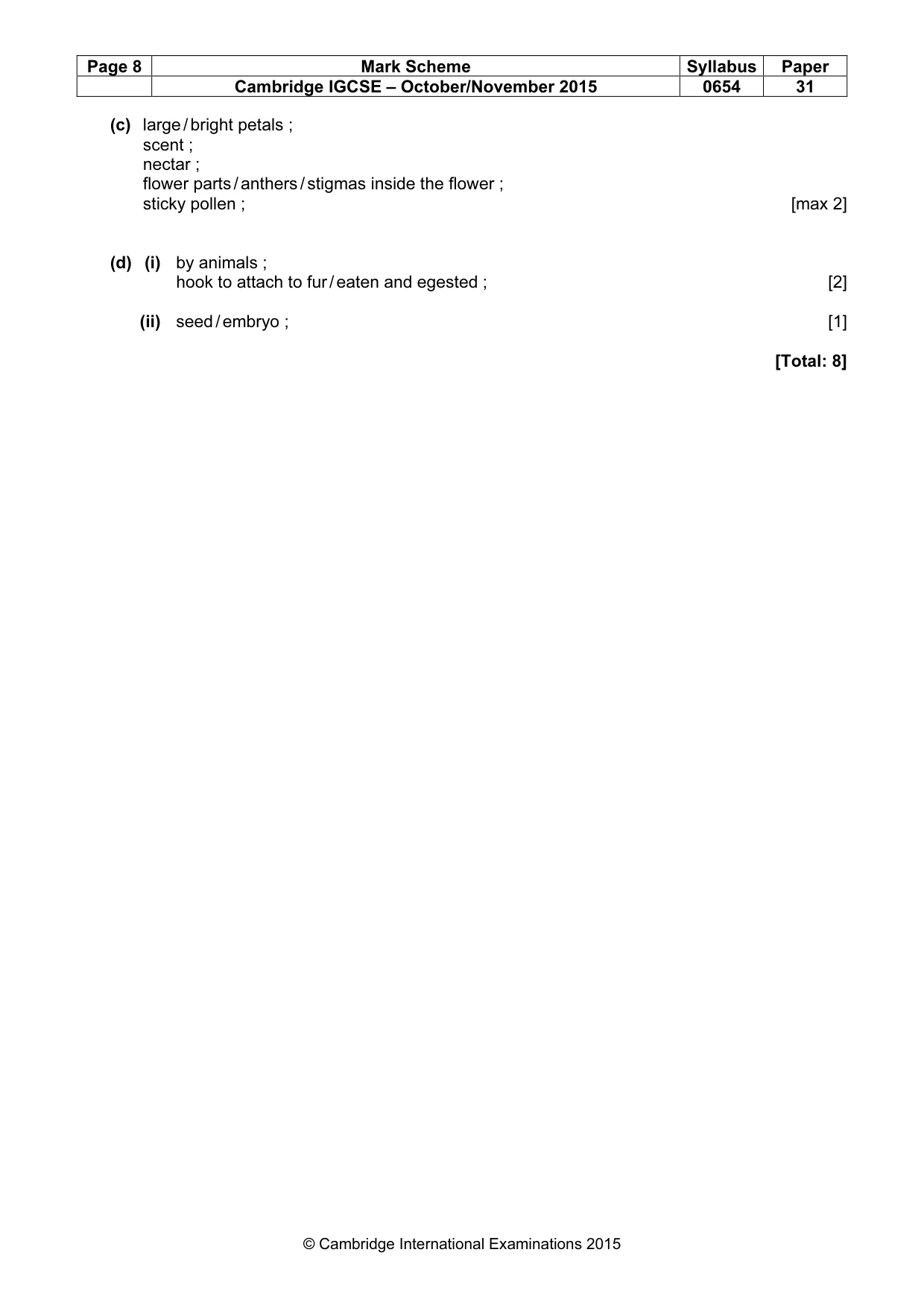
Page 8 Mark Scheme Syllabus Paper Cambridge IGCSE – October/November 2015 0654 31 © Cambridge International Examinations 2015 (c) large / bright petals ; scent ; nectar ; flower parts / anthers / stigmas inside the flower ; sticky pollen ; [max 2] (d) (i) by animals ; hook to attach to fur / eaten and egested ; [2] (ii) seed / embryo ; [1] [Total: 8]
What you needed in this session
Cambridge’s own grade thresholds for 2015 Oct/Nov, Paper 3 · Variant 1. A higher threshold means an easier paper — the bar moves with how the cohort did.