Cambridge IGCSE Sciences - Co-ordinated (Double) 0654 — 2015 Oct/Nov Paper 3 · Variant 3
0654/33/O/N/15 · 120 marks · ≈135 min
The question paper and its mark scheme, free to read here and free to download. This is Cambridge’s own paper, exactly as it was sat.
Question paper28 pages
Mark scheme7 pages
Answers below. Sit the paper first if you are practising.
Paper as text
Question paper, page 1
This document consists of 28 printed pages. DC (AC/CGW) 102949/4 © UCLES 2015 [Turn over Cambridge International Examinations Cambridge International General Certificate of Secondary Education * 9 5 9 1 3 1 5 2 7 1 * CO-ORDINATED SCIENCES 0654/33 Paper 3 (Extended) October/November 2015 2 hours Candidates answer on the Question Paper. No Additional Materials are required. READ THESE INSTRUCTIONS FIRST Write your Centre number, candidate number and name on all the work you hand in. Write in dark blue or black pen. You may use an HB pencil for any diagrams, graphs, tables or rough working. Do not use staples, paper clips, glue or correction fluid. DO NOT WRITE IN ANY BARCODES. Answer all questions. Electronic calculators may be used. You may lose marks if you do not show your working or if you do not use appropriate units. A copy of the Periodic Table is printed on page 28. At the end of the examination, fasten all your work securely together. The number of marks is given in brackets [ ] at the end of each question or part question.
Question paper, page 2
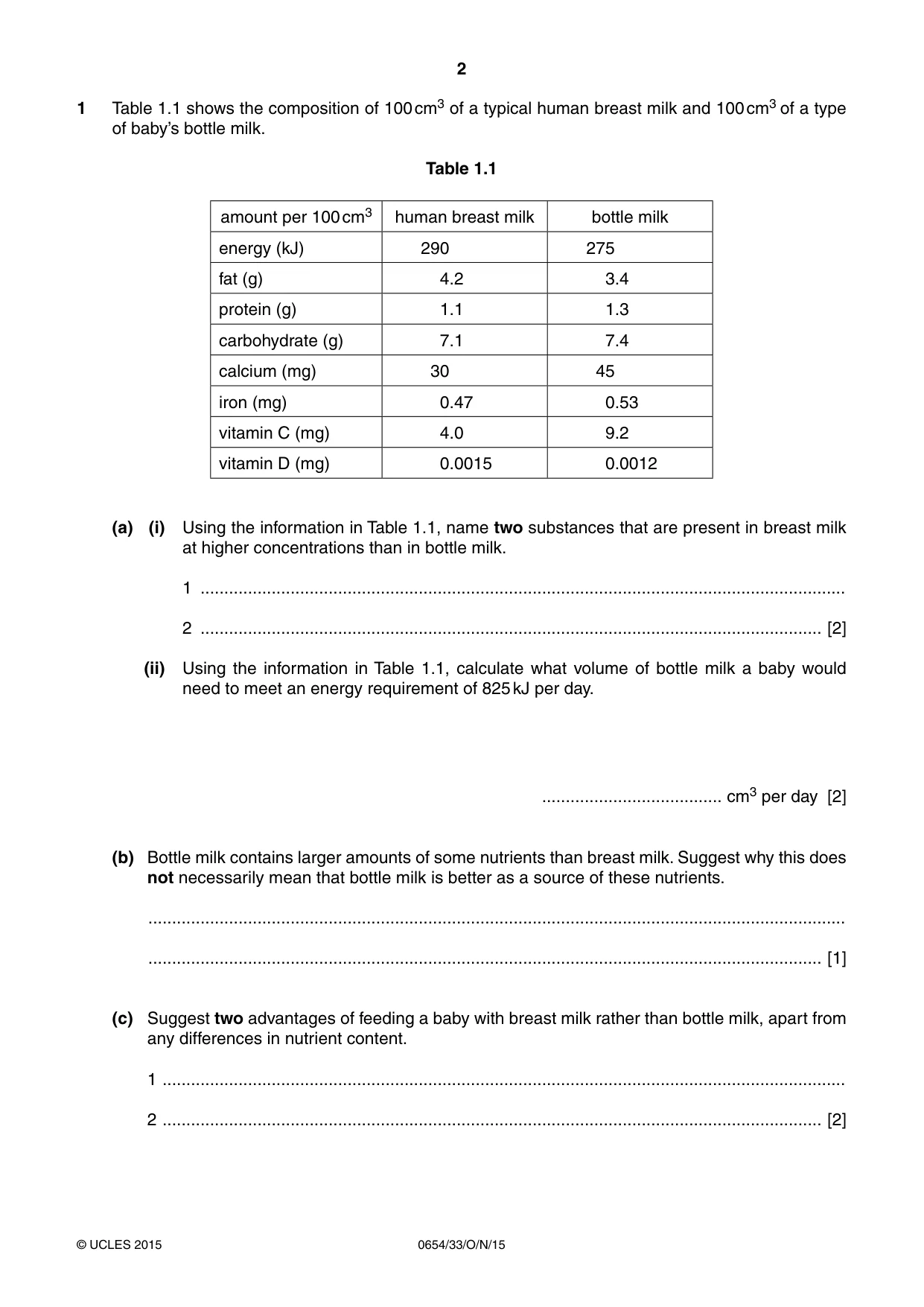
2 0654/33/O/N/15 © UCLES 2015 1 Table 1.1 shows the composition of 100 cm3 of a typical human breast milk and 100 cm3 of a type of baby’s bottle milk. Table 1.1 amount per 100 cm3 human breast milk bottle milk energy (kJ) 290 275 fat (g) 4.2 3.4 protein (g) 1.1 1.3 carbohydrate (g) 7.1 7.4 calcium (mg) 30 45 iron (mg) 0.47 0.53 vitamin C (mg) 4.0 9.2 vitamin D (mg) 0.0015 0.0012 (a) (i) Using the information in Table 1.1, name two substances that are present in breast milk at higher concentrations than in bottle milk. 1 … 2 … [2] (ii) Using the information in Table 1.1, calculate what volume of bottle milk a baby would need to meet an energy requirement of 825 kJ per day. … cm3 per day [2] (b) Bottle milk contains larger amounts of some nutrients than breast milk. Suggest why this does not necessarily mean that bottle milk is better as a source of these nutrients. … … [1] (c) Suggest two advantages of feeding a baby with breast milk rather than bottle milk, apart from any differences in nutrient content. 1 … 2 … [2]
Question paper, page 3
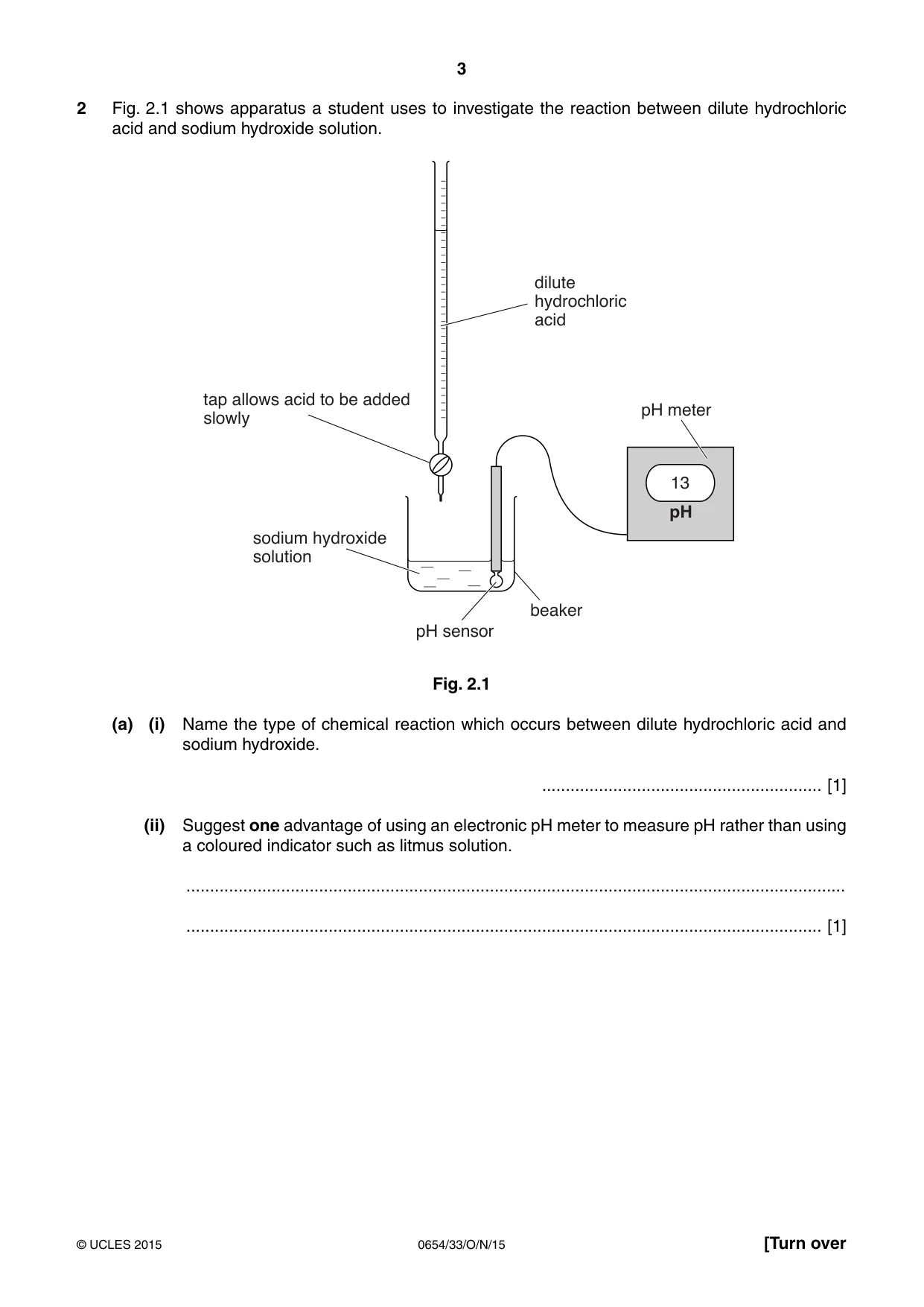
3 0654/33/O/N/15 © UCLES 2015 [Turn over 2 Fig. 2.1 shows apparatus a student uses to investigate the reaction between dilute hydrochloric acid and sodium hydroxide solution. beaker pH sensor sodium hydroxide solution tap allows acid to be added slowly pH meter dilute hydrochloric acid 13 pH Fig. 2.1 (a) (i) Name the type of chemical reaction which occurs between dilute hydrochloric acid and sodium hydroxide. … [1] (ii) Suggest one advantage of using an electronic pH meter to measure pH rather than using a coloured indicator such as litmus solution. … … [1]
Question paper, page 4
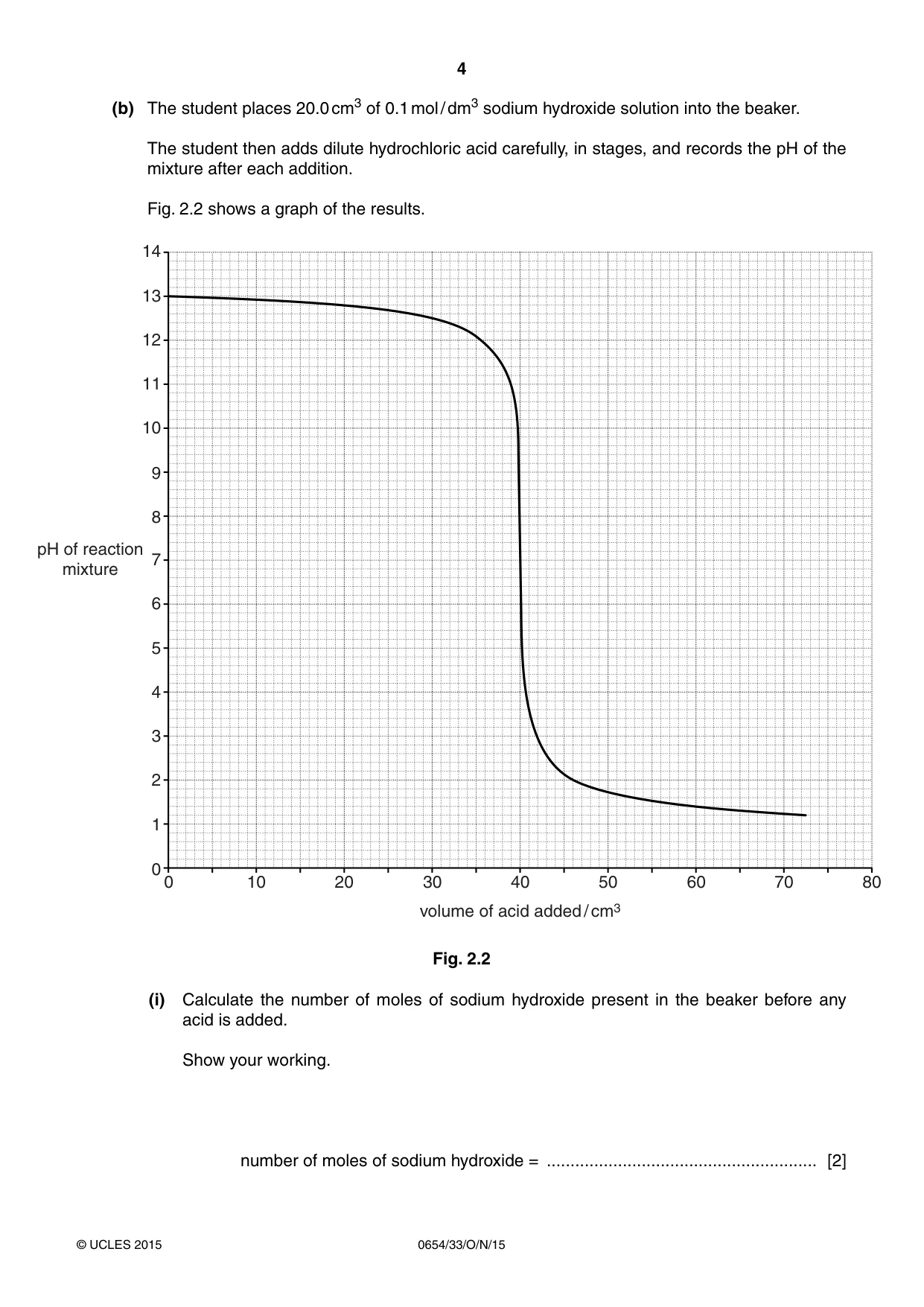
4 0654/33/O/N/15 © UCLES 2015 (b) The student places 20.0 cm3 of 0.1 mol / dm3 sodium hydroxide solution into the beaker. The student then adds dilute hydrochloric acid carefully, in stages, and records the pH of the mixture after each addition. Fig. 2.2 shows a graph of the results. 0 1 2 3 4 5 6 0 10 20 30 40 volume of acid added / cm3 50 60 70 80 pH of reaction mixture 7 8 9 10 11 12 13 14 Fig. 2.2 (i) Calculate the number of moles of sodium hydroxide present in the beaker before any acid is added. Show your working. number of moles of sodium hydroxide = … [2]
Question paper, page 5
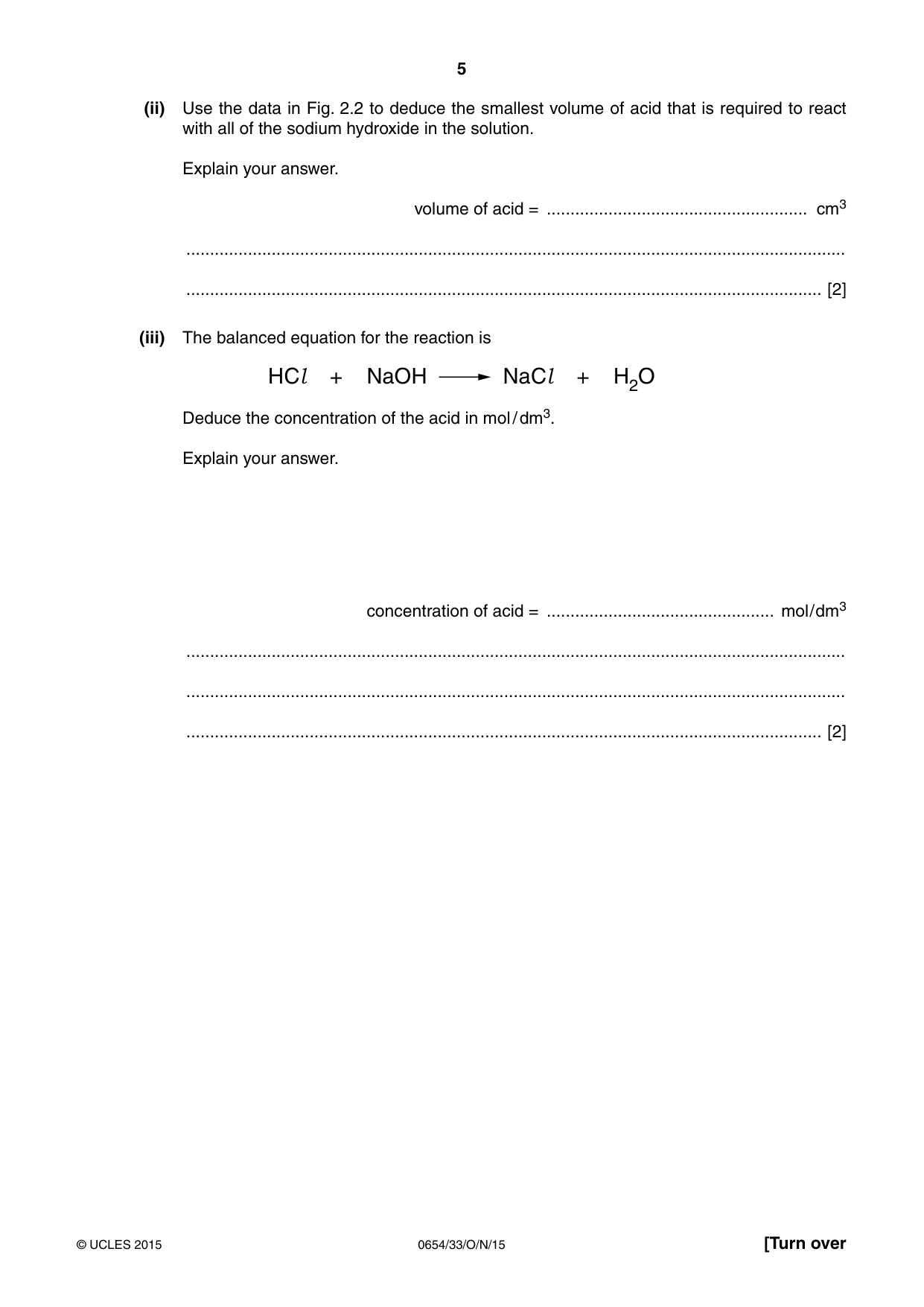
5 0654/33/O/N/15 © UCLES 2015 [Turn over (ii) Use the data in Fig. 2.2 to deduce the smallest volume of acid that is required to react with all of the sodium hydroxide in the solution. Explain your answer. volume of acid = … cm3 … … [2] (iii) The balanced equation for the reaction is HCl + NaOH NaCl + H2O Deduce the concentration of the acid in mol / dm3. Explain your answer. concentration of acid = … mol / dm3 … … … [2]
Question paper, page 6
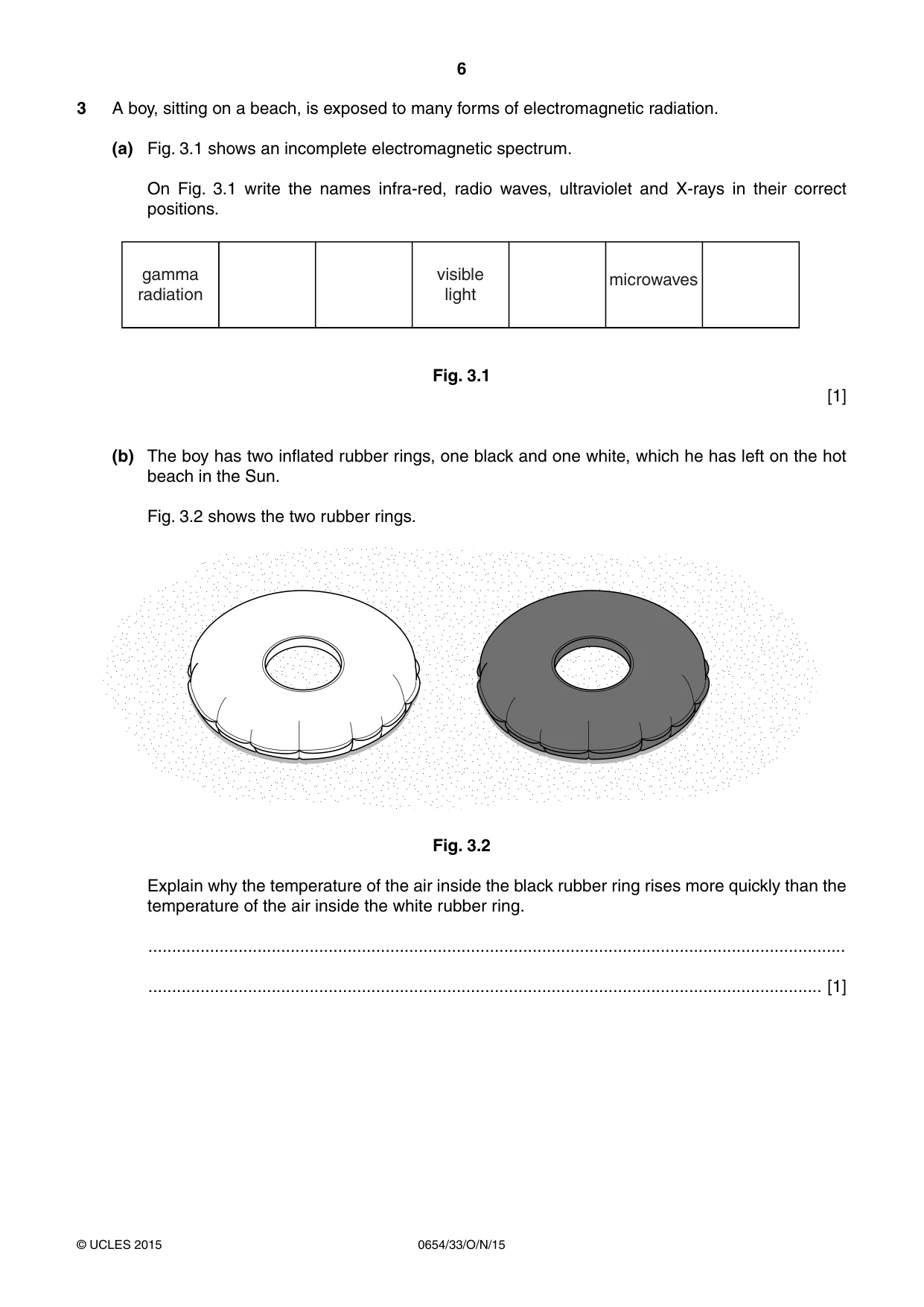
6 0654/33/O/N/15 © UCLES 2015 3 A boy, sitting on a beach, is exposed to many forms of electromagnetic radiation. (a) Fig. 3.1 shows an incomplete electromagnetic spectrum. On Fig. 3.1 write the names infra-red, radio waves, ultraviolet and X-rays in their correct positions. gamma radiation visible light microwaves Fig. 3.1 [1] (b) The boy has two inflated rubber rings, one black and one white, which he has left on the hot beach in the Sun. Fig. 3.2 shows the two rubber rings. Fig. 3.2 Explain why the temperature of the air inside the black rubber ring rises more quickly than the temperature of the air inside the white rubber ring. … … [1]
Question paper, page 7
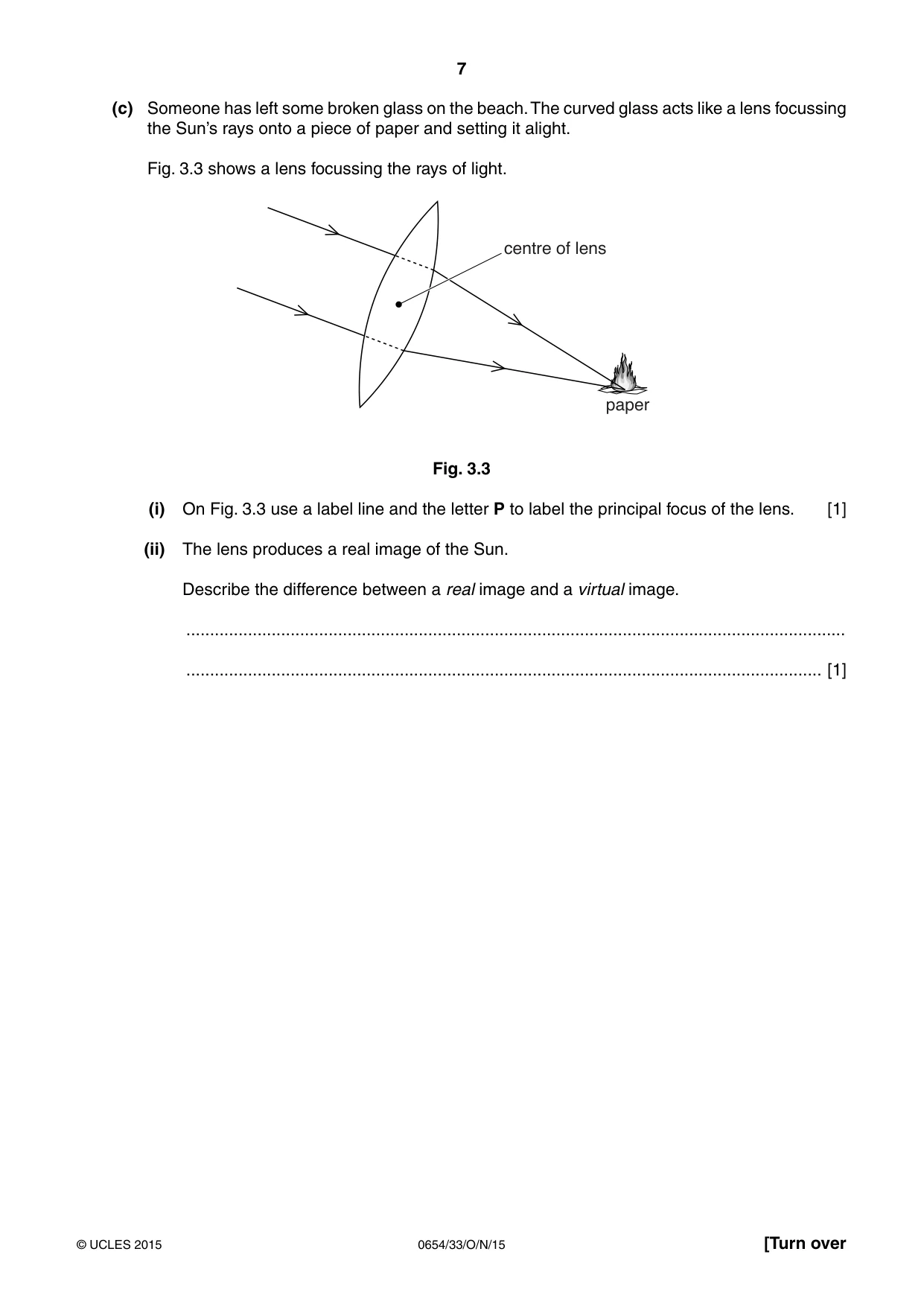
7 0654/33/O/N/15 © UCLES 2015 [Turn over (c) Someone has left some broken glass on the beach. The curved glass acts like a lens focussing the Sun’s rays onto a piece of paper and setting it alight. Fig. 3.3 shows a lens focussing the rays of light. paper centre of lens Fig. 3.3 (i) On Fig. 3.3 use a label line and the letter P to label the principal focus of the lens. [1] (ii) The lens produces a real image of the Sun. Describe the difference between a real image and a virtual image. … … [1]
Question paper, page 8
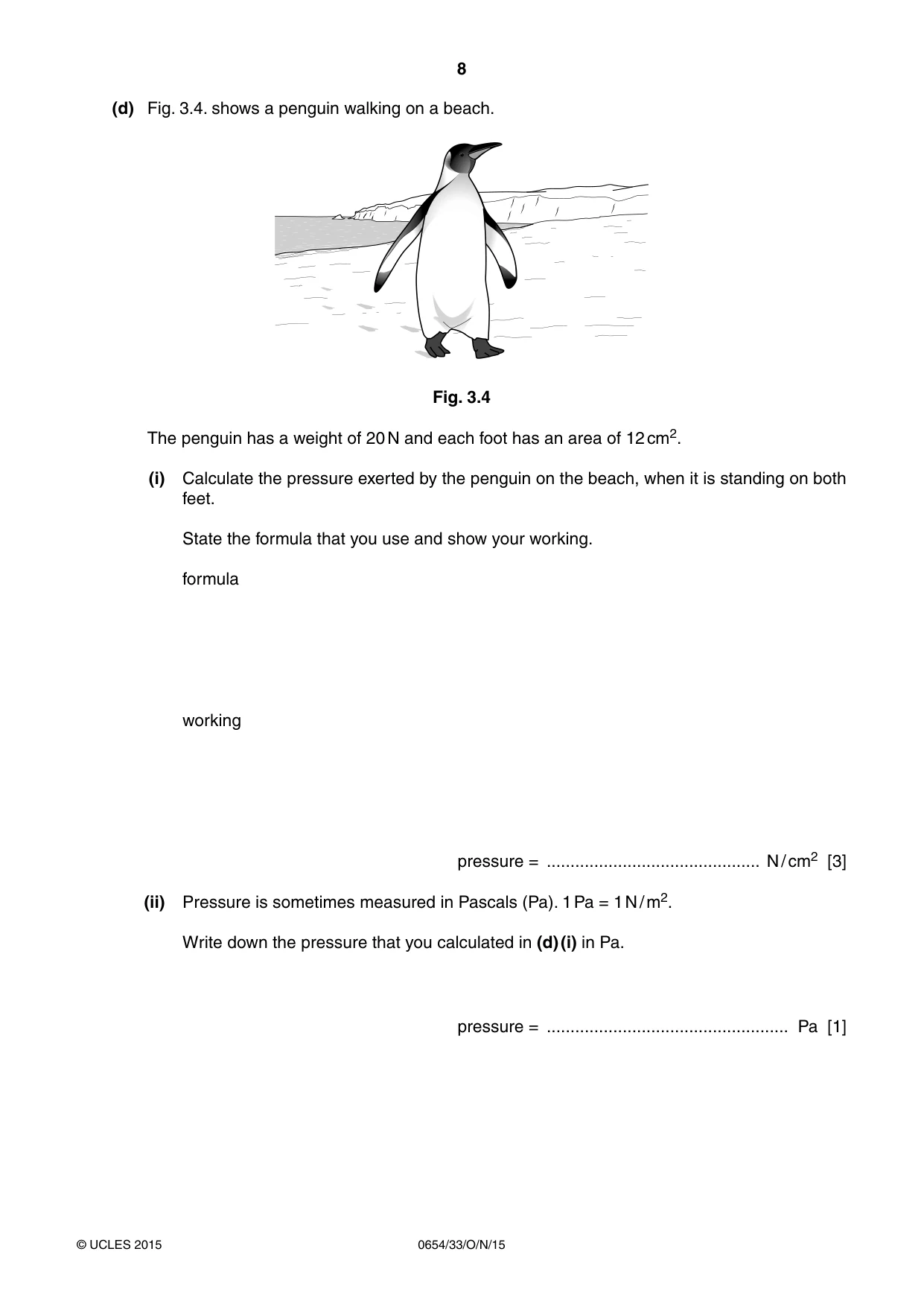
8 0654/33/O/N/15 © UCLES 2015 (d) Fig. 3.4. shows a penguin walking on a beach. Fig. 3.4 The penguin has a weight of 20 N and each foot has an area of 12 cm2. (i) Calculate the pressure exerted by the penguin on the beach, when it is standing on both feet. State the formula that you use and show your working. formula working pressure = … N / cm2 [3] (ii) Pressure is sometimes measured in Pascals (Pa). 1 Pa = 1 N / m2. Write down the pressure that you calculated in (d) (i) in Pa. pressure = … Pa [1]
Question paper, page 9
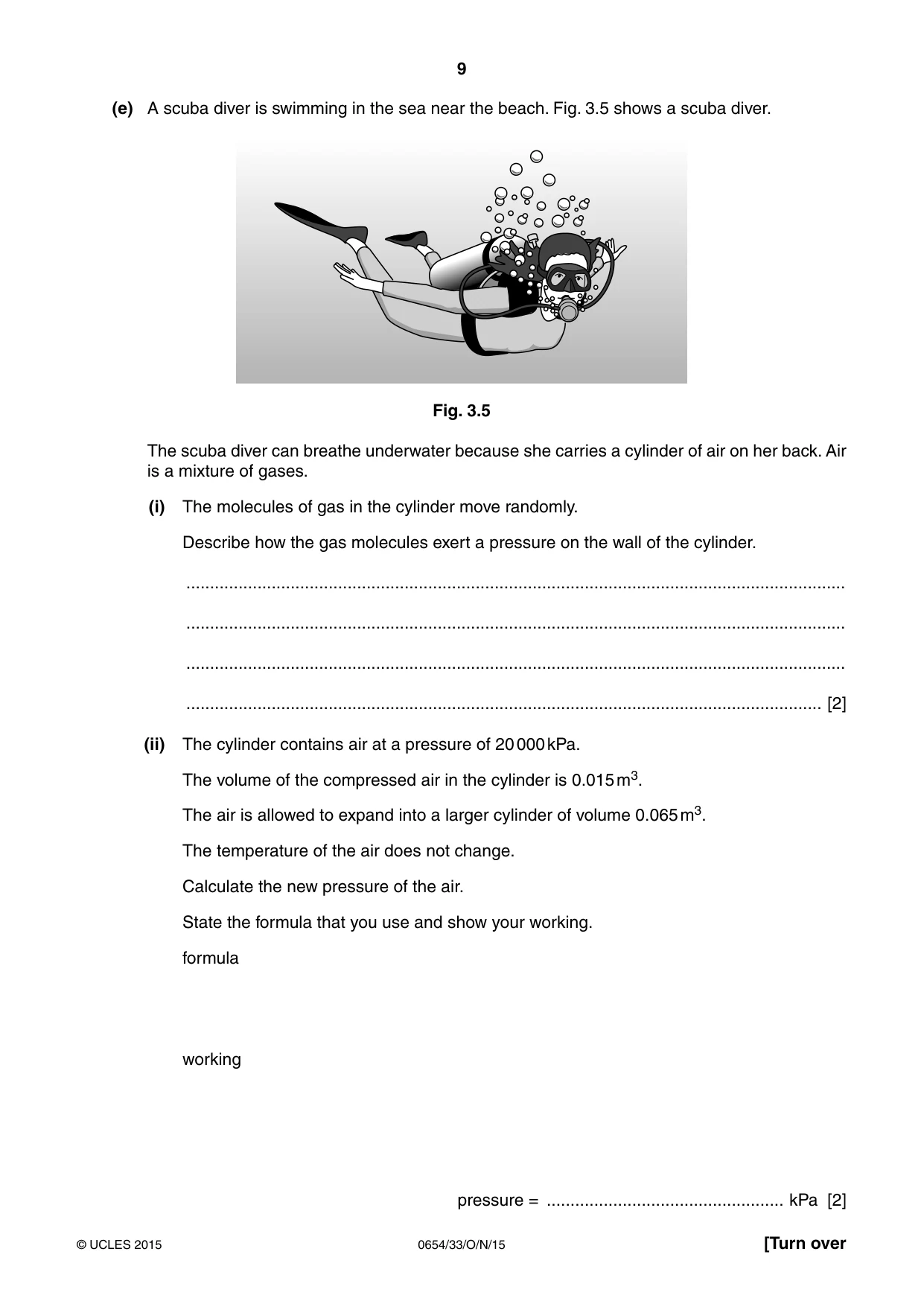
9 0654/33/O/N/15 © UCLES 2015 [Turn over (e) A scuba diver is swimming in the sea near the beach. Fig. 3.5 shows a scuba diver. Fig. 3.5 The scuba diver can breathe underwater because she carries a cylinder of air on her back. Air is a mixture of gases. (i) The molecules of gas in the cylinder move randomly. Describe how the gas molecules exert a pressure on the wall of the cylinder. … … … … [2] (ii) The cylinder contains air at a pressure of 20 000 kPa. The volume of the compressed air in the cylinder is 0.015 m3. The air is allowed to expand into a larger cylinder of volume 0.065 m3. The temperature of the air does not change. Calculate the new pressure of the air. State the formula that you use and show your working. formula working pressure = … kPa [2]
Question paper, page 10
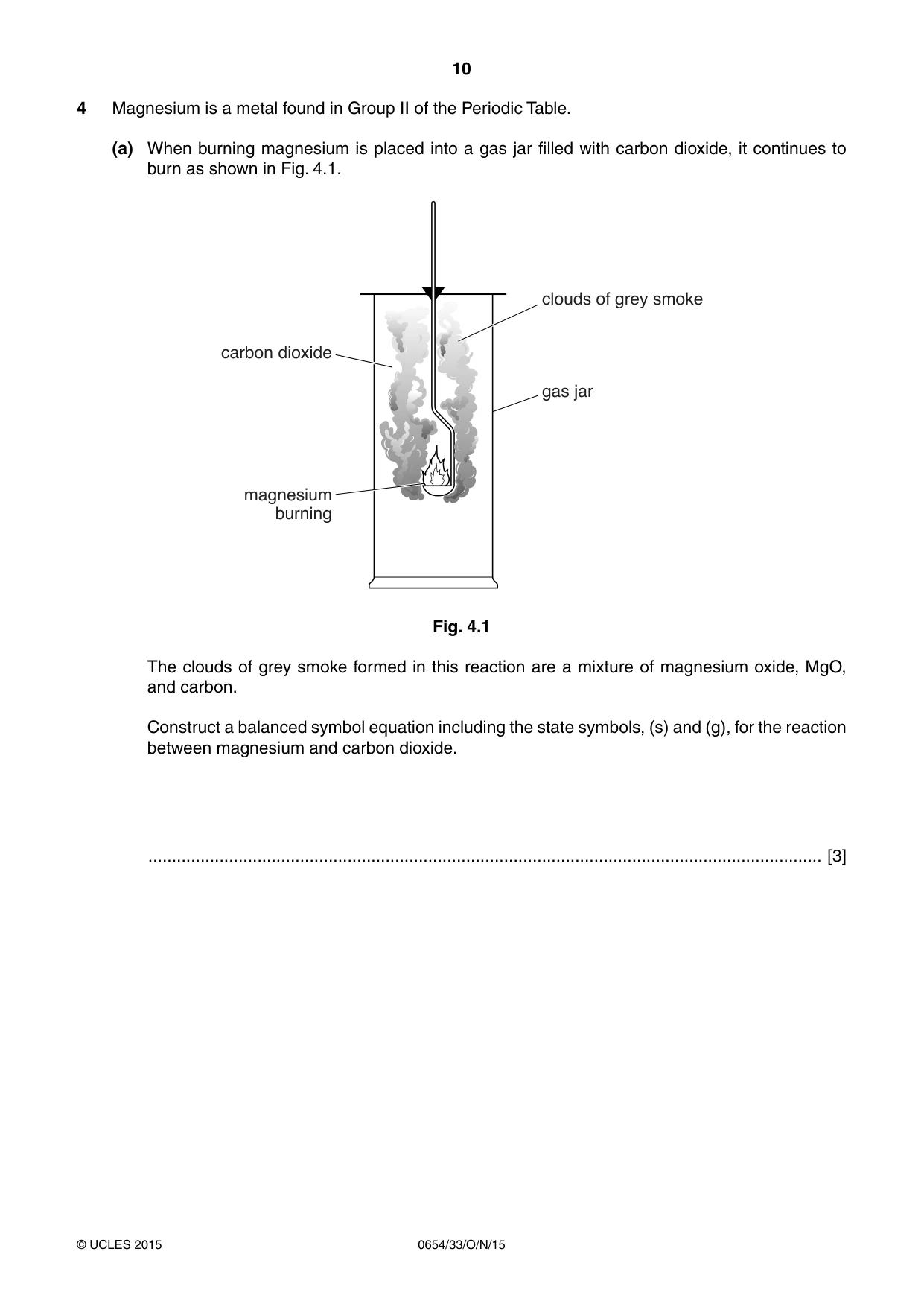
10 0654/33/O/N/15 © UCLES 2015 4 Magnesium is a metal found in Group II of the Periodic Table. (a) When burning magnesium is placed into a gas jar filled with carbon dioxide, it continues to burn as shown in Fig. 4.1. clouds of grey smoke gas jar carbon dioxide magnesium burning Fig. 4.1 The clouds of grey smoke formed in this reaction are a mixture of magnesium oxide, MgO, and carbon. Construct a balanced symbol equation including the state symbols, (s) and (g), for the reaction between magnesium and carbon dioxide. … [3]
Question paper, page 11
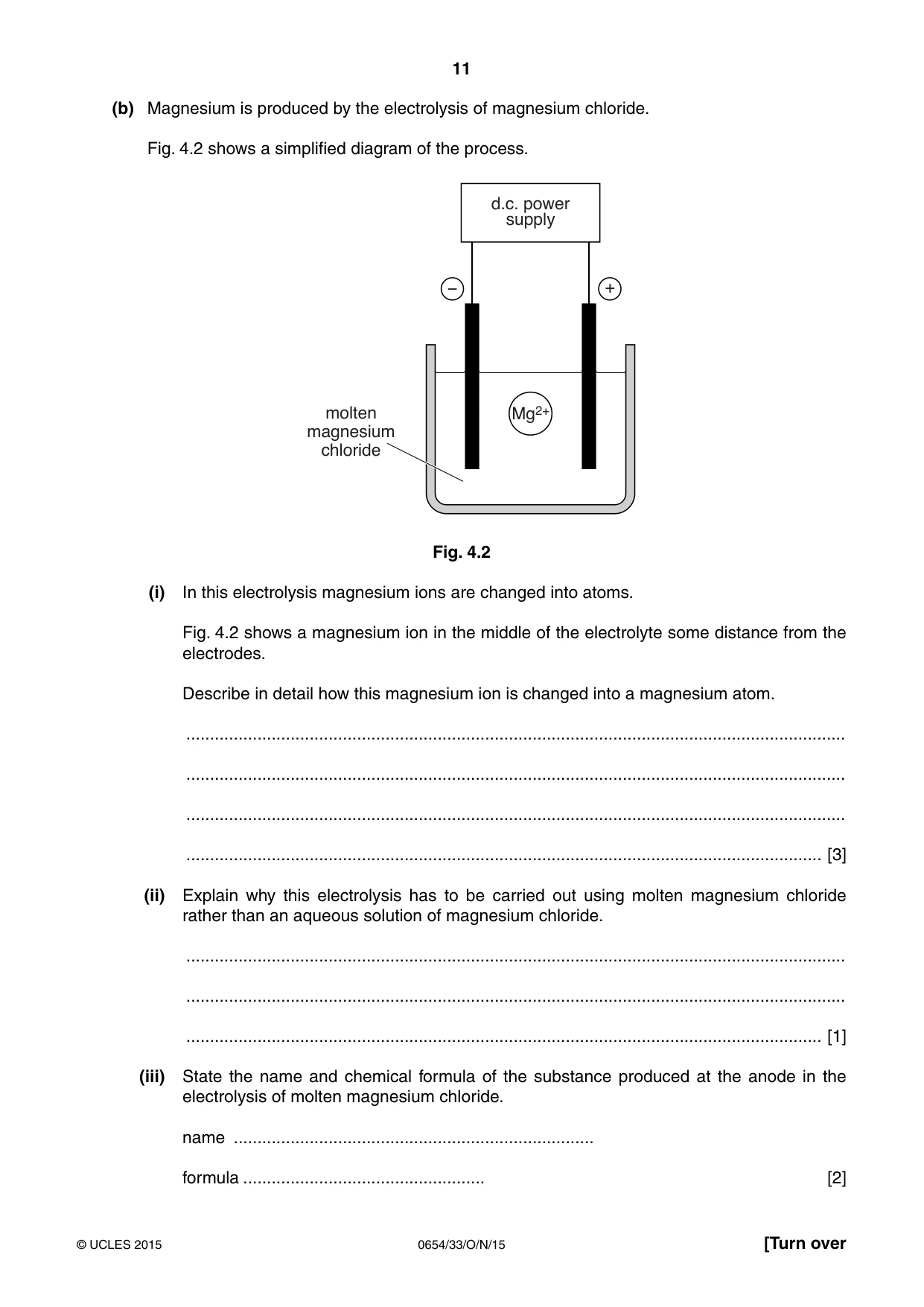
11 0654/33/O/N/15 © UCLES 2015 [Turn over (b) Magnesium is produced by the electrolysis of magnesium chloride. Fig. 4.2 shows a simplified diagram of the process. ï d.c. power supply Mg2+ molten magnesium chloride + Fig. 4.2 (i) In this electrolysis magnesium ions are changed into atoms. Fig. 4.2 shows a magnesium ion in the middle of the electrolyte some distance from the electrodes. Describe in detail how this magnesium ion is changed into a magnesium atom. … … … … [3] (ii) Explain why this electrolysis has to be carried out using molten magnesium chloride rather than an aqueous solution of magnesium chloride. … … … [1] (iii) State the name and chemical formula of the substance produced at the anode in the electrolysis of molten magnesium chloride. name … formula … [2]
Question paper, page 12
12 0654/33/O/N/15 © UCLES 2015 5 (a) Use words from the list to complete the sentences about cell division. You may use each word once, more than once, or not at all. different diploid doubled halved haploid identical maintained meiosis mitosis Gametes are produced by a type of nuclear division called … , which results in cells that are genetically … . During this type of cell division, the chromosome number is … , and so the cells produced are described as … . [4] (b) Apart from production of gametes, name three other processes, in living things, that depend on cell division. 1 … 2 … 3 … [3]
Question paper, page 13
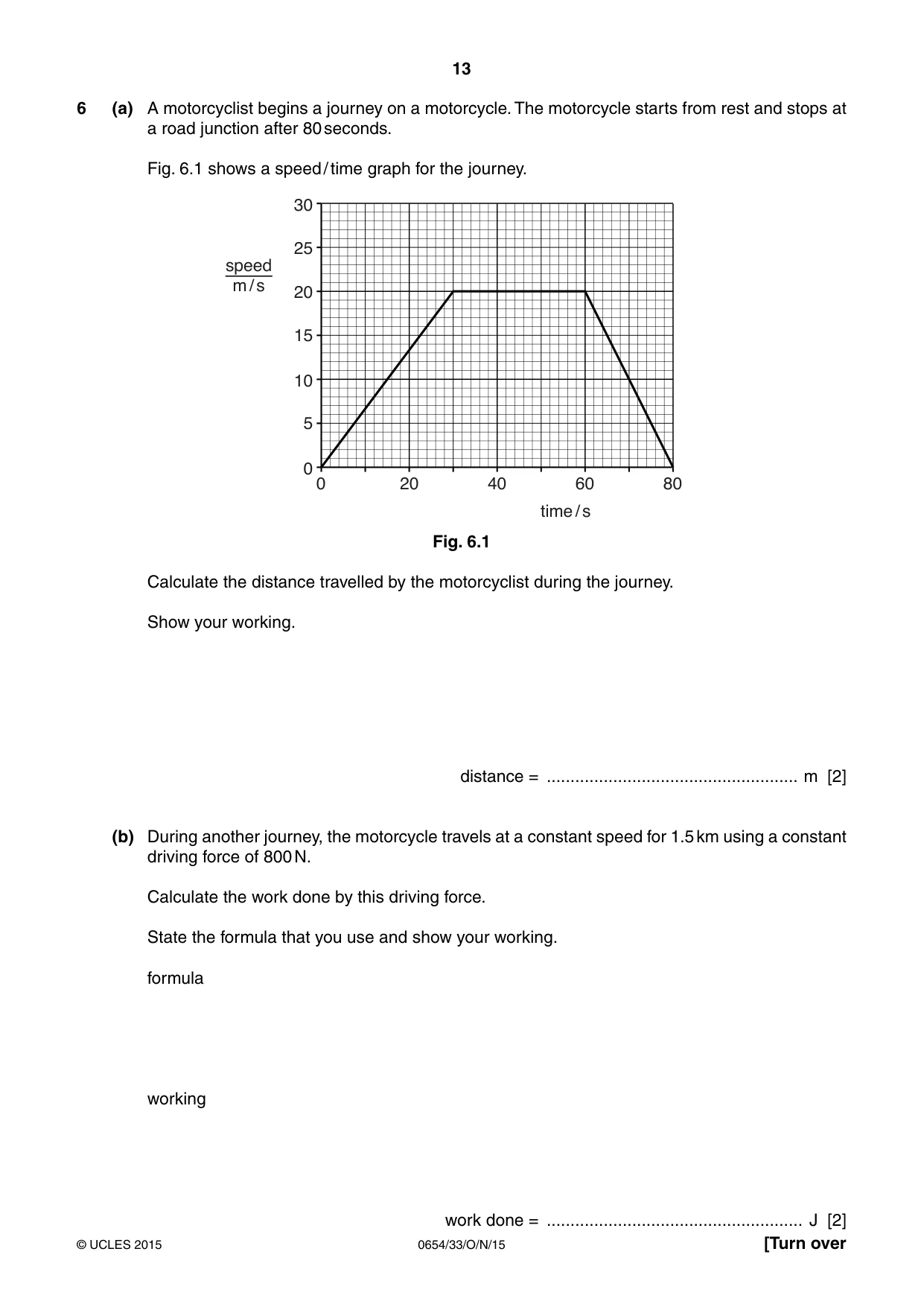
13 0654/33/O/N/15 © UCLES 2015 [Turn over 6 (a) A motorcyclist begins a journey on a motorcycle. The motorcycle starts from rest and stops at a road junction after 80 seconds. Fig. 6.1 shows a speed / time graph for the journey. 20 0 10 20 30 5 25 15 40 0 60 80 time / s speed m / s Fig. 6.1 Calculate the distance travelled by the motorcyclist during the journey. Show your working. distance = … m [2] (b) During another journey, the motorcycle travels at a constant speed for 1.5 km using a constant driving force of 800 N. Calculate the work done by this driving force. State the formula that you use and show your working. formula working work done = … J [2]
Question paper, page 14
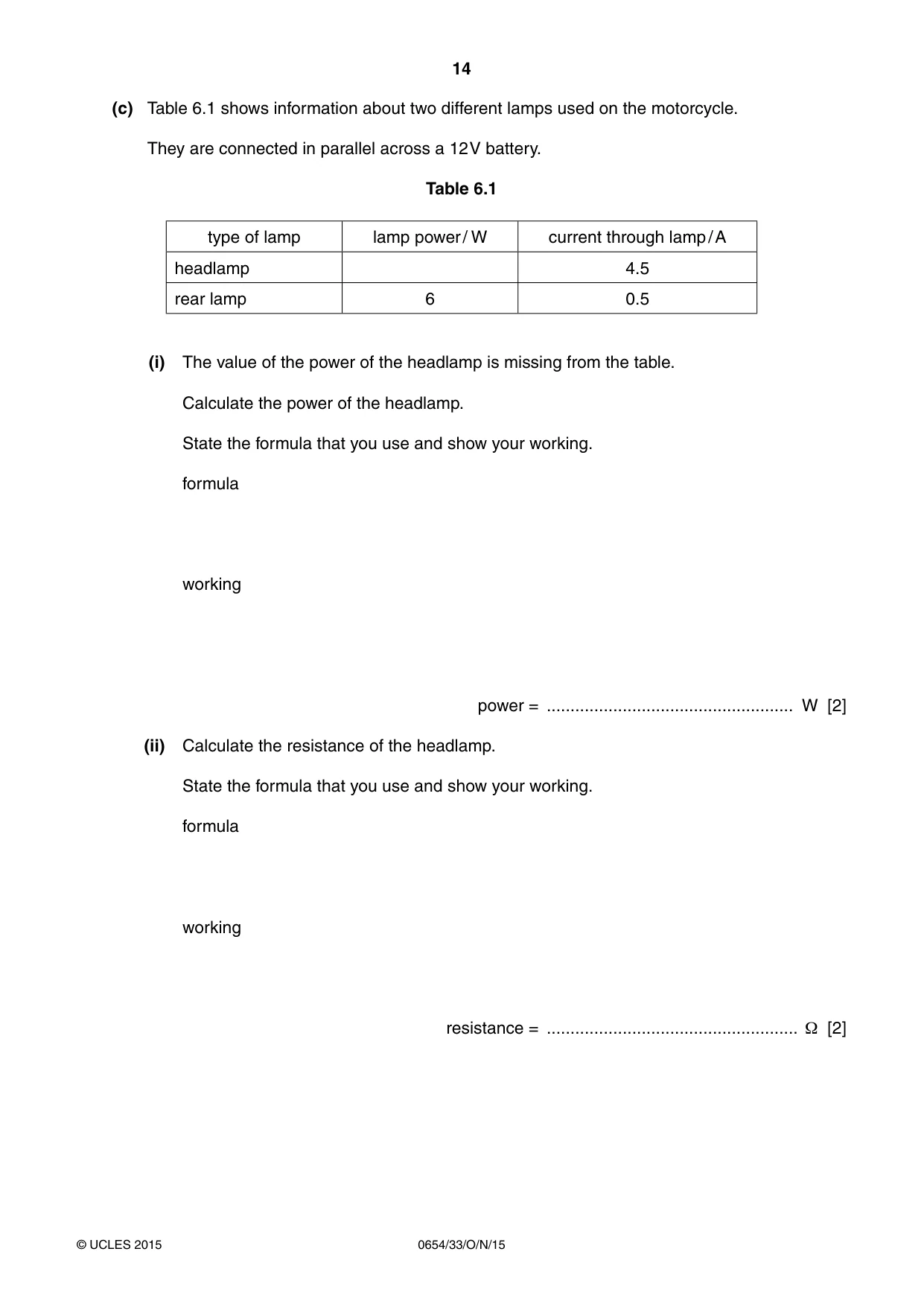
14 0654/33/O/N/15 © UCLES 2015 (c) Table 6.1 shows information about two differen t lamps used on the motorcycle. They are connected in parallel across a 12 V battery. Table 6.1 type of lamp lamp power / W current through lamp / A headlamp 4.5 rear lamp 6 0.5 (i) The value of the power of the headlamp is missing from the table. Calculate the power of the headlamp. State the formula that you use and show your working. formula working power = … W [2] (ii) Calculate the resistance of the headlamp. State the formula that you use and show your working. formula working resistance = … Ω [2]
Question paper, page 15
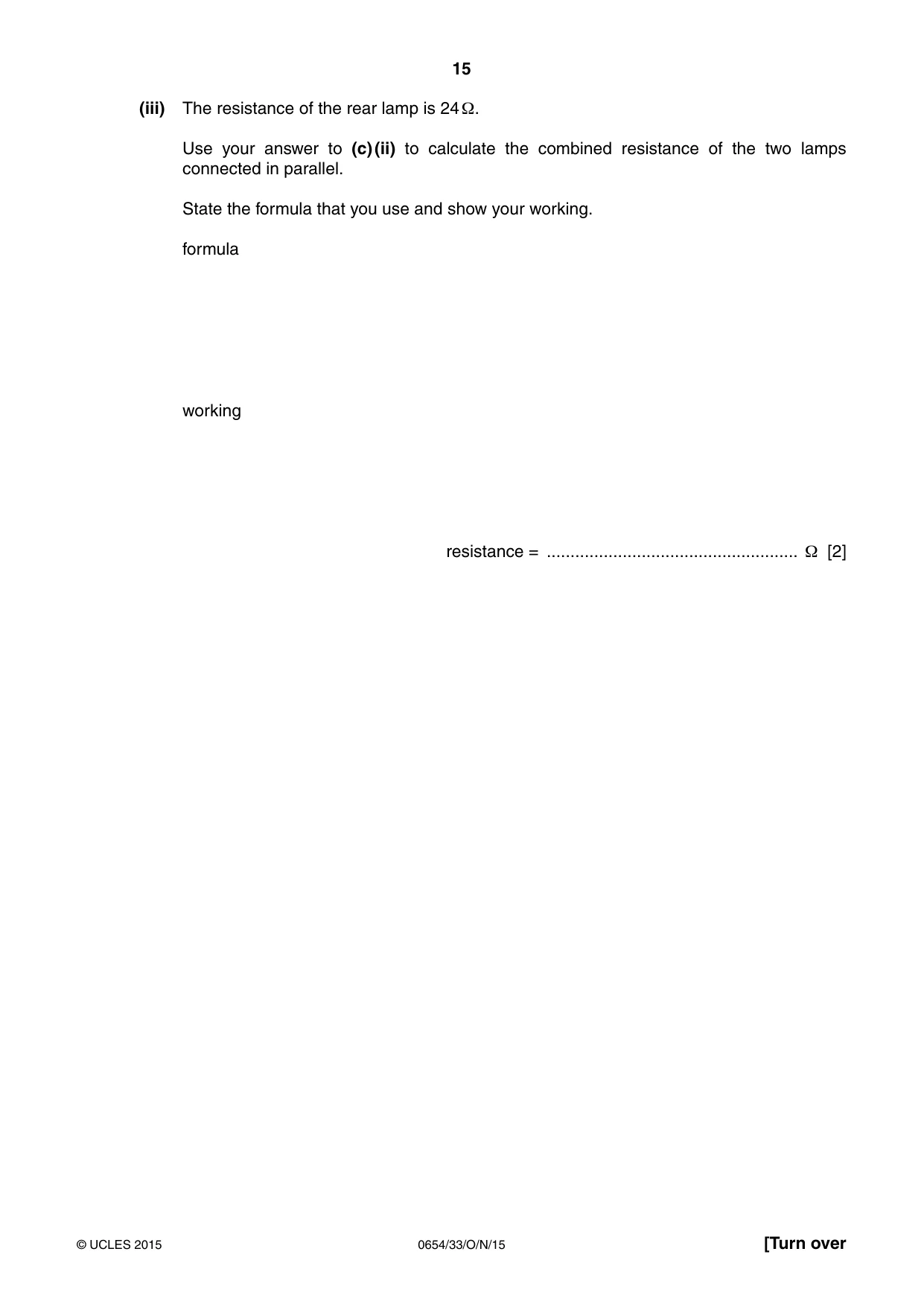
15 0654/33/O/N/15 © UCLES 2015 [Turn over (iii) The resistance of the rear lamp is 24 Ω. Use your answer to (c) (ii) to calculate the combined resistance of the two lamps connected in parallel. State the formula that you use and show your working. formula working resistance = … Ω [2]
Question paper, page 16
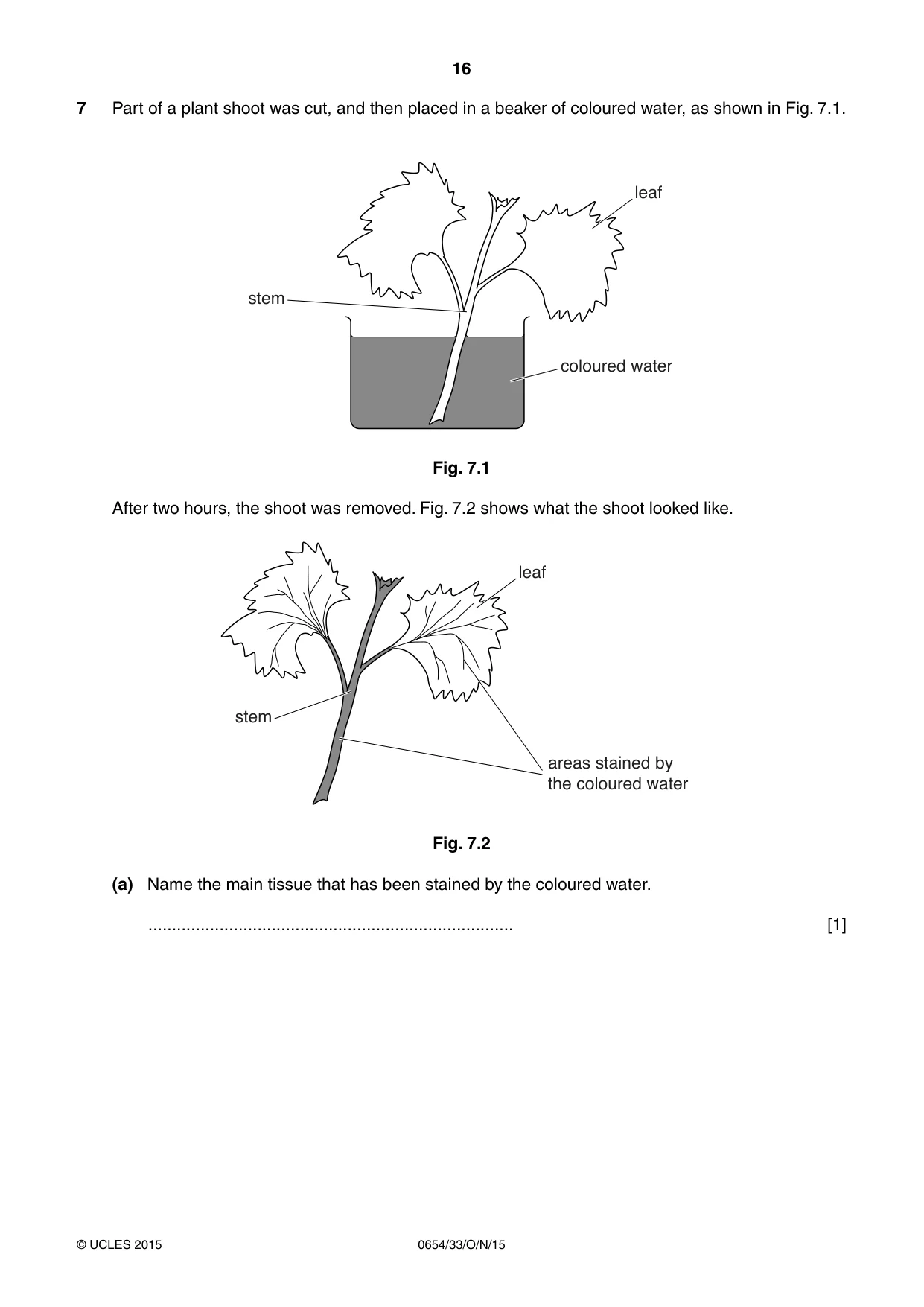
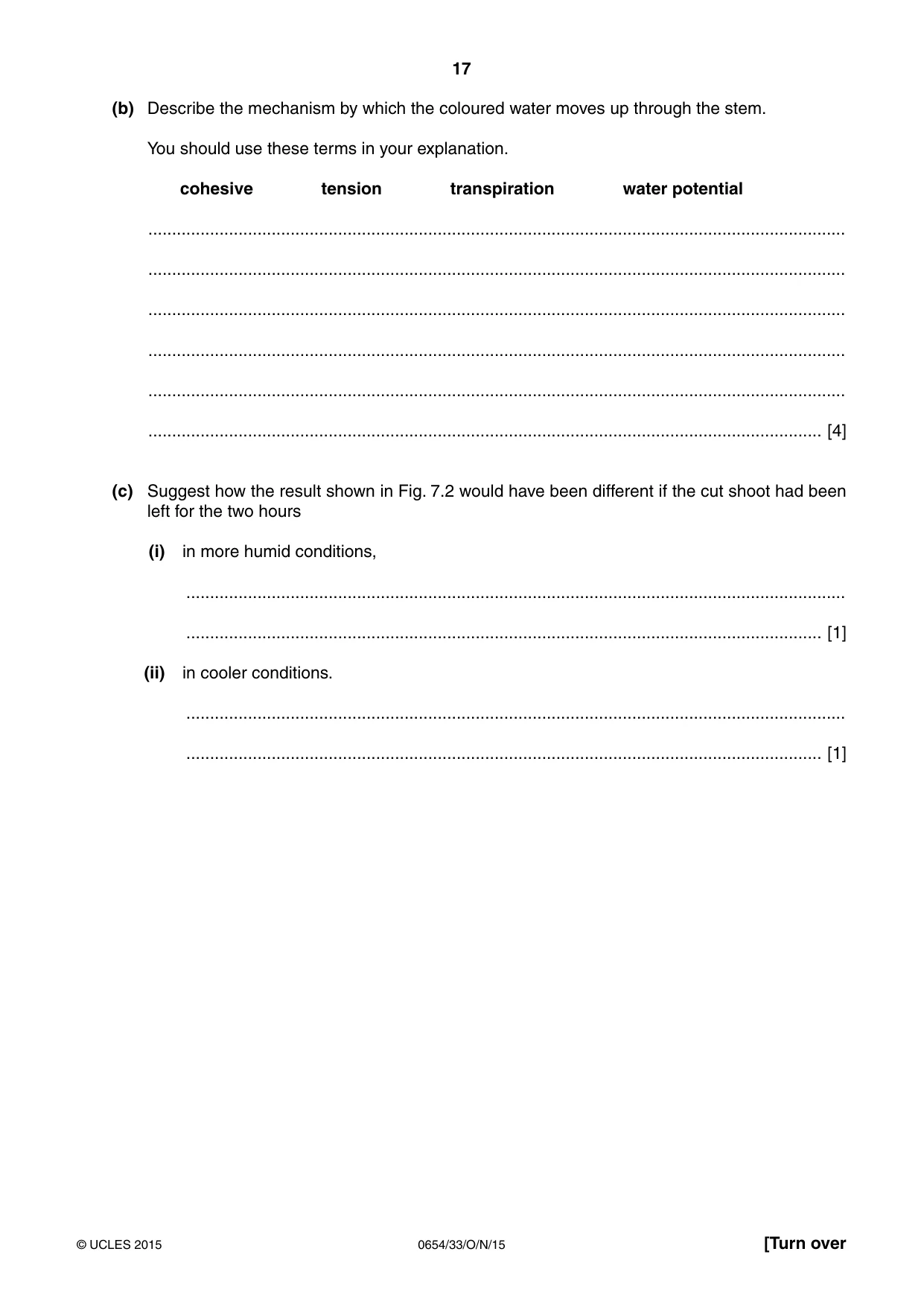
16 0654/33/O/N/15 © UCLES 2015 7 Part of a plant shoot was cut, and then placed in a beaker of coloured water, as shown in Fig. 7.1. leaf coloured water stem Fig. 7.1 After two hours, the shoot was removed. Fig. 7.2 shows what the shoot looked like. leaf areas stained by the coloured water stem Fig. 7.2 (a) Name the main tissue that has been stained by the coloured water. … [1]
Question paper, page 17
17 0654/33/O/N/15 © UCLES 2015 [Turn over (b) Describe the mechanism by which the coloured water moves up through the stem. You should use these terms in your explanation. cohesive tension transpiration water potential … … … … … … [4] (c) Suggest how the result shown in Fig. 7.2 would have been different if the cut shoot had been left for the two hours (i) in more humid conditions, … … [1] (ii) in cooler conditions. … … [1]
Question paper, page 18
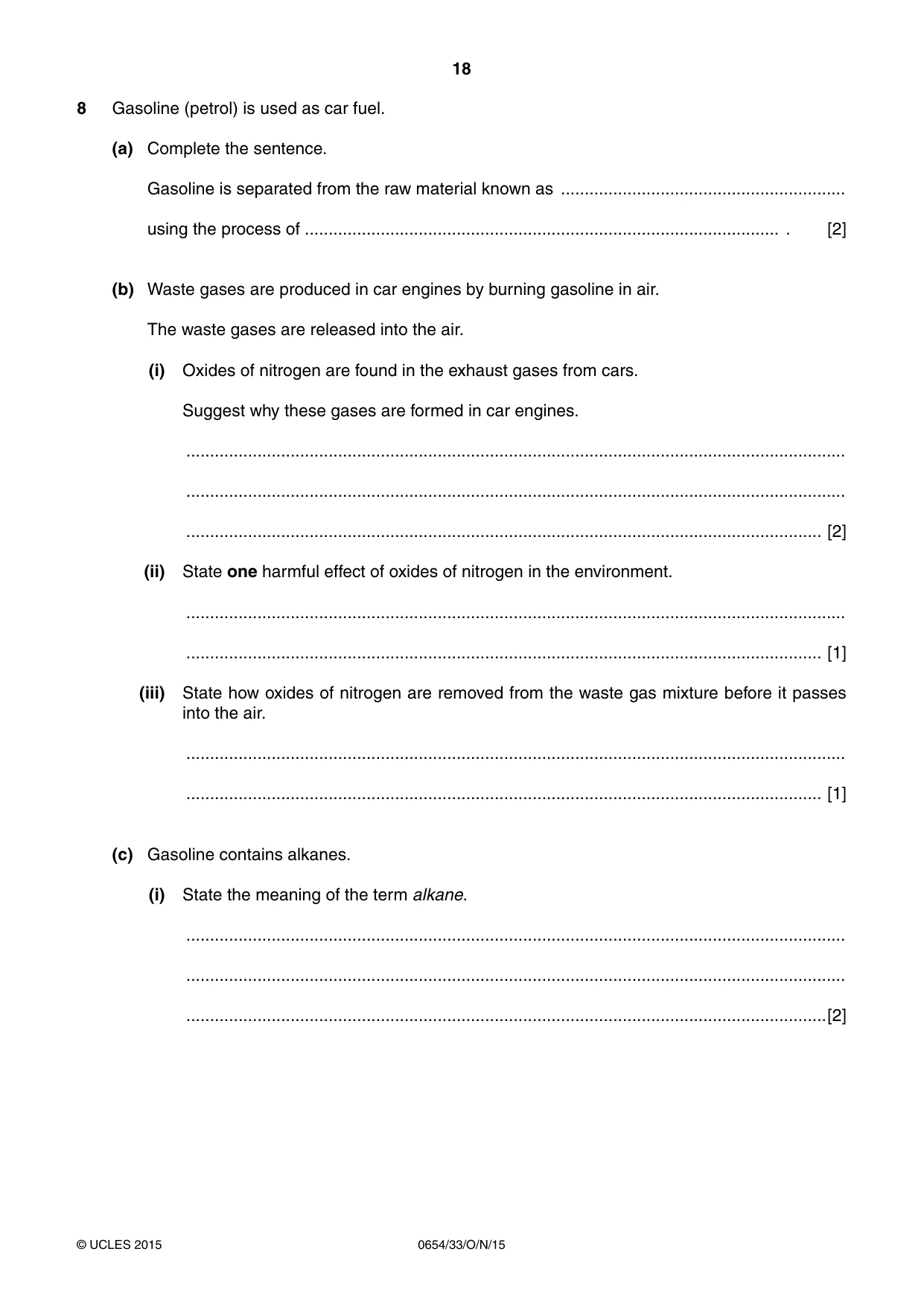
18 0654/33/O/N/15 © UCLES 2015 8 Gasoline (petrol) is used as car fuel. (a) Complete the sentence. Gasoline is separated from the raw material known as … using the process of … . [2] (b) Waste gases are produced in car engines by burning gasoline in air. The waste gases are released into the air. (i) Oxides of nitrogen are found in the exhaust gases from cars. Suggest why these gases are formed in car engines. … … … [2] (ii) State one harmful effect of oxides of nitrogen in the environment. … … [1] (iii) State how oxides of nitrogen are removed from the waste gas mixture before it passes into the air. … … [1] (c) Gasoline contains alkanes. (i) State the meaning of the term alkane. … … …[2]
Question paper, page 19
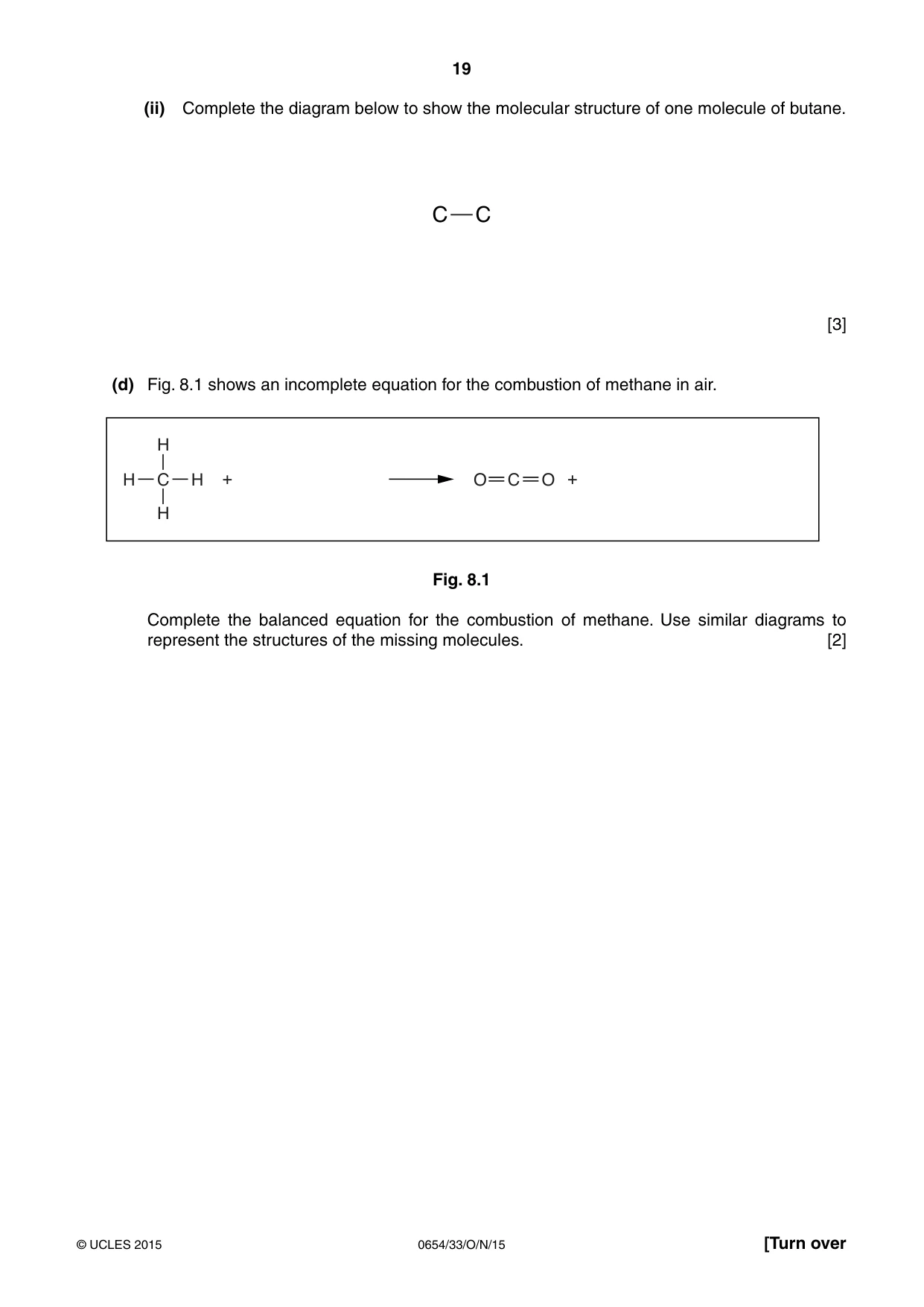
19 0654/33/O/N/15 © UCLES 2015 [Turn over (ii) Complete the diagram below to show the molecular structure of one molecule of butane. C C [3] (d) Fig. 8.1 shows an incomplete equation for the combustion of methane in air. H C H H H + + O C O Fig. 8.1 Complete the balanced equation for the combustion of methane. Use similar diagrams to represent the structures of the missing molecules. [2]
Question paper, page 20
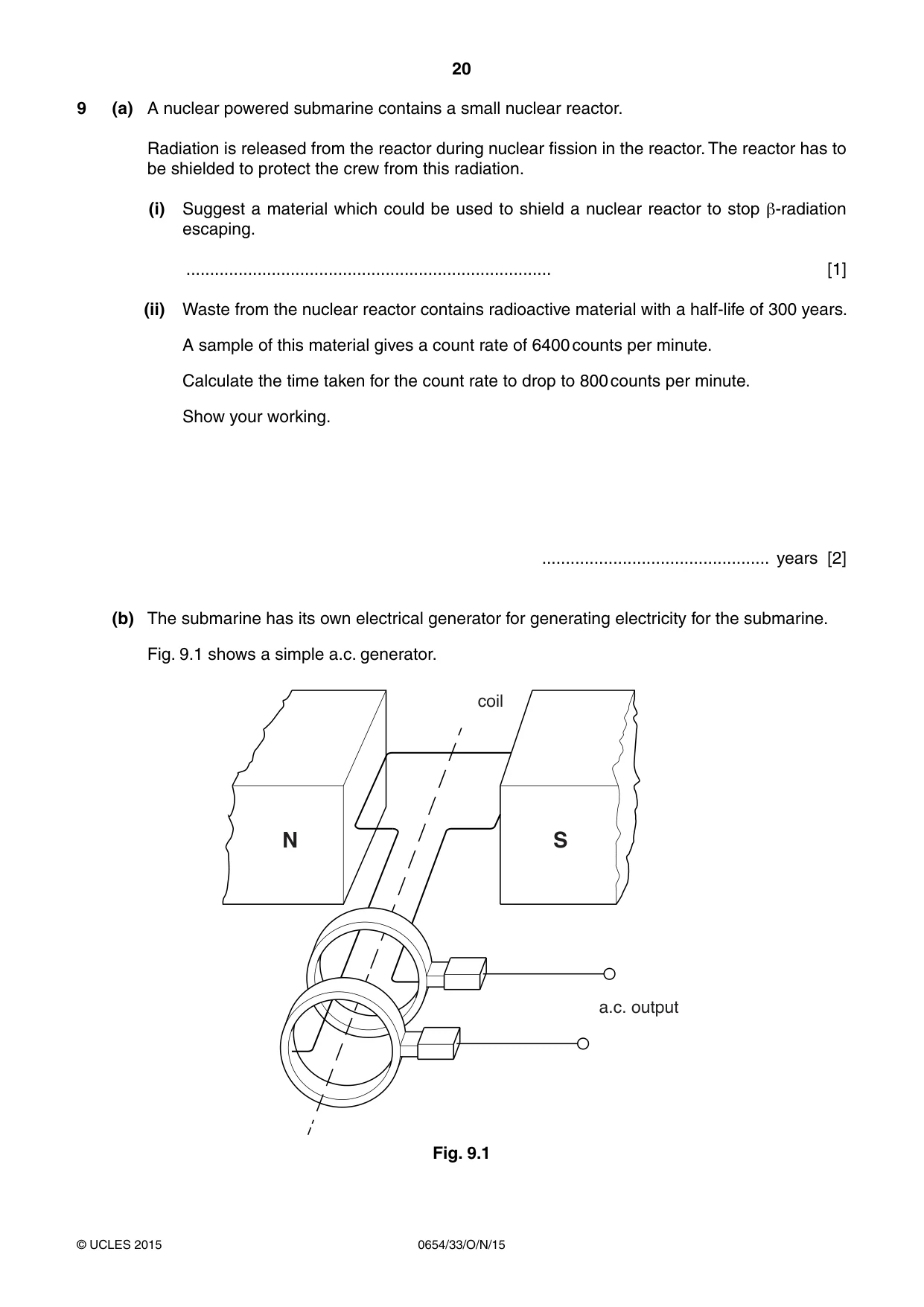
20 0654/33/O/N/15 © UCLES 2015 9 (a) A nuclear powered submarine contains a small nuclear reactor. Radiation is released from the reactor during nuclear fission in the reactor. The reactor has to be shielded to protect the crew from this radiation. (i) Suggest a material which could be used to shield a nuclear reactor to stop β-radiation escaping. … [1] (ii) Waste from the nuclear reactor contains radioactive material with a half-life of 300 years. A sample of this material gives a count rate of 6400 counts per minute. Calculate the time taken for the count rate to drop to 800 counts per minute. Show your working. … years [2] (b) The submarine has its own electrical generator for generating electricity for the submarine. Fig. 9.1 shows a simple a.c. generator. coil a.c. output N S Fig. 9.1
Question paper, page 21
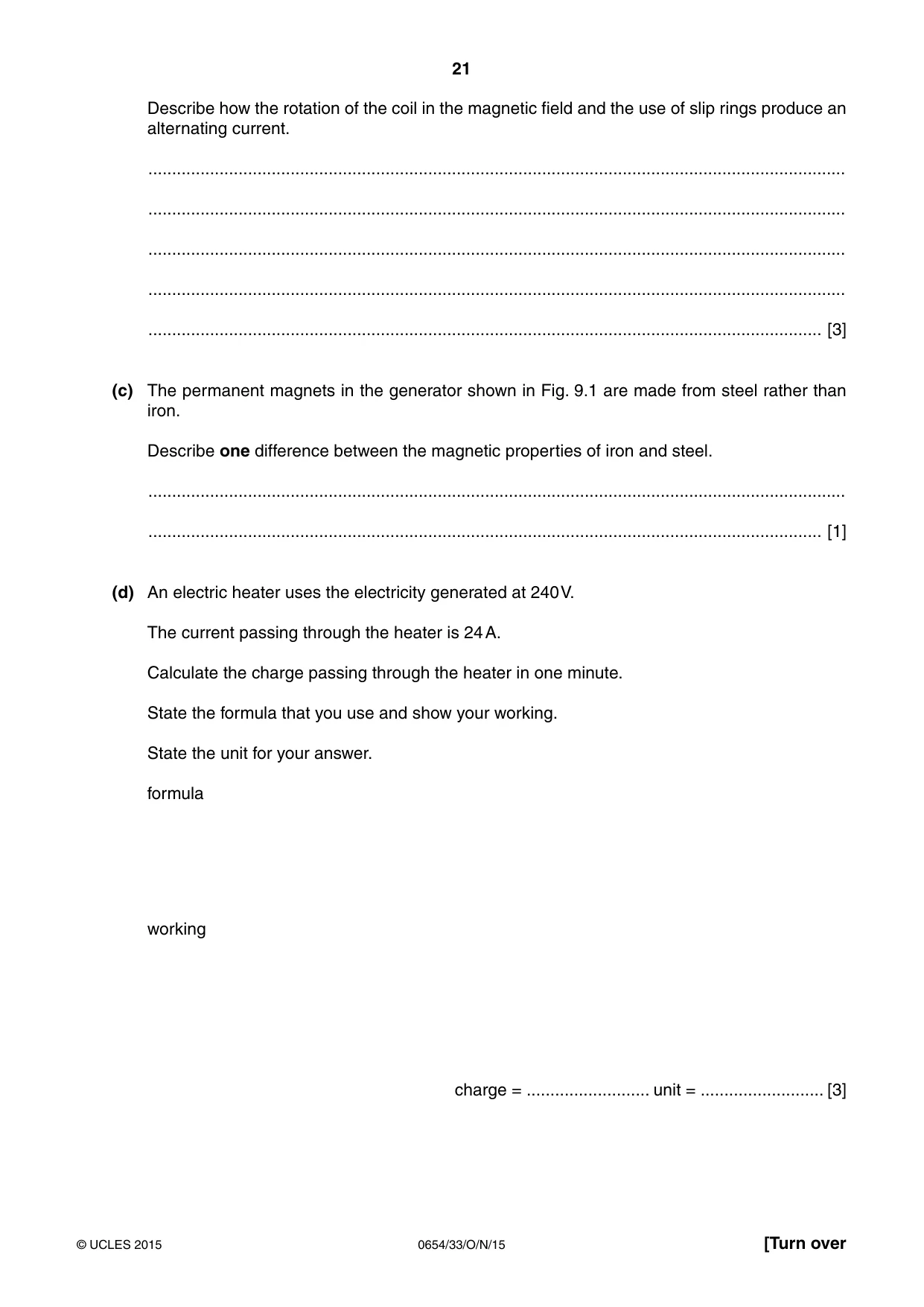
21 0654/33/O/N/15 © UCLES 2015 [Turn over Describe how the rotation of the coil in the magnetic field and the use of slip rings produce an alternating current. … … … … … [3] (c) The permanent magnets in the generator shown in Fig. 9.1 are made from steel rather than iron. Describe one difference between the magnetic properties of iron and steel. … … [1] (d) An electric heater uses the electricity generated at 240 V. The current passing through the heater is 24 A. Calculate the charge passing through the heater in one minute. State the formula that you use and show your working. State the unit for your answer. formula working charge = … unit = … [3]
Question paper, page 22
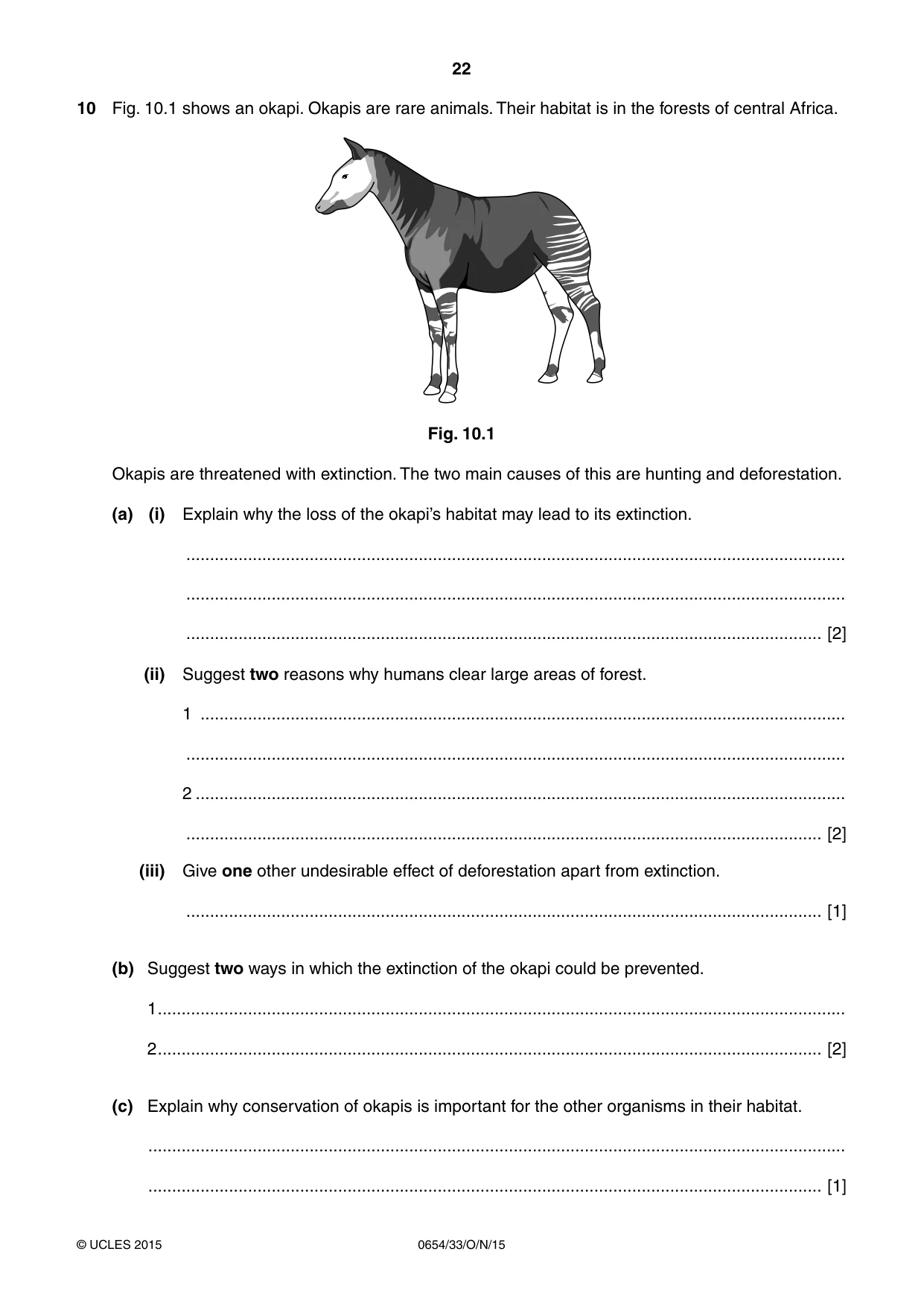
22 0654/33/O/N/15 © UCLES 2015 10 Fig. 10.1 shows an okapi. Okapis are rare animals. Their habitat is in the forests of central Africa. Fig. 10.1 Okapis are threatened with extinction. The two main causes of this are hunting and deforestation. (a) (i) Explain why the loss of the okapi’s habitat may lead to its extinction. … … … [2] (ii) Suggest two reasons why humans clear large areas of forest. 1 … … 2 … … [2] (iii) Give one other undesirable effect of deforestation apart from extinction. … [1] (b) Suggest two ways in which the extinction of the okapi could be prevented. 1 … 2 … [2] (c) Explain why conservation of okapis is important for the other organisms in their habitat. … … [1]
Question paper, page 23
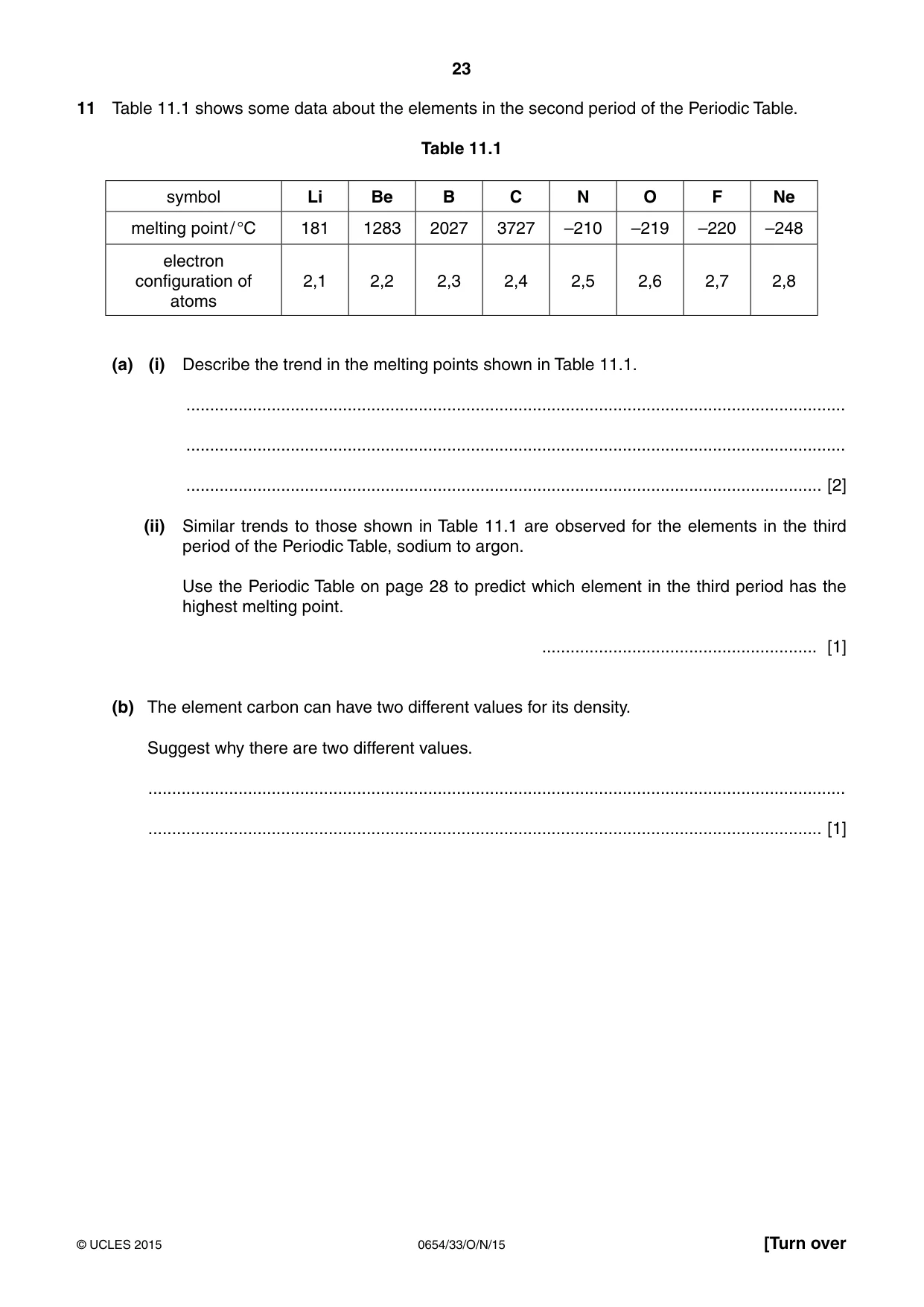
23 0654/33/O/N/15 © UCLES 2015 [Turn over 11 Table 11.1 shows some data about the elements in the second period of the Periodic Table. Table 11.1 symbol Li Be B C N O F Ne melting point / °C 181 1283 2027 3727 –210 –219 –220 –248 electron configuration of atoms 2,1 2,2 2,3 2,4 2,5 2,6 2,7 2,8 (a) (i) Describe the trend in the melting points shown in Table 11.1. … … … [2] (ii) Similar trends to those shown in Table 11.1 are observed for the elements in the third period of the Periodic Table, sodium to argon. Use the Periodic Table on page 28 to predict which element in the third period has the highest melting point. … [1] (b) The element carbon can have two different values for its density. Suggest why there are two different values. … … [1]
Question paper, page 24
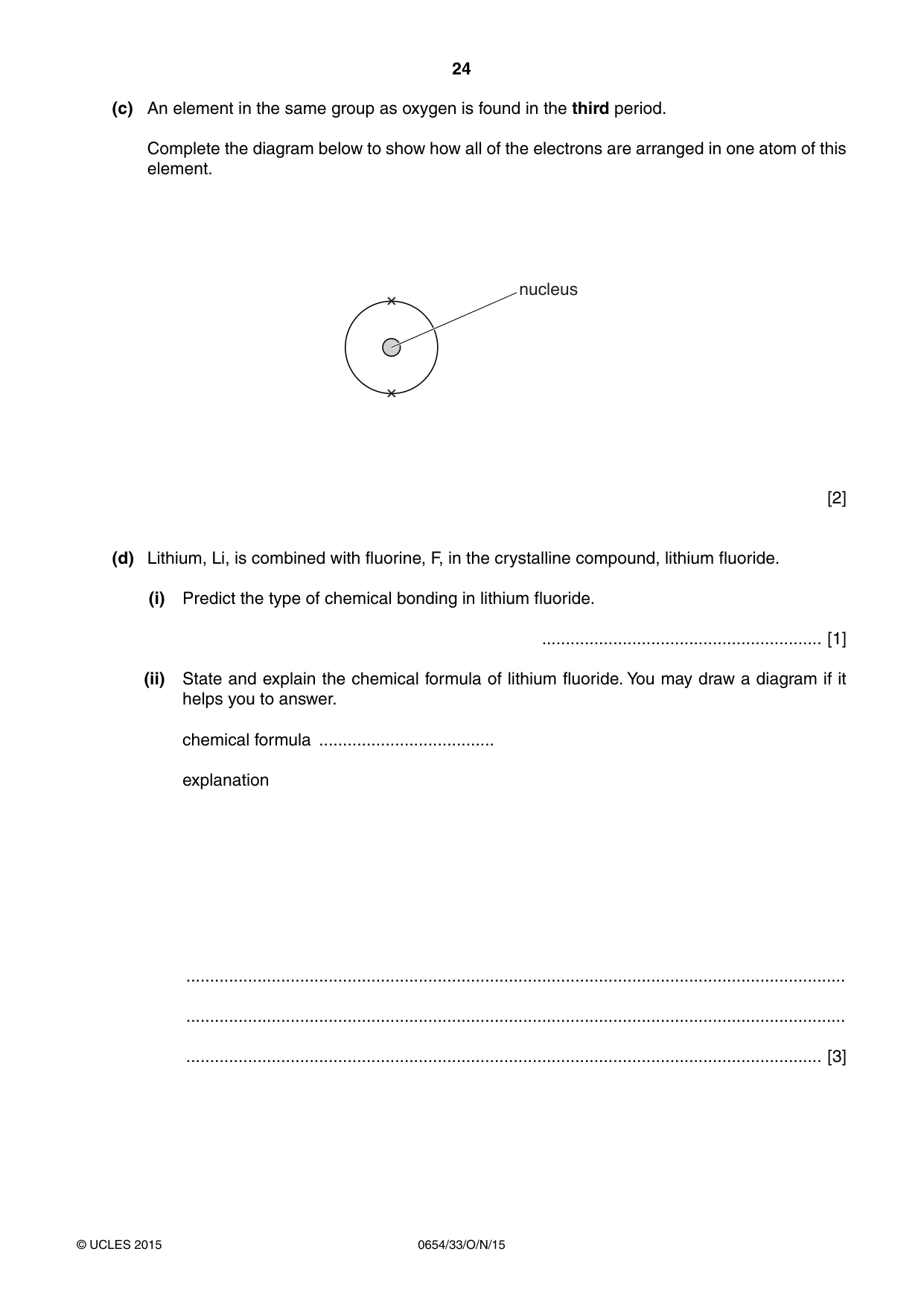
24 0654/33/O/N/15 © UCLES 2015 (c) An element in the same group as oxygen is found in the third period. Complete the diagram below to show how all of the electrons are arranged in one atom of this element. × nucleus × [2] (d) Lithium, Li, is combined with fluorine, F, in the crystalline compound, lithium fluoride. (i) Predict the type of chemical bonding in lithium fluoride. … [1] (ii) State and explain the chemical formula of lithium fluoride. You may draw a diagram if it helps you to answer. chemical formula … explanation … … … [3]
Question paper, page 25
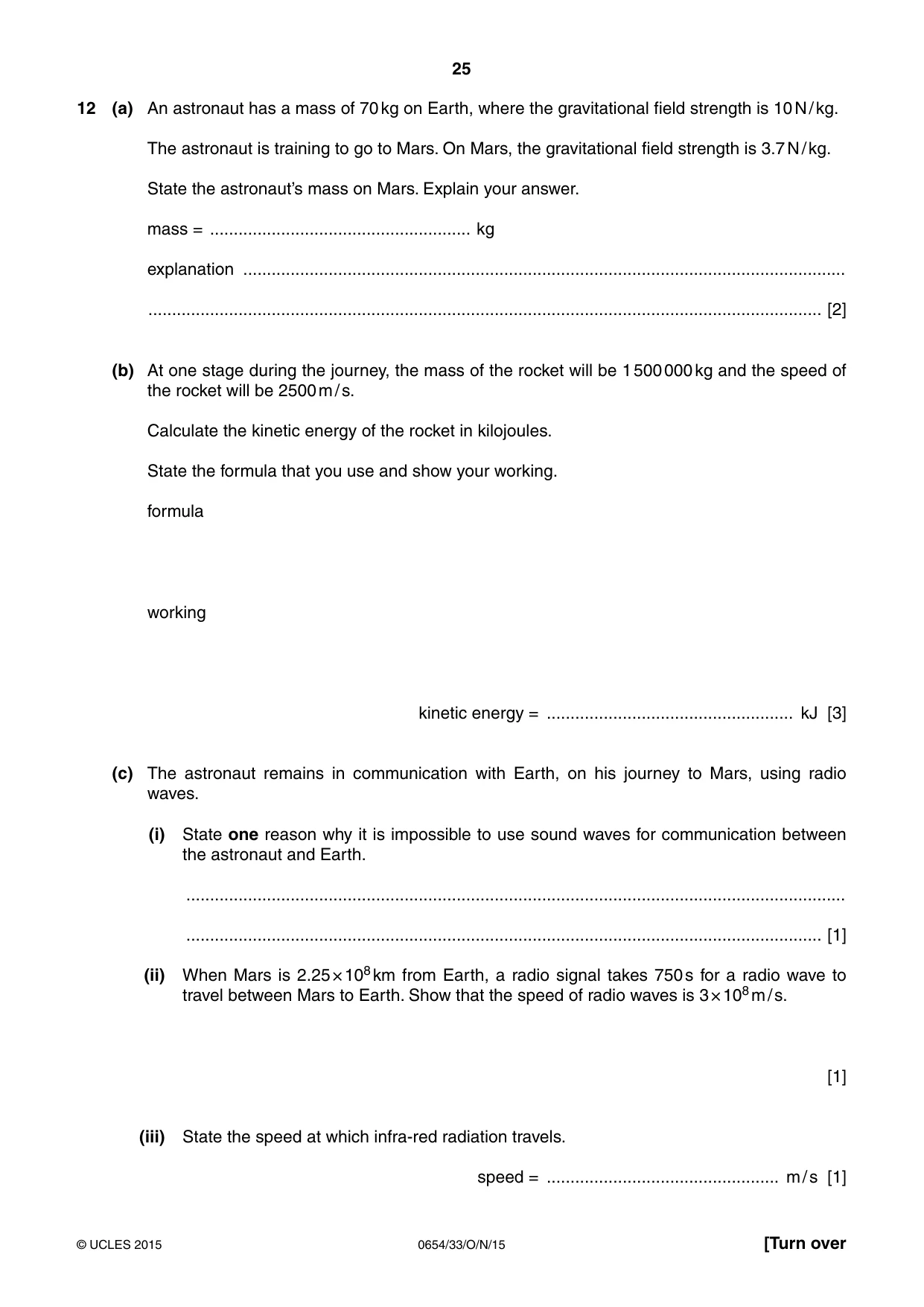
25 0654/33/O/N/15 © UCLES 2015 [Turn over 12 (a) An astronaut has a mass of 70 kg on Earth, where the gravitational field strength is 10 N / kg. The astronaut is training to go to Mars. On Mars, the gravitational field strength is 3.7 N / kg. State the astronaut’s mass on Mars. Explain your answer. mass = … kg explanation … … [2] (b) At one stage during the journey, the mass of the rocket will be 1 500 000 kg and the speed of the rocket will be 2500 m / s. Calculate the kinetic energy of the rocket in kilojoules. State the formula that you use and show your working. formula working kinetic energy = … kJ [3] (c) The astronaut remains in communication with Earth, on his journey to Mars, using radio waves. (i) State one reason why it is impossible to use sound waves for communication between the astronaut and Earth. … … [1] (ii) When Mars is 2.25 × 10⁸ km from Earth, a radio signal takes 750 s for a radio wave to travel between Mars to Earth. Show that the speed of radio waves is 3 × 10⁸ m / s. [1] (iii) State the speed at which infra-red radiation travels. speed = … m / s [1]
Question paper, page 26
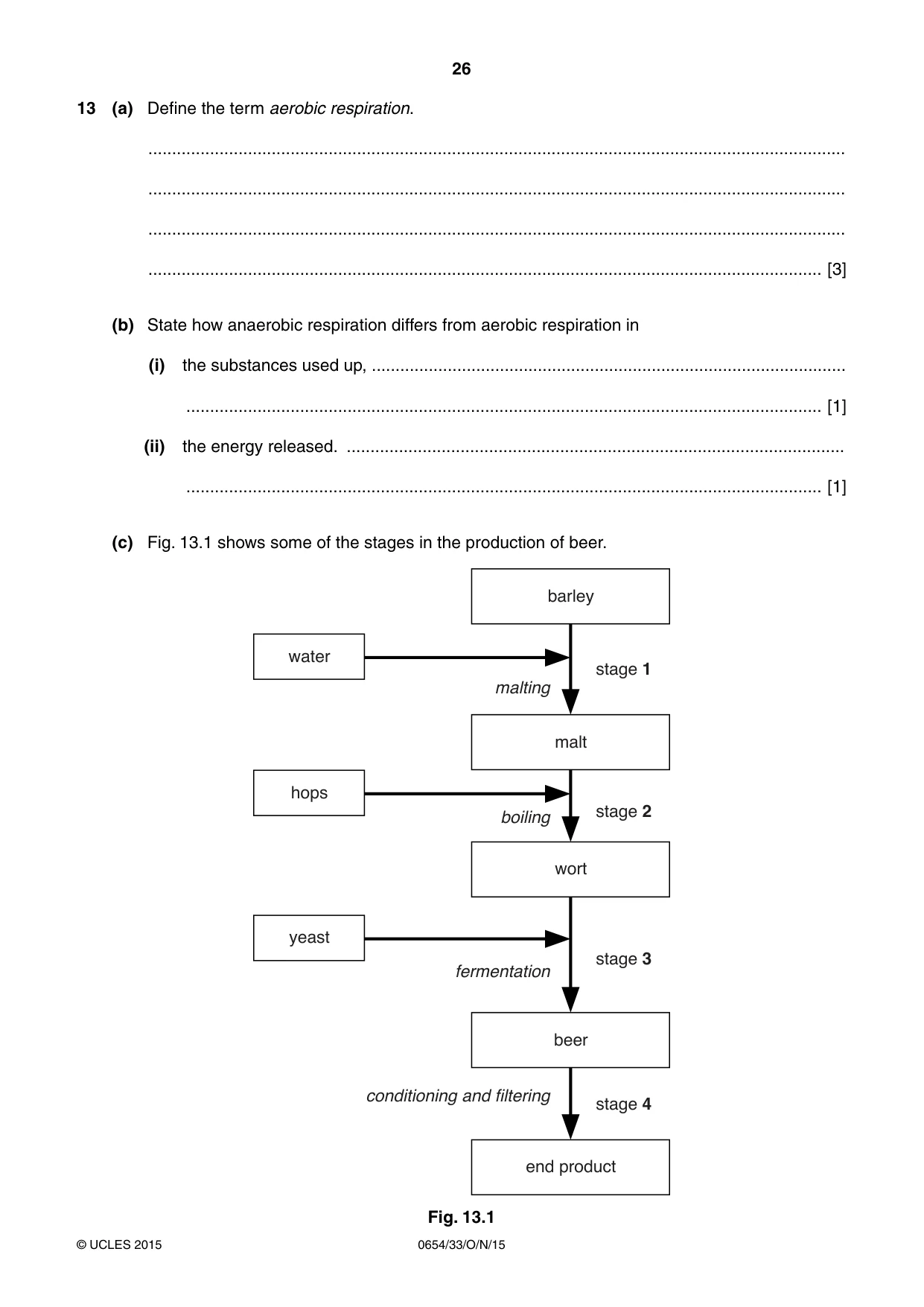
26 0654/33/O/N/15 © UCLES 2015 13 (a) Define the term aerobic respiration. … … … … [3] (b) State how anaerobic respiration differs from aerobic respiration in (i) the substances used up, … … [1] (ii) the energy released. … … [1] (c) Fig. 13.1 shows some of the stages in the production of beer. barley malt stage 1 stage 2 stage 3 stage 4 water malting boiling fermentation conditioning and filtering hops yeast wort end product beer Fig. 13.1
Question paper, page 27
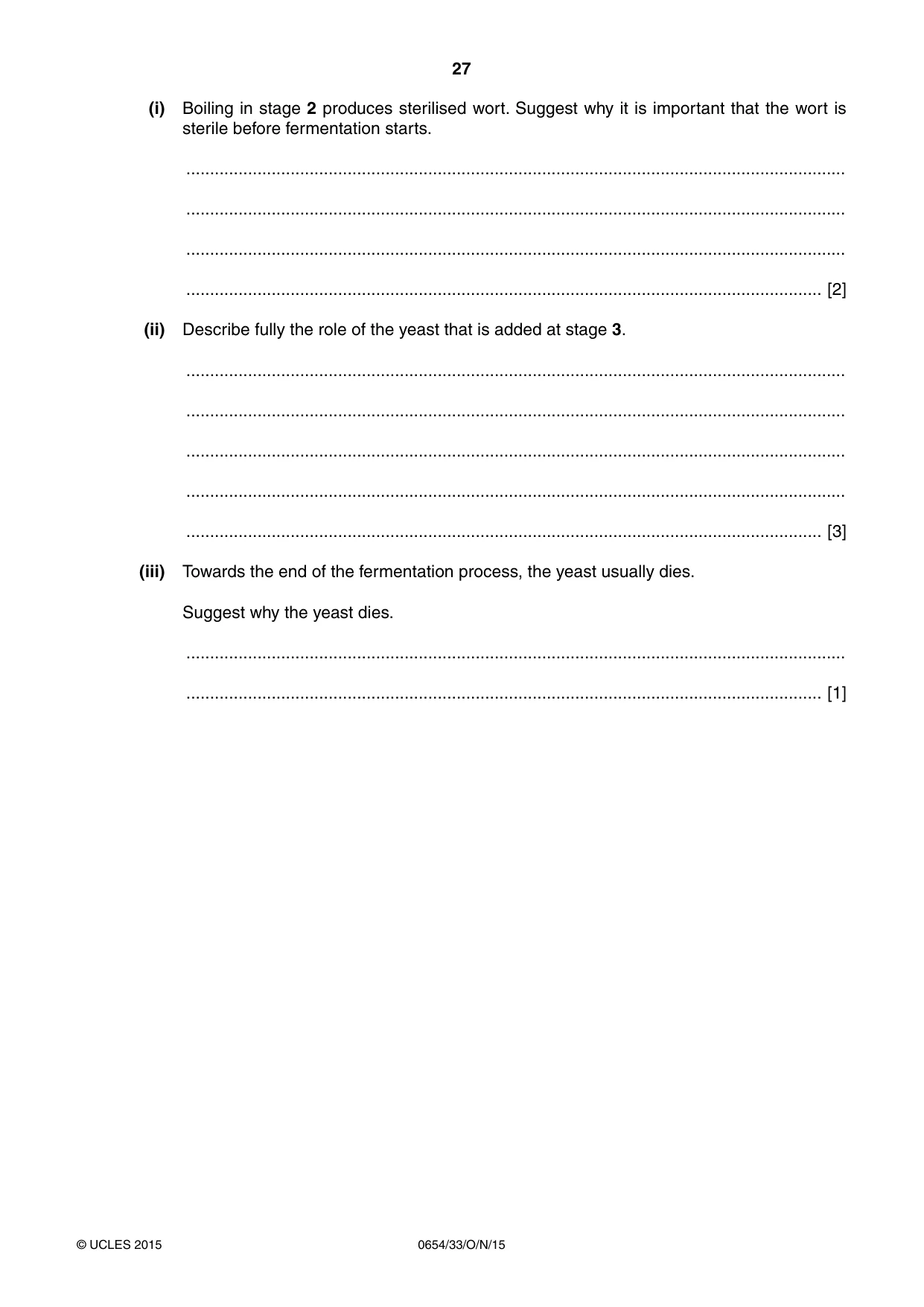
27 0654/33/O/N/15 © UCLES 2015 (i) Boiling in stage 2 produces sterilised wort. Suggest why it is important that the wort is sterile before fermentation starts. … … … … [2] (ii) Describe fully the role of the yeast that is added at stage 3. … … … … … [3] (iii) Towards the end of the fermentation process, the yeast usually dies. Suggest why the yeast dies. … … [1]
Question paper, page 28
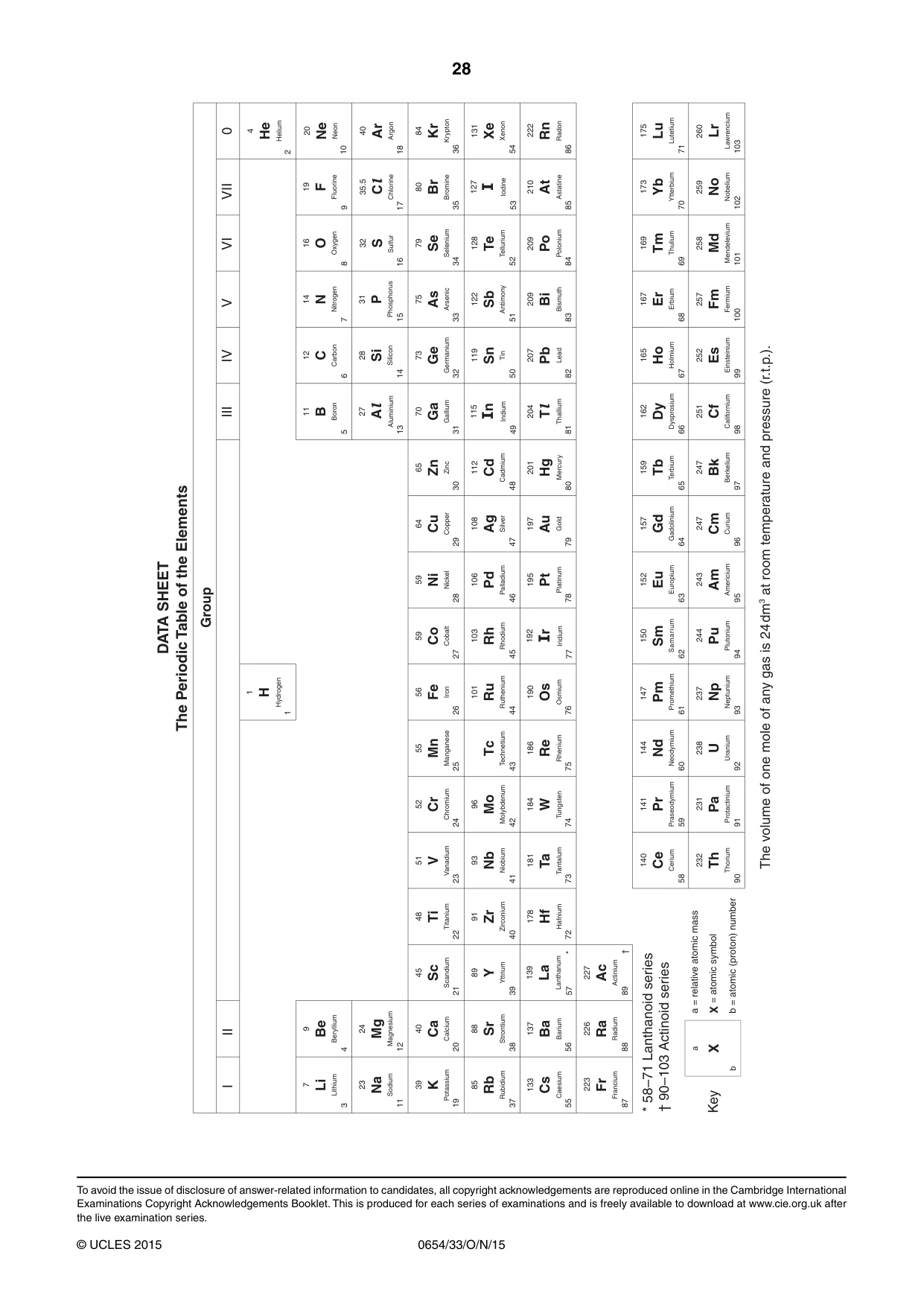
28 0654/33/O/N/15 © UCLES 2015 To avoid the issue of disclosure of answer-related information to candidates, all copyright acknowledgements are reproduced online in the Cambridge International Examinations Copyright Acknowledgements Booklet. This is produced for each series of examinations and is freely available to download at www.cie.org.uk after the live examination series. Group The Periodic Table of the Elements 140 Ce Cerium 58 141 Pr Praseodymium 59 144 Nd Neodymium 60 Pm Promethium 61 150 Sm Samarium 62 152 Eu Europium 63 157 Gd Gadolinium 64 159 Tb Terbium 65 162 Dy Dysprosium 66 165 Ho Holmium 67 167 Er Erbium 68 169 Tm Thulium 69 173 Yb Ytterbium 70 175 Lu Lutetium 71 232 Th Thorium 90 Pa Protactinium 91 238 231 147 237 244 243 247 247 251 252 257 258 259 260 U Uranium 92 Np Neptunium 93 Pu Plutonium 94 Am Americium 95 Cm Curium 96 Bk Berkelium 97 Cf Californium 98 Es Einsteinium 99 Fm Fermium 100 Md Mendelevium 101 No Nobelium 102 Lr Lawrencium 103 1 H Hydrogen 1 7 Li Lithium 3 23 Na Sodium 11 24 Mg Magnesium 12 40 Ca Calcium 20 45 Sc Scandium 21 48 Ti Titanium 22 51 V Vanadium 23 52 Cr Chromium 24 55 Mn Manganese 25 56 Fe Iron 26 59 Co Cobalt 27 59 Ni Nickel 28 64 Cu Copper 29 65 Zn Zinc 30 70 Ga Gallium 31 27 Al Aluminium 13 11 B Boron 5 12 C Carbon 6 14 N Nitrogen 7 16 O Oxygen 8 19 F Fluorine 9 28 Si Silicon 14 31 P Phosphorus 15 32 S Sulfur 16 35.5 Cl Chlorine 17 40 Ar Argon 18 20 Ne Neon 10 4 He Helium 2 73 Ge Germanium 32 75 As Arsenic 33 79 Se Selenium 34 80 Br Bromine 35 84 Kr Krypton 36 39 K Potassium 19 88 Sr Strontium 38 89 Y Yttrium 39 91 Zr Zirconium 40 93 Nb Niobium 41 96 Mo Molybdenum 42 Tc Technetium 43 101 Ru Ruthenium 44 103 Rh Rhodium 45 106 Pd Palladium 46 108 Ag Silver 47 112 Cd Cadmium 48 115 In Indium 49 119 Sn Tin 50 122 Sb Antimony 51 128 Te Tellurium 52 127 I Iodine 53 131 Xe Xenon 54 137 Ba Barium 56 139 La Lanthanum 57 * 178 Hf Hafnium 72 181 Ta Tantalum 73 184 W Tungsten 74 186 Re Rhenium 75 190 Os Osmium 76 192 Ir Iridium 77 195 Pt Platinum 78 197 Au Gold 79 201 Hg Mercury 80 204 Tl Thallium 81 207 Pb Lead 82 209 209 210 222 Bi Bismuth 83 Po Polonium 84 At Astatine 85 Rn Radon 86 Fr Francium 87 227 Ac Actinium 89 † 9 Be Beryllium 4 I II III IV V VI VII 0 85 Rb Rubidium 37 133 Cs Caesium 55 226 223 Ra Radium 88 a X b a = relative atomic mass X = atomic symbol b = atomic (proton) number Key DATA SHEET * 58–71 Lanthanoid series † 90–103 Actinoid series The volume of one mole of any gas is 24dm3 at room temperature and pressure (r.t.p.).
Mark scheme, page 1
® IGCSE is the registered trademark of Cambridge International Examinations. CAMBRIDGE INTERNATIONAL EXAMINATIONS Cambridge International General Certificate of Secondary Education MARK SCHEME for the October/November 2015 series 0654 CO-ORDINATED SCIENCES 0654/33 Paper 3 (Extended Theory), maximum raw mark 120 This mark scheme is published as an aid to teachers and candidates, to indicate the requirements of the examination. It shows the basis on which Examiners were instructed to award marks. It does not indicate the details of the discussions that took place at an Examiners’ meeting before marking began, which would have considered the acceptability of alternative answers. Mark schemes should be read in conjunction with the question paper and the Principal Examiner Report for Teachers. Cambridge will not enter into discussions about these mark schemes. Cambridge is publishing the mark schemes for the October/November 2015 series for most Cambridge IGCSE®, Cambridge International A and AS Level components and some Cambridge O Level components.
Mark scheme, page 2
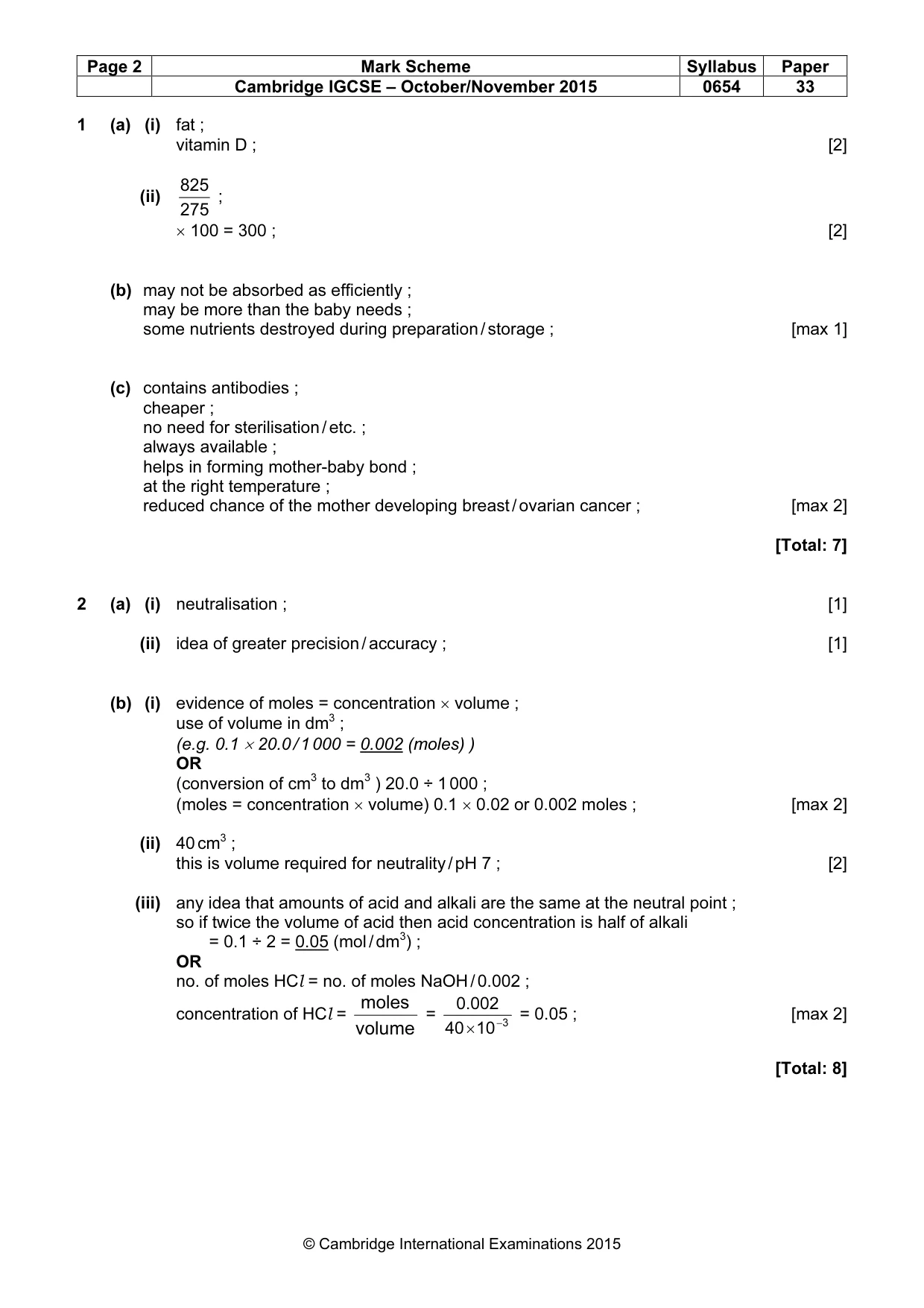
Page 2 Mark Scheme Syllabus Paper Cambridge IGCSE – October/November 2015 0654 33 © Cambridge International Examinations 2015 1 (a) (i) fat ; vitamin D ; [2] (ii) 275 825 ; × 100 = 300 ; [2] (b) may not be absorbed as efficiently ; may be more than the baby needs ; some nutrients destroyed during preparation / storage ; [max 1] (c) contains antibodies ; cheaper ; no need for sterilisation / etc. ; always available ; helps in forming mother-baby bond ; at the right temperature ; reduced chance of the mother developing breast / ovarian cancer ; [max 2] [Total: 7] 2 (a) (i) neutralisation ; [1] (ii) idea of greater precision / accuracy ; [1] (b) (i) evidence of moles = concentration × volume ; use of volume in dm3 ; (e.g. 0.1 × 20.0 / 1 000 = 0.002 (moles) ) OR (conversion of cm3 to dm3 ) 20.0 ÷ 1 000 ; (moles = concentration × volume) 0.1 × 0.02 or 0.002 moles ; [max 2] (ii) 40 cm3 ; this is volume required for neutrality / pH 7 ; [2] (iii) any idea that amounts of acid and alkali are the same at the neutral point ; so if twice the volume of acid then acid concentration is half of alkali = 0.1 ÷ 2 = 0.05 (mol / dm3) ; OR no. of moles HCl = no. of moles NaOH / 0.002 ; concentration of HCl = volume moles = 3 10 40 0.002 − × = 0.05 ; [max 2] [Total: 8]
Mark scheme, page 3
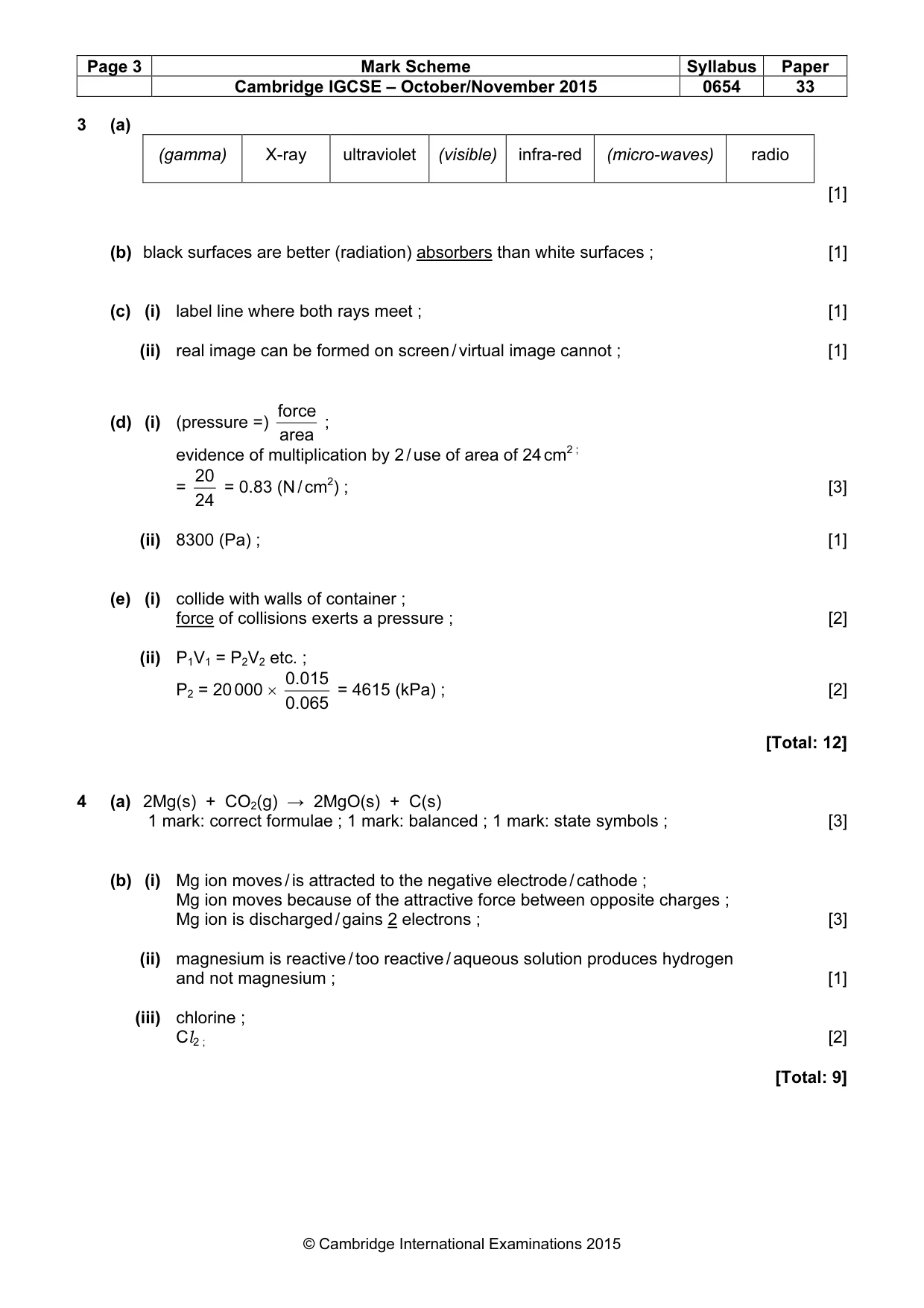
Page 3 Mark Scheme Syllabus Paper Cambridge IGCSE – October/November 2015 0654 33 © Cambridge International Examinations 2015 3 (a) (gamma) X-ray ultraviolet (visible) infra-red (micro-waves) radio [1] (b) black surfaces are better (radiation) absorbers than white surfaces ; [1] (c) (i) label line where both rays meet ; [1] (ii) real image can be formed on screen / virtual image cannot ; [1] (d) (i) (pressure =) area force ; evidence of multiplication by 2 / use of area of 24 cm2 ; = 24 20 = 0.83 (N / cm2) ; [3] (ii) 8300 (Pa) ; [1] (e) (i) collide with walls of container ; force of collisions exerts a pressure ; [2] (ii) P1V1 = P2V2 etc. ; P2 = 20 000 × 0.065 0.015 = 4615 (kPa) ; [2] [Total: 12] 4 (a) 2Mg(s) + CO2(g) → 2MgO(s) + C(s) 1 mark: correct formulae ; 1 mark: balanced ; 1 mark: state symbols ; [3] (b) (i) Mg ion moves / is attracted to the negative electrode / cathode ; Mg ion moves because of the attractive force between opposite charges ; Mg ion is discharged / gains 2 electrons ; [3] (ii) magnesium is reactive / too reactive / aqueous solution produces hydrogen and not magnesium ; [1] (iii) chlorine ; Cl2 ; [2] [Total: 9]
Mark scheme, page 4
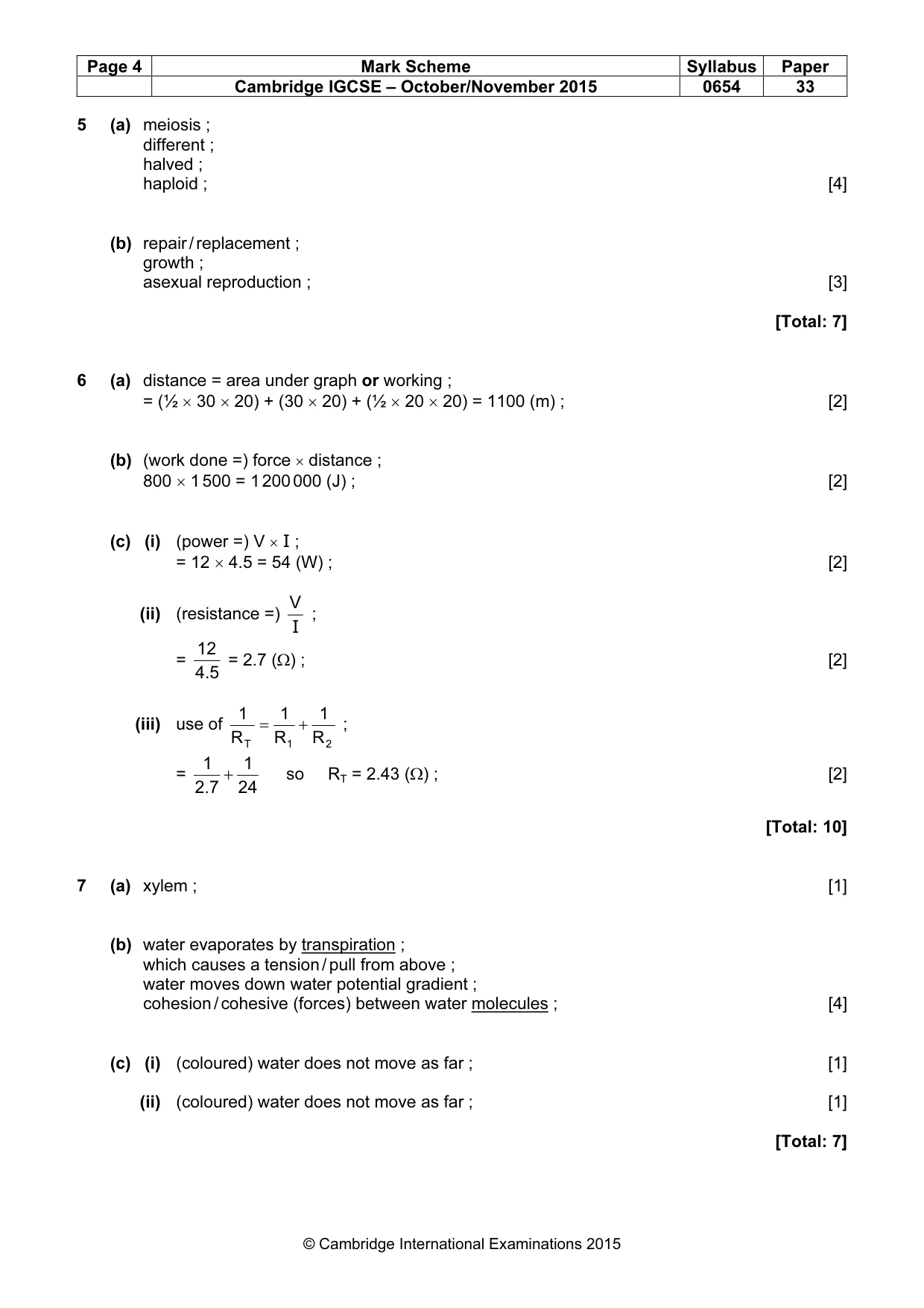
Page 4 Mark Scheme Syllabus Paper Cambridge IGCSE – October/November 2015 0654 33 © Cambridge International Examinations 2015 5 (a) meiosis ; different ; halved ; haploid ; [4] (b) repair / replacement ; growth ; asexual reproduction ; [3] [Total: 7] 6 (a) distance = area under graph or working ; = (½ × 30 × 20) + (30 × 20) + (½ × 20 × 20) = 1100 (m) ; [2] (b) (work done =) force × distance ; 800 × 1 500 = 1 200 000 (J) ; [2] (c) (i) (power =) V × I ; = 12 × 4.5 = 54 (W) ; [2] (ii) (resistance =) I V ; = 4.5 12 = 2.7 (Ω) ; [2] (iii) use of 2 1 T R 1 R 1 R 1 + = ; = 24 1 2.7 1 + so RT = 2.43 (Ω) ; [2] [Total: 10] 7 (a) xylem ; [1] (b) water evaporates by transpiration ; which causes a tension / pull from above ; water moves down water potential gradient ; cohesion / cohesive (forces) between water molecules ; [4] (c) (i) (coloured) water does not move as far ; [1] (ii) (coloured) water does not move as far ; [1] [Total: 7]
Mark scheme, page 5
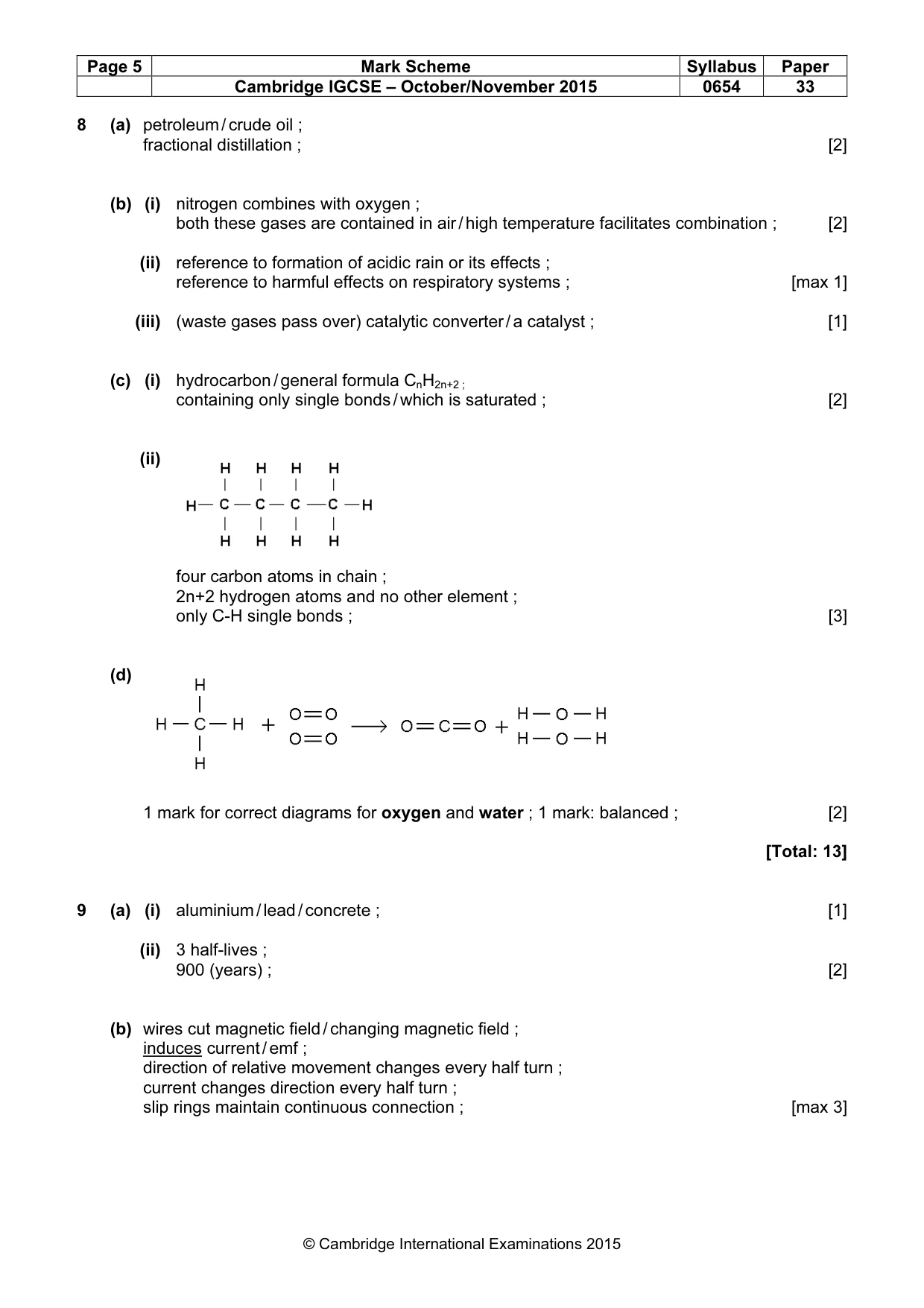
Page 5 Mark Scheme Syllabus Paper Cambridge IGCSE – October/November 2015 0654 33 © Cambridge International Examinations 2015 8 (a) petroleum / crude oil ; fractional distillation ; [2] (b) (i) nitrogen combines with oxygen ; both these gases are contained in air / high temperature facilitates combination ; [2] (ii) reference to formation of acidic rain or its effects ; reference to harmful effects on respiratory systems ; [max 1] (iii) (waste gases pass over) catalytic converter / a catalyst ; [1] (c) (i) hydrocarbon / general formula CnH2n+2 ; containing only single bonds / which is saturated ; [2] (ii) four carbon atoms in chain ; 2n+2 hydrogen atoms and no other element ; only C-H single bonds ; [3] (d) 1 mark for correct diagrams for oxygen and water ; 1 mark: balanced ; [2] [Total: 13] 9 (a) (i) aluminium / lead / concrete ; [1] (ii) 3 half-lives ; 900 (years) ; [2] (b) wires cut magnetic field / changing magnetic field ; induces current / emf ; direction of relative movement changes every half turn ; current changes direction every half turn ; slip rings maintain continuous connection ; [max 3]
Mark scheme, page 6
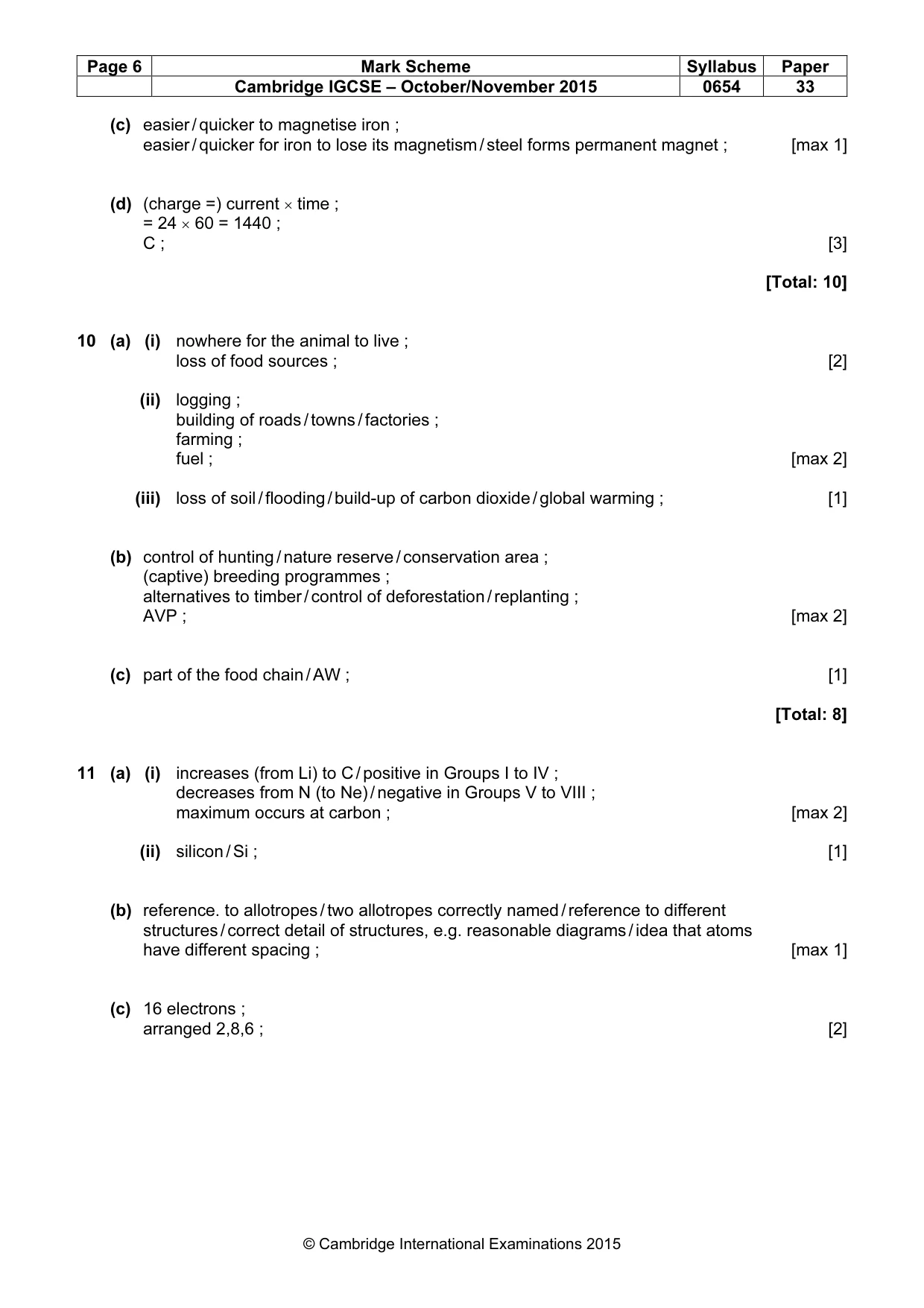
Page 6 Mark Scheme Syllabus Paper Cambridge IGCSE – October/November 2015 0654 33 © Cambridge International Examinations 2015 (c) easier / quicker to magnetise iron ; easier / quicker for iron to lose its magnetism / steel forms permanent magnet ; [max 1] (d) (charge =) current × time ; = 24 × 60 = 1440 ; C ; [3] [Total: 10] 10 (a) (i) nowhere for the animal to live ; loss of food sources ; [2] (ii) logging ; building of roads / towns / factories ; farming ; fuel ; [max 2] (iii) loss of soil / flooding / build-up of carbon dioxide / global warming ; [1] (b) control of hunting / nature reserve / conservation area ; (captive) breeding programmes ; alternatives to timber / control of deforestation / replanting ; AVP ; [max 2] (c) part of the food chain / AW ; [1] [Total: 8] 11 (a) (i) increases (from Li) to C / positive in Groups I to IV ; decreases from N (to Ne) / negative in Groups V to VIII ; maximum occurs at carbon ; [max 2] (ii) silicon / Si ; [1] (b) reference. to allotropes / two allotropes correctly named / reference to different structures / correct detail of structures, e.g. reasonable diagrams / idea that atoms have different spacing ; [max 1] (c) 16 electrons ; arranged 2,8,6 ; [2]
Mark scheme, page 7
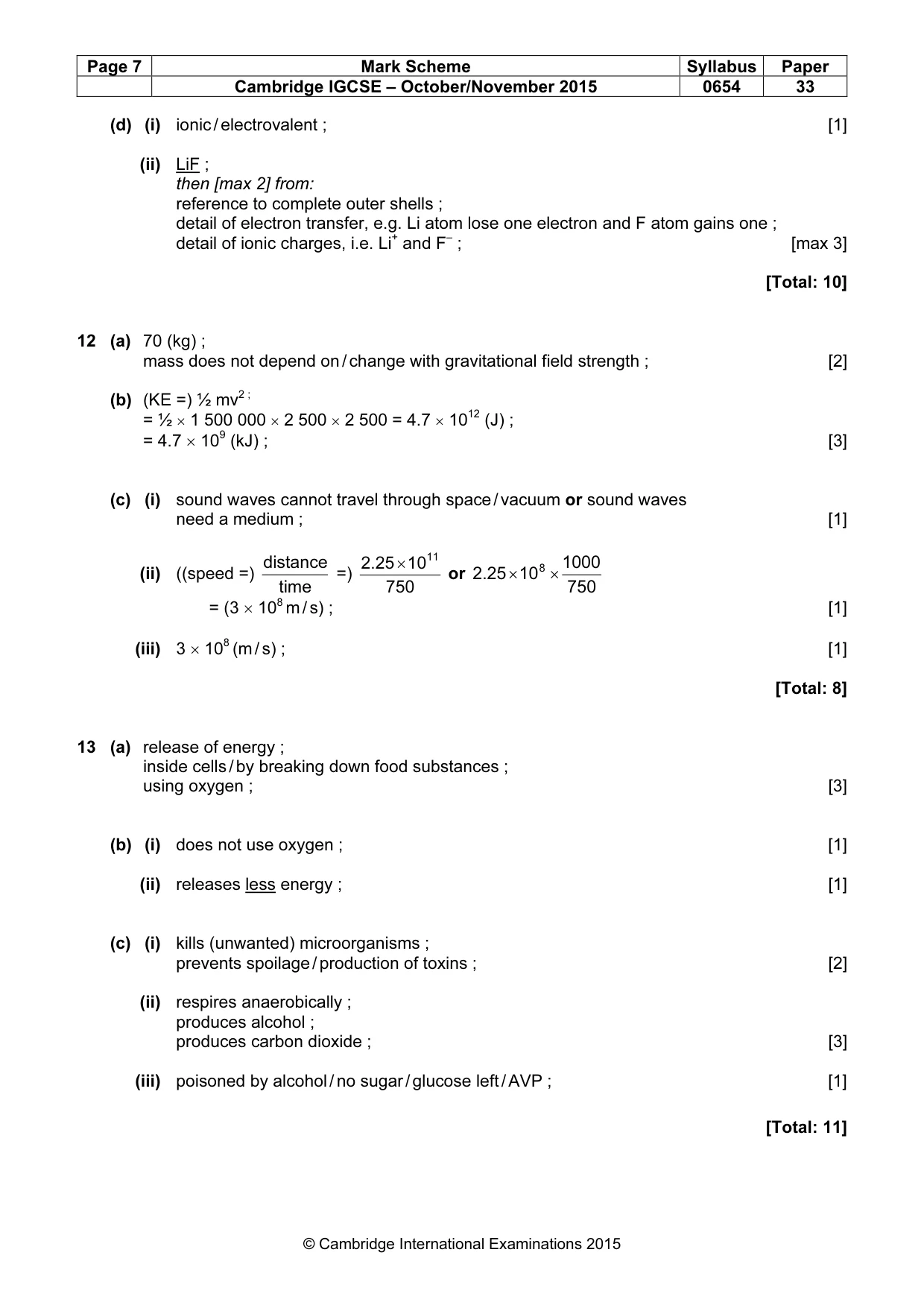
Page 7 Mark Scheme Syllabus Paper Cambridge IGCSE – October/November 2015 0654 33 © Cambridge International Examinations 2015 (d) (i) ionic / electrovalent ; [1] (ii) LiF ; then [max 2] from: reference to complete outer shells ; detail of electron transfer, e.g. Li atom lose one electron and F atom gains one ; detail of ionic charges, i.e. Li+ and F– ; [max 3] [Total: 10] 12 (a) 70 (kg) ; mass does not depend on / change with gravitational field strength ; [2] (b) (KE =) ½ mv2 ; = ½ × 1 500 000 × 2 500 × 2 500 = 4.7 × 10¹² (J) ; = 4.7 × 10⁹ (kJ) ; [3] (c) (i) sound waves cannot travel through space / vacuum or sound waves need a medium ; [1] (ii) ((speed =) time distance =) 750 10 2.25 11 × or 750 1000 10 2.25 8 × × = (3 × 10⁸ m / s) ; [1] (iii) 3 × 10⁸ (m / s) ; [1] [Total: 8] 13 (a) release of energy ; inside cells / by breaking down food substances ; using oxygen ; [3] (b) (i) does not use oxygen ; [1] (ii) releases less energy ; [1] (c) (i) kills (unwanted) microorganisms ; prevents spoilage / production of toxins ; [2] (ii) respires anaerobically ; produces alcohol ; produces carbon dioxide ; [3] (iii) poisoned by alcohol / no sugar / glucose left / AVP ; [1] [Total: 11]
What you needed in this session
Cambridge’s own grade thresholds for 2015 Oct/Nov, Paper 3 · Variant 3. A higher threshold means an easier paper — the bar moves with how the cohort did.