Cambridge IGCSE Sciences - Co-ordinated (Double) 0654 — 2010 May/June Paper 3 · Variant 1
0654/31/M/J/10 · 100 marks · ≈113 min
The question paper and its mark scheme, free to read here and free to download. This is Cambridge’s own paper, exactly as it was sat.
Question paper24 pages

Mark scheme7 pages
Answers below. Sit the paper first if you are practising.
Paper as text
Question paper, page 1
This document consists of 23 printed pages and 1 blank page. IB10 06_0654_31/4RP © UCLES 2010 [Turn over *3227885338* For Examiner's Use 1 2 3 4 5 6 7 8 9 Total UNIVERSITY OF CAMBRIDGE INTERNATIONAL EXAMINATIONS International General Certificate of Secondary Education CO-ORDINATED SCIENCES 0654/31 Paper 3 (Extended) May/June 2010 2 hours Candidates answer on the Question Paper. No Additional Materials are required. READ THESE INSTRUCTIONS FIRST Write your Centre number, candidate number and name on all the work you hand in. Write in dark blue or black pen. You may use a soft pencil for any diagrams, graphs, tables or rough working. Do not use staples, paper clips, highlighters, glue or correction fluid. DO NOT WRITE IN ANY BARCODES. Answer all questions. A copy of the Periodic Table is printed on page 24. At the end of the examination, fasten all your work securely together. The number of marks is given in brackets [ ] at the end of each question or part question. www.XtremePapers.com
Question paper, page 2
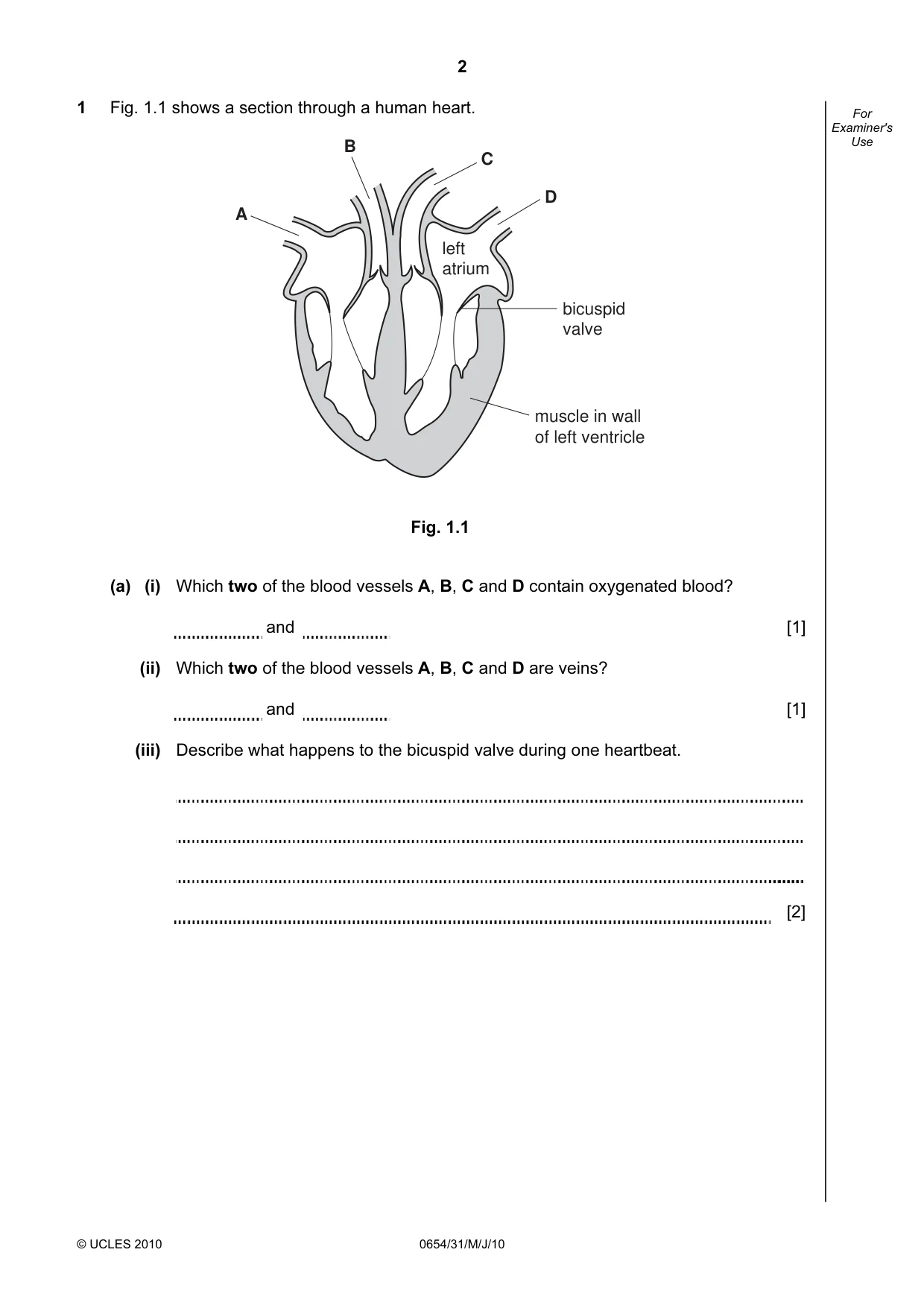
2 © UCLES 2010 0654/31/M/J/10 For Examiner's Use 1 Fig. 1.1 shows a section through a human heart. bicuspid valve muscle in wall of left ventricle A B C D left atrium Fig. 1.1 (a) (i) Which two of the blood vessels A, B, C and D contain oxygenated blood? and [1] (ii) Which two of the blood vessels A, B, C and D are veins? and [1] (iii) Describe what happens to the bicuspid valve during one heartbeat. [2]
Question paper, page 3
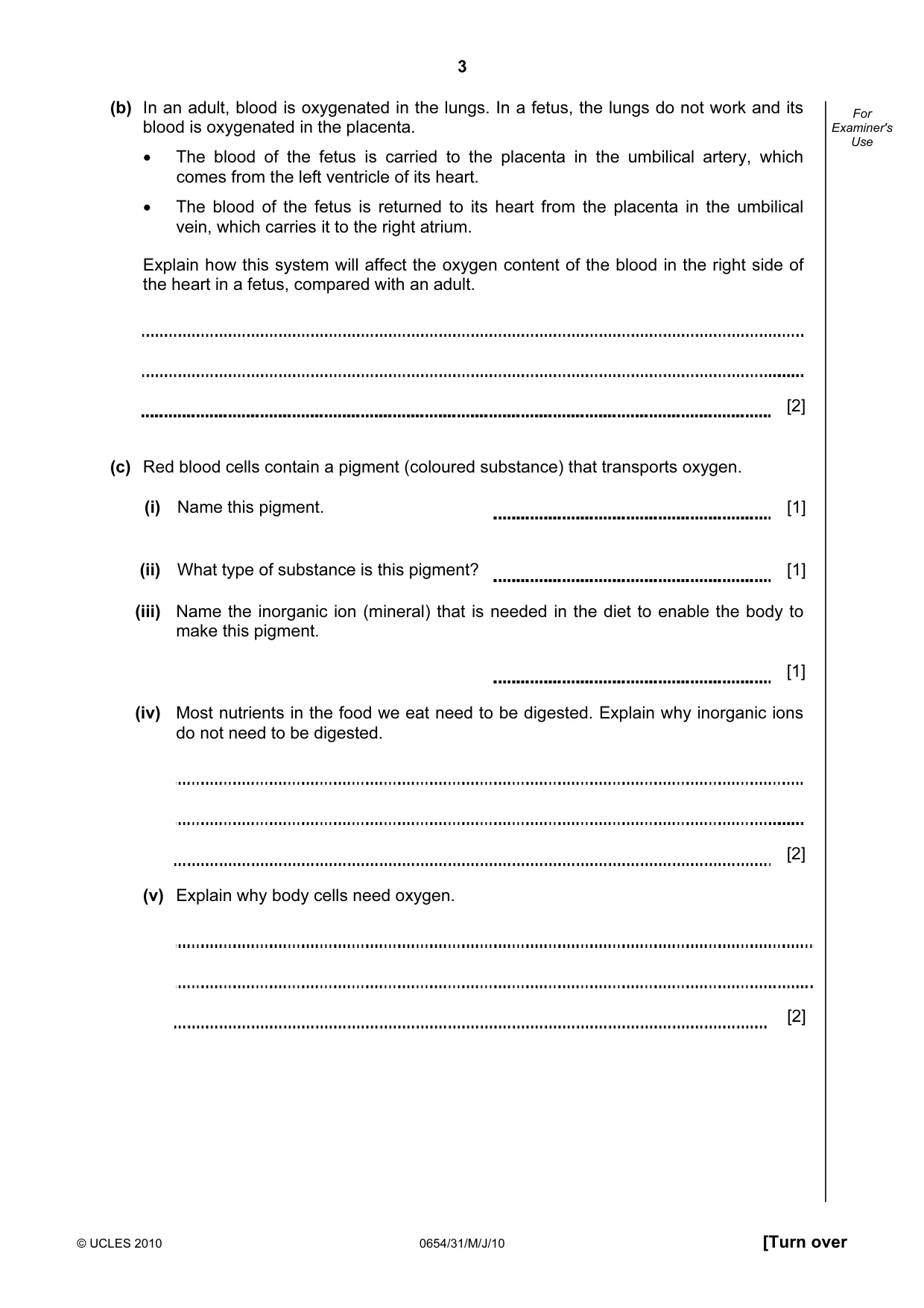
3 © UCLES 2010 0654/31/M/J/10 [Turn over For Examiner's Use (b) In an adult, blood is oxygenated in the lungs. In a fetus, the lungs do not work and its blood is oxygenated in the placenta. • The blood of the fetus is carried to the placenta in the umbilical artery, which comes from the left ventricle of its heart. • The blood of the fetus is returned to its heart from the placenta in the umbilical vein, which carries it to the right atrium. Explain how this system will affect the oxygen content of the blood in the right side of the heart in a fetus, compared with an adult. [2] (c) Red blood cells contain a pigment (coloured substance) that transports oxygen. (i) Name this pigment. [1] (ii) What type of substance is this pigment? [1] (iii) Name the inorganic ion (mineral) that is needed in the diet to enable the body to make this pigment. [1] (iv) Most nutrients in the food we eat need to be digested. Explain why inorganic ions do not need to be digested. [2] (v) Explain why body cells need oxygen. [2]
Question paper, page 4
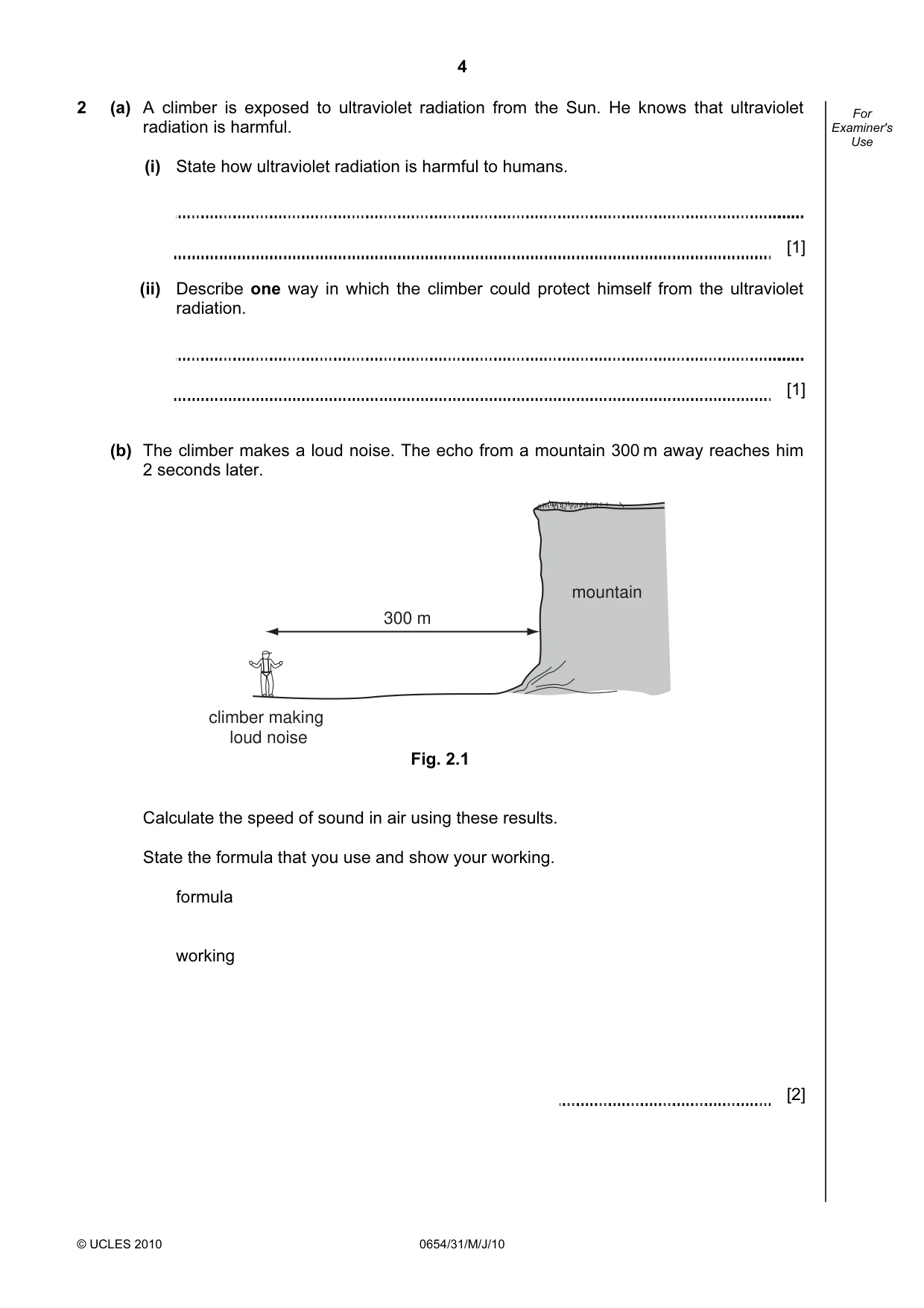
4 © UCLES 2010 0654/31/M/J/10 For Examiner's Use 2 (a) A climber is exposed to ultraviolet radiation from the Sun. He knows that ultraviolet radiation is harmful. (i) State how ultraviolet radiation is harmful to humans. [1] (ii) Describe one way in which the climber could protect himself from the ultraviolet radiation. [1] (b) The climber makes a loud noise. The echo from a mountain 300 m away reaches him 2 seconds later. 300 m mountain climber making loud noise Fig. 2.1 Calculate the speed of sound in air using these results. State the formula that you use and show your working. formula working [2]
Question paper, page 5
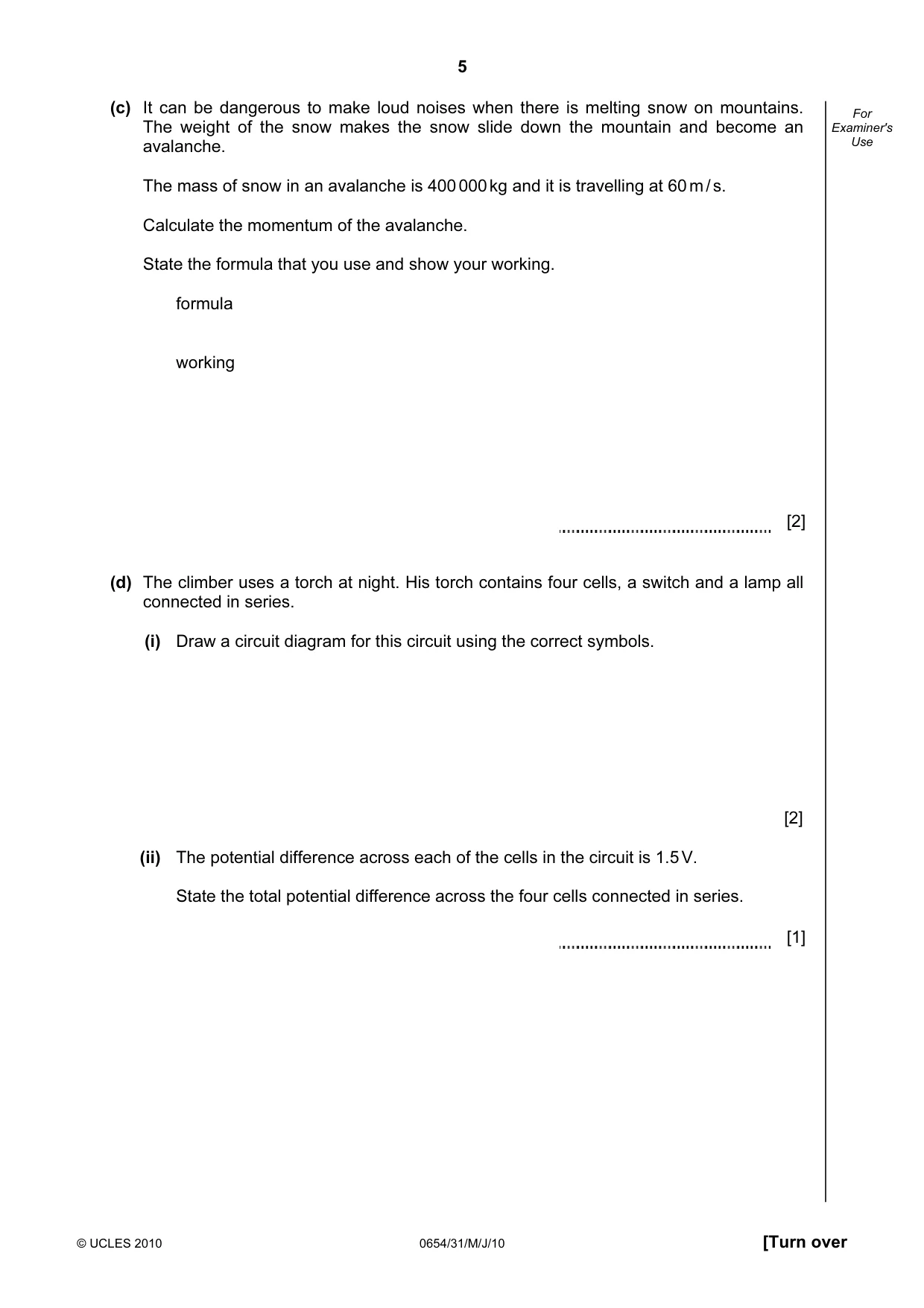
5 © UCLES 2010 0654/31/M/J/10 [Turn over For Examiner's Use (c) It can be dangerous to make loud noises when there is melting snow on mountains. The weight of the snow makes the snow slide down the mountain and become an avalanche. The mass of snow in an avalanche is 400 000 kg and it is travelling at 60 m / s. Calculate the momentum of the avalanche. State the formula that you use and show your working. formula working [2] (d) The climber uses a torch at night. His torch contains four cells, a switch and a lamp all connected in series. (i) Draw a circuit diagram for this circuit using the correct symbols. [2] (ii) The potential difference across each of the cells in the circuit is 1.5 V. State the total potential difference across the four cells connected in series. [1]
Question paper, page 6
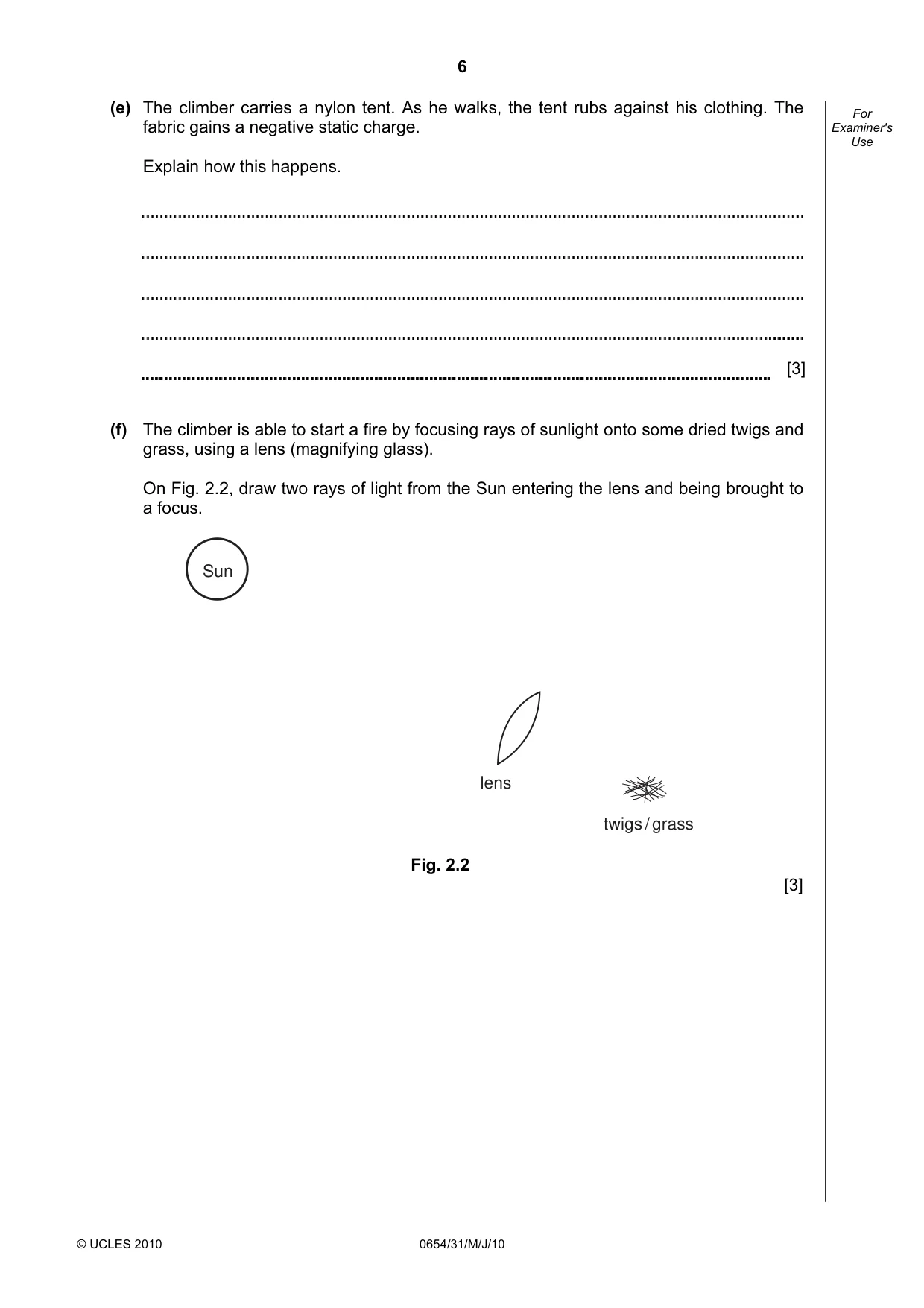
6 © UCLES 2010 0654/31/M/J/10 For Examiner's Use (e) The climber carries a nylon tent. As he walks, the tent rubs against his clothing. The fabric gains a negative static charge. Explain how this happens. [3] (f) The climber is able to start a fire by focusing rays of sunlight onto some dried twigs and grass, using a lens (magnifying glass). On Fig. 2.2, draw two rays of light from the Sun entering the lens and being brought to a focus. lens twigs / grass Sun Fig. 2.2 [3]
Question paper, page 7
7 © UCLES 2010 0654/31/M/J/10 [Turn over For Examiner's Use 3 (a) A person swallows a radioactive substance. Explain why this could be harmful. [3] (b) In a nuclear power station, nuclear fuel such as uranium gives out energy. (i) State what happens to the uranium atoms. [1] (ii) Describe one problem associated with this process. [2]
Question paper, page 8
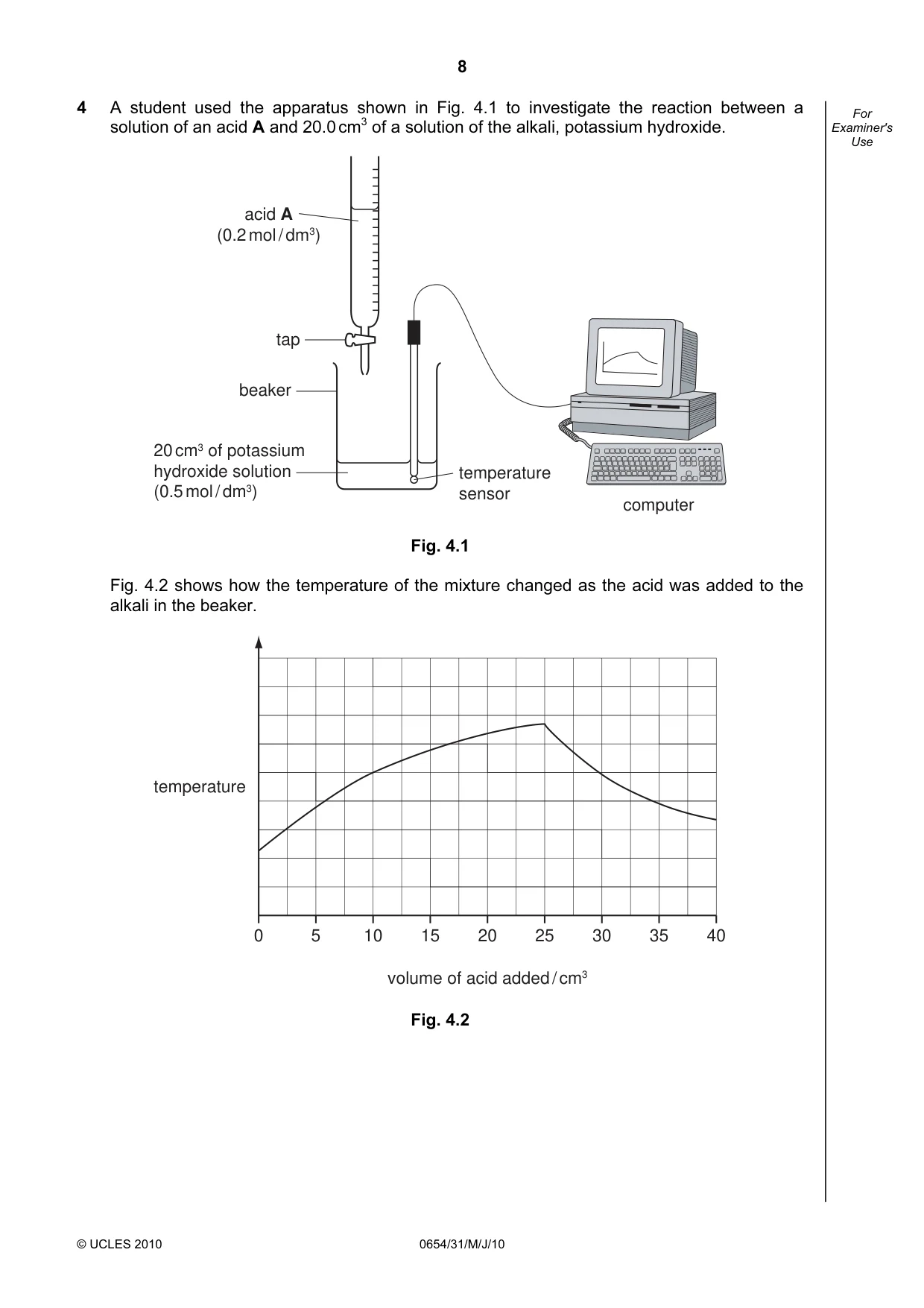
8 © UCLES 2010 0654/31/M/J/10 For Examiner's Use 4 A student used the apparatus shown in Fig. 4.1 to investigate the reaction between a solution of an acid A and 20.0 cm3 of a solution of the alkali, potassium hydroxide. acid A (0.2 mol / dm3) tap beaker 20 cm3 of potassium hydroxide solution (0.5 mol / dm3) temperature sensor computer Fig. 4.1 Fig. 4.2 shows how the temperature of the mixture changed as the acid was added to the alkali in the beaker. 0 5 10 15 20 25 30 35 40 temperature volume of acid added / cm3 Fig. 4.2
Question paper, page 9
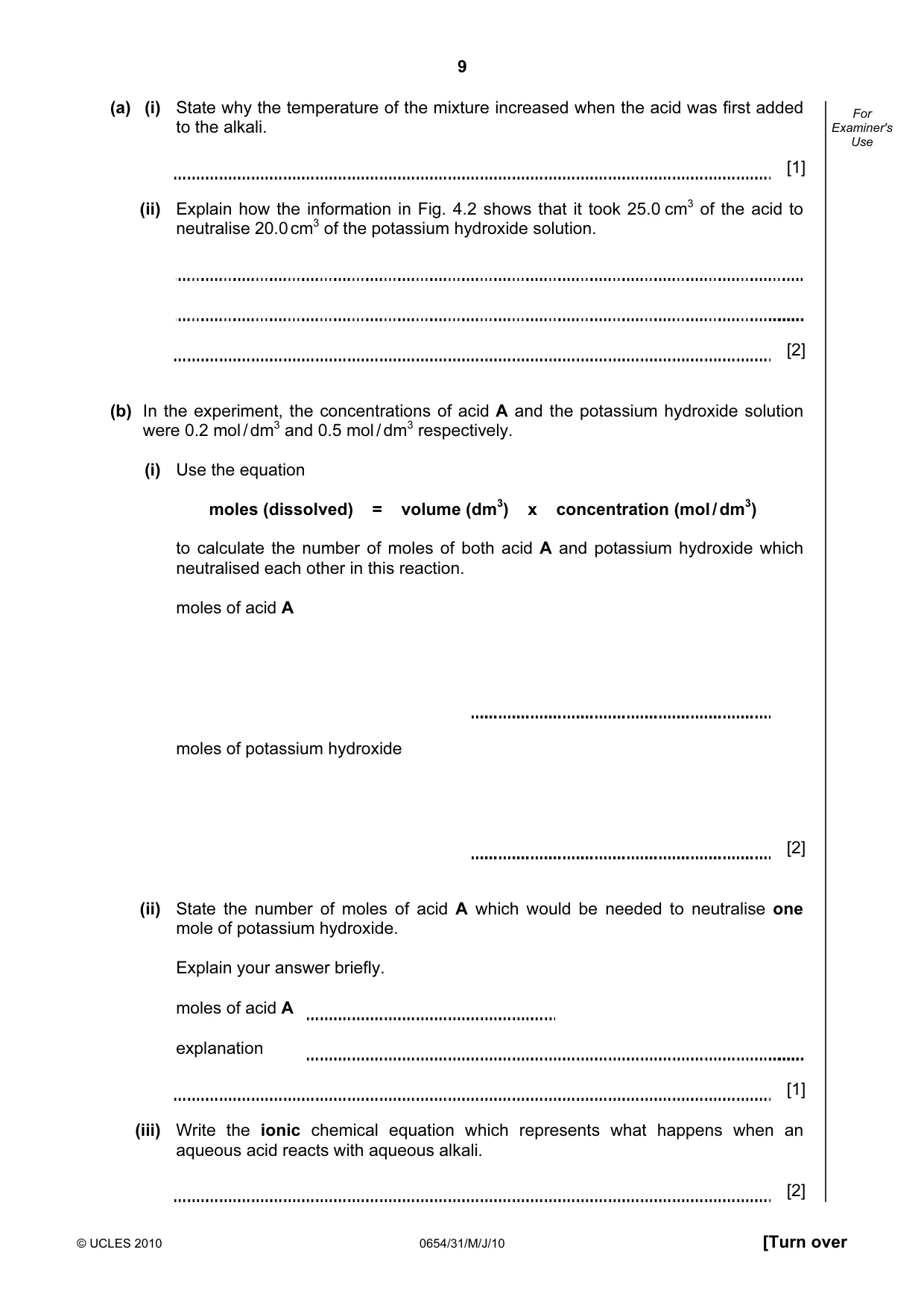
9 © UCLES 2010 0654/31/M/J/10 [Turn over For Examiner's Use (a) (i) State why the temperature of the mixture increased when the acid was first added to the alkali. [1] (ii) Explain how the information in Fig. 4.2 shows that it took 25.0 cm3 of the acid to neutralise 20.0 cm3 of the potassium hydroxide solution. [2] (b) In the experiment, the concentrations of acid A and the potassium hydroxide solution were 0.2 mol / dm3 and 0.5 mol / dm3 respectively. (i) Use the equation moles (dissolved) = volume (dm3) x concentration (mol / dm3) to calculate the number of moles of both acid A and potassium hydroxide which neutralised each other in this reaction. moles of acid A moles of potassium hydroxide [2] (ii) State the number of moles of acid A which would be needed to neutralise one mole of potassium hydroxide. Explain your answer briefly. moles of acid A explanation [1] (iii) Write the ionic chemical equation which represents what happens when an aqueous acid reacts with aqueous alkali. [2]
Question paper, page 10
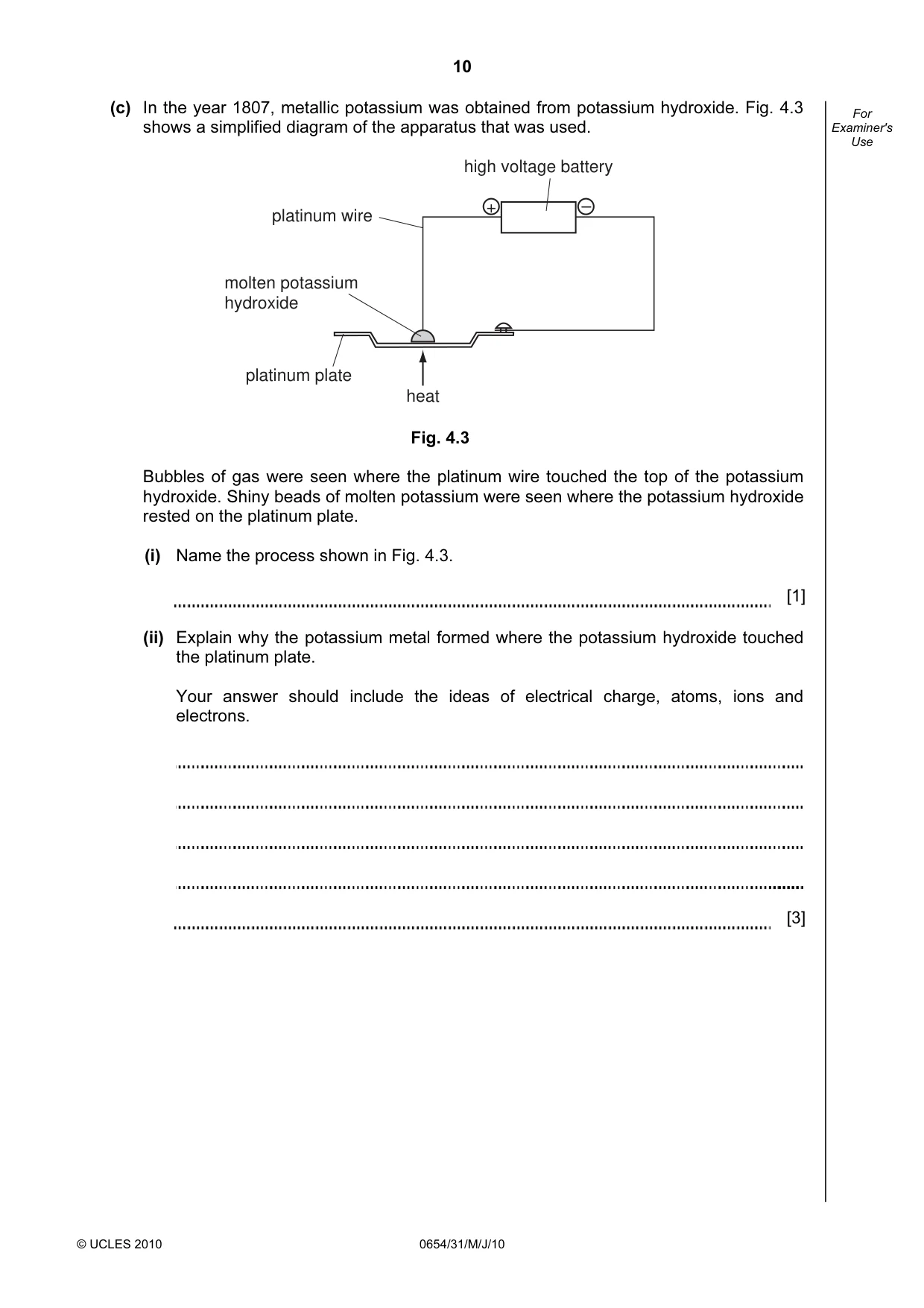
10 © UCLES 2010 0654/31/M/J/10 For Examiner's Use (c) In the year 1807, metallic potassium was obtained from potassium hydroxide. Fig. 4.3 shows a simplified diagram of the apparatus that was used. high voltage battery platinum wire platinum plate molten potassium hydroxide heat – + Fig. 4.3 Bubbles of gas were seen where the platinum wire touched the top of the potassium hydroxide. Shiny beads of molten potassium were seen where the potassium hydroxide rested on the platinum plate. (i) Name the process shown in Fig. 4.3. [1] (ii) Explain why the potassium metal formed where the potassium hydroxide touched the platinum plate. Your answer should include the ideas of electrical charge, atoms, ions and electrons. [3]
Question paper, page 11
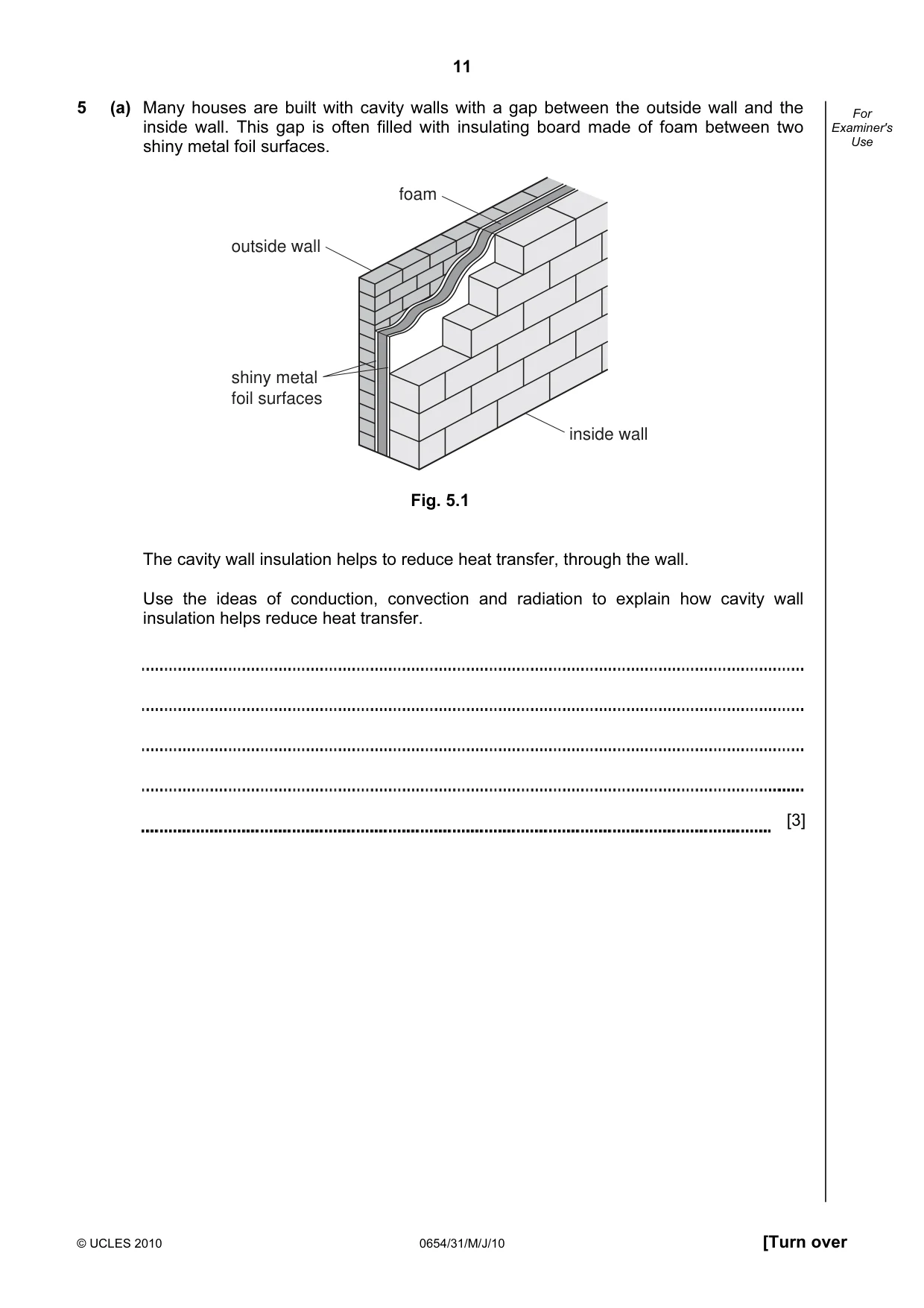
11 © UCLES 2010 0654/31/M/J/10 [Turn over For Examiner's Use 5 (a) Many houses are built with cavity walls with a gap between the outside wall and the inside wall. This gap is often filled with insulating board made of foam between two shiny metal foil surfaces. outside wall inside wall foam shiny metal foil surfaces Fig. 5.1 The cavity wall insulation helps to reduce heat transfer, through the wall. Use the ideas of conduction, convection and radiation to explain how cavity wall insulation helps reduce heat transfer. [3]
Question paper, page 12
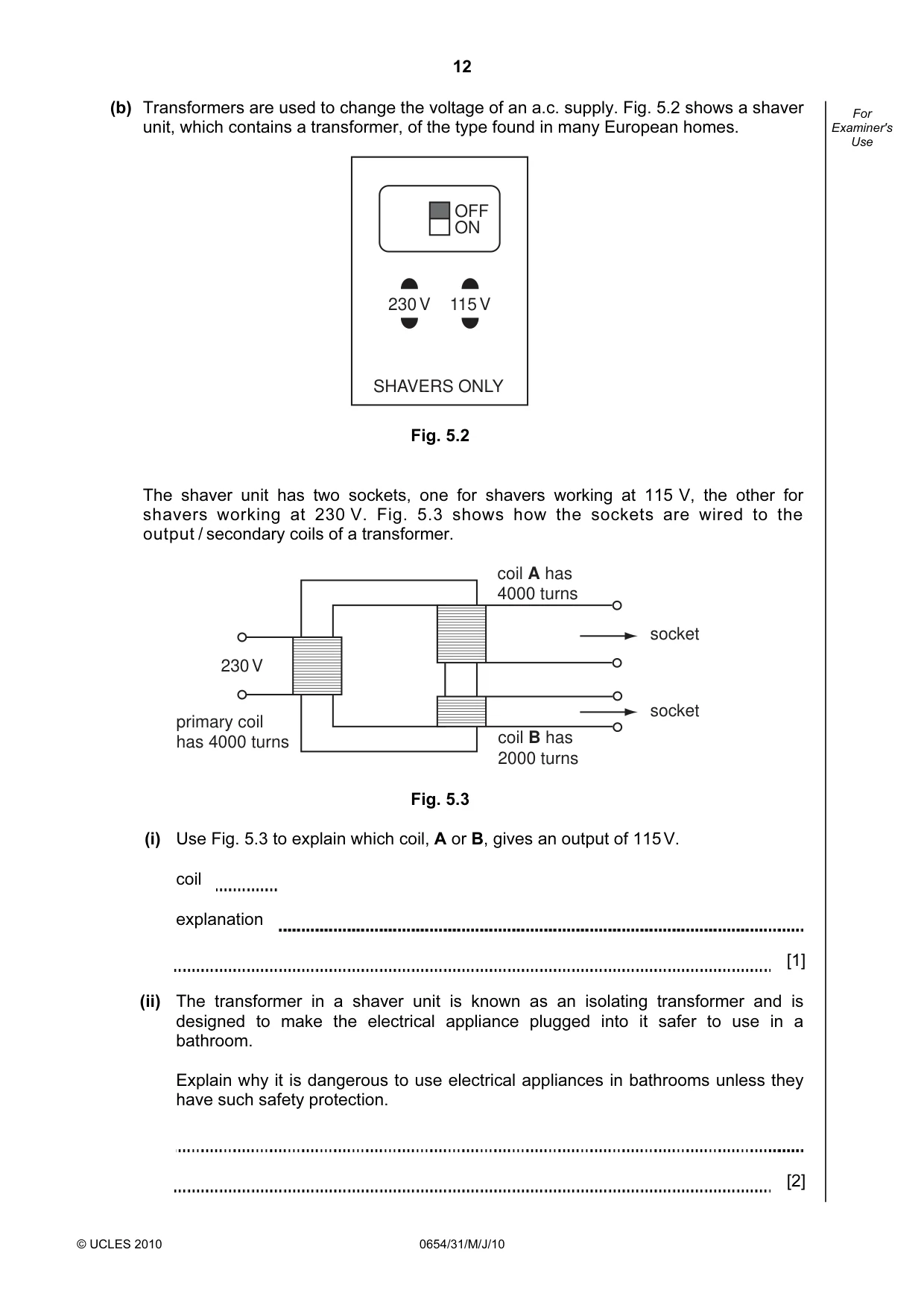
12 © UCLES 2010 0654/31/M/J/10 For Examiner's Use (b) Transformers are used to change the voltage of an a.c. supply. Fig. 5.2 shows a shaver unit, which contains a transformer, of the type found in many European homes. OFF ON SHAVERS ONLY 230 V 115 V Fig. 5.2 The shaver unit has two sockets, one for shavers working at 115 V, the other for shavers working at 230 V. Fig. 5.3 shows how the sockets are wired to the output / secondary coils of a transformer. 230 V primary coil has 4000 turns coil A has 4000 turns coil B has 2000 turns socket socket Fig. 5.3 (i) Use Fig. 5.3 to explain which coil, A or B, gives an output of 115 V. coil explanation [1] (ii) The transformer in a shaver unit is known as an isolating transformer and is designed to make the electrical appliance plugged into it safer to use in a bathroom. Explain why it is dangerous to use electrical appliances in bathrooms unless they have such safety protection. [2]
Question paper, page 13
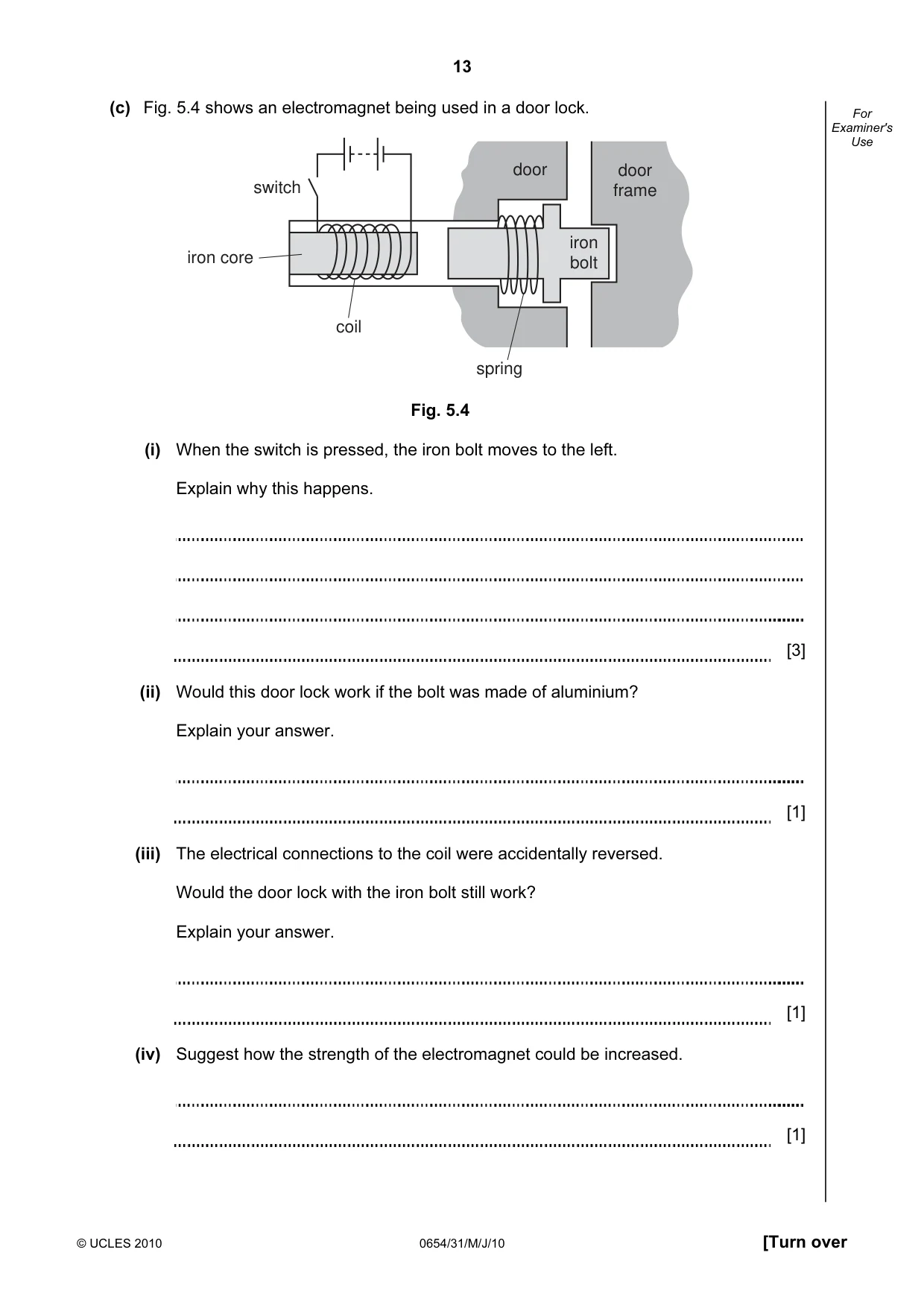
13 © UCLES 2010 0654/31/M/J/10 [Turn over For Examiner's Use (c) Fig. 5.4 shows an electromagnet being used in a door lock. iron bolt door door frame spring coil iron core switch Fig. 5.4 (i) When the switch is pressed, the iron bolt moves to the left. Explain why this happens. [3] (ii) Would this door lock work if the bolt was made of aluminium? Explain your answer. [1] (iii) The electrical connections to the coil were accidentally reversed. Would the door lock with the iron bolt still work? Explain your answer. [1] (iv) Suggest how the strength of the electromagnet could be increased. [1]
Question paper, page 14
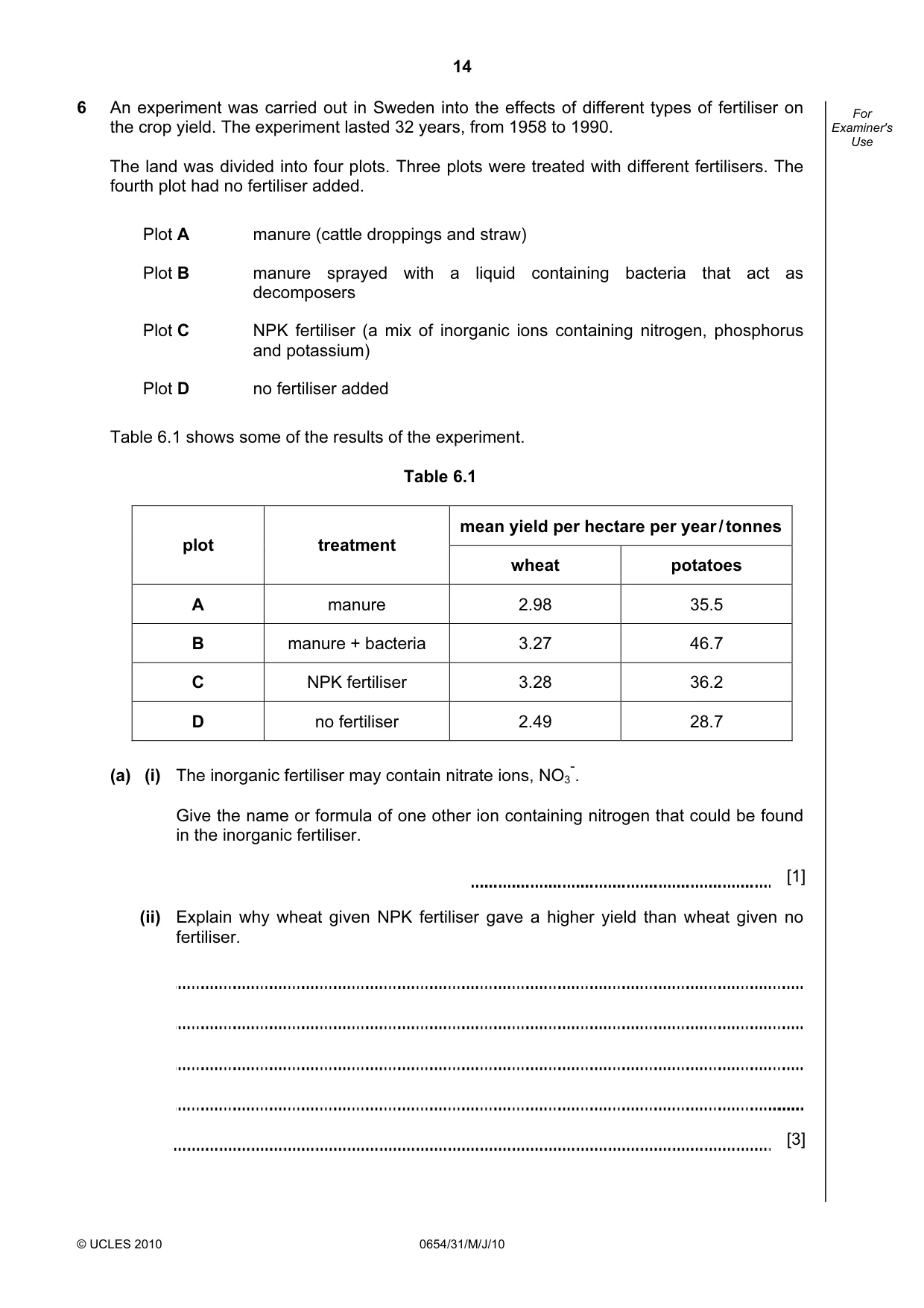
14 © UCLES 2010 0654/31/M/J/10 For Examiner's Use 6 An experiment was carried out in Sweden into the effects of different types of fertiliser on the crop yield. The experiment lasted 32 years, from 1958 to 1990. The land was divided into four plots. Three plots were treated with different fertilisers. The fourth plot had no fertiliser added. Plot A manure (cattle droppings and straw) Plot B manure sprayed with a liquid containing bacteria that act as decomposers Plot C NPK fertiliser (a mix of inorganic ions containing nitrogen, phosphorus and potassium) Plot D no fertiliser added Table 6.1 shows some of the results of the experiment. Table 6.1 mean yield per hectare per year / tonnes plot treatment wheat potatoes A manure 2.98 35.5 B manure + bacteria 3.27 46.7 C NPK fertiliser 3.28 36.2 D no fertiliser 2.49 28.7 (a) (i) The inorganic fertiliser may contain nitrate ions, NO3 -. Give the name or formula of one other ion containing nitrogen that could be found in the inorganic fertiliser. [1] (ii) Explain why wheat given NPK fertiliser gave a higher yield than wheat given no fertiliser. [3]
Question paper, page 15
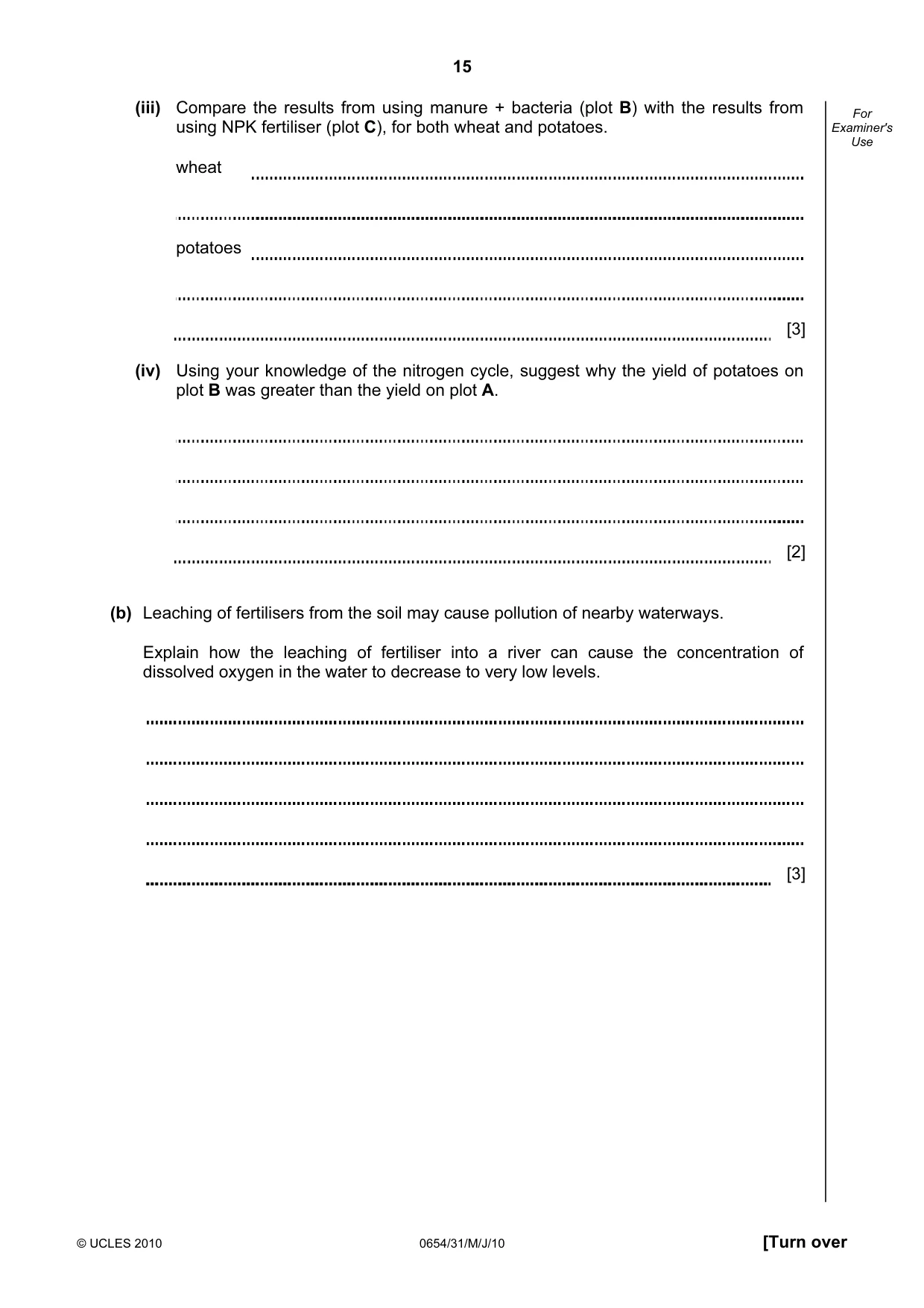
15 © UCLES 2010 0654/31/M/J/10 [Turn over For Examiner's Use (iii) Compare the results from using manure + bacteria (plot B) with the results from using NPK fertiliser (plot C), for both wheat and potatoes. wheat potatoes [3] (iv) Using your knowledge of the nitrogen cycle, suggest why the yield of potatoes on plot B was greater than the yield on plot A. [2] (b) Leaching of fertilisers from the soil may cause pollution of nearby waterways. Explain how the leaching of fertiliser into a river can cause the concentration of dissolved oxygen in the water to decrease to very low levels. [3]
Question paper, page 16
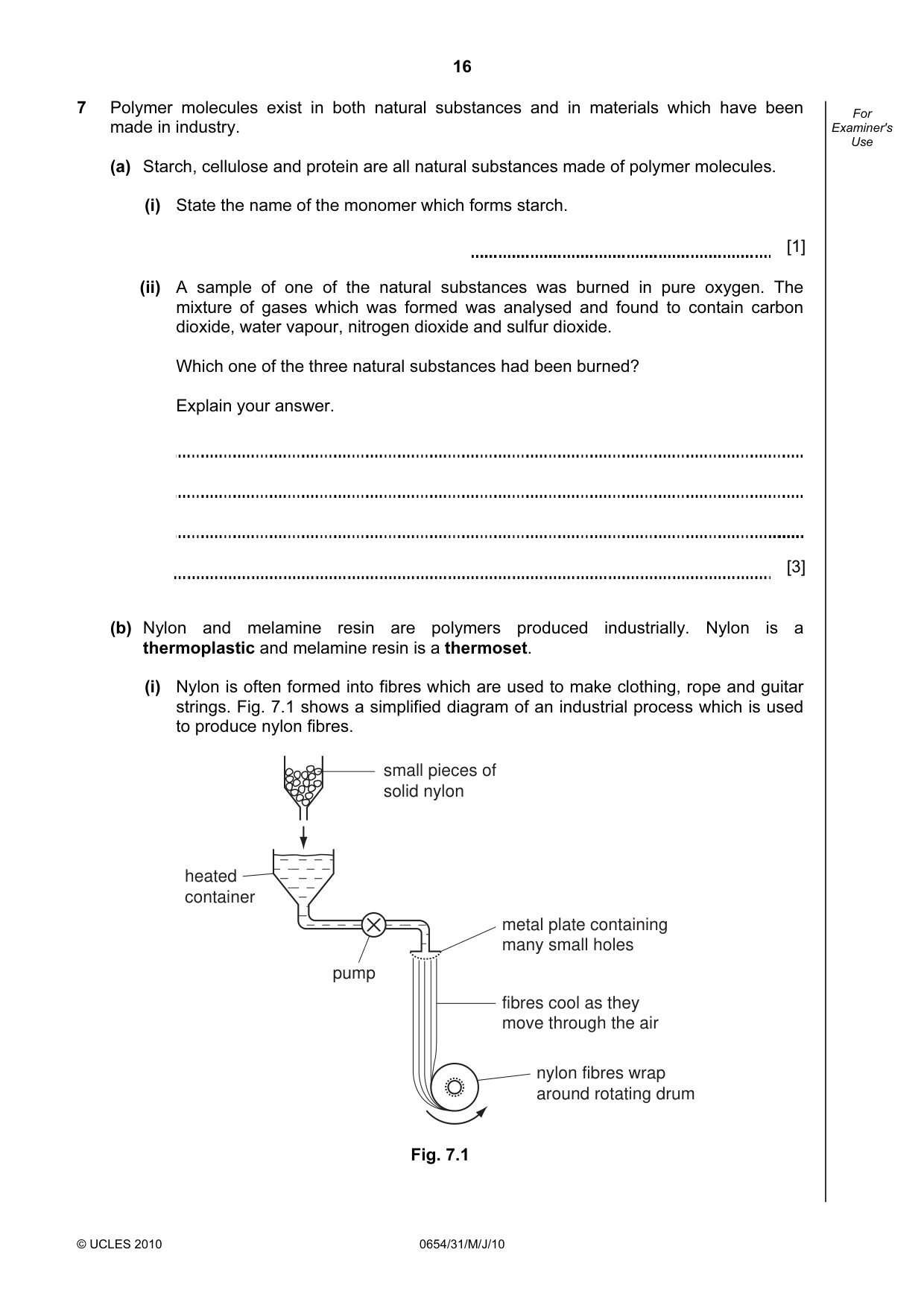
16 © UCLES 2010 0654/31/M/J/10 For Examiner's Use 7 Polymer molecules exist in both natural substances and in materials which have been made in industry. (a) Starch, cellulose and protein are all natural substances made of polymer molecules. (i) State the name of the monomer which forms starch. [1] (ii) A sample of one of the natural substances was burned in pure oxygen. The mixture of gases which was formed was analysed and found to contain carbon dioxide, water vapour, nitrogen dioxide and sulfur dioxide. Which one of the three natural substances had been burned? Explain your answer. [3] (b) Nylon and melamine resin are polymers produced industrially. Nylon is a thermoplastic and melamine resin is a thermoset. (i) Nylon is often formed into fibres which are used to make clothing, rope and guitar strings. Fig. 7.1 shows a simplified diagram of an industrial process which is used to produce nylon fibres. pump heated container metal plate containing many small holes fibres cool as they move through the air nylon fibres wrap around rotating drum small pieces of solid nylon Fig. 7.1
Question paper, page 17
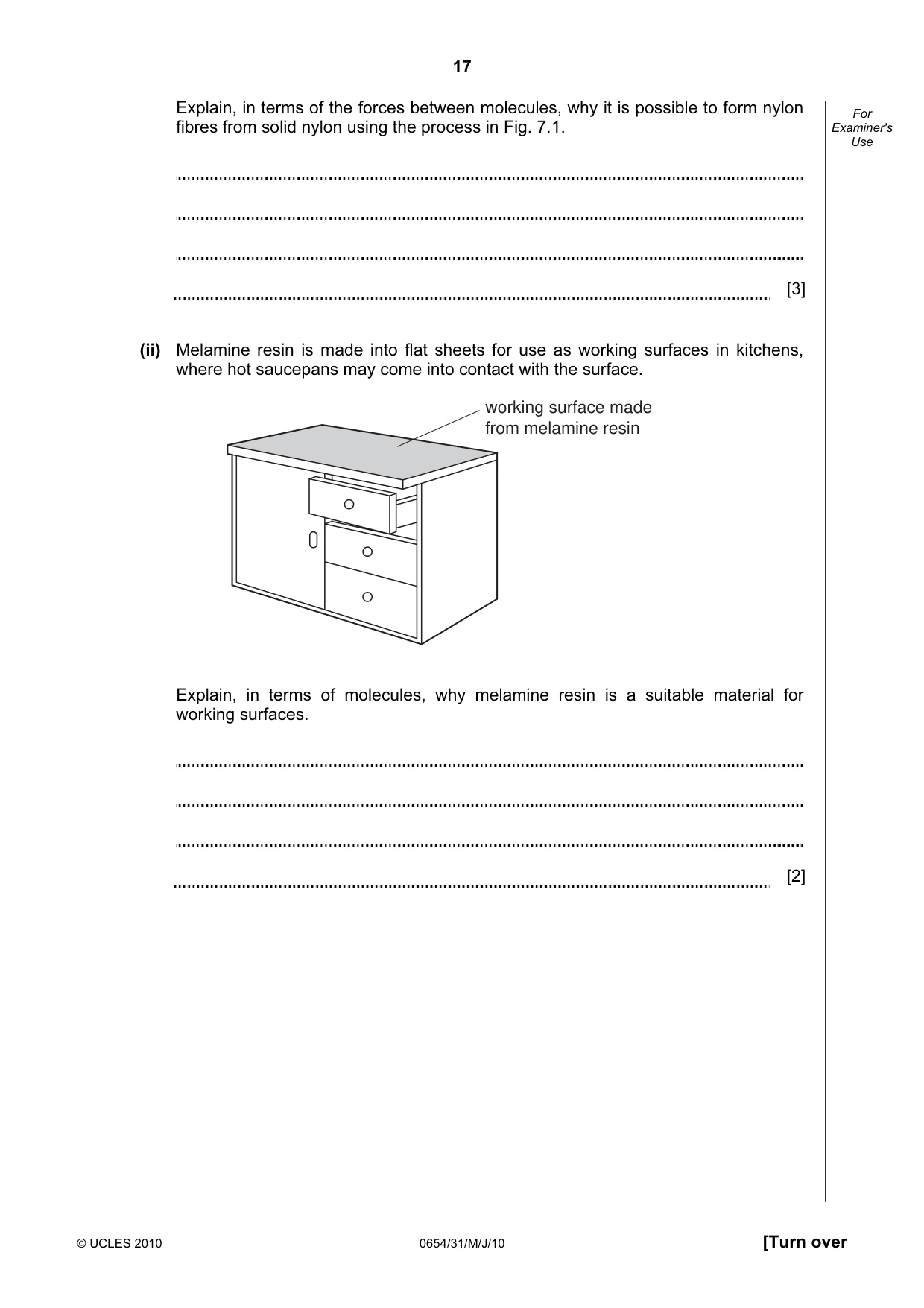
17 © UCLES 2010 0654/31/M/J/10 [Turn over For Examiner's Use Explain, in terms of the forces between molecules, why it is possible to form nylon fibres from solid nylon using the process in Fig. 7.1. [3] (ii) Melamine resin is made into flat sheets for use as working surfaces in kitchens, where hot saucepans may come into contact with the surface. working surface made from melamine resin Explain, in terms of molecules, why melamine resin is a suitable material for working surfaces. [2]
Question paper, page 18
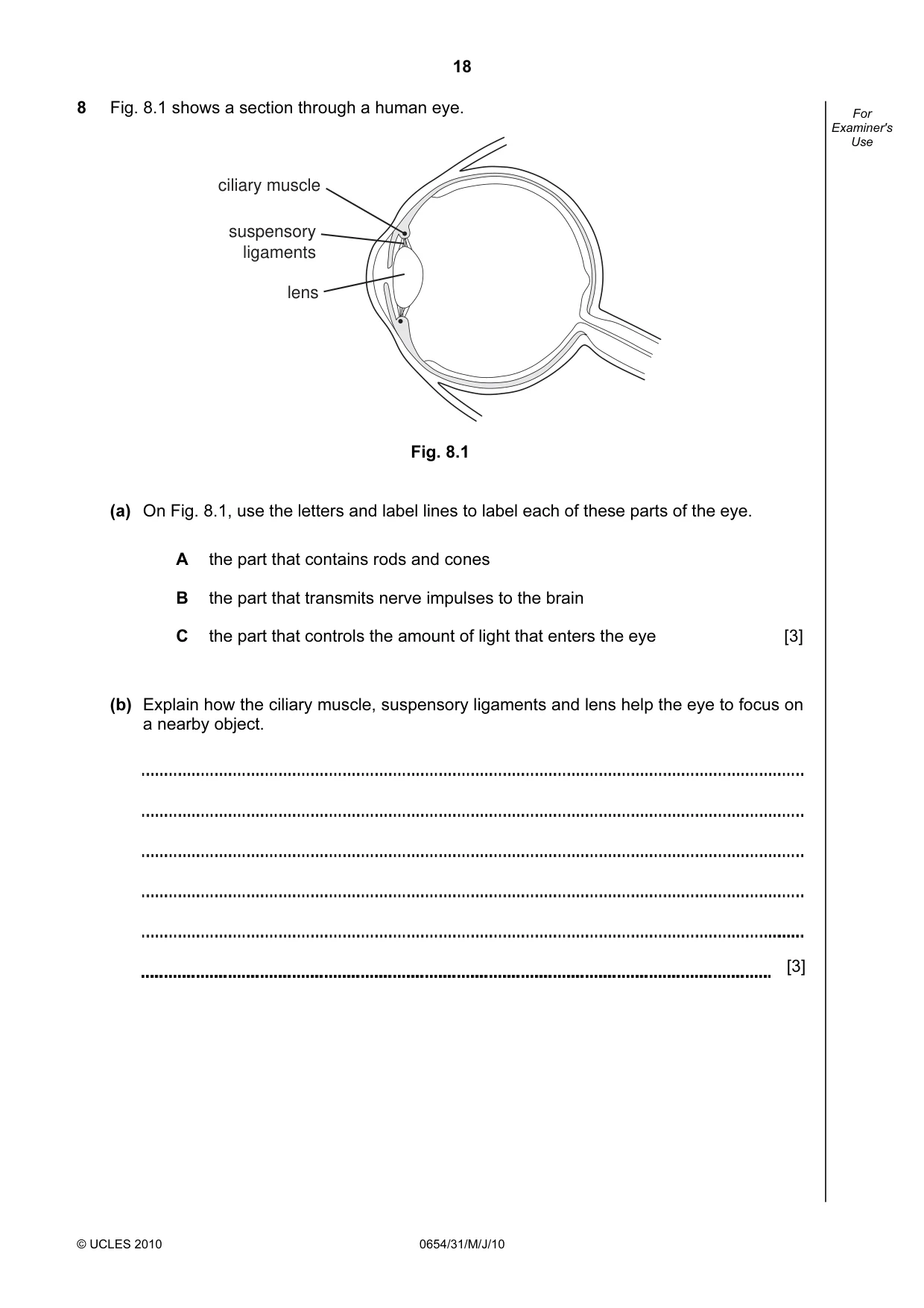
18 © UCLES 2010 0654/31/M/J/10 For Examiner's Use 8 Fig. 8.1 shows a section through a human eye. ciliary muscle suspensory ligaments lens Fig. 8.1 (a) On Fig. 8.1, use the letters and label lines to label each of these parts of the eye. A the part that contains rods and cones B the part that transmits nerve impulses to the brain C the part that controls the amount of light that enters the eye [3] (b) Explain how the ciliary muscle, suspensory ligaments and lens help the eye to focus on a nearby object. [3]
Question paper, page 19
19 © UCLES 2010 0654/31/M/J/10 [Turn over For Examiner's Use (c) Eye colour is determined by genes, and is inherited. There are many different alleles for eye colour. Some genes have alleles that cause disease. Give one example of an inherited disease, and describe how it can be passed from parents to offspring. name of disease how it is passed on [3]
Question paper, page 20
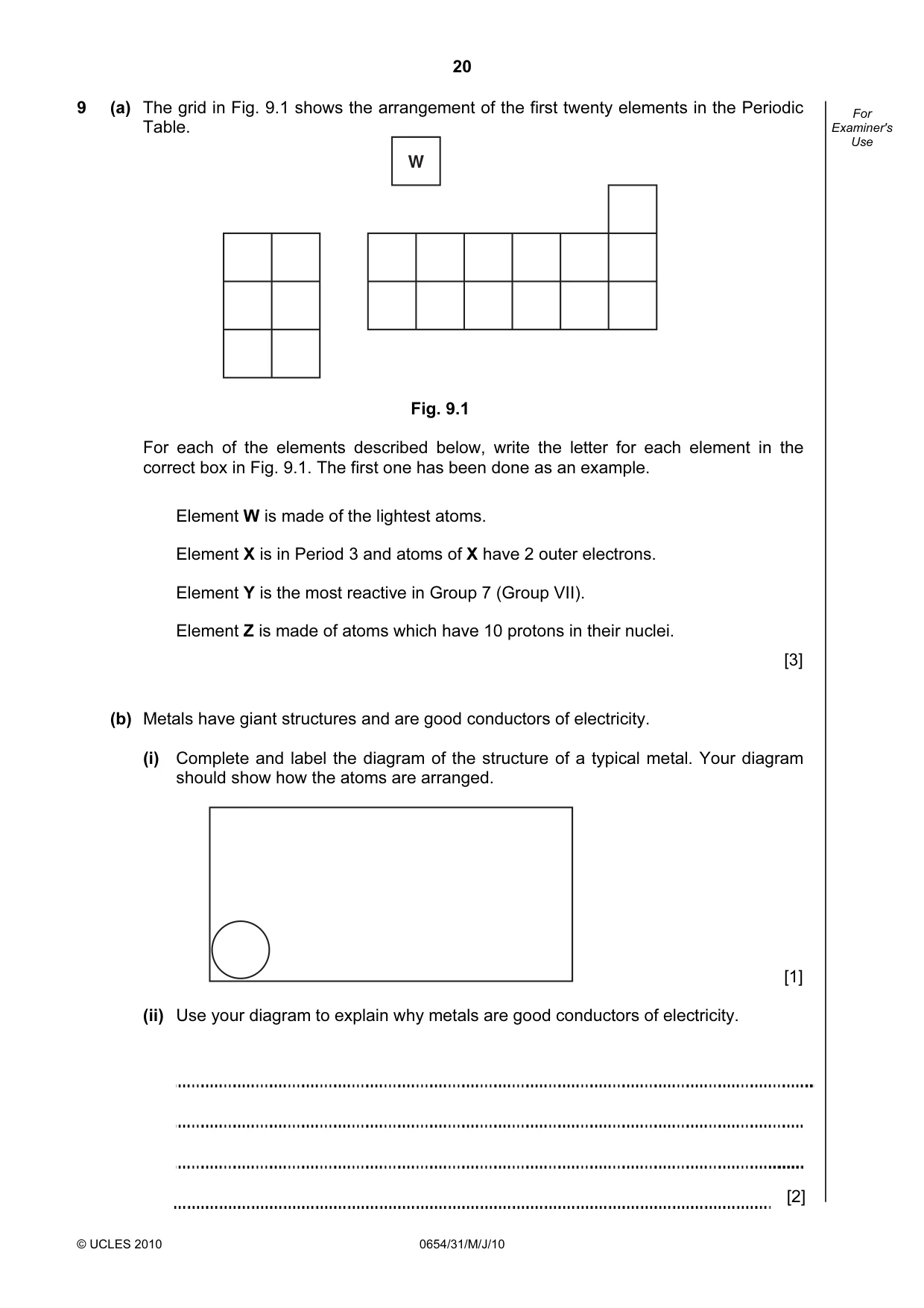
20 © UCLES 2010 0654/31/M/J/10 For Examiner's Use 9 (a) The grid in Fig. 9.1 shows the arrangement of the first twenty elements in the Periodic Table. W Fig. 9.1 For each of the elements described below, write the letter for each element in the correct box in Fig. 9.1. The first one has been done as an example. Element W is made of the lightest atoms. Element X is in Period 3 and atoms of X have 2 outer electrons. Element Y is the most reactive in Group 7 (Group VII). Element Z is made of atoms which have 10 protons in their nuclei. [3] (b) Metals have giant structures and are good conductors of electricity. (i) Complete and label the diagram of the structure of a typical metal. Your diagram should show how the atoms are arranged. [1] (ii) Use your diagram to explain why metals are good conductors of electricity. [2]
Question paper, page 21
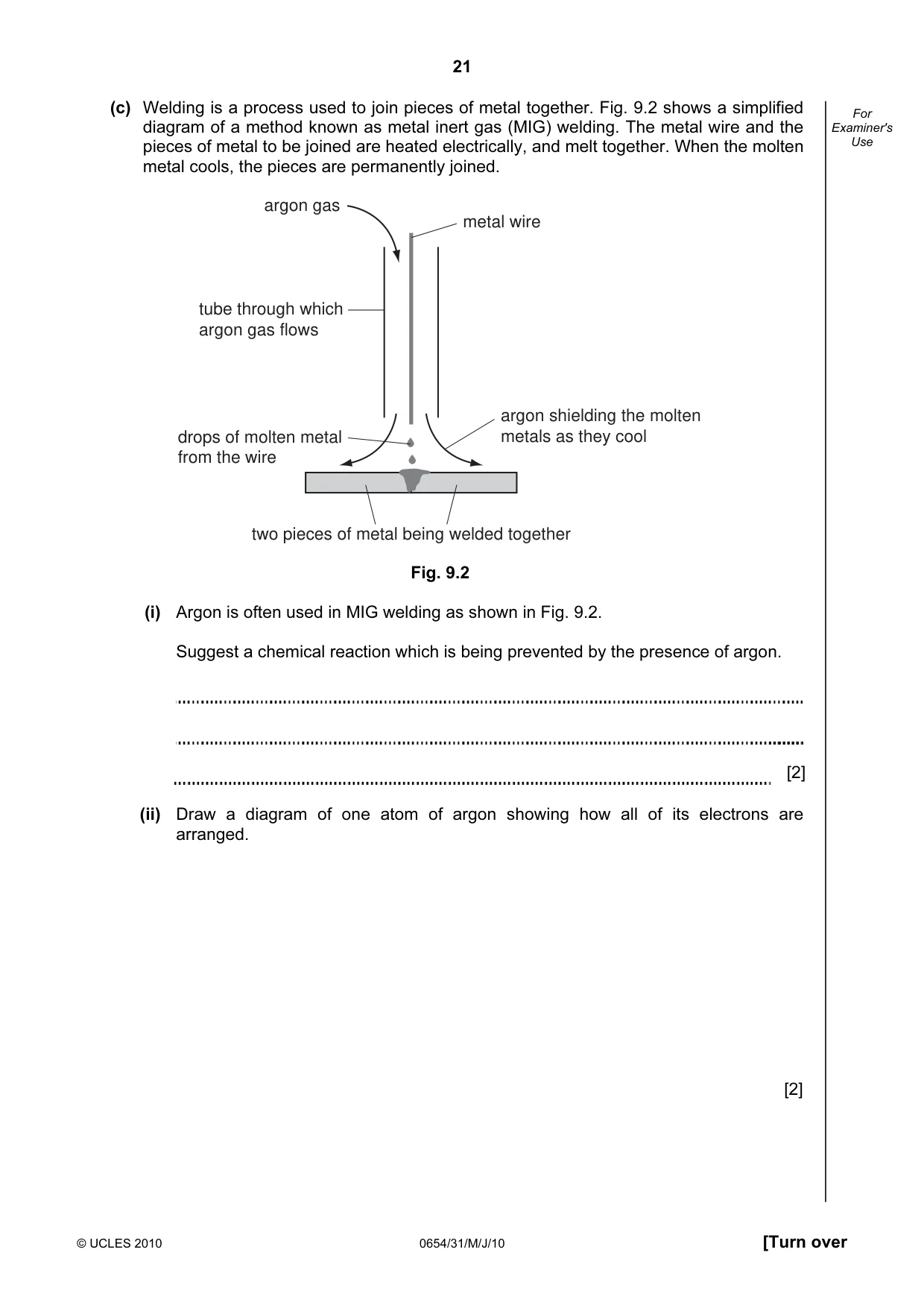
21 © UCLES 2010 0654/31/M/J/10 [Turn over For Examiner's Use (c) Welding is a process used to join pieces of metal together. Fig. 9.2 shows a simplified diagram of a method known as metal inert gas (MIG) welding. The metal wire and the pieces of metal to be joined are heated electrically, and melt together. When the molten metal cools, the pieces are permanently joined. two pieces of metal being welded together tube through which argon gas flows drops of molten metal from the wire argon shielding the molten metals as they cool metal wire argon gas Fig. 9.2 (i) Argon is often used in MIG welding as shown in Fig. 9.2. Suggest a chemical reaction which is being prevented by the presence of argon. [2] (ii) Draw a diagram of one atom of argon showing how all of its electrons are arranged. [2]
Question paper, page 22
22 © UCLES 2010 0654/31/M/J/10 For Examiner's Use (iii) Explain, in terms of their electron arrangement, why argon atoms do not react with the hot metals in MIG welding. [2]
Question paper, page 23
23 © UCLES 2010 0654/31/M/J/10 BLANK PAGE
Question paper, page 24
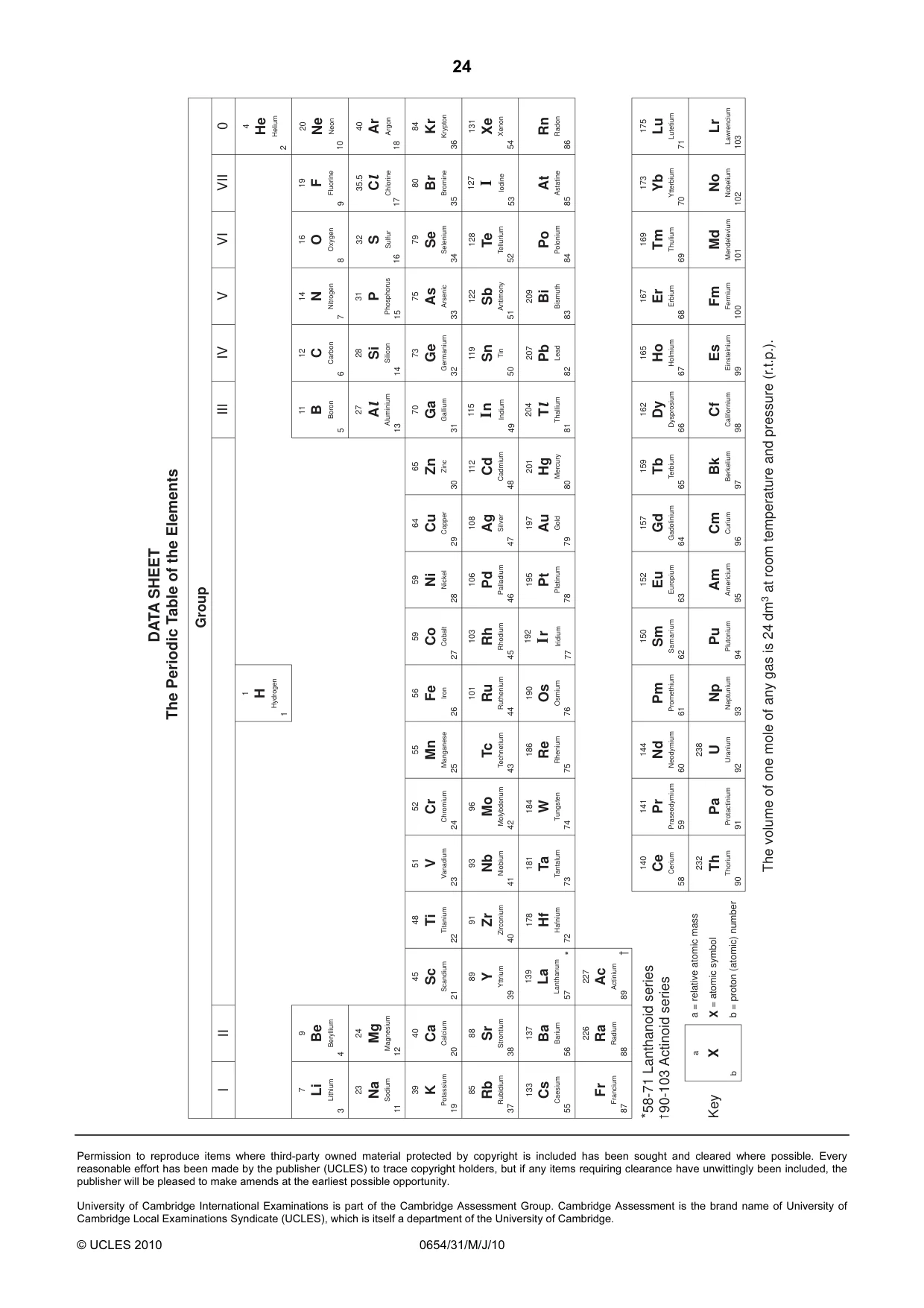
24 Permission to reproduce items where third-party owned material protected by copyright is included has been sought and cleared where possible. Every reasonable effort has been made by the publisher (UCLES) to trace copyright holders, but if any items requiring clearance have unwittingly been included, the publisher will be pleased to make amends at the earliest possible opportunity. University of Cambridge International Examinations is part of the Cambridge Assessment Group. Cambridge Assessment is the brand name of University of Cambridge Local Examinations Syndicate (UCLES), which is itself a department of the University of Cambridge. © UCLES 2010 0654/31/M/J/10 Group 140 Ce Cerium 58 141 Pr Praseodymium 59 144 Nd Neodymium 60 Pm Promethium 61 150 Sm Samarium 62 152 Eu Europium 63 157 Gd Gadolinium 64 159 Tb Terbium 65 162 Dy Dysprosium 66 165 Ho Holmium 67 167 Er Erbium 68 169 Tm Thulium 69 173 Yb Ytterbium 70 175 Lu Lutetium 71 232 Th Thorium 90 Pa Protactinium 91 238 U Uranium 92 Np Neptunium 93 Pu Plutonium 94 Am Americium 95 Cm Curium 96 Bk Berkelium 97 Cf Californium 98 Es Einsteinium 99 Fm Fermium 100 Md Mendelevium 101 No Nobelium 102 Lr Lawrencium 103 1 H Hydrogen 1 7 Li Lithium 3 23 Na Sodium 11 24 Mg Magnesium 12 40 Ca Calcium 20 45 Sc Scandium 21 48 Ti Titanium 22 51 V Vanadium 23 52 Cr Chromium 24 55 Mn Manganese 25 56 Fe Iron 26 59 Co Cobalt 27 59 Ni Nickel 28 64 Cu Copper 29 65 Zn Zinc 30 70 Ga Gallium 31 27 Al Aluminium 13 11 B Boron 5 12 C Carbon 6 14 N Nitrogen 7 16 O Oxygen 8 19 F Fluorine 9 28 Si Silicon 14 31 P Phosphorus 15 32 S Sulfur 16 35.5 Cl Chlorine 17 40 Ar Argon 18 20 Ne Neon 10 4 He Helium 2 73 Ge Germanium 32 75 As Arsenic 33 79 Se Selenium 34 80 Br Bromine 35 84 Kr Krypton 36 39 K Potassium 19 88 Sr Strontium 38 89 Y Yttrium 39 91 Zr Zirconium 40 93 Nb Niobium 41 96 Mo Molybdenum 42 Tc Technetium 43 101 Ru Ruthenium 44 103 Rh Rhodium 45 106 Pd Palladium 46 108 Ag Silver 47 112 Cd Cadmium 48 115 In Indium 49 119 Sn Tin 50 122 Sb Antimony 51 128 Te Tellurium 52 127 I Iodine 53 131 Xe Xenon 54 137 Ba Barium 56 139 La Lanthanum 57 * 178 Hf Hafnium 72 181 Ta Tantalum 73 184 W Tungsten 74 186 Re Rhenium 75 190 Os Osmium 76 192 Ir Iridium 77 195 Pt Platinum 78 197 Au Gold 79 201 Hg Mercury 80 204 Tl Thallium 81 207 Pb Lead 82 209 Bi Bismuth 83 Po Polonium 84 At Astatine 85 Rn Radon 86 Fr Francium 87 227 Ac Actinium 89 9 Be Beryllium 4 I II III IV V VI VII 0 85 Rb Rubidium 37 133 Cs Caesium 55 226 Ra Radium 88 The volume of one mole of any gas is 24 dm3 at room temperature and pressure (r.t.p.). a X b a = relative atomic mass X = atomic symbol b = proton (atomic) number Key *58-71 Lanthanoid series 90-103 Actinoid series DATA SHEET The Periodic Table of the Elements
Mark scheme, page 1
UNIVERSITY OF CAMBRIDGE INTERNATIONAL EXAMINATIONS International General Certificate of Secondary Education MARK SCHEME for the May/June 2010 question paper for the guidance of teachers 0654 CO-ORDINATED SCIENCES 0654/31 Paper 31 (Extended Theory), maximum raw mark 100 This mark scheme is published as an aid to teachers and candidates, to indicate the requirements of the examination. It shows the basis on which Examiners were instructed to award marks. It does not indicate the details of the discussions that took place at an Examiners’ meeting before marking began, which would have considered the acceptability of alternative answers. Mark schemes must be read in conjunction with the question papers and the report on the examination. • CIE will not enter into discussions or correspondence in connection with these mark schemes. CIE is publishing the mark schemes for the May/June 2010 question papers for most IGCSE, GCE Advanced Level and Advanced Subsidiary Level syllabuses and some Ordinary Level syllabuses. www.XtremePapers.com
Mark scheme, page 2
Page 2 Mark Scheme: Teachers’ version Syllabus Paper IGCSE – May/June 2010 0654 31 © UCLES 2010 1 (a) (i) C and D ; [1] (ii) A and D ; [1] (iii) opens and closes ; when atrium contracts valve is pushed open ; when ventricle contracts valve is pushed shut ; [max 2] (b) more oxygen (in right side of heart in fetus) ; idea that it is a mix of oxygenated blood (from placenta) and deoxygenated (from body tissues) ; [2] (c) (i) haemoglobin ; [1] (ii) protein ; [1] (iii) iron ; [1] (iv) small particles / not made of large molecules ; so can be absorbed as they are ; [2] (v) for respiration / to combine with glucose ; to release energy / to provide energy ; [2] [Total: 13] 2 (a) (i) causes, skin cancer / eye damage / burns / mutation in skin / damage to DNA in skin ; [1] (ii) protective clothing / sun block ; [1] (b) (speed =) distance / time ; = 300 m / s ; [2] (c) (momentum =) mass × velocity ; = 400 000 × 60 = 24 000 000 kg m / s ; [2] (d) (i) all symbols correct ; all symbols connected in series ; [2] (ii) 6 V ; [1] (e) electron transfer ; fabric gains electrons / tent loses electrons / or vice versa ; by friction between surfaces ; [3]
Mark scheme, page 3
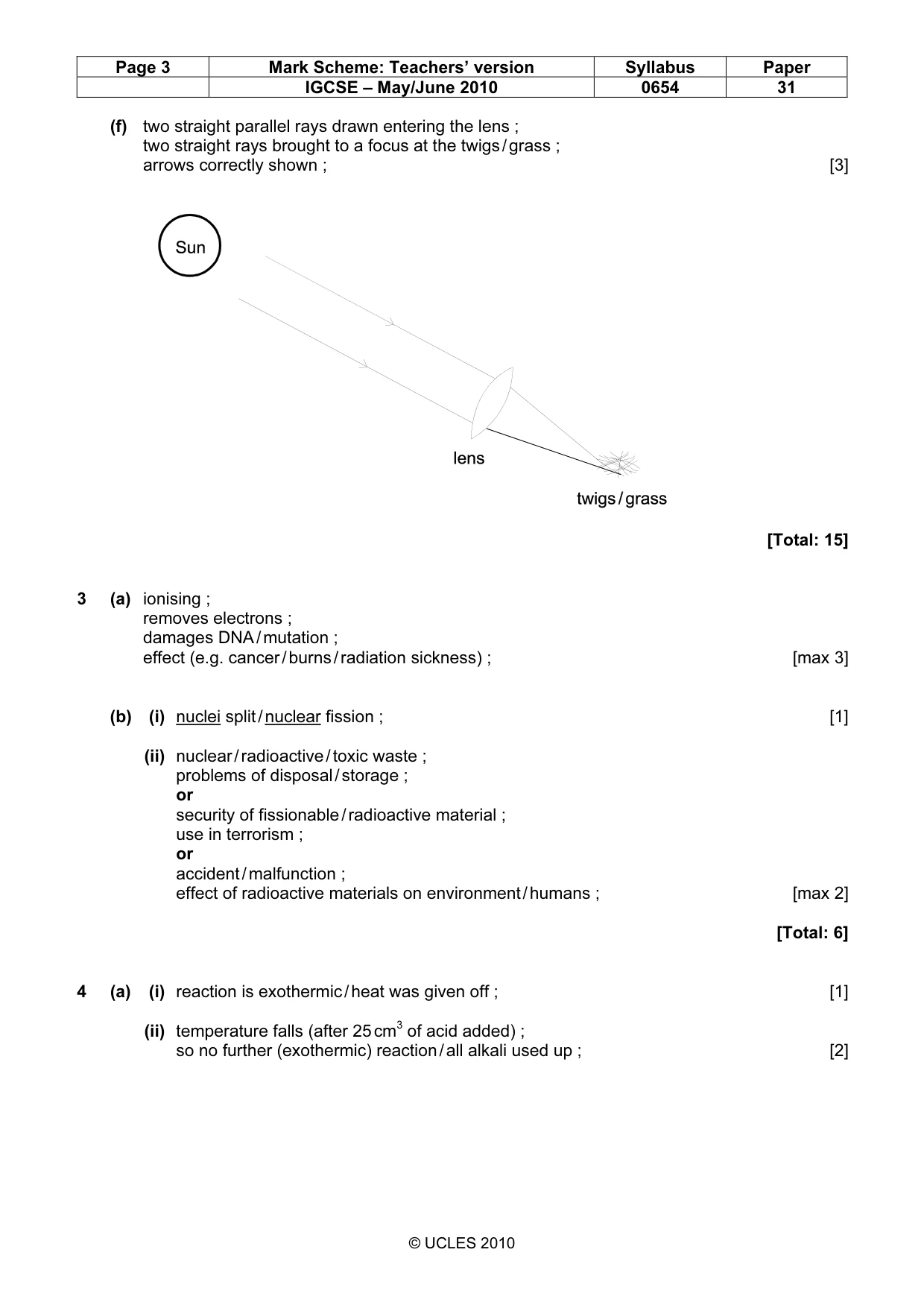
Page 3 Mark Scheme: Teachers’ version Syllabus Paper IGCSE – May/June 2010 0654 31 © UCLES 2010 (f) two straight parallel rays drawn entering the lens ; two straight rays brought to a focus at the twigs / grass ; arrows correctly shown ; [3] [Total: 15] 3 (a) ionising ; removes electrons ; damages DNA / mutation ; effect (e.g. cancer / burns / radiation sickness) ; [max 3] (b) (i) nuclei split / nuclear fission ; [1] (ii) nuclear / radioactive / toxic waste ; problems of disposal / storage ; or security of fissionable / radioactive material ; use in terrorism ; or accident / malfunction ; effect of radioactive materials on environment / humans ; [max 2] [Total: 6] 4 (a) (i) reaction is exothermic / heat was given off ; [1] (ii) temperature falls (after 25 cm3 of acid added) ; so no further (exothermic) reaction / all alkali used up ; [2]
Mark scheme, page 4
Page 4 Mark Scheme: Teachers’ version Syllabus Paper IGCSE – May/June 2010 0654 31 © UCLES 2010 (b) (i) moles of A ((25.0 / 1000) × 0.2 =) 0.005 ; moles KOH ((20.0 / 1000) × 0.5 =) 0.01 ; [2] (allow 1 mark if the same error in converting to dm3 is made in each calculation, e.g. if left in cm3 answers are 5 and 10) (ii) (0.5) (no mark) [e.c.f. from (i) provided answer is half the KOH moles] because the number of moles of acid must be half the number of moles of KOH / owtte / or relevant working ; [1] (iii) H+ + OH- → H2O (all correct for 2 marks, two of the three for 1 mark) ;; [2] (c) (i) electrolysis ; [1] (ii) plate, has a negative charge / is negative, and potassium ions, are positively charged / are positive ; opposite charges attract / potassium ions move towards the plate ; potassium ions gain electrons from the plate ; potassium ions, discharged / gain one electron / become atoms ; [max 3] [Total: 12] 5 (a) foam / air, is a poor conductor ; foam, stops convection of air / traps air ; radiation reflected by, shiny surfaces / foil / metal ; [3] (b) (i) B (no mark) turns ratio 2:1 ; [1] (ii) water can conduct electricity ; danger of electrocution ; [2] (c) (i) current (flows in circuit) ; produces (electro)magnet ; (magnet) attracts iron bolt ; [3] (ii) (no – no mark) aluminium is not magnetic / not attracted to electromagnet ; [1] (iii) (yes – no mark) still an electromagnet (so still attracts bolt) ; [1] (iv) more coils / bigger voltage / bigger core ; [1] [Total: 12]
Mark scheme, page 5
Page 5 Mark Scheme: Teachers’ version Syllabus Paper IGCSE – May/June 2010 0654 31 © UCLES 2010 6 (a) (i) ammonium / NH4 + ; [1] (ii) shortage of something in the soil ; nitrogen / nitrate, needed for making, protein / amino acids ; proteins for growth ; detail, e.g. more cells / more cytoplasm ; correct ref. to function of P or K ; [max 3] (iii) wheat – little / no, difference ; potatoes – greater, with manure + bacteria / in plot B ; 10.50 tonnes (per hectare per year) (greater) ; [3] (iv) manure contains plant and animal waste e.g. proteins / urea ; which needs to be, broken down / decomposed (by bacteria) ; to produce, ammonia / nitrates / something that can be used by plants ; reference to nitrification / nitrifying bacteria ; [max 2] (b) stimulates growth of, algae / plants ; plants / algae, die ; fed on by bacteria / decomposers ; which respire (aerobically) ; bacteria use oxygen ; [max 3] [Total: 12] 7 (a) (i) glucose ; [1] (ii) protein; only proteins contain, S / sulfur ; only proteins contain, N / nitrogen ; [3] (b) (i) molecules have only weak forces between them ; molecules / particles, can move past one another easily ; therefore (solid) nylon, melts / becomes a liquid, when heated / it enters the hot container ; molten nylon can be pumped (through small holes) ; molten threads solidify when cooled ; strong forces between molecules when solid ; [max 3] (ii) doesn’t melt (on contact with hot containers) ; molecules cannot move past one another ; because strong bonds hold polymer chains / crosslinks ; [max 2] [clear diagram could score crosslink mark] [Total: 9]
Mark scheme, page 6
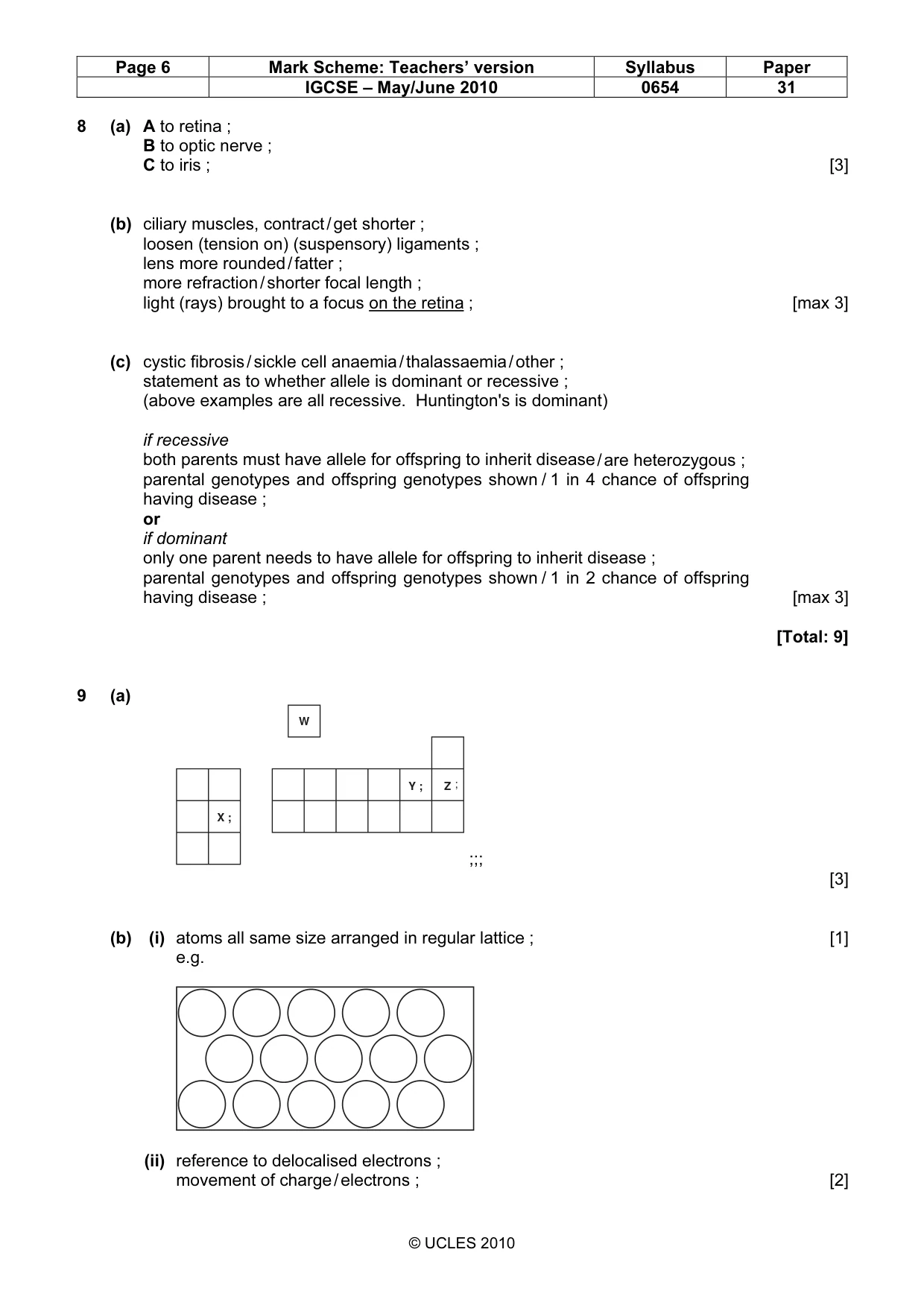
Page 6 Mark Scheme: Teachers’ version Syllabus Paper IGCSE – May/June 2010 0654 31 © UCLES 2010 8 (a) A to retina ; B to optic nerve ; C to iris ; [3] (b) ciliary muscles, contract / get shorter ; loosen (tension on) (suspensory) ligaments ; lens more rounded / fatter ; more refraction / shorter focal length ; light (rays) brought to a focus on the retina ; [max 3] (c) cystic fibrosis / sickle cell anaemia / thalassaemia / other ; statement as to whether allele is dominant or recessive ; (above examples are all recessive. Huntington's is dominant) if recessive both parents must have allele for offspring to inherit disease / are heterozygous ; parental genotypes and offspring genotypes shown / 1 in 4 chance of offspring having disease ; or if dominant only one parent needs to have allele for offspring to inherit disease ; parental genotypes and offspring genotypes shown / 1 in 2 chance of offspring having disease ; [max 3] [Total: 9] 9 (a) W X ; Y ; Z ; ;;; [3] (b) (i) atoms all same size arranged in regular lattice ; [1] e.g. (ii) reference to delocalised electrons ; movement of charge / electrons ; [2]
Mark scheme, page 7
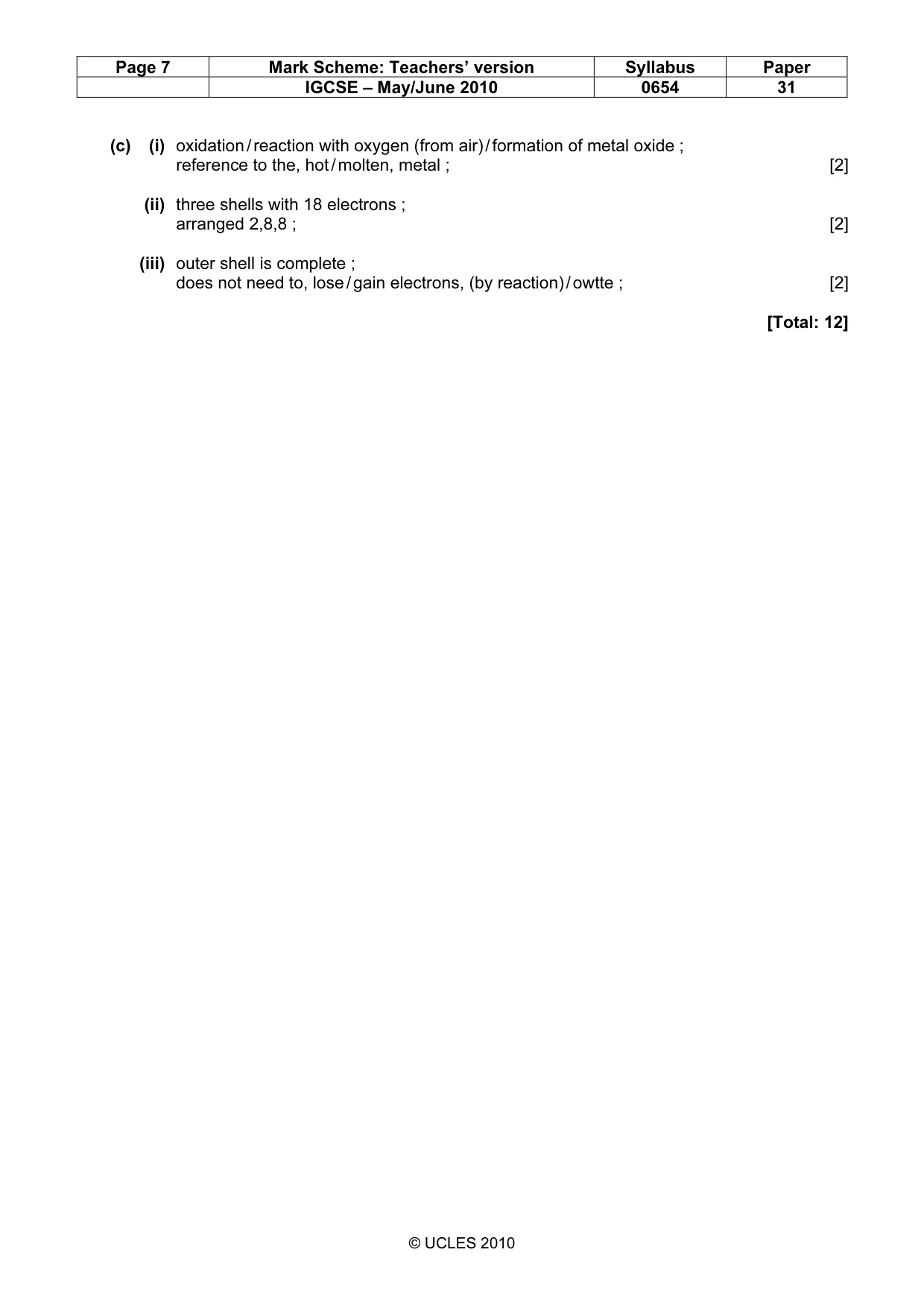
Page 7 Mark Scheme: Teachers’ version Syllabus Paper IGCSE – May/June 2010 0654 31 © UCLES 2010 (c) (i) oxidation / reaction with oxygen (from air) / formation of metal oxide ; reference to the, hot / molten, metal ; [2] (ii) three shells with 18 electrons ; arranged 2,8,8 ; [2] (iii) outer shell is complete ; does not need to, lose / gain electrons, (by reaction) / owtte ; [2] [Total: 12]
What you needed in this session
Cambridge’s own grade thresholds for 2010 May/June, Paper 3 · Variant 1. A higher threshold means an easier paper — the bar moves with how the cohort did.