Questions as text
Q1 · When evaporation occurs, molecules escape from the surface of a liquid 0973/21 May/June 2019
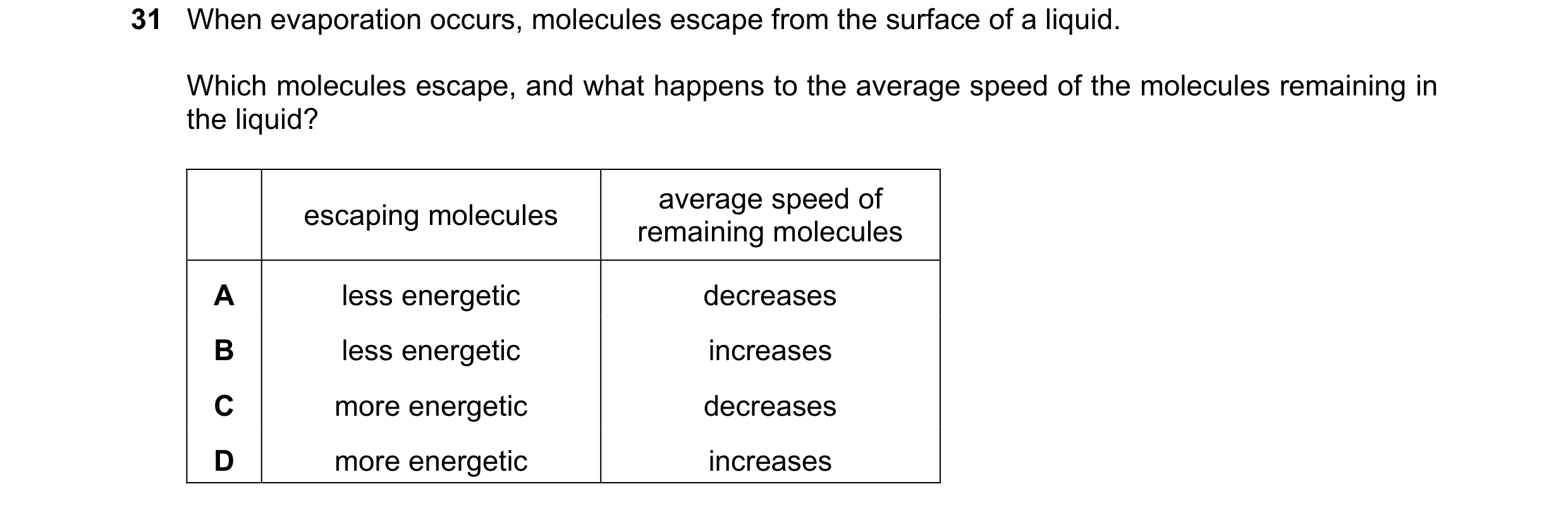
31 When evaporation occurs, molecules escape from the surface of a liquid. Which molecules escape, and what happens to the average speed of the molecules remaining in the liquid? average speed of escaping molecules remaining molecules A less energetic decreases B less energetic increases C more energetic decreases D more energetic increases
1 marks
Answer: C
This question in 0973/21 May/June 2019
Q2 · When equal masses of solids, liquids and gases are heated equally, they expand by… 0973/22 May/June 2019
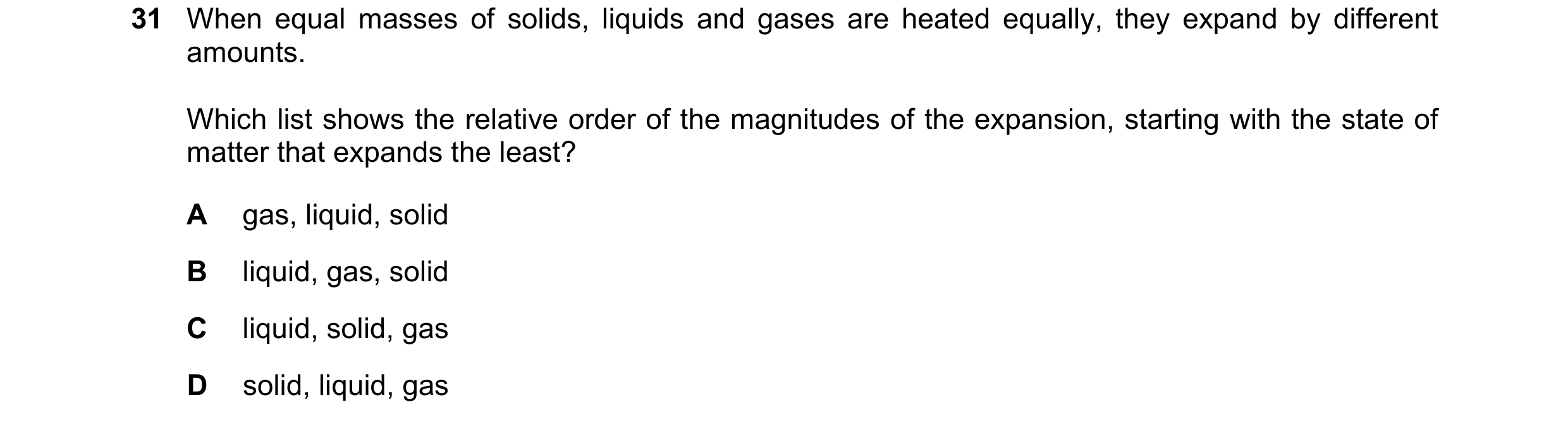
31 When equal masses of solids, liquids and gases are heated equally, they expand by different amounts. Which list shows the relative order of the magnitudes of the expansion, starting with the state of matter that expands the least? A gas, liquid, solid B liquid, gas, solid C liquid, solid, gas D solid, liquid, gas
1 marks
Answer: D
This question in 0973/22 May/June 2019
Q3 · The more energetic molecules of a liquid are escaping from its surface, causing the… 0973/21 Oct/Nov 2019
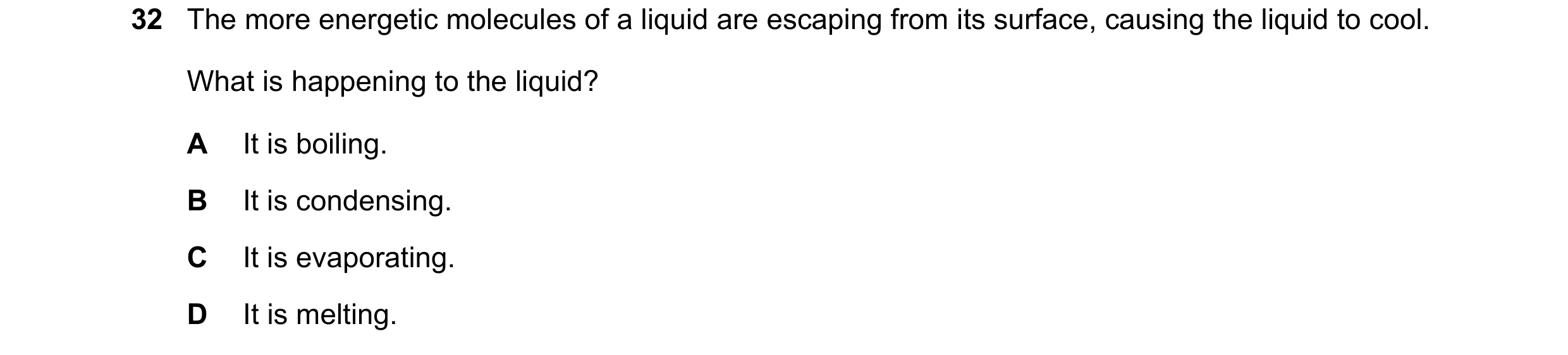
32 The more energetic molecules of a liquid are escaping from its surface, causing the liquid to cool. What is happening to the liquid? A It is boiling. B It is condensing. C It is evaporating. D It is melting.
1 marks
Answer: C
This question in 0973/21 Oct/Nov 2019
Q4 · Which labelled arrow on the diagram represents condensation? 0973/21 Oct/Nov 2021
32 Which labelled arrow on the diagram represents condensation? A liquid gas B C D solid
1 marks
Answer: A
This question in 0973/21 Oct/Nov 2021
Q5 · A sealed cylinder contains gas 0973/21 Oct/Nov 2021
33 A sealed cylinder contains gas. The average speed of the molecules of the gas increases but the average distance between them remains the same. How does this affect the pressure of the gas and its volume? pressure volume A decreases increases B decreases no change C increases increases D increases no change
1 marks
Answer: D
This question in 0973/21 Oct/Nov 2021
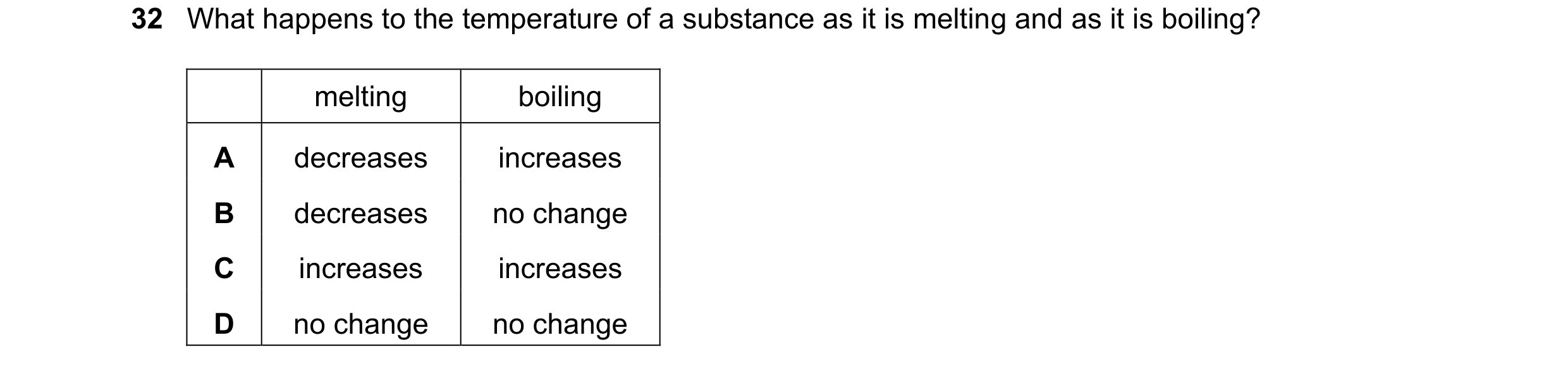
Q6 · What happens to the temperature of a substance as it is melting and as it is boiling? 0973/21 May/June 2022
32 What happens to the temperature of a substance as it is melting and as it is boiling? melting boiling A decreases increases B decreases no change C increases increases D no change no change
1 marks
Answer: D
This question in 0973/21 May/June 2022
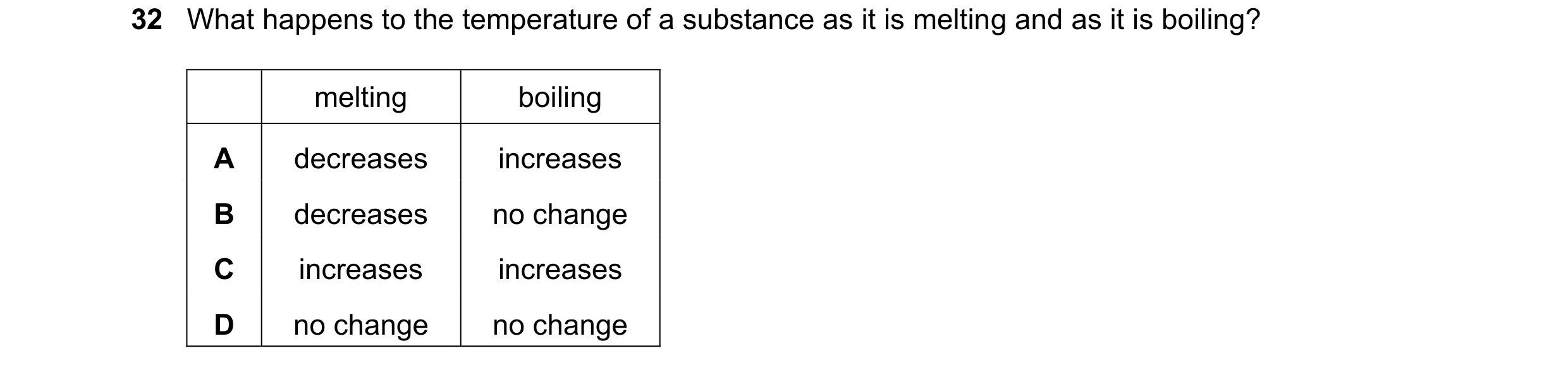
Q7 · What happens to the temperature of a substance as it is melting and as it is boiling? 0973/22 May/June 2022
32 What happens to the temperature of a substance as it is melting and as it is boiling? melting boiling A decreases increases B decreases no change C increases increases D no change no change
1 marks
Answer: D
This question in 0973/22 May/June 2022
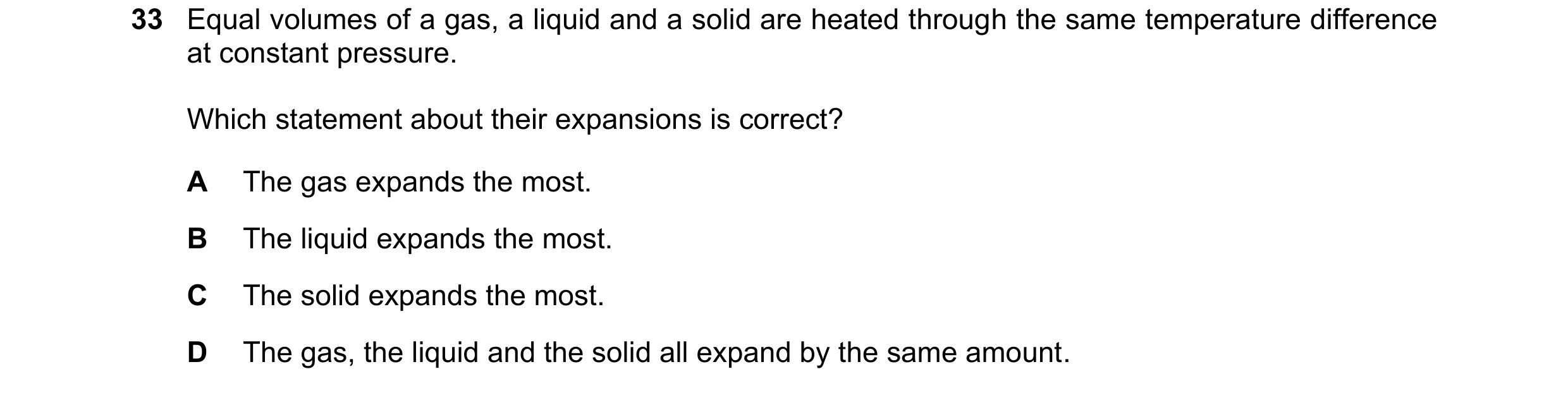
Q8 · Equal volumes of a gas, a liquid and a solid are heated through the same temperature… 0973/21 Oct/Nov 2022
33 Equal volumes of a gas, a liquid and a solid are heated through the same temperature difference at constant pressure. Which statement about their expansions is correct? A The gas expands the most. B The liquid expands the most. C The solid expands the most. D The gas, the liquid and the solid all expand by the same amount.
1 marks
Answer: A
This question in 0973/21 Oct/Nov 2022
Q9 · Which statement about gas particles is not correct? 0973/22 May/June 2023
32 Which statement about gas particles is not correct? A Increasing the temperature of a gas makes the gas particles move more slowly. B The gas particles are in constant random motion. C The pressure of a gas is caused by the collision of gas particles with the container. D Very small particles suspended in a gas are in constant random motion.
1 marks
Answer: A
This question in 0973/22 May/June 2023
Q10 · A student observes that a substance X does not flow 0973/21 Oct/Nov 2024
32 A student observes that a substance X does not flow. Which statement about substance X is correct? A It can be either a gas or a liquid. B It can only be a gas. C It can only be a liquid. D It can only be a solid.
1 marks
Answer: D
This question in 0973/21 Oct/Nov 2024
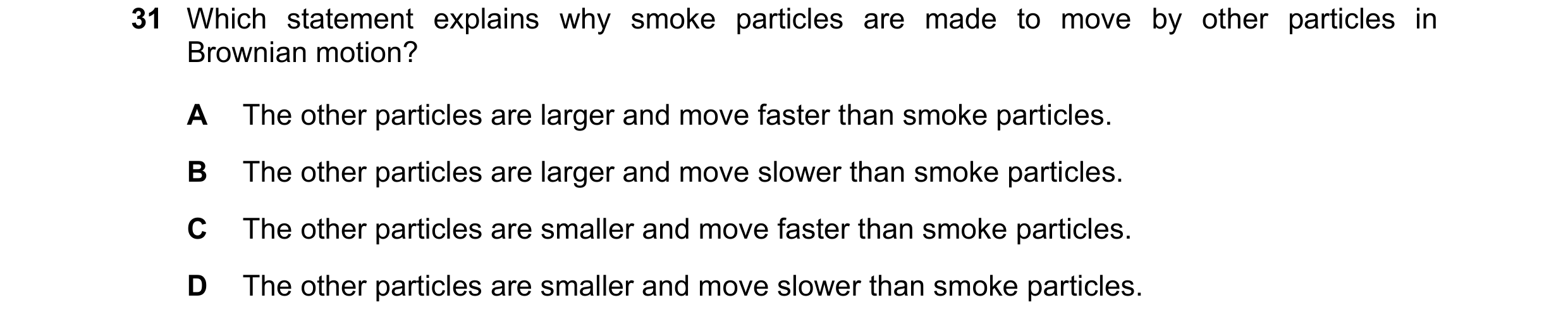
Q11 · Which statement explains why smoke particles are made to move by other particles in… 0973/21 May/June 2025
31 Which statement explains why smoke particles are made to move by other particles in Brownian motion? A The other particles are larger and move faster than smoke particles. B The other particles are larger and move slower than smoke particles. C The other particles are smaller and move faster than smoke particles. D The other particles are smaller and move slower than smoke particles.
1 marks
Answer: C
This question in 0973/21 May/June 2025
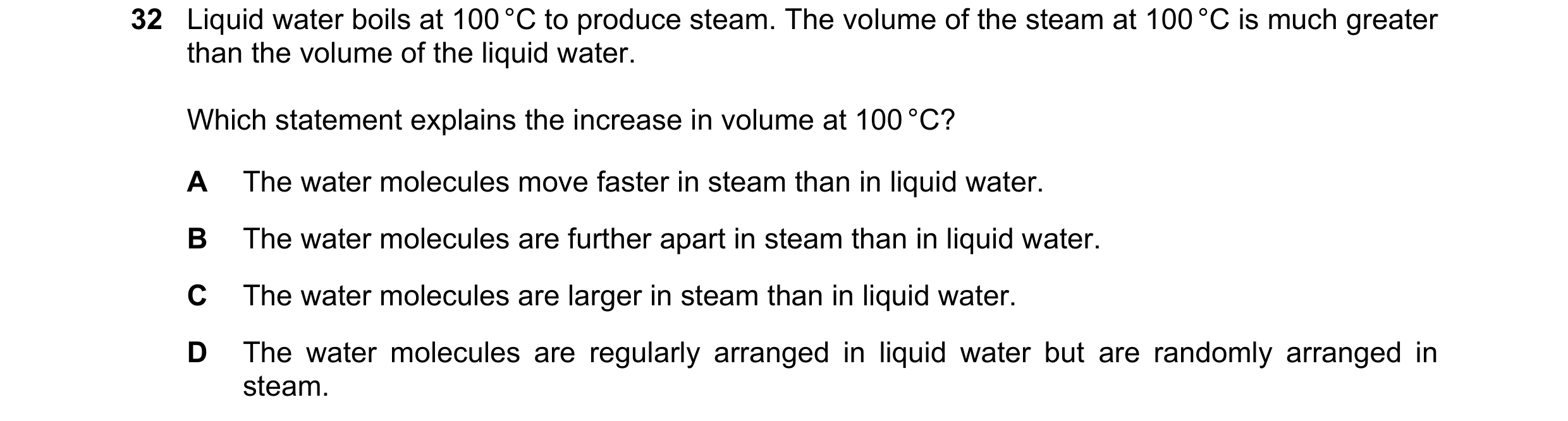
Q12 · Liquid water boils at 100 °C to produce steam 0973/22 May/June 2025
32 Liquid water boils at 100 °C to produce steam. The volume of the steam at 100 °C is much greater than the volume of the liquid water. Which statement explains the increase in volume at 100 °C? A The water molecules move faster in steam than in liquid water. B The water molecules are further apart in steam than in liquid water. C The water molecules are larger in steam than in liquid water. D The water molecules are regularly arranged in liquid water but are randomly arranged in steam.
1 marks
Answer: B
This question in 0973/22 May/June 2025
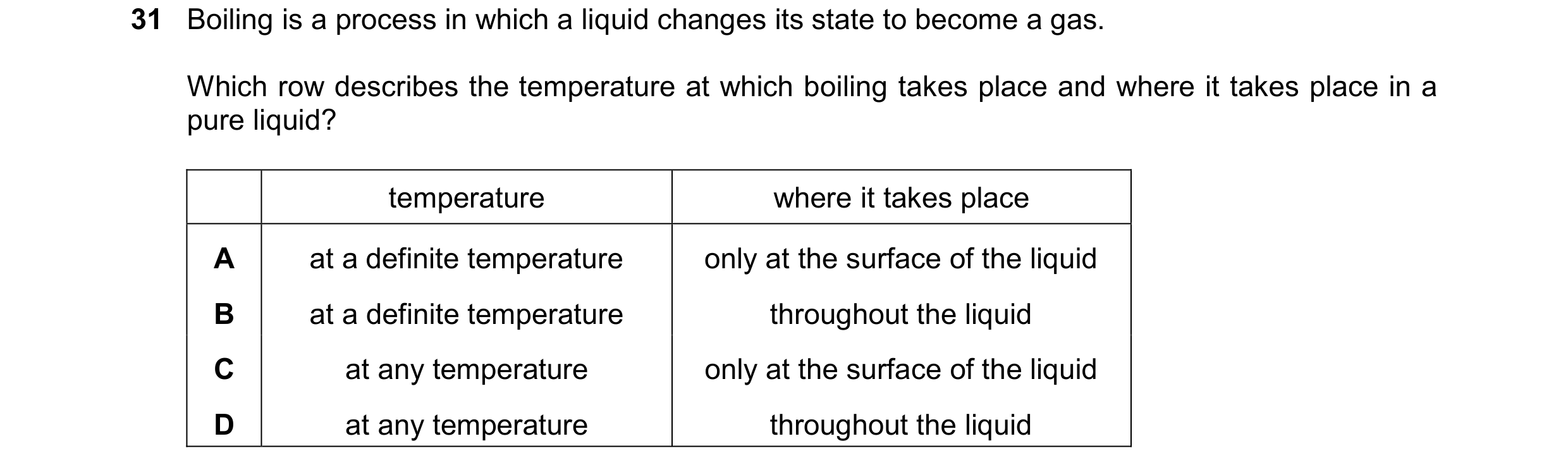
Q13 · Boiling is a process in which a liquid changes its state to become a gas 0973/21 Oct/Nov 2025
31 Boiling is a process in which a liquid changes its state to become a gas. Which row describes the temperature at which boiling takes place and where it takes place in a pure liquid? temperature where it takes place A at a definite temperature only at the surface of the liquid B at a definite temperature throughout the liquid C at any temperature only at the surface of the liquid D at any temperature throughout the liquid
1 marks
Answer: B
This question in 0973/21 Oct/Nov 2025
 1 / 3
1 / 3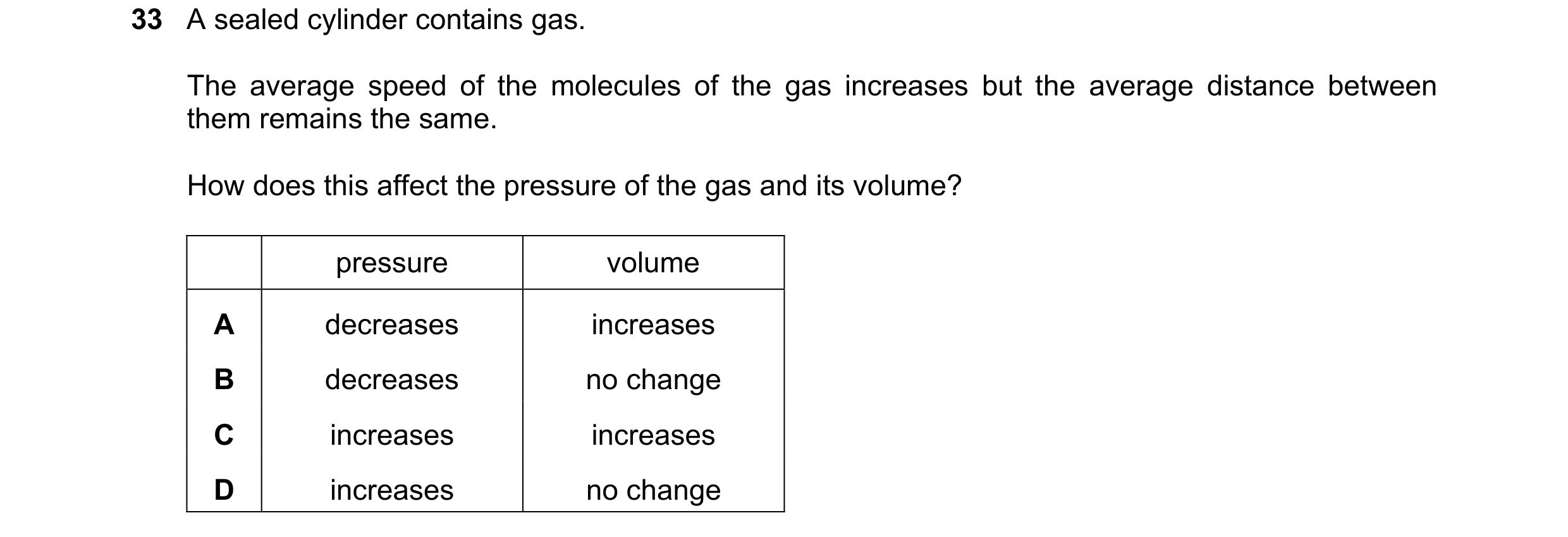
 2 / 3
2 / 3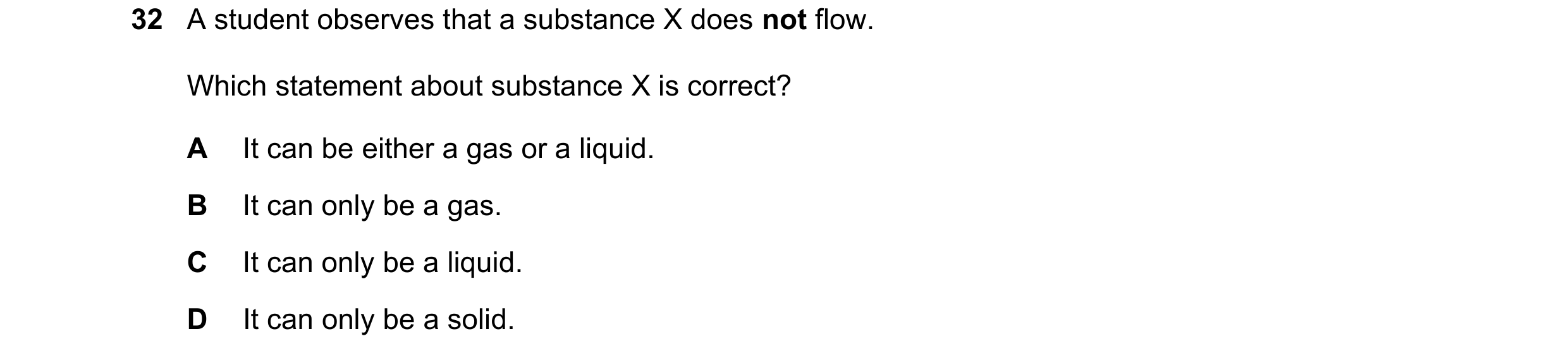
 3 / 3
3 / 3