Cambridge IGCSE Science - Combined 0653 — 2014 May/June Paper 6 · Variant 1
0653/61/M/J/14 · 60 marks · ≈68 min
The question paper and its mark scheme, free to read here and free to download. This is Cambridge’s own paper, exactly as it was sat.
Question paper20 pages



Mark scheme5 pages
Answers below. Sit the paper first if you are practising.
Paper as text
Question paper, page 1
This document consists of 19 printed pages and 1 blank page. IB14 06_0653_61/FP © UCLES 2014 [Turn over *8695980369* Cambridge International Examinations Cambridge International General Certificate of Secondary Education COMBINED SCIENCE 0653/61 Paper 6 Alternative to Practical May/June 2014 1 hour Candidates answer on the Question paper. No Additional Materials are required. READ THESE INSTRUCTIONS FIRST Write your Centre number, candidate number and name on all the work you hand in. Write in dark blue or black pen. You may use an HB pencil for any diagrams or graphs. Do not use staples, paper clips, glue or correction fluid. DO NOT WRITE IN ANY BARCODES. Answer all questions. Electronic calculators may be used. You may lose marks if you do not show your working or if you do not use appropriate units. At the end of the examination, fasten all your work securely together. The number of marks is given in brackets [ ] at the end of each question or part question.
Question paper, page 2
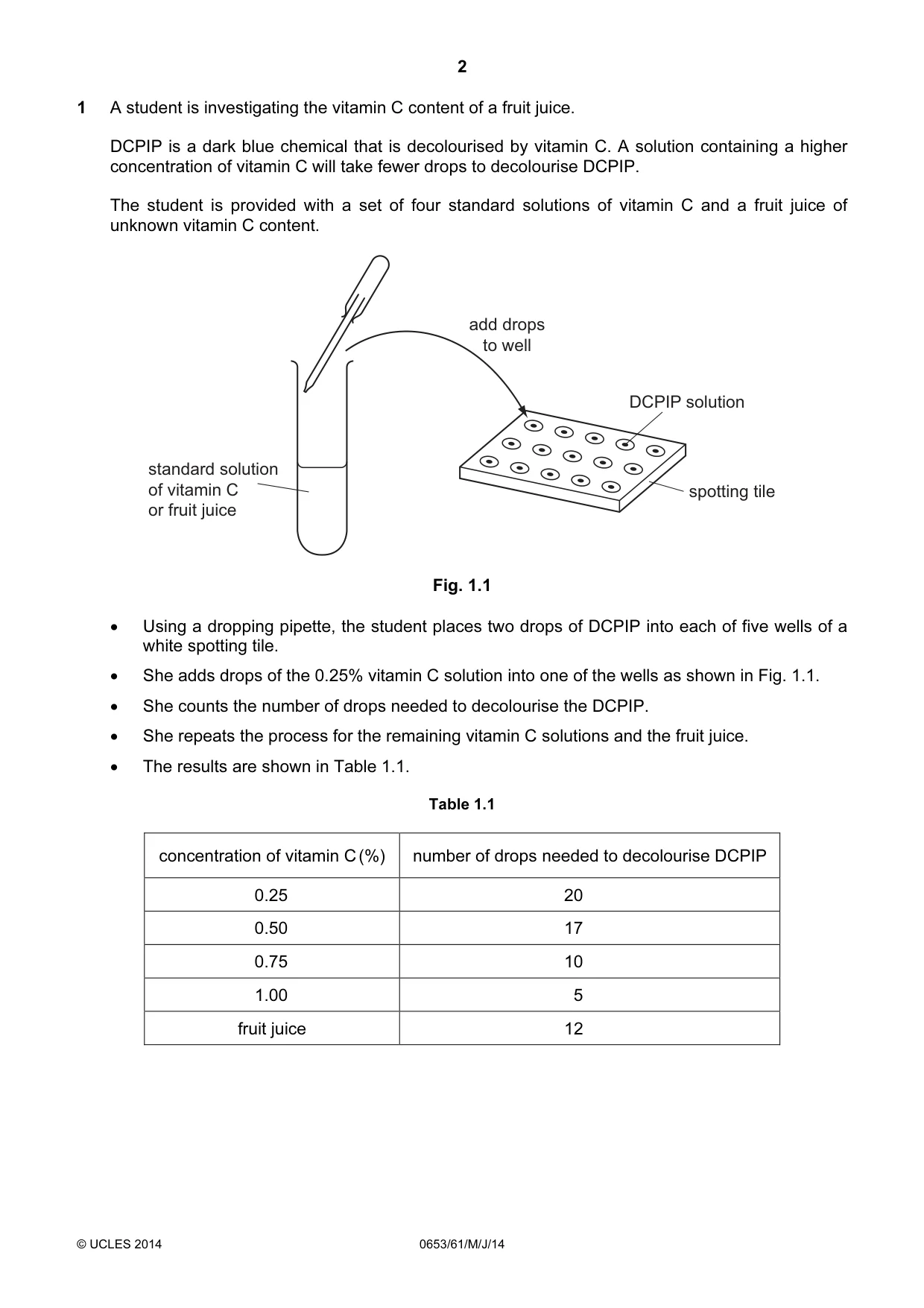
2 © UCLES 2014 0653/61/M/J/14 1 A student is investigating the vitamin C content of a fruit juice. DCPIP is a dark blue chemical that is decolourised by vitamin C. A solution containing a higher concentration of vitamin C will take fewer drops to decolourise DCPIP. The student is provided with a set of four standard solutions of vitamin C and a fruit juice of unknown vitamin C content. add drops to well DCPIP solution spotting tile standard solution of vitamin C or fruit juice Fig. 1.1 • Using a dropping pipette, the student places two drops of DCPIP into each of five wells of a white spotting tile. • She adds drops of the 0.25% vitamin C solution into one of the wells as shown in Fig. 1.1. • She counts the number of drops needed to decolourise the DCPIP. • She repeats the process for the remaining vitamin C solutions and the fruit juice. • The results are shown in Table 1.1. Table 1.1 concentration of vitamin C (%) number of drops needed to decolourise DCPIP 0.25 20 0.50 17 0.75 10 1.00 5 fruit juice 12
Question paper, page 3
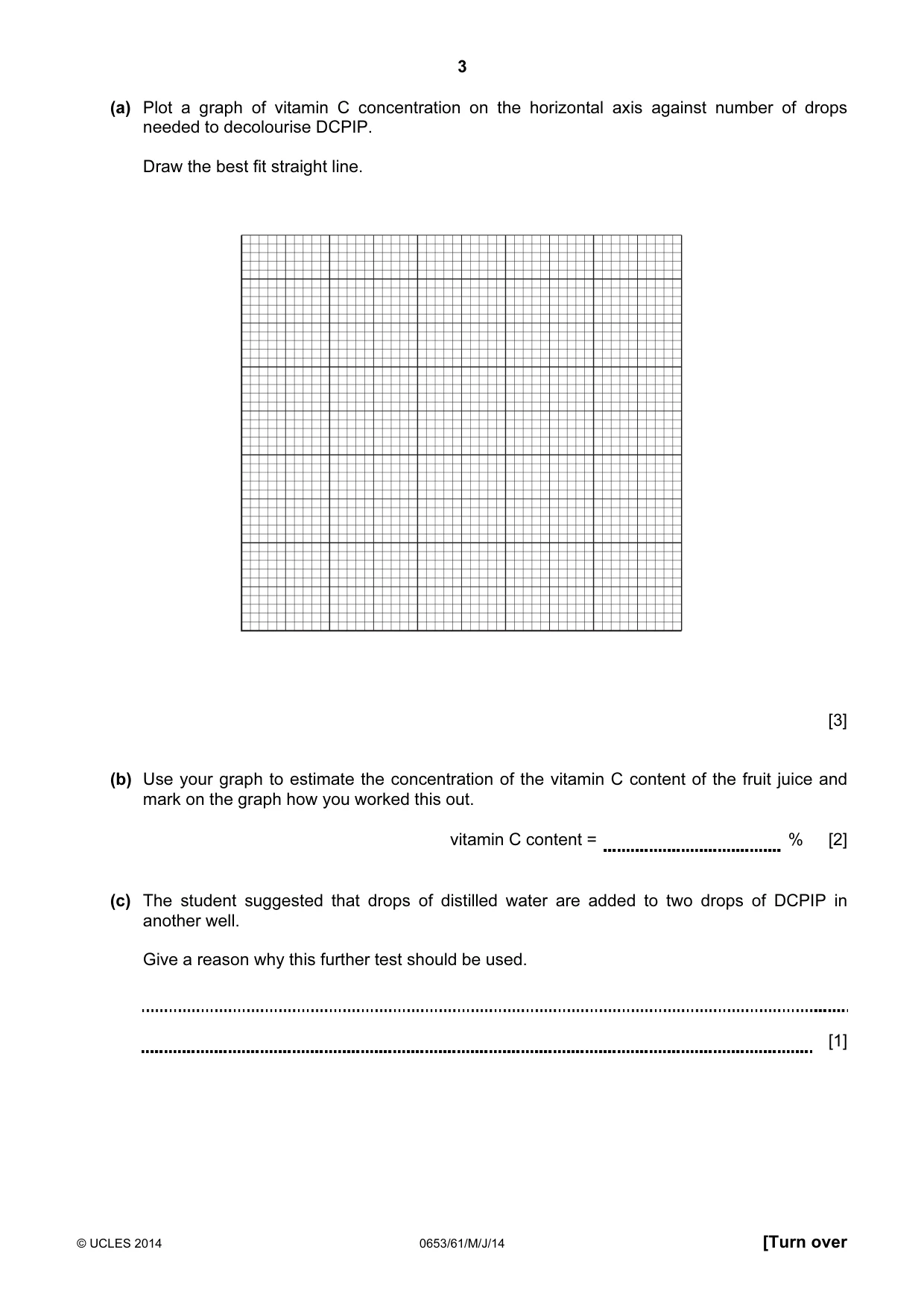
3 © UCLES 2014 0653/61/M/J/14 [Turn over (a) Plot a graph of vitamin C concentration on the horizontal axis against number of drops needed to decolourise DCPIP. Draw the best fit straight line. [3] (b) Use your graph to estimate the concentration of the vitamin C content of the fruit juice and mark on the graph how you worked this out. vitamin C content = % [2] (c) The student suggested that drops of distilled water are added to two drops of DCPIP in another well. Give a reason why this further test should be used. [1]
Question paper, page 4
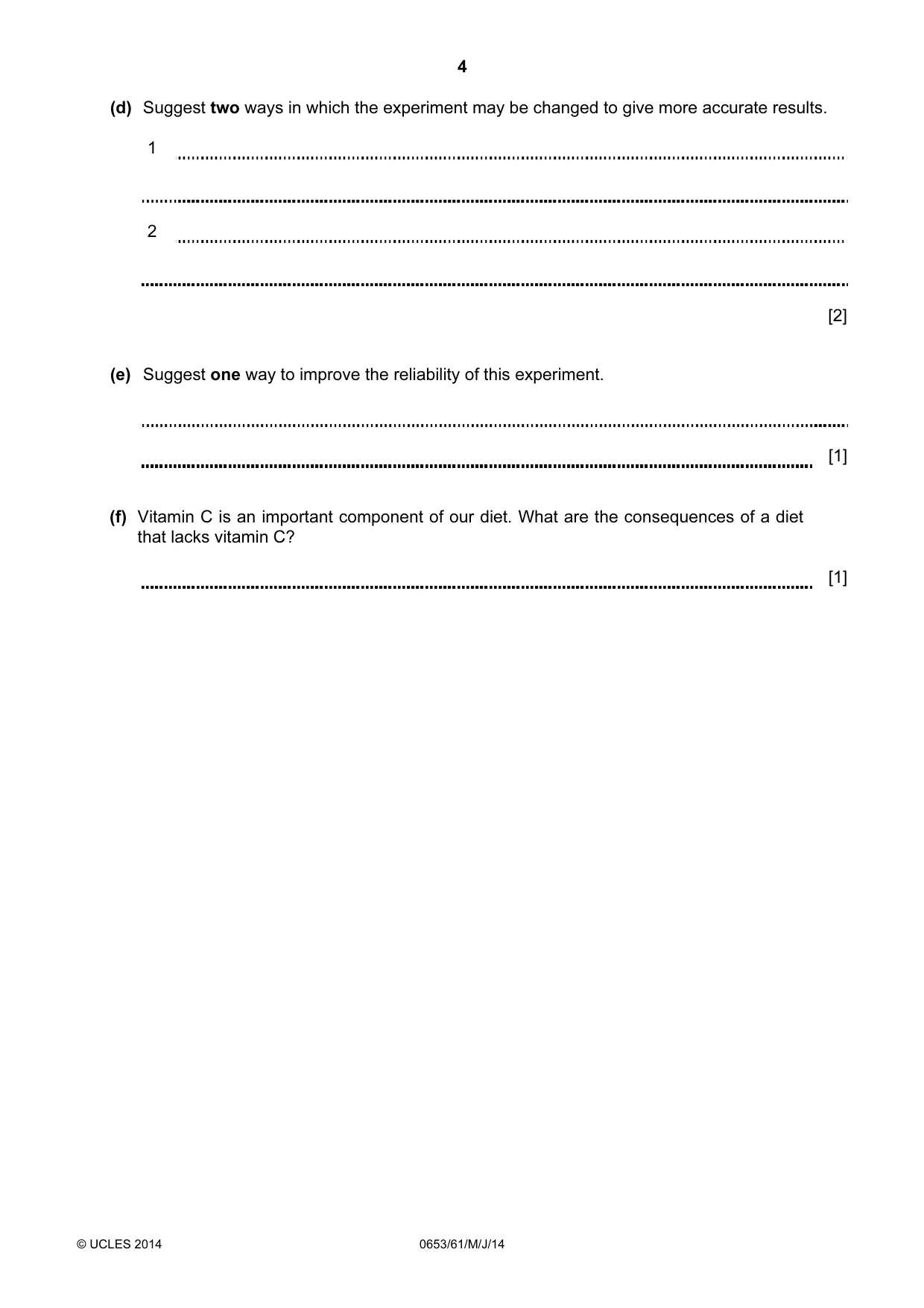
4 © UCLES 2014 0653/61/M/J/14 (d) Suggest two ways in which the experiment may be changed to give more accurate results. 1 2 [2] (e) Suggest one way to improve the reliability of this experiment. [1] (f) Vitamin C is an important component of our diet. What are the consequences of a diet that lacks vitamin C? [1]
Question paper, page 5
5 © UCLES 2014 0653/61/M/J/14 [Turn over Please turn over for Question 2.
Question paper, page 6
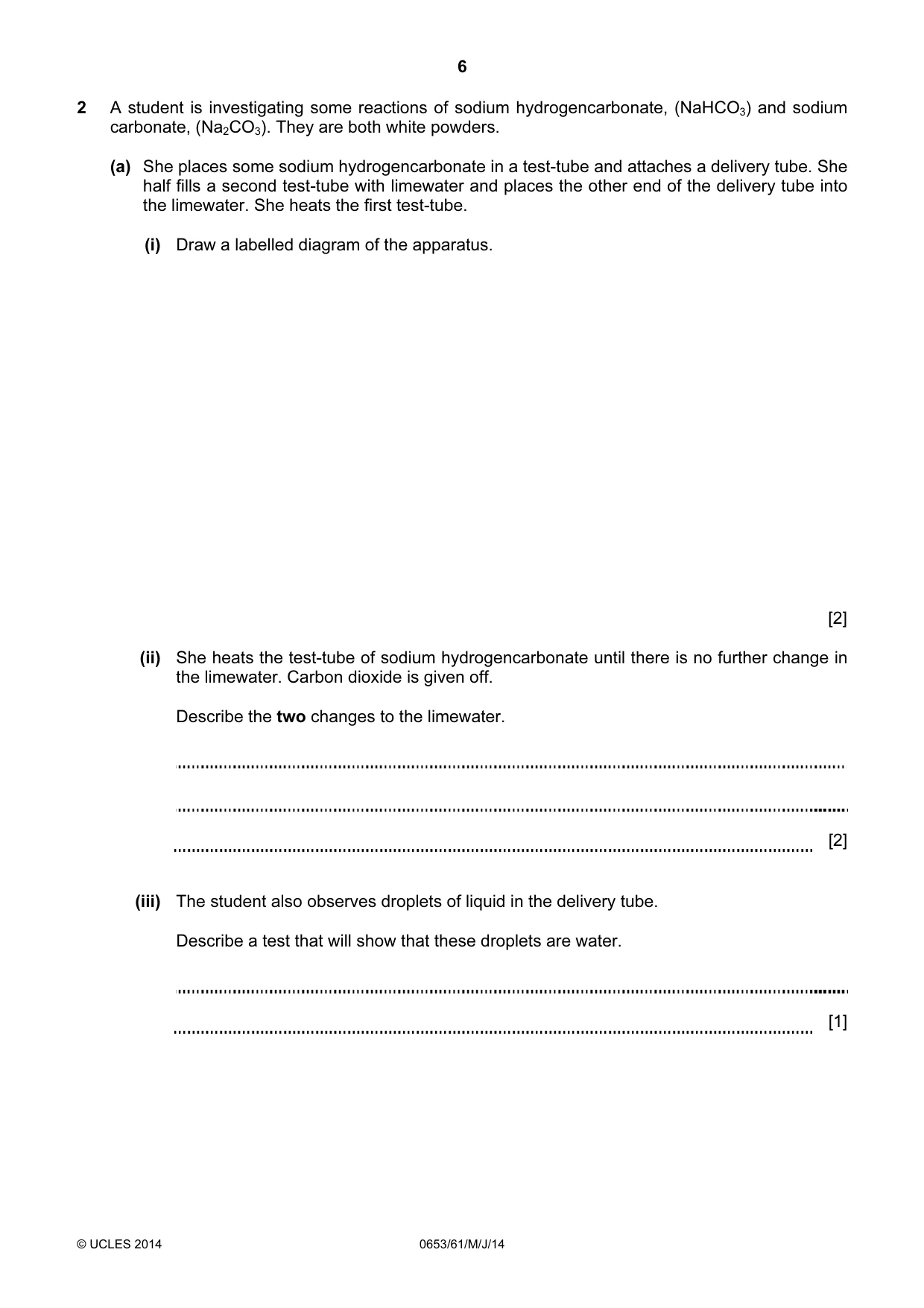
6 © UCLES 2014 0653/61/M/J/14 2 A student is investigating some reactions of sodium hydrogencarbonate, (NaHCO3) and sodium carbonate, (Na2CO3). They are both white powders. (a) She places some sodium hydrogencarbonate in a test-tube and attaches a delivery tube. She half fills a second test-tube with limewater and places the other end of the delivery tube into the limewater. She heats the first test-tube. (i) Draw a labelled diagram of the apparatus. [2] (ii) She heats the test-tube of sodium hydrogencarbonate until there is no further change in the limewater. Carbon dioxide is given off. Describe the two changes to the limewater. [2] (iii) The student also observes droplets of liquid in the delivery tube. Describe a test that will show that these droplets are water. [1]
Question paper, page 7
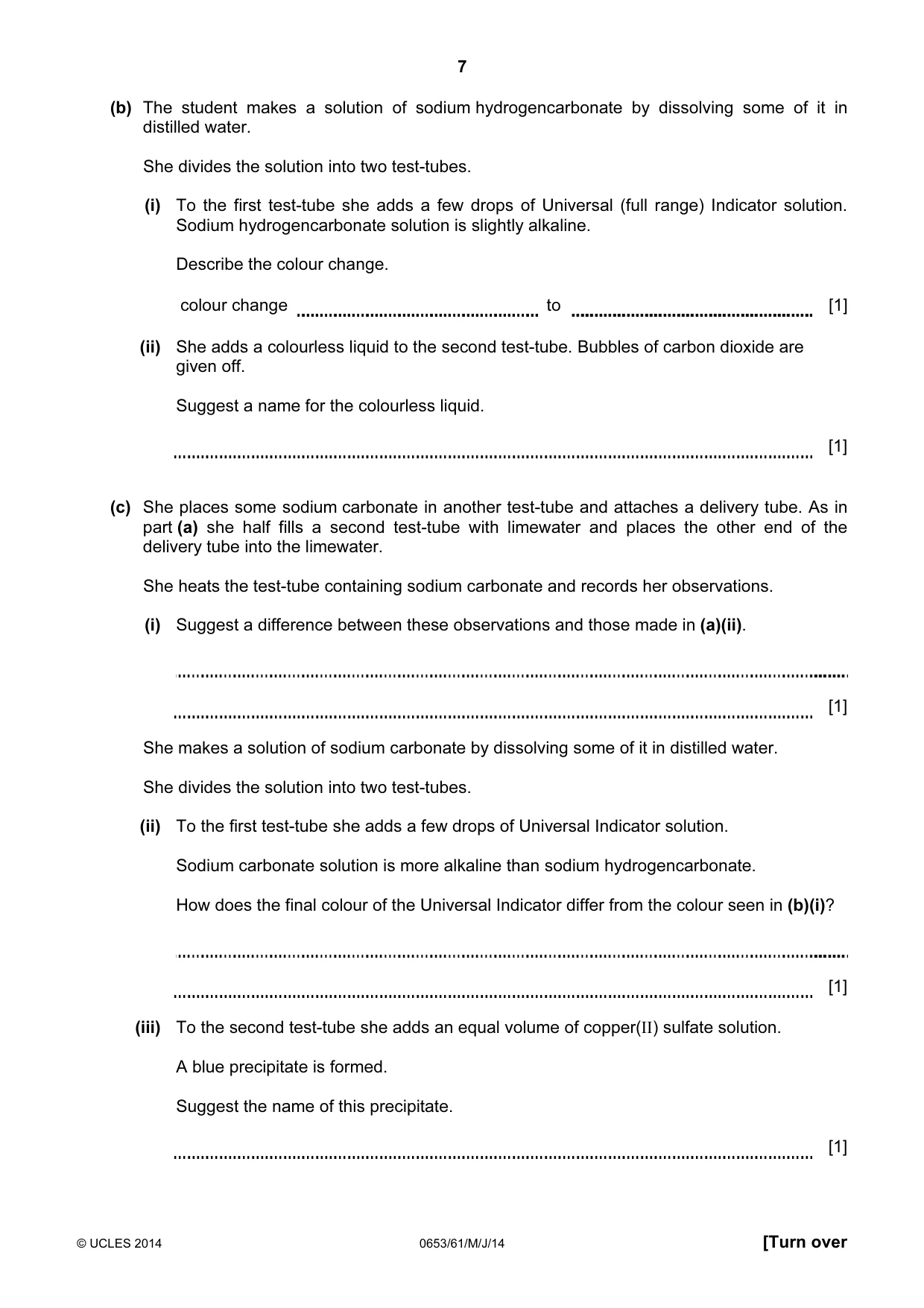
7 © UCLES 2014 0653/61/M/J/14 [Turn over (b) The student makes a solution of sodium hydrogencarbonate by dissolving some of it in distilled water. She divides the solution into two test-tubes. (i) To the first test-tube she adds a few drops of Universal (full range) Indicator solution. Sodium hydrogencarbonate solution is slightly alkaline. Describe the colour change. colour change to [1] (ii) She adds a colourless liquid to the second test-tube. Bubbles of carbon dioxide are given off. Suggest a name for the colourless liquid. [1] (c) She places some sodium carbonate in another test-tube and attaches a delivery tube. As in part (a) she half fills a second test-tube with limewater and places the other end of the delivery tube into the limewater. She heats the test-tube containing sodium carbonate and records her observations. (i) Suggest a difference between these observations and those made in (a)(ii). [1] She makes a solution of sodium carbonate by dissolving some of it in distilled water. She divides the solution into two test-tubes. (ii) To the first test-tube she adds a few drops of Universal Indicator solution. Sodium carbonate solution is more alkaline than sodium hydrogencarbonate. How does the final colour of the Universal Indicator differ from the colour seen in (b)(i)? [1] (iii) To the second test-tube she adds an equal volume of copper(II) sulfate solution. A blue precipitate is formed. Suggest the name of this precipitate. [1]
Question paper, page 8
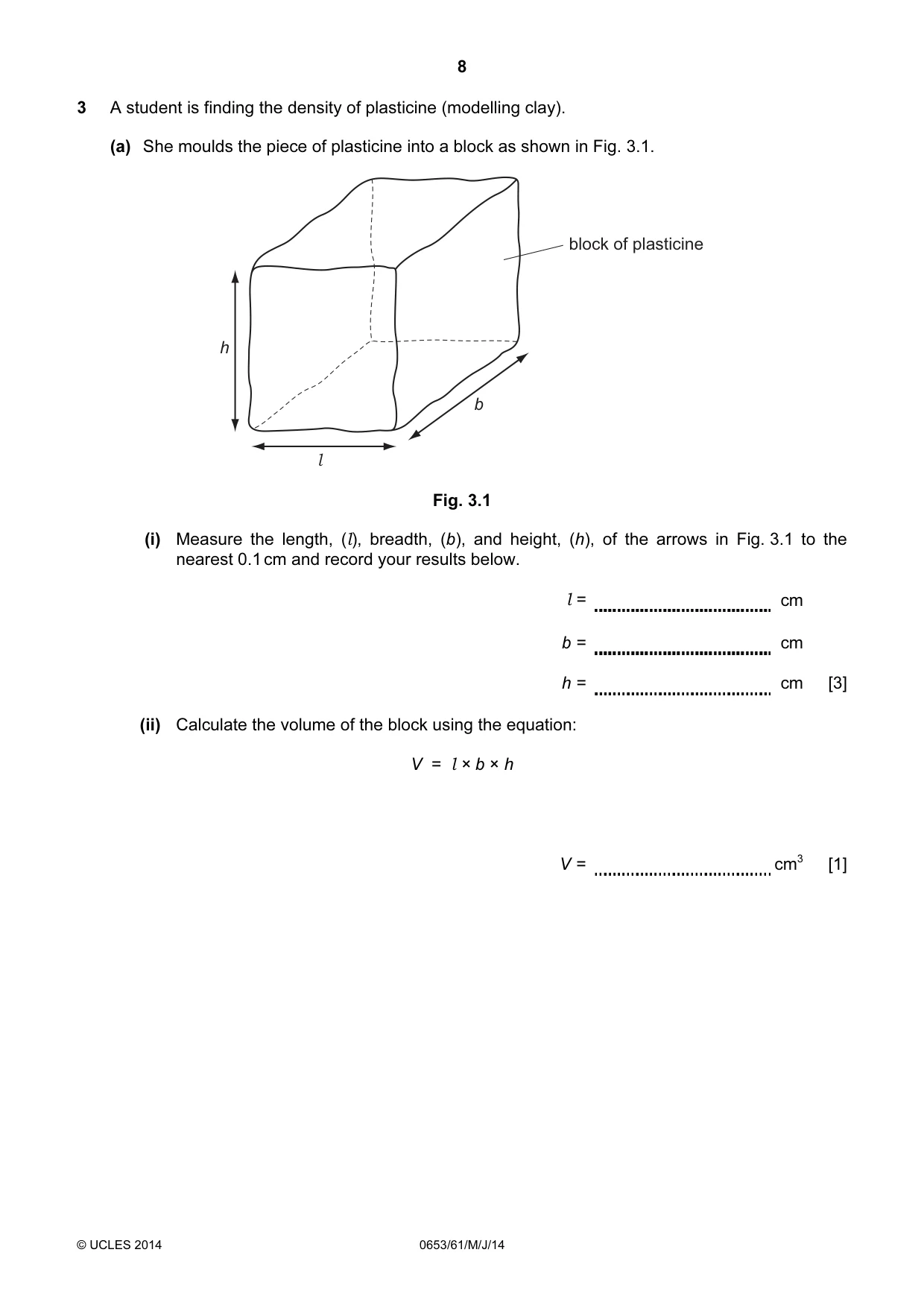
8 © UCLES 2014 0653/61/M/J/14 3 A student is finding the density of plasticine (modelling clay). (a) She moulds the piece of plasticine into a block as shown in Fig. 3.1. b h l block of plasticine Fig. 3.1 (i) Measure the length, (l), breadth, (b), and height, (h), of the arrows in Fig. 3.1 to the nearest 0.1 cm and record your results below. l = cm b = cm h = cm [3] (ii) Calculate the volume of the block using the equation: V = l × b × h V = cm3 [1]
Question paper, page 9
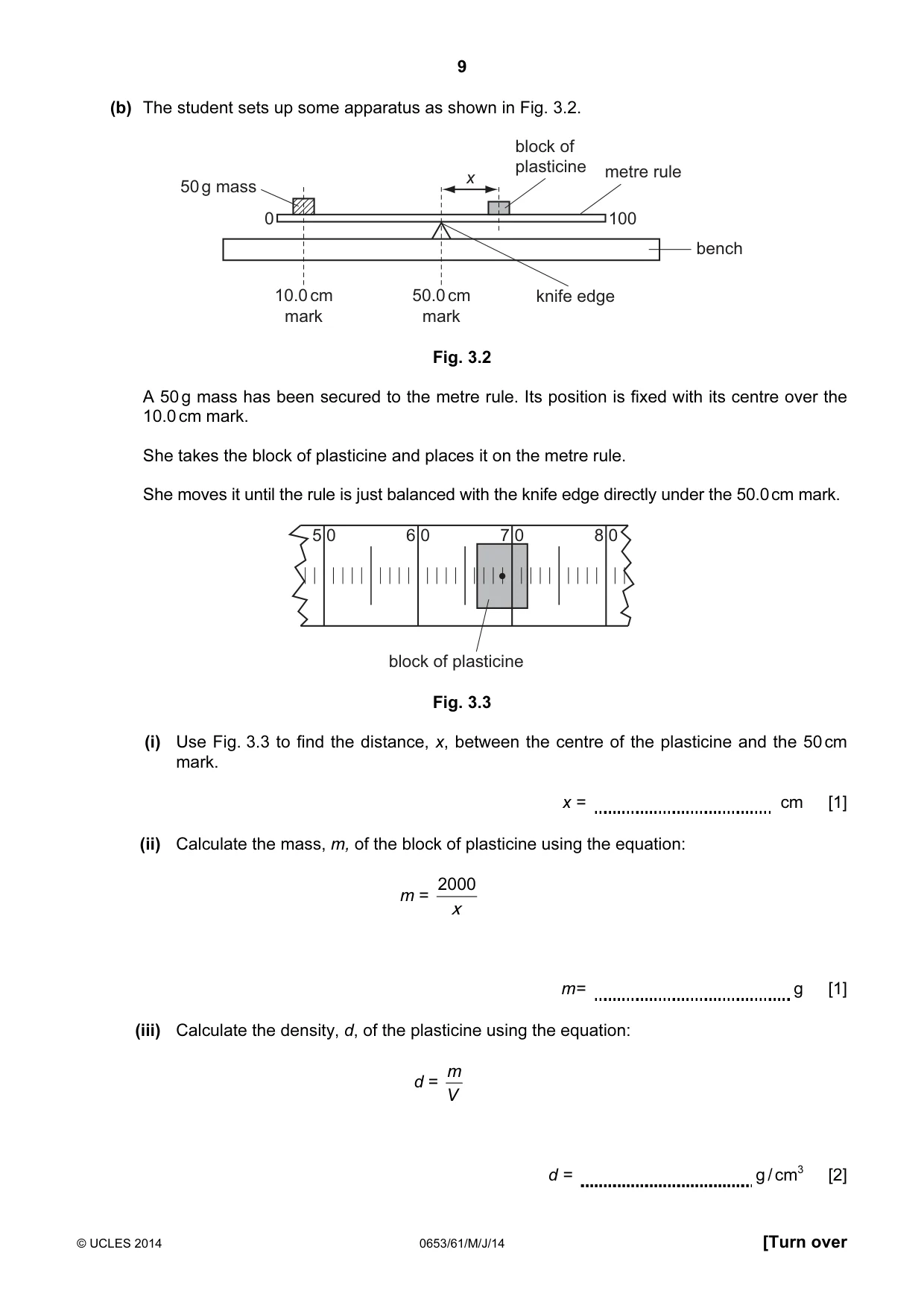
9 © UCLES 2014 0653/61/M/J/14 [Turn over (b) The student sets up some apparatus as shown in Fig. 3.2. 50 g mass block of plasticine metre rule x 10.0 cm mark 50.0 cm mark bench 0 100 knife edge Fig. 3.2 A 50 g mass has been secured to the metre rule. Its position is fixed with its centre over the 10.0 cm mark. She takes the block of plasticine and places it on the metre rule. She moves it until the rule is just balanced with the knife edge directly under the 50.0 cm mark. 5 0 6 0 7 0 8 0 block of plasticine Fig. 3.3 (i) Use Fig. 3.3 to find the distance, x, between the centre of the plasticine and the 50 cm mark. x = cm [1] (ii) Calculate the mass, m, of the block of plasticine using the equation: m = x 2000 m= g [1] (iii) Calculate the density, d, of the plasticine using the equation: d = V m d = g / cm3 [2]
Question paper, page 10
10 © UCLES 2014 0653/61/M/J/14 (c) Suggest two reasons why the data you have used to calculate the density of plasticine may be inaccurate. reason 1 reason 2 [2]
Question paper, page 11
11 © UCLES 2014 0653/61/M/J/14 [Turn over Please turn over for Question 4.
Question paper, page 12
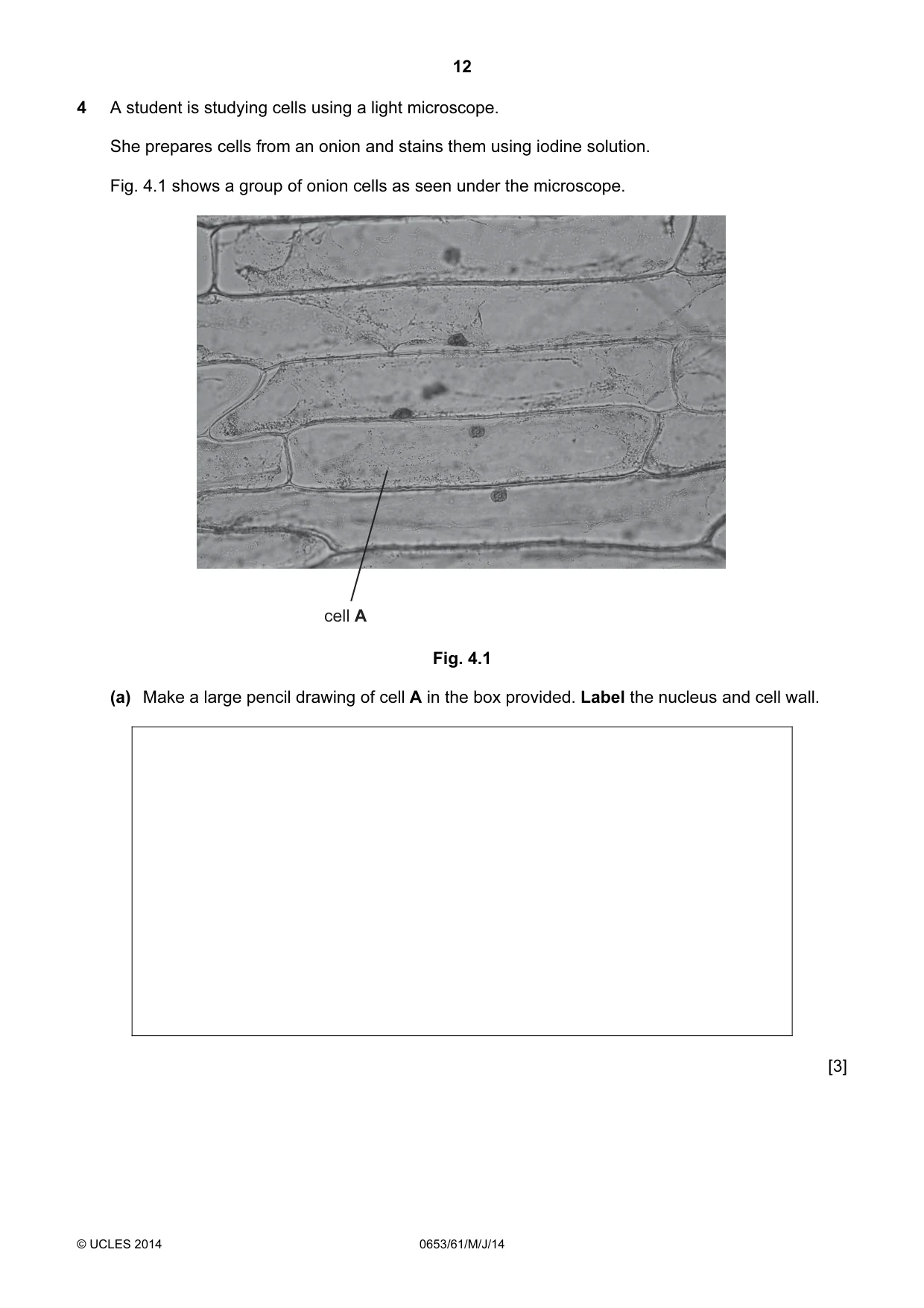
12 © UCLES 2014 0653/61/M/J/14 4 A student is studying cells using a light microscope. She prepares cells from an onion and stains them using iodine solution. Fig. 4.1 shows a group of onion cells as seen under the microscope. cell A Fig. 4.1 (a) Make a large pencil drawing of cell A in the box provided. Label the nucleus and cell wall. [3]
Question paper, page 13
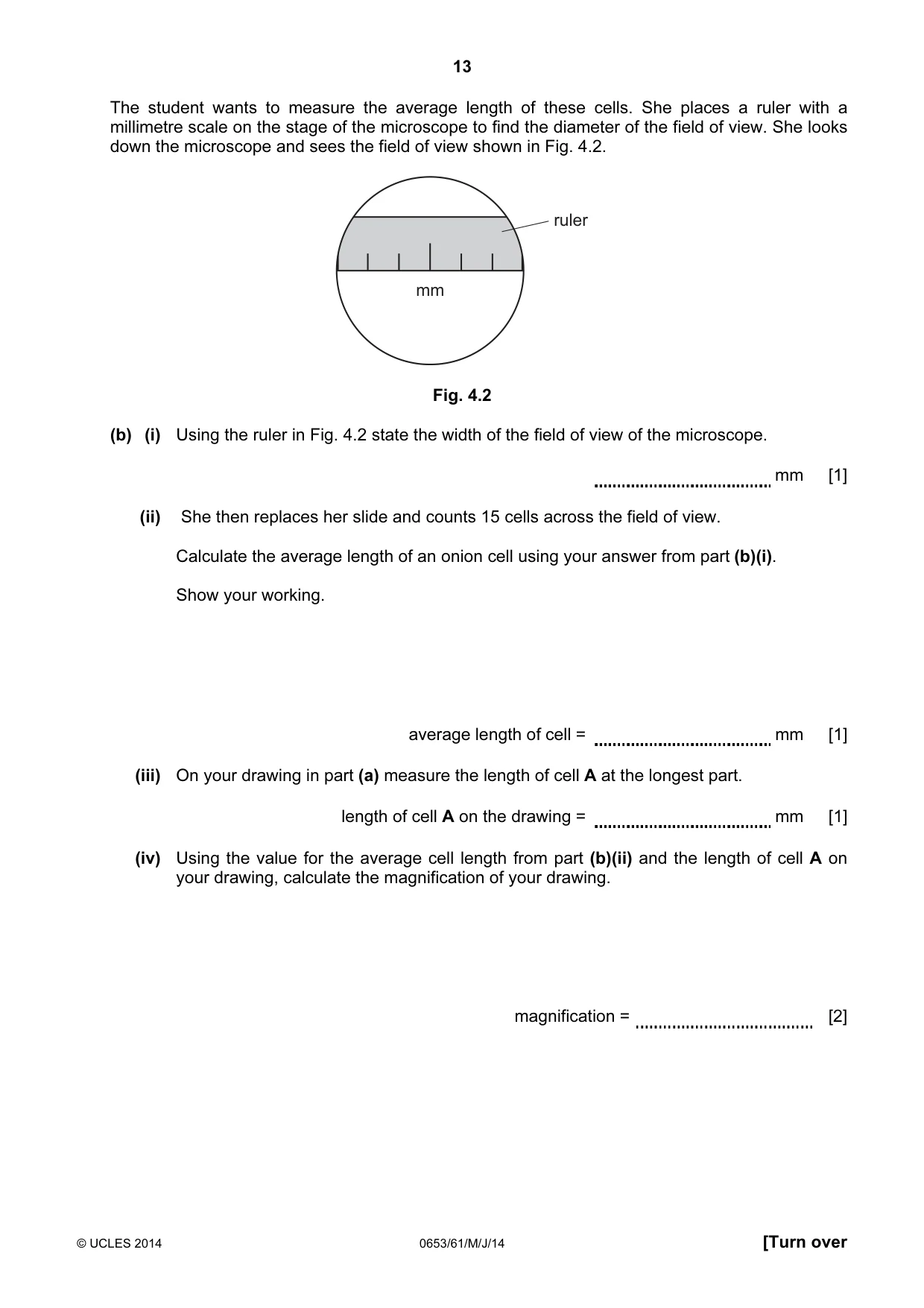
13 © UCLES 2014 0653/61/M/J/14 [Turn over The student wants to measure the average length of these cells. She places a ruler with a millimetre scale on the stage of the microscope to find the diameter of the field of view. She looks down the microscope and sees the field of view shown in Fig. 4.2. mm ruler Fig. 4.2 (b) (i) Using the ruler in Fig. 4.2 state the width of the field of view of the microscope. mm [1] (ii) She then replaces her slide and counts 15 cells across the field of view. Calculate the average length of an onion cell using your answer from part (b)(i). Show your working. average length of cell = mm [1] (iii) On your drawing in part (a) measure the length of cell A at the longest part. length of cell A on the drawing = mm [1] (iv) Using the value for the average cell length from part (b)(ii) and the length of cell A on your drawing, calculate the magnification of your drawing. magnification = [2]
Question paper, page 14
14 © UCLES 2014 0653/61/M/J/14 (c) Name one structure normally present in a plant cell that is not visible in these onion cells. [1] (d) Another student uses a microscope to look at some cells in iodine solution. Some parts of the cell stain blue-black. Explain this observation. [1]
Question paper, page 15
15 © UCLES 2014 0653/61/M/J/14 [Turn over Please turn over for Question 5.
Question paper, page 16
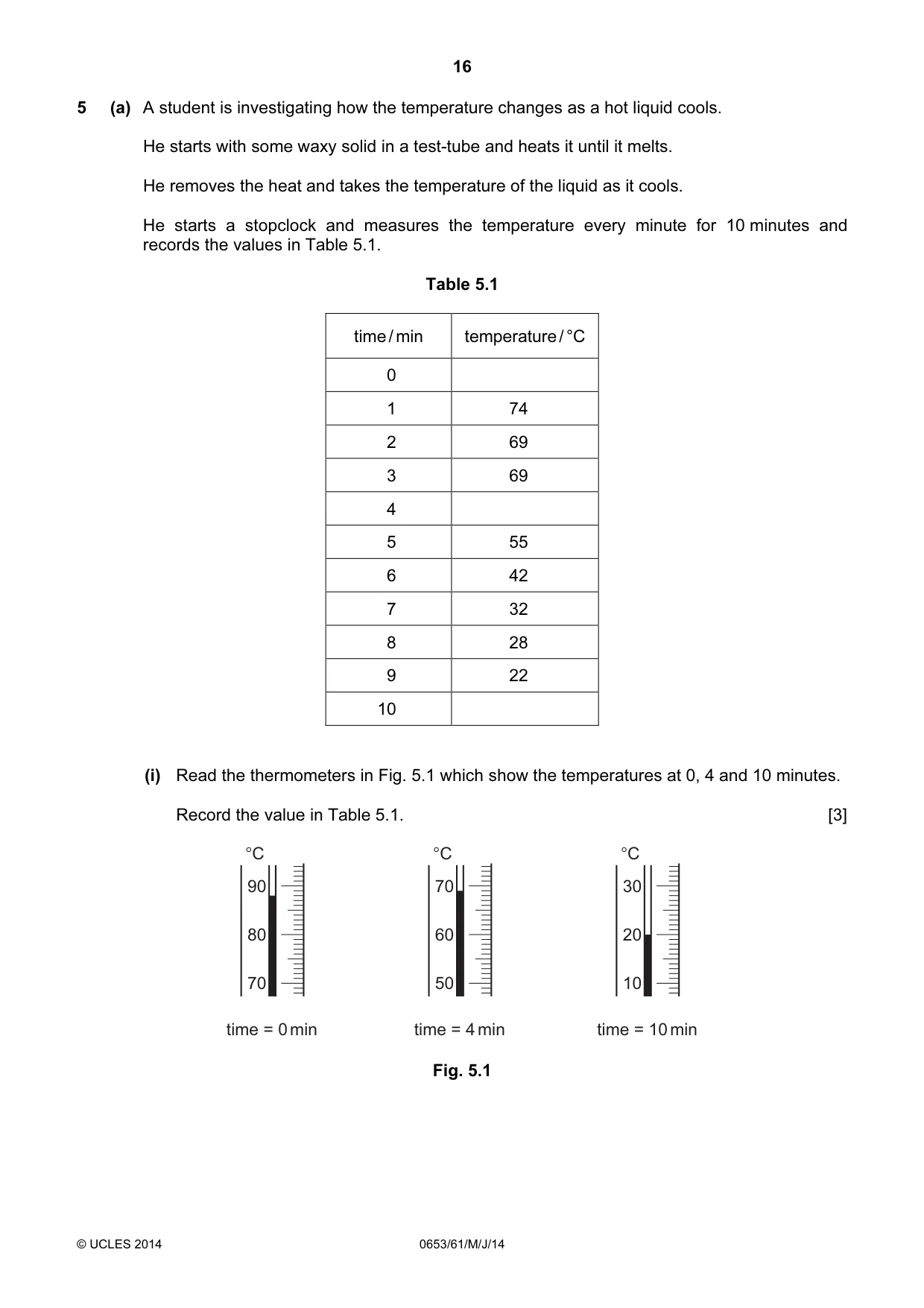
16 © UCLES 2014 0653/61/M/J/14 5 (a) A student is investigating how the temperature changes as a hot liquid cools. He starts with some waxy solid in a test-tube and heats it until it melts. He removes the heat and takes the temperature of the liquid as it cools. He starts a stopclock and measures the temperature every minute for 10 minutes and records the values in Table 5.1. Table 5.1 time / min temperature / °C 0 1 74 2 69 3 69 4 5 55 6 42 7 32 8 28 9 22 10 (i) Read the thermometers in Fig. 5.1 which show the temperatures at 0, 4 and 10 minutes. Record the value in Table 5.1. [3] 90 80 70 °C time = 0 min 70 60 50 °C time = 4 min 30 20 10 °C time = 10 min Fig. 5.1
Question paper, page 17
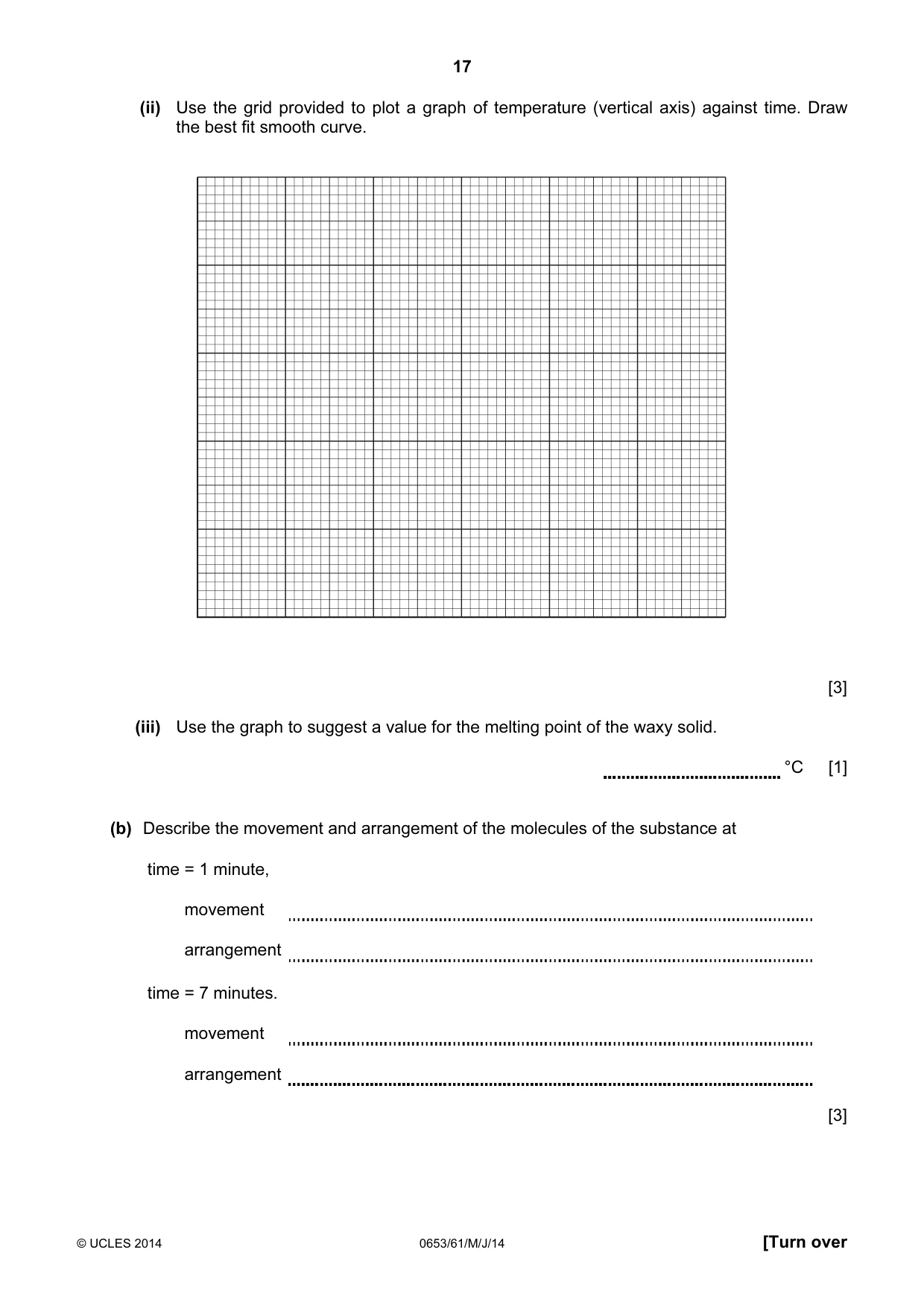
17 © UCLES 2014 0653/61/M/J/14 [Turn over (ii) Use the grid provided to plot a graph of temperature (vertical axis) against time. Draw the best fit smooth curve. [3] (iii) Use the graph to suggest a value for the melting point of the waxy solid. °C [1] (b) Describe the movement and arrangement of the molecules of the substance at time = 1 minute, movement arrangement time = 7 minutes. movement arrangement [3]
Question paper, page 18
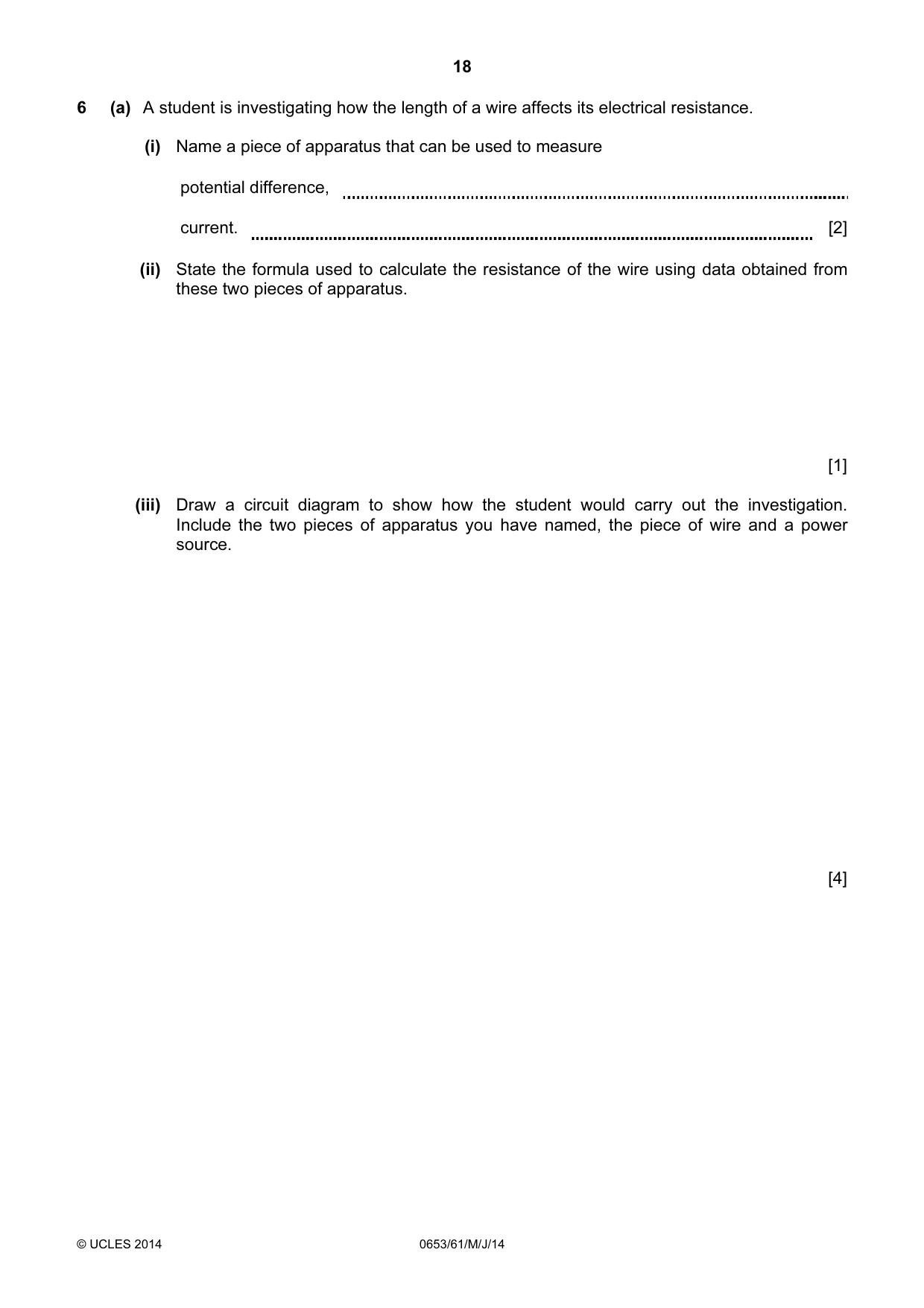
18 © UCLES 2014 0653/61/M/J/14 6 (a) A student is investigating how the length of a wire affects its electrical resistance. (i) Name a piece of apparatus that can be used to measure potential difference, current. [2] (ii) State the formula used to calculate the resistance of the wire using data obtained from these two pieces of apparatus. [1] (iii) Draw a circuit diagram to show how the student would carry out the investigation. Include the two pieces of apparatus you have named, the piece of wire and a power source. [4]
Question paper, page 19
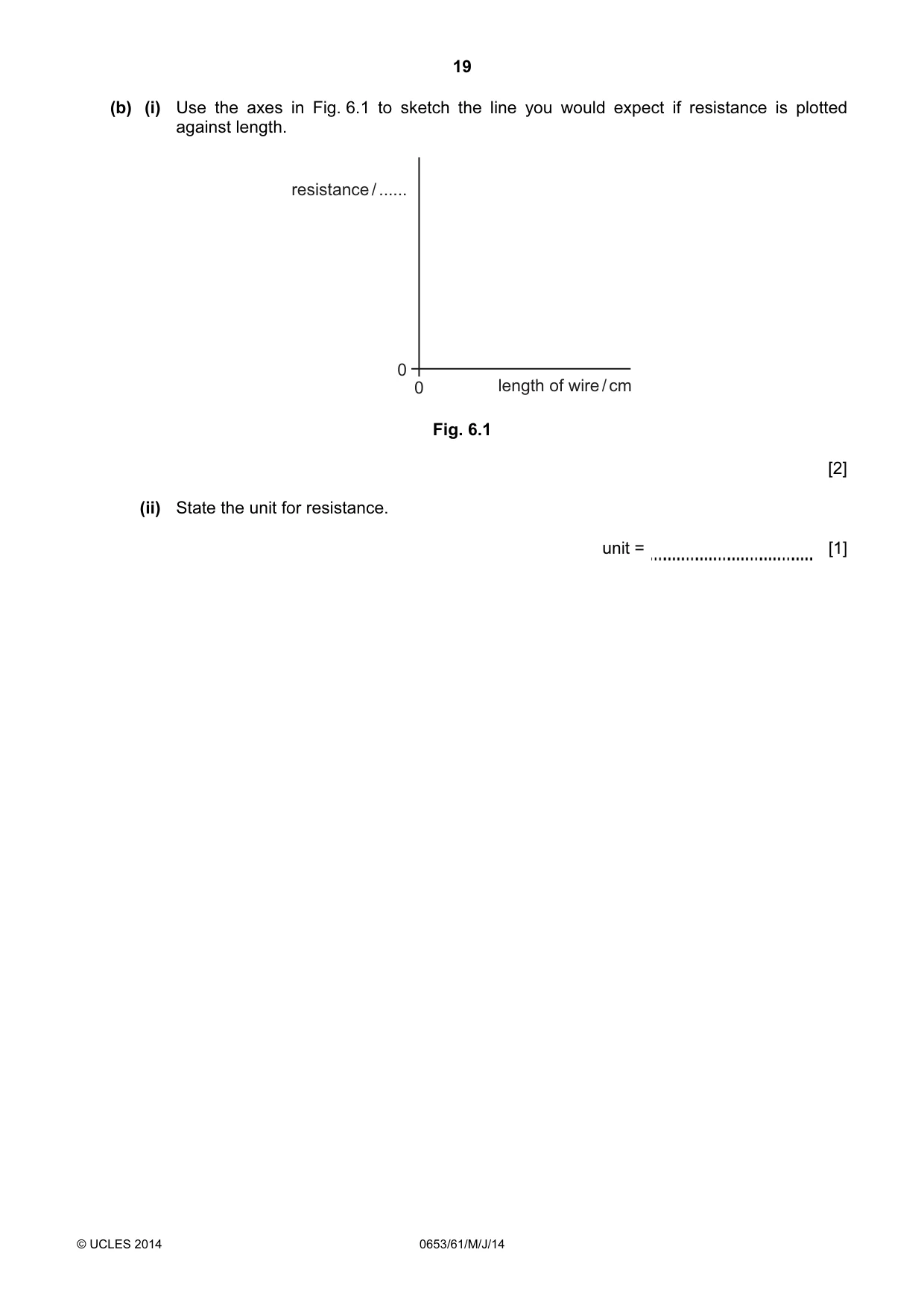
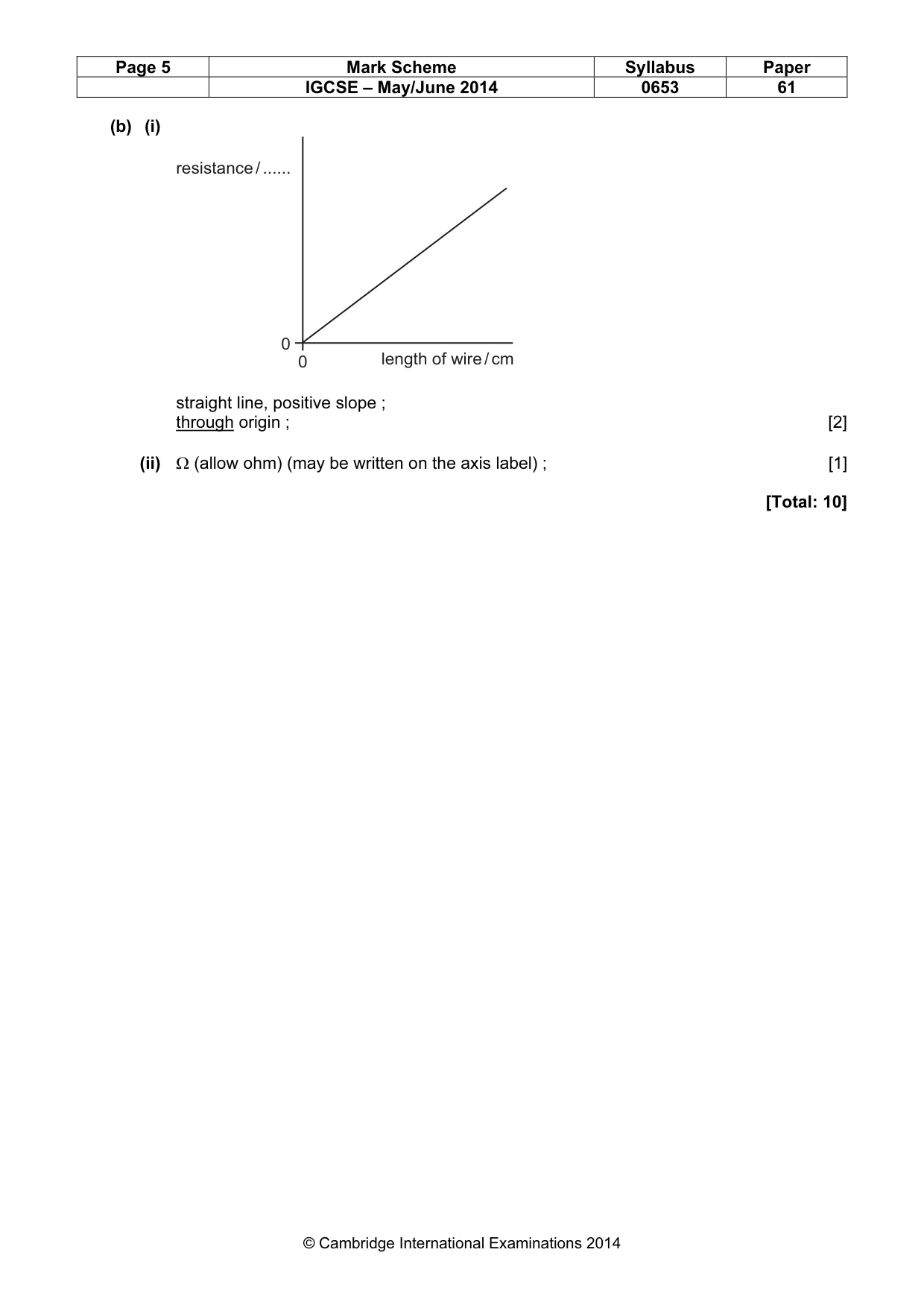
19 © UCLES 2014 0653/61/M/J/14 (b) (i) Use the axes in Fig. 6.1 to sketch the line you would expect if resistance is plotted against length. 0 0 length of wire / cm resistance / … Fig. 6.1 [2] (ii) State the unit for resistance. unit = [1]
Question paper, page 20
20 Permission to reproduce items where third-party owned material protected by copyright is included has been sought and cleared where possible. Every reasonable effort has been made by the publisher (UCLES) to trace copyright holders, but if any items requiring clearance have unwittingly been included, the publisher will be pleased to make amends at the earliest possible opportunity. Cambridge International Examinations is part of the Cambridge Assessment Group. Cambridge Assessment is the brand name of University of Cambridge Local Examinations Syndicate (UCLES), which is itself a department of the University of Cambridge. © UCLES 2014 0653/61/M/J/14 BLANK PAGE
Mark scheme, page 1
CAMBRIDGE INTERNATIONAL EXAMINATIONS International General Certificate of Secondary Education MARK SCHEME for the May/June 2014 series 0653 CO-ORDINATED SCIENCES 0653/61 Paper 6 (Alternative to Practical), maximum raw mark 60 This mark scheme is published as an aid to teachers and candidates, to indicate the requirements of the examination. It shows the basis on which Examiners were instructed to award marks. It does not indicate the details of the discussions that took place at an Examiners’ meeting before marking began, which would have considered the acceptability of alternative answers. Mark schemes should be read in conjunction with the question paper and the Principal Examiner Report for Teachers. Cambridge will not enter into discussions about these mark schemes. Cambridge is publishing the mark schemes for the May/June 2014 series for most IGCSE, GCE Advanced Level and Advanced Subsidiary Level components and some Ordinary Level components.
Mark scheme, page 2
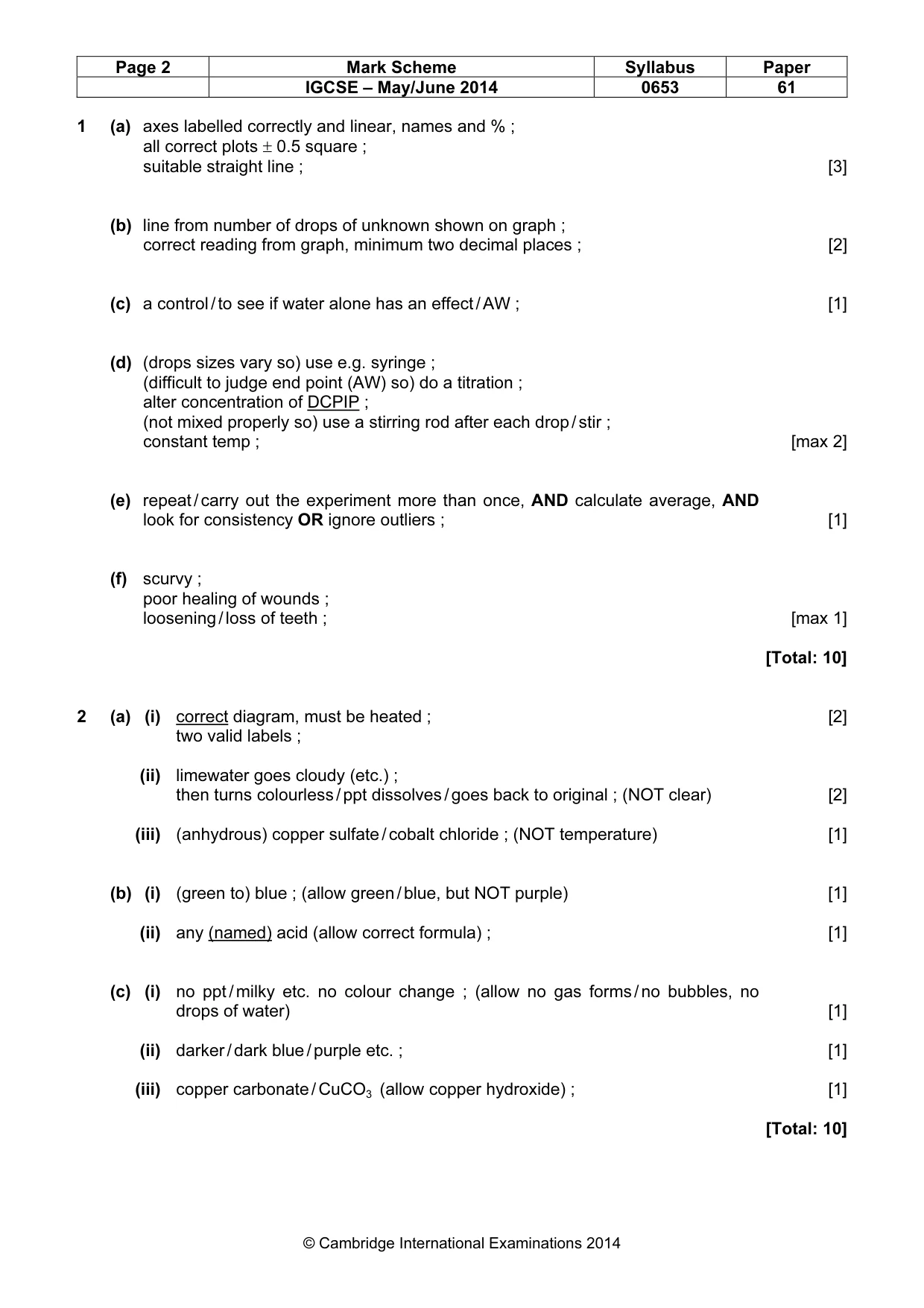
Page 2 Mark Scheme Syllabus Paper IGCSE – May/June 2014 0653 61 © Cambridge International Examinations 2014 1 (a) axes labelled correctly and linear, names and % ; all correct plots ± 0.5 square ; suitable straight line ; [3] (b) line from number of drops of unknown shown on graph ; correct reading from graph, minimum two decimal places ; [2] (c) a control / to see if water alone has an effect / AW ; [1] (d) (drops sizes vary so) use e.g. syringe ; (difficult to judge end point (AW) so) do a titration ; alter concentration of DCPIP ; (not mixed properly so) use a stirring rod after each drop / stir ; constant temp ; [max 2] (e) repeat / carry out the experiment more than once, AND calculate average, AND look for consistency OR ignore outliers ; [1] (f) scurvy ; poor healing of wounds ; loosening / loss of teeth ; [max 1] [Total: 10] 2 (a) (i) correct diagram, must be heated ; [2] two valid labels ; (ii) limewater goes cloudy (etc.) ; then turns colourless / ppt dissolves / goes back to original ; (NOT clear) [2] (iii) (anhydrous) copper sulfate / cobalt chloride ; (NOT temperature) [1] (b) (i) (green to) blue ; (allow green / blue, but NOT purple) [1] (ii) any (named) acid (allow correct formula) ; [1] (c) (i) no ppt / milky etc. no colour change ; (allow no gas forms / no bubbles, no drops of water) [1] (ii) darker / dark blue / purple etc. ; [1] (iii) copper carbonate / CuCO3 (allow copper hydroxide) ; [1] [Total: 10]
Mark scheme, page 3
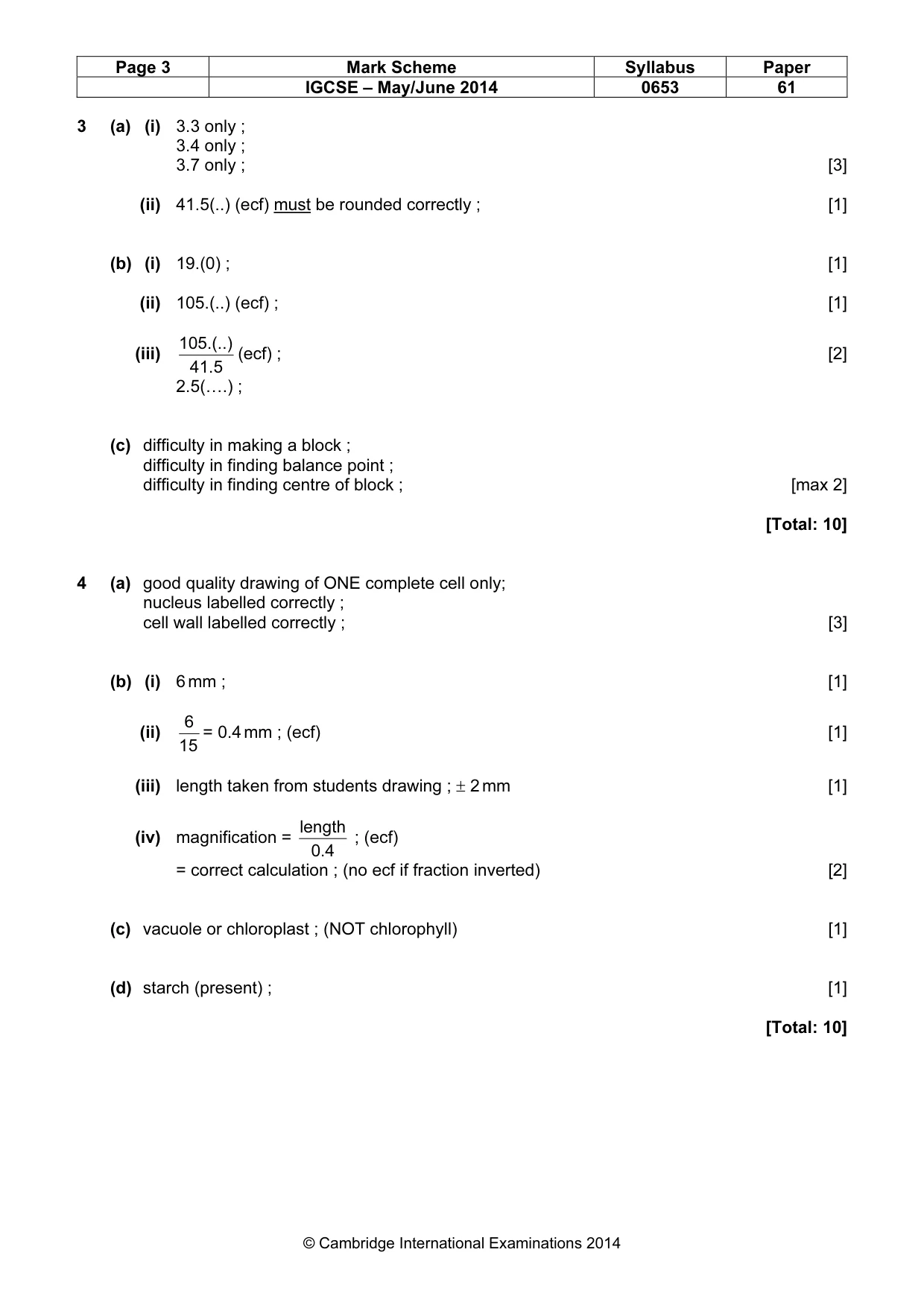
Page 3 Mark Scheme Syllabus Paper IGCSE – May/June 2014 0653 61 © Cambridge International Examinations 2014 3 (a) (i) 3.3 only ; 3.4 only ; 3.7 only ; [3] (ii) 41.5(..) (ecf) must be rounded correctly ; [1] (b) (i) 19.(0) ; [1] (ii) 105.(..) (ecf) ; [1] (iii) 41.5 105.(..) (ecf) ; [2] 2.5(….) ; (c) difficulty in making a block ; difficulty in finding balance point ; difficulty in finding centre of block ; [max 2] [Total: 10] 4 (a) good quality drawing of ONE complete cell only; nucleus labelled correctly ; cell wall labelled correctly ; [3] (b) (i) 6 mm ; [1] (ii) 15 6 = 0.4 mm ; (ecf) [1] (iii) length taken from students drawing ; ± 2 mm [1] (iv) magnification = 0.4 length ; (ecf) = correct calculation ; (no ecf if fraction inverted) [2] (c) vacuole or chloroplast ; (NOT chlorophyll) [1] (d) starch (present) ; [1] [Total: 10]
Mark scheme, page 4
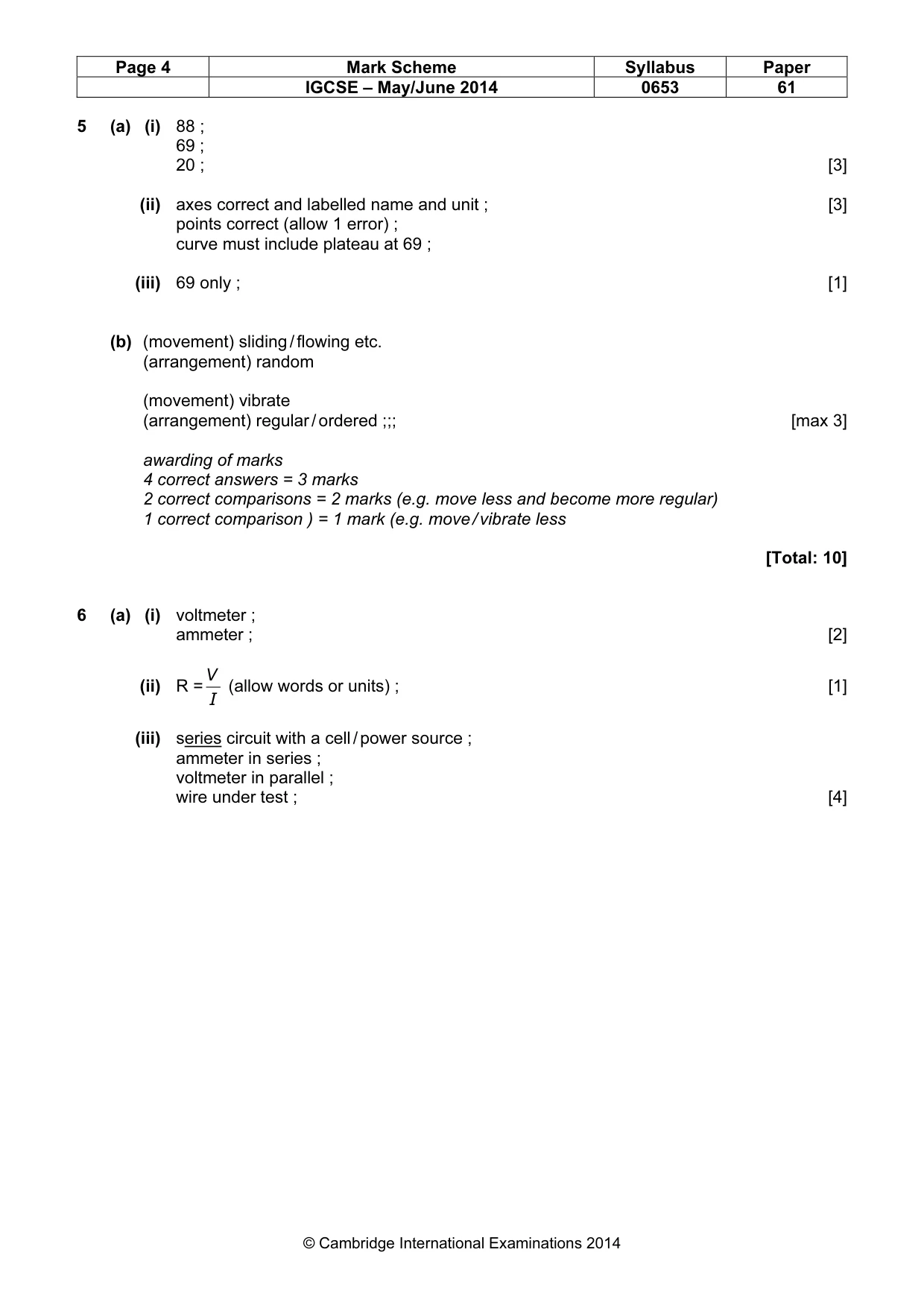
Page 4 Mark Scheme Syllabus Paper IGCSE – May/June 2014 0653 61 © Cambridge International Examinations 2014 5 (a) (i) 88 ; 69 ; 20 ; [3] (ii) axes correct and labelled name and unit ; [3] points correct (allow 1 error) ; curve must include plateau at 69 ; (iii) 69 only ; [1] (b) (movement) sliding / flowing etc. (arrangement) random (movement) vibrate (arrangement) regular / ordered ;;; [max 3] awarding of marks 4 correct answers = 3 marks 2 correct comparisons = 2 marks (e.g. move less and become more regular) 1 correct comparison ) = 1 mark (e.g. move / vibrate less [Total: 10] 6 (a) (i) voltmeter ; ammeter ; [2] (ii) R = I V (allow words or units) ; [1] (iii) series circuit with a cell / power source ; ammeter in series ; voltmeter in parallel ; wire under test ; [4]
Mark scheme, page 5
Page 5 Mark Scheme Syllabus Paper IGCSE – May/June 2014 0653 61 © Cambridge International Examinations 2014 (b) (i) straight line, positive slope ; through origin ; [2] (ii) Ω (allow ohm) (may be written on the axis label) ; [1] [Total: 10] 0 0 length of wire / cm resistance / …
What you needed in this session
Cambridge’s own grade thresholds for 2014 May/June, Paper 6 · Variant 1. A higher threshold means an easier paper — the bar moves with how the cohort did.