Cambridge IGCSE Religious Studies 0490 — 2017 Oct/Nov Paper 1 · Variant 2
0490/12/O/N/17 · 80 marks · ≈90 min
The question paper and its mark scheme, free to read here and free to download. This is Cambridge’s own paper, exactly as it was sat.
Question paper4 pages
Mark scheme18 pages
Answers below. Sit the paper first if you are practising.
Paper as text
Question paper, page 1
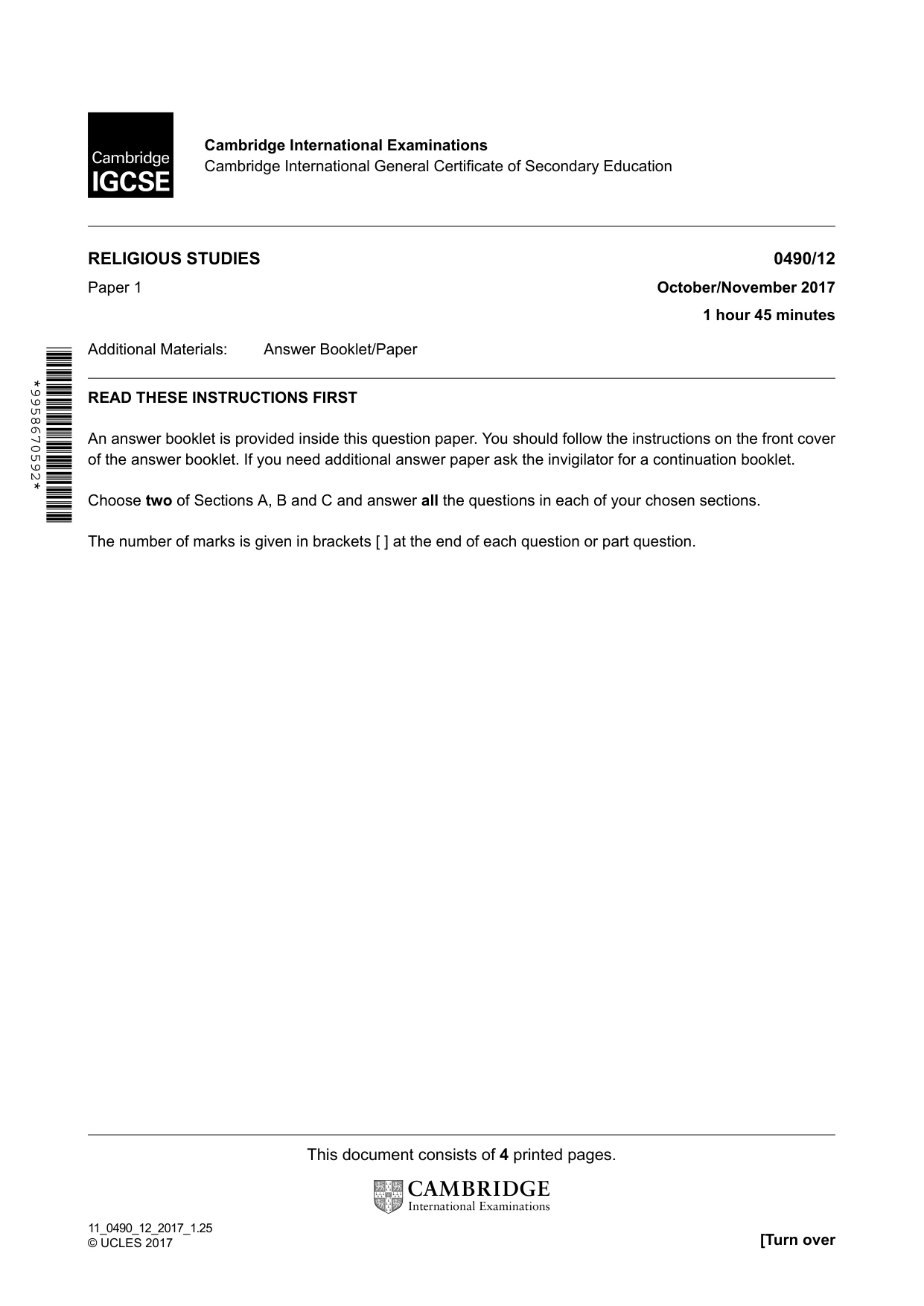
Cambridge International Examinations Cambridge International General Certificate of Secondary Education 0490/12 October/November 2017 1 hour 45 minutes RELIGIOUS STUDIES Paper 1 Additional Materials: Answer Booklet/Paper READ THESE INSTRUCTIONS FIRST An answer booklet is provided inside this question paper. You should follow the instructions on the front cover of the answer booklet. If you need additional answer paper ask the invigilator for a continuation booklet. Choose two of Sections A, B and C and answer all the questions in each of your chosen sections. The number of marks is given in brackets [ ] at the end of each question or part question. This document consists of 4 printed pages. [Turn over 11_0490_12_2017_1.25 © UCLES 2017 *9958670592*
Question paper, page 2
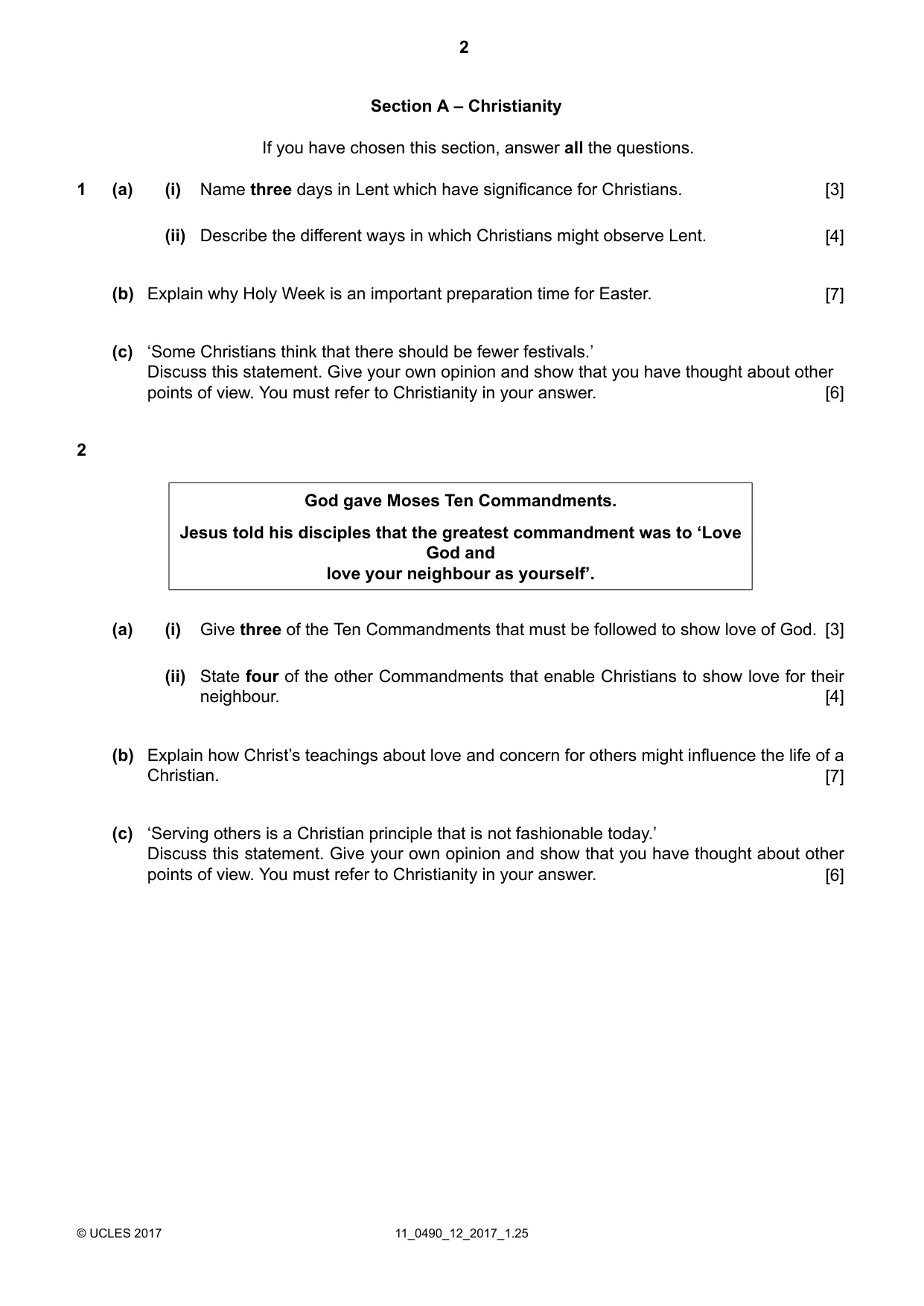
Section A – Christianity If you have chosen this section, answer all the questions. Name three days in Lent which have significance for Christians. [3] (i) (a) 1 Describe the different ways in which Christians might observe Lent. [4] (ii) Explain why Holy Week is an important preparation time for Easter. [7] (b) ‘Some Christians think that there should be fewer festivals.’ Discuss this statement. Give your own opinion and show that you have thought about other points of view. You must refer to Christianity in your answer. [6] (c) 2 God gave Moses Ten Commandments. Jesus told his disciples that the greatest commandment was to ‘Love God and love your neighbour as yourself’. Give three of the Ten Commandments that must be followed to show love of God. [3] (i) (a) State four of the other Commandments that enable Christians to show love for their neighbour. [4] (ii) Explain how Christ’s teachings about love and concern for others might influence the life of a Christian. [7] (b) ‘Serving others is a Christian principle that is not fashionable today.’ Discuss this statement. Give your own opinion and show that you have thought about other points of view. You must refer to Christianity in your answer. [6] (c) 11_0490_12_2017_1.25 © UCLES 2017 2
Question paper, page 3
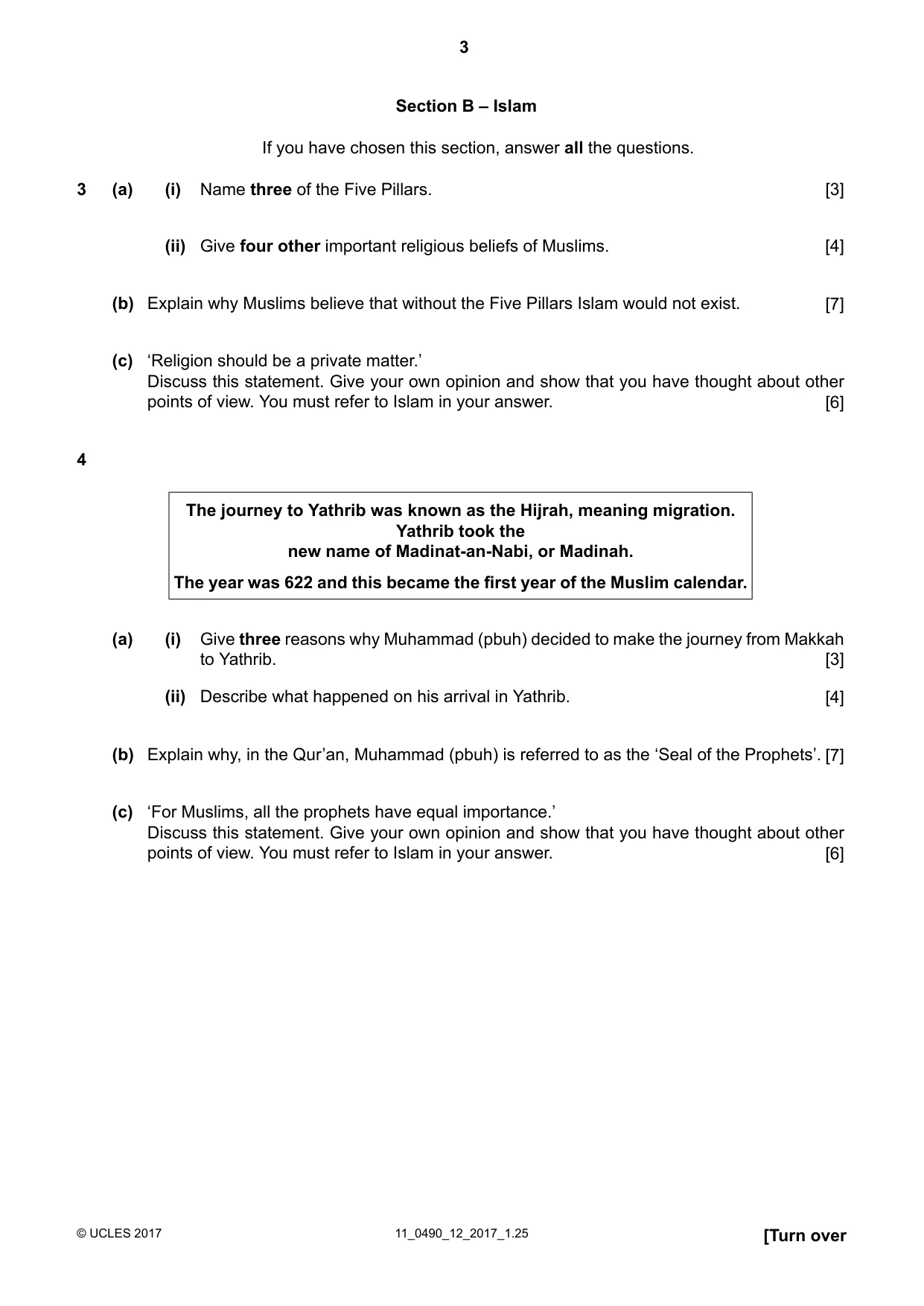
Section B – Islam If you have chosen this section, answer all the questions. Name three of the Five Pillars. [3] (i) (a) 3 Give four other important religious beliefs of Muslims. [4] (ii) Explain why Muslims believe that without the Five Pillars Islam would not exist. [7] (b) ‘Religion should be a private matter.’ Discuss this statement. Give your own opinion and show that you have thought about other points of view. You must refer to Islam in your answer. [6] (c) 4 The journey to Yathrib was known as the Hijrah, meaning migration. Yathrib took the new name of Madinat-an-Nabi, or Madinah. The year was 622 and this became the first year of the Muslim calendar. Give three reasons why Muhammad (pbuh) decided to make the journey from Makkah to Yathrib. [3] (i) (a) Describe what happened on his arrival in Yathrib. [4] (ii) Explain why, in the Qur’an, Muhammad (pbuh) is referred to as the ‘Seal of the Prophets’. [7] (b) ‘For Muslims, all the prophets have equal importance.’ Discuss this statement. Give your own opinion and show that you have thought about other points of view. You must refer to Islam in your answer. [6] (c) [Turn over 11_0490_12_2017_1.25 © UCLES 2017 3
Question paper, page 4
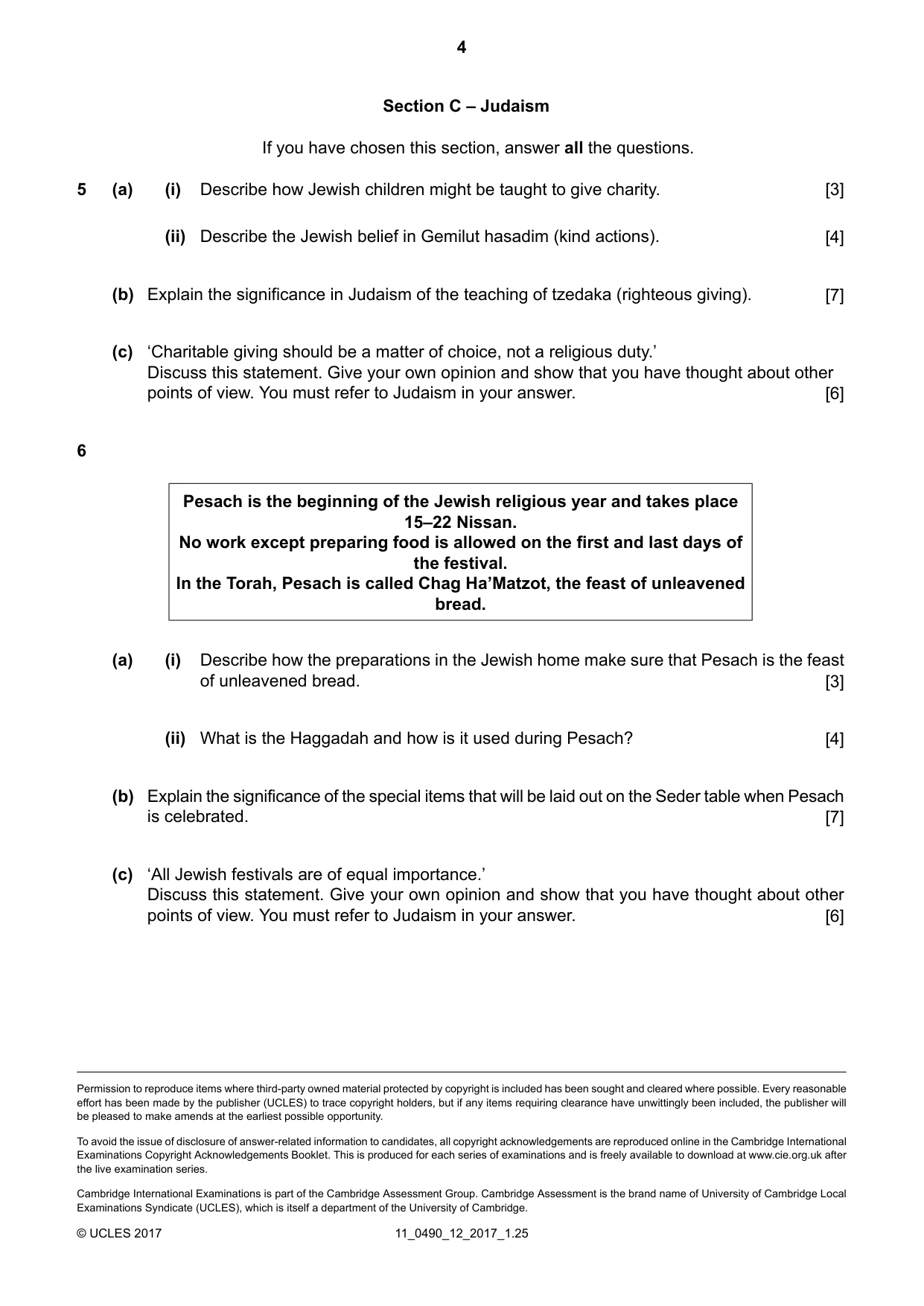
Section C – Judaism If you have chosen this section, answer all the questions. Describe how Jewish children might be taught to give charity. [3] (i) (a) 5 Describe the Jewish belief in Gemilut hasadim (kind actions). [4] (ii) Explain the significance in Judaism of the teaching of tzedaka (righteous giving). [7] (b) ‘Charitable giving should be a matter of choice, not a religious duty.’ Discuss this statement. Give your own opinion and show that you have thought about other points of view. You must refer to Judaism in your answer. [6] (c) 6 Pesach is the beginning of the Jewish religious year and takes place 15–22 Nissan. No work except preparing food is allowed on the first and last days of the festival. In the Torah, Pesach is called Chag Ha’Matzot, the feast of unleavened bread. Describe how the preparations in the Jewish home make sure that Pesach is the feast of unleavened bread. [3] (i) (a) What is the Haggadah and how is it used during Pesach? [4] (ii) Explain the significance of the special items that will be laid out on the Seder table when Pesach is celebrated. [7] (b) ‘All Jewish festivals are of equal importance.’ Discuss this statement. Give your own opinion and show that you have thought about other points of view. You must refer to Judaism in your answer. [6] (c) Permission to reproduce items where third-party owned material protected by copyright is included has been sought and cleared where possible. Every reasonable effort has been made by the publisher (UCLES) to trace copyright holders, but if any items requiring clearance have unwittingly been included, the publisher will be pleased to make amends at the earliest possible opportunity. To avoid the issue of disclosure of answer-related information to candidates, all copyright acknowledgements are reproduced online in the Cambridge International Examinations Copyright Acknowledgements Booklet. This is produced for each series of examinations and is freely available to download at www.cie.org.uk after the live examination series. Cambridge International Examinations is part of the Cambridge Assessment Group. Cambridge Assessment is the brand name of University of Cambridge Local Examinations Syndicate (UCLES), which is itself a department of the University of Cambridge. 11_0490_12_2017_1.25 © UCLES 2017 4
Mark scheme, page 1
® IGCSE is a registered trademark. This document consists of 18 printed pages. © UCLES 2017 [Turn over Cambridge Assessment International Education Cambridge International General Certificate of Secondary Education RELIGIOUS STUDIES 0490/12 Paper 1 October/November 2017 MARK SCHEME Maximum Mark: 80 Published This mark scheme is published as an aid to teachers and candidates, to indicate the requirements of the examination. It shows the basis on which Examiners were instructed to award marks. It does not indicate the details of the discussions that took place at an Examiners’ meeting before marking began, which would have considered the acceptability of alternative answers. Mark schemes should be read in conjunction with the question paper and the Principal Examiner Report for Teachers. Cambridge International will not enter into discussions about these mark schemes. Cambridge International is publishing the mark schemes for the October/November 2017 series for most Cambridge IGCSE®, Cambridge International A and AS Level components and some Cambridge O Level components.
Mark scheme, page 2
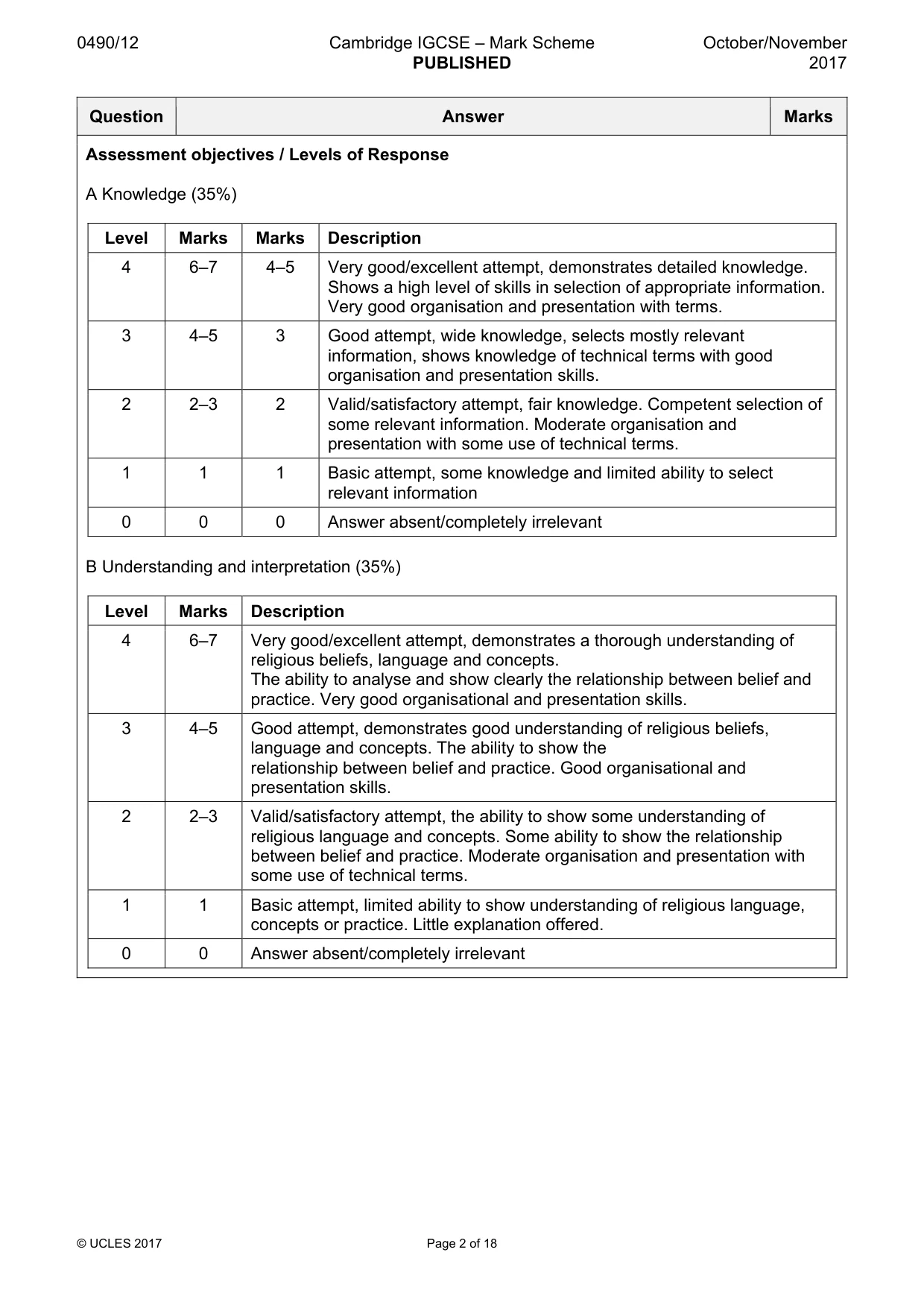
0490/12 Cambridge IGCSE – Mark Scheme PUBLISHED October/November 2017 © UCLES 2017 Page 2 of 18 Question Answer Marks Assessment objectives / Levels of Response A Knowledge (35%) Level Marks Marks Description 4 6–7 4–5 Very good/excellent attempt, demonstrates detailed knowledge. Shows a high level of skills in selection of appropriate information. Very good organisation and presentation with terms. 3 4–5 3 Good attempt, wide knowledge, selects mostly relevant information, shows knowledge of technical terms with good organisation and presentation skills. 2 2–3 2 Valid/satisfactory attempt, fair knowledge. Competent selection of some relevant information. Moderate organisation and presentation with some use of technical terms. 1 1 1 Basic attempt, some knowledge and limited ability to select relevant information 0 0 0 Answer absent/completely irrelevant B Understanding and interpretation (35%) Level Marks Description 4 6–7 Very good/excellent attempt, demonstrates a thorough understanding of religious beliefs, language and concepts. The ability to analyse and show clearly the relationship between belief and practice. Very good organisational and presentation skills. 3 4–5 Good attempt, demonstrates good understanding of religious beliefs, language and concepts. The ability to show the relationship between belief and practice. Good organisational and presentation skills. 2 2–3 Valid/satisfactory attempt, the ability to show some understanding of religious language and concepts. Some ability to show the relationship between belief and practice. Moderate organisation and presentation with some use of technical terms. 1 1 Basic attempt, limited ability to show understanding of religious language, concepts or practice. Little explanation offered. 0 0 Answer absent/completely irrelevant
Mark scheme, page 3
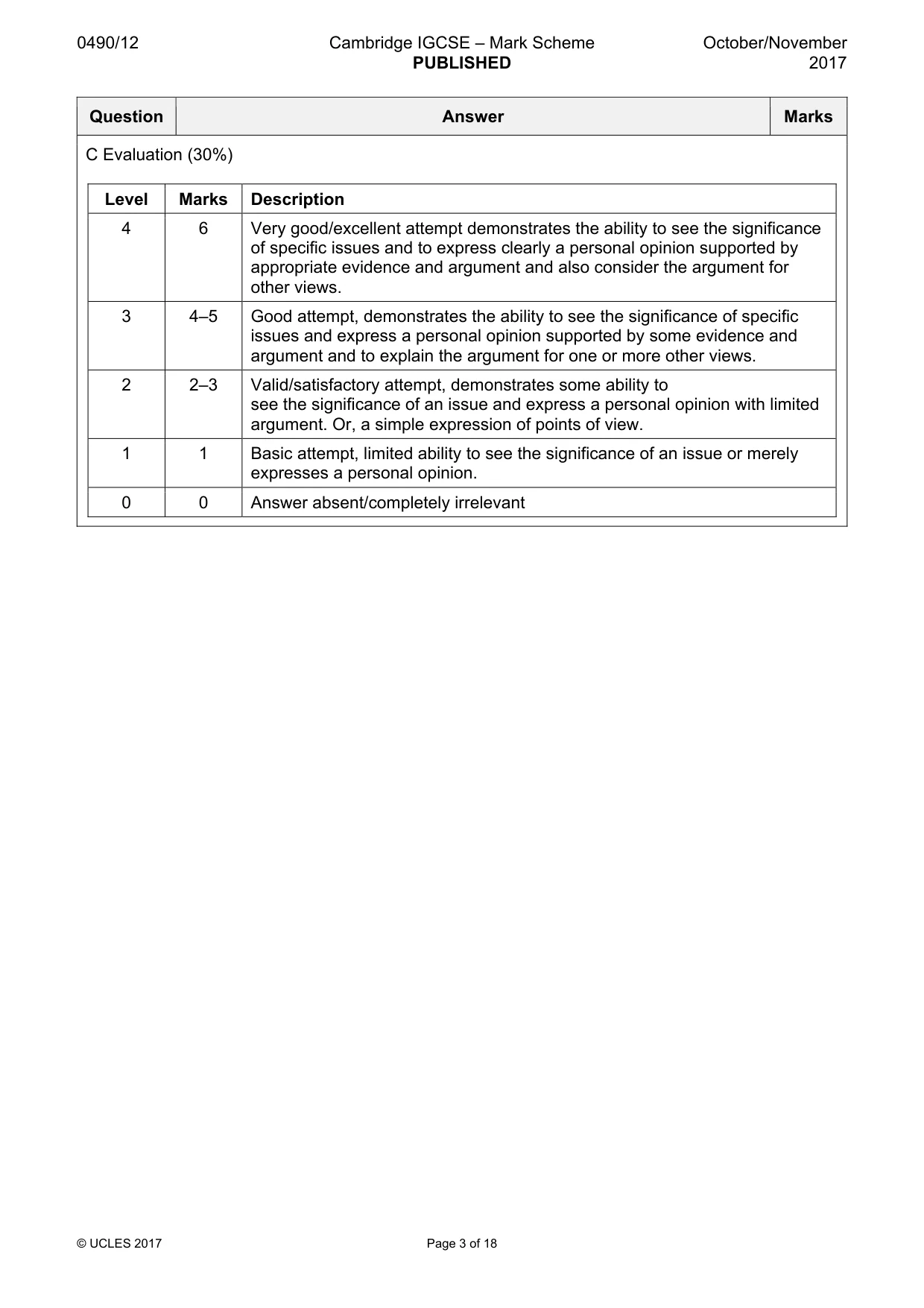
0490/12 Cambridge IGCSE – Mark Scheme PUBLISHED October/November 2017 © UCLES 2017 Page 3 of 18 Question Answer Marks C Evaluation (30%) Level Marks Description 4 6 Very good/excellent attempt demonstrates the ability to see the significance of specific issues and to express clearly a personal opinion supported by appropriate evidence and argument and also consider the argument for other views. 3 4–5 Good attempt, demonstrates the ability to see the significance of specific issues and express a personal opinion supported by some evidence and argument and to explain the argument for one or more other views. 2 2–3 Valid/satisfactory attempt, demonstrates some ability to see the significance of an issue and express a personal opinion with limited argument. Or, a simple expression of points of view. 1 1 Basic attempt, limited ability to see the significance of an issue or merely expresses a personal opinion. 0 0 Answer absent/completely irrelevant
Mark scheme, page 4
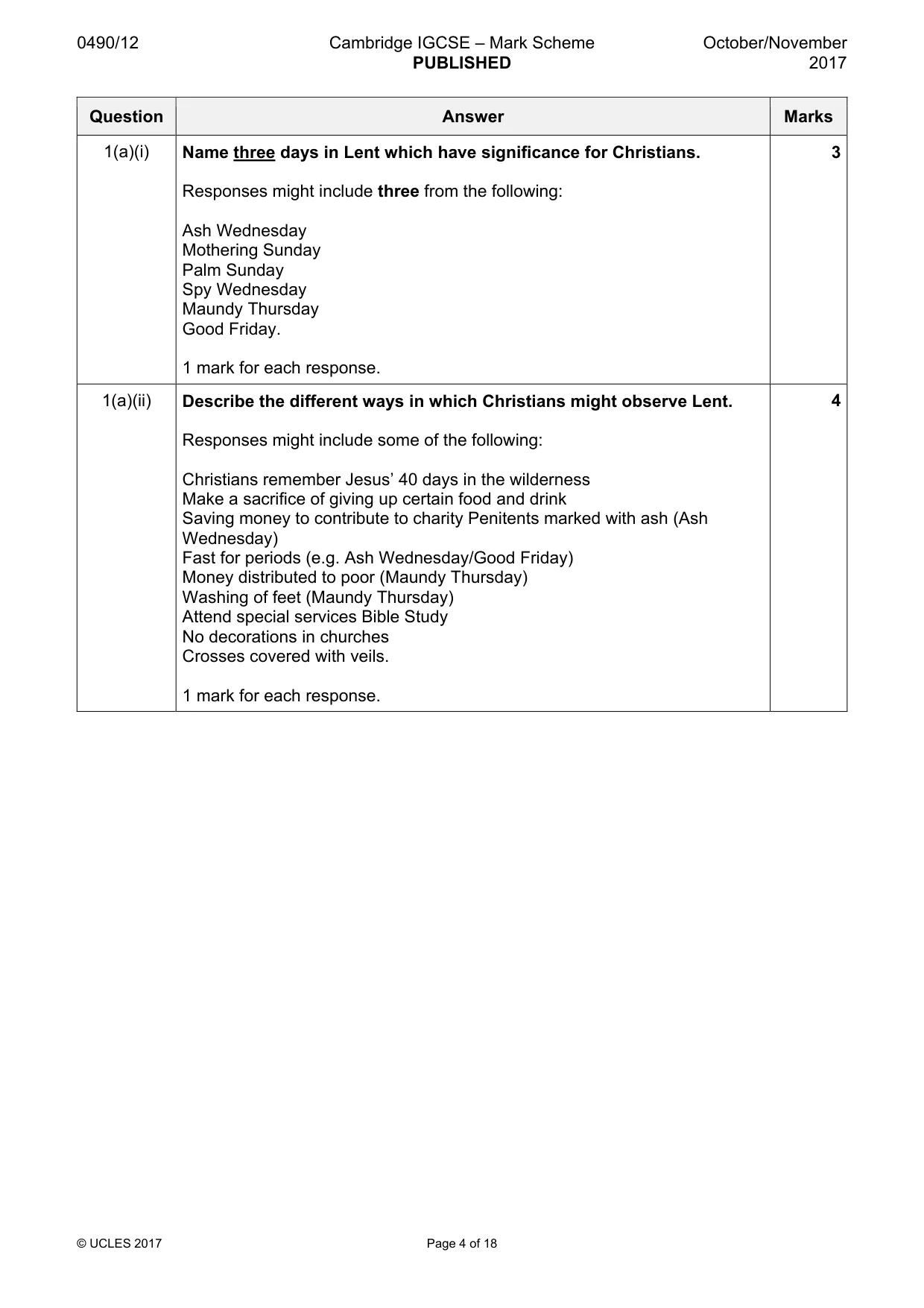
0490/12 Cambridge IGCSE – Mark Scheme PUBLISHED October/November 2017 © UCLES 2017 Page 4 of 18 Question Answer Marks 1(a)(i) Name three days in Lent which have significance for Christians. Responses might include three from the following: Ash Wednesday Mothering Sunday Palm Sunday Spy Wednesday Maundy Thursday Good Friday. 1 mark for each response. 3 1(a)(ii) Describe the different ways in which Christians might observe Lent. Responses might include some of the following: Christians remember Jesus’ 40 days in the wilderness Make a sacrifice of giving up certain food and drink Saving money to contribute to charity Penitents marked with ash (Ash Wednesday) Fast for periods (e.g. Ash Wednesday/Good Friday) Money distributed to poor (Maundy Thursday) Washing of feet (Maundy Thursday) Attend special services Bible Study No decorations in churches Crosses covered with veils. 1 mark for each response. 4
Mark scheme, page 5
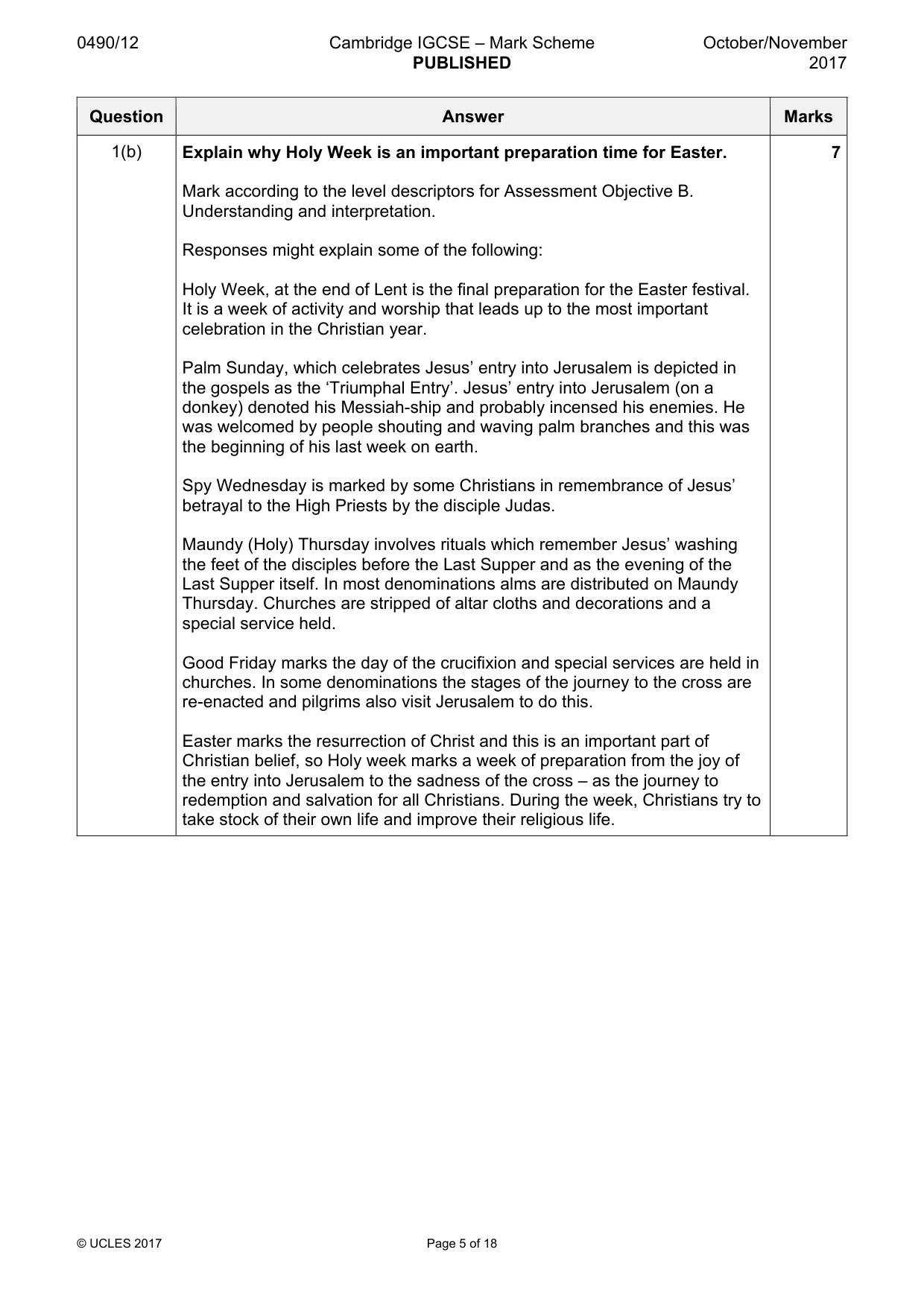
0490/12 Cambridge IGCSE – Mark Scheme PUBLISHED October/November 2017 © UCLES 2017 Page 5 of 18 Question Answer Marks 1(b) Explain why Holy Week is an important preparation time for Easter. Mark according to the level descriptors for Assessment Objective B. Understanding and interpretation. Responses might explain some of the following: Holy Week, at the end of Lent is the final preparation for the Easter festival. It is a week of activity and worship that leads up to the most important celebration in the Christian year. Palm Sunday, which celebrates Jesus’ entry into Jerusalem is depicted in the gospels as the ‘Triumphal Entry’. Jesus’ entry into Jerusalem (on a donkey) denoted his Messiah-ship and probably incensed his enemies. He was welcomed by people shouting and waving palm branches and this was the beginning of his last week on earth. Spy Wednesday is marked by some Christians in remembrance of Jesus’ betrayal to the High Priests by the disciple Judas. Maundy (Holy) Thursday involves rituals which remember Jesus’ washing the feet of the disciples before the Last Supper and as the evening of the Last Supper itself. In most denominations alms are distributed on Maundy Thursday. Churches are stripped of altar cloths and decorations and a special service held. Good Friday marks the day of the crucifixion and special services are held in churches. In some denominations the stages of the journey to the cross are re-enacted and pilgrims also visit Jerusalem to do this. Easter marks the resurrection of Christ and this is an important part of Christian belief, so Holy week marks a week of preparation from the joy of the entry into Jerusalem to the sadness of the cross – as the journey to redemption and salvation for all Christians. During the week, Christians try to take stock of their own life and improve their religious life. 7
Mark scheme, page 6
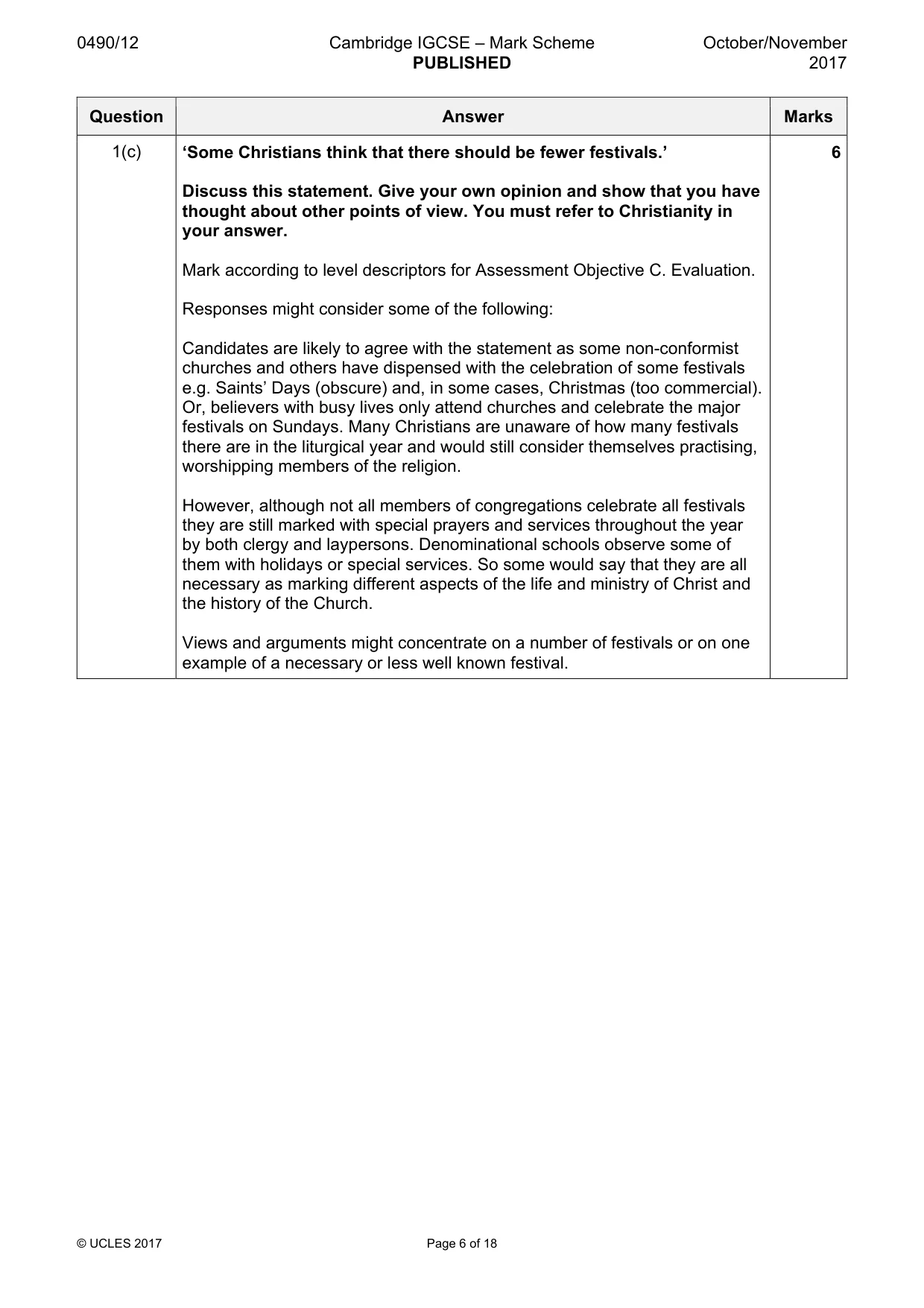
0490/12 Cambridge IGCSE – Mark Scheme PUBLISHED October/November 2017 © UCLES 2017 Page 6 of 18 Question Answer Marks 1(c) ‘Some Christians think that there should be fewer festivals.’ Discuss this statement. Give your own opinion and show that you have thought about other points of view. You must refer to Christianity in your answer. Mark according to level descriptors for Assessment Objective C. Evaluation. Responses might consider some of the following: Candidates are likely to agree with the statement as some non-conformist churches and others have dispensed with the celebration of some festivals e.g. Saints’ Days (obscure) and, in some cases, Christmas (too commercial). Or, believers with busy lives only attend churches and celebrate the major festivals on Sundays. Many Christians are unaware of how many festivals there are in the liturgical year and would still consider themselves practising, worshipping members of the religion. However, although not all members of congregations celebrate all festivals they are still marked with special prayers and services throughout the year by both clergy and laypersons. Denominational schools observe some of them with holidays or special services. So some would say that they are all necessary as marking different aspects of the life and ministry of Christ and the history of the Church. Views and arguments might concentrate on a number of festivals or on one example of a necessary or less well known festival. 6
Mark scheme, page 7
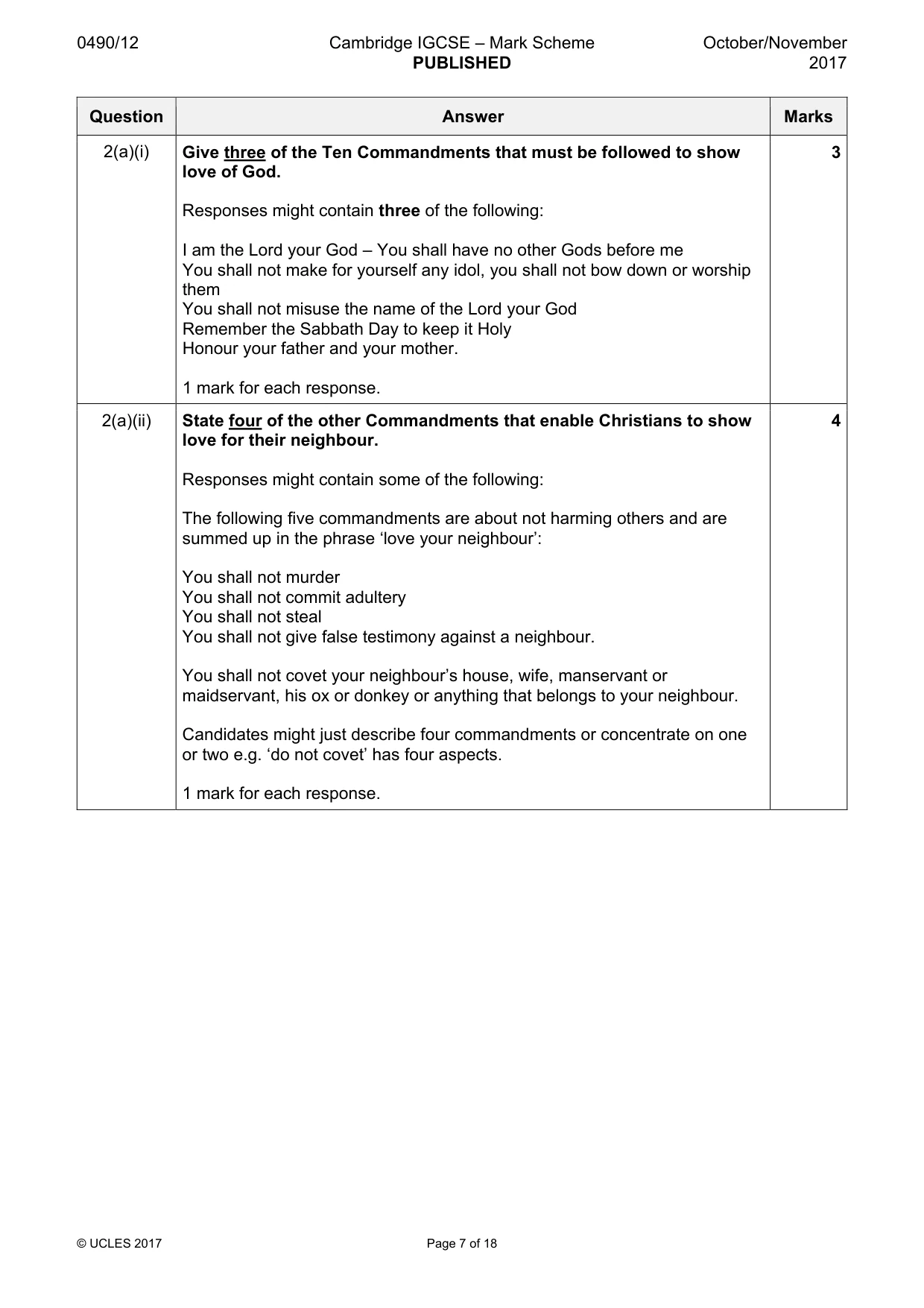
0490/12 Cambridge IGCSE – Mark Scheme PUBLISHED October/November 2017 © UCLES 2017 Page 7 of 18 Question Answer Marks 2(a)(i) Give three of the Ten Commandments that must be followed to show love of God. Responses might contain three of the following: I am the Lord your God – You shall have no other Gods before me You shall not make for yourself any idol, you shall not bow down or worship them You shall not misuse the name of the Lord your God Remember the Sabbath Day to keep it Holy Honour your father and your mother. 1 mark for each response. 3 2(a)(ii) State four of the other Commandments that enable Christians to show love for their neighbour. Responses might contain some of the following: The following five commandments are about not harming others and are summed up in the phrase ‘love your neighbour’: You shall not murder You shall not commit adultery You shall not steal You shall not give false testimony against a neighbour. You shall not covet your neighbour’s house, wife, manservant or maidservant, his ox or donkey or anything that belongs to your neighbour. Candidates might just describe four commandments or concentrate on one or two e.g. ‘do not covet’ has four aspects. 1 mark for each response. 4
Mark scheme, page 8
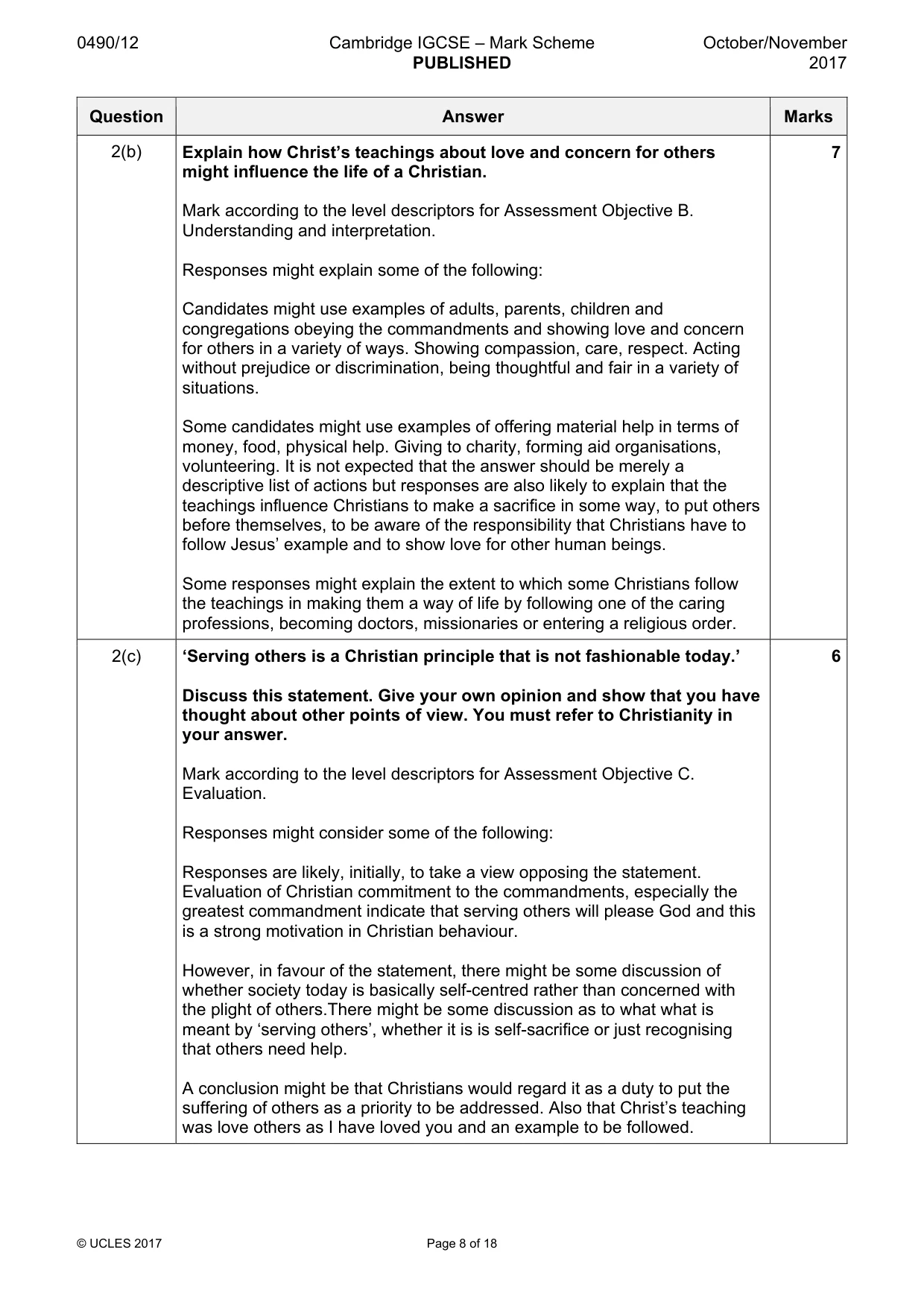
0490/12 Cambridge IGCSE – Mark Scheme PUBLISHED October/November 2017 © UCLES 2017 Page 8 of 18 Question Answer Marks 2(b) Explain how Christ’s teachings about love and concern for others might influence the life of a Christian. Mark according to the level descriptors for Assessment Objective B. Understanding and interpretation. Responses might explain some of the following: Candidates might use examples of adults, parents, children and congregations obeying the commandments and showing love and concern for others in a variety of ways. Showing compassion, care, respect. Acting without prejudice or discrimination, being thoughtful and fair in a variety of situations. Some candidates might use examples of offering material help in terms of money, food, physical help. Giving to charity, forming aid organisations, volunteering. It is not expected that the answer should be merely a descriptive list of actions but responses are also likely to explain that the teachings influence Christians to make a sacrifice in some way, to put others before themselves, to be aware of the responsibility that Christians have to follow Jesus’ example and to show love for other human beings. Some responses might explain the extent to which some Christians follow the teachings in making them a way of life by following one of the caring professions, becoming doctors, missionaries or entering a religious order. 7 2(c) ‘Serving others is a Christian principle that is not fashionable today.’ Discuss this statement. Give your own opinion and show that you have thought about other points of view. You must refer to Christianity in your answer. Mark according to the level descriptors for Assessment Objective C. Evaluation. Responses might consider some of the following: Responses are likely, initially, to take a view opposing the statement. Evaluation of Christian commitment to the commandments, especially the greatest commandment indicate that serving others will please God and this is a strong motivation in Christian behaviour. However, in favour of the statement, there might be some discussion of whether society today is basically self-centred rather than concerned with the plight of others.There might be some discussion as to what what is meant by ‘serving others’, whether it is is self-sacrifice or just recognising that others need help. A conclusion might be that Christians would regard it as a duty to put the suffering of others as a priority to be addressed. Also that Christ’s teaching was love others as I have loved you and an example to be followed. 6
Mark scheme, page 9
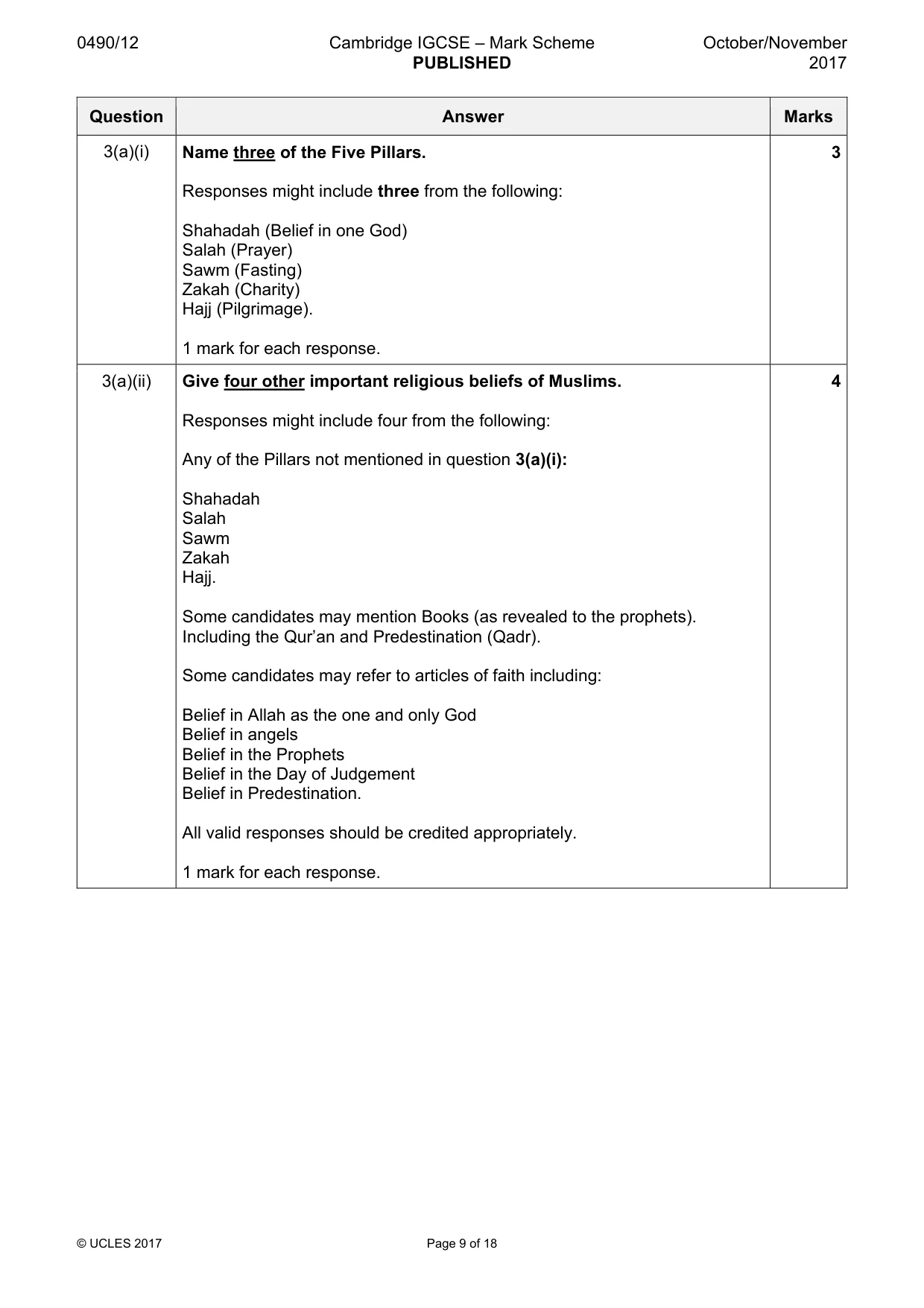
0490/12 Cambridge IGCSE – Mark Scheme PUBLISHED October/November 2017 © UCLES 2017 Page 9 of 18 Question Answer Marks 3(a)(i) Name three of the Five Pillars. Responses might include three from the following: Shahadah (Belief in one God) Salah (Prayer) Sawm (Fasting) Zakah (Charity) Hajj (Pilgrimage). 1 mark for each response. 3 3(a)(ii) Give four other important religious beliefs of Muslims. Responses might include four from the following: Any of the Pillars not mentioned in question 3(a)(i): Shahadah Salah Sawm Zakah Hajj. Some candidates may mention Books (as revealed to the prophets). Including the Qur’an and Predestination (Qadr). Some candidates may refer to articles of faith including: Belief in Allah as the one and only God Belief in angels Belief in the Prophets Belief in the Day of Judgement Belief in Predestination. All valid responses should be credited appropriately. 1 mark for each response. 4
Mark scheme, page 10
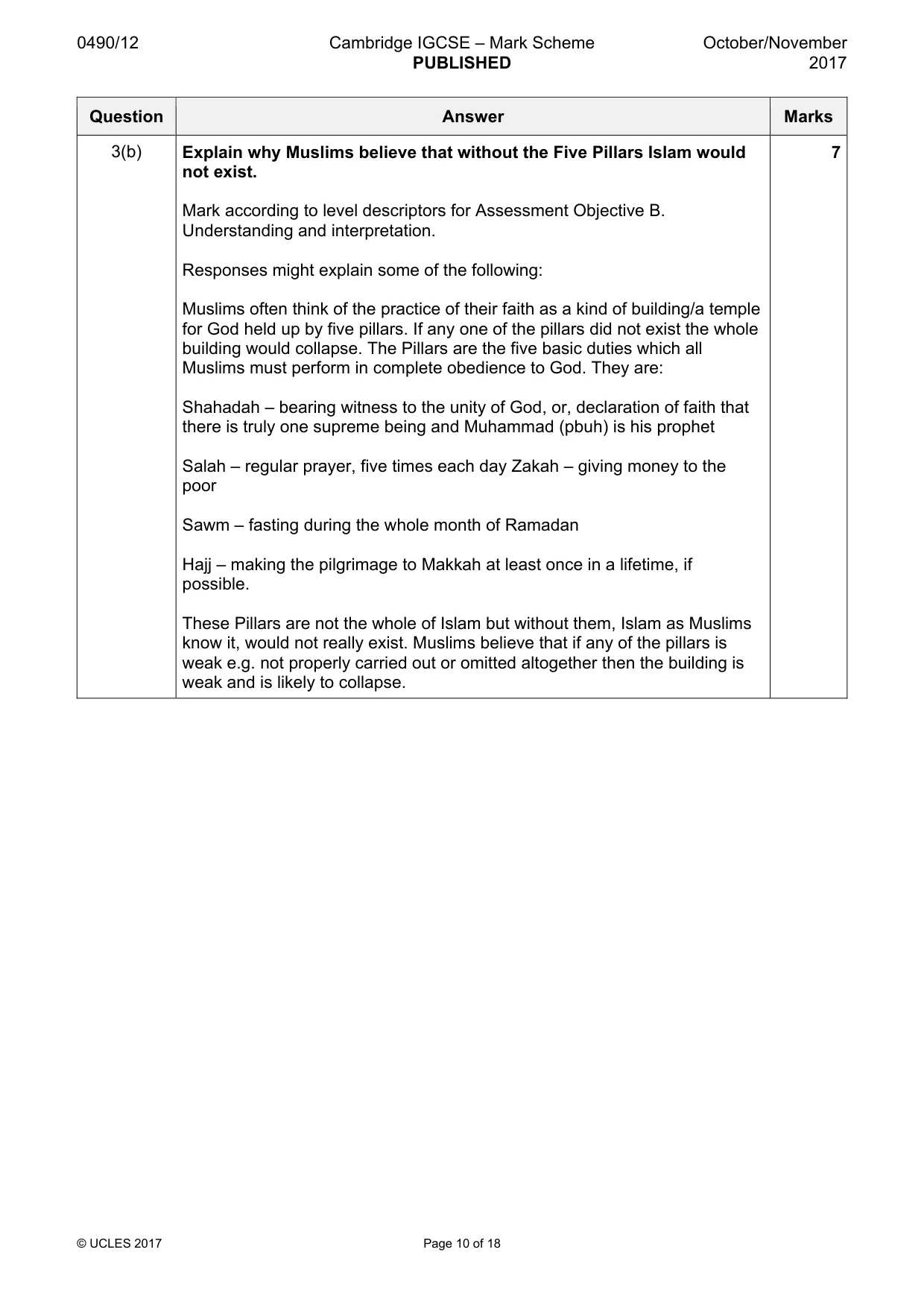
0490/12 Cambridge IGCSE – Mark Scheme PUBLISHED October/November 2017 © UCLES 2017 Page 10 of 18 Question Answer Marks 3(b) Explain why Muslims believe that without the Five Pillars Islam would not exist. Mark according to level descriptors for Assessment Objective B. Understanding and interpretation. Responses might explain some of the following: Muslims often think of the practice of their faith as a kind of building/a temple for God held up by five pillars. If any one of the pillars did not exist the whole building would collapse. The Pillars are the five basic duties which all Muslims must perform in complete obedience to God. They are: Shahadah – bearing witness to the unity of God, or, declaration of faith that there is truly one supreme being and Muhammad (pbuh) is his prophet Salah – regular prayer, five times each day Zakah – giving money to the poor Sawm – fasting during the whole month of Ramadan Hajj – making the pilgrimage to Makkah at least once in a lifetime, if possible. These Pillars are not the whole of Islam but without them, Islam as Muslims know it, would not really exist. Muslims believe that if any of the pillars is weak e.g. not properly carried out or omitted altogether then the building is weak and is likely to collapse. 7
Mark scheme, page 11
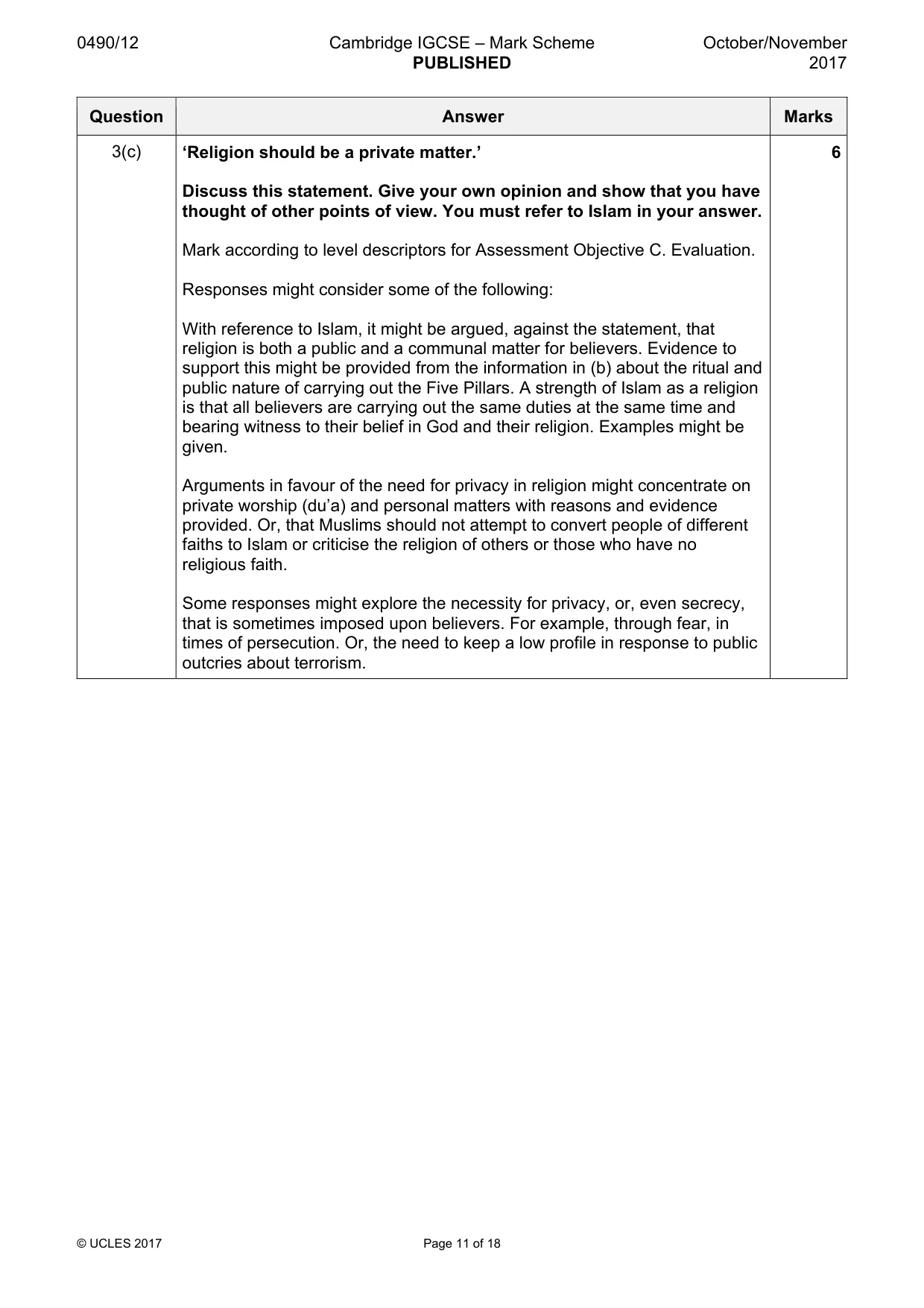
0490/12 Cambridge IGCSE – Mark Scheme PUBLISHED October/November 2017 © UCLES 2017 Page 11 of 18 Question Answer Marks 3(c) ‘Religion should be a private matter.’ Discuss this statement. Give your own opinion and show that you have thought of other points of view. You must refer to Islam in your answer. Mark according to level descriptors for Assessment Objective C. Evaluation. Responses might consider some of the following: With reference to Islam, it might be argued, against the statement, that religion is both a public and a communal matter for believers. Evidence to support this might be provided from the information in (b) about the ritual and public nature of carrying out the Five Pillars. A strength of Islam as a religion is that all believers are carrying out the same duties at the same time and bearing witness to their belief in God and their religion. Examples might be given. Arguments in favour of the need for privacy in religion might concentrate on private worship (du’a) and personal matters with reasons and evidence provided. Or, that Muslims should not attempt to convert people of different faiths to Islam or criticise the religion of others or those who have no religious faith. Some responses might explore the necessity for privacy, or, even secrecy, that is sometimes imposed upon believers. For example, through fear, in times of persecution. Or, the need to keep a low profile in response to public outcries about terrorism. 6
Mark scheme, page 12
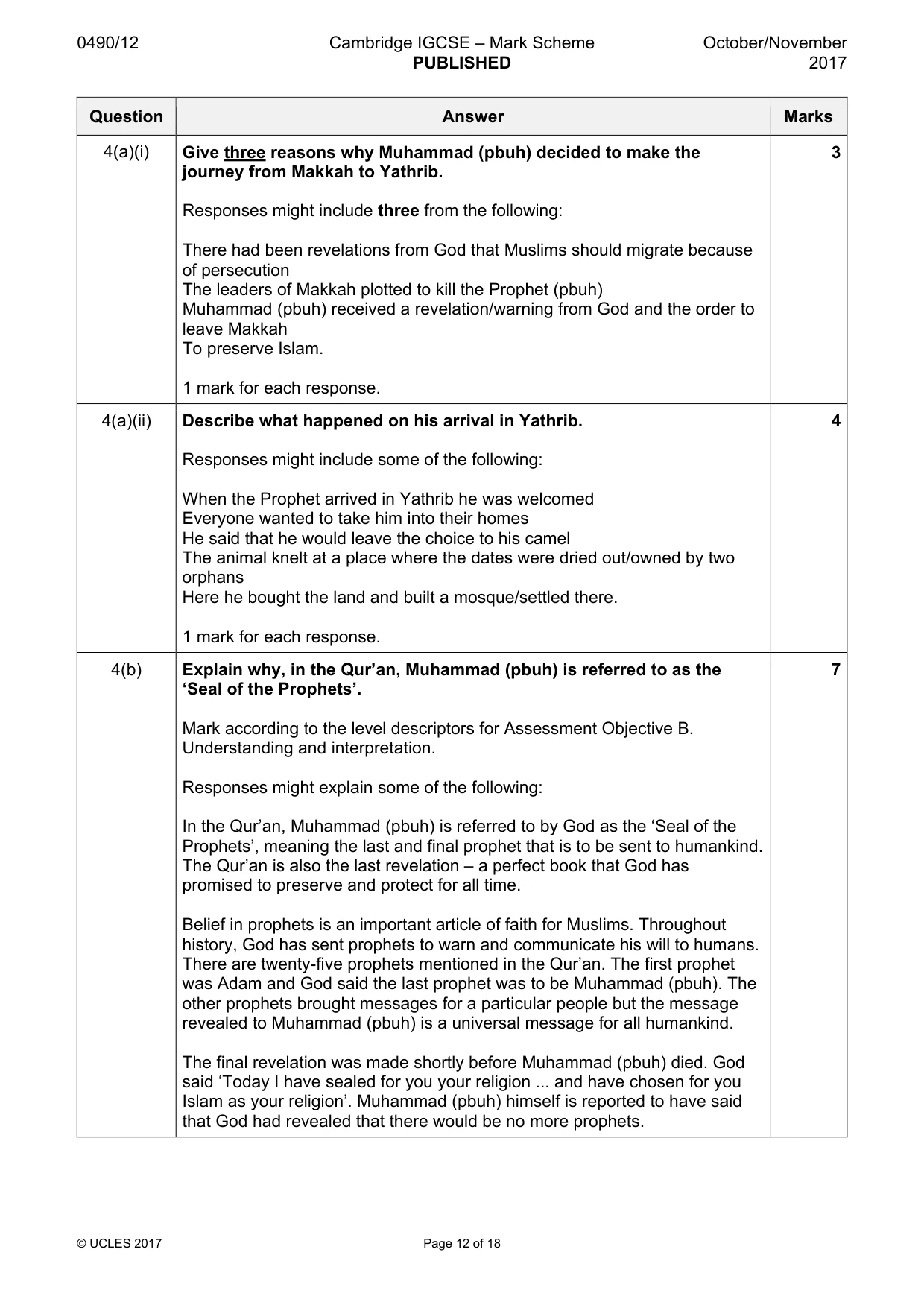
0490/12 Cambridge IGCSE – Mark Scheme PUBLISHED October/November 2017 © UCLES 2017 Page 12 of 18 Question Answer Marks 4(a)(i) Give three reasons why Muhammad (pbuh) decided to make the journey from Makkah to Yathrib. Responses might include three from the following: There had been revelations from God that Muslims should migrate because of persecution The leaders of Makkah plotted to kill the Prophet (pbuh) Muhammad (pbuh) received a revelation/warning from God and the order to leave Makkah To preserve Islam. 1 mark for each response. 3 4(a)(ii) Describe what happened on his arrival in Yathrib. Responses might include some of the following: When the Prophet arrived in Yathrib he was welcomed Everyone wanted to take him into their homes He said that he would leave the choice to his camel The animal knelt at a place where the dates were dried out/owned by two orphans Here he bought the land and built a mosque/settled there. 1 mark for each response. 4 4(b) Explain why, in the Qur’an, Muhammad (pbuh) is referred to as the ‘Seal of the Prophets’. Mark according to the level descriptors for Assessment Objective B. Understanding and interpretation. Responses might explain some of the following: In the Qur’an, Muhammad (pbuh) is referred to by God as the ‘Seal of the Prophets’, meaning the last and final prophet that is to be sent to humankind. The Qur’an is also the last revelation – a perfect book that God has promised to preserve and protect for all time. Belief in prophets is an important article of faith for Muslims. Throughout history, God has sent prophets to warn and communicate his will to humans. There are twenty-five prophets mentioned in the Qur’an. The first prophet was Adam and God said the last prophet was to be Muhammad (pbuh). The other prophets brought messages for a particular people but the message revealed to Muhammad (pbuh) is a universal message for all humankind. The final revelation was made shortly before Muhammad (pbuh) died. God said ‘Today I have sealed for you your religion ... and have chosen for you Islam as your religion’. Muhammad (pbuh) himself is reported to have said that God had revealed that there would be no more prophets. 7
Mark scheme, page 13
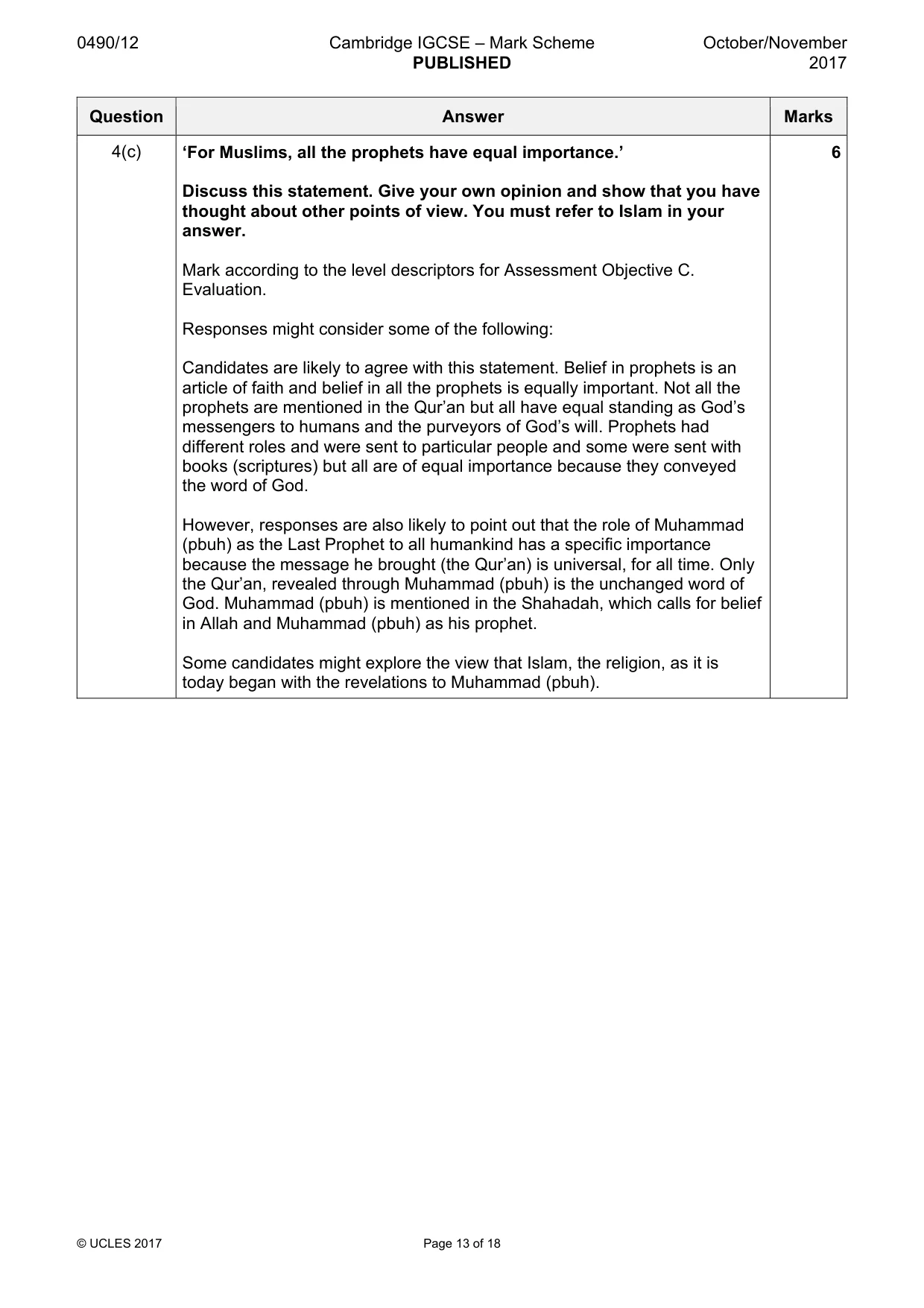
0490/12 Cambridge IGCSE – Mark Scheme PUBLISHED October/November 2017 © UCLES 2017 Page 13 of 18 Question Answer Marks 4(c) ‘For Muslims, all the prophets have equal importance.’ Discuss this statement. Give your own opinion and show that you have thought about other points of view. You must refer to Islam in your answer. Mark according to the level descriptors for Assessment Objective C. Evaluation. Responses might consider some of the following: Candidates are likely to agree with this statement. Belief in prophets is an article of faith and belief in all the prophets is equally important. Not all the prophets are mentioned in the Qur’an but all have equal standing as God’s messengers to humans and the purveyors of God’s will. Prophets had different roles and were sent to particular people and some were sent with books (scriptures) but all are of equal importance because they conveyed the word of God. However, responses are also likely to point out that the role of Muhammad (pbuh) as the Last Prophet to all humankind has a specific importance because the message he brought (the Qur’an) is universal, for all time. Only the Qur’an, revealed through Muhammad (pbuh) is the unchanged word of God. Muhammad (pbuh) is mentioned in the Shahadah, which calls for belief in Allah and Muhammad (pbuh) as his prophet. Some candidates might explore the view that Islam, the religion, as it is today began with the revelations to Muhammad (pbuh). 6
Mark scheme, page 14
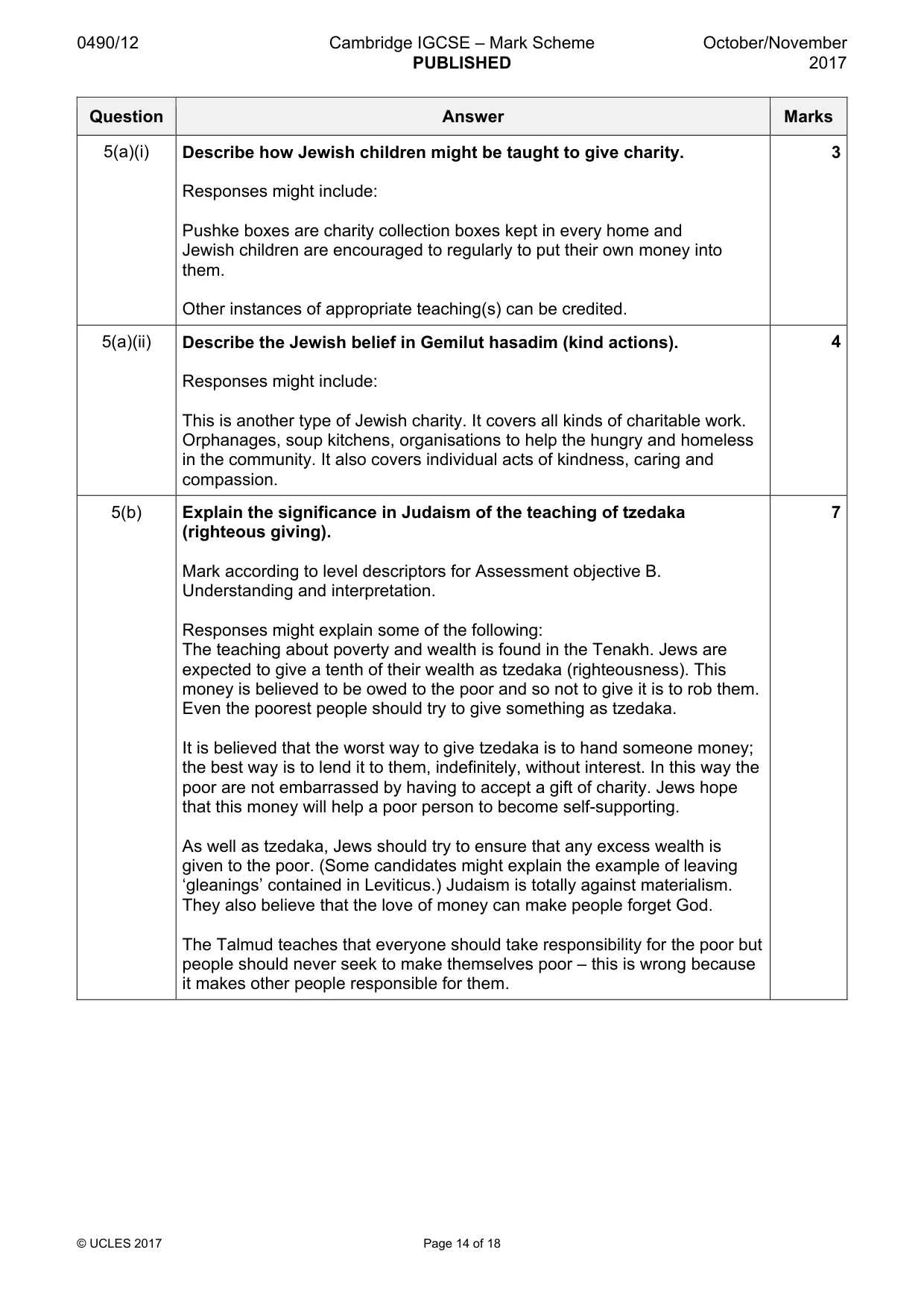
0490/12 Cambridge IGCSE – Mark Scheme PUBLISHED October/November 2017 © UCLES 2017 Page 14 of 18 Question Answer Marks 5(a)(i) Describe how Jewish children might be taught to give charity. Responses might include: Pushke boxes are charity collection boxes kept in every home and Jewish children are encouraged to regularly to put their own money into them. Other instances of appropriate teaching(s) can be credited. 3 5(a)(ii) Describe the Jewish belief in Gemilut hasadim (kind actions). Responses might include: This is another type of Jewish charity. It covers all kinds of charitable work. Orphanages, soup kitchens, organisations to help the hungry and homeless in the community. It also covers individual acts of kindness, caring and compassion. 4 5(b) Explain the significance in Judaism of the teaching of tzedaka (righteous giving). Mark according to level descriptors for Assessment objective B. Understanding and interpretation. Responses might explain some of the following: The teaching about poverty and wealth is found in the Tenakh. Jews are expected to give a tenth of their wealth as tzedaka (righteousness). This money is believed to be owed to the poor and so not to give it is to rob them. Even the poorest people should try to give something as tzedaka. It is believed that the worst way to give tzedaka is to hand someone money; the best way is to lend it to them, indefinitely, without interest. In this way the poor are not embarrassed by having to accept a gift of charity. Jews hope that this money will help a poor person to become self-supporting. As well as tzedaka, Jews should try to ensure that any excess wealth is given to the poor. (Some candidates might explain the example of leaving ‘gleanings’ contained in Leviticus.) Judaism is totally against materialism. They also believe that the love of money can make people forget God. The Talmud teaches that everyone should take responsibility for the poor but people should never seek to make themselves poor – this is wrong because it makes other people responsible for them. 7
Mark scheme, page 15
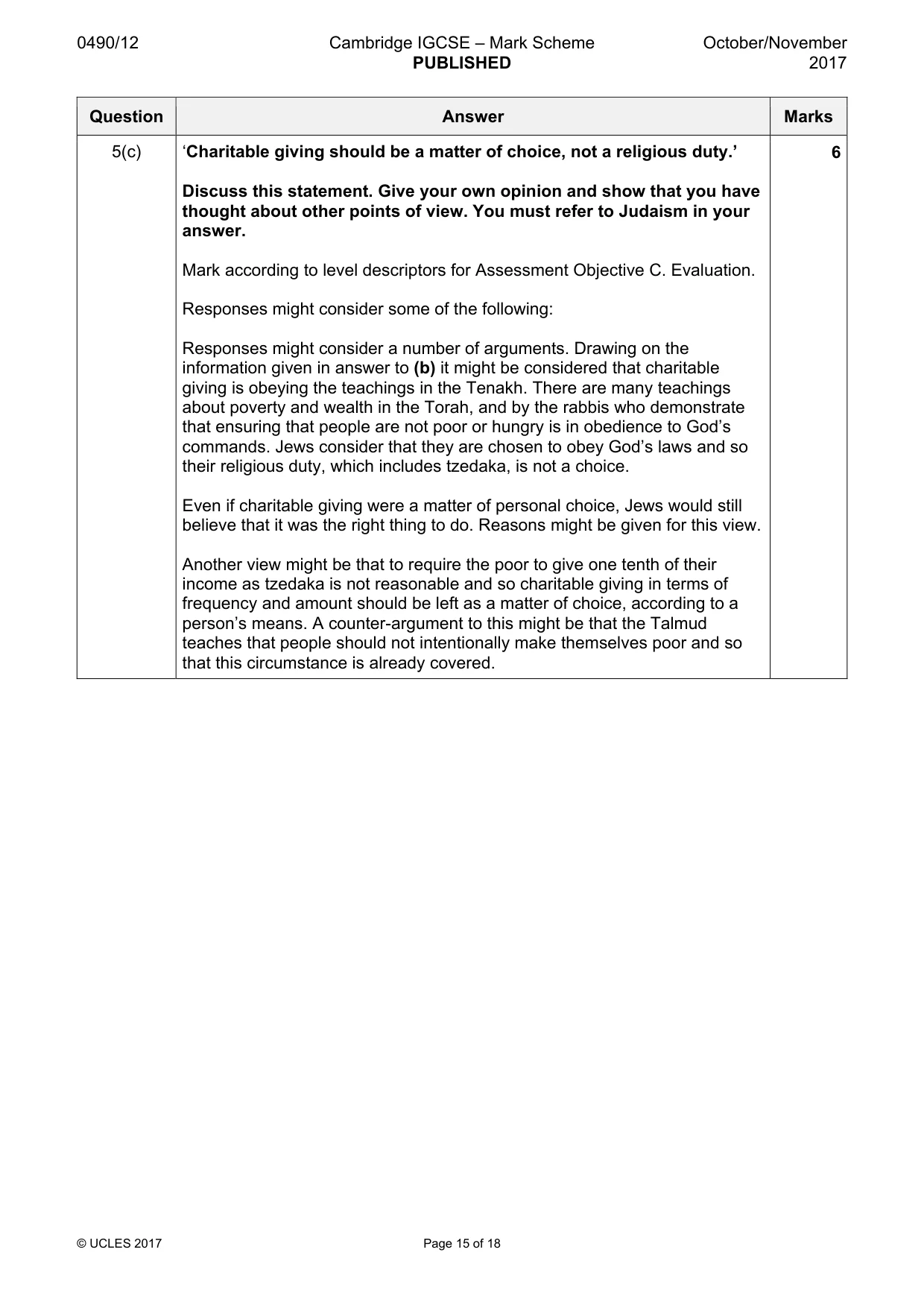
0490/12 Cambridge IGCSE – Mark Scheme PUBLISHED October/November 2017 © UCLES 2017 Page 15 of 18 Question Answer Marks 5(c) ‘Charitable giving should be a matter of choice, not a religious duty.’ Discuss this statement. Give your own opinion and show that you have thought about other points of view. You must refer to Judaism in your answer. Mark according to level descriptors for Assessment Objective C. Evaluation. Responses might consider some of the following: Responses might consider a number of arguments. Drawing on the information given in answer to (b) it might be considered that charitable giving is obeying the teachings in the Tenakh. There are many teachings about poverty and wealth in the Torah, and by the rabbis who demonstrate that ensuring that people are not poor or hungry is in obedience to God’s commands. Jews consider that they are chosen to obey God’s laws and so their religious duty, which includes tzedaka, is not a choice. Even if charitable giving were a matter of personal choice, Jews would still believe that it was the right thing to do. Reasons might be given for this view. Another view might be that to require the poor to give one tenth of their income as tzedaka is not reasonable and so charitable giving in terms of frequency and amount should be left as a matter of choice, according to a person’s means. A counter-argument to this might be that the Talmud teaches that people should not intentionally make themselves poor and so that this circumstance is already covered. 6
Mark scheme, page 16
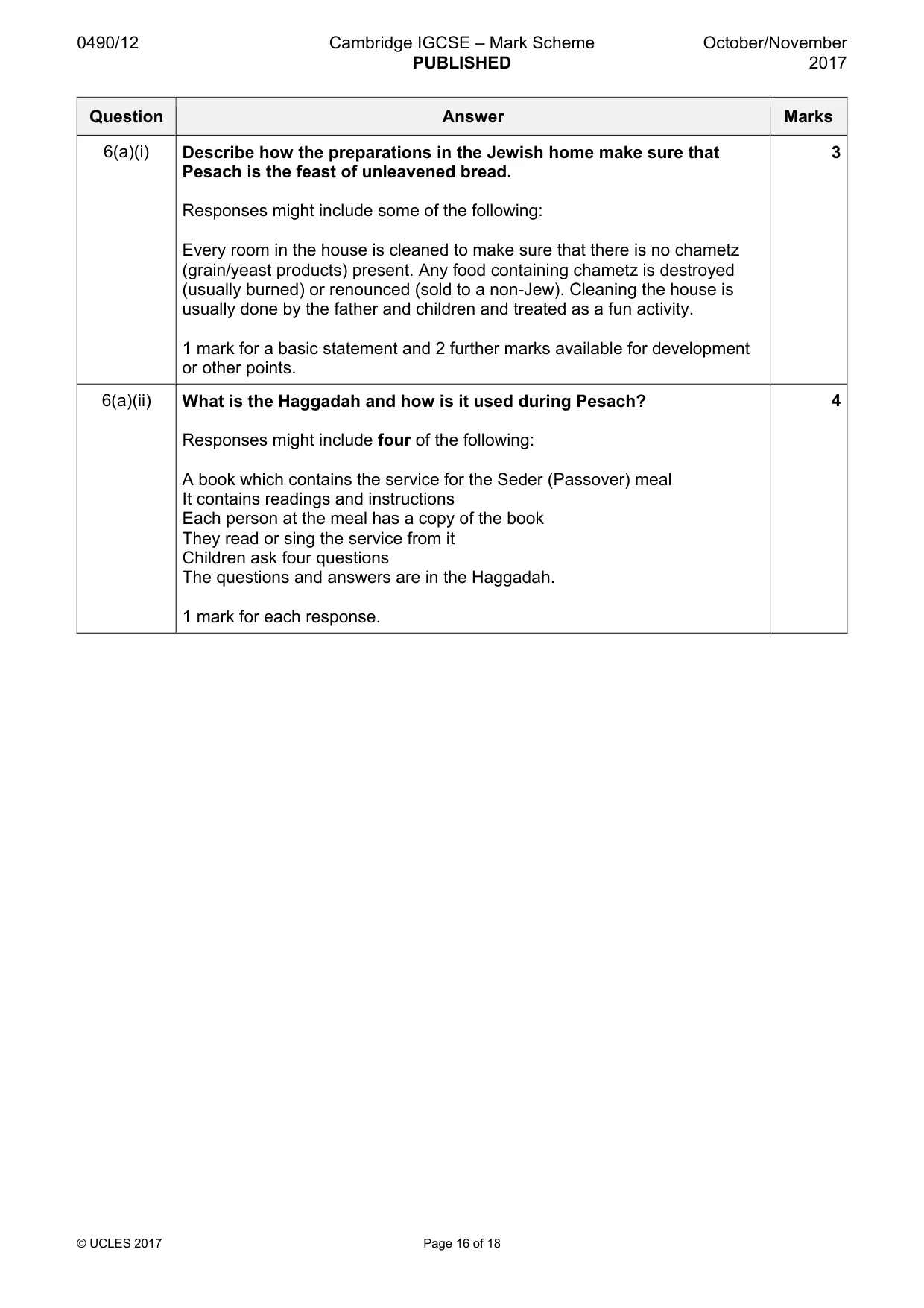
0490/12 Cambridge IGCSE – Mark Scheme PUBLISHED October/November 2017 © UCLES 2017 Page 16 of 18 Question Answer Marks 6(a)(i) Describe how the preparations in the Jewish home make sure that Pesach is the feast of unleavened bread. Responses might include some of the following: Every room in the house is cleaned to make sure that there is no chametz (grain/yeast products) present. Any food containing chametz is destroyed (usually burned) or renounced (sold to a non-Jew). Cleaning the house is usually done by the father and children and treated as a fun activity. 1 mark for a basic statement and 2 further marks available for development or other points. 3 6(a)(ii) What is the Haggadah and how is it used during Pesach? Responses might include four of the following: A book which contains the service for the Seder (Passover) meal It contains readings and instructions Each person at the meal has a copy of the book They read or sing the service from it Children ask four questions The questions and answers are in the Haggadah. 1 mark for each response. 4
Mark scheme, page 17
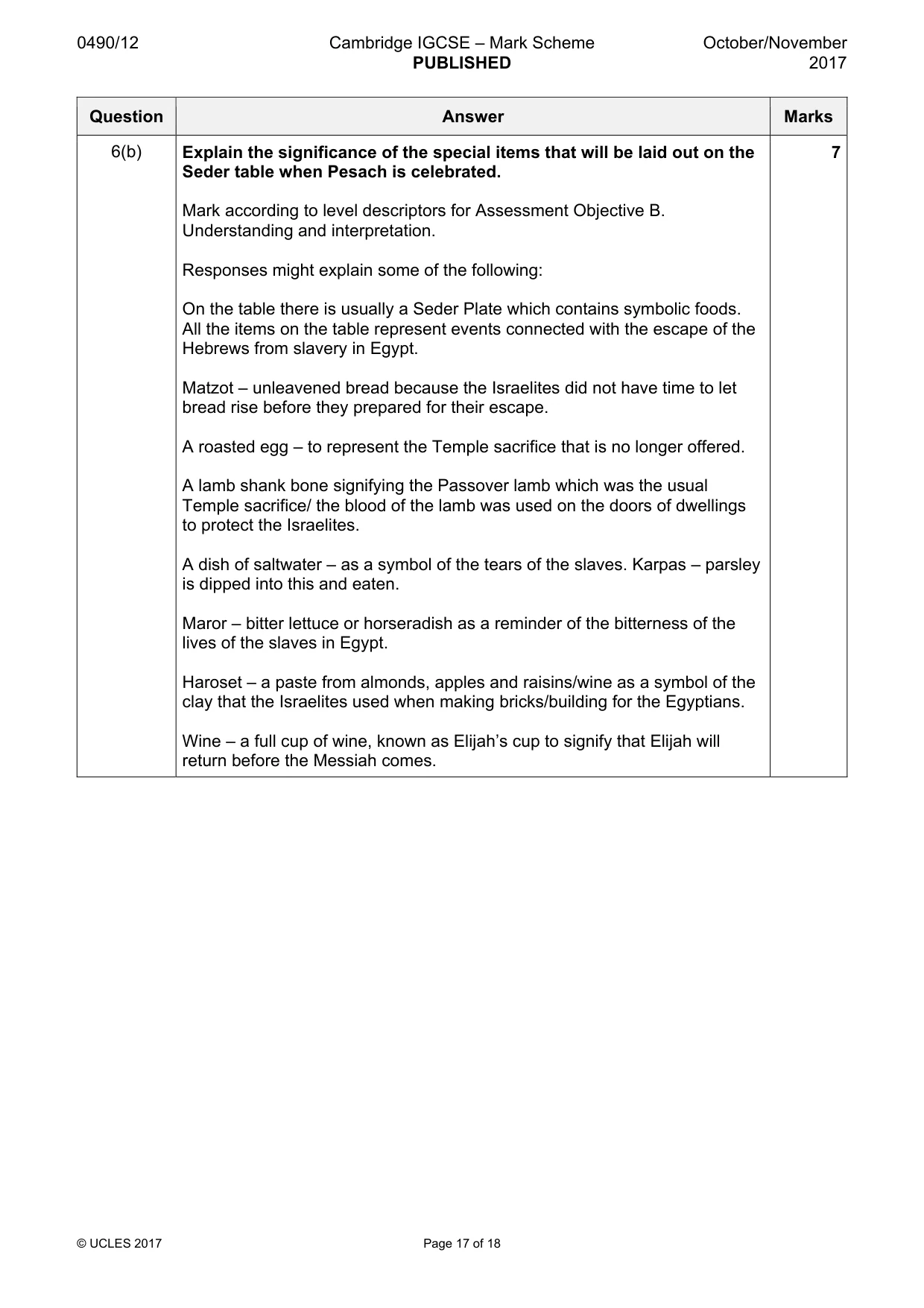
0490/12 Cambridge IGCSE – Mark Scheme PUBLISHED October/November 2017 © UCLES 2017 Page 17 of 18 Question Answer Marks 6(b) Explain the significance of the special items that will be laid out on the Seder table when Pesach is celebrated. Mark according to level descriptors for Assessment Objective B. Understanding and interpretation. Responses might explain some of the following: On the table there is usually a Seder Plate which contains symbolic foods. All the items on the table represent events connected with the escape of the Hebrews from slavery in Egypt. Matzot – unleavened bread because the Israelites did not have time to let bread rise before they prepared for their escape. A roasted egg – to represent the Temple sacrifice that is no longer offered. A lamb shank bone signifying the Passover lamb which was the usual Temple sacrifice/ the blood of the lamb was used on the doors of dwellings to protect the Israelites. A dish of saltwater – as a symbol of the tears of the slaves. Karpas – parsley is dipped into this and eaten. Maror – bitter lettuce or horseradish as a reminder of the bitterness of the lives of the slaves in Egypt. Haroset – a paste from almonds, apples and raisins/wine as a symbol of the clay that the Israelites used when making bricks/building for the Egyptians. Wine – a full cup of wine, known as Elijah’s cup to signify that Elijah will return before the Messiah comes. 7
Mark scheme, page 18
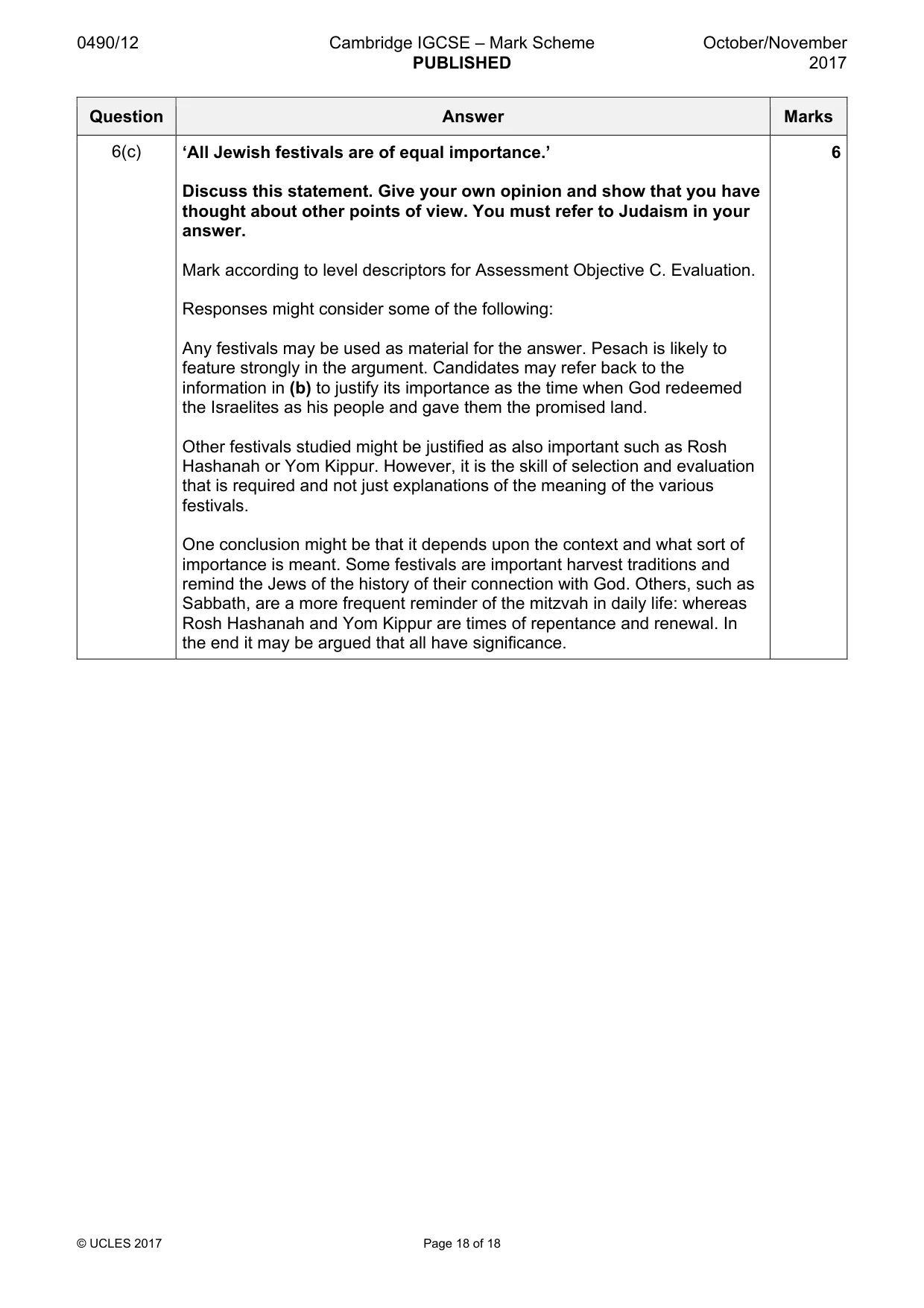
0490/12 Cambridge IGCSE – Mark Scheme PUBLISHED October/November 2017 © UCLES 2017 Page 18 of 18 Question Answer Marks 6(c) ‘All Jewish festivals are of equal importance.’ Discuss this statement. Give your own opinion and show that you have thought about other points of view. You must refer to Judaism in your answer. Mark according to level descriptors for Assessment Objective C. Evaluation. Responses might consider some of the following: Any festivals may be used as material for the answer. Pesach is likely to feature strongly in the argument. Candidates may refer back to the information in (b) to justify its importance as the time when God redeemed the Israelites as his people and gave them the promised land. Other festivals studied might be justified as also important such as Rosh Hashanah or Yom Kippur. However, it is the skill of selection and evaluation that is required and not just explanations of the meaning of the various festivals. One conclusion might be that it depends upon the context and what sort of importance is meant. Some festivals are important harvest traditions and remind the Jews of the history of their connection with God. Others, such as Sabbath, are a more frequent reminder of the mitzvah in daily life: whereas Rosh Hashanah and Yom Kippur are times of repentance and renewal. In the end it may be argued that all have significance. 6
What you needed in this session
Cambridge’s own grade thresholds for 2017 Oct/Nov, Paper 1 · Variant 2. A higher threshold means an easier paper — the bar moves with how the cohort did.