Cambridge IGCSE Religious Studies 0490 — 2017 Oct/Nov Paper 1 · Variant 1
0490/11/O/N/17 · 80 marks · ≈90 min
The question paper and its mark scheme, free to read here and free to download. This is Cambridge’s own paper, exactly as it was sat.
Question paper4 pages
Mark scheme11 pages
Answers below. Sit the paper first if you are practising.
Paper as text
Question paper, page 1
Cambridge International Examinations Cambridge International General Certificate of Secondary Education 0490/11 October/November 2017 1 hour 45 minutes RELIGIOUS STUDIES Paper 1 Additional Materials: Answer Booklet/Paper READ THESE INSTRUCTIONS FIRST An answer booklet is provided inside this question paper. You should follow the instructions on the front cover of the answer booklet. If you need additional answer paper ask the invigilator for a continuation booklet. Choose two of Sections A, B and C and answer all the questions in each of your chosen sections. The number of marks is given in brackets [ ] at the end of each question or part question. This document consists of 4 printed pages. [Turn over 11_0490_11_2017_1.1 © UCLES 2017 *7560836627*
Question paper, page 2
Choose two of Sections A, B and C and answer all the questions in each of your chosen sections. Section A – Christianity If you have chosen this section, answer all the questions. Name four symbols used during a baptism ceremony. [4] (i) (a) 1 Describe three promises made by the parents or godparents at an infant baptism. [3] (ii) Explain why Christians think baptism is an important rite. [7] (b) ‘Believers who are baptised as infants are stronger Christians.’ Discuss this statement. Give your own opinion and show that you have thought about other points of view. You must refer to Christianity in your answer. [6] (c) 2 ‘…remembering the words the Lord Jesus himself said: “It is more blessed to give than to receive.”’ Acts 20:35 – NIV Explain what is meant by tithing. [3] (i) (a) How might Christians fulfil their duty to care for others? [4] (ii) Explain why Christians think caring for others is important. [7] (b) ‘A man’s responsibility is to look after his family, not to worry about the suffering of others.’ Discuss this statement. Give your own opinion and show that you have thought about other points of view. You must refer to Christianity in your answer. [6] (c) 11_0490_11_2017_1.1 © UCLES 2017 2
Question paper, page 3
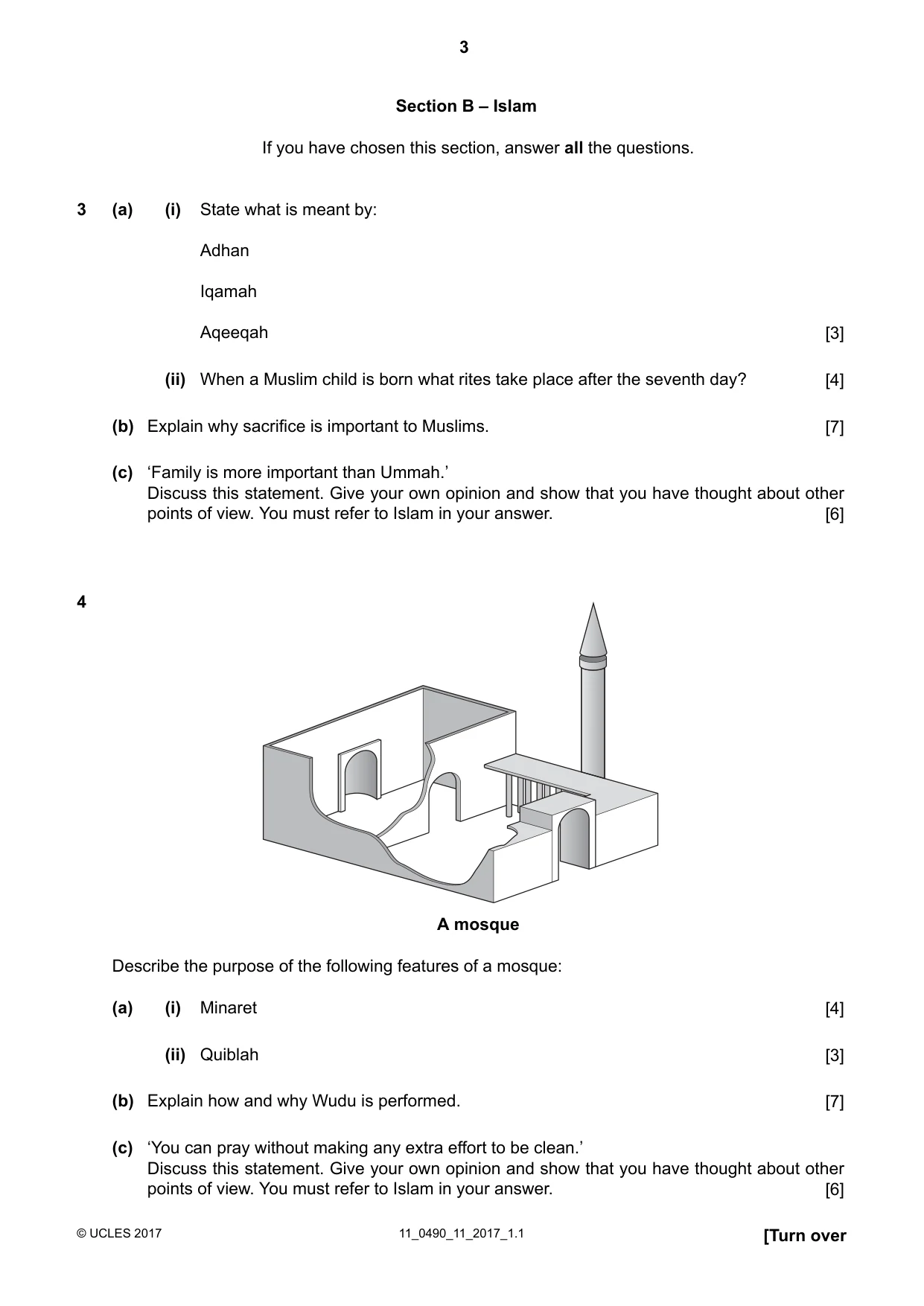
Section B – Islam If you have chosen this section, answer all the questions. State what is meant by: Adhan Iqamah Aqeeqah [3] (i) (a) 3 When a Muslim child is born what rites take place after the seventh day? [4] (ii) Explain why sacrifice is important to Muslims. [7] (b) ‘Family is more important than Ummah.’ Discuss this statement. Give your own opinion and show that you have thought about other points of view. You must refer to Islam in your answer. [6] (c) 4 A mosque Describe the purpose of the following features of a mosque: Minaret [4] (i) (a) Quiblah [3] (ii) Explain how and why Wudu is performed. [7] (b) ‘You can pray without making any extra effort to be clean.’ Discuss this statement. Give your own opinion and show that you have thought about other points of view. You must refer to Islam in your answer. [6] (c) [Turn over 11_0490_11_2017_1.1 © UCLES 2017 3
Question paper, page 4
Section C – Judaism If you have chosen this section, answer all the questions. 5 ‘Tzedaka is equal to all the other commandments combined.’ (Bava Bathra 9b) What is the Shema? [3] (i) (a) Describe how the Shema is part of the daily life of a Jew. [4] (ii) Explain the importance of the Mishnah to Jews. [7] (b) ‘Sacred writings are not relevant in the modern world.’ Discuss this statement. Give your own opinion and show that you have thought about other points of view. You must refer to Judaism in your answer. [6] (c) How might a Jewish girl prepare for Bat Mitzvah? [3] (i) (a) 6 Describe what happens at a Bat Mitzvah. [4] (ii) Explain the importance of religious rituals to Jewish men and women. [7] (b) ‘Religious rituals are more relevant to men than women in Judaism.’ Discuss this statement. Give your own opinion and show that you have thought about other points of view. You must refer to Judaism in your answer. [6] (c) Permission to reproduce items where third-party owned material protected by copyright is included has been sought and cleared where possible. Every reasonable effort has been made by the publisher (UCLES) to trace copyright holders, but if any items requiring clearance have unwittingly been included, the publisher will be pleased to make amends at the earliest possible opportunity. To avoid the issue of disclosure of answer-related information to candidates, all copyright acknowledgements are reproduced online in the Cambridge International Examinations Copyright Acknowledgements Booklet. This is produced for each series of examinations and is freely available to download at www.cie.org.uk after the live examination series. Cambridge International Examinations is part of the Cambridge Assessment Group. Cambridge Assessment is the brand name of University of Cambridge Local Examinations Syndicate (UCLES), which is itself a department of the University of Cambridge. 11_0490_11_2017_1.1 © UCLES 2017 4
Mark scheme, page 1
® IGCSE is a registered trademark. This document consists of 11 printed pages. © UCLES 2017 [Turn over Cambridge Assessment International Education Cambridge International General Certificate of Secondary Education RELIGIOUS STUDIES 0490/11 Paper 1 October/November 2017 MARK SCHEME Maximum Mark: 80 Published This mark scheme is published as an aid to teachers and candidates, to indicate the requirements of the examination. It shows the basis on which Examiners were instructed to award marks. It does not indicate the details of the discussions that took place at an Examiners’ meeting before marking began, which would have considered the acceptability of alternative answers. Mark schemes should be read in conjunction with the question paper and the Principal Examiner Report for Teachers. Cambridge International will not enter into discussions about these mark schemes. Cambridge International is publishing the mark schemes for the October/November 2017 series for most Cambridge IGCSE®, Cambridge International A and AS Level components and some Cambridge O Level components.
Mark scheme, page 2
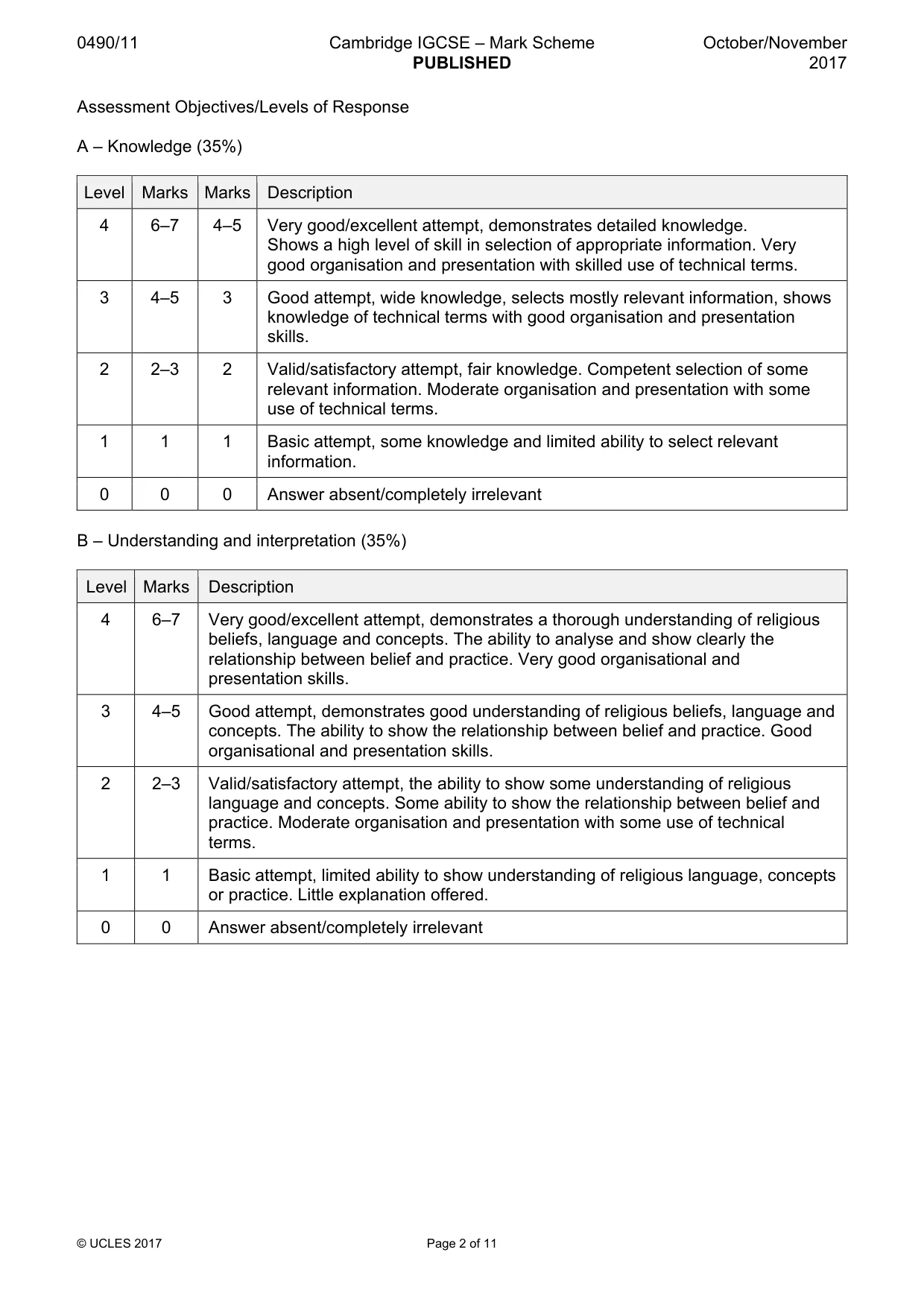
0490/11 Cambridge IGCSE – Mark Scheme PUBLISHED October/November 2017 © UCLES 2017 Page 2 of 11 Assessment Objectives/Levels of Response A – Knowledge (35%) Level Marks Marks Description 4 6–7 4–5 Very good/excellent attempt, demonstrates detailed knowledge. Shows a high level of skill in selection of appropriate information. Very good organisation and presentation with skilled use of technical terms. 3 4–5 3 Good attempt, wide knowledge, selects mostly relevant information, shows knowledge of technical terms with good organisation and presentation skills. 2 2–3 2 Valid/satisfactory attempt, fair knowledge. Competent selection of some relevant information. Moderate organisation and presentation with some use of technical terms. 1 1 1 Basic attempt, some knowledge and limited ability to select relevant information. 0 0 0 Answer absent/completely irrelevant B – Understanding and interpretation (35%) Level Marks Description 4 6–7 Very good/excellent attempt, demonstrates a thorough understanding of religious beliefs, language and concepts. The ability to analyse and show clearly the relationship between belief and practice. Very good organisational and presentation skills. 3 4–5 Good attempt, demonstrates good understanding of religious beliefs, language and concepts. The ability to show the relationship between belief and practice. Good organisational and presentation skills. 2 2–3 Valid/satisfactory attempt, the ability to show some understanding of religious language and concepts. Some ability to show the relationship between belief and practice. Moderate organisation and presentation with some use of technical terms. 1 1 Basic attempt, limited ability to show understanding of religious language, concepts or practice. Little explanation offered. 0 0 Answer absent/completely irrelevant
Mark scheme, page 3
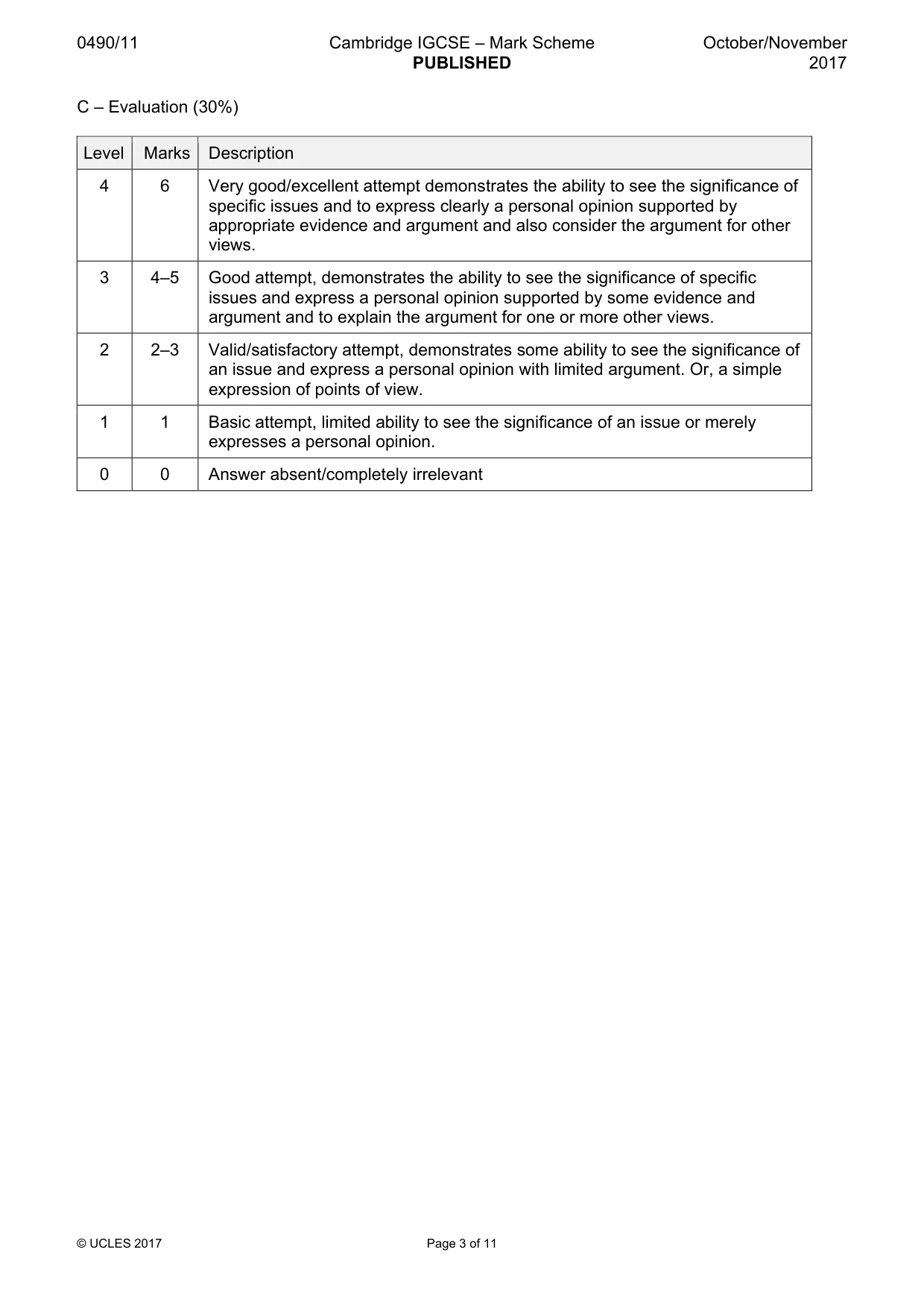
0490/11 Cambridge IGCSE – Mark Scheme PUBLISHED October/November 2017 © UCLES 2017 Page 3 of 11 C – Evaluation (30%) Level Marks Description 4 6 Very good/excellent attempt demonstrates the ability to see the significance of specific issues and to express clearly a personal opinion supported by appropriate evidence and argument and also consider the argument for other views. 3 4–5 Good attempt, demonstrates the ability to see the significance of specific issues and express a personal opinion supported by some evidence and argument and to explain the argument for one or more other views. 2 2–3 Valid/satisfactory attempt, demonstrates some ability to see the significance of an issue and express a personal opinion with limited argument. Or, a simple expression of points of view. 1 1 Basic attempt, limited ability to see the significance of an issue or merely expresses a personal opinion. 0 0 Answer absent/completely irrelevant
Mark scheme, page 4
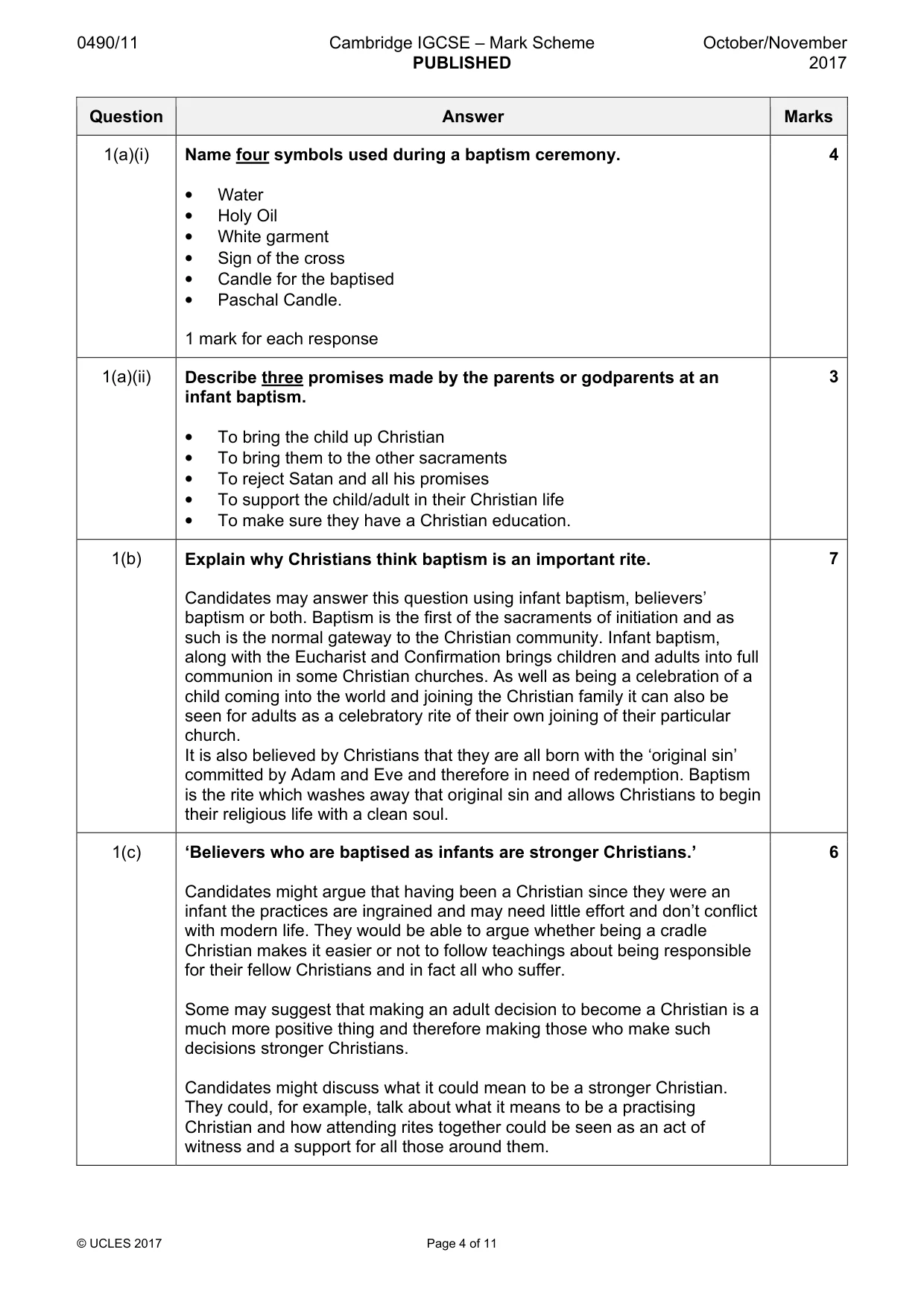
0490/11 Cambridge IGCSE – Mark Scheme PUBLISHED October/November 2017 © UCLES 2017 Page 4 of 11 Question Answer Marks 1(a)(i) Name four symbols used during a baptism ceremony. • Water • Holy Oil • White garment • Sign of the cross • Candle for the baptised • Paschal Candle. 1 mark for each response 4 1(a)(ii) Describe three promises made by the parents or godparents at an infant baptism. • To bring the child up Christian • To bring them to the other sacraments • To reject Satan and all his promises • To support the child/adult in their Christian life • To make sure they have a Christian education. 3 1(b) Explain why Christians think baptism is an important rite. Candidates may answer this question using infant baptism, believers’ baptism or both. Baptism is the first of the sacraments of initiation and as such is the normal gateway to the Christian community. Infant baptism, along with the Eucharist and Confirmation brings children and adults into full communion in some Christian churches. As well as being a celebration of a child coming into the world and joining the Christian family it can also be seen for adults as a celebratory rite of their own joining of their particular church. It is also believed by Christians that they are all born with the ‘original sin’ committed by Adam and Eve and therefore in need of redemption. Baptism is the rite which washes away that original sin and allows Christians to begin their religious life with a clean soul. 7 1(c) ‘Believers who are baptised as infants are stronger Christians.’ Candidates might argue that having been a Christian since they were an infant the practices are ingrained and may need little effort and don’t conflict with modern life. They would be able to argue whether being a cradle Christian makes it easier or not to follow teachings about being responsible for their fellow Christians and in fact all who suffer. Some may suggest that making an adult decision to become a Christian is a much more positive thing and therefore making those who make such decisions stronger Christians. Candidates might discuss what it could mean to be a stronger Christian. They could, for example, talk about what it means to be a practising Christian and how attending rites together could be seen as an act of witness and a support for all those around them. 6
Mark scheme, page 5
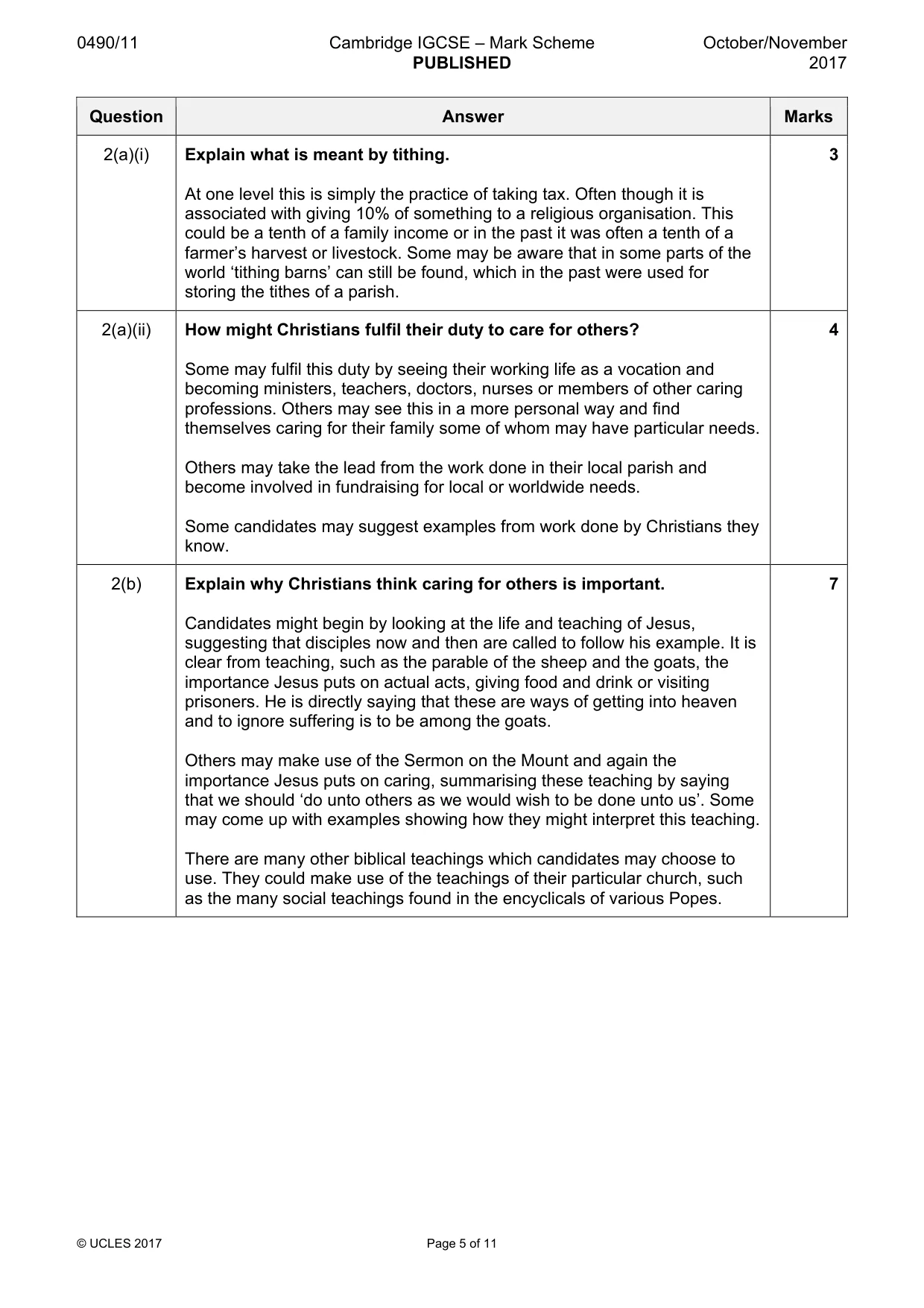
0490/11 Cambridge IGCSE – Mark Scheme PUBLISHED October/November 2017 © UCLES 2017 Page 5 of 11 Question Answer Marks 2(a)(i) Explain what is meant by tithing. At one level this is simply the practice of taking tax. Often though it is associated with giving 10% of something to a religious organisation. This could be a tenth of a family income or in the past it was often a tenth of a farmer’s harvest or livestock. Some may be aware that in some parts of the world ‘tithing barns’ can still be found, which in the past were used for storing the tithes of a parish. 3 2(a)(ii) How might Christians fulfil their duty to care for others? Some may fulfil this duty by seeing their working life as a vocation and becoming ministers, teachers, doctors, nurses or members of other caring professions. Others may see this in a more personal way and find themselves caring for their family some of whom may have particular needs. Others may take the lead from the work done in their local parish and become involved in fundraising for local or worldwide needs. Some candidates may suggest examples from work done by Christians they know. 4 2(b) Explain why Christians think caring for others is important. Candidates might begin by looking at the life and teaching of Jesus, suggesting that disciples now and then are called to follow his example. It is clear from teaching, such as the parable of the sheep and the goats, the importance Jesus puts on actual acts, giving food and drink or visiting prisoners. He is directly saying that these are ways of getting into heaven and to ignore suffering is to be among the goats. Others may make use of the Sermon on the Mount and again the importance Jesus puts on caring, summarising these teaching by saying that we should ‘do unto others as we would wish to be done unto us’. Some may come up with examples showing how they might interpret this teaching. There are many other biblical teachings which candidates may choose to use. They could make use of the teachings of their particular church, such as the many social teachings found in the encyclicals of various Popes. 7
Mark scheme, page 6
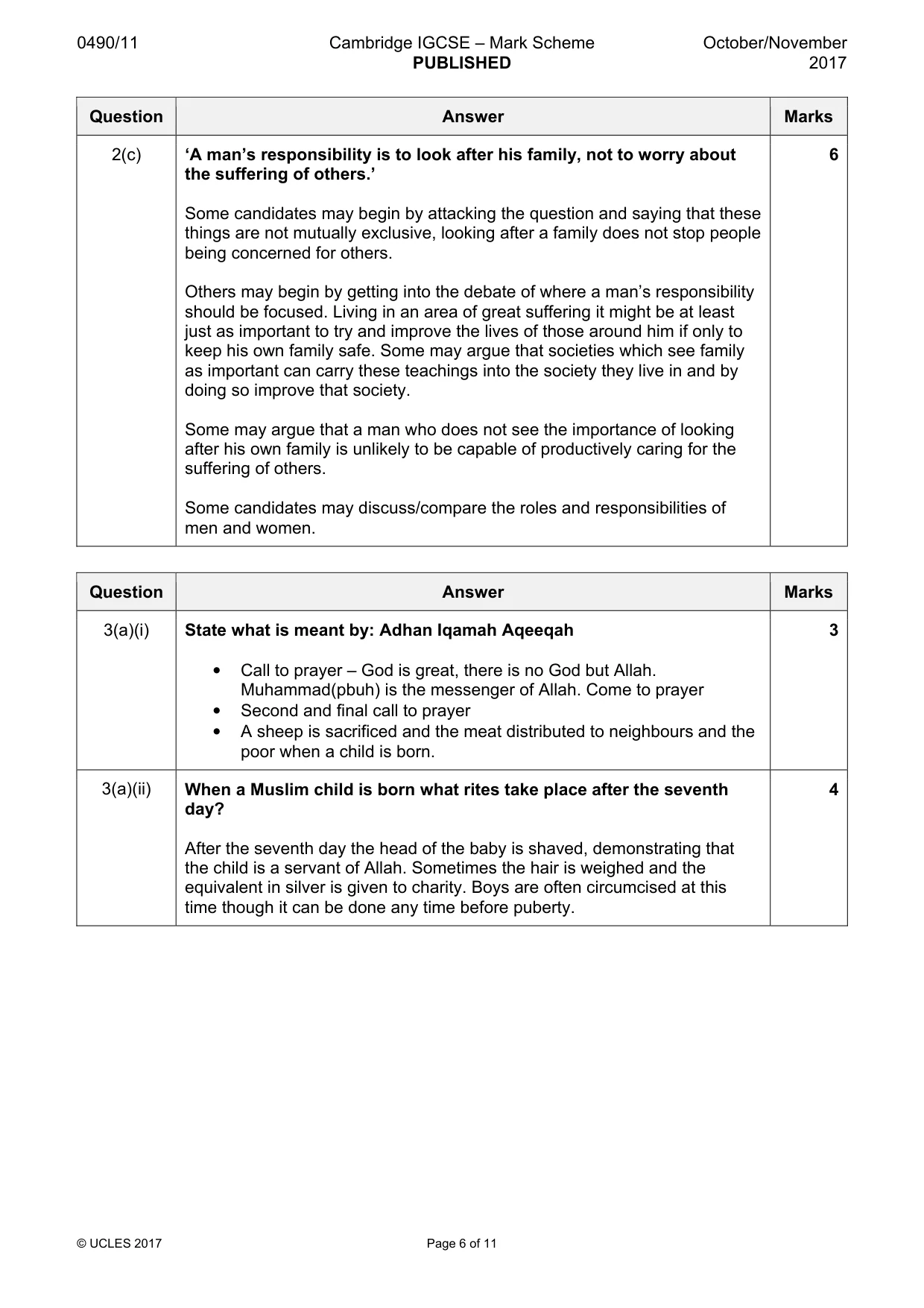
0490/11 Cambridge IGCSE – Mark Scheme PUBLISHED October/November 2017 © UCLES 2017 Page 6 of 11 Question Answer Marks 2(c) ‘A man’s responsibility is to look after his family, not to worry about the suffering of others.’ Some candidates may begin by attacking the question and saying that these things are not mutually exclusive, looking after a family does not stop people being concerned for others. Others may begin by getting into the debate of where a man’s responsibility should be focused. Living in an area of great suffering it might be at least just as important to try and improve the lives of those around him if only to keep his own family safe. Some may argue that societies which see family as important can carry these teachings into the society they live in and by doing so improve that society. Some may argue that a man who does not see the importance of looking after his own family is unlikely to be capable of productively caring for the suffering of others. Some candidates may discuss/compare the roles and responsibilities of men and women. 6 Question Answer Marks 3(a)(i) State what is meant by: Adhan Iqamah Aqeeqah • Call to prayer – God is great, there is no God but Allah. Muhammad(pbuh) is the messenger of Allah. Come to prayer • Second and final call to prayer • A sheep is sacrificed and the meat distributed to neighbours and the poor when a child is born. 3 3(a)(ii) When a Muslim child is born what rites take place after the seventh day? After the seventh day the head of the baby is shaved, demonstrating that the child is a servant of Allah. Sometimes the hair is weighed and the equivalent in silver is given to charity. Boys are often circumcised at this time though it can be done any time before puberty. 4
Mark scheme, page 7
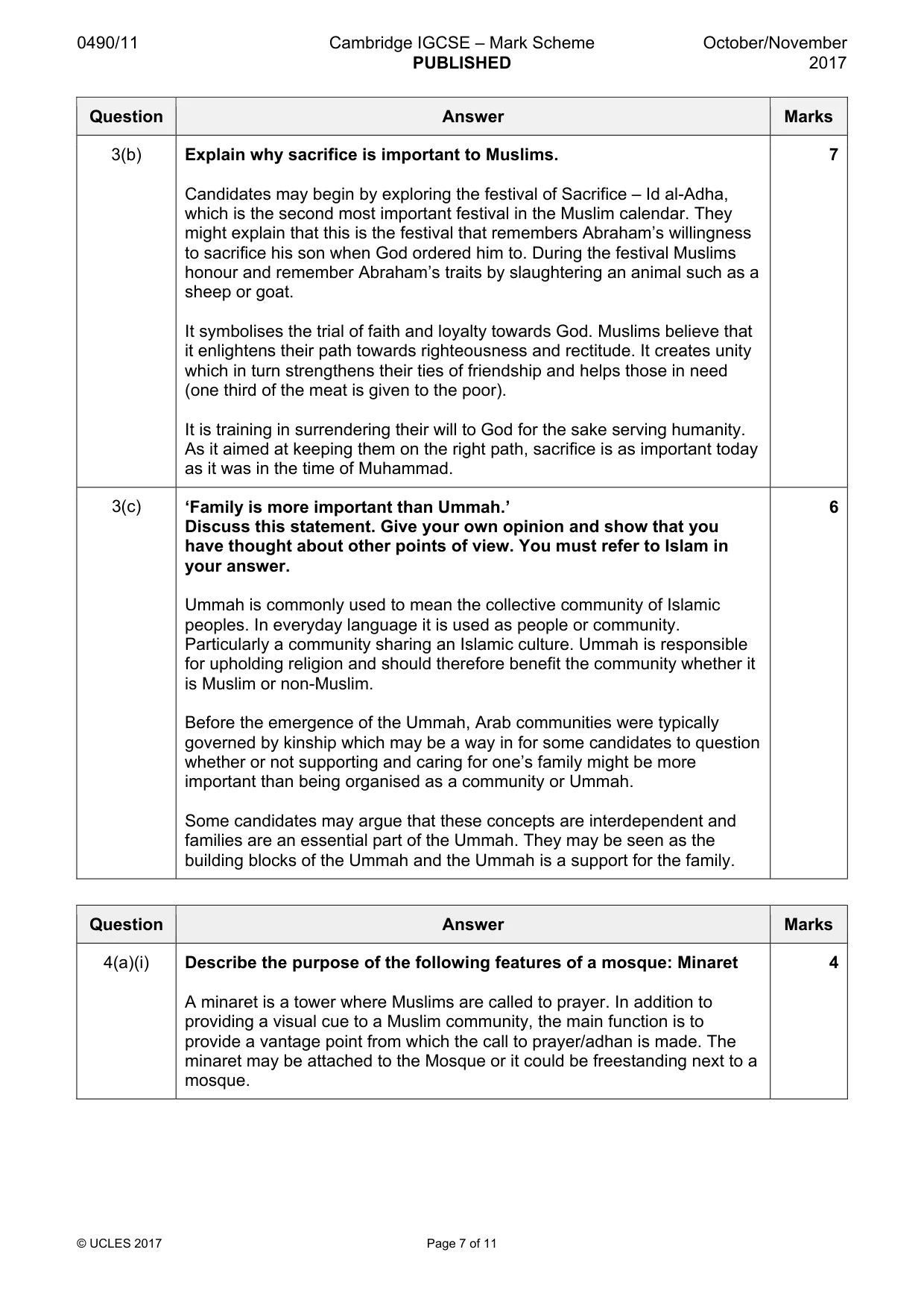
0490/11 Cambridge IGCSE – Mark Scheme PUBLISHED October/November 2017 © UCLES 2017 Page 7 of 11 Question Answer Marks 3(b) Explain why sacrifice is important to Muslims. Candidates may begin by exploring the festival of Sacrifice – Id al-Adha, which is the second most important festival in the Muslim calendar. They might explain that this is the festival that remembers Abraham’s willingness to sacrifice his son when God ordered him to. During the festival Muslims honour and remember Abraham’s traits by slaughtering an animal such as a sheep or goat. It symbolises the trial of faith and loyalty towards God. Muslims believe that it enlightens their path towards righteousness and rectitude. It creates unity which in turn strengthens their ties of friendship and helps those in need (one third of the meat is given to the poor). It is training in surrendering their will to God for the sake serving humanity. As it aimed at keeping them on the right path, sacrifice is as important today as it was in the time of Muhammad. 7 3(c) ‘Family is more important than Ummah.’ Discuss this statement. Give your own opinion and show that you have thought about other points of view. You must refer to Islam in your answer. Ummah is commonly used to mean the collective community of Islamic peoples. In everyday language it is used as people or community. Particularly a community sharing an Islamic culture. Ummah is responsible for upholding religion and should therefore benefit the community whether it is Muslim or non-Muslim. Before the emergence of the Ummah, Arab communities were typically governed by kinship which may be a way in for some candidates to question whether or not supporting and caring for one’s family might be more important than being organised as a community or Ummah. Some candidates may argue that these concepts are interdependent and families are an essential part of the Ummah. They may be seen as the building blocks of the Ummah and the Ummah is a support for the family. 6 Question Answer Marks 4(a)(i) Describe the purpose of the following features of a mosque: Minaret A minaret is a tower where Muslims are called to prayer. In addition to providing a visual cue to a Muslim community, the main function is to provide a vantage point from which the call to prayer/adhan is made. The minaret may be attached to the Mosque or it could be freestanding next to a mosque. 4
Mark scheme, page 8
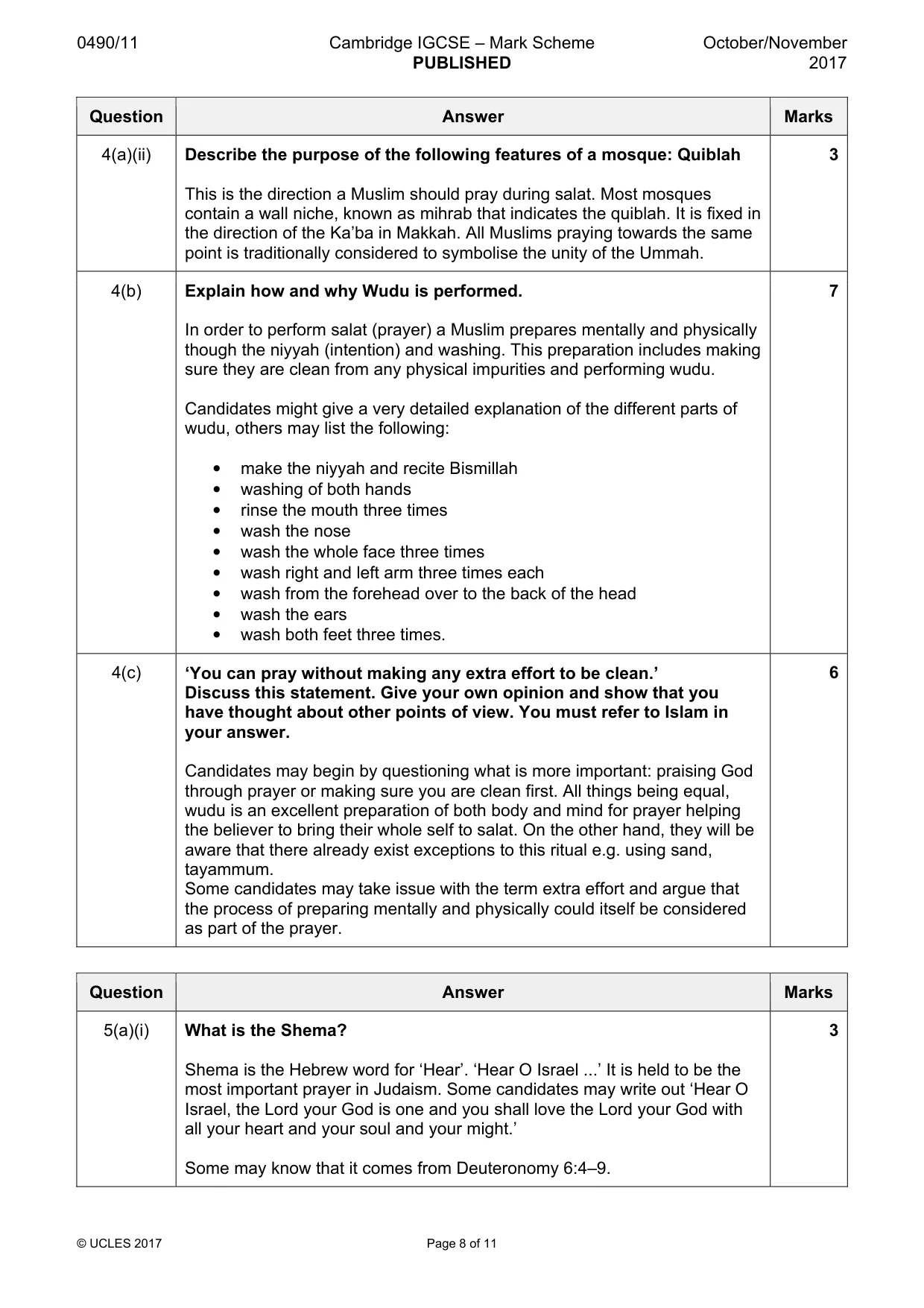
0490/11 Cambridge IGCSE – Mark Scheme PUBLISHED October/November 2017 © UCLES 2017 Page 8 of 11 Question Answer Marks 4(a)(ii) Describe the purpose of the following features of a mosque: Quiblah This is the direction a Muslim should pray during salat. Most mosques contain a wall niche, known as mihrab that indicates the quiblah. It is fixed in the direction of the Ka’ba in Makkah. All Muslims praying towards the same point is traditionally considered to symbolise the unity of the Ummah. 3 4(b) Explain how and why Wudu is performed. In order to perform salat (prayer) a Muslim prepares mentally and physically though the niyyah (intention) and washing. This preparation includes making sure they are clean from any physical impurities and performing wudu. Candidates might give a very detailed explanation of the different parts of wudu, others may list the following: • make the niyyah and recite Bismillah • washing of both hands • rinse the mouth three times • wash the nose • wash the whole face three times • wash right and left arm three times each • wash from the forehead over to the back of the head • wash the ears • wash both feet three times. 7 4(c) ‘You can pray without making any extra effort to be clean.’ Discuss this statement. Give your own opinion and show that you have thought about other points of view. You must refer to Islam in your answer. Candidates may begin by questioning what is more important: praising God through prayer or making sure you are clean first. All things being equal, wudu is an excellent preparation of both body and mind for prayer helping the believer to bring their whole self to salat. On the other hand, they will be aware that there already exist exceptions to this ritual e.g. using sand, tayammum. Some candidates may take issue with the term extra effort and argue that the process of preparing mentally and physically could itself be considered as part of the prayer. 6 Question Answer Marks 5(a)(i) What is the Shema? Shema is the Hebrew word for ‘Hear’. ‘Hear O Israel ...’ It is held to be the most important prayer in Judaism. Some candidates may write out ‘Hear O Israel, the Lord your God is one and you shall love the Lord your God with all your heart and your soul and your might.’ Some may know that it comes from Deuteronomy 6:4–9. 3
Mark scheme, page 9
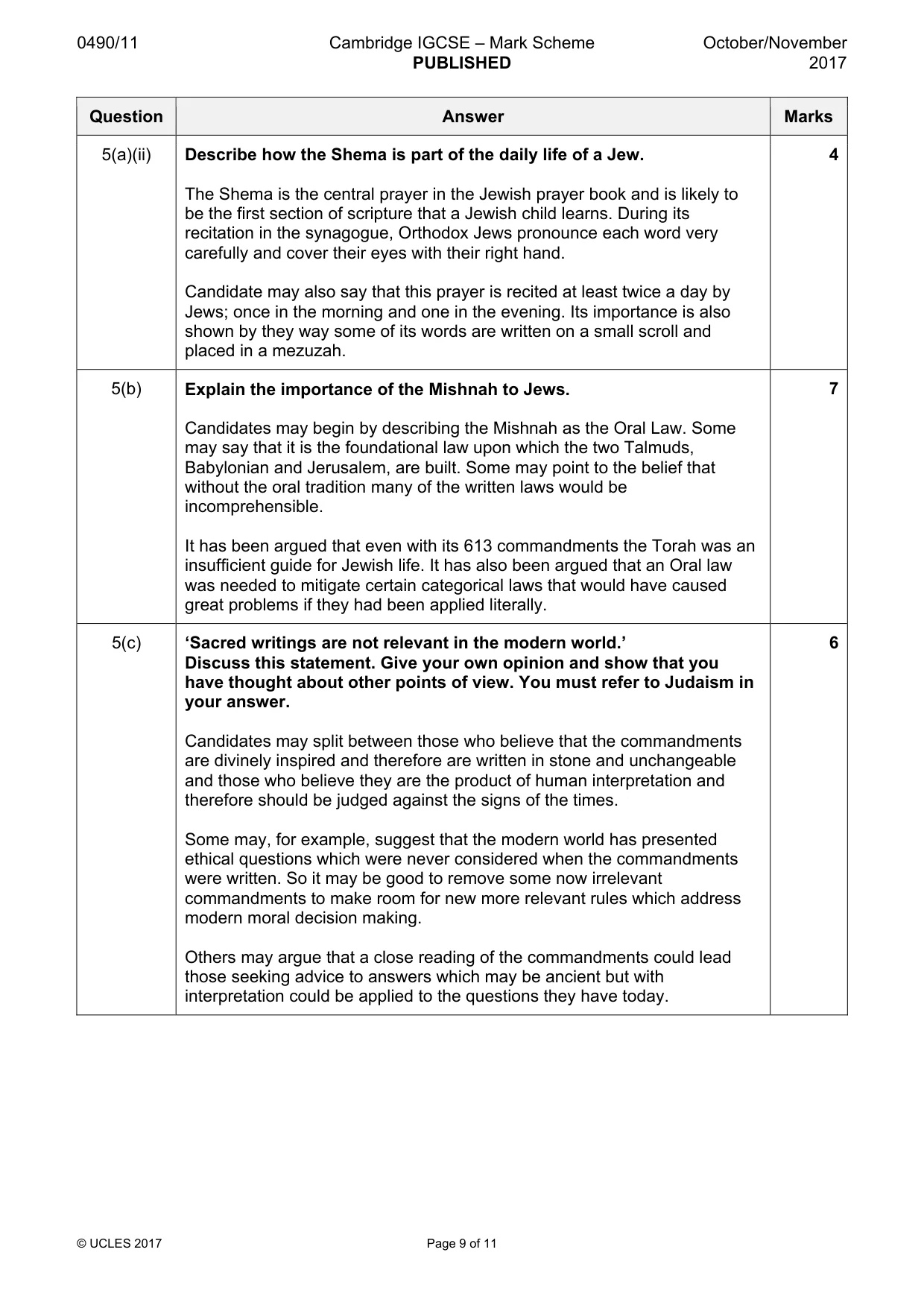
0490/11 Cambridge IGCSE – Mark Scheme PUBLISHED October/November 2017 © UCLES 2017 Page 9 of 11 Question Answer Marks 5(a)(ii) Describe how the Shema is part of the daily life of a Jew. The Shema is the central prayer in the Jewish prayer book and is likely to be the first section of scripture that a Jewish child learns. During its recitation in the synagogue, Orthodox Jews pronounce each word very carefully and cover their eyes with their right hand. Candidate may also say that this prayer is recited at least twice a day by Jews; once in the morning and one in the evening. Its importance is also shown by they way some of its words are written on a small scroll and placed in a mezuzah. 4 5(b) Explain the importance of the Mishnah to Jews. Candidates may begin by describing the Mishnah as the Oral Law. Some may say that it is the foundational law upon which the two Talmuds, Babylonian and Jerusalem, are built. Some may point to the belief that without the oral tradition many of the written laws would be incomprehensible. It has been argued that even with its 613 commandments the Torah was an insufficient guide for Jewish life. It has also been argued that an Oral law was needed to mitigate certain categorical laws that would have caused great problems if they had been applied literally. 7 5(c) ‘Sacred writings are not relevant in the modern world.’ Discuss this statement. Give your own opinion and show that you have thought about other points of view. You must refer to Judaism in your answer. Candidates may split between those who believe that the commandments are divinely inspired and therefore are written in stone and unchangeable and those who believe they are the product of human interpretation and therefore should be judged against the signs of the times. Some may, for example, suggest that the modern world has presented ethical questions which were never considered when the commandments were written. So it may be good to remove some now irrelevant commandments to make room for new more relevant rules which address modern moral decision making. Others may argue that a close reading of the commandments could lead those seeking advice to answers which may be ancient but with interpretation could be applied to the questions they have today. 6
Mark scheme, page 10
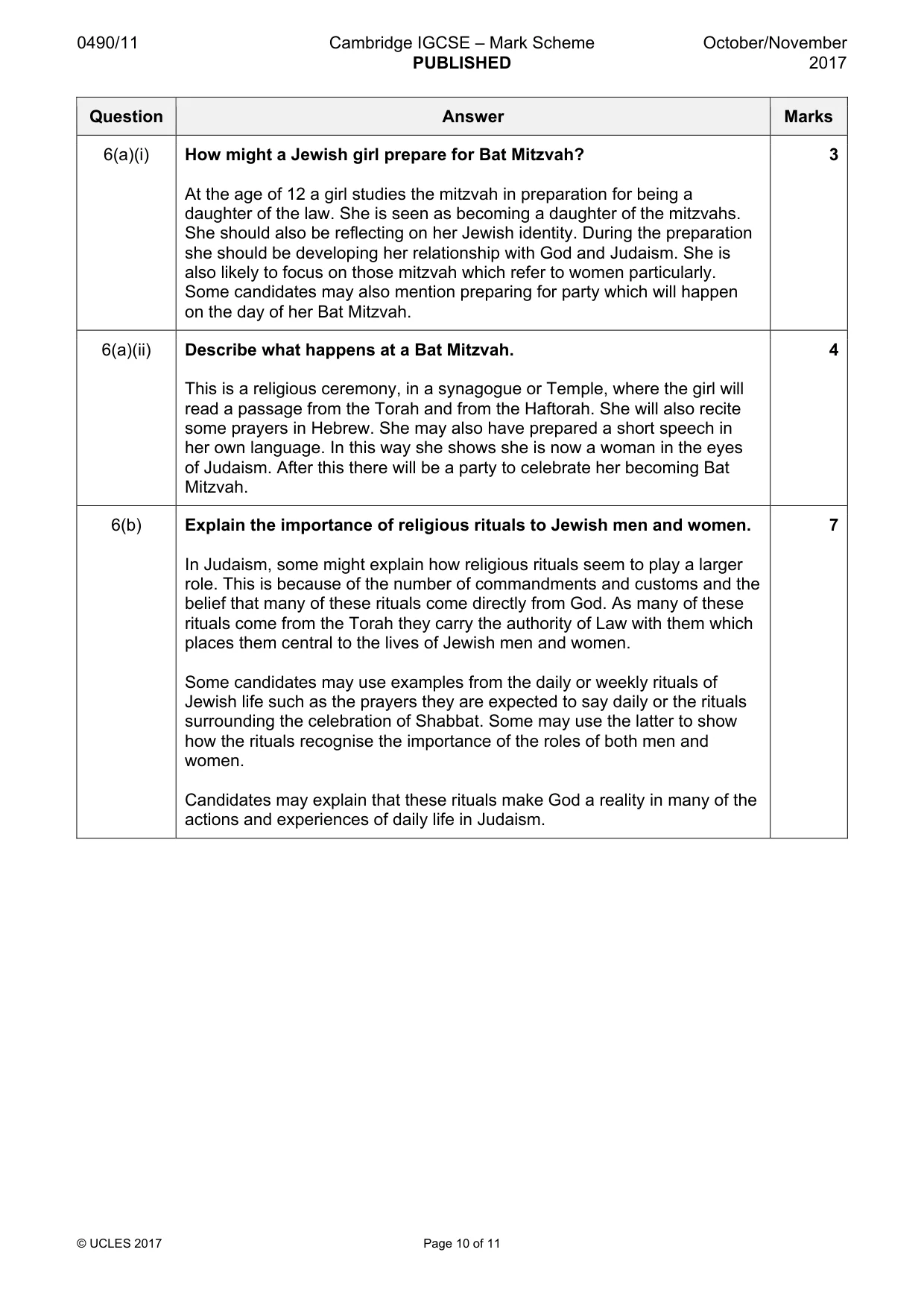
0490/11 Cambridge IGCSE – Mark Scheme PUBLISHED October/November 2017 © UCLES 2017 Page 10 of 11 Question Answer Marks 6(a)(i) How might a Jewish girl prepare for Bat Mitzvah? At the age of 12 a girl studies the mitzvah in preparation for being a daughter of the law. She is seen as becoming a daughter of the mitzvahs. She should also be reflecting on her Jewish identity. During the preparation she should be developing her relationship with God and Judaism. She is also likely to focus on those mitzvah which refer to women particularly. Some candidates may also mention preparing for party which will happen on the day of her Bat Mitzvah. 3 6(a)(ii) Describe what happens at a Bat Mitzvah. This is a religious ceremony, in a synagogue or Temple, where the girl will read a passage from the Torah and from the Haftorah. She will also recite some prayers in Hebrew. She may also have prepared a short speech in her own language. In this way she shows she is now a woman in the eyes of Judaism. After this there will be a party to celebrate her becoming Bat Mitzvah. 4 6(b) Explain the importance of religious rituals to Jewish men and women. In Judaism, some might explain how religious rituals seem to play a larger role. This is because of the number of commandments and customs and the belief that many of these rituals come directly from God. As many of these rituals come from the Torah they carry the authority of Law with them which places them central to the lives of Jewish men and women. Some candidates may use examples from the daily or weekly rituals of Jewish life such as the prayers they are expected to say daily or the rituals surrounding the celebration of Shabbat. Some may use the latter to show how the rituals recognise the importance of the roles of both men and women. Candidates may explain that these rituals make God a reality in many of the actions and experiences of daily life in Judaism. 7
Mark scheme, page 11
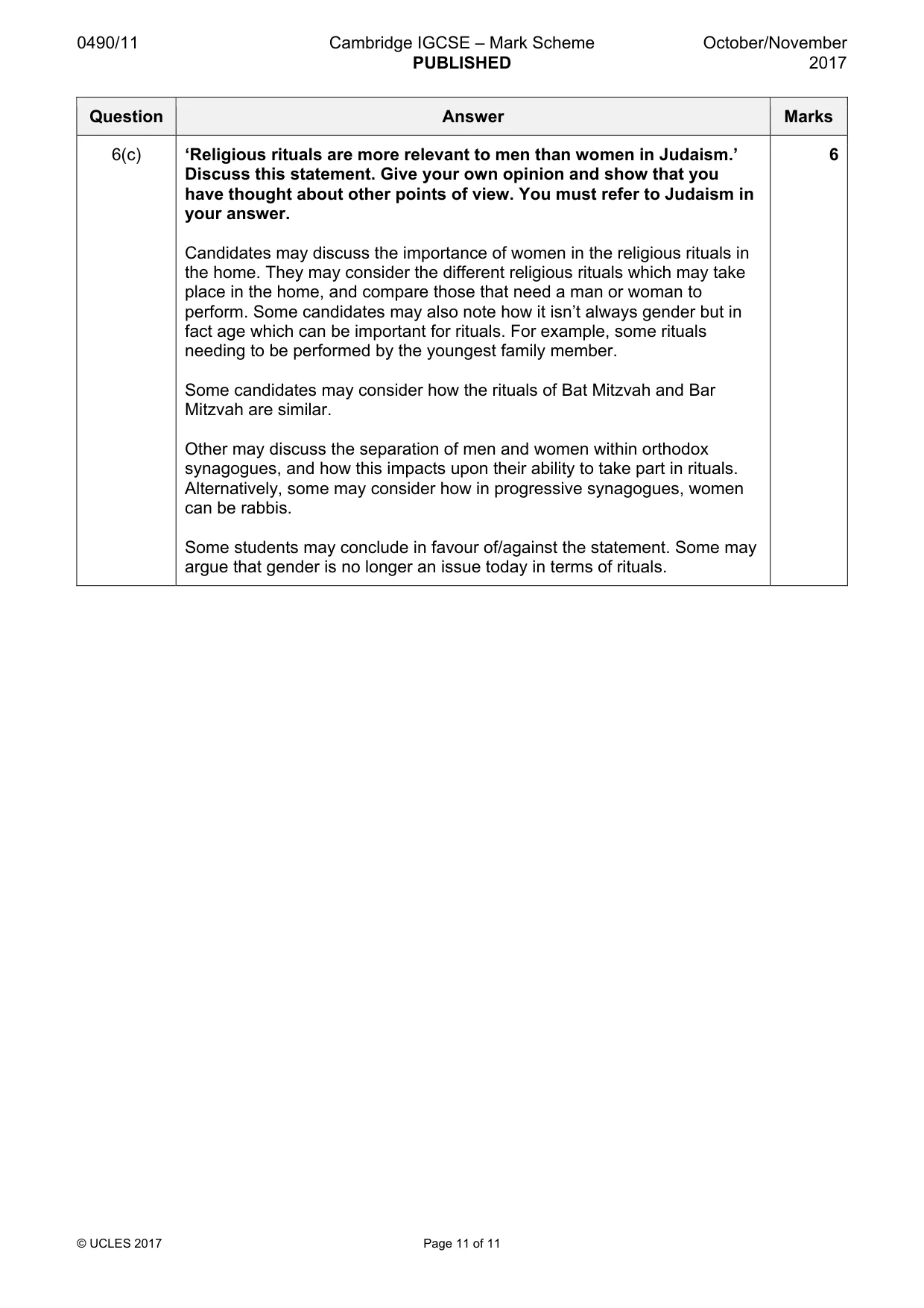
0490/11 Cambridge IGCSE – Mark Scheme PUBLISHED October/November 2017 © UCLES 2017 Page 11 of 11 Question Answer Marks 6(c) ‘Religious rituals are more relevant to men than women in Judaism.’ Discuss this statement. Give your own opinion and show that you have thought about other points of view. You must refer to Judaism in your answer. Candidates may discuss the importance of women in the religious rituals in the home. They may consider the different religious rituals which may take place in the home, and compare those that need a man or woman to perform. Some candidates may also note how it isn’t always gender but in fact age which can be important for rituals. For example, some rituals needing to be performed by the youngest family member. Some candidates may consider how the rituals of Bat Mitzvah and Bar Mitzvah are similar. Other may discuss the separation of men and women within orthodox synagogues, and how this impacts upon their ability to take part in rituals. Alternatively, some may consider how in progressive synagogues, women can be rabbis. Some students may conclude in favour of/against the statement. Some may argue that gender is no longer an issue today in terms of rituals. 6
What you needed in this session
Cambridge’s own grade thresholds for 2017 Oct/Nov, Paper 1 · Variant 1. A higher threshold means an easier paper — the bar moves with how the cohort did.