Cambridge IGCSE Physics (9-1) 0972 — 2022 Oct/Nov Paper 2 · Variant 1
0972/21/O/N/22 · 40 questions · 40 marks · ≈45 min
The question paper and its mark scheme, free to read here and free to download. This is Cambridge’s own paper, exactly as it was sat.
Question paper16 pages
Mark scheme3 pages
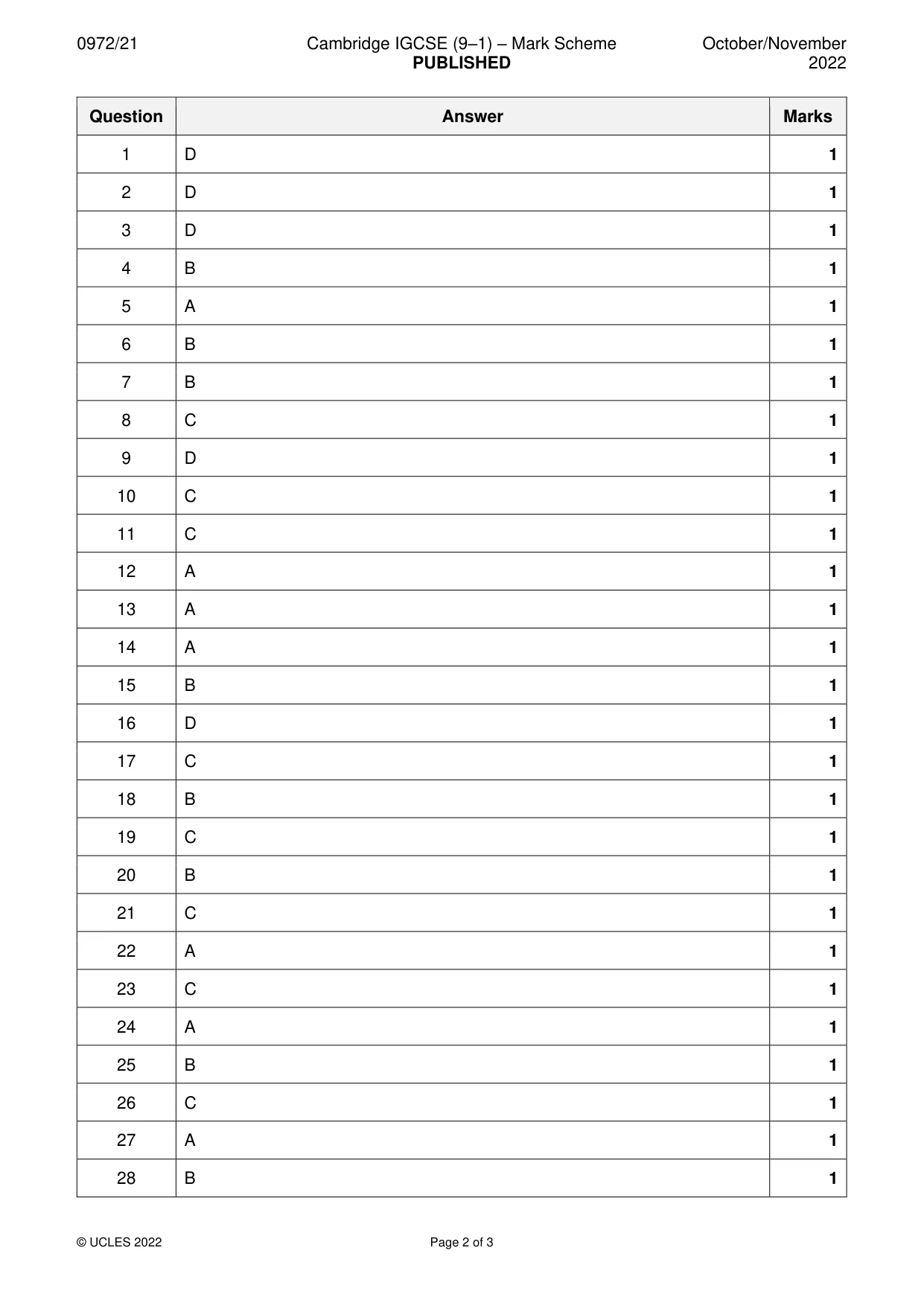
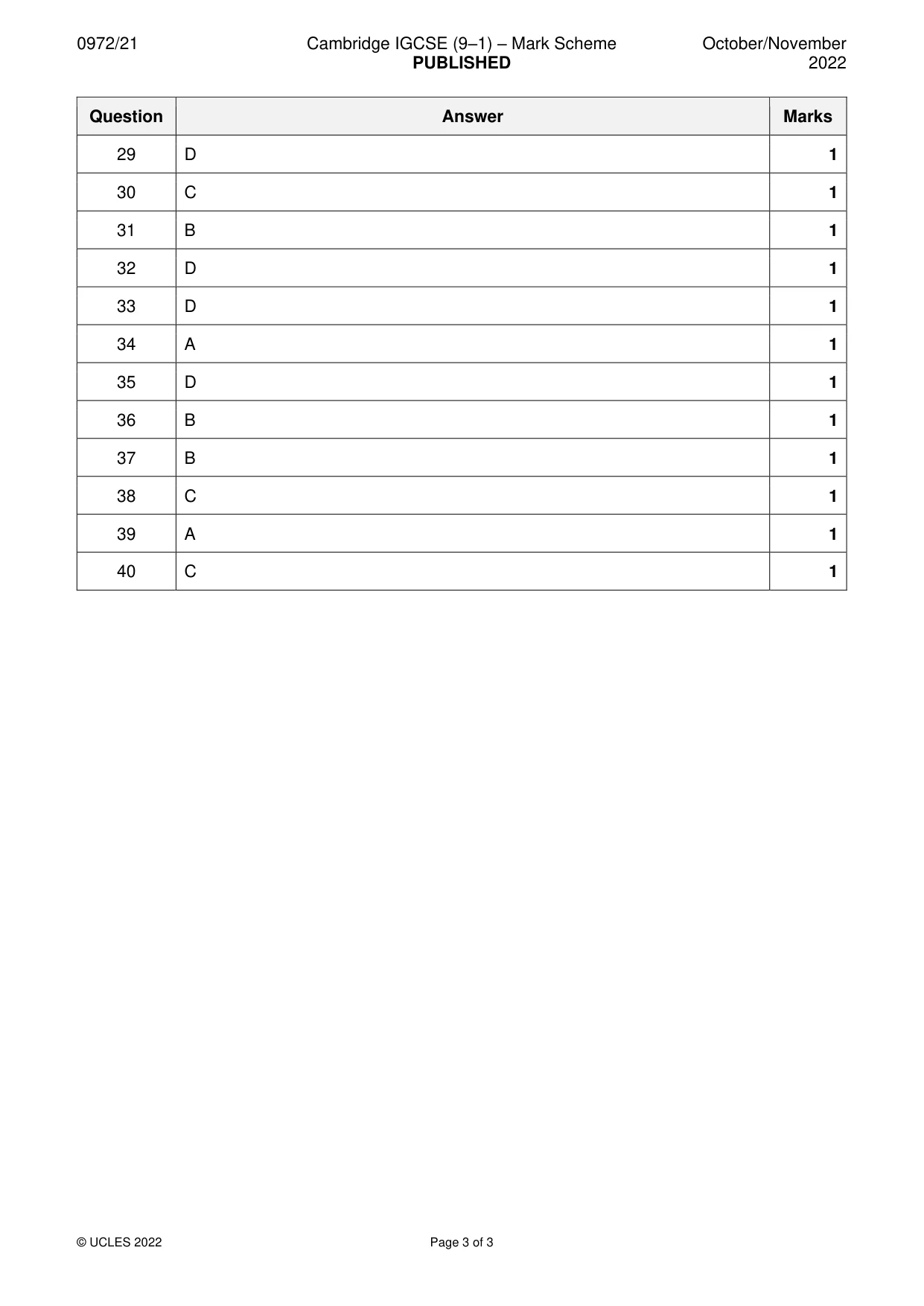
Answers below. Sit the paper first if you are practising.
Questions as text
Q1 · Which measuring instrument is used to measure the diameter of a thin metal wire?
1 Which measuring instrument is used to measure the diameter of a thin metal wire? A 30 cm rule B measuring tape C metre rule D micrometre screw gauge
Mark scheme: D
More questions on Physical quantities and measurement techniques
Q2 · A car starts from rest
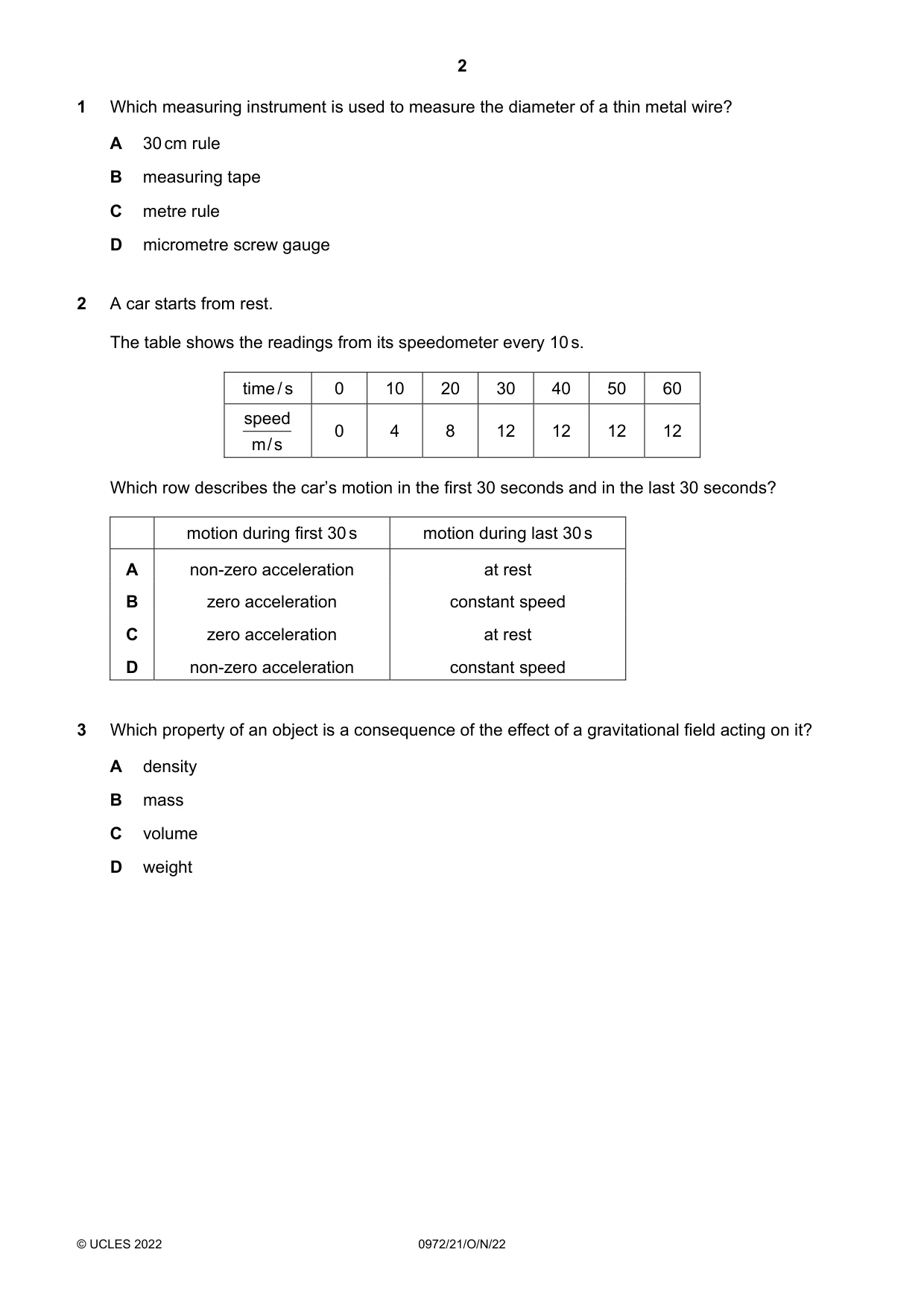
2 A car starts from rest. The table shows the readings from its speedometer every 10 s. time / s 0 10 20 30 40 50 60 speed 0 4 8 12 12 12 12 m / s Which row describes the car’s motion in the first 30 seconds and in the last 30 seconds? motion during first 30 s motion during last 30 s A non-zero acceleration at rest B zero acceleration constant speed C zero acceleration at rest D non-zero acceleration constant speed
Mark scheme: D
Q3 · Which property of an object is a consequence of the effect of a gravitational field…
3 Which property of an object is a consequence of the effect of a gravitational field acting on it? A density B mass C volume D weight
Mark scheme: D
Q4 · The diagram shows the dimensions of a solid rectangular block of metal of mass m
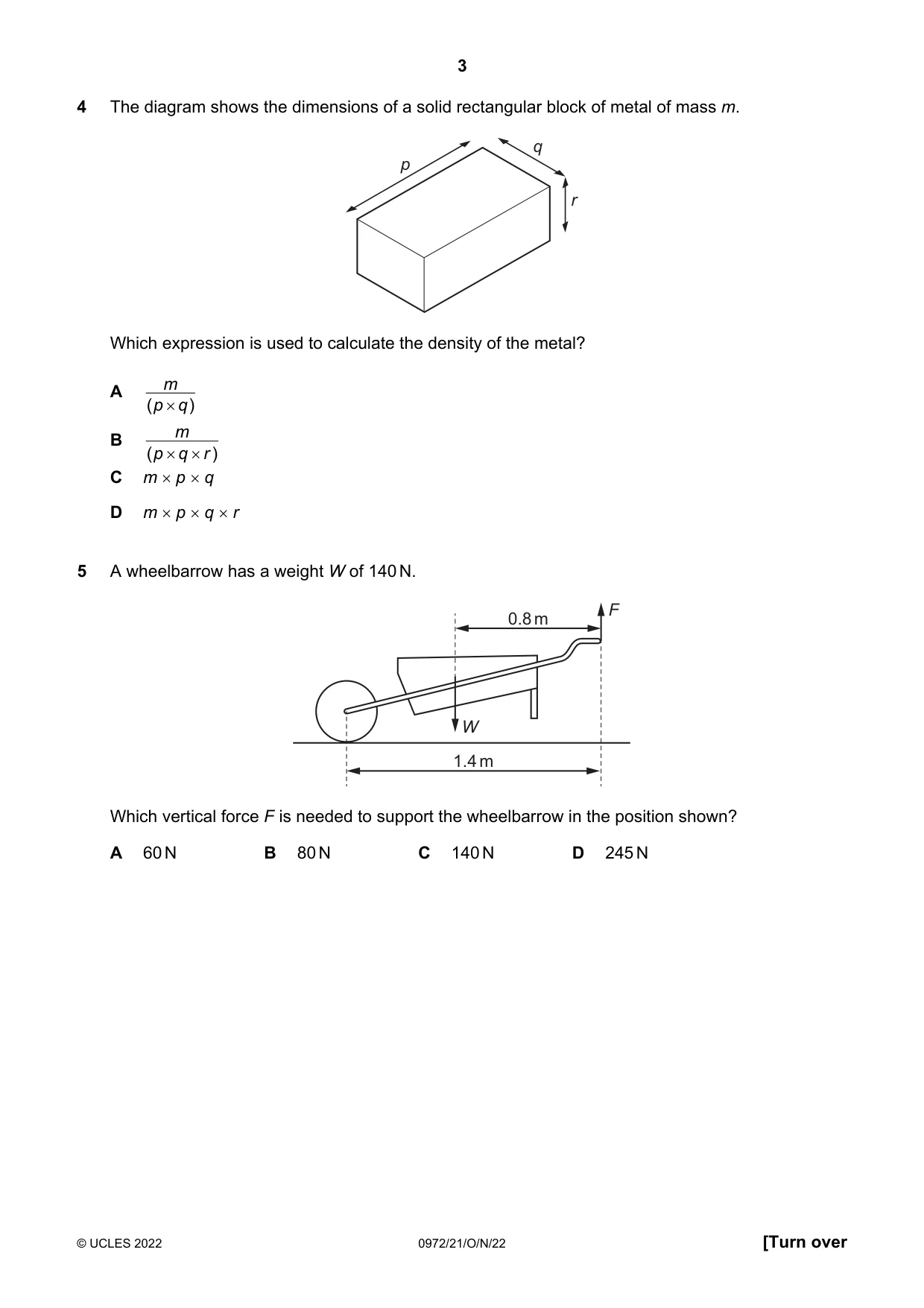
4 The diagram shows the dimensions of a solid rectangular block of metal of mass m. q p r Which expression is used to calculate the density of the metal? m A ( p × q ) m B ( p × q × r ) C m × p × q D m × p × q × r
Mark scheme: B
Q5 · A wheelbarrow has a weight W of 140 N
5 A wheelbarrow has a weight W of 140 N. F 0.8 m W 1.4 m Which vertical force F is needed to support the wheelbarrow in the position shown? A 60 N B 80 N C 140 N D 245 N
Mark scheme: A
Q6 · A car is travelling around a circular track at a constant speed, as shown
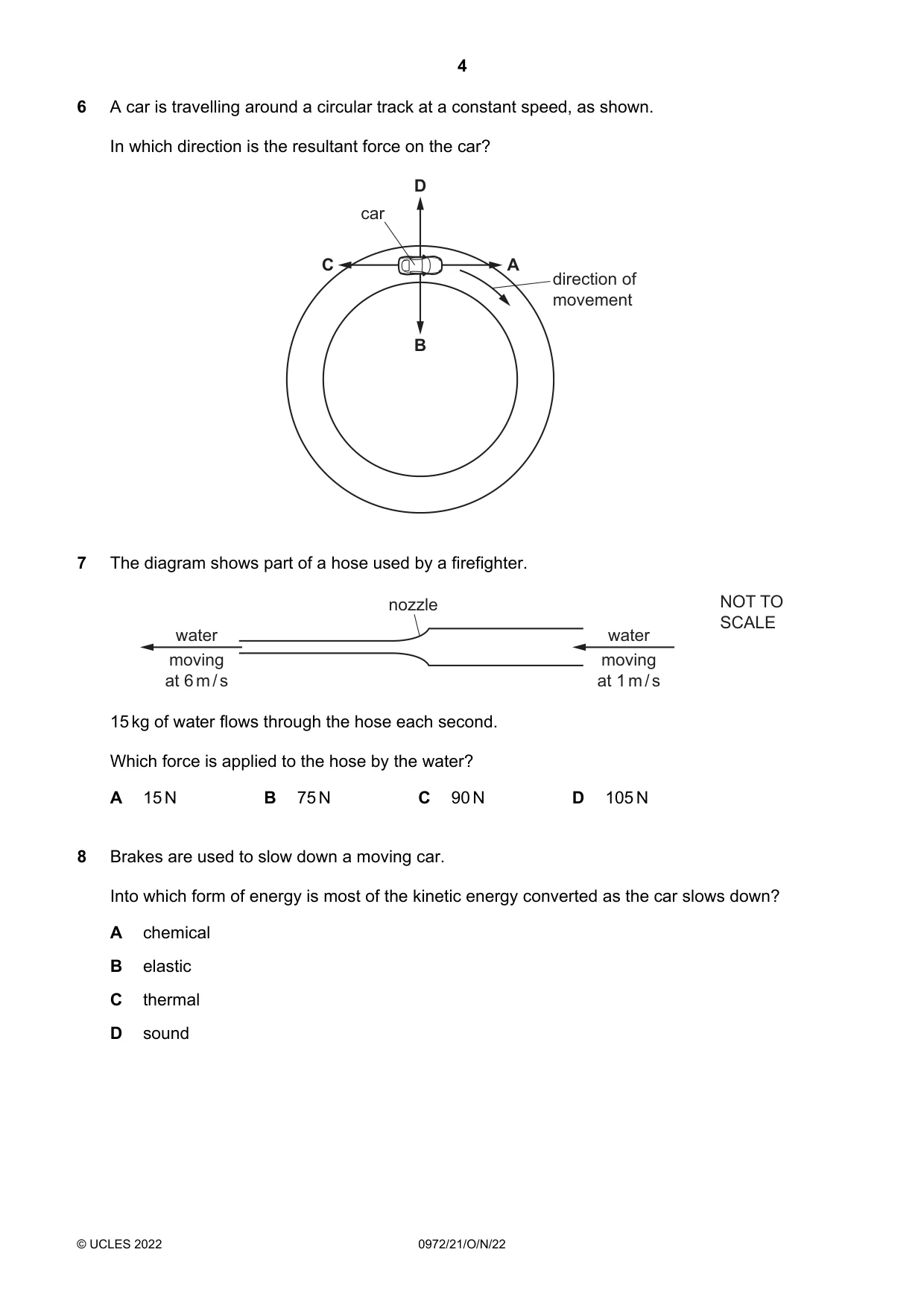
6 A car is travelling around a circular track at a constant speed, as shown. In which direction is the resultant force on the car? D car C A direction of movement B
Mark scheme: B
Q7 · The diagram shows part of a hose used by a firefighter
7 The diagram shows part of a hose used by a firefighter. nozzle NOT TO SCALE water water moving moving at 6 m / s at 1 m / s 15 kg of water flows through the hose each second. Which force is applied to the hose by the water? A 15 N B 75 N C 90 N D 105 N
Mark scheme: B
Q8 · Brakes are used to slow down a moving car
8 Brakes are used to slow down a moving car. Into which form of energy is most of the kinetic energy converted as the car slows down? A chemical B elastic C thermal D sound
Mark scheme: C
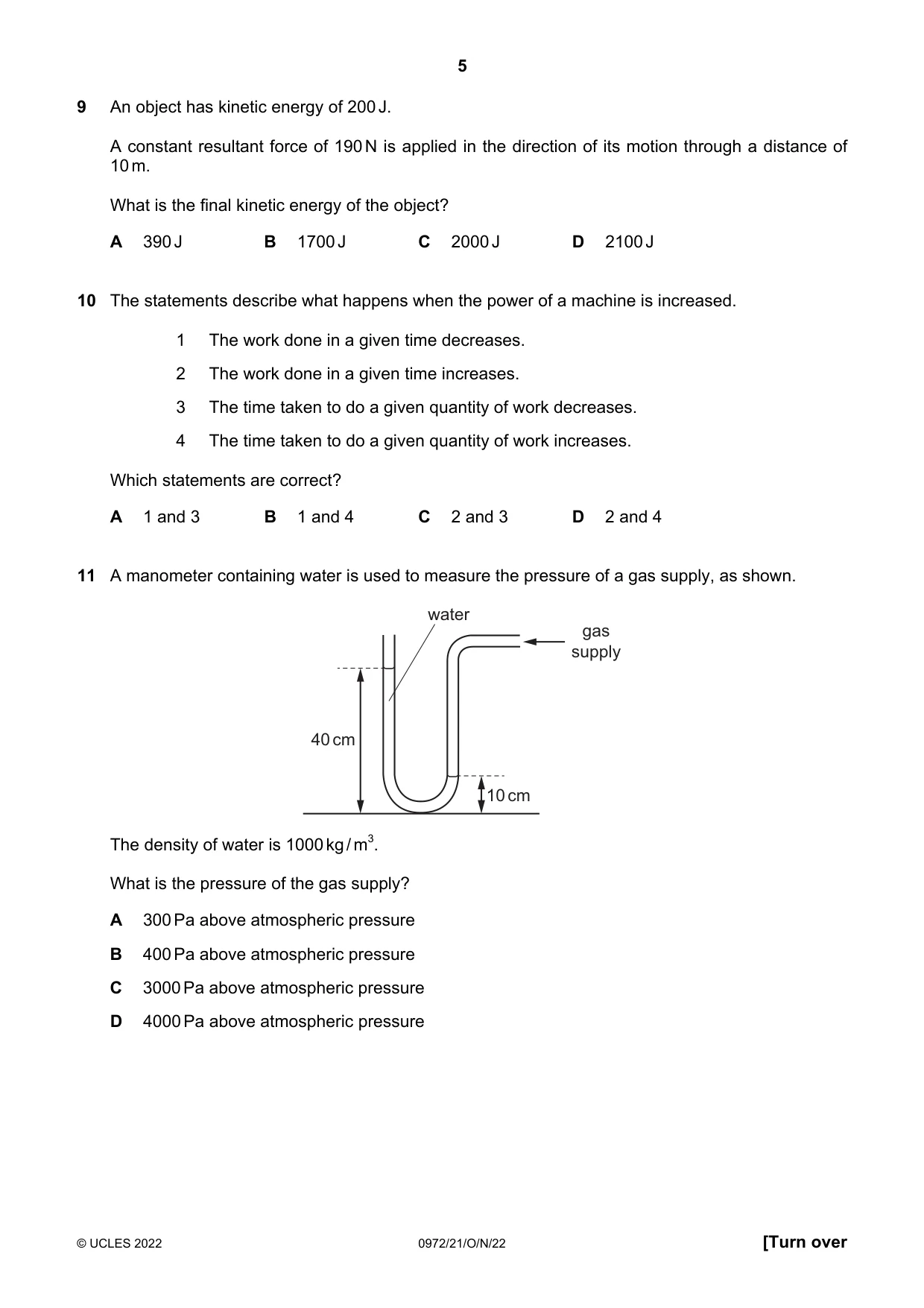
Q9 · An object has kinetic energy of 200 J
9 An object has kinetic energy of 200 J. A constant resultant force of 190 N is applied in the direction of its motion through a distance of 10 m. What is the final kinetic energy of the object? A 390 J B 1700 J C 2000 J D 2100 J
Mark scheme: D
Q10 · The statements describe what happens when the power of a machine is increased
10 The statements describe what happens when the power of a machine is increased. 1 The work done in a given time decreases. 2 The work done in a given time increases. 3 The time taken to do a given quantity of work decreases. 4 The time taken to do a given quantity of work increases. Which statements are correct? A 1 and 3 B 1 and 4 C 2 and 3 D 2 and 4
Mark scheme: C
Q11 · A manometer containing water is used to measure the pressure of a gas supply, as shown
11 A manometer containing water is used to measure the pressure of a gas supply, as shown. water gas supply 40 cm 10 cm The density of water is 1000 kg / m3. What is the pressure of the gas supply? A 300 Pa above atmospheric pressure B 400 Pa above atmospheric pressure C 3000 Pa above atmospheric pressure D 4000 Pa above atmospheric pressure
Mark scheme: C
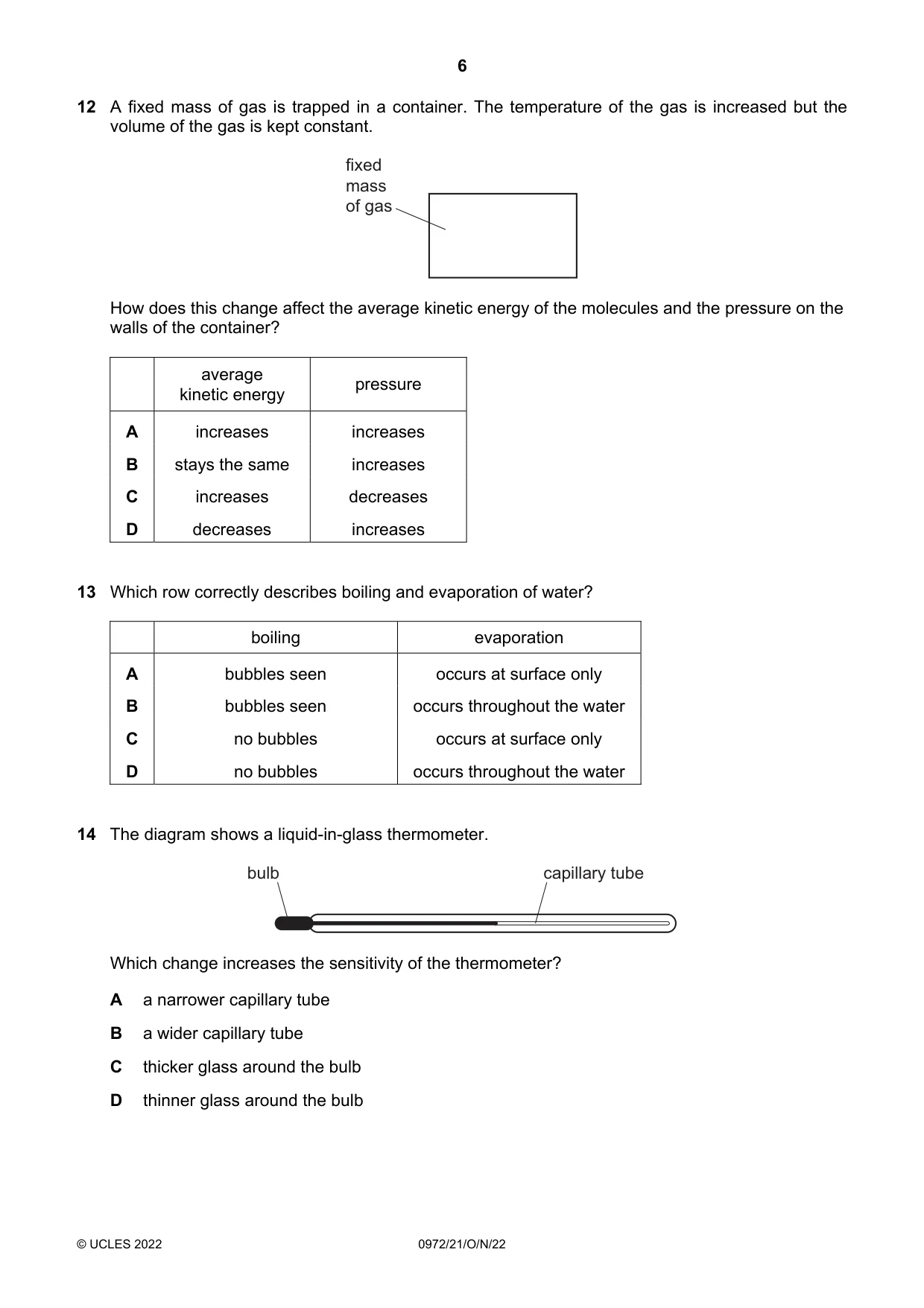
Q12 · A fixed mass of gas is trapped in a container
12 A fixed mass of gas is trapped in a container. The temperature of the gas is increased but the volume of the gas is kept constant. fixed mass of gas How does this change affect the average kinetic energy of the molecules and the pressure on the walls of the container? average pressure kinetic energy A increases increases B stays the same increases C increases decreases D decreases increases
Mark scheme: A
Q13 · Which row correctly describes boiling and evaporation of water?
13 Which row correctly describes boiling and evaporation of water? boiling evaporation A bubbles seen occurs at surface only B bubbles seen occurs throughout the water C no bubbles occurs at surface only D no bubbles occurs throughout the water
Mark scheme: A
Q14 · The diagram shows a liquid-in-glass thermometer
14 The diagram shows a liquid-in-glass thermometer. bulb capillary tube Which change increases the sensitivity of the thermometer? A a narrower capillary tube B a wider capillary tube C thicker glass around the bulb D thinner glass around the bulb
Mark scheme: A
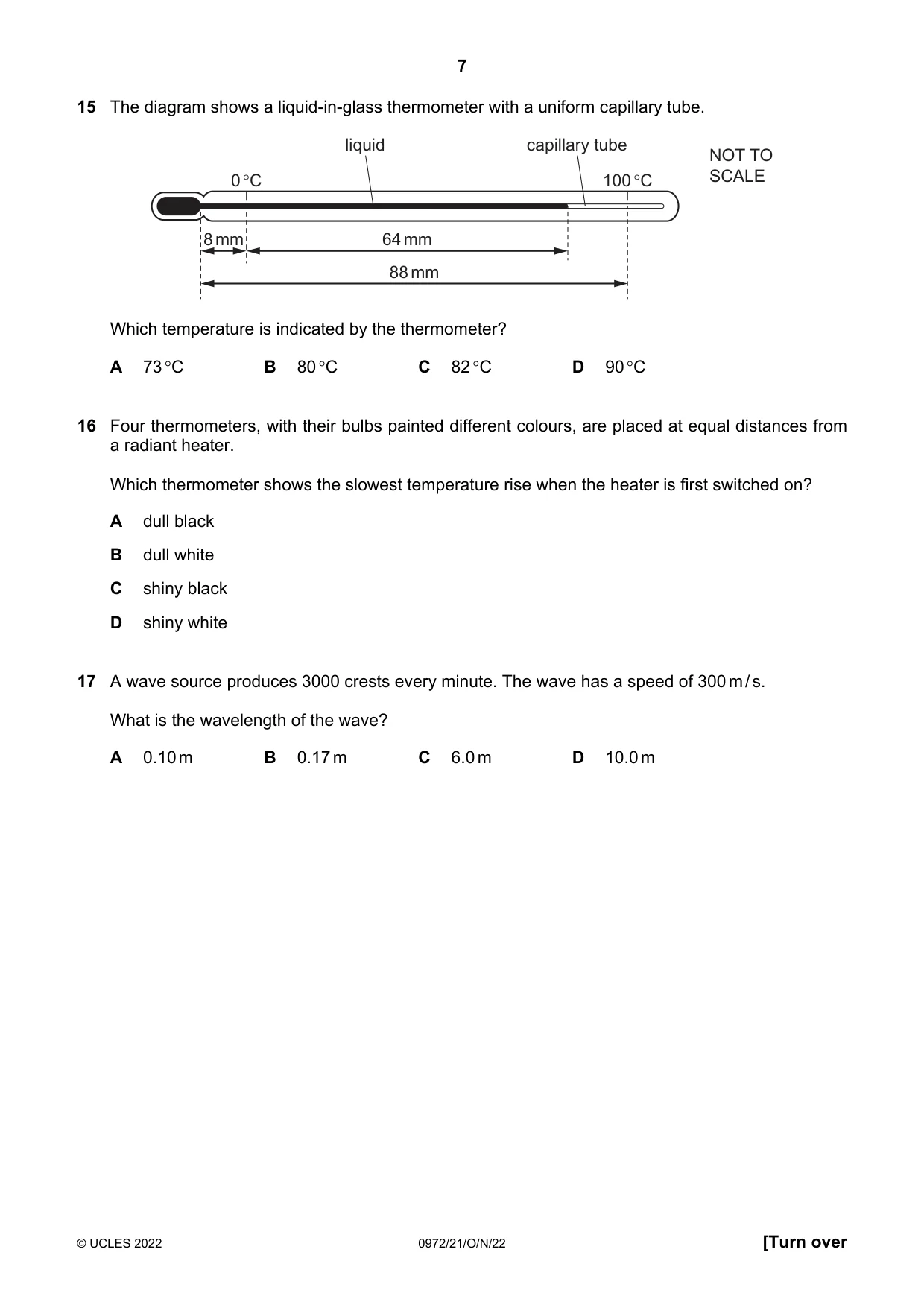
Q15 · The diagram shows a liquid-in-glass thermometer with a uniform capillary tube
15 The diagram shows a liquid-in-glass thermometer with a uniform capillary tube. liquid capillary tube NOT TO SCALE '8 mm! 64mm ! i - 88mm Which temperature is indicated by the thermometer? A 73°C B 80°C C 82°C D 90°C
Mark scheme: B
Q16 · Four thermometers, with their bulbs painted different colours, are placed at equal…
16 Four thermometers, with their bulbs painted different colours, are placed at equal distances from a radiant heater. Which thermometer shows the slowest temperature rise when the heater is first switched on? A dull black B dull white C shiny black D shiny white
Mark scheme: D
Q17 · A wave source produces 3000 crests every minute
17 A wave source produces 3000 crests every minute. The wave has a speed of 300 m / s. What is the wavelength of the wave? A 0.10 m B 0.17 m C 6.0 m D 10.0 m
Mark scheme: C
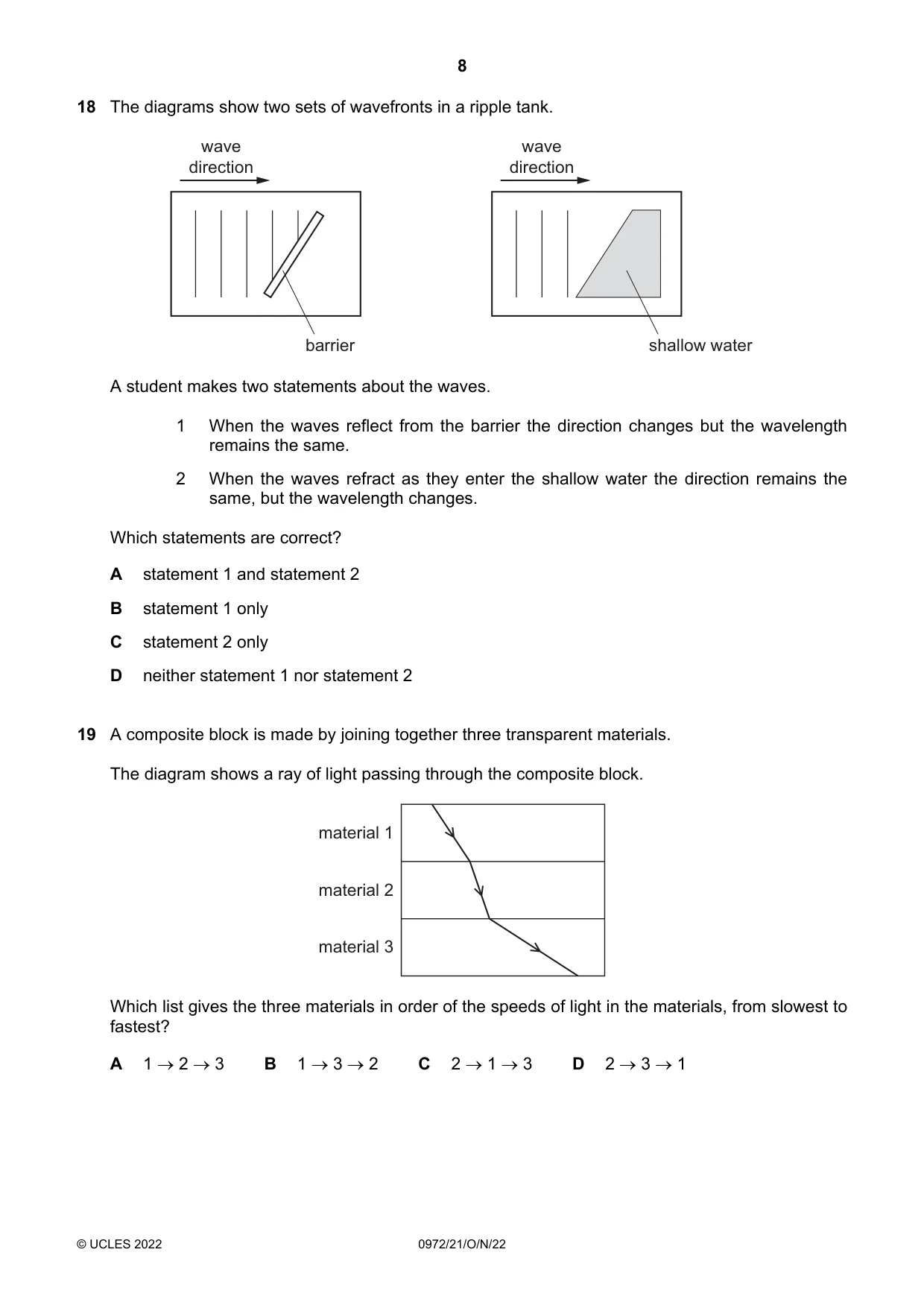
Q18 · The diagrams show two sets of wavefronts in a ripple tank
18 The diagrams show two sets of wavefronts in a ripple tank. wave wave direction direction barrier shallow water A student makes two statements about the waves. 1 When the waves reflect from the barrier the direction changes but the wavelength remains the same. 2 When the waves refract as they enter the shallow water the direction remains the same, but the wavelength changes. Which statements are correct? A statement 1 and statement 2 B statement 1 only C statement 2 only D neither statement 1 nor statement 2
Mark scheme: B
Q19 · A composite block is made by joining together three transparent materials
19 A composite block is made by joining together three transparent materials. The diagram shows a ray of light passing through the composite block. material 1 material 2 material 3 Which list gives the three materials in order of the speeds of light in the materials, from slowest to fastest? A 1 → 2 → 3 B 1 → 3 → 2 C 2 → 1 → 3 D 2 → 3 → 1
Mark scheme: C
Q20 · An object is placed 30 cm in front of a plane mirror
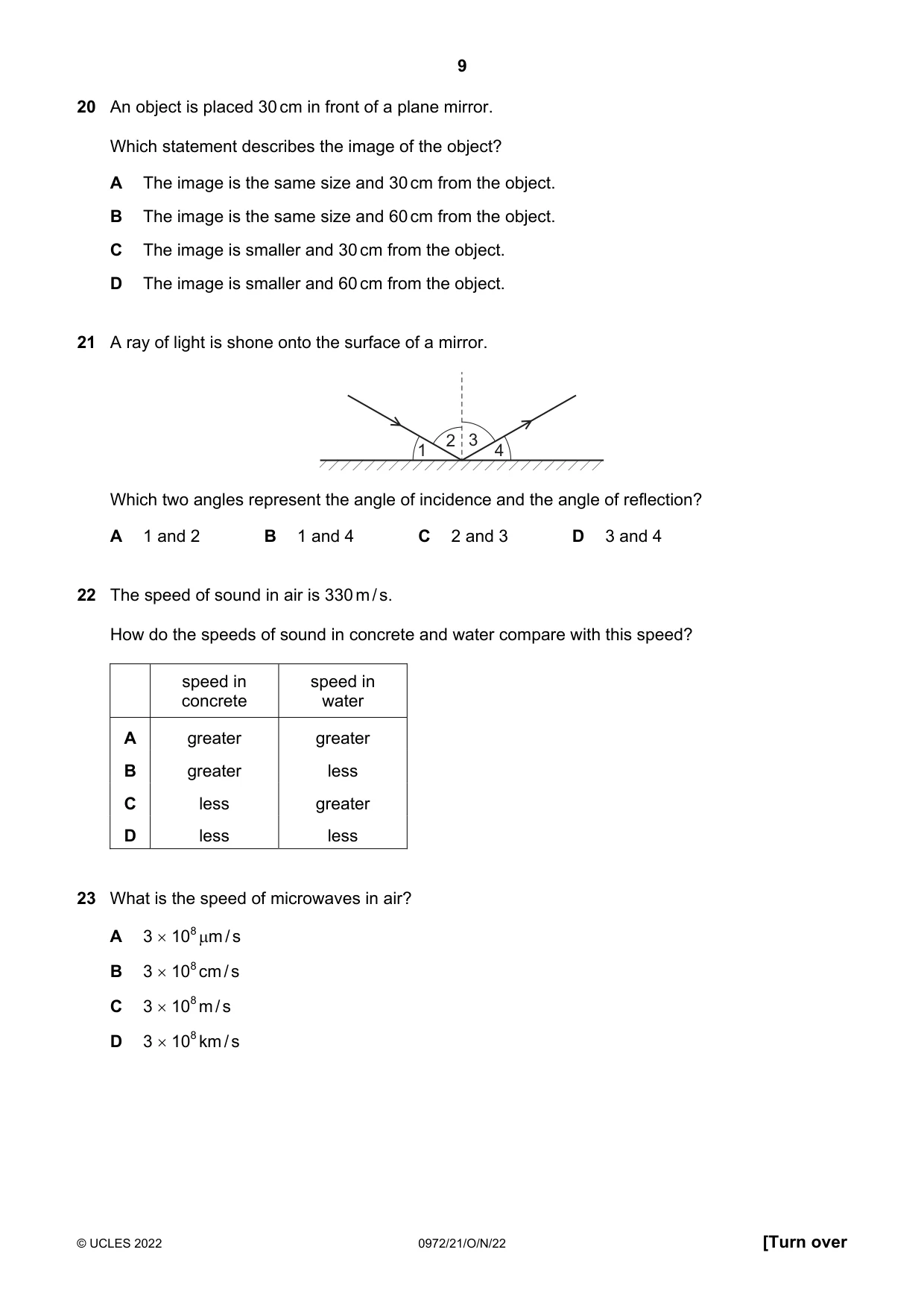
20 An object is placed 30 cm in front of a plane mirror. Which statement describes the image of the object? A The image is the same size and 30 cm from the object. B The image is the same size and 60 cm from the object. C The image is smaller and 30 cm from the object. D The image is smaller and 60 cm from the object.
Mark scheme: B
Q21 · A ray of light is shone onto the surface of a mirror
21 A ray of light is shone onto the surface of a mirror. 2 3 1 4 Which two angles represent the angle of incidence and the angle of reflection? A 1 and 2 B 1 and 4 C 2 and 3 D 3 and 4
Mark scheme: C
Q22 · The speed of sound in air is 330 m / s
22 The speed of sound in air is 330 m / s. How do the speeds of sound in concrete and water compare with this speed? speed in speed in concrete water A greater greater B greater less C less greater D less less
Mark scheme: A
Q23 · What is the speed of microwaves in air?
23 What is the speed of microwaves in air? A 3 × 108 µm / s B 3 × 108 cm / s C 3 × 10⁸ m / s D 3 × 10⁸ km / s
Mark scheme: C
Q24 · An observer stands at the finish line of a 100 m race
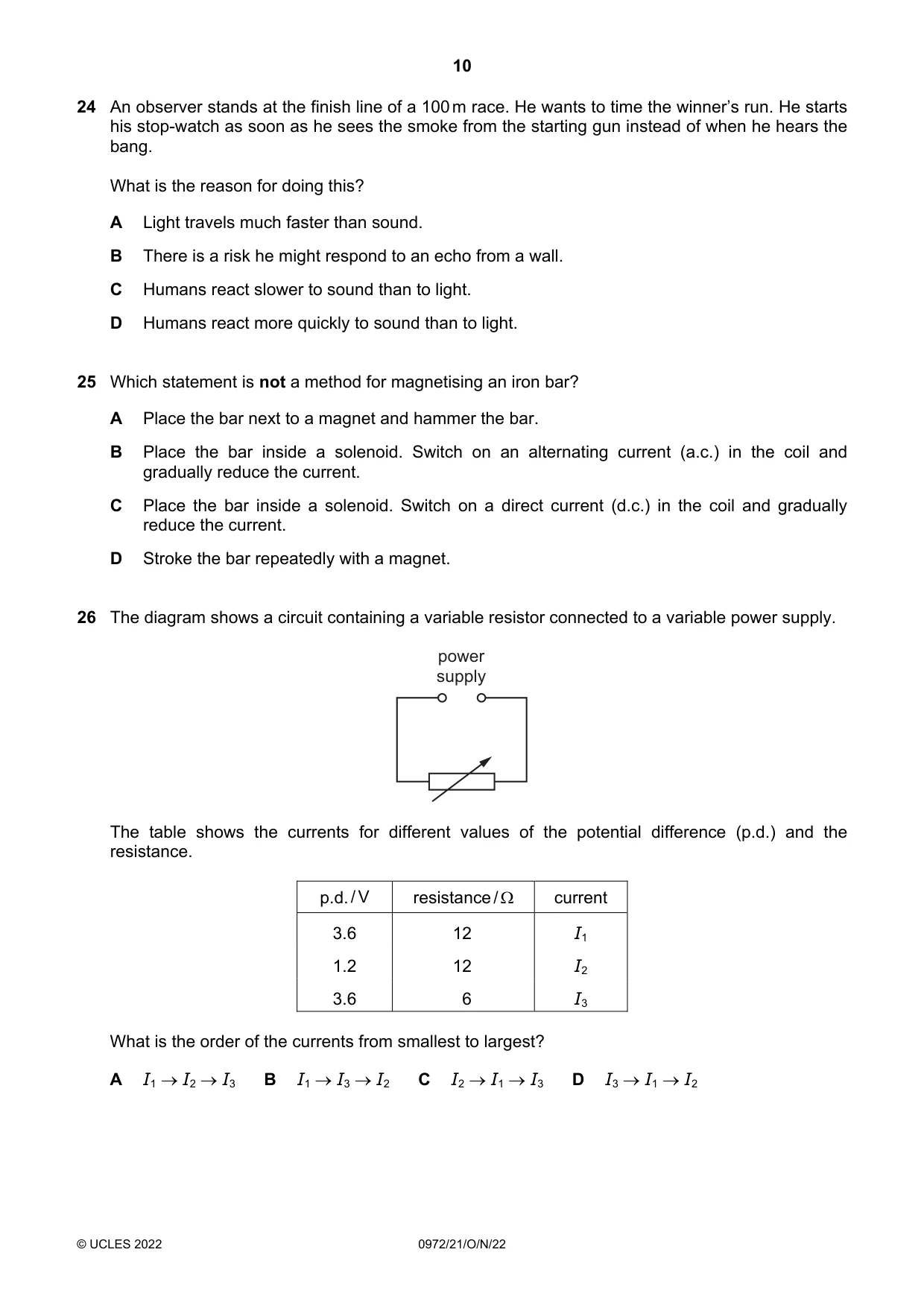
24 An observer stands at the finish line of a 100 m race. He wants to time the winner’s run. He starts his stop-watch as soon as he sees the smoke from the starting gun instead of when he hears the bang. What is the reason for doing this? A Light travels much faster than sound. B There is a risk he might respond to an echo from a wall. C Humans react slower to sound than to light. D Humans react more quickly to sound than to light.
Mark scheme: A
Q25 · Which statement is not a method for magnetising an iron bar?
25 Which statement is not a method for magnetising an iron bar? A Place the bar next to a magnet and hammer the bar. B Place the bar inside a solenoid. Switch on an alternating current (a.c.) in the coil and gradually reduce the current. C Place the bar inside a solenoid. Switch on a direct current (d.c.) in the coil and gradually reduce the current. D Stroke the bar repeatedly with a magnet.
Mark scheme: B
Q26 · The diagram shows a circuit containing a variable resistor connected to a variable power…
26 The diagram shows a circuit containing a variable resistor connected to a variable power supply. power supply The table shows the currents for different values of the potential difference (p.d.) and the resistance. p.d. / V resistance / Ω current 3.6 12 I1 1.2 12 I2 3.6 6 I3 What is the order of the currents from smallest to largest? A I1 → I2 → I3 B I1 → I3 → I2 C I2 → I1 → I3 D I3 → I1 → I2
Mark scheme: C
Q27 · Which diagram shows the electric field pattern around a positive charge?
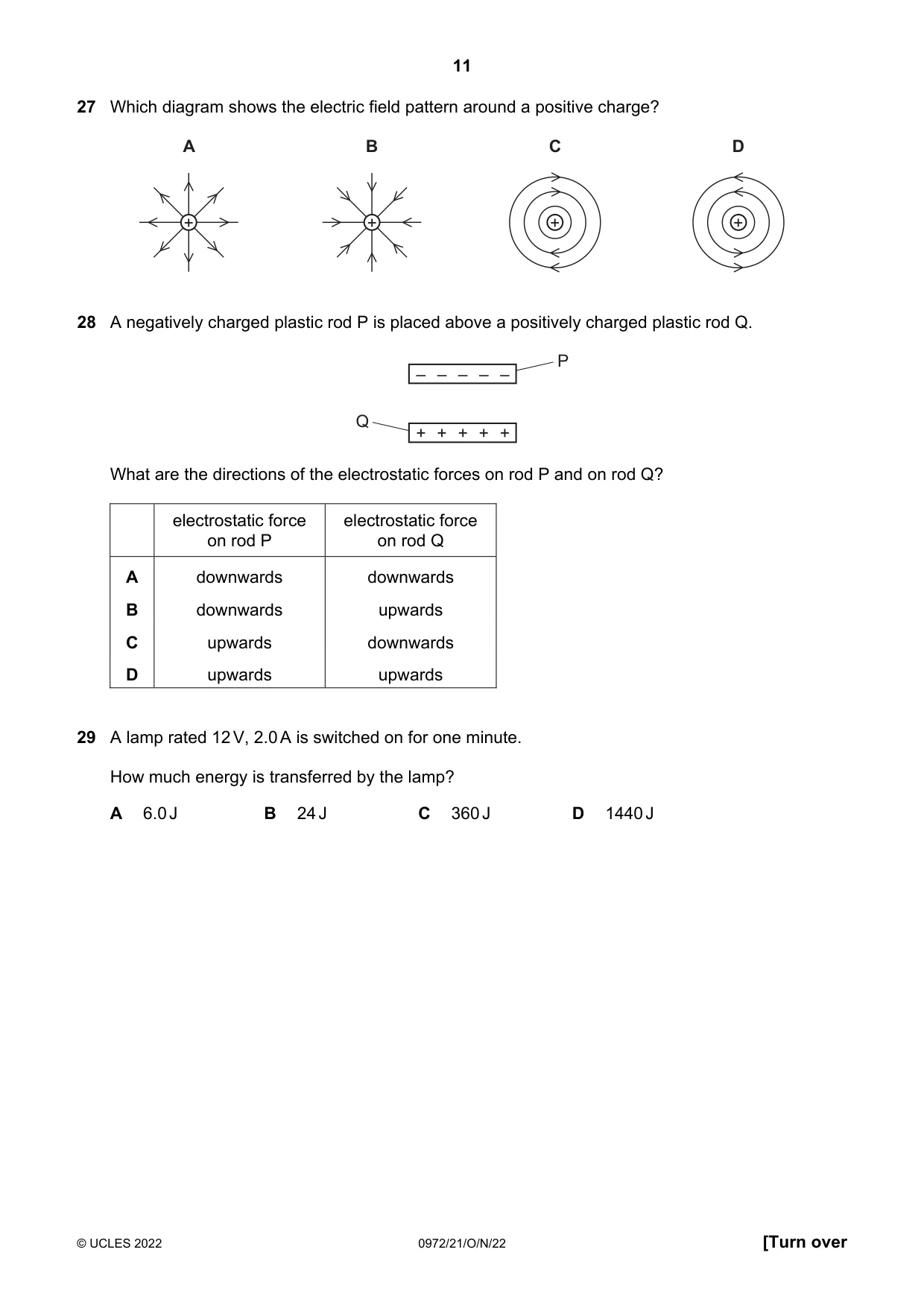
27 Which diagram shows the electric field pattern around a positive charge? A B C D + + + +
Mark scheme: A
Q28 · A negatively charged plastic rod P is placed above a positively charged plastic rod Q
28 A negatively charged plastic rod P is placed above a positively charged plastic rod Q. P – – – – – Q + + + + + What are the directions of the electrostatic forces on rod P and on rod Q? electrostatic force electrostatic force on rod P on rod Q A downwards downwards B downwards upwards C upwards downwards D upwards upwards
Mark scheme: B
Q29 · A lamp rated 12 V, 2.0 A is switched on for one minute
29 A lamp rated 12 V, 2.0 A is switched on for one minute. How much energy is transferred by the lamp? A 6.0 J B 24 J C 360 J D 1440 J
Mark scheme: D
Q30 · An alternating current (a.c.) power supply is connected in series with a resistor R and a…
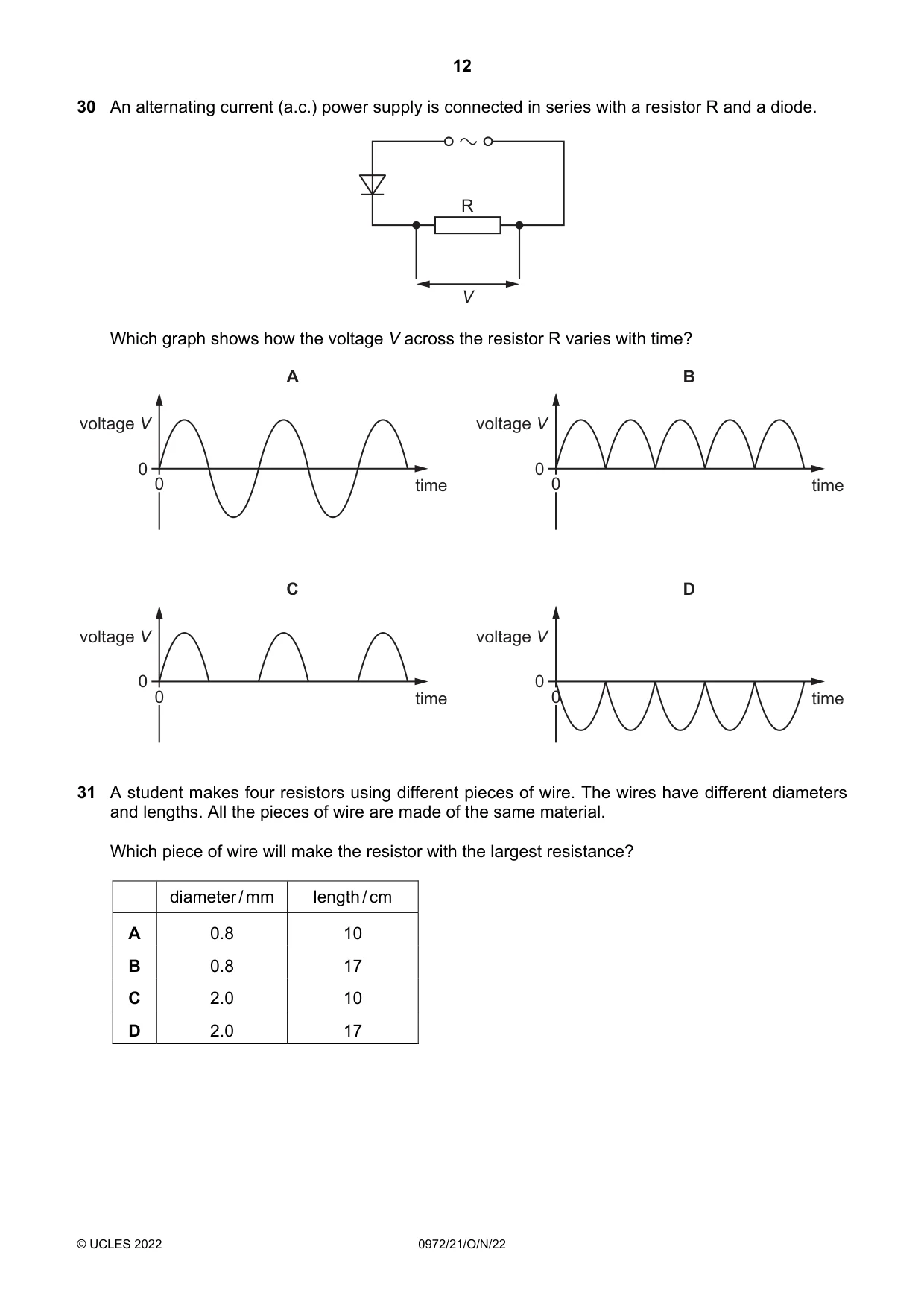
30 An alternating current (a.c.) power supply is connected in series with a resistor R and a diode. R V Which graph shows how the voltage V across the resistor R varies with time? A B voltage V voltage V 0 0 0 time 0 time C D voltage V voltage V 0 0 0 time 0 time
Mark scheme: C
Q31 · A student makes four resistors using different pieces of wire
31 A student makes four resistors using different pieces of wire. The wires have different diameters and lengths. All the pieces of wire are made of the same material. Which piece of wire will make the resistor with the largest resistance? diameter / mm length / cm A 0.8 10 B 0.8 17 C 2.0 10 D 2.0 17
Mark scheme: B
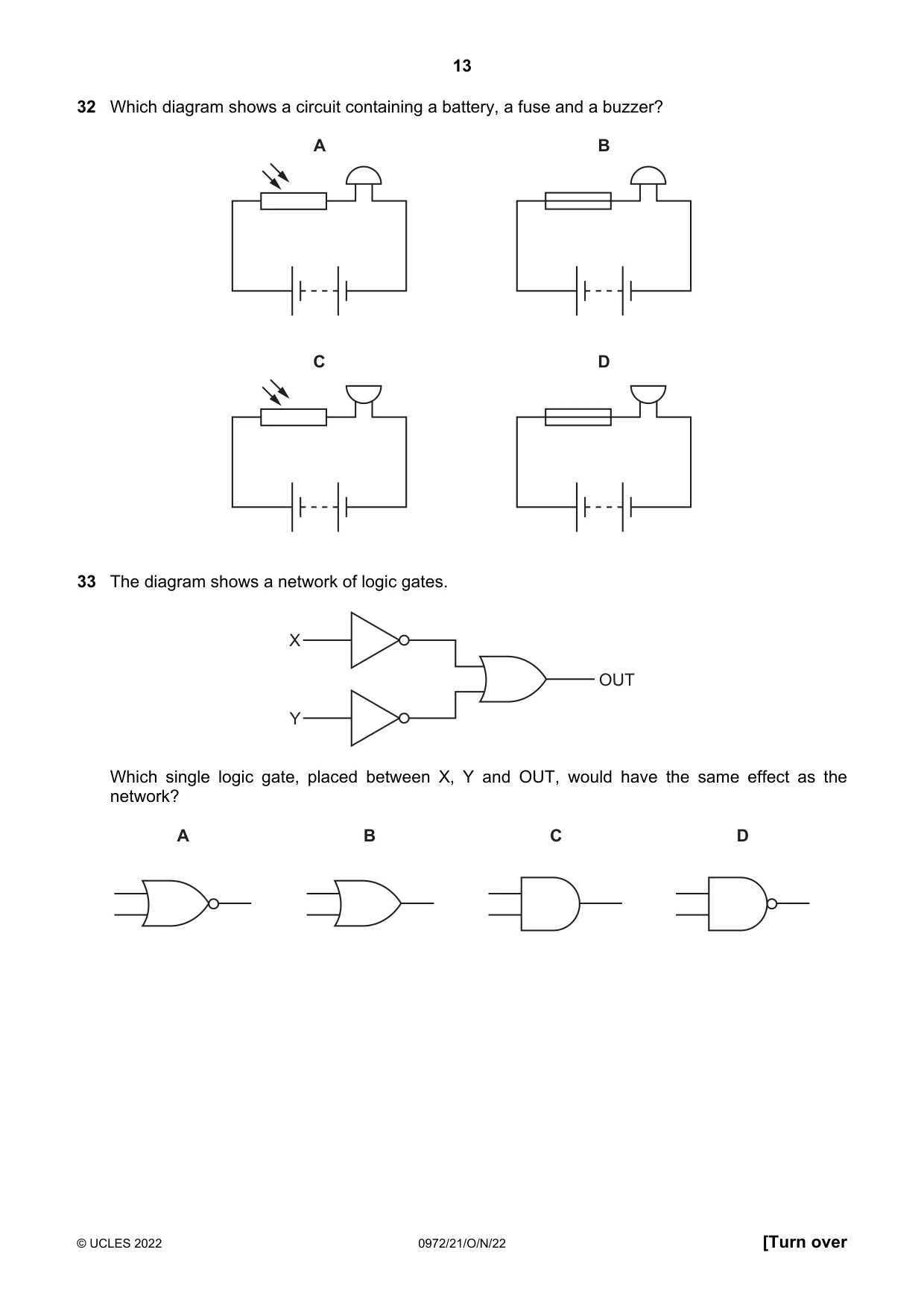
Q32 · Which diagram shows a circuit containing a battery, a fuse and a buzzer?
32 Which diagram shows a circuit containing a battery, a fuse and a buzzer? A B C D
Mark scheme: D
Q33 · The diagram shows a network of logic gates
33 The diagram shows a network of logic gates. X OUT Y Which single logic gate, placed between X, Y and OUT, would have the same effect as the network? A B C D
Mark scheme: D
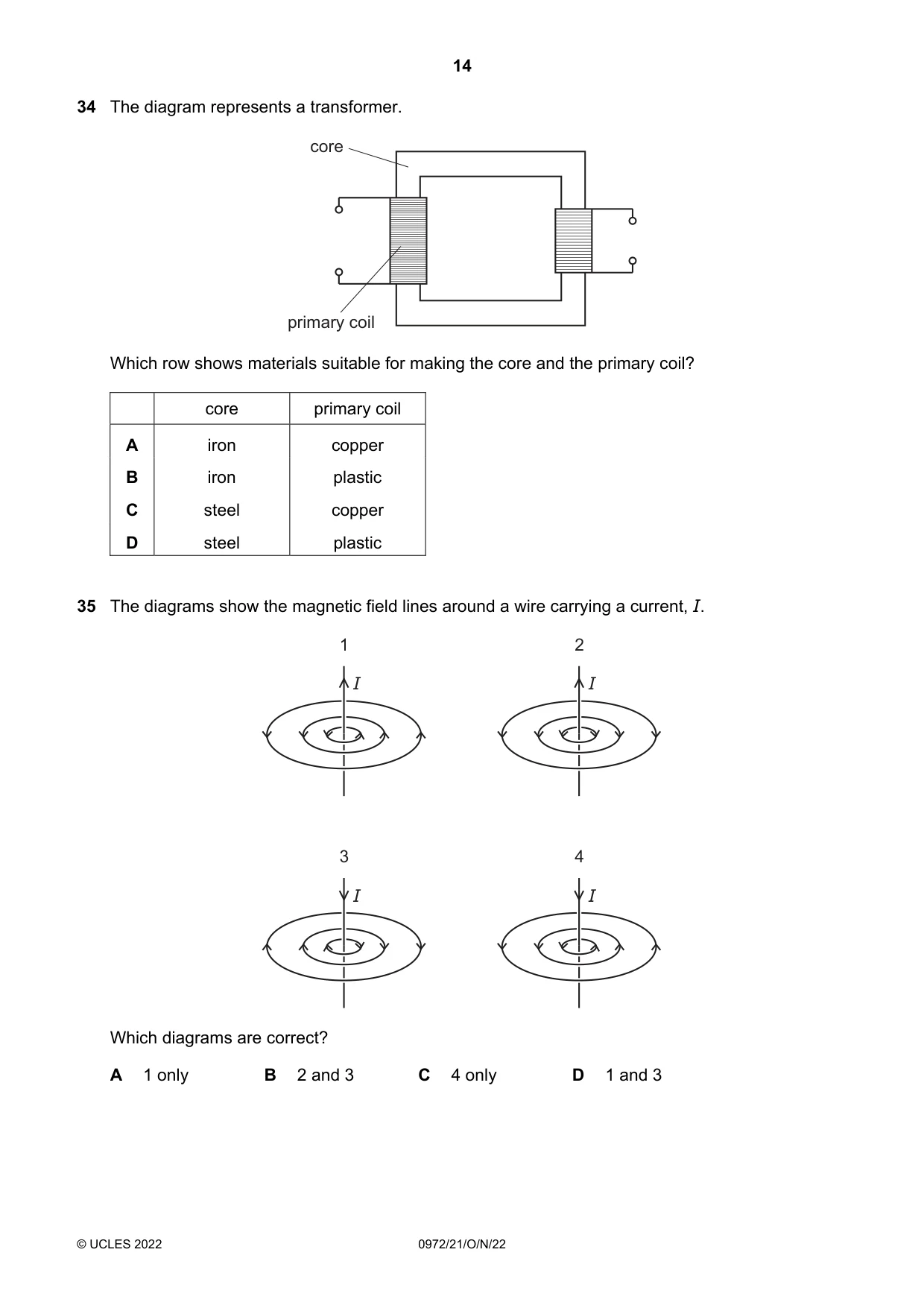
Q34 · The diagram represents a transformer
34 The diagram represents a transformer. core primary coil Which row shows materials suitable for making the core and the primary coil? core primary coil A iron copper B iron plastic C steel copper D steel plastic
Mark scheme: A
Q35 · The diagrams show the magnetic field lines around a wire carrying a current, I
35 The diagrams show the magnetic field lines around a wire carrying a current, I. 1 2 I I 3 4 I I Which diagrams are correct? A 1 only B 2 and 3 C 4 only D 1 and 3
Mark scheme: D
Q36 · Which statement about electromagnetic induction is correct?
36 Which statement about electromagnetic induction is correct? A A conductor moving parallel to magnetic field lines induces an electromotive force (e.m.f.) in the conductor. B The direction of the induced electromotive force (e.m.f.) opposes the change which produces it. C The induced current is in a direction parallel to the direction of motion producing it. D The induced electromotive force (e.m.f.) decreases when the speed of the conductor moving across the field lines increases.
Mark scheme: B
Q37 · A very important experiment increased scientists’ understanding of the structure of matter
37 A very important experiment increased scientists’ understanding of the structure of matter. In the experiment, particles scattered as they passed through a thin metal foil. Which particles were used, and to which conclusion did the experiment lead? particles conclusion A alpha-particles matter is made up of atoms B alpha-particles atoms have a very small nucleus C beta-particles matter is made up of atoms D beta-particles atoms have a very small nucleus
Mark scheme: B
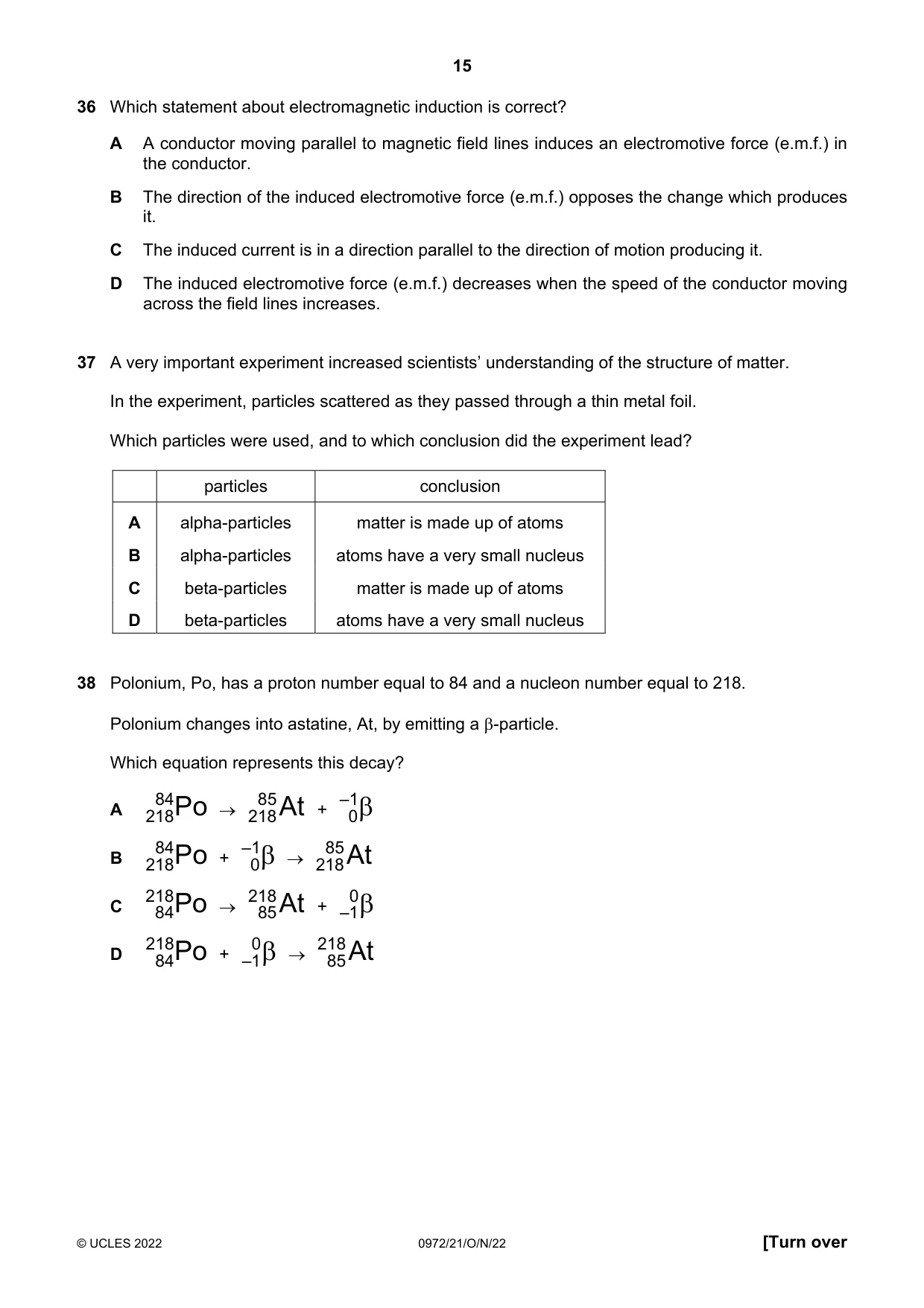
Q38 · Polonium, Po, has a proton number equal to 84 and a nucleon number equal to 218
38 Polonium, Po, has a proton number equal to 84 and a nucleon number equal to 218. Polonium changes into astatine, At, by emitting a β-particle. Which equation represents this decay? 84 Po 8 5 At –1 β A → + 218 218 0 84 Po –1 β 8 5 At B + → 218 0 218 218 Po 218 At 0 β C → + 8 4 85 – 1 218 Po 0 β 218 At D + → 8 4 – 1 85
Mark scheme: C
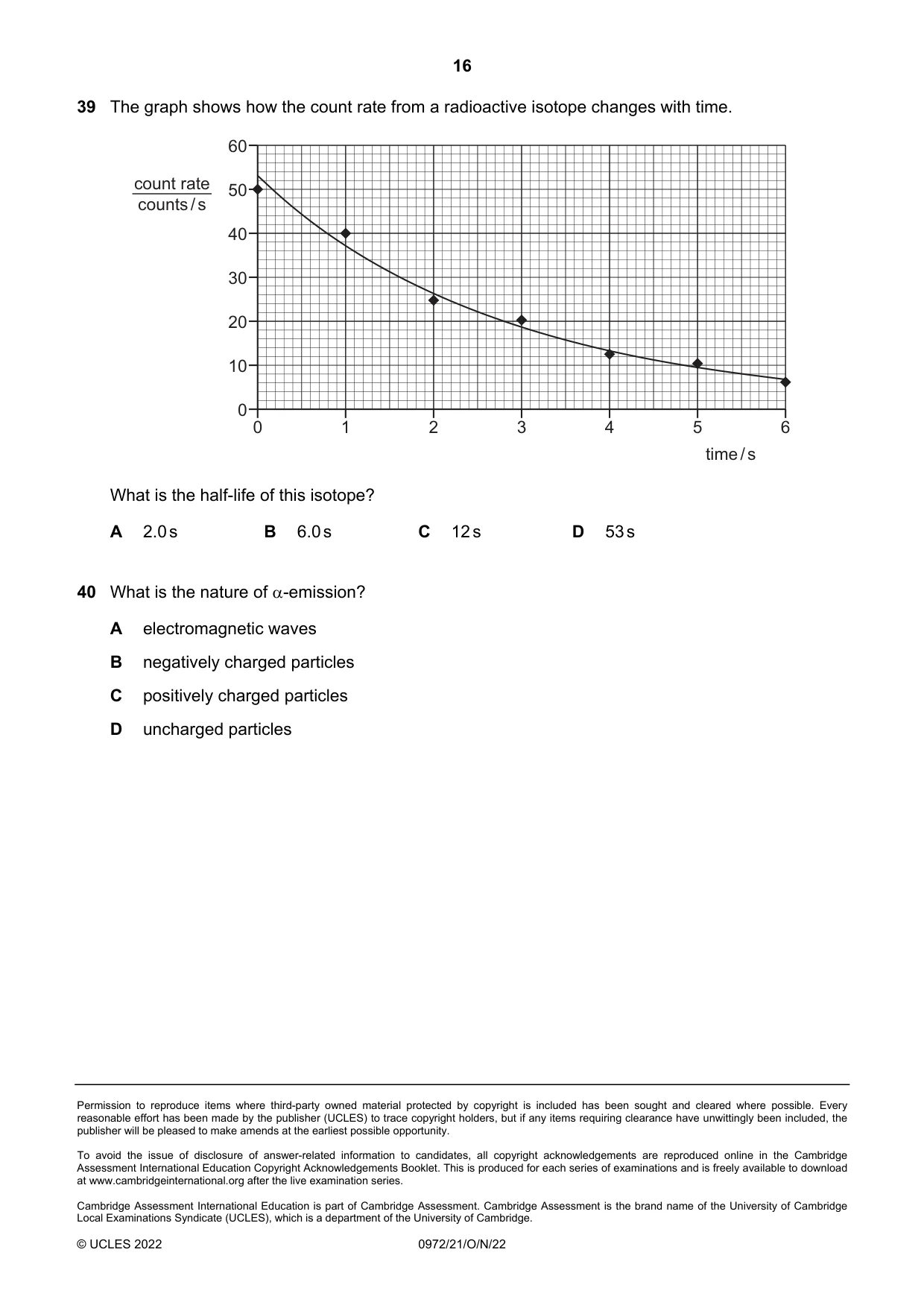
Q39 · The graph shows how the count rate from a radioactive isotope changes with time
39 The graph shows how the count rate from a radioactive isotope changes with time. 60 count rate 50 counts / s 40 30 20 10 0 0 1 2 3 4 5 6 time / s What is the half-life of this isotope? A 2.0 s B 6.0 s C 12 s D 53 s
Mark scheme: A
Q40 · What is the nature of α-emission?
40 What is the nature of α-emission? A electromagnetic waves B negatively charged particles C positively charged particles D uncharged particles
Mark scheme: C
What was in this paper
The subtopics covered by these 40 questions, and how many questions each got. Open one in a new tab to see every Cambridge question on it.
4Electric circuits3Electromagnetic effects3Energy, work and power3Light3Radioactivity3Forces2General properties of waves2Kinetic particle model of matter2Sound2Thermal properties and temperature2Density1Electrical safety1Electromagnetic spectrum1Mass and weight1Momentum1Motion1Physical quantities and measurement techniques1Pressure1Simple phenomena of magnetism1The nuclear model of the atom1Transfer of thermal energy1What you needed in this session
Cambridge’s own grade thresholds for 2022 Oct/Nov, Paper 2 · Variant 1. A higher threshold means an easier paper — the bar moves with how the cohort did.