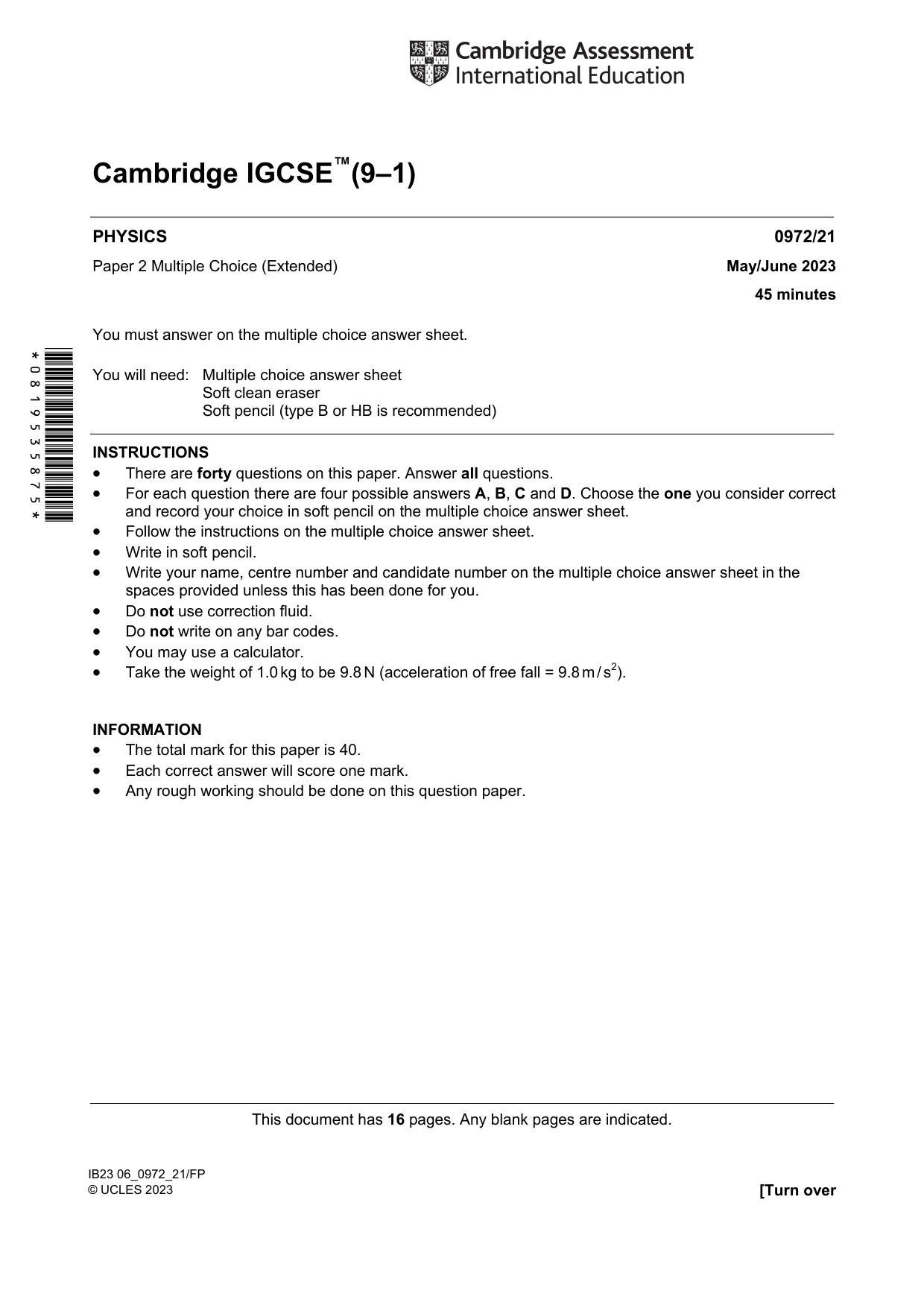
Cambridge IGCSE Physics (9-1) 0972 — 2023 May/June Paper 2 · Variant 1
0972/21/M/J/23 · 40 questions · 40 marks · ≈45 min
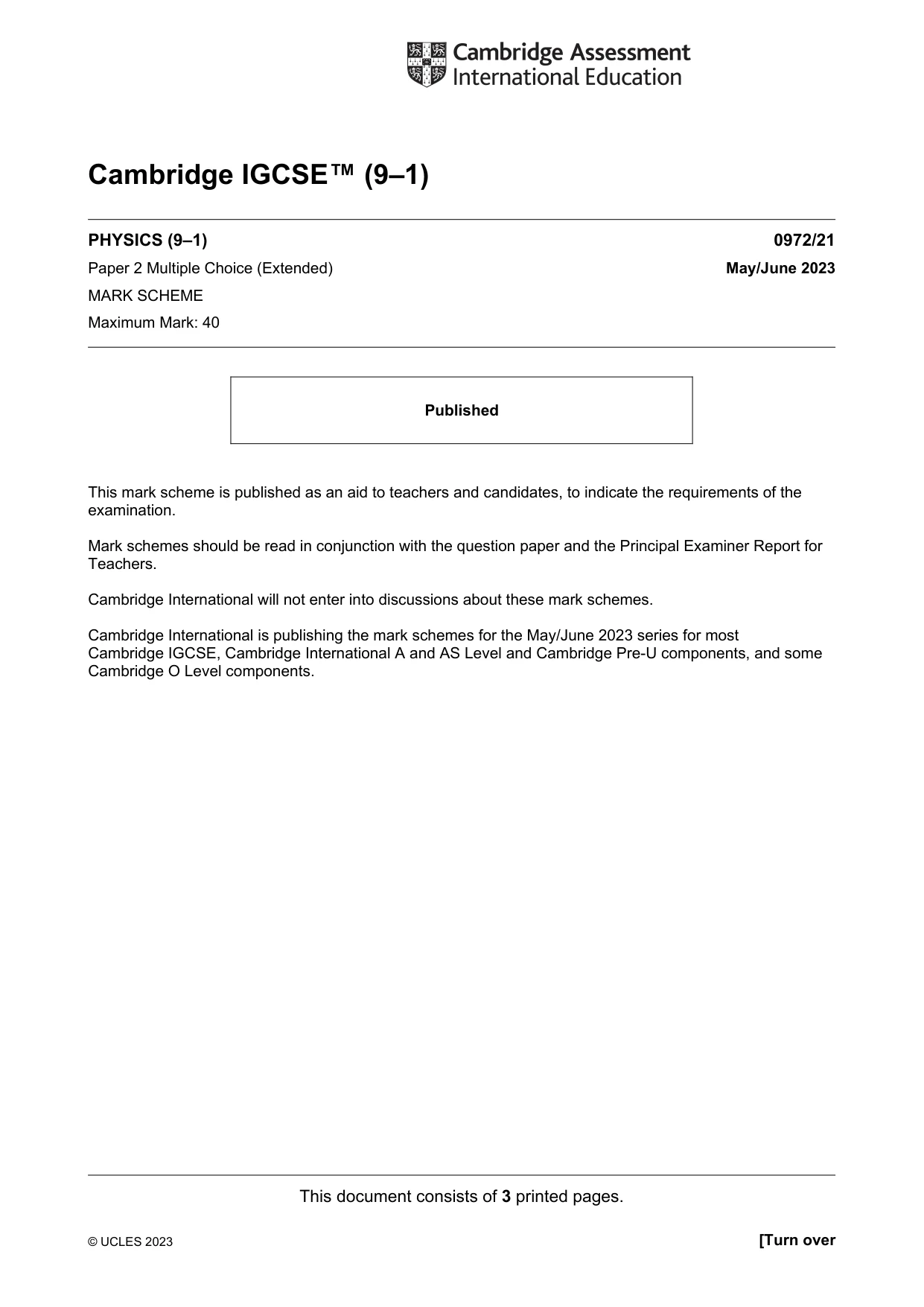
The question paper and its mark scheme, free to read here and free to download. This is Cambridge’s own paper, exactly as it was sat.
Question paper16 pages
Mark scheme3 pages
Answers below. Sit the paper first if you are practising.
Questions as text
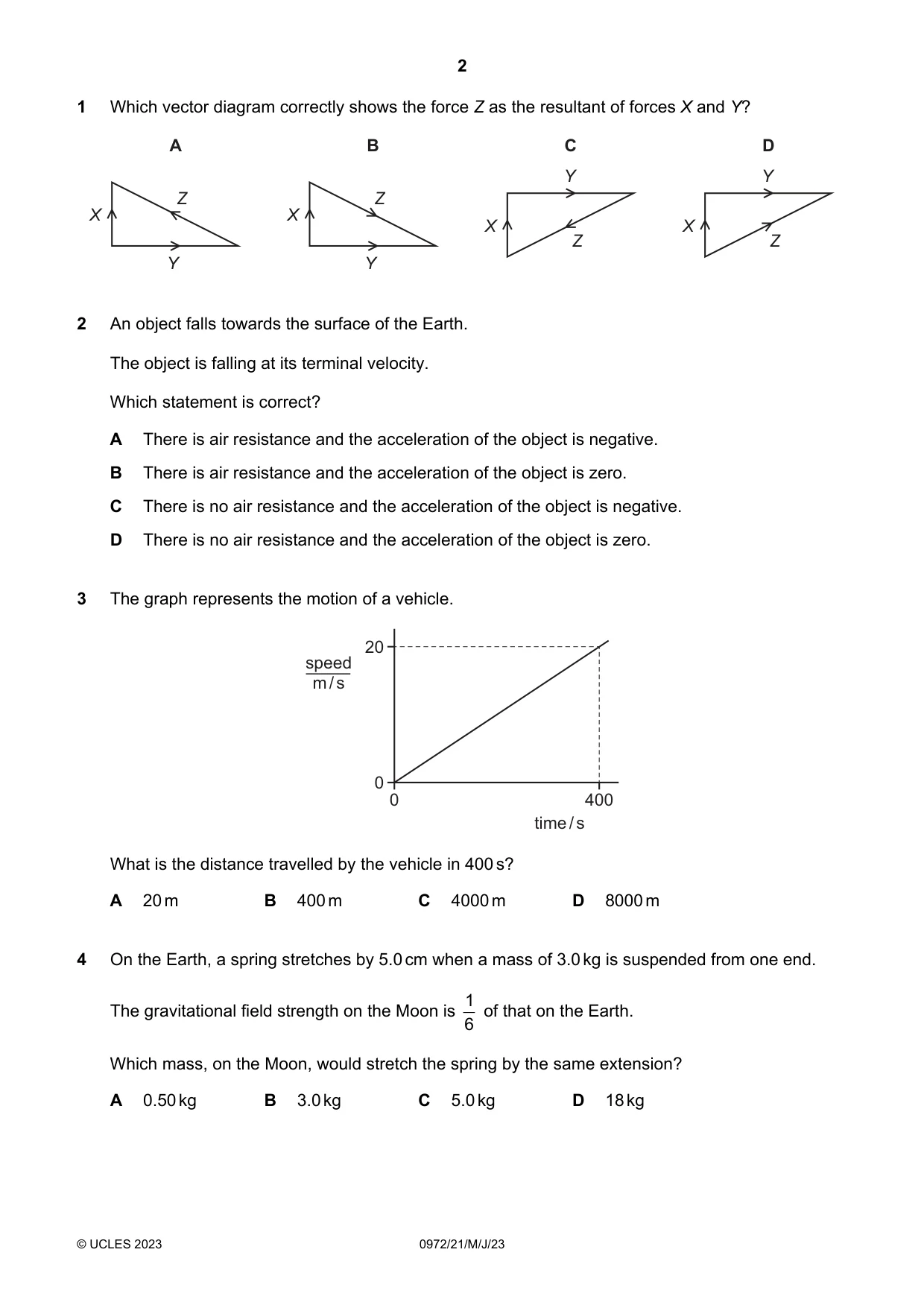
Q1 · Which vector diagram correctly shows the force Z as the resultant of forces X and Y?
1 Which vector diagram correctly shows the force Z as the resultant of forces X and Y? A B C D Y Y Z Z X X X X Z Z Y Y
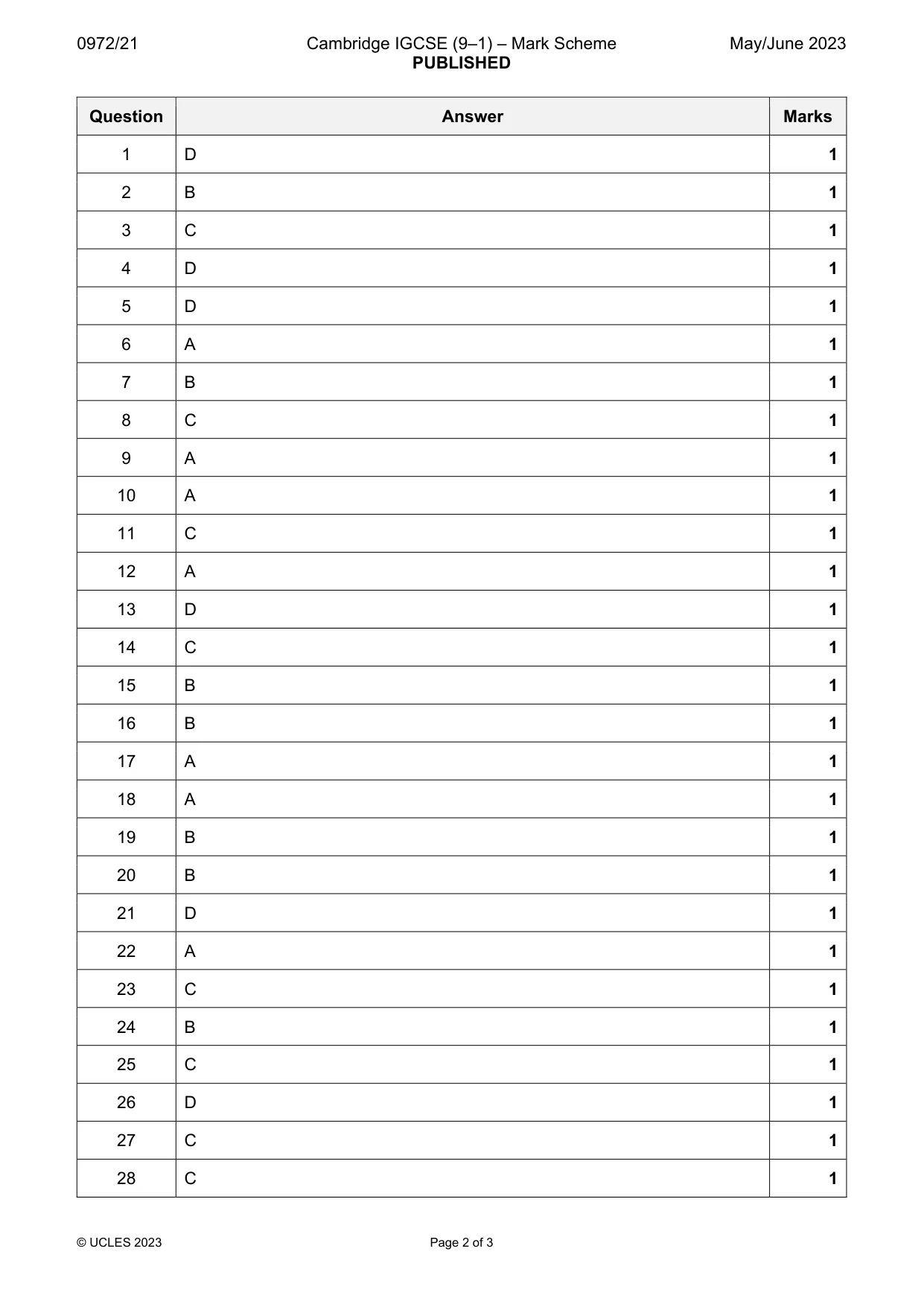
Mark scheme: D
Q2 · An object falls towards the surface of the Earth
2 An object falls towards the surface of the Earth. The object is falling at its terminal velocity. Which statement is correct? A There is air resistance and the acceleration of the object is negative. B There is air resistance and the acceleration of the object is zero. C There is no air resistance and the acceleration of the object is negative. D There is no air resistance and the acceleration of the object is zero.
Mark scheme: B
Q3 · The graph represents the motion of a vehicle
3 The graph represents the motion of a vehicle. 20 speed m / s 0 0 400 time / s What is the distance travelled by the vehicle in 400 s? A 20 m B 400 m C 4000 m D 8000 m
Mark scheme: C
Q4 · On the Earth, a spring stretches by 5.0 cm when a mass of 3.0 kg is suspended from one end
4 On the Earth, a spring stretches by 5.0 cm when a mass of 3.0 kg is suspended from one end. The gravitational field strength on the Moon is 1 6 of that on the Earth. Which mass, on the Moon, would stretch the spring by the same extension? A 0.50 kg B 3.0 kg C 5.0 kg D 18 kg
Mark scheme: D
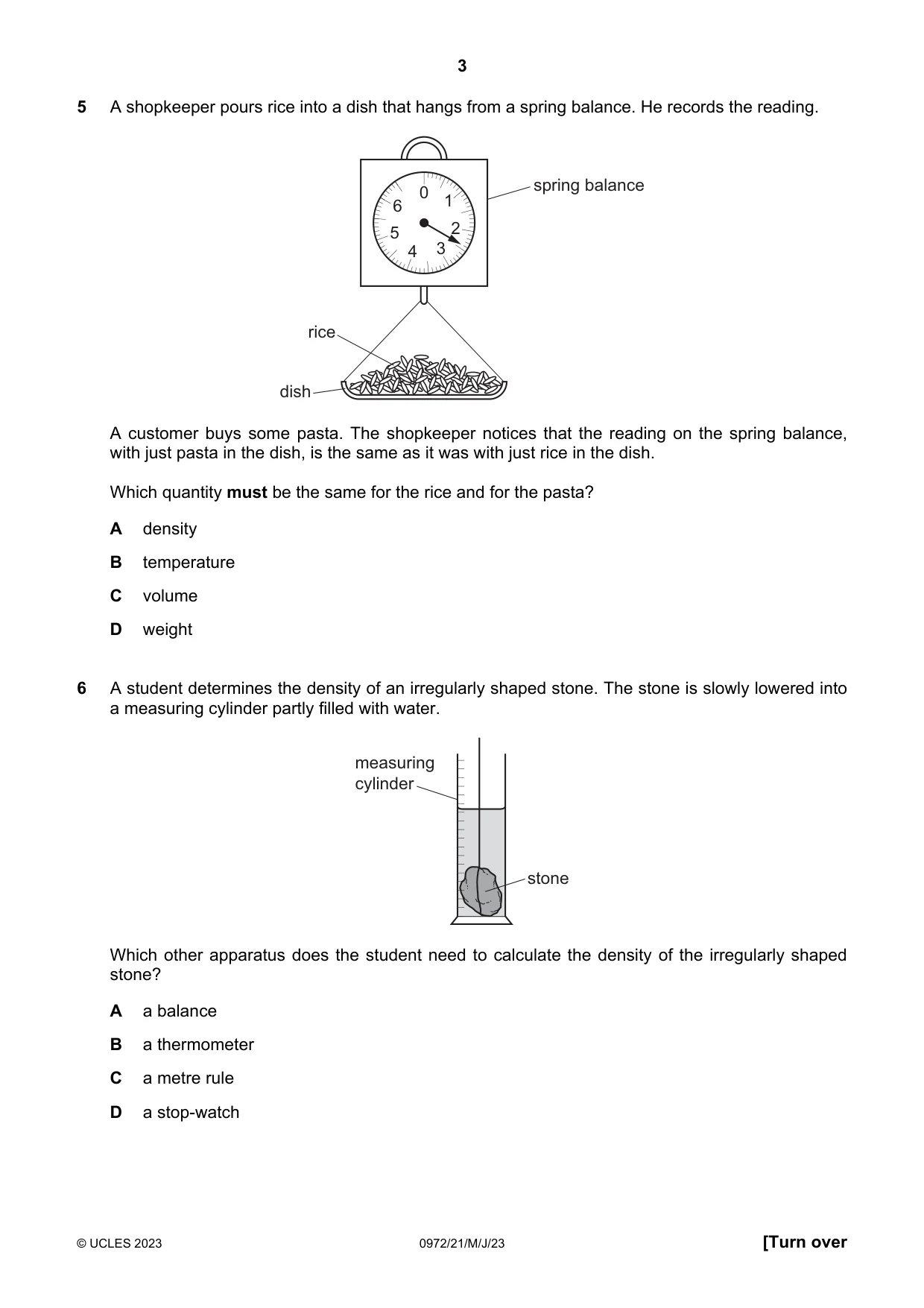
Q5 · A shopkeeper pours rice into a dish that hangs from a spring balance
5 A shopkeeper pours rice into a dish that hangs from a spring balance. He records the reading. 0 spring balance 6 1 5 2 4 3 rice dish A customer buys some pasta. The shopkeeper notices that the reading on the spring balance, with just pasta in the dish, is the same as it was with just rice in the dish. Which quantity must be the same for the rice and for the pasta? A density B temperature C volume D weight
Mark scheme: D
Q6 · A student determines the density of an irregularly shaped stone
6 A student determines the density of an irregularly shaped stone. The stone is slowly lowered into a measuring cylinder partly filled with water. measuring cylinder stone Which other apparatus does the student need to calculate the density of the irregularly shaped stone? A a balance B a thermometer C a metre rule D a stop-watch
Mark scheme: A
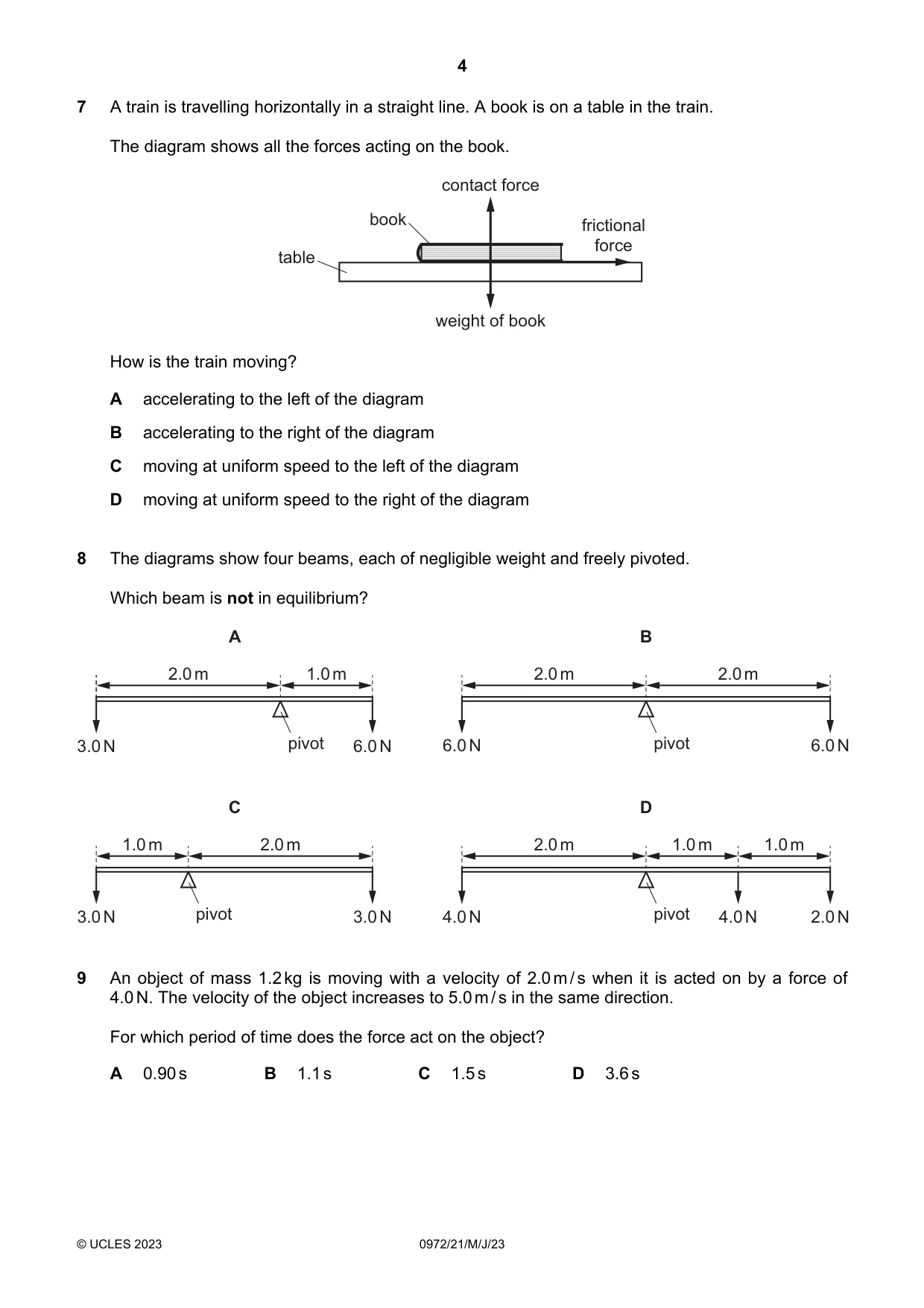
Q7 · A train is travelling horizontally in a straight line
7 A train is travelling horizontally in a straight line. A book is on a table in the train. The diagram shows all the forces acting on the book. contact force book frictional force table weight of book How is the train moving? A accelerating to the left of the diagram B accelerating to the right of the diagram C moving at uniform speed to the left of the diagram D moving at uniform speed to the right of the diagram
Mark scheme: B
Q8 · The diagrams show four beams, each of negligible weight and freely pivoted
8 The diagrams show four beams, each of negligible weight and freely pivoted. Which beam is not in equilibrium? A B 2.0 m 1.0 m 2.0 m 2.0 m 3.0 N pivot 6.0 N 6.0 N pivot 6.0 N C D 1.0 m 2.0 m 2.0 m 1.0 m 1.0 m 3.0 N pivot 3.0 N 4.0 N pivot 4.0 N 2.0 N
Mark scheme: C
Q9 · An object of mass 1.2 kg is moving with a velocity of 2.0 m / s when it is acted on by a…
9 An object of mass 1.2 kg is moving with a velocity of 2.0 m / s when it is acted on by a force of 4.0 N. The velocity of the object increases to 5.0 m / s in the same direction. For which period of time does the force act on the object? A 0.90 s B 1.1 s C 1.5 s D 3.6 s
Mark scheme: A
Q10 · Which row about the change of energy in the energy store must be correct?
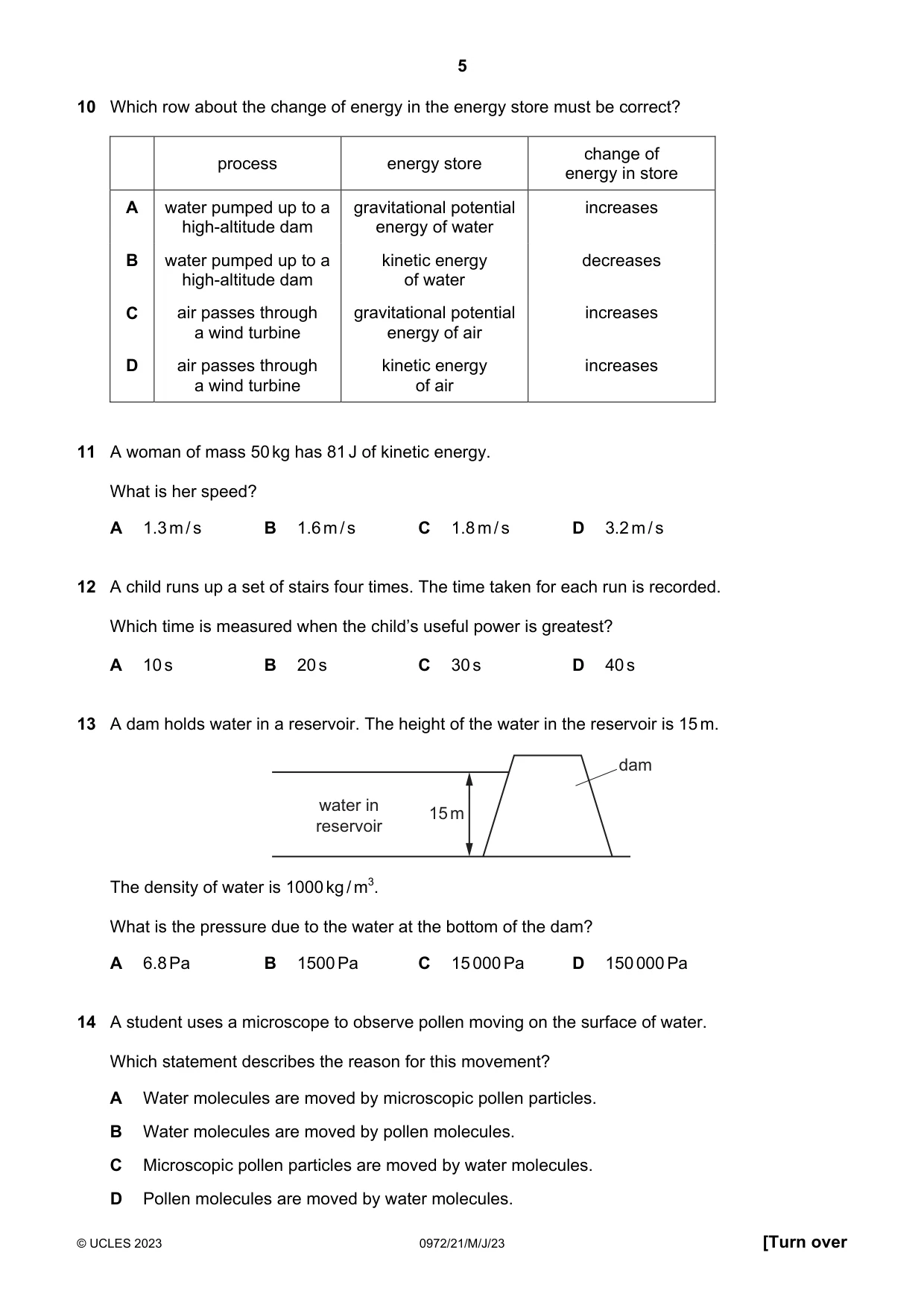
10 Which row about the change of energy in the energy store must be correct? change of process energy store energy in store A water pumped up to a gravitational potential increases high-altitude dam energy of water B water pumped up to a kinetic energy decreases high-altitude dam of water C air passes through gravitational potential increases a wind turbine energy of air D air passes through kinetic energy increases a wind turbine of air
Mark scheme: A
Q11 · A woman of mass 50 kg has 81 J of kinetic energy
11 A woman of mass 50 kg has 81 J of kinetic energy. What is her speed? A 1.3 m / s B 1.6 m / s C 1.8 m / s D 3.2 m / s
Mark scheme: C
Q12 · A child runs up a set of stairs four times
12 A child runs up a set of stairs four times. The time taken for each run is recorded. Which time is measured when the child’s useful power is greatest? A 10 s B 20 s C 30 s D 40 s
Mark scheme: A
Q13 · A dam holds water in a reservoir
13 A dam holds water in a reservoir. The height of the water in the reservoir is 15 m. dam water in 15 m reservoir The density of water is 1000 kg / m3. What is the pressure due to the water at the bottom of the dam? A 6.8 Pa B 1500 Pa C 15 000 Pa D 150 000 Pa
Mark scheme: D
Q14 · A student uses a microscope to observe pollen moving on the surface of water
14 A student uses a microscope to observe pollen moving on the surface of water. Which statement describes the reason for this movement? A Water molecules are moved by microscopic pollen particles. B Water molecules are moved by pollen molecules. C Microscopic pollen particles are moved by water molecules. D Pollen molecules are moved by water molecules.
Mark scheme: C
Q15 · Which statements about evaporation of water are correct?
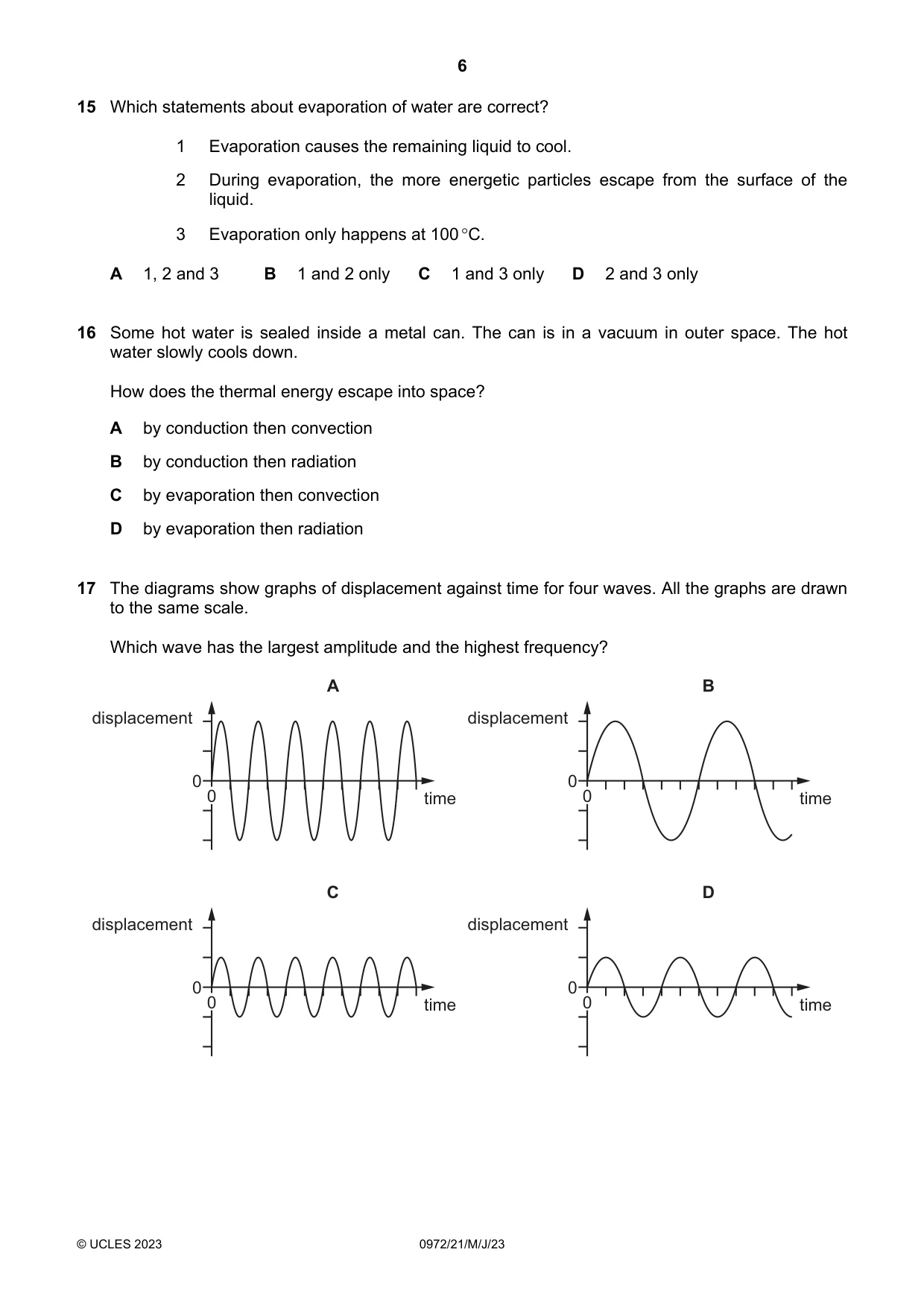
15 Which statements about evaporation of water are correct? 1 Evaporation causes the remaining liquid to cool. 2 During evaporation, the more energetic particles escape from the surface of the liquid. 3 Evaporation only happens at 100 °C. A 1, 2 and 3 B 1 and 2 only C 1 and 3 only D 2 and 3 only
Mark scheme: B
Q16 · Some hot water is sealed inside a metal can
16 Some hot water is sealed inside a metal can. The can is in a vacuum in outer space. The hot water slowly cools down. How does the thermal energy escape into space? A by conduction then convection B by conduction then radiation C by evaporation then convection D by evaporation then radiation
Mark scheme: B
Q17 · The diagrams show graphs of displacement against time for four waves
17 The diagrams show graphs of displacement against time for four waves. All the graphs are drawn to the same scale. Which wave has the largest amplitude and the highest frequency? A B displacement displacement 0 0 0 time 0 time C D displacement displacement 0 0 0 time 0 time
Mark scheme: A
Q18 · The diagram shows a ray of light entering a glass block
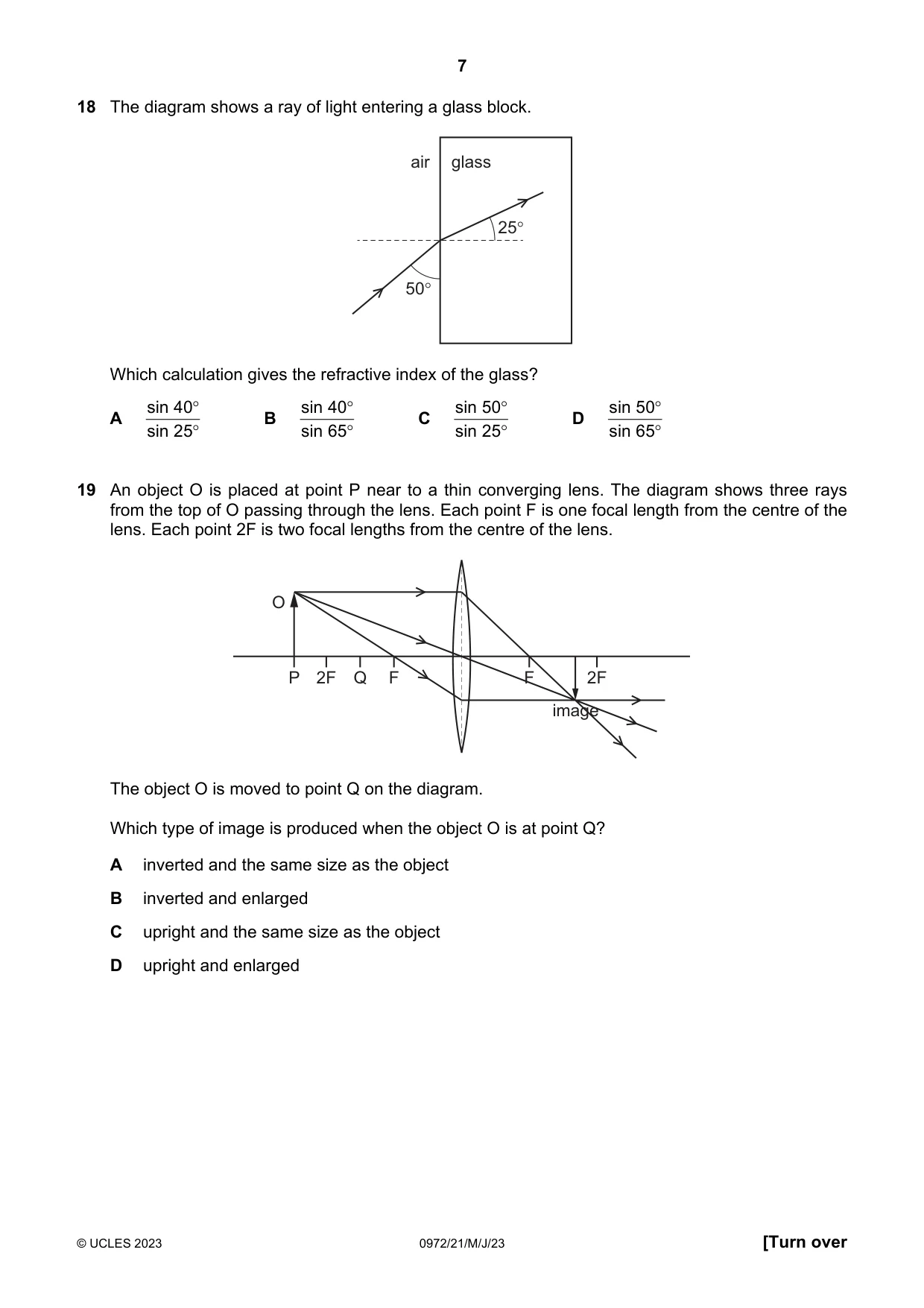
18 The diagram shows a ray of light entering a glass block. air 50° Which calculation gives the refractive index of the glass? sin 40° B sin 40° Cc sin 50° D sin 50° sin 25° sin 65° sin 25° sin 65°
Mark scheme: A
Q19 · An object O is placed at point P near to a thin converging lens
19 An object O is placed at point P near to a thin converging lens. The diagram shows three rays from the top of O passing through the lens. Each point F is one focal length from the centre of the lens. Each point 2F is two focal lengths from the centre of the lens. O P 2F Q F F 2F image The object O is moved to point Q on the diagram. Which type of image is produced when the object O is at point Q? A inverted and the same size as the object B inverted and enlarged C upright and the same size as the object D upright and enlarged
Mark scheme: B
Q20 · Which diagram shows the dispersion of white light by a glass prism?
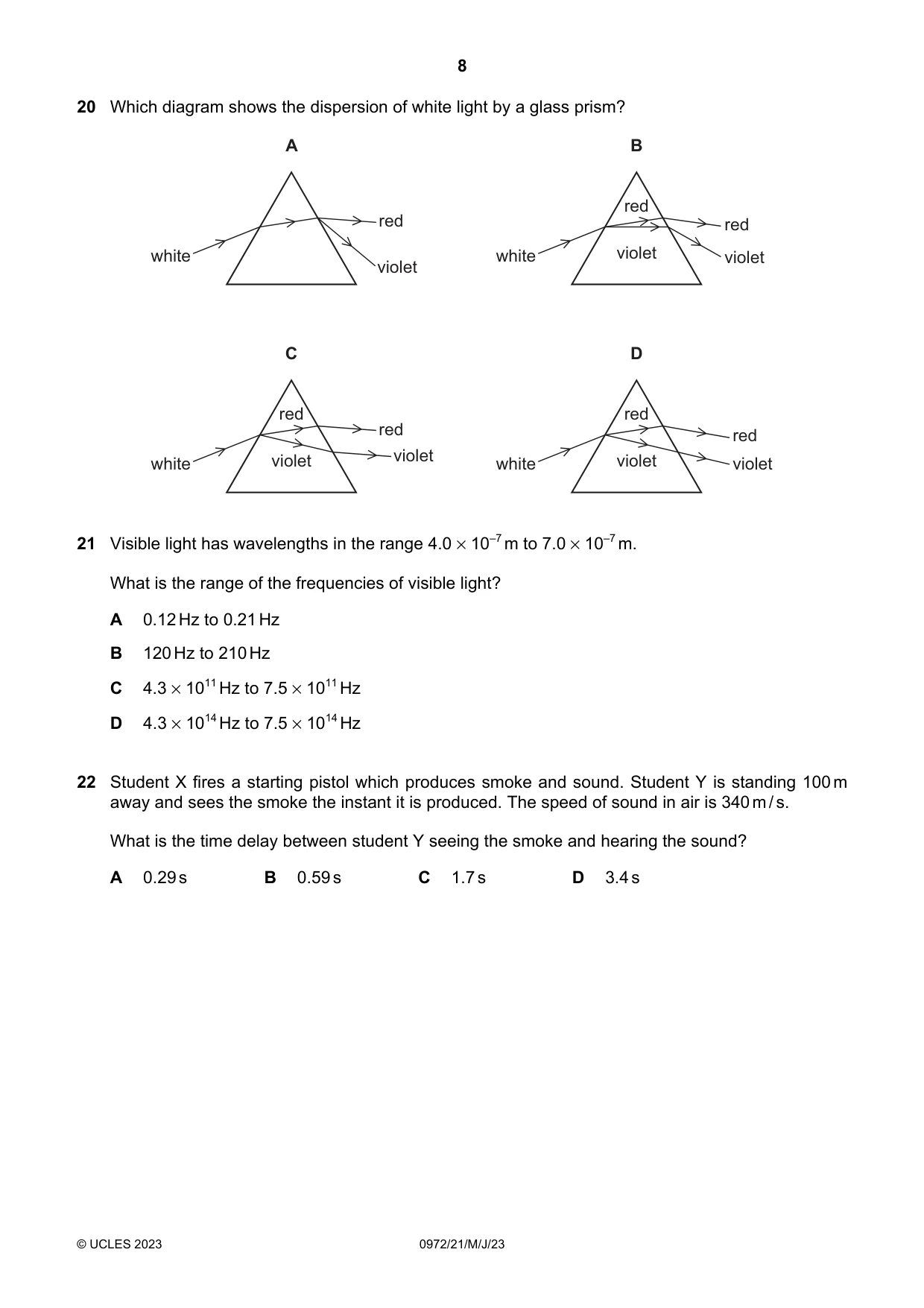
20 Which diagram shows the dispersion of white light by a glass prism? A B red red red white white violet violet violet C D red red red red white violet violet white violet violet
Mark scheme: B
Q21 · Visible light has wavelengths in the range 4.0 × 10⁻⁷ m to 7.0 × 10⁻⁷ m
21 Visible light has wavelengths in the range 4.0 × 10⁻⁷ m to 7.0 × 10⁻⁷ m. What is the range of the frequencies of visible light? A 0.12 Hz to 0.21 Hz B 120 Hz to 210 Hz C 4.3 × 10¹¹ Hz to 7.5 × 10¹¹ Hz D 4.3 × 10¹⁴ Hz to 7.5 × 10¹⁴ Hz
Mark scheme: D
Q22 · Student X fires a starting pistol which produces smoke and sound
22 Student X fires a starting pistol which produces smoke and sound. Student Y is standing 100 m away and sees the smoke the instant it is produced. The speed of sound in air is 340 m / s. What is the time delay between student Y seeing the smoke and hearing the sound? A 0.29 s B 0.59 s C 1.7 s D 3.4 s
Mark scheme: A
Q23 · An unmagnetised piece of soft iron is placed close to a strong permanent magnet, as shown
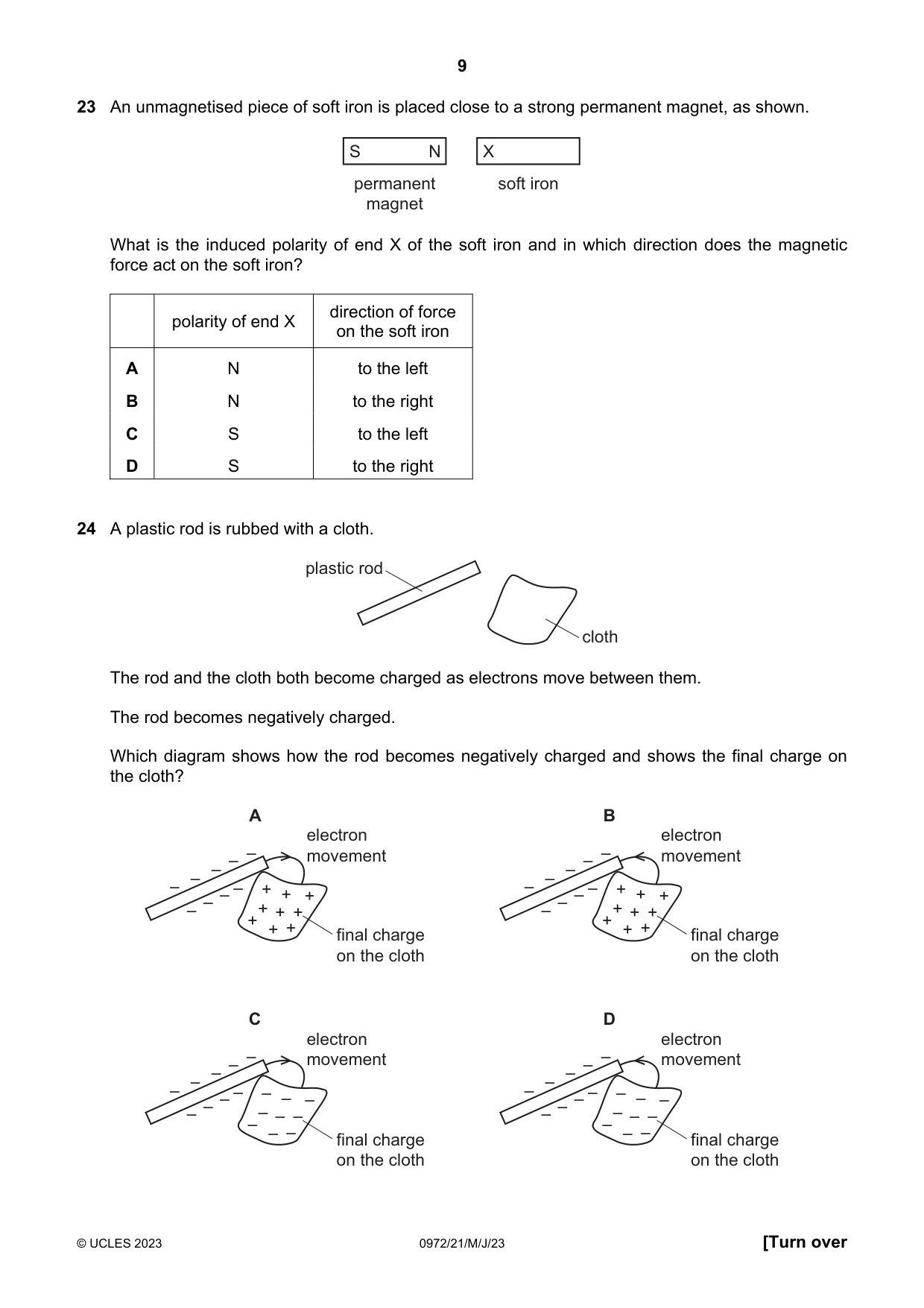
23 An unmagnetised piece of soft iron is placed close to a strong permanent magnet, as shown. S N X permanent soft iron magnet What is the induced polarity of end X of the soft iron and in which direction does the magnetic force act on the soft iron? direction of force polarity of end X on the soft iron A N to the left B N to the right C S to the left D S to the right
Mark scheme: C
Q24 · A plastic rod is rubbed with a cloth
24 A plastic rod is rubbed with a cloth. plastic rod cloth The rod and the cloth both become charged as electrons move between them. The rod becomes negatively charged. Which diagram shows how the rod becomes negatively charged and shows the final charge on the cloth? A B electron electron – – movement – – – movement – – – – – + + – – + + – – + – – + – ++ + + – ++ + + + + final charge + + final charge on the cloth on the cloth C D electron electron – – – movement – – – movement – – – – – – – – – – – – – – – – – –– – – – –– – – – – final charge – – final charge on the cloth on the cloth
Mark scheme: B
Q25 · A wire has a uniform circular cross-sectional area
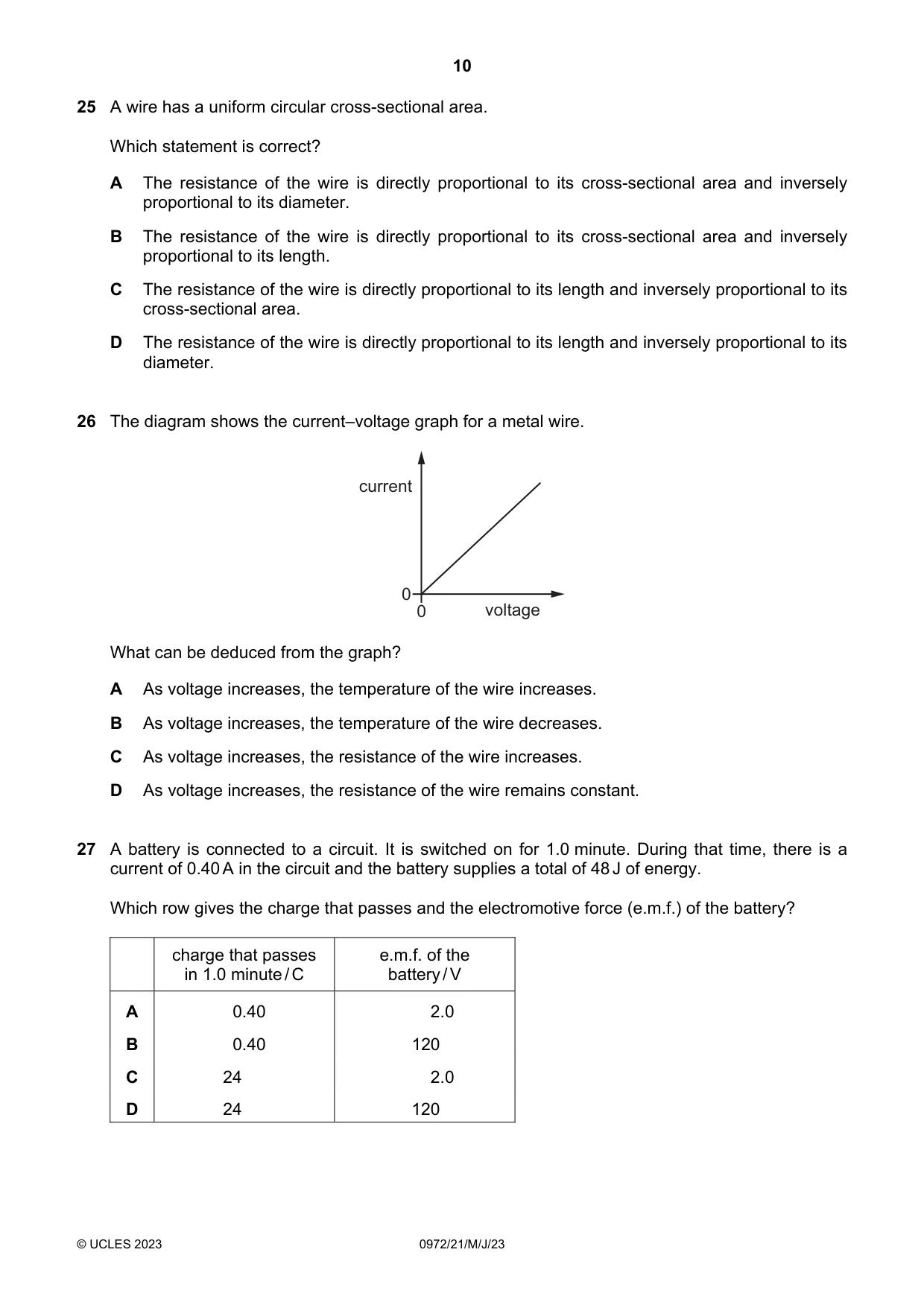
25 A wire has a uniform circular cross-sectional area. Which statement is correct? A The resistance of the wire is directly proportional to its cross-sectional area and inversely proportional to its diameter. B The resistance of the wire is directly proportional to its cross-sectional area and inversely proportional to its length. C The resistance of the wire is directly proportional to its length and inversely proportional to its cross-sectional area. D The resistance of the wire is directly proportional to its length and inversely proportional to its diameter.
Mark scheme: C
Q26 · The diagram shows the current–voltage graph for a metal wire
26 The diagram shows the current–voltage graph for a metal wire. current 0 0 voltage What can be deduced from the graph? A As voltage increases, the temperature of the wire increases. B As voltage increases, the temperature of the wire decreases. C As voltage increases, the resistance of the wire increases. D As voltage increases, the resistance of the wire remains constant.
Mark scheme: D
Q27 · A battery is connected to a circuit
27 A battery is connected to a circuit. It is switched on for 1.0 minute. During that time, there is a current of 0.40 A in the circuit and the battery supplies a total of 48 J of energy. Which row gives the charge that passes and the electromotive force (e.m.f.) of the battery? charge that passes e.m.f. of the in 1.0 minute / C battery / V A 0.40 2.0 B 0.40 120 C 24 2.0 D 24 120
Mark scheme: C
Q28 · The circuit diagram shows two identical lamps connected in parallel to a cell
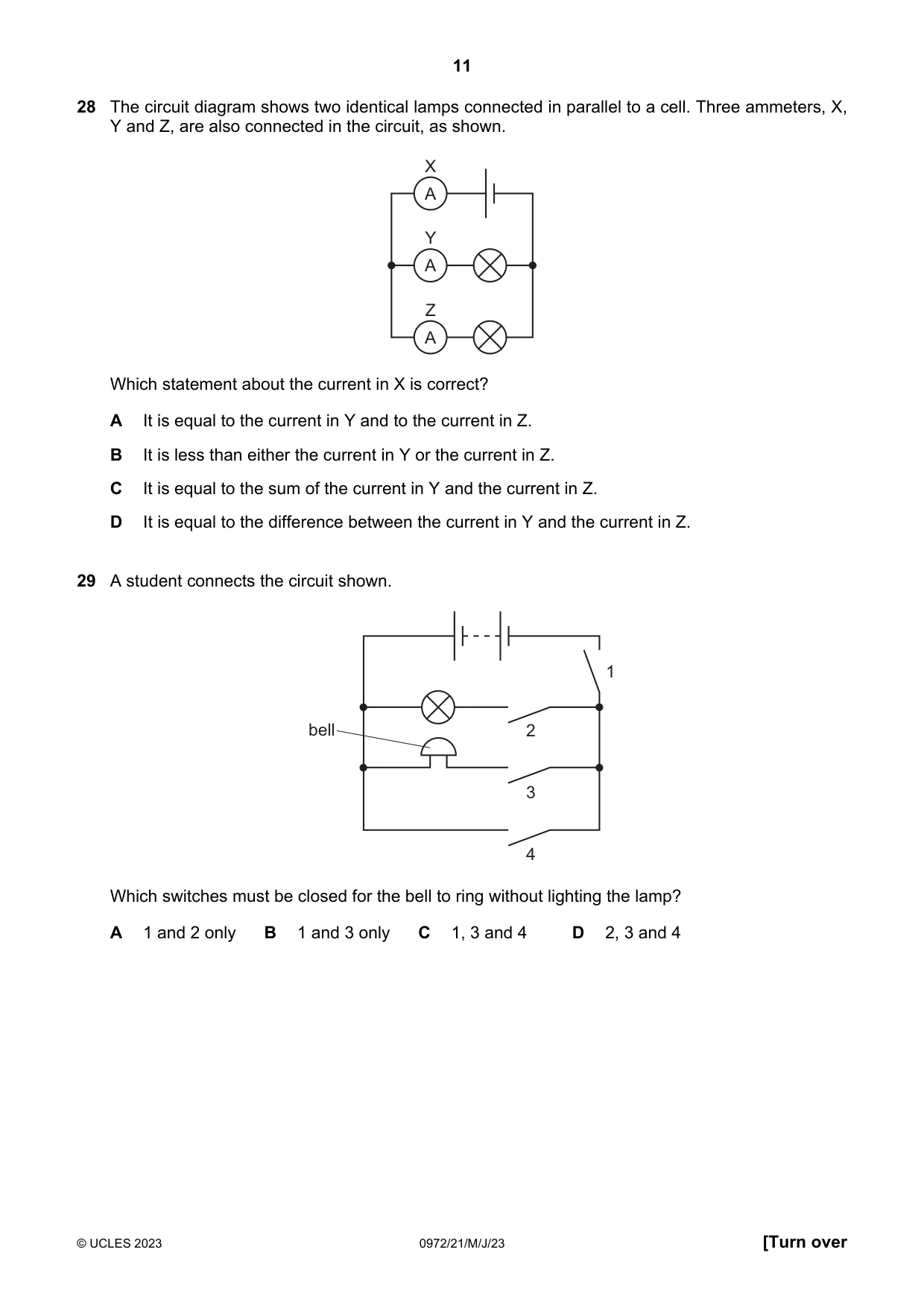
28 The circuit diagram shows two identical lamps connected in parallel to a cell. Three ammeters, X, Y and Z, are also connected in the circuit, as shown. X A Y A Z A Which statement about the current in X is correct? A It is equal to the current in Y and to the current in Z. B It is less than either the current in Y or the current in Z. C It is equal to the sum of the current in Y and the current in Z. D It is equal to the difference between the current in Y and the current in Z.
Mark scheme: C
Q29 · A student connects the circuit shown
29 A student connects the circuit shown. 1 bell 2 3 4 Which switches must be closed for the bell to ring without lighting the lamp? A 1 and 2 only B 1 and 3 only C 1, 3 and 4 D 2, 3 and 4
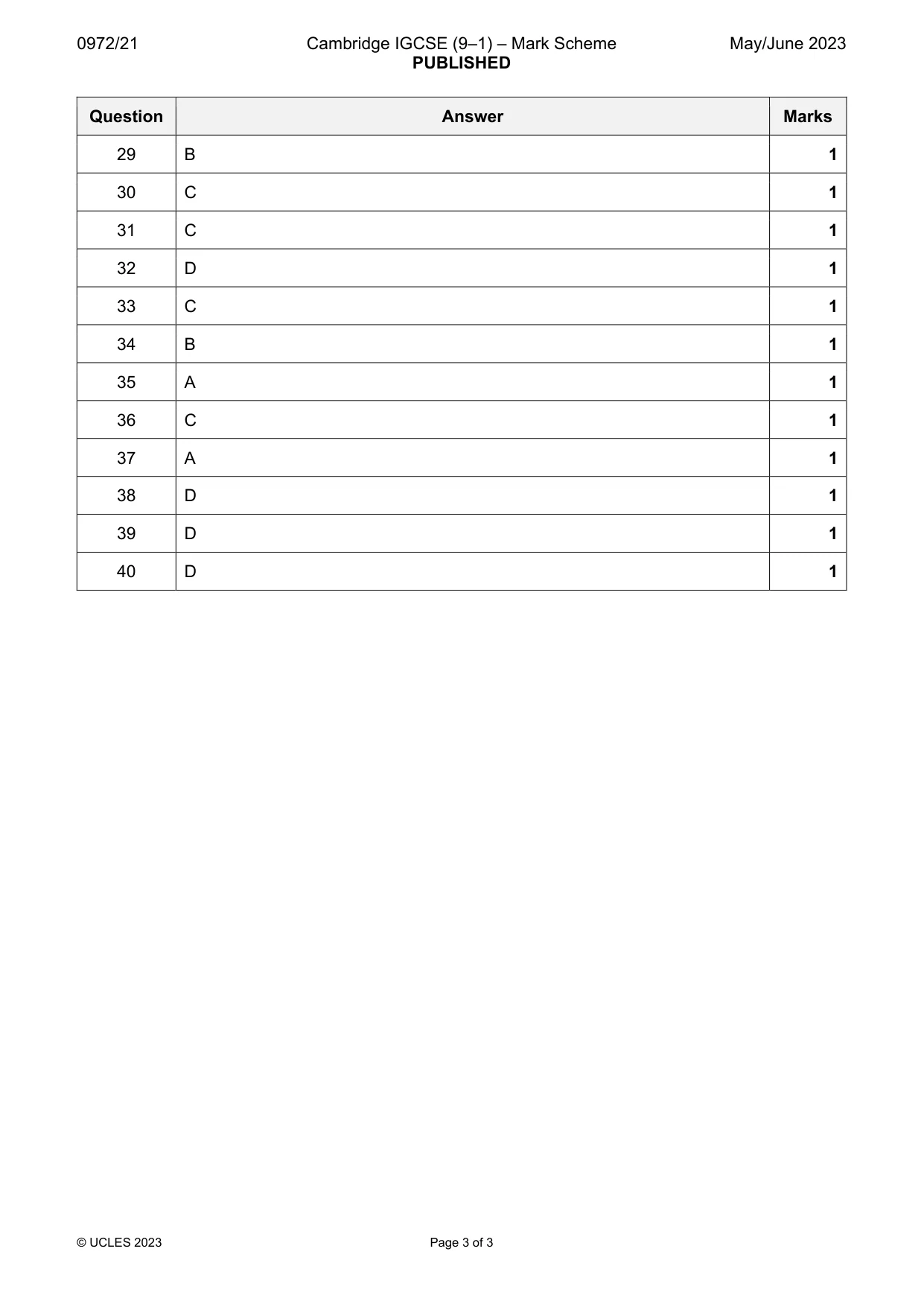
Mark scheme: B
Q30 · The diagram shows an a.c
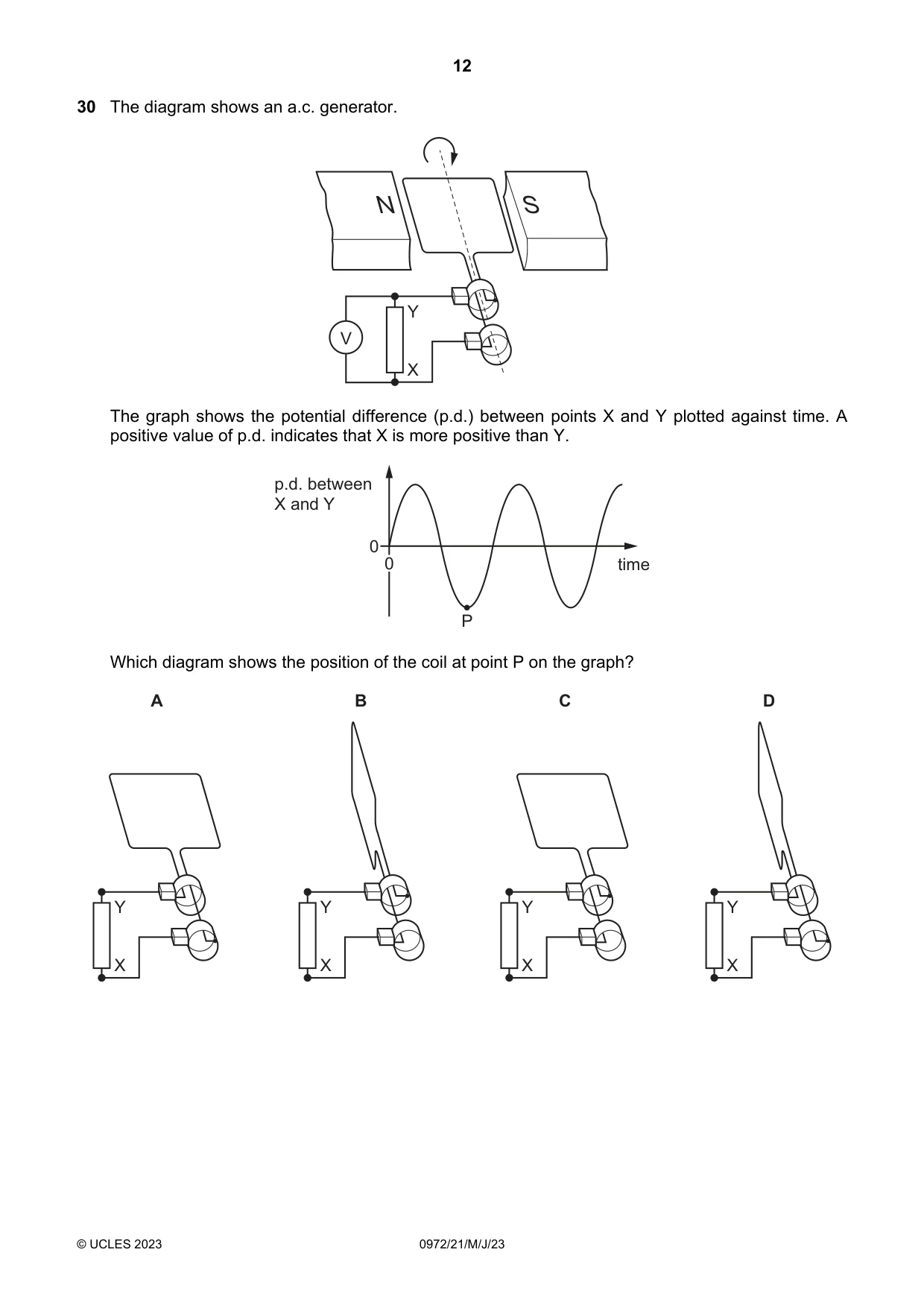
30 The diagram shows an a.c. generator. N S Y V X The graph shows the potential difference (p.d.) between points X and Y plotted against time. A positive value of p.d. indicates that X is more positive than Y. p.d. between X and Y 0 0 time P Which diagram shows the position of the coil at point P on the graph? A B C D Y Y Y Y X X X X
Mark scheme: C
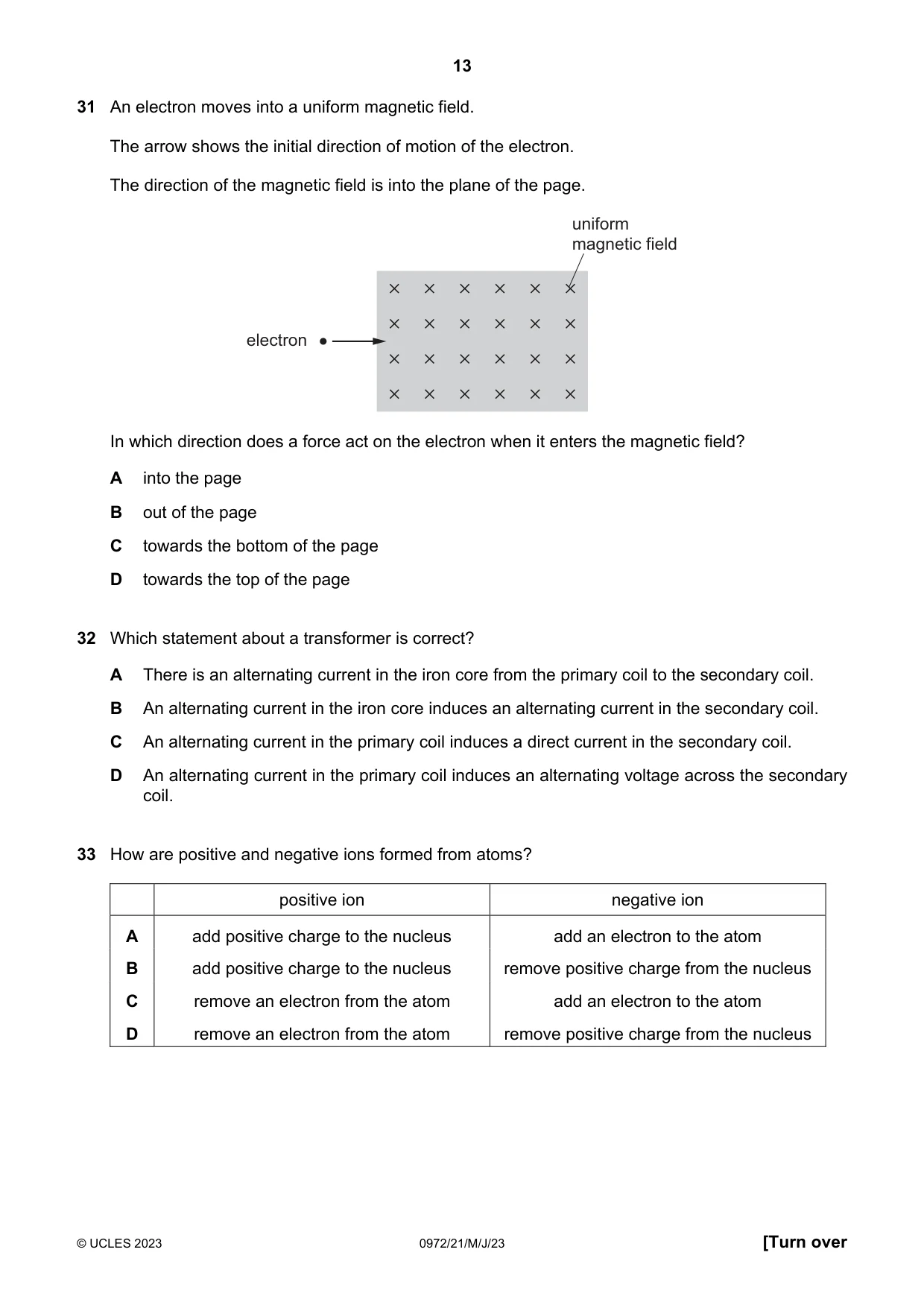
Q31 · An electron moves into a uniform magnetic field
31 An electron moves into a uniform magnetic field. The arrow shows the initial direction of motion of the electron. The direction of the magnetic field is into the plane of the page. uniform magnetic field electron In which direction does a force act on the electron when it enters the magnetic field? A into the page B out of the page C towards the bottom of the page D towards the top of the page
Mark scheme: C
Q32 · Which statement about a transformer is correct?
32 Which statement about a transformer is correct? A There is an alternating current in the iron core from the primary coil to the secondary coil. B An alternating current in the iron core induces an alternating current in the secondary coil. C An alternating current in the primary coil induces a direct current in the secondary coil. D An alternating current in the primary coil induces an alternating voltage across the secondary coil.
Mark scheme: D
Q33 · How are positive and negative ions formed from atoms?
33 How are positive and negative ions formed from atoms? positive ion negative ion A add positive charge to the nucleus add an electron to the atom B add positive charge to the nucleus remove positive charge from the nucleus C remove an electron from the atom add an electron to the atom D remove an electron from the atom remove positive charge from the nucleus 56 26X
Mark scheme: C
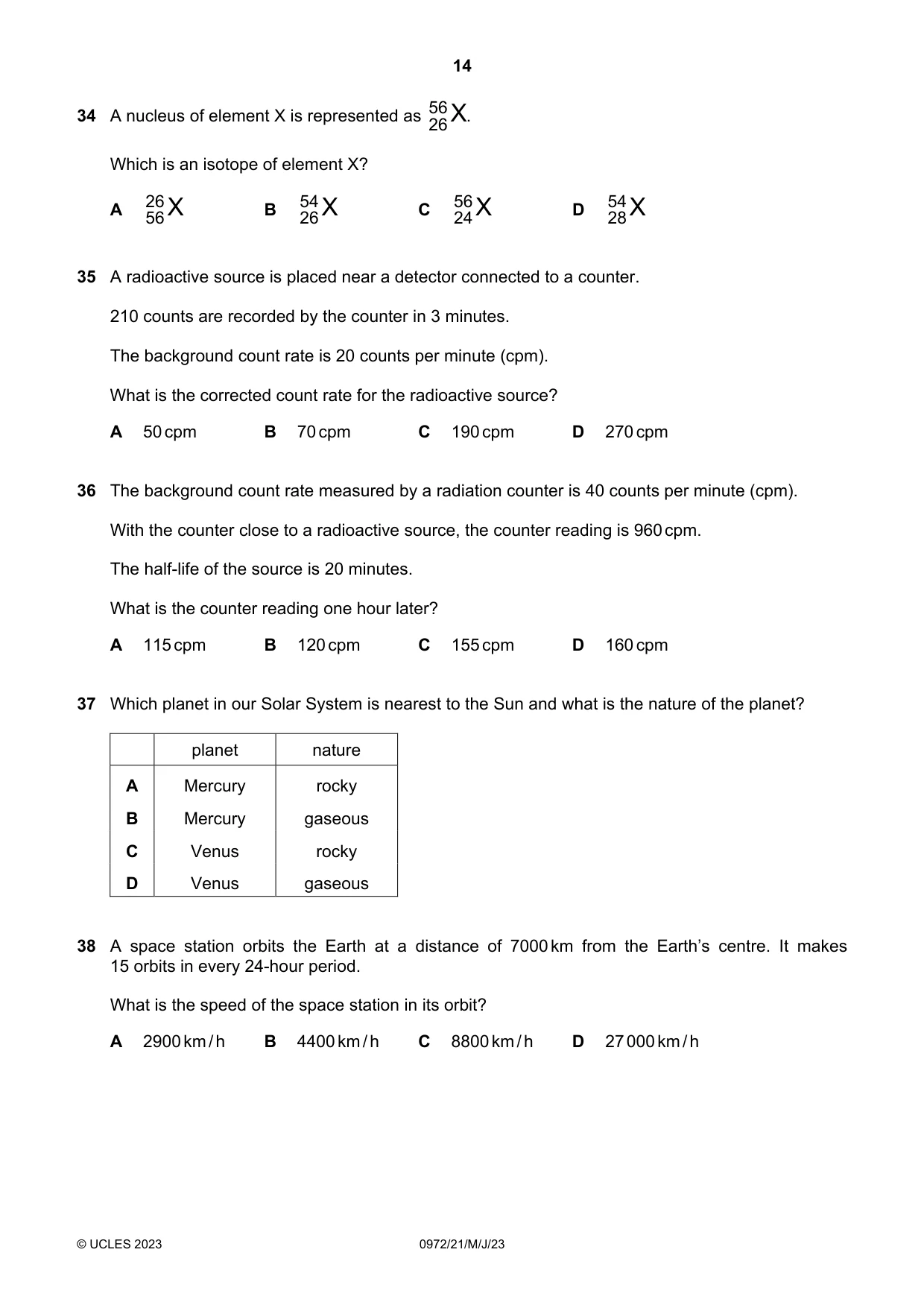
Q34 · A nucleus of element X is represented as
34 A nucleus of element X is represented as . Which is an isotope of element X? 26 X 54 X 56 X 54 X A B C D 56 26 24 28
Mark scheme: B
Q35 · A radioactive source is placed near a detector connected to a counter
35 A radioactive source is placed near a detector connected to a counter. 210 counts are recorded by the counter in 3 minutes. The background count rate is 20 counts per minute (cpm). What is the corrected count rate for the radioactive source? A 50 cpm B 70 cpm C 190 cpm D 270 cpm
Mark scheme: A
Q36 · The background count rate measured by a radiation counter is 40 counts per minute (cpm)
36 The background count rate measured by a radiation counter is 40 counts per minute (cpm). With the counter close to a radioactive source, the counter reading is 960 cpm. The half-life of the source is 20 minutes. What is the counter reading one hour later? A 115 cpm B 120 cpm C 155 cpm D 160 cpm
Mark scheme: C
Q37 · Which planet in our Solar System is nearest to the Sun and what is the nature of the…
37 Which planet in our Solar System is nearest to the Sun and what is the nature of the planet? planet nature A Mercury rocky B Mercury gaseous C Venus rocky D Venus gaseous
Mark scheme: A
Q38 · A space station orbits the Earth at a distance of 7000 km from the Earth’s centre
38 A space station orbits the Earth at a distance of 7000 km from the Earth’s centre. It makes 15 orbits in every 24-hour period. What is the speed of the space station in its orbit? A 2900 km / h B 4400 km / h C 8800 km / h D 27 000 km / h
Mark scheme: D
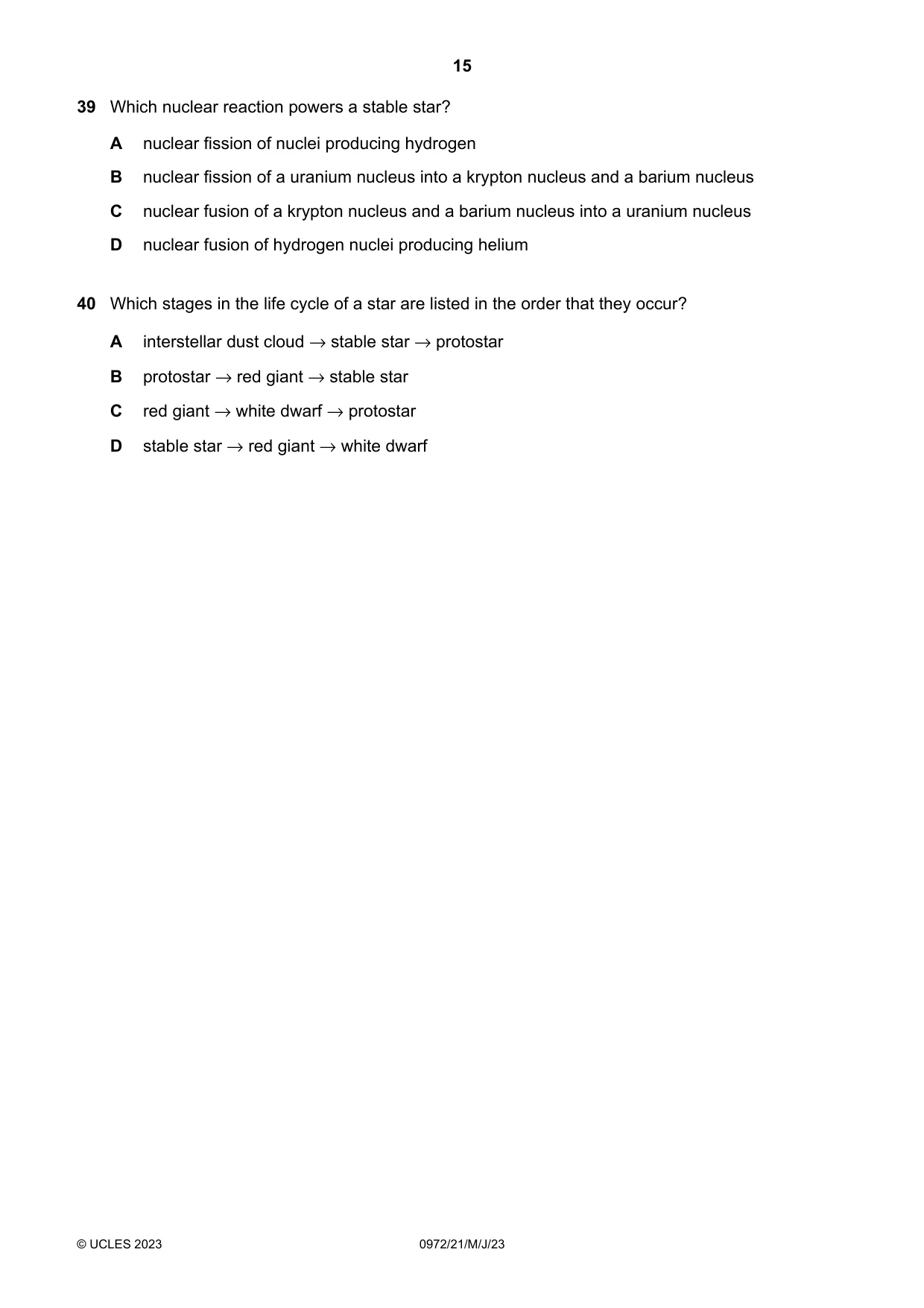
Q39 · Which nuclear reaction powers a stable star?
39 Which nuclear reaction powers a stable star? A nuclear fission of nuclei producing hydrogen B nuclear fission of a uranium nucleus into a krypton nucleus and a barium nucleus C nuclear fusion of a krypton nucleus and a barium nucleus into a uranium nucleus D nuclear fusion of hydrogen nuclei producing helium
Mark scheme: D
Q40 · Which stages in the life cycle of a star are listed in the order that they occur?
40 Which stages in the life cycle of a star are listed in the order that they occur? A interstellar dust cloud → stable star → protostar B protostar → red giant → stable star C red giant → white dwarf → protostar D stable star → red giant → white dwarf
Mark scheme: D
What was in this paper
The subtopics covered by these 40 questions, and how many questions each got. Open one in a new tab to see every Cambridge question on it.
4Electromagnetic effects3Energy, work and power3Forces3Light3Motion3Electric circuits2Mass and weight2Radioactivity2Stars and the Universe2The Earth and the Solar System2The nuclear model of the atom2Density1Electromagnetic spectrum1General properties of waves1Kinetic particle model of matter1Pressure1Simple phenomena of magnetism1Sound1Thermal properties and temperature1Transfer of thermal energy1What you needed in this session
Cambridge’s own grade thresholds for 2023 May/June, Paper 2 · Variant 1. A higher threshold means an easier paper — the bar moves with how the cohort did.