Cambridge IGCSE Physics (9-1) 0972 — 2020 May/June Paper 2 · Variant 2
0972/22/M/J/20 · 40 questions · 40 marks · ≈45 min
The question paper and its mark scheme, free to read here and free to download. This is Cambridge’s own paper, exactly as it was sat.
Question paper16 pages
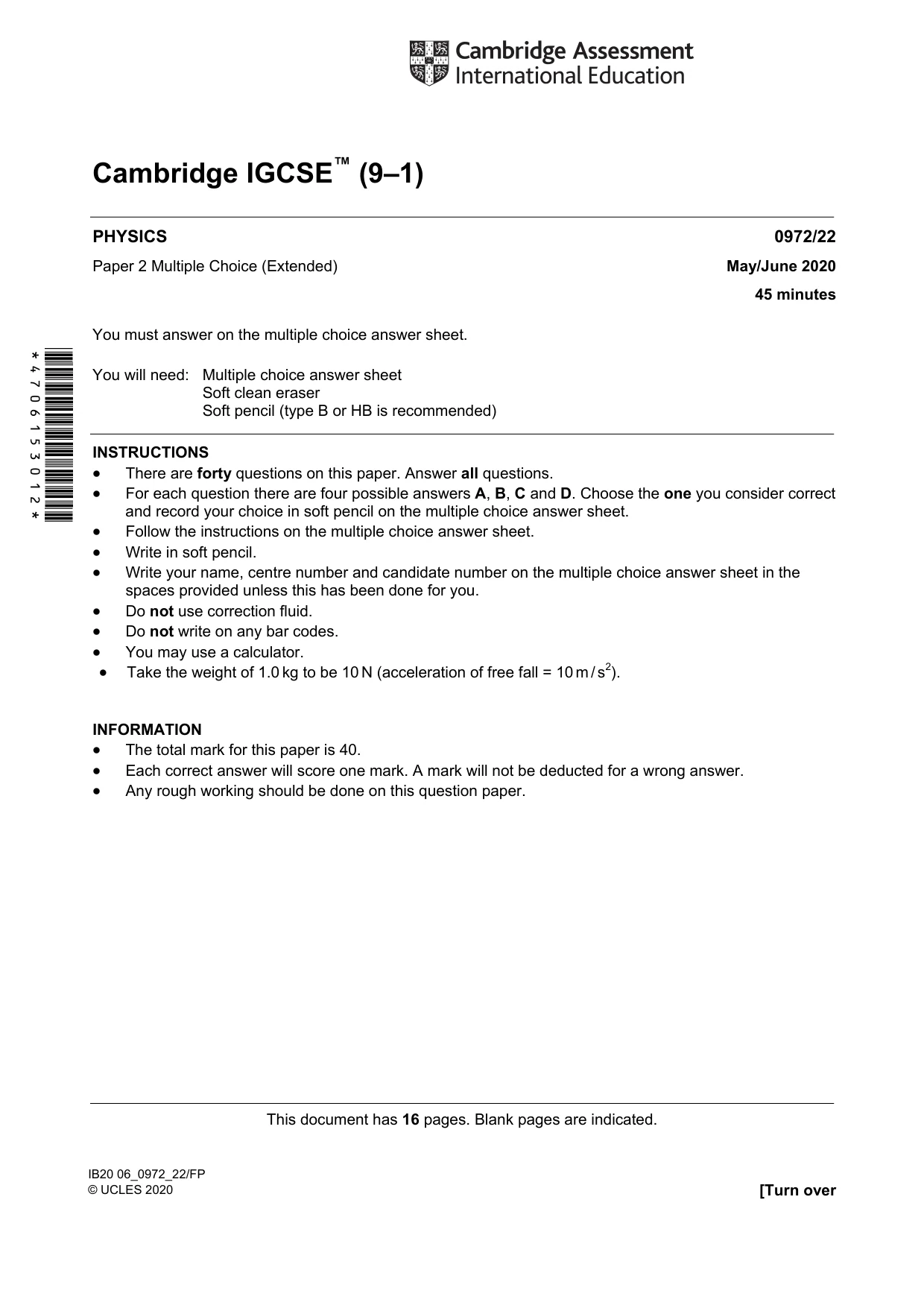
Mark scheme3 pages
Answers below. Sit the paper first if you are practising.
Questions as text
Q1 · Five athletes P, Q, R, S and T compete in a race
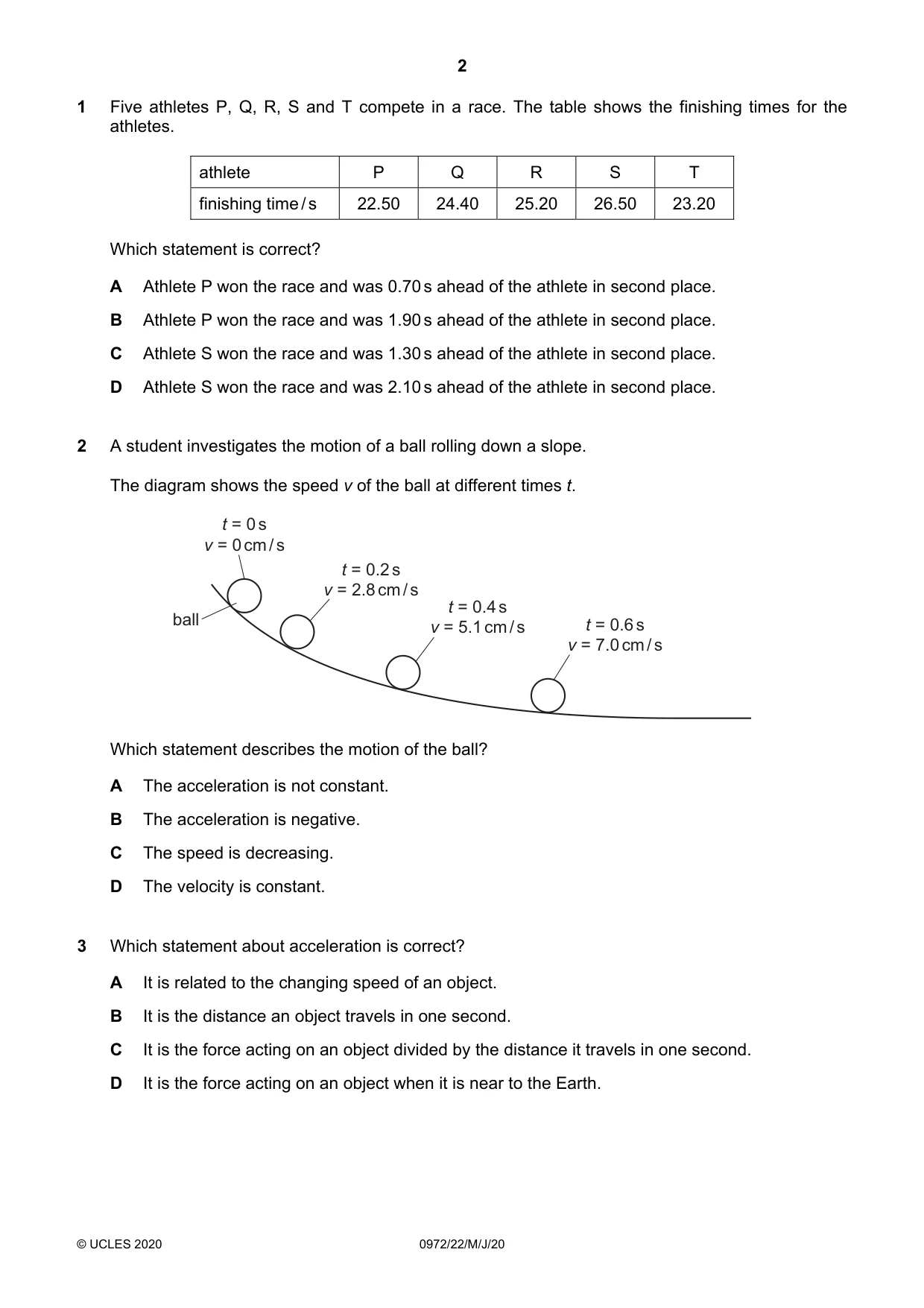
1 Five athletes P, Q, R, S and T compete in a race. The table shows the finishing times for the athletes. athlete P Q R S T finishing time / s 22.50 24.40 25.20 26.50 23.20 Which statement is correct? A Athlete P won the race and was 0.70 s ahead of the athlete in second place. B Athlete P won the race and was 1.90 s ahead of the athlete in second place. C Athlete S won the race and was 1.30 s ahead of the athlete in second place. D Athlete S won the race and was 2.10 s ahead of the athlete in second place.
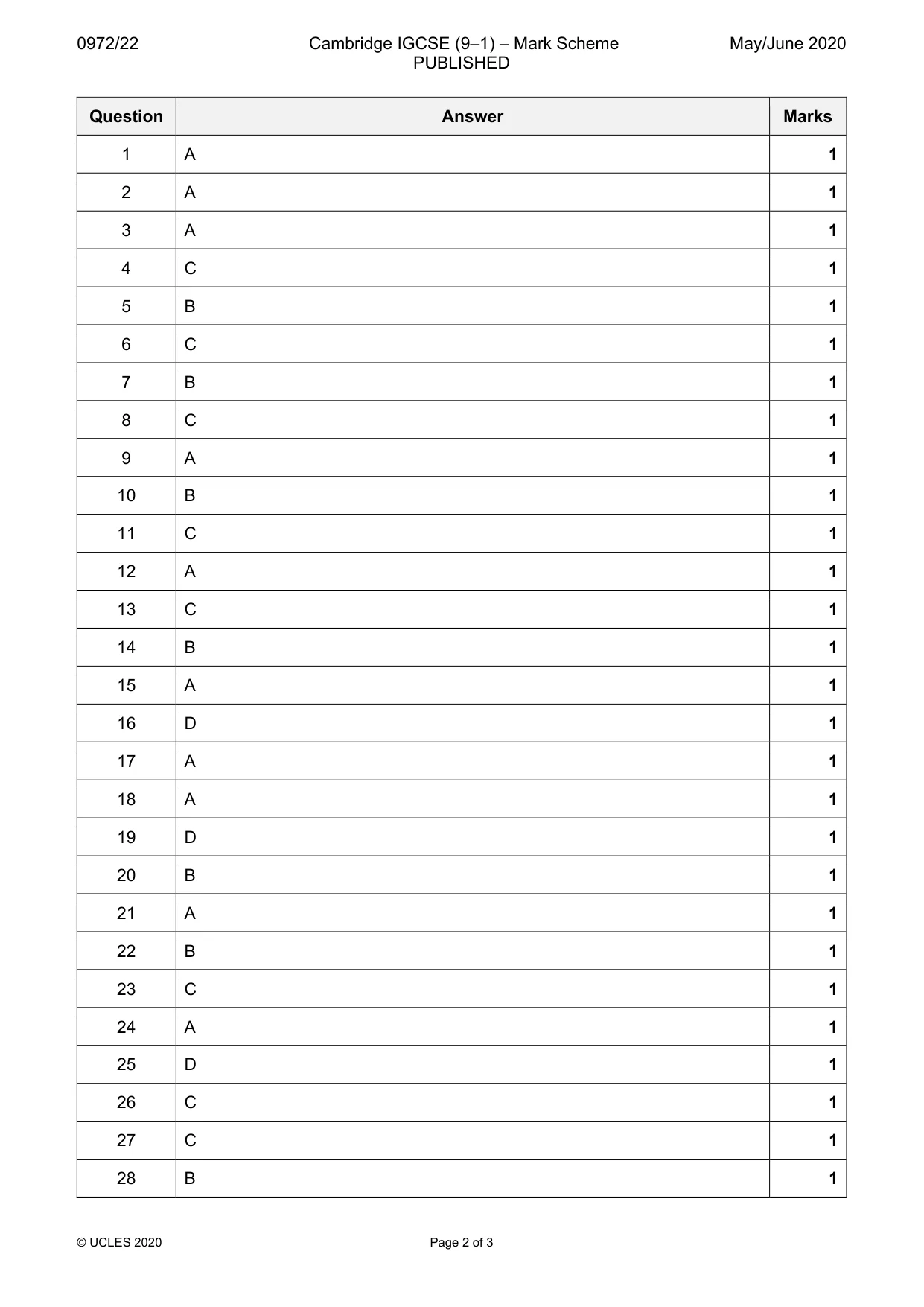
Mark scheme: A
Q2 · A student investigates the motion of a ball rolling down a slope
2 A student investigates the motion of a ball rolling down a slope. The diagram shows the speed v of the ball at different times t. t = 0 s v = 0 cm / s t = 0.2 s v = 2.8 cm / s t = 0.4 s ball v = 5.1 cm / s t = 0.6 s v = 7.0 cm / s Which statement describes the motion of the ball? A The acceleration is not constant. B The acceleration is negative. C The speed is decreasing. D The velocity is constant.
Mark scheme: A
Q3 · Which statement about acceleration is correct?
3 Which statement about acceleration is correct? A It is related to the changing speed of an object. B It is the distance an object travels in one second. C It is the force acting on an object divided by the distance it travels in one second. D It is the force acting on an object when it is near to the Earth.
Mark scheme: A
Q4 · Which statement correctly describes the effects of placing a heavy load in a car?
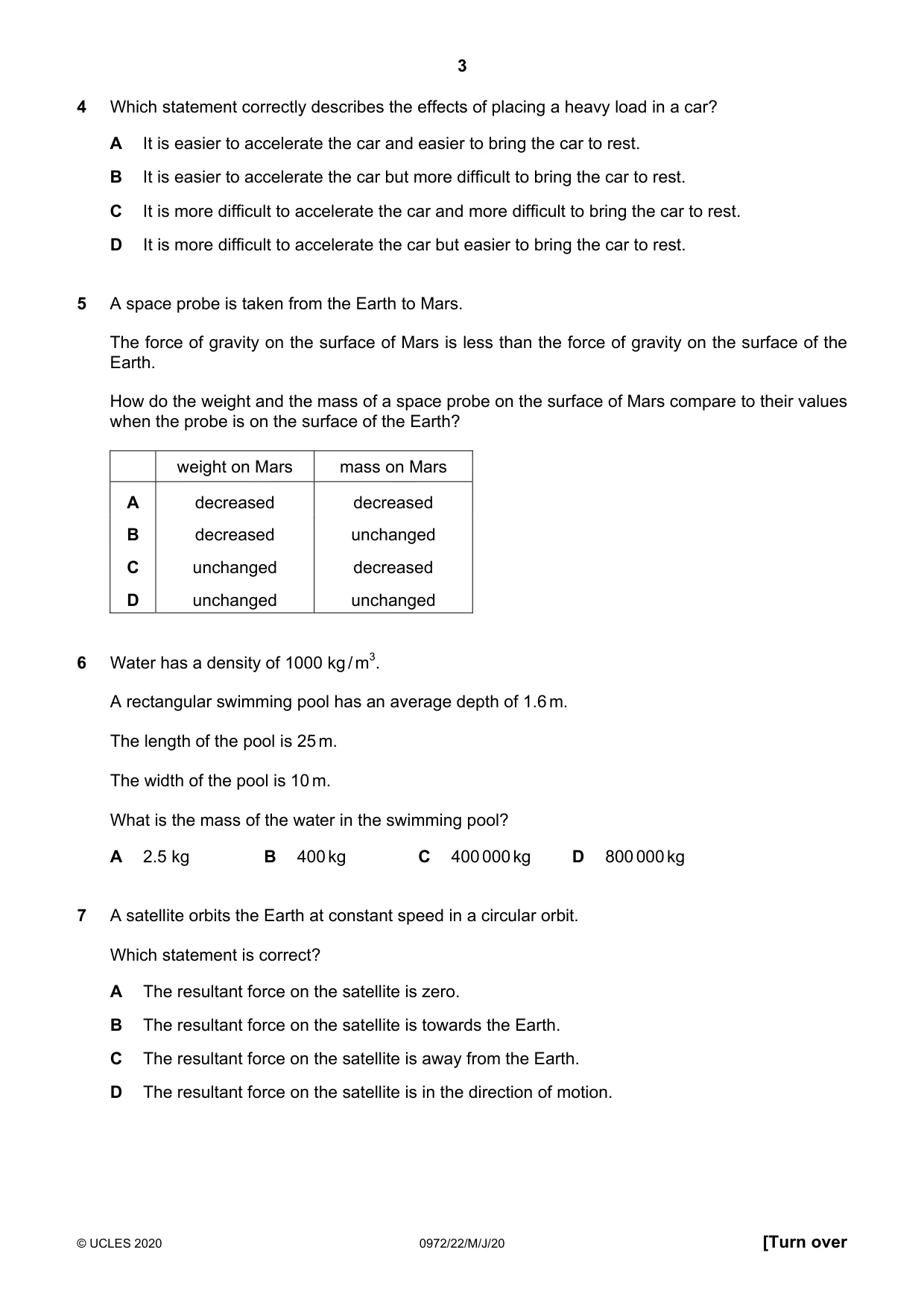
4 Which statement correctly describes the effects of placing a heavy load in a car? A It is easier to accelerate the car and easier to bring the car to rest. B It is easier to accelerate the car but more difficult to bring the car to rest. C It is more difficult to accelerate the car and more difficult to bring the car to rest. D It is more difficult to accelerate the car but easier to bring the car to rest.
Mark scheme: C
Q5 · A space probe is taken from the Earth to Mars
5 A space probe is taken from the Earth to Mars. The force of gravity on the surface of Mars is less than the force of gravity on the surface of the Earth. How do the weight and the mass of a space probe on the surface of Mars compare to their values when the probe is on the surface of the Earth? weight on Mars mass on Mars A decreased decreased B decreased unchanged C unchanged decreased D unchanged unchanged
Mark scheme: B
Q6 · Water has a density of 1000 kg / m3
6 Water has a density of 1000 kg / m3. A rectangular swimming pool has an average depth of 1.6 m. The length of the pool is 25 m. The width of the pool is 10 m. What is the mass of the water in the swimming pool? A 2.5 kg B 400 kg C 400 000 kg D 800 000 kg
Mark scheme: C
Q7 · A satellite orbits the Earth at constant speed in a circular orbit
7 A satellite orbits the Earth at constant speed in a circular orbit. Which statement is correct? A The resultant force on the satellite is zero. B The resultant force on the satellite is towards the Earth. C The resultant force on the satellite is away from the Earth. D The resultant force on the satellite is in the direction of motion.
Mark scheme: B
Q8 · Two forces P and Q act on an object
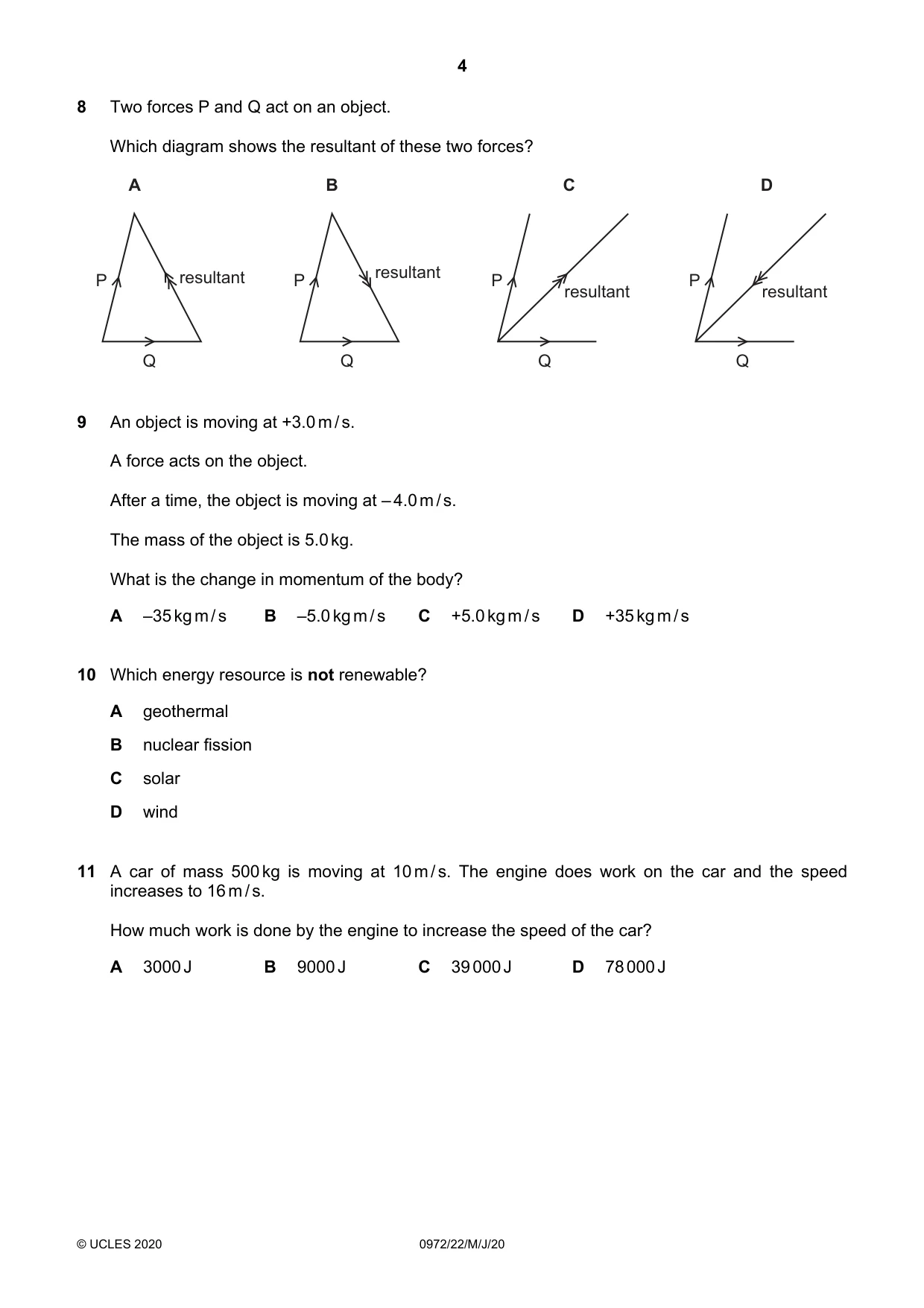
8 Two forces P and Q act on an object. Which diagram shows the resultant of these two forces? A B C D resultant resultant P P P P resultant resultant Q Q Q Q
Mark scheme: C
Q9 · An object is moving at +3.0 m / s
9 An object is moving at +3.0 m / s. A force acts on the object. After a time, the object is moving at – 4.0 m / s. The mass of the object is 5.0 kg. What is the change in momentum of the body? A –35 kg m / s B –5.0 kg m / s C +5.0 kg m / s D +35 kg m / s
Mark scheme: A
Q10 · Which energy resource is not renewable?
10 Which energy resource is not renewable? A geothermal B nuclear fission C solar D wind
Mark scheme: B
Q11 · A car of mass 500 kg is moving at 10 m / s
11 A car of mass 500 kg is moving at 10 m / s. The engine does work on the car and the speed increases to 16 m / s. How much work is done by the engine to increase the speed of the car? A 3000 J B 9000 J C 39 000 J D 78 000 J
Mark scheme: C
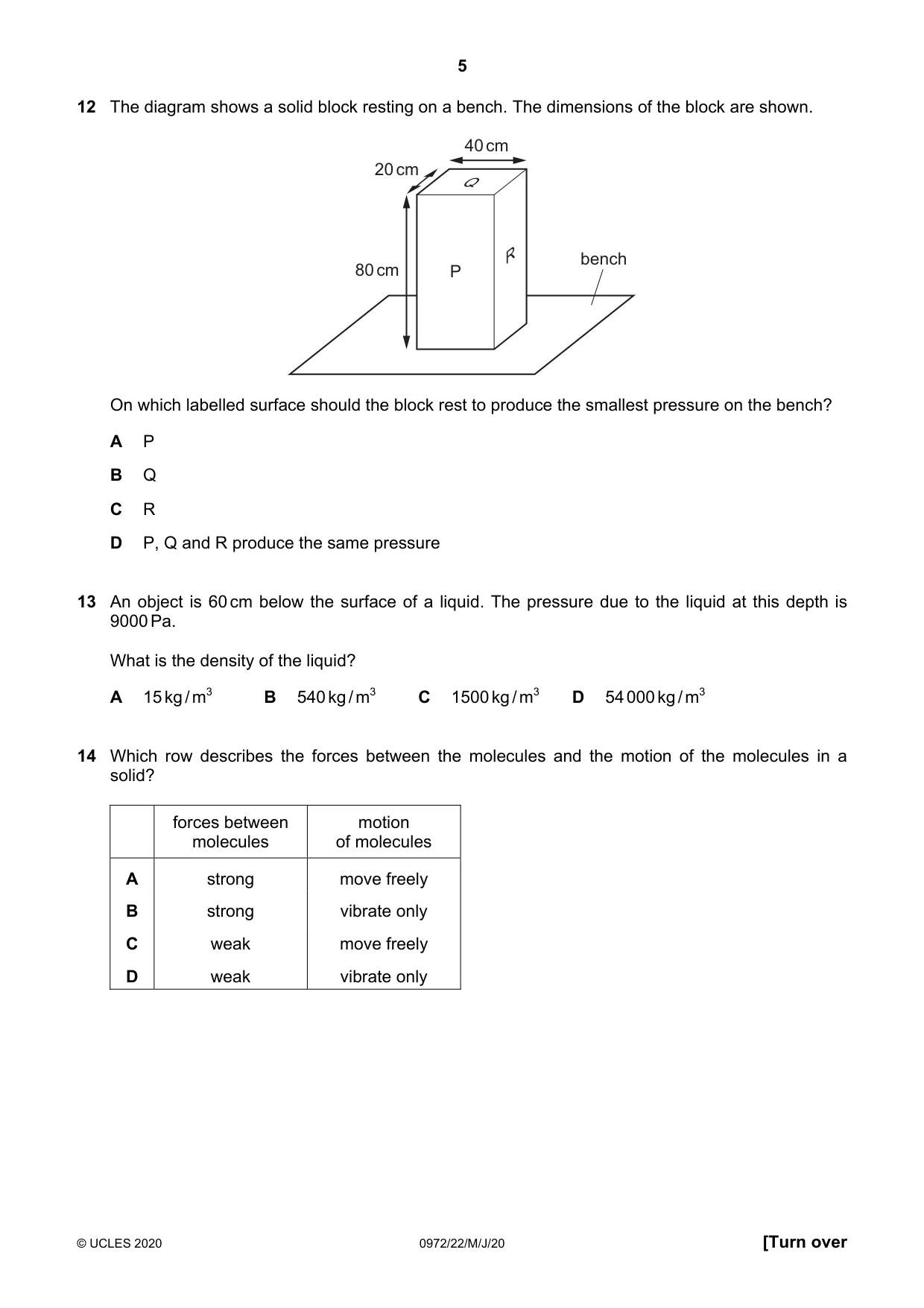
Q12 · The diagram shows a solid block resting on a bench
12 The diagram shows a solid block resting on a bench. The dimensions of the block are shown. 40 cm 20 cm Q R bench 80 cm P On which labelled surface should the block rest to produce the smallest pressure on the bench? A P B Q C R D P, Q and R produce the same pressure
Mark scheme: A
Q13 · An object is 60 cm below the surface of a liquid
13 An object is 60 cm below the surface of a liquid. The pressure due to the liquid at this depth is 9000 Pa. What is the density of the liquid? A 15 kg / m3 B 540 kg / m3 C 1500 kg / m3 D 54 000 kg / m3
Mark scheme: C
Q14 · Which row describes the forces between the molecules and the motion of the molecules in a…
14 Which row describes the forces between the molecules and the motion of the molecules in a solid? forces between motion molecules of molecules A strong move freely B strong vibrate only C weak move freely D weak vibrate only
Mark scheme: B
Q15 · Wet clothes are hanging outside to dry
15 Wet clothes are hanging outside to dry. Which condition decreases the rate of evaporation of the water from the clothes? A folded clothes B higher temperature C wetter clothes D windy day
Mark scheme: A
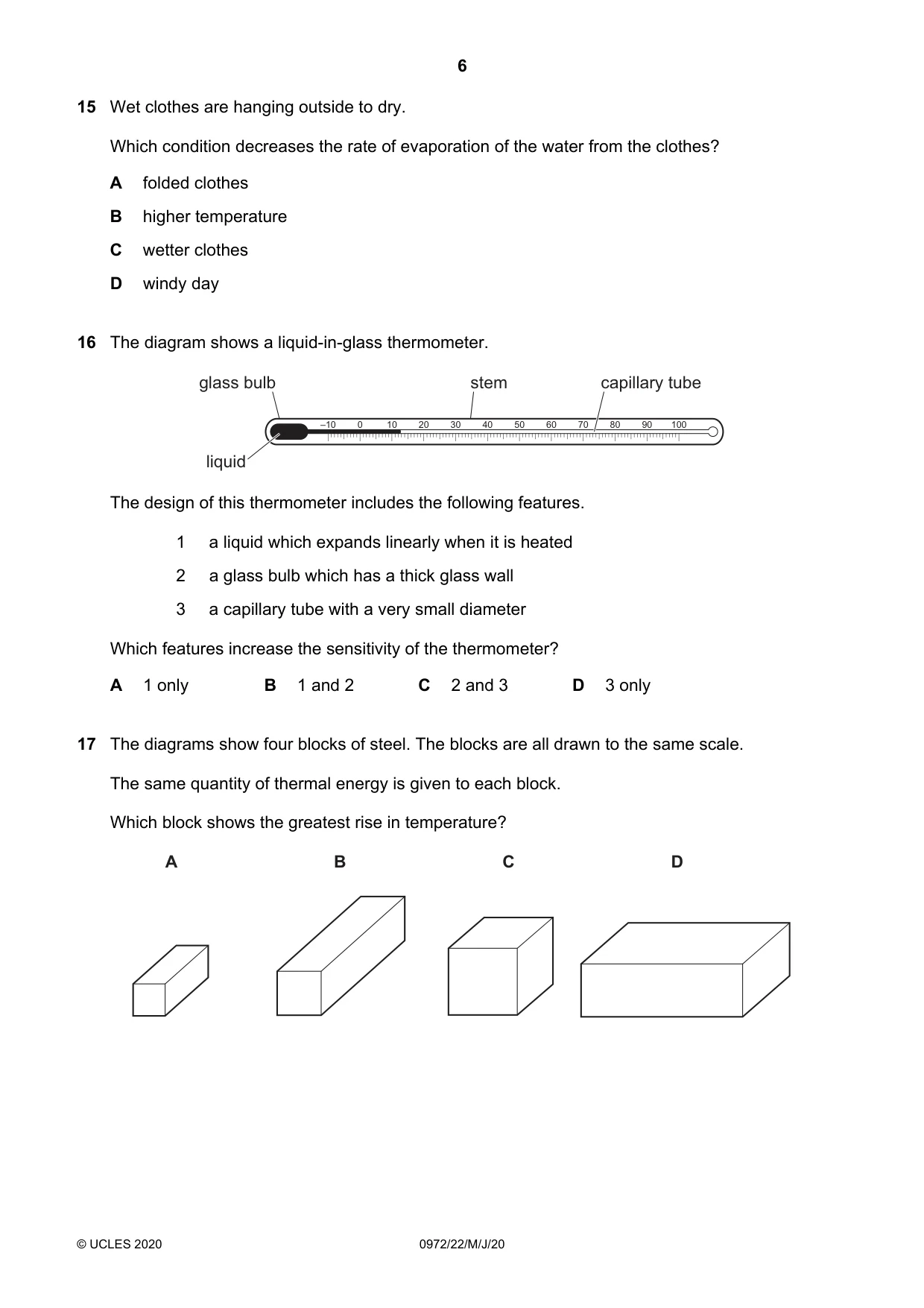
Q16 · The diagram shows a liquid-in-glass thermometer
16 The diagram shows a liquid-in-glass thermometer. glass bulb stem capillary tube –10 0 10 20 30 40 50 60 70 80 90 100 liquid The design of this thermometer includes the following features. 1 a liquid which expands linearly when it is heated 2 a glass bulb which has a thick glass wall 3 a capillary tube with a very small diameter Which features increase the sensitivity of the thermometer? A 1 only B 1 and 2 C 2 and 3 D 3 only
Mark scheme: D
Q17 · The diagrams show four blocks of steel
17 The diagrams show four blocks of steel. The blocks are all drawn to the same scale. The same quantity of thermal energy is given to each block. Which block shows the greatest rise in temperature? A B C D
Mark scheme: A
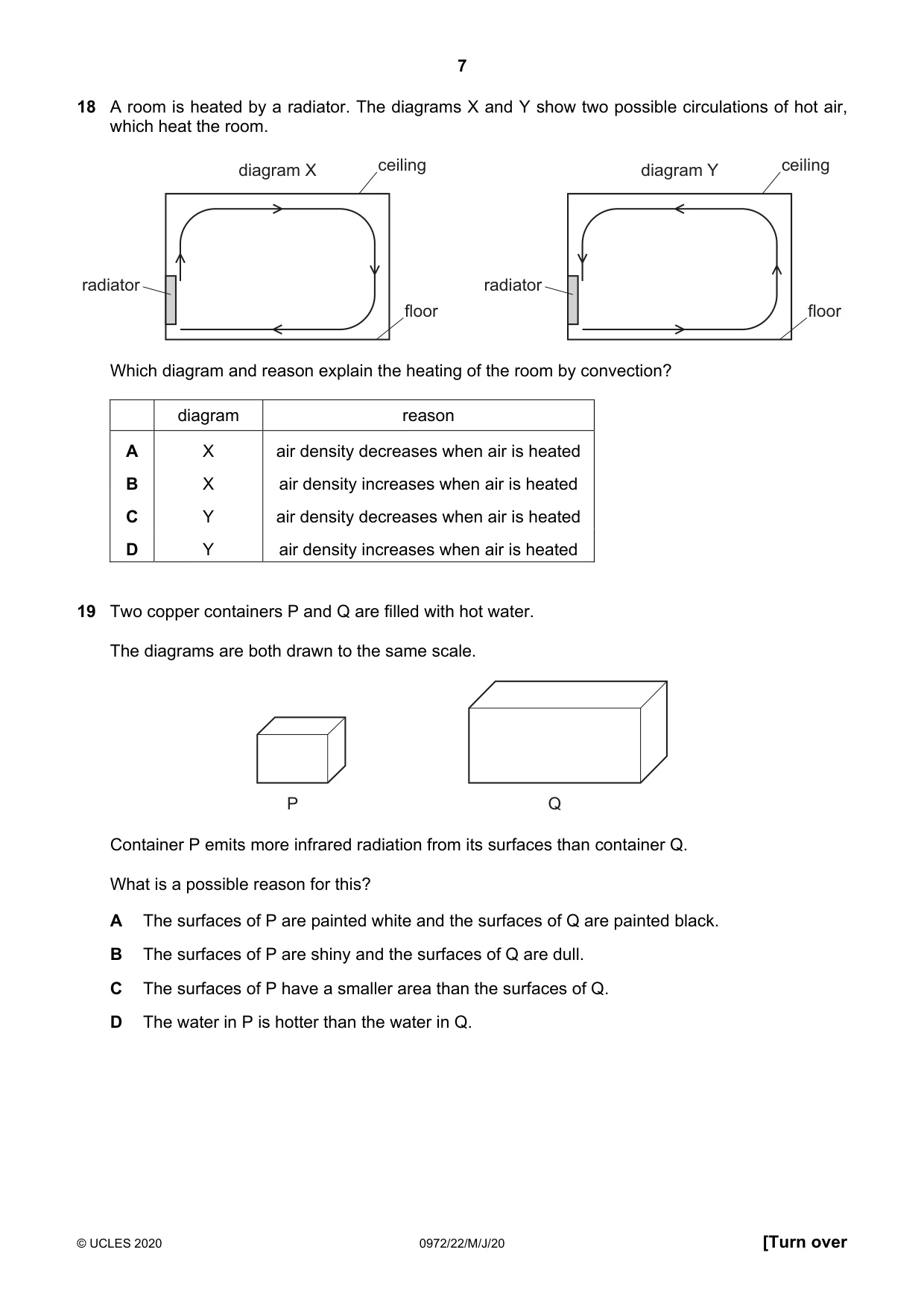
Q18 · A room is heated by a radiator
18 A room is heated by a radiator. The diagrams X and Y show two possible circulations of hot air, which heat the room. diagram X ceiling diagram Y ceiling radiator radiator floor floor Which diagram and reason explain the heating of the room by convection? diagram reason A X air density decreases when air is heated B X air density increases when air is heated C Y air density decreases when air is heated D Y air density increases when air is heated
Mark scheme: A
Q19 · Two copper containers P and Q are filled with hot water
19 Two copper containers P and Q are filled with hot water. The diagrams are both drawn to the same scale. P Q Container P emits more infrared radiation from its surfaces than container Q. What is a possible reason for this? A The surfaces of P are painted white and the surfaces of Q are painted black. B The surfaces of P are shiny and the surfaces of Q are dull. C The surfaces of P have a smaller area than the surfaces of Q. D The water in P is hotter than the water in Q.
Mark scheme: D
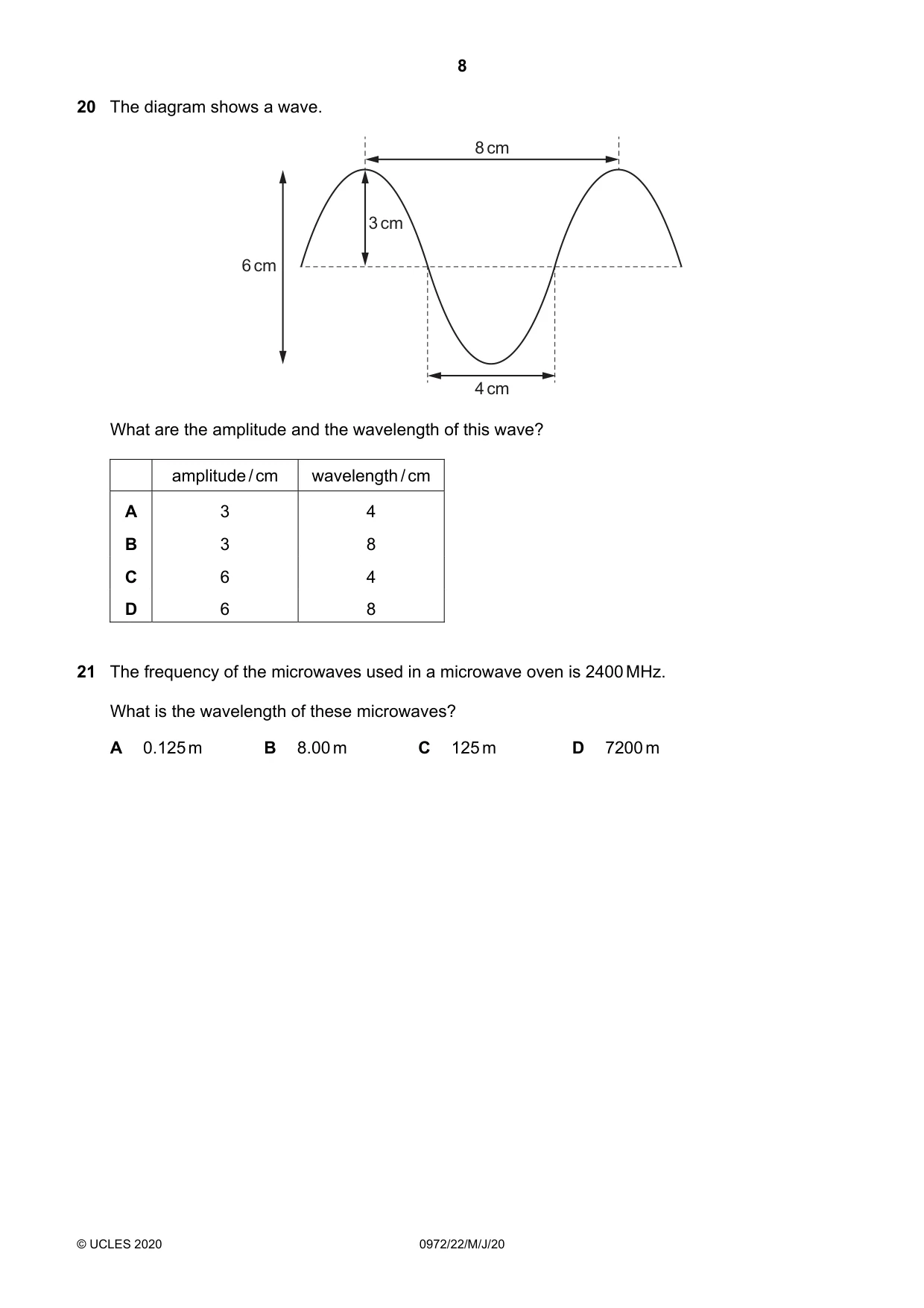
Q20 · The diagram shows a wave
20 The diagram shows a wave. 8 cm 3 cm 6 cm 4 cm What are the amplitude and the wavelength of this wave? amplitude / cm wavelength / cm A 3 4 B 3 8 C 6 4 D 6 8
Mark scheme: B
Q21 · The frequency of the microwaves used in a microwave oven is 2400 MHz
21 The frequency of the microwaves used in a microwave oven is 2400 MHz. What is the wavelength of these microwaves? A 0.125 m B 8.00 m C 125 m D 7200 m
Mark scheme: A
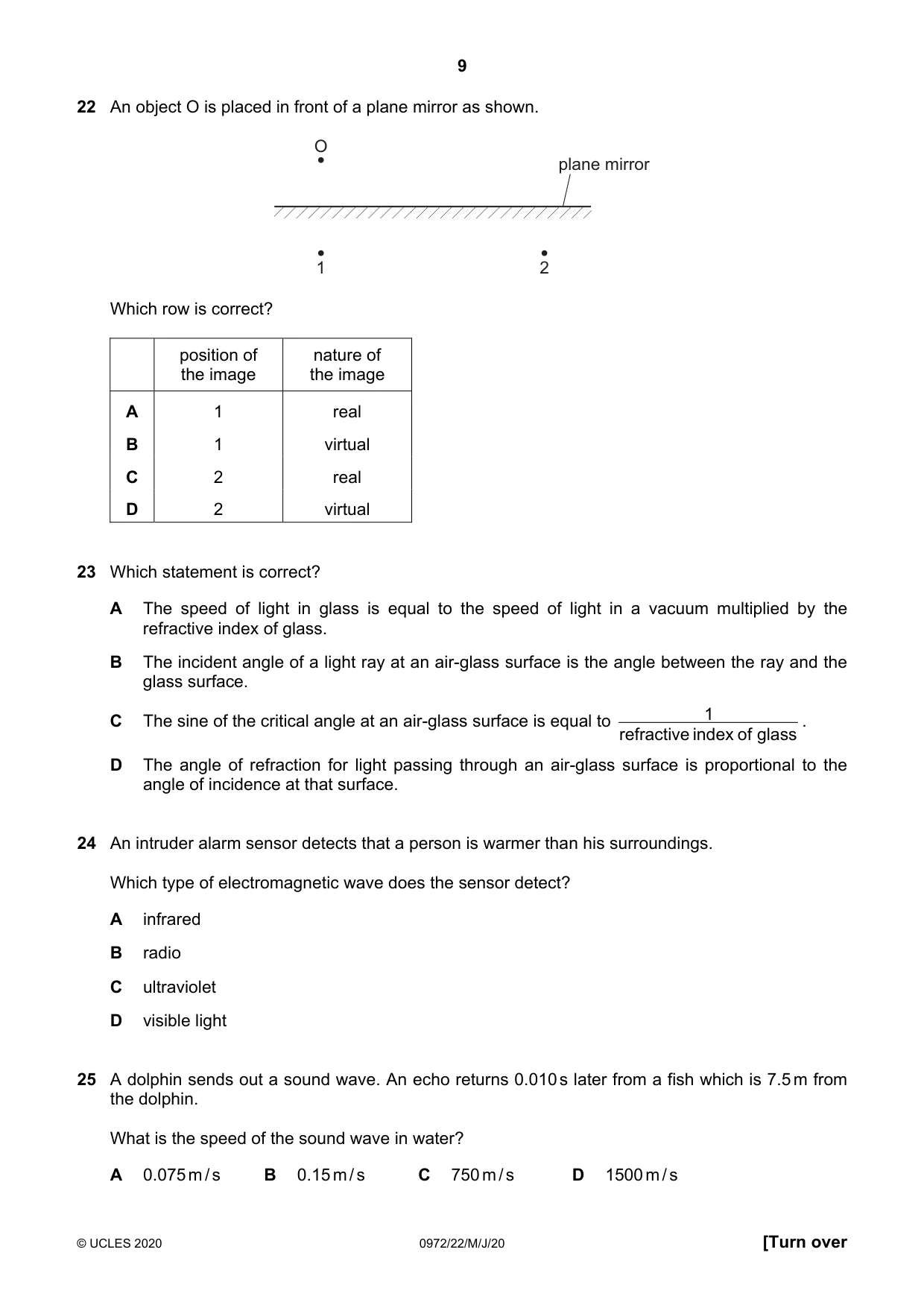
Q22 · An object O is placed in front of a plane mirror as shown
22 An object O is placed in front of a plane mirror as shown. O plane mirror 1 2 Which row is correct? position of nature of the image the image A 1 real B 1 virtual C 2 real D 2 virtual
Mark scheme: B
Q23 · Which statement is correct?
23 Which statement is correct? A The speed of light in glass is equal to the speed of light in a vacuum multiplied by the refractive index of glass. B The incident angle of a light ray at an air-glass surface is the angle between the ray and the glass surface. C The sine of the critical angle at an air-glass surface is equal to 1 . refractive index of glass D The angle of refraction for light passing through an air-glass surface is proportional to the angle of incidence at that surface.
Mark scheme: C
Q24 · An intruder alarm sensor detects that a person is warmer than his surroundings
24 An intruder alarm sensor detects that a person is warmer than his surroundings. Which type of electromagnetic wave does the sensor detect? A infrared B radio C ultraviolet D visible light
Mark scheme: A
Q25 · A dolphin sends out a sound wave
25 A dolphin sends out a sound wave. An echo returns 0.010 s later from a fish which is 7.5 m from the dolphin. What is the speed of the sound wave in water? A 0.075 m / s B 0.15 m / s C 750 m / s D 1500 m / s
Mark scheme: D
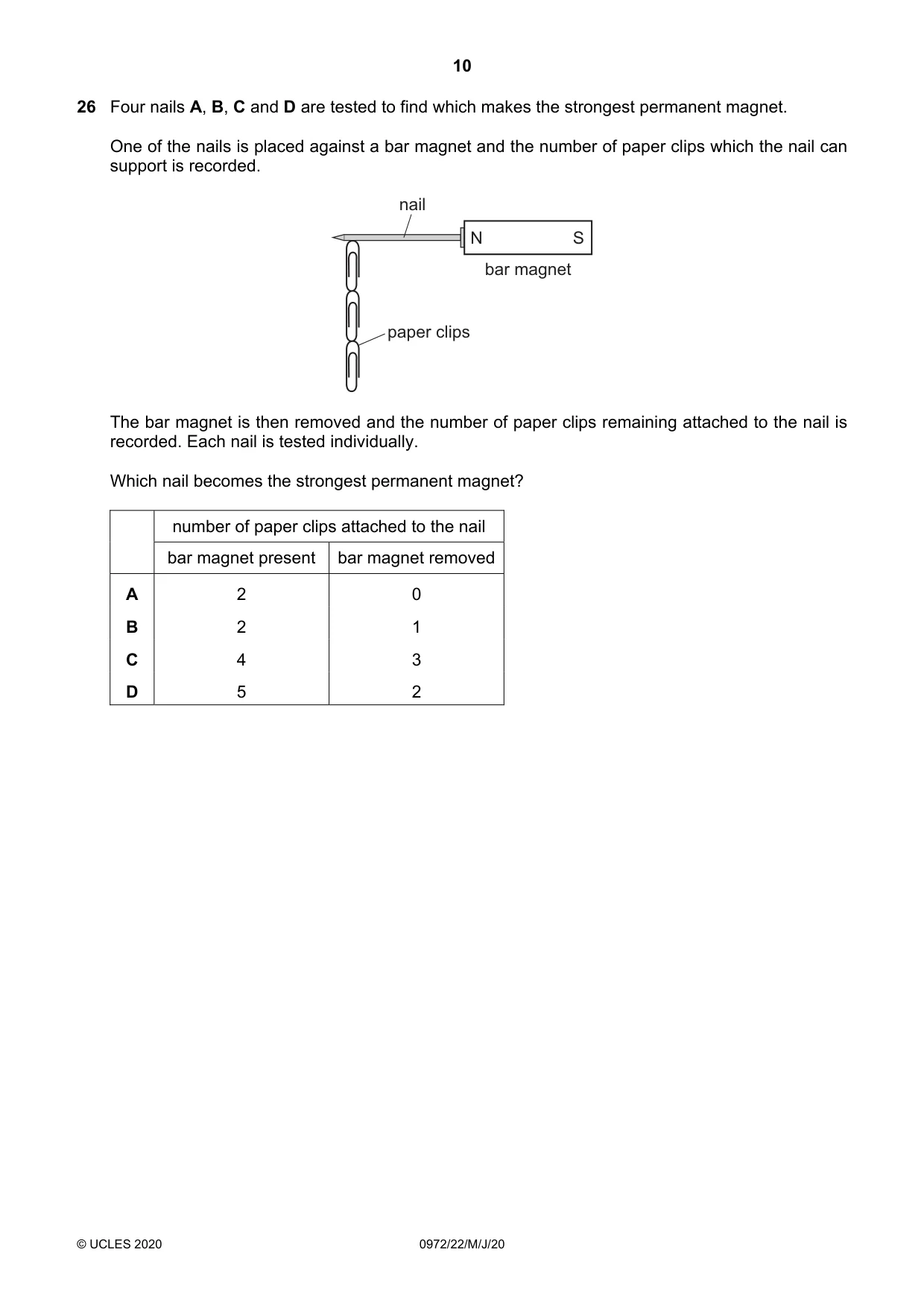
Q26 · Four nails A, B, C and D are tested to find which makes the strongest permanent magnet
26 Four nails A, B, C and D are tested to find which makes the strongest permanent magnet. One of the nails is placed against a bar magnet and the number of paper clips which the nail can support is recorded. nail N S bar magnet paper clips The bar magnet is then removed and the number of paper clips remaining attached to the nail is recorded. Each nail is tested individually. Which nail becomes the strongest permanent magnet? number of paper clips attached to the nail bar magnet present bar magnet removed A 2 0 B 2 1 C 4 3 D 5 2
Mark scheme: C
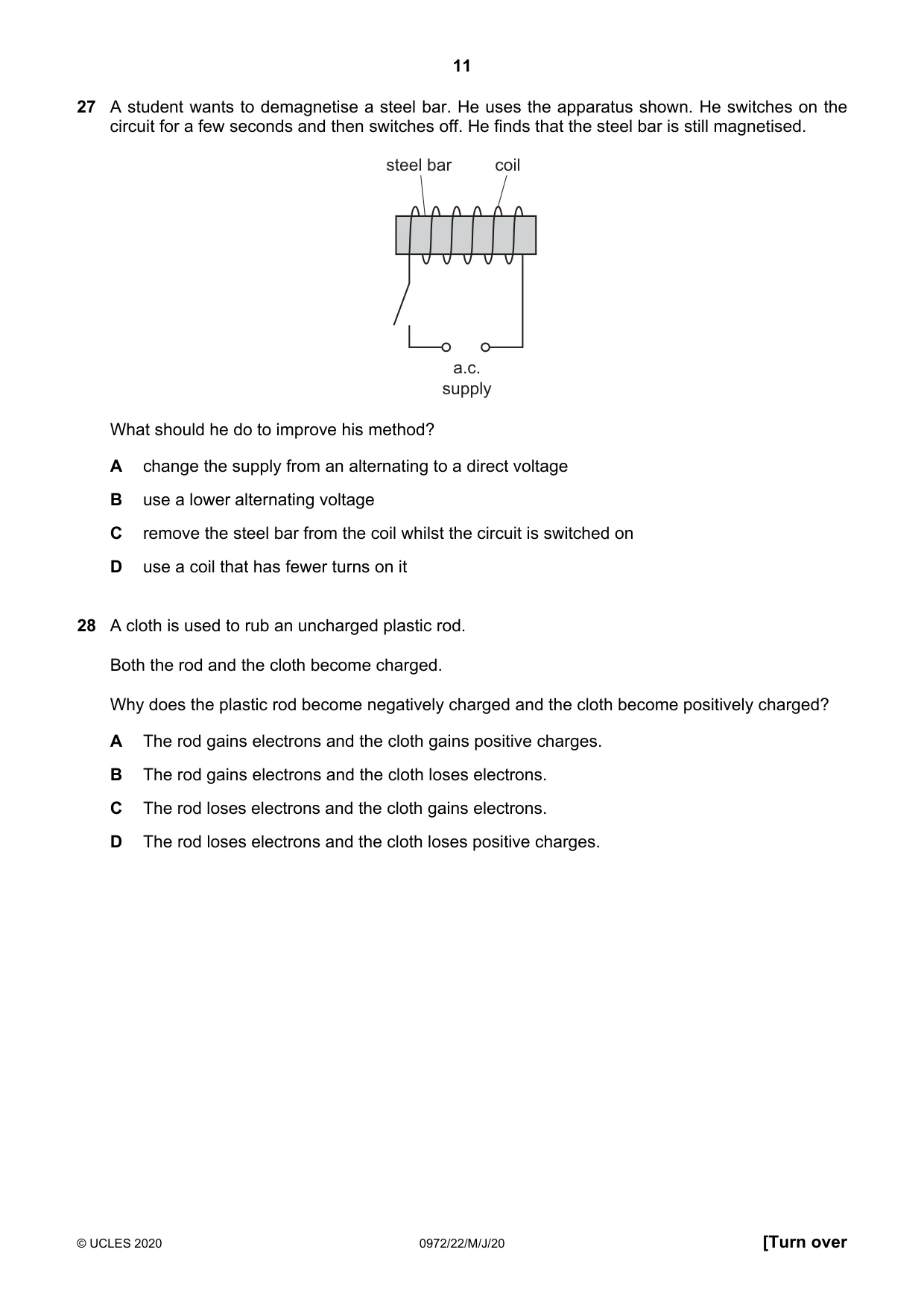
Q27 · A student wants to demagnetise a steel bar
27 A student wants to demagnetise a steel bar. He uses the apparatus shown. He switches on the circuit for a few seconds and then switches off. He finds that the steel bar is still magnetised. steel bar coil a.c. supply What should he do to improve his method? A change the supply from an alternating to a direct voltage B use a lower alternating voltage C remove the steel bar from the coil whilst the circuit is switched on D use a coil that has fewer turns on it
Mark scheme: C
Q28 · A cloth is used to rub an uncharged plastic rod
28 A cloth is used to rub an uncharged plastic rod. Both the rod and the cloth become charged. Why does the plastic rod become negatively charged and the cloth become positively charged? A The rod gains electrons and the cloth gains positive charges. B The rod gains electrons and the cloth loses electrons. C The rod loses electrons and the cloth gains electrons. D The rod loses electrons and the cloth loses positive charges.
Mark scheme: B
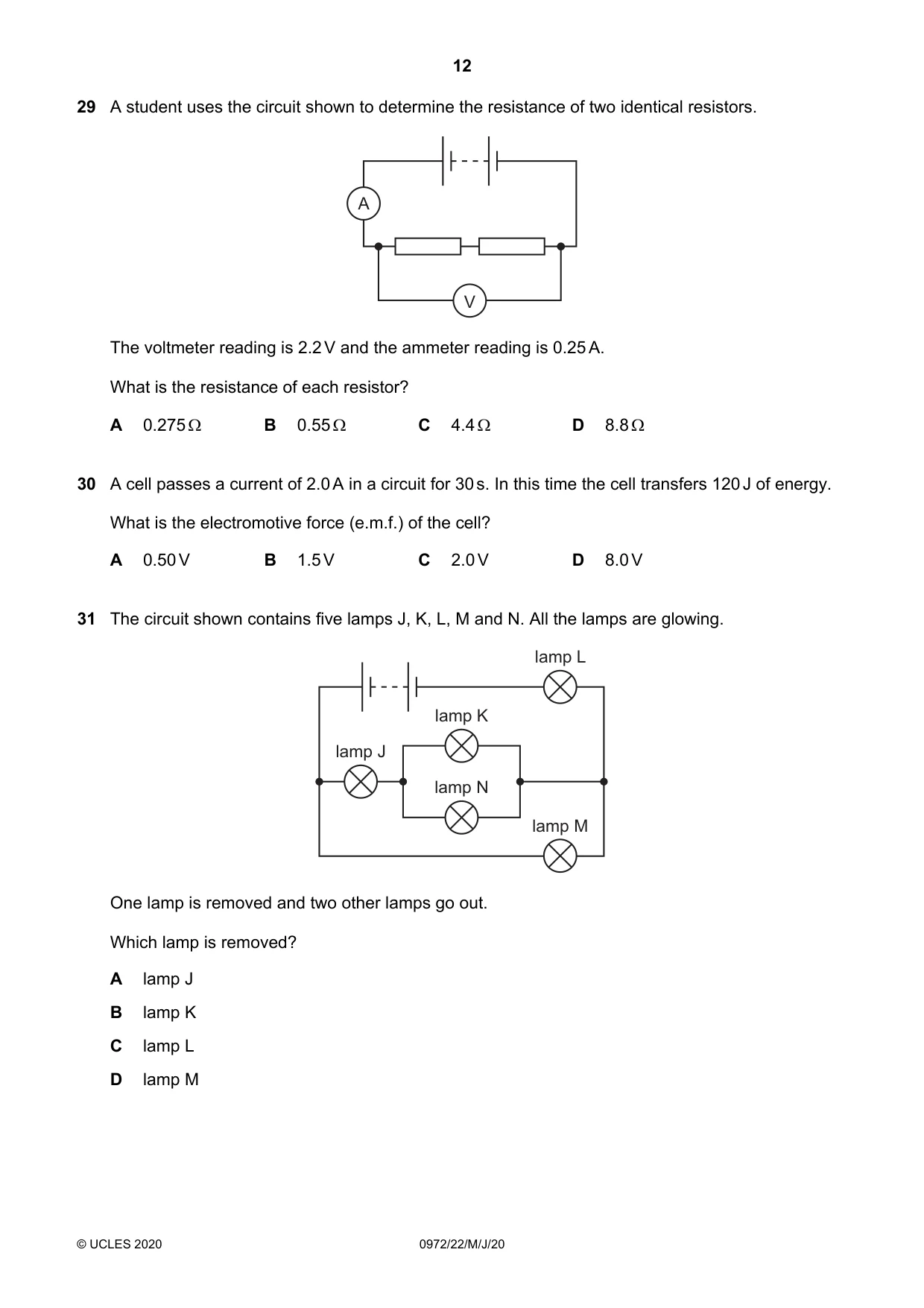
Q29 · A student uses the circuit shown to determine the resistance of two identical resistors
29 A student uses the circuit shown to determine the resistance of two identical resistors. A V The voltmeter reading is 2.2 V and the ammeter reading is 0.25 A. What is the resistance of each resistor? A 0.275 Ω B 0.55 Ω C 4.4 Ω D 8.8 Ω
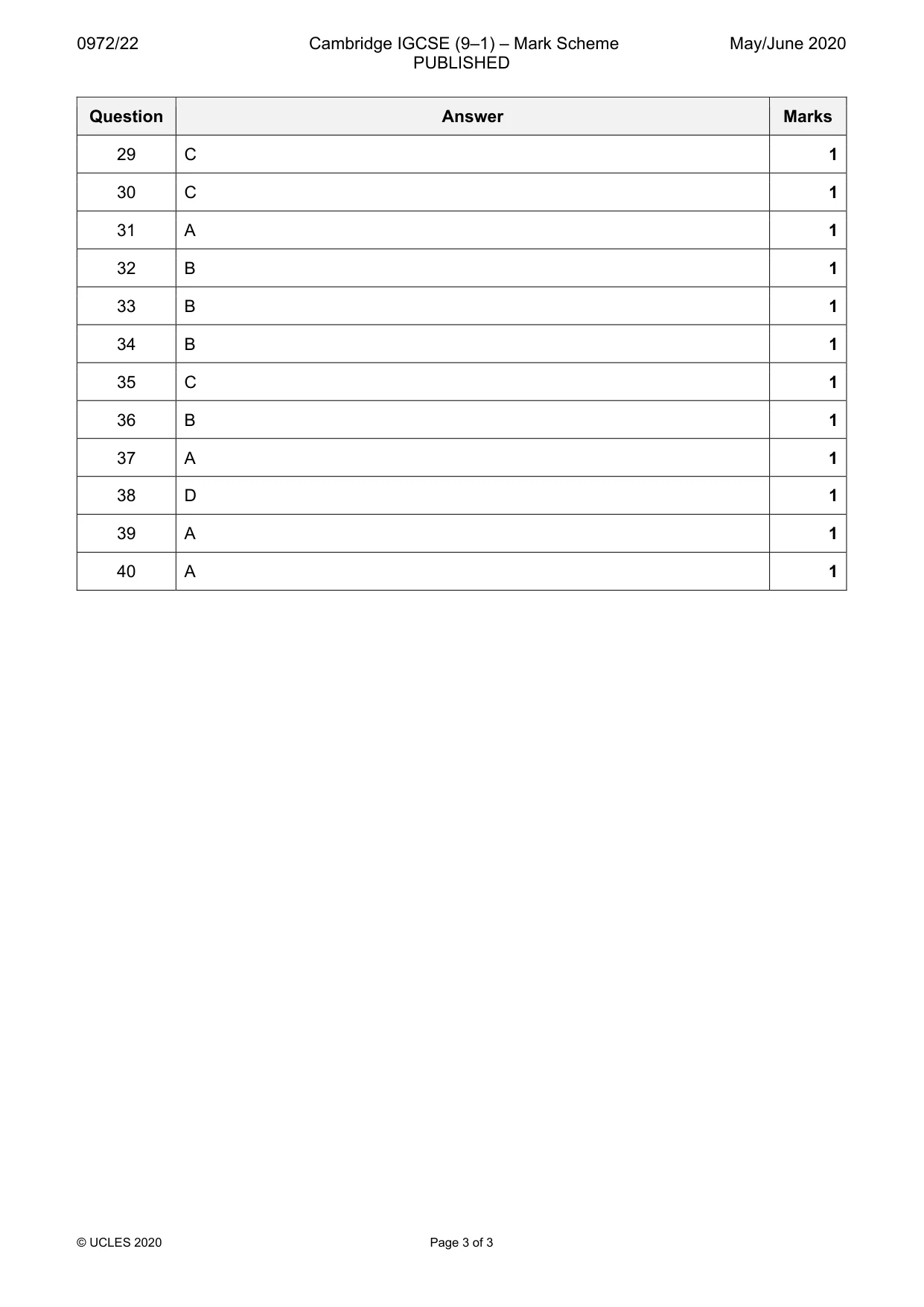
Mark scheme: C
Q30 · A cell passes a current of 2.0 A in a circuit for 30 s
30 A cell passes a current of 2.0 A in a circuit for 30 s. In this time the cell transfers 120 J of energy. What is the electromotive force (e.m.f.) of the cell? A 0.50 V B 1.5 V C 2.0 V D 8.0 V
Mark scheme: C
Q31 · The circuit shown contains five lamps J, K, L, M and N
31 The circuit shown contains five lamps J, K, L, M and N. All the lamps are glowing. lamp L lamp K lamp J lamp N lamp M One lamp is removed and two other lamps go out. Which lamp is removed? A lamp J B lamp K C lamp L D lamp M
Mark scheme: A
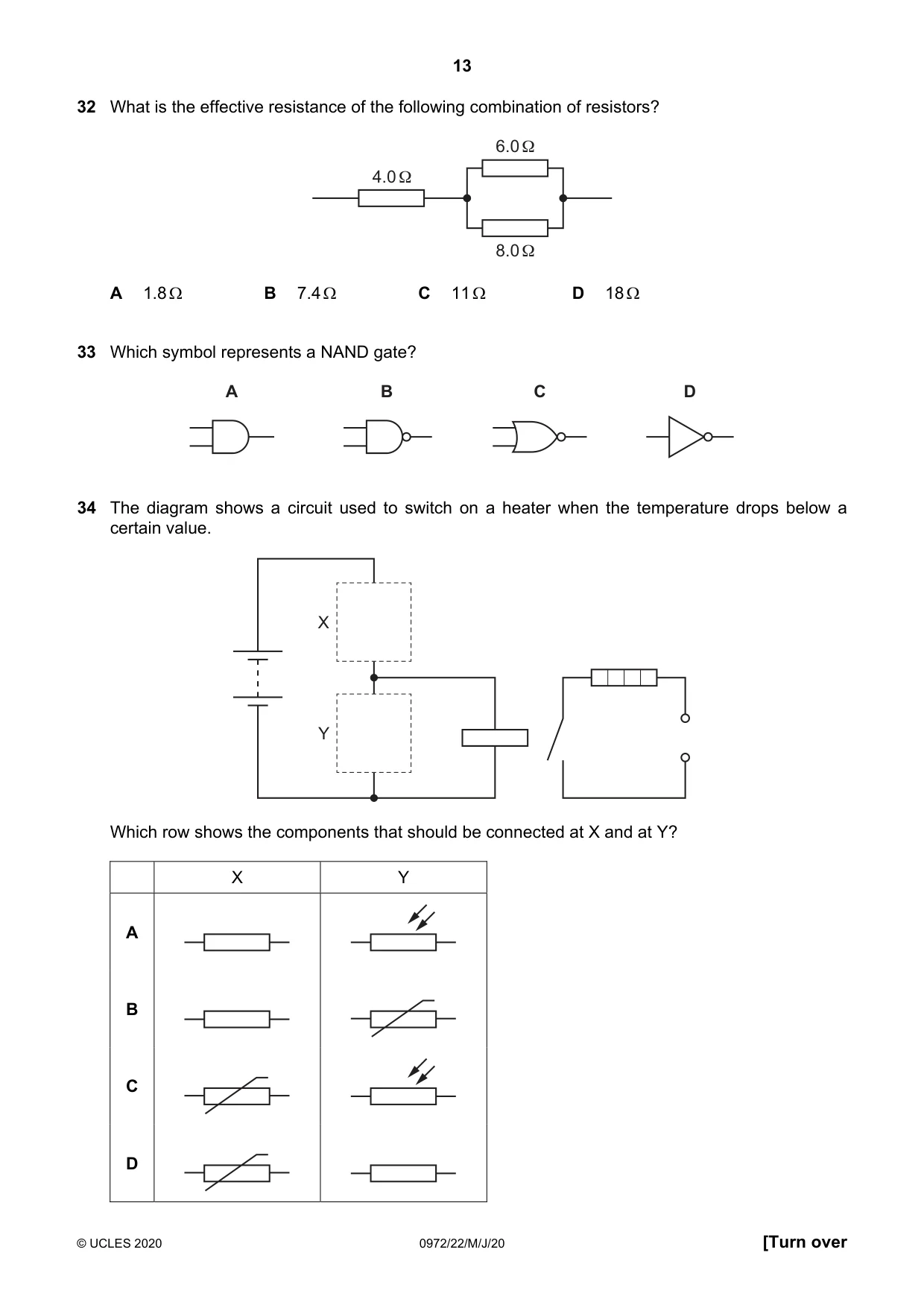
Q32 · What is the effective resistance of the following combination of resistors?
32 What is the effective resistance of the following combination of resistors? 6.0 Ω 4.0 Ω 8.0 Ω A 1.8 Ω B 7.4 Ω C 11 Ω D 18 Ω
Mark scheme: B
Q33 · Which symbol represents a NAND gate?
33 Which symbol represents a NAND gate? A B C D
Mark scheme: B
Q34 · The diagram shows a circuit used to switch on a heater when the temperature drops below a…
34 The diagram shows a circuit used to switch on a heater when the temperature drops below a certain value. X Y Which row shows the components that should be connected at X and at Y? X Y A B C D
Mark scheme: B
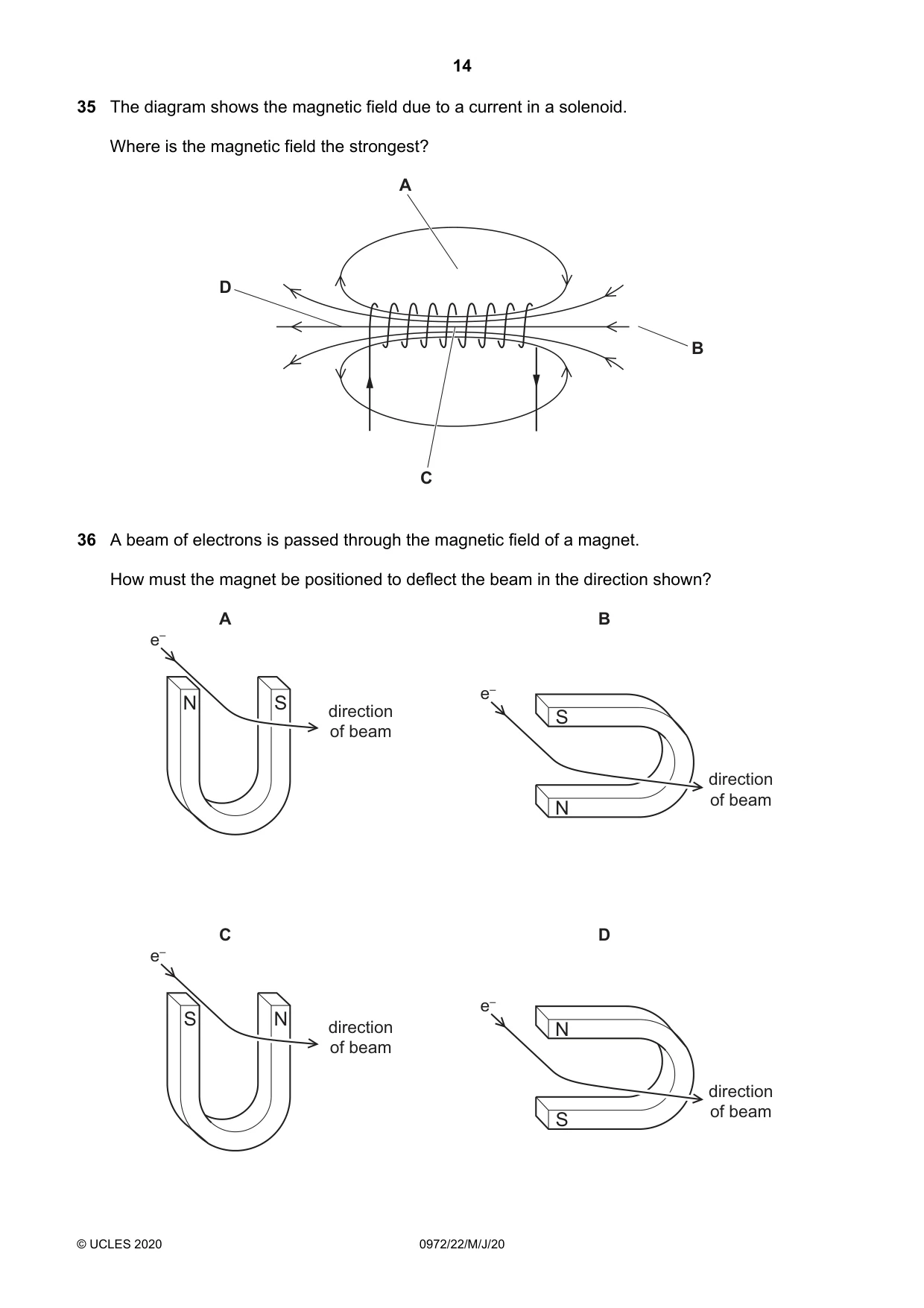
Q35 · The diagram shows the magnetic field due to a current in a solenoid
35 The diagram shows the magnetic field due to a current in a solenoid. Where is the magnetic field the strongest? A D B C
Mark scheme: C
Q36 · A beam of electrons is passed through the magnetic field of a magnet
36 A beam of electrons is passed through the magnetic field of a magnet. How must the magnet be positioned to deflect the beam in the direction shown? A B e– e– N S direction S of beam direction N of beam C D e– e– S N direction N of beam direction S of beam
Mark scheme: B
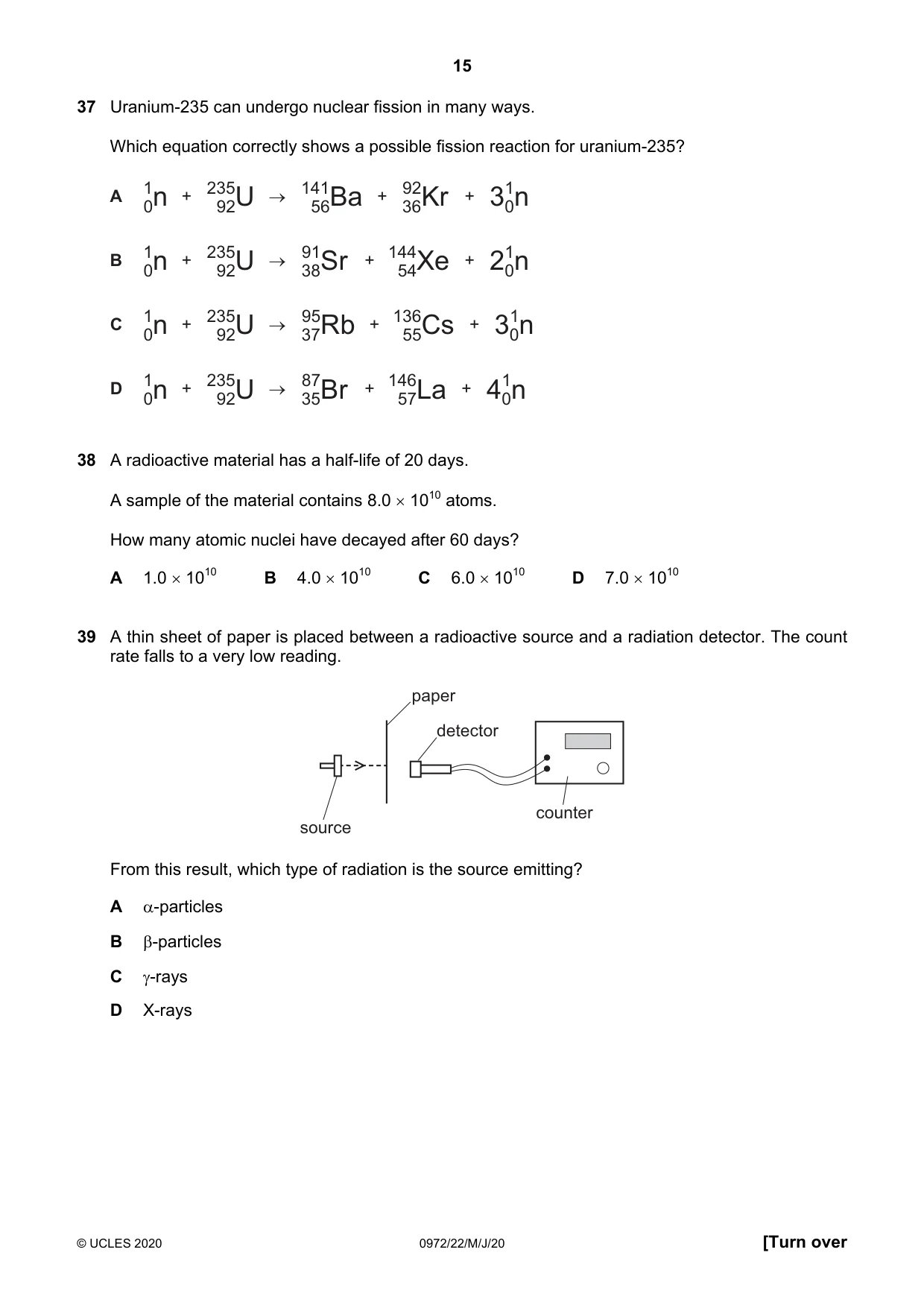
Q37 · Uranium-235 can undergo nuclear fission in many ways
37 Uranium-235 can undergo nuclear fission in many ways. Which equation correctly shows a possible fission reaction for uranium-235? 1n 235U 141Ba 92Kr 31n A + → + + 0 92 56 36 0 1n 235U 91Sr 144Xe 21n B + → + + 0 92 38 54 0 1n 235U 95Rb 136Cs 31n C + → + + 0 92 37 55 0 1n 235U 87Br 146La 41n D + → + + 0 92 35 57 0
Mark scheme: A
Q38 · A radioactive material has a half-life of 20 days
38 A radioactive material has a half-life of 20 days. A sample of the material contains 8.0 × 10¹⁰ atoms. How many atomic nuclei have decayed after 60 days? A 1.0 × 10¹⁰ B 4.0 × 10¹⁰ C 6.0 × 10¹⁰ D 7.0 × 10¹⁰
Mark scheme: D
Q39 · A thin sheet of paper is placed between a radioactive source and a radiation detector
39 A thin sheet of paper is placed between a radioactive source and a radiation detector. The count rate falls to a very low reading. paper detector counter source From this result, which type of radiation is the source emitting? A α-particles B β-particles C γ-rays D X-rays
Mark scheme: A
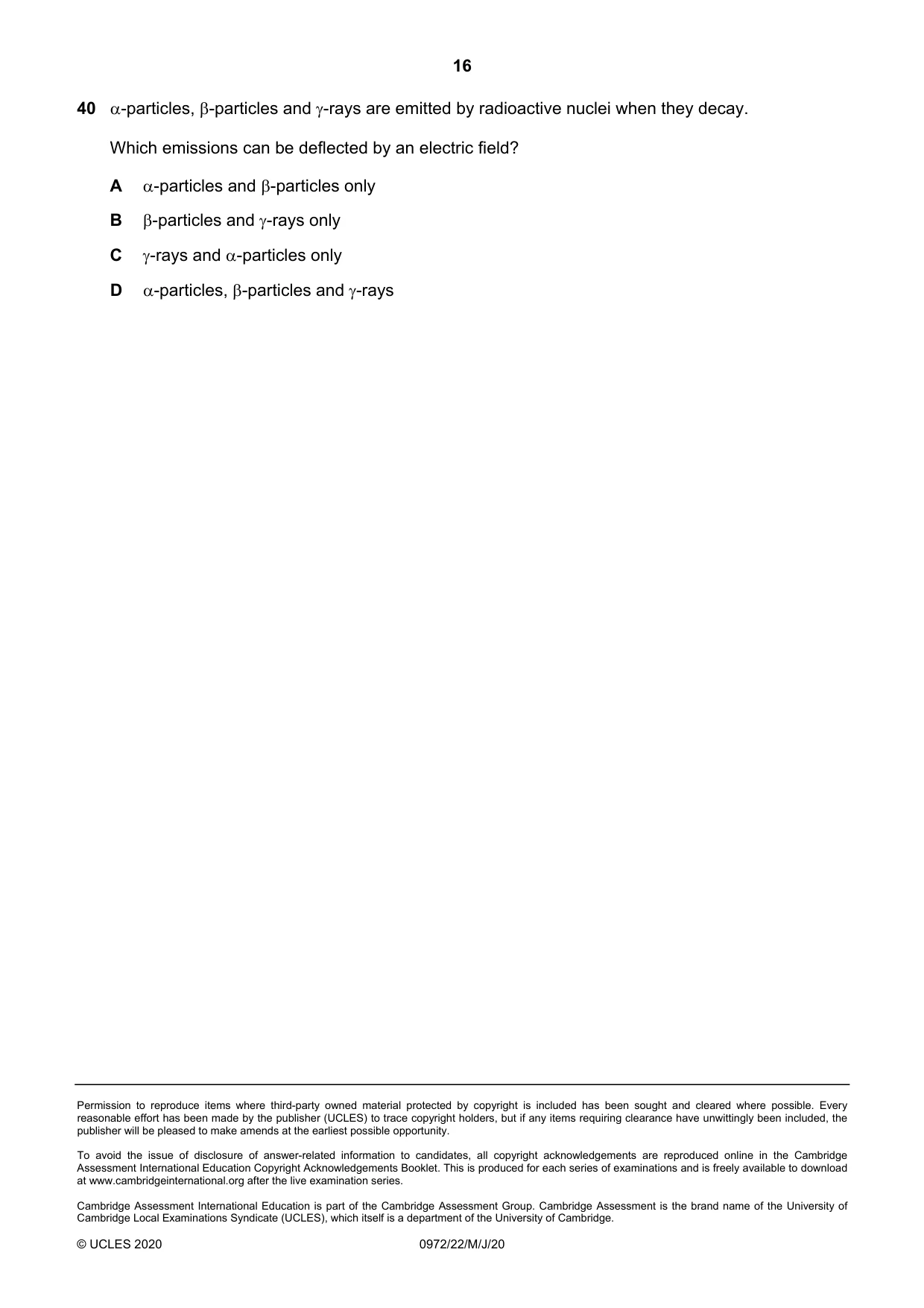
Q40 · Α-particles, β-particles and γ-rays are emitted by radioactive nuclei when they decay
40 α-particles, β-particles and γ-rays are emitted by radioactive nuclei when they decay. Which emissions can be deflected by an electric field? A α-particles and β-particles only B β-particles and γ-rays only C γ-rays and α-particles only D α-particles, β-particles and γ-rays
Mark scheme: A
What was in this paper
The subtopics covered by these 40 questions, and how many questions each got. Open one in a new tab to see every Cambridge question on it.
4Electrical quantities3Forces3Motion3Radioactivity3Simple phenomena of magnetism3Electromagnetic spectrum2Energy, work and power2Kinetic particle model of matter2Light2Pressure2Thermal properties and temperature2Transfer of thermal energy2Density1Electromagnetic effects1General properties of waves1Mass and weight1Momentum1Sound1The nuclear model of the atom1