Questions as text
Q1 · When does an object falling vertically through the air reach terminal velocity? 0972/21 May/June 2018
2 When does an object falling vertically through the air reach terminal velocity? A when the acceleration of the object becomes negative B when the acceleration of the object is equal to g C when the air resistance equals the weight of the object D when the air resistance is greater than the weight of the object
1 marks
Answer: C
This question in 0972/21 May/June 2018
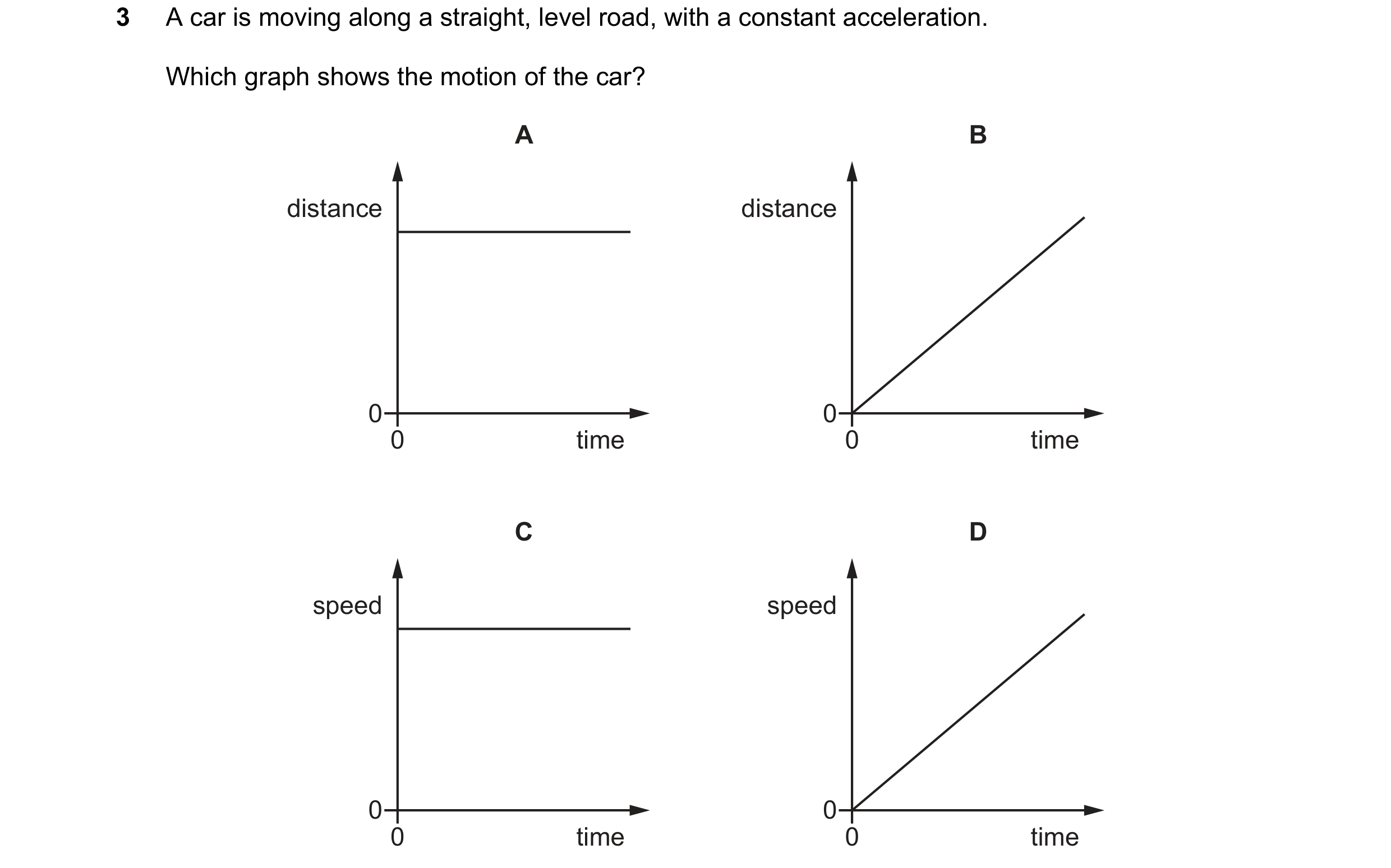
Q2 · A car is moving along a straight, level road, with a constant acceleration 0972/21 May/June 2018
3 A car is moving along a straight, level road, with a constant acceleration. Which graph shows the motion of the car? A B distance distance 0 0 0 time 0 time C D speed speed 0 0 0 time 0 time
1 marks
Answer: D
This question in 0972/21 May/June 2018
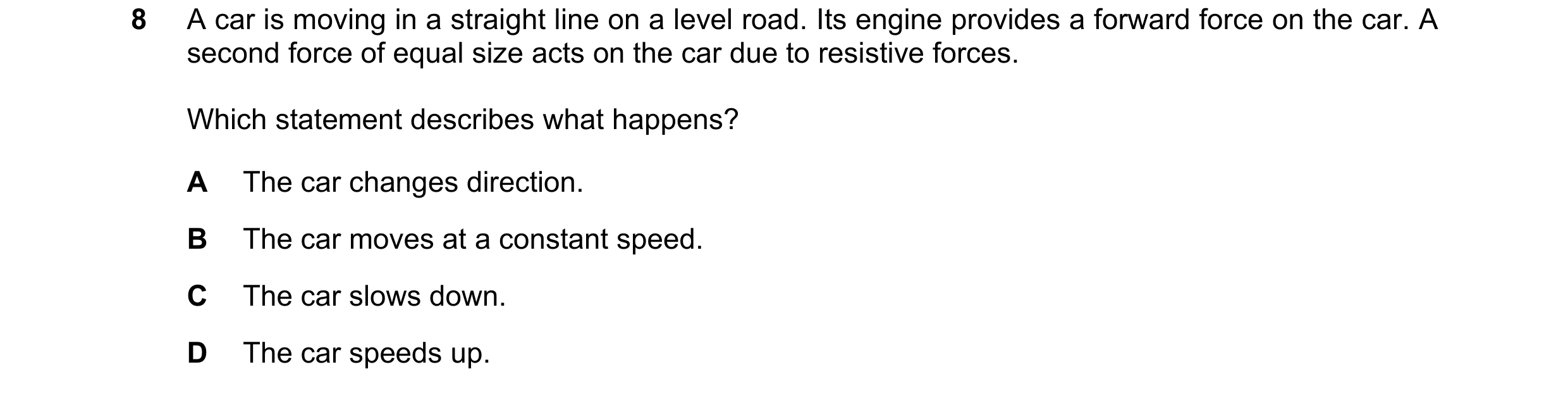
Q3 · A car is moving in a straight line on a level road 0972/21 May/June 2018
8 A car is moving in a straight line on a level road. Its engine provides a forward force on the car. A second force of equal size acts on the car due to resistive forces. Which statement describes what happens? A The car changes direction. B The car moves at a constant speed. C The car slows down. D The car speeds up.
1 marks
Answer: B
This question in 0972/21 May/June 2018
Q4 · Which expression gives the momentum of an object? 0972/21 May/June 2018
9 Which expression gives the momentum of an object? A mass × acceleration B mass × gravitational field strength C mass × velocity D 1 × mass × (velocity)2 2
1 marks
Answer: C
This question in 0972/21 May/June 2018
Q5 · A small, light ball is dropped from the top of a tall building 0972/21 Oct/Nov 2018
2 A small, light ball is dropped from the top of a tall building. Which graph shows how the speed of the ball changes with time? A B speed speed 0 0 0 time 0 time C D speed speed 0 0 0 time 0 time
1 marks
Answer: C
This question in 0972/21 Oct/Nov 2018
Q6 · A runner runs 300 m at an average speed of 3.0 m / s 0972/21 Oct/Nov 2018
3 A runner runs 300 m at an average speed of 3.0 m / s. She then runs another 300 m at an average speed of 6.0 m / s. What is her average speed for the total distance of 600 m? A 2.0 m / s B 4.0 m / s C 4.5 m / s D 8.0 m / s
1 marks
Answer: B
This question in 0972/21 Oct/Nov 2018
Q7 · A resultant force of 4.0 N acts on an object of mass 0.50 kg for 3.0 seconds 0972/21 Oct/Nov 2018
6 A resultant force of 4.0 N acts on an object of mass 0.50 kg for 3.0 seconds. What is the change in velocity caused by this force? A 4.0 m / s B 6.0 m / s C 12 m / s D 24 m / s
1 marks
Answer: D
This question in 0972/21 Oct/Nov 2018
Q8 · An object, initially at rest, is dropped from a height of 12.0 m 0972/21 Oct/Nov 2018
10 An object, initially at rest, is dropped from a height of 12.0 m. The change in gravitational potential energy when it falls to the ground is 565 J. The frictional forces are negligible. What is its speed when it hits the ground? A 4.71 m / s B 15.5 m / s C 47.1 m / s D 240 m / s
1 marks
Answer: B
This question in 0972/21 Oct/Nov 2018
Q9 · The velocity of an object increases from 30 m / s to 50 m / s in 5.0 seconds 0972/21 May/June 2019
2 The velocity of an object increases from 30 m / s to 50 m / s in 5.0 seconds. What is the average acceleration of the object? A 0.10 m / s2 B 0.25 m / s2 C 4.0 m / s2 D 10 m / s2
1 marks
Answer: C
This question in 0972/21 May/June 2019
Q10 · A heavy metal ball falls vertically downwards through air past four equally spaced levels… 0972/21 May/June 2019
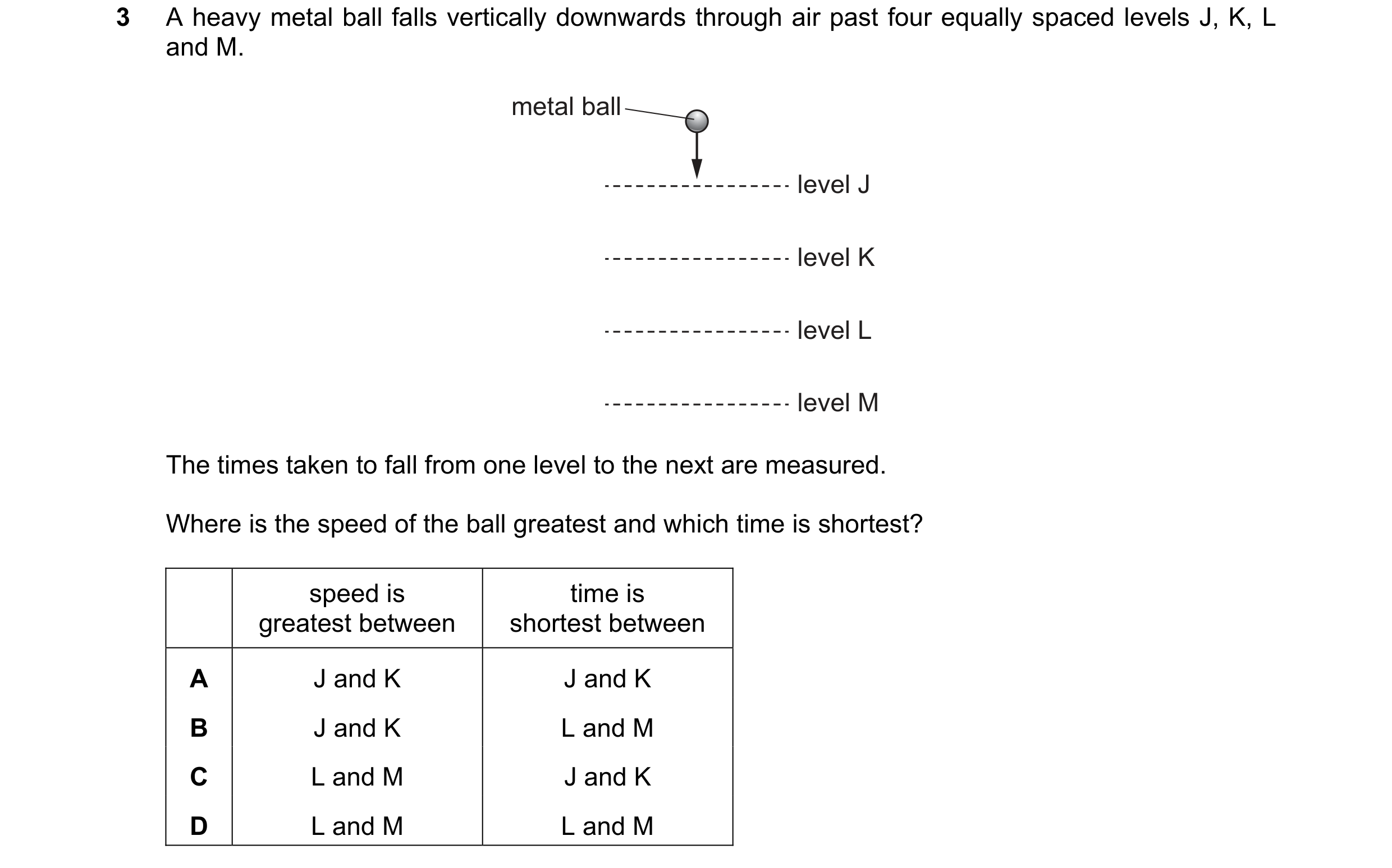
3 A heavy metal ball falls vertically downwards through air past four equally spaced levels J, K, L and M. metal ball level J level K level L level M The times taken to fall from one level to the next are measured. Where is the speed of the ball greatest and which time is shortest? speed is time is greatest between shortest between A J and K J and K B J and K L and M C L and M J and K D L and M L and M
1 marks
Answer: D
This question in 0972/21 May/June 2019
Q11 · A boat starts moving across a river at velocity v perpendicular to the river bank 0972/21 May/June 2019
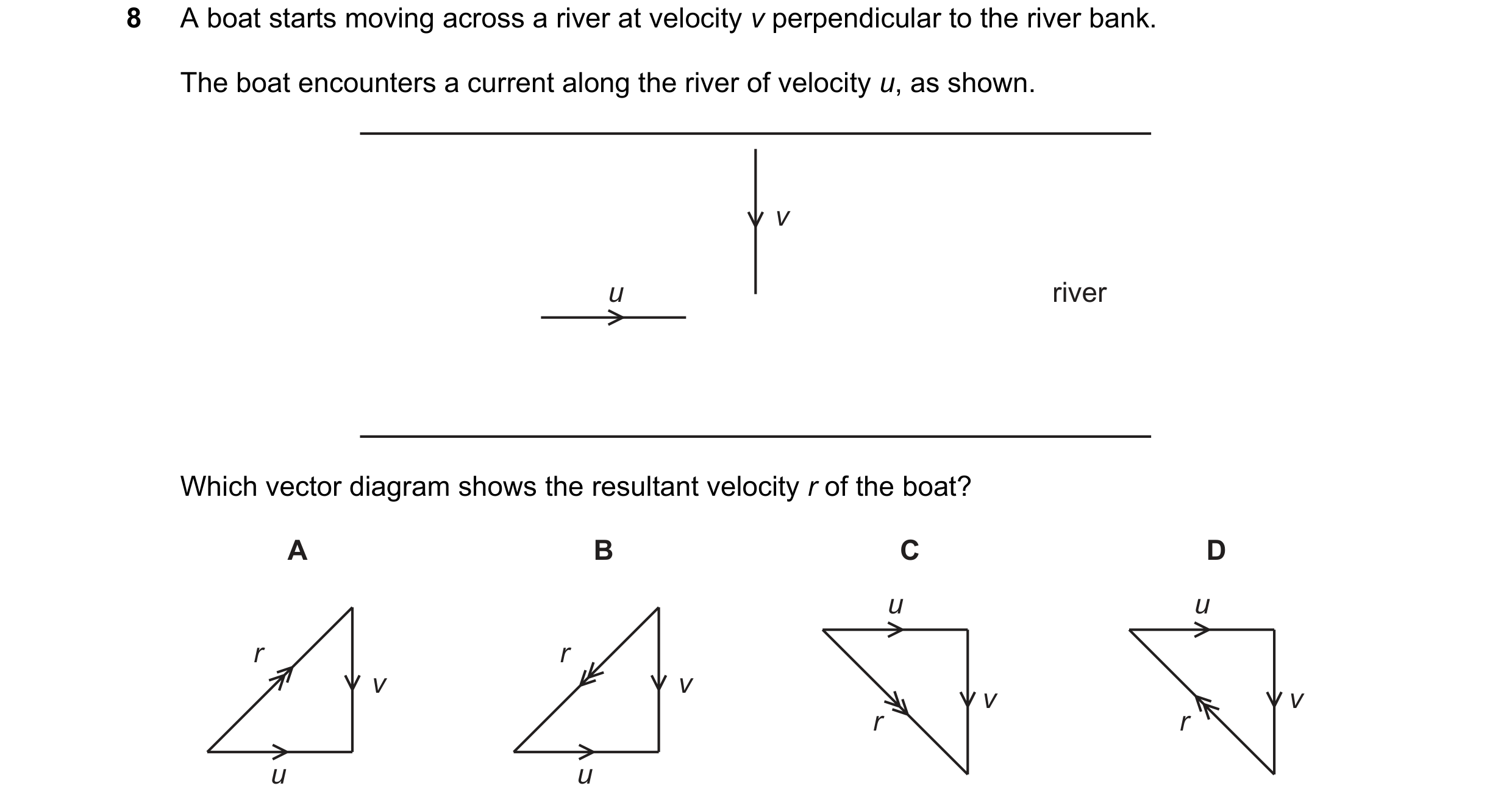
8 A boat starts moving across a river at velocity v perpendicular to the river bank. The boat encounters a current along the river of velocity u, as shown. v u river Which vector diagram shows the resultant velocity r of the boat? A B C D u u r r v v v v r r u u
1 marks
Answer: C
This question in 0972/21 May/June 2019
Q12 · An object falls from the top of a building that is 25 m high 0972/21 May/June 2019
10 An object falls from the top of a building that is 25 m high. Air resistance is negligible. What is the speed of the object when it hits the ground? A 10 m / s B 22 m / s C 25 m / s D 625 m / s
1 marks
Answer: B
This question in 0972/21 May/June 2019
Q13 · Four objects are moving along a straight line 0972/22 May/June 2019
2 Four objects are moving along a straight line. The distance of an object from a fixed point on the line is plotted against time for each object. Which object is decelerating? A B distance from distance from fixed point fixed point 00 00 time time C D distance from distance from fixed point fixed point 00 00 time time
1 marks
Answer: C
This question in 0972/22 May/June 2019
Q14 · A heavy metal ball falls vertically downwards through air past four equally spaced levels… 0972/22 May/June 2019
3 A heavy metal ball falls vertically downwards through air past four equally spaced levels J, K, L and M. metal ball level J level K level L level M The times taken to fall from one level to the next are measured. Where is the speed of the ball greatest and which time is shortest? speed is time is greatest between shortest between A J and K J and K B J and K L and M C L and M J and K D L and M L and M
1 marks
Answer: D
This question in 0972/22 May/June 2019
Q15 · Four students make statements about the mass of an object 0972/22 May/June 2019
4 Four students make statements about the mass of an object. Which statement is correct? A The mass of an object depends on the gravitational field which acts on the object. B The mass of an object divided by its weight is equal to the acceleration with which it falls freely. C The mass of an object increases when the temperature of the object increases. D The mass of an object resists change in motion of the object.
1 marks
Answer: D
This question in 0972/22 May/June 2019
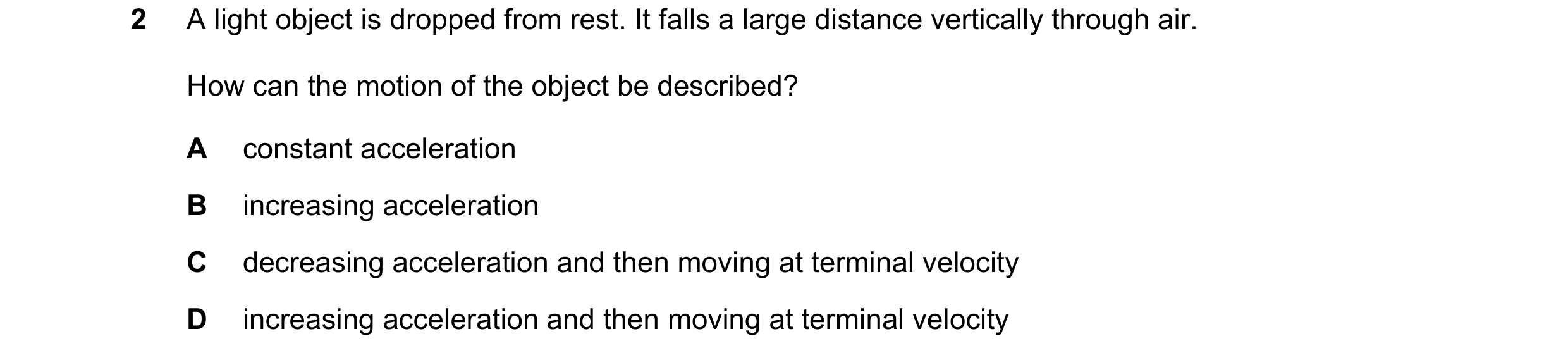
Q16 · A light object is dropped from rest 0972/21 Oct/Nov 2019
2 A light object is dropped from rest. It falls a large distance vertically through air. How can the motion of the object be described? A constant acceleration B increasing acceleration C decreasing acceleration and then moving at terminal velocity D increasing acceleration and then moving at terminal velocity
1 marks
Answer: C
This question in 0972/21 Oct/Nov 2019
Q17 · A car travels at an average speed of 60 km / h for 15 minutes 0972/21 Oct/Nov 2019
3 A car travels at an average speed of 60 km / h for 15 minutes. How far does the car travel in 15 minutes? A 4.0 km B 15 km C 240 km D 900 km
1 marks
Answer: B
This question in 0972/21 Oct/Nov 2019
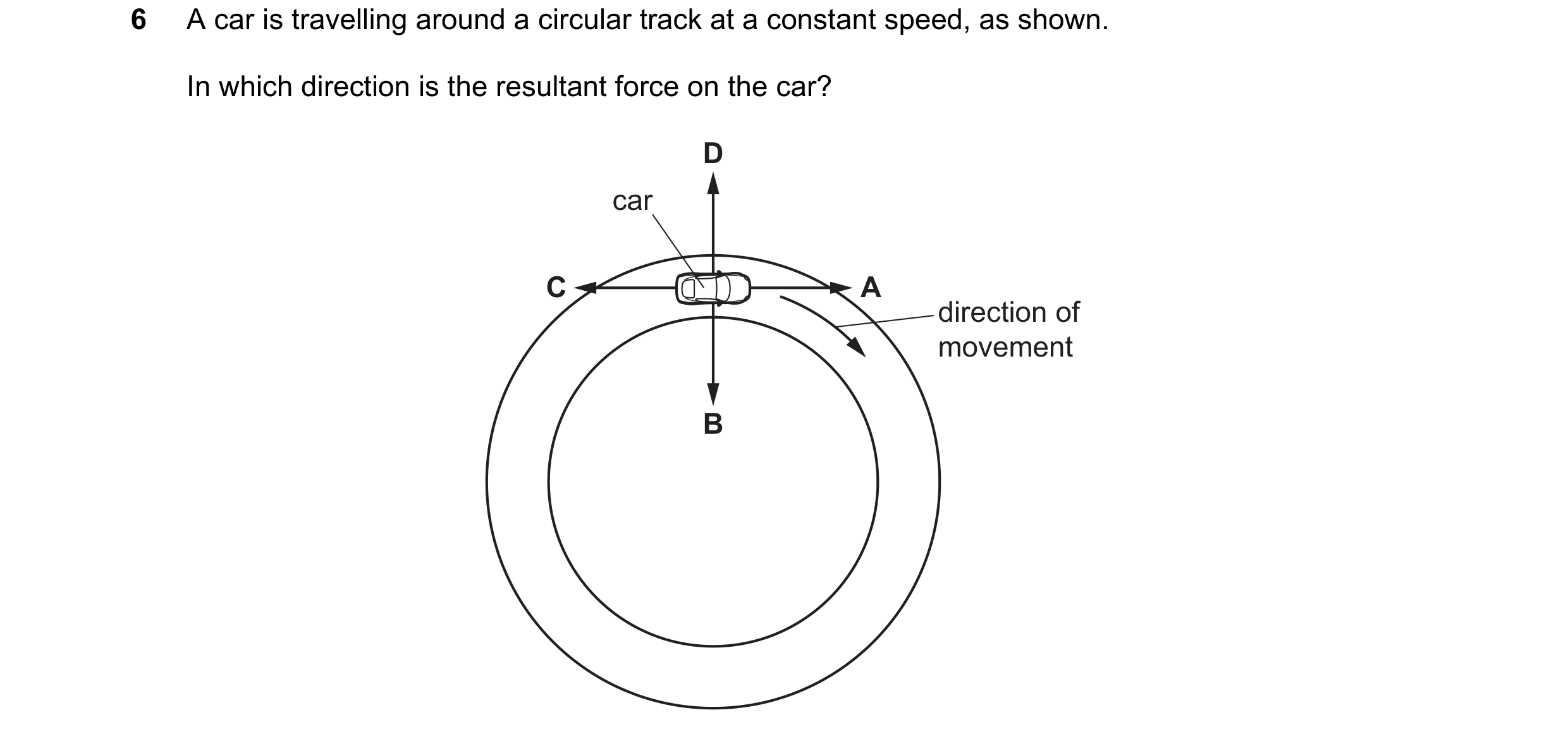
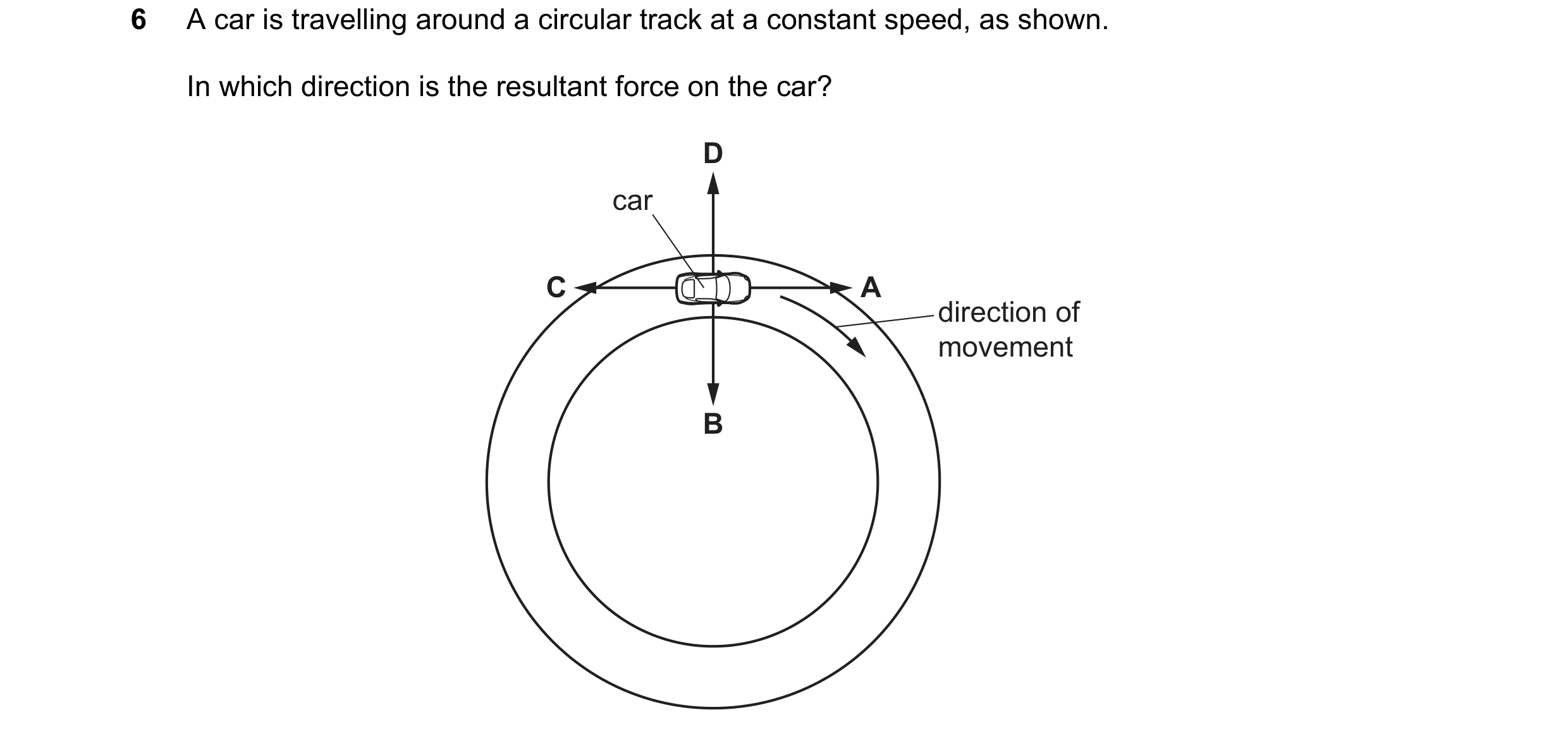
Q18 · A car is travelling around a circular track at a constant speed, as shown 0972/21 Oct/Nov 2019
6 A car is travelling around a circular track at a constant speed, as shown. In which direction is the resultant force on the car? D car C A direction of movement B
1 marks
Answer: B
This question in 0972/21 Oct/Nov 2019
Q19 · A student investigates the motion of a ball rolling down a slope 0972/21 May/June 2020
2 A student investigates the motion of a ball rolling down a slope. The diagram shows the speed v of the ball at different times t. t = 0 s v = 0 cm / s t = 0.2 s v = 2.8 cm / s t = 0.4 s ball v = 5.1 cm / s t = 0.6 s v = 7.0 cm / s Which statement describes the motion of the ball? A The acceleration is not constant. B The acceleration is negative. C The speed is decreasing. D The velocity is constant.
1 marks
Answer: A
This question in 0972/21 May/June 2020
Q20 · Which statement about acceleration is correct? 0972/21 May/June 2020
3 Which statement about acceleration is correct? A It is related to the changing speed of an object. B It is the distance an object travels in one second. C It is the force acting on an object divided by the distance it travels in one second. D It is the force acting on an object when it is near to the Earth.
1 marks
Answer: A
This question in 0972/21 May/June 2020
Q21 · Which quantity is a vector? 0972/21 May/June 2020
8 Which quantity is a vector? A acceleration B distance C speed D mass
1 marks
Answer: A
This question in 0972/21 May/June 2020
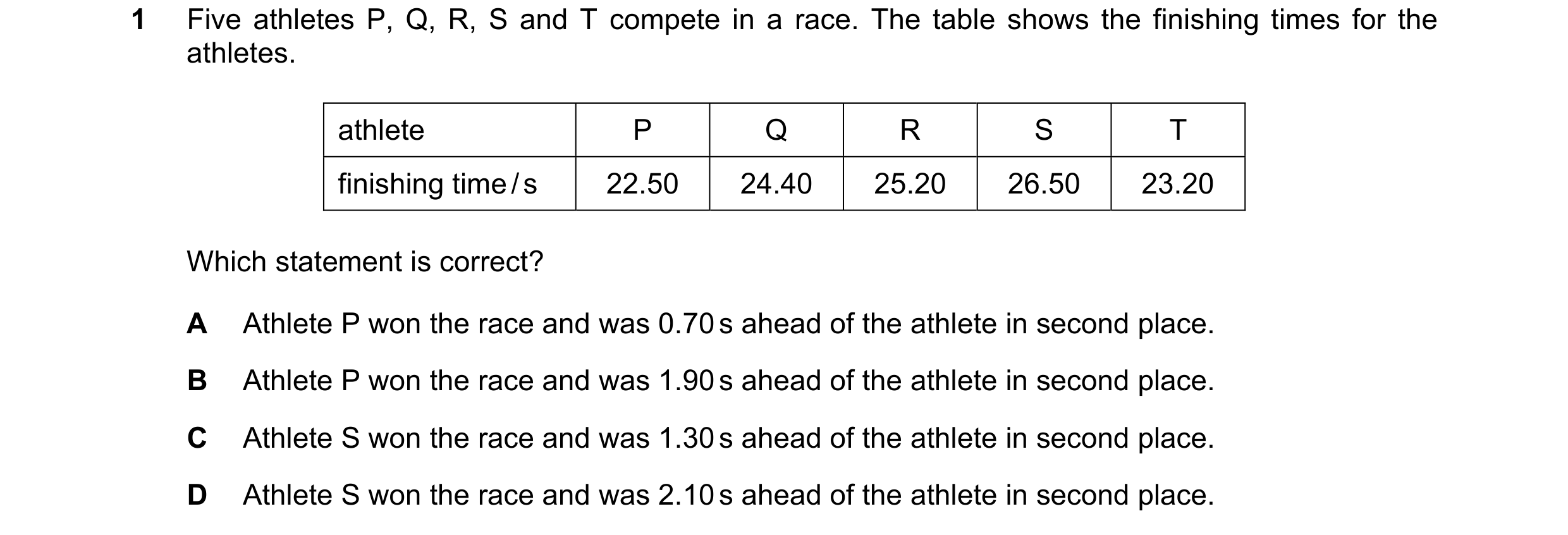
Q22 · Five athletes P, Q, R, S and T compete in a race 0972/22 May/June 2020
1 Five athletes P, Q, R, S and T compete in a race. The table shows the finishing times for the athletes. athlete P Q R S T finishing time / s 22.50 24.40 25.20 26.50 23.20 Which statement is correct? A Athlete P won the race and was 0.70 s ahead of the athlete in second place. B Athlete P won the race and was 1.90 s ahead of the athlete in second place. C Athlete S won the race and was 1.30 s ahead of the athlete in second place. D Athlete S won the race and was 2.10 s ahead of the athlete in second place.
1 marks
Answer: A
This question in 0972/22 May/June 2020
Q23 · A student investigates the motion of a ball rolling down a slope 0972/22 May/June 2020
2 A student investigates the motion of a ball rolling down a slope. The diagram shows the speed v of the ball at different times t. t = 0 s v = 0 cm / s t = 0.2 s v = 2.8 cm / s t = 0.4 s ball v = 5.1 cm / s t = 0.6 s v = 7.0 cm / s Which statement describes the motion of the ball? A The acceleration is not constant. B The acceleration is negative. C The speed is decreasing. D The velocity is constant.
1 marks
Answer: A
This question in 0972/22 May/June 2020
Q24 · Which statement about acceleration is correct? 0972/22 May/June 2020
3 Which statement about acceleration is correct? A It is related to the changing speed of an object. B It is the distance an object travels in one second. C It is the force acting on an object divided by the distance it travels in one second. D It is the force acting on an object when it is near to the Earth.
1 marks
Answer: A
This question in 0972/22 May/June 2020
Q25 · Which statement correctly describes the effects of placing a heavy load in a car? 0972/22 May/June 2020
4 Which statement correctly describes the effects of placing a heavy load in a car? A It is easier to accelerate the car and easier to bring the car to rest. B It is easier to accelerate the car but more difficult to bring the car to rest. C It is more difficult to accelerate the car and more difficult to bring the car to rest. D It is more difficult to accelerate the car but easier to bring the car to rest.
1 marks
Answer: C
This question in 0972/22 May/June 2020
Q26 · A satellite orbits the Earth at constant speed in a circular orbit 0972/22 May/June 2020
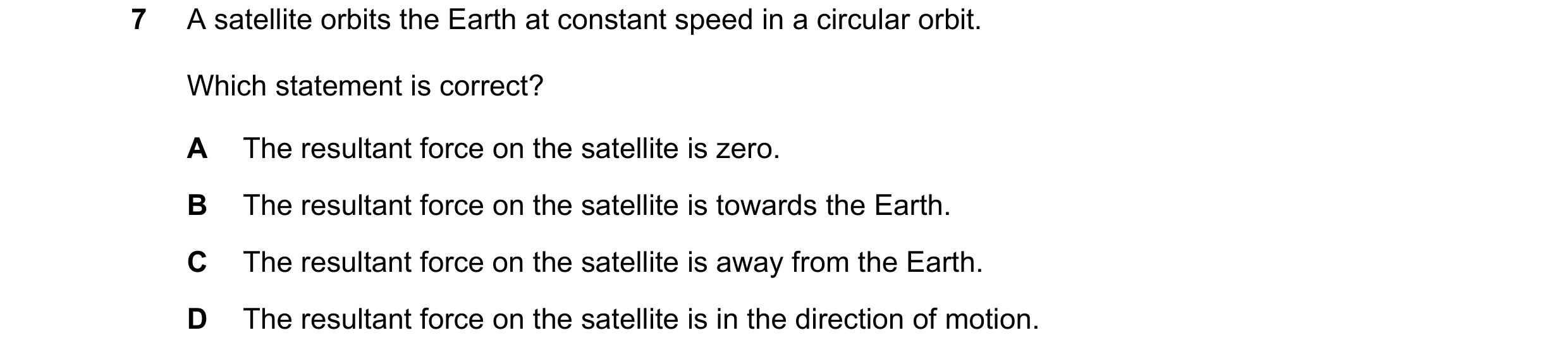
7 A satellite orbits the Earth at constant speed in a circular orbit. Which statement is correct? A The resultant force on the satellite is zero. B The resultant force on the satellite is towards the Earth. C The resultant force on the satellite is away from the Earth. D The resultant force on the satellite is in the direction of motion.
1 marks
Answer: B
This question in 0972/22 May/June 2020
Q27 · An object is moving at +3.0 m / s 0972/22 May/June 2020
9 An object is moving at +3.0 m / s. A force acts on the object. After a time, the object is moving at – 4.0 m / s. The mass of the object is 5.0 kg. What is the change in momentum of the body? A –35 kg m / s B –5.0 kg m / s C +5.0 kg m / s D +35 kg m / s
1 marks
Answer: A
This question in 0972/22 May/June 2020
Q28 · The speed–time graph represents a journey 0972/21 Oct/Nov 2020
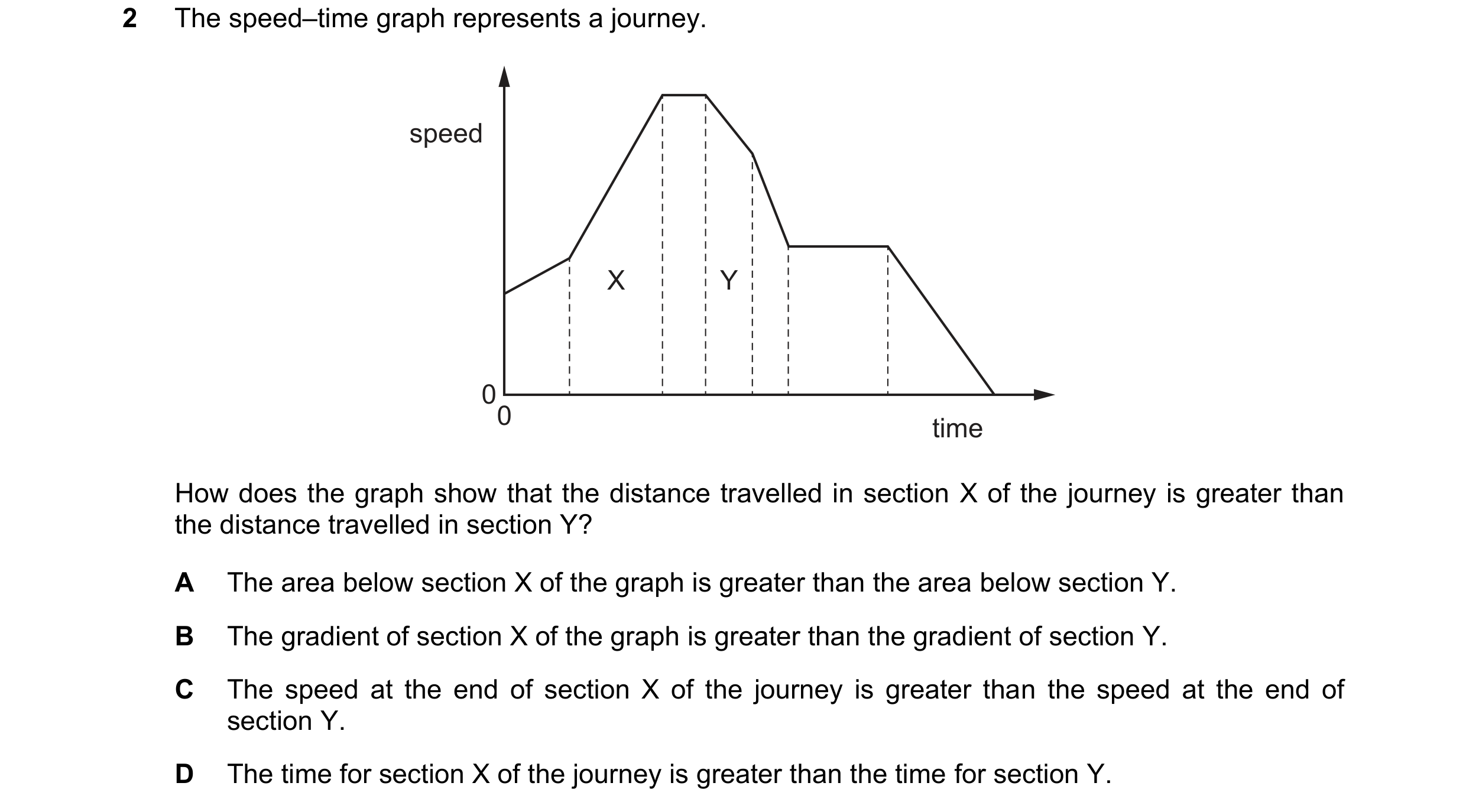
2 The speed–time graph represents a journey. speed X Y 00 time How does the graph show that the distance travelled in section X of the journey is greater than the distance travelled in section Y? A The area below section X of the graph is greater than the area below section Y. B The gradient of section X of the graph is greater than the gradient of section Y. C The speed at the end of section X of the journey is greater than the speed at the end of section Y. D The time for section X of the journey is greater than the time for section Y.
1 marks
Answer: A
This question in 0972/21 Oct/Nov 2020
Q29 · A car is travelling at a velocity of 2.0 m / s 0972/21 Oct/Nov 2020
3 A car is travelling at a velocity of 2.0 m / s. It accelerates at a constant 0.20 m / s2 for 2.5 minutes. What is the final velocity of the car? A 2.5 m / s B 5.2 m / s C 30 m / s D 32 m / s
1 marks
Answer: D
This question in 0972/21 Oct/Nov 2020
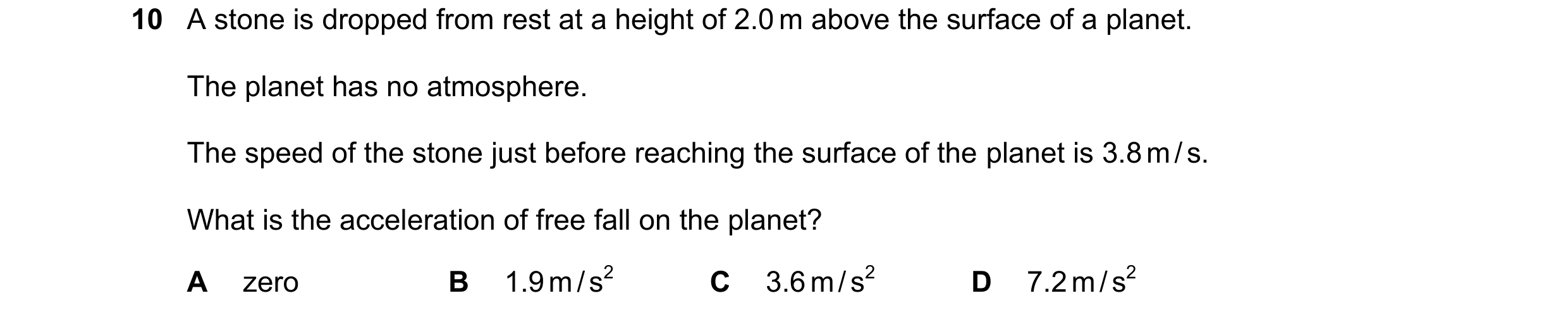
Q30 · A stone is dropped from rest at a height of 2.0 m above the surface of a planet 0972/21 Oct/Nov 2020
10 A stone is dropped from rest at a height of 2.0 m above the surface of a planet. The planet has no atmosphere. The speed of the stone just before reaching the surface of the planet is 3.8 m / s. What is the acceleration of free fall on the planet? A zero B 1.9 m / s2 C 3.6 m / s2 D 7.2 m / s2
1 marks
Answer: C
This question in 0972/21 Oct/Nov 2020
Q31 · The diagrams show distance–time graphs for four objects 0972/21 Oct/Nov 2021
2 The diagrams show distance–time graphs for four objects. Which graph represents an object moving with an increasing speed? A B distance distance 0 0 0 time 0 time C D distance distance 0 0 0 time 0 time
1 marks
Answer: D
This question in 0972/21 Oct/Nov 2021
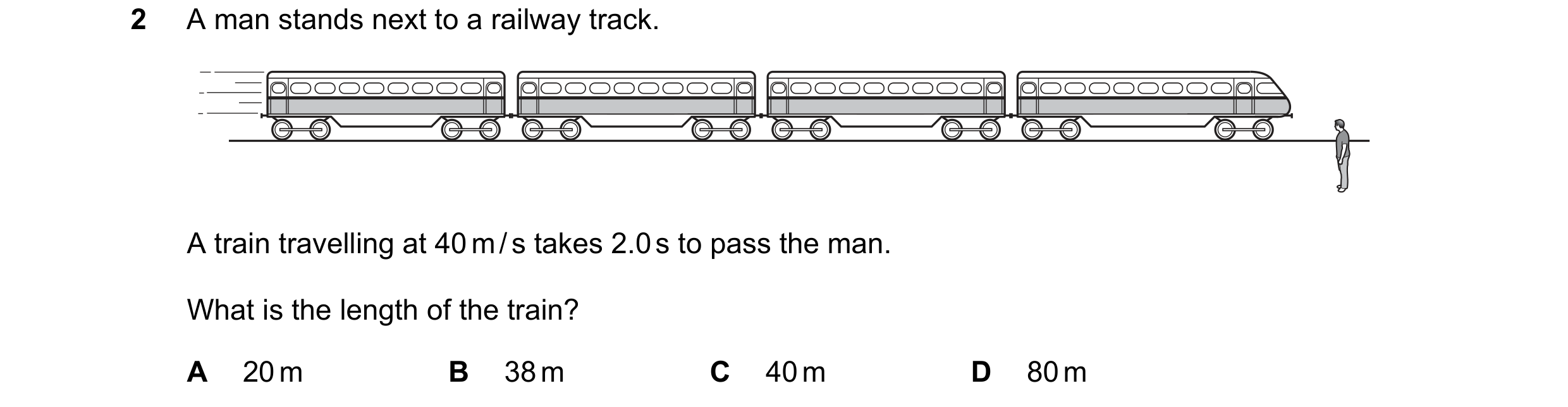
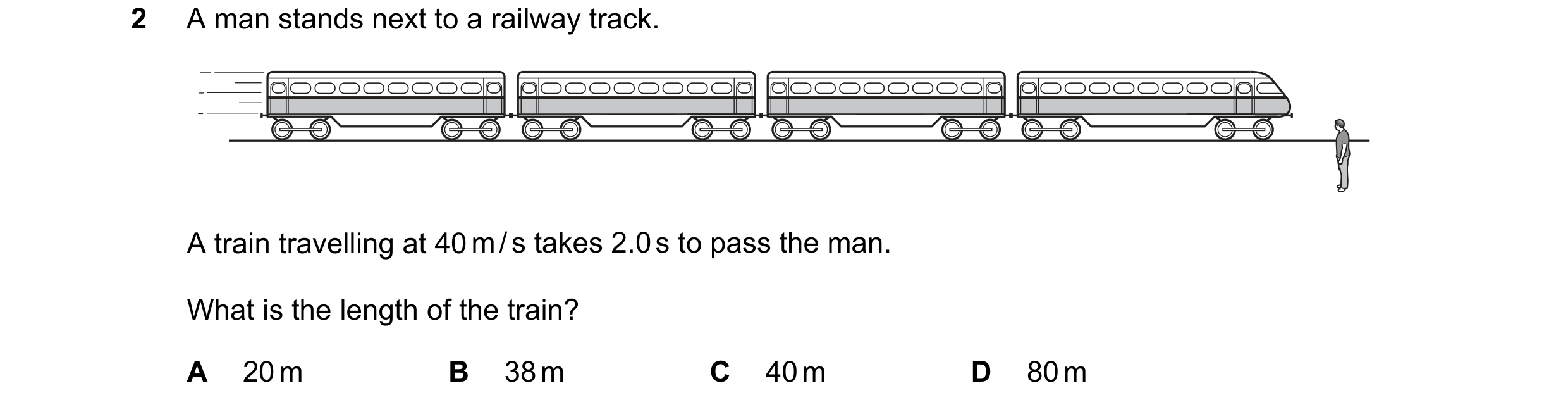
Q32 · A man stands next to a railway track 0972/21 May/June 2022
2 A man stands next to a railway track. A train travelling at 40 m / s takes 2.0 s to pass the man. What is the length of the train? A 20 m B 38 m C 40 m D 80 m
1 marks
Answer: D
This question in 0972/21 May/June 2022
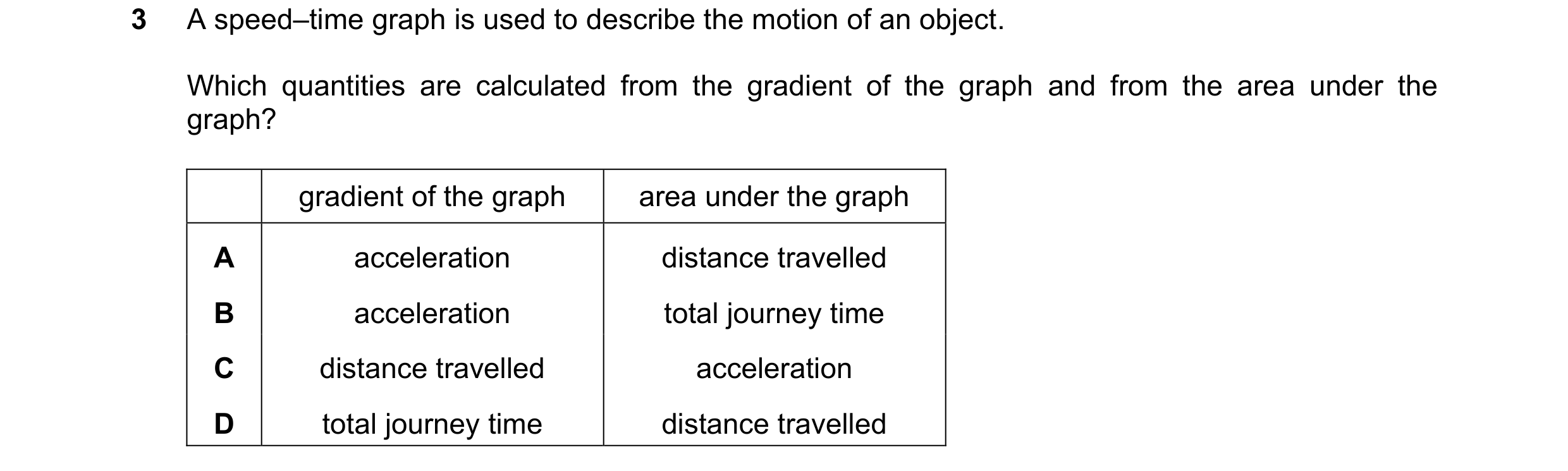
Q33 · A speed–time graph is used to describe the motion of an object 0972/21 May/June 2022
3 A speed–time graph is used to describe the motion of an object. Which quantities are calculated from the gradient of the graph and from the area under the graph? gradient of the graph area under the graph A acceleration distance travelled B acceleration total journey time C distance travelled acceleration D total journey time distance travelled
1 marks
Answer: A
This question in 0972/21 May/June 2022
Q34 · An object on the end of a string moves in a clockwise circular path at constant speed 0972/21 May/June 2022
6 An object on the end of a string moves in a clockwise circular path at constant speed. The diagram shows the object as viewed from above. What is the direction of the resultant force on the object when it is in the position shown? string A B object D C
1 marks
Answer: A
This question in 0972/21 May/June 2022
Q35 · A man stands next to a railway track 0972/22 May/June 2022
2 A man stands next to a railway track. A train travelling at 40 m / s takes 2.0 s to pass the man. What is the length of the train? A 20 m B 38 m C 40 m D 80 m
1 marks
Answer: D
This question in 0972/22 May/June 2022
Q36 · Which quantity is equal to acceleration? 0972/22 May/June 2022
3 Which quantity is equal to acceleration? A area under a distance–time graph B area under a speed–time graph C gradient of a distance–time graph D gradient of a speed–time graph
1 marks
Answer: D
This question in 0972/22 May/June 2022
Q37 · An object moves at constant speed around a circular path 0972/22 May/June 2022
6 An object moves at constant speed around a circular path. Which statement is correct? A A resultant force acts on the object outwards from the centre of the circle. B A resultant force acts on the object in the direction it is travelling. C A resultant force acts on the object towards the centre of the circle. D There is no resultant force acting on the object because it is moving at constant speed.
1 marks
Answer: C
This question in 0972/22 May/June 2022
Q38 · A car starts from rest 0972/21 Oct/Nov 2022
2 A car starts from rest. The table shows the readings from its speedometer every 10 s. time / s 0 10 20 30 40 50 60 speed 0 4 8 12 12 12 12 m / s Which row describes the car’s motion in the first 30 seconds and in the last 30 seconds? motion during first 30 s motion during last 30 s A non-zero acceleration at rest B zero acceleration constant speed C zero acceleration at rest D non-zero acceleration constant speed
1 marks
Answer: D
This question in 0972/21 Oct/Nov 2022
Q39 · A car is travelling around a circular track at a constant speed, as shown 0972/21 Oct/Nov 2022
6 A car is travelling around a circular track at a constant speed, as shown. In which direction is the resultant force on the car? D car C A direction of movement B
1 marks
Answer: B
This question in 0972/21 Oct/Nov 2022
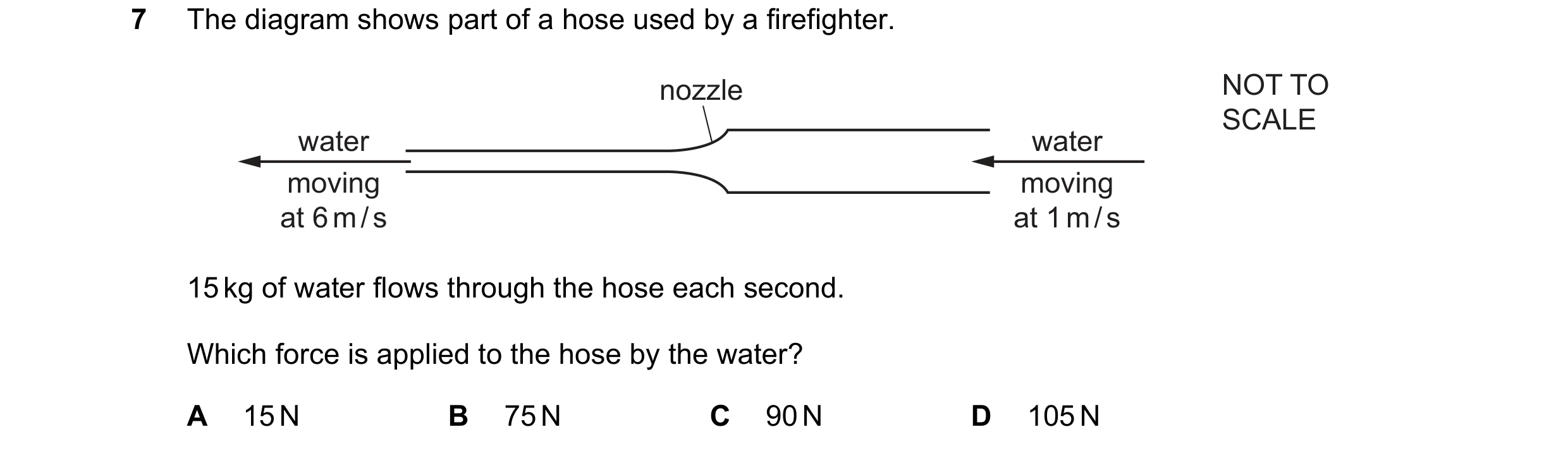
Q40 · The diagram shows part of a hose used by a firefighter 0972/21 Oct/Nov 2022
7 The diagram shows part of a hose used by a firefighter. nozzle NOT TO SCALE water water moving moving at 6 m / s at 1 m / s 15 kg of water flows through the hose each second. Which force is applied to the hose by the water? A 15 N B 75 N C 90 N D 105 N
1 marks
Answer: B
This question in 0972/21 Oct/Nov 2022
Q41 · An object falls towards the surface of the Earth 0972/21 May/June 2023
2 An object falls towards the surface of the Earth. The object is falling at its terminal velocity. Which statement is correct? A There is air resistance and the acceleration of the object is negative. B There is air resistance and the acceleration of the object is zero. C There is no air resistance and the acceleration of the object is negative. D There is no air resistance and the acceleration of the object is zero.
1 marks
Answer: B
This question in 0972/21 May/June 2023
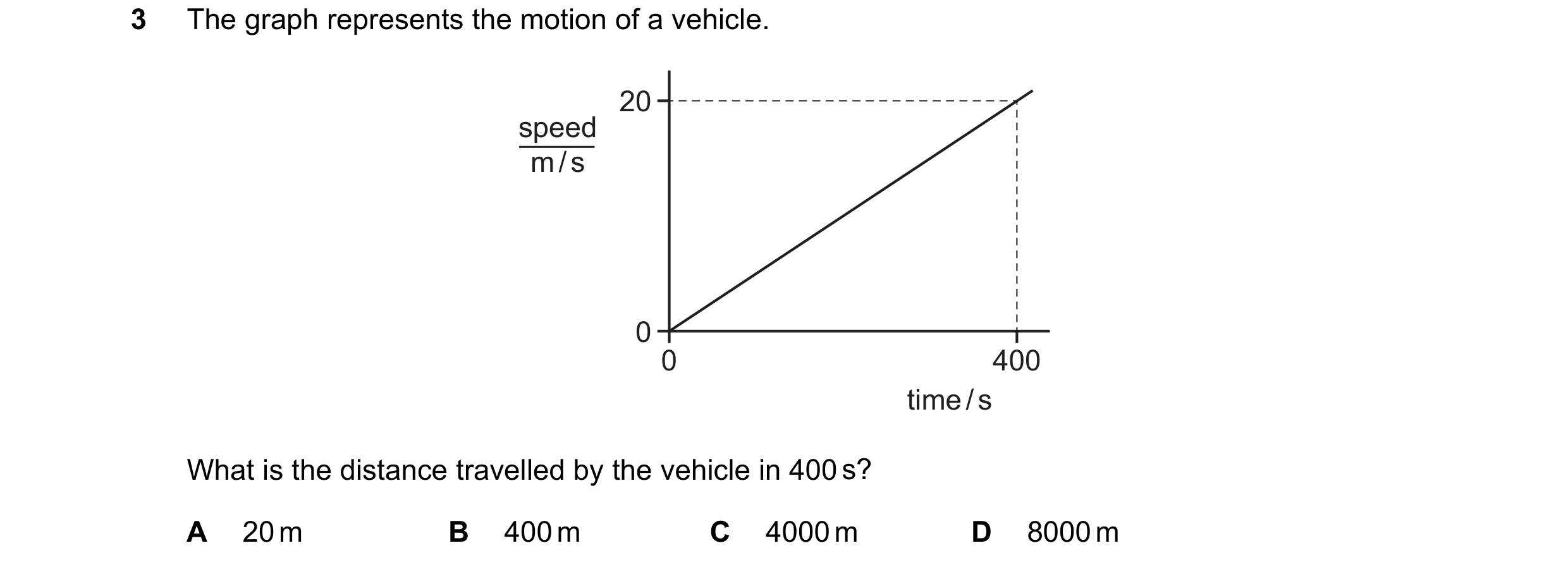
Q42 · The graph represents the motion of a vehicle 0972/21 May/June 2023
3 The graph represents the motion of a vehicle. 20 speed m / s 0 0 400 time / s What is the distance travelled by the vehicle in 400 s? A 20 m B 400 m C 4000 m D 8000 m
1 marks
Answer: C
This question in 0972/21 May/June 2023
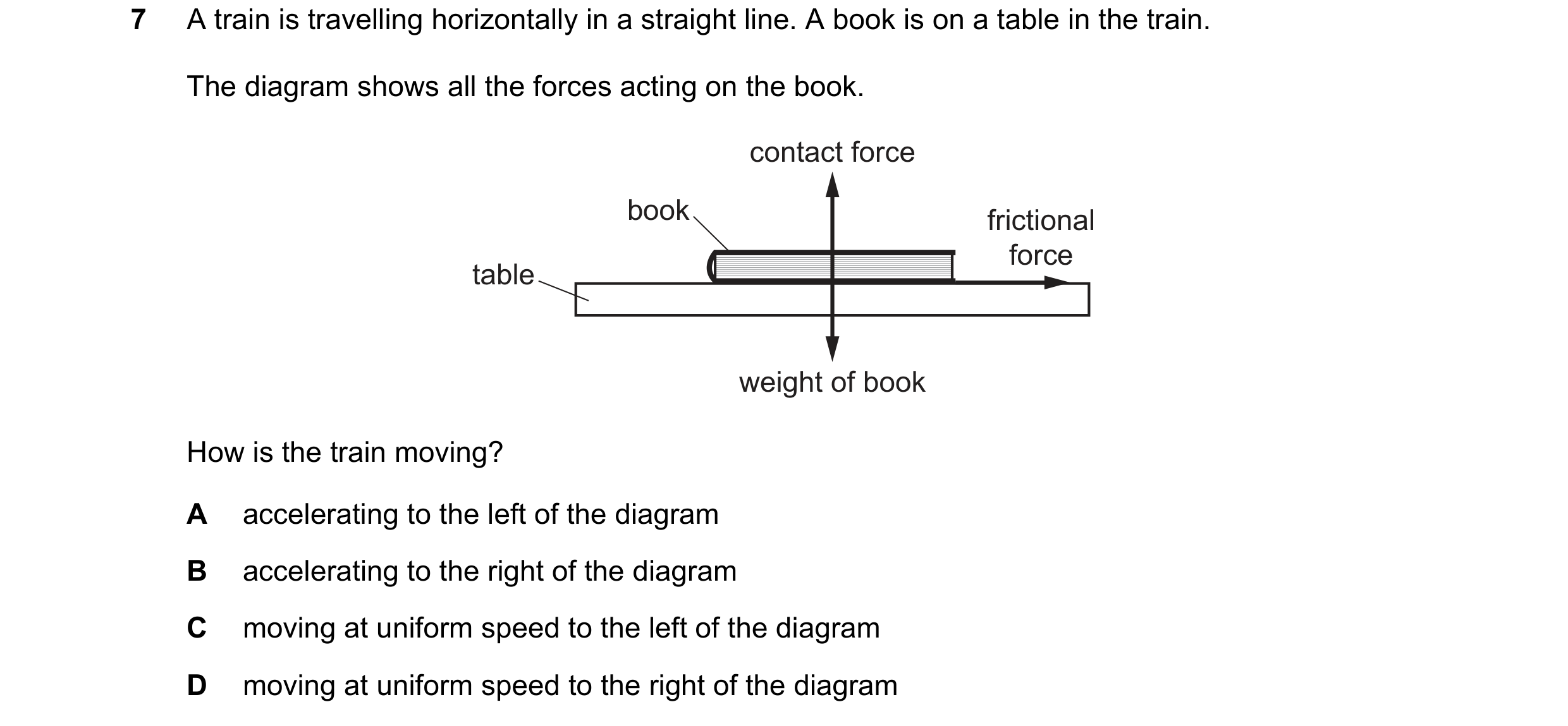
Q43 · A train is travelling horizontally in a straight line 0972/21 May/June 2023
7 A train is travelling horizontally in a straight line. A book is on a table in the train. The diagram shows all the forces acting on the book. contact force book frictional force table weight of book How is the train moving? A accelerating to the left of the diagram B accelerating to the right of the diagram C moving at uniform speed to the left of the diagram D moving at uniform speed to the right of the diagram
1 marks
Answer: B
This question in 0972/21 May/June 2023
Q44 · An object of mass 1.2 kg is moving with a velocity of 2.0 m / s when it is acted on by a… 0972/21 May/June 2023
9 An object of mass 1.2 kg is moving with a velocity of 2.0 m / s when it is acted on by a force of 4.0 N. The velocity of the object increases to 5.0 m / s in the same direction. For which period of time does the force act on the object? A 0.90 s B 1.1 s C 1.5 s D 3.6 s
1 marks
Answer: A
This question in 0972/21 May/June 2023
Q45 · A space station orbits the Earth at a distance of 7000 km from the Earth’s centre 0972/21 May/June 2023
38 A space station orbits the Earth at a distance of 7000 km from the Earth’s centre. It makes 15 orbits in every 24-hour period. What is the speed of the space station in its orbit? A 2900 km / h B 4400 km / h C 8800 km / h D 27 000 km / h
1 marks
Answer: D
This question in 0972/21 May/June 2023
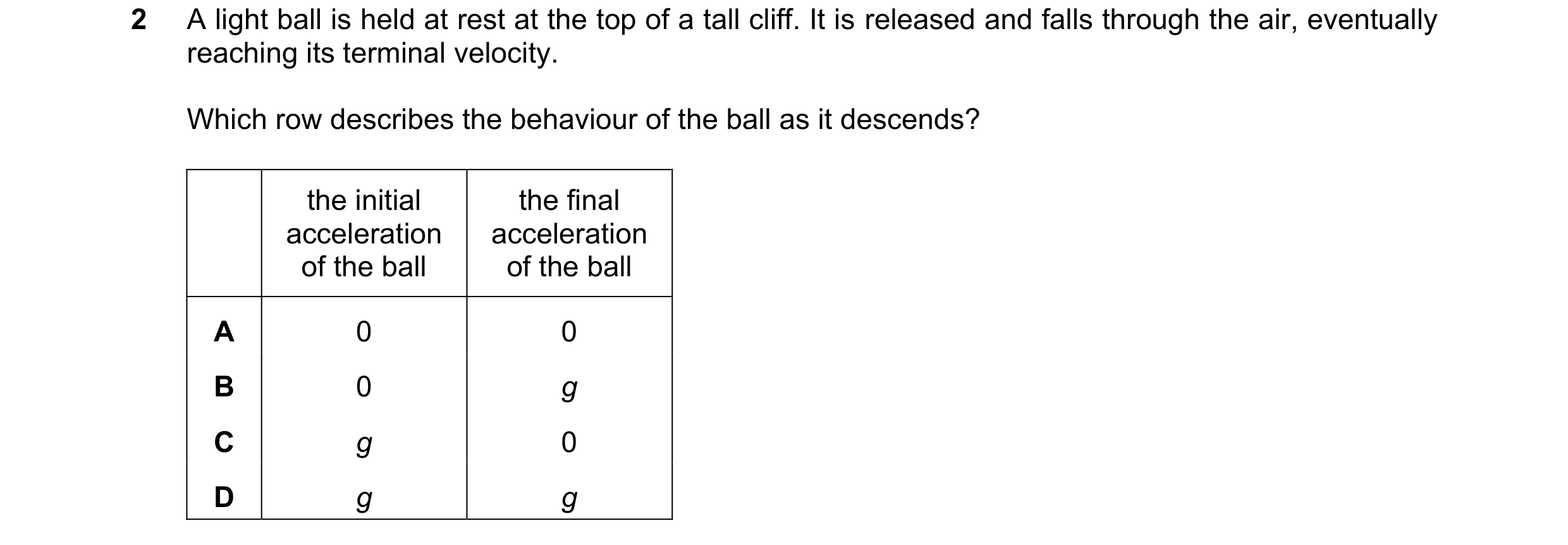
Q46 · A light ball is held at rest at the top of a tall cliff 0972/22 May/June 2023
2 A light ball is held at rest at the top of a tall cliff. It is released and falls through the air, eventually reaching its terminal velocity. Which row describes the behaviour of the ball as it descends? the initial the final acceleration acceleration of the ball of the ball A 0 0 B 0 g C g 0 D g g
1 marks
Answer: C
This question in 0972/22 May/June 2023
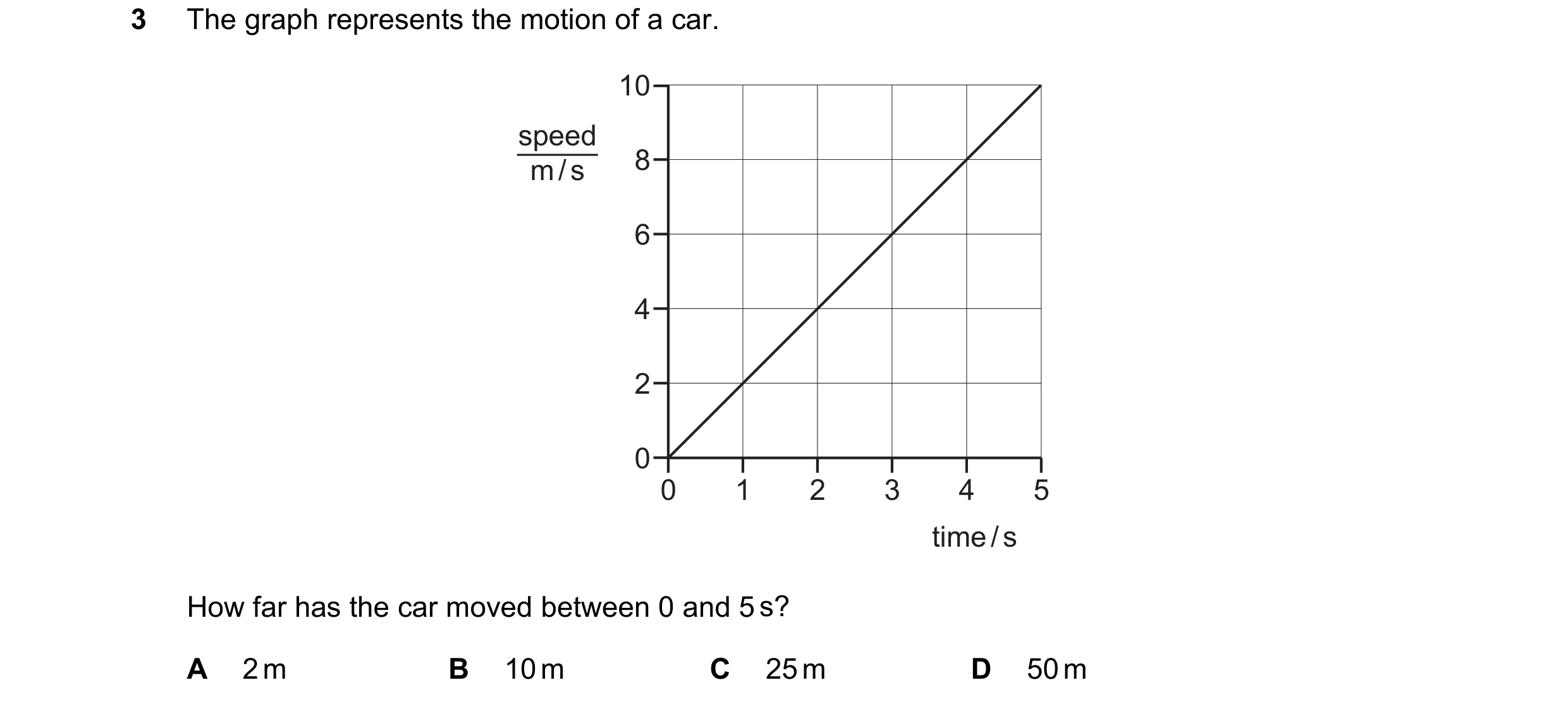
Q47 · The graph represents the motion of a car 0972/22 May/June 2023
3 The graph represents the motion of a car. 10 speed m / s 8 6 4 2 0 0 1 2 3 4 5 time / s How far has the car moved between 0 and 5 s? A 2 m B 10 m C 25 m D 50 m
1 marks
Answer: C
This question in 0972/22 May/June 2023
Q48 · A truck is towing a car along a straight horizontal road at a constant speed 0972/22 May/June 2023
7 A truck is towing a car along a straight horizontal road at a constant speed. truck car rope The rope breaks. Which row gives the direction of the initial acceleration of the truck after the rope breaks and the reason for the acceleration? direction of acceleration reason of the truck A left the driving force is greater than the resistive forces on the truck B left the driving force is smaller than the resistive forces on the truck C right the driving force is greater than the resistive forces on the truck D right the driving force is smaller than the resistive forces on the truck
1 marks
Answer: C
This question in 0972/22 May/June 2023
Q49 · A resultant force of 2.0 N acts on an object of mass 3.0 kg for 6.0 s 0972/22 May/June 2023
9 A resultant force of 2.0 N acts on an object of mass 3.0 kg for 6.0 s. What is the change in velocity of the object? A 0.25 m / s B 1.0 m / s C 4.0 m / s D 36 m / s
1 marks
Answer: C
This question in 0972/22 May/June 2023
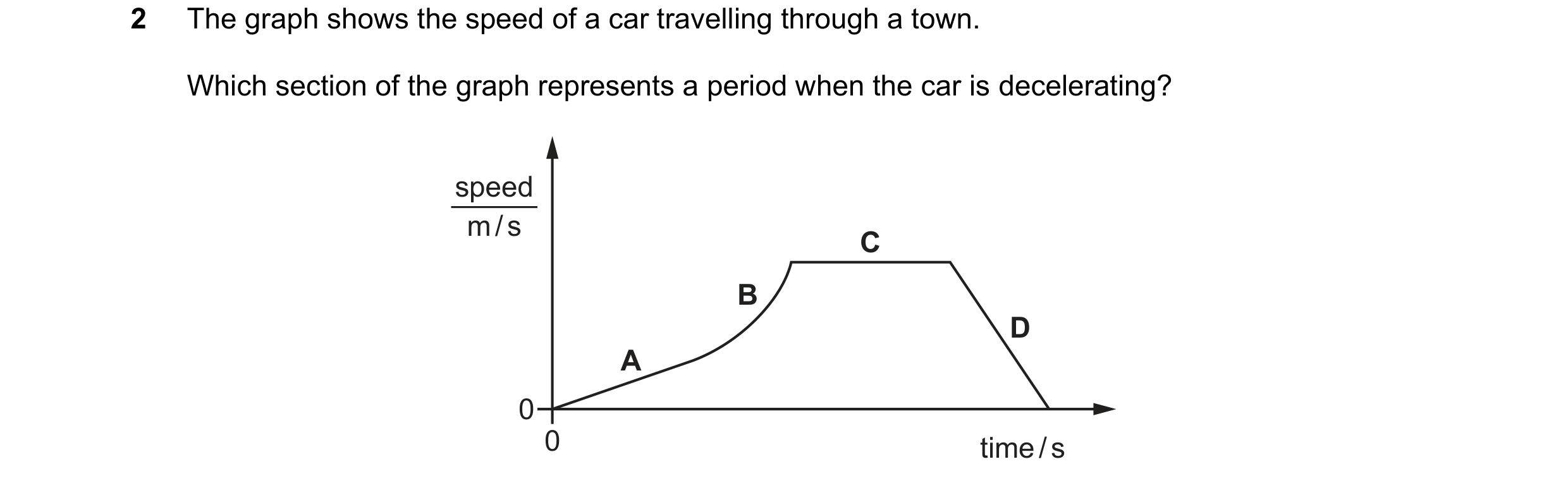
Q50 · The graph shows the speed of a car travelling through a town 0972/21 Oct/Nov 2023
2 The graph shows the speed of a car travelling through a town. Which section of the graph represents a period when the car is decelerating? speed m / s C B D A 0 0 time / s
1 marks
Answer: D
This question in 0972/21 Oct/Nov 2023
Q51 · An object reaches terminal velocity after being dropped and falling through air 0972/21 Oct/Nov 2023
3 An object reaches terminal velocity after being dropped and falling through air. Which graph shows how its speed varies with time? A B speed speed 0 0 0 time 0 time C D speed speed 0 0 0 time 0 time
1 marks
Answer: C
This question in 0972/21 Oct/Nov 2023
Q52 · Which moving object has a resultant force acting on it? 0972/21 Oct/Nov 2023
5 Which moving object has a resultant force acting on it? A a diver rising vertically through water at constant speed B an aircraft circling an airport at constant speed C a train going up a straight incline at constant speed D a parachutist descending vertically at terminal velocity
1 marks
Answer: B
This question in 0972/21 Oct/Nov 2023
Q53 · A stone is dropped from a tall tower and falls a distance of 50 m to the ground 0972/21 May/June 2024
7 A stone is dropped from a tall tower and falls a distance of 50 m to the ground. The stone has a mass of 3.0 kg. At which speed does the stone hit the ground? A 17 m / s B 31 m / s C 54 m / s D 150 m / s
1 marks
Answer: B
This question in 0972/21 May/June 2024
Q54 · The motion of an object is represented by the speed–time graph shown 0972/22 May/June 2024
2 The motion of an object is represented by the speed–time graph shown. speed area under the graph 0 0 time Which quantity is equal to the area under the graph? A acceleration B average speed C distance travelled D kinetic energy
1 marks
Answer: C
This question in 0972/22 May/June 2024
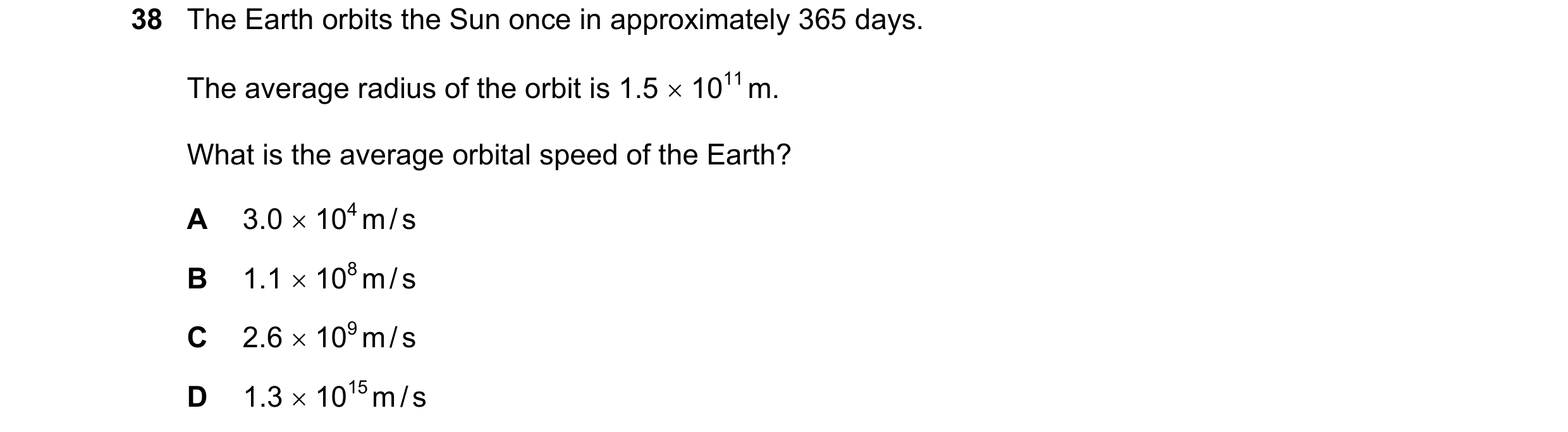
Q55 · The Earth orbits the Sun once in approximately 365 days 0972/22 May/June 2024
38 The Earth orbits the Sun once in approximately 365 days. The average radius of the orbit is 1.5 1011 m. What is the average orbital speed of the Earth? A 3.0 104 m / s B 1.1 108 m / s C 2.6 109 m / s D 1.3 1015 m / s
1 marks
Answer: A
This question in 0972/22 May/June 2024
Q56 · A rocket travels with an average speed of 6 km / s for 2 minutes 0972/21 Oct/Nov 2024
2 A rocket travels with an average speed of 6 km / s for 2 minutes. What is the distance travelled by the rocket? A 12 km B 50 km C 720 km D 12 000 km
1 marks
Answer: C
This question in 0972/21 Oct/Nov 2024
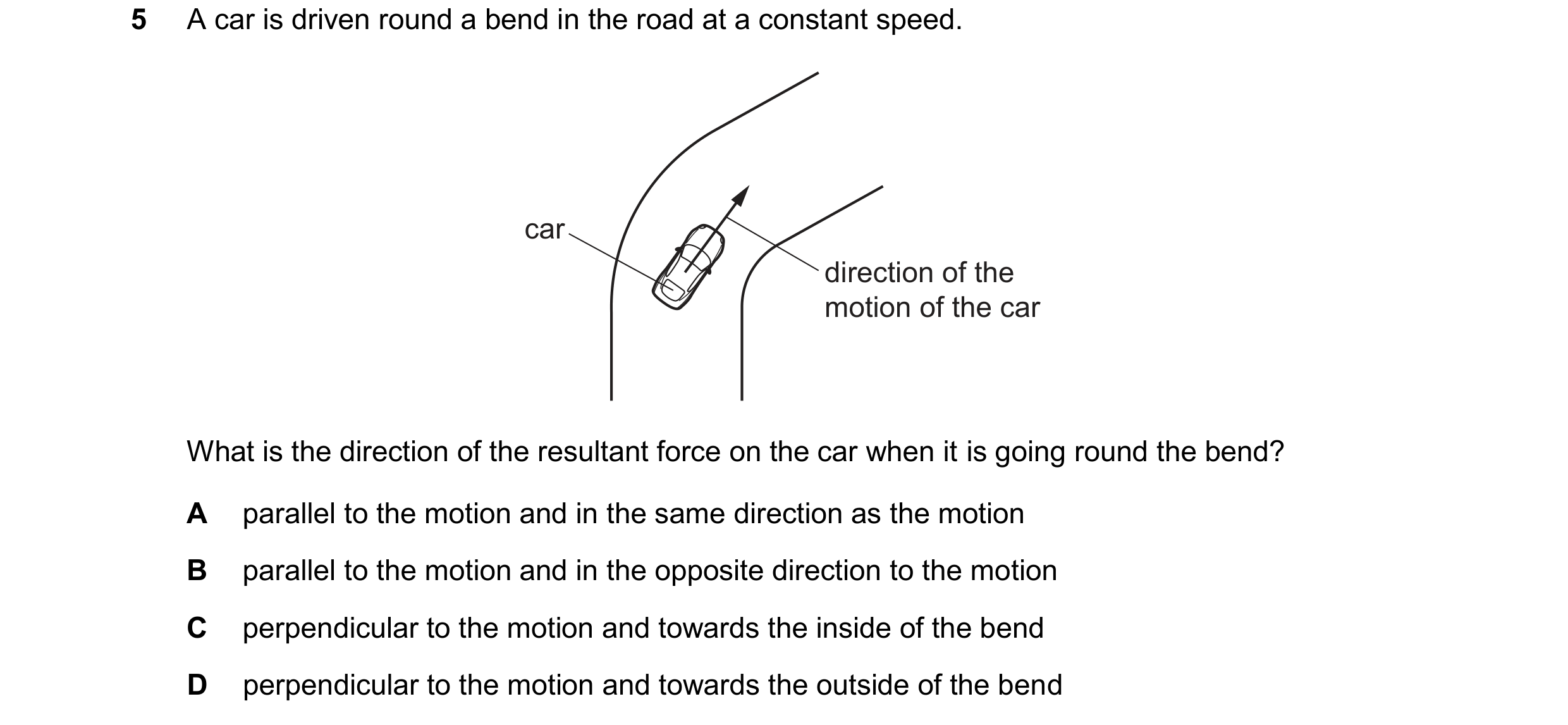
Q57 · A car is driven round a bend in the road at a constant speed 0972/21 Oct/Nov 2024
5 A car is driven round a bend in the road at a constant speed. car direction of the motion of the car What is the direction of the resultant force on the car when it is going round the bend? A parallel to the motion and in the same direction as the motion B parallel to the motion and in the opposite direction to the motion C perpendicular to the motion and towards the inside of the bend D perpendicular to the motion and towards the outside of the bend
1 marks
Answer: C
This question in 0972/21 Oct/Nov 2024
Q58 · The speed–time graph for a racing car is divided into four sections, P, Q, R and S 0972/21 May/June 2025
1 The speed–time graph for a racing car is divided into four sections, P, Q, R and S. The car starts the race but soon crashes into a wall of tyres. speed R Q S P 0 0 time Which sections of the graph show that there is an acceleration that is changing? A P, Q, R and S B Q, R and S only C Q and R only D R and S only
1 marks
Answer: C
This question in 0972/21 May/June 2025
Q59 · A force acting on a moving ball causes its motion to change 0972/21 May/June 2025
8 A force acting on a moving ball causes its motion to change. This force stays constant. What makes the force produce a greater change in the motion of the ball? A decreasing the total mass of the ball B increasing the temperature of the ball C using a ball with a hollow centre but the same mass D using a different material for the ball so that it has a lower density but the same mass
1 marks
Answer: A
This question in 0972/21 May/June 2025
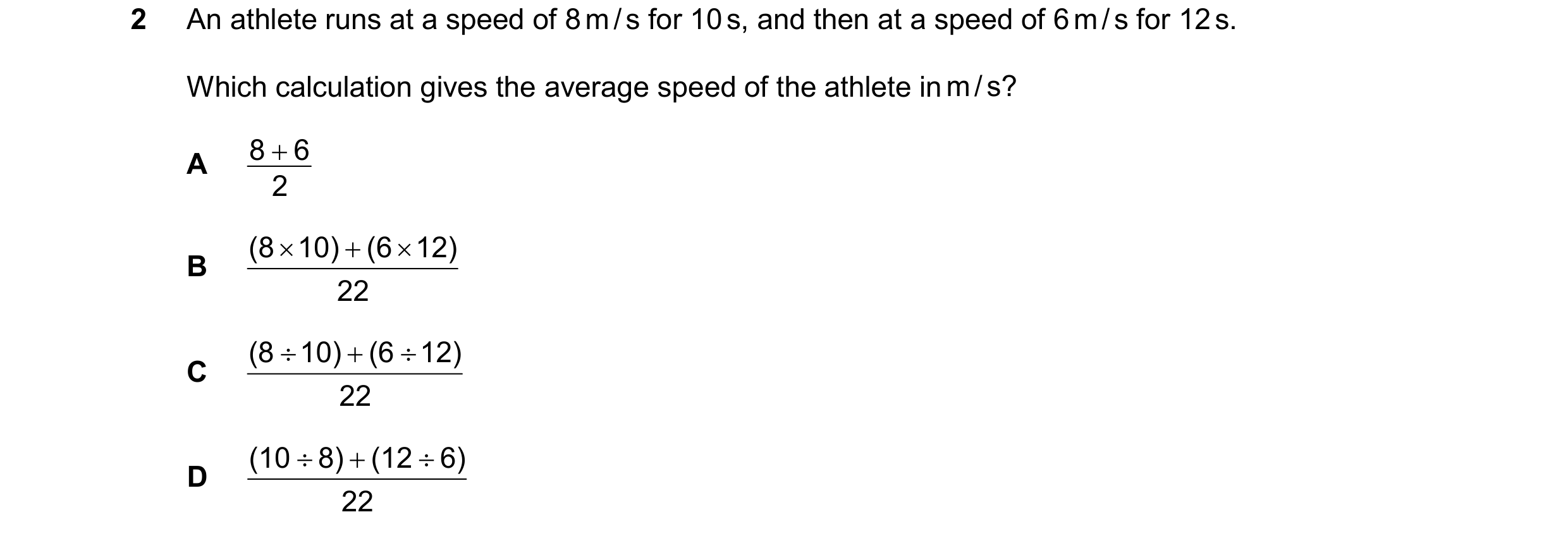
Q60 · An athlete runs at a speed of 8 m / s for 10 s, and then at a speed of 6 m / s for 12 s 0972/21 Oct/Nov 2025
2 An athlete runs at a speed of 8 m / s for 10 s, and then at a speed of 6 m / s for 12 s. Which calculation gives the average speed of the athlete in m / s? 8 6 A 2 (8 10) (6 12) B 22 (8 10) (6 12) C 22 (10 8) (12 6) D 22
1 marks
Answer: B
This question in 0972/21 Oct/Nov 2025
Q61 · A satellite is in orbit around the Earth 0972/21 Oct/Nov 2025
38 A satellite is in orbit around the Earth. The orbit has radius r and period T. Which expression gives the orbital speed of the satellite? r T 2 r 2 T A B C D 2 T 2 r T r
1 marks
Answer: C
This question in 0972/21 Oct/Nov 2025

 1 / 17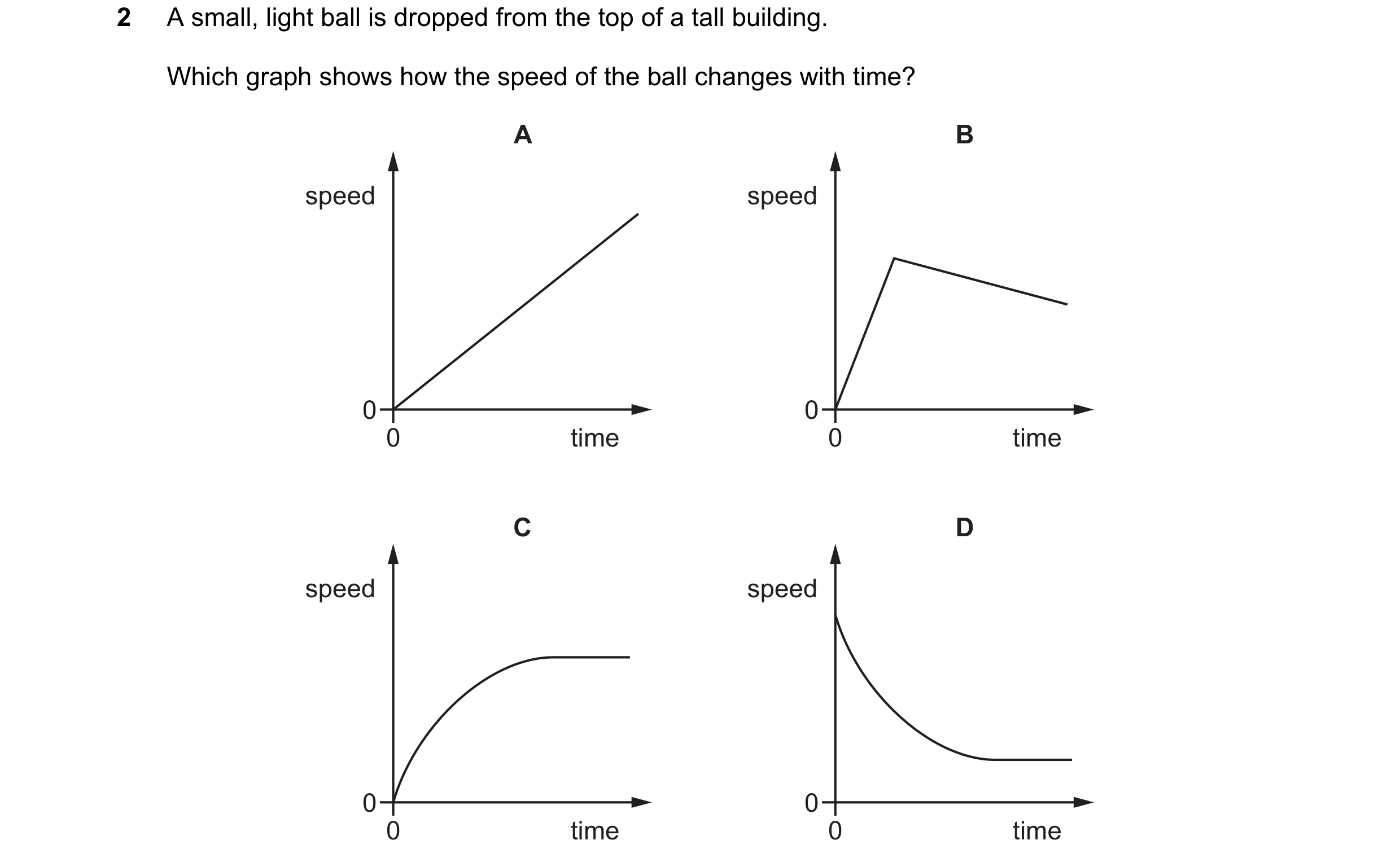



 2 / 17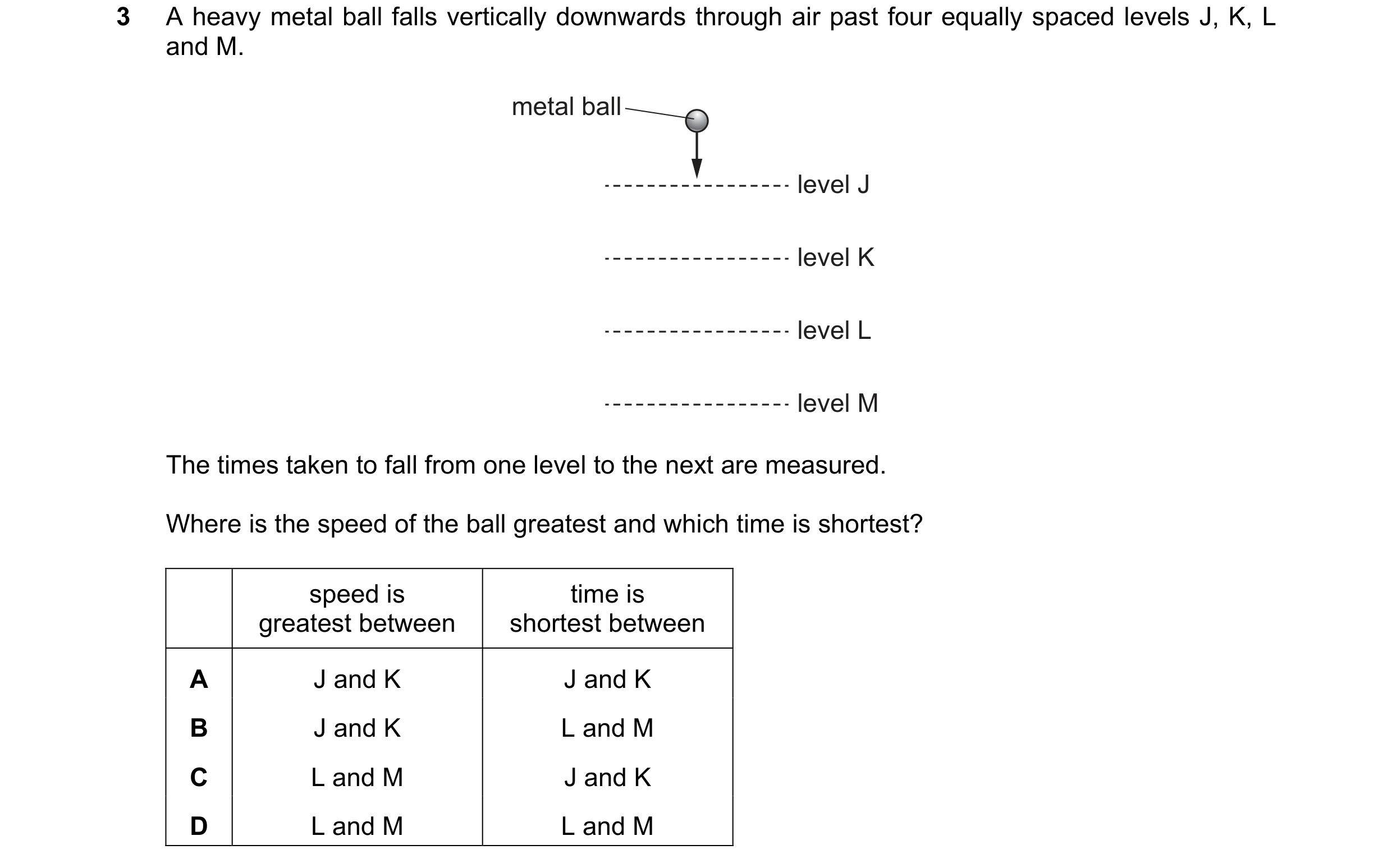
 3 / 17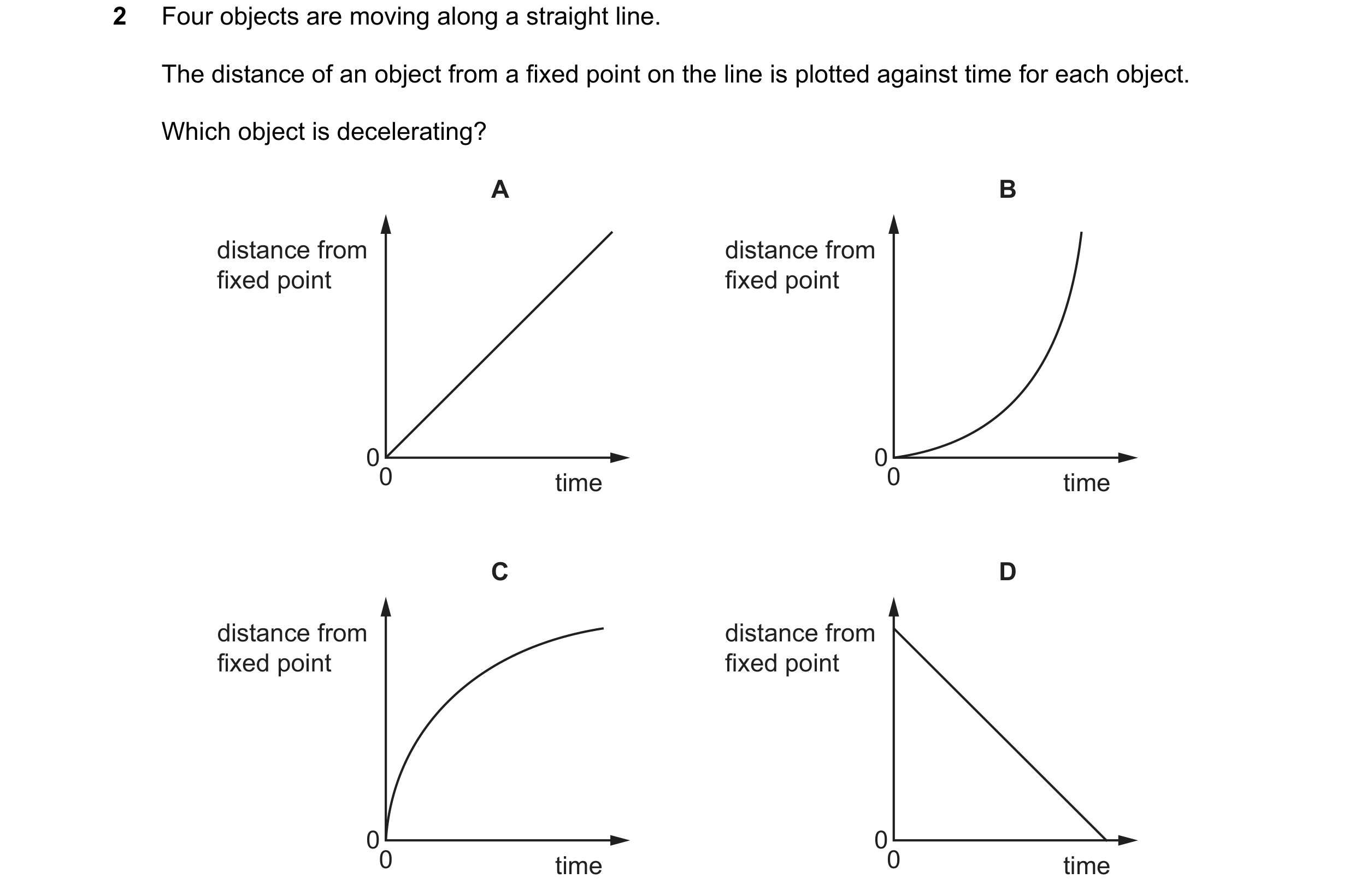
 4 / 17

 5 / 17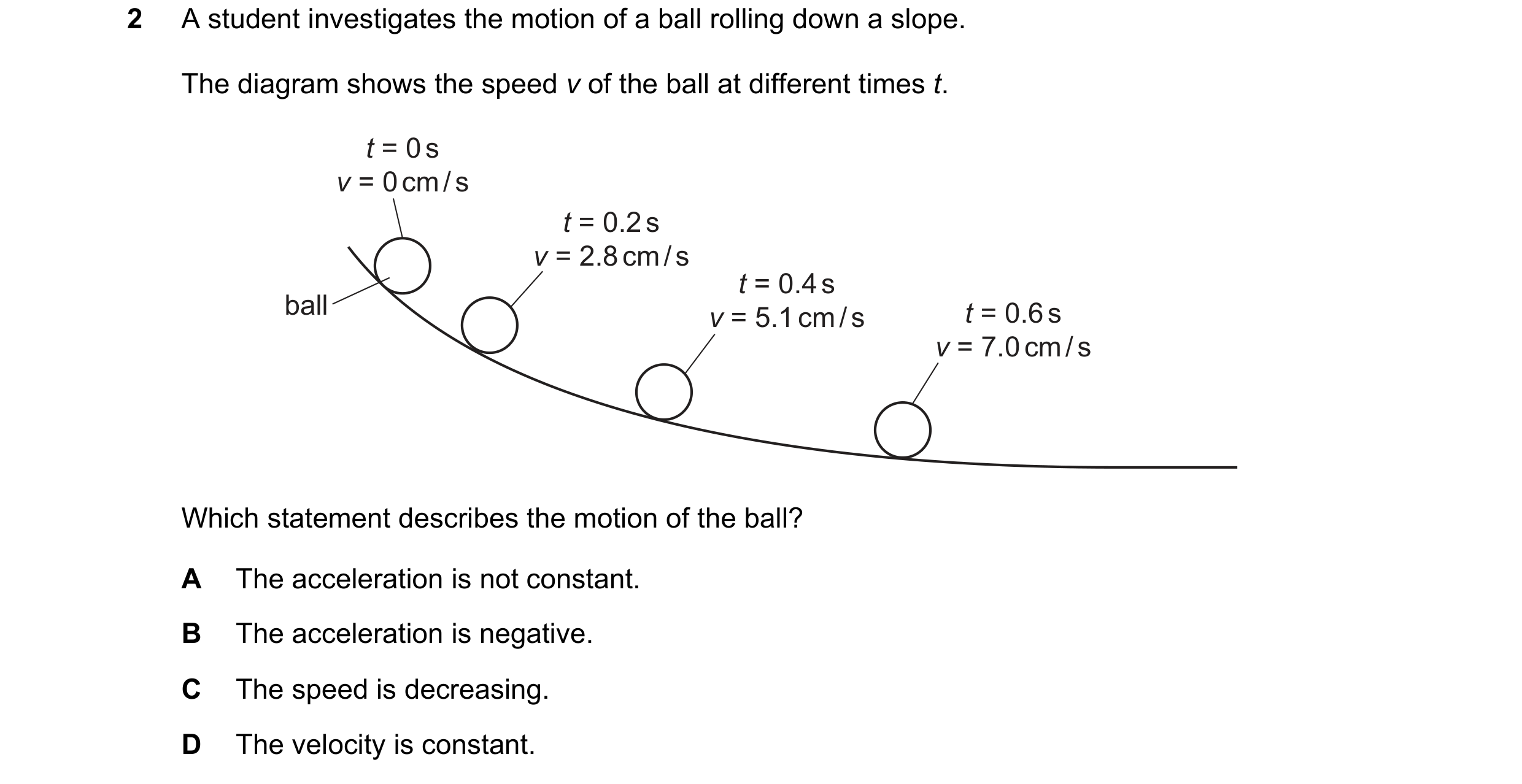


 6 / 17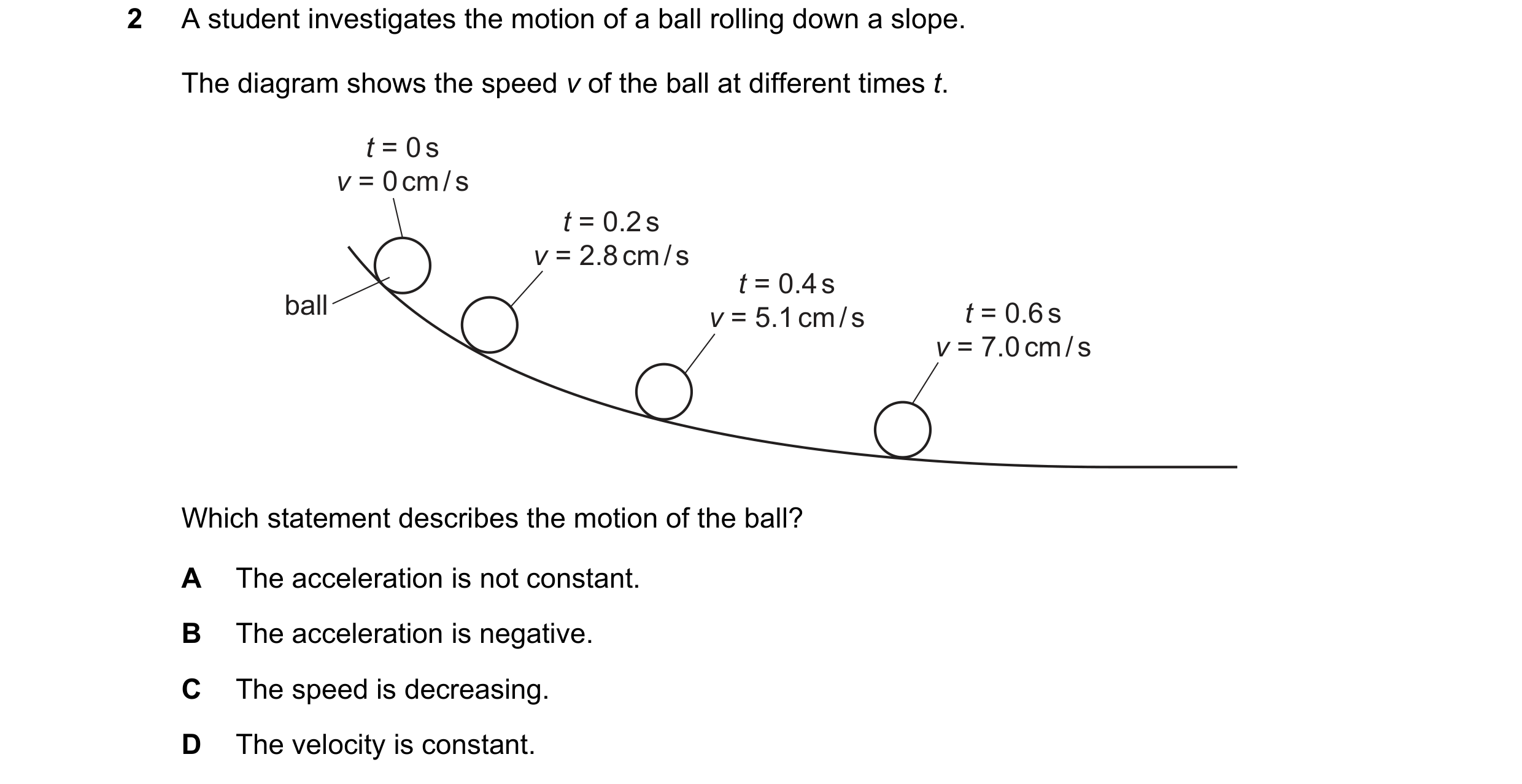


 7 / 17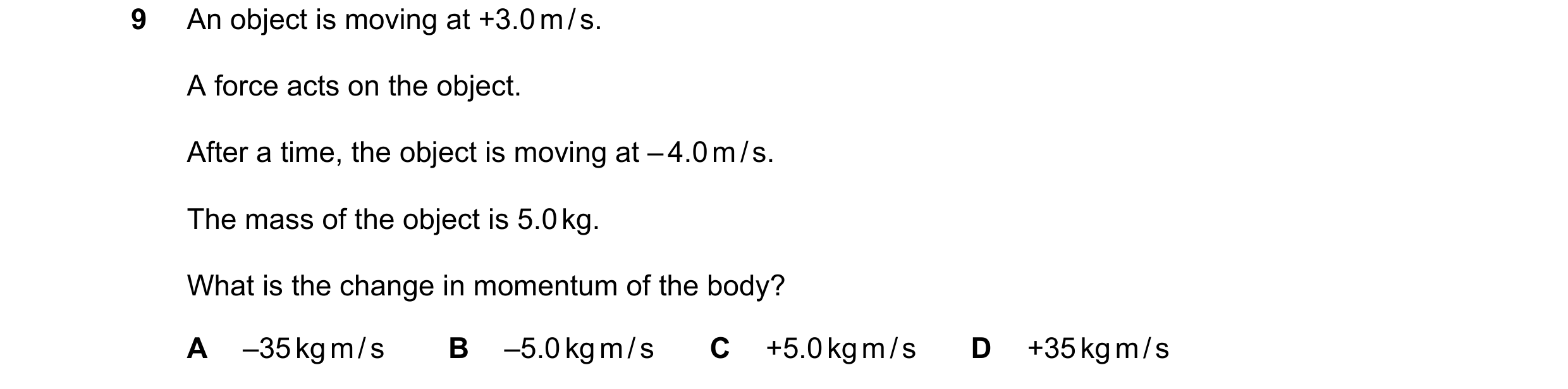

 8 / 17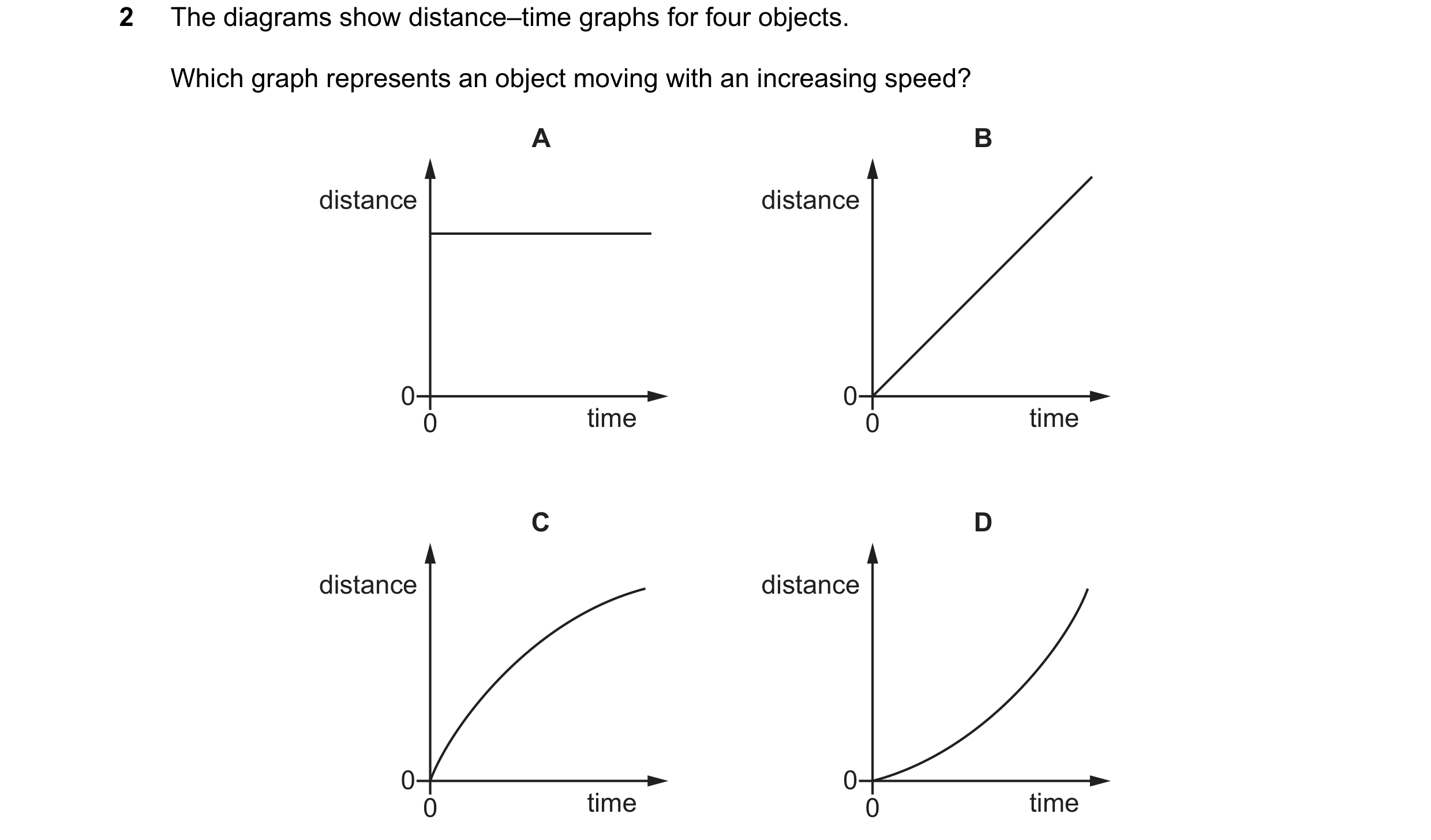
 9 / 17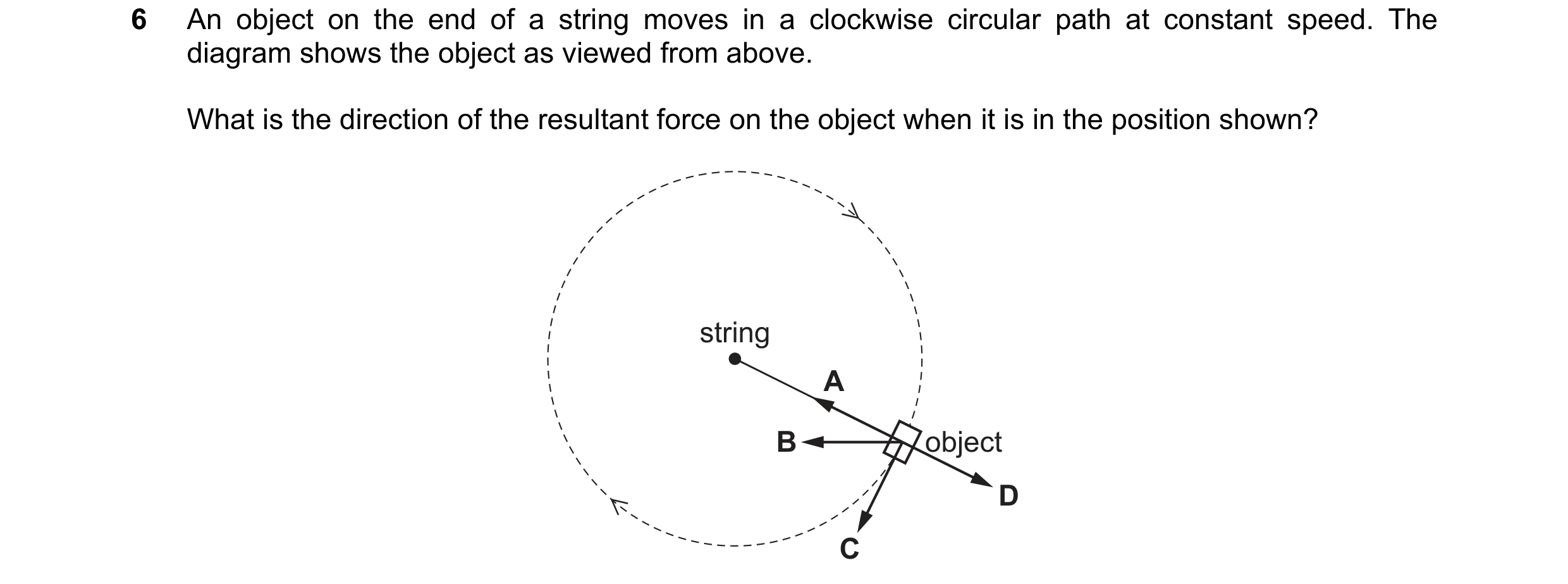

 10 / 17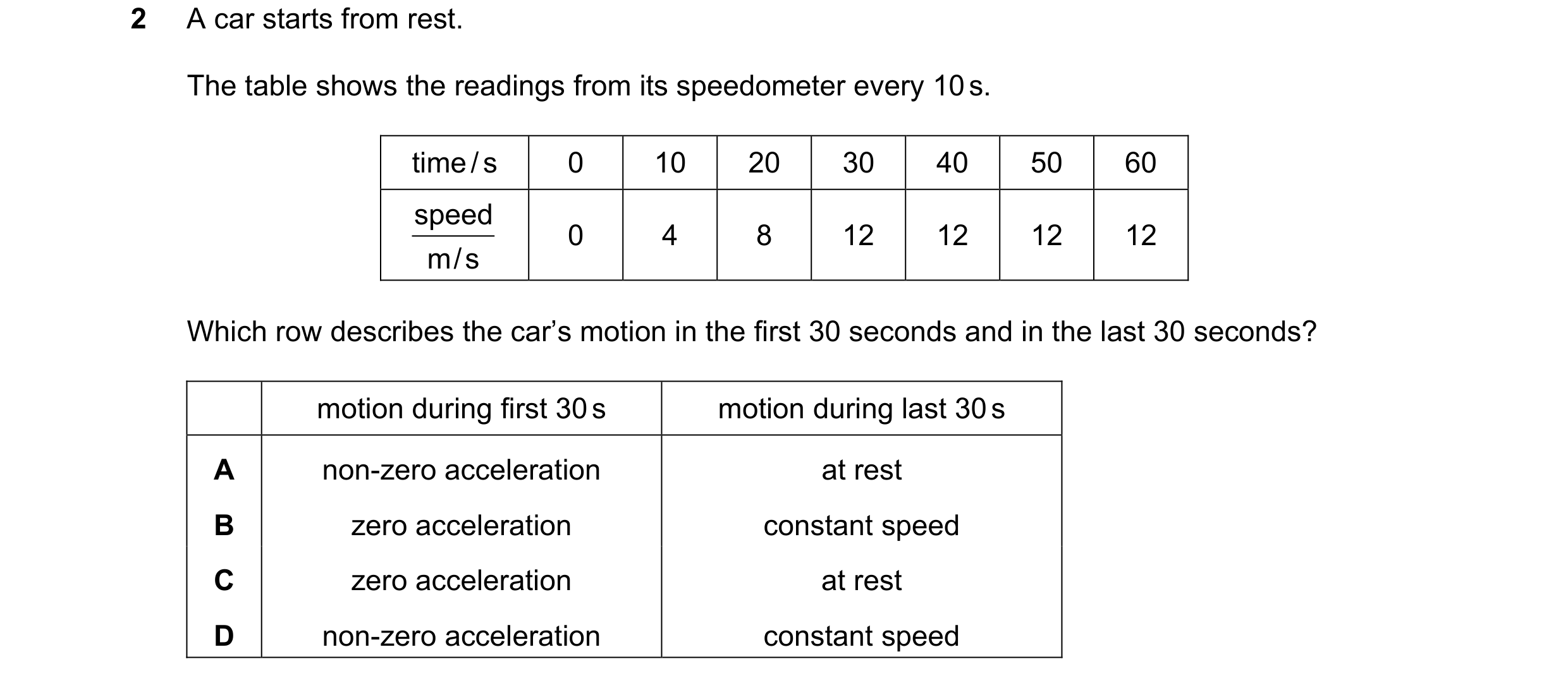
 11 / 17
 12 / 17
 13 / 17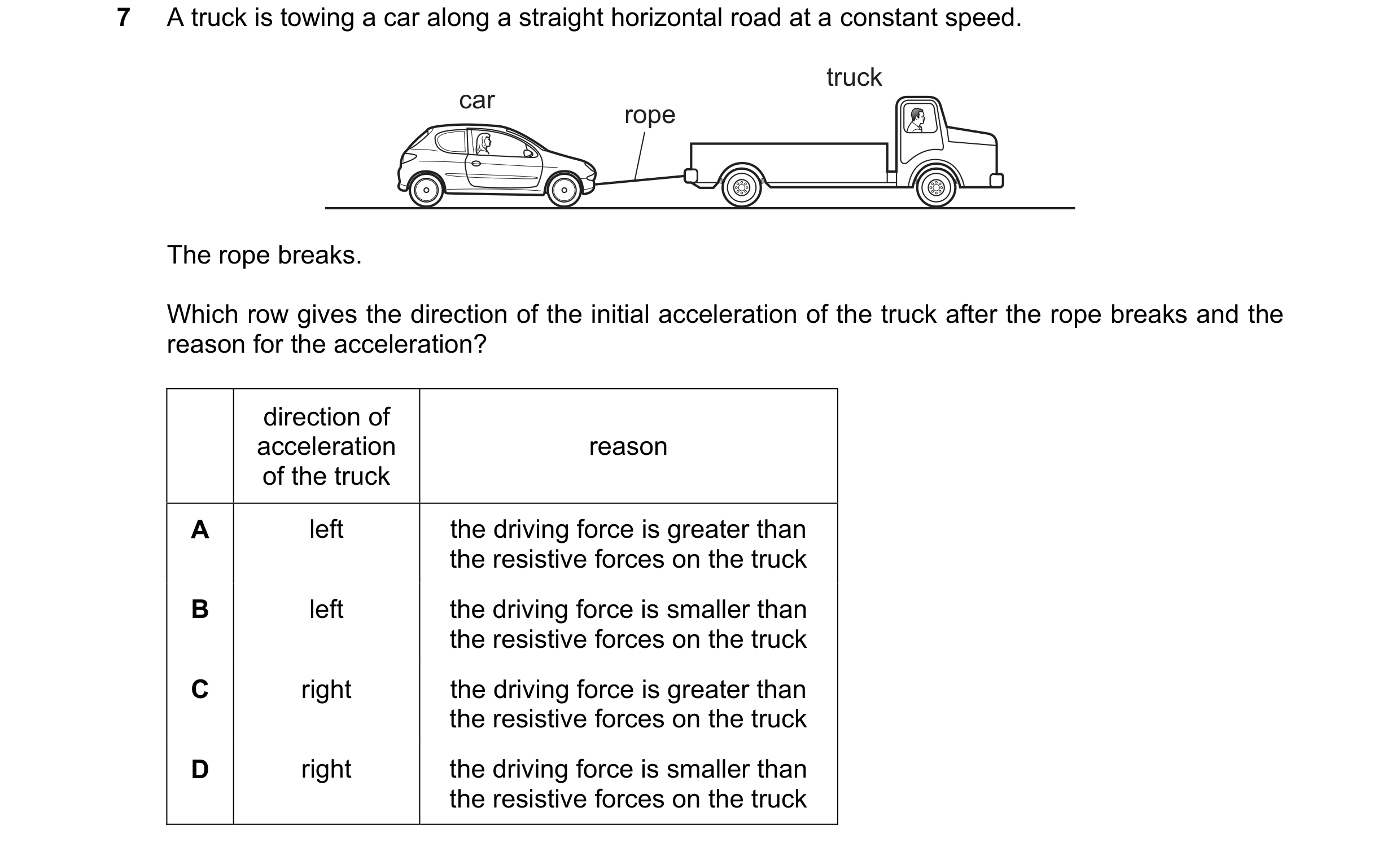

 14 / 17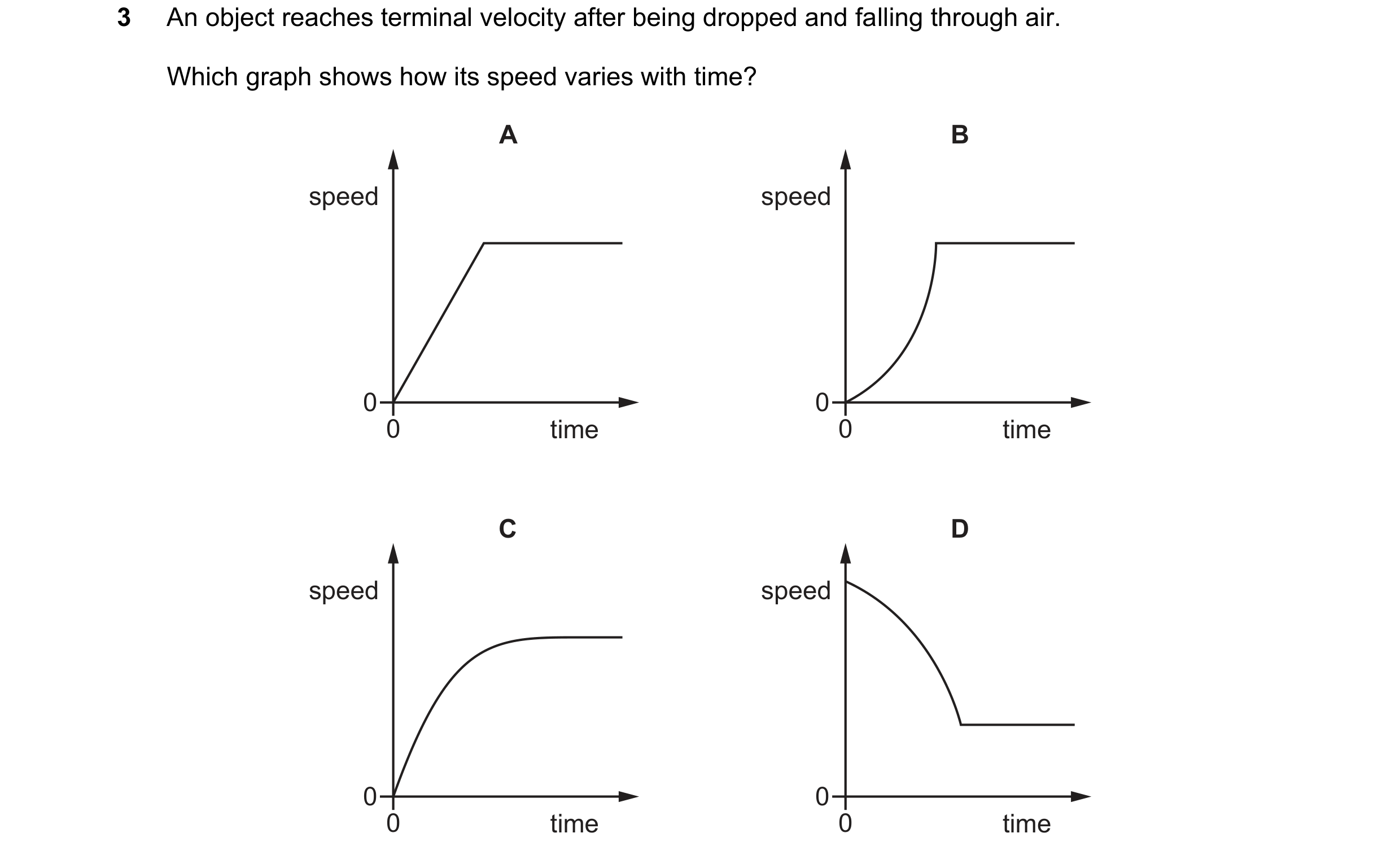

 15 / 17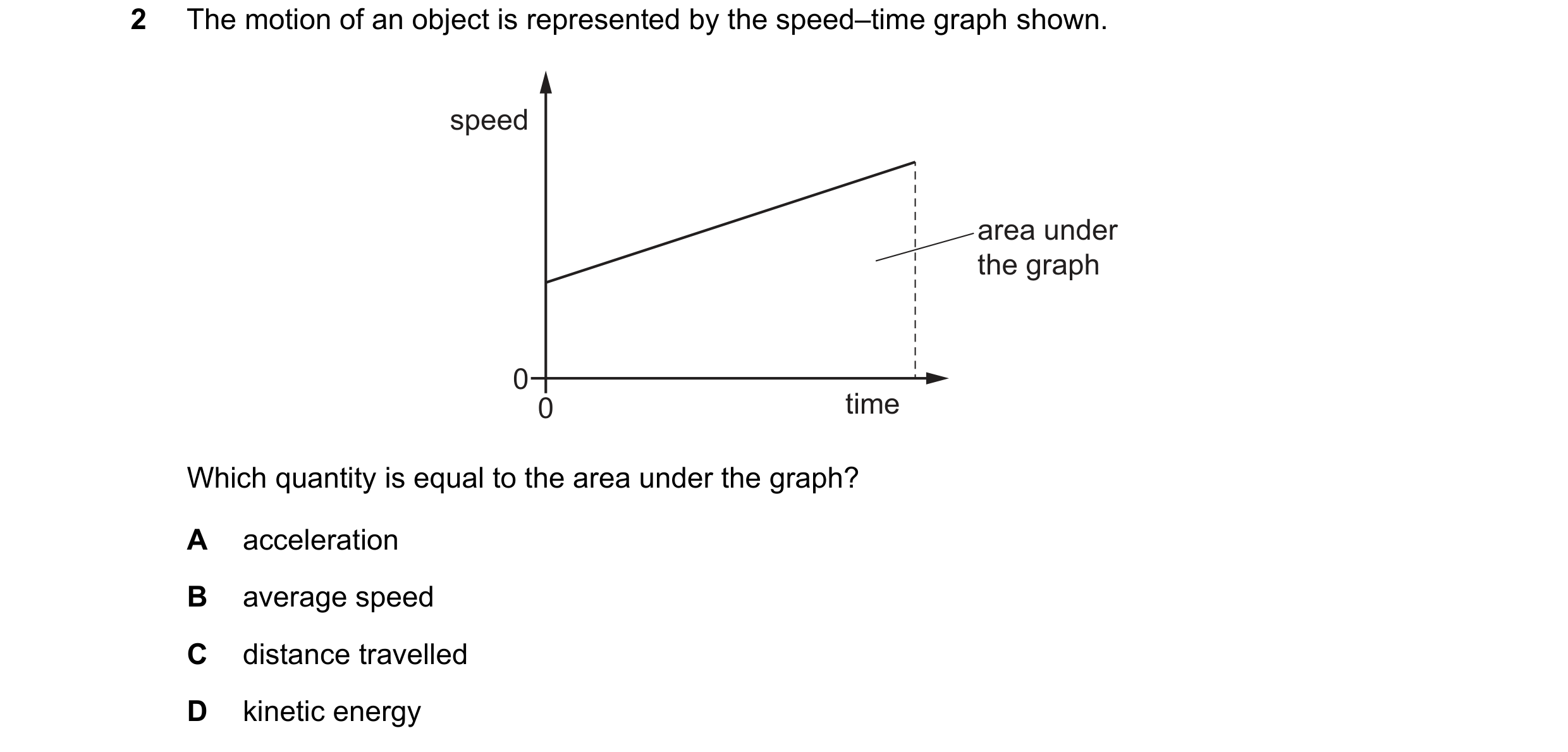

 16 / 17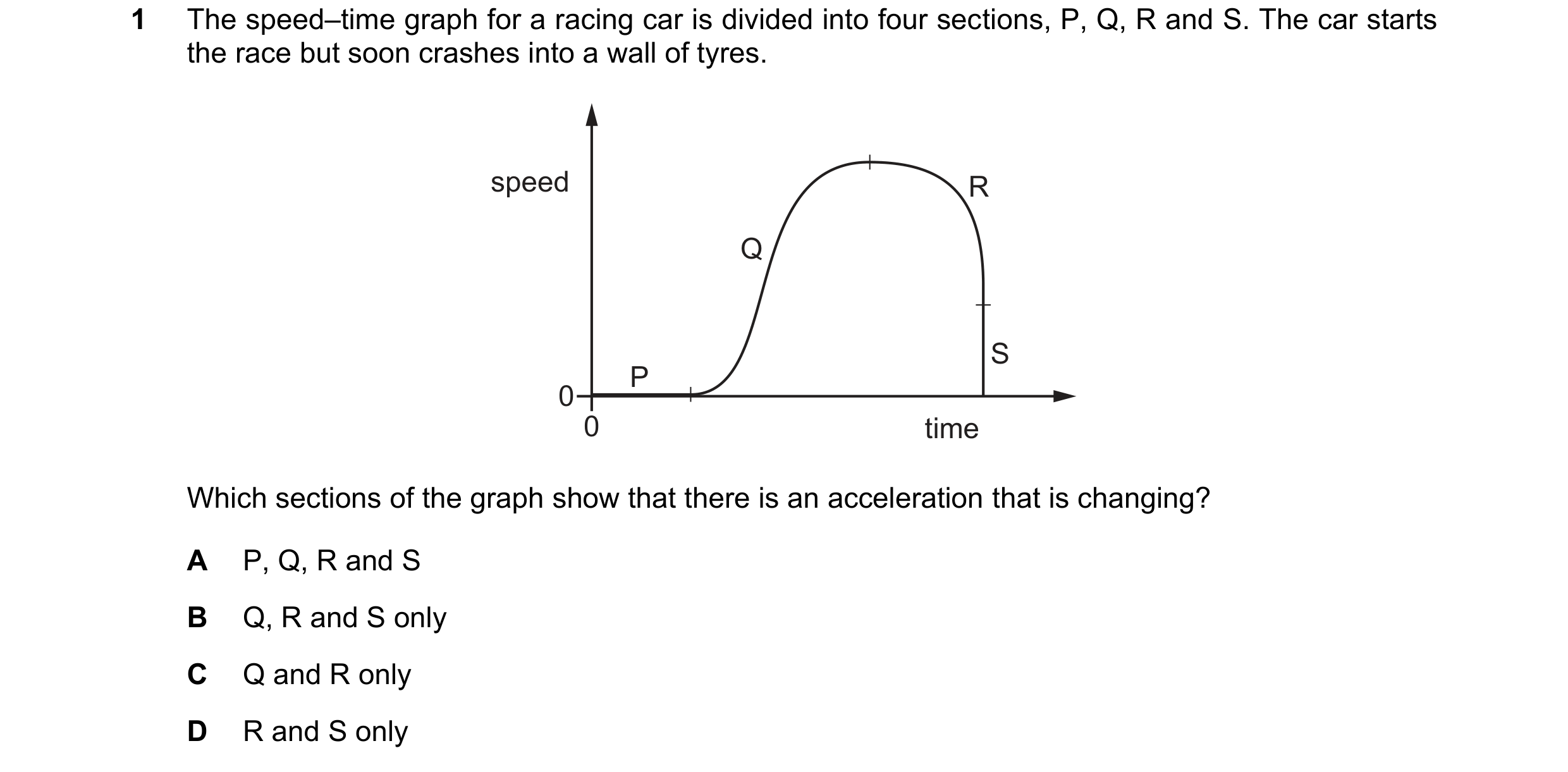
 17 / 17