Cambridge IGCSE Physics 0625 — 2016 May/June Paper 5 · Variant 2
0625/52/M/J/16 · 4 questions · 40 marks · ≈45 min
The question paper and its mark scheme, free to read here and free to download. This is Cambridge’s own paper, exactly as it was sat.
Question paper16 pages





Mark scheme6 pages
Answers below. Sit the paper first if you are practising.
Questions as text
Q1 · In this experiment, you will investigate the stretching of a spring
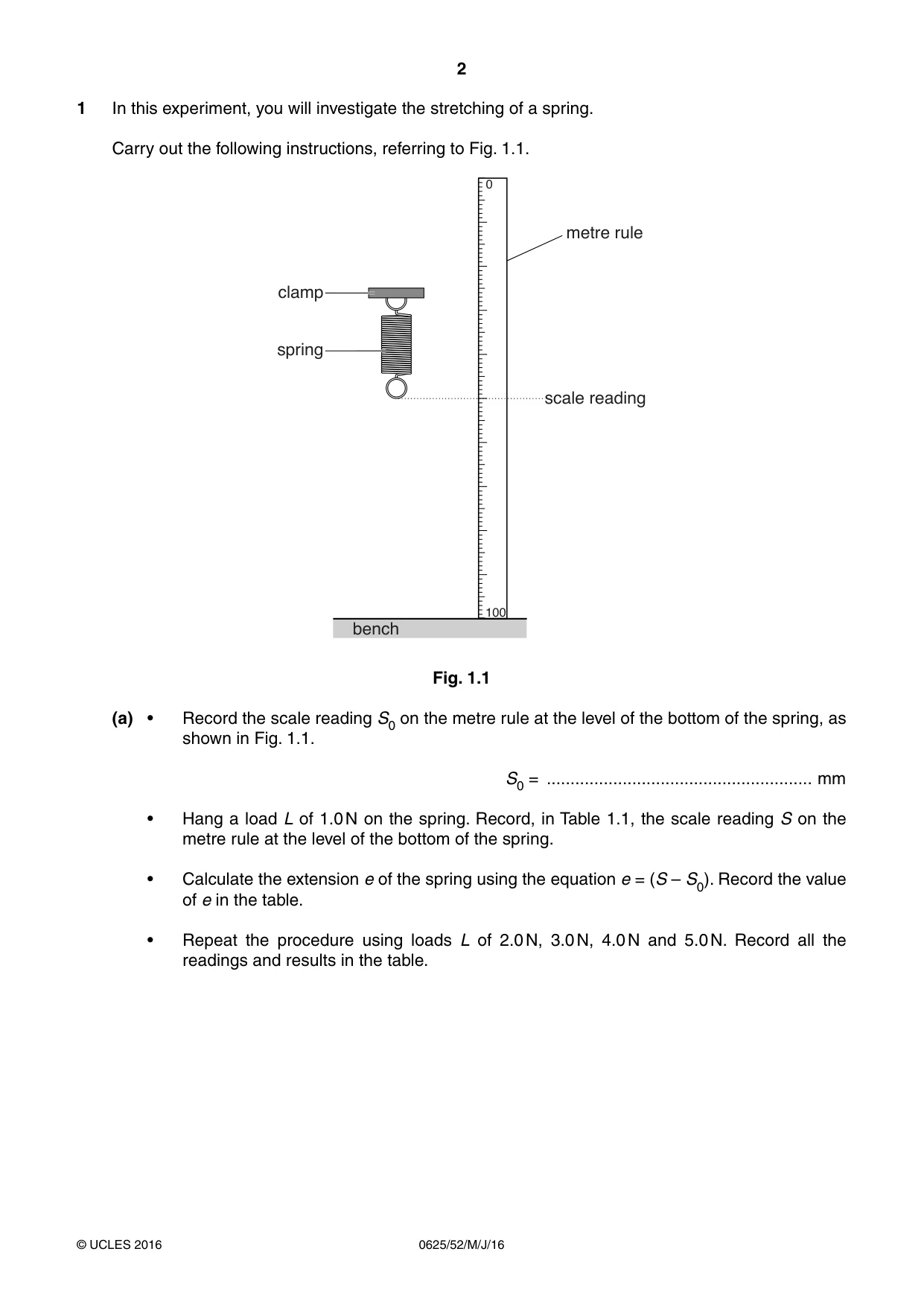
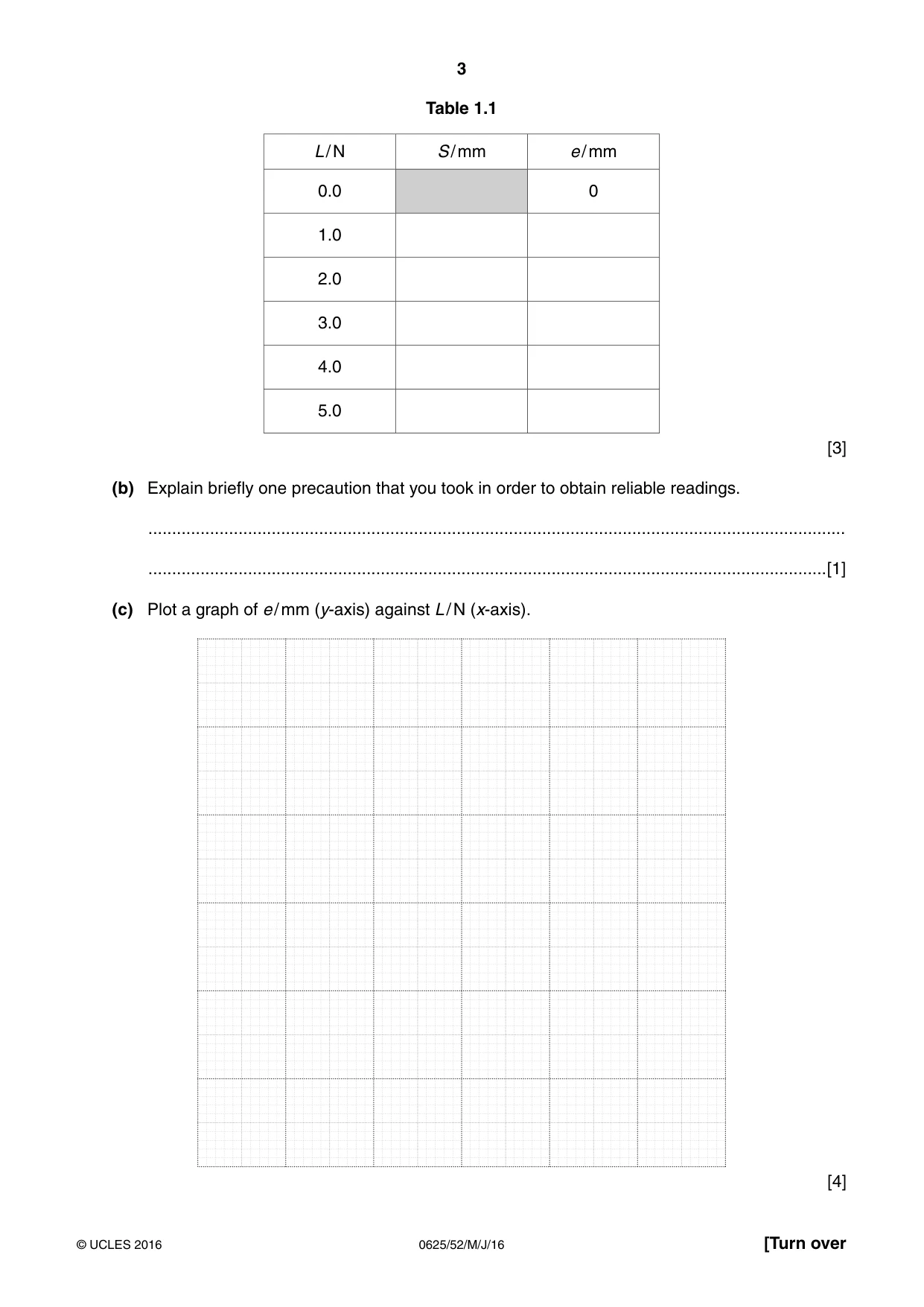
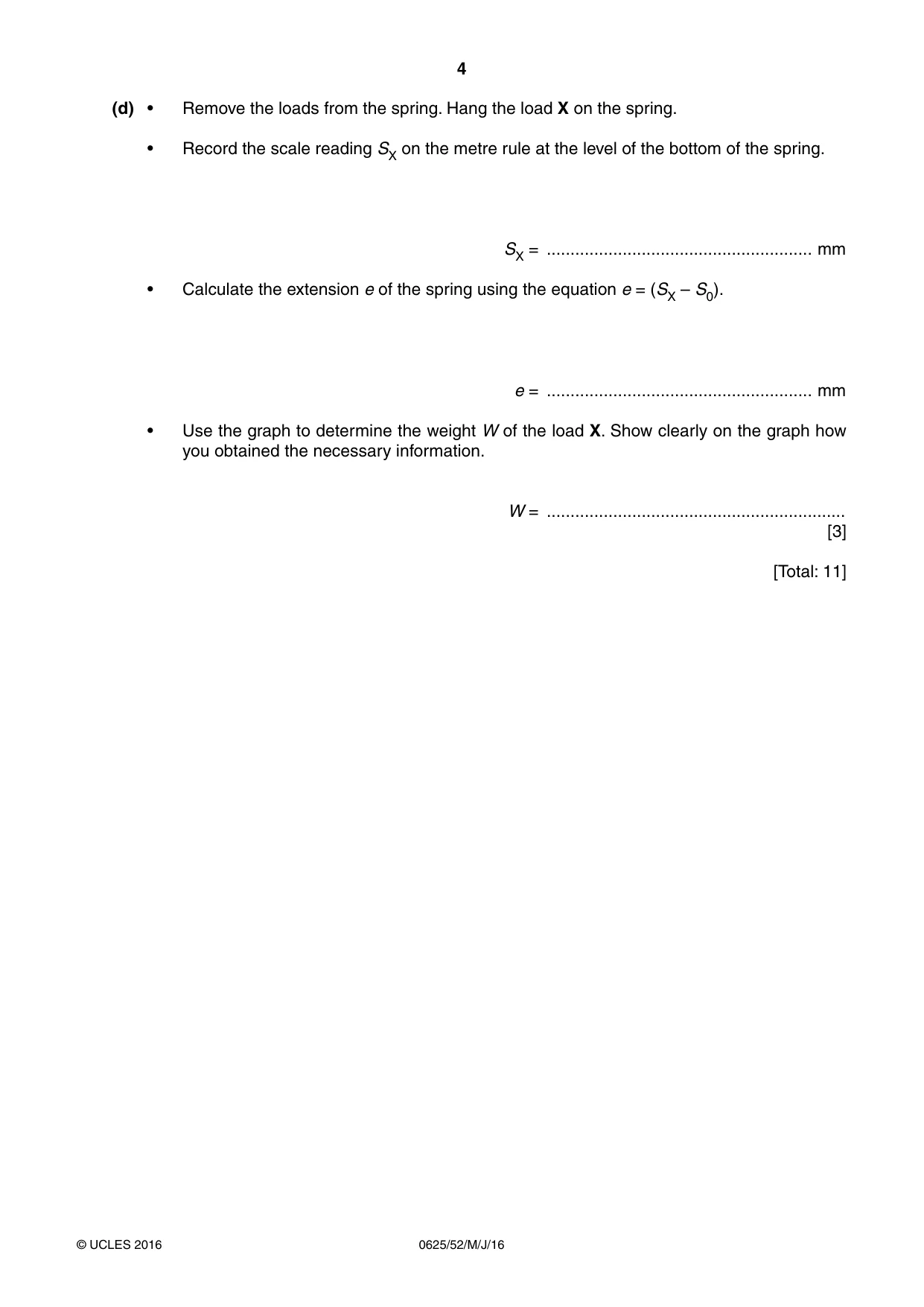
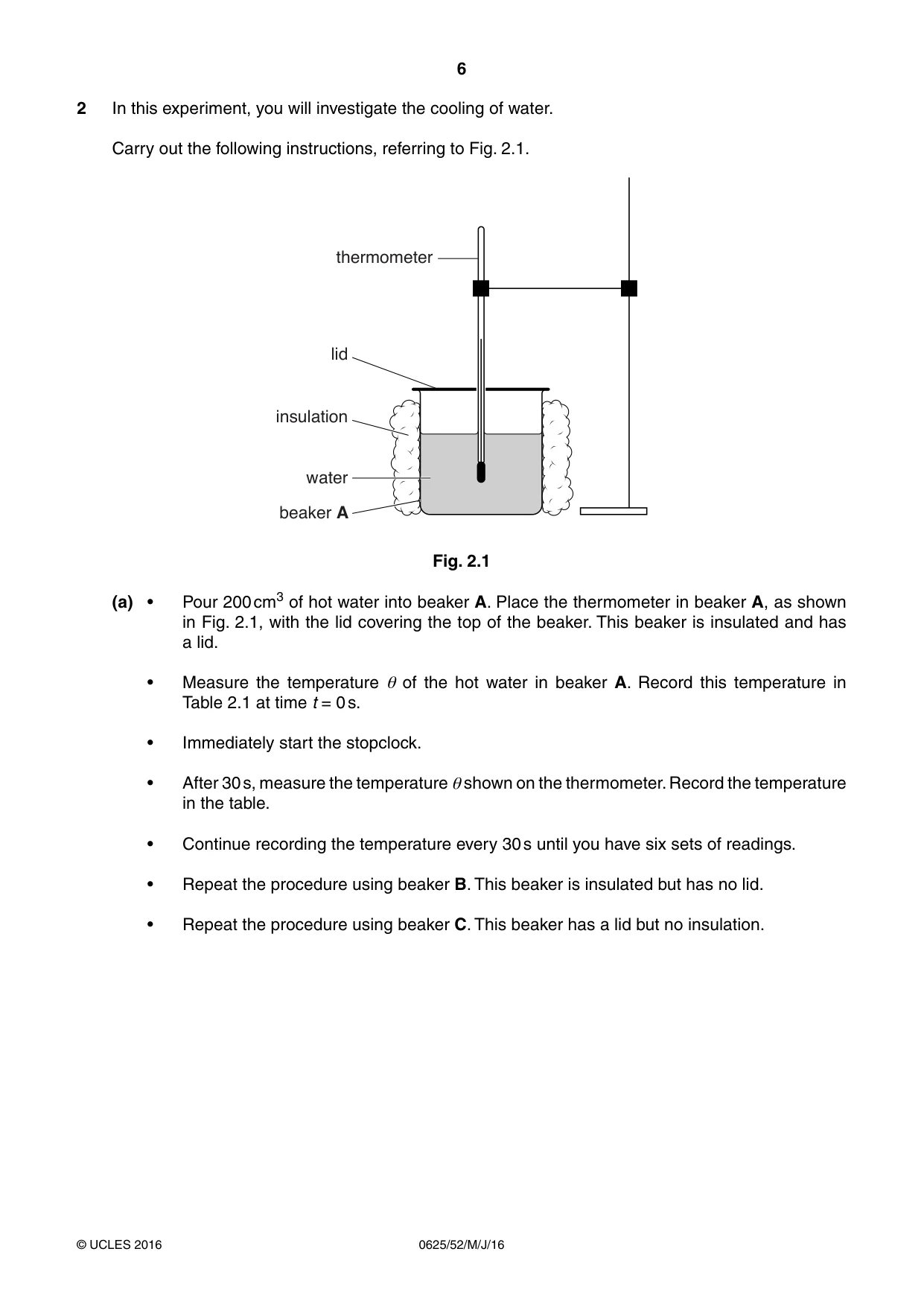
1 In this experiment, you will investigate the stretching of a spring. Carry out the following instructions, referring to Fig. 1.1. 0 metre rule clamp spring scale reading 100 bench Fig. 1.1 (a) • Record the scale reading S0 on the metre rule at the level of the bottom of the spring, as shown in Fig. 1.1. S0 = ........................................................ mm • Hang a load L of 1.0 N on the spring. Record, in Table 1.1, the scale reading S on the metre rule at the level of the bottom of the spring. • Calculate the extension e of the spring using the equation e = (S – S0). Record the value of e in the table. • Repeat the procedure using loads L of 2.0 N, 3.0 N, 4.0 N and 5.0 N. Record all the readings and results in the table. Table 1.1 L / N S / mm e / mm 0.0 0 1.0 2.0 3.0 4.0 5.0 [3] (b) Explain briefly one precaution that you took in order to obtain reliable readings. ................................................................................................................................................... ...............................................................................................................................................[1] (c) Plot a graph of e / mm (y-axis) against L / N (x-axis). [4] (d) • Remove the loads from the spring. Hang the load X on the spring. • Record the scale reading SX on the metre rule at the level of the bottom of the spring. SX = ........................................................ mm • Calculate the extension e of the spring using the equation e = (SX – S0). e = ........................................................ mm • Use the graph to determine the weight W of the load X. Show clearly on the graph how you obtained the necessary information. W = ............................................................... [3] [Total: 11]
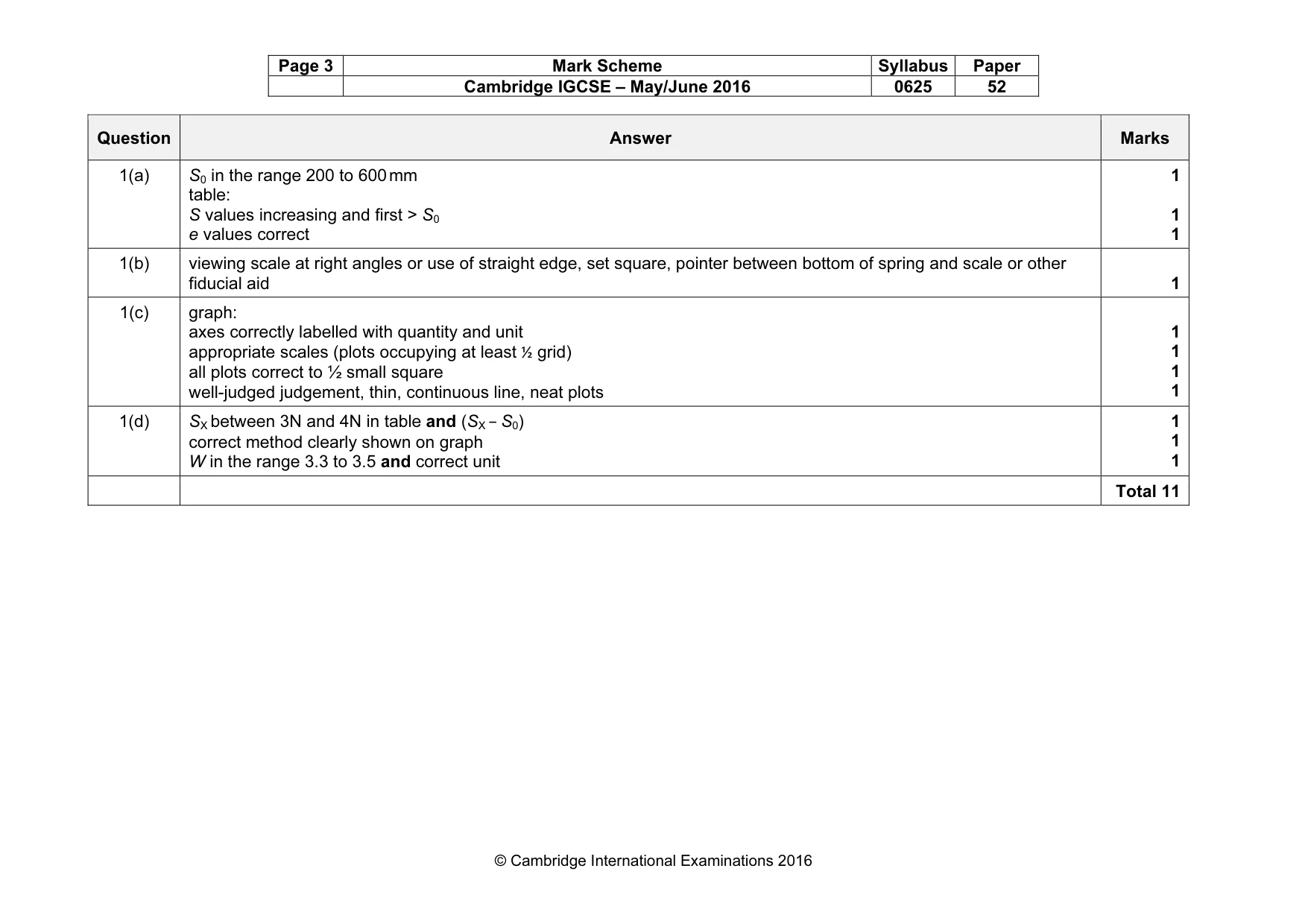
Mark scheme: 1(a) table: S values increasing and first > S0 e values correct 1 1 1 1(b) viewing scale at right angles or use of straight edge, set square, pointer between bottom of spring and scale or other fiducial aid 1 1(c) graph: axes correctly labelled with quantity and unit appropriate scales (plots occupying at least ½ grid) all plots correct to ½ small square well-judged judgement, thin, continuous line, neat plots 1 1 1 1 1(d) SX between 3N and 4N in table and (SX − S0) correct method clearly shown on graph W in the range 3.3 to 3.5 and correct unit 1 1 1 Total 11
More questions on Physical quantities and measurement techniques
Q2 · In this experiment, you will investigate the cooling of water
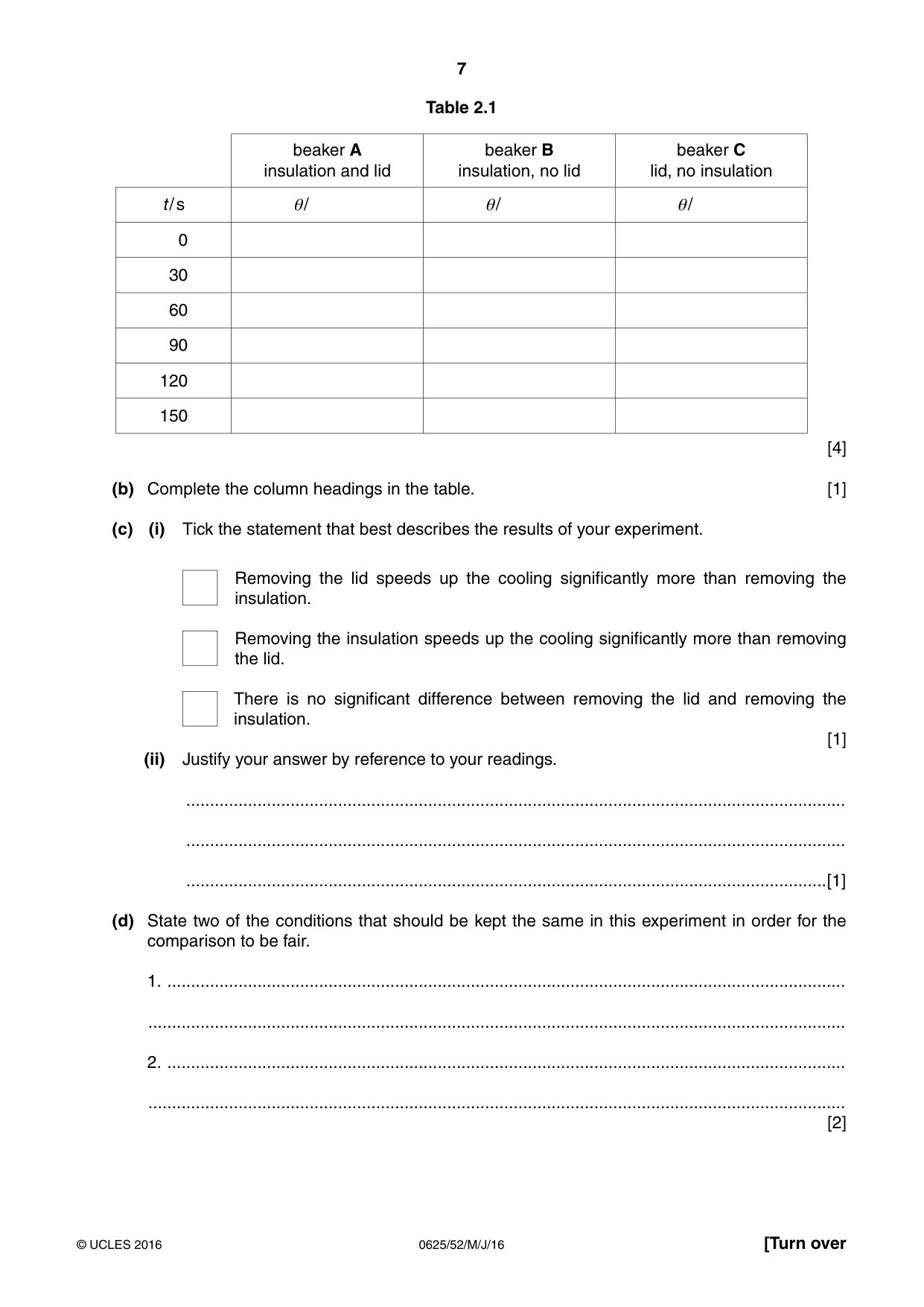
2 In this experiment, you will investigate the cooling of water. Carry out the following instructions, referring to Fig. 2.1. thermometer lid insulation water beaker A Fig. 2.1 (a) • Pour 200 cm3 of hot water into beaker A. Place the thermometer in beaker A, as shown in Fig. 2.1, with the lid covering the top of the beaker. This beaker is insulated and has a lid. • Measure the temperature θ of the hot water in beaker A. Record this temperature in Table 2.1 at time t = 0 s. • Immediately start the stopclock. • After 30 s, measure the temperature θ shown on the thermometer. Record the temperature in the table. • Continue recording the temperature every 30 s until you have six sets of readings. • Repeat the procedure using beaker B. This beaker is insulated but has no lid. • Repeat the procedure using beaker C. This beaker has a lid but no insulation. Table 2.1 beaker A beaker B beaker C insulation and lid insulation, no lid lid, no insulation t / s θ/ θ/ θ/ 0 30 60 90 120 150 [4] (b) Complete the column headings in the table. [1] (c) (i) Tick the statement that best describes the results of your experiment. Removing the lid speeds up the cooling significantly more than removing the insulation. Removing the insulation speeds up the cooling significantly more than removing the lid. There is no significant difference between removing the lid and removing the insulation. [1] (ii) Justify your answer by reference to your readings. ........................................................................................................................................... ........................................................................................................................................... .......................................................................................................................................[1] (d) State two of the conditions that should be kept the same in this experiment in order for the comparison to be fair. 1. ............................................................................................................................................... ................................................................................................................................................... 2. ............................................................................................................................................... ................................................................................................................................................... [2] (e) Describe briefly how a measuring cylinder is read to obtain a reliable value for the volume of water. You may draw a diagram. ................................................................................................................................................... ................................................................................................................................................... ................................................................................................................................................... ...............................................................................................................................................[2] [Total: 11]
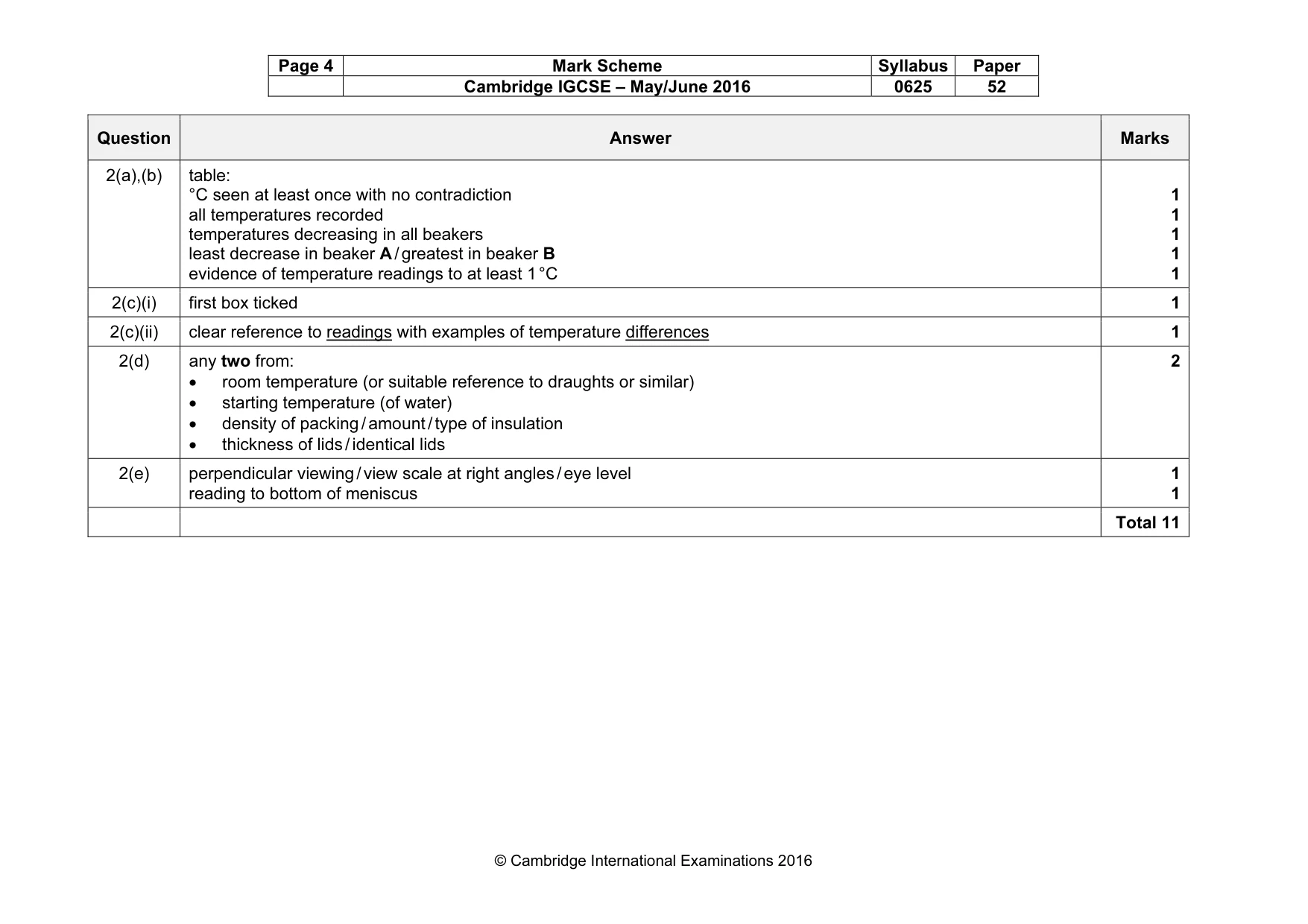
Mark scheme: 2(a),(b) table: °C seen at least once with no contradiction all temperatures recorded temperatures decreasing in all beakers least decrease in beaker A / greatest in beaker B evidence of temperature readings to at least 1 °C 1 1 1 1 1 2(c)(i) first box ticked 1 2(c)(ii) clear reference to readings with examples of temperature differences 1 2(d) any two from: • room temperature (or suitable reference to draughts or similar) • starting temperature (of water) • density of packing / amount / type of insulation • thickness of lids / identical lids 2 2(e) perpendicular viewing / view scale at right angles / eye level reading to bottom of meniscus 1 1 Total 11
Q3 · In this experiment, you will investigate the magnification of images produced by a lens
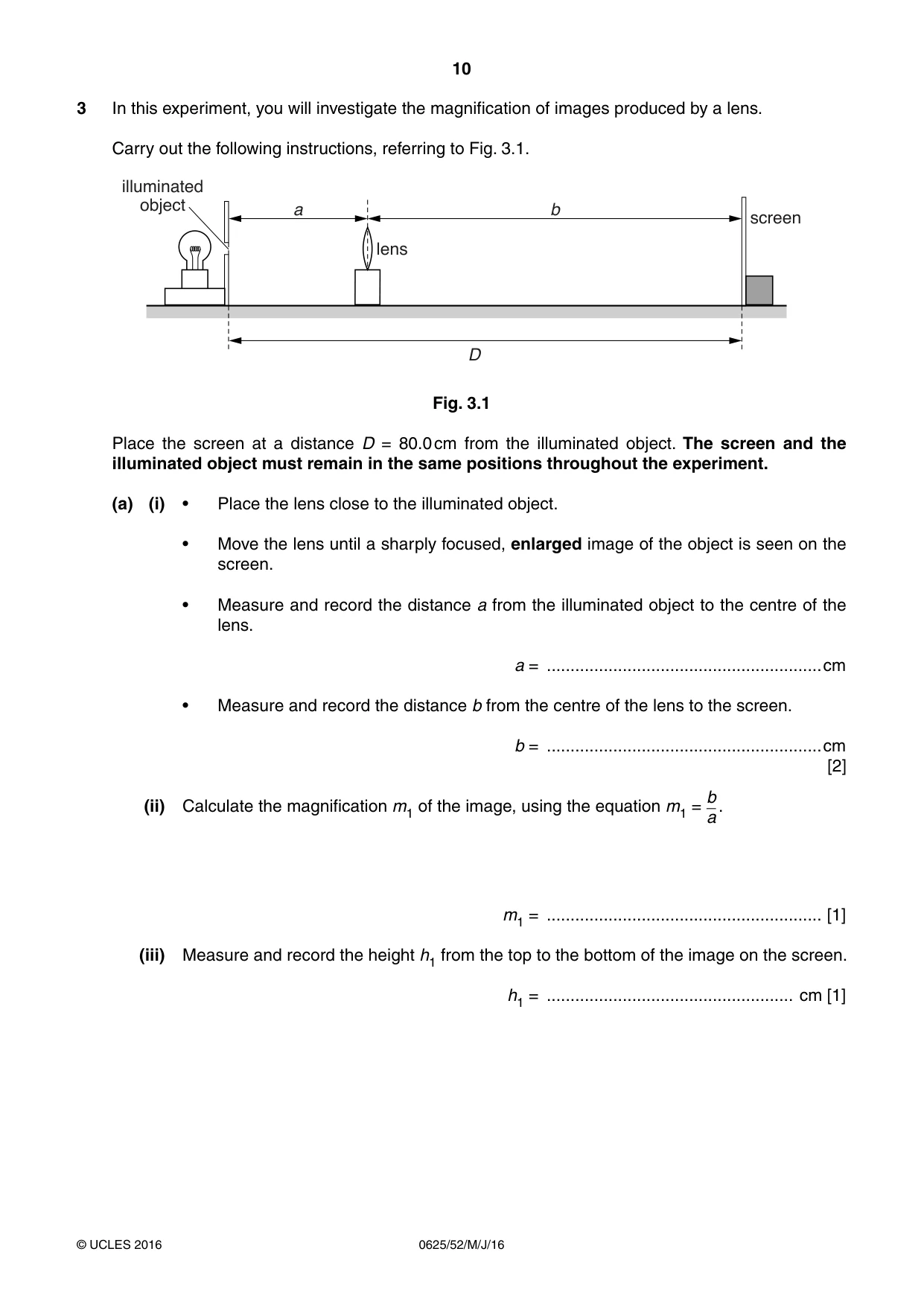
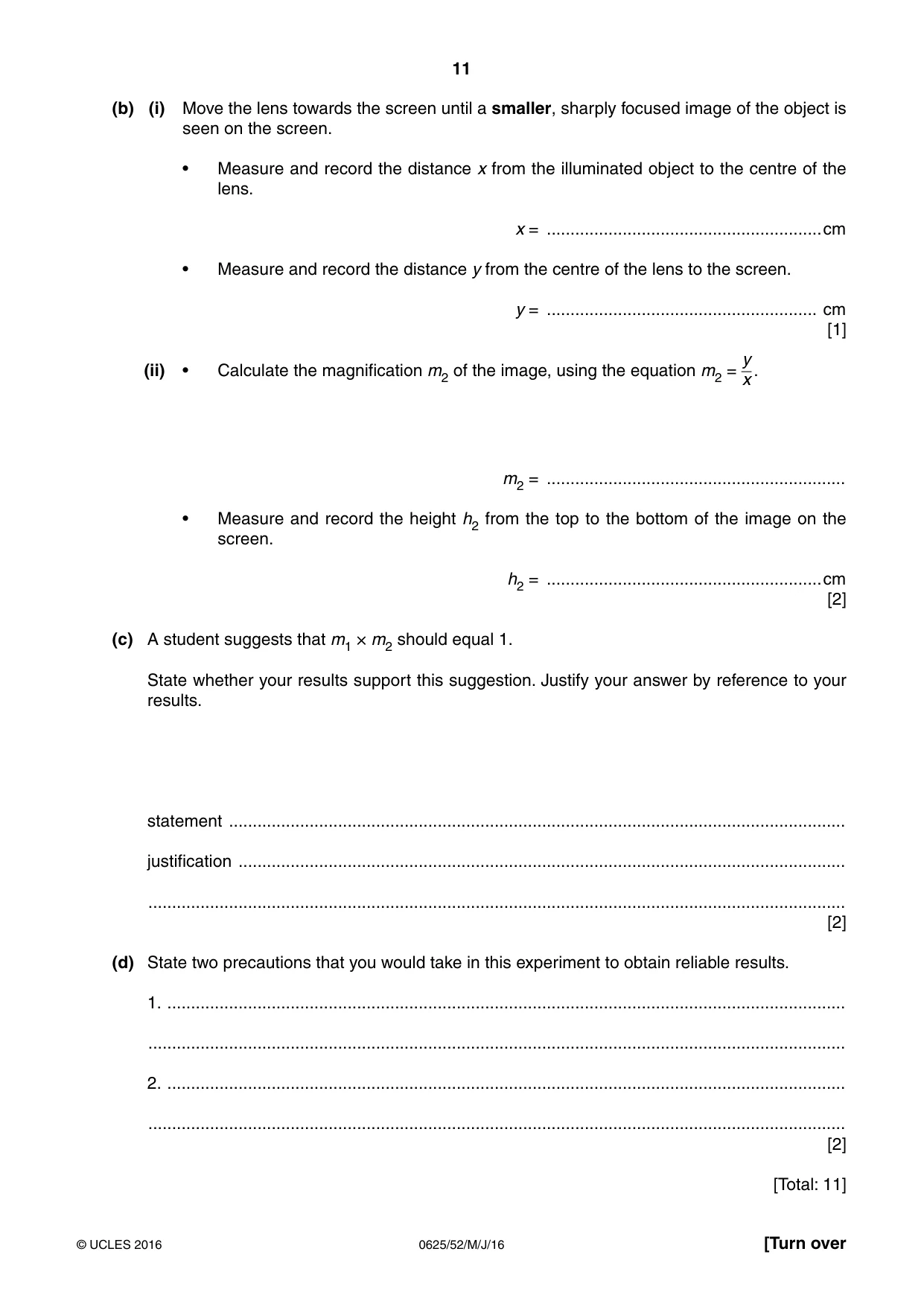
3 In this experiment, you will investigate the magnification of images produced by a lens. Carry out the following instructions, referring to Fig. 3.1. illuminated object a b screen lens D Fig. 3.1 Place the screen at a distance D = 80.0 cm from the illuminated object. The screen and the illuminated object must remain in the same positions throughout the experiment. (a) (i) • Place the lens close to the illuminated object. • Move the lens until a sharply focused, enlarged image of the object is seen on the screen. • Measure and record the distance a from the illuminated object to the centre of the lens. a = ..........................................................cm • Measure and record the distance b from the centre of the lens to the screen. b = ..........................................................cm [2] b (ii) Calculate the magnification m1 of the image, using the equation m1 = . a m1 = .......................................................... [1] (iii) Measure and record the height h1 from the top to the bottom of the image on the screen. h1 = .................................................... cm [1] (b) (i) Move the lens towards the screen until a smaller, sharply focused image of the object is seen on the screen. • Measure and record the distance x from the illuminated object to the centre of the lens. x = ..........................................................cm • Measure and record the distance y from the centre of the lens to the screen. y = ......................................................... cm [1] y (ii) • Calculate the magnification m2 of the image, using the equation m2 = x . m2 = ............................................................... • Measure and record the height h2 from the top to the bottom of the image on the screen. h2 = ..........................................................cm [2] (c) A student suggests that m1 × m2 should equal 1. State whether your results support this suggestion. Justify your answer by reference to your results. statement .................................................................................................................................. justification ................................................................................................................................ ................................................................................................................................................... [2] (d) State two precautions that you would take in this experiment to obtain reliable results. 1. ............................................................................................................................................... ................................................................................................................................................... 2. ............................................................................................................................................... ................................................................................................................................................... [2] [Total: 11]
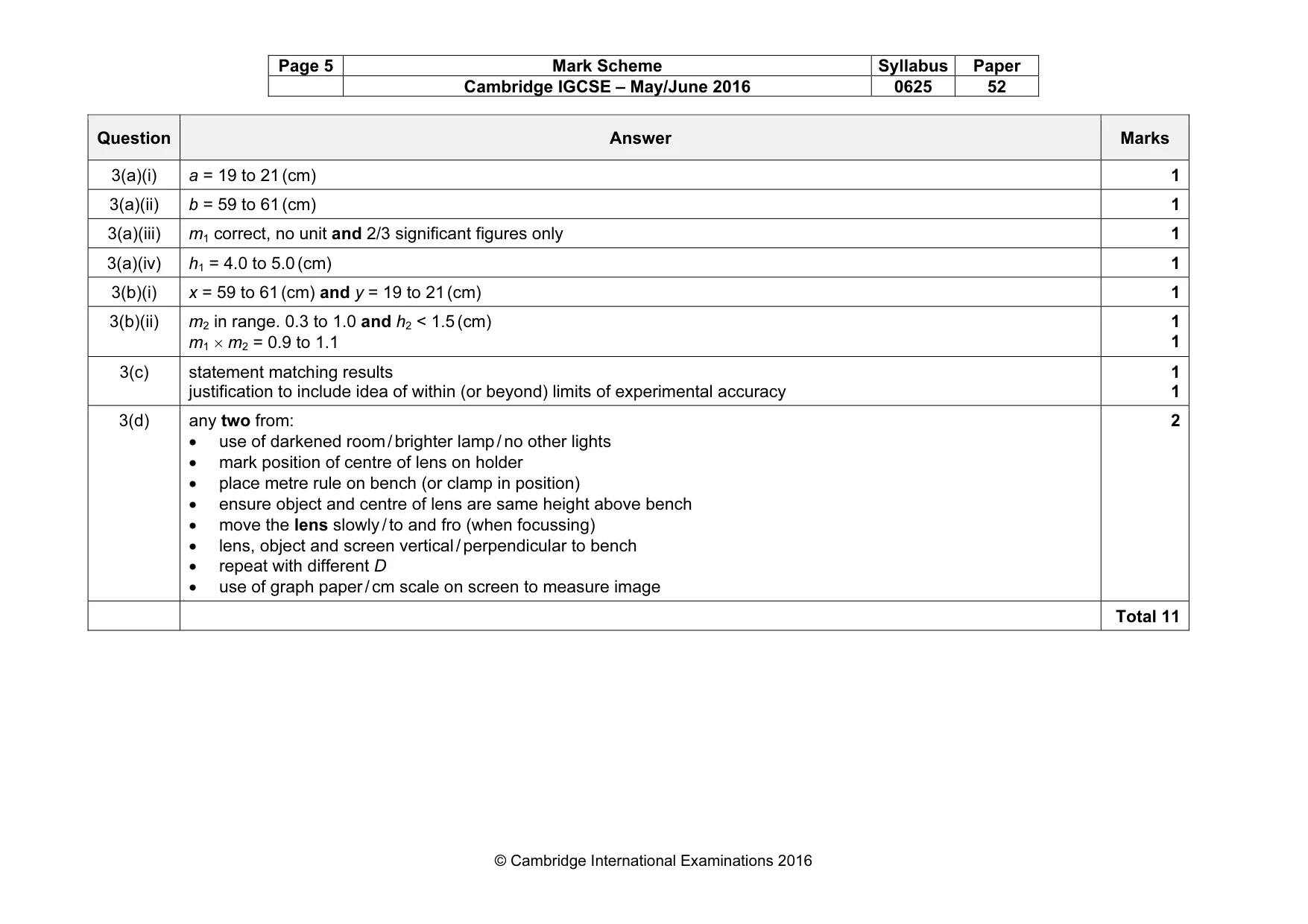
Mark scheme: 3(a)(i) 1 3(a)(ii) b = 59 to 61 (cm) 1 3(a)(iii) m1 correct, no unit and 2/3 significant figures only 1 3(a)(iv) h1 = 4.0 to 5.0 (cm) 1 3(b)(i) x = 59 to 61 (cm) and y = 19 to 21 (cm) 1 3(b)(ii) m2 in range. 0.3 to 1.0 and h2 < 1.5 (cm) m1 × m2 = 0.9 to 1.1 1 1 3(c) statement matching results justification to include idea of within (or beyond) limits of experimental accuracy 1 1 3(d) any two from: • use of darkened room / brighter lamp / no other lights • mark position of centre of lens on holder • place metre rule on bench (or clamp in position) • ensure object and centre of lens are same height above bench • move the lens slowly / to and fro (when focussing) • lens, object and screen vertical / perpendicular to bench • repeat with different D • use of graph paper / cm scale on screen to measure image 2 Total 11
Q4 · A student is investigating how the resistance of a wire depends on the length of the wire
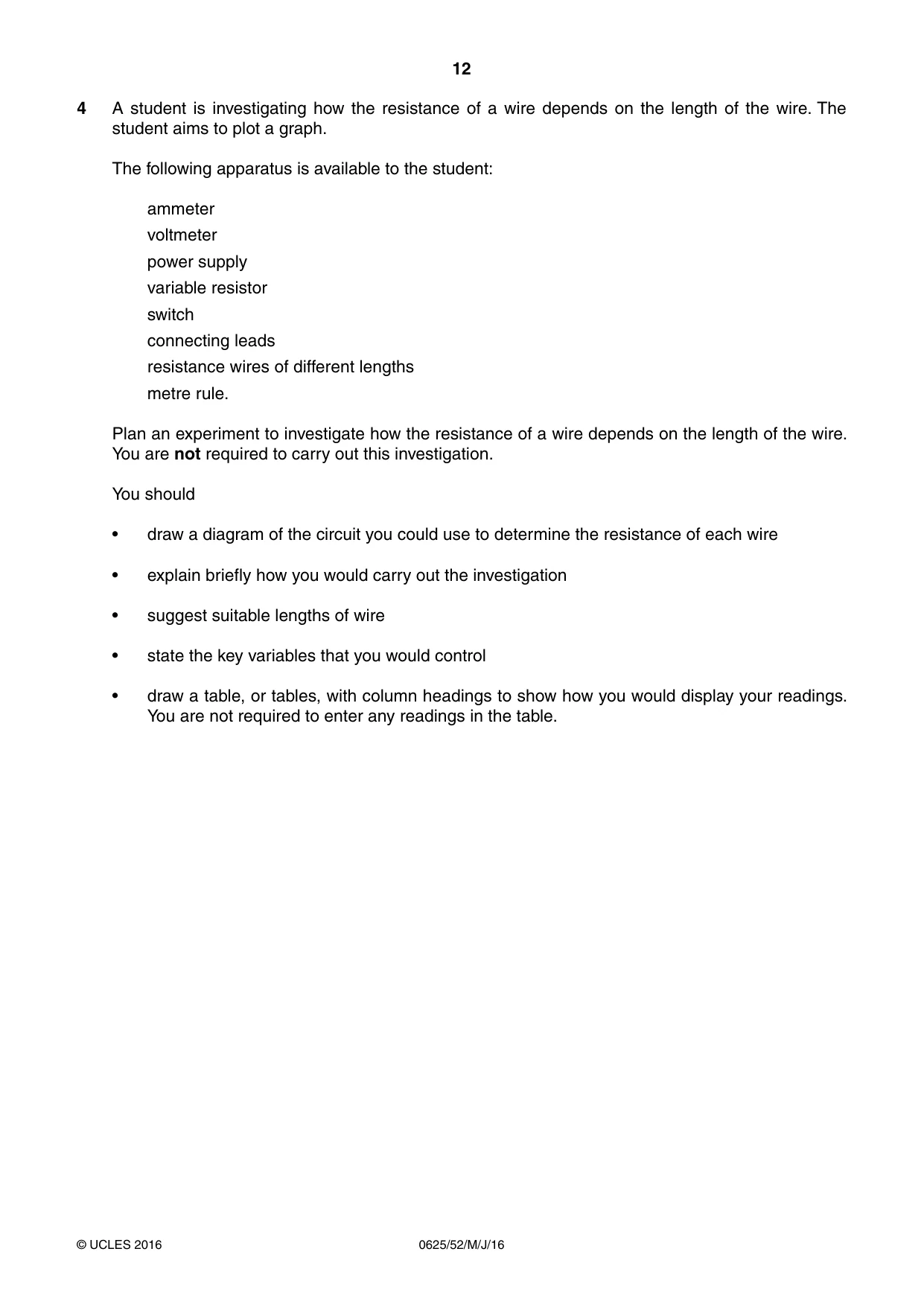
4 A student is investigating how the resistance of a wire depends on the length of the wire. The student aims to plot a graph. The following apparatus is available to the student: ammeter voltmeter power supply variable resistor switch connecting leads resistance wires of different lengths metre rule. Plan an experiment to investigate how the resistance of a wire depends on the length of the wire. You are not required to carry out this investigation. You should • draw a diagram of the circuit you could use to determine the resistance of each wire • explain briefly how you would carry out the investigation • suggest suitable lengths of wire • state the key variables that you would control • draw a table, or tables, with column headings to show how you would display your readings. You are not required to enter any readings in the table. .......................................................................................................................................................... .......................................................................................................................................................... .......................................................................................................................................................... .......................................................................................................................................................... .......................................................................................................................................................... .......................................................................................................................................................... .......................................................................................................................................................... .......................................................................................................................................................... .......................................................................................................................................................... .......................................................................................................................................................... .......................................................................................................................................................... .......................................................................................................................................................... .......................................................................................................................................................... .......................................................................................................................................................... .......................................................................................................................................................... .......................................................................................................................................................... .......................................................................................................................................................... .......................................................................................................................................................... .......................................................................................................................................................... .......................................................................................................................................................... .......................................................................................................................................................... .......................................................................................................................................................... .......................................................................................................................................................... .......................................................................................................................................................... .......................................................................................................................................................... .......................................................................................................................................................... ......................................................................................................................................................[7]
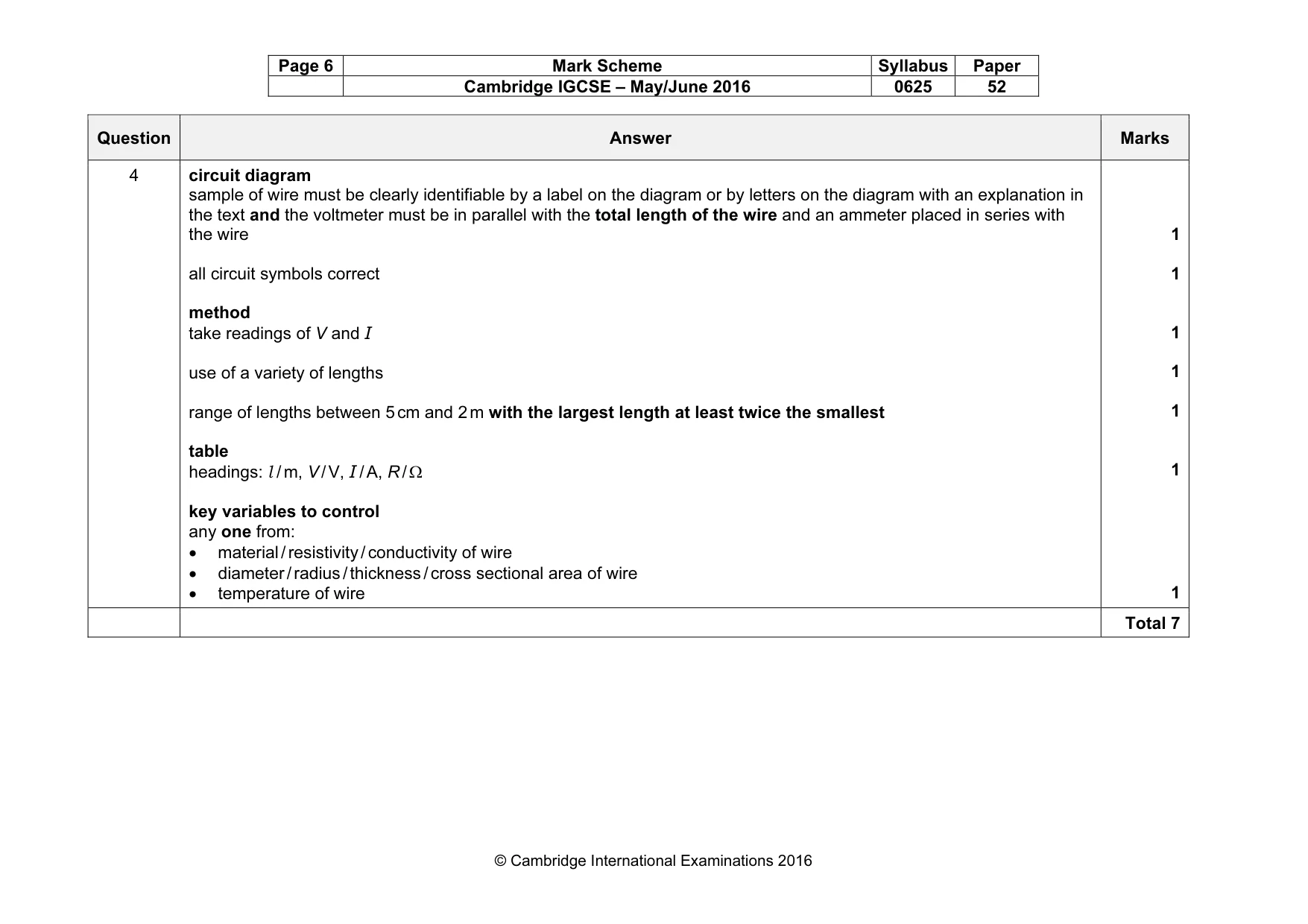
Mark scheme: 4 circuit diagram sample of wire must be clearly identifiable by a label on the diagram or by letters on the diagram with an explanation in the text and the voltmeter must be in parallel with the total length of the wire and an ammeter placed in series with the wire all circuit symbols correct method take readings of V and I use of a variety of lengths range of lengths between 5 cm and 2 m with the largest length at least twice the smallest table headings: l / m, V / V, I / A, R / Ω key variables to control any one from: • material / resistivity / conductivity of wire • diameter / radius / thickness / cross sectional area of wire • temperature of wire 1 1 1 1 1 1 1 Total 7
What was in this paper
The subtopics covered by these 4 questions, and how many questions each got. Open one in a new tab to see every Cambridge question on it.
What you needed in this session
Cambridge’s own grade thresholds for 2016 May/June, Paper 5 · Variant 2. A higher threshold means an easier paper — the bar moves with how the cohort did.