Cambridge IGCSE Physics 0625 — 2015 Feb/March Paper 2 · Variant 2
0625/22/F/M/15 · 80 marks · ≈90 min
The question paper and its mark scheme, free to read here and free to download. This is Cambridge’s own paper, exactly as it was sat.
Question paper20 pages
Mark scheme7 pages
Answers below. Sit the paper first if you are practising.
Paper as text
Question paper, page 1
This document consists of 18 printed pages and 2 blank pages. DC (ST/SW) 90397/5 © UCLES 2015 [Turn over Cambridge International Examinations Cambridge International General Certificate of Secondary Education * 2 6 7 5 8 8 0 1 7 6 * PHYSICS 0625/22 Paper 2 Core February/March 2015 1 hour 15 minutes Candidates answer on the Question Paper. No Additional Materials are required. READ THESE INSTRUCTIONS FIRST Write your Centre number, candidate number and name on all the work you hand in. Write in dark blue or black pen. You may use an HB pencil for any diagrams or graphs. Do not use staples, paper clips, glue or correction fluid. DO NOT WRITE IN ANY BARCODES. Answer all questions. Electronic calculators may be used. You may lose marks if you do not show your working or if you do not use appropriate units. Take the weight of 1 kg to be 10 N (i.e. acceleration of free fall = 10 m / s2). At the end of the examination, fasten all your work securely together. The number of marks is given in brackets [ ] at the end of each question or part question. The syllabus is approved for use in England, Wales and Northern Ireland as a Cambridge International Level 1/Level 2 Certificate.
Question paper, page 2
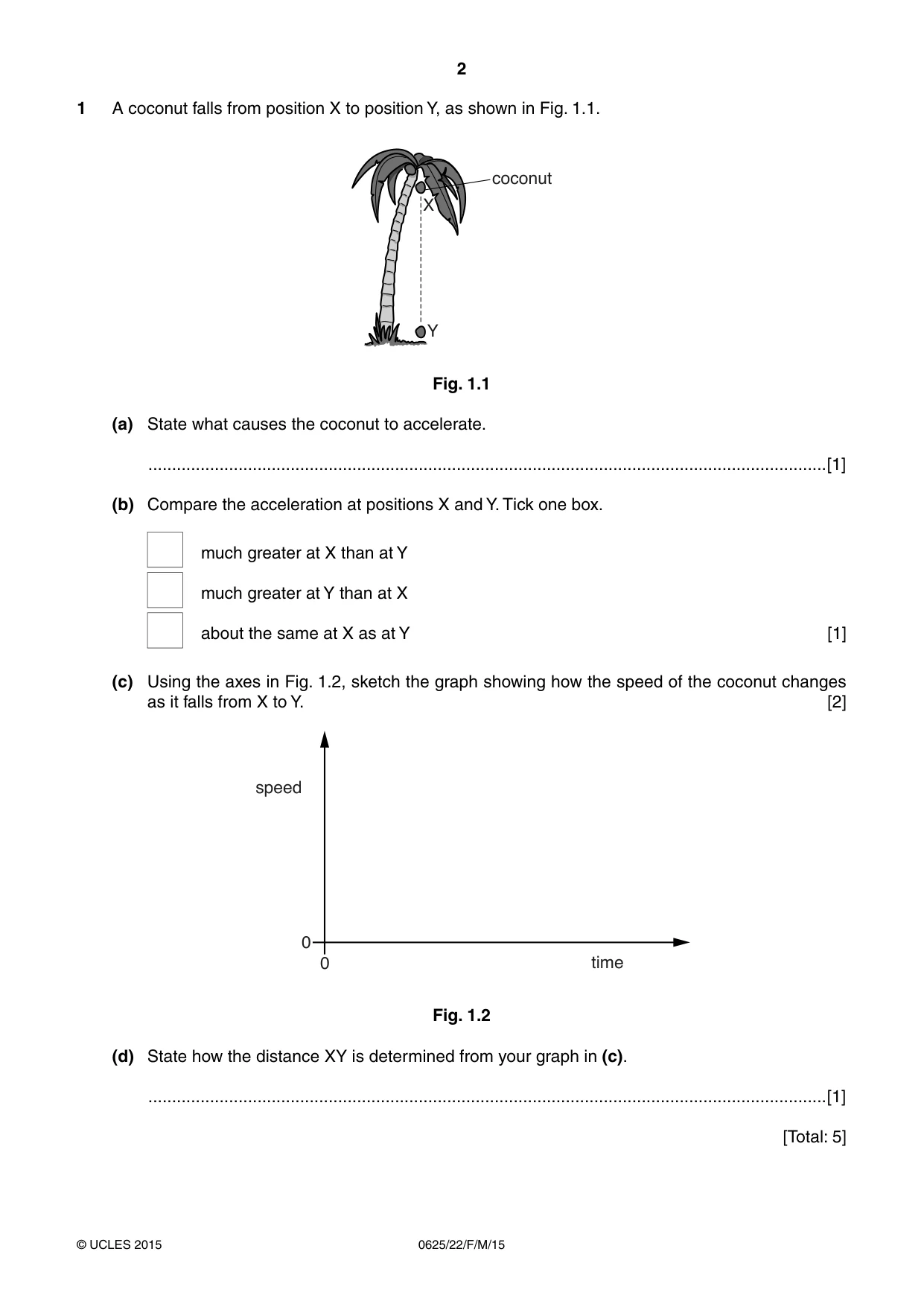
2 0625/22/F/M/15 © UCLES 2015 1 A coconut falls from position X to position Y, as shown in Fig. 1.1. X coconut Y Fig. 1.1 (a) State what causes the coconut to accelerate. …[1] (b) Compare the acceleration at positions X and Y. Tick one box. much greater at X than at Y much greater at Y than at X about the same at X as at Y [1] (c) Using the axes in Fig. 1.2, sketch the graph showing how the speed of the coconut changes as it falls from X to Y. [2] 0 time speed 0 Fig. 1.2 (d) State how the distance XY is determined from your graph in (c). …[1] [Total: 5]
Question paper, page 3
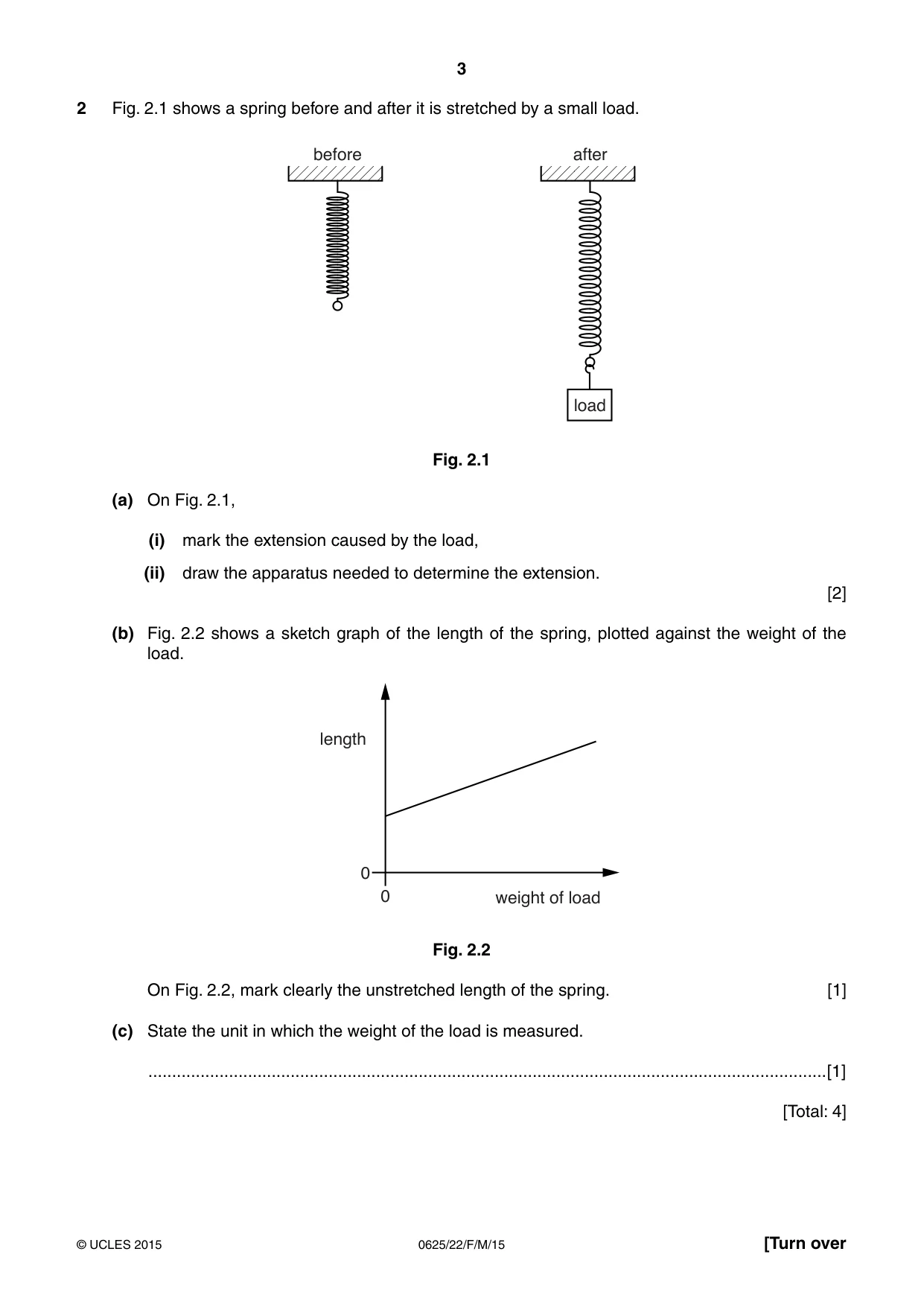
3 0625/22/F/M/15 © UCLES 2015 [Turn over 2 Fig. 2.1 shows a spring before and after it is stretched by a small load. load after before Fig. 2.1 (a) On Fig. 2.1, (i) mark the extension caused by the load, (ii) draw the apparatus needed to determine the extension. [2] (b) Fig. 2.2 shows a sketch graph of the length of the spring, plotted against the weight of the load. weight of load 0 0 length Fig. 2.2 On Fig. 2.2, mark clearly the unstretched length of the spring. [1] (c) State the unit in which the weight of the load is measured. …[1] [Total: 4]
Question paper, page 4
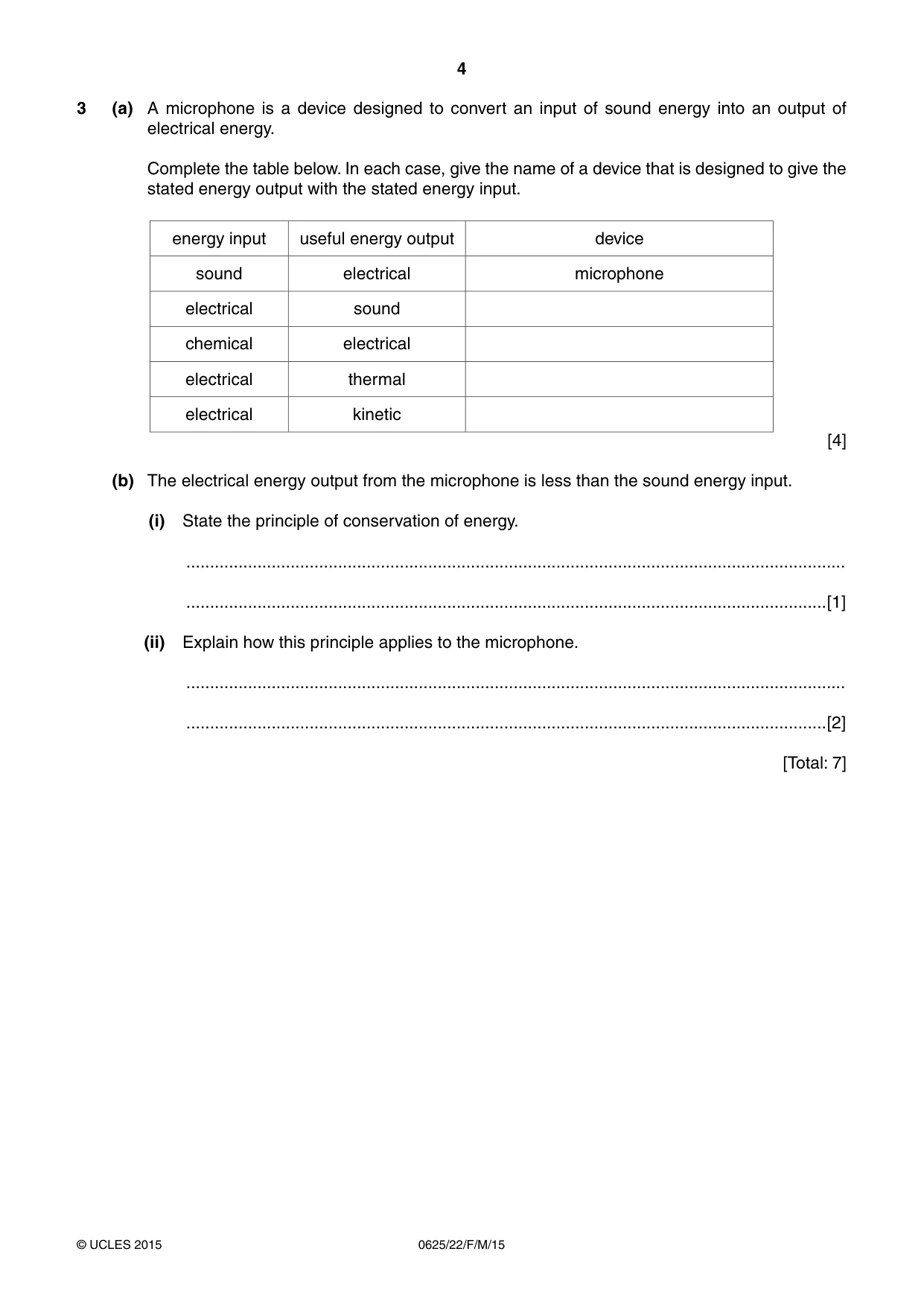
4 0625/22/F/M/15 © UCLES 2015 3 (a) A microphone is a device designed to convert an input of sound energy into an output of electrical energy. Complete the table below. In each case, give the name of a device that is designed to give the stated energy output with the stated energy input. energy input useful energy output device sound electrical microphone electrical sound chemical electrical electrical thermal electrical kinetic [4] (b) The electrical energy output from the microphone is less than the sound energy input. (i) State the principle of conservation of energy. … …[1] (ii) Explain how this principle applies to the microphone. … …[2] [Total: 7]
Question paper, page 5
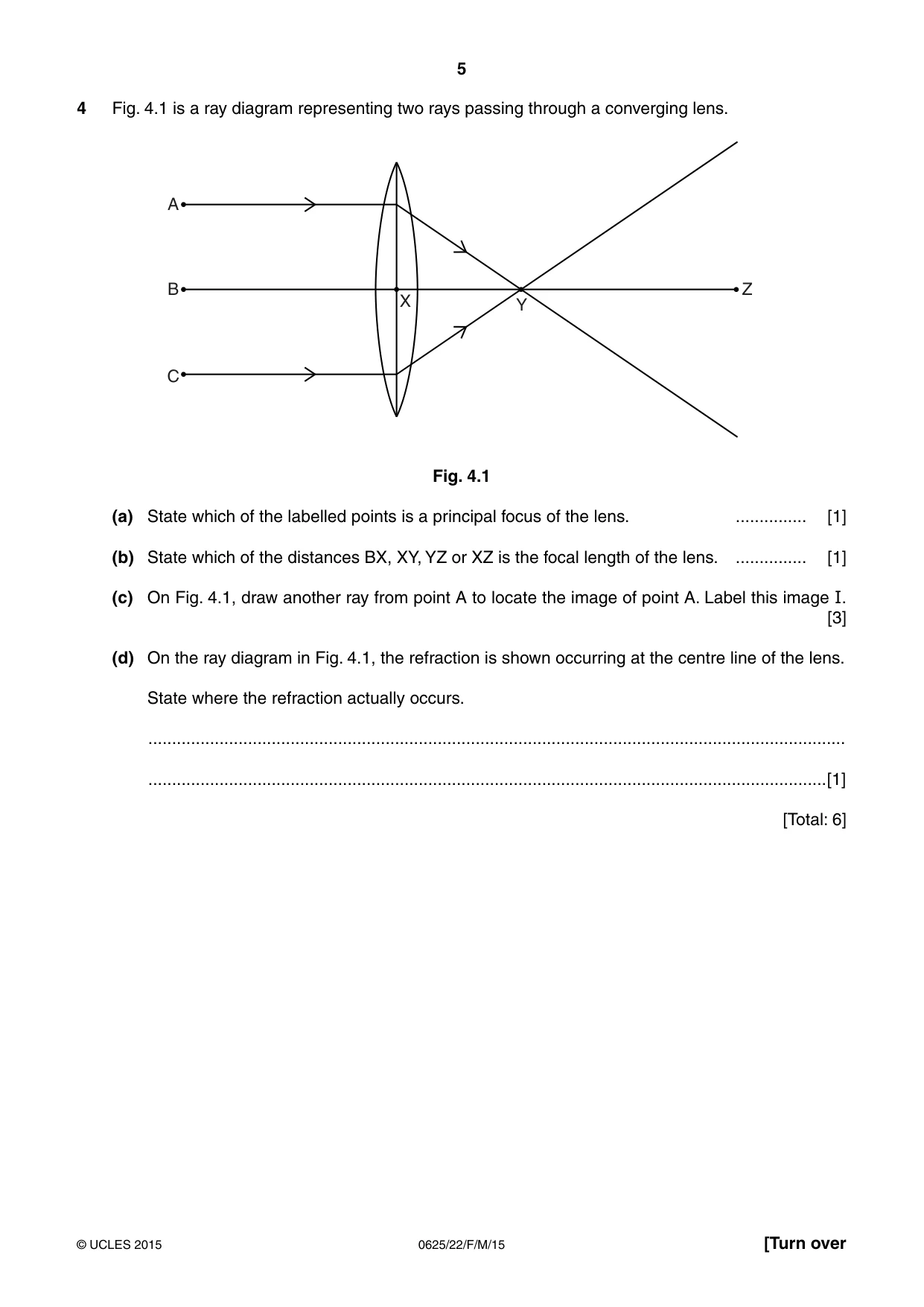
5 0625/22/F/M/15 © UCLES 2015 [Turn over 4 Fig. 4.1 is a ray diagram representing two rays passing through a converging lens. A B X Y Z C Fig. 4.1 (a) State which of the labelled points is a principal focus of the lens. … [1] (b) State which of the distances BX, XY, YZ or XZ is the focal length of the lens. … [1] (c) On Fig. 4.1, draw another ray from point A to locate the image of point A. Label this image I. [3] (d) On the ray diagram in Fig. 4.1, the refraction is shown occurring at the centre line of the lens. State where the refraction actually occurs. … …[1] [Total: 6]
Question paper, page 6
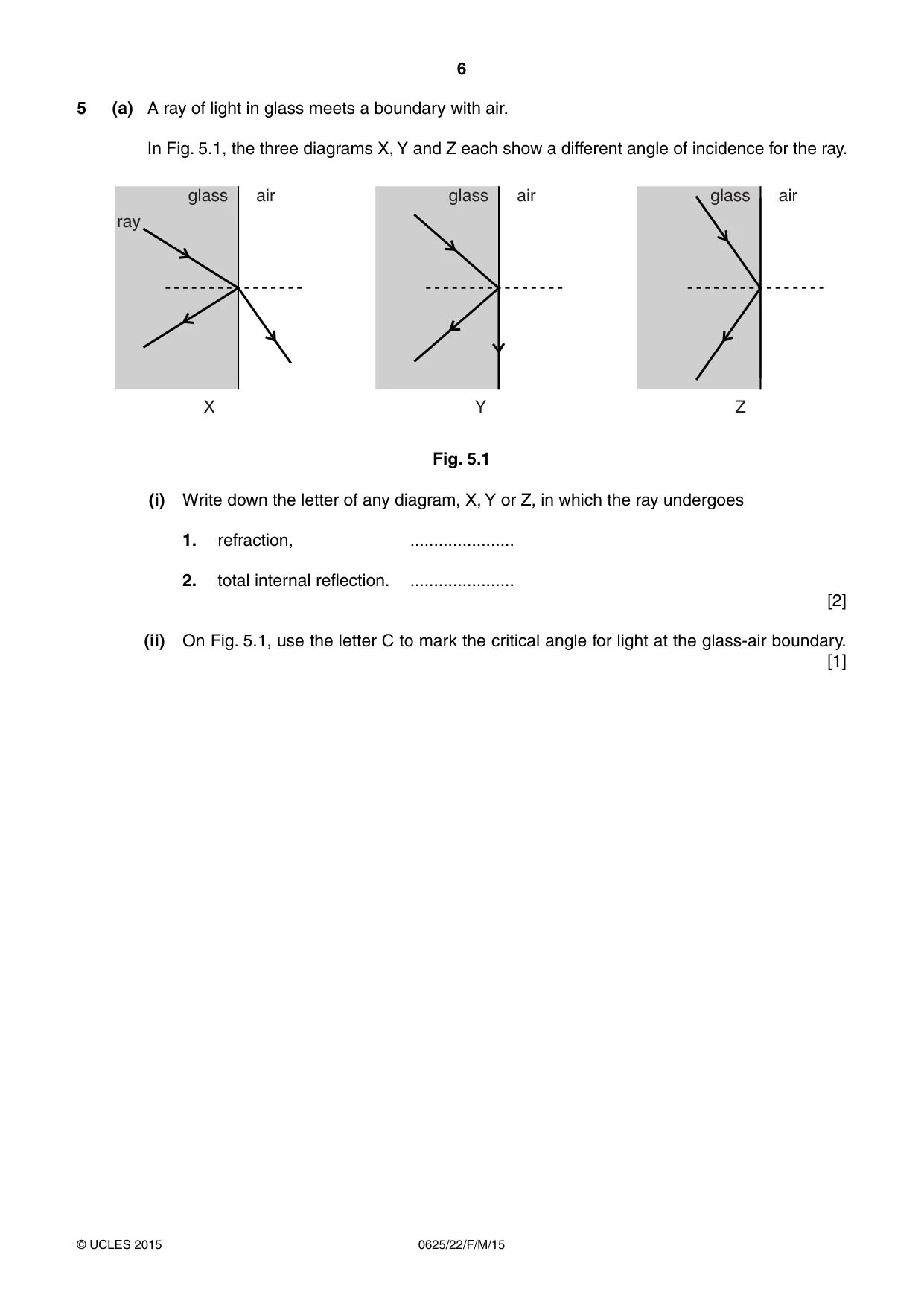
6 0625/22/F/M/15 © UCLES 2015 5 (a) A ray of light in glass meets a boundary with air. In Fig. 5.1, the three diagrams X, Y and Z each show a different angle of incidence for the ray. glass air ray X glass air Y glass air Z Fig. 5.1 (i) Write down the letter of any diagram, X, Y or Z, in which the ray undergoes 1. refraction, … 2. total internal reflection. … [2] (ii) On Fig. 5.1, use the letter C to mark the critical angle for light at the glass-air boundary. [1]
Question paper, page 7
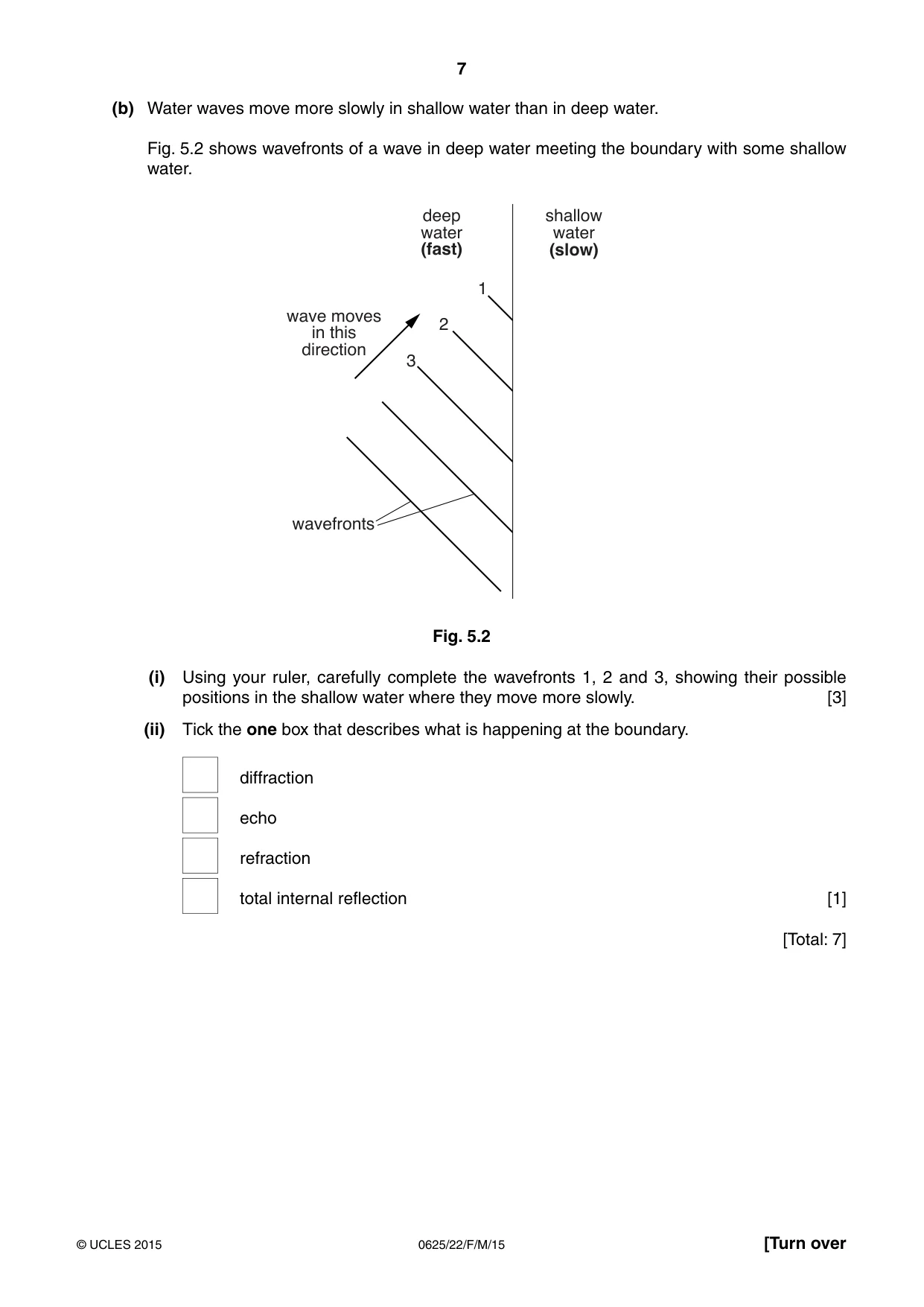
7 0625/22/F/M/15 © UCLES 2015 [Turn over (b) Water waves move more slowly in shallow water than in deep water. Fig. 5.2 shows wavefronts of a wave in deep water meeting the boundary with some shallow water. wave moves in this direction wavefronts deep water (fast) 3 2 1 shallow water (slow) Fig. 5.2 (i) Using your ruler, carefully complete the wavefronts 1, 2 and 3, showing their possible positions in the shallow water where they move more slowly. [3] (ii) Tick the one box that describes what is happening at the boundary. diffraction echo refraction total internal reflection [1] [Total: 7]
Question paper, page 8
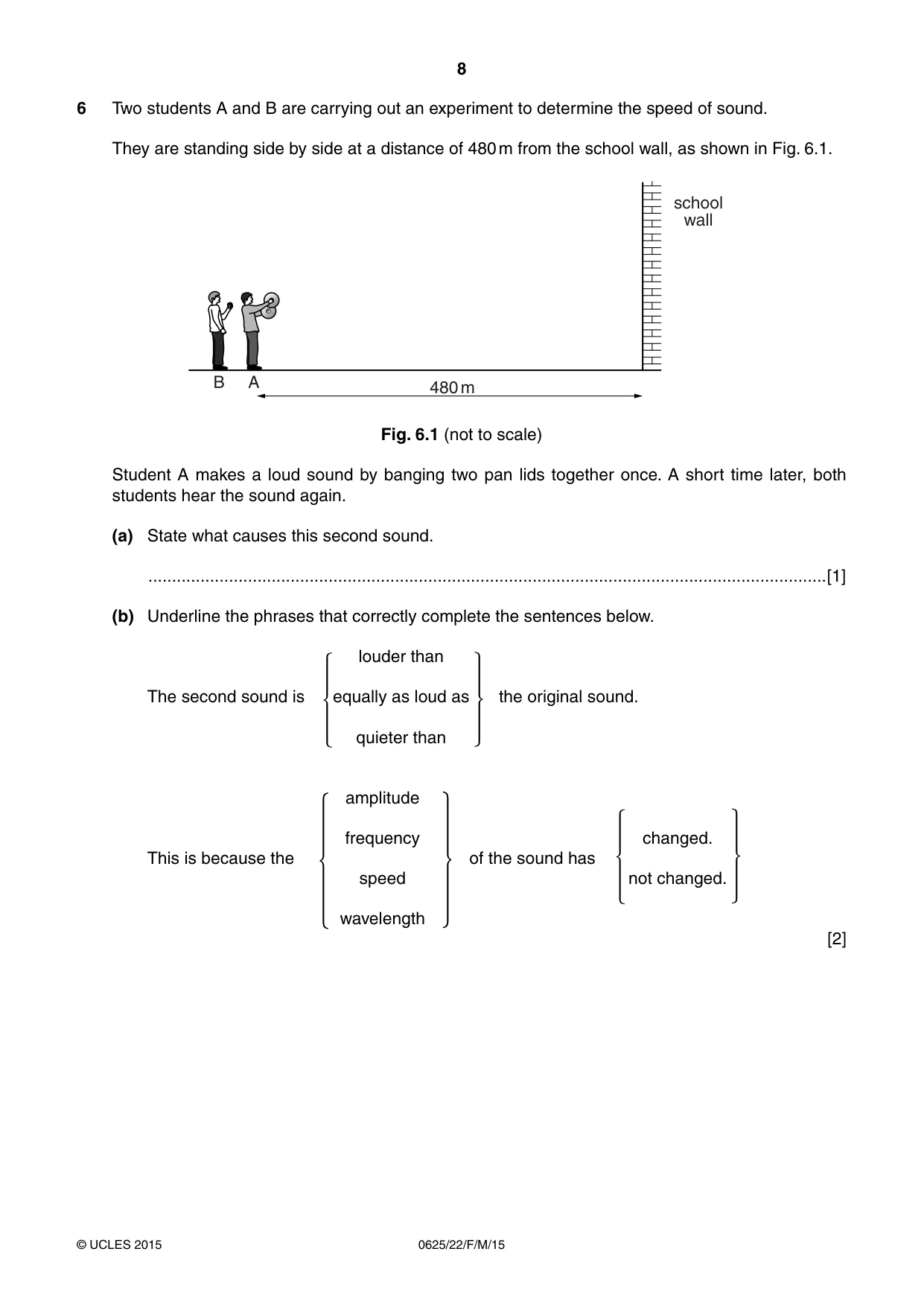
8 0625/22/F/M/15 © UCLES 2015 6 Two students A and B are carrying out an experiment to determine the speed of sound. They are standing side by side at a distance of 480 m from the school wall, as shown in Fig. 6.1. A 480 m school wall B Fig. 6.1 (not to scale) Student A makes a loud sound by banging two pan lids together once. A short time later, both students hear the sound again. (a) State what causes this second sound. …[1] (b) Underline the phrases that correctly complete the sentences below. louder than The second sound is equally as loud as the original sound. quieter than amplitude frequency changed. This is because the of the sound has speed not changed. wavelength [2]
Question paper, page 9
9 0625/22/F/M/15 © UCLES 2015 [Turn over (c) The time between the two sounds, as measured by student B, is 3.0 s. (i) Suggest the instrument that student B used to measure the time. …[1] (ii) Use the measurements to calculate the speed of sound. speed = … m / s [3] [Total: 7]
Question paper, page 10
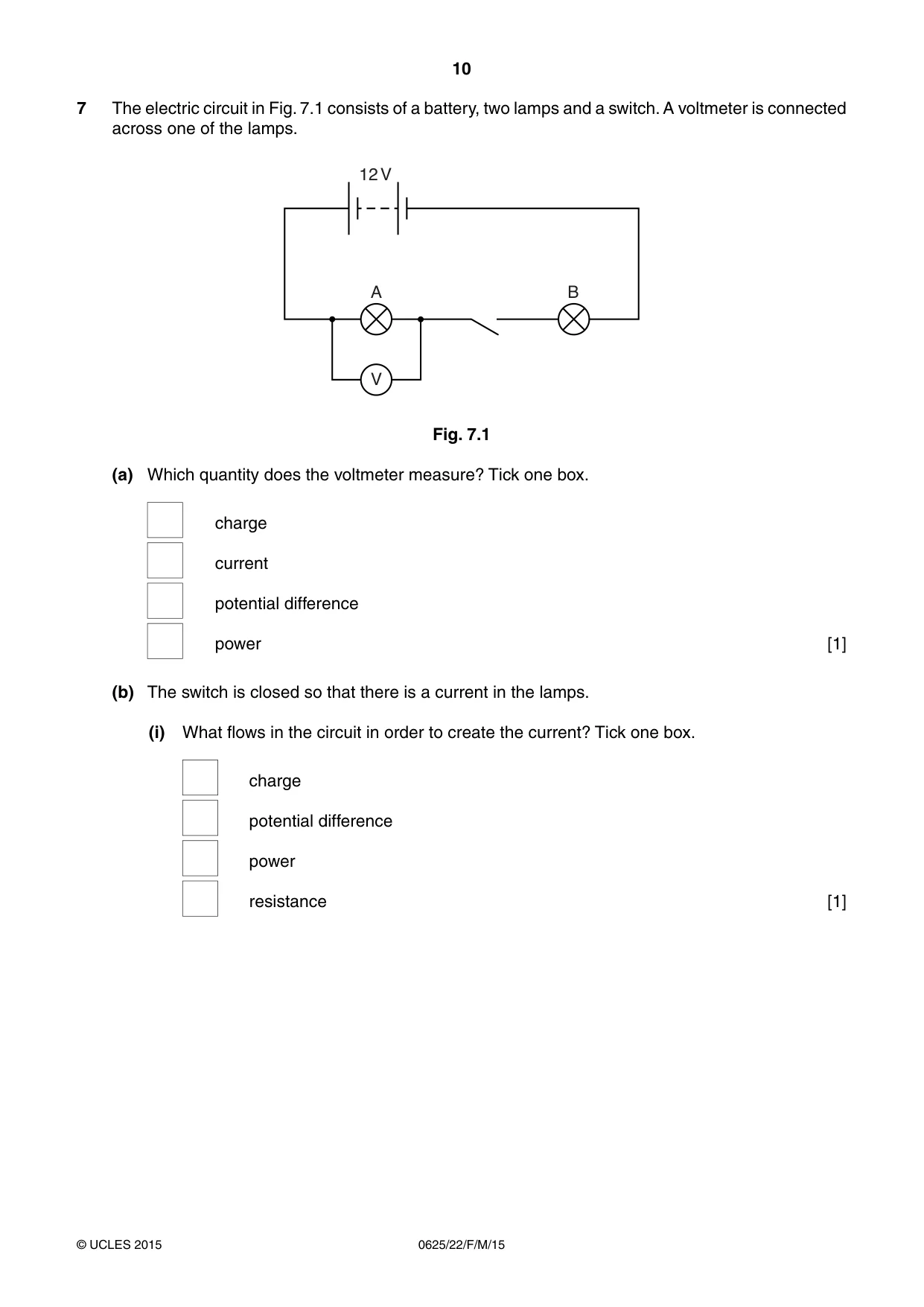
10 0625/22/F/M/15 © UCLES 2015 7 The electric circuit in Fig. 7.1 consists of a battery, two lamps and a switch. A voltmeter is connected across one of the lamps. V 12 V A B Fig. 7.1 (a) Which quantity does the voltmeter measure? Tick one box. charge current potential difference power [1] (b) The switch is closed so that there is a current in the lamps. (i) What flows in the circuit in order to create the current? Tick one box. charge potential difference power resistance [1]
Question paper, page 11
11 0625/22/F/M/15 © UCLES 2015 [Turn over (ii) The resistance of each lamp is 18 Ω. Calculate 1. the combined resistance of the lamps, combined resistance = … Ω [1] 2. the current in the circuit, stating the unit in your answer. current = …[4] (iii) Calculate the value of the reading on the voltmeter. voltmeter reading = … V [2] (c) Suggest one disadvantage of connecting lamps in series rather than in parallel. … …[1] [Total: 10]
Question paper, page 12
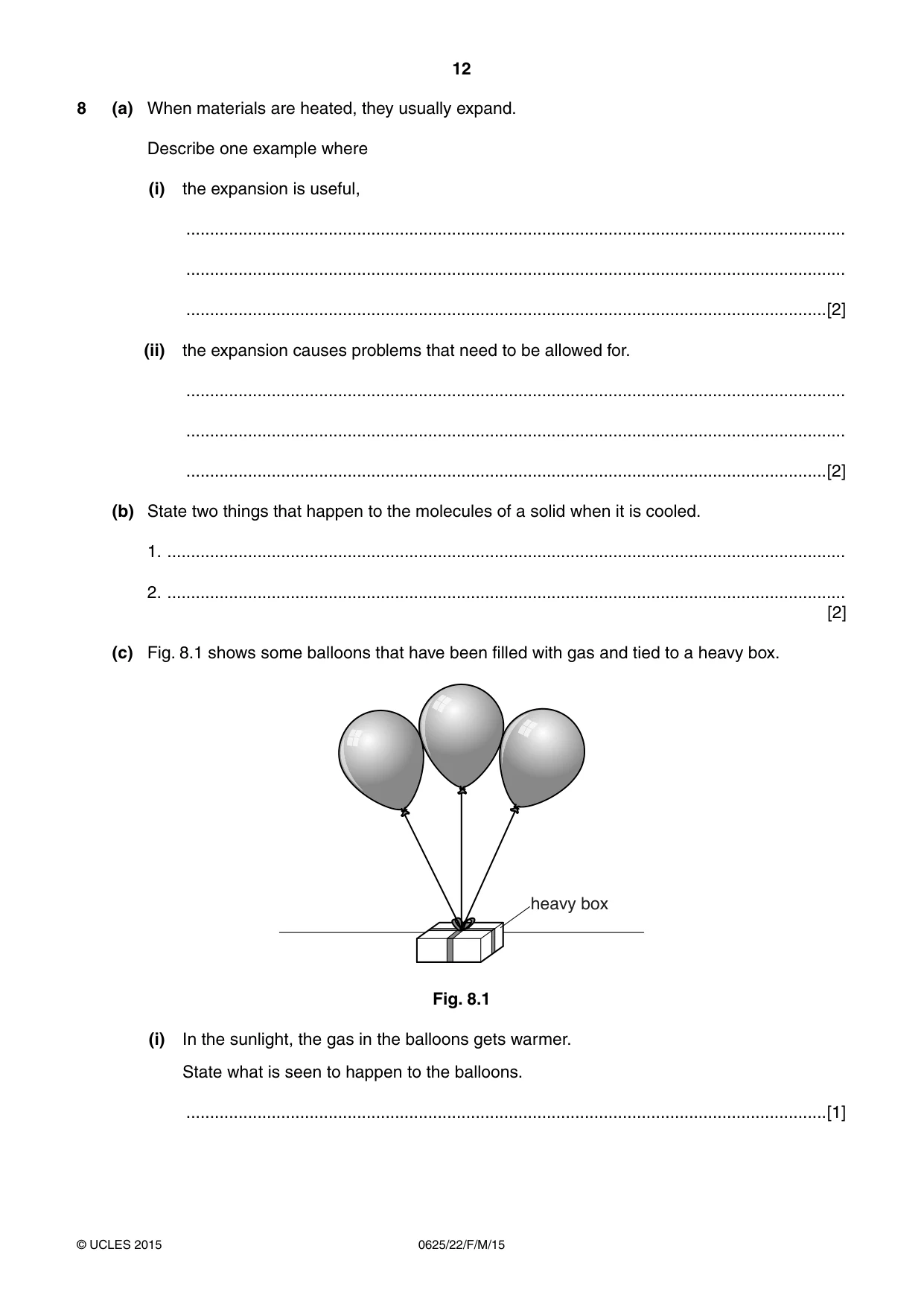
12 0625/22/F/M/15 © UCLES 2015 8 (a) When materials are heated, they usually expand. Describe one example where (i) the expansion is useful, … … …[2] (ii) the expansion causes problems that need to be allowed for. … … …[2] (b) State two things that happen to the molecules of a solid when it is cooled. 1. … 2. … [2] (c) Fig. 8.1 shows some balloons that have been filled with gas and tied to a heavy box. heavy box Fig. 8.1 (i) In the sunlight, the gas in the balloons gets warmer. State what is seen to happen to the balloons. …[1]
Question paper, page 13
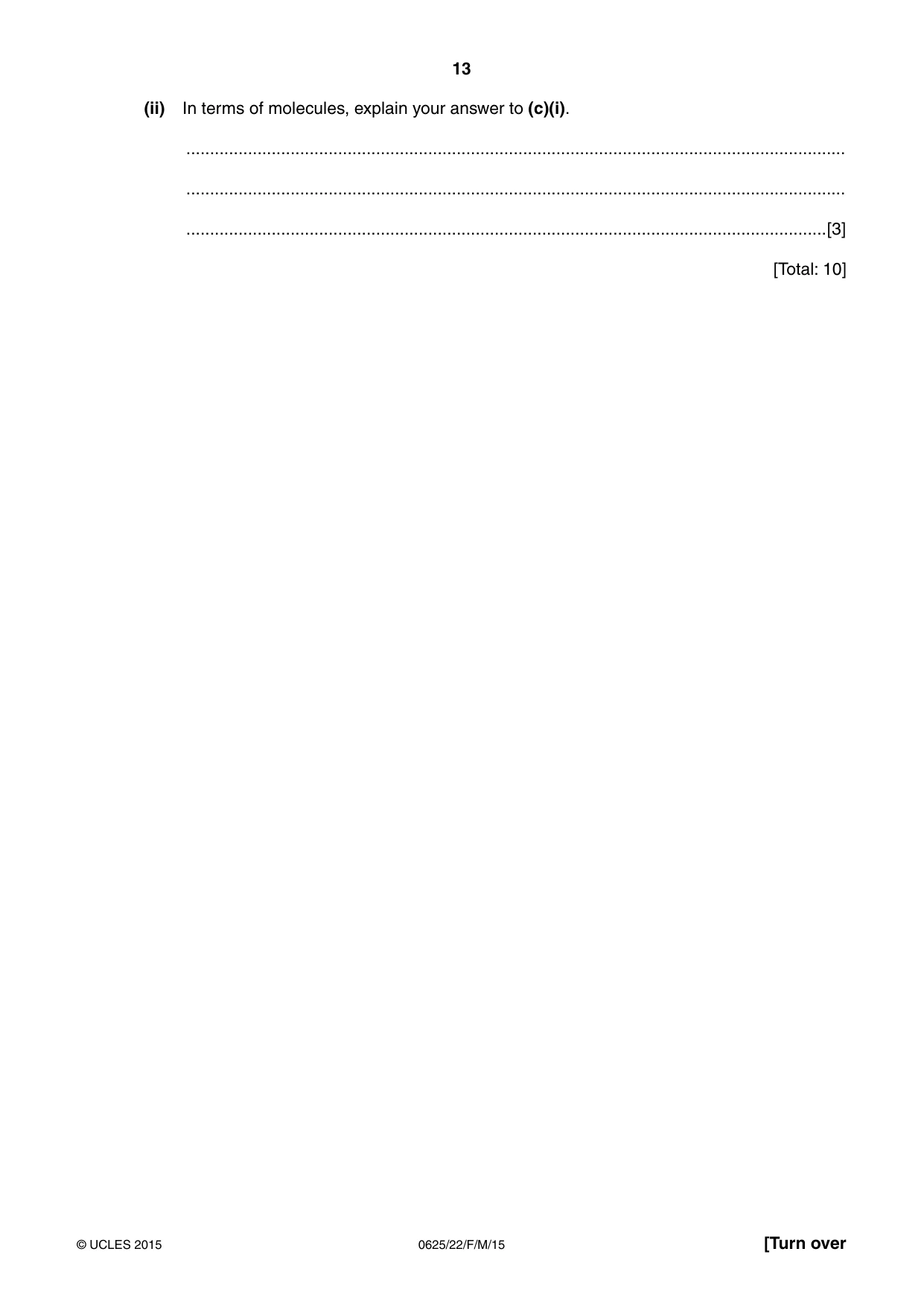
13 0625/22/F/M/15 © UCLES 2015 [Turn over (ii) In terms of molecules, explain your answer to (c)(i). … … …[3] [Total: 10]
Question paper, page 14
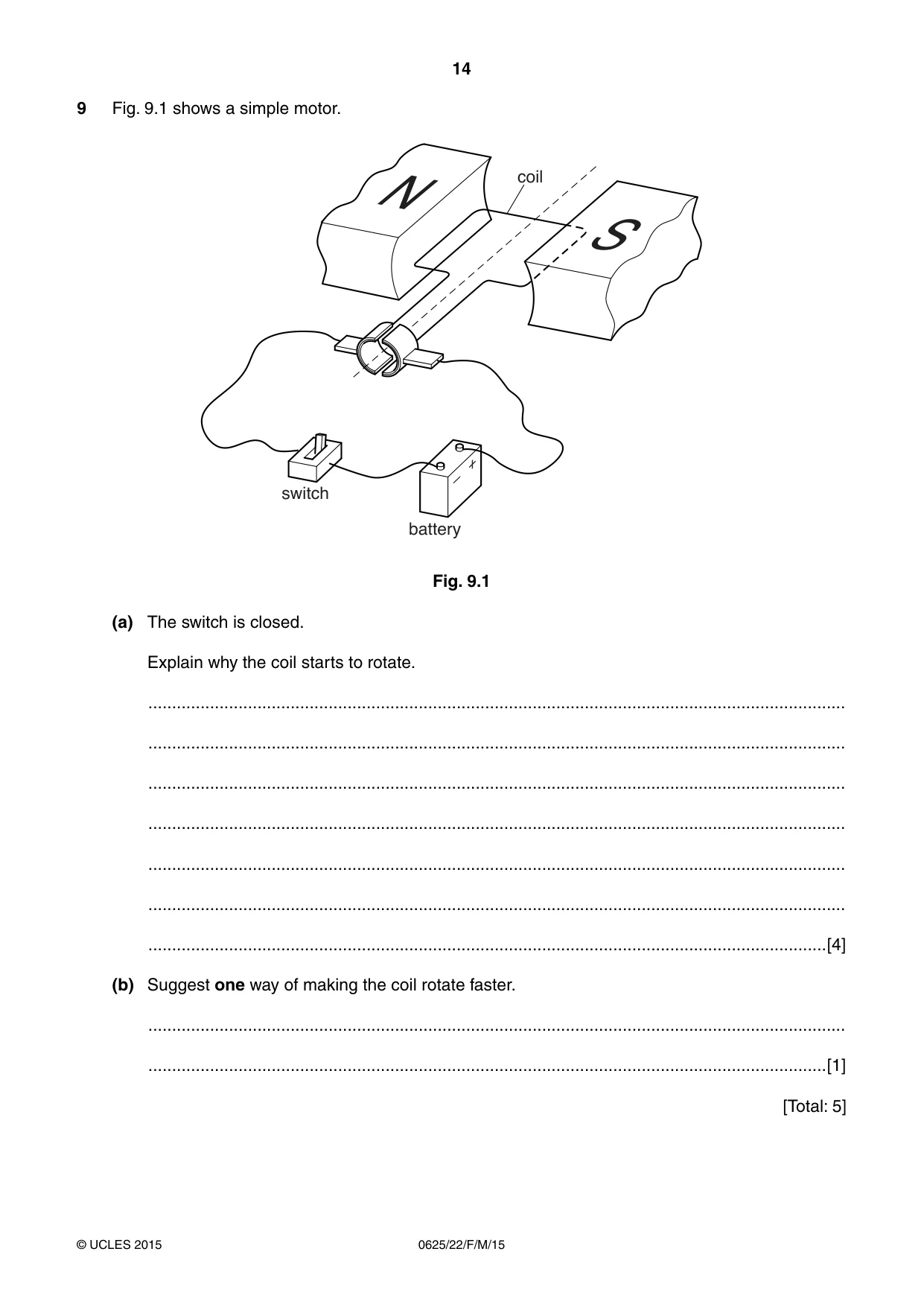
14 0625/22/F/M/15 © UCLES 2015 9 Fig. 9.1 shows a simple motor. coil battery switch – + N S Fig. 9.1 (a) The switch is closed. Explain why the coil starts to rotate. … … … … … … …[4] (b) Suggest one way of making the coil rotate faster. … …[1] [Total: 5]
Question paper, page 15
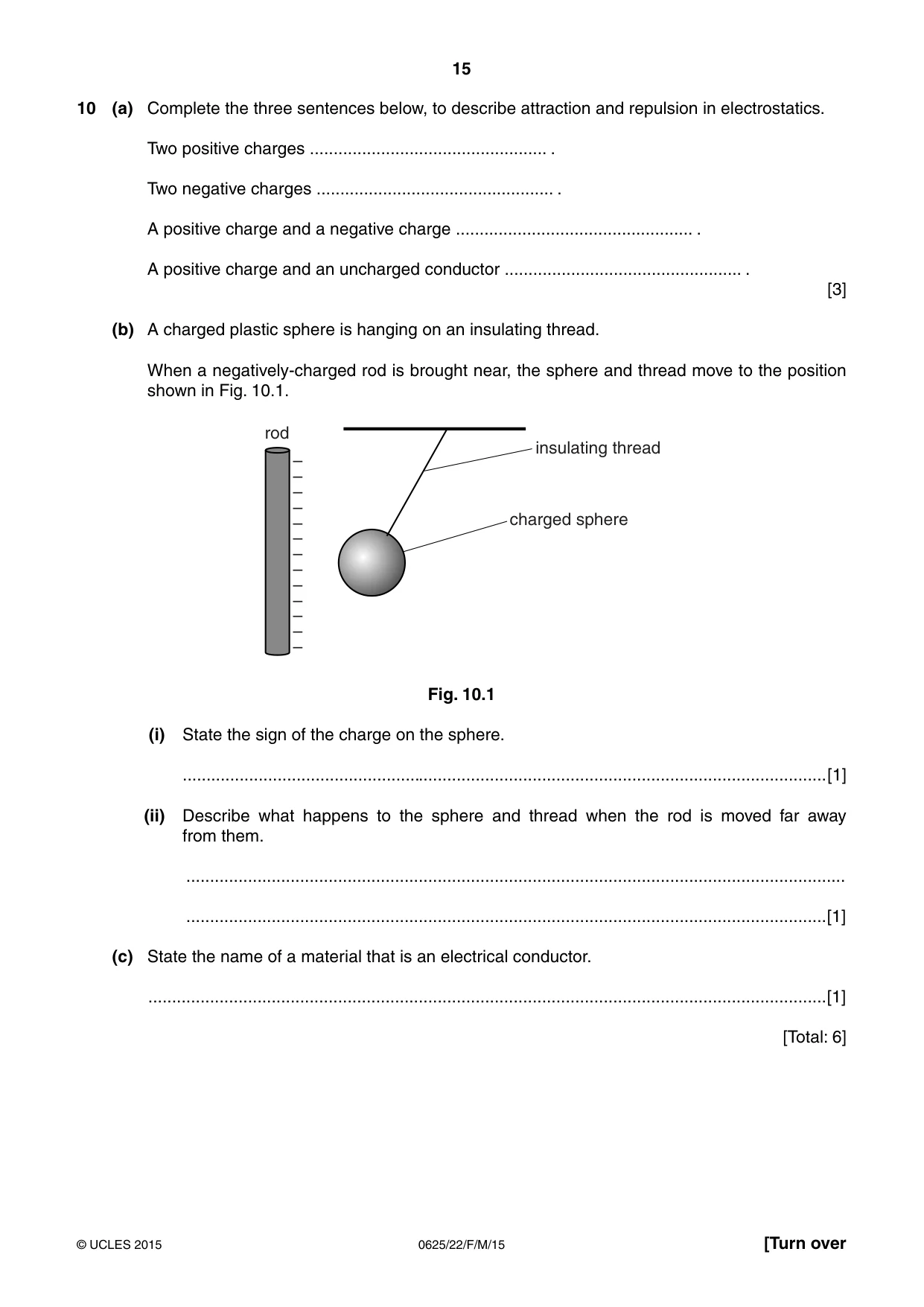
15 0625/22/F/M/15 © UCLES 2015 [Turn over 10 (a) Complete the three sentences below, to describe attraction and repulsion in electrostatics. Two positive charges … . Two negative charges … . A positive charge and a negative charge … . A positive charge and an uncharged conductor … . [3] (b) A charged plastic sphere is hanging on an insulating thread. When a negatively-charged rod is brought near, the sphere and thread move to the position shown in Fig. 10.1. – rod insulating thread charged sphere – – – – – – – – – – – – Fig. 10.1 (i) State the sign of the charge on the sphere. …[1] (ii) Describe what happens to the sphere and thread when the rod is moved far away from them. … …[1] (c) State the name of a material that is an electrical conductor. …[1] [Total: 6]
Question paper, page 16
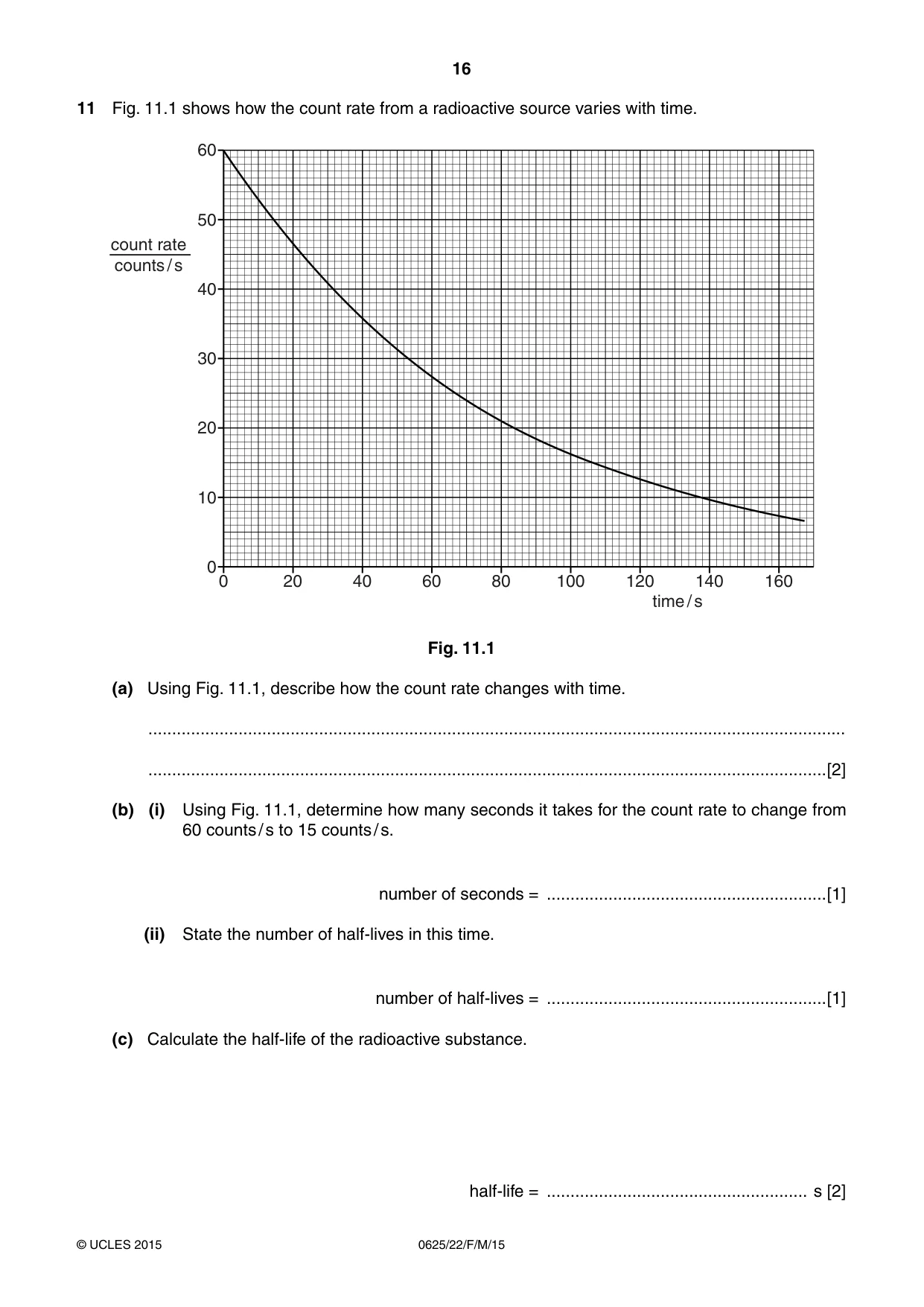
16 0625/22/F/M/15 © UCLES 2015 11 Fig. 11.1 shows how the count rate from a radioactive source varies with time. 0 0 10 20 30 40 50 60 20 40 60 80 100 120 140 time / s count rate counts / s 160 Fig. 11.1 (a) Using Fig. 11.1, describe how the count rate changes with time. … …[2] (b) (i) Using Fig. 11.1, determine how many seconds it takes for the count rate to change from 60 counts / s to 15 counts / s. number of seconds = …[1] (ii) State the number of half-lives in this time. number of half-lives = …[1] (c) Calculate the half-life of the radioactive substance. half-life = … s [2]
Question paper, page 17
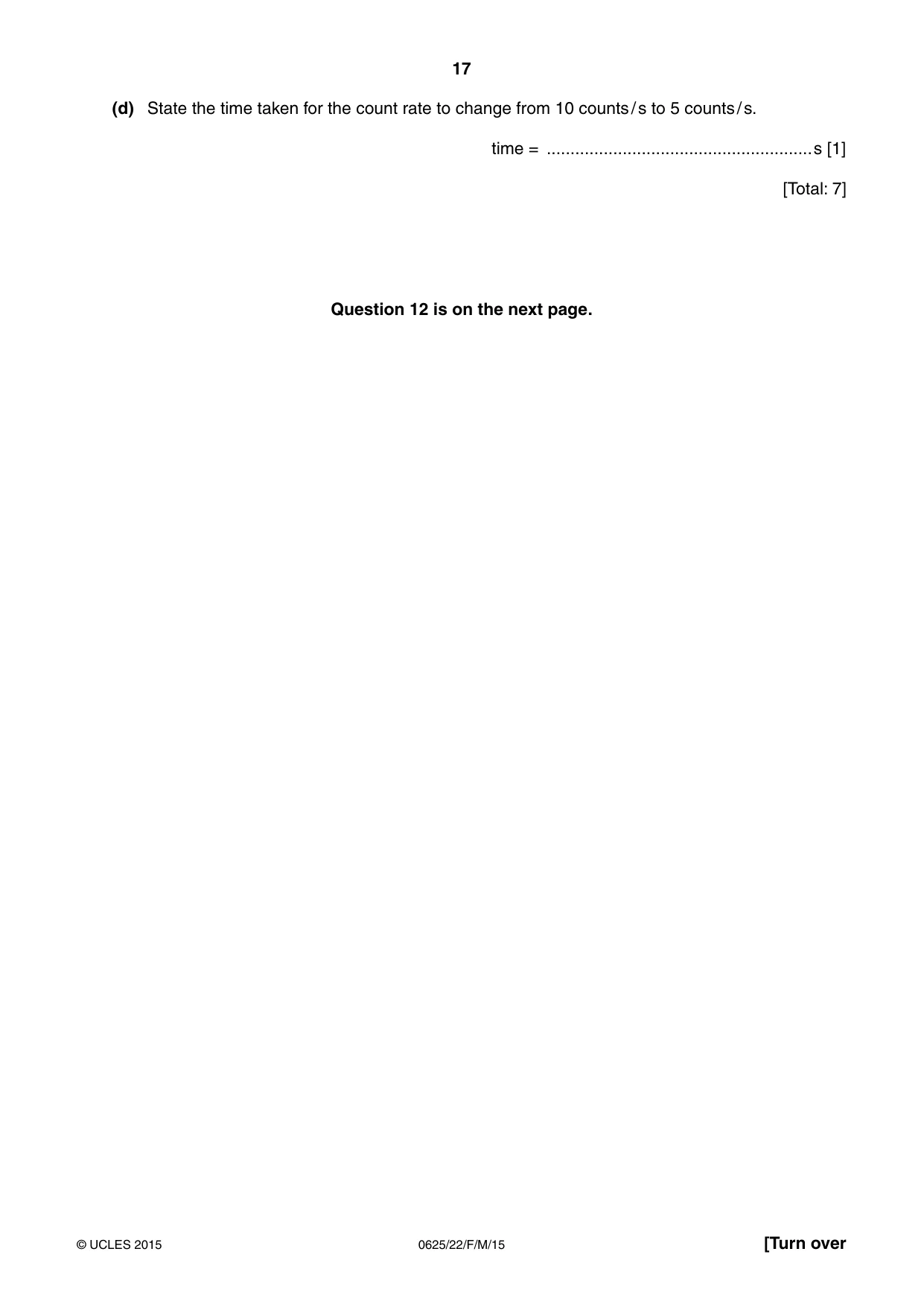
17 0625/22/F/M/15 © UCLES 2015 [Turn over (d) State the time taken for the count rate to change from 10 counts / s to 5 counts / s. time = …s [1] [Total: 7] Question 12 is on the next page.
Question paper, page 18
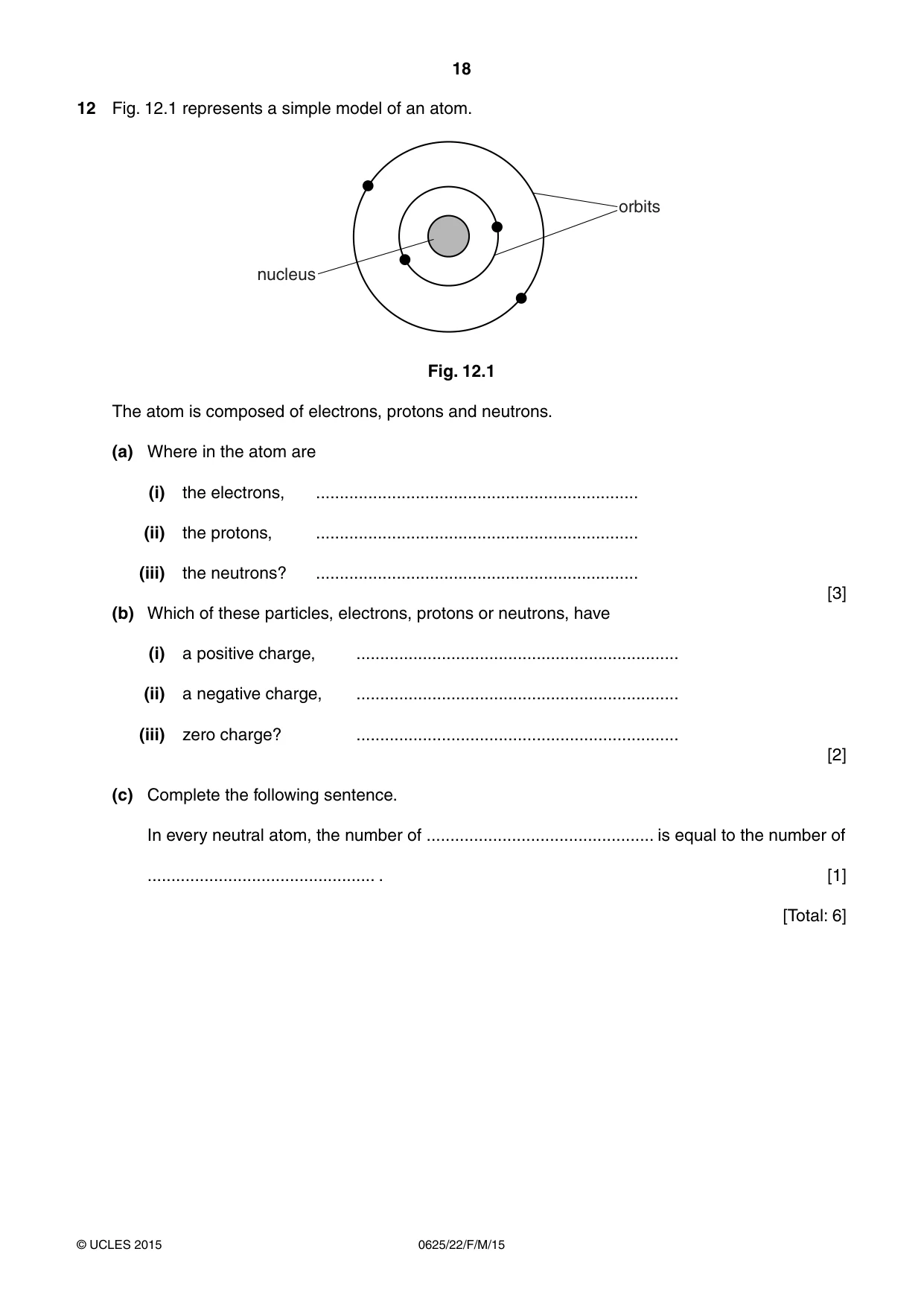
18 0625/22/F/M/15 © UCLES 2015 12 Fig. 12.1 represents a simple model of an atom. orbits nucleus Fig. 12.1 The atom is composed of electrons, protons and neutrons. (a) Where in the atom are (i) the electrons, … (ii) the protons, … (iii) the neutrons? … [3] (b) Which of these particles, electrons, protons or neutrons, have (i) a positive charge, … (ii) a negative charge, … (iii) zero charge? … [2] (c) Complete the following sentence. In every neutral atom, the number of … is equal to the number of … . [1] [Total: 6]
Question paper, page 19
19 0625/22/F/M/15 © UCLES 2015 BLANK PAGE
Question paper, page 20
20 0625/22/F/M/15 © UCLES 2015 Permission to reproduce items where third-party owned material protected by copyright is included has been sought and cleared where possible. Every reasonable effort has been made by the publisher (UCLES) to trace copyright holders, but if any items requiring clearance have unwittingly been included, the publisher will be pleased to make amends at the earliest possible opportunity. To avoid the issue of disclosure of answer-related information to candidates, all copyright acknowledgements are reproduced online in the Cambridge International Examinations Copyright Acknowledgements Booklet. This is produced for each series of examinations and is freely available to download at www.cie.org.uk after the live examination series. Cambridge International Examinations is part of the Cambridge Assessment Group. Cambridge Assessment is the brand name of University of Cambridge Local Examinations Syndicate (UCLES), which is itself a department of the University of Cambridge. BLANK PAGE
Mark scheme, page 1
® IGCSE is the registered trademark of Cambridge International Examinations. CAMBRIDGE INTERNATIONAL EXAMINATIONS Cambridge International General Certificate of Secondary Education MARK SCHEME for the March 2015 series 0625 PHYSICS 0625/22 Paper 2 (Core Theory), maximum raw mark 80 This mark scheme is published as an aid to teachers and candidates, to indicate the requirements of the examination. It shows the basis on which Examiners were instructed to award marks. It does not indicate the details of the discussions that took place at an Examiners’ meeting before marking began, which would have considered the acceptability of alternative answers. Mark schemes should be read in conjunction with the question paper and the Principal Examiner Report for Teachers. Cambridge will not enter into discussions about these mark schemes. Cambridge is publishing the mark schemes for the March 2015 series for most Cambridge IGCSE® components.
Mark scheme, page 2
Page 2 Mark Scheme Syllabus Paper Cambridge IGCSE – March 2015 0625 22 © Cambridge International Examinations 2015 NOTES ABOUT MARK SCHEME SYMBOLS & OTHER MATTERS B marks are independent marks, which do not depend on other marks. For a B mark to be scored, the point to which it refers must be seen specifically in the candidate’s answer. M marks are method marks upon which accuracy marks (A marks) later depend. If a candidate fails to score a particular M mark, then none of the dependent A marks can be scored. C marks are compensatory marks in general applicable to numerical questions. These can be scored even if the point to which they refer are not written down by the candidate, provided subsequent working gives evidence that they must have known it. A marks A marks are accuracy or answer marks which either depend on an M mark, or which are one of the ways which allow a C mark to be scored. A marks are commonly awarded for final answers to numerical questions. If a final numerical answer, eligible for A marks, is correct, all the C marks for that question are normally awarded. An A mark following an M mark is a dependent mark. Brackets ( ) Brackets around words or units in the mark scheme are intended to indicate wording used to clarify the mark scheme, but the marks do not depend on seeing the words or units in brackets, e.g. 10 (J) means that the mark is scored for 10, regardless of the unit given. Underlining Underlining indicates that this must be seen in the answer offered, or something very similar. OR / or This indicates alternative answers or words, any one of which is satisfactory for scoring the marks. AND Both answers or words must be given for credit to be awarded. e.e.o.o. This means "each error or omission". o.w.t.t.e. This means “or words to that effect”. c.a.o. This means “correct answer only”. Not/NOT This indicates that an incorrect answer is not to be disregarded, but cancels another otherwise correct alternative offered by the candidate, i.e. right plus wrong penalty applies. e.c.f. This means "error carried forward". If a candidate has made an earlier mistake and has carried an incorrect value forward to subsequent stages of working, marks indicated by e.c.f. may be awarded, provided the subsequent working is correct, bearing in mind the earlier mistake. This prevents a candidate from being penalised more than once for a particular mistake, but only applies to marks annotated e.c.f. Significant Answers are normally acceptable to any number of significant figures > 2. Any figures exceptions to this general rule will be specified in the mark scheme.
Mark scheme, page 3
Page 3 Mark Scheme Syllabus Paper Cambridge IGCSE – March 2015 0625 22 © Cambridge International Examinations 2015 Units Deduct one mark for each incorrect or missing unit from an answer that would otherwise gain all the marks available for that answer: maximum 1 per question. Fractions Allow these only where specified in the mark scheme.
Mark scheme, page 4
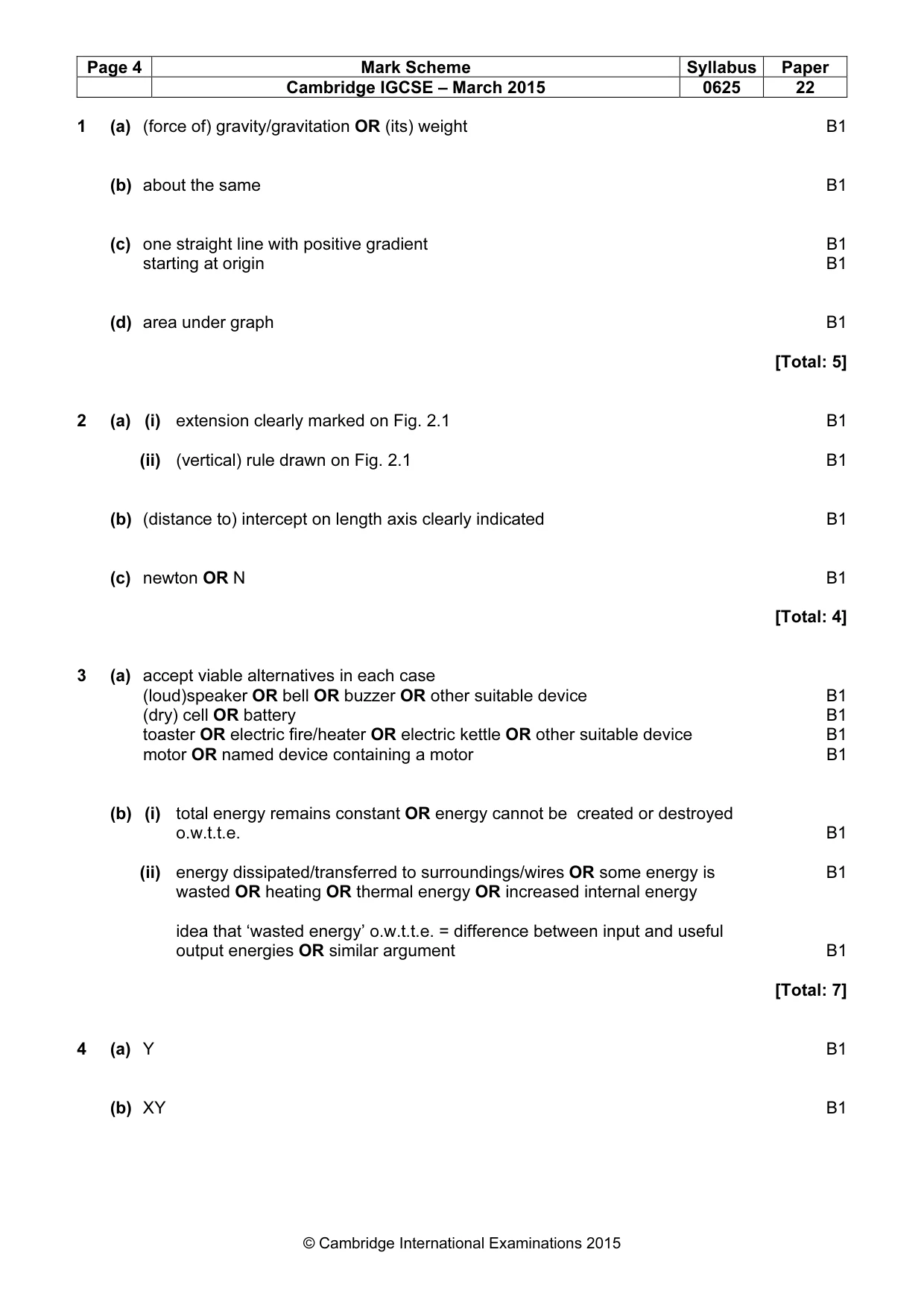
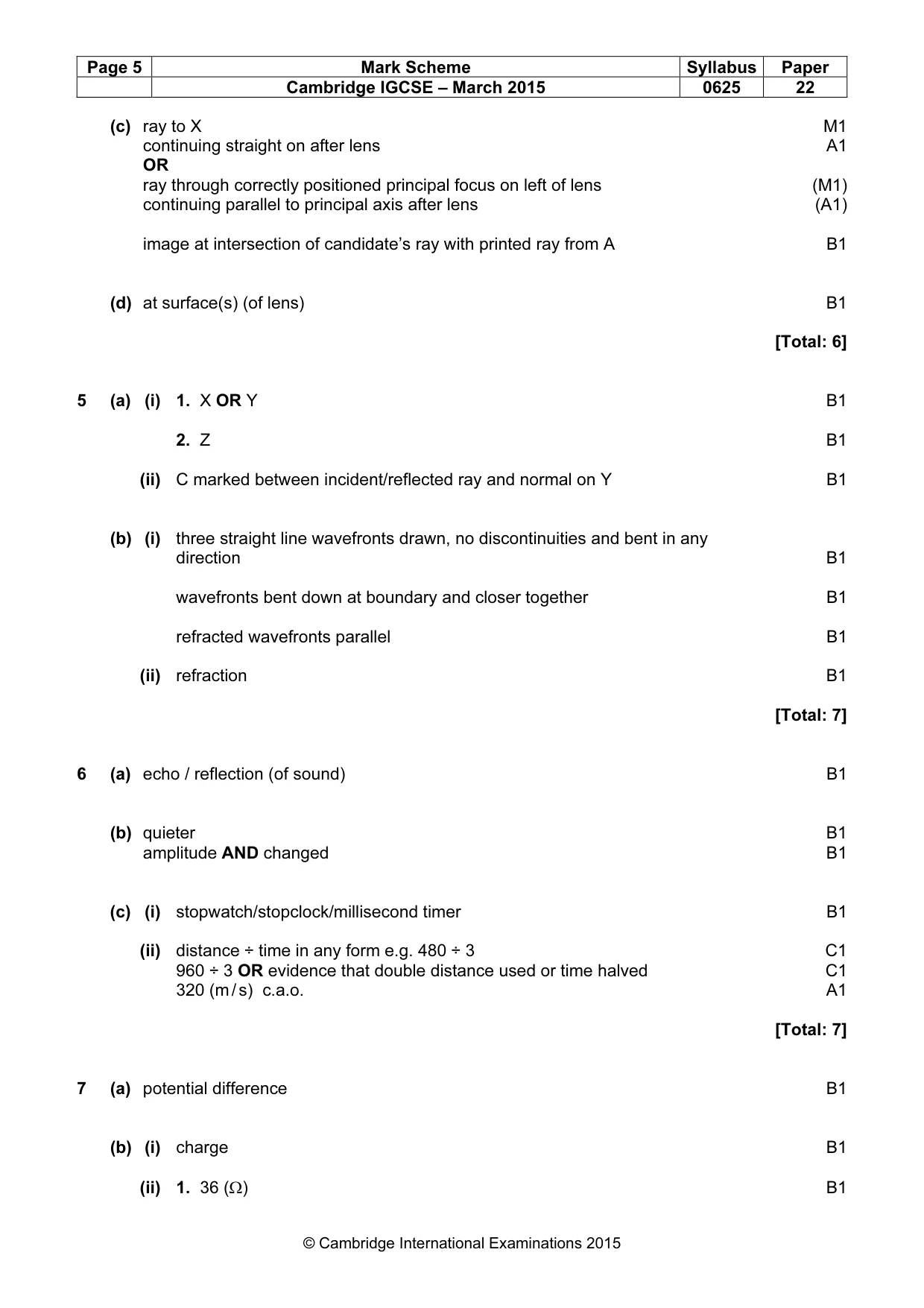
Page 4 Mark Scheme Syllabus Paper Cambridge IGCSE – March 2015 0625 22 © Cambridge International Examinations 2015 1 (a) (force of) gravity/gravitation OR (its) weight B1 (b) about the same B1 (c) one straight line with positive gradient B1 starting at origin B1 (d) area under graph B1 [Total: 5] 2 (a) (i) extension clearly marked on Fig. 2.1 B1 (ii) (vertical) rule drawn on Fig. 2.1 B1 (b) (distance to) intercept on length axis clearly indicated B1 (c) newton OR N B1 [Total: 4] 3 (a) accept viable alternatives in each case (loud)speaker OR bell OR buzzer OR other suitable device B1 (dry) cell OR battery B1 toaster OR electric fire/heater OR electric kettle OR other suitable device B1 motor OR named device containing a motor B1 (b) (i) total energy remains constant OR energy cannot be created or destroyed o.w.t.t.e. B1 (ii) energy dissipated/transferred to surroundings/wires OR some energy is B1 wasted OR heating OR thermal energy OR increased internal energy idea that ‘wasted energy’ o.w.t.t.e. = difference between input and useful output energies OR similar argument B1 [Total: 7] 4 (a) Y B1 (b) XY B1
Mark scheme, page 5
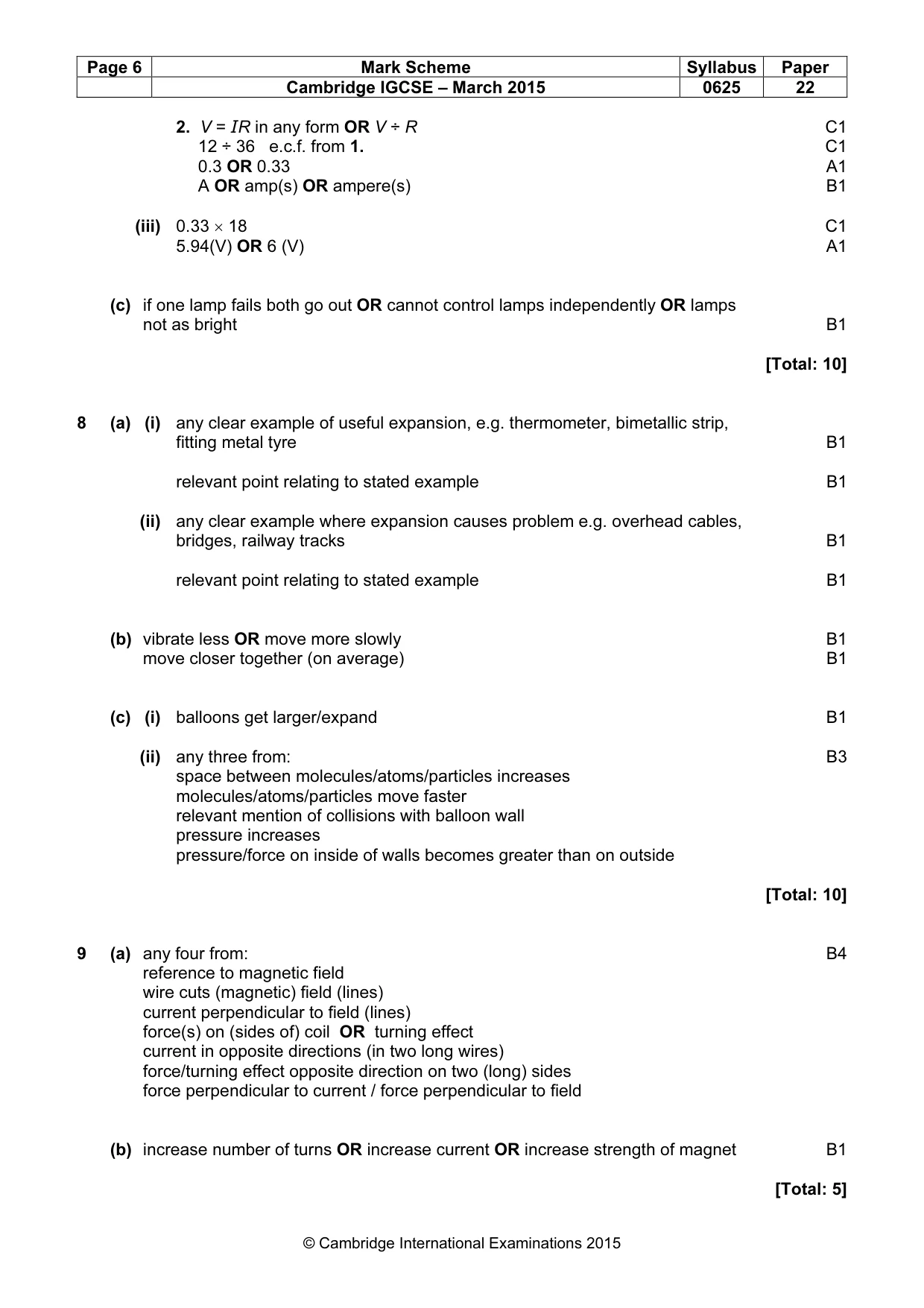
Page 5 Mark Scheme Syllabus Paper Cambridge IGCSE – March 2015 0625 22 © Cambridge International Examinations 2015 (c) ray to X M1 continuing straight on after lens A1 OR ray through correctly positioned principal focus on left of lens (M1) continuing parallel to principal axis after lens (A1) image at intersection of candidate’s ray with printed ray from A B1 (d) at surface(s) (of lens) B1 [Total: 6] 5 (a) (i) 1. X OR Y B1 2. Z B1 (ii) C marked between incident/reflected ray and normal on Y B1 (b) (i) three straight line wavefronts drawn, no discontinuities and bent in any direction B1 wavefronts bent down at boundary and closer together B1 refracted wavefronts parallel B1 (ii) refraction B1 [Total: 7] 6 (a) echo / reflection (of sound) B1 (b) quieter B1 amplitude AND changed B1 (c) (i) stopwatch/stopclock/millisecond timer B1 (ii) distance ÷ time in any form e.g. 480 ÷ 3 C1 960 ÷ 3 OR evidence that double distance used or time halved C1 320 (m / s) c.a.o. A1 [Total: 7] 7 (a) potential difference B1 (b) (i) charge B1 (ii) 1. 36 (Ω) B1
Mark scheme, page 6
Page 6 Mark Scheme Syllabus Paper Cambridge IGCSE – March 2015 0625 22 © Cambridge International Examinations 2015 2. V = IR in any form OR V ÷ R C1 12 ÷ 36 e.c.f. from 1. C1 0.3 OR 0.33 A1 A OR amp(s) OR ampere(s) B1 (iii) 0.33 × 18 C1 5.94(V) OR 6 (V) A1 (c) if one lamp fails both go out OR cannot control lamps independently OR lamps not as bright B1 [Total: 10] 8 (a) (i) any clear example of useful expansion, e.g. thermometer, bimetallic strip, fitting metal tyre B1 relevant point relating to stated example B1 (ii) any clear example where expansion causes problem e.g. overhead cables, bridges, railway tracks B1 relevant point relating to stated example B1 (b) vibrate less OR move more slowly B1 move closer together (on average) B1 (c) (i) balloons get larger/expand B1 (ii) any three from: B3 space between molecules/atoms/particles increases molecules/atoms/particles move faster relevant mention of collisions with balloon wall pressure increases pressure/force on inside of walls becomes greater than on outside [Total: 10] 9 (a) any four from: B4 reference to magnetic field wire cuts (magnetic) field (lines) current perpendicular to field (lines) force(s) on (sides of) coil OR turning effect current in opposite directions (in two long wires) force/turning effect opposite direction on two (long) sides force perpendicular to current / force perpendicular to field (b) increase number of turns OR increase current OR increase strength of magnet B1 [Total: 5]
Mark scheme, page 7
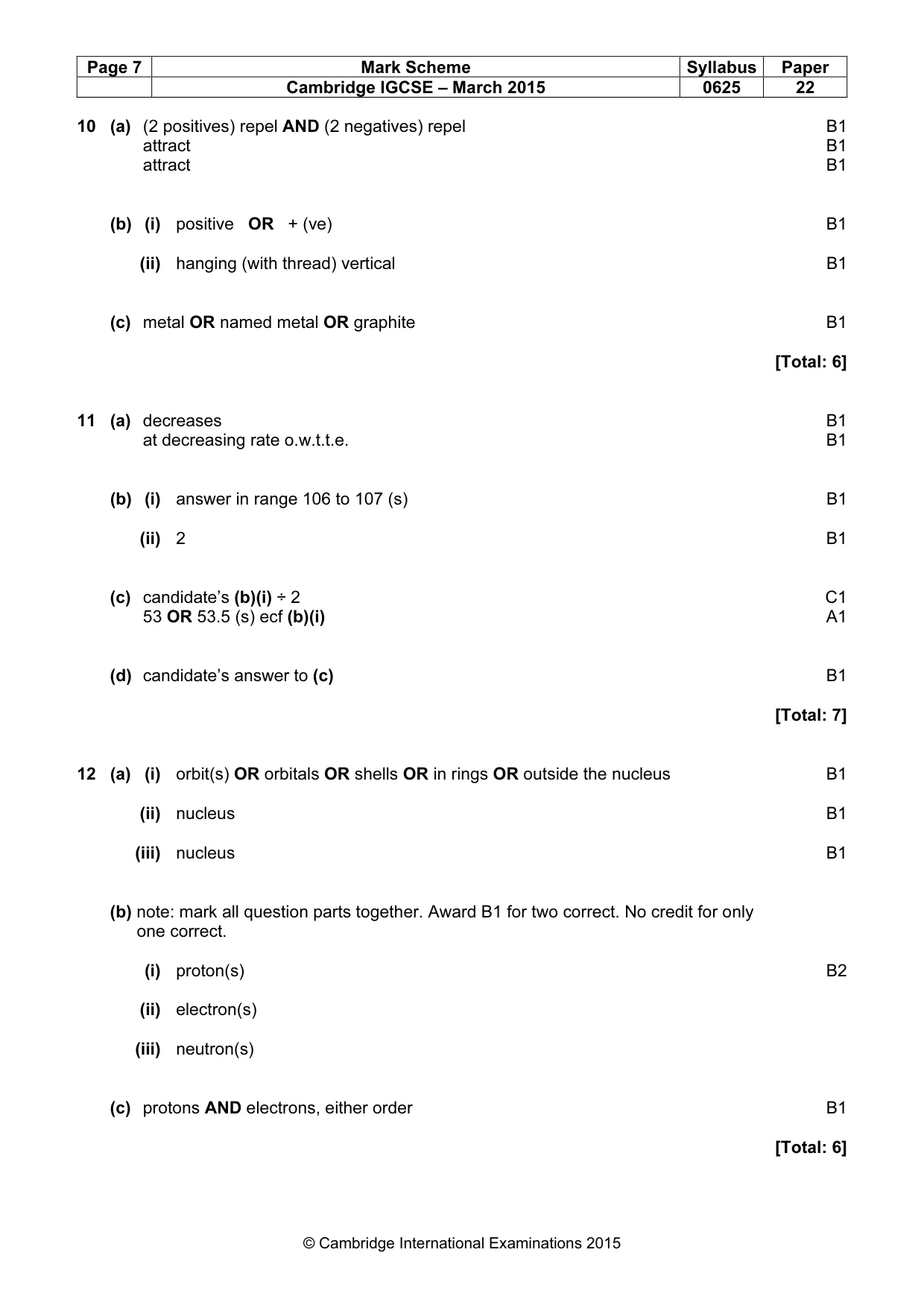
Page 7 Mark Scheme Syllabus Paper Cambridge IGCSE – March 2015 0625 22 © Cambridge International Examinations 2015 10 (a) (2 positives) repel AND (2 negatives) repel B1 attract B1 attract B1 (b) (i) positive OR + (ve) B1 (ii) hanging (with thread) vertical B1 (c) metal OR named metal OR graphite B1 [Total: 6] 11 (a) decreases B1 at decreasing rate o.w.t.t.e. B1 (b) (i) answer in range 106 to 107 (s) B1 (ii) 2 B1 (c) candidate’s (b)(i) ÷ 2 C1 53 OR 53.5 (s) ecf (b)(i) A1 (d) candidate’s answer to (c) B1 [Total: 7] 12 (a) (i) orbit(s) OR orbitals OR shells OR in rings OR outside the nucleus B1 (ii) nucleus B1 (iii) nucleus B1 (b) note: mark all question parts together. Award B1 for two correct. No credit for only one correct. (i) proton(s) B2 (ii) electron(s) (iii) neutron(s) (c) protons AND electrons, either order B1 [Total: 6]
What you needed in this session
Cambridge’s own grade thresholds for 2015 Feb/March, Paper 2 · Variant 2. A higher threshold means an easier paper — the bar moves with how the cohort did.