Cambridge IGCSE Physics 0625 — 2011 Oct/Nov Paper 2 · Variant 3
0625/23/O/N/11 · 80 marks · ≈90 min
The question paper and its mark scheme, free to read here and free to download. This is Cambridge’s own paper, exactly as it was sat.
Question paper20 pages
Mark scheme7 pages
Answers below. Sit the paper first if you are practising.
Paper as text
Question paper, page 1
This document consists of 20 printed pages. DC (CW/CGW) 34016/3 © UCLES 2011 [Turn over UNIVERSITY OF CAMBRIDGE INTERNATIONAL EXAMINATIONS International General Certificate of Secondary Education * 6 4 0 2 5 1 4 4 9 1 * PHYSICS 0625/23 Paper 2 Core October/November 2011 1 hour 15 minutes Candidates answer on the Question Paper. No Additional Materials are required. READ THESE INSTRUCTIONS FIRST Write your Centre number, candidate number and name on all the work you hand in. Write in dark blue or black pen. You may use a soft pencil for any diagrams, graphs or rough working. Do not use staples, paper clips, highlighters, glue or correction fluid. DO NOT WRITE IN ANY BARCODES. Answer all questions. You may lose marks if you do not show your working or if you do not use appropriate units. Take the weight of 1 kg to be 10 N (i.e. acceleration of free fall = 10 m / s2). At the end of the examination, fasten all your work securely together. The number of marks is given in brackets [ ] at the end of each question or part question. www.XtremePapers.com
Question paper, page 2
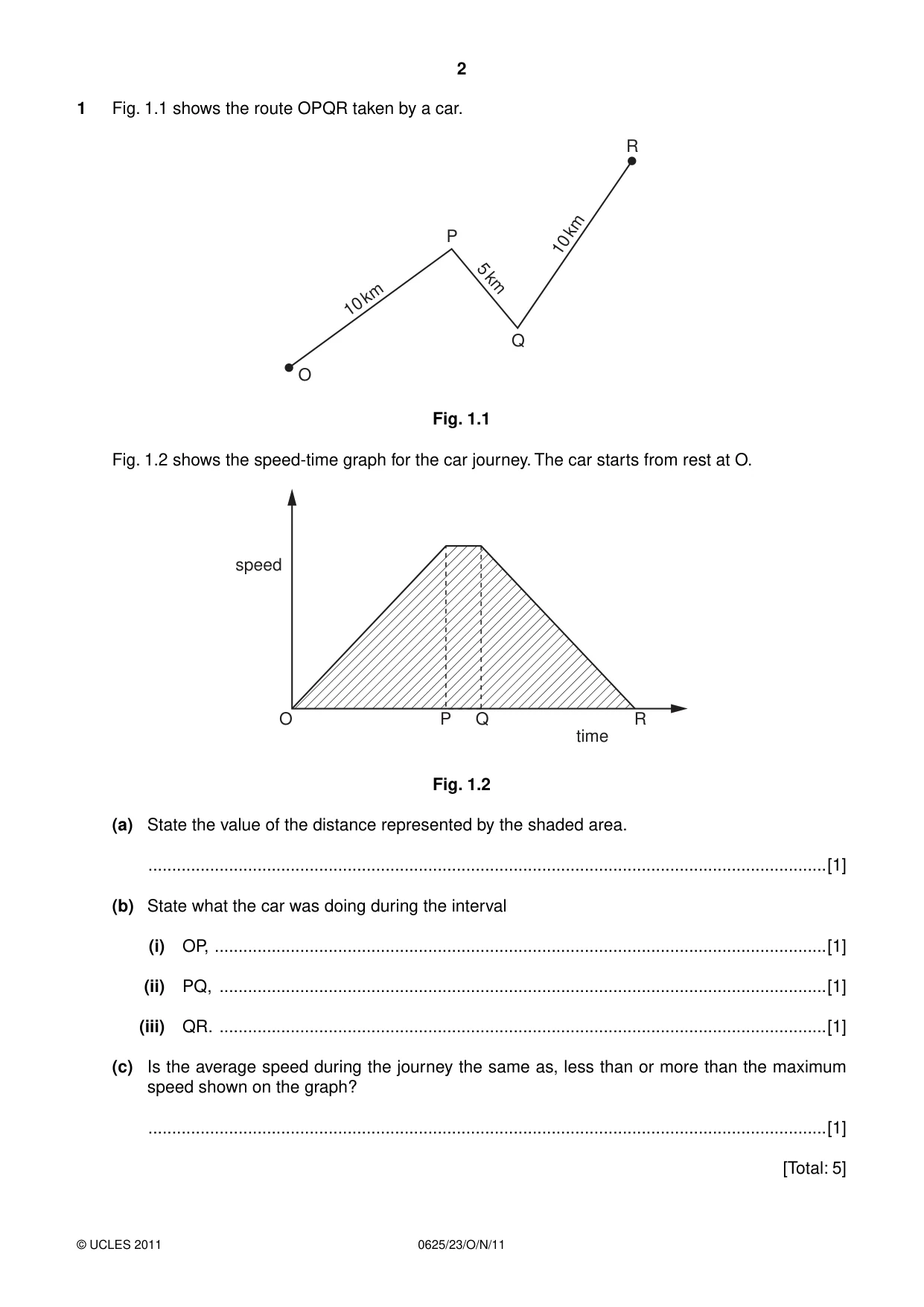
2 0625/23/O/N/11 © UCLES 2011 1 Fig. 1.1 shows the route OPQR taken by a car. 10 km 10 km 5 km P Q R O Fig. 1.1 Fig. 1.2 shows the speed-time graph for the car journey. The car starts from rest at O. O P Q R time speed Fig. 1.2 (a) State the value of the distance represented by the shaded area. …[1] (b) State what the car was doing during the interval (i) OP, …[1] (ii) PQ, …[1] (iii) QR. …[1] (c) Is the average speed during the journey the same as, less than or more than the maximum speed shown on the graph? …[1] [Total: 5]
Question paper, page 3
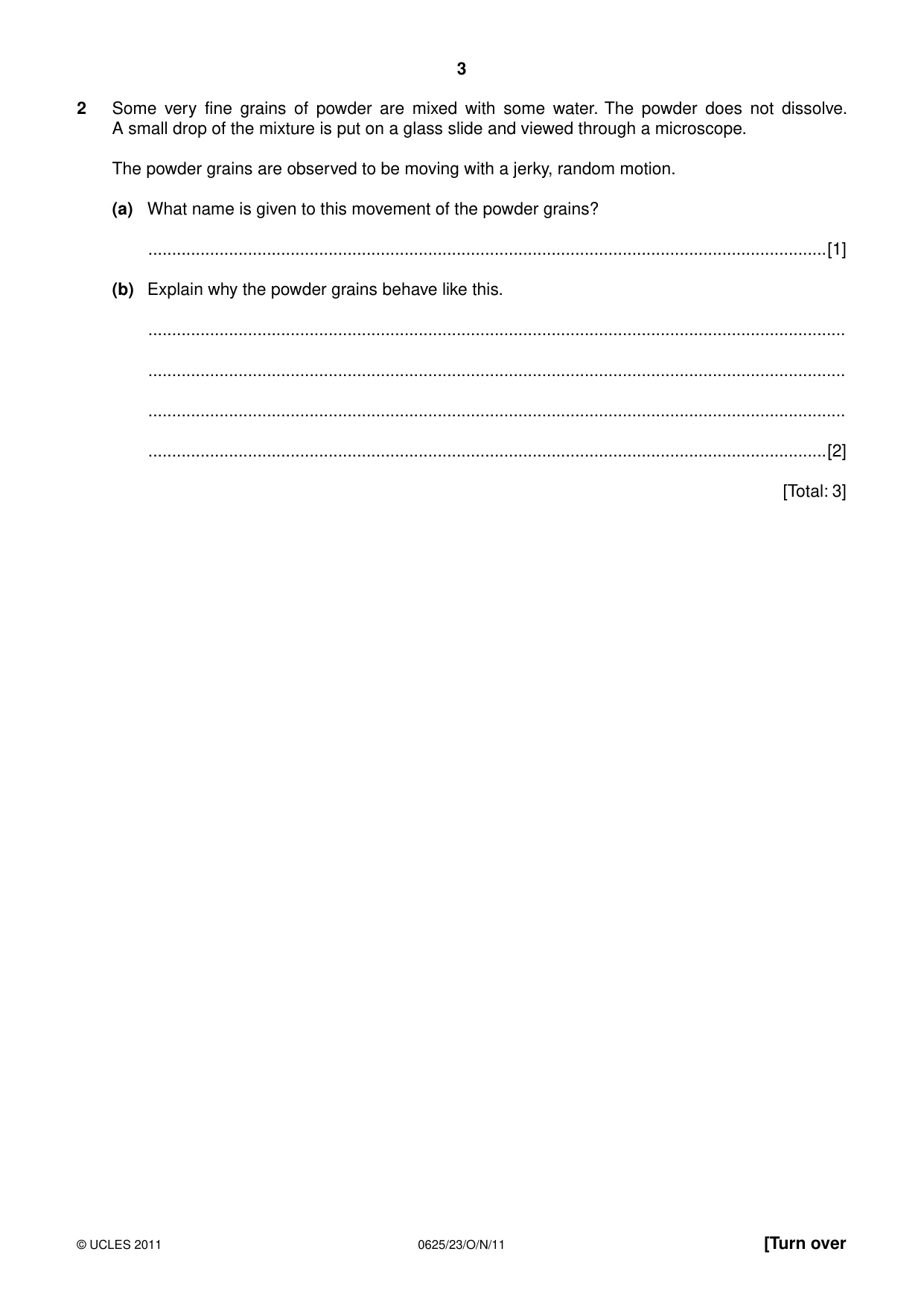
3 0625/23/O/N/11 © UCLES 2011 [Turn over 2 Some very fine grains of powder are mixed with some water. The powder does not dissolve. A small drop of the mixture is put on a glass slide and viewed through a microscope. The powder grains are observed to be moving with a jerky, random motion. (a) What name is given to this movement of the powder grains? …[1] (b) Explain why the powder grains behave like this. … … … …[2] [Total: 3]
Question paper, page 4
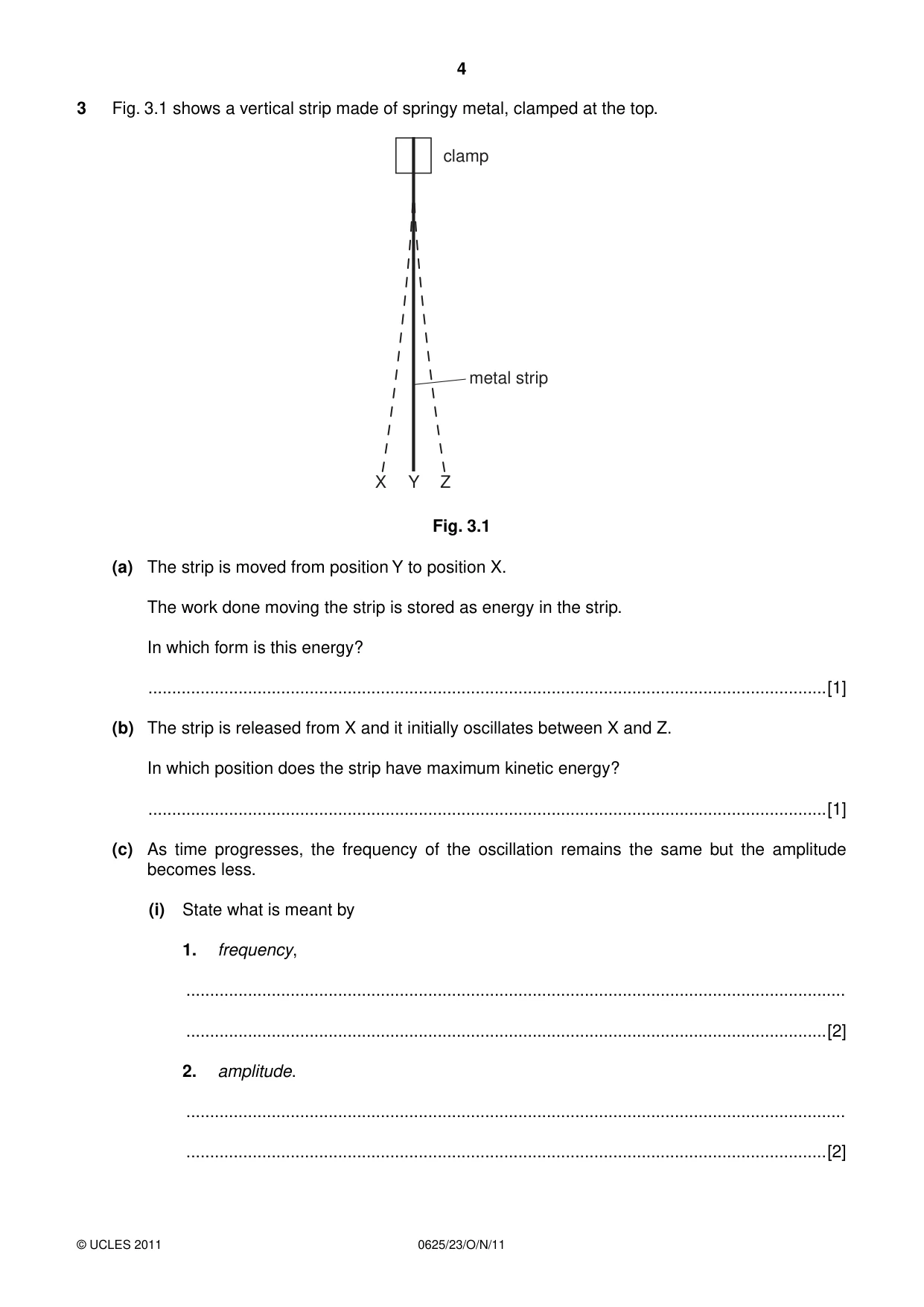
4 0625/23/O/N/11 © UCLES 2011 3 Fig. 3.1 shows a vertical strip made of springy metal, clamped at the top. clamp X Z Y metal strip Fig. 3.1 (a) The strip is moved from position Y to position X. The work done moving the strip is stored as energy in the strip. In which form is this energy? …[1] (b) The strip is released from X and it initially oscillates between X and Z. In which position does the strip have maximum kinetic energy? …[1] (c) As time progresses, the frequency of the oscillation remains the same but the amplitude becomes less. (i) State what is meant by 1. frequency, … …[2] 2. amplitude. … …[2]
Question paper, page 5
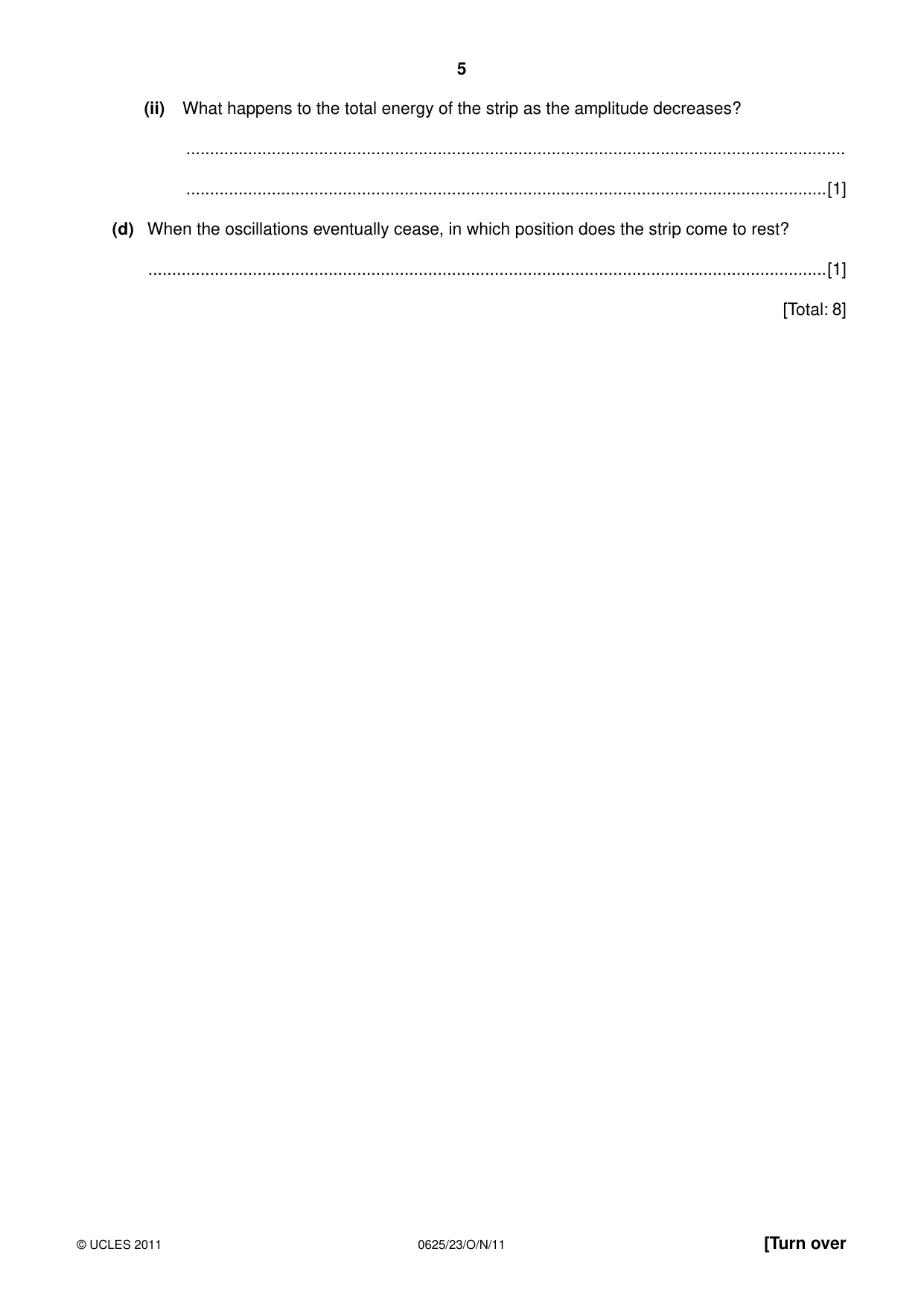
5 0625/23/O/N/11 © UCLES 2011 [Turn over (ii) What happens to the total energy of the strip as the amplitude decreases? … …[1] (d) When the oscillations eventually cease, in which position does the strip come to rest? …[1] [Total: 8]
Question paper, page 6
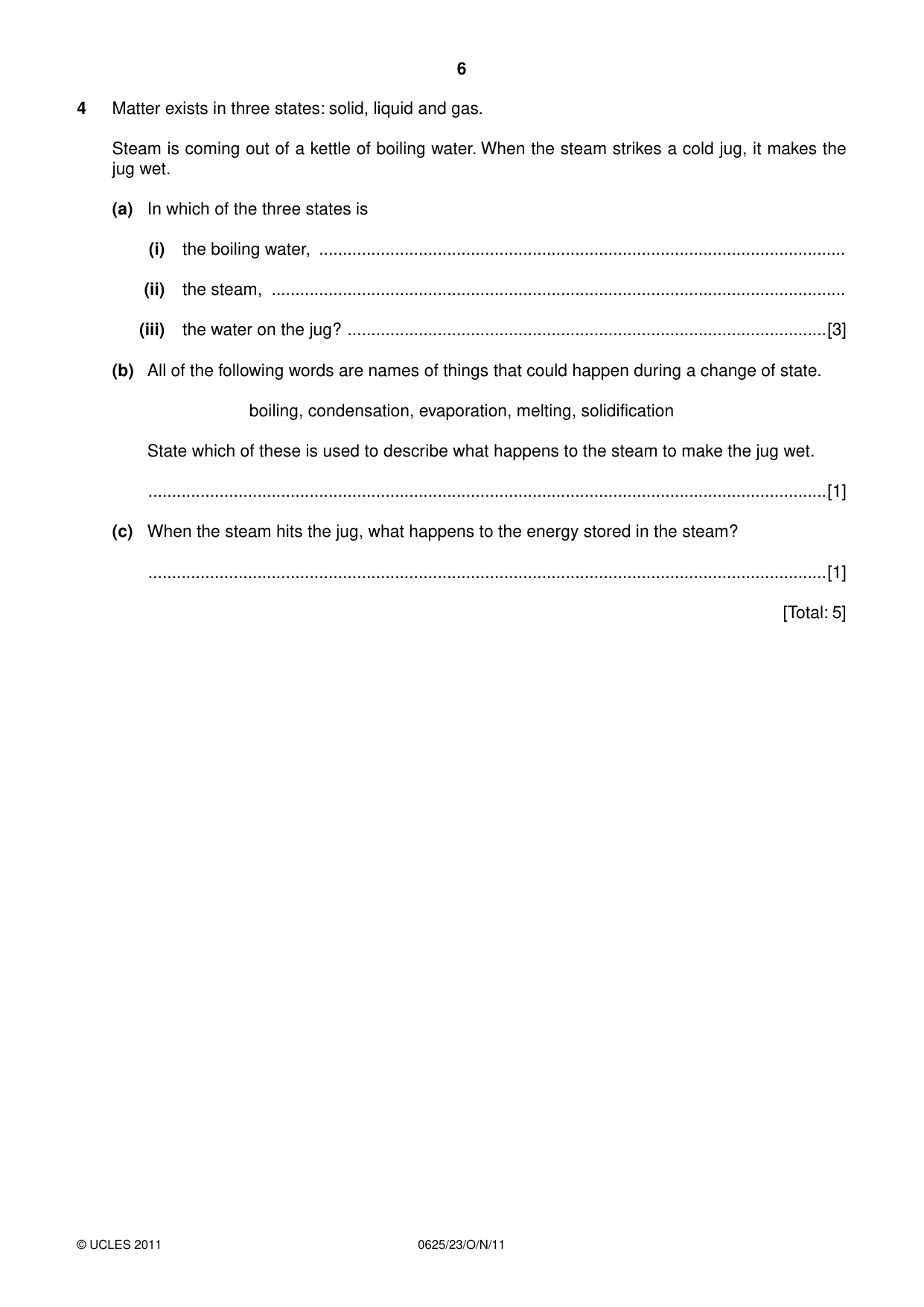
6 0625/23/O/N/11 © UCLES 2011 4 Matter exists in three states: solid, liquid and gas. Steam is coming out of a kettle of boiling water. When the steam strikes a cold jug, it makes the jug wet. (a) In which of the three states is (i) the boiling water, … (ii) the steam, … (iii) the water on the jug? …[3] (b) All of the following words are names of things that could happen during a change of state. boiling, condensation, evaporation, melting, solidification State which of these is used to describe what happens to the steam to make the jug wet. …[1] (c) When the steam hits the jug, what happens to the energy stored in the steam? …[1] [Total: 5]
Question paper, page 7
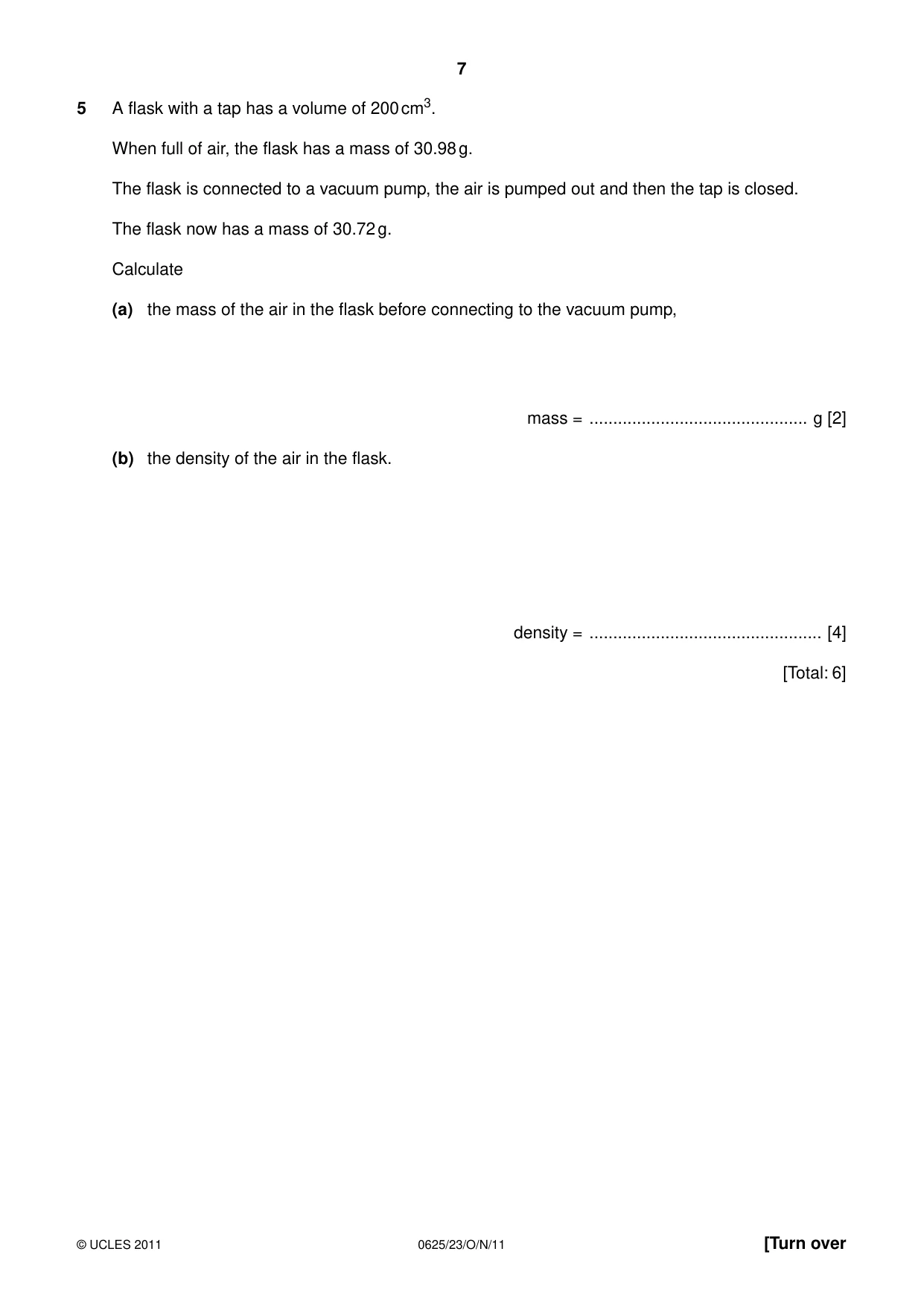
7 0625/23/O/N/11 © UCLES 2011 [Turn over 5 A flask with a tap has a volume of 200 cm3. When full of air, the flask has a mass of 30.98 g. The flask is connected to a vacuum pump, the air is pumped out and then the tap is closed. The flask now has a mass of 30.72 g. Calculate (a) the mass of the air in the flask before connecting to the vacuum pump, mass = … g [2] (b) the density of the air in the flask. density = … [4] [Total: 6]
Question paper, page 8
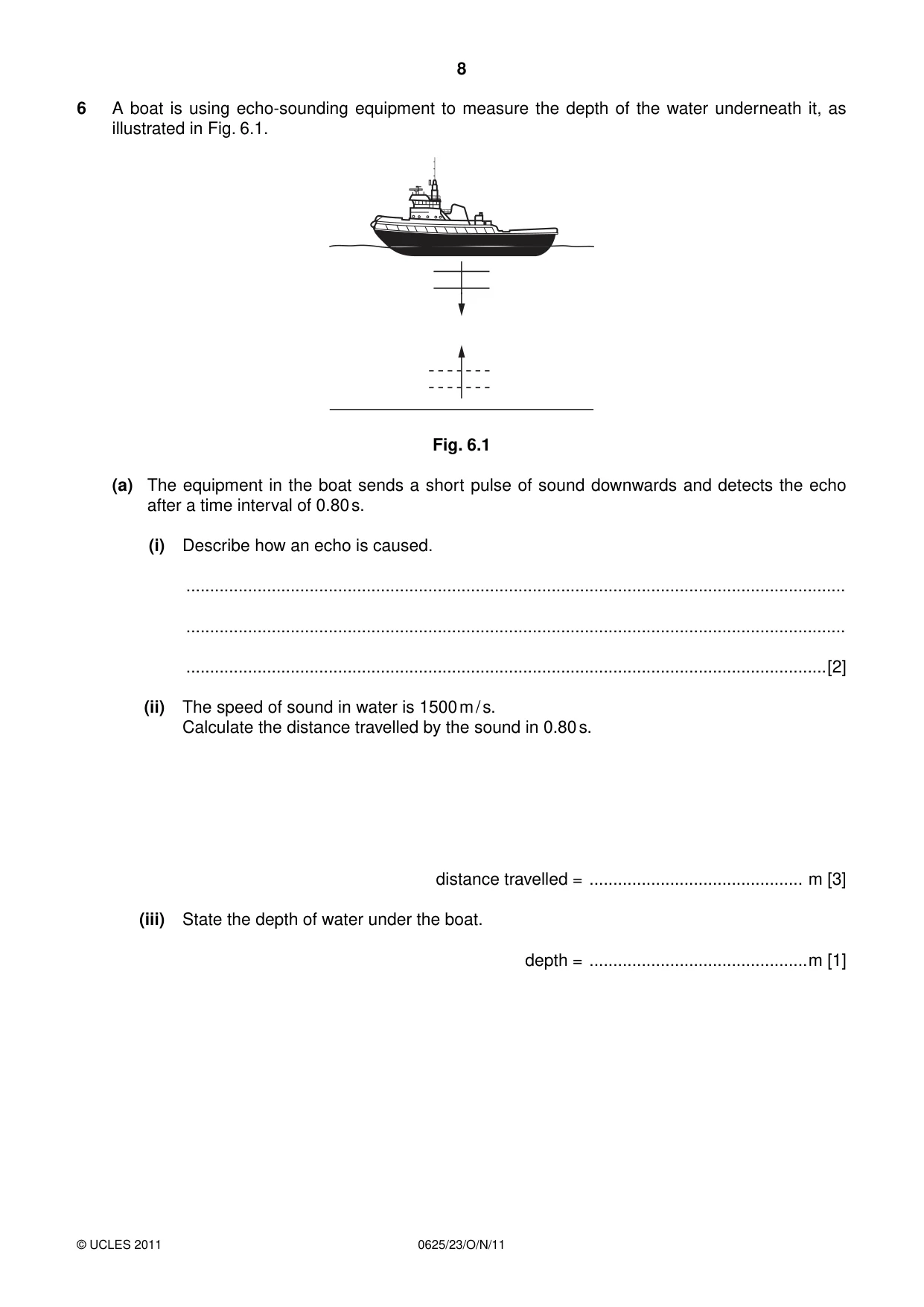
8 0625/23/O/N/11 © UCLES 2011 6 A boat is using echo-sounding equipment to measure the depth of the water underneath it, as illustrated in Fig. 6.1. Fig. 6.1 (a) The equipment in the boat sends a short pulse of sound downwards and detects the echo after a time interval of 0.80 s. (i) Describe how an echo is caused. … … …[2] (ii) The speed of sound in water is 1500 m / s. Calculate the distance travelled by the sound in 0.80 s. distance travelled = … m [3] (iii) State the depth of water under the boat. depth = …m [1]
Question paper, page 9
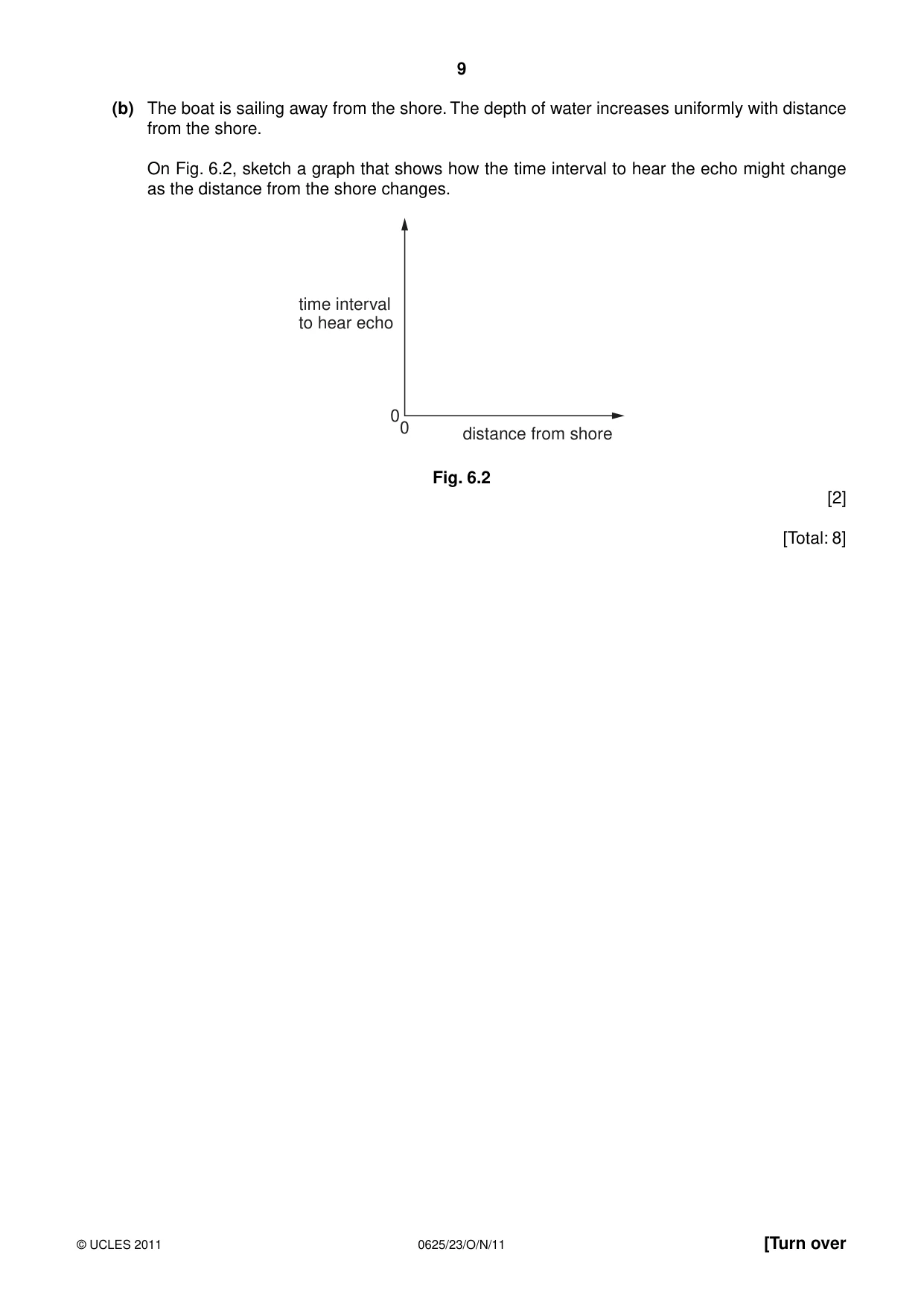
9 0625/23/O/N/11 © UCLES 2011 [Turn over (b) The boat is sailing away from the shore. The depth of water increases uniformly with distance from the shore. On Fig. 6.2, sketch a graph that shows how the time interval to hear the echo might change as the distance from the shore changes. 0 distance from shore time interval to hear echo 0 Fig. 6.2 [2] [Total: 8]
Question paper, page 10
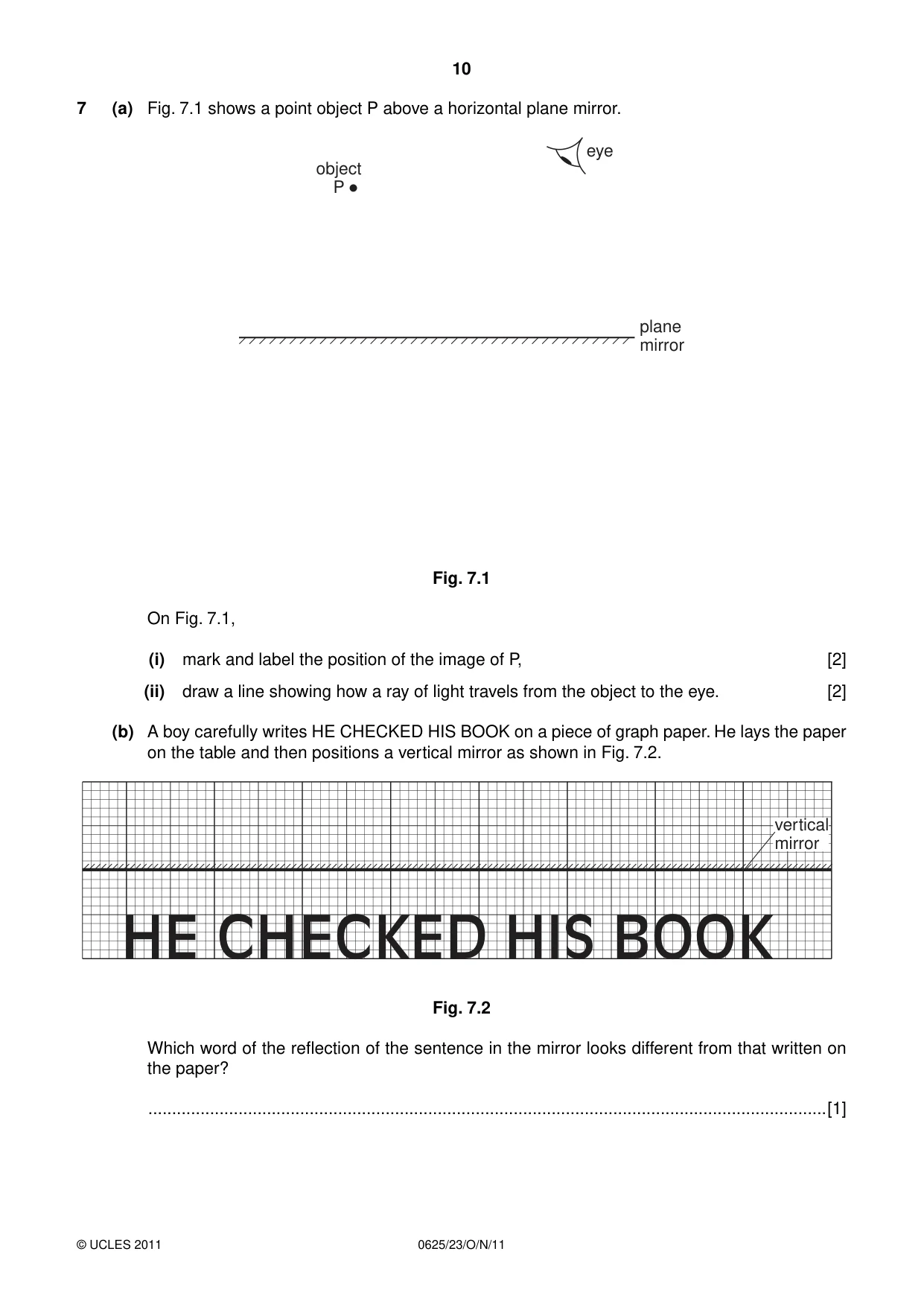
10 0625/23/O/N/11 © UCLES 2011 7 (a) Fig. 7.1 shows a point object P above a horizontal plane mirror. plane mirror object P eye Fig. 7.1 On Fig. 7.1, (i) mark and label the position of the image of P, [2] (ii) draw a line showing how a ray of light travels from the object to the eye. [2] (b) A boy carefully writes HE CHECKED HIS BOOK on a piece of graph paper. He lays the paper on the table and then positions a vertical mirror as shown in Fig. 7.2. vertical mirror HE CHECKED HIS BOOK Fig. 7.2 Which word of the reflection of the sentence in the mirror looks different from that written on the paper? …[1]
Question paper, page 11
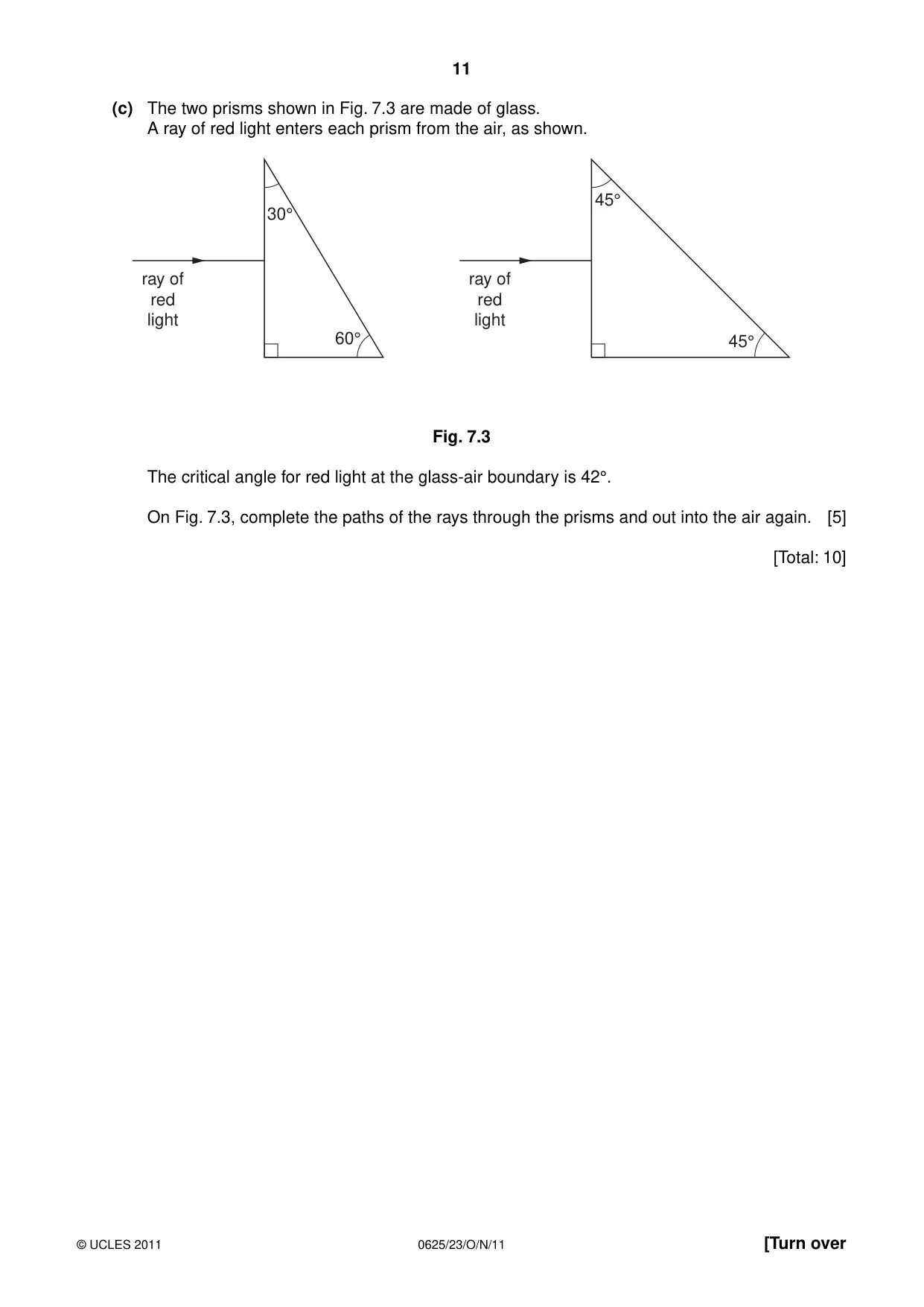
11 0625/23/O/N/11 © UCLES 2011 [Turn over (c) The two prisms shown in Fig. 7.3 are made of glass. A ray of red light enters each prism from the air, as shown. 60° 30° ray of red light 45° 45° ray of red light Fig. 7.3 The critical angle for red light at the glass-air boundary is 42°. On Fig. 7.3, complete the paths of the rays through the prisms and out into the air again. [5] [Total: 10]
Question paper, page 12
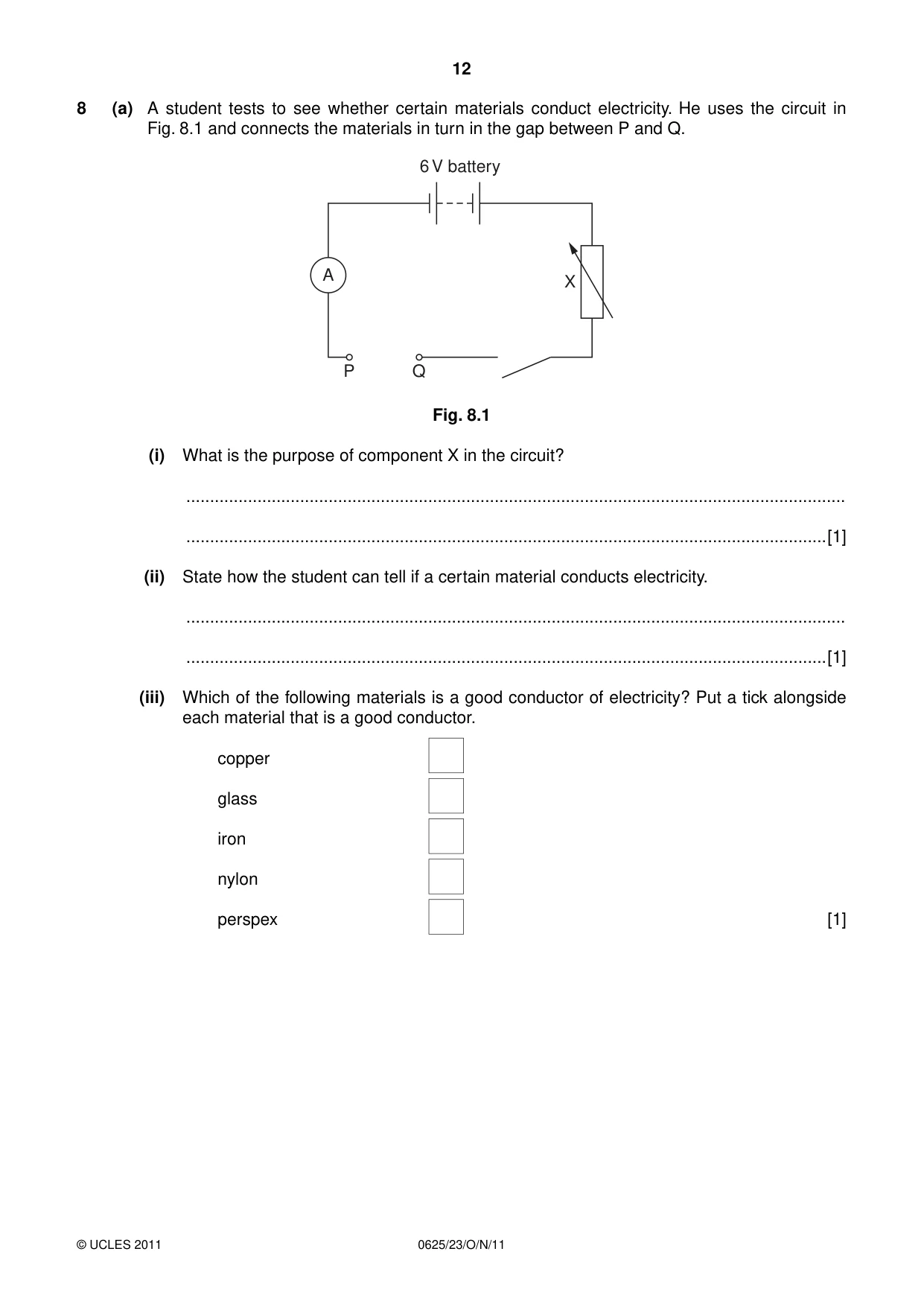
12 0625/23/O/N/11 © UCLES 2011 8 (a) A student tests to see whether certain materials conduct electricity. He uses the circuit in Fig. 8.1 and connects the materials in turn in the gap between P and Q. A 6 V battery P Q X Fig. 8.1 (i) What is the purpose of component X in the circuit? … …[1] (ii) State how the student can tell if a certain material conducts electricity. … …[1] (iii) Which of the following materials is a good conductor of electricity? Put a tick alongside each material that is a good conductor. copper glass iron nylon perspex [1]
Question paper, page 13
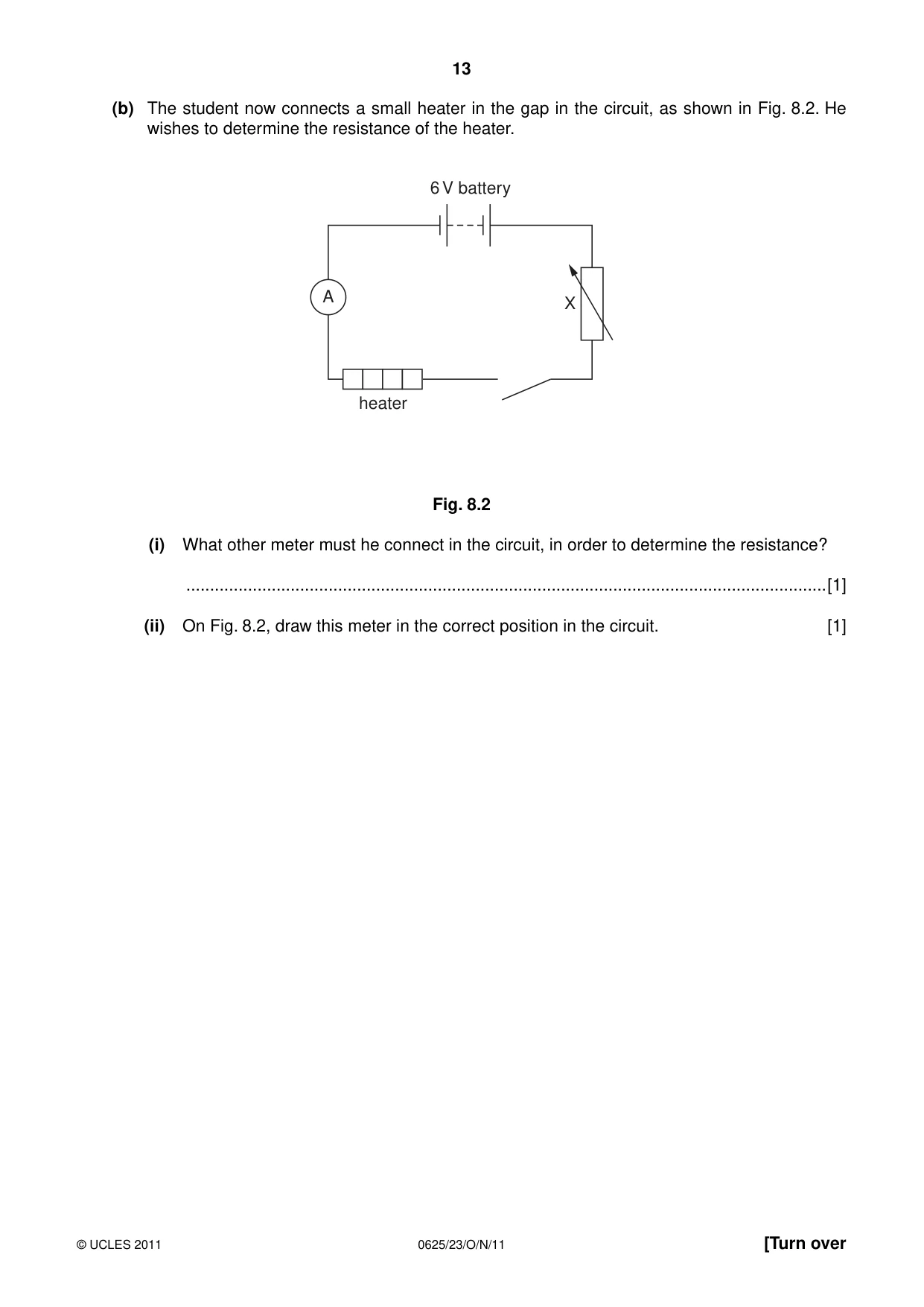
13 0625/23/O/N/11 © UCLES 2011 [Turn over (b) The student now connects a small heater in the gap in the circuit, as shown in Fig. 8.2. He wishes to determine the resistance of the heater. A 6 V battery heater X Fig. 8.2 (i) What other meter must he connect in the circuit, in order to determine the resistance? …[1] (ii) On Fig. 8.2, draw this meter in the correct position in the circuit. [1]
Question paper, page 14
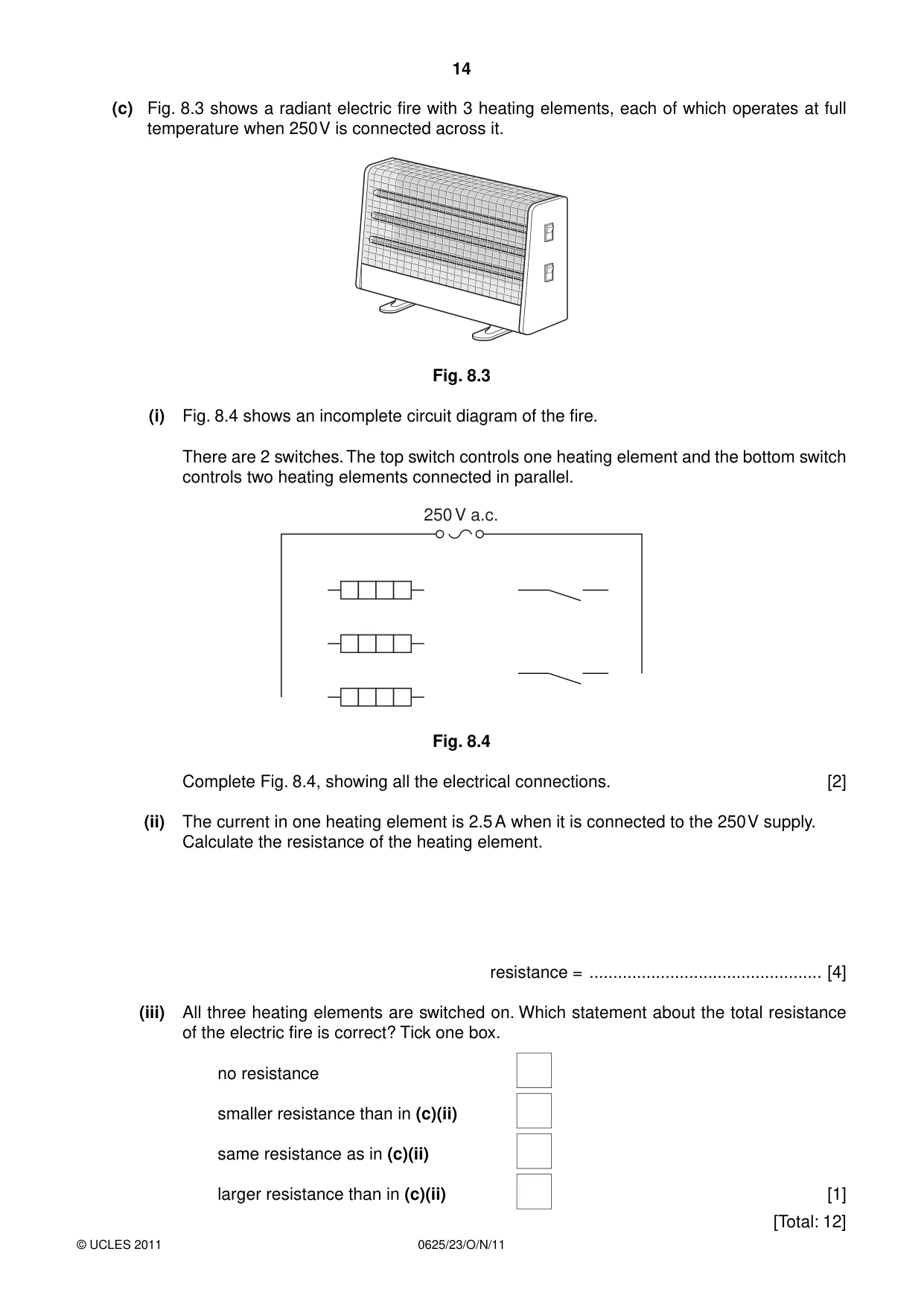
14 0625/23/O/N/11 © UCLES 2011 (c) Fig. 8.3 shows a radiant electric fire with 3 heating elements, each of which operates at full temperature when 250 V is connected across it. Fig. 8.3 (i) Fig. 8.4 shows an incomplete circuit diagram of the fire. There are 2 switches. The top switch controls one heating element and the bottom switch controls two heating elements connected in parallel. 250 V a.c. Fig. 8.4 Complete Fig. 8.4, showing all the electrical connections. [2] (ii) The current in one heating element is 2.5 A when it is connected to the 250 V supply. Calculate the resistance of the heating element. resistance = … [4] (iii) All three heating elements are switched on. Which statement about the total resistance of the electric fire is correct? Tick one box. no resistance smaller resistance than in (c)(ii) same resistance as in (c)(ii) larger resistance than in (c)(ii) [1] [Total: 12]
Question paper, page 15
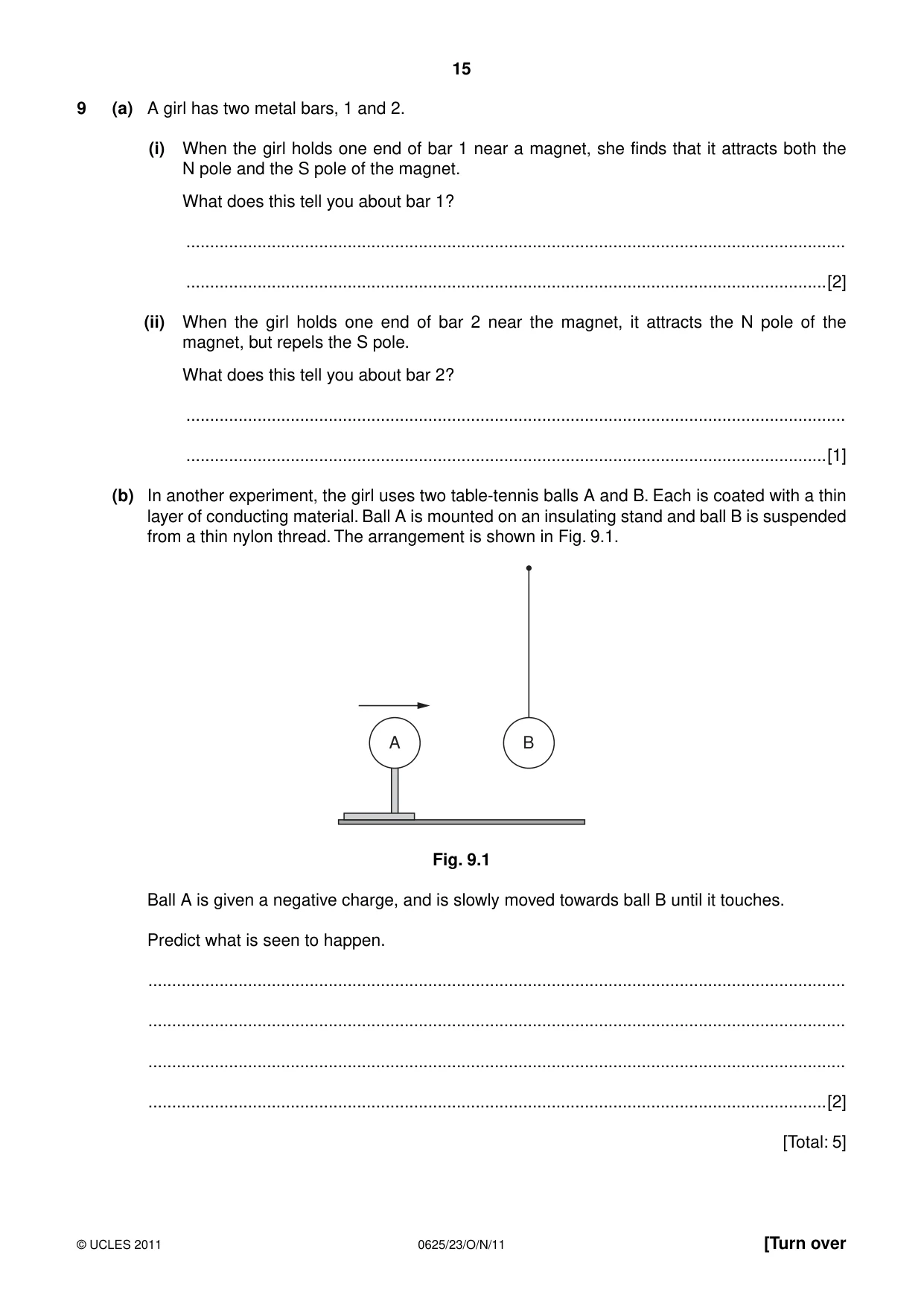
15 0625/23/O/N/11 © UCLES 2011 [Turn over 9 (a) A girl has two metal bars, 1 and 2. (i) When the girl holds one end of bar 1 near a magnet, she finds that it attracts both the N pole and the S pole of the magnet. What does this tell you about bar 1? … …[2] (ii) When the girl holds one end of bar 2 near the magnet, it attracts the N pole of the magnet, but repels the S pole. What does this tell you about bar 2? … …[1] (b) In another experiment, the girl uses two table-tennis balls A and B. Each is coated with a thin layer of conducting material. Ball A is mounted on an insulating stand and ball B is suspended from a thin nylon thread. The arrangement is shown in Fig. 9.1. A B Fig. 9.1 Ball A is given a negative charge, and is slowly moved towards ball B until it touches. Predict what is seen to happen. … … … …[2] [Total: 5]
Question paper, page 16
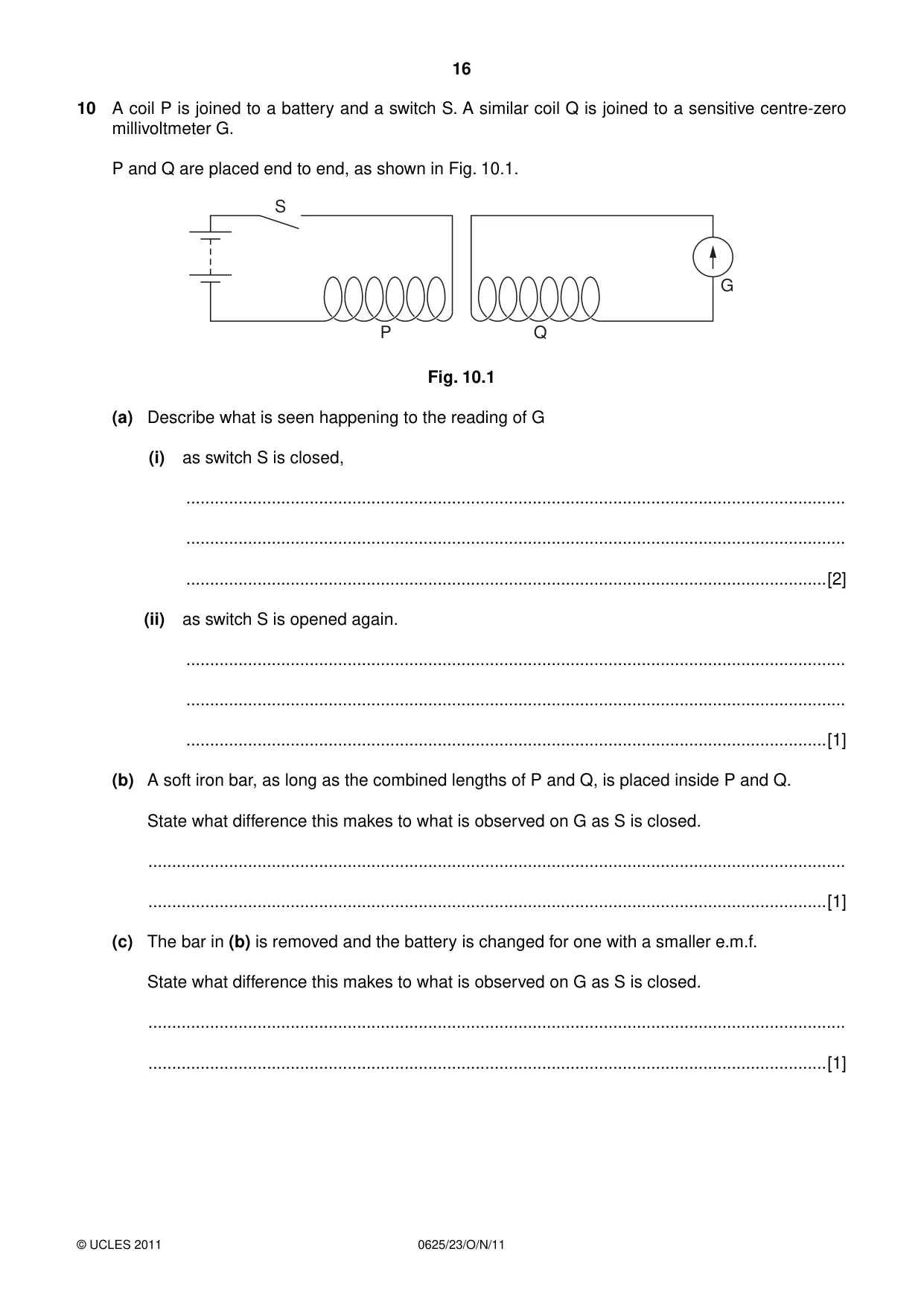
16 0625/23/O/N/11 © UCLES 2011 10 A coil P is joined to a battery and a switch S. A similar coil Q is joined to a sensitive centre-zero millivoltmeter G. P and Q are placed end to end, as shown in Fig. 10.1. S P Q G Fig. 10.1 (a) Describe what is seen happening to the reading of G (i) as switch S is closed, … … …[2] (ii) as switch S is opened again. … … …[1] (b) A soft iron bar, as long as the combined lengths of P and Q, is placed inside P and Q. State what difference this makes to what is observed on G as S is closed. … …[1] (c) The bar in (b) is removed and the battery is changed for one with a smaller e.m.f. State what difference this makes to what is observed on G as S is closed. … …[1]
Question paper, page 17
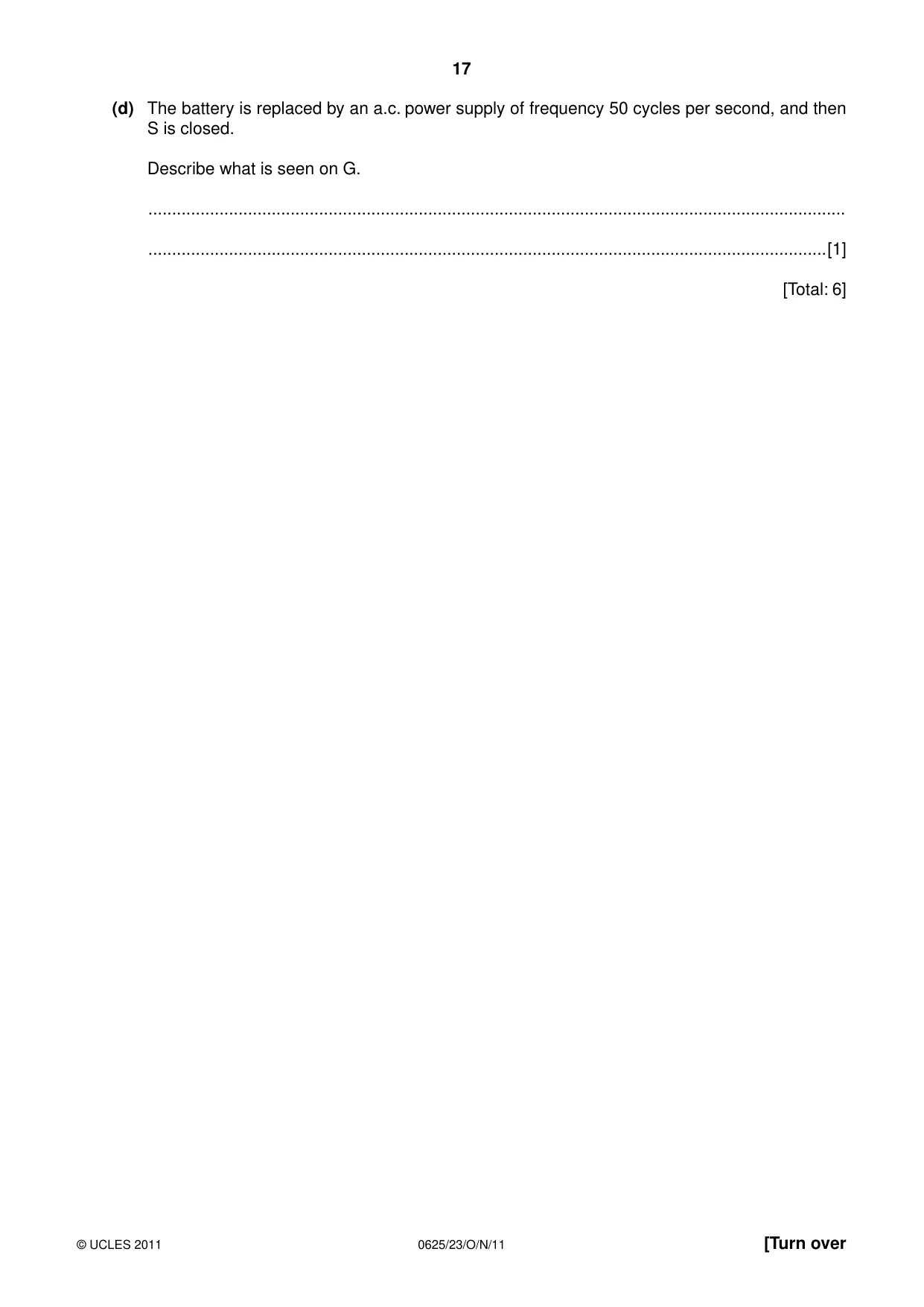
17 0625/23/O/N/11 © UCLES 2011 [Turn over (d) The battery is replaced by an a.c. power supply of frequency 50 cycles per second, and then S is closed. Describe what is seen on G. … …[1] [Total: 6]
Question paper, page 18
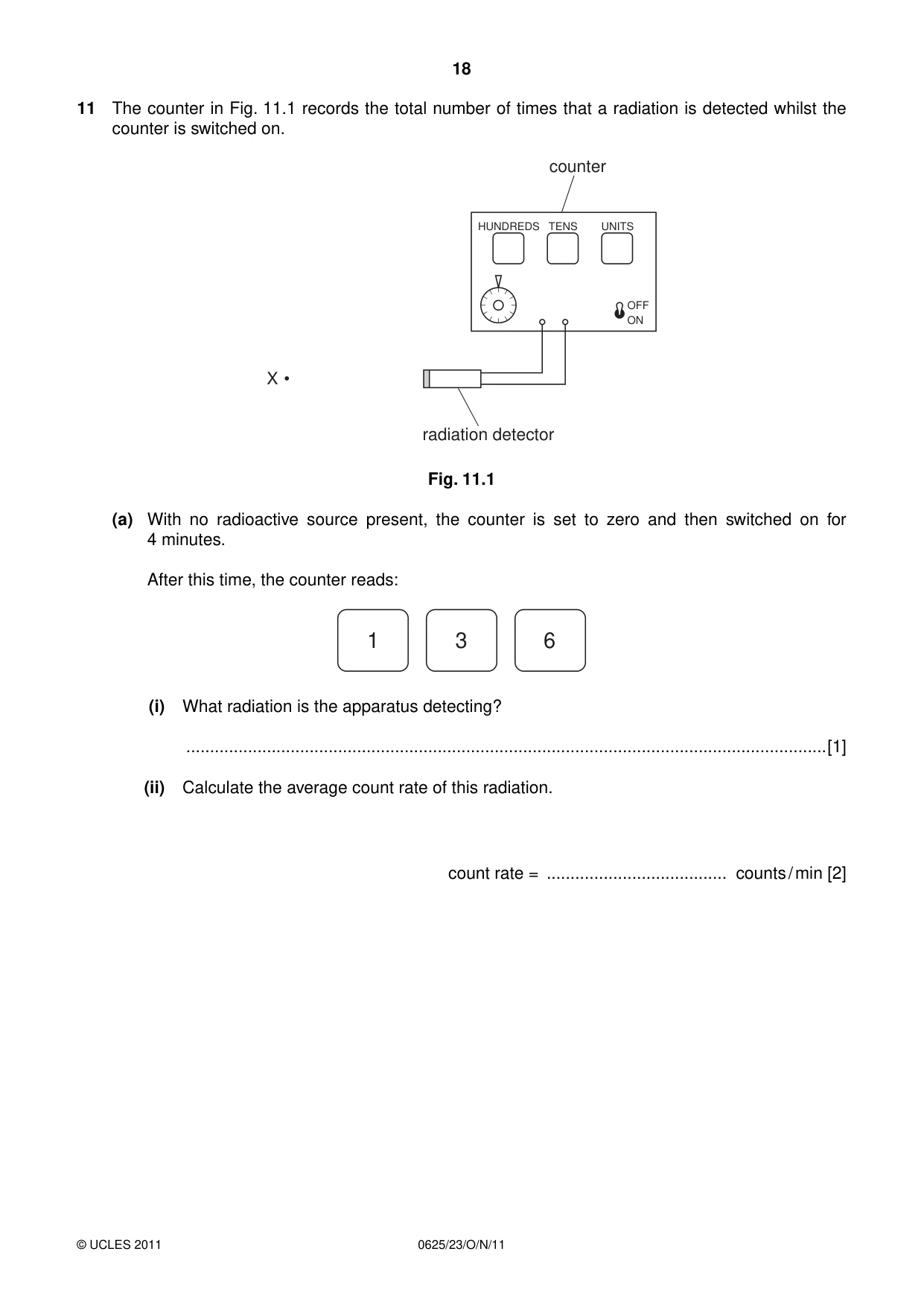
18 0625/23/O/N/11 © UCLES 2011 11 The counter in Fig. 11.1 records the total number of times that a radiation is detected whilst the counter is switched on. TENS UNITS ON OFF HUNDREDS counter radiation detector X • Fig. 11.1 (a) With no radioactive source present, the counter is set to zero and then switched on for 4 minutes. After this time, the counter reads: 1 3 6 (i) What radiation is the apparatus detecting? …[1] (ii) Calculate the average count rate of this radiation. count rate = … counts / min [2]
Question paper, page 19
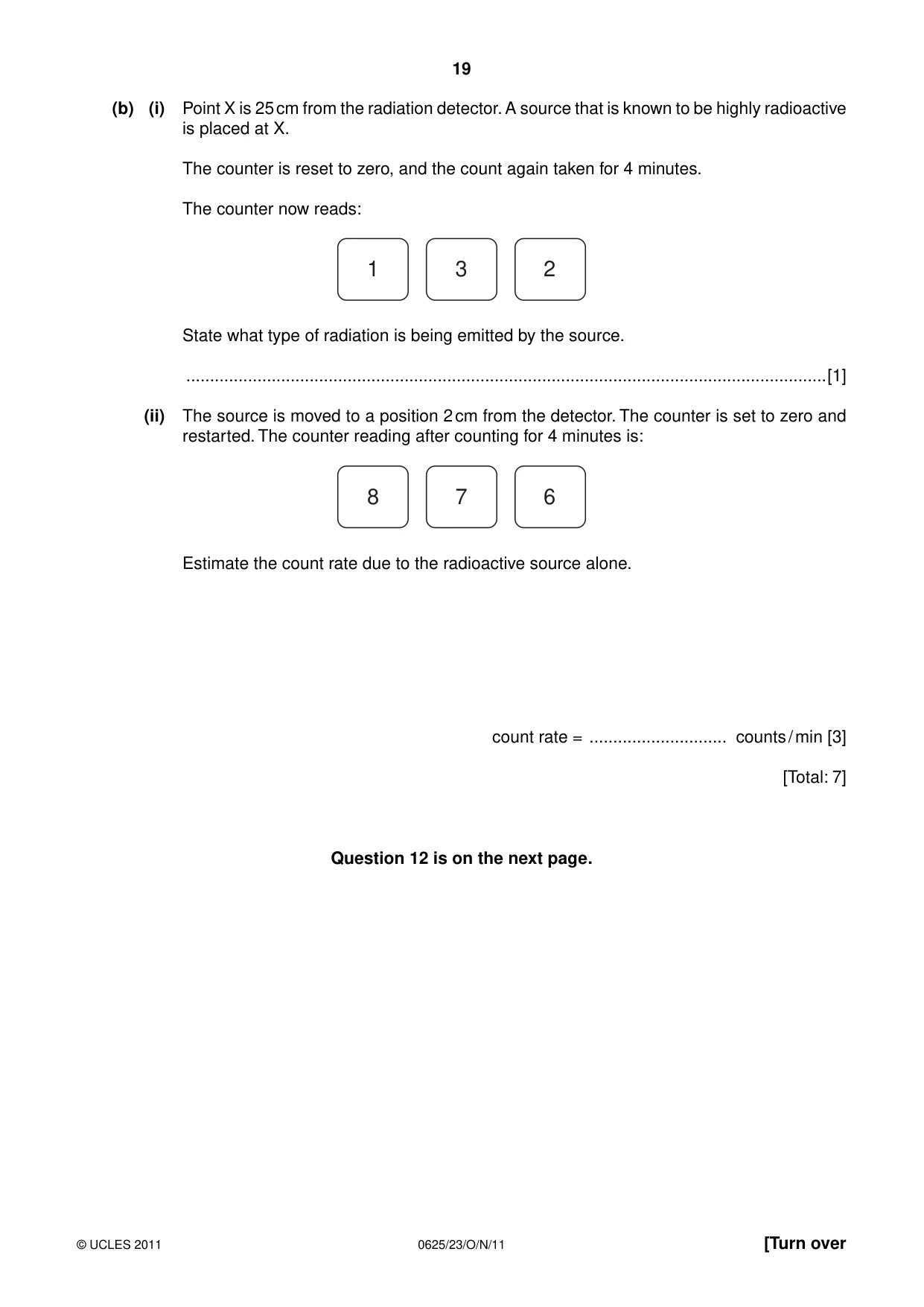
19 0625/23/O/N/11 © UCLES 2011 [Turn over (b) (i) Point X is 25 cm from the radiation detector. A source that is known to be highly radioactive is placed at X. The counter is reset to zero, and the count again taken for 4 minutes. The counter now reads: 1 3 2 State what type of radiation is being emitted by the source. …[1] (ii) The source is moved to a position 2 cm from the detector. The counter is set to zero and restarted. The counter reading after counting for 4 minutes is: 8 7 6 Estimate the count rate due to the radioactive source alone. count rate = … counts / min [3] [Total: 7] Question 12 is on the next page.
Question paper, page 20
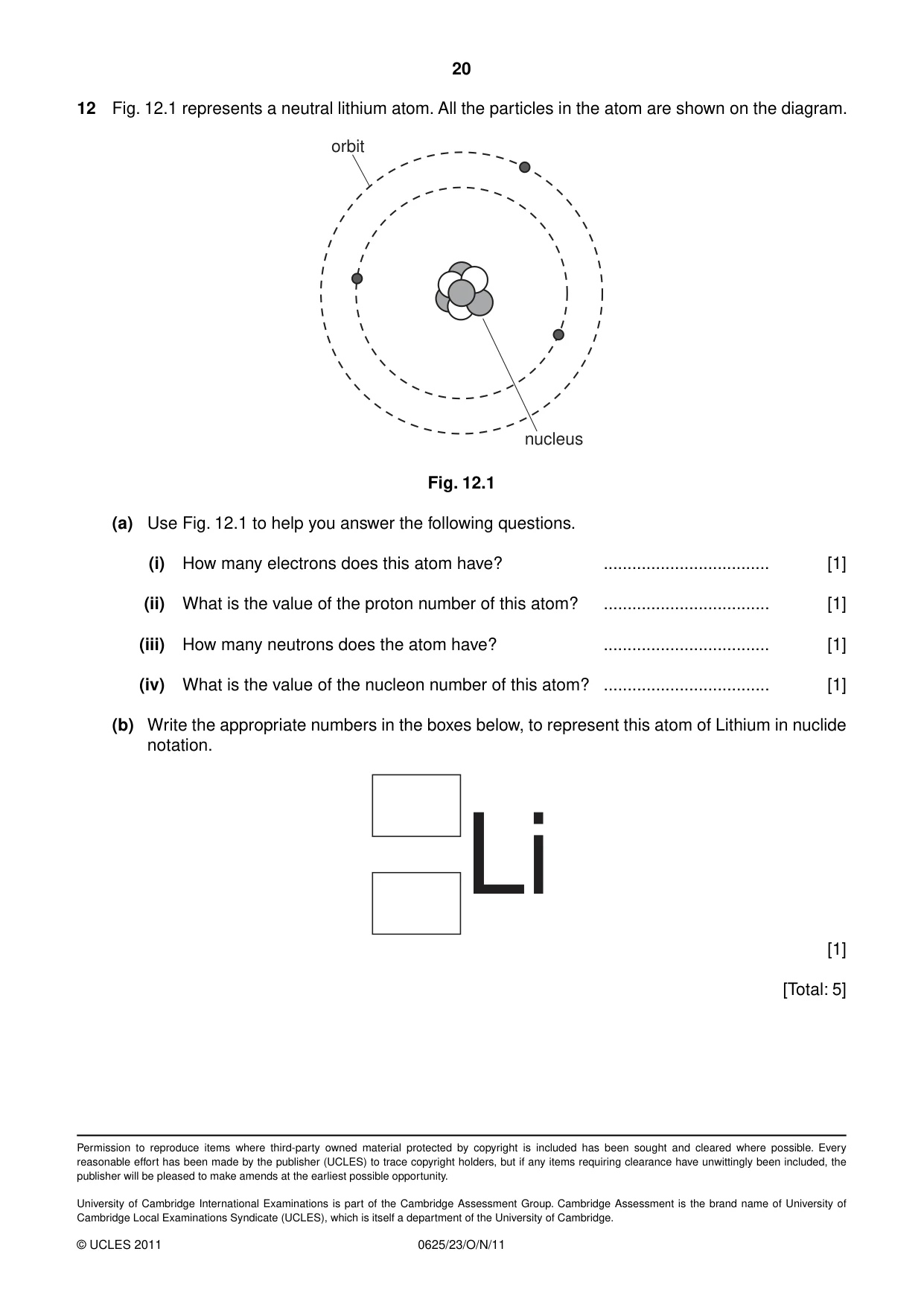
20 0625/23/O/N/11 © UCLES 2011 Permission to reproduce items where third-party owned material protected by copyright is included has been sought and cleared where possible. Every reasonable effort has been made by the publisher (UCLES) to trace copyright holders, but if any items requiring clearance have unwittingly been included, the publisher will be pleased to make amends at the earliest possible opportunity. University of Cambridge International Examinations is part of the Cambridge Assessment Group. Cambridge Assessment is the brand name of University of Cambridge Local Examinations Syndicate (UCLES), which is itself a department of the University of Cambridge. 12 Fig. 12.1 represents a neutral lithium atom. All the particles in the atom are shown on the diagram. orbit nucleus Fig. 12.1 (a) Use Fig. 12.1 to help you answer the following questions. (i) How many electrons does this atom have? … [1] (ii) What is the value of the proton number of this atom? … [1] (iii) How many neutrons does the atom have? … [1] (iv) What is the value of the nucleon number of this atom? … [1] (b) Write the appropriate numbers in the boxes below, to represent this atom of Lithium in nuclide notation. Li [1] [Total: 5]
Mark scheme, page 1
UNIVERSITY OF CAMBRIDGE INTERNATIONAL EXAMINATIONS International General Certificate of Secondary Education MARK SCHEME for the October/November 2011 question paper for the guidance of teachers 0625 PHYSICS 0625/23 Paper 2 (Core Theory), maximum raw mark 80 This mark scheme is published as an aid to teachers and candidates, to indicate the requirements of the examination. It shows the basis on which Examiners were instructed to award marks. It does not indicate the details of the discussions that took place at an Examiners’ meeting before marking began, which would have considered the acceptability of alternative answers. Mark schemes must be read in conjunction with the question papers and the report on the examination. • Cambridge will not enter into discussions or correspondence in connection with these mark schemes. Cambridge is publishing the mark schemes for the October/November 2011 question papers for most IGCSE, GCE Advanced Level and Advanced Subsidiary Level syllabuses and some Ordinary Level syllabuses. www.XtremePapers.com
Mark scheme, page 2
Page 2 Mark Scheme: Teachers’ version Syllabus Paper IGCSE – October/November 2011 0625 23 © University of Cambridge International Examinations 2011 NOTES ABOUT MARK SCHEME SYMBOLS & OTHER MATTERS B marks are independent marks, which do not depend on any other marks. For a B mark to be scored, the point to which it refers must actually be seen in the candidate's answer. M marks are method marks upon which accuracy marks (A marks) later depend. For an M mark to be scored, the point to which it refers must be seen in a candidate's answer. If a candidate fails to score a particular M mark, then none of the dependent A marks can be scored. C marks are compensatory method marks which can be scored even if the points to which they refer are not written down by the candidate, provided subsequent working gives evidence that they must have known it. e.g. if an equation carries a C mark and the candidate does not write down the actual equation but does correct working which shows he knew the equation, then the C mark is scored. A marks are accuracy or answer marks which either depend on an M mark, or which are one of the ways which allow a C mark to be scored. c.a.o. means "correct answer only". e.c.f. means "error carried forward". This indicates that if a candidate has made an earlier mistake and has carried his incorrect value forward to subsequent stages of working, he may be given marks indicated by e.c.f. provided his subsequent working is correct, bearing in mind his earlier mistake. This prevents a candidate being penalised more than once for a particular mistake, but only applies to marks annotated "e.c.f." e.e.o.o. means "each error or omission". brackets ( ) around words or units in the mark scheme are intended to indicate wording used to clarify the mark scheme, but the marks do not depend on seeing the words or units in brackets. e.g. 10 (J) means that the mark is scored for 10, regardless of the unit given. underlining indicates that this must be seen in the answer offered, or something very similar. OR/or indicates alternative answers, any one of which is satisfactory for scoring the marks. Spelling Be generous about spelling and use of English. If an answer can be understood to mean what we want, give credit. Significant Answers are acceptable to any number of significant figures ≥ 2, except if figures specified otherwise, or if only 1 sig. fig. is appropriate. Units Incorrect units are not penalised, except where specified. More commonly, marks are allocated for specific units. Fractions These are only acceptable where specified. Extras Ignore extras in answers if they are irrelevant; if they contradict an otherwise correct response or are forbidden by mark scheme, use right + wrong = 0 Ignore Indicates that something which is not correct is disregarded and does not cause a right plus wrong penalty.
Mark scheme, page 3
Page 3 Mark Scheme: Teachers’ version Syllabus Paper IGCSE – October/November 2011 0625 23 © University of Cambridge International Examinations 2011 Not/NOT Indicates that an incorrect answer is not to be disregarded, but cancels another otherwise correct alternative offered by the candidate i.e. right plus wrong penalty applies.
Mark scheme, page 4
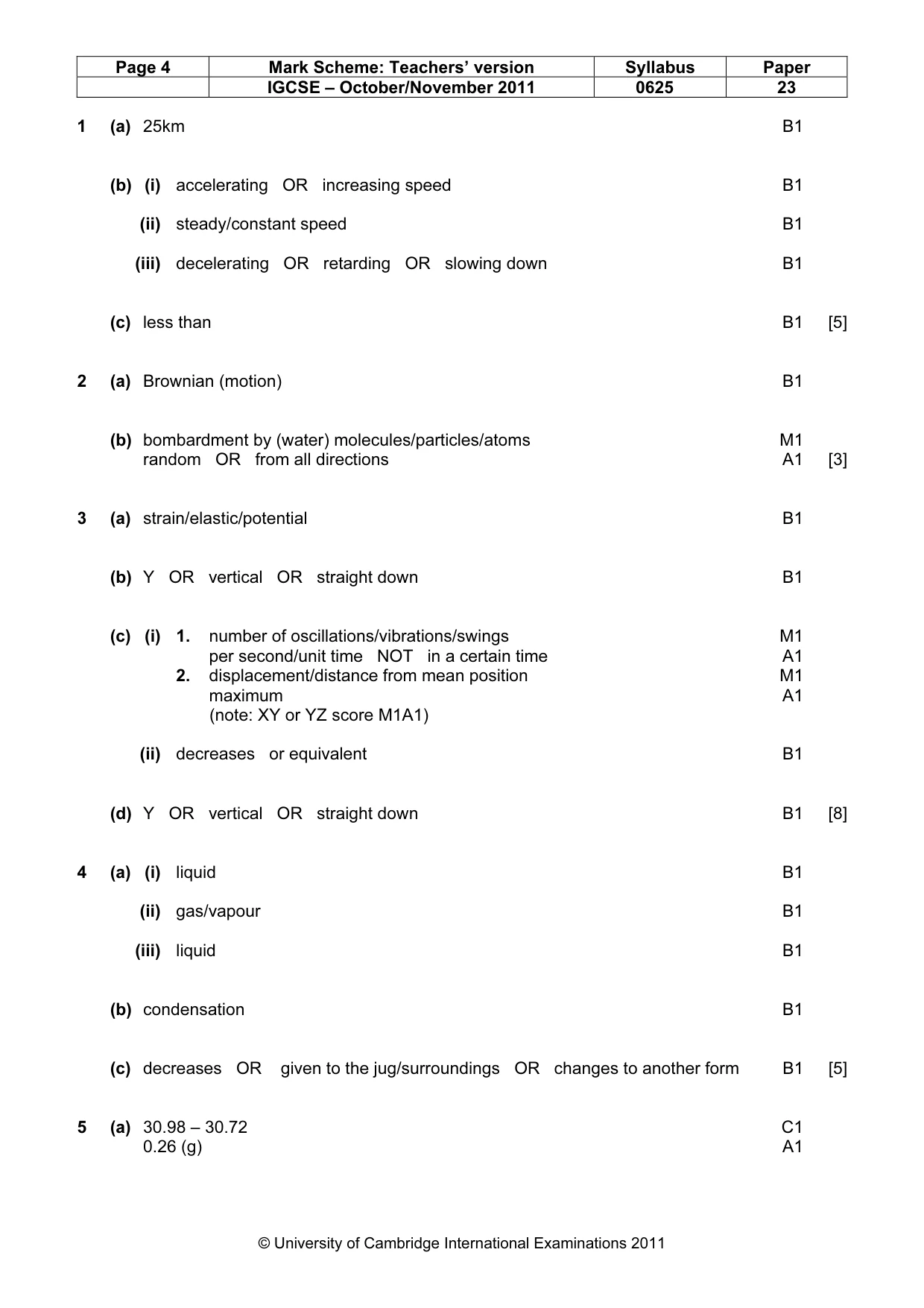
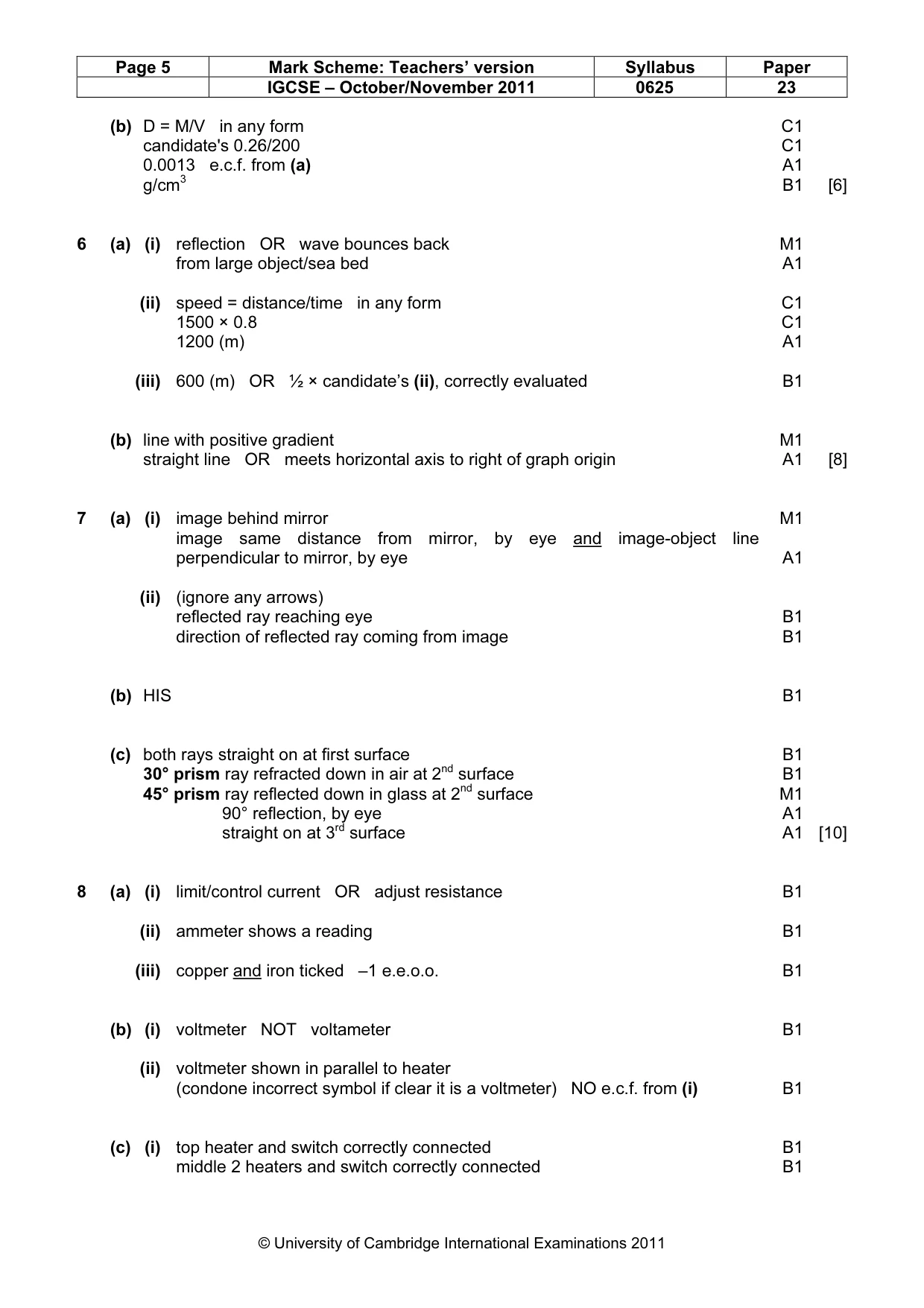
Page 4 Mark Scheme: Teachers’ version Syllabus Paper IGCSE – October/November 2011 0625 23 © University of Cambridge International Examinations 2011 1 (a) 25km B1 (b) (i) accelerating OR increasing speed B1 (ii) steady/constant speed B1 (iii) decelerating OR retarding OR slowing down B1 (c) less than B1 [5] 2 (a) Brownian (motion) B1 (b) bombardment by (water) molecules/particles/atoms M1 random OR from all directions A1 [3] 3 (a) strain/elastic/potential B1 (b) Y OR vertical OR straight down B1 (c) (i) 1. number of oscillations/vibrations/swings M1 per second/unit time NOT in a certain time A1 2. displacement/distance from mean position M1 maximum A1 (note: XY or YZ score M1A1) (ii) decreases or equivalent B1 (d) Y OR vertical OR straight down B1 [8] 4 (a) (i) liquid B1 (ii) gas/vapour B1 (iii) liquid B1 (b) condensation B1 (c) decreases OR given to the jug/surroundings OR changes to another form B1 [5] 5 (a) 30.98 – 30.72 C1 0.26 (g) A1
Mark scheme, page 5
Page 5 Mark Scheme: Teachers’ version Syllabus Paper IGCSE – October/November 2011 0625 23 © University of Cambridge International Examinations 2011 (b) D = M/V in any form C1 candidate's 0.26/200 C1 0.0013 e.c.f. from (a) A1 g/cm3 B1 [6] 6 (a) (i) reflection OR wave bounces back M1 from large object/sea bed A1 (ii) speed = distance/time in any form C1 1500 × 0.8 C1 1200 (m) A1 (iii) 600 (m) OR ½ × candidate’s (ii), correctly evaluated B1 (b) line with positive gradient M1 straight line OR meets horizontal axis to right of graph origin A1 [8] 7 (a) (i) image behind mirror M1 image same distance from mirror, by eye and image-object line perpendicular to mirror, by eye A1 (ii) (ignore any arrows) reflected ray reaching eye B1 direction of reflected ray coming from image B1 (b) HIS B1 (c) both rays straight on at first surface B1 30° prism ray refracted down in air at 2nd surface B1 45° prism ray reflected down in glass at 2nd surface M1 90° reflection, by eye A1 straight on at 3rd surface A1 [10] 8 (a) (i) limit/control current OR adjust resistance B1 (ii) ammeter shows a reading B1 (iii) copper and iron ticked –1 e.e.o.o. B1 (b) (i) voltmeter NOT voltameter B1 (ii) voltmeter shown in parallel to heater (condone incorrect symbol if clear it is a voltmeter) NO e.c.f. from (i) B1 (c) (i) top heater and switch correctly connected B1 middle 2 heaters and switch correctly connected B1
Mark scheme, page 6
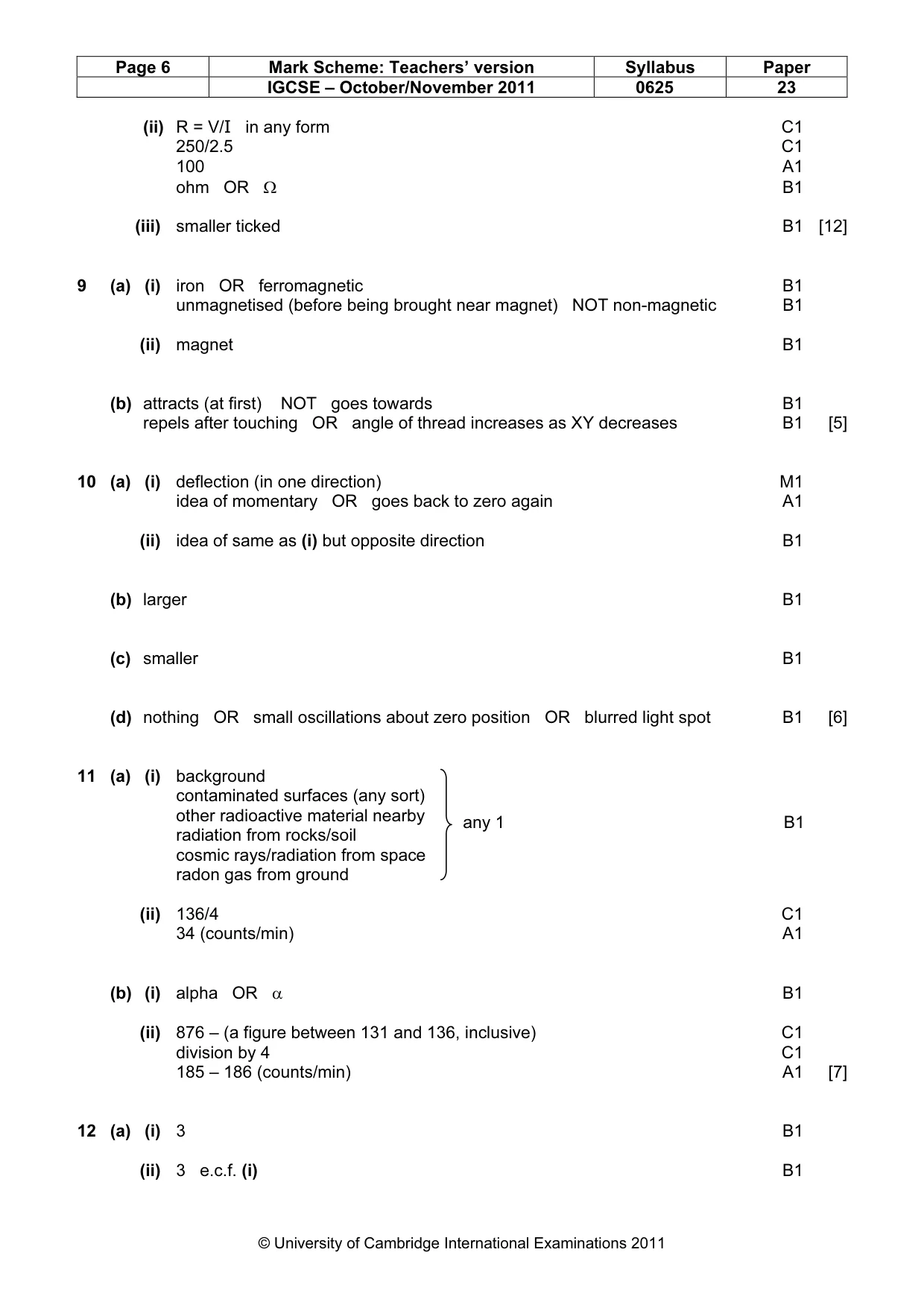
Page 6 Mark Scheme: Teachers’ version Syllabus Paper IGCSE – October/November 2011 0625 23 © University of Cambridge International Examinations 2011 (ii) R = V/I in any form C1 250/2.5 C1 100 A1 ohm OR Ω B1 (iii) smaller ticked B1 [12] 9 (a) (i) iron OR ferromagnetic B1 unmagnetised (before being brought near magnet) NOT non-magnetic B1 (ii) magnet B1 (b) attracts (at first) NOT goes towards B1 repels after touching OR angle of thread increases as XY decreases B1 [5] 10 (a) (i) deflection (in one direction) M1 idea of momentary OR goes back to zero again A1 (ii) idea of same as (i) but opposite direction B1 (b) larger B1 (c) smaller B1 (d) nothing OR small oscillations about zero position OR blurred light spot B1 [6] 11 (a) (i) background contaminated surfaces (any sort) other radioactive material nearby radiation from rocks/soil cosmic rays/radiation from space radon gas from ground (ii) 136/4 C1 34 (counts/min) A1 (b) (i) alpha OR α B1 (ii) 876 – (a figure between 131 and 136, inclusive) C1 division by 4 C1 185 – 186 (counts/min) A1 [7] 12 (a) (i) 3 B1 (ii) 3 e.c.f. (i) B1 any 1 B1
Mark scheme, page 7
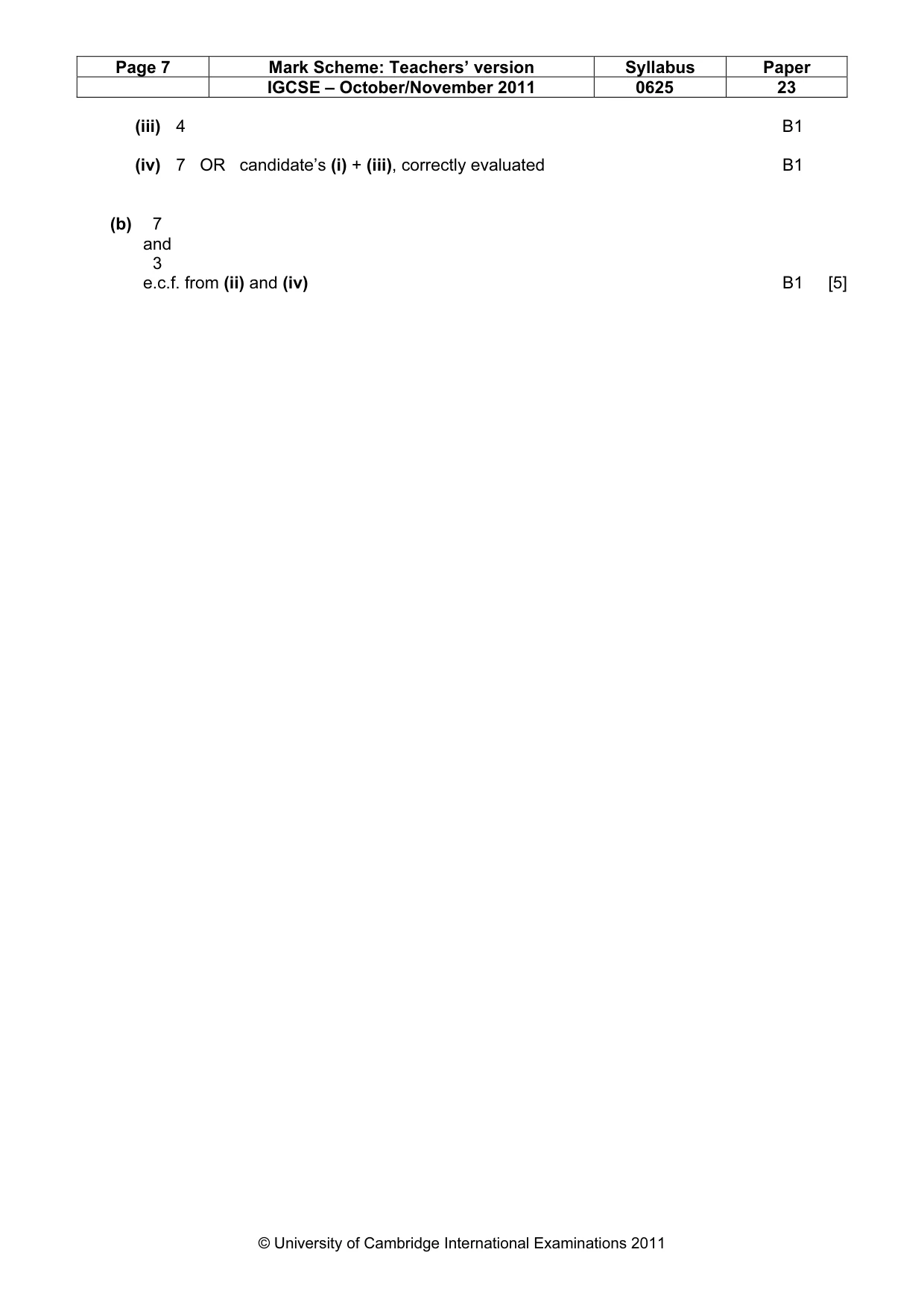
Page 7 Mark Scheme: Teachers’ version Syllabus Paper IGCSE – October/November 2011 0625 23 © University of Cambridge International Examinations 2011 (iii) 4 B1 (iv) 7 OR candidate’s (i) + (iii), correctly evaluated B1 (b) 7 and 3 e.c.f. from (ii) and (iv) B1 [5]
What you needed in this session
Cambridge’s own grade thresholds for 2011 Oct/Nov, Paper 2 · Variant 3. A higher threshold means an easier paper — the bar moves with how the cohort did.