Cambridge IGCSE Physics 0625 — 2008 May/June Paper 3 · Variant 1
0625/31/M/J/08
The question paper and its mark scheme, free to read here and free to download. This is Cambridge’s own paper, exactly as it was sat.
Question paper33 pages
Mark scheme
No mark scheme is in the library for this paper.
Paper as text
Question paper, page 1
Location Entry Codes As part of CIE’s continual commitment to maintaining best practice in assessment, CIE uses different variants of some question papers for our most popular assessments with large and widespread candidature. The question papers are closely related and the relationships between them have been thoroughly established using our assessment expertise. All versions of the paper give assessment of equal standard. The content assessed by the examination papers and the type of questions is unchanged. This change means that for this component there are now two variant Question Papers, Mark Schemes and Principal Examiner’s Reports where previously there was only one. For any individual country, it is intended that only one variant is used. This document contains both variants which will give all Centres access to even more past examination material than is usually the case. The diagram shows the relationship between the Question Papers, Mark Schemes and Principal Examiners’ Reports that are available. Question Paper Mark Scheme Principal Examiner’s Report Introduction Introduction Introduction First variant Question Paper First variant Mark Scheme First variant Principal Examiner’s Report Second variant Question Paper Second variant Mark Scheme Second variant Principal Examiner’s Report Who can I contact for further information on these changes? Please direct any questions about this to CIE’s Customer Services team at: international@cie.org.uk The titles for the variant items should correspond with the table above, so that at the top of the first page of the relevant part of the document and on the header, it has the words: • First variant Question Paper / Mark Scheme / Principal Examiner’s Report or • Second variant Question Paper / Mark Scheme / Principal Examiner’s Report as appropriate. www.XtremePapers.com
Question paper, page 2
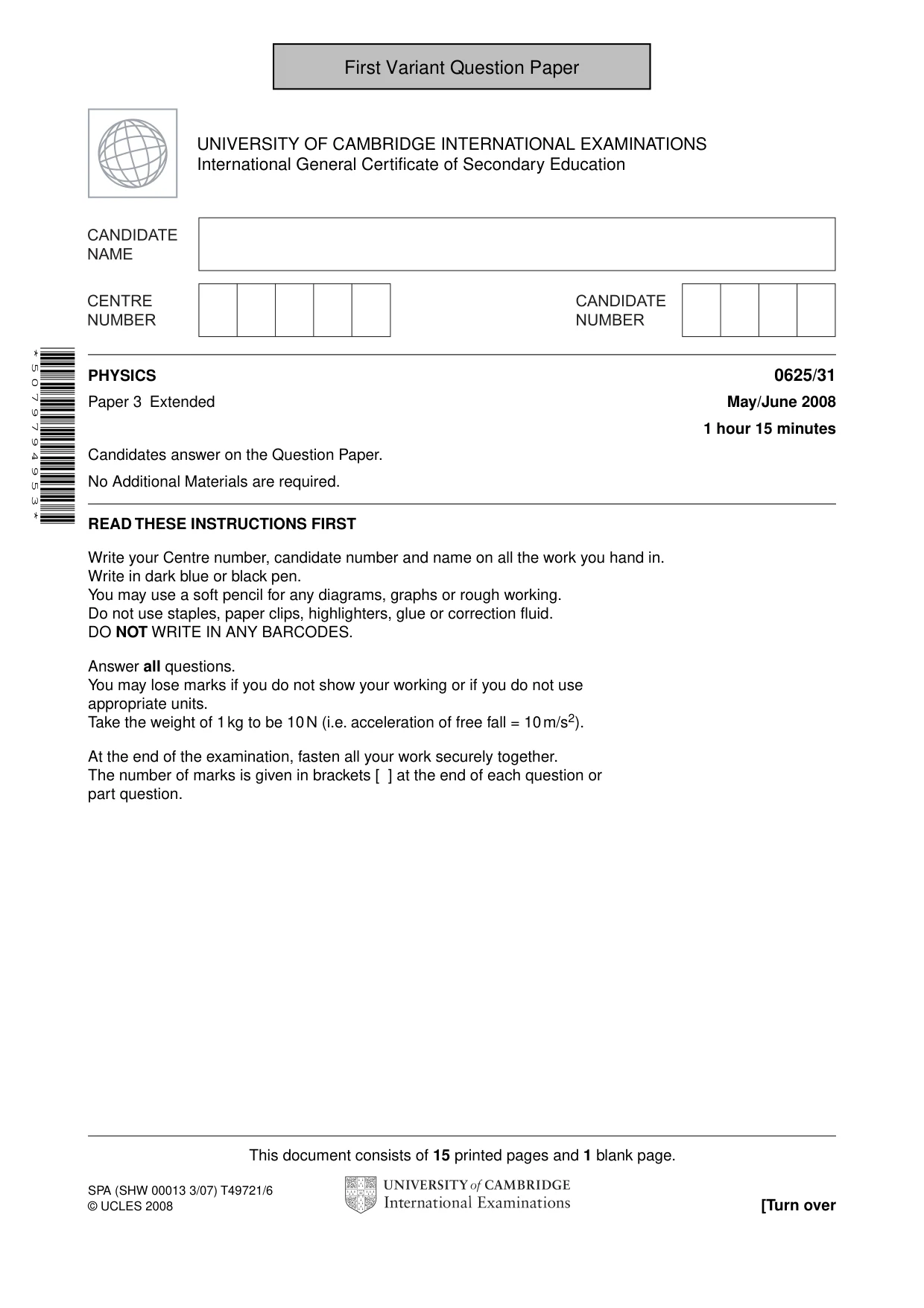
This document consists of 15 printed pages and 1 blank page. SPA (SHW 00013 3/07) T49721/6 © UCLES 2008 [Turn over UNIVERSITY OF CAMBRIDGE INTERNATIONAL EXAMINATIONS International General Certificate of Secondary Education READ THESE INSTRUCTIONS FIRST Write your Centre number, candidate number and name on all the work you hand in. Write in dark blue or black pen. You may use a soft pencil for any diagrams, graphs or rough working. Do not use staples, paper clips, highlighters, glue or correction fluid. DO NOT WRITE IN ANY BARCODES. Answer all questions. You may lose marks if you do not show your working or if you do not use appropriate units. Take the weight of 1 kg to be 10 N (i.e. acceleration of free fall = 10 m/s2). At the end of the examination, fasten all your work securely together. The number of marks is given in brackets [ ] at the end of each question or part question. PHYSICS 0625/31 Paper 3 Extended May/June 2008 1 hour 15 minutes Candidates answer on the Question Paper. No Additional Materials are required. * 5 0 7 9 7 9 4 9 5 3 * First Variant Question Paper
Question paper, page 3
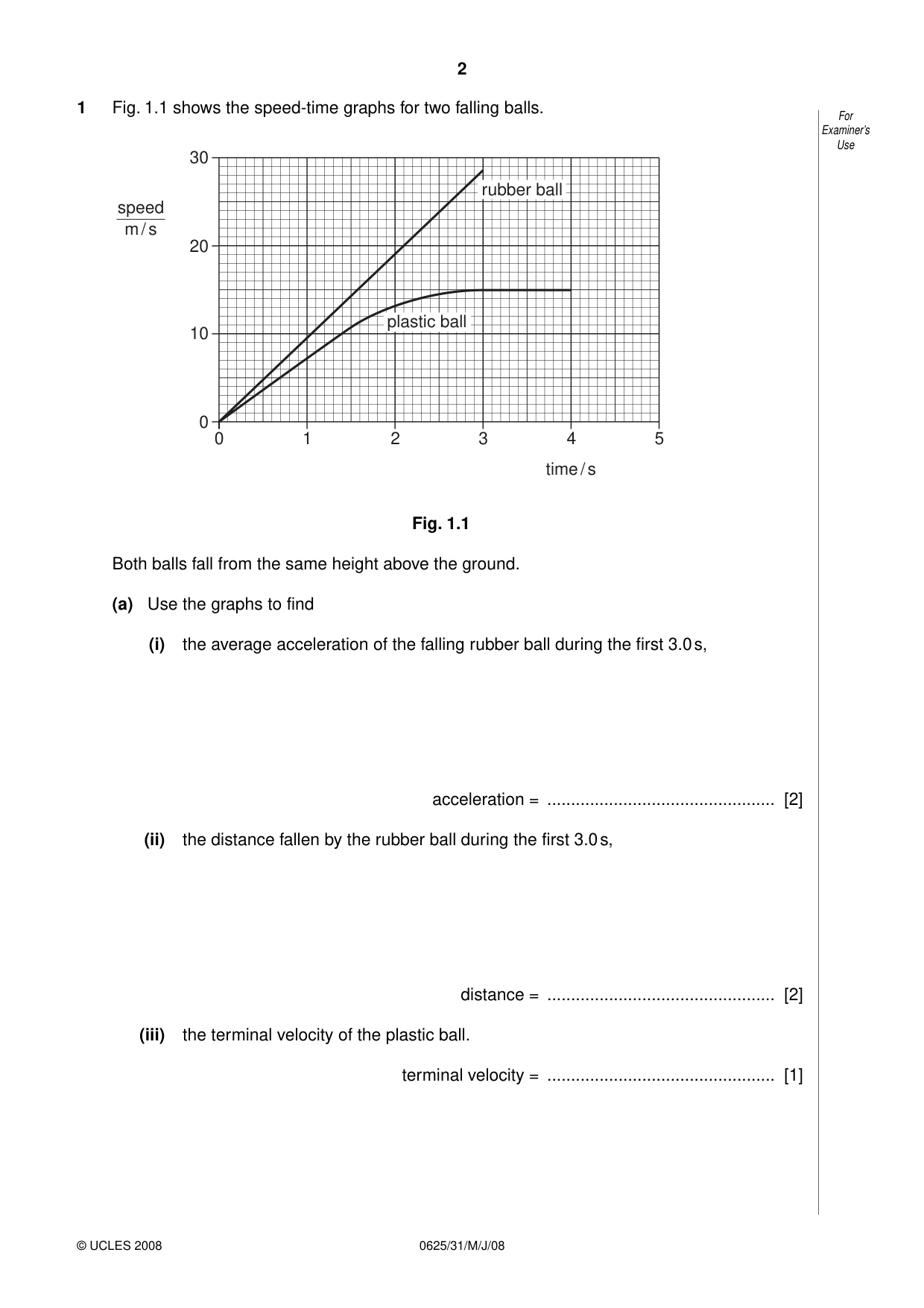
2 0625/31/M/J/08 © UCLES 2008 For Examiner’s Use 1 Fig. 1.1 shows the speed-time graphs for two falling balls. 0 1 2 3 4 5 0 10 20 30 time / s m / s speed rubber ball plastic ball Fig. 1.1 Both balls fall from the same height above the ground. (a) Use the graphs to find (i) the average acceleration of the falling rubber ball during the first 3.0 s, acceleration = … [2] (ii) the distance fallen by the rubber ball during the first 3.0 s, distance = … [2] (iii) the terminal velocity of the plastic ball. terminal velocity = … [1]
Question paper, page 4
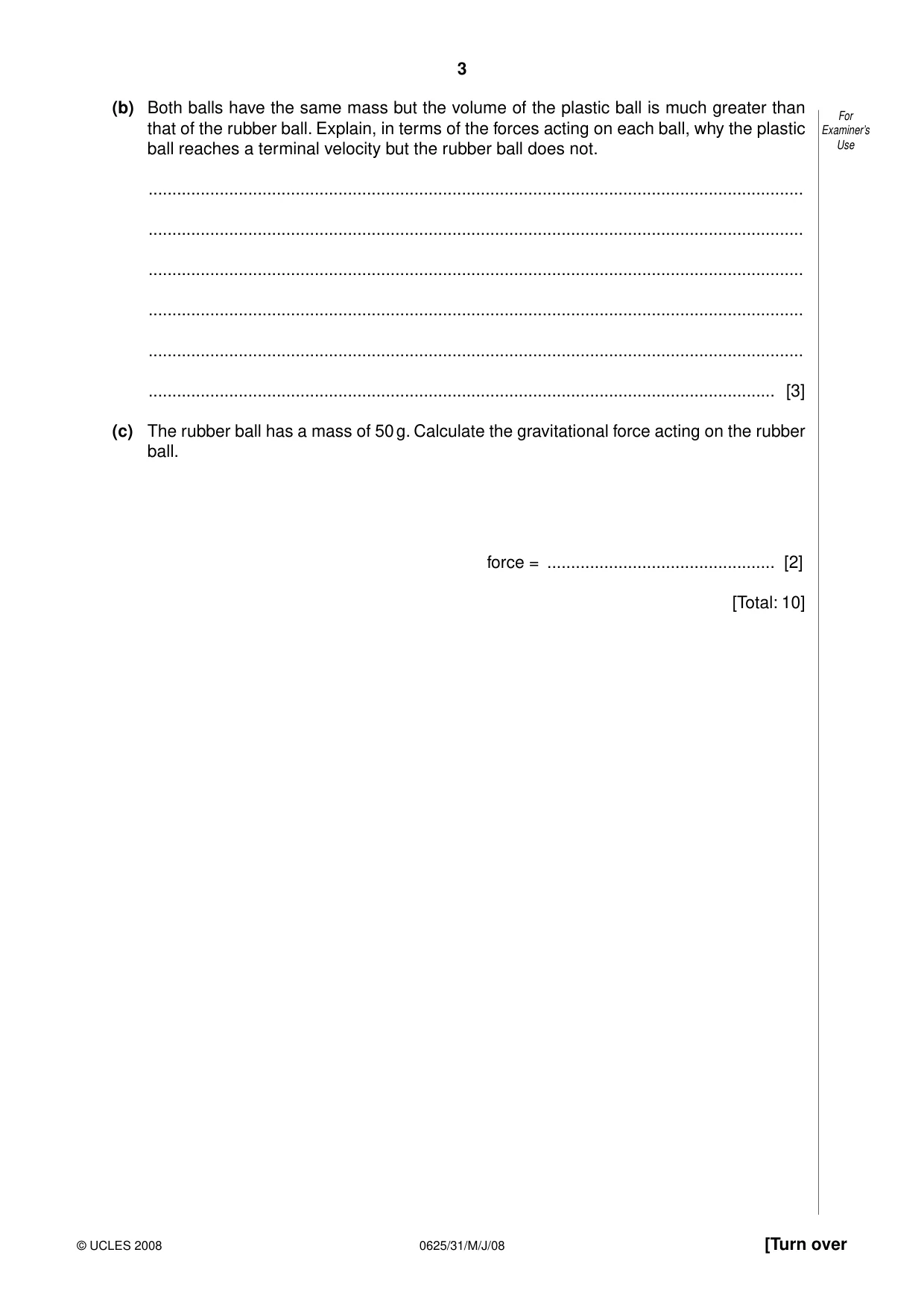
3 0625/31/M/J/08 © UCLES 2008 [Turn over For Examiner’s Use (b) Both balls have the same mass but the volume of the plastic ball is much greater than that of the rubber ball. Explain, in terms of the forces acting on each ball, why the plastic ball reaches a terminal velocity but the rubber ball does not. … … … … … … [3] (c) The rubber ball has a mass of 50 g. Calculate the gravitational force acting on the rubber ball. force = … [2] [Total: 10]
Question paper, page 5
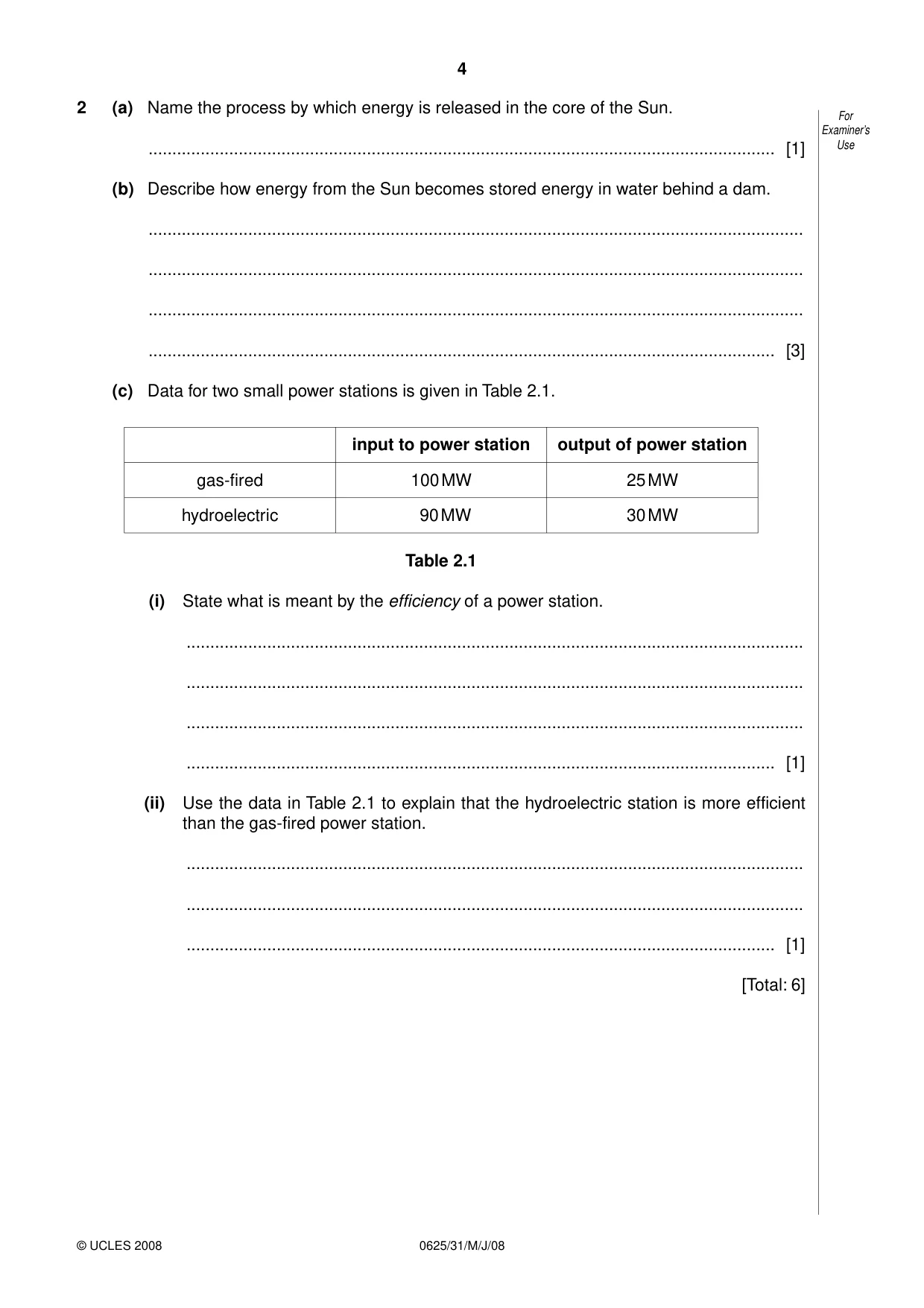
4 0625/31/M/J/08 © UCLES 2008 For Examiner’s Use 2 (a) Name the process by which energy is released in the core of the Sun. … [1] (b) Describe how energy from the Sun becomes stored energy in water behind a dam. … … … … [3] (c) Data for two small power stations is given in Table 2.1. input to power station output of power station gas-fired 100 MW 25 MW hydroelectric 90 MW 30 MW Table 2.1 (i) State what is meant by the efficiency of a power station. … … … … [1] (ii) Use the data in Table 2.1 to explain that the hydroelectric station is more efficient than the gas-fired power station. … … … [1] [Total: 6]
Question paper, page 6
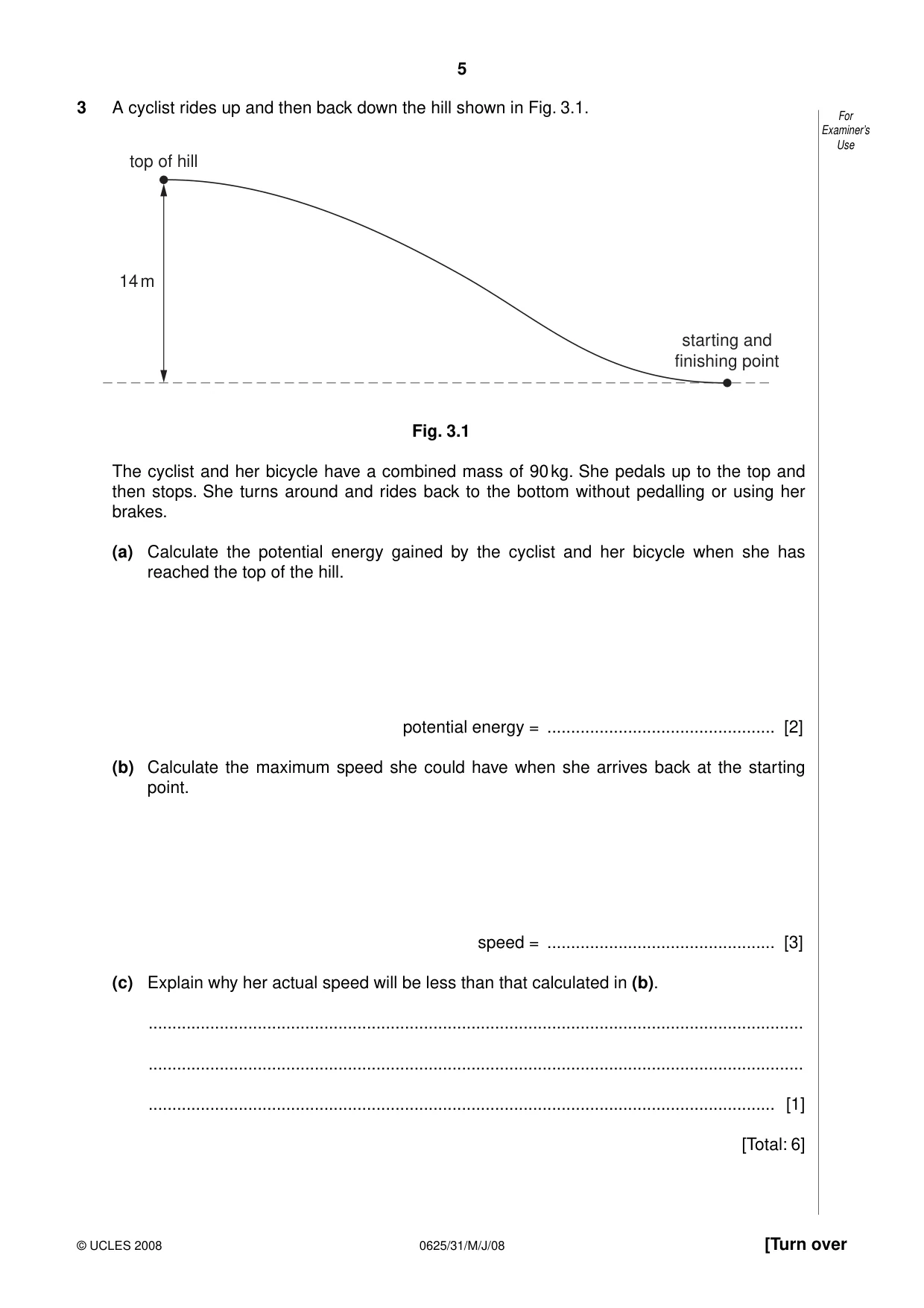
5 0625/31/M/J/08 © UCLES 2008 [Turn over For Examiner’s Use 3 A cyclist rides up and then back down the hill shown in Fig. 3.1. 14 m top of hill starting and finishing point Fig. 3.1 The cyclist and her bicycle have a combined mass of 90 kg. She pedals up to the top and then stops. She turns around and rides back to the bottom without pedalling or using her brakes. (a) Calculate the potential energy gained by the cyclist and her bicycle when she has reached the top of the hill. potential energy = … [2] (b) Calculate the maximum speed she could have when she arrives back at the starting point. speed = … [3] (c) Explain why her actual speed will be less than that calculated in (b). … … … [1] [Total: 6]
Question paper, page 7
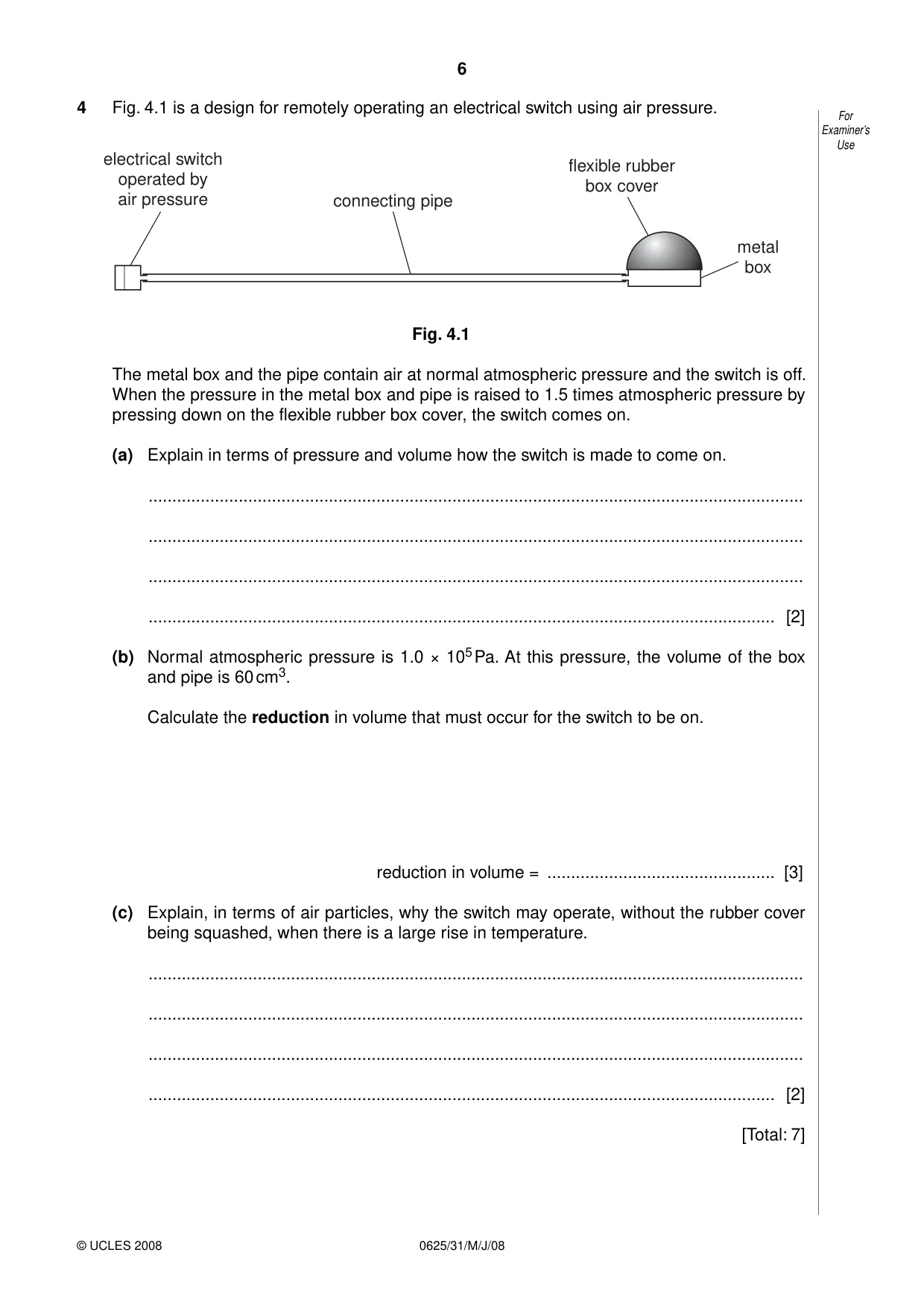
6 0625/31/M/J/08 © UCLES 2008 For Examiner’s Use 4 Fig. 4.1 is a design for remotely operating an electrical switch using air pressure. electrical switch operated by air pressure metal box connecting pipe flexible rubber box cover Fig. 4.1 The metal box and the pipe contain air at normal atmospheric pressure and the switch is off. When the pressure in the metal box and pipe is raised to 1.5 times atmospheric pressure by pressing down on the flexible rubber box cover, the switch comes on. (a) Explain in terms of pressure and volume how the switch is made to come on. … … … … [2] (b) Normal atmospheric pressure is 1.0 × 10⁵ Pa. At this pressure, the volume of the box and pipe is 60 cm3. Calculate the reduction in volume that must occur for the switch to be on. reduction in volume = … [3] (c) Explain, in terms of air particles, why the switch may operate, without the rubber cover being squashed, when there is a large rise in temperature. … … … … [2] [Total: 7]
Question paper, page 8
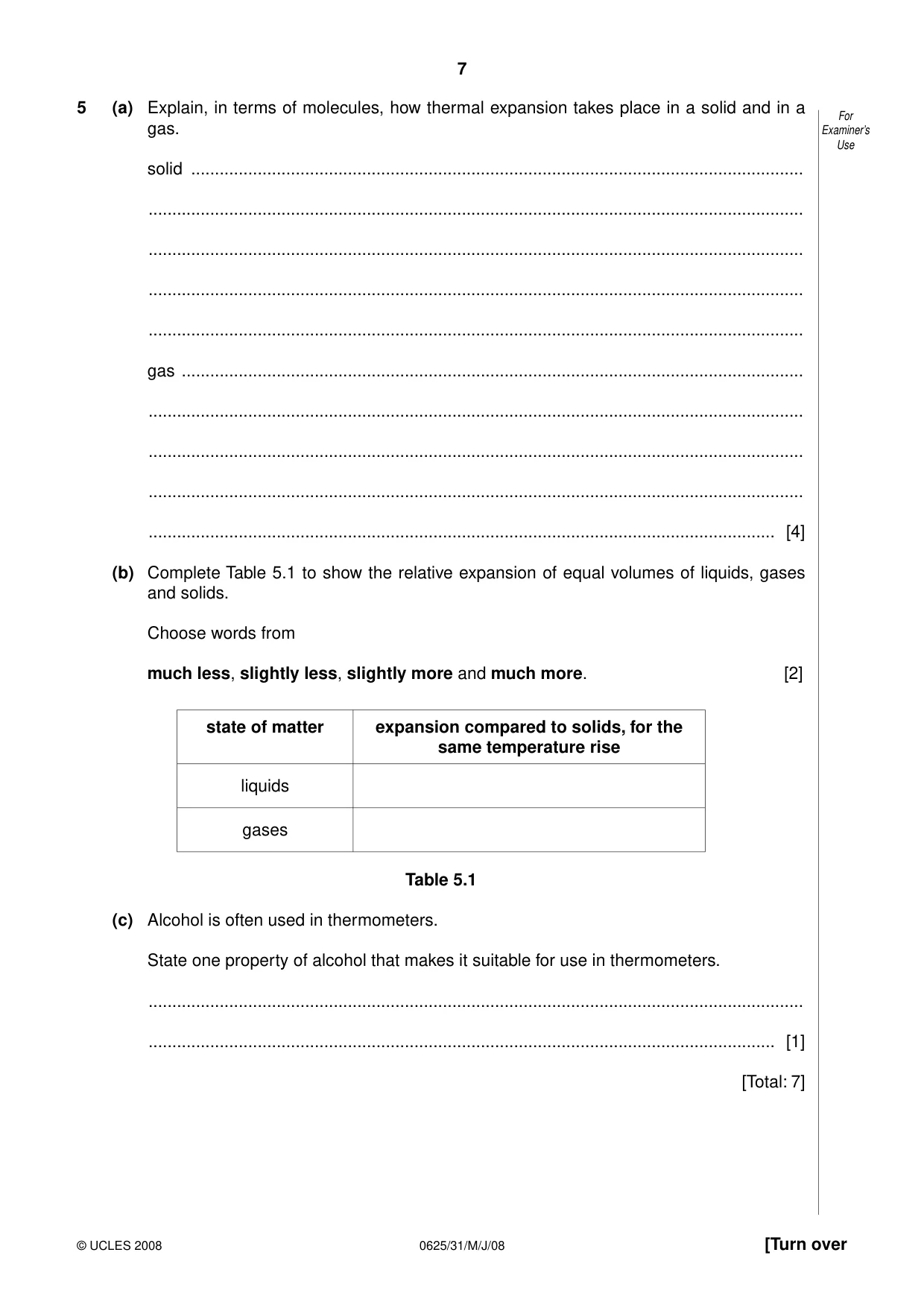
7 0625/31/M/J/08 © UCLES 2008 [Turn over For Examiner’s Use 5 (a) Explain, in terms of molecules, how thermal expansion takes place in a solid and in a gas. solid … … … … … gas … … … … … [4] (b) Complete Table 5.1 to show the relative expansion of equal volumes of liquids, gases and solids. Choose words from much less, slightly less, slightly more and much more. [2] state of matter expansion compared to solids, for the same temperature rise liquids gases Table 5.1 (c) Alcohol is often used in thermometers. State one property of alcohol that makes it suitable for use in thermometers. … … [1] [Total: 7]
Question paper, page 9
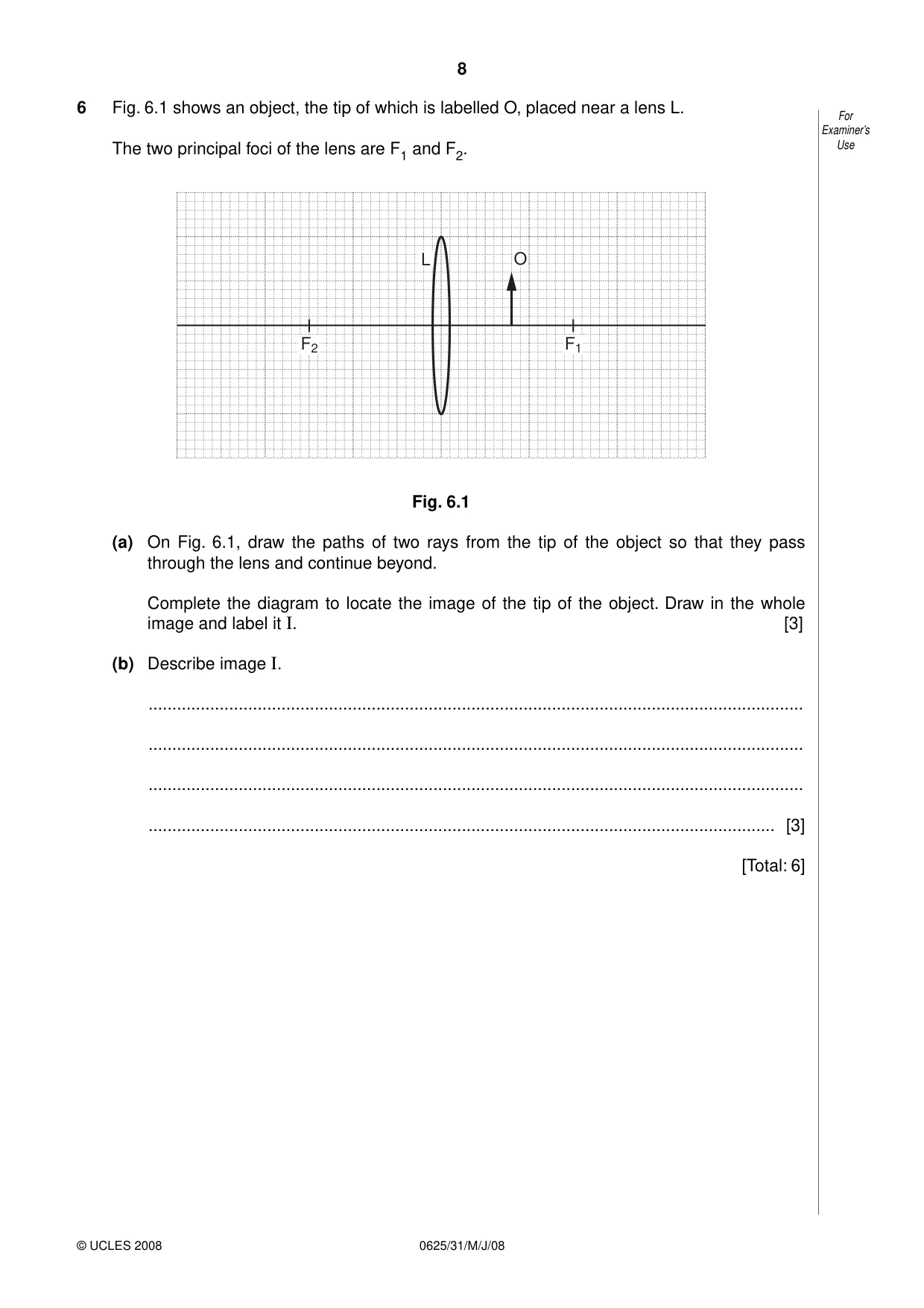
8 0625/31/M/J/08 © UCLES 2008 For Examiner’s Use 6 Fig. 6.1 shows an object, the tip of which is labelled O, placed near a lens L. The two principal foci of the lens are F1 and F2. F1 F2 L O Fig. 6.1 (a) On Fig. 6.1, draw the paths of two rays from the tip of the object so that they pass through the lens and continue beyond. Complete the diagram to locate the image of the tip of the object. Draw in the whole image and label it I. [3] (b) Describe image I. … … … … [3] [Total: 6]
Question paper, page 10
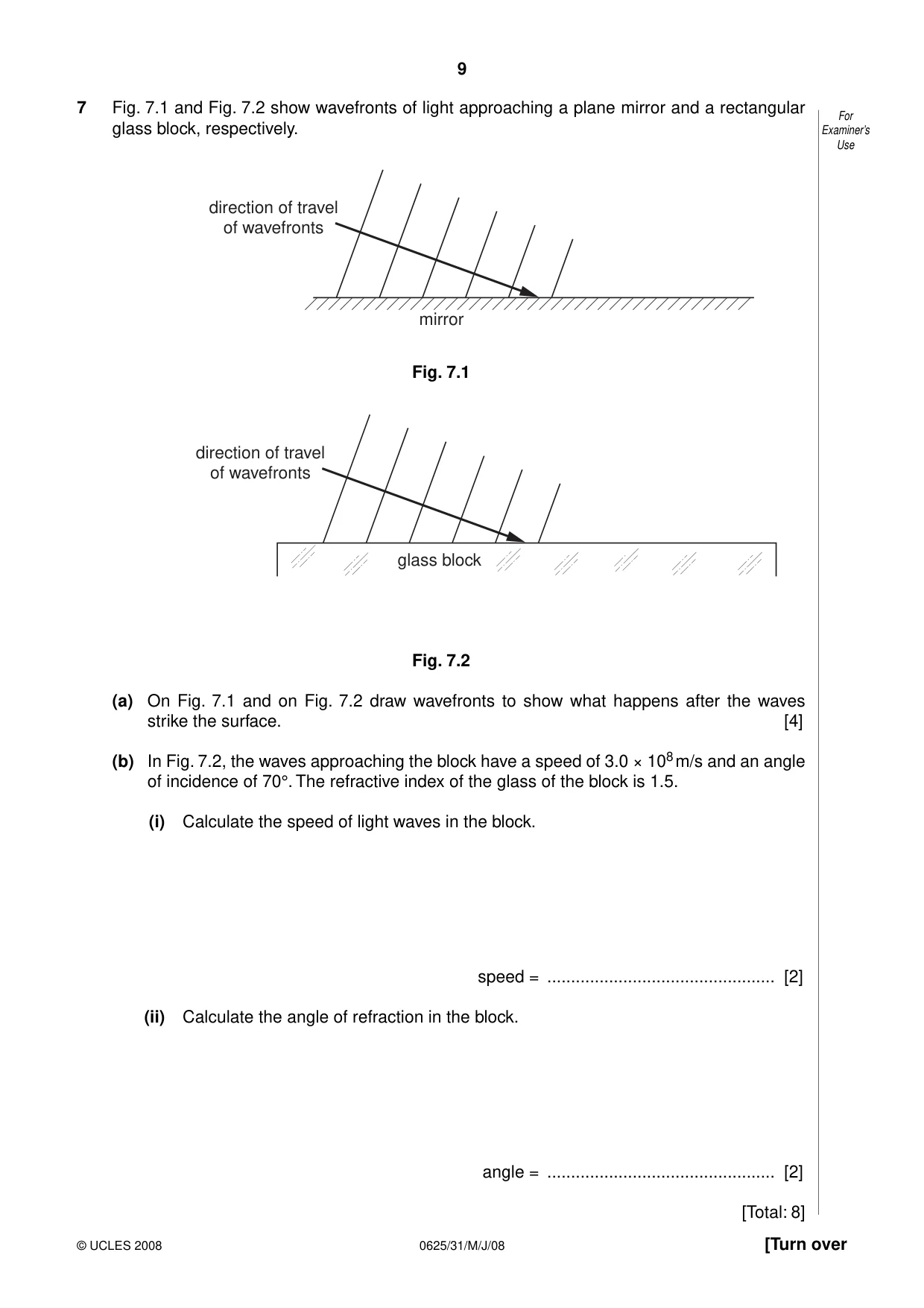
9 0625/31/M/J/08 © UCLES 2008 [Turn over For Examiner’s Use 7 Fig. 7.1 and Fig. 7.2 show wavefronts of light approaching a plane mirror and a rectangular glass block, respectively. direction of travel of wavefronts mirror Fig. 7.1 direction of travel of wavefronts glass block Fig. 7.2 (a) On Fig. 7.1 and on Fig. 7.2 draw wavefronts to show what happens after the waves strike the surface. [4] (b) In Fig. 7.2, the waves approaching the block have a speed of 3.0 × 10⁸ m/s and an angle of incidence of 70°. The refractive index of the glass of the block is 1.5. (i) Calculate the speed of light waves in the block. speed = … [2] (ii) Calculate the angle of refraction in the block. angle = … [2] [Total: 8]
Question paper, page 11
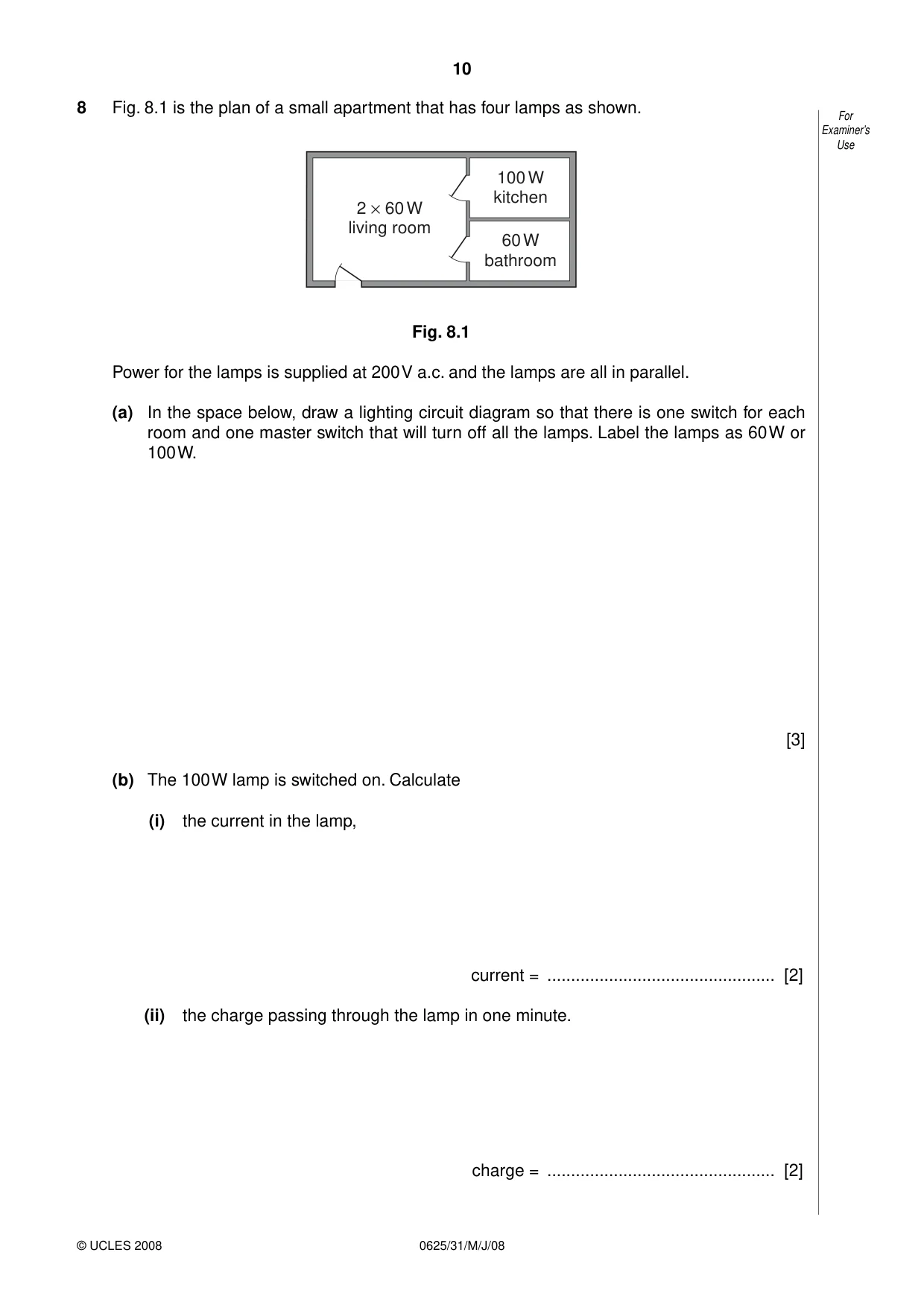
10 0625/31/M/J/08 © UCLES 2008 For Examiner’s Use 8 Fig. 8.1 is the plan of a small apartment that has four lamps as shown. 2 × 60 W living room 100 W kitchen 60 W bathroom Fig. 8.1 Power for the lamps is supplied at 200 V a.c. and the lamps are all in parallel. (a) In the space below, draw a lighting circuit diagram so that there is one switch for each room and one master switch that will turn off all the lamps. Label the lamps as 60 W or 100 W. [3] (b) The 100 W lamp is switched on. Calculate (i) the current in the lamp, current = … [2] (ii) the charge passing through the lamp in one minute. charge = … [2]
Question paper, page 12
11 0625/31/M/J/08 © UCLES 2008 [Turn over For Examiner’s Use (c) The three 60 W lamps are replaced by three energy-saving ones, that give the same light output but are rated at only 15 W each. Calculate (i) the total reduction in power, reduction in power = … [1] (ii) the energy saved when the lamps are lit for one hour. energy saved = … [2] [Total: 10]
Question paper, page 13
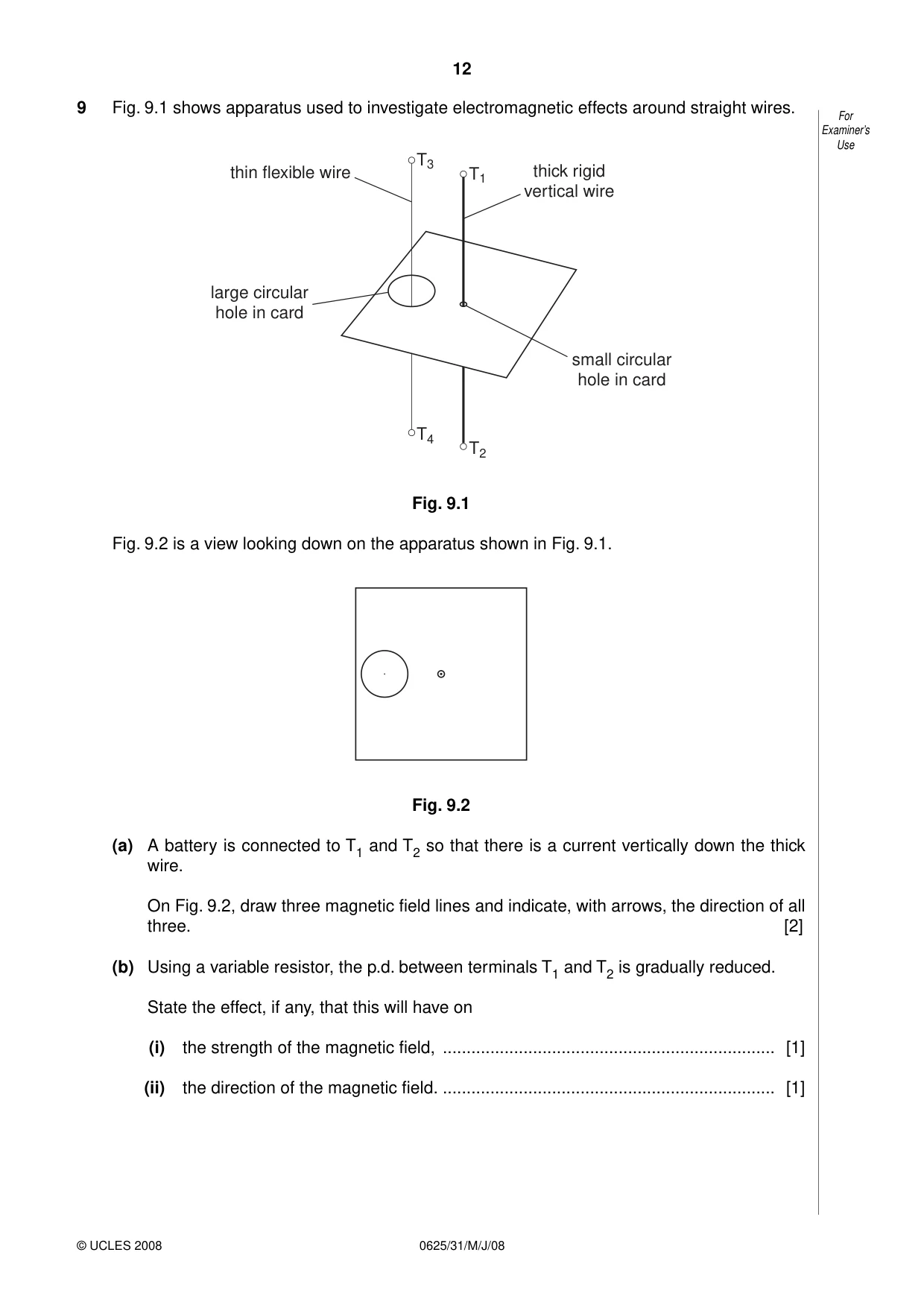
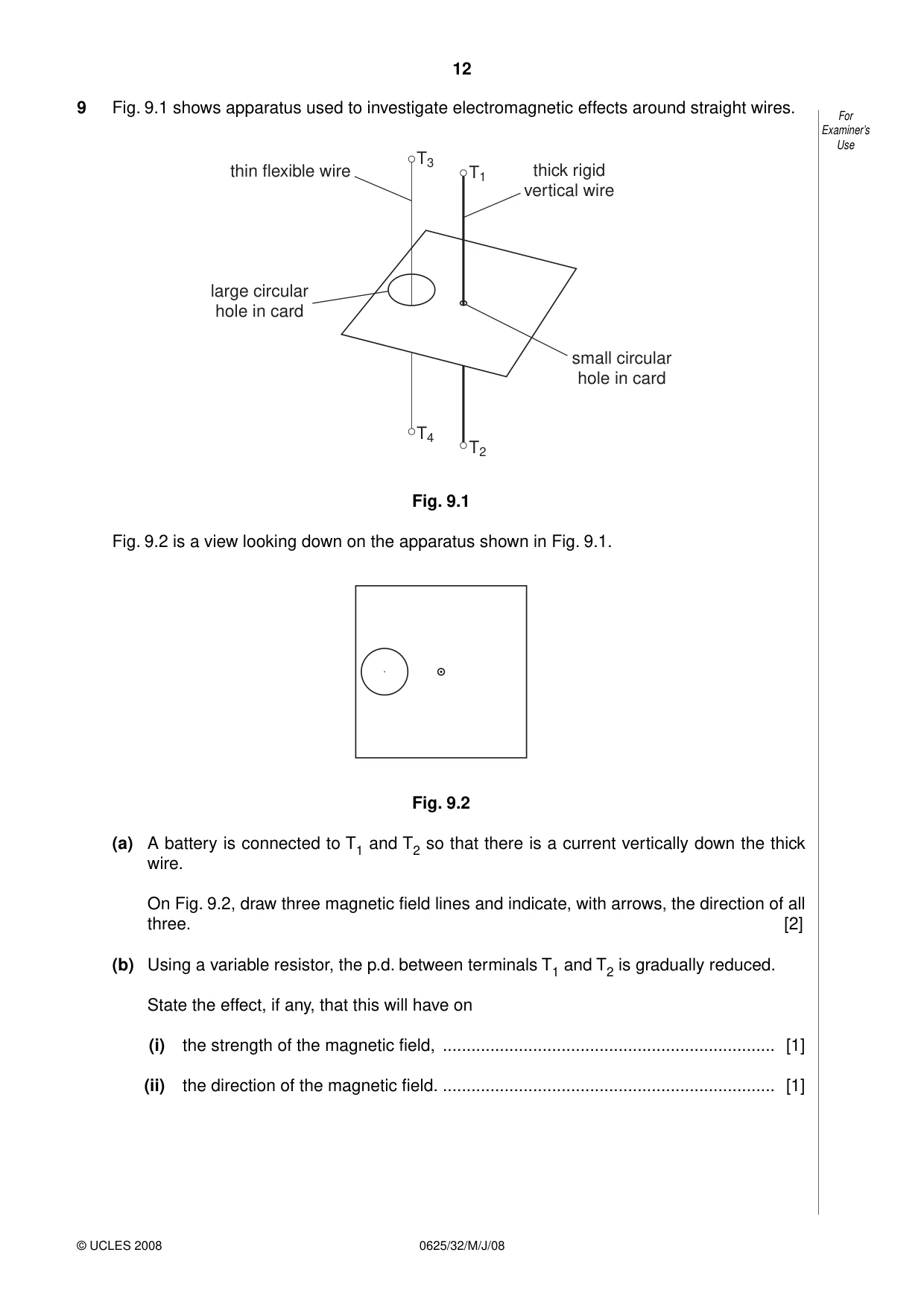
12 0625/31/M/J/08 © UCLES 2008 For Examiner’s Use 9 Fig. 9.1 shows apparatus used to investigate electromagnetic effects around straight wires. T1 T2 T3 T4 thin flexible wire thick rigid vertical wire large circular hole in card small circular hole in card Fig. 9.1 Fig. 9.2 is a view looking down on the apparatus shown in Fig. 9.1. Fig. 9.2 (a) A battery is connected to T1 and T2 so that there is a current vertically down the thick wire. On Fig. 9.2, draw three magnetic field lines and indicate, with arrows, the direction of all three. [2] (b) Using a variable resistor, the p.d. between terminals T1 and T2 is gradually reduced. State the effect, if any, that this will have on (i) the strength of the magnetic field, … [1] (ii) the direction of the magnetic field. … [1]
Question paper, page 14
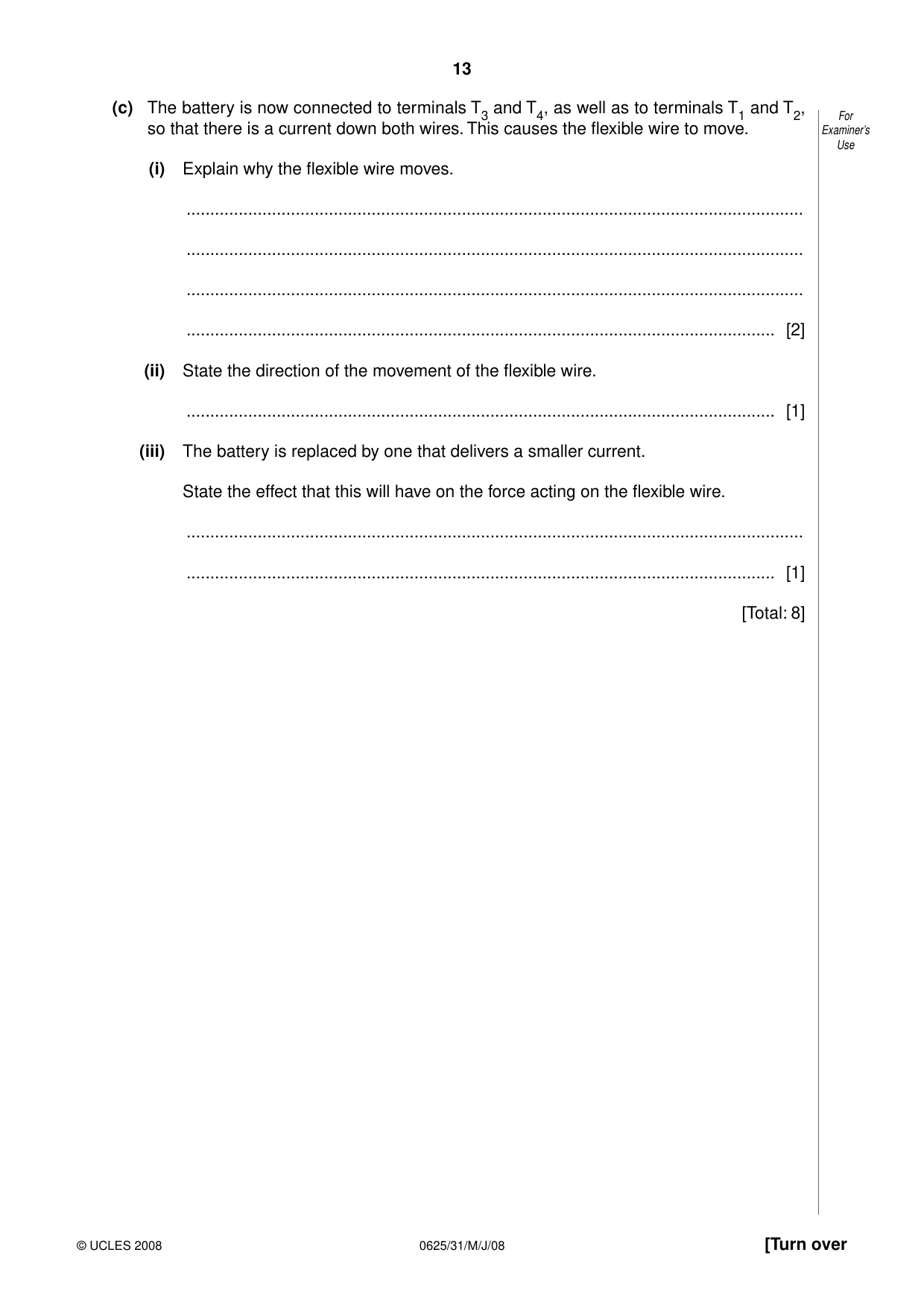
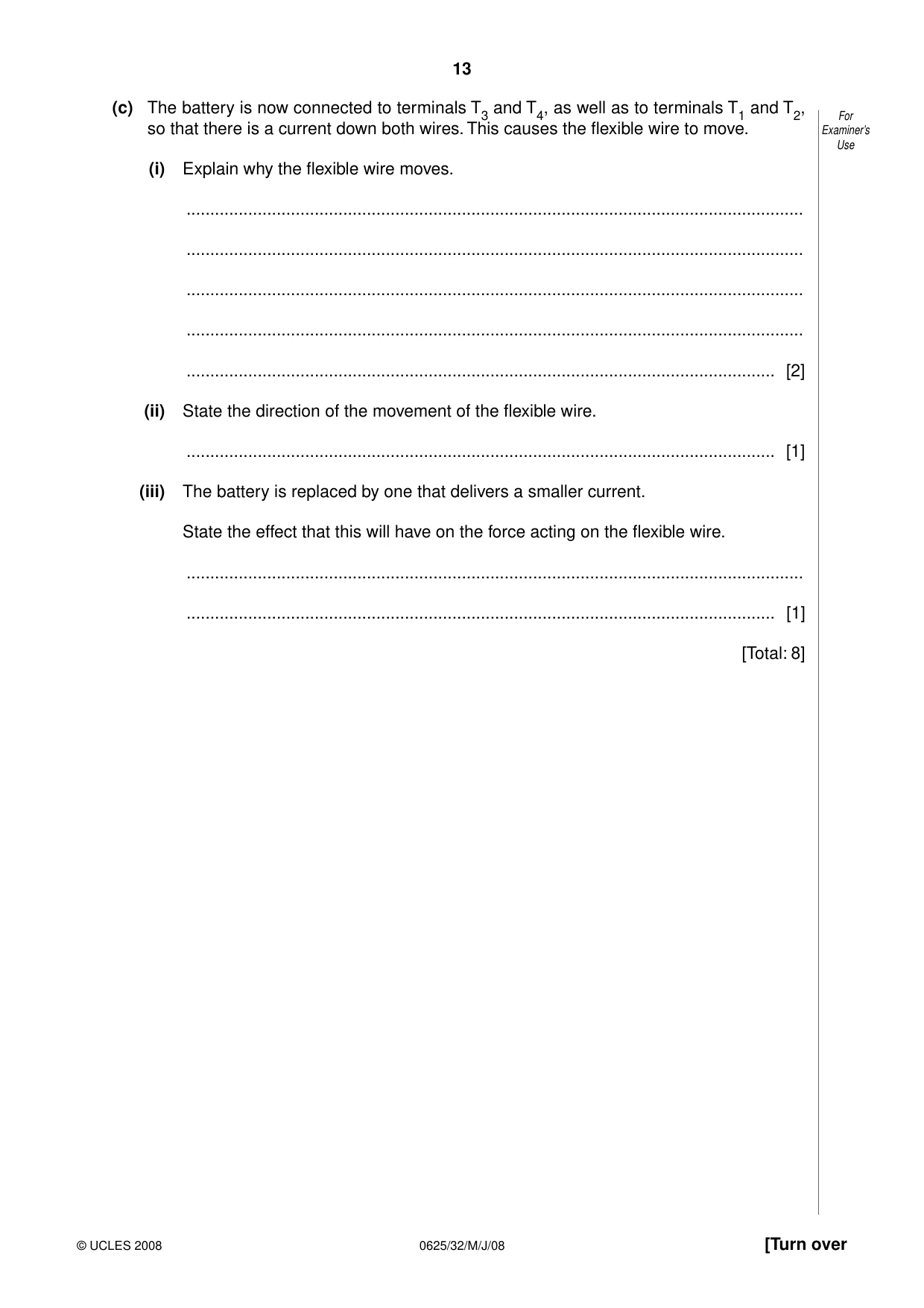
13 0625/31/M/J/08 © UCLES 2008 [Turn over For Examiner’s Use (c) The battery is now connected to terminals T3 and T4, as well as to terminals T1 and T2, so that there is a current down both wires. This causes the flexible wire to move. (i) Explain why the flexible wire moves. … … … … [2] (ii) State the direction of the movement of the flexible wire. … [1] (iii) The battery is replaced by one that delivers a smaller current. State the effect that this will have on the force acting on the flexible wire. … … [1] [Total: 8]
Question paper, page 15
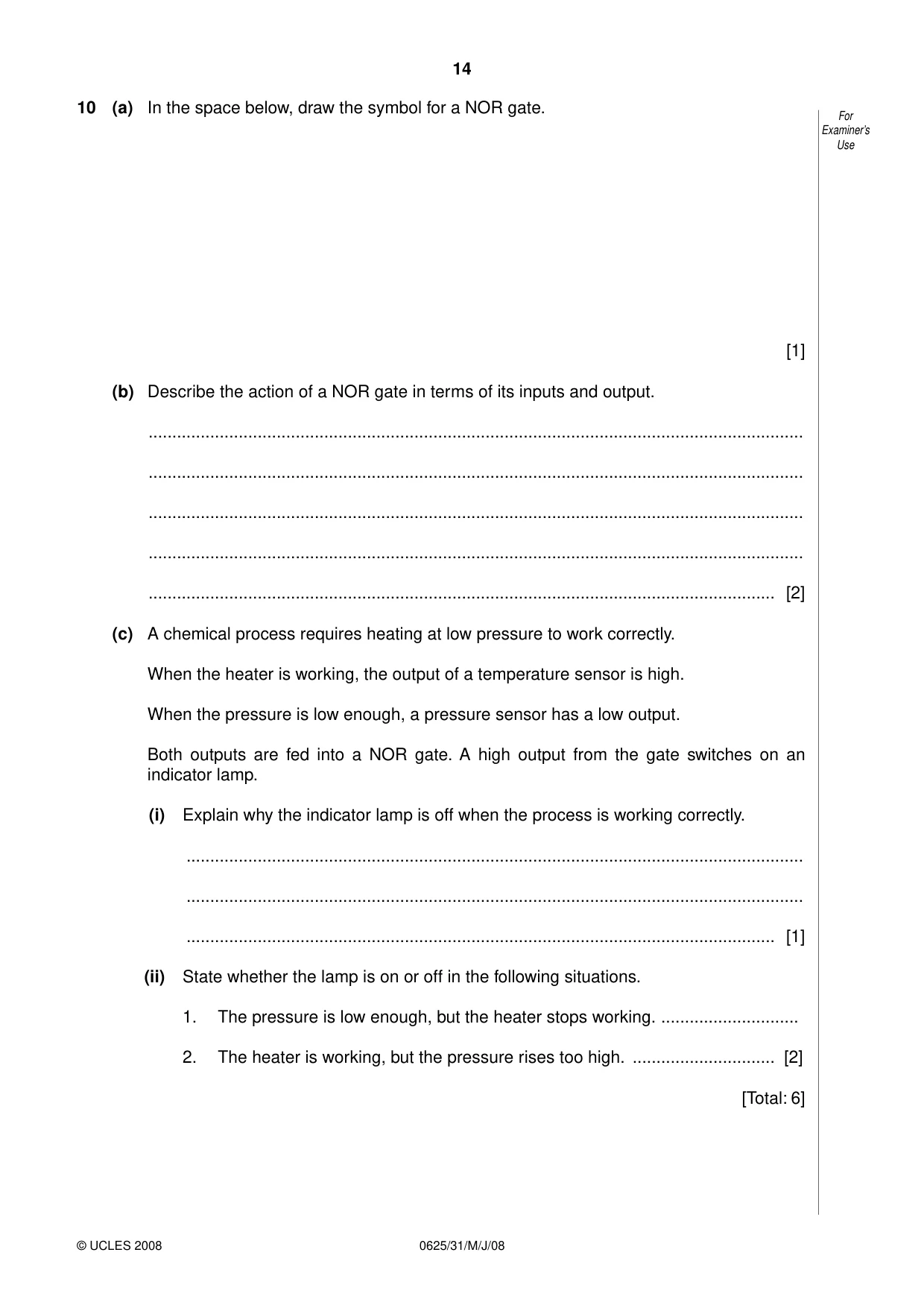
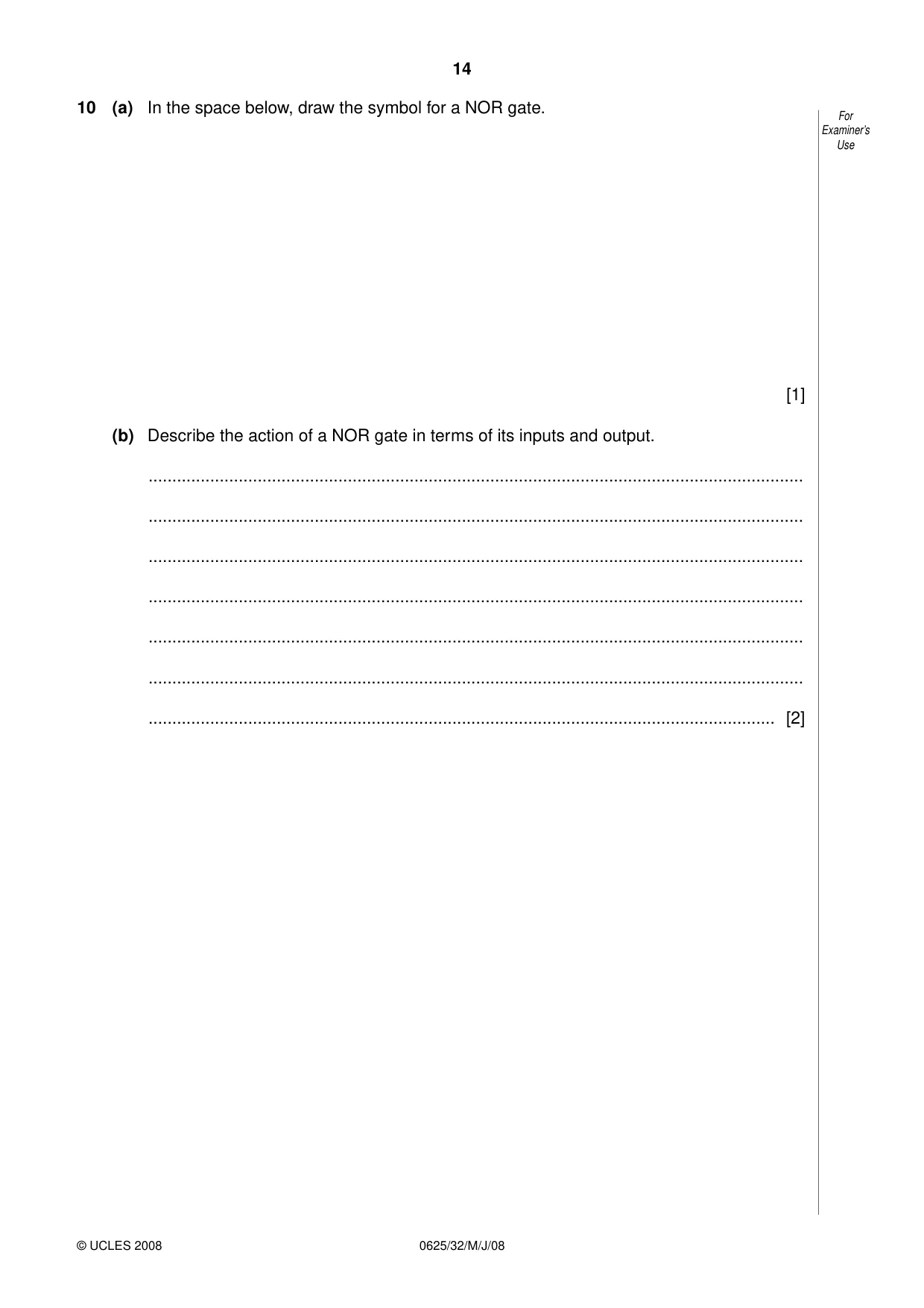
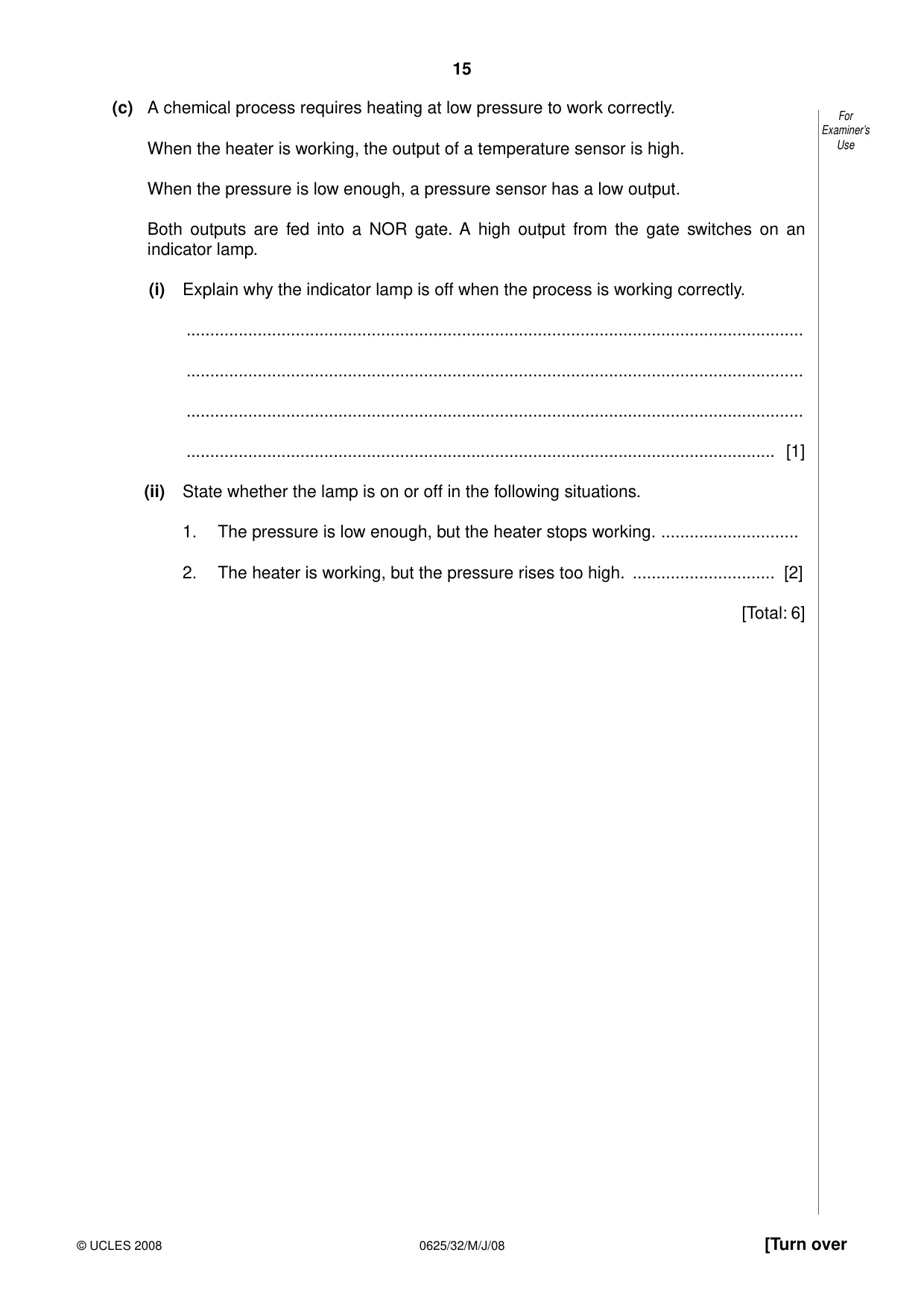
14 0625/31/M/J/08 © UCLES 2008 For Examiner’s Use 10 (a) In the space below, draw the symbol for a NOR gate. [1] (b) Describe the action of a NOR gate in terms of its inputs and output. … … … … … [2] (c) A chemical process requires heating at low pressure to work correctly. When the heater is working, the output of a temperature sensor is high. When the pressure is low enough, a pressure sensor has a low output. Both outputs are fed into a NOR gate. A high output from the gate switches on an indicator lamp. (i) Explain why the indicator lamp is off when the process is working correctly. … … … [1] (ii) State whether the lamp is on or off in the following situations. 1. The pressure is low enough, but the heater stops working. … 2. The heater is working, but the pressure rises too high. … [2] [Total: 6]
Question paper, page 16
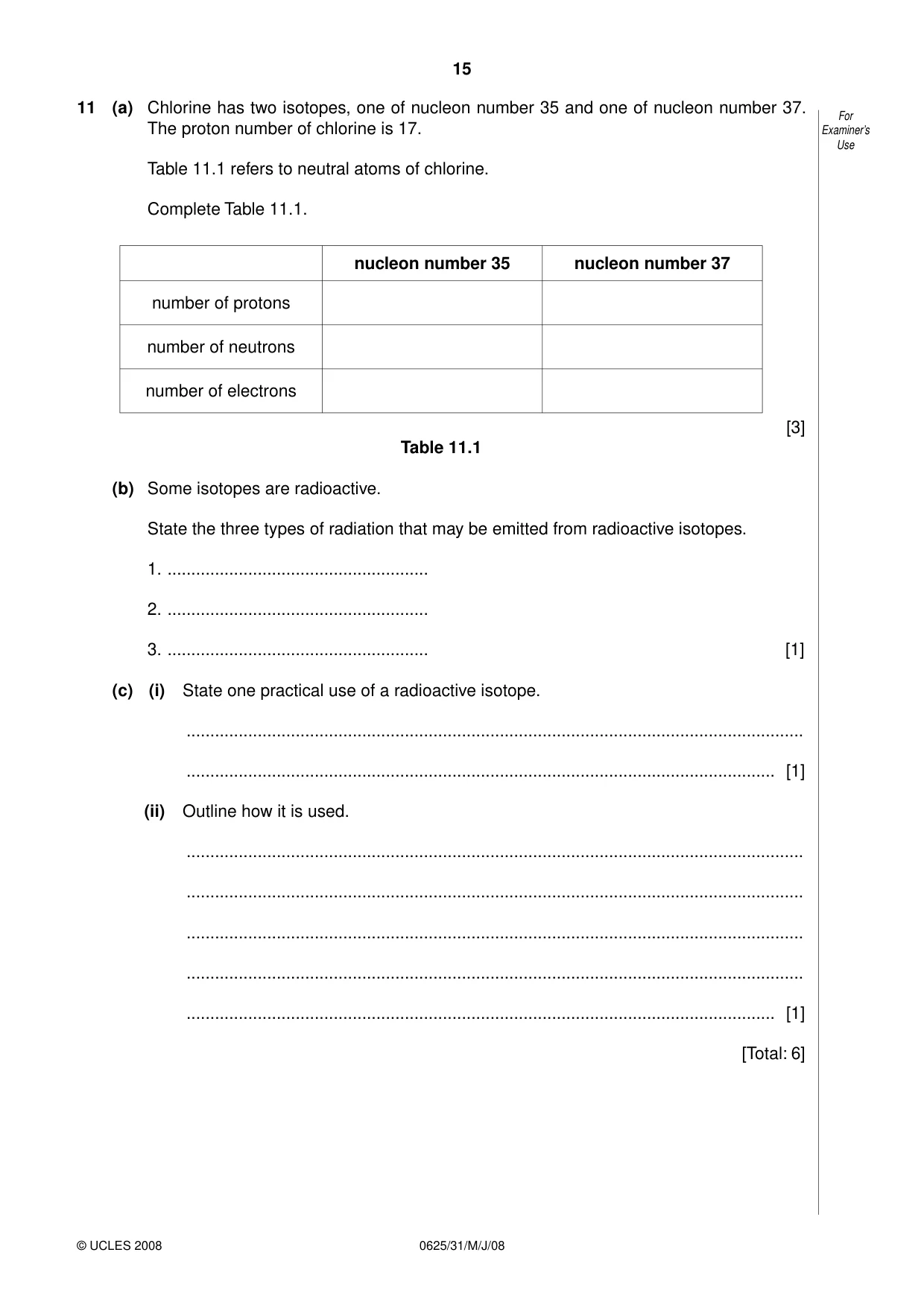
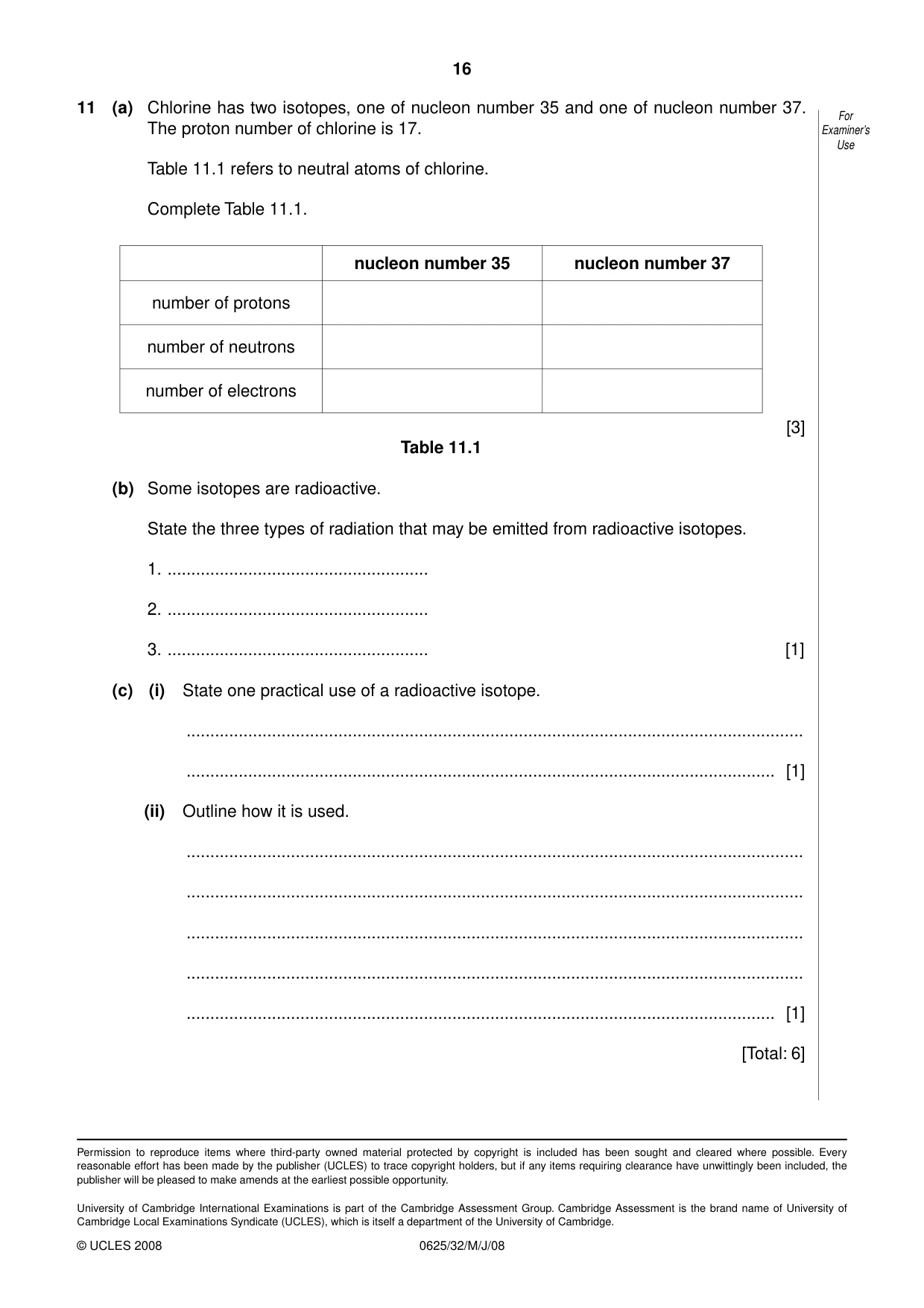
15 0625/31/M/J/08 © UCLES 2008 For Examiner’s Use 11 (a) Chlorine has two isotopes, one of nucleon number 35 and one of nucleon number 37. The proton number of chlorine is 17. Table 11.1 refers to neutral atoms of chlorine. Complete Table 11.1. nucleon number 35 nucleon number 37 number of protons number of neutrons number of electrons [3] Table 11.1 (b) Some isotopes are radioactive. State the three types of radiation that may be emitted from radioactive isotopes. 1. … 2. … 3. … [1] (c) (i) State one practical use of a radioactive isotope. … … [1] (ii) Outline how it is used. … … … … … [1] [Total: 6]
Question paper, page 17
16 0625/31/M/J/08 BLANK PAGE Permission to reproduce items where third-party owned material protected by copyright is included has been sought and cleared where possible. Every reasonable effort has been made by the publisher (UCLES) to trace copyright holders, but if any items requiring clearance have unwittingly been included, the publisher will be pleased to make amends at the earliest possible opportunity. University of Cambridge International Examinations is part of the Cambridge Assessment Group. Cambridge Assessment is the brand name of University of Cambridge Local Examinations Syndicate (UCLES), which is itself a department of the University of Cambridge.
Question paper, page 18
This document consists of 16 printed pages. SPA (SHW 00013 3/07) T49725/4 © UCLES 2008 [Turn over UNIVERSITY OF CAMBRIDGE INTERNATIONAL EXAMINATIONS International General Certificate of Secondary Education READ THESE INSTRUCTIONS FIRST Write your Centre number, candidate number and name on all the work you hand in. Write in dark blue or black pen. You may use a soft pencil for any diagrams, graphs or rough working. Do not use staples, paper clips, highlighters, glue or correction fluid. DO NOT WRITE IN ANY BARCODES. Answer all questions. You may lose marks if you do not show your working or if you do not use appropriate units. Take the weight of 1 kg to be 10 N (i.e. acceleration of free fall = 10 m/s2). At the end of the examination, fasten all your work securely together. The number of marks is given in brackets [ ] at the end of each question or part question. * 2 8 4 7 9 1 1 9 1 6 * PHYSICS 0625/32 Paper 3 Extended May/June 2008 1 hour 15 minutes Candidates answer on the Question Paper. No Additional Materials are required. Second Variant Question Paper
Question paper, page 19
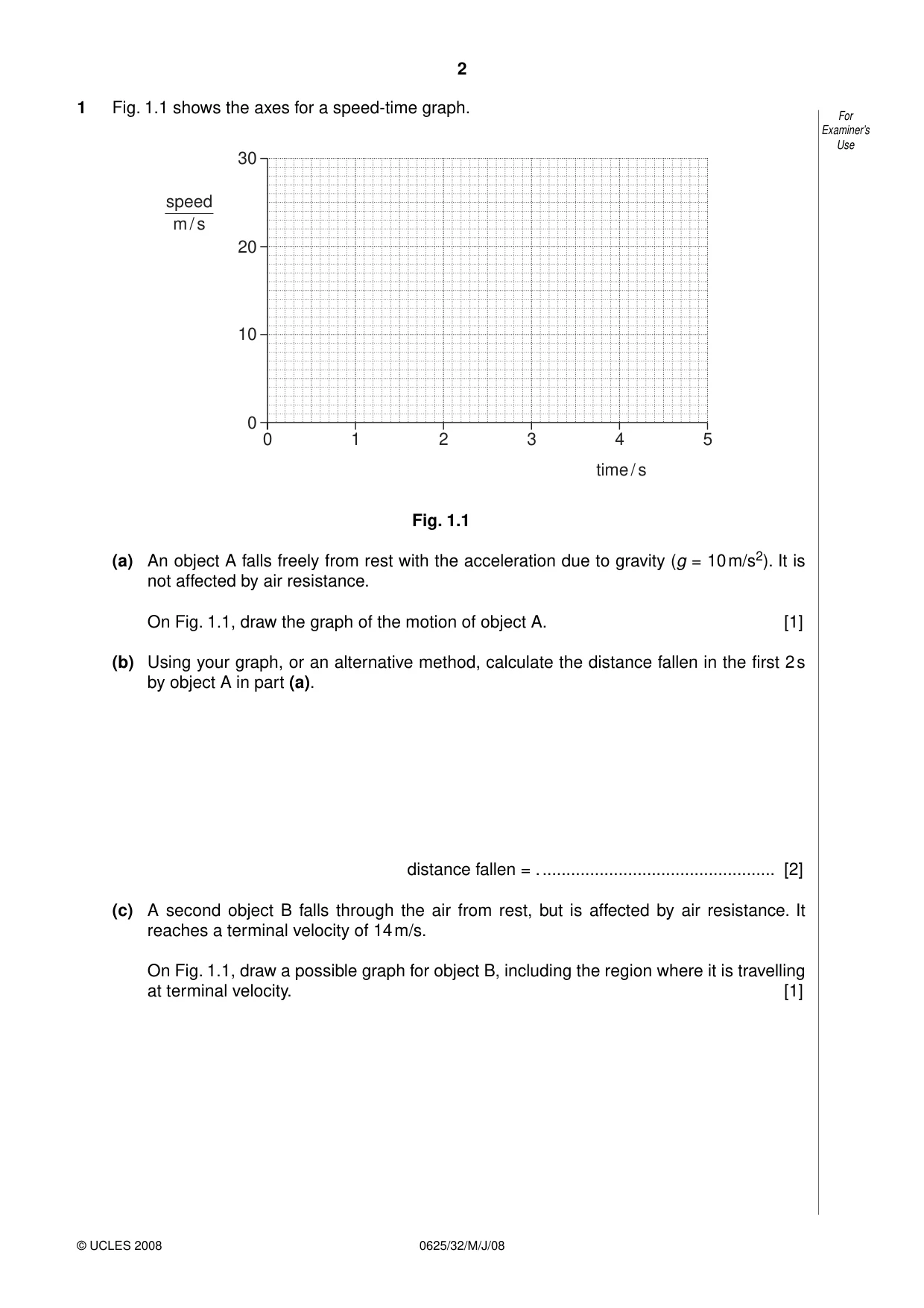
2 0625/32/M/J/08 © UCLES 2008 For Examiner’s Use 1 Fig. 1.1 shows the axes for a speed-time graph. 0 1 2 3 4 5 0 10 20 30 time / s m / s speed Fig. 1.1 (a) An object A falls freely from rest with the acceleration due to gravity (g = 10 m/s2). It is not affected by air resistance. On Fig. 1.1, draw the graph of the motion of object A. [1] (b) Using your graph, or an alternative method, calculate the distance fallen in the first 2 s by object A in part (a). distance fallen = . … [2] (c) A second object B falls through the air from rest, but is affected by air resistance. It reaches a terminal velocity of 14 m/s. On Fig. 1.1, draw a possible graph for object B, including the region where it is travelling at terminal velocity. [1]
Question paper, page 20
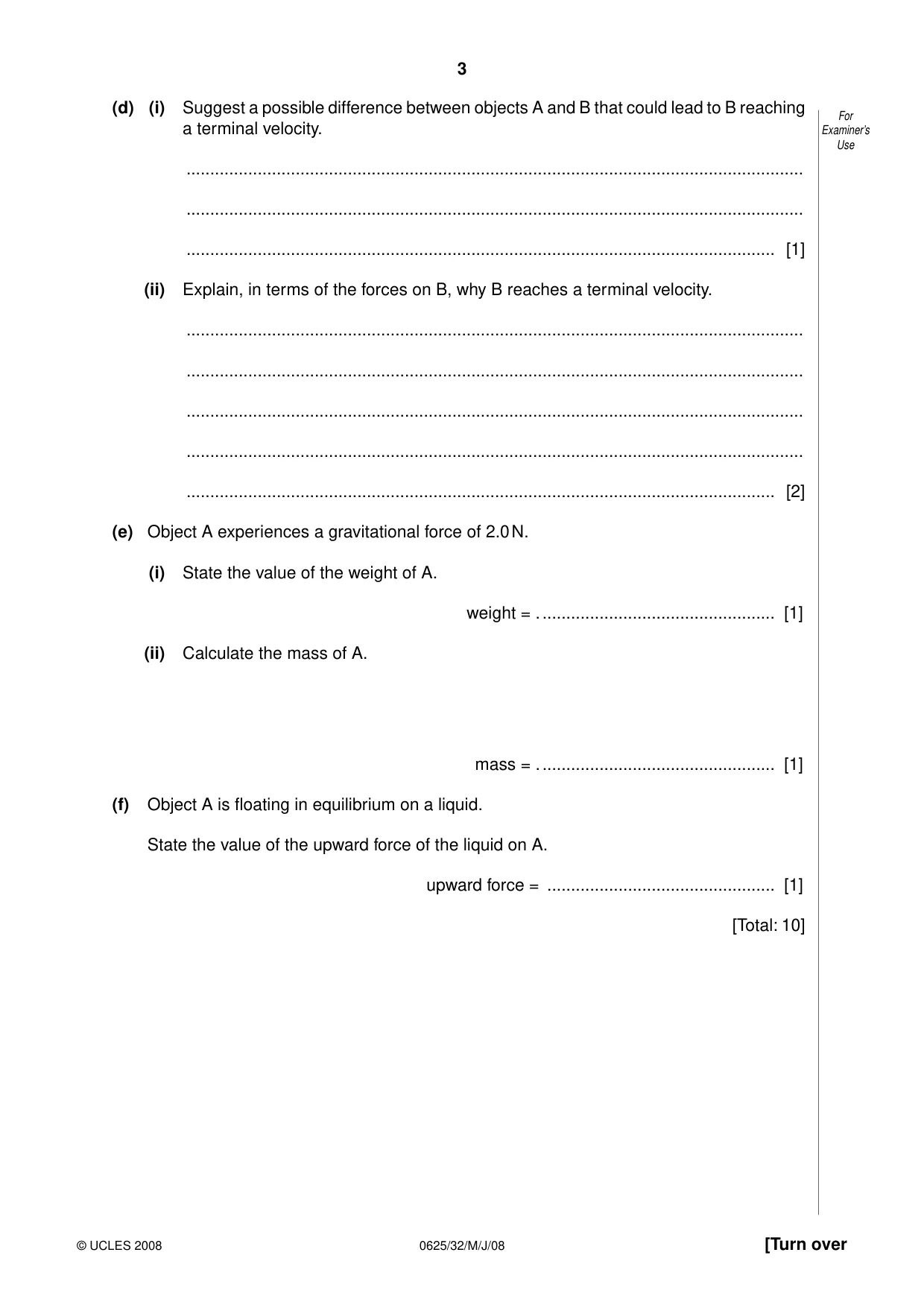
3 0625/32/M/J/08 © UCLES 2008 [Turn over For Examiner’s Use (d) (i) Suggest a possible difference between objects A and B that could lead to B reaching a terminal velocity. … … … [1] (ii) Explain, in terms of the forces on B, why B reaches a terminal velocity. … … … … … [2] (e) Object A experiences a gravitational force of 2.0 N. (i) State the value of the weight of A. weight = . … [1] (ii) Calculate the mass of A. mass = . … [1] (f) Object A is floating in equilibrium on a liquid. State the value of the upward force of the liquid on A. upward force = … [1] [Total: 10]
Question paper, page 21
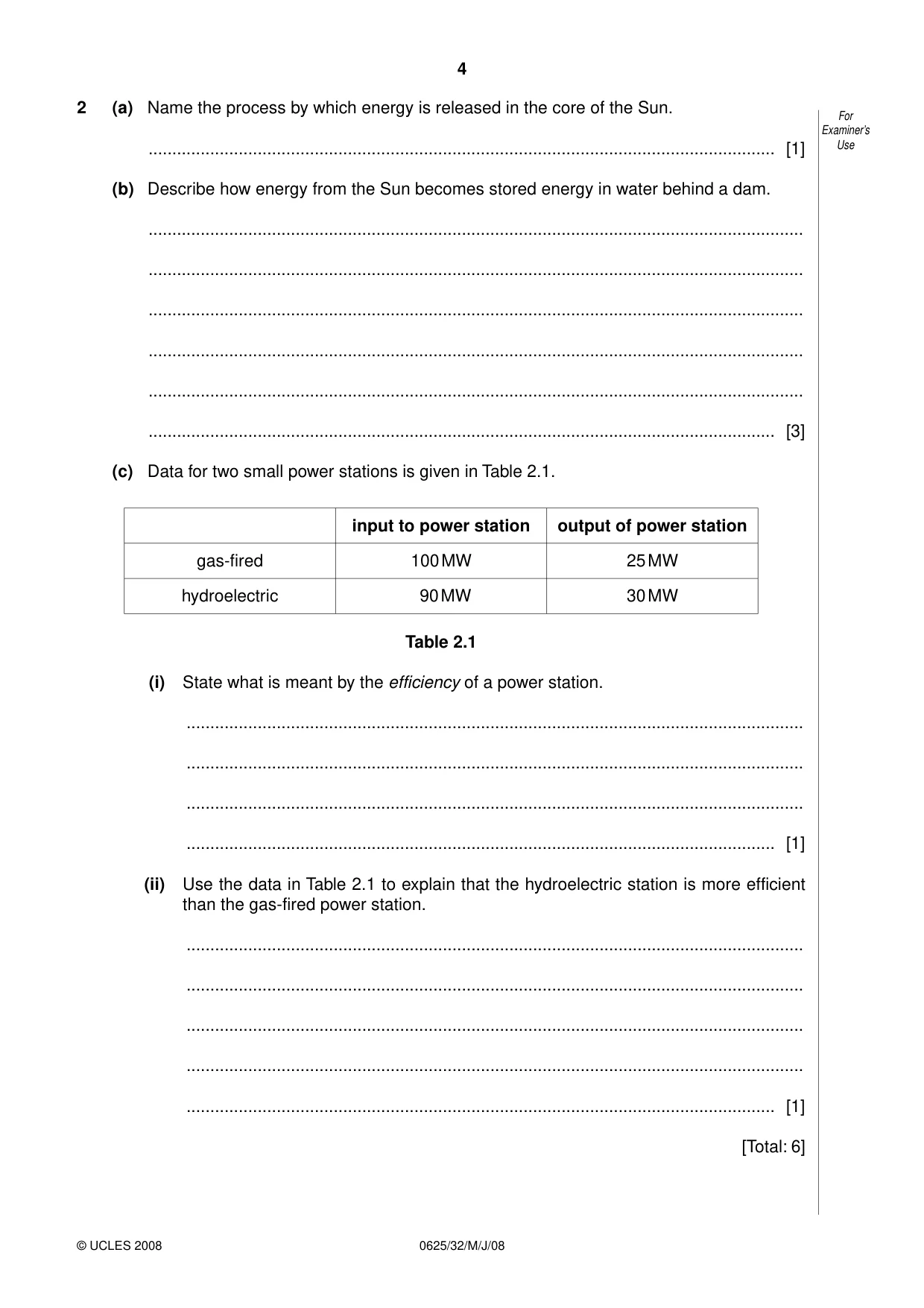
4 0625/32/M/J/08 © UCLES 2008 For Examiner’s Use 2 (a) Name the process by which energy is released in the core of the Sun. … [1] (b) Describe how energy from the Sun becomes stored energy in water behind a dam. … … … … … … [3] (c) Data for two small power stations is given in Table 2.1. input to power station output of power station gas-fired 100 MW 25 MW hydroelectric 90 MW 30 MW Table 2.1 (i) State what is meant by the efficiency of a power station. … … … … [1] (ii) Use the data in Table 2.1 to explain that the hydroelectric station is more efficient than the gas-fired power station. … … … … … [1] [Total: 6]
Question paper, page 22
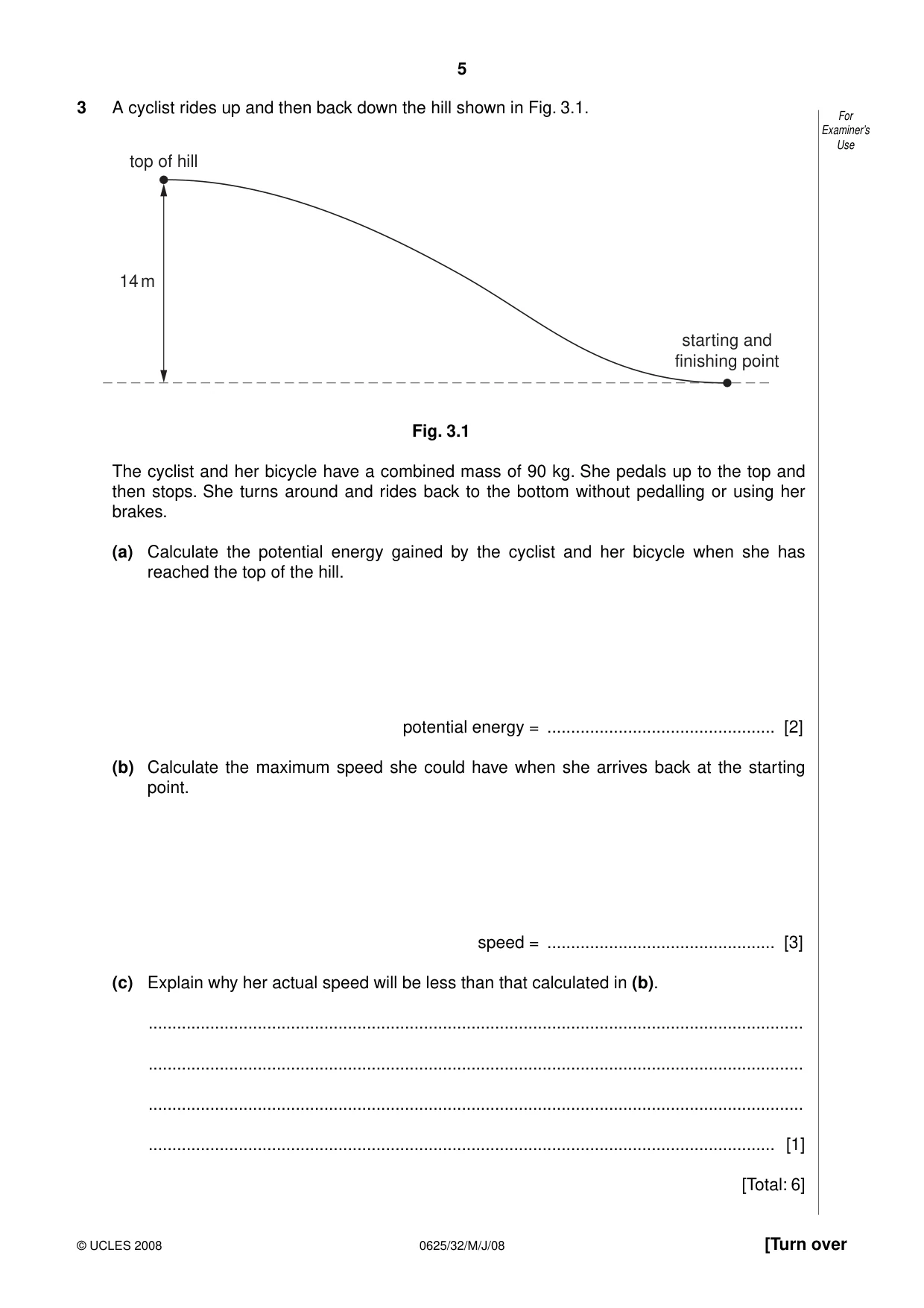
5 0625/32/M/J/08 © UCLES 2008 [Turn over For Examiner’s Use 3 A cyclist rides up and then back down the hill shown in Fig. 3.1. 14 m top of hill starting and finishing point Fig. 3.1 The cyclist and her bicycle have a combined mass of 90 kg. She pedals up to the top and then stops. She turns around and rides back to the bottom without pedalling or using her brakes. (a) Calculate the potential energy gained by the cyclist and her bicycle when she has reached the top of the hill. potential energy = … [2] (b) Calculate the maximum speed she could have when she arrives back at the starting point. speed = … [3] (c) Explain why her actual speed will be less than that calculated in (b). … … … … [1] [Total: 6]
Question paper, page 23
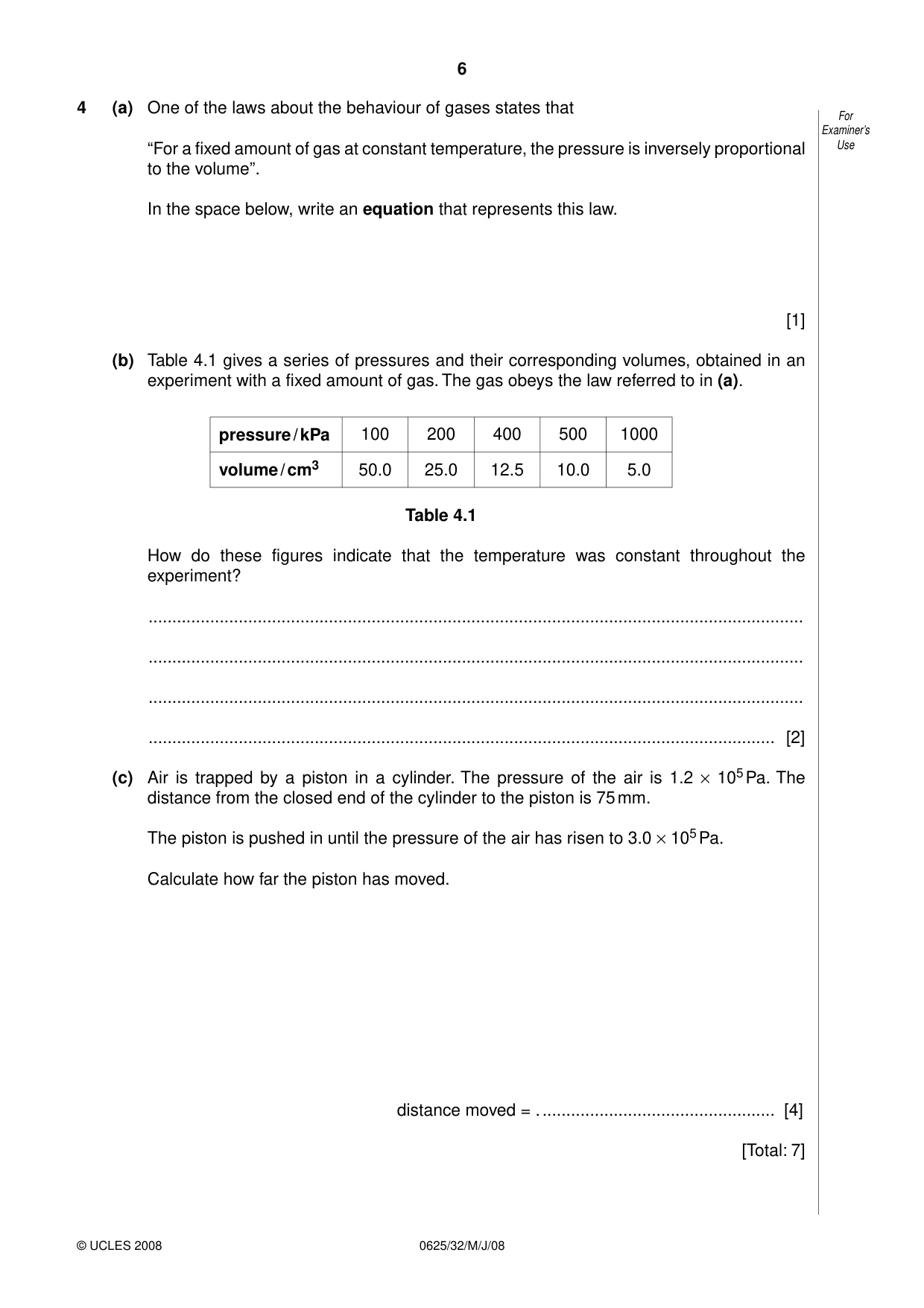
6 0625/32/M/J/08 © UCLES 2008 For Examiner’s Use 4 (a) One of the laws about the behaviour of gases states that “For a fixed amount of gas at constant temperature, the pressure is inversely proportional to the volume”. In the space below, write an equation that represents this law. [1] (b) Table 4.1 gives a series of pressures and their corresponding volumes, obtained in an experiment with a fixed amount of gas. The gas obeys the law referred to in (a). pressure / kPa 100 200 400 500 1000 volume / cm3 50.0 25.0 12.5 10.0 5.0 Table 4.1 How do these figures indicate that the temperature was constant throughout the experiment? … … … … [2] (c) Air is trapped by a piston in a cylinder. The pressure of the air is 1.2 × 10⁵ Pa. The distance from the closed end of the cylinder to the piston is 75 mm. The piston is pushed in until the pressure of the air has risen to 3.0 × 10⁵ Pa. Calculate how far the piston has moved. distance moved = . … [4] [Total: 7]
Question paper, page 24
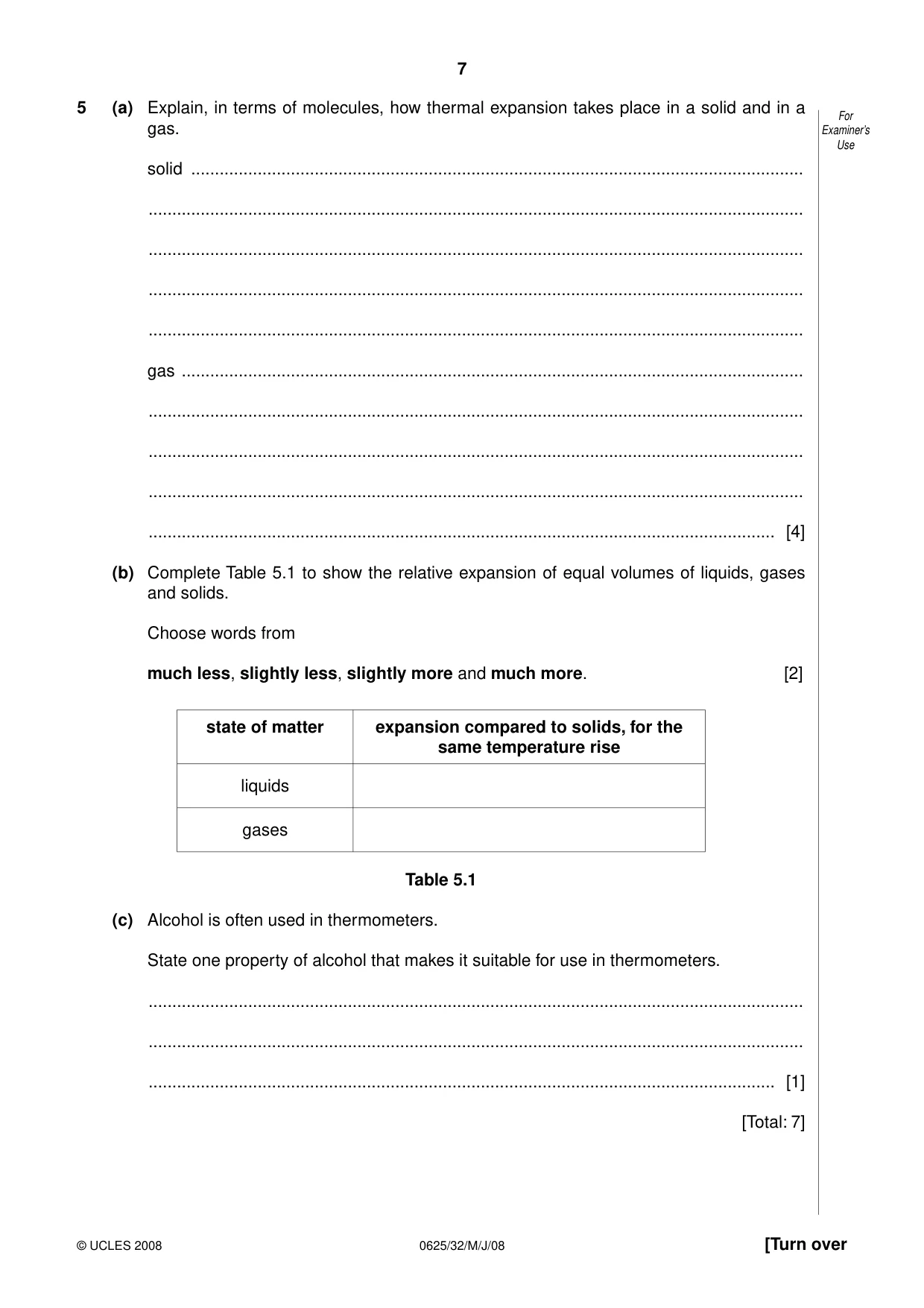
7 0625/32/M/J/08 © UCLES 2008 [Turn over For Examiner’s Use 5 (a) Explain, in terms of molecules, how thermal expansion takes place in a solid and in a gas. solid … … … … … gas … … … … … [4] (b) Complete Table 5.1 to show the relative expansion of equal volumes of liquids, gases and solids. Choose words from much less, slightly less, slightly more and much more. [2] state of matter expansion compared to solids, for the same temperature rise liquids gases Table 5.1 (c) Alcohol is often used in thermometers. State one property of alcohol that makes it suitable for use in thermometers. … … … [1] [Total: 7]
Question paper, page 25
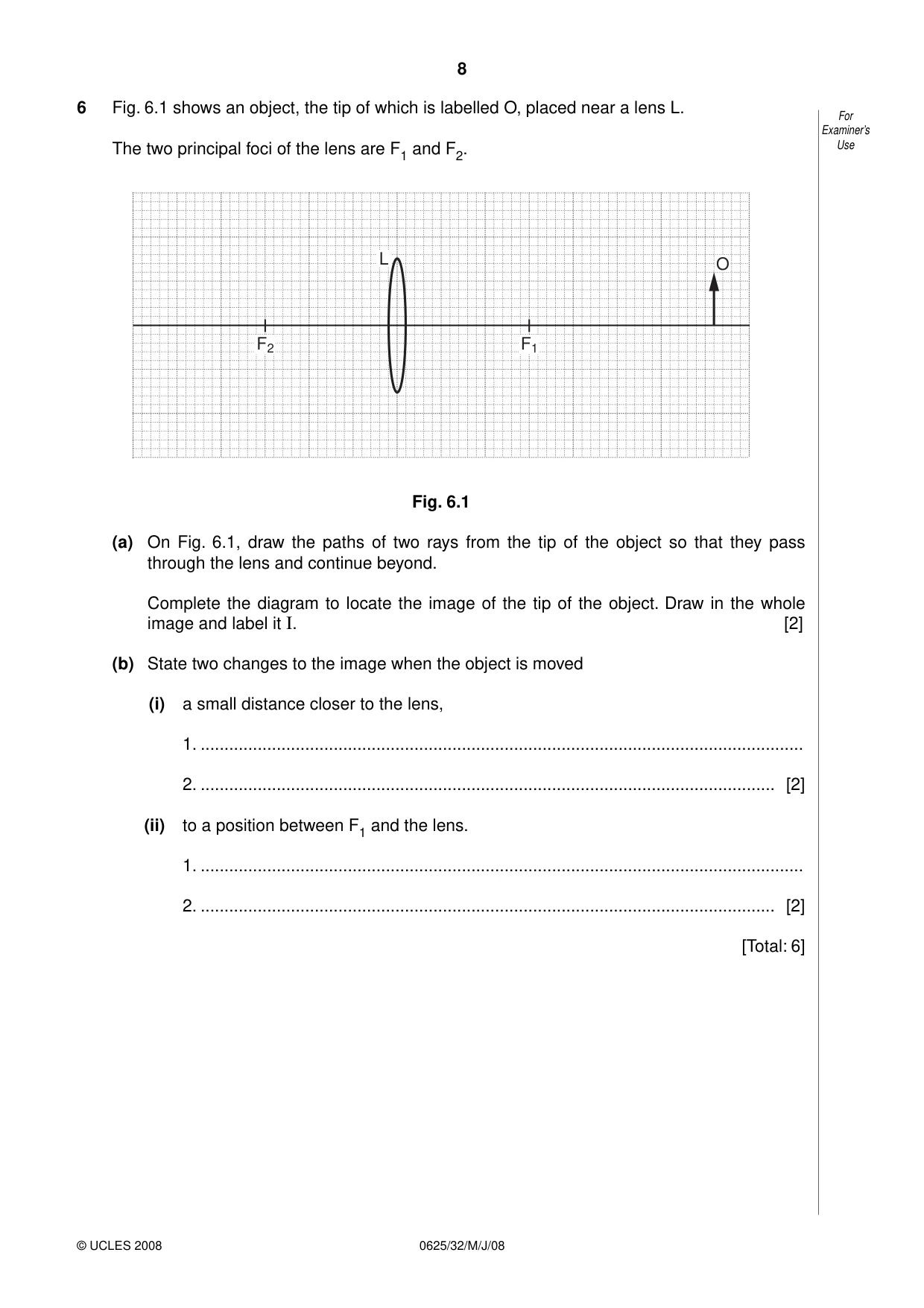
8 0625/32/M/J/08 © UCLES 2008 For Examiner’s Use 6 Fig. 6.1 shows an object, the tip of which is labelled O, placed near a lens L. The two principal foci of the lens are F1 and F2. F1 F2 L O Fig. 6.1 (a) On Fig. 6.1, draw the paths of two rays from the tip of the object so that they pass through the lens and continue beyond. Complete the diagram to locate the image of the tip of the object. Draw in the whole image and label it I. [2] (b) State two changes to the image when the object is moved (i) a small distance closer to the lens, 1. … 2. … [2] (ii) to a position between F1 and the lens. 1. … 2. … [2] [Total: 6]
Question paper, page 26
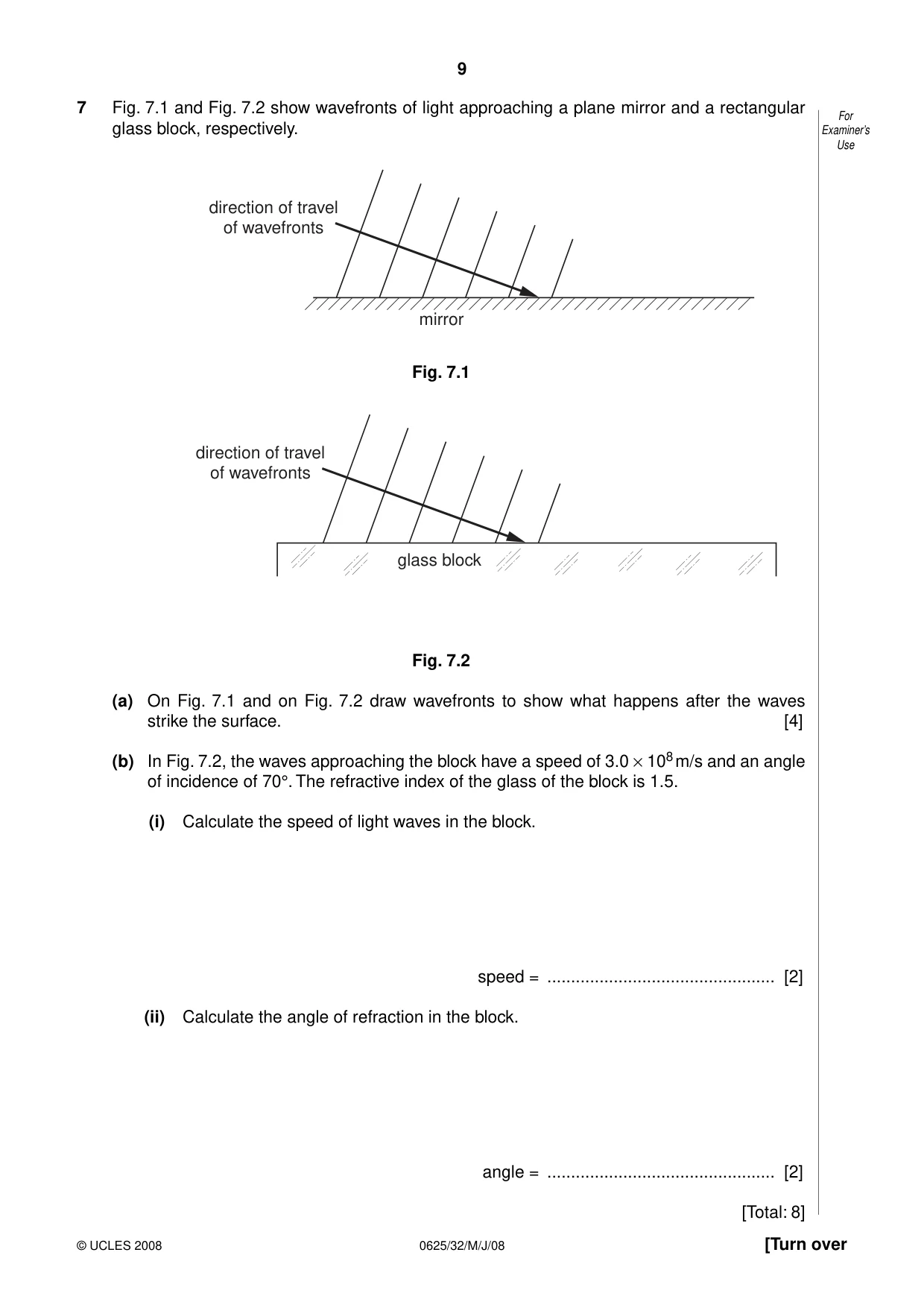
9 0625/32/M/J/08 © UCLES 2008 [Turn over For Examiner’s Use 7 Fig. 7.1 and Fig. 7.2 show wavefronts of light approaching a plane mirror and a rectangular glass block, respectively. direction of travel of wavefronts mirror Fig. 7.1 direction of travel of wavefronts glass block Fig. 7.2 (a) On Fig. 7.1 and on Fig. 7.2 draw wavefronts to show what happens after the waves strike the surface. [4] (b) In Fig. 7.2, the waves approaching the block have a speed of 3.0 × 10⁸ m/s and an angle of incidence of 70°. The refractive index of the glass of the block is 1.5. (i) Calculate the speed of light waves in the block. speed = … [2] (ii) Calculate the angle of refraction in the block. angle = … [2] [Total: 8]
Question paper, page 27
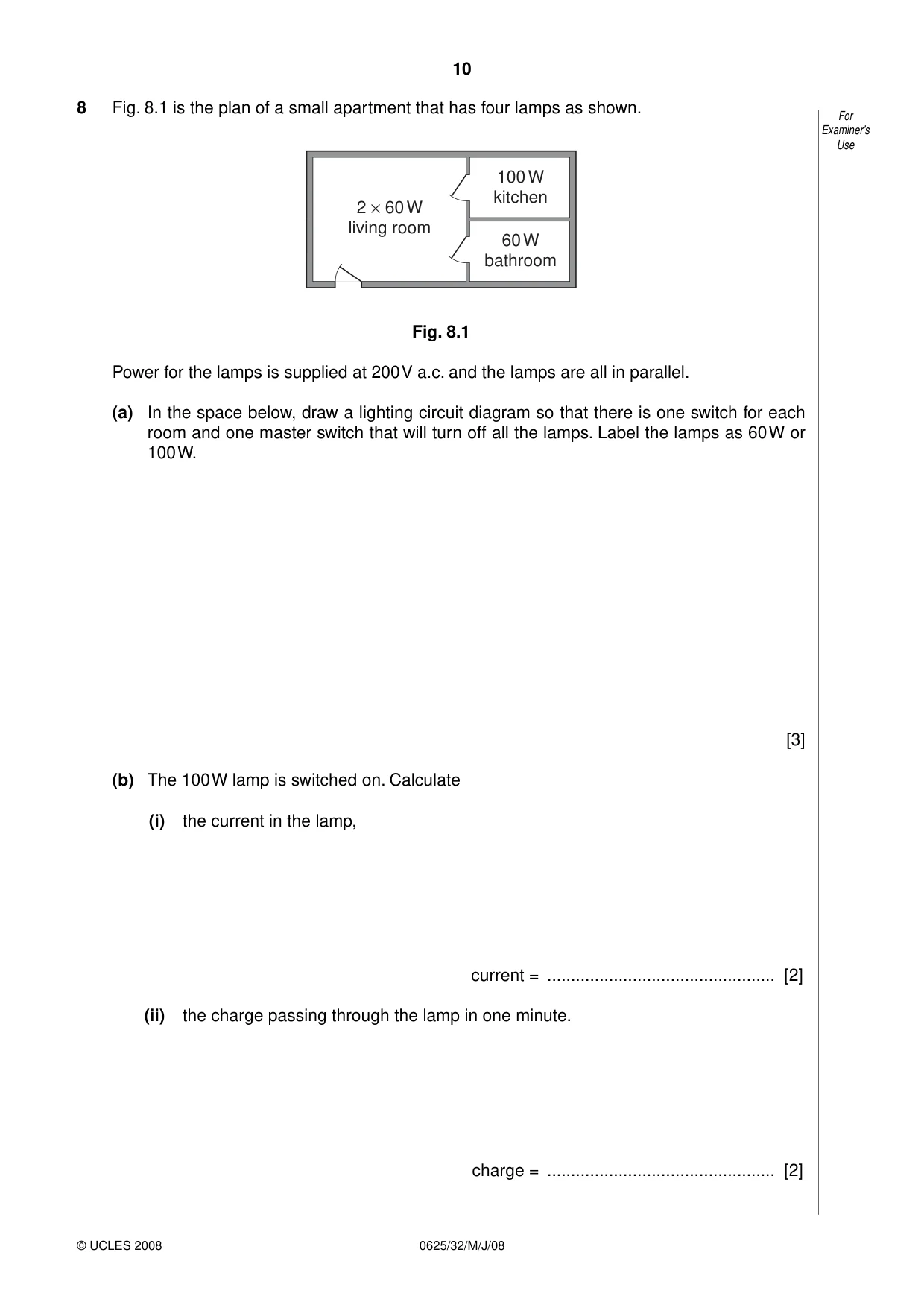
10 0625/32/M/J/08 © UCLES 2008 For Examiner’s Use 8 Fig. 8.1 is the plan of a small apartment that has four lamps as shown. 2 × 60 W living room 100 W kitchen 60 W bathroom Fig. 8.1 Power for the lamps is supplied at 200 V a.c. and the lamps are all in parallel. (a) In the space below, draw a lighting circuit diagram so that there is one switch for each room and one master switch that will turn off all the lamps. Label the lamps as 60 W or 100 W. [3] (b) The 100 W lamp is switched on. Calculate (i) the current in the lamp, current = … [2] (ii) the charge passing through the lamp in one minute. charge = … [2]
Question paper, page 28
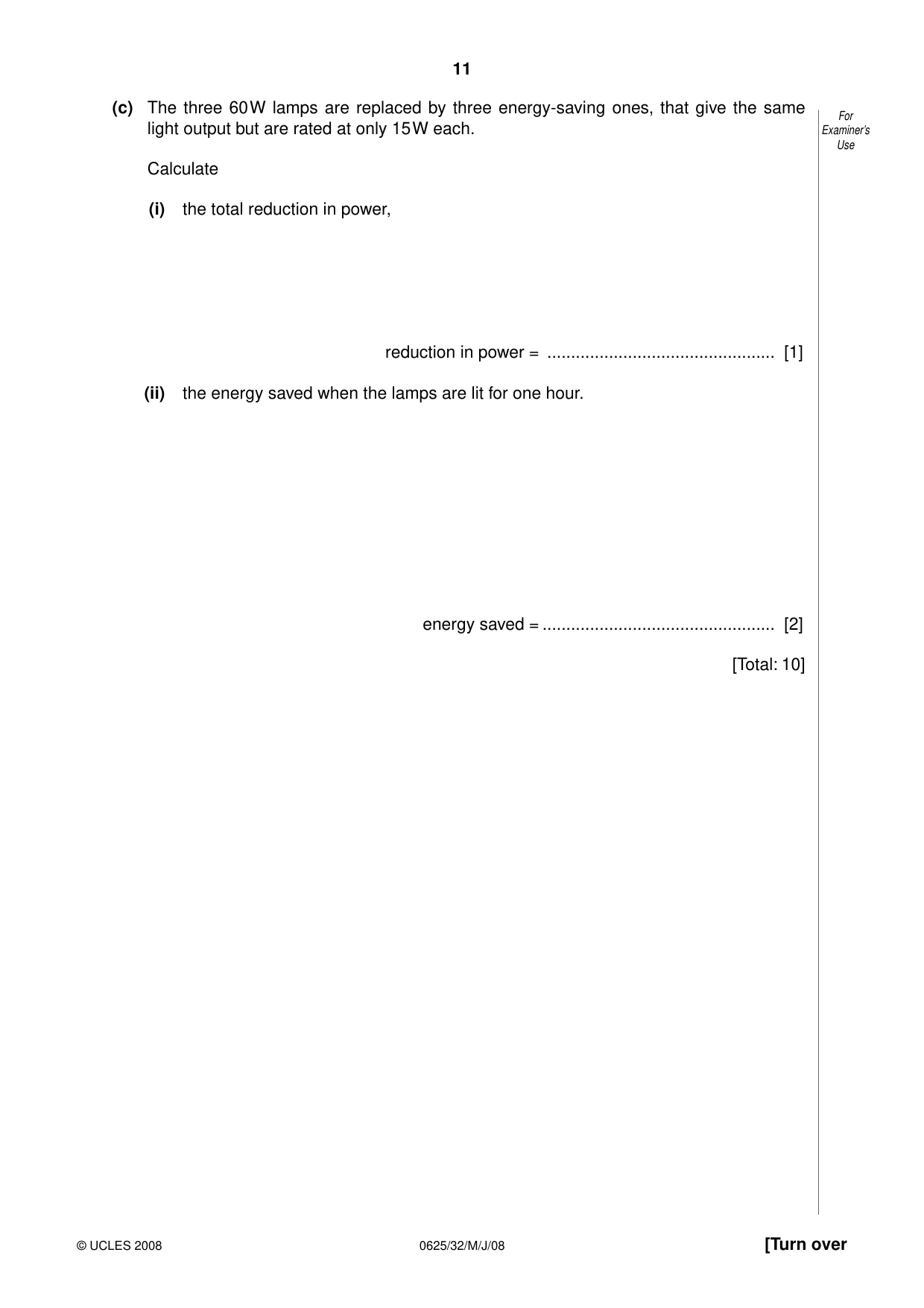
11 0625/32/M/J/08 © UCLES 2008 [Turn over For Examiner’s Use (c) The three 60 W lamps are replaced by three energy-saving ones, that give the same light output but are rated at only 15 W each. Calculate (i) the total reduction in power, reduction in power = … [1] (ii) the energy saved when the lamps are lit for one hour. energy saved = … [2] [Total: 10]
Question paper, page 29
12 0625/32/M/J/08 © UCLES 2008 For Examiner’s Use 9 Fig. 9.1 shows apparatus used to investigate electromagnetic effects around straight wires. T1 T2 T3 T4 thin flexible wire thick rigid vertical wire large circular hole in card small circular hole in card Fig. 9.1 Fig. 9.2 is a view looking down on the apparatus shown in Fig. 9.1. Fig. 9.2 (a) A battery is connected to T1 and T2 so that there is a current vertically down the thick wire. On Fig. 9.2, draw three magnetic field lines and indicate, with arrows, the direction of all three. [2] (b) Using a variable resistor, the p.d. between terminals T1 and T2 is gradually reduced. State the effect, if any, that this will have on (i) the strength of the magnetic field, … [1] (ii) the direction of the magnetic field. … [1]
Question paper, page 30
13 0625/32/M/J/08 © UCLES 2008 [Turn over For Examiner’s Use (c) The battery is now connected to terminals T3 and T4, as well as to terminals T1 and T2, so that there is a current down both wires. This causes the flexible wire to move. (i) Explain why the flexible wire moves. … … … … … [2] (ii) State the direction of the movement of the flexible wire. … [1] (iii) The battery is replaced by one that delivers a smaller current. State the effect that this will have on the force acting on the flexible wire. … … [1] [Total: 8]
Question paper, page 31
14 0625/32/M/J/08 © UCLES 2008 For Examiner’s Use 10 (a) In the space below, draw the symbol for a NOR gate. [1] (b) Describe the action of a NOR gate in terms of its inputs and output. … … … … … … … [2]
Question paper, page 32
15 0625/32/M/J/08 © UCLES 2008 [Turn over For Examiner’s Use (c) A chemical process requires heating at low pressure to work correctly. When the heater is working, the output of a temperature sensor is high. When the pressure is low enough, a pressure sensor has a low output. Both outputs are fed into a NOR gate. A high output from the gate switches on an indicator lamp. (i) Explain why the indicator lamp is off when the process is working correctly. … … … … [1] (ii) State whether the lamp is on or off in the following situations. 1. The pressure is low enough, but the heater stops working. … 2. The heater is working, but the pressure rises too high. … [2] [Total: 6]
Question paper, page 33
16 0625/32/M/J/08 © UCLES 2008 For Examiner’s Use 11 (a) Chlorine has two isotopes, one of nucleon number 35 and one of nucleon number 37. The proton number of chlorine is 17. Table 11.1 refers to neutral atoms of chlorine. Complete Table 11.1. nucleon number 35 nucleon number 37 number of protons number of neutrons number of electrons [3] Table 11.1 (b) Some isotopes are radioactive. State the three types of radiation that may be emitted from radioactive isotopes. 1. … 2. … 3. … [1] (c) (i) State one practical use of a radioactive isotope. … … [1] (ii) Outline how it is used. … … … … … [1] [Total: 6] Permission to reproduce items where third-party owned material protected by copyright is included has been sought and cleared where possible. Every reasonable effort has been made by the publisher (UCLES) to trace copyright holders, but if any items requiring clearance have unwittingly been included, the publisher will be pleased to make amends at the earliest possible opportunity. University of Cambridge International Examinations is part of the Cambridge Assessment Group. Cambridge Assessment is the brand name of University of Cambridge Local Examinations Syndicate (UCLES), which is itself a department of the University of Cambridge.