Cambridge IGCSE Physics 0625 — 2005 May/June Paper 3 · Variant 1
0625/31/M/J/05
The question paper and its mark scheme, free to read here and free to download. This is Cambridge’s own paper, exactly as it was sat.
Question paper16 pages
Mark scheme7 pages
Answers below. Sit the paper first if you are practising.
Paper as text
Question paper, page 1
This document consists of 15 printed pages and 1 blank page. SPA (SJF3442/CG) S92054/2.1 © UCLES 2005 [Turn over UNIVERSITY OF CAMBRIDGE INTERNATIONAL EXAMINATIONS International General Certificate of Secondary Education PHYSICS Paper 3 0625/03 May/June 2005 1 hour 15 minutes Candidates answer on the Question Paper. No Additional Materials are required. READ THESE INSTRUCTIONS FIRST Write your Centre number, candidate number and name on all the work you hand in. Write in dark blue or black pen in the spaces provided on the Question Paper. You may use a soft pencil for any diagrams, graphs or rough working. Do not use staples, paper clips, highlighters, glue or correction fluid. Answer all questions. At the end of the examination, fasten all your work securely together. The number of marks is given in brackets [ ] at the end of each question or part question. You may lose marks if you do not show your working or if you do not use appropriate units. Take the weight of 1 kg to be 10 N (i.e. acceleration of free fall = 10 m/s2). DO NOT WRITE IN THE BARCODE. DO NOT WRITE IN THE GREY AREAS BETWEEN THE PAGES. For Examiner’s Use 1 2 3 4 5 6 7 8 9 10 11 Total Candidate Name Centre Number Candidate Number www.XtremePapers.com
Question paper, page 2
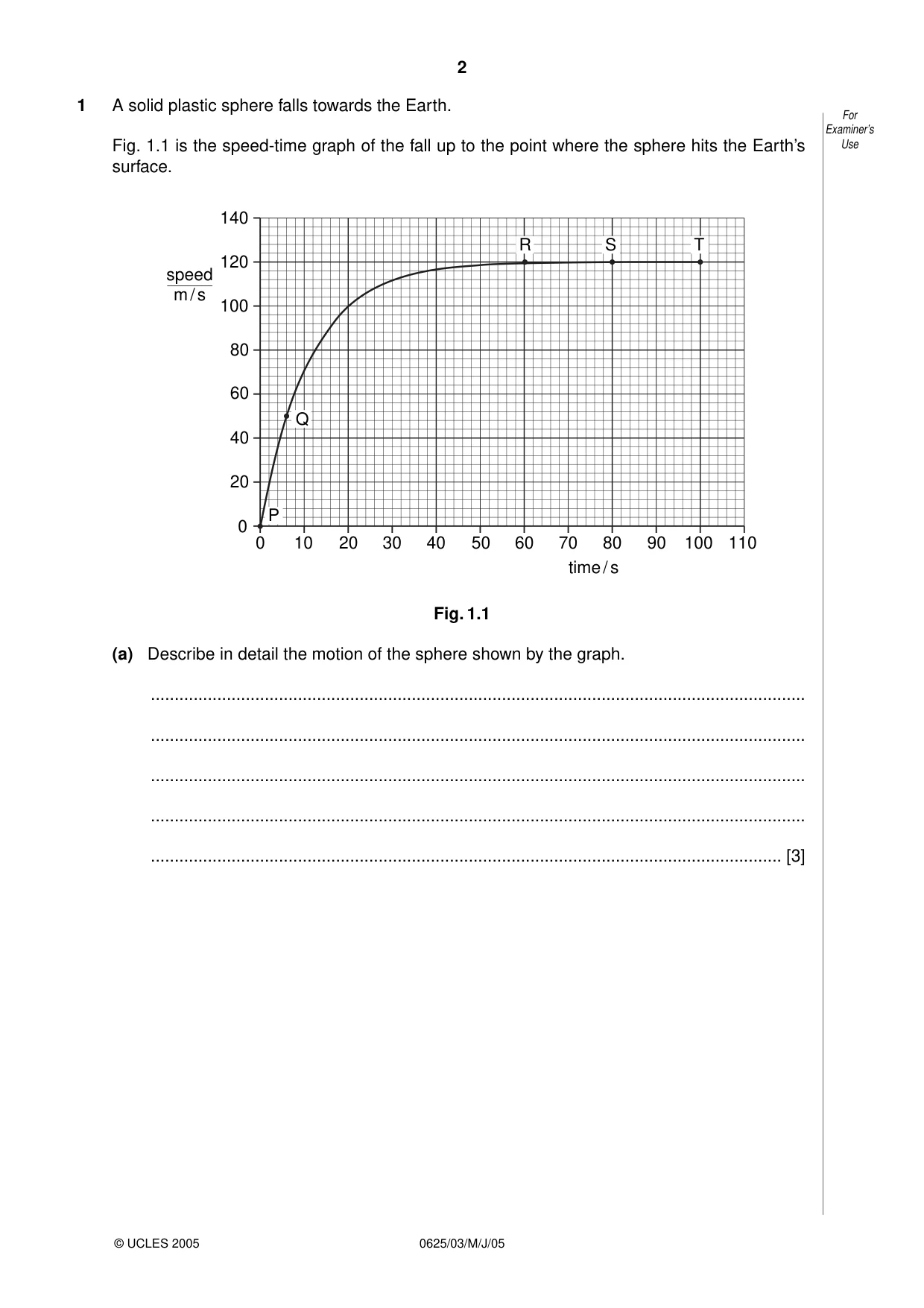
2 0625/03/M/J/05 1 A solid plastic sphere falls towards the Earth. Fig. 1.1 is the speed-time graph of the fall up to the point where the sphere hits the Earth’s surface. Fig. 1.1 (a) Describe in detail the motion of the sphere shown by the graph. … … … … … [3] 0 20 P Q R S T 40 60 80 100 120 140 speed m / s 10 0 20 30 40 50 60 70 80 90 100 110 time / s For Examiner’s Use © UCLES 2005
Question paper, page 3
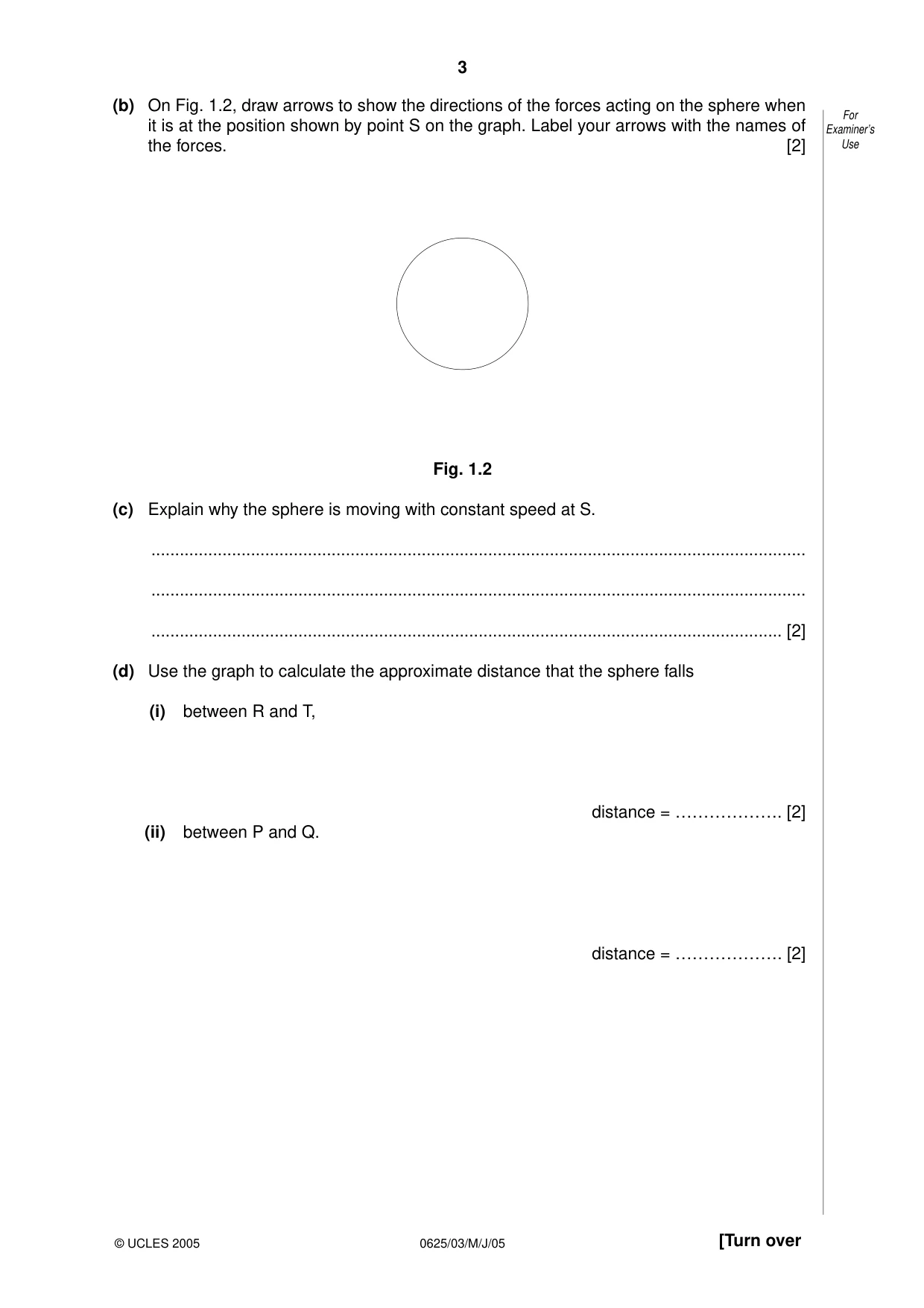
3 0625/03/M/J/05 [Turn over (b) On Fig. 1.2, draw arrows to show the directions of the forces acting on the sphere when it is at the position shown by point S on the graph. Label your arrows with the names of the forces. [2] Fig. 1.2 (c) Explain why the sphere is moving with constant speed at S. … … … [2] (d) Use the graph to calculate the approximate distance that the sphere falls (i) between R and T, distance = ………………. [2] (ii) between P and Q. distance = ………………. [2] For Examiner’s Use © UCLES 2005
Question paper, page 4
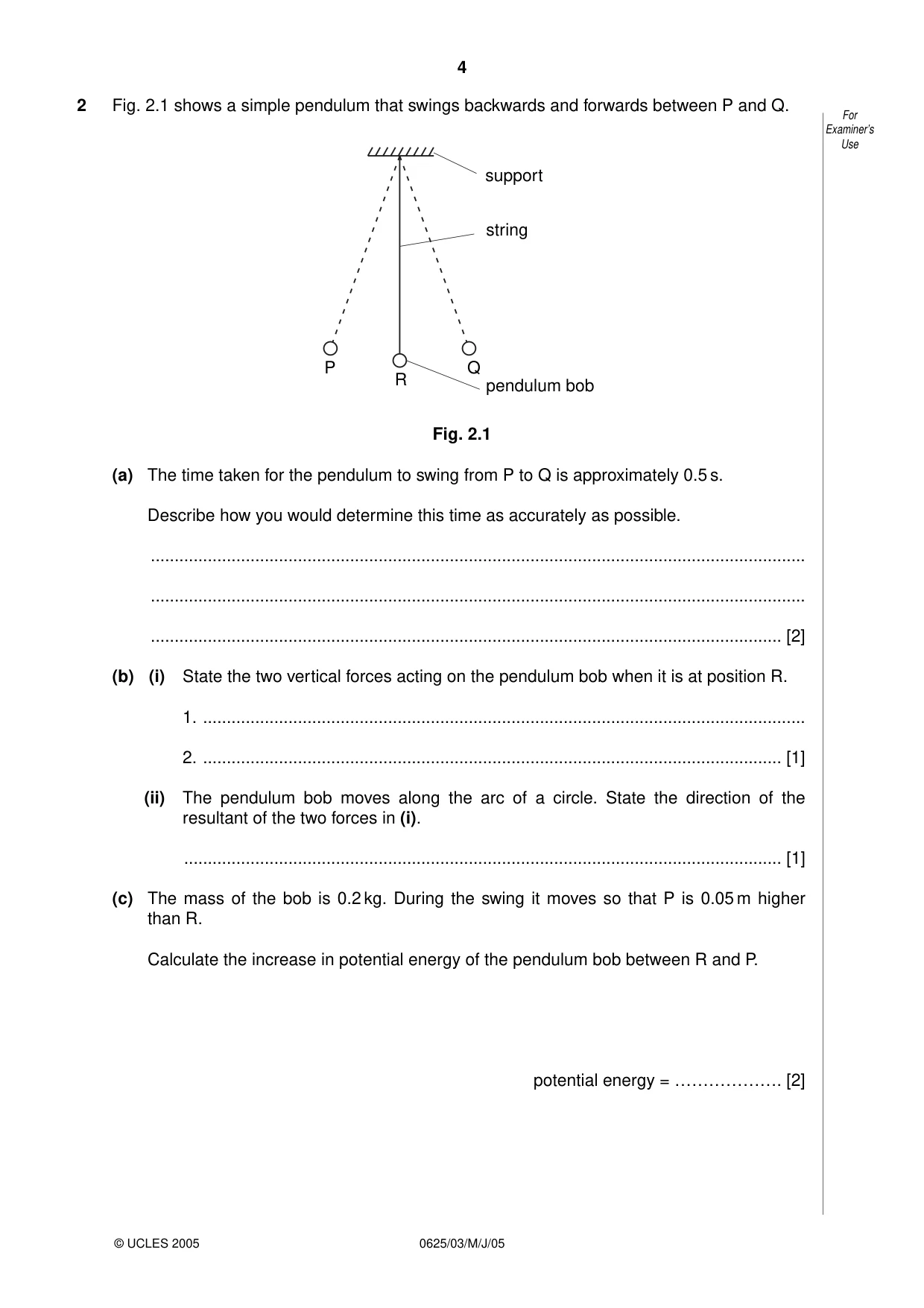
4 0625/03/M/J/05 2 Fig. 2.1 shows a simple pendulum that swings backwards and forwards between P and Q. Fig. 2.1 (a) The time taken for the pendulum to swing from P to Q is approximately 0.5 s. Describe how you would determine this time as accurately as possible. … … … [2] (b) (i) State the two vertical forces acting on the pendulum bob when it is at position R. 1. … 2. … [1] (ii) The pendulum bob moves along the arc of a circle. State the direction of the resultant of the two forces in (i). … [1] (c) The mass of the bob is 0.2 kg. During the swing it moves so that P is 0.05 m higher than R. Calculate the increase in potential energy of the pendulum bob between R and P. potential energy = ………………. [2] support string pendulum bob P R Q For Examiner’s Use © UCLES 2005
Question paper, page 5
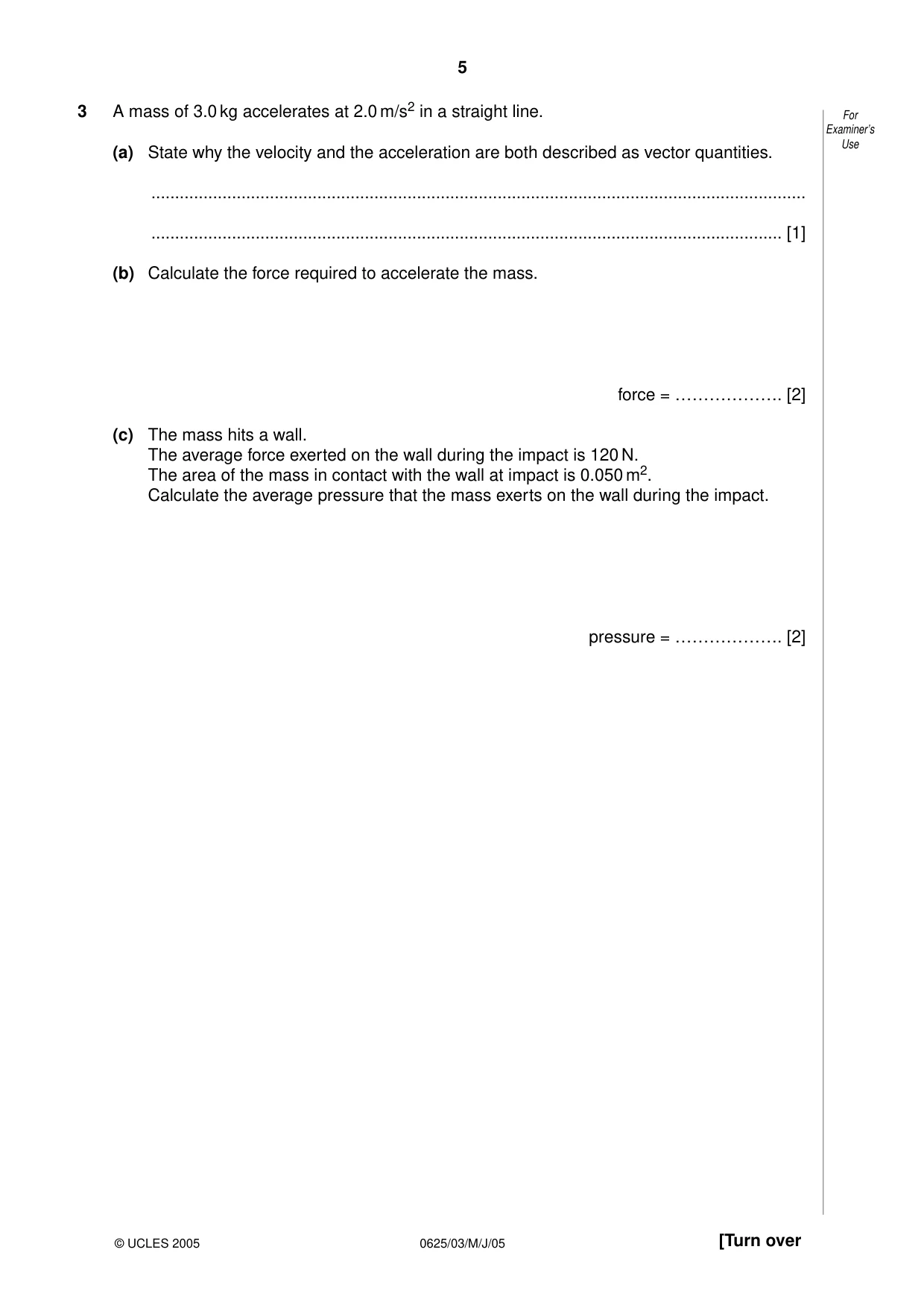
5 0625/03/M/J/05 [Turn over 3 A mass of 3.0 kg accelerates at 2.0 m/s2 in a straight line. (a) State why the velocity and the acceleration are both described as vector quantities. … … [1] (b) Calculate the force required to accelerate the mass. force = ………………. [2] (c) The mass hits a wall. The average force exerted on the wall during the impact is 120 N. The area of the mass in contact with the wall at impact is 0.050 m2. Calculate the average pressure that the mass exerts on the wall during the impact. pressure = ………………. [2] For Examiner’s Use © UCLES 2005
Question paper, page 6
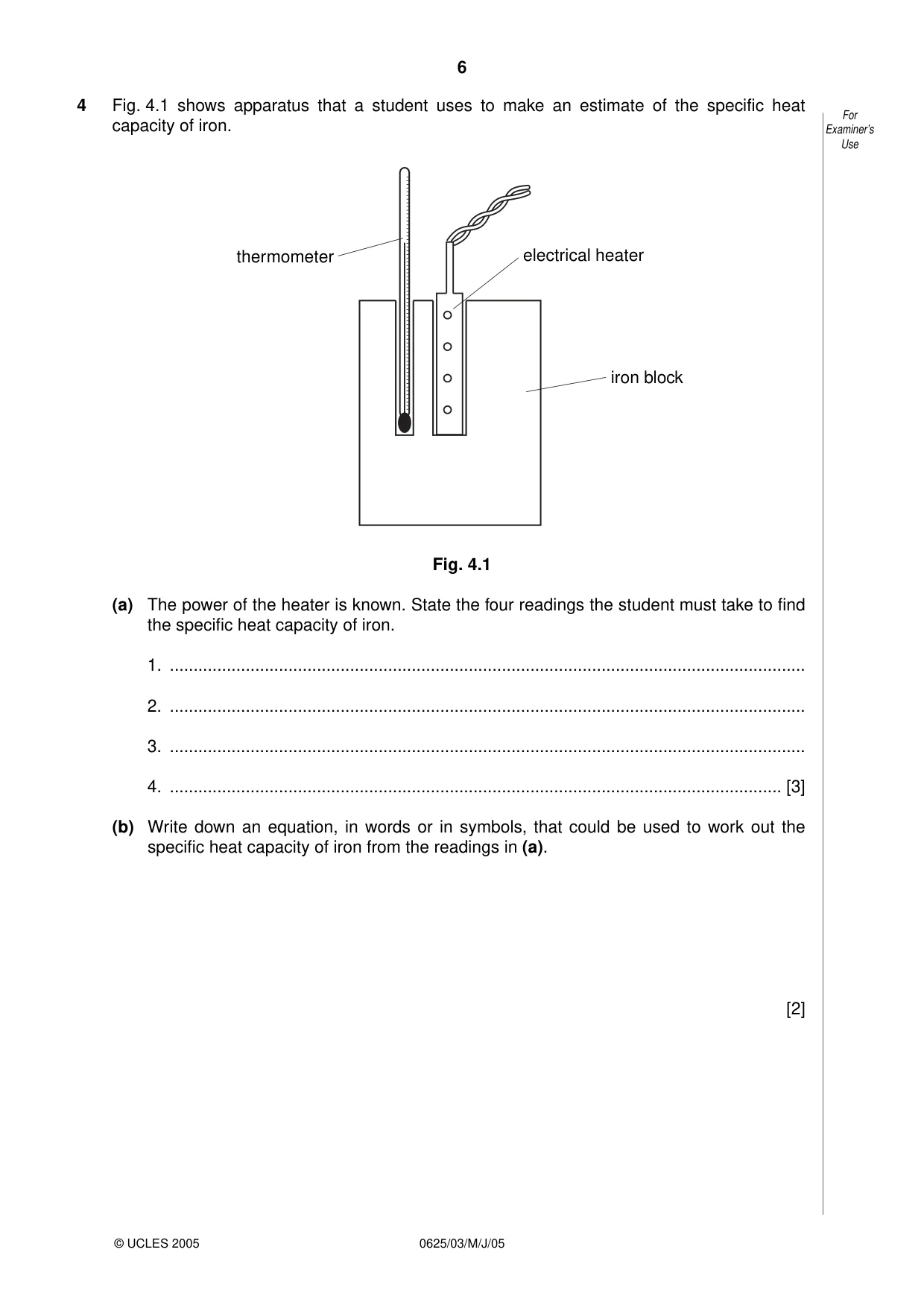
6 0625/03/M/J/05 4 Fig. 4.1 shows apparatus that a student uses to make an estimate of the specific heat capacity of iron. Fig. 4.1 (a) The power of the heater is known. State the four readings the student must take to find the specific heat capacity of iron. 1. … 2. … 3. … 4. … [3] (b) Write down an equation, in words or in symbols, that could be used to work out the specific heat capacity of iron from the readings in (a). [2] iron block electrical heater thermometer For Examiner’s Use © UCLES 2005
Question paper, page 7
7 0625/03/M/J/05 [Turn over (c) (i) Explain why the value obtained with this apparatus is higher than the actual value. … … [1] (ii) State one addition to the apparatus that would help to improve the accuracy of the value obtained. … … [1] For Examiner’s Use © UCLES 2005
Question paper, page 8
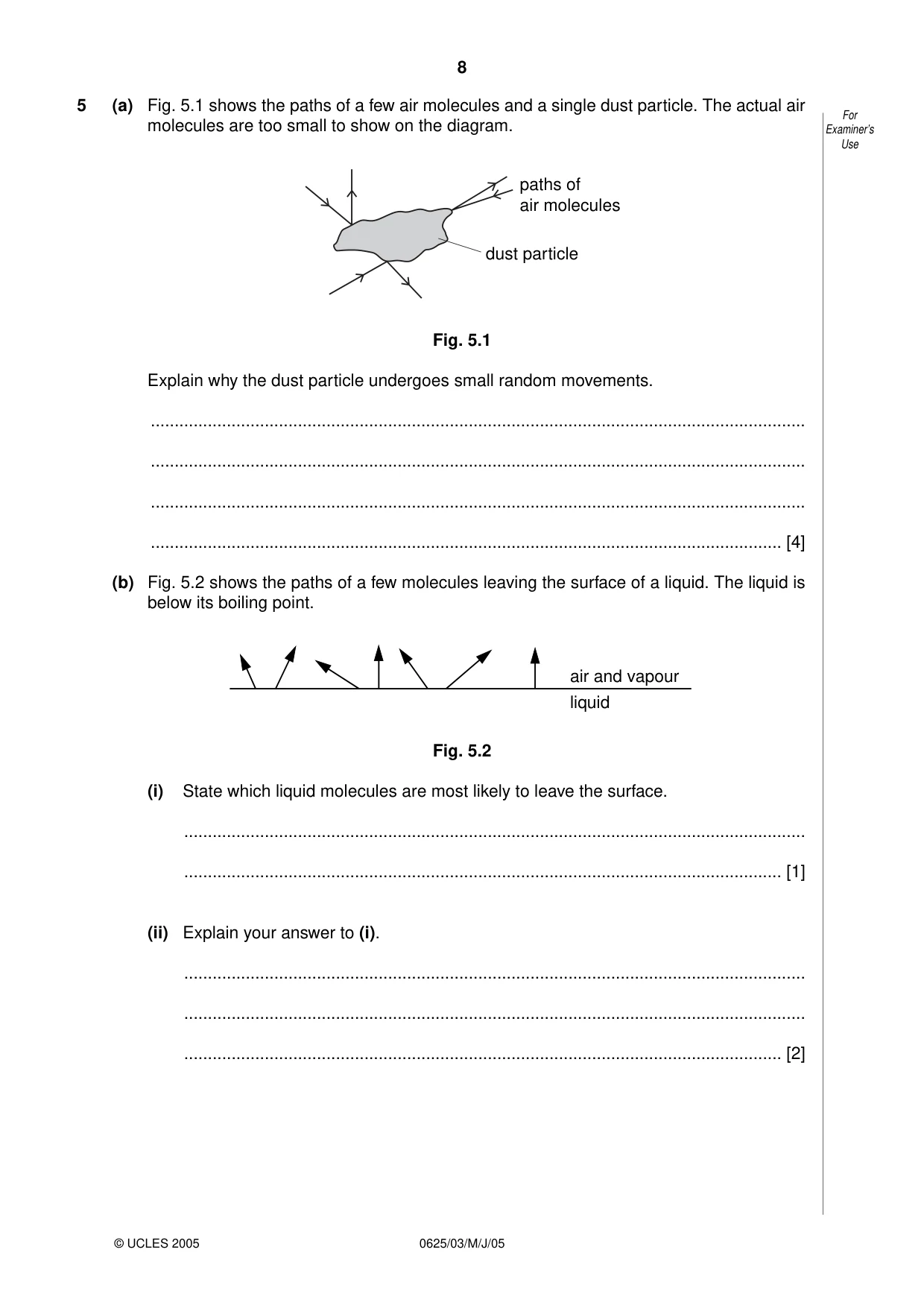
8 0625/03/M/J/05 5 (a) Fig. 5.1 shows the paths of a few air molecules and a single dust particle. The actual air molecules are too small to show on the diagram. Fig. 5.1 Explain why the dust particle undergoes small random movements. … … … … [4] (b) Fig. 5.2 shows the paths of a few molecules leaving the surface of a liquid. The liquid is below its boiling point. Fig. 5.2 (i) State which liquid molecules are most likely to leave the surface. … … [1] (ii) Explain your answer to (i). … … … [2] air and vapour liquid dust particle paths of air molecules For Examiner’s Use © UCLES 2005
Question paper, page 9
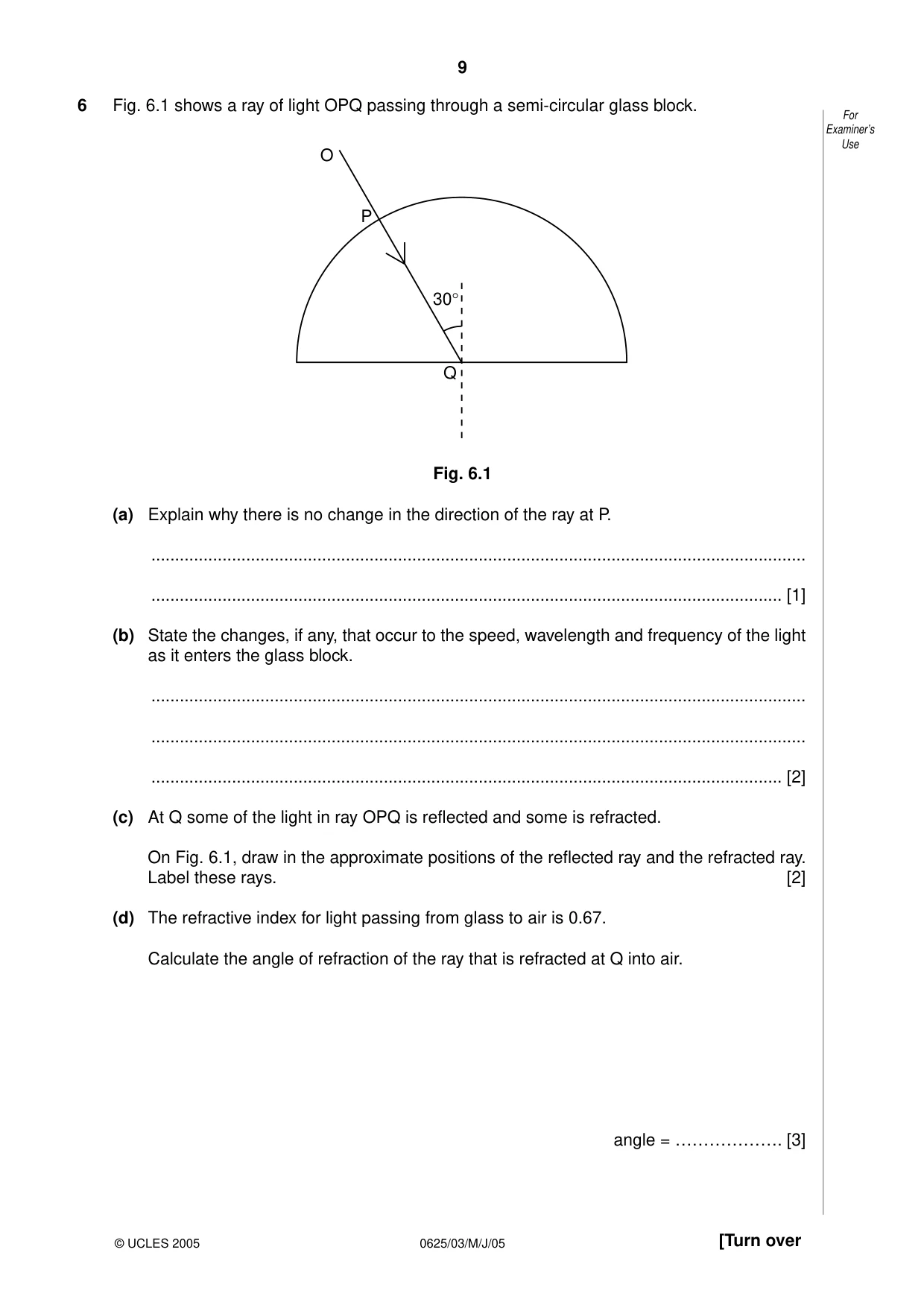
9 0625/03/M/J/05 [Turn over 6 Fig. 6.1 shows a ray of light OPQ passing through a semi-circular glass block. Fig. 6.1 (a) Explain why there is no change in the direction of the ray at P. … … [1] (b) State the changes, if any, that occur to the speed, wavelength and frequency of the light as it enters the glass block. … … … [2] (c) At Q some of the light in ray OPQ is reflected and some is refracted. On Fig. 6.1, draw in the approximate positions of the reflected ray and the refracted ray. Label these rays. [2] (d) The refractive index for light passing from glass to air is 0.67. Calculate the angle of refraction of the ray that is refracted at Q into air. angle = ………………. [3] 30° Q P O For Examiner’s Use © UCLES 2005
Question paper, page 10
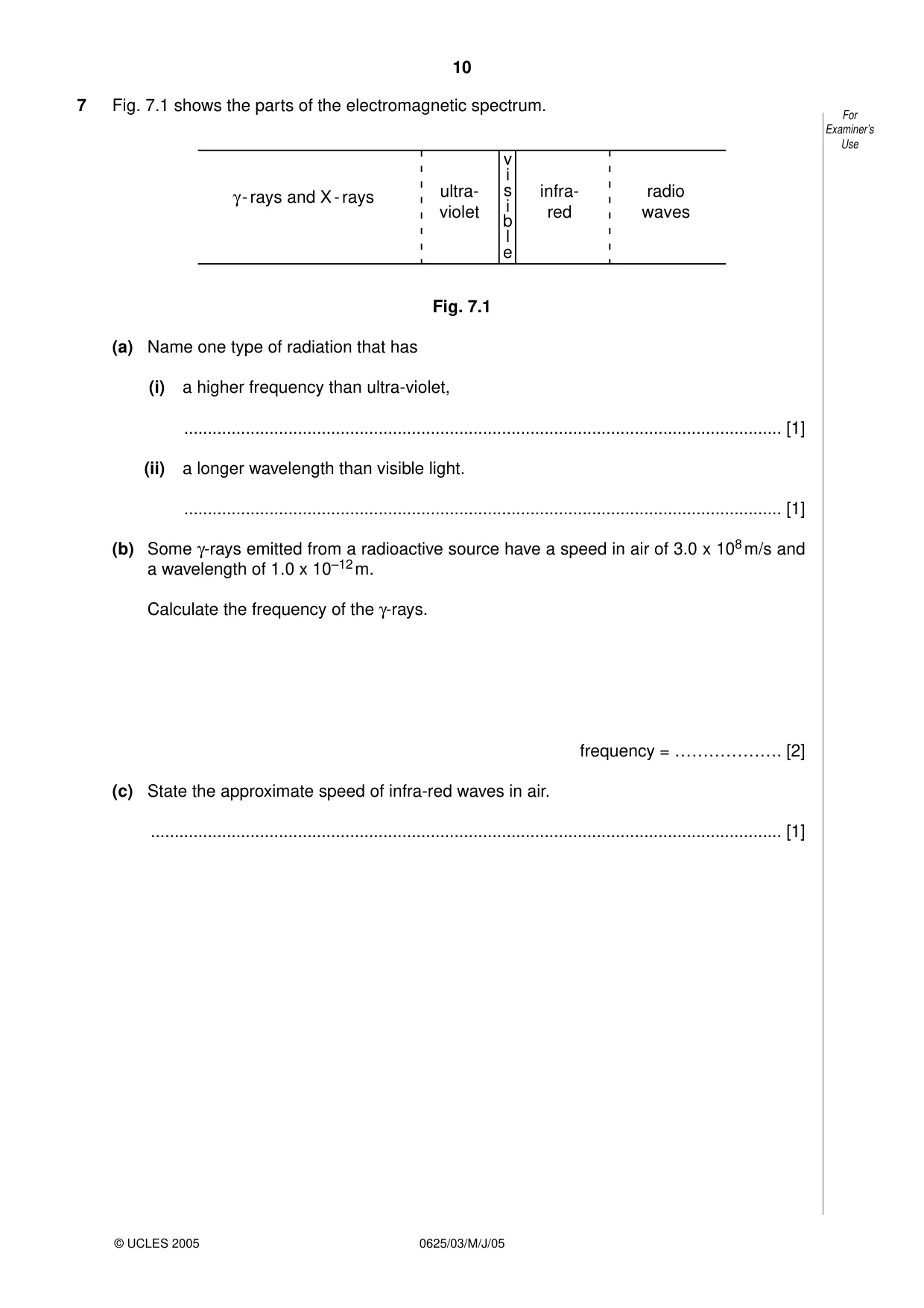
10 0625/03/M/J/05 7 Fig. 7.1 shows the parts of the electromagnetic spectrum. Fig. 7.1 (a) Name one type of radiation that has (i) a higher frequency than ultra-violet, … [1] (ii) a longer wavelength than visible light. … [1] (b) Some γ-rays emitted from a radioactive source have a speed in air of 3.0 x 10⁸m/s and a wavelength of 1.0 x 10⁻¹²m. Calculate the frequency of the γ-rays. frequency = ………………. [2] (c) State the approximate speed of infra-red waves in air. … [1] γ - rays and X - rays ultra- violet infra- red radio waves v i s i b l e For Examiner’s Use © UCLES 2005
Question paper, page 11
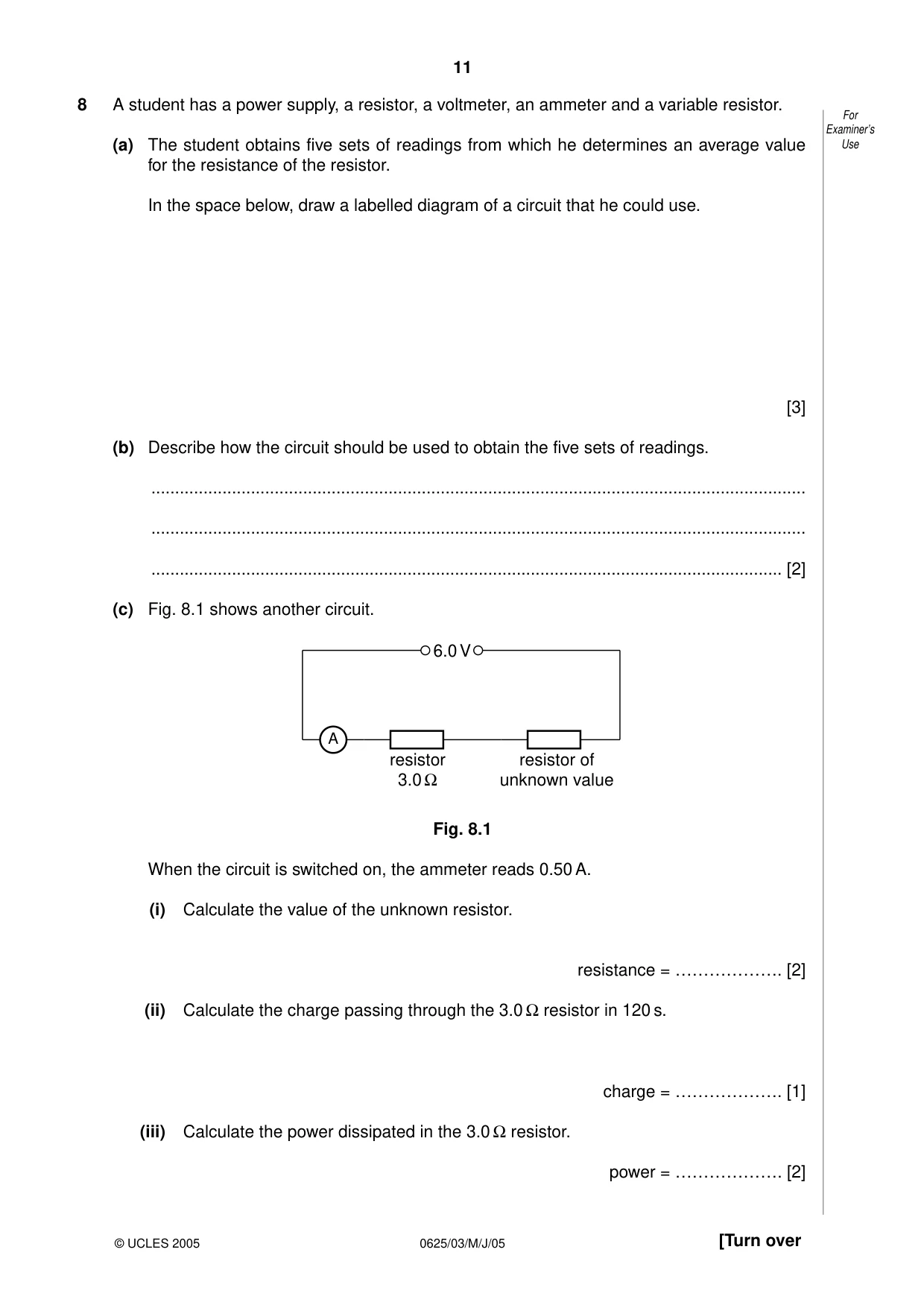
11 0625/03/M/J/05 [Turn over 8 A student has a power supply, a resistor, a voltmeter, an ammeter and a variable resistor. (a) The student obtains five sets of readings from which he determines an average value for the resistance of the resistor. In the space below, draw a labelled diagram of a circuit that he could use. [3] (b) Describe how the circuit should be used to obtain the five sets of readings. … … … [2] (c) Fig. 8.1 shows another circuit. Fig. 8.1 When the circuit is switched on, the ammeter reads 0.50 A. (i) Calculate the value of the unknown resistor. resistance = ………………. [2] (ii) Calculate the charge passing through the 3.0 Ωresistor in 120 s. charge = ………………. [1] (iii) Calculate the power dissipated in the 3.0 Ωresistor. power = ………………. [2] 6.0 V resistor 3.0 Ω resistor of unknown value A For Examiner’s Use © UCLES 2005
Question paper, page 12
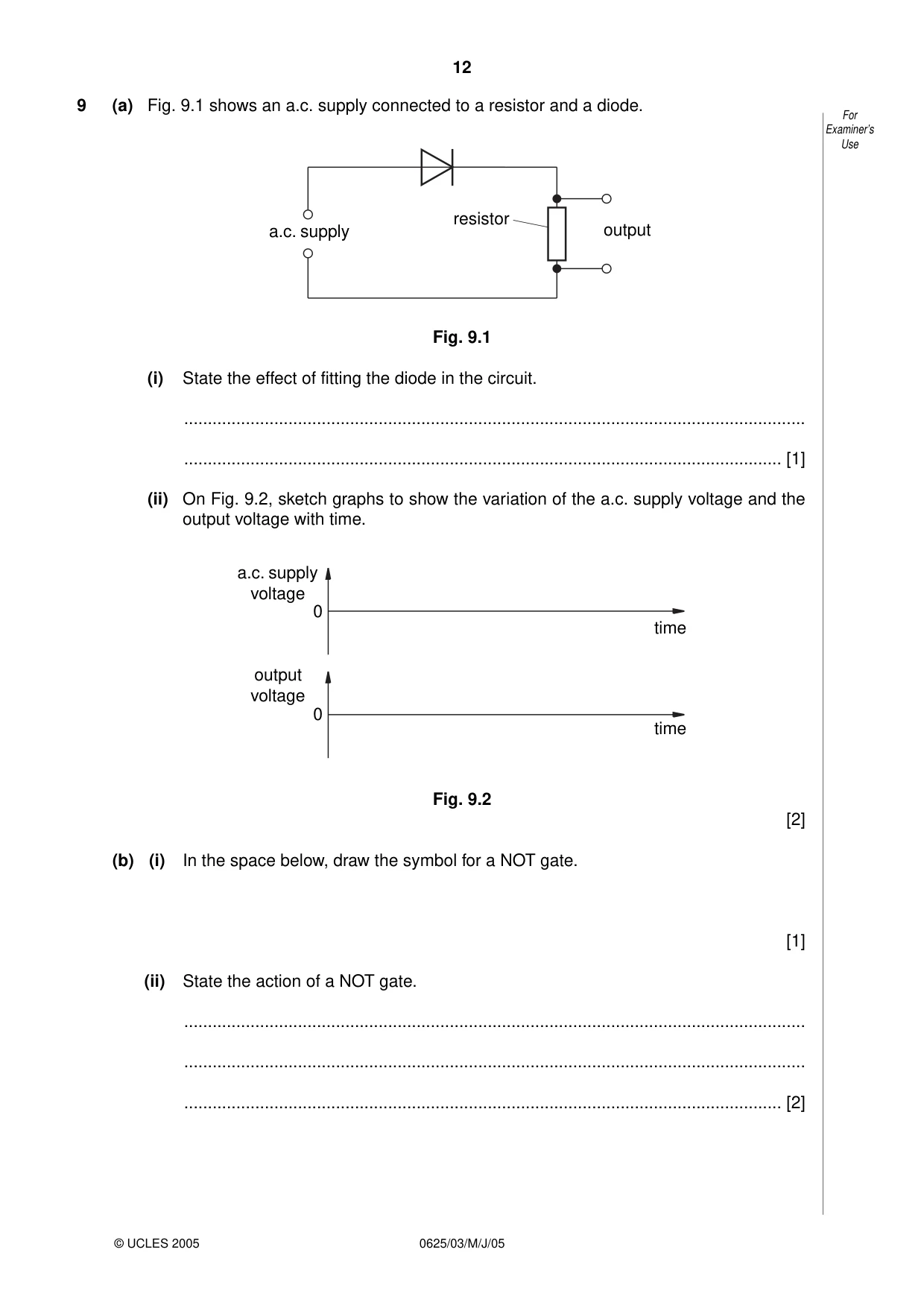
12 0625/03/M/J/05 9 (a) Fig. 9.1 shows an a.c. supply connected to a resistor and a diode. Fig. 9.1 (i) State the effect of fitting the diode in the circuit. … … [1] (ii) On Fig. 9.2, sketch graphs to show the variation of the a.c. supply voltage and the output voltage with time. Fig. 9.2 [2] (b) (i) In the space below, draw the symbol for a NOT gate. [1] (ii) State the action of a NOT gate. … … … [2] a.c. supply voltage time time 0 0 output voltage a.c. supply output resistor For Examiner’s Use © UCLES 2005
Question paper, page 13
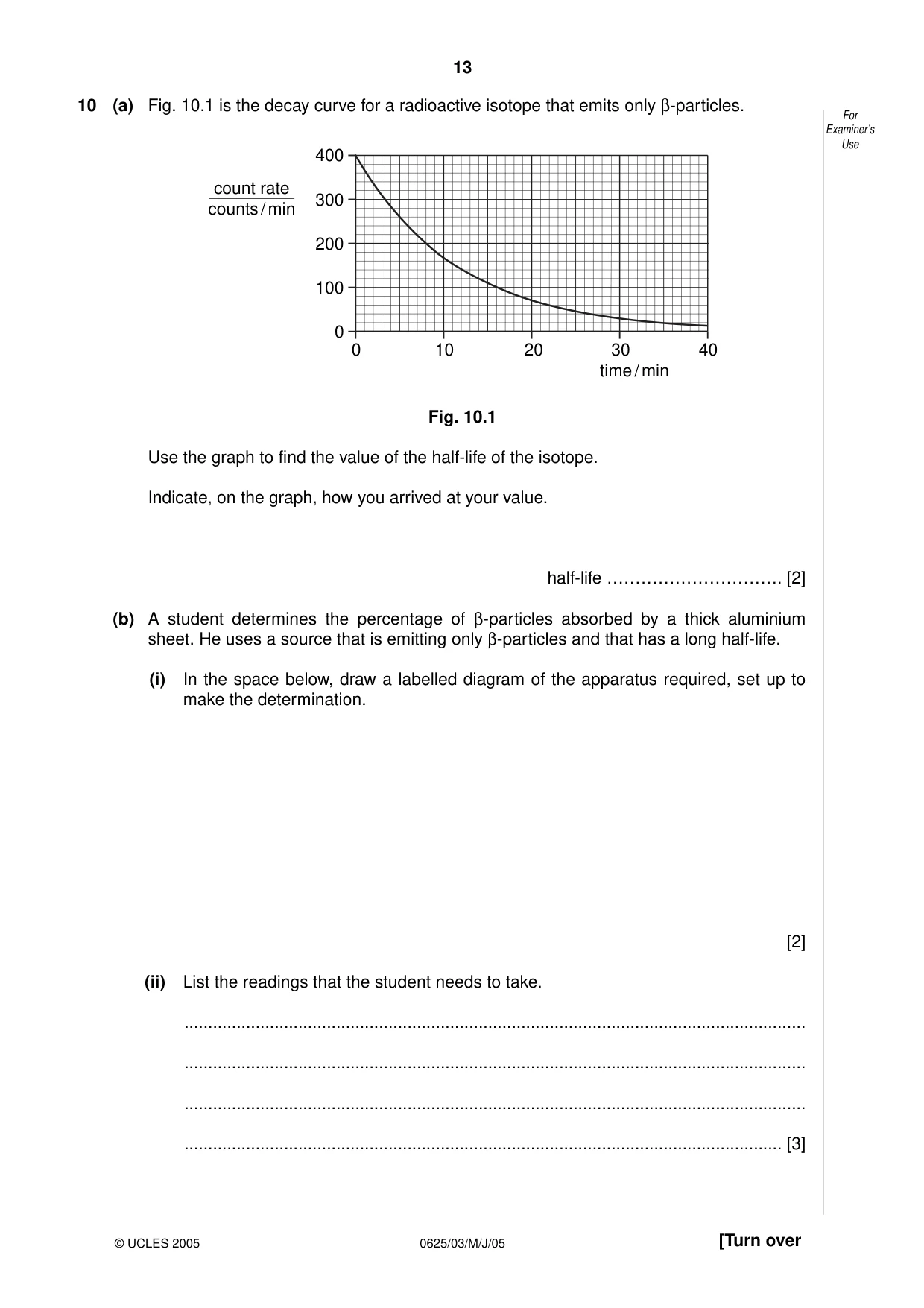
13 0625/03/M/J/05 [Turn over 10 (a) Fig. 10.1 is the decay curve for a radioactive isotope that emits only β-particles. Fig. 10.1 Use the graph to find the value of the half-life of the isotope. Indicate, on the graph, how you arrived at your value. half-life …………………………. [2] (b) A student determines the percentage of β-particles absorbed by a thick aluminium sheet. He uses a source that is emitting only β-particles and that has a long half-life. (i) In the space below, draw a labelled diagram of the apparatus required, set up to make the determination. [2] (ii) List the readings that the student needs to take. … … … … [3] 0 10 100 0 200 300 400 20 time / min count rate counts / min 30 40 For Examiner’s Use © UCLES 2005
Question paper, page 14
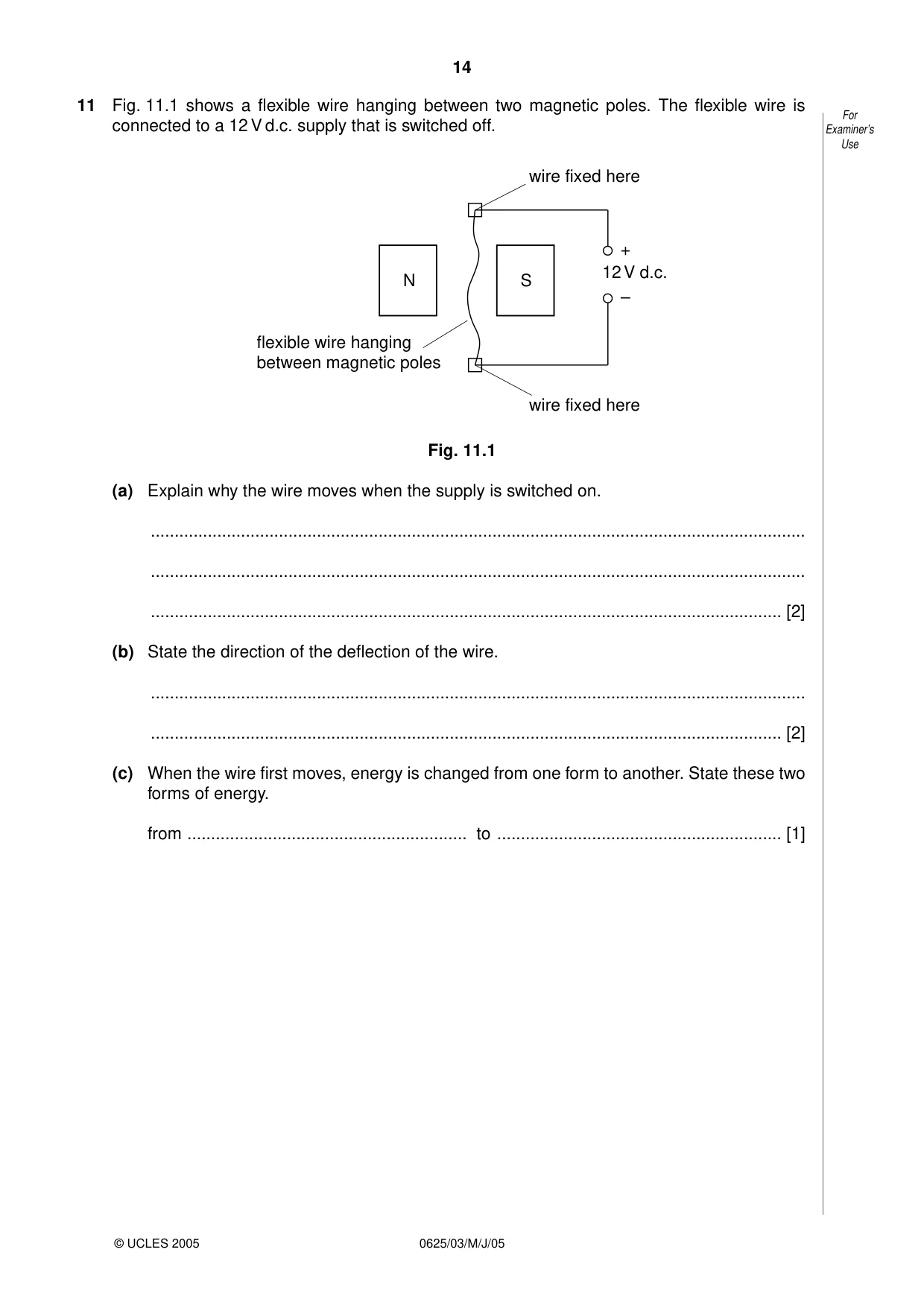
14 0625/03/M/J/05 11 Fig. 11.1 shows a flexible wire hanging between two magnetic poles. The flexible wire is connected to a 12 V d.c. supply that is switched off. Fig. 11.1 (a) Explain why the wire moves when the supply is switched on. … … … [2] (b) State the direction of the deflection of the wire. … … [2] (c) When the wire first moves, energy is changed from one form to another. State these two forms of energy. from … to … [1] wire fixed here wire fixed here 12 V d.c. + N S – flexible wire hanging between magnetic poles For Examiner’s Use © UCLES 2005
Question paper, page 15
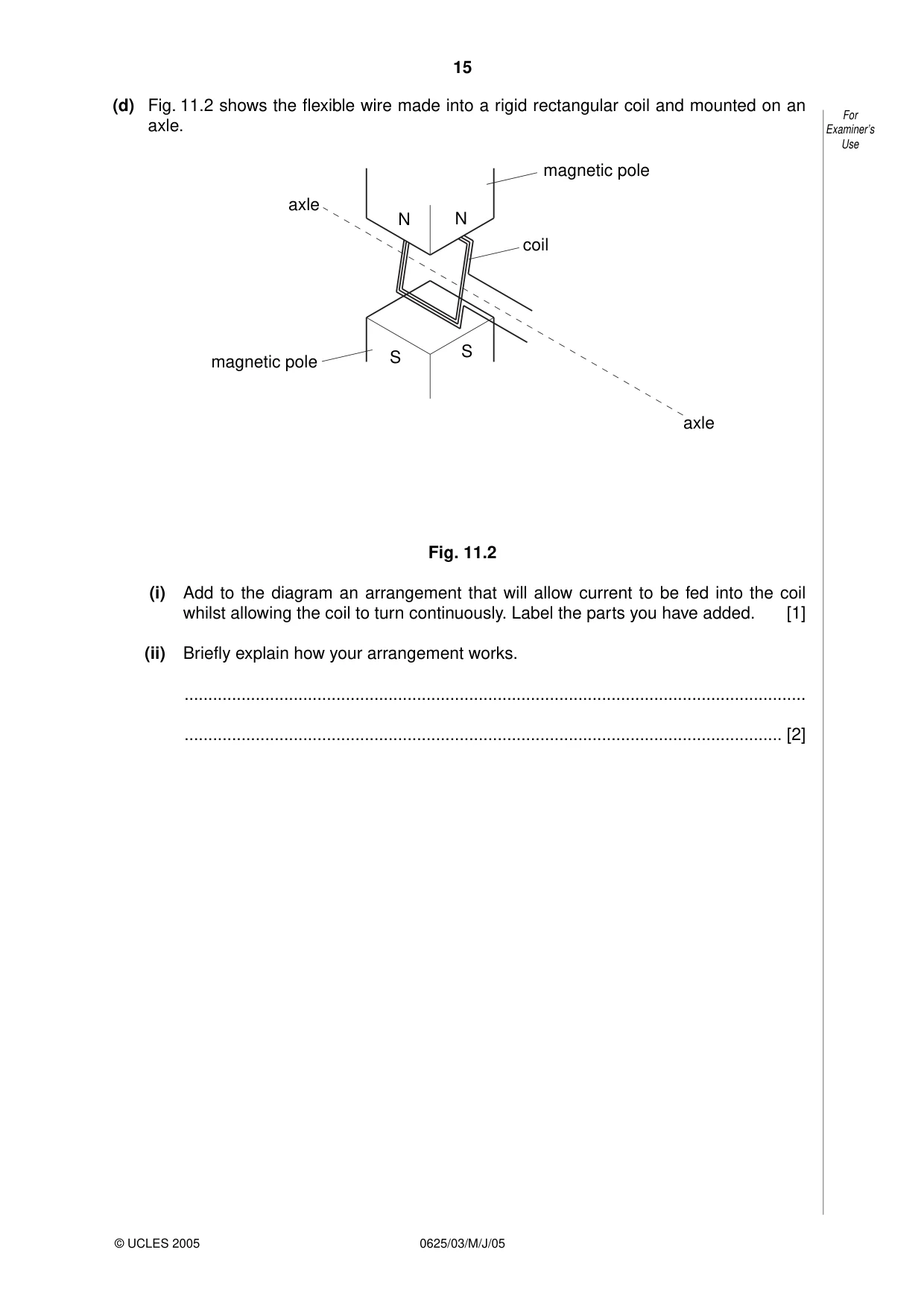
15 0625/03/M/J/05 (d) Fig. 11.2 shows the flexible wire made into a rigid rectangular coil and mounted on an axle. Fig. 11.2 (i) Add to the diagram an arrangement that will allow current to be fed into the coil whilst allowing the coil to turn continuously. Label the parts you have added. [1] (ii) Briefly explain how your arrangement works. … … [2] axle magnetic pole magnetic pole axle N N S S coil For Examiner’s Use © UCLES 2005
Question paper, page 16
16 0625/03/M/J/05 BLANK PAGE Permission to reproduce items where third-party owned material protected by copyright is included has been sought and cleared where possible. Every reasonable effort has been made by the publisher (UCLES) to trace copyright holders, but if any items requiring clearance have unwittingly been included, the publisher will be pleased to make amends at the earliest possible opportunity. University of Cambridge International Examinations is part of the University of Cambridge Local Examinations Syndicate (UCLES), which is itself a department of the University of Cambridge.
Mark scheme, page 1
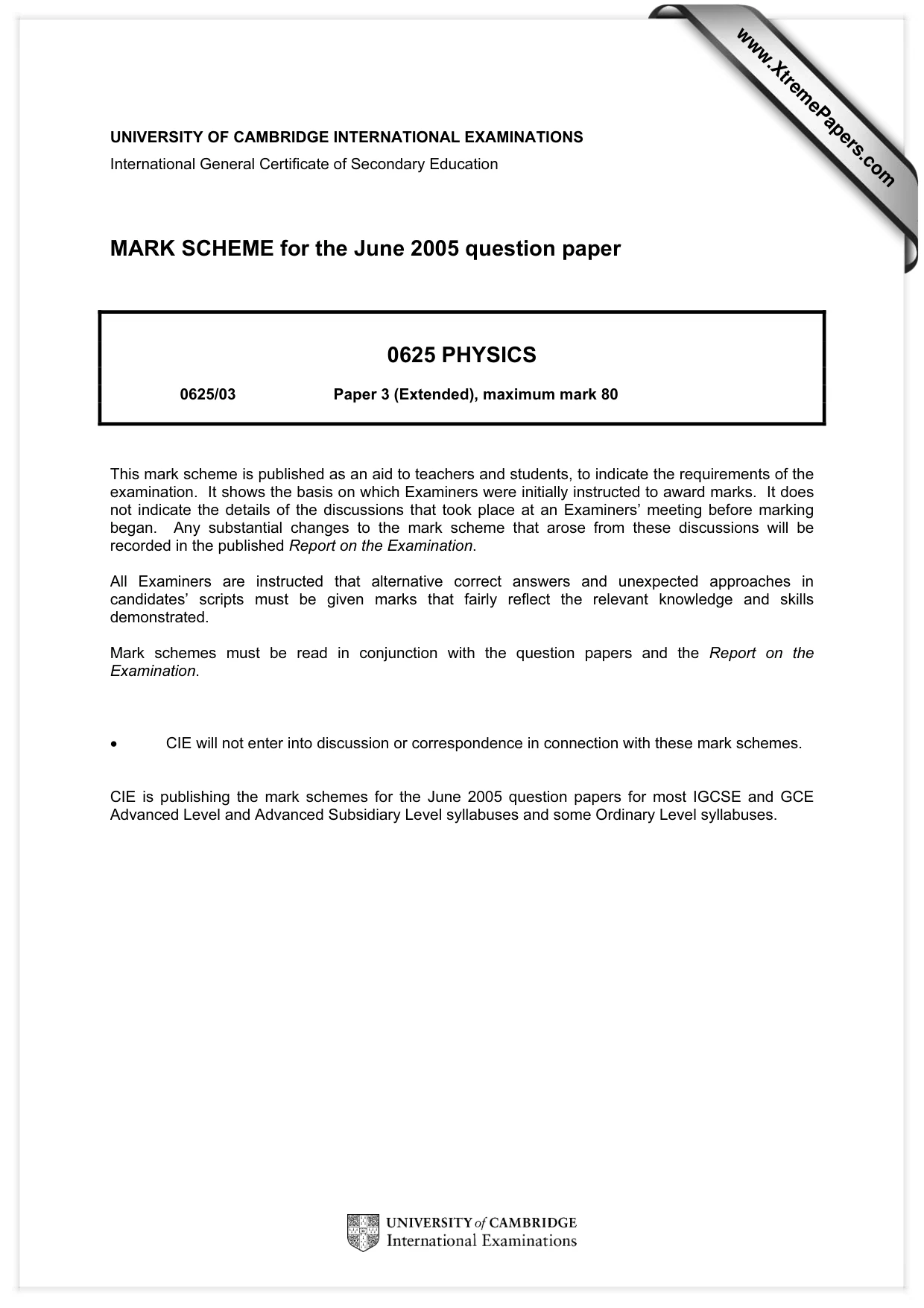
UNIVERSITY OF CAMBRIDGE INTERNATIONAL EXAMINATIONS International General Certificate of Secondary Education MARK SCHEME for the June 2005 question paper 0625 PHYSICS 0625/03 Paper 3 (Extended), maximum mark 80 This mark scheme is published as an aid to teachers and students, to indicate the requirements of the examination. It shows the basis on which Examiners were initially instructed to award marks. It does not indicate the details of the discussions that took place at an Examiners’ meeting before marking began. Any substantial changes to the mark scheme that arose from these discussions will be recorded in the published Report on the Examination. All Examiners are instructed that alternative correct answers and unexpected approaches in candidates’ scripts must be given marks that fairly reflect the relevant knowledge and skills demonstrated. Mark schemes must be read in conjunction with the question papers and the Report on the Examination. • CIE will not enter into discussion or correspondence in connection with these mark schemes. CIE is publishing the mark schemes for the June 2005 question papers for most IGCSE and GCE Advanced Level and Advanced Subsidiary Level syllabuses and some Ordinary Level syllabuses. www.XtremePapers.com
Mark scheme, page 2
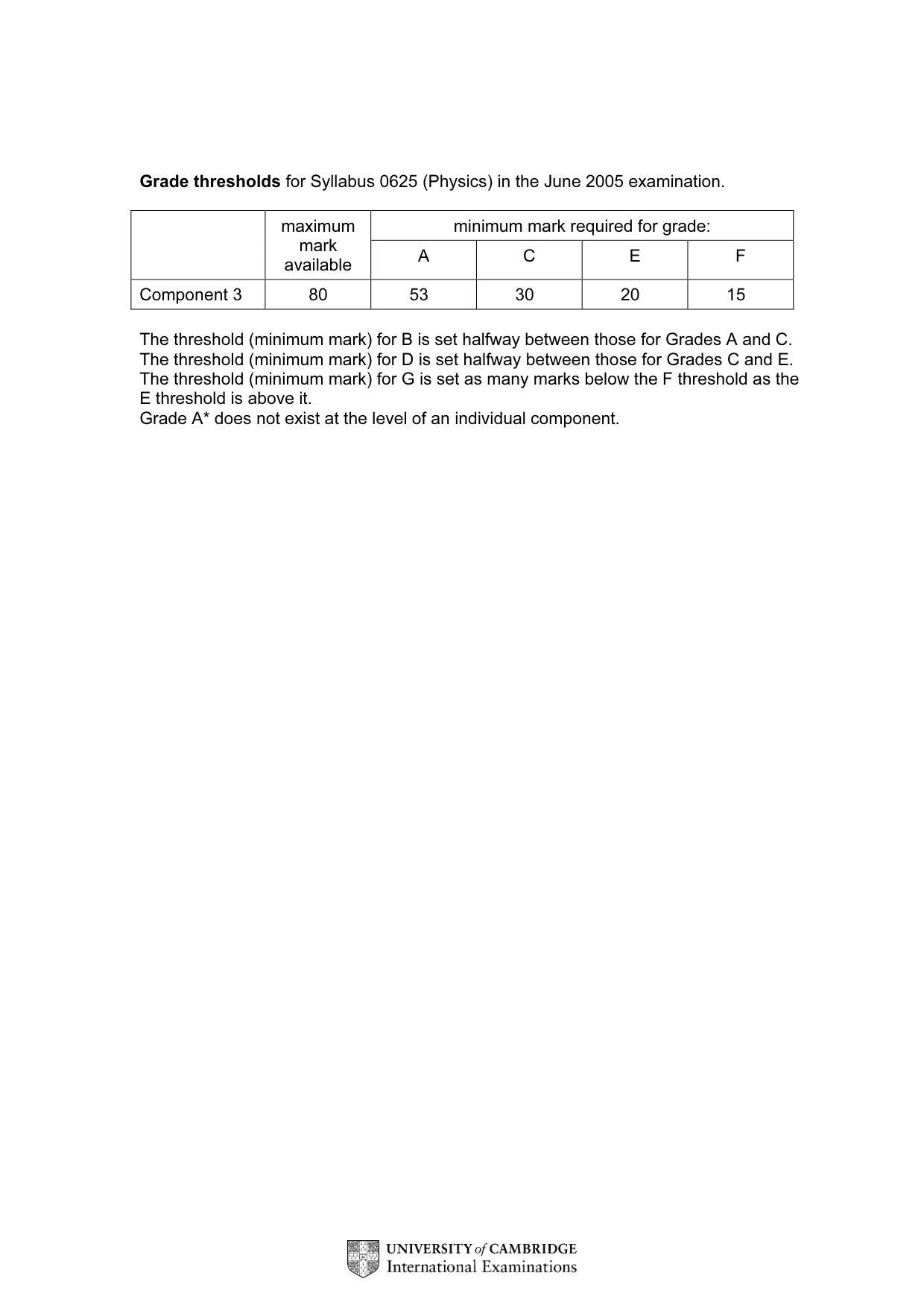
Grade thresholds for Syllabus 0625 (Physics) in the June 2005 examination. minimum mark required for grade: maximum mark available A C E F Component 3 80 53 30 20 15 The threshold (minimum mark) for B is set halfway between those for Grades A and C. The threshold (minimum mark) for D is set halfway between those for Grades C and E. The threshold (minimum mark) for G is set as many marks below the F threshold as the E threshold is above it. Grade A* does not exist at the level of an individual component.
Mark scheme, page 3
June 2005 IGCSE MARK SCHEME MAXIMUM MARK: 80 SYLLABUS/COMPONENT: 0625/03 PHYSICS Extended
Mark scheme, page 4
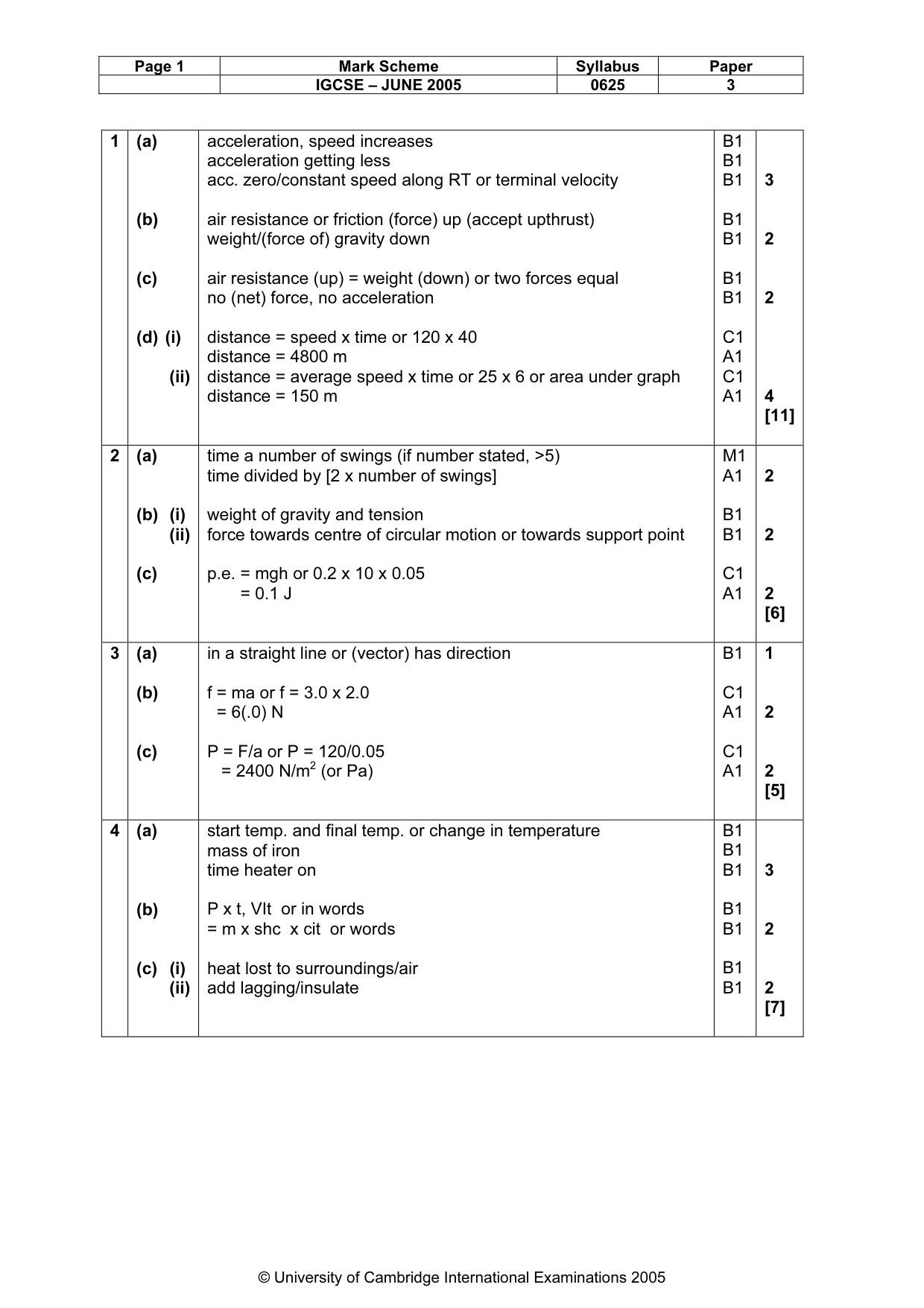
Page 1 Mark Scheme Syllabus Paper IGCSE – JUNE 2005 0625 3 © University of Cambridge International Examinations 2005 1 (a) (b) (c) (d) (i) (ii) acceleration, speed increases acceleration getting less acc. zero/constant speed along RT or terminal velocity air resistance or friction (force) up (accept upthrust) weight/(force of) gravity down air resistance (up) = weight (down) or two forces equal no (net) force, no acceleration distance = speed x time or 120 x 40 distance = 4800 m distance = average speed x time or 25 x 6 or area under graph distance = 150 m B1 B1 B1 B1 B1 B1 B1 C1 A1 C1 A1 3 2 2 4 [11] 2 (a) (b) (i) (ii) (c) time a number of swings (if number stated, >5) time divided by [2 x number of swings] weight of gravity and tension force towards centre of circular motion or towards support point p.e. = mgh or 0.2 x 10 x 0.05 = 0.1 J M1 A1 B1 B1 C1 A1 2 2 2 [6] 3 (a) (b) (c) in a straight line or (vector) has direction f = ma or f = 3.0 x 2.0 = 6(.0) N P = F/a or P = 120/0.05 = 2400 N/m2 (or Pa) B1 C1 A1 C1 A1 1 2 2 [5] 4 (a) (b) (c) (i) (ii) start temp. and final temp. or change in temperature mass of iron time heater on P x t, VIt or in words = m x shc x cit or words heat lost to surroundings/air add lagging/insulate B1 B1 B1 B1 B1 B1 B1 3 2 2 [7]
Mark scheme, page 5
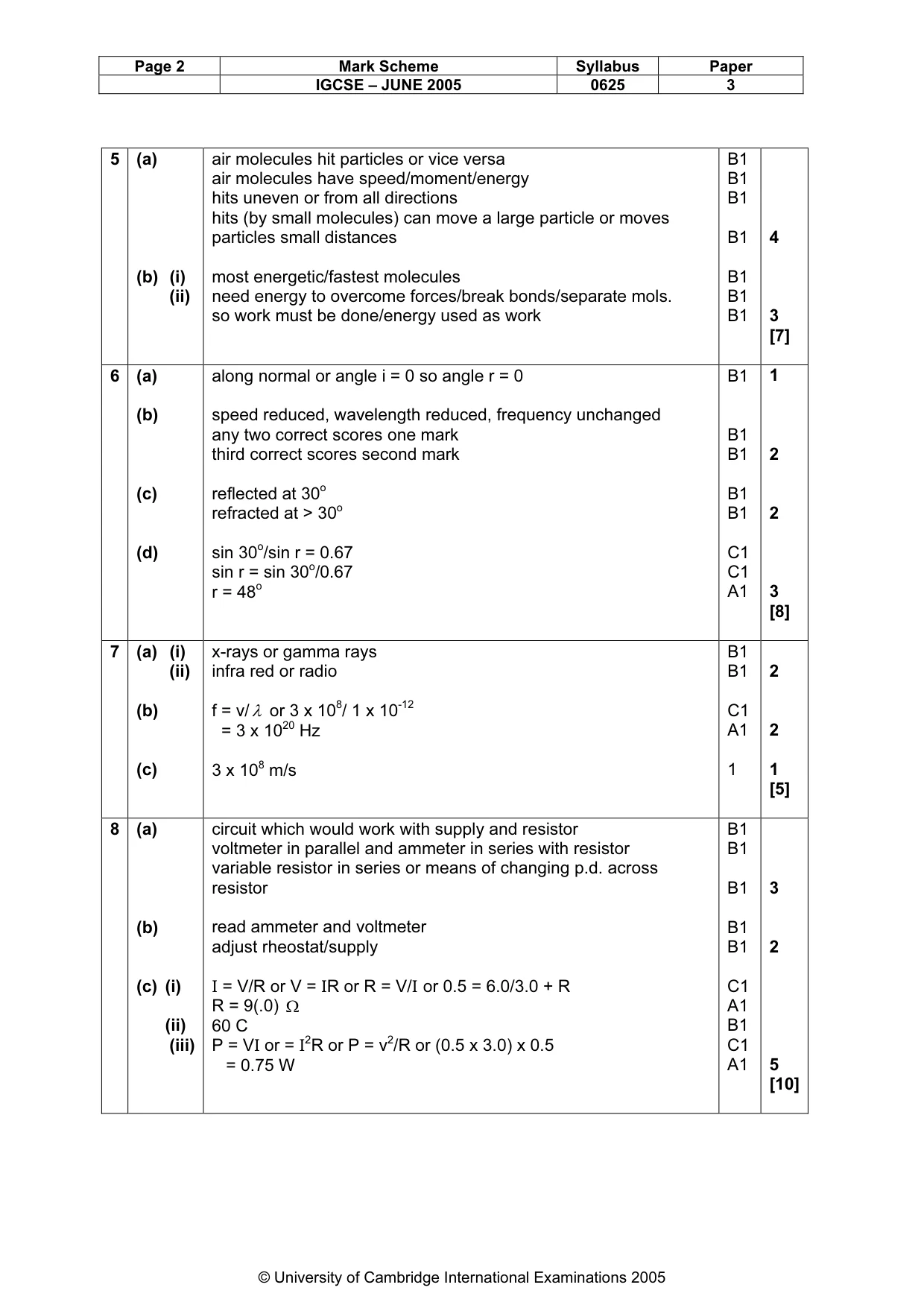
Page 2 Mark Scheme Syllabus Paper IGCSE – JUNE 2005 0625 3 © University of Cambridge International Examinations 2005 5 (a) (b) (i) (ii) air molecules hit particles or vice versa air molecules have speed/moment/energy hits uneven or from all directions hits (by small molecules) can move a large particle or moves particles small distances most energetic/fastest molecules need energy to overcome forces/break bonds/separate mols. so work must be done/energy used as work B1 B1 B1 B1 B1 B1 B1 4 3 [7] 6 (a) (b) (c) (d) along normal or angle i = 0 so angle r = 0 speed reduced, wavelength reduced, frequency unchanged any two correct scores one mark third correct scores second mark reflected at 30o refracted at > 30o sin 30o/sin r = 0.67 sin r = sin 30o/0.67 r = 48o B1 B1 B1 B1 B1 C1 C1 A1 1 2 2 3 [8] 7 (a) (i) (ii) (b) (c) x-rays or gamma rays infra red or radio f = v/λ or 3 x 10⁸/ 1 x 10-12 = 3 x 10²⁰ Hz 3 x 10⁸ m/s B1 B1 C1 A1 1 2 2 1 [5] 8 (a) (b) (c) (i) (ii) (iii) circuit which would work with supply and resistor voltmeter in parallel and ammeter in series with resistor variable resistor in series or means of changing p.d. across resistor read ammeter and voltmeter adjust rheostat/supply I = V/R or V = IR or R = V/I or 0.5 = 6.0/3.0 + R R = 9(.0) Ω 60 C P = VI or = I2R or P = v2/R or (0.5 x 3.0) x 0.5 = 0.75 W B1 B1 B1 B1 B1 C1 A1 B1 C1 A1 3 2 5 [10]
Mark scheme, page 6
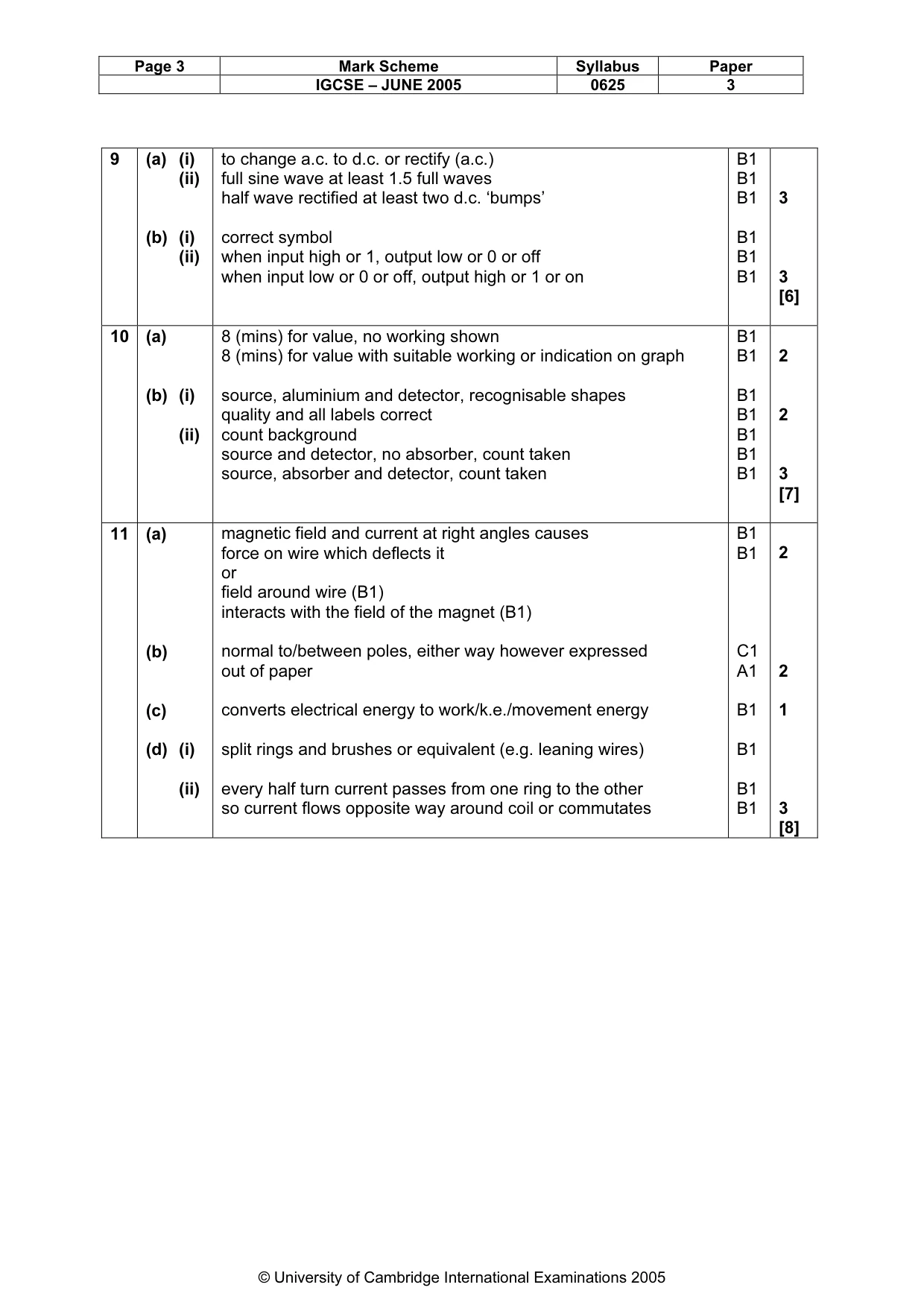
Page 3 Mark Scheme Syllabus Paper IGCSE – JUNE 2005 0625 3 © University of Cambridge International Examinations 2005 9 (a) (i) (ii) (b) (i) (ii) to change a.c. to d.c. or rectify (a.c.) full sine wave at least 1.5 full waves half wave rectified at least two d.c. ‘bumps’ correct symbol when input high or 1, output low or 0 or off when input low or 0 or off, output high or 1 or on B1 B1 B1 B1 B1 B1 3 3 [6] 10 (a) (b) (i) (ii) 8 (mins) for value, no working shown 8 (mins) for value with suitable working or indication on graph source, aluminium and detector, recognisable shapes quality and all labels correct count background source and detector, no absorber, count taken source, absorber and detector, count taken B1 B1 B1 B1 B1 B1 B1 2 2 3 [7] 11 (a) (b) (c) (d) (i) (ii) magnetic field and current at right angles causes force on wire which deflects it or field around wire (B1) interacts with the field of the magnet (B1) normal to/between poles, either way however expressed out of paper converts electrical energy to work/k.e./movement energy split rings and brushes or equivalent (e.g. leaning wires) every half turn current passes from one ring to the other so current flows opposite way around coil or commutates B1 B1 C1 A1 B1 B1 B1 B1 2 2 1 3 [8]
Mark scheme, page 7
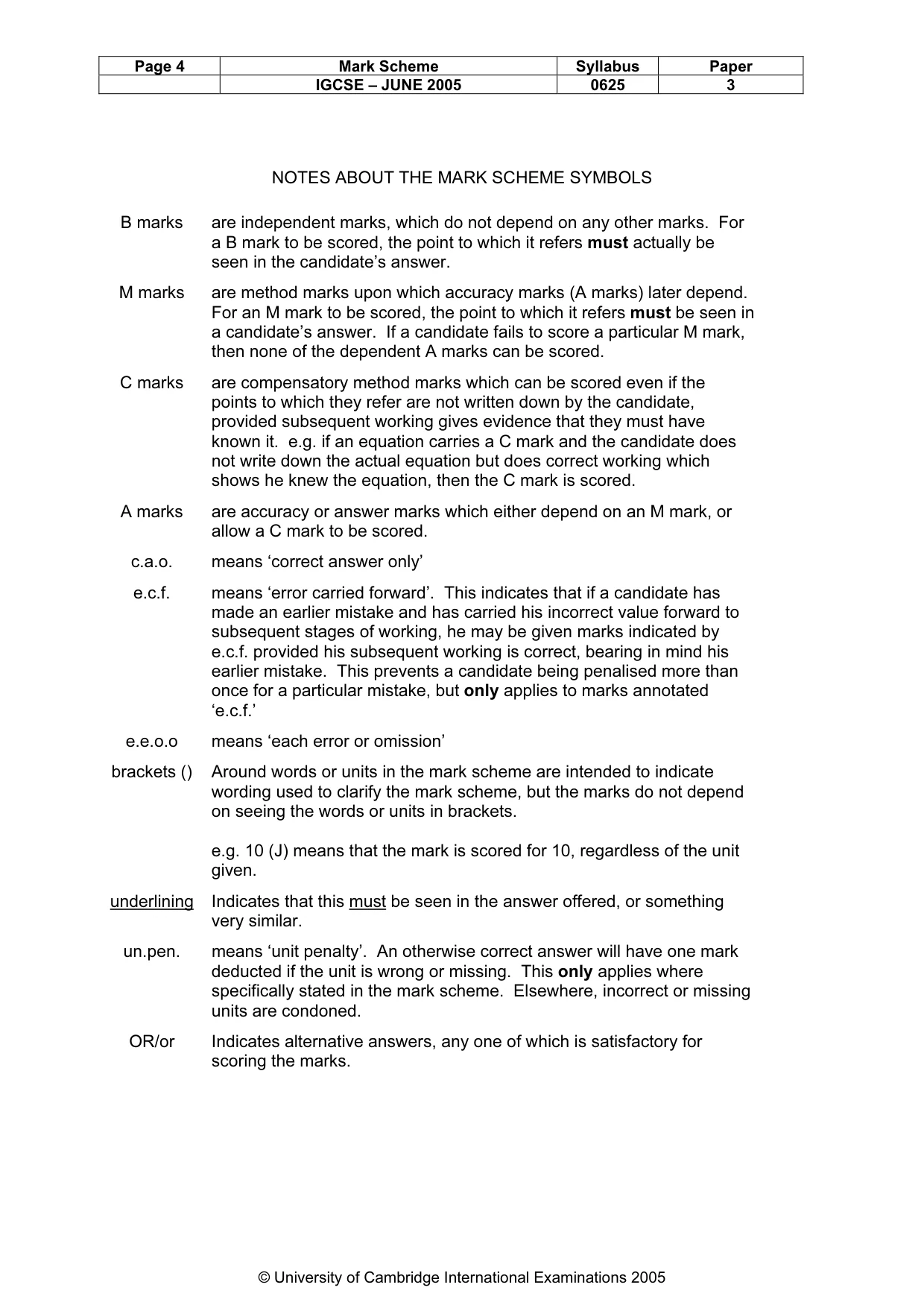
Page 4 Mark Scheme Syllabus Paper IGCSE – JUNE 2005 0625 3 © University of Cambridge International Examinations 2005 NOTES ABOUT THE MARK SCHEME SYMBOLS B marks are independent marks, which do not depend on any other marks. For a B mark to be scored, the point to which it refers must actually be seen in the candidate’s answer. M marks are method marks upon which accuracy marks (A marks) later depend. For an M mark to be scored, the point to which it refers must be seen in a candidate’s answer. If a candidate fails to score a particular M mark, then none of the dependent A marks can be scored. C marks are compensatory method marks which can be scored even if the points to which they refer are not written down by the candidate, provided subsequent working gives evidence that they must have known it. e.g. if an equation carries a C mark and the candidate does not write down the actual equation but does correct working which shows he knew the equation, then the C mark is scored. A marks are accuracy or answer marks which either depend on an M mark, or allow a C mark to be scored. c.a.o. means ‘correct answer only’ e.c.f. means ‘error carried forward’. This indicates that if a candidate has made an earlier mistake and has carried his incorrect value forward to subsequent stages of working, he may be given marks indicated by e.c.f. provided his subsequent working is correct, bearing in mind his earlier mistake. This prevents a candidate being penalised more than once for a particular mistake, but only applies to marks annotated ‘e.c.f.’ e.e.o.o means ‘each error or omission’ brackets () Around words or units in the mark scheme are intended to indicate wording used to clarify the mark scheme, but the marks do not depend on seeing the words or units in brackets. e.g. 10 (J) means that the mark is scored for 10, regardless of the unit given. underlining Indicates that this must be seen in the answer offered, or something very similar. un.pen. means ‘unit penalty’. An otherwise correct answer will have one mark deducted if the unit is wrong or missing. This only applies where specifically stated in the mark scheme. Elsewhere, incorrect or missing units are condoned. OR/or Indicates alternative answers, any one of which is satisfactory for scoring the marks.