Cambridge IGCSE Physics 0625 — 2004 Oct/Nov Paper 3 · Variant 1
0625/31/O/N/04
The question paper and its mark scheme, free to read here and free to download. This is Cambridge’s own paper, exactly as it was sat.
Question paper16 pages
Mark scheme6 pages
Answers below. Sit the paper first if you are practising.
Paper as text
Question paper, page 1
This document consists of 15 printed pages and 1 blank page. SPA (NH/BI) S80765/4 © UCLES 2004 [Turn over UNIVERSITY OF CAMBRIDGE INTERNATIONAL EXAMINATIONS International General Certificate of Secondary Education PHYSICS Paper 3 0625/03 October/November 2004 1 hour 15 minutes Candidates answer on the Question Paper. No Additional Materials are required. READ THESE INSTRUCTIONS FIRST Write your Centre number, candidate number and name on all the work you hand in. Write in dark blue or black pen in the spaces provided on the Question Paper. You may use a soft pencil for any diagrams, graphs or rough working. Do not use staples, paper clips, highlighters, glue or correction fluid. Answer all questions. At the end of the examination, fasten all your work securely together. The number of marks is given in brackets [ ] at the end of each question or part question. You may lose marks if you do not show your working or if you do not use appropriate units. DO NOT WRITE IN THE BARCODE. DO NOT WRITE IN THE GREY AREAS BETWEEN THE PAGES. If you have been given a label, look at the details. If any details are incorrect or missing, please fill in your correct details in the space given on this page. Stick your personal label here, if provided. For Examiner’s Use 1 2 3 4 5 6 7 8 9 10 11 Total Candidate Name Centre Number Candidate Number www.XtremePapers.com
Question paper, page 2
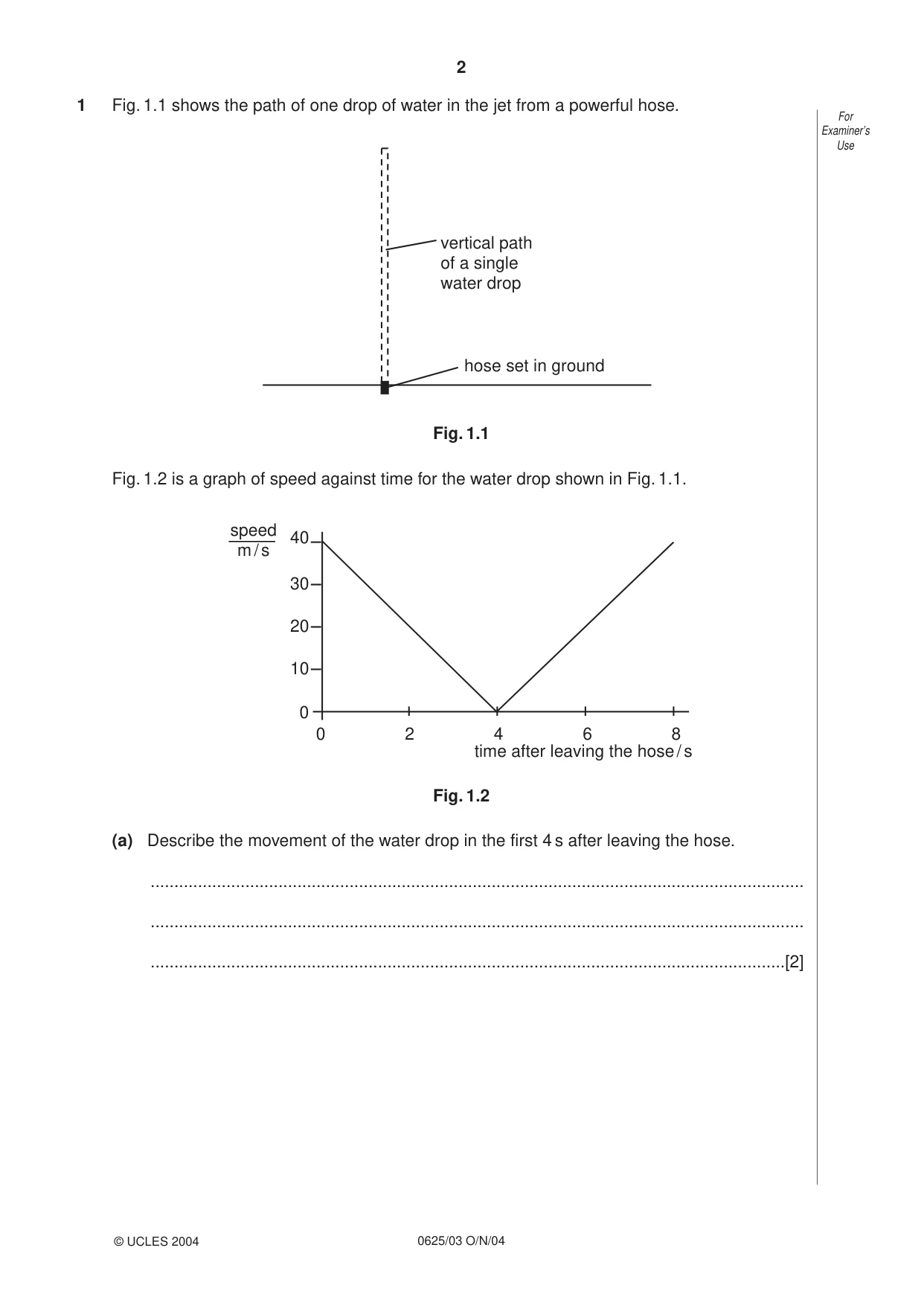
2 0625/03 O/N/04 1 Fig. 1.1 shows the path of one drop of water in the jet from a powerful hose. Fig. 1.1 Fig. 1.2 is a graph of speed against time for the water drop shown in Fig. 1.1. Fig. 1.2 (a) Describe the movement of the water drop in the first 4 s after leaving the hose. … … …[2] 0 0 10 20 30 40 speed m / s 2 4 6 8 time after leaving the hose / s vertical path of a single water drop hose set in ground For Examiner’s Use © UCLES 2004
Question paper, page 3
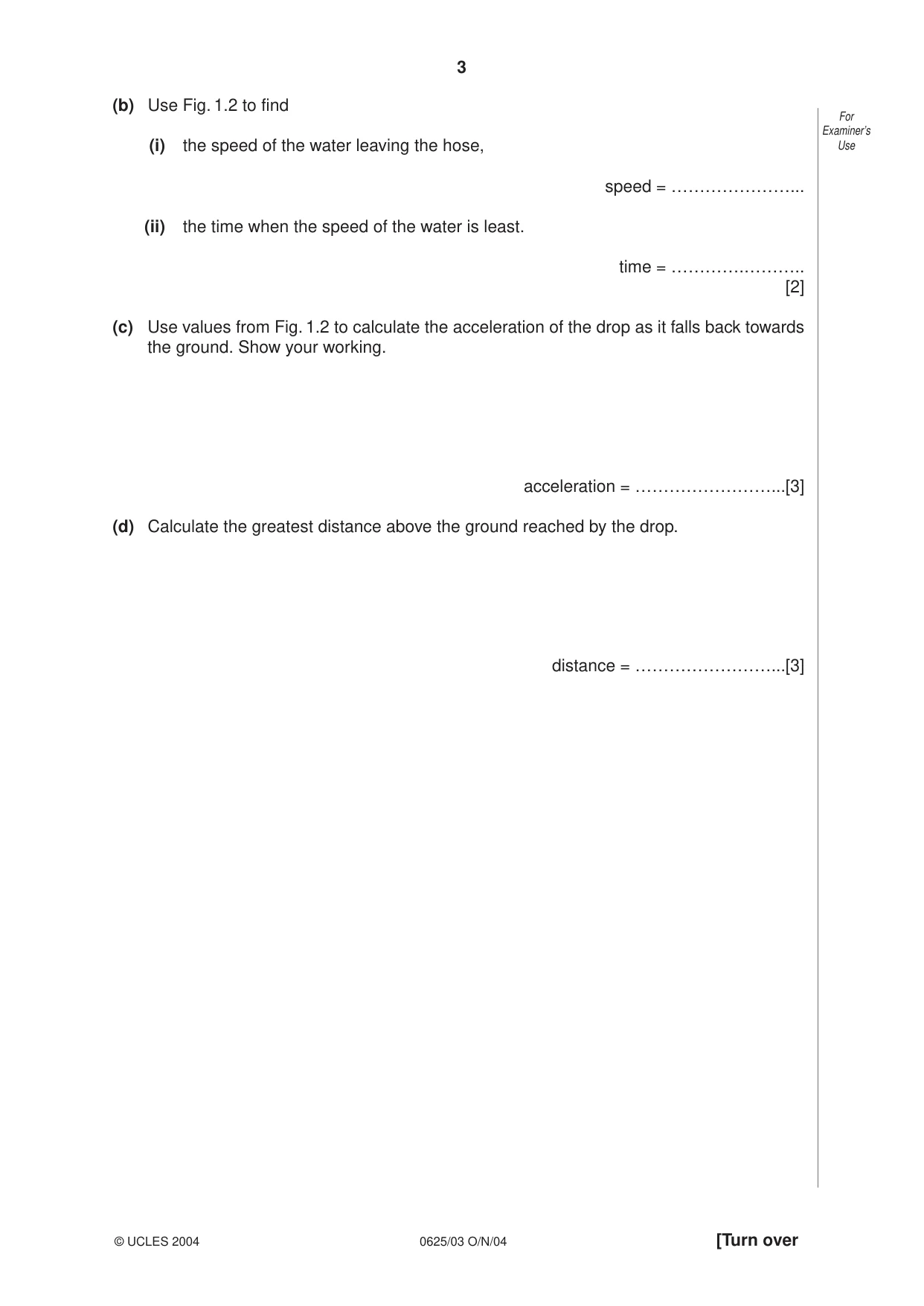
3 0625/03 O/N/04 [Turn over (b) Use Fig. 1.2 to find (i) the speed of the water leaving the hose, speed = …………………... (ii) the time when the speed of the water is least. time = ………….……….. [2] (c) Use values from Fig. 1.2 to calculate the acceleration of the drop as it falls back towards the ground. Show your working. acceleration = ……………………...[3] (d) Calculate the greatest distance above the ground reached by the drop. distance = ……………………...[3] For Examiner’s Use © UCLES 2004
Question paper, page 4
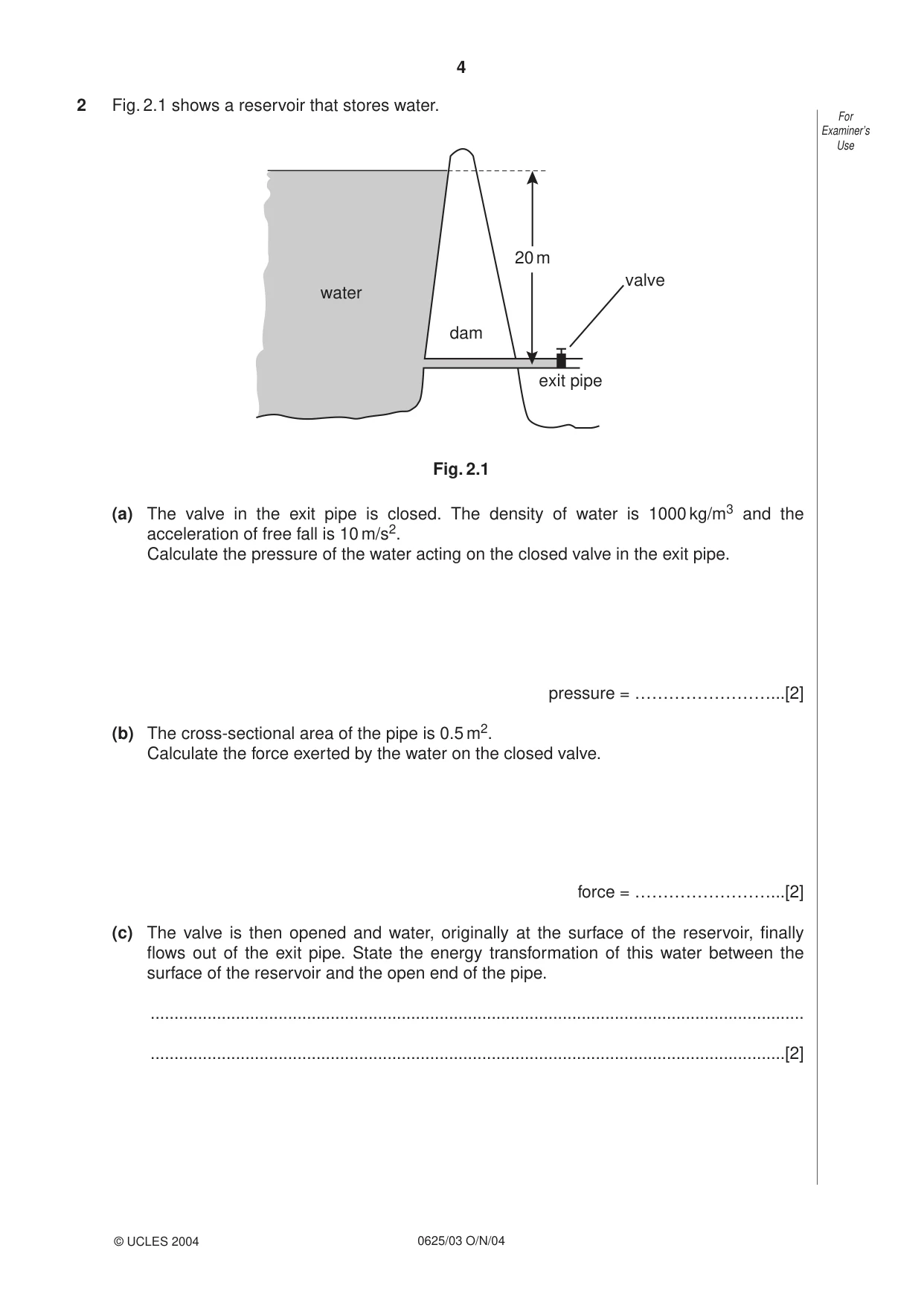
4 0625/03 O/N/04 2 Fig. 2.1 shows a reservoir that stores water. Fig. 2.1 (a) The valve in the exit pipe is closed. The density of water is 1000 kg/m3 and the acceleration of free fall is 10 m/s2. Calculate the pressure of the water acting on the closed valve in the exit pipe. pressure = ……………………...[2] (b) The cross-sectional area of the pipe is 0.5 m2. Calculate the force exerted by the water on the closed valve. force = ……………………...[2] (c) The valve is then opened and water, originally at the surface of the reservoir, finally flows out of the exit pipe. State the energy transformation of this water between the surface of the reservoir and the open end of the pipe. … …[2] valve exit pipe 20 m water dam For Examiner’s Use © UCLES 2004
Question paper, page 5
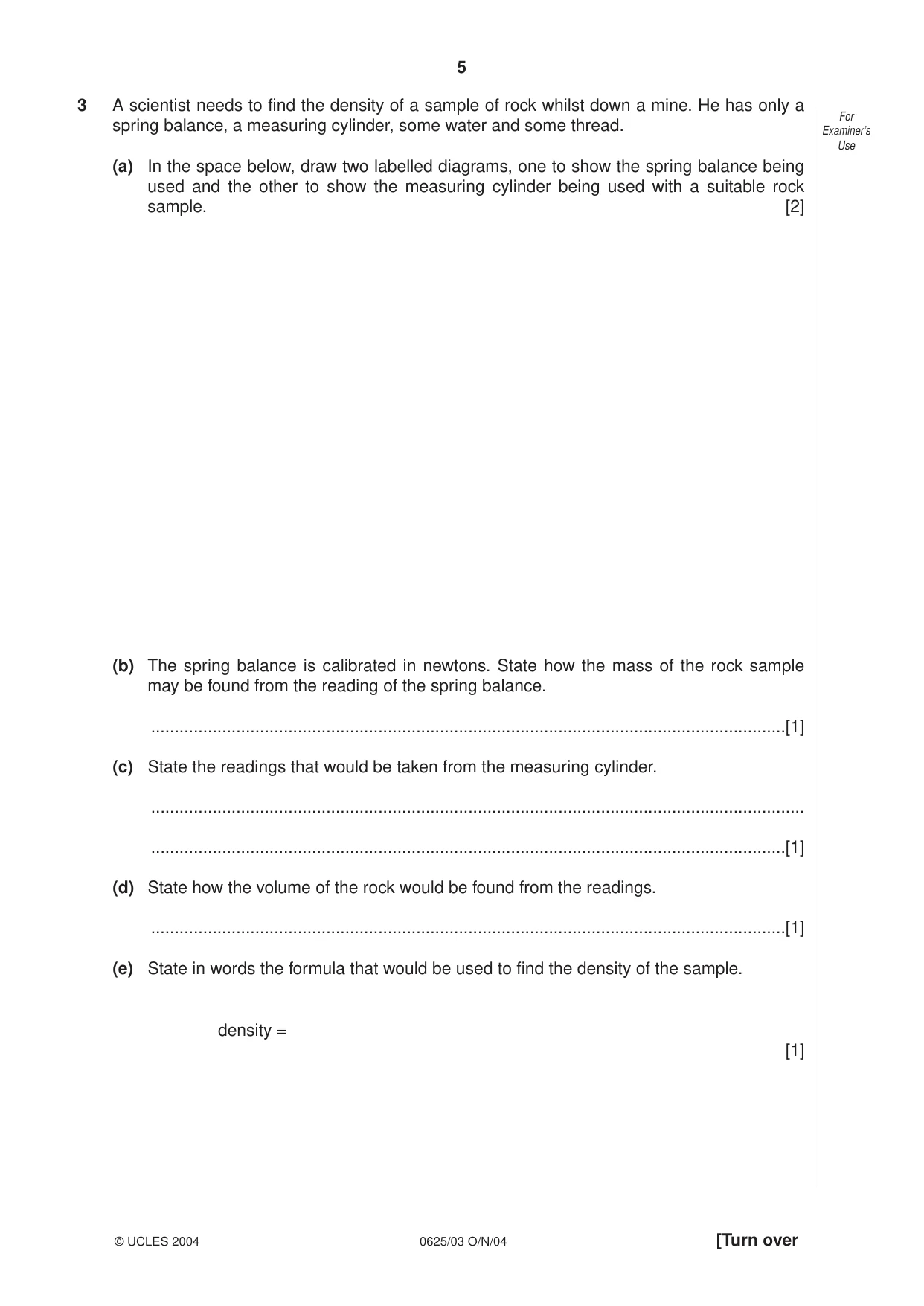
5 0625/03 O/N/04 [Turn over 3 A scientist needs to find the density of a sample of rock whilst down a mine. He has only a spring balance, a measuring cylinder, some water and some thread. (a) In the space below, draw two labelled diagrams, one to show the spring balance being used and the other to show the measuring cylinder being used with a suitable rock sample. [2] (b) The spring balance is calibrated in newtons. State how the mass of the rock sample may be found from the reading of the spring balance. …[1] (c) State the readings that would be taken from the measuring cylinder. … …[1] (d) State how the volume of the rock would be found from the readings. …[1] (e) State in words the formula that would be used to find the density of the sample. density = [1] For Examiner’s Use © UCLES 2004
Question paper, page 6
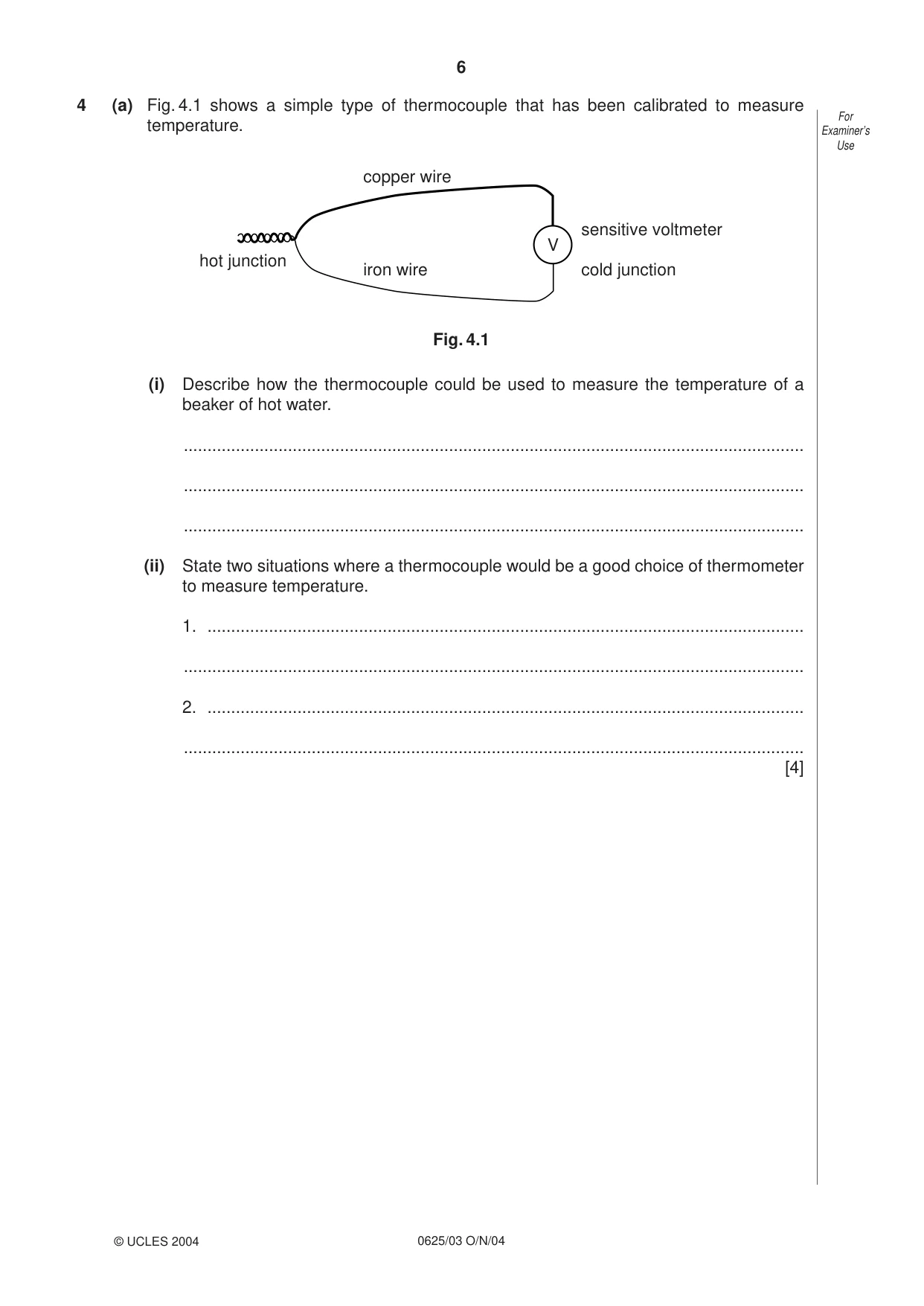
6 0625/03 O/N/04 4 (a) Fig. 4.1 shows a simple type of thermocouple that has been calibrated to measure temperature. Fig. 4.1 (i) Describe how the thermocouple could be used to measure the temperature of a beaker of hot water. … … … (ii) State two situations where a thermocouple would be a good choice of thermometer to measure temperature. 1. … … 2. … … [4] sensitive voltmeter cold junction copper wire iron wire hot junction V For Examiner’s Use © UCLES 2004
Question paper, page 7
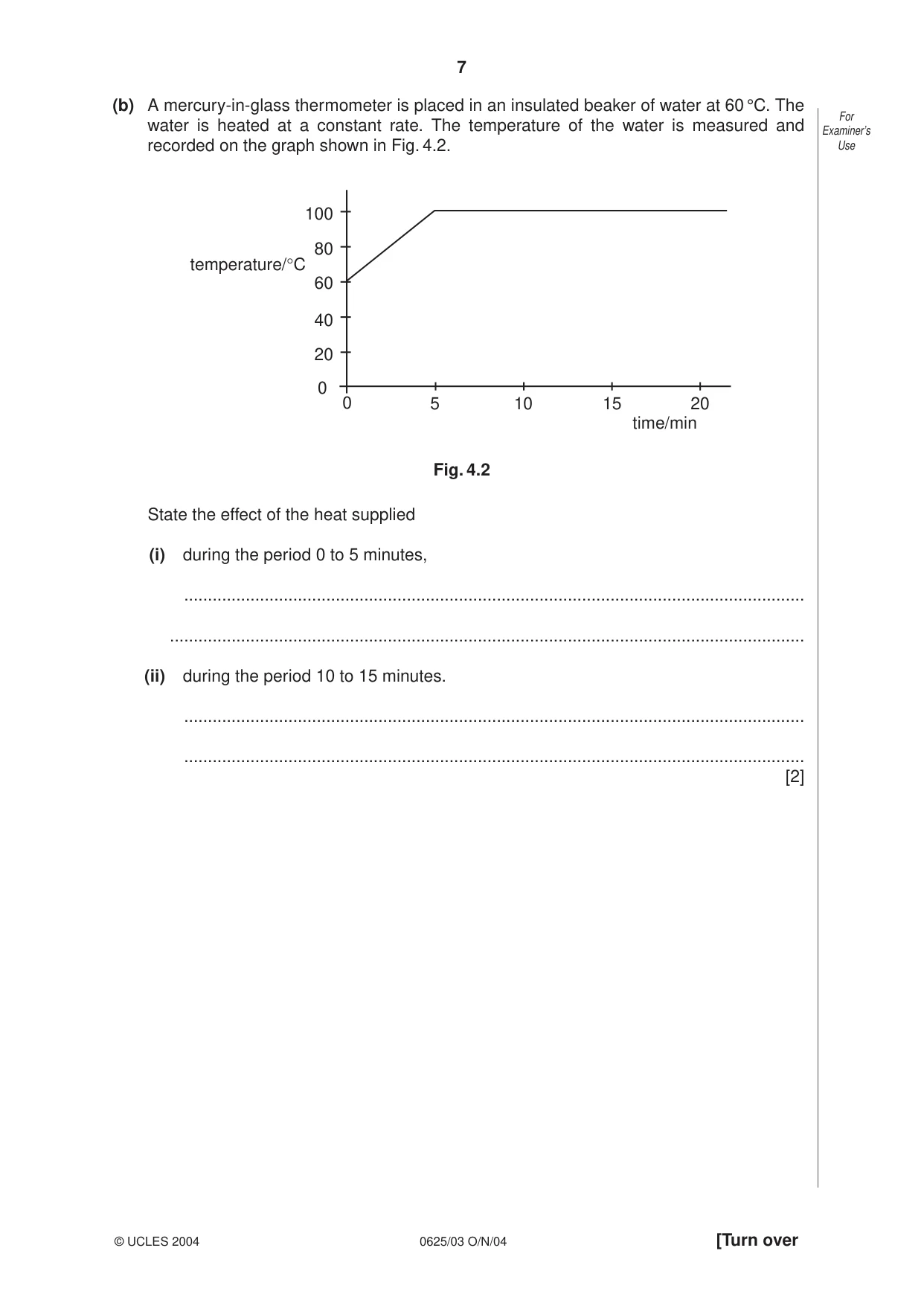
7 0625/03 O/N/04 [Turn over (b) A mercury-in-glass thermometer is placed in an insulated beaker of water at 60 °C. The water is heated at a constant rate. The temperature of the water is measured and recorded on the graph shown in Fig. 4.2. Fig. 4.2 State the effect of the heat supplied (i) during the period 0 to 5 minutes, … … (ii) during the period 10 to 15 minutes. … … [2] time/min temperature/°C 0 0 5 20 40 60 80 100 10 15 20 For Examiner’s Use © UCLES 2004
Question paper, page 8
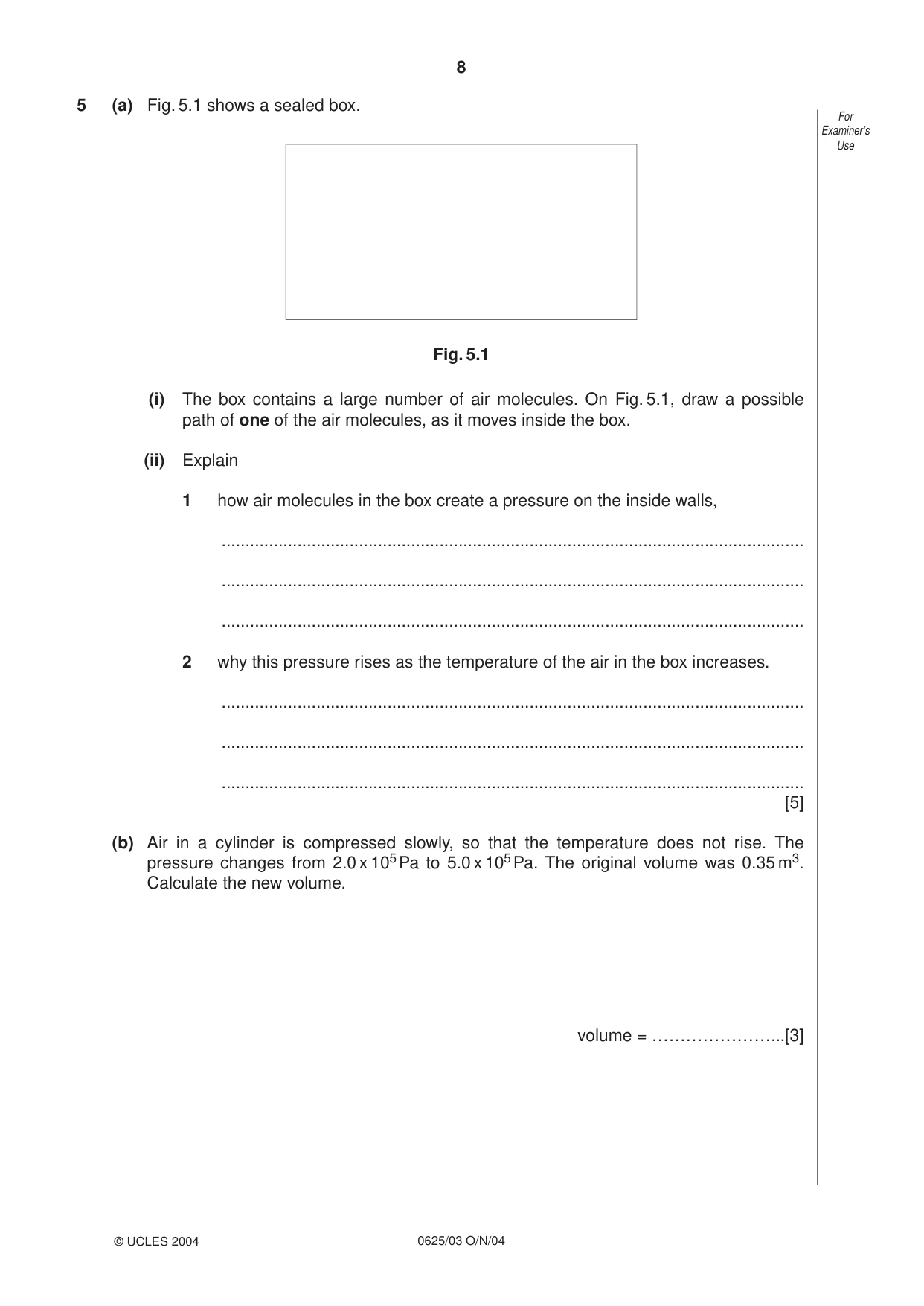
8 0625/03 O/N/04 5 (a) Fig. 5.1 shows a sealed box. Fig. 5.1 (i) The box contains a large number of air molecules. On Fig. 5.1, draw a possible path of one of the air molecules, as it moves inside the box. (ii) Explain 1 how air molecules in the box create a pressure on the inside walls, … … … 2 why this pressure rises as the temperature of the air in the box increases. … … … [5] (b) Air in a cylinder is compressed slowly, so that the temperature does not rise. The pressure changes from 2.0 x 10⁵Pa to 5.0 x 10⁵Pa. The original volume was 0.35 m3. Calculate the new volume. volume = …………………...[3] For Examiner’s Use © UCLES 2004
Question paper, page 9
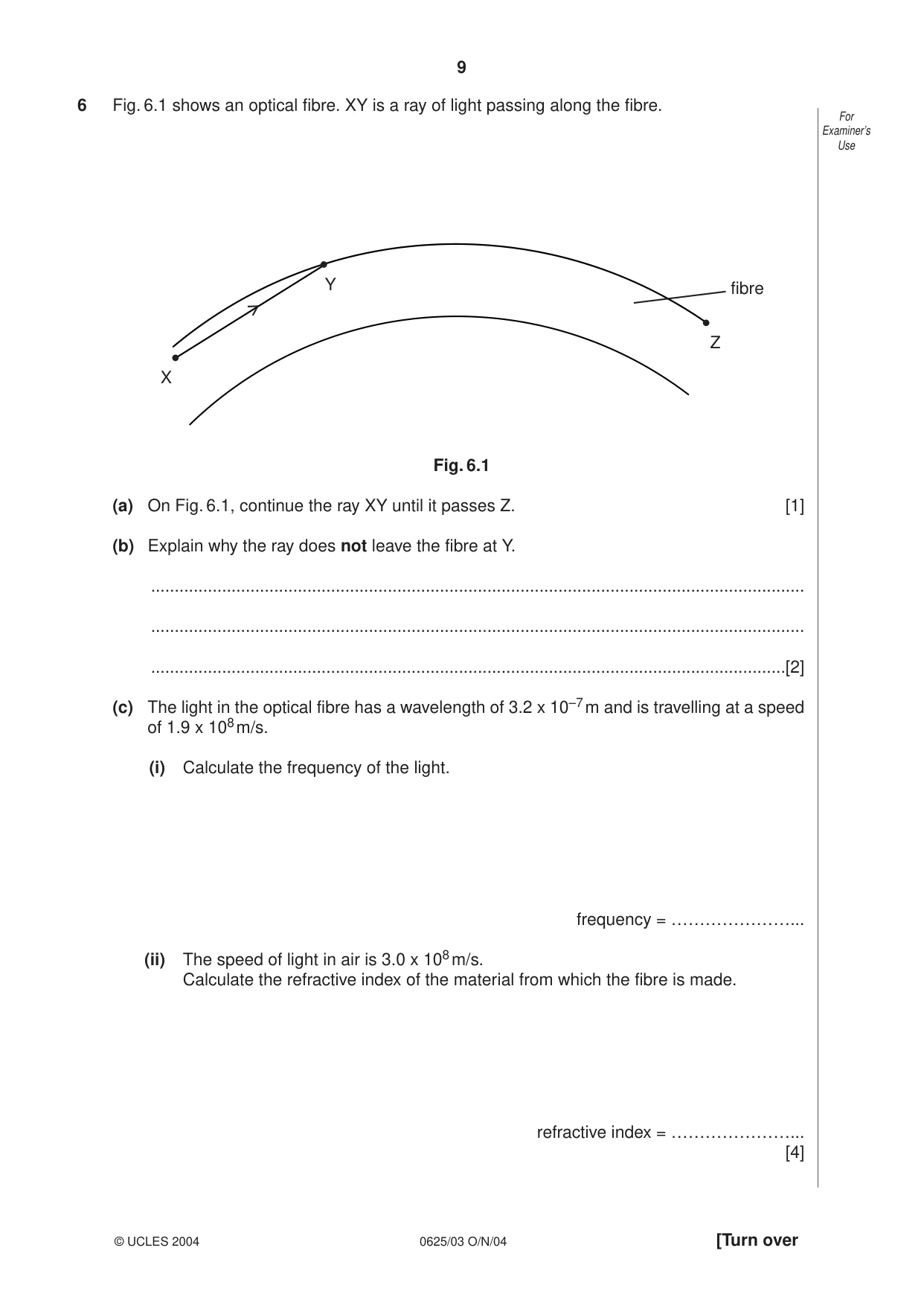
9 0625/03 O/N/04 [Turn over 6 Fig. 6.1 shows an optical fibre. XY is a ray of light passing along the fibre. Fig. 6.1 (a) On Fig. 6.1, continue the ray XY until it passes Z. [1] (b) Explain why the ray does not leave the fibre at Y. … … …[2] (c) The light in the optical fibre has a wavelength of 3.2 x 10⁻⁷m and is travelling at a speed of 1.9 x 10⁸m/s. (i) Calculate the frequency of the light. frequency = …………………... (ii) The speed of light in air is 3.0 x 10⁸m/s. Calculate the refractive index of the material from which the fibre is made. refractive index = …………………... [4] X Y Z fibre For Examiner’s Use © UCLES 2004
Question paper, page 10
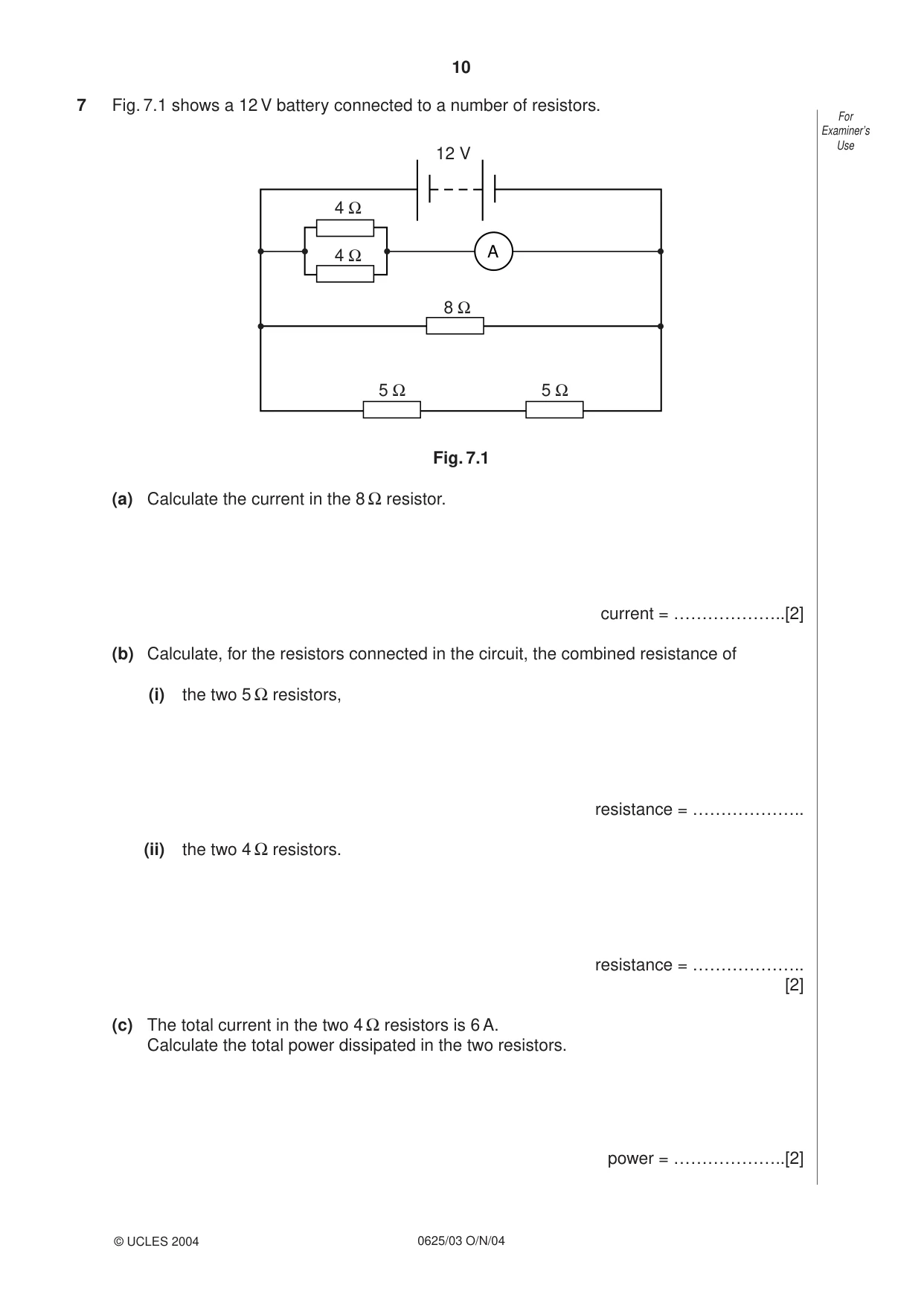
10 0625/03 O/N/04 7 Fig. 7.1 shows a 12 V battery connected to a number of resistors. Fig. 7.1 (a) Calculate the current in the 8 Ωresistor. current = ………………..[2] (b) Calculate, for the resistors connected in the circuit, the combined resistance of (i) the two 5 Ωresistors, resistance = ……………….. (ii) the two 4 Ωresistors. resistance = ……………….. [2] (c) The total current in the two 4 Ωresistors is 6 A. Calculate the total power dissipated in the two resistors. power = ………………..[2] A 12 V 8 Ω 5 Ω 5 Ω 4 Ω 4 Ω For Examiner’s Use © UCLES 2004
Question paper, page 11
11 0625/03 O/N/04 [Turn over (d) What will be the reading on a voltmeter connected across (i) the two 4 Ωresistors, reading = ……………….. (ii) one 5 Ωresistor? reading = ……………….. [2] (e) The 8 Ωresistor is made from a length of resistance wire of uniform cross-sectional area. State the effect on the resistance of the wire of using (i) the same length of the same material with a greater cross-sectional area, … (ii) a smaller length of the same material with the same cross-sectional area. … [2] For Examiner’s Use © UCLES 2004
Question paper, page 12
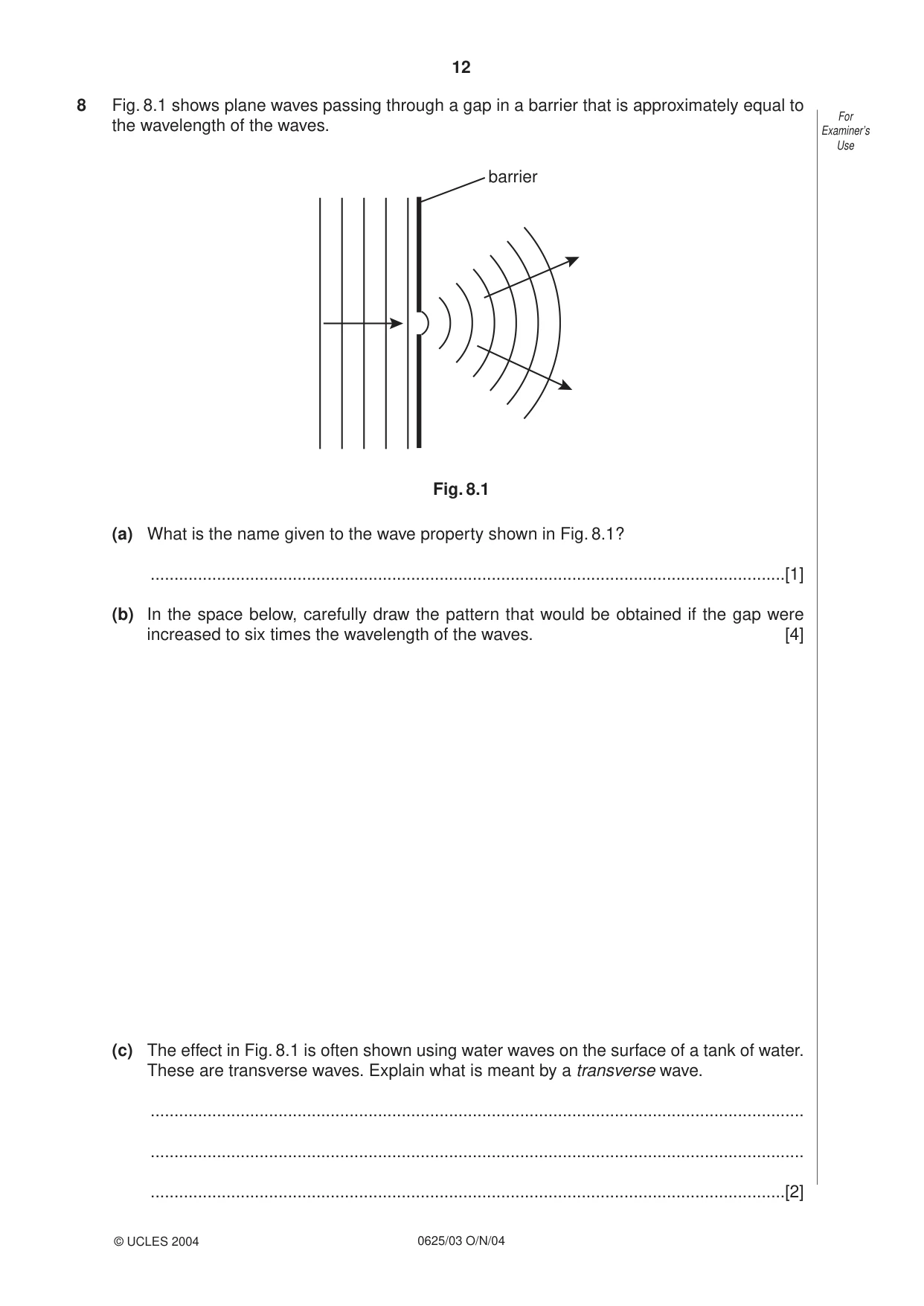
12 0625/03 O/N/04 8 Fig. 8.1 shows plane waves passing through a gap in a barrier that is approximately equal to the wavelength of the waves. Fig. 8.1 (a) What is the name given to the wave property shown in Fig. 8.1? …[1] (b) In the space below, carefully draw the pattern that would be obtained if the gap were increased to six times the wavelength of the waves. [4] (c) The effect in Fig. 8.1 is often shown using water waves on the surface of a tank of water. These are transverse waves. Explain what is meant by a transverse wave. … … …[2] barrier For Examiner’s Use © UCLES 2004
Question paper, page 13
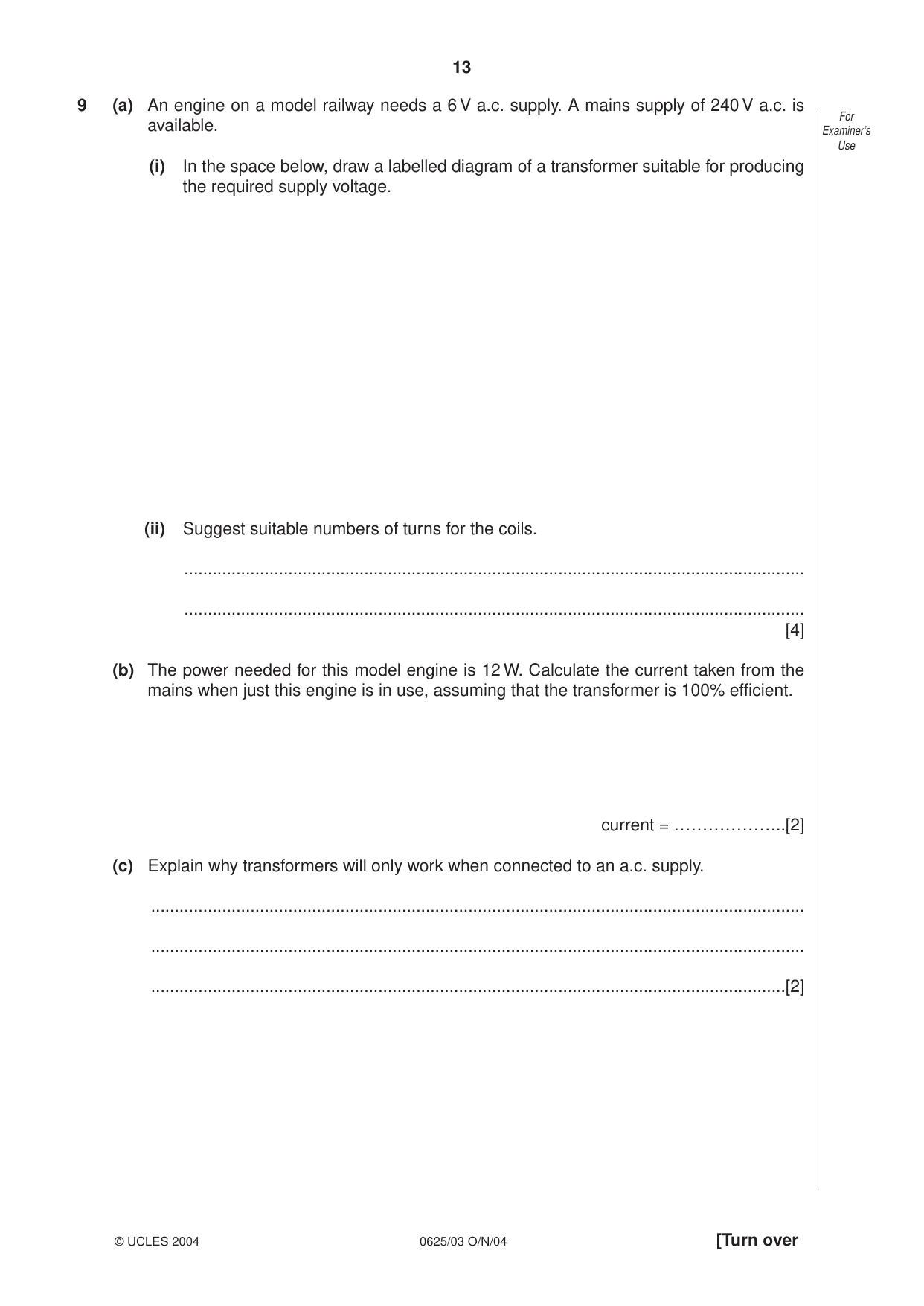
13 0625/03 O/N/04 [Turn over 9 (a) An engine on a model railway needs a 6 V a.c. supply. A mains supply of 240 V a.c. is available. (i) In the space below, draw a labelled diagram of a transformer suitable for producing the required supply voltage. (ii) Suggest suitable numbers of turns for the coils. … … [4] (b) The power needed for this model engine is 12 W. Calculate the current taken from the mains when just this engine is in use, assuming that the transformer is 100% efficient. current = ………………..[2] (c) Explain why transformers will only work when connected to an a.c. supply. … … …[2] For Examiner’s Use © UCLES 2004
Question paper, page 14
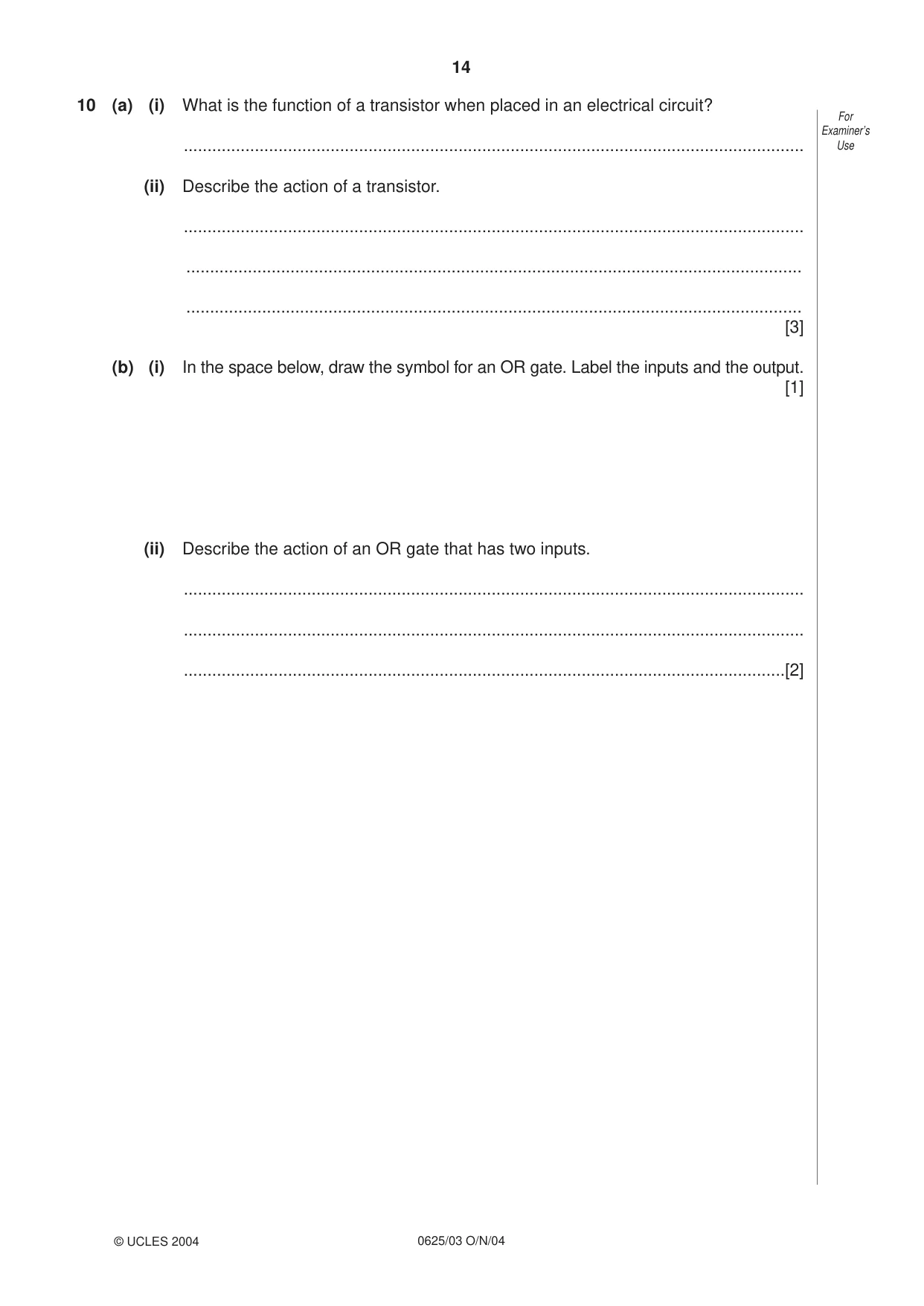
14 0625/03 O/N/04 10 (a) (i) What is the function of a transistor when placed in an electrical circuit? … (ii) Describe the action of a transistor. … … … [3] (b) (i) In the space below, draw the symbol for an OR gate. Label the inputs and the output. [1] (ii) Describe the action of an OR gate that has two inputs. … … …[2] For Examiner’s Use © UCLES 2004
Question paper, page 15
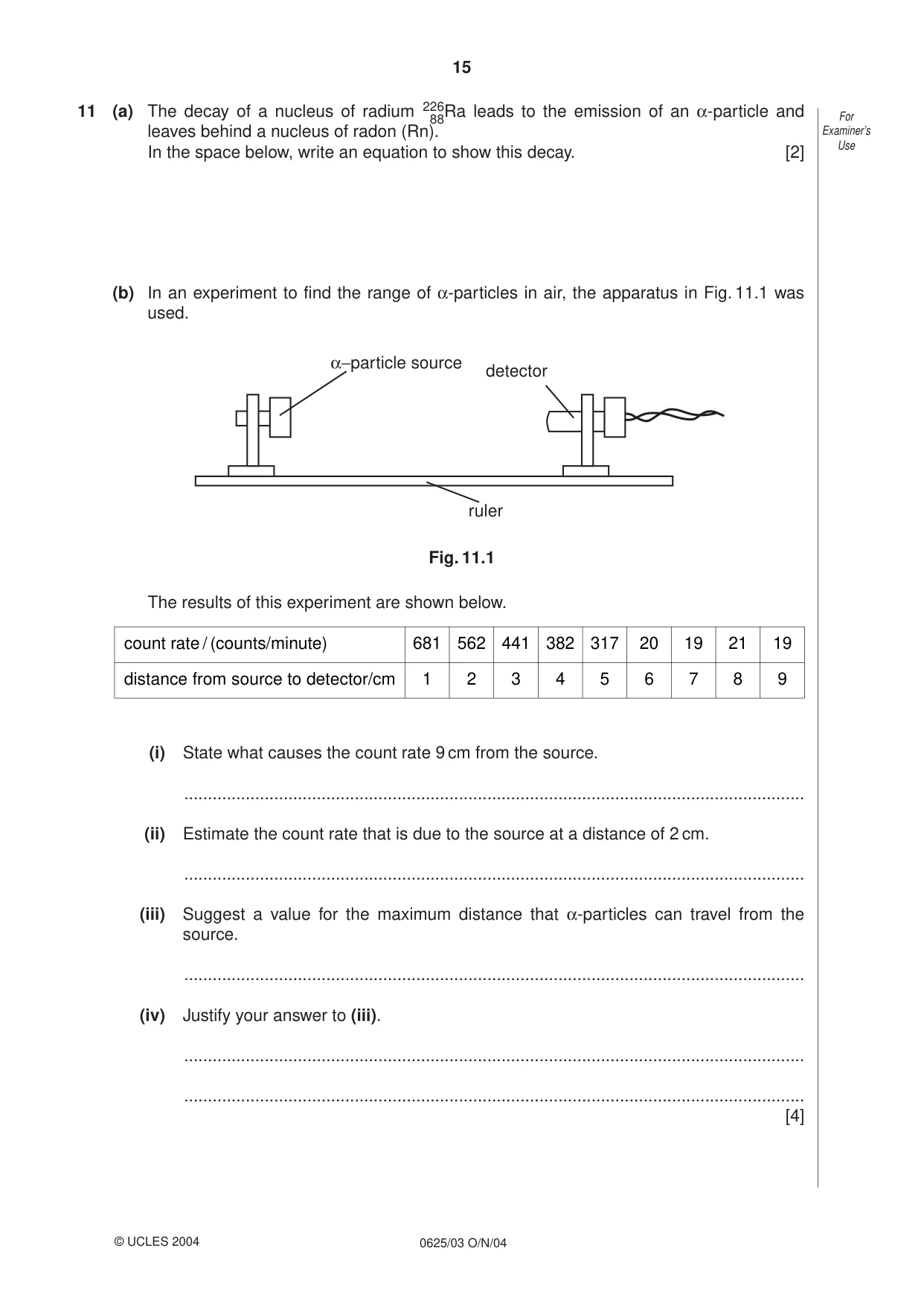
15 0625/03 O/N/04 11 (a) The decay of a nucleus of radium 226 88Ra leads to the emission of an α-particle and leaves behind a nucleus of radon (Rn). In the space below, write an equation to show this decay. [2] (b) In an experiment to find the range of α-particles in air, the apparatus in Fig. 11.1 was used. Fig. 11.1 The results of this experiment are shown below. (i) State what causes the count rate 9 cm from the source. … (ii) Estimate the count rate that is due to the source at a distance of 2 cm. … (iii) Suggest a value for the maximum distance that α-particles can travel from the source. … (iv) Justify your answer to (iii). … … [4] α−particle source detector ruler For Examiner’s Use © UCLES 2004 count rate / (counts/minute) 681 562 441 382 317 20 19 21 19 distance from source to detector/cm 1 2 3 4 5 6 7 8 9
Question paper, page 16
16 0625/03 O/N/04 BLANK PAGE Every reasonable effort has been made to trace all copyright holders where the publishers (i.e UCLES) are aware that third-party material has been reproduced. The publishers would be pleased to hear from anyone whose rights we have unwittingly infringed. University of Cambridge International Examinations is part of the University of Cambridge Local Examinations Syndicate (UCLES), which is itself a department of the University of Cambridge.
Mark scheme, page 1
UNIVERSITY OF CAMBRIDGE INTERNATIONAL EXAMINATIONS International General Certificate of Secondary Education MARK SCHEME for the November 2004 question paper 0625 PHYSICS 0625/03 Paper 3 (Extended Theory), maximum mark 80 This mark scheme is published as an aid to teachers and students, to indicate the requirements of the examination. It shows the basis on which Examiners were initially instructed to award marks. It does not indicate the details of the discussions that took place at an Examiners’ meeting before marking began. Any substantial changes to the mark scheme that arose from these discussions will be recorded in the published Report on the Examination. All Examiners are instructed that alternative correct answers and unexpected approaches in candidates’ scripts must be given marks that fairly reflect the relevant knowledge and skills demonstrated. Mark schemes must be read in conjunction with the question papers and the Report on the Examination. • CIE will not enter into discussion or correspondence in connection with these mark schemes. CIE is publishing the mark schemes for the November 2004 question papers for most IGCSE and GCE Advanced Level syllabuses. www.XtremePapers.com
Mark scheme, page 2
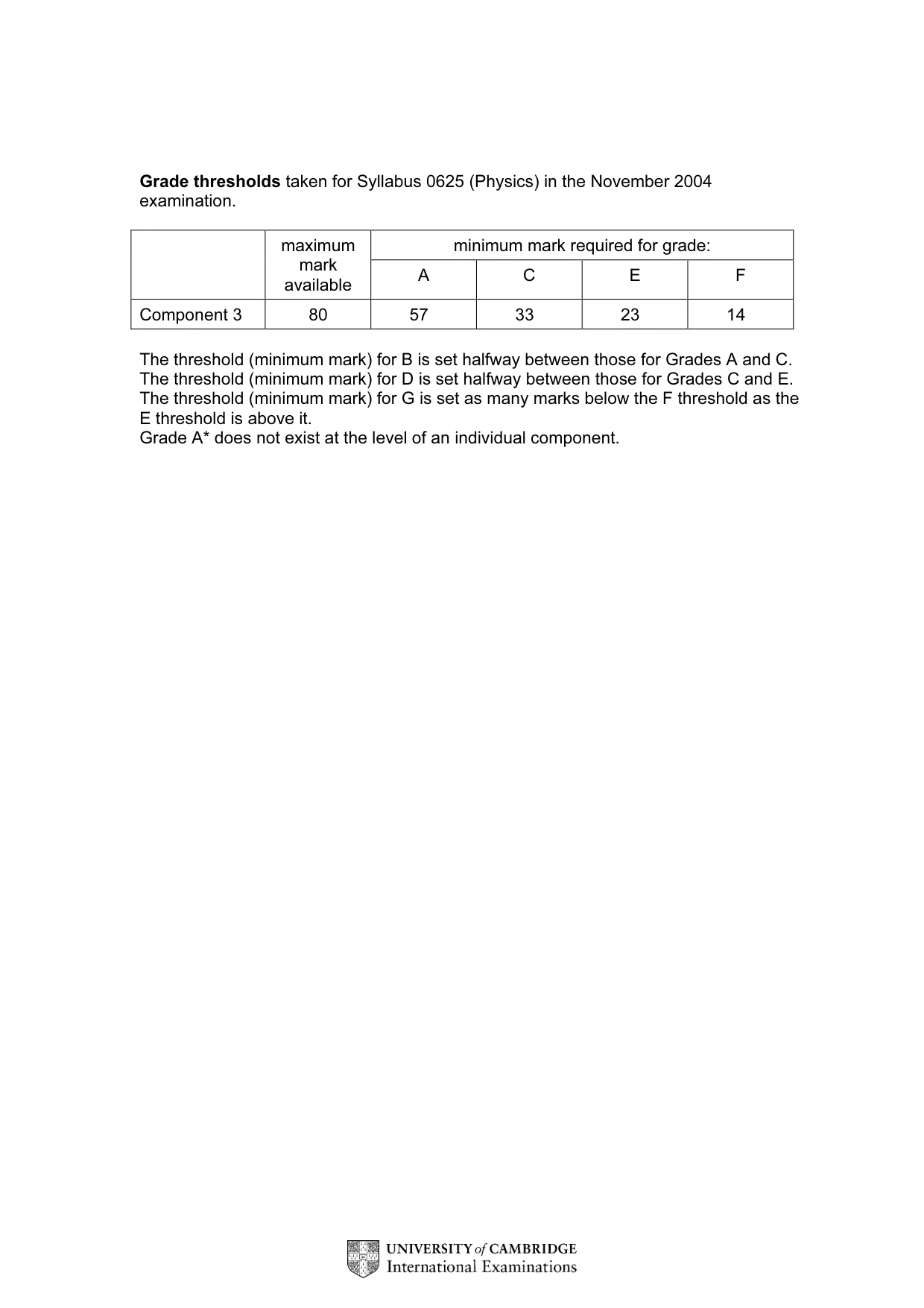
Grade thresholds taken for Syllabus 0625 (Physics) in the November 2004 examination. minimum mark required for grade: maximum mark available A C E F Component 3 80 57 33 23 14 The threshold (minimum mark) for B is set halfway between those for Grades A and C. The threshold (minimum mark) for D is set halfway between those for Grades C and E. The threshold (minimum mark) for G is set as many marks below the F threshold as the E threshold is above it. Grade A* does not exist at the level of an individual component.
Mark scheme, page 3
November 2004 INTERNATIONAL GCSE MARK SCHEME MAXIMUM MARK: 80 SYLLABUS/COMPONENT: 0625/03 PHYSICS (Extended Theory)
Mark scheme, page 4
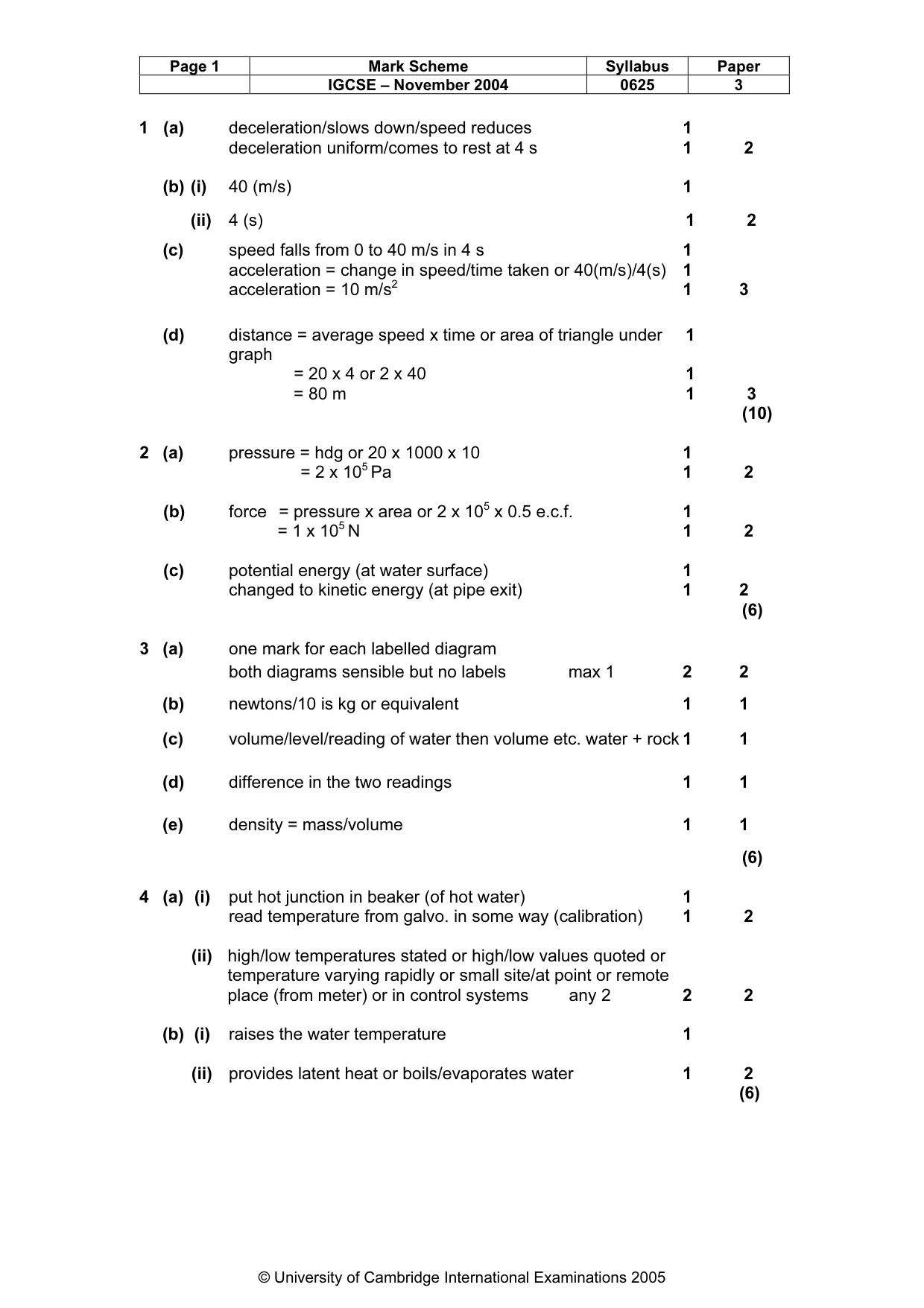
Page 1 Mark Scheme Syllabus Paper IGCSE – November 2004 0625 3 © University of Cambridge International Examinations 2005 1 (a) deceleration/slows down/speed reduces deceleration uniform/comes to rest at 4 s 1 1 2 (b) (i) 40 (m/s) 1 (ii) 4 (s) 1 2 (c) speed falls from 0 to 40 m/s in 4 s acceleration = change in speed/time taken or 40(m/s)/4(s) acceleration = 10 m/s2 1 1 1 3 (d) distance = average speed x time or area of triangle under graph = 20 x 4 or 2 x 40 = 80 m 1 1 1 3 (10) 2 (a) pressure = hdg or 20 x 1000 x 10 = 2 x 10⁵ Pa 1 1 2 (b) force = pressure x area or 2 x 105 x 0.5 e.c.f. = 1 x 10⁵ N 1 1 2 (c) potential energy (at water surface) changed to kinetic energy (at pipe exit) 1 1 2 (6) 3 (a) one mark for each labelled diagram both diagrams sensible but no labels max 1 2 2 (b) newtons/10 is kg or equivalent 1 1 (c) volume/level/reading of water then volume etc. water + rock 1 1 (d) difference in the two readings 1 1 (e) density = mass/volume 1 1 (6) 4 (a) (i) put hot junction in beaker (of hot water) read temperature from galvo. in some way (calibration) 1 1 2 (ii) high/low temperatures stated or high/low values quoted or temperature varying rapidly or small site/at point or remote place (from meter) or in control systems any 2 2 2 (b) (i) raises the water temperature 1 (ii) provides latent heat or boils/evaporates water 1 2 (6)
Mark scheme, page 5
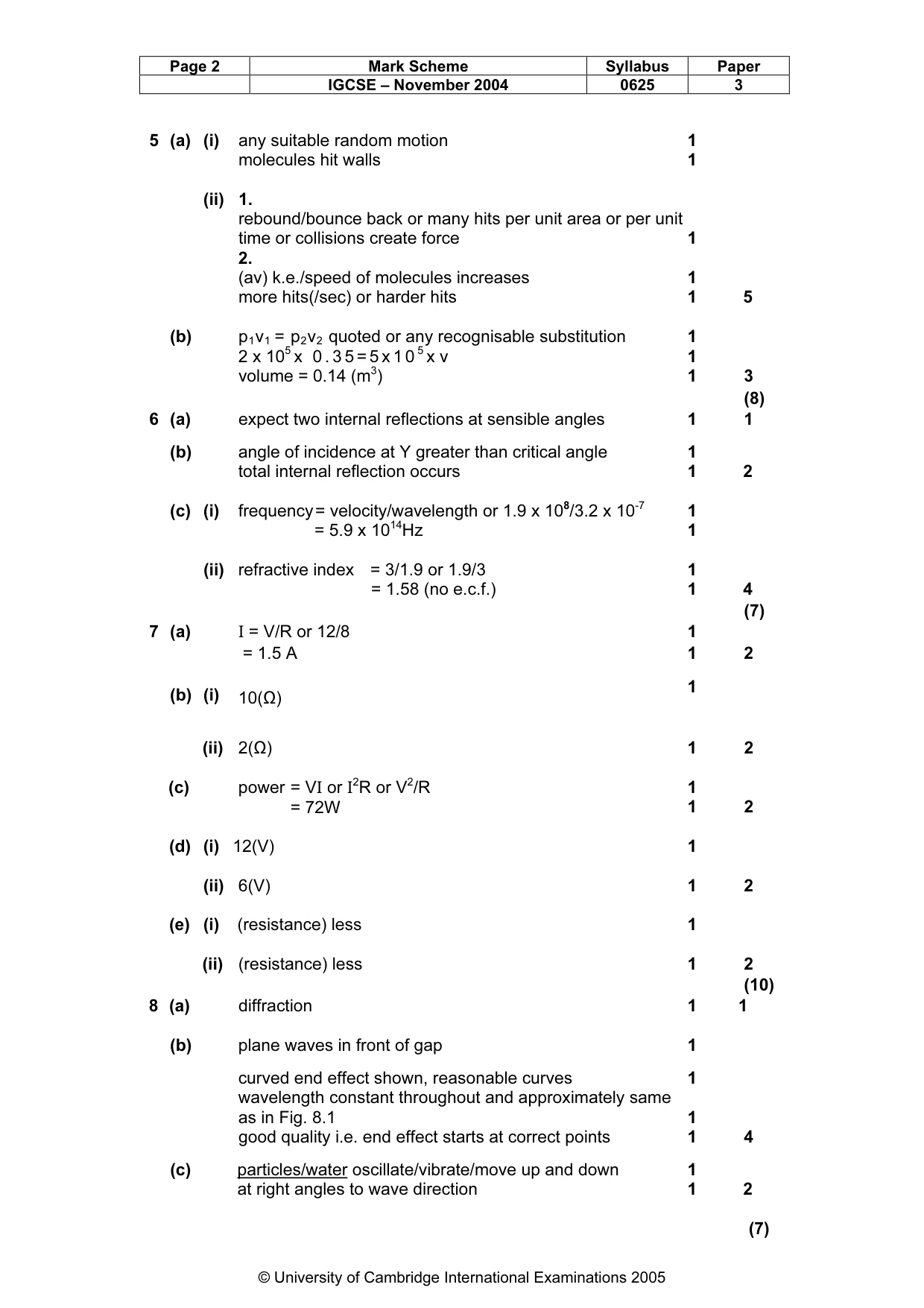
Page 2 Mark Scheme Syllabus Paper IGCSE – November 2004 0625 3 © University of Cambridge International Examinations 2005 5 (a) (i) (ii) any suitable random motion molecules hit walls 1. rebound/bounce back or many hits per unit area or per unit time or collisions create force 1 1 1 2. (av) k.e./speed of molecules increases more hits(/sec) or harder hits 1 1 5 (b) p1v1 = p2v2 quoted or any recognisable substitution 1 2 x 105 x 0 . 3 5 = 5 x 1 0 5 x v 1 volume = 0.14 (m3) 1 3 (8) 6 (a) expect two internal reflections at sensible angles 1 1 (b) angle of incidence at Y greater than critical angle total internal reflection occurs 1 1 2 (c) (i) frequency = velocity/wavelength or 1.9 x 10⁸/3.2 x 10-7 = 5.9 x 10¹⁴Hz 1 1 (ii) refractive index = 3/1.9 or 1.9/3 = 1.58 (no e.c.f.) 1 1 4 (7) 7 (a) I = V/R or 12/8 1 = 1.5 A 1 2 (b) (i) 10(Ω) 1 (c) (ii) 2(Ω) power = VI or I2R or V2/R = 72W 1 1 1 2 2 (d) (i) 12(V) 1 (e) (ii) (i) 6(V) (resistance) less 1 1 2 (ii) (resistance) less 1 2 (10) 8 (a) diffraction 1 1 (b) plane waves in front of gap 1 curved end effect shown, reasonable curves wavelength constant throughout and approximately same as in Fig. 8.1 1 1 good quality i.e. end effect starts at correct points 1 4 (c) particles/water oscillate/vibrate/move up and down at right angles to wave direction 1 1 2 (7)
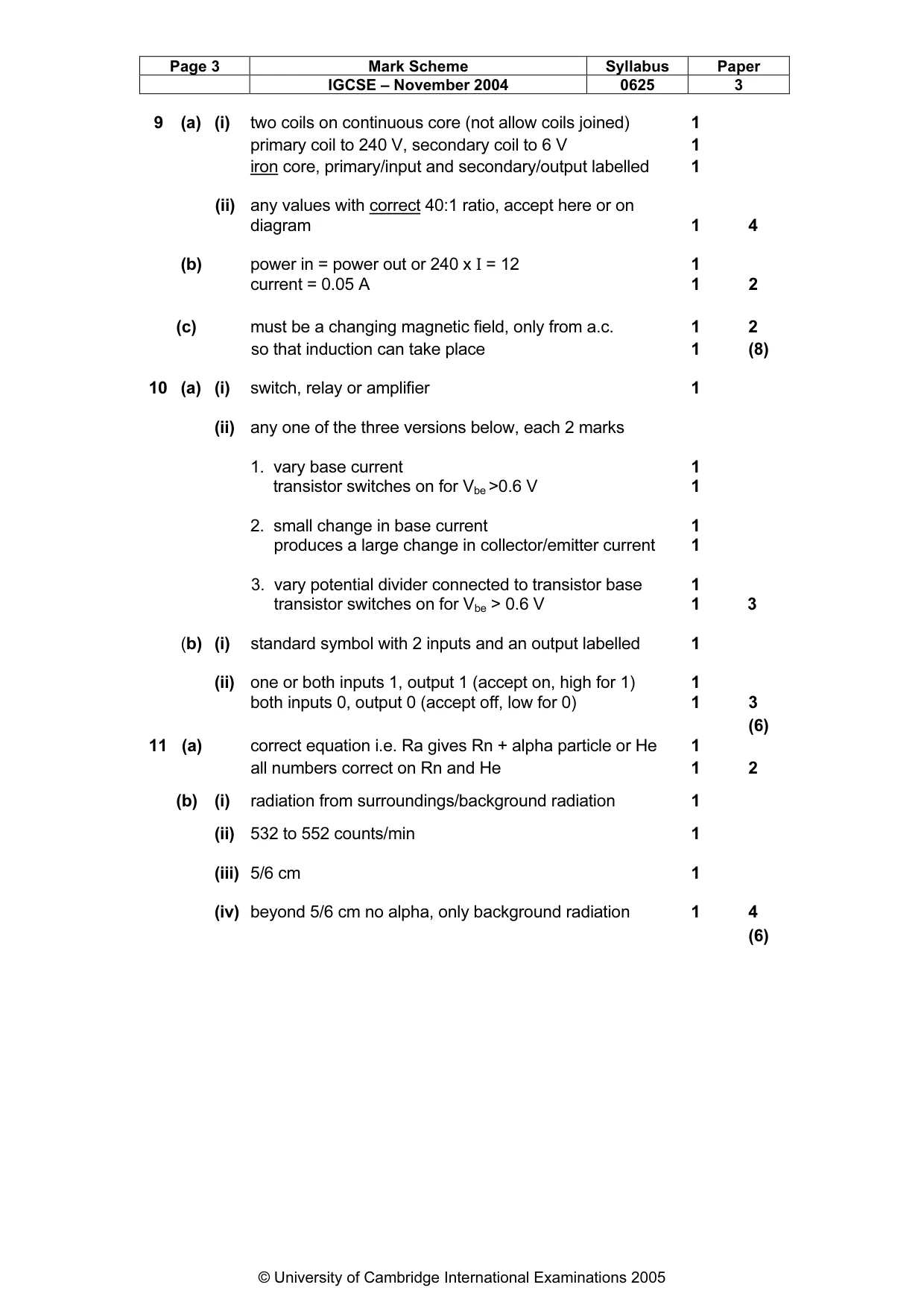
Mark scheme, page 6
Page 3 Mark Scheme Syllabus Paper IGCSE – November 2004 0625 3 © University of Cambridge International Examinations 2005 9 (a) (i) two coils on continuous core (not allow coils joined) 1 primary coil to 240 V, secondary coil to 6 V 1 iron core, primary/input and secondary/output labelled 1 (ii) any values with correct 40:1 ratio, accept here or on diagram 1 4 (b) power in = power out or 240 x I = 12 current = 0.05 A 1 1 2 (c) must be a changing magnetic field, only from a.c. 1 2 so that induction can take place 1 (8) 10 (a) (i) (ii) switch, relay or amplifier any one of the three versions below, each 2 marks 1. vary base current transistor switches on for Vbe >0.6 V 2. small change in base current produces a large change in collector/emitter current 3. vary potential divider connected to transistor base transistor switches on for Vbe > 0.6 V 1 1 1 1 1 1 1 3 (b) (i) standard symbol with 2 inputs and an output labelled 1 (ii) one or both inputs 1, output 1 (accept on, high for 1) 1 both inputs 0, output 0 (accept off, low for 0) 1 3 (6) 11 (a) correct equation i.e. Ra gives Rn + alpha particle or He 1 all numbers correct on Rn and He 1 2 (b) (i) radiation from surroundings/background radiation 1 (ii) 532 to 552 counts/min 1 (iii) 5/6 cm 1 (iv) beyond 5/6 cm no alpha, only background radiation 1 4 (6)