Cambridge IGCSE Physics 0625 — 2003 May/June Paper 3 · Variant 1
0625/31/M/J/03
The question paper and its mark scheme, free to read here and free to download. This is Cambridge’s own paper, exactly as it was sat.
Question paper12 pages
Mark scheme
No mark scheme is in the library for this paper.
Paper as text
Question paper, page 1
This document consists of 12 printed pages. SP (AT/KN) S46413/2 © CIE 2003 [Turn over CAMBRIDGE INTERNATIONAL EXAMINATIONS International General Certificate of Secondary Education PHYSICS 0625/03 Paper 3 May/June 2003 1 hour 15 minutes Candidates answer on the Question Paper. No Additional Materials are required. READ THESE INSTRUCTIONS FIRST Write your Centre number, candidate number and name on all the work you hand in. Write in dark blue or black pen in the spaces provided on the Question Paper. You may use a soft pencil for any diagrams, graphs or rough working. Do not use staples, paper clips, highlighters, glue or correction fluid. Answer all questions. The number of marks is given in brackets [ ] at the end of each question or part question. Centre Number Candidate Number Name If you have been given a label, look at the details. If any details are incorrect or missing, please fill in your correct details in the space given at the top of this page. Stick your personal label here, if provided. For Examiner’s Use 1 2 3 4 5 6 7 8 9 10 11 Total www.XtremePapers.com
Question paper, page 2
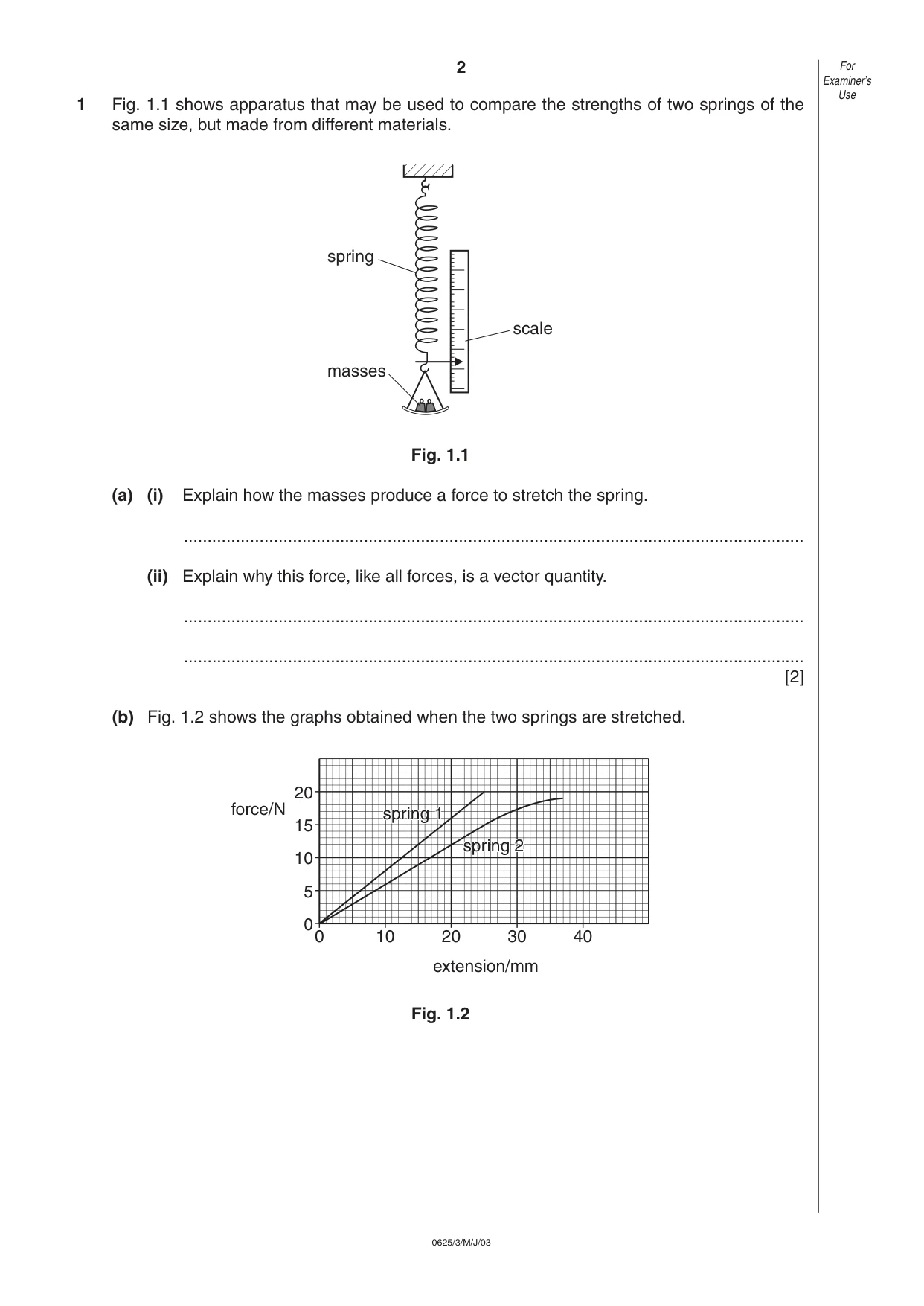
2 0625/3/M/J/03 1 Fig. 1.1 shows apparatus that may be used to compare the strengths of two springs of the same size, but made from different materials. Fig. 1.1 (a) (i) Explain how the masses produce a force to stretch the spring. … (ii) Explain why this force, like all forces, is a vector quantity. … … [2] (b) Fig. 1.2 shows the graphs obtained when the two springs are stretched. Fig. 1.2 0 0 5 10 15 20 force/N 10 20 30 40 extension/mm spring 1 spring 1 spring 2 spring 2 spring 1 spring 2 spring masses scale For Examiner’s Use
Question paper, page 3
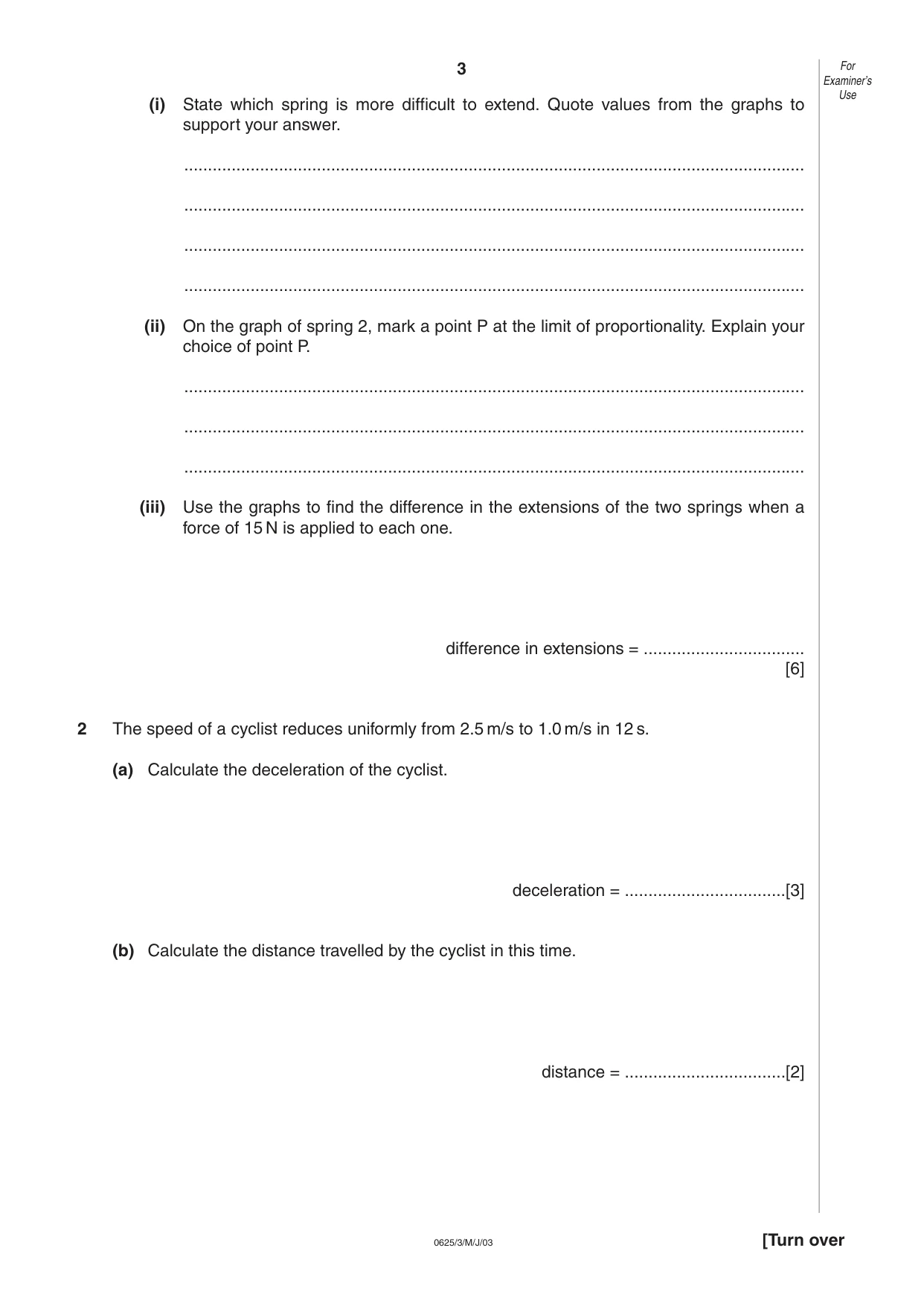
3 0625/3/M/J/03 [Turn over (i) State which spring is more difficult to extend. Quote values from the graphs to support your answer. … … … … (ii) On the graph of spring 2, mark a point P at the limit of proportionality. Explain your choice of point P. … … … (iii) Use the graphs to find the difference in the extensions of the two springs when a force of 15 N is applied to each one. difference in extensions = … [6] 2 The speed of a cyclist reduces uniformly from 2.5 m/s to 1.0 m/s in 12 s. (a) Calculate the deceleration of the cyclist. deceleration = …[3] (b) Calculate the distance travelled by the cyclist in this time. distance = …[2] For Examiner’s Use
Question paper, page 4
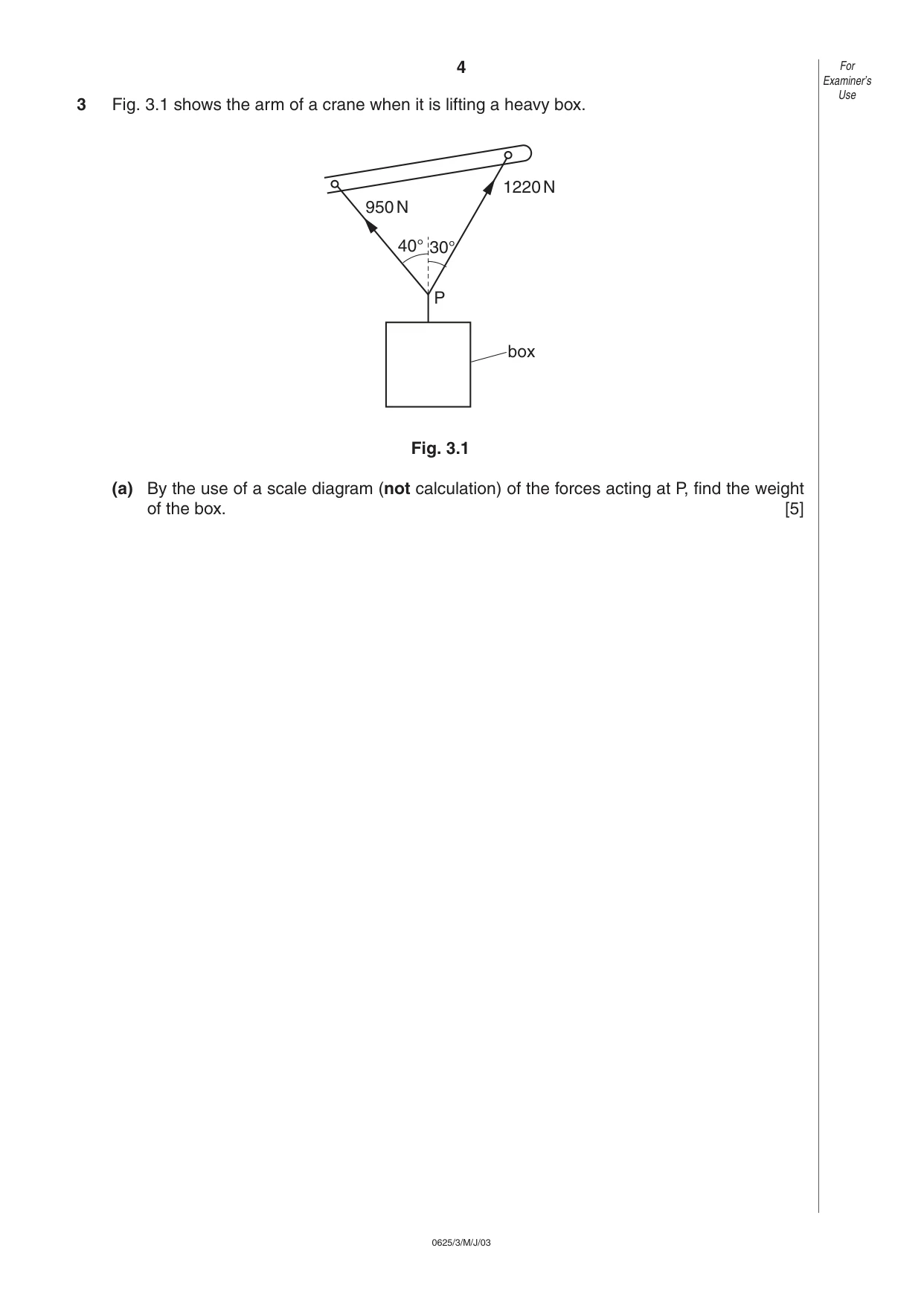
4 0625/3/M/J/03 3 Fig. 3.1 shows the arm of a crane when it is lifting a heavy box. Fig. 3.1 (a) By the use of a scale diagram (not calculation) of the forces acting at P, find the weight of the box. [5] 40° 30° 950N 1220N P box For Examiner’s Use
Question paper, page 5
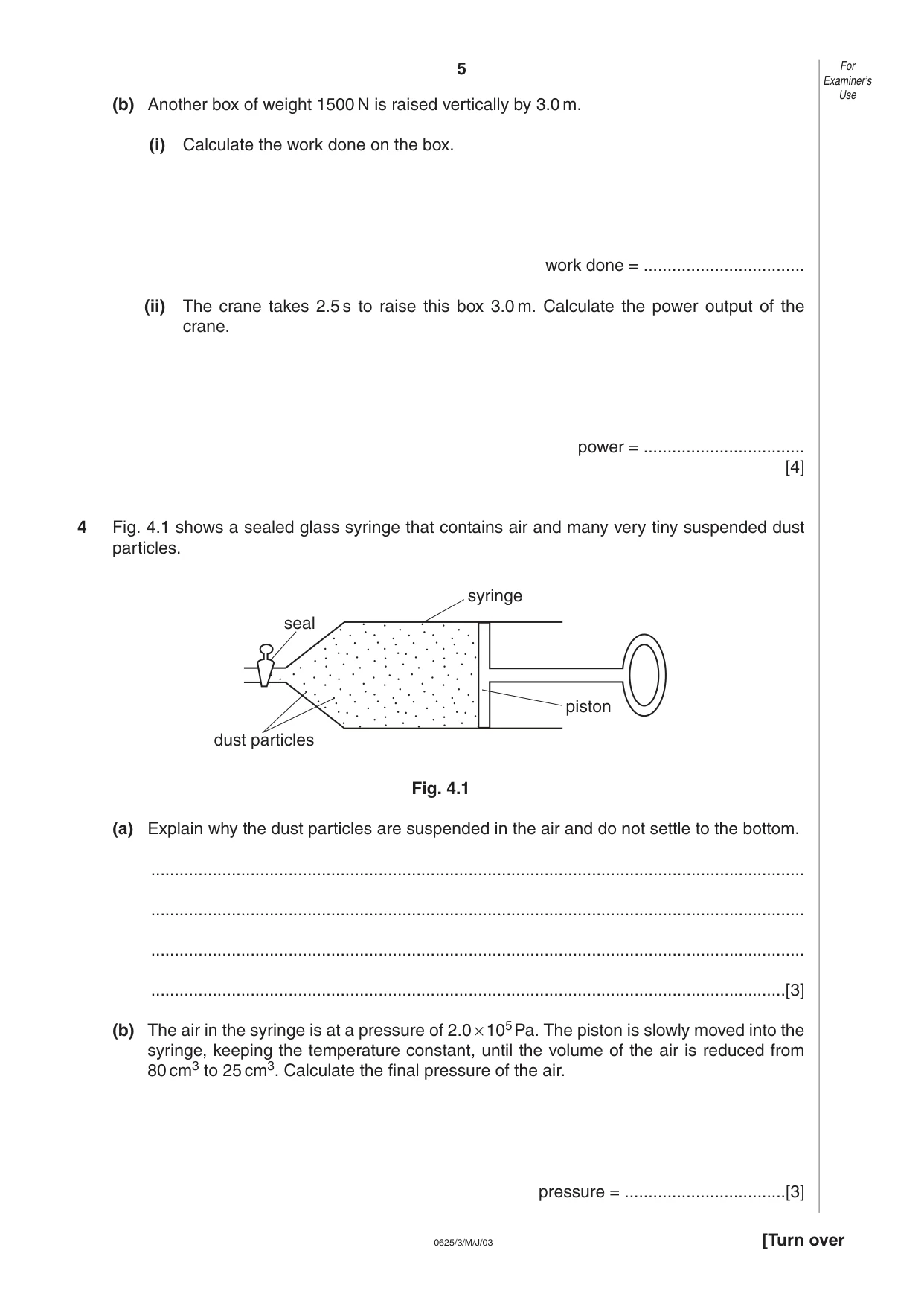
5 0625/3/M/J/03 [Turn over (b) Another box of weight 1500 N is raised vertically by 3.0 m. (i) Calculate the work done on the box. work done = … (ii) The crane takes 2.5 s to raise this box 3.0 m. Calculate the power output of the crane. power = … [4] 4 Fig. 4.1 shows a sealed glass syringe that contains air and many very tiny suspended dust particles. Fig. 4.1 (a) Explain why the dust particles are suspended in the air and do not settle to the bottom. … … … …[3] (b) The air in the syringe is at a pressure of 2.0 ×10⁵Pa. The piston is slowly moved into the syringe, keeping the temperature constant, until the volume of the air is reduced from 80 cm3 to 25 cm3. Calculate the final pressure of the air. pressure = …[3] syringe seal dust particles piston For Examiner’s Use
Question paper, page 6
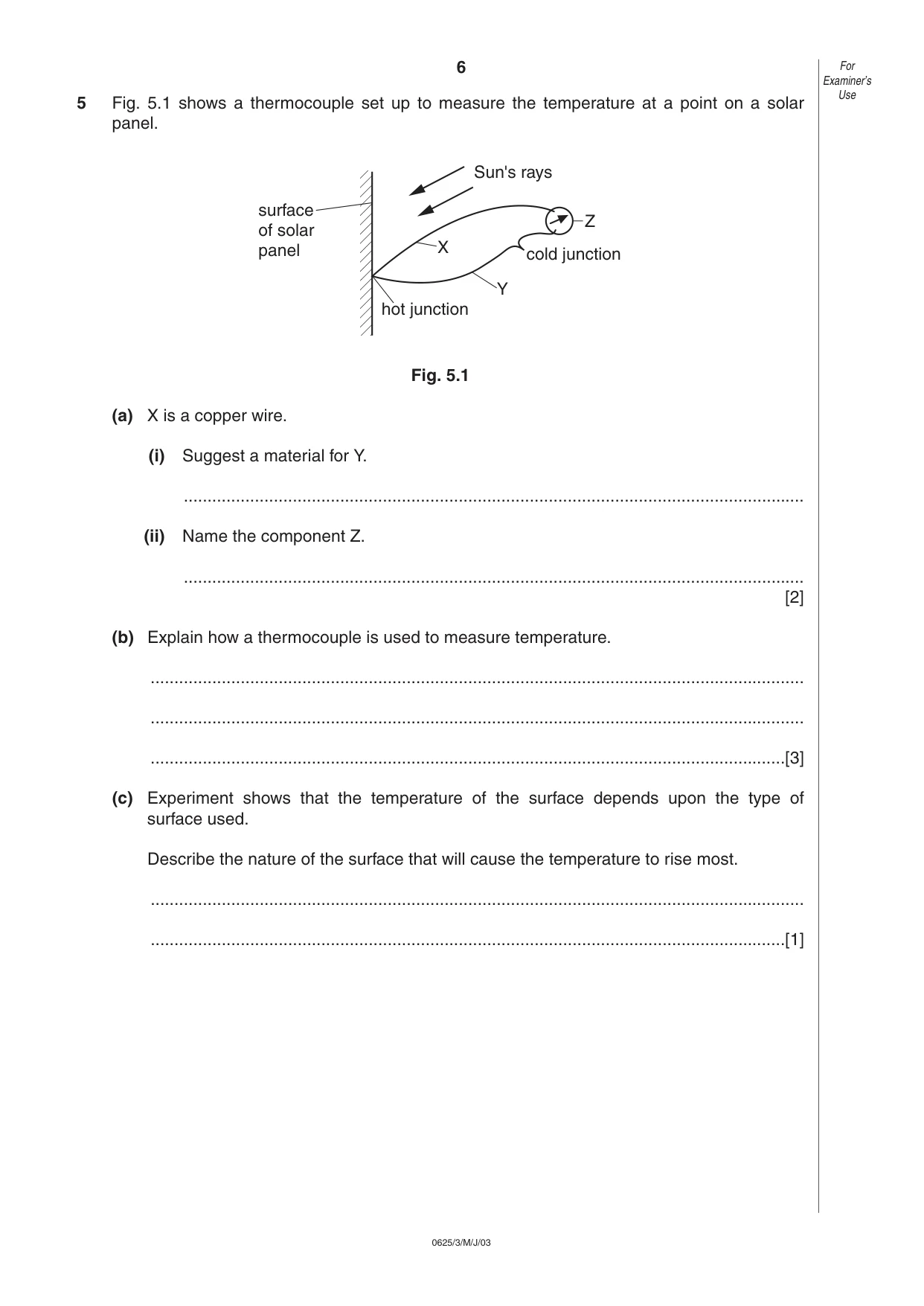
6 0625/3/M/J/03 5 Fig. 5.1 shows a thermocouple set up to measure the temperature at a point on a solar panel. Fig. 5.1 (a) X is a copper wire. (i) Suggest a material for Y. … (ii) Name the component Z. … [2] (b) Explain how a thermocouple is used to measure temperature. … … …[3] (c) Experiment shows that the temperature of the surface depends upon the type of surface used. Describe the nature of the surface that will cause the temperature to rise most. … …[1] cold junction Y Z X hot junction Sun's rays surface of solar panel For Examiner’s Use
Question paper, page 7
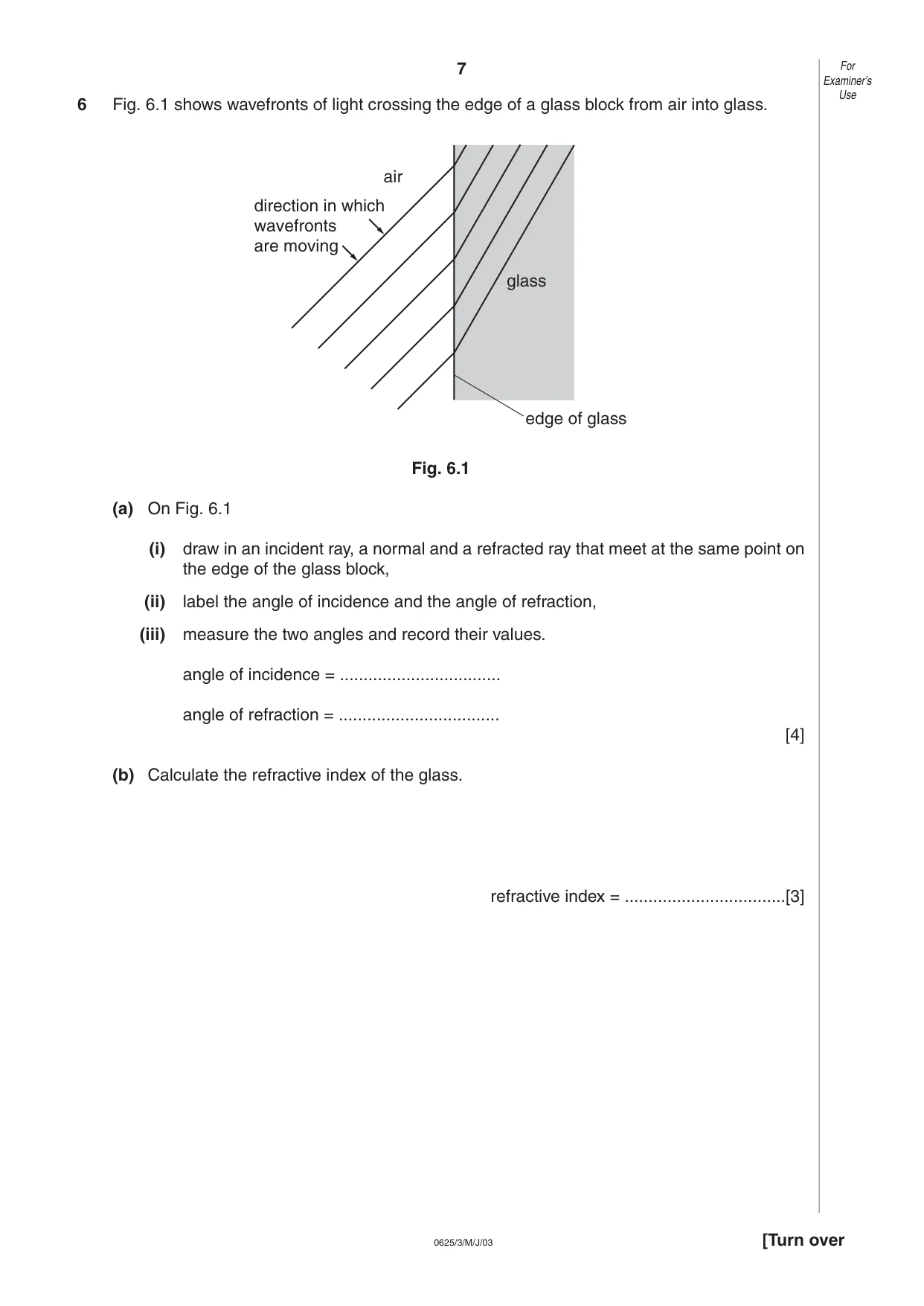
7 0625/3/M/J/03 [Turn over 6 Fig. 6.1 shows wavefronts of light crossing the edge of a glass block from air into glass. Fig. 6.1 (a) On Fig. 6.1 (i) draw in an incident ray, a normal and a refracted ray that meet at the same point on the edge of the glass block, (ii) label the angle of incidence and the angle of refraction, (iii) measure the two angles and record their values. angle of incidence = … angle of refraction = … [4] (b) Calculate the refractive index of the glass. refractive index = …[3] edge of glass glass air direction in which wavefronts are moving For Examiner’s Use
Question paper, page 8
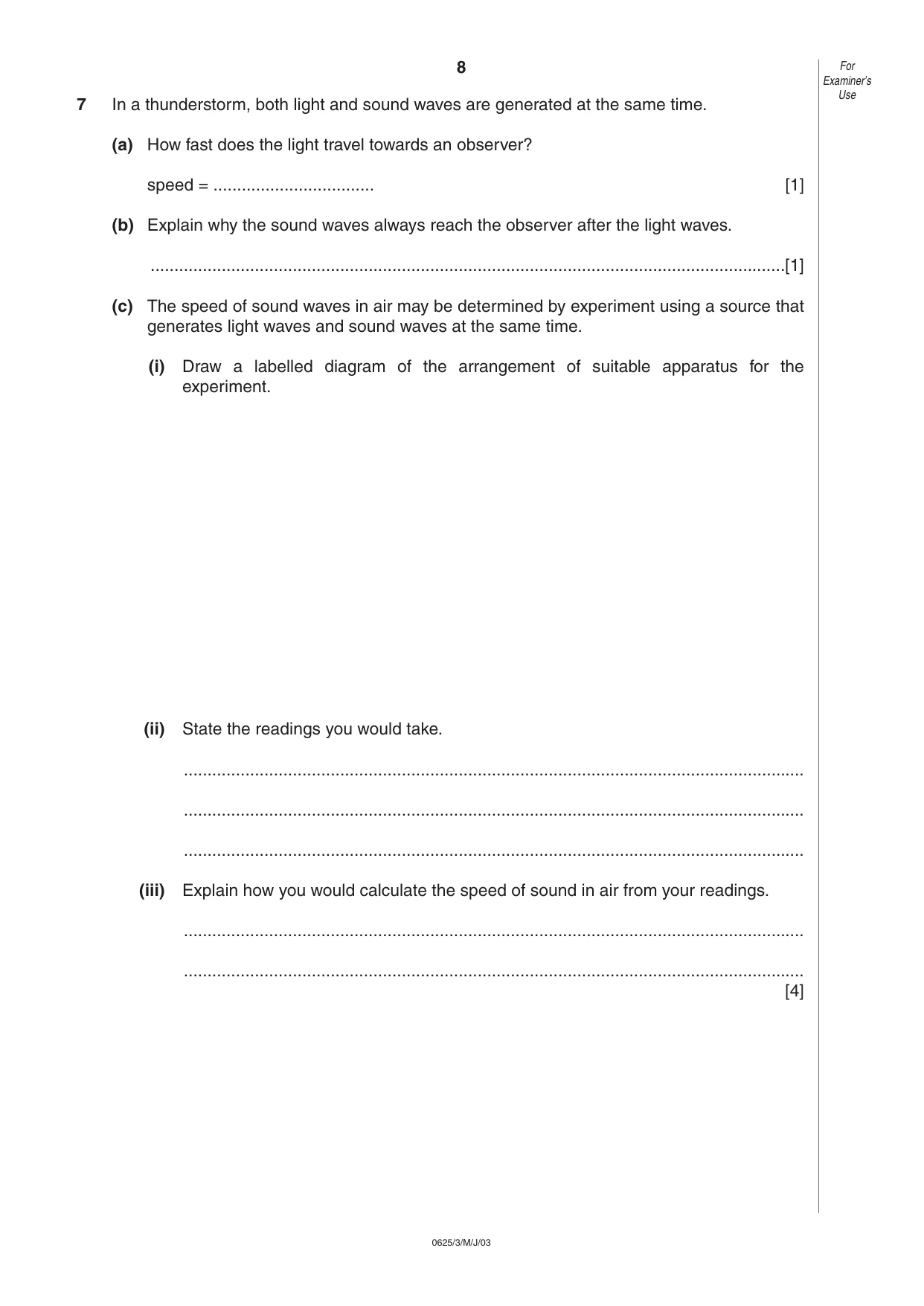
8 0625/3/M/J/03 7 In a thunderstorm, both light and sound waves are generated at the same time. (a) How fast does the light travel towards an observer? speed = … [1] (b) Explain why the sound waves always reach the observer after the light waves. …[1] (c) The speed of sound waves in air may be determined by experiment using a source that generates light waves and sound waves at the same time. (i) Draw a labelled diagram of the arrangement of suitable apparatus for the experiment. (ii) State the readings you would take. … … … (iii) Explain how you would calculate the speed of sound in air from your readings. … … [4] For Examiner’s Use
Question paper, page 9
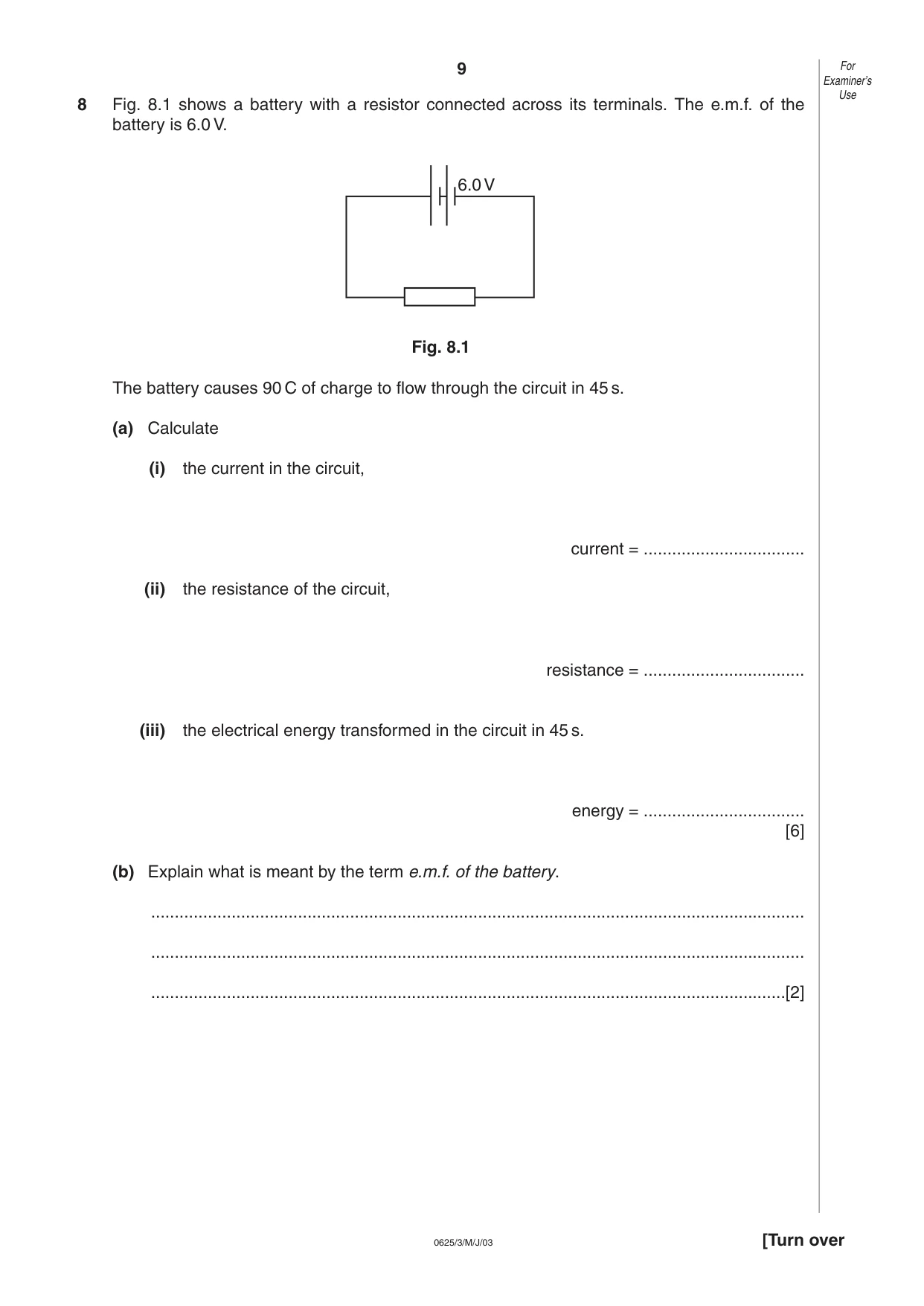
9 0625/3/M/J/03 [Turn over 8 Fig. 8.1 shows a battery with a resistor connected across its terminals. The e.m.f. of the battery is 6.0 V. Fig. 8.1 The battery causes 90 C of charge to flow through the circuit in 45 s. (a) Calculate (i) the current in the circuit, current = … (ii) the resistance of the circuit, resistance = … (iii) the electrical energy transformed in the circuit in 45 s. energy = … [6] (b) Explain what is meant by the term e.m.f. of the battery. … … …[2] 6.0V For Examiner’s Use
Question paper, page 10
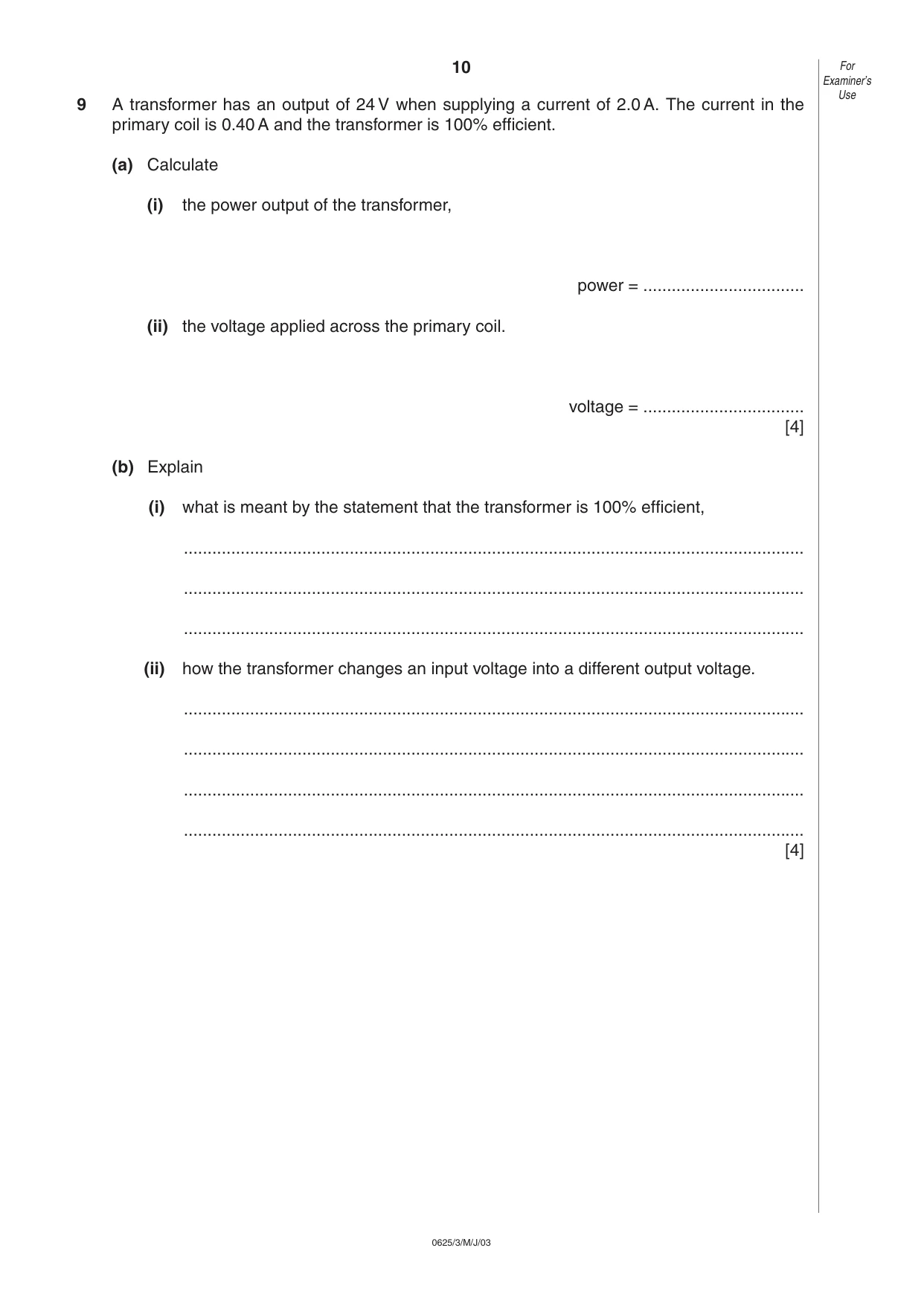
10 0625/3/M/J/03 9 A transformer has an output of 24 V when supplying a current of 2.0 A. The current in the primary coil is 0.40 A and the transformer is 100% efficient. (a) Calculate (i) the power output of the transformer, power = … (ii) the voltage applied across the primary coil. voltage = … [4] (b) Explain (i) what is meant by the statement that the transformer is 100% efficient, … … … (ii) how the transformer changes an input voltage into a different output voltage. … … … … [4] For Examiner’s Use
Question paper, page 11
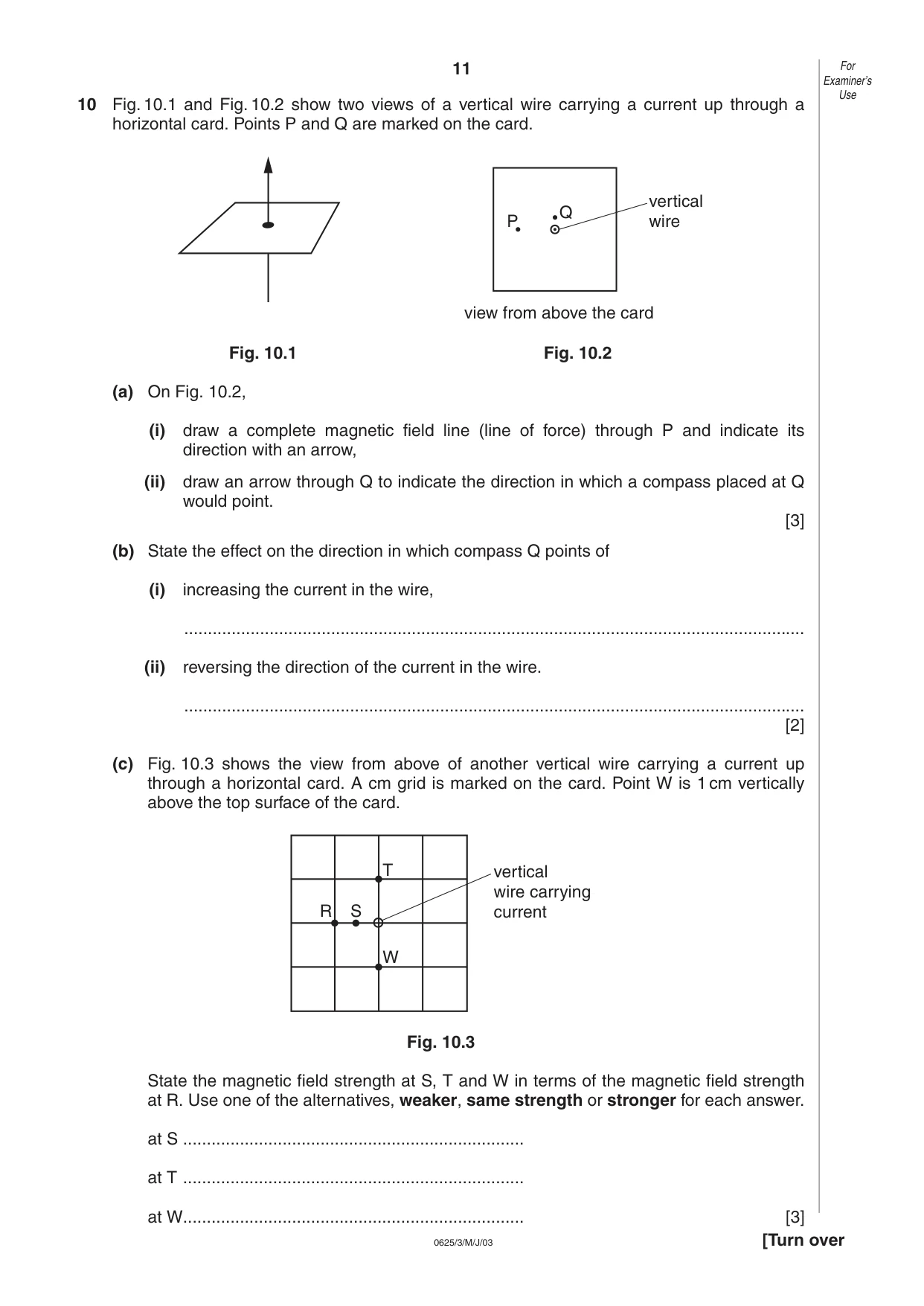
11 0625/3/M/J/03 [Turn over 10 Fig. 10.1 and Fig. 10.2 show two views of a vertical wire carrying a current up through a horizontal card. Points P and Q are marked on the card. Fig. 10.1 Fig. 10.2 (a) On Fig. 10.2, (i) draw a complete magnetic field line (line of force) through P and indicate its direction with an arrow, (ii) draw an arrow through Q to indicate the direction in which a compass placed at Q would point. [3] (b) State the effect on the direction in which compass Q points of (i) increasing the current in the wire, … (ii) reversing the direction of the current in the wire. … [2] (c) Fig. 10.3 shows the view from above of another vertical wire carrying a current up through a horizontal card. A cm grid is marked on the card. Point W is 1 cm vertically above the top surface of the card. Fig. 10.3 State the magnetic field strength at S, T and W in terms of the magnetic field strength at R. Use one of the alternatives, weaker, same strength or stronger for each answer. at S … at T … at W… [3] R S T W vertical wire carrying current P Q vertical wire view from above the card For Examiner’s Use
Question paper, page 12
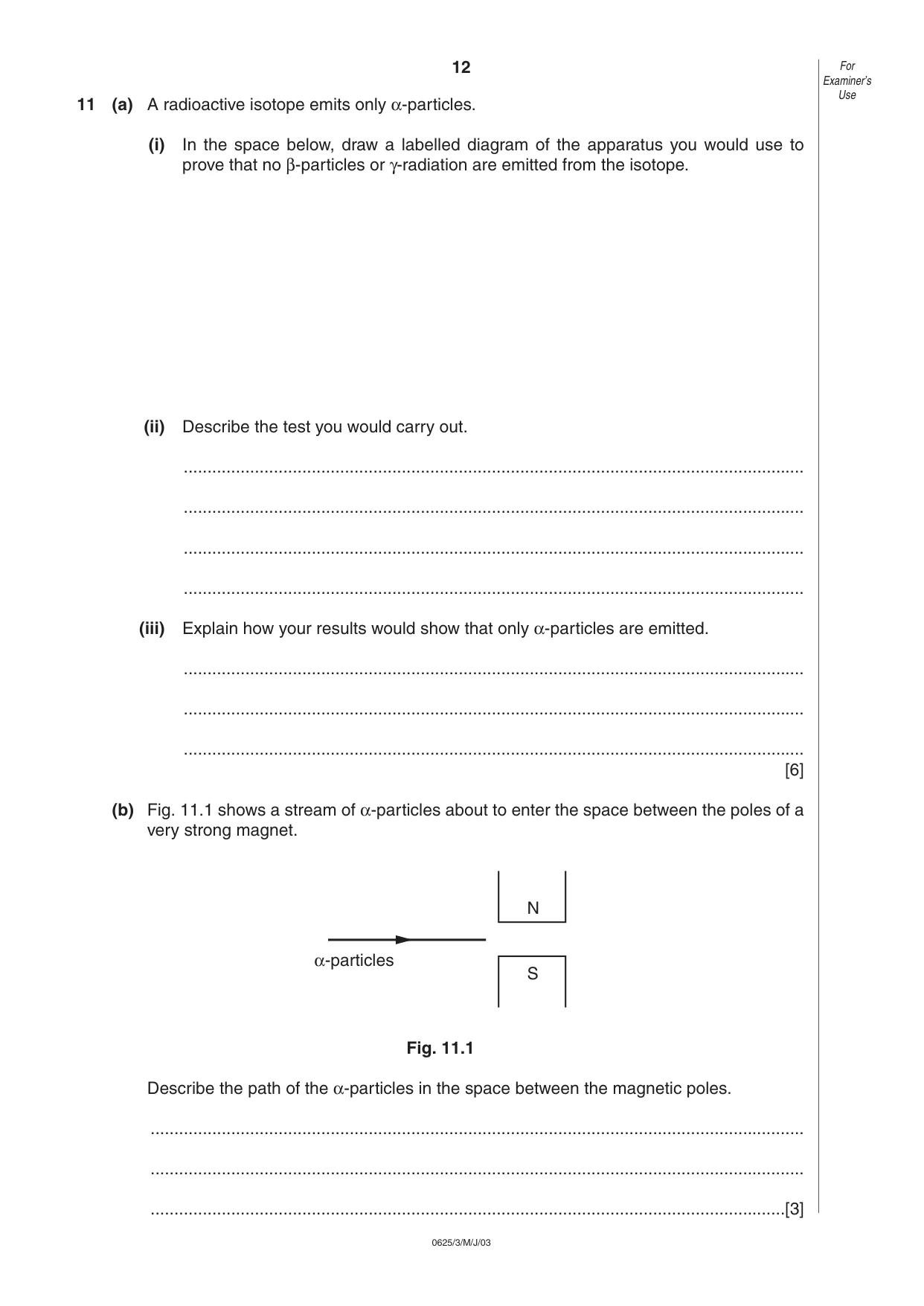
12 0625/3/M/J/03 11 (a) A radioactive isotope emits only α-particles. (i) In the space below, draw a labelled diagram of the apparatus you would use to prove that no β-particles or γ-radiation are emitted from the isotope. (ii) Describe the test you would carry out. … … … … (iii) Explain how your results would show that only α-particles are emitted. … … … [6] (b) Fig. 11.1 shows a stream of α-particles about to enter the space between the poles of a very strong magnet. Fig. 11.1 Describe the path of the α-particles in the space between the magnetic poles. … … …[3] N S α-particles For Examiner’s Use