Cambridge IGCSE Physical Science 0652 — 2018 Oct/Nov Paper 6 · Variant 2
0652/62/O/N/18 · 6 questions · 60 marks · ≈68 min
The question paper and its mark scheme, free to read here and free to download. This is Cambridge’s own paper, exactly as it was sat.
Question paper24 pages




Mark scheme7 pages
Answers below. Sit the paper first if you are practising.
Questions as text
Q1 · A student is given four colourless solutions H, J, K and L
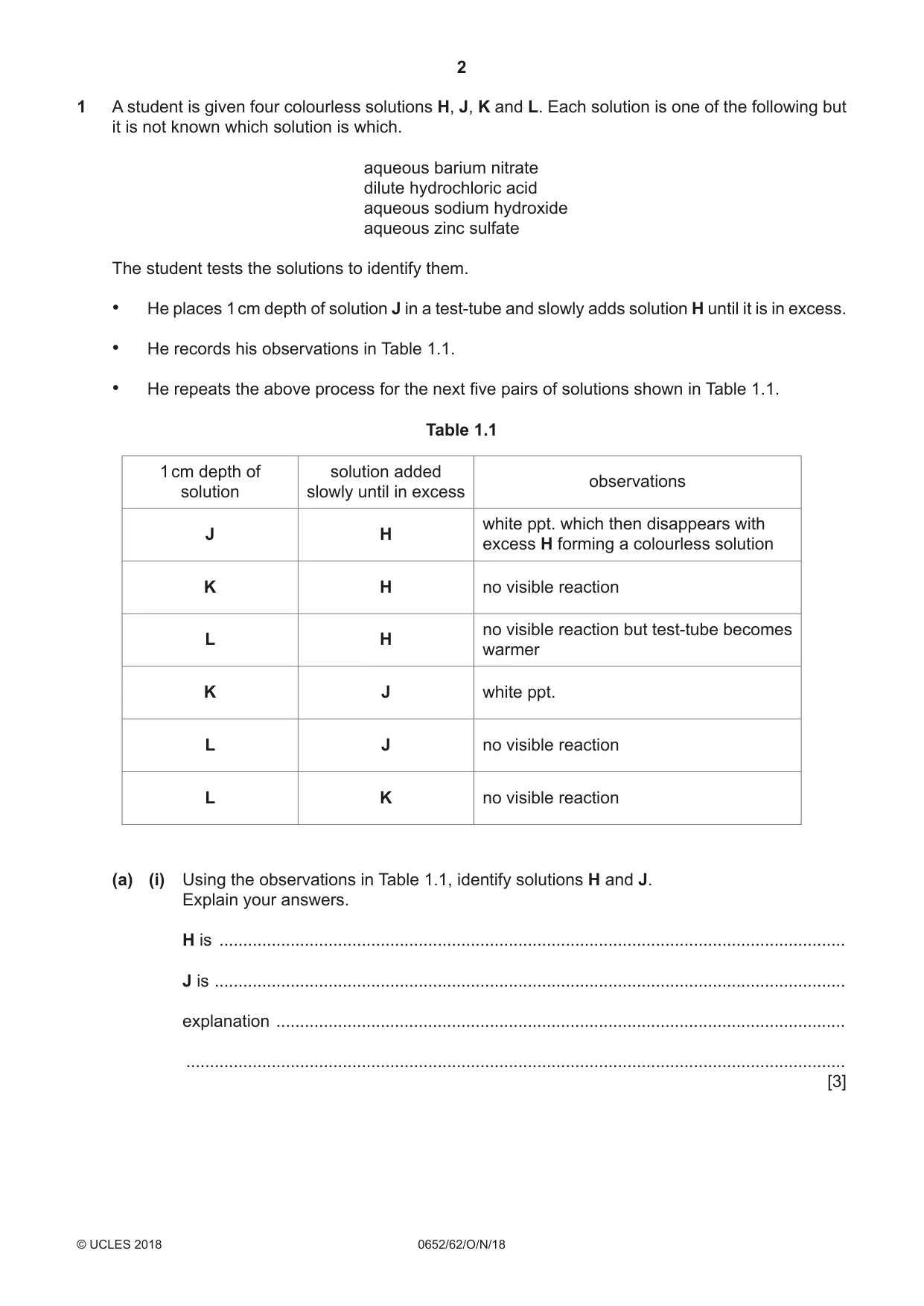
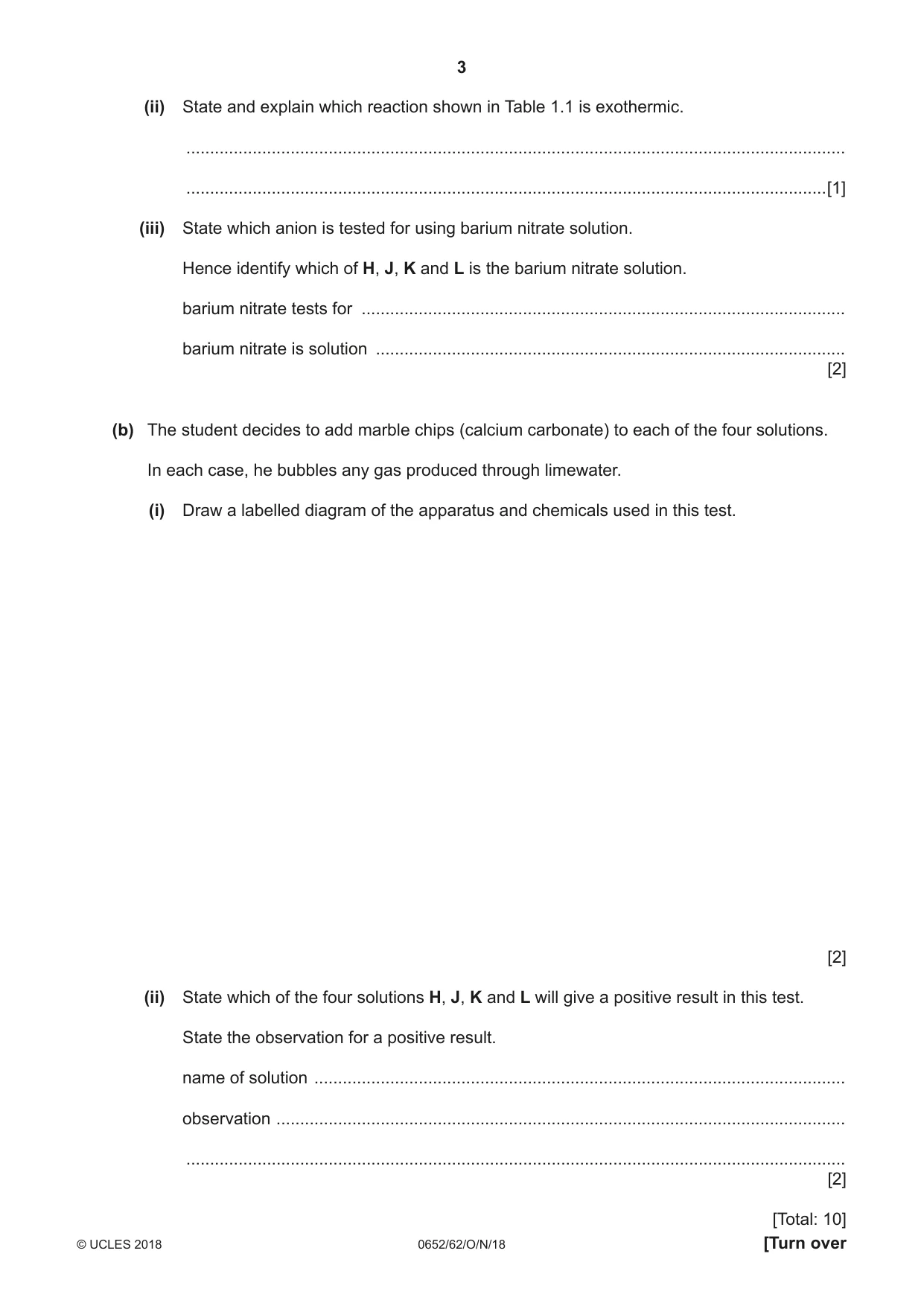
1 A student is given four colourless solutions H, J, K and L. Each solution is one of the following but it is not known which solution is which. aqueous barium nitrate dilute hydrochloric acid aqueous sodium hydroxide aqueous zinc sulfate The student tests the solutions to identify them. • He places 1 cm depth of solution J in a test-tube and slowly adds solution H until it is in excess. • He records his observations in Table 1.1. • He repeats the above process for the next five pairs of solutions shown in Table 1.1. Table 1.1 1 cm depth of solution added observations solution slowly until in excess white ppt. which then disappears with J H excess H forming a colourless solution K H no visible reaction no visible reaction but test-tube becomes L H warmer K J white ppt. L J no visible reaction L K no visible reaction (a) (i) Using the observations in Table 1.1, identify solutions H and J. Explain your answers. H is .................................................................................................................................... J is ..................................................................................................................................... explanation ........................................................................................................................ ........................................................................................................................................... [3] (ii) State and explain which reaction shown in Table 1.1 is exothermic. ........................................................................................................................................... .......................................................................................................................................[1] (iii) State which anion is tested for using barium nitrate solution. Hence identify which of H, J, K and L is the barium nitrate solution. barium nitrate tests for ...................................................................................................... barium nitrate is solution ................................................................................................... [2] (b) The student decides to add marble chips (calcium carbonate) to each of the four solutions. In each case, he bubbles any gas produced through limewater. (i) Draw a labelled diagram of the apparatus and chemicals used in this test. [2] (ii) State which of the four solutions H, J, K and L will give a positive result in this test. State the observation for a positive result. name of solution ................................................................................................................ observation ........................................................................................................................ ........................................................................................................................................... [2] [Total: 10]
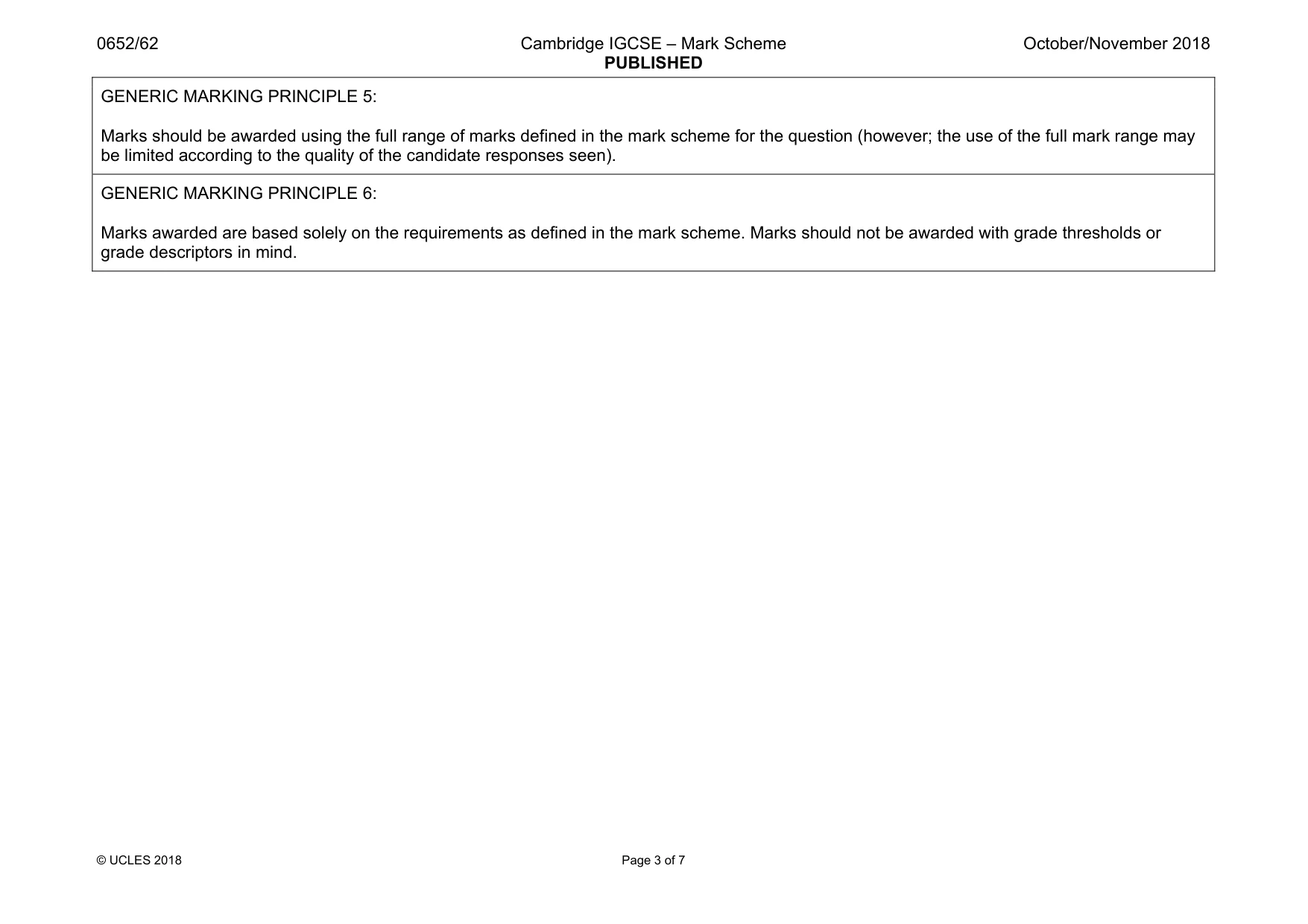
Mark scheme: 1(a)(i) H is sodium hydroxide ; J is zinc sulfate ; only pair giving white ppt. soluble in excess so H must be sodium hydroxide as reagent is being added in excess / J gives white ppt. with two of the solution (due to zinc ions and sulfate ions ) ; 3 1(a)(ii) L plus H as test-tube gets warmer ; 1 1(a)(iii) sulfate ; (barium nitrate is) K ; 2 1(b)(i) apparatus including delivery tube bung in one test-tube and delivery tube into liquid in other test-tube ; tube into labelled limewater ; 2 1(b)(ii) hydrochloric acid ; limewater milky ; 2
Q2 · A student measures the length l of a spring when different loads L are added to it
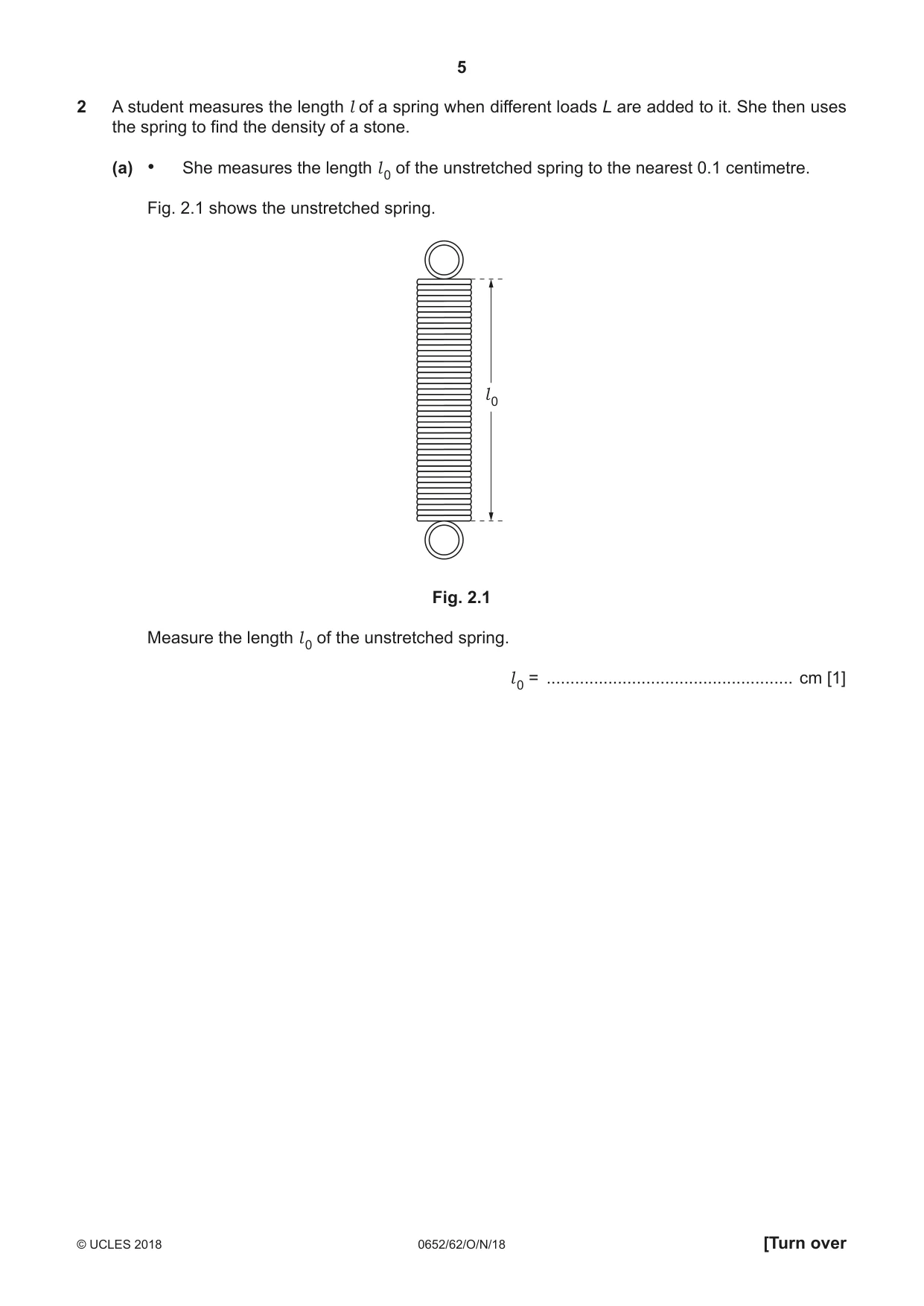
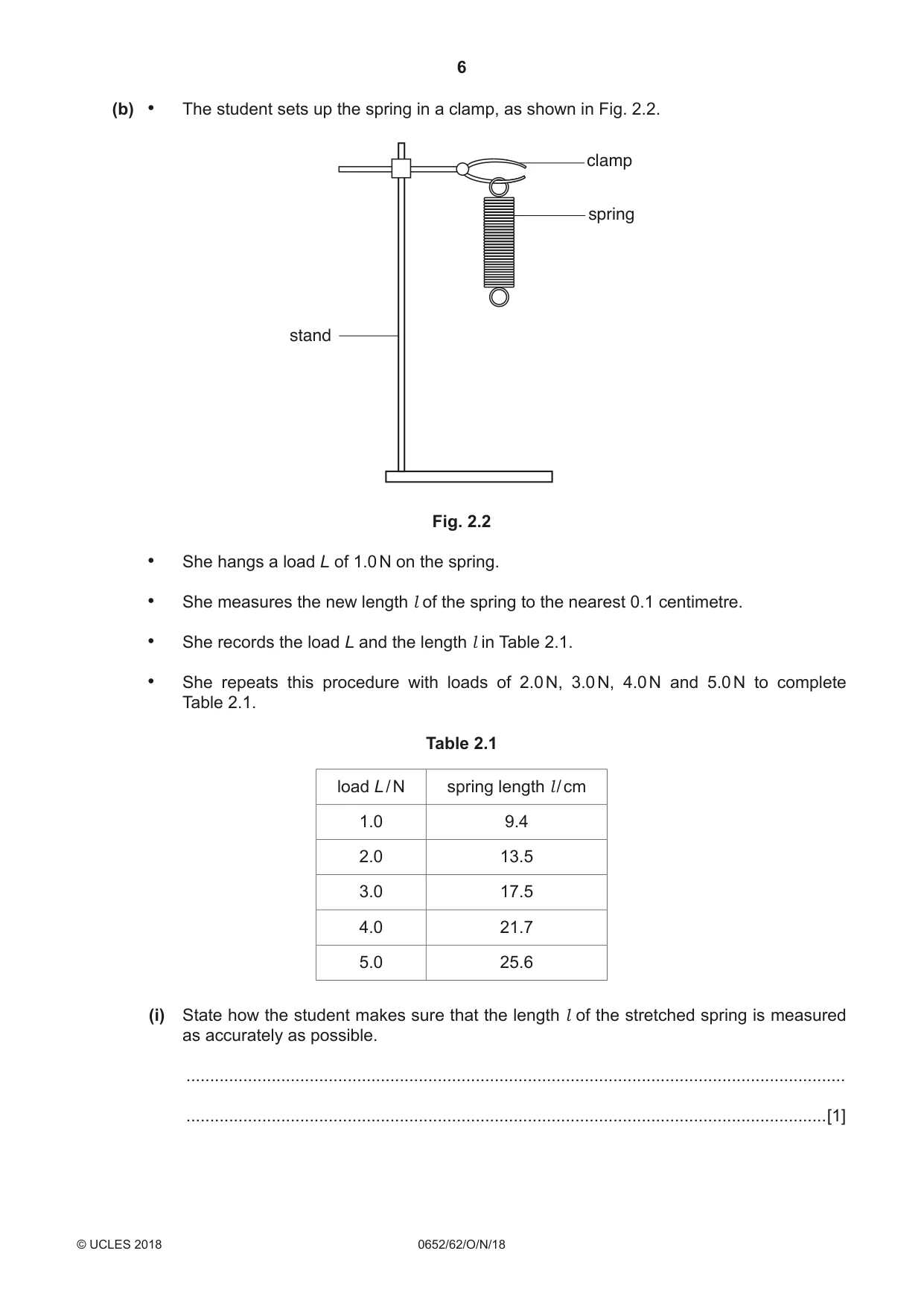
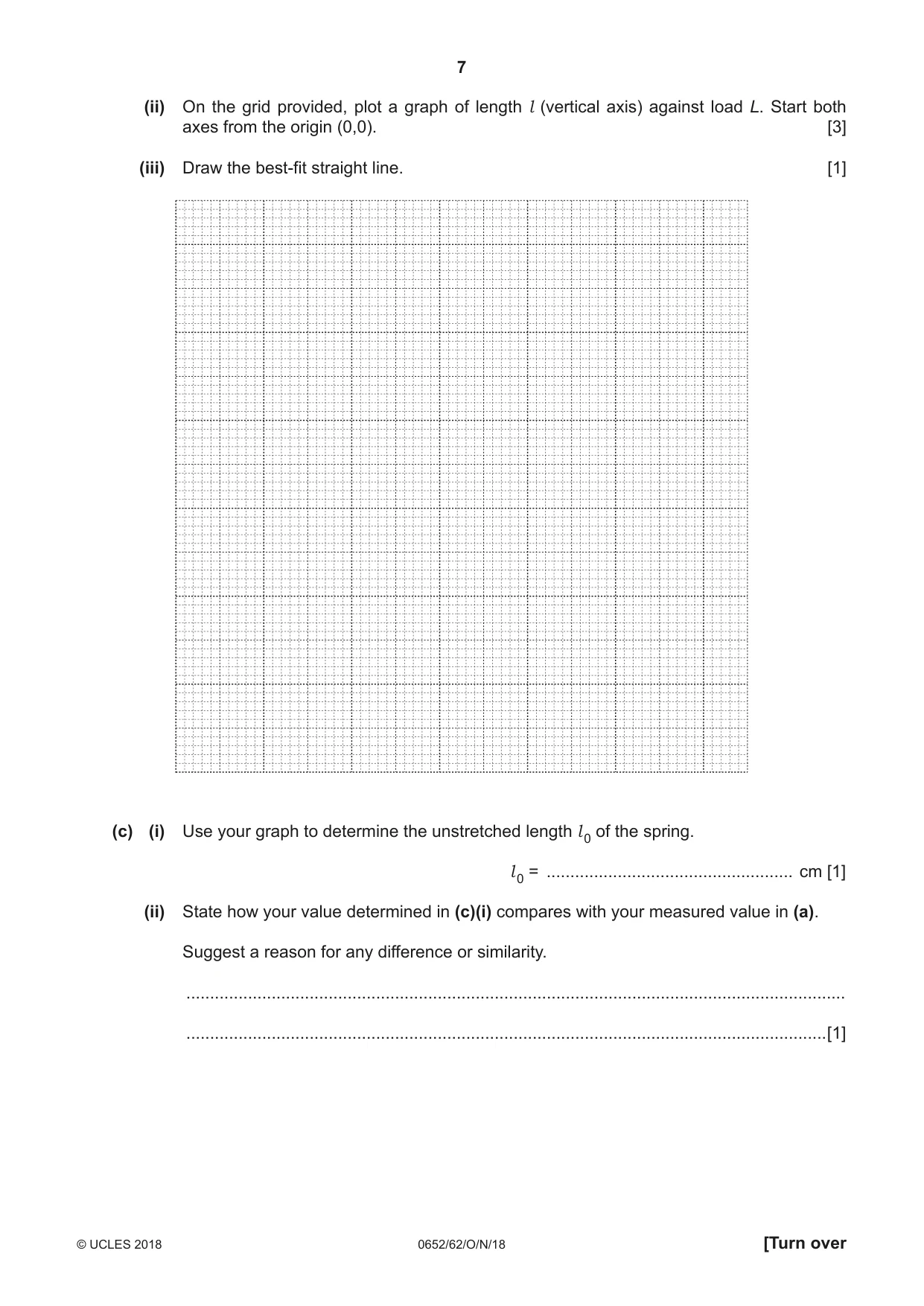
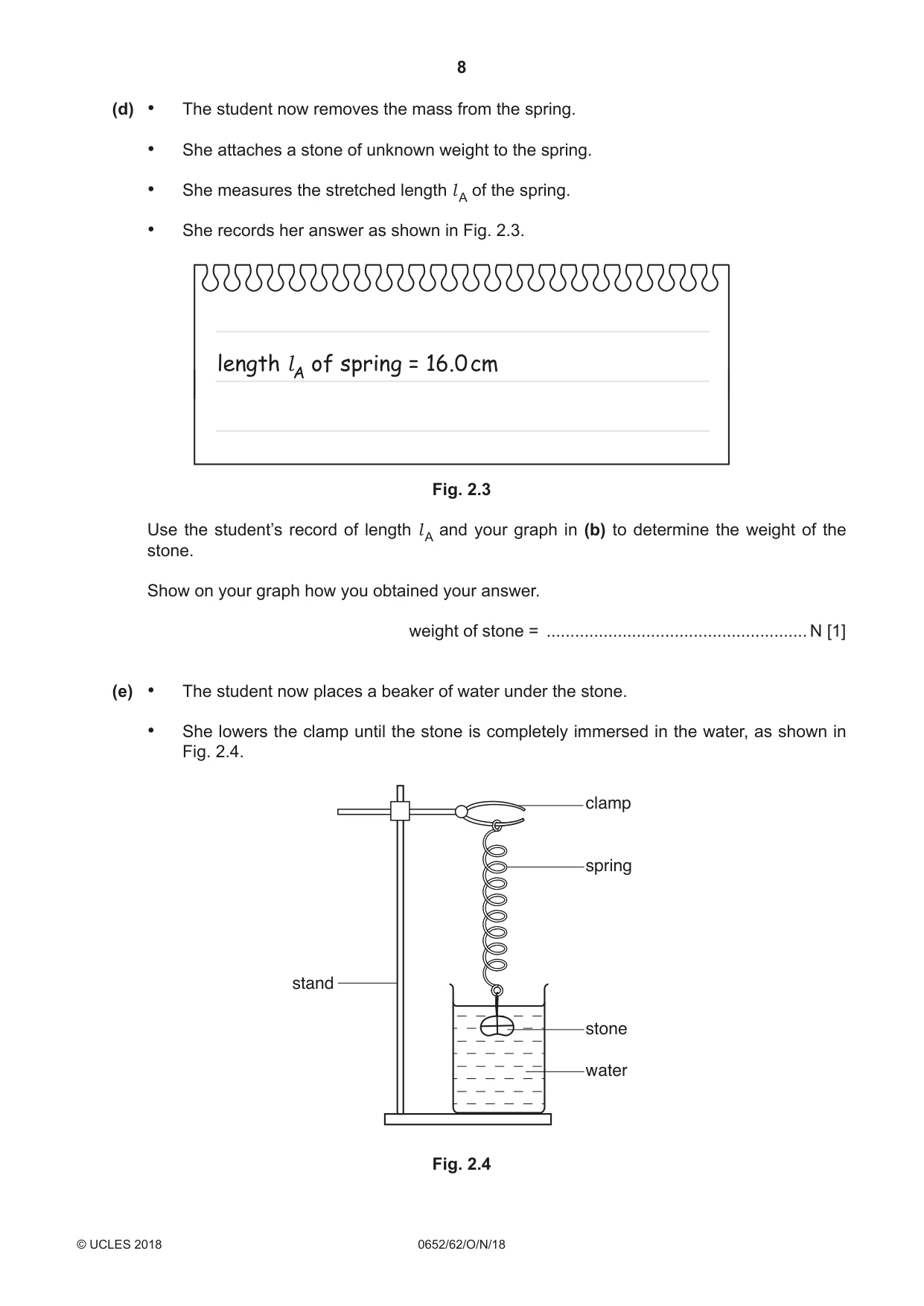
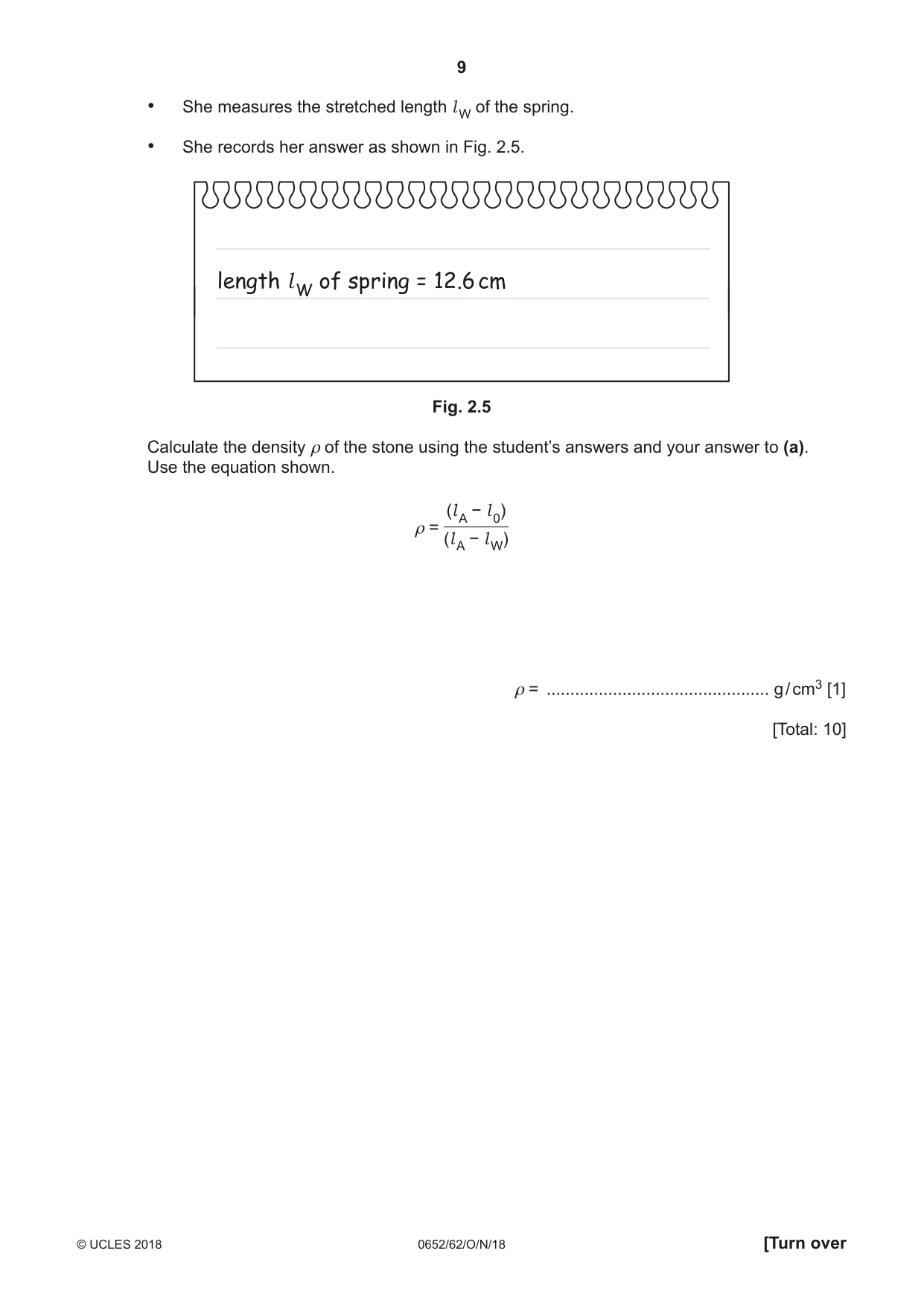
2 A student measures the length l of a spring when different loads L are added to it. She then uses the spring to find the density of a stone. (a) • She measures the length l 0 of the unstretched spring to the nearest 0.1 centimetre. Fig. 2.1 shows the unstretched spring. l 0 Fig. 2.1 Measure the length l 0 of the unstretched spring. l 0 = .................................................... cm [1] (b) • The student sets up the spring in a clamp, as shown in Fig. 2.2. clamp spring stand Fig. 2.2 • She hangs a load L of 1.0 N on the spring. • She measures the new length l of the spring to the nearest 0.1 centimetre. • She records the load L and the length l in Table 2.1. • She repeats this procedure with loads of 2.0 N, 3.0 N, 4.0 N and 5.0 N to complete Table 2.1. Table 2.1 load L / N spring length l / cm 1.0 9.4 2.0 13.5 3.0 17.5 4.0 21.7 5.0 25.6 (i) State how the student makes sure that the length l of the stretched spring is measured as accurately as possible. ........................................................................................................................................... .......................................................................................................................................[1] (ii) On the grid provided, plot a graph of length l (vertical axis) against load L. Start both axes from the origin (0,0). [3] (iii) Draw the best-fit straight line. [1] (c) (i) Use your graph to determine the unstretched length l 0 of the spring. l 0 = .................................................... cm [1] (ii) State how your value determined in (c)(i) compares with your measured value in (a). Suggest a reason for any difference or similarity. ........................................................................................................................................... .......................................................................................................................................[1] (d) • The student now removes the mass from the spring. • She attaches a stone of unknown weight to the spring. • She measures the stretched length l A of the spring. • She records her answer as shown in Fig. 2.3. length lA of spring = 16.0 cm Fig. 2.3 Use the student’s record of length l A and your graph in (b) to determine the weight of the stone. Show on your graph how you obtained your answer. weight of stone = ....................................................... N [1] (e) • The student now places a beaker of water under the stone. • She lowers the clamp until the stone is completely immersed in the water, as shown in Fig. 2.4. clamp spring stand stone water Fig. 2.4 • She measures the stretched length l W of the spring. • She records her answer as shown in Fig. 2.5. length l of spring = 12.6 cm W Fig. 2.5 Calculate the density ρ of the stone using the student’s answers and your answer to (a). Use the equation shown. (l A − l 0) ρ = (l A − l W) ρ = ............................................... g / cm3 [1] [Total: 10]
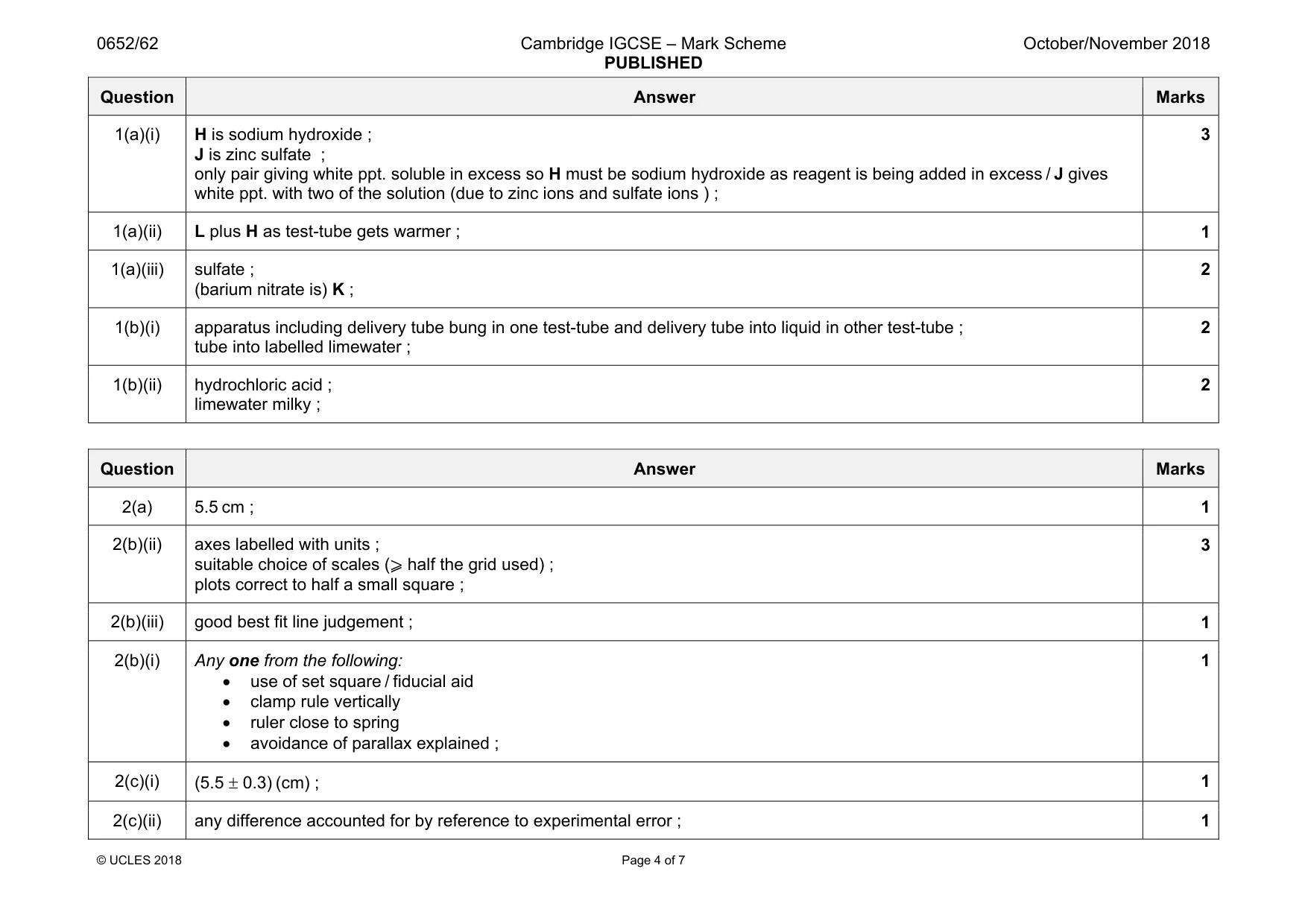
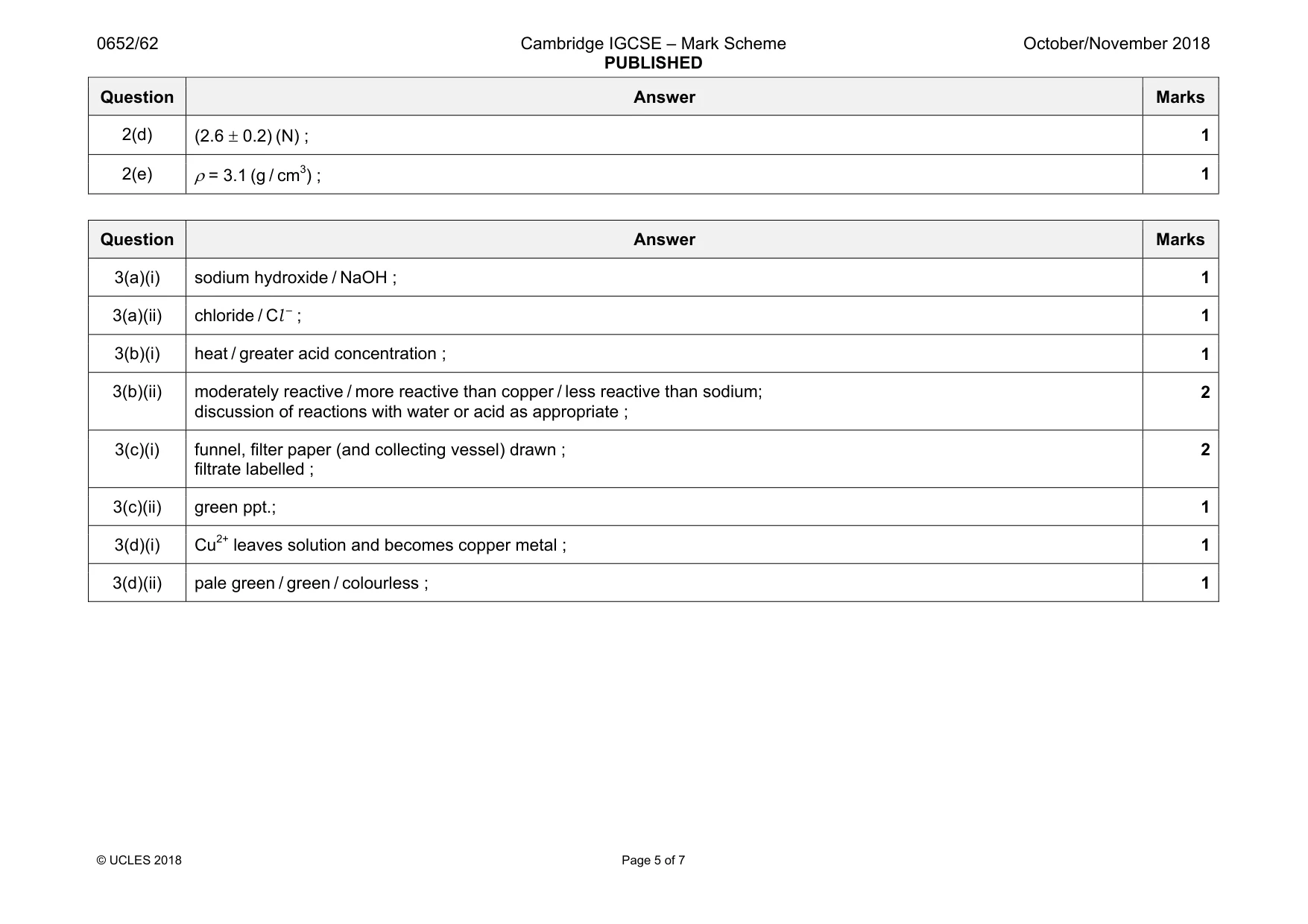
Mark scheme: 2(a) 5.5 cm ; 1 2(b)(ii) axes labelled with units ; suitable choice of scales (⩾ half the grid used) ; plots correct to half a small square ; 3 2(b)(iii) good best fit line judgement ; 1 2(b)(i) Any one from the following: • use of set square / fiducial aid • clamp rule vertically • ruler close to spring • avoidance of parallax explained ; 1 2(c)(i) (5.5 ± 0.3) (cm) ; 1 2(c)(ii) any difference accounted for by reference to experimental error ; 1 Question Answer Marks 2(d) (2.6 ± 0.2) (N) ; 1 2(e) ρ = 3.1 (g / cm3) ; 1
Q3 · A student investigates the reaction between solution M and solid N
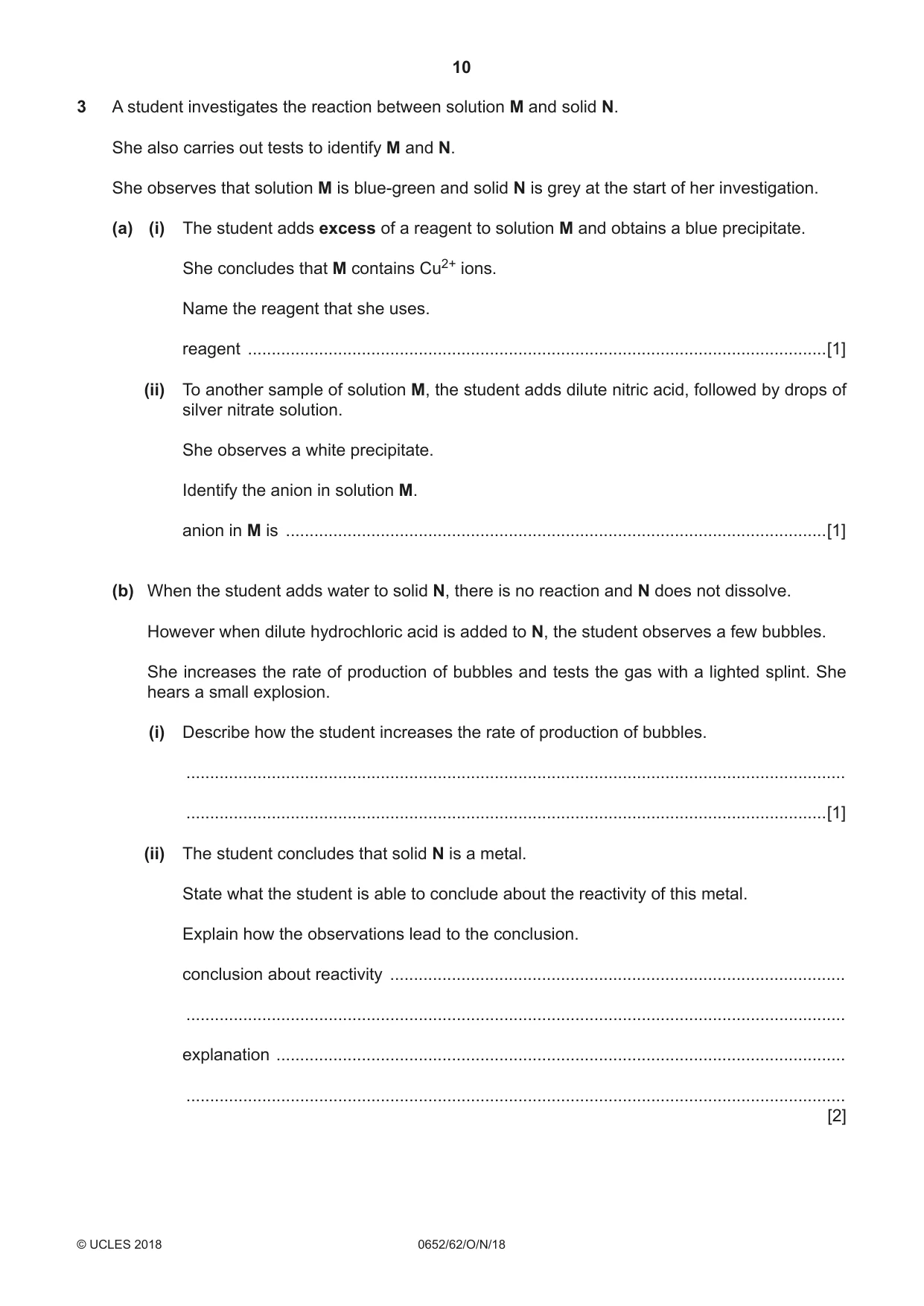
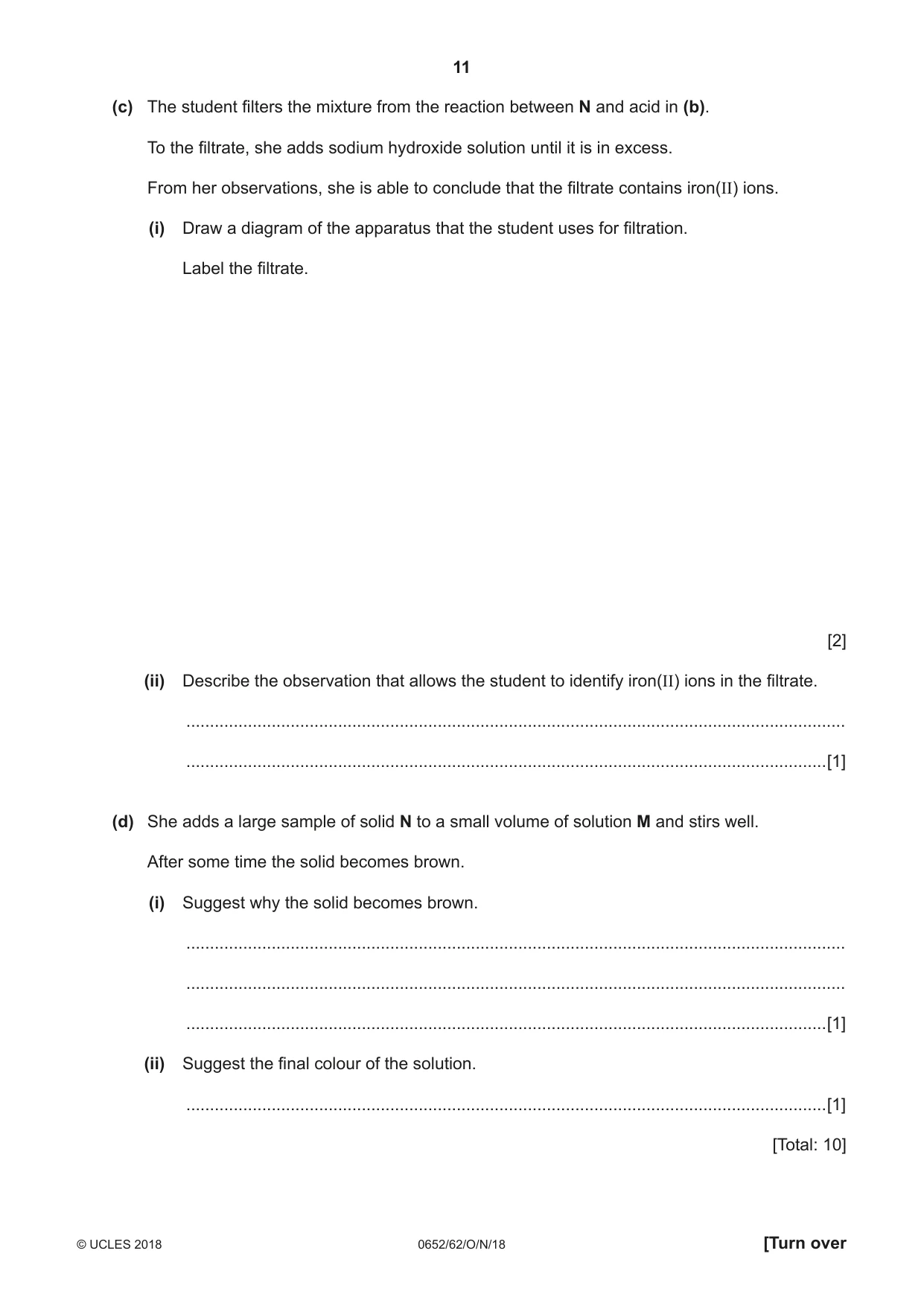
3 A student investigates the reaction between solution M and solid N. She also carries out tests to identify M and N. She observes that solution M is blue-green and solid N is grey at the start of her investigation. (a) (i) The student adds excess of a reagent to solution M and obtains a blue precipitate. She concludes that M contains Cu2+ ions. Name the reagent that she uses. reagent ..........................................................................................................................[1] (ii) To another sample of solution M, the student adds dilute nitric acid, followed by drops of silver nitrate solution. She observes a white precipitate. Identify the anion in solution M. anion in M is ..................................................................................................................[1] (b) When the student adds water to solid N, there is no reaction and N does not dissolve. However when dilute hydrochloric acid is added to N, the student observes a few bubbles. She increases the rate of production of bubbles and tests the gas with a lighted splint. She hears a small explosion. (i) Describe how the student increases the rate of production of bubbles. ........................................................................................................................................... .......................................................................................................................................[1] (ii) The student concludes that solid N is a metal. State what the student is able to conclude about the reactivity of this metal. Explain how the observations lead to the conclusion. conclusion about reactivity ................................................................................................ ........................................................................................................................................... explanation ........................................................................................................................ ........................................................................................................................................... [2] (c) The student filters the mixture from the reaction between N and acid in (b). To the filtrate, she adds sodium hydroxide solution until it is in excess. From her observations, she is able to conclude that the filtrate contains iron(II) ions. (i) Draw a diagram of the apparatus that the student uses for filtration. Label the filtrate. [2] (ii) Describe the observation that allows the student to identify iron(II) ions in the filtrate. ........................................................................................................................................... .......................................................................................................................................[1] (d) She adds a large sample of solid N to a small volume of solution M and stirs well. After some time the solid becomes brown. (i) Suggest why the solid becomes brown. ........................................................................................................................................... ........................................................................................................................................... .......................................................................................................................................[1] (ii) Suggest the final colour of the solution. .......................................................................................................................................[1] [Total: 10]
Mark scheme: 3(a)(i) sodium hydroxide / NaOH ; 1 3(a)(ii) chloride / Cl – ; 1 3(b)(i) heat / greater acid concentration ; 1 3(b)(ii) moderately reactive / more reactive than copper / less reactive than sodium; discussion of reactions with water or acid as appropriate ; 2 3(c)(i) funnel, filter paper (and collecting vessel) drawn ; filtrate labelled ; 2 3(c)(ii) green ppt.; 1 3(d)(i) Cu2+ leaves solution and becomes copper metal ; 1 3(d)(ii) pale green / green / colourless ; 1
Q4 · A student investigates how the power P produced by a lamp is related to the length l of…
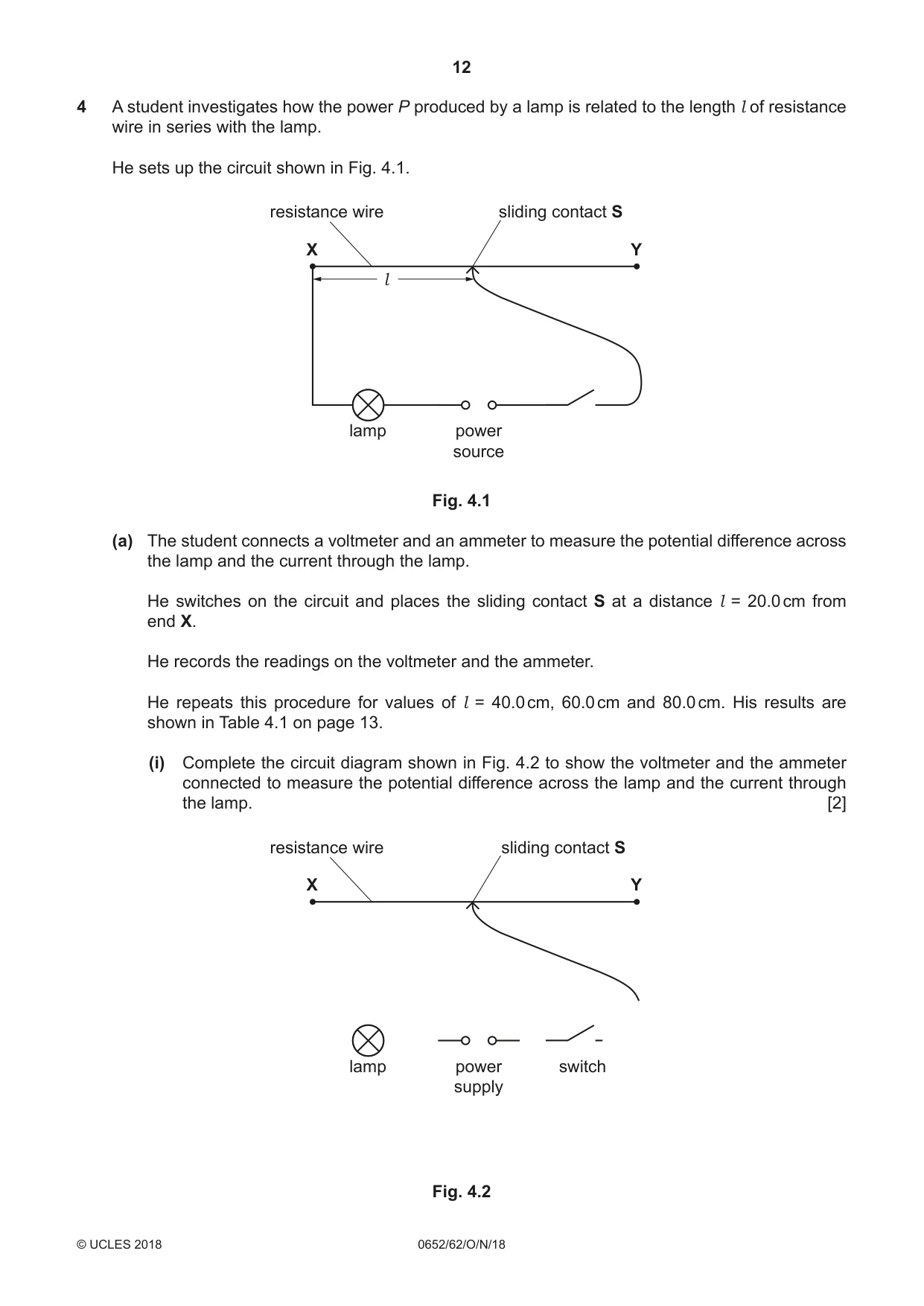
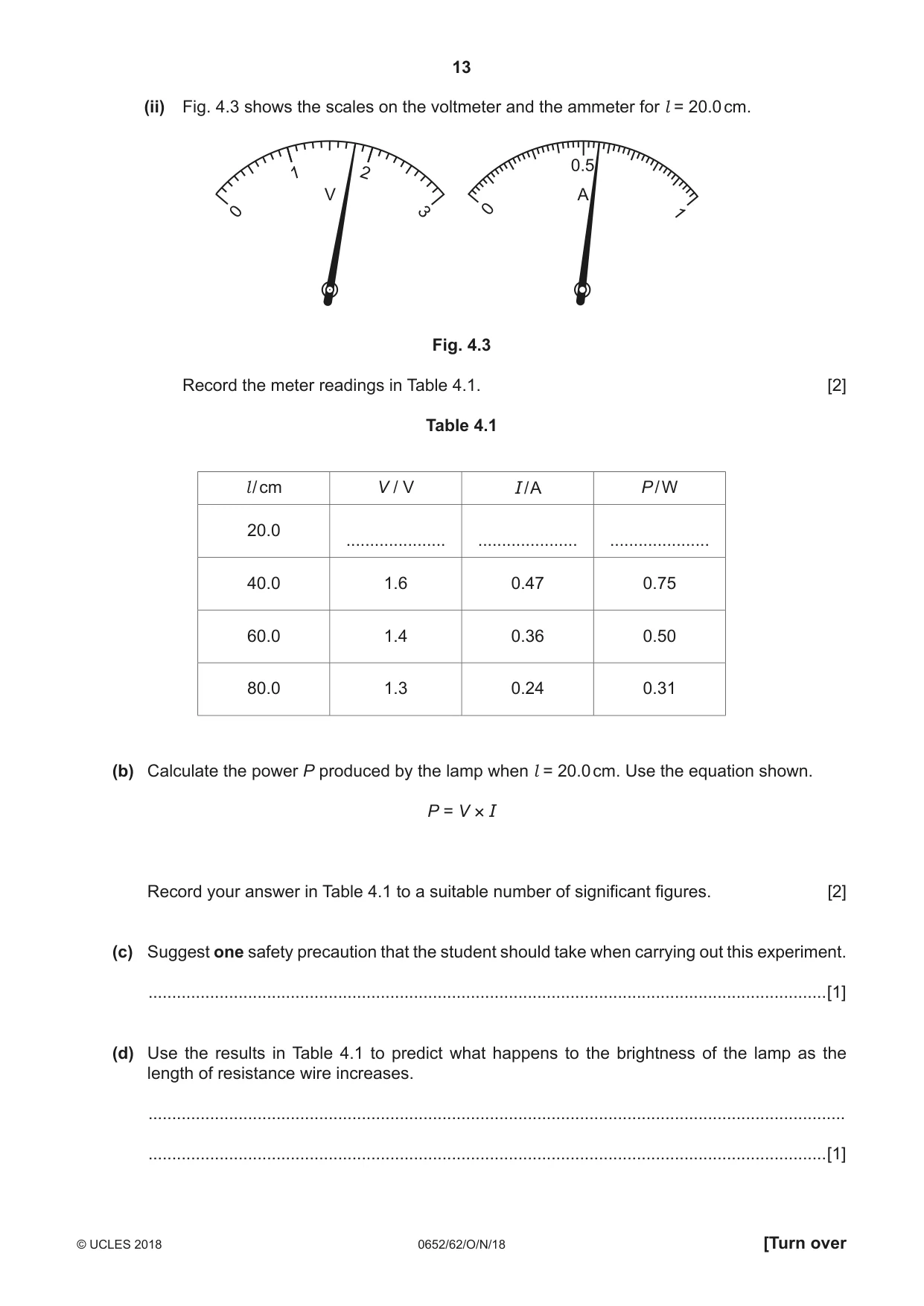
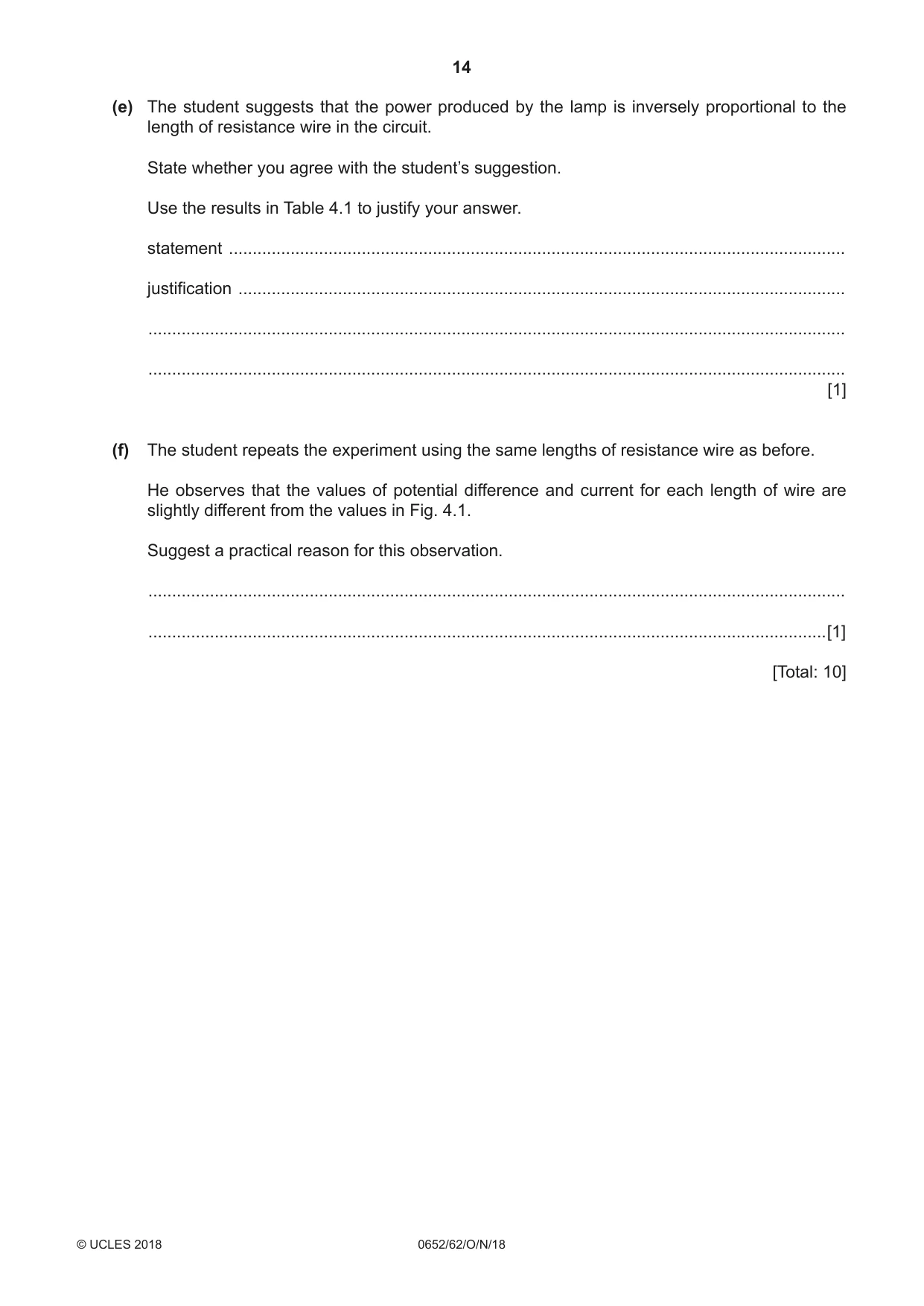
4 A student investigates how the power P produced by a lamp is related to the length l of resistance wire in series with the lamp. He sets up the circuit shown in Fig. 4.1. resistance wire sliding contact S X Y l lamp power source Fig. 4.1 (a) The student connects a voltmeter and an ammeter to measure the potential difference across the lamp and the current through the lamp. He switches on the circuit and places the sliding contact S at a distance l = 20.0 cm from end X. He records the readings on the voltmeter and the ammeter. He repeats this procedure for values of l = 40.0 cm, 60.0 cm and 80.0 cm. His results are shown in Table 4.1 on page 13. (i) Complete the circuit diagram shown in Fig. 4.2 to show the voltmeter and the ammeter connected to measure the potential difference across the lamp and the current through the lamp. [2] resistance wire sliding contact S X Y lamp power switch supply Fig. 4.2 (ii) Fig. 4.3 shows the scales on the voltmeter and the ammeter for l = 20.0 cm. 0.5 1 2 V A 0 3 0 1 Fig. 4.3 Record the meter readings in Table 4.1. [2] Table 4.1 l / cm V / V I / A P / W 20.0 ..................... ..................... ..................... 40.0 1.6 0.47 0.75 60.0 1.4 0.36 0.50 80.0 1.3 0.24 0.31 (b) Calculate the power P produced by the lamp when l = 20.0 cm. Use the equation shown. P = V × I Record your answer in Table 4.1 to a suitable number of significant figures. [2] (c) Suggest one safety precaution that the student should take when carrying out this experiment. ...............................................................................................................................................[1] (d) Use the results in Table 4.1 to predict what happens to the brightness of the lamp as the length of resistance wire increases. ................................................................................................................................................... ...............................................................................................................................................[1] (e) The student suggests that the power produced by the lamp is inversely proportional to the length of resistance wire in the circuit. State whether you agree with the student’s suggestion. Use the results in Table 4.1 to justify your answer. statement .................................................................................................................................. justification ................................................................................................................................ ................................................................................................................................................... ................................................................................................................................................... [1] (f) The student repeats the experiment using the same lengths of resistance wire as before. He observes that the values of potential difference and current for each length of wire are slightly different from the values in Fig. 4.1. Suggest a practical reason for this observation. ................................................................................................................................................... ...............................................................................................................................................[1] [Total: 10] Please turn over for Question 5.
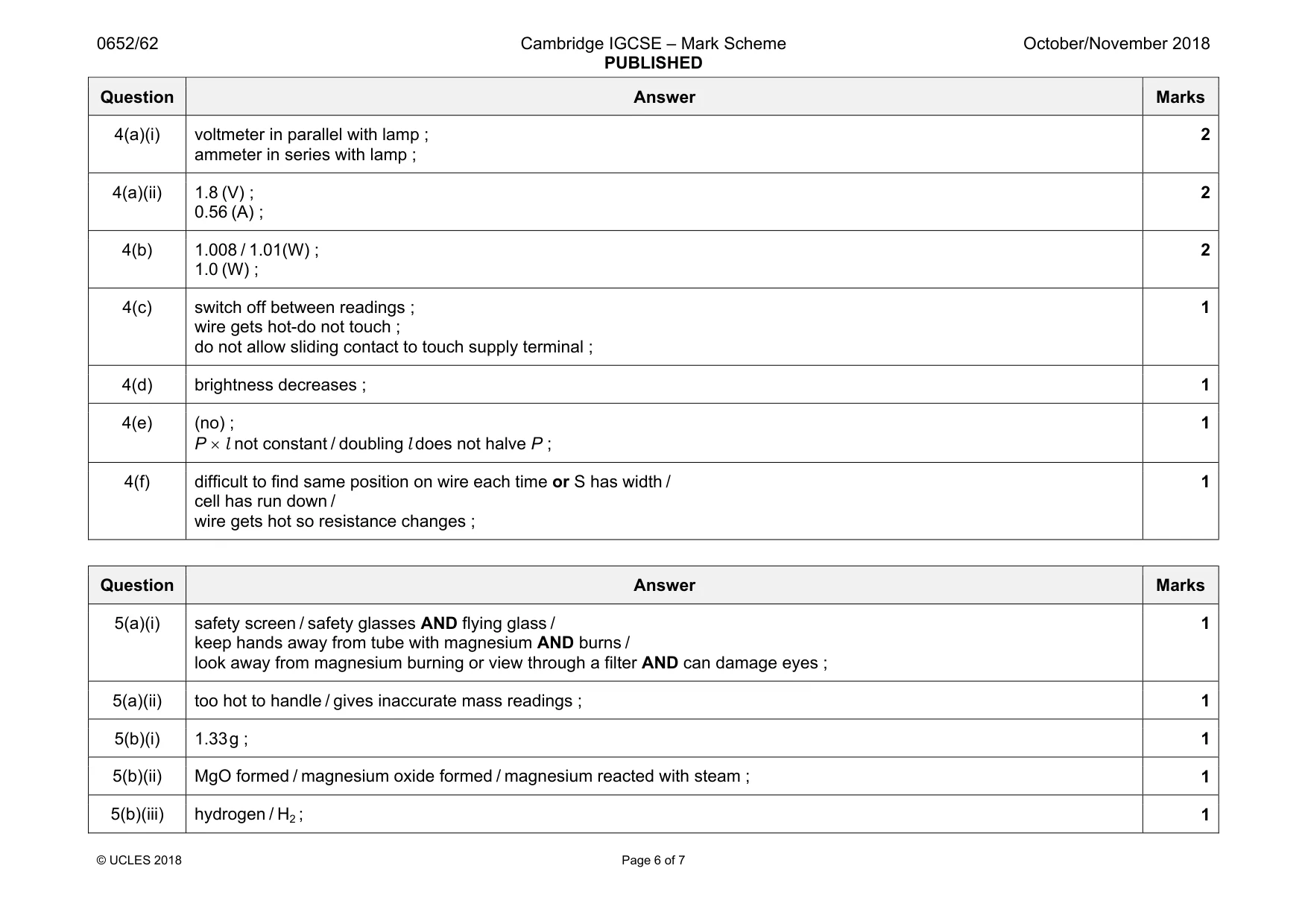
Mark scheme: 4(a)(i) voltmeter in parallel with lamp ; ammeter in series with lamp ; 2 4(a)(ii) 1.8 (V) ; 0.56 (A) ; 2 4(b) 1.008 / 1.01(W) ; 1.0 (W) ; 2 4(c) switch off between readings ; wire gets hot-do not touch ; do not allow sliding contact to touch supply terminal ; 1 4(d) brightness decreases ; 1 4(e) (no) ; P × l not constant / doubling l does not halve P ; 1 4(f) difficult to find same position on wire each time or S has width / cell has run down / wire gets hot so resistance changes ; 1
Q5 · A student investigates the reaction between magnesium and steam, H2O
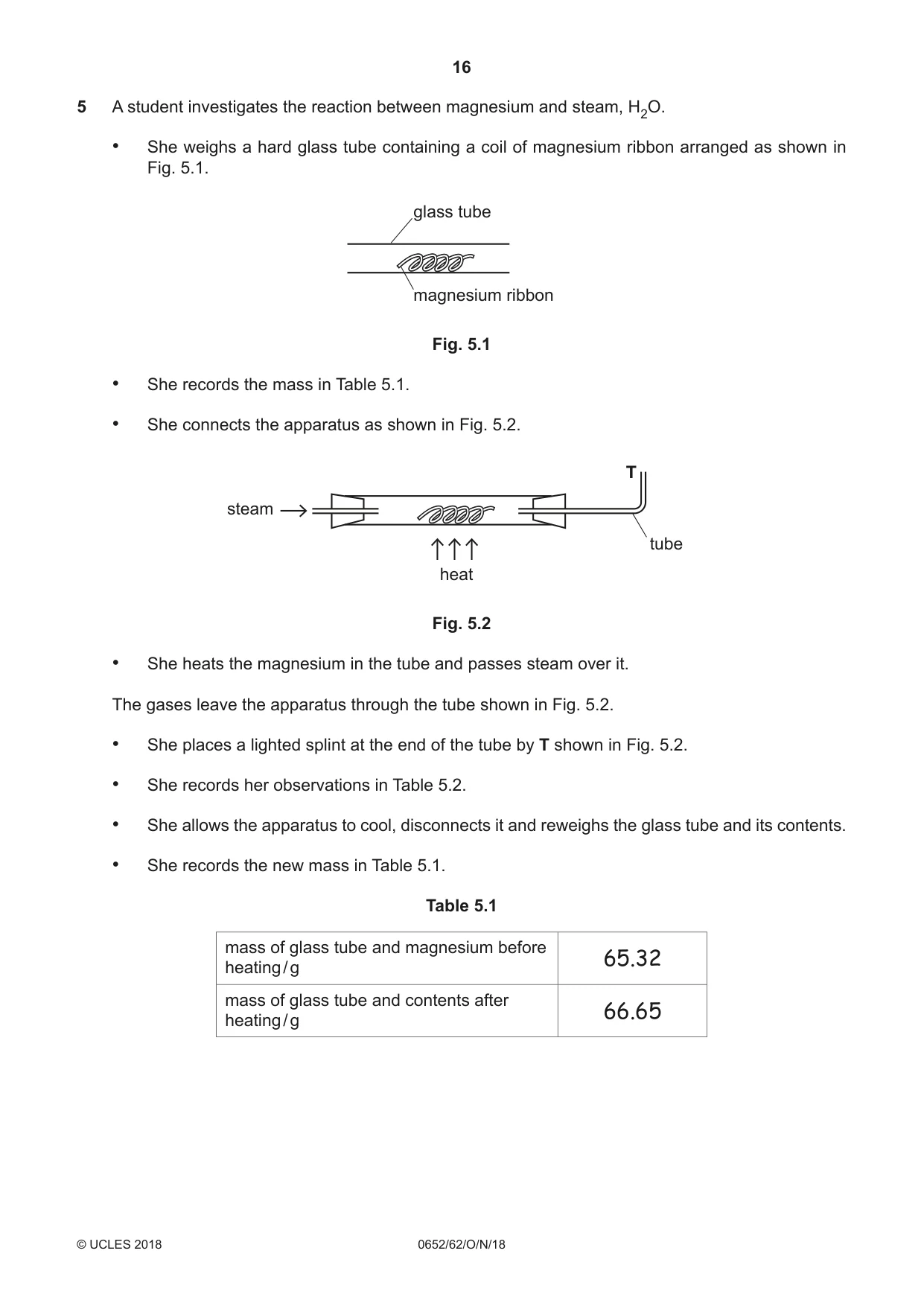
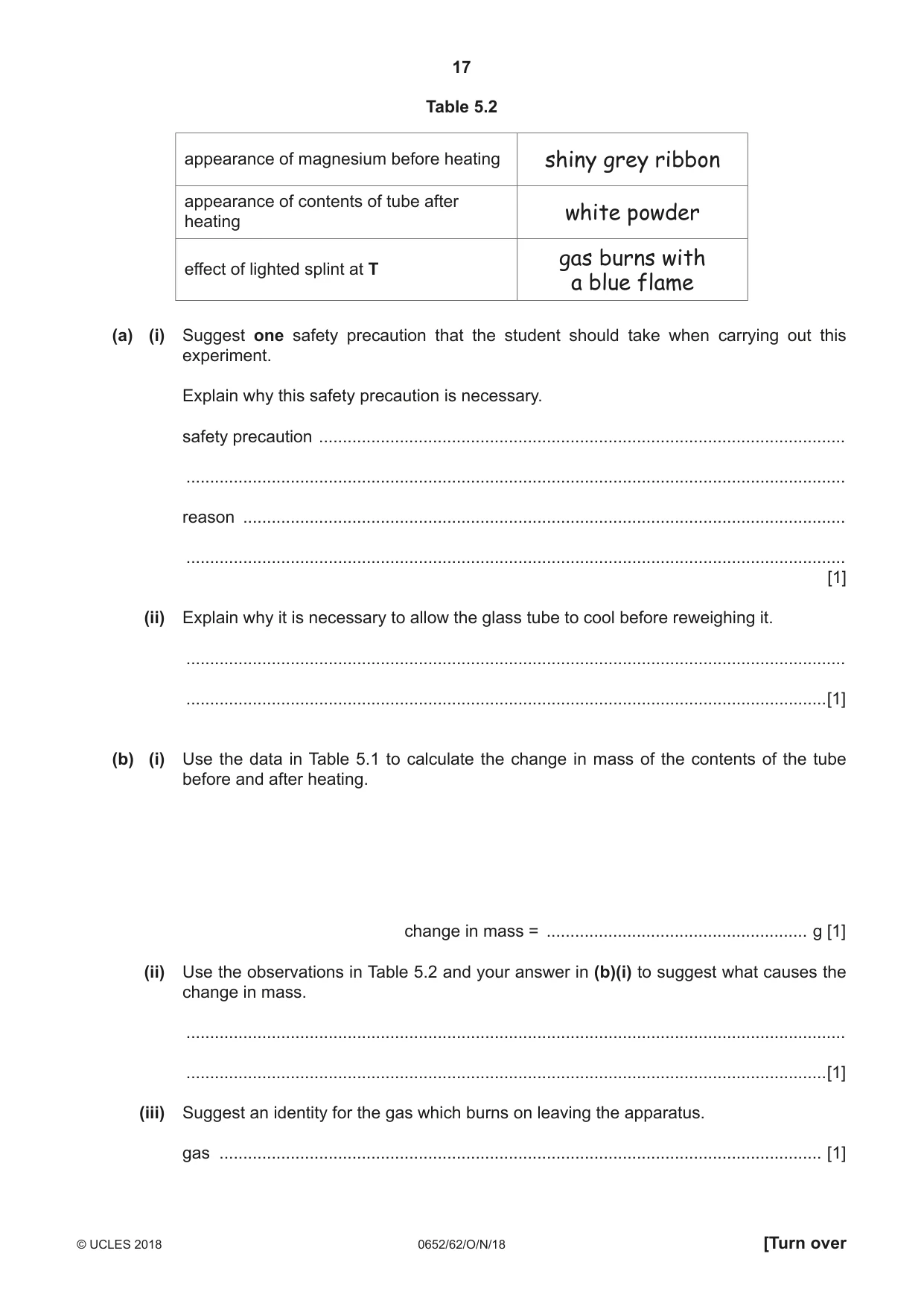
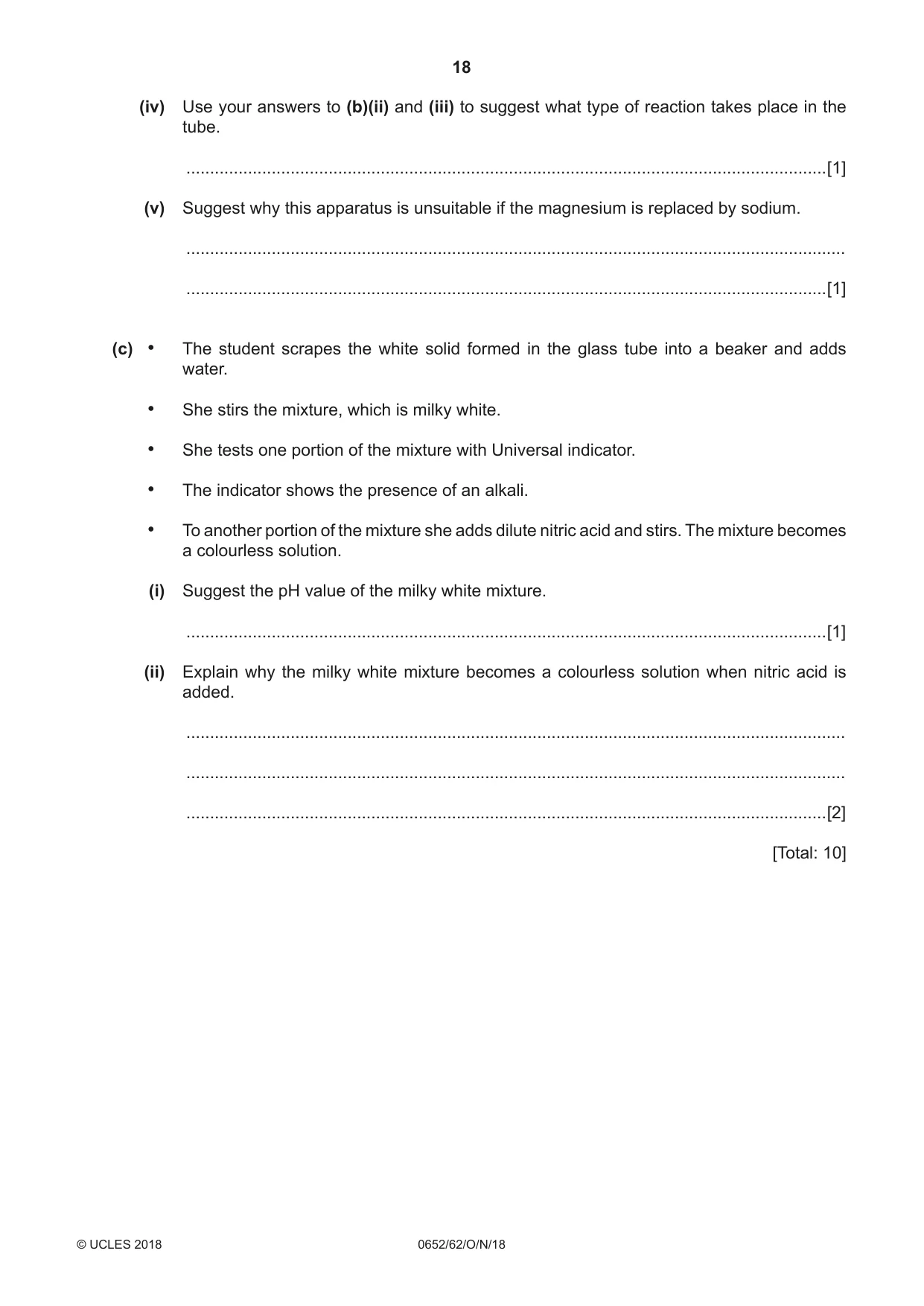
5 A student investigates the reaction between magnesium and steam, H2O. • She weighs a hard glass tube containing a coil of magnesium ribbon arranged as shown in Fig. 5.1. glass tube magnesium ribbon Fig. 5.1 • She records the mass in Table 5.1. • She connects the apparatus as shown in Fig. 5.2. T steam tube heat Fig. 5.2 • She heats the magnesium in the tube and passes steam over it. The gases leave the apparatus through the tube shown in Fig. 5.2. • She places a lighted splint at the end of the tube by T shown in Fig. 5.2. • She records her observations in Table 5.2. • She allows the apparatus to cool, disconnects it and reweighs the glass tube and its contents. • She records the new mass in Table 5.1. Table 5.1 mass of glass tube and magnesium before 65.32 heating / g mass of glass tube and contents after 66.65 heating / g Table 5.2 appearance of magnesium before heating shiny grey ribbon appearance of contents of tube after white powder heating gas burns with effect of lighted splint at T a blue flame (a) (i) Suggest one safety precaution that the student should take when carrying out this experiment. Explain why this safety precaution is necessary. safety precaution ............................................................................................................... ........................................................................................................................................... reason ............................................................................................................................... ........................................................................................................................................... [1] (ii) Explain why it is necessary to allow the glass tube to cool before reweighing it. ........................................................................................................................................... .......................................................................................................................................[1] (b) (i) Use the data in Table 5.1 to calculate the change in mass of the contents of the tube before and after heating. change in mass = ....................................................... g [1] (ii) Use the observations in Table 5.2 and your answer in (b)(i) to suggest what causes the change in mass. ........................................................................................................................................... .......................................................................................................................................[1] (iii) Suggest an identity for the gas which burns on leaving the apparatus. gas ............................................................................................................................... [1] (iv) Use your answers to (b)(ii) and (iii) to suggest what type of reaction takes place in the tube. .......................................................................................................................................[1] (v) Suggest why this apparatus is unsuitable if the magnesium is replaced by sodium. ........................................................................................................................................... .......................................................................................................................................[1] (c) • The student scrapes the white solid formed in the glass tube into a beaker and adds water. • She stirs the mixture, which is milky white. • She tests one portion of the mixture with Universal indicator. • The indicator shows the presence of an alkali. • To another portion of the mixture she adds dilute nitric acid and stirs. The mixture becomes a colourless solution. (i) Suggest the pH value of the milky white mixture. .......................................................................................................................................[1] (ii) Explain why the milky white mixture becomes a colourless solution when nitric acid is added. ........................................................................................................................................... ........................................................................................................................................... .......................................................................................................................................[2] [Total: 10]
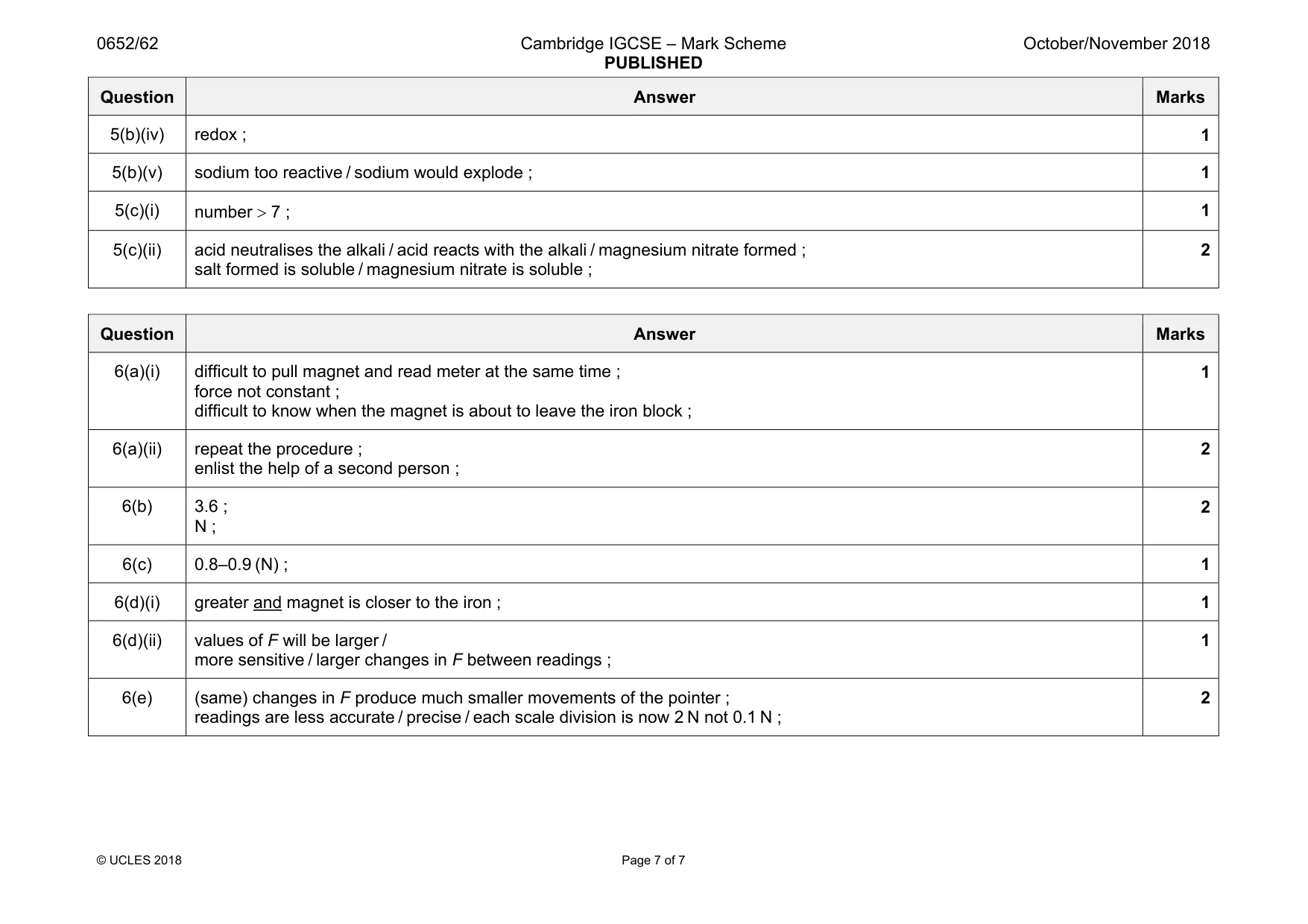
Mark scheme: 5(a)(i) safety screen / safety glasses AND flying glass / keep hands away from tube with magnesium AND burns / look away from magnesium burning or view through a filter AND can damage eyes ; 1 5(a)(ii) too hot to handle / gives inaccurate mass readings ; 1 5(b)(i) 1.33 g ; 1 5(b)(ii) MgO formed / magnesium oxide formed / magnesium reacted with steam ; 1 5(b)(iii) hydrogen / H2 ; 1 Question Answer Marks 5(b)(iv) redox ; 1 5(b)(v) sodium too reactive / sodium would explode ; 1 5(c)(i) number > 7 ; 1 5(c)(ii) acid neutralises the alkali / acid reacts with the alkali / magnesium nitrate formed ; salt formed is soluble / magnesium nitrate is soluble ; 2
Q6 · A student investigates how the size of the force needed to lift a bar magnet from an iron…
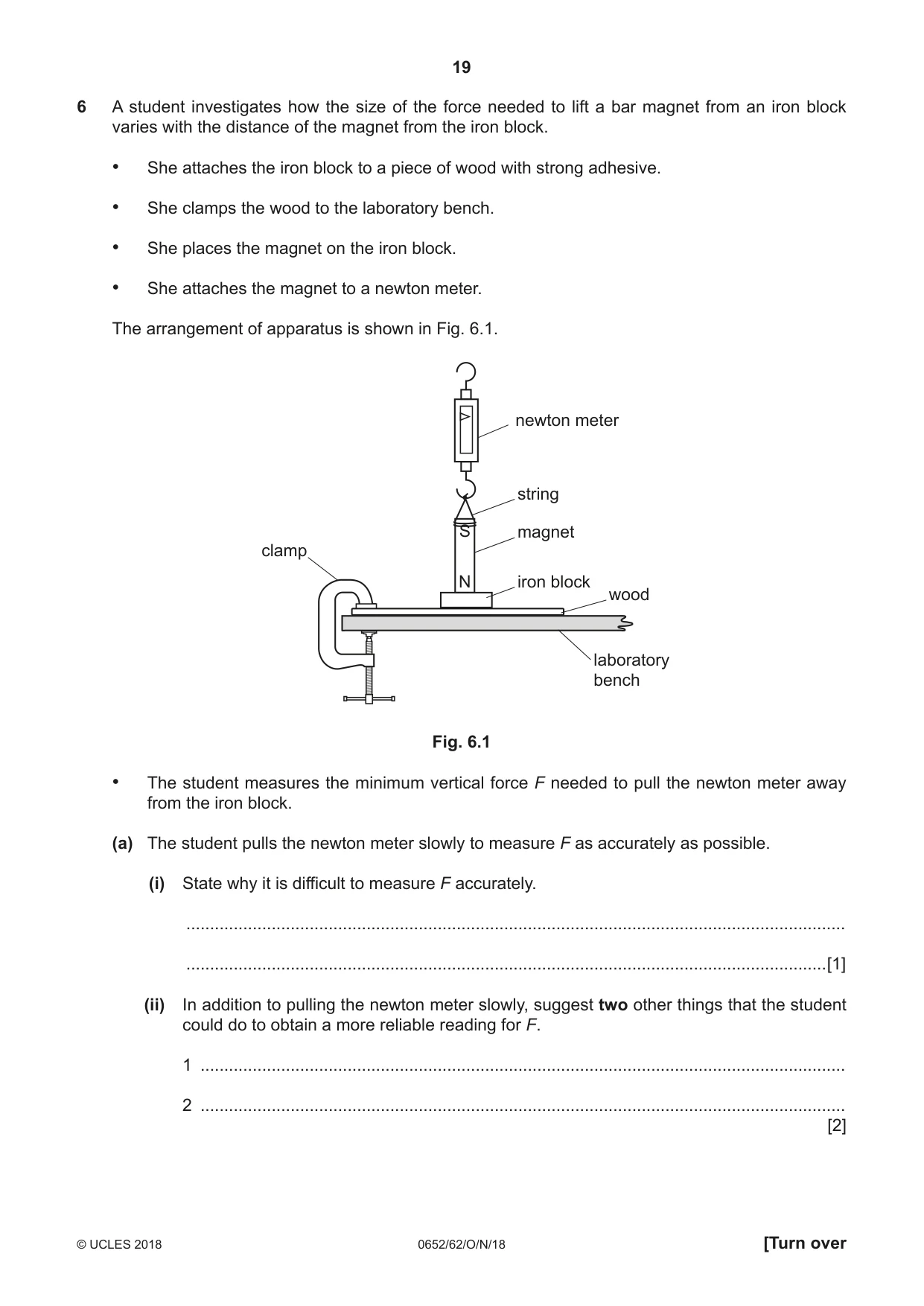
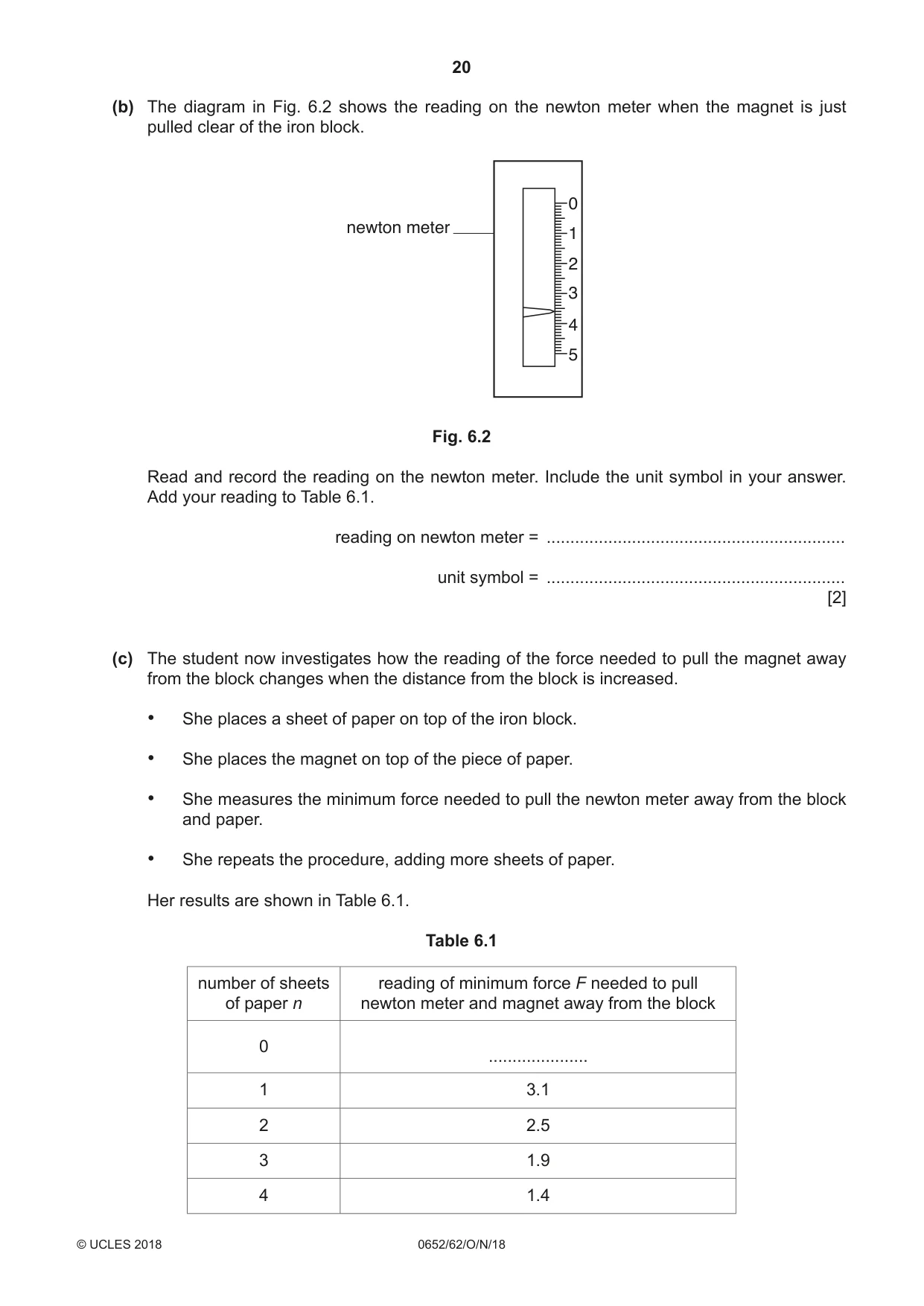
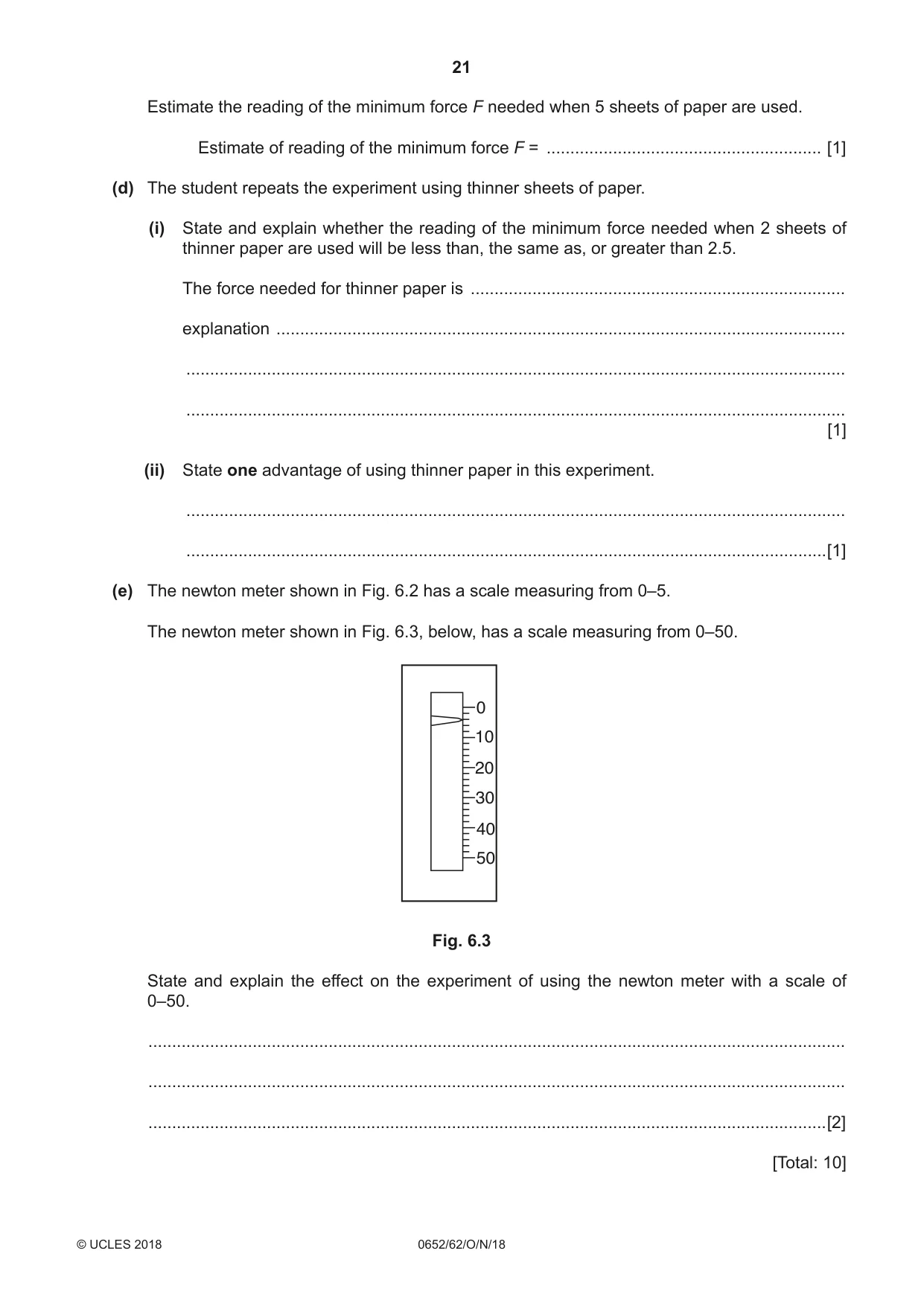
6 A student investigates how the size of the force needed to lift a bar magnet from an iron block varies with the distance of the magnet from the iron block. • She attaches the iron block to a piece of wood with strong adhesive. • She clamps the wood to the laboratory bench. • She places the magnet on the iron block. • She attaches the magnet to a newton meter. The arrangement of apparatus is shown in Fig. 6.1. newton meter string S magnet clamp N iron block wood laboratory bench Fig. 6.1 • The student measures the minimum vertical force F needed to pull the newton meter away from the iron block. (a) The student pulls the newton meter slowly to measure F as accurately as possible. (i) State why it is difficult to measure F accurately. ........................................................................................................................................... .......................................................................................................................................[1] (ii) In addition to pulling the newton meter slowly, suggest two other things that the student could do to obtain a more reliable reading for F. 1 ........................................................................................................................................ 2 ........................................................................................................................................ [2] (b) The diagram in Fig. 6.2 shows the reading on the newton meter when the magnet is just pulled clear of the iron block. 0 newton meter 1 2 3 4 5 Fig. 6.2 Read and record the reading on the newton meter. Include the unit symbol in your answer. Add your reading to Table 6.1. reading on newton meter = ............................................................... unit symbol = ............................................................... [2] (c) The student now investigates how the reading of the force needed to pull the magnet away from the block changes when the distance from the block is increased. • She places a sheet of paper on top of the iron block. • She places the magnet on top of the piece of paper. • She measures the minimum force needed to pull the newton meter away from the block and paper. • She repeats the procedure, adding more sheets of paper. Her results are shown in Table 6.1. Table 6.1 number of sheets reading of minimum force F needed to pull of paper n newton meter and magnet away from the block 0 ..................... 1 3.1 2 2.5 3 1.9 4 1.4 Estimate the reading of the minimum force F needed when 5 sheets of paper are used. Estimate of reading of the minimum force F = .......................................................... [1] (d) The student repeats the experiment using thinner sheets of paper. (i) State and explain whether the reading of the minimum force needed when 2 sheets of thinner paper are used will be less than, the same as, or greater than 2.5. The force needed for thinner paper is ............................................................................... explanation ........................................................................................................................ ........................................................................................................................................... ........................................................................................................................................... [1] (ii) State one advantage of using thinner paper in this experiment. ........................................................................................................................................... .......................................................................................................................................[1] (e) The newton meter shown in Fig. 6.2 has a scale measuring from 0‒5. The newton meter shown in Fig. 6.3, below, has a scale measuring from 0‒50. 0 10 20 30 40 50 Fig. 6.3 State and explain the effect on the experiment of using the newton meter with a scale of 0‒50. ................................................................................................................................................... ................................................................................................................................................... ...............................................................................................................................................[2] [Total: 10]
Mark scheme: 6(a)(i) difficult to pull magnet and read meter at the same time ; force not constant ; difficult to know when the magnet is about to leave the iron block ; 1 6(a)(ii) repeat the procedure ; enlist the help of a second person ; 2 6(b) 3.6 ; N ; 2 6(c) 0.8–0.9 (N) ; 1 6(d)(i) greater and magnet is closer to the iron ; 1 6(d)(ii) values of F will be larger / more sensitive / larger changes in F between readings ; 1 6(e) (same) changes in F produce much smaller movements of the pointer ; readings are less accurate / precise / each scale division is now 2 N not 0.1 N ; 2
What was in this paper
The subtopics covered by these 6 questions, and how many questions each got. Open one in a new tab to see every Cambridge question on it.
What you needed in this session
Cambridge’s own grade thresholds for 2018 Oct/Nov, Paper 6 · Variant 2. A higher threshold means an easier paper — the bar moves with how the cohort did.