Cambridge IGCSE Physical Science 0652 — 2020 Oct/Nov Paper 6 · Variant 2
0652/62/O/N/20 · 4 questions · 40 marks · ≈45 min
The question paper and its mark scheme, free to read here and free to download. This is Cambridge’s own paper, exactly as it was sat.
Question paper16 pages



Mark scheme7 pages
Answers below. Sit the paper first if you are practising.
Questions as text
Q1 · A student investigates the rate of reaction of magnesium with sulfuric acid
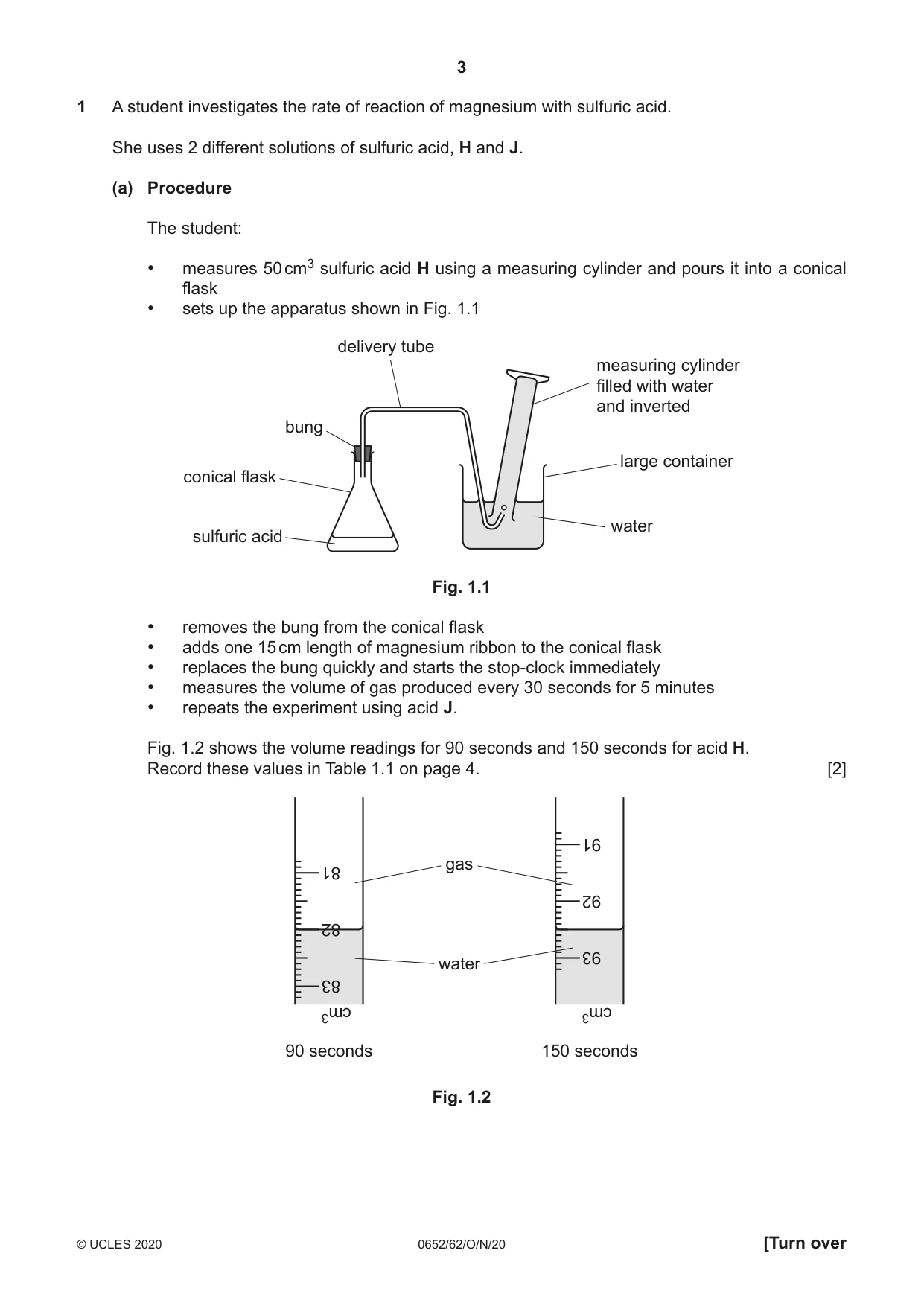
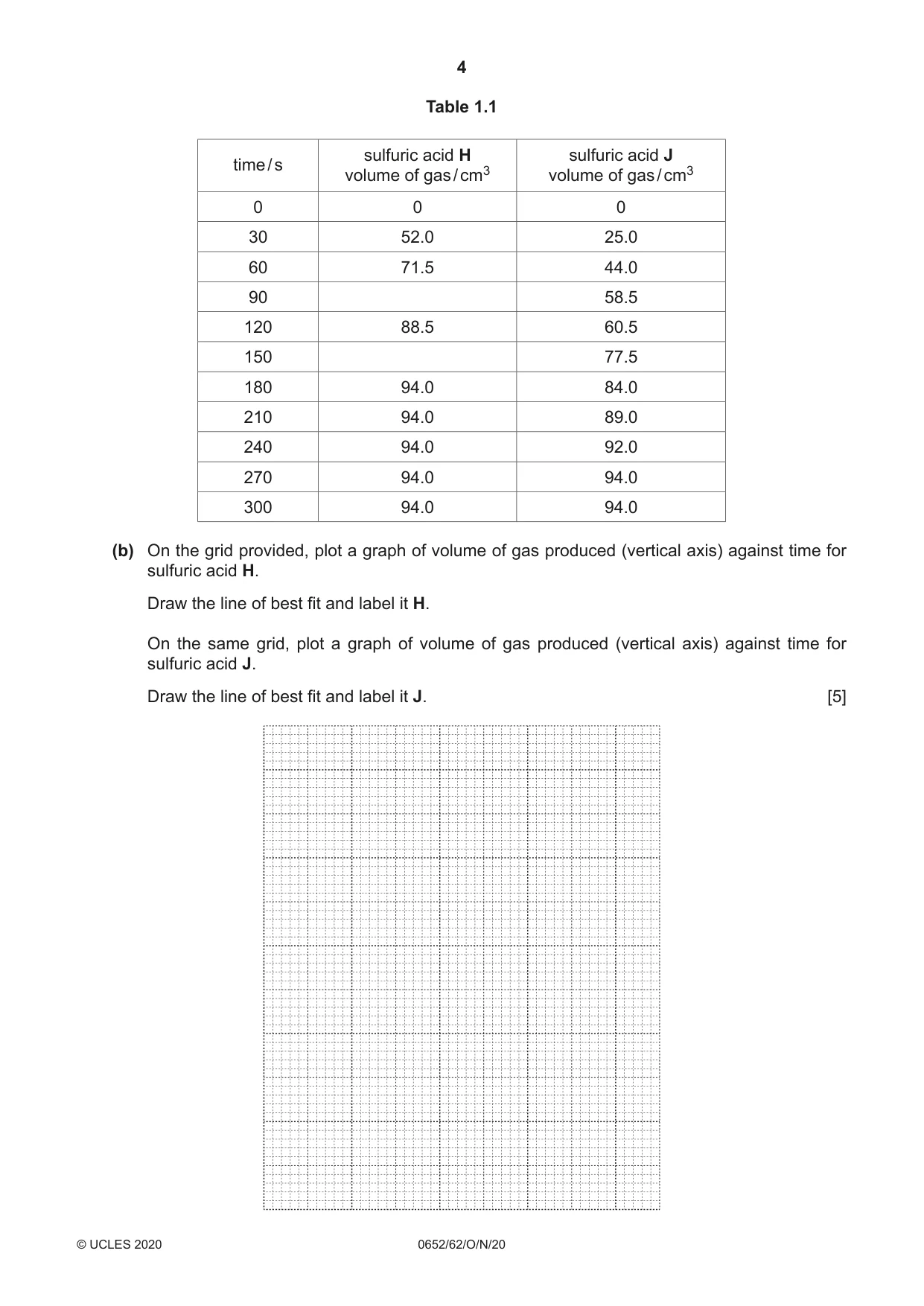
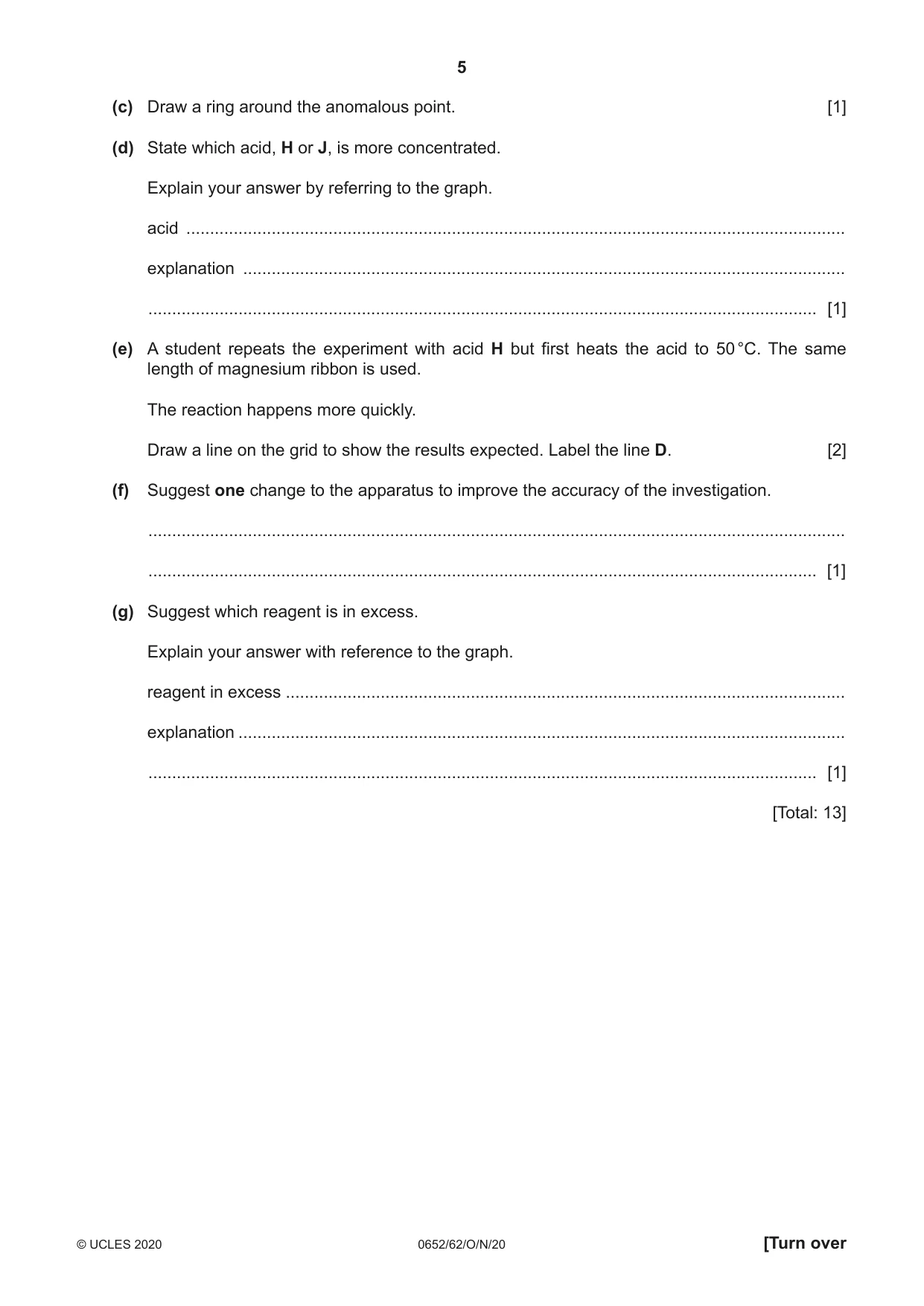
1 A student investigates the rate of reaction of magnesium with sulfuric acid. She uses 2 different solutions of sulfuric acid, H and J. (a) Procedure The student: • measures 50 cm3 sulfuric acid H using a measuring cylinder and pours it into a conical flask • sets up the apparatus shown in Fig. 1.1 delivery tube measuring cylinder filled with water and inverted bung large container conical flask water sulfuric acid Fig. 1.1 • removes the bung from the conical flask • adds one 15 cm length of magnesium ribbon to the conical flask • replaces the bung quickly and starts the stop-clock immediately • measures the volume of gas produced every 30 seconds for 5 minutes • repeats the experiment using acid J. Fig. 1.2 shows the volume readings for 90 seconds and 150 seconds for acid H. Record these values in Table 1.1 on page 4. [2] 91 gas 81 92 82 93 water 83 cm3 cm3 90 seconds 150 seconds Fig. 1.2 Table 1.1 sulfuric acid H sulfuric acid J time / s volume of gas / cm3 volume of gas / cm3 0 0 0 30 52.0 25.0 60 71.5 44.0 90 58.5 120 88.5 60.5 150 77.5 180 94.0 84.0 210 94.0 89.0 240 94.0 92.0 270 94.0 94.0 300 94.0 94.0 (b) On the grid provided, plot a graph of volume of gas produced (vertical axis) against time for sulfuric acid H. Draw the line of best fit and label it H. On the same grid, plot a graph of volume of gas produced (vertical axis) against time for sulfuric acid J. Draw the line of best fit and label it J. [5] (c) Draw a ring around the anomalous point. [1] (d) State which acid, H or J, is more concentrated. Explain your answer by referring to the graph. acid ........................................................................................................................................... explanation ............................................................................................................................... ............................................................................................................................................. [1] (e) A student repeats the experiment with acid H but first heats the acid to 50 °C. The same length of magnesium ribbon is used. The reaction happens more quickly. Draw a line on the grid to show the results expected. Label the line D. [2] (f) Suggest one change to the apparatus to improve the accuracy of the investigation. ................................................................................................................................................... ............................................................................................................................................. [1] (g) Suggest which reagent is in excess. Explain your answer with reference to the graph. reagent in excess ...................................................................................................................... explanation ................................................................................................................................ ............................................................................................................................................. [1] [Total: 13]
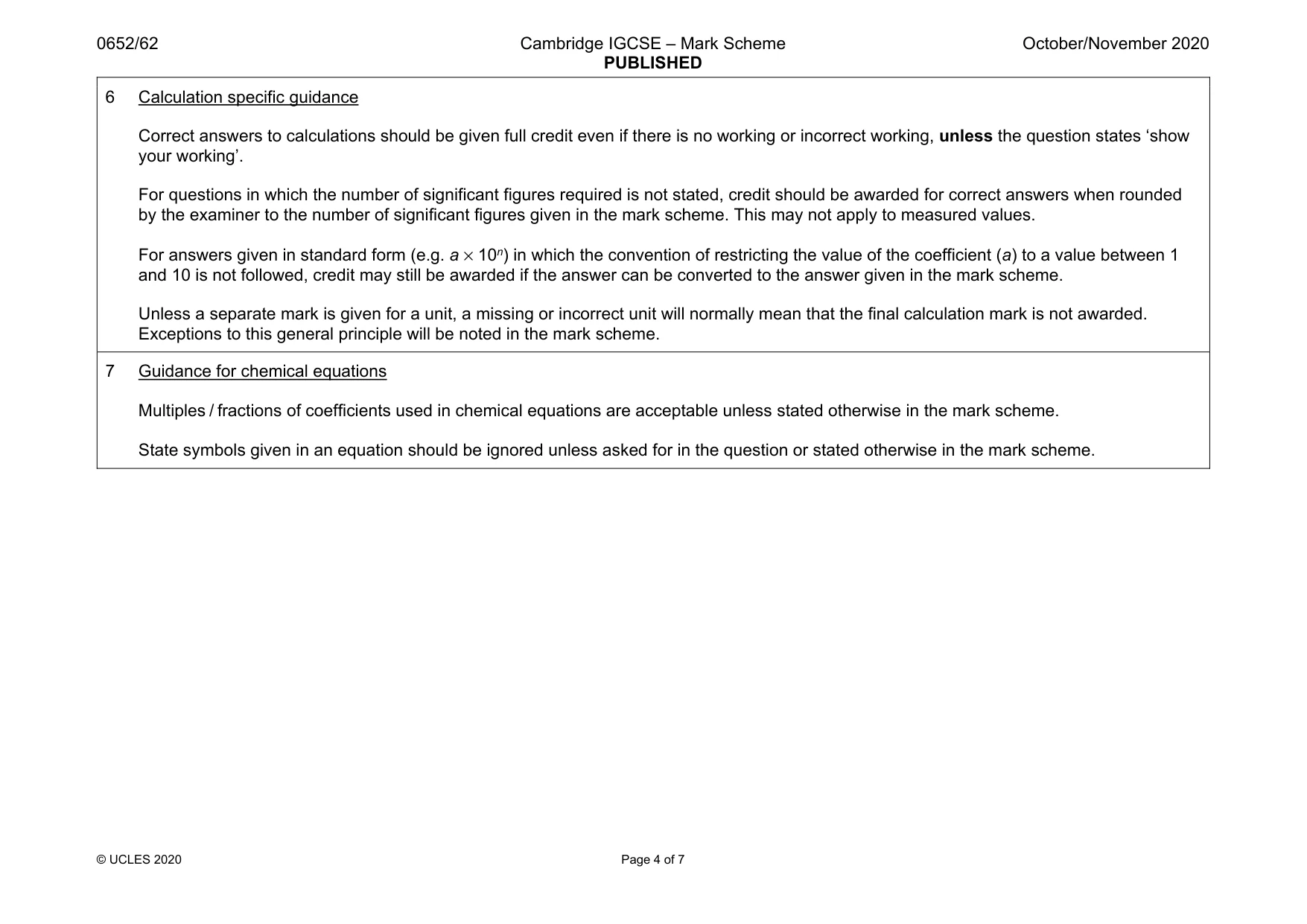
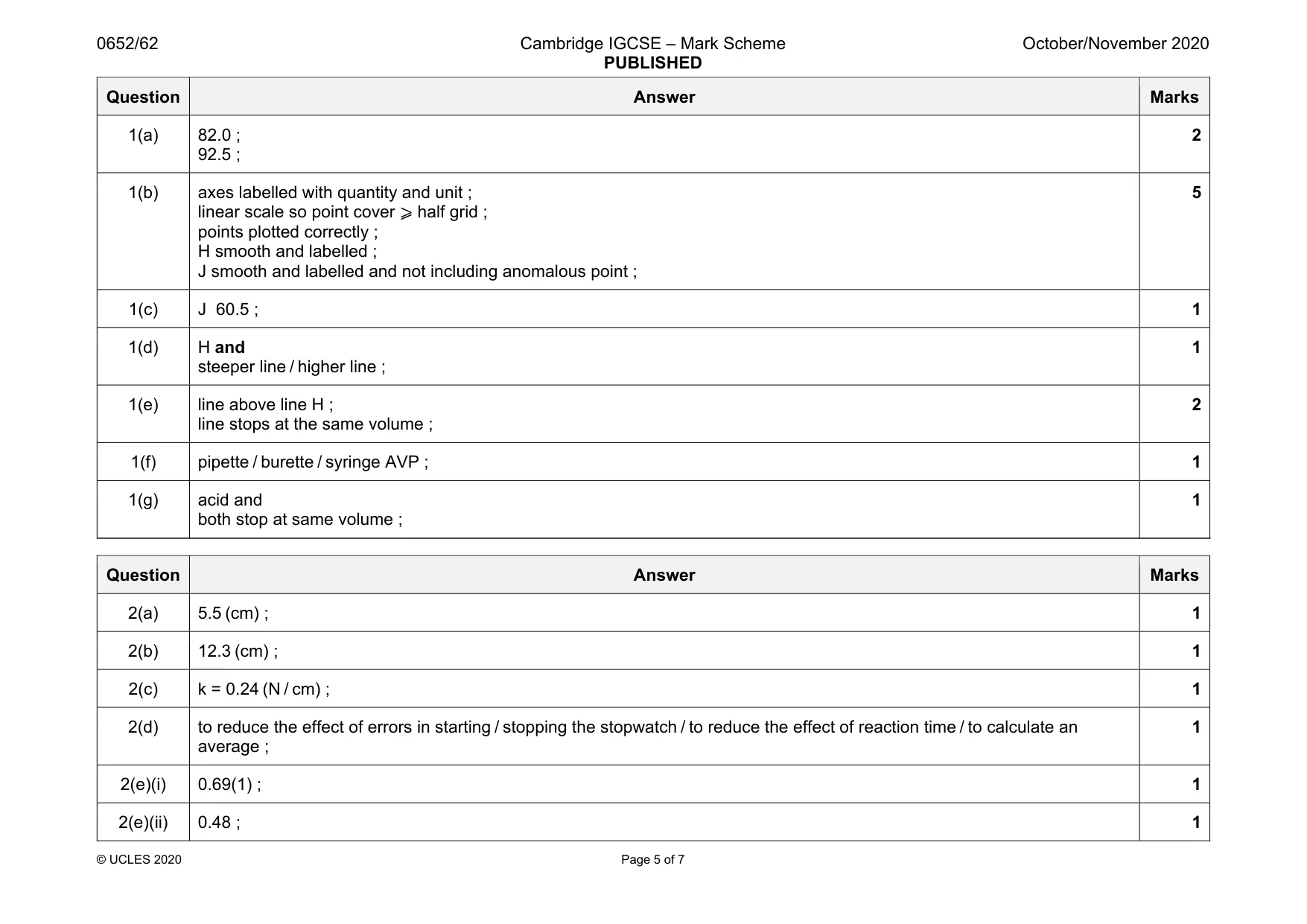
Mark scheme: 1(a) 82.0 ; 92.5 ; 2 1(b) axes labelled with quantity and unit ; linear scale so point cover ⩾ half grid ; points plotted correctly ; H smooth and labelled ; J smooth and labelled and not including anomalous point ; 5 1(c) J 60.5 ; 1 1(d) H and steeper line / higher line ; 1 1(e) line above line H ; line stops at the same volume ; 2 1(f) pipette / burette / syringe AVP ; 1 1(g) acid and both stop at same volume ; 1
Q2 · A student measures the spring constant k of a spring by two different methods
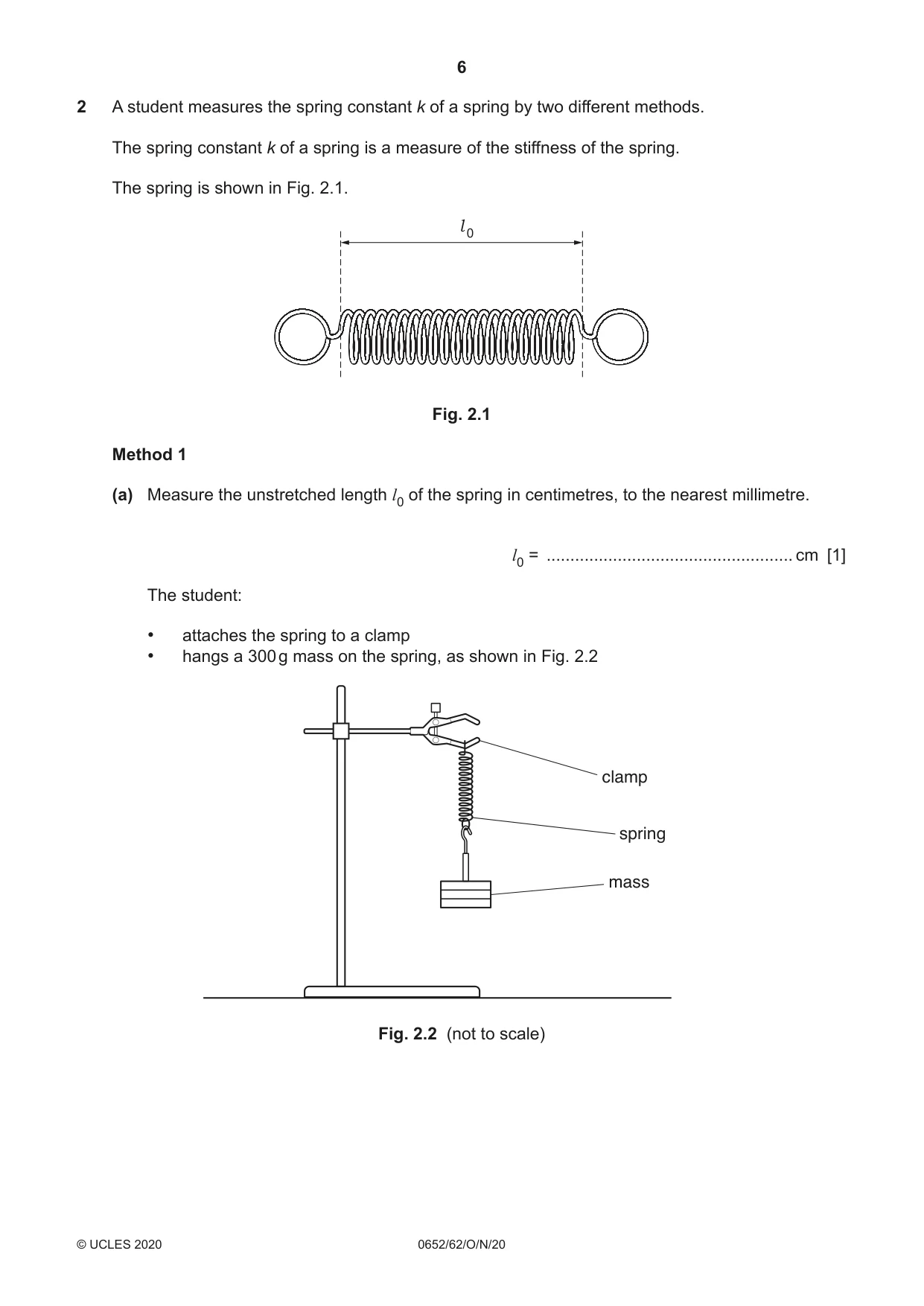
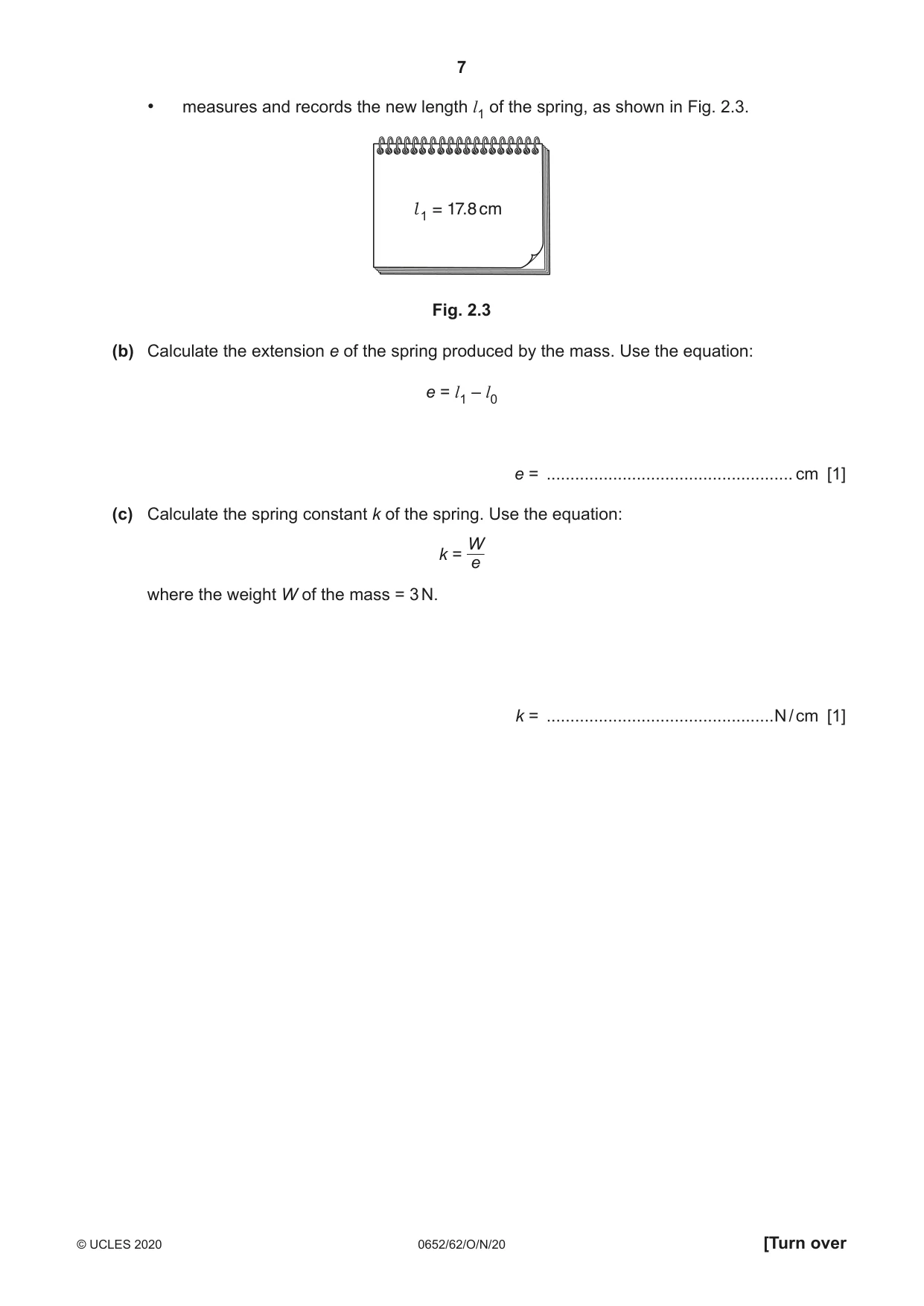
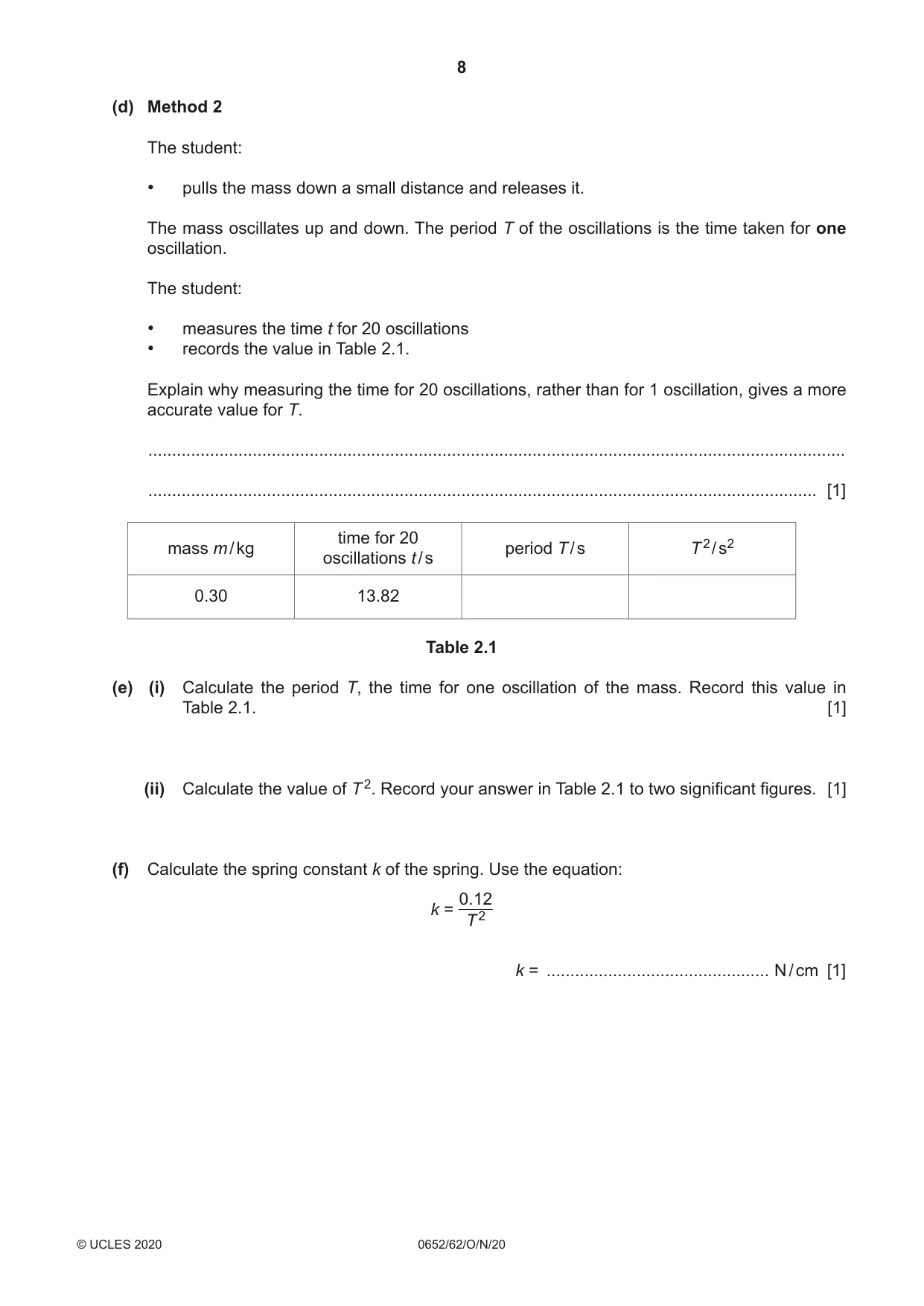
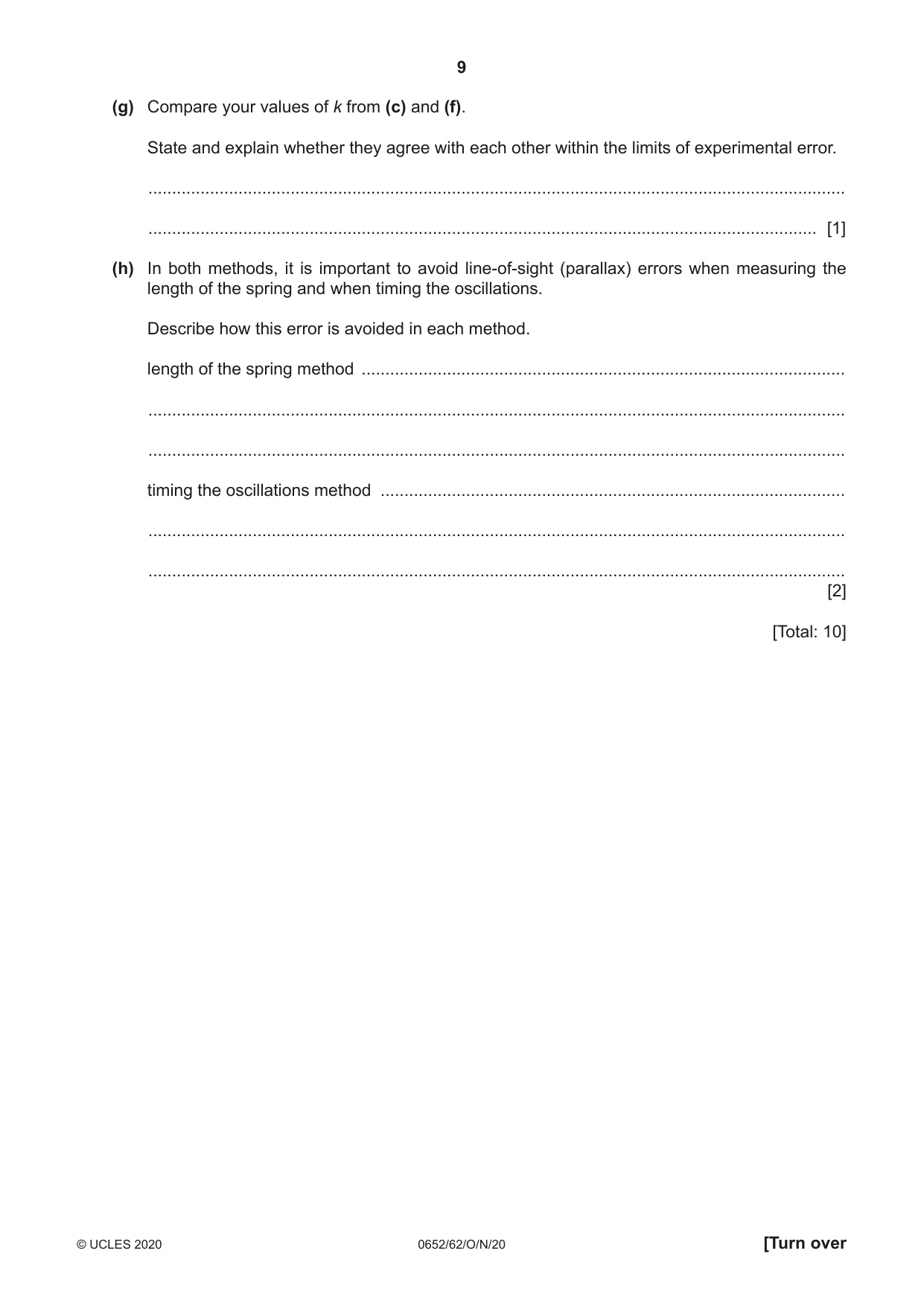
2 A student measures the spring constant k of a spring by two different methods. The spring constant k of a spring is a measure of the stiffness of the spring. The spring is shown in Fig. 2.1. l 0 Fig. 2.1 Method 1 (a) Measure the unstretched length l0 of the spring in centimetres, to the nearest millimetre. l0 = .................................................... cm [1] The student: • attaches the spring to a clamp • hangs a 300 g mass on the spring, as shown in Fig. 2.2 clamp spring mass Fig. 2.2 (not to scale) • measures and records the new length l1 of the spring, as shown in Fig. 2.3. l 1 = 17.8 cm Fig. 2.3 (b) Calculate the extension e of the spring produced by the mass. Use the equation: e = l1 – l0 e = .................................................... cm [1] (c) Calculate the spring constant k of the spring. Use the equation: W k = e where the weight W of the mass = 3 N. k = ................................................N / cm [1] (d) Method 2 The student: • pulls the mass down a small distance and releases it. The mass oscillates up and down. The period T of the oscillations is the time taken for one oscillation. The student: • measures the time t for 20 oscillations • records the value in Table 2.1. Explain why measuring the time for 20 oscillations, rather than for 1 oscillation, gives a more accurate value for T. ................................................................................................................................................... ............................................................................................................................................. [1] time for 20 2 mass m / kg period T / s T / s2 oscillations t / s 0.30 13.82 Table 2.1 (e) (i) Calculate the period T, the time for one oscillation of the mass. Record this value in Table 2.1. [1] (ii) Calculate the value of T 2. Record your answer in Table 2.1 to two significant figures. [1] (f) Calculate the spring constant k of the spring. Use the equation: 0.12 k = 2 T k = ............................................... N / cm [1] (g) Compare your values of k from (c) and (f). State and explain whether they agree with each other within the limits of experimental error. ................................................................................................................................................... ............................................................................................................................................. [1] (h) In both methods, it is important to avoid line-of-sight (parallax) errors when measuring the length of the spring and when timing the oscillations. Describe how this error is avoided in each method. length of the spring method ...................................................................................................... ................................................................................................................................................... ................................................................................................................................................... timing the oscillations method .................................................................................................. ................................................................................................................................................... ................................................................................................................................................... [2] [Total: 10]
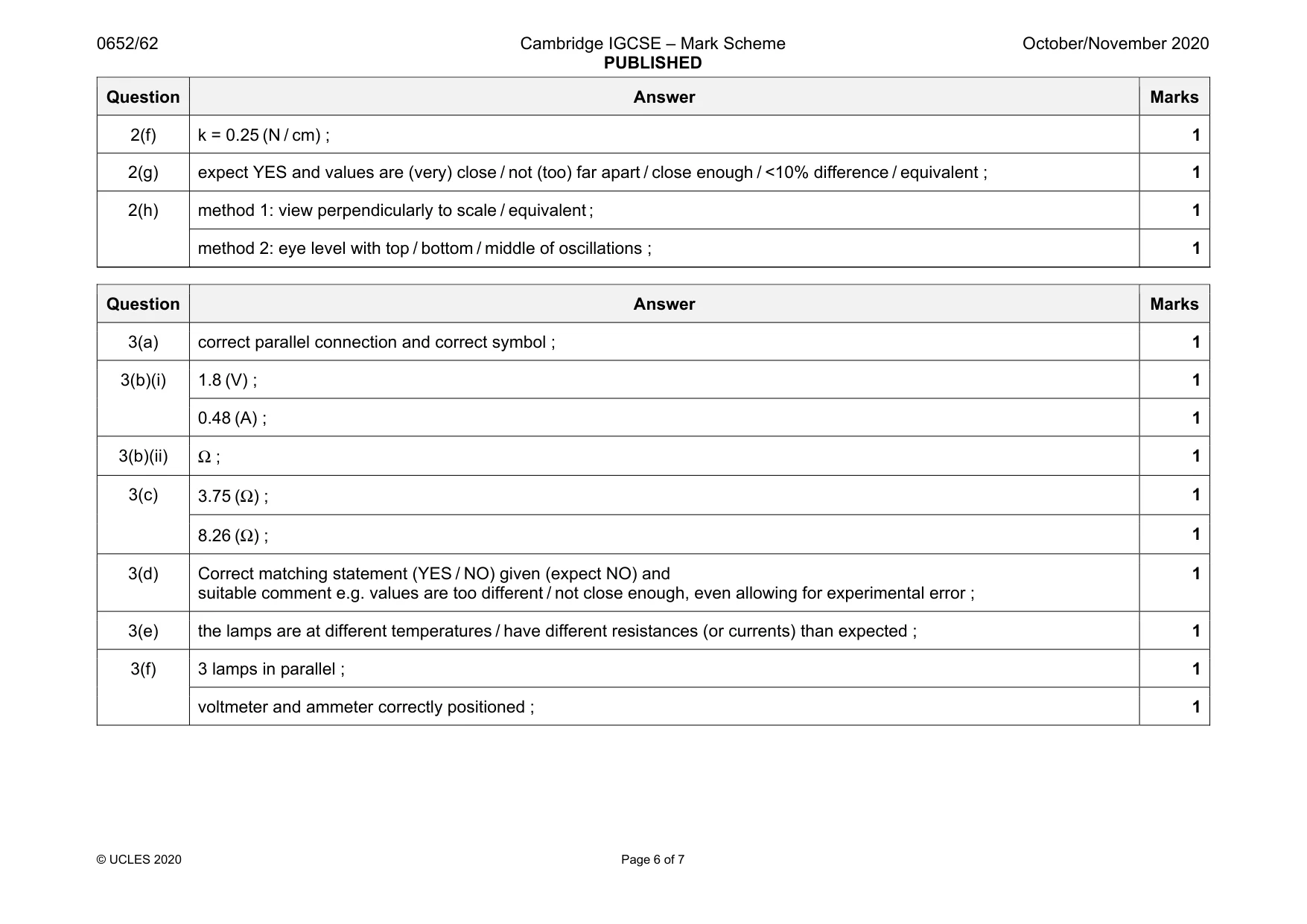
Mark scheme: 2(a) 5.5 (cm) ; 1 2(b) 12.3 (cm) ; 1 2(c) k = 0.24 (N / cm) ; 1 2(d) to reduce the effect of errors in starting / stopping the stopwatch / to reduce the effect of reaction time / to calculate an average ; 1 2(e)(i) 0.69(1) ; 1 2(e)(ii) 0.48 ; 1 Question Answer Marks 2(f) k = 0.25 (N / cm) ; 1 2(g) expect YES and values are (very) close / not (too) far apart / close enough / <10% difference / equivalent ; 1 2(h) method 1: view perpendicularly to scale / equivalent ; 1 method 2: eye level with top / bottom / middle of oscillations ; 1
Q3 · A student investigates the effective resistance of two different combinations of lamps
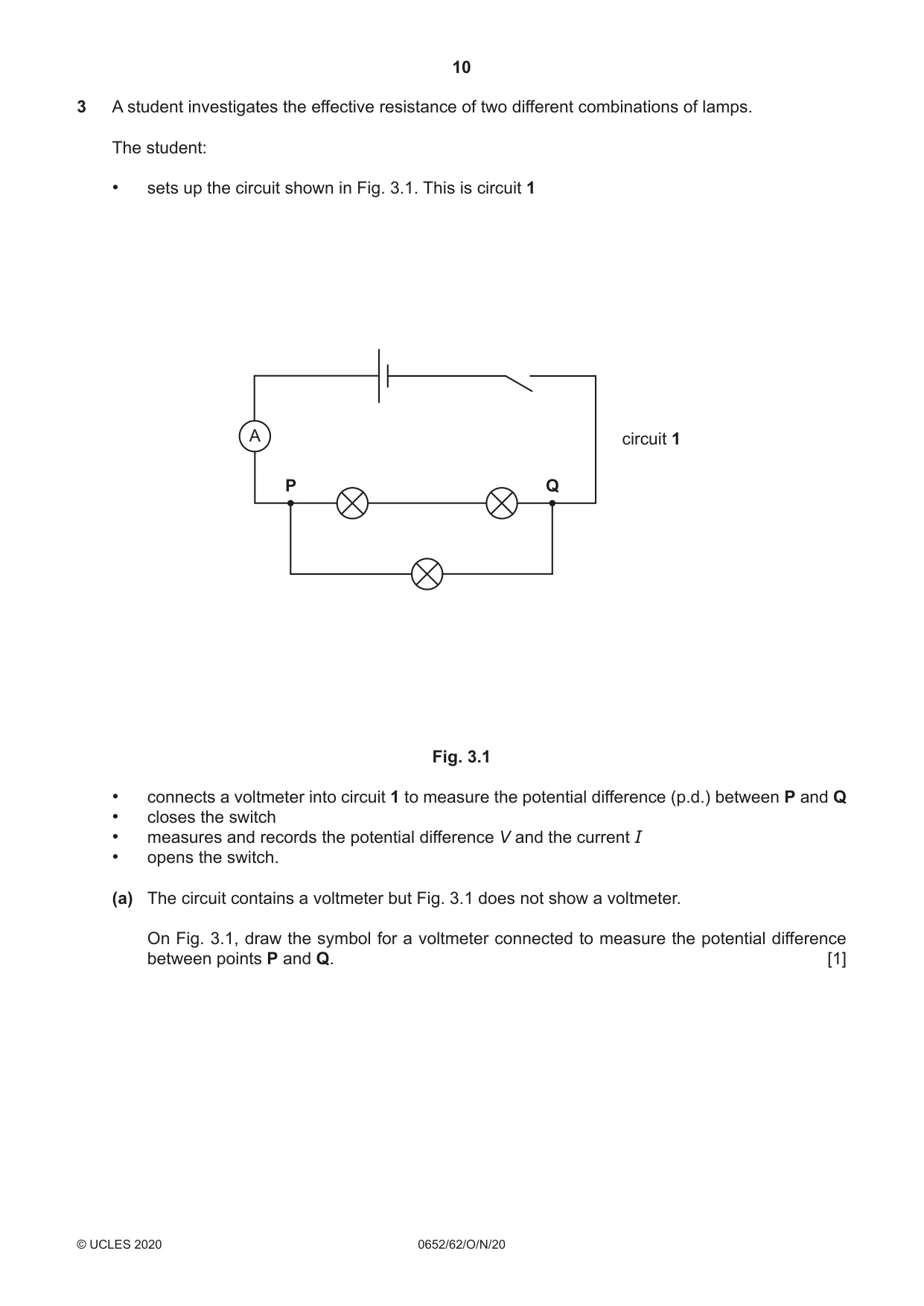
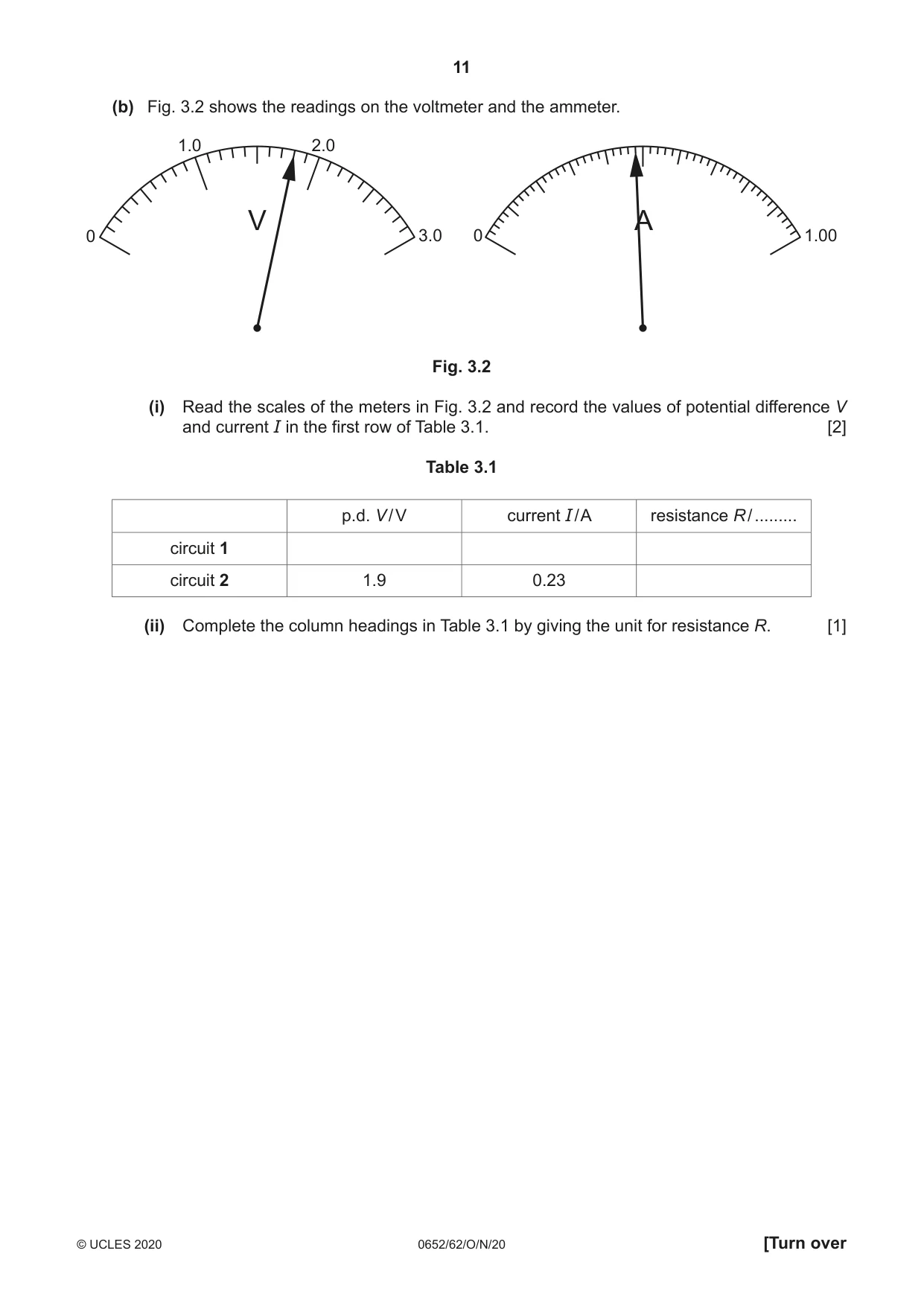
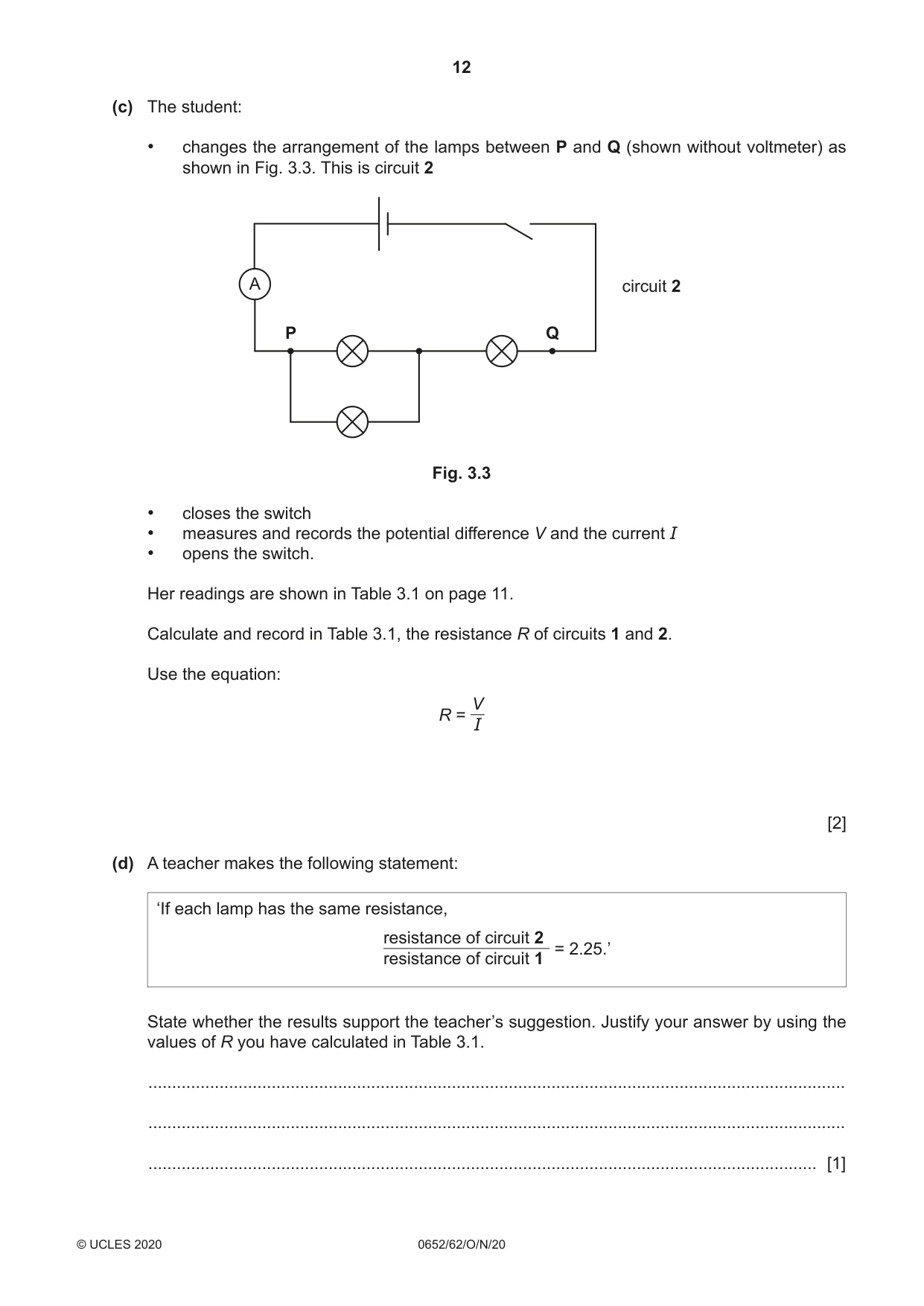
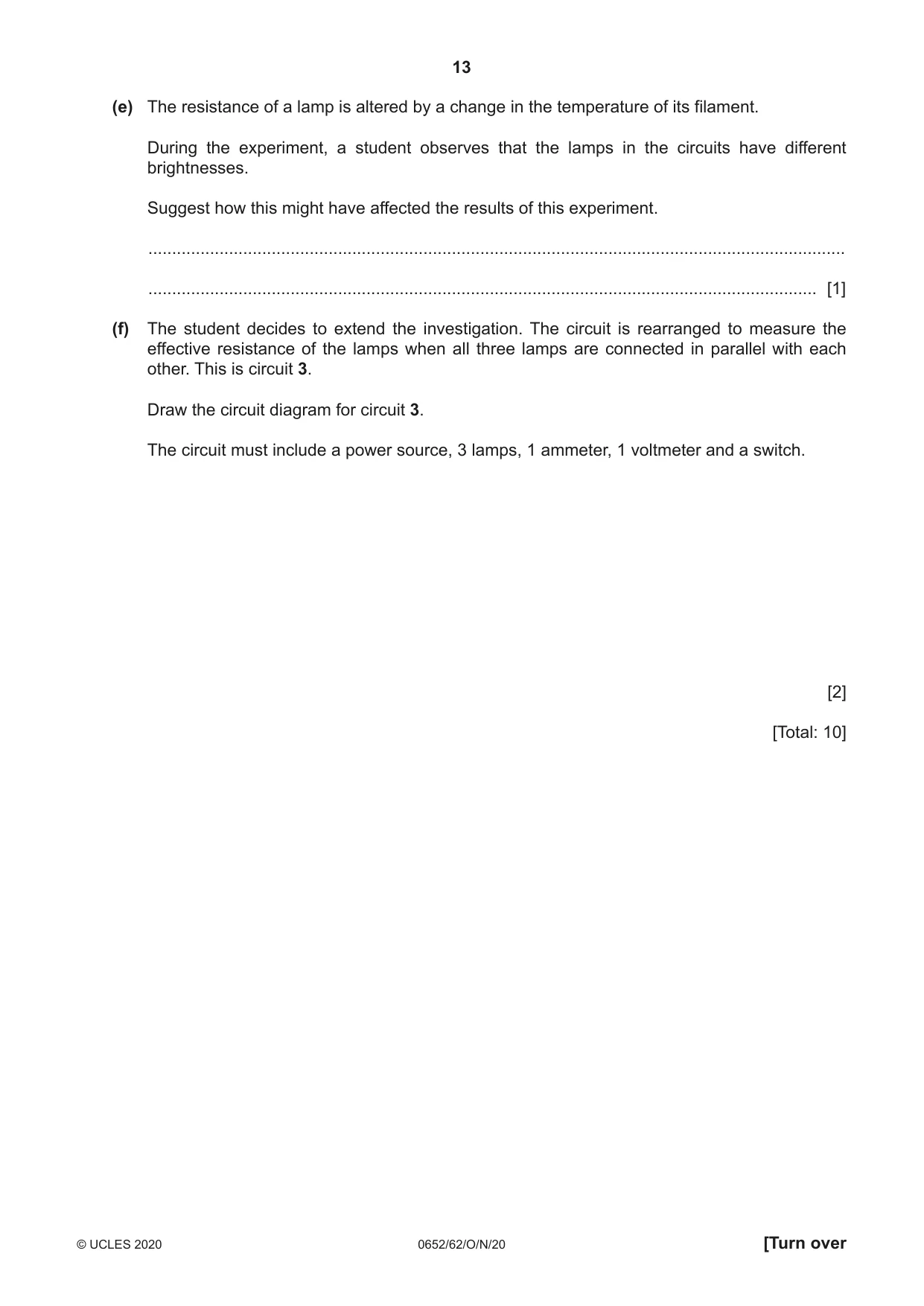
3 A student investigates the effective resistance of two different combinations of lamps. The student: • sets up the circuit shown in Fig. 3.1. This is circuit 1 A circuit 1 P Q Fig. 3.1 • connects a voltmeter into circuit 1 to measure the potential difference (p.d.) between P and Q • closes the switch • measures and records the potential difference V and the current I • opens the switch. (a) The circuit contains a voltmeter but Fig. 3.1 does not show a voltmeter. On Fig. 3.1, draw the symbol for a voltmeter connected to measure the potential difference between points P and Q. [1] (b) Fig. 3.2 shows the readings on the voltmeter and the ammeter. 1.0 2.0 V A0 3.0 0 1.00 Fig. 3.2 (i) Read the scales of the meters in Fig. 3.2 and record the values of potential difference V and current I in the first row of Table 3.1. [2] Table 3.1 p.d. V / V current I / A resistance R / ......... circuit 1 circuit 2 1.9 0.23 (ii) Complete the column headings in Table 3.1 by giving the unit for resistance R. [1] (c) The student: • changes the arrangement of the lamps between P and Q (shown without voltmeter) as shown in Fig. 3.3. This is circuit 2 A circuit 2 P Q Fig. 3.3 • closes the switch • measures and records the potential difference V and the current I • opens the switch. Her readings are shown in Table 3.1 on page 11. Calculate and record in Table 3.1, the resistance R of circuits 1 and 2. Use the equation: V R = I [2] (d) A teacher makes the following statement: ‘If each lamp has the same resistance, resistance of circuit 2 = 2.25.’ resistance of circuit 1 State whether the results support the teacher’s suggestion. Justify your answer by using the values of R you have calculated in Table 3.1. ................................................................................................................................................... ................................................................................................................................................... ............................................................................................................................................. [1]
Mark scheme: 3(a) correct parallel connection and correct symbol ; 1 3(b)(i) 1.8 (V) ; 1 0.48 (A) ; 1 3(b)(ii) Ω ; 1 3(c) 3.75 (Ω) ; 1 8.26 (Ω) ; 1 3(d) Correct matching statement (YES / NO) given (expect NO) and suitable comment e.g. values are too different / not close enough, even allowing for experimental error ; 1 3(e) the lamps are at different temperatures / have different resistances (or currents) than expected ; 1 3(f) 3 lamps in parallel ; 1 voltmeter and ammeter correctly positioned ; 1
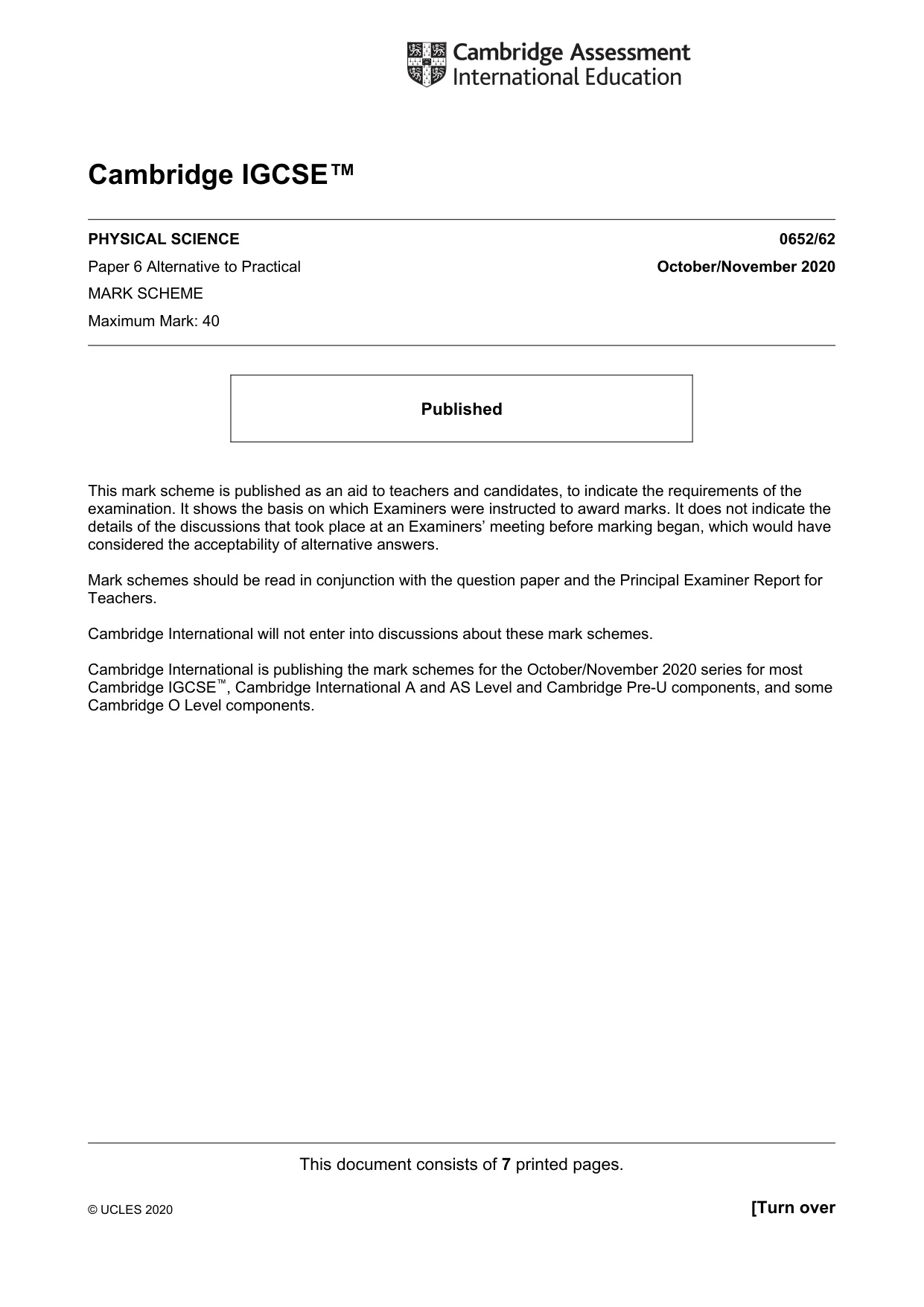
Q4 · Aqueous sodium hydroxide is an alkali
4 Aqueous sodium hydroxide is an alkali. When aqueous sodium hydroxide reacts with hydrochloric acid, a neutralisation reaction takes place and aqueous sodium chloride is made. The word equation for this reaction is shown. aqueous aqueous hydrochloric sodium + sodium + water acid hydroxide chloride To make pure aqueous sodium chloride, the amount of aqueous sodium hydroxide added needs to be the exact amount to just neutralise the hydrochloric acid. Plan an experiment to make a pure sample of sodium chloride solid. You may use any common laboratory apparatus, aqueous sodium hydroxide, hydrochloric acid and any named indicator. Your plan should include: • a brief description of the method including the apparatus you would use • safety precautions and explain why these are needed • how you make sure the sodium chloride is pure • the measurements you will make. A diagram is not required but you may draw one if it helps to explain your plan. .......................................................................................................................................................... .......................................................................................................................................................... .......................................................................................................................................................... .......................................................................................................................................................... .......................................................................................................................................................... .......................................................................................................................................................... .......................................................................................................................................................... .......................................................................................................................................................... .......................................................................................................................................................... .......................................................................................................................................................... .......................................................................................................................................................... .......................................................................................................................................................... .......................................................................................................................................................... .......................................................................................................................................................... .......................................................................................................................................................... .......................................................................................................................................................... .......................................................................................................................................................... .......................................................................................................................................................... .......................................................................................................................................................... .......................................................................................................................................................... .......................................................................................................................................................... .......................................................................................................................................................... .......................................................................................................................................................... .......................................................................................................................................................... .......................................................................................................................................................... .......................................................................................................................................................... .......................................................................................................................................................... .......................................................................................................................................................... .......................................................................................................................................................... ..........................................................................................................................................................
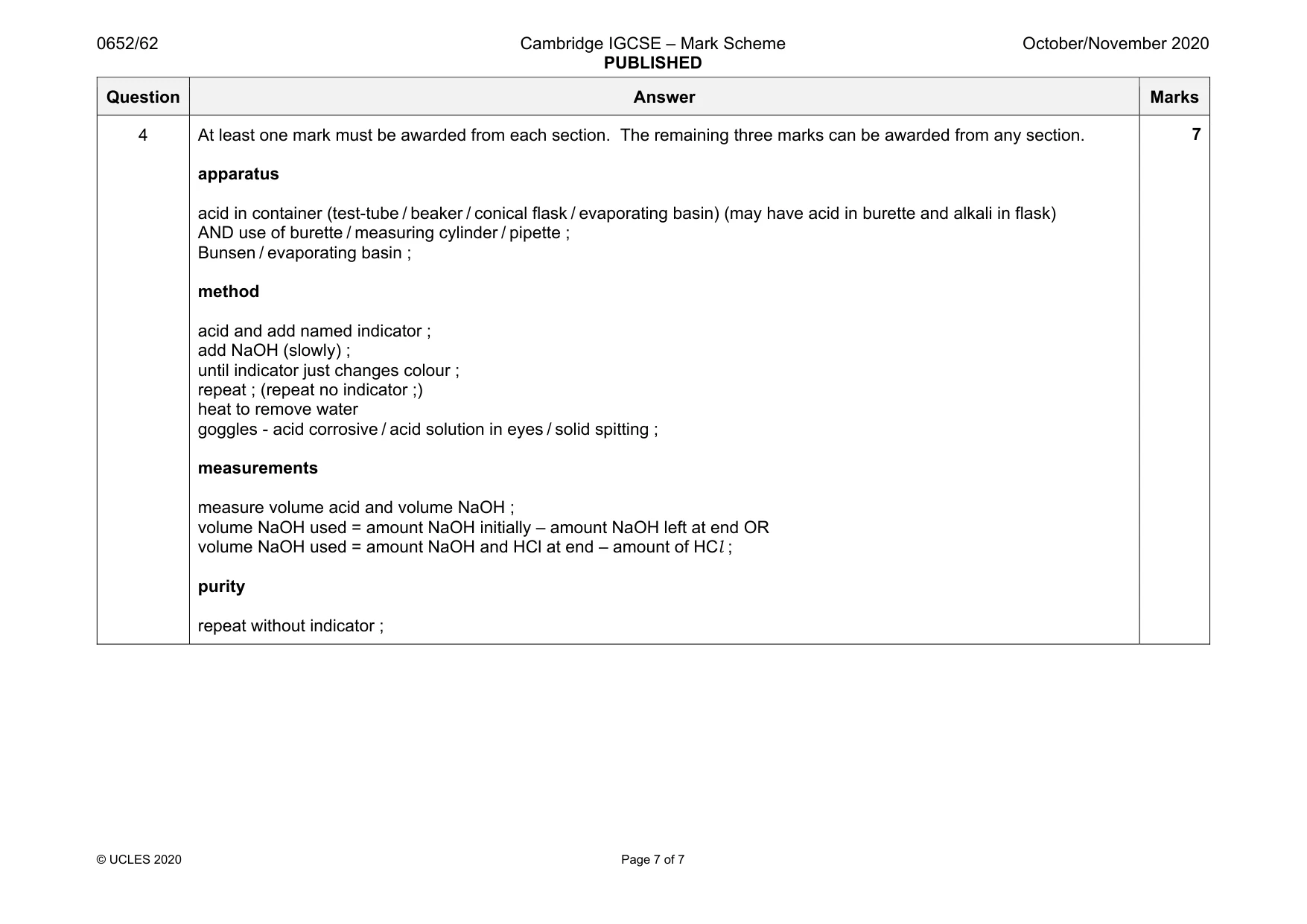
Mark scheme: 4 At least one mark must be awarded from each section. The remaining three marks can be awarded from any section. apparatus acid in container (test-tube / beaker / conical flask / evaporating basin) (may have acid in burette and alkali in flask) AND use of burette / measuring cylinder / pipette ; Bunsen / evaporating basin ; method acid and add named indicator ; add NaOH (slowly) ; until indicator just changes colour ; repeat ; (repeat no indicator ;) heat to remove water goggles - acid corrosive / acid solution in eyes / solid spitting ; measurements measure volume acid and volume NaOH ; volume NaOH used = amount NaOH initially – amount NaOH left at end OR volume NaOH used = amount NaOH and HCl at end – amount of HCl ; purity repeat without indicator ;
What was in this paper
The subtopics covered by these 4 questions, and how many questions each got. Open one in a new tab to see every Cambridge question on it.
What you needed in this session
Cambridge’s own grade thresholds for 2020 Oct/Nov, Paper 6 · Variant 2. A higher threshold means an easier paper — the bar moves with how the cohort did.