Cambridge IGCSE Physical Science 0652 — 2018 Oct/Nov Paper 5 · Variant 1
0652/51/O/N/18 · 2 questions · 30 marks · ≈34 min
The question paper and its mark scheme, free to read here and free to download. This is Cambridge’s own paper, exactly as it was sat.
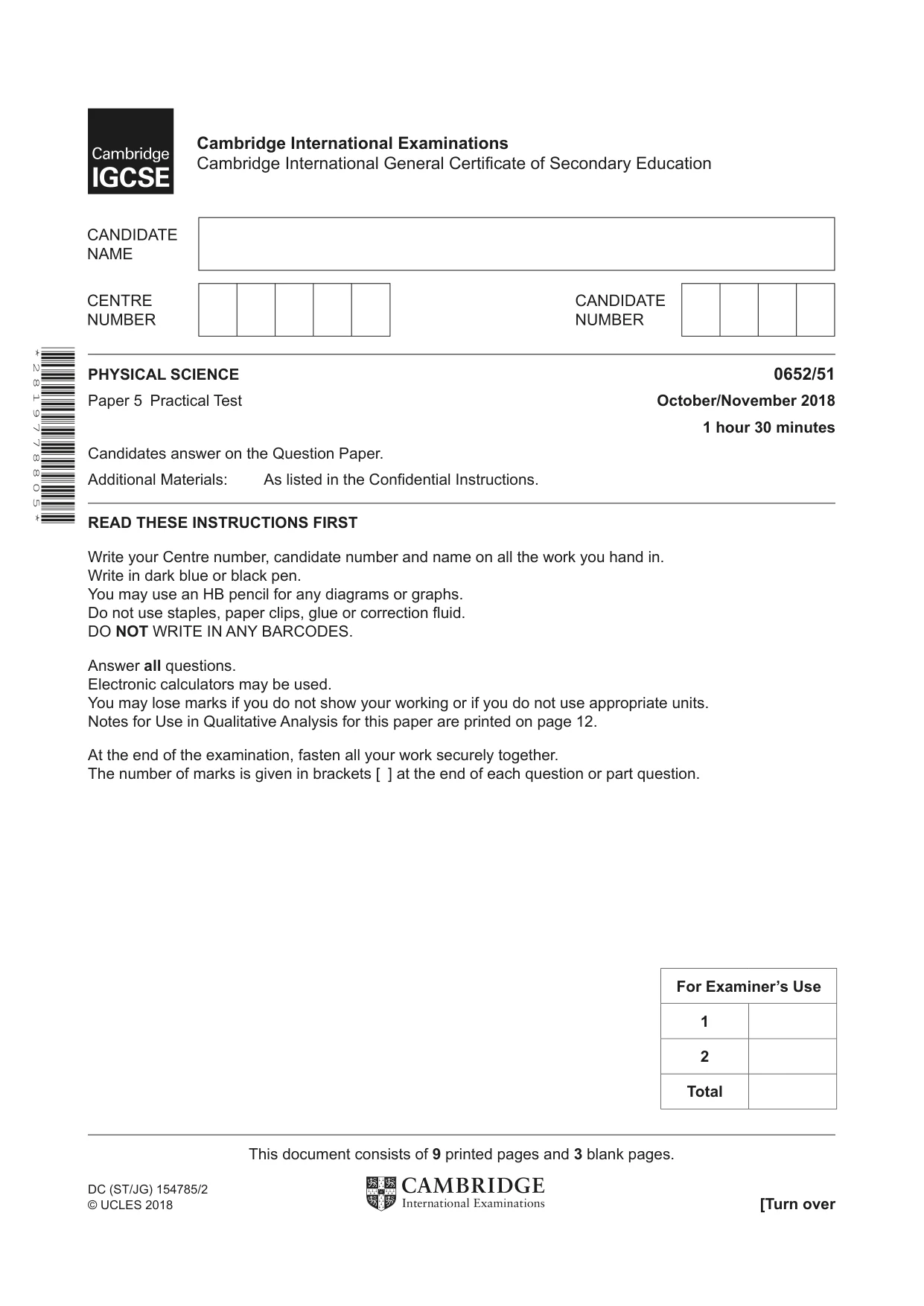
Question paper12 pages



Mark scheme5 pages
Answers below. Sit the paper first if you are practising.
Questions as text
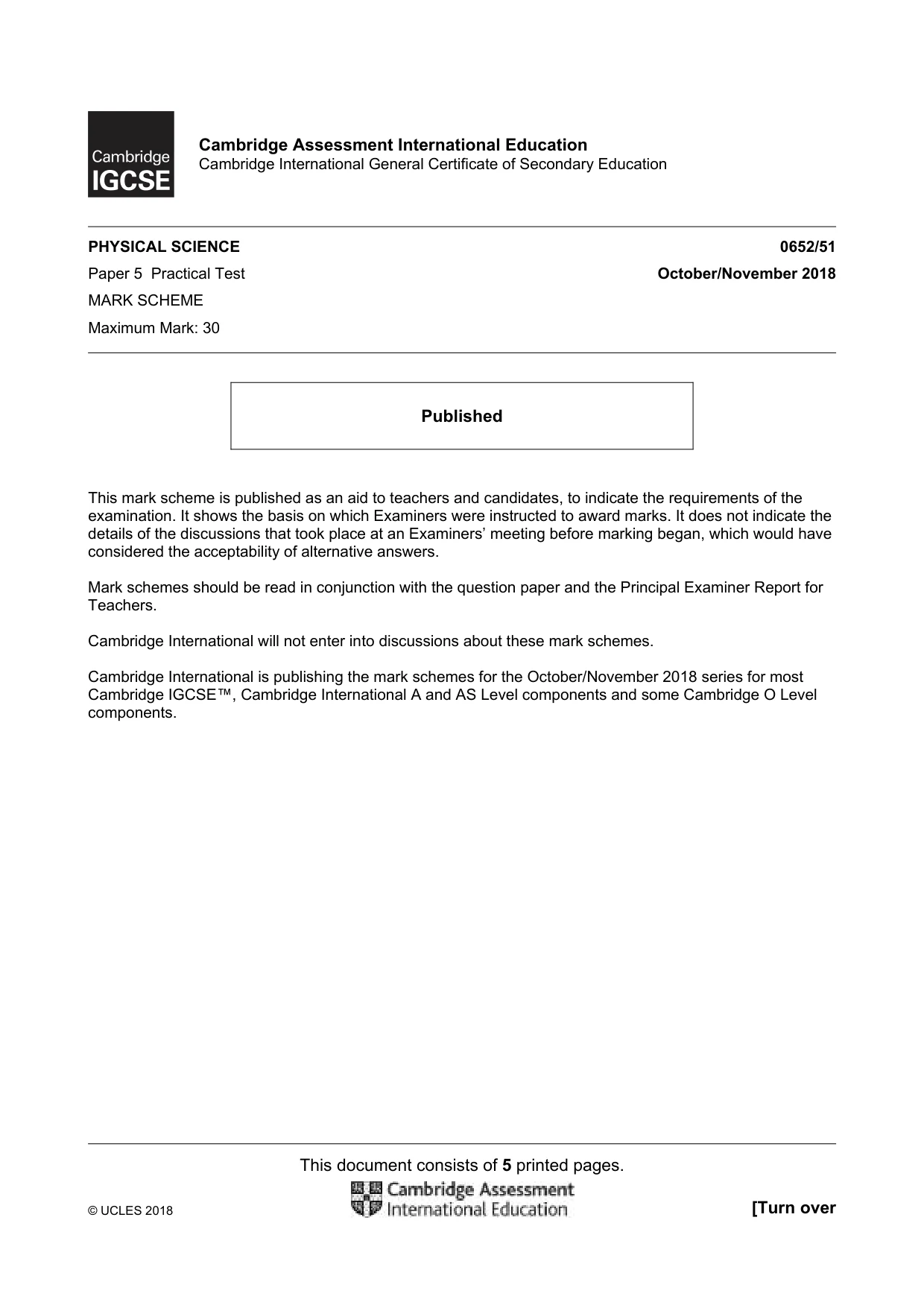
Q1 · Notes for use in Qualitative Analysis for this question are printed on page 12
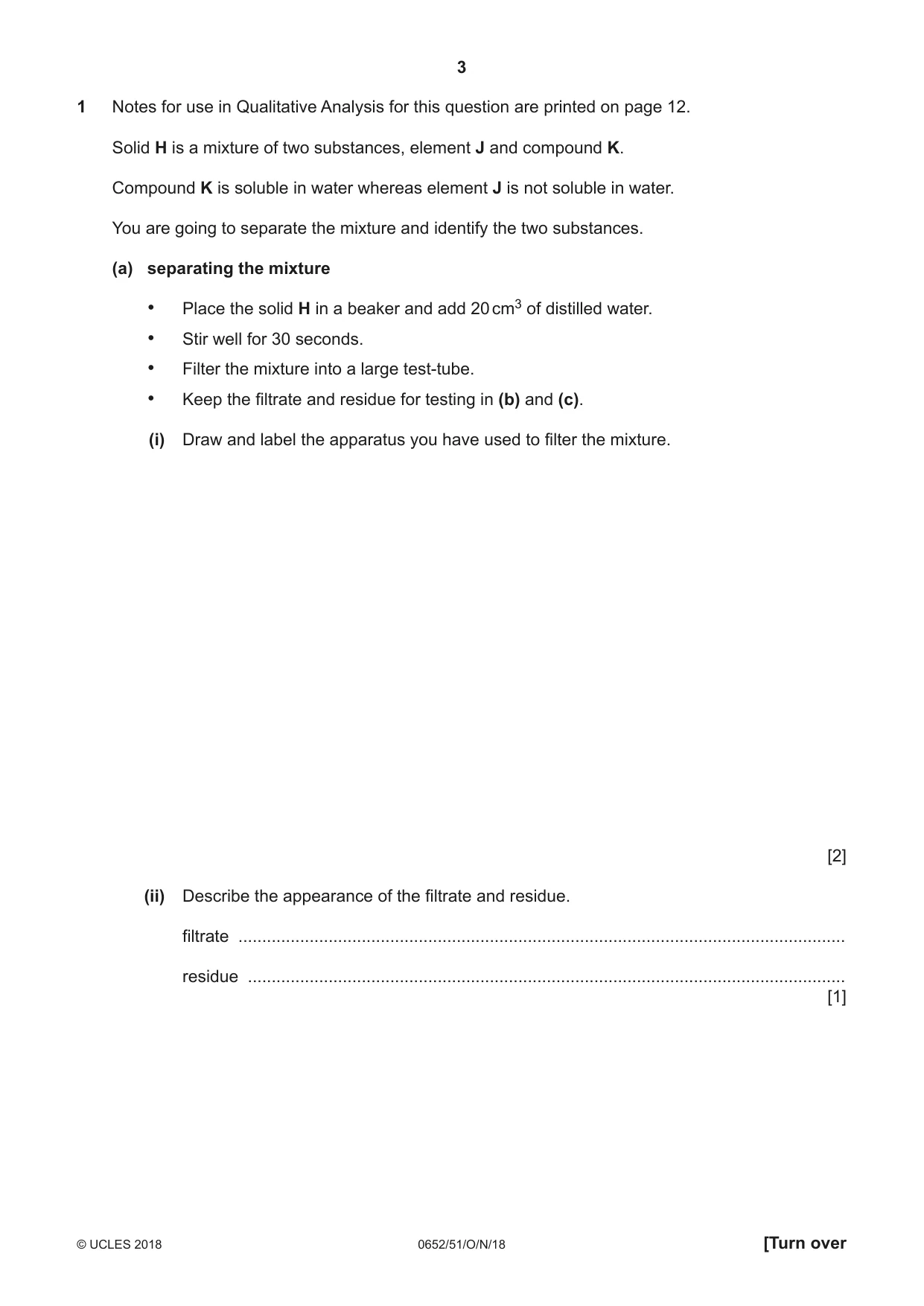
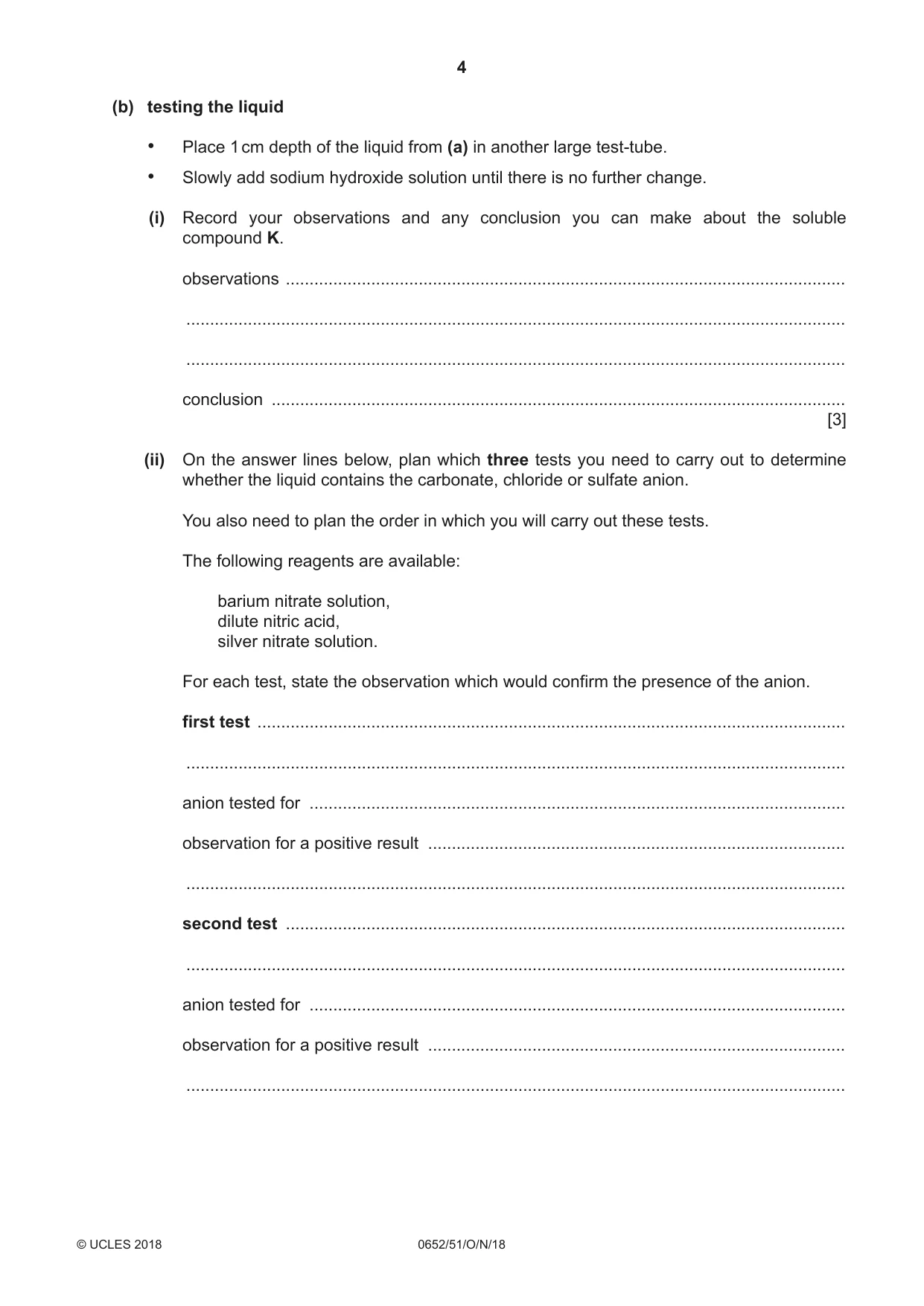
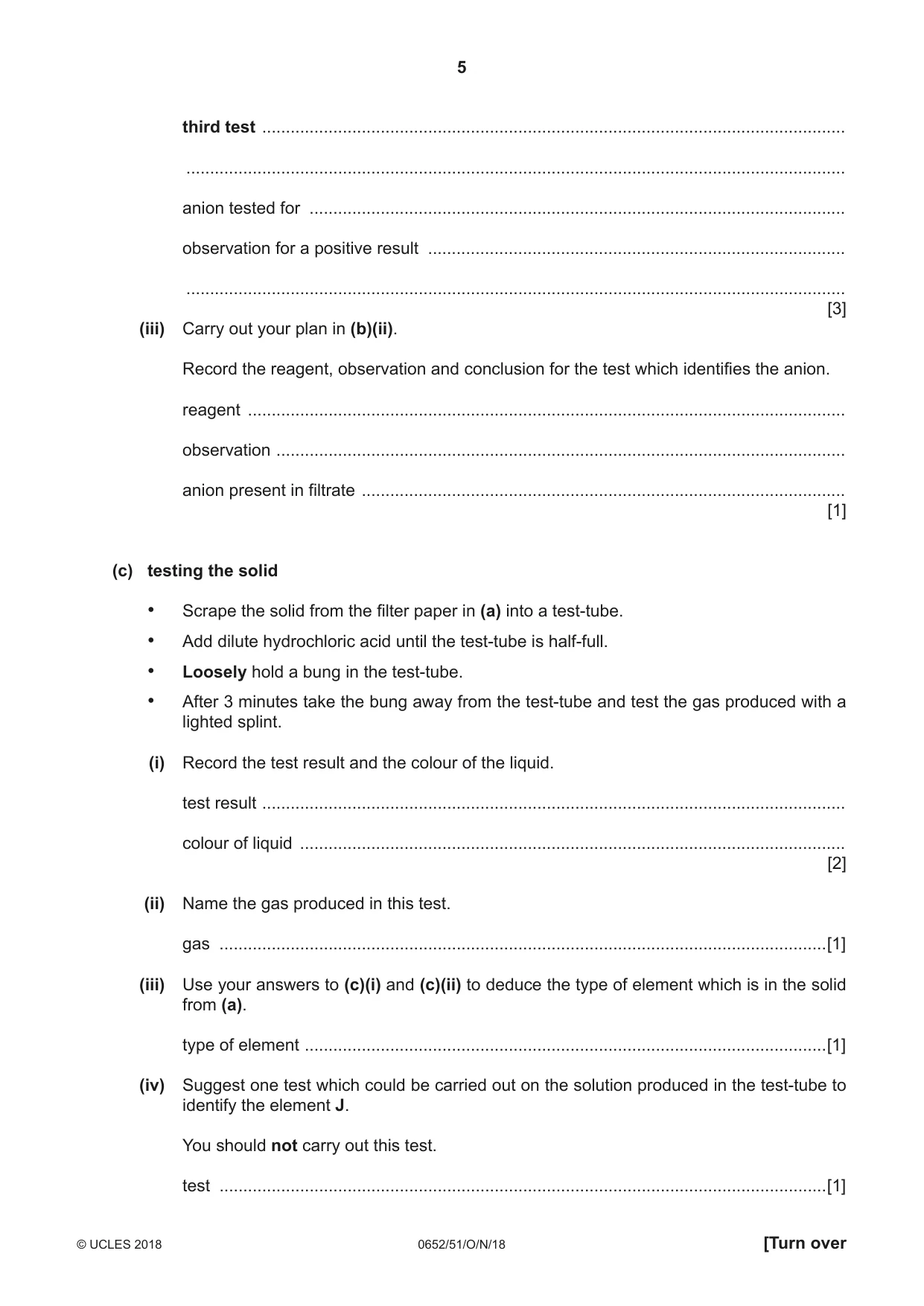
1 Notes for use in Qualitative Analysis for this question are printed on page 12. Solid H is a mixture of two substances, element J and compound K. Compound K is soluble in water whereas element J is not soluble in water. You are going to separate the mixture and identify the two substances. (a) separating the mixture • Place the solid H in a beaker and add 20 cm3 of distilled water. • Stir well for 30 seconds. • Filter the mixture into a large test-tube. • Keep the filtrate and residue for testing in (b) and (c). (i) Draw and label the apparatus you have used to filter the mixture. [2] (ii) Describe the appearance of the filtrate and residue. filtrate ................................................................................................................................ residue .............................................................................................................................. [1] (b) testing the liquid • Place 1 cm depth of the liquid from (a) in another large test-tube. • Slowly add sodium hydroxide solution until there is no further change. (i) Record your observations and any conclusion you can make about the soluble compound K. observations ...................................................................................................................... ........................................................................................................................................... ........................................................................................................................................... conclusion ......................................................................................................................... [3] (ii) On the answer lines below, plan which three tests you need to carry out to determine whether the liquid contains the carbonate, chloride or sulfate anion. You also need to plan the order in which you will carry out these tests. The following reagents are available: barium nitrate solution, dilute nitric acid, silver nitrate solution. For each test, state the observation which would confirm the presence of the anion. first test ............................................................................................................................ ........................................................................................................................................... anion tested for ................................................................................................................. observation for a positive result ........................................................................................ ........................................................................................................................................... second test ...................................................................................................................... ........................................................................................................................................... anion tested for ................................................................................................................. observation for a positive result ........................................................................................ ........................................................................................................................................... third test ........................................................................................................................... ........................................................................................................................................... anion tested for ................................................................................................................. observation for a positive result ........................................................................................ ........................................................................................................................................... [3] (iii) Carry out your plan in (b)(ii). Record the reagent, observation and conclusion for the test which identifies the anion. reagent .............................................................................................................................. observation ........................................................................................................................ anion present in filtrate ...................................................................................................... [1] (c) testing the solid • Scrape the solid from the filter paper in (a) into a test-tube. • Add dilute hydrochloric acid until the test-tube is half-full. • Loosely hold a bung in the test-tube. • After 3 minutes take the bung away from the test-tube and test the gas produced with a lighted splint. (i) Record the test result and the colour of the liquid. test result ........................................................................................................................... colour of liquid ................................................................................................................... [2] (ii) Name the gas produced in this test. gas ................................................................................................................................[1] (iii) Use your answers to (c)(i) and (c)(ii) to deduce the type of element which is in the solid from (a). type of element ..............................................................................................................[1] (iv) Suggest one test which could be carried out on the solution produced in the test-tube to identify the element J. You should not carry out this test. test ................................................................................................................................[1]
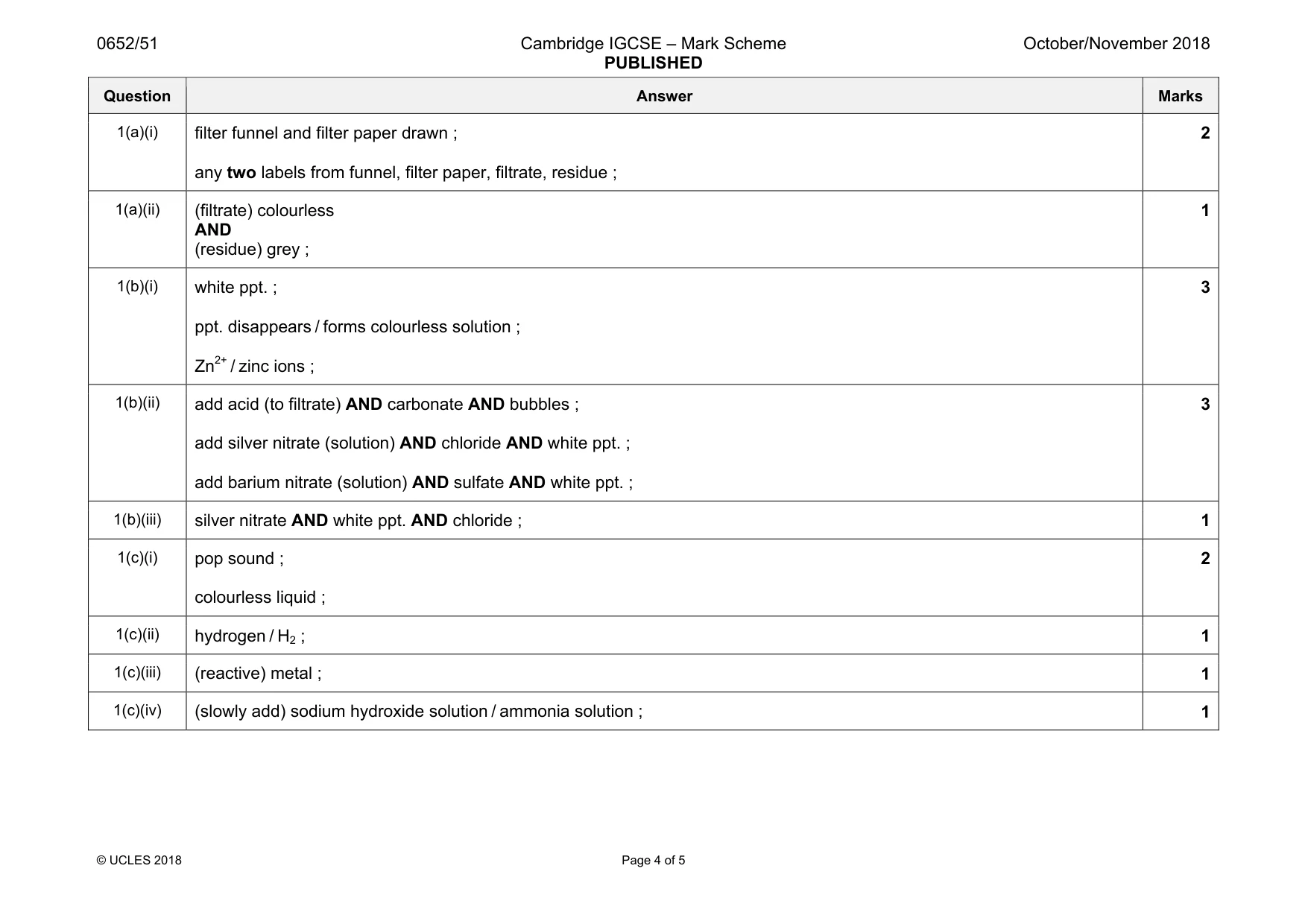
Mark scheme: 1(a)(i) filter funnel and filter paper drawn ; any two labels from funnel, filter paper, filtrate, residue ; 2 1(a)(ii) (filtrate) colourless AND (residue) grey ; 1 1(b)(i) white ppt. ; ppt. disappears / forms colourless solution ; Zn2+ / zinc ions ; 3 1(b)(ii) add acid (to filtrate) AND carbonate AND bubbles ; add silver nitrate (solution) AND chloride AND white ppt. ; add barium nitrate (solution) AND sulfate AND white ppt. ; 3 1(b)(iii) silver nitrate AND white ppt. AND chloride ; 1 1(c)(i) pop sound ; colourless liquid ; 2 1(c)(ii) hydrogen / H2 ; 1 1(c)(iii) (reactive) metal ; 1 1(c)(iv) (slowly add) sodium hydroxide solution / ammonia solution ; 1
Q2 · You are going to investigate the resistance and the power output of two lamps, L and M…
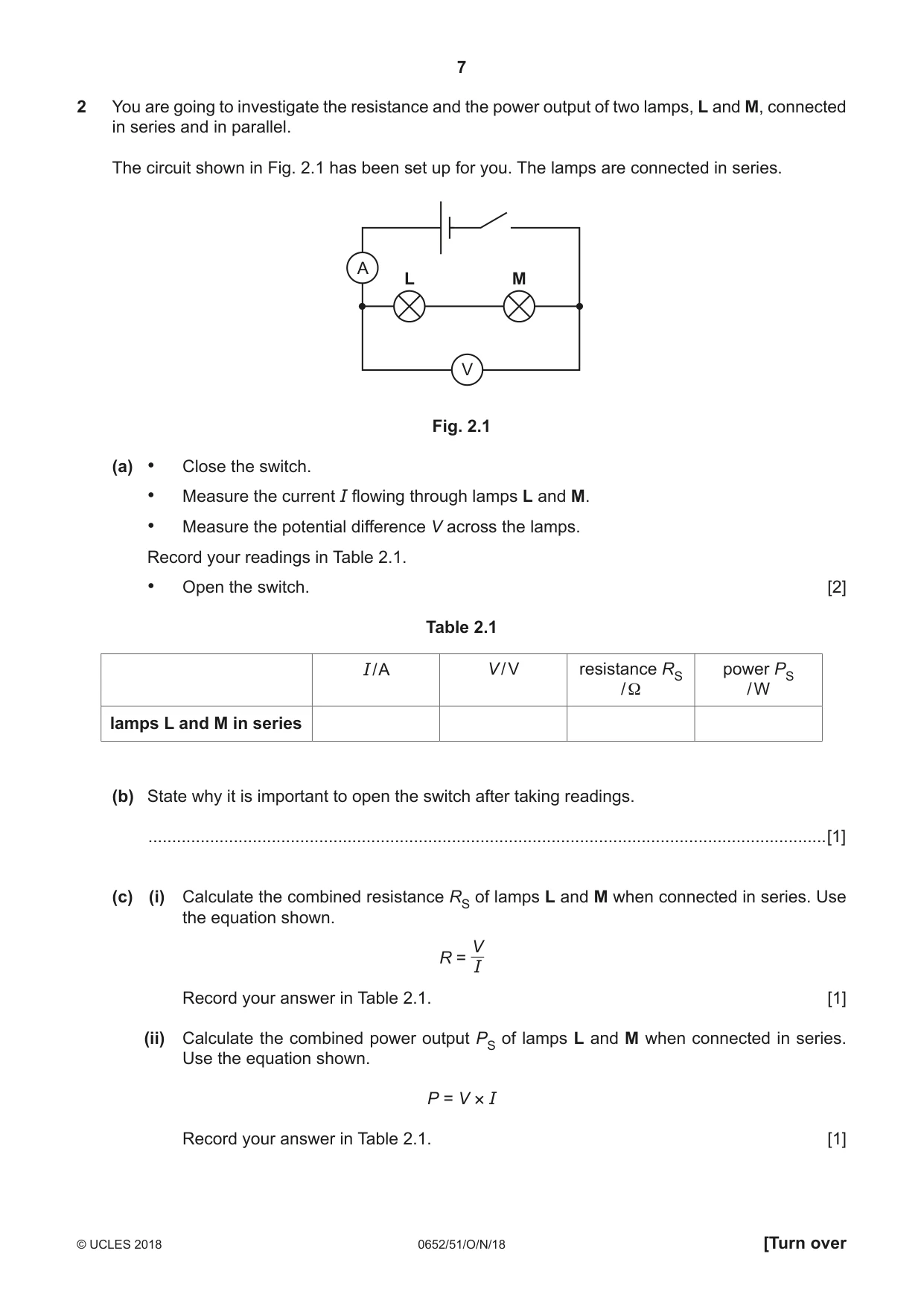
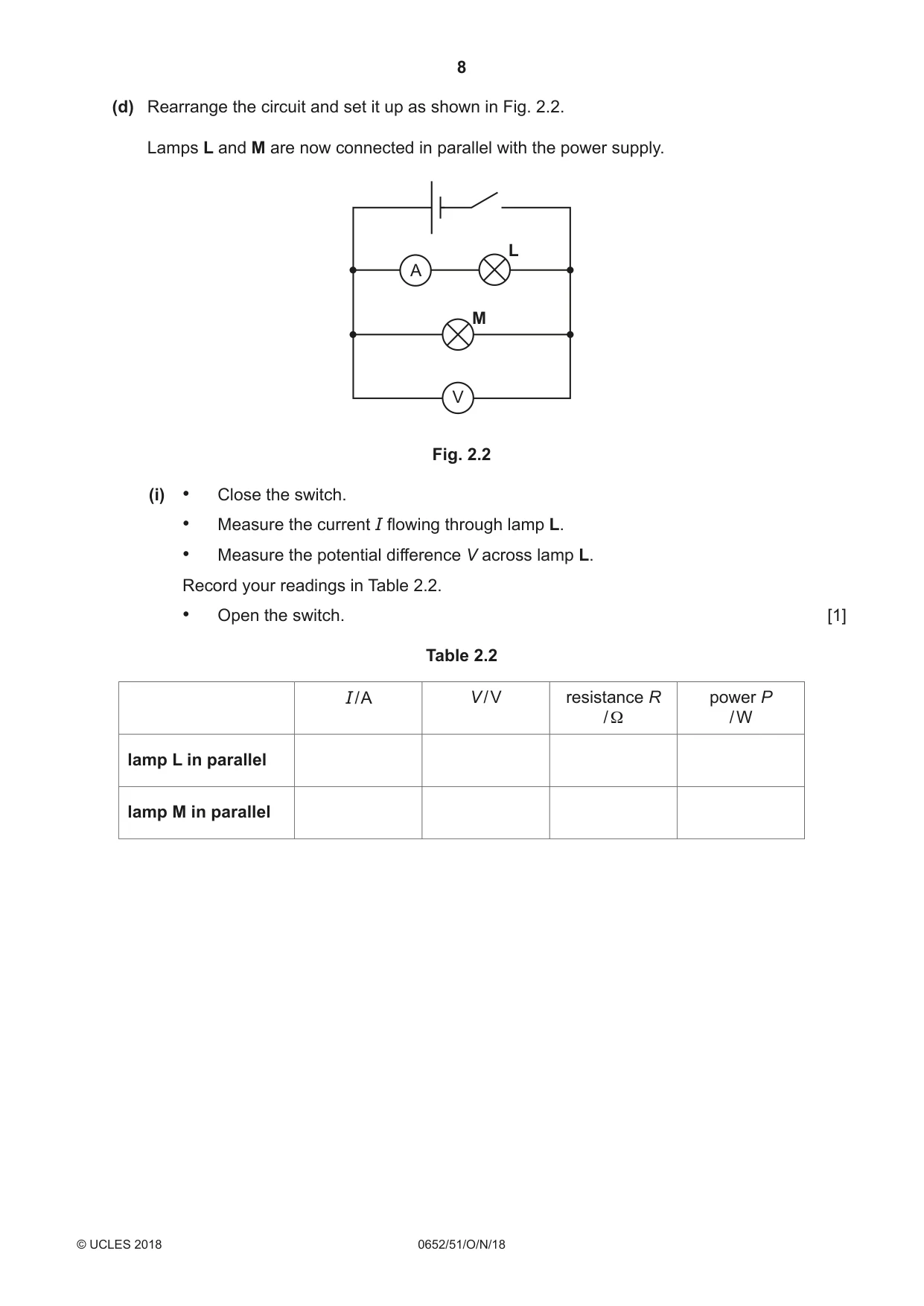
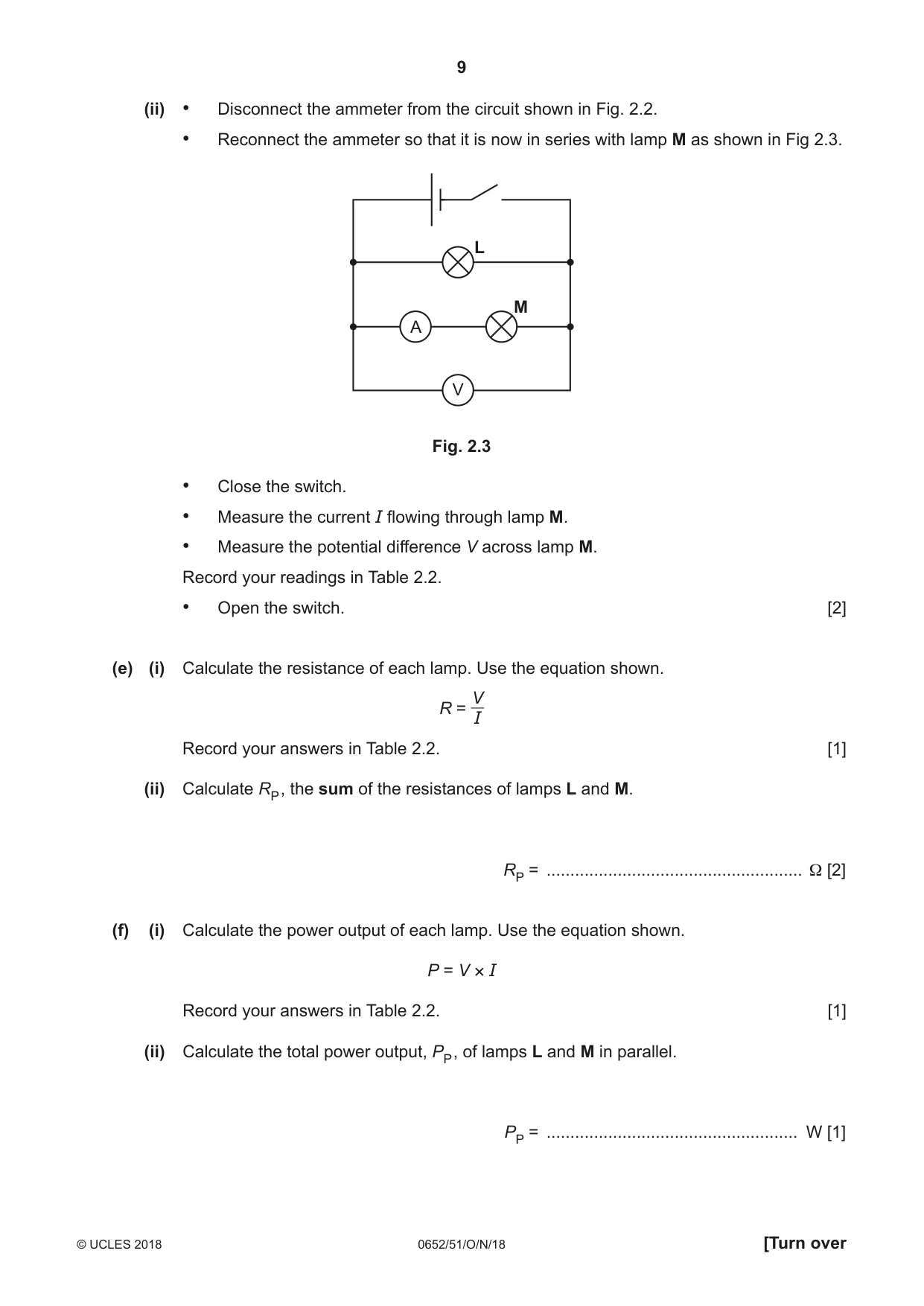
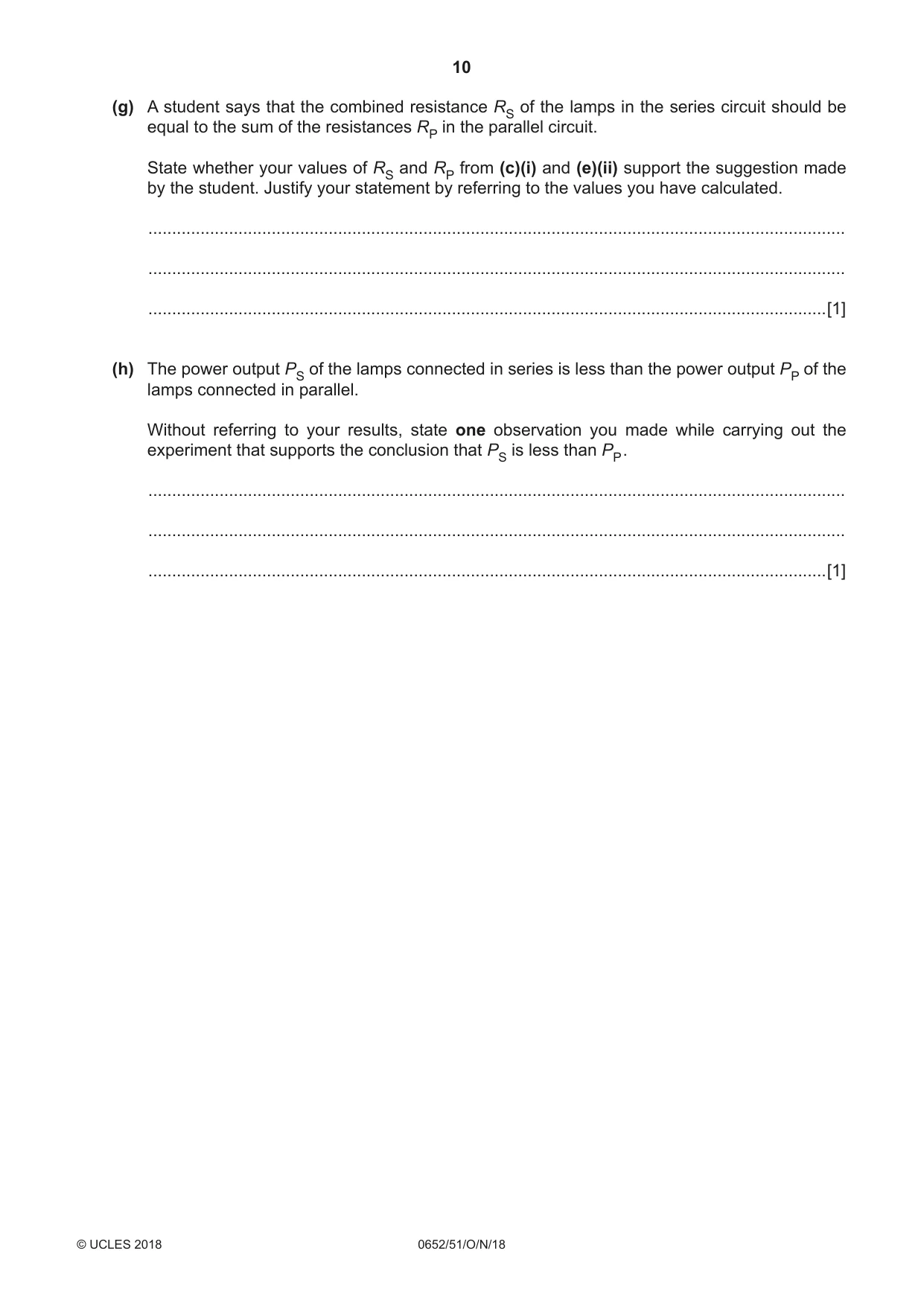
2 You are going to investigate the resistance and the power output of two lamps, L and M, connected in series and in parallel. The circuit shown in Fig. 2.1 has been set up for you. The lamps are connected in series. A L M V Fig. 2.1 (a) • Close the switch. • Measure the current I flowing through lamps L and M. • Measure the potential difference V across the lamps. Record your readings in Table 2.1. • Open the switch. [2] Table 2.1 I / A V / V resistance RS power PS / Ω / W lamps L and M in series (b) State why it is important to open the switch after taking readings. ...............................................................................................................................................[1] (c) (i) Calculate the combined resistance RS of lamps L and M when connected in series. Use the equation shown. V R = I Record your answer in Table 2.1. [1] (ii) Calculate the combined power output PS of lamps L and M when connected in series. Use the equation shown. P = V × I Record your answer in Table 2.1. [1] (d) Rearrange the circuit and set it up as shown in Fig. 2.2. Lamps L and M are now connected in parallel with the power supply. L A M V Fig. 2.2 (i) • Close the switch. • Measure the current I flowing through lamp L. • Measure the potential difference V across lamp L. Record your readings in Table 2.2. • Open the switch. [1] Table 2.2 I / A V / V resistance R power P / Ω / W lamp L in parallel lamp M in parallel (ii) • Disconnect the ammeter from the circuit shown in Fig. 2.2. • Reconnect the ammeter so that it is now in series with lamp M as shown in Fig 2.3. L M A V Fig. 2.3 • Close the switch. • Measure the current I flowing through lamp M. • Measure the potential difference V across lamp M. Record your readings in Table 2.2. • Open the switch. [2] (e) (i) Calculate the resistance of each lamp. Use the equation shown. V R = I Record your answers in Table 2.2. [1] (ii) Calculate RP , the sum of the resistances of lamps L and M. RP = ...................................................... Ω [2] (f) (i) Calculate the power output of each lamp. Use the equation shown. P = V × I Record your answers in Table 2.2. [1] (ii) Calculate the total power output, PP , of lamps L and M in parallel. PP = ..................................................... W [1]
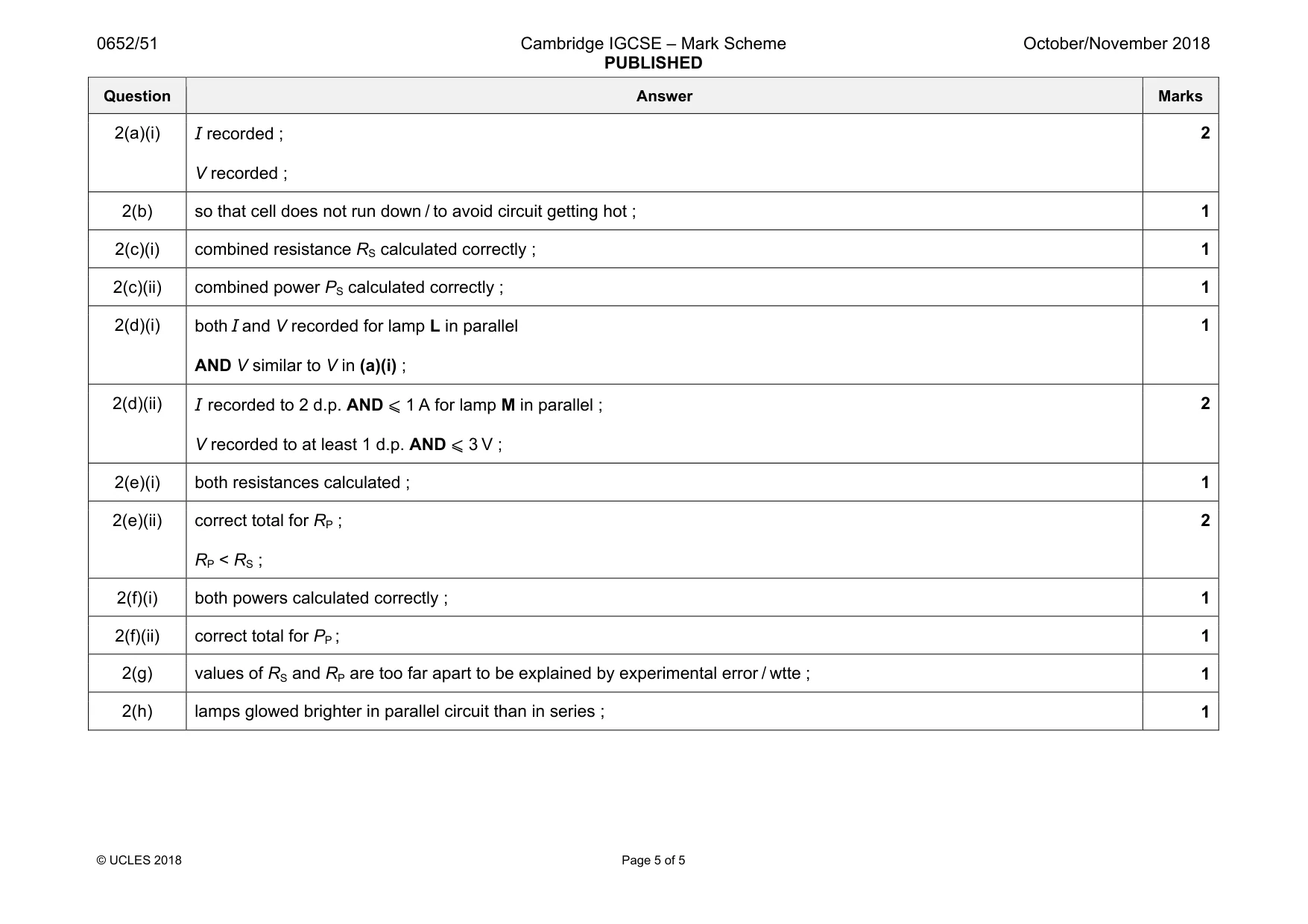
Mark scheme: 2(a)(i) V recorded ; 2 2(b) so that cell does not run down / to avoid circuit getting hot ; 1 2(c)(i) combined resistance RS calculated correctly ; 1 2(c)(ii) combined power PS calculated correctly ; 1 2(d)(i) both I and V recorded for lamp L in parallel AND V similar to V in (a)(i) ; 1 2(d)(ii) I recorded to 2 d.p. AND ⩽ 1 A for lamp M in parallel ; V recorded to at least 1 d.p. AND ⩽ 3 V ; 2 2(e)(i) both resistances calculated ; 1 2(e)(ii) correct total for RP ; RP < RS ; 2 2(f)(i) both powers calculated correctly ; 1 2(f)(ii) correct total for PP ; 1 2(g) values of RS and RP are too far apart to be explained by experimental error / wtte ; 1 2(h) lamps glowed brighter in parallel circuit than in series ; 1
What was in this paper
The subtopics covered by these 2 questions, and how many questions each got. Open one in a new tab to see every Cambridge question on it.
What you needed in this session
Cambridge’s own grade thresholds for 2018 Oct/Nov, Paper 5 · Variant 1. A higher threshold means an easier paper — the bar moves with how the cohort did.