Cambridge IGCSE Physical Science 0652 — 2021 Oct/Nov Paper 5 · Variant 1
0652/51/O/N/21 · 4 questions · 40 marks · ≈45 min
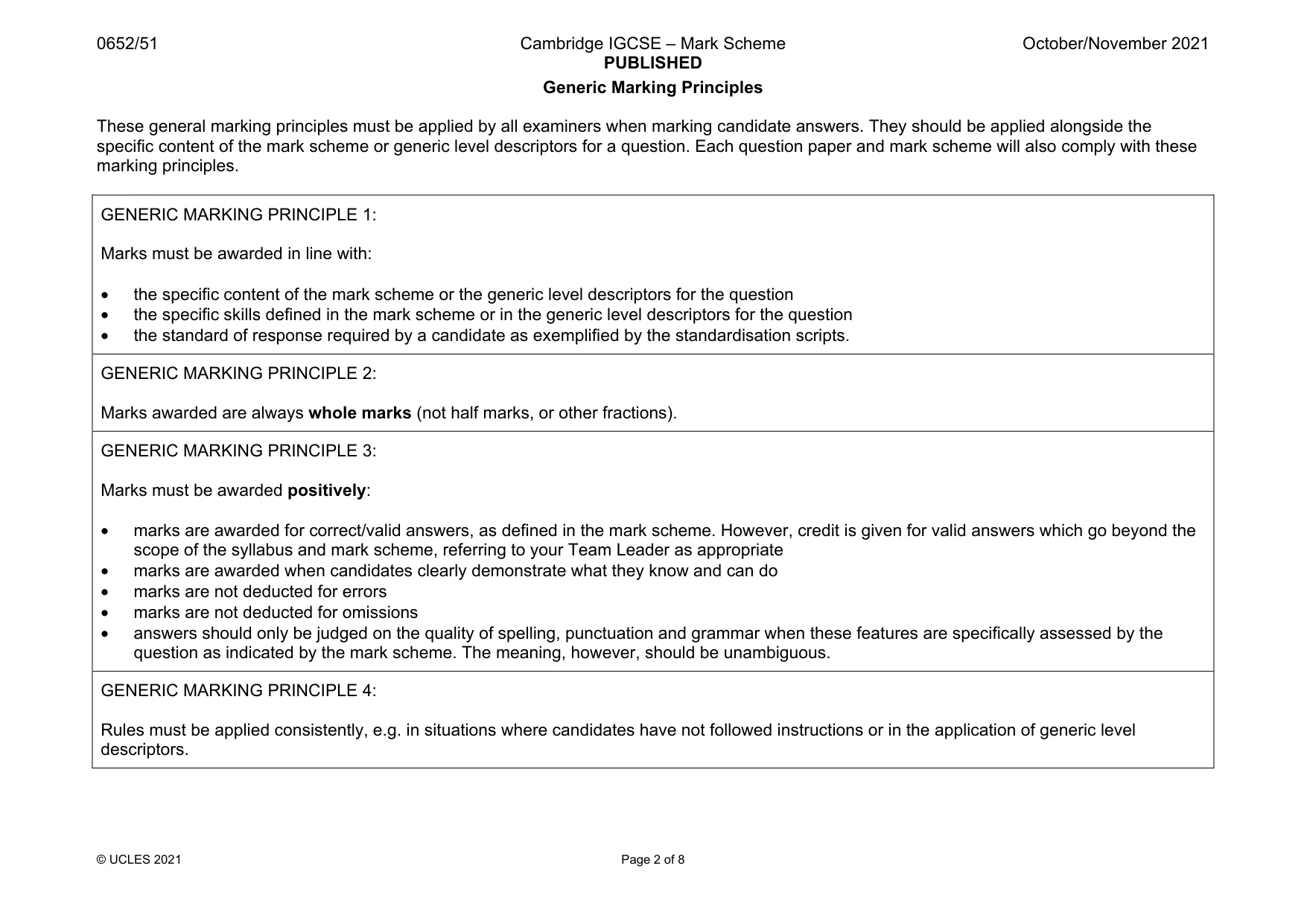
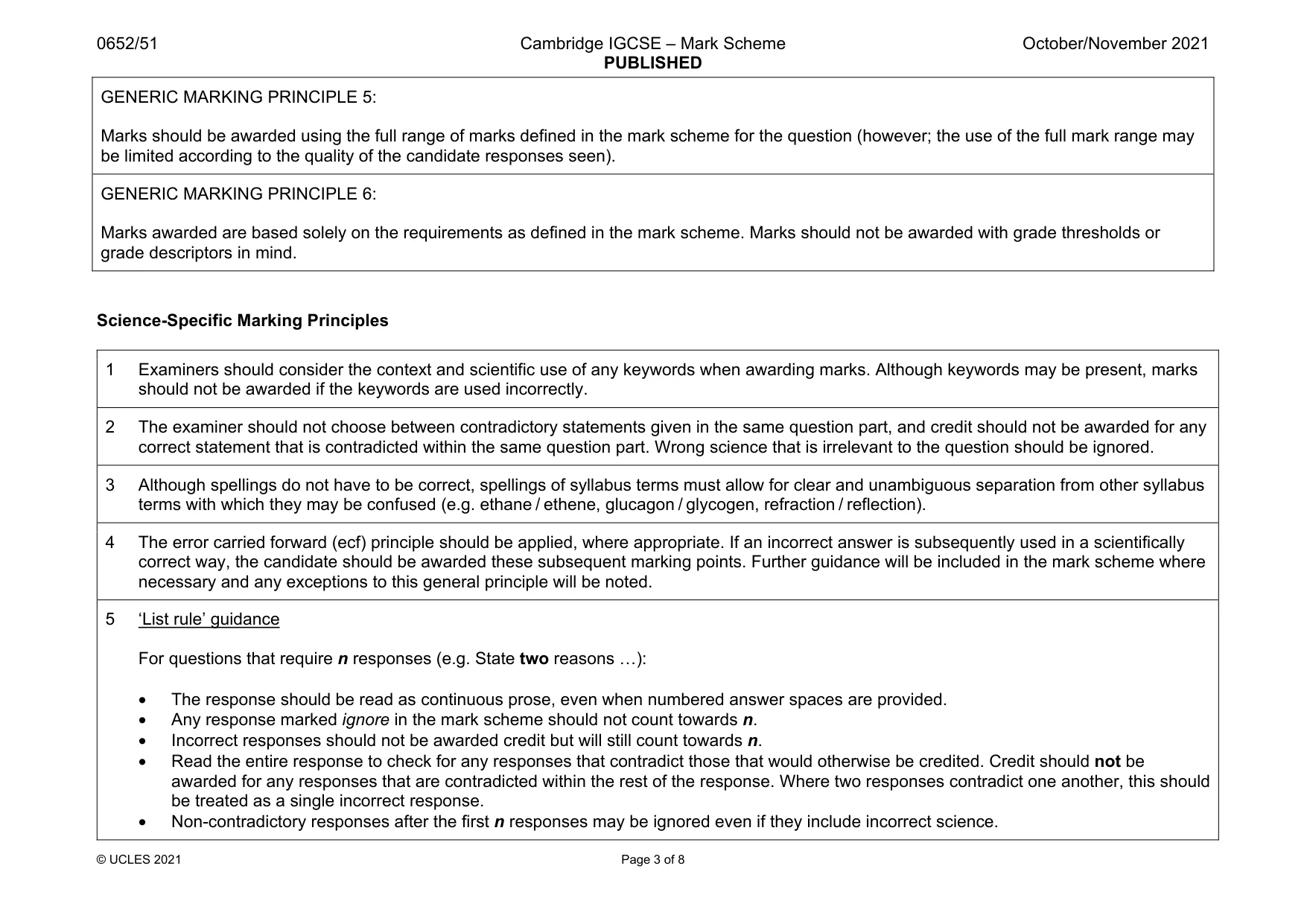
The question paper and its mark scheme, free to read here and free to download. This is Cambridge’s own paper, exactly as it was sat.
Question paper20 pages
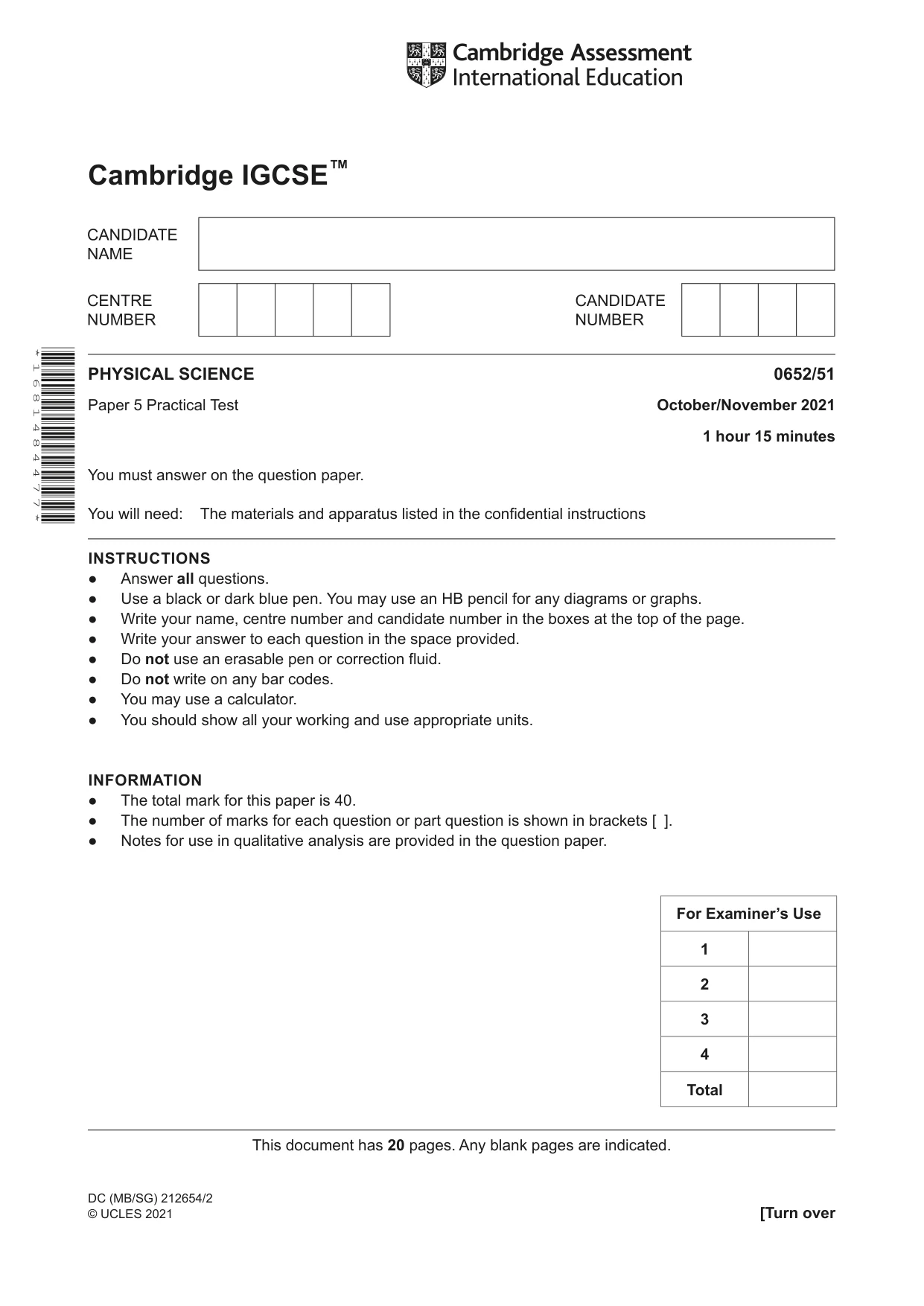





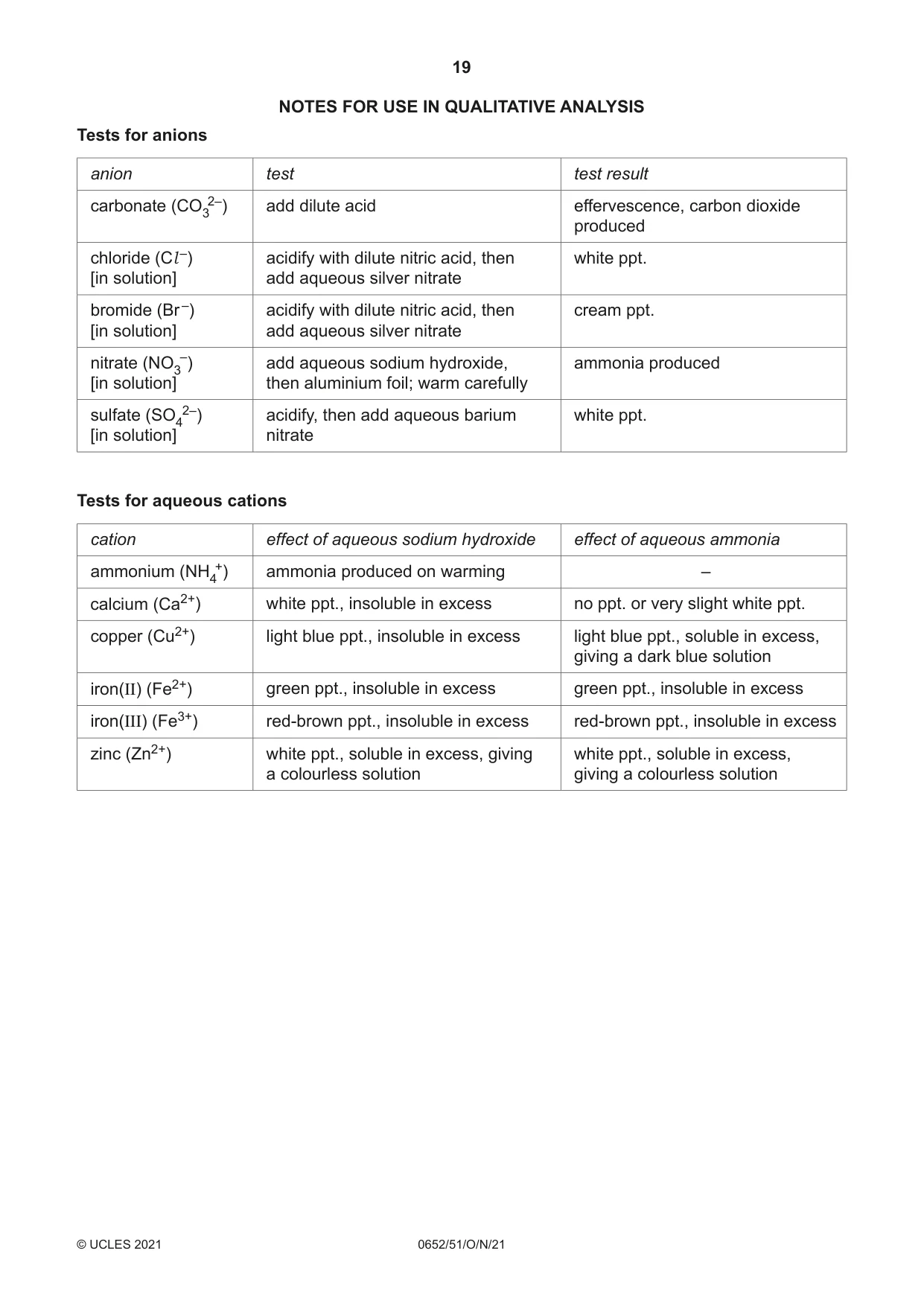
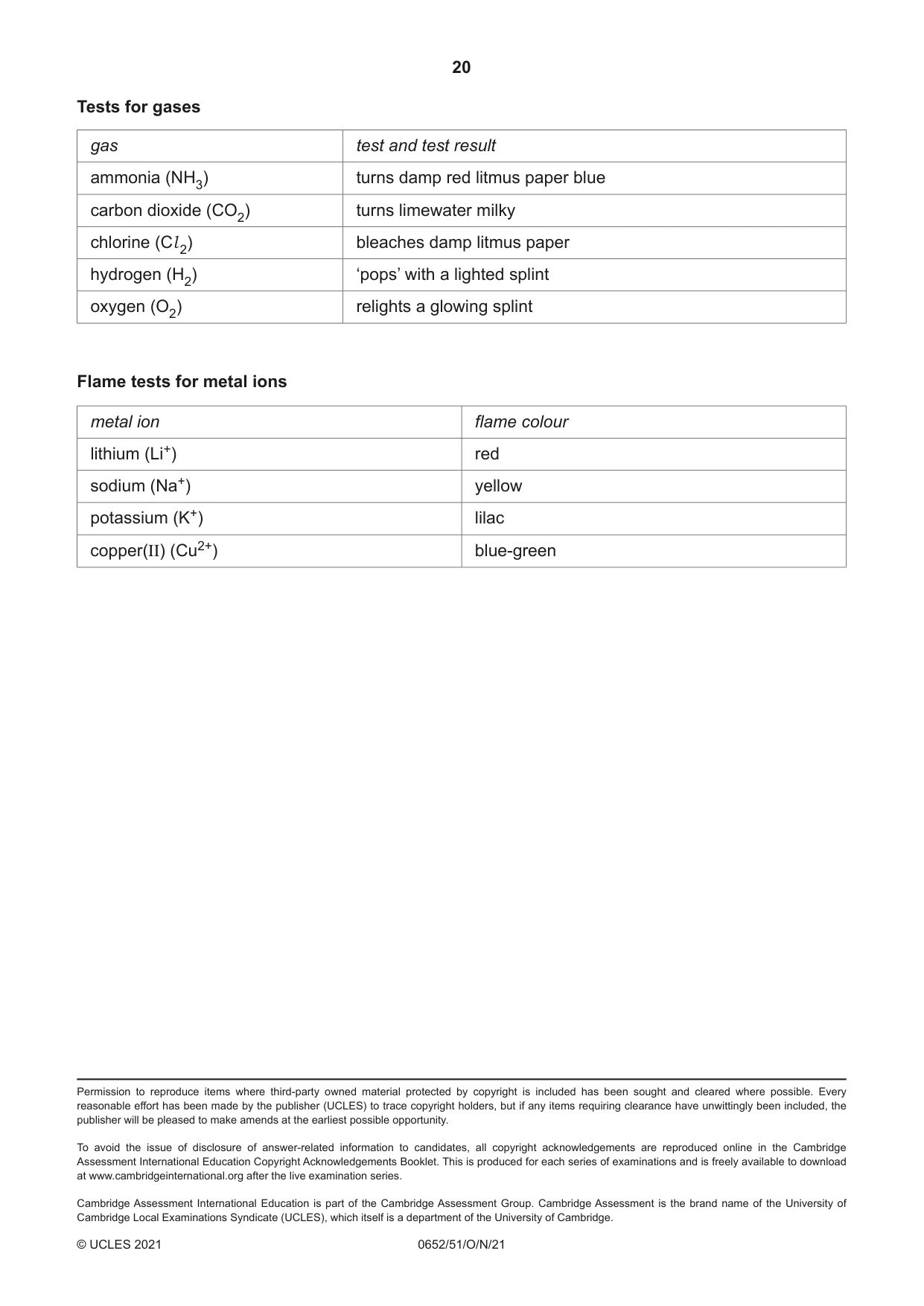
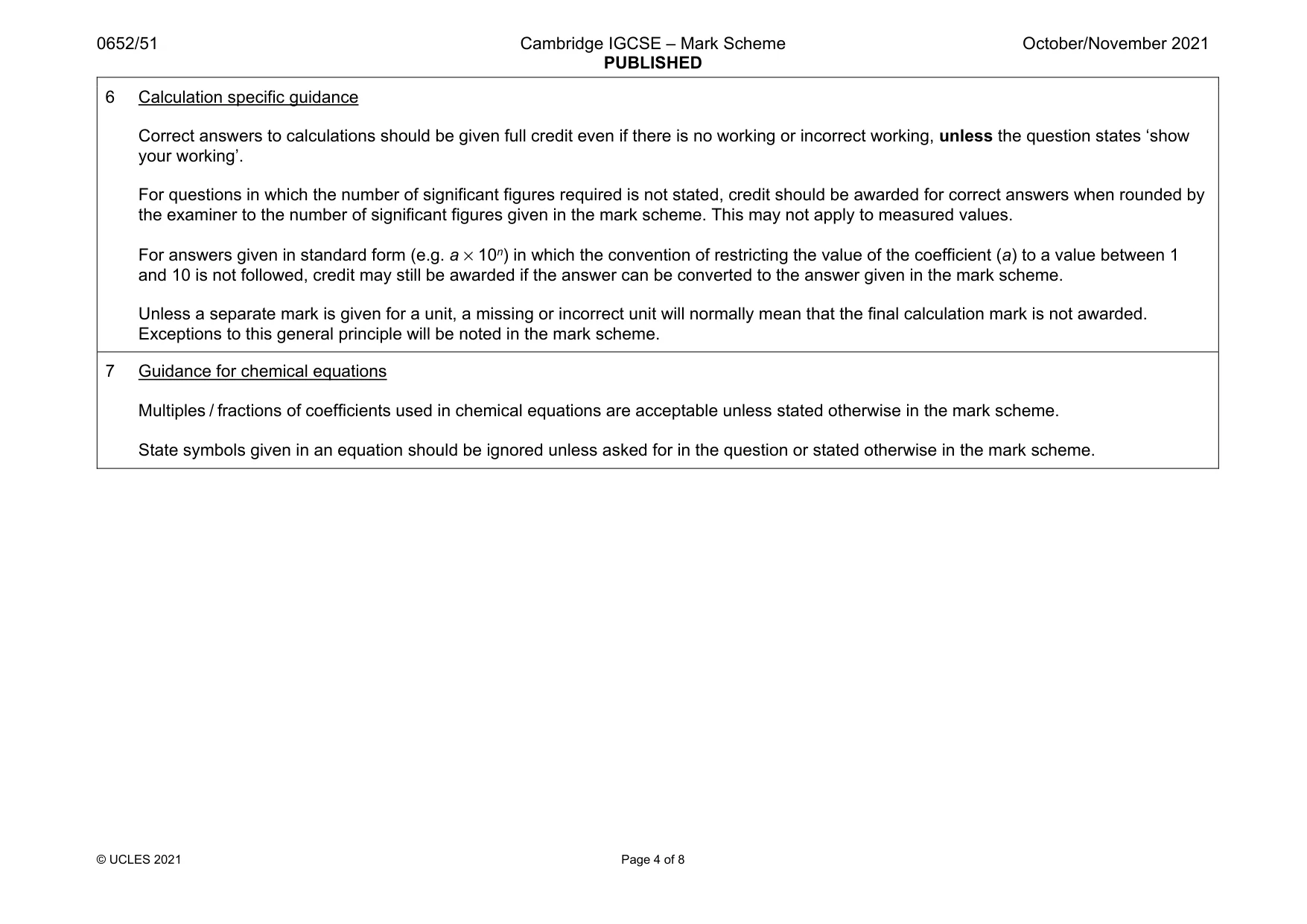
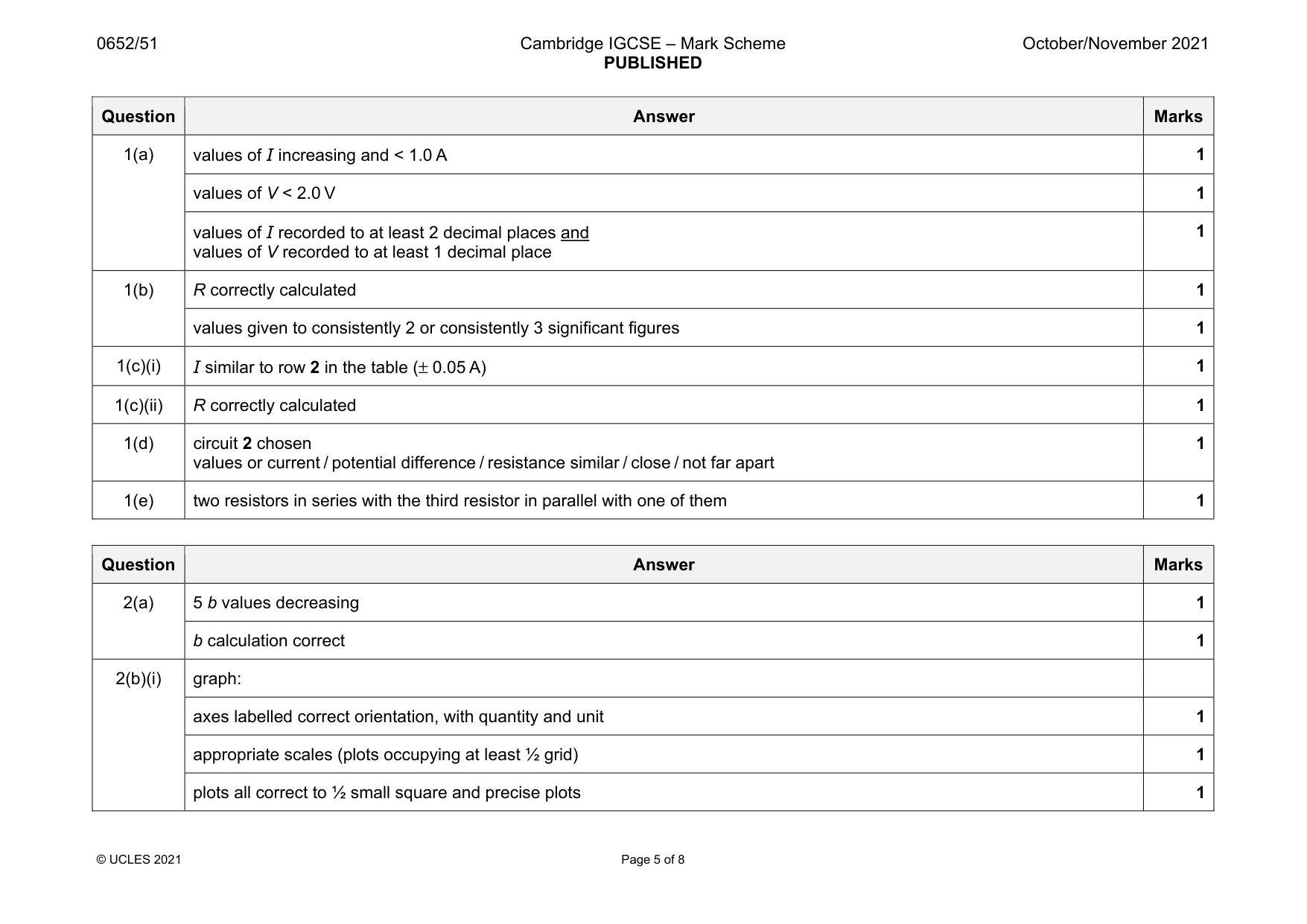
Mark scheme8 pages
Answers below. Sit the paper first if you are practising.
Questions as text
Q1 · You are going to investigate different arrangements of resistors
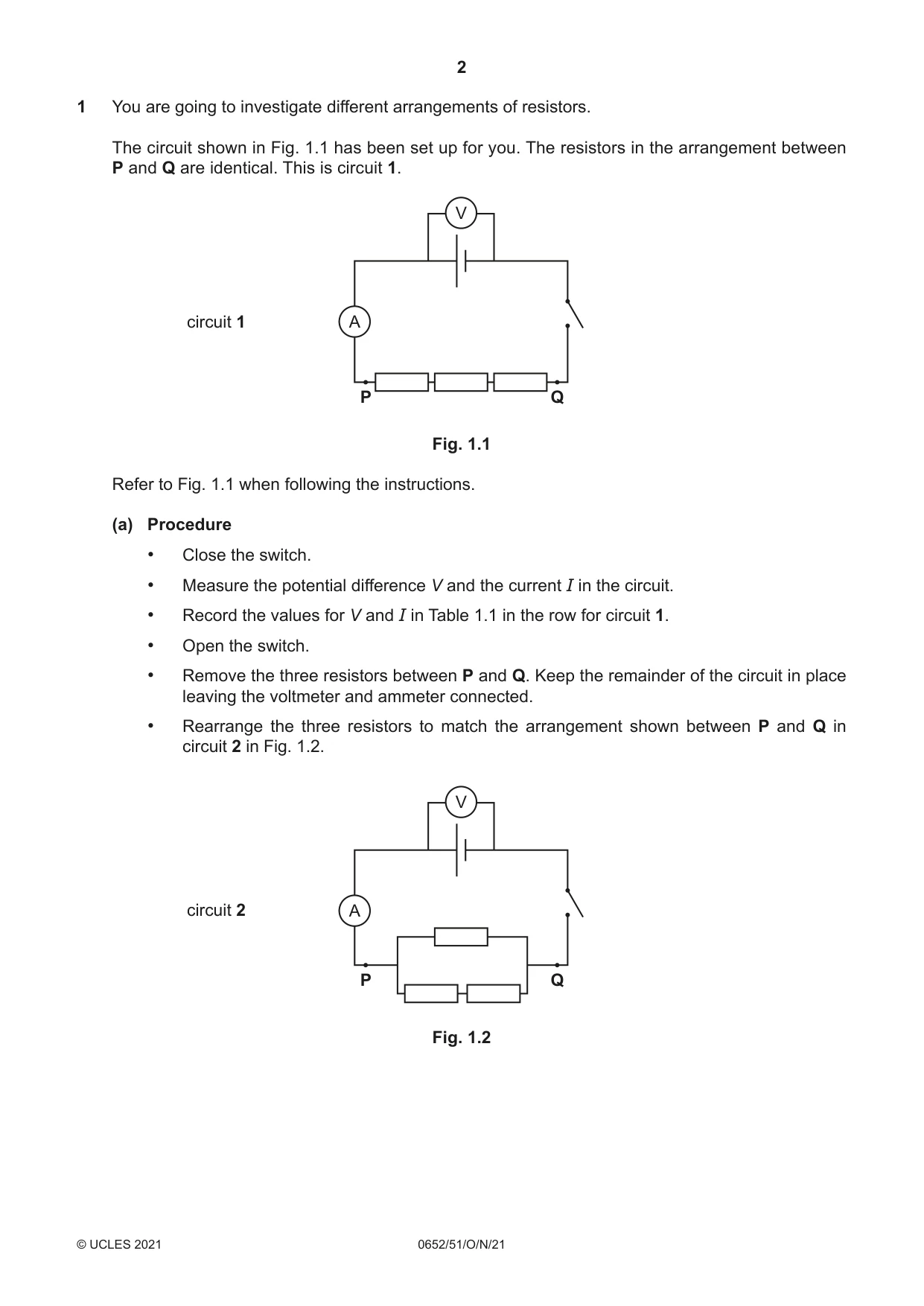
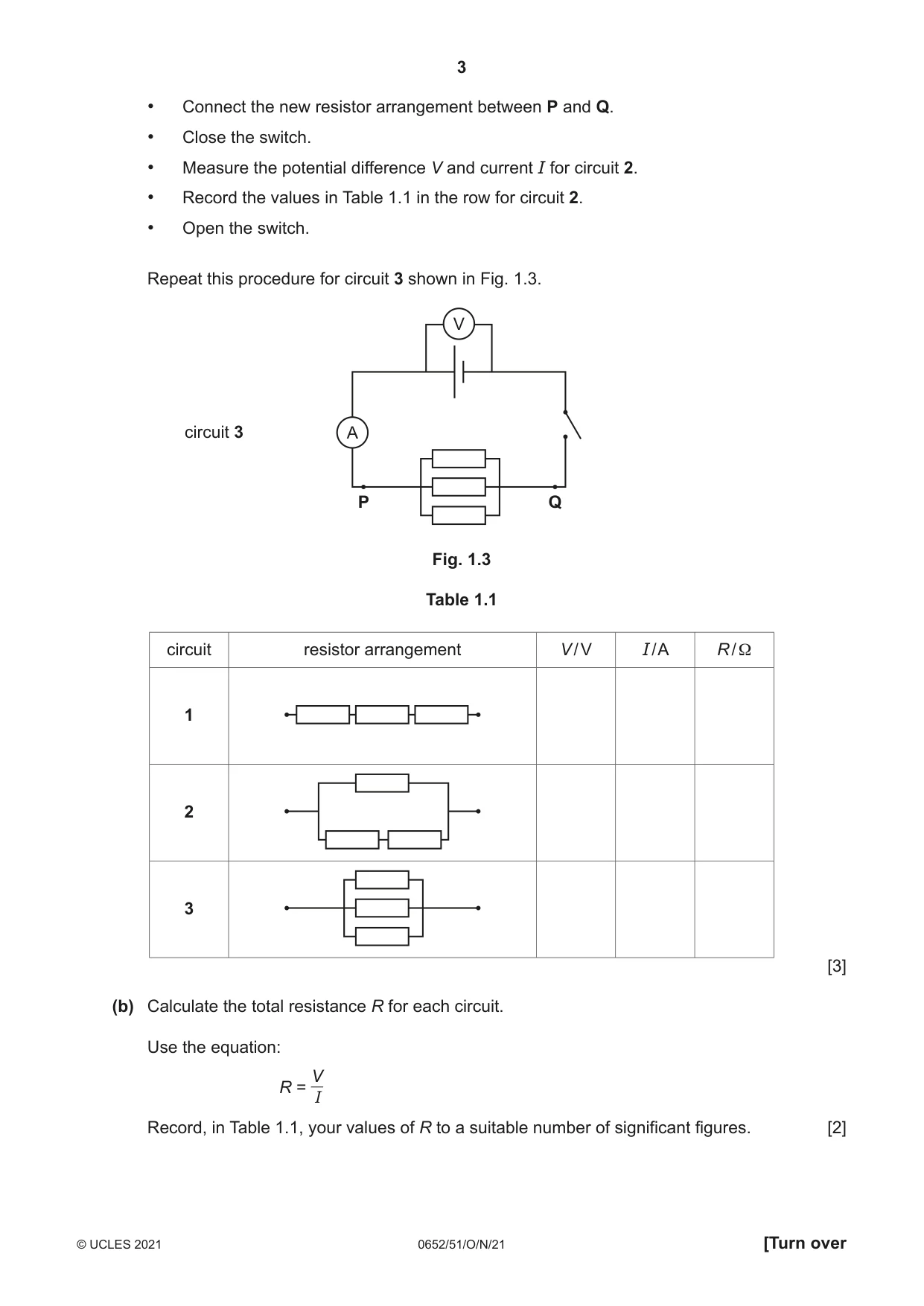
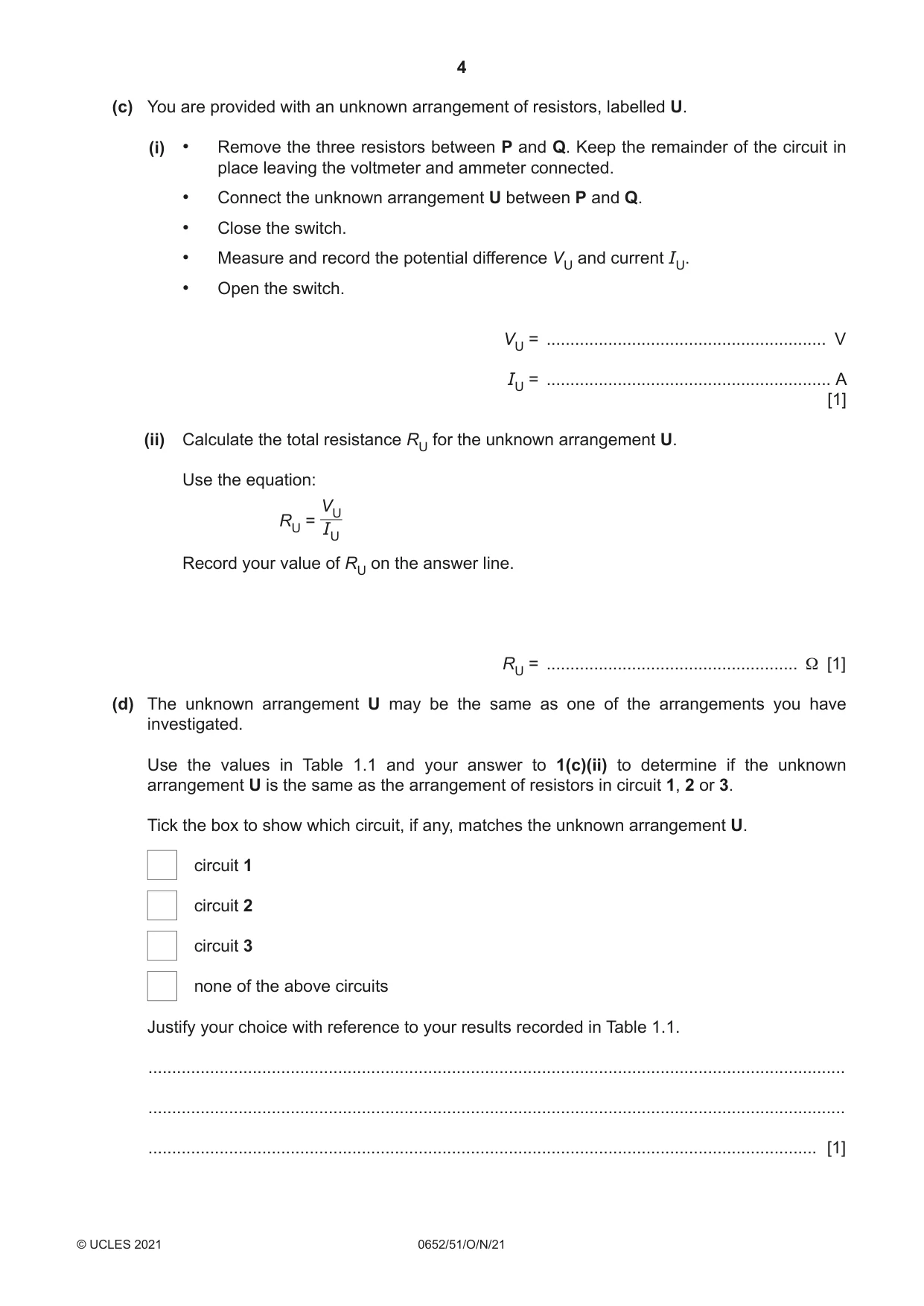
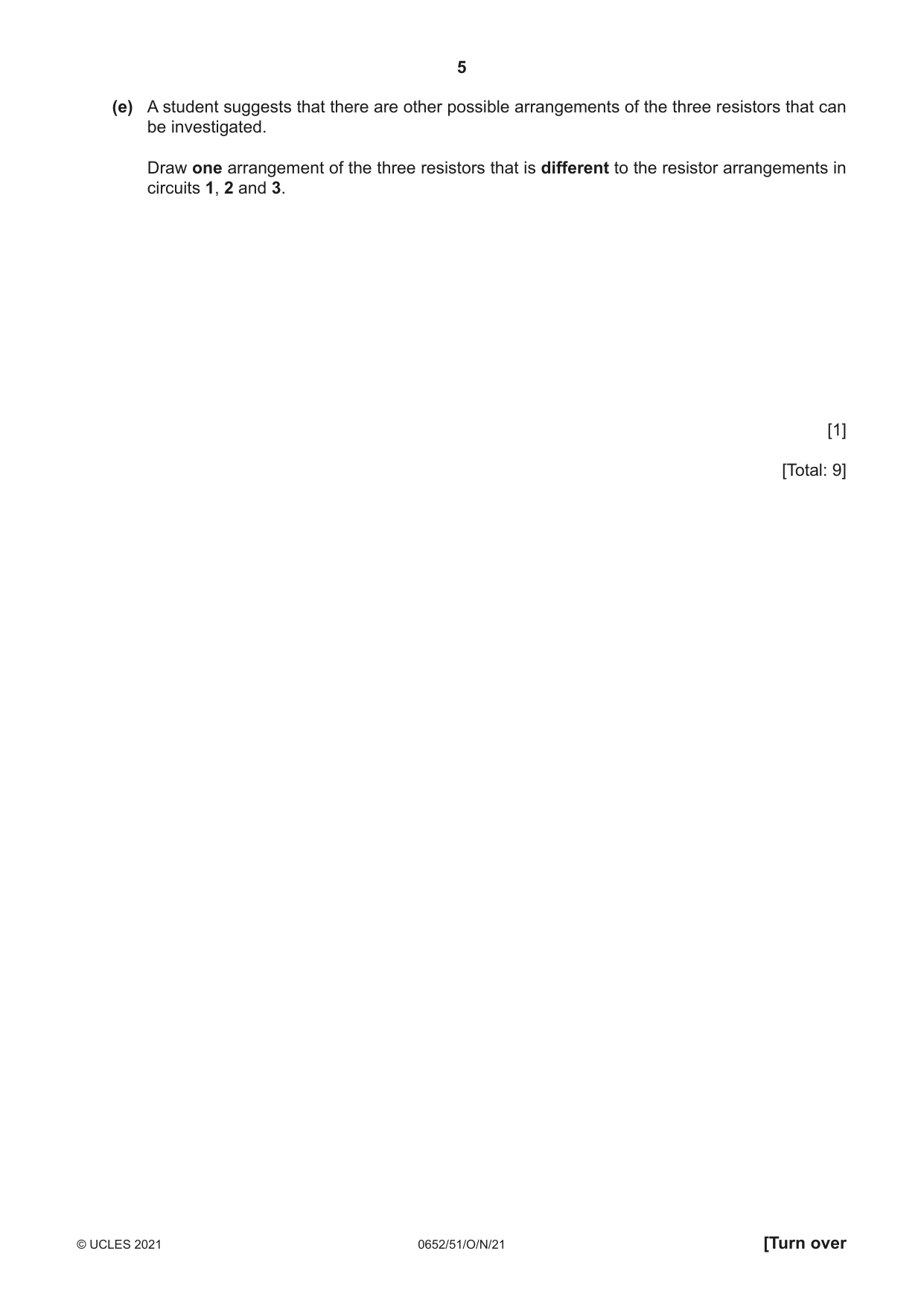
1 You are going to investigate different arrangements of resistors. The circuit shown in Fig. 1.1 has been set up for you. The resistors in the arrangement between P and Q are identical. This is circuit 1. V circuit 1 A P Q Fig. 1.1 Refer to Fig. 1.1 when following the instructions. (a) Procedure • Close the switch. • Measure the potential difference V and the current I in the circuit. • Record the values for V and I in Table 1.1 in the row for circuit 1. • Open the switch. • Remove the three resistors between P and Q. Keep the remainder of the circuit in place leaving the voltmeter and ammeter connected. • Rearrange the three resistors to match the arrangement shown between P and Q in circuit 2 in Fig. 1.2. V circuit 2 A P Q Fig. 1.2 • Connect the new resistor arrangement between P and Q. • Close the switch. • Measure the potential difference V and current I for circuit 2. • Record the values in Table 1.1 in the row for circuit 2. • Open the switch. Repeat this procedure for circuit 3 shown in Fig. 1.3. V circuit 3 A P Q Fig. 1.3 Table 1.1 circuit resistor arrangement V / V I / A R / Ω 1 2 3 [3] (b) Calculate the total resistance R for each circuit. Use the equation: V R = I Record, in Table 1.1, your values of R to a suitable number of significant figures. [2] (c) You are provided with an unknown arrangement of resistors, labelled U. (i) • Remove the three resistors between P and Q. Keep the remainder of the circuit in place leaving the voltmeter and ammeter connected. • Connect the unknown arrangement U between P and Q. • Close the switch. • Measure and record the potential difference VU and current IU. • Open the switch. VU = ........................................................... V IU = ............................................................ A [1] (ii) Calculate the total resistance RU for the unknown arrangement U. Use the equation: VU RU = IU Record your value of RU on the answer line. RU = ..................................................... Ω [1] (d) The unknown arrangement U may be the same as one of the arrangements you have investigated. Use the values in Table 1.1 and your answer to 1(c)(ii) to determine if the unknown arrangement U is the same as the arrangement of resistors in circuit 1, 2 or 3. Tick the box to show which circuit, if any, matches the unknown arrangement U. circuit 1 circuit 2 circuit 3 none of the above circuits Justify your choice with reference to your results recorded in Table 1.1. ................................................................................................................................................... ................................................................................................................................................... ............................................................................................................................................. [1] (e) A student suggests that there are other possible arrangements of the three resistors that can be investigated. Draw one arrangement of the three resistors that is different to the resistor arrangements in circuits 1, 2 and 3. [1] [Total: 9]
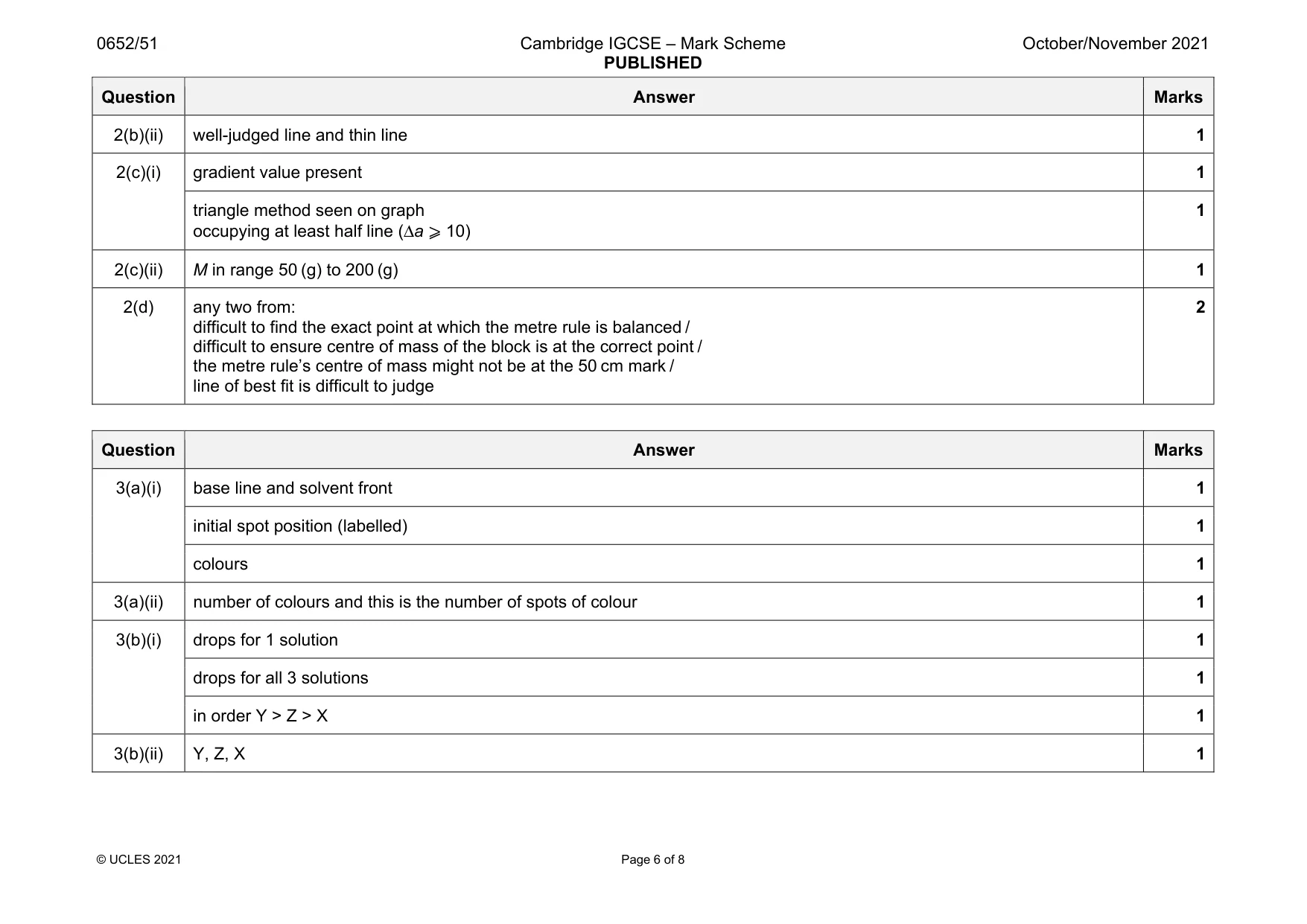
Mark scheme: 1(a) 1 values of V < 2.0 V 1 values of I recorded to at least 2 decimal places and values of V recorded to at least 1 decimal place 1 1(b) R correctly calculated 1 values given to consistently 2 or consistently 3 significant figures 1 1(c)(i) I similar to row 2 in the table (± 0.05 A) 1 1(c)(ii) R correctly calculated 1 1(d) circuit 2 chosen values or current / potential difference / resistance similar / close / not far apart 1 1(e) two resistors in series with the third resistor in parallel with one of them 1
Q2 · You are going to determine the mass of a metre rule using a balancing method
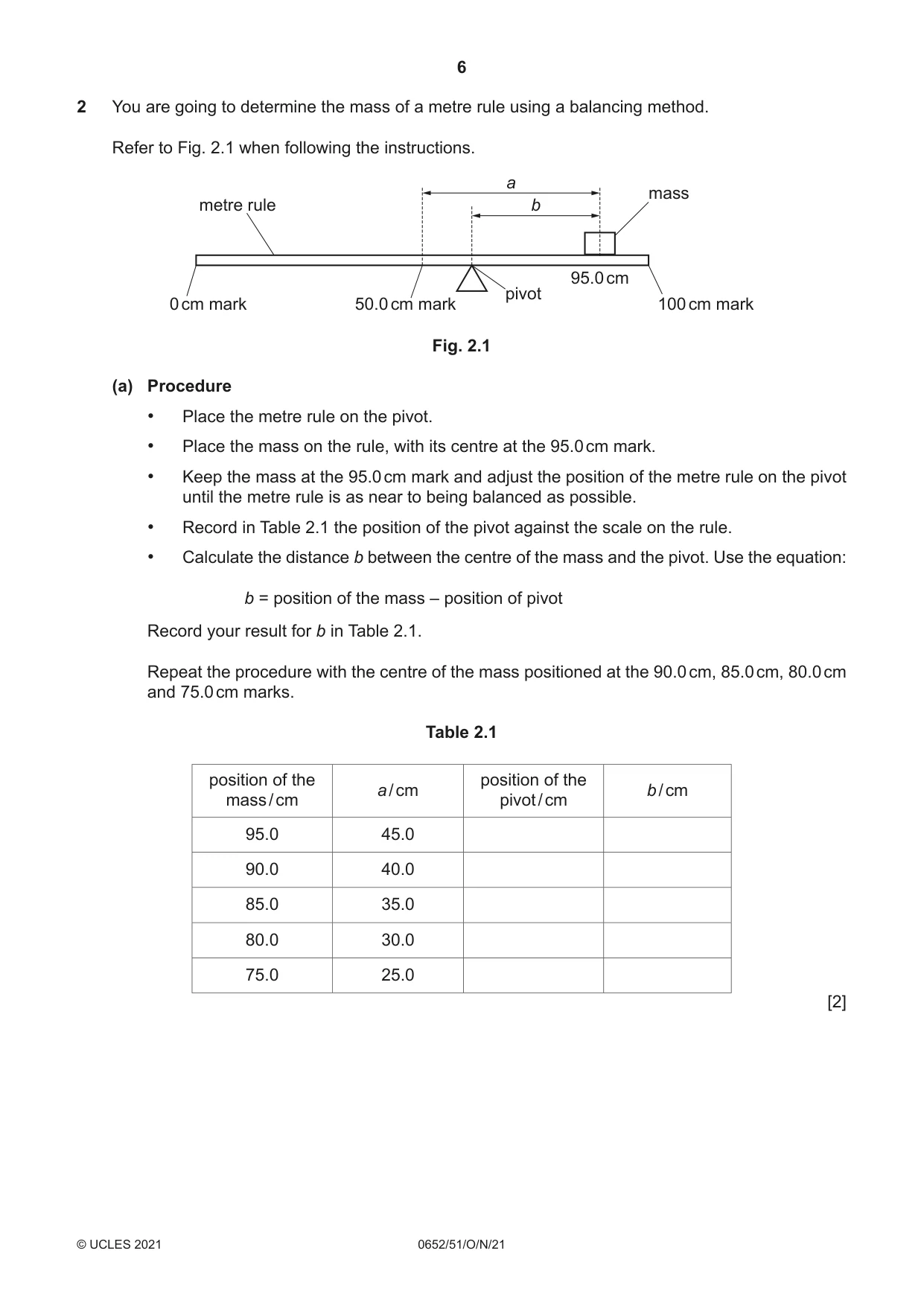
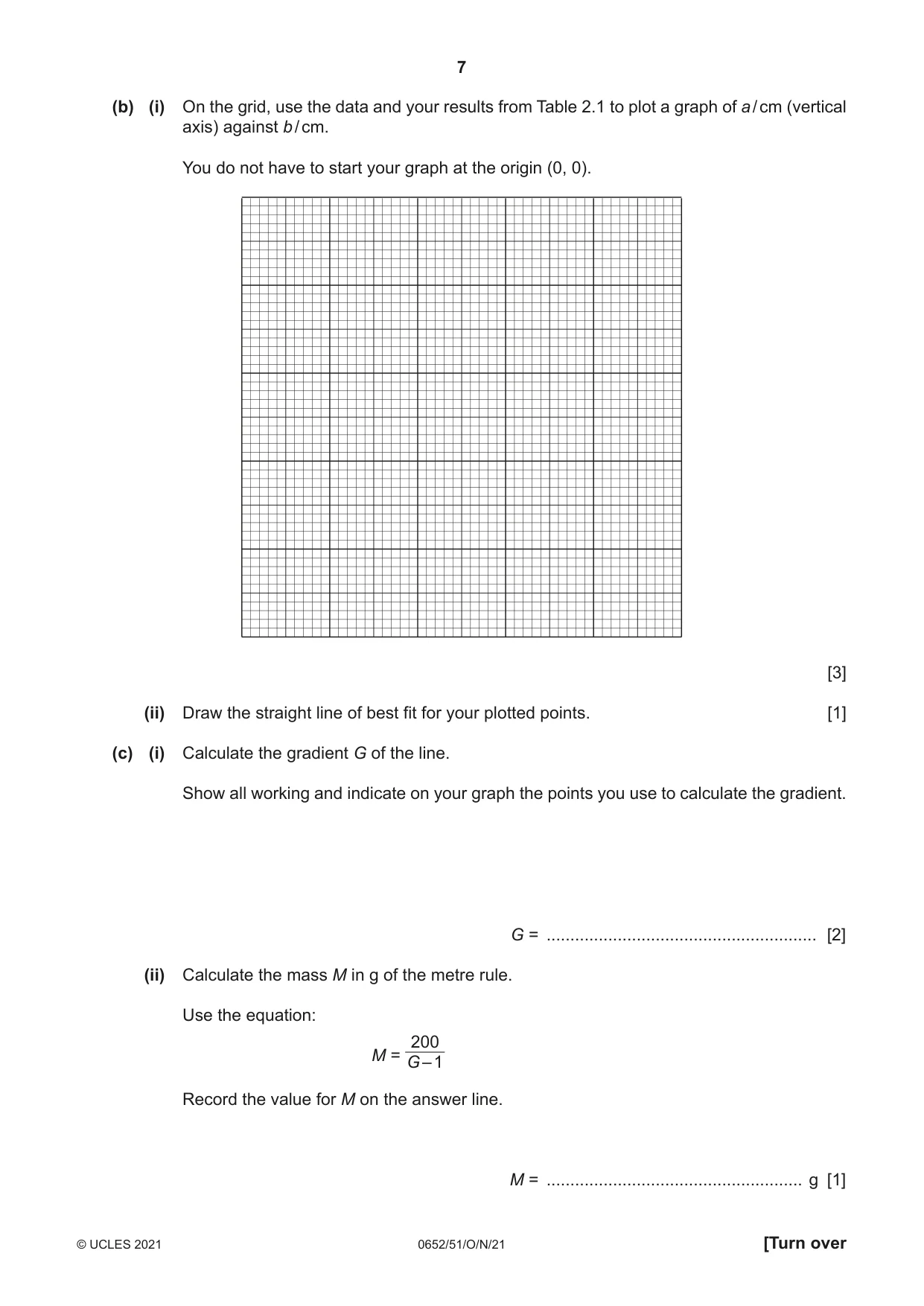
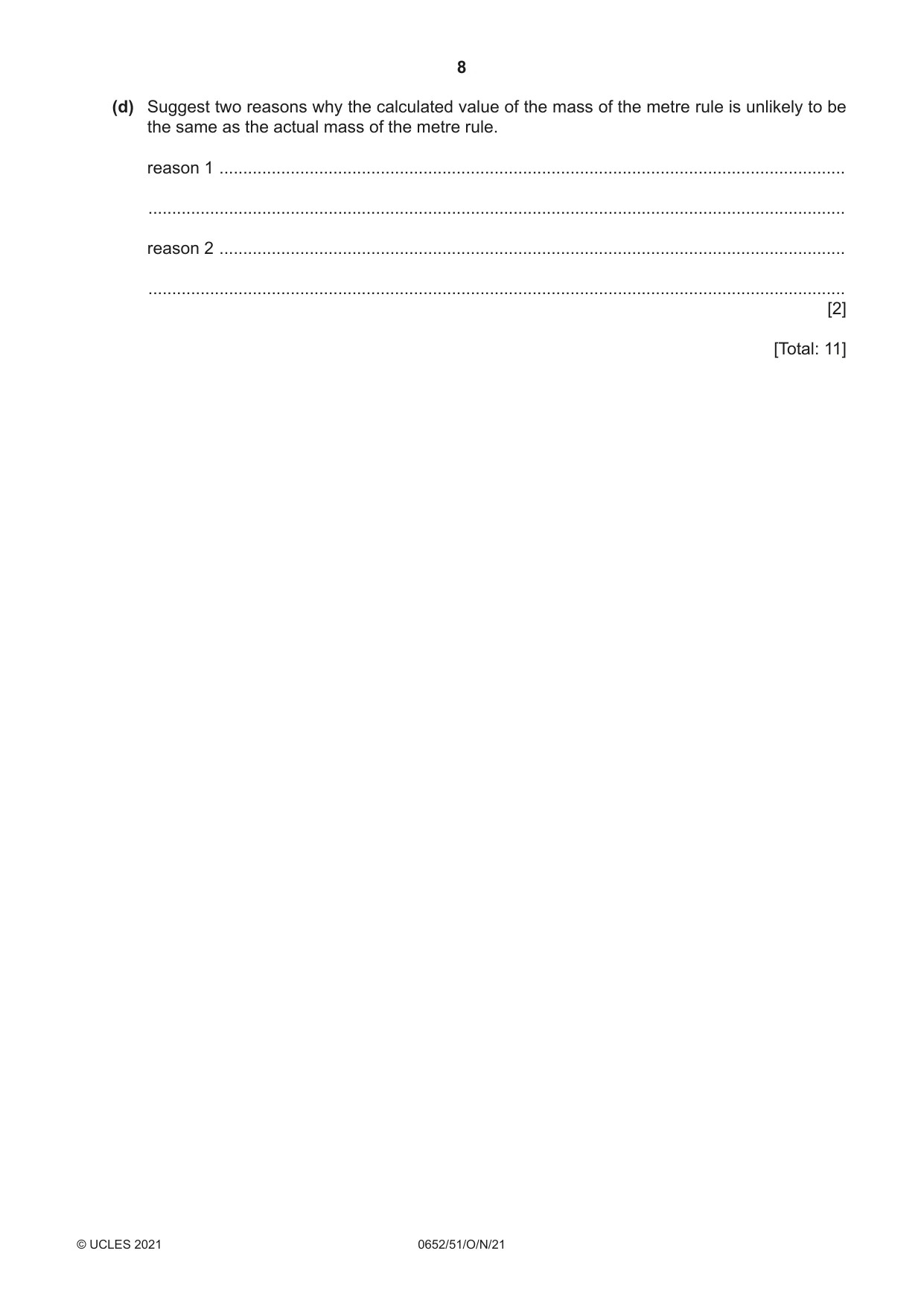
2 You are going to determine the mass of a metre rule using a balancing method. Refer to Fig. 2.1 when following the instructions. a mass metre rule b 95.0 cm pivot 0 cm mark 50.0 cm mark 100 cm mark Fig. 2.1 (a) Procedure • Place the metre rule on the pivot. • Place the mass on the rule, with its centre at the 95.0 cm mark. • Keep the mass at the 95.0 cm mark and adjust the position of the metre rule on the pivot until the metre rule is as near to being balanced as possible. • Record in Table 2.1 the position of the pivot against the scale on the rule. • Calculate the distance b between the centre of the mass and the pivot. Use the equation: b = position of the mass – position of pivot Record your result for b in Table 2.1. Repeat the procedure with the centre of the mass positioned at the 90.0 cm, 85.0 cm, 80.0 cm and 75.0 cm marks. Table 2.1 position of the position of the a / cm b / cm mass / cm pivot / cm 95.0 45.0 90.0 40.0 85.0 35.0 80.0 30.0 75.0 25.0 [2] (b) (i) On the grid, use the data and your results from Table 2.1 to plot a graph of a / cm (vertical axis) against b / cm. You do not have to start your graph at the origin (0, 0). [3] (ii) Draw the straight line of best fit for your plotted points. [1] (c) (i) Calculate the gradient G of the line. Show all working and indicate on your graph the points you use to calculate the gradient. G = ......................................................... [2] (ii) Calculate the mass M in g of the metre rule. Use the equation: 200 M = G – 1 Record the value for M on the answer line. M = ...................................................... g [1] (d) Suggest two reasons why the calculated value of the mass of the metre rule is unlikely to be the same as the actual mass of the metre rule. reason 1 .................................................................................................................................... ................................................................................................................................................... reason 2 .................................................................................................................................... ................................................................................................................................................... [2] [Total: 11] Question 3 begins over the page
Mark scheme: 2(a) 5 b values decreasing 1 b calculation correct 1 2(b)(i) graph: axes labelled correct orientation, with quantity and unit 1 appropriate scales (plots occupying at least ½ grid) 1 plots all correct to ½ small square and precise plots 1 Question Answer Marks 2(b)(ii) well-judged line and thin line 1 2(c)(i) gradient value present 1 triangle method seen on graph occupying at least half line (Δa ⩾ 10) 1 2(c)(ii) M in range 50 (g) to 200 (g) 1 2(d) any two from: difficult to find the exact point at which the metre rule is balanced / difficult to ensure centre of mass of the block is at the correct point / the metre rule’s centre of mass might not be at the 50 cm mark / line of best fit is difficult to judge 2
Q3 · In this investigation, you will: • investigate the colours that make up universal…
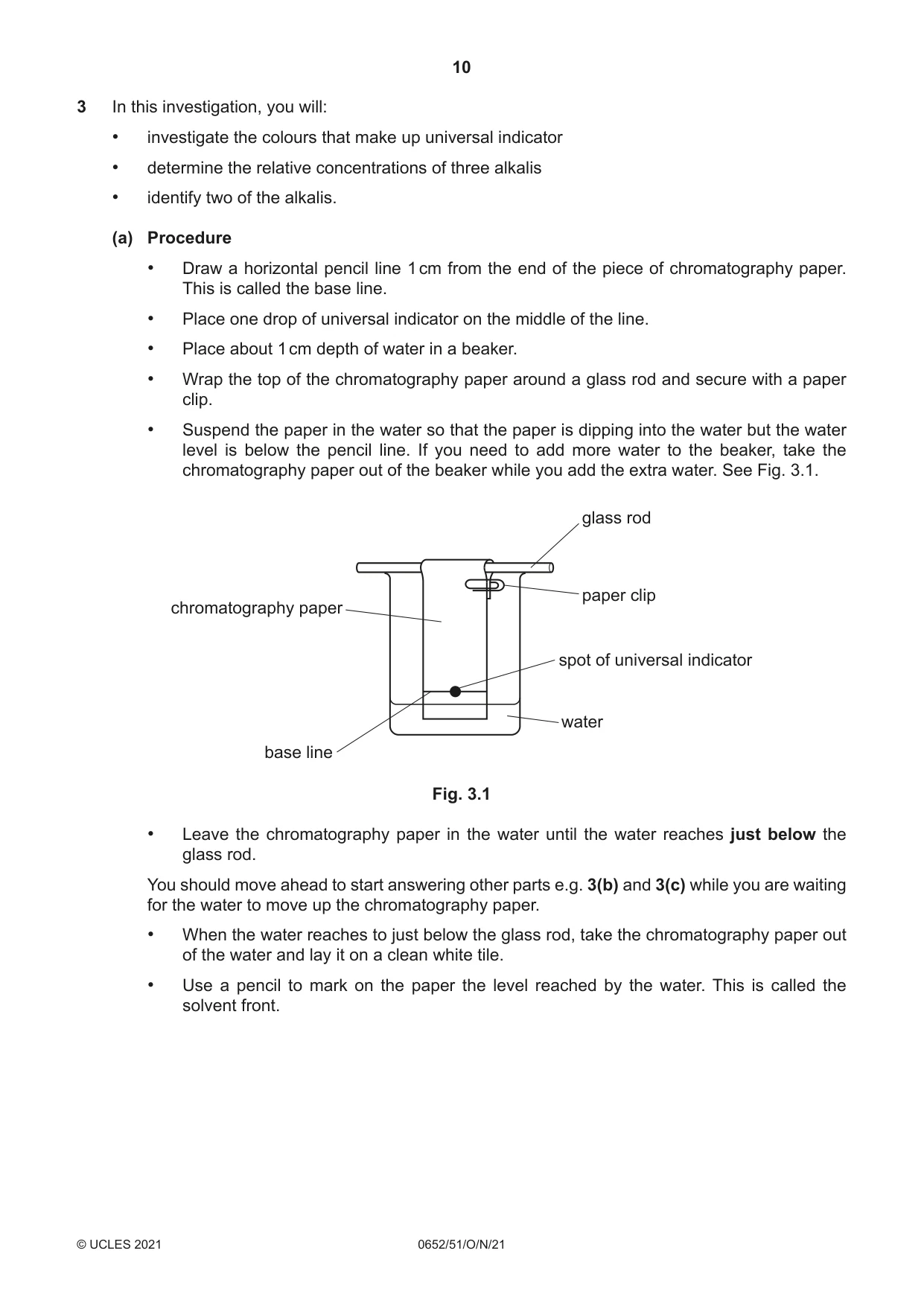
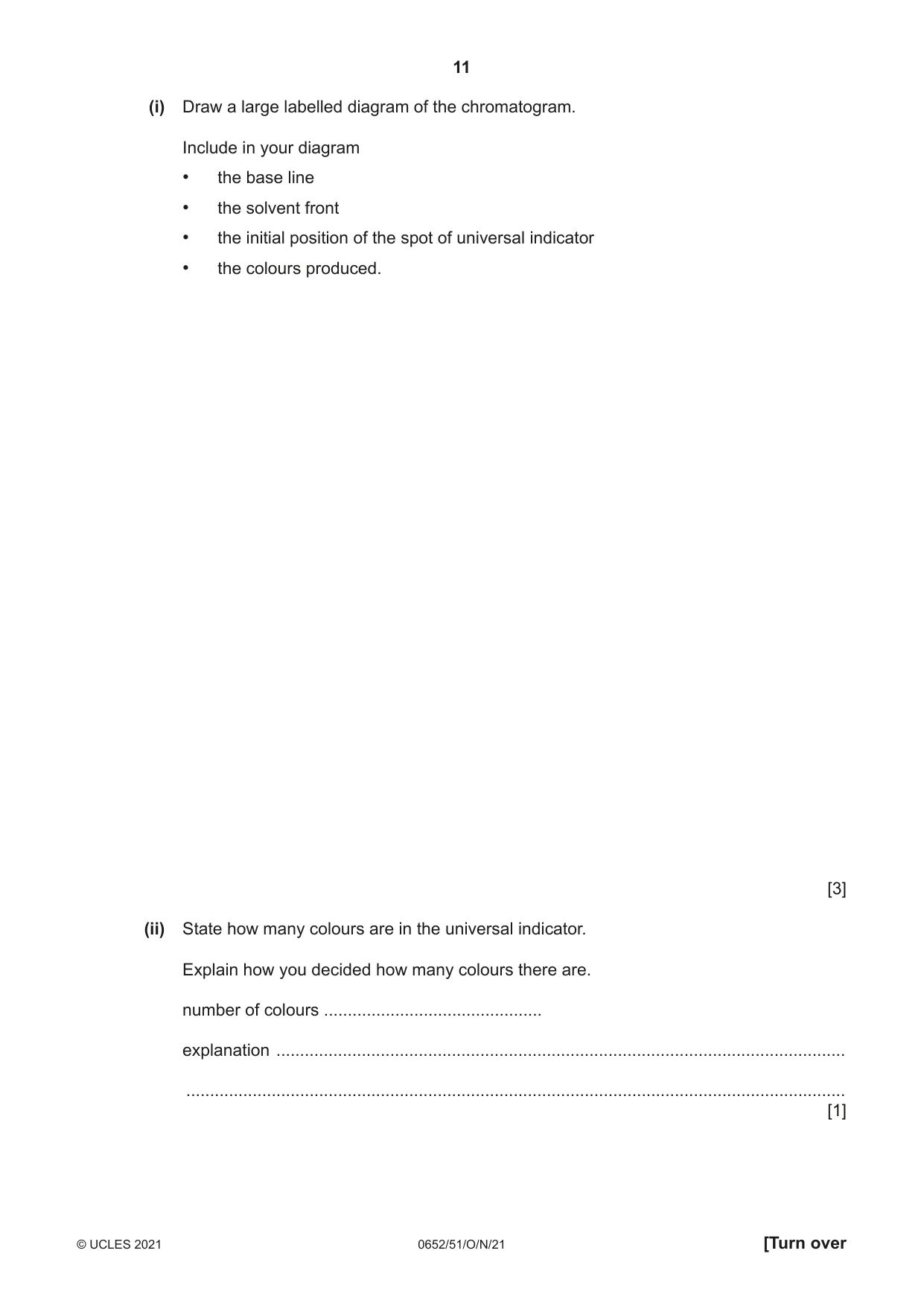
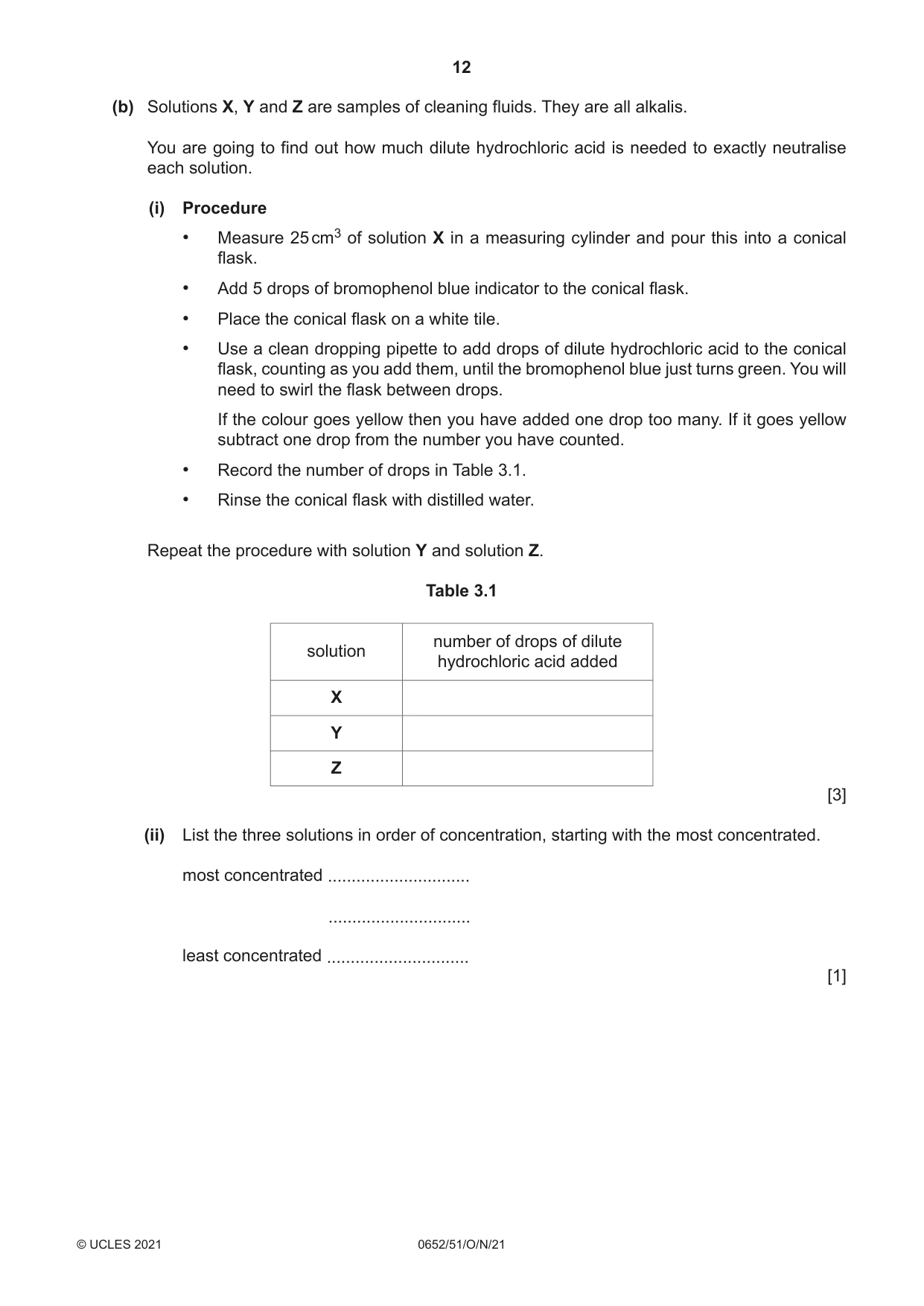
3 In this investigation, you will: • investigate the colours that make up universal indicator • determine the relative concentrations of three alkalis • identify two of the alkalis. (a) Procedure • Draw a horizontal pencil line 1 cm from the end of the piece of chromatography paper. This is called the base line. • Place one drop of universal indicator on the middle of the line. • Place about 1 cm depth of water in a beaker. • Wrap the top of the chromatography paper around a glass rod and secure with a paper clip. • Suspend the paper in the water so that the paper is dipping into the water but the water level is below the pencil line. If you need to add more water to the beaker, take the chromatography paper out of the beaker while you add the extra water. See Fig. 3.1. glass rod paper clip chromatography paper spot of universal indicator water base line Fig. 3.1 • Leave the chromatography paper in the water until the water reaches just below the glass rod. You should move ahead to start answering other parts e.g. 3(b) and 3(c) while you are waiting for the water to move up the chromatography paper. • When the water reaches to just below the glass rod, take the chromatography paper out of the water and lay it on a clean white tile. • Use a pencil to mark on the paper the level reached by the water. This is called the solvent front. (i) Draw a large labelled diagram of the chromatogram. Include in your diagram • the base line • the solvent front • the initial position of the spot of universal indicator • the colours produced. [3] (ii) State how many colours are in the universal indicator. Explain how you decided how many colours there are. number of colours .............................................. explanation ........................................................................................................................ ........................................................................................................................................... [1] (b) Solutions X, Y and Z are samples of cleaning fluids. They are all alkalis. You are going to find out how much dilute hydrochloric acid is needed to exactly neutralise each solution. (i) Procedure • Measure 25 cm3 of solution X in a measuring cylinder and pour this into a conical flask. • Add 5 drops of bromophenol blue indicator to the conical flask. • Place the conical flask on a white tile. • Use a clean dropping pipette to add drops of dilute hydrochloric acid to the conical flask, counting as you add them, until the bromophenol blue just turns green. You will need to swirl the flask between drops. If the colour goes yellow then you have added one drop too many. If it goes yellow subtract one drop from the number you have counted. • Record the number of drops in Table 3.1. • Rinse the conical flask with distilled water. Repeat the procedure with solution Y and solution Z. Table 3.1 number of drops of dilute solution hydrochloric acid added X Y Z [3] (ii) List the three solutions in order of concentration, starting with the most concentrated. most concentrated .............................. .............................. least concentrated .............................. [1]
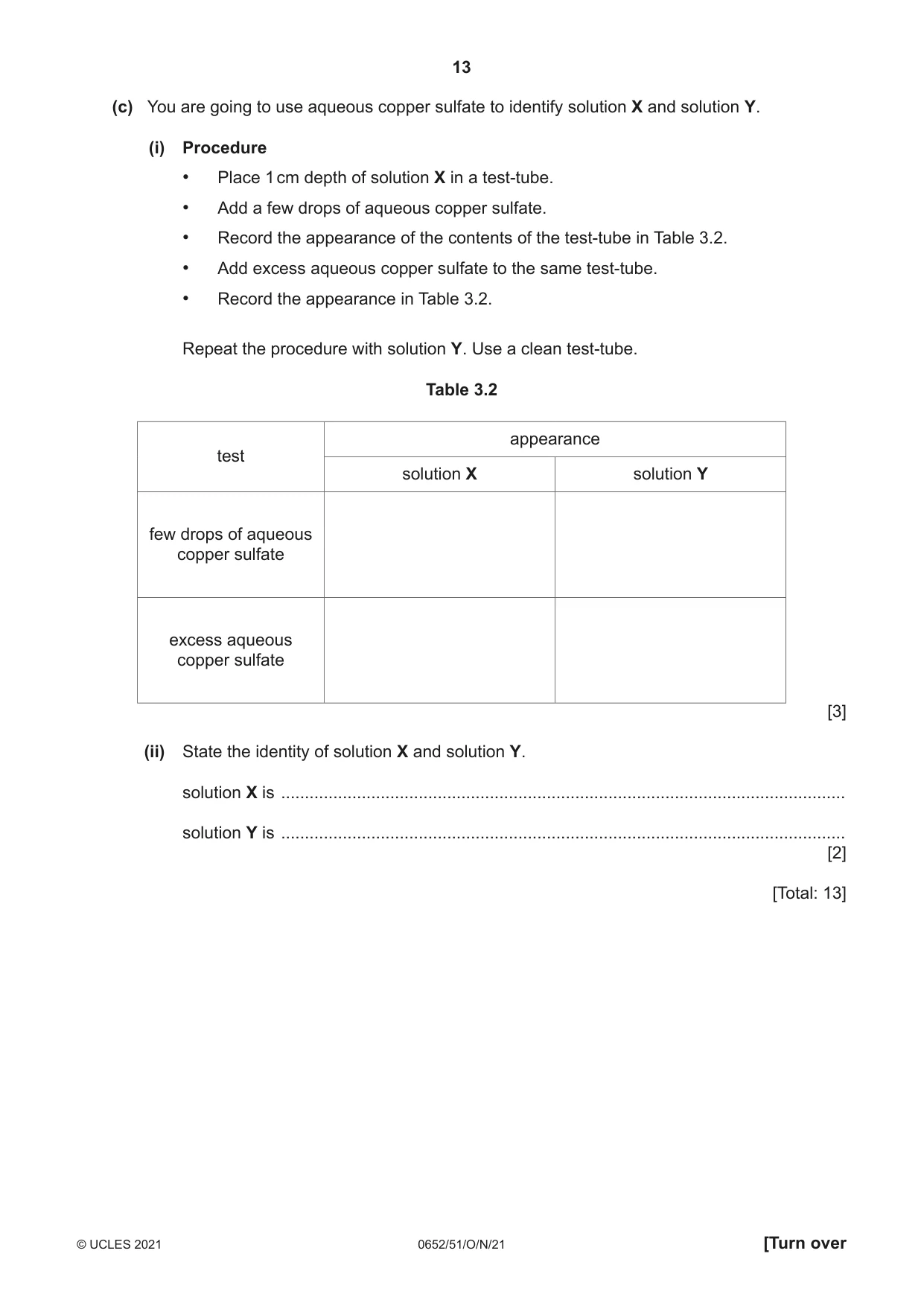
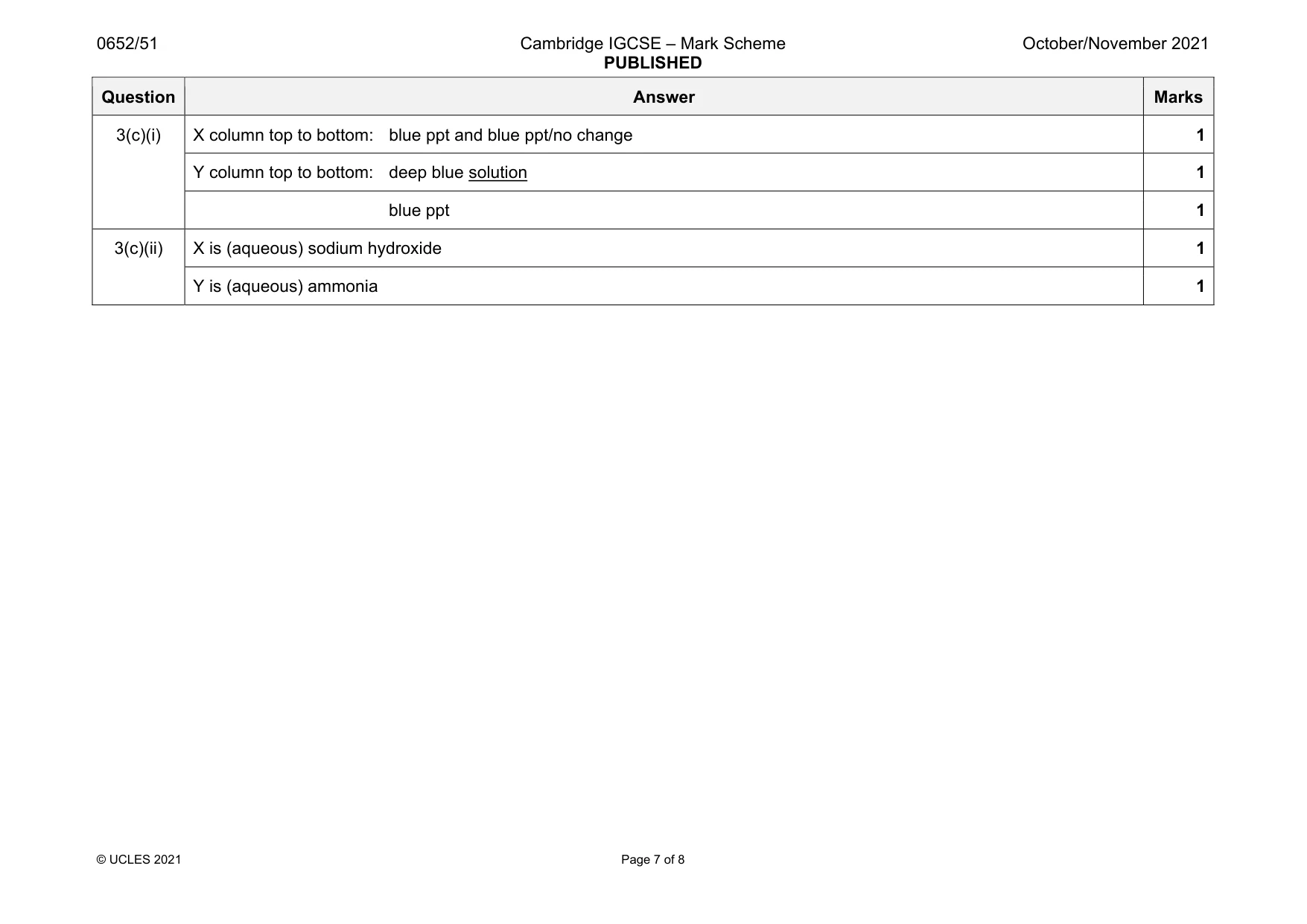
Mark scheme: 3(a)(i) base line and solvent front 1 initial spot position (labelled) 1 colours 1 3(a)(ii) number of colours and this is the number of spots of colour 1 3(b)(i) drops for 1 solution 1 drops for all 3 solutions 1 in order Y > Z > X 1 3(b)(ii) Y, Z, X 1 Question Answer Marks 3(c)(i) X column top to bottom: blue ppt and blue ppt/no change 1 Y column top to bottom: deep blue solution 1 blue ppt 1 3(c)(ii) X is (aqueous) sodium hydroxide 1 Y is (aqueous) ammonia 1
Q4 · When fuels burn they give out energy
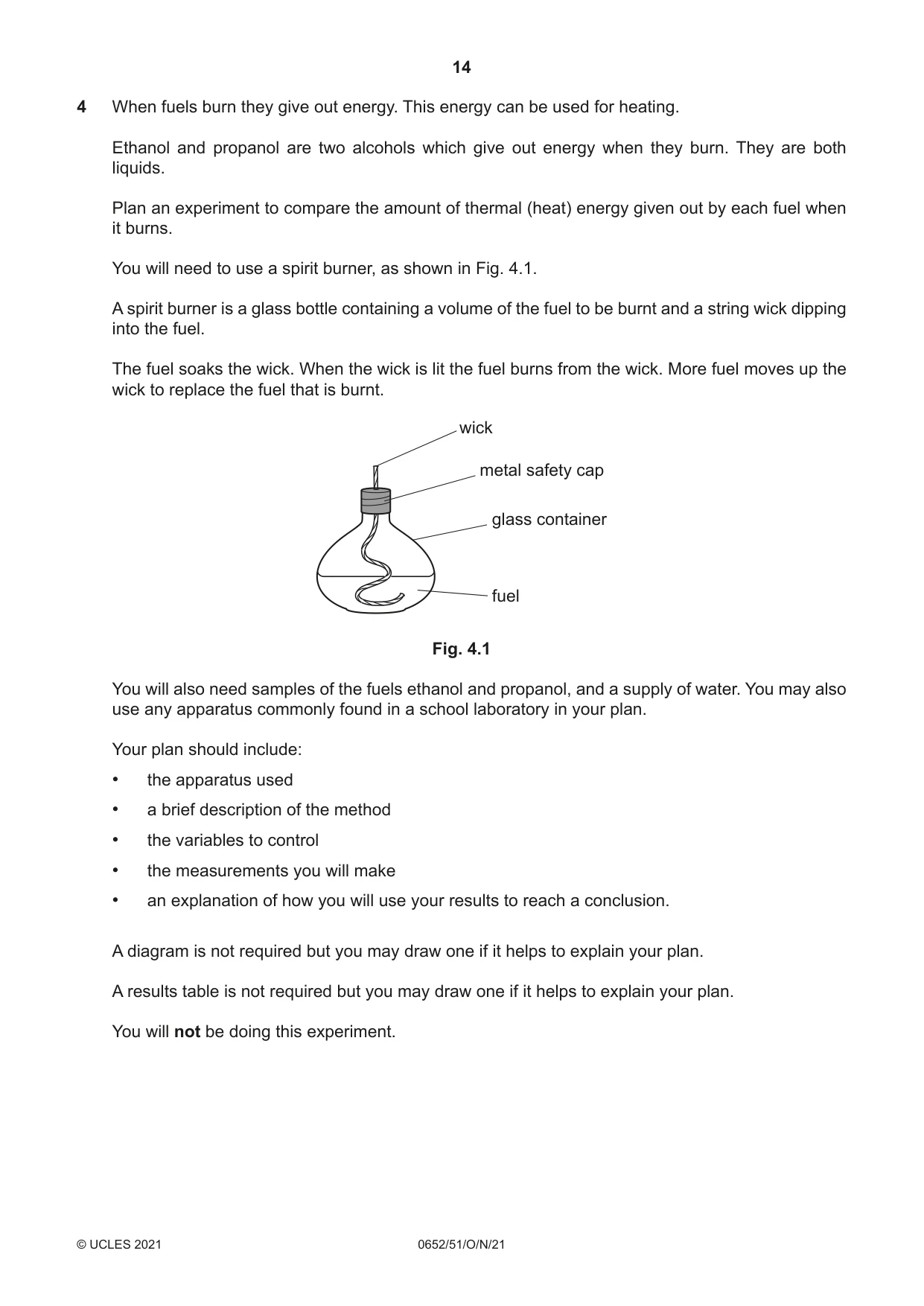
4 When fuels burn they give out energy. This energy can be used for heating. Ethanol and propanol are two alcohols which give out energy when they burn. They are both liquids. Plan an experiment to compare the amount of thermal (heat) energy given out by each fuel when it burns. You will need to use a spirit burner, as shown in Fig. 4.1. A spirit burner is a glass bottle containing a volume of the fuel to be burnt and a string wick dipping into the fuel. The fuel soaks the wick. When the wick is lit the fuel burns from the wick. More fuel moves up the wick to replace the fuel that is burnt. wick metal safety cap glass container fuel Fig. 4.1 You will also need samples of the fuels ethanol and propanol, and a supply of water. You may also use any apparatus commonly found in a school laboratory in your plan. Your plan should include: • the apparatus used • a brief description of the method • the variables to control • the measurements you will make • an explanation of how you will use your results to reach a conclusion. A diagram is not required but you may draw one if it helps to explain your plan. A results table is not required but you may draw one if it helps to explain your plan. You will not be doing this experiment. .......................................................................................................................................................... .......................................................................................................................................................... .......................................................................................................................................................... .......................................................................................................................................................... .......................................................................................................................................................... .......................................................................................................................................................... .......................................................................................................................................................... .......................................................................................................................................................... .......................................................................................................................................................... .......................................................................................................................................................... .......................................................................................................................................................... .......................................................................................................................................................... .......................................................................................................................................................... .......................................................................................................................................................... .......................................................................................................................................................... .......................................................................................................................................................... .......................................................................................................................................................... .......................................................................................................................................................... .......................................................................................................................................................... .......................................................................................................................................................... .......................................................................................................................................................... .......................................................................................................................................................... .......................................................................................................................................................... .......................................................................................................................................................... .......................................................................................................................................................... .......................................................................................................................................................... .......................................................................................................................................................... .......................................................................................................................................................... .......................................................................................................................................................... .......................................................................................................................................................... .......................................................................................................................................................... ..........................................................................................................................................................
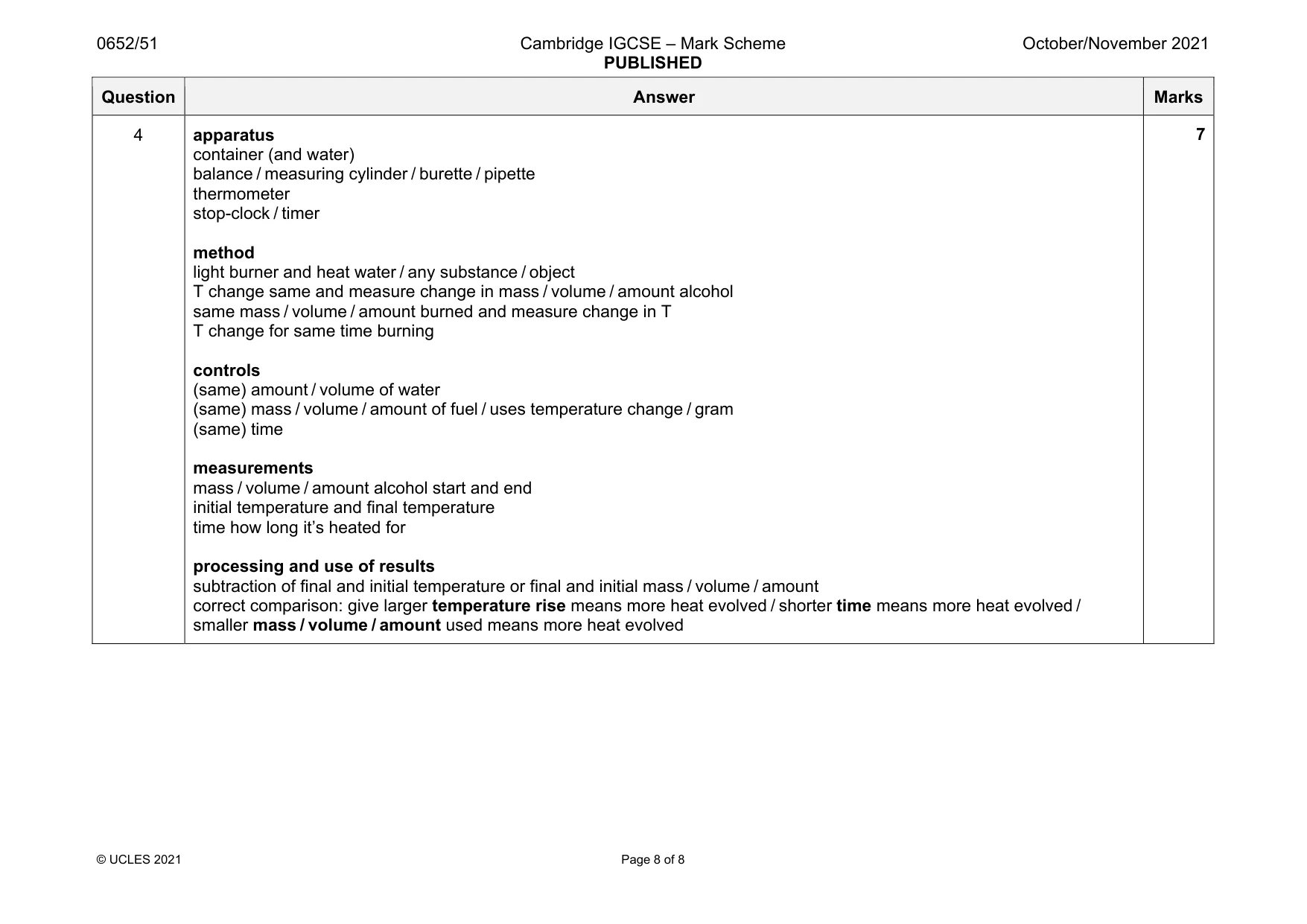
Mark scheme: 4 apparatus container (and water) balance / measuring cylinder / burette / pipette thermometer stop-clock / timer method light burner and heat water / any substance / object T change same and measure change in mass / volume / amount alcohol same mass / volume / amount burned and measure change in T T change for same time burning controls (same) amount / volume of water (same) mass / volume / amount of fuel / uses temperature change / gram (same) time measurements mass / volume / amount alcohol start and end initial temperature and final temperature time how long it’s heated for processing and use of results subtraction of final and initial temperature or final and initial mass / volume / amount correct comparison: give larger temperature rise means more heat evolved / shorter time means more heat evolved / smaller mass / volume / amount used means more heat evolved
What was in this paper
The subtopics covered by these 4 questions, and how many questions each got. Open one in a new tab to see every Cambridge question on it.
What you needed in this session
Cambridge’s own grade thresholds for 2021 Oct/Nov, Paper 5 · Variant 1. A higher threshold means an easier paper — the bar moves with how the cohort did.