Cambridge IGCSE Physical Science 0652 — 2020 Oct/Nov Paper 5 · Variant 1
0652/51/O/N/20 · 4 questions · 40 marks · ≈45 min
The question paper and its mark scheme, free to read here and free to download. This is Cambridge’s own paper, exactly as it was sat.
Question paper16 pages




Mark scheme8 pages
Answers below. Sit the paper first if you are practising.
Questions as text
Q1 · You are going to investigate the reaction between magnesium ribbon and hydrochloric acid
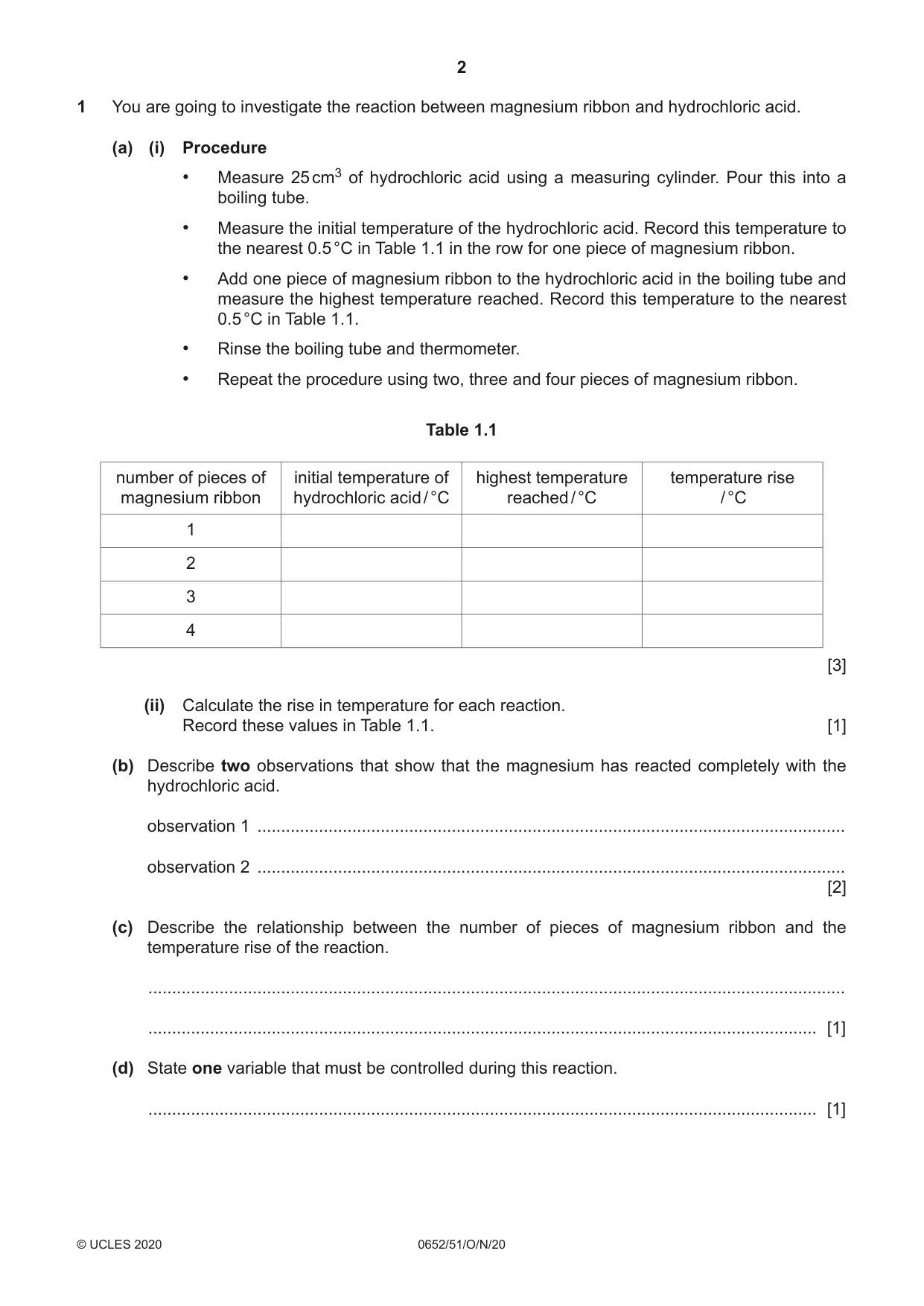
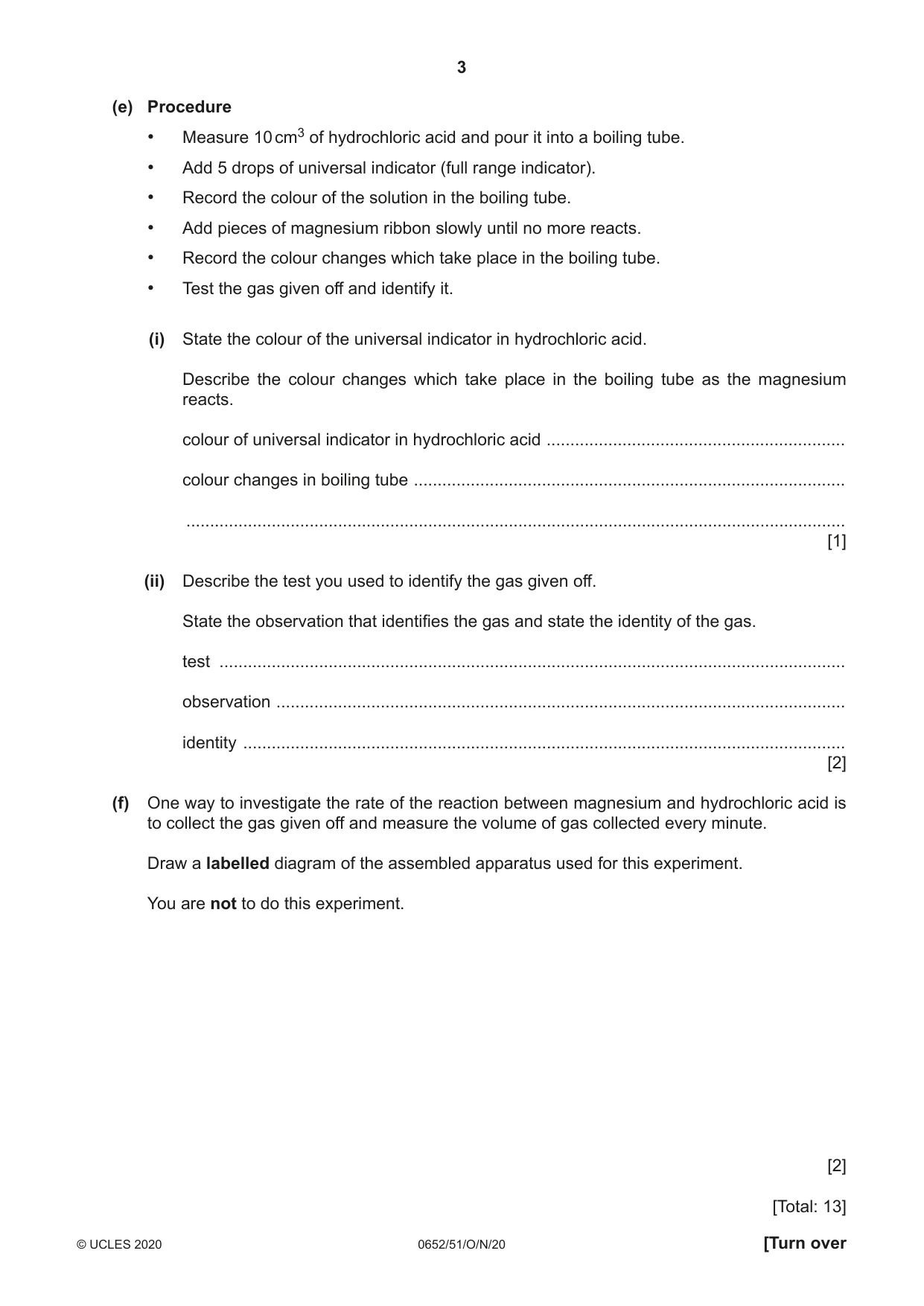
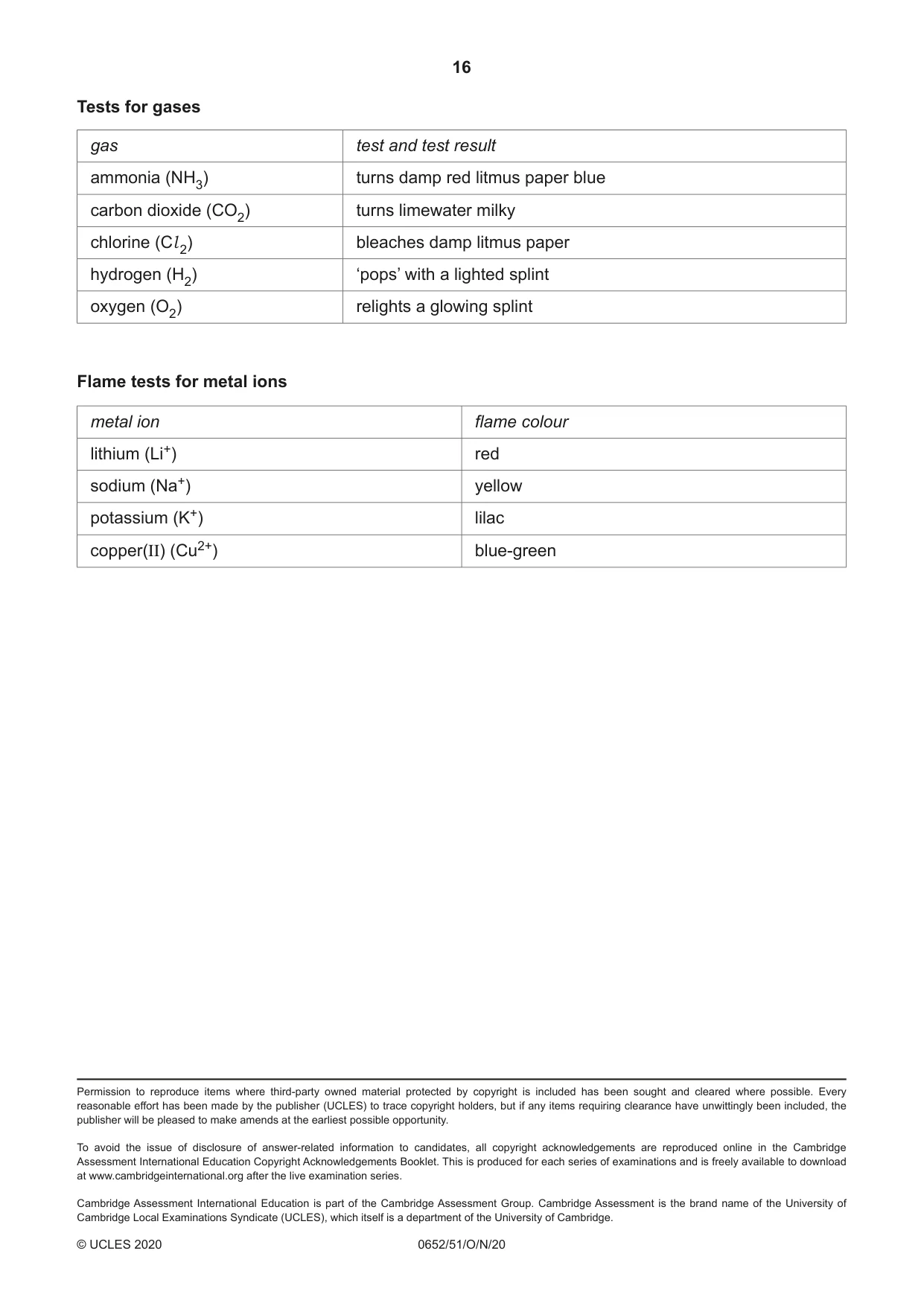
1 You are going to investigate the reaction between magnesium ribbon and hydrochloric acid. (a) (i) Procedure • Measure 25 cm3 of hydrochloric acid using a measuring cylinder. Pour this into a boiling tube. • Measure the initial temperature of the hydrochloric acid. Record this temperature to the nearest 0.5 °C in Table 1.1 in the row for one piece of magnesium ribbon. • Add one piece of magnesium ribbon to the hydrochloric acid in the boiling tube and measure the highest temperature reached. Record this temperature to the nearest 0.5 °C in Table 1.1. • Rinse the boiling tube and thermometer. • Repeat the procedure using two, three and four pieces of magnesium ribbon. Table 1.1 number of pieces of initial temperature of highest temperature temperature rise magnesium ribbon hydrochloric acid / °C reached / °C / °C 1 2 3 4 [3] (ii) Calculate the rise in temperature for each reaction. Record these values in Table 1.1. [1] (b) Describe two observations that show that the magnesium has reacted completely with the hydrochloric acid. observation 1 ............................................................................................................................ observation 2 ............................................................................................................................ [2] (c) Describe the relationship between the number of pieces of magnesium ribbon and the temperature rise of the reaction. ................................................................................................................................................... ............................................................................................................................................. [1] (d) State one variable that must be controlled during this reaction. ............................................................................................................................................. [1] (e) Procedure • Measure 10 cm3 of hydrochloric acid and pour it into a boiling tube. • Add 5 drops of universal indicator (full range indicator). • Record the colour of the solution in the boiling tube. • Add pieces of magnesium ribbon slowly until no more reacts. • Record the colour changes which take place in the boiling tube. • Test the gas given off and identify it. (i) State the colour of the universal indicator in hydrochloric acid. Describe the colour changes which take place in the boiling tube as the magnesium reacts. colour of universal indicator in hydrochloric acid ............................................................... colour changes in boiling tube ........................................................................................... ........................................................................................................................................... [1] (ii) Describe the test you used to identify the gas given off. State the observation that identifies the gas and state the identity of the gas. test .................................................................................................................................... observation ........................................................................................................................ identity ............................................................................................................................... [2] (f) One way to investigate the rate of the reaction between magnesium and hydrochloric acid is to collect the gas given off and measure the volume of gas collected every minute. Draw a labelled diagram of the assembled apparatus used for this experiment. You are not to do this experiment. [2] [Total: 13]
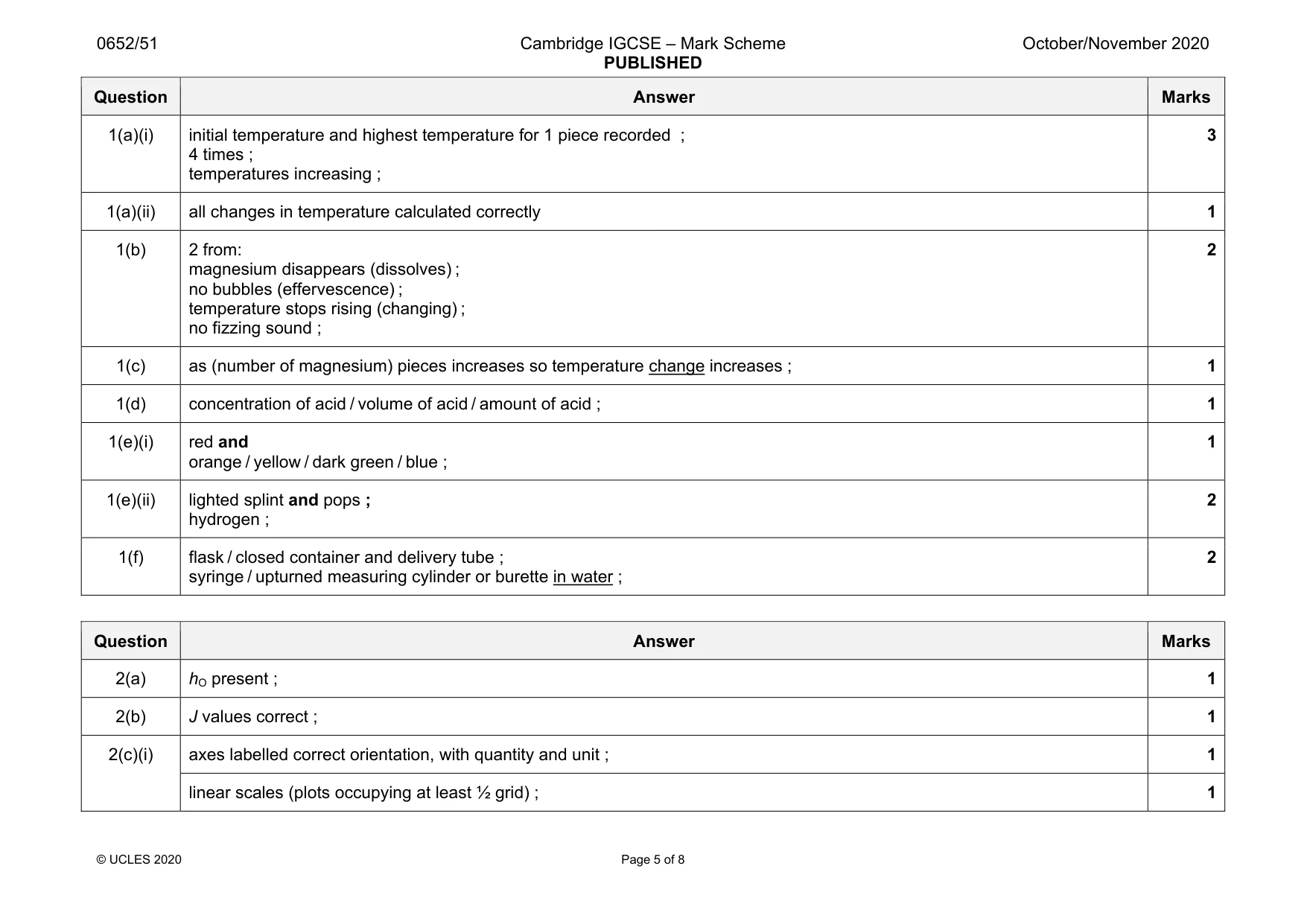
Mark scheme: 1(a)(i) initial temperature and highest temperature for 1 piece recorded ; 4 times ; temperatures increasing ; 3 1(a)(ii) all changes in temperature calculated correctly 1 1(b) 2 from: magnesium disappears (dissolves) ; no bubbles (effervescence) ; temperature stops rising (changing) ; no fizzing sound ; 2 1(c) as (number of magnesium) pieces increases so temperature change increases ; 1 1(d) concentration of acid / volume of acid / amount of acid ; 1 1(e)(i) red and orange / yellow / dark green / blue ; 1 1(e)(ii) lighted splint and pops ; hydrogen ; 2 1(f) flask / closed container and delivery tube ; syringe / upturned measuring cylinder or burette in water ; 2
Q2 · You are going to investigate the magnification produced by a converging lens
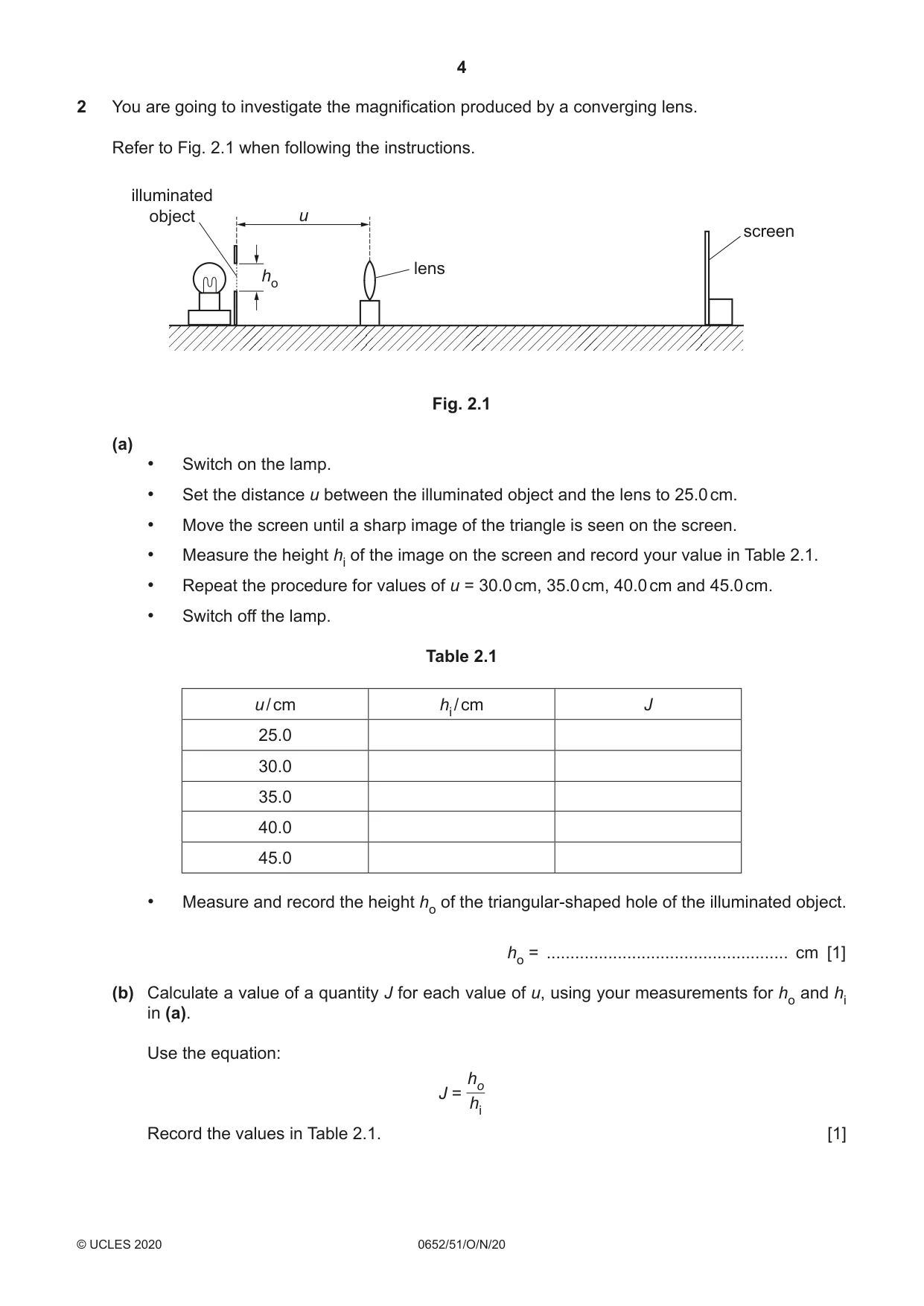
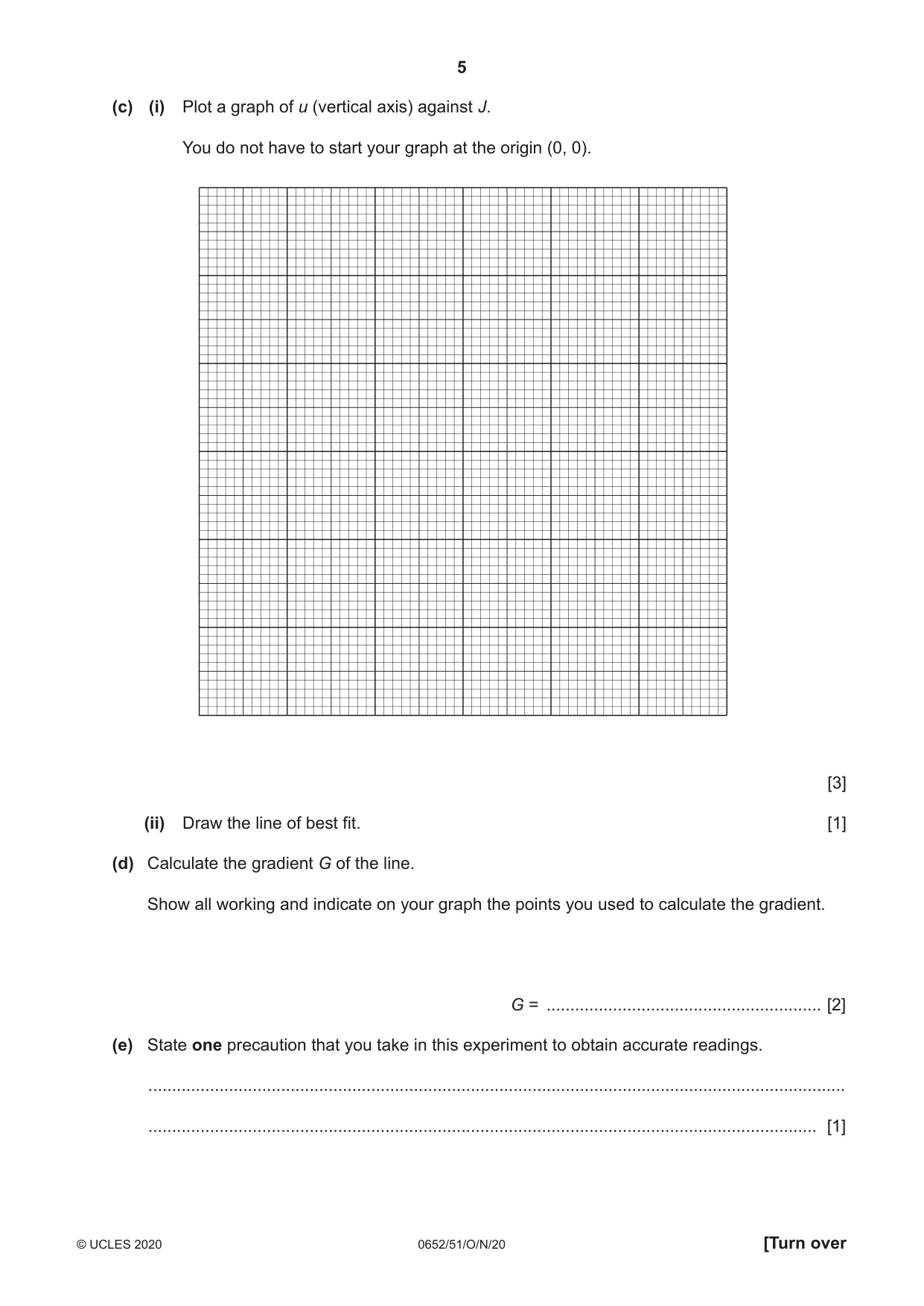
2 You are going to investigate the magnification produced by a converging lens. Refer to Fig. 2.1 when following the instructions. illuminated object u screen lens ho Fig. 2.1 (a) • Switch on the lamp. • Set the distance u between the illuminated object and the lens to 25.0 cm. • Move the screen until a sharp image of the triangle is seen on the screen. • Measure the height hi of the image on the screen and record your value in Table 2.1. • Repeat the procedure for values of u = 30.0 cm, 35.0 cm, 40.0 cm and 45.0 cm. • Switch off the lamp. Table 2.1 u / cm hi / cm J 25.0 30.0 35.0 40.0 45.0 • Measure and record the height ho of the triangular-shaped hole of the illuminated object. ho = ................................................... cm [1] (b) Calculate a value of a quantity J for each value of u, using your measurements for ho and hi in (a). Use the equation: ho J = hi Record the values in Table 2.1. [1] (c) (i) Plot a graph of u (vertical axis) against J. You do not have to start your graph at the origin (0, 0). [3] (ii) Draw the line of best fit. [1] (d) Calculate the gradient G of the line. Show all working and indicate on your graph the points you used to calculate the gradient. G = .......................................................... [2] (e) State one precaution that you take in this experiment to obtain accurate readings. ................................................................................................................................................... ............................................................................................................................................. [1] (f) One difficulty in measuring the height of the image is that the ruler and your hand cast a shadow over the image. Suggest an improvement to the apparatus or the arrangement of the apparatus to overcome this difficulty. ................................................................................................................................................... ............................................................................................................................................. [1] [Total: 10] Question 3 begins over the page
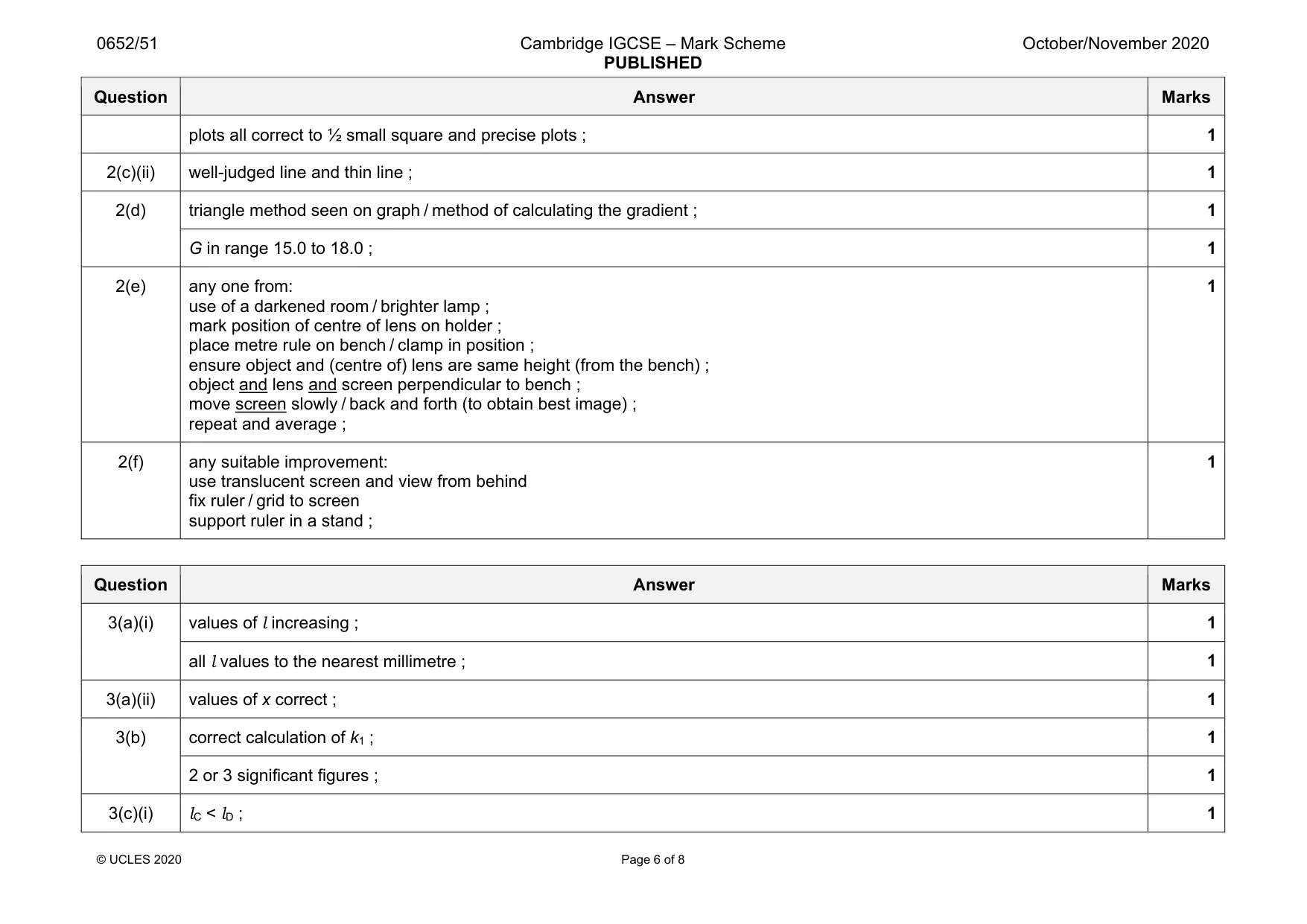
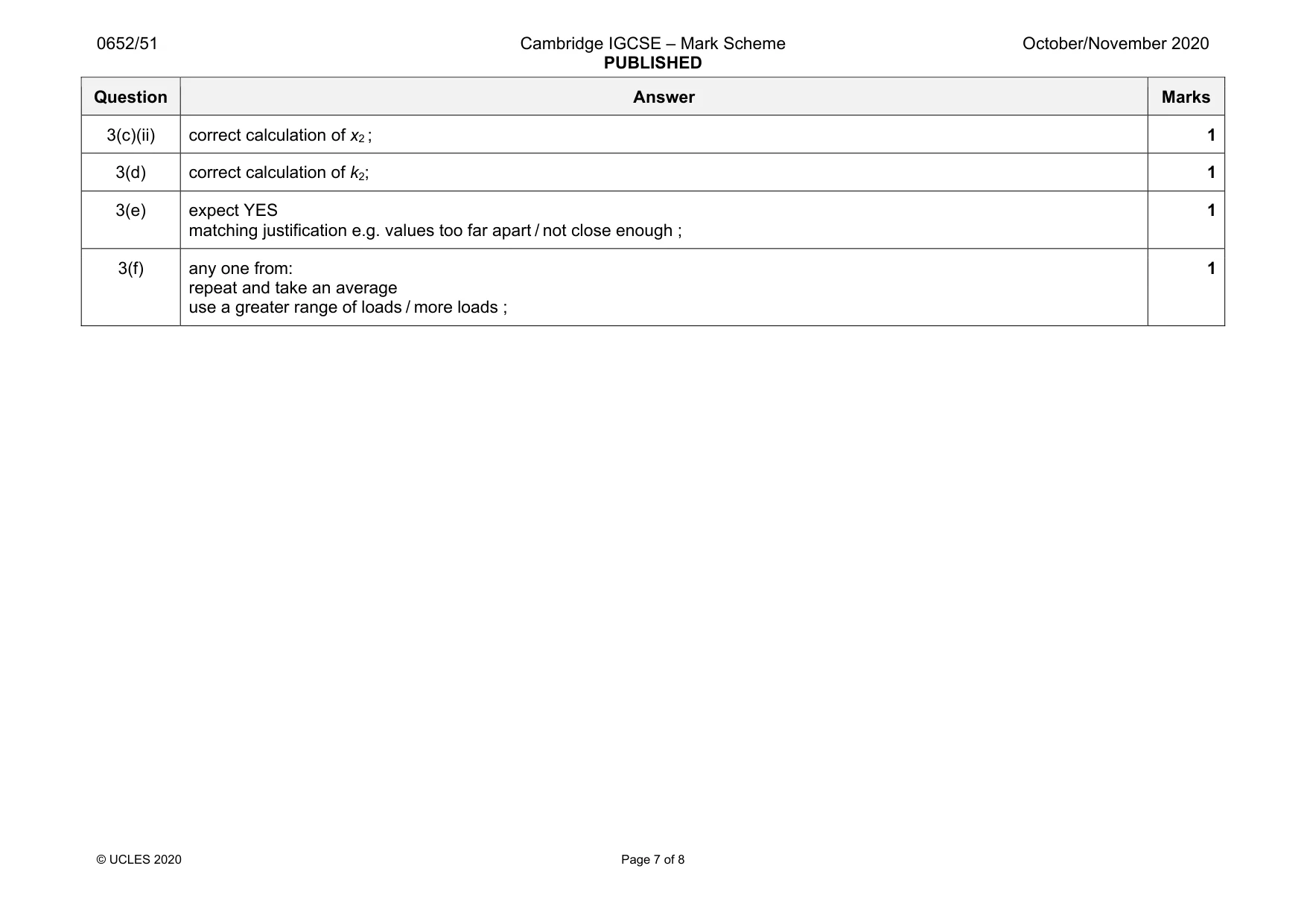
Mark scheme: 2(a) hO present ; 1 2(b) J values correct ; 1 2(c)(i) axes labelled correct orientation, with quantity and unit ; 1 linear scales (plots occupying at least ½ grid) ; 1 Question Answer Marks plots all correct to ½ small square and precise plots ; 1 2(c)(ii) well-judged line and thin line ; 1 2(d) triangle method seen on graph / method of calculating the gradient ; 1 G in range 15.0 to 18.0 ; 1 2(e) any one from: use of a darkened room / brighter lamp ; mark position of centre of lens on holder ; place metre rule on bench / clamp in position ; ensure object and (centre of) lens are same height (from the bench) ; object and lens and screen perpendicular to bench ; move screen slowly / back and forth (to obtain best image) ; repeat and average ; 1 2(f) any suitable improvement: use translucent screen and view from behind fix ruler / grid to screen support ruler in a stand ; 1
Q3 · You are going to investigate the stretching of two identical springs
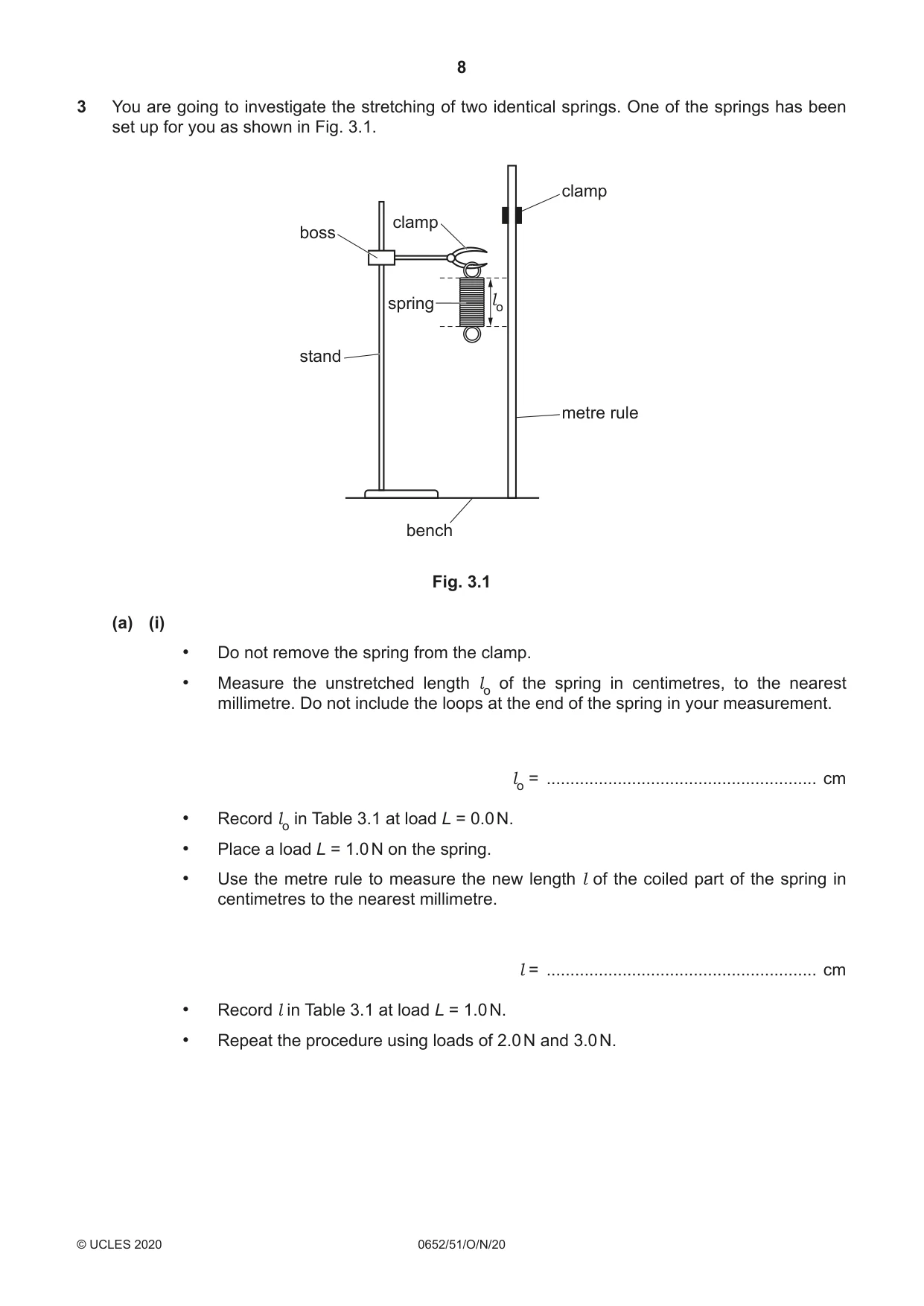
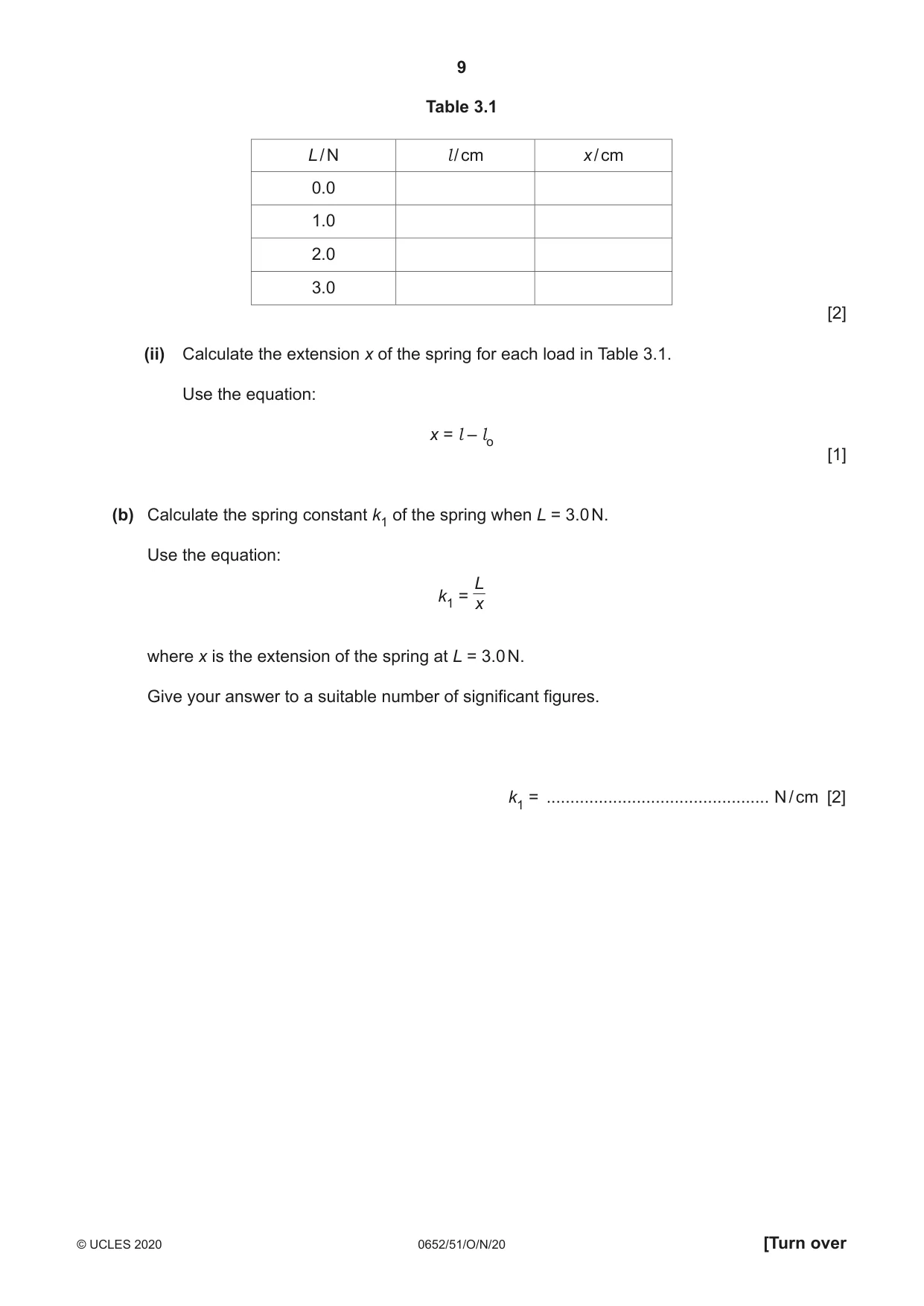
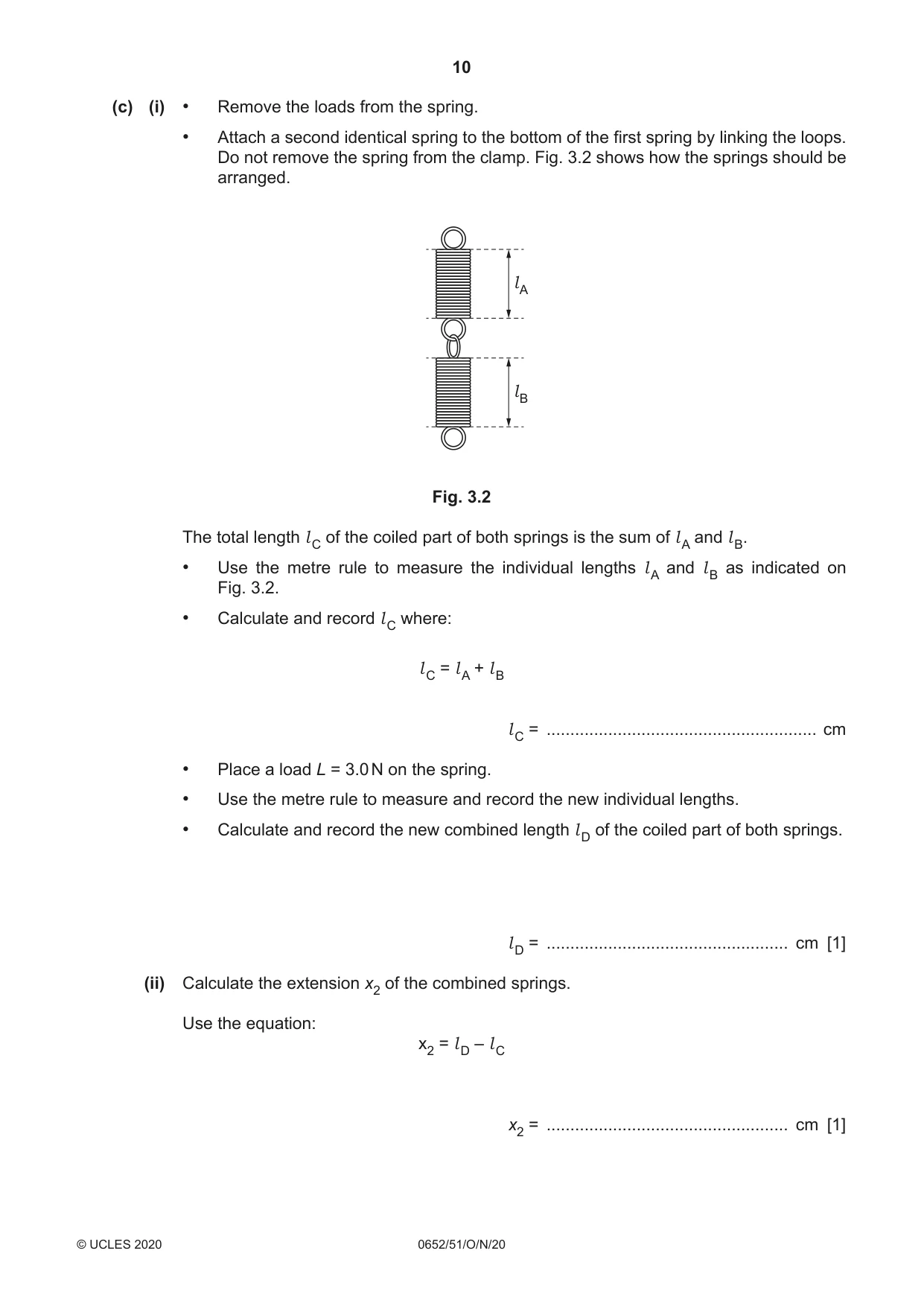
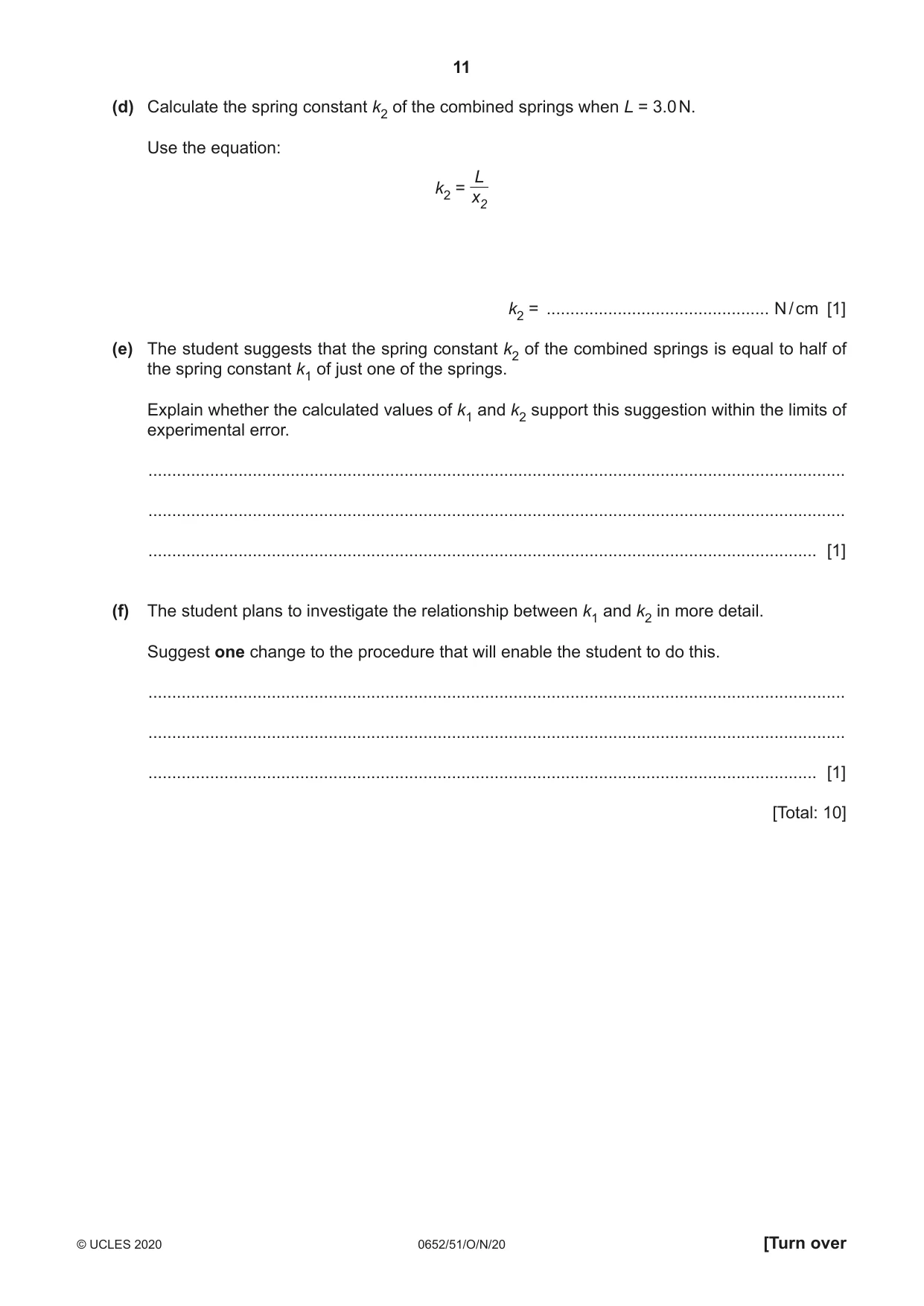
3 You are going to investigate the stretching of two identical springs. One of the springs has been set up for you as shown in Fig. 3.1. clamp clamp boss spring lo stand metre rule bench Fig. 3.1 (a) (i) • Do not remove the spring from the clamp. • Measure the unstretched length lo of the spring in centimetres, to the nearest millimetre. Do not include the loops at the end of the spring in your measurement. lo = ......................................................... cm • Record lo in Table 3.1 at load L = 0.0 N. • Place a load L = 1.0 N on the spring. • Use the metre rule to measure the new length l of the coiled part of the spring in centimetres to the nearest millimetre. l = ......................................................... cm • Record l in Table 3.1 at load L = 1.0 N. • Repeat the procedure using loads of 2.0 N and 3.0 N. Table 3.1 L / N l / cm x / cm 0.0 1.0 2.0 3.0 [2] (ii) Calculate the extension x of the spring for each load in Table 3.1. Use the equation: x = l – lo [1] (b) Calculate the spring constant k1 of the spring when L = 3.0 N. Use the equation: L k1 = x where x is the extension of the spring at L = 3.0 N. Give your answer to a suitable number of significant figures. k1 = ............................................... N / cm [2] (c) (i) • Remove the loads from the spring. • Attach a second identical spring to the bottom of the first spring by linking the loops. Do not remove the spring from the clamp. Fig. 3.2 shows how the springs should be arranged. l A l B Fig. 3.2 The total length l C of the coiled part of both springs is the sum of l A and l B. • Use the metre rule to measure the individual lengths l A and l B as indicated on Fig. 3.2. • Calculate and record l C where: l C = l A + l B l C = ......................................................... cm • Place a load L = 3.0 N on the spring. • Use the metre rule to measure and record the new individual lengths. • Calculate and record the new combined length l D of the coiled part of both springs. l D = ................................................... cm [1] (ii) Calculate the extension x2 of the combined springs. Use the equation: x2 = l D – l C x2 = ................................................... cm [1]
Mark scheme: 3(a)(i) 1 all l values to the nearest millimetre ; 1 3(a)(ii) values of x correct ; 1 3(b) correct calculation of k1 ; 1 2 or 3 significant figures ; 1 3(c)(i) lC < lD ; 1 Question Answer Marks 3(c)(ii) correct calculation of x2 ; 1 3(d) correct calculation of k2; 1 3(e) expect YES matching justification e.g. values too far apart / not close enough ; 1 3(f) any one from: repeat and take an average use a greater range of loads / more loads ; 1
Q4 · Lemon juice and lime juice both contain acids
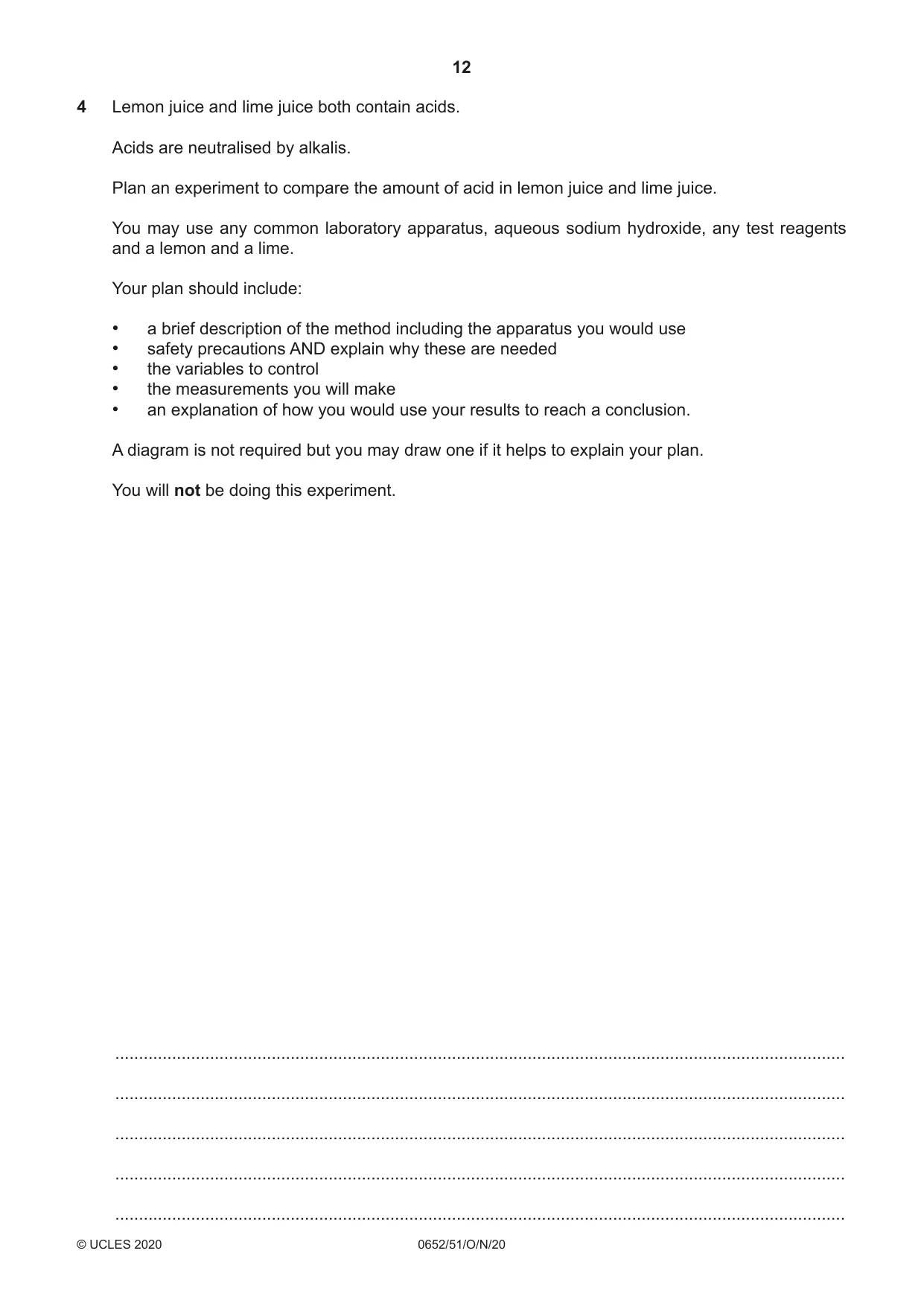
4 Lemon juice and lime juice both contain acids. Acids are neutralised by alkalis. Plan an experiment to compare the amount of acid in lemon juice and lime juice. You may use any common laboratory apparatus, aqueous sodium hydroxide, any test reagents and a lemon and a lime. Your plan should include: • a brief description of the method including the apparatus you would use • safety precautions AND explain why these are needed • the variables to control • the measurements you will make • an explanation of how you would use your results to reach a conclusion. A diagram is not required but you may draw one if it helps to explain your plan. You will not be doing this experiment. .......................................................................................................................................................... .......................................................................................................................................................... .......................................................................................................................................................... .......................................................................................................................................................... .......................................................................................................................................................... .......................................................................................................................................................... .......................................................................................................................................................... .......................................................................................................................................................... .......................................................................................................................................................... .......................................................................................................................................................... .......................................................................................................................................................... .......................................................................................................................................................... .......................................................................................................................................................... .......................................................................................................................................................... .......................................................................................................................................................... .......................................................................................................................................................... .......................................................................................................................................................... .......................................................................................................................................................... .......................................................................................................................................................... .......................................................................................................................................................... .......................................................................................................................................................... .......................................................................................................................................................... .......................................................................................................................................................... .......................................................................................................................................................... .......................................................................................................................................................... .......................................................................................................................................................... .......................................................................................................................................................... .......................................................................................................................................................... .......................................................................................................................................................... .......................................................................................................................................................... .......................................................................................................................................................... ..........................................................................................................................................................
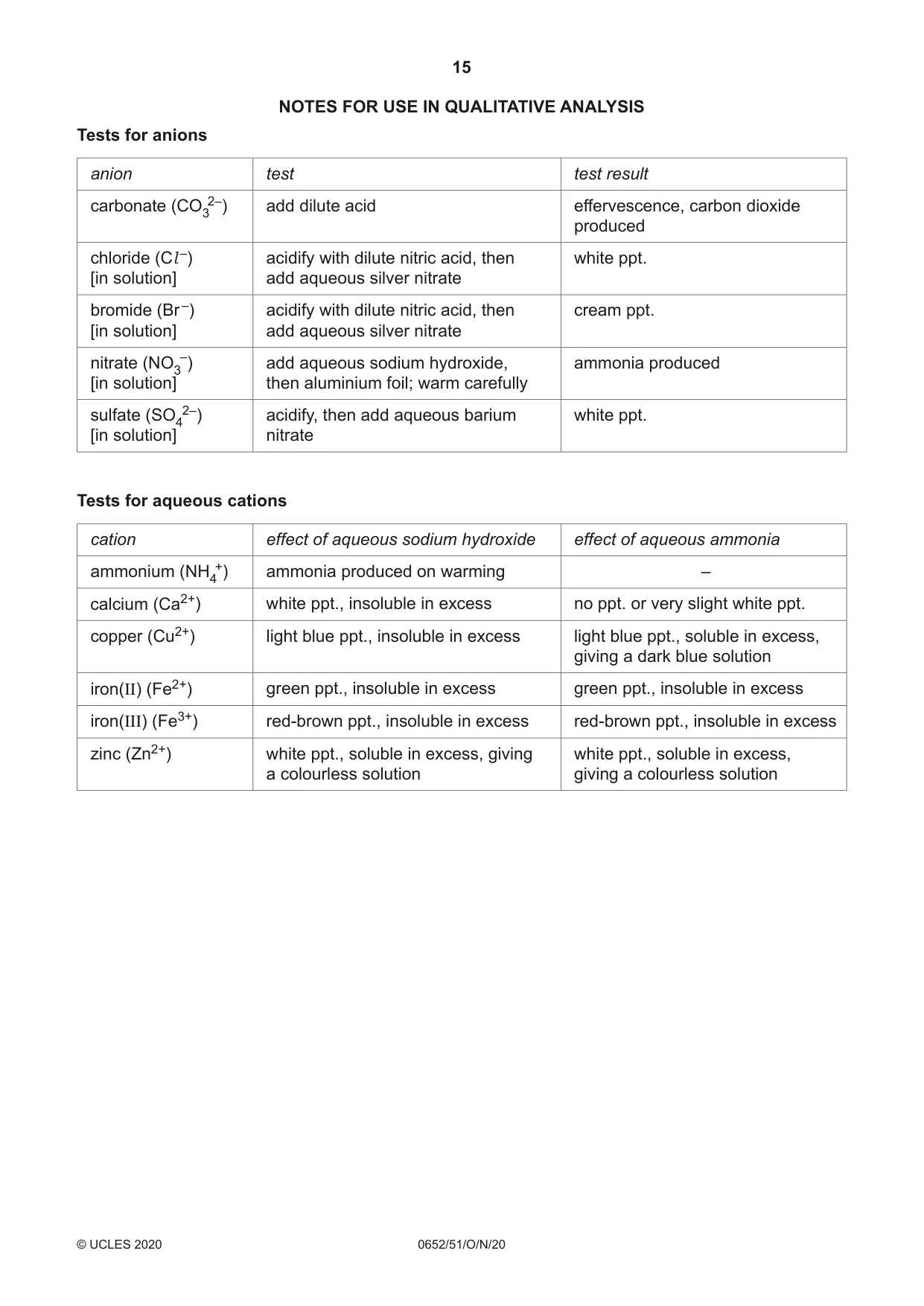
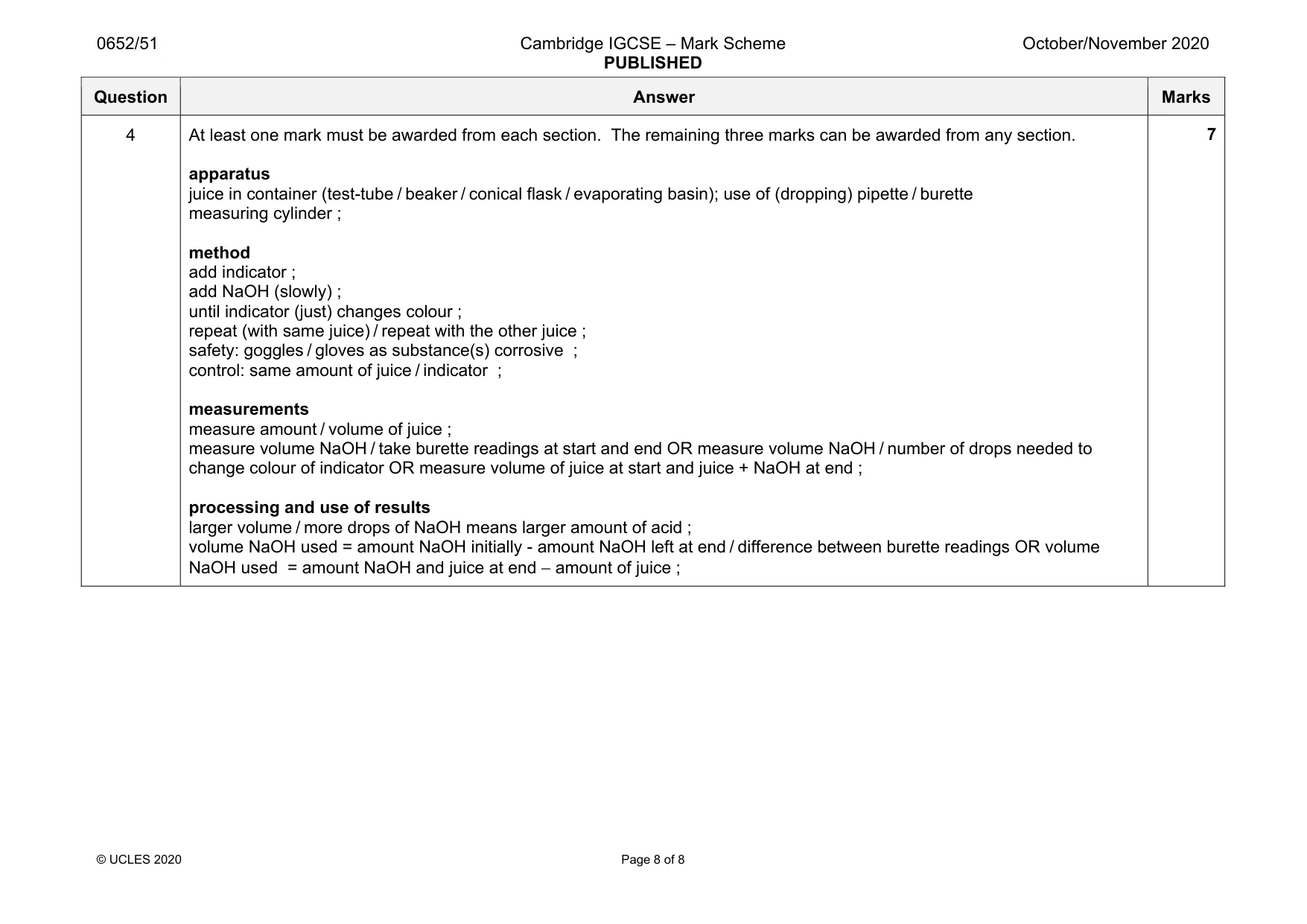
Mark scheme: 4 At least one mark must be awarded from each section. The remaining three marks can be awarded from any section. apparatus juice in container (test-tube / beaker / conical flask / evaporating basin); use of (dropping) pipette / burette measuring cylinder ; method add indicator ; add NaOH (slowly) ; until indicator (just) changes colour ; repeat (with same juice) / repeat with the other juice ; safety: goggles / gloves as substance(s) corrosive ; control: same amount of juice / indicator ; measurements measure amount / volume of juice ; measure volume NaOH / take burette readings at start and end OR measure volume NaOH / number of drops needed to change colour of indicator OR measure volume of juice at start and juice + NaOH at end ; processing and use of results larger volume / more drops of NaOH means larger amount of acid ; volume NaOH used = amount NaOH initially - amount NaOH left at end / difference between burette readings OR volume NaOH used = amount NaOH and juice at end − amount of juice ;
More questions on The characteristic properties of acids and bases
What was in this paper
The subtopics covered by these 4 questions, and how many questions each got. Open one in a new tab to see every Cambridge question on it.
What you needed in this session
Cambridge’s own grade thresholds for 2020 Oct/Nov, Paper 5 · Variant 1. A higher threshold means an easier paper — the bar moves with how the cohort did.