Cambridge IGCSE Physical Science 0652 — 2018 Oct/Nov Paper 5 · Variant 2
0652/52/O/N/18 · 2 questions · 30 marks · ≈34 min
The question paper and its mark scheme, free to read here and free to download. This is Cambridge’s own paper, exactly as it was sat.
Question paper12 pages



Mark scheme5 pages
Answers below. Sit the paper first if you are practising.
Questions as text
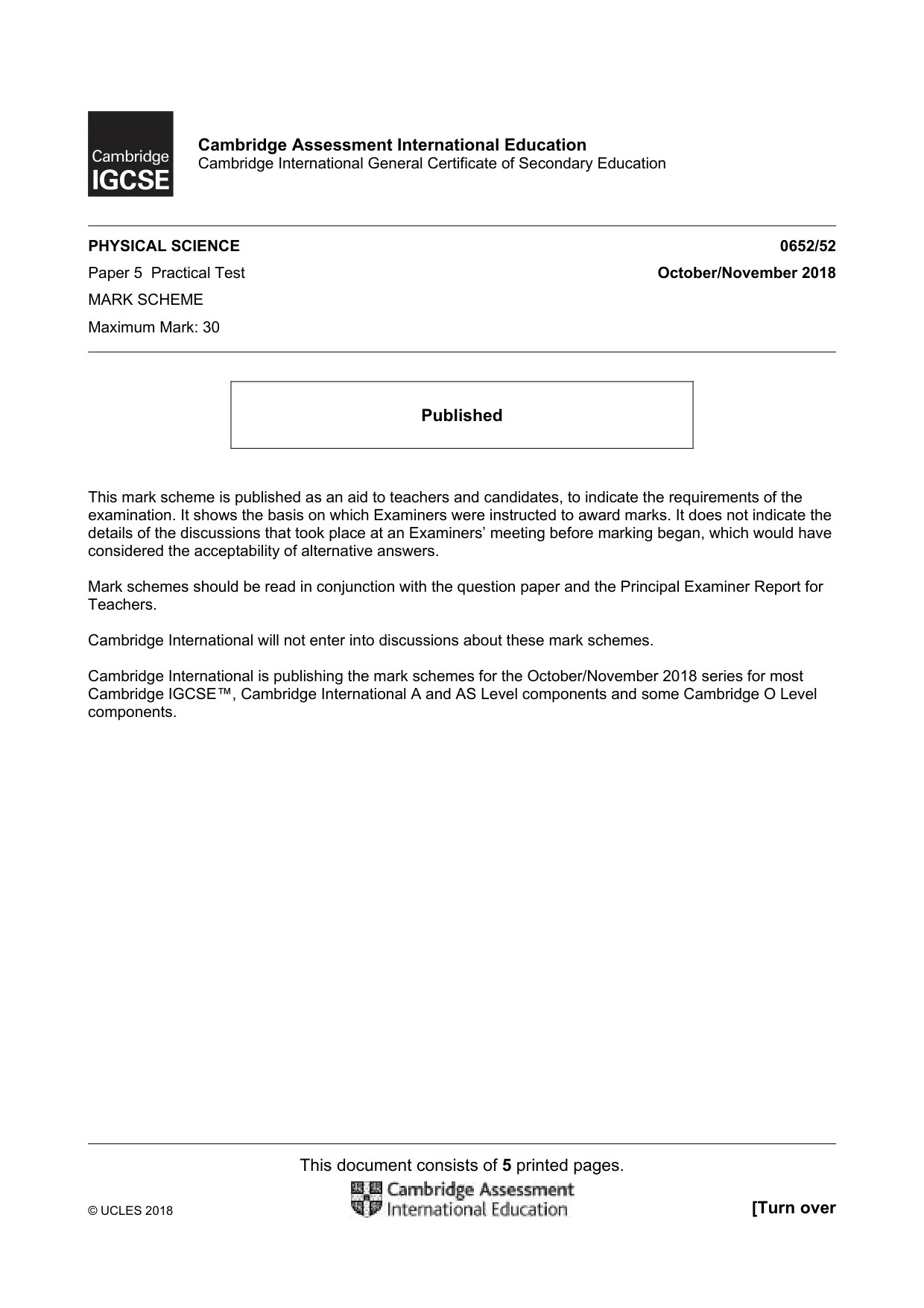
Q1 · Notes for use in Qualitative Analysis for this question are printed on page 12
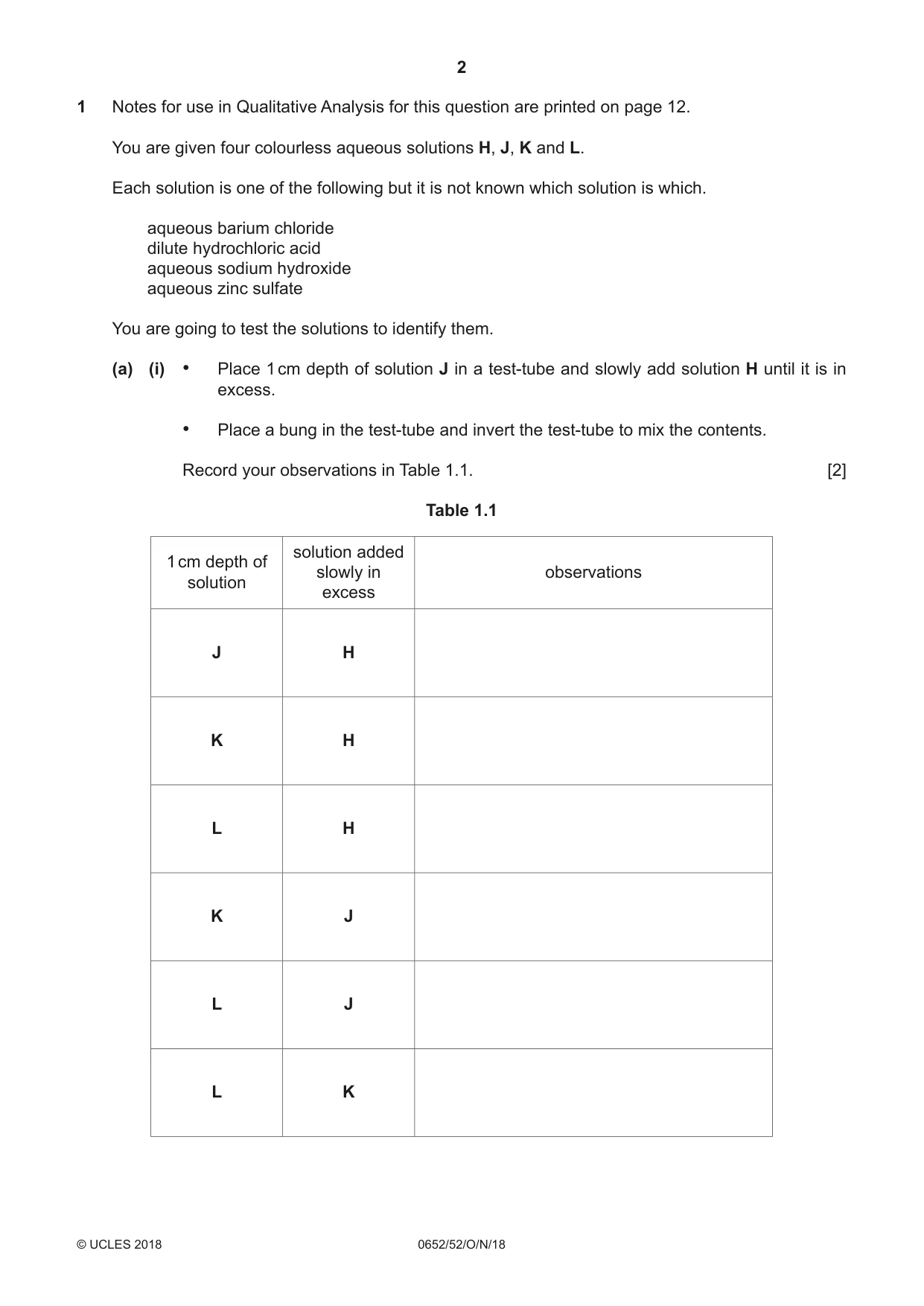
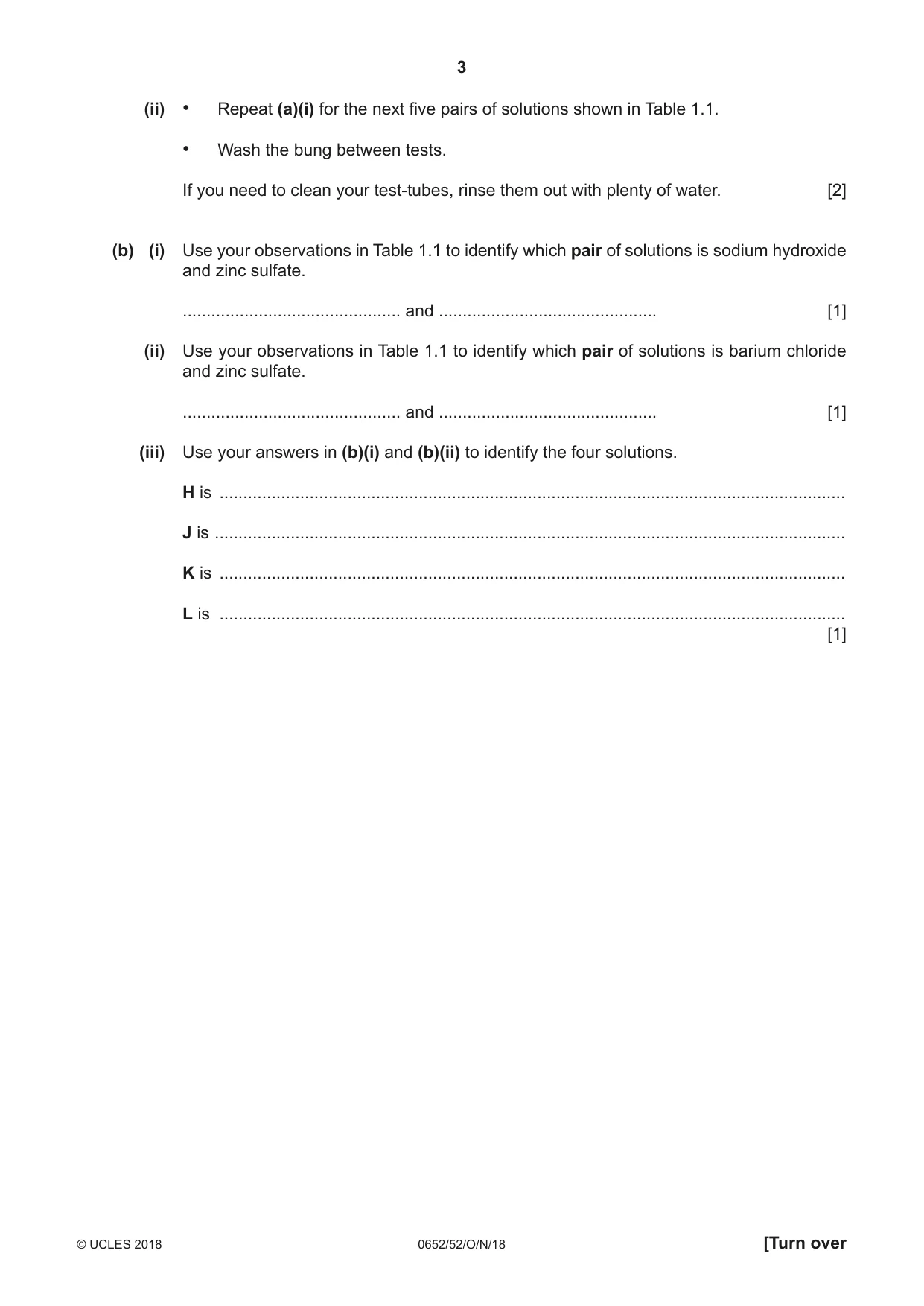
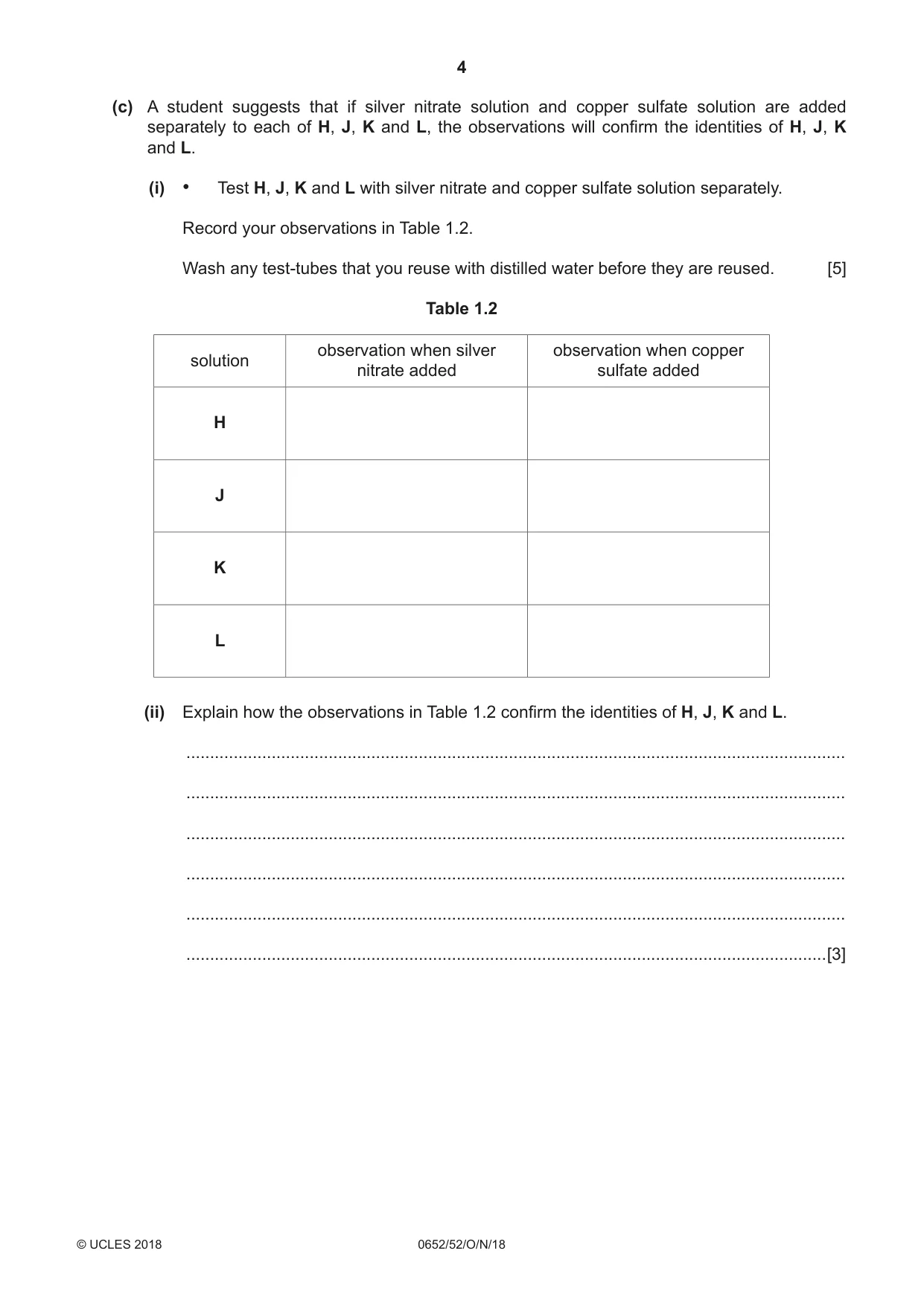
1 Notes for use in Qualitative Analysis for this question are printed on page 12. You are given four colourless aqueous solutions H, J, K and L. Each solution is one of the following but it is not known which solution is which. aqueous barium chloride dilute hydrochloric acid aqueous sodium hydroxide aqueous zinc sulfate You are going to test the solutions to identify them. (a) (i) • Place 1 cm depth of solution J in a test-tube and slowly add solution H until it is in excess. • Place a bung in the test-tube and invert the test-tube to mix the contents. Record your observations in Table 1.1. [2] Table 1.1 solution added 1 cm depth of slowly in observations solution excess J H K H L H K J L J L K (ii) • Repeat (a)(i) for the next five pairs of solutions shown in Table 1.1. • Wash the bung between tests. If you need to clean your test-tubes, rinse them out with plenty of water. [2] (b) (i) Use your observations in Table 1.1 to identify which pair of solutions is sodium hydroxide and zinc sulfate. .............................................. and .............................................. [1] (ii) Use your observations in Table 1.1 to identify which pair of solutions is barium chloride and zinc sulfate. .............................................. and .............................................. [1] (iii) Use your answers in (b)(i) and (b)(ii) to identify the four solutions. H is .................................................................................................................................... J is ..................................................................................................................................... K is .................................................................................................................................... L is .................................................................................................................................... [1] (c) A student suggests that if silver nitrate solution and copper sulfate solution are added separately to each of H, J, K and L, the observations will confirm the identities of H, J, K and L. (i) • Test H, J, K and L with silver nitrate and copper sulfate solution separately. Record your observations in Table 1.2. Wash any test-tubes that you reuse with distilled water before they are reused. [5] Table 1.2 observation when silver observation when copper solution nitrate added sulfate added H J K L (ii) Explain how the observations in Table 1.2 confirm the identities of H, J, K and L. ........................................................................................................................................... ........................................................................................................................................... ........................................................................................................................................... ........................................................................................................................................... ........................................................................................................................................... .......................................................................................................................................[3]
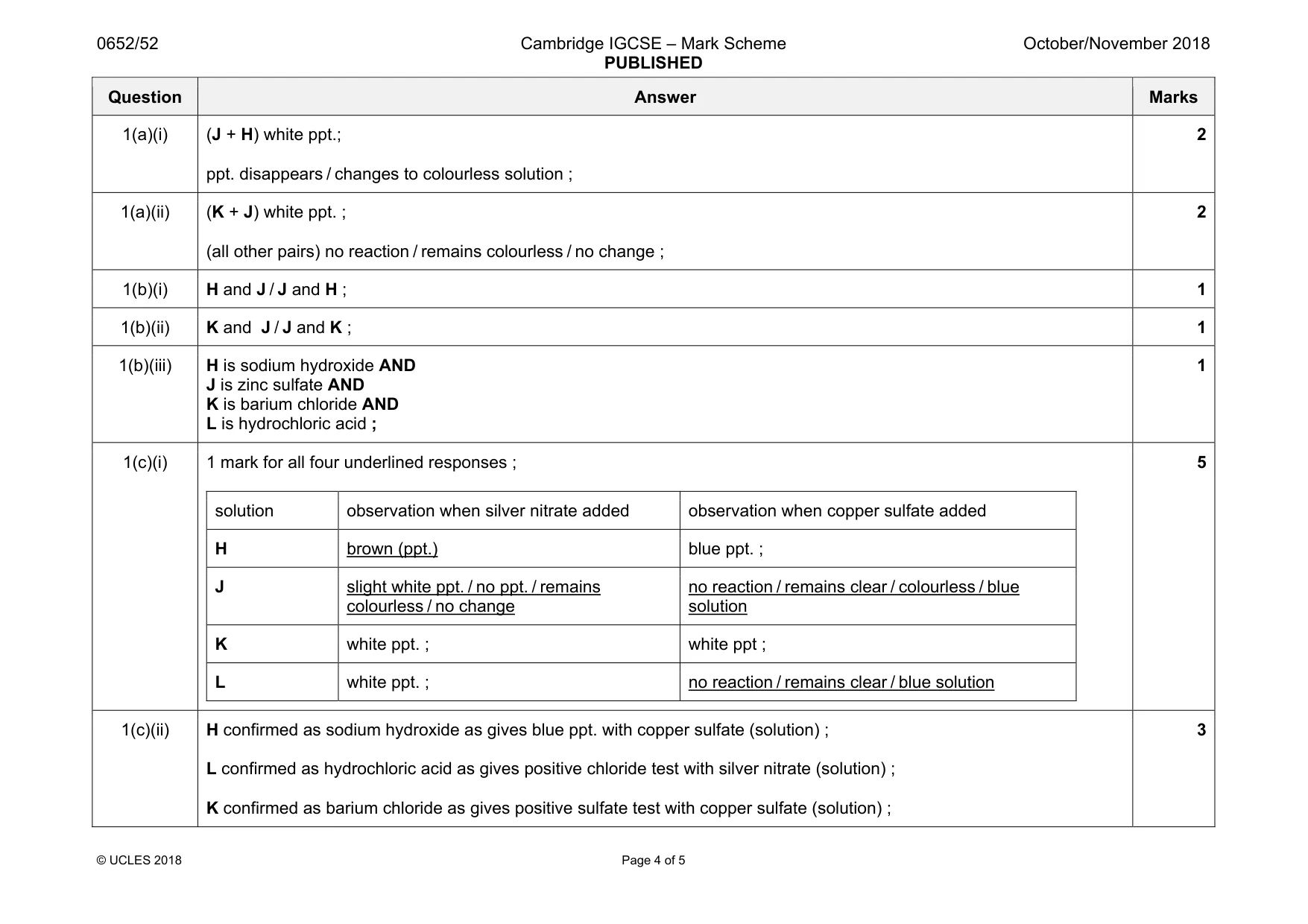
Mark scheme: 1(a)(i) (J + H) white ppt.; ppt. disappears / changes to colourless solution ; 2 1(a)(ii) (K + J) white ppt. ; (all other pairs) no reaction / remains colourless / no change ; 2 1(b)(i) H and J / J and H ; 1 1(b)(ii) K and J / J and K ; 1 1(b)(iii) H is sodium hydroxide AND J is zinc sulfate AND K is barium chloride AND L is hydrochloric acid ; 1 1(c)(i) 1 mark for all four underlined responses ; solution observation when silver nitrate added observation when copper sulfate added H brown (ppt.) blue ppt. ; J slight white ppt. / no ppt. / remains colourless / no change no reaction / remains clear / colourless / blue solution K white ppt. ; white ppt ; L white ppt. ; no reaction / remains clear / blue solution 5 1(c)(ii) H confirmed as sodium hydroxide as gives blue ppt. with copper sulfate (solution) ; L confirmed as hydrochloric acid as gives positive chloride test with silver nitrate (solution) ; K confirmed as barium chloride as gives positive sulfate test with copper sulfate (solution) ; 3
Q2 · You are going to measure the length l of a spring when different loads L are added to it
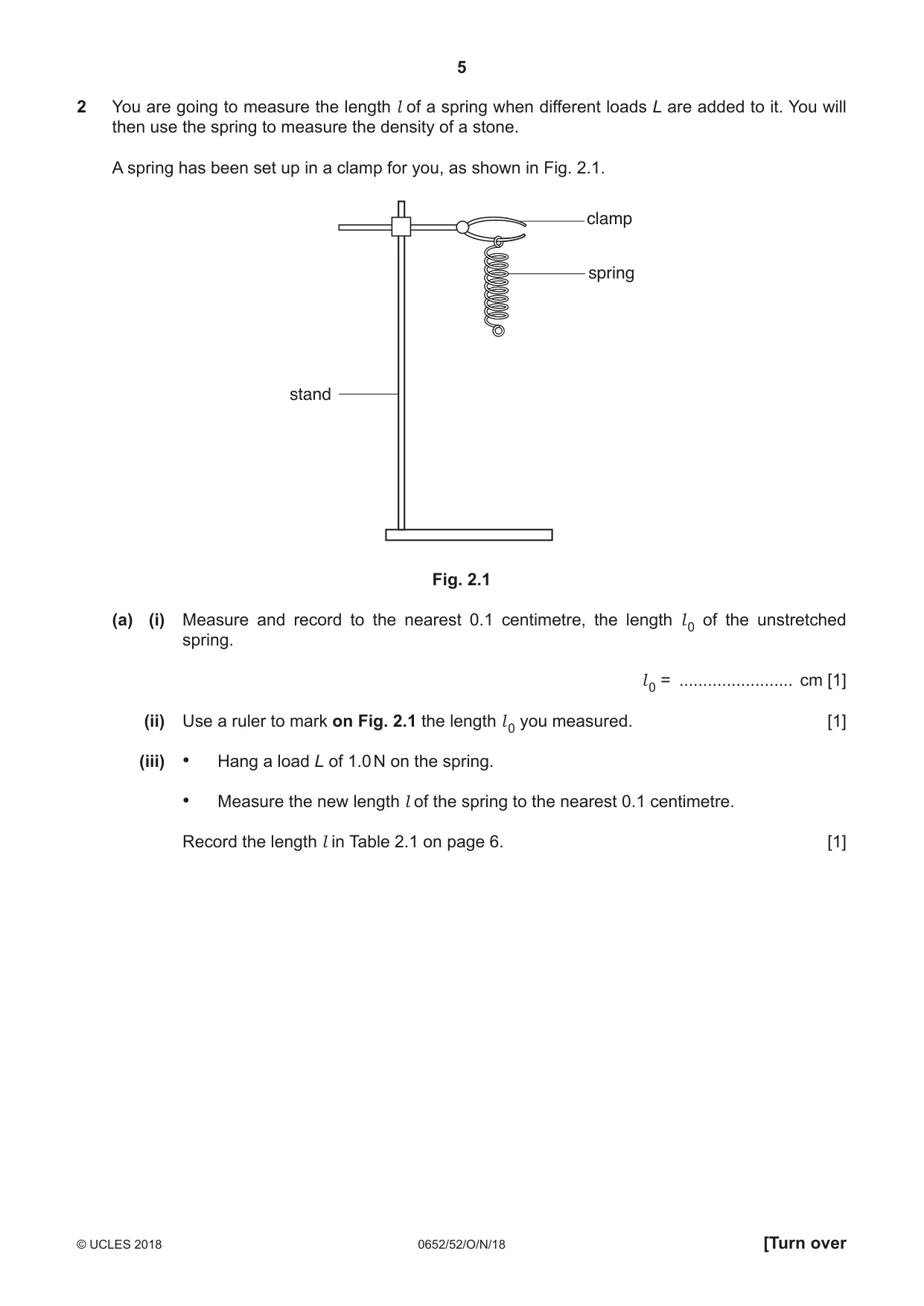
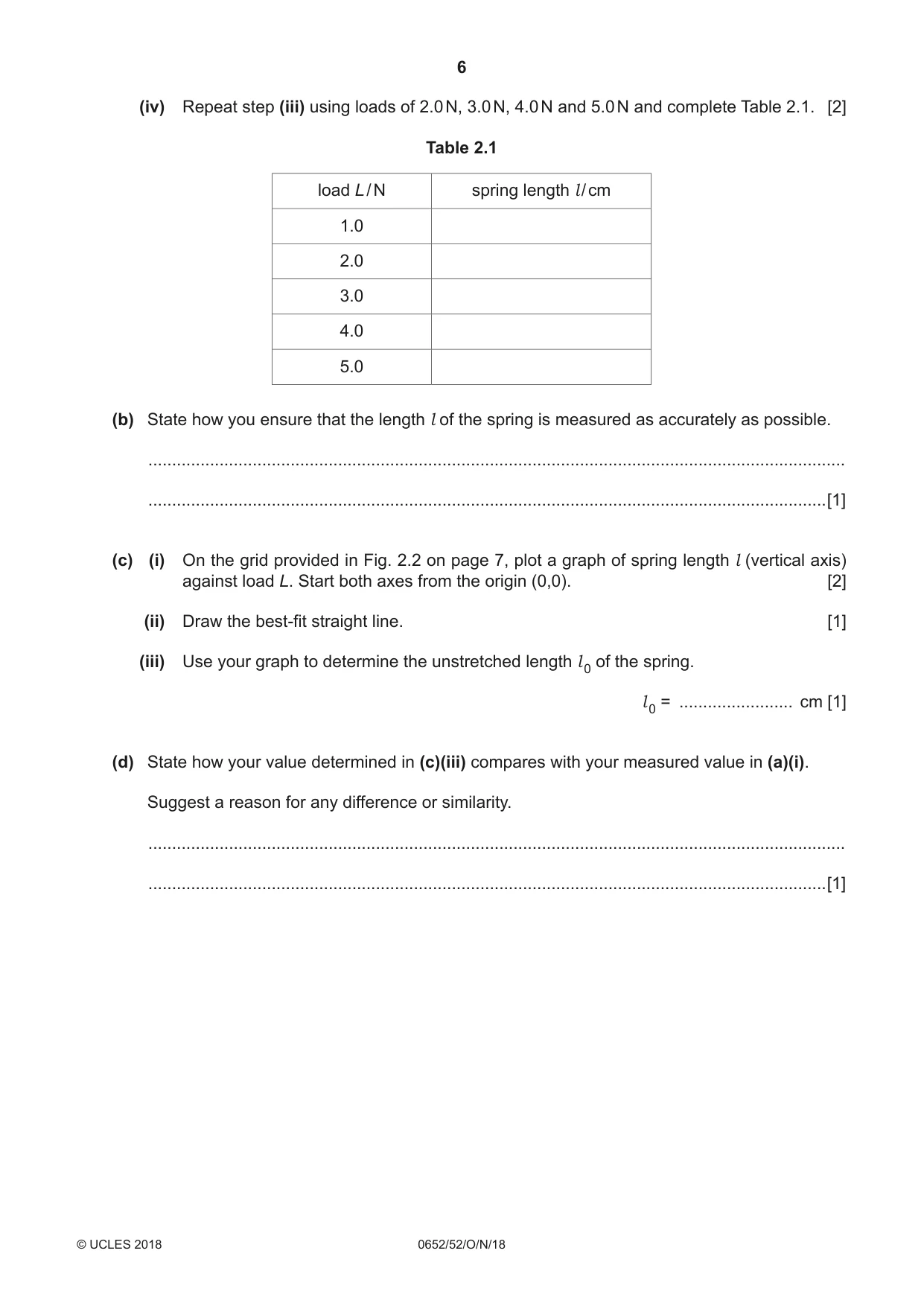
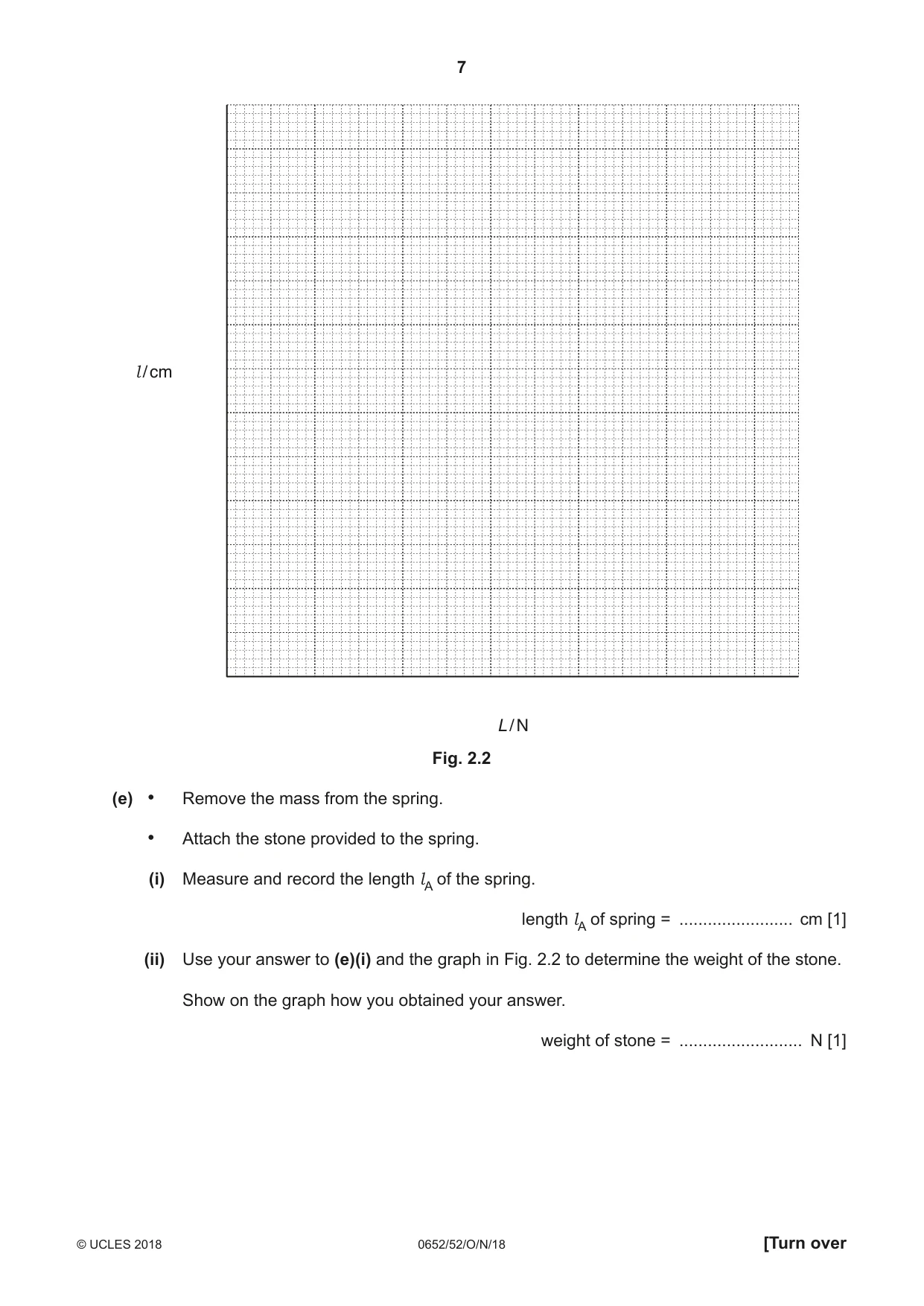
2 You are going to measure the length l of a spring when different loads L are added to it. You will then use the spring to measure the density of a stone. A spring has been set up in a clamp for you, as shown in Fig. 2.1. clamp spring stand Fig. 2.1 (a) (i) Measure and record to the nearest 0.1 centimetre, the length l 0 of the unstretched spring. l 0 = ........................ cm [1] (ii) Use a ruler to mark on Fig. 2.1 the length l 0 you measured. [1] (iii) • Hang a load L of 1.0 N on the spring. • Measure the new length l of the spring to the nearest 0.1 centimetre. Record the length l in Table 2.1 on page 6. [1] (iv) Repeat step (iii) using loads of 2.0 N, 3.0 N, 4.0 N and 5.0 N and complete Table 2.1. [2] Table 2.1 load L / N spring length l / cm 1.0 2.0 3.0 4.0 5.0 (b) State how you ensure that the length l of the spring is measured as accurately as possible. ................................................................................................................................................... ...............................................................................................................................................[1] (c) (i) On the grid provided in Fig. 2.2 on page 7, plot a graph of spring length l (vertical axis) against load L. Start both axes from the origin (0,0). [2] (ii) Draw the best-fit straight line. [1] (iii) Use your graph to determine the unstretched length l 0 of the spring. l 0 = ........................ cm [1] (d) State how your value determined in (c)(iii) compares with your measured value in (a)(i). Suggest a reason for any difference or similarity. ................................................................................................................................................... ...............................................................................................................................................[1] l / cm L / N Fig. 2.2 (e) • Remove the mass from the spring. • Attach the stone provided to the spring. (i) Measure and record the length lA of the spring. length lA of spring = ........................ cm [1] (ii) Use your answer to (e)(i) and the graph in Fig. 2.2 to determine the weight of the stone. Show on the graph how you obtained your answer. weight of stone = .......................... N [1]
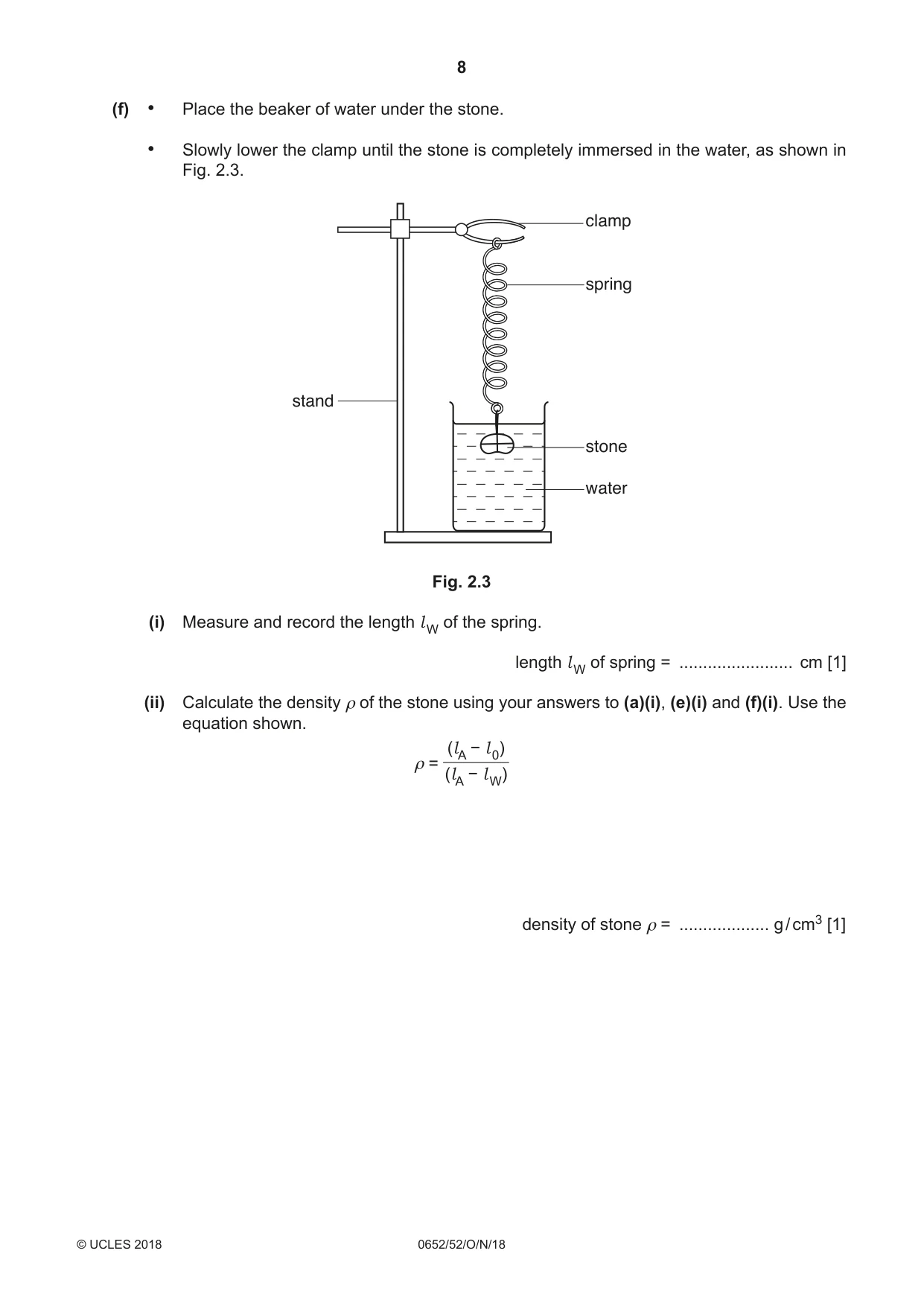
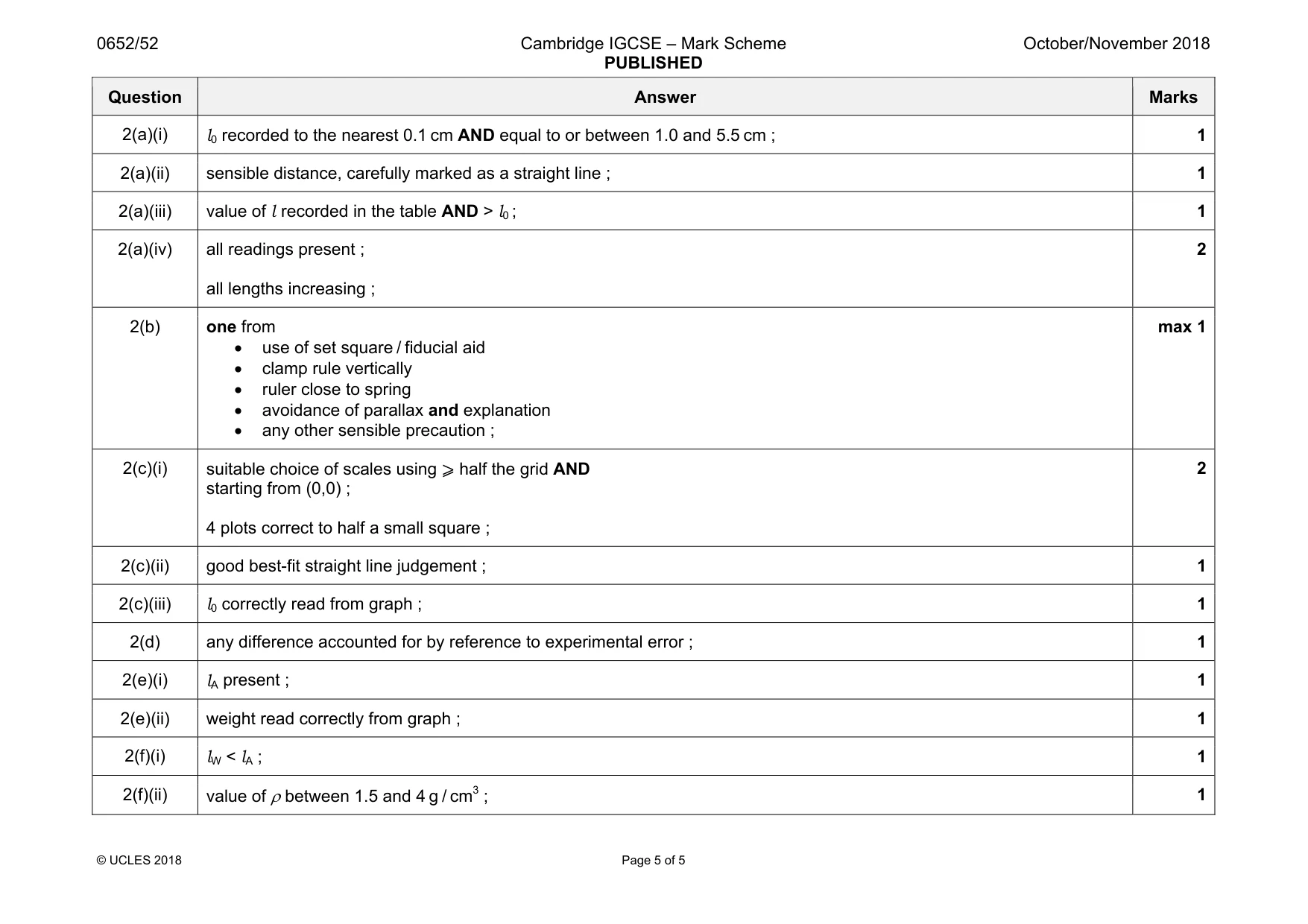
Mark scheme: 2(a)(i) 1 2(a)(ii) sensible distance, carefully marked as a straight line ; 1 2(a)(iii) value of l recorded in the table AND > l0 ; 1 2(a)(iv) all readings present ; all lengths increasing ; 2 2(b) one from • use of set square / fiducial aid • clamp rule vertically • ruler close to spring • avoidance of parallax and explanation • any other sensible precaution ; max 1 2(c)(i) suitable choice of scales using ⩾ half the grid AND starting from (0,0) ; 4 plots correct to half a small square ; 2 2(c)(ii) good best-fit straight line judgement ; 1 2(c)(iii) l0 correctly read from graph ; 1 2(d) any difference accounted for by reference to experimental error ; 1 2(e)(i) lA present ; 1 2(e)(ii) weight read correctly from graph ; 1 2(f)(i) lW < lA ; 1 2(f)(ii) value of ρ between 1.5 and 4 g / cm3 ; 1
What was in this paper
The subtopics covered by these 2 questions, and how many questions each got. Open one in a new tab to see every Cambridge question on it.
What you needed in this session
Cambridge’s own grade thresholds for 2018 Oct/Nov, Paper 5 · Variant 2. A higher threshold means an easier paper — the bar moves with how the cohort did.