Cambridge IGCSE Physical Science 0652 — 2017 Oct/Nov Paper 3 · Variant 1
0652/31/O/N/17 · 12 questions · 80 marks · ≈90 min
The question paper and its mark scheme, free to read here and free to download. This is Cambridge’s own paper, exactly as it was sat.
Question paper20 pages
Mark scheme7 pages
Answers below. Sit the paper first if you are practising.
Questions as text
Q1 · A student measures the density of a liquid
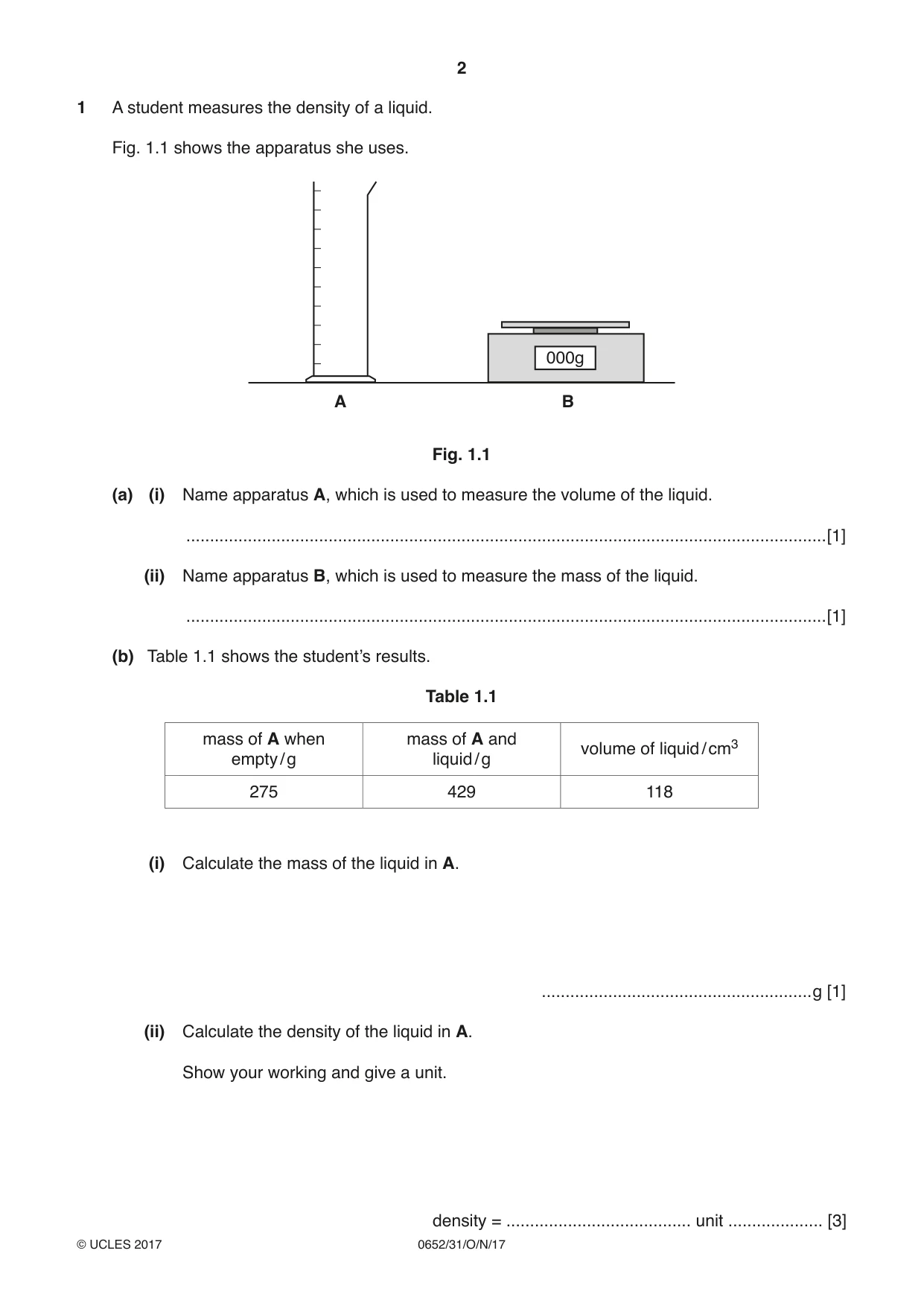
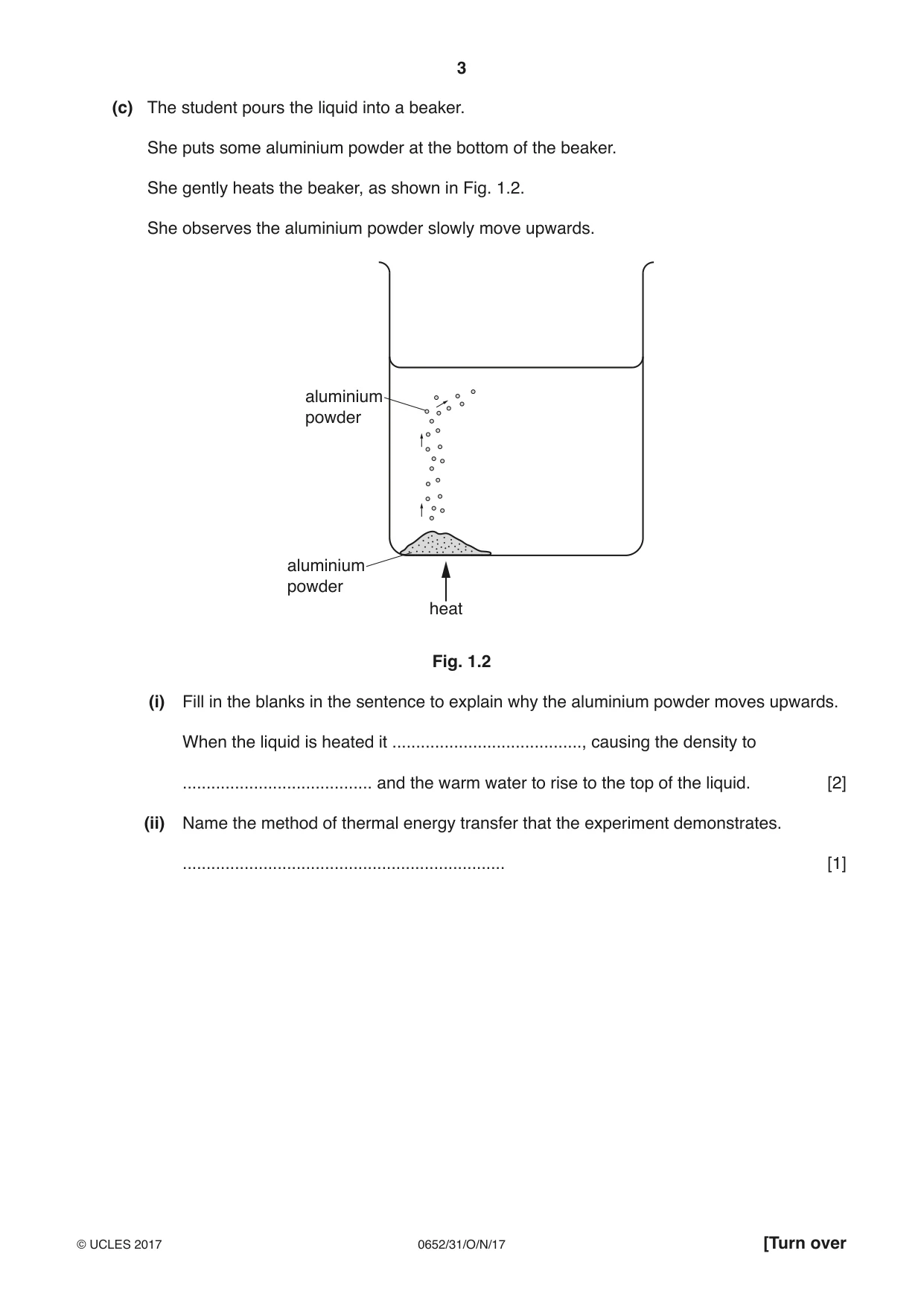
1 A student measures the density of a liquid. Fig. 1.1 shows the apparatus she uses. 000g A B Fig. 1.1 (a) (i) Name apparatus A, which is used to measure the volume of the liquid. .......................................................................................................................................[1] (ii) Name apparatus B, which is used to measure the mass of the liquid. .......................................................................................................................................[1] (b) Table 1.1 shows the student’s results. Table 1.1 mass of A when mass of A and volume of liquid / cm3 empty / g liquid / g 275 429 118 (i) Calculate the mass of the liquid in A. .........................................................g [1] (ii) Calculate the density of the liquid in A. Show your working and give a unit. density = ....................................... unit .................... [3] (c) The student pours the liquid into a beaker. She puts some aluminium powder at the bottom of the beaker. She gently heats the beaker, as shown in Fig. 1.2. She observes the aluminium powder slowly move upwards. aluminium powder aluminium powder heat Fig. 1.2 (i) Fill in the blanks in the sentence to explain why the aluminium powder moves upwards. When the liquid is heated it ........................................, causing the density to ........................................ and the warm water to rise to the top of the liquid. [2] (ii) Name the method of thermal energy transfer that the experiment demonstrates. .................................................................... [1]
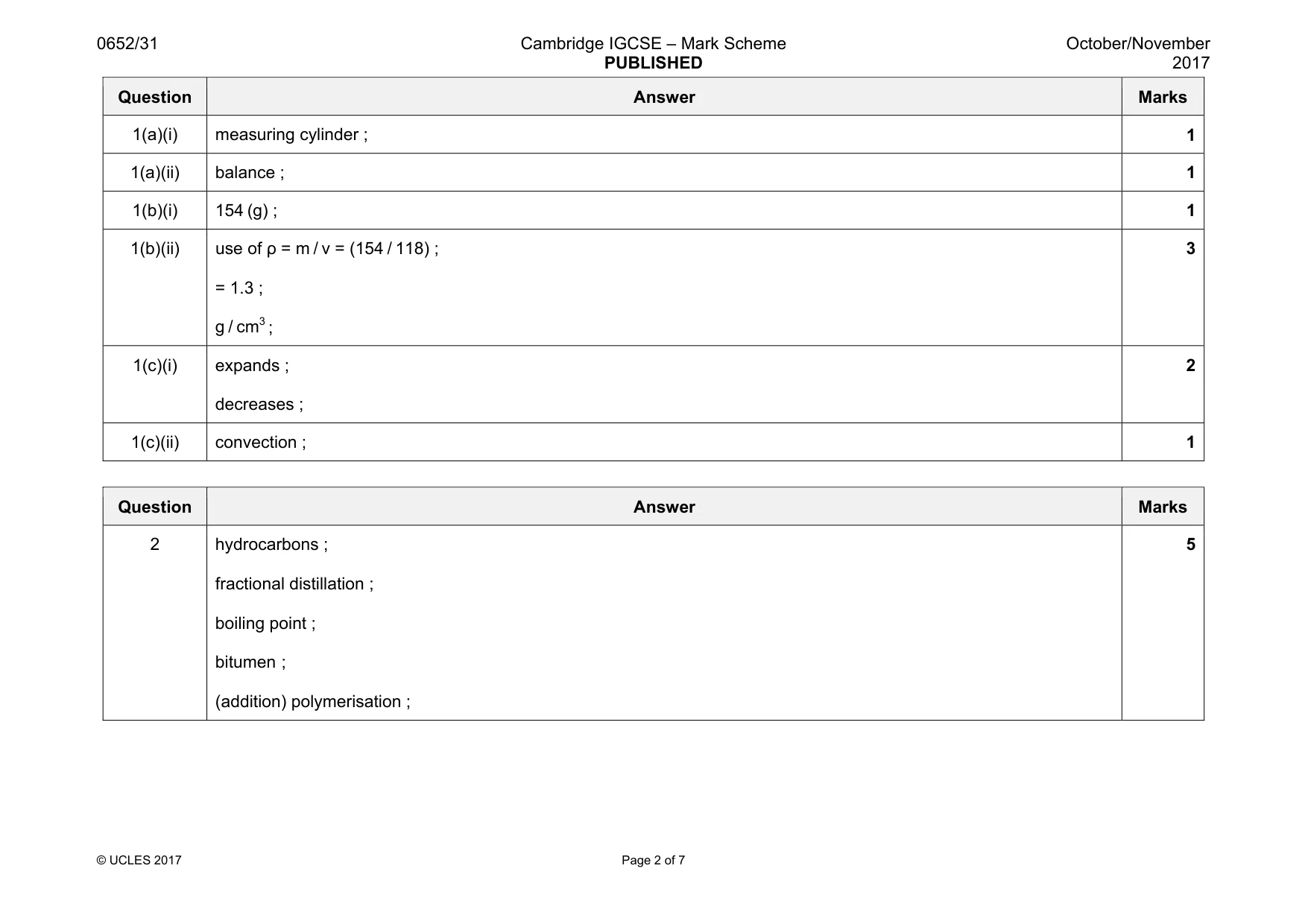
Mark scheme: 1(a)(i) measuring cylinder ; 1 1(a)(ii) balance ; 1 1(b)(i) 154 (g) ; 1 1(b)(ii) use of ρ = m / v = (154 / 118) ; = 1.3 ; g / cm3 ; 3 1(c)(i) expands ; decreases ; 2 1(c)(ii) convection ; 1
Q2 · Complete the passage by writing terms from the list in the blank spaces
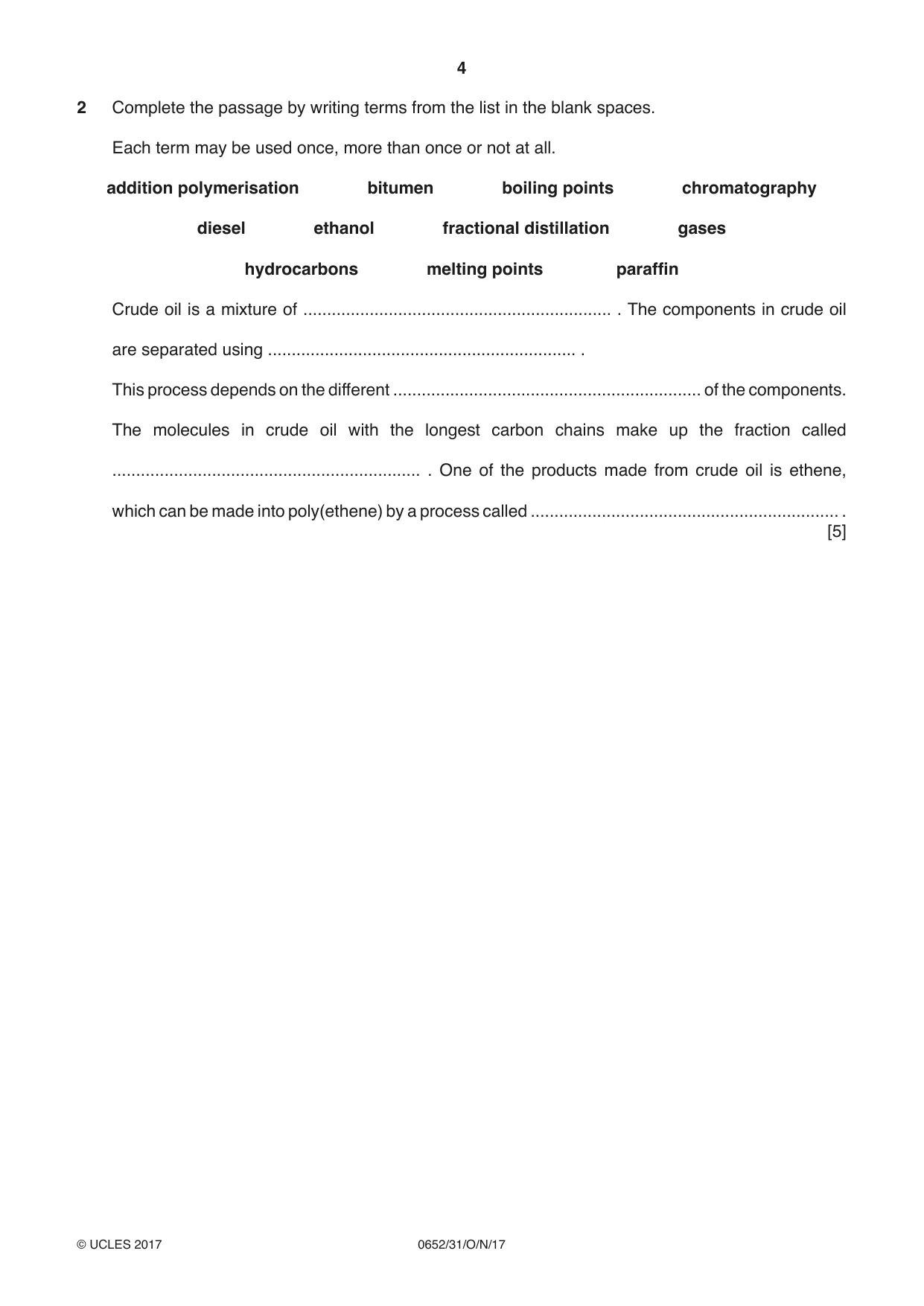
2 Complete the passage by writing terms from the list in the blank spaces. Each term may be used once, more than once or not at all. addition polymerisation bitumen boiling points chromatography diesel ethanol fractional distillation gases hydrocarbons melting points paraffin Crude oil is a mixture of ................................................................. . The components in crude oil are separated using ................................................................. . This process depends on the different ................................................................. of the components. The molecules in crude oil with the longest carbon chains make up the fraction called ................................................................. . One of the products made from crude oil is ethene, which can be made into poly(ethene) by a process called ................................................................. . [5]
Mark scheme: 2 hydrocarbons ; fractional distillation ; boiling point ; bitumen ; (addition) polymerisation ; 5
Q3 · Fill in the blanks in the sentences to describe the operation of the solar cells
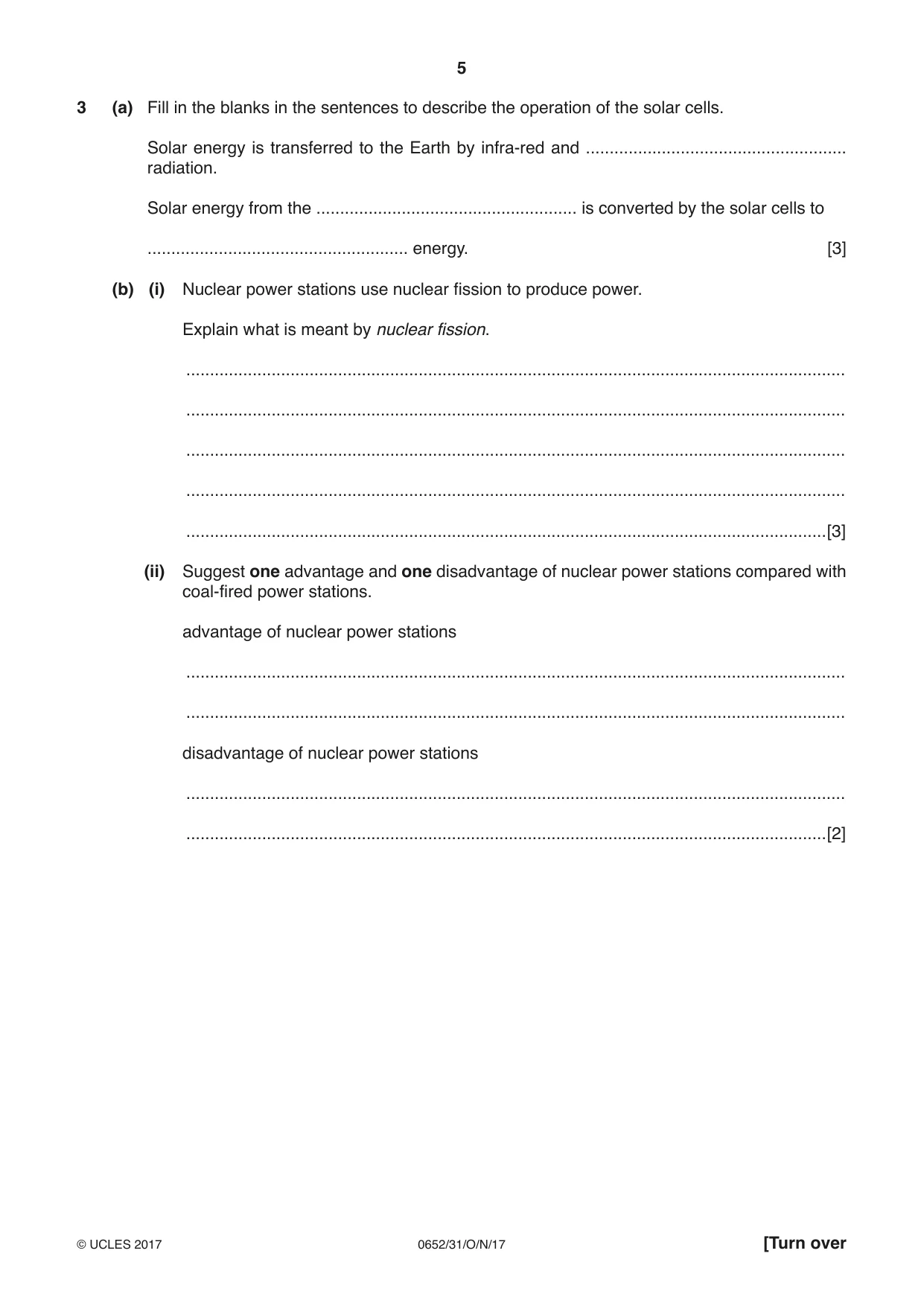
3 (a) Fill in the blanks in the sentences to describe the operation of the solar cells. Solar energy is transferred to the Earth by infra-red and ....................................................... radiation. Solar energy from the ....................................................... is converted by the solar cells to ....................................................... energy. [3] (b) (i) Nuclear power stations use nuclear fission to produce power. Explain what is meant by nuclear fission. ........................................................................................................................................... ........................................................................................................................................... ........................................................................................................................................... ........................................................................................................................................... .......................................................................................................................................[3] (ii) Suggest one advantage and one disadvantage of nuclear power stations compared with coal-fired power stations. advantage of nuclear power stations ........................................................................................................................................... ........................................................................................................................................... disadvantage of nuclear power stations ........................................................................................................................................... .......................................................................................................................................[2]
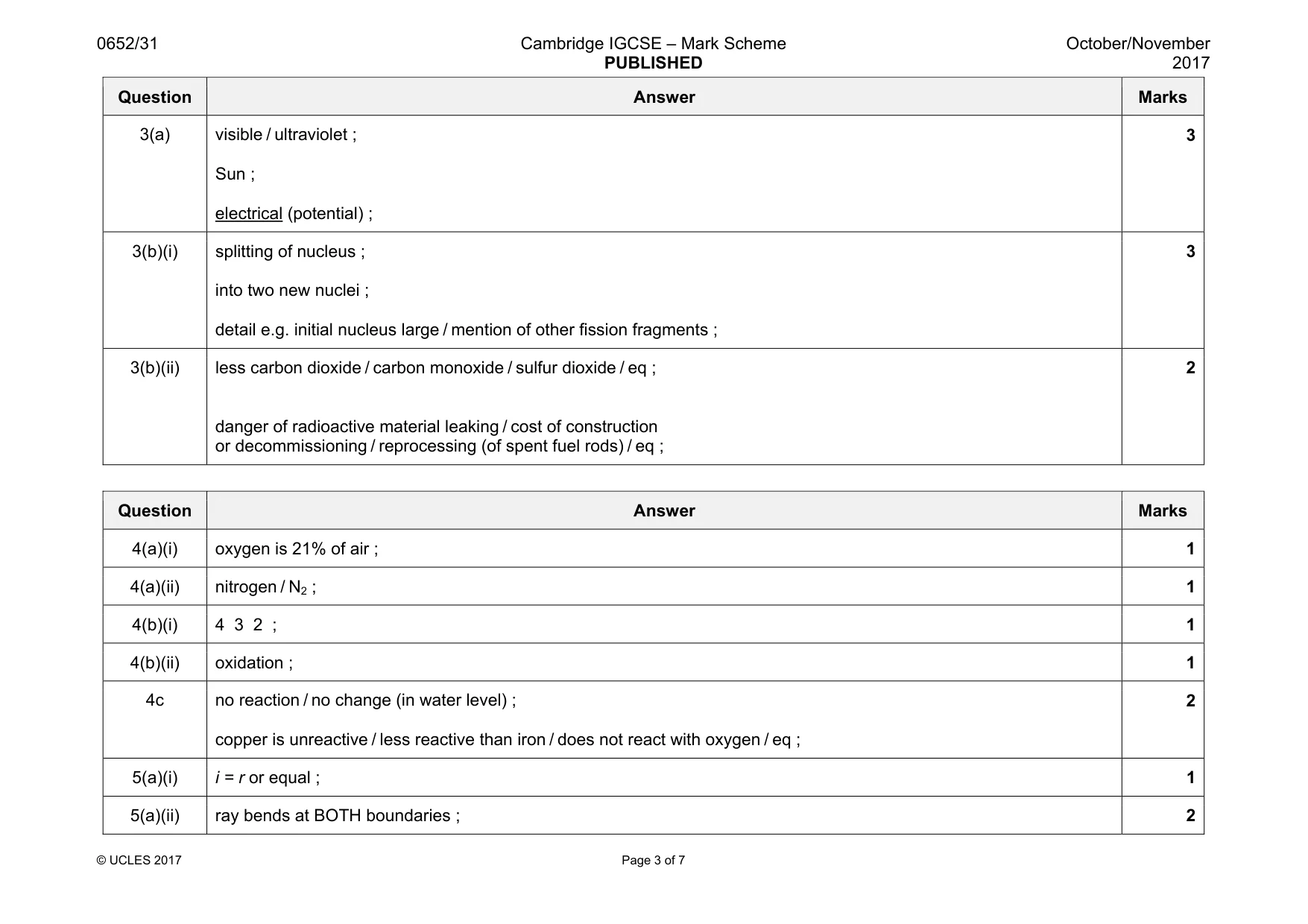
Mark scheme: 3(a) visible / ultraviolet ; Sun ; electrical (potential) ; 3 3(b)(i) splitting of nucleus ; into two new nuclei ; detail e.g. initial nucleus large / mention of other fission fragments ; 3 3(b)(ii) less carbon dioxide / carbon monoxide / sulfur dioxide / eq ; danger of radioactive material leaking / cost of construction or decommissioning / reprocessing (of spent fuel rods) / eq ; 2
Q4 · Apparatus used to react iron filings with air
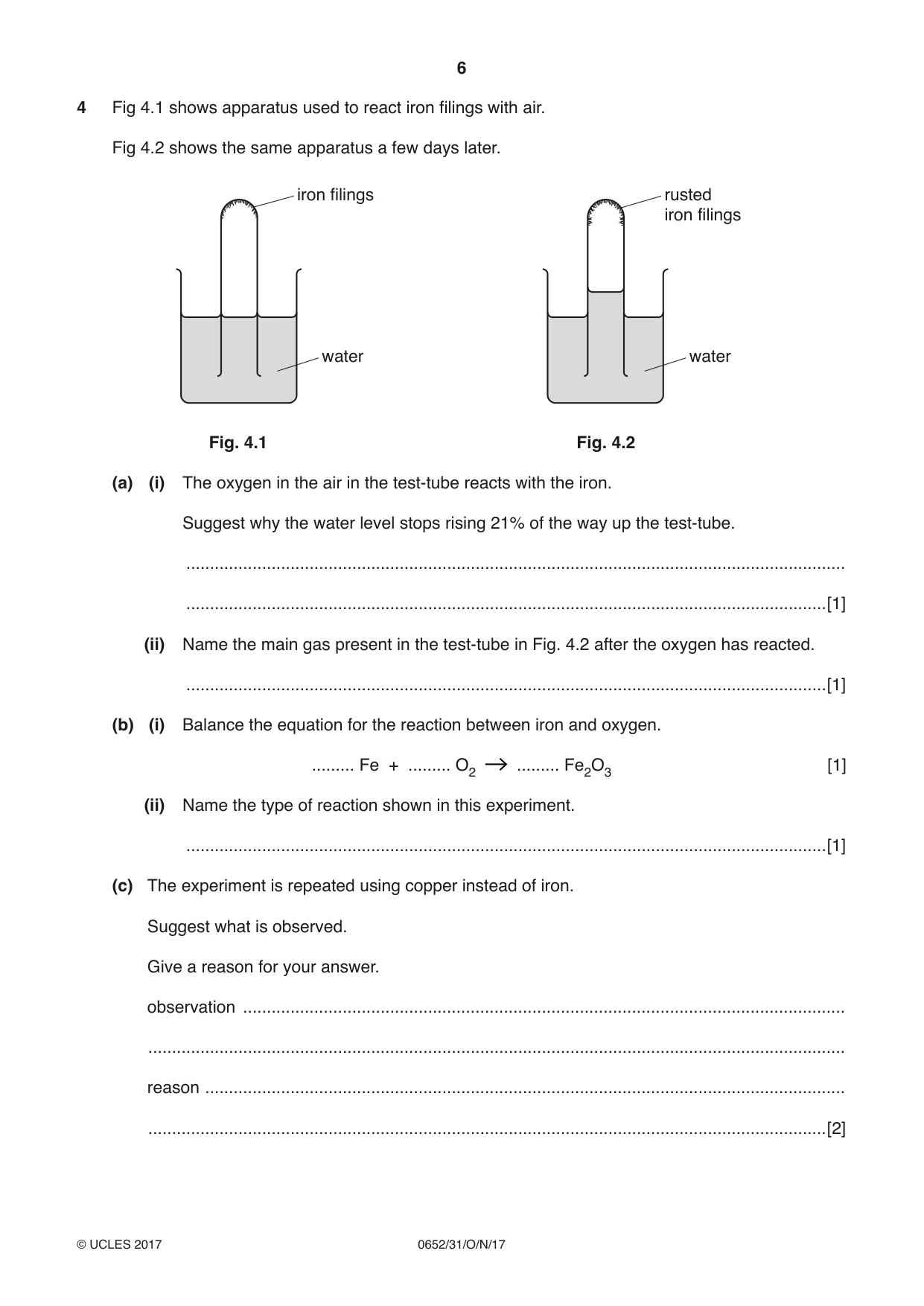
4 Fig 4.1 shows apparatus used to react iron filings with air. Fig 4.2 shows the same apparatus a few days later. iron filings rusted iron filings water water Fig. 4.1 Fig. 4.2 (a) (i) The oxygen in the air in the test-tube reacts with the iron. Suggest why the water level stops rising 21% of the way up the test-tube. ........................................................................................................................................... .......................................................................................................................................[1] (ii) Name the main gas present in the test-tube in Fig. 4.2 after the oxygen has reacted. .......................................................................................................................................[1] (b) (i) Balance the equation for the reaction between iron and oxygen. ......... Fe + ......... O2 ......... Fe2O3 [1] (ii) Name the type of reaction shown in this experiment. .......................................................................................................................................[1] (c) The experiment is repeated using copper instead of iron. Suggest what is observed. Give a reason for your answer. observation ............................................................................................................................... ................................................................................................................................................... reason ....................................................................................................................................... ...............................................................................................................................................[2]
Mark scheme: 4(a)(i) oxygen is 21% of air ; 1 4(a)(ii) nitrogen / N2 ; 1 4(b)(i) 4 3 2 ; 1 4(b)(ii) oxidation ; 1 4c no reaction / no change (in water level) ; copper is unreactive / less reactive than iron / does not react with oxygen / eq ; 2
Q5 · A ray of light incident on the surface of a rectangular glass block
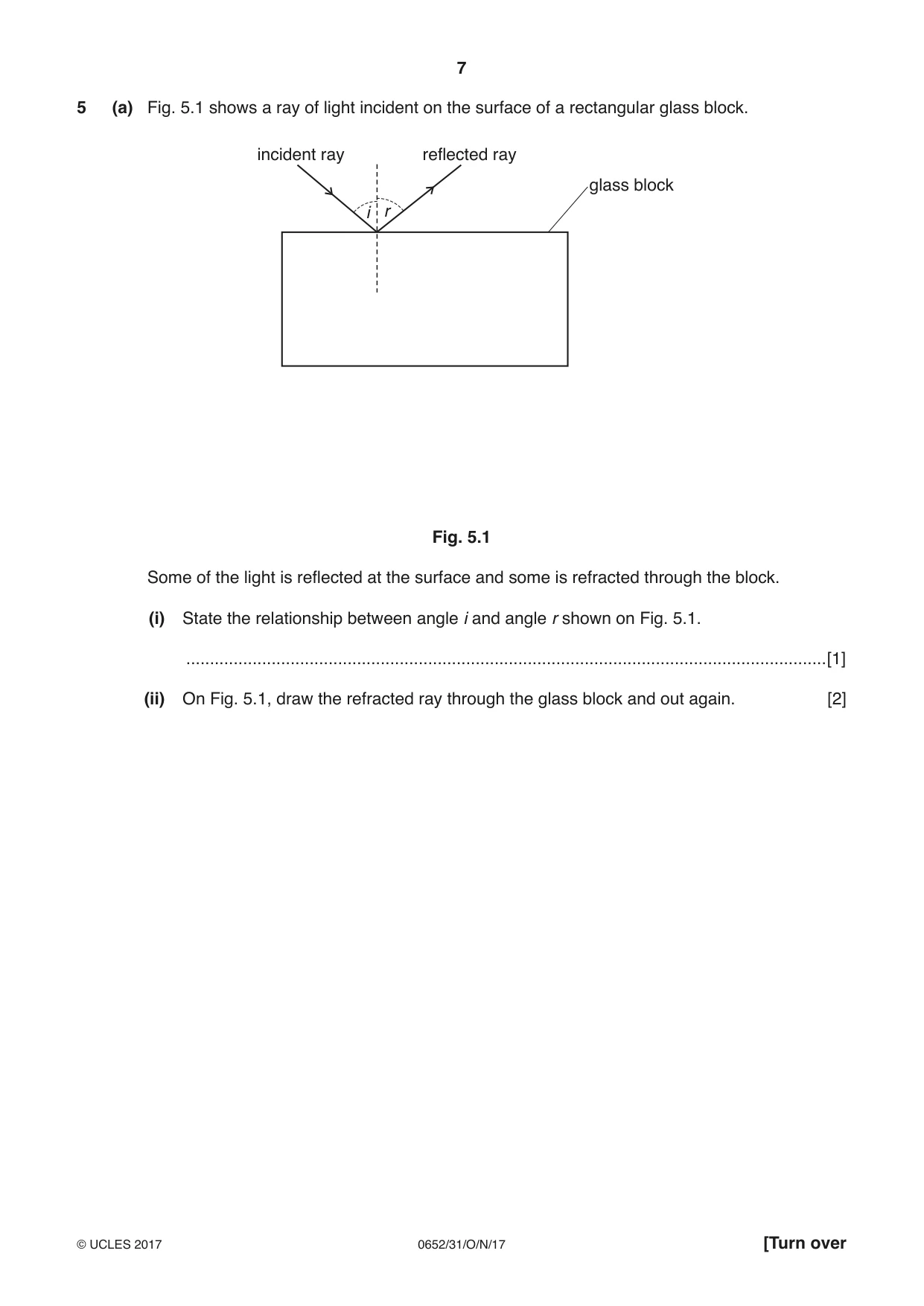
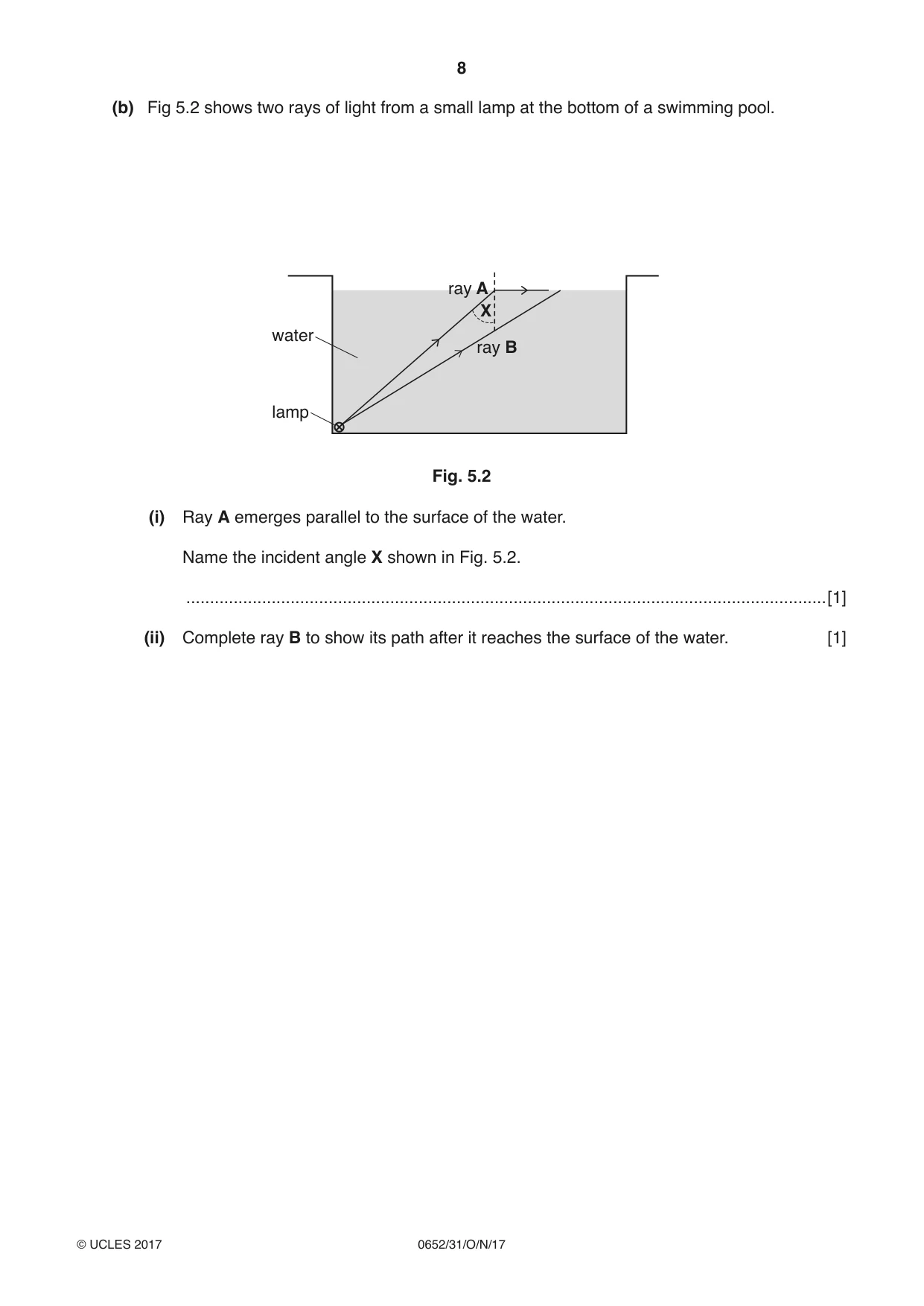
5 (a) Fig. 5.1 shows a ray of light incident on the surface of a rectangular glass block. incident ray reflected ray glass block i r Fig. 5.1 Some of the light is reflected at the surface and some is refracted through the block. (i) State the relationship between angle i and angle r shown on Fig. 5.1. .......................................................................................................................................[1] (ii) On Fig. 5.1, draw the refracted ray through the glass block and out again. [2] (b) Fig 5.2 shows two rays of light from a small lamp at the bottom of a swimming pool. ray A X water ray B lamp Fig. 5.2 (i) Ray A emerges parallel to the surface of the water. Name the incident angle X shown in Fig. 5.2. .......................................................................................................................................[1] (ii) Complete ray B to show its path after it reaches the surface of the water. [1]
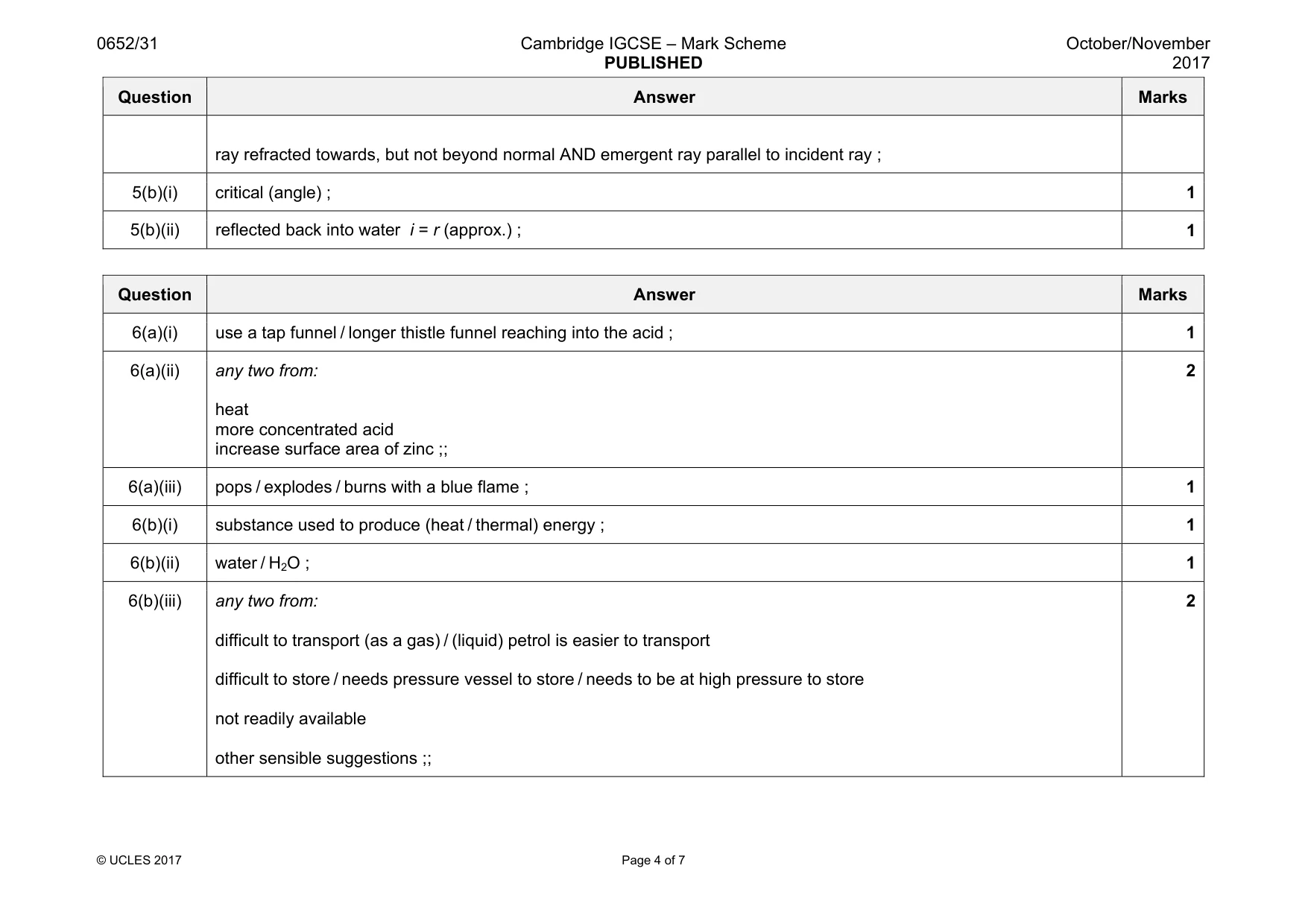
Mark scheme: 5(a)(i) i = r or equal ; 1 5(a)(ii) ray bends at BOTH boundaries ; 2 Question Answer Marks ray refracted towards, but not beyond normal AND emergent ray parallel to incident ray ; 5(b)(i) critical (angle) ; 1 5(b)(ii) reflected back into water i = r (approx.) ; 1
Q6 · Zinc reacts with hydrochloric acid to form hydrogen
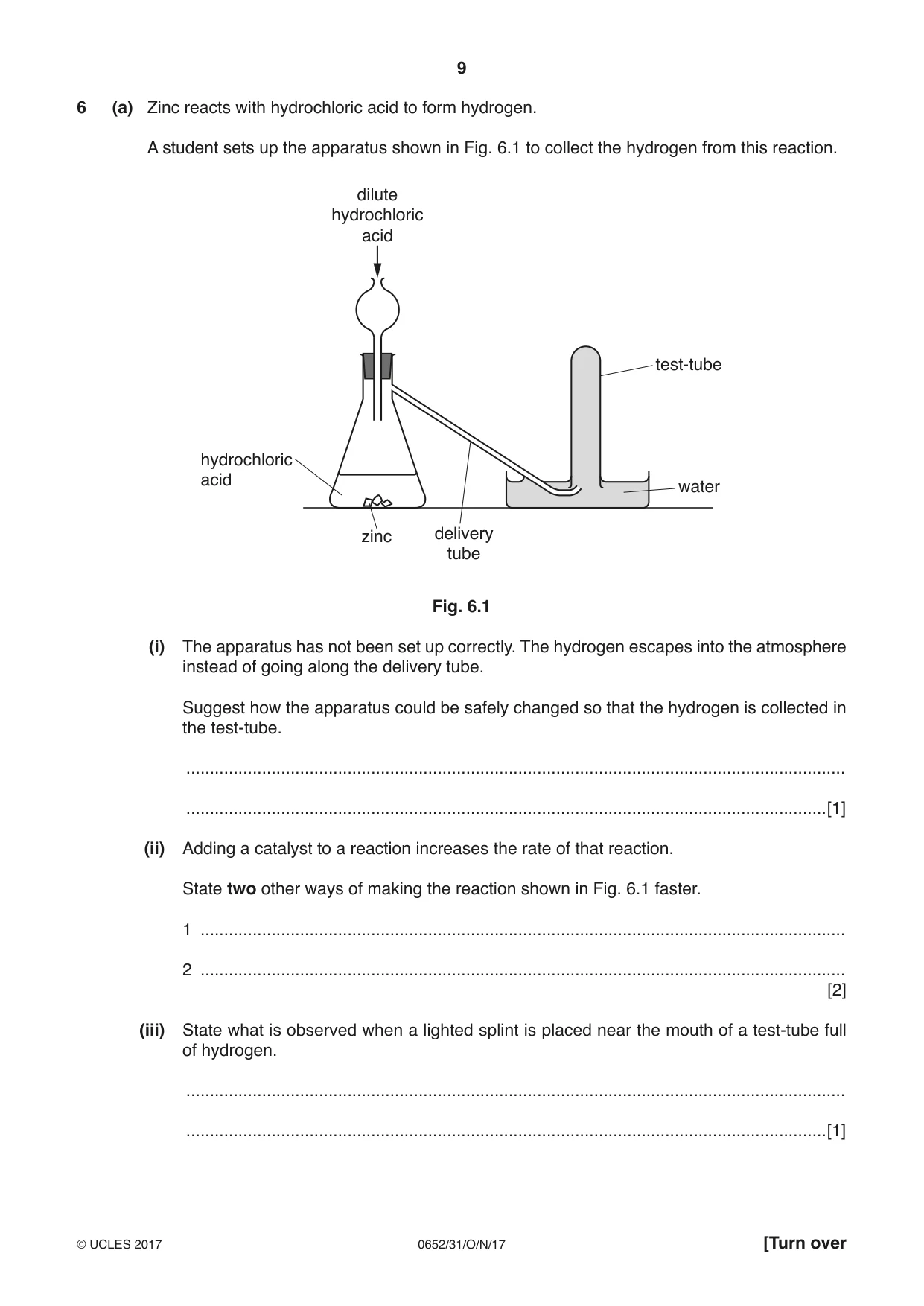
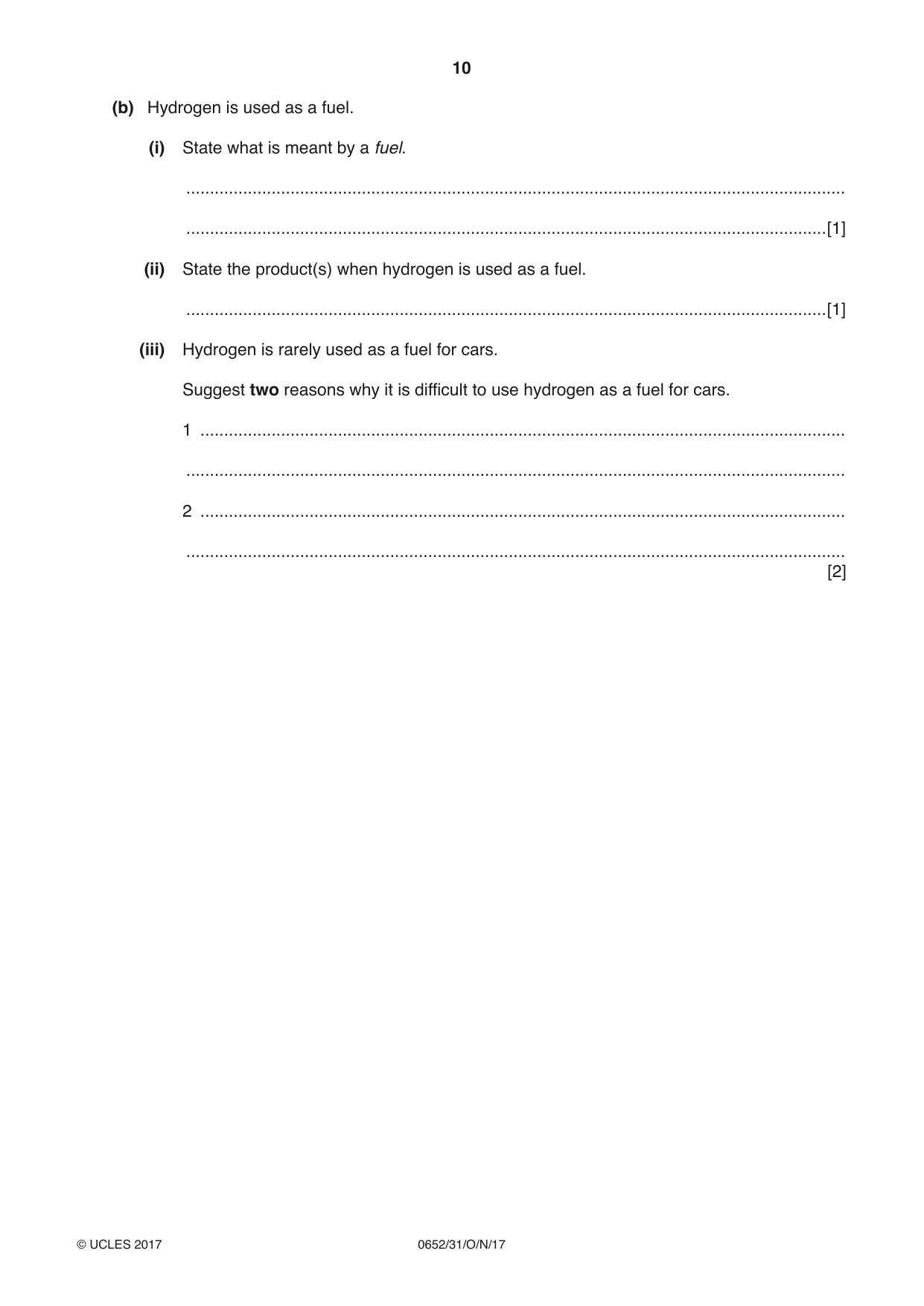
6 (a) Zinc reacts with hydrochloric acid to form hydrogen. A student sets up the apparatus shown in Fig. 6.1 to collect the hydrogen from this reaction. dilute hydrochloric acid test-tube hydrochloric acid water zinc delivery tube Fig. 6.1 (i) The apparatus has not been set up correctly. The hydrogen escapes into the atmosphere instead of going along the delivery tube. Suggest how the apparatus could be safely changed so that the hydrogen is collected in the test-tube. ........................................................................................................................................... .......................................................................................................................................[1] (ii) Adding a catalyst to a reaction increases the rate of that reaction. State two other ways of making the reaction shown in Fig. 6.1 faster. 1 ........................................................................................................................................ 2 ........................................................................................................................................ [2] (iii) State what is observed when a lighted splint is placed near the mouth of a test-tube full of hydrogen. ........................................................................................................................................... .......................................................................................................................................[1] (b) Hydrogen is used as a fuel. (i) State what is meant by a fuel. ........................................................................................................................................... .......................................................................................................................................[1] (ii) State the product(s) when hydrogen is used as a fuel. .......................................................................................................................................[1] (iii) Hydrogen is rarely used as a fuel for cars. Suggest two reasons why it is difficult to use hydrogen as a fuel for cars. 1 ........................................................................................................................................ ........................................................................................................................................... 2 ........................................................................................................................................ ........................................................................................................................................... [2]
Mark scheme: 6(a)(i) use a tap funnel / longer thistle funnel reaching into the acid ; 1 6(a)(ii) any two from: heat more concentrated acid increase surface area of zinc ;; 2 6(a)(iii) pops / explodes / burns with a blue flame ; 1 6(b)(i) substance used to produce (heat / thermal) energy ; 1 6(b)(ii) water / H2O ; 1 6(b)(iii) any two from: difficult to transport (as a gas) / (liquid) petrol is easier to transport difficult to store / needs pressure vessel to store / needs to be at high pressure to store not readily available other sensible suggestions ;; 2
Q7 · Pitchblende is an ore of uranium
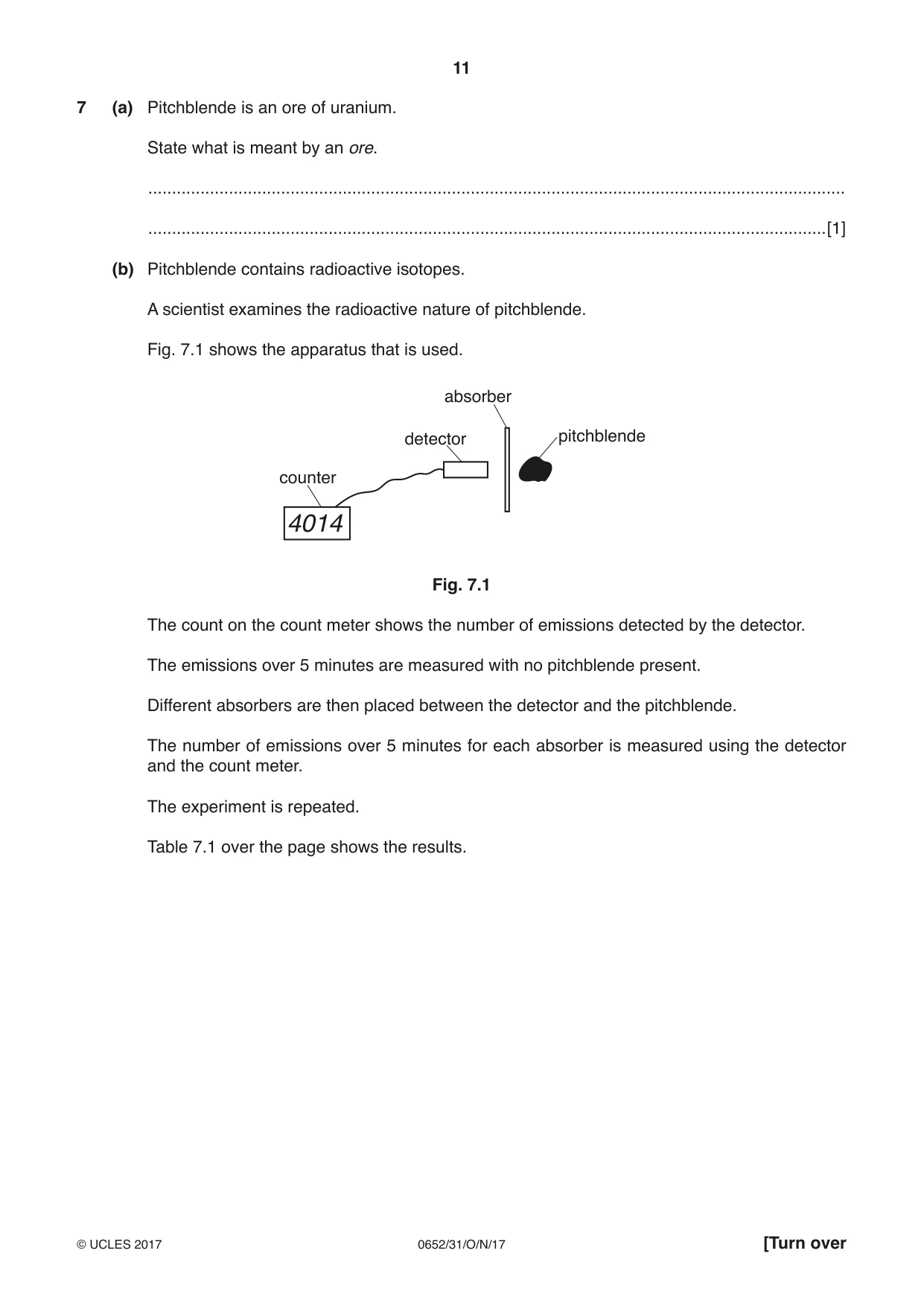
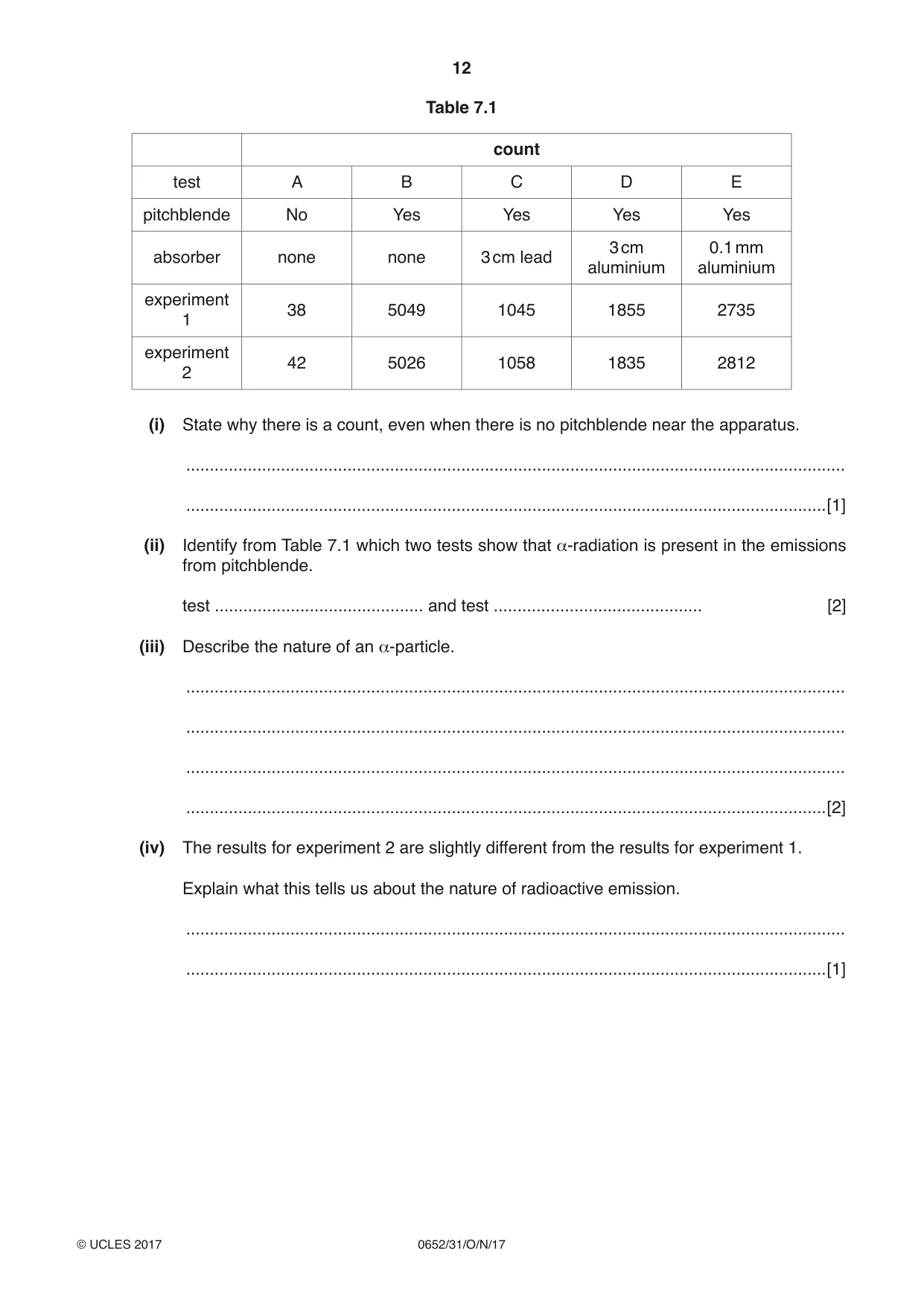
7 (a) Pitchblende is an ore of uranium. State what is meant by an ore. ................................................................................................................................................... ...............................................................................................................................................[1] (b) Pitchblende contains radioactive isotopes. A scientist examines the radioactive nature of pitchblende. Fig. 7.1 shows the apparatus that is used. absorber detector pitchblende counter 4014 Fig. 7.1 The count on the count meter shows the number of emissions detected by the detector. The emissions over 5 minutes are measured with no pitchblende present. Different absorbers are then placed between the detector and the pitchblende. The number of emissions over 5 minutes for each absorber is measured using the detector and the count meter. The experiment is repeated. Table 7.1 over the page shows the results. Table 7.1 count test A B C D E pitchblende No Yes Yes Yes Yes 3 cm 0.1 mm absorber none none 3 cm lead aluminium aluminium experiment 38 5049 1045 1855 2735 1 experiment 42 5026 1058 1835 2812 2 (i) State why there is a count, even when there is no pitchblende near the apparatus. ........................................................................................................................................... .......................................................................................................................................[1] (ii) Identify from Table 7.1 which two tests show that α-radiation is present in the emissions from pitchblende. test ............................................ and test ............................................ [2] (iii) Describe the nature of an α-particle. ........................................................................................................................................... ........................................................................................................................................... ........................................................................................................................................... .......................................................................................................................................[2] (iv) The results for experiment 2 are slightly different from the results for experiment 1. Explain what this tells us about the nature of radioactive emission. ........................................................................................................................................... .......................................................................................................................................[1]
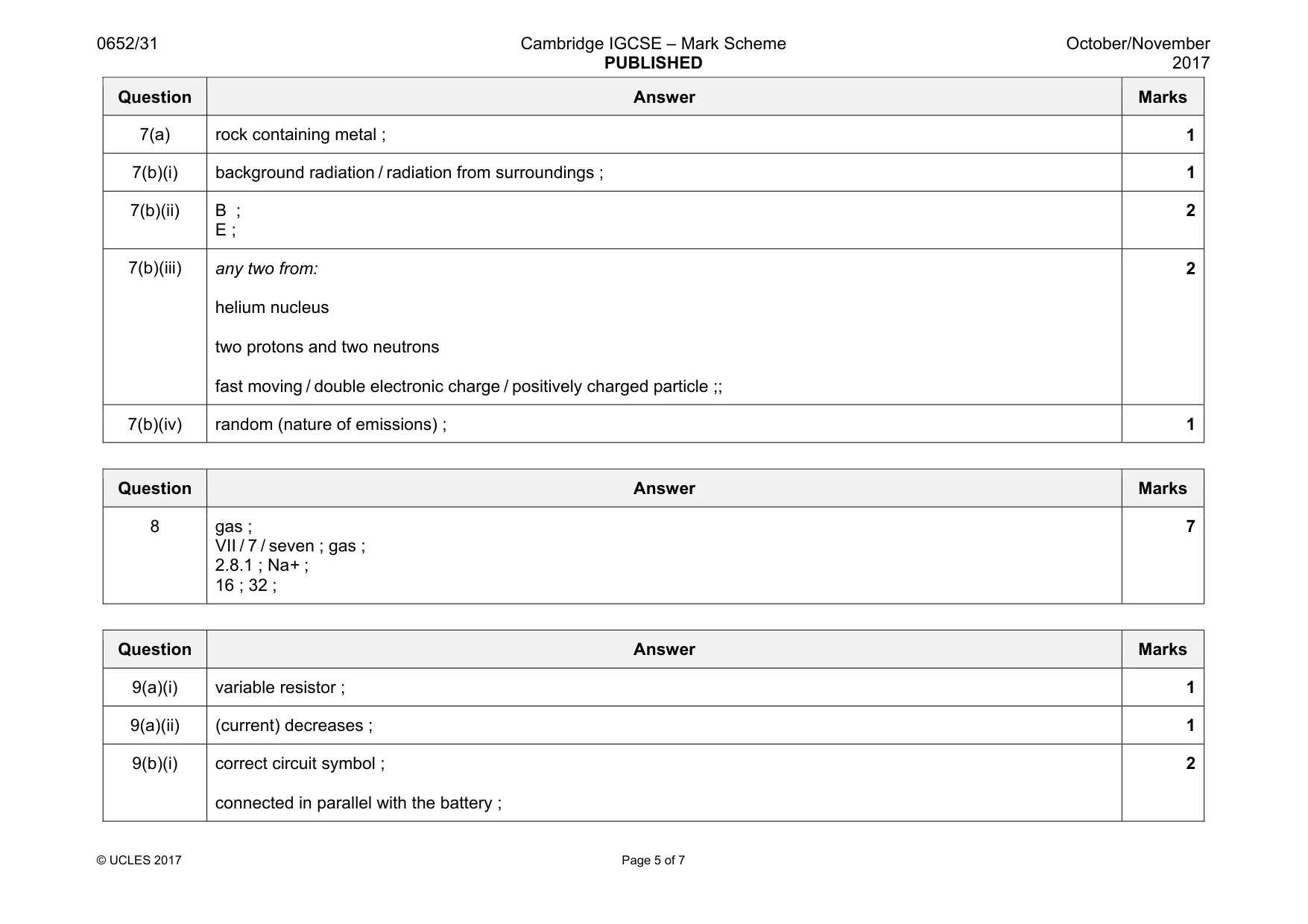
Mark scheme: 7(a) rock containing metal ; 1 7(b)(i) background radiation / radiation from surroundings ; 1 7(b)(ii) B ; E ; 2 7(b)(iii) any two from: helium nucleus two protons and two neutrons fast moving / double electronic charge / positively charged particle ;; 2 7(b)(iv) random (nature of emissions) ; 1
Q8 · Information about some elements of the Periodic Table
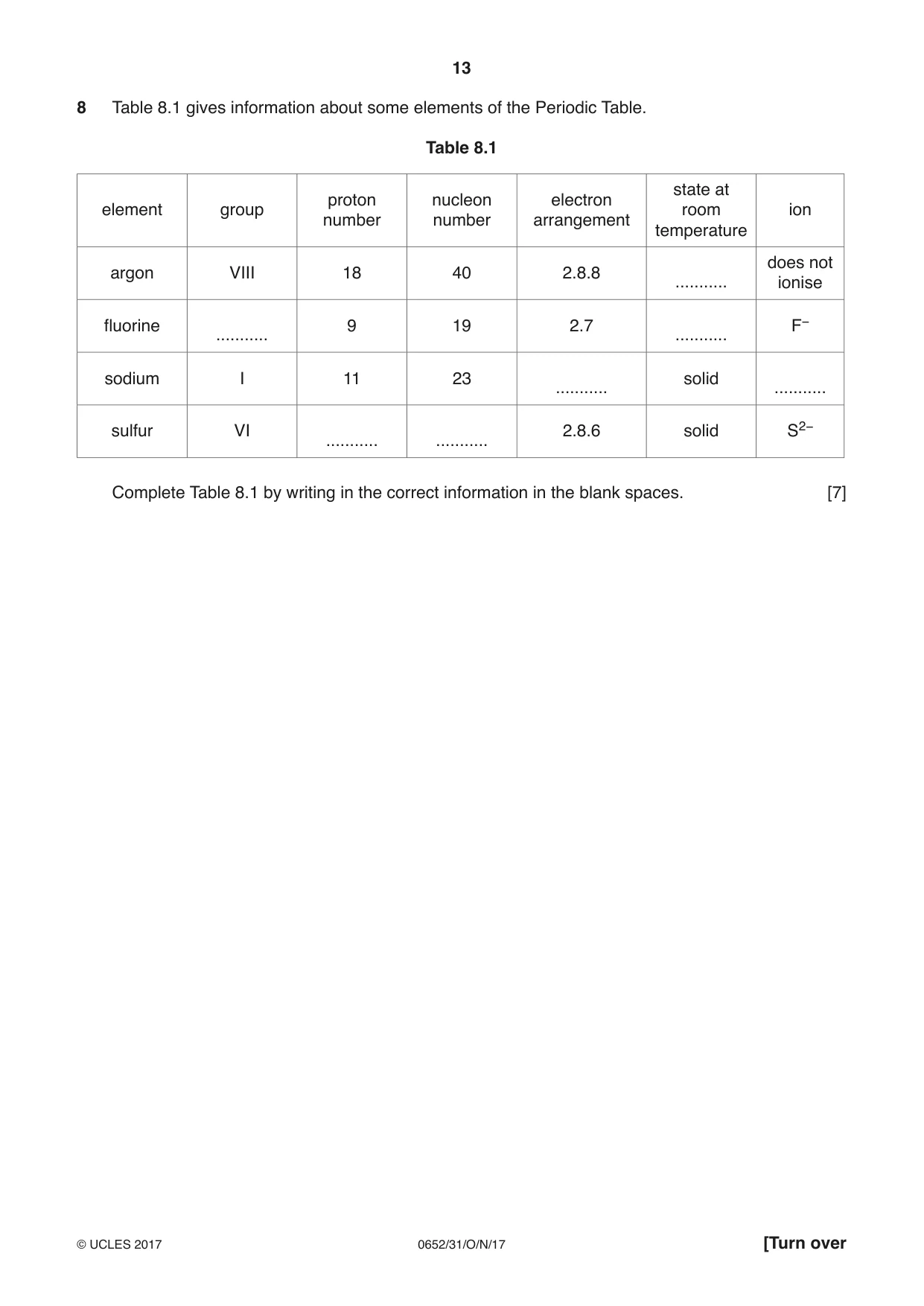
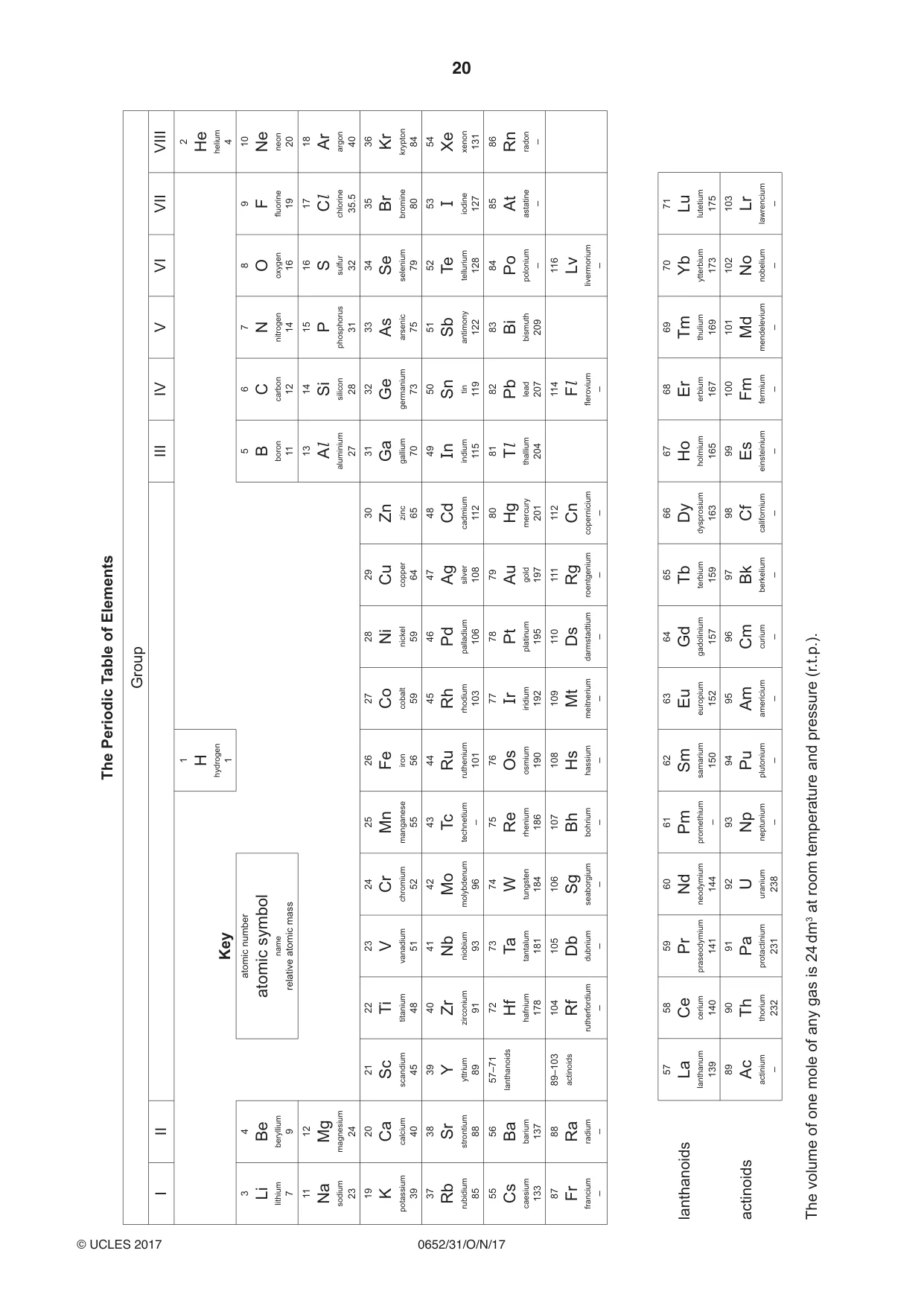
8 Table 8.1 gives information about some elements of the Periodic Table. Table 8.1 state at proton nucleon electron element group room ion number number arrangement temperature does not argon VIII 18 40 2.8.8 ........... ionise fluorine 9 19 2.7 F− ........... ........... sodium I 11 23 solid ........... ........... sulfur VI 2.8.6 solid S2− ........... ........... Complete Table 8.1 by writing in the correct information in the blank spaces. [7]
Mark scheme: 8 gas ; VII / 7 / seven ; gas ; 2.8.1 ; Na+ ; 16 ; 32 ; 7
Question 9
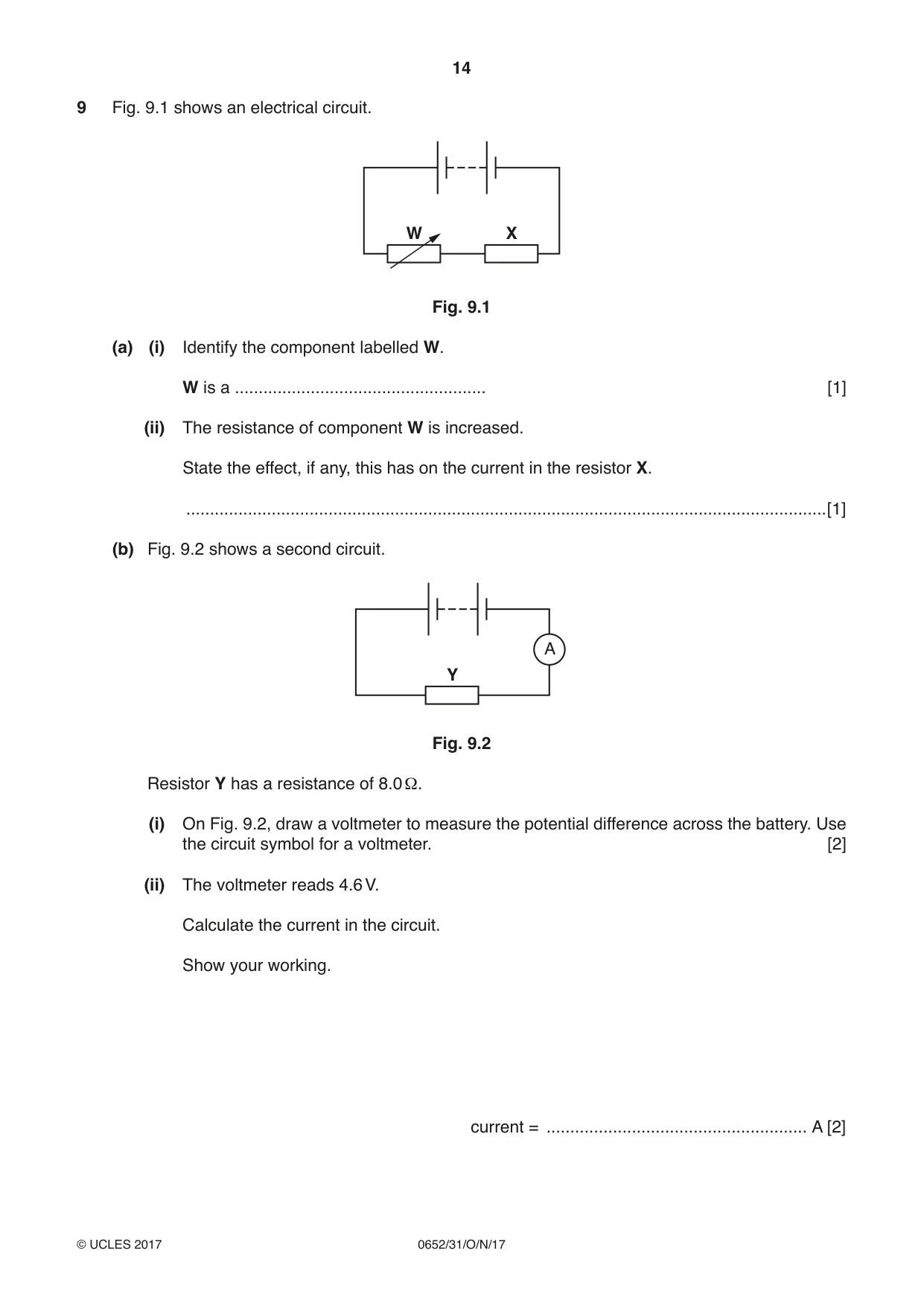
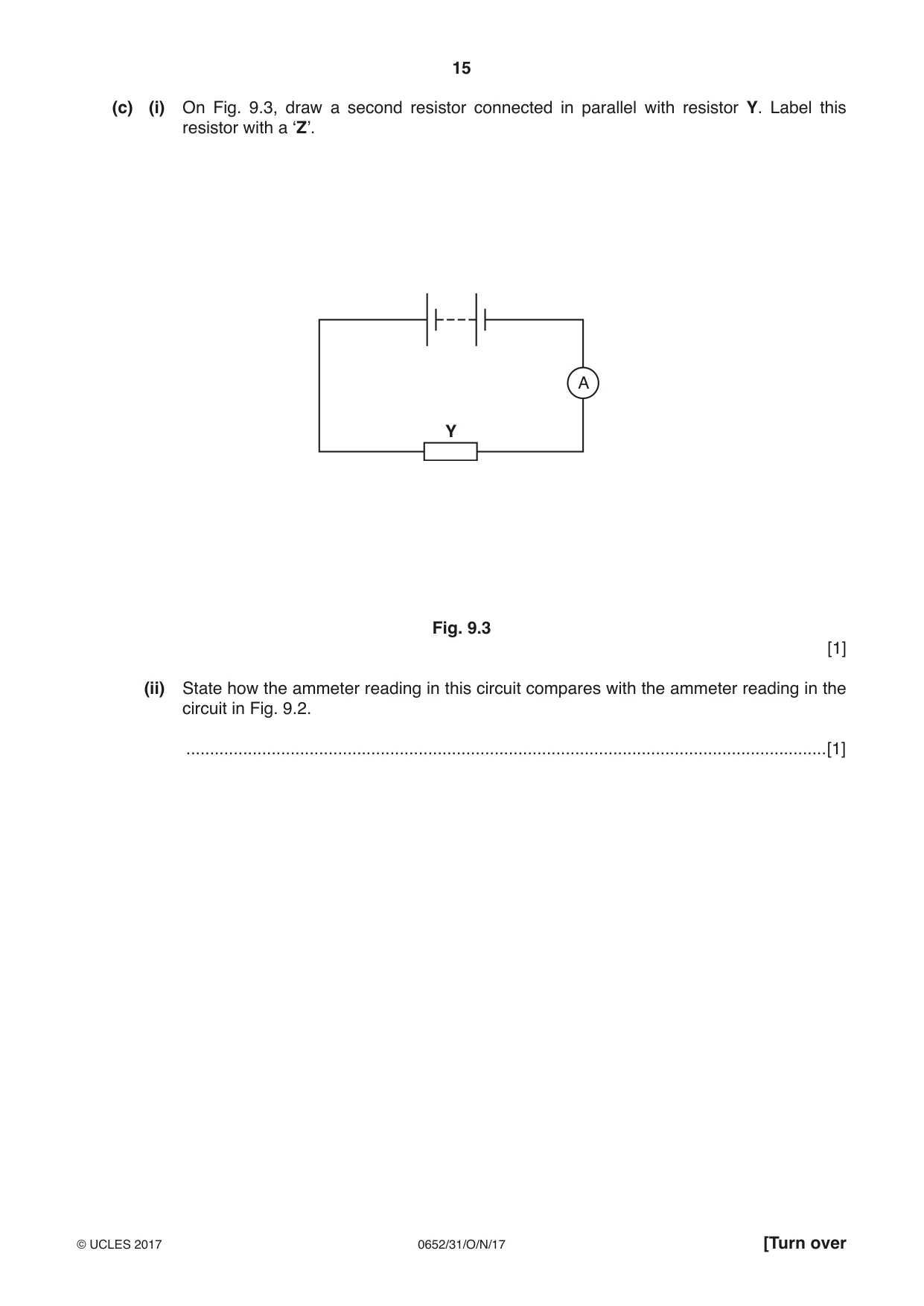
9 Fig. 9.1 shows an electrical circuit. W X Fig. 9.1 (a) (i) Identify the component labelled W. W is a ..................................................... [1] (ii) The resistance of component W is increased. State the effect, if any, this has on the current in the resistor X. .......................................................................................................................................[1] (b) Fig. 9.2 shows a second circuit. A Y Fig. 9.2 Resistor Y has a resistance of 8.0 Ω. (i) On Fig. 9.2, draw a voltmeter to measure the potential difference across the battery. Use the circuit symbol for a voltmeter. [2] (ii) The voltmeter reads 4.6 V. Calculate the current in the circuit. Show your working. current = ....................................................... A [2] (c) (i) On Fig. 9.3, draw a second resistor connected in parallel with resistor Y. Label this resistor with a ‘Z’. A Y Fig. 9.3 [1] (ii) State how the ammeter reading in this circuit compares with the ammeter reading in the circuit in Fig. 9.2. .......................................................................................................................................[1]
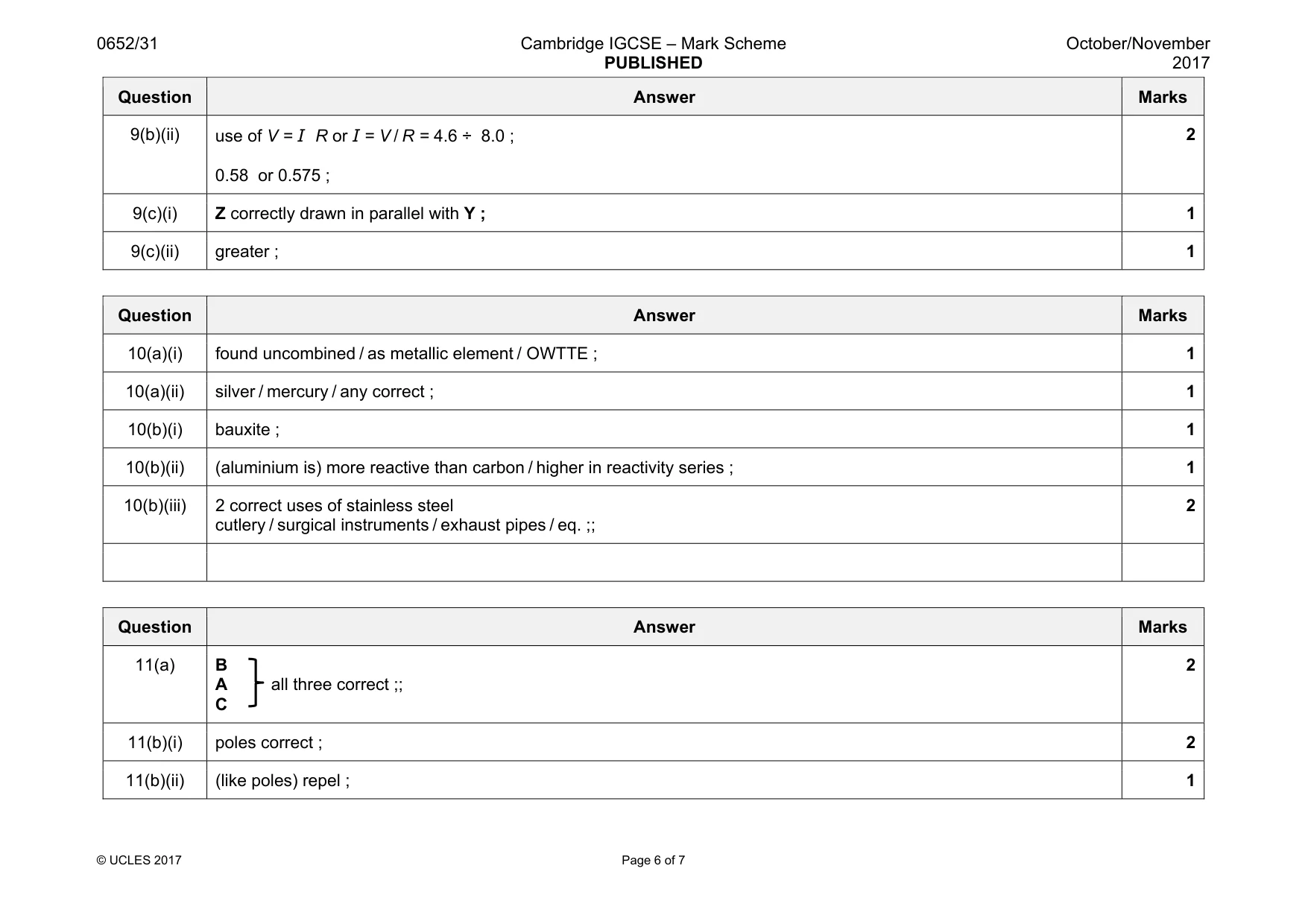
Mark scheme: 9(a)(i) variable resistor ; 1 9(a)(ii) (current) decreases ; 1 9(b)(i) correct circuit symbol ; connected in parallel with the battery ; 2 Question Answer Marks 9(b)(ii) use of V = I R or I = V / R = 4.6 ÷ 8.0 ; 0.58 or 0.575 ; 2 9(c)(i) Z correctly drawn in parallel with Y ; 1 9(c)(ii) greater ; 1
Q10 · Gold is described as a native metal
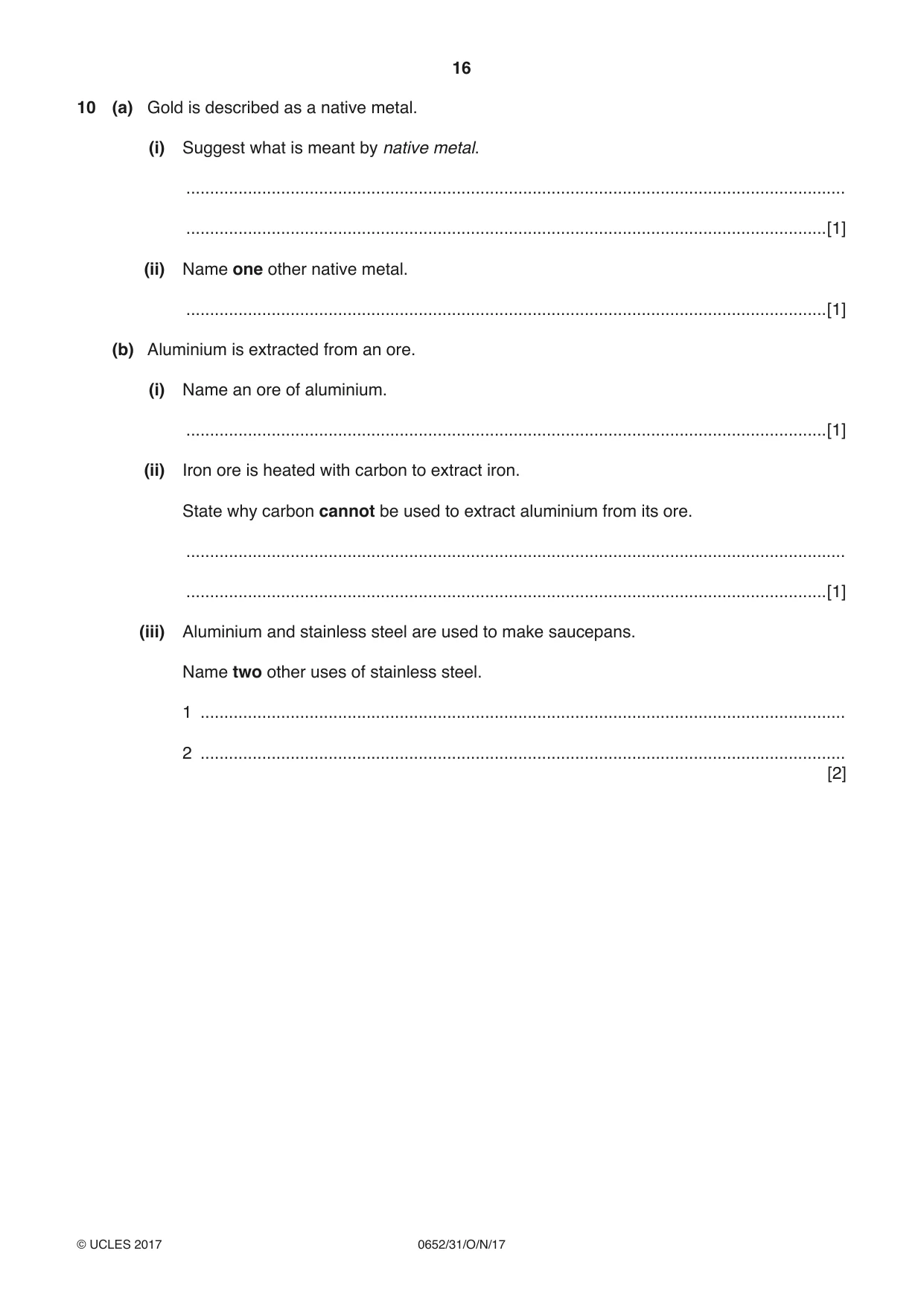
10 (a) Gold is described as a native metal. (i) Suggest what is meant by native metal. ........................................................................................................................................... .......................................................................................................................................[1] (ii) Name one other native metal. .......................................................................................................................................[1] (b) Aluminium is extracted from an ore. (i) Name an ore of aluminium. .......................................................................................................................................[1] (ii) Iron ore is heated with carbon to extract iron. State why carbon cannot be used to extract aluminium from its ore. ........................................................................................................................................... .......................................................................................................................................[1] (iii) Aluminium and stainless steel are used to make saucepans. Name two other uses of stainless steel. 1 ........................................................................................................................................ 2 ........................................................................................................................................ [2]
Mark scheme: 10(a)(i) found uncombined / as metallic element / OWTTE ; 1 10(a)(ii) silver / mercury / any correct ; 1 10(b)(i) bauxite ; 1 10(b)(ii) (aluminium is) more reactive than carbon / higher in reactivity series ; 1 10(b)(iii) 2 correct uses of stainless steel cutlery / surgical instruments / exhaust pipes / eq. ;; 2
Q11 · A student has three metal bars, A, B and C
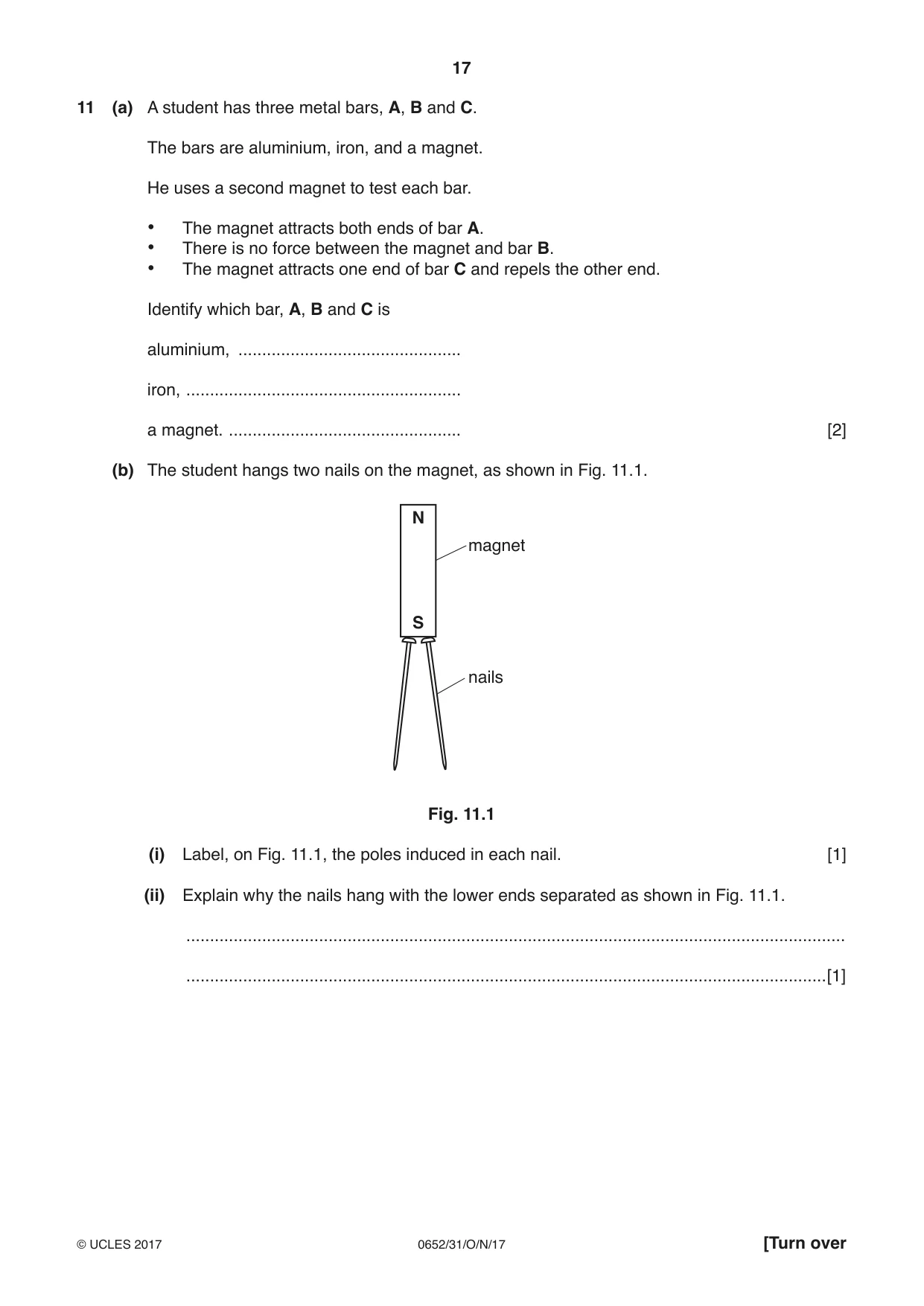
11 (a) A student has three metal bars, A, B and C. The bars are aluminium, iron, and a magnet. He uses a second magnet to test each bar. • The magnet attracts both ends of bar A. • There is no force between the magnet and bar B. • The magnet attracts one end of bar C and repels the other end. Identify which bar, A, B and C is aluminium, ............................................... iron, .......................................................... a magnet. ................................................. [2] (b) The student hangs two nails on the magnet, as shown in Fig. 11.1. N magnet S nails Fig. 11.1 (i) Label, on Fig. 11.1, the poles induced in each nail. [1] (ii) Explain why the nails hang with the lower ends separated as shown in Fig. 11.1. ........................................................................................................................................... .......................................................................................................................................[1]
Mark scheme: 11(a) B A all three correct ;; C 2 11(b)(i) poles correct ; 2 11(b)(ii) (like poles) repel ; 1
Q12 · Some information about members of a homologous series of acids
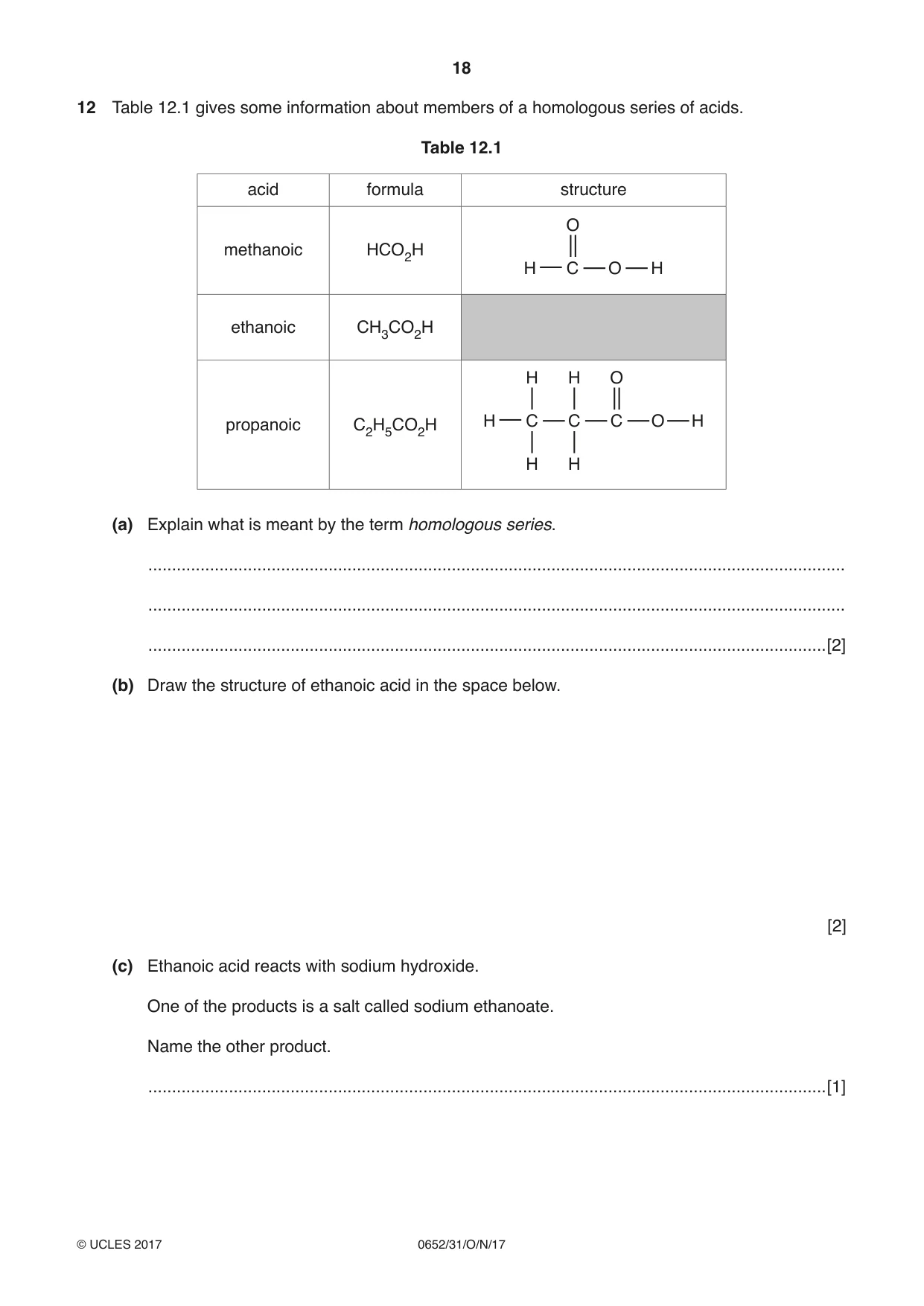
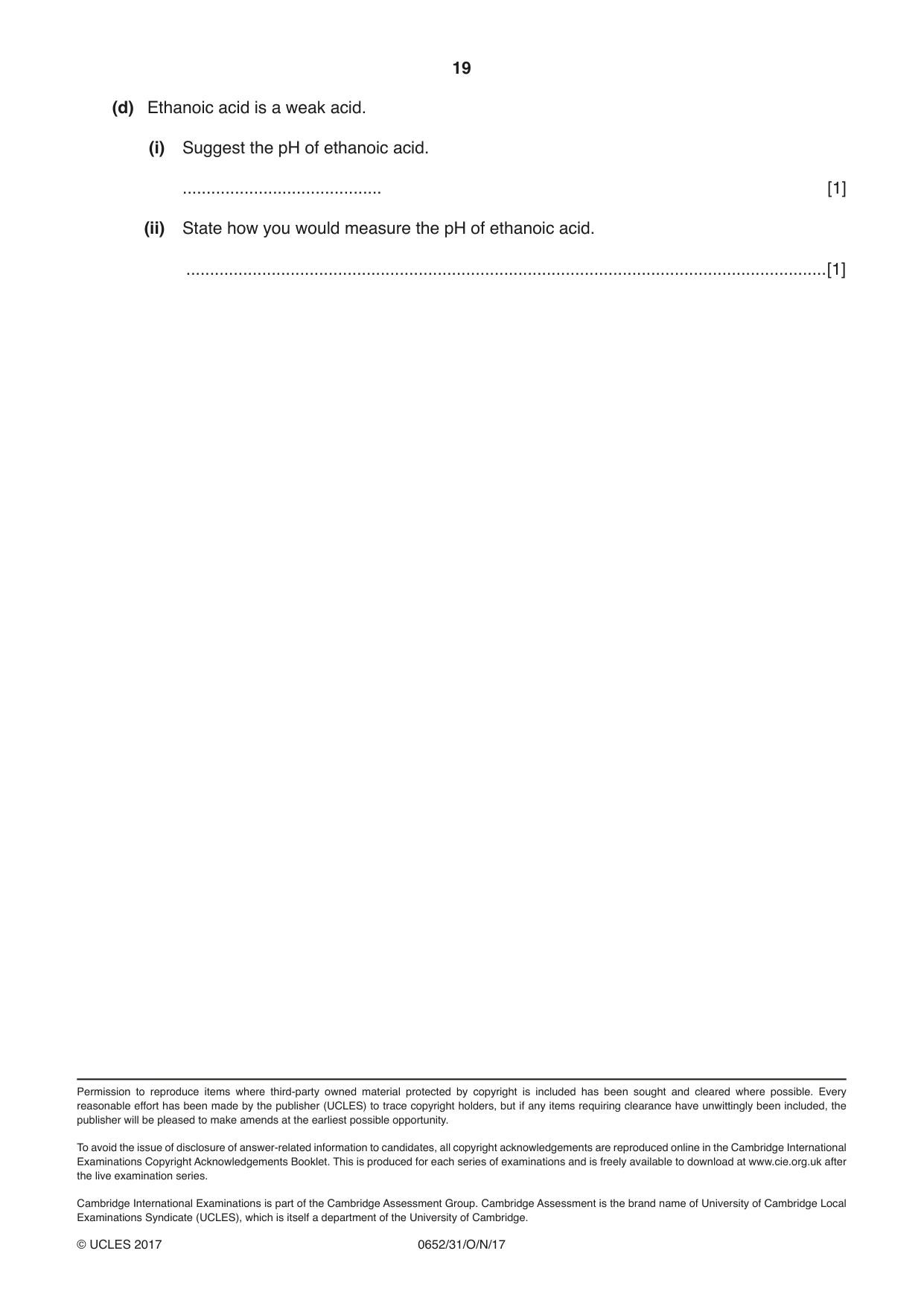
12 Table 12.1 gives some information about members of a homologous series of acids. Table 12.1 acid formula structure O methanoic HCO2H H C O H ethanoic CH3CO2H H H O propanoic C2H5CO2H H C C C O H H H (a) Explain what is meant by the term homologous series. ................................................................................................................................................... ................................................................................................................................................... ...............................................................................................................................................[2] (b) Draw the structure of ethanoic acid in the space below. [2] (c) Ethanoic acid reacts with sodium hydroxide. One of the products is a salt called sodium ethanoate. Name the other product. ...............................................................................................................................................[1] (d) Ethanoic acid is a weak acid. (i) Suggest the pH of ethanoic acid. .......................................... [1] (ii) State how you would measure the pH of ethanoic acid. .......................................................................................................................................[1]
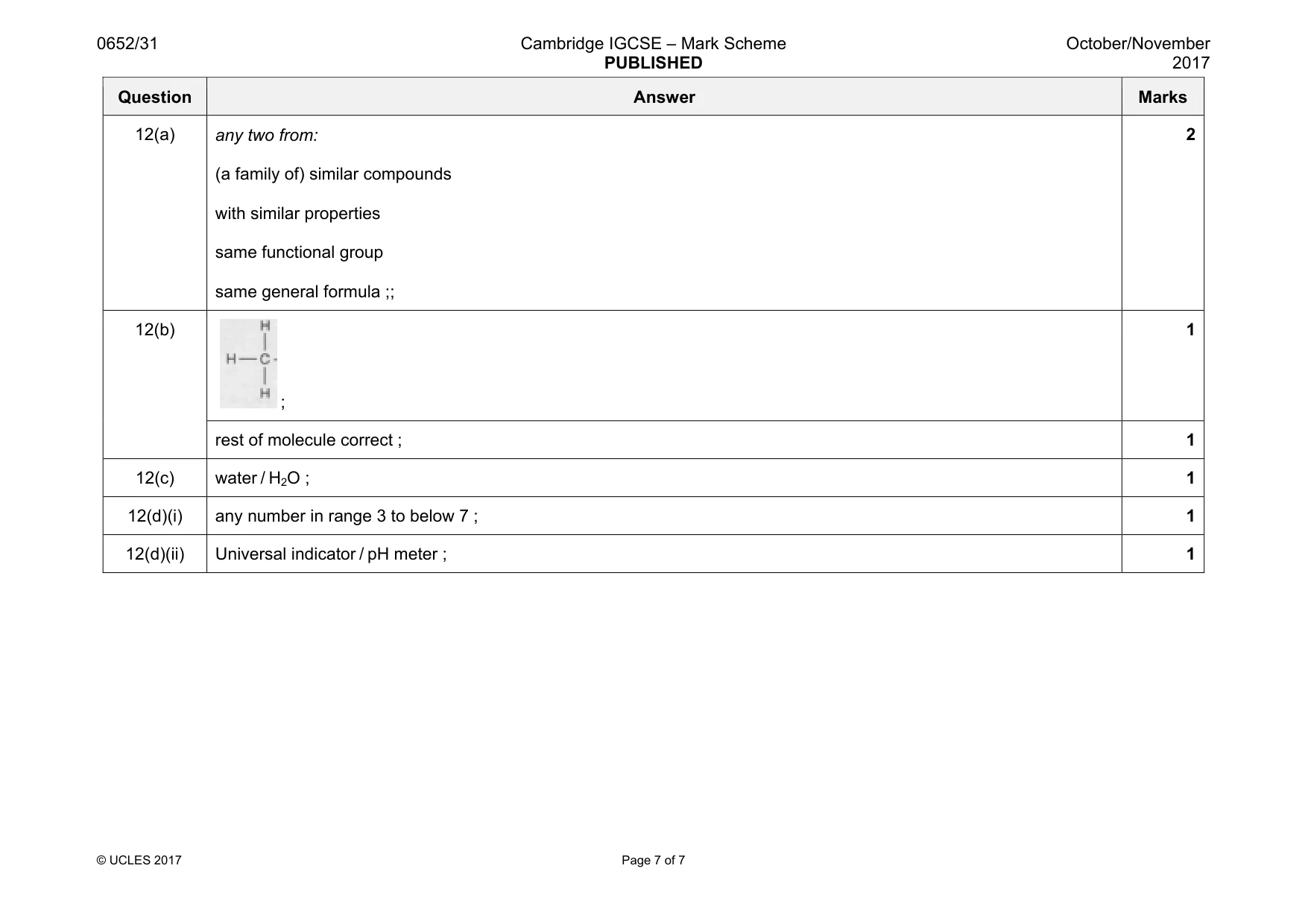
Mark scheme: 12(a) any two from: (a family of) similar compounds with similar properties same functional group same general formula ;; 2 12(b) ; 1 rest of molecule correct ; 1 12(c) water / H2O ; 1 12(d)(i) any number in range 3 to below 7 ; 1 12(d)(ii) Universal indicator / pH meter ; 1
What was in this paper
The subtopics covered by these 12 questions, and how many questions each got. Open one in a new tab to see every Cambridge question on it.
What you needed in this session
Cambridge’s own grade thresholds for 2017 Oct/Nov, Paper 3 · Variant 1. A higher threshold means an easier paper — the bar moves with how the cohort did.