Cambridge IGCSE Physical Science 0652 — 2014 Oct/Nov Paper 6 · Variant 2
0652/62/O/N/14 · 60 marks · ≈68 min
The question paper and its mark scheme, free to read here and free to download. This is Cambridge’s own paper, exactly as it was sat.
Question paper20 pages


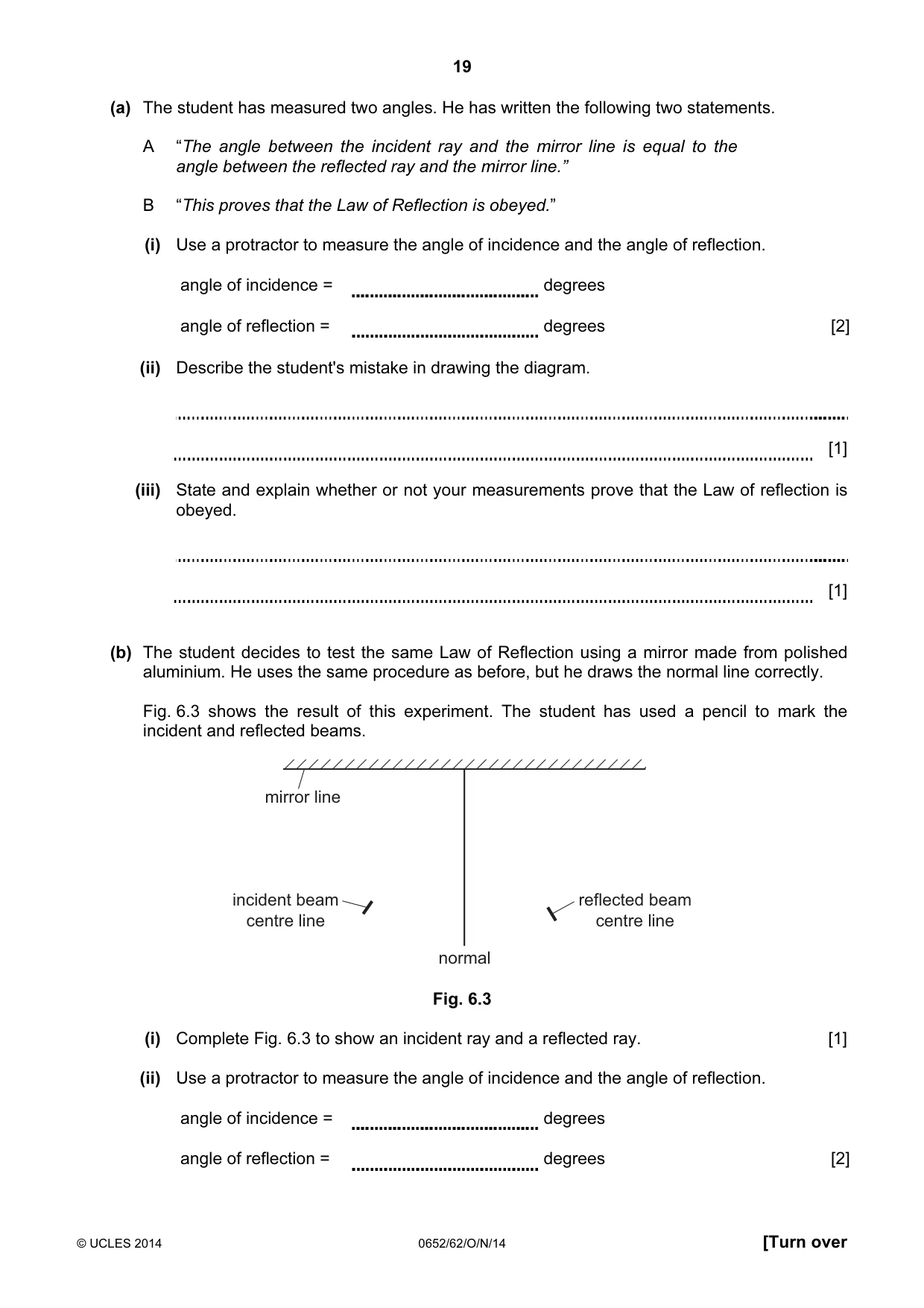
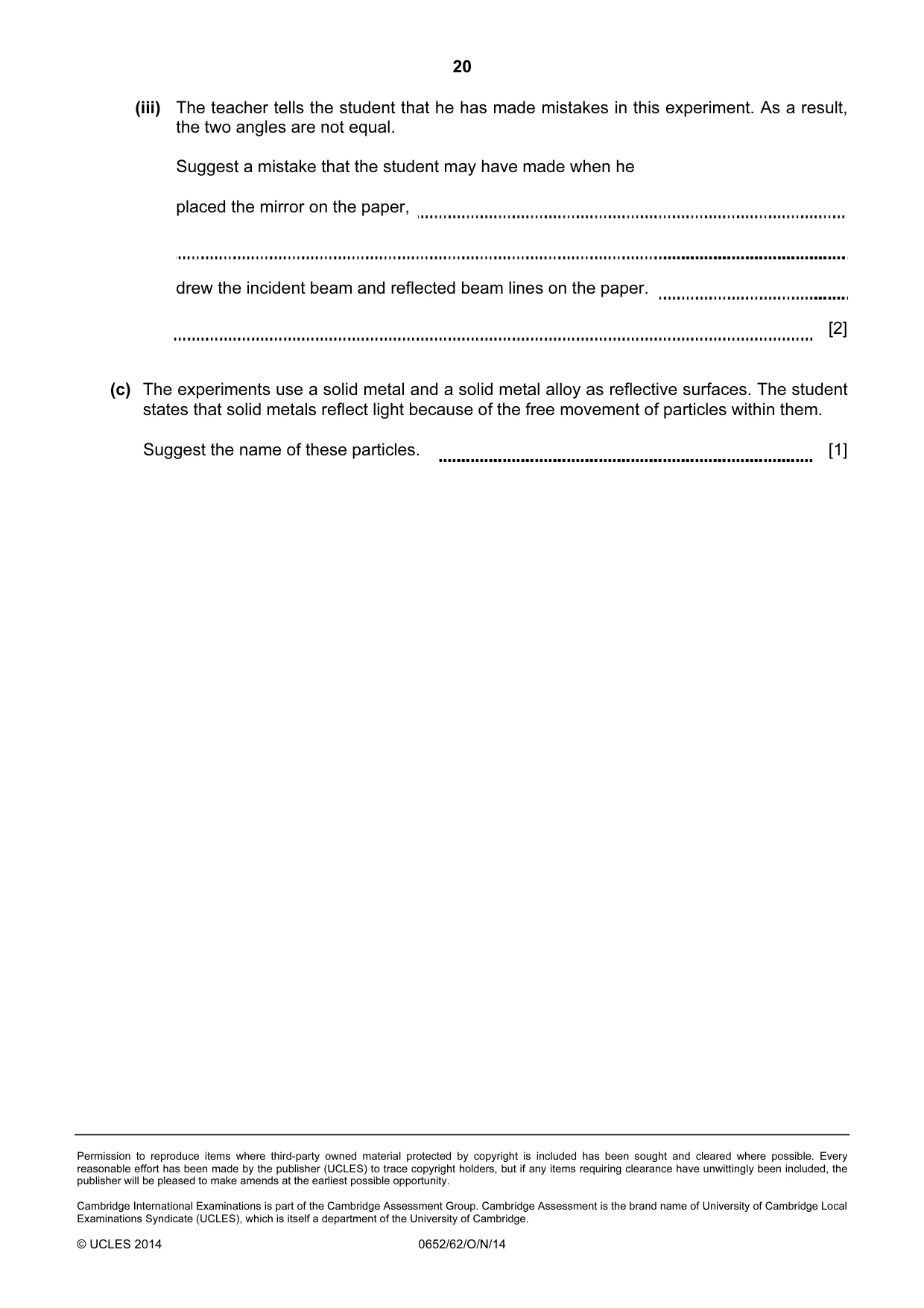
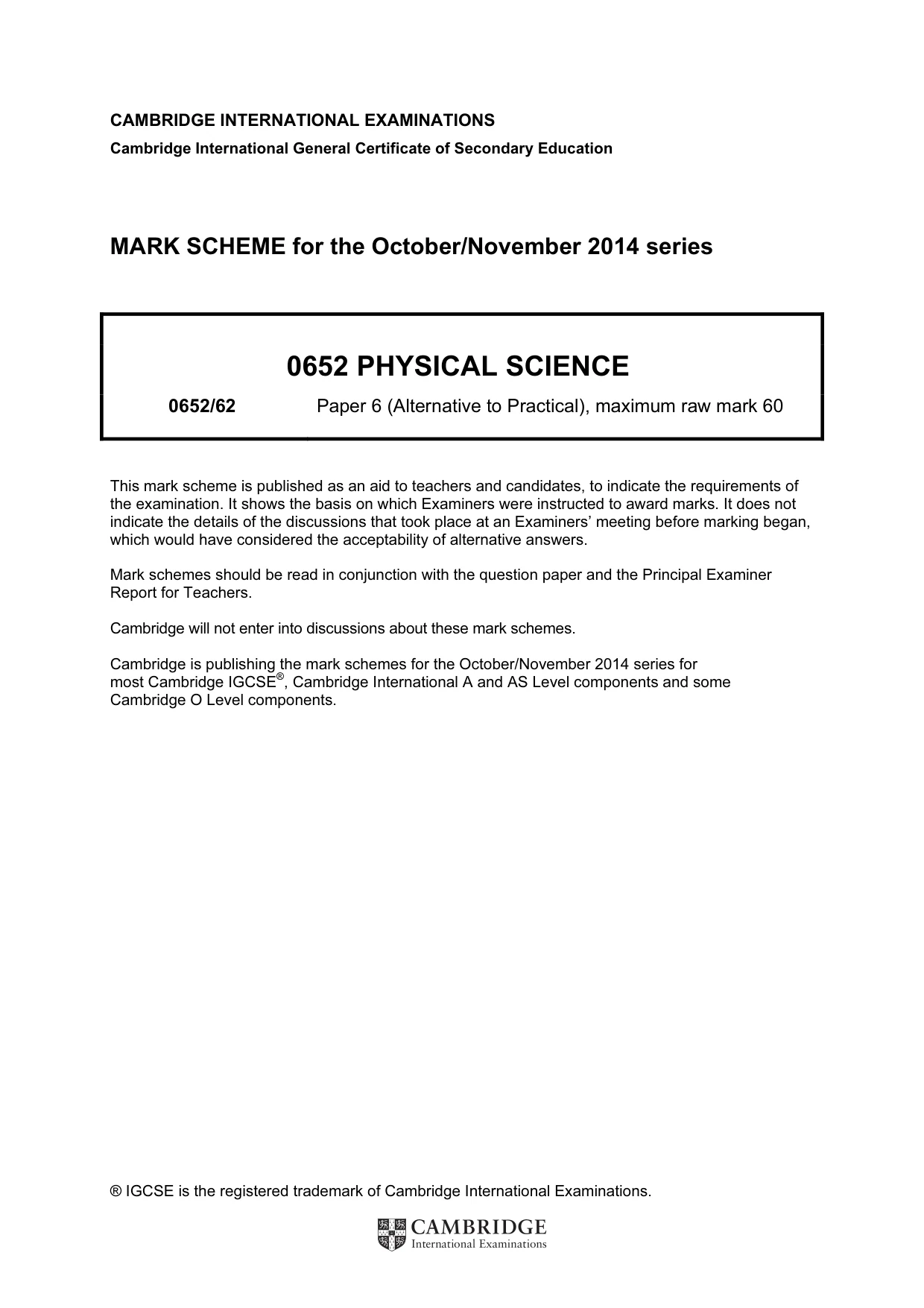
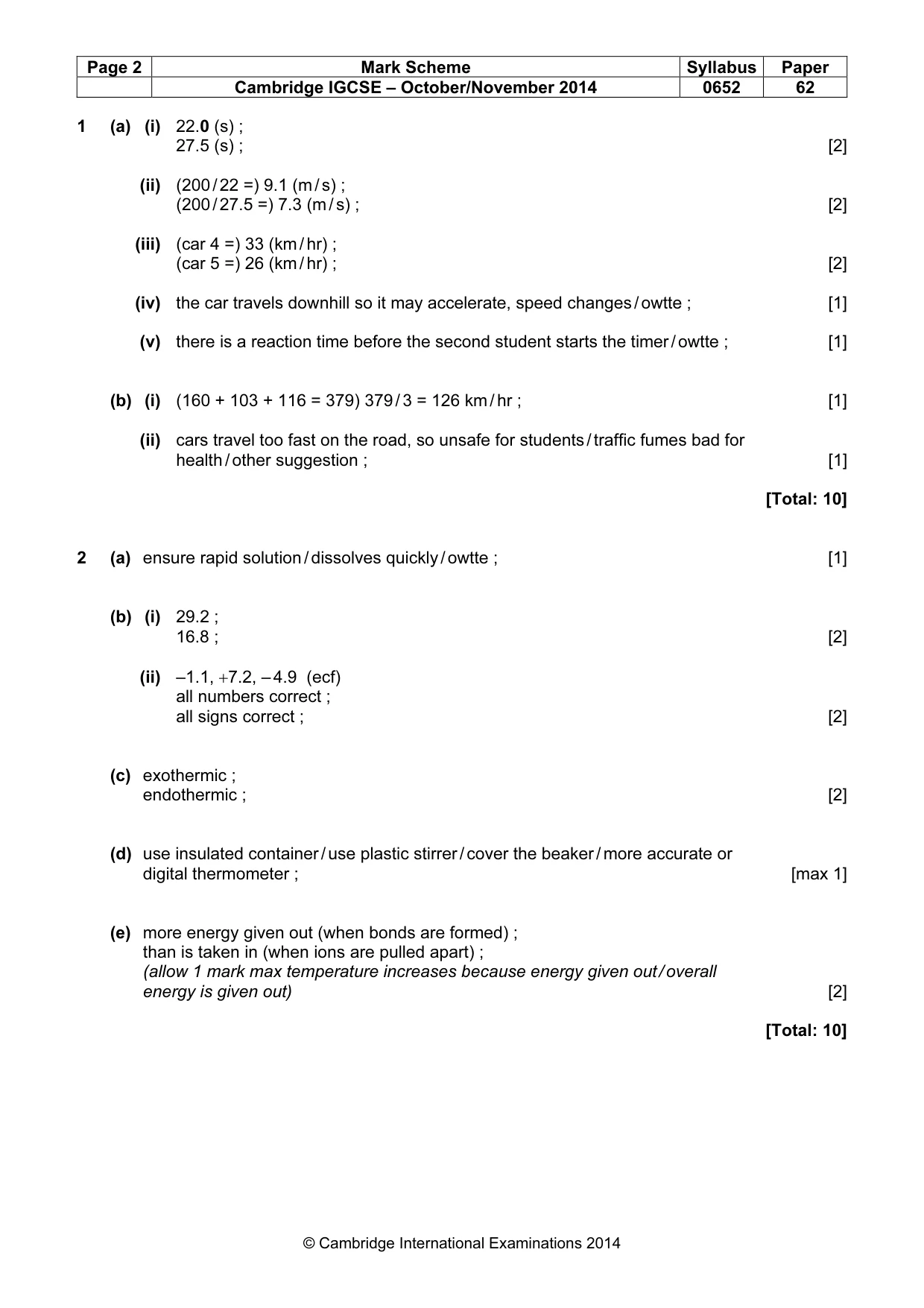
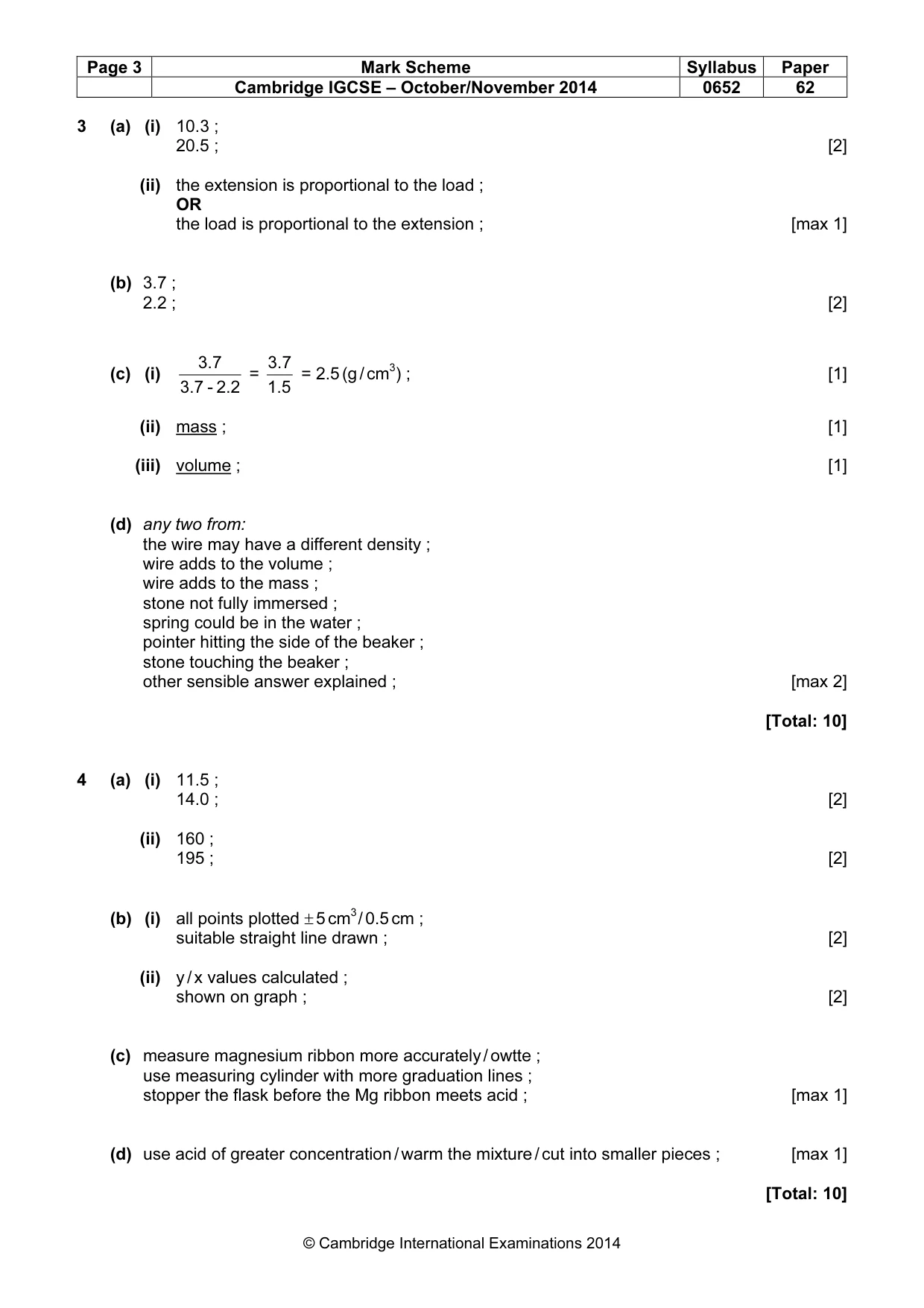
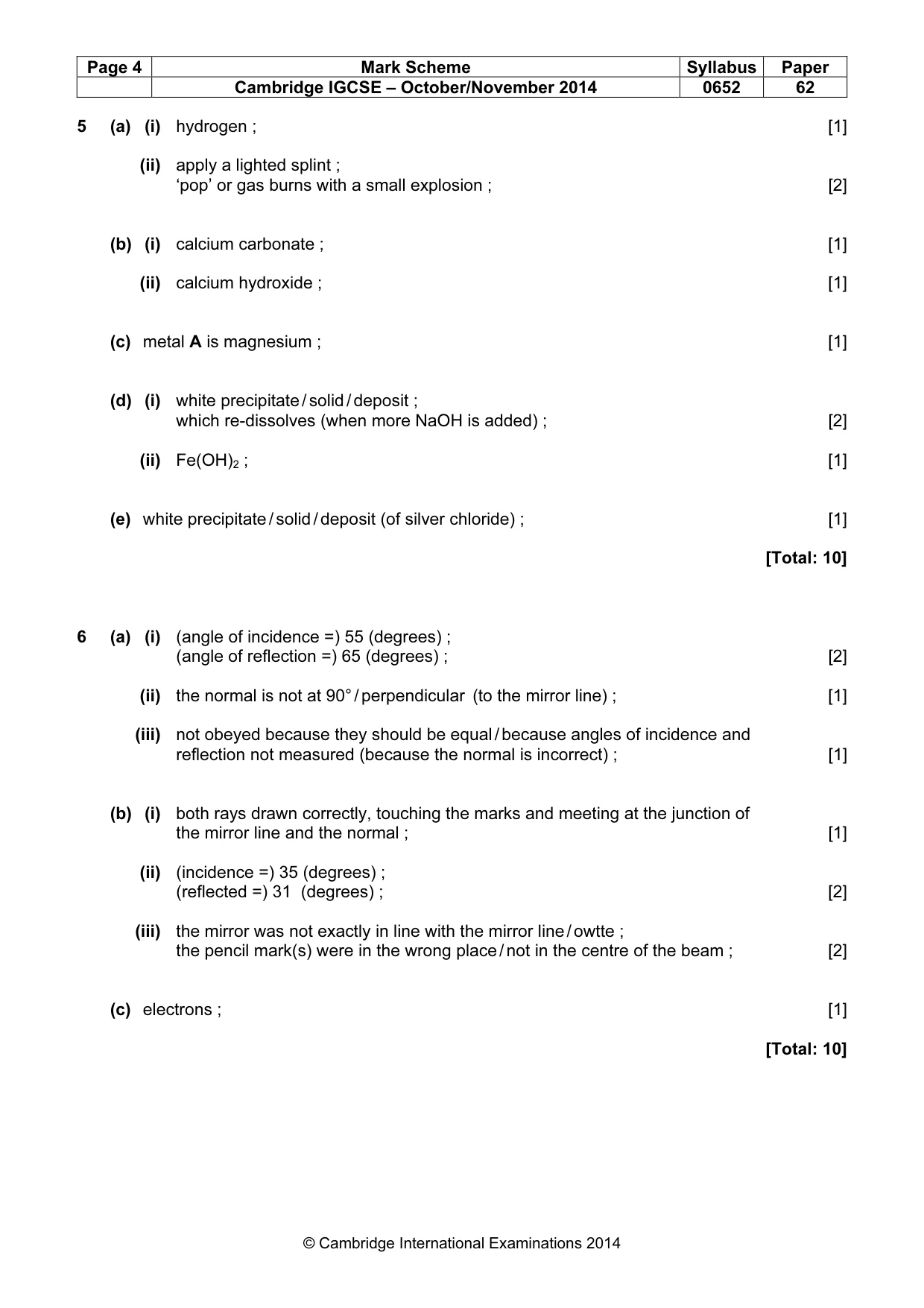
Mark scheme4 pages
Answers below. Sit the paper first if you are practising.
Paper as text
Question paper, page 1
This document consists of 20 printed pages. IB14 11_0652_62/3RP © UCLES 2014 [Turn over *3876146039* Cambridge International Examinations Cambridge International General Certificate of Secondary Education PHYSICAL SCIENCE 0652/62 Paper 6 Alternative to Practical October/November 2014 1 hour Candidates answer on the Question Paper. No Additional Materials are required. READ THESE INSTRUCTIONS FIRST Write your Centre number, candidate number and name on all the work you hand in. Write in dark blue or black pen. You may use an HB pencil for any diagrams or graphs. Do not use staples, paper clips, glue or correction fluid. DO NOT WRITE IN ANY BARCODES. Answer all questions. Electronic calculators may be used. You may lose marks if you do not show your working or if you do not use appropriate units. At the end of the examination, fasten all your work securely together. The number of marks is given in brackets [ ] at the end of each question or part question.
Question paper, page 2
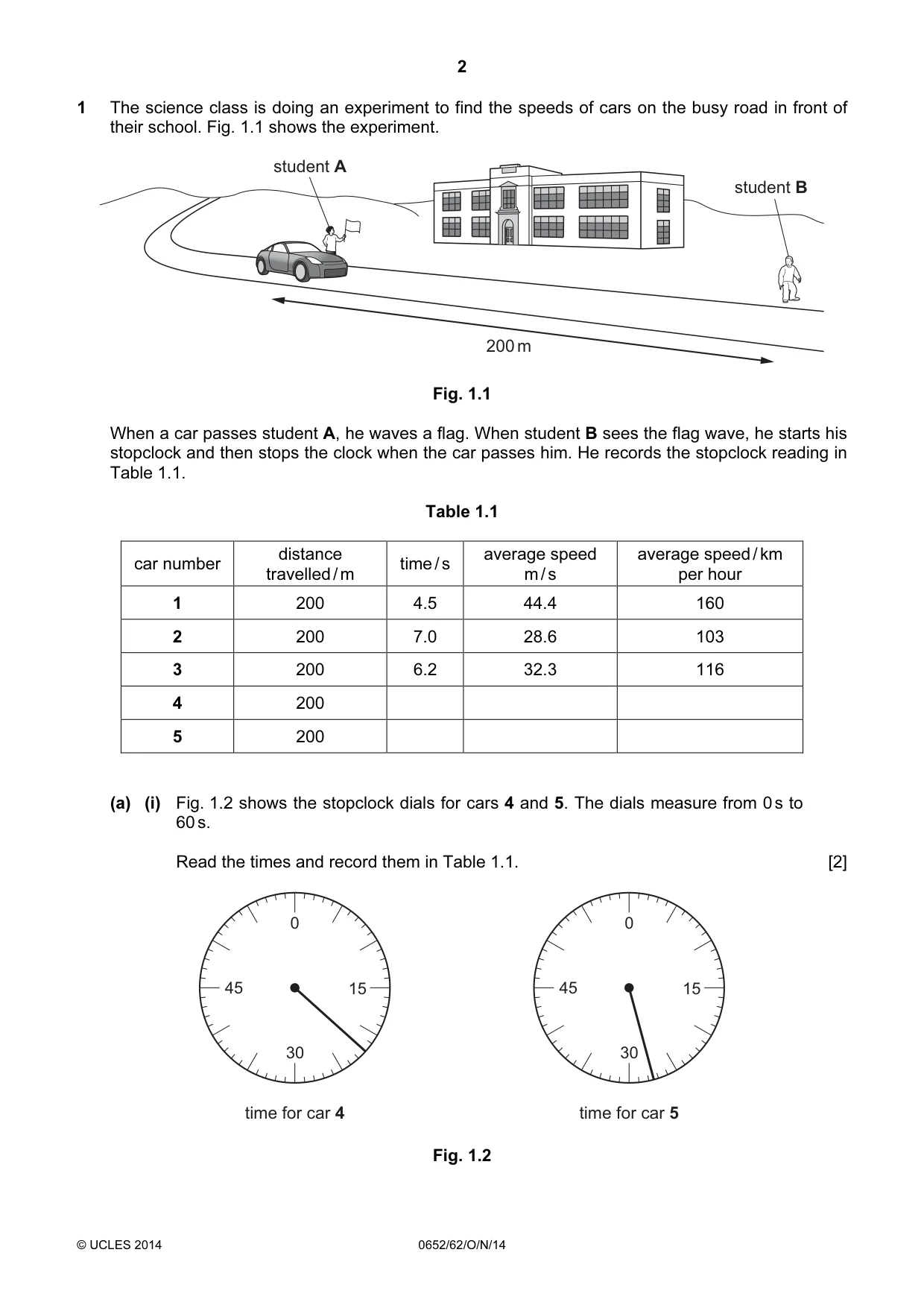
2 © UCLES 2014 0652/62/O/N/14 1 The science class is doing an experiment to find the speeds of cars on the busy road in front of their school. Fig. 1.1 shows the experiment. student A student B 200 m Fig. 1.1 When a car passes student A, he waves a flag. When student B sees the flag wave, he starts his stopclock and then stops the clock when the car passes him. He records the stopclock reading in Table 1.1. Table 1.1 car number distance travelled / m time / s average speed m / s average speed / km per hour 1 200 4.5 44.4 160 2 200 7.0 28.6 103 3 200 6.2 32.3 116 4 200 5 200 (a) (i) Fig. 1.2 shows the stopclock dials for cars 4 and 5. The dials measure from 0 s to 60 s. Read the times and record them in Table 1.1. [2] 0 15 30 45 time for car 4 0 15 30 45 time for car 5 Fig. 1.2
Question paper, page 3
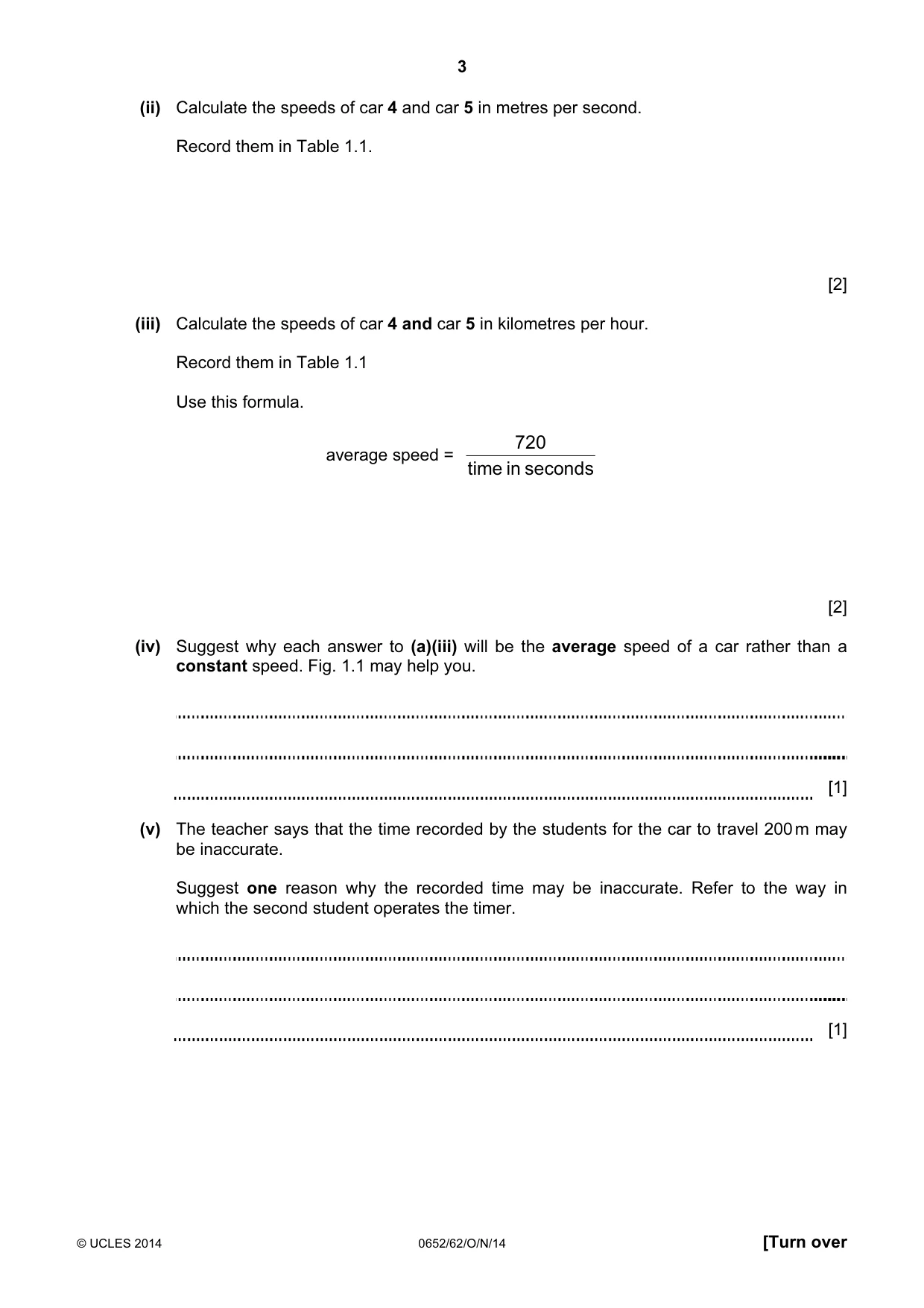
3 © UCLES 2014 0652/62/O/N/14 [Turn over (ii) Calculate the speeds of car 4 and car 5 in metres per second. Record them in Table 1.1. [2] (iii) Calculate the speeds of car 4 and car 5 in kilometres per hour. Record them in Table 1.1 Use this formula. average speed = seconds in time 720 [2] (iv) Suggest why each answer to (a)(iii) will be the average speed of a car rather than a constant speed. Fig. 1.1 may help you. [1] (v) The teacher says that the time recorded by the students for the car to travel 200 m may be inaccurate. Suggest one reason why the recorded time may be inaccurate. Refer to the way in which the second student operates the timer. [1]
Question paper, page 4
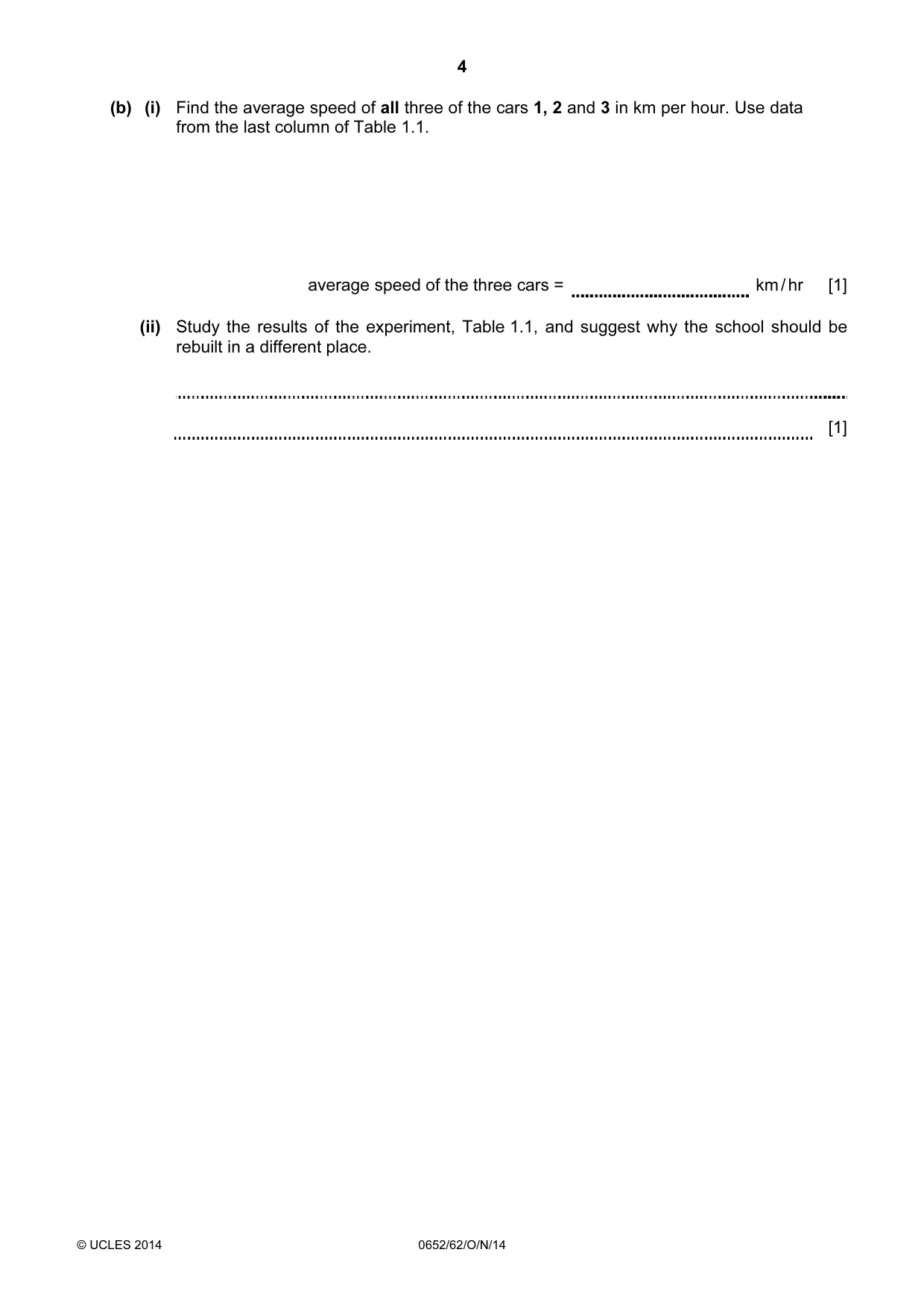
4 © UCLES 2014 0652/62/O/N/14 (b) (i) Find the average speed of all three of the cars 1, 2 and 3 in km per hour. Use data from the last column of Table 1.1. average speed of the three cars = km / hr [1] (ii) Study the results of the experiment, Table 1.1, and suggest why the school should be rebuilt in a different place. [1]
Question paper, page 5
5 © UCLES 2014 0652/62/O/N/14 [Turn over Please turn over for Question 2.
Question paper, page 6
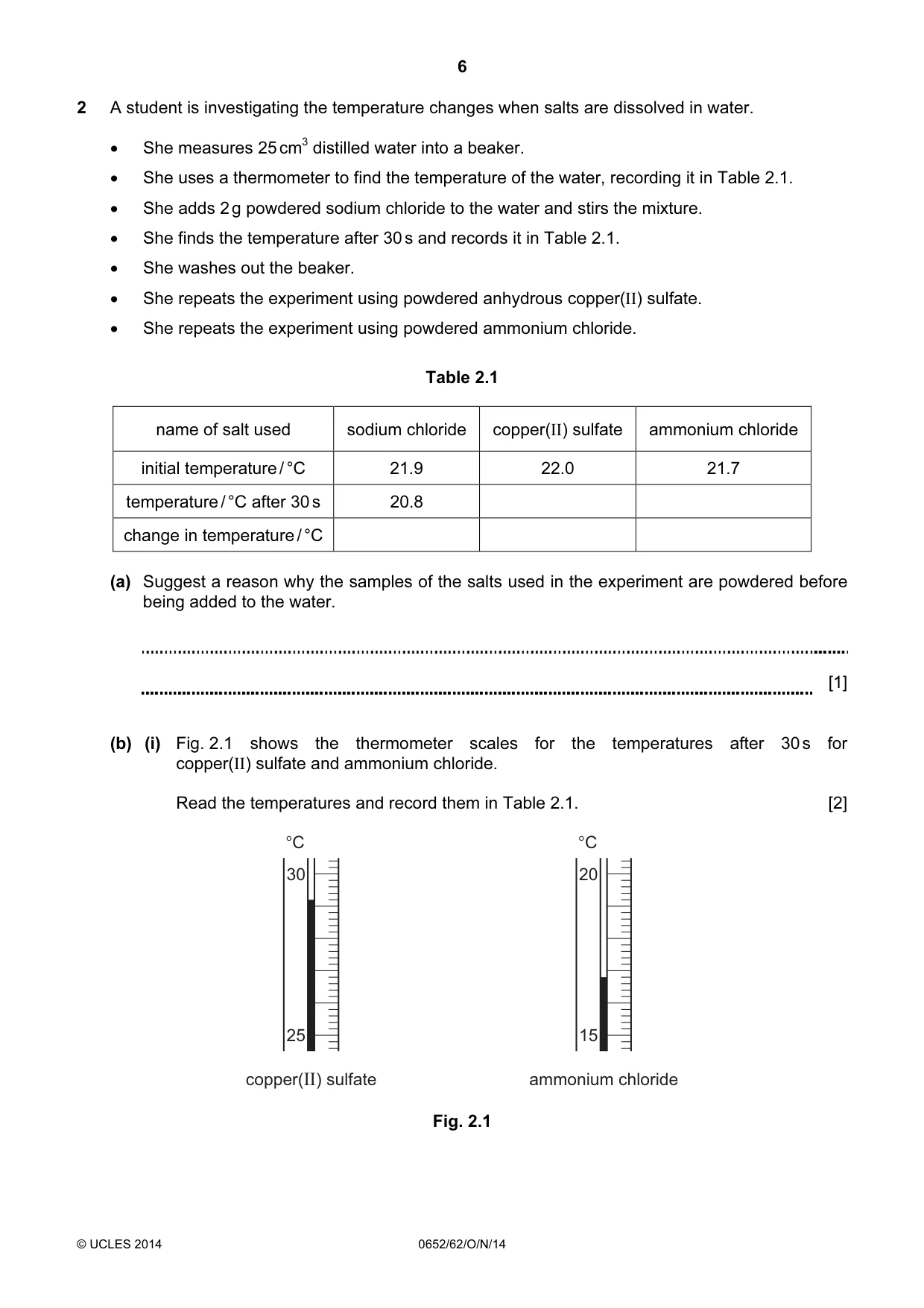
6 © UCLES 2014 0652/62/O/N/14 2 A student is investigating the temperature changes when salts are dissolved in water. • She measures 25 cm3 distilled water into a beaker. • She uses a thermometer to find the temperature of the water, recording it in Table 2.1. • She adds 2 g powdered sodium chloride to the water and stirs the mixture. • She finds the temperature after 30 s and records it in Table 2.1. • She washes out the beaker. • She repeats the experiment using powdered anhydrous copper(II) sulfate. • She repeats the experiment using powdered ammonium chloride. Table 2.1 name of salt used sodium chloride copper(II) sulfate ammonium chloride initial temperature / °C 21.9 22.0 21.7 temperature / °C after 30 s 20.8 change in temperature / °C (a) Suggest a reason why the samples of the salts used in the experiment are powdered before being added to the water. [1] (b) (i) Fig. 2.1 shows the thermometer scales for the temperatures after 30 s for copper(II) sulfate and ammonium chloride. Read the temperatures and record them in Table 2.1. [2] 30 25 °C copper(II) sulfate 20 15 °C ammonium chloride Fig. 2.1
Question paper, page 7
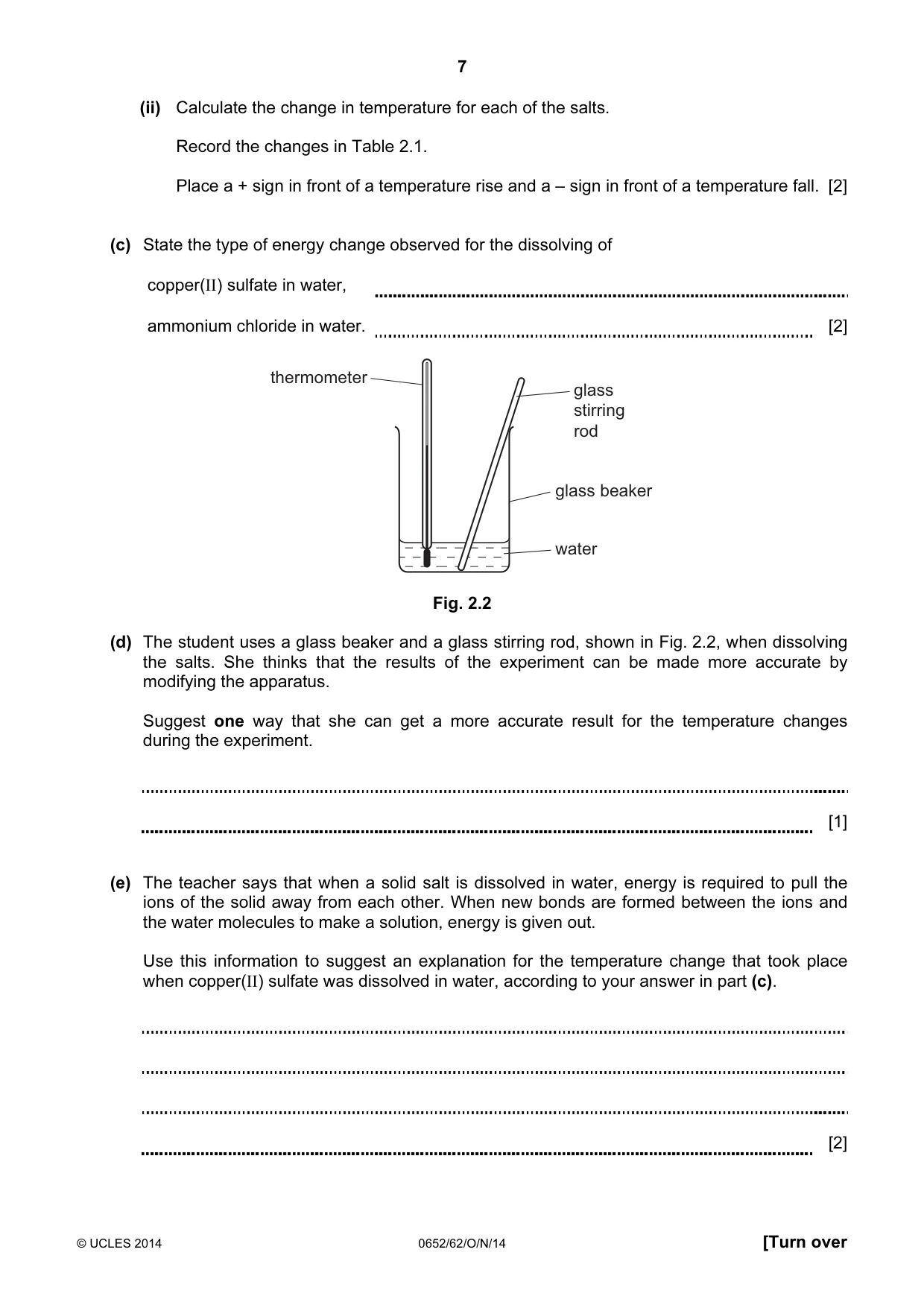
7 © UCLES 2014 0652/62/O/N/14 [Turn over (ii) Calculate the change in temperature for each of the salts. Record the changes in Table 2.1. Place a + sign in front of a temperature rise and a – sign in front of a temperature fall. [2] (c) State the type of energy change observed for the dissolving of copper(II) sulfate in water, ammonium chloride in water. [2] thermometer glass stirring rod glass beaker water Fig. 2.2 (d) The student uses a glass beaker and a glass stirring rod, shown in Fig. 2.2, when dissolving the salts. She thinks that the results of the experiment can be made more accurate by modifying the apparatus. Suggest one way that she can get a more accurate result for the temperature changes during the experiment. [1] (e) The teacher says that when a solid salt is dissolved in water, energy is required to pull the ions of the solid away from each other. When new bonds are formed between the ions and the water molecules to make a solution, energy is given out. Use this information to suggest an explanation for the temperature change that took place when copper(II) sulfate was dissolved in water, according to your answer in part (c). [2]
Question paper, page 8
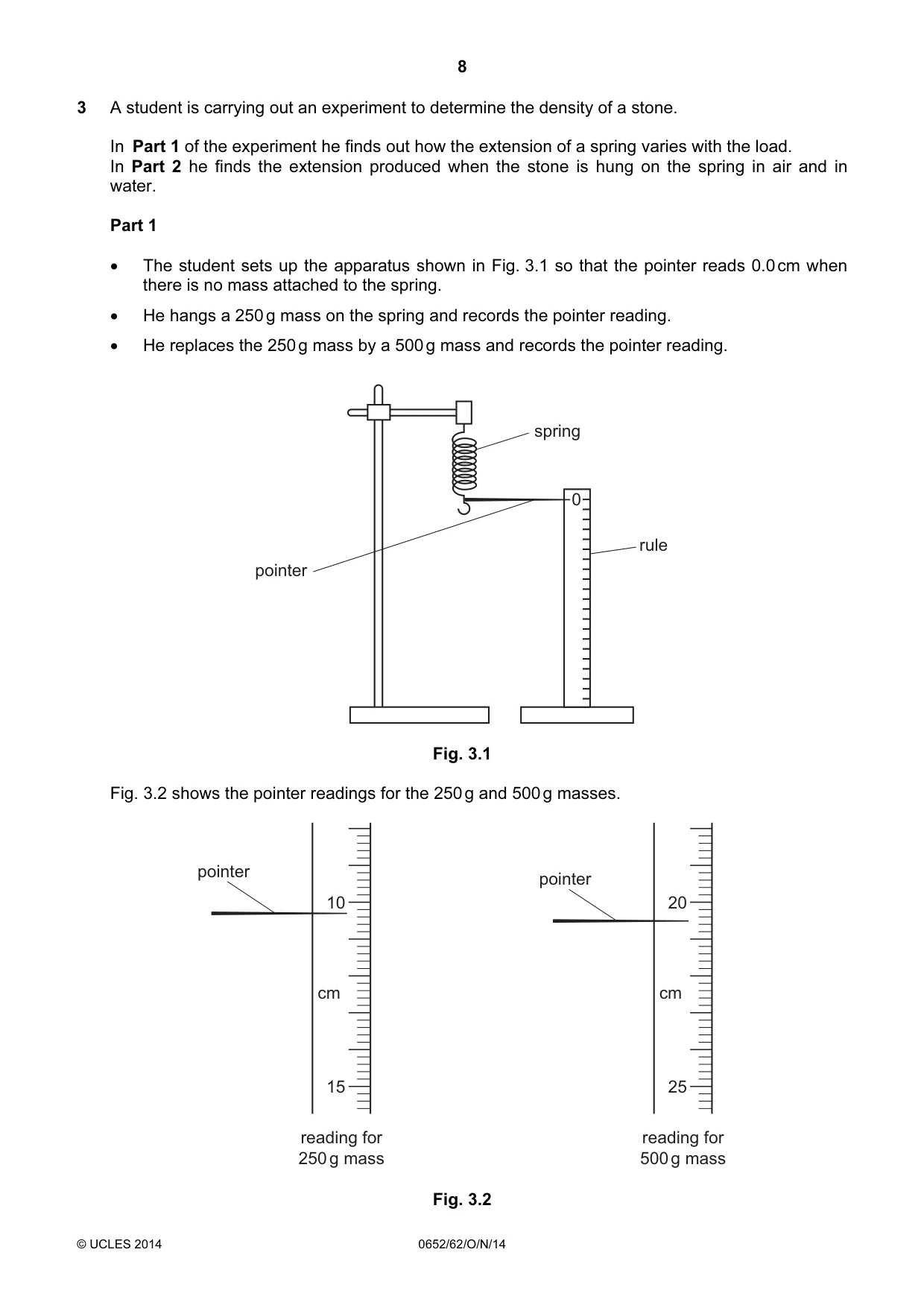
8 © UCLES 2014 0652/62/O/N/14 3 A student is carrying out an experiment to determine the density of a stone. In Part 1 of the experiment he finds out how the extension of a spring varies with the load. In Part 2 he finds the extension produced when the stone is hung on the spring in air and in water. Part 1 • The student sets up the apparatus shown in Fig. 3.1 so that the pointer reads 0.0 cm when there is no mass attached to the spring. • He hangs a 250 g mass on the spring and records the pointer reading. • He replaces the 250 g mass by a 500 g mass and records the pointer reading. spring 0 rule pointer Fig. 3.1 Fig. 3.2 shows the pointer readings for the 250 g and 500 g masses. 10 15 reading for 250 g mass pointer cm 20 25 reading for 500 g mass pointer cm Fig. 3.2
Question paper, page 9
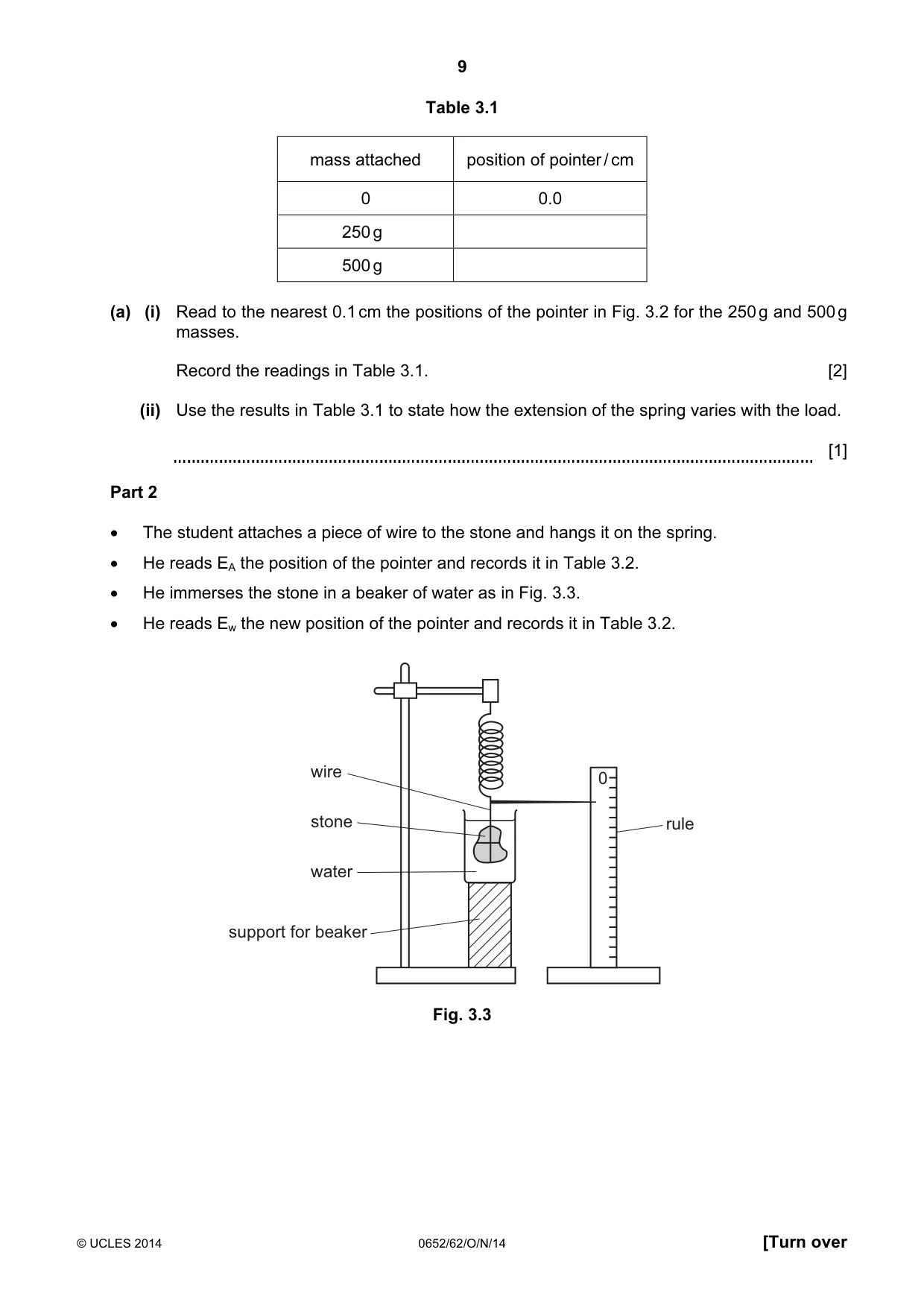
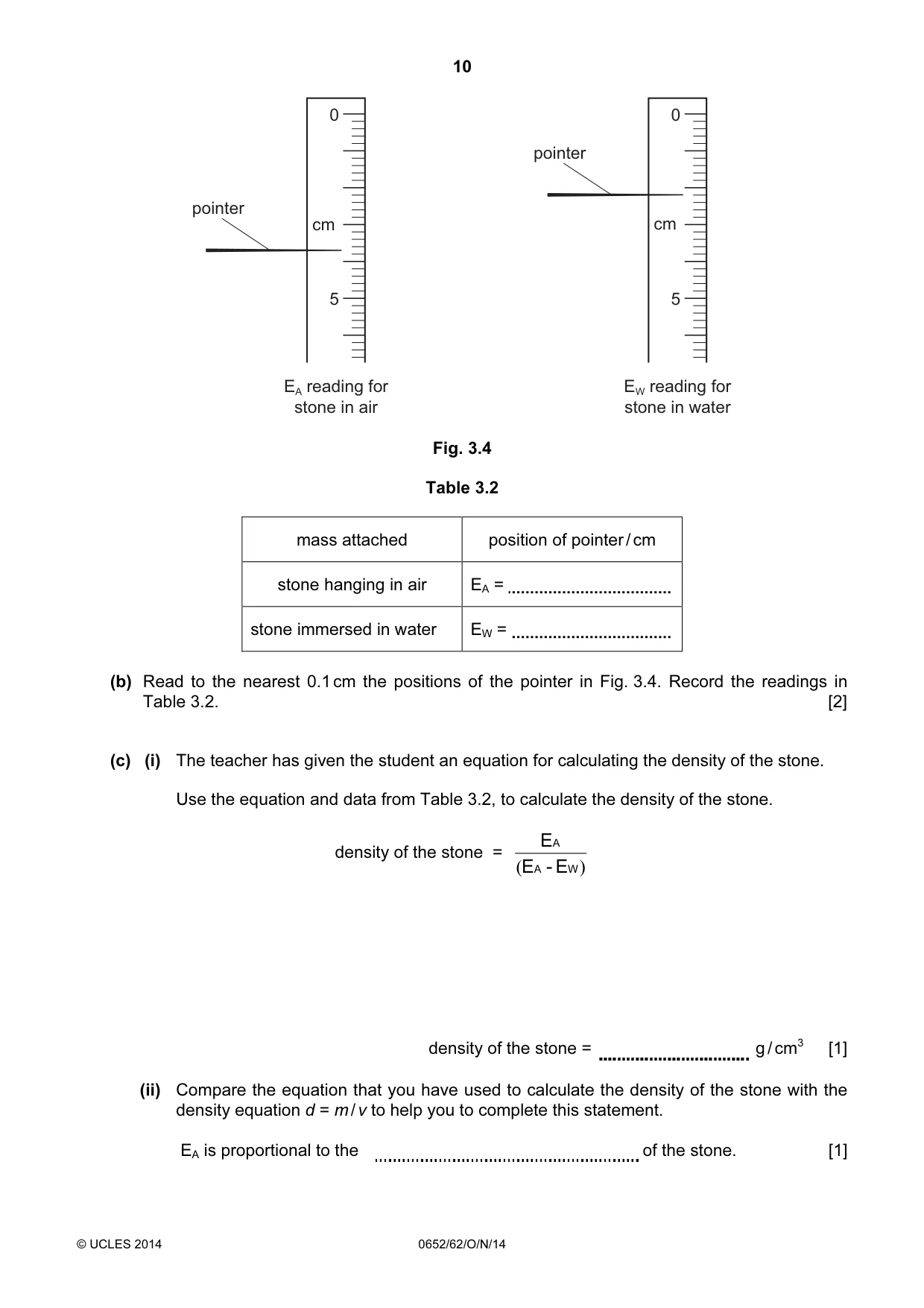
9 © UCLES 2014 0652/62/O/N/14 [Turn over Table 3.1 mass attached position of pointer / cm 0 0.0 250 g 500 g (a) (i) Read to the nearest 0.1 cm the positions of the pointer in Fig. 3.2 for the 250 g and 500 g masses. Record the readings in Table 3.1. [2] (ii) Use the results in Table 3.1 to state how the extension of the spring varies with the load. [1] Part 2 • The student attaches a piece of wire to the stone and hangs it on the spring. • He reads EA the position of the pointer and records it in Table 3.2. • He immerses the stone in a beaker of water as in Fig. 3.3. • He reads Ew the new position of the pointer and records it in Table 3.2. 0 rule wire stone water support for beaker Fig. 3.3
Question paper, page 10
10 © UCLES 2014 0652/62/O/N/14 0 5 0 5 EA reading for stone in air pointer cm EW reading for stone in water pointer cm Fig. 3.4 Table 3.2 mass attached position of pointer / cm stone hanging in air EA = stone immersed in water EW = (b) Read to the nearest 0.1 cm the positions of the pointer in Fig. 3.4. Record the readings in Table 3.2. [2] (c) (i) The teacher has given the student an equation for calculating the density of the stone. Use the equation and data from Table 3.2, to calculate the density of the stone. density of the stone = ) ( W A A E - E E density of the stone = g / cm3 [1] (ii) Compare the equation that you have used to calculate the density of the stone with the density equation d = m / v to help you to complete this statement. EA is proportional to the of the stone. [1]
Question paper, page 11
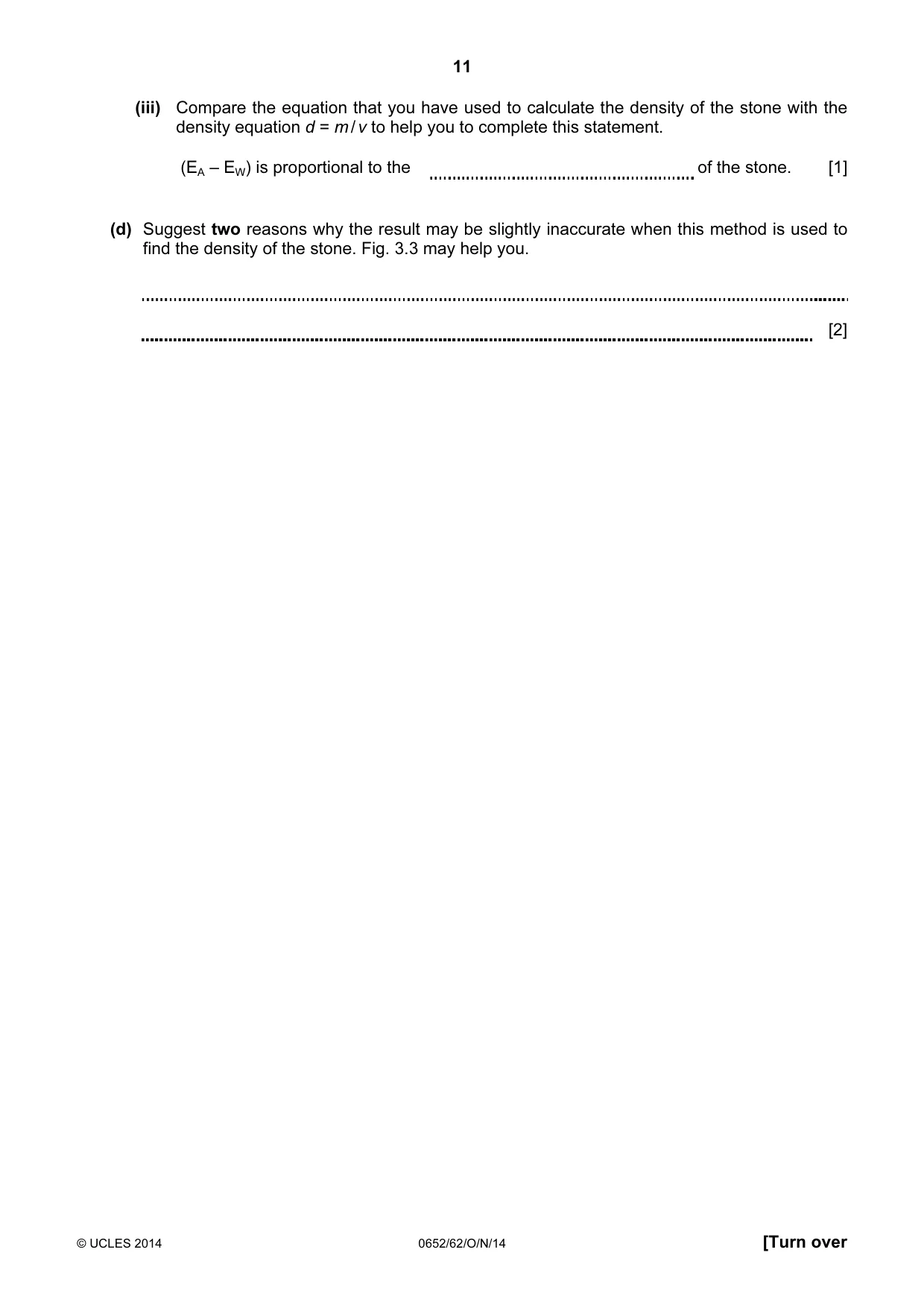
11 © UCLES 2014 0652/62/O/N/14 [Turn over (iii) Compare the equation that you have used to calculate the density of the stone with the density equation d = m / v to help you to complete this statement. (EA – EW) is proportional to the of the stone. [1] (d) Suggest two reasons why the result may be slightly inaccurate when this method is used to find the density of the stone. Fig. 3.3 may help you. [2]
Question paper, page 12
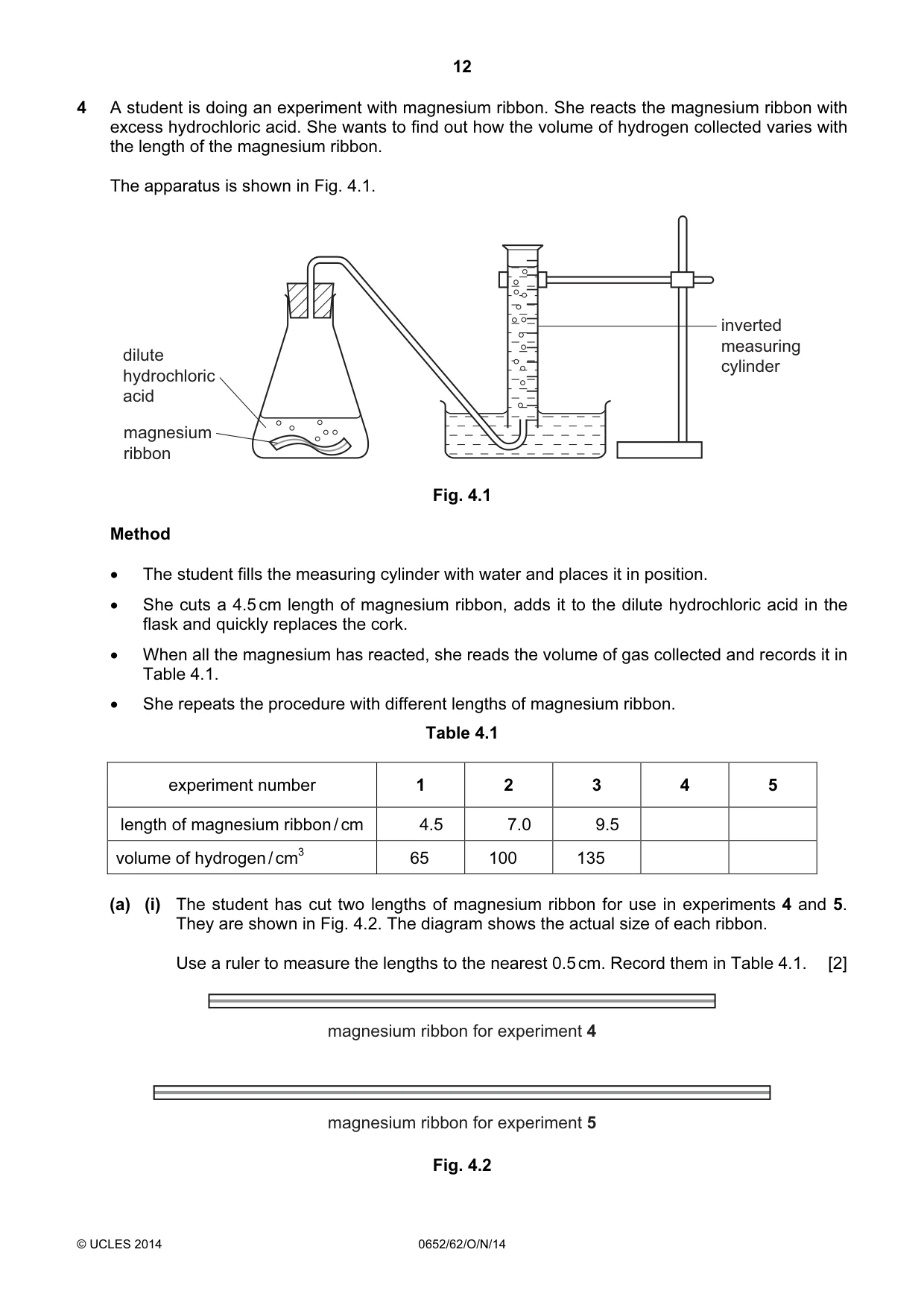
12 © UCLES 2014 0652/62/O/N/14 4 A student is doing an experiment with magnesium ribbon. She reacts the magnesium ribbon with excess hydrochloric acid. She wants to find out how the volume of hydrogen collected varies with the length of the magnesium ribbon. The apparatus is shown in Fig. 4.1. inverted measuring cylinder dilute hydrochloric acid magnesium ribbon Fig. 4.1 Method • The student fills the measuring cylinder with water and places it in position. • She cuts a 4.5 cm length of magnesium ribbon, adds it to the dilute hydrochloric acid in the flask and quickly replaces the cork. • When all the magnesium has reacted, she reads the volume of gas collected and records it in Table 4.1. • She repeats the procedure with different lengths of magnesium ribbon. Table 4.1 experiment number 1 2 3 4 5 length of magnesium ribbon / cm 4.5 7.0 9.5 volume of hydrogen / cm3 65 100 135 (a) (i) The student has cut two lengths of magnesium ribbon for use in experiments 4 and 5. They are shown in Fig. 4.2. The diagram shows the actual size of each ribbon. Use a ruler to measure the lengths to the nearest 0.5 cm. Record them in Table 4.1. [2] magnesium ribbon for experiment 4 magnesium ribbon for experiment 5 Fig. 4.2
Question paper, page 13
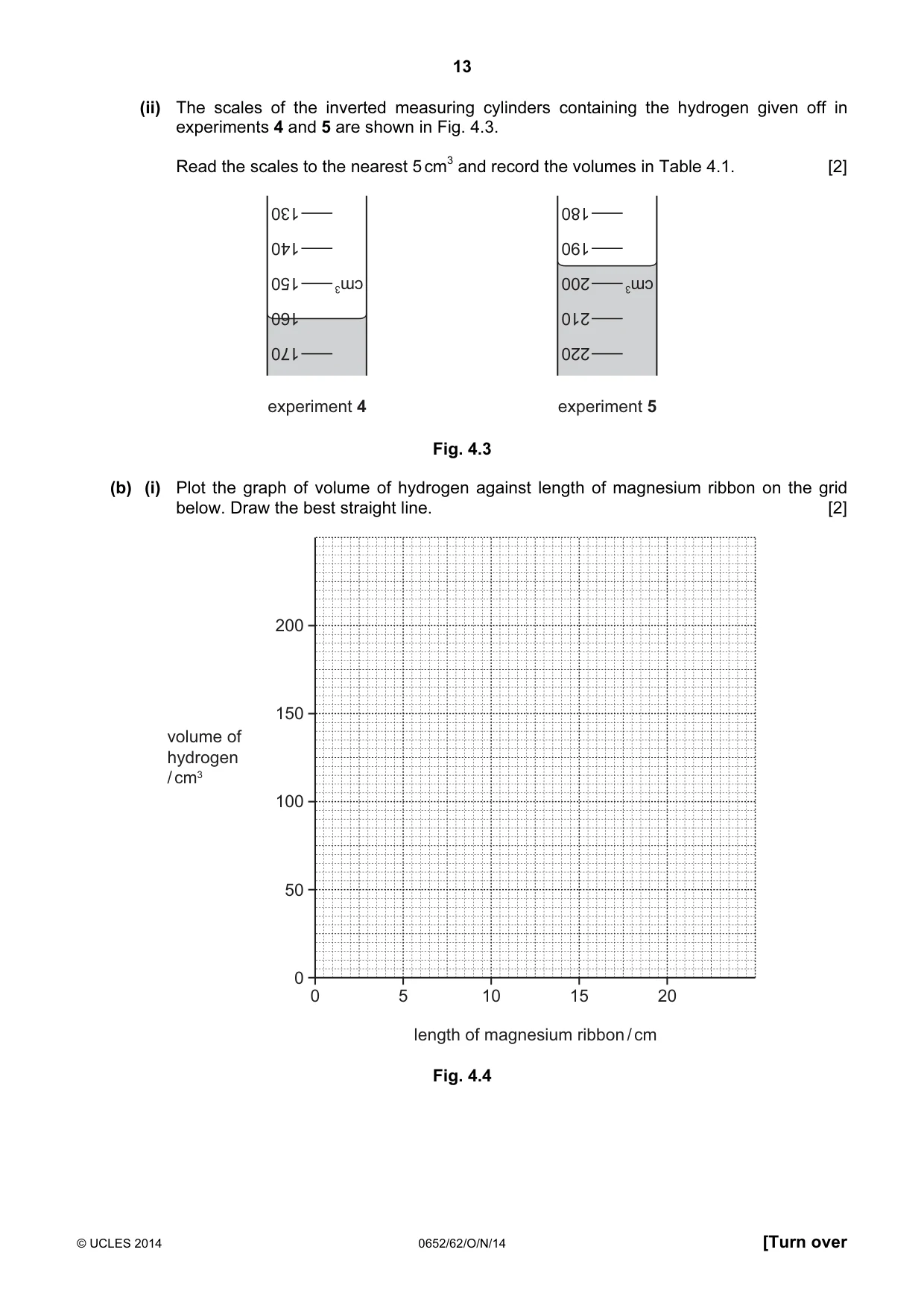
13 © UCLES 2014 0652/62/O/N/14 [Turn over (ii) The scales of the inverted measuring cylinders containing the hydrogen given off in experiments 4 and 5 are shown in Fig. 4.3. Read the scales to the nearest 5 cm3 and record the volumes in Table 4.1. [2] 170 160 150 140 130 cm3 experiment 4 220 210 200 190 180 cm3 experiment 5 Fig. 4.3 (b) (i) Plot the graph of volume of hydrogen against length of magnesium ribbon on the grid below. Draw the best straight line. [2] 200 150 100 50 0 0 5 10 15 20 length of magnesium ribbon / cm volume of hydrogen / cm3 Fig. 4.4
Question paper, page 14
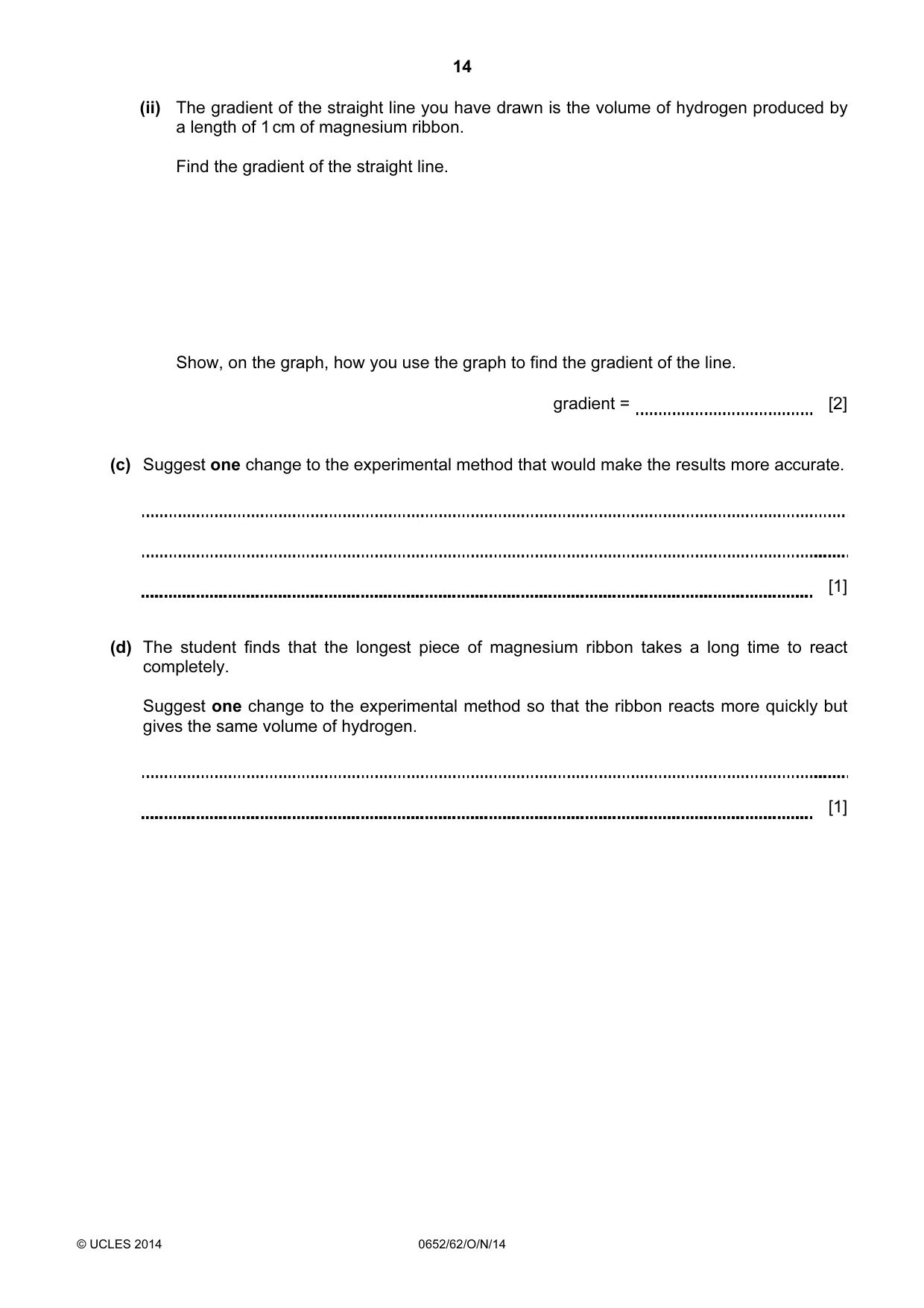
14 © UCLES 2014 0652/62/O/N/14 (ii) The gradient of the straight line you have drawn is the volume of hydrogen produced by a length of 1 cm of magnesium ribbon. Find the gradient of the straight line. Show, on the graph, how you use the graph to find the gradient of the line. gradient = [2] (c) Suggest one change to the experimental method that would make the results more accurate. [1] (d) The student finds that the longest piece of magnesium ribbon takes a long time to react completely. Suggest one change to the experimental method so that the ribbon reacts more quickly but gives the same volume of hydrogen. [1]
Question paper, page 15
15 © UCLES 2014 0652/62/O/N/14 [Turn over Please turn over for Question 5.
Question paper, page 16
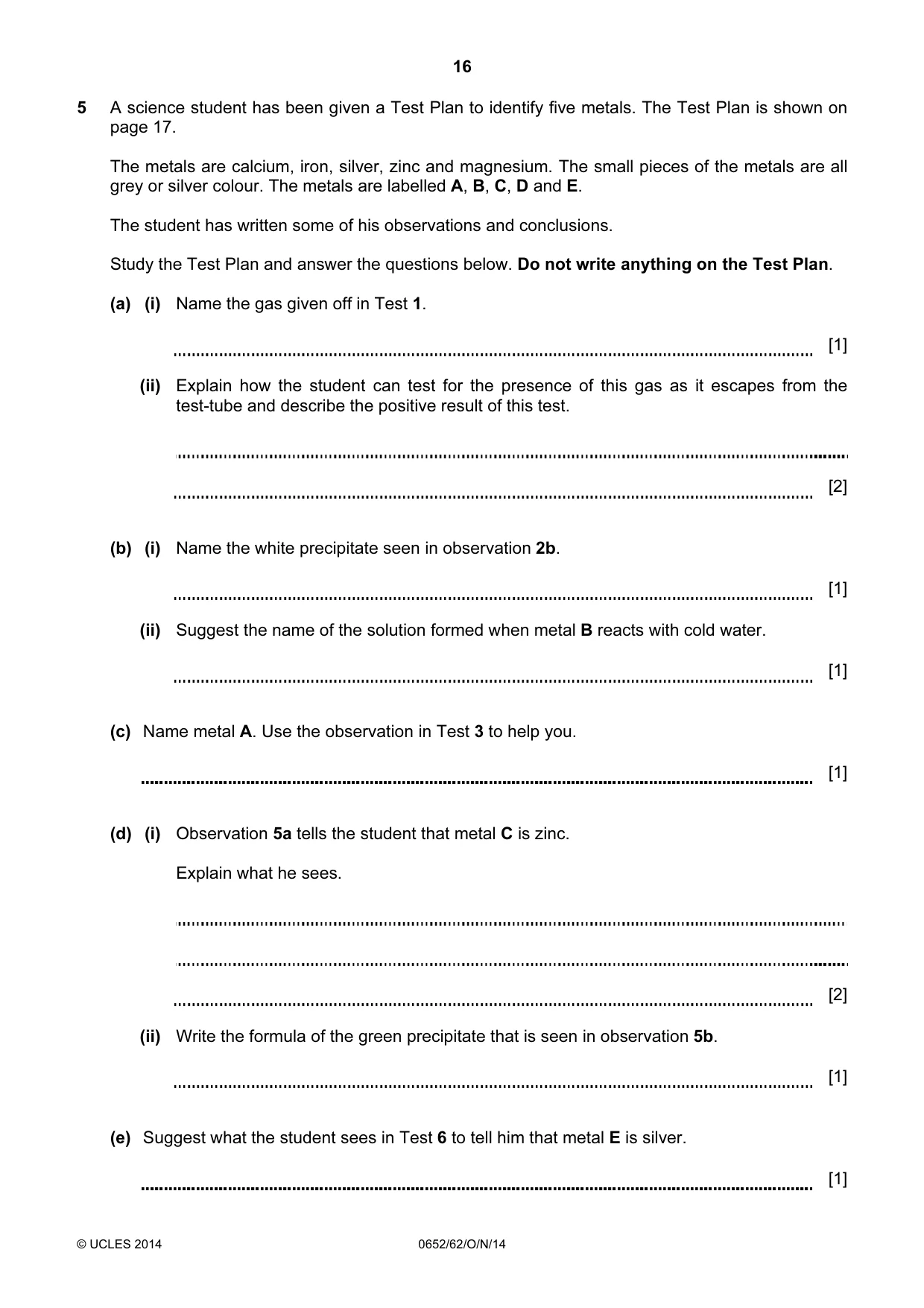
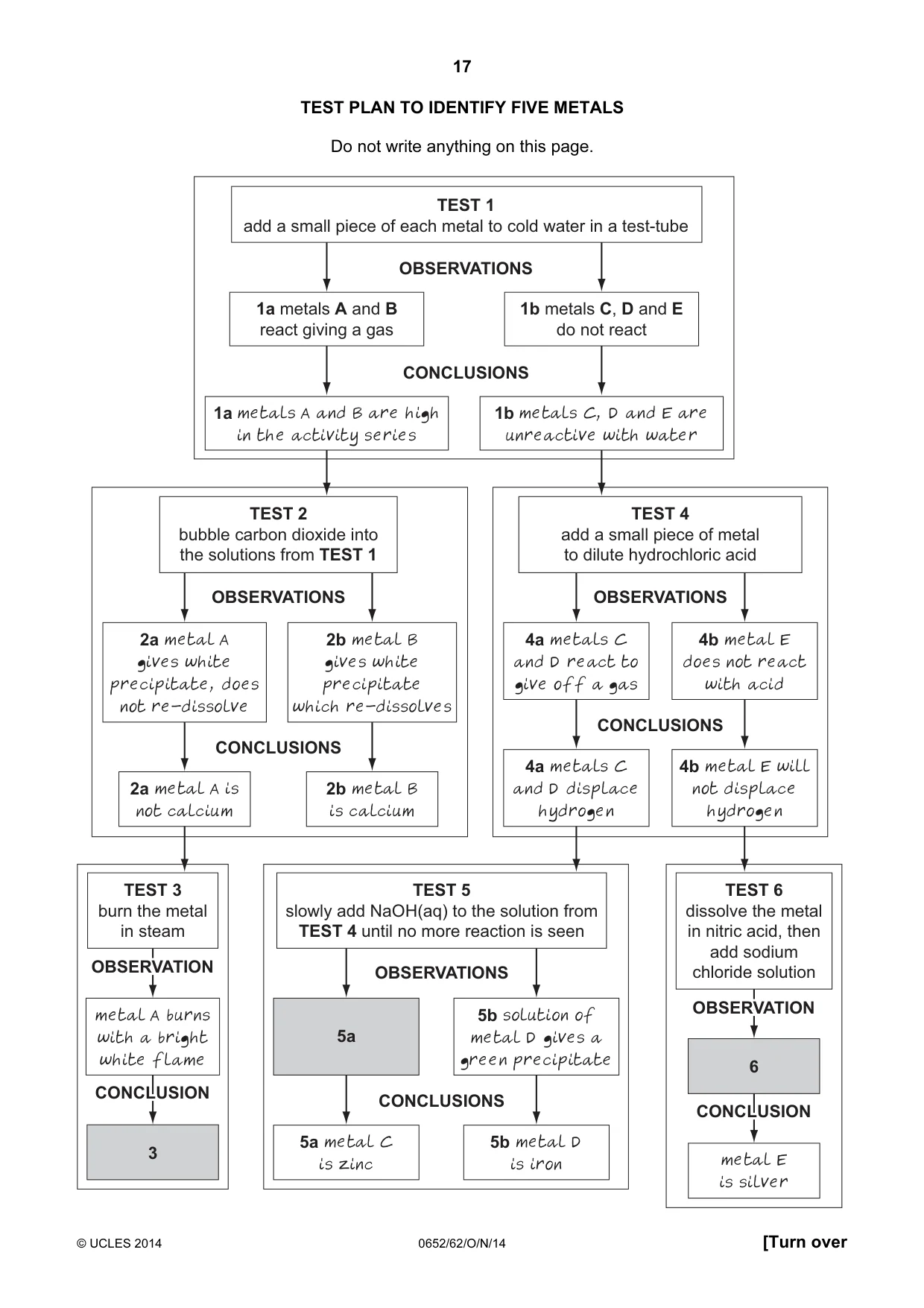
16 © UCLES 2014 0652/62/O/N/14 5 A science student has been given a Test Plan to identify five metals. The Test Plan is shown on page 17. The metals are calcium, iron, silver, zinc and magnesium. The small pieces of the metals are all grey or silver colour. The metals are labelled A, B, C, D and E. The student has written some of his observations and conclusions. Study the Test Plan and answer the questions below. Do not write anything on the Test Plan. (a) (i) Name the gas given off in Test 1. [1] (ii) Explain how the student can test for the presence of this gas as it escapes from the test-tube and describe the positive result of this test. [2] (b) (i) Name the white precipitate seen in observation 2b. [1] (ii) Suggest the name of the solution formed when metal B reacts with cold water. [1] (c) Name metal A. Use the observation in Test 3 to help you. [1] (d) (i) Observation 5a tells the student that metal C is zinc. Explain what he sees. [2] (ii) Write the formula of the green precipitate that is seen in observation 5b. [1] (e) Suggest what the student sees in Test 6 to tell him that metal E is silver. [1]
Question paper, page 17
17 © UCLES 2014 0652/62/O/N/14 [Turn over TEST PLAN TO IDENTIFY FIVE METALS Do not write anything on this page. TEST 1 add a small piece of each metal to cold water in a test-tube OBSERVATIONS 1a metals A and B react giving a gas 1b metals C, D and E do not react CONCLUSIONS 1a metals A and B are high in the activity series 1b metals C, D and E are unreactive with water TEST 2 bubble carbon dioxide into the solutions from TEST 1 OBSERVATIONS 2a metal A gives white precipitate, does not re-dissolve 2b metal B gives white precipitate which re-dissolves CONCLUSIONS 2a metal A is not calcium 2b metal B is calcium TEST 3 burn the metal in steam metal A burns with a bright white flame 3 6 TEST 4 add a small piece of metal to dilute hydrochloric acid OBSERVATIONS 4a metals C and D react to give off a gas 4b metal E does not react with acid CONCLUSIONS 4a metals C and D displace hydrogen 4b metal E will not displace hydrogen TEST 5 slowly add NaOH(aq) to the solution from TEST 4 until no more reaction is seen OBSERVATIONS 5a 5b solution of metal D gives a green precipitate CONCLUSIONS 5a metal C is zinc 5b metal D is iron OBSERVATION OBSERVATION CONCLUSION CONCLUSION OBSERVATION CONCLUSION TEST 6 dissolve the metal in nitric acid, then add sodium chloride solution metal E is silver OBSERVATION OBSERVATION CONCLUSION CONCLUSION OBSERVATION CONCLUSION
Question paper, page 18
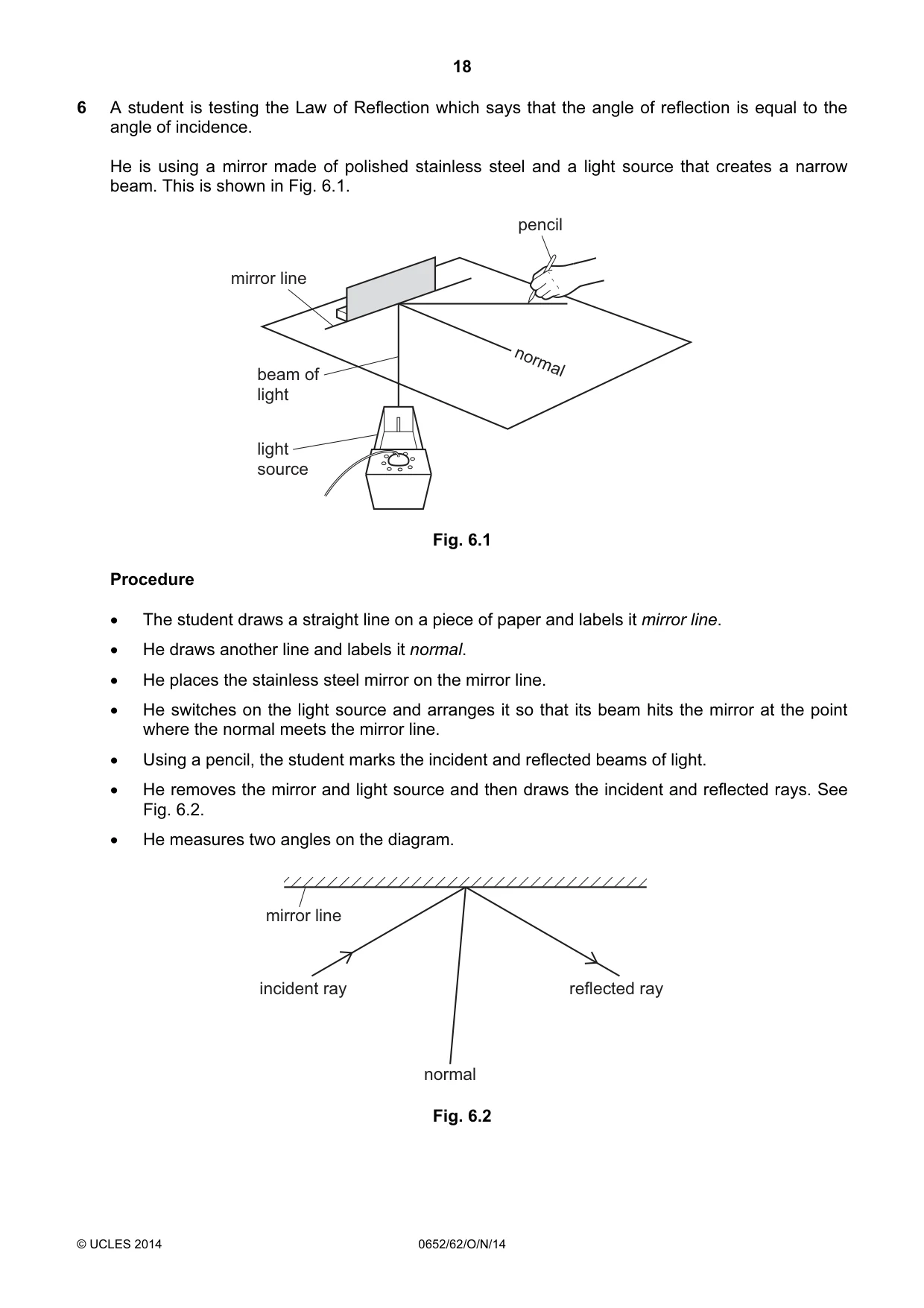
18 © UCLES 2014 0652/62/O/N/14 6 A student is testing the Law of Reflection which says that the angle of reflection is equal to the angle of incidence. He is using a mirror made of polished stainless steel and a light source that creates a narrow beam. This is shown in Fig. 6.1. mirror line beam of light light source normal pencil Fig. 6.1 Procedure • The student draws a straight line on a piece of paper and labels it mirror line. • He draws another line and labels it normal. • He places the stainless steel mirror on the mirror line. • He switches on the light source and arranges it so that its beam hits the mirror at the point where the normal meets the mirror line. • Using a pencil, the student marks the incident and reflected beams of light. • He removes the mirror and light source and then draws the incident and reflected rays. See Fig. 6.2. • He measures two angles on the diagram. normal incident ray reflected ray mirror line Fig. 6.2
Question paper, page 19
19 © UCLES 2014 0652/62/O/N/14 [Turn over (a) The student has measured two angles. He has written the following two statements. A “The angle between the incident ray and the mirror line is equal to the angle between the reflected ray and the mirror line.” B “This proves that the Law of Reflection is obeyed.” (i) Use a protractor to measure the angle of incidence and the angle of reflection. angle of incidence = degrees angle of reflection = degrees [2] (ii) Describe the student's mistake in drawing the diagram. [1] (iii) State and explain whether or not your measurements prove that the Law of reflection is obeyed. [1] (b) The student decides to test the same Law of Reflection using a mirror made from polished aluminium. He uses the same procedure as before, but he draws the normal line correctly. Fig. 6.3 shows the result of this experiment. The student has used a pencil to mark the incident and reflected beams. normal incident beam centre line reflected beam centre line mirror line Fig. 6.3 (i) Complete Fig. 6.3 to show an incident ray and a reflected ray. [1] (ii) Use a protractor to measure the angle of incidence and the angle of reflection. angle of incidence = degrees angle of reflection = degrees [2]
Question paper, page 20
20 Permission to reproduce items where third-party owned material protected by copyright is included has been sought and cleared where possible. Every reasonable effort has been made by the publisher (UCLES) to trace copyright holders, but if any items requiring clearance have unwittingly been included, the publisher will be pleased to make amends at the earliest possible opportunity. Cambridge International Examinations is part of the Cambridge Assessment Group. Cambridge Assessment is the brand name of University of Cambridge Local Examinations Syndicate (UCLES), which is itself a department of the University of Cambridge. © UCLES 2014 0652/62/O/N/14 (iii) The teacher tells the student that he has made mistakes in this experiment. As a result, the two angles are not equal. Suggest a mistake that the student may have made when he placed the mirror on the paper, drew the incident beam and reflected beam lines on the paper. [2] (c) The experiments use a solid metal and a solid metal alloy as reflective surfaces. The student states that solid metals reflect light because of the free movement of particles within them. Suggest the name of these particles. [1]
Mark scheme, page 1
® IGCSE is the registered trademark of Cambridge International Examinations. CAMBRIDGE INTERNATIONAL EXAMINATIONS Cambridge International General Certificate of Secondary Education MARK SCHEME for the October/November 2014 series 0652 PHYSICAL SCIENCE 0652/62 Paper 6 (Alternative to Practical), maximum raw mark 60 This mark scheme is published as an aid to teachers and candidates, to indicate the requirements of the examination. It shows the basis on which Examiners were instructed to award marks. It does not indicate the details of the discussions that took place at an Examiners’ meeting before marking began, which would have considered the acceptability of alternative answers. Mark schemes should be read in conjunction with the question paper and the Principal Examiner Report for Teachers. Cambridge will not enter into discussions about these mark schemes. Cambridge is publishing the mark schemes for the October/November 2014 series for most Cambridge IGCSE®, Cambridge International A and AS Level components and some Cambridge O Level components.
Mark scheme, page 2
Page 2 Mark Scheme Syllabus Paper Cambridge IGCSE – October/November 2014 0652 62 © Cambridge International Examinations 2014 1 (a) (i) 22.0 (s) ; 27.5 (s) ; [2] (ii) (200 / 22 =) 9.1 (m / s) ; (200 / 27.5 =) 7.3 (m / s) ; [2] (iii) (car 4 =) 33 (km / hr) ; (car 5 =) 26 (km / hr) ; [2] (iv) the car travels downhill so it may accelerate, speed changes / owtte ; [1] (v) there is a reaction time before the second student starts the timer / owtte ; [1] (b) (i) (160 + 103 + 116 = 379) 379 / 3 = 126 km / hr ; [1] (ii) cars travel too fast on the road, so unsafe for students / traffic fumes bad for health / other suggestion ; [1] [Total: 10] 2 (a) ensure rapid solution / dissolves quickly / owtte ; [1] (b) (i) 29.2 ; 16.8 ; [2] (ii) –1.1, +7.2, – 4.9 (ecf) all numbers correct ; all signs correct ; [2] (c) exothermic ; endothermic ; [2] (d) use insulated container / use plastic stirrer / cover the beaker / more accurate or digital thermometer ; [max 1] (e) more energy given out (when bonds are formed) ; than is taken in (when ions are pulled apart) ; (allow 1 mark max temperature increases because energy given out / overall energy is given out) [2] [Total: 10]
Mark scheme, page 3
Page 3 Mark Scheme Syllabus Paper Cambridge IGCSE – October/November 2014 0652 62 © Cambridge International Examinations 2014 3 (a) (i) 10.3 ; 20.5 ; [2] (ii) the extension is proportional to the load ; OR the load is proportional to the extension ; [max 1] (b) 3.7 ; 2.2 ; [2] (c) (i) 2.2 - 3.7 3.7 = 1.5 3.7 = 2.5 (g / cm3) ; [1] (ii) mass ; [1] (iii) volume ; [1] (d) any two from: the wire may have a different density ; wire adds to the volume ; wire adds to the mass ; stone not fully immersed ; spring could be in the water ; pointer hitting the side of the beaker ; stone touching the beaker ; other sensible answer explained ; [max 2] [Total: 10] 4 (a) (i) 11.5 ; 14.0 ; [2] (ii) 160 ; 195 ; [2] (b) (i) all points plotted ± 5 cm3 / 0.5 cm ; suitable straight line drawn ; [2] (ii) y / x values calculated ; shown on graph ; [2] (c) measure magnesium ribbon more accurately / owtte ; use measuring cylinder with more graduation lines ; stopper the flask before the Mg ribbon meets acid ; [max 1] (d) use acid of greater concentration / warm the mixture / cut into smaller pieces ; [max 1] [Total: 10]
Mark scheme, page 4
Page 4 Mark Scheme Syllabus Paper Cambridge IGCSE – October/November 2014 0652 62 © Cambridge International Examinations 2014 5 (a) (i) hydrogen ; [1] (ii) apply a lighted splint ; ‘pop’ or gas burns with a small explosion ; [2] (b) (i) calcium carbonate ; [1] (ii) calcium hydroxide ; [1] (c) metal A is magnesium ; [1] (d) (i) white precipitate / solid / deposit ; which re-dissolves (when more NaOH is added) ; [2] (ii) Fe(OH)2 ; [1] (e) white precipitate / solid / deposit (of silver chloride) ; [1] [Total: 10] 6 (a) (i) (angle of incidence =) 55 (degrees) ; (angle of reflection =) 65 (degrees) ; [2] (ii) the normal is not at 90° / perpendicular (to the mirror line) ; [1] (iii) not obeyed because they should be equal / because angles of incidence and reflection not measured (because the normal is incorrect) ; [1] (b) (i) both rays drawn correctly, touching the marks and meeting at the junction of the mirror line and the normal ; [1] (ii) (incidence =) 35 (degrees) ; (reflected =) 31 (degrees) ; [2] (iii) the mirror was not exactly in line with the mirror line / owtte ; the pencil mark(s) were in the wrong place / not in the centre of the beam ; [2] (c) electrons ; [1] [Total: 10]
What you needed in this session
Cambridge’s own grade thresholds for 2014 Oct/Nov, Paper 6 · Variant 2. A higher threshold means an easier paper — the bar moves with how the cohort did.