Cambridge IGCSE Physical Science 0652 — 2014 Oct/Nov Paper 3 · Variant 1
0652/31/O/N/14 · 80 marks · ≈90 min
The question paper and its mark scheme, free to read here and free to download. This is Cambridge’s own paper, exactly as it was sat.
Question paper20 pages


Mark scheme5 pages
Answers below. Sit the paper first if you are practising.
Paper as text
Question paper, page 1
This document consists of 19 printed pages and 1 blank page. DC (CW/CGW) 89044/4 © UCLES 2014 [Turn over Cambridge International Examinations Cambridge International General Certificate of Secondary Education * 0 4 6 4 0 1 9 8 3 8 * PHYSICAL SCIENCE 0652/31 Paper 3 (Extended) October/November 2014 1 hour 15 minutes Candidates answer on the Question Paper. No Additional Materials are required. READ THESE INSTRUCTIONS FIRST Write your Centre number, candidate number and name on all the work you hand in. Write in dark blue or black pen. You may use an HB soft pencil for any diagrams, graphs, tables or rough working. Do not use staples, paper clips, glue or correction fluid. DO NOT WRITE IN ANY BARCODES. Answer all questions. A copy of the Periodic Table is printed on page 20. Electronic calculators may be used. At the end of the examination, fasten all your work securely together. The number of marks is given in brackets [ ] at the end of each question or part question.
Question paper, page 2
2 0652/31/O/N/14 © UCLES 2014 BLANK PAGE
Question paper, page 3
3 0652/31/O/N/14 © UCLES 2014 [Turn over 1 Methane burns according to the following equation. CH4 + 2O2 CO2 + 2H2O (a) (i) This reaction releases energy. State the term used to describe a chemical reaction that releases energy. …[1] (ii) Use ideas about bond breaking and bond making to explain why energy is released in this reaction. … … … …[3] (b) (i) Name the fossil fuel that consists mainly of methane. …[1] (ii) The main use of methane is as a fuel. Suggest why methane has only a few other uses. … …[1]
Question paper, page 4
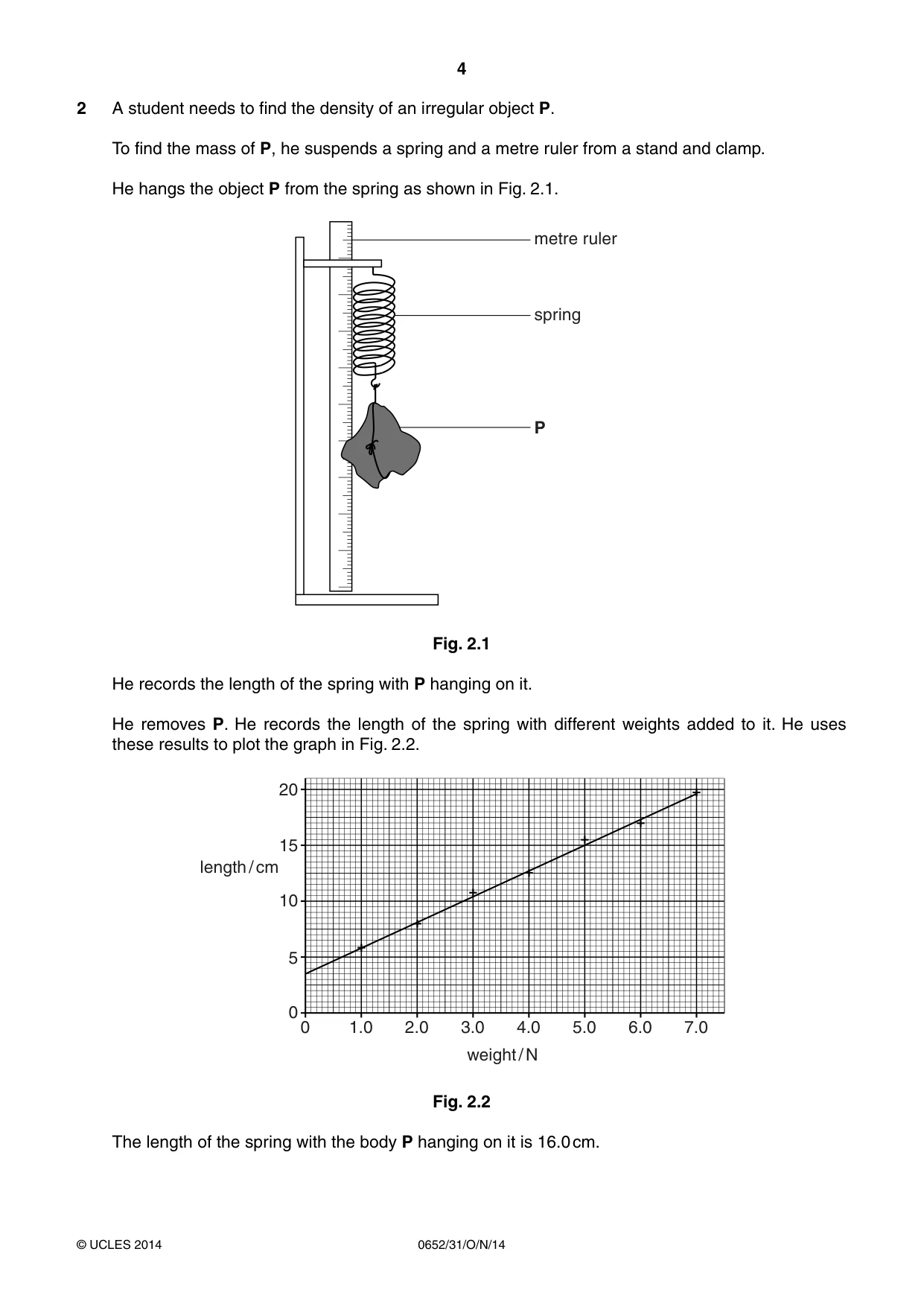
4 0652/31/O/N/14 © UCLES 2014 2 A student needs to find the density of an irregular object P. To find the mass of P, he suspends a spring and a metre ruler from a stand and clamp. He hangs the object P from the spring as shown in Fig. 2.1. spring metre ruler P Fig. 2.1 He records the length of the spring with P hanging on it. He removes P. He records the length of the spring with different weights added to it. He uses these results to plot the graph in Fig. 2.2. 0 5 10 1.0 2.0 0 3.0 4.0 weight / N 5.0 6.0 7.0 15 20 length / cm Fig. 2.2 The length of the spring with the body P hanging on it is 16.0 cm.
Question paper, page 5
5 0652/31/O/N/14 © UCLES 2014 [Turn over (a) (i) Determine the weight of body P. weight = … N [1] (ii) Calculate the mass of P and state the unit. mass = … unit = … [2] (b) In order to calculate the density of P, the student needs to find its volume. Describe how this can be found. … … … …[3] (c) The volume of P is found to be 180 cm3. Calculate the density of P in g / cm3. density = … g / cm3 … [2]
Question paper, page 6
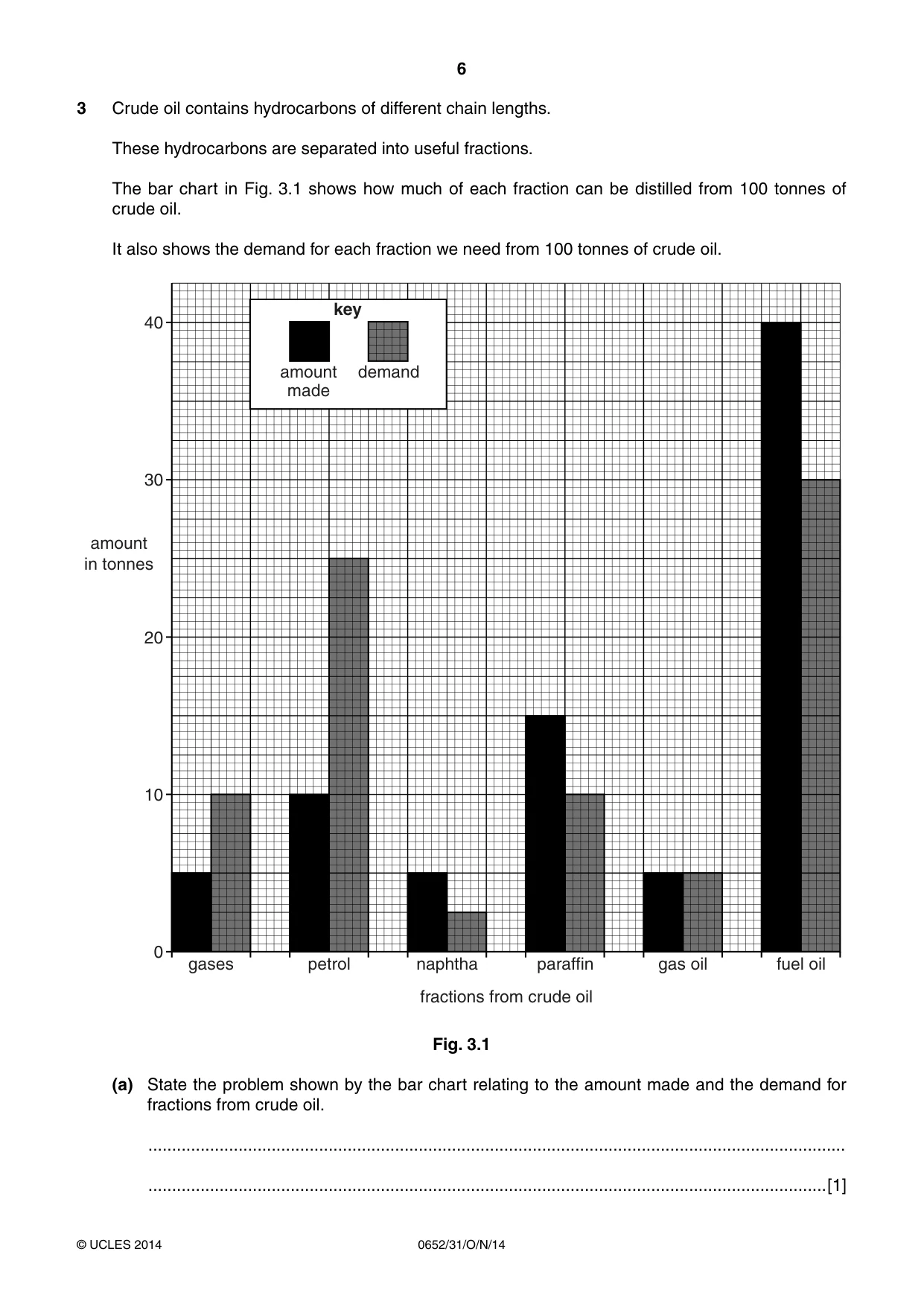
6 0652/31/O/N/14 © UCLES 2014 3 Crude oil contains hydrocarbons of different chain lengths. These hydrocarbons are separated into useful fractions. The bar chart in Fig. 3.1 shows how much of each fraction can be distilled from 100 tonnes of crude oil. It also shows the demand for each fraction we need from 100 tonnes of crude oil. gases petrol 0 10 20 30 amount in tonnes 40 naphtha paraffin fractions from crude oil gas oil fuel oil key amount made demand Fig. 3.1 (a) State the problem shown by the bar chart relating to the amount made and the demand for fractions from crude oil. … …[1]
Question paper, page 7
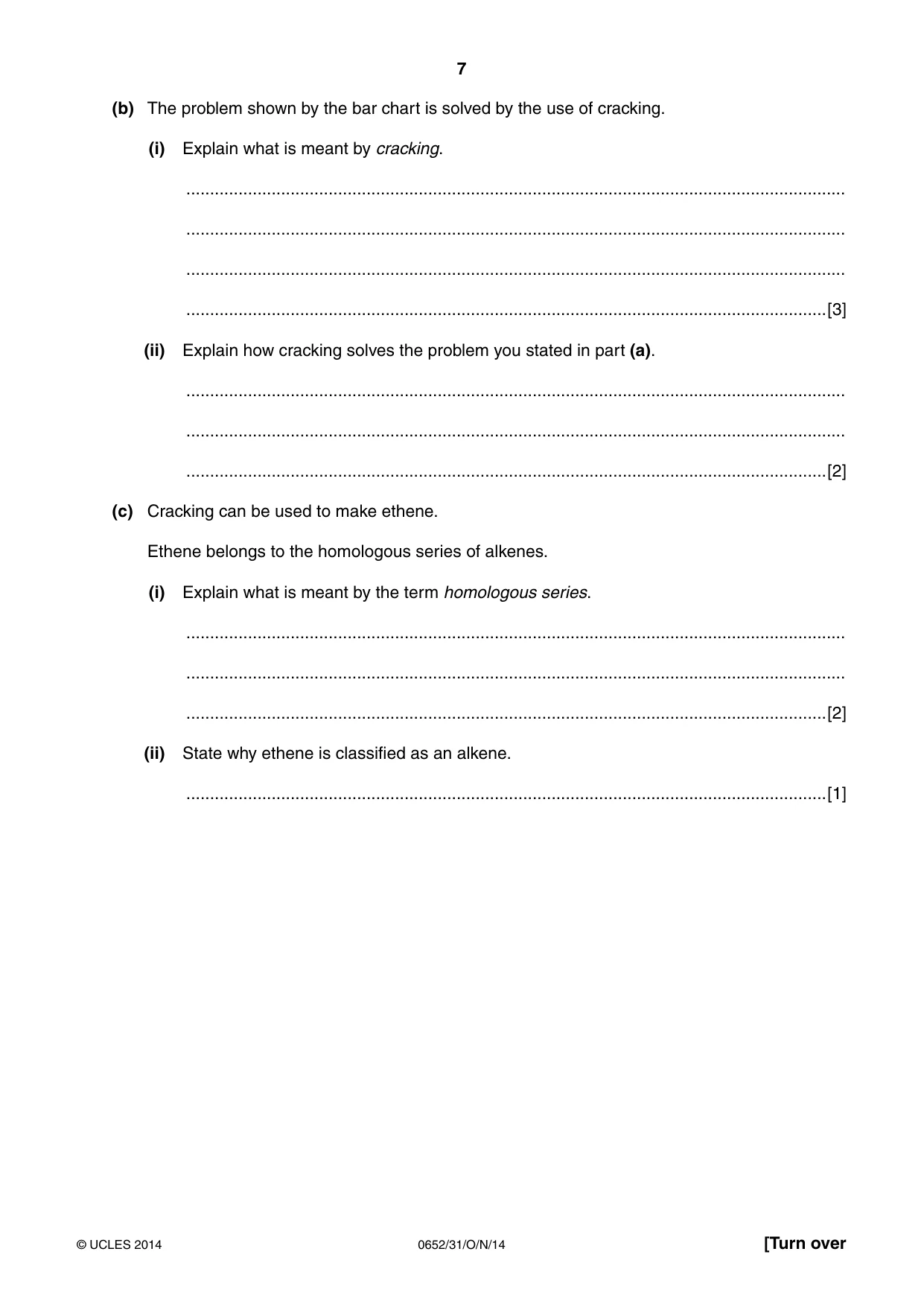
7 0652/31/O/N/14 © UCLES 2014 [Turn over (b) The problem shown by the bar chart is solved by the use of cracking. (i) Explain what is meant by cracking. … … … …[3] (ii) Explain how cracking solves the problem you stated in part (a). … … …[2] (c) Cracking can be used to make ethene. Ethene belongs to the homologous series of alkenes. (i) Explain what is meant by the term homologous series. … … …[2] (ii) State why ethene is classified as an alkene. …[1]
Question paper, page 8
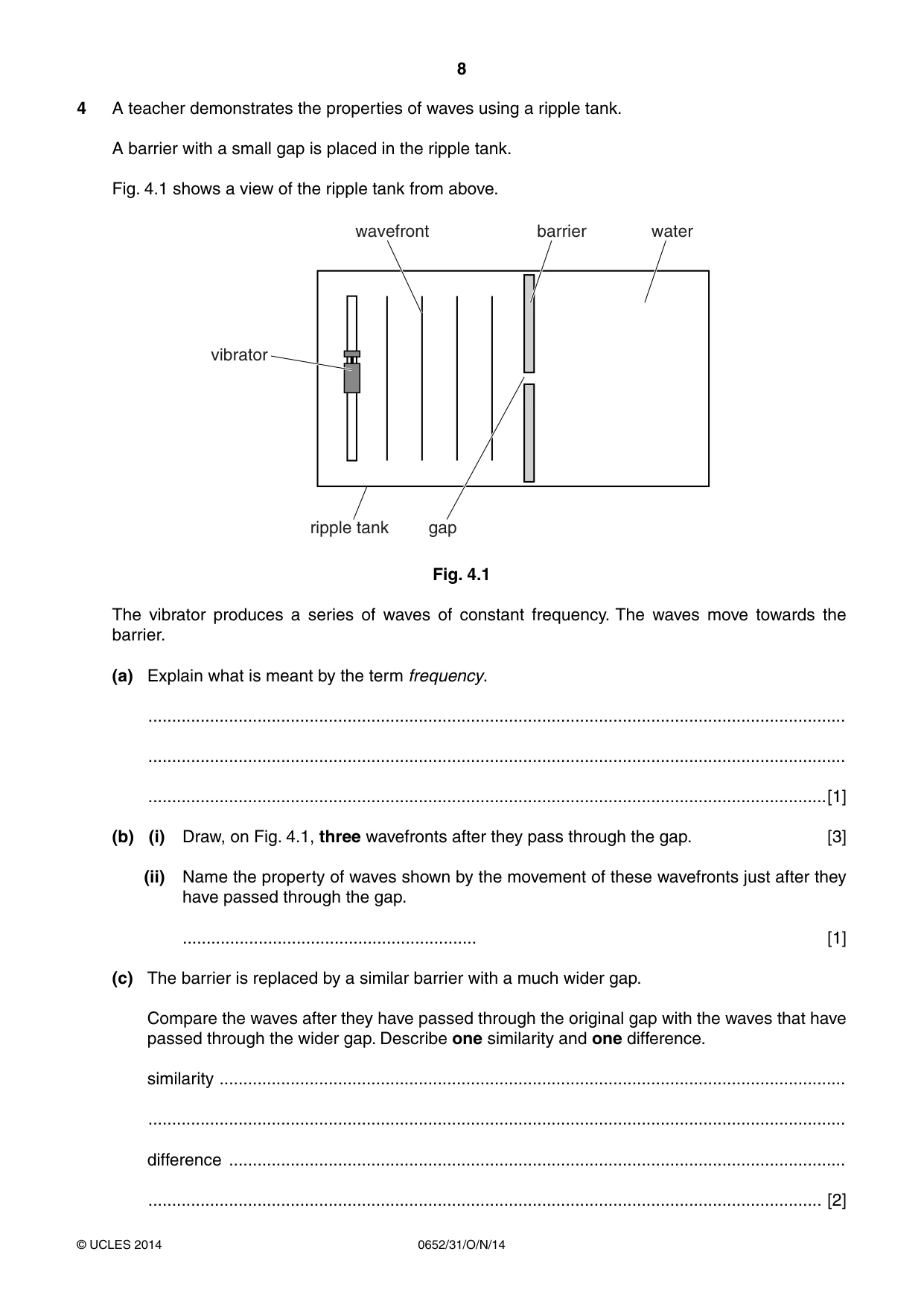
8 0652/31/O/N/14 © UCLES 2014 4 A teacher demonstrates the properties of waves using a ripple tank. A barrier with a small gap is placed in the ripple tank. Fig. 4.1 shows a view of the ripple tank from above. ripple tank gap wavefront barrier water vibrator Fig. 4.1 The vibrator produces a series of waves of constant frequency. The waves move towards the barrier. (a) Explain what is meant by the term frequency. … … …[1] (b) (i) Draw, on Fig. 4.1, three wavefronts after they pass through the gap. [3] (ii) Name the property of waves shown by the movement of these wavefronts just after they have passed through the gap. … [1] (c) The barrier is replaced by a similar barrier with a much wider gap. Compare the waves after they have passed through the original gap with the waves that have passed through the wider gap. Describe one similarity and one difference. similarity … … difference … … [2]
Question paper, page 9
9 0652/31/O/N/14 © UCLES 2014 [Turn over Question 5 begins over the page
Question paper, page 10
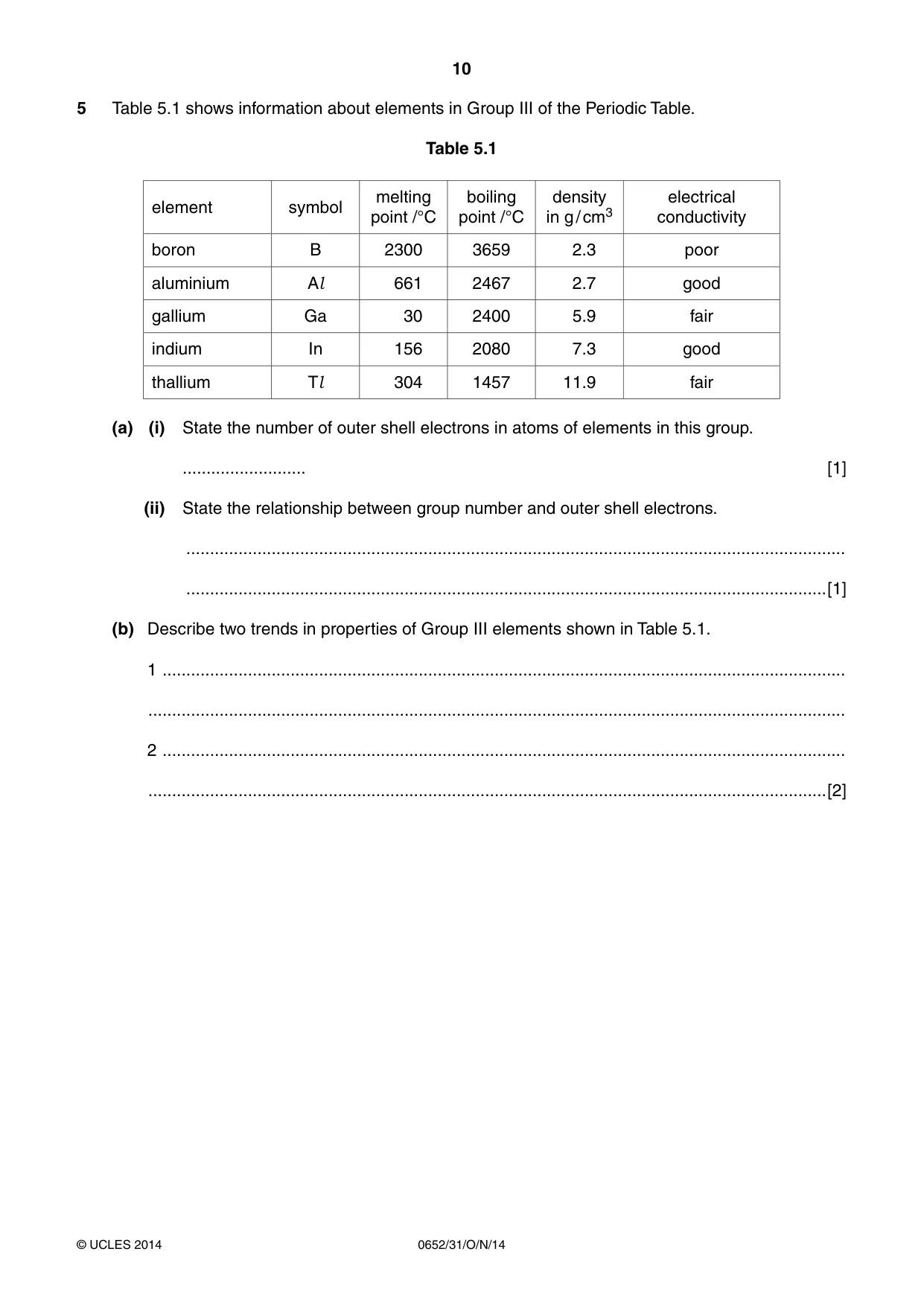
10 0652/31/O/N/14 © UCLES 2014 5 Table 5.1 shows information about elements in Group III of the Periodic Table. Table 5.1 element symbol melting point /°C boiling point /°C density in g / cm3 electrical conductivity boron B 2300 3659 2.3 poor aluminium Al 661 2467 2.7 good gallium Ga 30 2400 5.9 fair indium In 156 2080 7.3 good thallium Tl 304 1457 11.9 fair (a) (i) State the number of outer shell electrons in atoms of elements in this group. … [1] (ii) State the relationship between group number and outer shell electrons. … …[1] (b) Describe two trends in properties of Group III elements shown in Table 5.1. 1 … … 2 … …[2]
Question paper, page 11
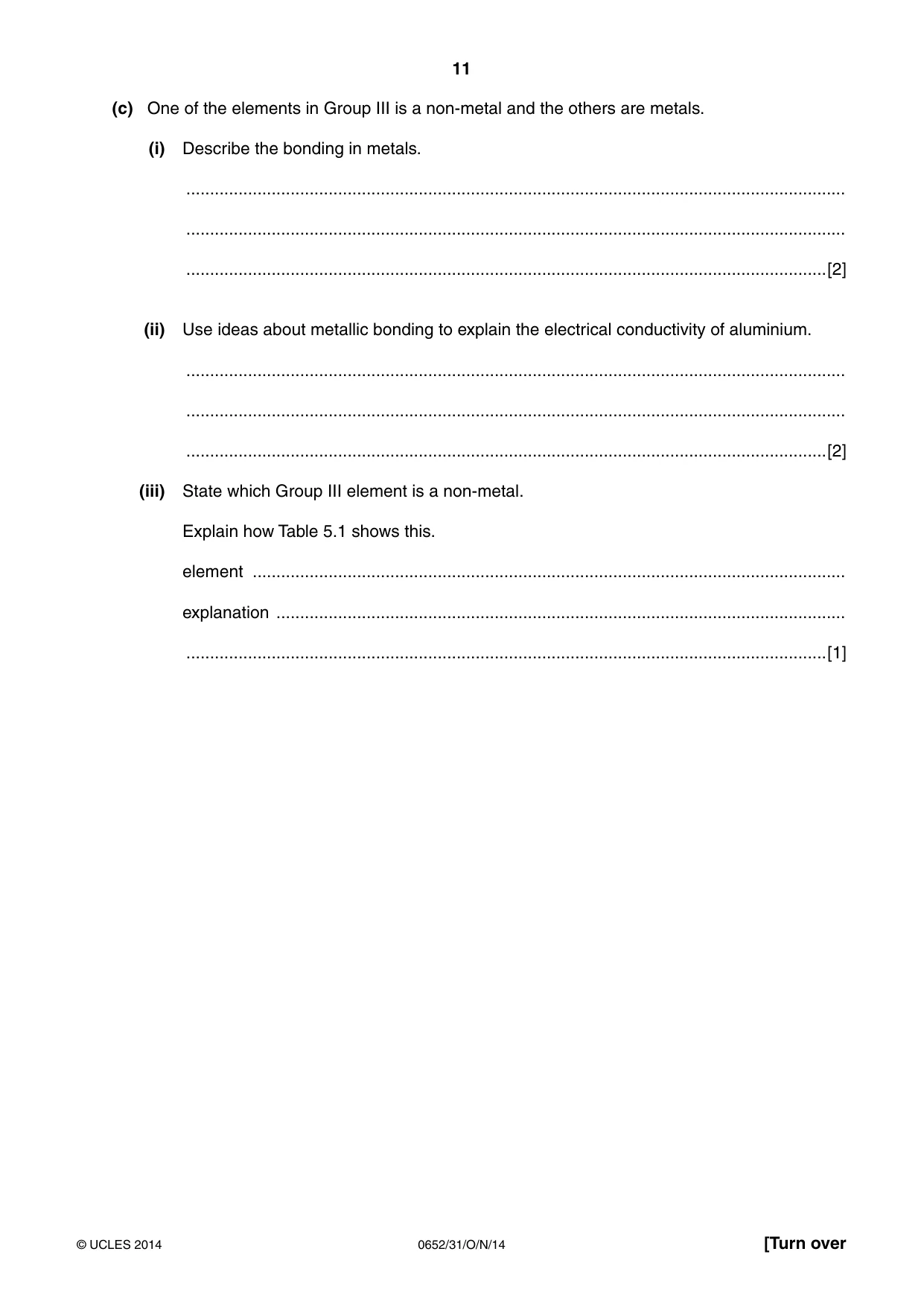
11 0652/31/O/N/14 © UCLES 2014 [Turn over (c) One of the elements in Group III is a non-metal and the others are metals. (i) Describe the bonding in metals. … … …[2] (ii) Use ideas about metallic bonding to explain the electrical conductivity of aluminium. … … …[2] (iii) State which Group III element is a non-metal. Explain how Table 5.1 shows this. element … explanation … …[1]
Question paper, page 12
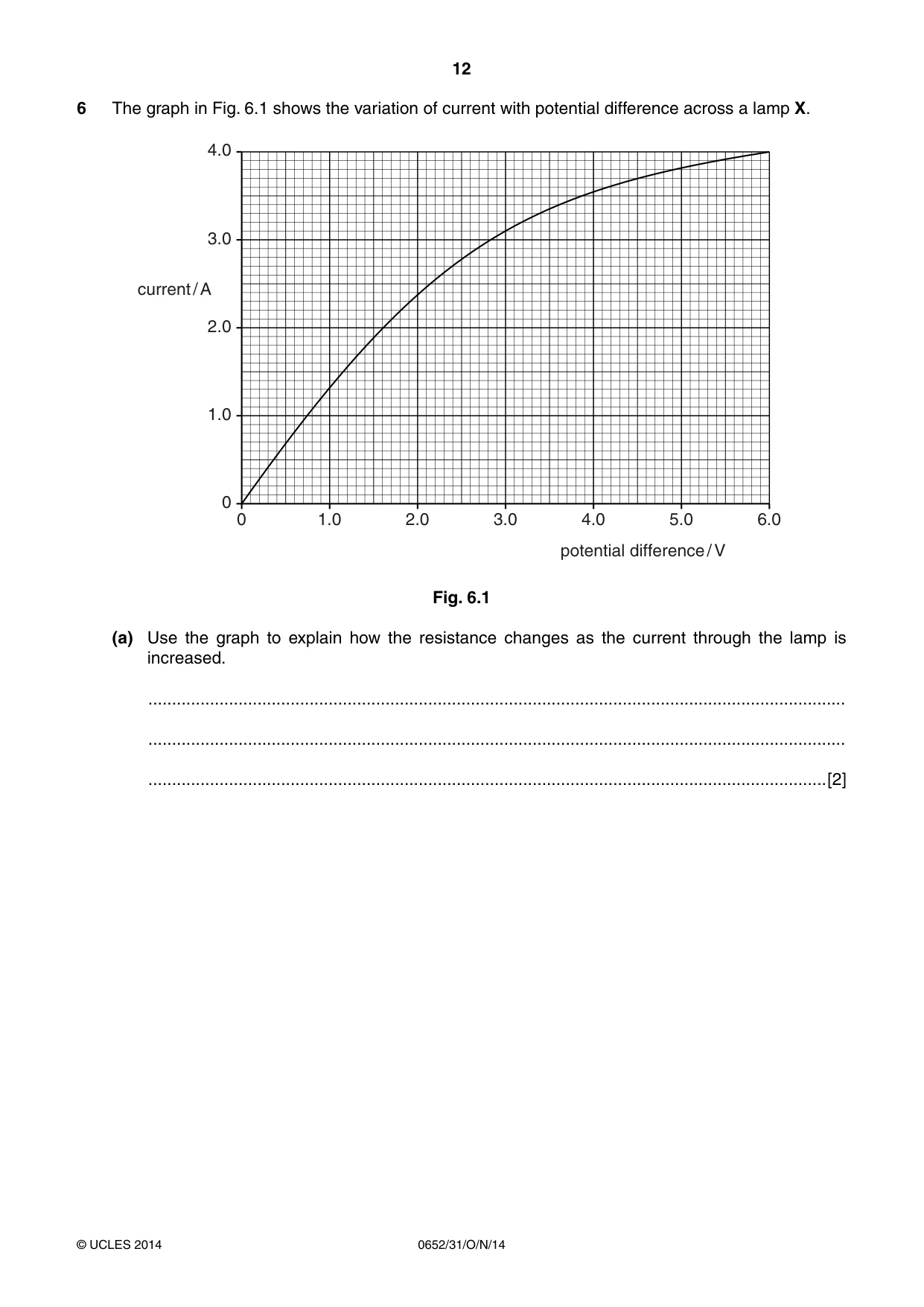
12 0652/31/O/N/14 © UCLES 2014 6 The graph in Fig. 6.1 shows the variation of current with potential difference across a lamp X. 4.0 3.0 2.0 1.0 0 current / A 0 1.0 2.0 3.0 4.0 5.0 6.0 potential difference / V Fig. 6.1 (a) Use the graph to explain how the resistance changes as the current through the lamp is increased. … … …[2]
Question paper, page 13
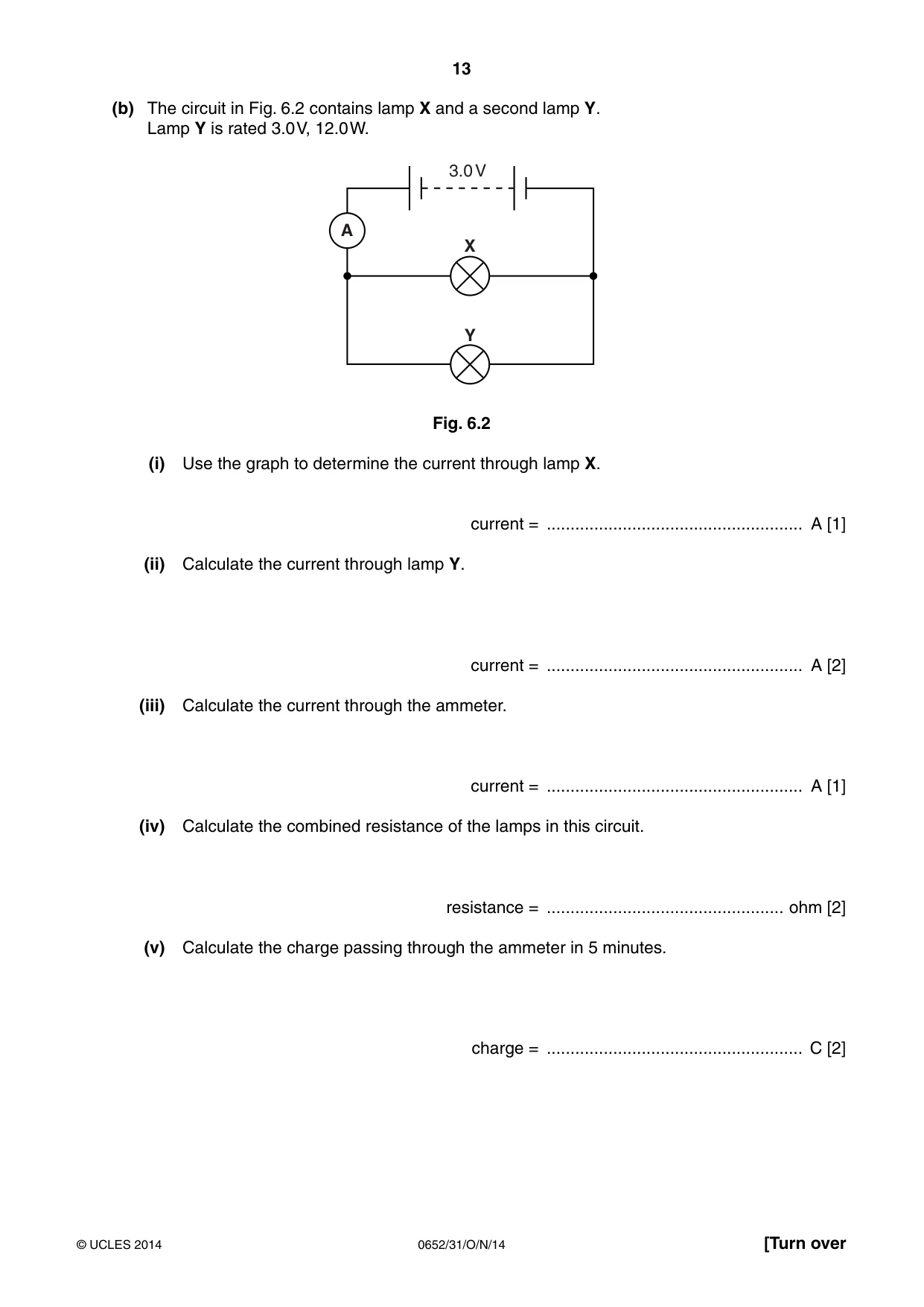
13 0652/31/O/N/14 © UCLES 2014 [Turn over (b) The circuit in Fig. 6.2 contains lamp X and a second lamp Y. Lamp Y is rated 3.0 V, 12.0 W. 3.0 V X Y A Fig. 6.2 (i) Use the graph to determine the current through lamp X. current = … A [1] (ii) Calculate the current through lamp Y. current = … A [2] (iii) Calculate the current through the ammeter. current = … A [1] (iv) Calculate the combined resistance of the lamps in this circuit. resistance = … ohm [2] (v) Calculate the charge passing through the ammeter in 5 minutes. charge = … C [2]
Question paper, page 14
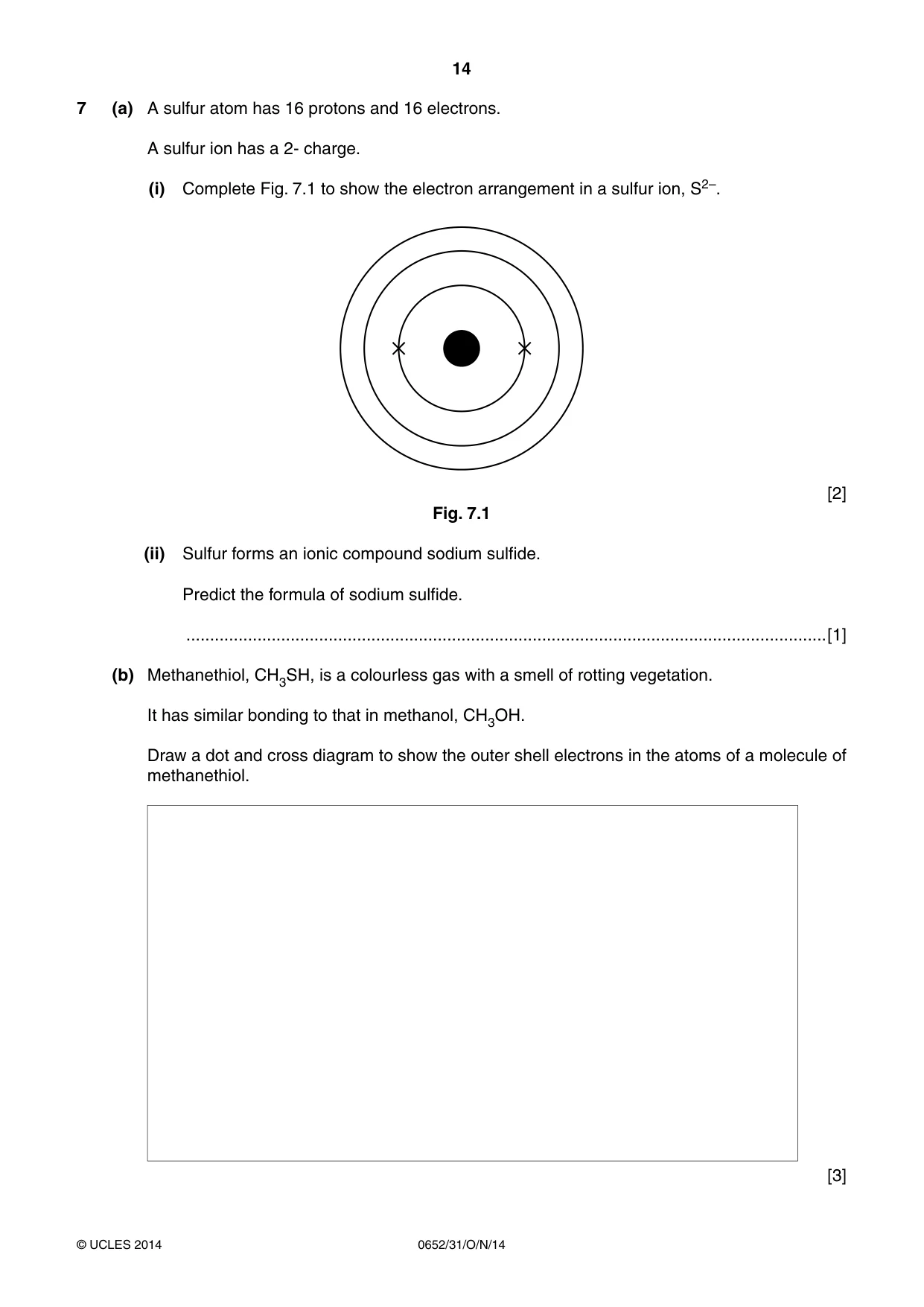
14 0652/31/O/N/14 © UCLES 2014 7 (a) A sulfur atom has 16 protons and 16 electrons. A sulfur ion has a 2- charge. (i) Complete Fig. 7.1 to show the electron arrangement in a sulfur ion, S2–. [2] Fig. 7.1 (ii) Sulfur forms an ionic compound sodium sulfide. Predict the formula of sodium sulfide. …[1] (b) Methanethiol, CH3SH, is a colourless gas with a smell of rotting vegetation. It has similar bonding to that in methanol, CH3OH. Draw a dot and cross diagram to show the outer shell electrons in the atoms of a molecule of methanethiol. [3]
Question paper, page 15
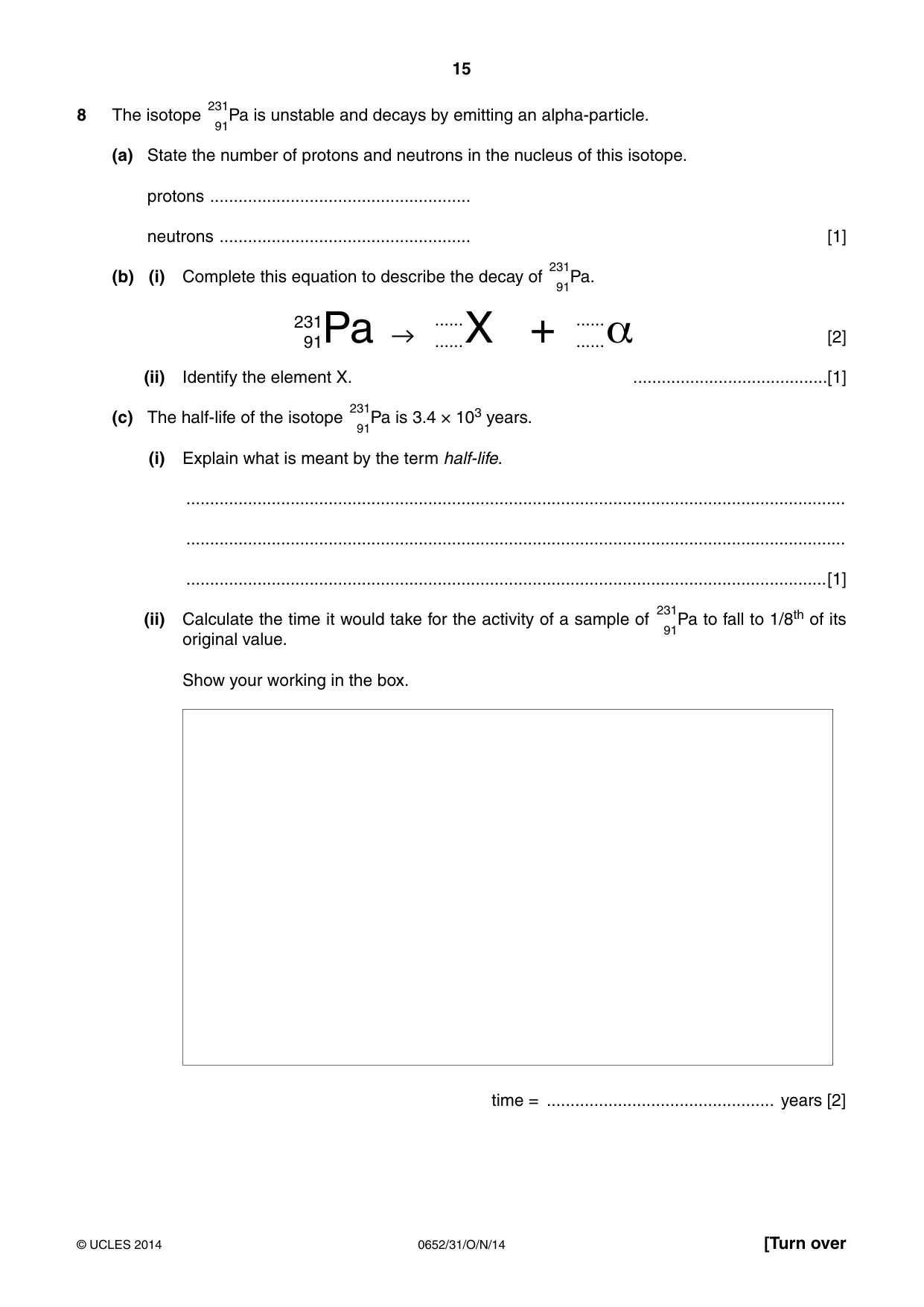
15 0652/31/O/N/14 © UCLES 2014 [Turn over 8 The isotope 231 91Pa is unstable and decays by emitting an alpha-particle. (a) State the number of protons and neutrons in the nucleus of this isotope. protons … neutrons … [1] (b) (i) Complete this equation to describe the decay of 231 91Pa. 231 91Pa … …X + … …α [2] (ii) Identify the element X. …[1] (c) The half-life of the isotope 231 91Pa is 3.4 × 10³ years. (i) Explain what is meant by the term half-life. … … …[1] (ii) Calculate the time it would take for the activity of a sample of 231 91Pa to fall to 1/8th of its original value. Show your working in the box. time = … years [2]
Question paper, page 16
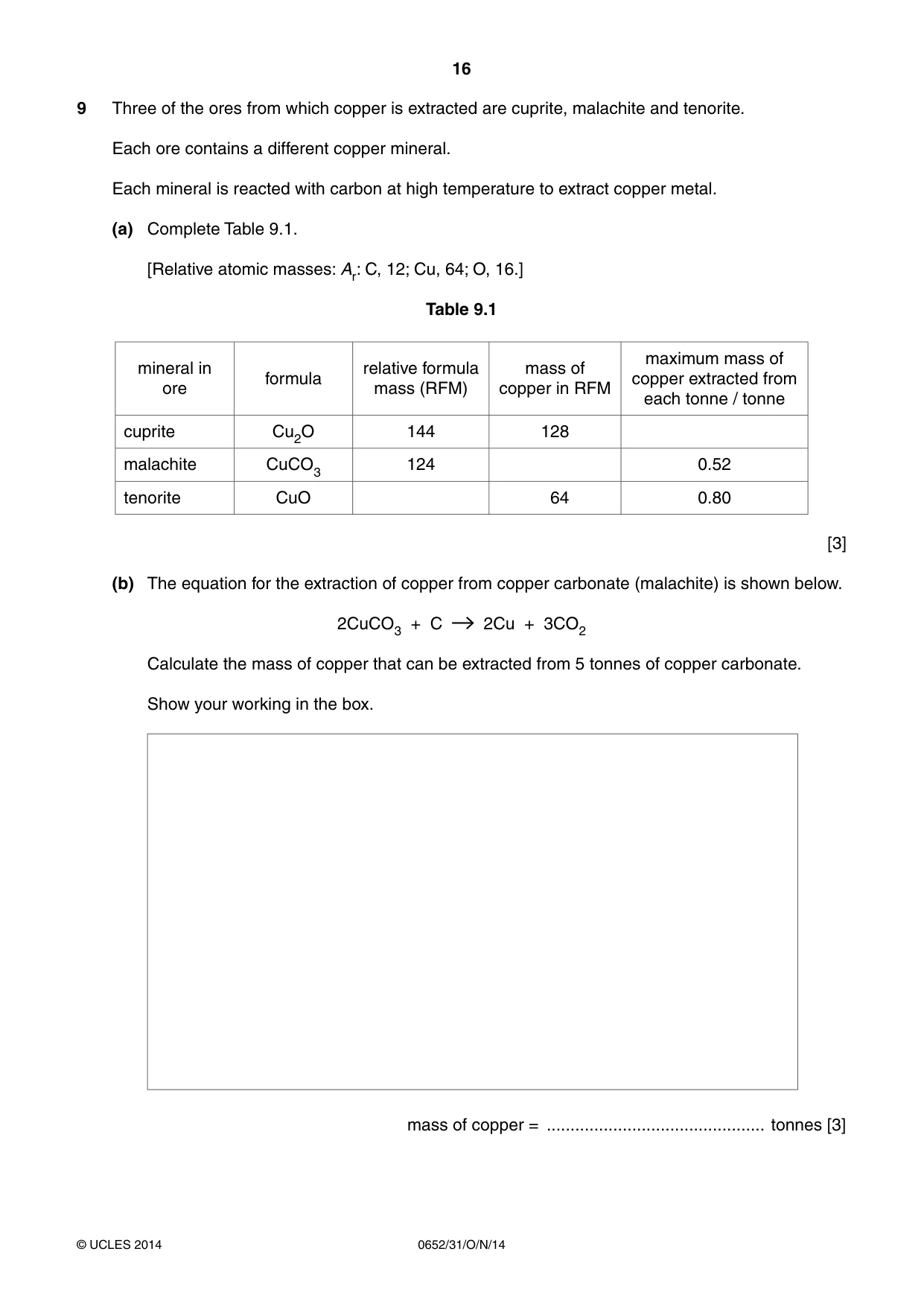
16 0652/31/O/N/14 © UCLES 2014 9 Three of the ores from which copper is extracted are cuprite, malachite and tenorite. Each ore contains a different copper mineral. Each mineral is reacted with carbon at high temperature to extract copper metal. (a) Complete Table 9.1. [Relative atomic masses: Ar: C, 12; Cu, 64; O, 16.] Table 9.1 mineral in ore formula relative formula mass (RFM) mass of copper in RFM maximum mass of copper extracted from each tonne / tonne cuprite Cu2O 144 128 malachite CuCO3 124 0.52 tenorite CuO 64 0.80 [3] (b) The equation for the extraction of copper from copper carbonate (malachite) is shown below. 2CuCO3 + C 2Cu + 3CO2 Calculate the mass of copper that can be extracted from 5 tonnes of copper carbonate. Show your working in the box. mass of copper = … tonnes [3]
Question paper, page 17
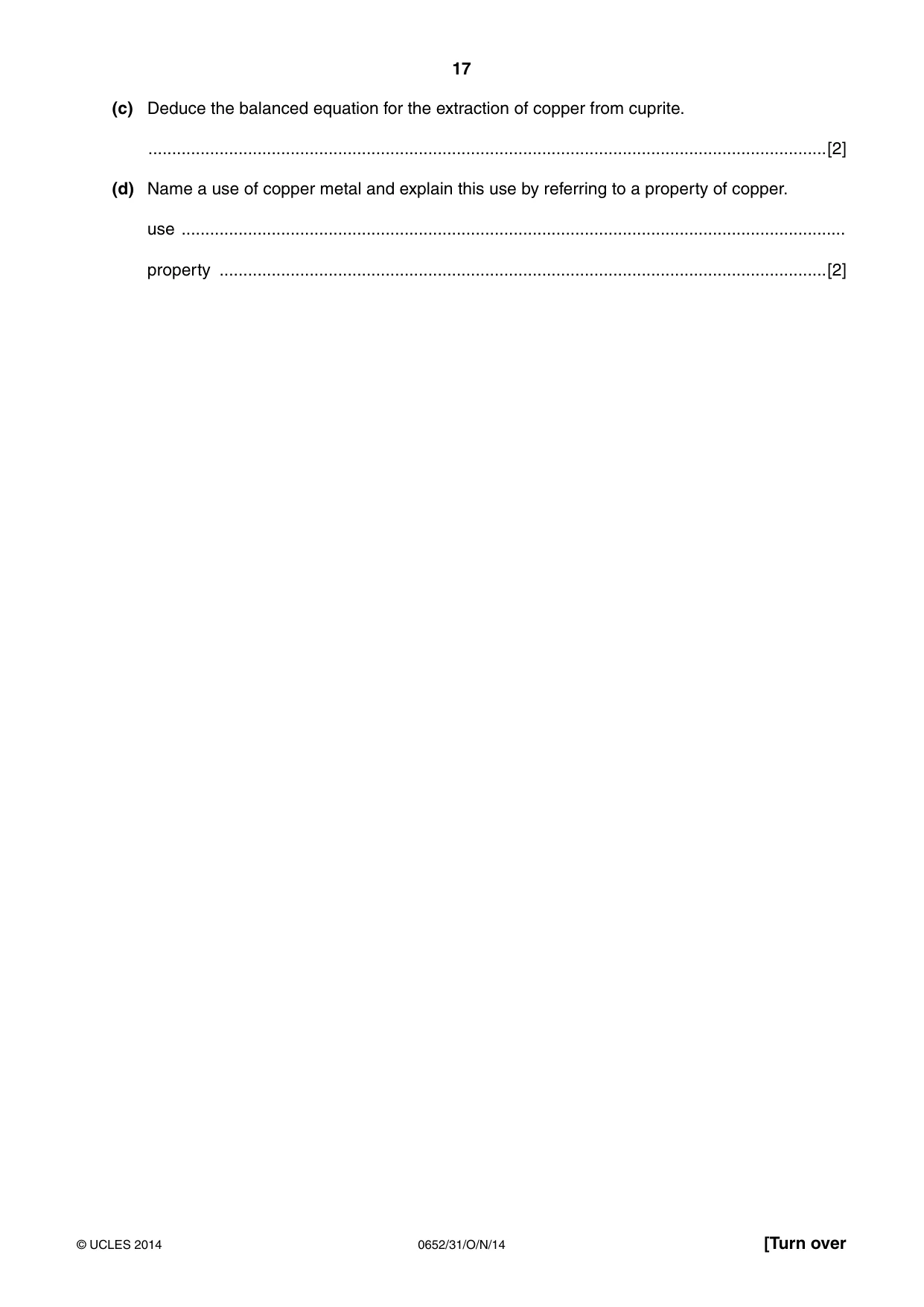
17 0652/31/O/N/14 © UCLES 2014 [Turn over (c) Deduce the balanced equation for the extraction of copper from cuprite. …[2] (d) Name a use of copper metal and explain this use by referring to a property of copper. use … property …[2]
Question paper, page 18
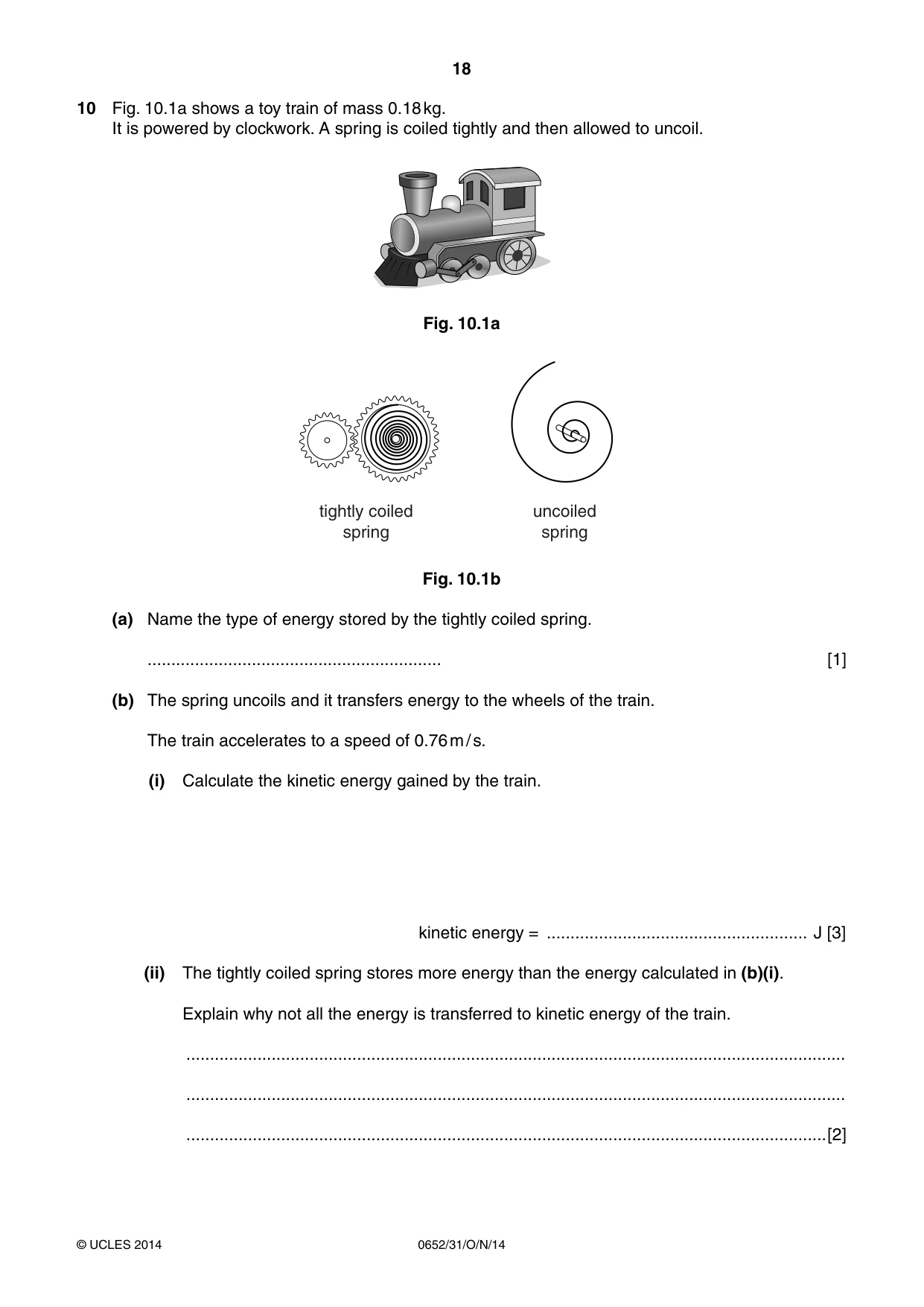
18 0652/31/O/N/14 © UCLES 2014 10 Fig. 10.1a shows a toy train of mass 0.18 kg. It is powered by clockwork. A spring is coiled tightly and then allowed to uncoil. Fig. 10.1a tightly coiled spring uncoiled spring Fig. 10.1b (a) Name the type of energy stored by the tightly coiled spring. … [1] (b) The spring uncoils and it transfers energy to the wheels of the train. The train accelerates to a speed of 0.76 m / s. (i) Calculate the kinetic energy gained by the train. kinetic energy = … J [3] (ii) The tightly coiled spring stores more energy than the energy calculated in (b)(i). Explain why not all the energy is transferred to kinetic energy of the train. … … …[2]
Question paper, page 19
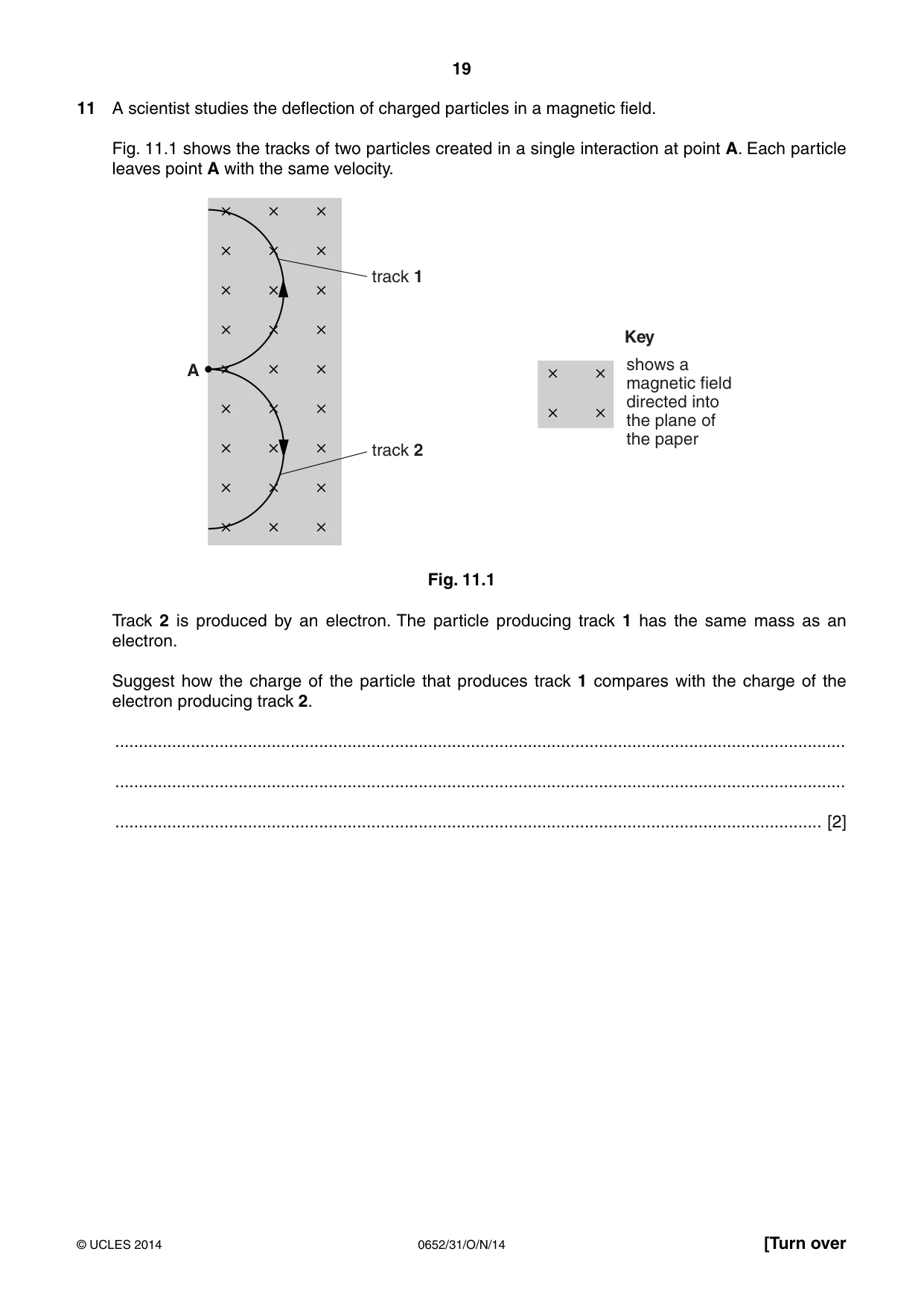
19 0652/31/O/N/14 © UCLES 2014 [Turn over 11 A scientist studies the deflection of charged particles in a magnetic field. Fig. 11.1 shows the tracks of two particles created in a single interaction at point A. Each particle leaves point A with the same velocity. A track 1 track 2 Key shows a magnetic field directed into the plane of the paper Fig. 11.1 Track 2 is produced by an electron. The particle producing track 1 has the same mass as an electron. Suggest how the charge of the particle that produces track 1 compares with the charge of the electron producing track 2. … … … [2]
Question paper, page 20
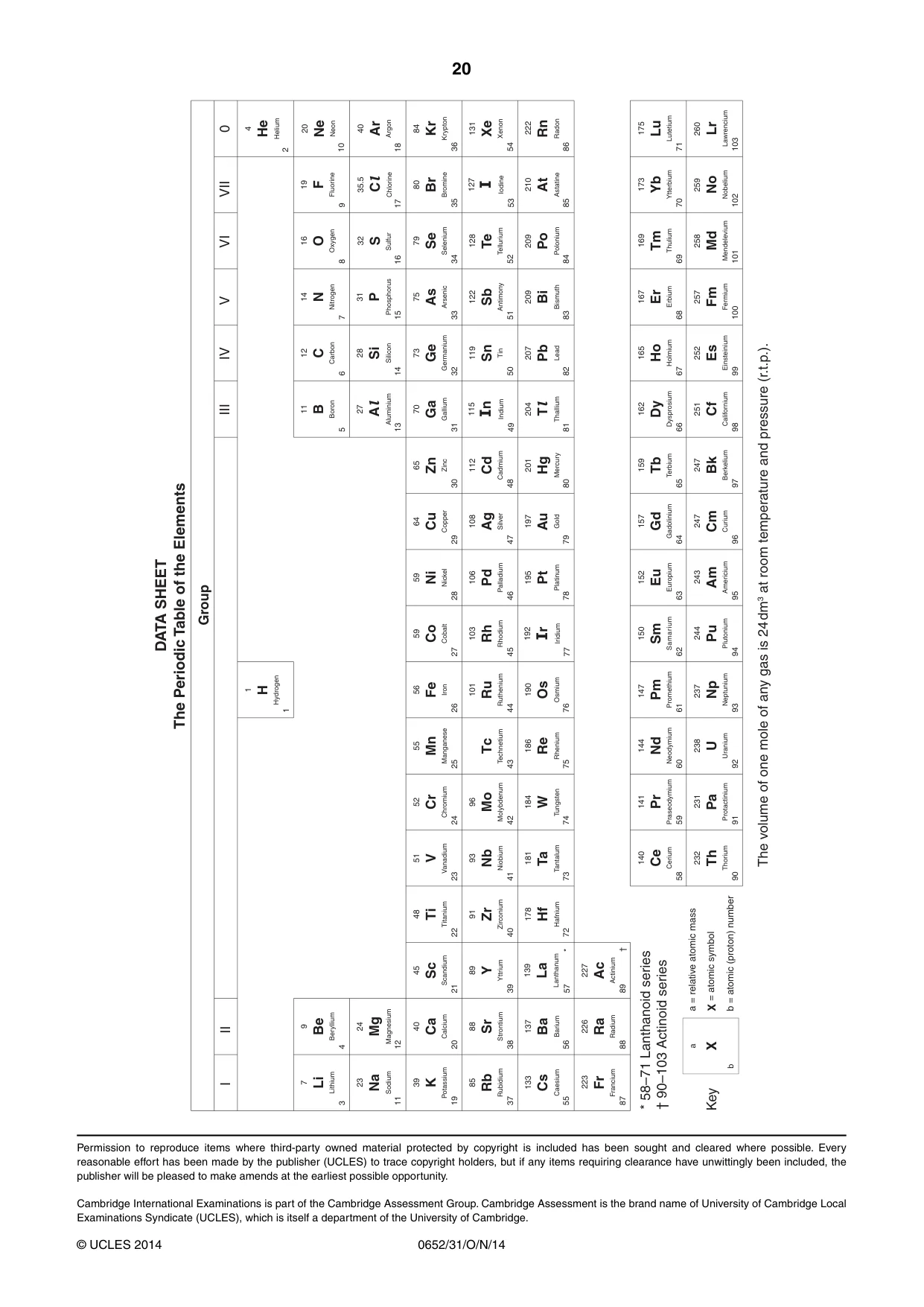
20 0652/31/O/N/14 © UCLES 2014 Group The Periodic Table of the Elements 140 Ce Cerium 58 141 Pr Praseodymium 59 144 Nd Neodymium 60 Pm Promethium 61 150 Sm Samarium 62 152 Eu Europium 63 157 Gd Gadolinium 64 159 Tb Terbium 65 162 Dy Dysprosium 66 165 Ho Holmium 67 167 Er Erbium 68 169 Tm Thulium 69 173 Yb Ytterbium 70 175 Lu Lutetium 71 232 Th Thorium 90 Pa Protactinium 91 238 231 147 237 244 243 247 247 251 252 257 258 259 260 U Uranium 92 Np Neptunium 93 Pu Plutonium 94 Am Americium 95 Cm Curium 96 Bk Berkelium 97 Cf Californium 98 Es Einsteinium 99 Fm Fermium 100 Md Mendelevium 101 No Nobelium 102 Lr Lawrencium 103 1 H Hydrogen 1 7 Li Lithium 3 23 Na Sodium 11 24 Mg Magnesium 12 40 Ca Calcium 20 45 Sc Scandium 21 48 Ti Titanium 22 51 V Vanadium 23 52 Cr Chromium 24 55 Mn Manganese 25 56 Fe Iron 26 59 Co Cobalt 27 59 Ni Nickel 28 64 Cu Copper 29 65 Zn Zinc 30 70 Ga Gallium 31 27 Al Aluminium 13 11 B Boron 5 12 C Carbon 6 14 N Nitrogen 7 16 O Oxygen 8 19 F Fluorine 9 28 Si Silicon 14 31 P Phosphorus 15 32 S Sulfur 16 35.5 Cl Chlorine 17 40 Ar Argon 18 20 Ne Neon 10 4 He Helium 2 73 Ge Germanium 32 75 As Arsenic 33 79 Se Selenium 34 80 Br Bromine 35 84 Kr Krypton 36 39 K Potassium 19 88 Sr Strontium 38 89 Y Yttrium 39 91 Zr Zirconium 40 93 Nb Niobium 41 96 Mo Molybdenum 42 Tc Technetium 43 101 Ru Ruthenium 44 103 Rh Rhodium 45 106 Pd Palladium 46 108 Ag Silver 47 112 Cd Cadmium 48 115 In Indium 49 119 Sn Tin 50 122 Sb Antimony 51 128 Te Tellurium 52 127 I Iodine 53 131 Xe Xenon 54 137 Ba Barium 56 139 La Lanthanum 57 * 178 Hf Hafnium 72 181 Ta Tantalum 73 184 W Tungsten 74 186 Re Rhenium 75 190 Os Osmium 76 192 Ir Iridium 77 195 Pt Platinum 78 197 Au Gold 79 201 Hg Mercury 80 204 Tl Thallium 81 207 Pb Lead 82 209 209 210 222 Bi Bismuth 83 Po Polonium 84 At Astatine 85 Rn Radon 86 Fr Francium 87 227 Ac Actinium 89 † 9 Be Beryllium 4 I II III IV V VI VII 0 85 Rb Rubidium 37 133 Cs Caesium 55 226 223 Ra Radium 88 a X b a = relative atomic mass X = atomic symbol b = atomic (proton) number Key DATA SHEET * 58–71 Lanthanoid series † 90–103 Actinoid series The volume of one mole of any gas is 24dm3 at room temperature and pressure (r.t.p.). Permission to reproduce items where third-party owned material protected by copyright is included has been sought and cleared where possible. Every reasonable effort has been made by the publisher (UCLES) to trace copyright holders, but if any items requiring clearance have unwittingly been included, the publisher will be pleased to make amends at the earliest possible opportunity. Cambridge International Examinations is part of the Cambridge Assessment Group. Cambridge Assessment is the brand name of University of Cambridge Local Examinations Syndicate (UCLES), which is itself a department of the University of Cambridge.
Mark scheme, page 1
® IGCSE is the registered trademark of Cambridge International Examinations. CAMBRIDGE INTERNATIONAL EXAMINATIONS Cambridge International General Certificate of Secondary Education MARK SCHEME for the October/November 2014 series 0652 PHYSICAL SCIENCE 0652/31 Paper 3 (Extended Theory), maximum raw mark 80 This mark scheme is published as an aid to teachers and candidates, to indicate the requirements of the examination. It shows the basis on which Examiners were instructed to award marks. It does not indicate the details of the discussions that took place at an Examiners’ meeting before marking began, which would have considered the acceptability of alternative answers. Mark schemes should be read in conjunction with the question paper and the Principal Examiner Report for Teachers. Cambridge will not enter into discussions about these mark schemes. Cambridge is publishing the mark schemes for the October/November 2014 series for most Cambridge IGCSE®, Cambridge International A and AS Level components and some Cambridge O Level components.
Mark scheme, page 2
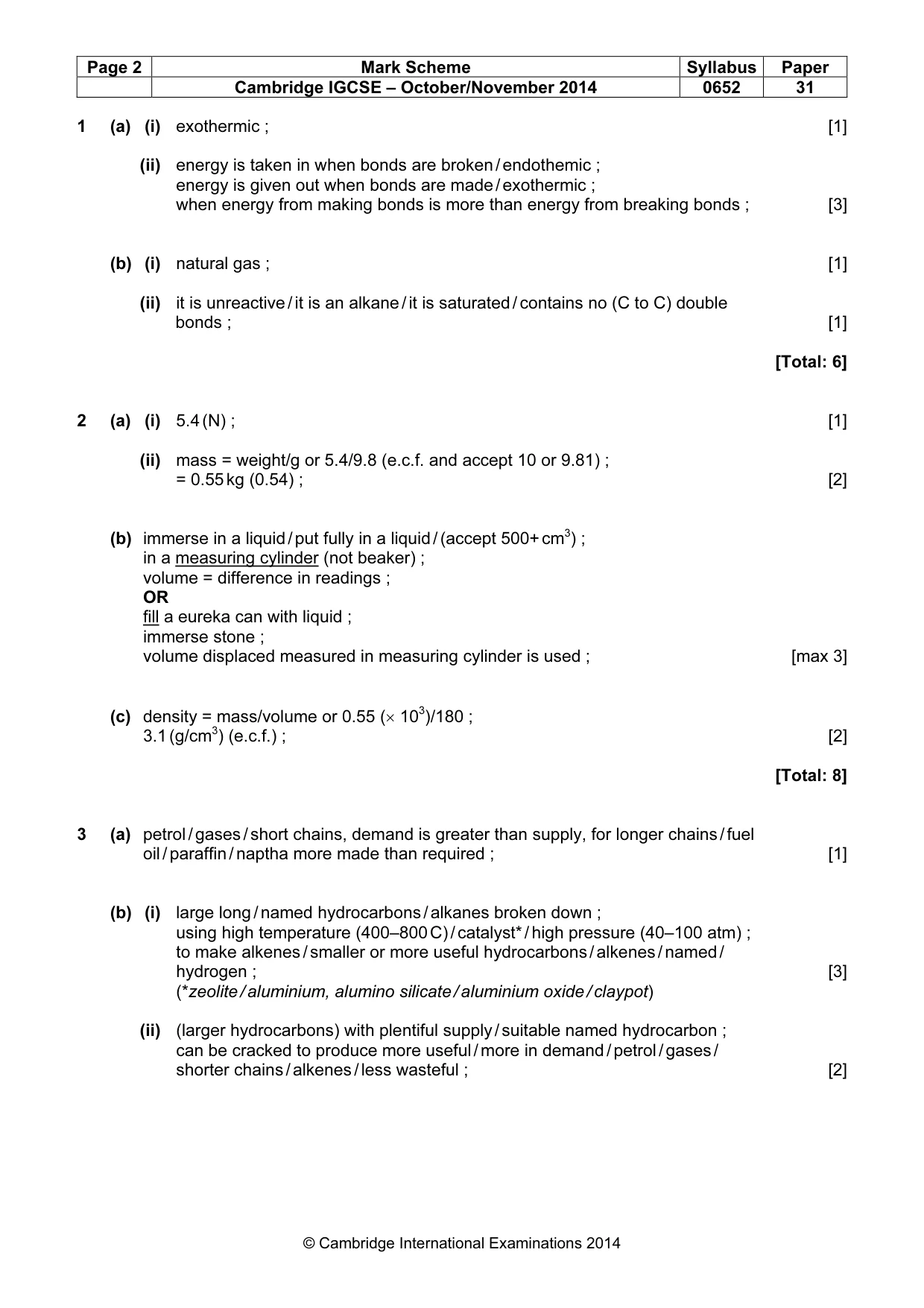
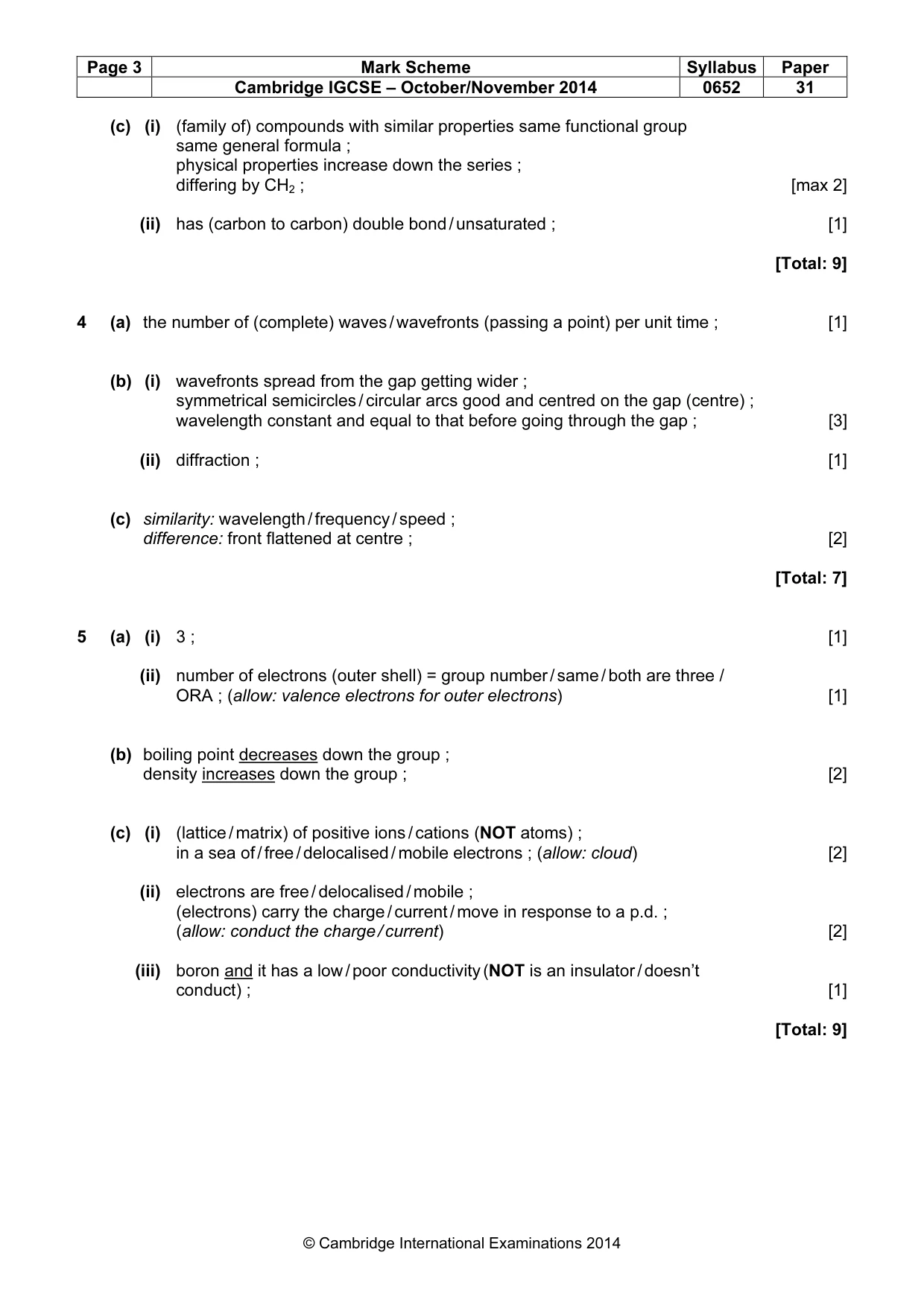
Page 2 Mark Scheme Syllabus Paper Cambridge IGCSE – October/November 2014 0652 31 © Cambridge International Examinations 2014 1 (a) (i) exothermic ; [1] (ii) energy is taken in when bonds are broken / endothemic ; energy is given out when bonds are made / exothermic ; when energy from making bonds is more than energy from breaking bonds ; [3] (b) (i) natural gas ; [1] (ii) it is unreactive / it is an alkane / it is saturated / contains no (C to C) double bonds ; [1] [Total: 6] 2 (a) (i) 5.4 (N) ; [1] (ii) mass = weight/g or 5.4/9.8 (e.c.f. and accept 10 or 9.81) ; = 0.55 kg (0.54) ; [2] (b) immerse in a liquid / put fully in a liquid / (accept 500+ cm3) ; in a measuring cylinder (not beaker) ; volume = difference in readings ; OR fill a eureka can with liquid ; immerse stone ; volume displaced measured in measuring cylinder is used ; [max 3] (c) density = mass/volume or 0.55 (× 103)/180 ; 3.1 (g/cm3) (e.c.f.) ; [2] [Total: 8] 3 (a) petrol / gases / short chains, demand is greater than supply, for longer chains / fuel oil / paraffin / naptha more made than required ; [1] (b) (i) large long / named hydrocarbons / alkanes broken down ; using high temperature (400–800 C) / catalyst* / high pressure (40–100 atm) ; to make alkenes / smaller or more useful hydrocarbons / alkenes / named / hydrogen ; [3] (*zeolite / aluminium, alumino silicate / aluminium oxide / claypot) (ii) (larger hydrocarbons) with plentiful supply / suitable named hydrocarbon ; can be cracked to produce more useful / more in demand / petrol / gases / shorter chains / alkenes / less wasteful ; [2]
Mark scheme, page 3
Page 3 Mark Scheme Syllabus Paper Cambridge IGCSE – October/November 2014 0652 31 © Cambridge International Examinations 2014 (c) (i) (family of) compounds with similar properties same functional group same general formula ; physical properties increase down the series ; differing by CH2 ; [max 2] (ii) has (carbon to carbon) double bond / unsaturated ; [1] [Total: 9] 4 (a) the number of (complete) waves / wavefronts (passing a point) per unit time ; [1] (b) (i) wavefronts spread from the gap getting wider ; symmetrical semicircles / circular arcs good and centred on the gap (centre) ; wavelength constant and equal to that before going through the gap ; [3] (ii) diffraction ; [1] (c) similarity: wavelength / frequency / speed ; difference: front flattened at centre ; [2] [Total: 7] 5 (a) (i) 3 ; [1] (ii) number of electrons (outer shell) = group number / same / both are three / ORA ; (allow: valence electrons for outer electrons) [1] (b) boiling point decreases down the group ; density increases down the group ; [2] (c) (i) (lattice / matrix) of positive ions / cations (NOT atoms) ; in a sea of / free / delocalised / mobile electrons ; (allow: cloud) [2] (ii) electrons are free / delocalised / mobile ; (electrons) carry the charge / current / move in response to a p.d. ; (allow: conduct the charge / current) [2] (iii) boron and it has a low / poor conductivity (NOT is an insulator / doesn’t conduct) ; [1] [Total: 9]
Mark scheme, page 4
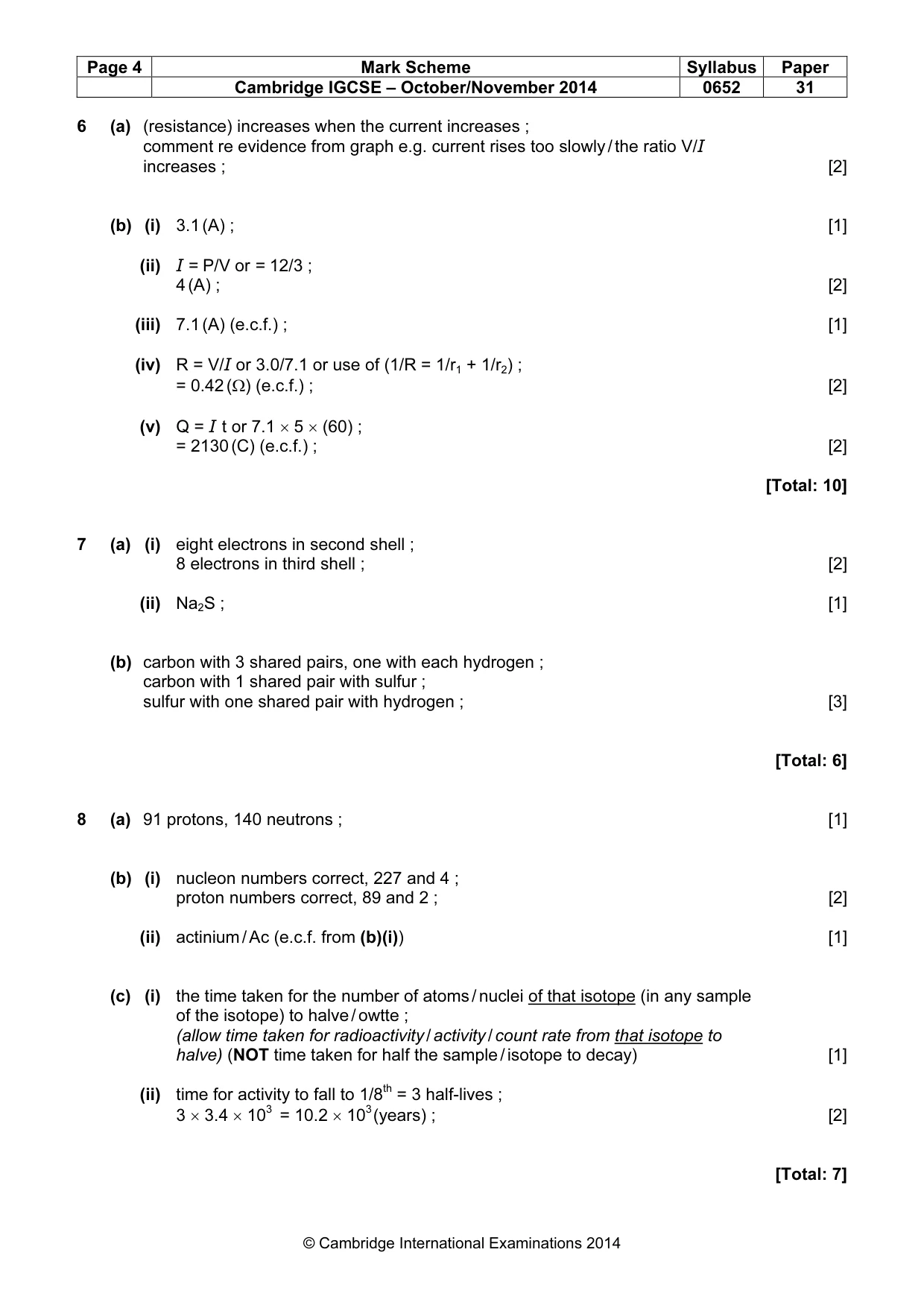
Page 4 Mark Scheme Syllabus Paper Cambridge IGCSE – October/November 2014 0652 31 © Cambridge International Examinations 2014 6 (a) (resistance) increases when the current increases ; comment re evidence from graph e.g. current rises too slowly / the ratio V/I increases ; [2] (b) (i) 3.1 (A) ; [1] (ii) I = P/V or = 12/3 ; 4 (A) ; [2] (iii) 7.1 (A) (e.c.f.) ; [1] (iv) R = V/I or 3.0/7.1 or use of (1/R = 1/r1 + 1/r2) ; = 0.42 (Ω) (e.c.f.) ; [2] (v) Q = I t or 7.1 × 5 × (60) ; = 2130 (C) (e.c.f.) ; [2] [Total: 10] 7 (a) (i) eight electrons in second shell ; 8 electrons in third shell ; [2] (ii) Na2S ; [1] (b) carbon with 3 shared pairs, one with each hydrogen ; carbon with 1 shared pair with sulfur ; sulfur with one shared pair with hydrogen ; [3] [Total: 6] 8 (a) 91 protons, 140 neutrons ; [1] (b) (i) nucleon numbers correct, 227 and 4 ; proton numbers correct, 89 and 2 ; [2] (ii) actinium / Ac (e.c.f. from (b)(i)) [1] (c) (i) the time taken for the number of atoms / nuclei of that isotope (in any sample of the isotope) to halve / owtte ; (allow time taken for radioactivity / activity / count rate from that isotope to halve) (NOT time taken for half the sample / isotope to decay) [1] (ii) time for activity to fall to 1/8th = 3 half-lives ; 3 × 3.4 × 103 = 10.2 × 10³ (years) ; [2] [Total: 7]
Mark scheme, page 5
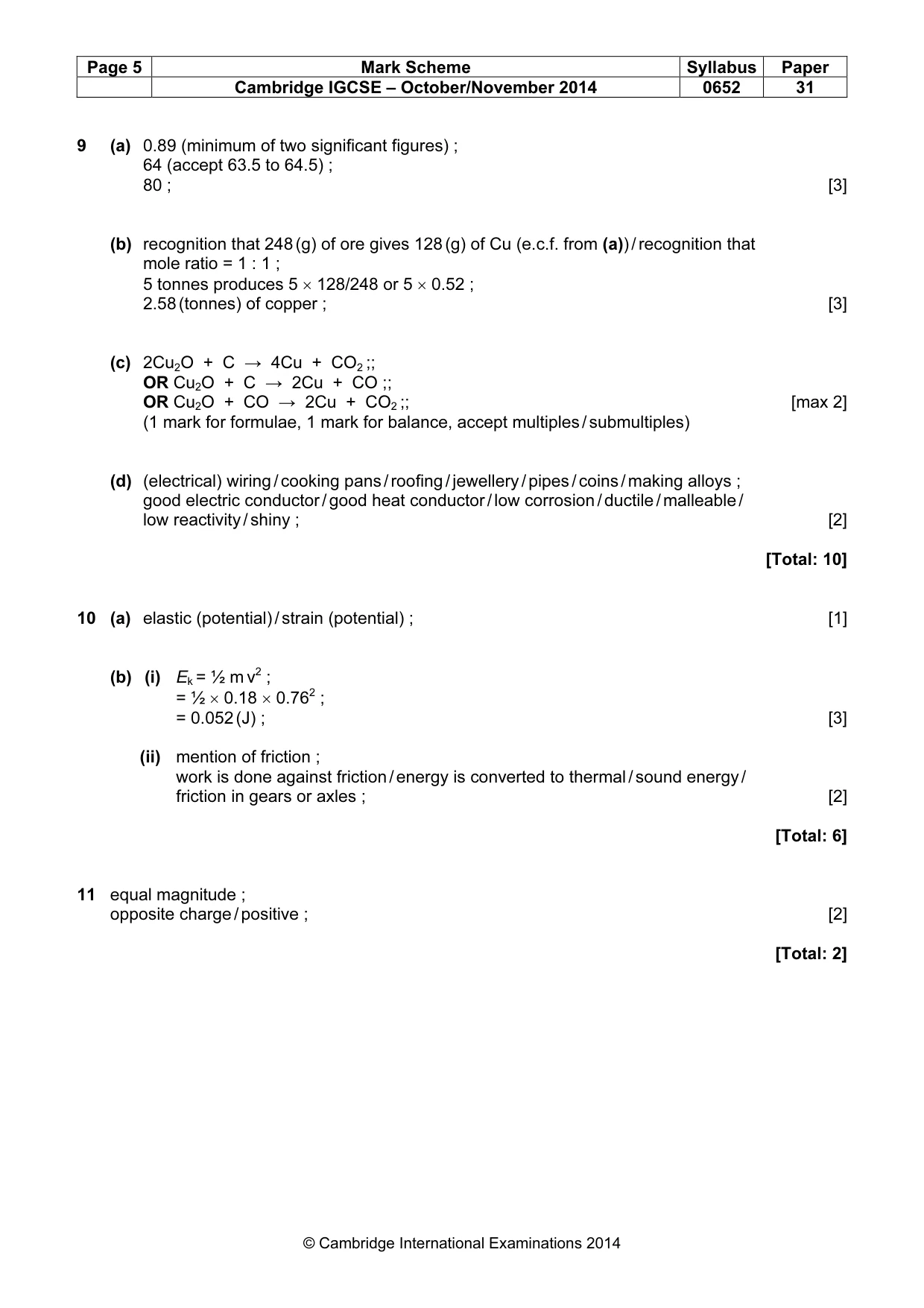
Page 5 Mark Scheme Syllabus Paper Cambridge IGCSE – October/November 2014 0652 31 © Cambridge International Examinations 2014 9 (a) 0.89 (minimum of two significant figures) ; 64 (accept 63.5 to 64.5) ; 80 ; [3] (b) recognition that 248 (g) of ore gives 128 (g) of Cu (e.c.f. from (a)) / recognition that mole ratio = 1 : 1 ; 5 tonnes produces 5 × 128/248 or 5 × 0.52 ; 2.58 (tonnes) of copper ; [3] (c) 2Cu2O + C → 4Cu + CO2 ;; OR Cu2O + C → 2Cu + CO ;; OR Cu2O + CO → 2Cu + CO2 ;; [max 2] (1 mark for formulae, 1 mark for balance, accept multiples / submultiples) (d) (electrical) wiring / cooking pans / roofing / jewellery / pipes / coins / making alloys ; good electric conductor / good heat conductor / low corrosion / ductile / malleable / low reactivity / shiny ; [2] [Total: 10] 10 (a) elastic (potential) / strain (potential) ; [1] (b) (i) Ek = ½ m v2 ; = ½ × 0.18 × 0.762 ; = 0.052 (J) ; [3] (ii) mention of friction ; work is done against friction / energy is converted to thermal / sound energy / friction in gears or axles ; [2] [Total: 6] 11 equal magnitude ; opposite charge / positive ; [2] [Total: 2]
What you needed in this session
Cambridge’s own grade thresholds for 2014 Oct/Nov, Paper 3 · Variant 1. A higher threshold means an easier paper — the bar moves with how the cohort did.