Cambridge IGCSE Physical Science 0652 — 2002 Oct/Nov Paper 1 · Variant 1
0652/11/O/N/02
The question paper and its mark scheme, free to read here and free to download. This is Cambridge’s own paper, exactly as it was sat.
Question paper20 pages



Mark scheme
No mark scheme is in the library for this paper.
Paper as text
Question paper, page 1
TIME 45 minutes INSTRUCTIONS TO CANDIDATES Do not open this booklet until you are told to do so. Write your name, Centre number and candidate number on the answer sheet in the spaces provided unless this has already been done for you. There are forty questions in this paper. Answer all questions. For each question, there are four possible answers, A, B, C and D. Choose the one you consider correct and record your choice in soft pencil on the separate answer sheet. Read very carefully the instructions on the answer sheet. INFORMATION FOR CANDIDATES Each correct answer will score one mark. A mark will not be deducted for a wrong answer. Any rough working should be done in this booklet. A copy of the Periodic Table is printed on page 20. International General Certificate of Secondary Education CAMBRIDGE INTERNATIONAL EXAMINATIONS PHYSICAL SCIENCE 0652/1 PAPER 1 Multiple Choice OCTOBER/NOVEMBER SESSION 2002 45 minutes Additional materials: Multiple Choice answer sheet Soft clean eraser Soft pencil (type B or HB is recommended) This question paper consists of 17 printed pages and 3 blank pages. SP (AT/KN) S25995/3 © CIE 2002 [Turn over www.XtremePapers.com
Question paper, page 2
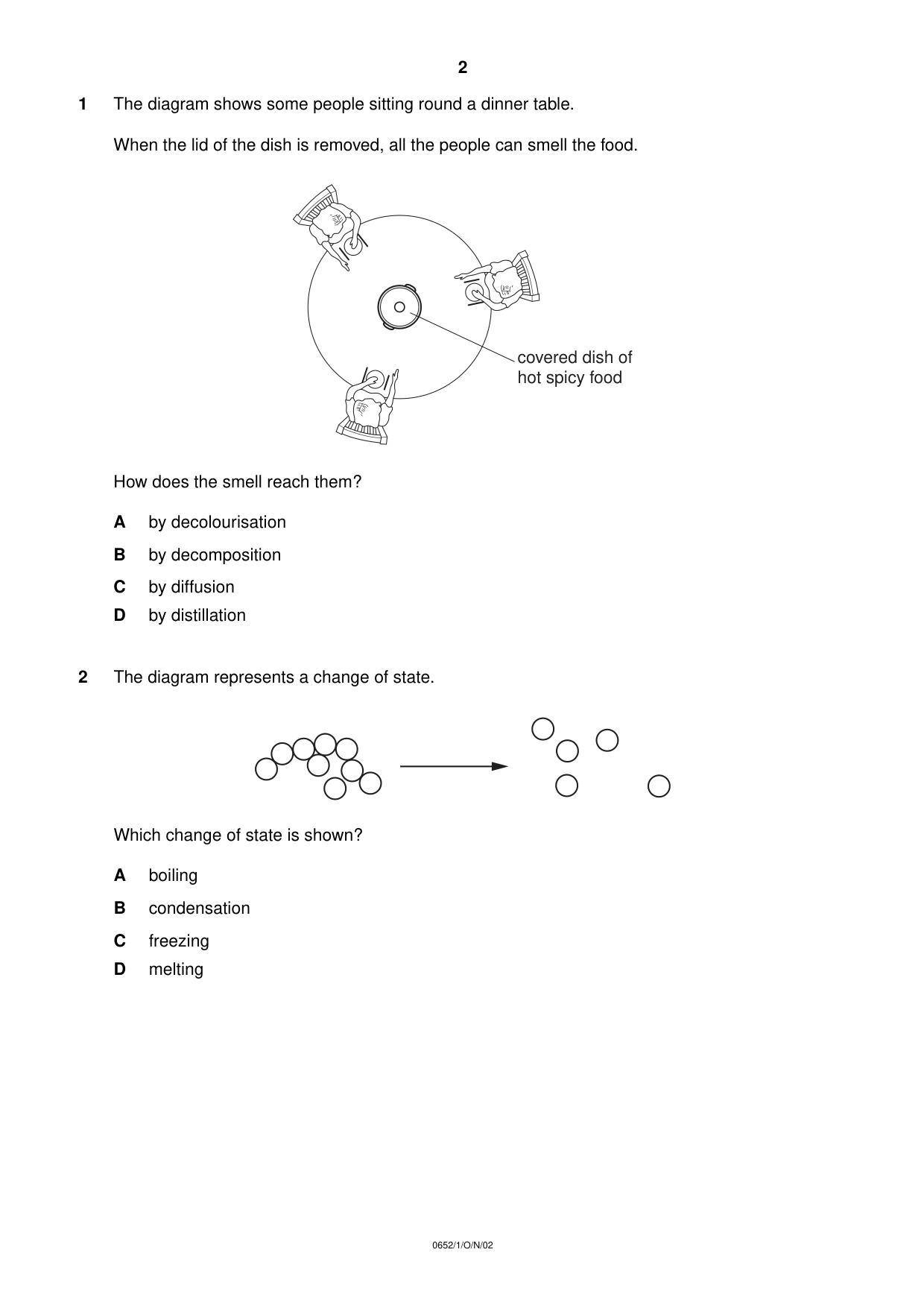
2 0652/1/O/N/02 1 The diagram shows some people sitting round a dinner table. When the lid of the dish is removed, all the people can smell the food. How does the smell reach them? A by decolourisation B by decomposition C by diffusion D by distillation 2 The diagram represents a change of state. Which change of state is shown? A boiling B condensation C freezing D melting covered dish of hot spicy food
Question paper, page 3
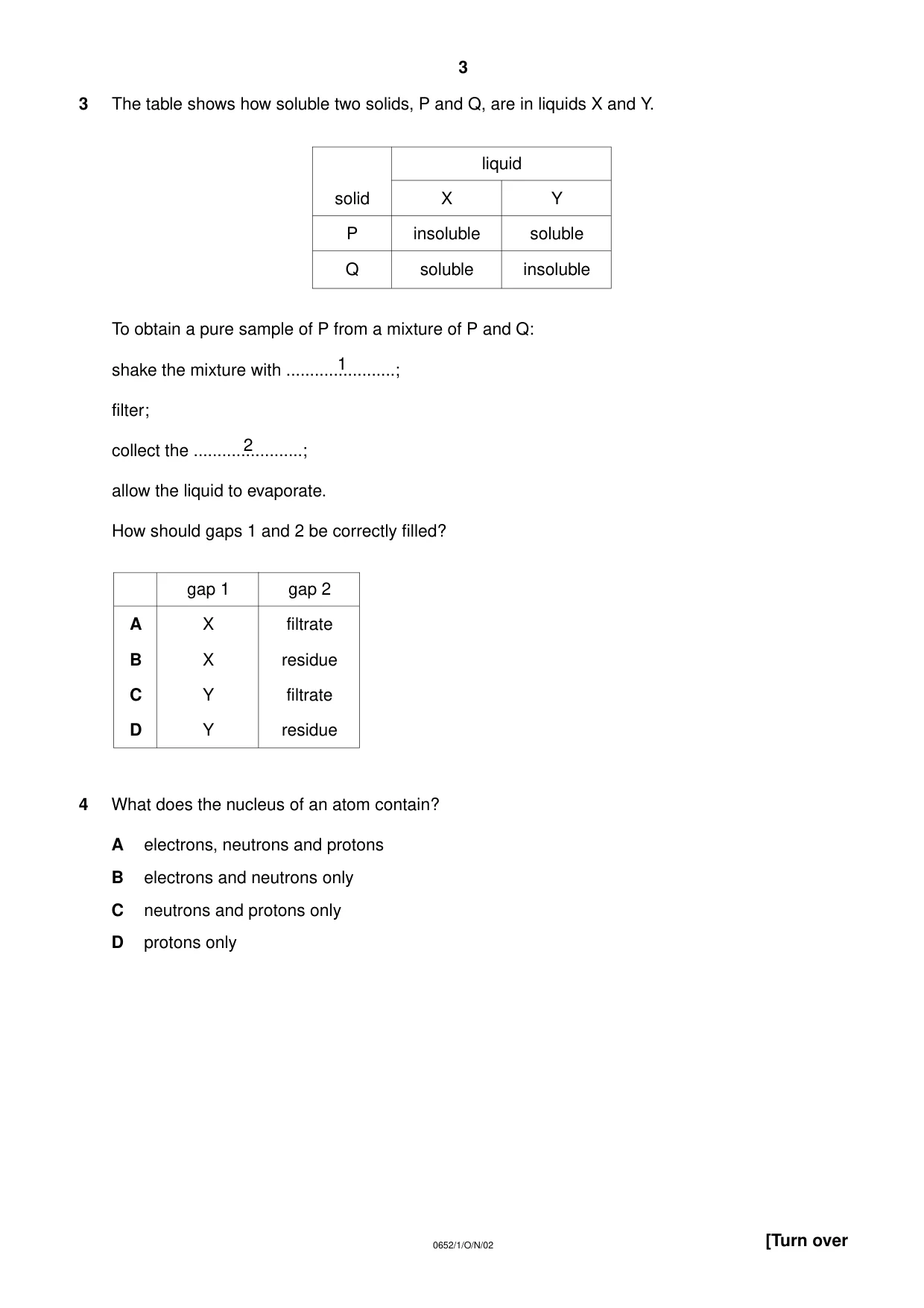
3 0652/1/O/N/02 [Turn over 3 The table shows how soluble two solids, P and Q, are in liquids X and Y. To obtain a pure sample of P from a mixture of P and Q: shake the mixture with …; filter; collect the …; allow the liquid to evaporate. How should gaps 1 and 2 be correctly filled? 4 What does the nucleus of an atom contain? A electrons, neutrons and protons B electrons and neutrons only C neutrons and protons only D protons only liquid solid X Y P insoluble soluble Q soluble insoluble 1 2 gap 1 gap 2 A X filtrate B X residue C Y filtrate D Y residue
Question paper, page 4
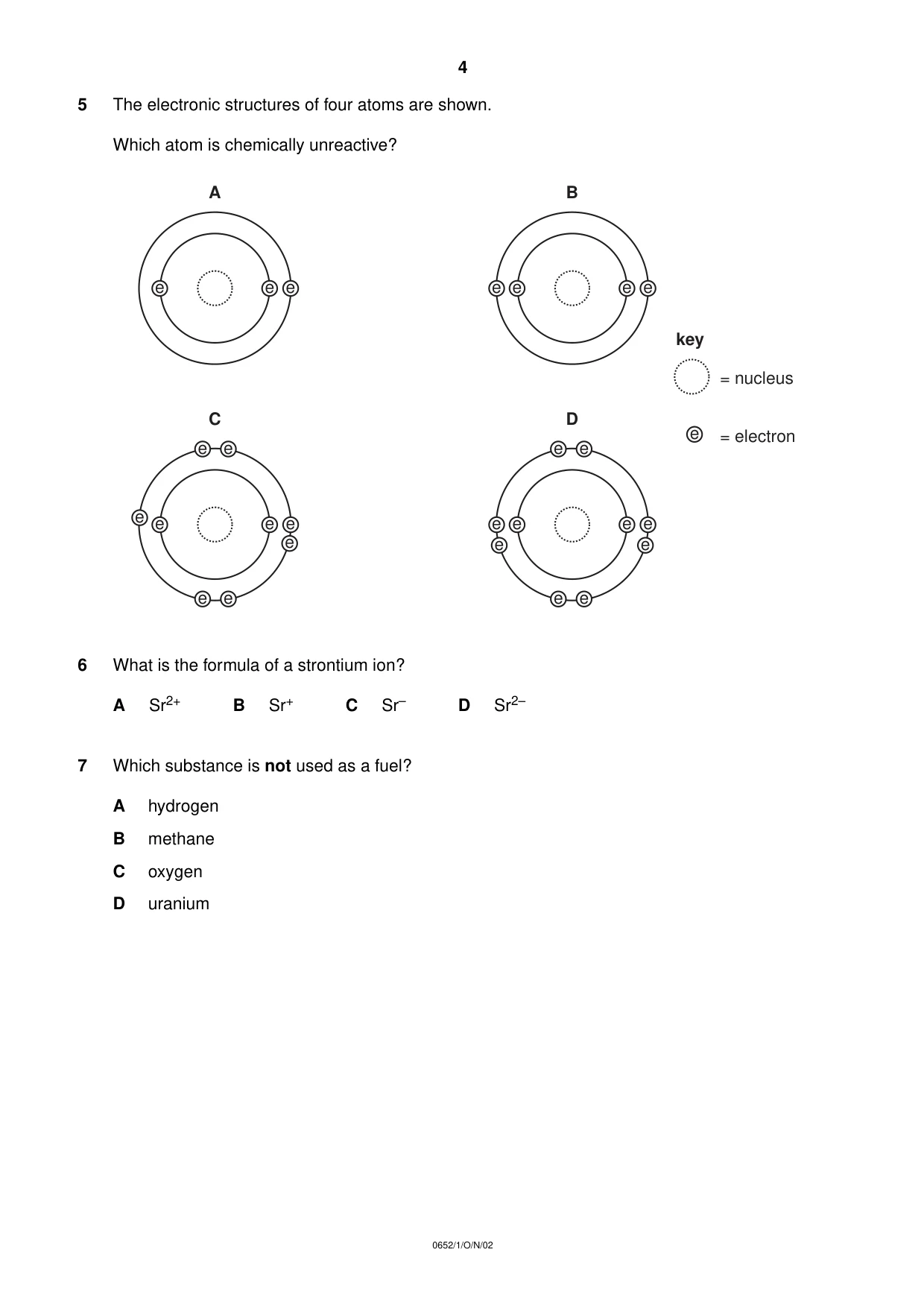
4 0652/1/O/N/02 5 The electronic structures of four atoms are shown. Which atom is chemically unreactive? 6 What is the formula of a strontium ion? A Sr2+ B Sr+ C Sr– D Sr2– 7 Which substance is not used as a fuel? A hydrogen B methane C oxygen D uranium e e e A e e e e e B e e e e e e e e e C e e e e e e D e e e e key = nucleus = electron
Question paper, page 5
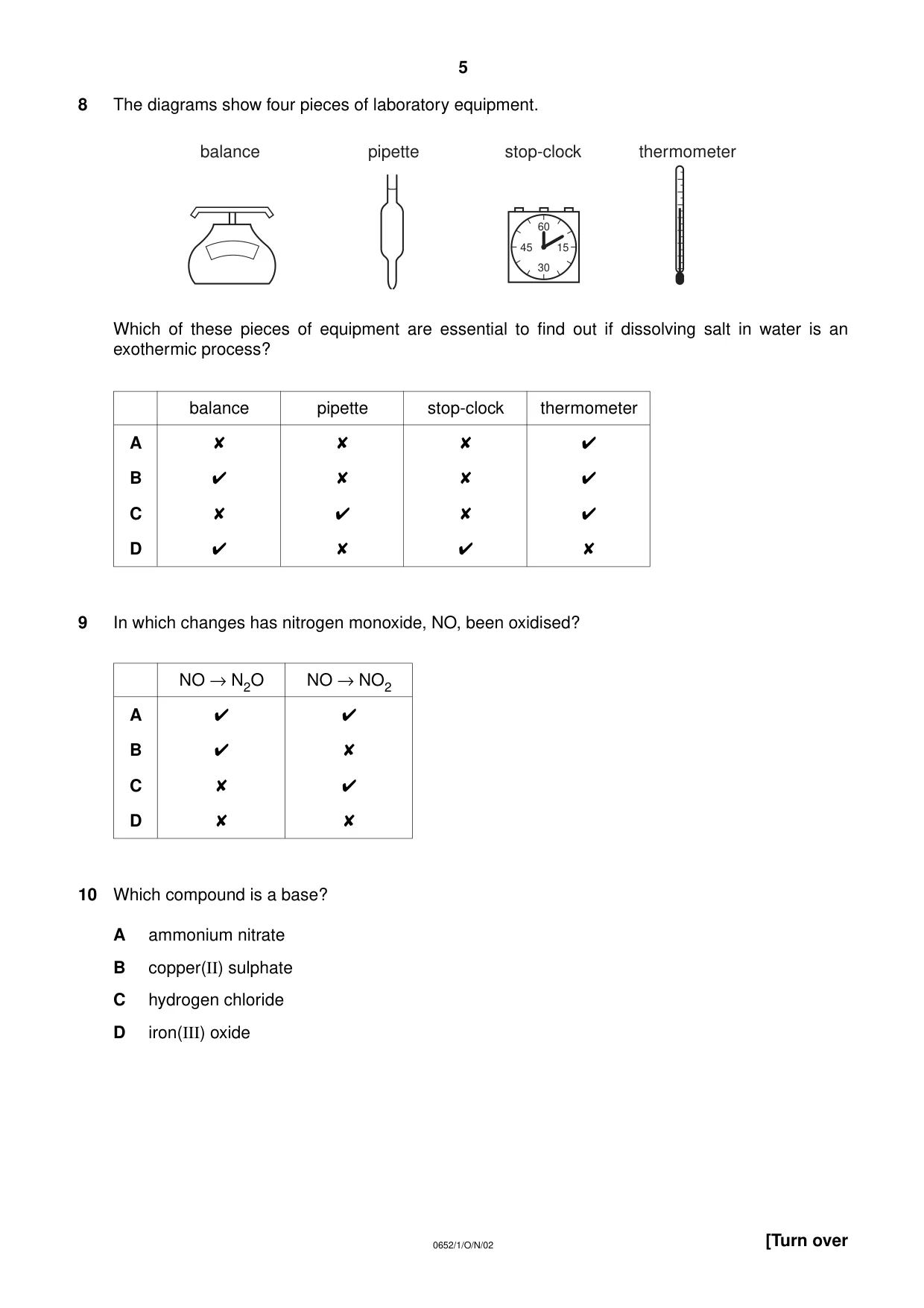
5 0652/1/O/N/02 [Turn over 8 The diagrams show four pieces of laboratory equipment. Which of these pieces of equipment are essential to find out if dissolving salt in water is an exothermic process? 9 In which changes has nitrogen monoxide, NO, been oxidised? 10 Which compound is a base? A ammonium nitrate B copper(II) sulphate C hydrogen chloride D iron(III) oxide balance pipette stop-clock thermometer 60 30 45 15 balance pipette stop-clock thermometer A ✘ ✘ ✘ ✔ B ✔ ✘ ✘ ✔ C ✘ ✔ ✘ ✔ D ✔ ✘ ✔ ✘ NO →N2O NO →NO2 A ✔ ✔ B ✔ ✘ C ✘ ✔ D ✘ ✘
Question paper, page 6
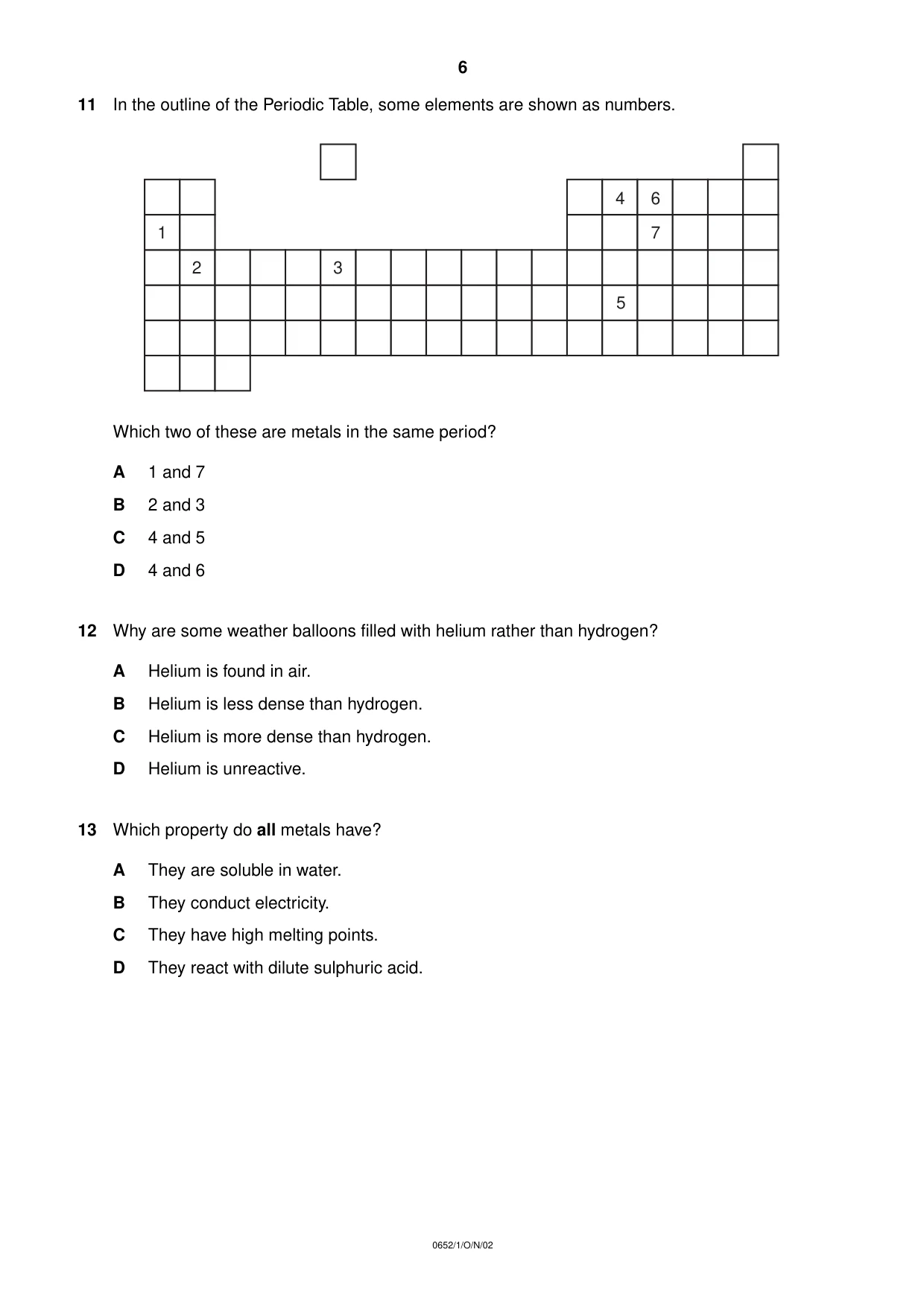
6 0652/1/O/N/02 11 In the outline of the Periodic Table, some elements are shown as numbers. Which two of these are metals in the same period? A 1 and 7 B 2 and 3 C 4 and 5 D 4 and 6 12 Why are some weather balloons filled with helium rather than hydrogen? A Helium is found in air. B Helium is less dense than hydrogen. C Helium is more dense than hydrogen. D Helium is unreactive. 13 Which property do all metals have? A They are soluble in water. B They conduct electricity. C They have high melting points. D They react with dilute sulphuric acid. 1 2 3 4 6 7 5
Question paper, page 7
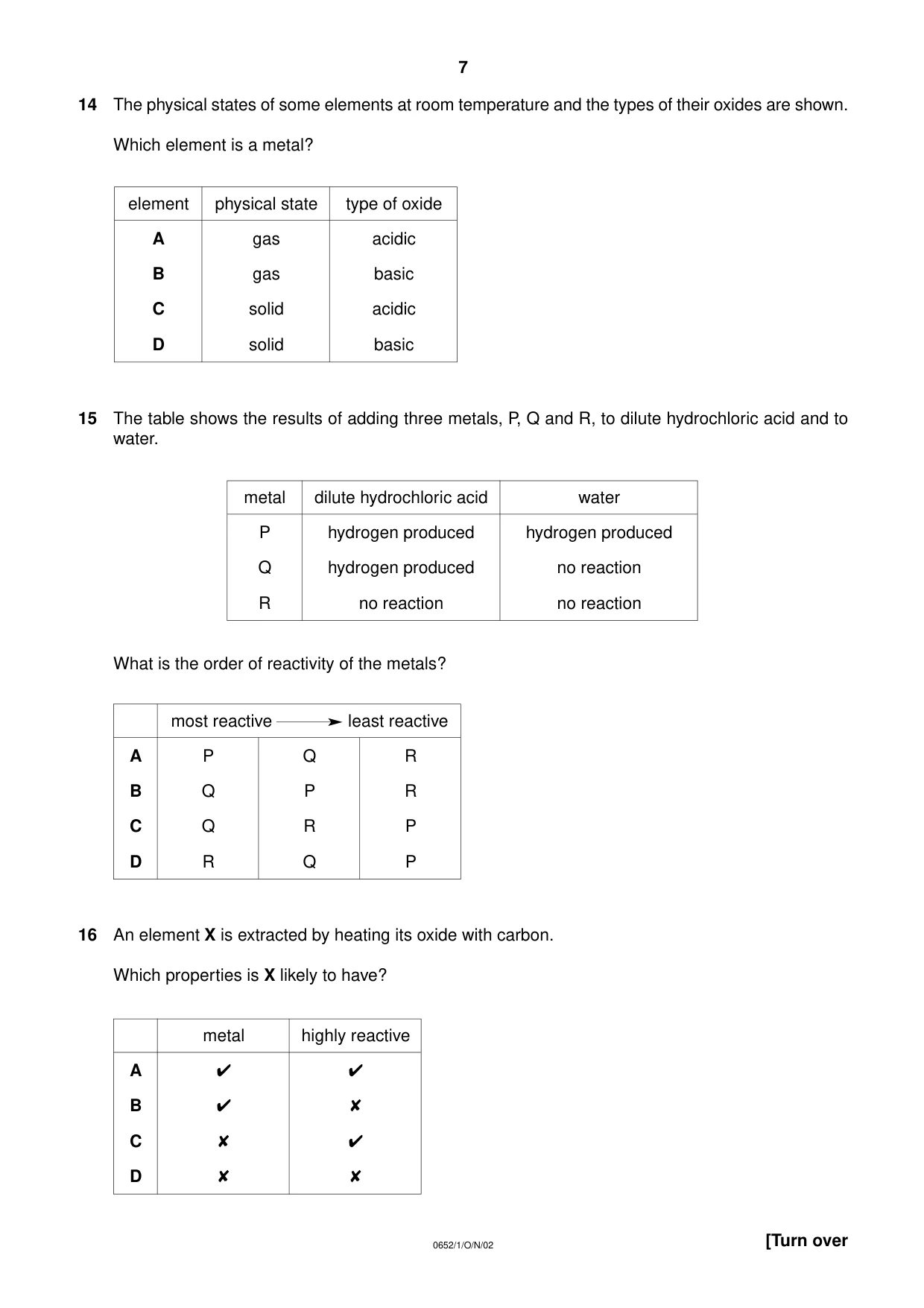
7 0652/1/O/N/02 [Turn over 14 The physical states of some elements at room temperature and the types of their oxides are shown. Which element is a metal? 15 The table shows the results of adding three metals, P, Q and R, to dilute hydrochloric acid and to water. What is the order of reactivity of the metals? 16 An element X is extracted by heating its oxide with carbon. Which properties is X likely to have? element physical state type of oxide A gas acidic B gas basic C solid acidic D solid basic metal dilute hydrochloric acid water P hydrogen produced hydrogen produced Q hydrogen produced no reaction R no reaction no reaction most reactive least reactive A P Q R B Q P R C Q R P D R Q P metal highly reactive A ✔ ✔ B ✔ ✘ C ✘ ✔ D ✘ ✘
Question paper, page 8
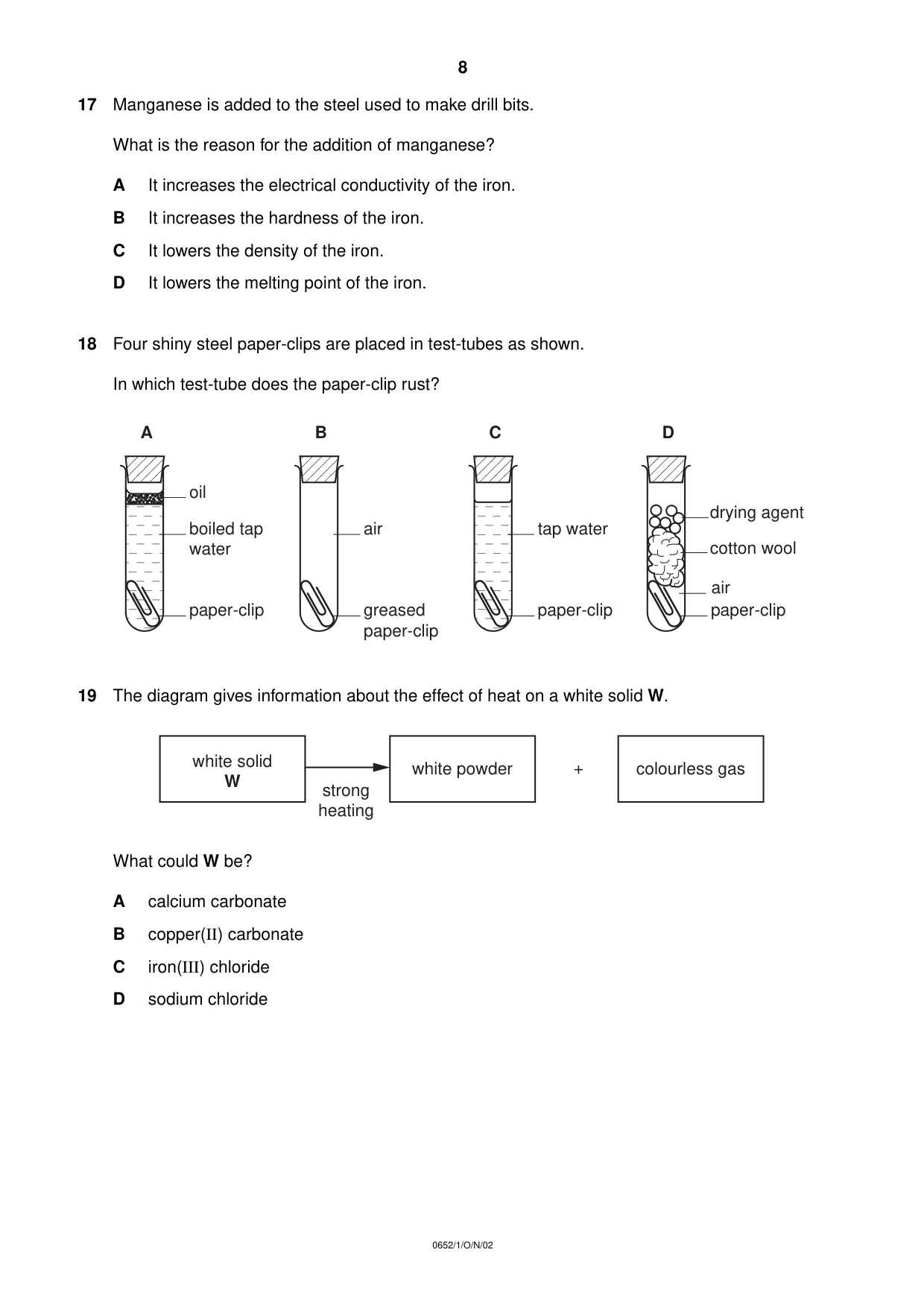
8 0652/1/O/N/02 17 Manganese is added to the steel used to make drill bits. What is the reason for the addition of manganese? A It increases the electrical conductivity of the iron. B It increases the hardness of the iron. C It lowers the density of the iron. D It lowers the melting point of the iron. 18 Four shiny steel paper-clips are placed in test-tubes as shown. In which test-tube does the paper-clip rust? 19 The diagram gives information about the effect of heat on a white solid W. What could W be? A calcium carbonate B copper(II) carbonate C iron(III) chloride D sodium chloride white solid W white powder colourless gas strong heating + A oil paper-clip boiled tap water C paper-clip tap water B greased paper-clip air air D drying agent paper-clip cotton wool
Question paper, page 9
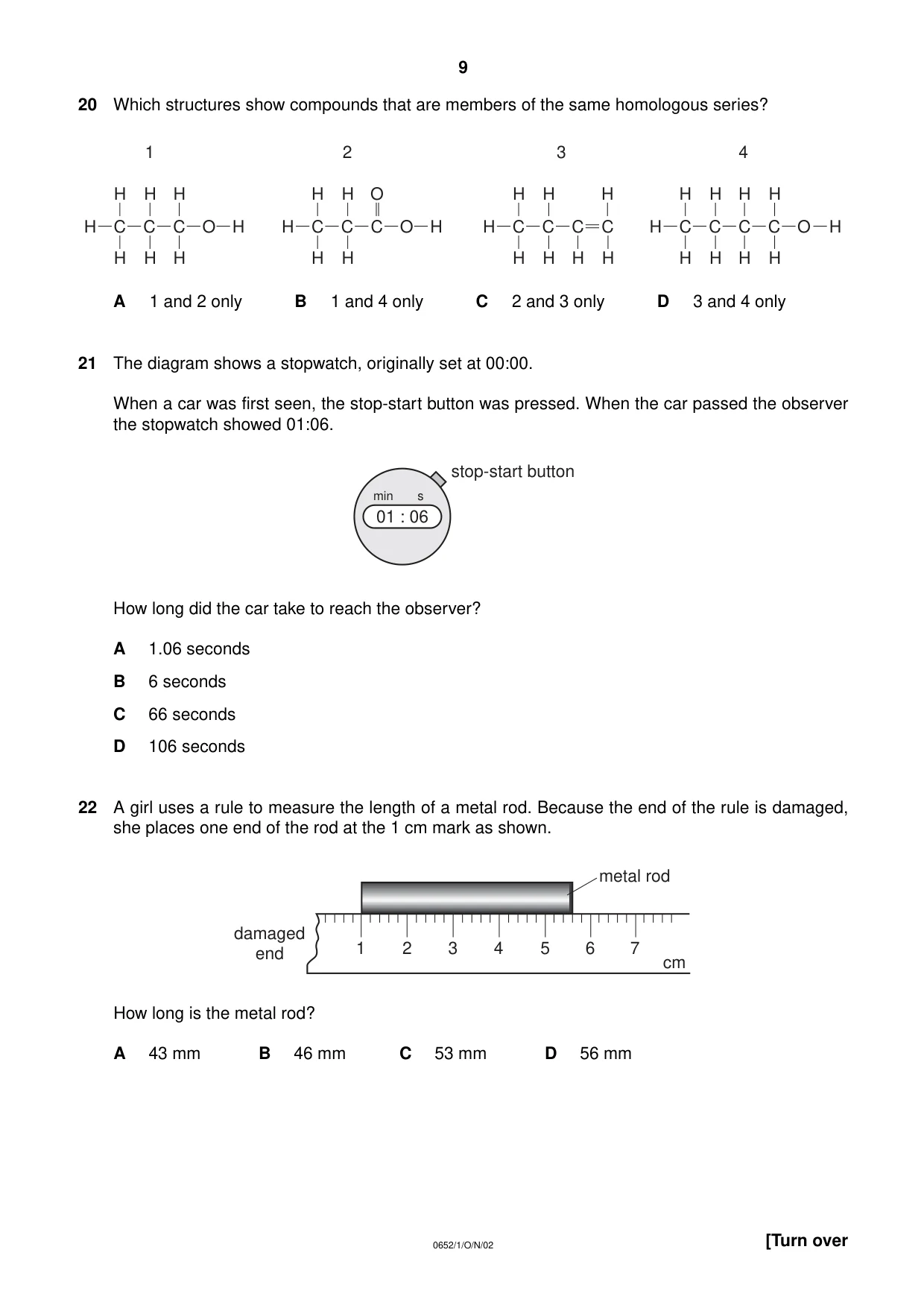
9 0652/1/O/N/02 [Turn over 20 Which structures show compounds that are members of the same homologous series? A 1 and 2 only B 1 and 4 only C 2 and 3 only D 3 and 4 only 21 The diagram shows a stopwatch, originally set at 00:00. When a car was first seen, the stop-start button was pressed. When the car passed the observer the stopwatch showed 01:06. How long did the car take to reach the observer? A 1.06 seconds B 6 seconds C 66 seconds D 106 seconds 22 A girl uses a rule to measure the length of a metal rod. Because the end of the rule is damaged, she places one end of the rod at the 1 cm mark as shown. How long is the metal rod? A 43 mm B 46 mm C 53 mm D 56 mm 1 2 3 4 5 6 7 cm metal rod damaged end 01 : 06 stop-start button min s H H H C C C O H H H H H 1 H H H C C C O H H H O 2 H H H C C C C H H H H H 3 H H H C C C C O H H H H H H H 4
Question paper, page 10
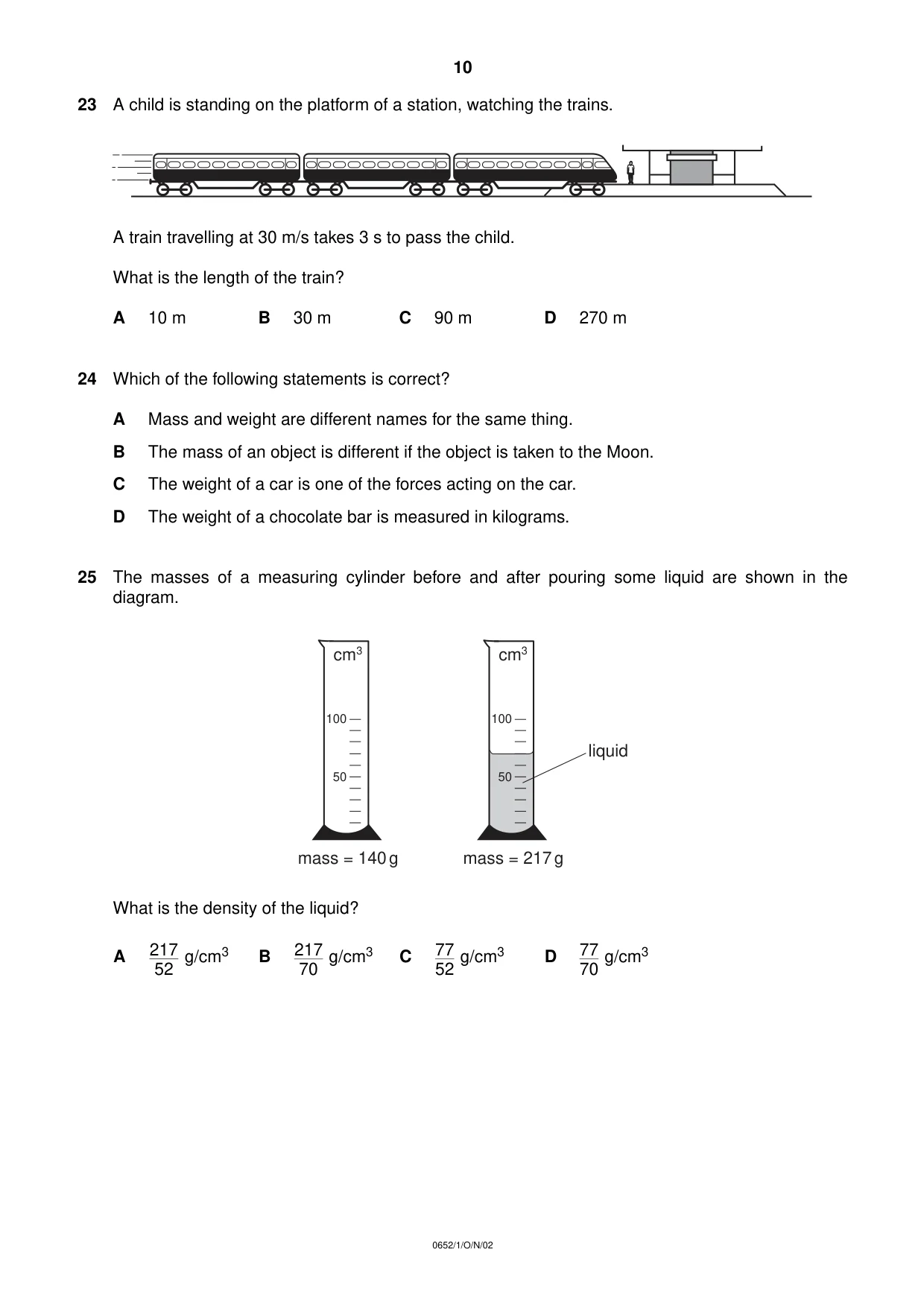
10 0652/1/O/N/02 23 A child is standing on the platform of a station, watching the trains. A train travelling at 30 m/s takes 3 s to pass the child. What is the length of the train? A 10 m B 30 m C 90 m D 270 m 24 Which of the following statements is correct? A Mass and weight are different names for the same thing. B The mass of an object is different if the object is taken to the Moon. C The weight of a car is one of the forces acting on the car. D The weight of a chocolate bar is measured in kilograms. 25 The masses of a measuring cylinder before and after pouring some liquid are shown in the diagram. What is the density of the liquid? cm3 50 100 mass = 140 g cm3 50 100 mass = 217 g liquid 217 52 217 70 77 52 77 70 A g/cm3 B g/cm3 C g/cm3 D g/cm3
Question paper, page 11
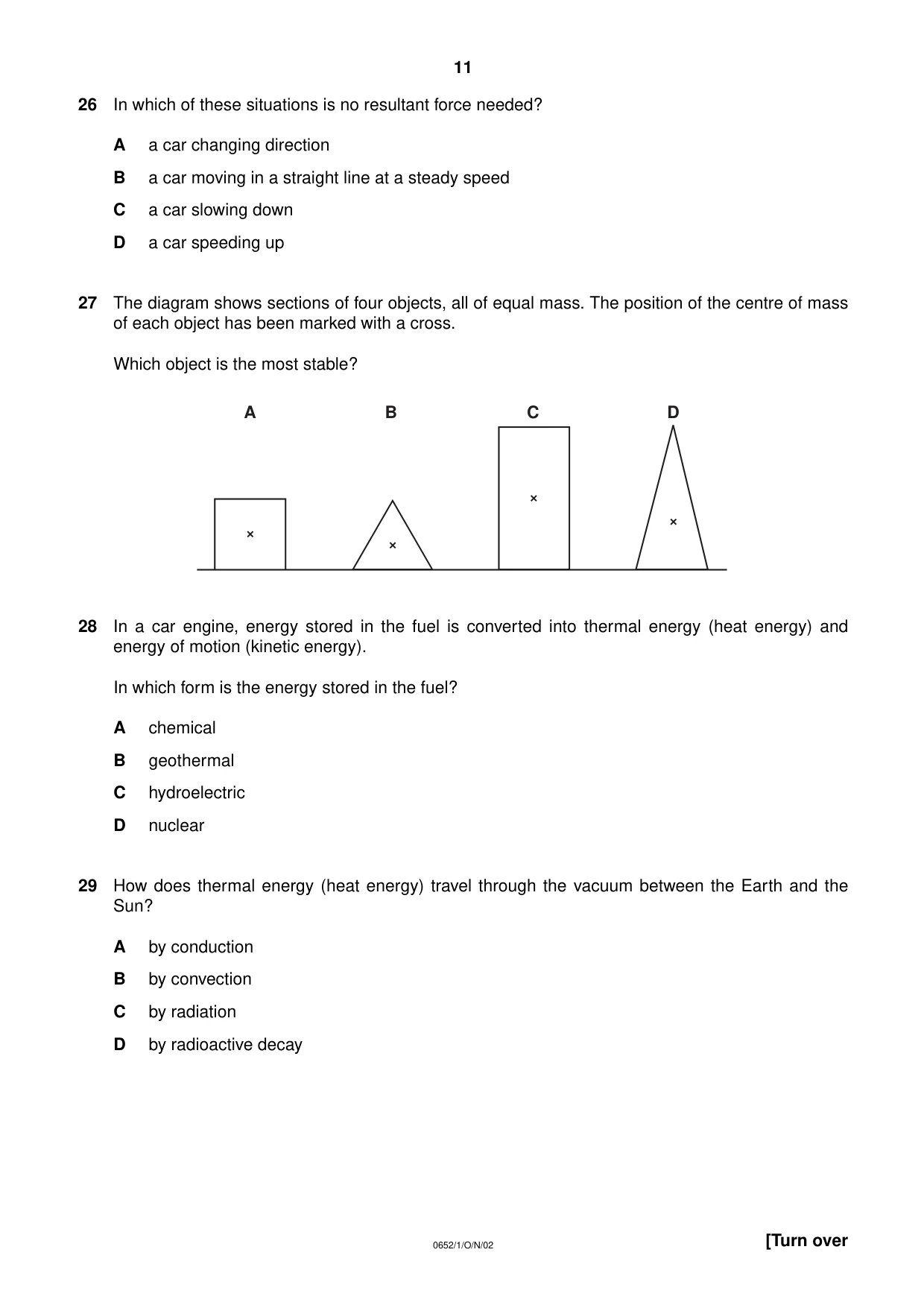
11 0652/1/O/N/02 [Turn over 26 In which of these situations is no resultant force needed? A a car changing direction B a car moving in a straight line at a steady speed C a car slowing down D a car speeding up 27 The diagram shows sections of four objects, all of equal mass. The position of the centre of mass of each object has been marked with a cross. Which object is the most stable? 28 In a car engine, energy stored in the fuel is converted into thermal energy (heat energy) and energy of motion (kinetic energy). In which form is the energy stored in the fuel? A chemical B geothermal C hydroelectric D nuclear 29 How does thermal energy (heat energy) travel through the vacuum between the Earth and the Sun? A by conduction B by convection C by radiation D by radioactive decay A B C D
Question paper, page 12
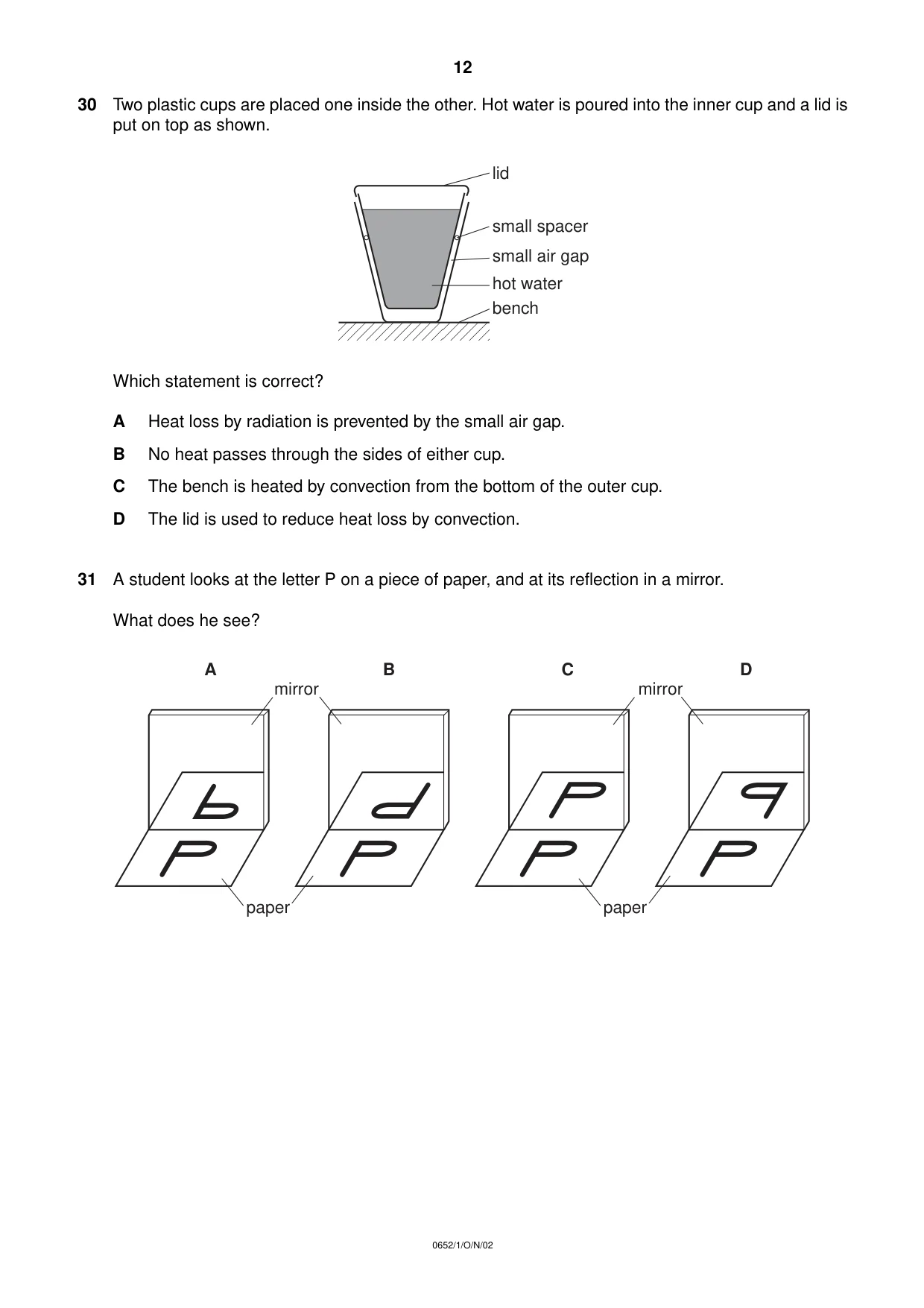
12 0652/1/O/N/02 30 Two plastic cups are placed one inside the other. Hot water is poured into the inner cup and a lid is put on top as shown. Which statement is correct? A Heat loss by radiation is prevented by the small air gap. B No heat passes through the sides of either cup. C The bench is heated by convection from the bottom of the outer cup. D The lid is used to reduce heat loss by convection. 31 A student looks at the letter P on a piece of paper, and at its reflection in a mirror. What does he see? A B C D mirror mirror paper paper bench hot water small air gap small spacer lid
Question paper, page 13
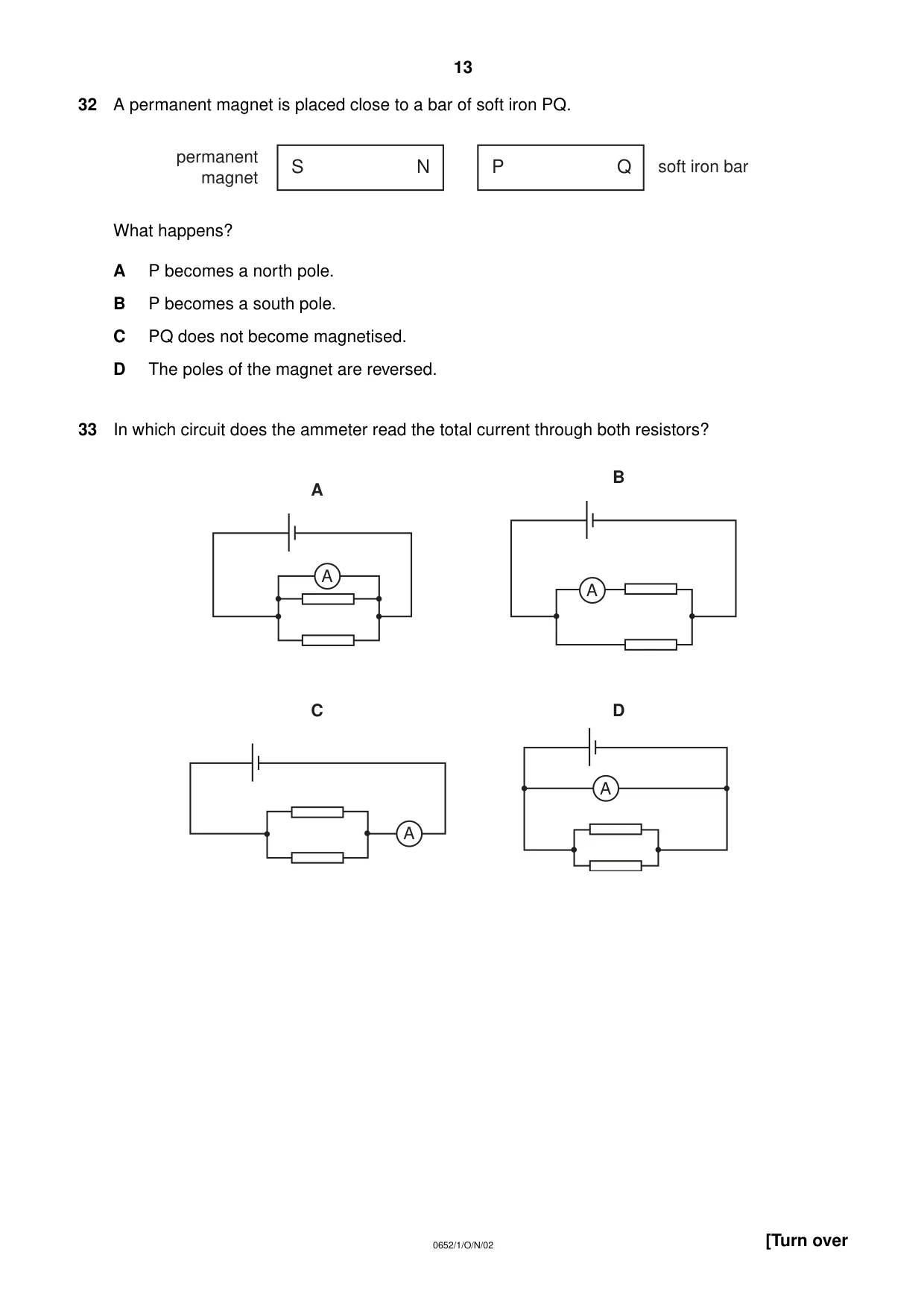
13 0652/1/O/N/02 [Turn over 32 A permanent magnet is placed close to a bar of soft iron PQ. What happens? A P becomes a north pole. B P becomes a south pole. C PQ does not become magnetised. D The poles of the magnet are reversed. 33 In which circuit does the ammeter read the total current through both resistors? A A A C A B D A S N P Q permanent magnet soft iron bar
Question paper, page 14
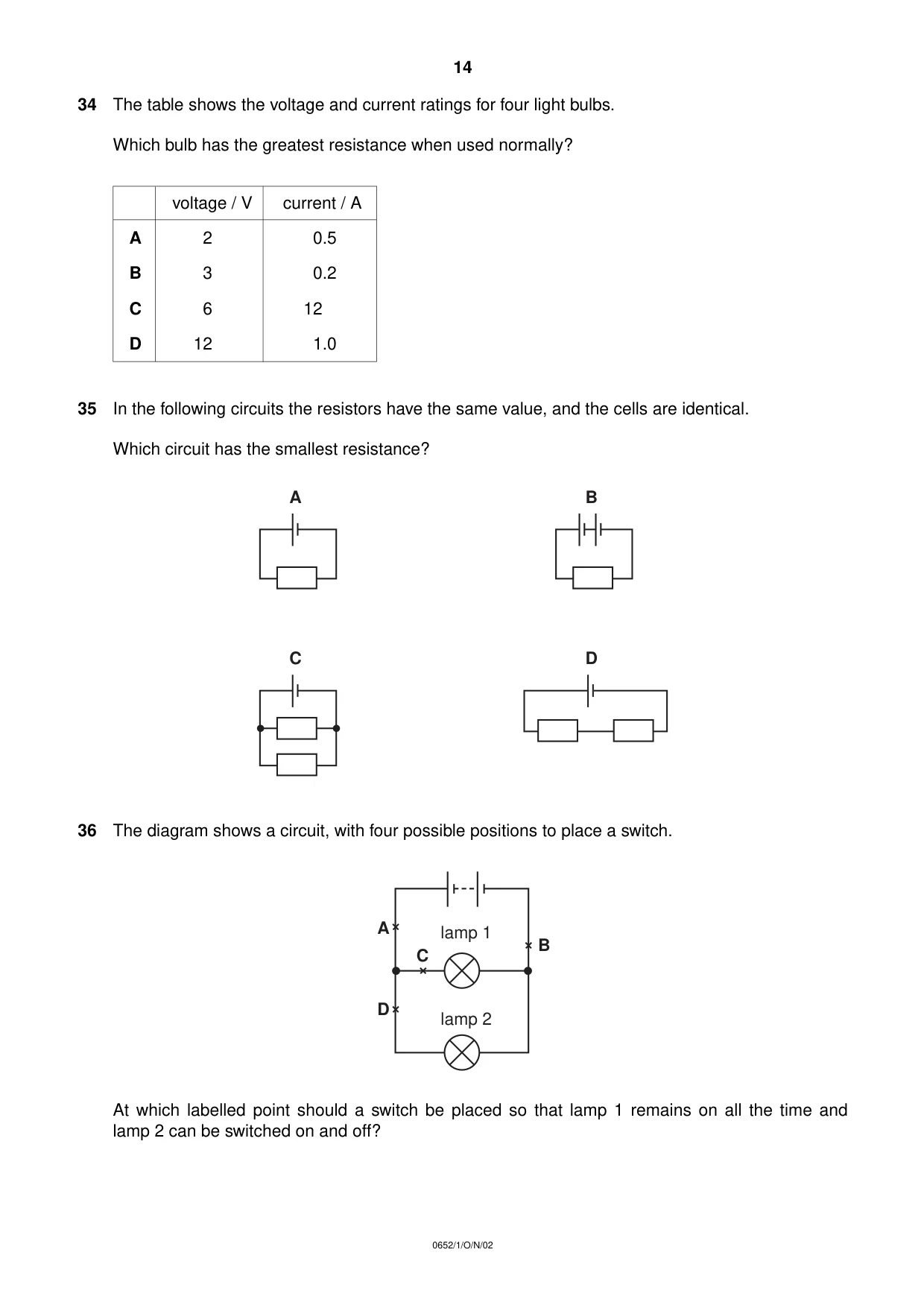
14 0652/1/O/N/02 34 The table shows the voltage and current ratings for four light bulbs. Which bulb has the greatest resistance when used normally? 35 In the following circuits the resistors have the same value, and the cells are identical. Which circuit has the smallest resistance? 36 The diagram shows a circuit, with four possible positions to place a switch. At which labelled point should a switch be placed so that lamp 1 remains on all the time and lamp 2 can be switched on and off? A D C B lamp 1 lamp 2 A B C D voltage / V current / A A 2 0.5 B 3 0.2 C 6 12 D 12 1.0
Question paper, page 15
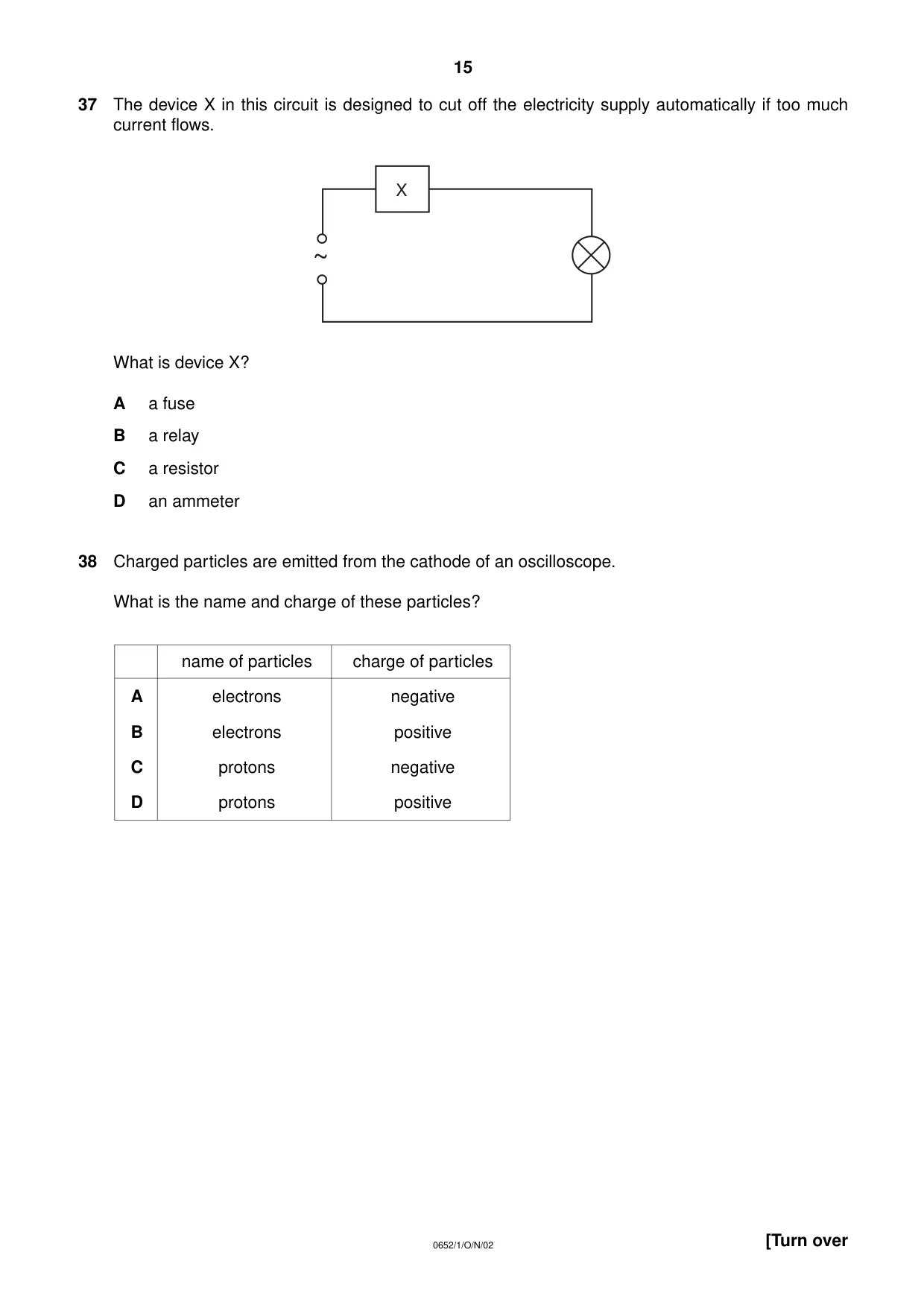
15 0652/1/O/N/02 [Turn over 37 The device X in this circuit is designed to cut off the electricity supply automatically if too much current flows. What is device X? A a fuse B a relay C a resistor D an ammeter 38 Charged particles are emitted from the cathode of an oscilloscope. What is the name and charge of these particles? ~ X name of particles charge of particles A electrons negative B electrons positive C protons negative D protons positive
Question paper, page 16
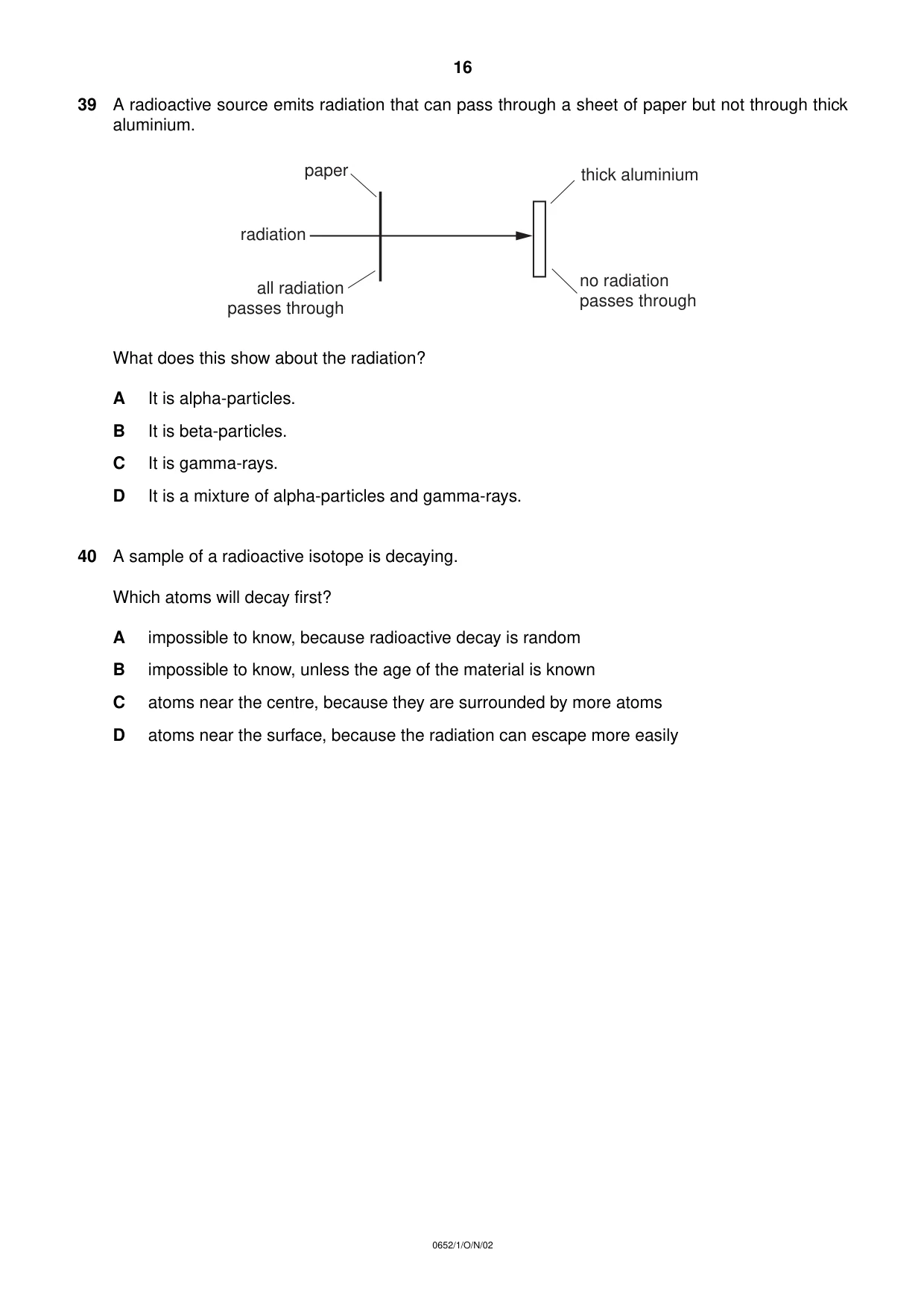
16 0652/1/O/N/02 39 A radioactive source emits radiation that can pass through a sheet of paper but not through thick aluminium. What does this show about the radiation? A It is alpha-particles. B It is beta-particles. C It is gamma-rays. D It is a mixture of alpha-particles and gamma-rays. 40 A sample of a radioactive isotope is decaying. Which atoms will decay first? A impossible to know, because radioactive decay is random B impossible to know, unless the age of the material is known C atoms near the centre, because they are surrounded by more atoms D atoms near the surface, because the radiation can escape more easily radiation paper thick aluminium all radiation passes through no radiation passes through
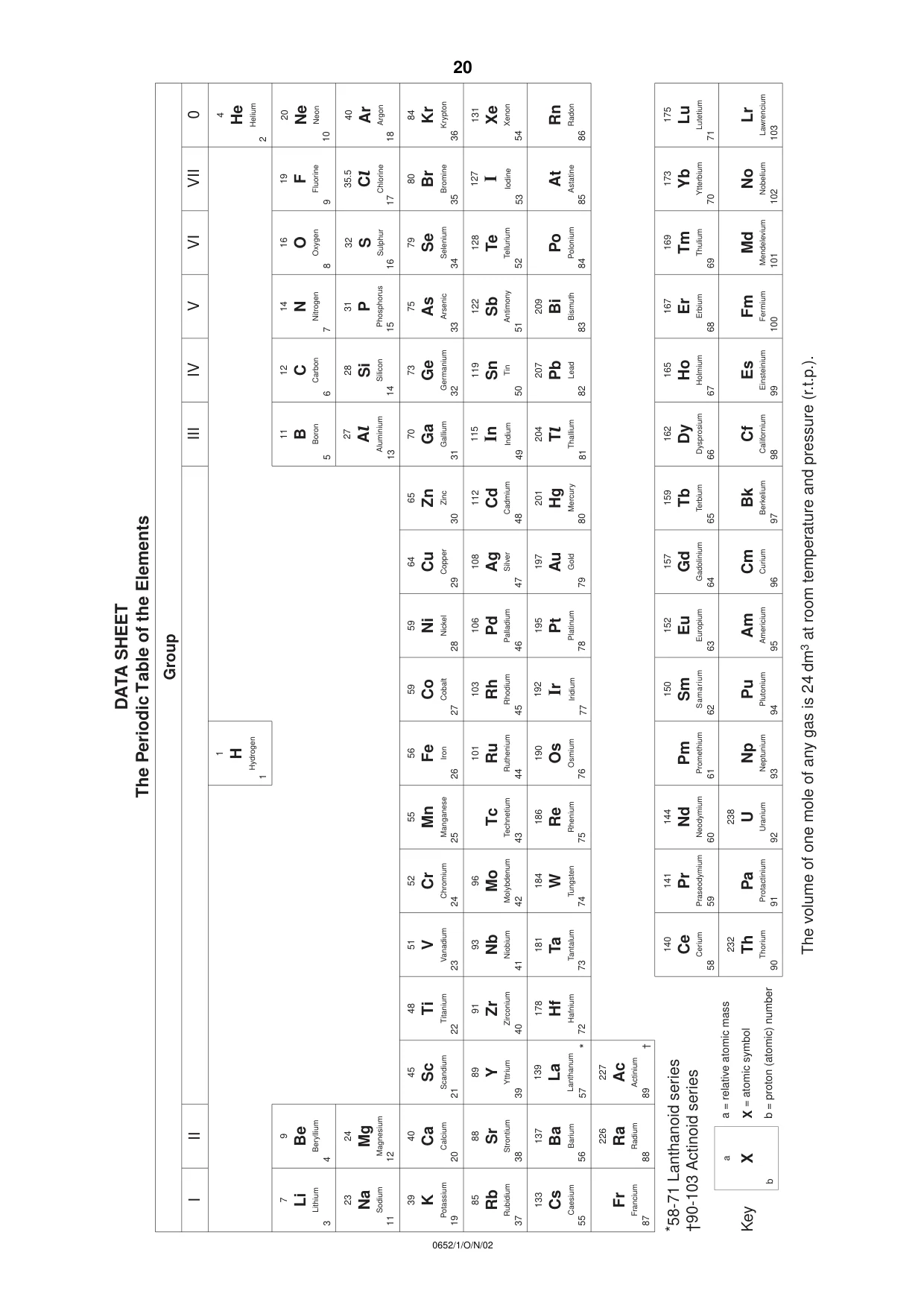
Question paper, page 20
20 0652/1/O/N/02 Group DATA SHEET The Periodic Table of the Elements 140 Ce Cerium 58 141 Pr Praseodymium 59 144 Nd Neodymium 60 Pm Promethium 61 150 Sm Samarium 62 152 Eu Europium 63 157 Gd Gadolinium 64 159 Tb Terbium 65 162 Dy Dysprosium 66 165 Ho Holmium 67 167 Er Erbium 68 169 Tm Thulium 69 173 Yb Ytterbium 70 175 Lu Lutetium 71 232 Th Thorium 90 Pa Protactinium 91 238 U Uranium 92 Np Neptunium 93 Pu Plutonium 94 Am Americium 95 Cm Curium 96 Bk Berkelium 97 Cf Californium 98 Es Einsteinium 99 Fm Fermium 100 Md Mendelevium 101 No Nobelium 102 Lr Lawrencium 103 1 H Hydrogen 1 7 Li Lithium 3 23 Na Sodium 11 24 Mg Magnesium 12 40 Ca Calcium 20 45 Sc Scandium 21 48 Ti Titanium 22 51 V Vanadium 23 52 Cr Chromium 24 55 Mn Manganese 25 56 Fe Iron 26 59 Co Cobalt 27 59 Ni Nickel 28 64 Cu Copper 29 65 Zn Zinc 30 70 Ga Gallium 31 27 Al Aluminium 13 11 B Boron 5 12 C Carbon 6 14 N Nitrogen 7 16 O Oxygen 8 19 F Fluorine 9 28 Si Silicon 14 31 P Phosphorus 15 32 S Sulphur 16 35.5 Cl Chlorine 17 40 Ar Argon 18 20 Ne Neon 10 4 He Helium 2 73 Ge Germanium 32 75 As Arsenic 33 79 Se Selenium 34 80 Br Bromine 35 84 Kr Krypton 36 39 K Potassium 19 88 Sr Strontium 38 89 Y Yttrium 39 91 Zr Zirconium 40 93 Nb Niobium 41 96 Mo Molybdenum 42 Tc Technetium 43 101 Ru Ruthenium 44 103 Rh Rhodium 45 106 Pd Palladium 46 108 Ag Silver 47 112 Cd Cadmium 48 115 In Indium 49 119 Sn Tin 50 122 Sb Antimony 51 128 Te Tellurium 52 127 I Iodine 53 131 Xe Xenon 54 137 Ba Barium 56 139 La Lanthanum 57 * 178 Hf Hafnium 72 181 Ta Tantalum 73 184 W Tungsten 74 186 Re Rhenium 75 190 Os Osmium 76 192 Ir Iridium 77 195 Pt Platinum 78 197 Au Gold 79 201 Hg Mercury 80 204 Tl Thallium 81 207 Pb Lead 82 209 Bi Bismuth 83 Po Polonium 84 At Astatine 85 Rn Radon 86 Fr Francium 87 227 Ac Actinium 89 † 9 Be Beryllium 4 I II III IV V VI VII 0 85 Rb Rubidium 37 133 Cs Caesium 55 226 Ra Radium 88 The volume of one mole of any gas is 24 dm3 at room temperature and pressure (r.t.p.). a X b a = relative atomic mass X = atomic symbol b = proton (atomic) number Key *58-71 Lanthanoid series †90-103 Actinoid series