Cambridge IGCSE Physical Education 0413 — 2013 May/June Paper 1 · Variant 1
0413/11/M/J/13 · 80 marks · ≈90 min
The question paper and its mark scheme, free to read here and free to download. This is Cambridge’s own paper, exactly as it was sat.
Question paper12 pages



Mark scheme9 pages
Answers below. Sit the paper first if you are practising.


Paper as text
Question paper, page 1
This document consists of 10 printed pages and 2 blank pages. DC (RCL (DF)) 65062/3 © UCLES 2013 [Turn over UNIVERSITY OF CAMBRIDGE INTERNATIONAL EXAMINATIONS International General Certificate of Secondary Education * 9 0 8 7 8 3 7 6 5 1 * PHYSICAL EDUCATION 0413/11 Paper 1 May/June 2013 1 Hour 45 minutes Candidates answer on the Question Paper. No Additional Materials are required. READ THESE INSTRUCTIONS FIRST Write your Centre number, candidate number and name on all the work you hand in. Write in dark blue or black pen. You may use a soft pencil for any diagrams, graphs or rough working. Do not use staples, paper clips, highlighters, glue or correction fluid. DO NOT WRITE IN ANY BARCODES. Answer all questions. At the end of the examination, fasten all your work securely together. The number of marks is given in brackets [ ] at the end of each question or part question.
Question paper, page 2
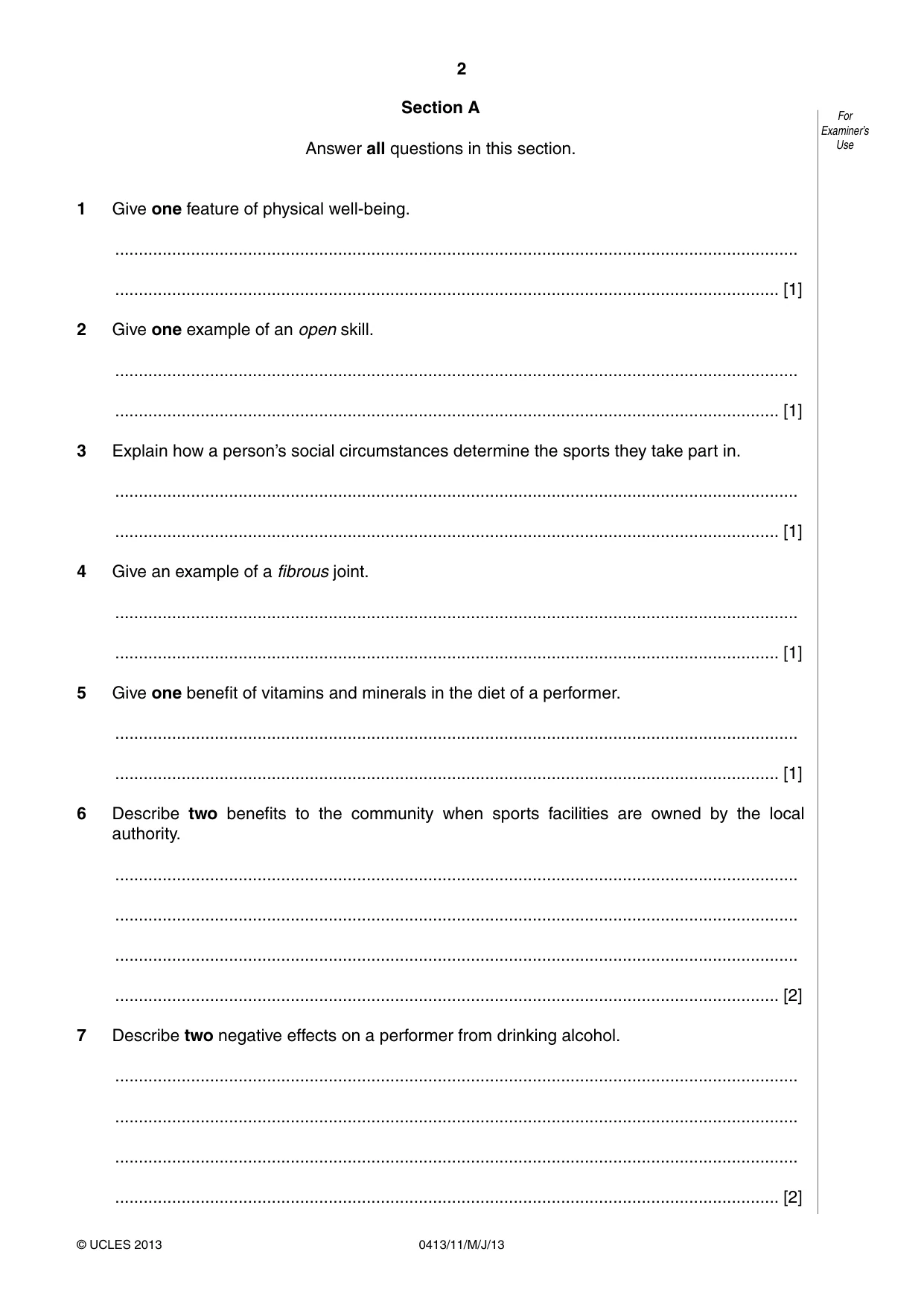
2 0413/11/M/J/13 © UCLES 2013 For Examiner’s Use Section A Answer all questions in this section. 1 Give one feature of physical well-being. … … [1] 2 Give one example of an open skill. … … [1] 3 Explain how a person’s social circumstances determine the sports they take part in. … … [1] 4 Give an example of a fibrous joint. … … [1] 5 Give one benefit of vitamins and minerals in the diet of a performer. … … [1] 6 Describe two benefits to the community when sports facilities are owned by the local authority. … … … … [2] 7 Describe two negative effects on a performer from drinking alcohol. … … … … [2]
Question paper, page 3
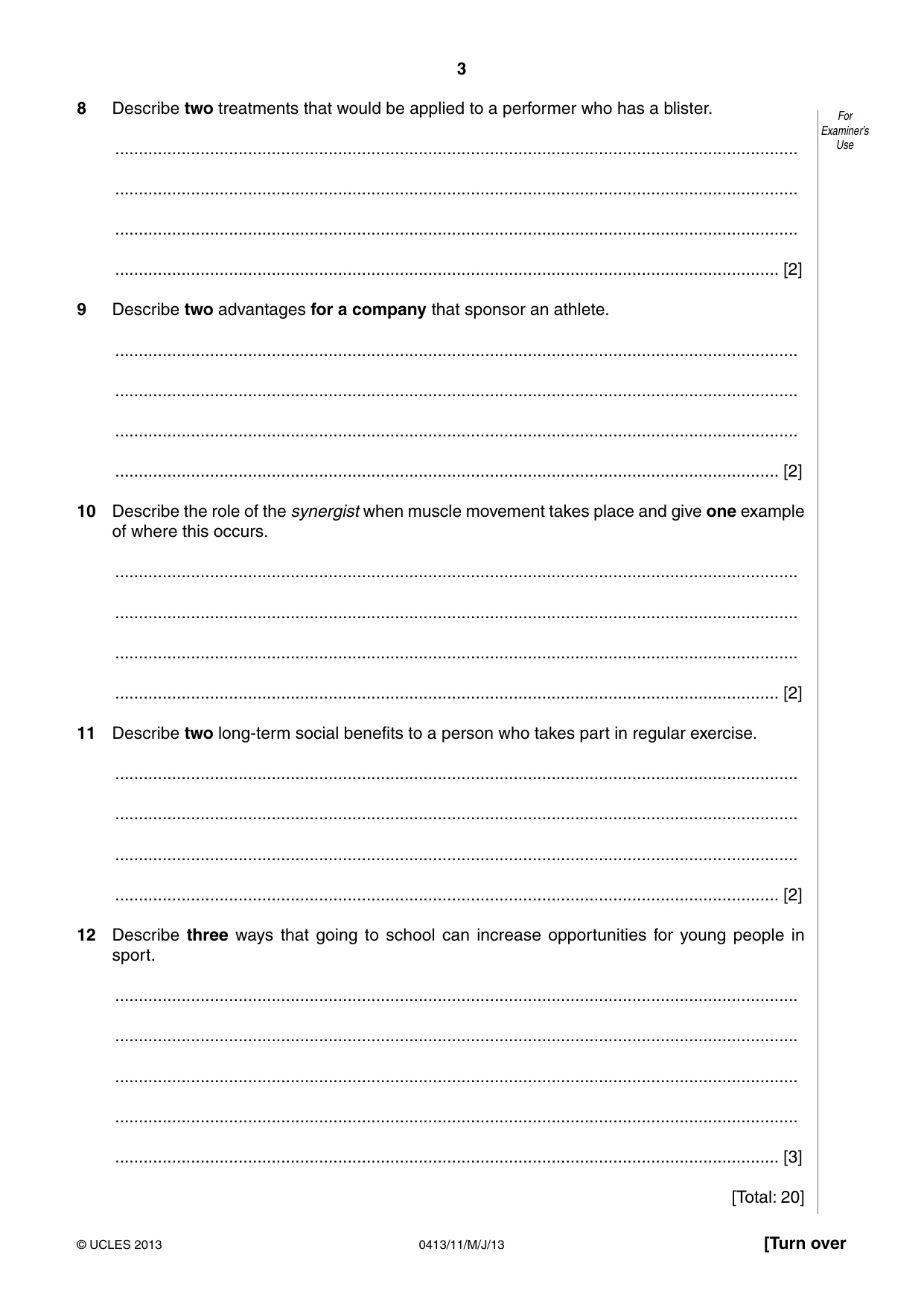
3 0413/11/M/J/13 © UCLES 2013 [Turn over For Examiner’s Use 8 Describe two treatments that would be applied to a performer who has a blister. … … … … [2] 9 Describe two advantages for a company that sponsor an athlete. … … … … [2] 10 Describe the role of the synergist when muscle movement takes place and give one example of where this occurs. … … … … [2] 11 Describe two long-term social benefits to a person who takes part in regular exercise. … … … … [2] 12 Describe three ways that going to school can increase opportunities for young people in sport. … … … … … [3] [Total: 20]
Question paper, page 4
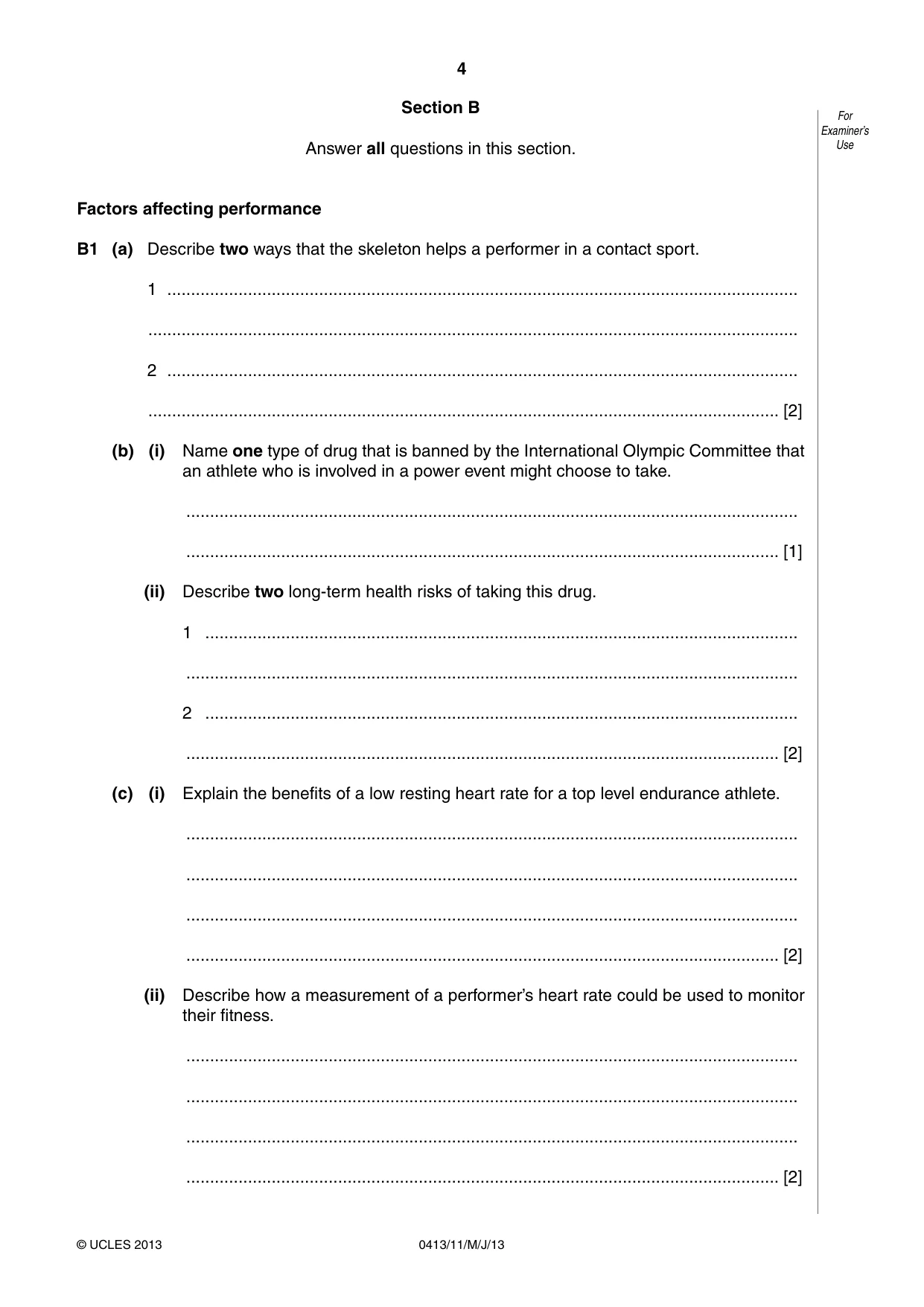
4 0413/11/M/J/13 © UCLES 2013 For Examiner’s Use Section B Answer all questions in this section. Factors affecting performance B1 (a) Describe two ways that the skeleton helps a performer in a contact sport. 1 … … 2 … … [2] (b) (i) Name one type of drug that is banned by the International Olympic Committee that an athlete who is involved in a power event might choose to take. … … [1] (ii) Describe two long-term health risks of taking this drug. 1 … … 2 … … [2] (c) (i) Explain the benefits of a low resting heart rate for a top level endurance athlete. … … … … [2] (ii) Describe how a measurement of a performer’s heart rate could be used to monitor their fitness. … … … … [2]
Question paper, page 5
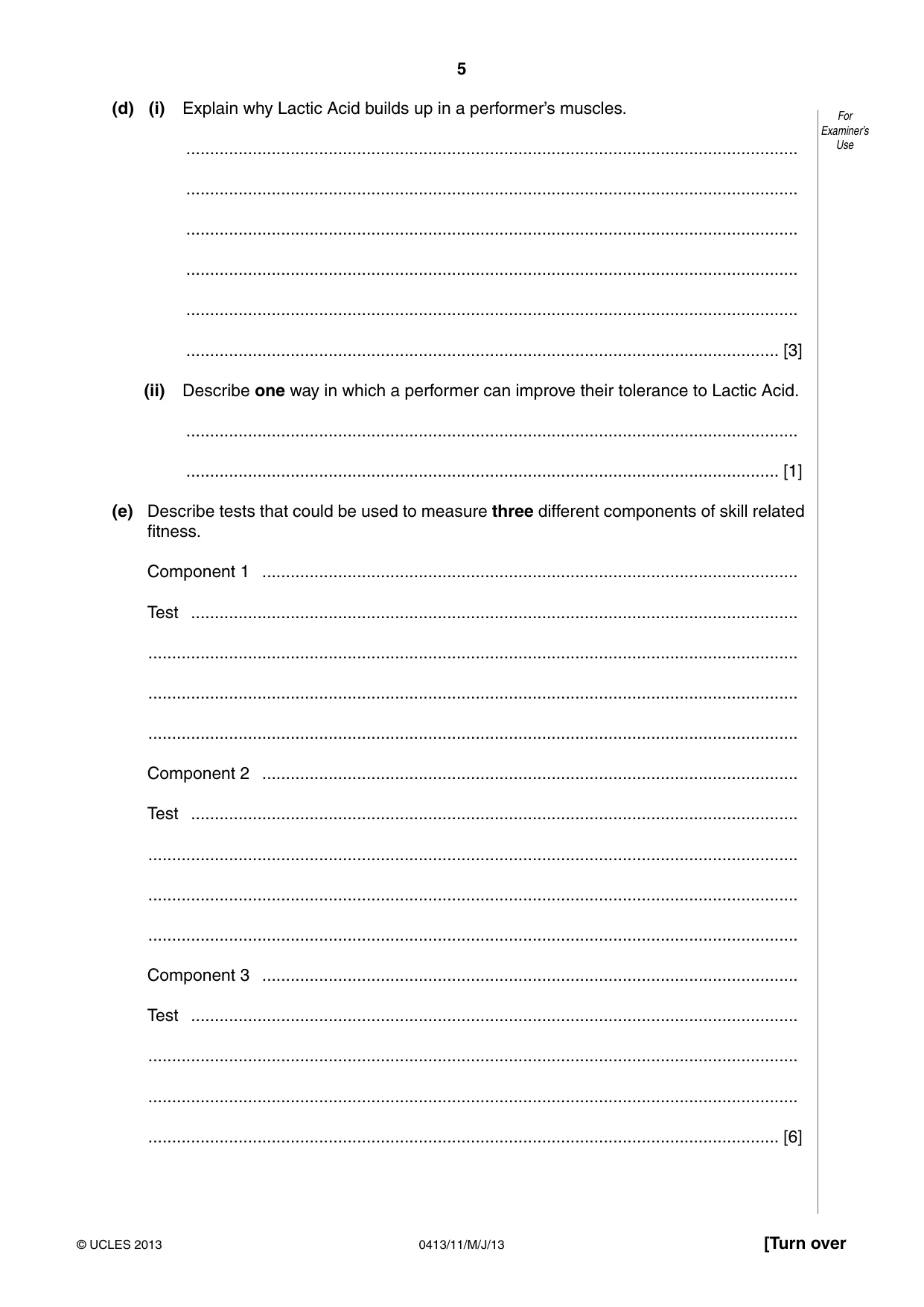
5 0413/11/M/J/13 © UCLES 2013 [Turn over For Examiner’s Use (d) (i) Explain why Lactic Acid builds up in a performer’s muscles. … … … … … … [3] (ii) Describe one way in which a performer can improve their tolerance to Lactic Acid. … … [1] (e) Describe tests that could be used to measure three different components of skill related fitness. Component 1 … Test … … … … Component 2 … Test … … … … Component 3 … Test … … … … [6]
Question paper, page 6
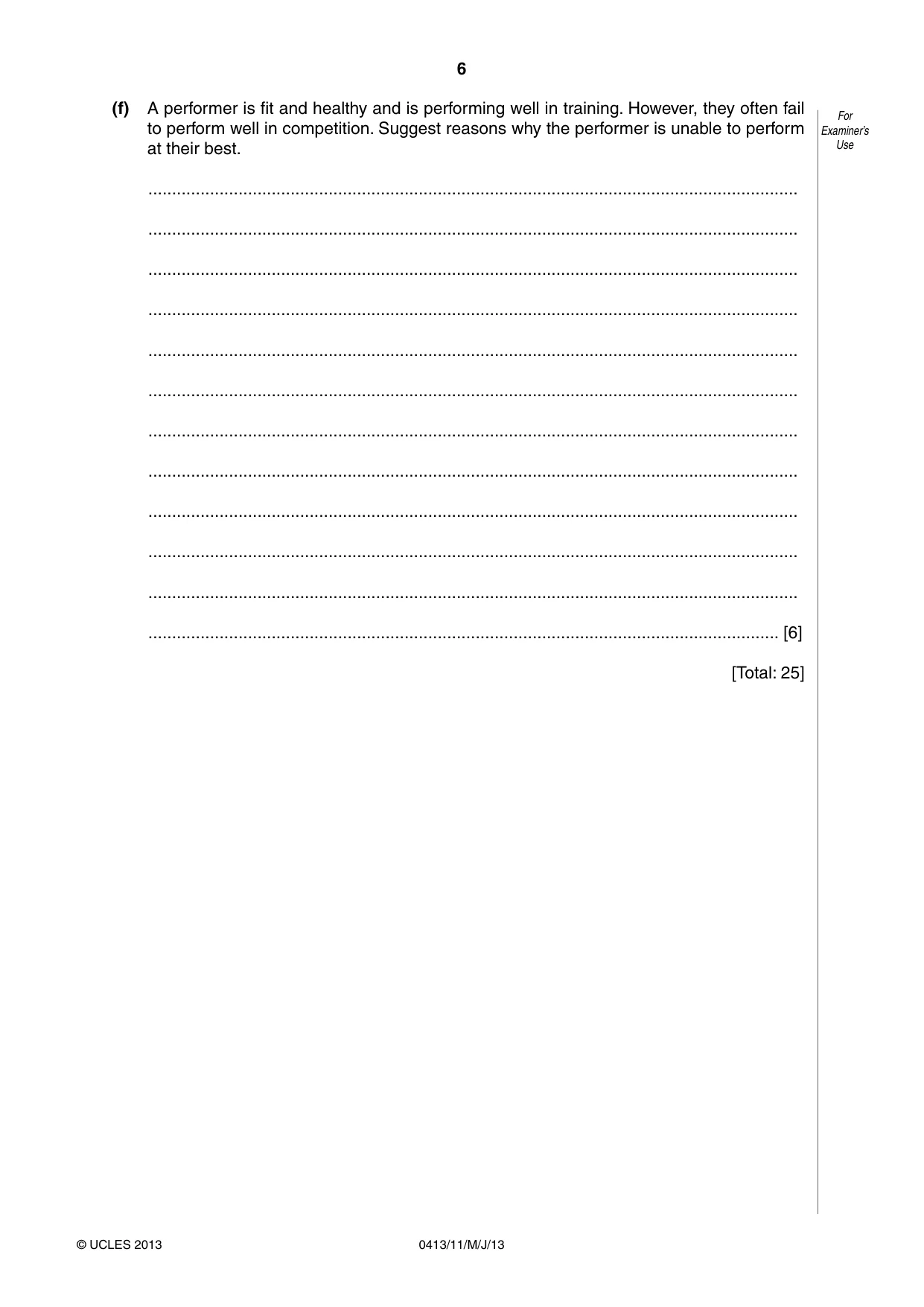
6 0413/11/M/J/13 © UCLES 2013 For Examiner’s Use (f) A performer is fit and healthy and is performing well in training. However, they often fail to perform well in competition. Suggest reasons why the performer is unable to perform at their best. … … … … … … … … … … … … [6] [Total: 25]
Question paper, page 7
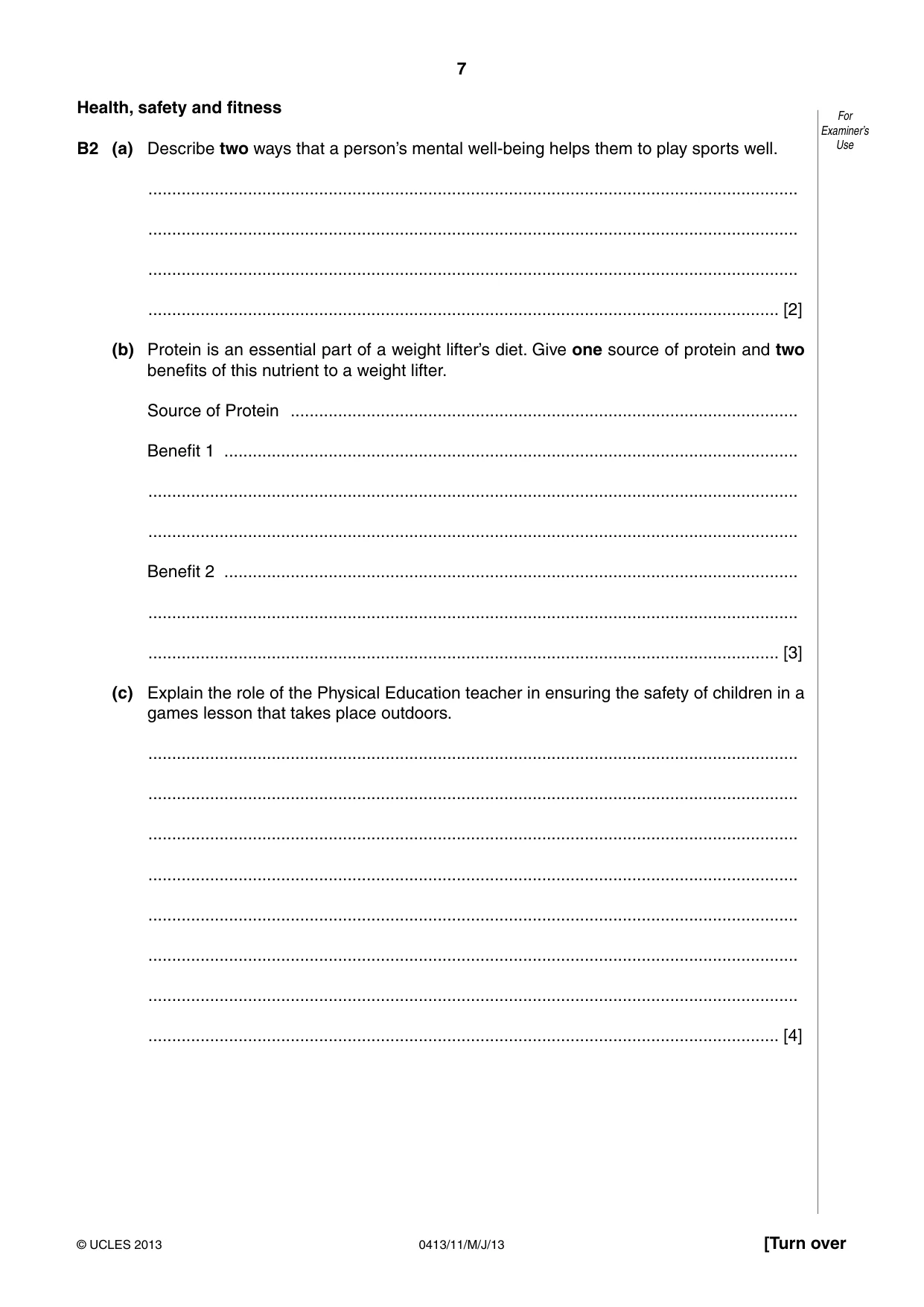
7 0413/11/M/J/13 © UCLES 2013 [Turn over For Examiner’s Use Health, safety and fitness B2 (a) Describe two ways that a person’s mental well-being helps them to play sports well. … … … … [2] (b) Protein is an essential part of a weight lifter’s diet. Give one source of protein and two benefits of this nutrient to a weight lifter. Source of Protein … Benefit 1 … … … Benefit 2 … … … [3] (c) Explain the role of the Physical Education teacher in ensuring the safety of children in a games lesson that takes place outdoors. … … … … … … … … [4]
Question paper, page 8
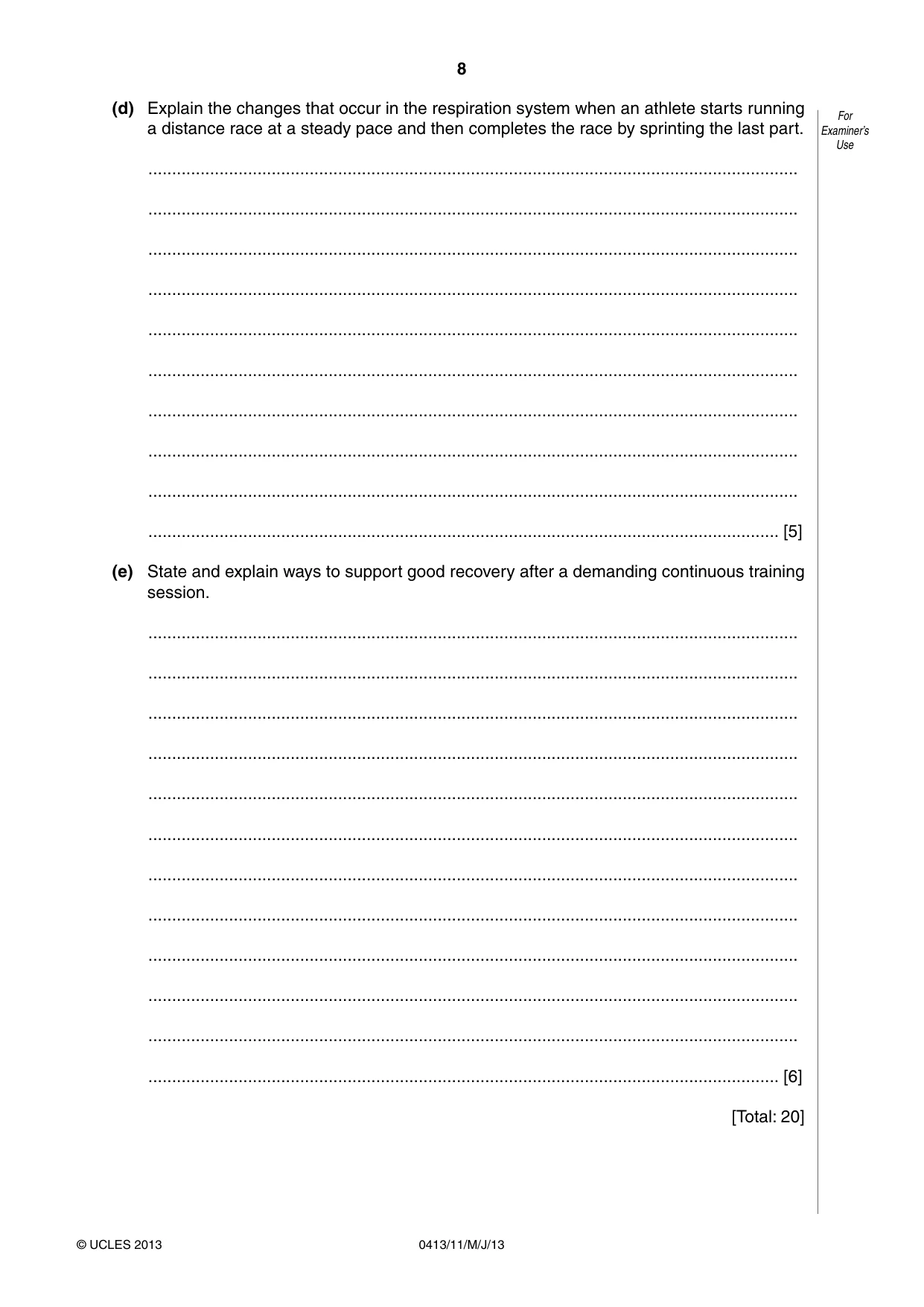
8 0413/11/M/J/13 © UCLES 2013 For Examiner’s Use (d) Explain the changes that occur in the respiration system when an athlete starts running a distance race at a steady pace and then completes the race by sprinting the last part. … … … … … … … … … … [5] (e) State and explain ways to support good recovery after a demanding continuous training session. … … … … … … … … … … … … [6] [Total: 20]
Question paper, page 9
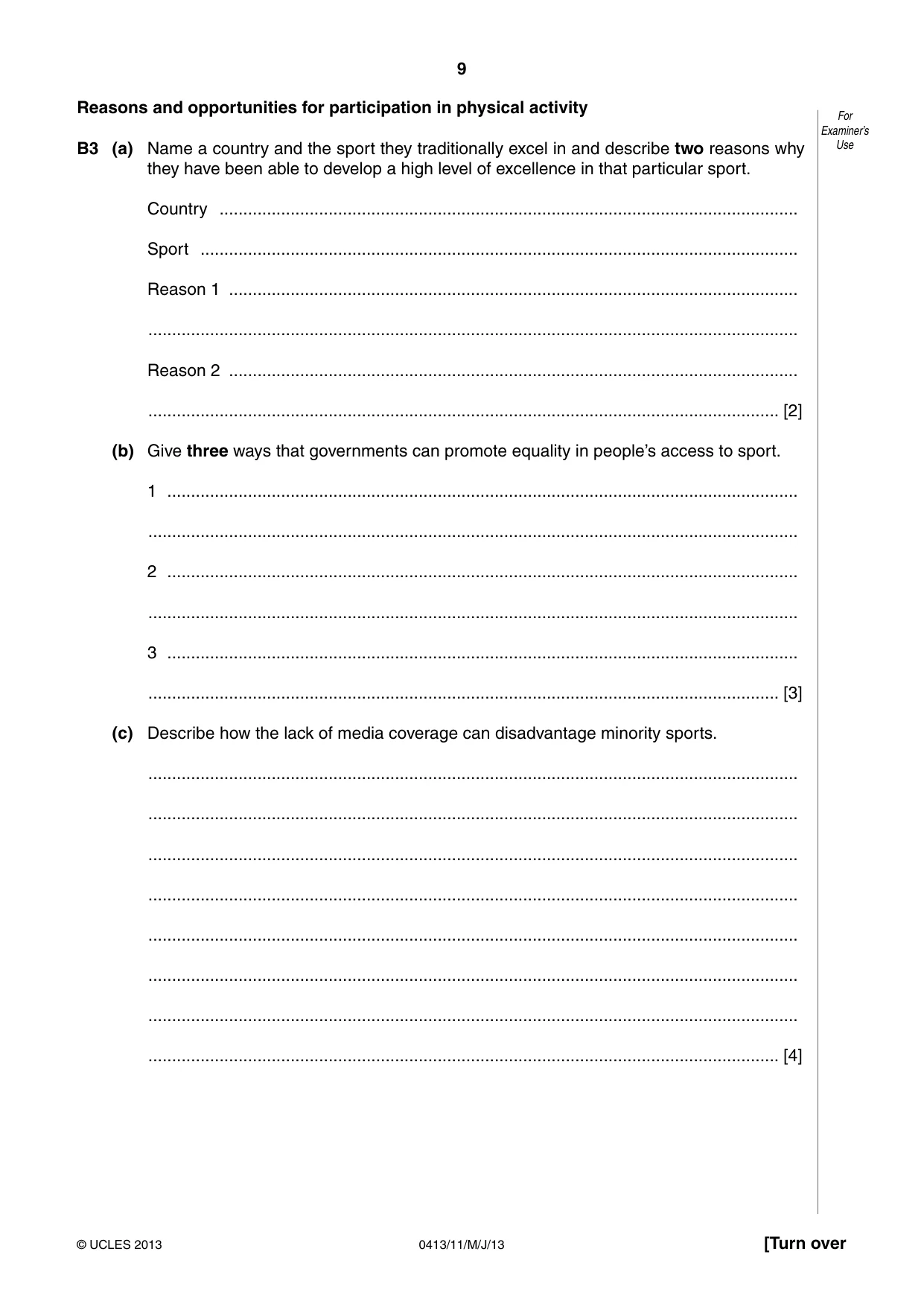
9 0413/11/M/J/13 © UCLES 2013 [Turn over For Examiner’s Use Reasons and opportunities for participation in physical activity B3 (a) Name a country and the sport they traditionally excel in and describe two reasons why they have been able to develop a high level of excellence in that particular sport. Country … Sport … Reason 1 … … Reason 2 … … [2] (b) Give three ways that governments can promote equality in people’s access to sport. 1 … … 2 … … 3 … … [3] (c) Describe how the lack of media coverage can disadvantage minority sports. … … … … … … … … [4]
Question paper, page 10
10 0413/11/M/J/13 © UCLES 2013 For Examiner’s Use (d) Describe the reasons why a local authority might decide to build a leisure centre in a particular location. … … … … … … … … … … … … [6] [Total: 15]
Question paper, page 11
11 0413/11/M/J/13 © UCLES 2013 BLANK PAGE
Question paper, page 12
12 0413/11/M/J/13 © UCLES 2013 BLANK PAGE Permission to reproduce items where third-party owned material protected by copyright is included has been sought and cleared where possible. Every reasonable effort has been made by the publisher (UCLES) to trace copyright holders, but if any items requiring clearance have unwittingly been included, the publisher will be pleased to make amends at the earliest possible opportunity. University of Cambridge International Examinations is part of the Cambridge Assessment Group. Cambridge Assessment is the brand name of University of Cambridge Local Examinations Syndicate (UCLES), which is itself a department of the University of Cambridge.
Mark scheme, page 1
CAMBRIDGE INTERNATIONAL EXAMINATIONS International General Certificate of Secondary Education MARK SCHEME for the May/June 2013 series 0413 PHYSICAL EDUCATION 0413/11 Paper 1, maximum raw mark 80 This mark scheme is published as an aid to teachers and candidates, to indicate the requirements of the examination. It shows the basis on which Examiners were instructed to award marks. It does not indicate the details of the discussions that took place at an Examiners’ meeting before marking began, which would have considered the acceptability of alternative answers. Mark schemes should be read in conjunction with the question paper and the Principal Examiner Report for Teachers. Cambridge will not enter into discussions about these mark schemes. Cambridge is publishing the mark schemes for the May/June 2013 series for most IGCSE, GCE Advanced Level and Advanced Subsidiary Level components and some Ordinary Level components.
Mark scheme, page 2
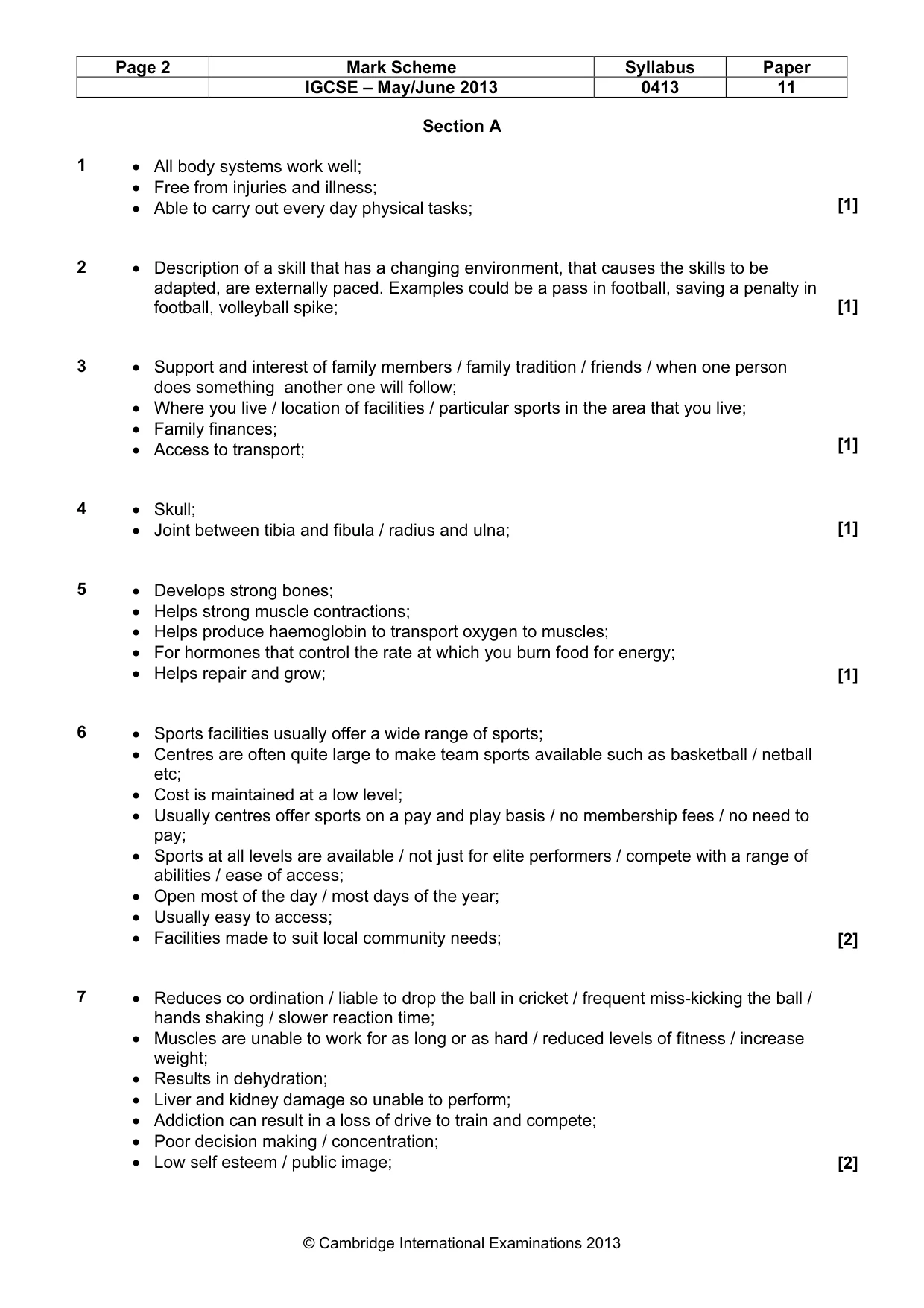
Page 2 Mark Scheme Syllabus Paper IGCSE – May/June 2013 0413 11 © Cambridge International Examinations 2013 Section A 1 • All body systems work well; • Free from injuries and illness; • Able to carry out every day physical tasks; [1] 2 • Description of a skill that has a changing environment, that causes the skills to be adapted, are externally paced. Examples could be a pass in football, saving a penalty in football, volleyball spike; [1] 3 • Support and interest of family members / family tradition / friends / when one person does something another one will follow; • Where you live / location of facilities / particular sports in the area that you live; • Family finances; • Access to transport; [1] 4 • Skull; • Joint between tibia and fibula / radius and ulna; [1] 5 • Develops strong bones; • Helps strong muscle contractions; • Helps produce haemoglobin to transport oxygen to muscles; • For hormones that control the rate at which you burn food for energy; • Helps repair and grow; [1] 6 • Sports facilities usually offer a wide range of sports; • Centres are often quite large to make team sports available such as basketball / netball etc; • Cost is maintained at a low level; • Usually centres offer sports on a pay and play basis / no membership fees / no need to pay; • Sports at all levels are available / not just for elite performers / compete with a range of abilities / ease of access; • Open most of the day / most days of the year; • Usually easy to access; • Facilities made to suit local community needs; [2] 7 • Reduces co ordination / liable to drop the ball in cricket / frequent miss-kicking the ball / hands shaking / slower reaction time; • Muscles are unable to work for as long or as hard / reduced levels of fitness / increase weight; • Results in dehydration; • Liver and kidney damage so unable to perform; • Addiction can result in a loss of drive to train and compete; • Poor decision making / concentration; • Low self esteem / public image; [2]
Mark scheme, page 3
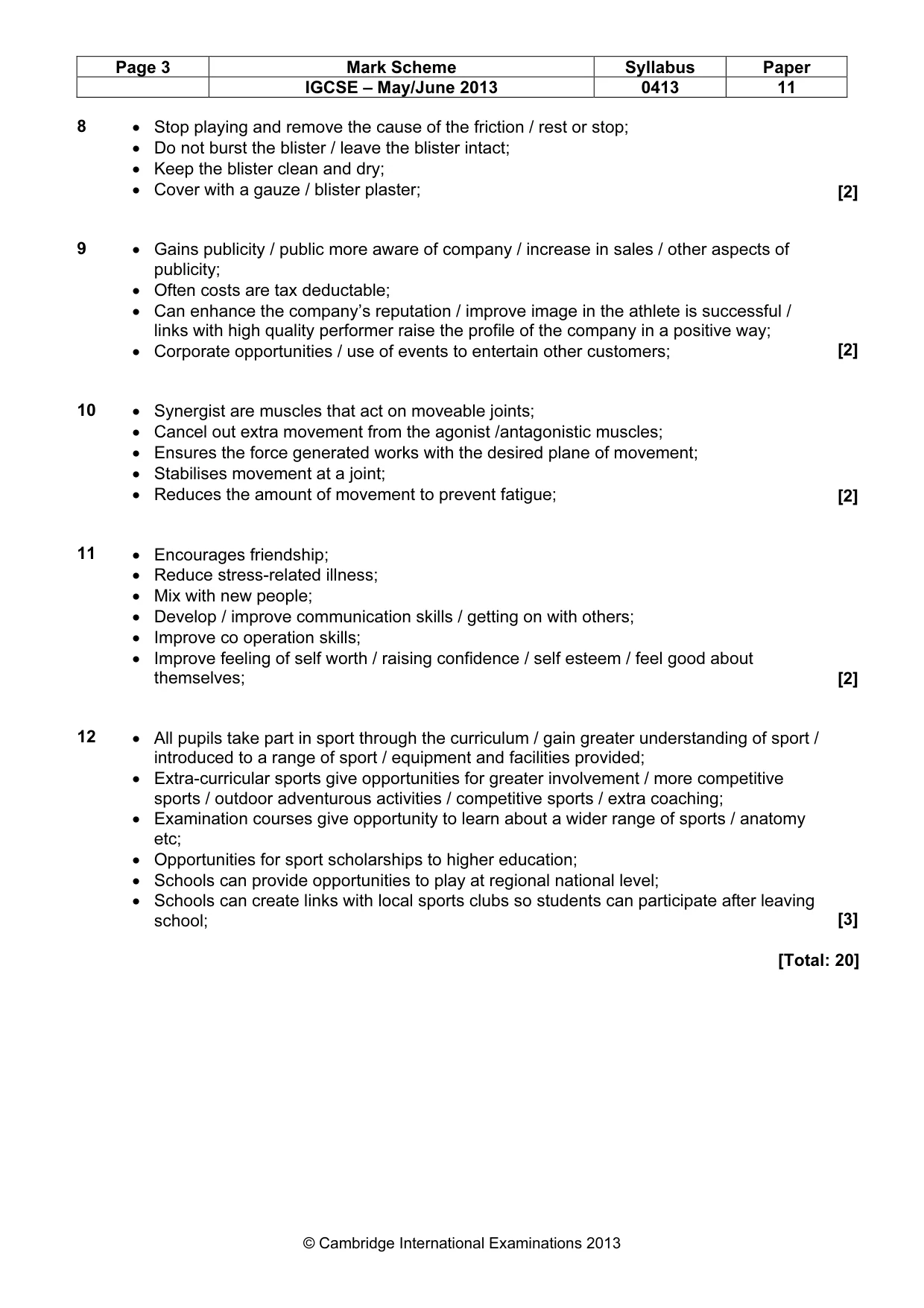
Page 3 Mark Scheme Syllabus Paper IGCSE – May/June 2013 0413 11 © Cambridge International Examinations 2013 8 • Stop playing and remove the cause of the friction / rest or stop; • Do not burst the blister / leave the blister intact; • Keep the blister clean and dry; • Cover with a gauze / blister plaster; [2] 9 • Gains publicity / public more aware of company / increase in sales / other aspects of publicity; • Often costs are tax deductable; • Can enhance the company’s reputation / improve image in the athlete is successful / links with high quality performer raise the profile of the company in a positive way; • Corporate opportunities / use of events to entertain other customers; [2] 10 • Synergist are muscles that act on moveable joints; • Cancel out extra movement from the agonist /antagonistic muscles; • Ensures the force generated works with the desired plane of movement; • Stabilises movement at a joint; • Reduces the amount of movement to prevent fatigue; [2] 11 • Encourages friendship; • Reduce stress-related illness; • Mix with new people; • Develop / improve communication skills / getting on with others; • Improve co operation skills; • Improve feeling of self worth / raising confidence / self esteem / feel good about themselves; [2] 12 • All pupils take part in sport through the curriculum / gain greater understanding of sport / introduced to a range of sport / equipment and facilities provided; • Extra-curricular sports give opportunities for greater involvement / more competitive sports / outdoor adventurous activities / competitive sports / extra coaching; • Examination courses give opportunity to learn about a wider range of sports / anatomy etc; • Opportunities for sport scholarships to higher education; • Schools can provide opportunities to play at regional national level; • Schools can create links with local sports clubs so students can participate after leaving school; [3] [Total: 20]
Mark scheme, page 4
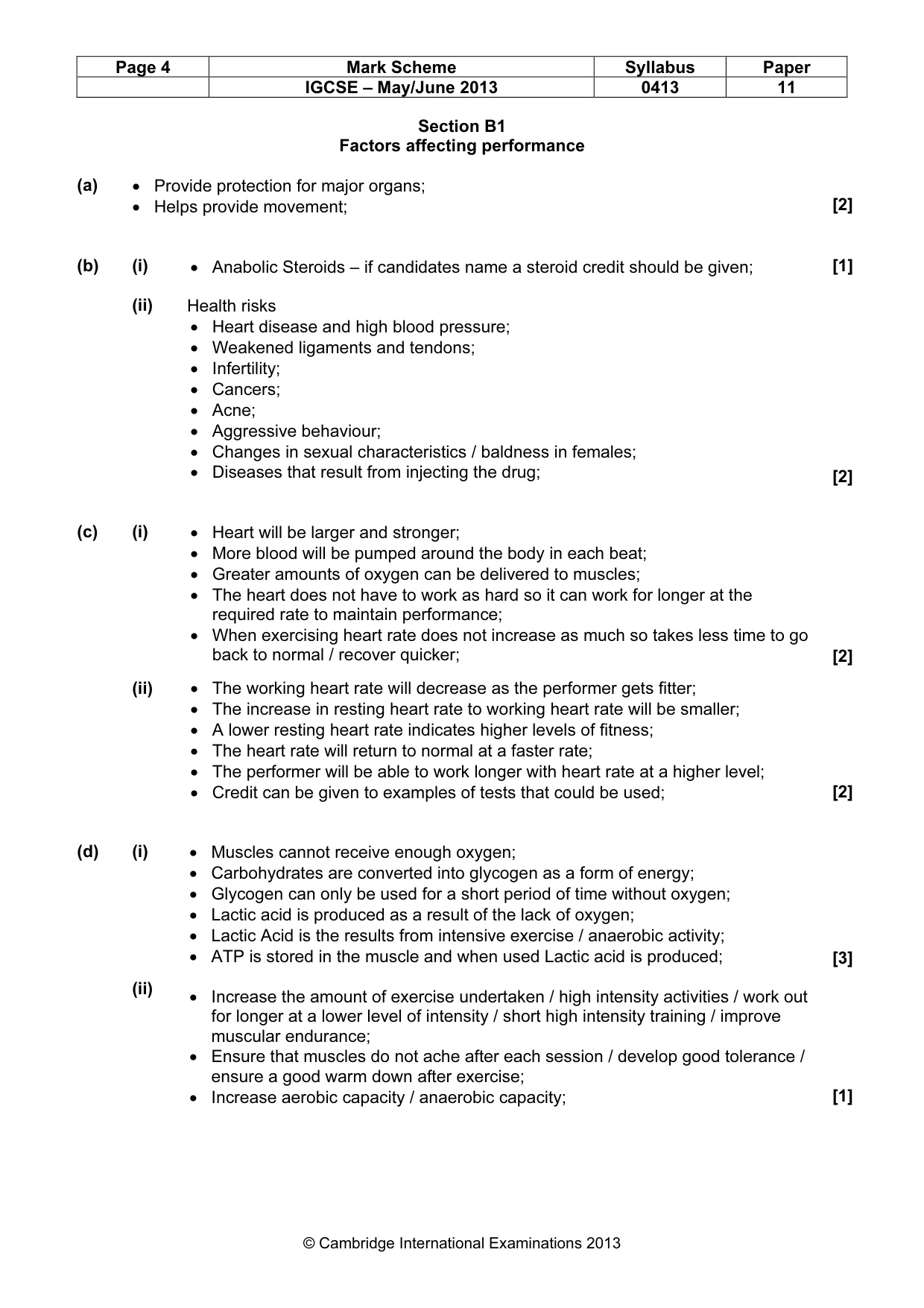
Page 4 Mark Scheme Syllabus Paper IGCSE – May/June 2013 0413 11 © Cambridge International Examinations 2013 Section B1 Factors affecting performance (a) • Provide protection for major organs; • Helps provide movement; [2] (b) (i) (ii) • Anabolic Steroids – if candidates name a steroid credit should be given; Health risks • Heart disease and high blood pressure; • Weakened ligaments and tendons; • Infertility; • Cancers; • Acne; • Aggressive behaviour; • Changes in sexual characteristics / baldness in females; • Diseases that result from injecting the drug; [1] [2] (c) (i) (ii) • Heart will be larger and stronger; • More blood will be pumped around the body in each beat; • Greater amounts of oxygen can be delivered to muscles; • The heart does not have to work as hard so it can work for longer at the required rate to maintain performance; • When exercising heart rate does not increase as much so takes less time to go back to normal / recover quicker; • The working heart rate will decrease as the performer gets fitter; • The increase in resting heart rate to working heart rate will be smaller; • A lower resting heart rate indicates higher levels of fitness; • The heart rate will return to normal at a faster rate; • The performer will be able to work longer with heart rate at a higher level; • Credit can be given to examples of tests that could be used; [2] [2] (d) (i) (ii) • Muscles cannot receive enough oxygen; • Carbohydrates are converted into glycogen as a form of energy; • Glycogen can only be used for a short period of time without oxygen; • Lactic acid is produced as a result of the lack of oxygen; • Lactic Acid is the results from intensive exercise / anaerobic activity; • ATP is stored in the muscle and when used Lactic acid is produced; • Increase the amount of exercise undertaken / high intensity activities / work out for longer at a lower level of intensity / short high intensity training / improve muscular endurance; • Ensure that muscles do not ache after each session / develop good tolerance / ensure a good warm down after exercise; • Increase aerobic capacity / anaerobic capacity; [3] [1]
Mark scheme, page 5
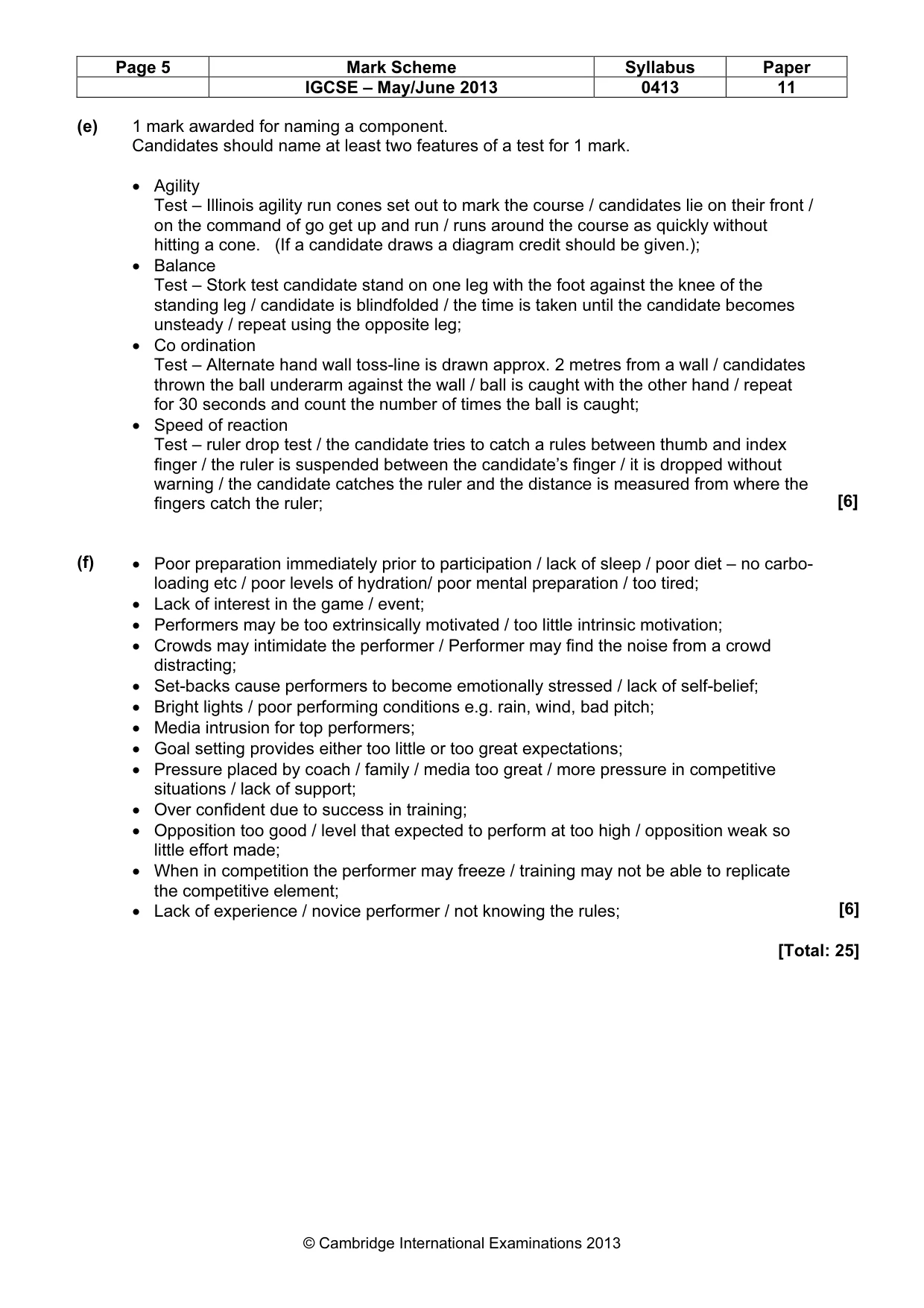
Page 5 Mark Scheme Syllabus Paper IGCSE – May/June 2013 0413 11 © Cambridge International Examinations 2013 (e) 1 mark awarded for naming a component. Candidates should name at least two features of a test for 1 mark. • Agility Test – Illinois agility run cones set out to mark the course / candidates lie on their front / on the command of go get up and run / runs around the course as quickly without hitting a cone. (If a candidate draws a diagram credit should be given.); • Balance Test – Stork test candidate stand on one leg with the foot against the knee of the standing leg / candidate is blindfolded / the time is taken until the candidate becomes unsteady / repeat using the opposite leg; • Co ordination Test – Alternate hand wall toss-line is drawn approx. 2 metres from a wall / candidates thrown the ball underarm against the wall / ball is caught with the other hand / repeat for 30 seconds and count the number of times the ball is caught; • Speed of reaction Test – ruler drop test / the candidate tries to catch a rules between thumb and index finger / the ruler is suspended between the candidate’s finger / it is dropped without warning / the candidate catches the ruler and the distance is measured from where the fingers catch the ruler; [6] (f) • Poor preparation immediately prior to participation / lack of sleep / poor diet – no carbo- loading etc / poor levels of hydration/ poor mental preparation / too tired; • Lack of interest in the game / event; • Performers may be too extrinsically motivated / too little intrinsic motivation; • Crowds may intimidate the performer / Performer may find the noise from a crowd distracting; • Set-backs cause performers to become emotionally stressed / lack of self-belief; • Bright lights / poor performing conditions e.g. rain, wind, bad pitch; • Media intrusion for top performers; • Goal setting provides either too little or too great expectations; • Pressure placed by coach / family / media too great / more pressure in competitive situations / lack of support; • Over confident due to success in training; • Opposition too good / level that expected to perform at too high / opposition weak so little effort made; • When in competition the performer may freeze / training may not be able to replicate the competitive element; • Lack of experience / novice performer / not knowing the rules; [6] [Total: 25]
Mark scheme, page 6
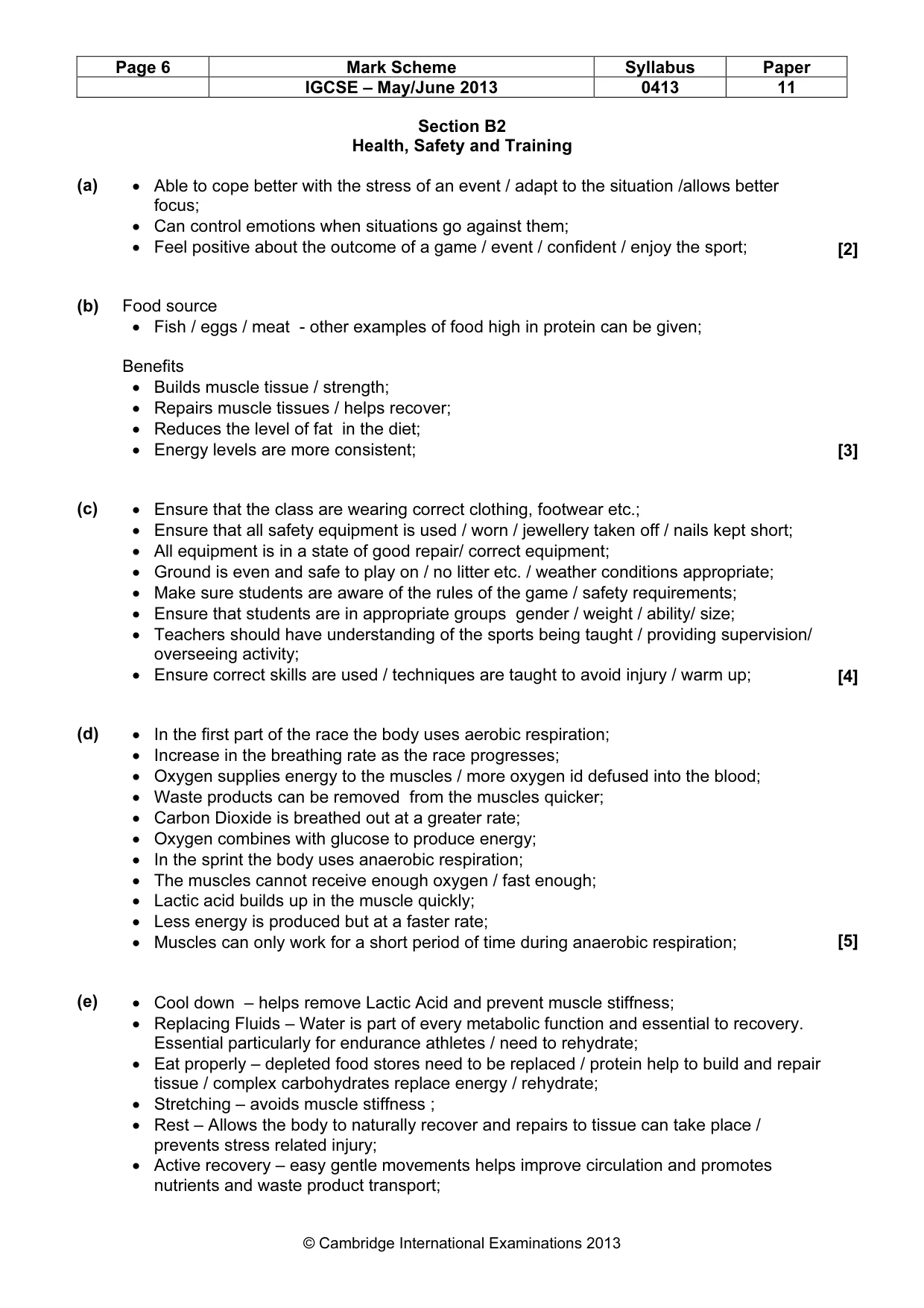
Page 6 Mark Scheme Syllabus Paper IGCSE – May/June 2013 0413 11 © Cambridge International Examinations 2013 Section B2 Health, Safety and Training (a) • Able to cope better with the stress of an event / adapt to the situation /allows better focus; • Can control emotions when situations go against them; • Feel positive about the outcome of a game / event / confident / enjoy the sport; [2] (b) Food source • Fish / eggs / meat - other examples of food high in protein can be given; Benefits • Builds muscle tissue / strength; • Repairs muscle tissues / helps recover; • Reduces the level of fat in the diet; • Energy levels are more consistent; [3] (c) • Ensure that the class are wearing correct clothing, footwear etc.; • Ensure that all safety equipment is used / worn / jewellery taken off / nails kept short; • All equipment is in a state of good repair/ correct equipment; • Ground is even and safe to play on / no litter etc. / weather conditions appropriate; • Make sure students are aware of the rules of the game / safety requirements; • Ensure that students are in appropriate groups gender / weight / ability/ size; • Teachers should have understanding of the sports being taught / providing supervision/ overseeing activity; • Ensure correct skills are used / techniques are taught to avoid injury / warm up; [4] (d) • In the first part of the race the body uses aerobic respiration; • Increase in the breathing rate as the race progresses; • Oxygen supplies energy to the muscles / more oxygen id defused into the blood; • Waste products can be removed from the muscles quicker; • Carbon Dioxide is breathed out at a greater rate; • Oxygen combines with glucose to produce energy; • In the sprint the body uses anaerobic respiration; • The muscles cannot receive enough oxygen / fast enough; • Lactic acid builds up in the muscle quickly; • Less energy is produced but at a faster rate; • Muscles can only work for a short period of time during anaerobic respiration; [5] (e) • Cool down – helps remove Lactic Acid and prevent muscle stiffness; • Replacing Fluids – Water is part of every metabolic function and essential to recovery. Essential particularly for endurance athletes / need to rehydrate; • Eat properly – depleted food stores need to be replaced / protein help to build and repair tissue / complex carbohydrates replace energy / rehydrate; • Stretching – avoids muscle stiffness ; • Rest – Allows the body to naturally recover and repairs to tissue can take place / prevents stress related injury; • Active recovery – easy gentle movements helps improve circulation and promotes nutrients and waste product transport;
Mark scheme, page 7
Page 7 Mark Scheme Syllabus Paper IGCSE – May/June 2013 0413 11 © Cambridge International Examinations 2013 • Massage – aid circulations and promotes general well- being; • Ice baths / alternate hot and cold treatment – reduces muscle soreness / helps flush out waste products; • Sleep – during sleep the body produces growth hormone which aids recovery and tissue growth; • Avoid overtraining which can cause stress, stress related injury / prevents recovery. [6] [Total: 20]
Mark scheme, page 8
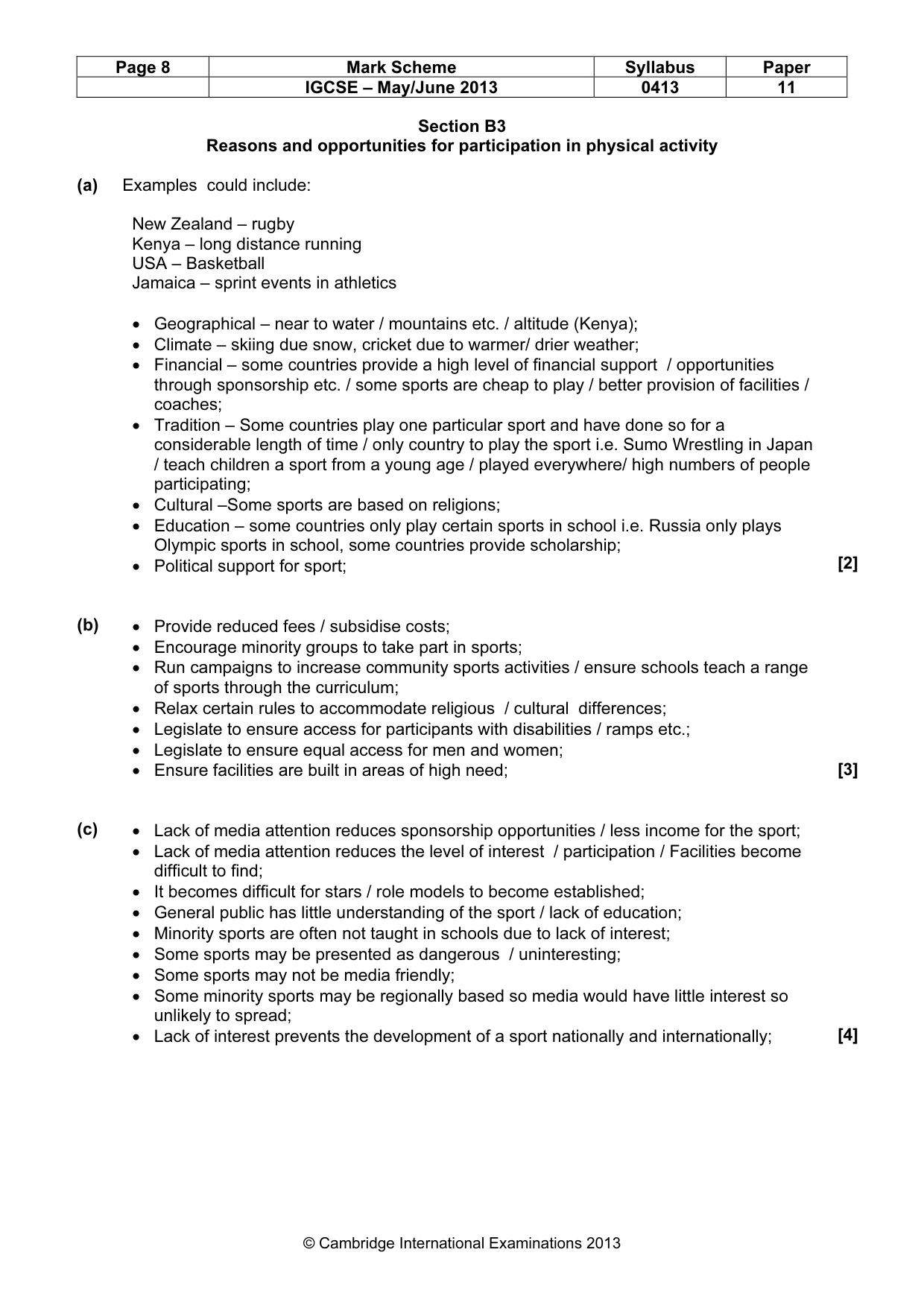
Page 8 Mark Scheme Syllabus Paper IGCSE – May/June 2013 0413 11 © Cambridge International Examinations 2013 Section B3 Reasons and opportunities for participation in physical activity (a) Examples could include: New Zealand – rugby Kenya – long distance running USA – Basketball Jamaica – sprint events in athletics • Geographical – near to water / mountains etc. / altitude (Kenya); • Climate – skiing due snow, cricket due to warmer/ drier weather; • Financial – some countries provide a high level of financial support / opportunities through sponsorship etc. / some sports are cheap to play / better provision of facilities / coaches; • Tradition – Some countries play one particular sport and have done so for a considerable length of time / only country to play the sport i.e. Sumo Wrestling in Japan / teach children a sport from a young age / played everywhere/ high numbers of people participating; • Cultural –Some sports are based on religions; • Education – some countries only play certain sports in school i.e. Russia only plays Olympic sports in school, some countries provide scholarship; • Political support for sport; [2] (b) • Provide reduced fees / subsidise costs; • Encourage minority groups to take part in sports; • Run campaigns to increase community sports activities / ensure schools teach a range of sports through the curriculum; • Relax certain rules to accommodate religious / cultural differences; • Legislate to ensure access for participants with disabilities / ramps etc.; • Legislate to ensure equal access for men and women; • Ensure facilities are built in areas of high need; [3] (c) • Lack of media attention reduces sponsorship opportunities / less income for the sport; • Lack of media attention reduces the level of interest / participation / Facilities become difficult to find; • It becomes difficult for stars / role models to become established; • General public has little understanding of the sport / lack of education; • Minority sports are often not taught in schools due to lack of interest; • Some sports may be presented as dangerous / uninteresting; • Some sports may not be media friendly; • Some minority sports may be regionally based so media would have little interest so unlikely to spread; • Lack of interest prevents the development of a sport nationally and internationally; [4]
Mark scheme, page 9
Page 9 Mark Scheme Syllabus Paper IGCSE – May/June 2013 0413 11 © Cambridge International Examinations 2013 (d) • Population – whether there are enough people close to the centre to be able to use it; • Use of the natural environment e.g. use of a lake for a sailing centre / geographical features needed; • Suitability of the land / terrain / pollution / size of plot; • Cost – land in certain areas can be highly expensive and may prevent the project; • Access – needs to be close to public transport / road networks; • Planning permission – there maybe objections to the planning locally; • Where the new centre is being built in relation to existing facilities; • If the facility caters for one sport – will the demand make it worthwhile; • Community based factors that could include the regeneration of an area of high deprivation; [6] [Total: 15]
What you needed in this session
Cambridge’s own grade thresholds for 2013 May/June, Paper 1 · Variant 1. A higher threshold means an easier paper — the bar moves with how the cohort did.