Cambridge IGCSE Physical Education 0413 — 2010 Oct/Nov Paper 1 · Variant 1
0413/11/O/N/10 · 80 marks · ≈90 min
The question paper and its mark scheme, free to read here and free to download. This is Cambridge’s own paper, exactly as it was sat.
Question paper16 pages






Mark scheme11 pages
Answers below. Sit the paper first if you are practising.
Paper as text
Question paper, page 1
This document consists of 13 printed pages and 3 blank pages. DC CB (CS) 15793/2 © UCLES 2010 [Turn over UNIVERSITY OF CAMBRIDGE INTERNATIONAL EXAMINATIONS International General Certificate of Secondary Education READ THESE INSTRUCTIONS FIRST Write your Centre number, candidate number and name on all the work you hand in. Write in dark blue or black pen. You may use a soft pencil for any diagrams, graphs or rough working. Do not use staples, paper clips, highlighters, glue or correction fluid. DO NOT WRITE IN ANY BARCODES. Answer all questions. At the end of the examination, fasten all your work securely together. The number of marks is given in brackets [ ] at the end of each question or part question. * 6 2 6 8 0 4 0 5 0 4 * PHYSICAL EDUCATION 0413/01 Paper 1 October/November 2010 1 hour 45 minutes Candidates answer on the Question Paper. No Additional Materials are required. For Examiner’s Use Section A B1 B2 B3 Total www.XtremePapers.com
Question paper, page 2
0413/01/O/N/10 © UCLES 2010 For Examiner’s Use Section A Answer all the questions in this section. 1 What is meant by the term physique? … … …[1] 2 If a performer sprains an ankle, part of the recommended treatment is to elevate the leg. How does this action help recovery? … … …[1] 3 Give one typical feature of sports facilities that are found in rural areas. … … …[1] 4 What is meant by the term open skill ? … … …[1] 5 Describe the role of the chairperson in a local sports club. … … …[1] 2
Question paper, page 3
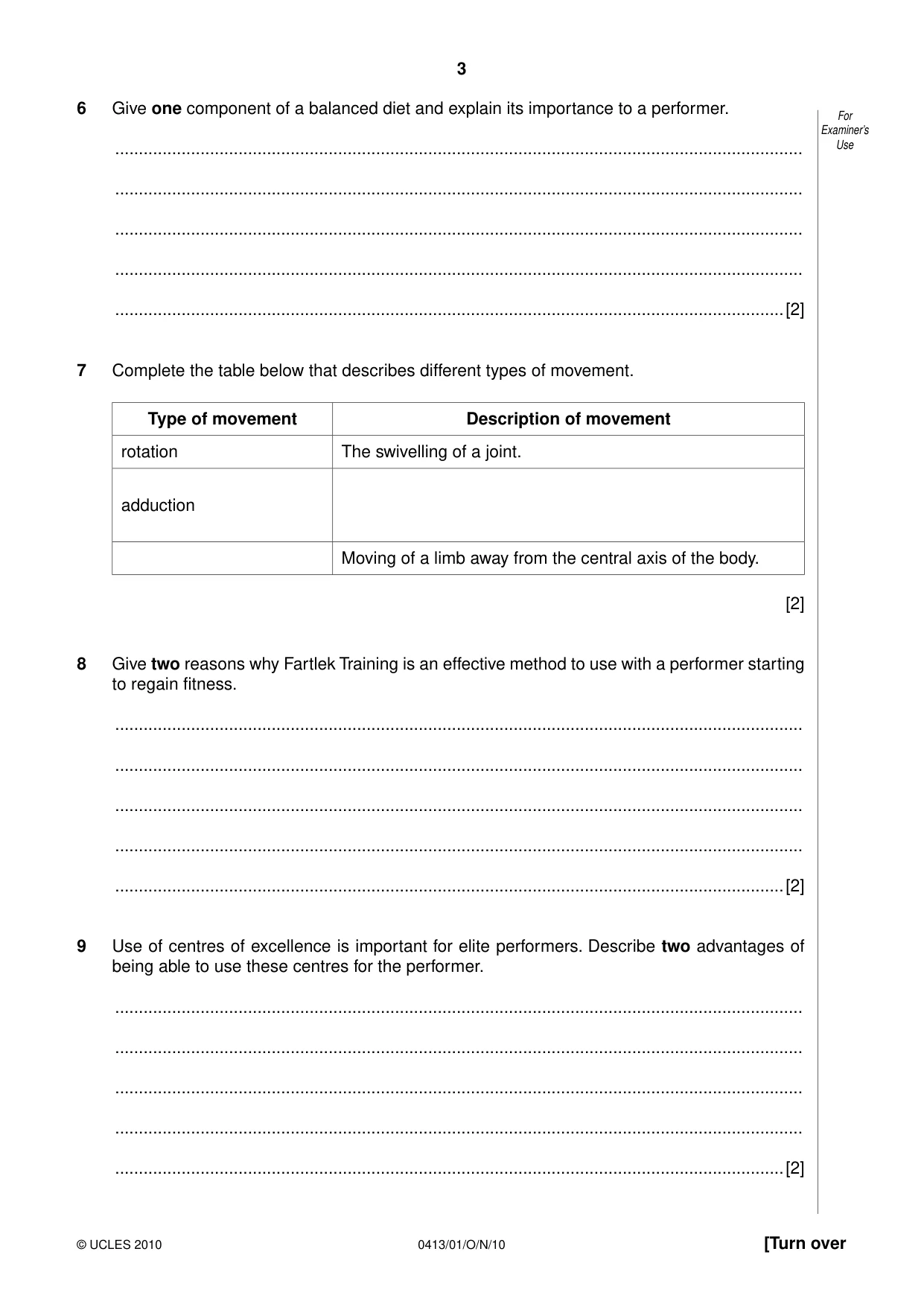
3 0413/01/O/N/10 © UCLES 2010 [Turn over For Examiner’s Use 6 Give one component of a balanced diet and explain its importance to a performer. … … … … …[2] 7 Complete the table below that describes different types of movement. Type of movement Description of movement rotation The swivelling of a joint. adduction Moving of a limb away from the central axis of the body. [2] 8 Give two reasons why Fartlek Training is an effective method to use with a performer starting to regain fitness. … … … … …[2] 9 Use of centres of excellence is important for elite performers. Describe two advantages of being able to use these centres for the performer. … … … … …[2]
Question paper, page 4
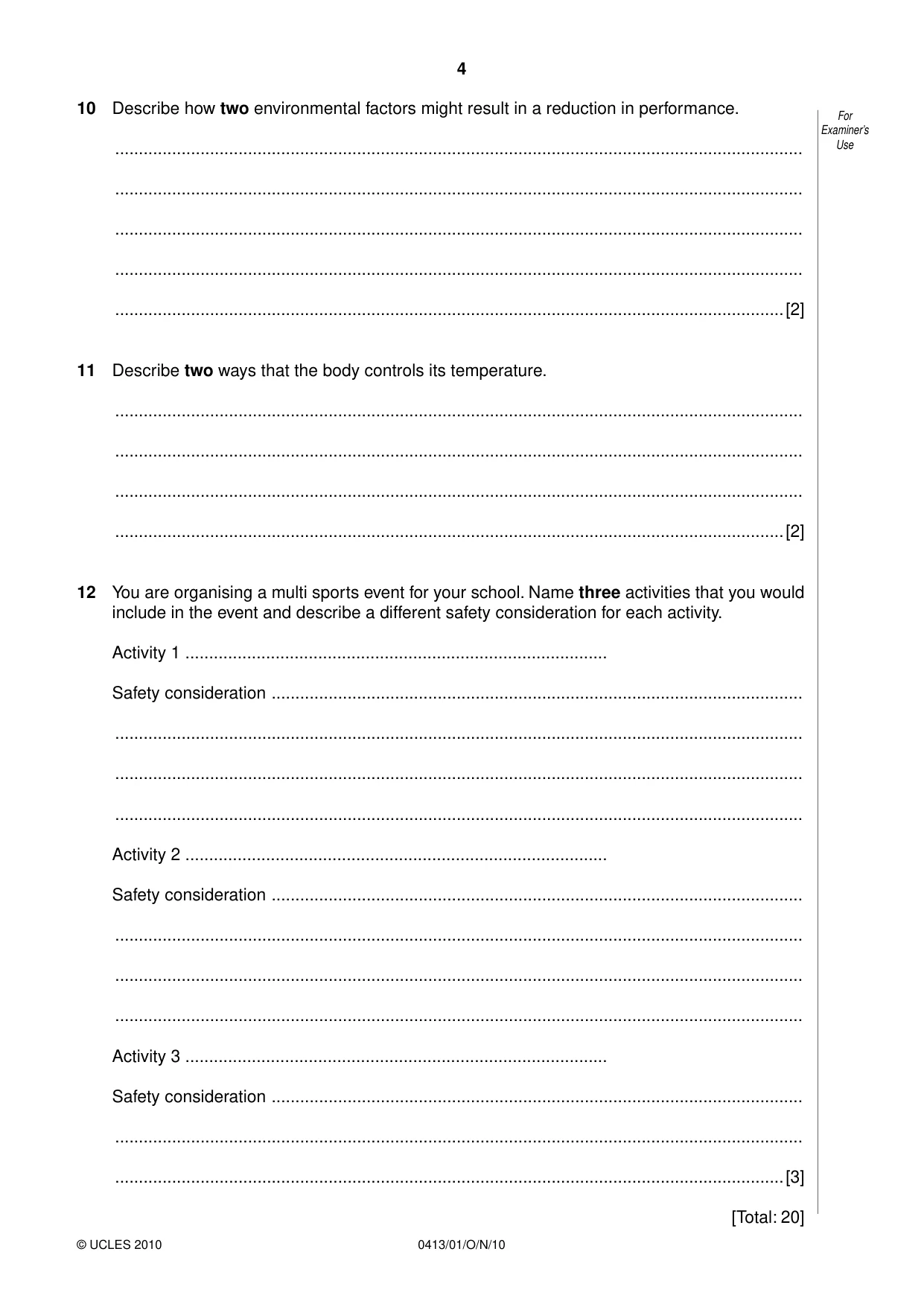
4 0413/01/O/N/10 © UCLES 2010 For Examiner’s Use 10 Describe how two environmental factors might result in a reduction in performance. … … … … …[2] 11 Describe two ways that the body controls its temperature. … … … …[2] 12 You are organising a multi sports event for your school. Name three activities that you would include in the event and describe a different safety consideration for each activity. Activity 1 … Safety consideration … … … … Activity 2 … Safety consideration … … … … Activity 3 … Safety consideration … … …[3] [Total: 20]
Question paper, page 5
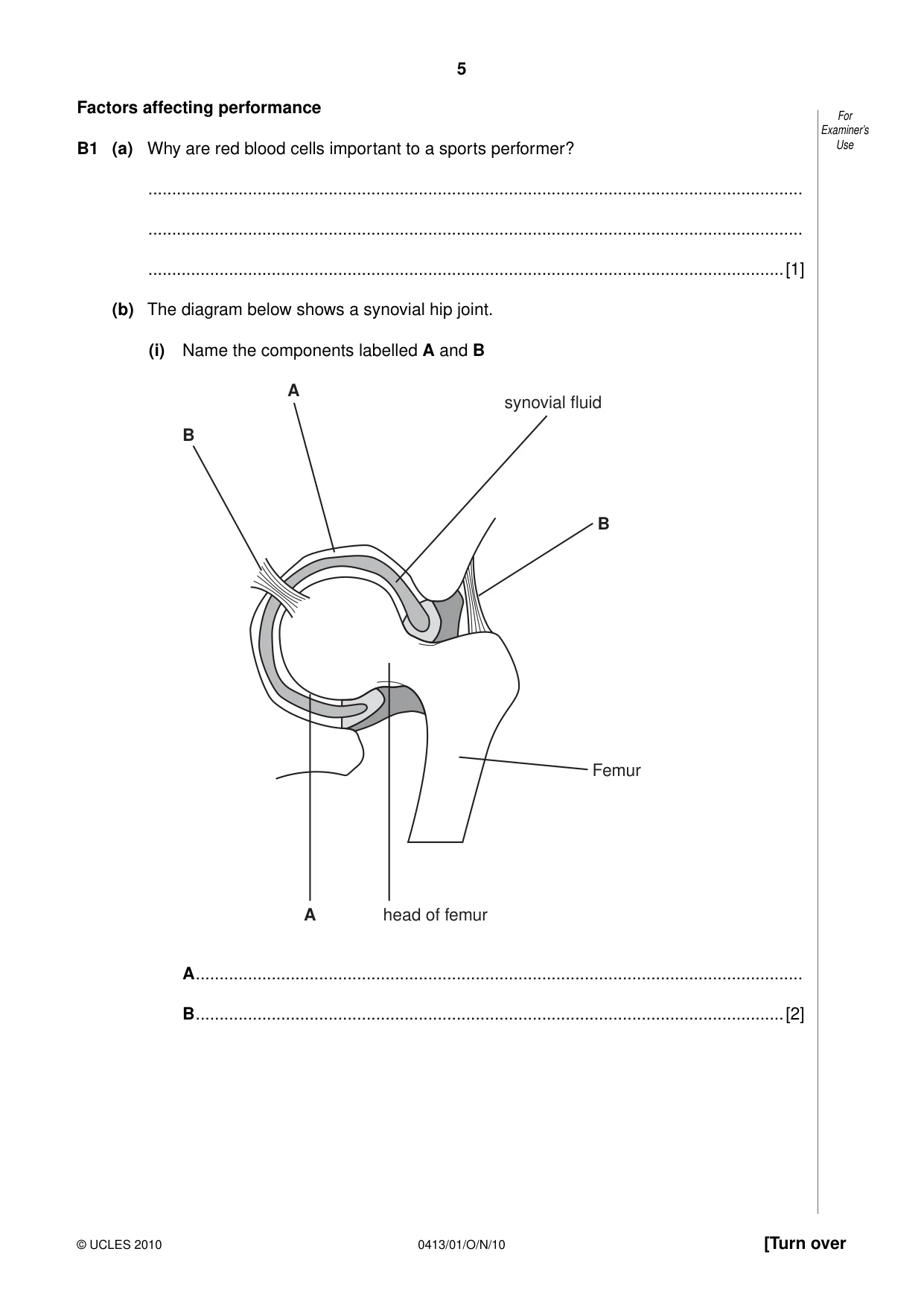
5 0413/01/O/N/10 © UCLES 2010 [Turn over For Examiner’s Use Factors affecting performance B1 (a) Why are red blood cells important to a sports performer? … … …[1] (b) The diagram below shows a synovial hip joint. (i) Name the components labelled A and B Femur head of femur A B synovial fluid A B A … B …[2]
Question paper, page 6
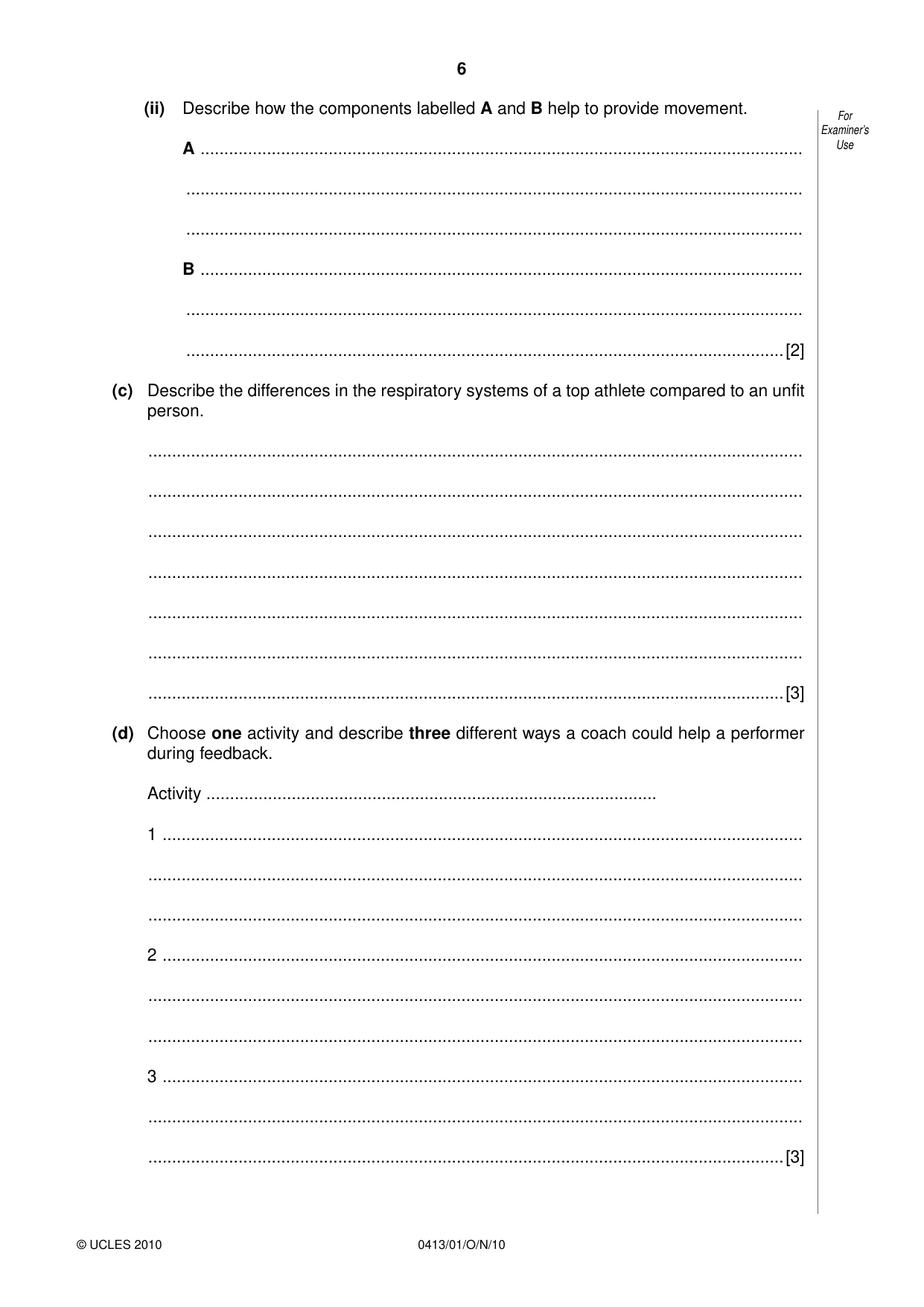
6 0413/01/O/N/10 © UCLES 2010 For Examiner’s Use (ii) Describe how the components labelled A and B help to provide movement. A … … … B … … …[2] (c) Describe the differences in the respiratory systems of a top athlete compared to an unfit person. … … … … … … …[3] (d) Choose one activity and describe three different ways a coach could help a performer during feedback. Activity … 1 … … … 2 … … … 3 … … …[3]
Question paper, page 7
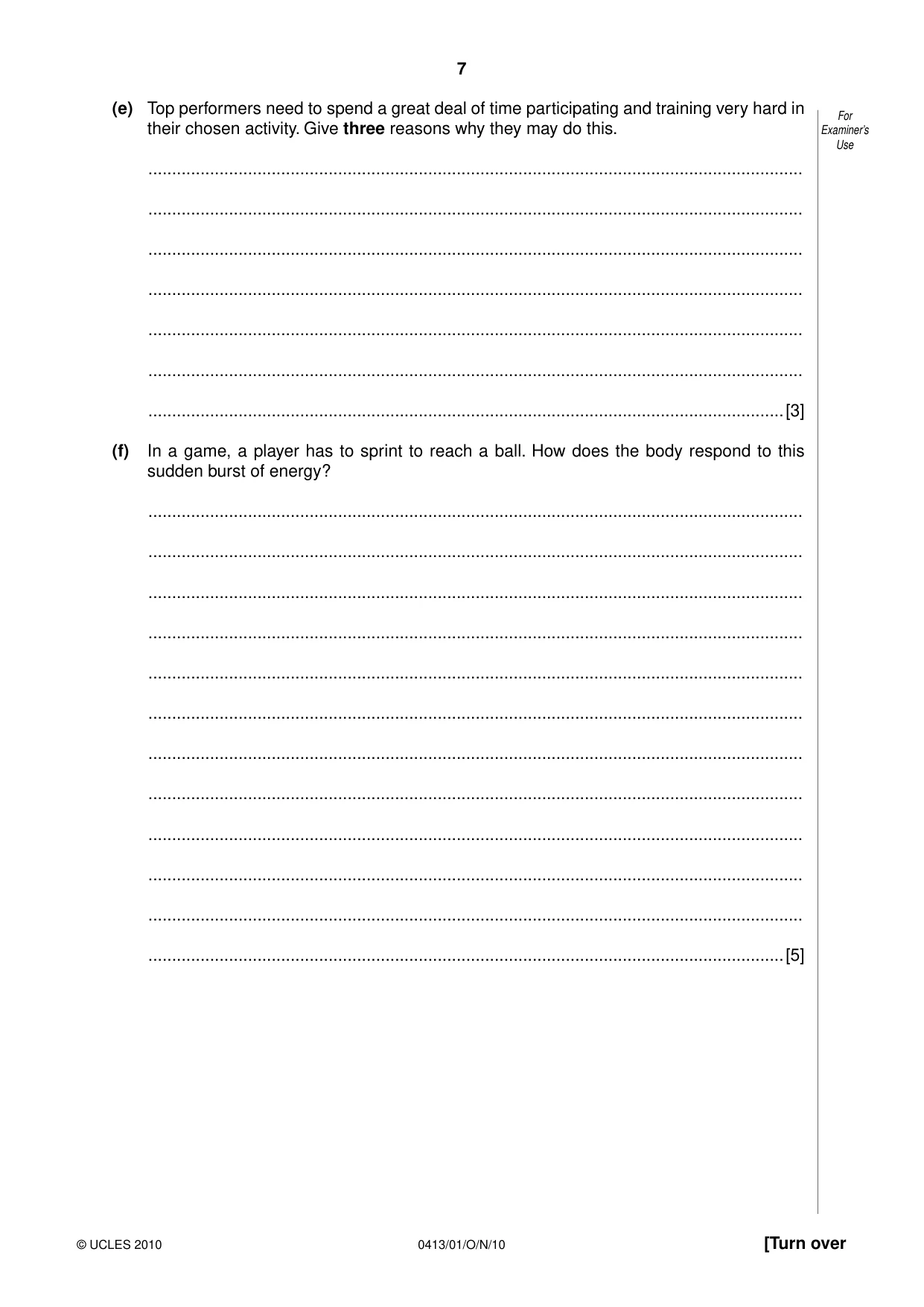
7 0413/01/O/N/10 © UCLES 2010 [Turn over For Examiner’s Use (e) Top performers need to spend a great deal of time participating and training very hard in their chosen activity. Give three reasons why they may do this. … … … … … … …[3] (f) In a game, a player has to sprint to reach a ball. How does the body respond to this sudden burst of energy? … … … … … … … … … … … …[5]
Question paper, page 8
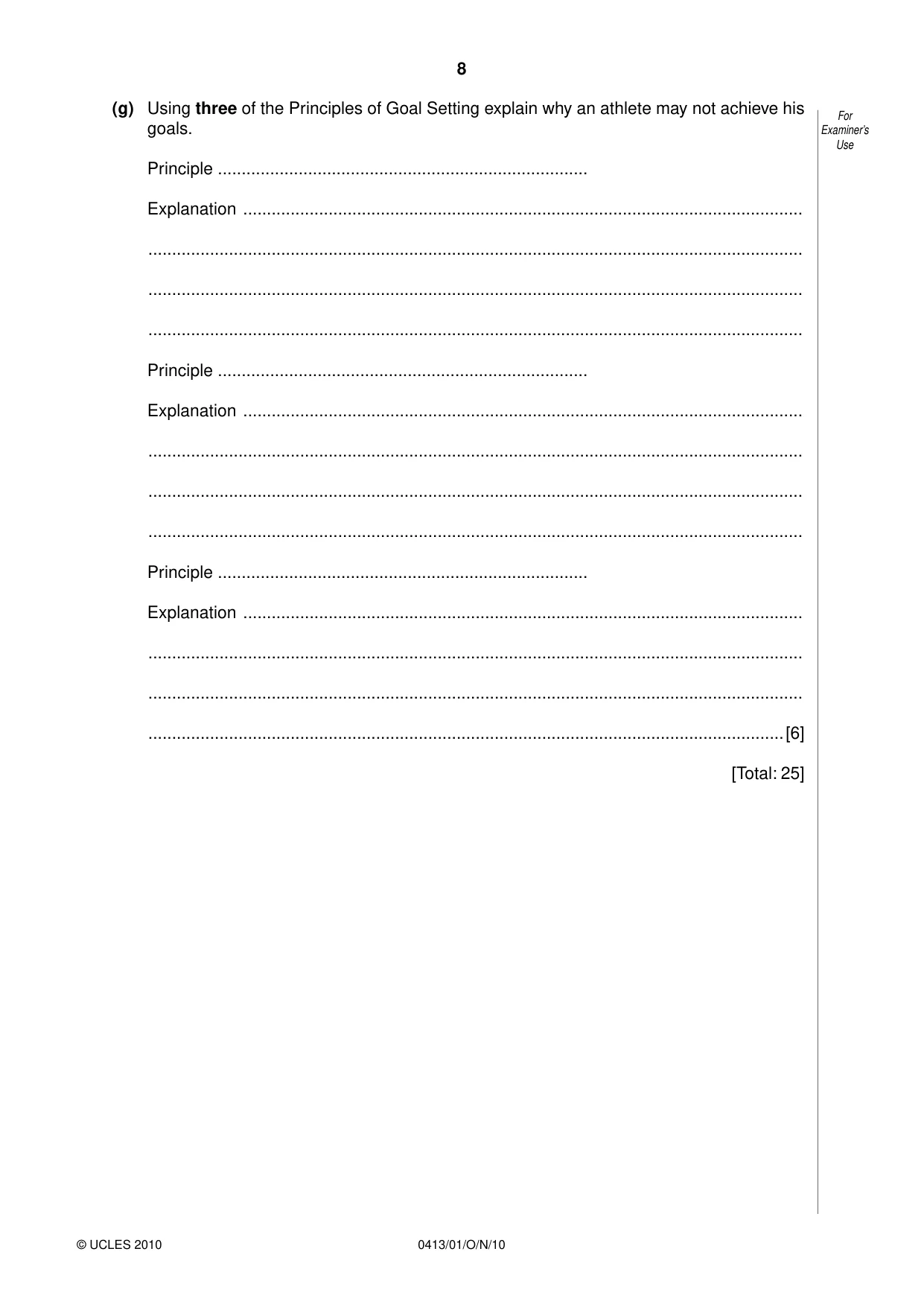
8 0413/01/O/N/10 © UCLES 2010 For Examiner’s Use (g) Using three of the Principles of Goal Setting explain why an athlete may not achieve his goals. Principle … Explanation … … … … Principle … Explanation … … … … Principle … Explanation … … … …[6] [Total: 25]
Question paper, page 9
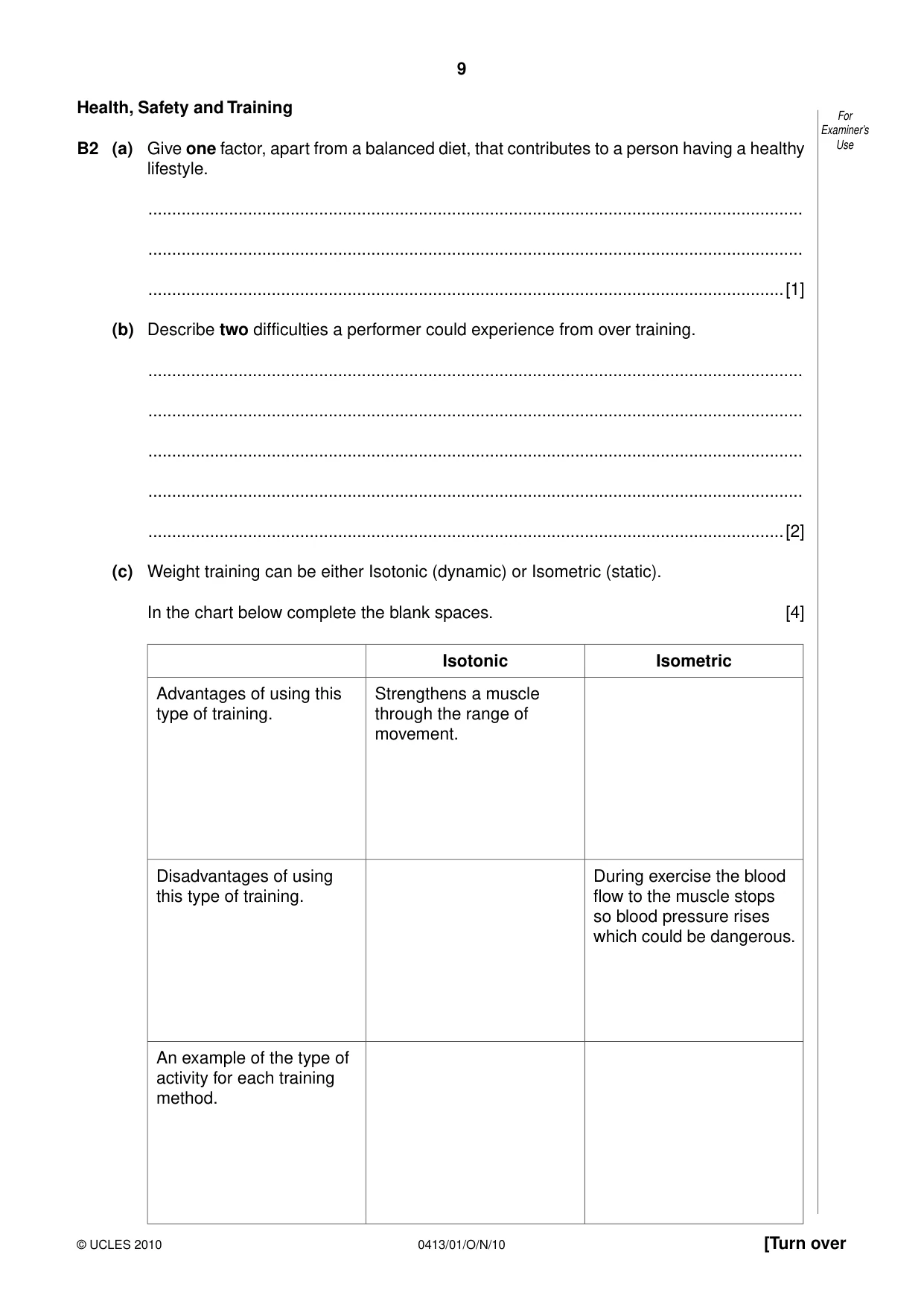
9 0413/01/O/N/10 © UCLES 2010 [Turn over For Examiner’s Use Health, Safety and Training B2 (a) Give one factor, apart from a balanced diet, that contributes to a person having a healthy lifestyle. … … …[1] (b) Describe two difficulties a performer could experience from over training. … … … … …[2] (c) Weight training can be either Isotonic (dynamic) or Isometric (static). In the chart below complete the blank spaces. [4] Isotonic Isometric Advantages of using this type of training. Strengthens a muscle through the range of movement. Disadvantages of using this type of training. During exercise the blood flow to the muscle stops so blood pressure rises which could be dangerous. An example of the type of activity for each training method.
Question paper, page 10
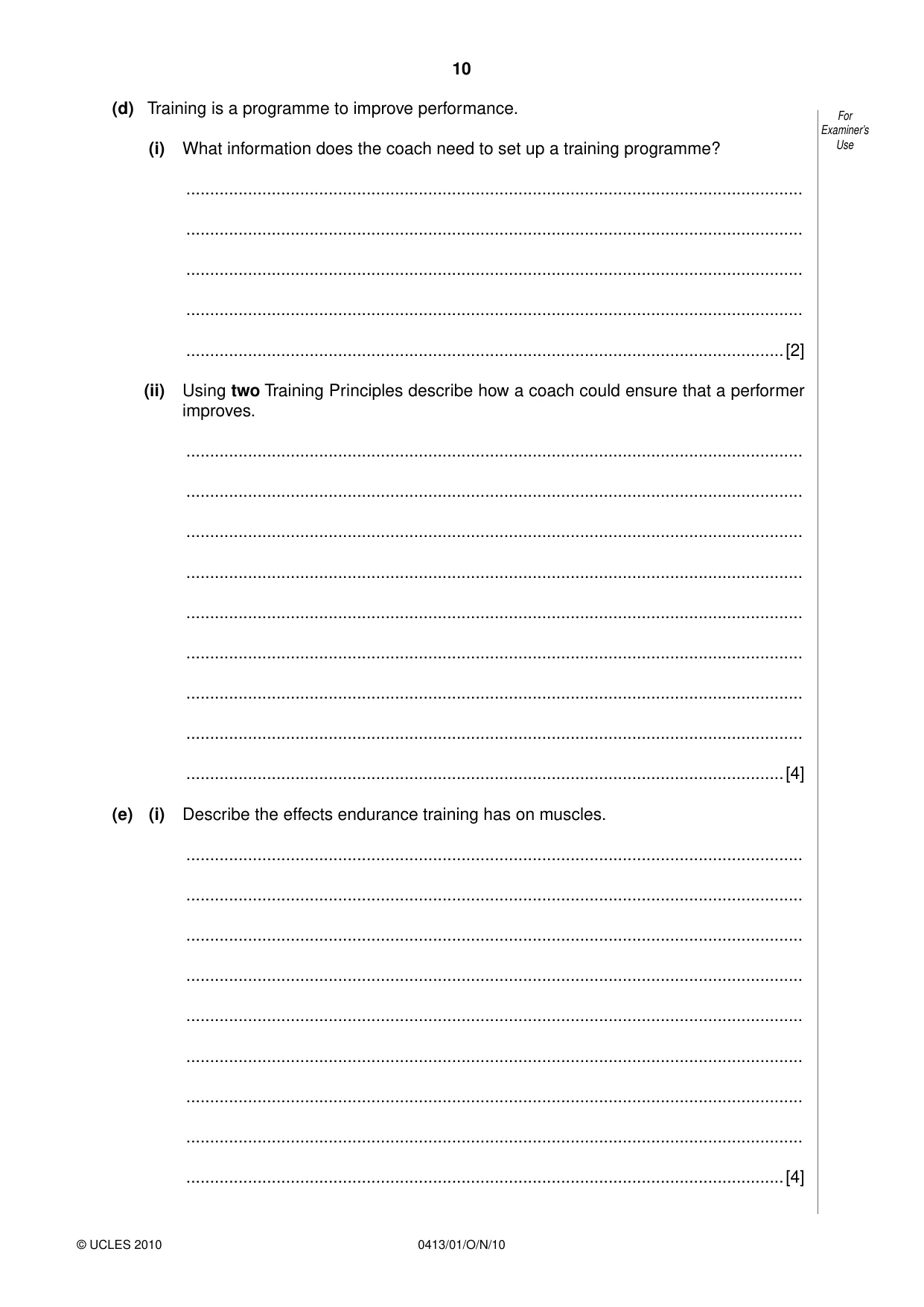
10 0413/01/O/N/10 © UCLES 2010 For Examiner’s Use (d) Training is a programme to improve performance. (i) What information does the coach need to set up a training programme? … … … … …[2] (ii) Using two Training Principles describe how a coach could ensure that a performer improves. … … … … … … … … …[4] (e) (i) Describe the effects endurance training has on muscles. … … … … … … … … …[4]
Question paper, page 11
11 0413/01/O/N/10 © UCLES 2010 [Turn over For Examiner’s Use (ii) Muscles are made up of different types of fibres. Name and describe the features of the fibre that would enable an endurance athlete to perform well. Name of fibre … … … … … … … …[3] [Total: 20]
Question paper, page 12
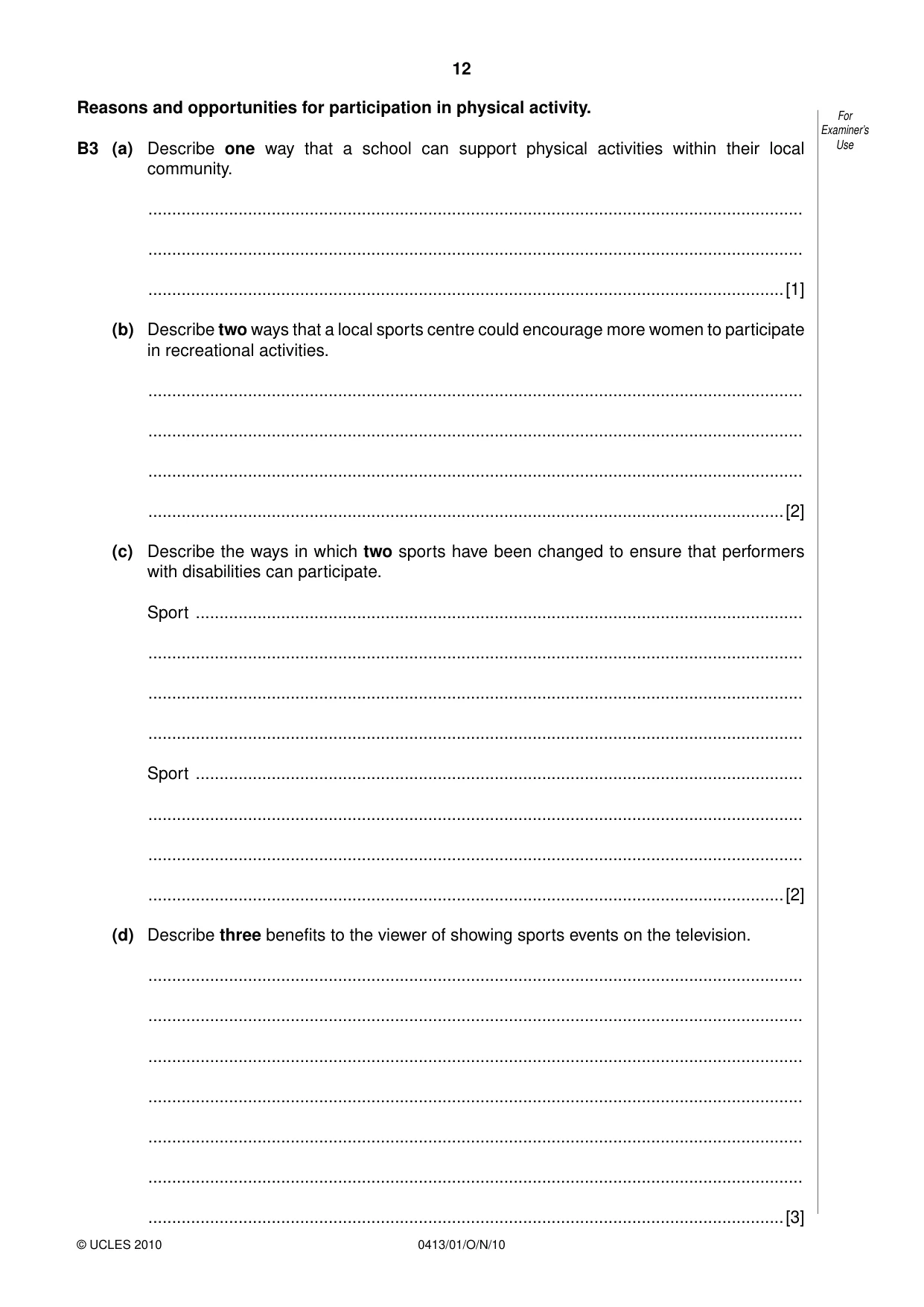
12 0413/01/O/N/10 © UCLES 2010 For Examiner’s Use Reasons and opportunities for participation in physical activity. B3 (a) Describe one way that a school can support physical activities within their local community. … … …[1] (b) Describe two ways that a local sports centre could encourage more women to participate in recreational activities. … … … …[2] (c) Describe the ways in which two sports have been changed to ensure that performers with disabilities can participate. Sport … … … … Sport … … … …[2] (d) Describe three benefits to the viewer of showing sports events on the television. … … … … … … …[3]
Question paper, page 13
13 0413/01/O/N/10 © UCLES 2010 For Examiner’s Use (e) Many major sporting events require a sponsor to ensure their success. (i) Give three reasons why a sponsor would invest money in supporting an event. … … … … … … … …[3] (ii) What potential disadvantages could there be for the sponsor when supporting an event? … … … … …[2] (iii) Describe some of the disadvantages that the event may experience by having a sponsor. … … … …[2] [Total: 15]
Question paper, page 14
14 0413/01/O/N/10 © UCLES 2010 BLANK PAGE
Question paper, page 15
15 0413/01/O/N/10 © UCLES 2010 BLANK PAGE
Question paper, page 16
16 0413/01/O/N/10 © UCLES 2010 BLANK PAGE Permission to reproduce items where third-party owned material protected by copyright is included has been sought and cleared where possible. Every reasonable effort has been made by the publisher (UCLES) to trace copyright holders, but if any items requiring clearance have unwittingly been included, the publisher will be pleased to make amends at the earliest possible opportunity. University of Cambridge International Examinations is part of the Cambridge Assessment Group. Cambridge Assessment is the brand name of University of Cambridge Local Examinations Syndicate (UCLES), which is itself a department of the University of Cambridge.
Mark scheme, page 1
UNIVERSITY OF CAMBRIDGE INTERNATIONAL EXAMINATIONS International General Certificate of Secondary Education MARK SCHEME for the October/November 2010 question paper for the guidance of teachers 0413 PHYSICAL EDUCATION 0413/01 Paper 1, maximum raw mark 80 This mark scheme is published as an aid to teachers and candidates, to indicate the requirements of the examination. It shows the basis on which Examiners were instructed to award marks. It does not indicate the details of the discussions that took place at an Examiners’ meeting before marking began, which would have considered the acceptability of alternative answers. Mark schemes must be read in conjunction with the question papers and the report on the examination. • CIE will not enter into discussions or correspondence in connection with these mark schemes. CIE is publishing the mark schemes for the October/November 2010 question papers for most IGCSE, GCE Advanced Level and Advanced Subsidiary Level syllabuses and some Ordinary Level syllabuses. www.XtremePapers.com
Mark scheme, page 2
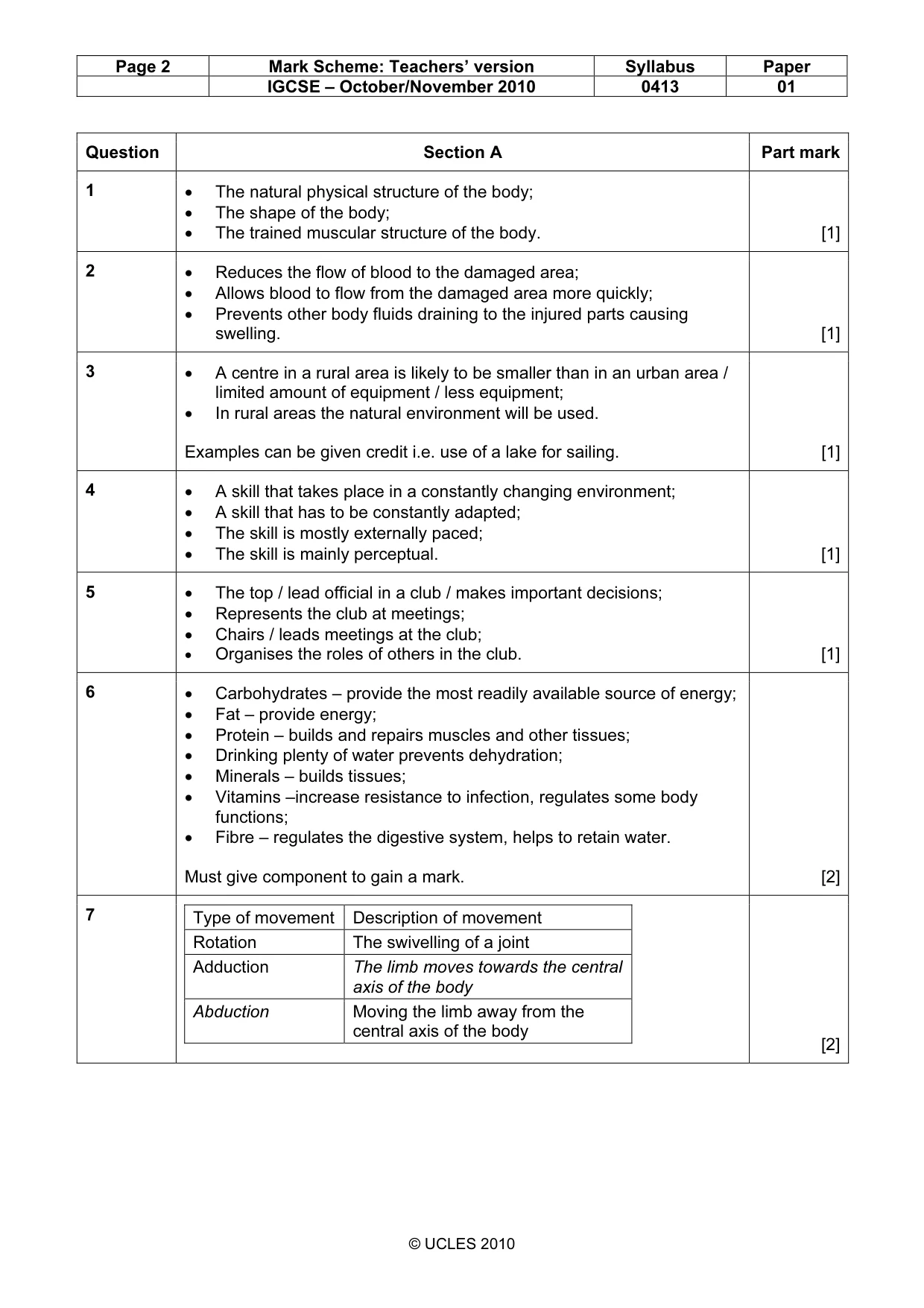
Page 2 Mark Scheme: Teachers’ version Syllabus Paper IGCSE – October/November 2010 0413 01 © UCLES 2010 Question Section A Part mark 1 • The natural physical structure of the body; • The shape of the body; • The trained muscular structure of the body. [1] 2 • Reduces the flow of blood to the damaged area; • Allows blood to flow from the damaged area more quickly; • Prevents other body fluids draining to the injured parts causing swelling. [1] 3 • A centre in a rural area is likely to be smaller than in an urban area / limited amount of equipment / less equipment; • In rural areas the natural environment will be used. Examples can be given credit i.e. use of a lake for sailing. [1] 4 • A skill that takes place in a constantly changing environment; • A skill that has to be constantly adapted; • The skill is mostly externally paced; • The skill is mainly perceptual. [1] 5 • The top / lead official in a club / makes important decisions; • Represents the club at meetings; • Chairs / leads meetings at the club; • Organises the roles of others in the club. [1] 6 • Carbohydrates – provide the most readily available source of energy; • Fat – provide energy; • Protein – builds and repairs muscles and other tissues; • Drinking plenty of water prevents dehydration; • Minerals – builds tissues; • Vitamins –increase resistance to infection, regulates some body functions; • Fibre – regulates the digestive system, helps to retain water. Must give component to gain a mark. [2] 7 [2] Type of movement Description of movement Rotation The swivelling of a joint Adduction The limb moves towards the central axis of the body Abduction Moving the limb away from the central axis of the body
Mark scheme, page 3
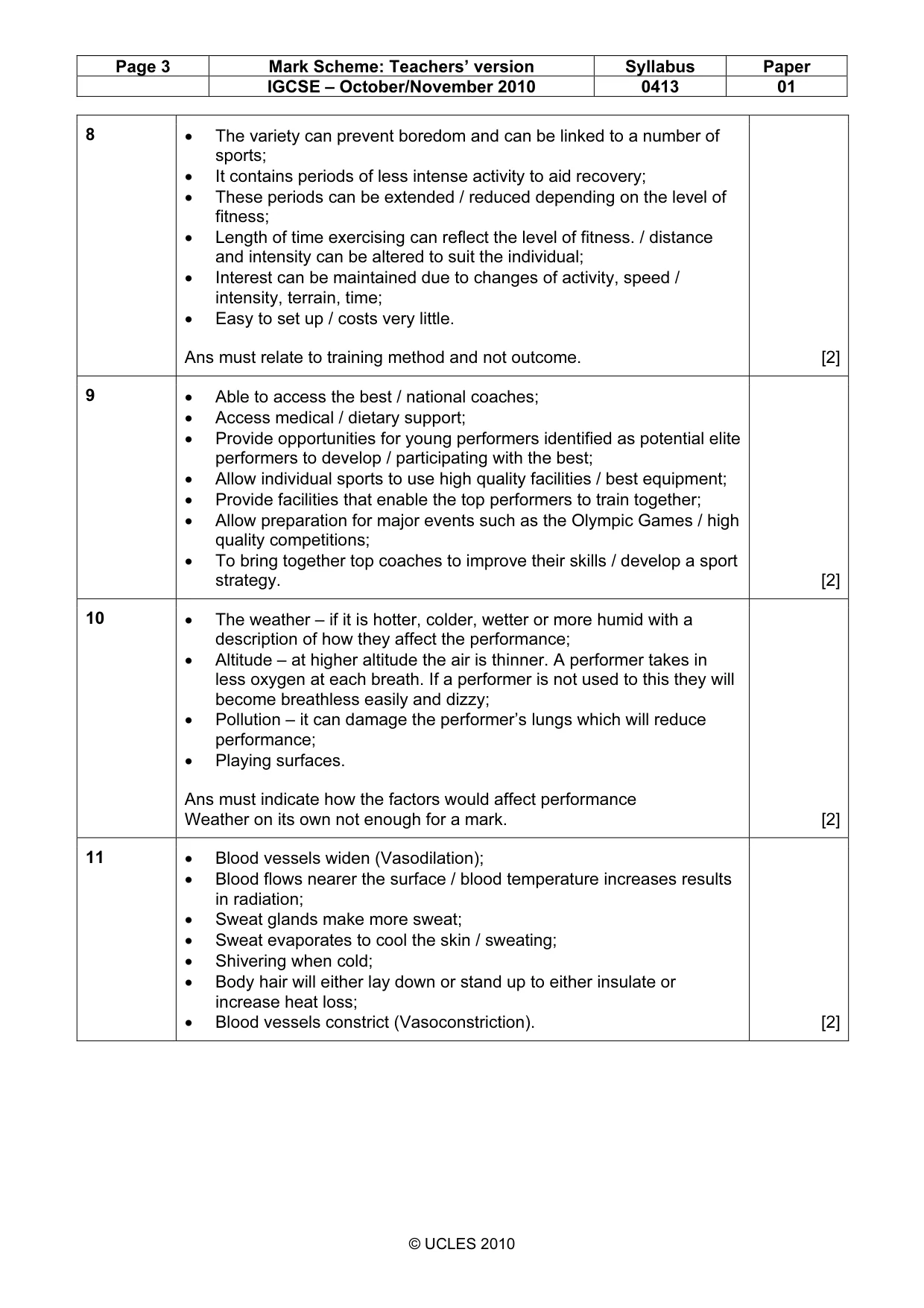
Page 3 Mark Scheme: Teachers’ version Syllabus Paper IGCSE – October/November 2010 0413 01 © UCLES 2010 8 • The variety can prevent boredom and can be linked to a number of sports; • It contains periods of less intense activity to aid recovery; • These periods can be extended / reduced depending on the level of fitness; • Length of time exercising can reflect the level of fitness. / distance and intensity can be altered to suit the individual; • Interest can be maintained due to changes of activity, speed / intensity, terrain, time; • Easy to set up / costs very little. Ans must relate to training method and not outcome. [2] 9 • Able to access the best / national coaches; • Access medical / dietary support; • Provide opportunities for young performers identified as potential elite performers to develop / participating with the best; • Allow individual sports to use high quality facilities / best equipment; • Provide facilities that enable the top performers to train together; • Allow preparation for major events such as the Olympic Games / high quality competitions; • To bring together top coaches to improve their skills / develop a sport strategy. [2] 10 • The weather – if it is hotter, colder, wetter or more humid with a description of how they affect the performance; • Altitude – at higher altitude the air is thinner. A performer takes in less oxygen at each breath. If a performer is not used to this they will become breathless easily and dizzy; • Pollution – it can damage the performer’s lungs which will reduce performance; • Playing surfaces. Ans must indicate how the factors would affect performance Weather on its own not enough for a mark. [2] 11 • Blood vessels widen (Vasodilation); • Blood flows nearer the surface / blood temperature increases results in radiation; • Sweat glands make more sweat; • Sweat evaporates to cool the skin / sweating; • Shivering when cold; • Body hair will either lay down or stand up to either insulate or increase heat loss; • Blood vessels constrict (Vasoconstriction). [2]
Mark scheme, page 4
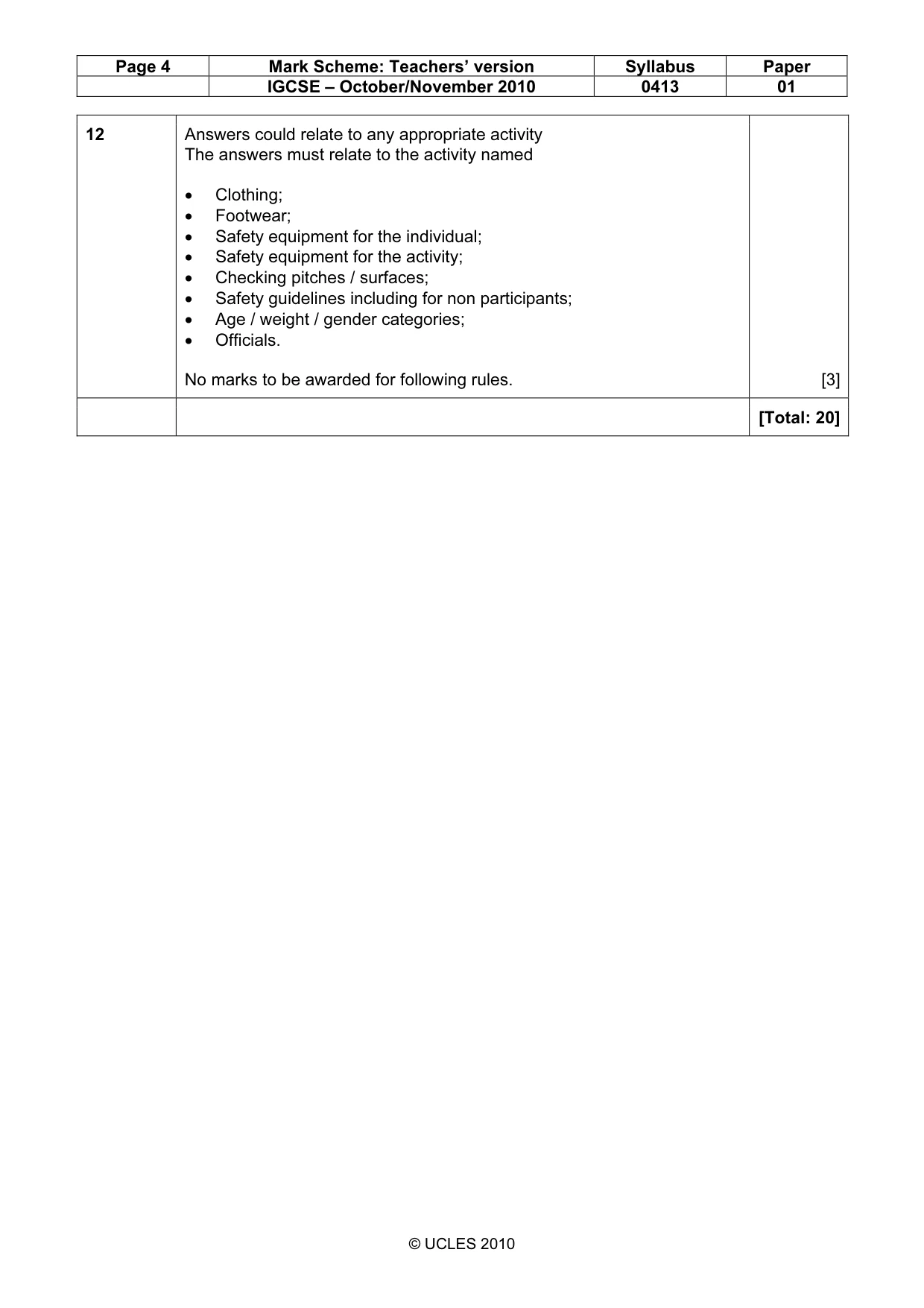
Page 4 Mark Scheme: Teachers’ version Syllabus Paper IGCSE – October/November 2010 0413 01 © UCLES 2010 12 Answers could relate to any appropriate activity The answers must relate to the activity named • Clothing; • Footwear; • Safety equipment for the individual; • Safety equipment for the activity; • Checking pitches / surfaces; • Safety guidelines including for non participants; • Age / weight / gender categories; • Officials. No marks to be awarded for following rules. [3] [Total: 20]
Mark scheme, page 5
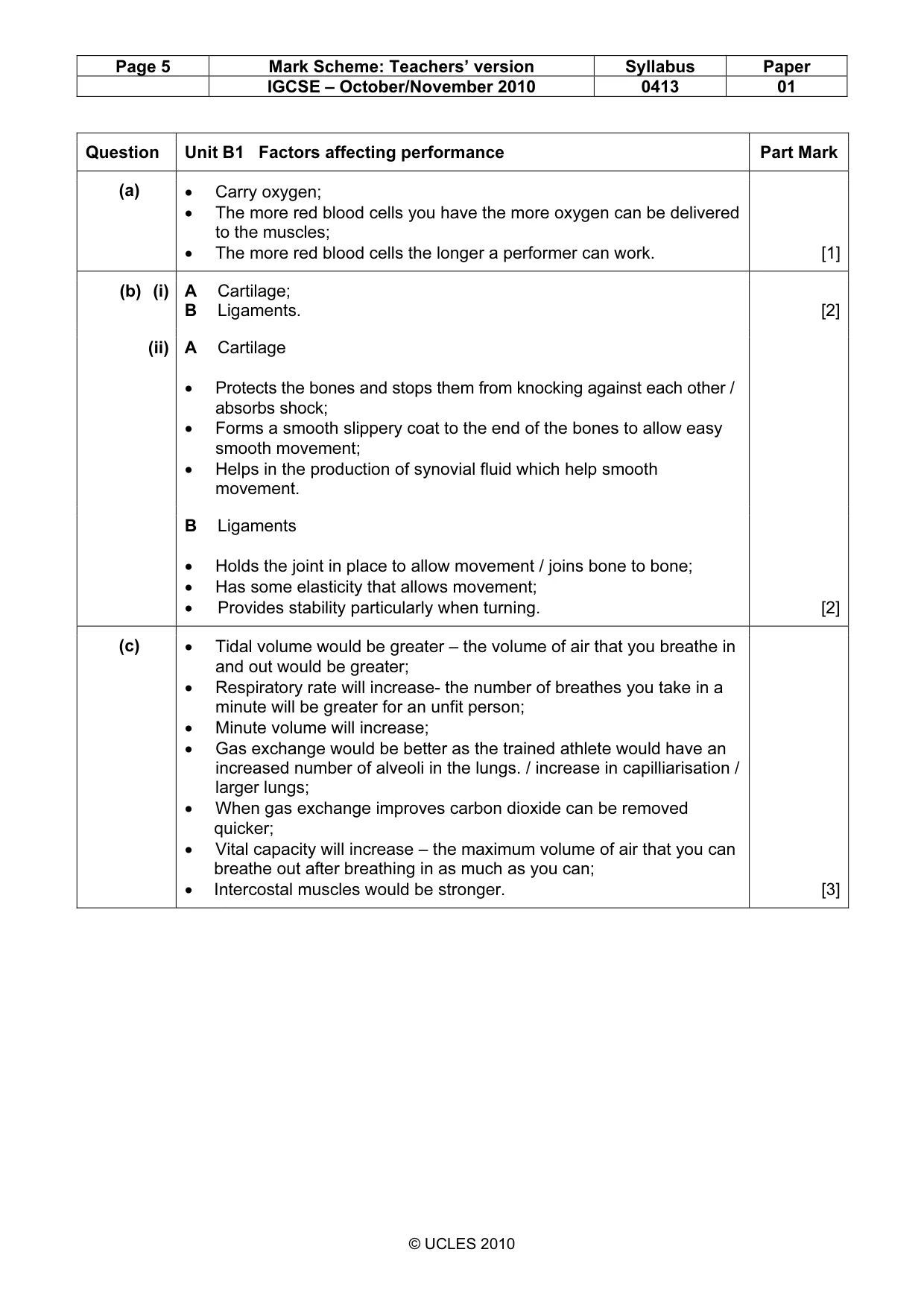
Page 5 Mark Scheme: Teachers’ version Syllabus Paper IGCSE – October/November 2010 0413 01 © UCLES 2010 Question Unit B1 Factors affecting performance Part Mark (a) • Carry oxygen; • The more red blood cells you have the more oxygen can be delivered to the muscles; • The more red blood cells the longer a performer can work. [1] (b) (i) A Cartilage; B Ligaments. [2] (ii) A Cartilage • Protects the bones and stops them from knocking against each other / absorbs shock; • Forms a smooth slippery coat to the end of the bones to allow easy smooth movement; • Helps in the production of synovial fluid which help smooth movement. B Ligaments • Holds the joint in place to allow movement / joins bone to bone; • Has some elasticity that allows movement; • Provides stability particularly when turning. [2] (c) • Tidal volume would be greater – the volume of air that you breathe in and out would be greater; • Respiratory rate will increase- the number of breathes you take in a minute will be greater for an unfit person; • Minute volume will increase; • Gas exchange would be better as the trained athlete would have an increased number of alveoli in the lungs. / increase in capilliarisation / larger lungs; • When gas exchange improves carbon dioxide can be removed quicker; • Vital capacity will increase – the maximum volume of air that you can breathe out after breathing in as much as you can; • Intercostal muscles would be stronger. [3]
Mark scheme, page 6
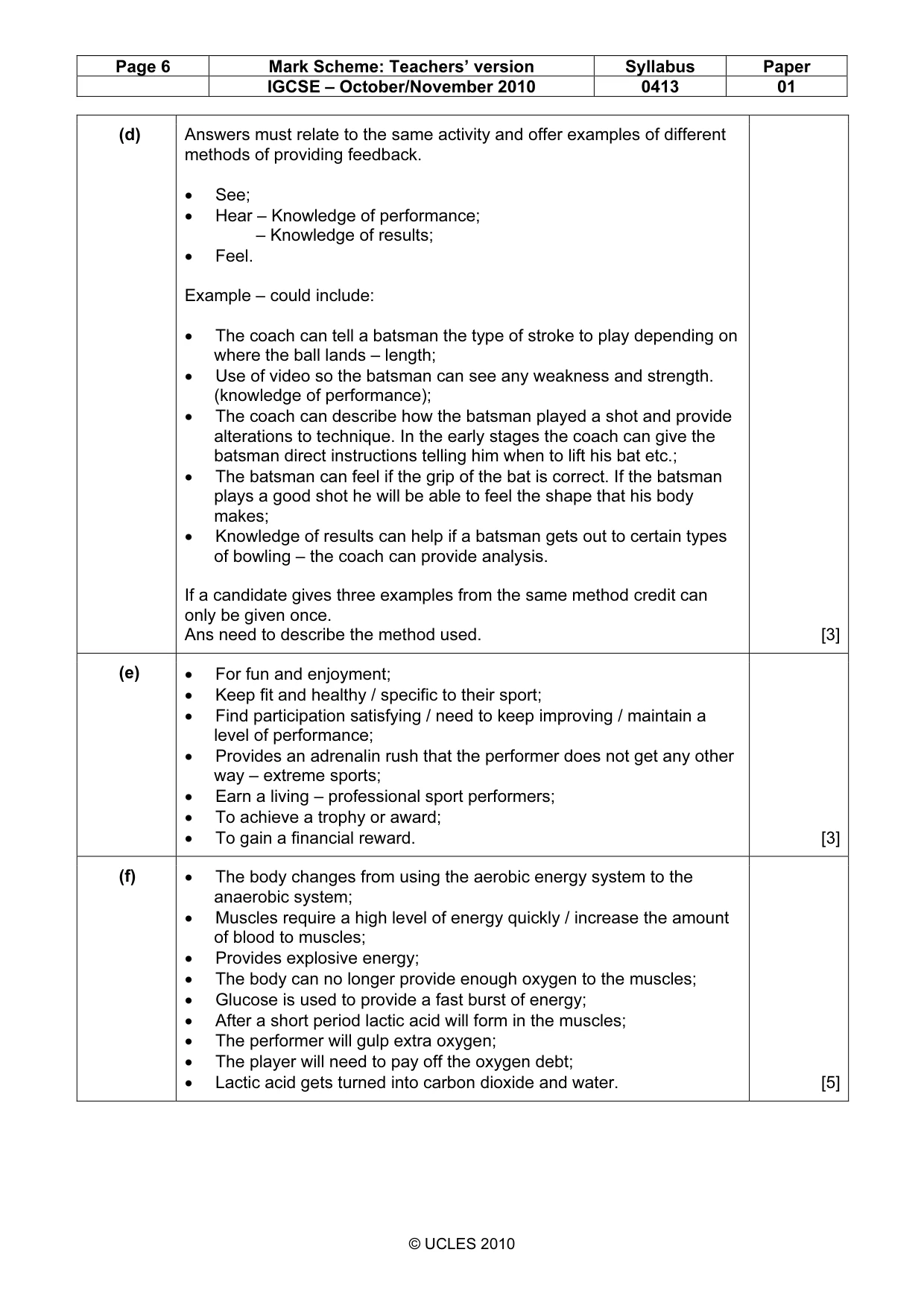
Page 6 Mark Scheme: Teachers’ version Syllabus Paper IGCSE – October/November 2010 0413 01 © UCLES 2010 (d) Answers must relate to the same activity and offer examples of different methods of providing feedback. • See; • Hear – Knowledge of performance; – Knowledge of results; • Feel. Example – could include: • The coach can tell a batsman the type of stroke to play depending on where the ball lands – length; • Use of video so the batsman can see any weakness and strength. (knowledge of performance); • The coach can describe how the batsman played a shot and provide alterations to technique. In the early stages the coach can give the batsman direct instructions telling him when to lift his bat etc.; • The batsman can feel if the grip of the bat is correct. If the batsman plays a good shot he will be able to feel the shape that his body makes; • Knowledge of results can help if a batsman gets out to certain types of bowling – the coach can provide analysis. If a candidate gives three examples from the same method credit can only be given once. Ans need to describe the method used. [3] (e) • For fun and enjoyment; • Keep fit and healthy / specific to their sport; • Find participation satisfying / need to keep improving / maintain a level of performance; • Provides an adrenalin rush that the performer does not get any other way – extreme sports; • Earn a living – professional sport performers; • To achieve a trophy or award; • To gain a financial reward. [3] (f) • The body changes from using the aerobic energy system to the anaerobic system; • Muscles require a high level of energy quickly / increase the amount of blood to muscles; • Provides explosive energy; • The body can no longer provide enough oxygen to the muscles; • Glucose is used to provide a fast burst of energy; • After a short period lactic acid will form in the muscles; • The performer will gulp extra oxygen; • The player will need to pay off the oxygen debt; • Lactic acid gets turned into carbon dioxide and water. [5]
Mark scheme, page 7
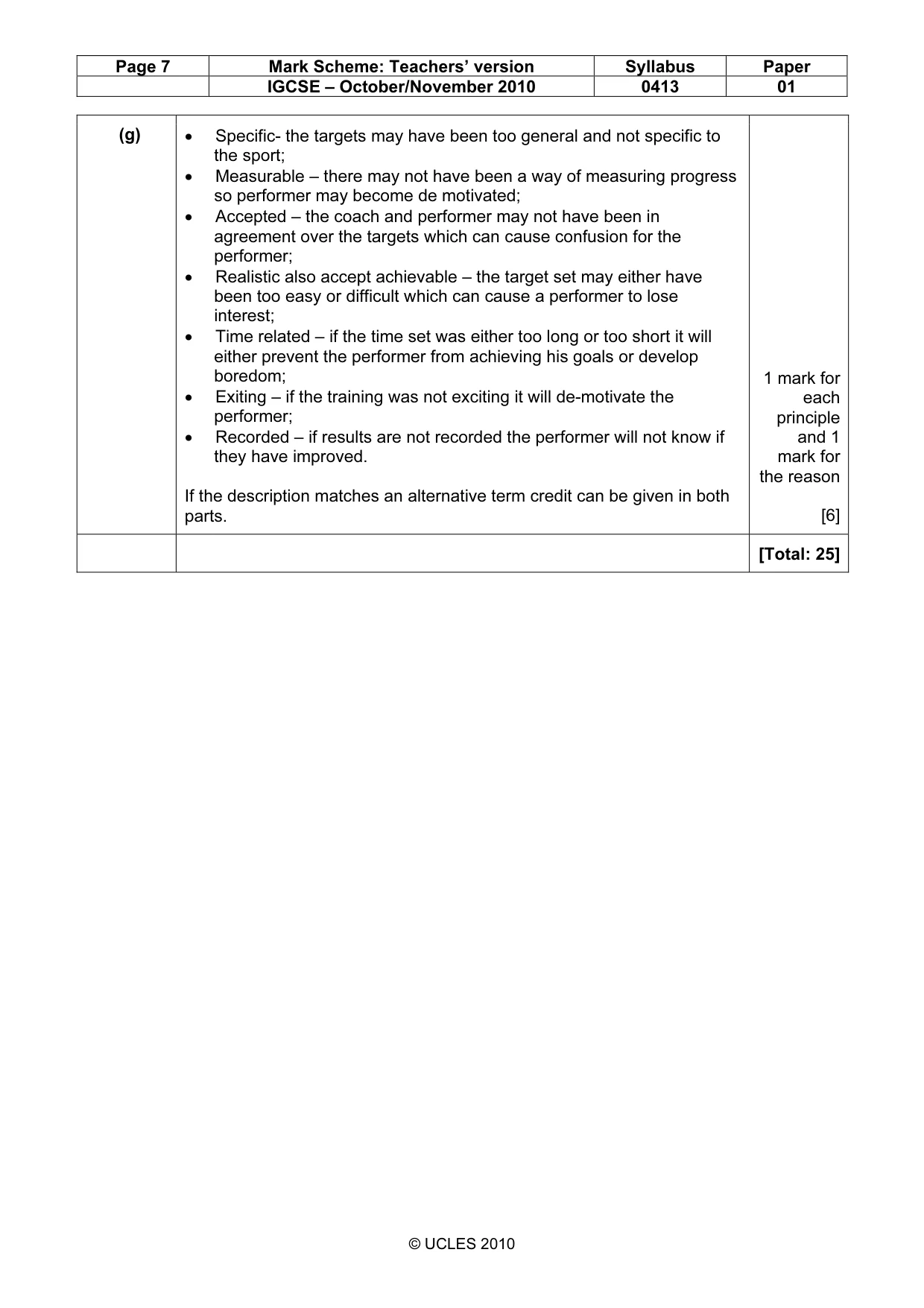
Page 7 Mark Scheme: Teachers’ version Syllabus Paper IGCSE – October/November 2010 0413 01 © UCLES 2010 (g) • Specific- the targets may have been too general and not specific to the sport; • Measurable – there may not have been a way of measuring progress so performer may become de motivated; • Accepted – the coach and performer may not have been in agreement over the targets which can cause confusion for the performer; • Realistic also accept achievable – the target set may either have been too easy or difficult which can cause a performer to lose interest; • Time related – if the time set was either too long or too short it will either prevent the performer from achieving his goals or develop boredom; • Exiting – if the training was not exciting it will de-motivate the performer; • Recorded – if results are not recorded the performer will not know if they have improved. If the description matches an alternative term credit can be given in both parts. 1 mark for each principle and 1 mark for the reason [6] [Total: 25]
Mark scheme, page 8
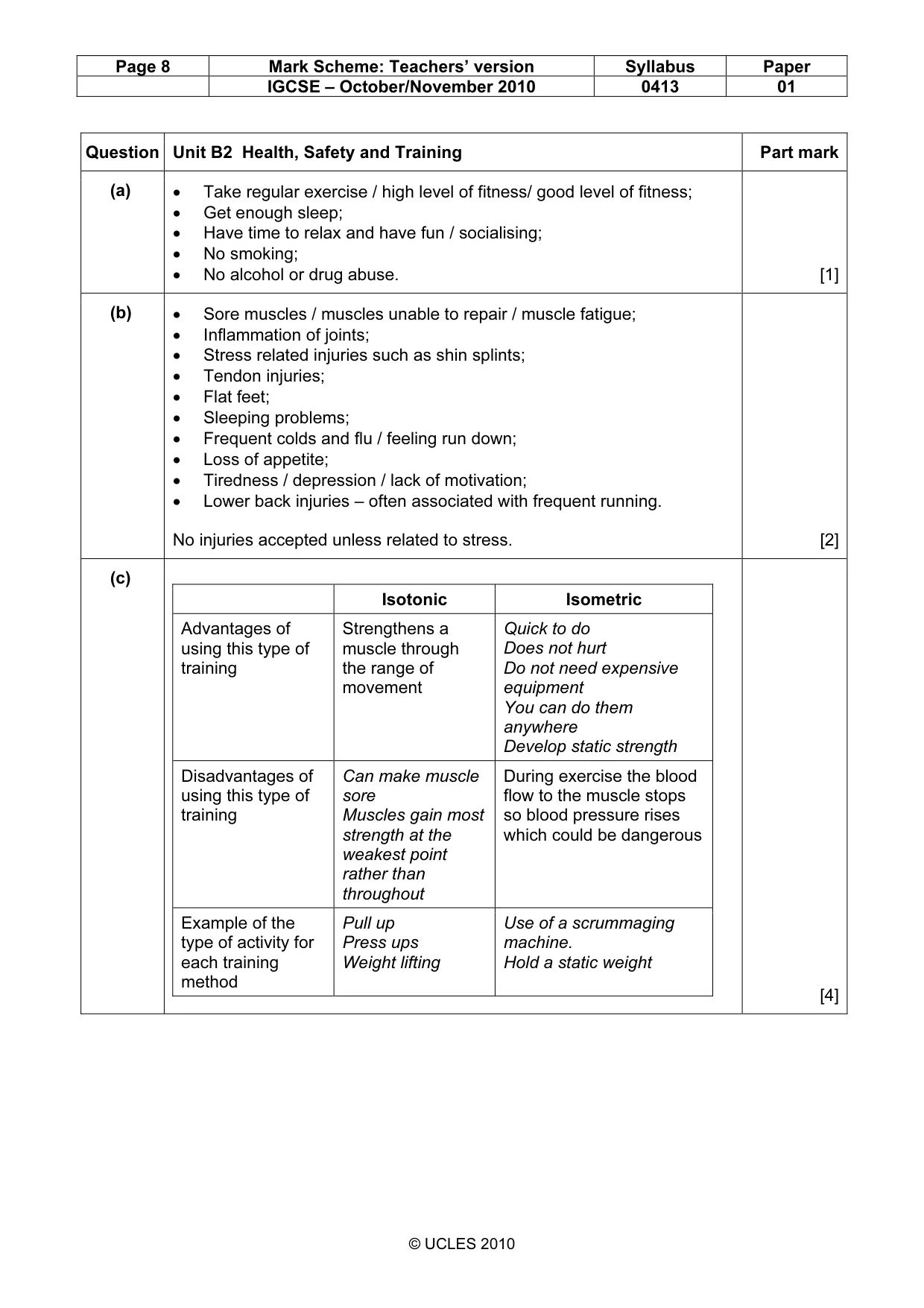
Page 8 Mark Scheme: Teachers’ version Syllabus Paper IGCSE – October/November 2010 0413 01 © UCLES 2010 Question Unit B2 Health, Safety and Training Part mark (a) • Take regular exercise / high level of fitness/ good level of fitness; • Get enough sleep; • Have time to relax and have fun / socialising; • No smoking; • No alcohol or drug abuse. [1] (b) • Sore muscles / muscles unable to repair / muscle fatigue; • Inflammation of joints; • Stress related injuries such as shin splints; • Tendon injuries; • Flat feet; • Sleeping problems; • Frequent colds and flu / feeling run down; • Loss of appetite; • Tiredness / depression / lack of motivation; • Lower back injuries – often associated with frequent running. No injuries accepted unless related to stress. [2] (c) [4] Isotonic Isometric Advantages of using this type of training Strengthens a muscle through the range of movement Quick to do Does not hurt Do not need expensive equipment You can do them anywhere Develop static strength Disadvantages of using this type of training Can make muscle sore Muscles gain most strength at the weakest point rather than throughout During exercise the blood flow to the muscle stops so blood pressure rises which could be dangerous Example of the type of activity for each training method Pull up Press ups Weight lifting Use of a scrummaging machine. Hold a static weight
Mark scheme, page 9
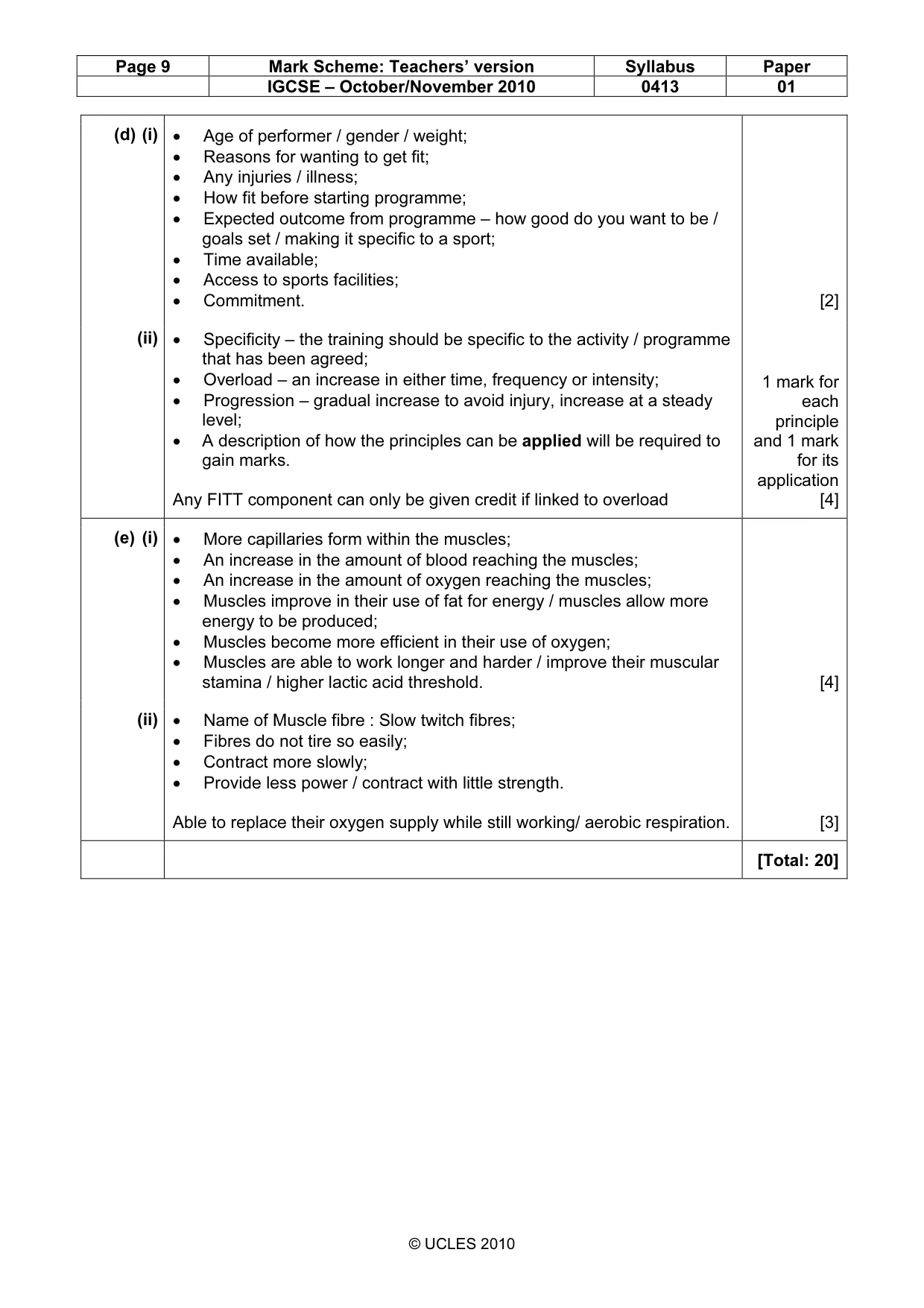
Page 9 Mark Scheme: Teachers’ version Syllabus Paper IGCSE – October/November 2010 0413 01 © UCLES 2010 (d) (i) • Age of performer / gender / weight; • Reasons for wanting to get fit; • Any injuries / illness; • How fit before starting programme; • Expected outcome from programme – how good do you want to be / goals set / making it specific to a sport; • Time available; • Access to sports facilities; • Commitment. [2] (ii) • Specificity – the training should be specific to the activity / programme that has been agreed; • Overload – an increase in either time, frequency or intensity; • Progression – gradual increase to avoid injury, increase at a steady level; • A description of how the principles can be applied will be required to gain marks. Any FITT component can only be given credit if linked to overload 1 mark for each principle and 1 mark for its application [4] (e) (i) • More capillaries form within the muscles; • An increase in the amount of blood reaching the muscles; • An increase in the amount of oxygen reaching the muscles; • Muscles improve in their use of fat for energy / muscles allow more energy to be produced; • Muscles become more efficient in their use of oxygen; • Muscles are able to work longer and harder / improve their muscular stamina / higher lactic acid threshold. [4] (ii) • Name of Muscle fibre : Slow twitch fibres; • Fibres do not tire so easily; • Contract more slowly; • Provide less power / contract with little strength. Able to replace their oxygen supply while still working/ aerobic respiration. [3] [Total: 20]
Mark scheme, page 10
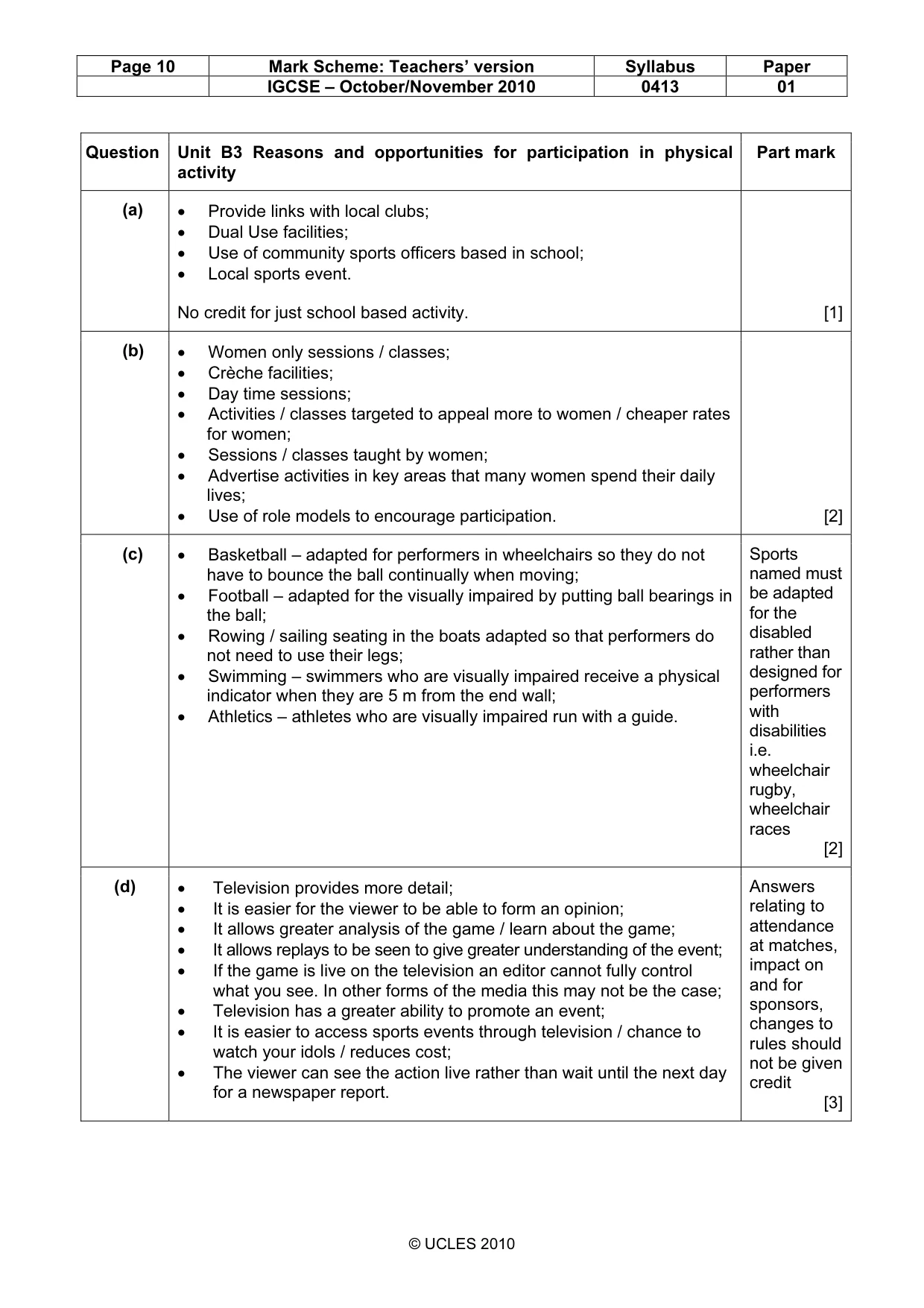
Page 10 Mark Scheme: Teachers’ version Syllabus Paper IGCSE – October/November 2010 0413 01 © UCLES 2010 Question Unit B3 Reasons and opportunities for participation in physical activity Part mark (a) • Provide links with local clubs; • Dual Use facilities; • Use of community sports officers based in school; • Local sports event. No credit for just school based activity. [1] (b) • Women only sessions / classes; • Crèche facilities; • Day time sessions; • Activities / classes targeted to appeal more to women / cheaper rates for women; • Sessions / classes taught by women; • Advertise activities in key areas that many women spend their daily lives; • Use of role models to encourage participation. [2] (c) • Basketball – adapted for performers in wheelchairs so they do not have to bounce the ball continually when moving; • Football – adapted for the visually impaired by putting ball bearings in the ball; • Rowing / sailing seating in the boats adapted so that performers do not need to use their legs; • Swimming – swimmers who are visually impaired receive a physical indicator when they are 5 m from the end wall; • Athletics – athletes who are visually impaired run with a guide. Sports named must be adapted for the disabled rather than designed for performers with disabilities i.e. wheelchair rugby, wheelchair races [2] (d) • Television provides more detail; • It is easier for the viewer to be able to form an opinion; • It allows greater analysis of the game / learn about the game; • It allows replays to be seen to give greater understanding of the event; • If the game is live on the television an editor cannot fully control what you see. In other forms of the media this may not be the case; • Television has a greater ability to promote an event; • It is easier to access sports events through television / chance to watch your idols / reduces cost; • The viewer can see the action live rather than wait until the next day for a newspaper report. Answers relating to attendance at matches, impact on and for sponsors, changes to rules should not be given credit [3]
Mark scheme, page 11
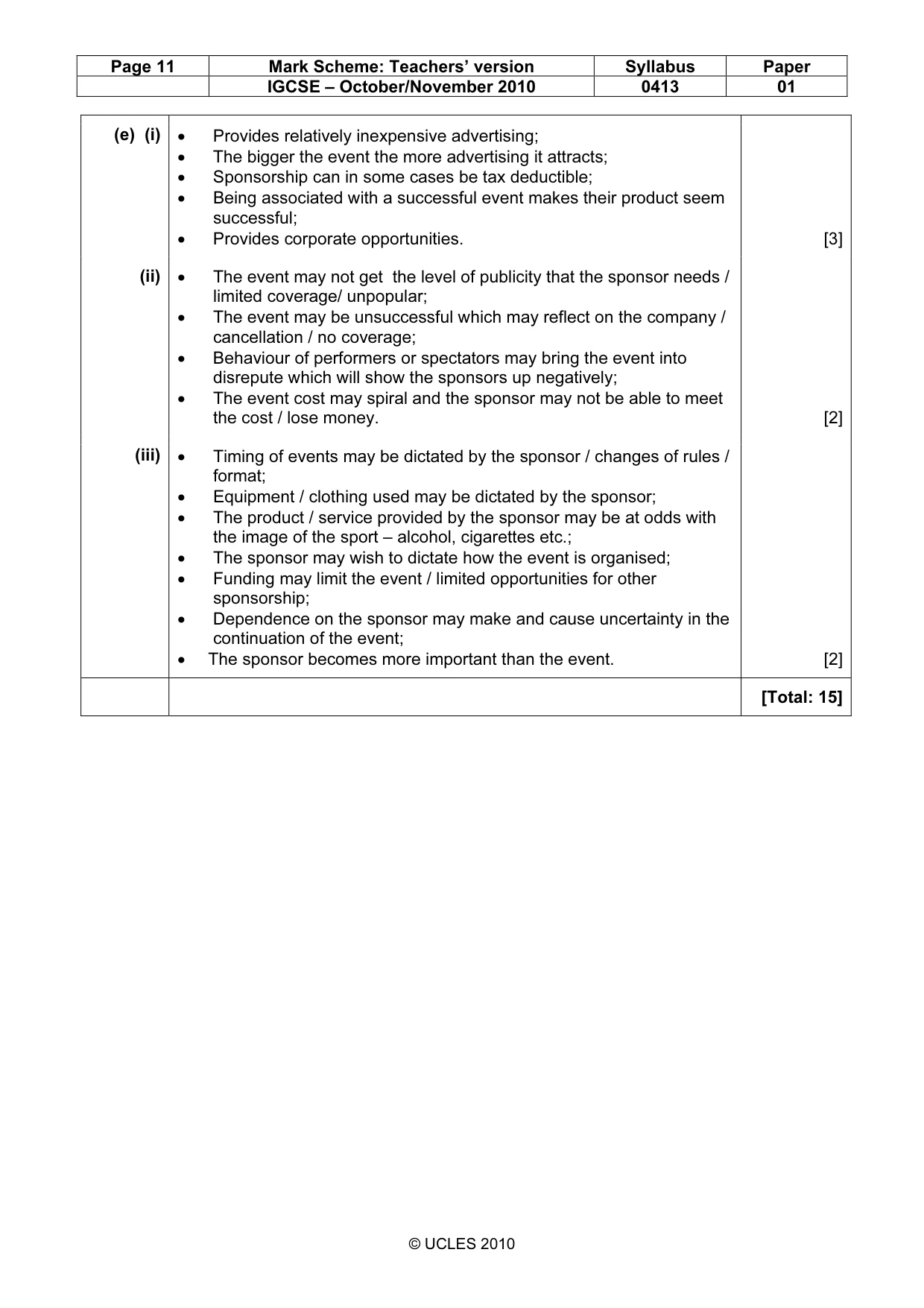
Page 11 Mark Scheme: Teachers’ version Syllabus Paper IGCSE – October/November 2010 0413 01 © UCLES 2010 (e) (i) • Provides relatively inexpensive advertising; • The bigger the event the more advertising it attracts; • Sponsorship can in some cases be tax deductible; • Being associated with a successful event makes their product seem successful; • Provides corporate opportunities. [3] (ii) • The event may not get the level of publicity that the sponsor needs / limited coverage/ unpopular; • The event may be unsuccessful which may reflect on the company / cancellation / no coverage; • Behaviour of performers or spectators may bring the event into disrepute which will show the sponsors up negatively; • The event cost may spiral and the sponsor may not be able to meet the cost / lose money. [2] (iii) • Timing of events may be dictated by the sponsor / changes of rules / format; • Equipment / clothing used may be dictated by the sponsor; • The product / service provided by the sponsor may be at odds with the image of the sport – alcohol, cigarettes etc.; • The sponsor may wish to dictate how the event is organised; • Funding may limit the event / limited opportunities for other sponsorship; • Dependence on the sponsor may make and cause uncertainty in the continuation of the event; • The sponsor becomes more important than the event. [2] [Total: 15]
What you needed in this session
Cambridge’s own grade thresholds for 2010 Oct/Nov, Paper 1 · Variant 1. A higher threshold means an easier paper — the bar moves with how the cohort did.