Cambridge IGCSE Physical Education 0413 — 2009 Oct/Nov Paper 1 · Variant 1
0413/11/O/N/09 · 80 marks · ≈90 min
The question paper and its mark scheme, free to read here and free to download. This is Cambridge’s own paper, exactly as it was sat.
Question paper16 pages





Mark scheme12 pages
Answers below. Sit the paper first if you are practising.
Paper as text
Question paper, page 1
This document consists of 13 printed pages and 3 blank pages. SHW 00232 4/08 V04367/1 © UCLES 2009 [Turn over UNIVERSITY OF CAMBRIDGE INTERNATIONAL EXAMINATIONS International General Certificate of Secondary Education READ THESE INSTRUCTIONS FIRST Write your Centre number, candidate number and name on all the work you hand in. Write in dark blue or black pen. You may use a soft pencil for any diagrams, graphs or rough working. Do not use staples, paper clips, highlighters, glue or correction fluid. DO NOT WRITE IN ANY BARCODES. Answer all questions. At the end of the examination, fasten all your work securely together. The number of marks is given in brackets [ ] at the end of each question or part question. * 2 3 5 9 7 1 8 8 1 0 * PHYSICAL EDUCATION 0413/01 Paper 1 October/November 2009 1 hour 45 minutes Candidates answer on the Question Paper. No Additional Materials are required. For Examiner’s Use Section A B1 B2 B3 Total www.XtremePapers.com
Question paper, page 2
0413/01/O/N/09 © UCLES 2009 For Examiner’s Use Section A Answer all questions in this section. 1 Give one definition of the term Social Well-being. … … [1] 2 Apart from providing energy name another reason why the body needs nutrients. … … [1] 3 Most drugs can harm a performer in some way. Name one socially accepted drug. … … [1] 4 Describe one way that unemployment can reduce the level of participation in physical activity. … … [1] 5 Describe one main bone that helps in the production of blood. … … [1] 6 Give two forms of extrinsic motivation. … … … … [2] 2
Question paper, page 3
3 0413/01/O/N/09 © UCLES 2009 [Turn over For Examiner’s Use 7 Describe two factors that could encourage older people to participate in physical activities. … … … … [2] 8 There are far fewer female professional teams compared to those for males. Give two reasons why this is the case. … … … … … [2] 9 Describe two benefits, other than helping to prevent injury that can be gained from a warm up. … … … … [2] 10 Bruising is an injury commonly associated with contact sports. What is meant by the term bruising? … … [1] 11 Give one sign or symptom of bruising. … … [1]
Question paper, page 4
4 0413/01/O/N/09 © UCLES 2009 For Examiner’s Use 12 Describe two ways in which a sports centre can encourage participation. … … … … [2] 13 Describe three ways that schools help to promote participation amongst its students. … … … … … … [3] [Total: 20]
Question paper, page 5
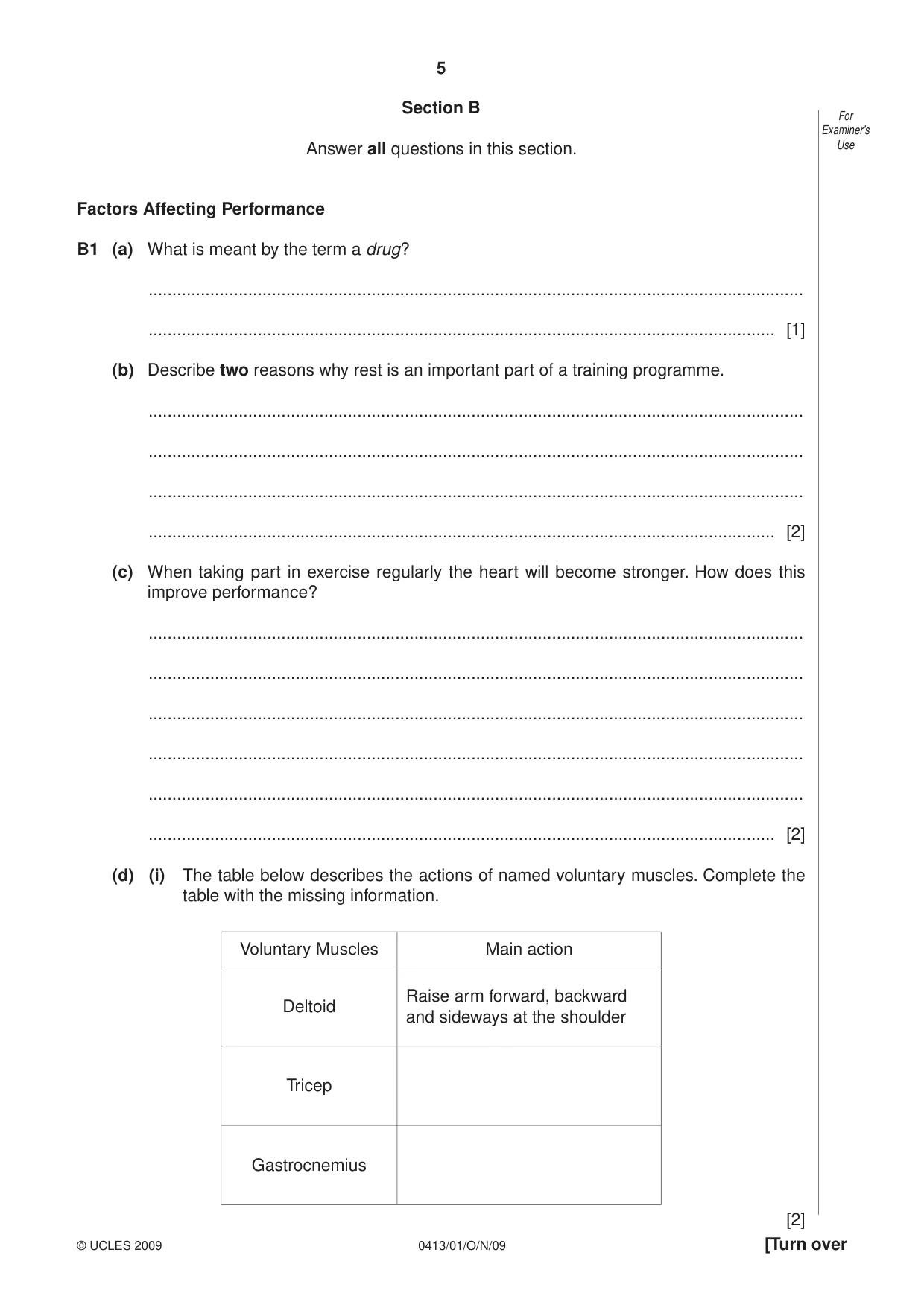
0413/01/O/N/09 © UCLES 2009 [Turn over For Examiner’s Use Section B Answer all questions in this section. Factors Affecting Performance B1 (a) What is meant by the term a drug? … … [1] (b) Describe two reasons why rest is an important part of a training programme. … … … … [2] (c) When taking part in exercise regularly the heart will become stronger. How does this improve performance? … … … … … … [2] (d) (i) The table below describes the actions of named voluntary muscles. Complete the table with the missing information. Voluntary Muscles Main action Deltoid Raise arm forward, backward and sideways at the shoulder Tricep Gastrocnemius [2] 5
Question paper, page 6
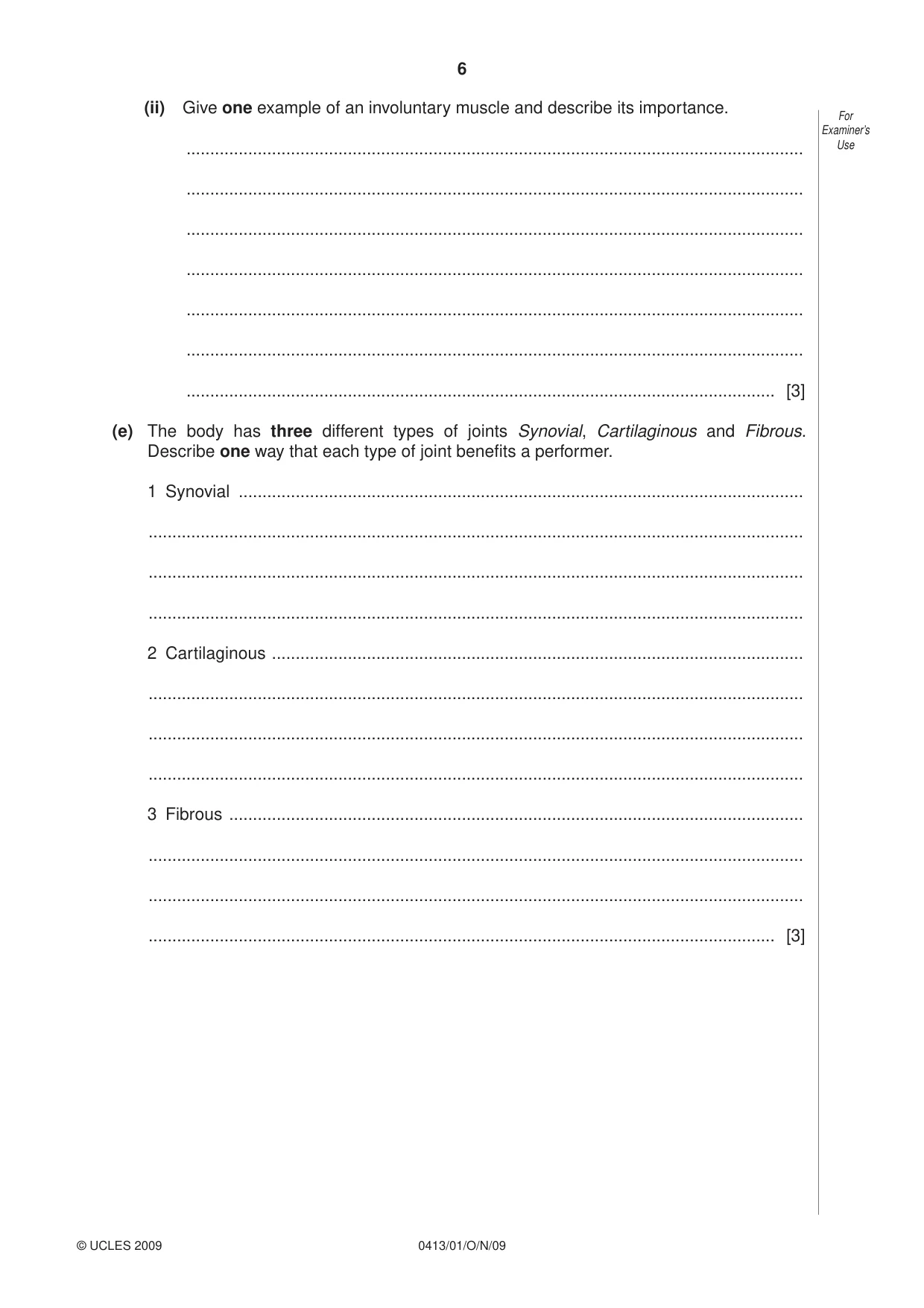
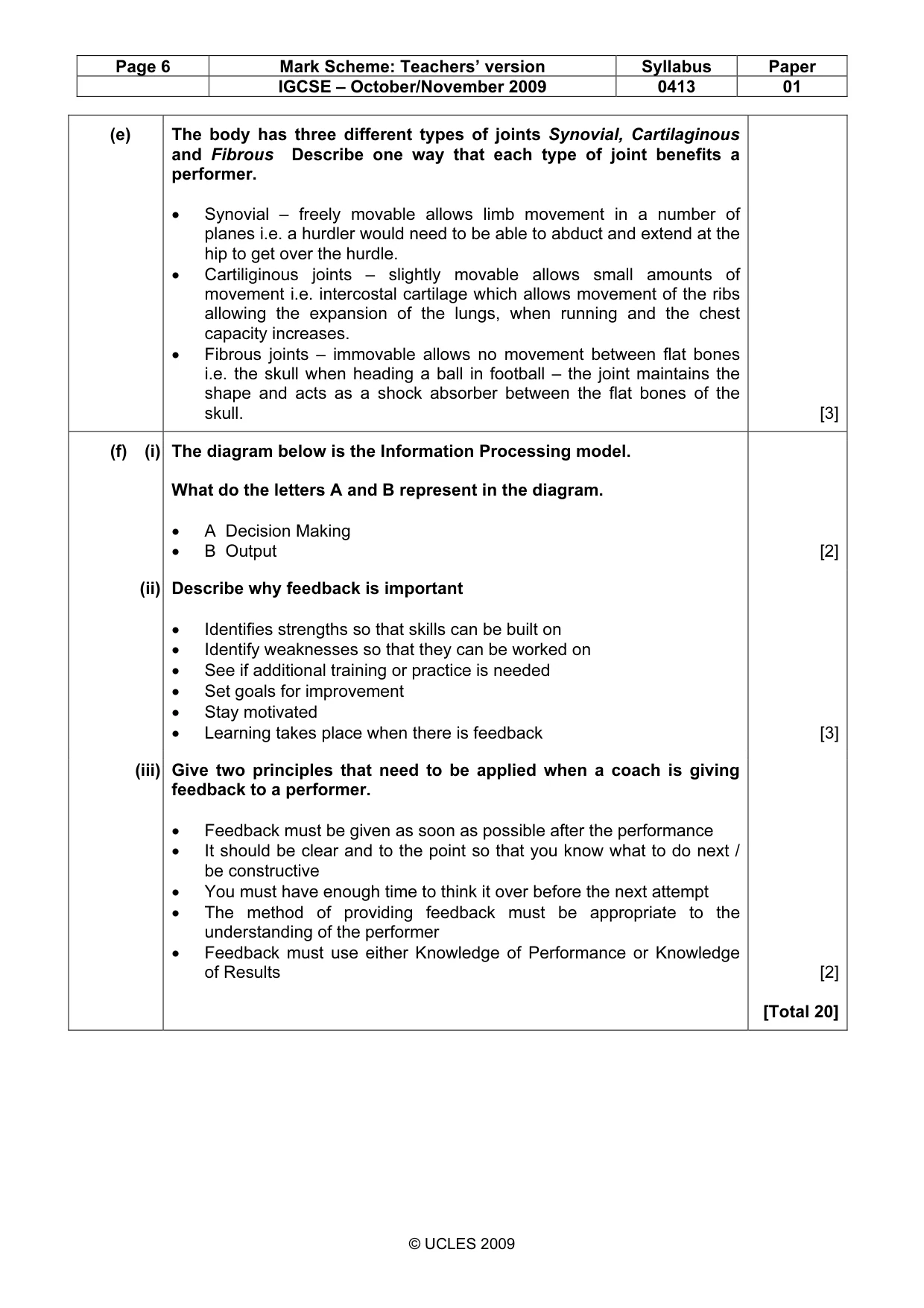
6 0413/01/O/N/09 © UCLES 2009 For Examiner’s Use (ii) Give one example of an involuntary muscle and describe its importance. … … … … … … … [3] (e) The body has three different types of joints Synovial, Cartilaginous and Fibrous. Describe one way that each type of joint benefits a performer. 1 Synovial … … … … 2 Cartilaginous … … … … 3 Fibrous … … … … [3]
Question paper, page 7
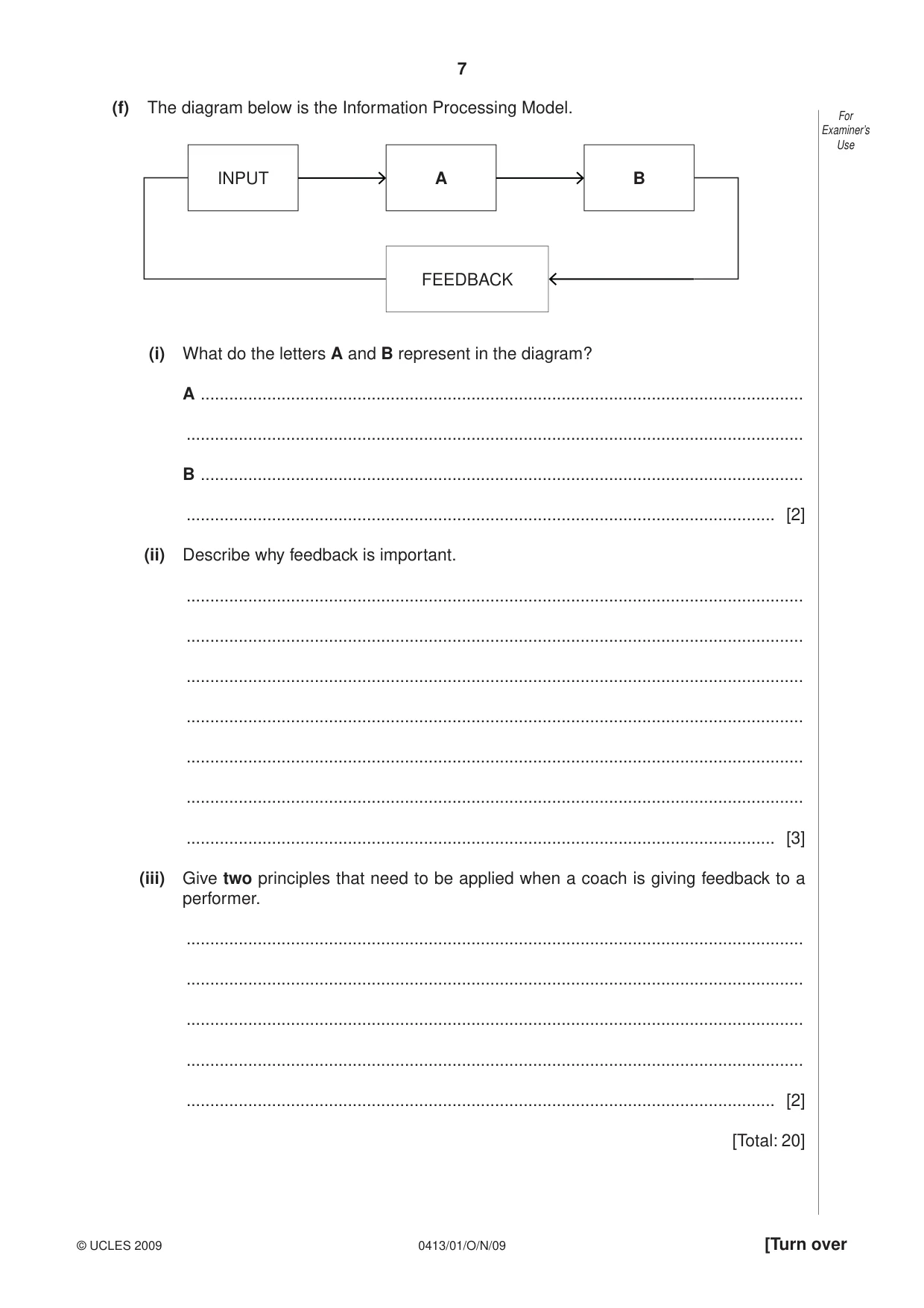
7 0413/01/O/N/09 © UCLES 2009 [Turn over For Examiner’s Use (f) The diagram below is the Information Processing Model. INPUT A B FEEDBACK (i) What do the letters A and B represent in the diagram? A … … B … … [2] (ii) Describe why feedback is important. … … … … … … … [3] (iii) Give two principles that need to be applied when a coach is giving feedback to a performer. … … … … … [2] [Total: 20]
Question paper, page 8
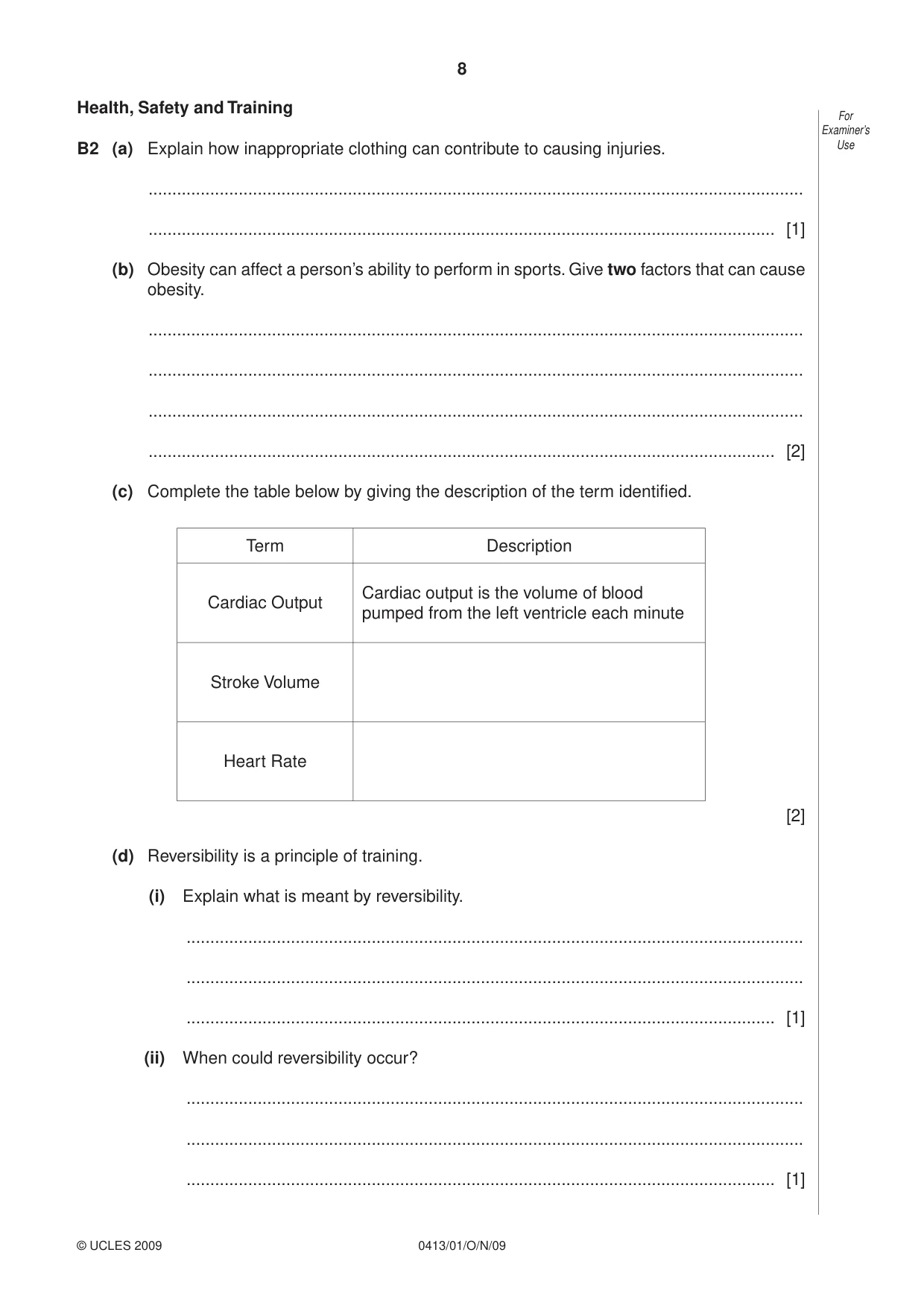
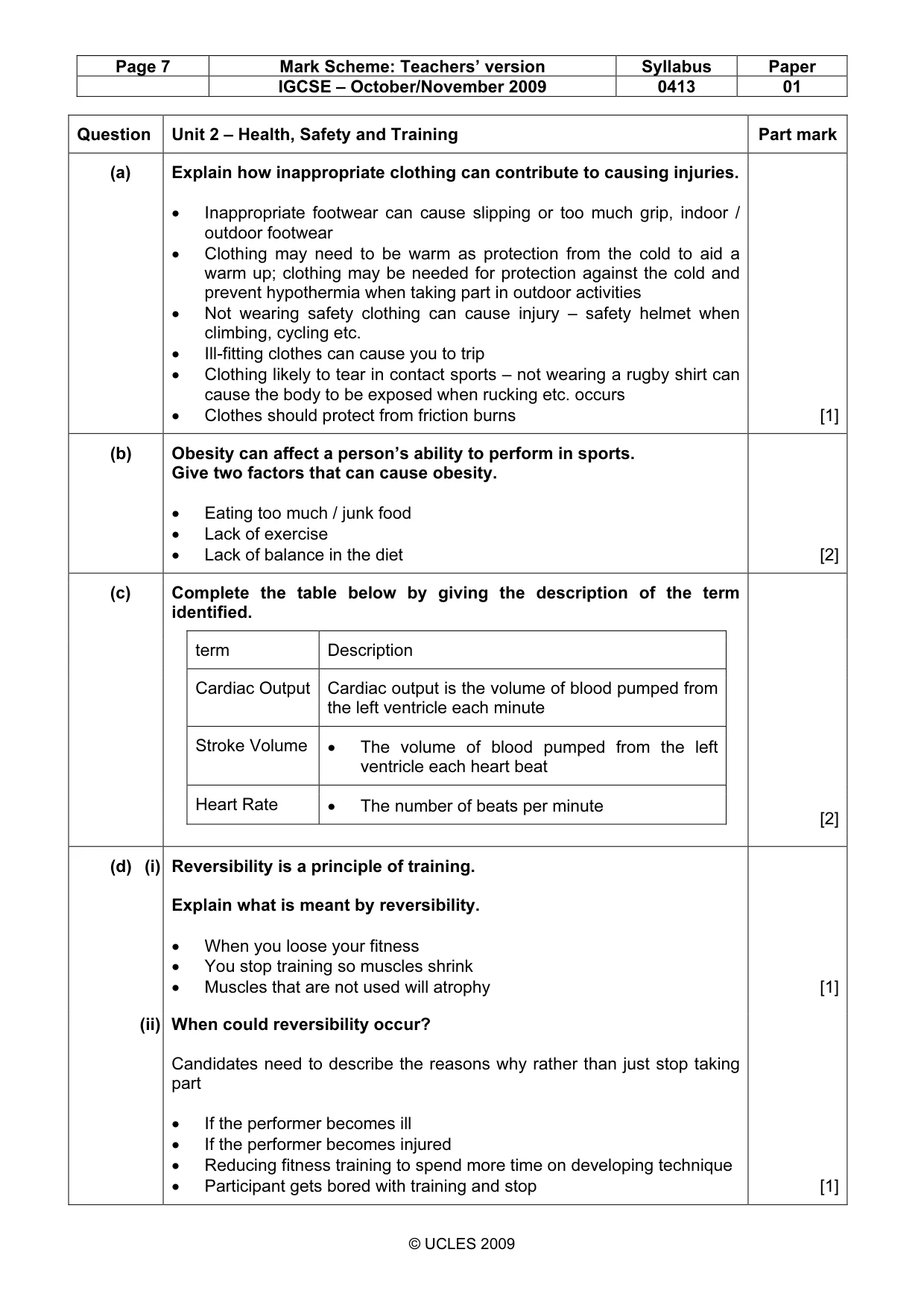
8 0413/01/O/N/09 © UCLES 2009 For Examiner’s Use Health, Safety and Training B2 (a) Explain how inappropriate clothing can contribute to causing injuries. … … [1] (b) Obesity can affect a person’s ability to perform in sports. Give two factors that can cause obesity. … … … … [2] (c) Complete the table below by giving the description of the term identified. Term Description Cardiac Output Cardiac output is the volume of blood pumped from the left ventricle each minute Stroke Volume Heart Rate [2] (d) Reversibility is a principle of training. (i) Explain what is meant by reversibility. … … … [1] (ii) When could reversibility occur? … … … [1]
Question paper, page 9
9 0413/01/O/N/09 © UCLES 2009 [Turn over For Examiner’s Use (iii) Choose one of the other principles of training and explain how this is used in a weight training programme. … … … … … … … [2] (e) (i) Explain the benefits of being involved in a Fartlek Training programme. … … … … … … … … [3] (ii) Explain how you would use the overload principle in Fartlek Training to improve performance. … … … [1]
Question paper, page 10
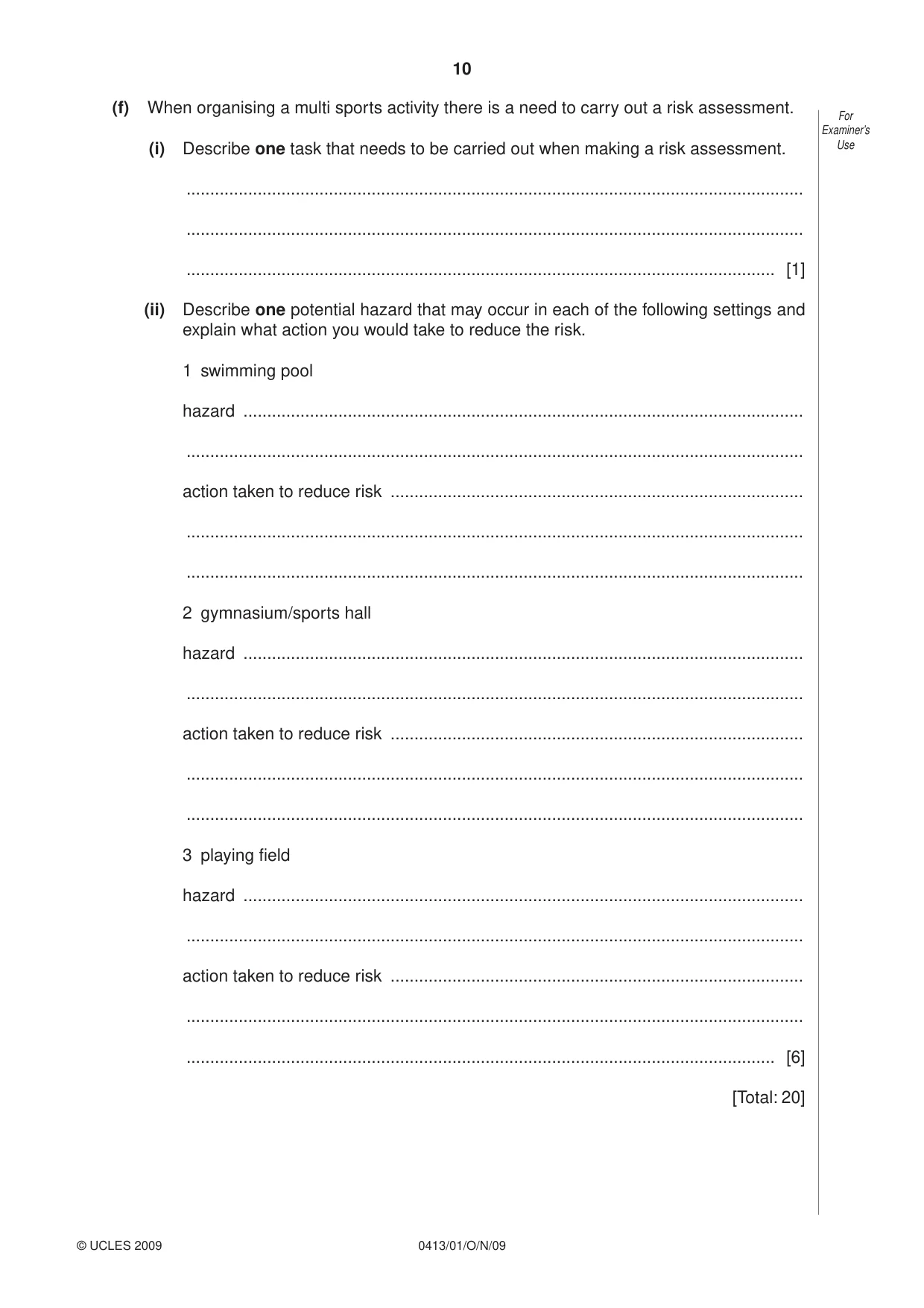
10 0413/01/O/N/09 © UCLES 2009 For Examiner’s Use (f) When organising a multi sports activity there is a need to carry out a risk assessment. (i) Describe one task that needs to be carried out when making a risk assessment. … … … [1] (ii) Describe one potential hazard that may occur in each of the following settings and explain what action you would take to reduce the risk. 1 swimming pool hazard … … action taken to reduce risk … … … 2 gymnasium/sports hall hazard … … action taken to reduce risk … … … 3 playing field hazard … … action taken to reduce risk … … … [6] [Total: 20]
Question paper, page 11
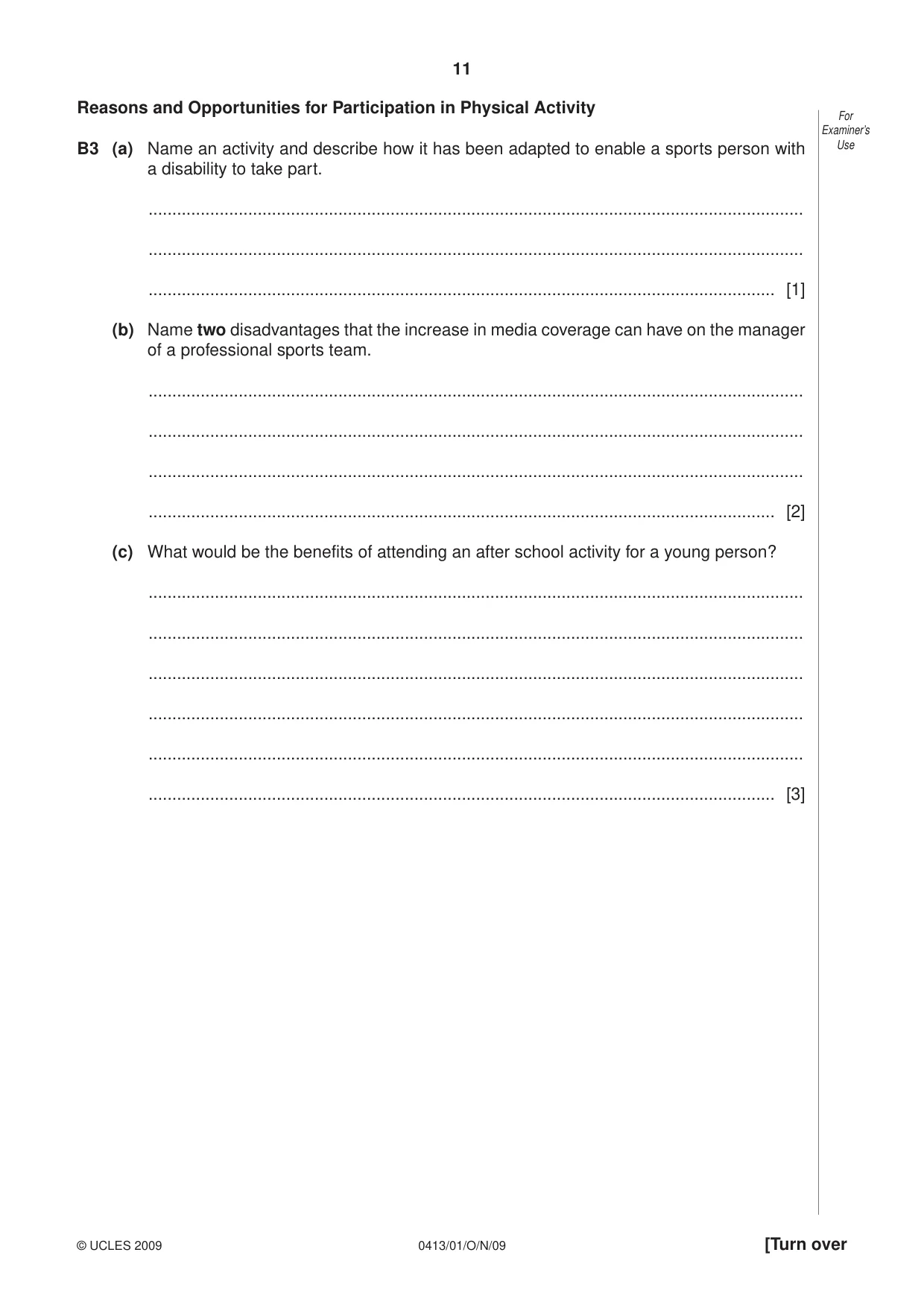
11 0413/01/O/N/09 © UCLES 2009 [Turn over For Examiner’s Use Reasons and Opportunities for Participation in Physical Activity B3 (a) Name an activity and describe how it has been adapted to enable a sports person with a disability to take part. … … … [1] (b) Name two disadvantages that the increase in media coverage can have on the manager of a professional sports team. … … … … [2] (c) What would be the benefits of attending an after school activity for a young person? … … … … … … [3]
Question paper, page 12
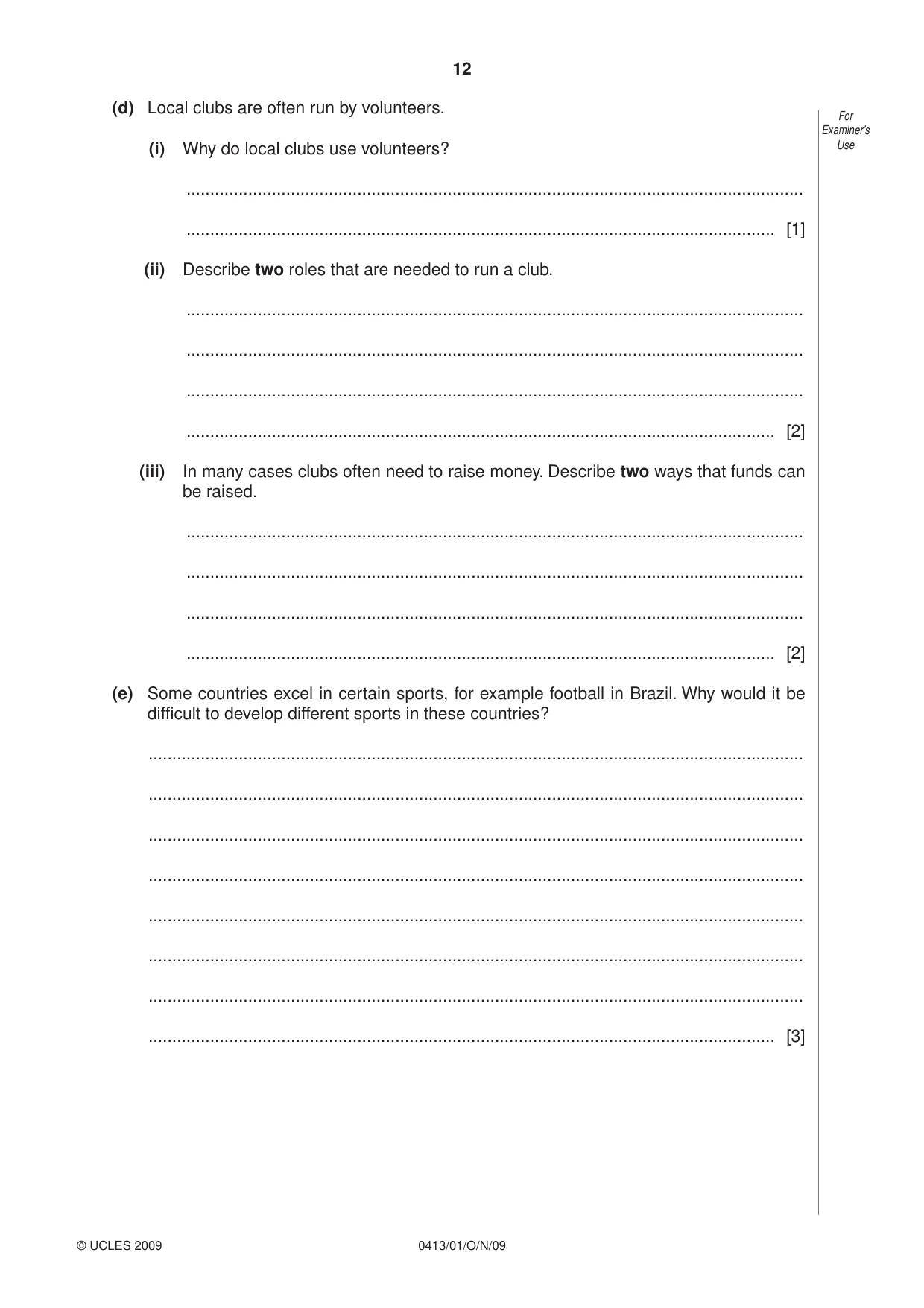
12 0413/01/O/N/09 © UCLES 2009 For Examiner’s Use (d) Local clubs are often run by volunteers. (i) Why do local clubs use volunteers? … … [1] (ii) Describe two roles that are needed to run a club. … … … … [2] (iii) In many cases clubs often need to raise money. Describe two ways that funds can be raised. … … … … [2] (e) Some countries excel in certain sports, for example football in Brazil. Why would it be difficult to develop different sports in these countries? … … … … … … … … [3]
Question paper, page 13
13 0413/01/O/N/09 © UCLES 2009 For Examiner’s Use (f) (i) What are the positive effects of the media on sport? … … … … … … … … [3] (ii) Using two named sports, describe some of the changes that have been brought about by television coverage. … … … … … … … … [3] [Total: 20]
Question paper, page 16
16 0413/01/O/N/09 BLANK PAGE Permission to reproduce items where third-party owned material protected by copyright is included has been sought and cleared where possible. Every reasonable effort has been made by the publisher (UCLES) to trace copyright holders, but if any items requiring clearance have unwittingly been included, the publisher will be pleased to make amends at the earliest possible opportunity. University of Cambridge International Examinations is part of the Cambridge Assessment Group. Cambridge Assessment is the brand name of University of Cambridge Local Examinations Syndicate (UCLES), which is itself a department of the University of Cambridge.
Mark scheme, page 1
UNIVERSITY OF CAMBRIDGE INTERNATIONAL EXAMINATIONS International General Certificate of Secondary Education MARK SCHEME for the October/November 2009 question paper for the guidance of teachers 0413 PHYSICAL EDUCATION 0413/01 Paper 1 (Theory), maximum raw mark 80 This mark scheme is published as an aid to teachers and candidates, to indicate the requirements of the examination. It shows the basis on which Examiners were instructed to award marks. It does not indicate the details of the discussions that took place at an Examiners’ meeting before marking began, which would have considered the acceptability of alternative answers. Mark schemes must be read in conjunction with the question papers and the report on the examination. • CIE will not enter into discussions or correspondence in connection with these mark schemes. CIE is publishing the mark schemes for the October/November 2009 question papers for most IGCSE, GCE Advanced Level and Advanced Subsidiary Level syllabuses and some Ordinary Level syllabuses. www.XtremePapers.com
Mark scheme, page 2
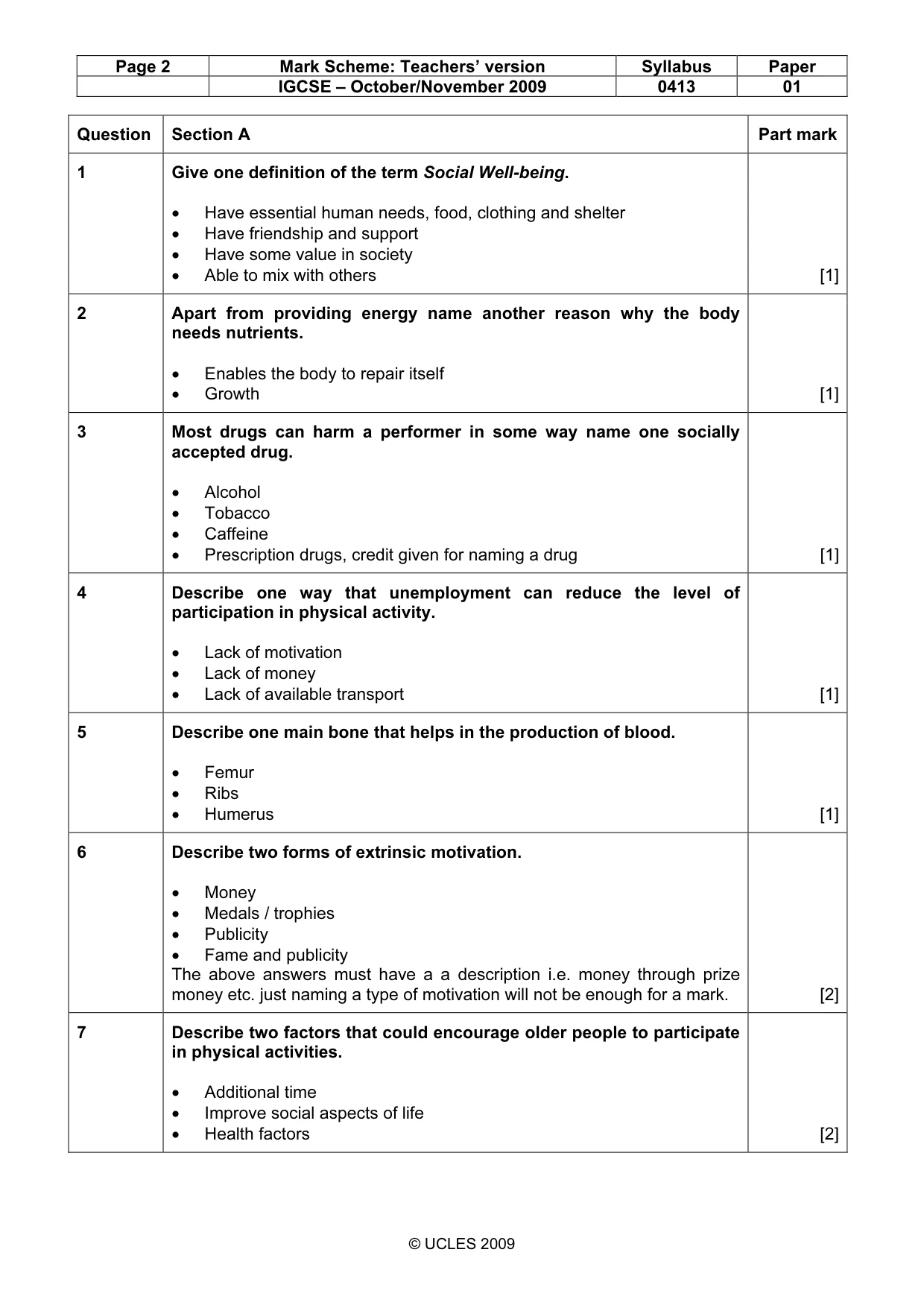
Page 2 Mark Scheme: Teachers’ version Syllabus Paper IGCSE – October/November 2009 0413 01 © UCLES 2009 Question Section A Part mark 1 Give one definition of the term Social Well-being. • Have essential human needs, food, clothing and shelter • Have friendship and support • Have some value in society • Able to mix with others [1] 2 Apart from providing energy name another reason why the body needs nutrients. • Enables the body to repair itself • Growth [1] 3 Most drugs can harm a performer in some way name one socially accepted drug. • Alcohol • Tobacco • Caffeine • Prescription drugs, credit given for naming a drug [1] 4 Describe one way that unemployment can reduce the level of participation in physical activity. • Lack of motivation • Lack of money • Lack of available transport [1] 5 Describe one main bone that helps in the production of blood. • Femur • Ribs • Humerus [1] 6 Describe two forms of extrinsic motivation. • Money • Medals / trophies • Publicity • Fame and publicity The above answers must have a a description i.e. money through prize money etc. just naming a type of motivation will not be enough for a mark. [2] 7 Describe two factors that could encourage older people to participate in physical activities. • Additional time • Improve social aspects of life • Health factors [2]
Mark scheme, page 3
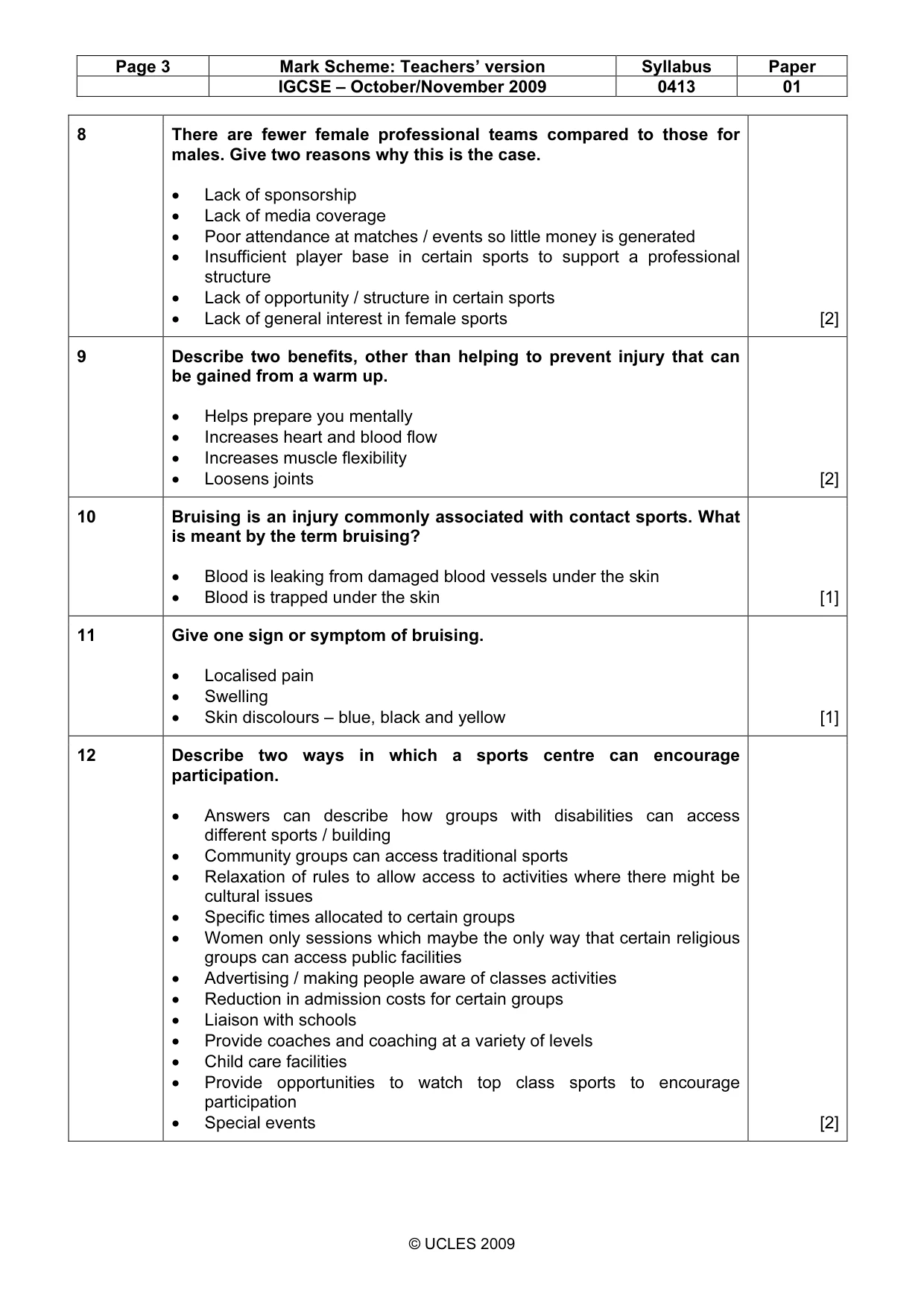
Page 3 Mark Scheme: Teachers’ version Syllabus Paper IGCSE – October/November 2009 0413 01 © UCLES 2009 8 There are fewer female professional teams compared to those for males. Give two reasons why this is the case. • Lack of sponsorship • Lack of media coverage • Poor attendance at matches / events so little money is generated • Insufficient player base in certain sports to support a professional structure • Lack of opportunity / structure in certain sports • Lack of general interest in female sports [2] 9 Describe two benefits, other than helping to prevent injury that can be gained from a warm up. • Helps prepare you mentally • Increases heart and blood flow • Increases muscle flexibility • Loosens joints [2] 10 Bruising is an injury commonly associated with contact sports. What is meant by the term bruising? • Blood is leaking from damaged blood vessels under the skin • Blood is trapped under the skin [1] 11 Give one sign or symptom of bruising. • Localised pain • Swelling • Skin discolours – blue, black and yellow [1] 12 Describe two ways in which a sports centre can encourage participation. • Answers can describe how groups with disabilities can access different sports / building • Community groups can access traditional sports • Relaxation of rules to allow access to activities where there might be cultural issues • Specific times allocated to certain groups • Women only sessions which maybe the only way that certain religious groups can access public facilities • Advertising / making people aware of classes activities • Reduction in admission costs for certain groups • Liaison with schools • Provide coaches and coaching at a variety of levels • Child care facilities • Provide opportunities to watch top class sports to encourage participation • Special events [2]
Mark scheme, page 4
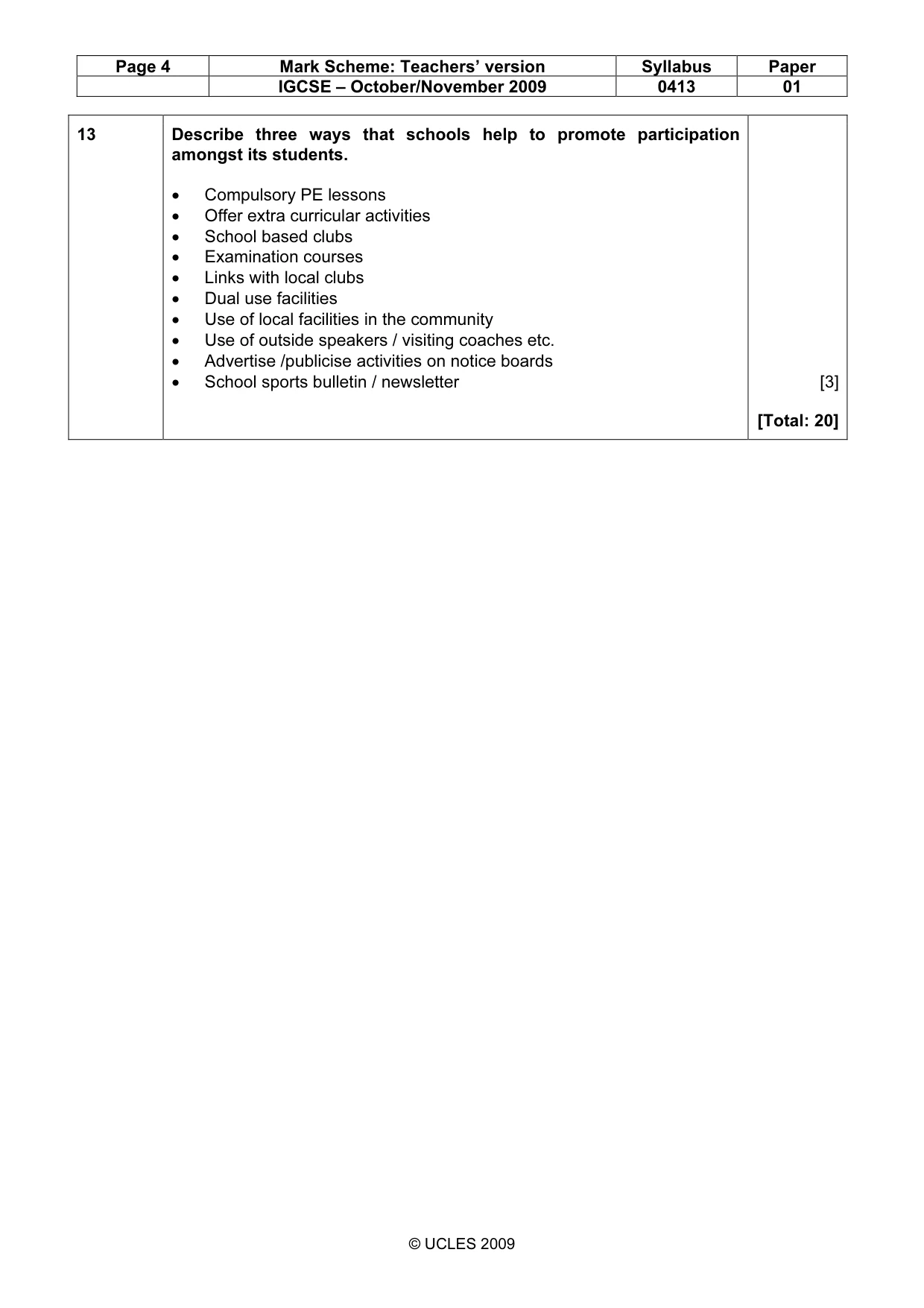
Page 4 Mark Scheme: Teachers’ version Syllabus Paper IGCSE – October/November 2009 0413 01 © UCLES 2009 13 Describe three ways that schools help to promote participation amongst its students. • Compulsory PE lessons • Offer extra curricular activities • School based clubs • Examination courses • Links with local clubs • Dual use facilities • Use of local facilities in the community • Use of outside speakers / visiting coaches etc. • Advertise /publicise activities on notice boards • School sports bulletin / newsletter [3] [Total: 20]
Mark scheme, page 5
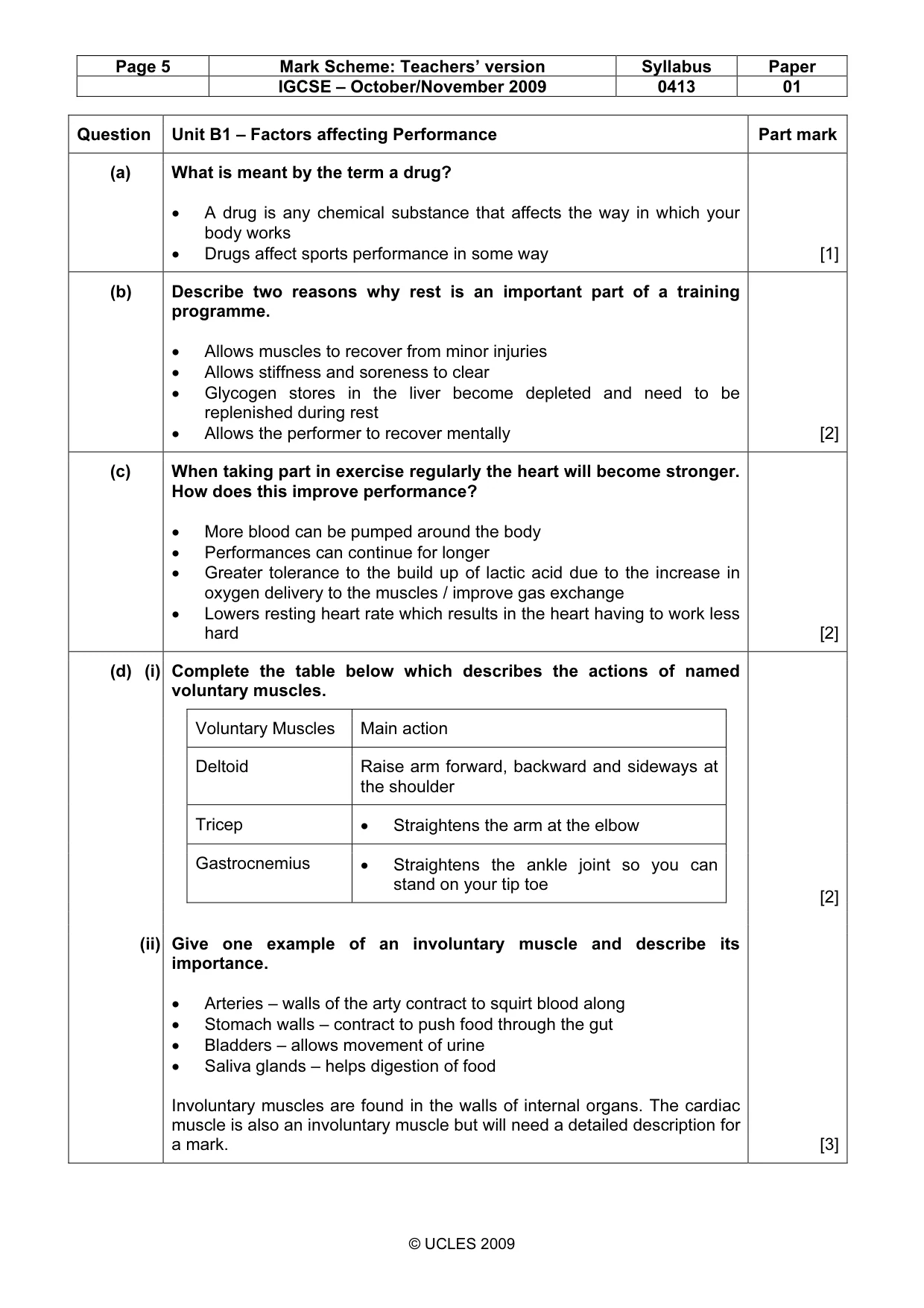
Page 5 Mark Scheme: Teachers’ version Syllabus Paper IGCSE – October/November 2009 0413 01 © UCLES 2009 Question Unit B1 – Factors affecting Performance Part mark (a) What is meant by the term a drug? • A drug is any chemical substance that affects the way in which your body works • Drugs affect sports performance in some way [1] (b) Describe two reasons why rest is an important part of a training programme. • Allows muscles to recover from minor injuries • Allows stiffness and soreness to clear • Glycogen stores in the liver become depleted and need to be replenished during rest • Allows the performer to recover mentally [2] (c) When taking part in exercise regularly the heart will become stronger. How does this improve performance? • More blood can be pumped around the body • Performances can continue for longer • Greater tolerance to the build up of lactic acid due to the increase in oxygen delivery to the muscles / improve gas exchange • Lowers resting heart rate which results in the heart having to work less hard [2] (d) (i) Complete the table below which describes the actions of named voluntary muscles. Voluntary Muscles Main action Deltoid Raise arm forward, backward and sideways at the shoulder Tricep • Straightens the arm at the elbow Gastrocnemius • Straightens the ankle joint so you can stand on your tip toe [2] (ii) Give one example of an involuntary muscle and describe its importance. • Arteries – walls of the arty contract to squirt blood along • Stomach walls – contract to push food through the gut • Bladders – allows movement of urine • Saliva glands – helps digestion of food Involuntary muscles are found in the walls of internal organs. The cardiac muscle is also an involuntary muscle but will need a detailed description for a mark. [3]
Mark scheme, page 6
Page 6 Mark Scheme: Teachers’ version Syllabus Paper IGCSE – October/November 2009 0413 01 © UCLES 2009 (e) The body has three different types of joints Synovial, Cartilaginous and Fibrous Describe one way that each type of joint benefits a performer. • Synovial – freely movable allows limb movement in a number of planes i.e. a hurdler would need to be able to abduct and extend at the hip to get over the hurdle. • Cartiliginous joints – slightly movable allows small amounts of movement i.e. intercostal cartilage which allows movement of the ribs allowing the expansion of the lungs, when running and the chest capacity increases. • Fibrous joints – immovable allows no movement between flat bones i.e. the skull when heading a ball in football – the joint maintains the shape and acts as a shock absorber between the flat bones of the skull. [3] (f) (i) The diagram below is the Information Processing model. What do the letters A and B represent in the diagram. • A Decision Making • B Output [2] (ii) Describe why feedback is important • Identifies strengths so that skills can be built on • Identify weaknesses so that they can be worked on • See if additional training or practice is needed • Set goals for improvement • Stay motivated • Learning takes place when there is feedback [3] (iii) Give two principles that need to be applied when a coach is giving feedback to a performer. • Feedback must be given as soon as possible after the performance • It should be clear and to the point so that you know what to do next / be constructive • You must have enough time to think it over before the next attempt • The method of providing feedback must be appropriate to the understanding of the performer • Feedback must use either Knowledge of Performance or Knowledge of Results [2] [Total 20]
Mark scheme, page 7
Page 7 Mark Scheme: Teachers’ version Syllabus Paper IGCSE – October/November 2009 0413 01 © UCLES 2009 Question Unit 2 – Health, Safety and Training Part mark (a) Explain how inappropriate clothing can contribute to causing injuries. • Inappropriate footwear can cause slipping or too much grip, indoor / outdoor footwear • Clothing may need to be warm as protection from the cold to aid a warm up; clothing may be needed for protection against the cold and prevent hypothermia when taking part in outdoor activities • Not wearing safety clothing can cause injury – safety helmet when climbing, cycling etc. • Ill-fitting clothes can cause you to trip • Clothing likely to tear in contact sports – not wearing a rugby shirt can cause the body to be exposed when rucking etc. occurs • Clothes should protect from friction burns [1] (b) Obesity can affect a person’s ability to perform in sports. Give two factors that can cause obesity. • Eating too much / junk food • Lack of exercise • Lack of balance in the diet [2] (c) Complete the table below by giving the description of the term identified. term Description Cardiac Output Cardiac output is the volume of blood pumped from the left ventricle each minute Stroke Volume • The volume of blood pumped from the left ventricle each heart beat Heart Rate • The number of beats per minute [2] (d) (i) Reversibility is a principle of training. Explain what is meant by reversibility. • When you loose your fitness • You stop training so muscles shrink • Muscles that are not used will atrophy [1] (ii) When could reversibility occur? Candidates need to describe the reasons why rather than just stop taking part • If the performer becomes ill • If the performer becomes injured • Reducing fitness training to spend more time on developing technique • Participant gets bored with training and stop [1]
Mark scheme, page 8
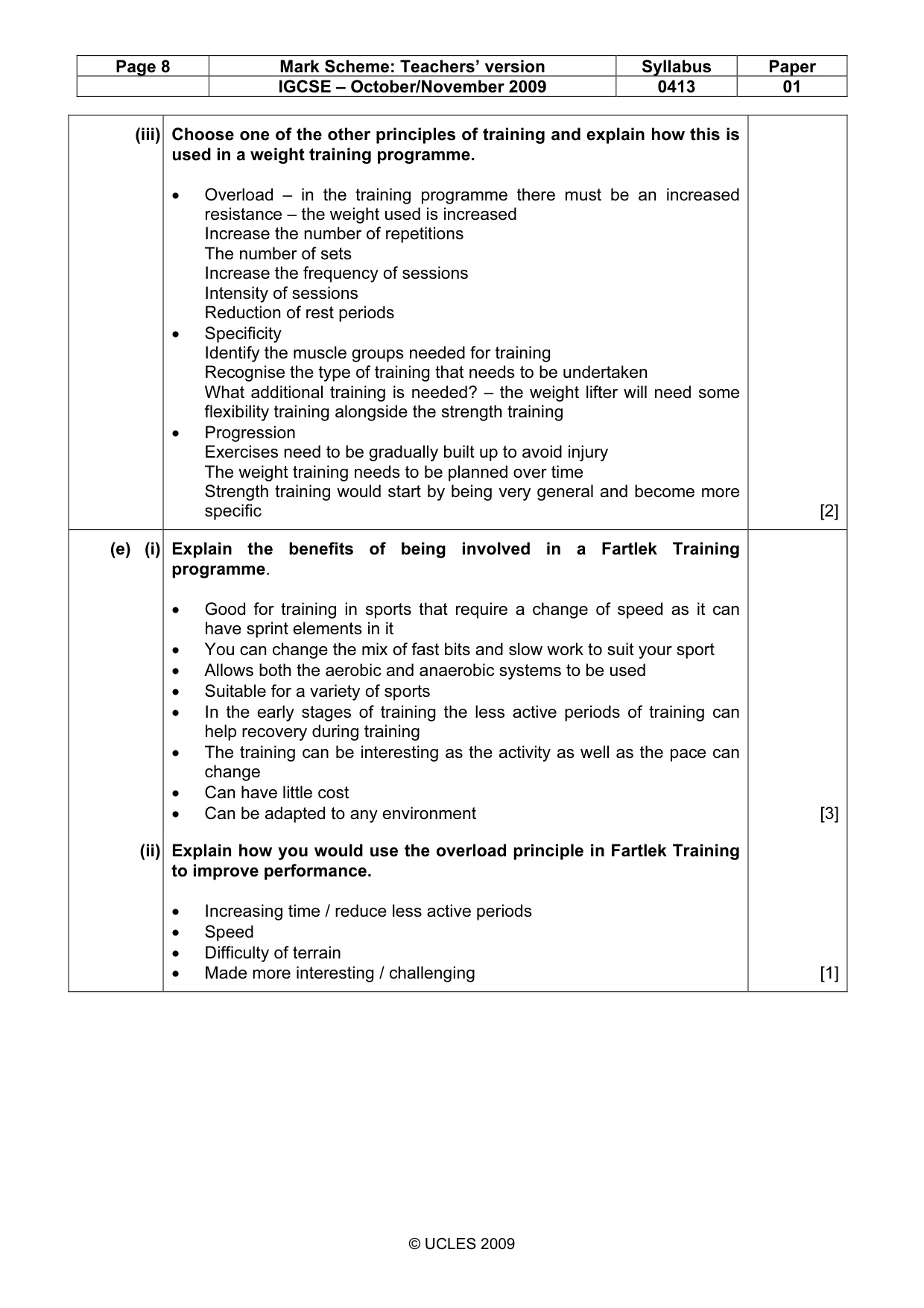
Page 8 Mark Scheme: Teachers’ version Syllabus Paper IGCSE – October/November 2009 0413 01 © UCLES 2009 (iii) Choose one of the other principles of training and explain how this is used in a weight training programme. • Overload – in the training programme there must be an increased resistance – the weight used is increased Increase the number of repetitions The number of sets Increase the frequency of sessions Intensity of sessions Reduction of rest periods • Specificity Identify the muscle groups needed for training Recognise the type of training that needs to be undertaken What additional training is needed? – the weight lifter will need some flexibility training alongside the strength training • Progression Exercises need to be gradually built up to avoid injury The weight training needs to be planned over time Strength training would start by being very general and become more specific [2] (e) (i) Explain the benefits of being involved in a Fartlek Training programme. • Good for training in sports that require a change of speed as it can have sprint elements in it • You can change the mix of fast bits and slow work to suit your sport • Allows both the aerobic and anaerobic systems to be used • Suitable for a variety of sports • In the early stages of training the less active periods of training can help recovery during training • The training can be interesting as the activity as well as the pace can change • Can have little cost • Can be adapted to any environment [3] (ii) Explain how you would use the overload principle in Fartlek Training to improve performance. • Increasing time / reduce less active periods • Speed • Difficulty of terrain • Made more interesting / challenging [1]
Mark scheme, page 9
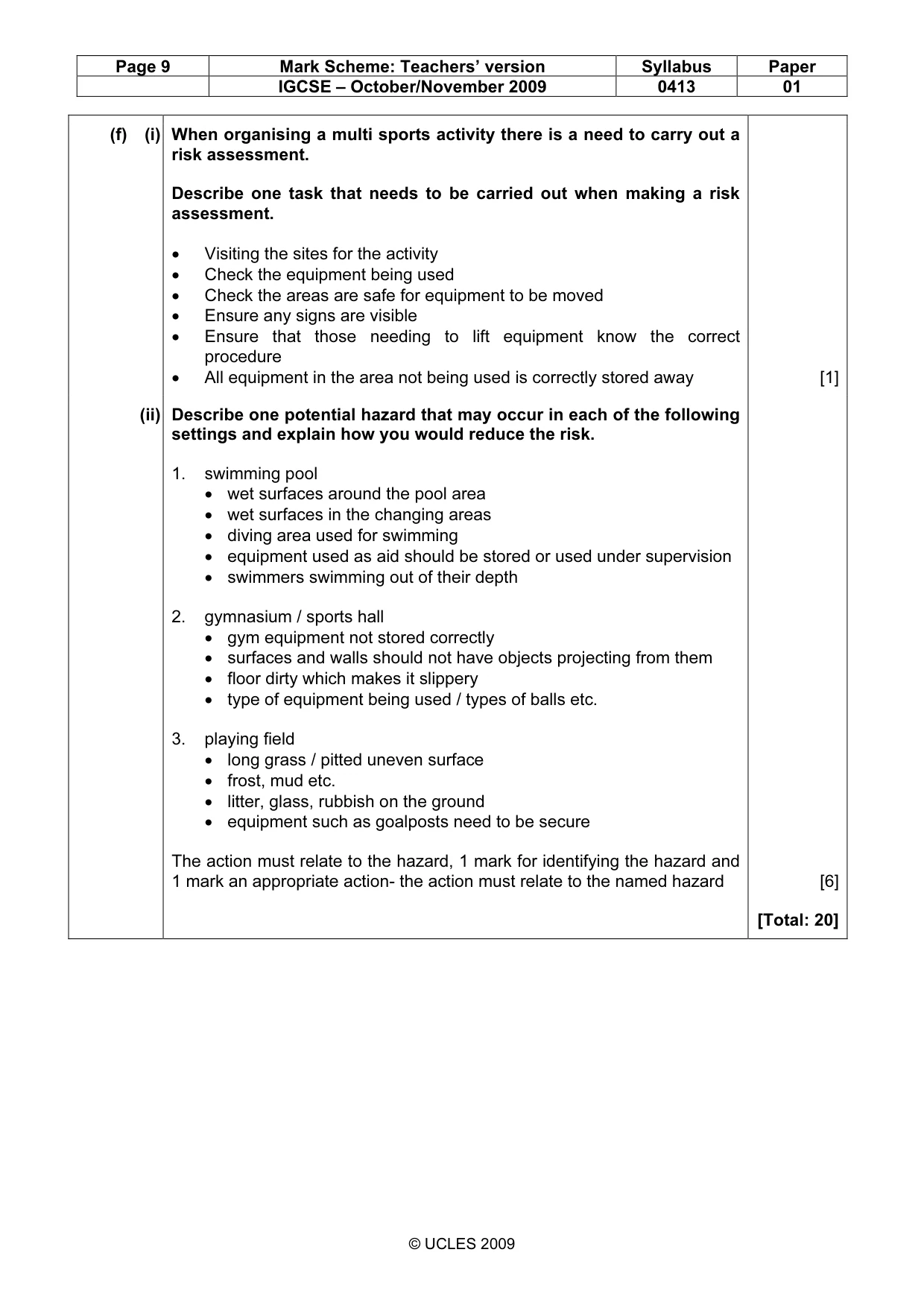
Page 9 Mark Scheme: Teachers’ version Syllabus Paper IGCSE – October/November 2009 0413 01 © UCLES 2009 (f) (i) When organising a multi sports activity there is a need to carry out a risk assessment. Describe one task that needs to be carried out when making a risk assessment. • Visiting the sites for the activity • Check the equipment being used • Check the areas are safe for equipment to be moved • Ensure any signs are visible • Ensure that those needing to lift equipment know the correct procedure • All equipment in the area not being used is correctly stored away [1] (ii) Describe one potential hazard that may occur in each of the following settings and explain how you would reduce the risk. 1. swimming pool • wet surfaces around the pool area • wet surfaces in the changing areas • diving area used for swimming • equipment used as aid should be stored or used under supervision • swimmers swimming out of their depth 2. gymnasium / sports hall • gym equipment not stored correctly • surfaces and walls should not have objects projecting from them • floor dirty which makes it slippery • type of equipment being used / types of balls etc. 3. playing field • long grass / pitted uneven surface • frost, mud etc. • litter, glass, rubbish on the ground • equipment such as goalposts need to be secure The action must relate to the hazard, 1 mark for identifying the hazard and 1 mark an appropriate action- the action must relate to the named hazard [6] [Total: 20]
Mark scheme, page 10
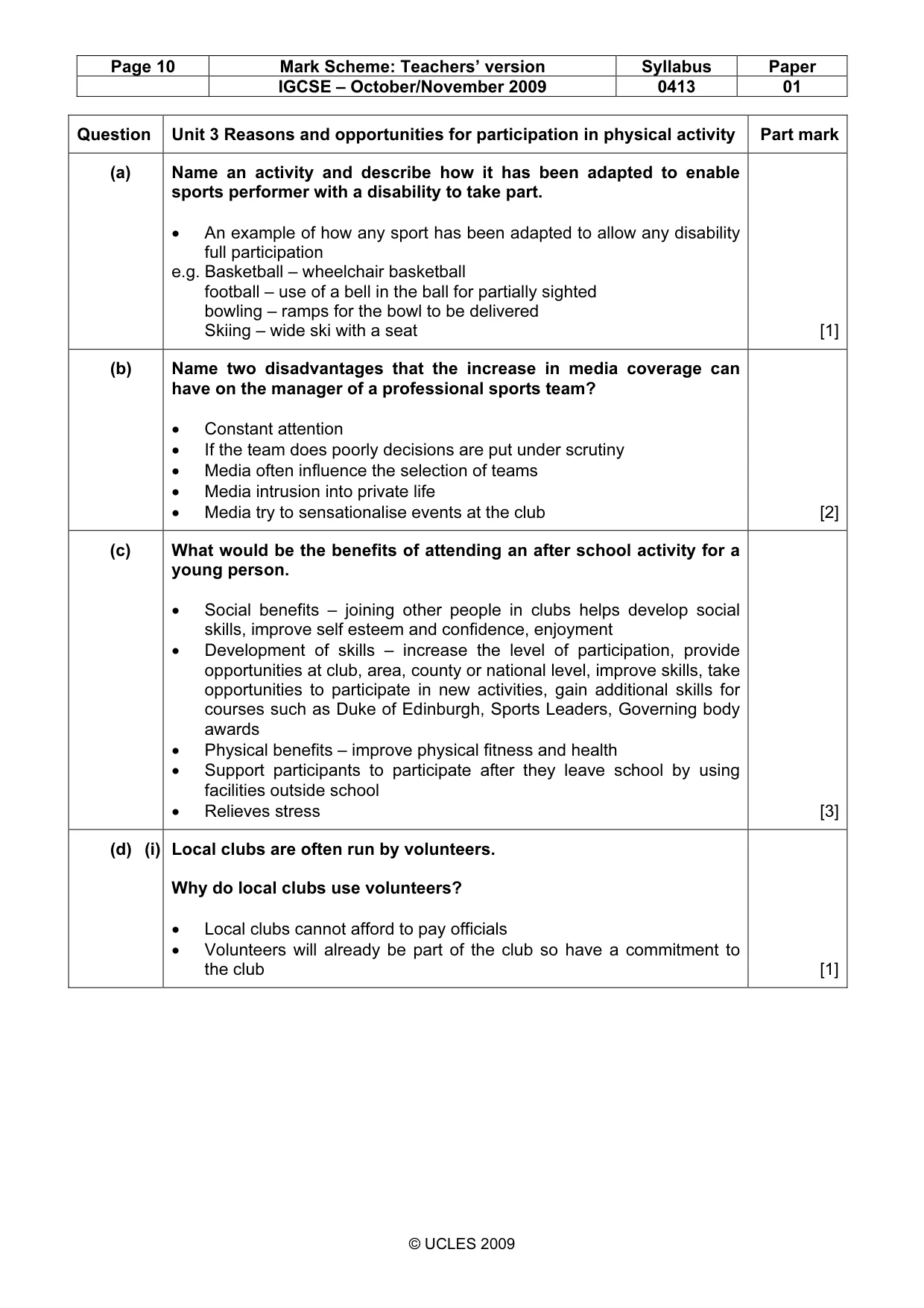
Page 10 Mark Scheme: Teachers’ version Syllabus Paper IGCSE – October/November 2009 0413 01 © UCLES 2009 Question Unit 3 Reasons and opportunities for participation in physical activity Part mark (a) Name an activity and describe how it has been adapted to enable sports performer with a disability to take part. • An example of how any sport has been adapted to allow any disability full participation e.g. Basketball – wheelchair basketball football – use of a bell in the ball for partially sighted bowling – ramps for the bowl to be delivered Skiing – wide ski with a seat [1] (b) Name two disadvantages that the increase in media coverage can have on the manager of a professional sports team? • Constant attention • If the team does poorly decisions are put under scrutiny • Media often influence the selection of teams • Media intrusion into private life • Media try to sensationalise events at the club [2] (c) What would be the benefits of attending an after school activity for a young person. • Social benefits – joining other people in clubs helps develop social skills, improve self esteem and confidence, enjoyment • Development of skills – increase the level of participation, provide opportunities at club, area, county or national level, improve skills, take opportunities to participate in new activities, gain additional skills for courses such as Duke of Edinburgh, Sports Leaders, Governing body awards • Physical benefits – improve physical fitness and health • Support participants to participate after they leave school by using facilities outside school • Relieves stress [3] (d) (i) Local clubs are often run by volunteers. Why do local clubs use volunteers? • Local clubs cannot afford to pay officials • Volunteers will already be part of the club so have a commitment to the club [1]
Mark scheme, page 11
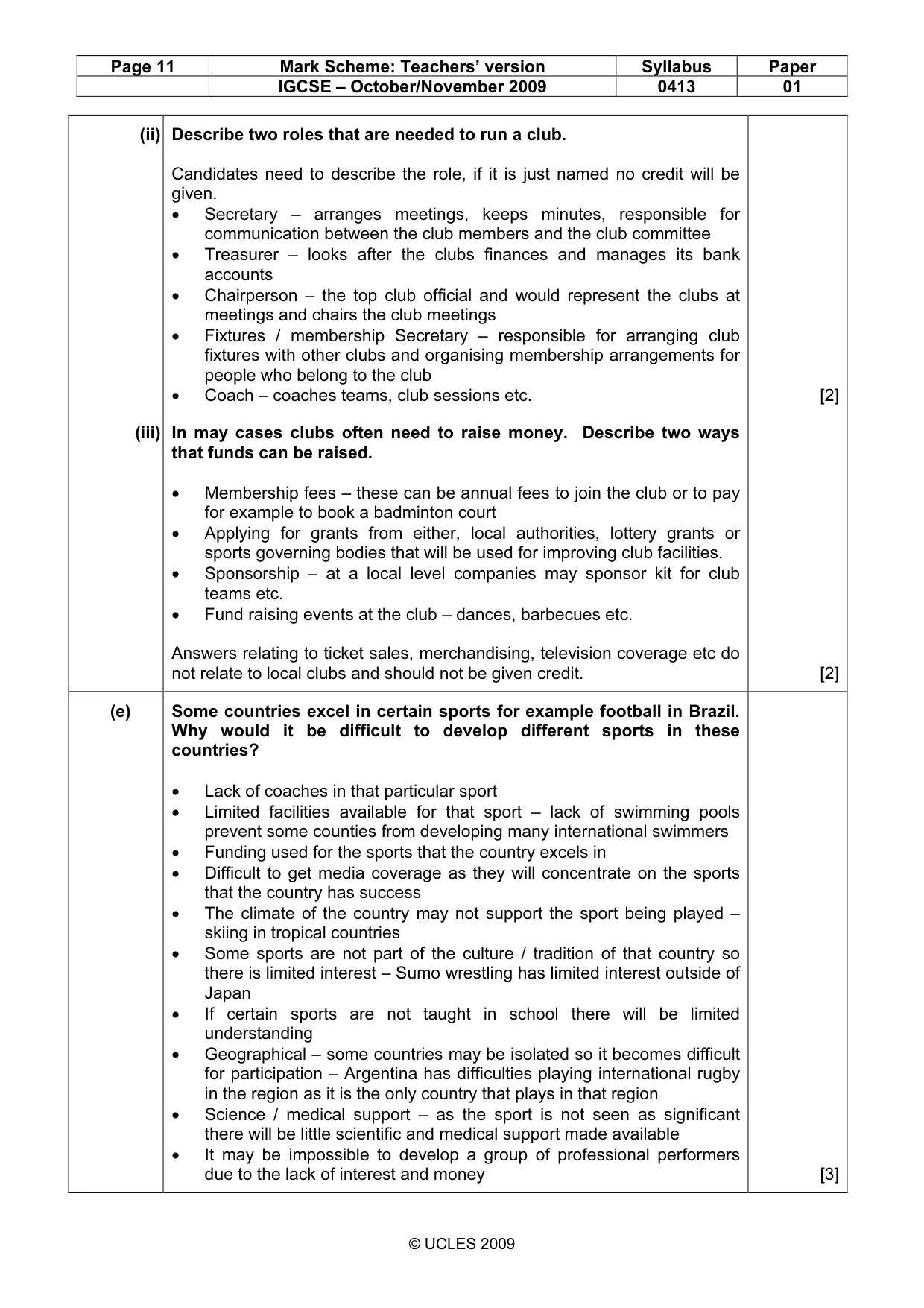
Page 11 Mark Scheme: Teachers’ version Syllabus Paper IGCSE – October/November 2009 0413 01 © UCLES 2009 (ii) Describe two roles that are needed to run a club. Candidates need to describe the role, if it is just named no credit will be given. • Secretary – arranges meetings, keeps minutes, responsible for communication between the club members and the club committee • Treasurer – looks after the clubs finances and manages its bank accounts • Chairperson – the top club official and would represent the clubs at meetings and chairs the club meetings • Fixtures / membership Secretary – responsible for arranging club fixtures with other clubs and organising membership arrangements for people who belong to the club • Coach – coaches teams, club sessions etc. [2] (iii) In may cases clubs often need to raise money. Describe two ways that funds can be raised. • Membership fees – these can be annual fees to join the club or to pay for example to book a badminton court • Applying for grants from either, local authorities, lottery grants or sports governing bodies that will be used for improving club facilities. • Sponsorship – at a local level companies may sponsor kit for club teams etc. • Fund raising events at the club – dances, barbecues etc. Answers relating to ticket sales, merchandising, television coverage etc do not relate to local clubs and should not be given credit. [2] (e) Some countries excel in certain sports for example football in Brazil. Why would it be difficult to develop different sports in these countries? • Lack of coaches in that particular sport • Limited facilities available for that sport – lack of swimming pools prevent some counties from developing many international swimmers • Funding used for the sports that the country excels in • Difficult to get media coverage as they will concentrate on the sports that the country has success • The climate of the country may not support the sport being played – skiing in tropical countries • Some sports are not part of the culture / tradition of that country so there is limited interest – Sumo wrestling has limited interest outside of Japan • If certain sports are not taught in school there will be limited understanding • Geographical – some countries may be isolated so it becomes difficult for participation – Argentina has difficulties playing international rugby in the region as it is the only country that plays in that region • Science / medical support – as the sport is not seen as significant there will be little scientific and medical support made available • It may be impossible to develop a group of professional performers due to the lack of interest and money [3]
Mark scheme, page 12
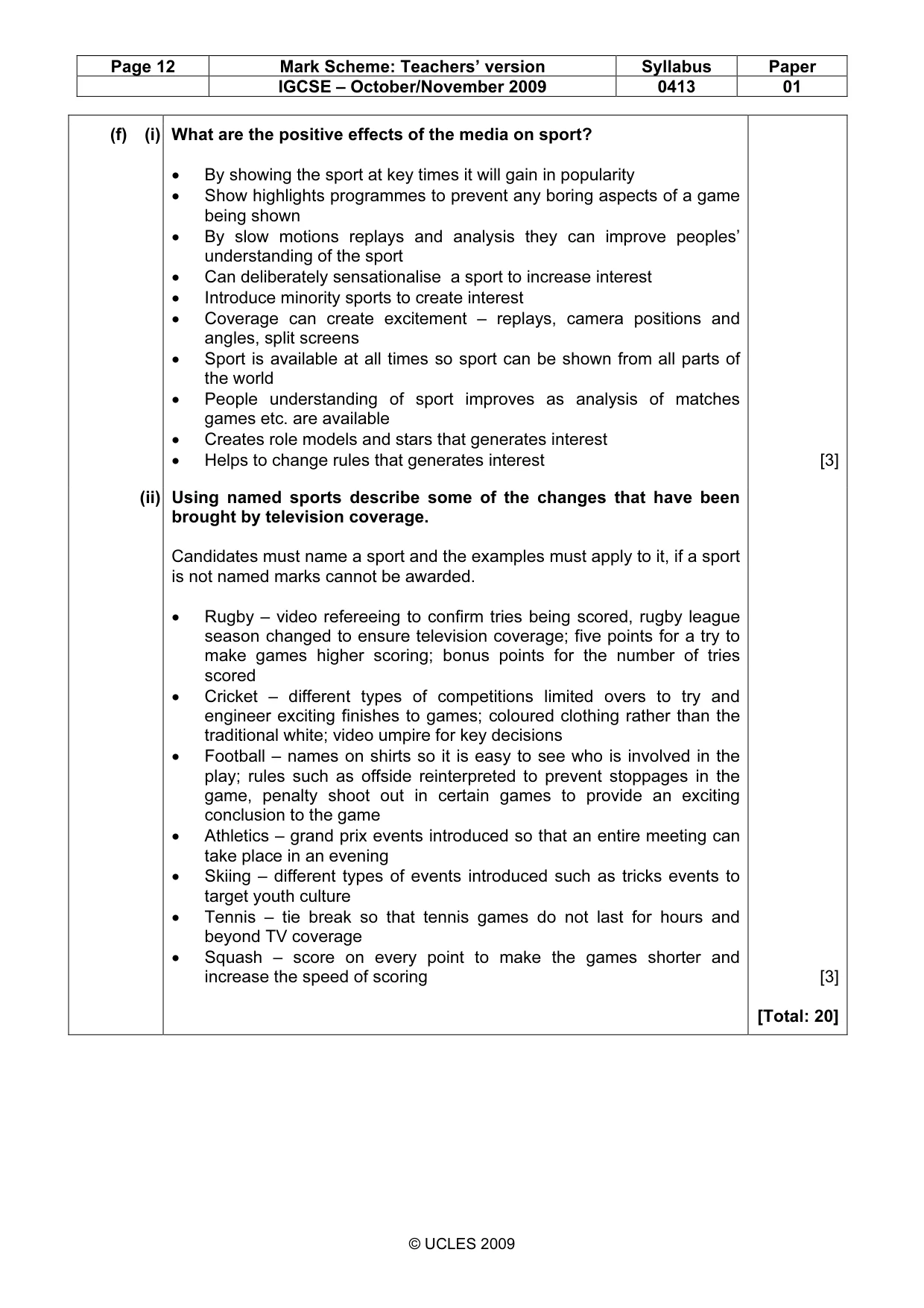
Page 12 Mark Scheme: Teachers’ version Syllabus Paper IGCSE – October/November 2009 0413 01 © UCLES 2009 (f) (i) What are the positive effects of the media on sport? • By showing the sport at key times it will gain in popularity • Show highlights programmes to prevent any boring aspects of a game being shown • By slow motions replays and analysis they can improve peoples’ understanding of the sport • Can deliberately sensationalise a sport to increase interest • Introduce minority sports to create interest • Coverage can create excitement – replays, camera positions and angles, split screens • Sport is available at all times so sport can be shown from all parts of the world • People understanding of sport improves as analysis of matches games etc. are available • Creates role models and stars that generates interest • Helps to change rules that generates interest [3] (ii) Using named sports describe some of the changes that have been brought by television coverage. Candidates must name a sport and the examples must apply to it, if a sport is not named marks cannot be awarded. • Rugby – video refereeing to confirm tries being scored, rugby league season changed to ensure television coverage; five points for a try to make games higher scoring; bonus points for the number of tries scored • Cricket – different types of competitions limited overs to try and engineer exciting finishes to games; coloured clothing rather than the traditional white; video umpire for key decisions • Football – names on shirts so it is easy to see who is involved in the play; rules such as offside reinterpreted to prevent stoppages in the game, penalty shoot out in certain games to provide an exciting conclusion to the game • Athletics – grand prix events introduced so that an entire meeting can take place in an evening • Skiing – different types of events introduced such as tricks events to target youth culture • Tennis – tie break so that tennis games do not last for hours and beyond TV coverage • Squash – score on every point to make the games shorter and increase the speed of scoring [3] [Total: 20]
What you needed in this session
Cambridge’s own grade thresholds for 2009 Oct/Nov, Paper 1 · Variant 1. A higher threshold means an easier paper — the bar moves with how the cohort did.