Cambridge IGCSE Physical Education 0413 — 2009 May/June Paper 1 · Variant 1
0413/11/M/J/09 · 80 marks · ≈90 min
The question paper and its mark scheme, free to read here and free to download. This is Cambridge’s own paper, exactly as it was sat.
Question paper16 pages







Mark scheme13 pages
Answers below. Sit the paper first if you are practising.

Paper as text
Question paper, page 1
This document consists of 13 printed pages and 3 blank pages. SP (SHW) 00232 4/08 T73023/1 © UCLES 2009 [Turn over UNIVERSITY OF CAMBRIDGE INTERNATIONAL EXAMINATIONS International General Certificate of Secondary Education READ THESE INSTRUCTIONS FIRST Write your Centre number, candidate number and name on all the work you hand in. Write in dark blue or black pen. You may use a soft pencil for any diagrams, graphs or rough working. Do not use staples, paper clips, highlighters, glue or correction fluid. DO NOT WRITE IN ANY BARCODES. Answer all questions. At the end of the examination, fasten all your work securely together. The number of marks is given in brackets [ ] at the end of each question or part question. * 2 0 7 3 4 2 0 4 0 7 * PHYSICAL EDUCATION 0413/01 Paper 1 May/June 2009 1 hour 45 minutes Candidates answer on the Question Paper. No Additional Materials are required. For Examiner’s Use Section A B1 B2 B3 Total www.XtremePapers.com
Question paper, page 2
0413/01/M/J/09 © UCLES 2009 For Examiner’s Use Section A Answer all questions in this section. 1 Give one definition of the term mental well-being. … … [1] 2 Describe one effect on the blood that a person training at altitude may experience. … … [1] 3 Describe how the pelvis helps to fulfil one of the main functions of the skeleton. … … [1] 4 What condition could result from excessive eating and taking little exercise? … … [1] 5 If a player in a tennis match suffered from a sprained ankle, what First Aid treatment would you administer? … … [1] 6 What is the function of plasma and platelets in the blood? … … … … [2] 2
Question paper, page 3
3 0413/01/M/J/09 © UCLES 2009 [Turn over For Examiner’s Use 7 What type of movement is allowed by a pivot joint? Give an example of where in the body this takes place. … … … … [2] 8 Give a definition of the term Flexibility and describe how it can improve performance. … … … … [2] 9 Apart from sporting facilities give two different types of leisure facilities provided by private companies. … … … … [2] 10 Describe two ways that improved health care has influenced how people participate in sports. … … … … [2]
Question paper, page 4
4 0413/01/M/J/09 © UCLES 2009 For Examiner’s Use 11 Describe two social benefits of being a member of a sports club. … … … … [2] 12 In what ways do local clubs provide opportunities for participation? … … … … [2] 13 Describe one possible disadvantage when activities are provided by local clubs. … … [1] [Total: 20]
Question paper, page 5
0413/01/M/J/09 © UCLES 2009 [Turn over For Examiner’s Use Section B Answer all questions in this section. Factors Affecting Performance B1 (a) Describe one way that adrenalin can cause a reduction in performance. … … [1] (b) How is Lactic Acid removed from muscles? … … [1] (c) The points at which a muscle joins the bone is called the Origin or Insertion. Describe how each helps with movement. Origin … … Insertion … … [2] (d) Name two components of skill related fitness and give examples of how you would recognise these in a skilled performer. Component 1 … … … … Component 2 … … … … [4] 5
Question paper, page 6
6 0413/01/M/J/09 © UCLES 2009 For Examiner’s Use (e) The diagram below shows a joint in the body. A B (i) Name the type of joint. … [1] (ii) Name the parts of the joint labelled A and B. A … B … [2] (iii) How do the parts labelled A and B help in effective movement of the joint when running? A … … B … … [2]
Question paper, page 7
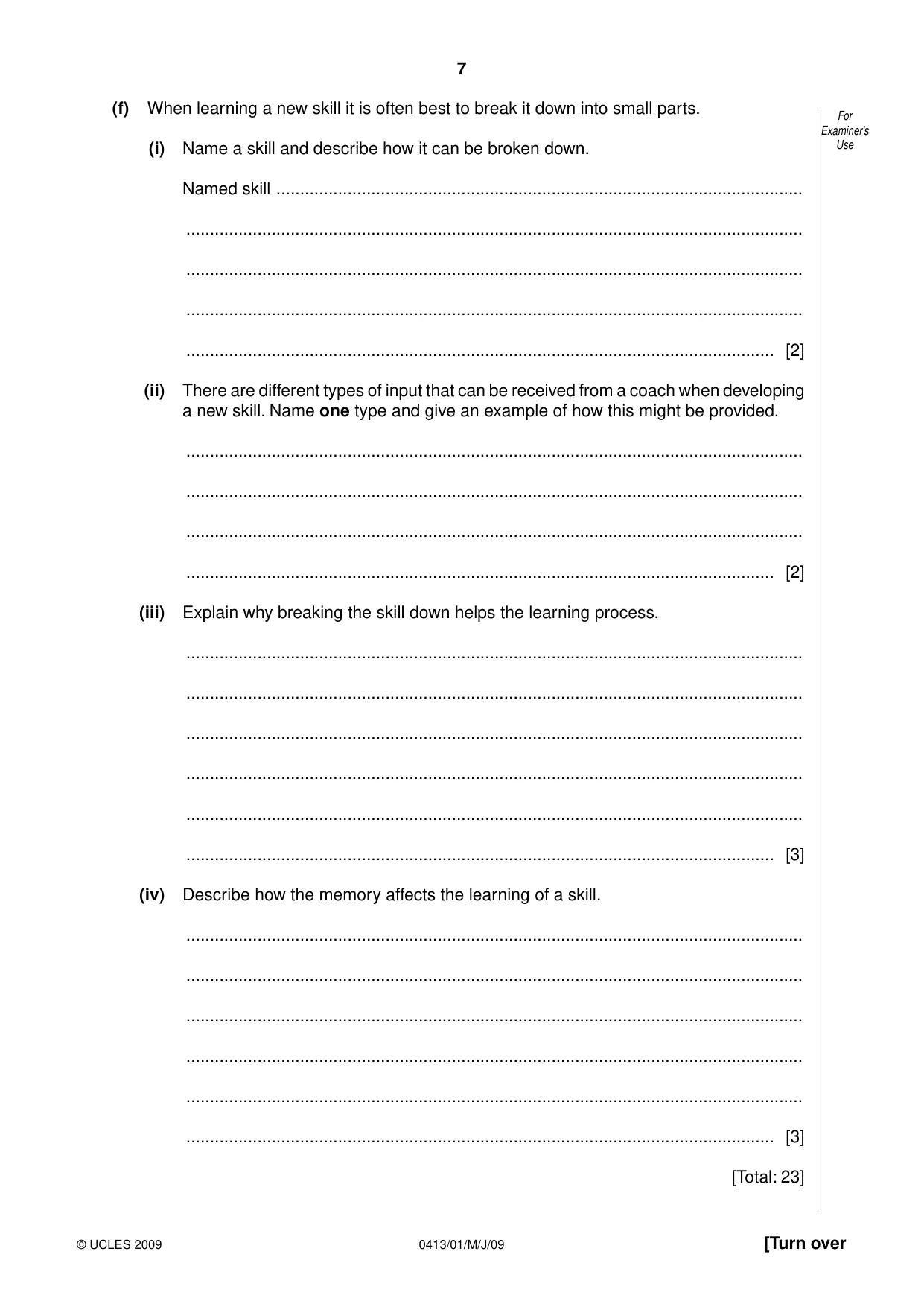
7 0413/01/M/J/09 © UCLES 2009 [Turn over For Examiner’s Use (f) When learning a new skill it is often best to break it down into small parts. (i) Name a skill and describe how it can be broken down. Named skill … … … … … [2] (ii) There are different types of input that can be received from a coach when developing a new skill. Name one type and give an example of how this might be provided. … … … … [2] (iii) Explain why breaking the skill down helps the learning process. … … … … … … [3] (iv) Describe how the memory affects the learning of a skill. … … … … … … [3] [Total: 23]
Question paper, page 8
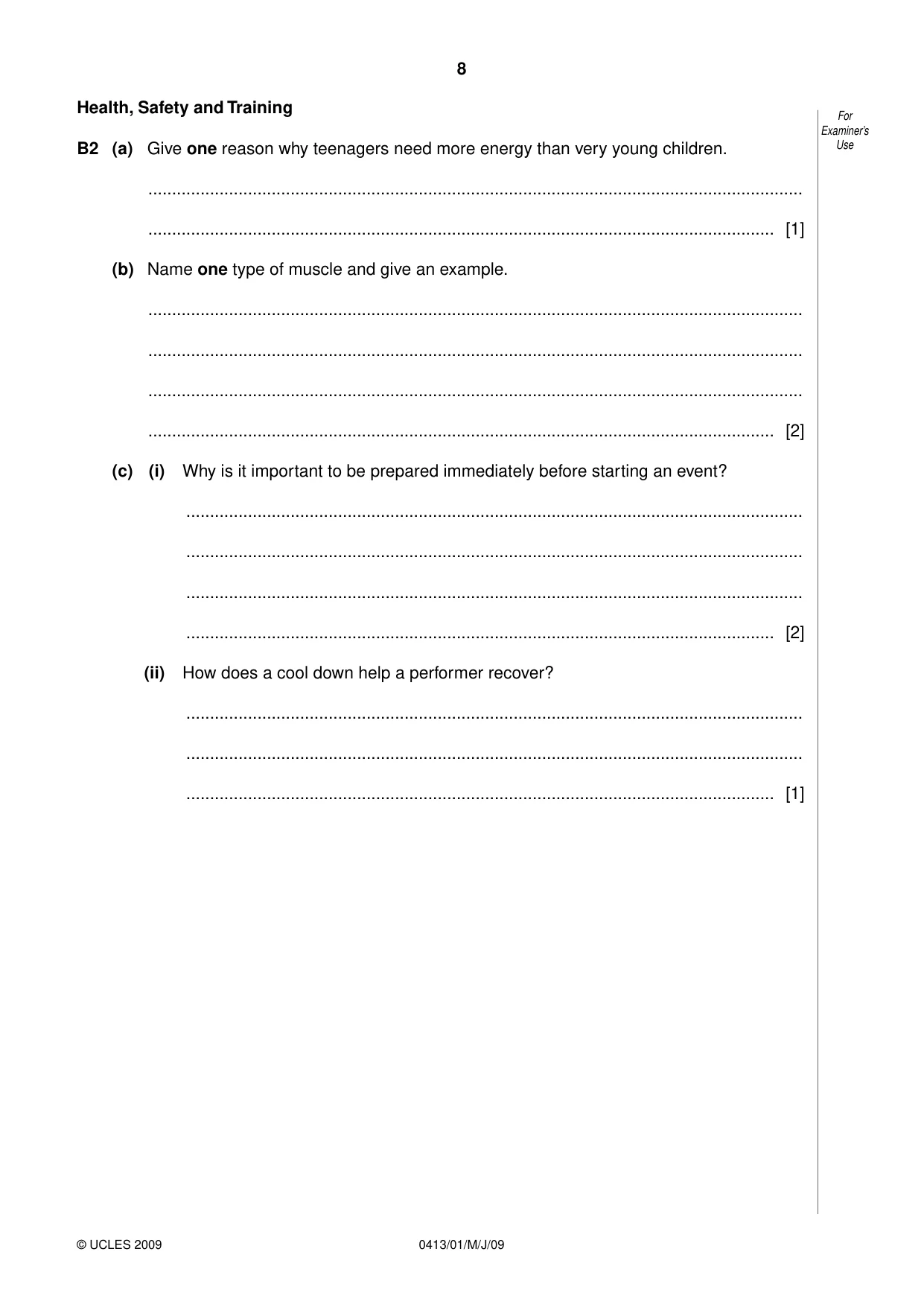
8 0413/01/M/J/09 © UCLES 2009 For Examiner’s Use Health, Safety and Training B2 (a) Give one reason why teenagers need more energy than very young children. … … [1] (b) Name one type of muscle and give an example. … … … … [2] (c) (i) Why is it important to be prepared immediately before starting an event? … … … … [2] (ii) How does a cool down help a performer recover? … … … [1]
Question paper, page 9
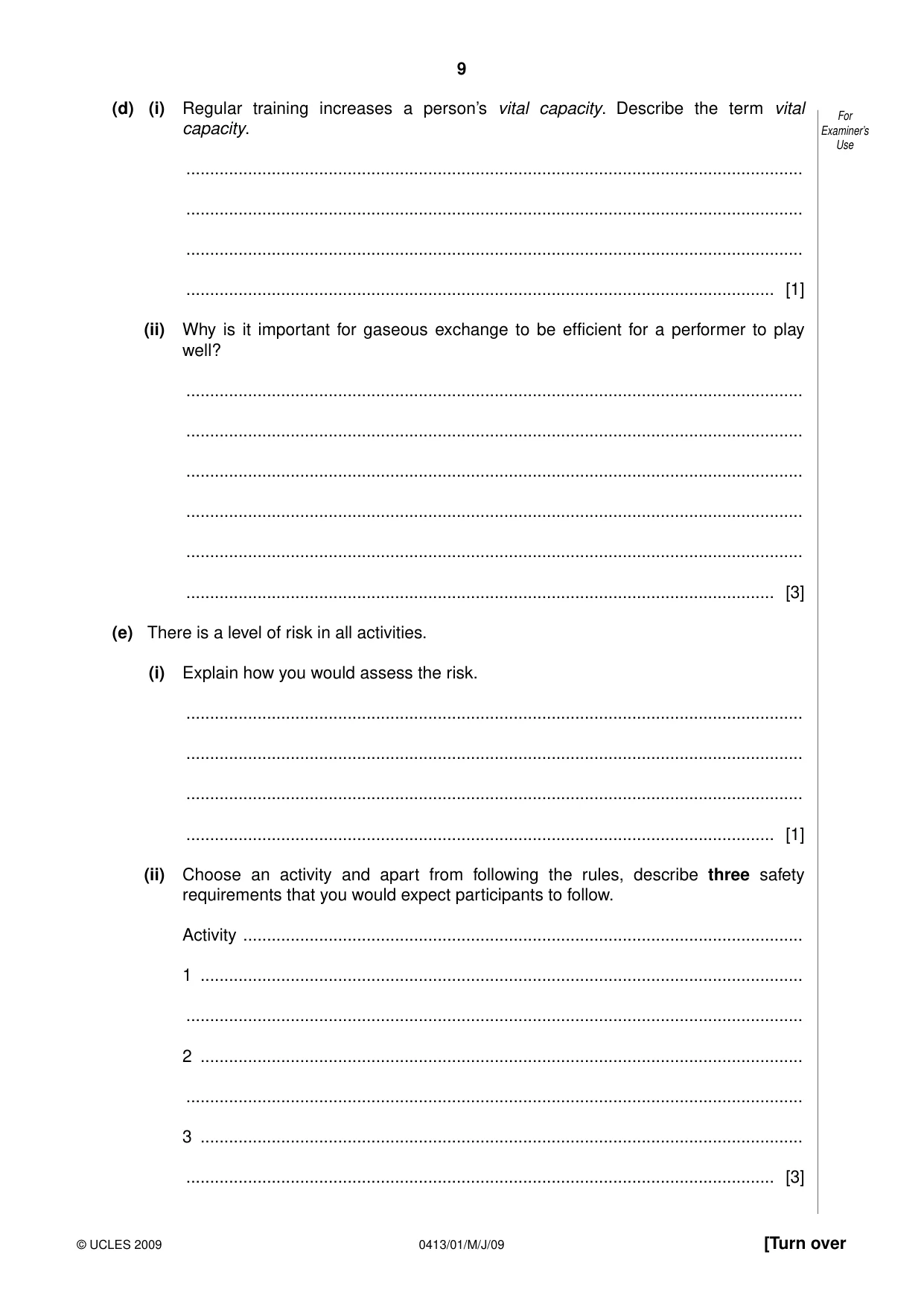
9 0413/01/M/J/09 © UCLES 2009 [Turn over For Examiner’s Use (d) (i) Regular training increases a person’s vital capacity. Describe the term vital capacity. … … … … [1] (ii) Why is it important for gaseous exchange to be efficient for a performer to play well? … … … … … … [3] (e) There is a level of risk in all activities. (i) Explain how you would assess the risk. … … … … [1] (ii) Choose an activity and apart from following the rules, describe three safety requirements that you would expect participants to follow. Activity … 1 … … 2 … … 3 … … [3]
Question paper, page 10
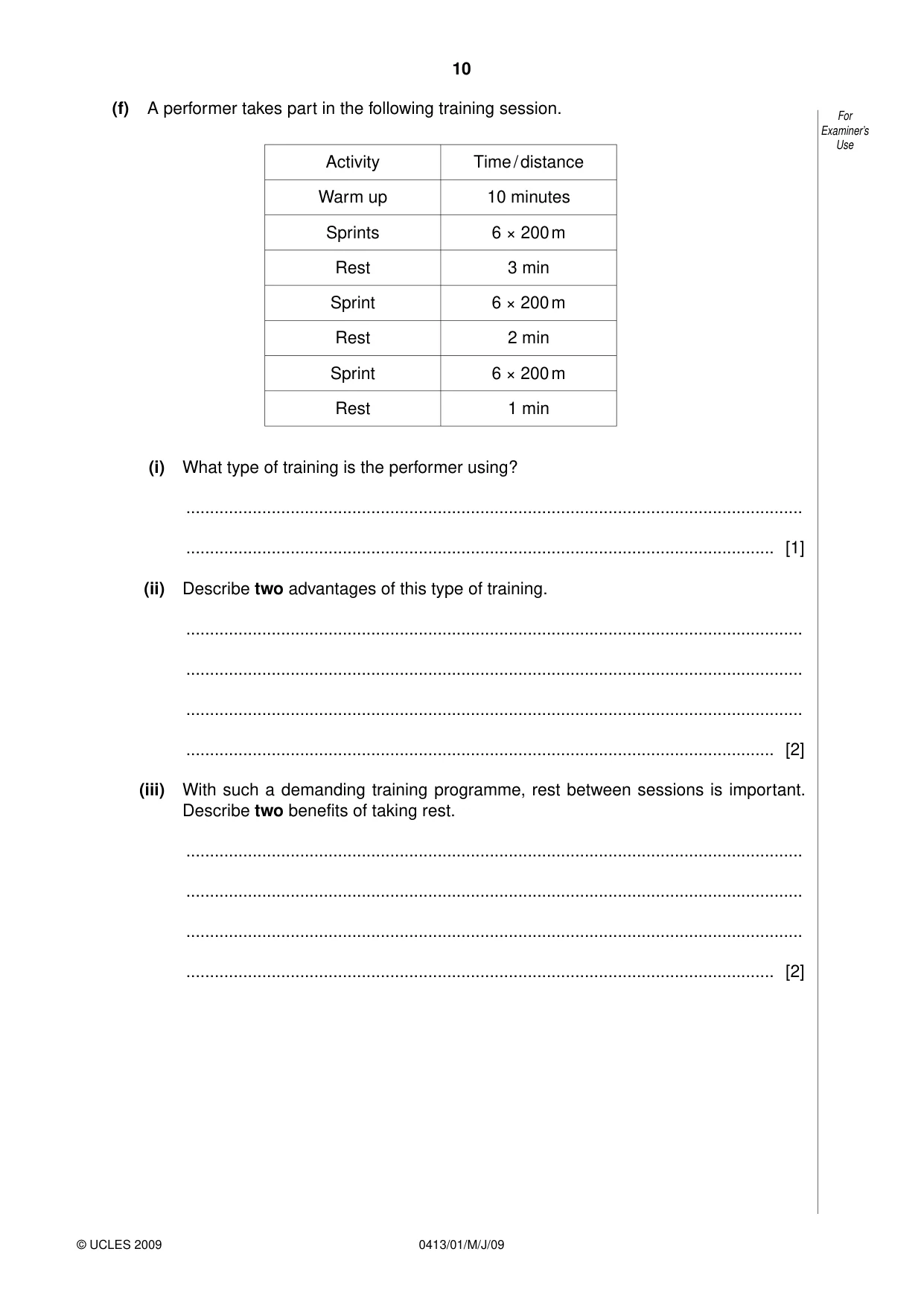
10 0413/01/M/J/09 © UCLES 2009 For Examiner’s Use (f) A performer takes part in the following training session. Activity Time / distance Warm up 10 minutes Sprints 6 × 200 m Rest 3 min Sprint 6 × 200 m Rest 2 min Sprint 6 × 200 m Rest 1 min (i) What type of training is the performer using? … … [1] (ii) Describe two advantages of this type of training. … … … … [2] (iii) With such a demanding training programme, rest between sessions is important. Describe two benefits of taking rest. … … … … [2]
Question paper, page 11
11 0413/01/M/J/09 © UCLES 2009 [Turn over For Examiner’s Use (iv) Apart from completing time trials, describe one test that could be used to monitor progress. … … … … … … … … [3] [Total: 22]
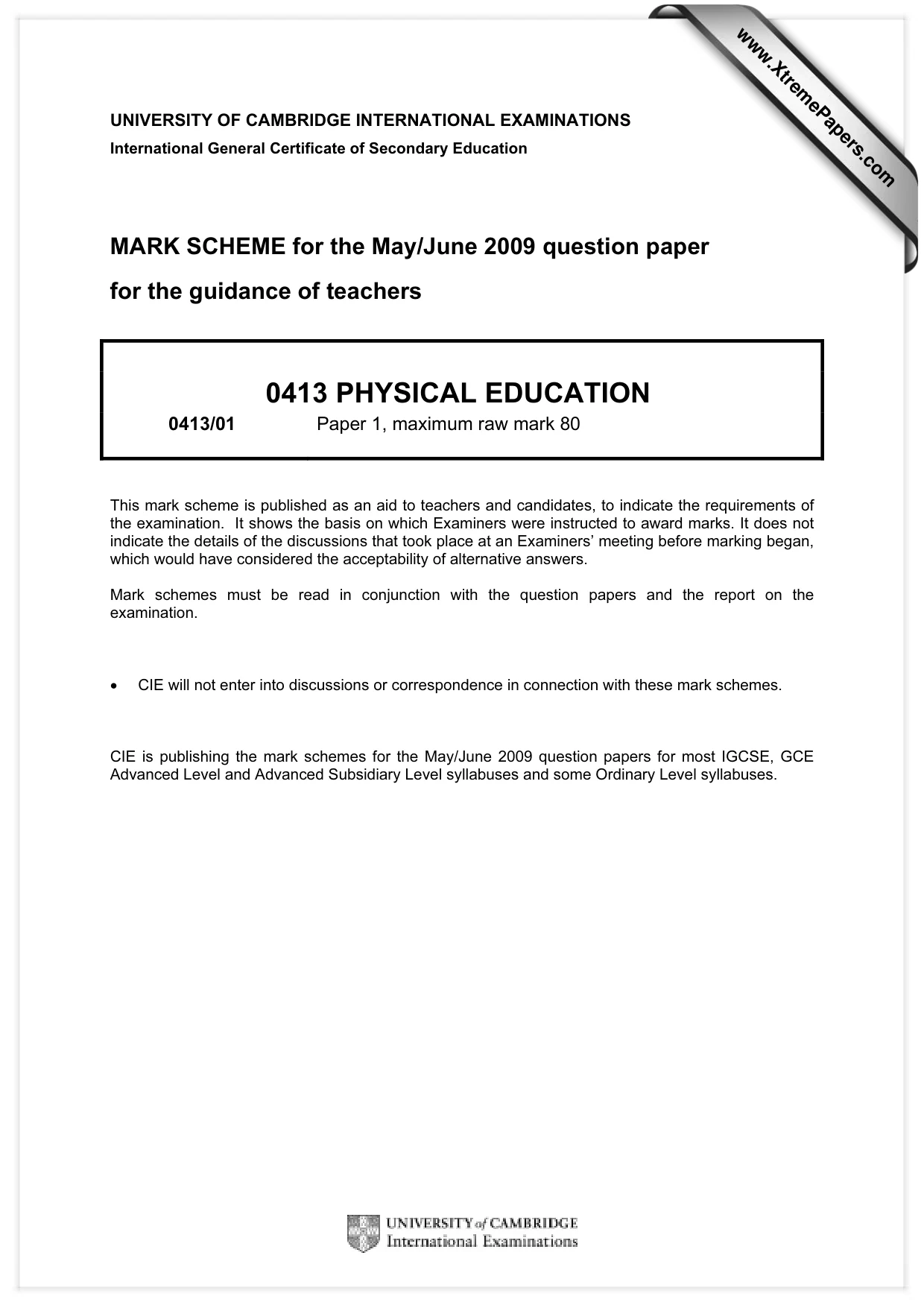
Question paper, page 12
12 0413/01/M/J/09 © UCLES 2009 For Examiner’s Use Reasons and Opportunities for Participation in Physical Activity B3 (a) Give one reason why some women might find it difficult to take part in physical recreation. … … [1] (b) How has television promoted better understanding of sporting performances? … … … [1] (c) Describe three factors that should be considered when planning a new outdoor activities centre. … … … … … … [3] (d) Describe three ways that a sports centre can help promote an increase in participation for performers with disabilities. … … … … … … … [3]
Question paper, page 13
13 0413/01/M/J/09 © UCLES 2009 For Examiner’s Use (e) (i) Explain some of the disadvantages that a country might experience when hosting a global event. … … … … … … … … … … [4] (ii) Often the country that hosts a global event performs better than normal at the event. Explain why this should be the case. … … … … … … … [3] [Total: 15]
Question paper, page 16
16 0413/01/M/J/09 BLANK PAGE Permission to reproduce items where third-party owned material protected by copyright is included has been sought and cleared where possible. Every reasonable effort has been made by the publisher (UCLES) to trace copyright holders, but if any items requiring clearance have unwittingly been included, the publisher will be pleased to make amends at the earliest possible opportunity. University of Cambridge International Examinations is part of the Cambridge Assessment Group. Cambridge Assessment is the brand name of University of Cambridge Local Examinations Syndicate (UCLES), which is itself a department of the University of Cambridge.
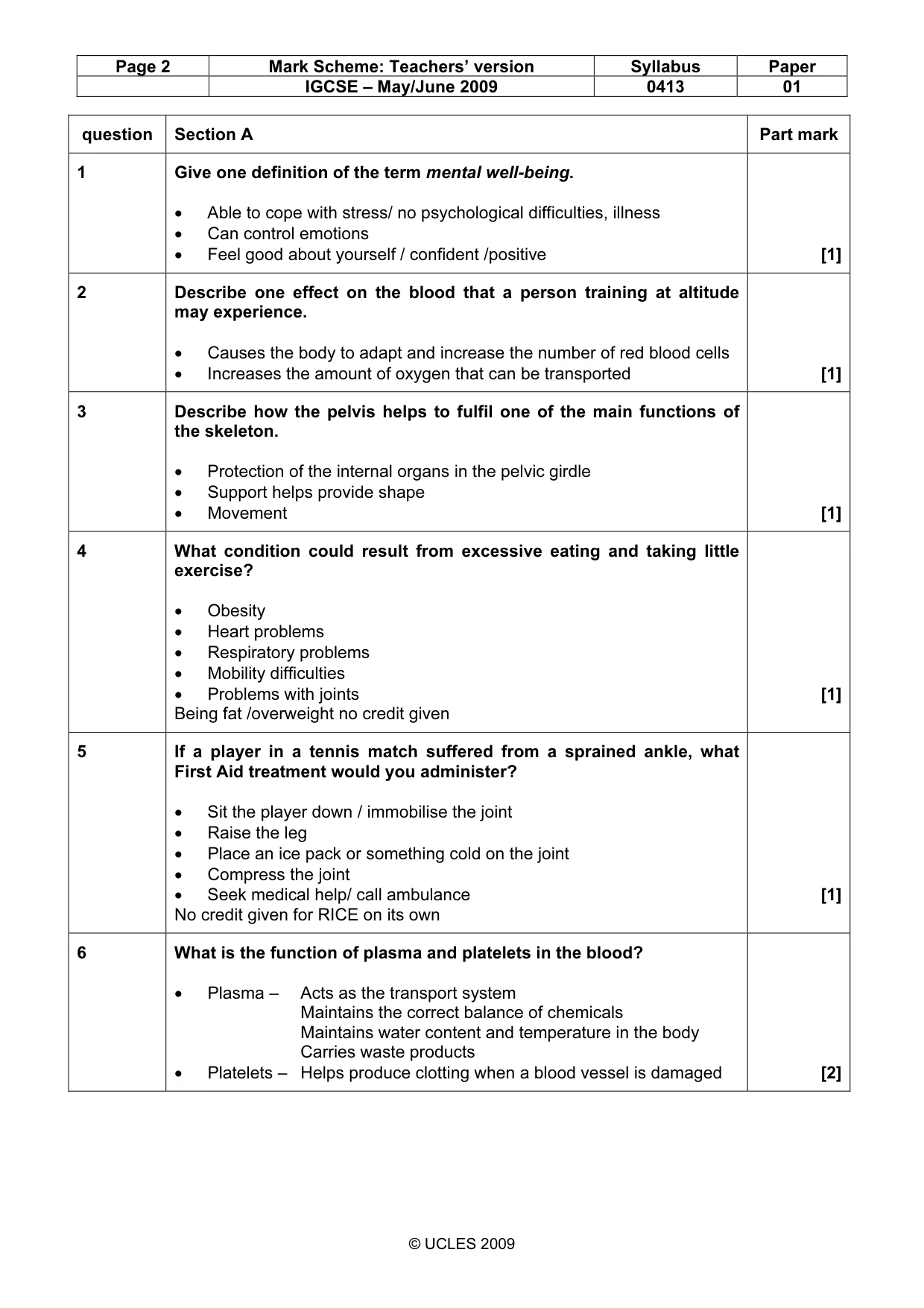
Mark scheme, page 1
UNIVERSITY OF CAMBRIDGE INTERNATIONAL EXAMINATIONS International General Certificate of Secondary Education MARK SCHEME for the May/June 2009 question paper for the guidance of teachers 0413 PHYSICAL EDUCATION 0413/01 Paper 1, maximum raw mark 80 This mark scheme is published as an aid to teachers and candidates, to indicate the requirements of the examination. It shows the basis on which Examiners were instructed to award marks. It does not indicate the details of the discussions that took place at an Examiners’ meeting before marking began, which would have considered the acceptability of alternative answers. Mark schemes must be read in conjunction with the question papers and the report on the examination. • CIE will not enter into discussions or correspondence in connection with these mark schemes. CIE is publishing the mark schemes for the May/June 2009 question papers for most IGCSE, GCE Advanced Level and Advanced Subsidiary Level syllabuses and some Ordinary Level syllabuses. www.XtremePapers.com
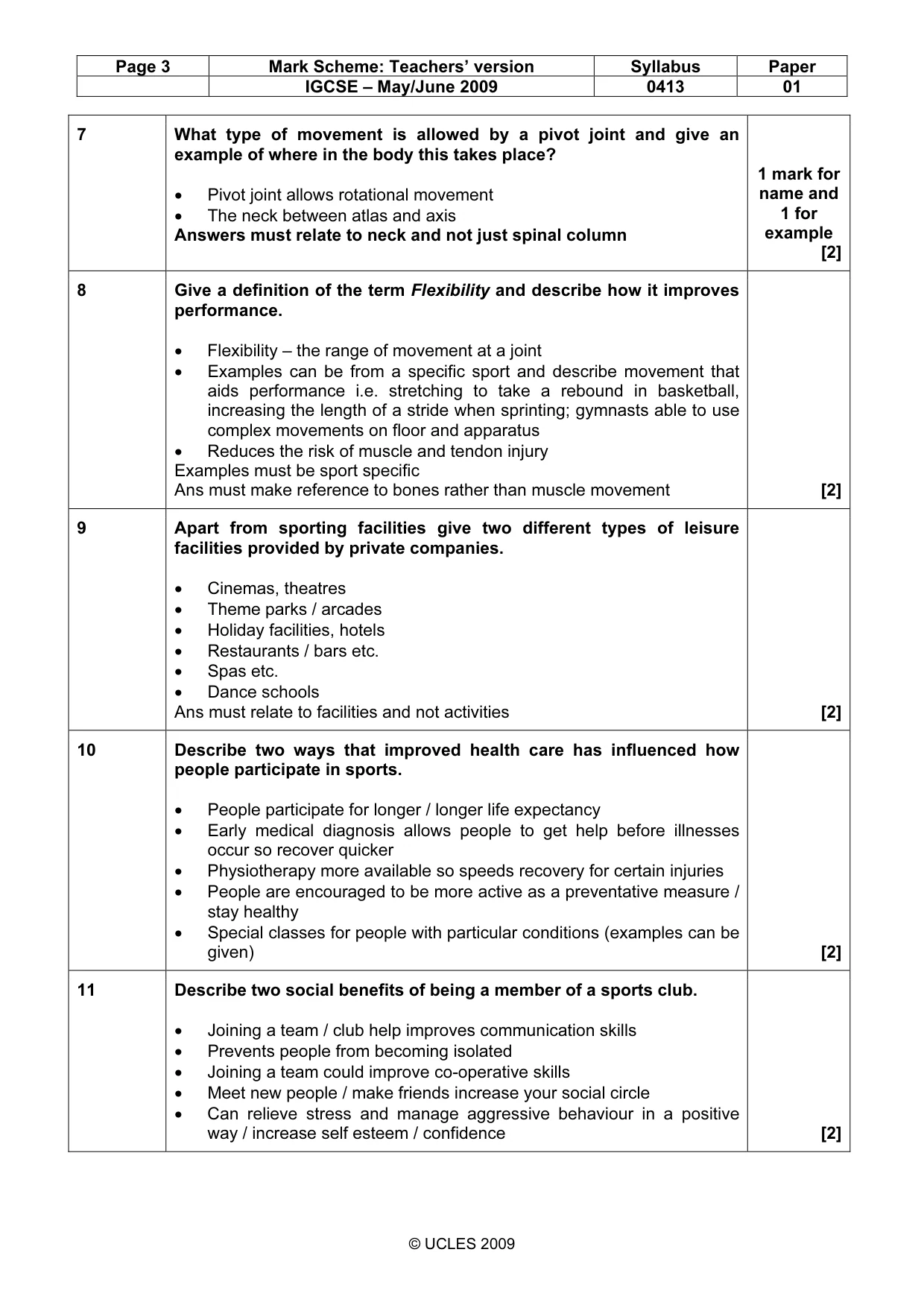
Mark scheme, page 2
Page 2 Mark Scheme: Teachers’ version Syllabus Paper IGCSE – May/June 2009 0413 01 © UCLES 2009 question Section A Part mark 1 Give one definition of the term mental well-being. • Able to cope with stress/ no psychological difficulties, illness • Can control emotions • Feel good about yourself / confident /positive [1] 2 Describe one effect on the blood that a person training at altitude may experience. • Causes the body to adapt and increase the number of red blood cells • Increases the amount of oxygen that can be transported [1] 3 Describe how the pelvis helps to fulfil one of the main functions of the skeleton. • Protection of the internal organs in the pelvic girdle • Support helps provide shape • Movement [1] 4 What condition could result from excessive eating and taking little exercise? • Obesity • Heart problems • Respiratory problems • Mobility difficulties • Problems with joints Being fat /overweight no credit given [1] 5 If a player in a tennis match suffered from a sprained ankle, what First Aid treatment would you administer? • Sit the player down / immobilise the joint • Raise the leg • Place an ice pack or something cold on the joint • Compress the joint • Seek medical help/ call ambulance No credit given for RICE on its own [1] 6 What is the function of plasma and platelets in the blood? • Plasma – Acts as the transport system Maintains the correct balance of chemicals Maintains water content and temperature in the body Carries waste products • Platelets – Helps produce clotting when a blood vessel is damaged [2]
Mark scheme, page 3
Page 3 Mark Scheme: Teachers’ version Syllabus Paper IGCSE – May/June 2009 0413 01 © UCLES 2009 7 What type of movement is allowed by a pivot joint and give an example of where in the body this takes place? • Pivot joint allows rotational movement • The neck between atlas and axis Answers must relate to neck and not just spinal column 1 mark for name and 1 for example [2] 8 Give a definition of the term Flexibility and describe how it improves performance. • Flexibility – the range of movement at a joint • Examples can be from a specific sport and describe movement that aids performance i.e. stretching to take a rebound in basketball, increasing the length of a stride when sprinting; gymnasts able to use complex movements on floor and apparatus • Reduces the risk of muscle and tendon injury Examples must be sport specific Ans must make reference to bones rather than muscle movement [2] 9 Apart from sporting facilities give two different types of leisure facilities provided by private companies. • Cinemas, theatres • Theme parks / arcades • Holiday facilities, hotels • Restaurants / bars etc. • Spas etc. • Dance schools Ans must relate to facilities and not activities [2] 10 Describe two ways that improved health care has influenced how people participate in sports. • People participate for longer / longer life expectancy • Early medical diagnosis allows people to get help before illnesses occur so recover quicker • Physiotherapy more available so speeds recovery for certain injuries • People are encouraged to be more active as a preventative measure / stay healthy • Special classes for people with particular conditions (examples can be given) [2] 11 Describe two social benefits of being a member of a sports club. • Joining a team / club help improves communication skills • Prevents people from becoming isolated • Joining a team could improve co-operative skills • Meet new people / make friends increase your social circle • Can relieve stress and manage aggressive behaviour in a positive way / increase self esteem / confidence [2]
Mark scheme, page 4
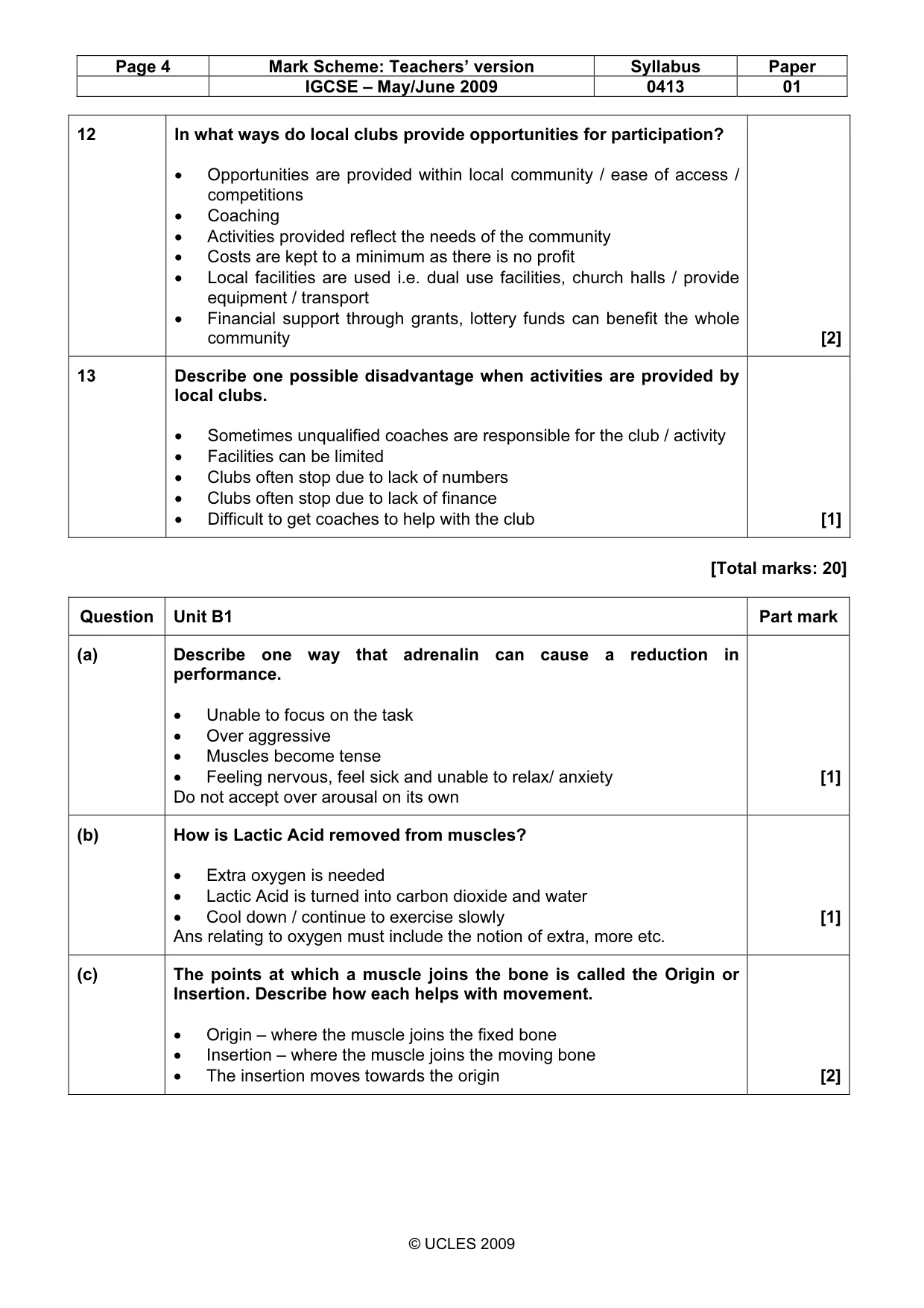
Page 4 Mark Scheme: Teachers’ version Syllabus Paper IGCSE – May/June 2009 0413 01 © UCLES 2009 12 In what ways do local clubs provide opportunities for participation? • Opportunities are provided within local community / ease of access / competitions • Coaching • Activities provided reflect the needs of the community • Costs are kept to a minimum as there is no profit • Local facilities are used i.e. dual use facilities, church halls / provide equipment / transport • Financial support through grants, lottery funds can benefit the whole community [2] 13 Describe one possible disadvantage when activities are provided by local clubs. • Sometimes unqualified coaches are responsible for the club / activity • Facilities can be limited • Clubs often stop due to lack of numbers • Clubs often stop due to lack of finance • Difficult to get coaches to help with the club [1] [Total marks: 20] Question Unit B1 Part mark (a) Describe one way that adrenalin can cause a reduction in performance. • Unable to focus on the task • Over aggressive • Muscles become tense • Feeling nervous, feel sick and unable to relax/ anxiety Do not accept over arousal on its own [1] (b) How is Lactic Acid removed from muscles? • Extra oxygen is needed • Lactic Acid is turned into carbon dioxide and water • Cool down / continue to exercise slowly Ans relating to oxygen must include the notion of extra, more etc. [1] (c) The points at which a muscle joins the bone is called the Origin or Insertion. Describe how each helps with movement. • Origin – where the muscle joins the fixed bone • Insertion – where the muscle joins the moving bone • The insertion moves towards the origin [2]
Mark scheme, page 5
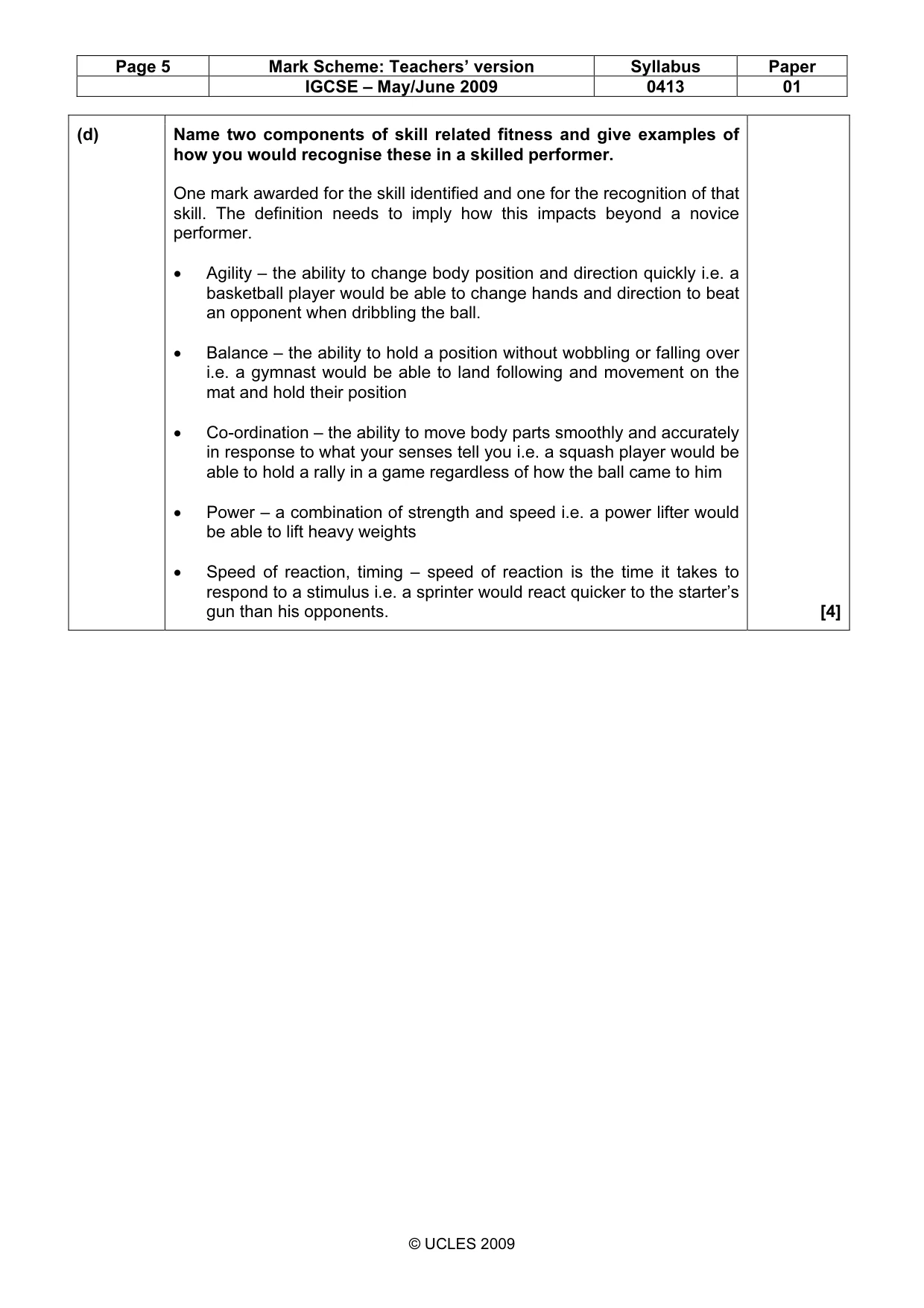
Page 5 Mark Scheme: Teachers’ version Syllabus Paper IGCSE – May/June 2009 0413 01 © UCLES 2009 (d) Name two components of skill related fitness and give examples of how you would recognise these in a skilled performer. One mark awarded for the skill identified and one for the recognition of that skill. The definition needs to imply how this impacts beyond a novice performer. • Agility – the ability to change body position and direction quickly i.e. a basketball player would be able to change hands and direction to beat an opponent when dribbling the ball. • Balance – the ability to hold a position without wobbling or falling over i.e. a gymnast would be able to land following and movement on the mat and hold their position • Co-ordination – the ability to move body parts smoothly and accurately in response to what your senses tell you i.e. a squash player would be able to hold a rally in a game regardless of how the ball came to him • Power – a combination of strength and speed i.e. a power lifter would be able to lift heavy weights • Speed of reaction, timing – speed of reaction is the time it takes to respond to a stimulus i.e. a sprinter would react quicker to the starter’s gun than his opponents. [4]
Mark scheme, page 6
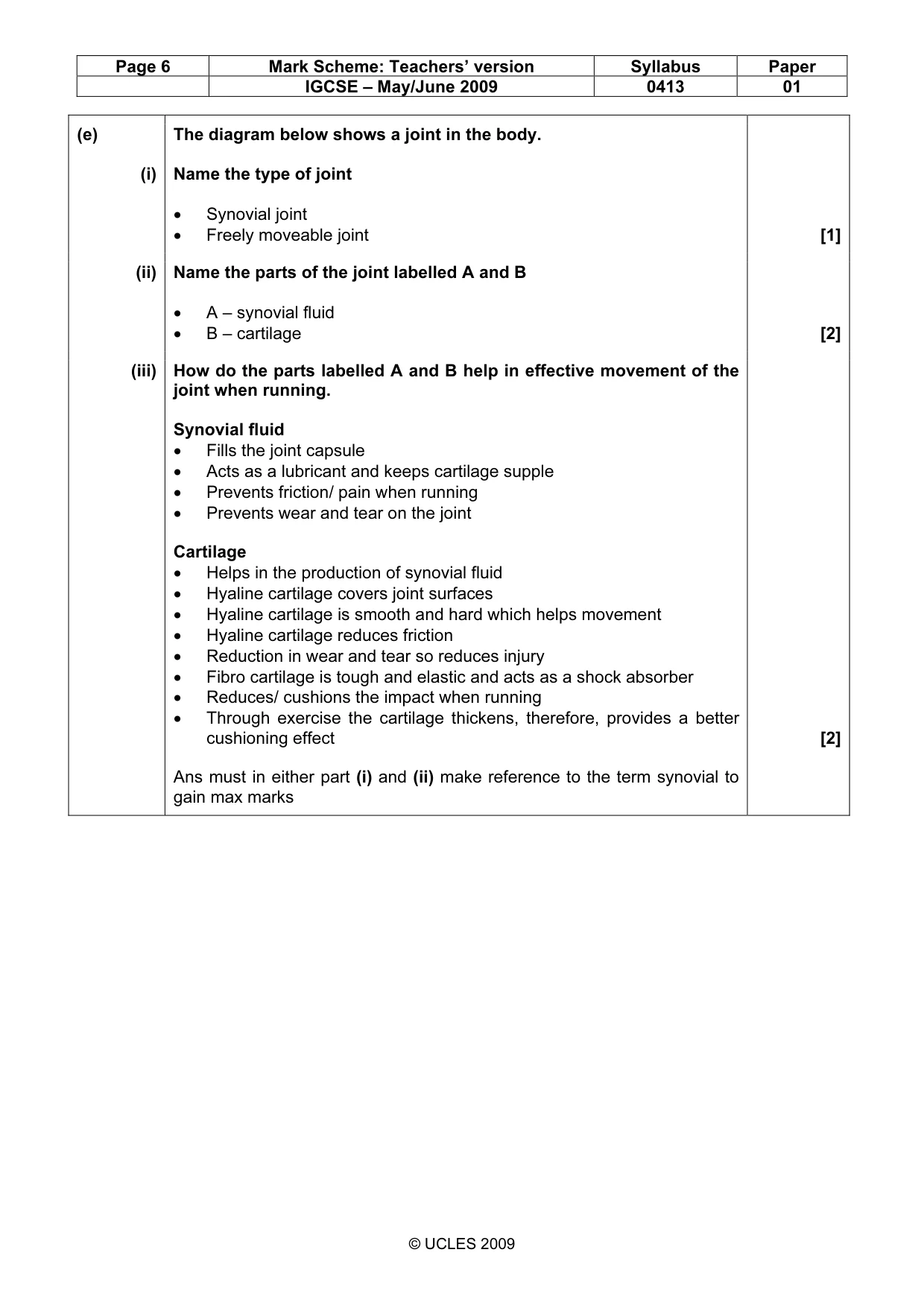
Page 6 Mark Scheme: Teachers’ version Syllabus Paper IGCSE – May/June 2009 0413 01 © UCLES 2009 (e) (i) The diagram below shows a joint in the body. Name the type of joint • Synovial joint • Freely moveable joint [1] (ii) Name the parts of the joint labelled A and B • A – synovial fluid • B – cartilage [2] (iii) How do the parts labelled A and B help in effective movement of the joint when running. Synovial fluid • Fills the joint capsule • Acts as a lubricant and keeps cartilage supple • Prevents friction/ pain when running • Prevents wear and tear on the joint Cartilage • Helps in the production of synovial fluid • Hyaline cartilage covers joint surfaces • Hyaline cartilage is smooth and hard which helps movement • Hyaline cartilage reduces friction • Reduction in wear and tear so reduces injury • Fibro cartilage is tough and elastic and acts as a shock absorber • Reduces/ cushions the impact when running • Through exercise the cartilage thickens, therefore, provides a better cushioning effect Ans must in either part (i) and (ii) make reference to the term synovial to gain max marks [2]
Mark scheme, page 7
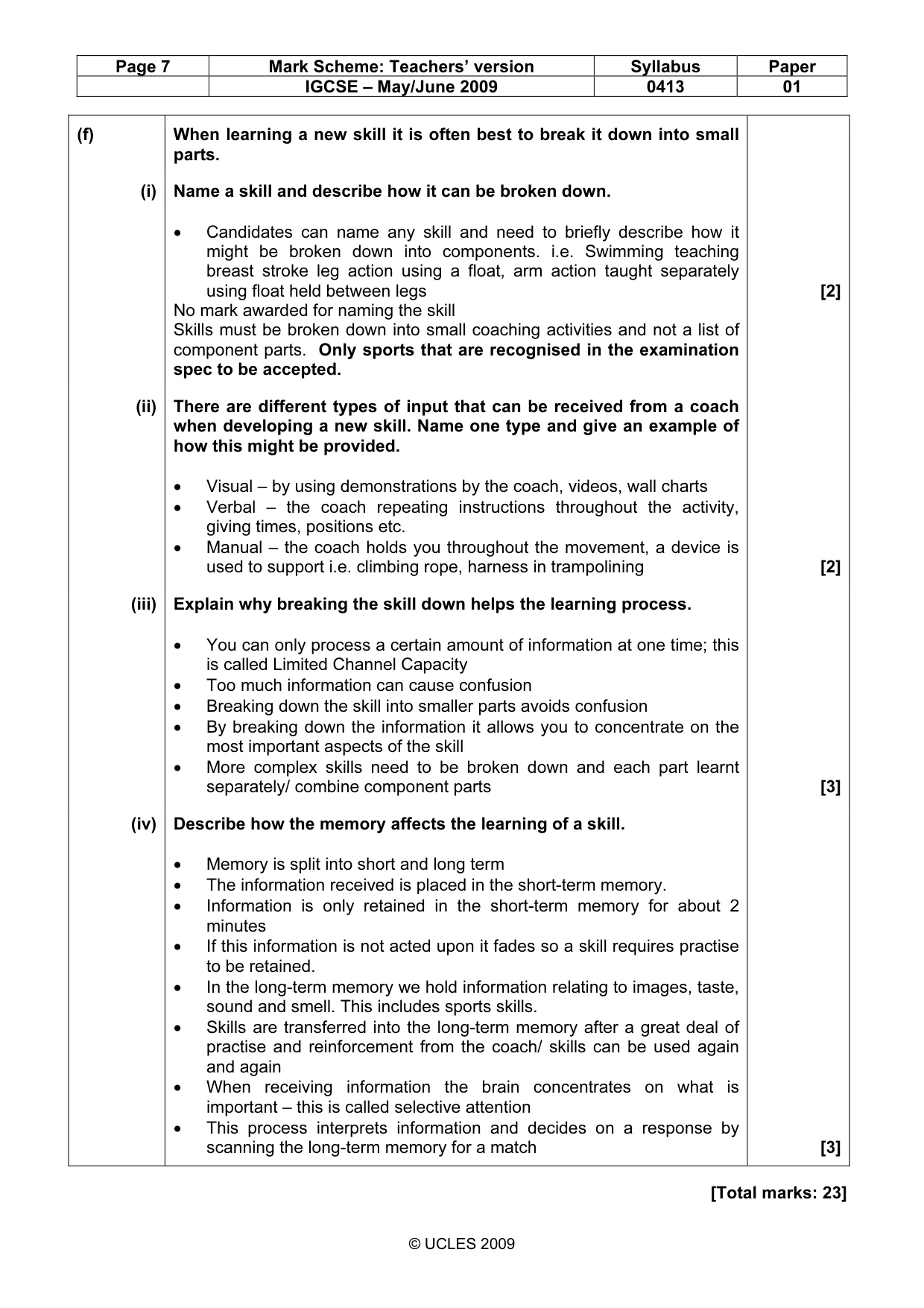
Page 7 Mark Scheme: Teachers’ version Syllabus Paper IGCSE – May/June 2009 0413 01 © UCLES 2009 (f) When learning a new skill it is often best to break it down into small parts. (i) Name a skill and describe how it can be broken down. • Candidates can name any skill and need to briefly describe how it might be broken down into components. i.e. Swimming teaching breast stroke leg action using a float, arm action taught separately using float held between legs No mark awarded for naming the skill Skills must be broken down into small coaching activities and not a list of component parts. Only sports that are recognised in the examination spec to be accepted. [2] (ii) There are different types of input that can be received from a coach when developing a new skill. Name one type and give an example of how this might be provided. • Visual – by using demonstrations by the coach, videos, wall charts • Verbal – the coach repeating instructions throughout the activity, giving times, positions etc. • Manual – the coach holds you throughout the movement, a device is used to support i.e. climbing rope, harness in trampolining [2] (iii) Explain why breaking the skill down helps the learning process. • You can only process a certain amount of information at one time; this is called Limited Channel Capacity • Too much information can cause confusion • Breaking down the skill into smaller parts avoids confusion • By breaking down the information it allows you to concentrate on the most important aspects of the skill • More complex skills need to be broken down and each part learnt separately/ combine component parts [3] (iv) Describe how the memory affects the learning of a skill. • Memory is split into short and long term • The information received is placed in the short-term memory. • Information is only retained in the short-term memory for about 2 minutes • If this information is not acted upon it fades so a skill requires practise to be retained. • In the long-term memory we hold information relating to images, taste, sound and smell. This includes sports skills. • Skills are transferred into the long-term memory after a great deal of practise and reinforcement from the coach/ skills can be used again and again • When receiving information the brain concentrates on what is important – this is called selective attention • This process interprets information and decides on a response by scanning the long-term memory for a match [3] [Total marks: 23]
Mark scheme, page 8
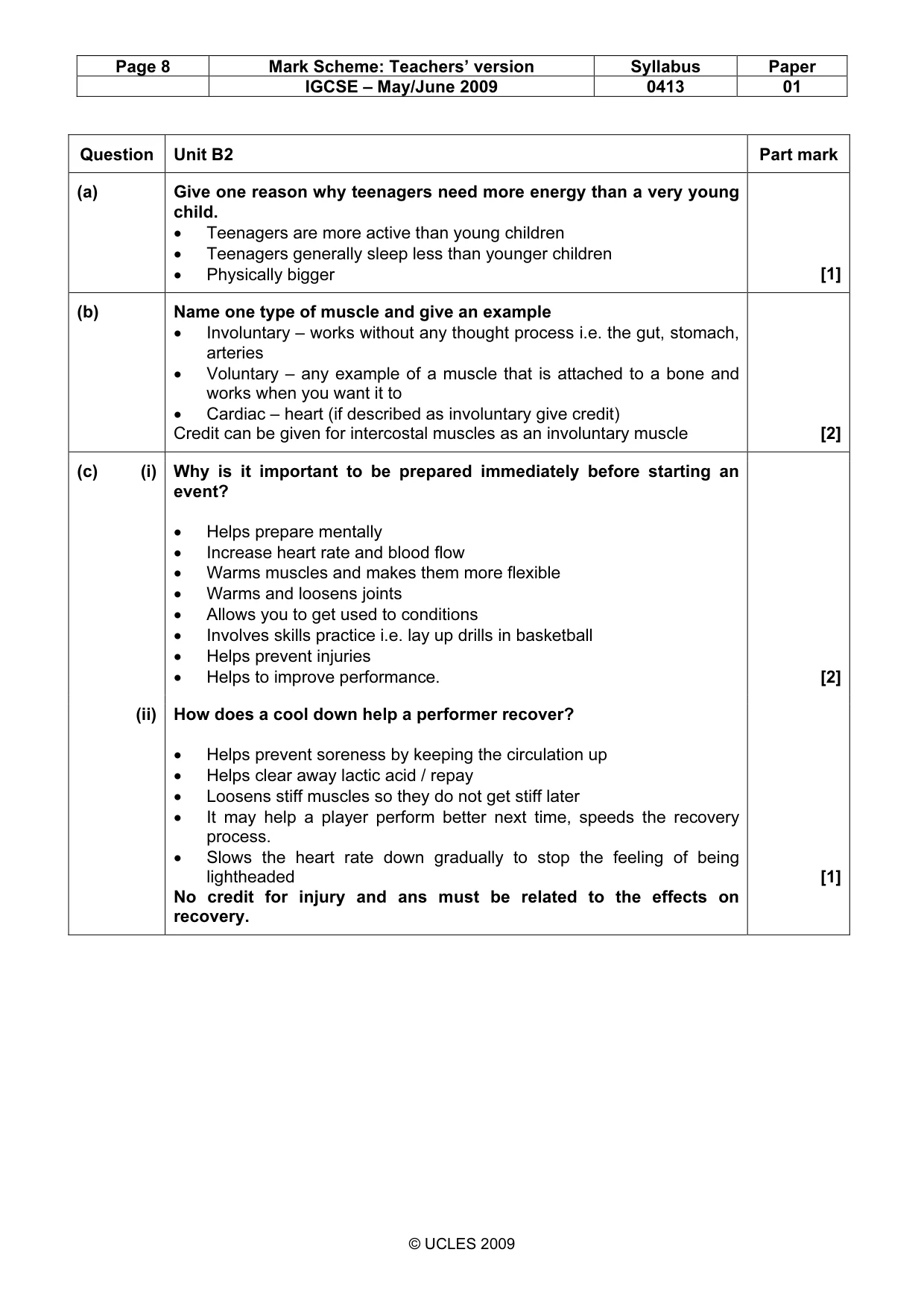
Page 8 Mark Scheme: Teachers’ version Syllabus Paper IGCSE – May/June 2009 0413 01 © UCLES 2009 Question Unit B2 Part mark (a) Give one reason why teenagers need more energy than a very young child. • Teenagers are more active than young children • Teenagers generally sleep less than younger children • Physically bigger [1] (b) Name one type of muscle and give an example • Involuntary – works without any thought process i.e. the gut, stomach, arteries • Voluntary – any example of a muscle that is attached to a bone and works when you want it to • Cardiac – heart (if described as involuntary give credit) Credit can be given for intercostal muscles as an involuntary muscle [2] (c) (i) Why is it important to be prepared immediately before starting an event? • Helps prepare mentally • Increase heart rate and blood flow • Warms muscles and makes them more flexible • Warms and loosens joints • Allows you to get used to conditions • Involves skills practice i.e. lay up drills in basketball • Helps prevent injuries • Helps to improve performance. [2] (ii) How does a cool down help a performer recover? • Helps prevent soreness by keeping the circulation up • Helps clear away lactic acid / repay • Loosens stiff muscles so they do not get stiff later • It may help a player perform better next time, speeds the recovery process. • Slows the heart rate down gradually to stop the feeling of being lightheaded No credit for injury and ans must be related to the effects on recovery. [1]
Mark scheme, page 9
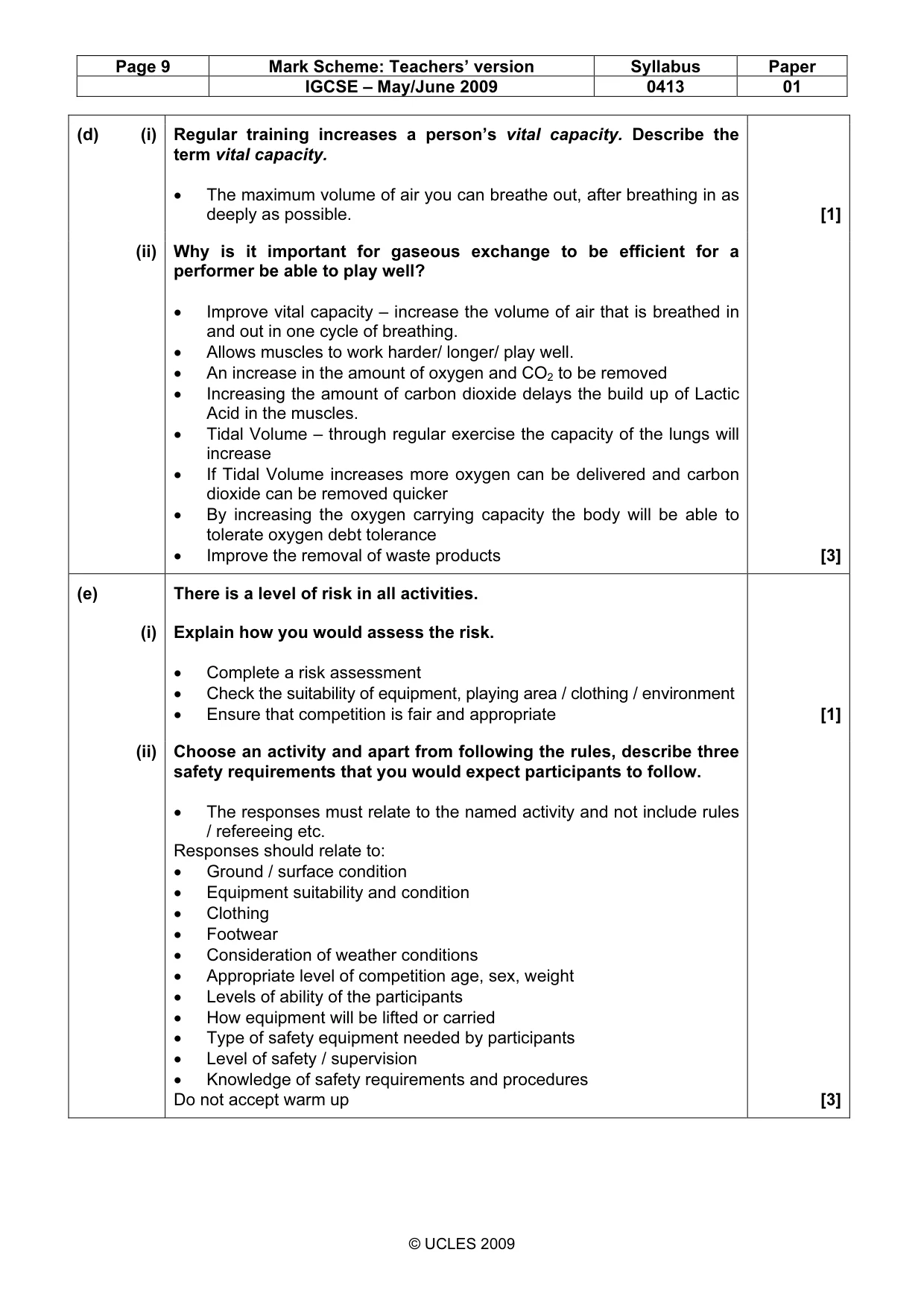
Page 9 Mark Scheme: Teachers’ version Syllabus Paper IGCSE – May/June 2009 0413 01 © UCLES 2009 (d) (i) Regular training increases a person’s vital capacity. Describe the term vital capacity. • The maximum volume of air you can breathe out, after breathing in as deeply as possible. [1] (ii) Why is it important for gaseous exchange to be efficient for a performer be able to play well? • Improve vital capacity – increase the volume of air that is breathed in and out in one cycle of breathing. • Allows muscles to work harder/ longer/ play well. • An increase in the amount of oxygen and CO2 to be removed • Increasing the amount of carbon dioxide delays the build up of Lactic Acid in the muscles. • Tidal Volume – through regular exercise the capacity of the lungs will increase • If Tidal Volume increases more oxygen can be delivered and carbon dioxide can be removed quicker • By increasing the oxygen carrying capacity the body will be able to tolerate oxygen debt tolerance • Improve the removal of waste products [3] (e) (i) There is a level of risk in all activities. Explain how you would assess the risk. • Complete a risk assessment • Check the suitability of equipment, playing area / clothing / environment • Ensure that competition is fair and appropriate [1] (ii) Choose an activity and apart from following the rules, describe three safety requirements that you would expect participants to follow. • The responses must relate to the named activity and not include rules / refereeing etc. Responses should relate to: • Ground / surface condition • Equipment suitability and condition • Clothing • Footwear • Consideration of weather conditions • Appropriate level of competition age, sex, weight • Levels of ability of the participants • How equipment will be lifted or carried • Type of safety equipment needed by participants • Level of safety / supervision • Knowledge of safety requirements and procedures Do not accept warm up [3]
Mark scheme, page 10
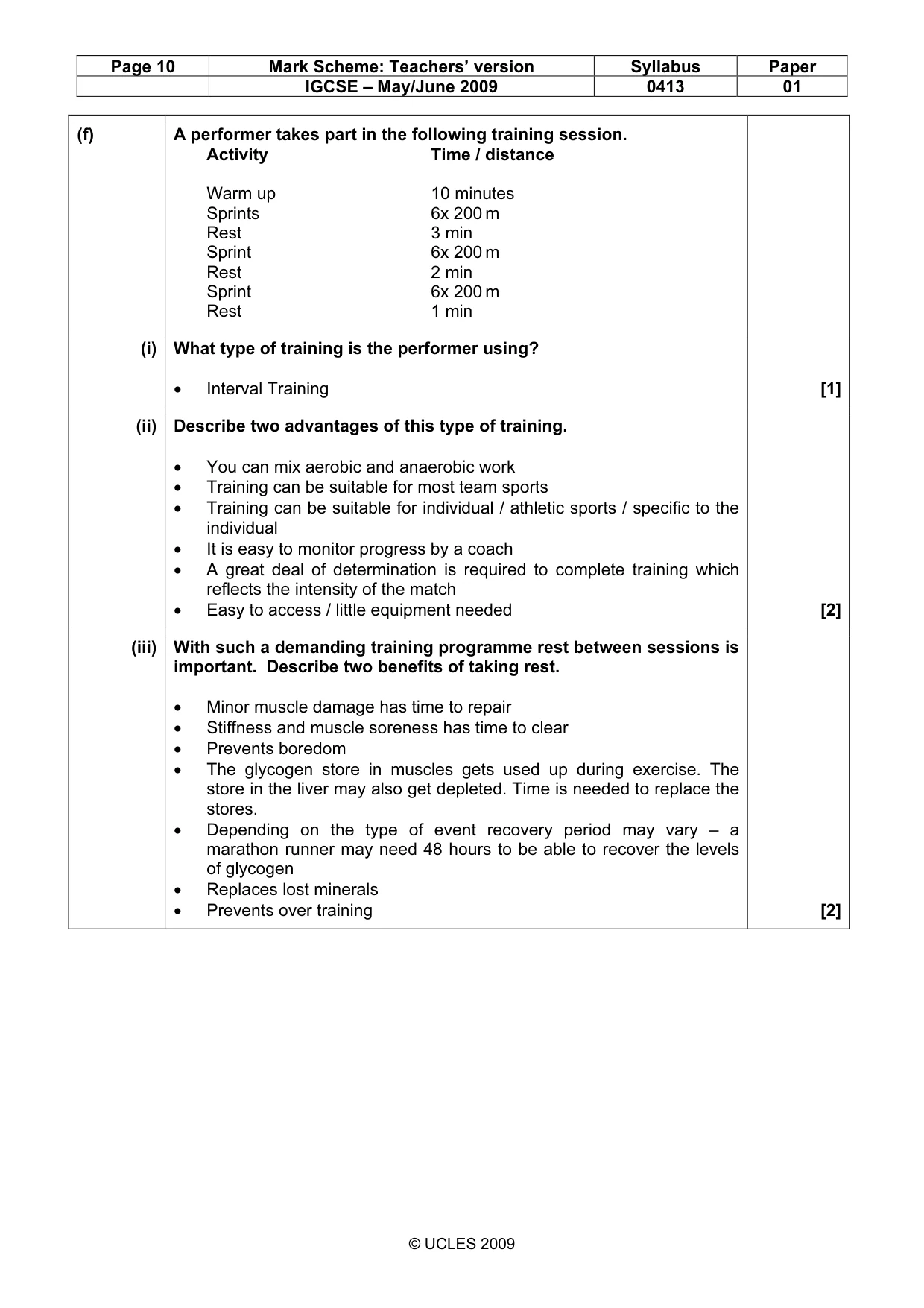
Page 10 Mark Scheme: Teachers’ version Syllabus Paper IGCSE – May/June 2009 0413 01 © UCLES 2009 (f) A performer takes part in the following training session. Activity Time / distance Warm up 10 minutes Sprints 6x 200 m Rest 3 min Sprint 6x 200 m Rest 2 min Sprint 6x 200 m Rest 1 min (i) What type of training is the performer using? • Interval Training [1] (ii) Describe two advantages of this type of training. • You can mix aerobic and anaerobic work • Training can be suitable for most team sports • Training can be suitable for individual / athletic sports / specific to the individual • It is easy to monitor progress by a coach • A great deal of determination is required to complete training which reflects the intensity of the match • Easy to access / little equipment needed [2] (iii) With such a demanding training programme rest between sessions is important. Describe two benefits of taking rest. • Minor muscle damage has time to repair • Stiffness and muscle soreness has time to clear • Prevents boredom • The glycogen store in muscles gets used up during exercise. The store in the liver may also get depleted. Time is needed to replace the stores. • Depending on the type of event recovery period may vary – a marathon runner may need 48 hours to be able to recover the levels of glycogen • Replaces lost minerals • Prevents over training [2]
Mark scheme, page 11
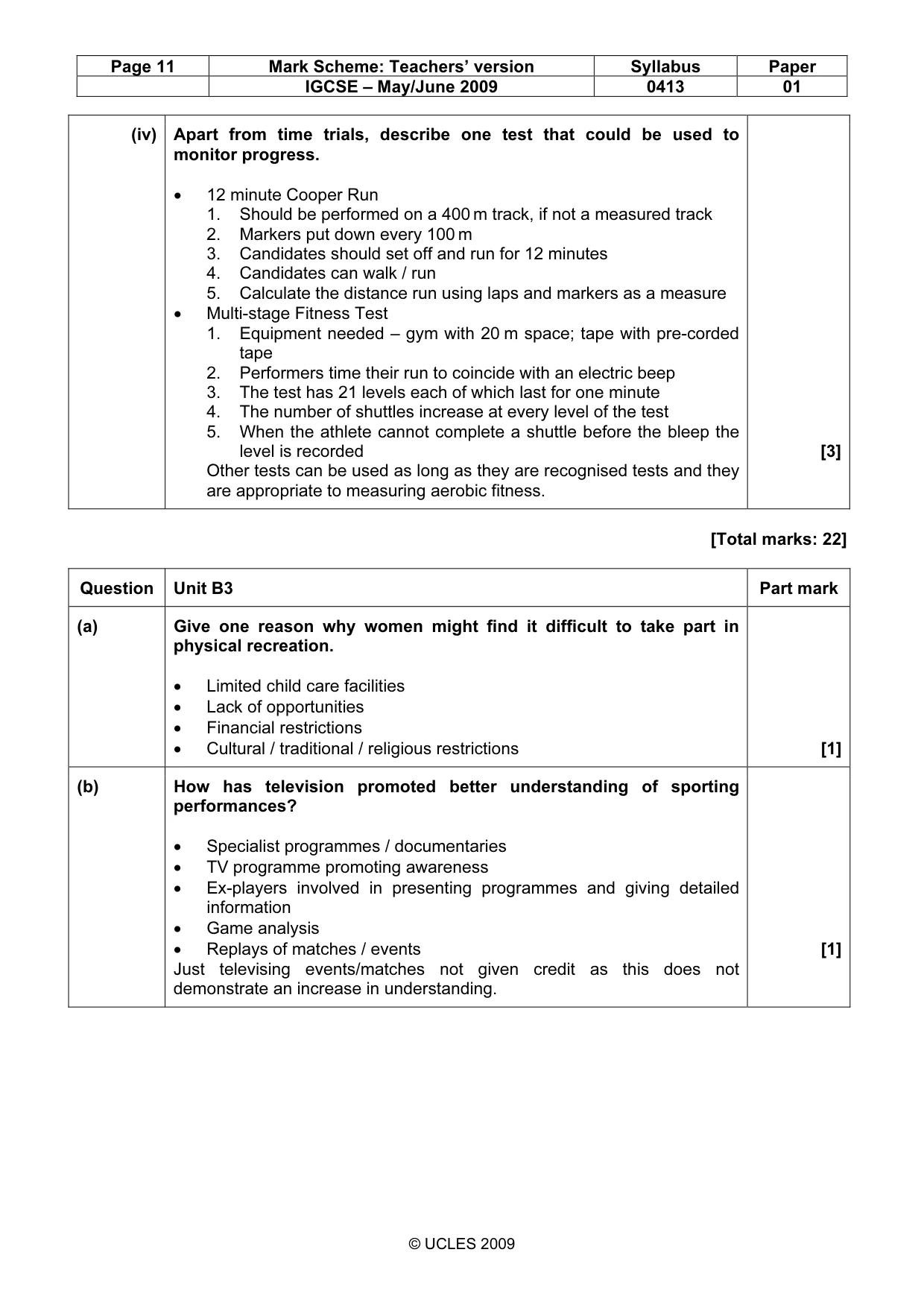
Page 11 Mark Scheme: Teachers’ version Syllabus Paper IGCSE – May/June 2009 0413 01 © UCLES 2009 (iv) Apart from time trials, describe one test that could be used to monitor progress. • 12 minute Cooper Run 1. Should be performed on a 400 m track, if not a measured track 2. Markers put down every 100 m 3. Candidates should set off and run for 12 minutes 4. Candidates can walk / run 5. Calculate the distance run using laps and markers as a measure • Multi-stage Fitness Test 1. Equipment needed – gym with 20 m space; tape with pre-corded tape 2. Performers time their run to coincide with an electric beep 3. The test has 21 levels each of which last for one minute 4. The number of shuttles increase at every level of the test 5. When the athlete cannot complete a shuttle before the bleep the level is recorded Other tests can be used as long as they are recognised tests and they are appropriate to measuring aerobic fitness. [3] [Total marks: 22] Question Unit B3 Part mark (a) Give one reason why women might find it difficult to take part in physical recreation. • Limited child care facilities • Lack of opportunities • Financial restrictions • Cultural / traditional / religious restrictions [1] (b) How has television promoted better understanding of sporting performances? • Specialist programmes / documentaries • TV programme promoting awareness • Ex-players involved in presenting programmes and giving detailed information • Game analysis • Replays of matches / events Just televising events/matches not given credit as this does not demonstrate an increase in understanding. [1]
Mark scheme, page 12
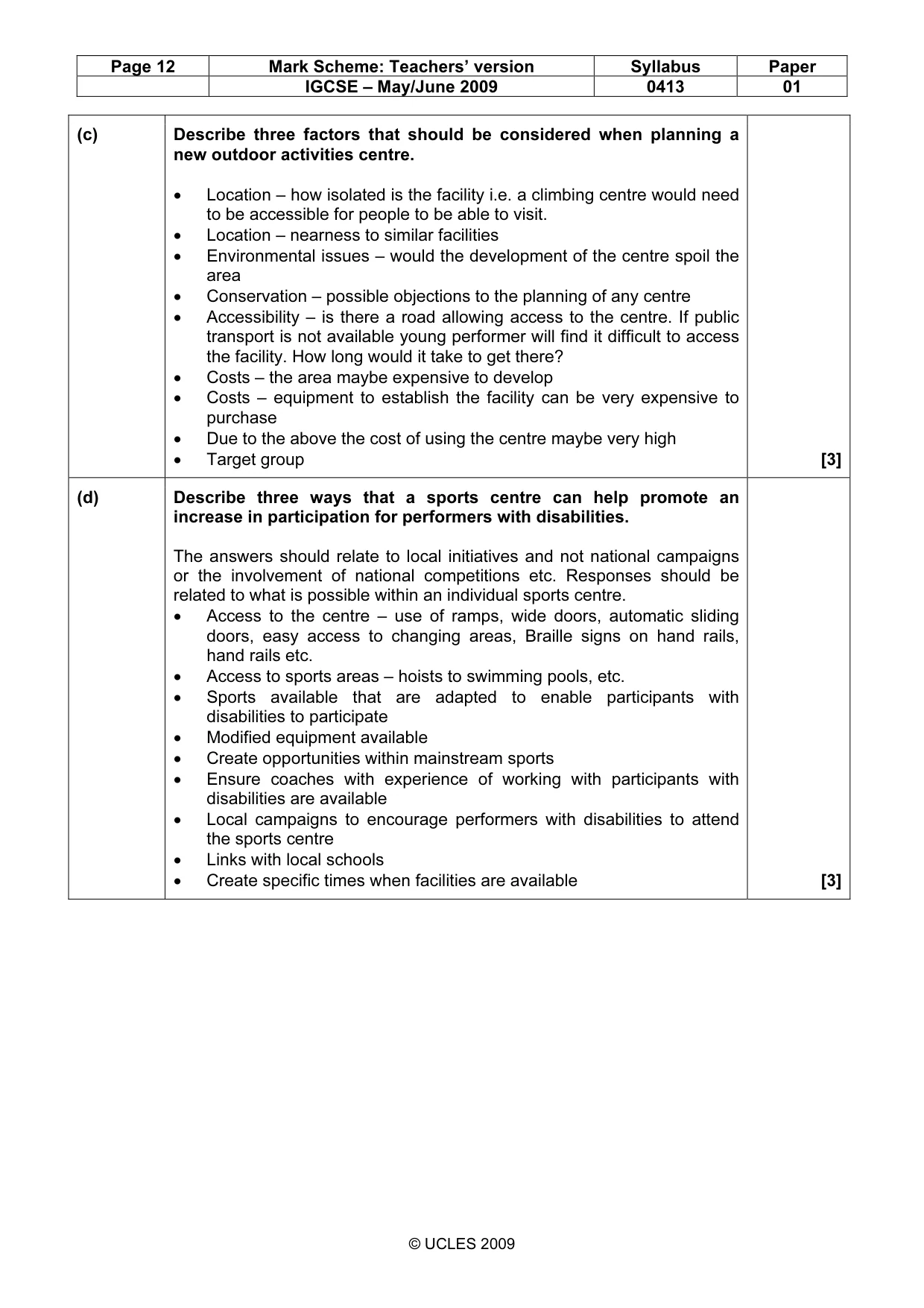
Page 12 Mark Scheme: Teachers’ version Syllabus Paper IGCSE – May/June 2009 0413 01 © UCLES 2009 (c) Describe three factors that should be considered when planning a new outdoor activities centre. • Location – how isolated is the facility i.e. a climbing centre would need to be accessible for people to be able to visit. • Location – nearness to similar facilities • Environmental issues – would the development of the centre spoil the area • Conservation – possible objections to the planning of any centre • Accessibility – is there a road allowing access to the centre. If public transport is not available young performer will find it difficult to access the facility. How long would it take to get there? • Costs – the area maybe expensive to develop • Costs – equipment to establish the facility can be very expensive to purchase • Due to the above the cost of using the centre maybe very high • Target group [3] (d) Describe three ways that a sports centre can help promote an increase in participation for performers with disabilities. The answers should relate to local initiatives and not national campaigns or the involvement of national competitions etc. Responses should be related to what is possible within an individual sports centre. • Access to the centre – use of ramps, wide doors, automatic sliding doors, easy access to changing areas, Braille signs on hand rails, hand rails etc. • Access to sports areas – hoists to swimming pools, etc. • Sports available that are adapted to enable participants with disabilities to participate • Modified equipment available • Create opportunities within mainstream sports • Ensure coaches with experience of working with participants with disabilities are available • Local campaigns to encourage performers with disabilities to attend the sports centre • Links with local schools • Create specific times when facilities are available [3]
Mark scheme, page 13
Page 13 Mark Scheme: Teachers’ version Syllabus Paper IGCSE – May/June 2009 0413 01 © UCLES 2009 (e) (i) Explain some of the disadvantages that a country could experience when hosting a global event. • Costs of running the games and providing facilities for the games / competition i.e. building stadia • The possibility of making a loss which would have to be paid for by the host nation • Security – the international threat of terrorism requires a high level of security • The need to ensure a high quality and number of hotels for spectators • Transport arrangements – increase in the number of air flights into the country – pollution • Infrastructure may need to be updated and improved • High dependency on sponsorship to pay for the games • Hostility towards the expenditure on such an event • Communications – do global television companies take coverage away from local companies and, therefore, potential profits • May need to provide facilities that would not be of use to the host nation after the event • Potential political difficulties with competing nations • If the games were not to be successful this could impact on the international standing of the host nation • Increase in crime and vandalism [4] (ii) Often the country that hosts a global event performs better than normal at the event. Explain why this should be the case. • Feel-good factor in the host country inspires some performers to play better. • Preparation for a major games takes many years and performers from host nations focus on peaking for this event rather than any other • Support for the host nation is usually more enthusiastic • Performers from host nations usually have access to the best of the training facilities available • No need to travel and acclimatise • Automatic qualification [3] [Total mark: 15]
What you needed in this session
Cambridge’s own grade thresholds for 2009 May/June, Paper 1 · Variant 1. A higher threshold means an easier paper — the bar moves with how the cohort did.