Cambridge IGCSE Physical Education 0413 — 2008 May/June Paper 1 · Variant 1
0413/11/M/J/08 · 80 marks · ≈90 min
The question paper and its mark scheme, free to read here and free to download. This is Cambridge’s own paper, exactly as it was sat.
Question paper16 pages





Mark scheme12 pages
Answers below. Sit the paper first if you are practising.
Paper as text
Question paper, page 1
UNIVERSITY OF CAMBRIDGE INTERNATIONAL EXAMINATIONS International General Certificate of Secondary Education READ THESE INSTRUCTIONS FIRST Write your Centre number, candidate number and name on all the work you hand in. Write in dark blue or black pen. You may use a soft pencil for any diagrams, graphs or rough working. Do not use staples, paper clips, highlighters, glue or correction fluid. DO NOT WRITE IN ANY BARCODES. Answer all questions. At the end of the examination, fasten all your work securely together. The number of marks is given in brackets [ ] at the end of each question or part question. PHYSICAL EDUCATION 0413/01 Paper 1 May/June 2008 2 hours Candidates answer on the Question Paper. No Additional Materials are required. For Examiner’s Use Section A B1 B2 B3 Total This document consists of 13 printed pages and 3 blank pages. SP (SM) T49141/2 © UCLES 2008 [Turn over * 9 0 3 2 3 4 6 7 4 6 * www.XtremePapers.com
Question paper, page 2
2 © UCLES 2008 For Examiner’s Use 0413/01/M/J/08 Section A Answer all questions in this section. 1 Name one factor that will affect how well a skill is performed. …[1] 2 Give one definition of the term health and fitness. …[1] 3 What is meant by leisure time? … …[1] 4 Name one factor that still makes it difficult for some women to participate in sports. … …[1] 5 Describe one key feature of resistance training. … …[1] 6 Choose one of the seven principles used for goal setting and explain why it is important. … … …[2] 7 Identify two differences between a ligament and a tendon. … … … …[2]
Question paper, page 3
3 © UCLES 2008 [Turn over For Examiner’s Use 0413/01/M/J/08 8 It may be possible to prevent some injuries by warming up properly. Describe two other ways that a warm up can help a performer. … … … …[2] 9 Providers of sports and recreation facilities can be split into three groups. Name one of these groups and explain why their role is important. … … … …[2] 10 Name two nutrients along with their food source. Nutrient 1 … Food source … Nutrient 2 … Food source …[2]
Question paper, page 4
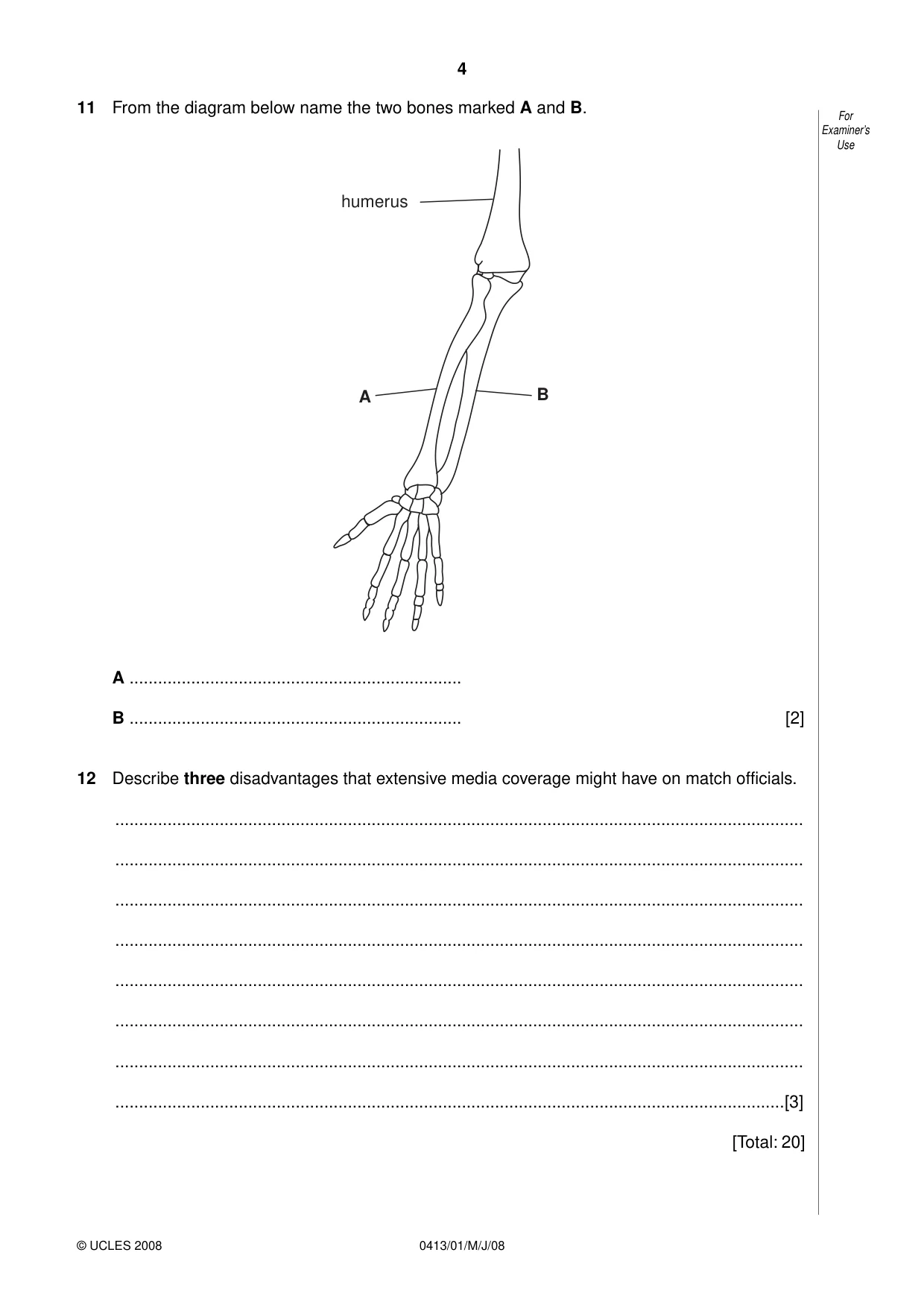
4 © UCLES 2008 For Examiner’s Use 0413/01/M/J/08 11 From the diagram below name the two bones marked A and B. humerus A B A … B … [2] 12 Describe three disadvantages that extensive media coverage might have on match officials. … … … … … … … …[3] [Total: 20]
Question paper, page 5
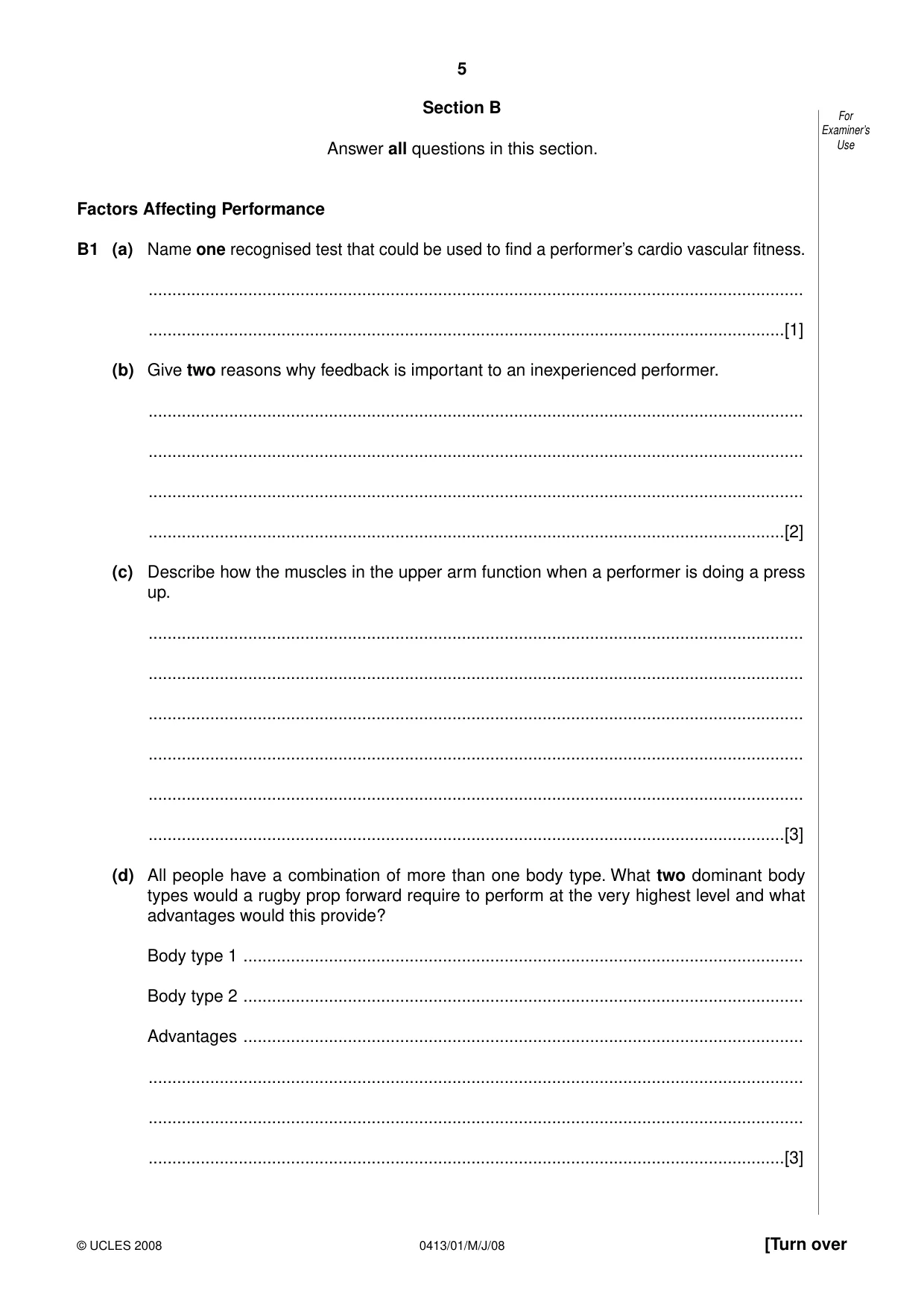
5 © UCLES 2008 [Turn over For Examiner’s Use 0413/01/M/J/08 Section B Answer all questions in this section. Factors Affecting Performance B1 (a) Name one recognised test that could be used to find a performer’s cardio vascular fitness. … …[1] (b) Give two reasons why feedback is important to an inexperienced performer. … … … …[2] (c) Describe how the muscles in the upper arm function when a performer is doing a press up. … … … … … …[3] (d) All people have a combination of more than one body type. What two dominant body types would a rugby prop forward require to perform at the very highest level and what advantages would this provide? Body type 1 … Body type 2 … Advantages … … … …[3]
Question paper, page 6
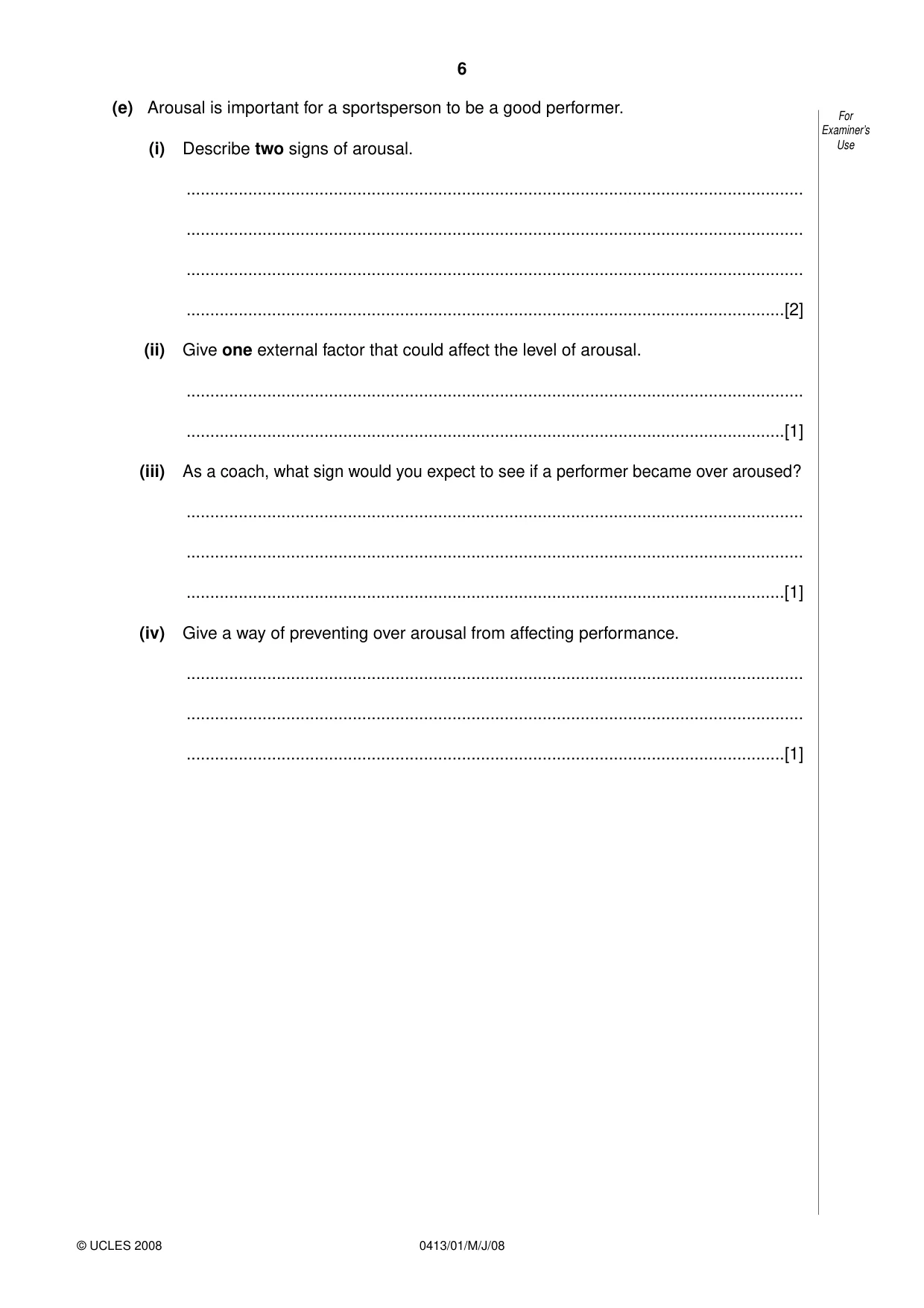
6 © UCLES 2008 For Examiner’s Use 0413/01/M/J/08 (e) Arousal is important for a sportsperson to be a good performer. (i) Describe two signs of arousal. … … … …[2] (ii) Give one external factor that could affect the level of arousal. … …[1] (iii) As a coach, what sign would you expect to see if a performer became over aroused? … … …[1] (iv) Give a way of preventing over arousal from affecting performance. … … …[1]
Question paper, page 7
7 © UCLES 2008 [Turn over For Examiner’s Use 0413/01/M/J/08 (f) Smoking can be described as a socially acceptable drug, but it can affect how well an athlete performs. (i) Describe how smoking affects the fitness of the athlete. … … … … … … … … … …[3] (ii) Name a type of drug that is banned by the International Olympic Committee and describe the negative effect that its misuse might have on the performer. Name of substance …[1] Effect … … … … …[2] [Total: 20]
Question paper, page 8
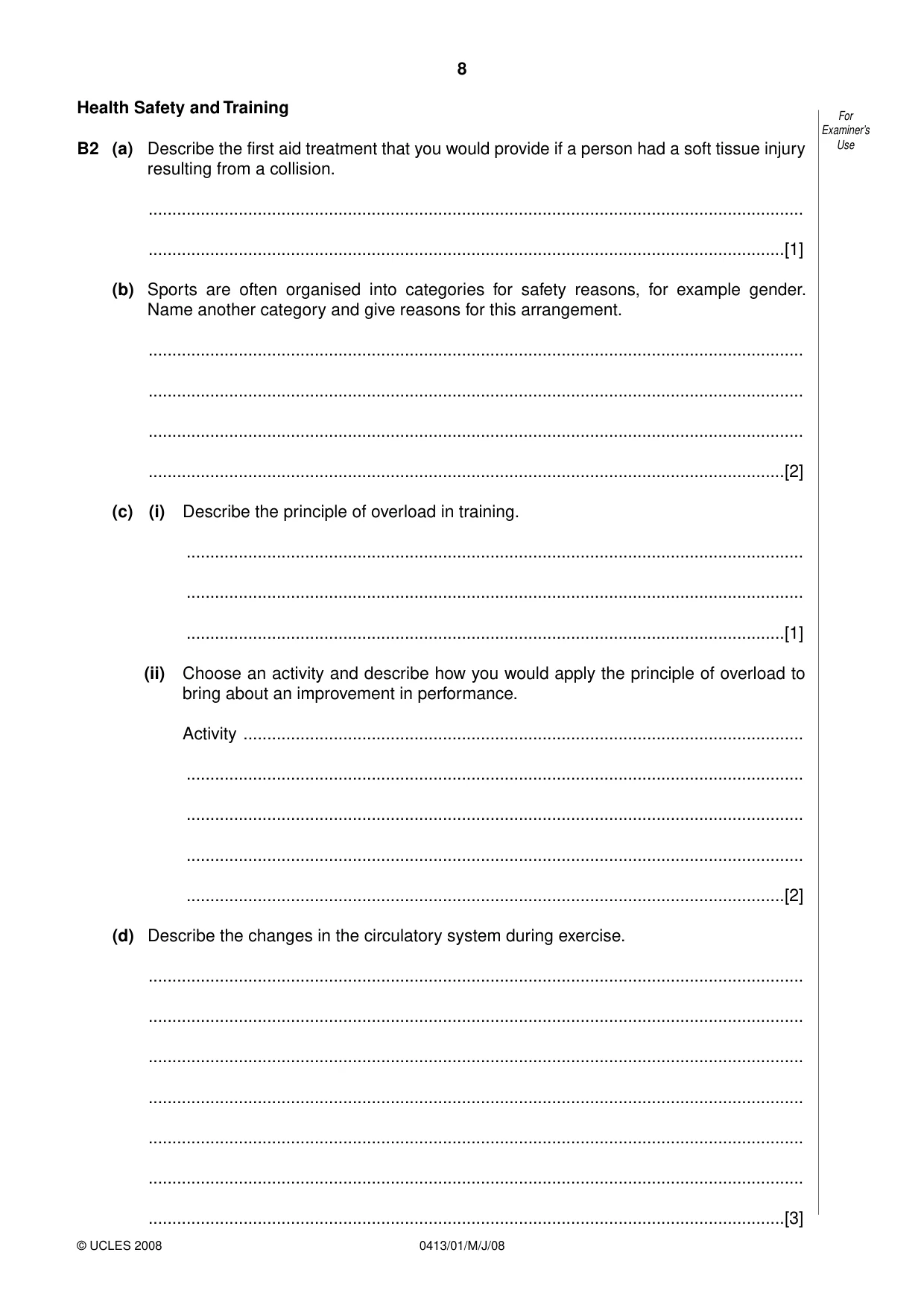
8 © UCLES 2008 For Examiner’s Use 0413/01/M/J/08 Health Safety and Training B2 (a) Describe the first aid treatment that you would provide if a person had a soft tissue injury resulting from a collision. … …[1] (b) Sports are often organised into categories for safety reasons, for example gender. Name another category and give reasons for this arrangement. … … … …[2] (c) (i) Describe the principle of overload in training. … … …[1] (ii) Choose an activity and describe how you would apply the principle of overload to bring about an improvement in performance. Activity … … … … …[2] (d) Describe the changes in the circulatory system during exercise. … … … … … … …[3]
Question paper, page 9
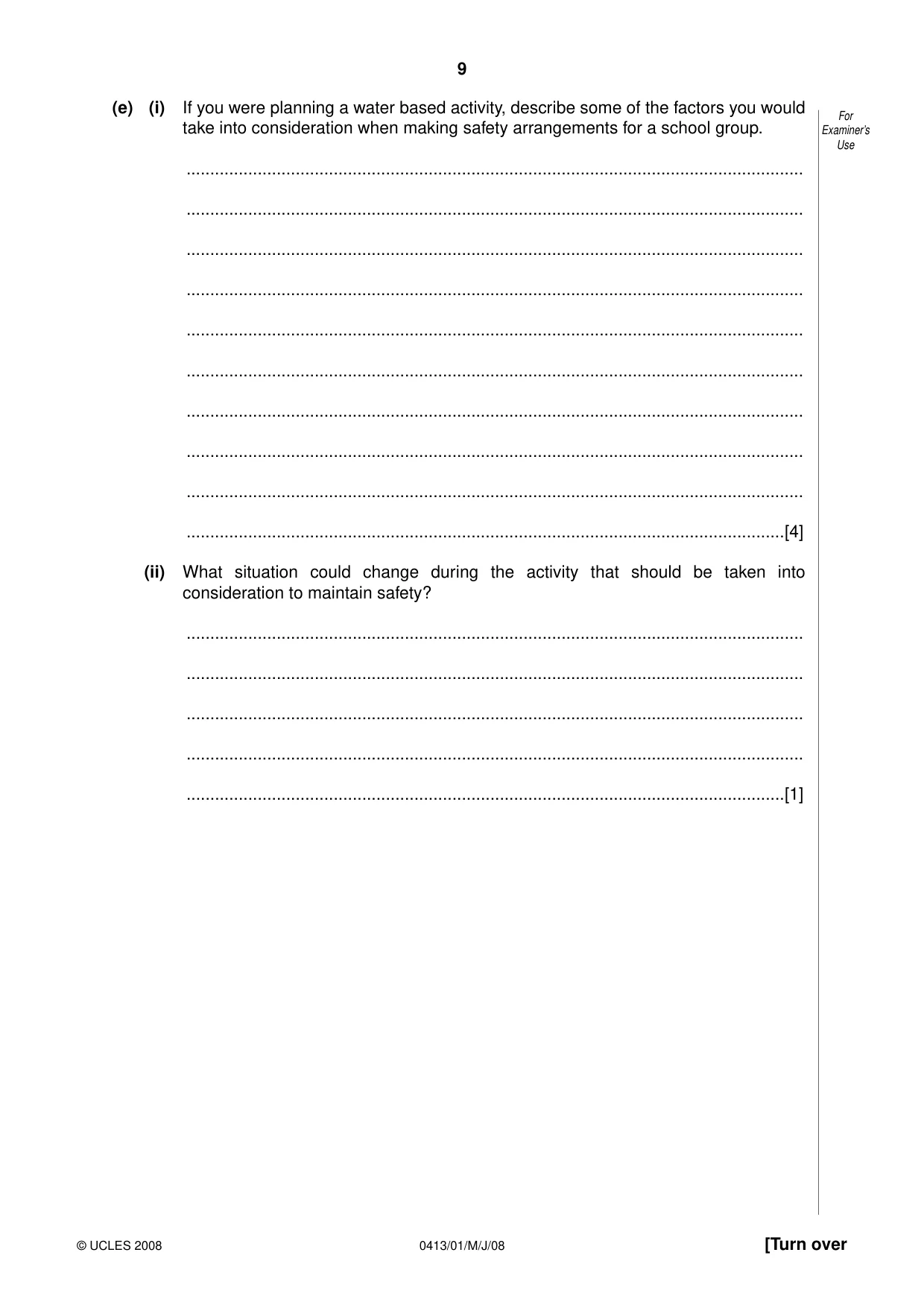
9 © UCLES 2008 [Turn over For Examiner’s Use 0413/01/M/J/08 (e) (i) If you were planning a water based activity, describe some of the factors you would take into consideration when making safety arrangements for a school group. … … … … … … … … … …[4] (ii) What situation could change during the activity that should be taken into consideration to maintain safety? … … … … …[1]
Question paper, page 10
10 © UCLES 2008 For Examiner’s Use 0413/01/M/J/08 (f) If you were designing a circuit training programme to improve muscular endurance: (i) Describe two different activities that you would include in the circuit and give details of how they would improve muscular endurance. … … … … … … … … … …[4] (ii) Give two advantages of using circuit training. … … … …[2] [Total: 20]
Question paper, page 11
11 © UCLES 2008 [Turn over For Examiner’s Use 0413/01/M/J/08 Reasons and Opportunities for Participation in Physical Activity B3 (a) Describe one way that an amateur performer can finance playing at the highest level. … …[1] (b) How can the media help to promote greater awareness of disability sports? … … … …[2] (c) Older people tend to choose different physical activities than younger people. Describe the main reasons for their choices. … … … … …[2] (d) Some countries have developed a high level of excellence in a particular sport or activity. Describe some of the reasons for this level of excellence. … … … … … … … …[3]
Question paper, page 12
12 © UCLES 2008 For Examiner’s Use 0413/01/M/J/08 (e) Access to facilities needed for adventurous activities such as skiing, rock climbing and canoeing is difficult for some people. Therefore, artificial facilities have been developed for such activities. Describe the advantages and disadvantages of using such facilities. … … … … … … … … … … …[5] (f) Due to public demand there has been an increase in the number of leisure facilities available. (i) What social factors affect the opportunities for participation in leisure activities? … … … … … … … … … … … … …[4]
Question paper, page 13
13 © UCLES 2008 For Examiner’s Use 0413/01/M/J/08 (ii) Describe how schools help improve opportunities for participation in leisure activities. … … … … … … … …[3] [Total: 20]
Question paper, page 14
14 0413/01/M/J/08 © UCLES 2008 BLANK PAGE
Question paper, page 15
15 0413/01/M/J/08 © UCLES 2008 BLANK PAGE
Question paper, page 16
16 0413/01/M/J/08 © UCLES 2008 BLANK PAGE Permission to reproduce items where third-party owned material protected by copyright is included has been sought and cleared where possible. Every reasonable effort has been made by the publisher (UCLES) to trace copyright holders, but if any items requiring clearance have unwittingly been included, the publisher will be pleased to make amends at the earliest possible opportunity. University of Cambridge International Examinations is part of the Cambridge Assessment Group. Cambridge Assessment is the brand name of University of Cambridge Local Examinations Syndicate (UCLES), which is itself a department of the University of Cambridge.
Mark scheme, page 1
UNIVERSITY OF CAMBRIDGE INTERNATIONAL EXAMINATIONS International General Certificate of Secondary Education MARK SCHEME for the May/June 2008 question paper 0413 PHYSICAL EDUCATION 0413/01 Paper 1, maximum raw mark 80 This mark scheme is published as an aid to teachers and candidates, to indicate the requirements of the examination. It shows the basis on which Examiners were instructed to award marks. It does not indicate the details of the discussions that took place at an Examiners’ meeting before marking began. All Examiners are instructed that alternative correct answers and unexpected approaches in candidates’ scripts must be given marks that fairly reflect the relevant knowledge and skills demonstrated. Mark schemes must be read in conjunction with the question papers and the report on the examination. • CIE will not enter into discussions or correspondence in connection with these mark schemes. CIE is publishing the mark schemes for the May/June 2008 question papers for most IGCSE, GCE Advanced Level and Advanced Subsidiary Level syllabuses and some Ordinary Level syllabuses. www.XtremePapers.com
Mark scheme, page 2
Page 2 Mark Scheme Syllabus Paper IGCSE – May/June 2008 0413 01 © UCLES 2008 Section A 1 Name one factor that will affect how well a skill is performed. • speed • agility • co-ordination • flexibility • balance • reaction time [1] 2 Give one definition of the term health and fitness. • health is a state of complete physical, mental and social well-being • be able to meet the demands of the environment [1] 3 What is meant by leisure time? • the time in which you can do as you wish • time when you do not have to work • time when you can take part in activities of your choice [1] 4 Name one factor that still makes it difficult for some women to participate in sport. • lack of crèche/child care facilities • lack of transport • time – women who combine work and a family find limited time available • time – women who are full-time carers find it difficult to create time during the day • costs of joining a gym if not working • single mothers have both limited time and resources • cultural attitudes towards women’s participation/religion Answers that relate to more historical barriers to participation should not be given credit. No marks awarded for lack of strength, cannot compete with men, etc. [1] 5 Describe one key feature of resistance training. • a method of training that requires the performer to work against a load • training that uses weights in some form • training that always requires performers to work with an overload • working extremely hard [1] 6 Choose one of the seven principles used for goal setting and explain why it is important. Candidates should choose one of the following principles (1 mark) and an explanation (1 mark). • Specific – ensures that it is relevant to the performer • Measurable – ensures that performer can recognise the improvement • Accepted – the performer and coach agree so both see the value and purpose of the training • Realistic – the goal must be achievable if not there will be little value in continuing • Time-related – if training takes place over a long period it can become boring, if too short targets cannot be achieved • Exciting – training can become boring or be motivating and interesting • Recorded – means that work can be recorded and can be used to see what progress has been made – acts as feedback Credit should not be given if SMARTER is used, as the question requires only one element to be used. [2]
Mark scheme, page 3
Page 3 Mark Scheme Syllabus Paper IGCSE – May/June 2008 0413 01 © UCLES 2008 7 Identify two differences between a ligament and a tendon. Tendon • connects muscle to bone • stores and releases energy • very flexible and stretchy • acts as a buffer and protects the limb from sudden and violent strain Ligament • connects bones together • slightly elastic • stabilises joints • holds joints in place [2] 8 It may be possible to prevent some injuries by warming up properly. Describe two other ways that a warm up can help a performer. Answers must relate to an increase. • increases heart rate • increases blood flow • warms muscles and makes them more flexible • warms and loosens joints • practise part of the sport or movement • ensure the performer is focused on activity [2] 9 Providers of sports and recreation facilities can be split into three groups. Name one of these groups and explain why their role is important. Providers are: • local authorities • private companies • voluntary organisations Importance of their role: Local authorities • offer service for communities not concerned with profit • provide a wide range of facilities • provide facilities for schools Private companies • high quality facilities • specialist facilities • latest technology used within facilities Voluntary organisations • meet the needs of local communities • low cost • reflect the needs of specific groups in the community An acceptable response could be made giving the example of a squash club as a private club. This should only be awarded if the role is clearly one of a private club. If the role is not correct the example should not be given credit. 1 mark for naming a provider and 1 mark for the benefit [2]
Mark scheme, page 4
Page 4 Mark Scheme Syllabus Paper IGCSE – May/June 2008 0413 01 © UCLES 2008 10 Name two nutrients along with their food source. • carbohydrates – pasta, rice, potatoes and bread • fats – meat, cream, cheese, cakes, biscuits • proteins – milk, fish, meat, nuts • vitamins and minerals – fish, liver, vegetables, fruit, eggs, • fibre and water can also be given credit 1 mark for nutrient and source [2] 11 Name the bones marked A and B. A – radius B – ulna [2] 12 Describe three disadvantages that extensive media coverage might have on match officials. • decisions are put under scrutiny by the media • decisions can be replayed • incidents can be looked at from many angles that may see incidents that officials do not • players can lack confidence in officials if they are seen to make poor decisions • officials become concerned about making decisions • integrity of officials questioned • media can lead campaigns against individuals/intrusion into private life • officials can become celebrities and subjected to sensational press coverage which increases pressure • interviews with players, etc. can result in pressure on officials [3] [Total: 20]
Mark scheme, page 5
Page 5 Mark Scheme Syllabus Paper IGCSE – May/June 2008 0413 01 © UCLES 2008 Section B B1 Factors affecting Performance (a) Name one recognised cardio-vascular test. • Multi-Stage Fitness Test/bleep test • The Cooper Test • The Harvard Step Test • The Cycle Ergonometer Test [1] (b) Give two reasons why feedback is important to an inexperienced performer. • it can identify strengths • it can identify weaknesses • enables people to improve/consolidate • stops errors that novice performers frequently make • see if extra training or practice is needed • sets goals for improvement • stay motivated • feedback needs to be more frequent for the novice performer as mistakes are more frequent Feedback can be provided by • knowledge of performance • knowledge of results • through video analysis [1/1] (c) Describe how the muscles in the upper arm function when a performer is doing a press up? • the bicep and triceps work together • the bicep runs along the front of the arm • the triceps are at the rear of the upper arm • the process is an antagonistic muscle action • to bend your arm at the elbow, the bicep contracts • the triceps relaxes to bend the arm • to straighten the arm, the triceps contract • the bicep relaxes to straighten the arm • concentric movement [3] (d) All people have a combination of more than one body type. What two dominant body types would a rugby prop forward require to perform at the very highest level and what advantages would this provide? • body mix would be mesomorph/endomorph Both body types for one mark Advantages – must relate to the impact in a game • endomorph would provide body bulk which would help in the scrum • provide strength and power to push and move an opponent • needs to be heavy to avoid being pushed or lifted • needs mobility to move about the field • well-defined muscular structure with strong forearms and thighs help to tackle and hold the ball in contact situations 1 mark for body types 2 marks for advantages [3]
Mark scheme, page 6
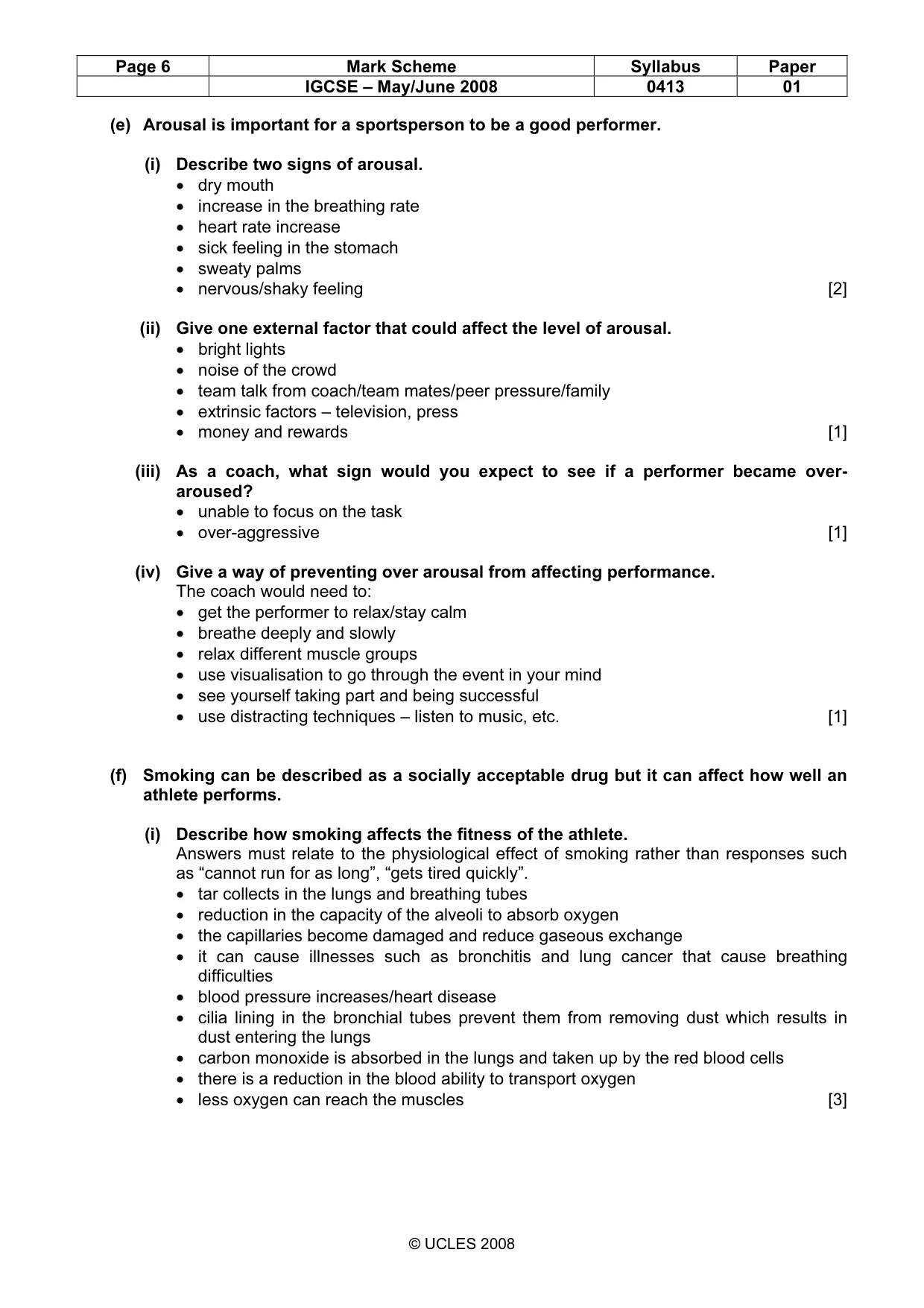
Page 6 Mark Scheme Syllabus Paper IGCSE – May/June 2008 0413 01 © UCLES 2008 (e) Arousal is important for a sportsperson to be a good performer. (i) Describe two signs of arousal. • dry mouth • increase in the breathing rate • heart rate increase • sick feeling in the stomach • sweaty palms • nervous/shaky feeling [2] (ii) Give one external factor that could affect the level of arousal. • bright lights • noise of the crowd • team talk from coach/team mates/peer pressure/family • extrinsic factors – television, press • money and rewards [1] (iii) As a coach, what sign would you expect to see if a performer became over- aroused? • unable to focus on the task • over-aggressive [1] (iv) Give a way of preventing over arousal from affecting performance. The coach would need to: • get the performer to relax/stay calm • breathe deeply and slowly • relax different muscle groups • use visualisation to go through the event in your mind • see yourself taking part and being successful • use distracting techniques – listen to music, etc. [1] (f) Smoking can be described as a socially acceptable drug but it can affect how well an athlete performs. (i) Describe how smoking affects the fitness of the athlete. Answers must relate to the physiological effect of smoking rather than responses such as “cannot run for as long”, “gets tired quickly”. • tar collects in the lungs and breathing tubes • reduction in the capacity of the alveoli to absorb oxygen • the capillaries become damaged and reduce gaseous exchange • it can cause illnesses such as bronchitis and lung cancer that cause breathing difficulties • blood pressure increases/heart disease • cilia lining in the bronchial tubes prevent them from removing dust which results in dust entering the lungs • carbon monoxide is absorbed in the lungs and taken up by the red blood cells • there is a reduction in the blood ability to transport oxygen • less oxygen can reach the muscles [3]
Mark scheme, page 7
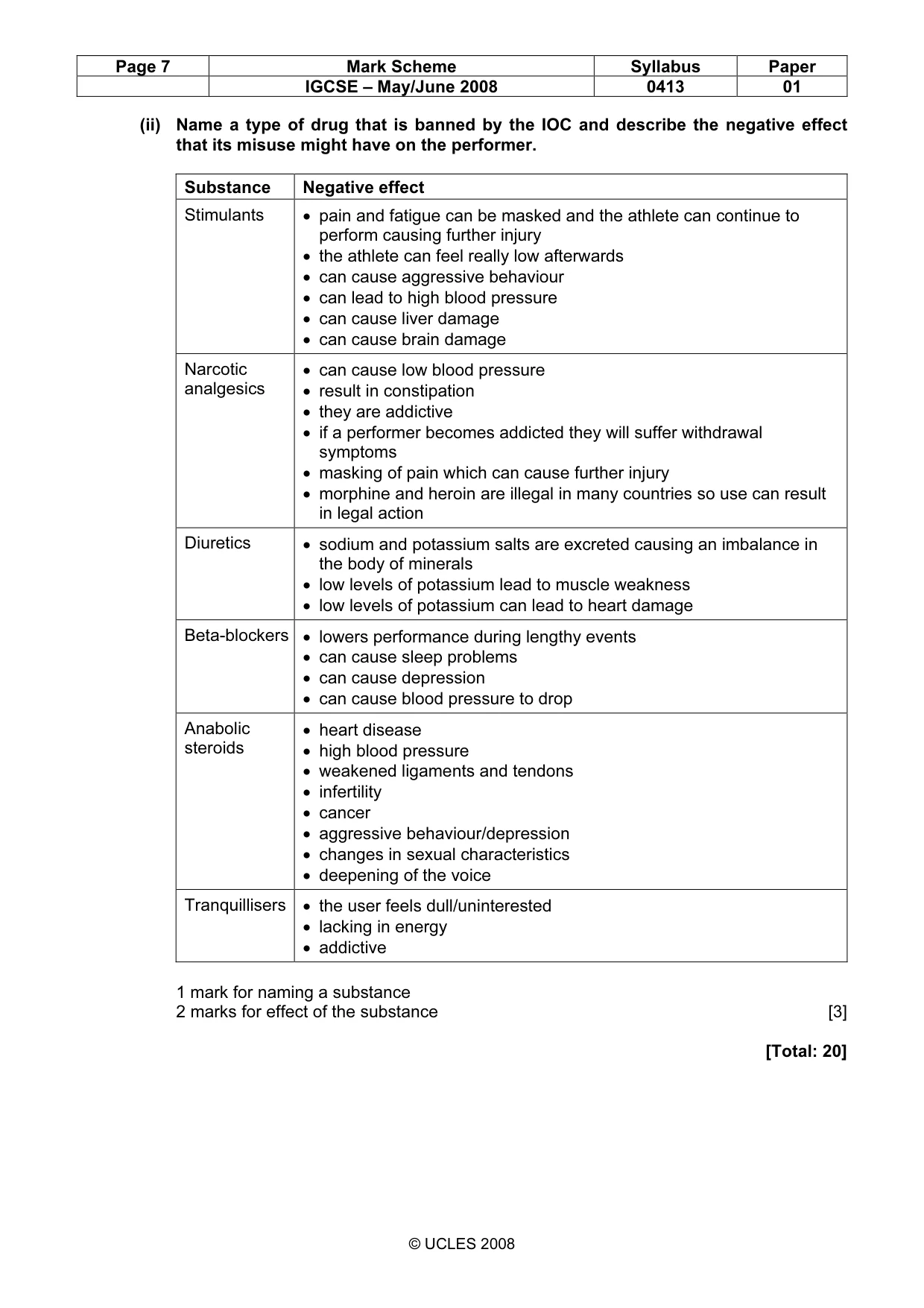
Page 7 Mark Scheme Syllabus Paper IGCSE – May/June 2008 0413 01 © UCLES 2008 (ii) Name a type of drug that is banned by the IOC and describe the negative effect that its misuse might have on the performer. Substance Negative effect Stimulants • pain and fatigue can be masked and the athlete can continue to perform causing further injury • the athlete can feel really low afterwards • can cause aggressive behaviour • can lead to high blood pressure • can cause liver damage • can cause brain damage Narcotic analgesics • can cause low blood pressure • result in constipation • they are addictive • if a performer becomes addicted they will suffer withdrawal symptoms • masking of pain which can cause further injury • morphine and heroin are illegal in many countries so use can result in legal action Diuretics • sodium and potassium salts are excreted causing an imbalance in the body of minerals • low levels of potassium lead to muscle weakness • low levels of potassium can lead to heart damage Beta-blockers • lowers performance during lengthy events • can cause sleep problems • can cause depression • can cause blood pressure to drop Anabolic steroids • heart disease • high blood pressure • weakened ligaments and tendons • infertility • cancer • aggressive behaviour/depression • changes in sexual characteristics • deepening of the voice Tranquillisers • the user feels dull/uninterested • lacking in energy • addictive 1 mark for naming a substance 2 marks for effect of the substance [3] [Total: 20]
Mark scheme, page 8
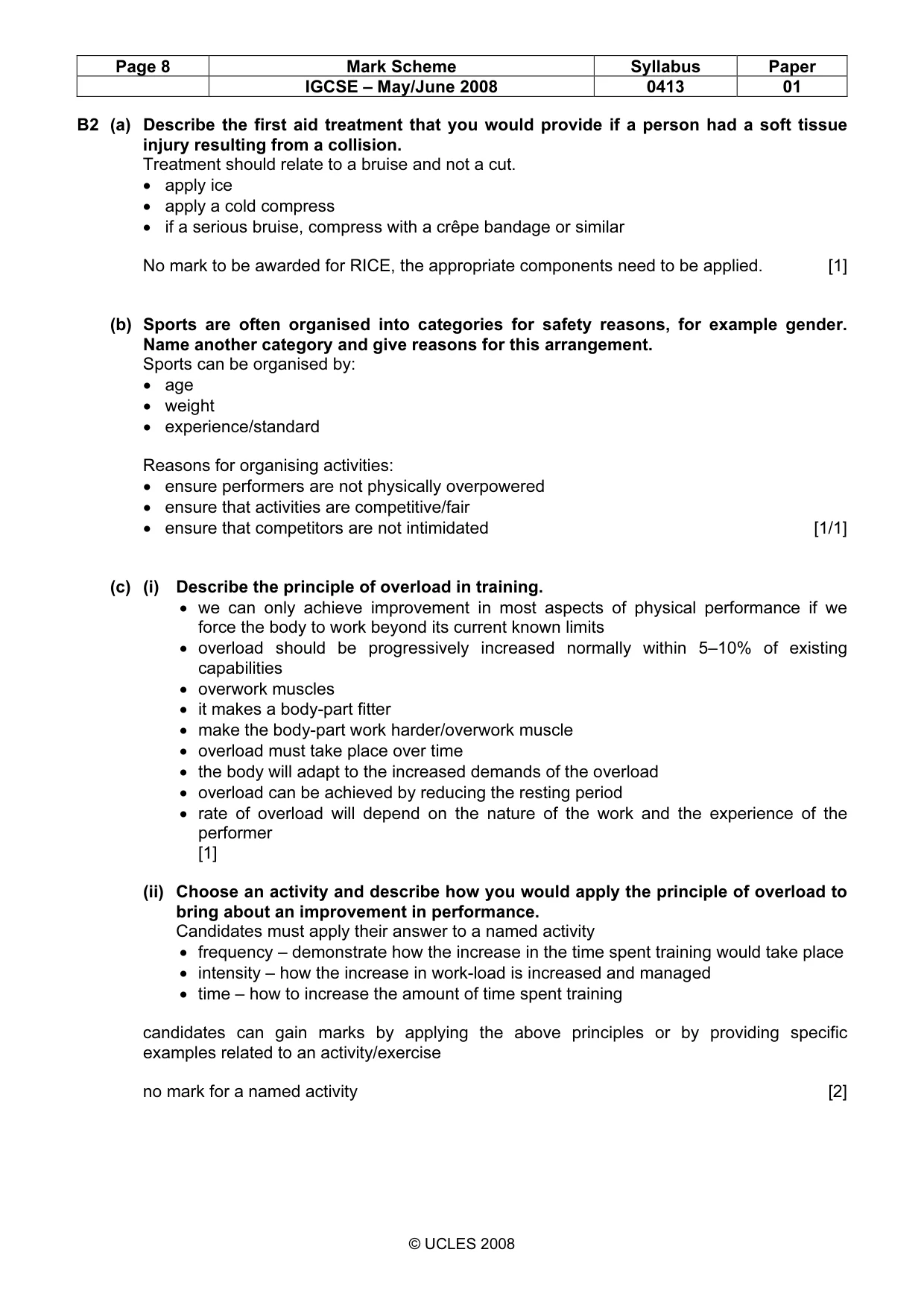
Page 8 Mark Scheme Syllabus Paper IGCSE – May/June 2008 0413 01 © UCLES 2008 B2 (a) Describe the first aid treatment that you would provide if a person had a soft tissue injury resulting from a collision. Treatment should relate to a bruise and not a cut. • apply ice • apply a cold compress • if a serious bruise, compress with a crêpe bandage or similar No mark to be awarded for RICE, the appropriate components need to be applied. [1] (b) Sports are often organised into categories for safety reasons, for example gender. Name another category and give reasons for this arrangement. Sports can be organised by: • age • weight • experience/standard Reasons for organising activities: • ensure performers are not physically overpowered • ensure that activities are competitive/fair • ensure that competitors are not intimidated [1/1] (c) (i) Describe the principle of overload in training. • we can only achieve improvement in most aspects of physical performance if we force the body to work beyond its current known limits • overload should be progressively increased normally within 5–10% of existing capabilities • overwork muscles • it makes a body-part fitter • make the body-part work harder/overwork muscle • overload must take place over time • the body will adapt to the increased demands of the overload • overload can be achieved by reducing the resting period • rate of overload will depend on the nature of the work and the experience of the performer [1] (ii) Choose an activity and describe how you would apply the principle of overload to bring about an improvement in performance. Candidates must apply their answer to a named activity • frequency – demonstrate how the increase in the time spent training would take place • intensity – how the increase in work-load is increased and managed • time – how to increase the amount of time spent training candidates can gain marks by applying the above principles or by providing specific examples related to an activity/exercise no mark for a named activity [2]
Mark scheme, page 9
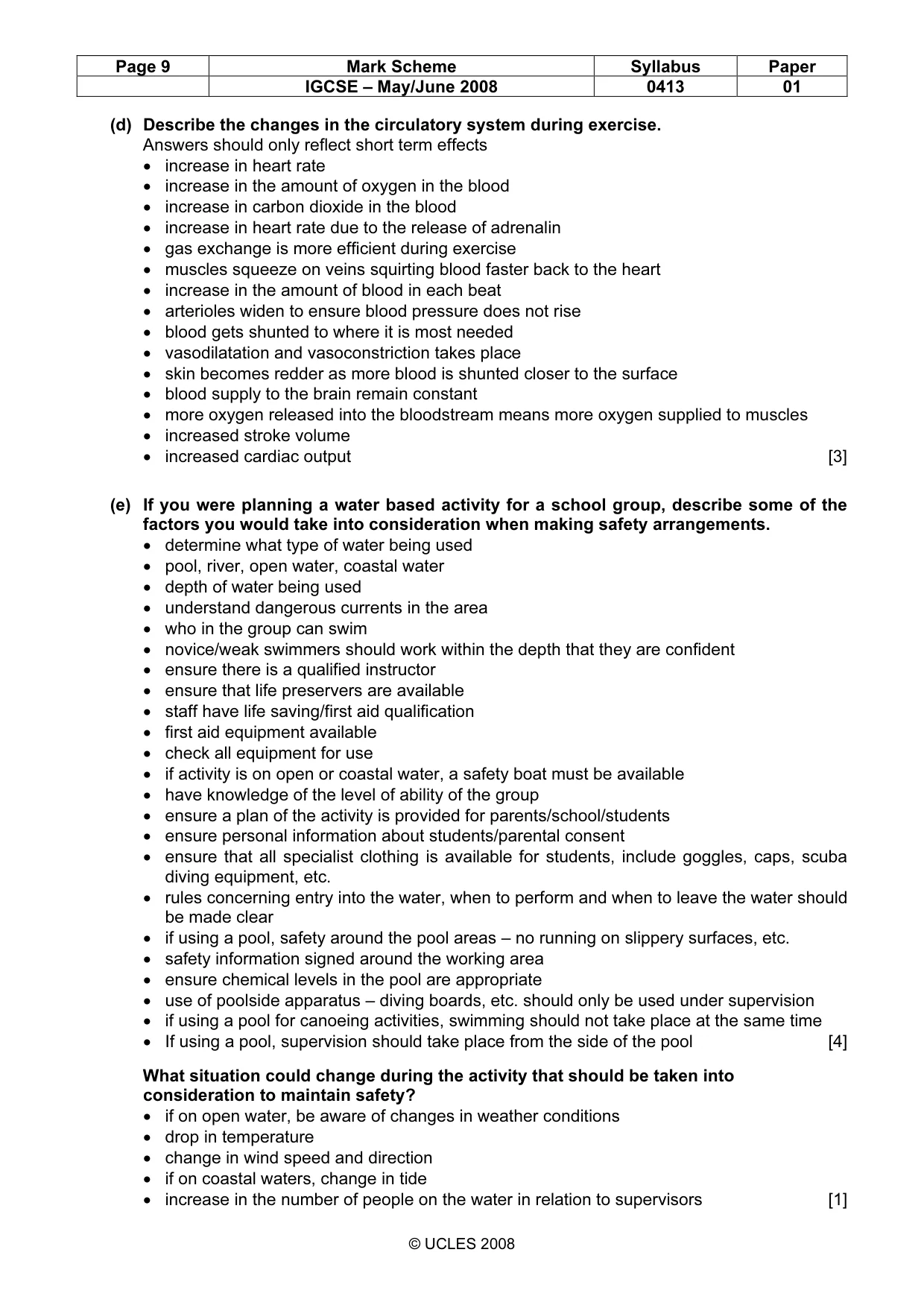
Page 9 Mark Scheme Syllabus Paper IGCSE – May/June 2008 0413 01 © UCLES 2008 (d) Describe the changes in the circulatory system during exercise. Answers should only reflect short term effects • increase in heart rate • increase in the amount of oxygen in the blood • increase in carbon dioxide in the blood • increase in heart rate due to the release of adrenalin • gas exchange is more efficient during exercise • muscles squeeze on veins squirting blood faster back to the heart • increase in the amount of blood in each beat • arterioles widen to ensure blood pressure does not rise • blood gets shunted to where it is most needed • vasodilatation and vasoconstriction takes place • skin becomes redder as more blood is shunted closer to the surface • blood supply to the brain remain constant • more oxygen released into the bloodstream means more oxygen supplied to muscles • increased stroke volume • increased cardiac output [3] (e) If you were planning a water based activity for a school group, describe some of the factors you would take into consideration when making safety arrangements. • determine what type of water being used • pool, river, open water, coastal water • depth of water being used • understand dangerous currents in the area • who in the group can swim • novice/weak swimmers should work within the depth that they are confident • ensure there is a qualified instructor • ensure that life preservers are available • staff have life saving/first aid qualification • first aid equipment available • check all equipment for use • if activity is on open or coastal water, a safety boat must be available • have knowledge of the level of ability of the group • ensure a plan of the activity is provided for parents/school/students • ensure personal information about students/parental consent • ensure that all specialist clothing is available for students, include goggles, caps, scuba diving equipment, etc. • rules concerning entry into the water, when to perform and when to leave the water should be made clear • if using a pool, safety around the pool areas – no running on slippery surfaces, etc. • safety information signed around the working area • ensure chemical levels in the pool are appropriate • use of poolside apparatus – diving boards, etc. should only be used under supervision • if using a pool for canoeing activities, swimming should not take place at the same time • If using a pool, supervision should take place from the side of the pool [4] What situation could change during the activity that should be taken into consideration to maintain safety? • if on open water, be aware of changes in weather conditions • drop in temperature • change in wind speed and direction • if on coastal waters, change in tide • increase in the number of people on the water in relation to supervisors [1]
Mark scheme, page 10
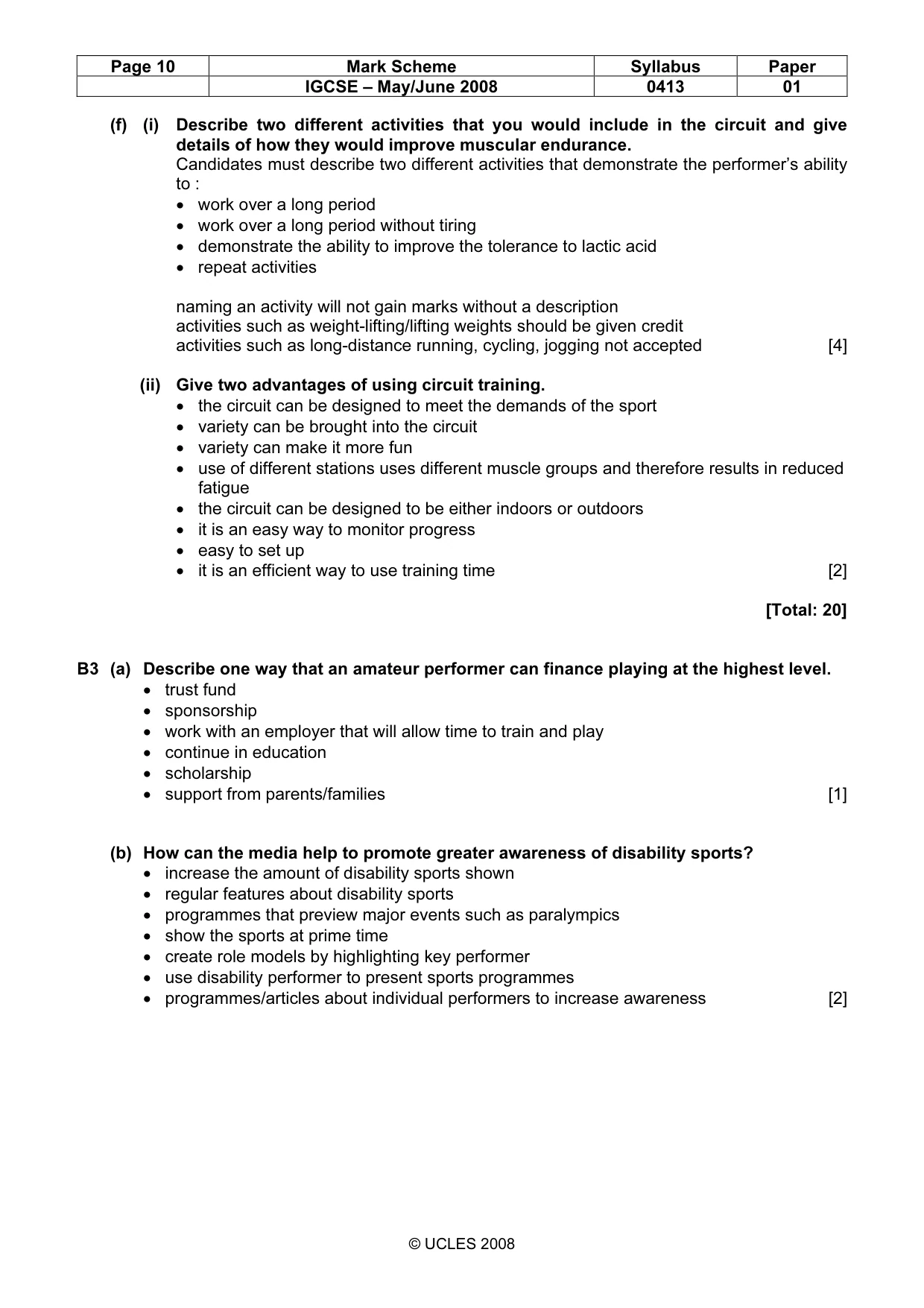
Page 10 Mark Scheme Syllabus Paper IGCSE – May/June 2008 0413 01 © UCLES 2008 (f) (i) Describe two different activities that you would include in the circuit and give details of how they would improve muscular endurance. Candidates must describe two different activities that demonstrate the performer’s ability to : • work over a long period • work over a long period without tiring • demonstrate the ability to improve the tolerance to lactic acid • repeat activities naming an activity will not gain marks without a description activities such as weight-lifting/lifting weights should be given credit activities such as long-distance running, cycling, jogging not accepted [4] (ii) Give two advantages of using circuit training. • the circuit can be designed to meet the demands of the sport • variety can be brought into the circuit • variety can make it more fun • use of different stations uses different muscle groups and therefore results in reduced fatigue • the circuit can be designed to be either indoors or outdoors • it is an easy way to monitor progress • easy to set up • it is an efficient way to use training time [2] [Total: 20] B3 (a) Describe one way that an amateur performer can finance playing at the highest level. • trust fund • sponsorship • work with an employer that will allow time to train and play • continue in education • scholarship • support from parents/families [1] (b) How can the media help to promote greater awareness of disability sports? • increase the amount of disability sports shown • regular features about disability sports • programmes that preview major events such as paralympics • show the sports at prime time • create role models by highlighting key performer • use disability performer to present sports programmes • programmes/articles about individual performers to increase awareness [2]
Mark scheme, page 11
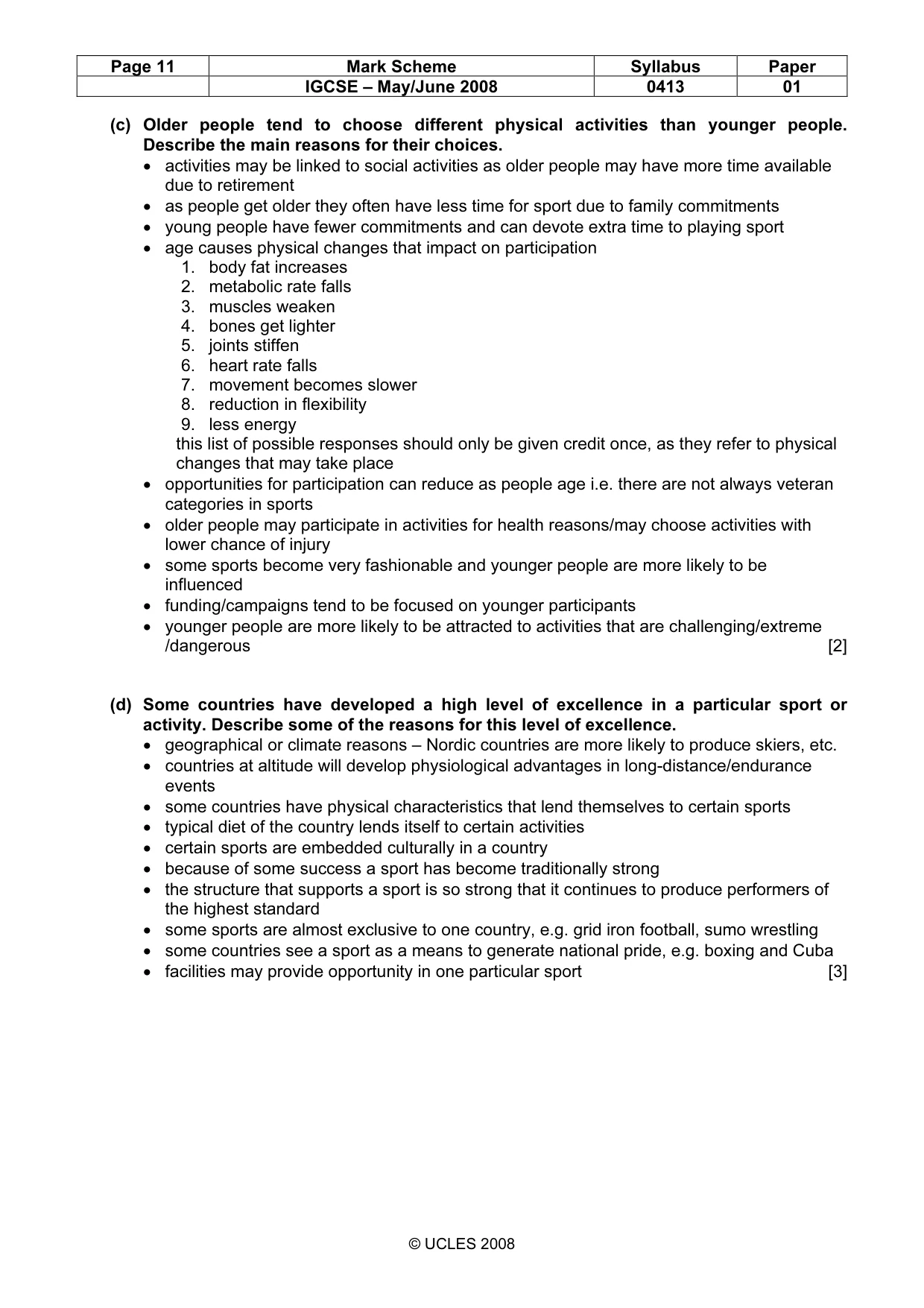
Page 11 Mark Scheme Syllabus Paper IGCSE – May/June 2008 0413 01 © UCLES 2008 (c) Older people tend to choose different physical activities than younger people. Describe the main reasons for their choices. • activities may be linked to social activities as older people may have more time available due to retirement • as people get older they often have less time for sport due to family commitments • young people have fewer commitments and can devote extra time to playing sport • age causes physical changes that impact on participation 1. body fat increases 2. metabolic rate falls 3. muscles weaken 4. bones get lighter 5. joints stiffen 6. heart rate falls 7. movement becomes slower 8. reduction in flexibility 9. less energy this list of possible responses should only be given credit once, as they refer to physical changes that may take place • opportunities for participation can reduce as people age i.e. there are not always veteran categories in sports • older people may participate in activities for health reasons/may choose activities with lower chance of injury • some sports become very fashionable and younger people are more likely to be influenced • funding/campaigns tend to be focused on younger participants • younger people are more likely to be attracted to activities that are challenging/extreme /dangerous [2] (d) Some countries have developed a high level of excellence in a particular sport or activity. Describe some of the reasons for this level of excellence. • geographical or climate reasons – Nordic countries are more likely to produce skiers, etc. • countries at altitude will develop physiological advantages in long-distance/endurance events • some countries have physical characteristics that lend themselves to certain sports • typical diet of the country lends itself to certain activities • certain sports are embedded culturally in a country • because of some success a sport has become traditionally strong • the structure that supports a sport is so strong that it continues to produce performers of the highest standard • some sports are almost exclusive to one country, e.g. grid iron football, sumo wrestling • some countries see a sport as a means to generate national pride, e.g. boxing and Cuba • facilities may provide opportunity in one particular sport [3]
Mark scheme, page 12
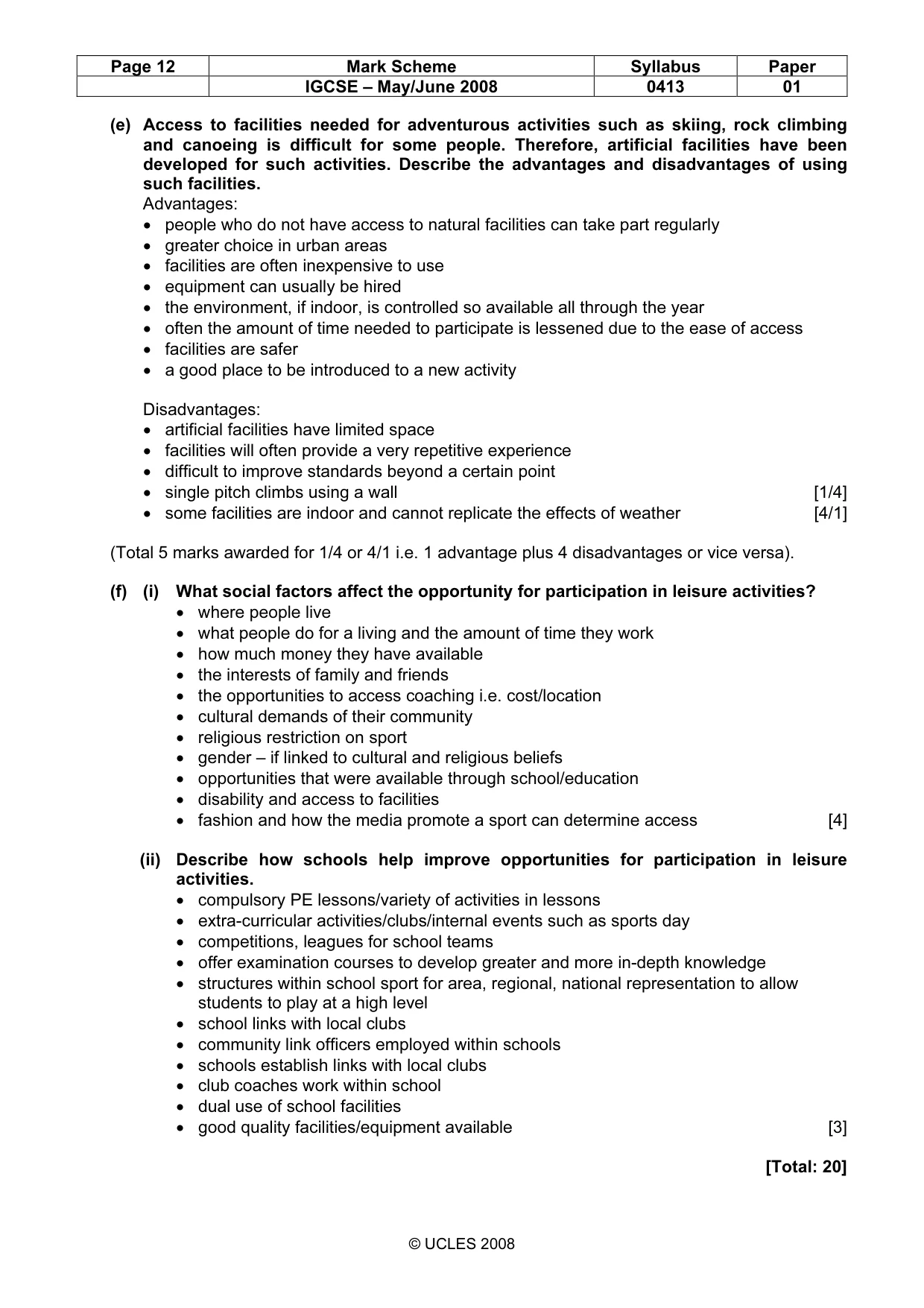
Page 12 Mark Scheme Syllabus Paper IGCSE – May/June 2008 0413 01 © UCLES 2008 (e) Access to facilities needed for adventurous activities such as skiing, rock climbing and canoeing is difficult for some people. Therefore, artificial facilities have been developed for such activities. Describe the advantages and disadvantages of using such facilities. Advantages: • people who do not have access to natural facilities can take part regularly • greater choice in urban areas • facilities are often inexpensive to use • equipment can usually be hired • the environment, if indoor, is controlled so available all through the year • often the amount of time needed to participate is lessened due to the ease of access • facilities are safer • a good place to be introduced to a new activity Disadvantages: • artificial facilities have limited space • facilities will often provide a very repetitive experience • difficult to improve standards beyond a certain point • single pitch climbs using a wall [1/4] • some facilities are indoor and cannot replicate the effects of weather [4/1] (Total 5 marks awarded for 1/4 or 4/1 i.e. 1 advantage plus 4 disadvantages or vice versa). (f) (i) What social factors affect the opportunity for participation in leisure activities? • where people live • what people do for a living and the amount of time they work • how much money they have available • the interests of family and friends • the opportunities to access coaching i.e. cost/location • cultural demands of their community • religious restriction on sport • gender – if linked to cultural and religious beliefs • opportunities that were available through school/education • disability and access to facilities • fashion and how the media promote a sport can determine access [4] (ii) Describe how schools help improve opportunities for participation in leisure activities. • compulsory PE lessons/variety of activities in lessons • extra-curricular activities/clubs/internal events such as sports day • competitions, leagues for school teams • offer examination courses to develop greater and more in-depth knowledge • structures within school sport for area, regional, national representation to allow students to play at a high level • school links with local clubs • community link officers employed within schools • schools establish links with local clubs • club coaches work within school • dual use of school facilities • good quality facilities/equipment available [3] [Total: 20]
What you needed in this session
Cambridge’s own grade thresholds for 2008 May/June, Paper 1 · Variant 1. A higher threshold means an easier paper — the bar moves with how the cohort did.