Cambridge IGCSE Physical Education 0413 — 2007 May/June Paper 1 · Variant 1
0413/11/M/J/07 · 80 marks · ≈90 min
The question paper and its mark scheme, free to read here and free to download. This is Cambridge’s own paper, exactly as it was sat.
Question paper12 pages








Mark scheme12 pages
Answers below. Sit the paper first if you are practising.







Paper as text
Question paper, page 1
This document consists of 12 printed pages. SP (MML 13117 3/06) T24872/4 © UCLES 2007 [Turn over READ THESE INSTRUCTIONS FIRST Write your Centre number, candidate number and name on all the work you hand in. Write in dark blue or black pen. You may use a soft pencil for any diagrams, graphs or rough working. Do not use staples, paper clips, highlighters, glue or correction fluid. DO NOT WRITE IN ANY BARCODES. Answer all questions. At the end of the examination, fasten all your work securely together. The number of marks is given in brackets [ ] at the end of each question or part question. PHYSICAL EDUCATION 0413/01 Paper 1 May/June 2007 2 hours Candidates answer on the Question Paper. No Additional Materials are required. * 6 0 3 5 2 8 4 9 5 1 * UNIVERSITY OF CAMBRIDGE INTERNATIONAL EXAMINATIONS International General Certificate of Secondary Education For Examiner’s Use Section A B1 B2 B3 Total www.XtremePapers.com
Question paper, page 2
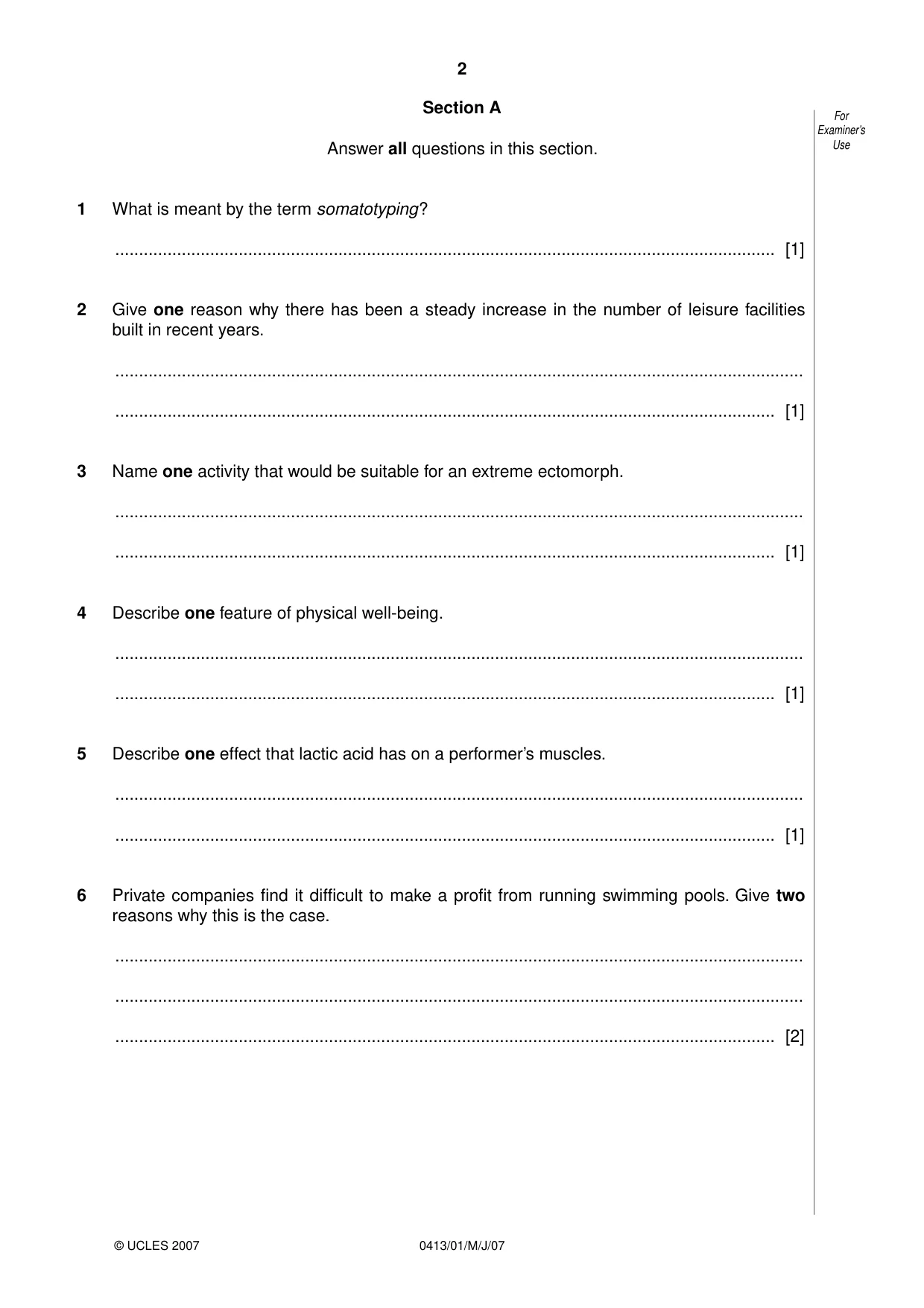
2 0413/01/M/J/07 © UCLES 2007 For Examiner’s Use Section A Answer all questions in this section. 1 What is meant by the term somatotyping ? … [1] 2 Give one reason why there has been a steady increase in the number of leisure facilities built in recent years. … … [1] 3 Name one activity that would be suitable for an extreme ectomorph. … … [1] 4 Describe one feature of physical well-being. … … [1] 5 Describe one effect that lactic acid has on a performer’s muscles. … … [1] 6 Private companies find it difficult to make a profit from running swimming pools. Give two reasons why this is the case. … … … [2]
Question paper, page 3
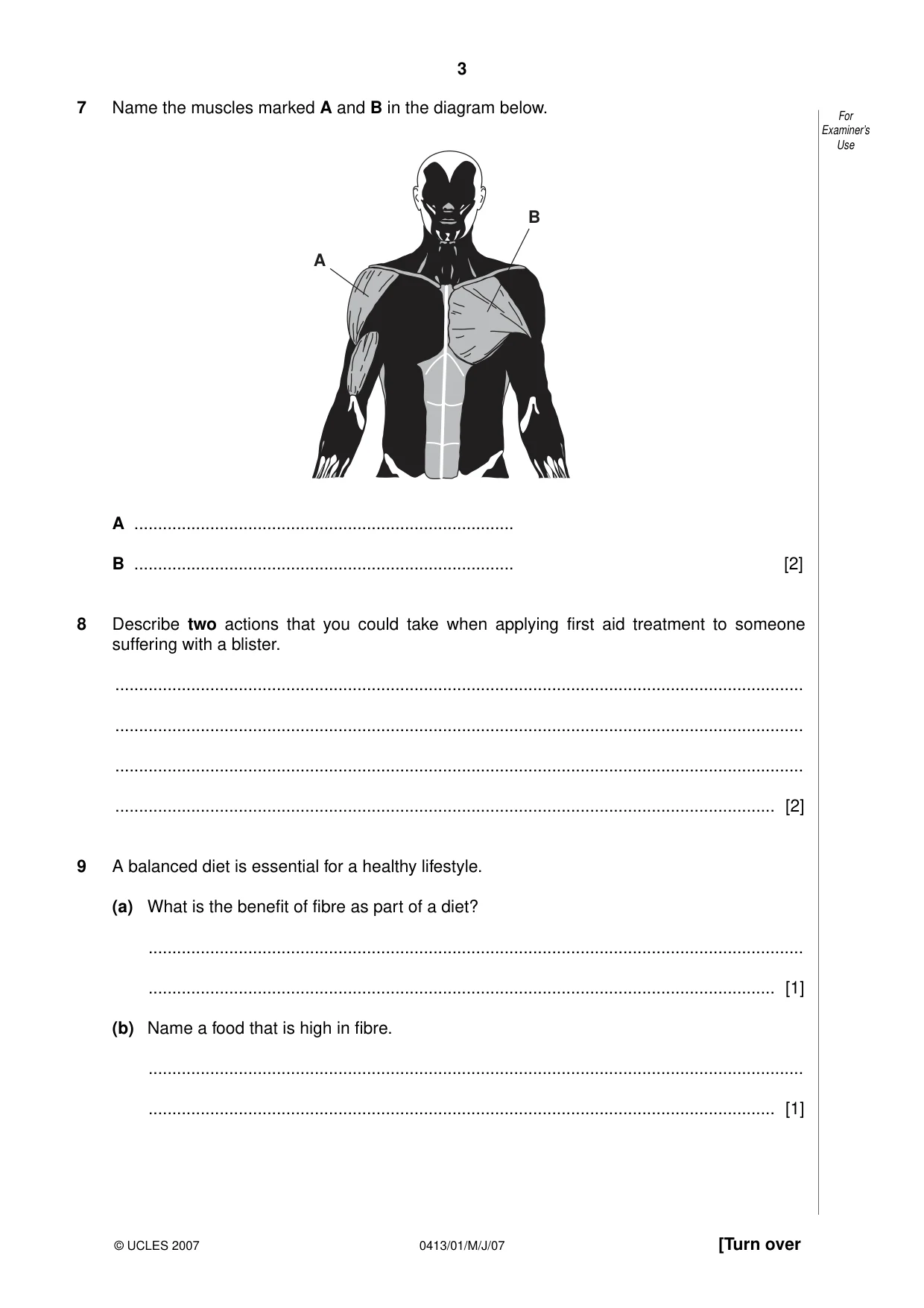
3 0413/01/M/J/07 [Turn over © UCLES 2007 For Examiner’s Use 7 Name the muscles marked A and B in the diagram below. A B A … B … [2] 8 Describe two actions that you could take when applying first aid treatment to someone suffering with a blister. … … … … [2] 9 A balanced diet is essential for a healthy lifestyle. (a) What is the benefit of fibre as part of a diet? … … [1] (b) Name a food that is high in fibre. … … [1]
Question paper, page 4
4 0413/01/M/J/07 © UCLES 2007 For Examiner’s Use 10 Give two harmful effects of consuming large quantities of alcohol on the health of an individual. … … … … [2] 11 Name an indoor sporting activity. … (a) Describe one potential danger that could occur when playing the activity. … … [1] (b) Describe how you would overcome this danger. … … [1] 12 Some performers hope to play at the highest level. Describe three external factors that could determine if a performer plays at the highest level in their sport. … … … … … … [3] [Total: 20]
Question paper, page 5
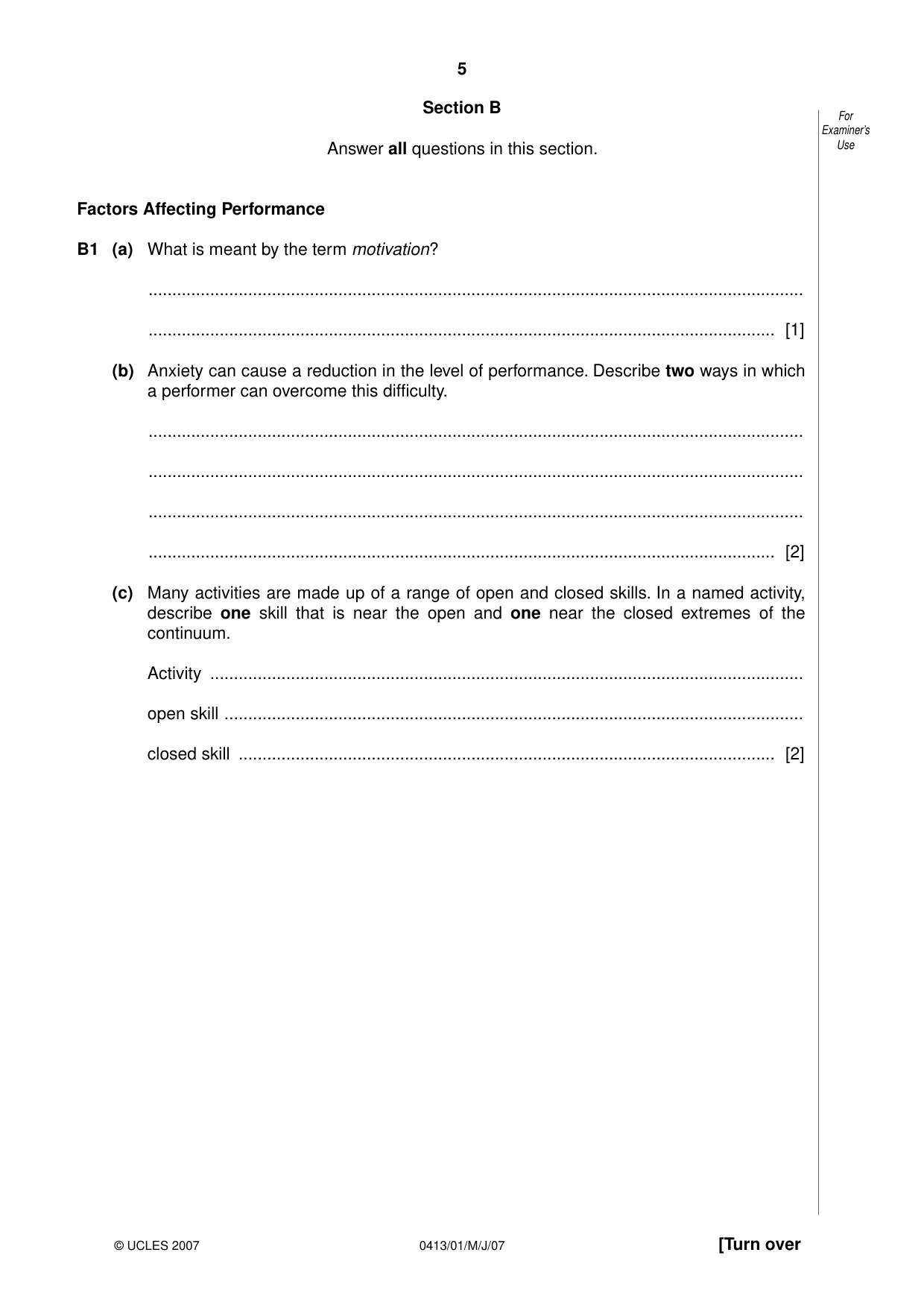
5 0413/01/M/J/07 [Turn over © UCLES 2007 For Examiner’s Use Section B Answer all questions in this section. Factors Affecting Performance B1 (a) What is meant by the term motivation? … … [1] (b) Anxiety can cause a reduction in the level of performance. Describe two ways in which a performer can overcome this difficulty. … … … … [2] (c) Many activities are made up of a range of open and closed skills. In a named activity, describe one skill that is near the open and one near the closed extremes of the continuum. Activity … open skill … closed skill … [2]
Question paper, page 6
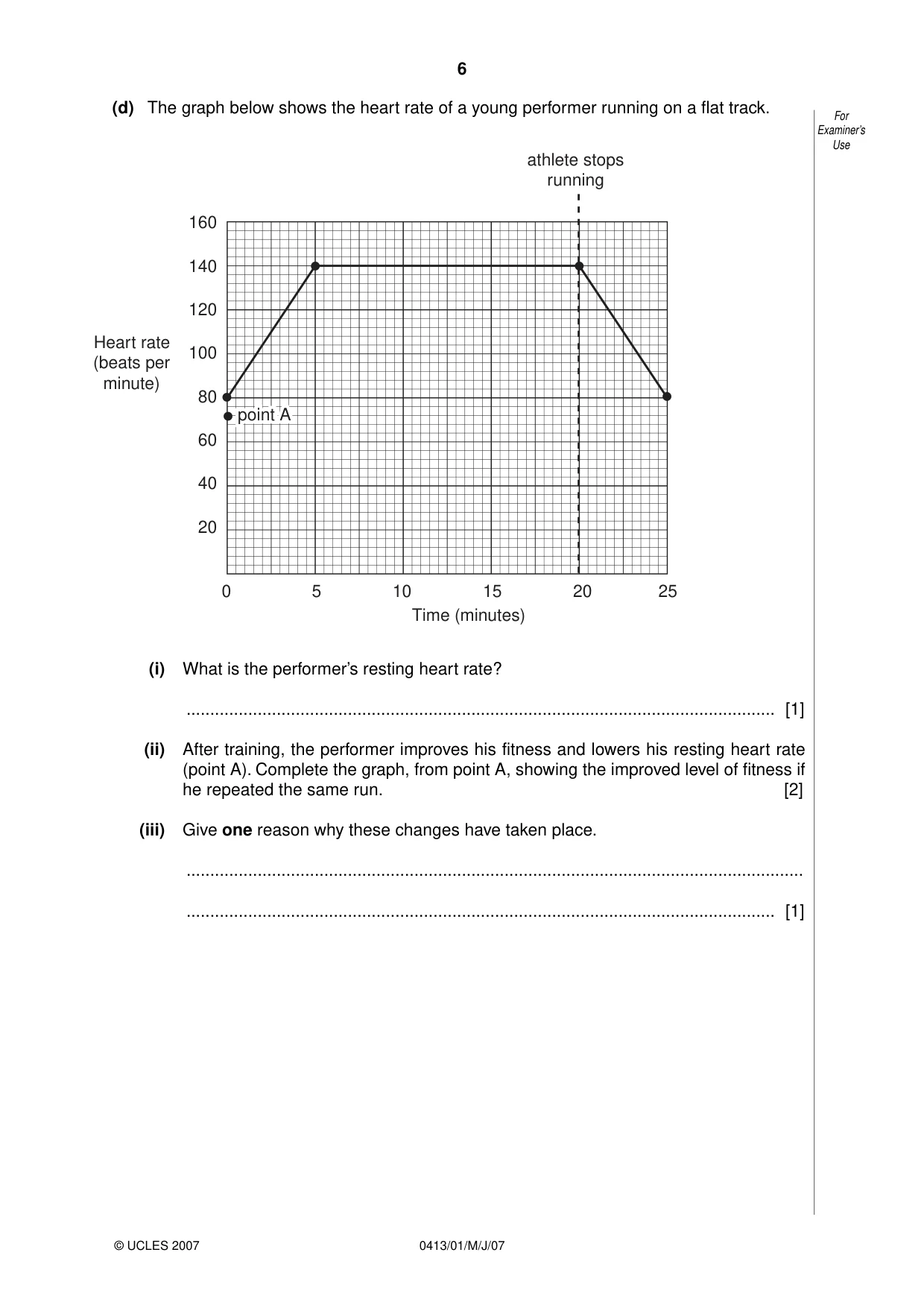
6 0413/01/M/J/07 © UCLES 2007 For Examiner’s Use (d) The graph below shows the heart rate of a young performer running on a flat track. 160 140 120 100 80 60 40 20 0 5 10 15 20 25 Time (minutes) Heart rate (beats per minute) athlete stops running point A point A point A (i) What is the performer’s resting heart rate? … [1] (ii) After training, the performer improves his fitness and lowers his resting heart rate (point A). Complete the graph, from point A, showing the improved level of fitness if he repeated the same run. [2] (iii) Give one reason why these changes have taken place. … … [1]
Question paper, page 7
7 0413/01/M/J/07 [Turn over © UCLES 2007 For Examiner’s Use (e) The table below shows types of movement, a key feature and where the type of movement might occur. Some information has been completed in the table. Complete the table by writing in the missing details. Types of movement Key features Joint Flexion Knee Elbow Movement of a limb away from the central axis of the body Extension Knee Elbow [4] (f) (i) What does the multi-stage fitness test measure? … … [1] (ii) Describe how you would carry out this test. Include details of any equipment used. … … … … … … … [3] (iii) Describe another test which will assess the same component of fitness. … … … … … … [3] [Total: 20]
Question paper, page 8
8 0413/01/M/J/07 © UCLES 2007 For Examiner’s Use Health, Safety and Training B2 (a) An athlete takes part in a sprinting event. What will happen to the athlete when an Oxygen Debt occurs? … … [1] (b) An athlete takes part in a regular training programme for a number of months. He finds that his performances during training decreases. Describe two reasons why this might happen. … … … [2] (c) Complete the following equation. Glucose + Oxygen Energy + … + Water [1] Name which respiration system this equation describes and explain one key feature of it. … … … [1] (d) (i) Describe two factors that determine how much energy a person needs in their daily life. … … … … [2] (ii) An athlete preparing for a long distance running event will often use his/her diet to increase energy levels immediately before the event. Name and describe this process. … … … … [1]
Question paper, page 9
9 0413/01/M/J/07 [Turn over © UCLES 2007 For Examiner’s Use (e) When a performer takes part in exercise the body generates heat which is lost through evaporation and radiation. (i) Explain how these two processes take place. Evaporation … … … Radiation … … … [3] (ii) Some outdoor sports take place in cold, wet conditions and in such cases a performer’s body temperature can drop. Explain how the body reduces the effect of playing in such cold conditions. … … … … [2]
Question paper, page 10
10 0413/01/M/J/07 © UCLES 2007 For Examiner’s Use (f) An athlete wants to improve his physical fitness in preparation for a long distance running event. He decides to use a Circuit Training programme to help him prepare. (i) Describe two key elements of Circuit Training. … … … [2] (ii) Choose two of the principles of training and describe how they would affect the planning of the Circuit Training. … … … [2] (iii) What are the advantages of using a Circuit Training programme? … … … [2] (iv) What alternative training method could the athlete use to get ready for the event? … … [1] [Total: 20]
Question paper, page 11
11 0413/01/M/J/07 [Turn over © UCLES 2007 For Examiner’s Use Reasons and Opportunities for Participation in Physical Activity B3 (a) Define the term physical recreation. … [1] (b) Give two reasons why where you live can influence the types of activities in which you participate. … … … [2] (c) Describe two ways that sporting opportunities, for young people, can be improved through links between schools and clubs. … … … … [2] (d) There has been an increase in the number of sportsmen and women becoming professional performers. Describe some of the factors that have allowed this increase to arise. … … … … [3]
Question paper, page 12
12 0413/01/M/J/07 © UCLES 2007 For Examiner’s Use (e) The amount of sport shown on television has increased greatly in recent years. Give reasons why this high level of exposure can have a negative effect on a sport. … … … … … … … … … [5] (f) There has been an increase in the number of women participating in sport in recent years. (i) What factors have contributed to this increase in participation? … … … … … … … … … [5] (ii) Despite the increase in female participation, more girls than boys stop taking part in sport immediately after they leave school. What reasons can you give for this? … … … [2] [Total: 20] Permission to reproduce items where third-party owned material protected by copyright is included has been sought and cleared where possible. Every reasonable effort has been made by the publisher (UCLES) to trace copyright holders, but if any items requiring clearance have unwittingly been included, the publisher will be pleased to make amends at the earliest possible opportunity. University of Cambridge International Examinations is part of the Cambridge Assessment Group. Cambridge Assessment is the brand name of University of Cambridge Local Examinations Syndicate (UCLES), which is itself a department of the University of Cambridge.
Mark scheme, page 1
UNIVERSITY OF CAMBRIDGE INTERNATIONAL EXAMINATIONS International General Certificate of Secondary Education MARK SCHEME for the May/June 2007 question paper 0413 PHYSICAL EDUCATION 0413/01 Paper 1, maximum raw mark 80 This mark scheme is published as an aid to teachers and candidates, to indicate the requirements of the examination. It shows the basis on which Examiners were instructed to award marks. It does not indicate the details of the discussions that took place at an Examiners’ meeting before marking began. All Examiners are instructed that alternative correct answers and unexpected approaches in candidates’ scripts must be given marks that fairly reflect the relevant knowledge and skills demonstrated. Mark schemes must be read in conjunction with the question papers and the report on the examination. • CIE will not enter into discussions or correspondence in connection with these mark schemes. CIE is publishing the mark schemes for the May/June 2007 question papers for most IGCSE, GCE Advanced Level and Advanced Subsidiary Level syllabuses and some Ordinary Level syllabuses. www.XtremePapers.com
Mark scheme, page 2
Page 2 Mark Scheme Syllabus Paper IGCSE – May/June 2007 0413 01 © UCLES 2007 Section A 1 Definition of the term somatotyping • is a way of describing body build • it looks at how fat, muscular and linear the body is, in that order • it describes each extreme of body build on a scale of 1 to 7 [1] 2 A reason for the increase in the number of recreational facilities • more private companies involved in providing facilities • exercise more socially accepted • more exposure of sports on TV creates greater demand • people are more aware of health issues • people have more leisure time so increase in demand [1] 3 An activity that would suit an ectomorph • basketball • high jump • volleyball • long distance running • activities where height and low body weight are an advantage • if candidates give an example of a named performer who is an ectomorph, credit can be given [1] 4 A feature of physical well-being • no illness or injury • heart, lungs and other body systems working well [1] 5 The effects of lactic acid on muscles • tired/fatigue • painful/sore • burning sensation • stop working • stitch [1] 6 Private companies find it difficult to make a profit from running swimming pools • the water may need be heated throughout the day and night • the water will need to be treated throughout the day and night • has to be staffed even if its empty of people • staffing has to assume a certain level of use • constant training of staff who work in the pool/lifeguards needed • difficult to know how much it will be used at certain times of the day • high maintenance [2]
Mark scheme, page 3
Page 3 Mark Scheme Syllabus Paper IGCSE – May/June 2007 0413 01 © UCLES 2007 7 Name the two muscles marked • A deltoid • B pectora l[2] 8 Applying first aid treatment for a blister • do not burst a blister • keep clean and dry • cover with gauze • prevent from further rubbing as blisters are caused by friction • do not pick off the scab that may form • seek medical help/advice • cool down the area [2] 9 What is the benefit of fibre in a diet and name a source (a) • it clears out the gut • prevents constipation • prevents bowel cancer • it makes you feel full so you eat less [1] (b) • cereals, bread, potatoes [1] 10 Name two harmful effects of consuming large quantities of alcohol • affects co-ordination • balance • affects judgment • affects hearing and speech • lowers levels of glycogen in muscles so they cannot work as long or hard • causes dehydration (hangover) • long term can lead to liver damage • long term can lead to kidney damage • loss of drive in all aspects of life, including an interest in performing sports • slows reactions [2] 11 Name an indoor activity, describe a danger Candidates must name a sport – no mark awarded. If no sport is named marks cannot be awarded. (a) The activity must be one that is usually conducted indoors – activities such as 5-a-side football should be credited e.g. slippery surfaces, obstructions, facilities inappropriately equipped for activities, such as glass windows where ball games are played. [1] (b) Describe how you would overcome this danger The solution should not include ‘following the rules’ but must relate to the danger identified in the first part of the answer e.g. non-slip preparation on the floor, restrict facilities to more appropriate activities to avoid injuries. Have signs erected warning participants of potential dangers. Correct footwear. [1]
Mark scheme, page 4
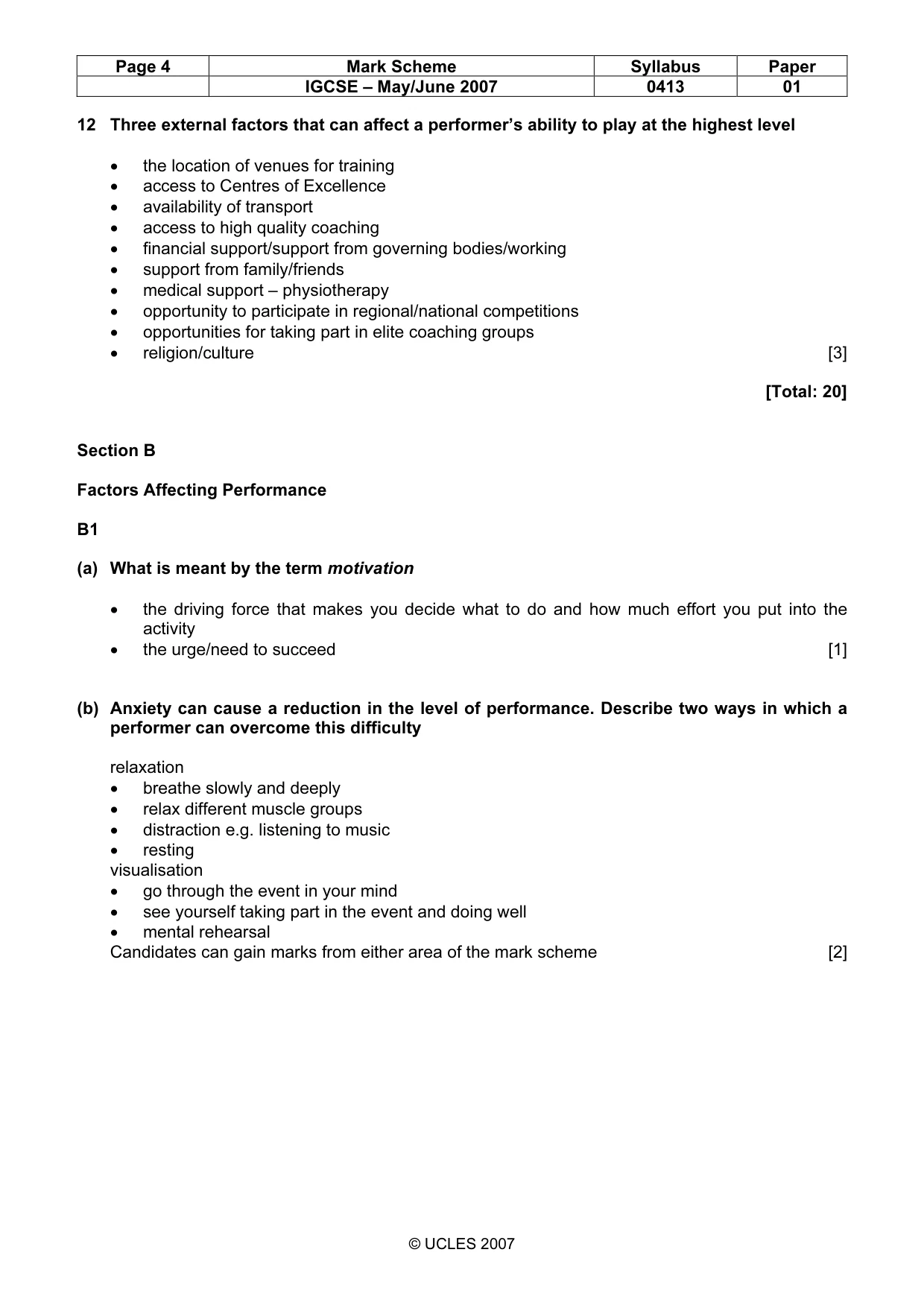
Page 4 Mark Scheme Syllabus Paper IGCSE – May/June 2007 0413 01 © UCLES 2007 12 Three external factors that can affect a performer’s ability to play at the highest level • the location of venues for training • access to Centres of Excellence • availability of transport • access to high quality coaching • financial support/support from governing bodies/working • support from family/friends • medical support – physiotherapy • opportunity to participate in regional/national competitions • opportunities for taking part in elite coaching groups • religion/culture [3] [Total: 20] Section B Factors Affecting Performance B1 (a) What is meant by the term motivation • the driving force that makes you decide what to do and how much effort you put into the activity • the urge/need to succeed [1] (b) Anxiety can cause a reduction in the level of performance. Describe two ways in which a performer can overcome this difficulty relaxation • breathe slowly and deeply • relax different muscle groups • distraction e.g. listening to music • resting visualisation • go through the event in your mind • see yourself taking part in the event and doing well • mental rehearsal Candidates can gain marks from either area of the mark scheme [2]
Mark scheme, page 5
Page 5 Mark Scheme Syllabus Paper IGCSE – May/June 2007 0413 01 © UCLES 2007 (c) Describe an open and closed skill from a named activity Candidates must name an activity to gain marks. The skills must come from the same game/activity and must demonstrate an understanding of an open and closed skill. It is most likely that neither skill would be at the extreme of the continuum but must indicate features of an open or closed skill. e.g. basketball – free throw (closed) – lay up (open) football – taking a goal kick (closed) – saving a shot at goal (open) hockey – penalty stroke (closed) – dribbling a ball (open) tennis – serve (closed) – a running forehand stroke (open) badminton – serve (closed) – playing a clear (open) [2] (d) If the performer was fitter how would the graph change? (i) resting heart rate = 78 – 80 [1] (ii) The candidates must complete this question on the graph starting at point A. The graph drawn by the candidate must show two of the three improvements: • a more gradual increase from point A to the working heart rate • a lower working heart rate • a steeper line from the point at which exercise stops and returns to the resting heart rate [2] (iii) • the heart grows larger, its walls a little thicker, it holds a greater volume of blood and contracts stronger • the body makes more blood which increases the amount of red blood cells so more oxygen can be carried • arteries grow larger and more elastic so blood pressure falls [1] (e) Name the types movement, key features and joint Type of movement Key features Joint Flexion The bending of a joint Drawing back the foot to kick a ball Knee Elbow Abduction Movement away from a limb and away from the central axis of the body Hip Shoulder Extension The straightening of a limb at a joint Elbow Knee [4] The answers are in bold print – one mark awarded the correct completion of each box
Mark scheme, page 6
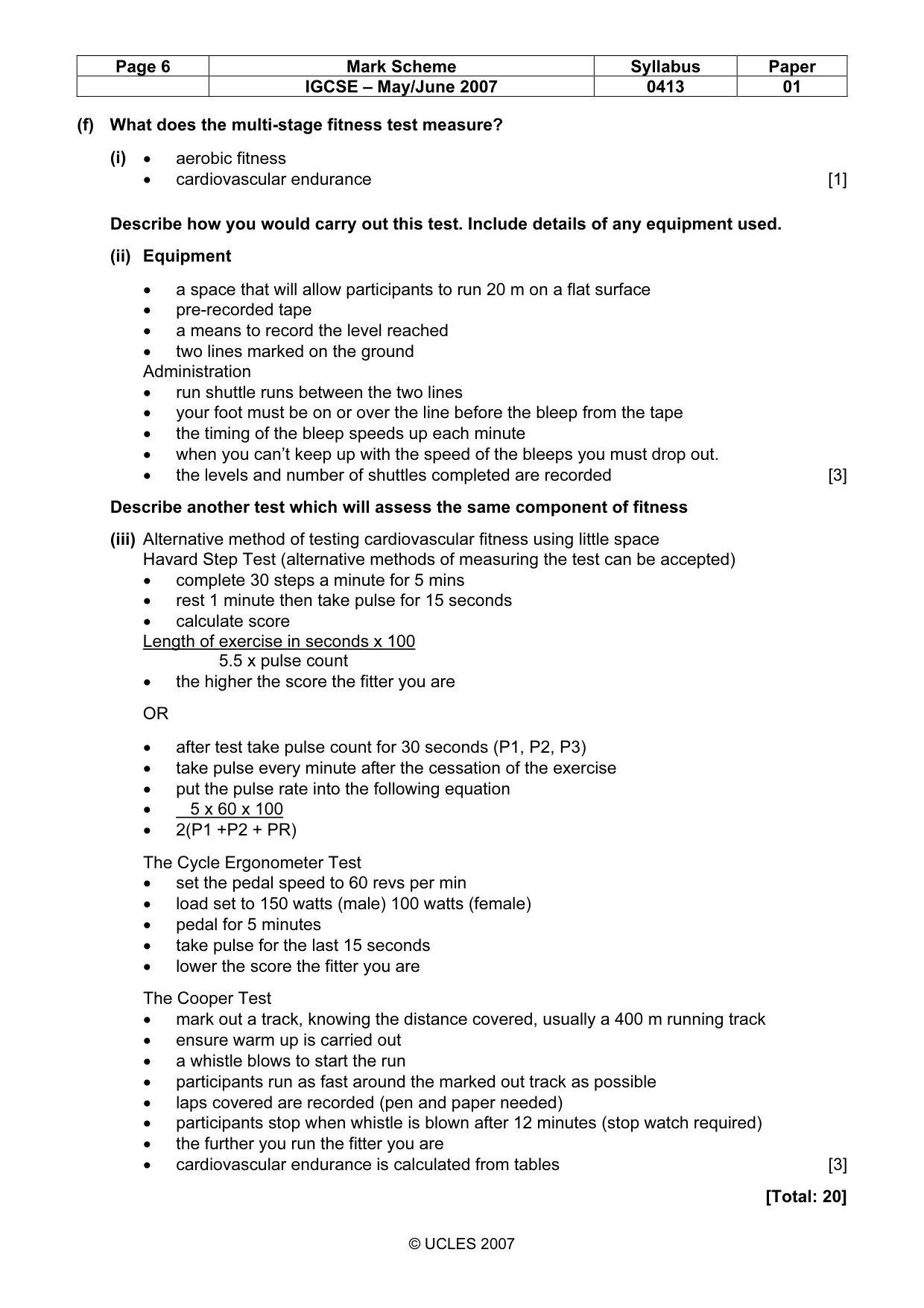
Page 6 Mark Scheme Syllabus Paper IGCSE – May/June 2007 0413 01 © UCLES 2007 (f) What does the multi-stage fitness test measure? (i) • aerobic fitness • cardiovascular endurance [1] Describe how you would carry out this test. Include details of any equipment used. (ii) Equipment • a space that will allow participants to run 20 m on a flat surface • pre-recorded tape • a means to record the level reached • two lines marked on the ground Administration • run shuttle runs between the two lines • your foot must be on or over the line before the bleep from the tape • the timing of the bleep speeds up each minute • when you can’t keep up with the speed of the bleeps you must drop out. • the levels and number of shuttles completed are recorded [3] Describe another test which will assess the same component of fitness (iii) Alternative method of testing cardiovascular fitness using little space Havard Step Test (alternative methods of measuring the test can be accepted) • complete 30 steps a minute for 5 mins • rest 1 minute then take pulse for 15 seconds • calculate score Length of exercise in seconds x 100 5.5 x pulse count • the higher the score the fitter you are OR • after test take pulse count for 30 seconds (P1, P2, P3) • take pulse every minute after the cessation of the exercise • put the pulse rate into the following equation • 5 x 60 x 100 • 2(P1 +P2 + PR) The Cycle Ergonometer Test • set the pedal speed to 60 revs per min • load set to 150 watts (male) 100 watts (female) • pedal for 5 minutes • take pulse for the last 15 seconds • lower the score the fitter you are The Cooper Test • mark out a track, knowing the distance covered, usually a 400 m running track • ensure warm up is carried out • a whistle blows to start the run • participants run as fast around the marked out track as possible • laps covered are recorded (pen and paper needed) • participants stop when whistle is blown after 12 minutes (stop watch required) • the further you run the fitter you are • cardiovascular endurance is calculated from tables [3] [Total: 20]
Mark scheme, page 7
Page 7 Mark Scheme Syllabus Paper IGCSE – May/June 2007 0413 01 © UCLES 2007 Health, Safety and Training B2 (a) Describe what will happen to an athlete when an Oxygen Debt occurs • the athlete will gulp in air to pay off the oxygen debt • he/she will have to stop all out effort • the volume of oxygen consumed during recovery from exercise in excess of that which would normally be consumed in the same period [1] (b) Two reasons why performances might decrease Overtraining so the performer is: • tired/rest time • has pain and soreness in the joints so unable to perform at their best • loss of appetite and energy • feelings of anxiety • more susceptible to cold and minor illness • inappropriate training programme Performer may become: • bored with training • lack of progress results in demotivation • injury (=usually stress related) [2] (c) Complete the equation carbon dioxide [1] Name the respiratory system this equation describes and explain one key feature • aerobic fitness • cardiovascular endurance • aerobic respiration (plus an explanation) • it supplies sufficient oxygen for the performer to complete the exercise • it requires activities to be less intense • if sufficient oxygen is available the activity could be carried on almost indefinitely • there is no oxygen debt to pay back at the end of the activity [1]
Mark scheme, page 8
Page 8 Mark Scheme Syllabus Paper IGCSE – May/June 2007 0413 01 © UCLES 2007 (d) (i) Describe two factors that determine how much energy is needed • age – young children and the elderly need less energy • gender – males usually need more energy than females of the same age • lifestyle – the more active you are the more energy you need. A top athlete will need more energy than an office worker. [2] (ii) An athlete preparing for a long distance running event, will often use his/her diet to increase energy levels immediately before the event To gain a mark candidates must name and give a simple description of carboloading. • carboloading • just before the event switch to light training and eat lots of carbohydrates [1] (e) The performer loses heat through evaporation and radiation (i) Evaporation • the sweat glands create more sweat • sweat is released through the pores in the skin • the process of converting a liquid (sweat) into a vapour thus enabling heat particles to escape resulting in the body cooling • body hairs lie flat to aid evaporation Radiation • vasodilation takes place – the blood vessels under the skin widen. • increase in the amount of blood that flows near the skin • heat is transferred through the skin [Total of 3 marks awarded for part (i) 2/1 or 1/2] [3] (ii) Some sports take place in cold, wet conditions and in some cases the performer’s body temperature can drop. Explain how the body reduces the effect of playing in such conditions. • you will stop sweating • the blood vessels under the skin contract. This is called vasoconstriction • less blood will flow near the surface so less heat is lost • the muscles start a series of small contractions to produce heat and this is called shivering • body hairs stand up to trap body heat [2]
Mark scheme, page 9
Page 9 Mark Scheme Syllabus Paper IGCSE – May/June 2007 0413 01 © UCLES 2007 (f) Describe two key elements of circuit training • a circuit usually has 8 – 15 stations • you do different exercises at each station • either there is a time limit or a given number of reps at each station • a rest can be included between stations • a circuit can be made specific for an activity [2] (ii) Choose two of the principles of training and describe how they would affect the planning of the circuit training The answers must relate to a long distance running event • specificity – the exercises must try to develop endurance exercises must be specific to the main muscle groups used in running ensure the training reflects the distances being covered in the running event. • progression – the increase must be gradual due to the nature of the running event over exercising can lead to stress related injuries if there is no increase in training there can be no improvement in performance due to the nature of the event, overtraining can cause tiredness and affect the ability to continue training • overload – There should be reference to the distance and time that relate to the fact that the training is for a long distance running event. increase the number of times you complete the circuit increase the number of times that you spend on each station increase the number of reps at each station increase the amount of time spent training • reversibility – the training programme must be maintained to avoid reversibility. Mix up circuits so that there are hard and easy sessions to avoid tiredness and injury. [2] Candidates should choose 2 of the above points and provide one application for each point. (iii) What are the advantages of using a Circuit Training programme • training can include a wide variety of exercise • easy to adapt to a sport • an efficient use of training time • training can be done indoors or outdoors • circuits can be done with little equipment • fun [2] What alternative training methods could be used to get ready for the event? (iv) • continuous training • fartlek training • lateral training with description [1] [Total: 20]
Mark scheme, page 10
Page 10 Mark Scheme Syllabus Paper IGCSE – May/June 2007 0413 01 © UCLES 2007 Reasons and opportunities for participation in physical activities. B3 (a) Define the term physical recreation • A physical activity that you do just for pleasure, in your leisure time. Should not include serious sport or activities that people play for a living [1] (b) Reasons why where you live can affect the activities you play • if you live in rural areas you may need transport to access facilities • specialist facilities can be located some distance from your home and therefore, not accessible • in rural areas there may be few facilities available • there will be few opportunities for country activities i.e. climbing, skiing in towns • access to coaching may restrict opportunities • certain activities are based in cities i.e. basketball • cultural i.e. certain countries practice certain sports; skiing in Nordic countries, football in Brazil [2] (c) How are sporting opportunities enhanced by links between school and clubs • students can play sports that are not available in school • clubs can provide qualified coaches to visit schools • students can join clubs after leaving school • schools can supplement their facilities by using those at a local club • use clubs for residential courses e.g. sailing, climbing • some schools do not offer extra curricular activities • clubs tend not to close during holiday periods so students can continue to participate during these times • sports in schools are governed by term times, clubs will offer out of season training opportunities • clubs can use school facilities which will reduce the costs of running a club • school/club liaison officers can be created to promote the increased links [2]
Mark scheme, page 11
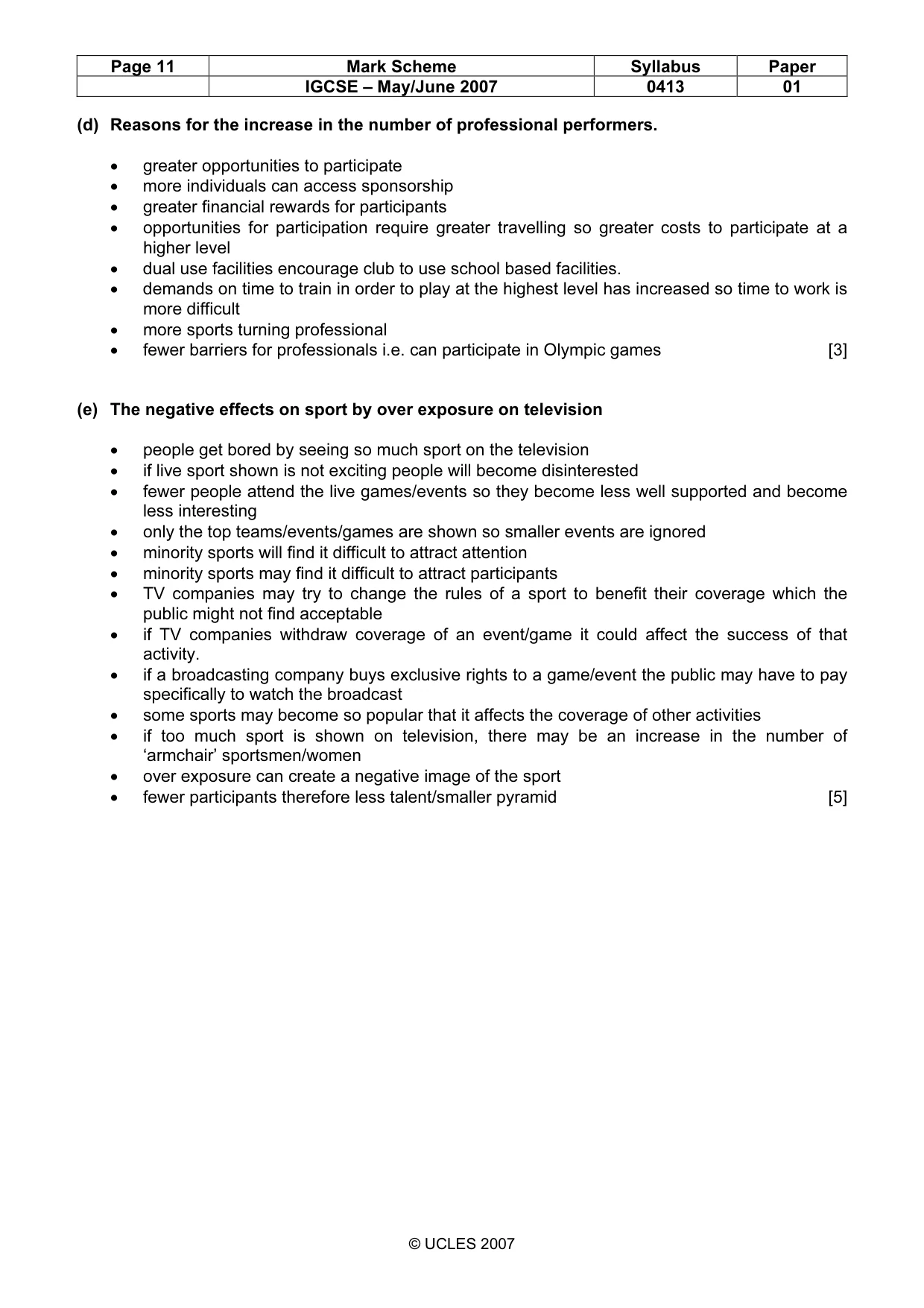
Page 11 Mark Scheme Syllabus Paper IGCSE – May/June 2007 0413 01 © UCLES 2007 (d) Reasons for the increase in the number of professional performers. • greater opportunities to participate • more individuals can access sponsorship • greater financial rewards for participants • opportunities for participation require greater travelling so greater costs to participate at a higher level • dual use facilities encourage club to use school based facilities. • demands on time to train in order to play at the highest level has increased so time to work is more difficult • more sports turning professional • fewer barriers for professionals i.e. can participate in Olympic games [3] (e) The negative effects on sport by over exposure on television • people get bored by seeing so much sport on the television • if live sport shown is not exciting people will become disinterested • fewer people attend the live games/events so they become less well supported and become less interesting • only the top teams/events/games are shown so smaller events are ignored • minority sports will find it difficult to attract attention • minority sports may find it difficult to attract participants • TV companies may try to change the rules of a sport to benefit their coverage which the public might not find acceptable • if TV companies withdraw coverage of an event/game it could affect the success of that activity. • if a broadcasting company buys exclusive rights to a game/event the public may have to pay specifically to watch the broadcast • some sports may become so popular that it affects the coverage of other activities • if too much sport is shown on television, there may be an increase in the number of ‘armchair’ sportsmen/women • over exposure can create a negative image of the sport • fewer participants therefore less talent/smaller pyramid [5]
Mark scheme, page 12
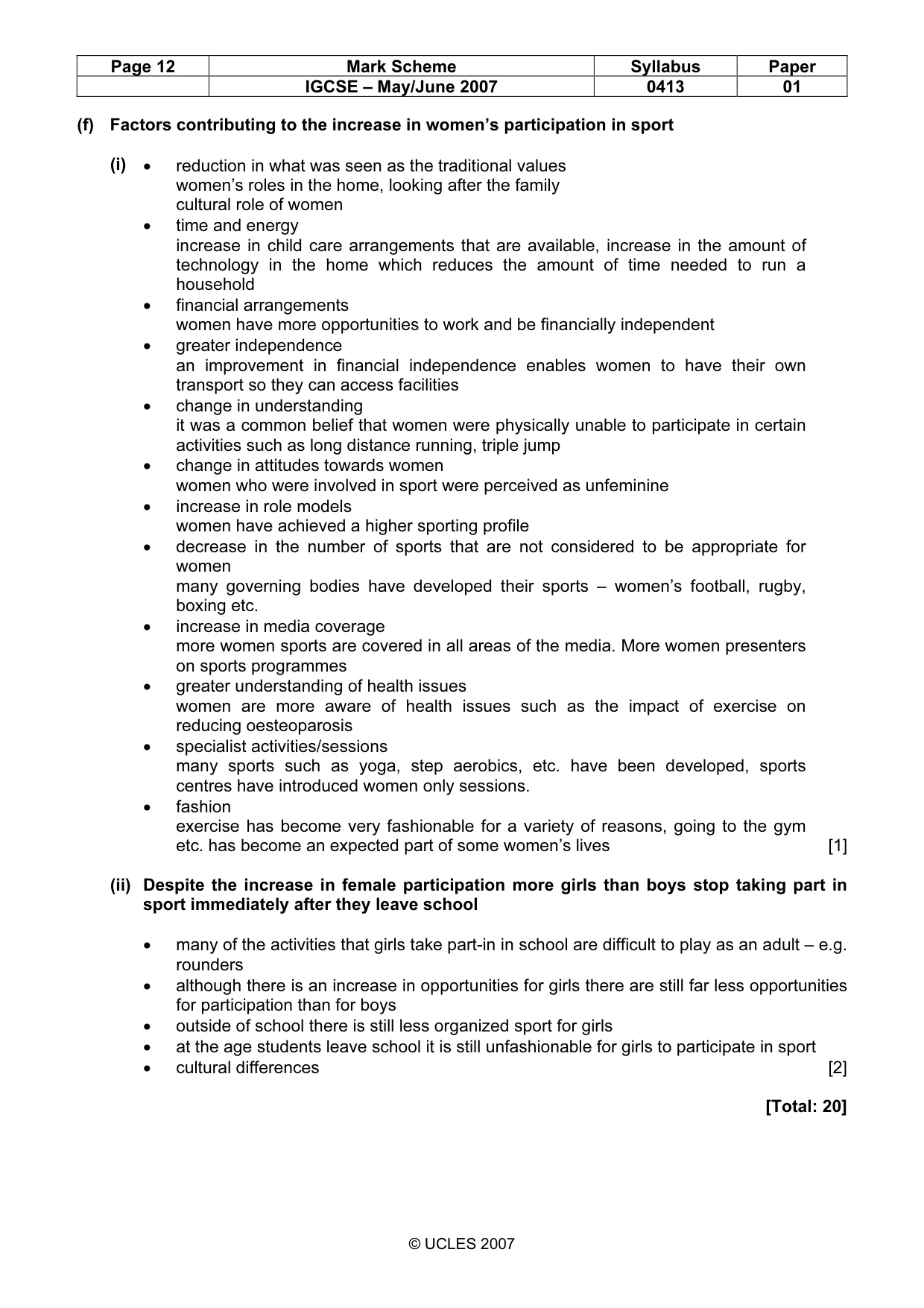
Page 12 Mark Scheme Syllabus Paper IGCSE – May/June 2007 0413 01 © UCLES 2007 (f) Factors contributing to the increase in women’s participation in sport (i) • reduction in what was seen as the traditional values women’s roles in the home, looking after the family cultural role of women • time and energy increase in child care arrangements that are available, increase in the amount of technology in the home which reduces the amount of time needed to run a household • financial arrangements women have more opportunities to work and be financially independent • greater independence an improvement in financial independence enables women to have their own transport so they can access facilities • change in understanding it was a common belief that women were physically unable to participate in certain activities such as long distance running, triple jump • change in attitudes towards women women who were involved in sport were perceived as unfeminine • increase in role models women have achieved a higher sporting profile • decrease in the number of sports that are not considered to be appropriate for women many governing bodies have developed their sports – women’s football, rugby, boxing etc. • increase in media coverage more women sports are covered in all areas of the media. More women presenters on sports programmes • greater understanding of health issues women are more aware of health issues such as the impact of exercise on reducing oesteoparosis • specialist activities/sessions many sports such as yoga, step aerobics, etc. have been developed, sports centres have introduced women only sessions. • fashion exercise has become very fashionable for a variety of reasons, going to the gym etc. has become an expected part of some women’s lives [1] (ii) Despite the increase in female participation more girls than boys stop taking part in sport immediately after they leave school • many of the activities that girls take part-in in school are difficult to play as an adult – e.g. rounders • although there is an increase in opportunities for girls there are still far less opportunities for participation than for boys • outside of school there is still less organized sport for girls • at the age students leave school it is still unfashionable for girls to participate in sport • cultural differences [2] [Total: 20]
What you needed in this session
Cambridge’s own grade thresholds for 2007 May/June, Paper 1 · Variant 1. A higher threshold means an easier paper — the bar moves with how the cohort did.