Cambridge IGCSE Physical Education 0413 — 2006 May/June Paper 1 · Variant 1
0413/11/M/J/06 · 80 marks · ≈90 min
The question paper and its mark scheme, free to read here and free to download. This is Cambridge’s own paper, exactly as it was sat.
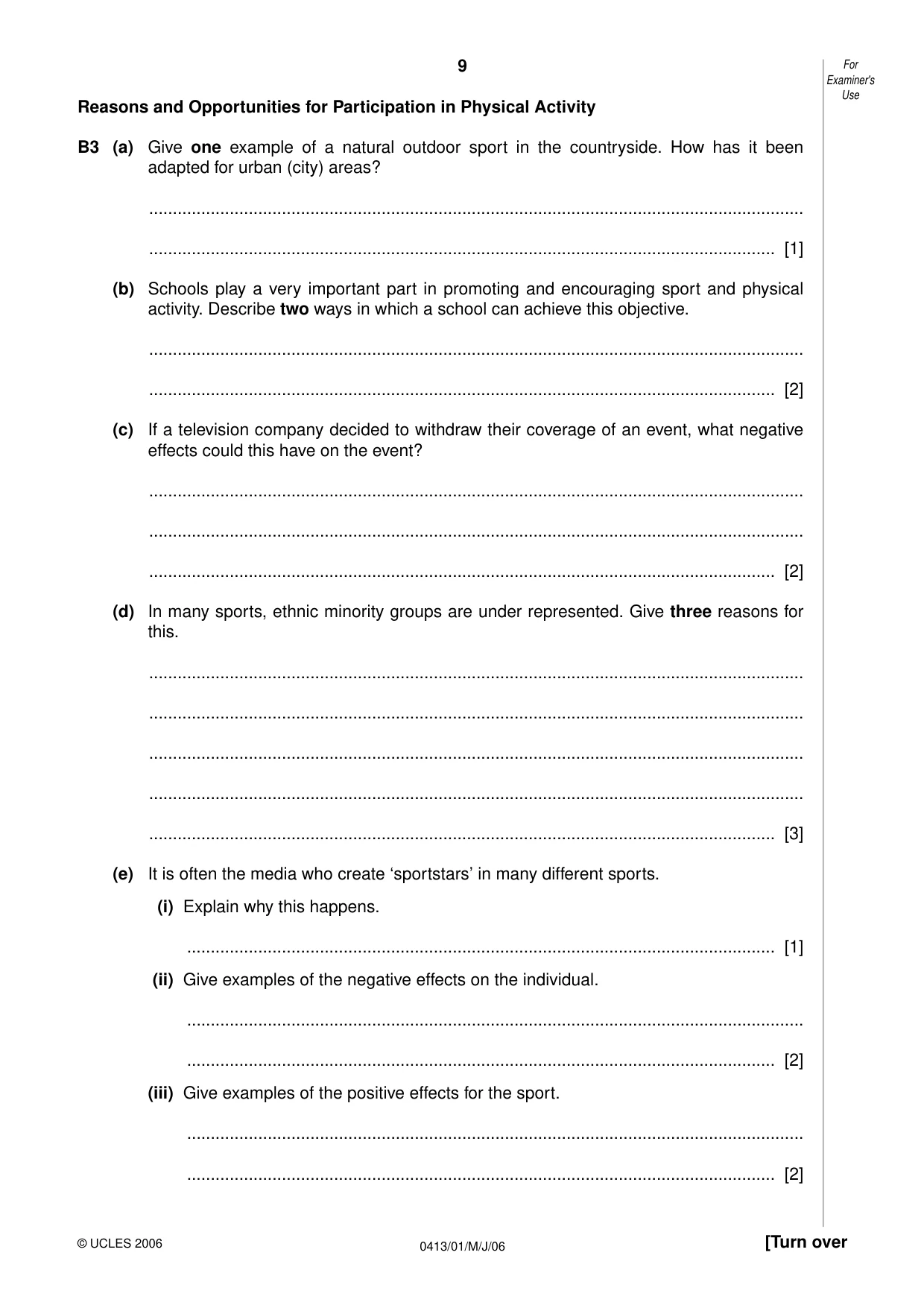
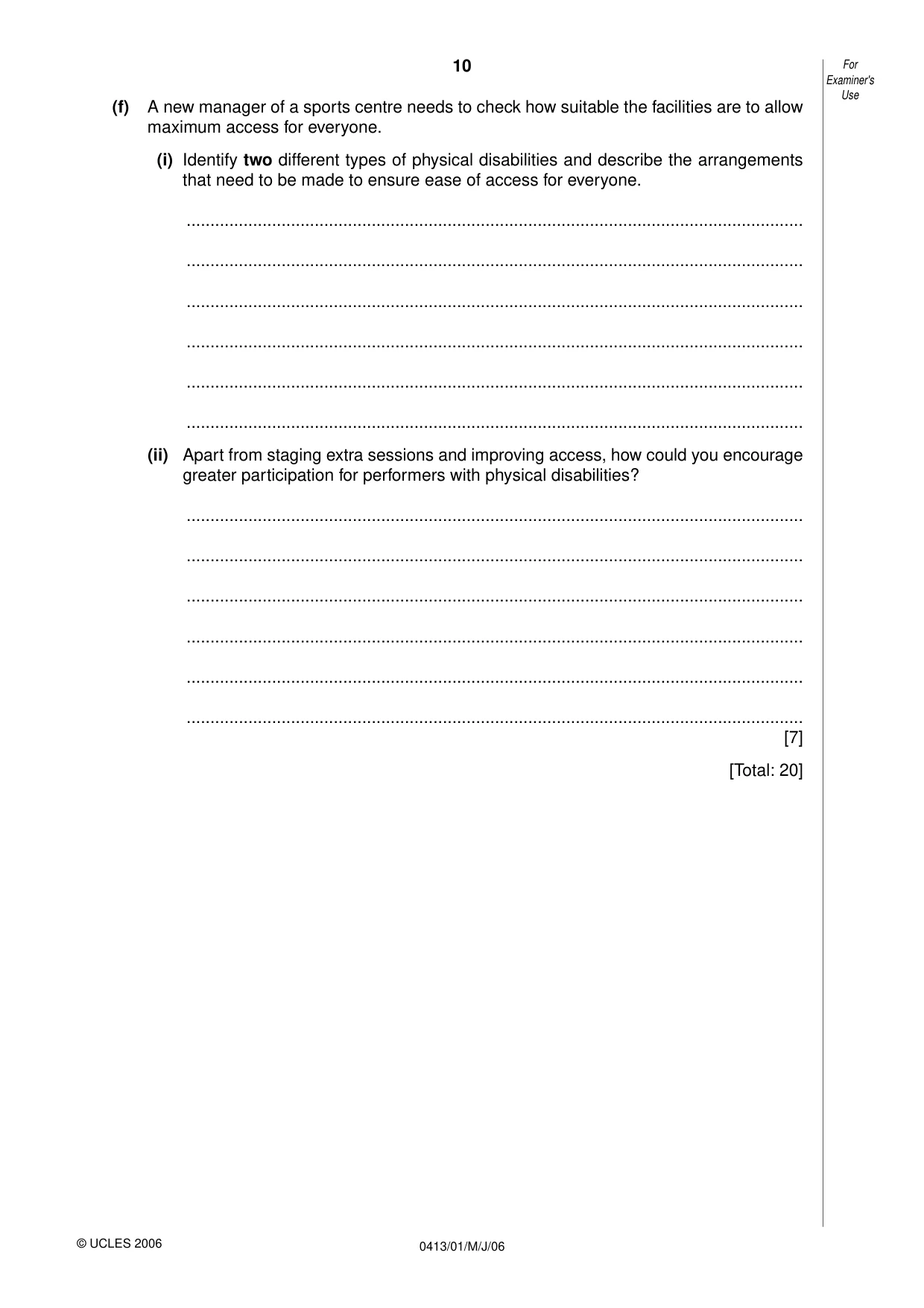
Question paper12 pages


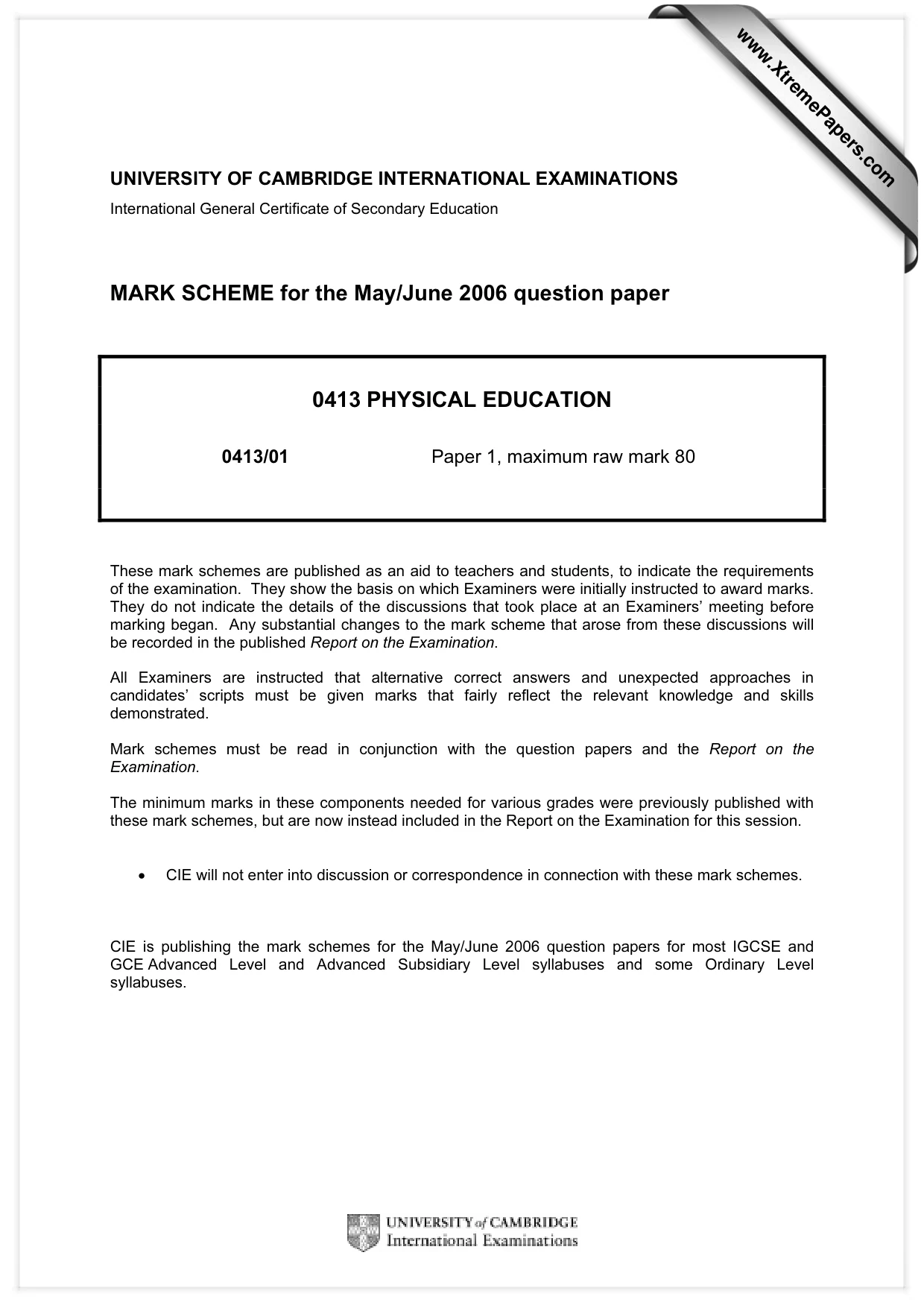
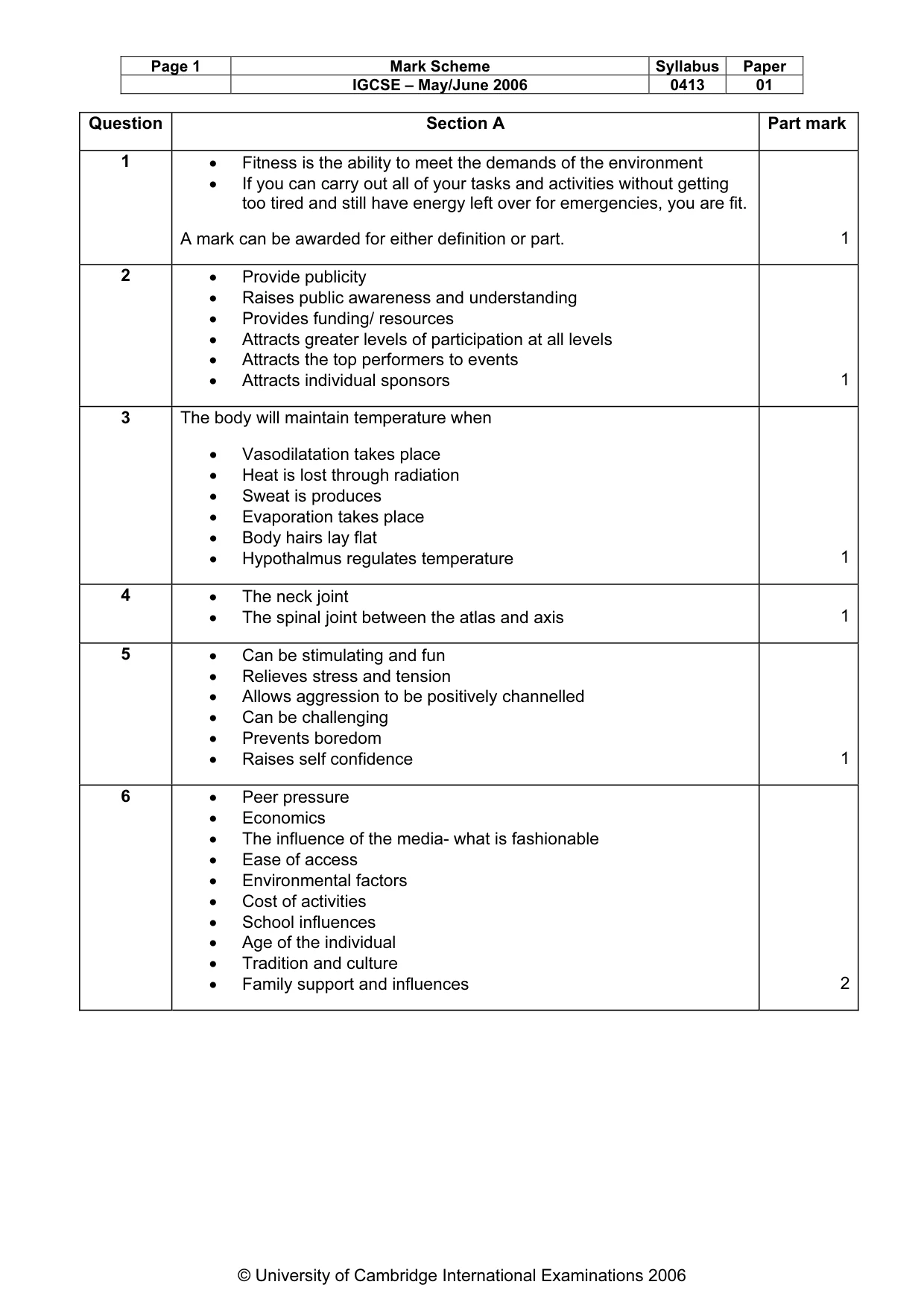
Mark scheme12 pages
Answers below. Sit the paper first if you are practising.
Paper as text
Question paper, page 1
This document consists of 10 printed pages and 2 blank pages. SP (MML 10775 4/05) T02324/5 © UCLES 2006 [Turn over UNIVERSITY OF CAMBRIDGE INTERNATIONAL EXAMINATIONS International General Certificate of Secondary Education PHYSICAL EDUCATION 0413/01 Paper 1 May/June 2006 2 hours Candidates answer on the Question Paper. No Additional Materials are required. READ THESE INSTRUCTIONS FIRST Write your Centre number, candidate number and name on all the work you hand in. Write in dark blue or black pen. You may use a soft pencil for any diagrams, graphs or rough working. Do not use staples, paper clips, highlighters, glue or correction fluid. Answer all questions. At the end of the examination, fasten all your work securely together. The number of marks is given in brackets [ ] at the end of each question or part question. Centre Number Candidate Number Name FOR EXAMINER’S USE SECTION A Section B1 Section B2 Section B3 TOTAL www.XtremePapers.com
Question paper, page 2
Section A Answer all questions in this section. 1 Define the term fitness. … [1] 2 Give one reason why it is important for a sport to attract media attention. … … [1] 3 When exercising, the body’s temperature will increase. Describe one way in which the body controls this. … … [1] 4 Give an example of a pivot joint. … [1] 5 Give one psychological benefit that participating in exercise could have on an individual. … [1] 6 Apart from an individual’s interest in a particular sport or activity, give two factors that will affect what people choose to do in their leisure time. … … [2] 7 Name two different activities in which participants may feel the need to take an illegal diuretic substance. … … [2] 2 For Examiner's Use 0413/01/M/J/06 © UCLES 2006
Question paper, page 3
8 Give two reasons why it is important to have a balanced diet. … … [2] 9 There have been a number of campaigns to encourage women to participate in sport. Describe two of the problems that these campaigns have tried to overcome. … … … [2] 10 The body will respond to arousal by producing adrenalin. Describe two other physiological responses that the body will make when aroused. … … [2] 11 Name two situations that could result in injury during an indoor sports activity. … … … [2] 12 Highly paid professional sportsmen and women can now take part in the Olympic Games. Give three reasons why they participate for a medal rather than money. … … … … [3] [Total: 20] 3 [Turn over For Examiner's Use 0413/01/M/J/06 © UCLES 2006
Question paper, page 4
Section B Answer all questions in this section. Factors Affecting Performance B1 (a) Give an example of an exercise that would help develop the efficiency of the latissimus dorsi muscle. … [1] (b) Apart from providing support and movement, name two other functions of the skeleton. … … [2] (c) The information processing model has an input and an output. What is meant by the terms input and output? … … … [2] (d) Timing and co-ordination are elements of skill related fitness. Name one other element and describe a test to measure it. Element … Description … … … … [3] 4 For Examiner's Use 0413/01/M/J/06 © UCLES 2006
Question paper, page 5
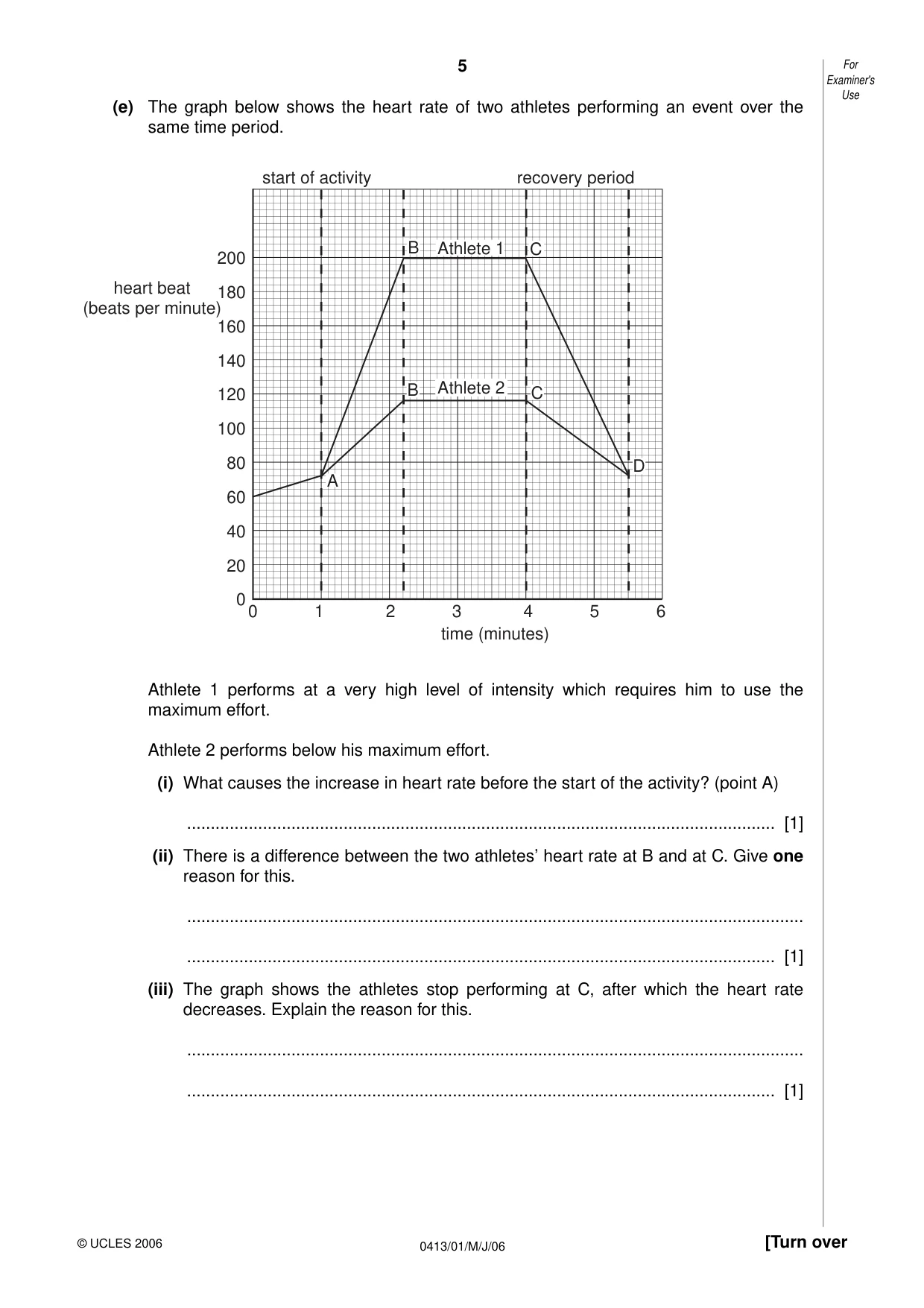
(e) The graph below shows the heart rate of two athletes performing an event over the same time period. Athlete 1 performs at a very high level of intensity which requires him to use the maximum effort. Athlete 2 performs below his maximum effort. (i) What causes the increase in heart rate before the start of the activity? (point A) … [1] (ii) There is a difference between the two athletes’ heart rate at B and at C. Give one reason for this. … … [1] (iii) The graph shows the athletes stop performing at C, after which the heart rate decreases. Explain the reason for this. … … [1] 200 180 160 140 120 100 80 60 40 20 00 1 2 3 4 5 6 A B B C C D Athlete 1 Athlete 2 start of activity recovery period time (minutes) heart beat (beats per minute) 5 [Turn over For Examiner's Use 0413/01/M/J/06 © UCLES 2006
Question paper, page 6
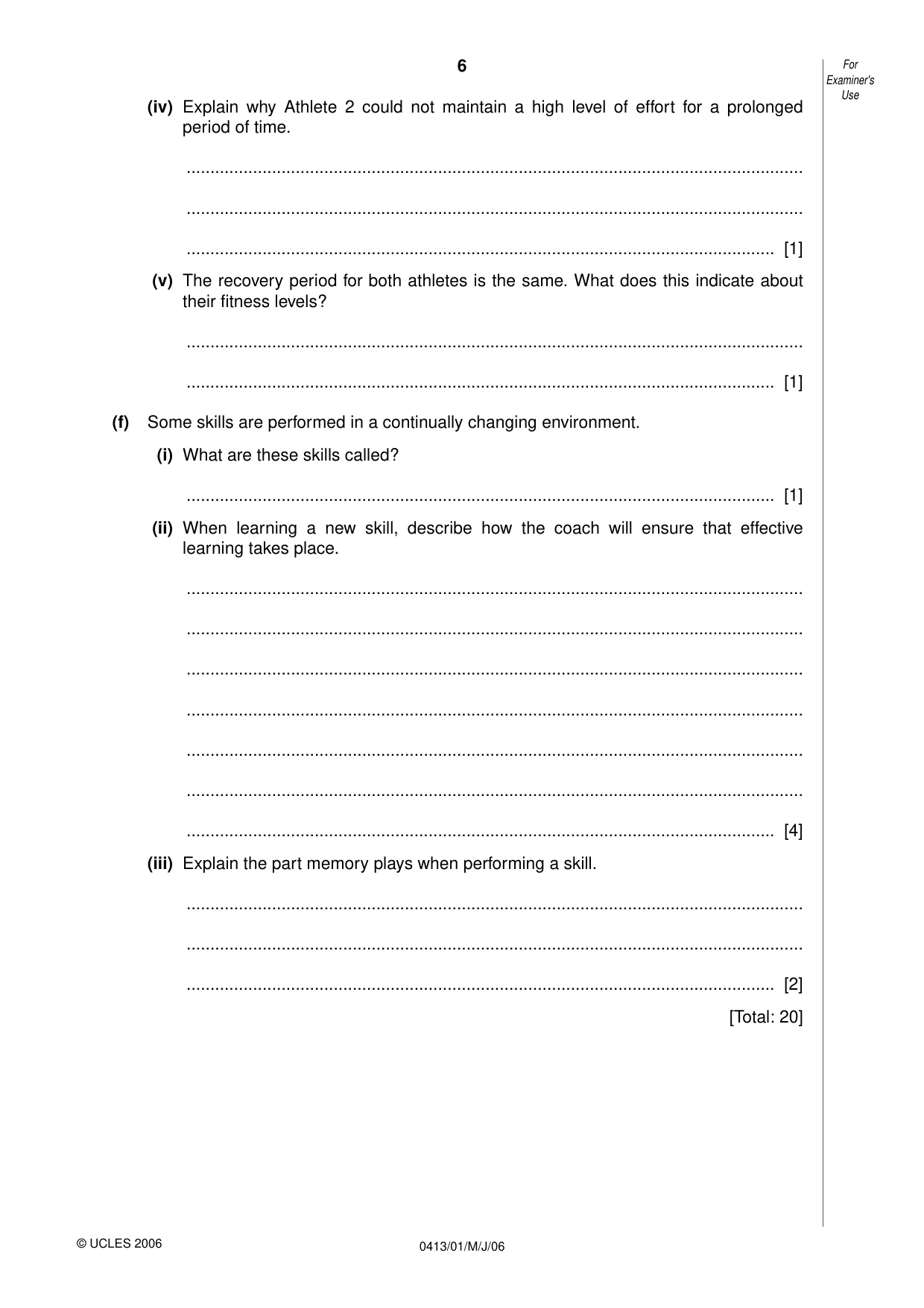
(iv) Explain why Athlete 2 could not maintain a high level of effort for a prolonged period of time. … … … [1] (v) The recovery period for both athletes is the same. What does this indicate about their fitness levels? … … [1] (f) Some skills are performed in a continually changing environment. (i) What are these skills called? … [1] (ii) When learning a new skill, describe how the coach will ensure that effective learning takes place. … … … … … … … [4] (iii) Explain the part memory plays when performing a skill. … … … [2] [Total: 20] 6 For Examiner's Use 0413/01/M/J/06 © UCLES 2006
Question paper, page 7
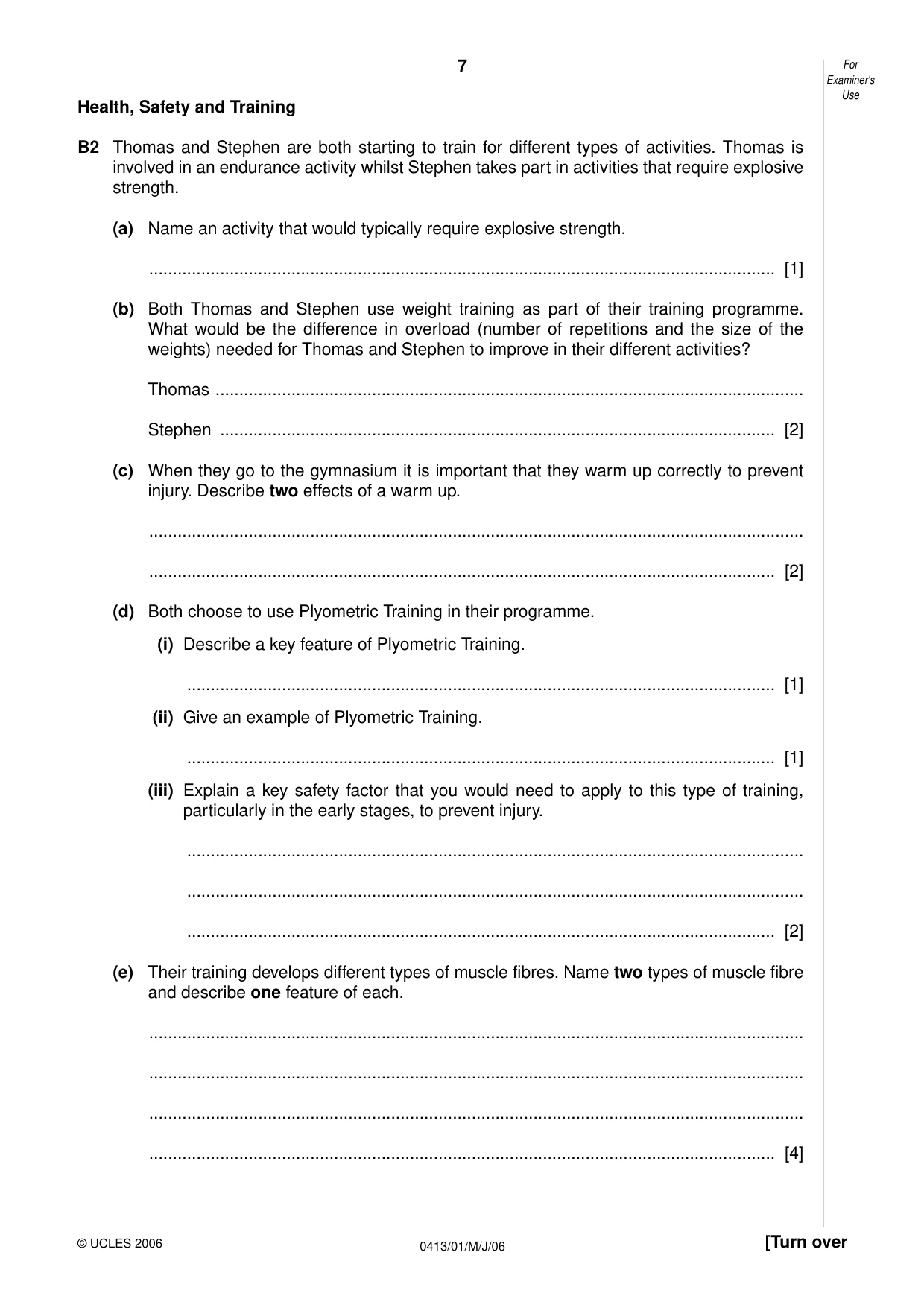
Health, Safety and Training B2 Thomas and Stephen are both starting to train for different types of activities. Thomas is involved in an endurance activity whilst Stephen takes part in activities that require explosive strength. (a) Name an activity that would typically require explosive strength. … [1] (b) Both Thomas and Stephen use weight training as part of their training programme. What would be the difference in overload (number of repetitions and the size of the weights) needed for Thomas and Stephen to improve in their different activities? Thomas … Stephen … [2] (c) When they go to the gymnasium it is important that they warm up correctly to prevent injury. Describe two effects of a warm up. … … [2] (d) Both choose to use Plyometric Training in their programme. (i) Describe a key feature of Plyometric Training. … [1] (ii) Give an example of Plyometric Training. … [1] (iii) Explain a key safety factor that you would need to apply to this type of training, particularly in the early stages, to prevent injury. … … … [2] (e) Their training develops different types of muscle fibres. Name two types of muscle fibre and describe one feature of each. … … … … [4] 7 [Turn over For Examiner's Use 0413/01/M/J/06 © UCLES 2006
Question paper, page 8
(f) Thomas and Stephen continue to train for a substantial period of time. (i) Name two long term training effects of exercise on the heart. … … [2] (ii) Name two long term training effects on the respiratory system. … … [2] Both students are very enthusiastic about their training but tend to overtrain. (iii) What would be the physical signs that they are overtraining? … … … … … [3] [Total: 20] 8 For Examiner's Use 0413/01/M/J/06 © UCLES 2006
Question paper, page 9
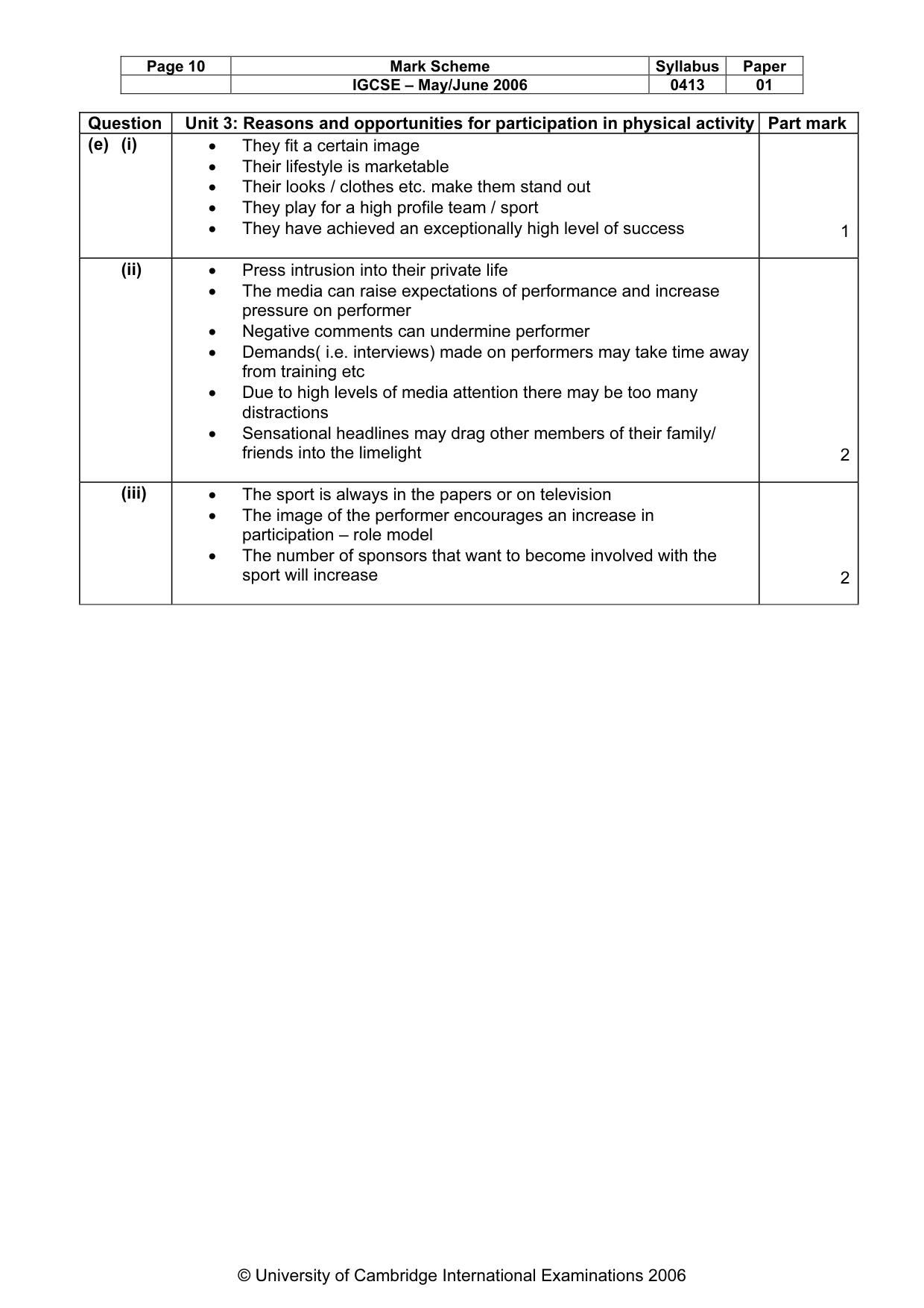
Reasons and Opportunities for Participation in Physical Activity B3 (a) Give one example of a natural outdoor sport in the countryside. How has it been adapted for urban (city) areas? … … [1] (b) Schools play a very important part in promoting and encouraging sport and physical activity. Describe two ways in which a school can achieve this objective. … … [2] (c) If a television company decided to withdraw their coverage of an event, what negative effects could this have on the event? … … … [2] (d) In many sports, ethnic minority groups are under represented. Give three reasons for this. … … … … … [3] (e) It is often the media who create ‘sportstars’ in many different sports. (i) Explain why this happens. … [1] (ii) Give examples of the negative effects on the individual. … … [2] (iii) Give examples of the positive effects for the sport. … … [2] 9 [Turn over For Examiner's Use 0413/01/M/J/06 © UCLES 2006
Question paper, page 10
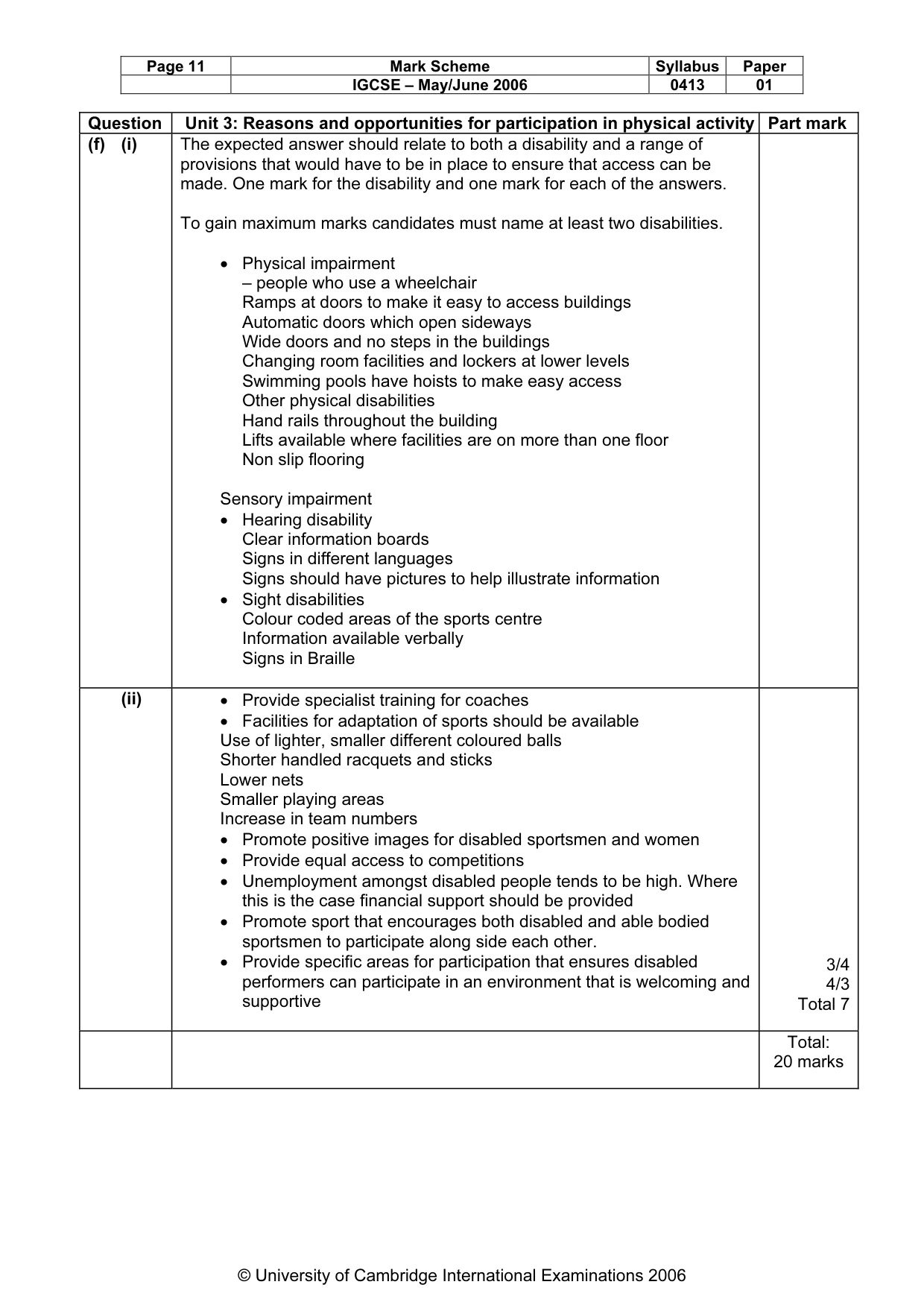
(f) A new manager of a sports centre needs to check how suitable the facilities are to allow maximum access for everyone. (i) Identify two different types of physical disabilities and describe the arrangements that need to be made to ensure ease of access for everyone. … … … … … … (ii) Apart from staging extra sessions and improving access, how could you encourage greater participation for performers with physical disabilities? … … … … … … [7] [Total: 20] 10 For Examiner's Use 0413/01/M/J/06 © UCLES 2006
Question paper, page 12
BLANK PAGE Permission to reproduce items where third-party owned material protected by copyright is included has been sought and cleared where possible. Every reasonable effort has been made by the publisher (UCLES) to trace copyright holders, but if any items requiring clearance have unwittingly been included, the publisher will be pleased to make amends at the earliest possible opportunity. University of Cambridge International Examinations is part of the University of Cambridge Local Examinations Syndicate (UCLES), which is itself a department of the University of Cambridge. 12 0413/01/M/J/06
Mark scheme, page 1
UNIVERSITY OF CAMBRIDGE INTERNATIONAL EXAMINATIONS International General Certificate of Secondary Education MARK SCHEME for the May/June 2006 question paper 0413 PHYSICAL EDUCATION 0413/01 Paper 1, maximum raw mark 80 These mark schemes are published as an aid to teachers and students, to indicate the requirements of the examination. They show the basis on which Examiners were initially instructed to award marks. They do not indicate the details of the discussions that took place at an Examiners’ meeting before marking began. Any substantial changes to the mark scheme that arose from these discussions will be recorded in the published Report on the Examination. All Examiners are instructed that alternative correct answers and unexpected approaches in candidates’ scripts must be given marks that fairly reflect the relevant knowledge and skills demonstrated. Mark schemes must be read in conjunction with the question papers and the Report on the Examination. The minimum marks in these components needed for various grades were previously published with these mark schemes, but are now instead included in the Report on the Examination for this session. • CIE will not enter into discussion or correspondence in connection with these mark schemes. CIE is publishing the mark schemes for the May/June 2006 question papers for most IGCSE and GCE Advanced Level and Advanced Subsidiary Level syllabuses and some Ordinary Level syllabuses. www.XtremePapers.com
Mark scheme, page 2
Page 1 Mark Scheme Syllabus Paper IGCSE – May/June 2006 0413 01 © University of Cambridge International Examinations 2006 Question Section A Part mark 1 • Fitness is the ability to meet the demands of the environment • If you can carry out all of your tasks and activities without getting too tired and still have energy left over for emergencies, you are fit. A mark can be awarded for either definition or part. 1 2 • Provide publicity • Raises public awareness and understanding • Provides funding/ resources • Attracts greater levels of participation at all levels • Attracts the top performers to events • Attracts individual sponsors 1 3 The body will maintain temperature when • Vasodilatation takes place • Heat is lost through radiation • Sweat is produces • Evaporation takes place • Body hairs lay flat • Hypothalmus regulates temperature 1 4 • The neck joint • The spinal joint between the atlas and axis 1 5 • Can be stimulating and fun • Relieves stress and tension • Allows aggression to be positively channelled • Can be challenging • Prevents boredom • Raises self confidence 1 6 • Peer pressure • Economics • The influence of the media- what is fashionable • Ease of access • Environmental factors • Cost of activities • School influences • Age of the individual • Tradition and culture • Family support and influences 2
Mark scheme, page 3
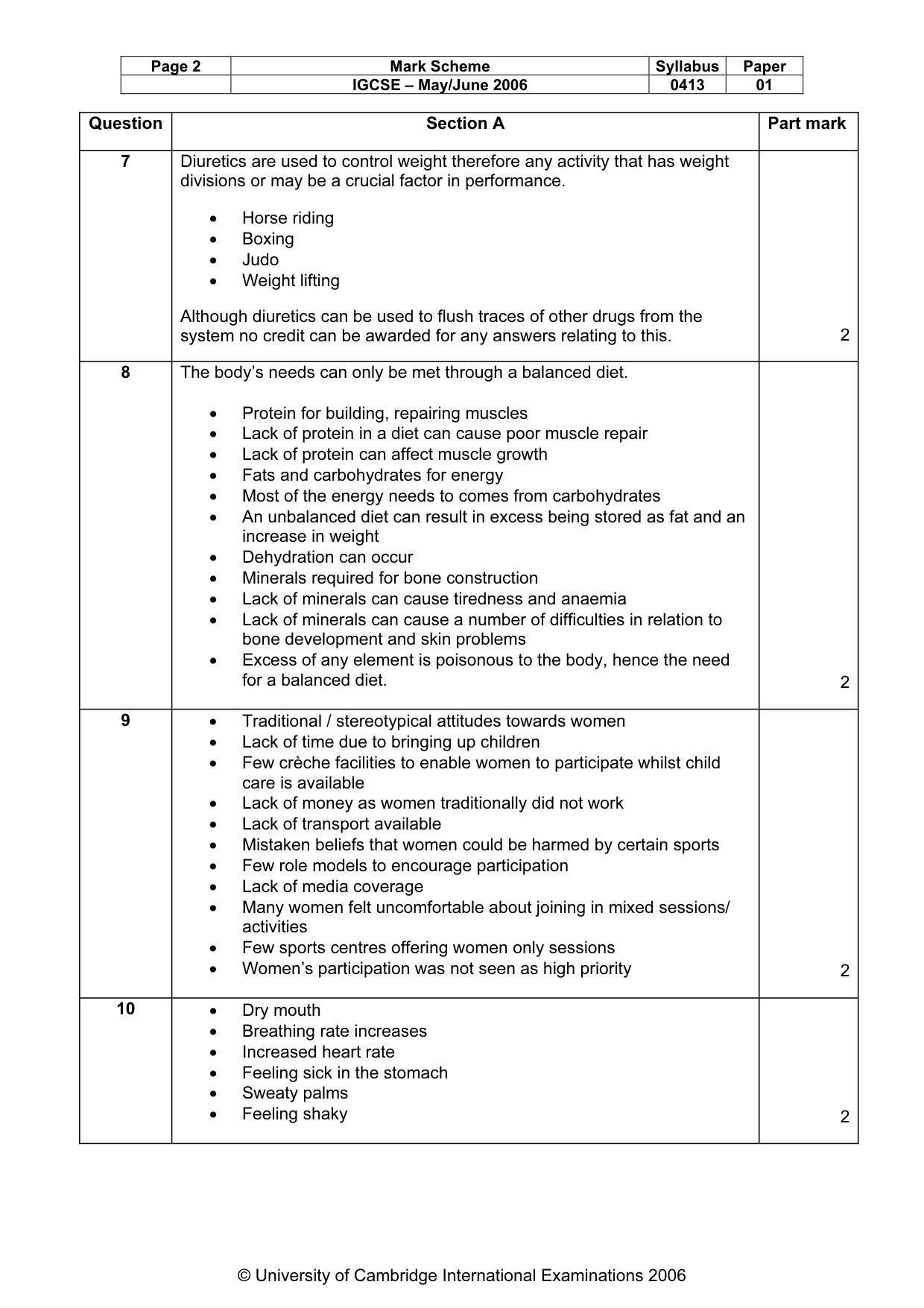
Page 2 Mark Scheme Syllabus Paper IGCSE – May/June 2006 0413 01 © University of Cambridge International Examinations 2006 Question Section A Part mark 7 Diuretics are used to control weight therefore any activity that has weight divisions or may be a crucial factor in performance. • Horse riding • Boxing • Judo • Weight lifting Although diuretics can be used to flush traces of other drugs from the system no credit can be awarded for any answers relating to this. 2 8 The body’s needs can only be met through a balanced diet. • Protein for building, repairing muscles • Lack of protein in a diet can cause poor muscle repair • Lack of protein can affect muscle growth • Fats and carbohydrates for energy • Most of the energy needs to comes from carbohydrates • An unbalanced diet can result in excess being stored as fat and an increase in weight • Dehydration can occur • Minerals required for bone construction • Lack of minerals can cause tiredness and anaemia • Lack of minerals can cause a number of difficulties in relation to bone development and skin problems • Excess of any element is poisonous to the body, hence the need for a balanced diet. 2 9 • Traditional / stereotypical attitudes towards women • Lack of time due to bringing up children • Few crèche facilities to enable women to participate whilst child care is available • Lack of money as women traditionally did not work • Lack of transport available • Mistaken beliefs that women could be harmed by certain sports • Few role models to encourage participation • Lack of media coverage • Many women felt uncomfortable about joining in mixed sessions/ activities • Few sports centres offering women only sessions • Women’s participation was not seen as high priority 2 10 • Dry mouth • Breathing rate increases • Increased heart rate • Feeling sick in the stomach • Sweaty palms • Feeling shaky 2
Mark scheme, page 4
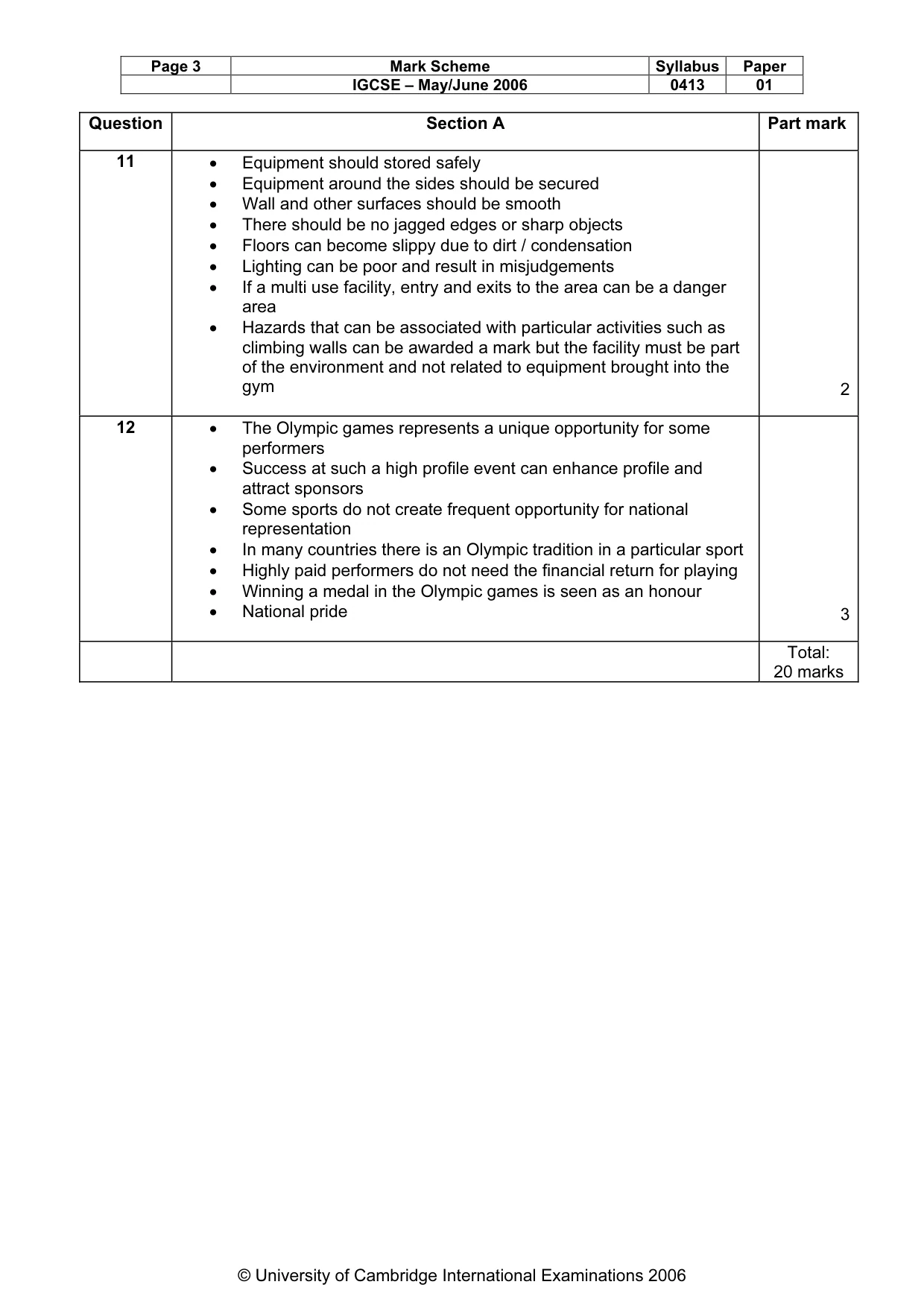
Page 3 Mark Scheme Syllabus Paper IGCSE – May/June 2006 0413 01 © University of Cambridge International Examinations 2006 Question Section A Part mark 11 • Equipment should stored safely • Equipment around the sides should be secured • Wall and other surfaces should be smooth • There should be no jagged edges or sharp objects • Floors can become slippy due to dirt / condensation • Lighting can be poor and result in misjudgements • If a multi use facility, entry and exits to the area can be a danger area • Hazards that can be associated with particular activities such as climbing walls can be awarded a mark but the facility must be part of the environment and not related to equipment brought into the gym 2 12 • The Olympic games represents a unique opportunity for some performers • Success at such a high profile event can enhance profile and attract sponsors • Some sports do not create frequent opportunity for national representation • In many countries there is an Olympic tradition in a particular sport • Highly paid performers do not need the financial return for playing • Winning a medal in the Olympic games is seen as an honour • National pride 3 Total: 20 marks
Mark scheme, page 5
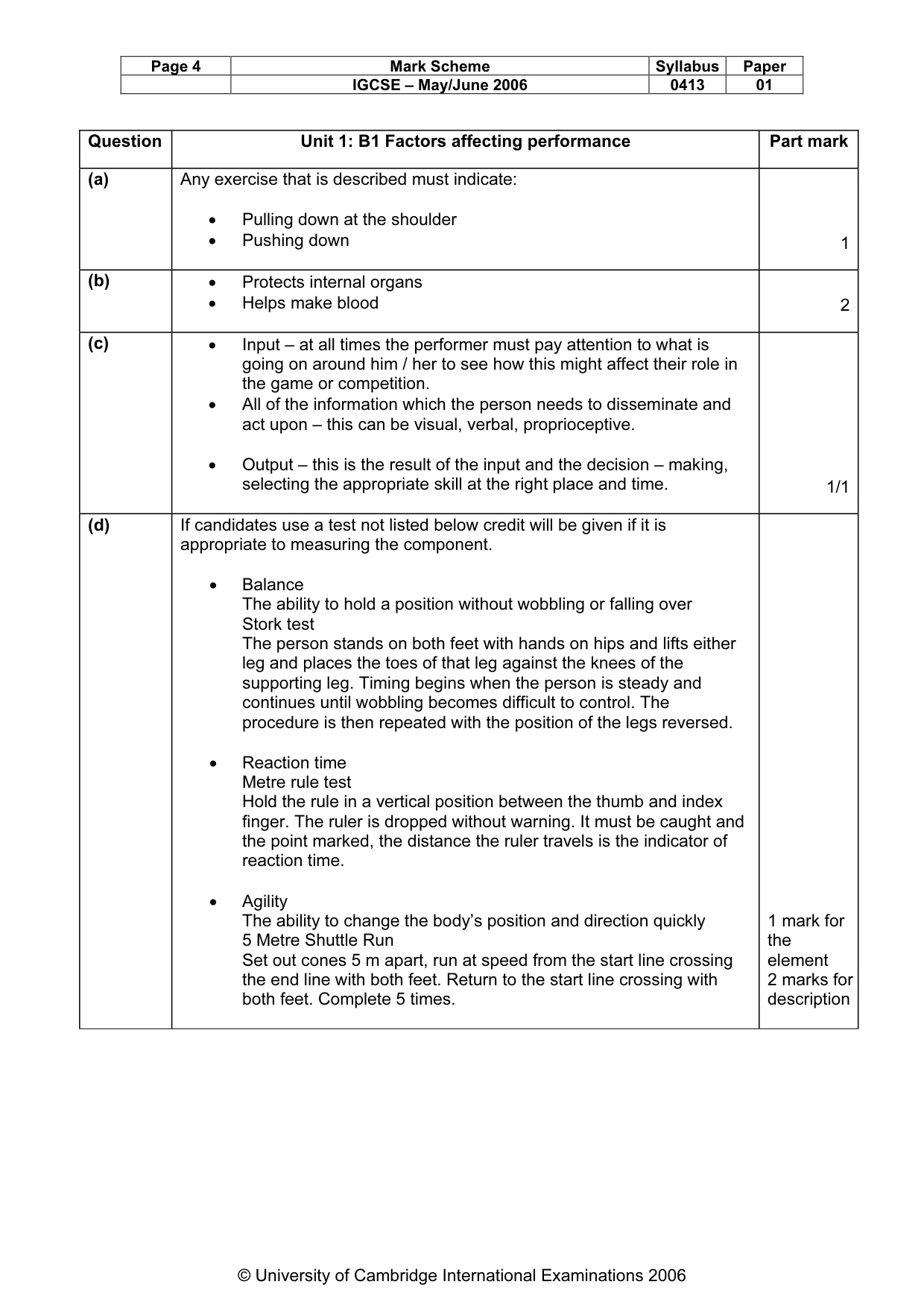
Page 4 Mark Scheme Syllabus Paper IGCSE – May/June 2006 0413 01 © University of Cambridge International Examinations 2006 Question Unit 1: B1 Factors affecting performance Part mark (a) Any exercise that is described must indicate: • Pulling down at the shoulder • Pushing down 1 (b) • Protects internal organs • Helps make blood 2 (c) • Input – at all times the performer must pay attention to what is going on around him / her to see how this might affect their role in the game or competition. • All of the information which the person needs to disseminate and act upon – this can be visual, verbal, proprioceptive. • Output – this is the result of the input and the decision – making, selecting the appropriate skill at the right place and time. 1/1 (d) If candidates use a test not listed below credit will be given if it is appropriate to measuring the component. • Balance The ability to hold a position without wobbling or falling over Stork test The person stands on both feet with hands on hips and lifts either leg and places the toes of that leg against the knees of the supporting leg. Timing begins when the person is steady and continues until wobbling becomes difficult to control. The procedure is then repeated with the position of the legs reversed. • Reaction time Metre rule test Hold the rule in a vertical position between the thumb and index finger. The ruler is dropped without warning. It must be caught and the point marked, the distance the ruler travels is the indicator of reaction time. • Agility The ability to change the body’s position and direction quickly 5 Metre Shuttle Run Set out cones 5 m apart, run at speed from the start line crossing the end line with both feet. Return to the start line crossing with both feet. Complete 5 times. 1 mark for the element 2 marks for description
Mark scheme, page 6
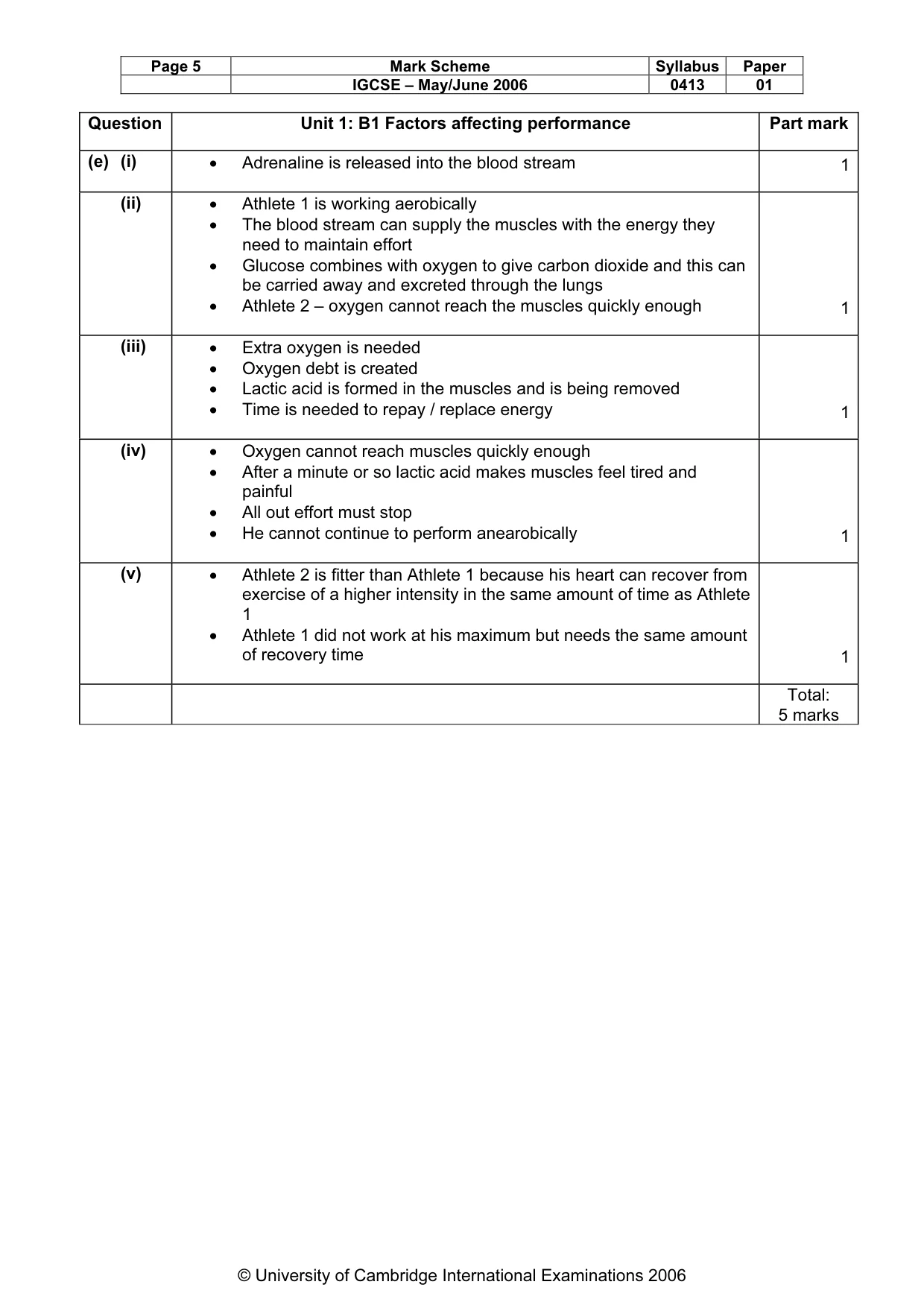
Page 5 Mark Scheme Syllabus Paper IGCSE – May/June 2006 0413 01 © University of Cambridge International Examinations 2006 Question Unit 1: B1 Factors affecting performance Part mark (e) (i) • Adrenaline is released into the blood stream 1 (ii) • Athlete 1 is working aerobically • The blood stream can supply the muscles with the energy they need to maintain effort • Glucose combines with oxygen to give carbon dioxide and this can be carried away and excreted through the lungs • Athlete 2 – oxygen cannot reach the muscles quickly enough 1 (iii) • Extra oxygen is needed • Oxygen debt is created • Lactic acid is formed in the muscles and is being removed • Time is needed to repay / replace energy 1 (iv) • Oxygen cannot reach muscles quickly enough • After a minute or so lactic acid makes muscles feel tired and painful • All out effort must stop • He cannot continue to perform anearobically 1 (v) • Athlete 2 is fitter than Athlete 1 because his heart can recover from exercise of a higher intensity in the same amount of time as Athlete 1 • Athlete 1 did not work at his maximum but needs the same amount of recovery time 1 Total: 5 marks
Mark scheme, page 7
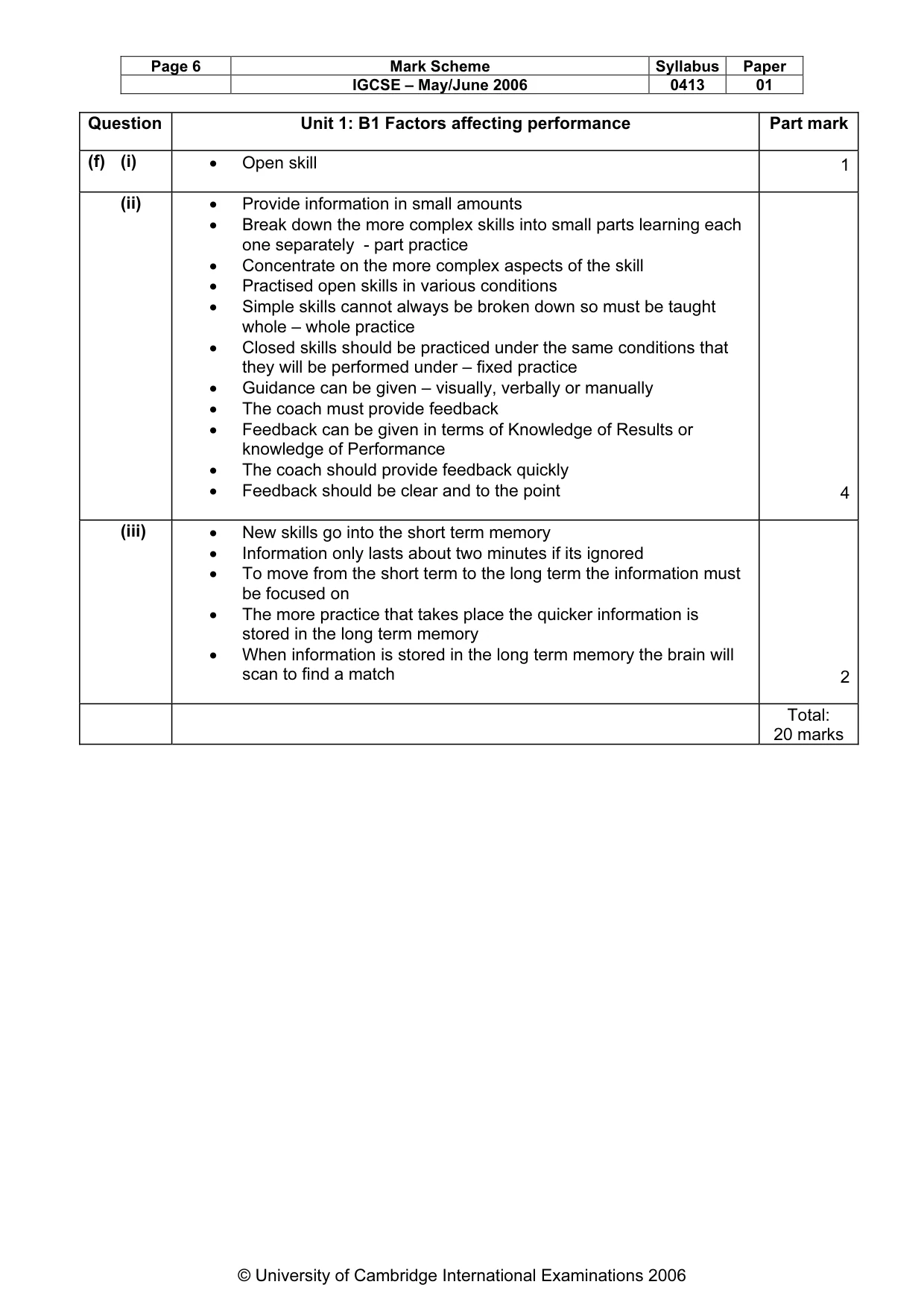
Page 6 Mark Scheme Syllabus Paper IGCSE – May/June 2006 0413 01 © University of Cambridge International Examinations 2006 Question Unit 1: B1 Factors affecting performance Part mark (f) (i) • Open skill 1 (ii) • Provide information in small amounts • Break down the more complex skills into small parts learning each one separately - part practice • Concentrate on the more complex aspects of the skill • Practised open skills in various conditions • Simple skills cannot always be broken down so must be taught whole – whole practice • Closed skills should be practiced under the same conditions that they will be performed under – fixed practice • Guidance can be given – visually, verbally or manually • The coach must provide feedback • Feedback can be given in terms of Knowledge of Results or knowledge of Performance • The coach should provide feedback quickly • Feedback should be clear and to the point 4 (iii) • New skills go into the short term memory • Information only lasts about two minutes if its ignored • To move from the short term to the long term the information must be focused on • The more practice that takes place the quicker information is stored in the long term memory • When information is stored in the long term memory the brain will scan to find a match 2 Total: 20 marks
Mark scheme, page 8
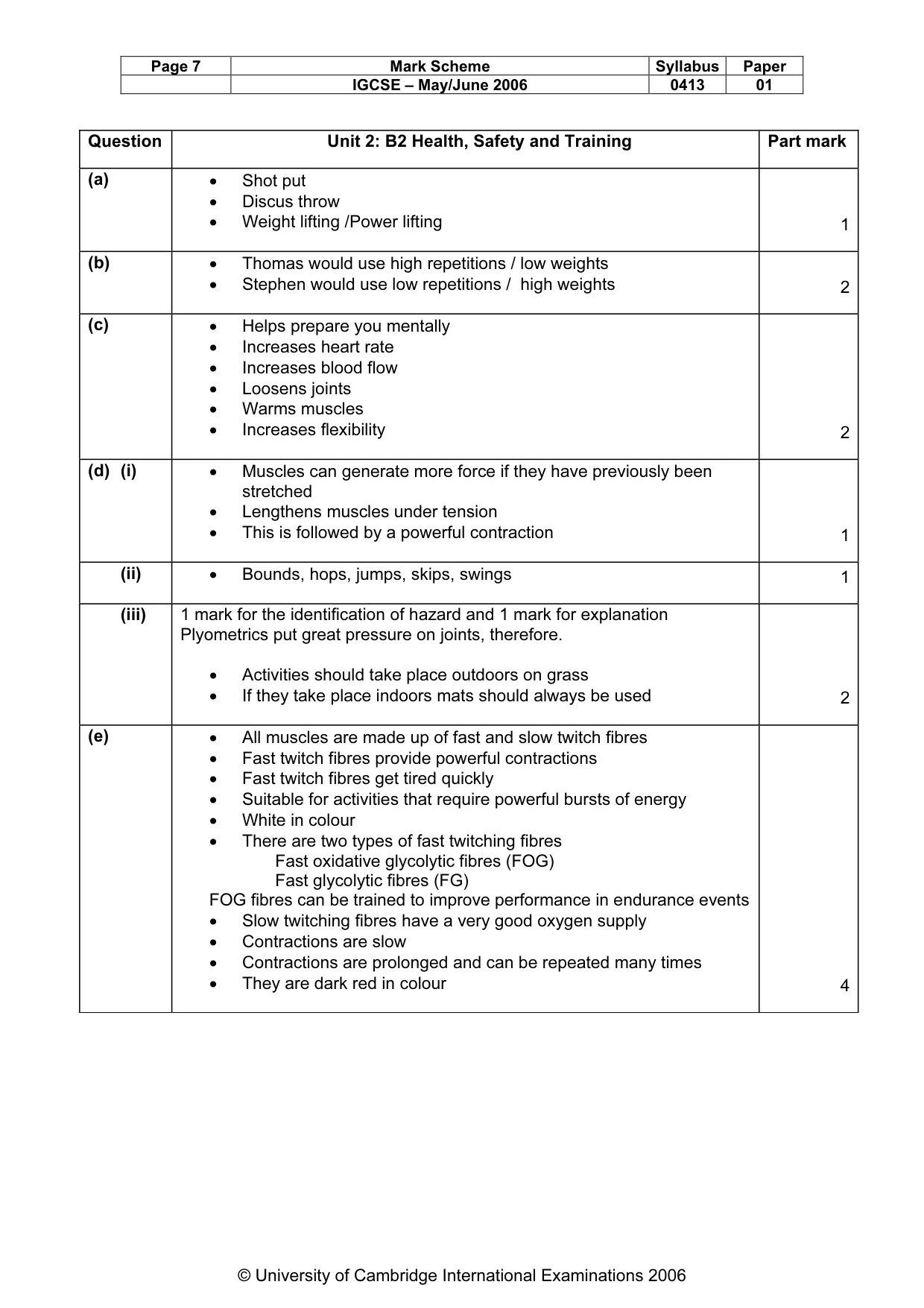
Page 7 Mark Scheme Syllabus Paper IGCSE – May/June 2006 0413 01 © University of Cambridge International Examinations 2006 Question Unit 2: B2 Health, Safety and Training Part mark (a) • Shot put • Discus throw • Weight lifting /Power lifting 1 (b) • Thomas would use high repetitions / low weights • Stephen would use low repetitions / high weights 2 (c) • Helps prepare you mentally • Increases heart rate • Increases blood flow • Loosens joints • Warms muscles • Increases flexibility 2 (d) (i) • Muscles can generate more force if they have previously been stretched • Lengthens muscles under tension • This is followed by a powerful contraction 1 (ii) • Bounds, hops, jumps, skips, swings 1 (iii) 1 mark for the identification of hazard and 1 mark for explanation Plyometrics put great pressure on joints, therefore. • Activities should take place outdoors on grass • If they take place indoors mats should always be used 2 (e) • All muscles are made up of fast and slow twitch fibres • Fast twitch fibres provide powerful contractions • Fast twitch fibres get tired quickly • Suitable for activities that require powerful bursts of energy • White in colour • There are two types of fast twitching fibres Fast oxidative glycolytic fibres (FOG) Fast glycolytic fibres (FG) FOG fibres can be trained to improve performance in endurance events • Slow twitching fibres have a very good oxygen supply • Contractions are slow • Contractions are prolonged and can be repeated many times • They are dark red in colour 4
Mark scheme, page 9
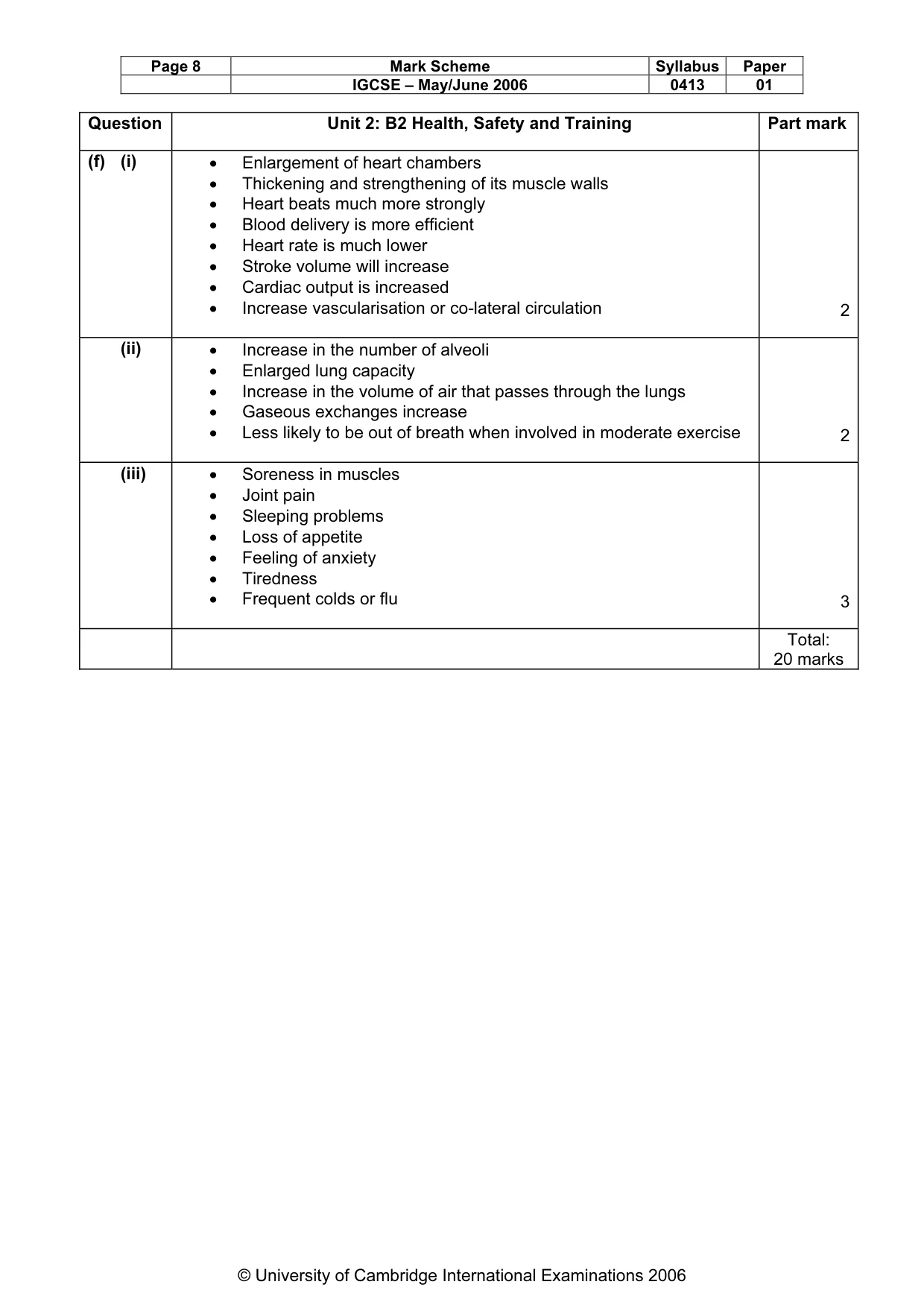
Page 8 Mark Scheme Syllabus Paper IGCSE – May/June 2006 0413 01 © University of Cambridge International Examinations 2006 Question Unit 2: B2 Health, Safety and Training Part mark (f) (i) • Enlargement of heart chambers • Thickening and strengthening of its muscle walls • Heart beats much more strongly • Blood delivery is more efficient • Heart rate is much lower • Stroke volume will increase • Cardiac output is increased • Increase vascularisation or co-lateral circulation 2 (ii) • Increase in the number of alveoli • Enlarged lung capacity • Increase in the volume of air that passes through the lungs • Gaseous exchanges increase • Less likely to be out of breath when involved in moderate exercise 2 (iii) • Soreness in muscles • Joint pain • Sleeping problems • Loss of appetite • Feeling of anxiety • Tiredness • Frequent colds or flu 3 Total: 20 marks
Mark scheme, page 10
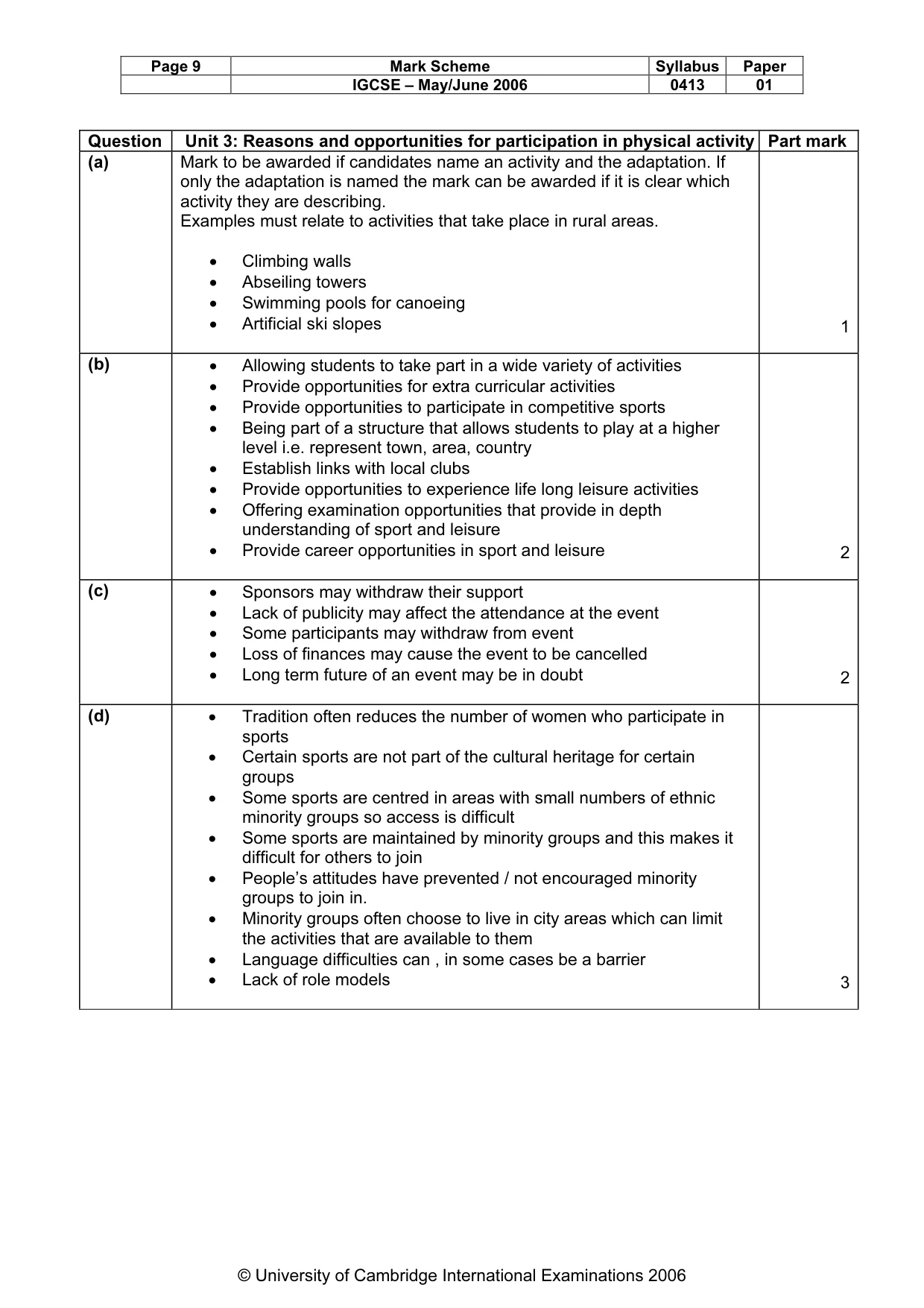
Page 9 Mark Scheme Syllabus Paper IGCSE – May/June 2006 0413 01 © University of Cambridge International Examinations 2006 Question Unit 3: Reasons and opportunities for participation in physical activity Part mark (a) Mark to be awarded if candidates name an activity and the adaptation. If only the adaptation is named the mark can be awarded if it is clear which activity they are describing. Examples must relate to activities that take place in rural areas. • Climbing walls • Abseiling towers • Swimming pools for canoeing • Artificial ski slopes 1 (b) • Allowing students to take part in a wide variety of activities • Provide opportunities for extra curricular activities • Provide opportunities to participate in competitive sports • Being part of a structure that allows students to play at a higher level i.e. represent town, area, country • Establish links with local clubs • Provide opportunities to experience life long leisure activities • Offering examination opportunities that provide in depth understanding of sport and leisure • Provide career opportunities in sport and leisure 2 (c) • Sponsors may withdraw their support • Lack of publicity may affect the attendance at the event • Some participants may withdraw from event • Loss of finances may cause the event to be cancelled • Long term future of an event may be in doubt 2 (d) • Tradition often reduces the number of women who participate in sports • Certain sports are not part of the cultural heritage for certain groups • Some sports are centred in areas with small numbers of ethnic minority groups so access is difficult • Some sports are maintained by minority groups and this makes it difficult for others to join • People’s attitudes have prevented / not encouraged minority groups to join in. • Minority groups often choose to live in city areas which can limit the activities that are available to them • Language difficulties can , in some cases be a barrier • Lack of role models 3
Mark scheme, page 11
Page 10 Mark Scheme Syllabus Paper IGCSE – May/June 2006 0413 01 © University of Cambridge International Examinations 2006 Question Unit 3: Reasons and opportunities for participation in physical activity Part mark (e) (i) • They fit a certain image • Their lifestyle is marketable • Their looks / clothes etc. make them stand out • They play for a high profile team / sport • They have achieved an exceptionally high level of success 1 (ii) • Press intrusion into their private life • The media can raise expectations of performance and increase pressure on performer • Negative comments can undermine performer • Demands( i.e. interviews) made on performers may take time away from training etc • Due to high levels of media attention there may be too many distractions • Sensational headlines may drag other members of their family/ friends into the limelight 2 (iii) • The sport is always in the papers or on television • The image of the performer encourages an increase in participation – role model • The number of sponsors that want to become involved with the sport will increase 2
Mark scheme, page 12
Page 11 Mark Scheme Syllabus Paper IGCSE – May/June 2006 0413 01 © University of Cambridge International Examinations 2006 Question Unit 3: Reasons and opportunities for participation in physical activity Part mark (f) (i) The expected answer should relate to both a disability and a range of provisions that would have to be in place to ensure that access can be made. One mark for the disability and one mark for each of the answers. To gain maximum marks candidates must name at least two disabilities. • Physical impairment – people who use a wheelchair Ramps at doors to make it easy to access buildings Automatic doors which open sideways Wide doors and no steps in the buildings Changing room facilities and lockers at lower levels Swimming pools have hoists to make easy access Other physical disabilities Hand rails throughout the building Lifts available where facilities are on more than one floor Non slip flooring Sensory impairment • Hearing disability Clear information boards Signs in different languages Signs should have pictures to help illustrate information • Sight disabilities Colour coded areas of the sports centre Information available verbally Signs in Braille (ii) • Provide specialist training for coaches • Facilities for adaptation of sports should be available Use of lighter, smaller different coloured balls Shorter handled racquets and sticks Lower nets Smaller playing areas Increase in team numbers • Promote positive images for disabled sportsmen and women • Provide equal access to competitions • Unemployment amongst disabled people tends to be high. Where this is the case financial support should be provided • Promote sport that encourages both disabled and able bodied sportsmen to participate along side each other. • Provide specific areas for participation that ensures disabled performers can participate in an environment that is welcoming and supportive 3/4 4/3 Total 7 Total: 20 marks
What you needed in this session
Cambridge’s own grade thresholds for 2006 May/June, Paper 1 · Variant 1. A higher threshold means an easier paper — the bar moves with how the cohort did.