Cambridge IGCSE Pakistan Studies 0448 — 2019 May/June Paper 2 · Variant 1
0448/21/M/J/19 · 5 questions · 75 marks · ≈84 min
The question paper and its mark scheme, free to read here and free to download. This is Cambridge’s own paper, exactly as it was sat.
Question paper24 pages

Mark scheme19 pages
Answers below. Sit the paper first if you are practising.
Questions as text
Question 1
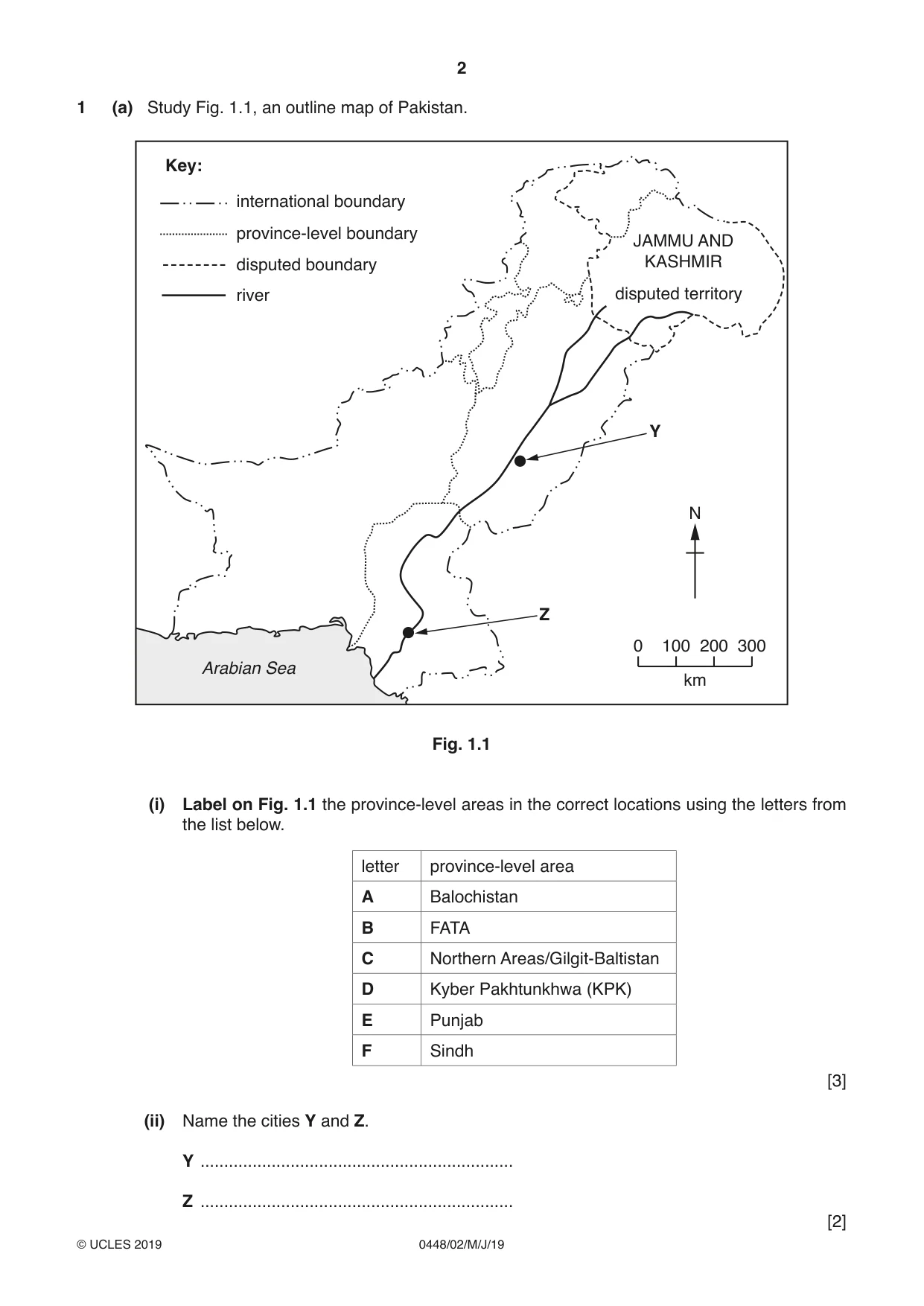
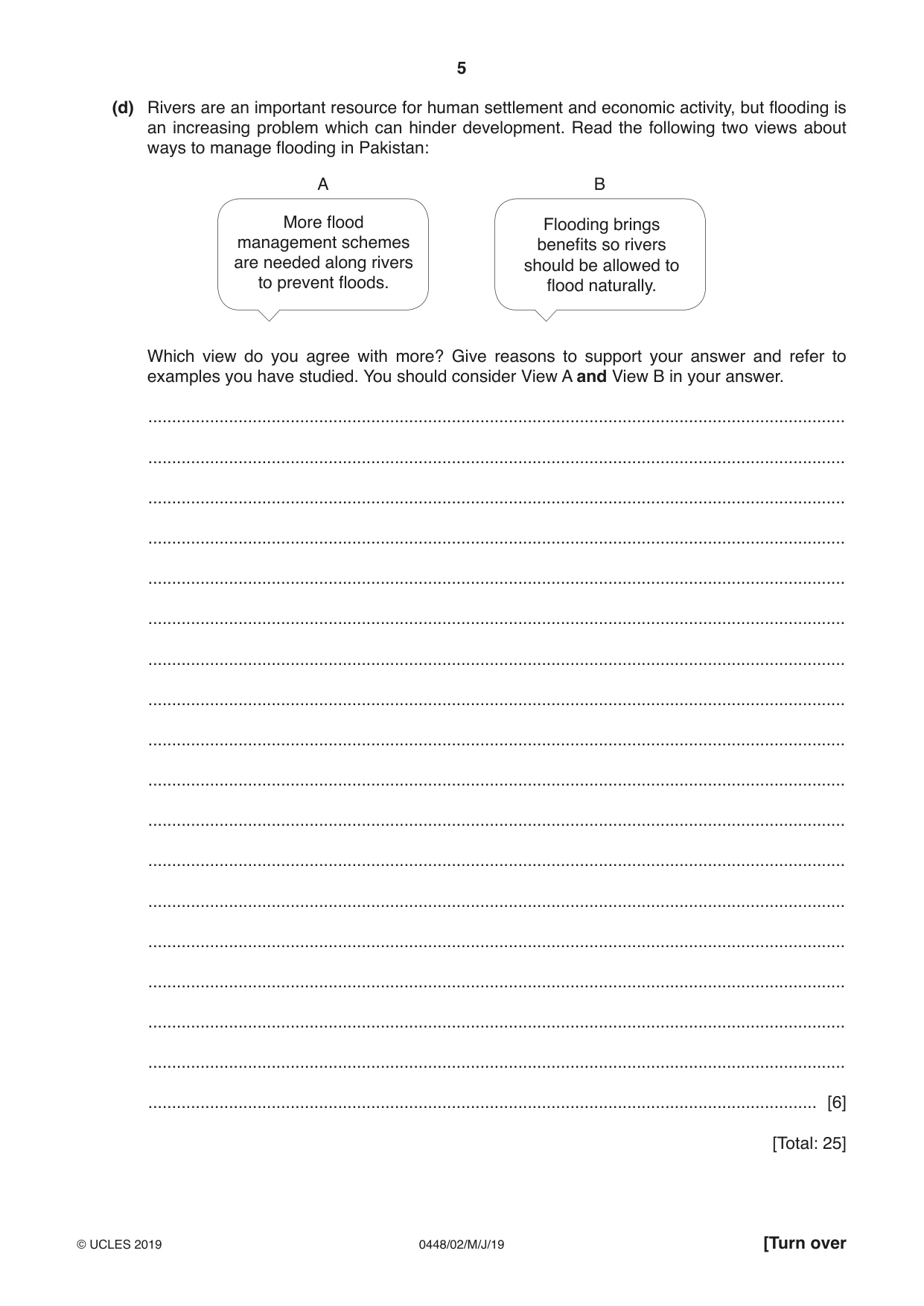
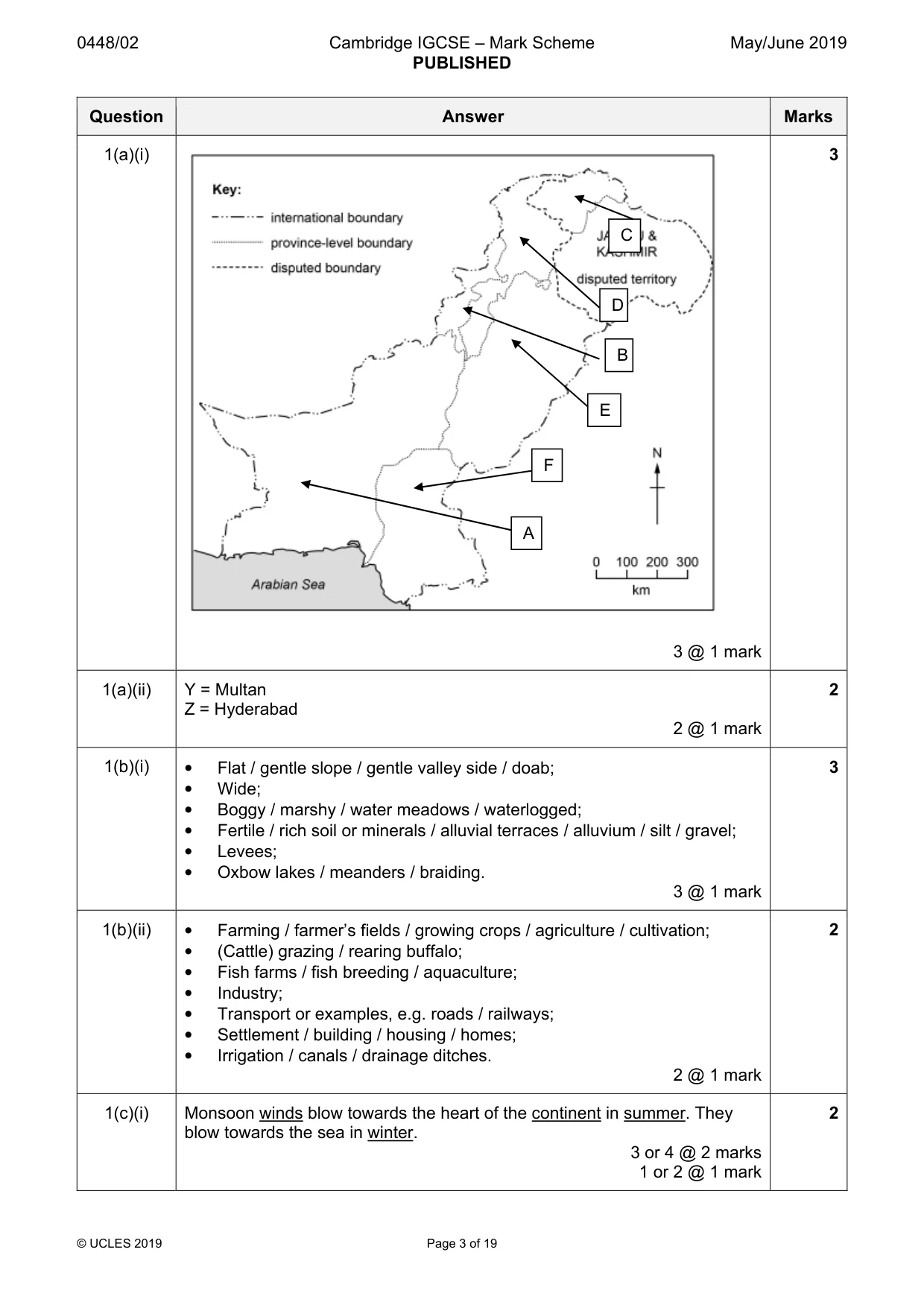
1 (a) Study Fig. 1.1, an outline map of Pakistan. Key: international boundary province-level boundary JAMMU AND disputed boundary KASHMIR river disputed territory Y N Z 0 100 200 300 Arabian Sea km Fig. 1.1 (i) Label on Fig. 1.1 the province-level areas in the correct locations using the letters from the list below. letter province-level area A Balochistan B FATA C Northern Areas/Gilgit-Baltistan D Kyber Pakhtunkhwa (KPK) E Punjab F Sindh [3] (ii) Name the cities Y and Z. Y .................................................................. Z .................................................................. [2] (b) (i) Describe the characteristics of a floodplain. ........................................................................................................................................... ........................................................................................................................................... ........................................................................................................................................... ........................................................................................................................................... ........................................................................................................................................... ..................................................................................................................................... [3] (ii) State two ways that land on a floodplain is used. 1 .................................................................. 2 .................................................................. [2] (c) (i) Complete the passage below about monsoon rainfall in Pakistan. Choose the correct words from the list and place them in the spaces provided. Monsoon .................. blow towards the heart of the ...................... in ...................... . They blow towards the sea in .............................. . autumn continent ocean spring summer winds winter [2] (ii) Describe the causes of the south west monsoon. ........................................................................................................................................... ........................................................................................................................................... ........................................................................................................................................... ........................................................................................................................................... ........................................................................................................................................... ..................................................................................................................................... [3] (iii) Explain two impacts of a heavy monsoon. You should develop your answer. ........................................................................................................................................... ........................................................................................................................................... ........................................................................................................................................... ........................................................................................................................................... ........................................................................................................................................... ........................................................................................................................................... ........................................................................................................................................... ..................................................................................................................................... [4] (d) Rivers are an important resource for human settlement and economic activity, but flooding is an increasing problem which can hinder development. Read the following two views about ways to manage flooding in Pakistan: A B More flood Flooding brings management schemes benefits so rivers are needed along rivers should be allowed to to prevent floods. flood naturally. Which view do you agree with more? Give reasons to support your answer and refer to examples you have studied. You should consider View A and View B in your answer. ................................................................................................................................................... ................................................................................................................................................... ................................................................................................................................................... ................................................................................................................................................... ................................................................................................................................................... ................................................................................................................................................... ................................................................................................................................................... ................................................................................................................................................... ................................................................................................................................................... ................................................................................................................................................... ................................................................................................................................................... ................................................................................................................................................... ................................................................................................................................................... ................................................................................................................................................... ................................................................................................................................................... ................................................................................................................................................... ................................................................................................................................................... ............................................................................................................................................. [6] [Total: 25]
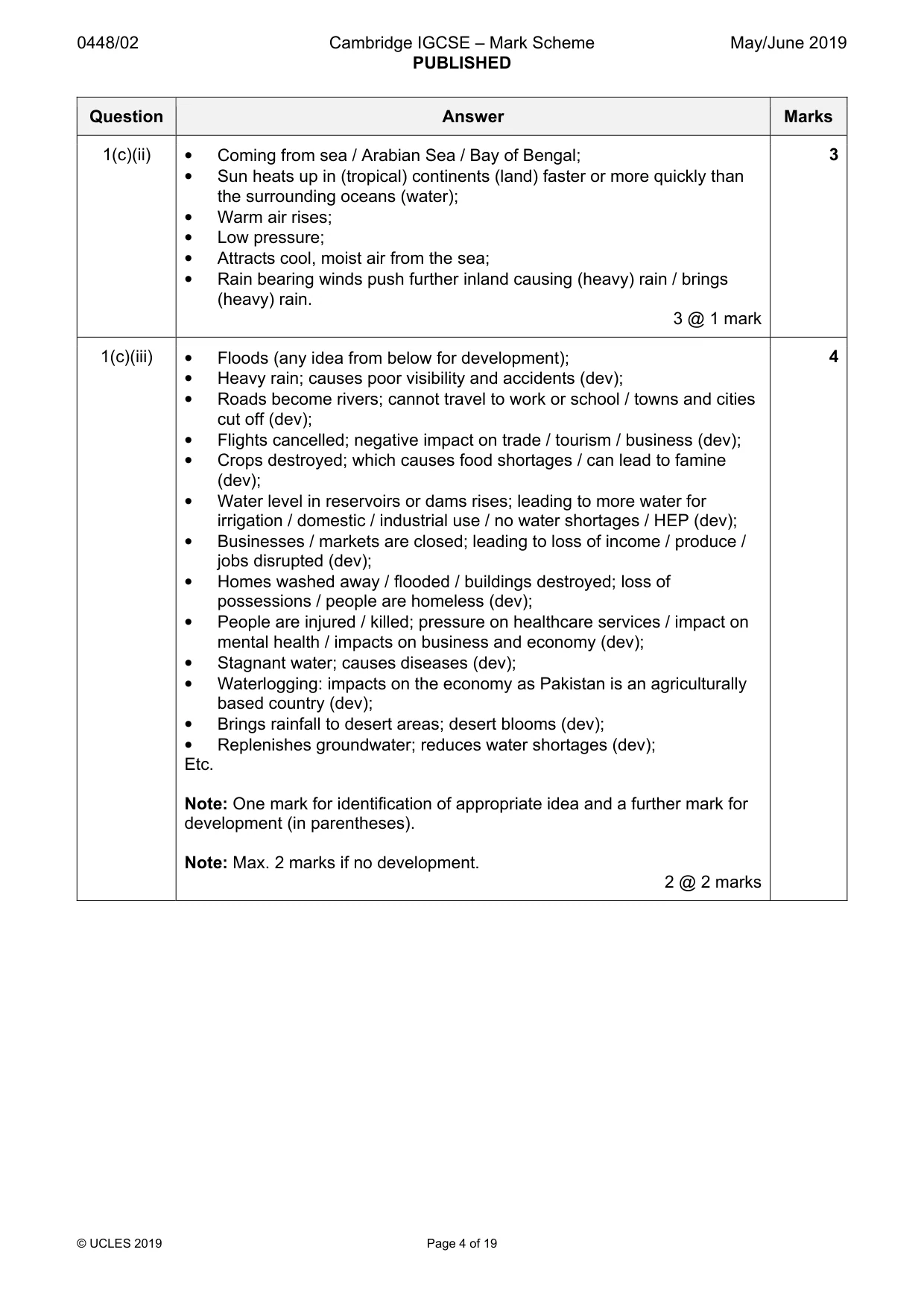
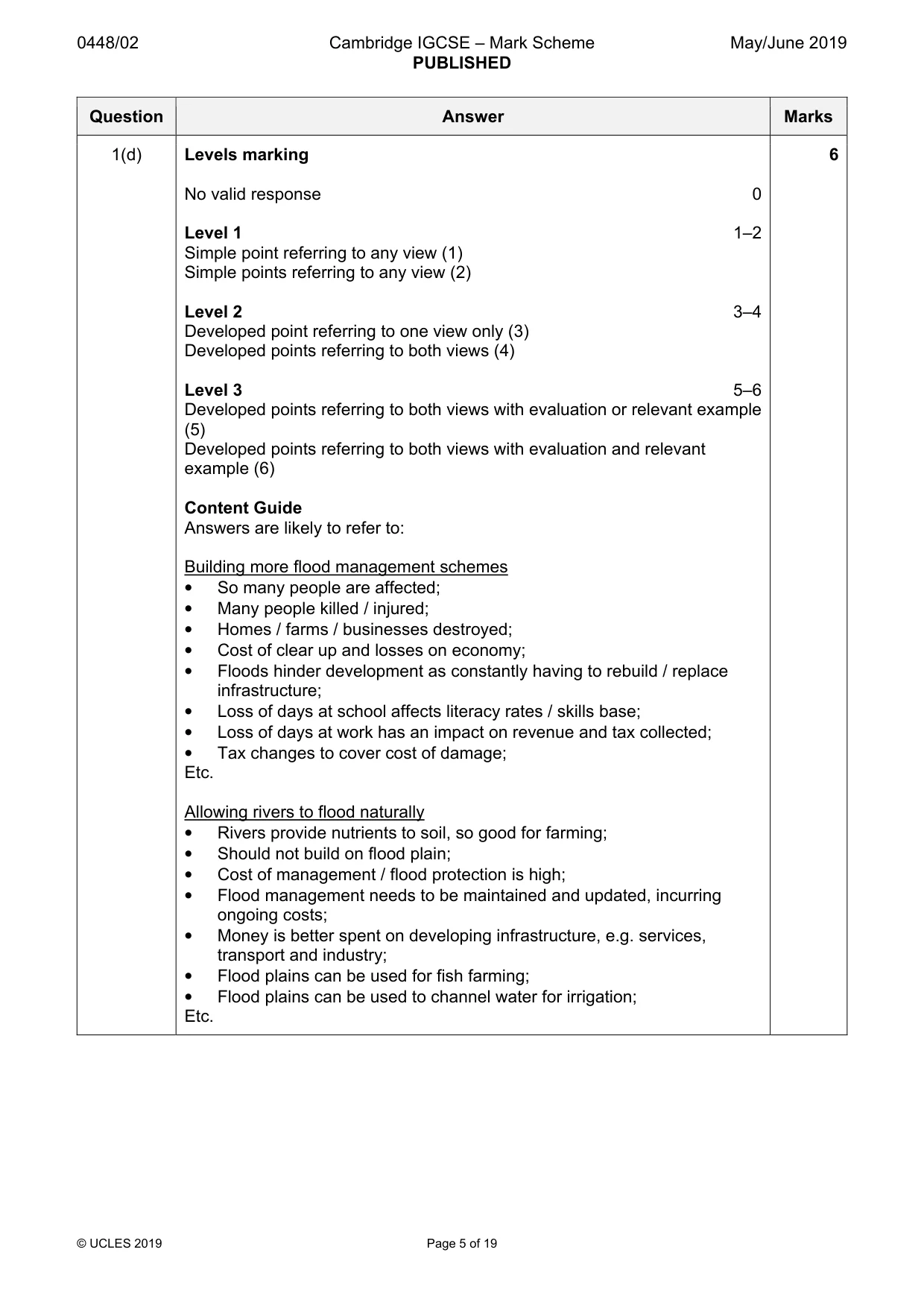
Mark scheme: Question Answer Marks 1(a)(i) 3 C D B E F A 3 @ 1 mark 1(a)(ii) Y = Multan 2 Z = Hyderabad 2 @ 1 mark 1(b)(i) • Flat / gentle slope / gentle valley side / doab; 3 • Wide; • Boggy / marshy / water meadows / waterlogged; • Fertile / rich soil or minerals / alluvial terraces / alluvium / silt / gravel; • Levees; • Oxbow lakes / meanders / braiding. 3 @ 1 mark 1(b)(ii) • Farming / farmer’s fields / growing crops / agriculture / cultivation; 2 • (Cattle) grazing / rearing buffalo; • Fish farms / fish breeding / aquaculture; • Industry; • Transport or examples, e.g. roads / railways; • Settlement / building / housing / homes; • Irrigation / canals / drainage ditches. 2 @ 1 mark 1(c)(i) Monsoon winds blow towards the heart of the continent in summer. They 2 blow towards the sea in winter. 3 or 4 @ 2 marks 1 or 2 @ 1 mark 1(c)(ii) • Coming from sea / Arabian Sea / Bay of Bengal; 3 • Sun heats up in (tropical) continents (land) faster or more quickly than the surrounding oceans (water); • Warm air rises; • Low pressure; • Attracts cool, moist air from the sea; • Rain bearing winds push further inland causing (heavy) rain / brings (heavy) rain. 3 @ 1 mark 1(c)(iii) • Floods (any idea from below for development); 4 • Heavy rain; causes poor visibility and accidents (dev); • Roads become rivers; cannot travel to work or school / towns and cities cut off (dev); • Flights cancelled; negative impact on trade / tourism / business (dev); • Crops destroyed; which causes food shortages / can lead to famine (dev); • Water level in reservoirs or dams rises; leading to more water for irrigation / domestic / industrial use / no water shortages / HEP (dev); • Businesses / markets are closed; leading to loss of income / produce / jobs disrupted (dev); • Homes washed away / flooded / buildings destroyed; loss of possessions / people are homeless (dev); • People are injured / killed; pressure on healthcare services / impact on mental health / impacts on business and economy (dev); • Stagnant water; causes diseases (dev); • Waterlogging: impacts on the economy as Pakistan is an agriculturally based country (dev); • Brings rainfall to desert areas; desert blooms (dev); • Replenishes groundwater; reduces water shortages (dev); Etc. Note: One mark for identification of appropriate idea and a further mark for development (in parentheses). Note: Max. 2 marks if no development. 2 @ 2 marks 1(d) Levels marking 6 No valid response 0 Level 1 1–2 Simple point referring to any view (1) Simple points referring to any view (2) Level 2 3–4 Developed point referring to one view only (3) Developed points referring to both views (4) Level 3 5–6 Developed points referring to both views with evaluation or relevant example (5) Developed points referring to both views with evaluation and relevant example (6) Content Guide Answers are likely to refer to: Building more flood management schemes • So many people are affected; • Many people killed / injured; • Homes / farms / businesses destroyed; • Cost of clear up and losses on economy; • Floods hinder development as constantly having to rebuild / replace infrastructure; • Loss of days at school affects literacy rates / skills base; • Loss of days at work has an impact on revenue and tax collected; • Tax changes to cover cost of damage; Etc. Allowing rivers to flood naturally • Rivers provide nutrients to soil, so good for farming; • Should not build on flood plain; • Cost of management / flood protection is high; • Flood management needs to be maintained and updated, incurring ongoing costs; • Money is better spent on developing infrastructure, e.g. services, transport and industry; • Flood plains can be used for fish farming; • Flood plains can be used to channel water for irrigation; Etc.
Question 2
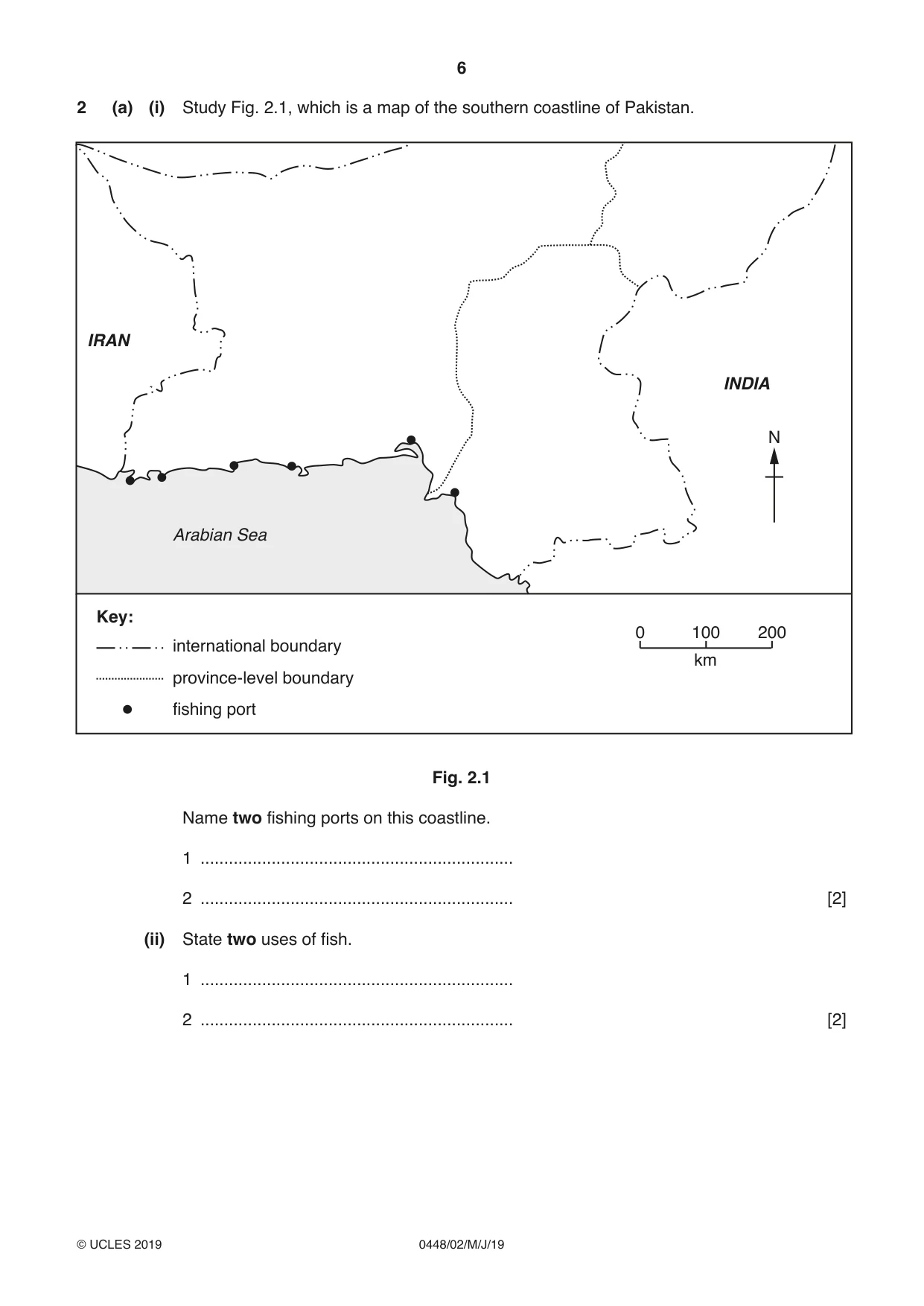
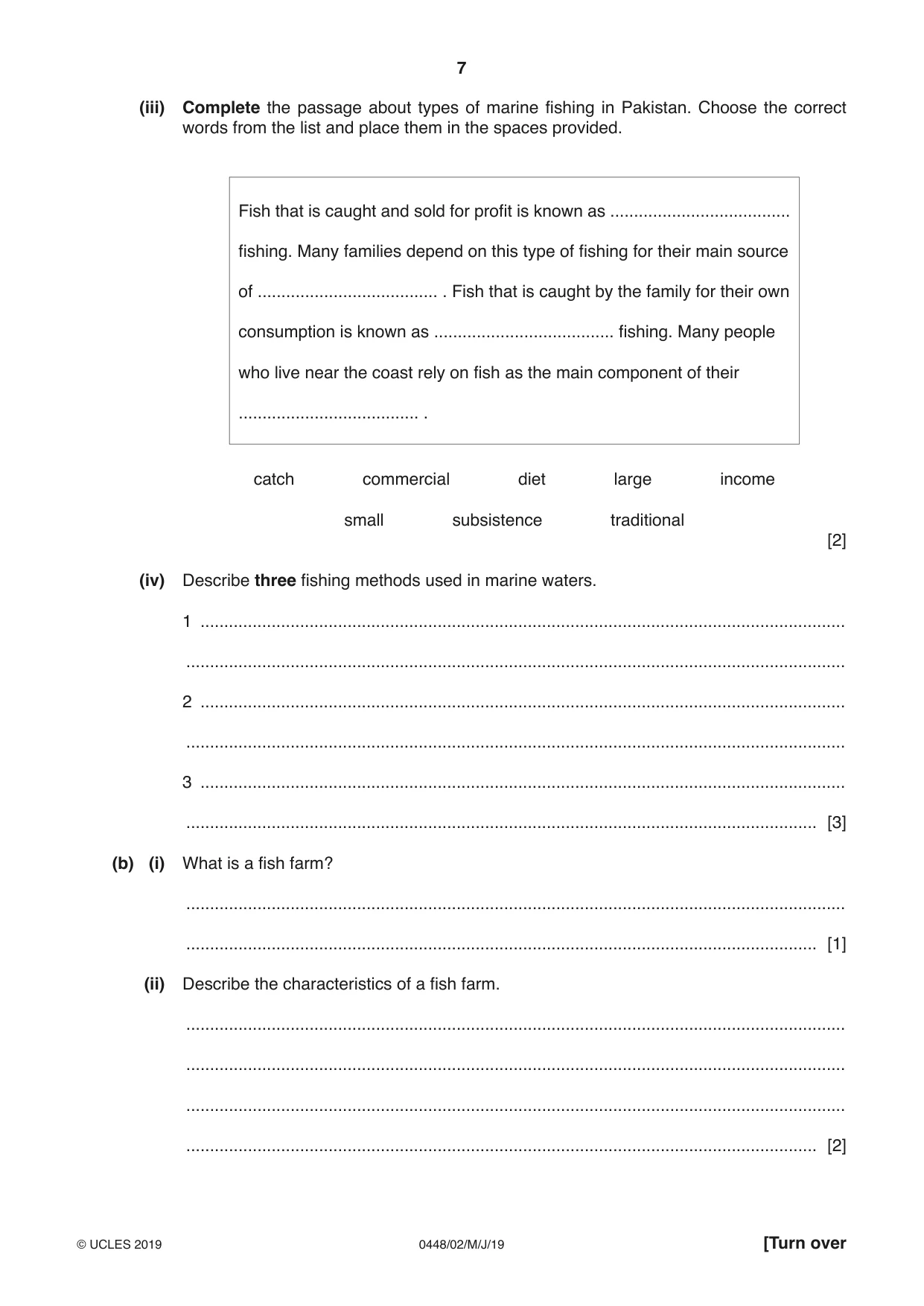
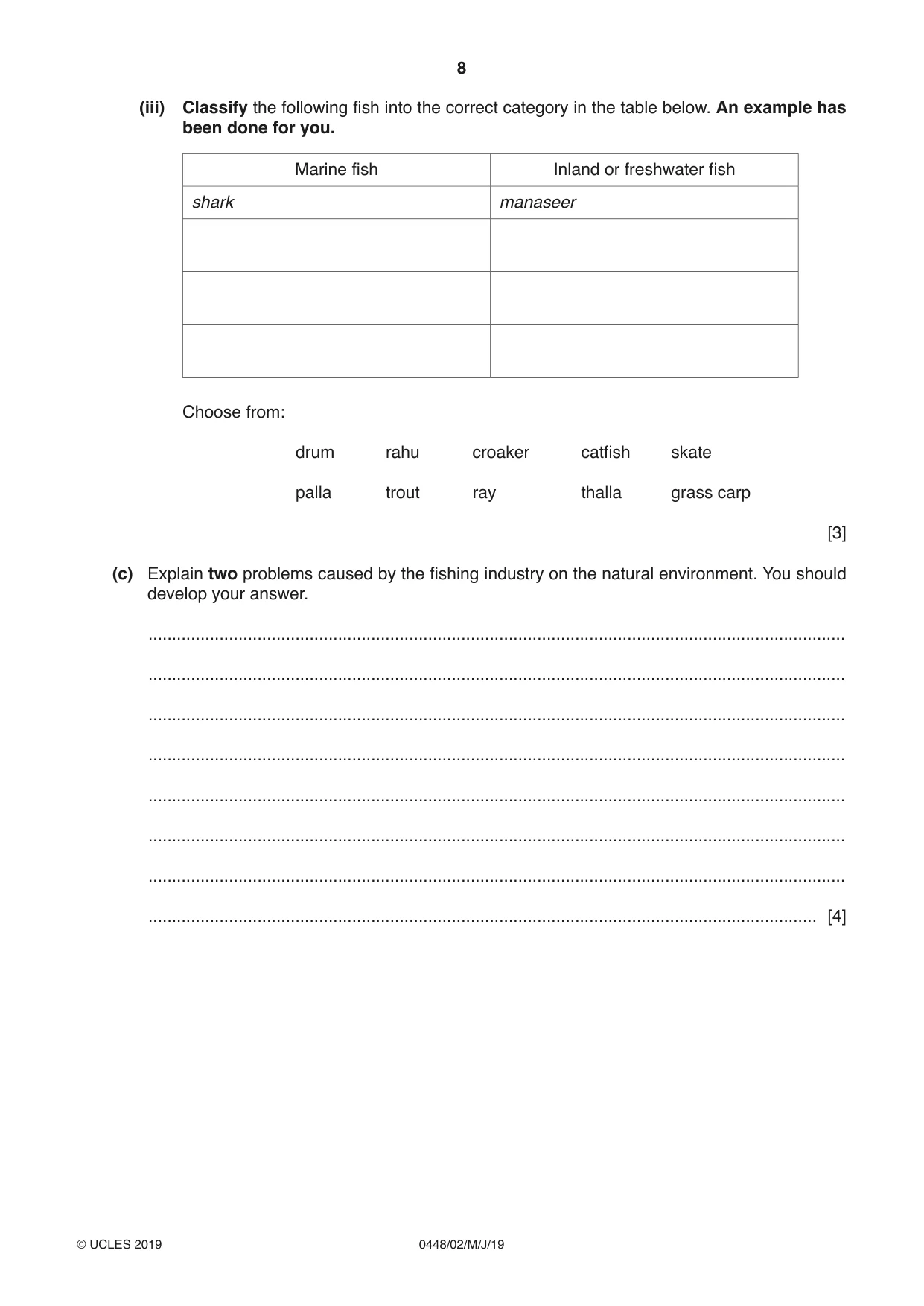
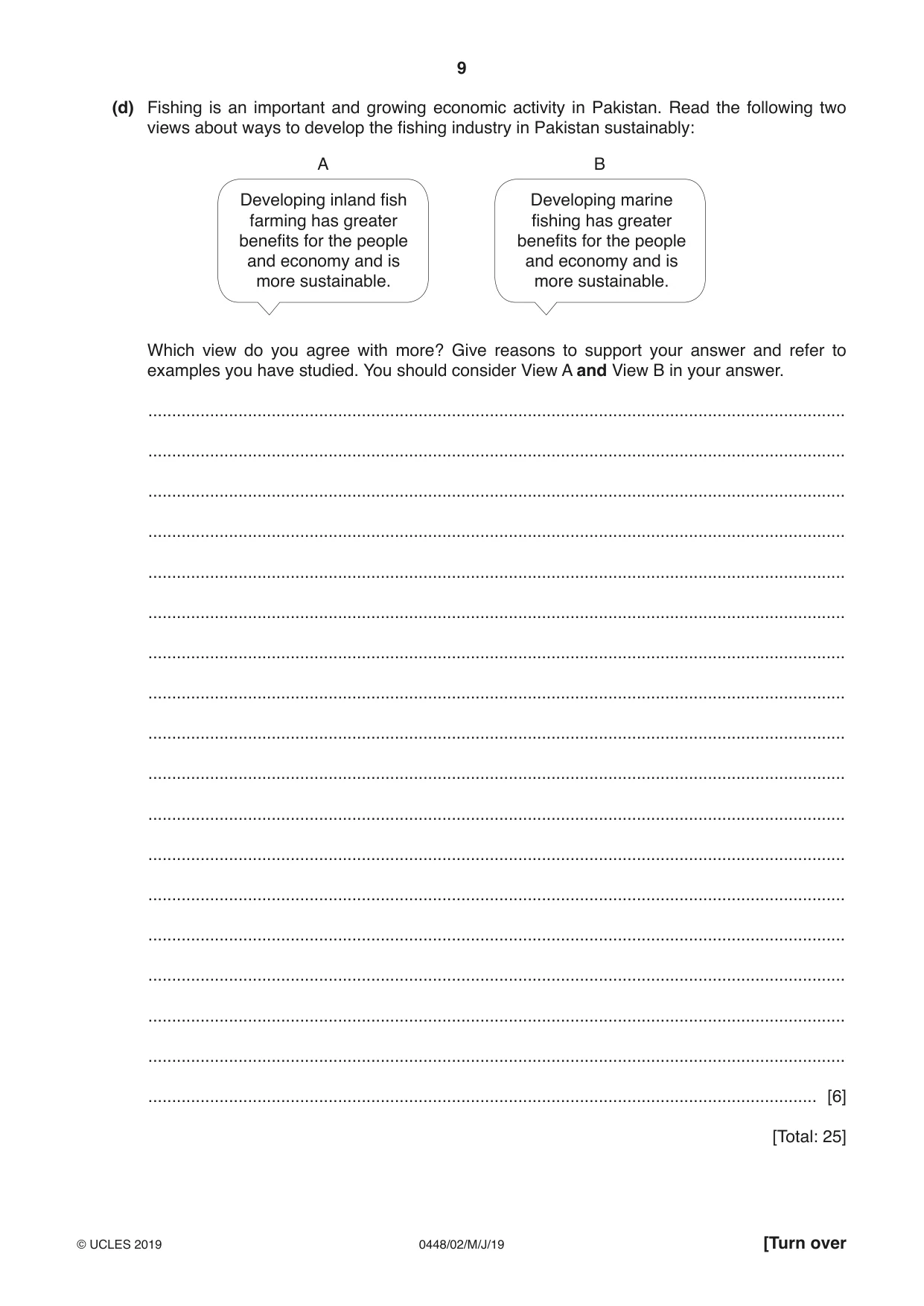
2 (a) (i) Study Fig. 2.1, which is a map of the southern coastline of Pakistan. IRAN INDIA N Arabian Sea Key: 0 100 200 international boundary km province-level boundary fishing port Fig. 2.1 Name two fishing ports on this coastline. 1 .................................................................. 2 .................................................................. [2] (ii) State two uses of fish. 1 .................................................................. 2 .................................................................. [2] (iii) Complete the passage about types of marine fishing in Pakistan. Choose the correct words from the list and place them in the spaces provided. Fish that is caught and sold for profit is known as ...................................... fishing. Many families depend on this type of fishing for their main source of ...................................... . Fish that is caught by the family for their own consumption is known as ...................................... fishing. Many people who live near the coast rely on fish as the main component of their ...................................... . catch commercial diet large income small subsistence traditional [2] (iv) Describe three fishing methods used in marine waters. 1 ........................................................................................................................................ ........................................................................................................................................... 2 ........................................................................................................................................ ........................................................................................................................................... 3 ........................................................................................................................................ ..................................................................................................................................... [3] (b) (i) What is a fish farm? ........................................................................................................................................... ..................................................................................................................................... [1] (ii) Describe the characteristics of a fish farm. ........................................................................................................................................... ........................................................................................................................................... ........................................................................................................................................... ..................................................................................................................................... [2] (iii) Classify the following fish into the correct category in the table below. An example has been done for you. Marine fish Inland or freshwater fish shark manaseer Choose from: drum rahu croaker catfish skate palla trout ray thalla grass carp [3] (c) Explain two problems caused by the fishing industry on the natural environment. You should develop your answer. ................................................................................................................................................... ................................................................................................................................................... ................................................................................................................................................... ................................................................................................................................................... ................................................................................................................................................... ................................................................................................................................................... ................................................................................................................................................... ............................................................................................................................................. [4] (d) Fishing is an important and growing economic activity in Pakistan. Read the following two views about ways to develop the fishing industry in Pakistan sustainably: A B Developing inland fish Developing marine farming has greater fishing has greater benefits for the people benefits for the people and economy and is and economy and is more sustainable. more sustainable. Which view do you agree with more? Give reasons to support your answer and refer to examples you have studied. You should consider View A and View B in your answer. ................................................................................................................................................... ................................................................................................................................................... ................................................................................................................................................... ................................................................................................................................................... ................................................................................................................................................... ................................................................................................................................................... ................................................................................................................................................... ................................................................................................................................................... ................................................................................................................................................... ................................................................................................................................................... ................................................................................................................................................... ................................................................................................................................................... ................................................................................................................................................... ................................................................................................................................................... ................................................................................................................................................... ................................................................................................................................................... ................................................................................................................................................... ............................................................................................................................................. [6] [Total: 25]
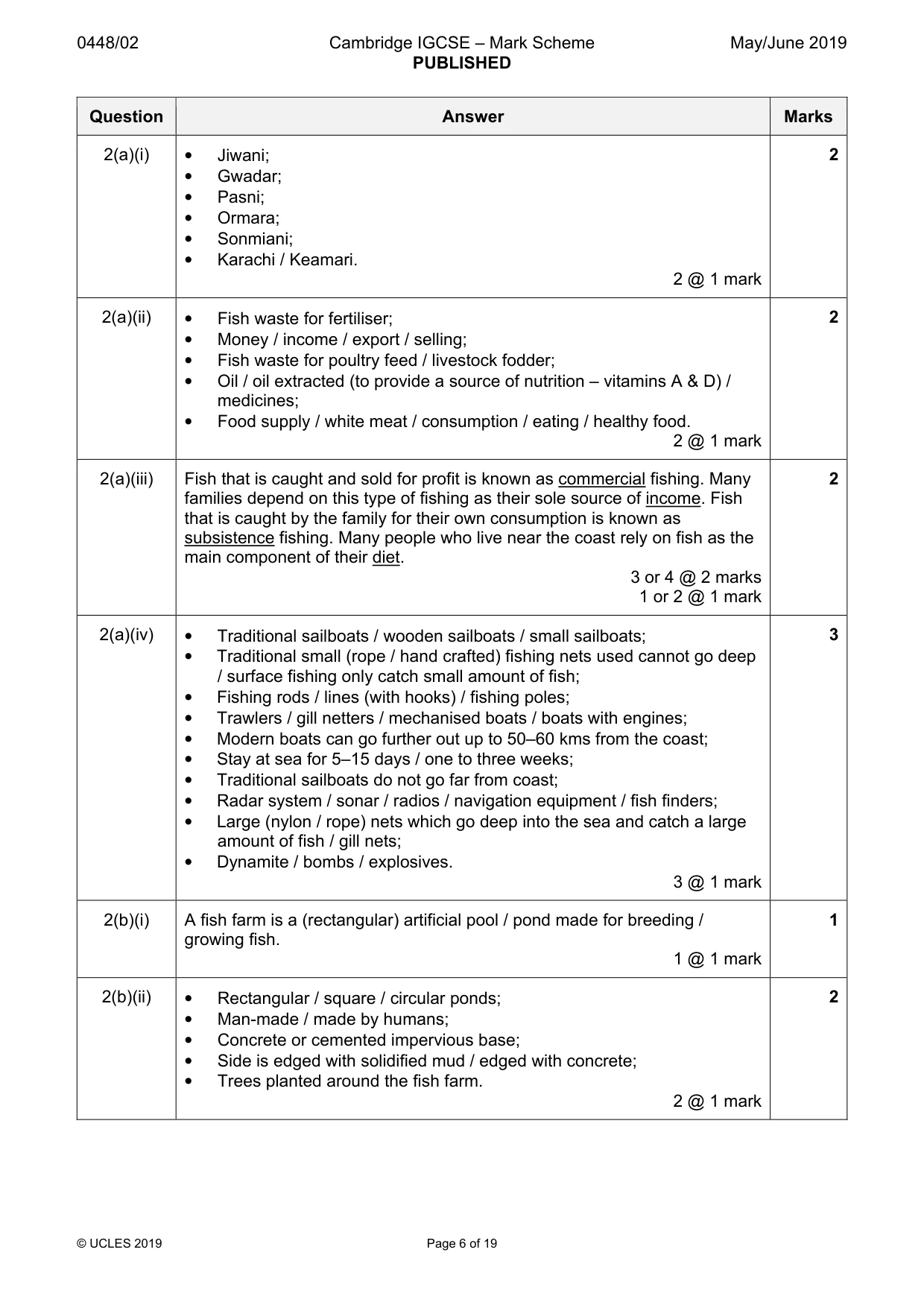
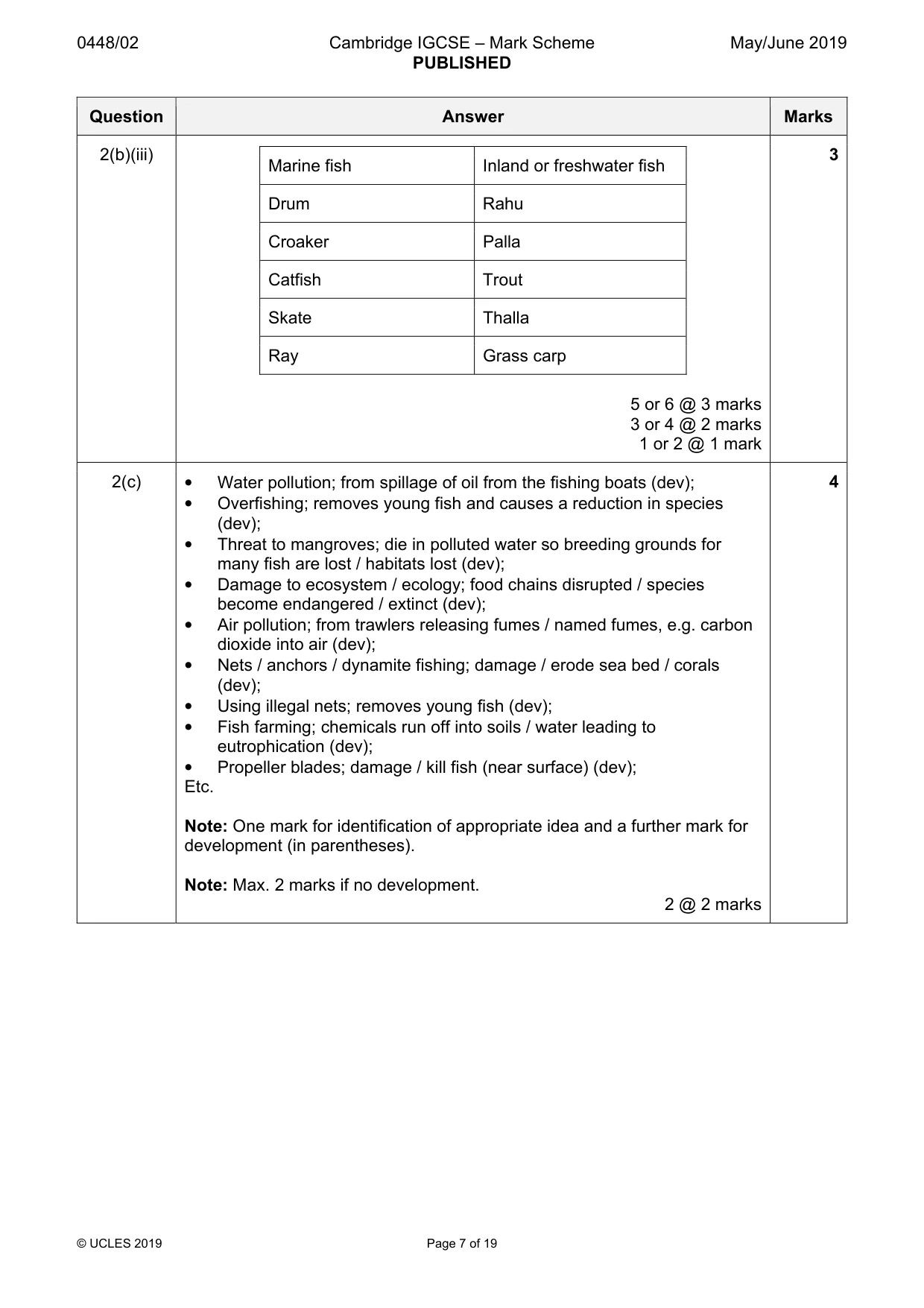
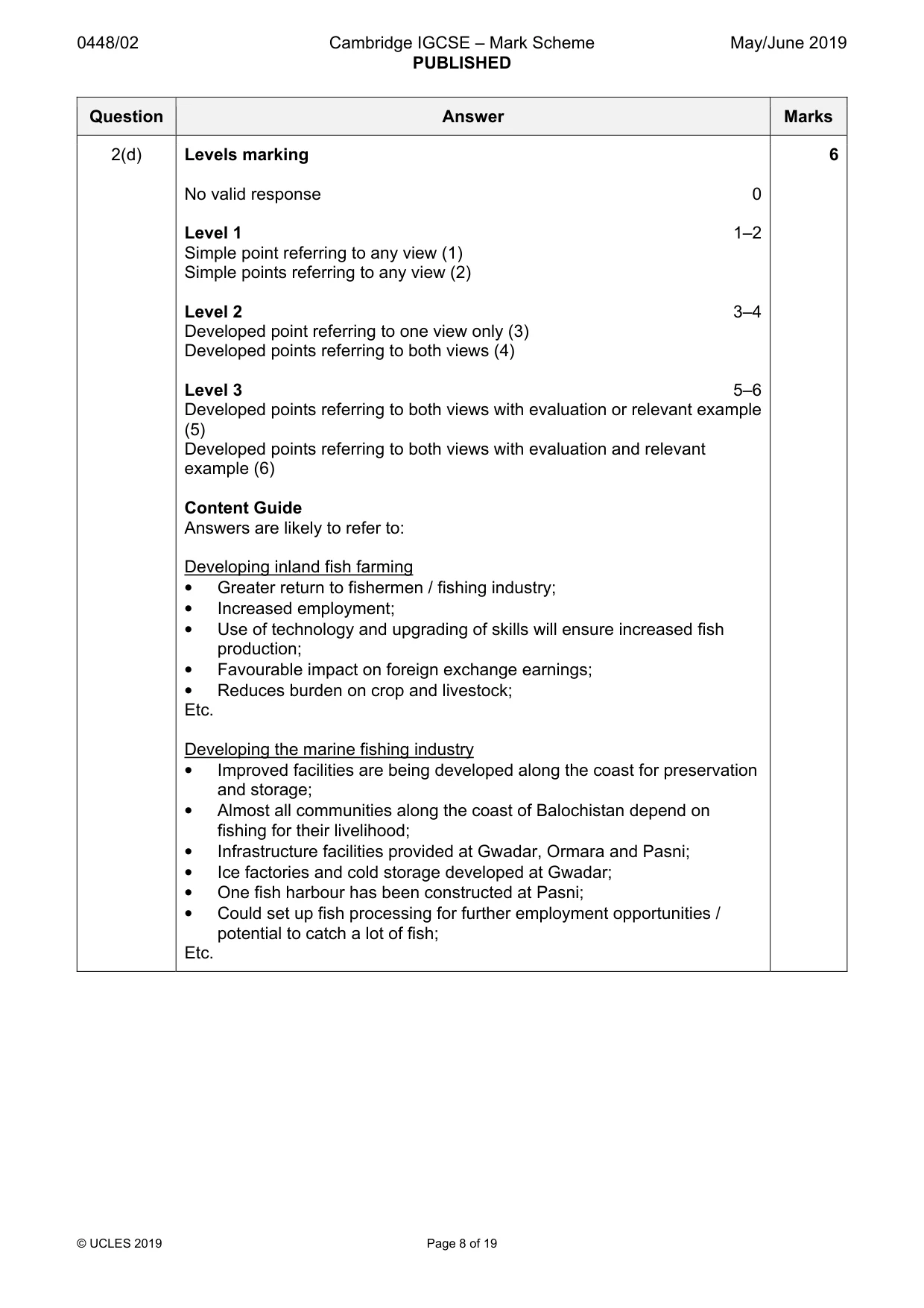
Mark scheme: 2(a)(i) • Jiwani; 2 • Gwadar; • Pasni; • Ormara; • Sonmiani; • Karachi / Keamari. 2 @ 1 mark 2(a)(ii) • Fish waste for fertiliser; 2 • Money / income / export / selling; • Fish waste for poultry feed / livestock fodder; • Oil / oil extracted (to provide a source of nutrition – vitamins A & D) / medicines; • Food supply / white meat / consumption / eating / healthy food. 2 @ 1 mark 2(a)(iii) Fish that is caught and sold for profit is known as commercial fishing. Many 2 families depend on this type of fishing as their sole source of income. Fish that is caught by the family for their own consumption is known as subsistence fishing. Many people who live near the coast rely on fish as the main component of their diet. 3 or 4 @ 2 marks 1 or 2 @ 1 mark 2(a)(iv) • Traditional sailboats / wooden sailboats / small sailboats; 3 • Traditional small (rope / hand crafted) fishing nets used cannot go deep / surface fishing only catch small amount of fish; • Fishing rods / lines (with hooks) / fishing poles; • Trawlers / gill netters / mechanised boats / boats with engines; • Modern boats can go further out up to 50–60 kms from the coast; • Stay at sea for 5–15 days / one to three weeks; • Traditional sailboats do not go far from coast; • Radar system / sonar / radios / navigation equipment / fish finders; • Large (nylon / rope) nets which go deep into the sea and catch a large amount of fish / gill nets; • Dynamite / bombs / explosives. 3 @ 1 mark 2(b)(i) A fish farm is a (rectangular) artificial pool / pond made for breeding / 1 growing fish. 1 @ 1 mark 2(b)(ii) • Rectangular / square / circular ponds; 2 • Man-made / made by humans; • Concrete or cemented impervious base; • Side is edged with solidified mud / edged with concrete; • Trees planted around the fish farm. 2 @ 1 mark 2(b)(iii) 3 Marine fish Inland or freshwater fish Drum Rahu Croaker Palla Catfish Trout Skate Thalla Ray Grass carp 5 or 6 @ 3 marks 3 or 4 @ 2 marks 1 or 2 @ 1 mark 2(c) • Water pollution; from spillage of oil from the fishing boats (dev); 4 • Overfishing; removes young fish and causes a reduction in species (dev); • Threat to mangroves; die in polluted water so breeding grounds for many fish are lost / habitats lost (dev); • Damage to ecosystem / ecology; food chains disrupted / species become endangered / extinct (dev); • Air pollution; from trawlers releasing fumes / named fumes, e.g. carbon dioxide into air (dev); • Nets / anchors / dynamite fishing; damage / erode sea bed / corals (dev); • Using illegal nets; removes young fish (dev); • Fish farming; chemicals run off into soils / water leading to eutrophication (dev); • Propeller blades; damage / kill fish (near surface) (dev); Etc. Note: One mark for identification of appropriate idea and a further mark for development (in parentheses). Note: Max. 2 marks if no development. 2 @ 2 marks 2(d) Levels marking 6 No valid response 0 Level 1 1–2 Simple point referring to any view (1) Simple points referring to any view (2) Level 2 3–4 Developed point referring to one view only (3) Developed points referring to both views (4) Level 3 5–6 Developed points referring to both views with evaluation or relevant example (5) Developed points referring to both views with evaluation and relevant example (6) Content Guide Answers are likely to refer to: Developing inland fish farming • Greater return to fishermen / fishing industry; • Increased employment; • Use of technology and upgrading of skills will ensure increased fish production; • Favourable impact on foreign exchange earnings; • Reduces burden on crop and livestock; Etc. Developing the marine fishing industry • Improved facilities are being developed along the coast for preservation and storage; • Almost all communities along the coast of Balochistan depend on fishing for their livelihood; • Infrastructure facilities provided at Gwadar, Ormara and Pasni; • Ice factories and cold storage developed at Gwadar; • One fish harbour has been constructed at Pasni; • Could set up fish processing for further employment opportunities / potential to catch a lot of fish; Etc.
Question 3
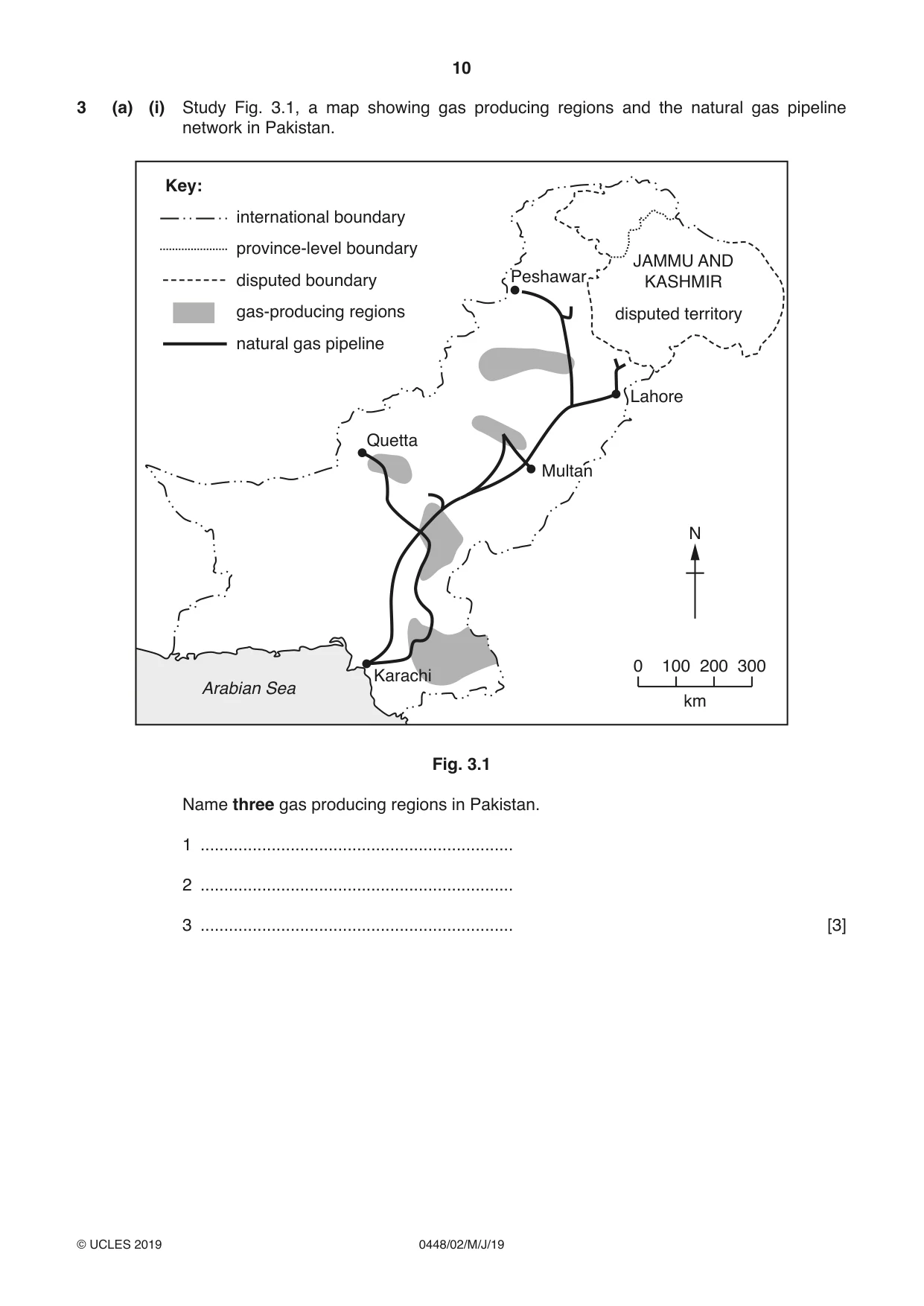
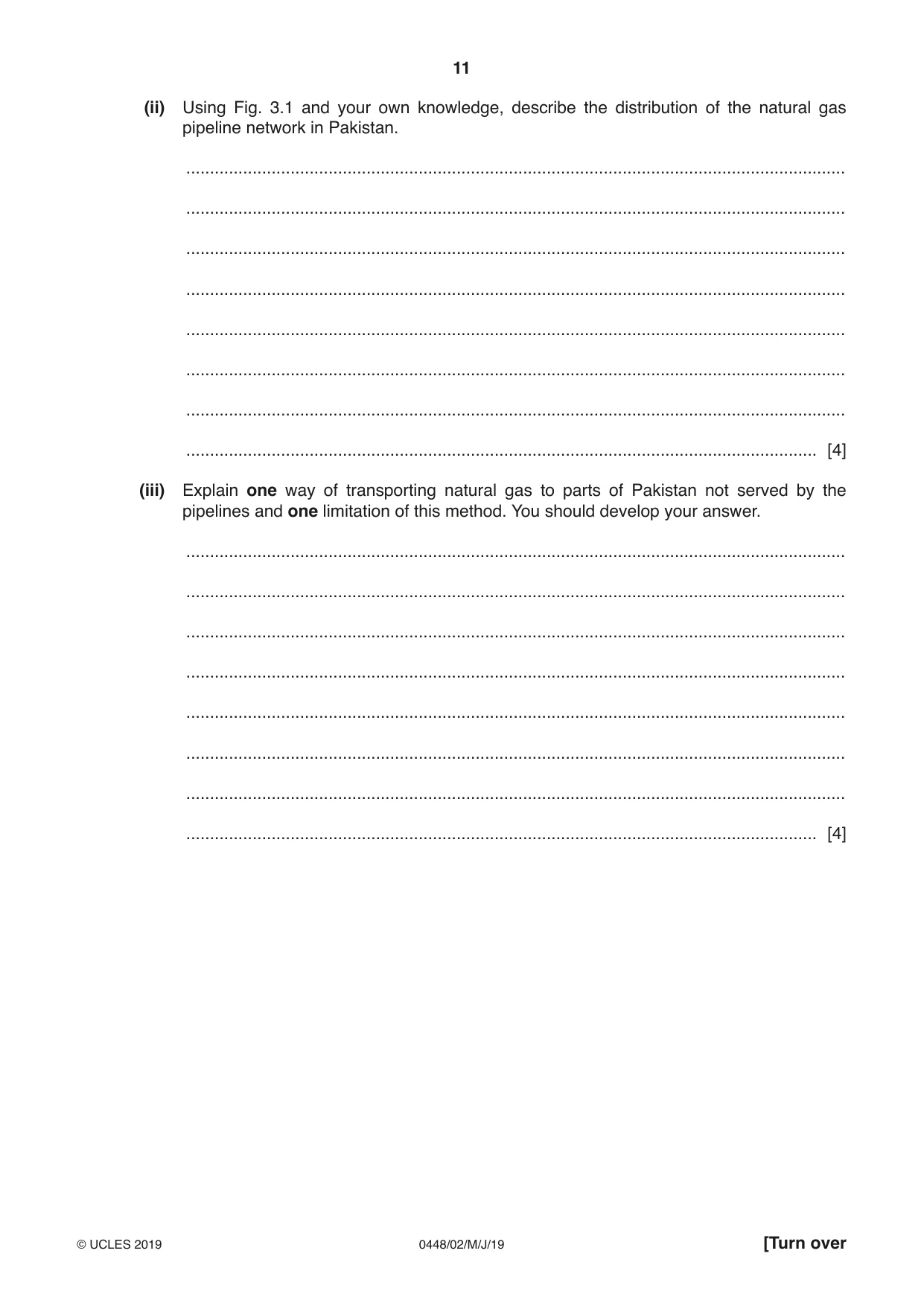
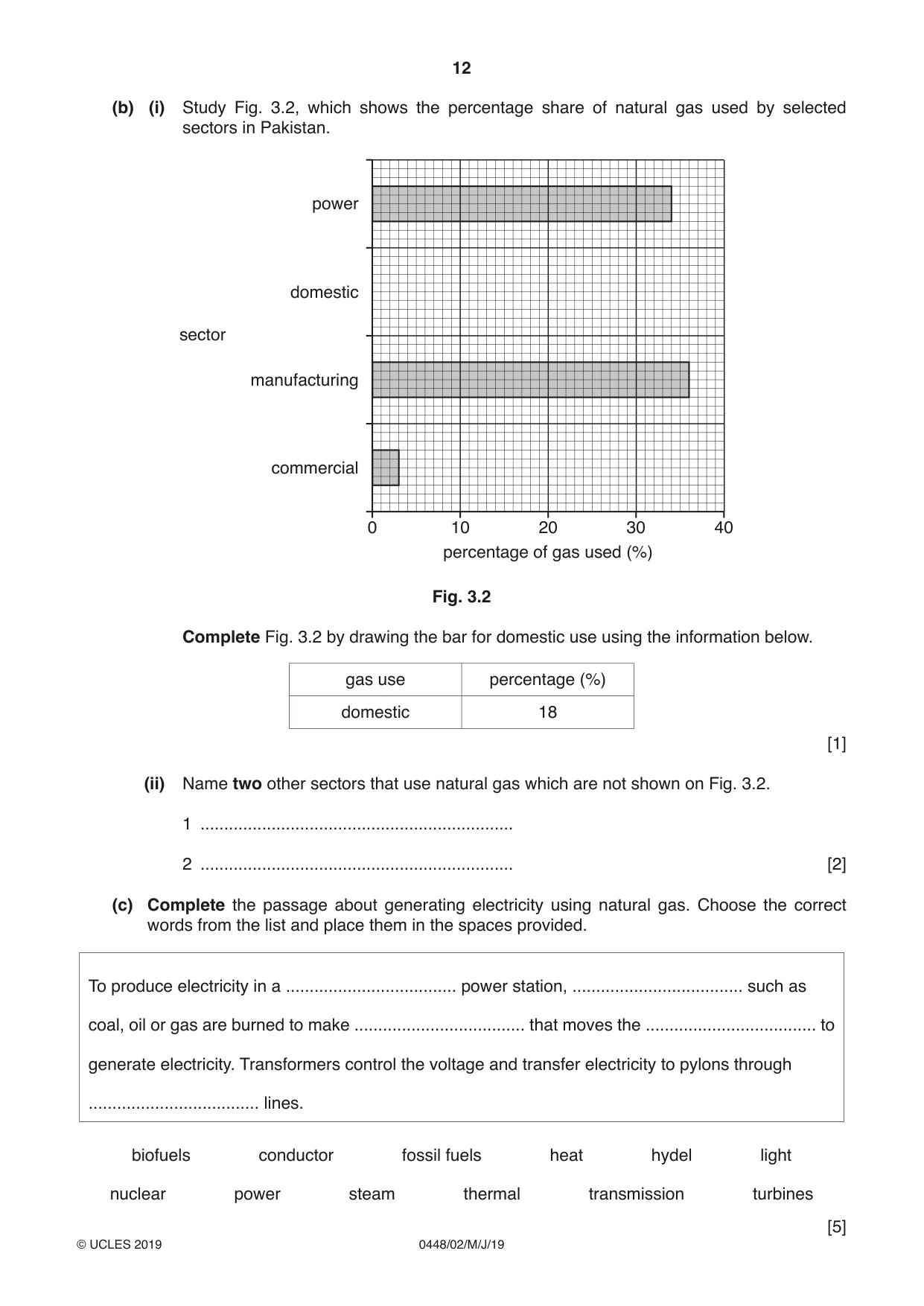
3 (a) (i) Study Fig. 3.1, a map showing gas producing regions and the natural gas pipeline network in Pakistan. Key: international boundary province-level boundary JAMMU AND disputed boundary Peshawar KASHMIR gas-producing regions disputed territory natural gas pipeline Lahore Quetta Multan N 0 100 200 300 Karachi Arabian Sea km Fig. 3.1 Name three gas producing regions in Pakistan. 1 .................................................................. 2 .................................................................. 3 .................................................................. [3] (ii) Using Fig. 3.1 and your own knowledge, describe the distribution of the natural gas pipeline network in Pakistan. ........................................................................................................................................... ........................................................................................................................................... ........................................................................................................................................... ........................................................................................................................................... ........................................................................................................................................... ........................................................................................................................................... ........................................................................................................................................... ..................................................................................................................................... [4] (iii) Explain one way of transporting natural gas to parts of Pakistan not served by the pipelines and one limitation of this method. You should develop your answer. ........................................................................................................................................... ........................................................................................................................................... ........................................................................................................................................... ........................................................................................................................................... ........................................................................................................................................... ........................................................................................................................................... ........................................................................................................................................... ..................................................................................................................................... [4] (b) (i) Study Fig. 3.2, which shows the percentage share of natural gas used by selected sectors in Pakistan. power domestic sector manufacturing commercial 0 10 20 30 40 percentage of gas used (%) Fig. 3.2 Complete Fig. 3.2 by drawing the bar for domestic use using the information below. gas use percentage (%) domestic 18 [1] (ii) Name two other sectors that use natural gas which are not shown on Fig. 3.2. 1 .................................................................. 2 .................................................................. [2] (c) Complete the passage about generating electricity using natural gas. Choose the correct words from the list and place them in the spaces provided. To produce electricity in a .................................... power station, .................................... such as coal, oil or gas are burned to make .................................... that moves the .................................... to generate electricity. Transformers control the voltage and transfer electricity to pylons through .................................... lines. biofuels conductor fossil fuels heat hydel light nuclear power steam thermal transmission turbines (d) The natural gas field discovered at Sui is considered to be one of the largest in the world. Additional smaller gas fields have since been discovered and developed in Pakistan. To what extent is further development of the natural gas industry possible in Pakistan? Give reasons to support your judgement. You should consider different points of view in your answer. ................................................................................................................................................... ................................................................................................................................................... ................................................................................................................................................... ................................................................................................................................................... ................................................................................................................................................... ................................................................................................................................................... ................................................................................................................................................... ................................................................................................................................................... ................................................................................................................................................... ................................................................................................................................................... ................................................................................................................................................... ................................................................................................................................................... ................................................................................................................................................... ................................................................................................................................................... ................................................................................................................................................... ................................................................................................................................................... ................................................................................................................................................... ............................................................................................................................................. [6] [Total: 25]
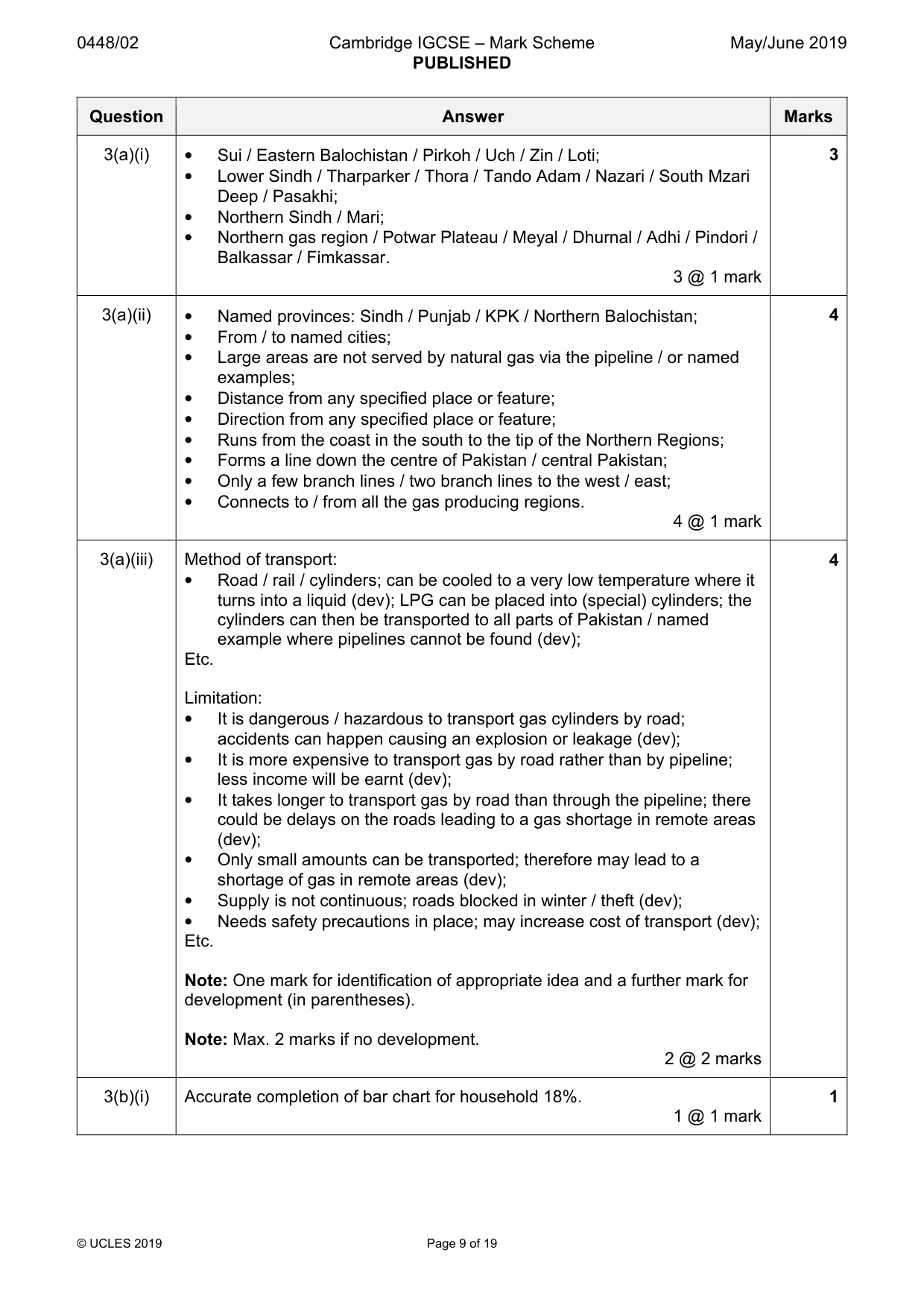
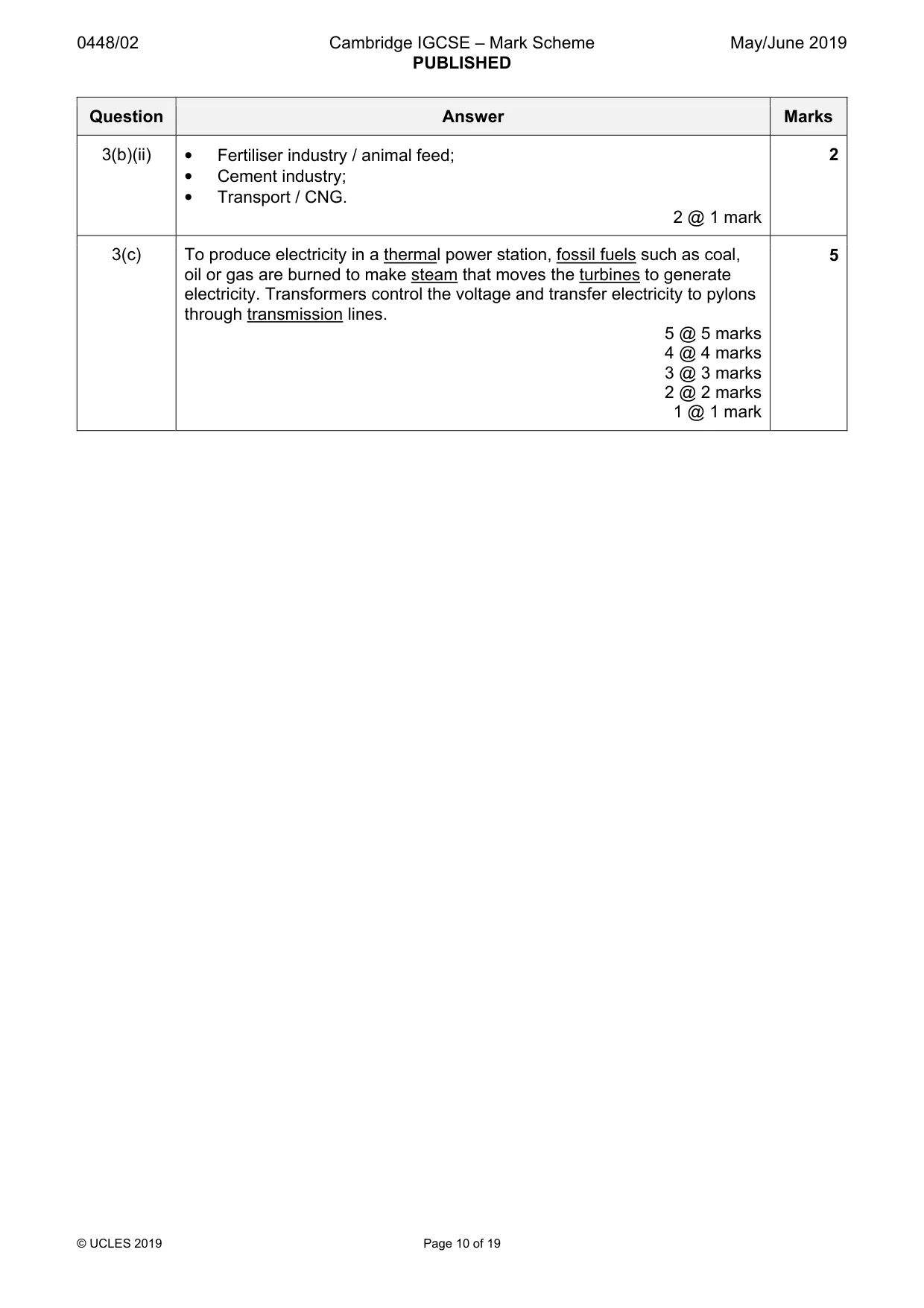
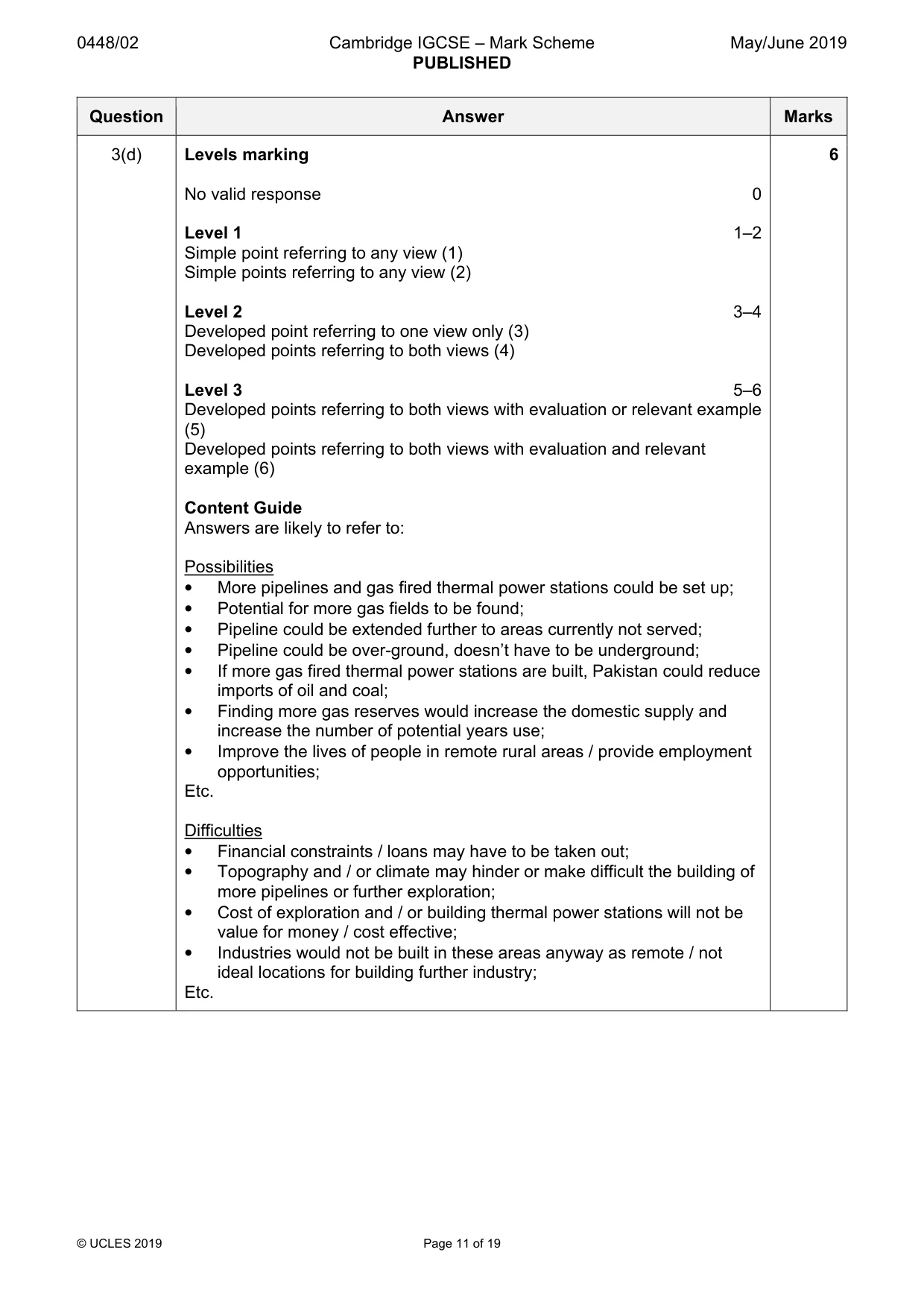
Mark scheme: 3(a)(i) • Sui / Eastern Balochistan / Pirkoh / Uch / Zin / Loti; 3 • Lower Sindh / Tharparker / Thora / Tando Adam / Nazari / South Mzari Deep / Pasakhi; • Northern Sindh / Mari; • Northern gas region / Potwar Plateau / Meyal / Dhurnal / Adhi / Pindori / Balkassar / Fimkassar. 3 @ 1 mark 3(a)(ii) • Named provinces: Sindh / Punjab / KPK / Northern Balochistan; 4 • From / to named cities; • Large areas are not served by natural gas via the pipeline / or named examples; • Distance from any specified place or feature; • Direction from any specified place or feature; • Runs from the coast in the south to the tip of the Northern Regions; • Forms a line down the centre of Pakistan / central Pakistan; • Only a few branch lines / two branch lines to the west / east; • Connects to / from all the gas producing regions. 4 @ 1 mark 3(a)(iii) Method of transport: 4 • Road / rail / cylinders; can be cooled to a very low temperature where it turns into a liquid (dev); LPG can be placed into (special) cylinders; the cylinders can then be transported to all parts of Pakistan / named example where pipelines cannot be found (dev); Etc. Limitation: • It is dangerous / hazardous to transport gas cylinders by road; accidents can happen causing an explosion or leakage (dev); • It is more expensive to transport gas by road rather than by pipeline; less income will be earnt (dev); • It takes longer to transport gas by road than through the pipeline; there could be delays on the roads leading to a gas shortage in remote areas (dev); • Only small amounts can be transported; therefore may lead to a shortage of gas in remote areas (dev); • Supply is not continuous; roads blocked in winter / theft (dev); • Needs safety precautions in place; may increase cost of transport (dev); Etc. Note: One mark for identification of appropriate idea and a further mark for development (in parentheses). Note: Max. 2 marks if no development. 2 @ 2 marks 3(b)(i) Accurate completion of bar chart for household 18%. 1 1 @ 1 mark 3(b)(ii) • Fertiliser industry / animal feed; 2 • Cement industry; • Transport / CNG. 2 @ 1 mark 3(c) To produce electricity in a thermal power station, fossil fuels such as coal, 5 oil or gas are burned to make steam that moves the turbines to generate electricity. Transformers control the voltage and transfer electricity to pylons through transmission lines. 5 @ 5 marks 4 @ 4 marks 3 @ 3 marks 2 @ 2 marks 1 @ 1 mark 3(d) Levels marking 6 No valid response 0 Level 1 1–2 Simple point referring to any view (1) Simple points referring to any view (2) Level 2 3–4 Developed point referring to one view only (3) Developed points referring to both views (4) Level 3 5–6 Developed points referring to both views with evaluation or relevant example (5) Developed points referring to both views with evaluation and relevant example (6) Content Guide Answers are likely to refer to: Possibilities • More pipelines and gas fired thermal power stations could be set up; • Potential for more gas fields to be found; • Pipeline could be extended further to areas currently not served; • Pipeline could be over-ground, doesn’t have to be underground; • If more gas fired thermal power stations are built, Pakistan could reduce imports of oil and coal; • Finding more gas reserves would increase the domestic supply and increase the number of potential years use; • Improve the lives of people in remote rural areas / provide employment opportunities; Etc. Difficulties • Financial constraints / loans may have to be taken out; • Topography and / or climate may hinder or make difficult the building of more pipelines or further exploration; • Cost of exploration and / or building thermal power stations will not be value for money / cost effective; • Industries would not be built in these areas anyway as remote / not ideal locations for building further industry; Etc.
Question 4
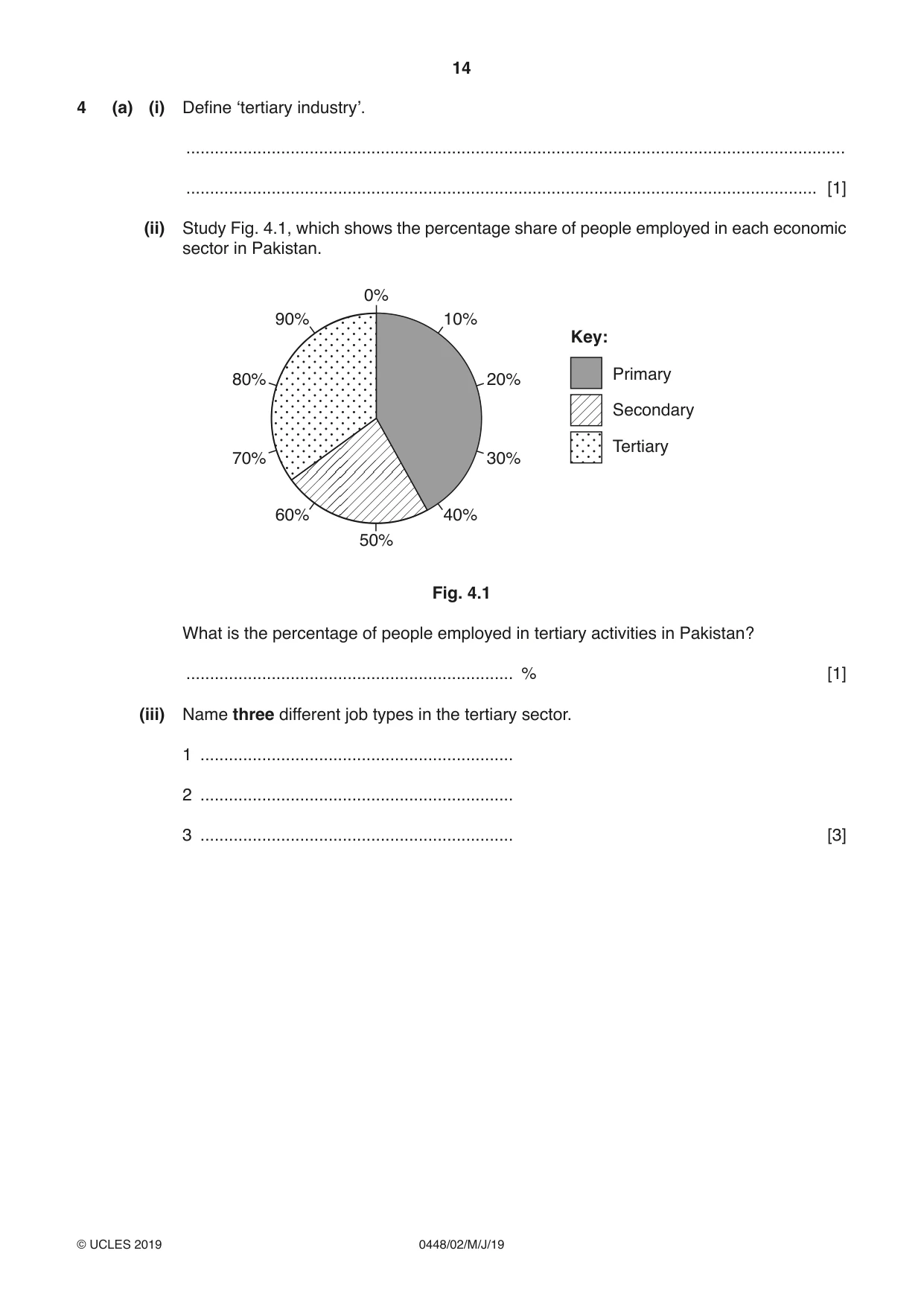
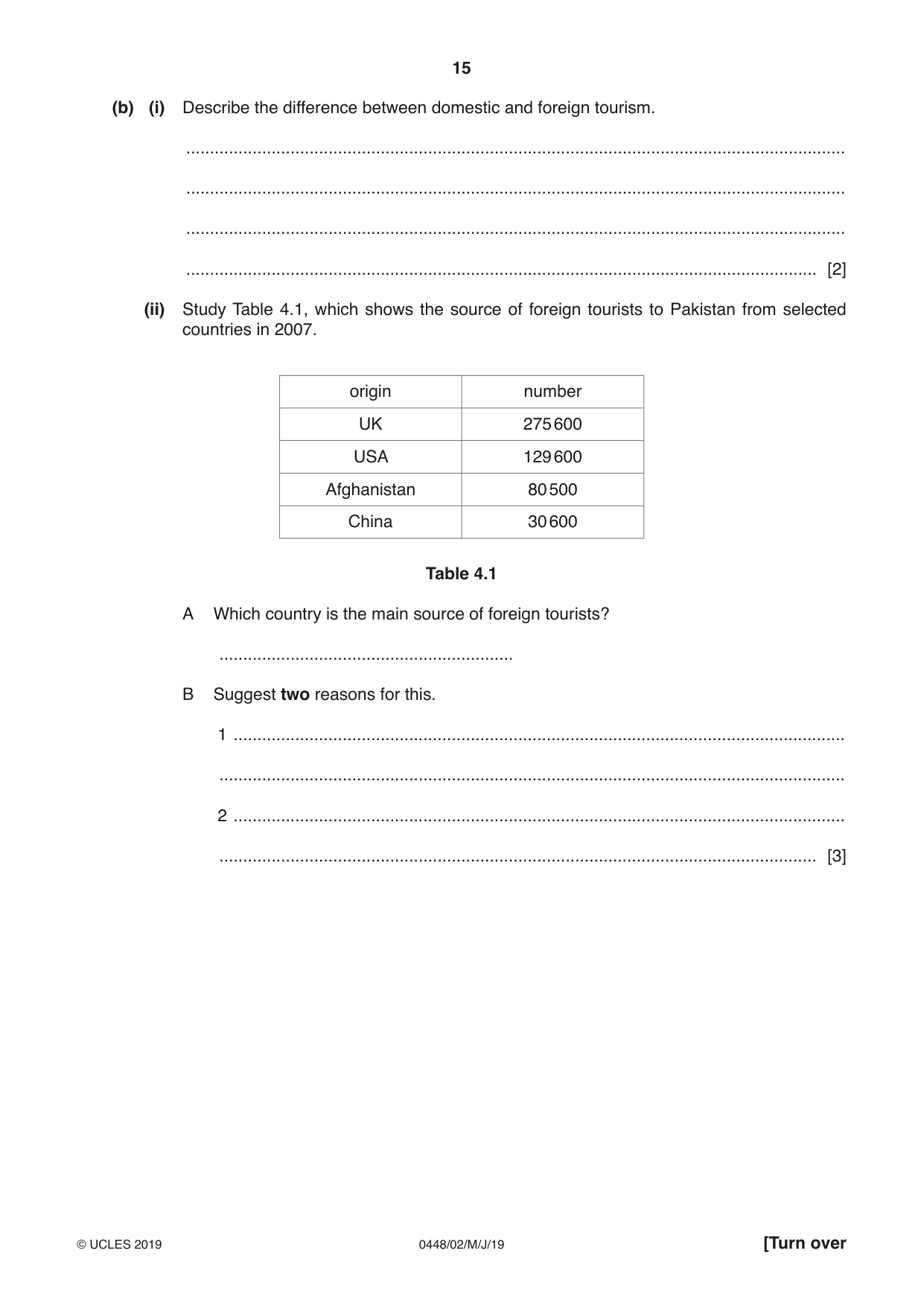
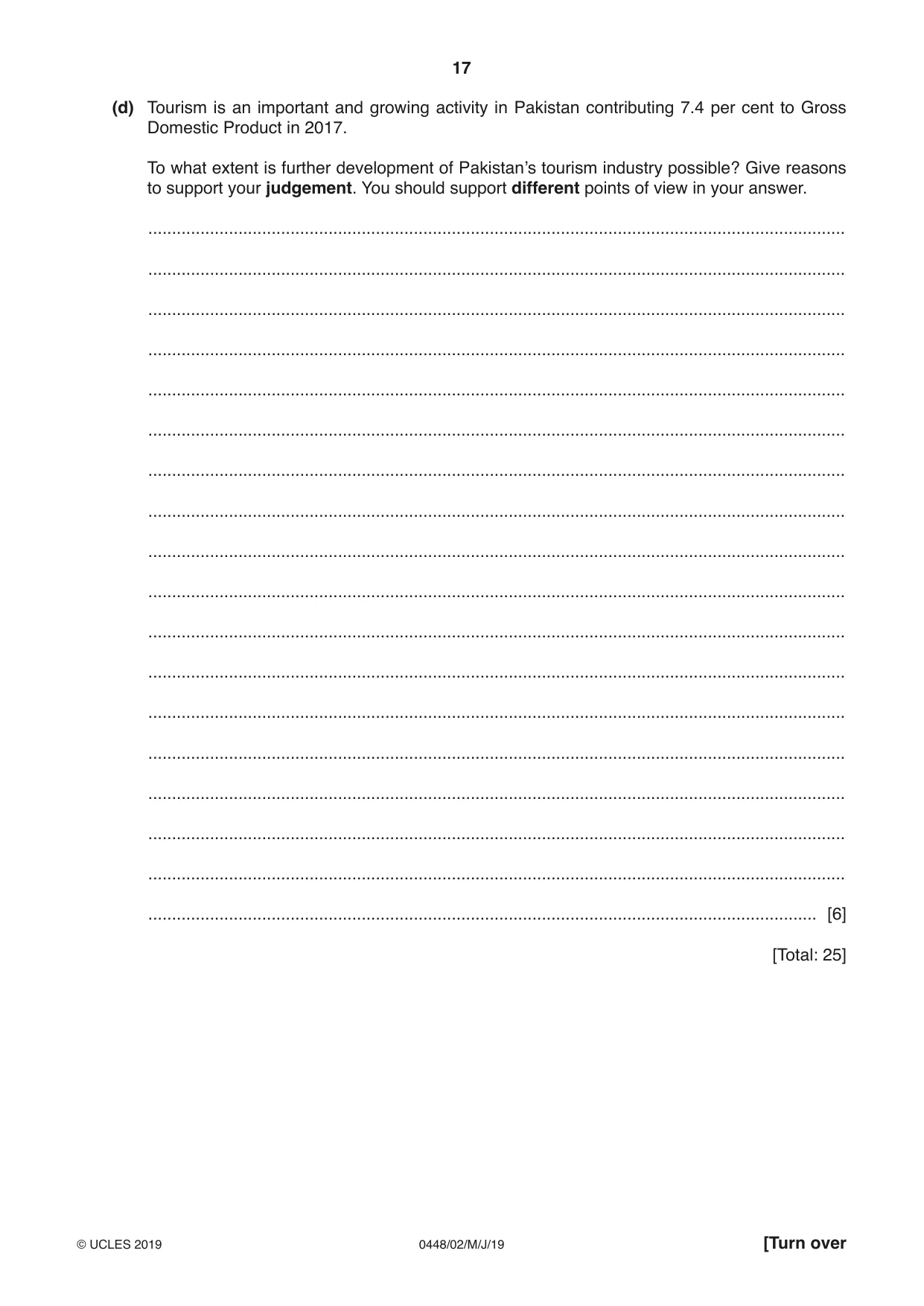
4 (a) (i) Define ‘tertiary industry’. ........................................................................................................................................... ..................................................................................................................................... [1] (ii) Study Fig. 4.1, which shows the percentage share of people employed in each economic sector in Pakistan. 0% 90% 10% Key: Primary 80% 20% Secondary Tertiary 70% 30% 60% 40% 50% Fig. 4.1 What is the percentage of people employed in tertiary activities in Pakistan? ..................................................................... % [1] (iii) Name three different job types in the tertiary sector. 1 .................................................................. 2 .................................................................. 3 .................................................................. [3] (b) (i) Describe the difference between domestic and foreign tourism. ........................................................................................................................................... ........................................................................................................................................... ........................................................................................................................................... ..................................................................................................................................... [2] (ii) Study Table 4.1, which shows the source of foreign tourists to Pakistan from selected countries in 2007. origin number UK 275 600 USA 129 600 Afghanistan 80 500 China 30 600 Table 4.1 A Which country is the main source of foreign tourists? .............................................................. B Suggest two reasons for this. 1 ................................................................................................................................. .................................................................................................................................... 2 ................................................................................................................................. .............................................................................................................................. [3] (c) (i) Explain two advantages of tourism to Pakistan. You should develop your answer. ........................................................................................................................................... ........................................................................................................................................... ........................................................................................................................................... ........................................................................................................................................... ........................................................................................................................................... ........................................................................................................................................... ........................................................................................................................................... ..................................................................................................................................... [4] (ii) Study Figs. 4.2, 4.3, 4.4, 4.5 and 4.6 (Insert), photographs of some natural and cultural attractions of Pakistan. Use the photographs and your own knowledge to suggest how each is a tourist attraction. Fig. 4.2 .............................................................................................................................. ........................................................................................................................................... Fig. 4.3 .............................................................................................................................. ........................................................................................................................................... Fig. 4.4 .............................................................................................................................. ........................................................................................................................................... Fig. 4.5 .............................................................................................................................. ........................................................................................................................................... Fig. 4.6 .............................................................................................................................. ..................................................................................................................................... [5] (d) Tourism is an important and growing activity in Pakistan contributing 7.4 per cent to Gross Domestic Product in 2017. To what extent is further development of Pakistan’s tourism industry possible? Give reasons to support your judgement. You should support different points of view in your answer. ................................................................................................................................................... ................................................................................................................................................... ................................................................................................................................................... ................................................................................................................................................... ................................................................................................................................................... ................................................................................................................................................... ................................................................................................................................................... ................................................................................................................................................... ................................................................................................................................................... ................................................................................................................................................... ................................................................................................................................................... ................................................................................................................................................... ................................................................................................................................................... ................................................................................................................................................... ................................................................................................................................................... ................................................................................................................................................... ................................................................................................................................................... ............................................................................................................................................. [6] [Total: 25]
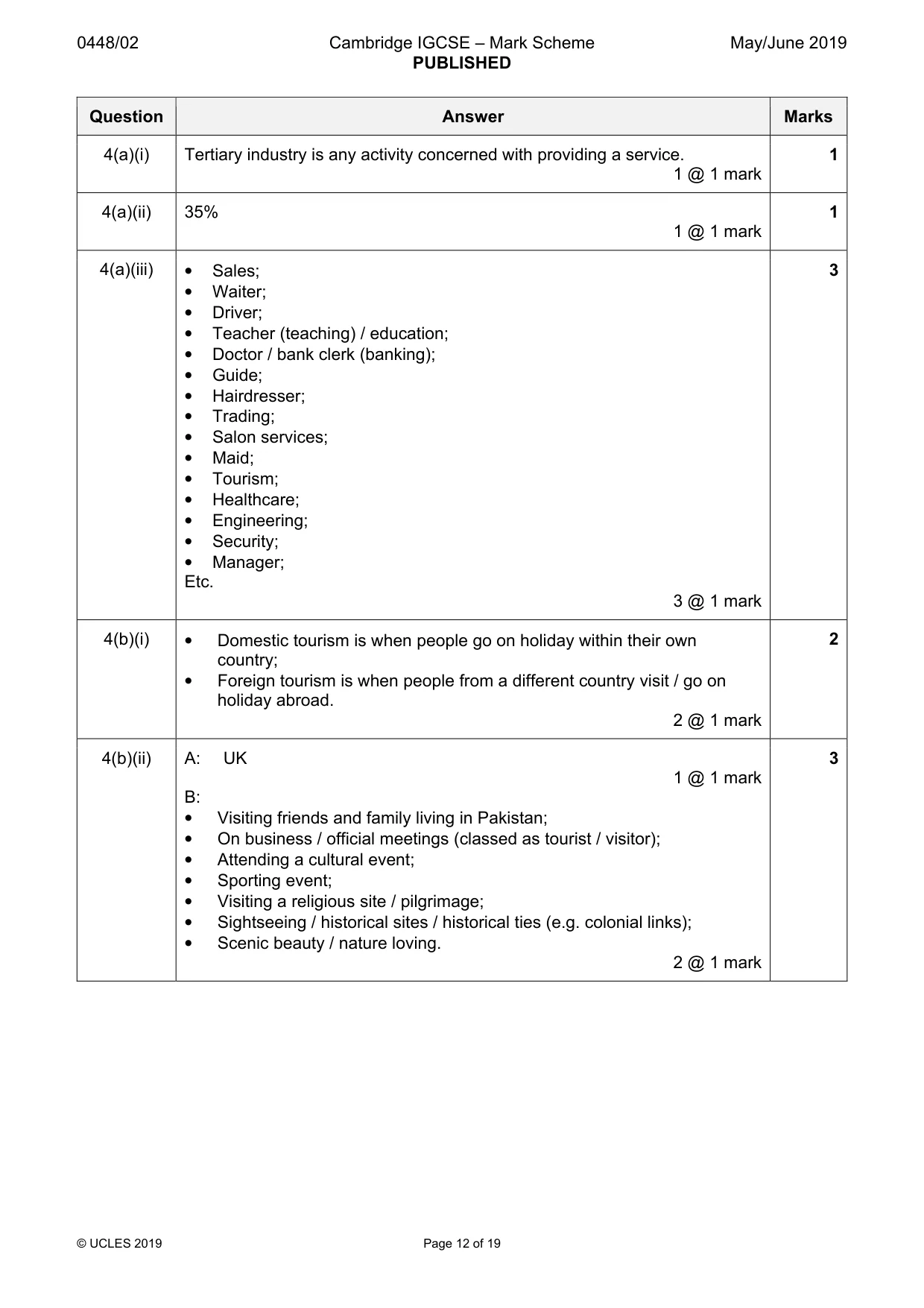
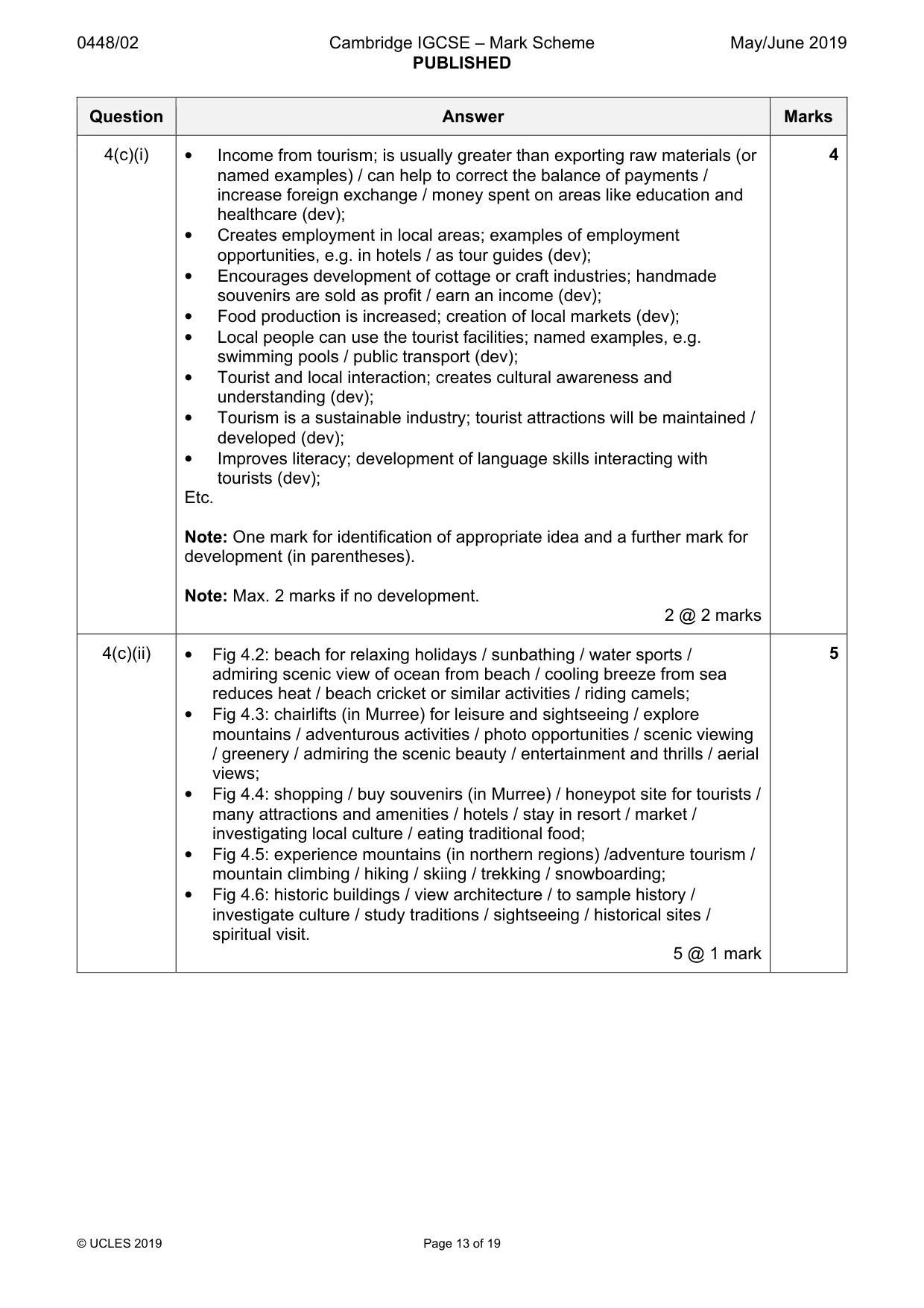
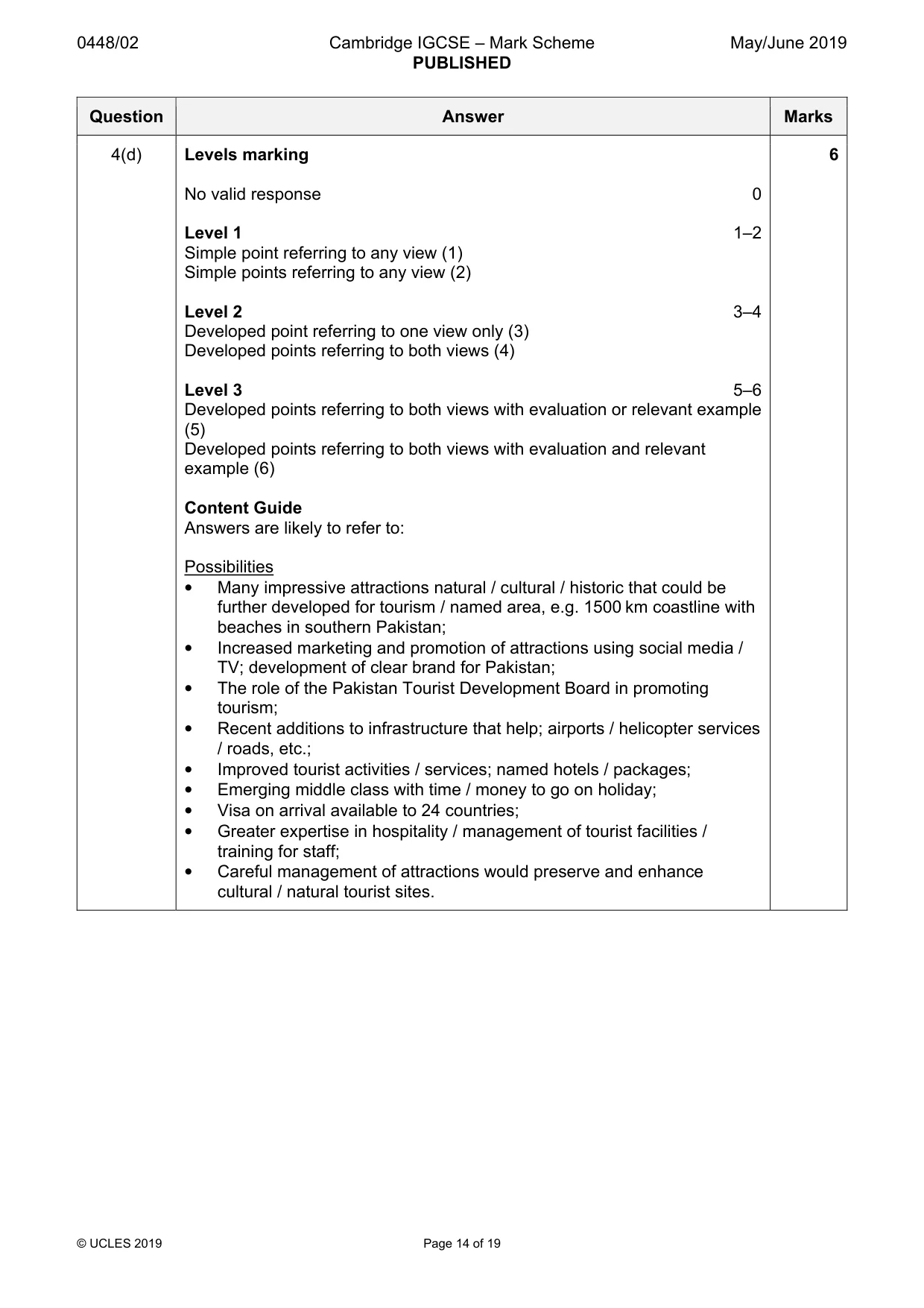
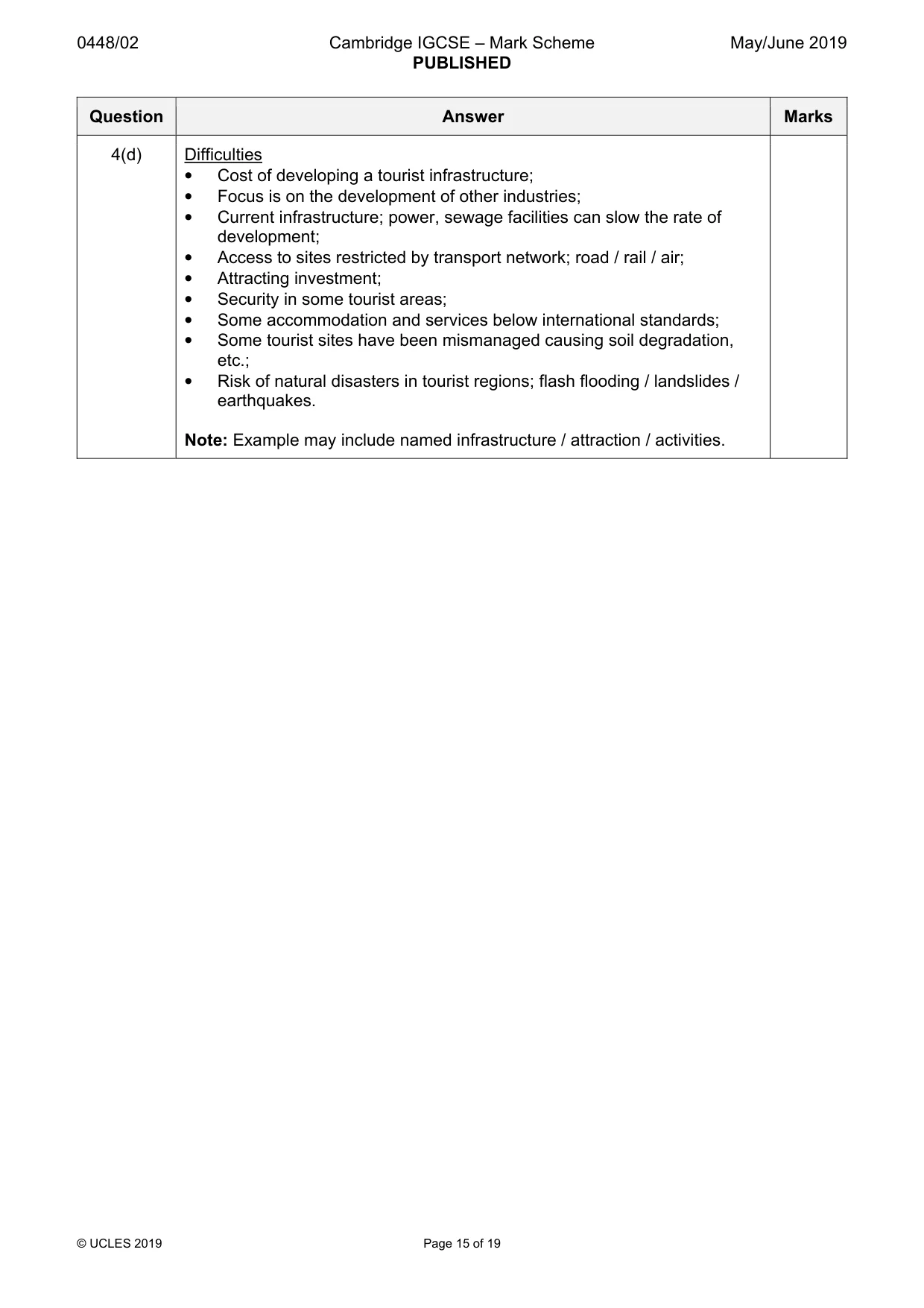
Mark scheme: 4(a)(i) Tertiary industry is any activity concerned with providing a service. 1 1 @ 1 mark 4(a)(ii) 35% 1 1 @ 1 mark 4(a)(iii) • Sales; 3 • Waiter; • Driver; • Teacher (teaching) / education; • Doctor / bank clerk (banking); • Guide; • Hairdresser; • Trading; • Salon services; • Maid; • Tourism; • Healthcare; • Engineering; • Security; • Manager; Etc. 3 @ 1 mark 4(b)(i) • Domestic tourism is when people go on holiday within their own 2 country; • Foreign tourism is when people from a different country visit / go on holiday abroad. 2 @ 1 mark 4(b)(ii) A: UK 3 1 @ 1 mark B: • Visiting friends and family living in Pakistan; • On business / official meetings (classed as tourist / visitor); • Attending a cultural event; • Sporting event; • Visiting a religious site / pilgrimage; • Sightseeing / historical sites / historical ties (e.g. colonial links); • Scenic beauty / nature loving. 2 @ 1 mark 4(c)(i) • Income from tourism; is usually greater than exporting raw materials (or 4 named examples) / can help to correct the balance of payments / increase foreign exchange / money spent on areas like education and healthcare (dev); • Creates employment in local areas; examples of employment opportunities, e.g. in hotels / as tour guides (dev); • Encourages development of cottage or craft industries; handmade souvenirs are sold as profit / earn an income (dev); • Food production is increased; creation of local markets (dev); • Local people can use the tourist facilities; named examples, e.g. swimming pools / public transport (dev); • Tourist and local interaction; creates cultural awareness and understanding (dev); • Tourism is a sustainable industry; tourist attractions will be maintained / developed (dev); • Improves literacy; development of language skills interacting with tourists (dev); Etc. Note: One mark for identification of appropriate idea and a further mark for development (in parentheses). Note: Max. 2 marks if no development. 2 @ 2 marks 4(c)(ii) • Fig 4.2: beach for relaxing holidays / sunbathing / water sports / 5 admiring scenic view of ocean from beach / cooling breeze from sea reduces heat / beach cricket or similar activities / riding camels; • Fig 4.3: chairlifts (in Murree) for leisure and sightseeing / explore mountains / adventurous activities / photo opportunities / scenic viewing / greenery / admiring the scenic beauty / entertainment and thrills / aerial views; • Fig 4.4: shopping / buy souvenirs (in Murree) / honeypot site for tourists / many attractions and amenities / hotels / stay in resort / market / investigating local culture / eating traditional food; • Fig 4.5: experience mountains (in northern regions) /adventure tourism / mountain climbing / hiking / skiing / trekking / snowboarding; • Fig 4.6: historic buildings / view architecture / to sample history / investigate culture / study traditions / sightseeing / historical sites / spiritual visit. 5 @ 1 mark 4(d) Levels marking 6 No valid response 0 Level 1 1–2 Simple point referring to any view (1) Simple points referring to any view (2) Level 2 3–4 Developed point referring to one view only (3) Developed points referring to both views (4) Level 3 5–6 Developed points referring to both views with evaluation or relevant example (5) Developed points referring to both views with evaluation and relevant example (6) Content Guide Answers are likely to refer to: Possibilities • Many impressive attractions natural / cultural / historic that could be further developed for tourism / named area, e.g. 1500 km coastline with beaches in southern Pakistan; • Increased marketing and promotion of attractions using social media / TV; development of clear brand for Pakistan; • The role of the Pakistan Tourist Development Board in promoting tourism; • Recent additions to infrastructure that help; airports / helicopter services / roads, etc.; • Improved tourist activities / services; named hotels / packages; • Emerging middle class with time / money to go on holiday; • Visa on arrival available to 24 countries; • Greater expertise in hospitality / management of tourist facilities / training for staff; • Careful management of attractions would preserve and enhance cultural / natural tourist sites. 4(d) Difficulties • Cost of developing a tourist infrastructure; • Focus is on the development of other industries; • Current infrastructure; power, sewage facilities can slow the rate of development; • Access to sites restricted by transport network; road / rail / air; • Attracting investment; • Security in some tourist areas; • Some accommodation and services below international standards; • Some tourist sites have been mismanaged causing soil degradation, etc.; • Risk of natural disasters in tourist regions; flash flooding / landslides / earthquakes. Note: Example may include named infrastructure / attraction / activities.
Question 5
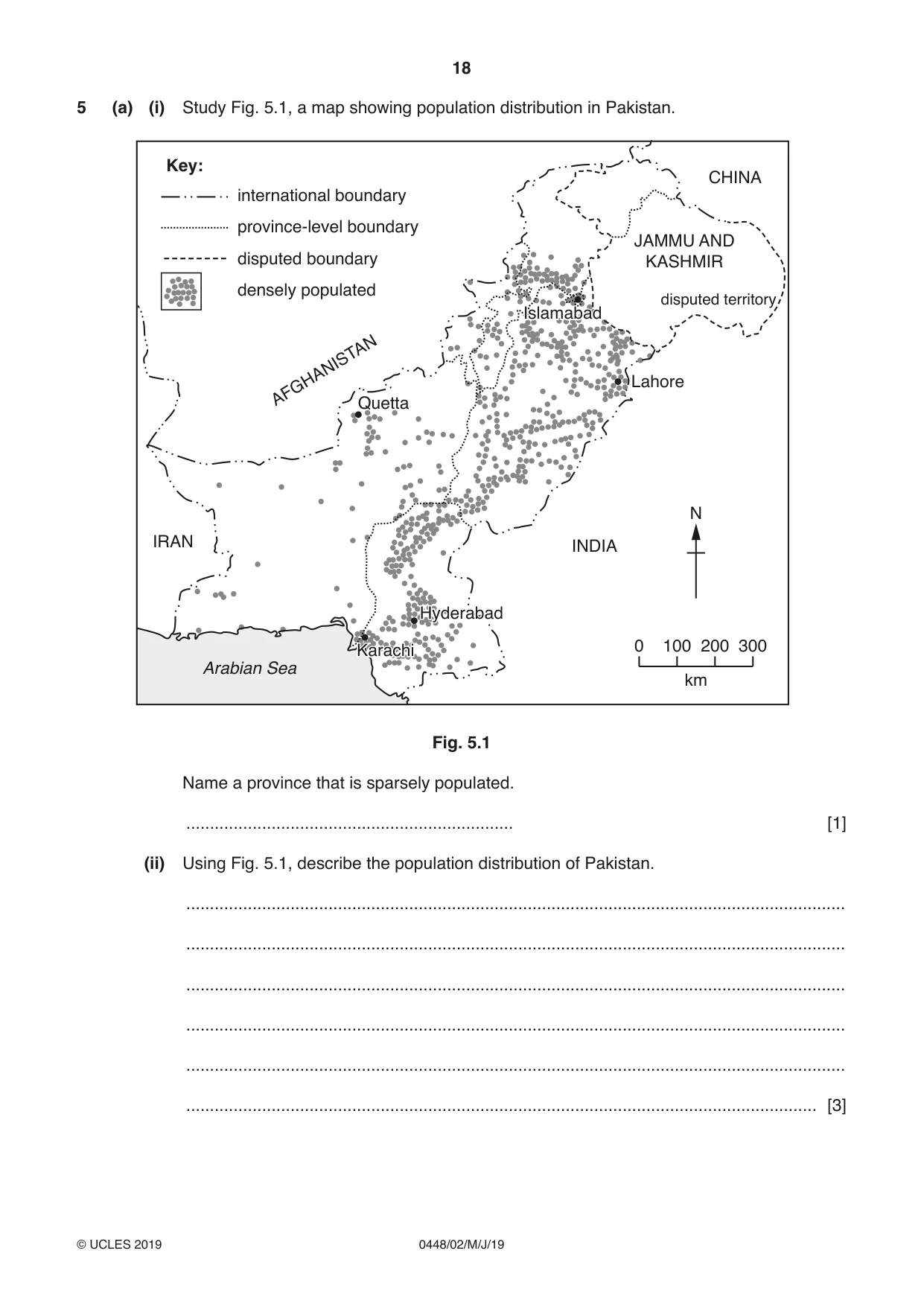
5 (a) (i) Study Fig. 5.1, a map showing population distribution in Pakistan. Key: CHINA international boundary province-level boundary JAMMU AND disputed boundary KASHMIR densely populated disputed territory IslamabadIslamabad Lahore AFGHANISTANQuetta N IRAN INDIA HyderabadHyderabad KarachiKarachi 0 100 200 300 Arabian Sea km Fig. 5.1 Name a province that is sparsely populated. ..................................................................... [1] (ii) Using Fig. 5.1, describe the population distribution of Pakistan. ........................................................................................................................................... ........................................................................................................................................... ........................................................................................................................................... ........................................................................................................................................... ........................................................................................................................................... ..................................................................................................................................... [3] (iii) Suggest three physical factors for the pattern of population distribution shown in Fig. 5.1. 1 ........................................................................................................................................ ........................................................................................................................................... 2 ........................................................................................................................................ ........................................................................................................................................... 3 ........................................................................................................................................ ..................................................................................................................................... [3] (b) (i) Define ‘rural to urban migration’. ........................................................................................................................................... ..................................................................................................................................... [1] (ii) Using your own knowledge, what is the trend for the percentage share of people living in rural areas? Circle the correct answer. increasing decreasing stable [1] (iii) State three pull factors for people moving to urban areas. 1 ........................................................................................................................................ 2 ......................................................................................................................................... 3 ................................................................................................................................... [3] (c) (i) Explain two impacts of large numbers of people moving into urban areas. You should develop your answer. ........................................................................................................................................... ........................................................................................................................................... ........................................................................................................................................... ........................................................................................................................................... ........................................................................................................................................... ........................................................................................................................................... ........................................................................................................................................... ..................................................................................................................................... [4] (ii) Study Figs. 5.2 and 5.3 (Insert), which show two areas of shanty development in Pakistan. Describe three differences between the shanty developments shown in Figs. 5.2 and 5.3. 1 ........................................................................................................................................ ........................................................................................................................................... 2 ........................................................................................................................................ ........................................................................................................................................... 3 ........................................................................................................................................ ..................................................................................................................................... [3]
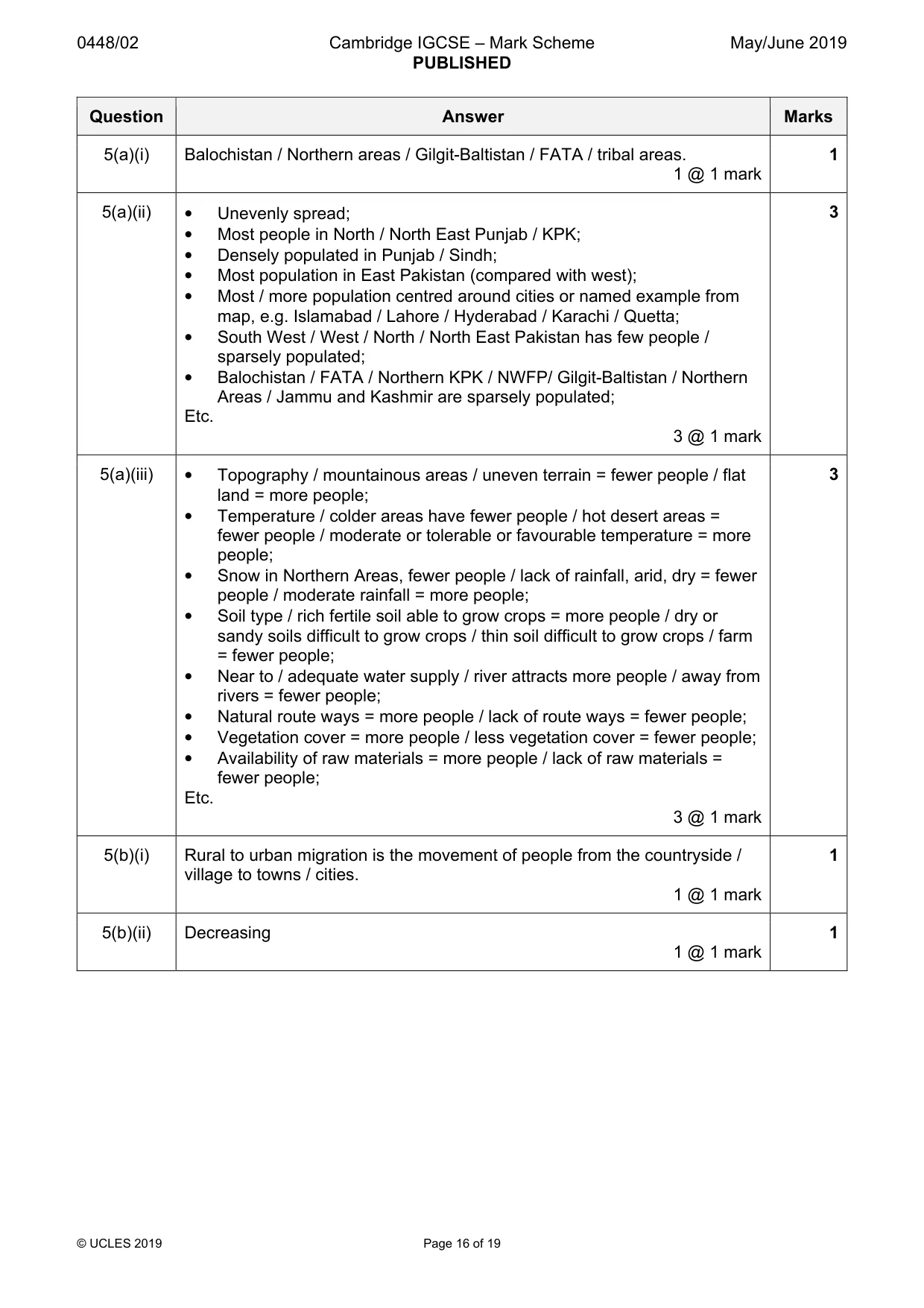
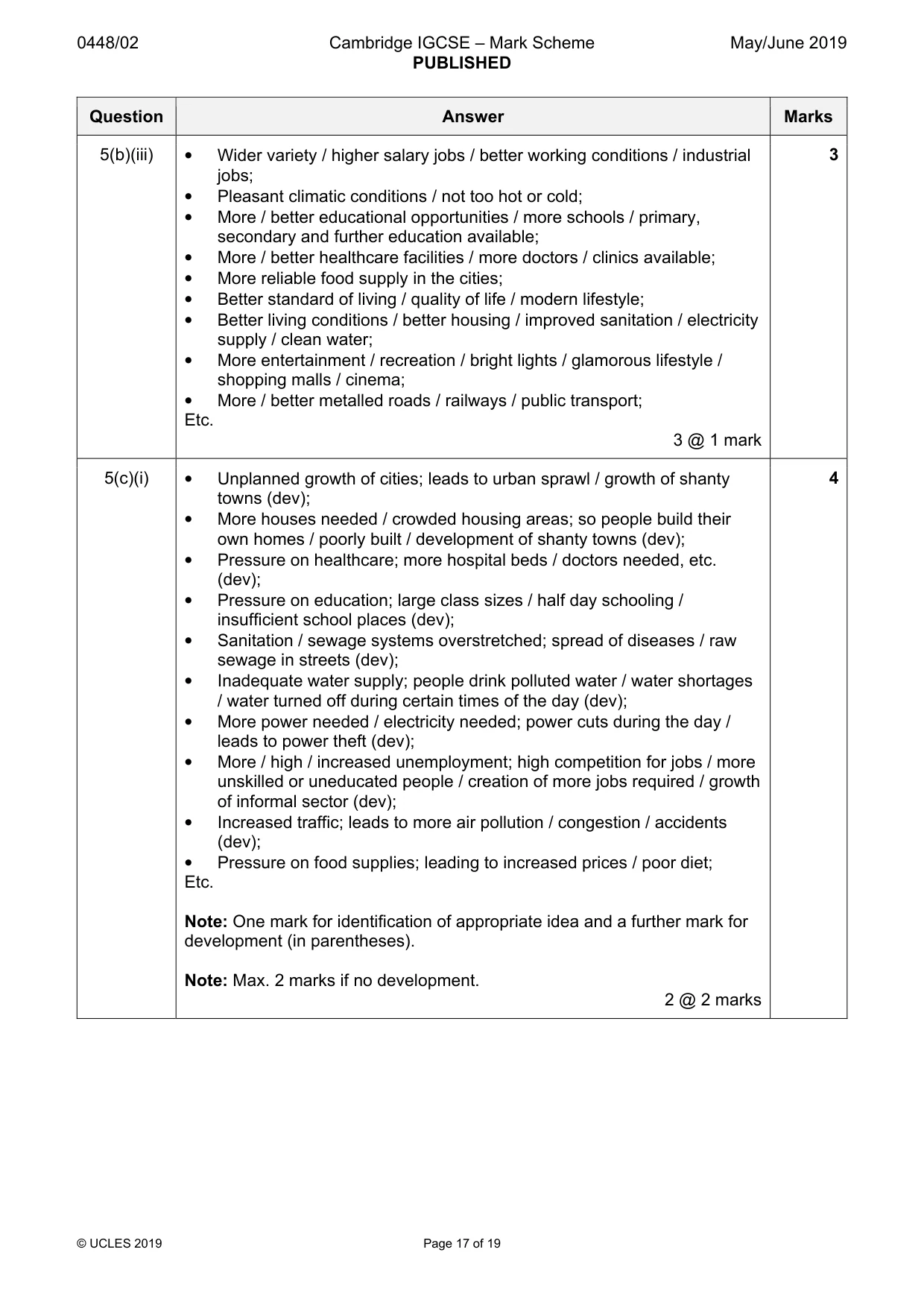
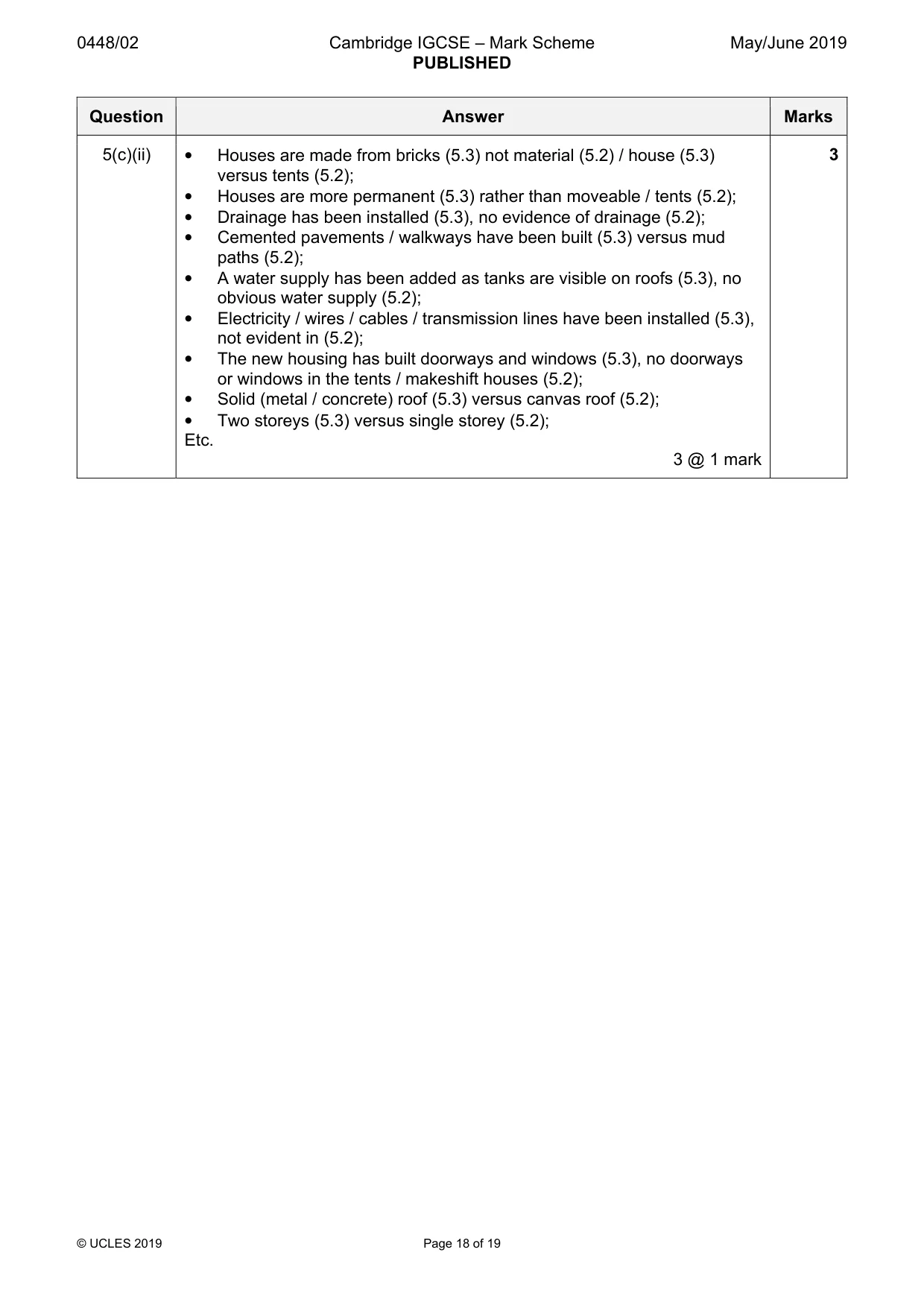
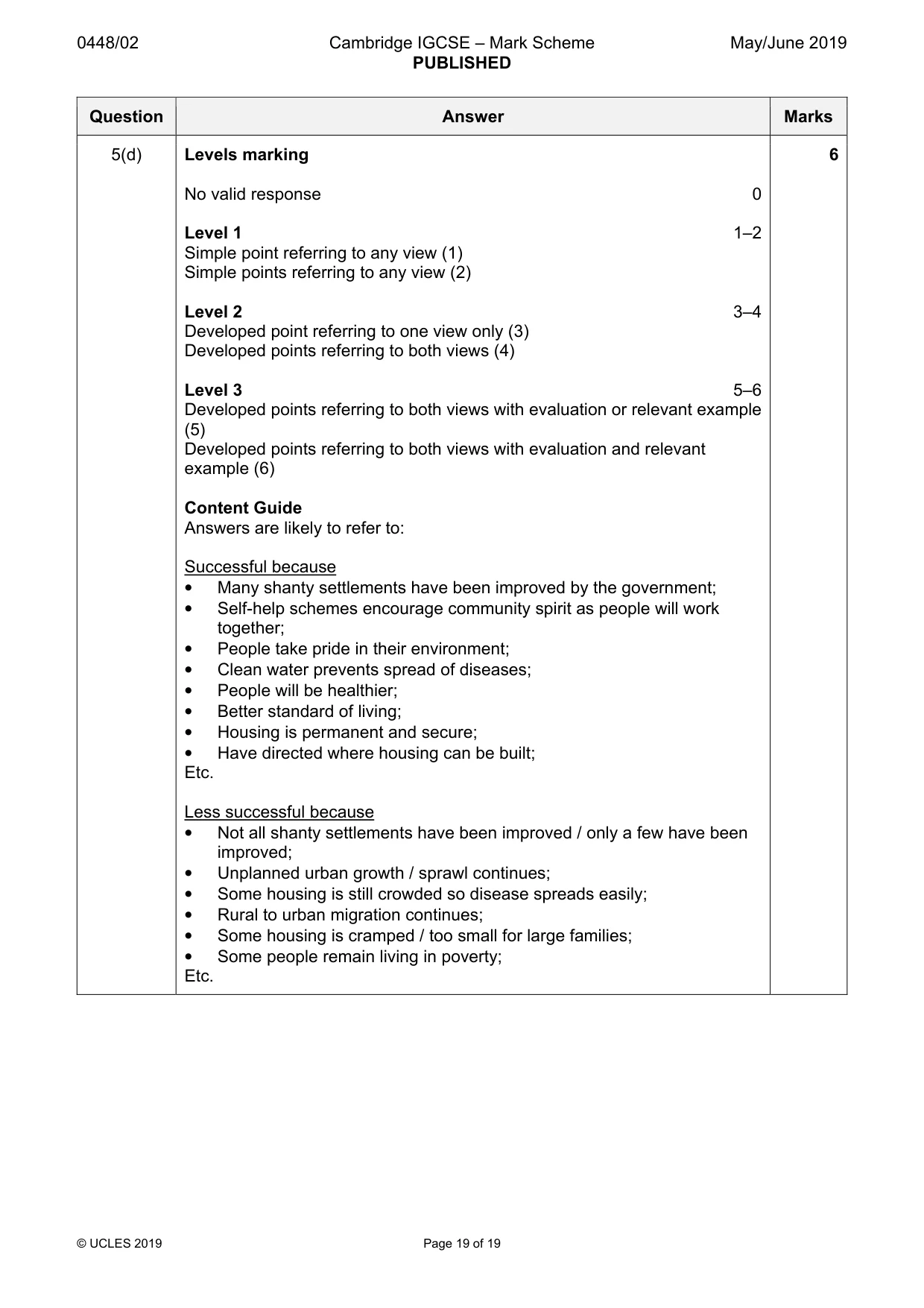
Mark scheme: 5(a)(i) Balochistan / Northern areas / Gilgit-Baltistan / FATA / tribal areas. 1 1 @ 1 mark 5(a)(ii) • Unevenly spread; 3 • Most people in North / North East Punjab / KPK; • Densely populated in Punjab / Sindh; • Most population in East Pakistan (compared with west); • Most / more population centred around cities or named example from map, e.g. Islamabad / Lahore / Hyderabad / Karachi / Quetta; • South West / West / North / North East Pakistan has few people / sparsely populated; • Balochistan / FATA / Northern KPK / NWFP/ Gilgit-Baltistan / Northern Areas / Jammu and Kashmir are sparsely populated; Etc. 3 @ 1 mark 5(a)(iii) • Topography / mountainous areas / uneven terrain = fewer people / flat 3 land = more people; • Temperature / colder areas have fewer people / hot desert areas = fewer people / moderate or tolerable or favourable temperature = more people; • Snow in Northern Areas, fewer people / lack of rainfall, arid, dry = fewer people / moderate rainfall = more people; • Soil type / rich fertile soil able to grow crops = more people / dry or sandy soils difficult to grow crops / thin soil difficult to grow crops / farm = fewer people; • Near to / adequate water supply / river attracts more people / away from rivers = fewer people; • Natural route ways = more people / lack of route ways = fewer people; • Vegetation cover = more people / less vegetation cover = fewer people; • Availability of raw materials = more people / lack of raw materials = fewer people; Etc. 3 @ 1 mark 5(b)(i) Rural to urban migration is the movement of people from the countryside / 1 village to towns / cities. 1 @ 1 mark 5(b)(ii) Decreasing 1 1 @ 1 mark 5(b)(iii) • Wider variety / higher salary jobs / better working conditions / industrial 3 jobs; • Pleasant climatic conditions / not too hot or cold; • More / better educational opportunities / more schools / primary, secondary and further education available; • More / better healthcare facilities / more doctors / clinics available; • More reliable food supply in the cities; • Better standard of living / quality of life / modern lifestyle; • Better living conditions / better housing / improved sanitation / electricity supply / clean water; • More entertainment / recreation / bright lights / glamorous lifestyle / shopping malls / cinema; • More / better metalled roads / railways / public transport; Etc. 3 @ 1 mark 5(c)(i) • Unplanned growth of cities; leads to urban sprawl / growth of shanty 4 towns (dev); • More houses needed / crowded housing areas; so people build their own homes / poorly built / development of shanty towns (dev); • Pressure on healthcare; more hospital beds / doctors needed, etc. (dev); • Pressure on education; large class sizes / half day schooling / insufficient school places (dev); • Sanitation / sewage systems overstretched; spread of diseases / raw sewage in streets (dev); • Inadequate water supply; people drink polluted water / water shortages / water turned off during certain times of the day (dev); • More power needed / electricity needed; power cuts during the day / leads to power theft (dev); • More / high / increased unemployment; high competition for jobs / more unskilled or uneducated people / creation of more jobs required / growth of informal sector (dev); • Increased traffic; leads to more air pollution / congestion / accidents (dev); • Pressure on food supplies; leading to increased prices / poor diet; Etc. Note: One mark for identification of appropriate idea and a further mark for development (in parentheses). Note: Max. 2 marks if no development. 2 @ 2 marks 5(c)(ii) • Houses are made from bricks (5.3) not material (5.2) / house (5.3) 3 versus tents (5.2); • Houses are more permanent (5.3) rather than moveable / tents (5.2); • Drainage has been installed (5.3), no evidence of drainage (5.2); • Cemented pavements / walkways have been built (5.3) versus mud paths (5.2); • A water supply has been added as tanks are visible on roofs (5.3), no obvious water supply (5.2); • Electricity / wires / cables / transmission lines have been installed (5.3), not evident in (5.2); • The new housing has built doorways and windows (5.3), no doorways or windows in the tents / makeshift houses (5.2); • Solid (metal / concrete) roof (5.3) versus canvas roof (5.2); • Two storeys (5.3) versus single storey (5.2); Etc. 3 @ 1 mark 5(d) Levels marking 6 No valid response 0 Level 1 1–2 Simple point referring to any view (1) Simple points referring to any view (2) Level 2 3–4 Developed point referring to one view only (3) Developed points referring to both views (4) Level 3 5–6 Developed points referring to both views with evaluation or relevant example (5) Developed points referring to both views with evaluation and relevant example (6) Content Guide Answers are likely to refer to: Successful because • Many shanty settlements have been improved by the government; • Self-help schemes encourage community spirit as people will work together; • People take pride in their environment; • Clean water prevents spread of diseases; • People will be healthier; • Better standard of living; • Housing is permanent and secure; • Have directed where housing can be built; Etc. Less successful because • Not all shanty settlements have been improved / only a few have been improved; • Unplanned urban growth / sprawl continues; • Some housing is still crowded so disease spreads easily; • Rural to urban migration continues; • Some housing is cramped / too small for large families; • Some people remain living in poverty; Etc.
What you needed in this session
Cambridge’s own grade thresholds for 2019 May/June, Paper 2 · Variant 1. A higher threshold means an easier paper — the bar moves with how the cohort did.