Cambridge IGCSE Pakistan Studies 0448 — 2017 May/June Paper 2 · Variant 1
0448/21/M/J/17 · 5 questions · 75 marks · ≈84 min
The question paper and its mark scheme, free to read here and free to download. This is Cambridge’s own paper, exactly as it was sat.
Question paper24 pages
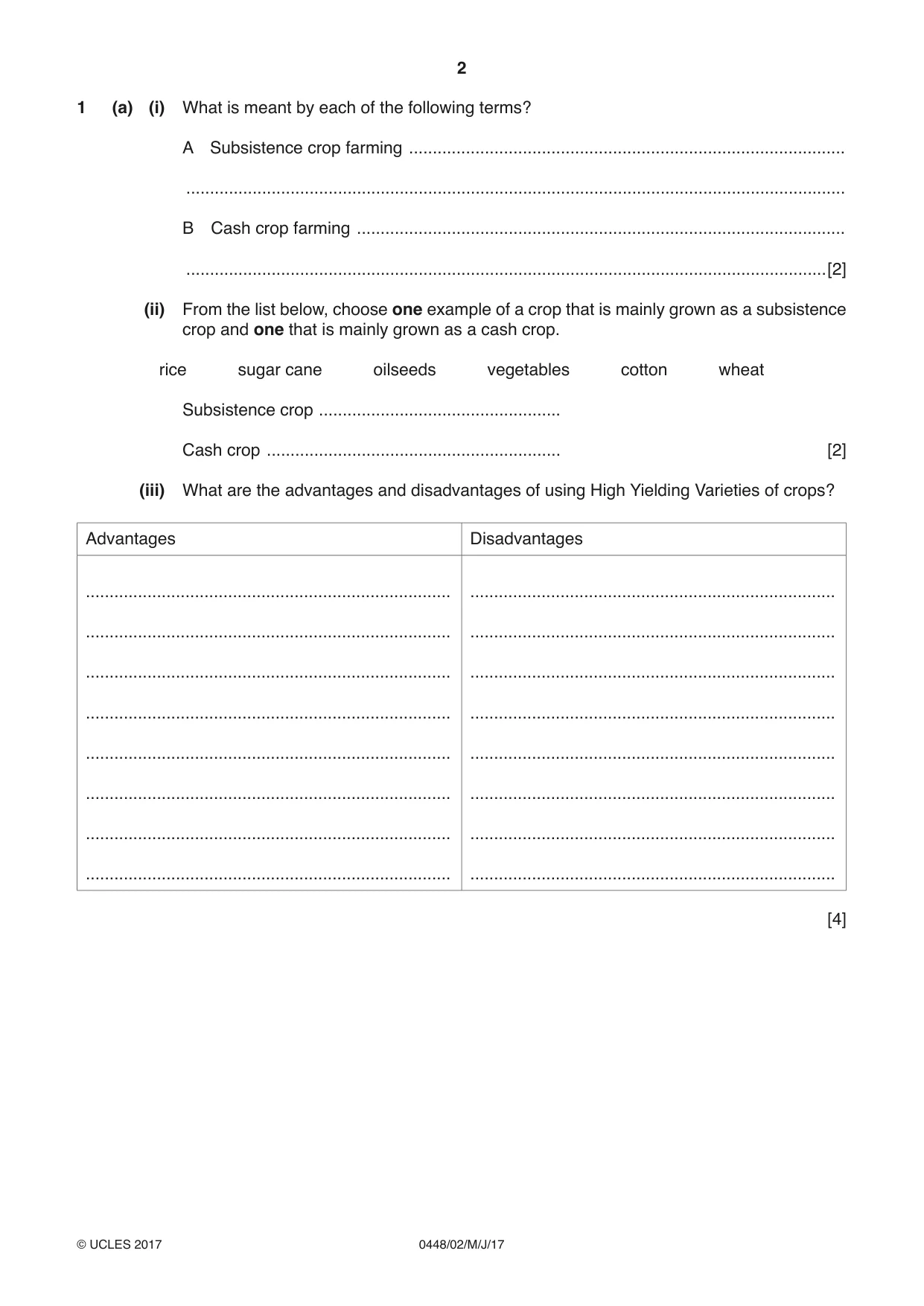
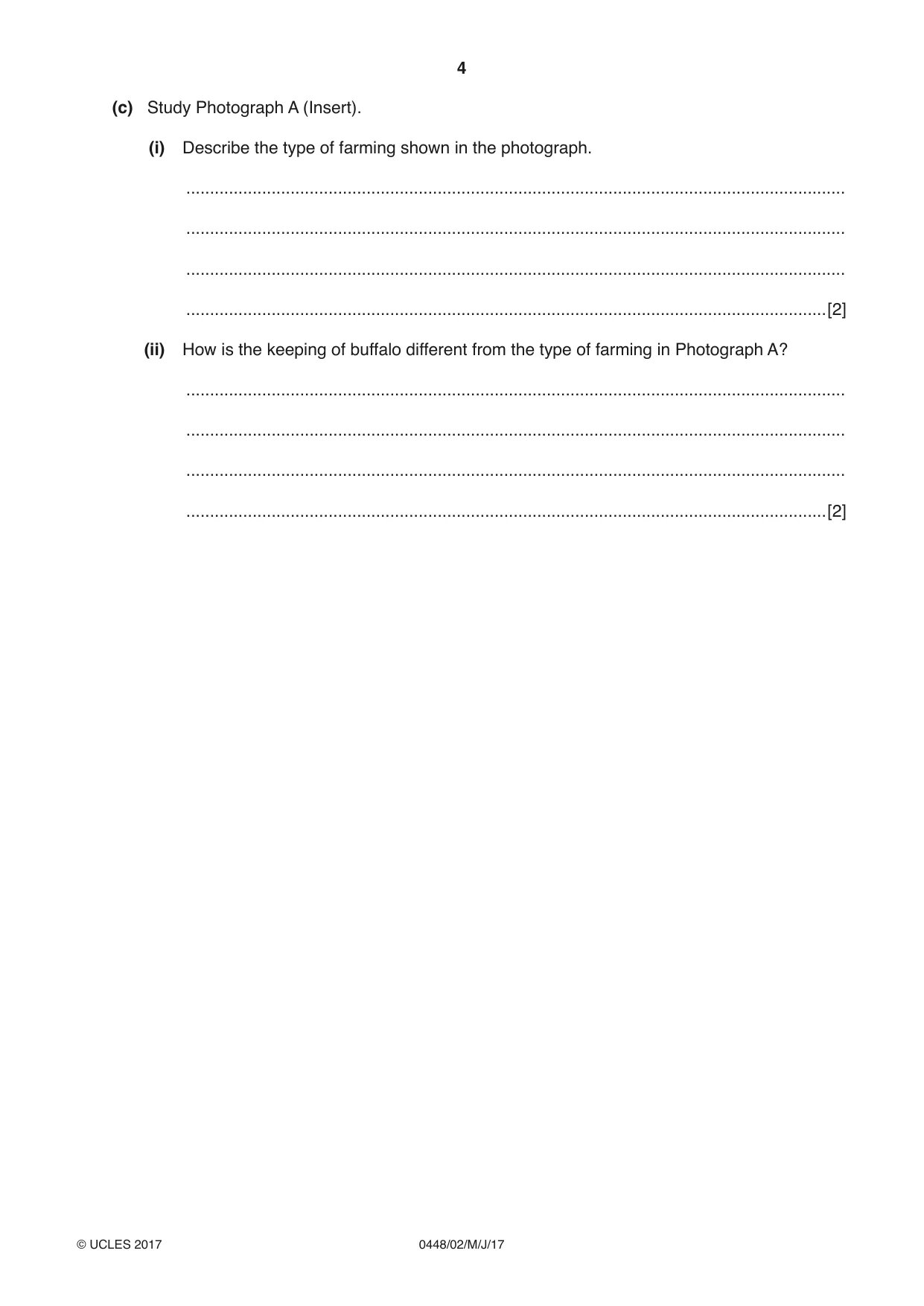



Mark scheme19 pages
Answers below. Sit the paper first if you are practising.
Questions as text
Q1 · What is meant by each of the following terms?
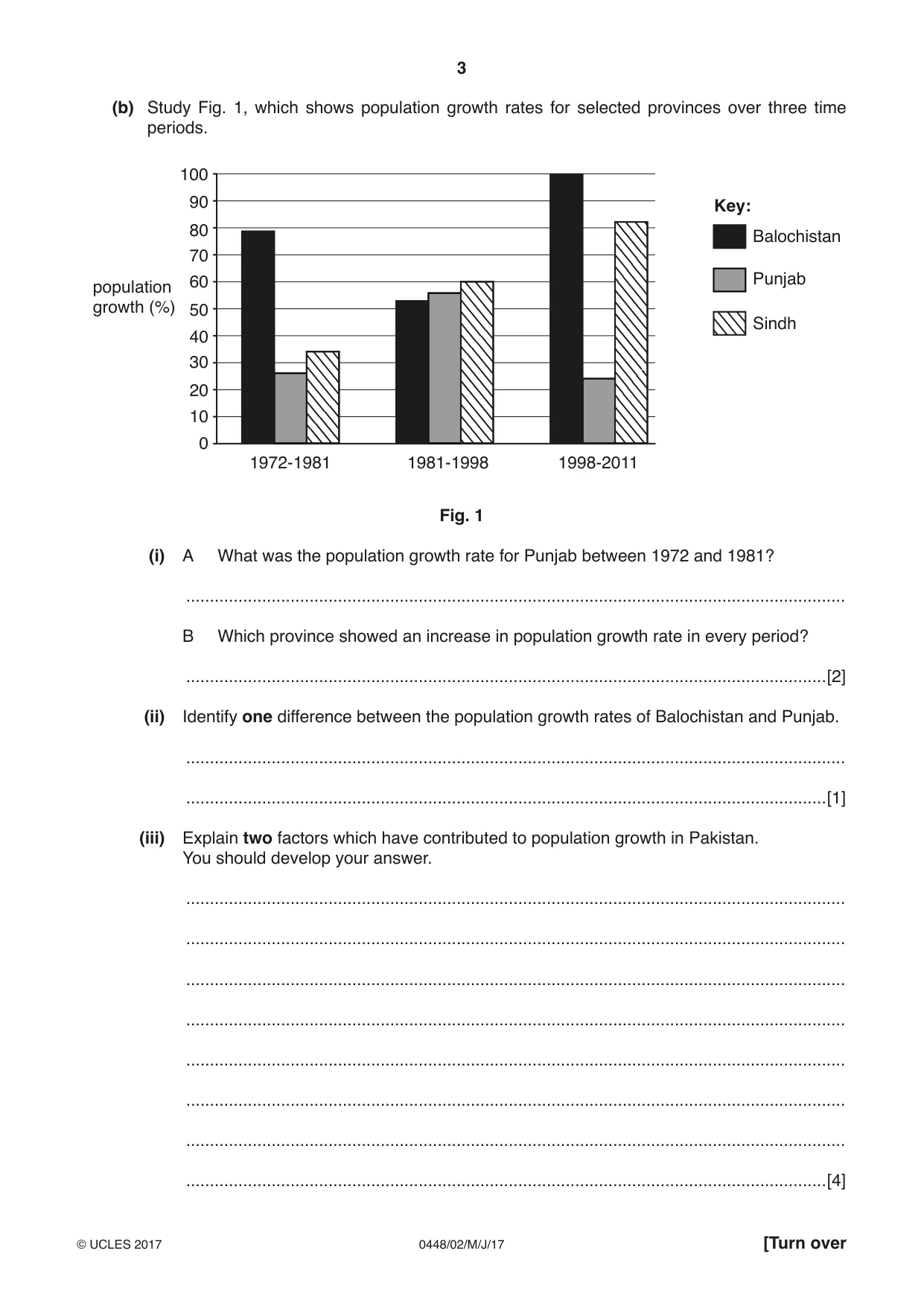
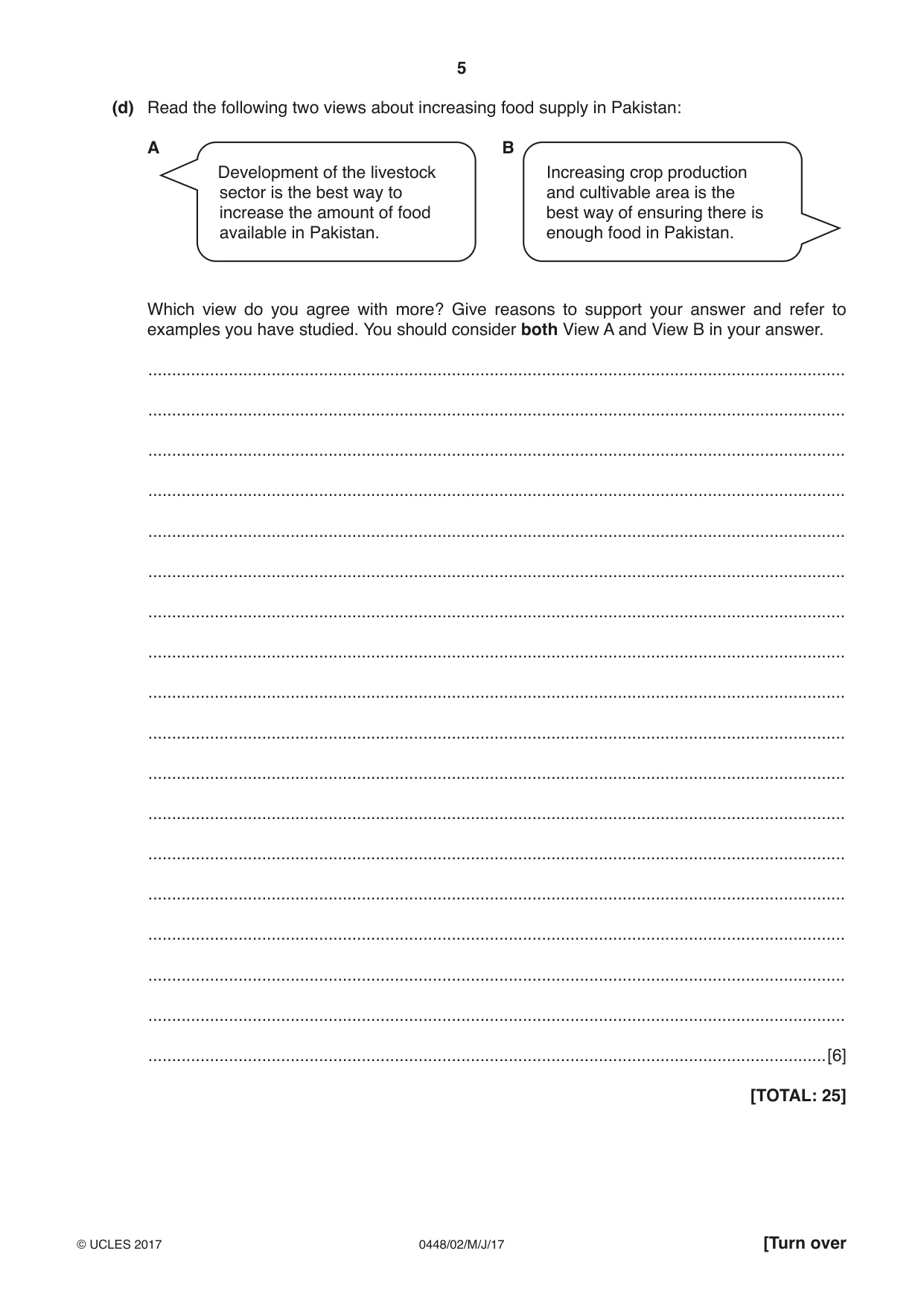
1 (a) (i) What is meant by each of the following terms? A Subsistence crop farming ............................................................................................ ........................................................................................................................................... B Cash crop farming ....................................................................................................... .......................................................................................................................................[2] (ii) From the list below, choose one example of a crop that is mainly grown as a subsistence crop and one that is mainly grown as a cash crop. rice sugar cane oilseeds vegetables cotton wheat Subsistence crop ................................................... Cash crop .............................................................. [2] (iii) What are the advantages and disadvantages of using High Yielding Varieties of crops? Advantages Disadvantages ............................................................................. ............................................................................. ............................................................................. ............................................................................. ............................................................................. ............................................................................. ............................................................................. ............................................................................. ............................................................................. ............................................................................. ............................................................................. ............................................................................. ............................................................................. ............................................................................. ............................................................................. ............................................................................. [4] (b) Study Fig. 1, which shows population growth rates for selected provinces over three time periods. 100 90 Key: 80 Balochistan 70 population 60 Punjab growth (%) 50 Sindh 40 30 20 10 0 1972-1981 1981-1998 1998-2011 Fig. 1 (i) A What was the population growth rate for Punjab between 1972 and 1981? ........................................................................................................................................... B Which province showed an increase in population growth rate in every period? .......................................................................................................................................[2] (ii) Identify one difference between the population growth rates of Balochistan and Punjab. ........................................................................................................................................... .......................................................................................................................................[1] (iii) Explain two factors which have contributed to population growth in Pakistan. You should develop your answer. ........................................................................................................................................... ........................................................................................................................................... ........................................................................................................................................... ........................................................................................................................................... ........................................................................................................................................... ........................................................................................................................................... ........................................................................................................................................... .......................................................................................................................................[4] (c) Study Photograph A (Insert). (i) Describe the type of farming shown in the photograph. ........................................................................................................................................... ........................................................................................................................................... ........................................................................................................................................... .......................................................................................................................................[2] (ii) How is the keeping of buffalo different from the type of farming in Photograph A? ........................................................................................................................................... ........................................................................................................................................... ........................................................................................................................................... .......................................................................................................................................[2] (d) Read the following two views about increasing food supply in Pakistan: A B Development of the livestock Increasing crop production sector is the best way to and cultivable area is the increase the amount of food best way of ensuring there is available in Pakistan. enough food in Pakistan. Which view do you agree with more? Give reasons to support your answer and refer to examples you have studied. You should consider both View A and View B in your answer. ................................................................................................................................................... ................................................................................................................................................... ................................................................................................................................................... ................................................................................................................................................... ................................................................................................................................................... ................................................................................................................................................... ................................................................................................................................................... ................................................................................................................................................... ................................................................................................................................................... ................................................................................................................................................... ................................................................................................................................................... ................................................................................................................................................... ................................................................................................................................................... ................................................................................................................................................... ................................................................................................................................................... ................................................................................................................................................... ................................................................................................................................................... ...............................................................................................................................................[6] [TOTAL: 25]
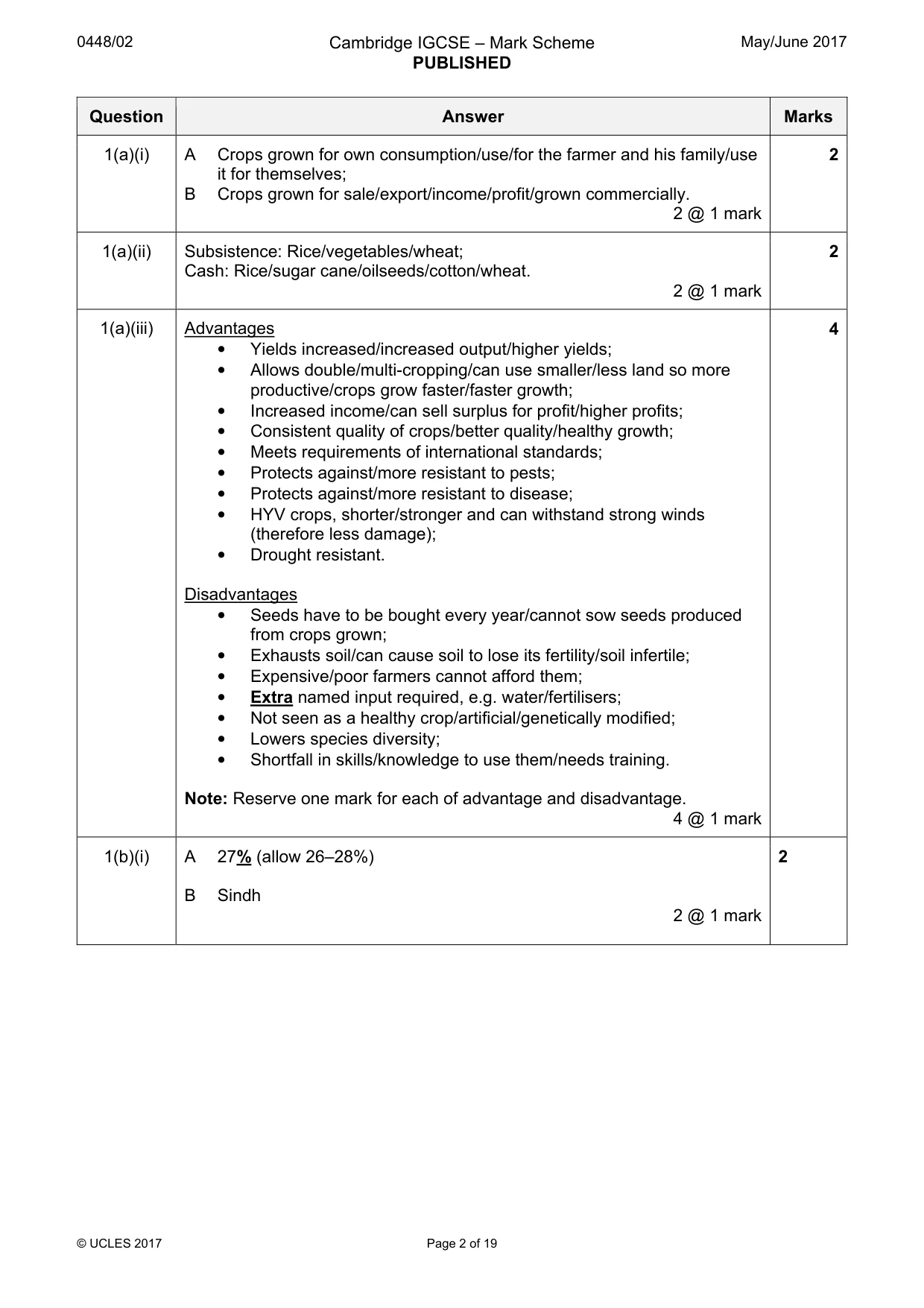
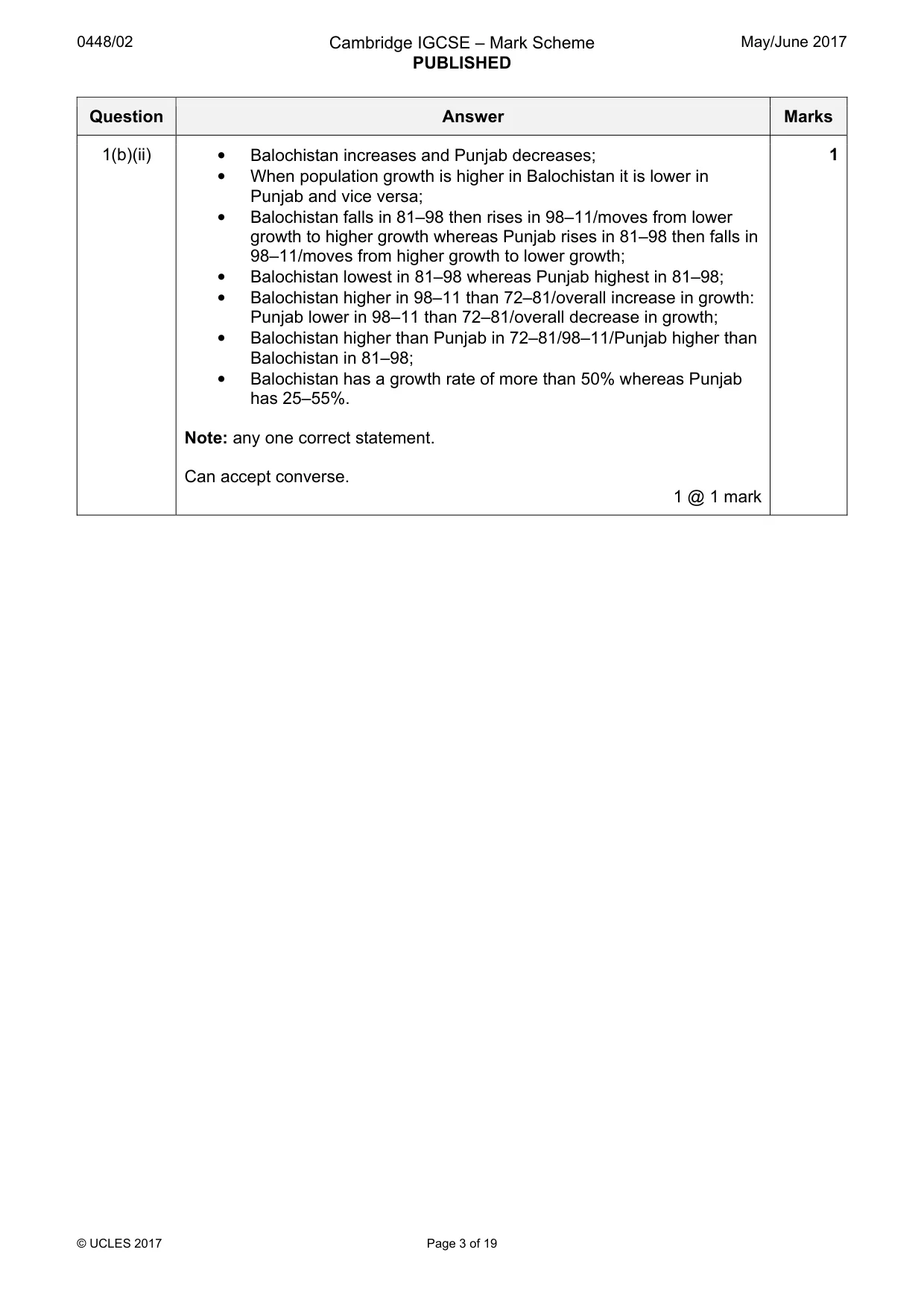
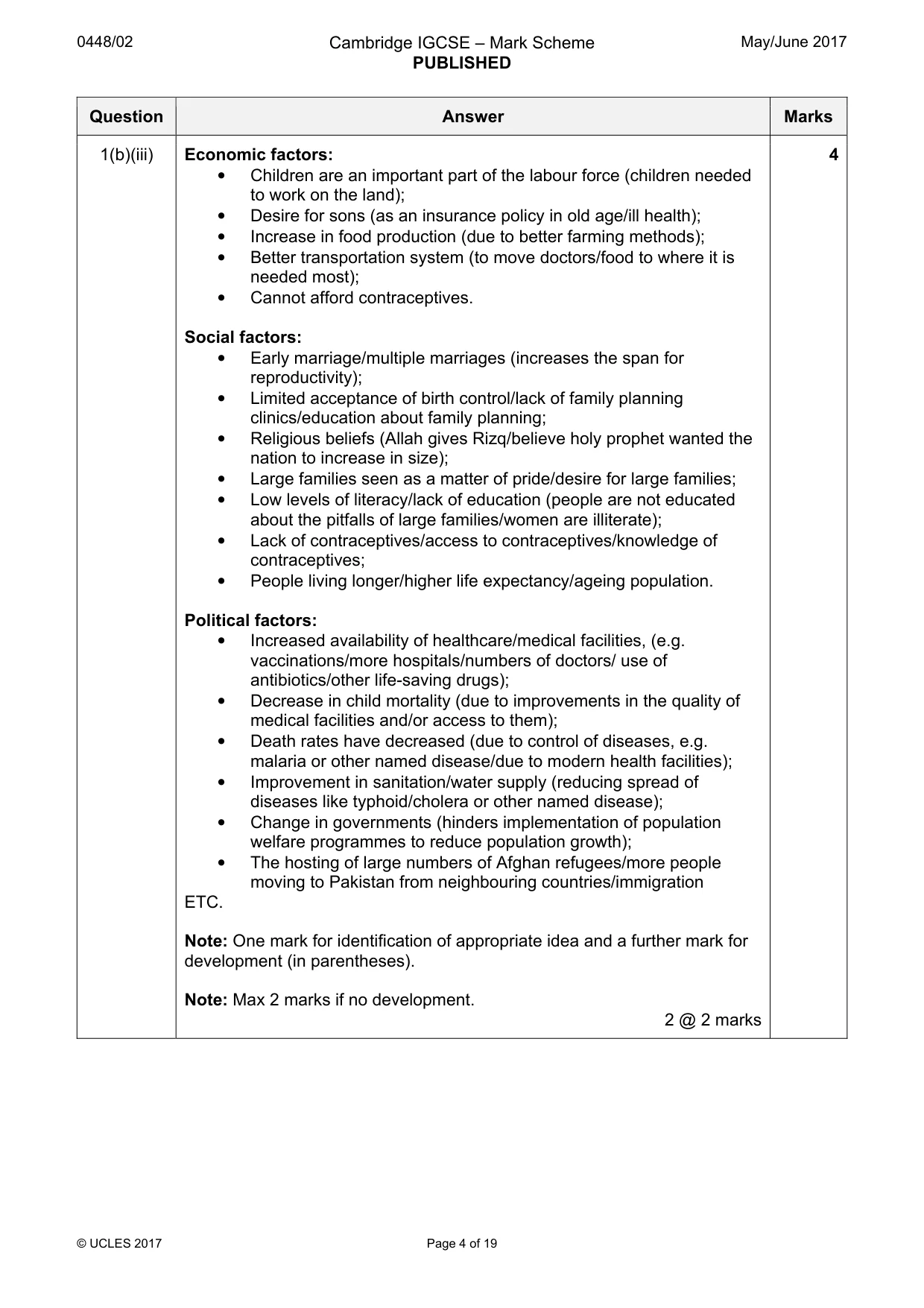
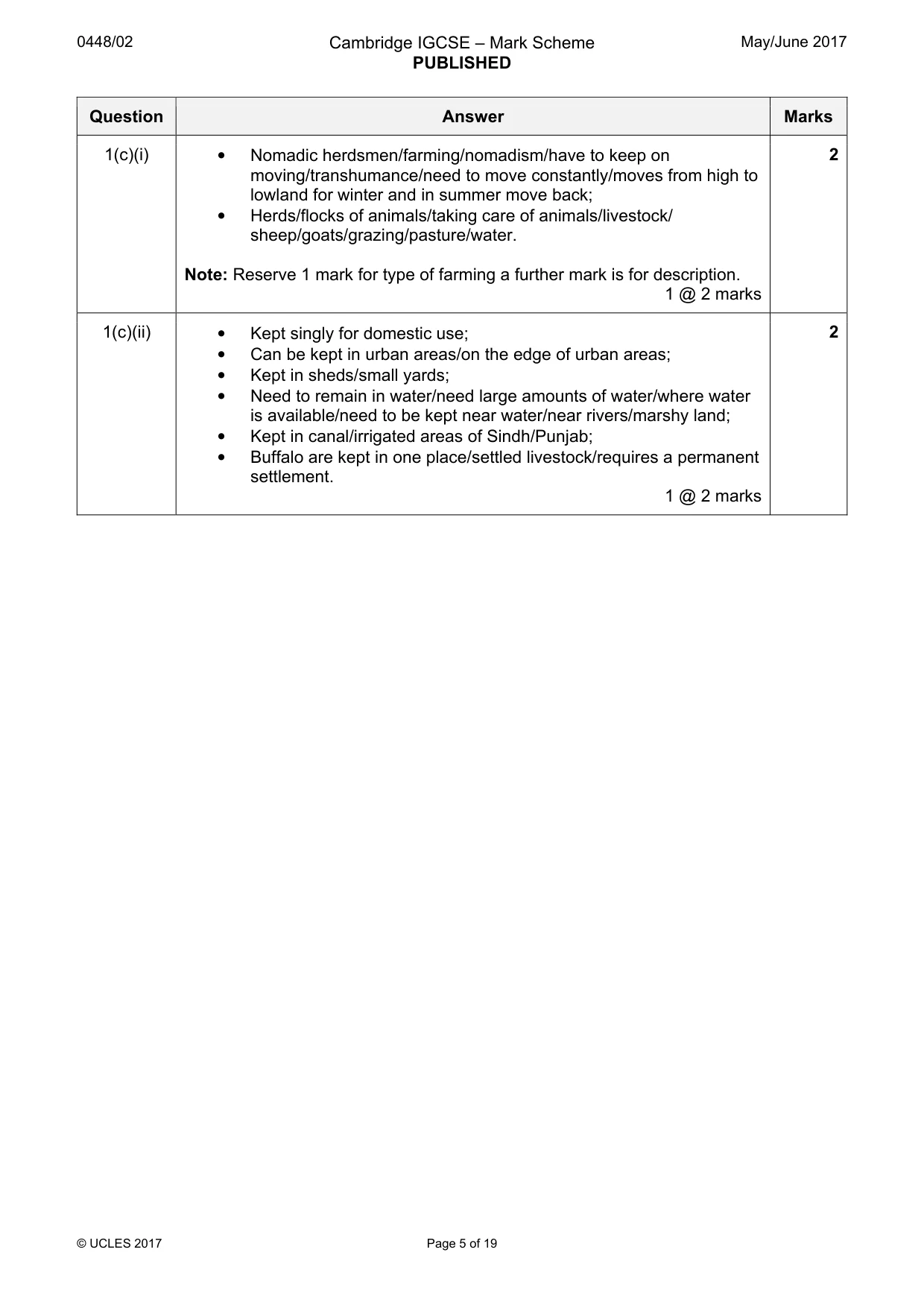
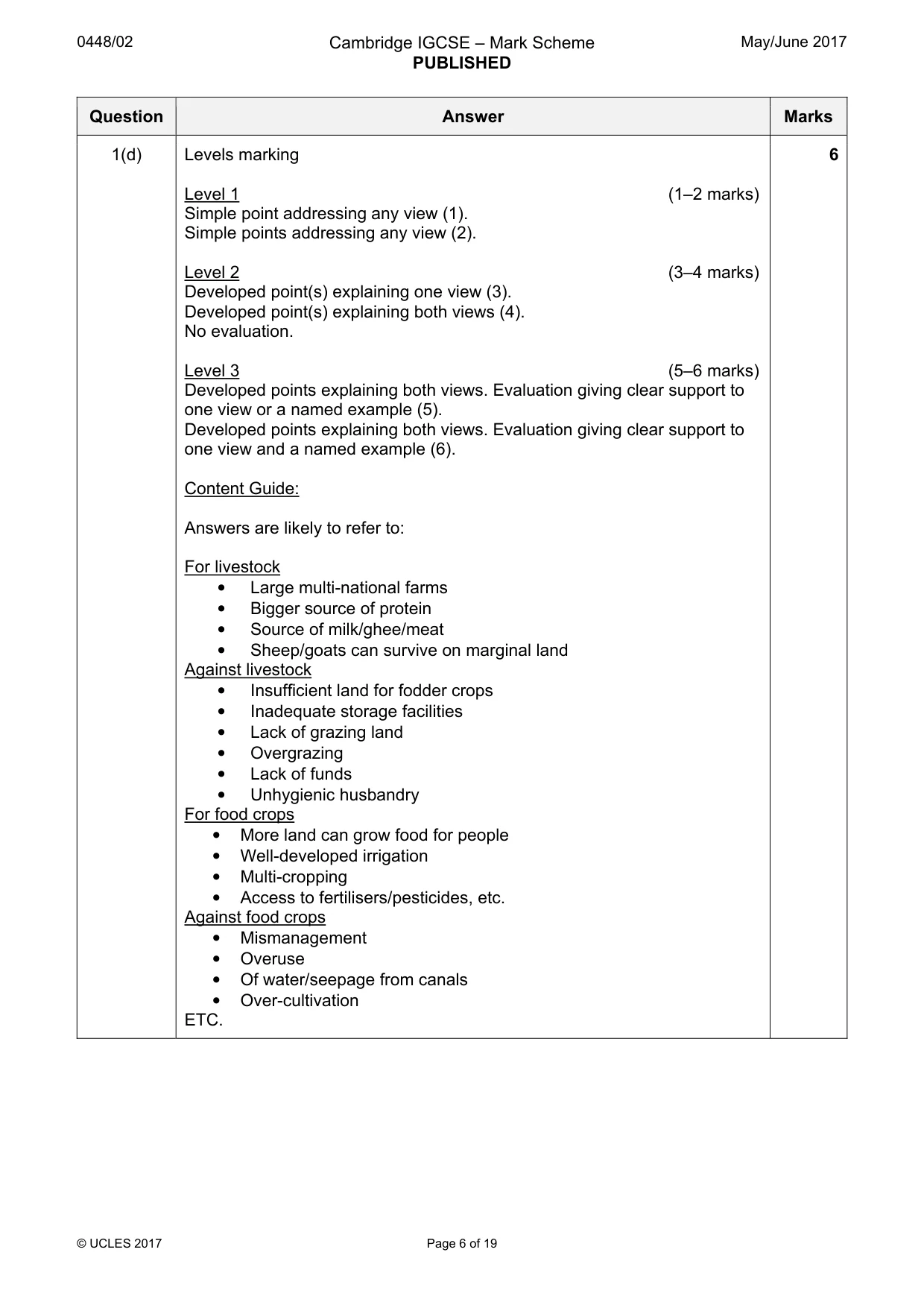
Mark scheme: Question Answer Marks 1(a)(i) A Crops grown for own consumption/use/for the farmer and his family/use 2 it for themselves; B Crops grown for sale/export/income/profit/grown commercially. 2 @ 1 mark 1(a)(ii) Subsistence: Rice/vegetables/wheat; 2 Cash: Rice/sugar cane/oilseeds/cotton/wheat. 2 @ 1 mark 1(a)(iii) Advantages 4 • Yields increased/increased output/higher yields; • Allows double/multi-cropping/can use smaller/less land so more productive/crops grow faster/faster growth; • Increased income/can sell surplus for profit/higher profits; • Consistent quality of crops/better quality/healthy growth; • Meets requirements of international standards; • Protects against/more resistant to pests; • Protects against/more resistant to disease; • HYV crops, shorter/stronger and can withstand strong winds (therefore less damage); • Drought resistant. Disadvantages • Seeds have to be bought every year/cannot sow seeds produced from crops grown; • Exhausts soil/can cause soil to lose its fertility/soil infertile; • Expensive/poor farmers cannot afford them; • Extra named input required, e.g. water/fertilisers; • Not seen as a healthy crop/artificial/genetically modified; • Lowers species diversity; • Shortfall in skills/knowledge to use them/needs training. Note: Reserve one mark for each of advantage and disadvantage. 4 @ 1 mark 1(b)(i) A 27% (allow 26–28%) 2 B Sindh 2 @ 1 mark 1(b)(ii) • Balochistan increases and Punjab decreases; 1 • When population growth is higher in Balochistan it is lower in Punjab and vice versa; • Balochistan falls in 81–98 then rises in 98–11/moves from lower growth to higher growth whereas Punjab rises in 81–98 then falls in 98–11/moves from higher growth to lower growth; • Balochistan lowest in 81–98 whereas Punjab highest in 81–98; • Balochistan higher in 98–11 than 72–81/overall increase in growth: Punjab lower in 98–11 than 72–81/overall decrease in growth; • Balochistan higher than Punjab in 72–81/98–11/Punjab higher than Balochistan in 81–98; • Balochistan has a growth rate of more than 50% whereas Punjab has 25–55%. Note: any one correct statement. Can accept converse. 1 @ 1 mark 1(b)(iii) Economic factors: 4 • Children are an important part of the labour force (children needed to work on the land); • Desire for sons (as an insurance policy in old age/ill health); • Increase in food production (due to better farming methods); • Better transportation system (to move doctors/food to where it is needed most); • Cannot afford contraceptives. Social factors: • Early marriage/multiple marriages (increases the span for reproductivity); • Limited acceptance of birth control/lack of family planning clinics/education about family planning; • Religious beliefs (Allah gives Rizq/believe holy prophet wanted the nation to increase in size); • Large families seen as a matter of pride/desire for large families; • Low levels of literacy/lack of education (people are not educated about the pitfalls of large families/women are illiterate); • Lack of contraceptives/access to contraceptives/knowledge of contraceptives; • People living longer/higher life expectancy/ageing population. Political factors: • Increased availability of healthcare/medical facilities, (e.g. vaccinations/more hospitals/numbers of doctors/ use of antibiotics/other life-saving drugs); • Decrease in child mortality (due to improvements in the quality of medical facilities and/or access to them); • Death rates have decreased (due to control of diseases, e.g. malaria or other named disease/due to modern health facilities); • Improvement in sanitation/water supply (reducing spread of diseases like typhoid/cholera or other named disease); • Change in governments (hinders implementation of population welfare programmes to reduce population growth); • The hosting of large numbers of Afghan refugees/more people moving to Pakistan from neighbouring countries/immigration ETC. Note: One mark for identification of appropriate idea and a further mark for development (in parentheses). Note: Max 2 marks if no development. 2 @ 2 marks 1(c)(i) • Nomadic herdsmen/farming/nomadism/have to keep on 2 moving/transhumance/need to move constantly/moves from high to lowland for winter and in summer move back; • Herds/flocks of animals/taking care of animals/livestock/ sheep/goats/grazing/pasture/water. Note: Reserve 1 mark for type of farming a further mark is for description. 1 @ 2 marks 1(c)(ii) • Kept singly for domestic use; 2 • Can be kept in urban areas/on the edge of urban areas; • Kept in sheds/small yards; • Need to remain in water/need large amounts of water/where water is available/need to be kept near water/near rivers/marshy land; • Kept in canal/irrigated areas of Sindh/Punjab; • Buffalo are kept in one place/settled livestock/requires a permanent settlement. 1 @ 2 marks 1(d) Levels marking 6 Level 1 (1–2 marks) Simple point addressing any view (1). Simple points addressing any view (2). Level 2 (3–4 marks) Developed point(s) explaining one view (3). Developed point(s) explaining both views (4). No evaluation. Level 3 (5–6 marks) Developed points explaining both views. Evaluation giving clear support to one view or a named example (5). Developed points explaining both views. Evaluation giving clear support to one view and a named example (6). Content Guide: Answers are likely to refer to: For livestock • Large multi-national farms • Bigger source of protein • Source of milk/ghee/meat • Sheep/goats can survive on marginal land Against livestock • Insufficient land for fodder crops • Inadequate storage facilities • Lack of grazing land • Overgrazing • Lack of funds • Unhygienic husbandry For food crops • More land can grow food for people • Well-developed irrigation • Multi-cropping • Access to fertilisers/pesticides, etc. Against food crops • Mismanagement • Overuse • Of water/seepage from canals • Over-cultivation ETC.
Question 2
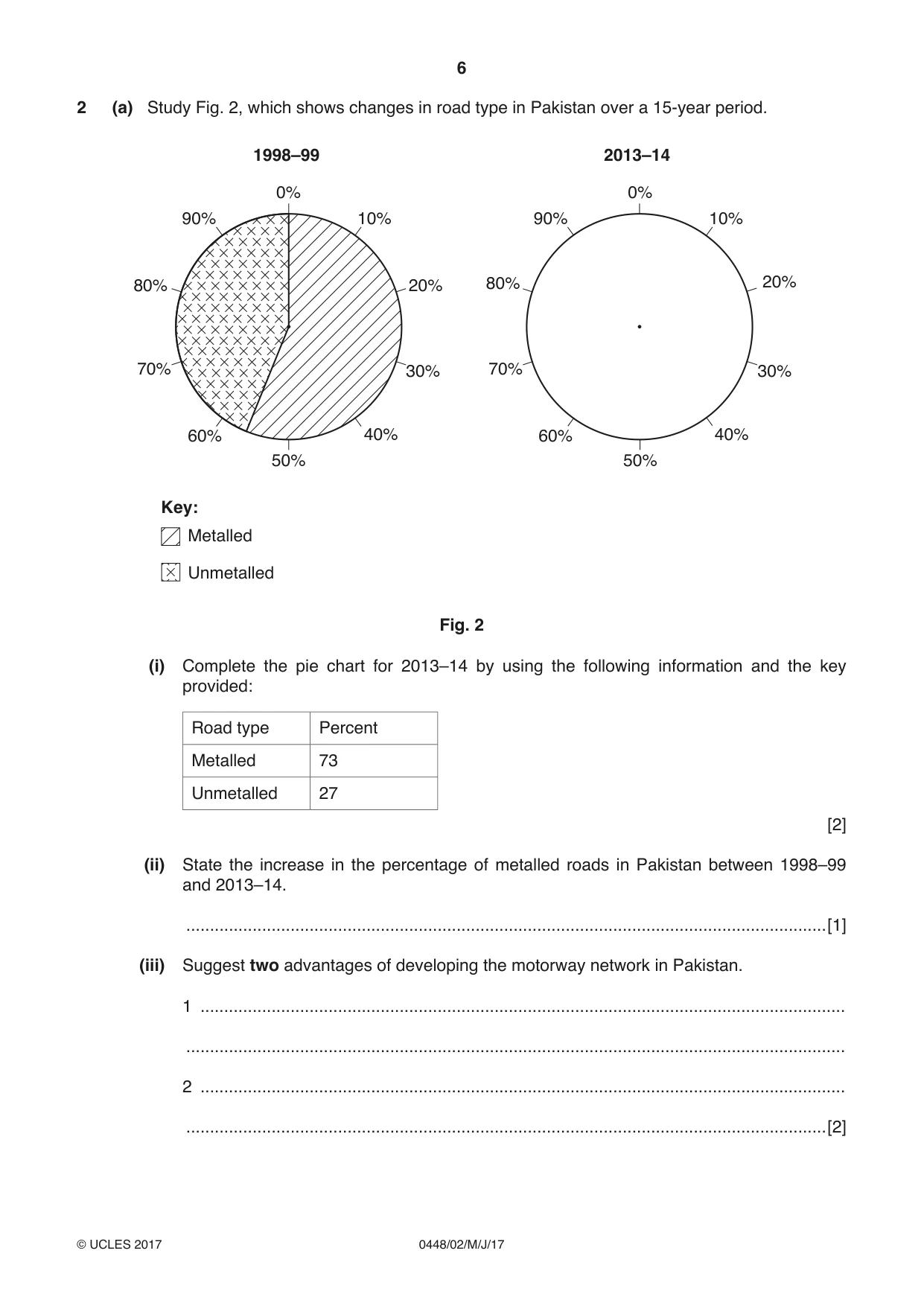
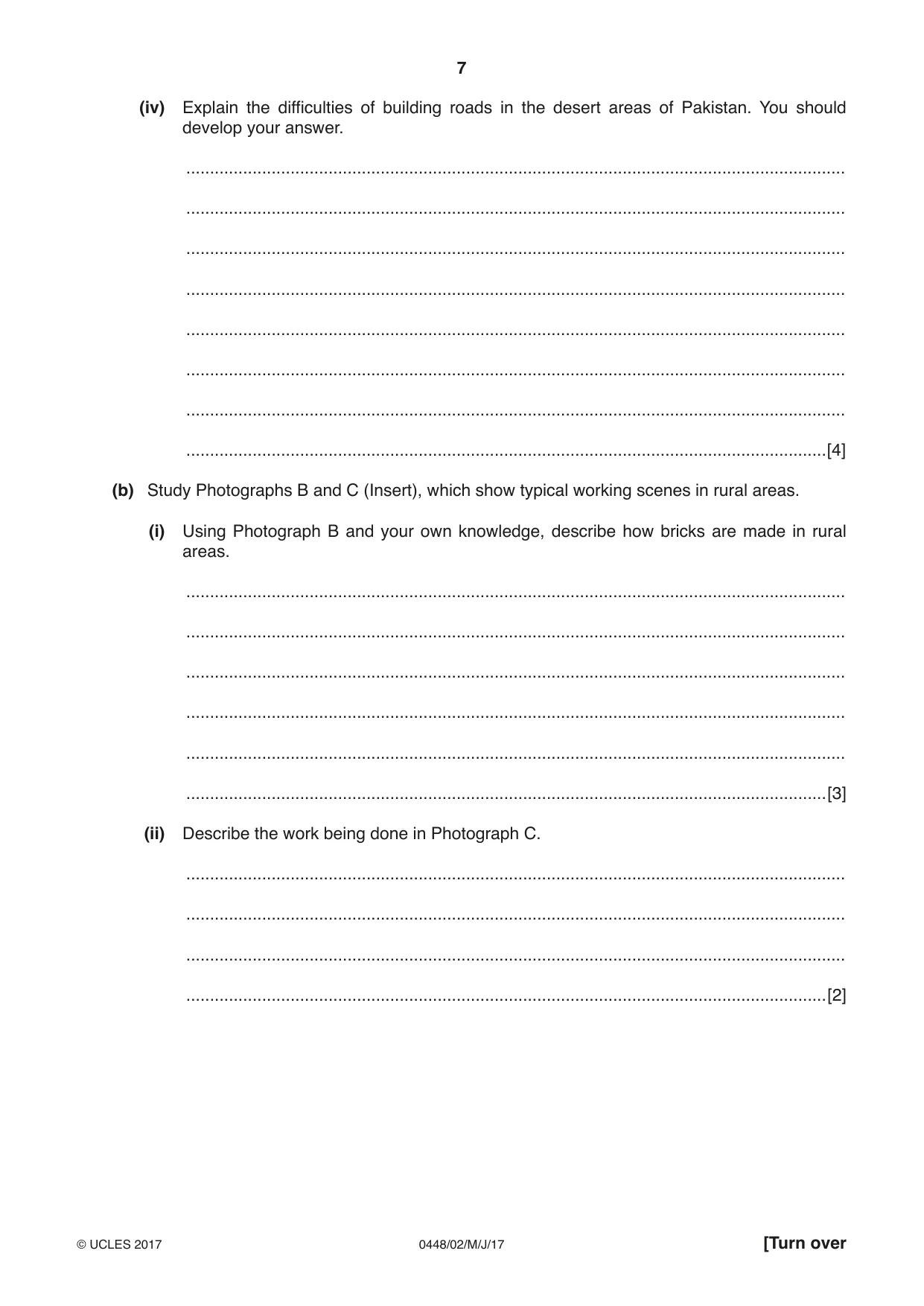
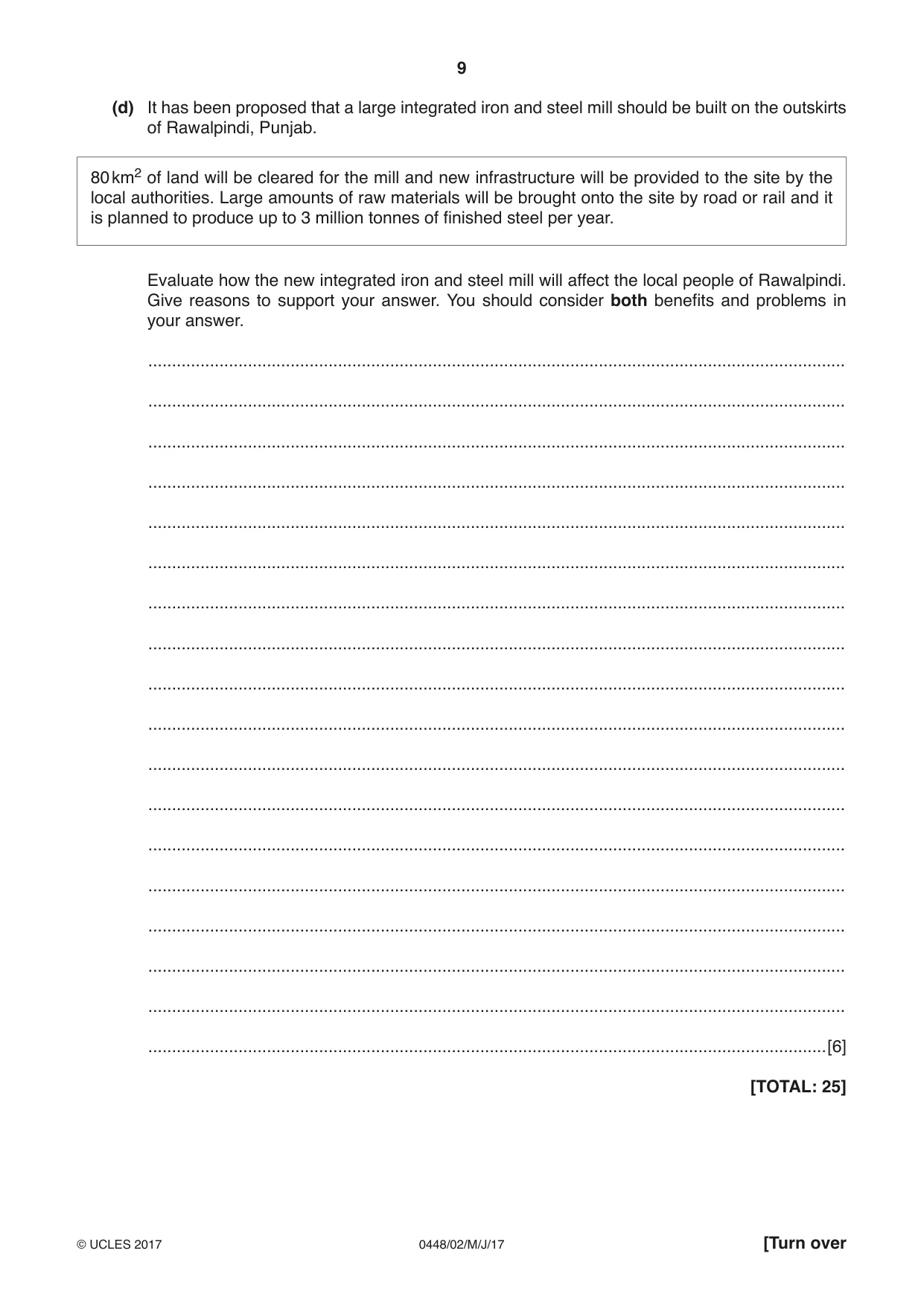
2 (a) Study Fig. 2, which shows changes in road type in Pakistan over a 15-year period. 1998–99 2013–14 0% 0% 90% 10% 90% 10% 80% 20% 80% 20% 70% 30% 70% 30% 60% 40% 60% 40% 50% 50% Key: Metalled Unmetalled Fig. 2 (i) Complete the pie chart for 2013–14 by using the following information and the key provided: Road type Percent Metalled 73 Unmetalled 27 [2] (ii) State the increase in the percentage of metalled roads in Pakistan between 1998–99 and 2013–14. .......................................................................................................................................[1] (iii) Suggest two advantages of developing the motorway network in Pakistan. 1 ........................................................................................................................................ ........................................................................................................................................... 2 ........................................................................................................................................ .......................................................................................................................................[2] (iv) Explain the difficulties of building roads in the desert areas of Pakistan. You should develop your answer. ........................................................................................................................................... ........................................................................................................................................... ........................................................................................................................................... ........................................................................................................................................... ........................................................................................................................................... ........................................................................................................................................... ........................................................................................................................................... .......................................................................................................................................[4] (b) Study Photographs B and C (Insert), which show typical working scenes in rural areas. (i) Using Photograph B and your own knowledge, describe how bricks are made in rural areas. ........................................................................................................................................... ........................................................................................................................................... ........................................................................................................................................... ........................................................................................................................................... ........................................................................................................................................... .......................................................................................................................................[3] (ii) Describe the work being done in Photograph C. ........................................................................................................................................... ........................................................................................................................................... ........................................................................................................................................... .......................................................................................................................................[2] (c) (i) Why is employment in urban areas considered to be more attractive than employment in rural areas? ........................................................................................................................................... ........................................................................................................................................... ........................................................................................................................................... .......................................................................................................................................[2] (ii) State three pull factors that attract migrants to urban areas other than for work. 1 ......................................................................................................................................... ........................................................................................................................................... 2 ........................................................................................................................................ ........................................................................................................................................... 3 ........................................................................................................................................ .......................................................................................................................................[3] (d) It has been proposed that a large integrated iron and steel mill should be built on the outskirts of Rawalpindi, Punjab. 80 km2 of land will be cleared for the mill and new infrastructure will be provided to the site by the local authorities. Large amounts of raw materials will be brought onto the site by road or rail and it is planned to produce up to 3 million tonnes of finished steel per year. Evaluate how the new integrated iron and steel mill will affect the local people of Rawalpindi. Give reasons to support your answer. You should consider both benefits and problems in your answer. ................................................................................................................................................... ................................................................................................................................................... ................................................................................................................................................... ................................................................................................................................................... ................................................................................................................................................... ................................................................................................................................................... ................................................................................................................................................... ................................................................................................................................................... ................................................................................................................................................... ................................................................................................................................................... ................................................................................................................................................... ................................................................................................................................................... ................................................................................................................................................... ................................................................................................................................................... ................................................................................................................................................... ................................................................................................................................................... ................................................................................................................................................... ...............................................................................................................................................[6] [TOTAL: 25]
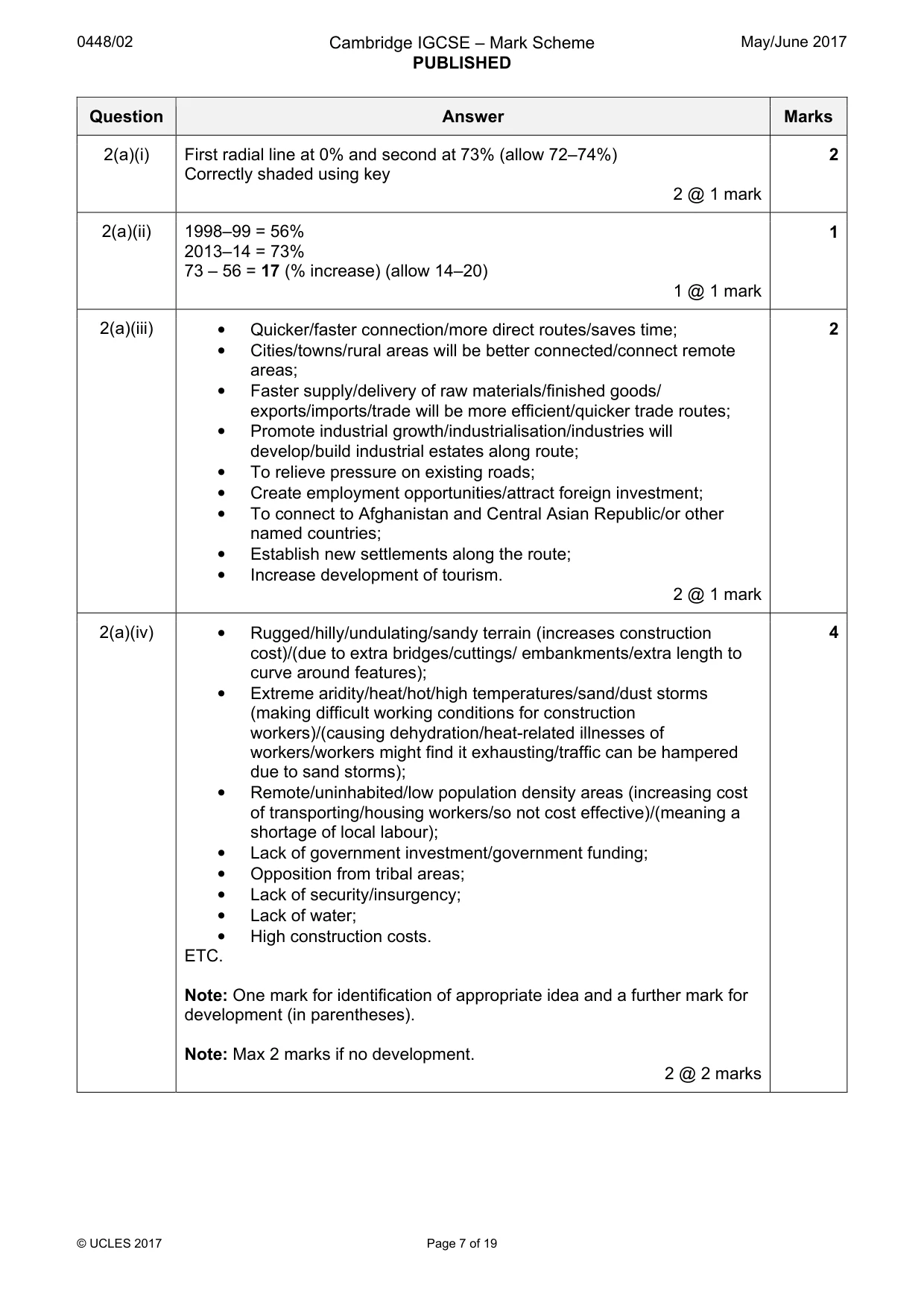
Mark scheme: 2(a)(i) First radial line at 0% and second at 73% (allow 72–74%) 2 Correctly shaded using key 2 @ 1 mark 2(a)(ii) 1998–99 = 56% 1 2013–14 = 73% 73 – 56 = 17 (% increase) (allow 14–20) 1 @ 1 mark 2(a)(iii) • Quicker/faster connection/more direct routes/saves time; 2 • Cities/towns/rural areas will be better connected/connect remote areas; • Faster supply/delivery of raw materials/finished goods/ exports/imports/trade will be more efficient/quicker trade routes; • Promote industrial growth/industrialisation/industries will develop/build industrial estates along route; • To relieve pressure on existing roads; • Create employment opportunities/attract foreign investment; • To connect to Afghanistan and Central Asian Republic/or other named countries; • Establish new settlements along the route; • Increase development of tourism. 2 @ 1 mark 2(a)(iv) • Rugged/hilly/undulating/sandy terrain (increases construction 4 cost)/(due to extra bridges/cuttings/ embankments/extra length to curve around features); • Extreme aridity/heat/hot/high temperatures/sand/dust storms (making difficult working conditions for construction workers)/(causing dehydration/heat-related illnesses of workers/workers might find it exhausting/traffic can be hampered due to sand storms); • Remote/uninhabited/low population density areas (increasing cost of transporting/housing workers/so not cost effective)/(meaning a shortage of local labour); • Lack of government investment/government funding; • Opposition from tribal areas; • Lack of security/insurgency; • Lack of water; • High construction costs. ETC. Note: One mark for identification of appropriate idea and a further mark for development (in parentheses). Note: Max 2 marks if no development. 2 @ 2 marks 2(b)(i) • Mixing clay with water; 3 • Placing mixture into rectangular moulds/mould the clay/moulded into brick shape/cuboid shape/put into stencils/blocks; • Leaving to dry in sunlight; • Firing/baking in kilns/furnace/heated in kilns to harden them/baked/heated in a furnace. Note: Processes do not have to be in the correct order. 3 @ 1 mark 2(b)(ii) • Harvesting/cutting; 2 • Collecting in bales/bundling together/stacking/tying them; • Laborious/carrying/lifting/picking up; • Manual work/done by hand. 2 @ 1 mark 2(c)(i) • High salary/salaries higher/more work-related benefits/promotion 2 available/handsome salaries; • Salaries more regular/stable/livelihood less at risk/fixed wages; • Better working conditions/examples, e.g. AC/more likely to be indoors/offices/factories; • Less likely to be manual/more likely to be higher skilled; • Perceived abundance of work available/wider variety of jobs/more job opportunities; • Fixed/regular hours/year round/contract. 2 @ 1 mark 2(c)(ii) • Higher/better education/better/more schools/universities/ colleges; 3 • More/better hospitals/greater access to healthcare; • Better housing/or examples, e.g. brick built housing; • Named better infrastructure transport/roads/railways; • Better/more regular supply of electricity/gas; • Improved/better sanitation/sewage systems; • Piped/clean/drinking/regular supply/potable water; • More entertainment/recreation/leisure facilities or named examples, e.g. cinema; • Variety of shops/shopping malls; • Reliable access to food/more food available/more regular food supply; • Bright lights/glamorous lifestyle. 3 @ 1 mark 2(d) Levels marking 6 Level 1 (1–2 marks) Simple point addressing either a problem or benefit (1). Simple points addressing either problems or benefits or both (2). Level 2 (3–4 marks) Developed point(s) explaining either problems or benefits (3). Developed point(s) explaining both problems and benefits (4). No evaluation. Level 3 (5–6 marks) Developed points explaining both problems and benefits. Evaluation giving clear support to problems or benefits or a named example (5). Developed points explaining both problems and benefits. Evaluation giving clear support to problems or benefits and a named example (6). Content Guide: Answers are likely to refer to: Benefits • Employment opportunities • Improvements to roads/other infrastructure • New settlements • Educational/recreational facilities • More trade for local shops • More work for local ancillary/related industries Problems • Farmland/grazing • Air pollution/dust from chimneys, etc. • Visual pollution/eyesore • Roads/railways congested • Attracts migrants • Uses large amounts of water/power ETC. Note: Answers must relate to local people not the nation.
Question 3
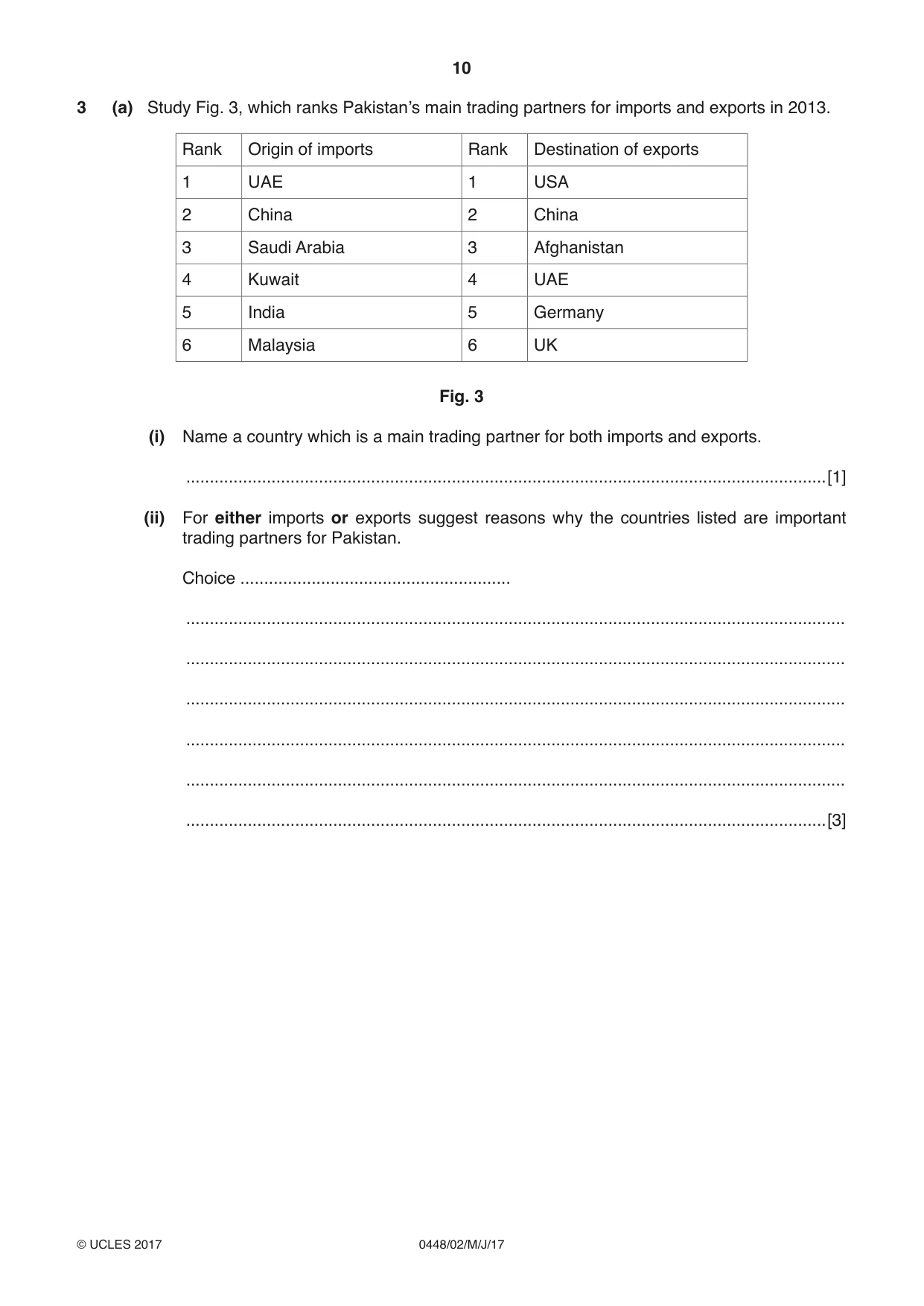
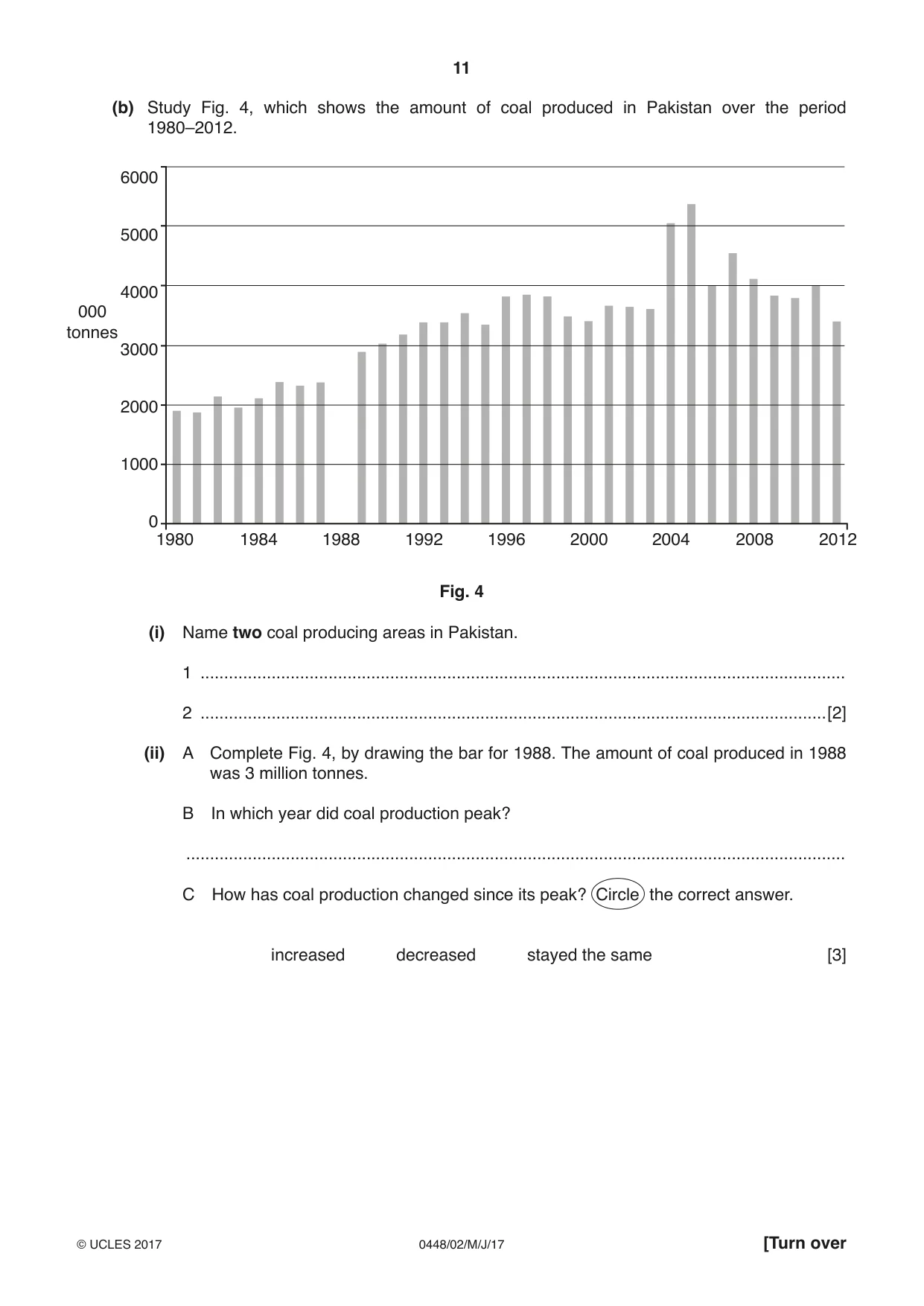
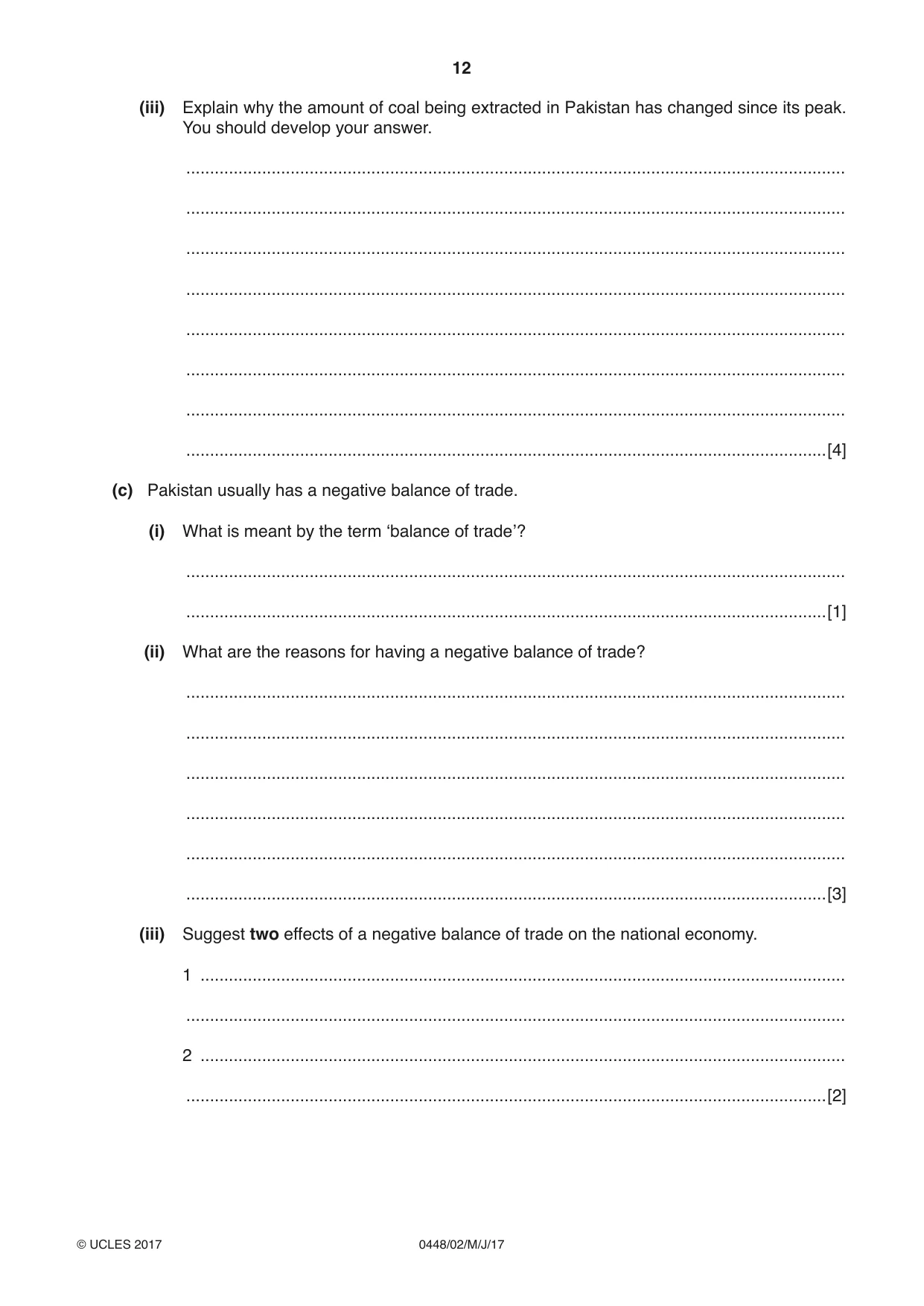
3 (a) Study Fig. 3, which ranks Pakistan’s main trading partners for imports and exports in 2013. Rank Origin of imports Rank Destination of exports 1 UAE 1 USA 2 China 2 China 3 Saudi Arabia 3 Afghanistan 4 Kuwait 4 UAE 5 India 5 Germany 6 Malaysia 6 UK Fig. 3 (i) Name a country which is a main trading partner for both imports and exports. .......................................................................................................................................[1] (ii) For either imports or exports suggest reasons why the countries listed are important trading partners for Pakistan. Choice ......................................................... ........................................................................................................................................... ........................................................................................................................................... ........................................................................................................................................... ........................................................................................................................................... ........................................................................................................................................... .......................................................................................................................................[3] (b) Study Fig. 4, which shows the amount of coal produced in Pakistan over the period 1980–2012. 6000 5000 4000 000 tonnes 3000 2000 1000 0 1980 1984 1988 1992 1996 2000 2004 2008 2012 Fig. 4 (i) Name two coal producing areas in Pakistan. 1 ........................................................................................................................................ 2 ....................................................................................................................................[2] (ii) A Complete Fig. 4, by drawing the bar for 1988. The amount of coal produced in 1988 was 3 million tonnes. B In which year did coal production peak? ........................................................................................................................................... C How has coal production changed since its peak? Circle the correct answer. increased decreased stayed the same [3] (iii) Explain why the amount of coal being extracted in Pakistan has changed since its peak. You should develop your answer. ........................................................................................................................................... ........................................................................................................................................... ........................................................................................................................................... ........................................................................................................................................... ........................................................................................................................................... ........................................................................................................................................... ........................................................................................................................................... .......................................................................................................................................[4] (c) Pakistan usually has a negative balance of trade. (i) What is meant by the term ‘balance of trade’? ........................................................................................................................................... .......................................................................................................................................[1] (ii) What are the reasons for having a negative balance of trade? ........................................................................................................................................... ........................................................................................................................................... ........................................................................................................................................... ........................................................................................................................................... ........................................................................................................................................... .......................................................................................................................................[3] (iii) Suggest two effects of a negative balance of trade on the national economy. 1 ........................................................................................................................................ ........................................................................................................................................... 2 ........................................................................................................................................ .......................................................................................................................................[2] (d) Evaluate whether using global telecommunications has improved employment opportunities in Pakistan. Give reasons to support your answer and refer to examples you have studied. You should consider different points of view in your answer. ................................................................................................................................................... ................................................................................................................................................... ................................................................................................................................................... ................................................................................................................................................... ................................................................................................................................................... ................................................................................................................................................... ................................................................................................................................................... ................................................................................................................................................... ................................................................................................................................................... ................................................................................................................................................... ................................................................................................................................................... ................................................................................................................................................... ................................................................................................................................................... ................................................................................................................................................... ................................................................................................................................................... ................................................................................................................................................... ................................................................................................................................................... ...............................................................................................................................................[6] [TOTAL: 25]
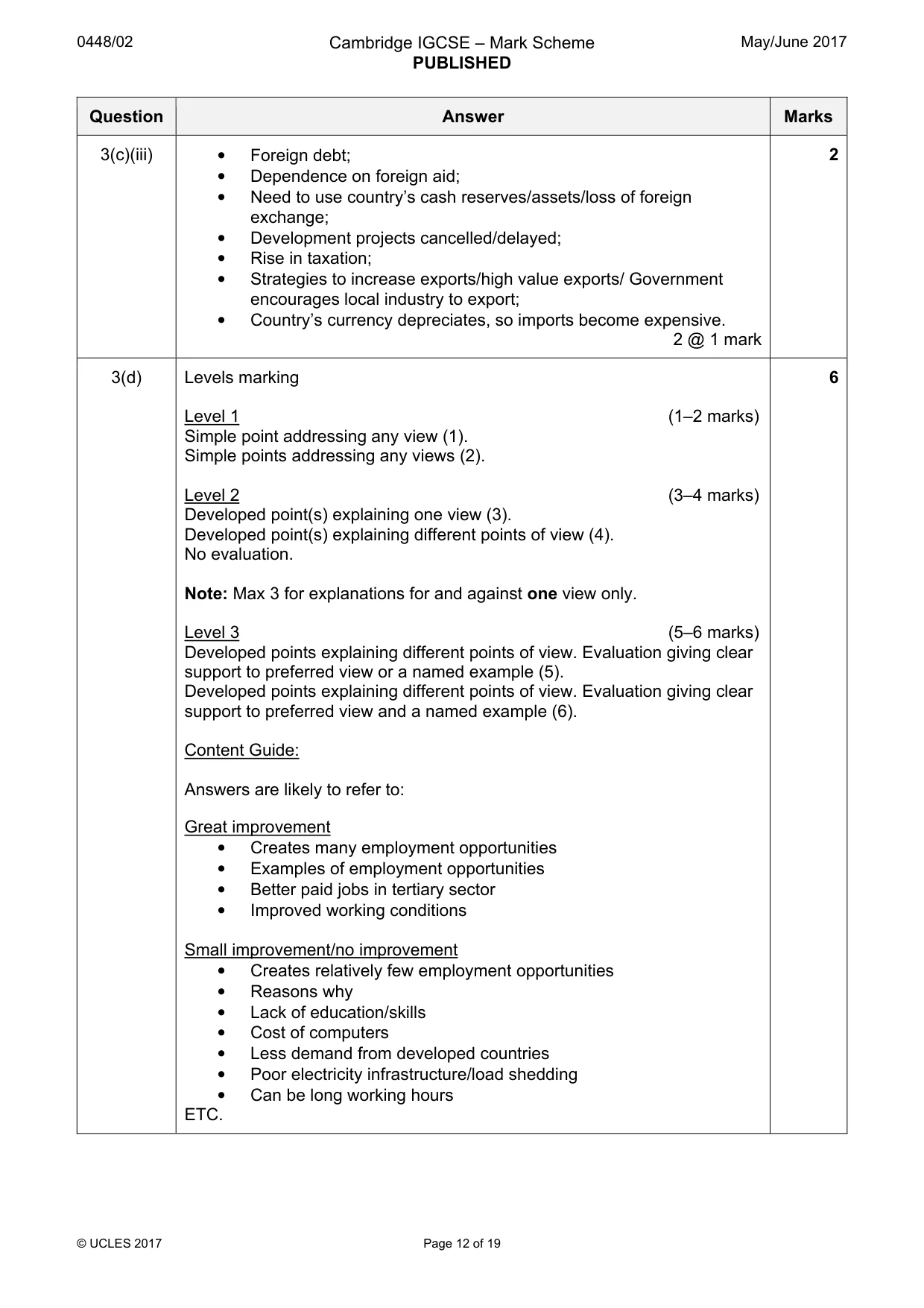
Mark scheme: 3(a)(i) China / UAE 1 1 @ 1 mark 3(a)(ii) Imports 3 • China/India – regional superpower/strong economy/neighbouring country/has land links; • China/India – source of capital/manufactured goods/ technological goods/import machinery; • UAE/Kuwait/Saudi Arabia – source of oil; • Malaysia – source of palm oil; • India – source of primary commodities, e.g. fruit and vegetables. Exports • Any named country – increased sales/markets/market share/enlarge market share; • China/Afghanistan – neighbouring countries with land links; • Afghanistan – foodstuffs such as rice, sugar; • China – to maintain relations/political ties with regional superpower; • UAE – nearby country via sea/Arabian Sea/Makran Coast; • USA/Germany/UK – developed economies raw materials, e.g. cotton yarn/woven cloth or manufactured goods, e.g. sports goods, linen, suits. Note: Country must be named plus import or export. Note: No additional products or countries allowed. 3 @ 1 mark 3(b)(i) • Lower/S Sindh/Lakhra/Jhimpir/Sonda/Thar/Thar desert; 2 • N/NW Balochistan/Quetta/Sor/Mach/Degari/Khost/ Shahrig/Harnal/Duki/Chamalang; • Salt Range/Dandot Pidh/Potwar plateau; • Makerwal. 2 @ 1 mark 3(b)(ii) A Bar accurately drawn on Fig. 4 3 B 2005 C Decreased Note: Width within demarcations and height must touch the 3m line. 3 @ 1 mark 3(b)(iii) • Existing coalfields becoming exhausted/existing coal measures 4 becoming harder to access (therefore increasing cost of extraction); • High cost of extraction/exploration/equipment/ technology (leads to indebtedness); • Lack of government funding (which a developing country with high population growth cannot afford); • Lack of/poor transport links to/from coal producing areas/potential coal producing areas (which discourages further investment); • Lack of skilled/highly trained labour (therefore requiring expensive foreign expertise); • Insurgency/lack of security (which discourages foreign mining companies from operating/investing); • Decreased demand for fossil fuels/change to cleaner fuels/renewables (due to world agreements/targets); • Coal from Pakistan is low grade (so has to be imported from other countries); • Domestically replacing coal with gas (as Pakistan has many gas fields, e.g. at Sui/one of largest in world); • Change from coal to oil/diesel for trains (due to partition). ETC. Note: One mark for identification of appropriate idea and a further mark for development (in parentheses). Note: Max 2 marks if no development. 2 @ 2 marks 3(c)(i) The difference between the value of goods imported and exported by a 1 country/the value of imports subtracted from exports/the value of exports minus imports. 1 @ 1 mark 3(c)(ii) • Value of goods imported is more than the value of goods exported; 3 • Uncompetitive quality/low quality of exports; • Unable to fulfil domestic needs of population; • Import tariffs/quotas in other countries; • Dependency on import of capital goods/machinery/ oil/high value added goods; • Dependency on importing/exporting agricultural products/food/named examples; • Depreciating own currency/rupee against dollar; • Trade embargoes imposed by other countries. 3 @ 1 mark 3(c)(iii) • Foreign debt; 2 • Dependence on foreign aid; • Need to use country’s cash reserves/assets/loss of foreign exchange; • Development projects cancelled/delayed; • Rise in taxation; • Strategies to increase exports/high value exports/ Government encourages local industry to export; • Country’s currency depreciates, so imports become expensive. 2 @ 1 mark 3(d) Levels marking 6 Level 1 (1–2 marks) Simple point addressing any view (1). Simple points addressing any views (2). Level 2 (3–4 marks) Developed point(s) explaining one view (3). Developed point(s) explaining different points of view (4). No evaluation. Note: Max 3 for explanations for and against one view only. Level 3 (5–6 marks) Developed points explaining different points of view. Evaluation giving clear support to preferred view or a named example (5). Developed points explaining different points of view. Evaluation giving clear support to preferred view and a named example (6). Content Guide: Answers are likely to refer to: Great improvement • Creates many employment opportunities • Examples of employment opportunities • Better paid jobs in tertiary sector • Improved working conditions Small improvement/no improvement • Creates relatively few employment opportunities • Reasons why • Lack of education/skills • Cost of computers • Less demand from developed countries • Poor electricity infrastructure/load shedding • Can be long working hours ETC.
Question 4
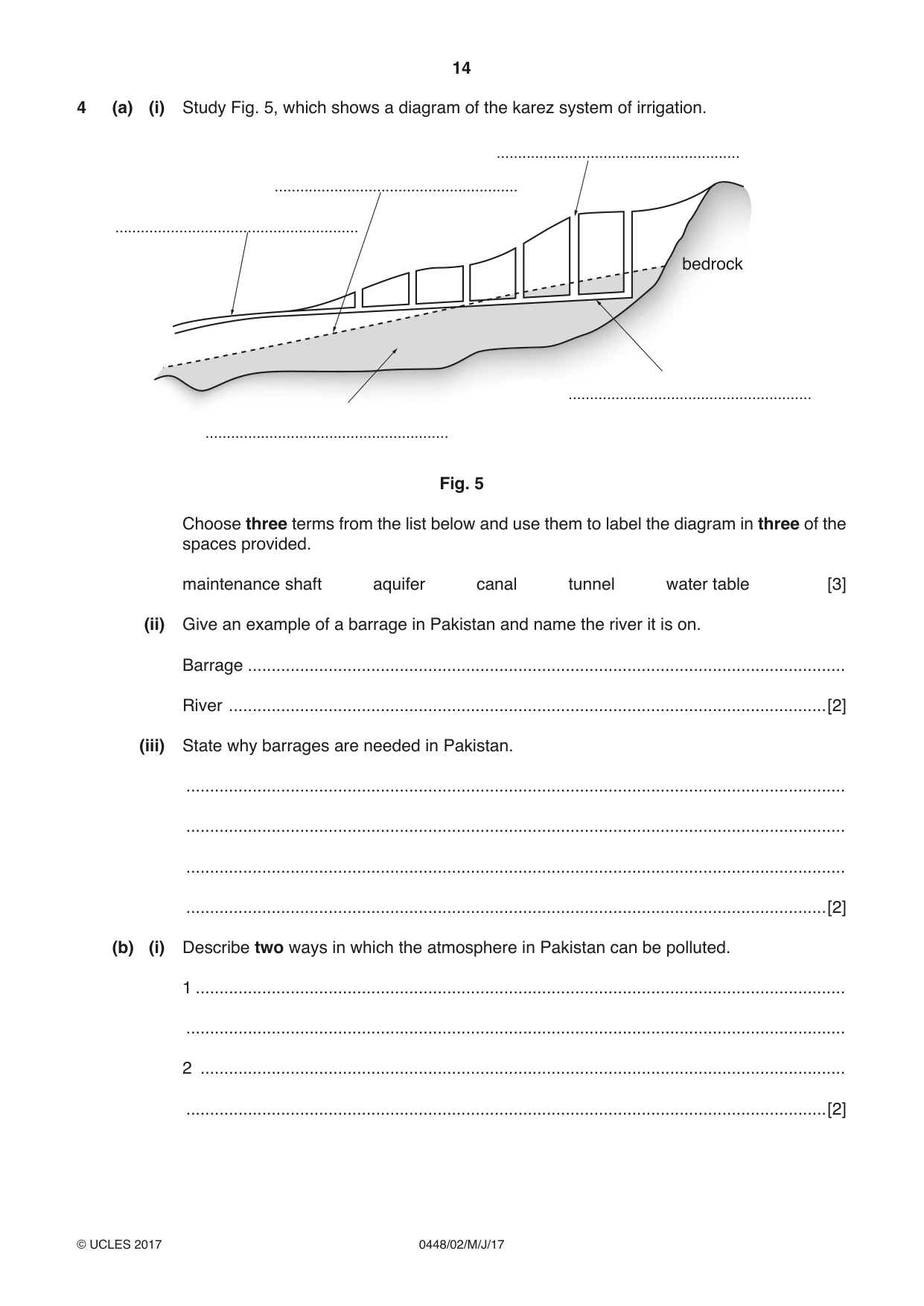
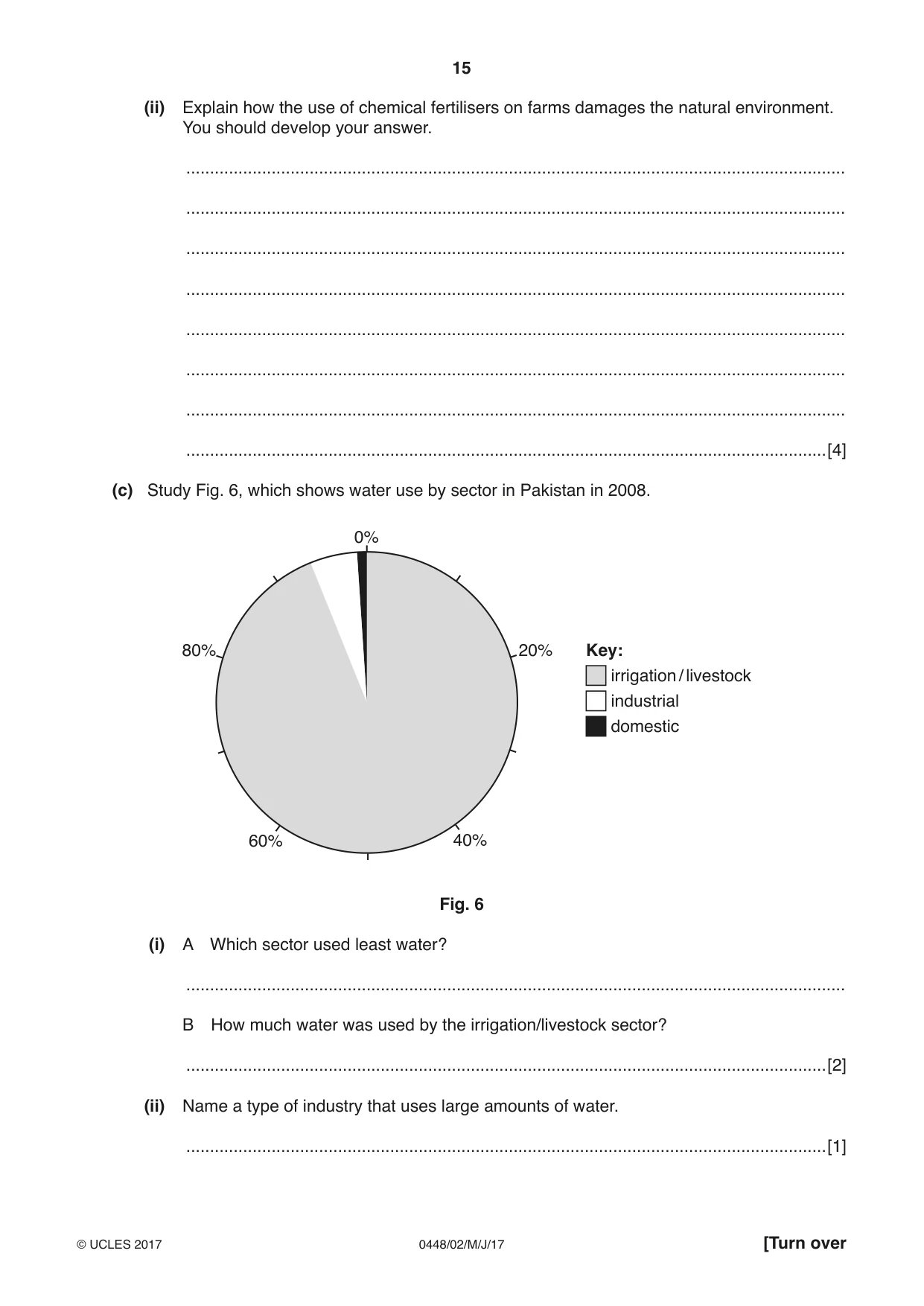
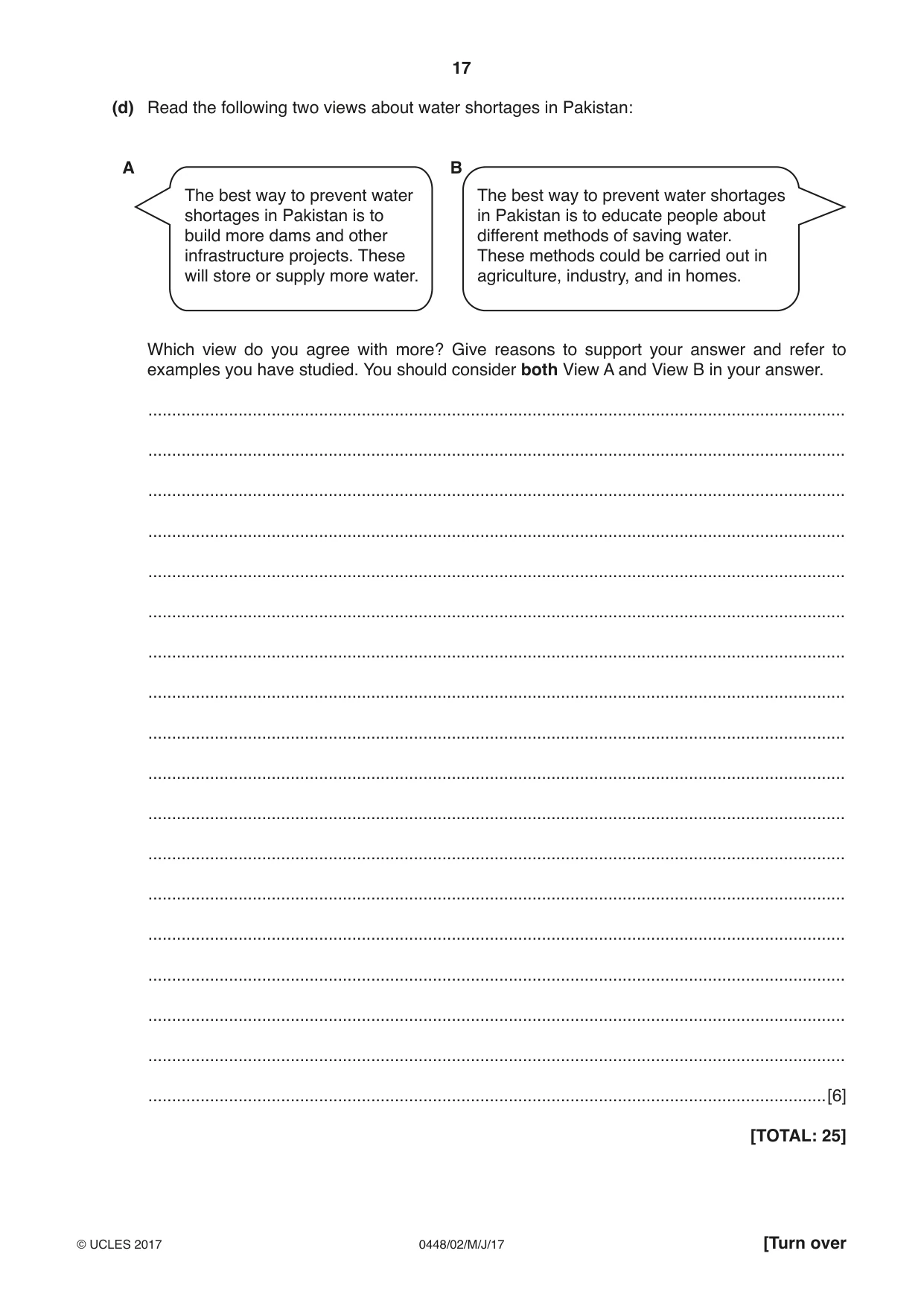
4 (a) (i) Study Fig. 5, which shows a diagram of the karez system of irrigation. ......................................................... ......................................................... ......................................................... bedrock ......................................................... ......................................................... Fig. 5 Choose three terms from the list below and use them to label the diagram in three of the spaces provided. maintenance shaft aquifer canal tunnel water table [3] (ii) Give an example of a barrage in Pakistan and name the river it is on. Barrage .............................................................................................................................. River ..............................................................................................................................[2] (iii) State why barrages are needed in Pakistan. ........................................................................................................................................... ........................................................................................................................................... ........................................................................................................................................... .......................................................................................................................................[2] (b) (i) Describe two ways in which the atmosphere in Pakistan can be polluted. 1 ......................................................................................................................................... ........................................................................................................................................... 2 ........................................................................................................................................ .......................................................................................................................................[2] (ii) Explain how the use of chemical fertilisers on farms damages the natural environment. You should develop your answer. ........................................................................................................................................... ........................................................................................................................................... ........................................................................................................................................... ........................................................................................................................................... ........................................................................................................................................... ........................................................................................................................................... ........................................................................................................................................... .......................................................................................................................................[4] (c) Study Fig. 6, which shows water use by sector in Pakistan in 2008. 0% 80% 20% Key: irrigation / livestock industrial domestic 60% 40% Fig. 6 (i) A Which sector used least water? ........................................................................................................................................... B How much water was used by the irrigation/livestock sector? .......................................................................................................................................[2] (ii) Name a type of industry that uses large amounts of water. .......................................................................................................................................[1] (iii) About 60% of irrigation water is lost before it reaches crops. Give three reasons why irrigation water is lost in this way. 1 ........................................................................................................................................ ........................................................................................................................................... 2 ........................................................................................................................................ ........................................................................................................................................... 3 ........................................................................................................................................ .......................................................................................................................................[3] (d) Read the following two views about water shortages in Pakistan: A B The best way to prevent water The best way to prevent water shortages shortages in Pakistan is to in Pakistan is to educate people about build more dams and other different methods of saving water. infrastructure projects. These These methods could be carried out in will store or supply more water. agriculture, industry, and in homes. Which view do you agree with more? Give reasons to support your answer and refer to examples you have studied. You should consider both View A and View B in your answer. ................................................................................................................................................... ................................................................................................................................................... ................................................................................................................................................... ................................................................................................................................................... ................................................................................................................................................... ................................................................................................................................................... ................................................................................................................................................... ................................................................................................................................................... ................................................................................................................................................... ................................................................................................................................................... ................................................................................................................................................... ................................................................................................................................................... ................................................................................................................................................... ................................................................................................................................................... ................................................................................................................................................... ................................................................................................................................................... ................................................................................................................................................... ...............................................................................................................................................[6] [TOTAL: 25]
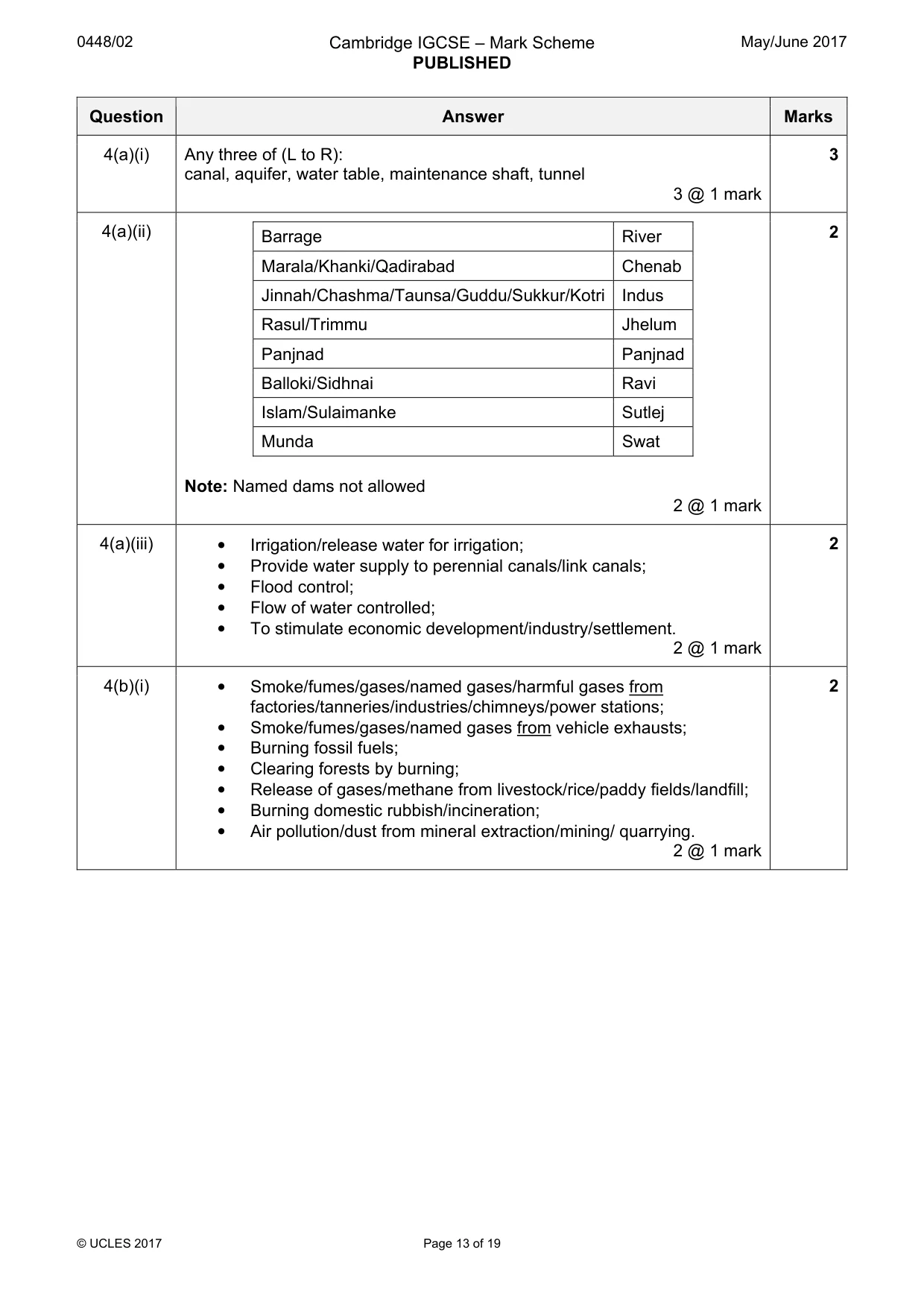
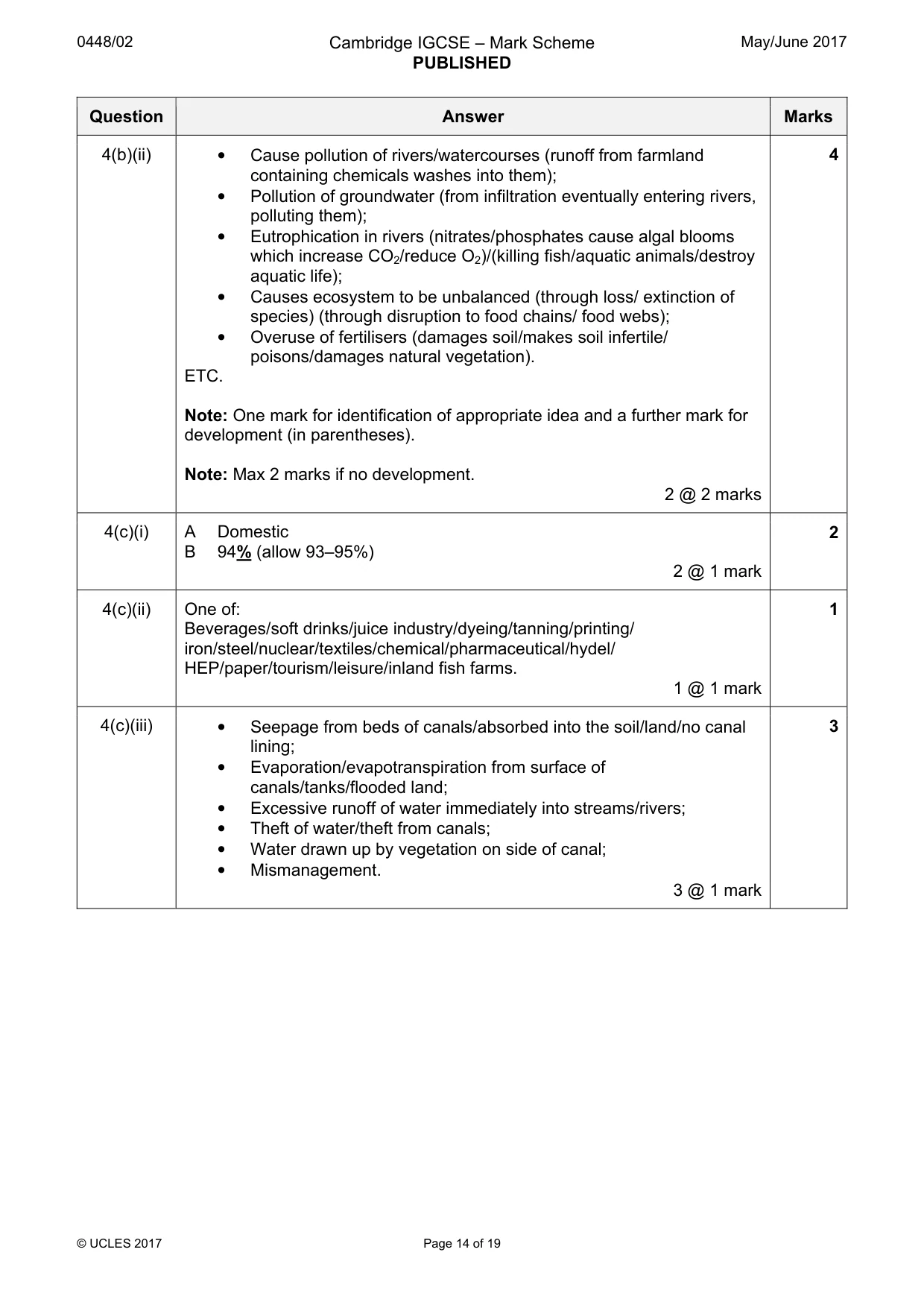
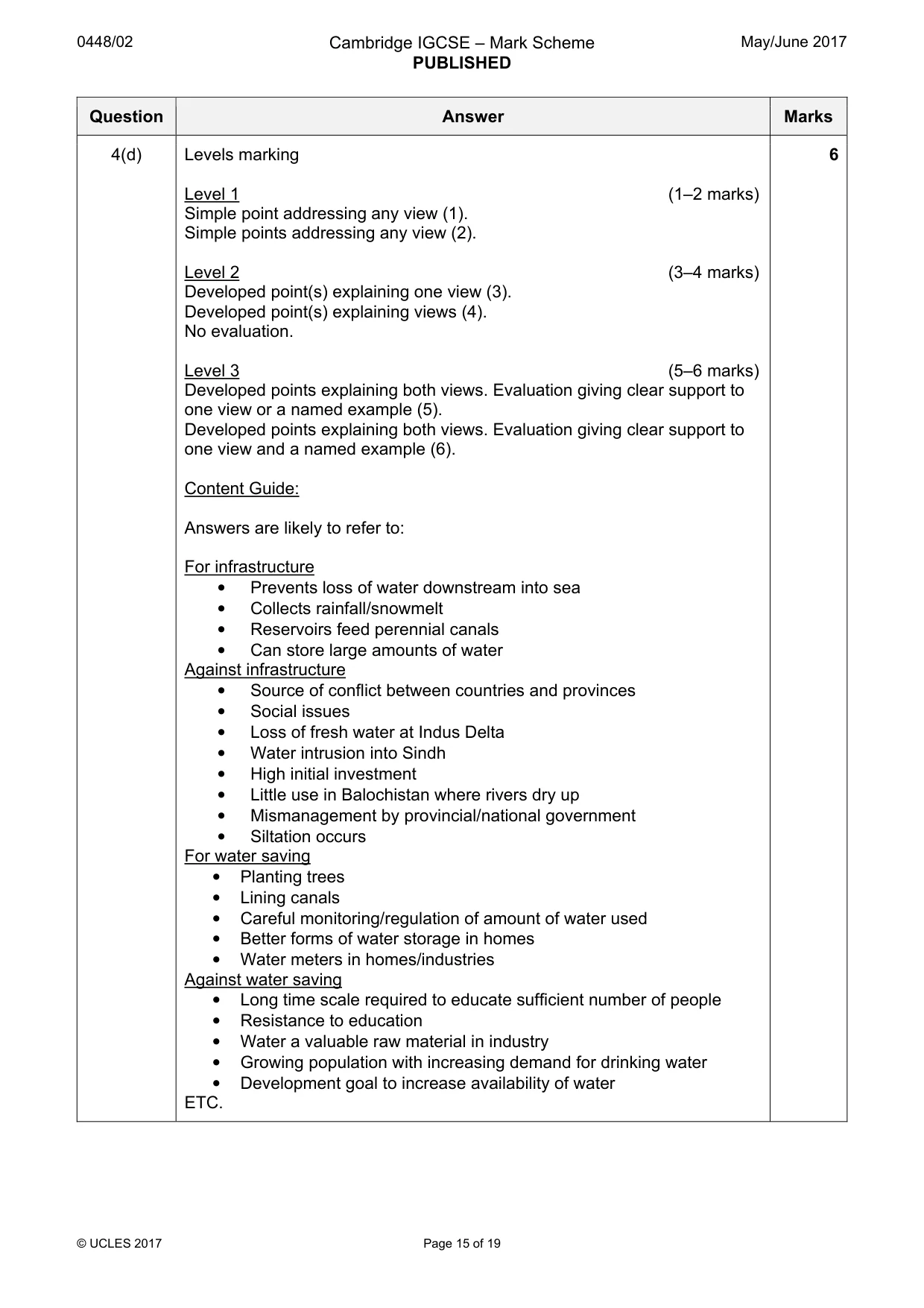
Mark scheme: 4(a)(i) Any three of (L to R): 3 canal, aquifer, water table, maintenance shaft, tunnel 3 @ 1 mark 4(a)(ii) 2 Barrage River Marala/Khanki/Qadirabad Chenab Jinnah/Chashma/Taunsa/Guddu/Sukkur/Kotri Indus Rasul/Trimmu Jhelum Panjnad Panjnad Balloki/Sidhnai Ravi Islam/Sulaimanke Sutlej Munda Swat Note: Named dams not allowed 2 @ 1 mark 4(a)(iii) • Irrigation/release water for irrigation; 2 • Provide water supply to perennial canals/link canals; • Flood control; • Flow of water controlled; • To stimulate economic development/industry/settlement. 2 @ 1 mark 4(b)(i) • Smoke/fumes/gases/named gases/harmful gases from 2 factories/tanneries/industries/chimneys/power stations; • Smoke/fumes/gases/named gases from vehicle exhausts; • Burning fossil fuels; • Clearing forests by burning; • Release of gases/methane from livestock/rice/paddy fields/landfill; • Burning domestic rubbish/incineration; • Air pollution/dust from mineral extraction/mining/ quarrying. 2 @ 1 mark 4(b)(ii) • Cause pollution of rivers/watercourses (runoff from farmland 4 containing chemicals washes into them); • Pollution of groundwater (from infiltration eventually entering rivers, polluting them); • Eutrophication in rivers (nitrates/phosphates cause algal blooms which increase CO2/reduce O2)/(killing fish/aquatic animals/destroy aquatic life); • Causes ecosystem to be unbalanced (through loss/ extinction of species) (through disruption to food chains/ food webs); • Overuse of fertilisers (damages soil/makes soil infertile/ poisons/damages natural vegetation). ETC. Note: One mark for identification of appropriate idea and a further mark for development (in parentheses). Note: Max 2 marks if no development. 2 @ 2 marks 4(c)(i) A Domestic 2 B 94% (allow 93–95%) 2 @ 1 mark 4(c)(ii) One of: 1 Beverages/soft drinks/juice industry/dyeing/tanning/printing/ iron/steel/nuclear/textiles/chemical/pharmaceutical/hydel/ HEP/paper/tourism/leisure/inland fish farms. 1 @ 1 mark 4(c)(iii) • Seepage from beds of canals/absorbed into the soil/land/no canal 3 lining; • Evaporation/evapotranspiration from surface of canals/tanks/flooded land; • Excessive runoff of water immediately into streams/rivers; • Theft of water/theft from canals; • Water drawn up by vegetation on side of canal; • Mismanagement. 3 @ 1 mark 4(d) Levels marking 6 Level 1 (1–2 marks) Simple point addressing any view (1). Simple points addressing any view (2). Level 2 (3–4 marks) Developed point(s) explaining one view (3). Developed point(s) explaining views (4). No evaluation. Level 3 (5–6 marks) Developed points explaining both views. Evaluation giving clear support to one view or a named example (5). Developed points explaining both views. Evaluation giving clear support to one view and a named example (6). Content Guide: Answers are likely to refer to: For infrastructure • Prevents loss of water downstream into sea • Collects rainfall/snowmelt • Reservoirs feed perennial canals • Can store large amounts of water Against infrastructure • Source of conflict between countries and provinces • Social issues • Loss of fresh water at Indus Delta • Water intrusion into Sindh • High initial investment • Little use in Balochistan where rivers dry up • Mismanagement by provincial/national government • Siltation occurs For water saving • Planting trees • Lining canals • Careful monitoring/regulation of amount of water used • Better forms of water storage in homes • Water meters in homes/industries Against water saving • Long time scale required to educate sufficient number of people • Resistance to education • Water a valuable raw material in industry • Growing population with increasing demand for drinking water • Development goal to increase availability of water ETC.
Question 5
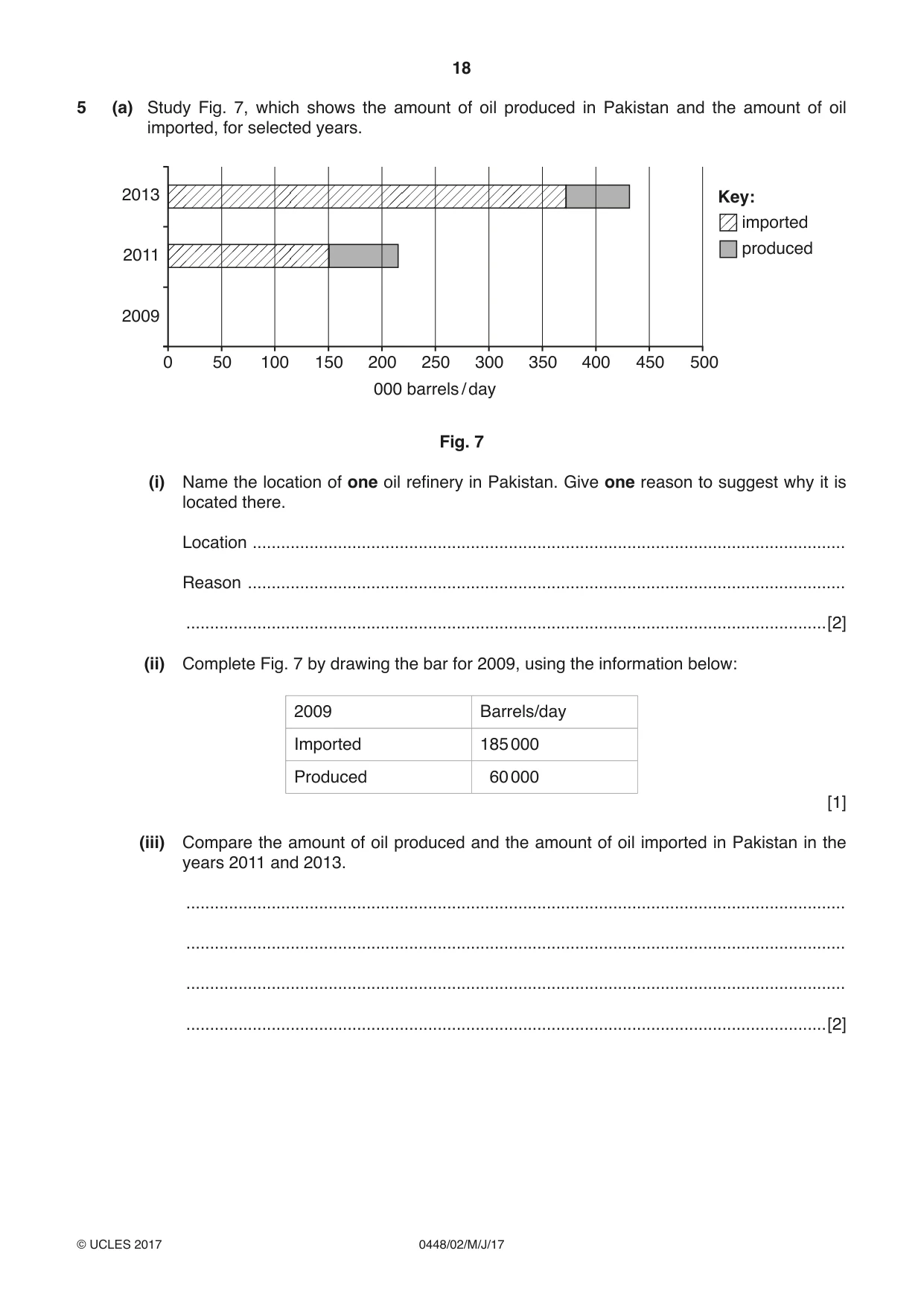
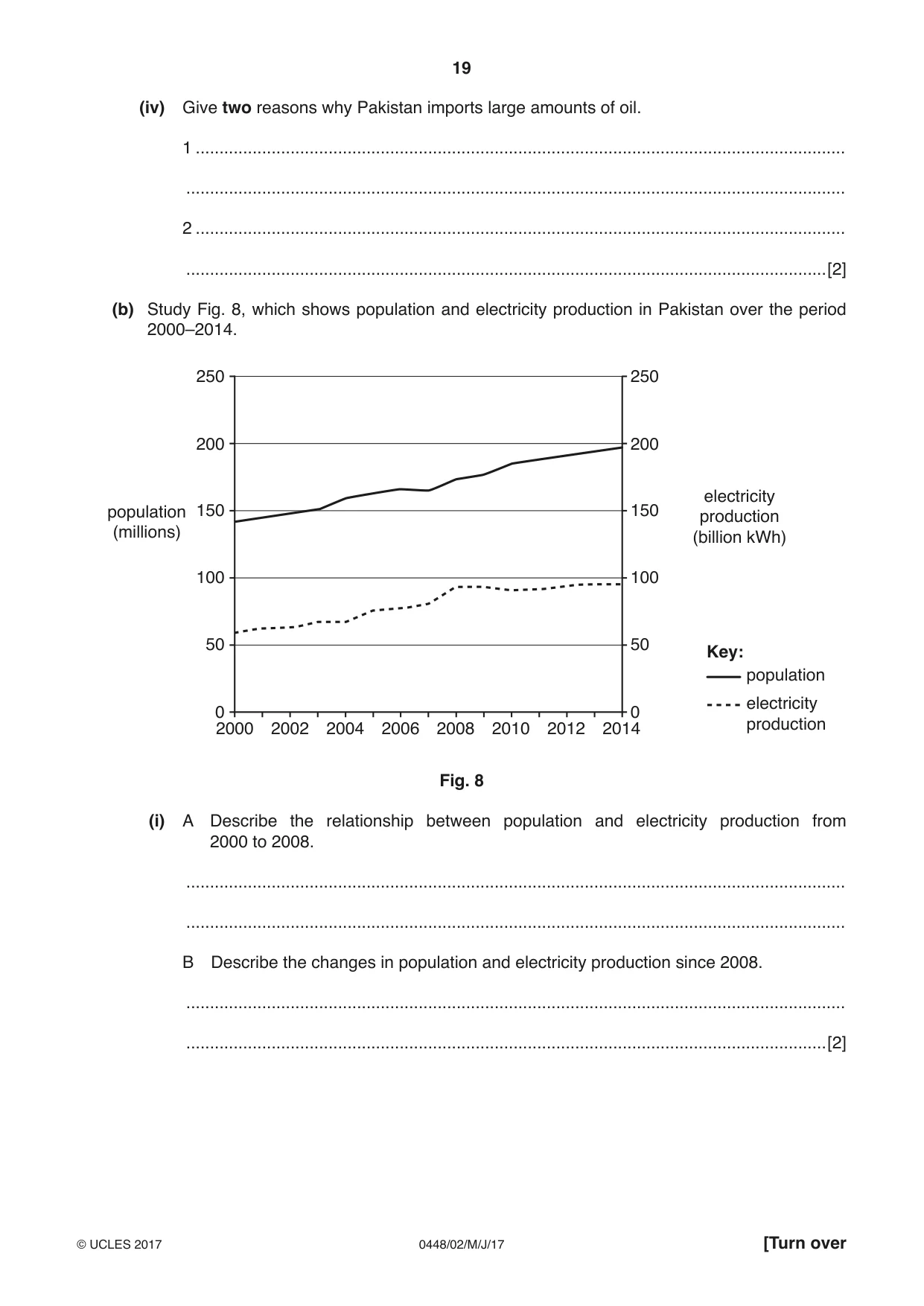
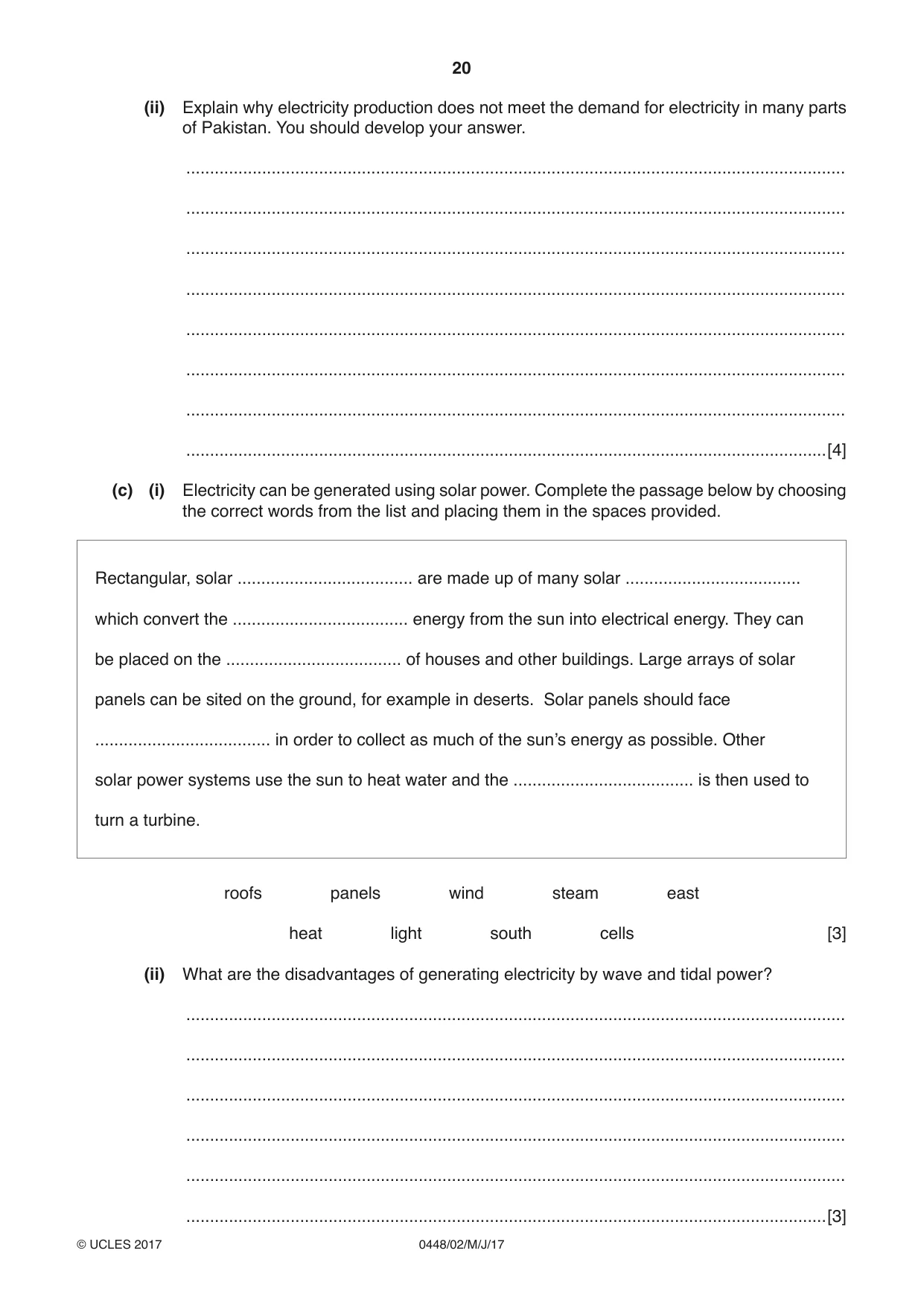
5 (a) Study Fig. 7, which shows the amount of oil produced in Pakistan and the amount of oil imported, for selected years. 2013 Key: imported produced 2011 2009 0 50 100 150 200 250 300 350 400 450 500 000 barrels / day Fig. 7 (i) Name the location of one oil refinery in Pakistan. Give one reason to suggest why it is located there. Location ............................................................................................................................. Reason .............................................................................................................................. .......................................................................................................................................[2] (ii) Complete Fig. 7 by drawing the bar for 2009, using the information below: 2009 Barrels/day Imported 185 000 Produced 60 000 [1] (iii) Compare the amount of oil produced and the amount of oil imported in Pakistan in the years 2011 and 2013. ........................................................................................................................................... ........................................................................................................................................... ........................................................................................................................................... .......................................................................................................................................[2] (iv) Give two reasons why Pakistan imports large amounts of oil. 1 ......................................................................................................................................... ........................................................................................................................................... 2 ......................................................................................................................................... .......................................................................................................................................[2] (b) Study Fig. 8, which shows population and electricity production in Pakistan over the period 2000–2014. 250 250 200 200 electricity population 150 150 production (millions) (billion kWh) 100 100 50 50 Key: population electricity 0 0 2000 2002 2004 2006 2008 2010 2012 2014 production Fig. 8 (i) A Describe the relationship between population and electricity production from 2000 to 2008. ........................................................................................................................................... ........................................................................................................................................... B Describe the changes in population and electricity production since 2008. ........................................................................................................................................... .......................................................................................................................................[2] (ii) Explain why electricity production does not meet the demand for electricity in many parts of Pakistan. You should develop your answer. ........................................................................................................................................... ........................................................................................................................................... ........................................................................................................................................... ........................................................................................................................................... ........................................................................................................................................... ........................................................................................................................................... ........................................................................................................................................... .......................................................................................................................................[4] (c) (i) Electricity can be generated using solar power. Complete the passage below by choosing the correct words from the list and placing them in the spaces provided. Rectangular, solar ..................................... are made up of many solar ..................................... which convert the ..................................... energy from the sun into electrical energy. They can be placed on the ..................................... of houses and other buildings. Large arrays of solar panels can be sited on the ground, for example in deserts. Solar panels should face ..................................... in order to collect as much of the sun’s energy as possible. Other solar power systems use the sun to heat water and the ...................................... is then used to turn a turbine. roofs panels wind steam east heat light south cells [3] (ii) What are the disadvantages of generating electricity by wave and tidal power? ........................................................................................................................................... ........................................................................................................................................... ........................................................................................................................................... ........................................................................................................................................... ...........................................................................................................................................
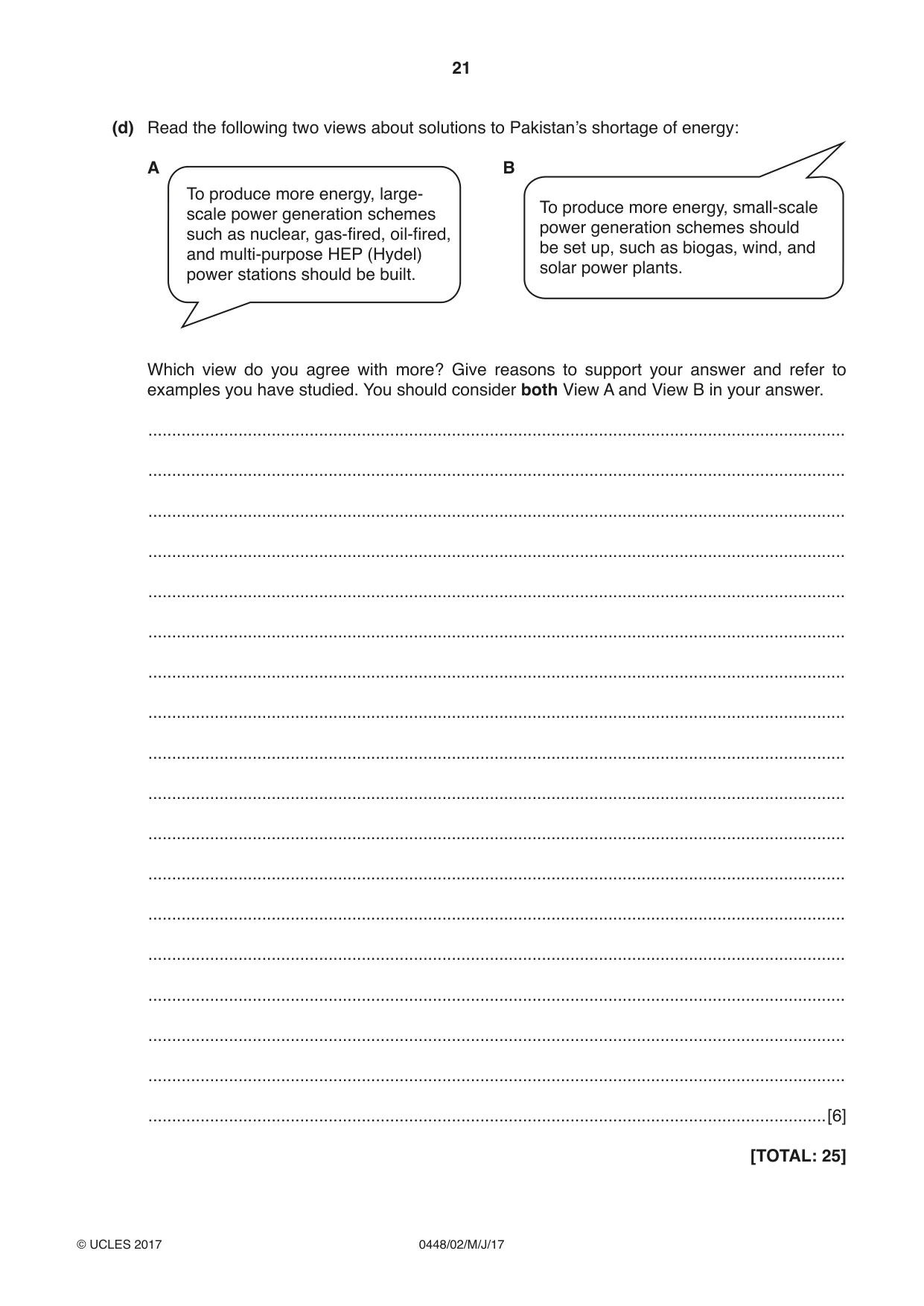
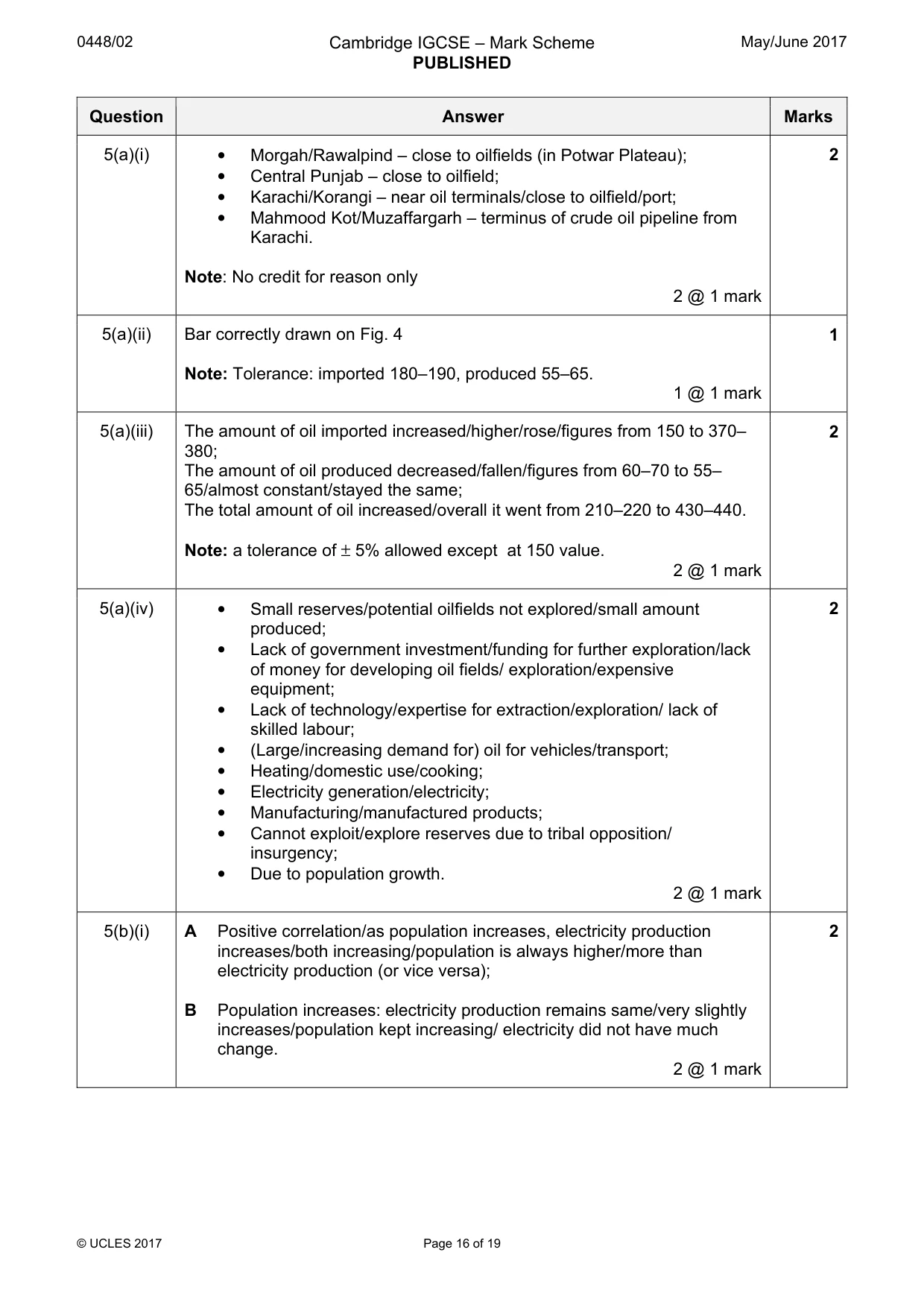
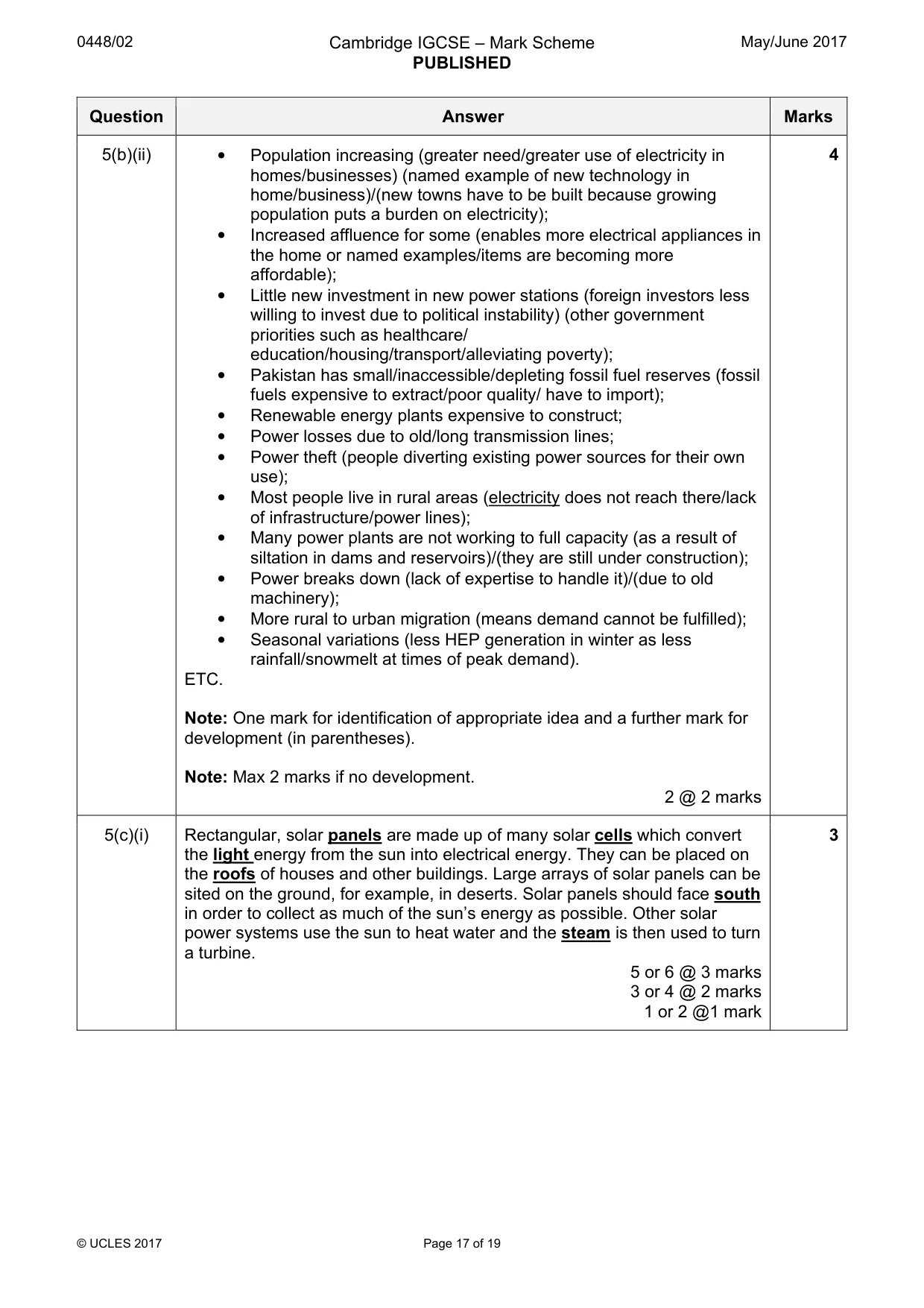
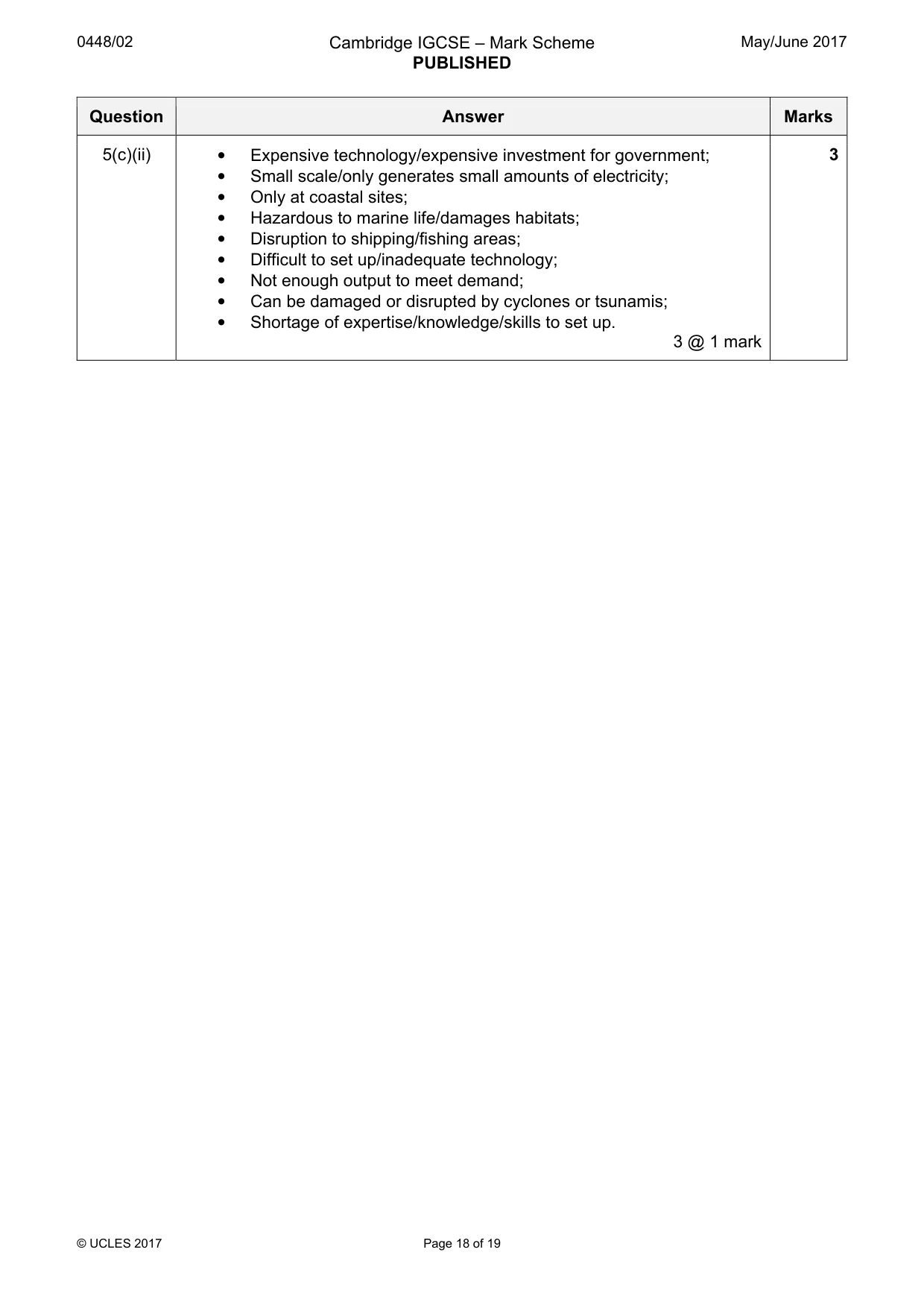
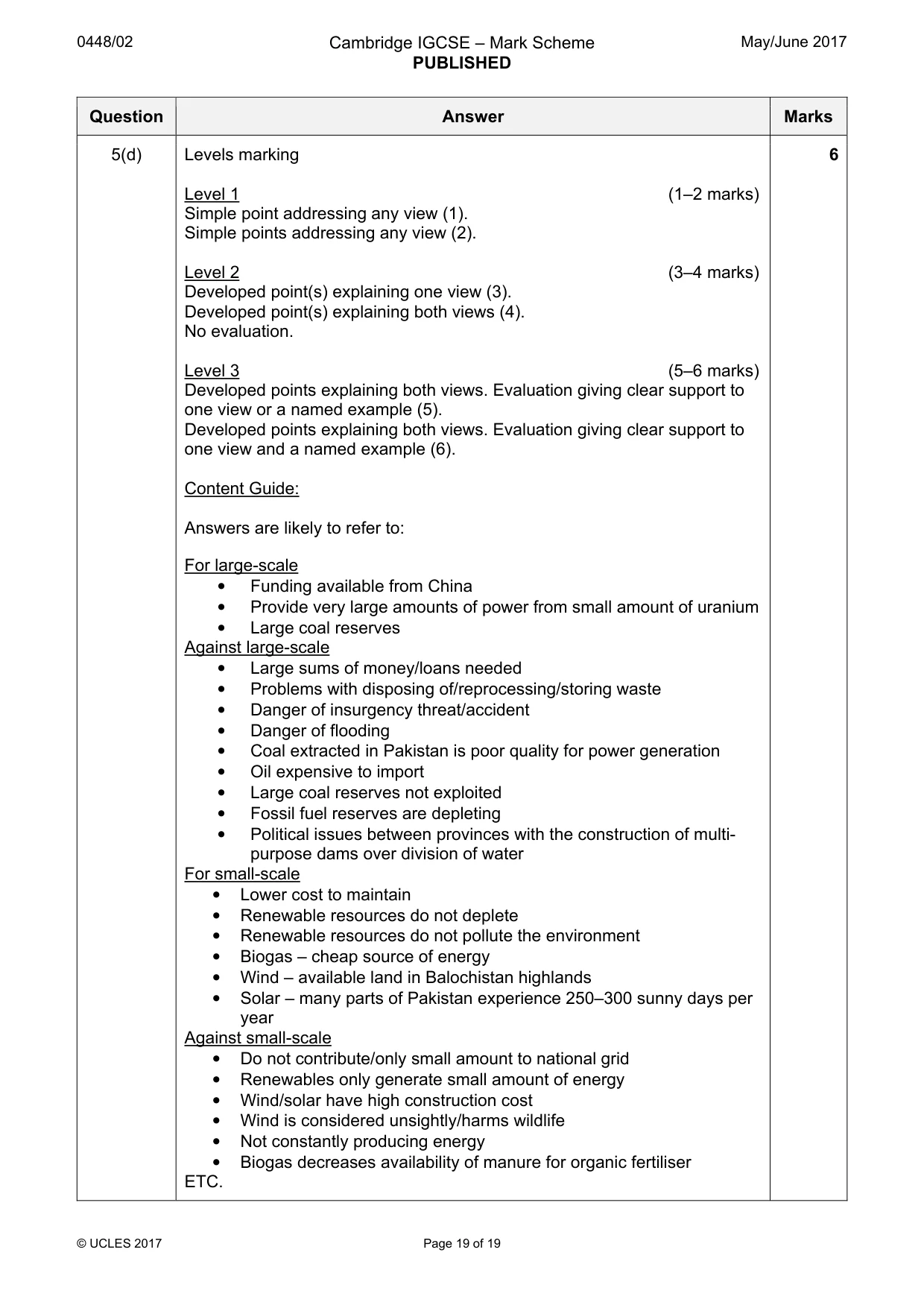
Mark scheme: 5(a)(i) • Morgah/Rawalpind – close to oilfields (in Potwar Plateau); 2 • Central Punjab – close to oilfield; • Karachi/Korangi – near oil terminals/close to oilfield/port; • Mahmood Kot/Muzaffargarh – terminus of crude oil pipeline from Karachi. Note: No credit for reason only 2 @ 1 mark 5(a)(ii) Bar correctly drawn on Fig. 4 1 Note: Tolerance: imported 180–190, produced 55–65. 1 @ 1 mark 5(a)(iii) The amount of oil imported increased/higher/rose/figures from 150 to 370– 2 380; The amount of oil produced decreased/fallen/figures from 60–70 to 55– 65/almost constant/stayed the same; The total amount of oil increased/overall it went from 210–220 to 430–440. Note: a tolerance of ± 5% allowed except at 150 value. 2 @ 1 mark 5(a)(iv) • Small reserves/potential oilfields not explored/small amount 2 produced; • Lack of government investment/funding for further exploration/lack of money for developing oil fields/ exploration/expensive equipment; • Lack of technology/expertise for extraction/exploration/ lack of skilled labour; • (Large/increasing demand for) oil for vehicles/transport; • Heating/domestic use/cooking; • Electricity generation/electricity; • Manufacturing/manufactured products; • Cannot exploit/explore reserves due to tribal opposition/ insurgency; • Due to population growth. 2 @ 1 mark 5(b)(i) A Positive correlation/as population increases, electricity production 2 increases/both increasing/population is always higher/more than electricity production (or vice versa); B Population increases: electricity production remains same/very slightly increases/population kept increasing/ electricity did not have much change. 2 @ 1 mark 5(b)(ii) • Population increasing (greater need/greater use of electricity in 4 homes/businesses) (named example of new technology in home/business)/(new towns have to be built because growing population puts a burden on electricity); • Increased affluence for some (enables more electrical appliances in the home or named examples/items are becoming more affordable); • Little new investment in new power stations (foreign investors less willing to invest due to political instability) (other government priorities such as healthcare/ education/housing/transport/alleviating poverty); • Pakistan has small/inaccessible/depleting fossil fuel reserves (fossil fuels expensive to extract/poor quality/ have to import); • Renewable energy plants expensive to construct; • Power losses due to old/long transmission lines; • Power theft (people diverting existing power sources for their own use); • Most people live in rural areas (electricity does not reach there/lack of infrastructure/power lines); • Many power plants are not working to full capacity (as a result of siltation in dams and reservoirs)/(they are still under construction); • Power breaks down (lack of expertise to handle it)/(due to old machinery); • More rural to urban migration (means demand cannot be fulfilled); • Seasonal variations (less HEP generation in winter as less rainfall/snowmelt at times of peak demand). ETC. Note: One mark for identification of appropriate idea and a further mark for development (in parentheses). Note: Max 2 marks if no development. 2 @ 2 marks 5(c)(i) Rectangular, solar panels are made up of many solar cells which convert 3 the light energy from the sun into electrical energy. They can be placed on the roofs of houses and other buildings. Large arrays of solar panels can be sited on the ground, for example, in deserts. Solar panels should face south in order to collect as much of the sun’s energy as possible. Other solar power systems use the sun to heat water and the steam is then used to turn a turbine. 5 or 6 @ 3 marks 3 or 4 @ 2 marks 1 or 2 @1 mark 5(c)(ii) • Expensive technology/expensive investment for government; 3 • Small scale/only generates small amounts of electricity; • Only at coastal sites; • Hazardous to marine life/damages habitats; • Disruption to shipping/fishing areas; • Difficult to set up/inadequate technology; • Not enough output to meet demand; • Can be damaged or disrupted by cyclones or tsunamis; • Shortage of expertise/knowledge/skills to set up. 3 @ 1 mark 5(d) Levels marking 6 Level 1 (1–2 marks) Simple point addressing any view (1). Simple points addressing any view (2). Level 2 (3–4 marks) Developed point(s) explaining one view (3). Developed point(s) explaining both views (4). No evaluation. Level 3 (5–6 marks) Developed points explaining both views. Evaluation giving clear support to one view or a named example (5). Developed points explaining both views. Evaluation giving clear support to one view and a named example (6). Content Guide: Answers are likely to refer to: For large-scale • Funding available from China • Provide very large amounts of power from small amount of uranium • Large coal reserves Against large-scale • Large sums of money/loans needed • Problems with disposing of/reprocessing/storing waste • Danger of insurgency threat/accident • Danger of flooding • Coal extracted in Pakistan is poor quality for power generation • Oil expensive to import • Large coal reserves not exploited • Fossil fuel reserves are depleting • Political issues between provinces with the construction of multi- purpose dams over division of water For small-scale • Lower cost to maintain • Renewable resources do not deplete • Renewable resources do not pollute the environment • Biogas – cheap source of energy • Wind – available land in Balochistan highlands • Solar – many parts of Pakistan experience 250–300 sunny days per year Against small-scale • Do not contribute/only small amount to national grid • Renewables only generate small amount of energy • Wind/solar have high construction cost • Wind is considered unsightly/harms wildlife • Not constantly producing energy • Biogas decreases availability of manure for organic fertiliser ETC.
What you needed in this session
Cambridge’s own grade thresholds for 2017 May/June, Paper 2 · Variant 1. A higher threshold means an easier paper — the bar moves with how the cohort did.