Cambridge IGCSE Mathematics (with coursework) 0581 — 2014 Oct/Nov Paper 4 · Variant 3
0581/43/O/N/14
The question paper and its mark scheme, free to read here and free to download. This is Cambridge’s own paper, exactly as it was sat.
Question paper16 pages
Mark scheme7 pages
Answers below. Sit the paper first if you are practising.
Paper as text
Question paper, page 1
READ THESE INSTRUCTIONS FIRST Write your Centre number, candidate number and name on all the work you hand in. Write in dark blue or black pen. You may use an HB pencil for any diagrams or graphs. Do not use staples, paper clips, glue or correction fl uid. DO NOT WRITE IN ANY BARCODES. Answer all questions. If working is needed for any question it must be shown below that question. Electronic calculators should be used. If the degree of accuracy is not specifi ed in the question, and if the answer is not exact, give the answer to three signifi cant fi gures. Give answers in degrees to one decimal place. For π, use either your calculator value or 3.142. At the end of the examination, fasten all your work securely together. The number of marks is given in brackets [ ] at the end of each question or part question. The total of the marks for this paper is 130. MATHEMATICS 0581/43 Paper 4 (Extended) October/November 2014 2 hours 30 minutes Candidates answer on the Question Paper. Additional Materials: Electronic calculator Geometrical instruments Tracing paper (optional) Cambridge International Examinations Cambridge International General Certifi cate of Secondary Education This document consists of 16 printed pages. [Turn over IB14 11_0581_43/FP © UCLES 2014 *1243463711* PAPA CAMBRIDGE
Question paper, page 2
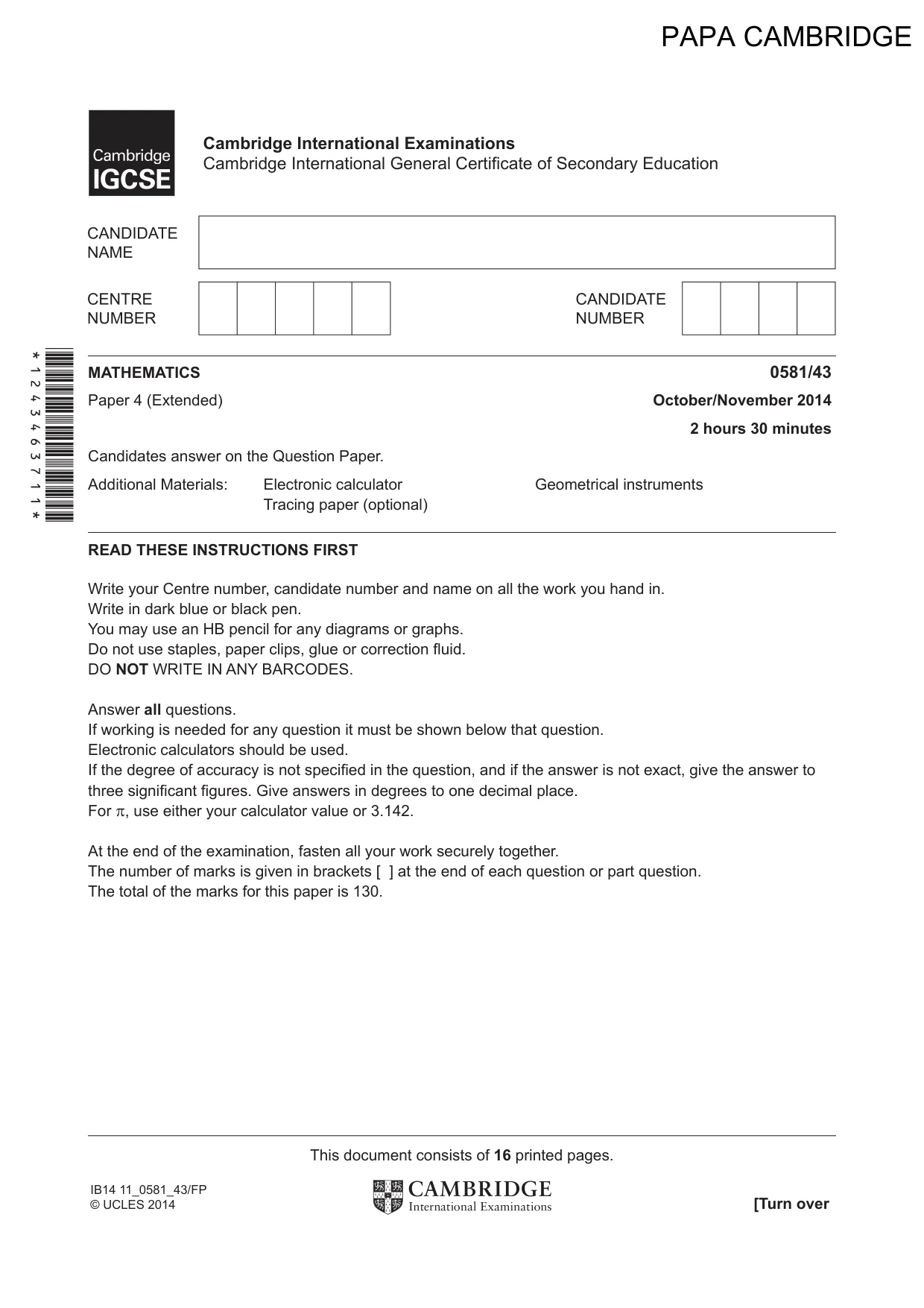
2 0581/43/O/N/14 © UCLES 2014 1 (a) ABCD is a trapezium. 2.6 cm 4.7 cm 17 cm 11 cm A B D C NOT TO SCALE (i) Calculate the length of AD. Answer(a)(i) AD = … cm [2] (ii) Calculate the size of angle BCD. Answer(a)(ii) Angle BCD = … [3] (iii) Calculate the area of the trapezium ABCD. Answer(a)(iii) … cm2 [2] (b) A similar trapezium has perpendicular height 9.4 cm. Calculate the area of this trapezium. Answer(b) … cm2 [3] __________________________________________________________________________________________
Question paper, page 3
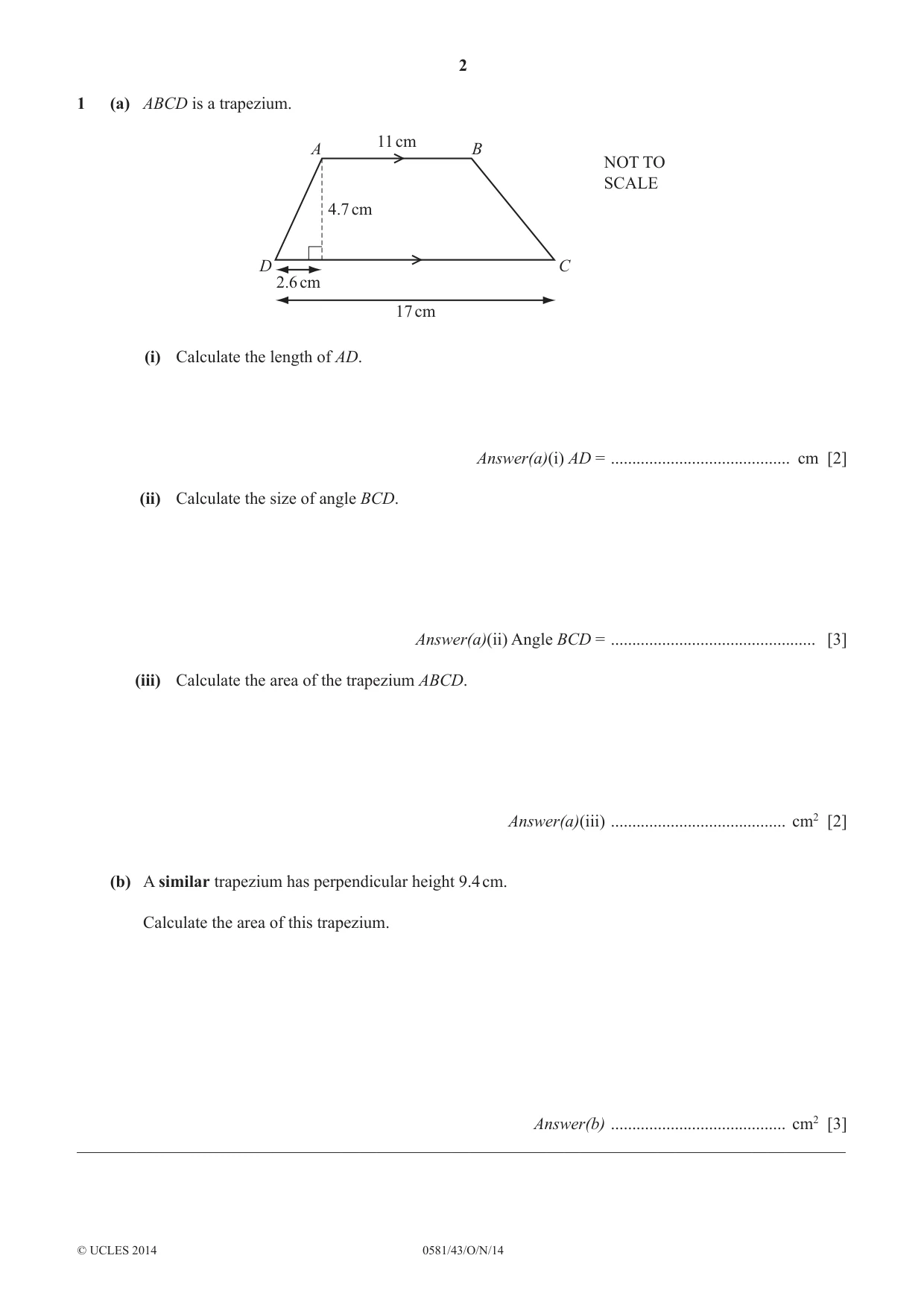
3 0581/43/O/N/14 © UCLES 2014 [Turn over 2 There are three different areas, A, B and C, for seating in a theatre. The numbers of seats in each area are in the ratio A : B : C = 11 : 8 : 7 . There are 920 seats in area B. (a) (i) Show that there are 805 seats in area C. Answer(a)(i) [1] (ii) Write the number of seats in area B as a percentage of the total number of seats. Answer(a)(ii) … % [2] (b) The cost of a ticket for a seat in each area of the theatre is shown in the table. Area A $11.50 Area B $15 Area C $22.50 For a concert 80% of area B tickets were sold and 5 3 of area C tickets were sold. The total amount of money taken from ticket sales was $35 834. Calculate the number of area A tickets that were sold. Answer(b) … [5] (c) The total ticket sales of $35 834 was 5% less than the ticket sales at the previous concert. Calculate the ticket sales at the previous concert. Answer(c) $ … [3] __________________________________________________________________________________________
Question paper, page 4
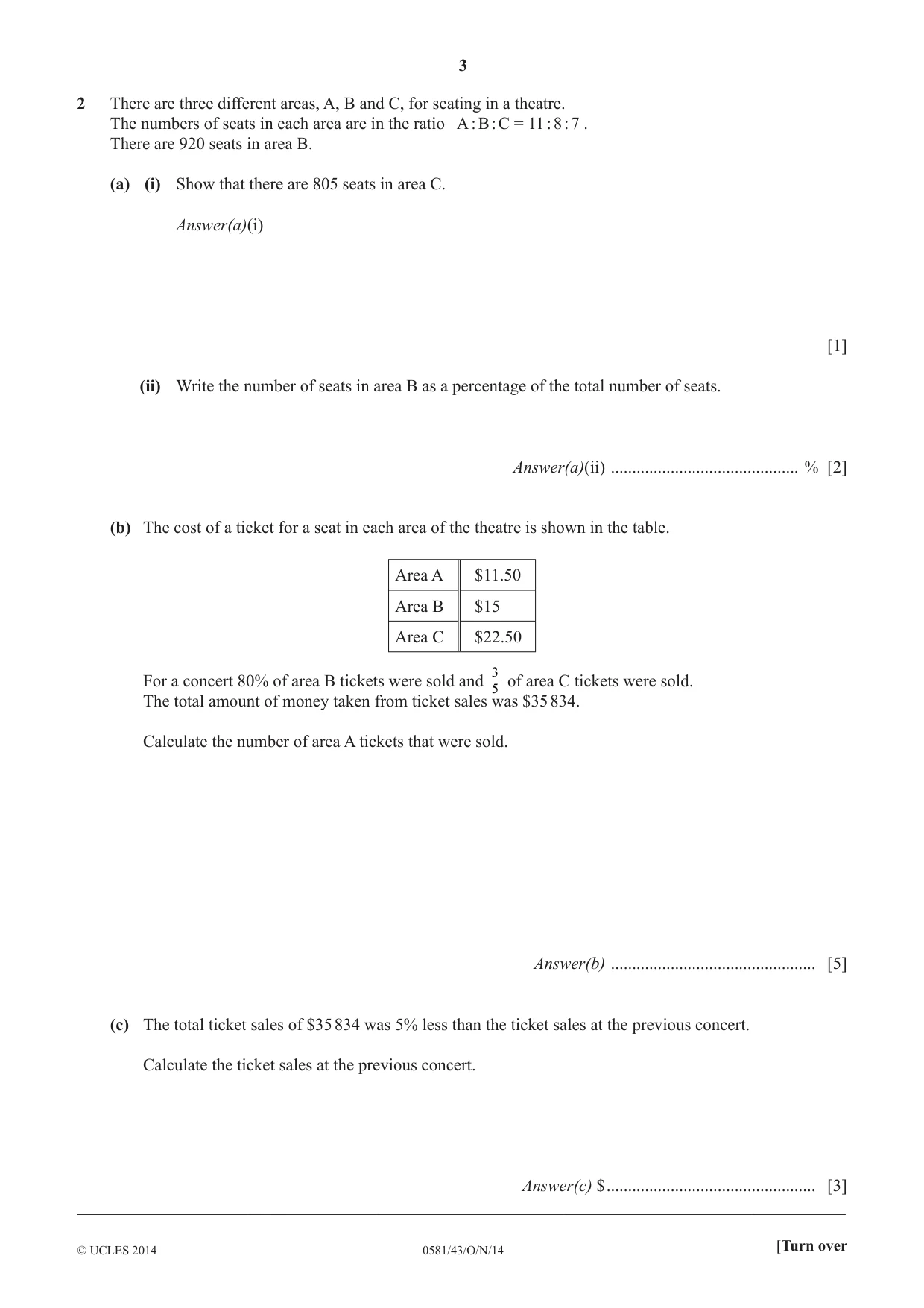
4 0581/43/O/N/14 © UCLES 2014 3 O A B C D 56° 52° E NOT TO SCALE A, B, C and D are points on a circle, centre O. CE is a tangent to the circle at C. (a) Find the sizes of the following angles and give a reason for each answer. (i) Angle DAC = … because … … [2] (ii) Angle DOC = … because … … [2] (iii) Angle BCO = … because … … [2]
Question paper, page 5
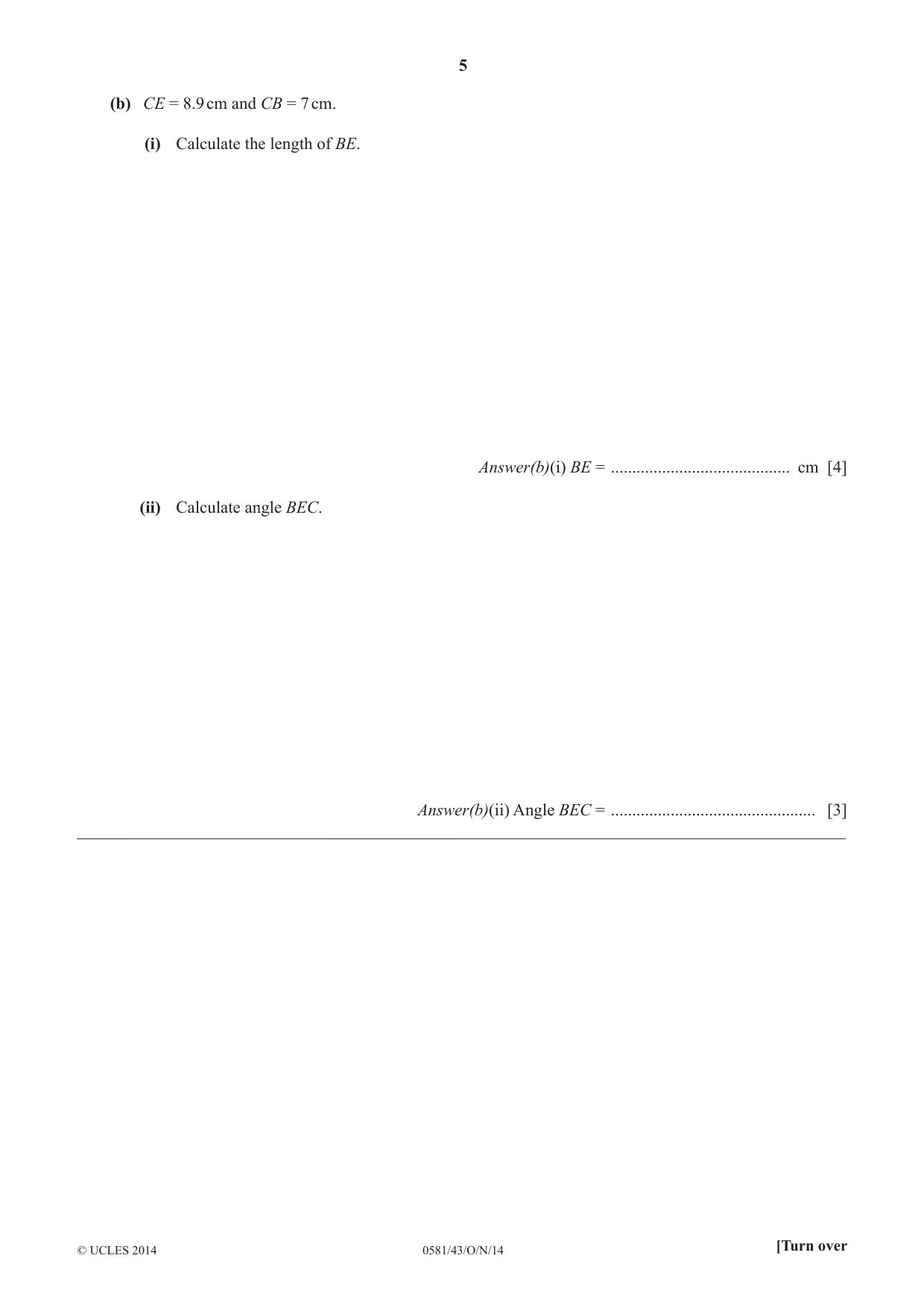
5 0581/43/O/N/14 © UCLES 2014 [Turn over (b) CE = 8.9 cm and CB = 7 cm. (i) Calculate the length of BE. Answer(b)(i) BE = … cm [4] (ii) Calculate angle BEC. Answer(b)(ii) Angle BEC = … [3] __________________________________________________________________________________________
Question paper, page 6
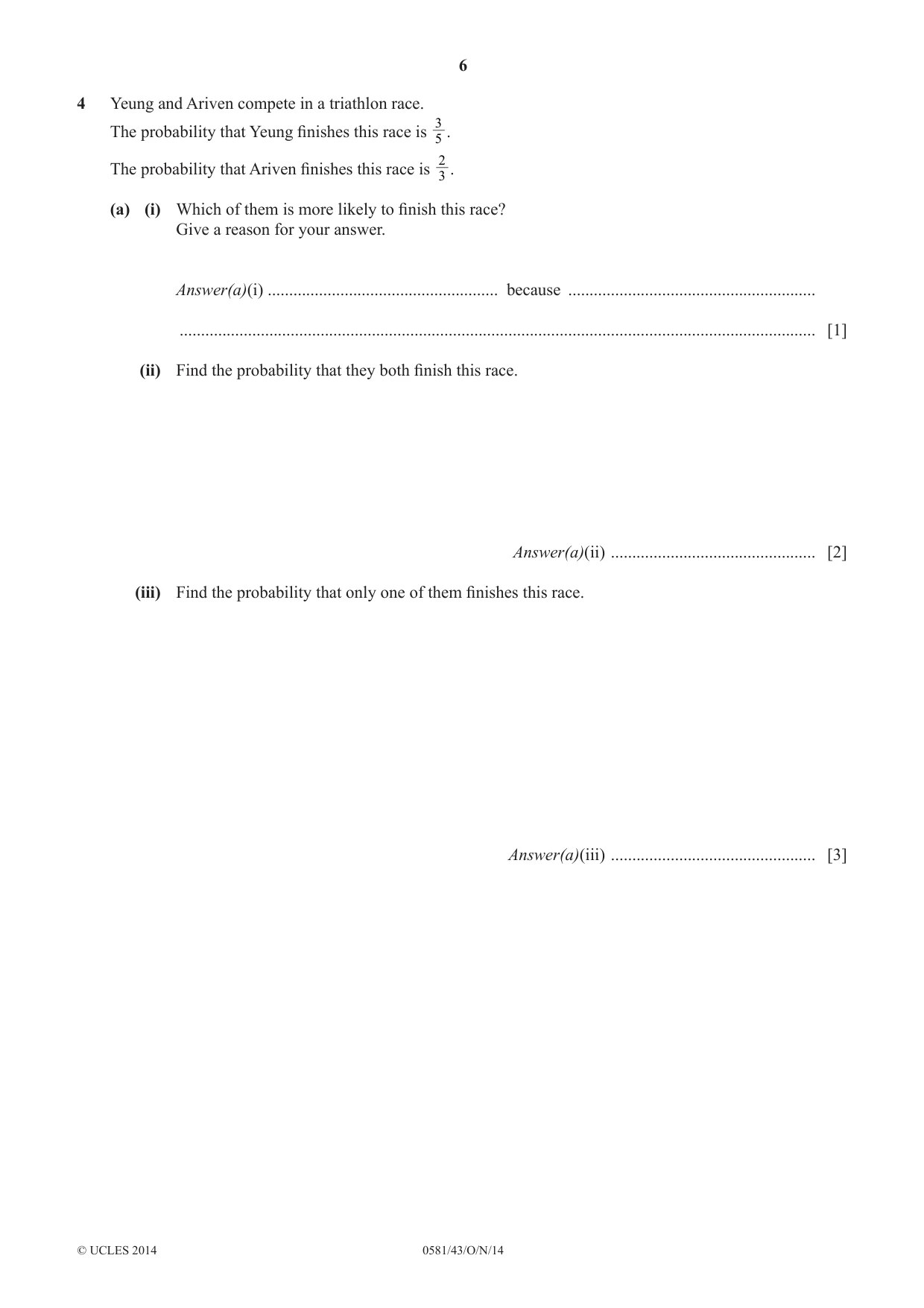
6 0581/43/O/N/14 © UCLES 2014 4 Yeung and Ariven compete in a triathlon race. The probability that Yeung fi nishes this race is 5 3 . The probability that Ariven fi nishes this race is 3 2 . (a) (i) Which of them is more likely to fi nish this race? Give a reason for your answer. Answer(a)(i) … because … … [1] (ii) Find the probability that they both fi nish this race. Answer(a)(ii) … [2] (iii) Find the probability that only one of them fi nishes this race. Answer(a)(iii) … [3]
Question paper, page 7
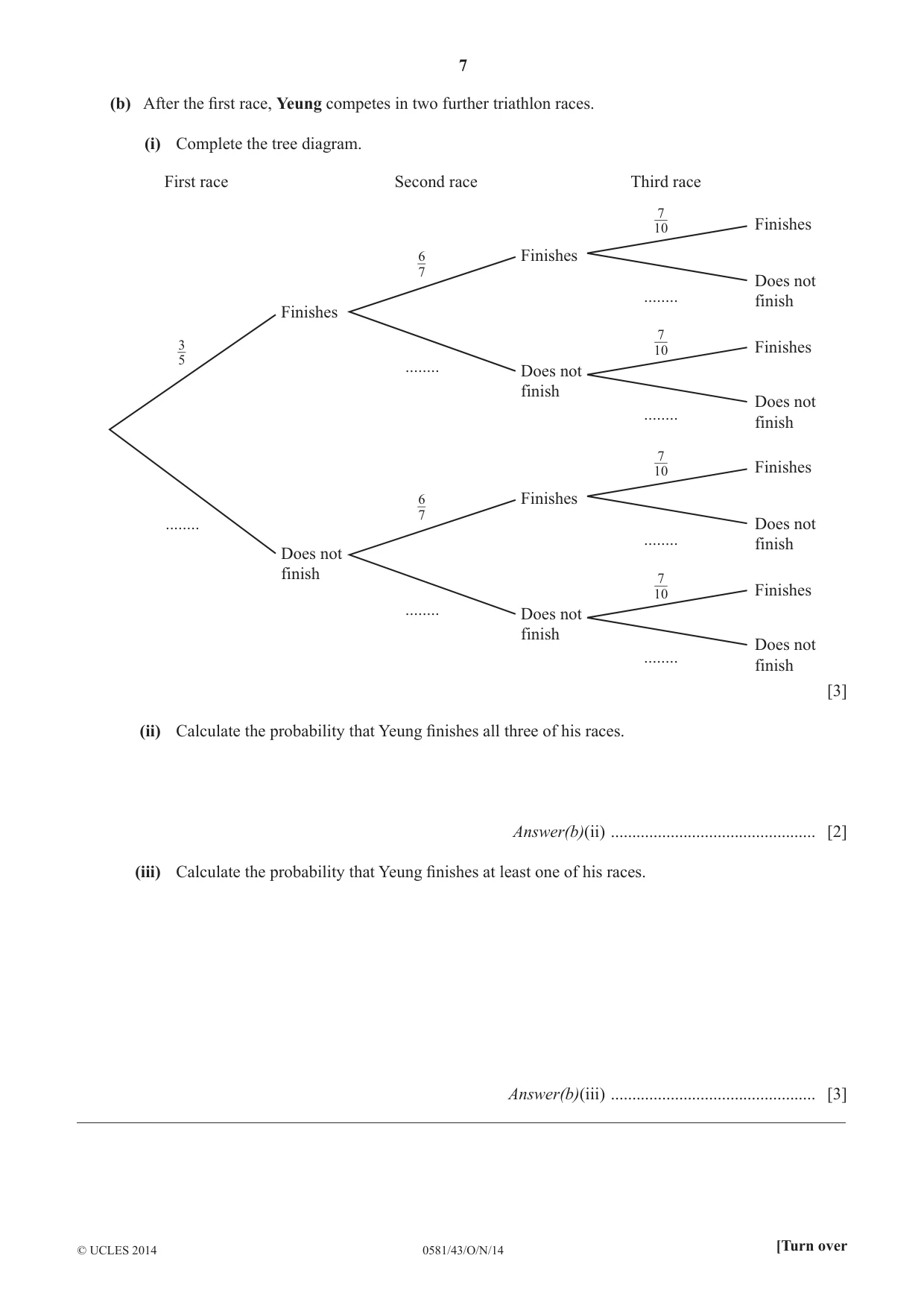
7 0581/43/O/N/14 © UCLES 2014 [Turn over (b) After the fi rst race, Yeung competes in two further triathlon races. (i) Complete the tree diagram. Finishes Does not finish Finishes Does not finish Does not finish Finishes … … … 6 7 Finishes First race Second race Third race Does not finish … 3 5 Finishes Does not finish Finishes Does not finish Does not finish Finishes … … … 6 7 7 10 7 10 7 10 7 10 [3] (ii) Calculate the probability that Yeung fi nishes all three of his races. Answer(b)(ii) … [2] (iii) Calculate the probability that Yeung fi nishes at least one of his races. Answer(b)(iii) … [3] __________________________________________________________________________________________
Question paper, page 8
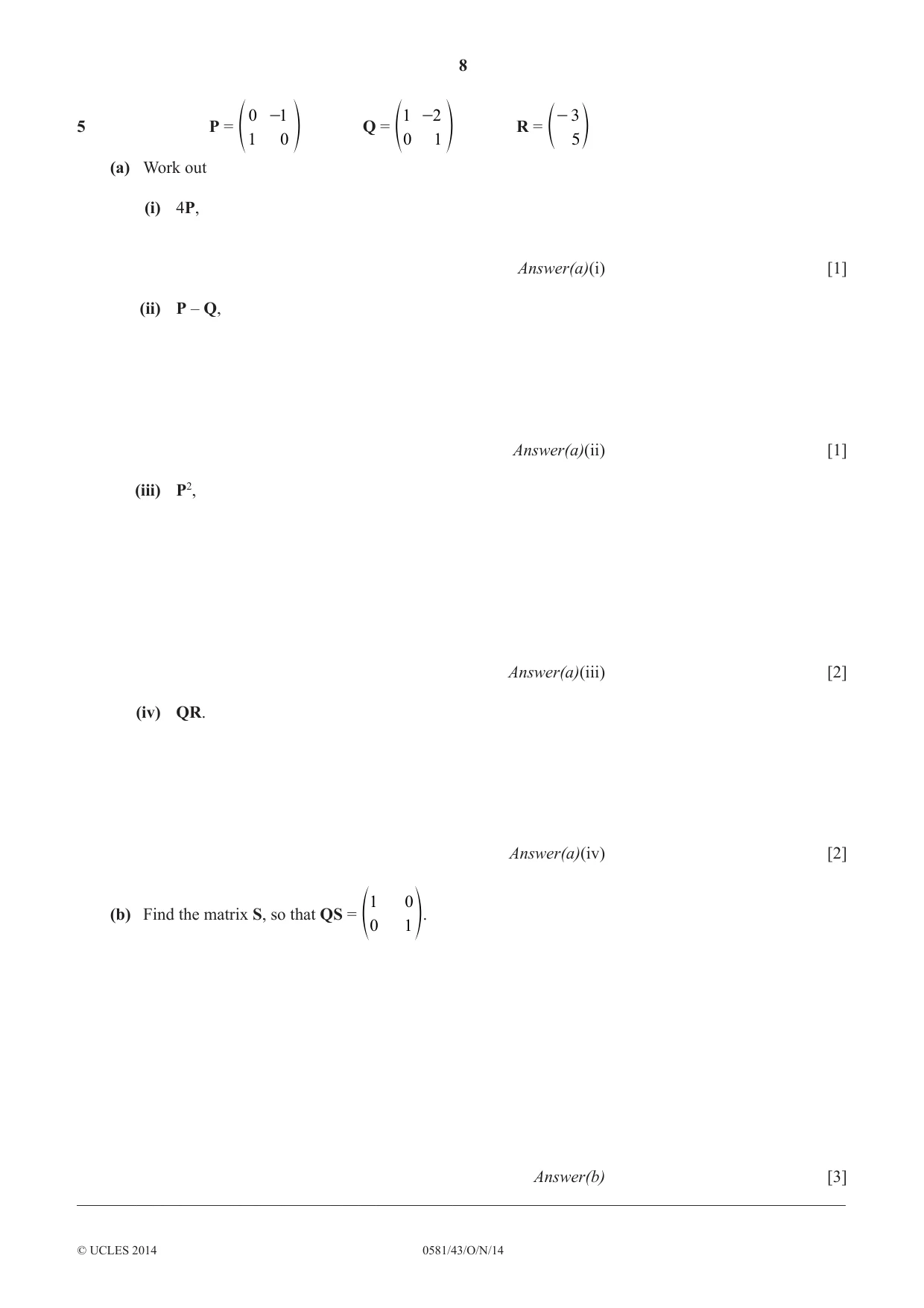
8 0581/43/O/N/14 © UCLES 2014 5 P = 1 1 0 - 0 f p Q = 2 1 0 1 - f p R = 3 5 - e o (a) Work out (i) 4P, Answer(a)(i) [1] (ii) P – Q, Answer(a)(ii) [1] (iii) P2, Answer(a)(iii) [2] (iv) QR. Answer(a)(iv) [2] (b) Find the matrix S, so that QS = 1 0 0 1 f p. Answer(b) [3] __________________________________________________________________________________________
Question paper, page 9
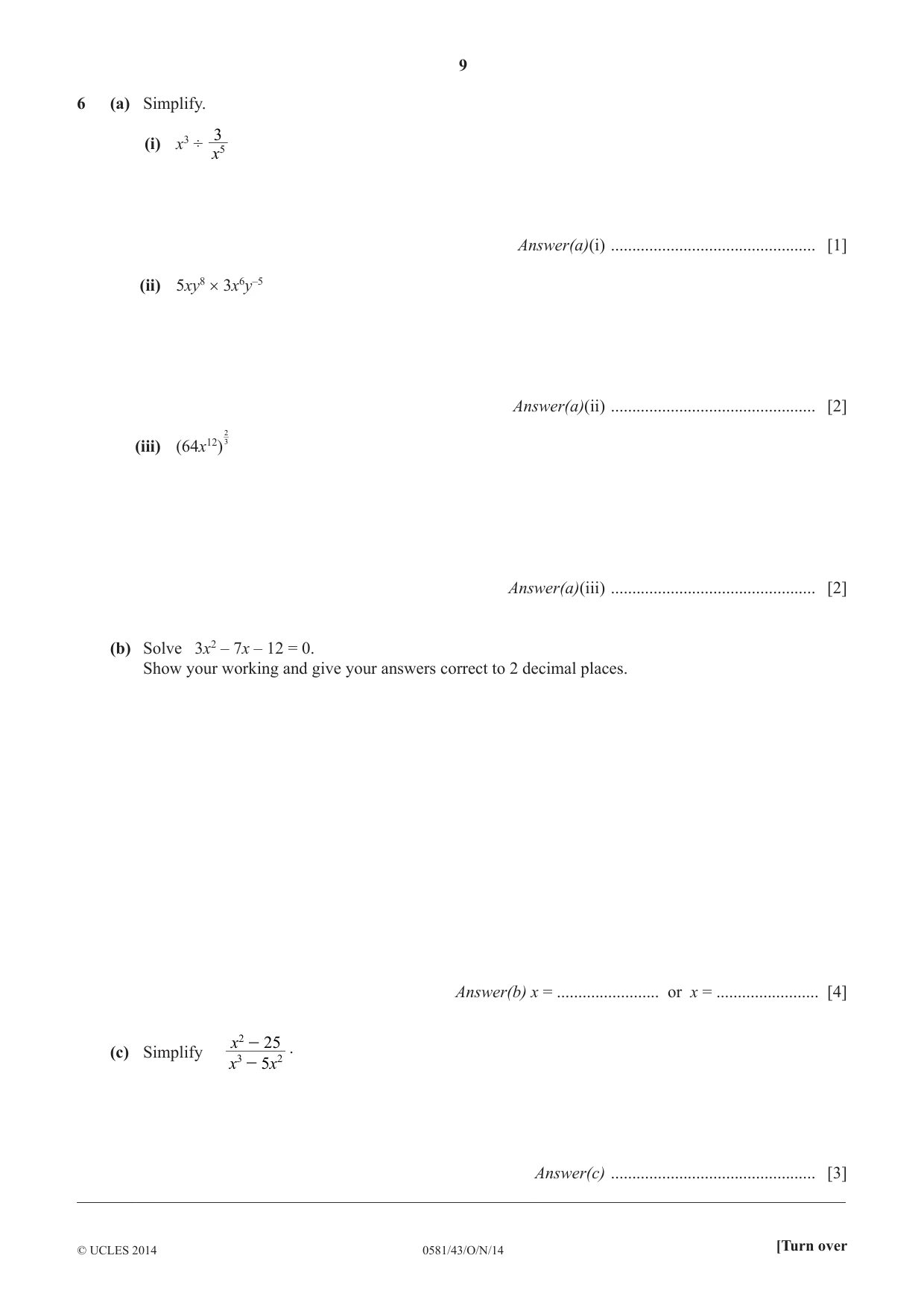
9 0581/43/O/N/14 © UCLES 2014 [Turn over 6 (a) Simplify. (i) x3 ÷ 53 x Answer(a)(i) … [1] (ii) 5xy8 × 3x6y–5 Answer(a)(ii) … [2] (iii) (64x12) Answer(a)(iii) … [2] (b) Solve 3x2 – 7x – 12 = 0. Show your working and give your answers correct to 2 decimal places. Answer(b) x = … or x = … [4] (c) Simplify 3 2 2 5 25 x x x - - . Answer(c) … [3] __________________________________________________________________________________________ 3 2
Question paper, page 10
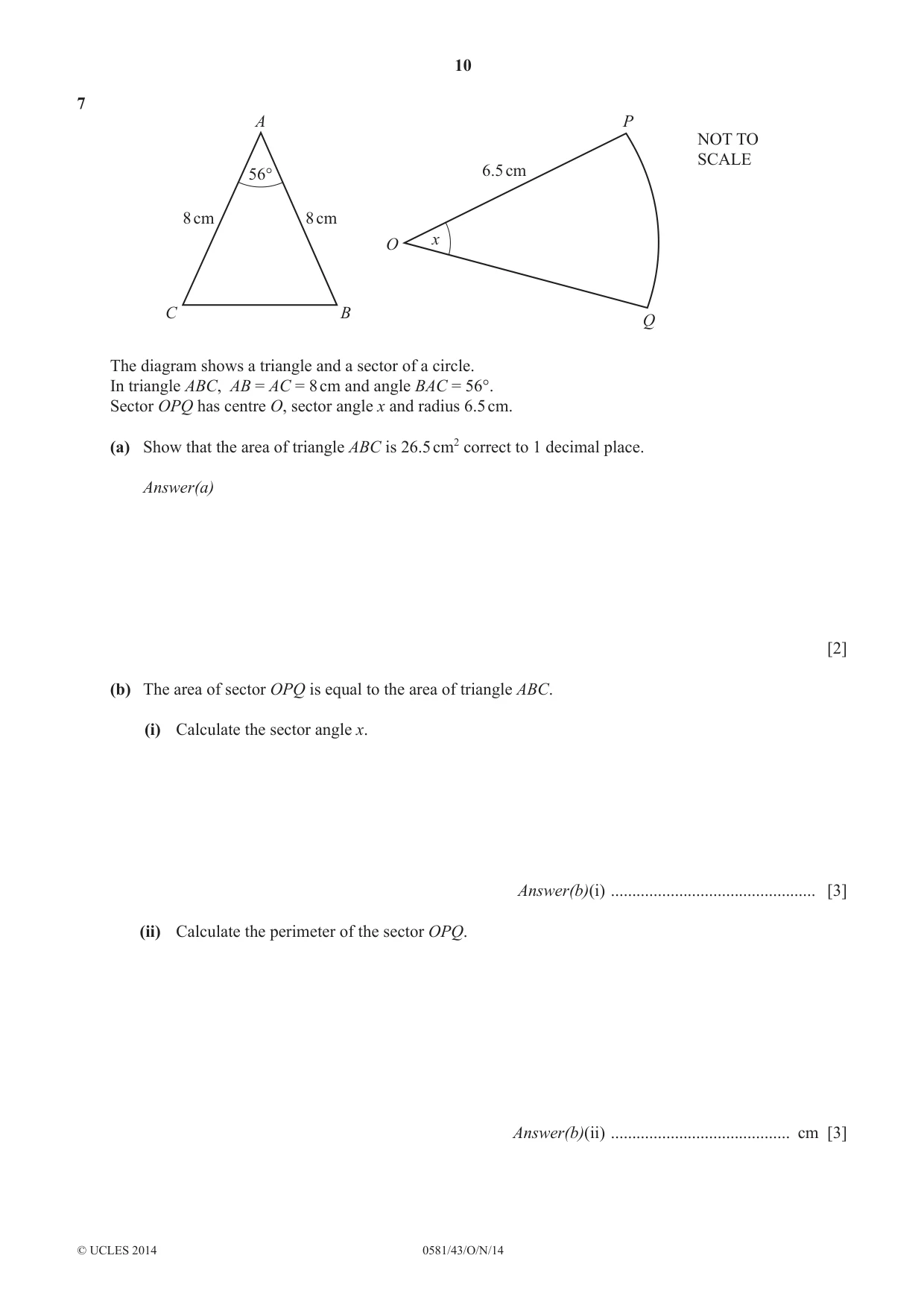
10 0581/43/O/N/14 © UCLES 2014 7 A C B 8 cm 6.5 cm 8 cm 56° O P Q NOT TO SCALE x The diagram shows a triangle and a sector of a circle. In triangle ABC, AB = AC = 8 cm and angle BAC = 56°. Sector OPQ has centre O, sector angle x and radius 6.5 cm. (a) Show that the area of triangle ABC is 26.5 cm2 correct to 1 decimal place. Answer(a) [2] (b) The area of sector OPQ is equal to the area of triangle ABC. (i) Calculate the sector angle x. Answer(b)(i) … [3] (ii) Calculate the perimeter of the sector OPQ. Answer(b)(ii) … cm [3]
Question paper, page 11
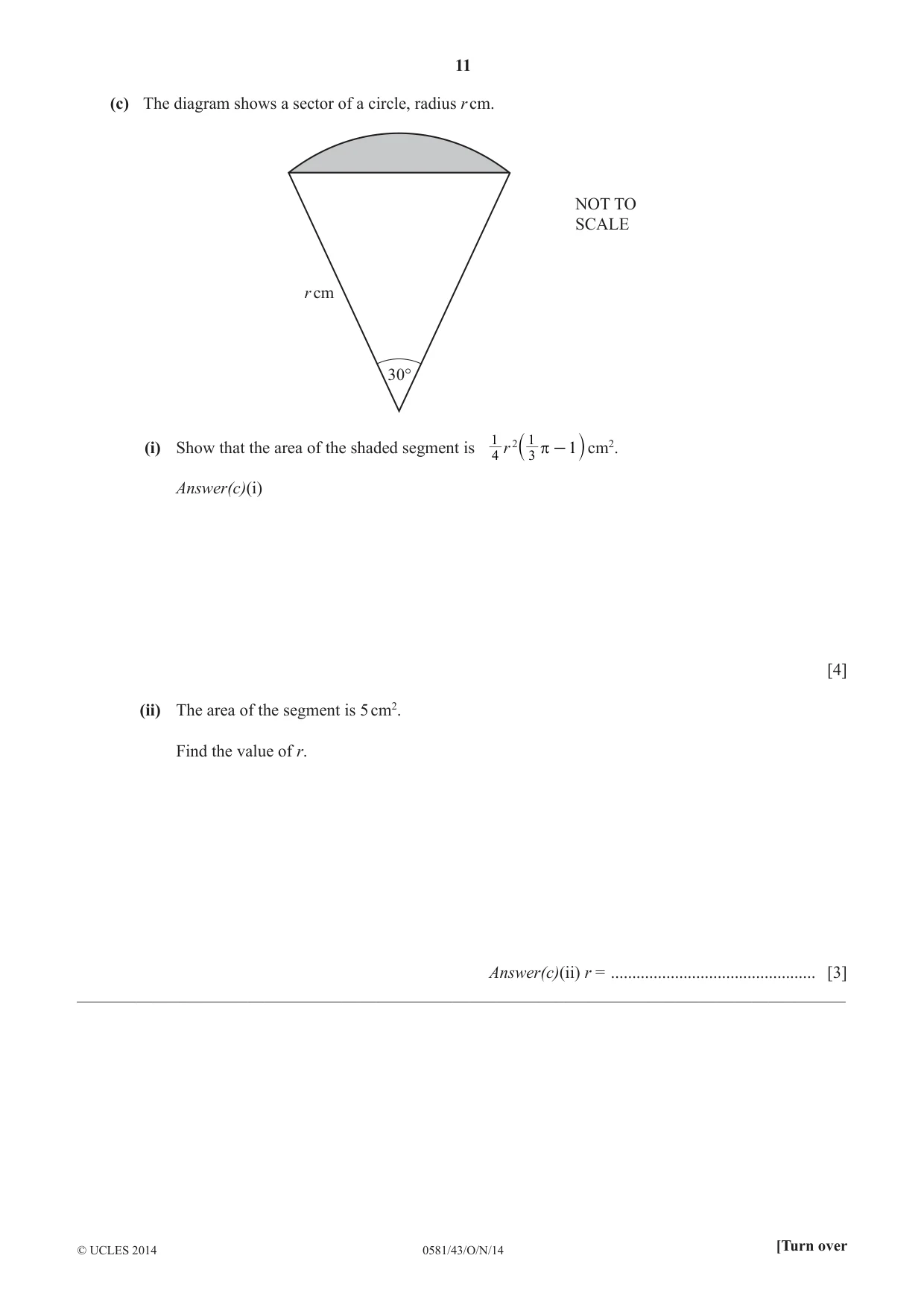
11 0581/43/O/N/14 © UCLES 2014 [Turn over (c) The diagram shows a sector of a circle, radius r cm. r cm 30° NOT TO SCALE (i) Show that the area of the shaded segment is 4 1 r 2 3 π 1 1 - ` j cm2. Answer(c)(i) [4] (ii) The area of the segment is 5 cm2. Find the value of r. Answer(c)(ii) r = … [3] __________________________________________________________________________________________
Question paper, page 12
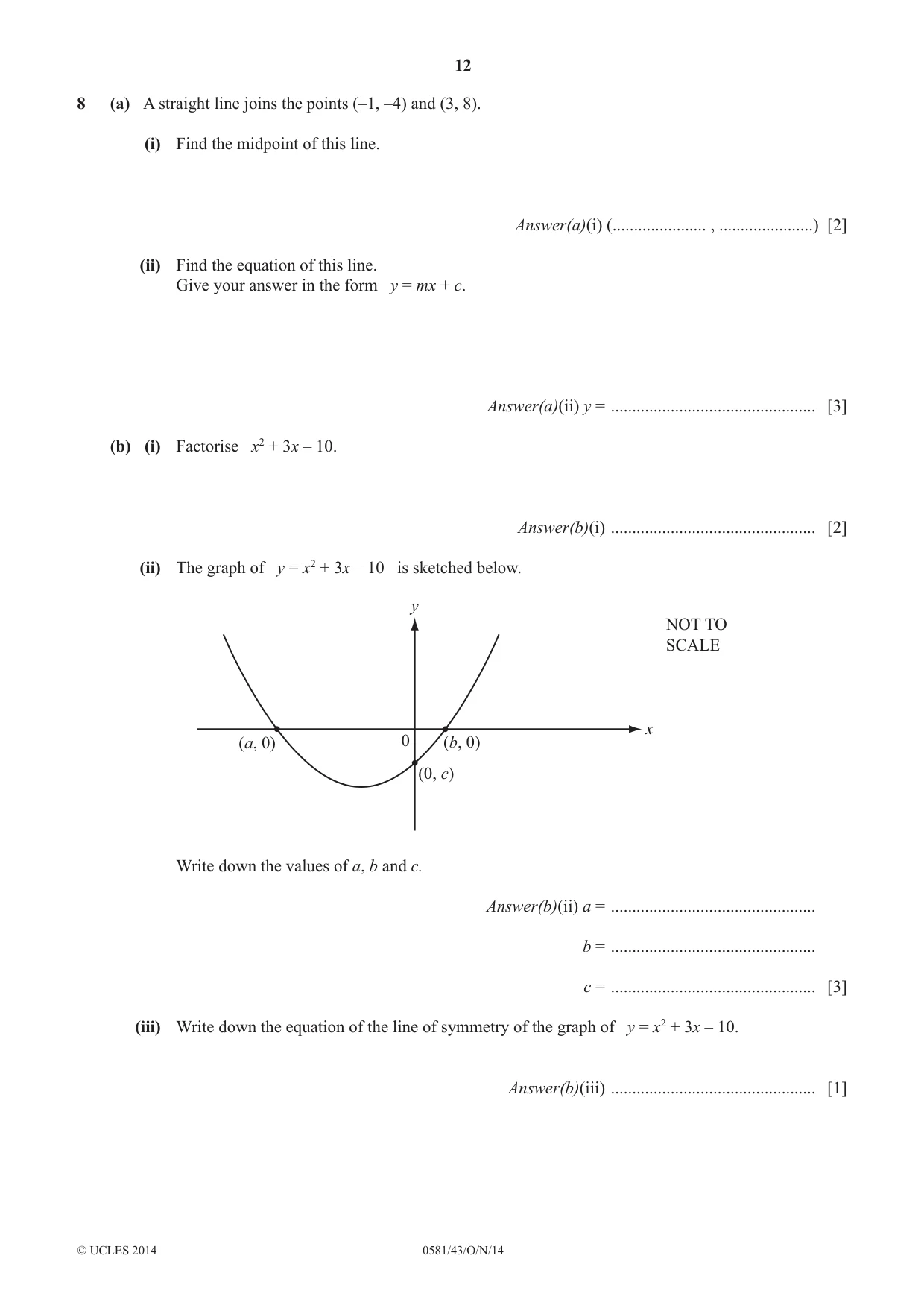
12 0581/43/O/N/14 © UCLES 2014 8 (a) A straight line joins the points (–1, –4) and (3, 8). (i) Find the midpoint of this line. Answer(a)(i) (… , …) [2] (ii) Find the equation of this line. Give your answer in the form y = mx + c. Answer(a)(ii) y = … [3] (b) (i) Factorise x2 + 3x – 10. Answer(b)(i) … [2] (ii) The graph of y = x2 + 3x – 10 is sketched below. y x 0 (b, 0) (0, c) (a, 0) NOT TO SCALE Write down the values of a, b and c. Answer(b)(ii) a = … b = … c = … [3] (iii) Write down the equation of the line of symmetry of the graph of y = x2 + 3x – 10. Answer(b)(iii) … [1]
Question paper, page 13
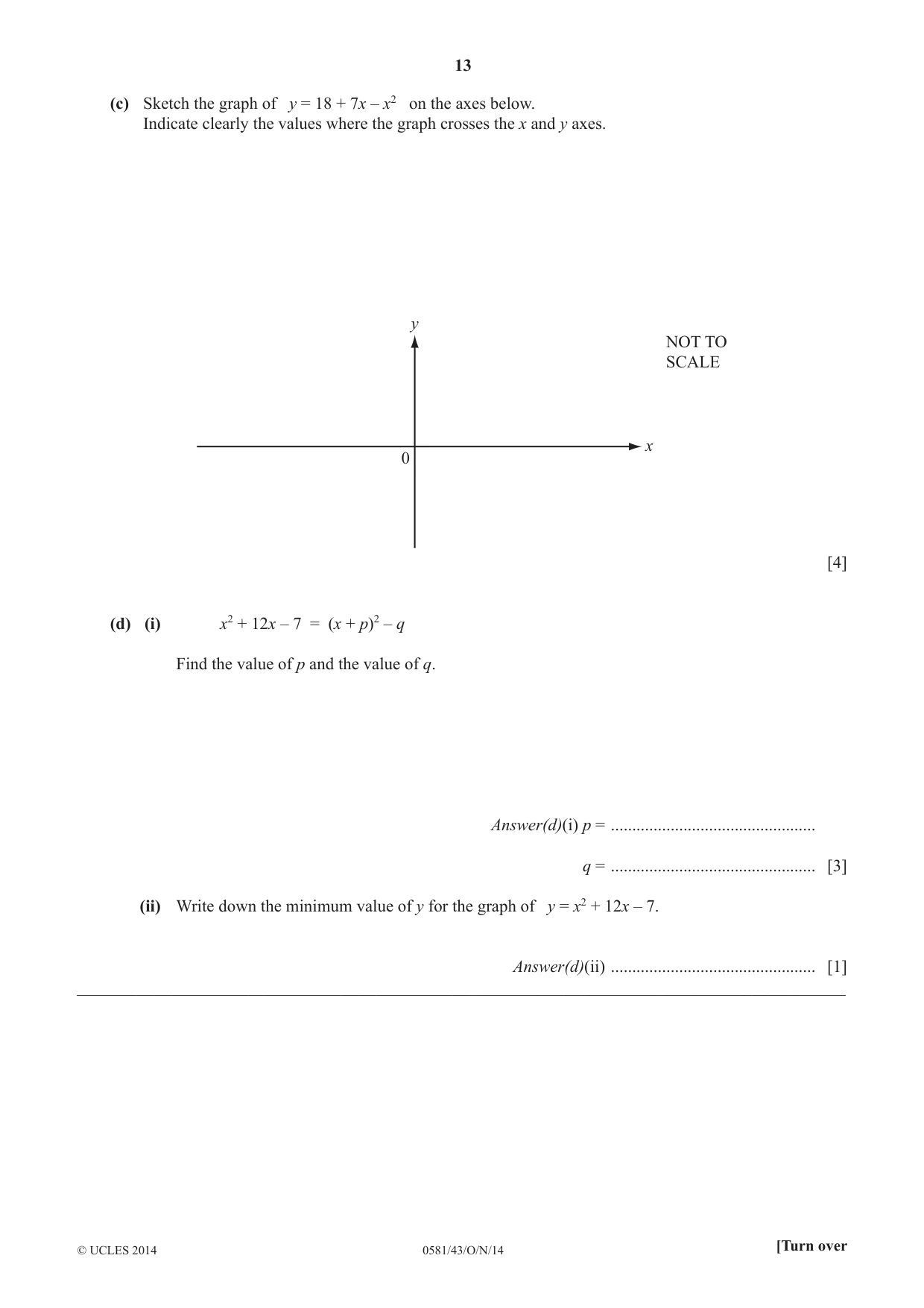
13 0581/43/O/N/14 © UCLES 2014 [Turn over (c) Sketch the graph of y = 18 + 7x – x2 on the axes below. Indicate clearly the values where the graph crosses the x and y axes. y x 0 NOT TO SCALE [4] (d) (i) x2 + 12x – 7 = (x + p)2 – q Find the value of p and the value of q. Answer(d)(i) p = … q = … [3] (ii) Write down the minimum value of y for the graph of y = x2 + 12x – 7. Answer(d)(ii) … [1] __________________________________________________________________________________________
Question paper, page 14
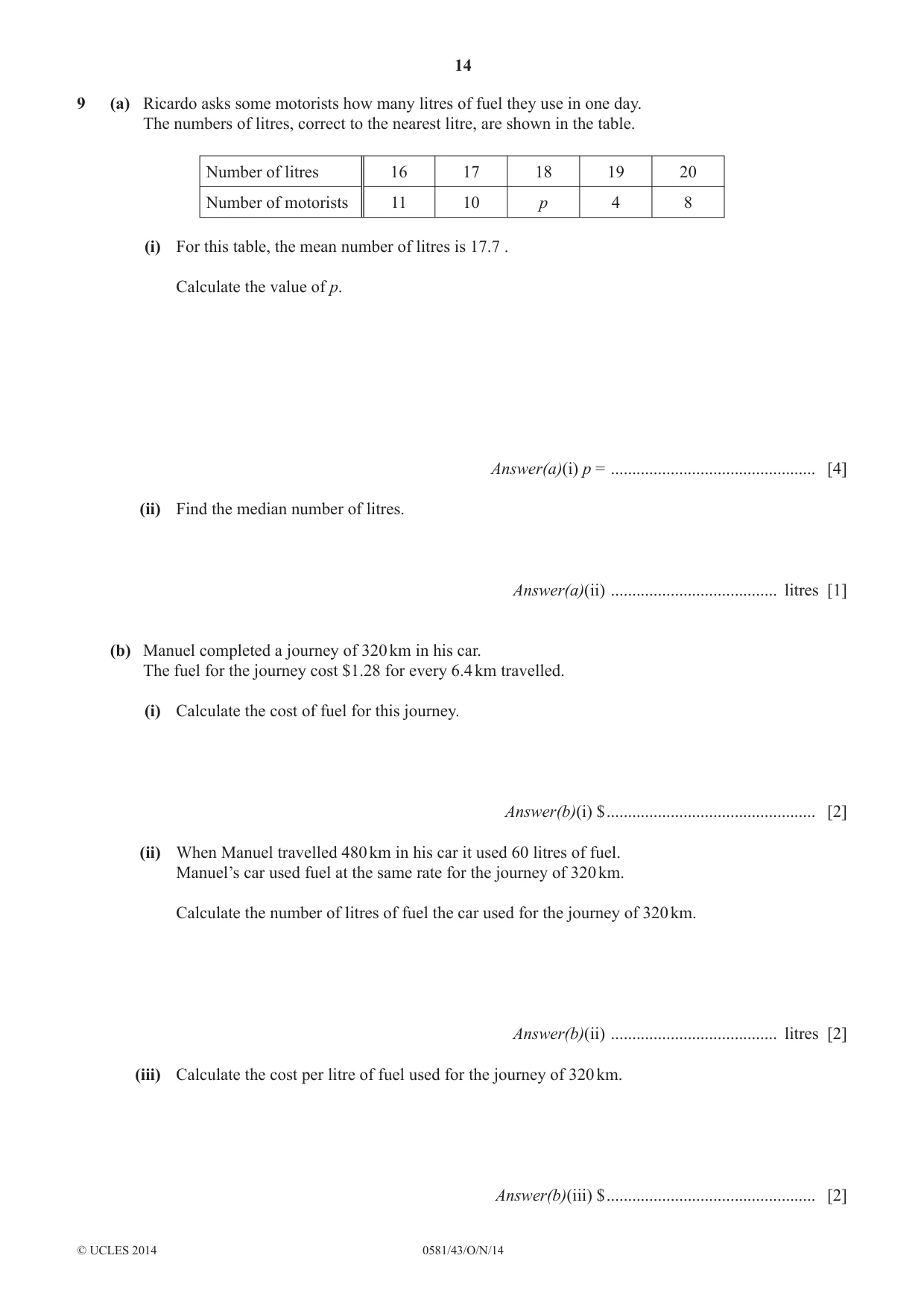
14 0581/43/O/N/14 © UCLES 2014 9 (a) Ricardo asks some motorists how many litres of fuel they use in one day. The numbers of litres, correct to the nearest litre, are shown in the table. Number of litres 16 17 18 19 20 Number of motorists 11 10 p 4 8 (i) For this table, the mean number of litres is 17.7 . Calculate the value of p. Answer(a)(i) p = … [4] (ii) Find the median number of litres. Answer(a)(ii) … litres [1] (b) Manuel completed a journey of 320 km in his car. The fuel for the journey cost $1.28 for every 6.4 km travelled. (i) Calculate the cost of fuel for this journey. Answer(b)(i) $ … [2] (ii) When Manuel travelled 480 km in his car it used 60 litres of fuel. Manuel’s car used fuel at the same rate for the journey of 320 km. Calculate the number of litres of fuel the car used for the journey of 320 km. Answer(b)(ii) … litres [2] (iii) Calculate the cost per litre of fuel used for the journey of 320 km. Answer(b)(iii) $ … [2]
Question paper, page 15
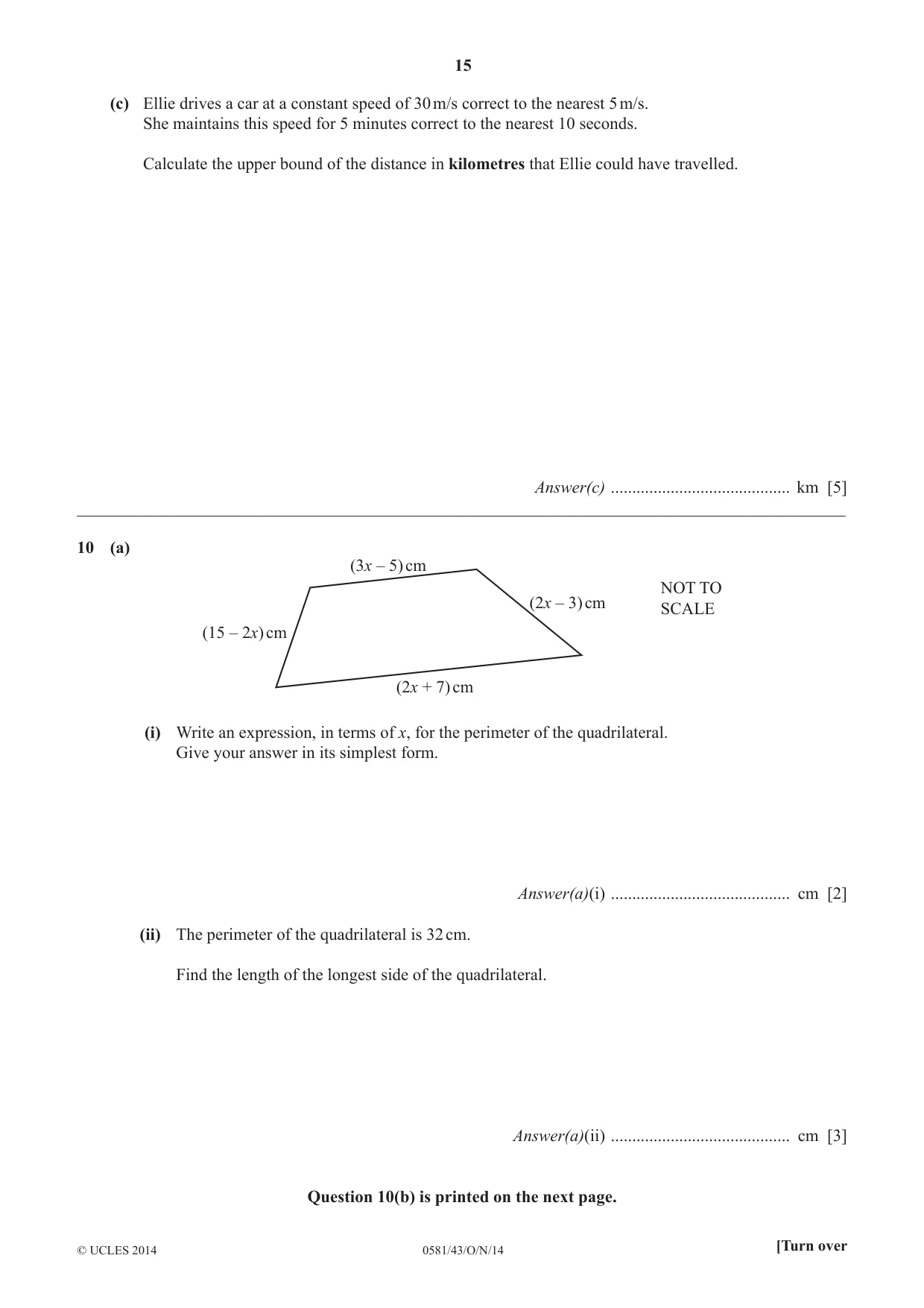
15 0581/43/O/N/14 © UCLES 2014 [Turn over (c) Ellie drives a car at a constant speed of 30 m/s correct to the nearest 5 m/s. She maintains this speed for 5 minutes correct to the nearest 10 seconds. Calculate the upper bound of the distance in kilometres that Ellie could have travelled. Answer(c) … km [5] __________________________________________________________________________________________ 10 (a) (3x – 5) cm (2x – 3) cm (2x + 7) cm (15 – 2x) cm NOT TO SCALE (i) Write an expression, in terms of x, for the perimeter of the quadrilateral. Give your answer in its simplest form. Answer(a)(i) … cm [2] (ii) The perimeter of the quadrilateral is 32 cm. Find the length of the longest side of the quadrilateral. Answer(a)(ii) … cm [3] Question 10(b) is printed on the next page.
Question paper, page 16
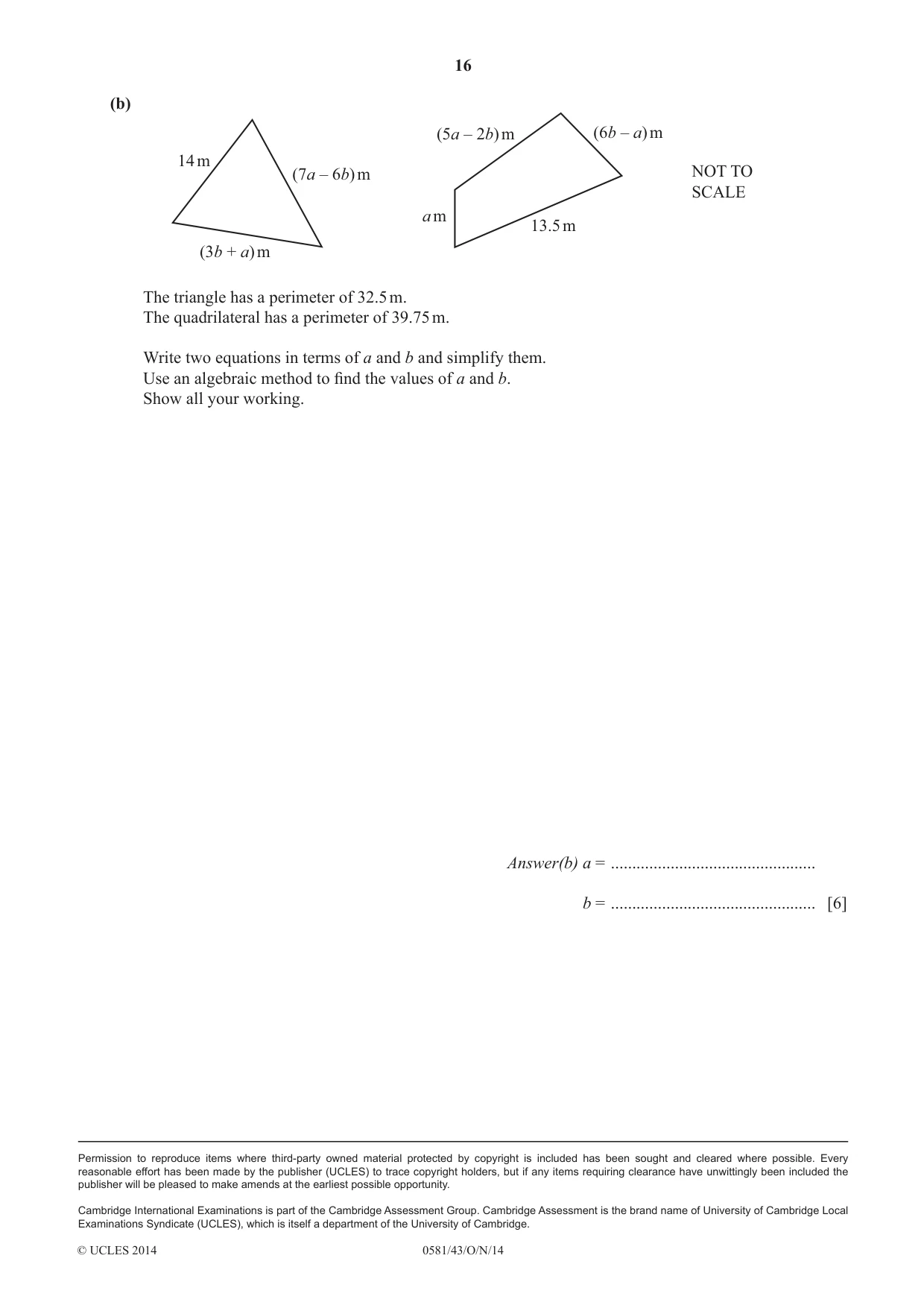
16 0581/43/O/N/14 © UCLES 2014 Permission to reproduce items where third-party owned material protected by copyright is included has been sought and cleared where possible. Every reasonable effort has been made by the publisher (UCLES) to trace copyright holders, but if any items requiring clearance have unwittingly been included the publisher will be pleased to make amends at the earliest possible opportunity. Cambridge International Examinations is part of the Cambridge Assessment Group. Cambridge Assessment is the brand name of University of Cambridge Local Examinations Syndicate (UCLES), which is itself a department of the University of Cambridge. (b) 14 m (3b + a) m (7a – 6b) m (5a – 2b) m (6b – a) m 13.5 m a m NOT TO SCALE The triangle has a perimeter of 32.5 m. The quadrilateral has a perimeter of 39.75 m. Write two equations in terms of a and b and simplify them. Use an algebraic method to fi nd the values of a and b. Show all your working. Answer(b) a = … b = … [6]
Mark scheme, page 1
® IGCSE is the registered trademark of Cambridge International Examinations. CAMBRIDGE INTERNATIONAL EXAMINATIONS Cambridge International General Certificate of Secondary Education MARK SCHEME for the October/November 2014 series 0581 MATHEMATICS 0581/43 Paper 4 (Extended), maximum raw mark 130 This mark scheme is published as an aid to teachers and candidates, to indicate the requirements of the examination. It shows the basis on which Examiners were instructed to award marks. It does not indicate the details of the discussions that took place at an Examiners’ meeting before marking began, which would have considered the acceptability of alternative answers. Mark schemes should be read in conjunction with the question paper and the Principal Examiner Report for Teachers. Cambridge will not enter into discussions about these mark schemes. Cambridge is publishing the mark schemes for the October/November 2014 series for most Cambridge IGCSE®, Cambridge International A and AS Level components and some Cambridge O Level components. PAPA CAMBRIDGE
Mark scheme, page 2
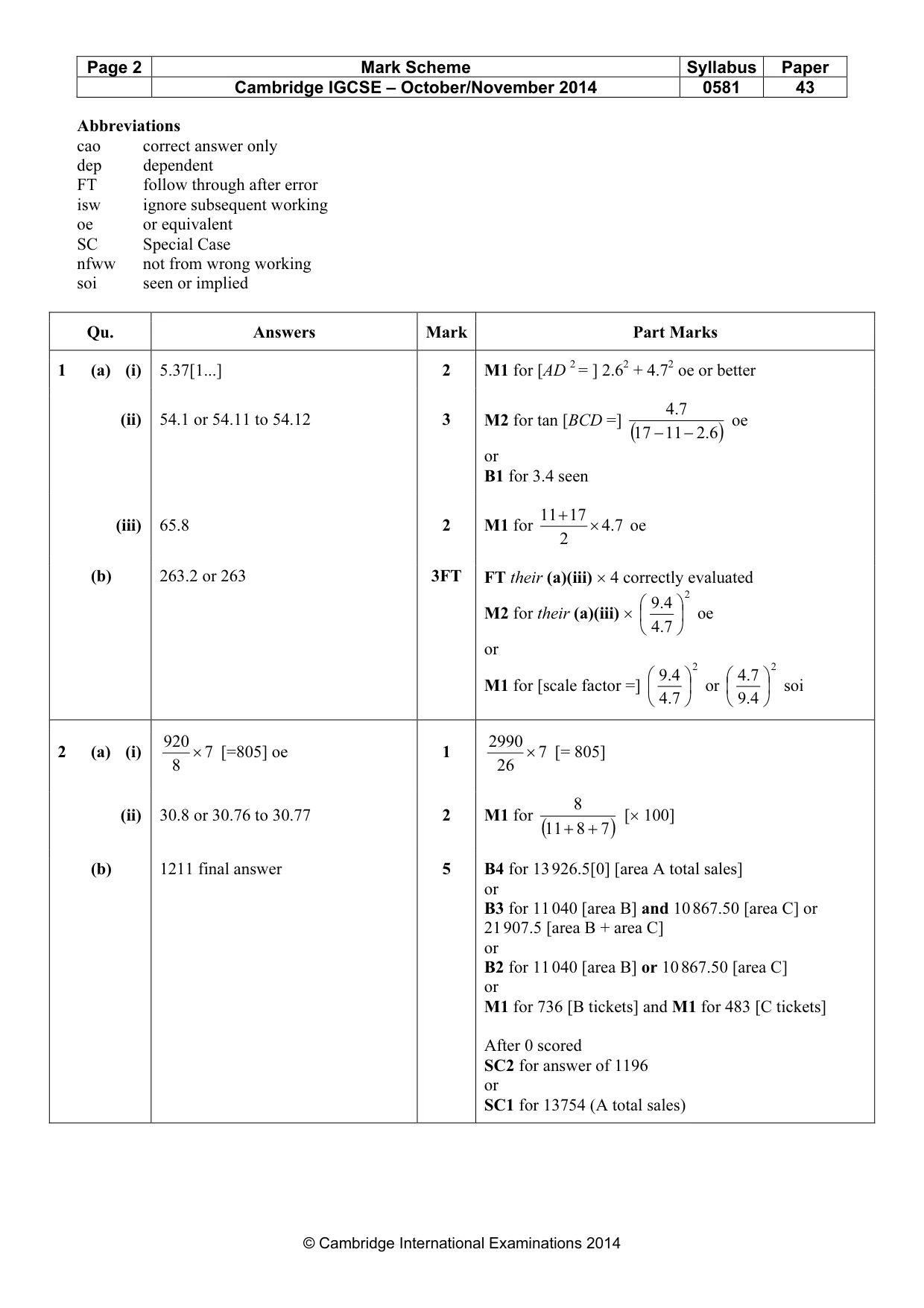
Page 2 Mark Scheme Syllabus Paper Cambridge IGCSE – October/November 2014 0581 43 © Cambridge International Examinations 2014 Abbreviations cao correct answer only dep dependent FT follow through after error isw ignore subsequent working oe or equivalent SC Special Case nfww not from wrong working soi seen or implied Qu. Answers Mark Part Marks 1 (a) (i) 5.37[1...] 2 M1 for [AD 2 = ] 2.62 + 4.72 oe or better (ii) 54.1 or 54.11 to 54.12 3 M2 for tan [BCD =] ( ) 6.2 11 17 7.4 − − oe or B1 for 3.4 seen (iii) 65.8 2 M1 for 7.4 2 17 11 × + oe (b) 263.2 or 263 3FT FT their (a)(iii) × 4 correctly evaluated M2 for their (a)(iii) × 2 7.4 4.9 oe or M1 for [scale factor =] 2 7.4 4.9 or 2 4.9 7.4 soi 2 (a) (i) 7 8 920 × [=805] oe 1 7 26 2990 × [= 805] (ii) 30.8 or 30.76 to 30.77 2 M1 for ( ) 7 8 11 8 + + [× 100] (b) 1211 final answer 5 B4 for 13 926.5[0] [area A total sales] or B3 for 11 040 [area B] and 10 867.50 [area C] or 21 907.5 [area B + area C] or B2 for 11 040 [area B] or 10 867.50 [area C] or M1 for 736 [B tickets] and M1 for 483 [C tickets] After 0 scored SC2 for answer of 1196 or SC1 for 13754 (A total sales)
Mark scheme, page 3
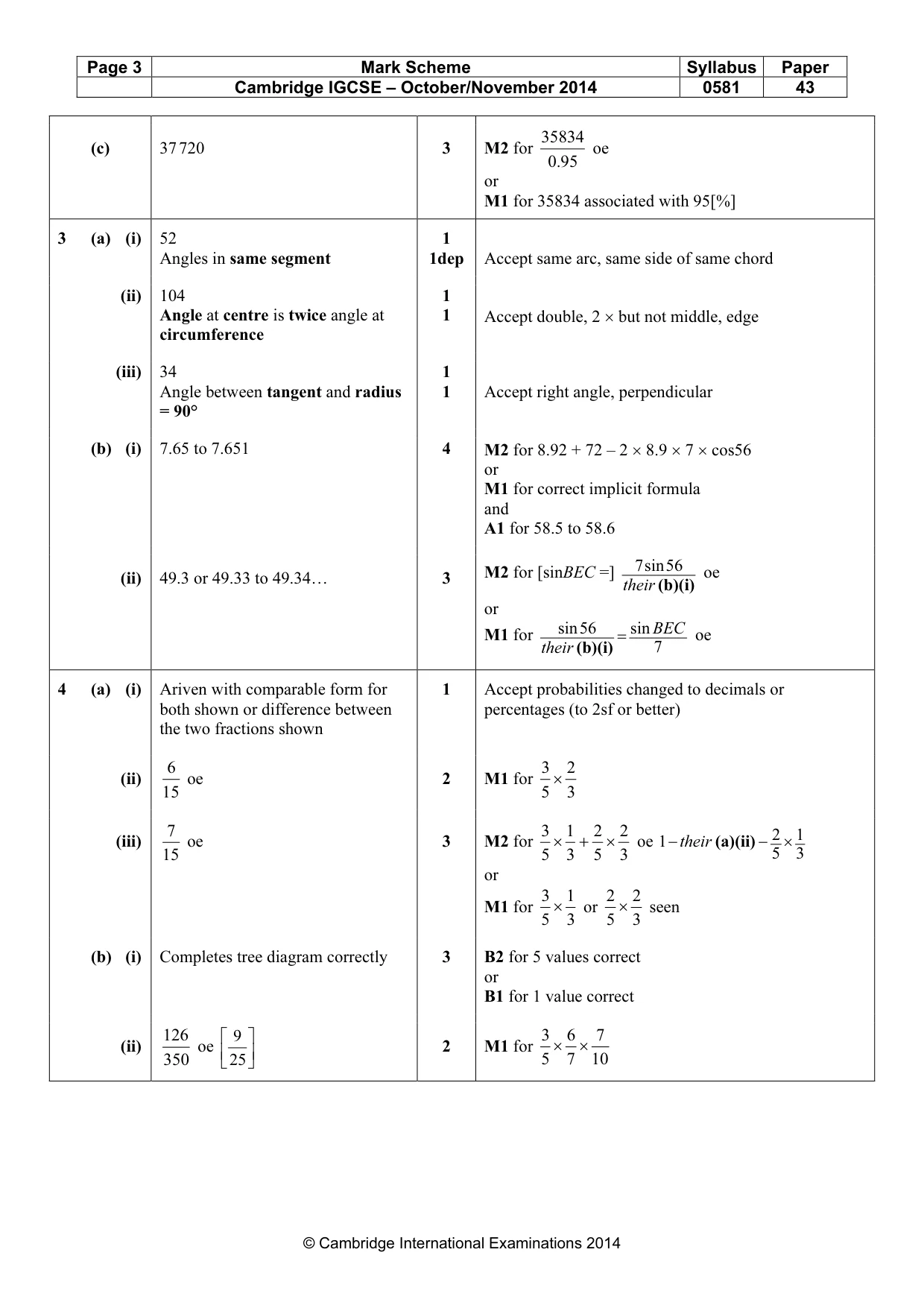
Page 3 Mark Scheme Syllabus Paper Cambridge IGCSE – October/November 2014 0581 43 © Cambridge International Examinations 2014 (c) 37 720 3 M2 for 95 .0 35834 oe or M1 for 35834 associated with 95[%] 3 (a) (i) 52 Angles in same segment 1 1dep Accept same arc, same side of same chord (ii) 104 Angle at centre is twice angle at circumference 1 1 Accept double, 2 × but not middle, edge (iii) 34 Angle between tangent and radius = 90° 1 1 Accept right angle, perpendicular (b) (i) 7.65 to 7.651 4 M2 for 8.92 + 72 – 2 × 8.9 × 7 × cos56 or M1 for correct implicit formula and A1 for 58.5 to 58.6 (ii) 49.3 or 49.33 to 49.34… 3 M2 for [sinBEC =] (b)(i) their 56 sin 7 oe or M1 for 7 sin 56 sin BEC their = (b)(i) oe 4 (a) (i) Ariven with comparable form for both shown or difference between the two fractions shown 1 Accept probabilities changed to decimals or percentages (to 2sf or better) (ii) 15 6 oe 2 M1 for 3 2 5 3 × (iii) 15 7 oe 3 M2 for 3 2 5 2 3 1 5 3 × + × oe 3 1 5 2 1 × − − (a)(ii) their or M1 for 3 1 5 3 × or 3 2 5 2 × seen (b) (i) Completes tree diagram correctly 3 B2 for 5 values correct or B1 for 1 value correct (ii) 350 126 oe 25 9 2 M1 for 10 7 7 6 5 3 × ×
Mark scheme, page 4
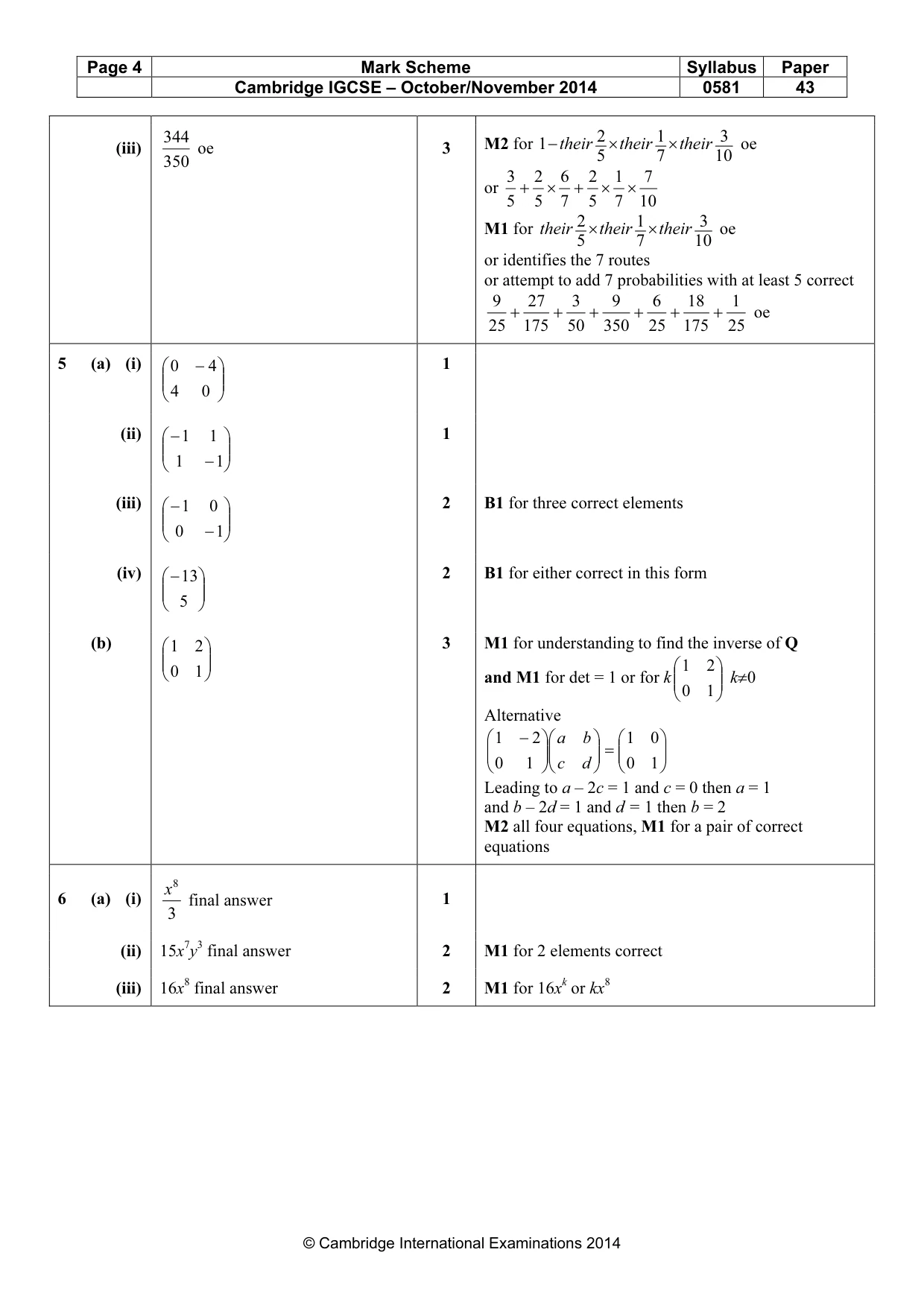
Page 4 Mark Scheme Syllabus Paper Cambridge IGCSE – October/November 2014 0581 43 © Cambridge International Examinations 2014 (iii) 350 344 oe 3 M2 for 10 3 7 1 5 2 1 their their their × × − oe or 10 7 7 1 5 2 7 6 5 2 5 3 × × + × + M1 for 10 3 7 1 5 2 their their their × × oe or identifies the 7 routes or attempt to add 7 probabilities with at least 5 correct 25 1 175 18 25 6 350 9 50 3 175 27 25 9 + + + + + + oe 5 (a) (i) − 0 4 4 0 1 (ii) − − 1 1 1 1 1 (iii) − − 1 0 0 1 2 B1 for three correct elements (iv) − 5 13 2 B1 for either correct in this form (b) 1 0 2 1 3 M1 for understanding to find the inverse of Q and M1 for det = 1 or for k 1 0 2 1 k≠0 Alternative = − 1 0 0 1 1 0 2 1 d c b a Leading to a – 2c = 1 and c = 0 then a = 1 and b – 2d = 1 and d = 1 then b = 2 M2 all four equations, M1 for a pair of correct equations 6 (a) (i) 3 8x final answer 1 (ii) 15x7y3 final answer 2 M1 for 2 elements correct (iii) 16x8 final answer 2 M1 for 16xk or kx8
Mark scheme, page 5
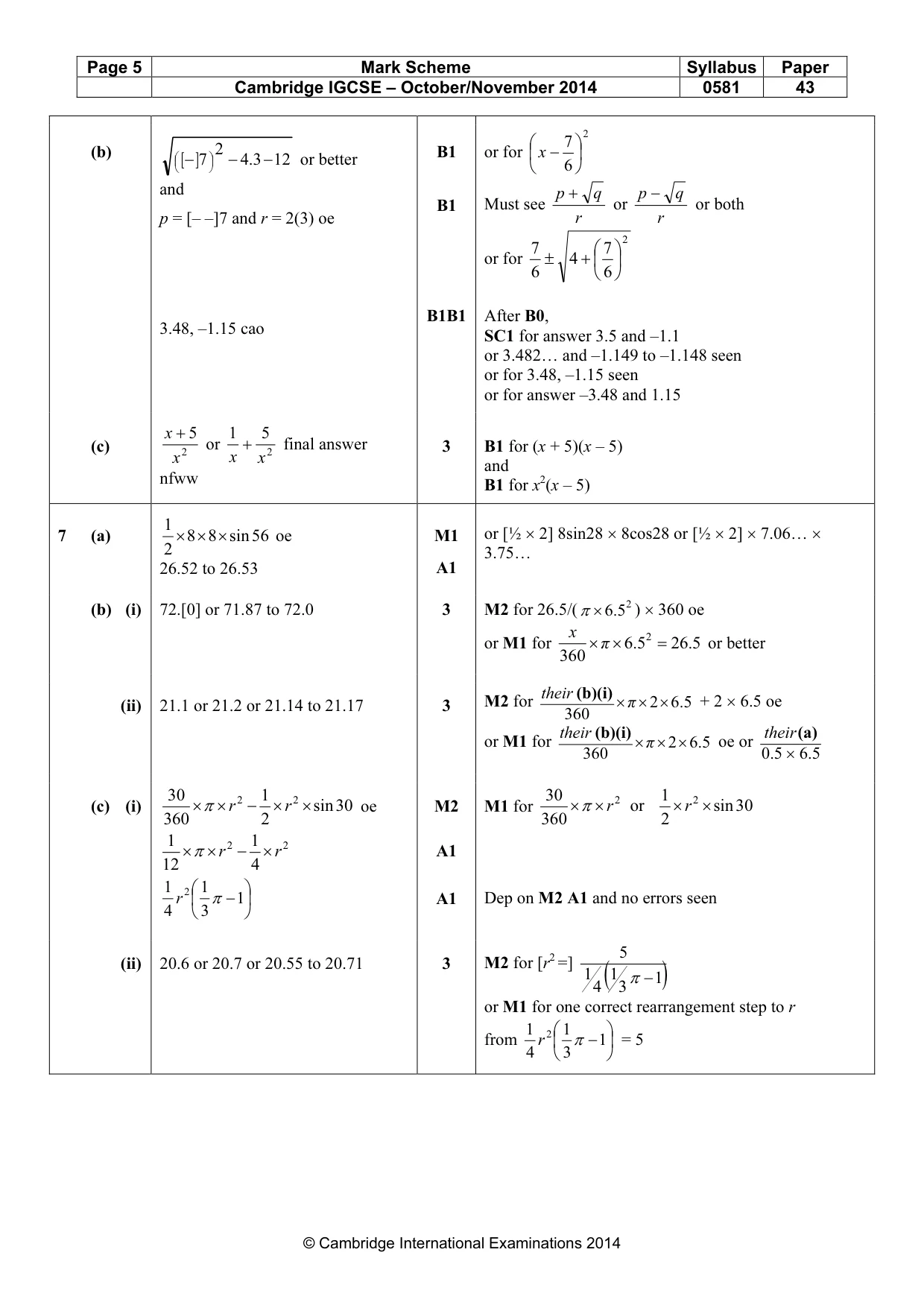
Page 5 Mark Scheme Syllabus Paper Cambridge IGCSE – October/November 2014 0581 43 © Cambridge International Examinations 2014 (b) [ ] 12 3.4 2 7 − − − or better and p = [– –]7 and r = 2(3) oe 3.48, –1.15 cao B1 B1 B1B1 or for 2 6 7 − x Must see r q p + or r q p − or both or for 2 6 7 4 6 7 + ± After B0, SC1 for answer 3.5 and –1.1 or 3.482… and –1.149 to –1.148 seen or for 3.48, –1.15 seen or for answer –3.48 and 1.15 (c) 2 5 x x + or 2 5 1 x x + final answer nfww 3 B1 for (x + 5)(x – 5) and B1 for x2(x – 5) 7 (a) 56 sin 8 8 2 1 × × × oe 26.52 to 26.53 M1 A1 or [½ × 2] 8sin28 × 8cos28 or [½ × 2] × 7.06… × 3.75… (b) (i) 72.[0] or 71.87 to 72.0 3 M2 for 26.5/( 2 5.6 × π ) × 360 oe or M1 for 5. 26 5.6 360 2 = × ×π x or better (ii) 21.1 or 21.2 or 21.14 to 21.17 3 M2 for 5.6 2 360 × × ×π their (b)(i) + 2 × 6.5 oe or M1 for 5.6 2 360 × × ×π their (b)(i) oe or 5.6 5.0 × (a) their (c) (i) 30 sin 2 1 360 30 2 2 × × − × × r r π oe 2 2 4 1 12 1 r r × − × ×π −1 3 1 4 1 2 π r M2 A1 A1 M1 for 30 sin 2 1 or 360 30 2 2 × × × × r r π Dep on M2 A1 and no errors seen (ii) 20.6 or 20.7 or 20.55 to 20.71 3 M2 for [r2 =] ( )1 3 1 4 1 5 − π or M1 for one correct rearrangement step to r from −1 3 1 4 1 2 π r = 5
Mark scheme, page 6
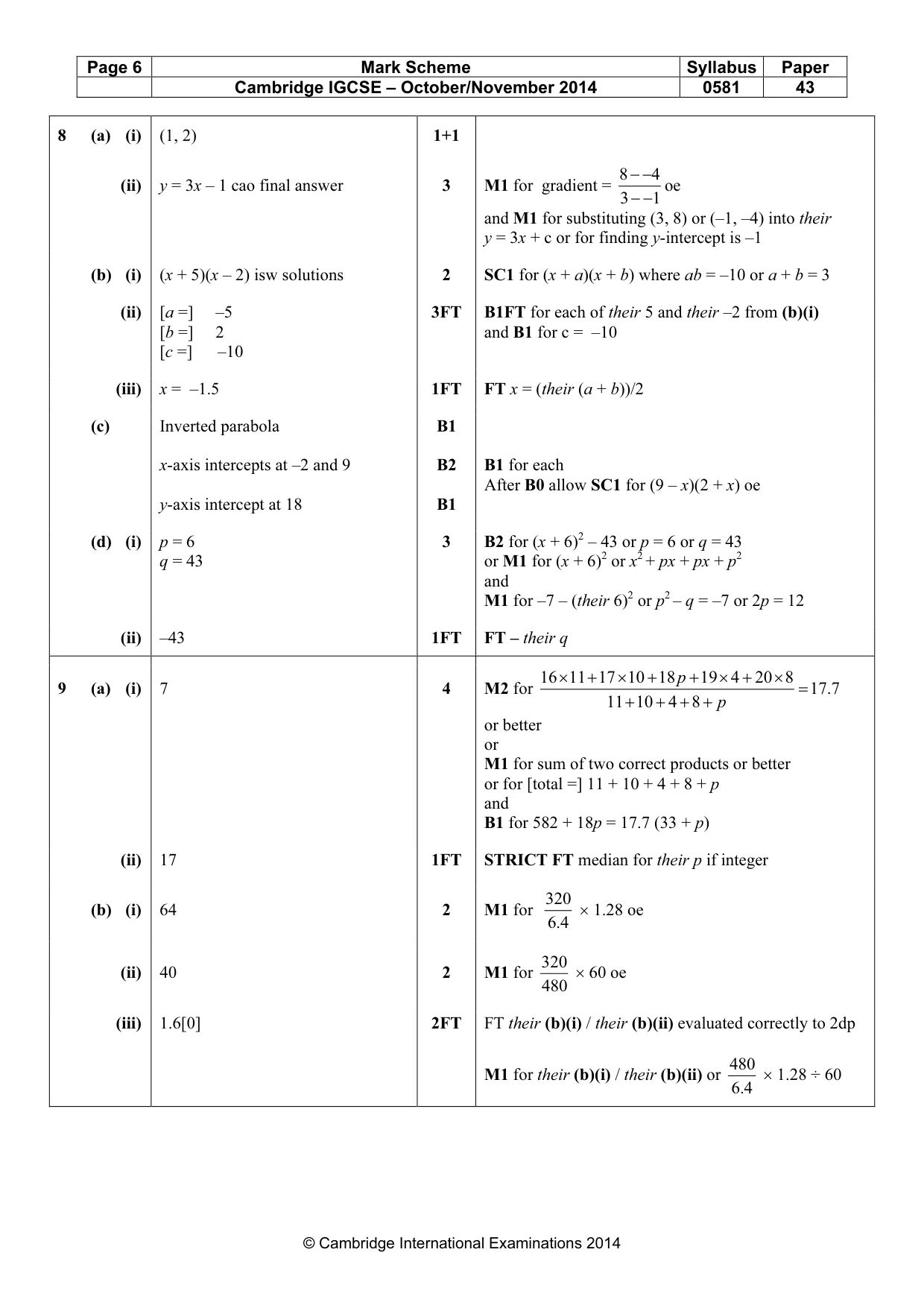
Page 6 Mark Scheme Syllabus Paper Cambridge IGCSE – October/November 2014 0581 43 © Cambridge International Examinations 2014 8 (a) (i) (1, 2) 1+1 (ii) y = 3x – 1 cao final answer 3 M1 for gradient = 1 3 4 8 − − − − oe and M1 for substituting (3, 8) or (–1, –4) into their y = 3x + c or for finding y-intercept is –1 (b) (i) (x + 5)(x – 2) isw solutions 2 SC1 for (x + a)(x + b) where ab = –10 or a + b = 3 (ii) [a =] –5 [b =] 2 [c =] –10 3FT B1FT for each of their 5 and their –2 from (b)(i) and B1 for c = –10 (iii) x = –1.5 1FT FT x = (their (a + b))/2 (c) Inverted parabola x-axis intercepts at –2 and 9 y-axis intercept at 18 B1 B2 B1 B1 for each After B0 allow SC1 for (9 – x)(2 + x) oe (d) (i) p = 6 q = 43 3 B2 for (x + 6)2 – 43 or p = 6 or q = 43 or M1 for (x + 6)2 or x2 + px + px + p2 and M1 for –7 – (their 6)2 or p2 – q = –7 or 2p = 12 (ii) –43 1FT FT – their q 9 (a) (i) 7 4 M2 for 7. 17 8 4 10 11 8 20 4 19 18 10 17 11 16 = + + + + × + × + + × + × p p or better or M1 for sum of two correct products or better or for [total =] 11 + 10 + 4 + 8 + p and B1 for 582 + 18p = 17.7 (33 + p) (ii) 17 1FT STRICT FT median for their p if integer (b) (i) 64 2 M1 for 4.6 320 × 1.28 oe (ii) 40 2 M1 for 480 320 × 60 oe (iii) 1.6[0] 2FT FT their (b)(i) / their (b)(ii) evaluated correctly to 2dp M1 for their (b)(i) / their (b)(ii) or 4.6 480 × 1.28 ÷ 60
Mark scheme, page 7
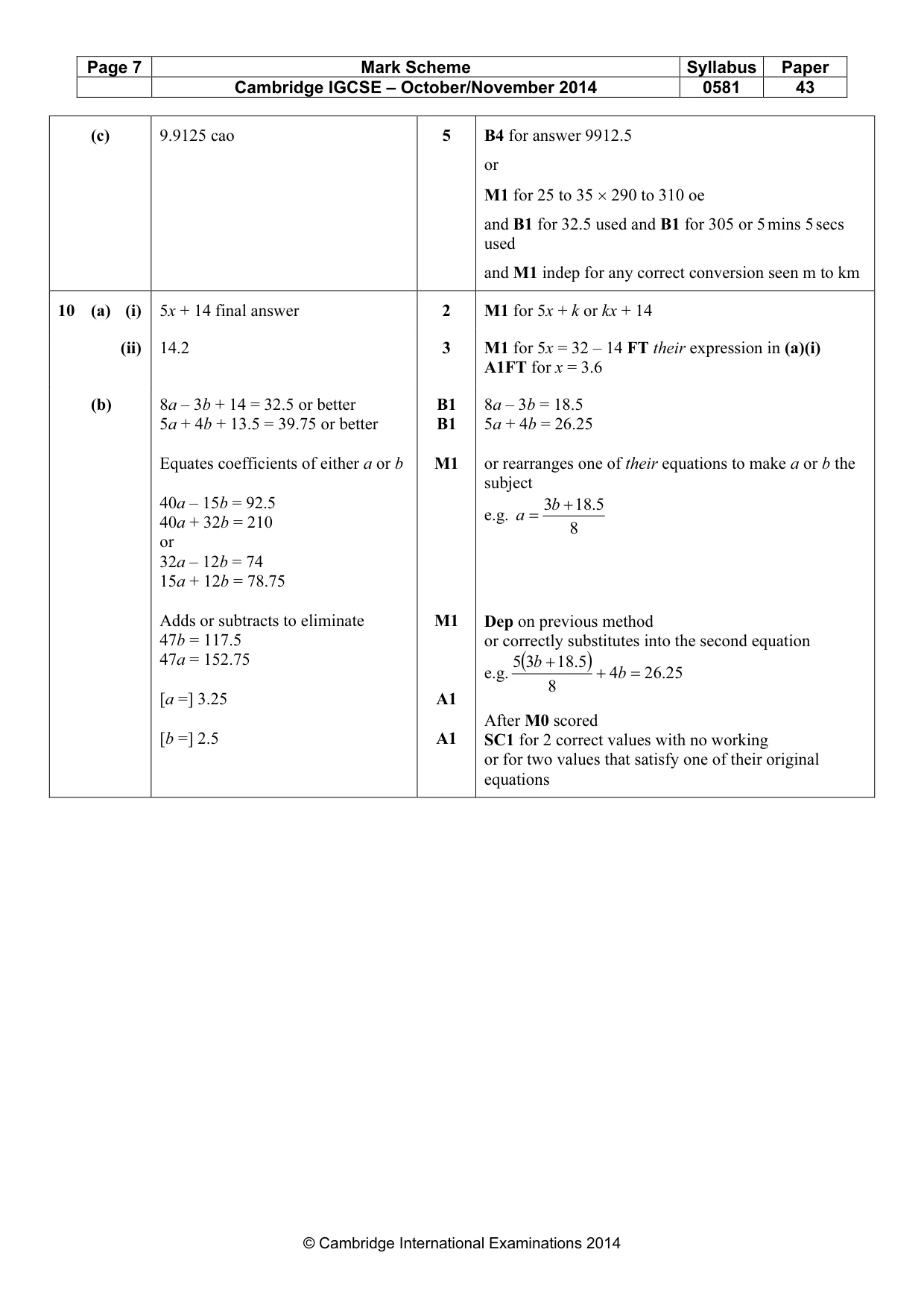
Page 7 Mark Scheme Syllabus Paper Cambridge IGCSE – October/November 2014 0581 43 © Cambridge International Examinations 2014 (c) 9.9125 cao 5 B4 for answer 9912.5 or M1 for 25 to 35 × 290 to 310 oe and B1 for 32.5 used and B1 for 305 or 5 mins 5 secs used and M1 indep for any correct conversion seen m to km 10 (a) (i) 5x + 14 final answer 2 M1 for 5x + k or kx + 14 (ii) 14.2 3 M1 for 5x = 32 – 14 FT their expression in (a)(i) A1FT for x = 3.6 (b) 8a – 3b + 14 = 32.5 or better 5a + 4b + 13.5 = 39.75 or better Equates coefficients of either a or b 40a – 15b = 92.5 40a + 32b = 210 or 32a – 12b = 74 15a + 12b = 78.75 Adds or subtracts to eliminate 47b = 117.5 47a = 152.75 [a =] 3.25 [b =] 2.5 B1 B1 M1 M1 A1 A1 8a – 3b = 18.5 5a + 4b = 26.25 or rearranges one of their equations to make a or b the subject e.g. 8 5. 18 3 + = b a Dep on previous method or correctly substitutes into the second equation e.g. ( ) 25 . 26 4 8 5. 18 3 5 = + + b b After M0 scored SC1 for 2 correct values with no working or for two values that satisfy one of their original equations