Cambridge IGCSE Mathematics (with coursework) 0581 — 2014 Oct/Nov Paper 4 · Variant 1
0581/41/O/N/14
The question paper and its mark scheme, free to read here and free to download. This is Cambridge’s own paper, exactly as it was sat.
Question paper20 pages
Mark scheme8 pages
Answers below. Sit the paper first if you are practising.
Paper as text
Question paper, page 1
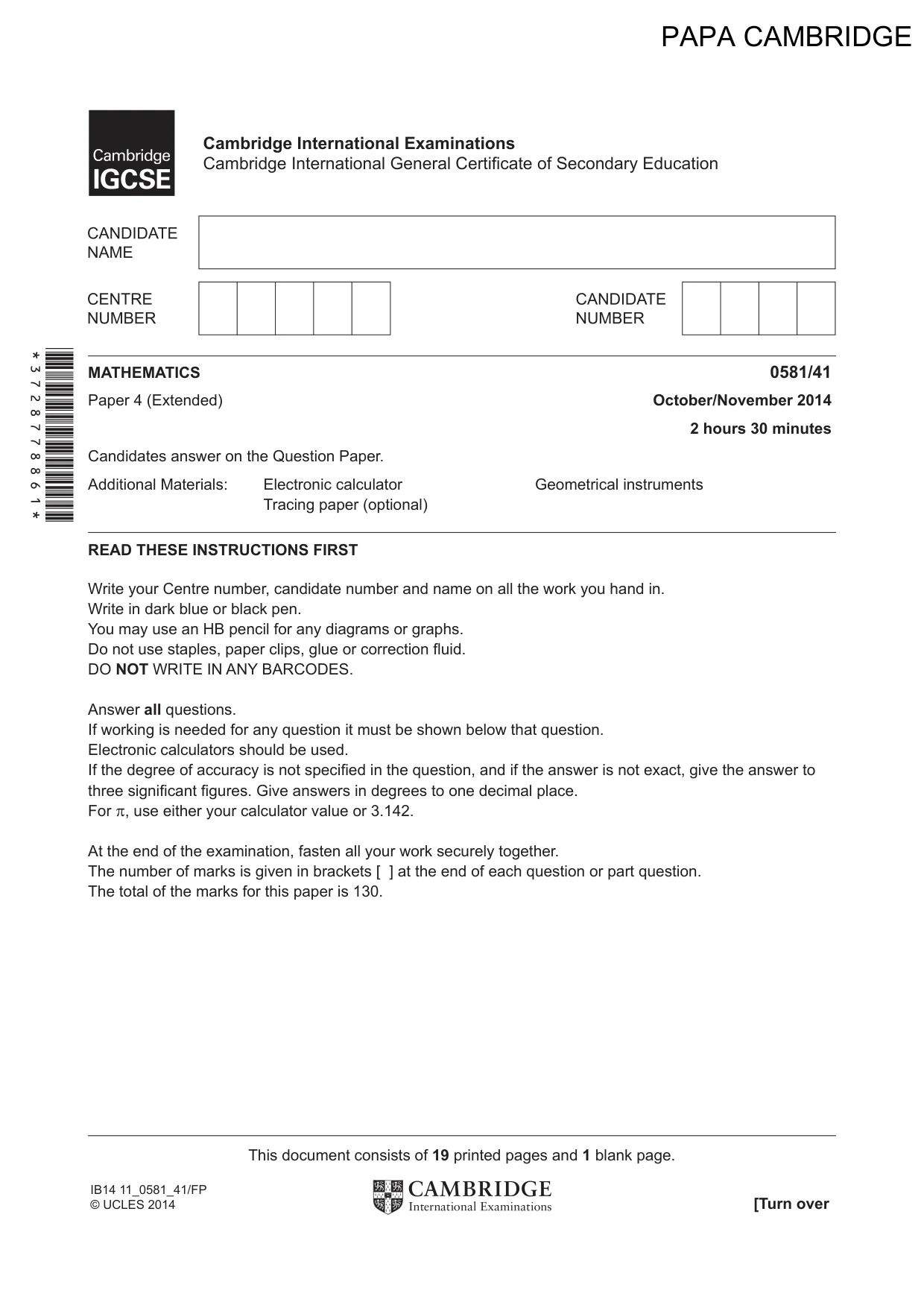
READ THESE INSTRUCTIONS FIRST Write your Centre number, candidate number and name on all the work you hand in. Write in dark blue or black pen. You may use an HB pencil for any diagrams or graphs. Do not use staples, paper clips, glue or correction fl uid. DO NOT WRITE IN ANY BARCODES. Answer all questions. If working is needed for any question it must be shown below that question. Electronic calculators should be used. If the degree of accuracy is not specifi ed in the question, and if the answer is not exact, give the answer to three signifi cant fi gures. Give answers in degrees to one decimal place. For π, use either your calculator value or 3.142. At the end of the examination, fasten all your work securely together. The number of marks is given in brackets [ ] at the end of each question or part question. The total of the marks for this paper is 130. MATHEMATICS 0581/41 Paper 4 (Extended) October/November 2014 2 hours 30 minutes Candidates answer on the Question Paper. Additional Materials: Electronic calculator Geometrical instruments Tracing paper (optional) Cambridge International Examinations Cambridge International General Certifi cate of Secondary Education This document consists of 19 printed pages and 1 blank page. [Turn over IB14 11_0581_41/FP © UCLES 2014 *3728778861* PAPA CAMBRIDGE
Question paper, page 2
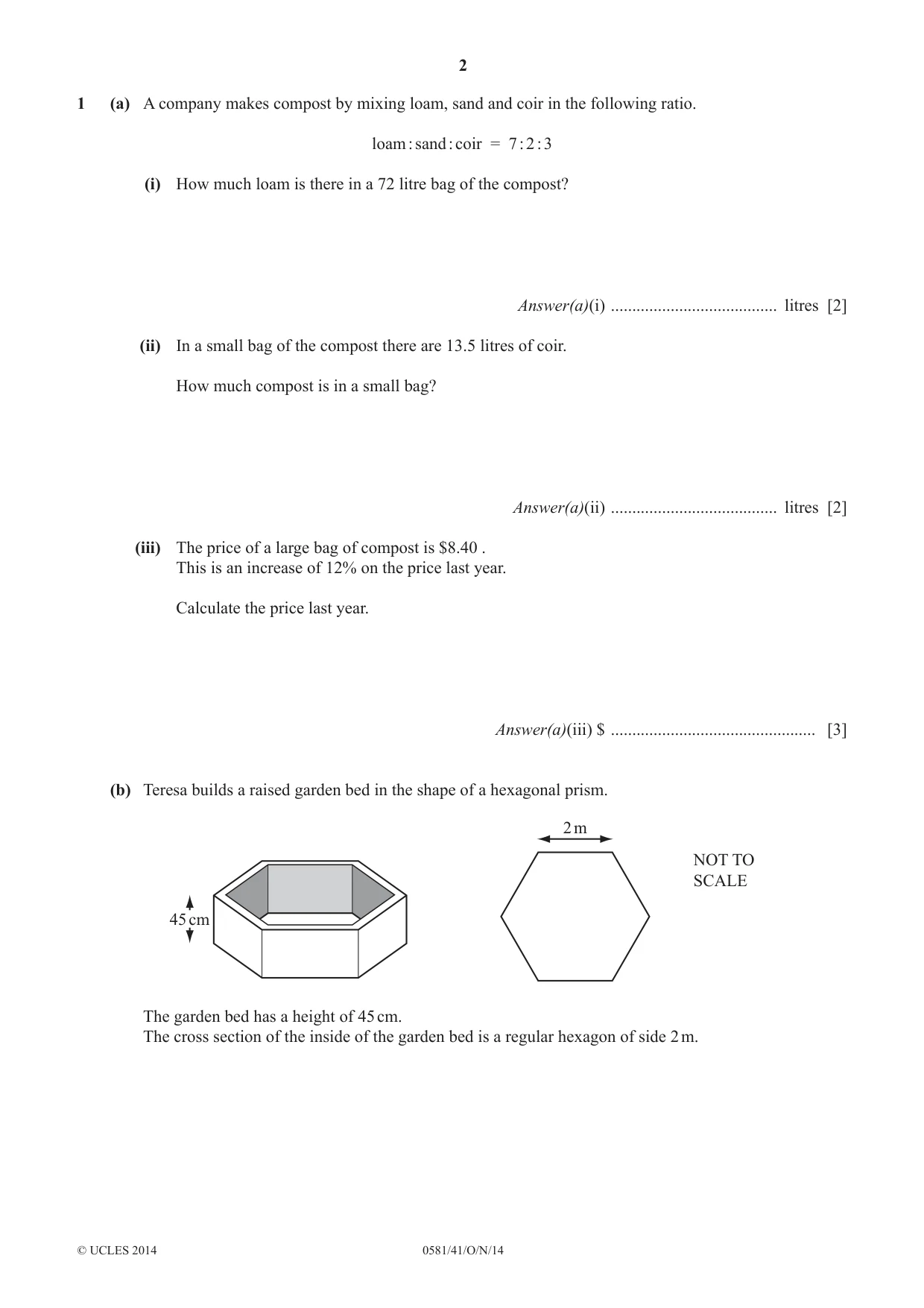
2 0581/41/O/N/14 © UCLES 2014 1 (a) A company makes compost by mixing loam, sand and coir in the following ratio. loam : sand : coir = 7 : 2 : 3 (i) How much loam is there in a 72 litre bag of the compost? Answer(a)(i) … litres [2] (ii) In a small bag of the compost there are 13.5 litres of coir. How much compost is in a small bag? Answer(a)(ii) … litres [2] (iii) The price of a large bag of compost is $8.40 . This is an increase of 12% on the price last year. Calculate the price last year. Answer(a)(iii) $ … [3] (b) Teresa builds a raised garden bed in the shape of a hexagonal prism. 2 m NOT TO SCALE 45 cm The garden bed has a height of 45 cm. The cross section of the inside of the garden bed is a regular hexagon of side 2 m.
Question paper, page 3
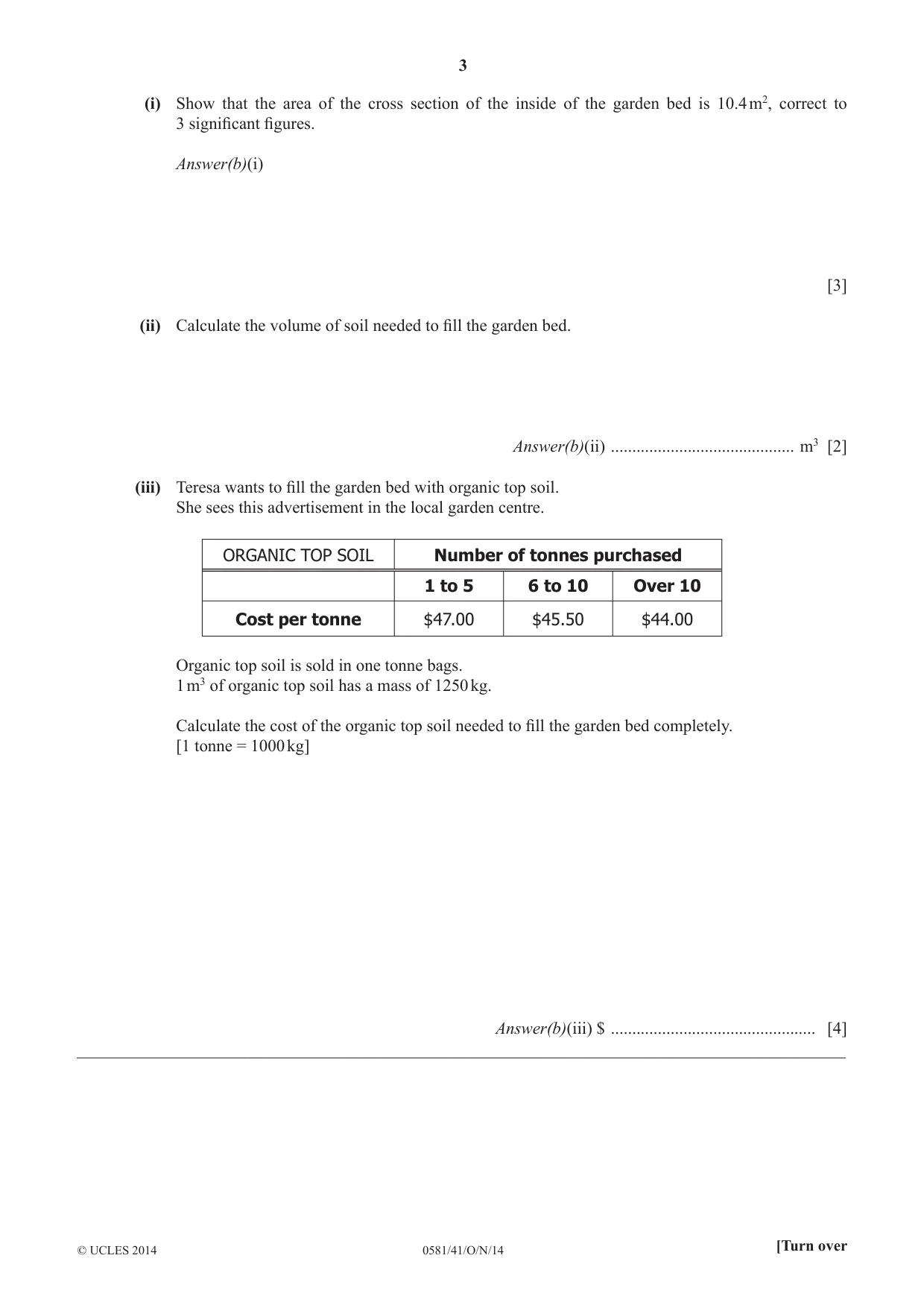
3 0581/41/O/N/14 © UCLES 2014 [Turn over (i) Show that the area of the cross section of the inside of the garden bed is 10.4 m2, correct to 3 signifi cant fi gures. Answer(b)(i) [3] (ii) Calculate the volume of soil needed to fi ll the garden bed. Answer(b)(ii) … m3 [2] (iii) Teresa wants to fi ll the garden bed with organic top soil. She sees this advertisement in the local garden centre. ORGANIC TOP SOIL Number of tonnes purchased 1 to 5 6 to 10 Over 10 Cost per tonne $47.00 $45.50 $44.00 Organic top soil is sold in one tonne bags. 1 m3 of organic top soil has a mass of 1250 kg. Calculate the cost of the organic top soil needed to fi ll the garden bed completely. [1 tonne = 1000 kg] Answer(b)(iii) $ … [4] __________________________________________________________________________________________
Question paper, page 4
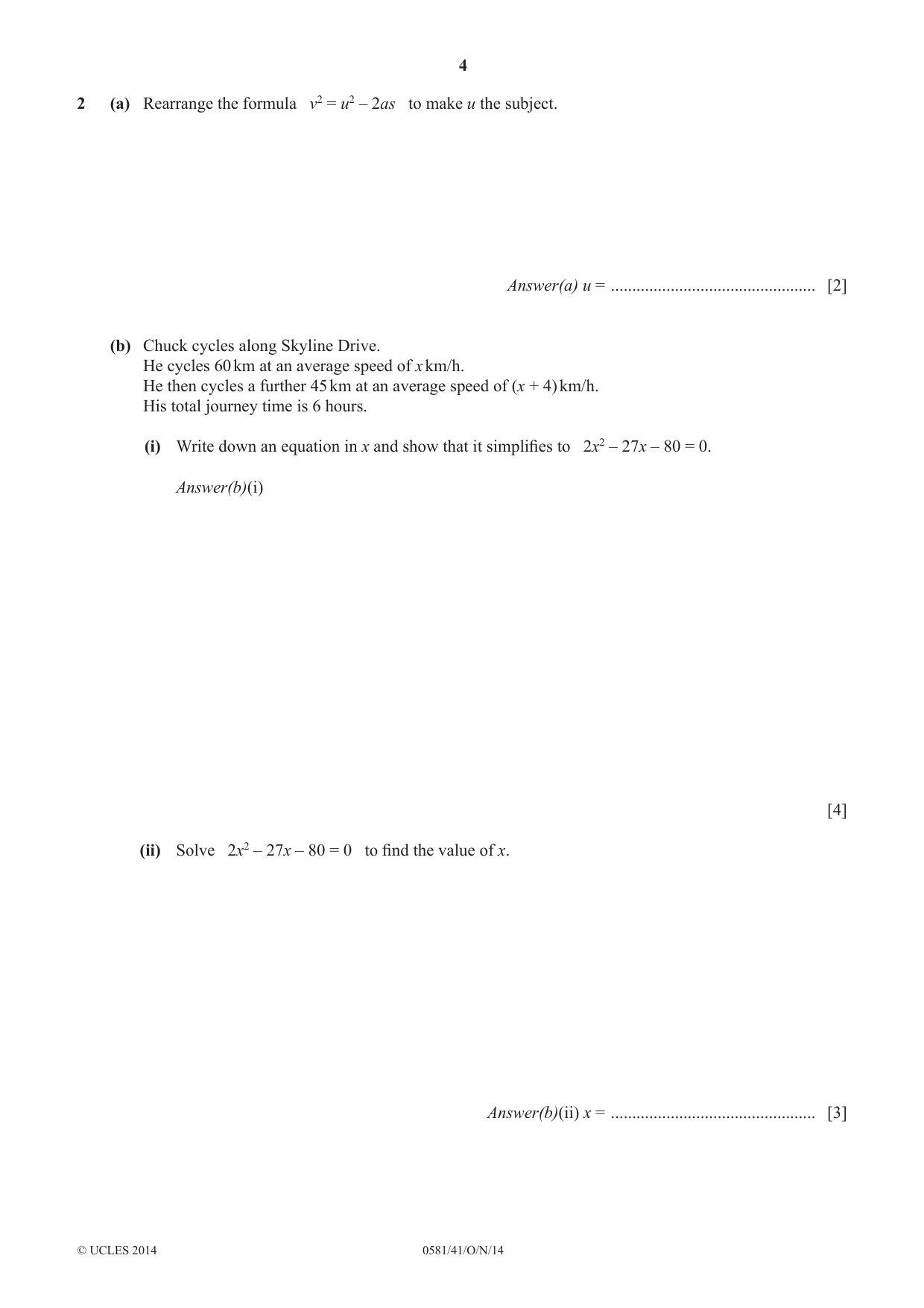
4 0581/41/O/N/14 © UCLES 2014 2 (a) Rearrange the formula v2 = u2 – 2as to make u the subject. Answer(a) u = … [2] (b) Chuck cycles along Skyline Drive. He cycles 60 km at an average speed of x km/h. He then cycles a further 45 km at an average speed of (x + 4) km/h. His total journey time is 6 hours. (i) Write down an equation in x and show that it simplifi es to 2x2 – 27x – 80 = 0. Answer(b)(i) [4] (ii) Solve 2x2 – 27x – 80 = 0 to fi nd the value of x. Answer(b)(ii) x = … [3]
Question paper, page 5
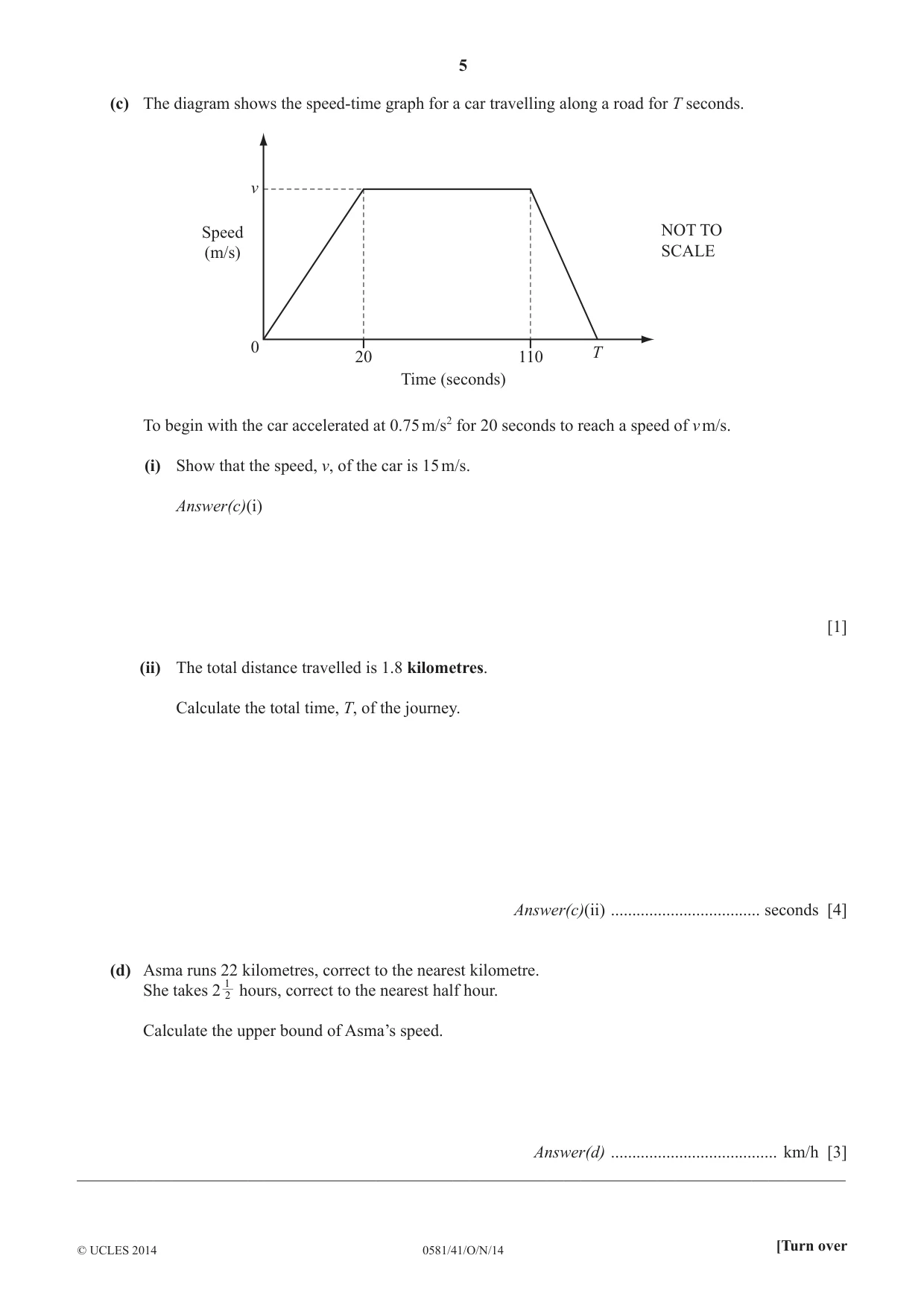
5 0581/41/O/N/14 © UCLES 2014 [Turn over (c) The diagram shows the speed-time graph for a car travelling along a road for T seconds. 0 v T 20 110 Time (seconds) Speed (m/s) NOT TO SCALE To begin with the car accelerated at 0.75 m/s2 for 20 seconds to reach a speed of v m/s. (i) Show that the speed, v, of the car is 15 m/s. Answer(c)(i) [1] (ii) The total distance travelled is 1.8 kilometres. Calculate the total time, T, of the journey. Answer(c)(ii) … seconds [4] (d) Asma runs 22 kilometres, correct to the nearest kilometre. She takes 2 2 1 hours, correct to the nearest half hour. Calculate the upper bound of Asma’s speed. Answer(d) … km/h [3] __________________________________________________________________________________________
Question paper, page 6
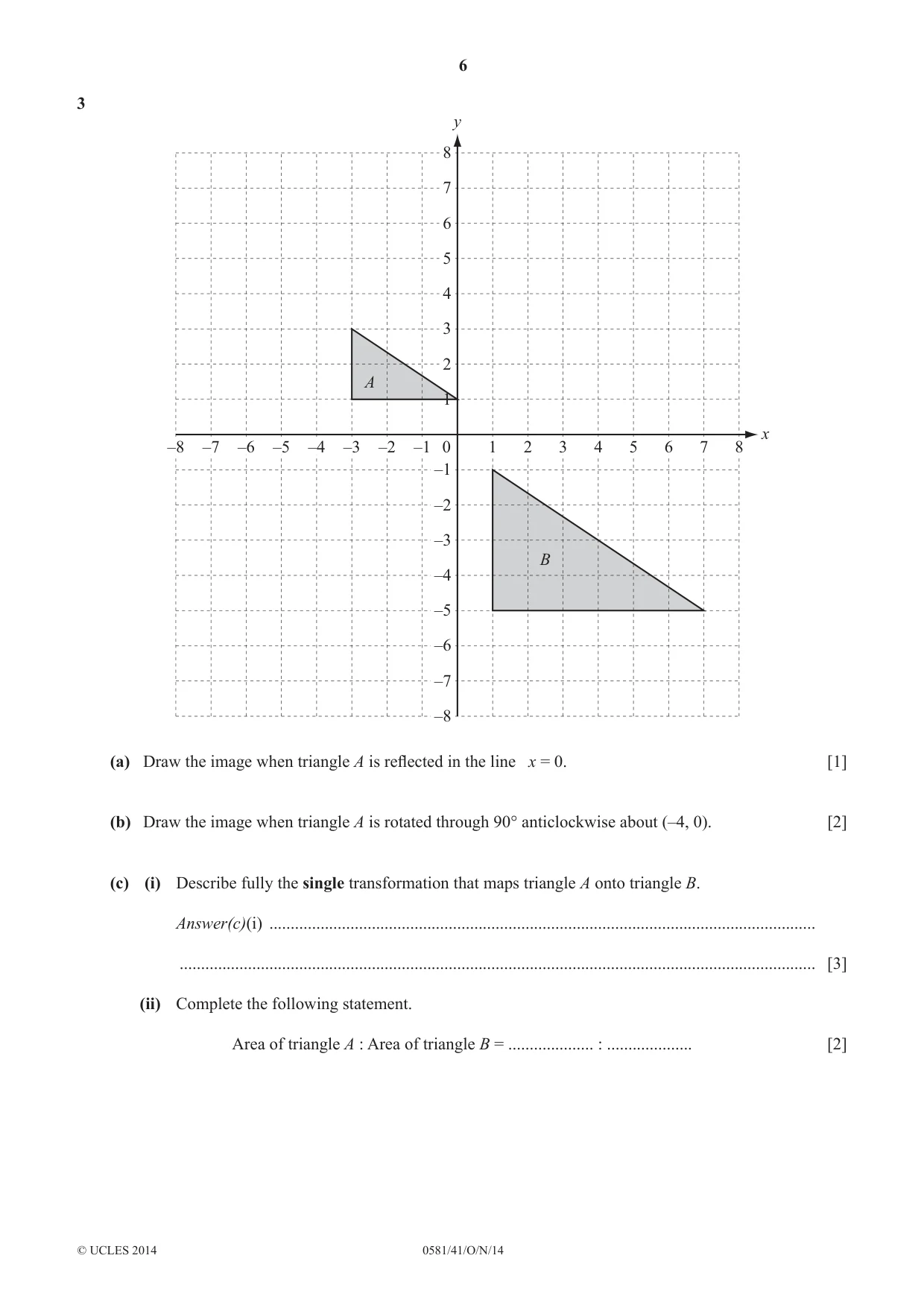
6 0581/41/O/N/14 © UCLES 2014 3 8 7 6 5 4 3 2 1 –1 –2 –3 –4 –5 –6 –7 –8 –6 –7 –8 –5 –4 –3 –2 –1 1 0 2 3 4 5 6 7 8 y x A B (a) Draw the image when triangle A is refl ected in the line x = 0. [1] (b) Draw the image when triangle A is rotated through 90° anticlockwise about (–4, 0). [2] (c) (i) Describe fully the single transformation that maps triangle A onto triangle B. Answer(c)(i) … … [3] (ii) Complete the following statement. Area of triangle A : Area of triangle B = … : … [2]
Question paper, page 7
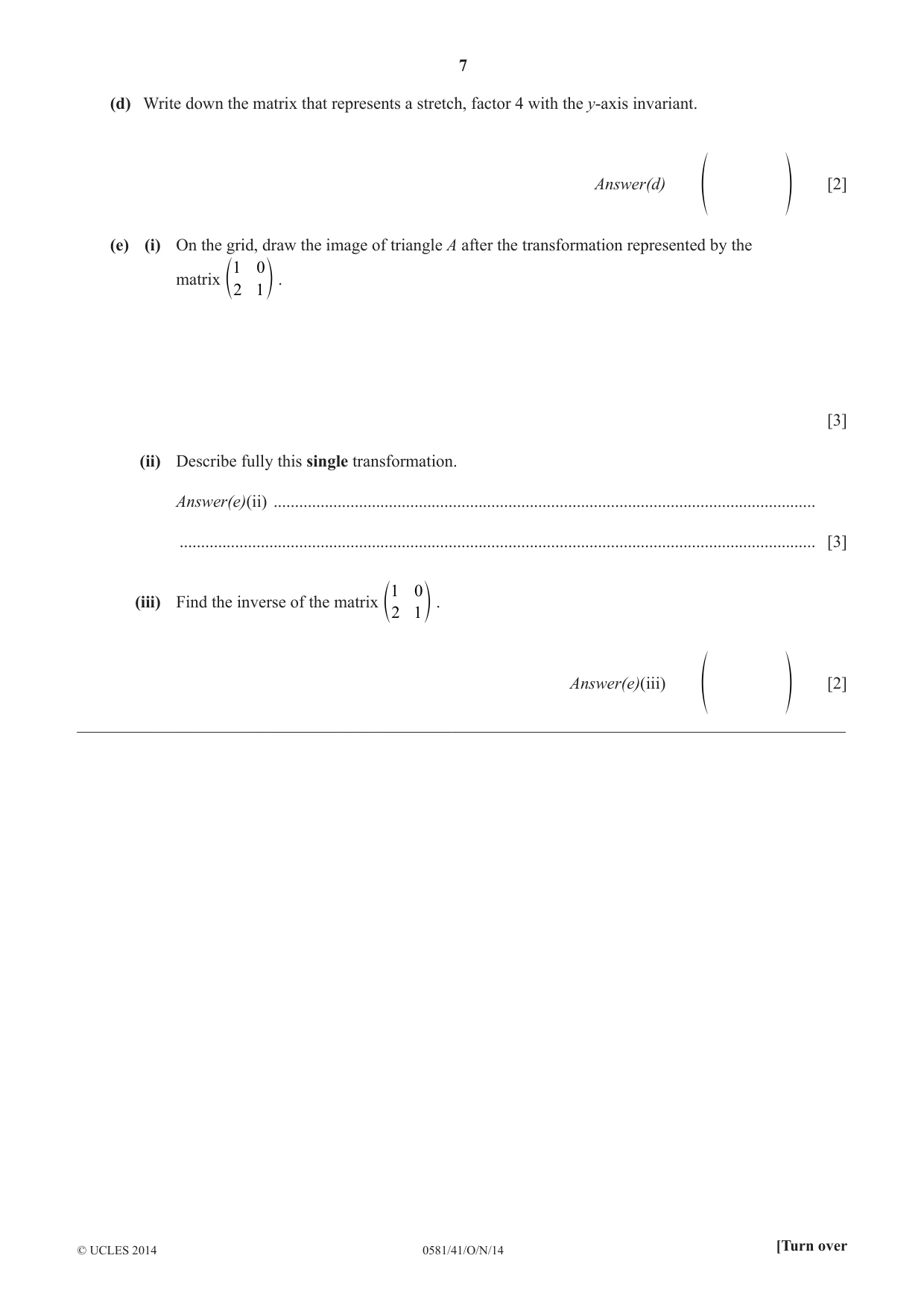
7 0581/41/O/N/14 © UCLES 2014 [Turn over (d) Write down the matrix that represents a stretch, factor 4 with the y-axis invariant. Answer(d) f p [2] (e) (i) On the grid, draw the image of triangle A after the transformation represented by the matrix 1 2 0 1 e o . [3] (ii) Describe fully this single transformation. Answer(e)(ii) … … [3] (iii) Find the inverse of the matrix 1 2 0 1 e o . Answer(e)(iii) f p [2] __________________________________________________________________________________________
Question paper, page 8
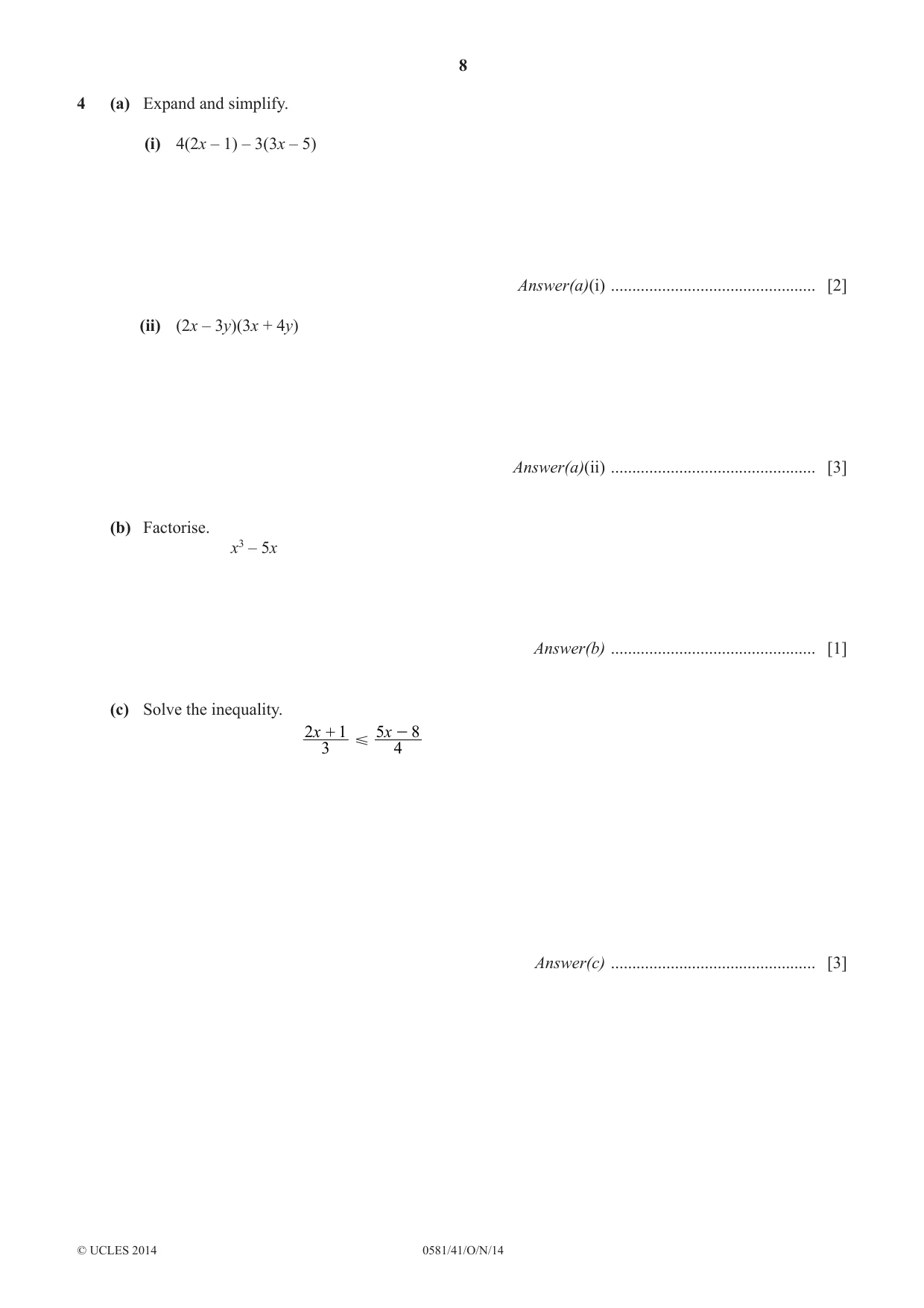
8 0581/41/O/N/14 © UCLES 2014 4 (a) Expand and simplify. (i) 4(2x – 1) – 3(3x – 5) Answer(a)(i) … [2] (ii) (2x – 3y)(3x + 4y) Answer(a)(ii) … [3] (b) Factorise. x3 – 5x Answer(b) … [1] (c) Solve the inequality. 3 2 1 x + Y= 4 5 8 x - Answer(c) … [3]
Question paper, page 9
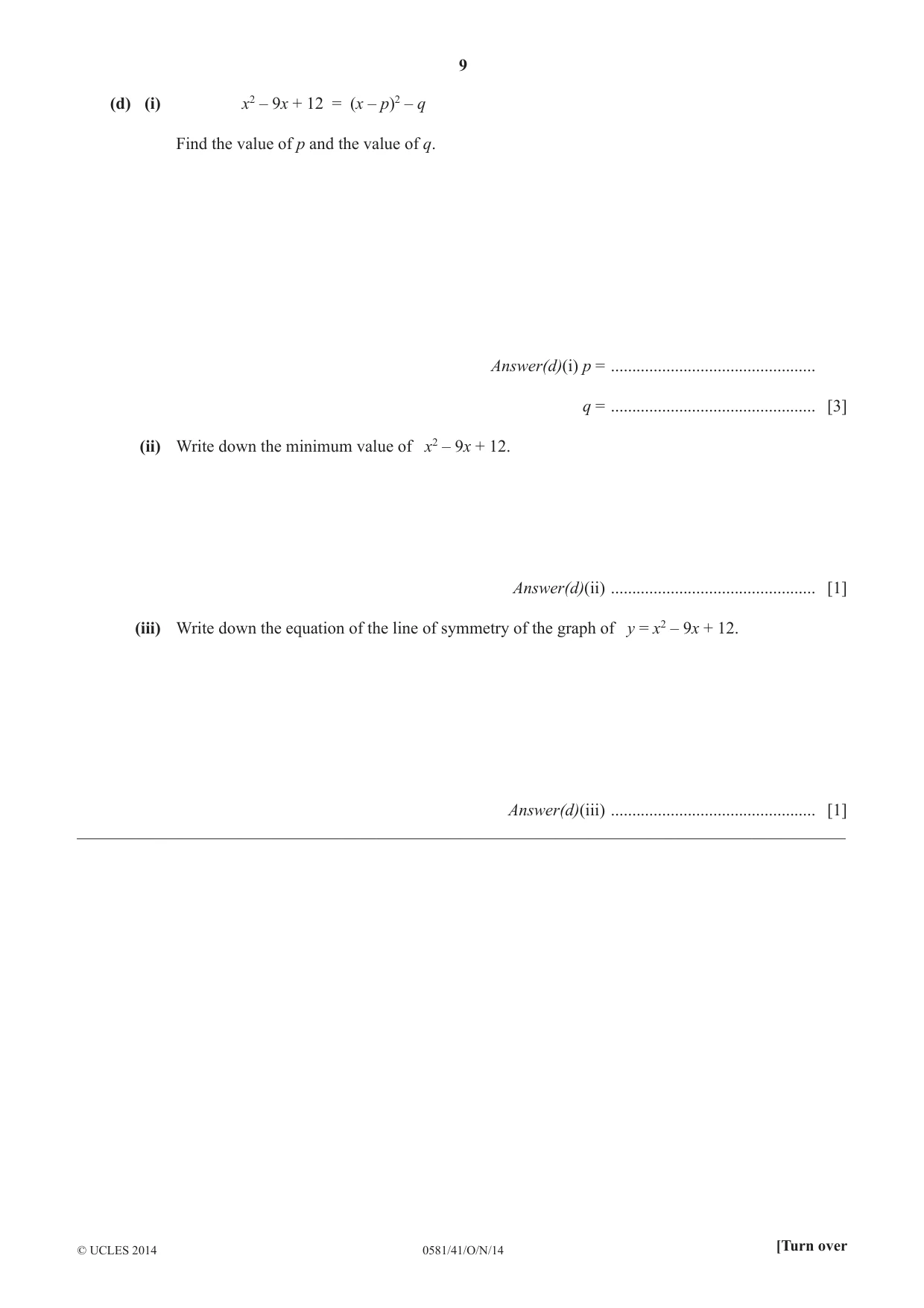
9 0581/41/O/N/14 © UCLES 2014 [Turn over (d) (i) x2 – 9x + 12 = (x – p)2 – q Find the value of p and the value of q. Answer(d)(i) p = … q = … [3] (ii) Write down the minimum value of x2 – 9x + 12. Answer(d)(ii) … [1] (iii) Write down the equation of the line of symmetry of the graph of y = x2 – 9x + 12. Answer(d)(iii) … [1] __________________________________________________________________________________________
Question paper, page 10
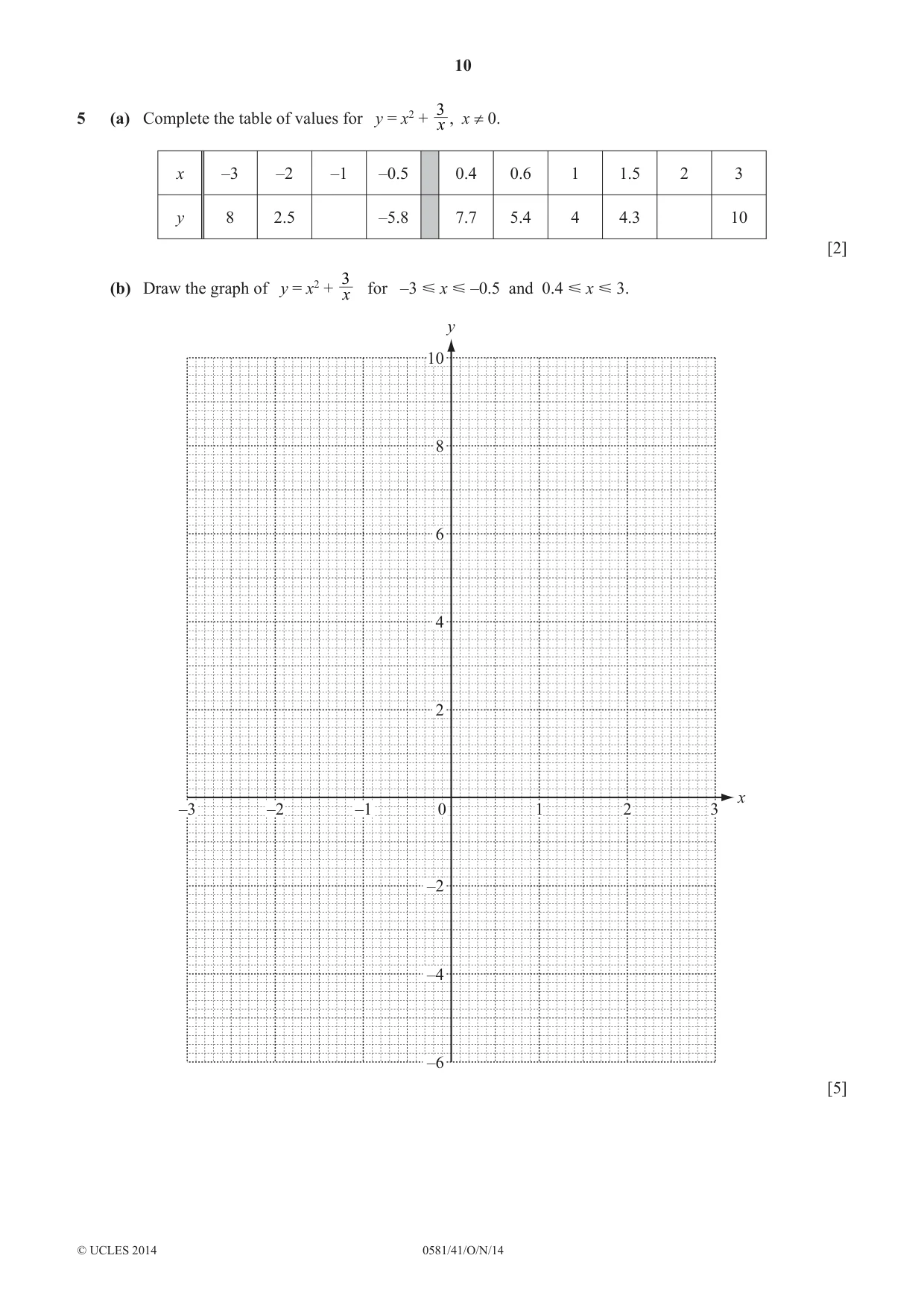
10 0581/41/O/N/14 © UCLES 2014 5 (a) Complete the table of values for y = x2 + x 3 , x ≠ 0. x –3 –2 –1 –0.5 0.4 0.6 1 1.5 2 3 y 8 2.5 –5.8 7.7 5.4 4 4.3 10 [2] (b) Draw the graph of y = x2 + x 3 for –3 Y x Y –0.5 and 0.4 Y x Y 3. y x 10 8 6 4 2 –2 –4 –6 0 –1 –2 –3 3 2 1 [5]
Question paper, page 11
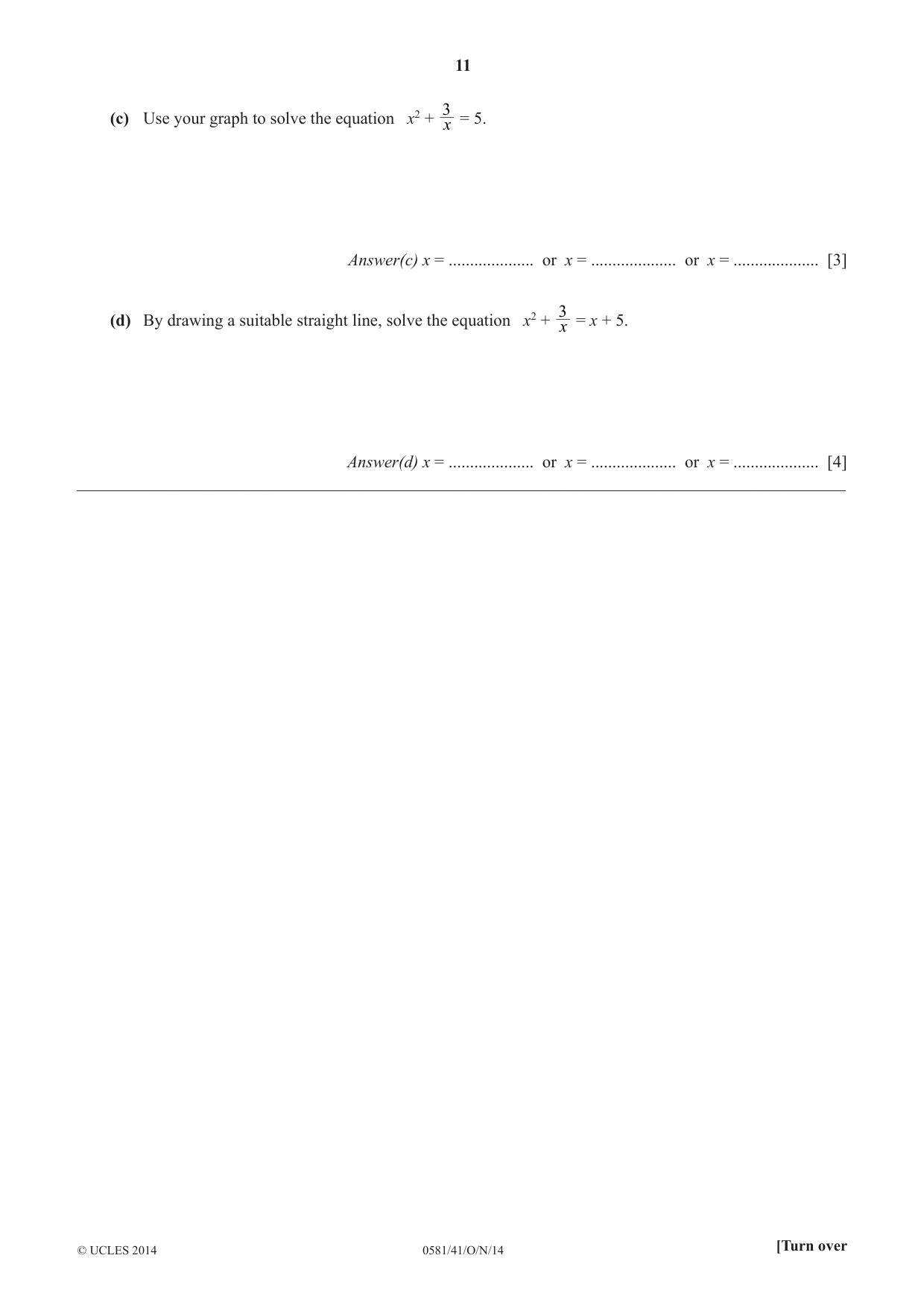
11 0581/41/O/N/14 © UCLES 2014 [Turn over (c) Use your graph to solve the equation x2 + x 3 = 5. Answer(c) x = … or x = … or x = … [3] (d) By drawing a suitable straight line, solve the equation x2 + x 3 = x + 5. Answer(d) x = … or x = … or x = … [4] __________________________________________________________________________________________
Question paper, page 12
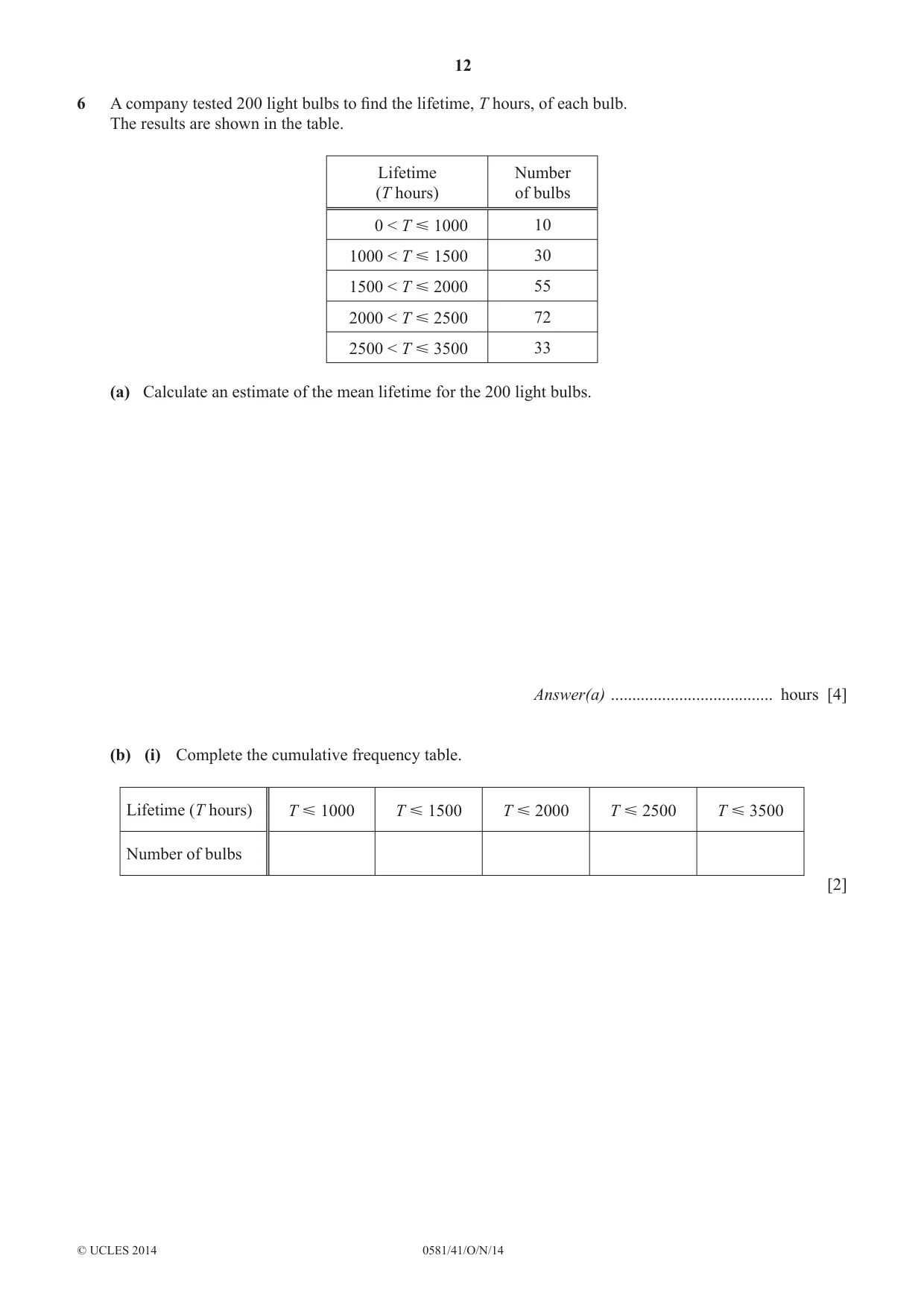
12 0581/41/O/N/14 © UCLES 2014 6 A company tested 200 light bulbs to fi nd the lifetime, T hours, of each bulb. The results are shown in the table. Lifetime (T hours) Number of bulbs 0 < T Y 1000 10 1000 < T Y 1500 30 1500 < T Y 2000 55 2000 < T Y 2500 72 2500 < T Y 3500 33 (a) Calculate an estimate of the mean lifetime for the 200 light bulbs. Answer(a) … hours [4] (b) (i) Complete the cumulative frequency table. Lifetime (T hours) T Y 1000 T Y 1500 T Y 2000 T Y 2500 T Y 3500 Number of bulbs [2]
Question paper, page 13
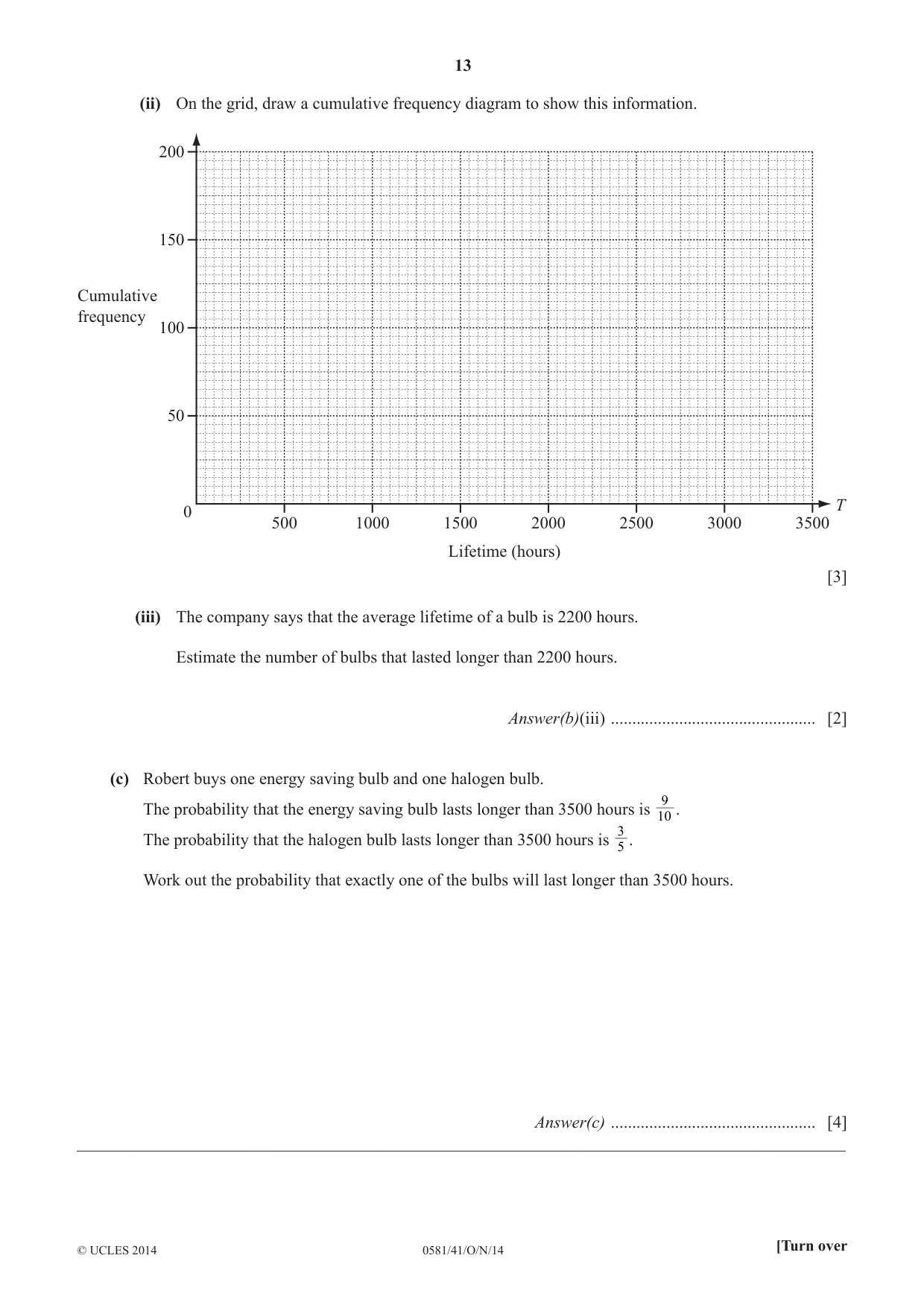
13 0581/41/O/N/14 © UCLES 2014 [Turn over (ii) On the grid, draw a cumulative frequency diagram to show this information. 200 150 100 50 500 0 1000 1500 2000 Lifetime (hours) 2500 3000 3500 Cumulative frequency T [3] (iii) The company says that the average lifetime of a bulb is 2200 hours. Estimate the number of bulbs that lasted longer than 2200 hours. Answer(b)(iii) … [2] (c) Robert buys one energy saving bulb and one halogen bulb. The probability that the energy saving bulb lasts longer than 3500 hours is 10 9 . The probability that the halogen bulb lasts longer than 3500 hours is 5 3 . Work out the probability that exactly one of the bulbs will last longer than 3500 hours. Answer(c) … [4] __________________________________________________________________________________________
Question paper, page 14
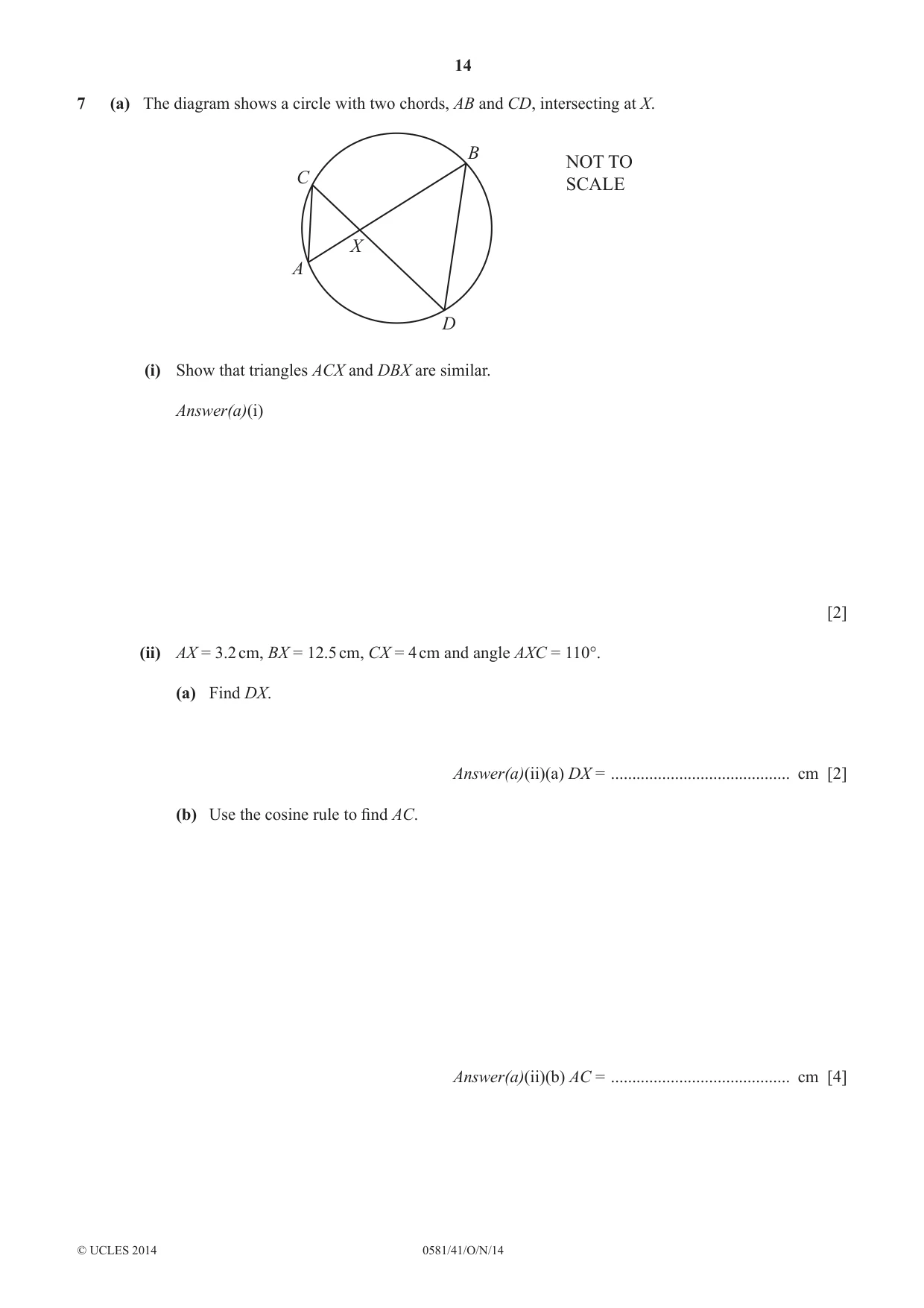
14 0581/41/O/N/14 © UCLES 2014 7 (a) The diagram shows a circle with two chords, AB and CD, intersecting at X. B C A D X NOT TO SCALE (i) Show that triangles ACX and DBX are similar. Answer(a)(i) [2] (ii) AX = 3.2 cm, BX = 12.5 cm, CX = 4 cm and angle AXC = 110°. (a) Find DX. Answer(a)(ii)(a) DX = … cm [2] (b) Use the cosine rule to fi nd AC. Answer(a)(ii)(b) AC = … cm [4]
Question paper, page 15
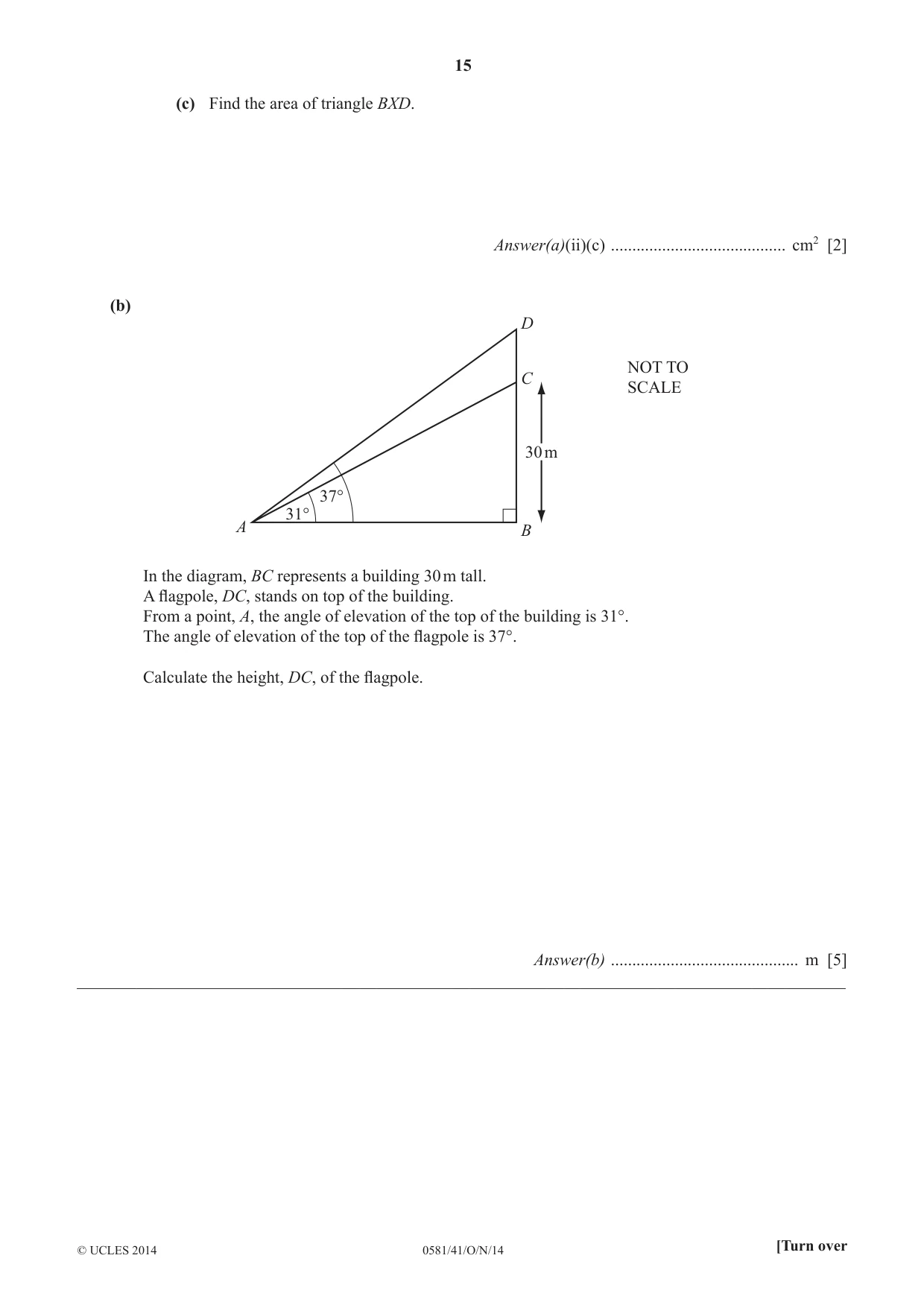
15 0581/41/O/N/14 © UCLES 2014 [Turn over (c) Find the area of triangle BXD. Answer(a)(ii)(c) … cm2 [2] (b) D C B A 31° 37° 30 m NOT TO SCALE In the diagram, BC represents a building 30 m tall. A fl agpole, DC, stands on top of the building. From a point, A, the angle of elevation of the top of the building is 31°. The angle of elevation of the top of the fl agpole is 37°. Calculate the height, DC, of the fl agpole. Answer(b) … m [5] __________________________________________________________________________________________
Question paper, page 16
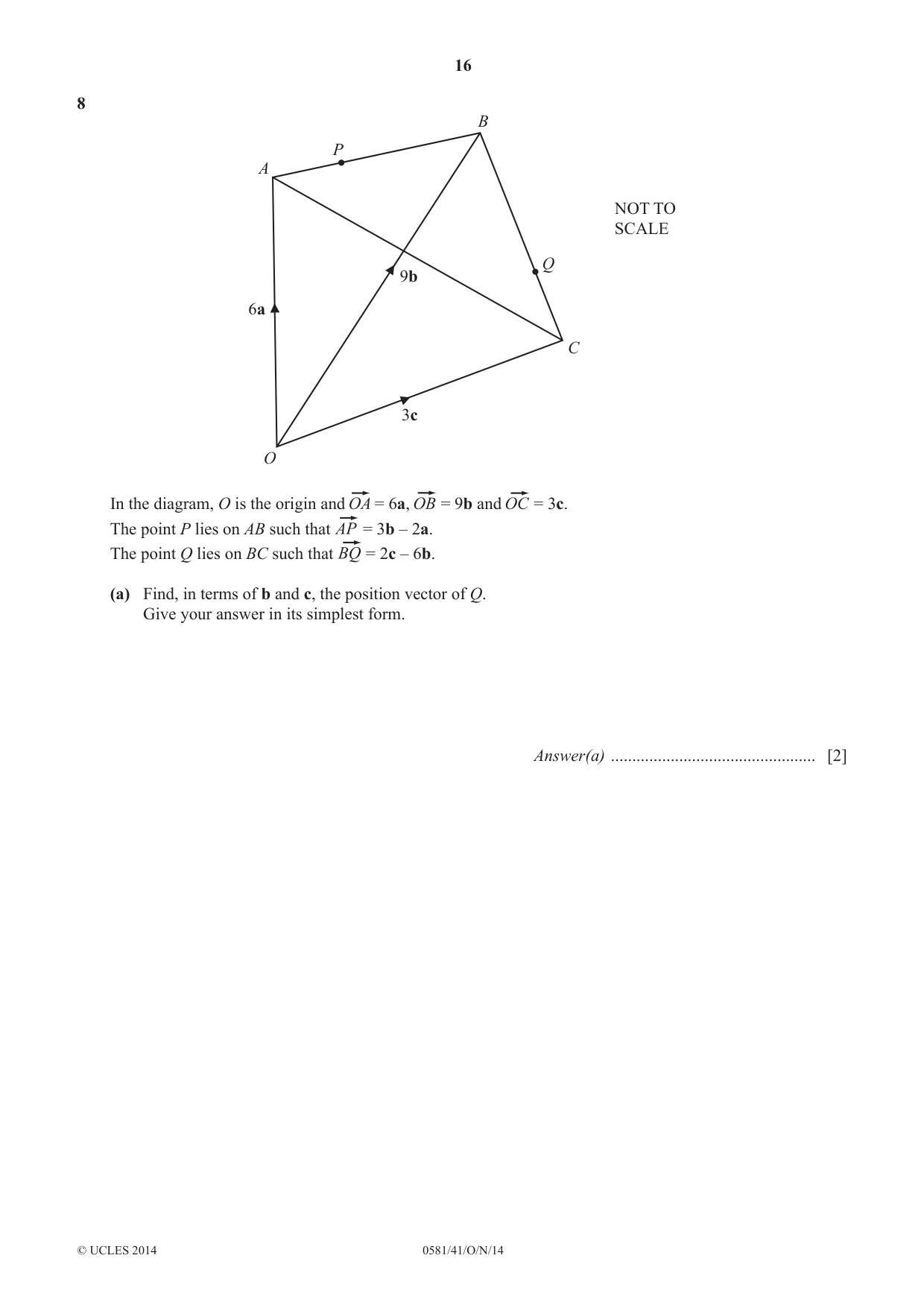
16 0581/41/O/N/14 © UCLES 2014 8 B A P O C Q 3c 6a 9b NOT TO SCALE In the diagram, O is the origin and = 6a, = 9b and = 3c. The point P lies on AB such that = 3b – 2a. The point Q lies on BC such that = 2c – 6b. (a) Find, in terms of b and c, the position vector of Q. Give your answer in its simplest form. Answer(a) … [2]
Question paper, page 17
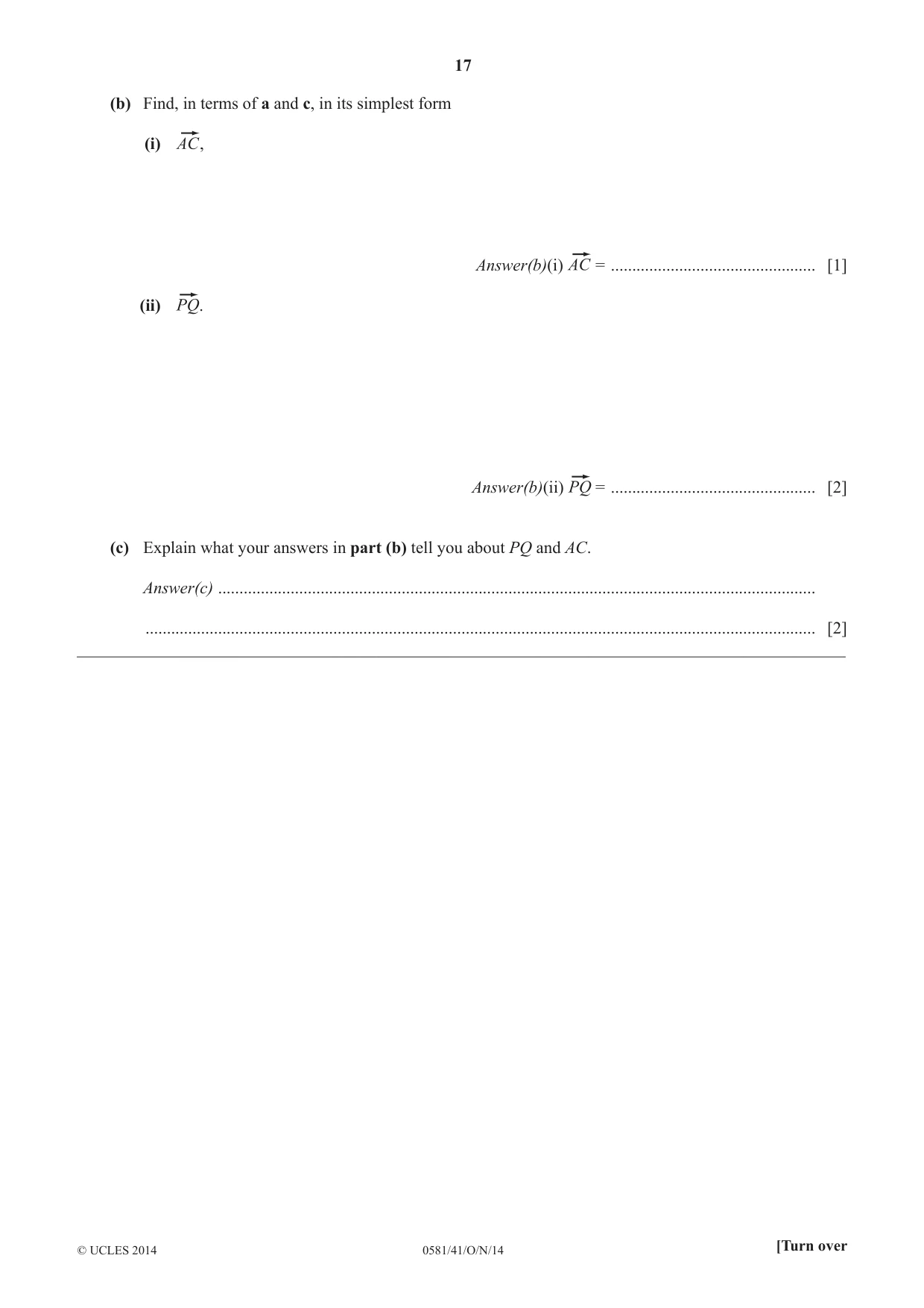
17 0581/41/O/N/14 © UCLES 2014 [Turn over (b) Find, in terms of a and c, in its simplest form (i) , Answer(b)(i) = … [1] (ii) . Answer(b)(ii) = … [2] (c) Explain what your answers in part (b) tell you about PQ and AC. Answer(c) … … [2] __________________________________________________________________________________________
Question paper, page 18
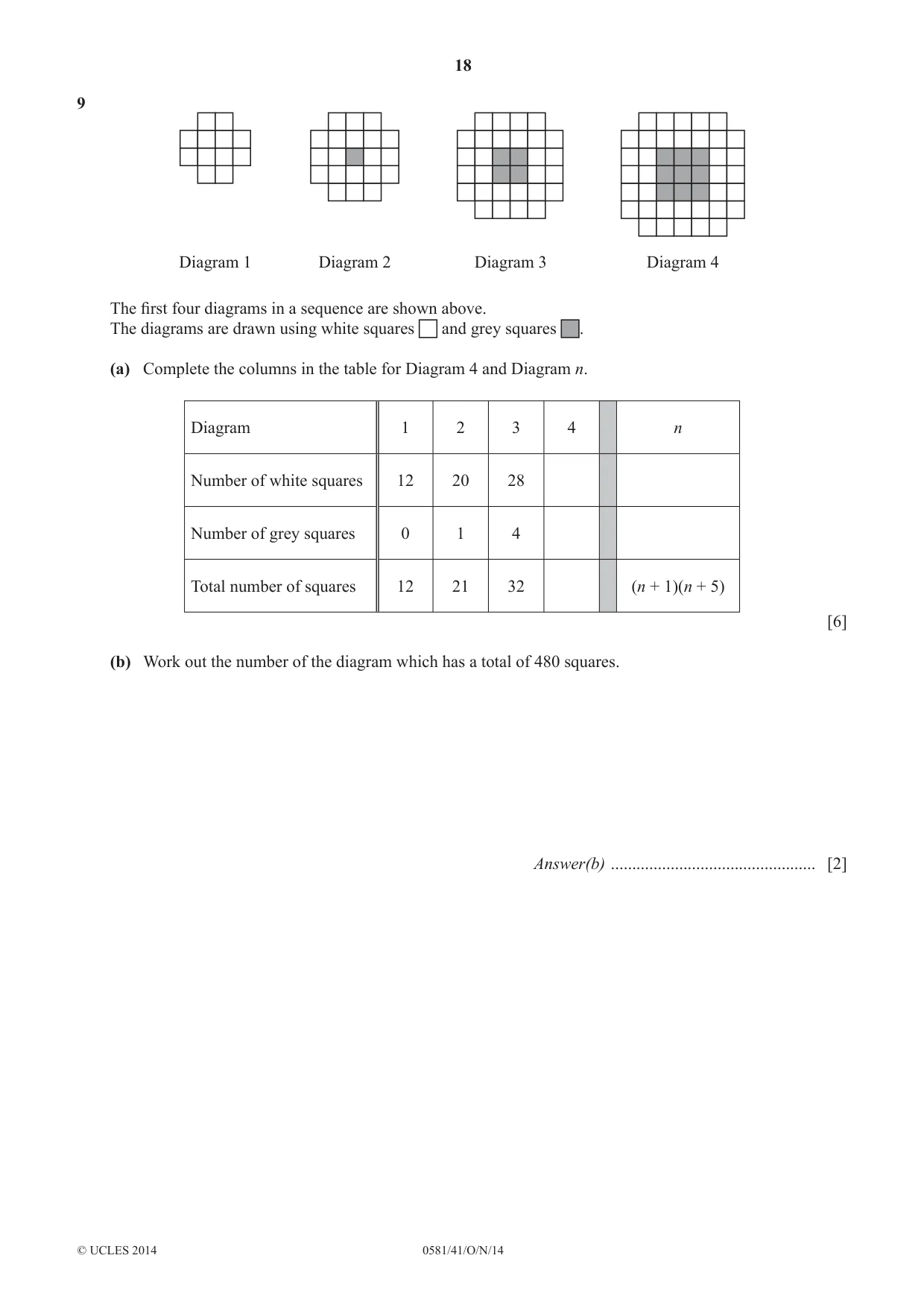
18 0581/41/O/N/14 © UCLES 2014 9 Diagram 4 Diagram 3 Diagram 2 Diagram 1 The fi rst four diagrams in a sequence are shown above. The diagrams are drawn using white squares and grey squares . (a) Complete the columns in the table for Diagram 4 and Diagram n. Diagram 1 2 3 4 n Number of white squares 12 20 28 Number of grey squares 0 1 4 Total number of squares 12 21 32 (n + 1)(n + 5) [6] (b) Work out the number of the diagram which has a total of 480 squares. Answer(b) … [2]
Question paper, page 19
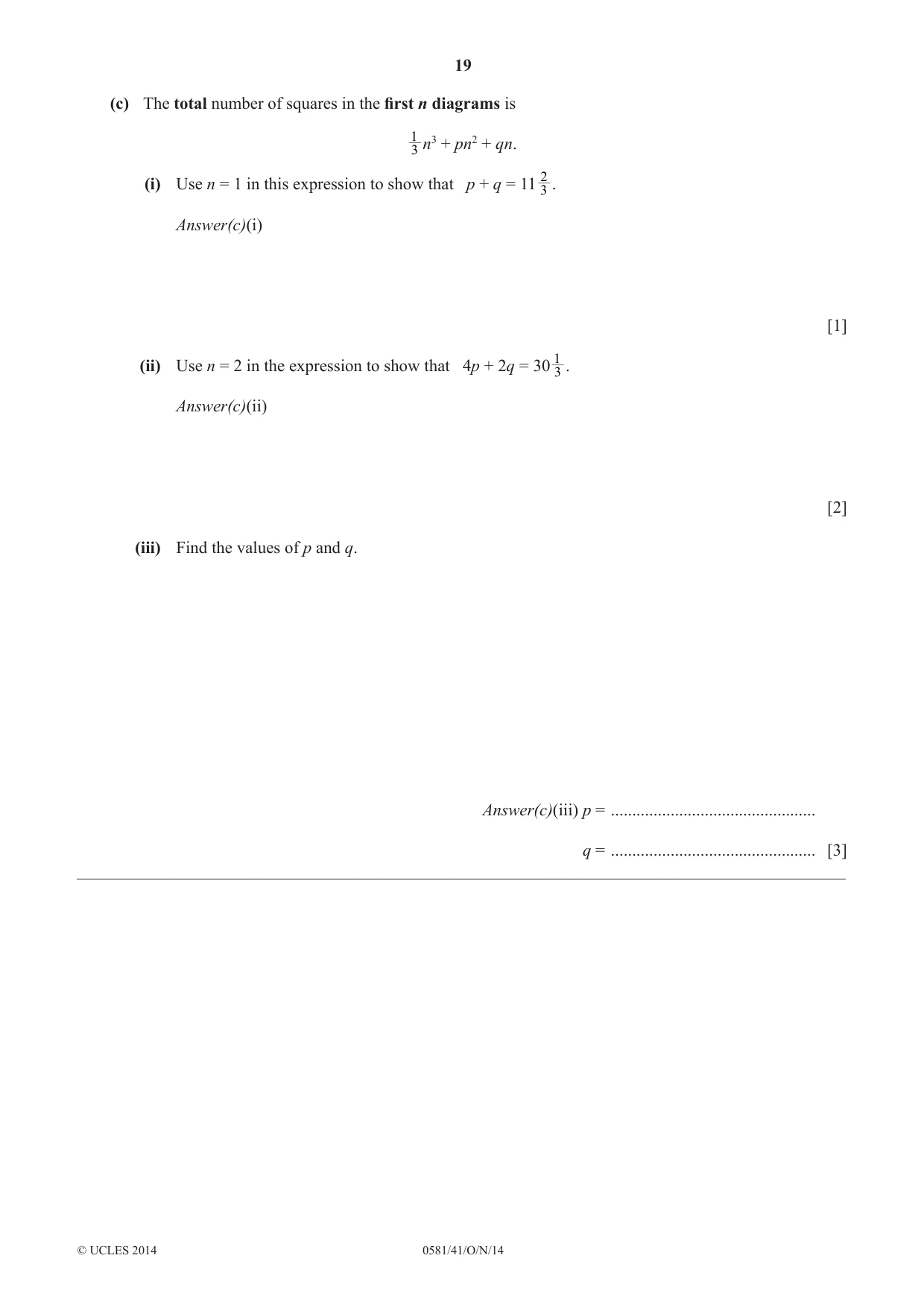
19 0581/41/O/N/14 © UCLES 2014 [Turn over (c) The total number of squares in the fi rst n diagrams is 3 1 n3 + pn2 + qn. (i) Use n = 1 in this expression to show that p + q = 11 3 2 . Answer(c)(i) [1] (ii) Use n = 2 in the expression to show that 4p + 2q = 30 3 1 . Answer(c)(ii) [2] (iii) Find the values of p and q. Answer(c)(iii) p = … q = … [3] __________________________________________________________________________________________
Question paper, page 20
20 0581/41/O/N/14 © UCLES 2014 Permission to reproduce items where third-party owned material protected by copyright is included has been sought and cleared where possible. Every reasonable effort has been made by the publisher (UCLES) to trace copyright holders, but if any items requiring clearance have unwittingly been included the publisher will be pleased to make amends at the earliest possible opportunity. Cambridge International Examinations is part of the Cambridge Assessment Group. Cambridge Assessment is the brand name of University of Cambridge Local Examinations Syndicate (UCLES), which is itself a department of the University of Cambridge. BLANK PAGE
Mark scheme, page 1
® IGCSE is the registered trademark of Cambridge International Examinations. CAMBRIDGE INTERNATIONAL EXAMINATIONS Cambridge International General Certificate of Secondary Education MARK SCHEME for the October/November 2014 series 0581 MATHEMATICS 0581/41 Paper 4 (Extended), maximum raw mark 130 This mark scheme is published as an aid to teachers and candidates, to indicate the requirements of the examination. It shows the basis on which Examiners were instructed to award marks. It does not indicate the details of the discussions that took place at an Examiners’ meeting before marking began, which would have considered the acceptability of alternative answers. Mark schemes should be read in conjunction with the question paper and the Principal Examiner Report for Teachers. Cambridge will not enter into discussions about these mark schemes. Cambridge is publishing the mark schemes for the October/November 2014 series for most Cambridge IGCSE®, Cambridge International A and AS Level components and some Cambridge O Level components. PAPA CAMBRIDGE
Mark scheme, page 2
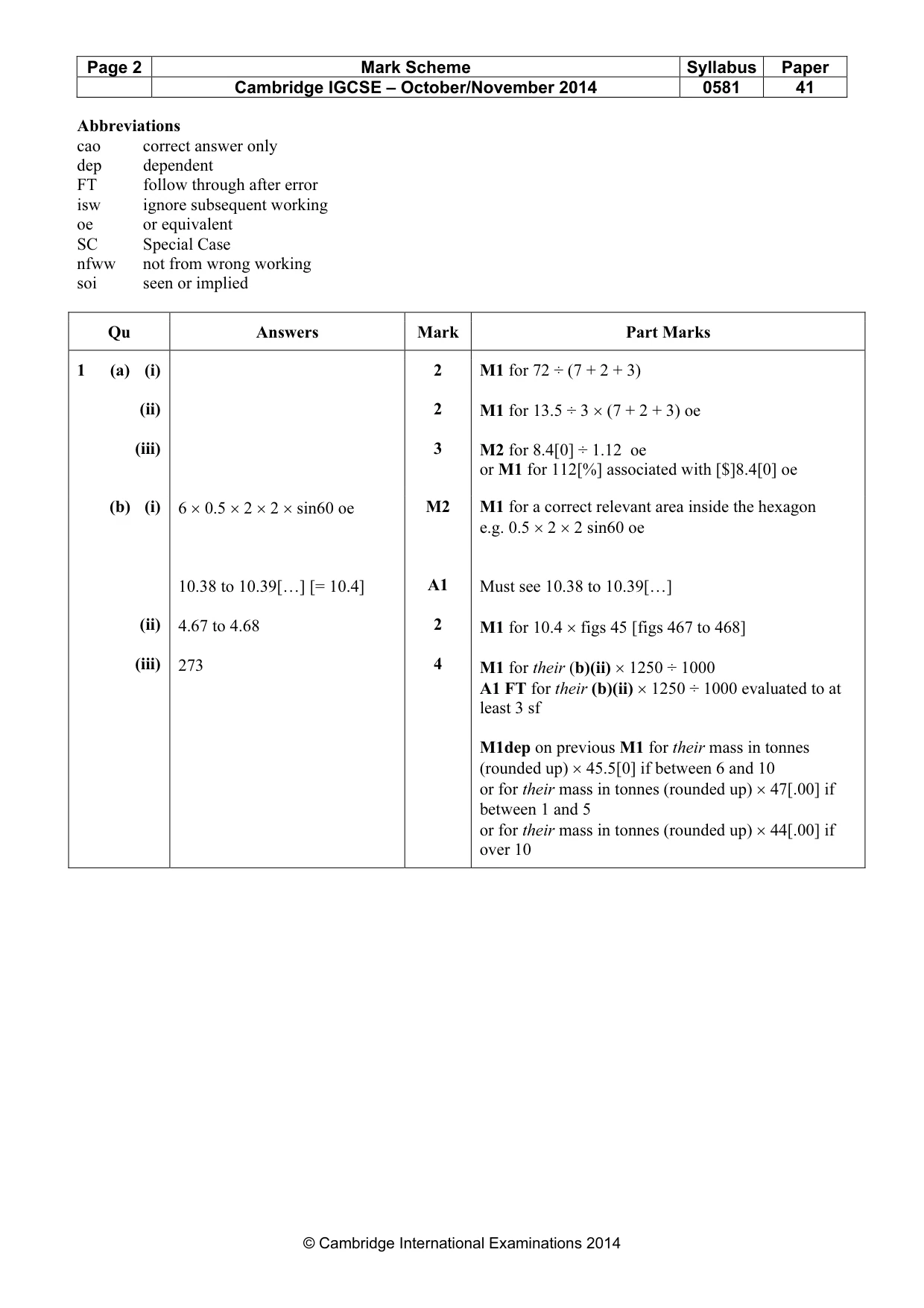
Page 2 Mark Scheme Syllabus Paper Cambridge IGCSE – October/November 2014 0581 41 © Cambridge International Examinations 2014 Abbreviations cao correct answer only dep dependent FT follow through after error isw ignore subsequent working oe or equivalent SC Special Case nfww not from wrong working soi seen or implied Qu Answers Mark Part Marks 1 (a) (i) (ii) (iii) 2 2 3 M1 for 72 ÷ (7 + 2 + 3) M1 for 13.5 ÷ 3 × (7 + 2 + 3) oe M2 for 8.4[0] ÷ 1.12 oe or M1 for 112[%] associated with [$]8.4[0] oe (b) (i) (ii) (iii) 6 × 0.5 × 2 × 2 × sin60 oe 10.38 to 10.39[…] [= 10.4] 4.67 to 4.68 273 M2 A1 2 4 M1 for a correct relevant area inside the hexagon e.g. 0.5 × 2 × 2 sin60 oe Must see 10.38 to 10.39[…] M1 for 10.4 × figs 45 [figs 467 to 468] M1 for their (b)(ii) × 1250 ÷ 1000 A1 FT for their (b)(ii) × 1250 ÷ 1000 evaluated to at least 3 sf M1dep on previous M1 for their mass in tonnes (rounded up) × 45.5[0] if between 6 and 10 or for their mass in tonnes (rounded up) × 47[.00] if between 1 and 5 or for their mass in tonnes (rounded up) × 44[.00] if over 10
Mark scheme, page 3
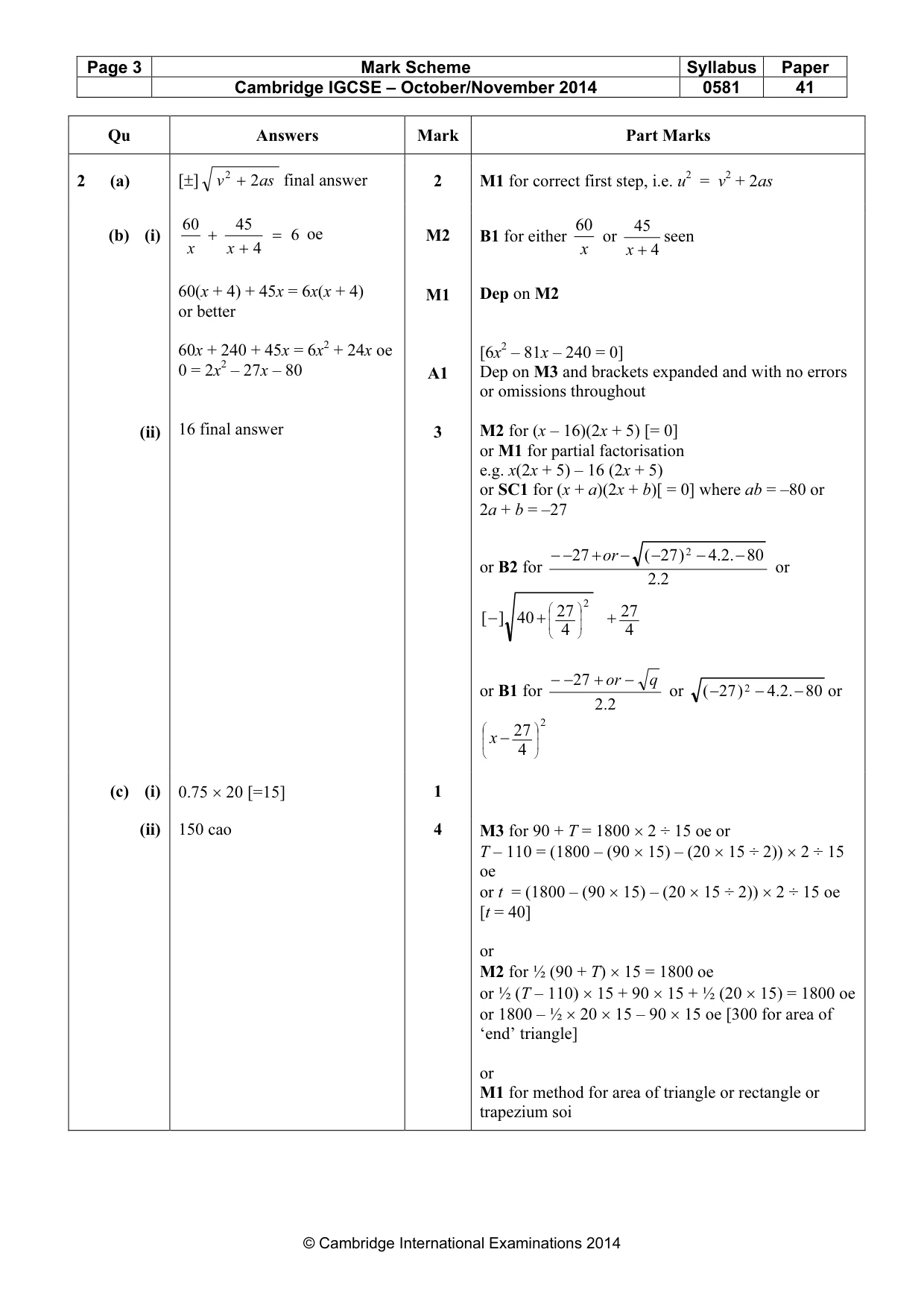
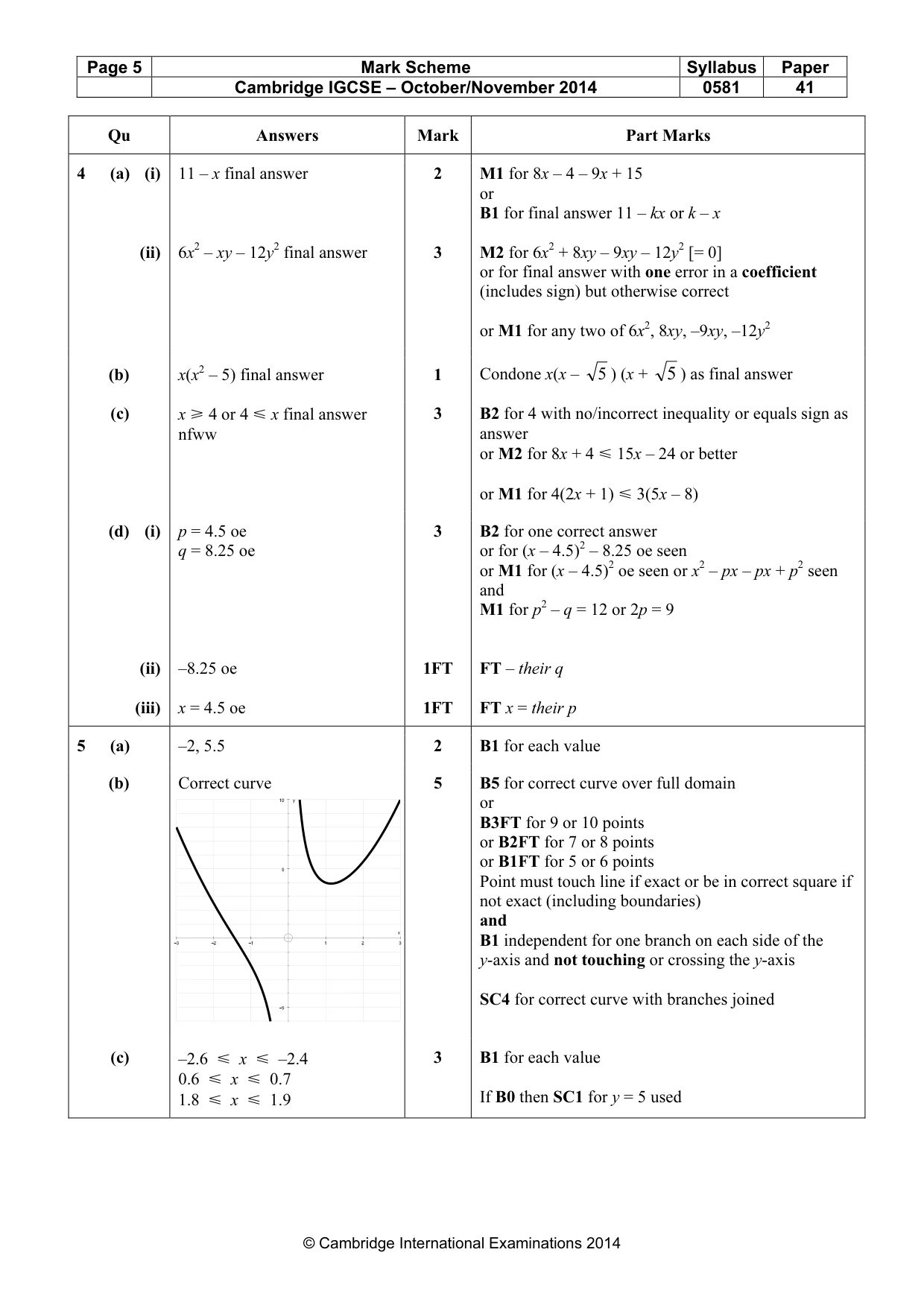
Page 3 Mark Scheme Syllabus Paper Cambridge IGCSE – October/November 2014 0581 41 © Cambridge International Examinations 2014 Qu Answers Mark Part Marks 2 (a) [±] as v 2 2 + final answer 2 M1 for correct first step, i.e. u2 = v2 + 2as (b) (i) (ii) 6 4 45 60 = + + x x oe 60(x + 4) + 45x = 6x(x + 4) or better 60x + 240 + 45x = 6x2 + 24x oe 0 = 2x2 – 27x – 80 16 final answer M2 M1 A1 3 B1 for either x 60 or 4 45 + x seen Dep on M2 [6x2 – 81x – 240 = 0] Dep on M3 and brackets expanded and with no errors or omissions throughout M2 for (x – 16)(2x + 5) [= 0] or M1 for partial factorisation e.g. x(2x + 5) – 16 (2x + 5) or SC1 for (x + a)(2x + b)[ = 0] where ab = –80 or 2a + b = –27 or B2 for 2.2 80 .2.4 ) 27 ( 27 2 − − − − + − − or or 4 27 4 27 40 ] [ 2 + + − or B1 for 2.2 27 q or − + − − or 80 .2.4 ) 27 ( 2 − − − or 2 4 27 − x (c) (i) 0.75 × 20 [=15] 1 (ii) 150 cao 4 M3 for 90 + T = 1800 × 2 ÷ 15 oe or T – 110 = (1800 – (90 × 15) – (20 × 15 ÷ 2)) × 2 ÷ 15 oe or t = (1800 – (90 × 15) – (20 × 15 ÷ 2)) × 2 ÷ 15 oe [t = 40] or M2 for ½ (90 + T) × 15 = 1800 oe or ½ (T – 110) × 15 + 90 × 15 + ½ (20 × 15) = 1800 oe or 1800 – ½ × 20 × 15 – 90 × 15 oe [300 for area of ‘end’ triangle] or M1 for method for area of triangle or rectangle or trapezium soi
Mark scheme, page 4
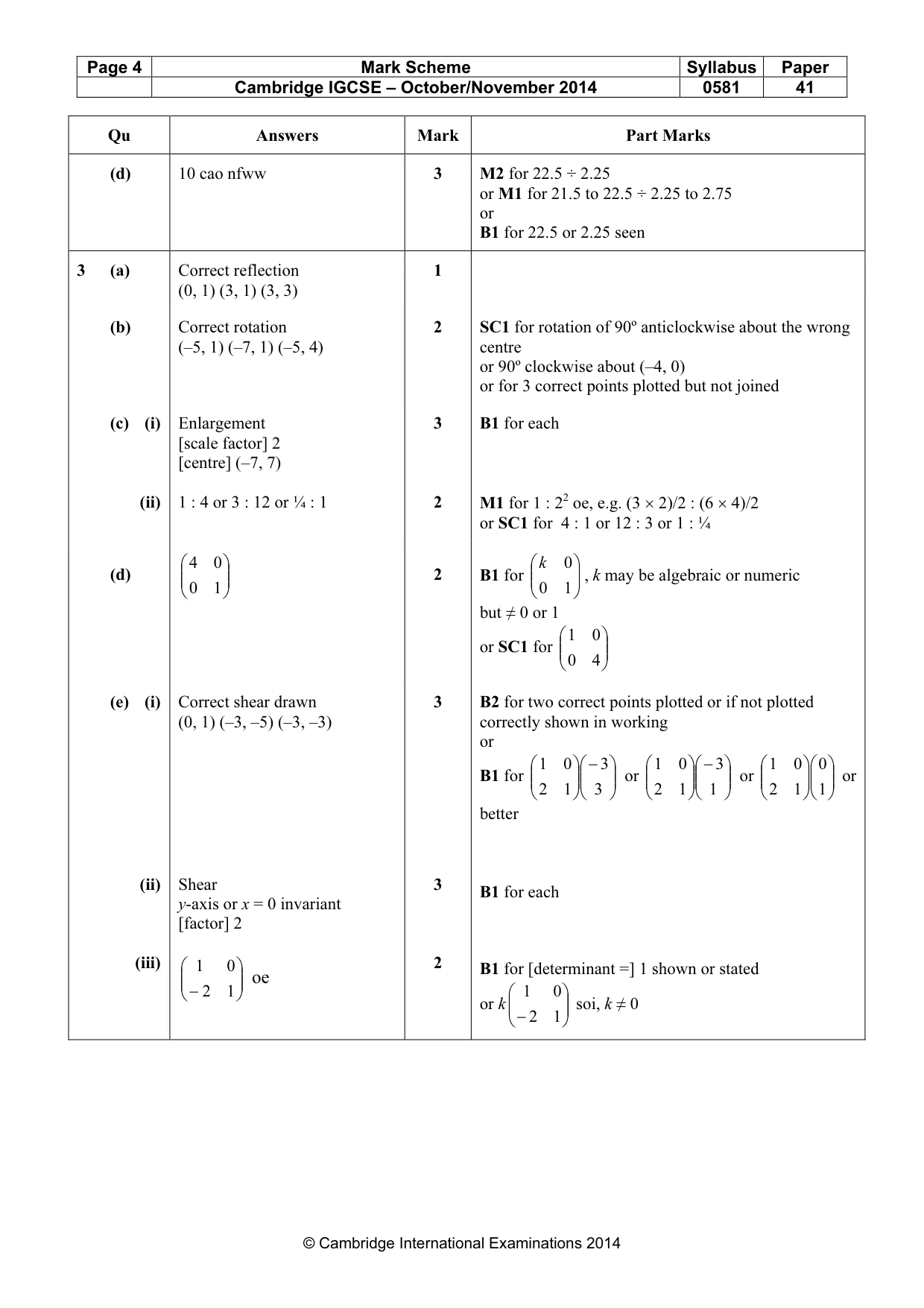
Page 4 Mark Scheme Syllabus Paper Cambridge IGCSE – October/November 2014 0581 41 © Cambridge International Examinations 2014 Qu Answers Mark Part Marks (d) 10 cao nfww 3 M2 for 22.5 ÷ 2.25 or M1 for 21.5 to 22.5 ÷ 2.25 to 2.75 or B1 for 22.5 or 2.25 seen 3 (a) Correct reflection (0, 1) (3, 1) (3, 3) 1 (b) Correct rotation (–5, 1) (–7, 1) (–5, 4) 2 SC1 for rotation of 90º anticlockwise about the wrong centre or 90º clockwise about (–4, 0) or for 3 correct points plotted but not joined (c) (i) (ii) Enlargement [scale factor] 2 [centre] (–7, 7) 1 : 4 or 3 : 12 or ¼ : 1 3 2 B1 for each M1 for 1 : 22 oe, e.g. (3 × 2)/2 : (6 × 4)/2 or SC1 for 4 : 1 or 12 : 3 or 1 : ¼ (d) 1 0 0 4 2 B1 for 1 0 0 k , k may be algebraic or numeric but ≠ 0 or 1 or SC1 for 4 0 0 1 (e) (i) (ii) (iii) Correct shear drawn (0, 1) (–3, –5) (–3, –3) Shear y-axis or x = 0 invariant [factor] 2 − 1 2 0 1 oe 3 3 2 B2 for two correct points plotted or if not plotted correctly shown in working or B1 for − 3 3 1 2 0 1 or − 1 3 1 2 0 1 or 1 0 1 2 0 1 or better B1 for each B1 for [determinant =] 1 shown or stated or k − 1 2 0 1 soi, k ≠ 0
Mark scheme, page 5
Page 5 Mark Scheme Syllabus Paper Cambridge IGCSE – October/November 2014 0581 41 © Cambridge International Examinations 2014 Qu Answers Mark Part Marks 4 (a) (i) (ii) 11 – x final answer 6x2 – xy – 12y2 final answer 2 3 M1 for 8x – 4 – 9x + 15 or B1 for final answer 11 – kx or k – x M2 for 6x2 + 8xy – 9xy – 12y2 [= 0] or for final answer with one error in a coefficient (includes sign) but otherwise correct or M1 for any two of 6x2, 8xy, –9xy, –12y2 (b) x(x2 – 5) final answer 1 Condone x(x – 5 ) (x + 5 ) as final answer (c) x [ 4 or 4 Y x final answer nfww 3 B2 for 4 with no/incorrect inequality or equals sign as answer or M2 for 8x + 4 Y 15x – 24 or better or M1 for 4(2x + 1) Y 3(5x – 8) (d) (i) (ii) (iii) p = 4.5 oe q = 8.25 oe –8.25 oe x = 4.5 oe 3 1FT 1FT B2 for one correct answer or for (x – 4.5)2 – 8.25 oe seen or M1 for (x – 4.5)2 oe seen or x2 – px – px + p2 seen and M1 for p2 – q = 12 or 2p = 9 FT – their q FT x = their p 5 (a) –2, 5.5 2 B1 for each value (b) Correct curve 5 B5 for correct curve over full domain or B3FT for 9 or 10 points or B2FT for 7 or 8 points or B1FT for 5 or 6 points Point must touch line if exact or be in correct square if not exact (including boundaries) and B1 independent for one branch on each side of the y-axis and not touching or crossing the y-axis SC4 for correct curve with branches joined (c) –2.6 Y x Y –2.4 0.6 Y x Y 0.7 1.8 Y x Y 1.9 3 B1 for each value If B0 then SC1 for y = 5 used −3 −2 −1 1 2 3 −5 5 10 x y
Mark scheme, page 6
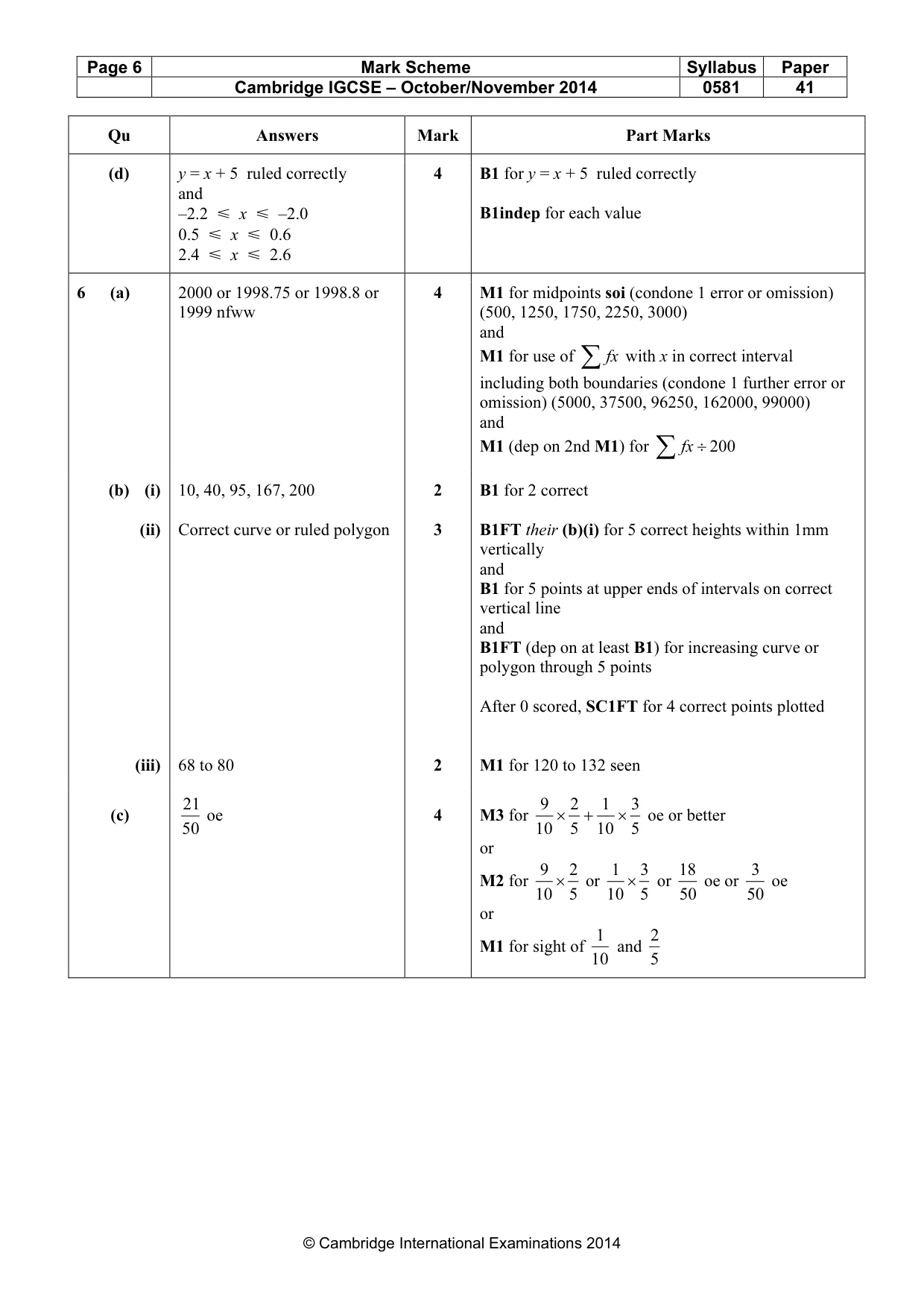
Page 6 Mark Scheme Syllabus Paper Cambridge IGCSE – October/November 2014 0581 41 © Cambridge International Examinations 2014 Qu Answers Mark Part Marks (d) y = x + 5 ruled correctly and –2.2 Y x Y –2.0 0.5 Y x Y 0.6 2.4 Y x Y 2.6 4 B1 for y = x + 5 ruled correctly B1indep for each value 6 (a) 2000 or 1998.75 or 1998.8 or 1999 nfww 4 M1 for midpoints soi (condone 1 error or omission) (500, 1250, 1750, 2250, 3000) and M1 for use of ∑fx with x in correct interval including both boundaries (condone 1 further error or omission) (5000, 37500, 96250, 162000, 99000) and M1 (dep on 2nd M1) for 200 ÷ ∑fx (b) (i) (ii) (iii) 10, 40, 95, 167, 200 Correct curve or ruled polygon 68 to 80 2 3 2 B1 for 2 correct B1FT their (b)(i) for 5 correct heights within 1mm vertically and B1 for 5 points at upper ends of intervals on correct vertical line and B1FT (dep on at least B1) for increasing curve or polygon through 5 points After 0 scored, SC1FT for 4 correct points plotted M1 for 120 to 132 seen (c) 50 21 oe 4 M3 for 5 3 10 1 5 2 10 9 × + × oe or better or M2 for 5 2 10 9 × or 5 3 10 1 × or 50 18 oe or 50 3 oe or M1 for sight of 10 1 and 5 2
Mark scheme, page 7
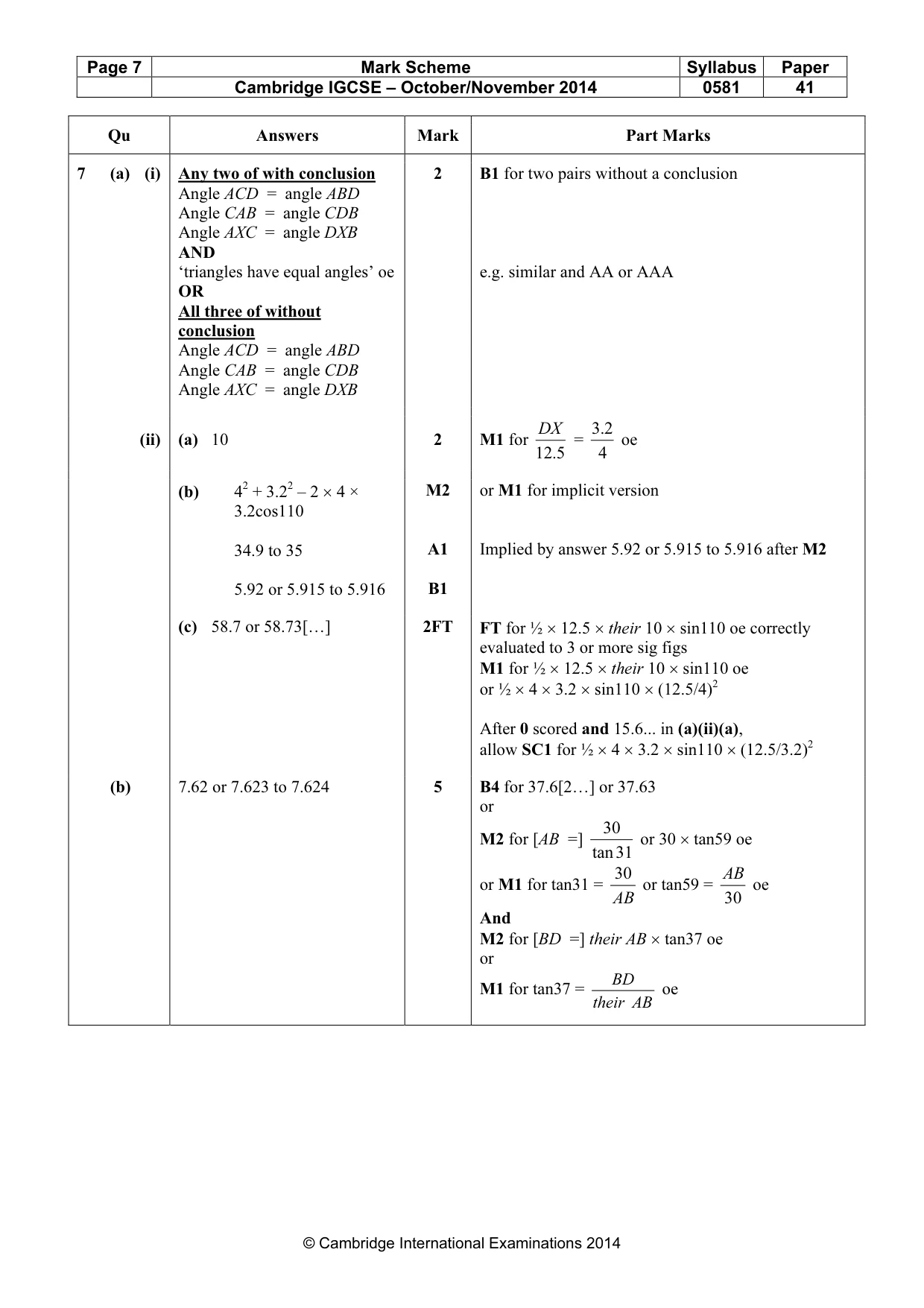
Page 7 Mark Scheme Syllabus Paper Cambridge IGCSE – October/November 2014 0581 41 © Cambridge International Examinations 2014 Qu Answers Mark Part Marks 7 (a) (i) Any two of with conclusion Angle ACD = angle ABD Angle CAB = angle CDB Angle AXC = angle DXB AND ‘triangles have equal angles’ oe OR All three of without conclusion Angle ACD = angle ABD Angle CAB = angle CDB Angle AXC = angle DXB 2 B1 for two pairs without a conclusion e.g. similar and AA or AAA (ii) (a) 10 2 M1 for 5. 12 DX = 4 2.3 oe (b) 42 + 3.22 – 2 × 4 × 3.2cos110 34.9 to 35 5.92 or 5.915 to 5.916 M2 A1 B1 or M1 for implicit version Implied by answer 5.92 or 5.915 to 5.916 after M2 (c) 58.7 or 58.73[…] 2FT FT for ½ × 12.5 × their 10 × sin110 oe correctly evaluated to 3 or more sig figs M1 for ½ × 12.5 × their 10 × sin110 oe or ½ × 4 × 3.2 × sin110 × (12.5/4)2 After 0 scored and 15.6... in (a)(ii)(a), allow SC1 for ½ × 4 × 3.2 × sin110 × (12.5/3.2)2 (b) 7.62 or 7.623 to 7.624 5 B4 for 37.6[2…] or 37.63 or M2 for [AB =] 31 tan 30 or 30 × tan59 oe or M1 for tan31 = AB 30 or tan59 = 30 AB oe And M2 for [BD =] their AB × tan37 oe or M1 for tan37 = AB their BD oe
Mark scheme, page 8
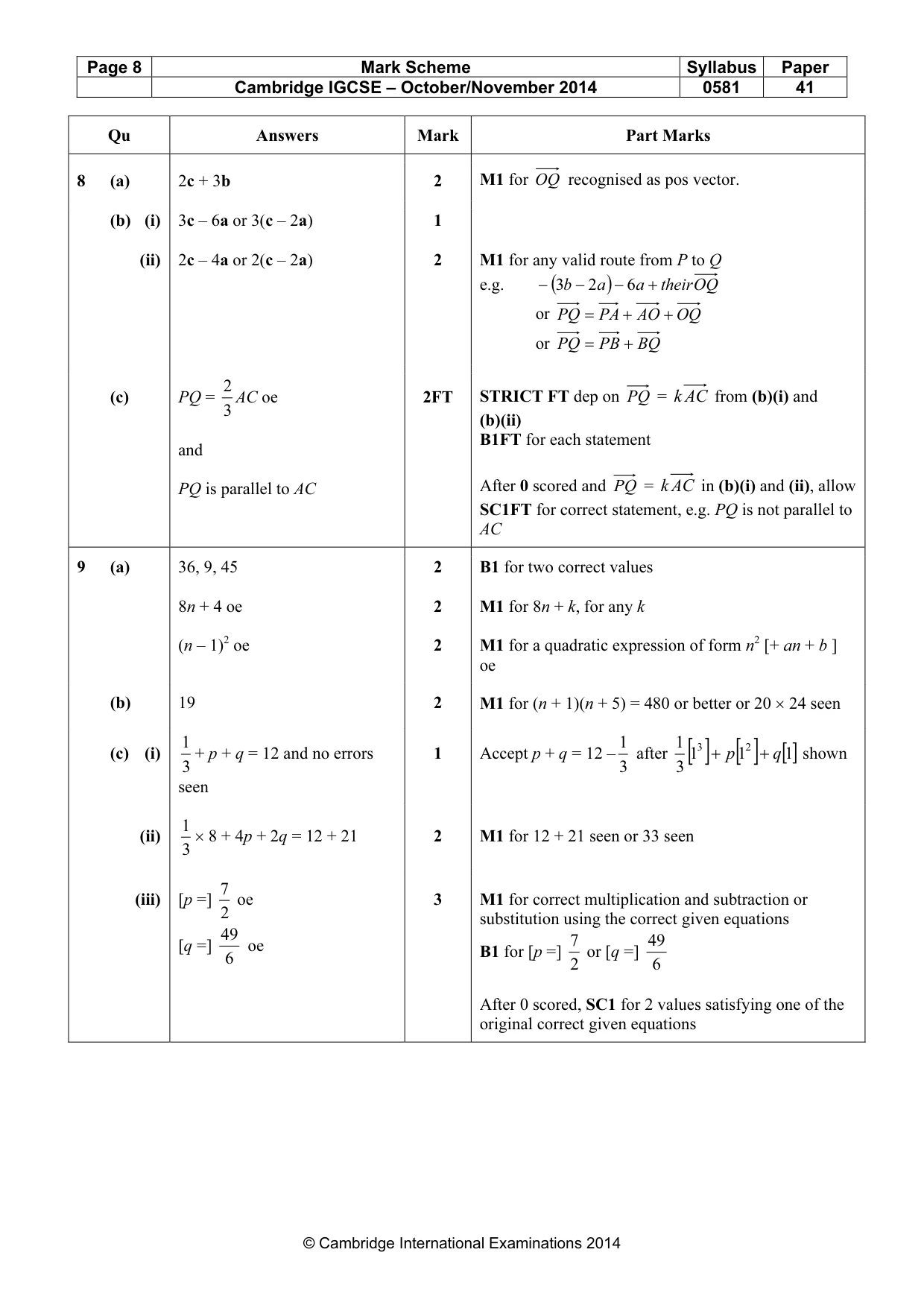
Page 8 Mark Scheme Syllabus Paper Cambridge IGCSE – October/November 2014 0581 41 © Cambridge International Examinations 2014 Qu Answers Mark Part Marks 8 (a) 2c + 3b 2 M1 for OQ recognised as pos vector. (b) (i) (ii) 3c – 6a or 3(c – 2a) 2c – 4a or 2(c – 2a) 1 2 M1 for any valid route from P to Q e.g. ( ) OQ their a a b + − − − 6 2 3 or OQ AO PA PQ + + = or BQ PB PQ + = (c) PQ = 3 2 AC oe and PQ is parallel to AC 2FT STRICT FT dep on PQ = AC k from (b)(i) and (b)(ii) B1FT for each statement After 0 scored and PQ = AC k in (b)(i) and (ii), allow SC1FT for correct statement, e.g. PQ is not parallel to AC 9 (a) 36, 9, 45 8n + 4 oe (n – 1)2 oe 2 2 2 B1 for two correct values M1 for 8n + k, for any k M1 for a quadratic expression of form n2 [+ an + b ] oe (b) 19 2 M1 for (n + 1)(n + 5) = 480 or better or 20 × 24 seen (c) (i) 3 1 + p + q = 12 and no errors seen 1 Accept p + q = 12 – 3 1 after [ ] [ ] [ ]1 1 1 3 1 2 3 q p + + shown (ii) 3 1 × 8 + 4p + 2q = 12 + 21 2 M1 for 12 + 21 seen or 33 seen (iii) [p =] 2 7 oe [q =] 6 49 oe 3 M1 for correct multiplication and subtraction or substitution using the correct given equations B1 for [p =] 2 7 or [q =] 6 49 After 0 scored, SC1 for 2 values satisfying one of the original correct given equations