Cambridge IGCSE Mathematics (with coursework) 0581 — 2012 May/June Paper 4 · Variant 3
0581/43/M/J/12 · 130 marks · ≈146 min
The question paper and its mark scheme, free to read here and free to download. This is Cambridge’s own paper, exactly as it was sat.
Question paper20 pages
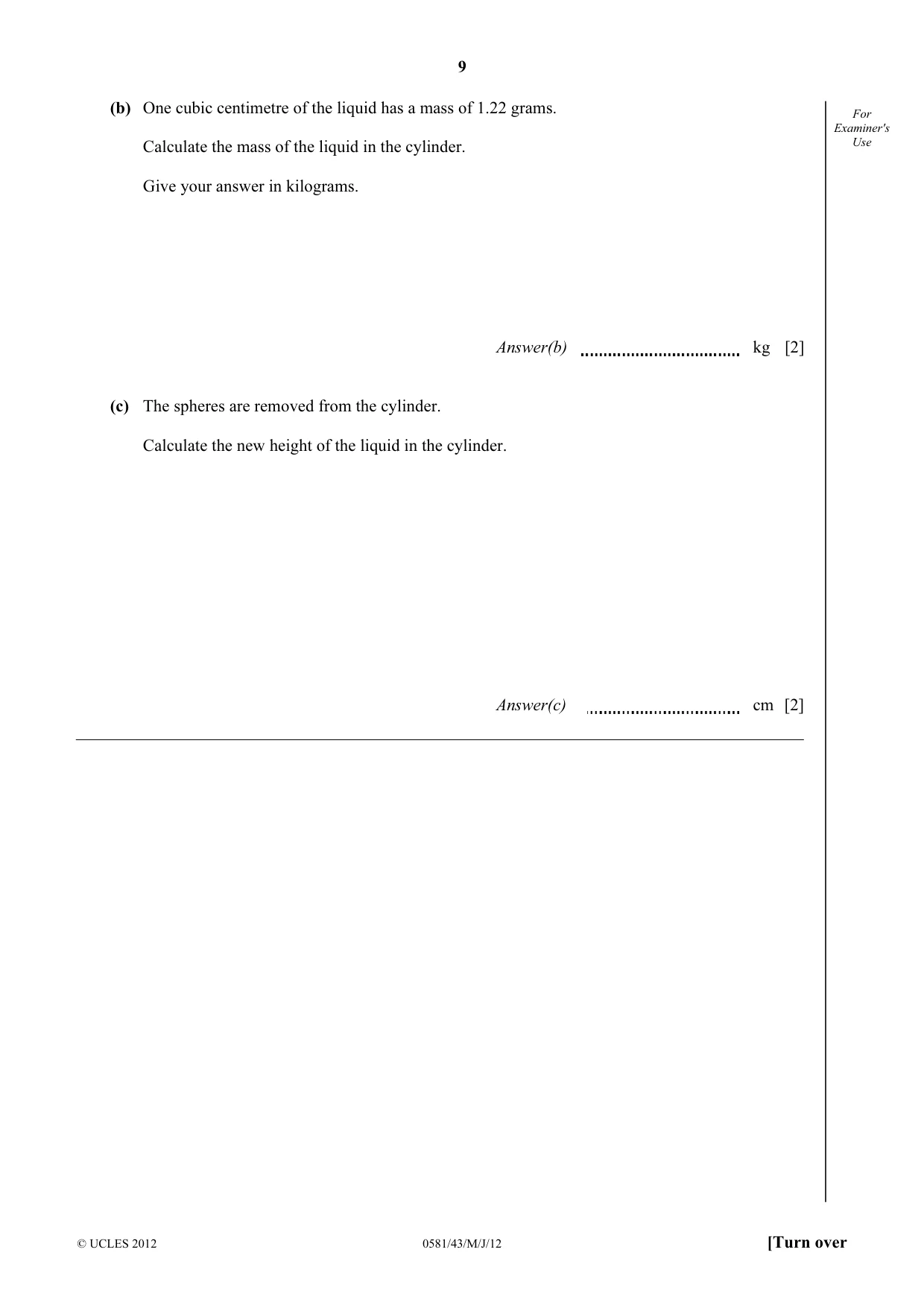
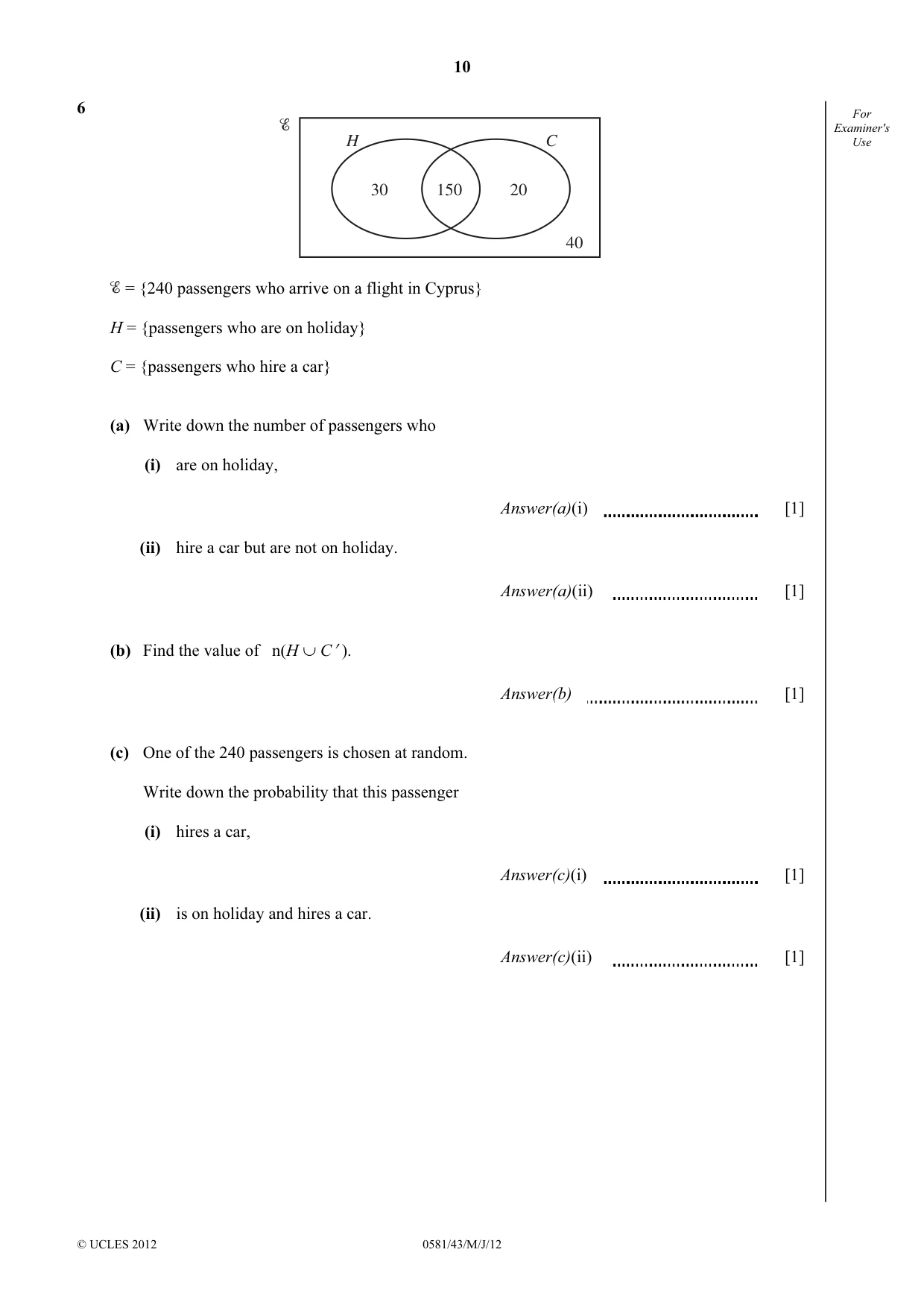
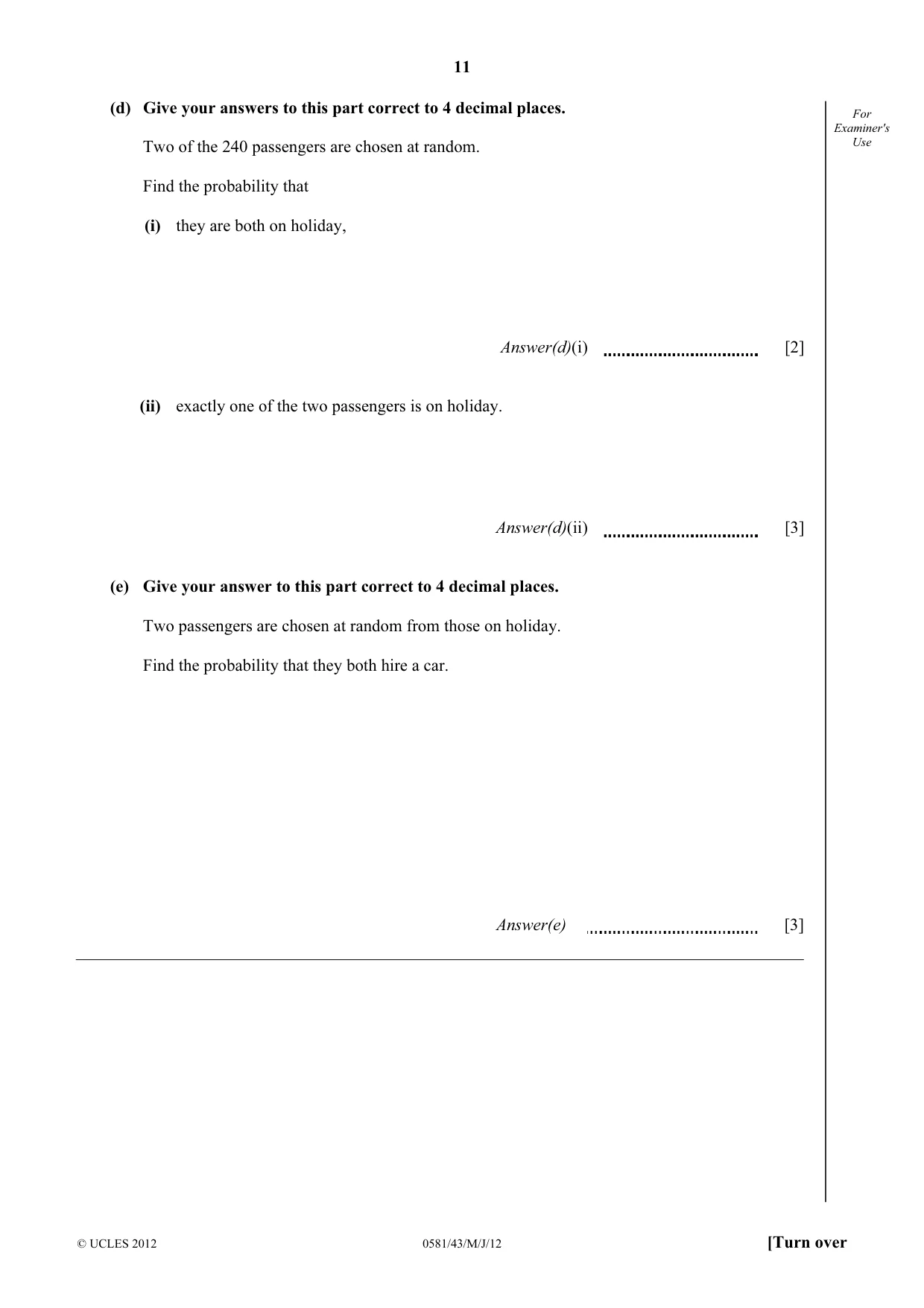
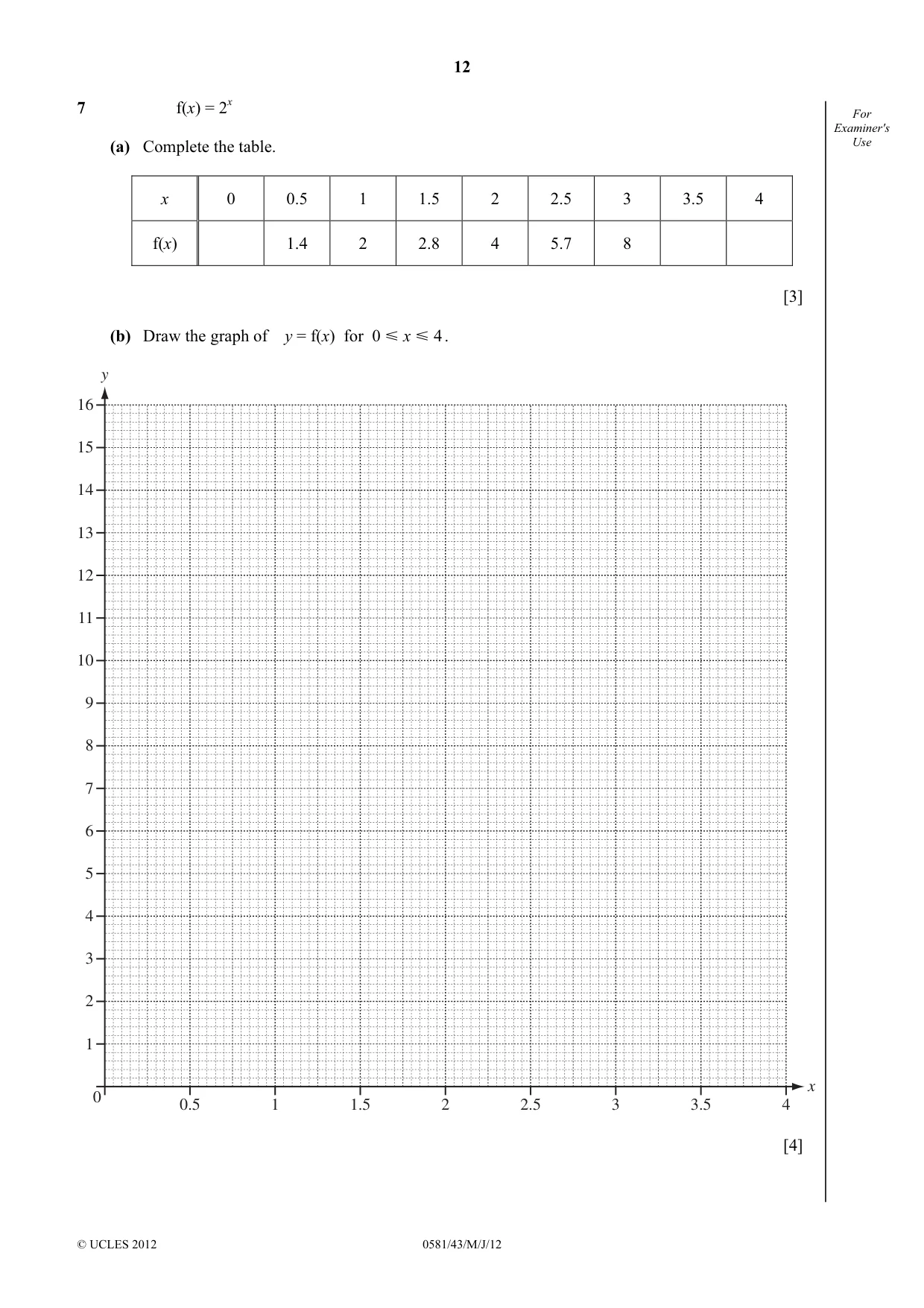
Mark scheme8 pages
Answers below. Sit the paper first if you are practising.
Paper as text
Question paper, page 1
This document consists of 19 printed pages and 1 blank page. IB12 06_0581_43/FP © UCLES 2012 [Turn over *1183591360* UNIVERSITY OF CAMBRIDGE INTERNATIONAL EXAMINATIONS International General Certificate of Secondary Education MATHEMATICS 0581/43 Paper 4 (Extended) May/June 2012 2 hours 30 minutes Candidates answer on the Question Paper. Additional Materials: Electronic calculator Geometrical instruments Mathematical tables (optional) Tracing paper (optional) READ THESE INSTRUCTIONS FIRST Write your Centre number, candidate number and name on all the work you hand in. Write in dark blue or black pen. You may use a pencil for any diagrams or graphs. Do not use staples, paper clips, highlighters, glue or correction fluid. DO NOT WRITE IN ANY BARCODES. Answer all questions. If working is needed for any question it must be shown below that question. Electronic calculators should be used. If the degree of accuracy is not specified in the question, and if the answer is not exact, give the answer to three significant figures. Give answers in degrees to one decimal place. For π use either your calculator value or 3.142. At the end of the examination, fasten all your work securely together. The number of marks is given in brackets [ ] at the end of each question or part question. The total of the marks for this paper is 130. www.XtremePapers.com
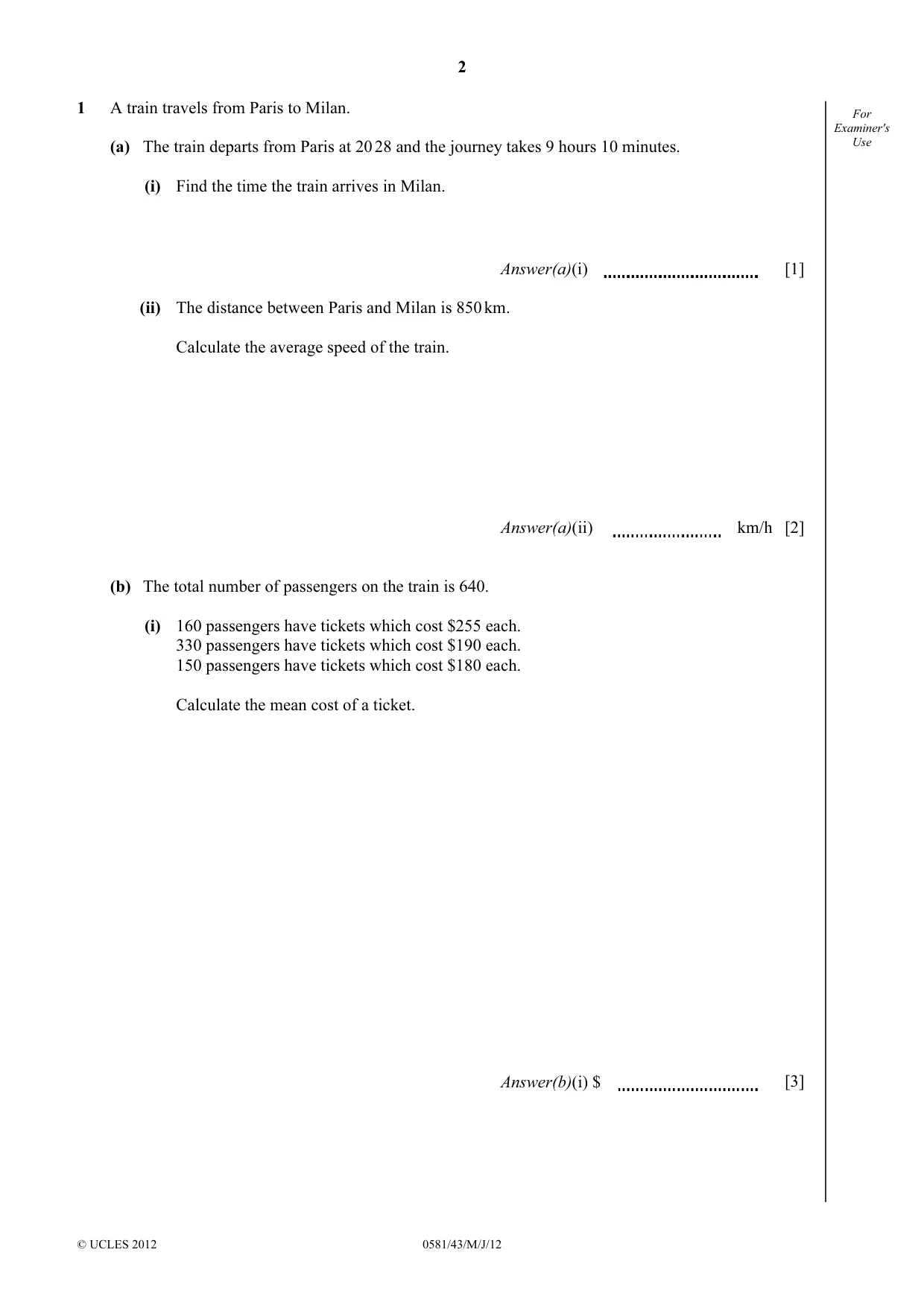
Question paper, page 2
2 © UCLES 2012 0581/43/M/J/12 For Examiner's Use 1 A train travels from Paris to Milan. (a) The train departs from Paris at 20 28 and the journey takes 9 hours 10 minutes. (i) Find the time the train arrives in Milan. Answer(a)(i) [1] (ii) The distance between Paris and Milan is 850 km. Calculate the average speed of the train. Answer(a)(ii) km/h [2] (b) The total number of passengers on the train is 640. (i) 160 passengers have tickets which cost $255 each. 330 passengers have tickets which cost $190 each. 150 passengers have tickets which cost $180 each. Calculate the mean cost of a ticket. Answer(b)(i) $ [3]
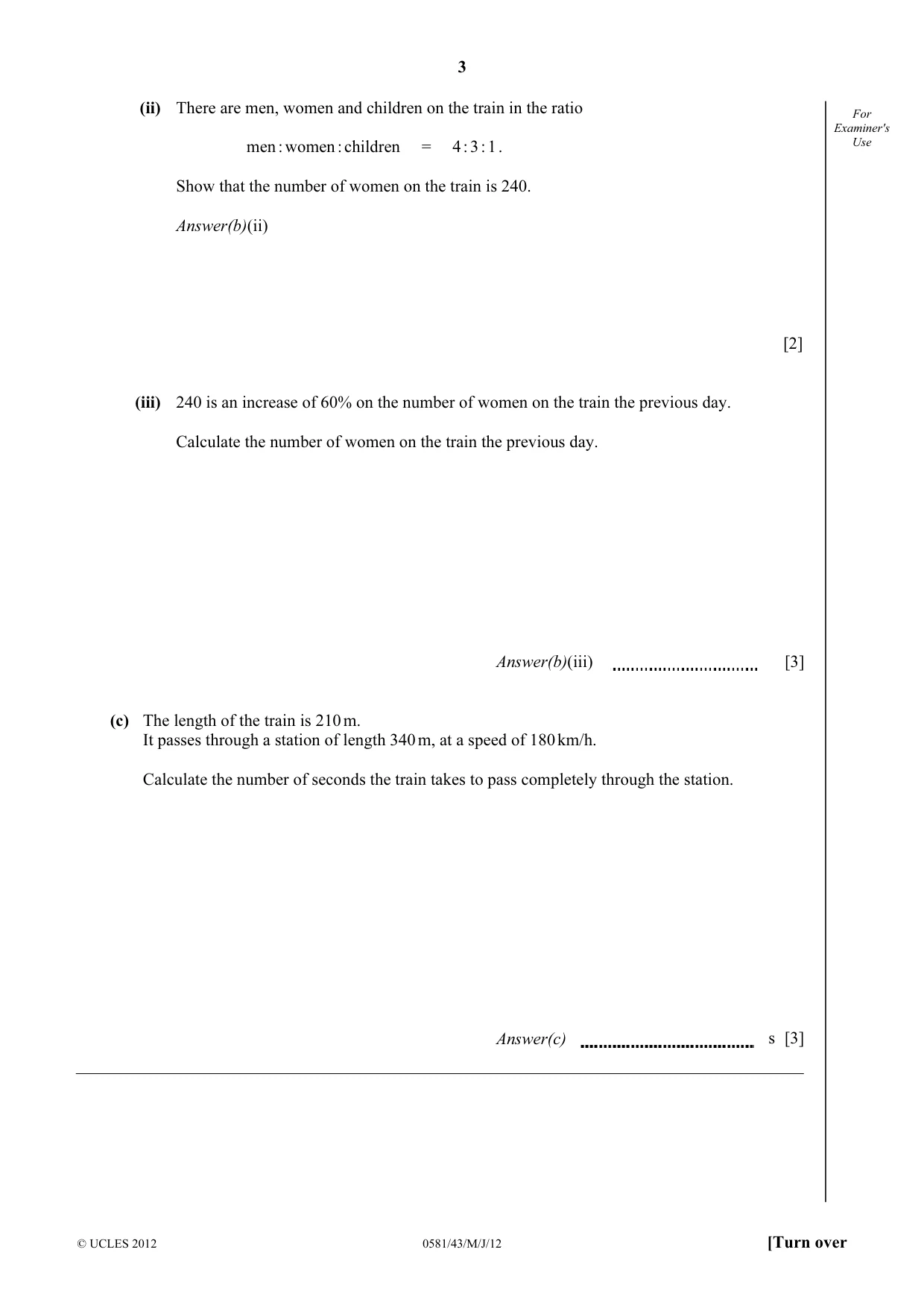
Question paper, page 3
3 © UCLES 2012 0581/43/M/J/12 [Turn over For Examiner's Use (ii) There are men, women and children on the train in the ratio men : women : children = 4 : 3 : 1 . Show that the number of women on the train is 240. Answer(b)(ii) [2] (iii) 240 is an increase of 60% on the number of women on the train the previous day. Calculate the number of women on the train the previous day. Answer(b)(iii) [3] (c) The length of the train is 210 m. It passes through a station of length 340 m, at a speed of 180 km/h. Calculate the number of seconds the train takes to pass completely through the station. Answer(c) s [3]
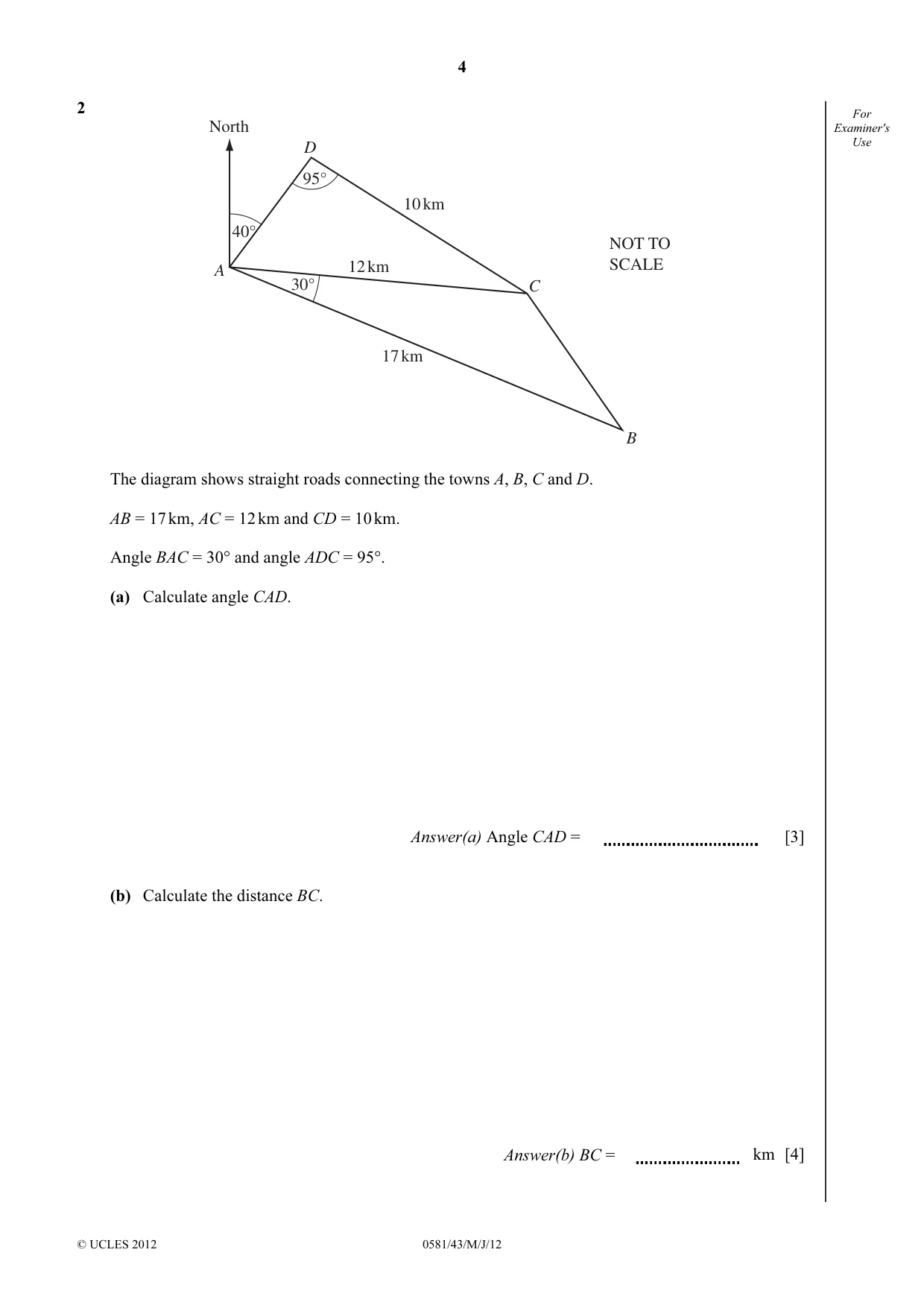
Question paper, page 4
4 © UCLES 2012 0581/43/M/J/12 For Examiner's Use 2 North D A C B 30° 40° 95° 10 km 12 km 17 km NOT TO SCALE The diagram shows straight roads connecting the towns A, B, C and D. AB = 17 km, AC = 12 km and CD = 10 km. Angle BAC = 30° and angle ADC = 95°. (a) Calculate angle CAD. Answer(a) Angle CAD = [3] (b) Calculate the distance BC. Answer(b) BC = km [4]
Question paper, page 5
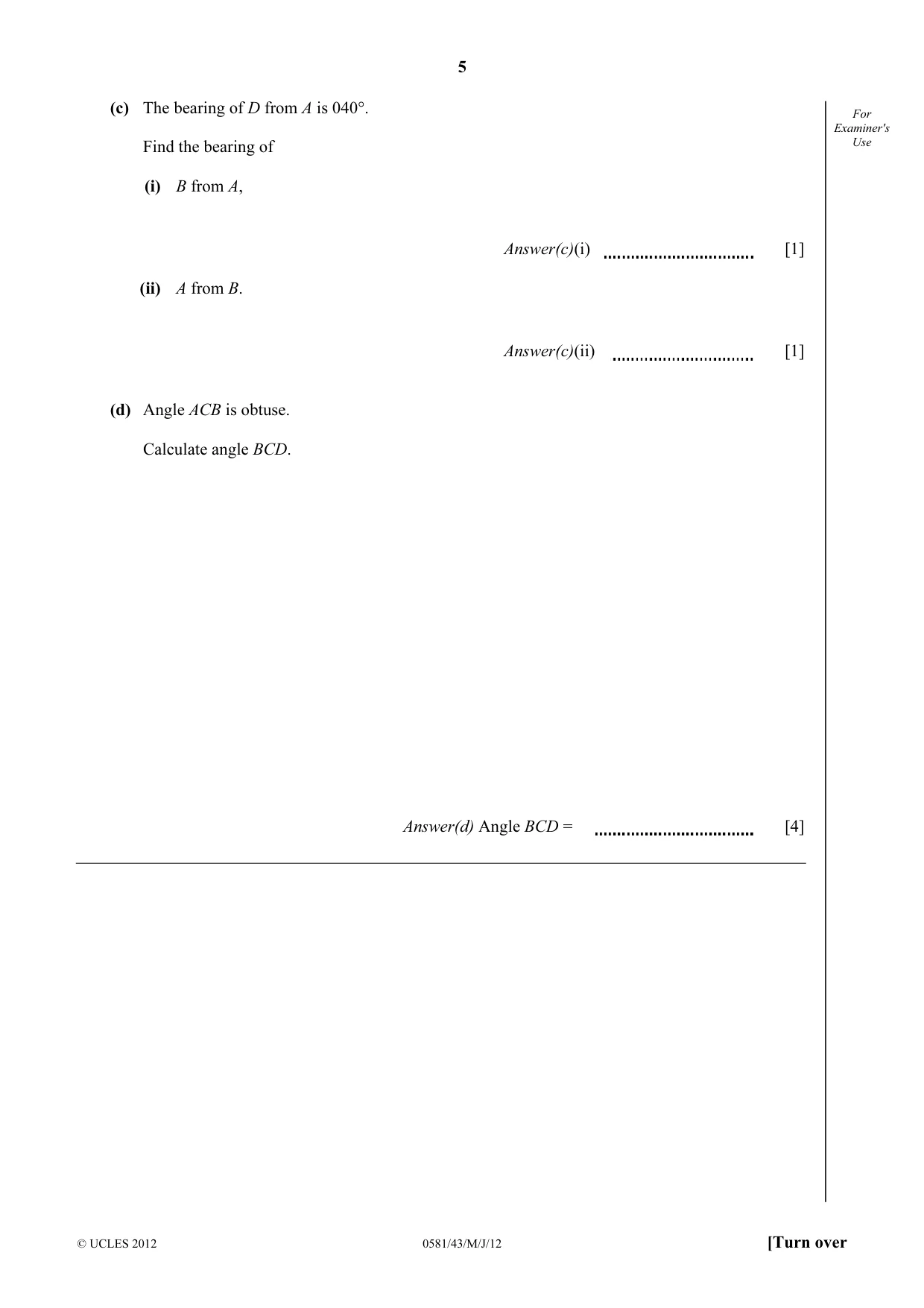
5 © UCLES 2012 0581/43/M/J/12 [Turn over For Examiner's Use (c) The bearing of D from A is 040°. Find the bearing of (i) B from A, Answer(c)(i) [1] (ii) A from B. Answer(c)(ii) [1] (d) Angle ACB is obtuse. Calculate angle BCD. Answer(d) Angle BCD = [4]
Question paper, page 6
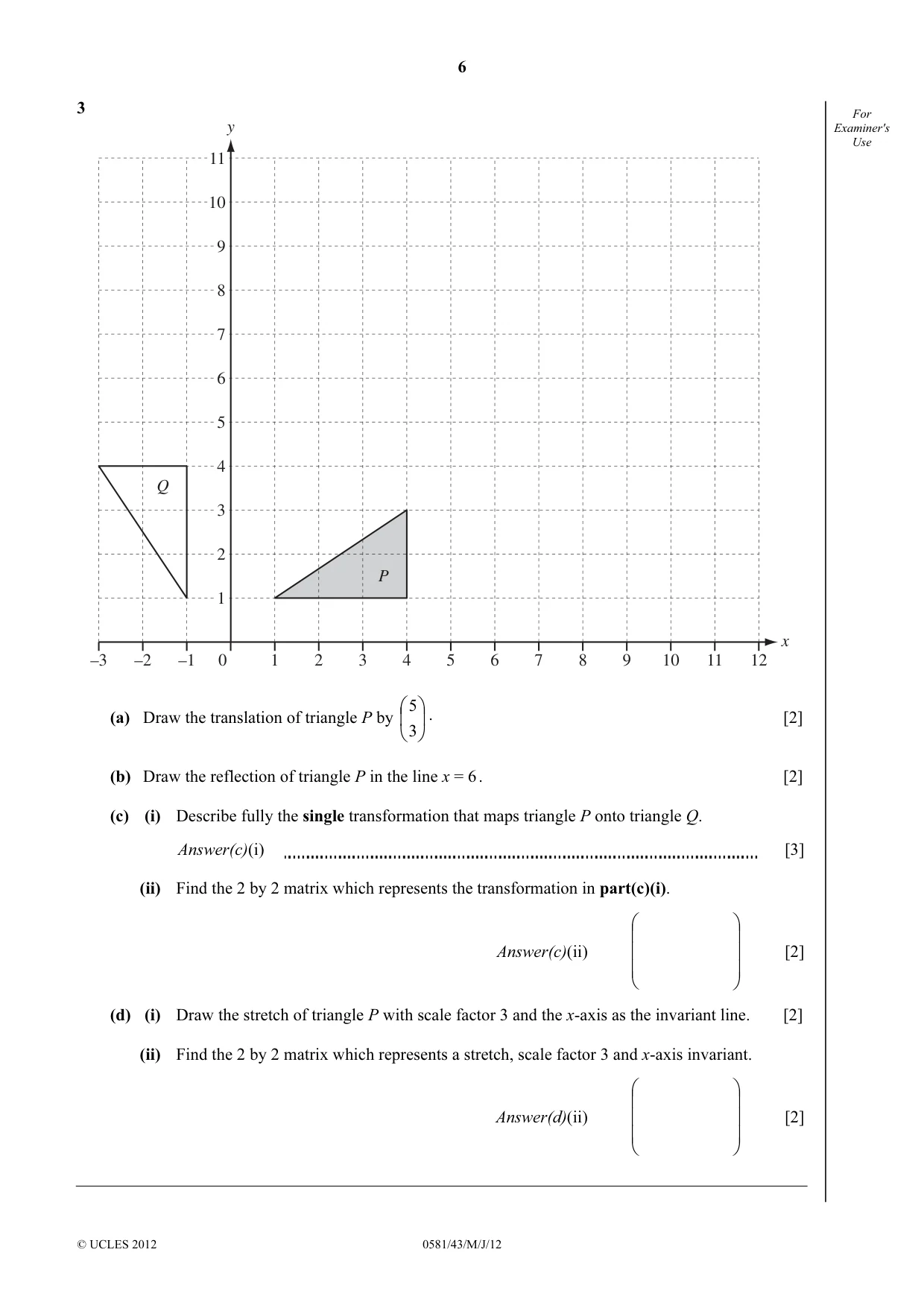
6 © UCLES 2012 0581/43/M/J/12 For Examiner's Use 3 P Q y x 11 10 9 8 7 6 5 4 3 2 1 –3 –2 –1 1 0 2 3 4 5 6 7 8 9 10 11 12 (a) Draw the translation of triangle P by 3 5 . [2] (b) Draw the reflection of triangle P in the line x = 6 . [2] (c) (i) Describe fully the single transformation that maps triangle P onto triangle Q. Answer(c)(i) [3] (ii) Find the 2 by 2 matrix which represents the transformation in part(c)(i). Answer(c)(ii) [2] (d) (i) Draw the stretch of triangle P with scale factor 3 and the x-axis as the invariant line. [2] (ii) Find the 2 by 2 matrix which represents a stretch, scale factor 3 and x-axis invariant. Answer(d)(ii) [2]
Question paper, page 7
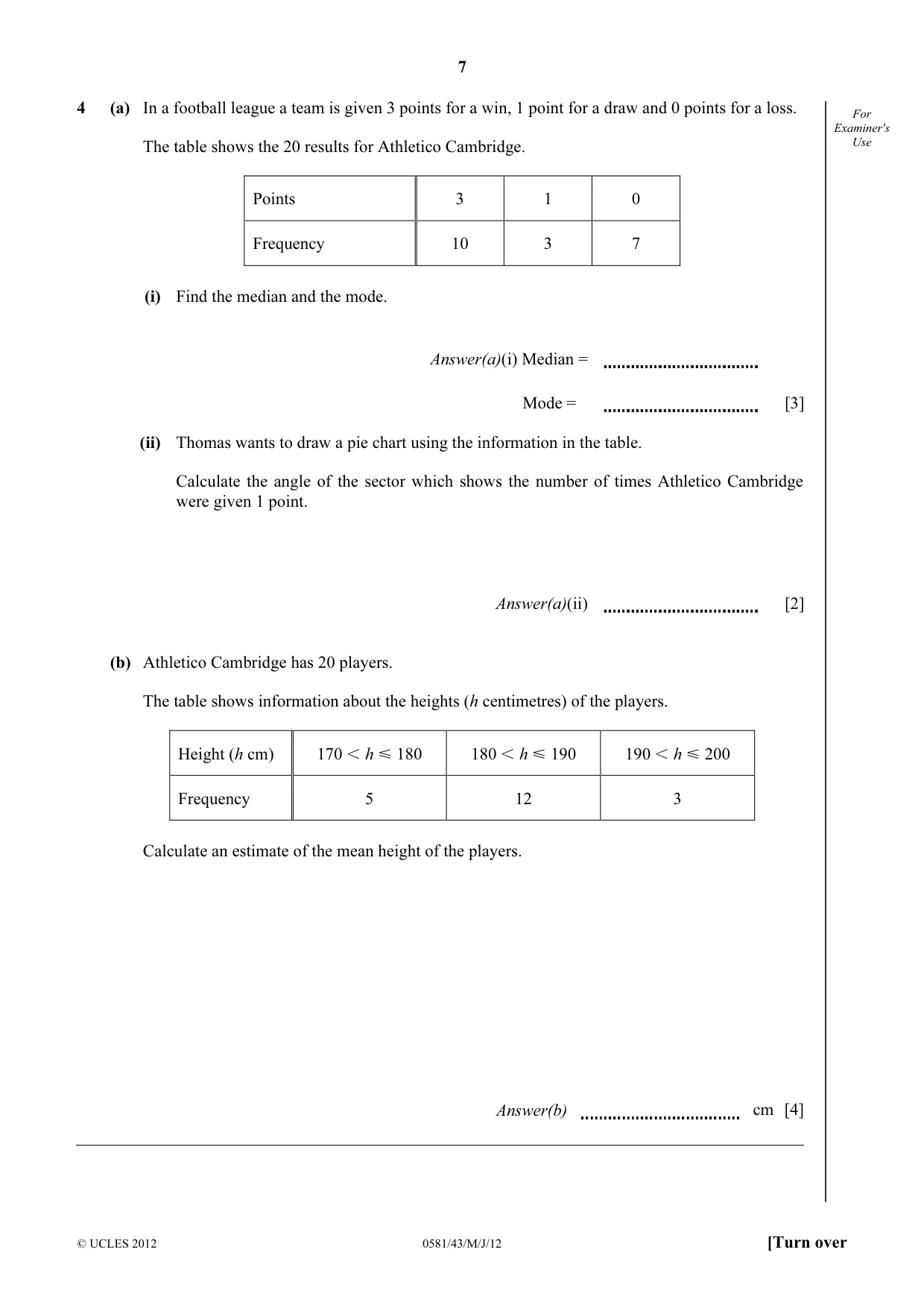
7 © UCLES 2012 0581/43/M/J/12 [Turn over For Examiner's Use 4 (a) In a football league a team is given 3 points for a win, 1 point for a draw and 0 points for a loss. The table shows the 20 results for Athletico Cambridge. Points 3 1 0 Frequency 10 3 7 (i) Find the median and the mode. Answer(a)(i) Median = Mode = [3] (ii) Thomas wants to draw a pie chart using the information in the table. Calculate the angle of the sector which shows the number of times Athletico Cambridge were given 1 point. Answer(a)(ii) [2] (b) Athletico Cambridge has 20 players. The table shows information about the heights (h centimetres) of the players. Height (h cm) 170 I h Y 180 180 I h Y 190 190 I h Y 200 Frequency 5 12 3 Calculate an estimate of the mean height of the players. Answer(b) cm [4]
Question paper, page 8
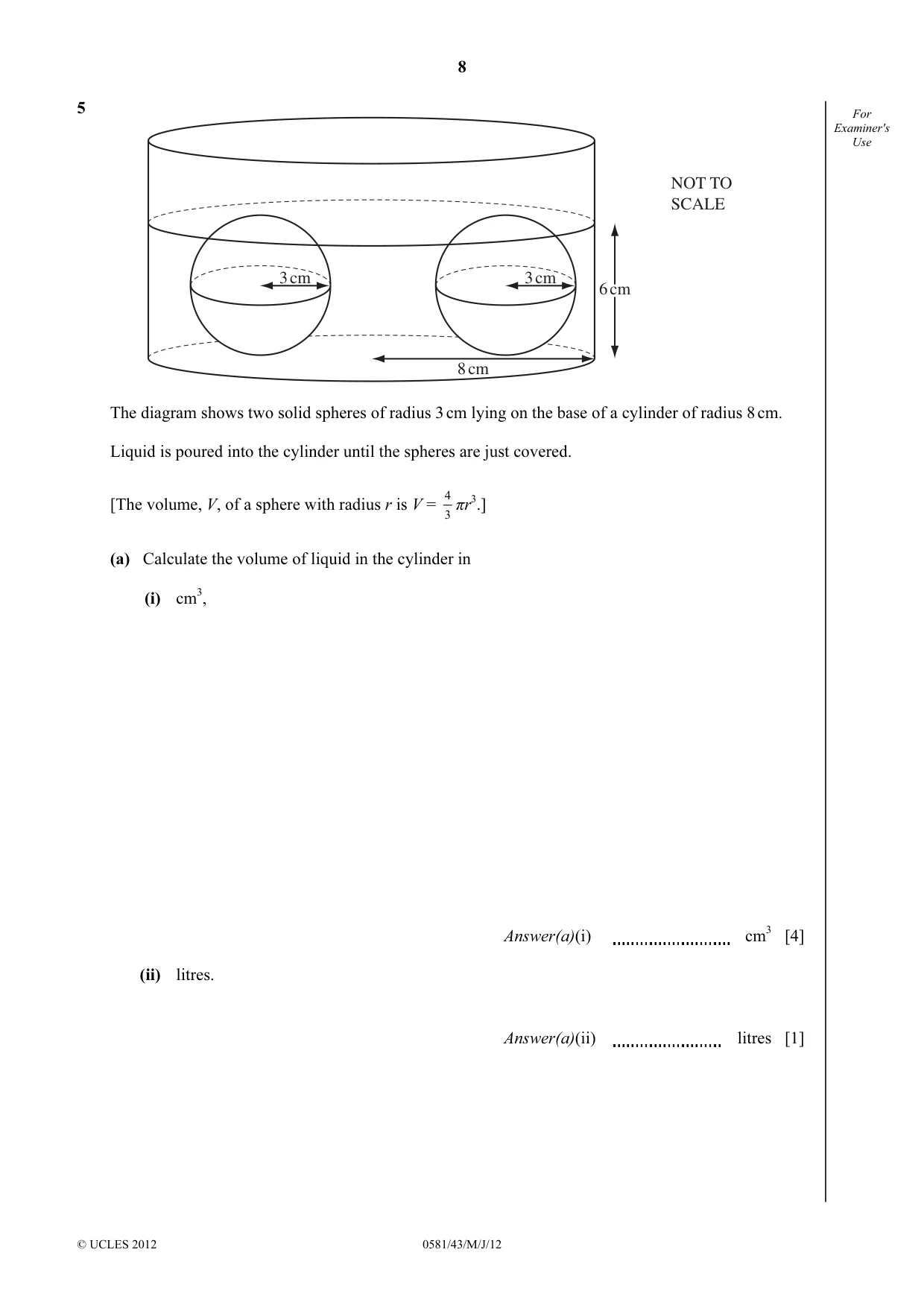
8 © UCLES 2012 0581/43/M/J/12 For Examiner's Use 5 3 cm 3 cm 8 cm 6 cm NOT TO SCALE The diagram shows two solid spheres of radius 3 cm lying on the base of a cylinder of radius 8 cm. Liquid is poured into the cylinder until the spheres are just covered. [The volume, V, of a sphere with radius r is V = 3 4 πr3.] (a) Calculate the volume of liquid in the cylinder in (i) cm3, Answer(a)(i) cm3 [4] (ii) litres. Answer(a)(ii) litres [1]
Question paper, page 9
9 © UCLES 2012 0581/43/M/J/12 [Turn over For Examiner's Use (b) One cubic centimetre of the liquid has a mass of 1.22 grams. Calculate the mass of the liquid in the cylinder. Give your answer in kilograms. Answer(b) kg [2] (c) The spheres are removed from the cylinder. Calculate the new height of the liquid in the cylinder. Answer(c) cm [2]
Question paper, page 10
10 © UCLES 2012 0581/43/M/J/12 For Examiner's Use 6 H C 20 40 150 30 = {240 passengers who arrive on a flight in Cyprus} H = {passengers who are on holiday} C = {passengers who hire a car} (a) Write down the number of passengers who (i) are on holiday, Answer(a)(i) [1] (ii) hire a car but are not on holiday. Answer(a)(ii) [1] (b) Find the value of n(H ∪ CV ). Answer(b) [1] (c) One of the 240 passengers is chosen at random. Write down the probability that this passenger (i) hires a car, Answer(c)(i) [1] (ii) is on holiday and hires a car. Answer(c)(ii) [1]
Question paper, page 11
11 © UCLES 2012 0581/43/M/J/12 [Turn over For Examiner's Use (d) Give your answers to this part correct to 4 decimal places. Two of the 240 passengers are chosen at random. Find the probability that (i) they are both on holiday, Answer(d)(i) [2] (ii) exactly one of the two passengers is on holiday. Answer(d)(ii) [3] (e) Give your answer to this part correct to 4 decimal places. Two passengers are chosen at random from those on holiday. Find the probability that they both hire a car. Answer(e) [3]
Question paper, page 12
12 © UCLES 2012 0581/43/M/J/12 For Examiner's Use 7 f(x) = 2x (a) Complete the table. x 0 0.5 1 1.5 2 2.5 3 3.5 4 f(x) 1.4 2 2.8 4 5.7 8 [3] (b) Draw the graph of y = f(x) for 0 Y x Y 4 . y x 0 16 15 14 13 12 11 10 9 8 7 6 5 4 3 2 1 0.5 1 1.5 2 2.5 3 3.5 4 [4]
Question paper, page 13
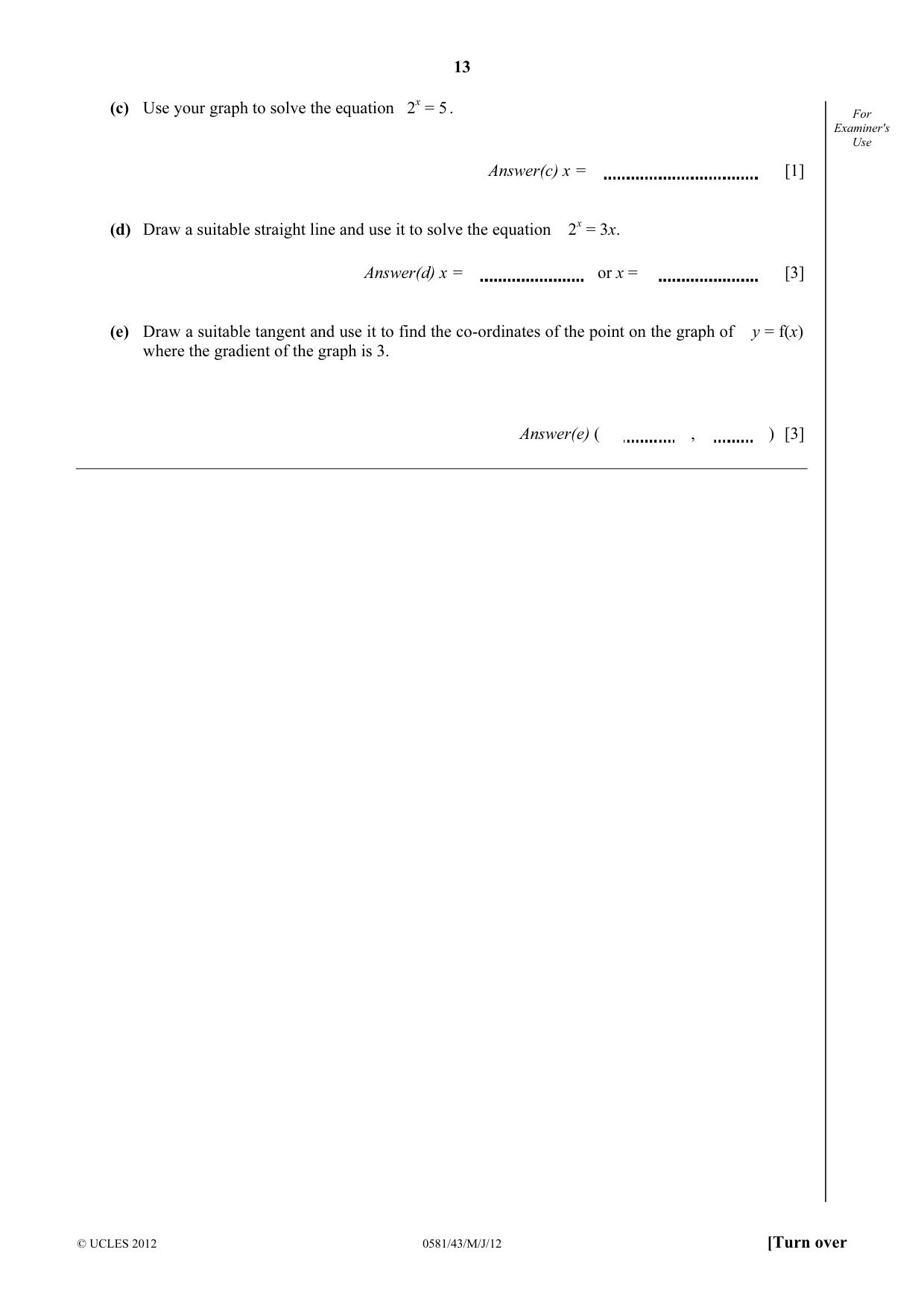
13 © UCLES 2012 0581/43/M/J/12 [Turn over For Examiner's Use (c) Use your graph to solve the equation 2x = 5 . Answer(c) x = [1] (d) Draw a suitable straight line and use it to solve the equation 2x = 3x. Answer(d) x = or x = [3] (e) Draw a suitable tangent and use it to find the co-ordinates of the point on the graph of y = f(x) where the gradient of the graph is 3. Answer(e) ( , ) [3]
Question paper, page 14
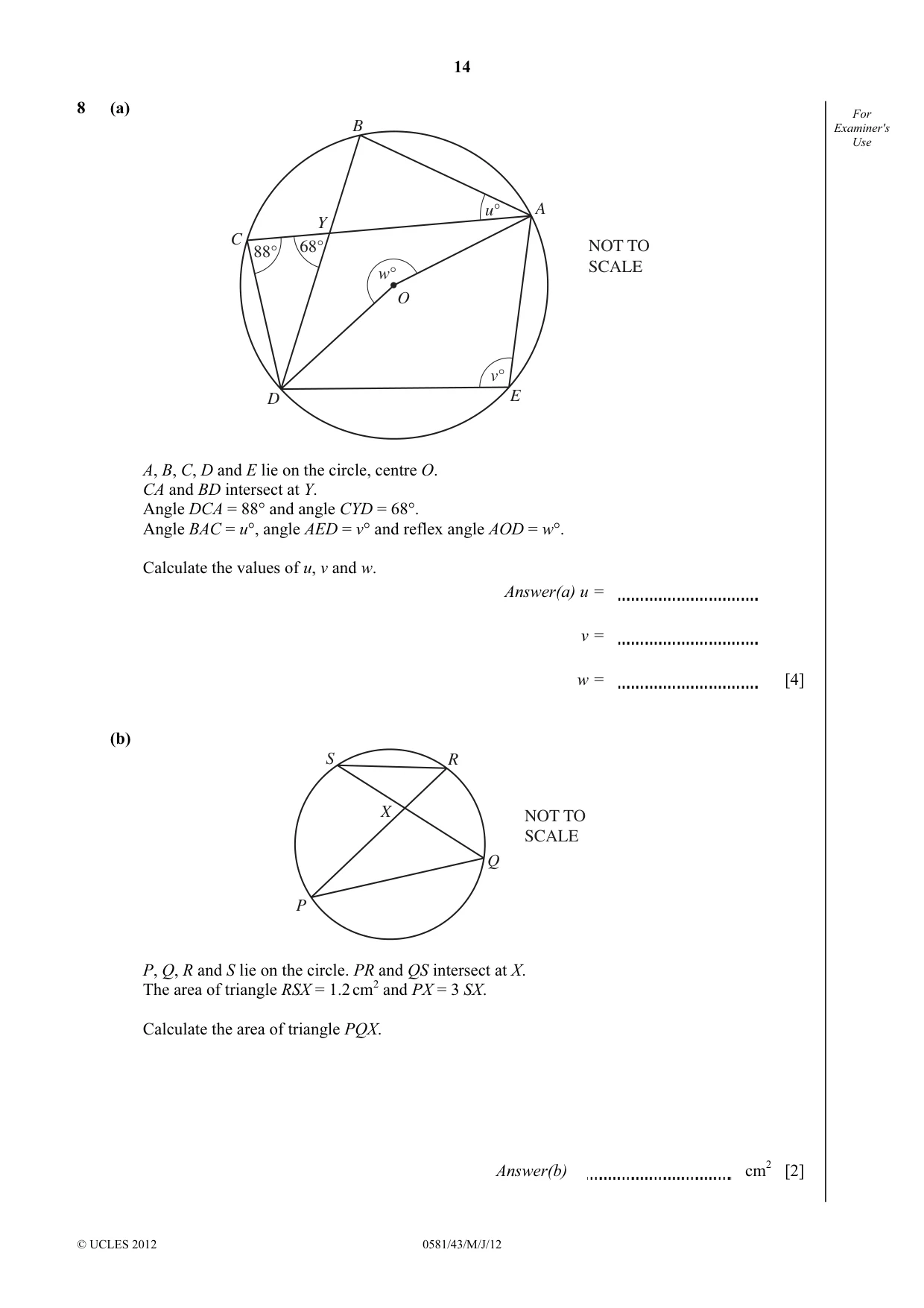
14 © UCLES 2012 0581/43/M/J/12 For Examiner's Use 8 (a) B C D O Y E A u° v° w° 68° 88° NOT TO SCALE A, B, C, D and E lie on the circle, centre O. CA and BD intersect at Y. Angle DCA = 88° and angle CYD = 68°. Angle BAC = u°, angle AED = v° and reflex angle AOD = w°. Calculate the values of u, v and w. Answer(a) u = v = w = [4] (b) S R Q P NOT TO SCALE X P, Q, R and S lie on the circle. PR and QS intersect at X. The area of triangle RSX = 1.2 cm2 and PX = 3 SX. Calculate the area of triangle PQX. Answer(b) cm2 [2]
Question paper, page 15
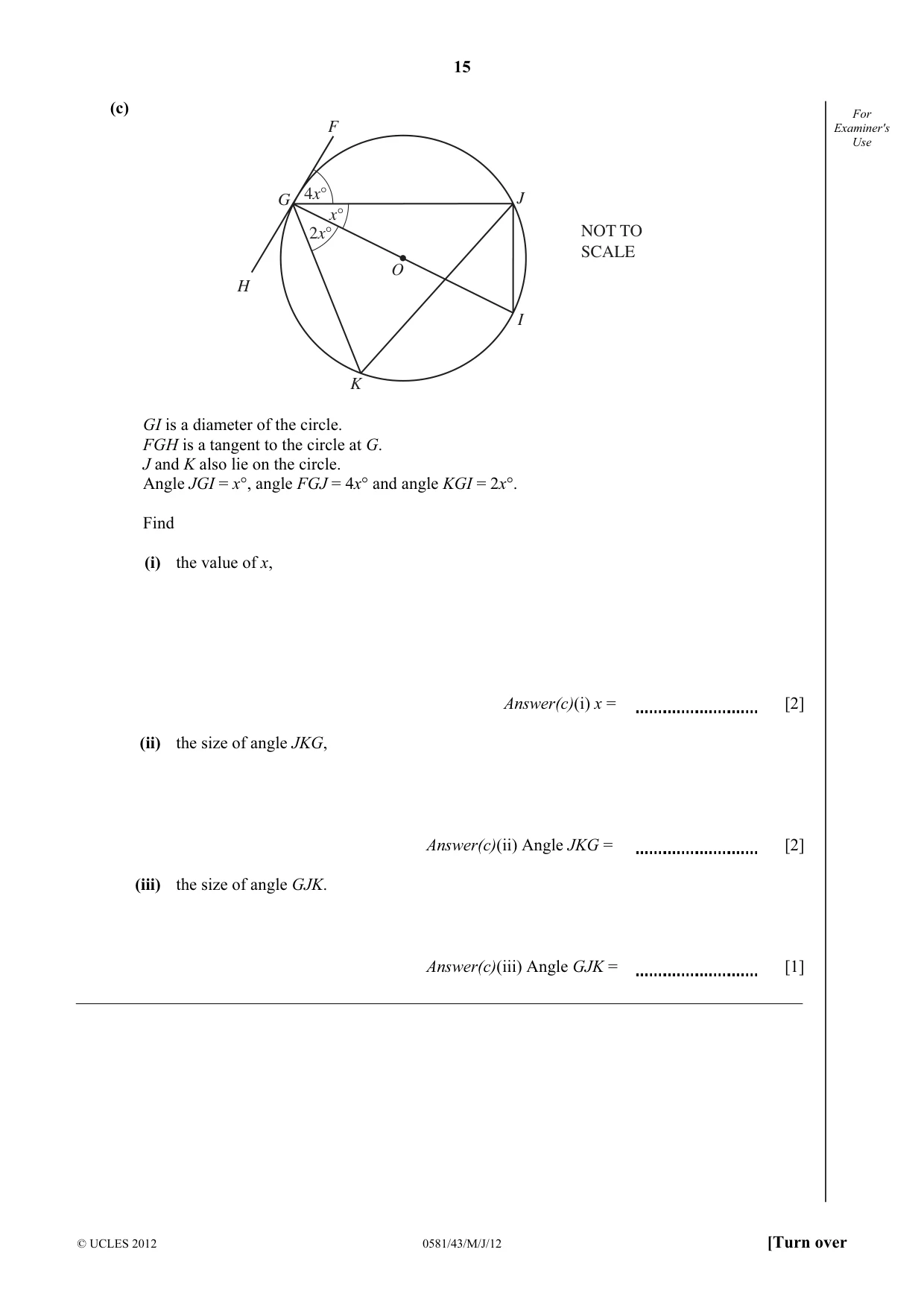
15 © UCLES 2012 0581/43/M/J/12 [Turn over For Examiner's Use (c) J I K O H G F 4x° 2x° x° NOT TO SCALE GI is a diameter of the circle. FGH is a tangent to the circle at G. J and K also lie on the circle. Angle JGI = x°, angle FGJ = 4x° and angle KGI = 2x°. Find (i) the value of x, Answer(c)(i) x = [2] (ii) the size of angle JKG, Answer(c)(ii) Angle JKG = [2] (iii) the size of angle GJK. Answer(c)(iii) Angle GJK = [1]
Question paper, page 16
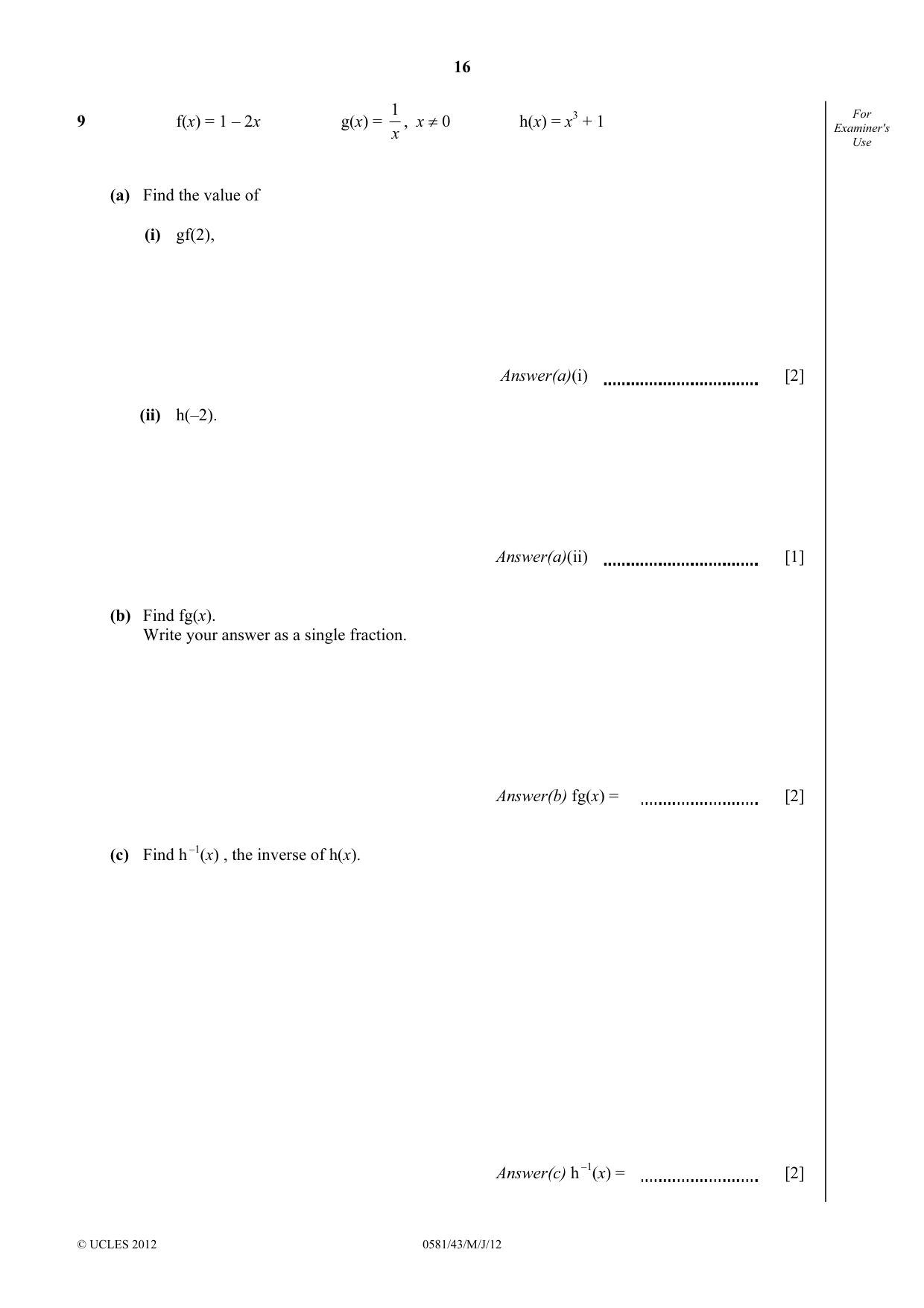
16 © UCLES 2012 0581/43/M/J/12 For Examiner's Use 9 f(x) = 1 – 2x g(x) = x 1 , x ≠ 0 h(x) = x3 + 1 (a) Find the value of (i) gf(2), Answer(a)(i) [2] (ii) h(–2). Answer(a)(ii) [1] (b) Find fg(x). Write your answer as a single fraction. Answer(b) fg(x) = [2] (c) Find h –1(x) , the inverse of h(x). Answer(c) h –1(x) = [2]
Question paper, page 17
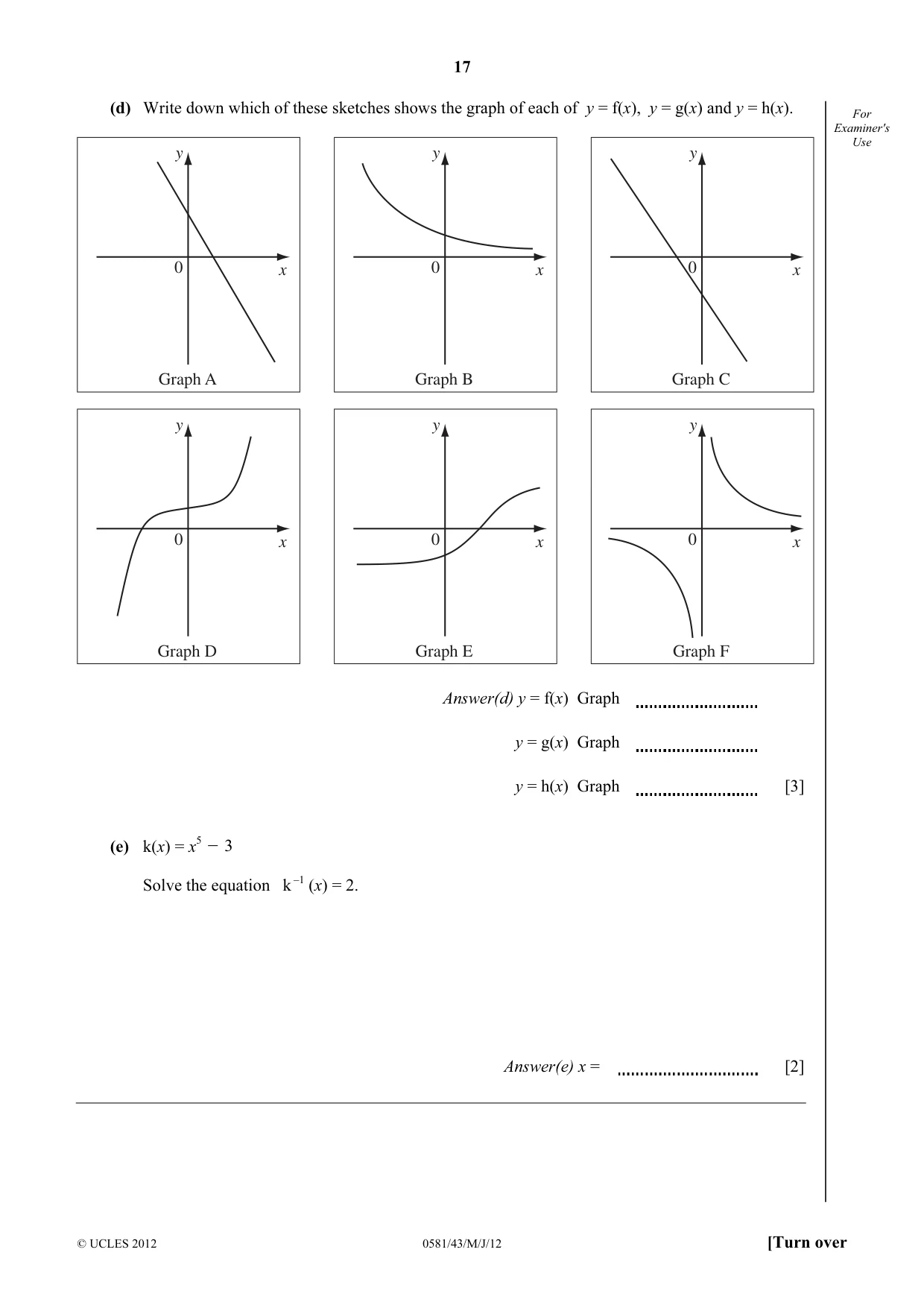
17 © UCLES 2012 0581/43/M/J/12 [Turn over For Examiner's Use (d) Write down which of these sketches shows the graph of each of y = f(x), y = g(x) and y = h(x). y x 0 Graph A y x 0 Graph B y x 0 Graph C y x 0 Graph D y x 0 Graph E y x 0 Graph F Answer(d) y = f(x) Graph y = g(x) Graph y = h(x) Graph [3] (e) k(x) = x5 O=3 Solve the equation k –1 (x) = 2. Answer(e) x = [2]
Question paper, page 18
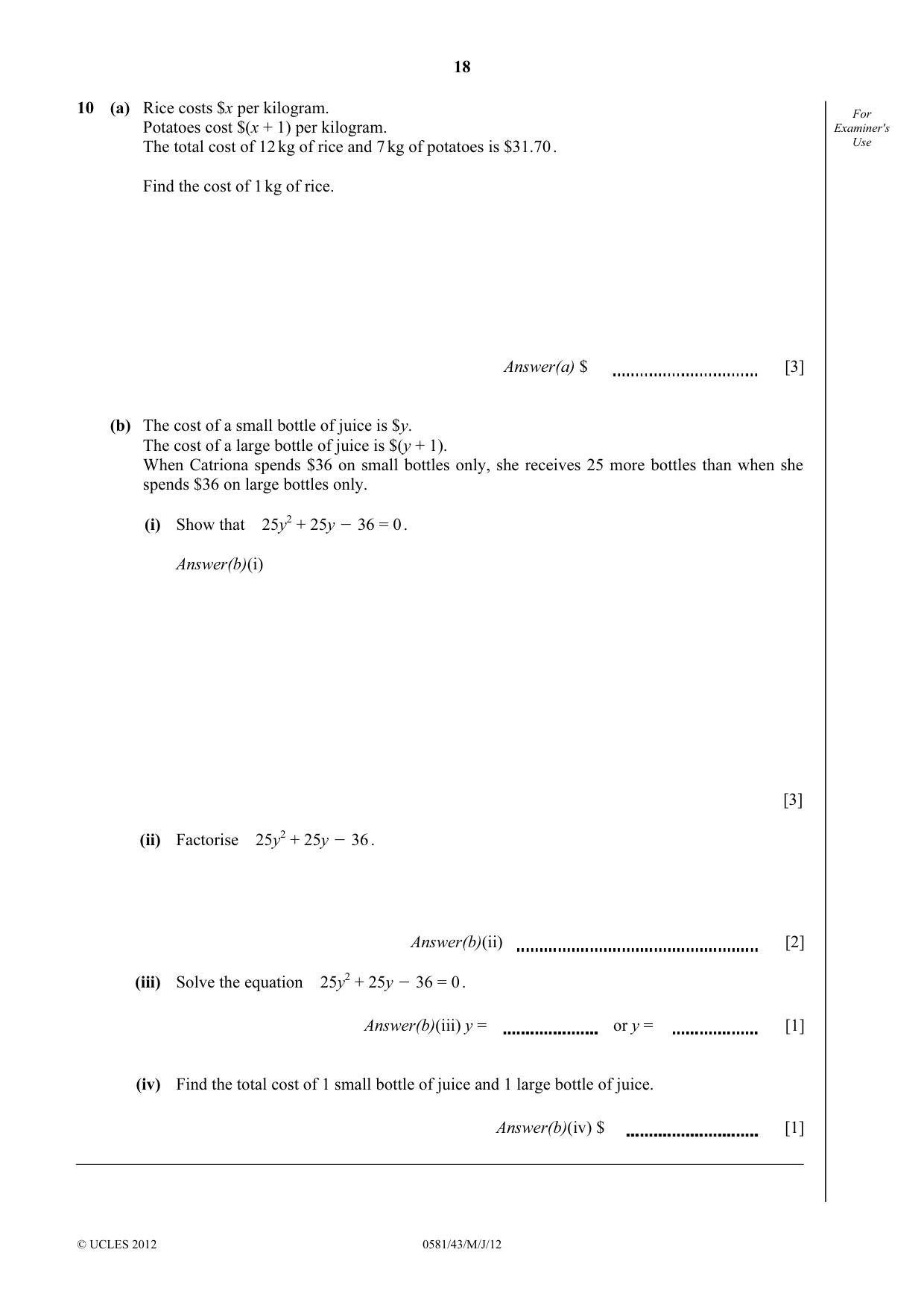
18 © UCLES 2012 0581/43/M/J/12 For Examiner's Use 10 (a) Rice costs $x per kilogram. Potatoes cost $(x + 1) per kilogram. The total cost of 12 kg of rice and 7 kg of potatoes is $31.70 . Find the cost of 1 kg of rice. Answer(a) $ [3] (b) The cost of a small bottle of juice is $y. The cost of a large bottle of juice is $(y + 1). When Catriona spends $36 on small bottles only, she receives 25 more bottles than when she spends $36 on large bottles only. (i) Show that 25y2 + 25y O 36 = 0 . Answer(b)(i) [3] (ii) Factorise 25y2 + 25y O 36 . Answer(b)(ii) [2] (iii) Solve the equation 25y2 + 25y O 36 = 0 . Answer(b)(iii) y = or y = [1] (iv) Find the total cost of 1 small bottle of juice and 1 large bottle of juice. Answer(b)(iv) $ [1]
Question paper, page 19
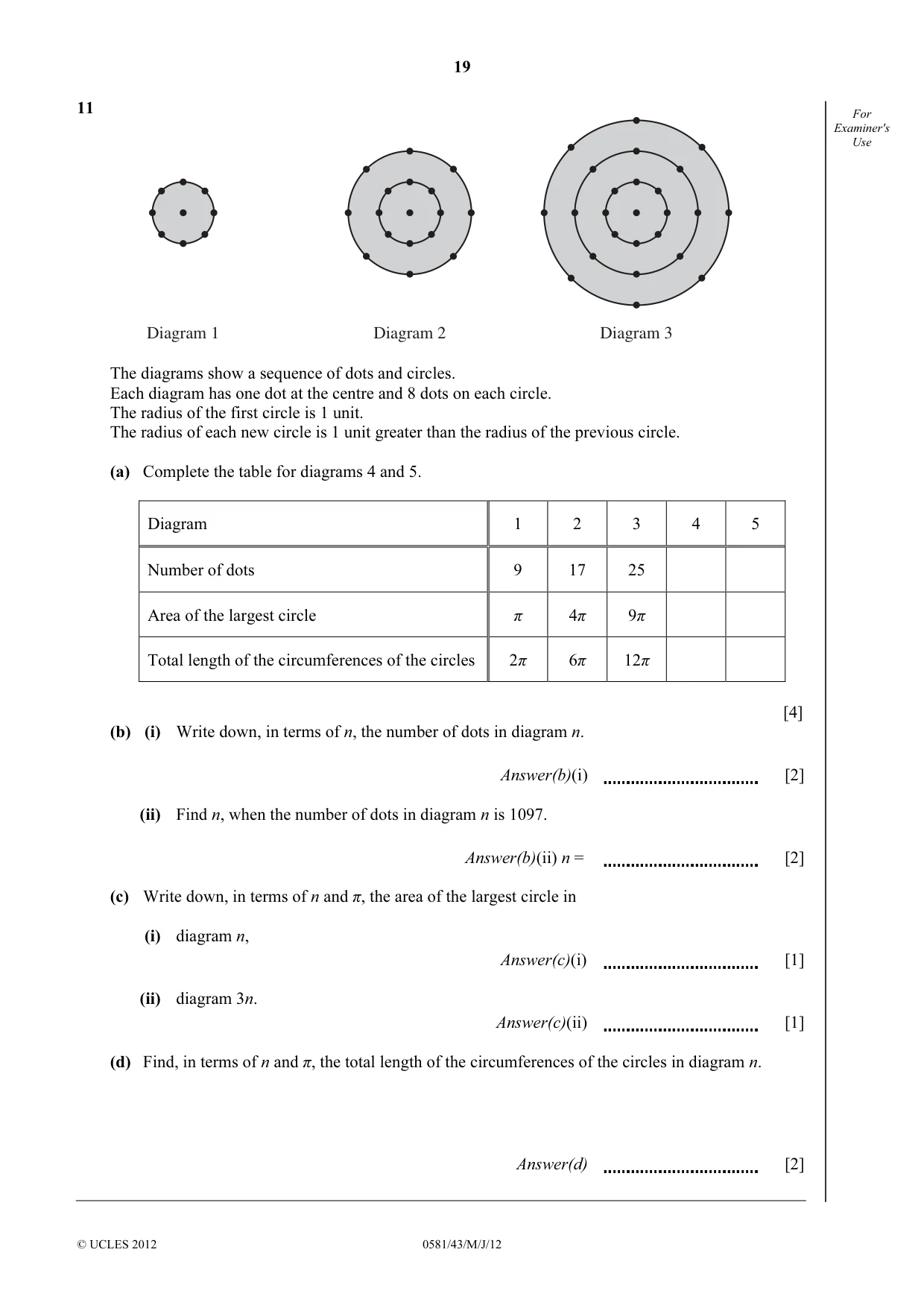
19 © UCLES 2012 0581/43/M/J/12 For Examiner's Use 11 Diagram 3 Diagram 2 Diagram 1 The diagrams show a sequence of dots and circles. Each diagram has one dot at the centre and 8 dots on each circle. The radius of the first circle is 1 unit. The radius of each new circle is 1 unit greater than the radius of the previous circle. (a) Complete the table for diagrams 4 and 5. Diagram 1 2 3 4 5 Number of dots 9 17 25 Area of the largest circle π 4π 9π Total length of the circumferences of the circles 2π 6π 12π [4] (b) (i) Write down, in terms of n, the number of dots in diagram n. Answer(b)(i) [2] (ii) Find n, when the number of dots in diagram n is 1097. Answer(b)(ii) n = [2] (c) Write down, in terms of n and π, the area of the largest circle in (i) diagram n, Answer(c)(i) [1] (ii) diagram 3n. Answer(c)(ii) [1] (d) Find, in terms of n and π, the total length of the circumferences of the circles in diagram n. Answer(d) [2]
Question paper, page 20
20 Permission to reproduce items where third-party owned material protected by copyright is included has been sought and cleared where possible. Every reasonable effort has been made by the publisher (UCLES) to trace copyright holders, but if any items requiring clearance have unwittingly been included, the publisher will be pleased to make amends at the earliest possible opportunity. University of Cambridge International Examinations is part of the Cambridge Assessment Group. Cambridge Assessment is the brand name of University of Cambridge Local Examinations Syndicate (UCLES), which is itself a department of the University of Cambridge. © UCLES 2012 0581/43/M/J/12 BLANK PAGE
Mark scheme, page 1
UNIVERSITY OF CAMBRIDGE INTERNATIONAL EXAMINATIONS International General Certificate of Secondary Education MARK SCHEME for the May/June 2012 question paper for the guidance of teachers 0581 MATHEMATICS 0581/43 Paper 4 (Extended), maximum raw mark 130 This mark scheme is published as an aid to teachers and candidates, to indicate the requirements of the examination. It shows the basis on which Examiners were instructed to award marks. It does not indicate the details of the discussions that took place at an Examiners’ meeting before marking began, which would have considered the acceptability of alternative answers. Mark schemes must be read in conjunction with the question papers and the report on the examination. • Cambridge will not enter into discussions or correspondence in connection with these mark schemes. Cambridge is publishing the mark schemes for the May/June 2012 question papers for most IGCSE, GCE Advanced Level and Advanced Subsidiary Level syllabuses and some Ordinary Level syllabuses. www.XtremePapers.com
Mark scheme, page 2
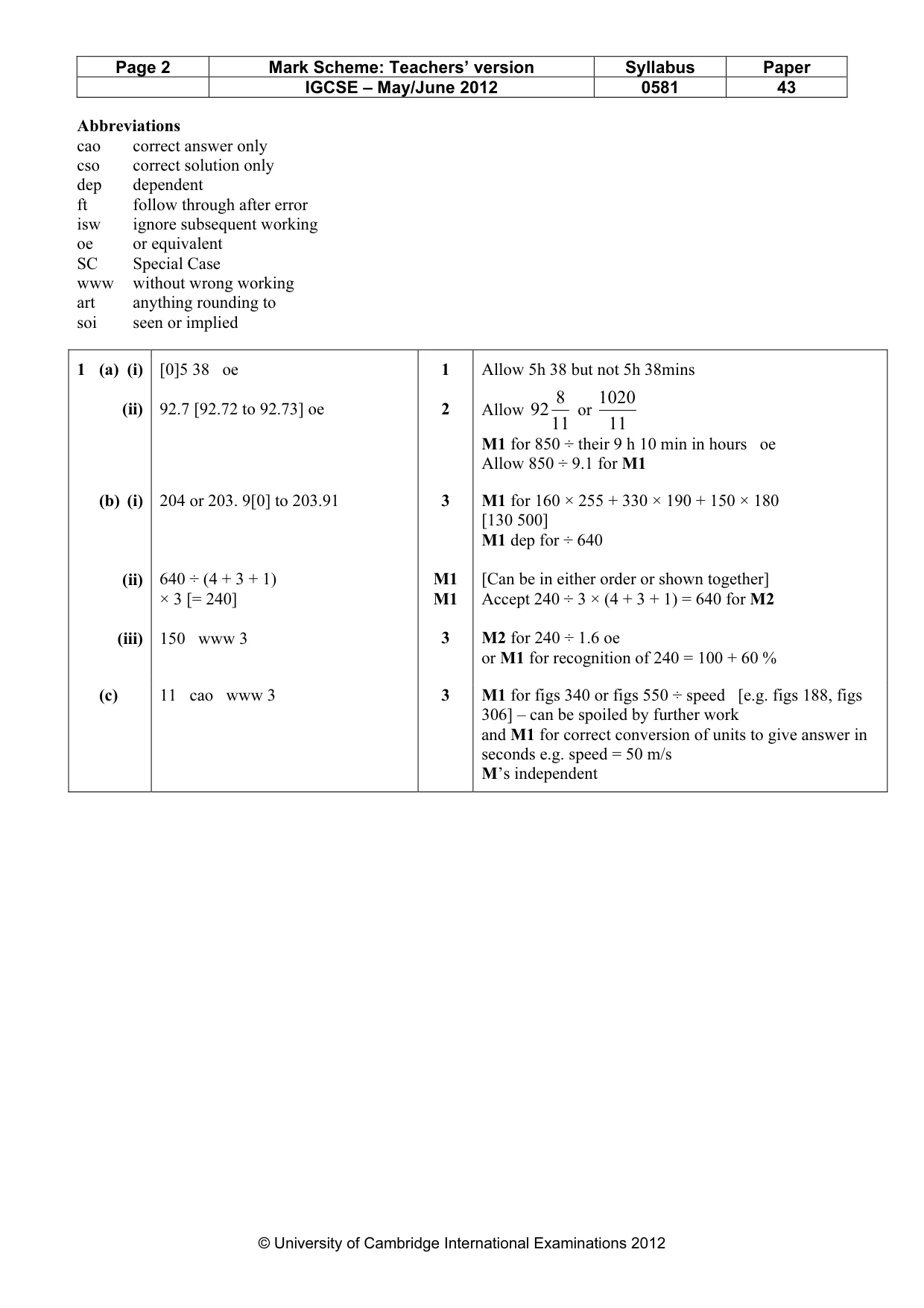
Page 2 Mark Scheme: Teachers’ version Syllabus Paper IGCSE – May/June 2012 0581 43 © University of Cambridge International Examinations 2012 Abbreviations cao correct answer only cso correct solution only dep dependent ft follow through after error isw ignore subsequent working oe or equivalent SC Special Case www without wrong working art anything rounding to soi seen or implied 1 (a) (i) (ii) [0]5 38 oe 92.7 [92.72 to 92.73] oe 1 2 Allow 5h 38 but not 5h 38mins Allow 11 8 92 or 11 1020 M1 for 850 ÷ their 9 h 10 min in hours oe Allow 850 ÷ 9.1 for M1 (b) (i) (ii) (iii) 204 or 203. 9[0] to 203.91 640 ÷ (4 + 3 + 1) × 3 [= 240] 150 www 3 3 M1 M1 3 M1 for 160 × 255 + 330 × 190 + 150 × 180 [130 500] M1 dep for ÷ 640 [Can be in either order or shown together] Accept 240 ÷ 3 × (4 + 3 + 1) = 640 for M2 M2 for 240 ÷ 1.6 oe or M1 for recognition of 240 = 100 + 60 % (c) 11 cao www 3 3 M1 for figs 340 or figs 550 ÷ speed [e.g. figs 188, figs 306] – can be spoiled by further work and M1 for correct conversion of units to give answer in seconds e.g. speed = 50 m/s M’s independent
Mark scheme, page 3
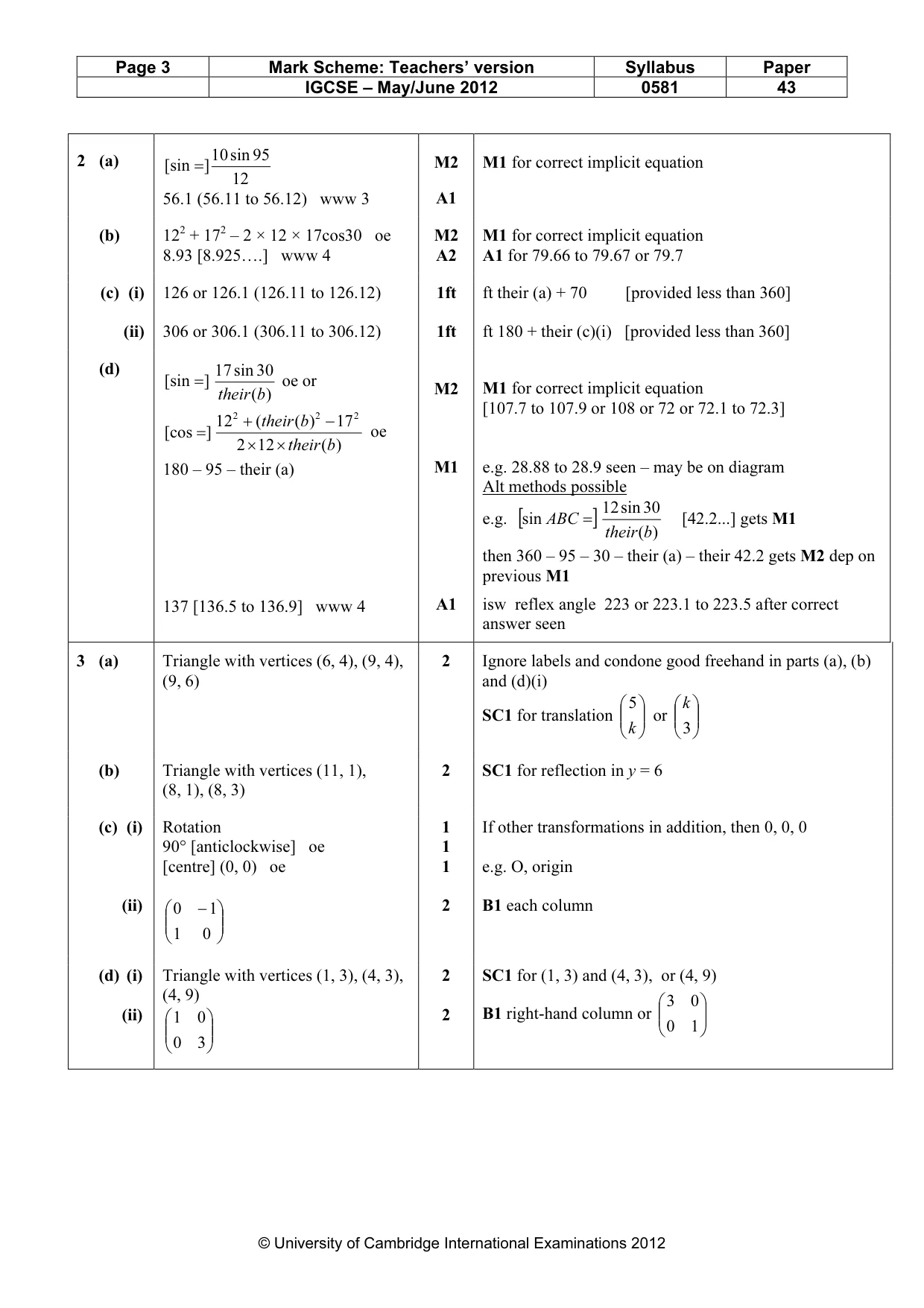
Page 3 Mark Scheme: Teachers’ version Syllabus Paper IGCSE – May/June 2012 0581 43 © University of Cambridge International Examinations 2012 2 (a) 12 95 sin 10 ] [sin = 56.1 (56.11 to 56.12) www 3 M2 A1 M1 for correct implicit equation (b) 122 + 172 – 2 × 12 × 17cos30 oe 8.93 [8.925….] www 4 M2 A2 M1 for correct implicit equation A1 for 79.66 to 79.67 or 79.7 (c) (i) (ii) 126 or 126.1 (126.11 to 126.12) 306 or 306.1 (306.11 to 306.12) 1ft 1ft ft their (a) + 70 [provided less than 360] ft 180 + their (c)(i) [provided less than 360] (d) ) ( 30 sin 17 ] [sin b their = oe or 2 2 2 12 ( ( ) 17 [cos ] 2 12 ( ) their b their b + − = × × oe 180 – 95 – their (a) 137 [136.5 to 136.9] www 4 M2 M1 A1 M1 for correct implicit equation [107.7 to 107.9 or 108 or 72 or 72.1 to 72.3] e.g. 28.88 to 28.9 seen – may be on diagram Alt methods possible e.g. [ ] ) ( 30 sin 12 sin b their ABC = [42.2...] gets M1 then 360 – 95 – 30 – their (a) – their 42.2 gets M2 dep on previous M1 isw reflex angle 223 or 223.1 to 223.5 after correct answer seen 3 (a) Triangle with vertices (6, 4), (9, 4), (9, 6) 2 Ignore labels and condone good freehand in parts (a), (b) and (d)(i) SC1 for translation k 5 or 3 k (b) Triangle with vertices (11, 1), (8, 1), (8, 3) 2 SC1 for reflection in y = 6 (c) (i) (ii) Rotation 90° [anticlockwise] oe [centre] (0, 0) oe − 0 1 1 0 1 1 1 2 If other transformations in addition, then 0, 0, 0 e.g. O, origin B1 each column (d) (i) (ii) Triangle with vertices (1, 3), (4, 3), (4, 9) 3 0 0 1 2 2 SC1 for (1, 3) and (4, 3), or (4, 9) B1 right-hand column or 1 0 0 3
Mark scheme, page 4
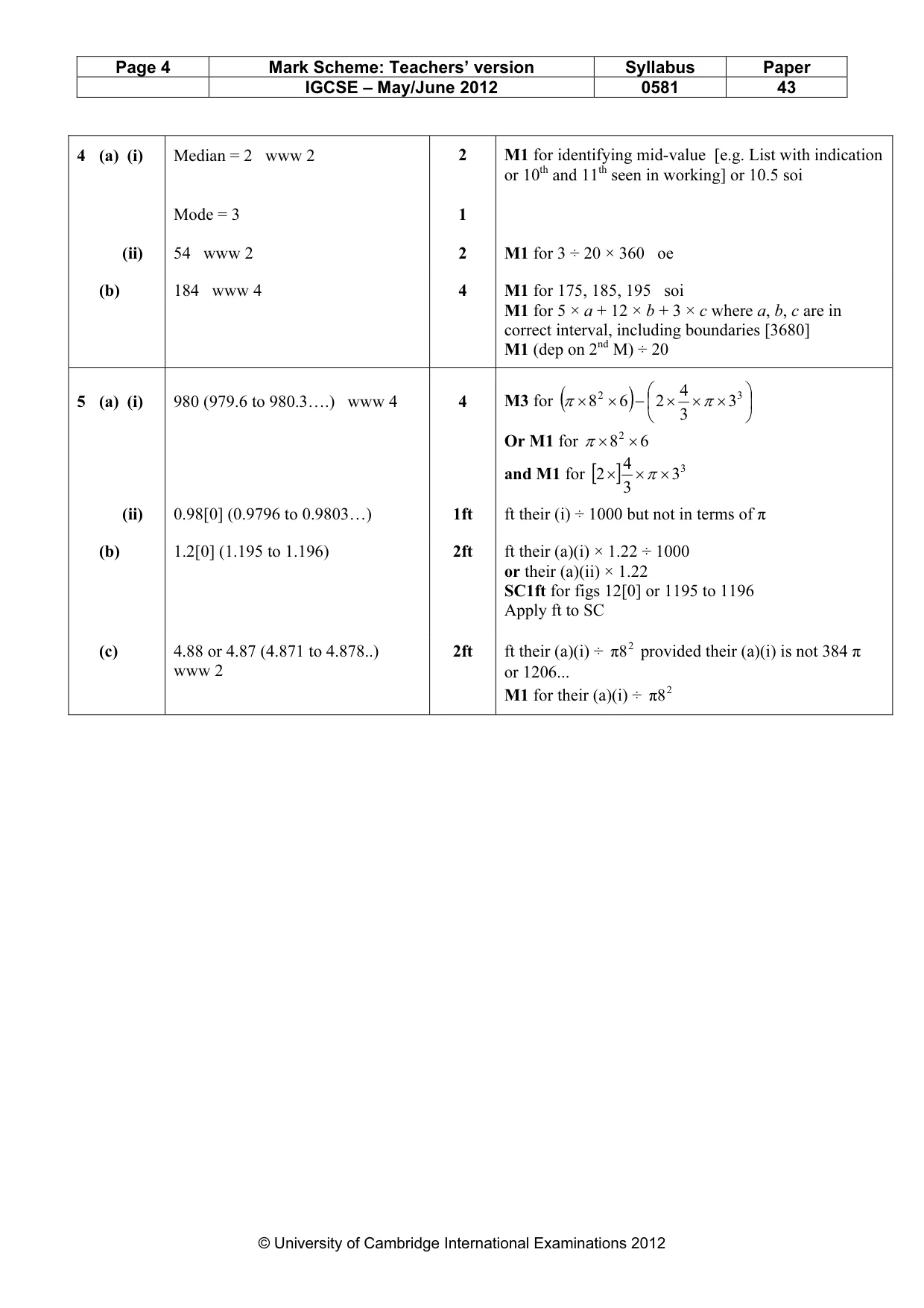
Page 4 Mark Scheme: Teachers’ version Syllabus Paper IGCSE – May/June 2012 0581 43 © University of Cambridge International Examinations 2012 4 (a) (i) (ii) Median = 2 www 2 Mode = 3 54 www 2 2 1 2 M1 for identifying mid-value [e.g. List with indication or 10th and 11th seen in working] or 10.5 soi M1 for 3 ÷ 20 × 360 oe (b) 184 www 4 4 M1 for 175, 185, 195 soi M1 for 5 × a + 12 × b + 3 × c where a, b, c are in correct interval, including boundaries [3680] M1 (dep on 2nd M) ÷ 20 5 (a) (i) (ii) 980 (979.6 to 980.3….) www 4 0.98[0] (0.9796 to 0.9803…) 4 1ft M3 for ( ) × × × − × × 3 2 3 3 4 2 6 8 π π Or M1 for 6 82 × × π and M1 for [ ] 3 3 3 4 2 × × × π ft their (i) ÷ 1000 but not in terms of π (b) 1.2[0] (1.195 to 1.196) 2ft ft their (a)(i) × 1.22 ÷ 1000 or their (a)(ii) × 1.22 SC1ft for figs 12[0] or 1195 to 1196 Apply ft to SC (c) 4.88 or 4.87 (4.871 to 4.878..) www 2 2ft ft their (a)(i) ÷ 2 8 π provided their (a)(i) is not 384 π or 1206... M1 for their (a)(i) ÷ 2 8 π
Mark scheme, page 5
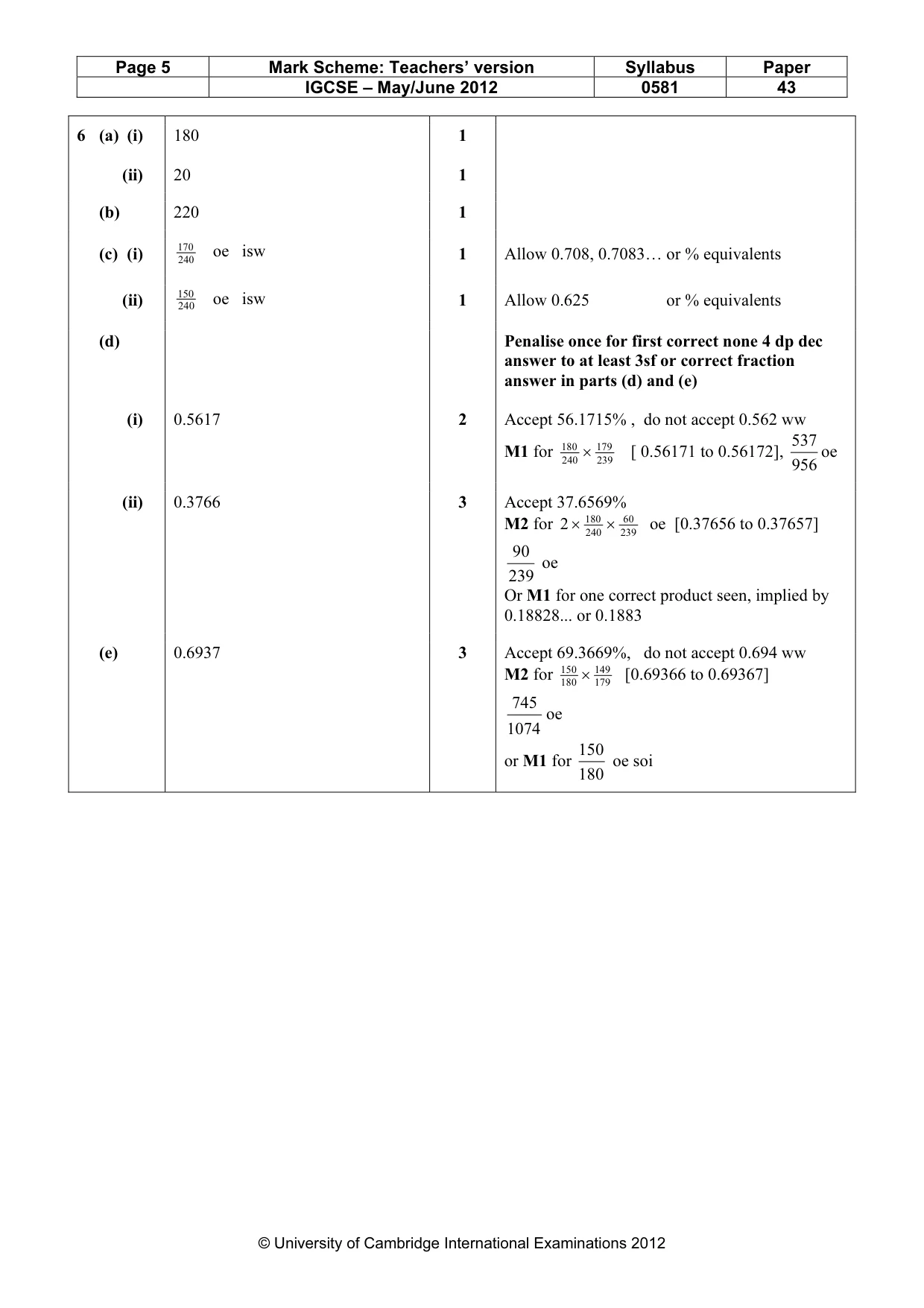
Page 5 Mark Scheme: Teachers’ version Syllabus Paper IGCSE – May/June 2012 0581 43 © University of Cambridge International Examinations 2012 6 (a) (i) (ii) 180 20 1 1 (b) 220 1 (c) (i) 240 170 oe isw 1 Allow 0.708, 0.7083… or % equivalents (ii) 240 150 oe isw 1 Allow 0.625 or % equivalents (d) (i) 0.5617 2 Penalise once for first correct none 4 dp dec answer to at least 3sf or correct fraction answer in parts (d) and (e) Accept 56.1715% , do not accept 0.562 ww M1 for 239 179 240 180 × [ 0.56171 to 0.56172], 956 537 oe (ii) 0.3766 3 Accept 37.6569% M2 for 239 60 240 180 2 × × oe [0.37656 to 0.37657] 239 90 oe Or M1 for one correct product seen, implied by 0.18828... or 0.1883 (e) 0.6937 3 Accept 69.3669%, do not accept 0.694 ww M2 for 179 149 180 150 × [0.69366 to 0.69367] 1074 745 oe or M1 for 180 150 oe soi
Mark scheme, page 6
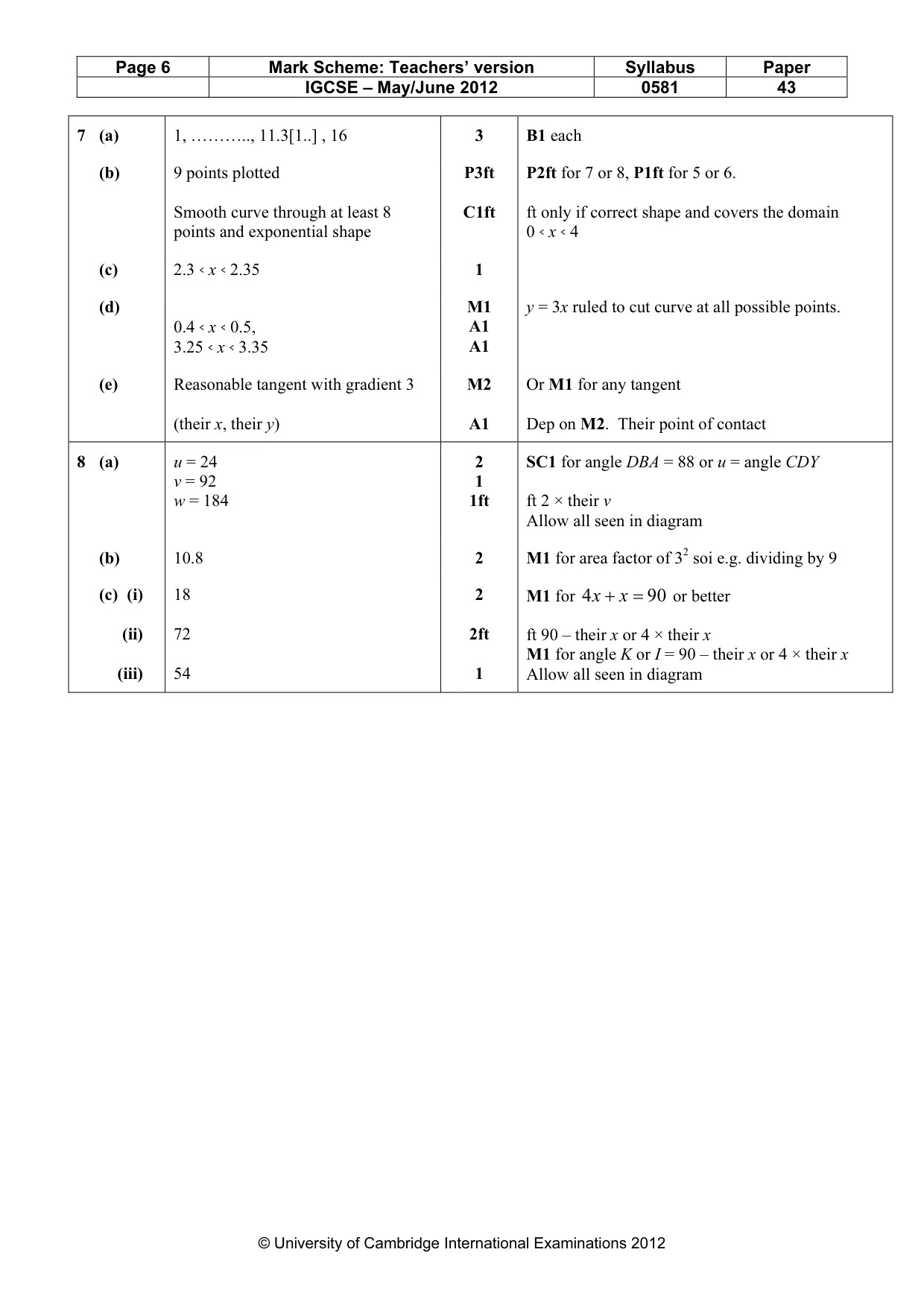
Page 6 Mark Scheme: Teachers’ version Syllabus Paper IGCSE – May/June 2012 0581 43 © University of Cambridge International Examinations 2012 7 (a) 1, ……….., 11.3[1..] , 16 3 B1 each (b) 9 points plotted Smooth curve through at least 8 points and exponential shape P3ft C1ft P2ft for 7 or 8, P1ft for 5 or 6. ft only if correct shape and covers the domain 0 < x < 4 (c) 2.3 < x < 2.35 1 (d) 0.4 < x < 0.5, 3.25 < x < 3.35 M1 A1 A1 y = 3x ruled to cut curve at all possible points. (e) Reasonable tangent with gradient 3 (their x, their y) M2 A1 Or M1 for any tangent Dep on M2. Their point of contact 8 (a) u = 24 v = 92 w = 184 2 1 1ft SC1 for angle DBA = 88 or u = angle CDY ft 2 × their v Allow all seen in diagram (b) 10.8 2 M1 for area factor of 32 soi e.g. dividing by 9 (c) (i) (ii) (iii) 18 72 54 2 2ft 1 M1 for 90 4 = + x x or better ft 90 – their x or 4 × their x M1 for angle K or I = 90 – their x or 4 × their x Allow all seen in diagram
Mark scheme, page 7
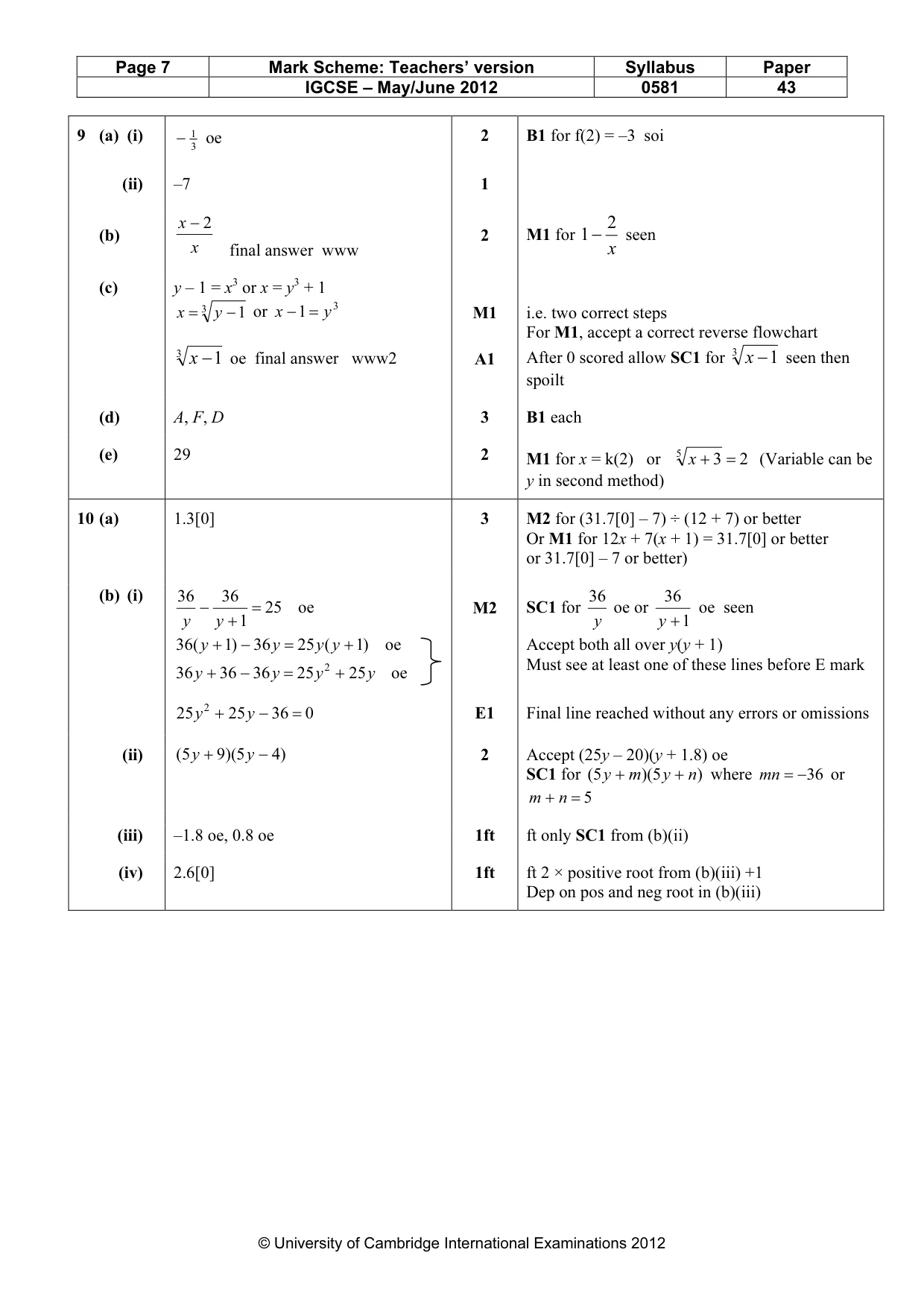
Page 7 Mark Scheme: Teachers’ version Syllabus Paper IGCSE – May/June 2012 0581 43 © University of Cambridge International Examinations 2012 9 (a) (i) (ii) 3 1 − oe –7 2 1 B1 for f(2) = –3 soi (b) x x 2 − final answer www 2 M1 for x 2 1− seen (c) y – 1 = x3 or x = y3 + 1 3 1 − = y x or 3 1 y x = − 3 1 − x oe final answer www2 M1 A1 i.e. two correct steps For M1, accept a correct reverse flowchart After 0 scored allow SC1 for 3 1 − x seen then spoilt (d) A, F, D 3 B1 each (e) 29 2 M1 for x = k(2) or 2 3 5 = + x (Variable can be y in second method) 10 (a) 1.3[0] 3 M2 for (31.7[0] – 7) ÷ (12 + 7) or better Or M1 for 12x + 7(x + 1) = 31.7[0] or better or 31.7[0] – 7 or better) (b) (i) 25 1 36 36 = + −y y oe )1 ( 25 36 )1 ( 36 + = − + y y y y oe y y y y 25 25 36 36 36 2 + = − + oe 0 36 25 25 2 = − + y y M2 E1 SC1 for y 36 oe or 1 36 + y oe seen Accept both all over y(y + 1) Must see at least one of these lines before E mark Final line reached without any errors or omissions (ii) ) 4 5 )( 9 5 ( − + y y 2 Accept (25y – 20)(y + 1.8) oe SC1 for ) 5 )( 5 ( n y m y + + where 36 − = mn or 5 = + n m (iii) –1.8 oe, 0.8 oe 1ft ft only SC1 from (b)(ii) (iv) 2.6[0] 1ft ft 2 × positive root from (b)(iii) +1 Dep on pos and neg root in (b)(iii)
Mark scheme, page 8
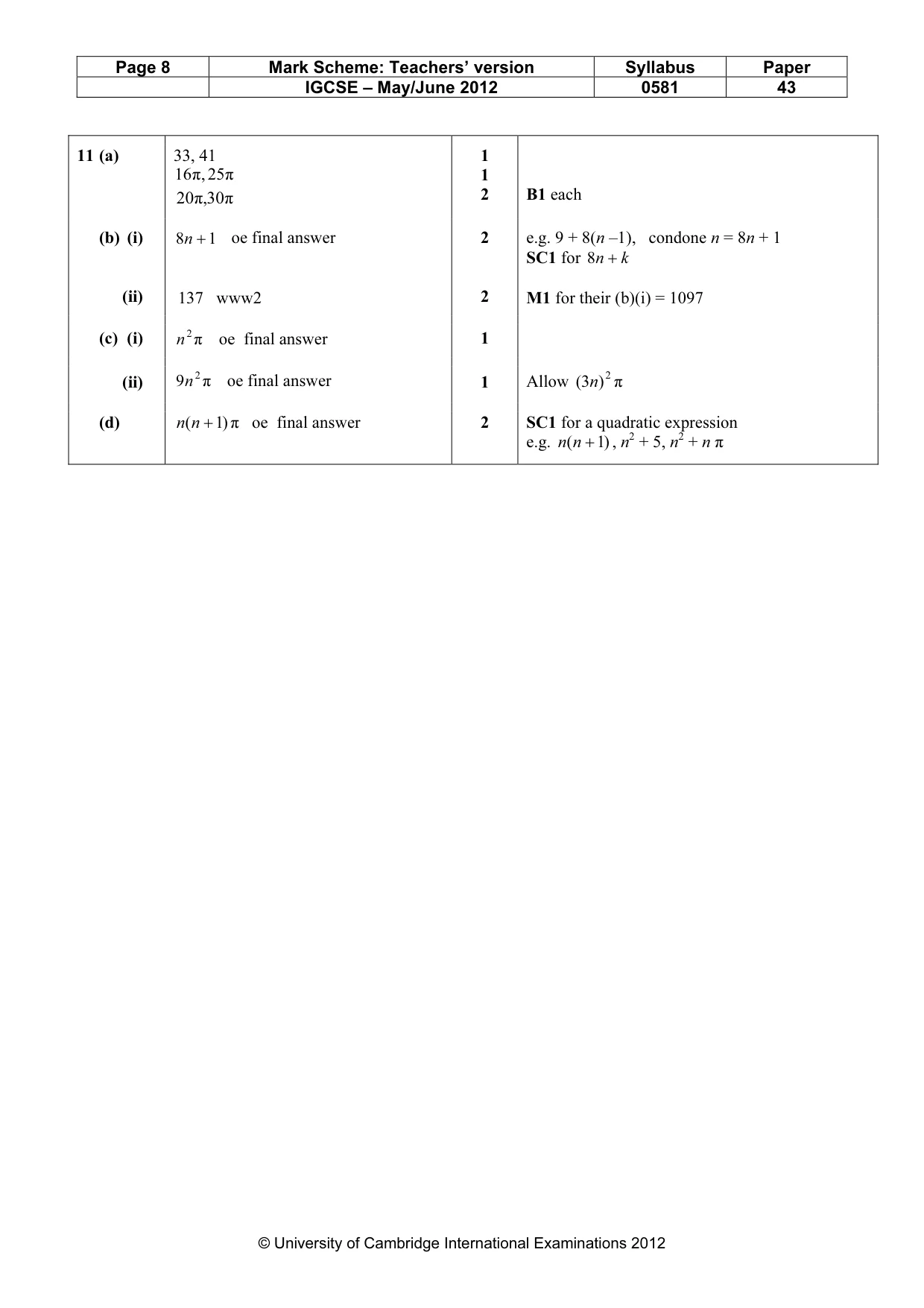
Page 8 Mark Scheme: Teachers’ version Syllabus Paper IGCSE – May/June 2012 0581 43 © University of Cambridge International Examinations 2012 11 (a) 33, 41 π 25 ,π 16 π 30 ,π 20 1 1 2 B1 each (b) (i) (ii) 1 8 + n oe final answer 137 www2 2 2 e.g. 9 + 8(n –1), condone n = 8n + 1 SC1 for k n + 8 M1 for their (b)(i) = 1097 (c) (i) π 2 n oe final answer 1 (ii) π 9 2 n oe final answer 1 Allow π ) 3 ( 2 n (d) )1 ( + n n π oe final answer 2 SC1 for a quadratic expression e.g. )1 ( + n n , n2 + 5, n2 + n π
What you needed in this session
Cambridge’s own grade thresholds for 2012 May/June, Paper 4 · Variant 3. A higher threshold means an easier paper — the bar moves with how the cohort did.