Cambridge IGCSE Mathematics (with coursework) 0581 — 2010 May/June Paper 4 · Variant 3
0581/43/M/J/10
The question paper and its mark scheme, free to read here and free to download. This is Cambridge’s own paper, exactly as it was sat.
Question paper20 pages
Mark scheme6 pages
Answers below. Sit the paper first if you are practising.
Paper as text
Question paper, page 1
This document consists of 19 printed pages and 1 blank page. IB10 06_0581_43/FP © UCLES 2010 [Turn over *4514577832* UNIVERSITY OF CAMBRIDGE INTERNATIONAL EXAMINATIONS International General Certificate of Secondary Education MATHEMATICS 0581/43 Paper 4 (Extended) May/June 2010 2 hours 30 minutes Candidates answer on the Question Paper. Additional Materials: Electronic calculator Geometrical instruments Mathematical tables (optional) Tracing paper (optional) READ THESE INSTRUCTIONS FIRST Write your Centre number, candidate number and name on all the work you hand in. Write in dark blue or black pen. You may use a pencil for any diagrams or graphs. Do not use staples, paper clips, highlighters, glue or correction fluid. Do NOT WRITE IN ANY BARCODES. Answer all questions. If working is needed for any question it must be shown below that question. Electronic calculators should be used. If the degree of accuracy is not specified in the question, and if the answer is not exact, give the answer to three significant figures. Give answers in degrees to one decimal place. For π use either your calculator value or 3.142. At the end of the examination, fasten all your work securely together. The number of marks is given in brackets [ ] at the end of each question or part question. The total of the marks for this paper is 130. www.XtremePapers.com
Question paper, page 2
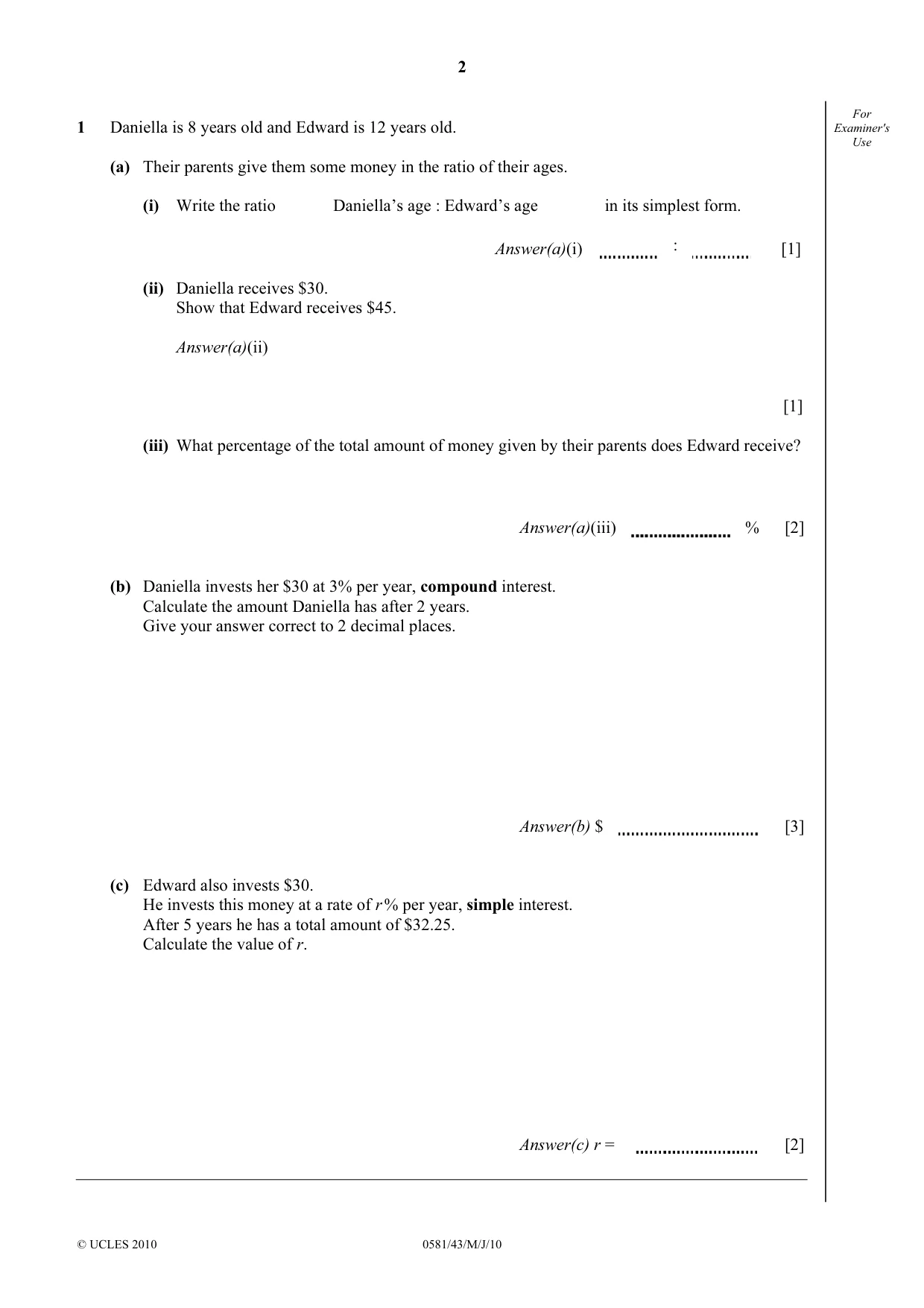
2 © UCLES 2010 0581/43/M/J/10 For Examiner's Use 1 Daniella is 8 years old and Edward is 12 years old. (a) Their parents give them some money in the ratio of their ages. (i) Write the ratio Daniella’s age : Edward’s age in its simplest form. Answer(a)(i) : [1] (ii) Daniella receives $30. Show that Edward receives $45. Answer(a)(ii) [1] (iii) What percentage of the total amount of money given by their parents does Edward receive? Answer(a)(iii) % [2] (b) Daniella invests her $30 at 3% per year, compound interest. Calculate the amount Daniella has after 2 years. Give your answer correct to 2 decimal places. Answer(b) $ [3] (c) Edward also invests $30. He invests this money at a rate of r % per year, simple interest. After 5 years he has a total amount of $32.25. Calculate the value of r. Answer(c) r = [2]
Question paper, page 3
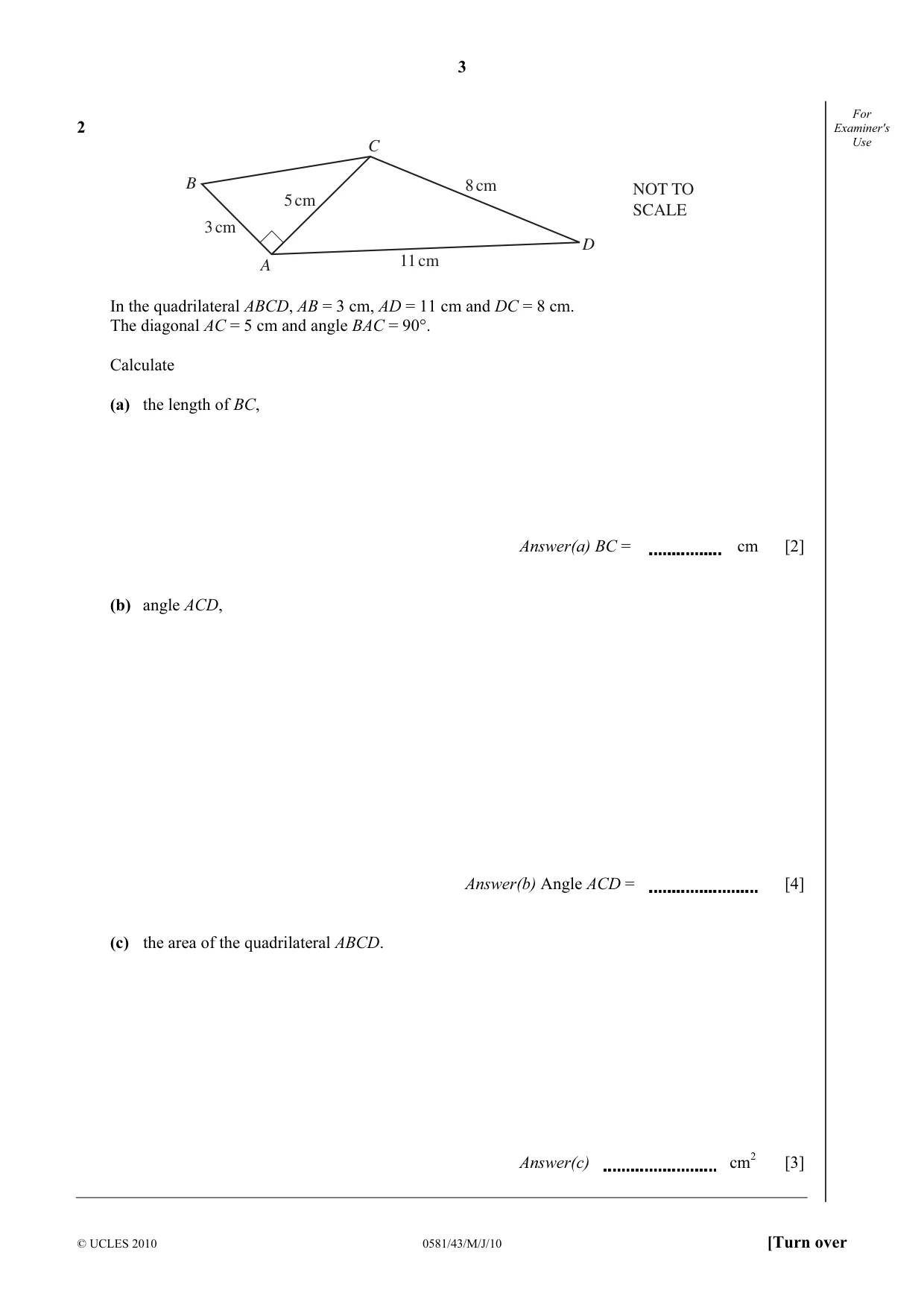
3 © UCLES 2010 0581/43/M/J/10 [Turn over For Examiner's Use 2 B A D C 8 cm 11 cm 3 cm 5 cm NOT TO SCALE In the quadrilateral ABCD, AB = 3 cm, AD = 11 cm and DC = 8 cm. The diagonal AC = 5 cm and angle BAC = 90°. Calculate (a) the length of BC, Answer(a) BC = cm [2] (b) angle ACD, Answer(b) Angle ACD = [4] (c) the area of the quadrilateral ABCD. Answer(c) cm2 [3]
Question paper, page 4
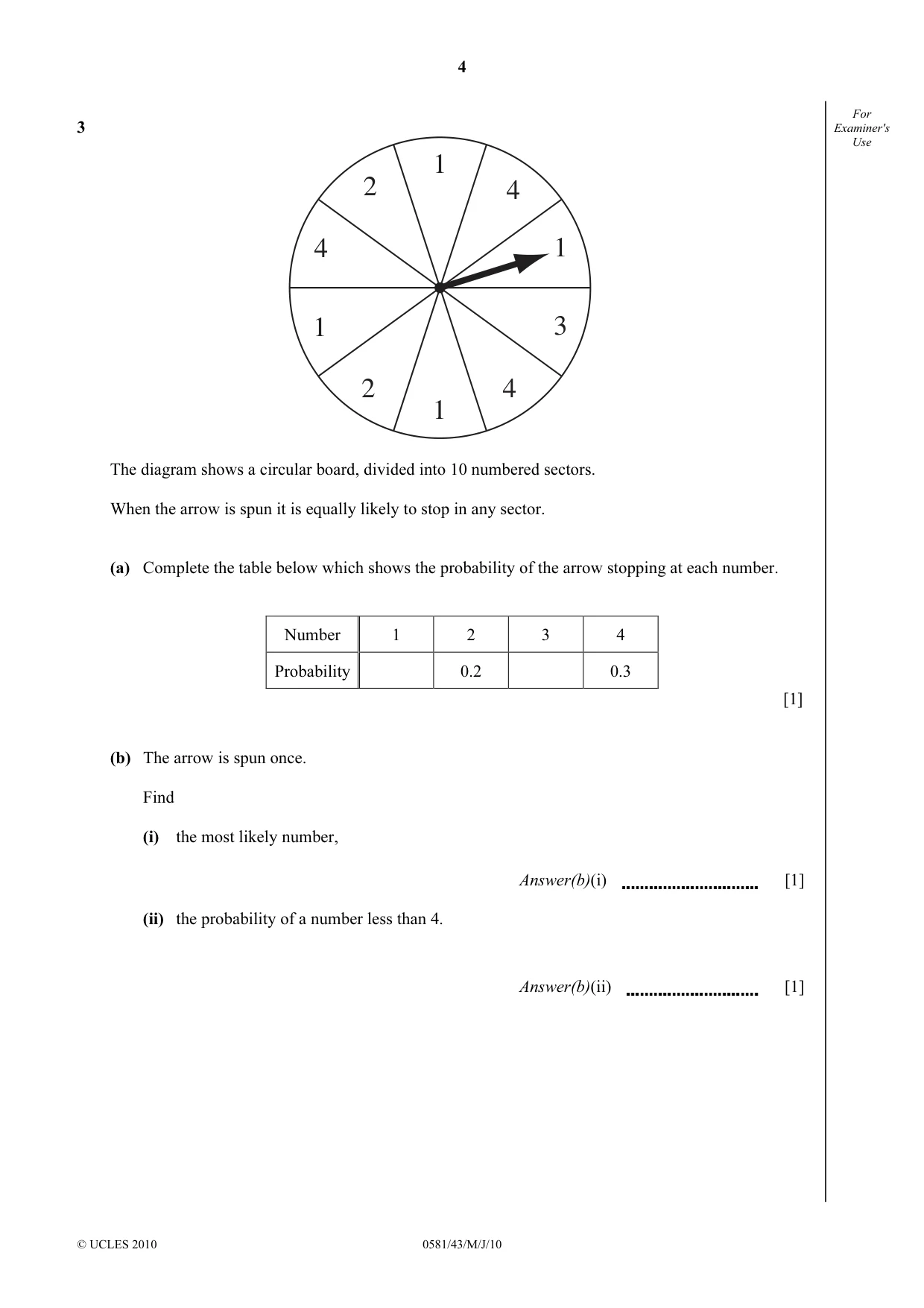
4 © UCLES 2010 0581/43/M/J/10 For Examiner's Use 3 1 4 1 3 4 1 2 1 4 2 The diagram shows a circular board, divided into 10 numbered sectors. When the arrow is spun it is equally likely to stop in any sector. (a) Complete the table below which shows the probability of the arrow stopping at each number. Number 1 2 3 4 Probability 0.2 0.3 [1] (b) The arrow is spun once. Find (i) the most likely number, Answer(b)(i) [1] (ii) the probability of a number less than 4. Answer(b)(ii) [1]
Question paper, page 5
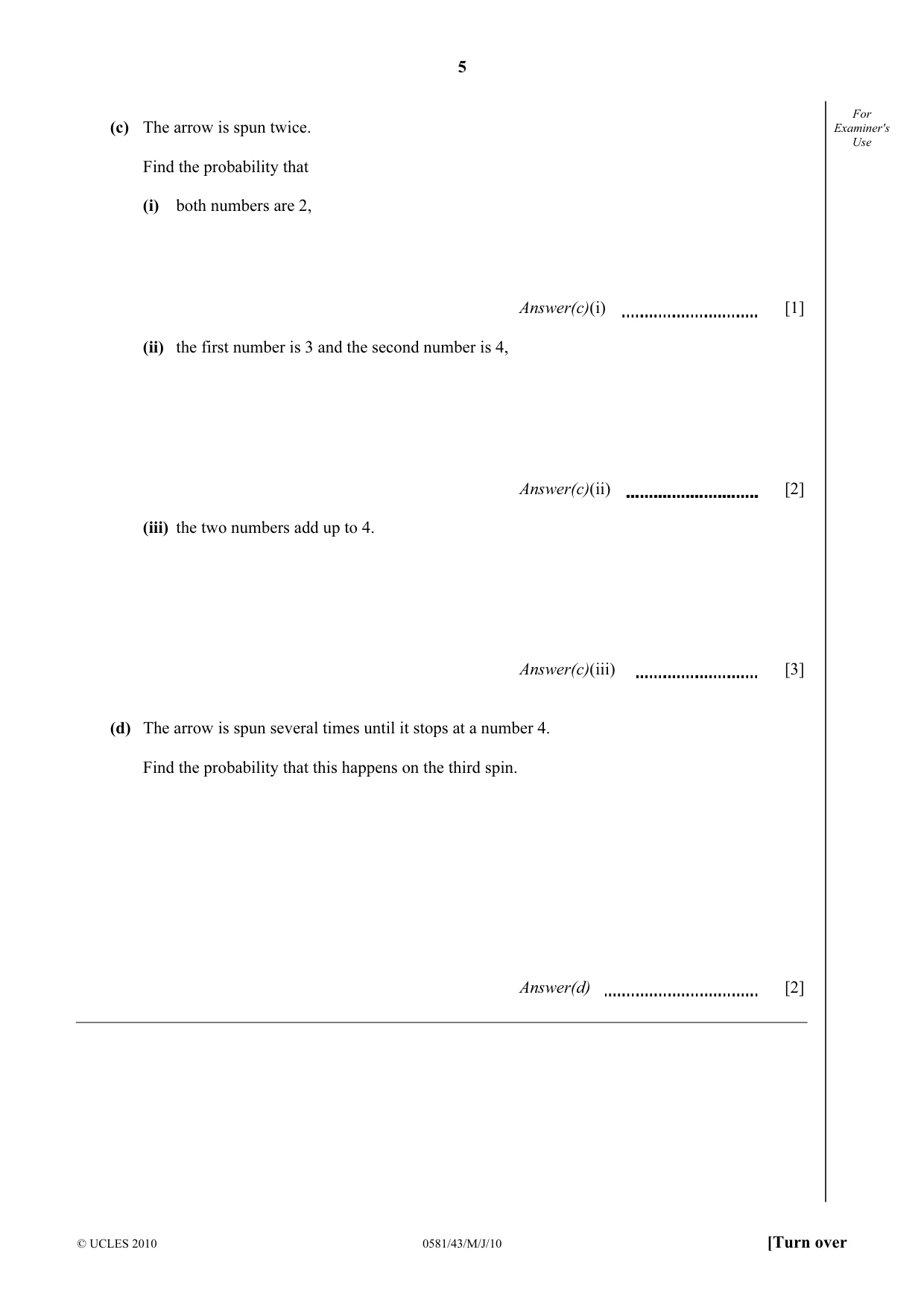
5 © UCLES 2010 0581/43/M/J/10 [Turn over For Examiner's Use (c) The arrow is spun twice. Find the probability that (i) both numbers are 2, Answer(c)(i) [1] (ii) the first number is 3 and the second number is 4, Answer(c)(ii) [2] (iii) the two numbers add up to 4. Answer(c)(iii) [3] (d) The arrow is spun several times until it stops at a number 4. Find the probability that this happens on the third spin. Answer(d) [2]
Question paper, page 6
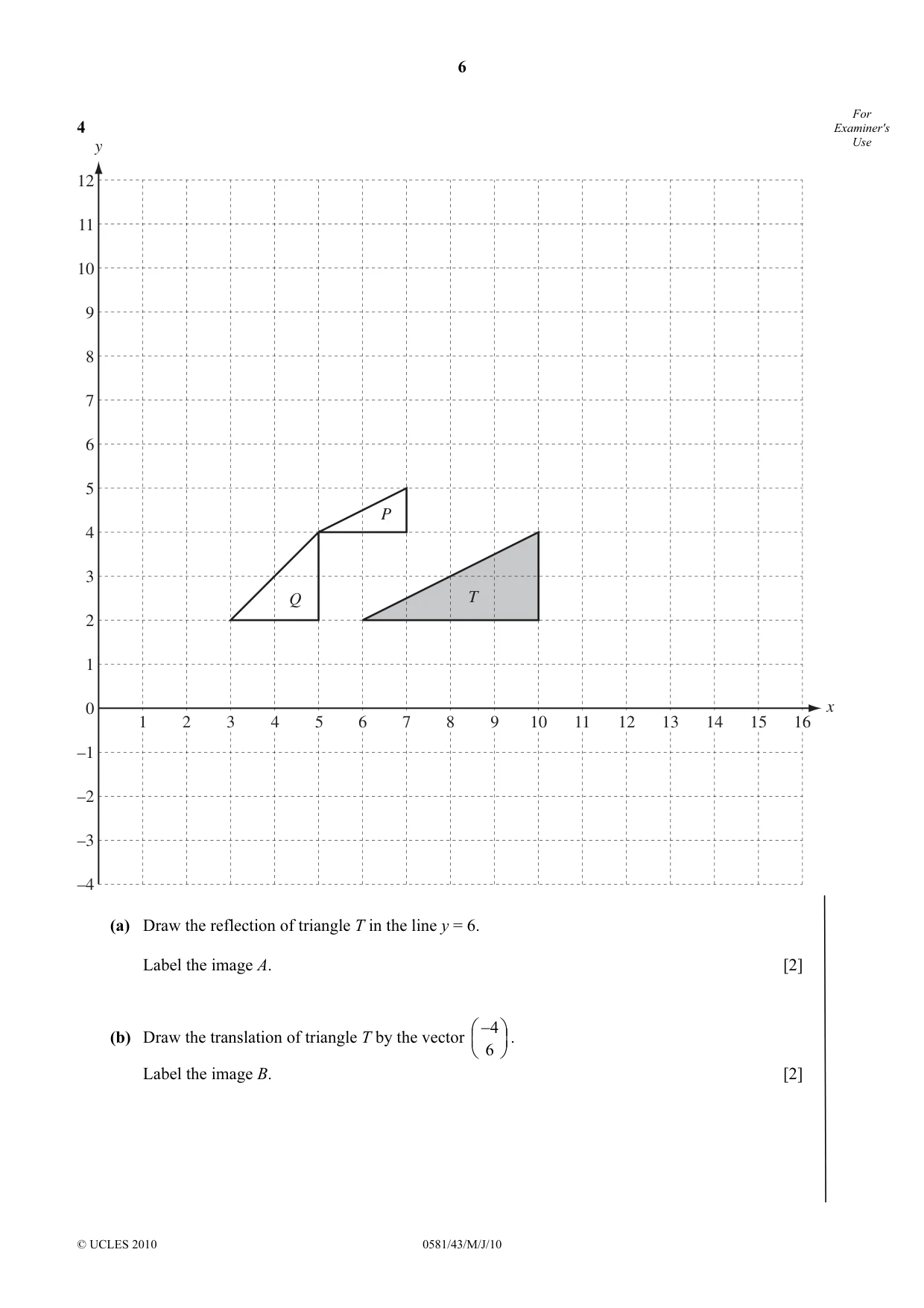
6 © UCLES 2010 0581/43/M/J/10 For Examiner's Use 4 y x 12 11 10 9 8 7 6 5 4 3 2 1 0 –1 –2 –3 –4 1 2 3 4 5 6 7 8 9 10 11 12 13 14 15 16 P Q T (a) Draw the reflection of triangle T in the line y = 6. Label the image A. [2] (b) Draw the translation of triangle T by the vector 4 6 − . Label the image B. [2]
Question paper, page 7
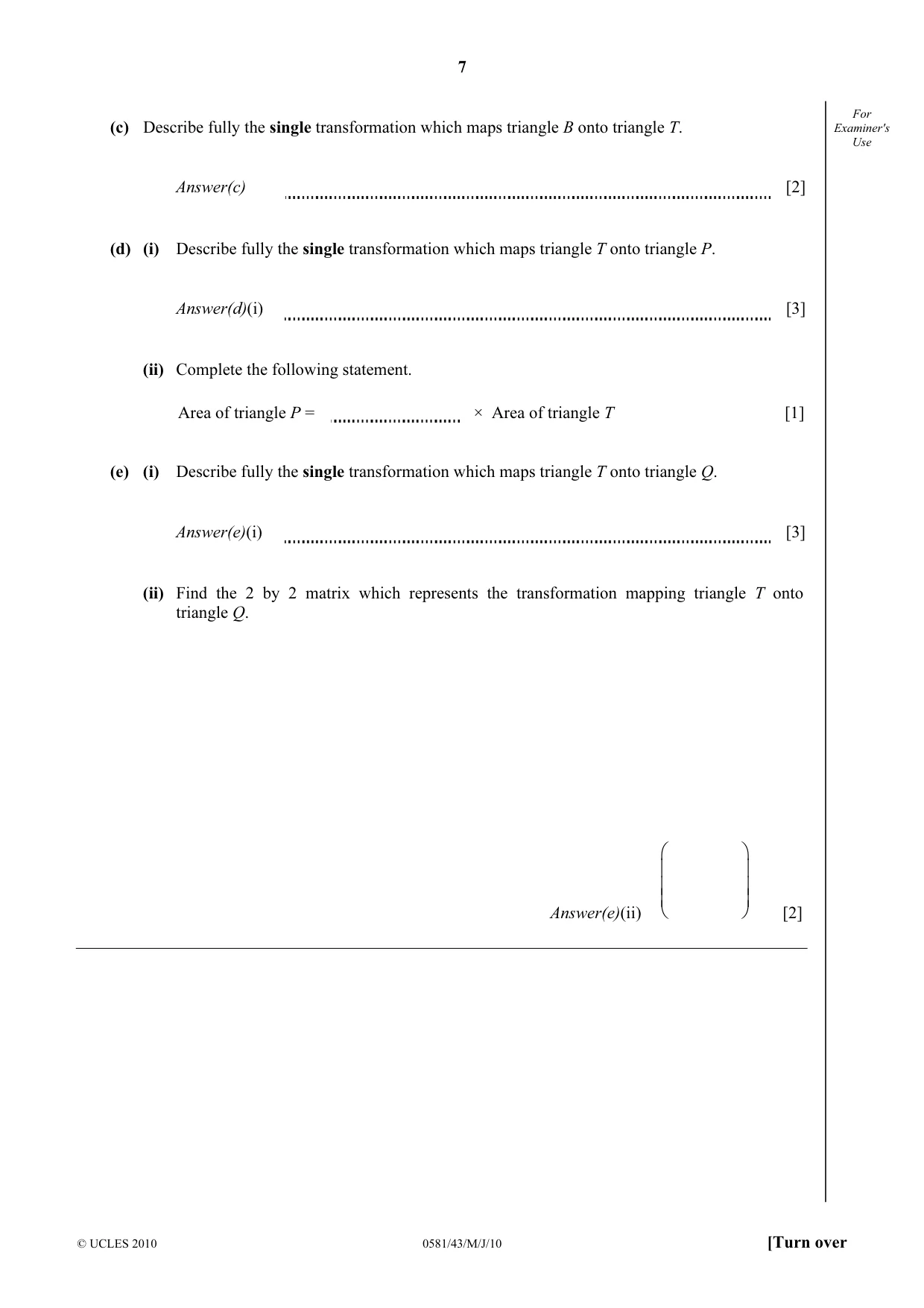
7 © UCLES 2010 0581/43/M/J/10 [Turn over For Examiner's Use (c) Describe fully the single transformation which maps triangle B onto triangle T. Answer(c) [2] (d) (i) Describe fully the single transformation which maps triangle T onto triangle P. Answer(d)(i) [3] (ii) Complete the following statement. Area of triangle P = × Area of triangle T [1] (e) (i) Describe fully the single transformation which maps triangle T onto triangle Q. Answer(e)(i) [3] (ii) Find the 2 by 2 matrix which represents the transformation mapping triangle T onto triangle Q. Answer(e)(ii) [2]
Question paper, page 8
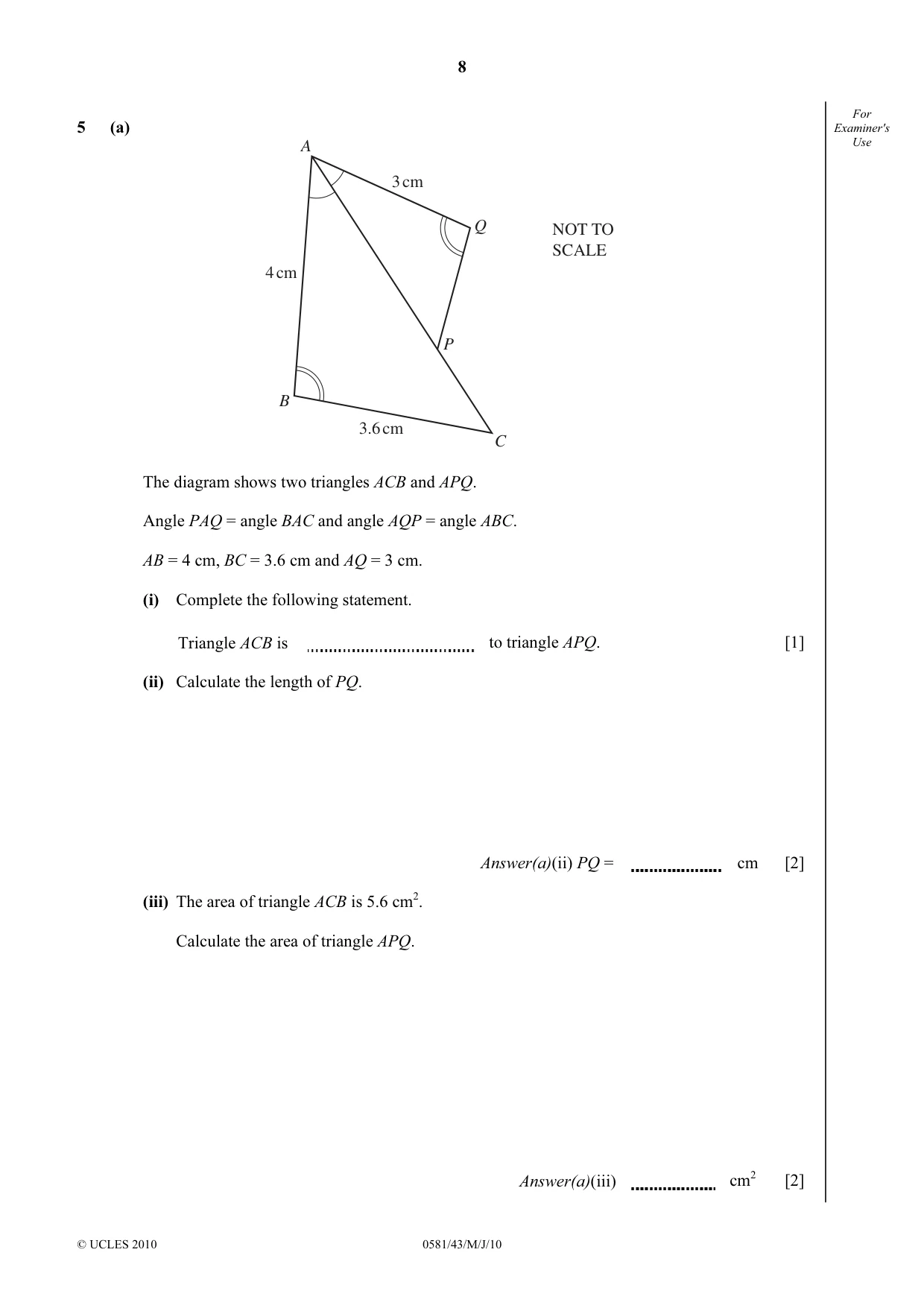
8 © UCLES 2010 0581/43/M/J/10 For Examiner's Use 5 (a) Q A B C P 3 cm 4 cm 3.6 cm NOT TO SCALE The diagram shows two triangles ACB and APQ. Angle PAQ = angle BAC and angle AQP = angle ABC. AB = 4 cm, BC = 3.6 cm and AQ = 3 cm. (i) Complete the following statement. Triangle ACB is to triangle APQ. [1] (ii) Calculate the length of PQ. Answer(a)(ii) PQ = cm [2] (iii) The area of triangle ACB is 5.6 cm2. Calculate the area of triangle APQ. Answer(a)(iii) cm2 [2]
Question paper, page 9
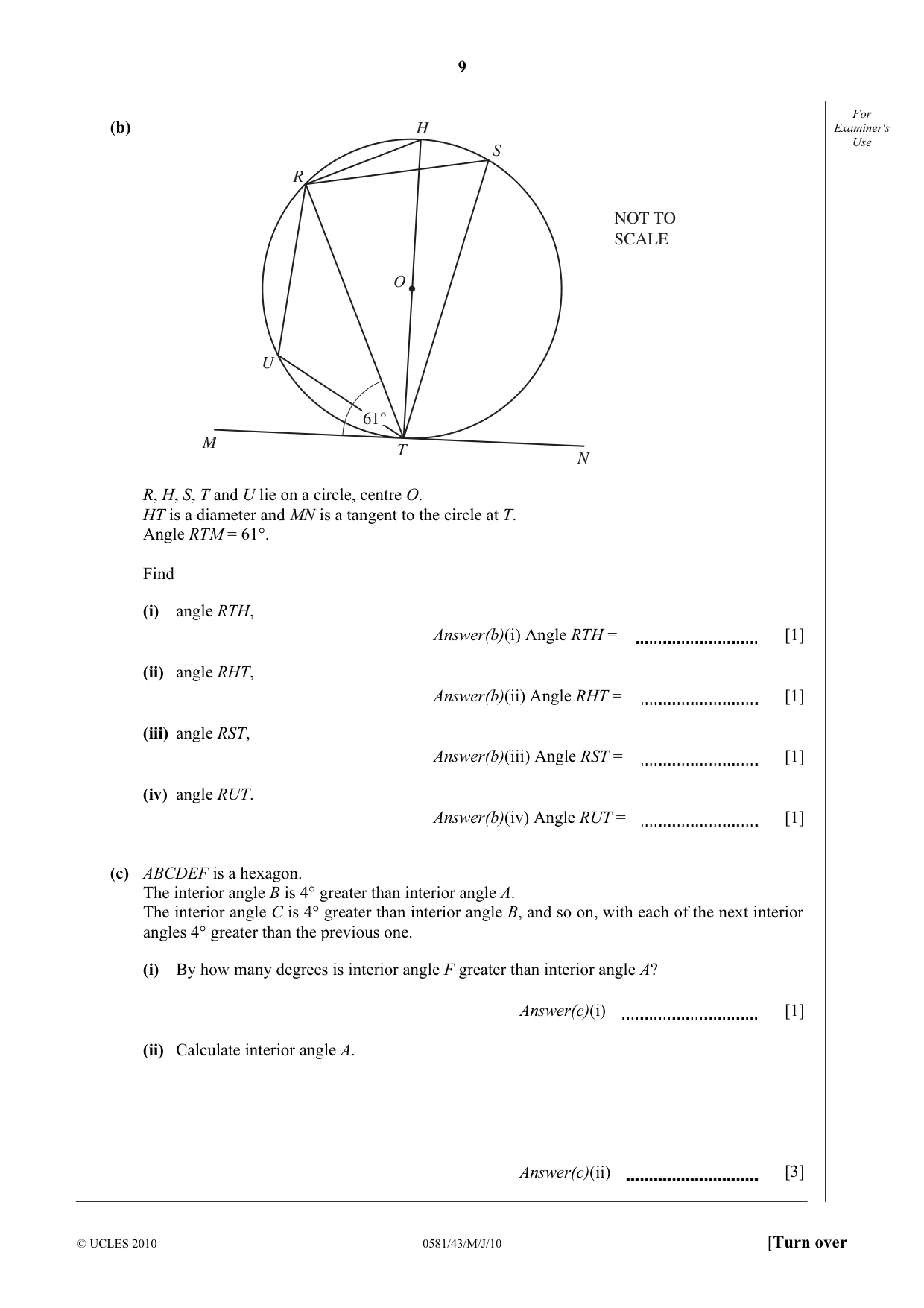
9 © UCLES 2010 0581/43/M/J/10 [Turn over For Examiner's Use (b) R, H, S, T and U lie on a circle, centre O. HT is a diameter and MN is a tangent to the circle at T. Angle RTM = 61°. Find (i) angle RTH, Answer(b)(i) Angle RTH = [1] (ii) angle RHT, Answer(b)(ii) Angle RHT = [1] (iii) angle RST, Answer(b)(iii) Angle RST = [1] (iv) angle RUT. Answer(b)(iv) Angle RUT = [1] (c) ABCDEF is a hexagon. The interior angle B is 4° greater than interior angle A. The interior angle C is 4° greater than interior angle B, and so on, with each of the next interior angles 4° greater than the previous one. (i) By how many degrees is interior angle F greater than interior angle A? Answer(c)(i) [1] (ii) Calculate interior angle A. Answer(c)(ii) [3] H R U T M N O S 61° NOT TO SCALE
Question paper, page 10
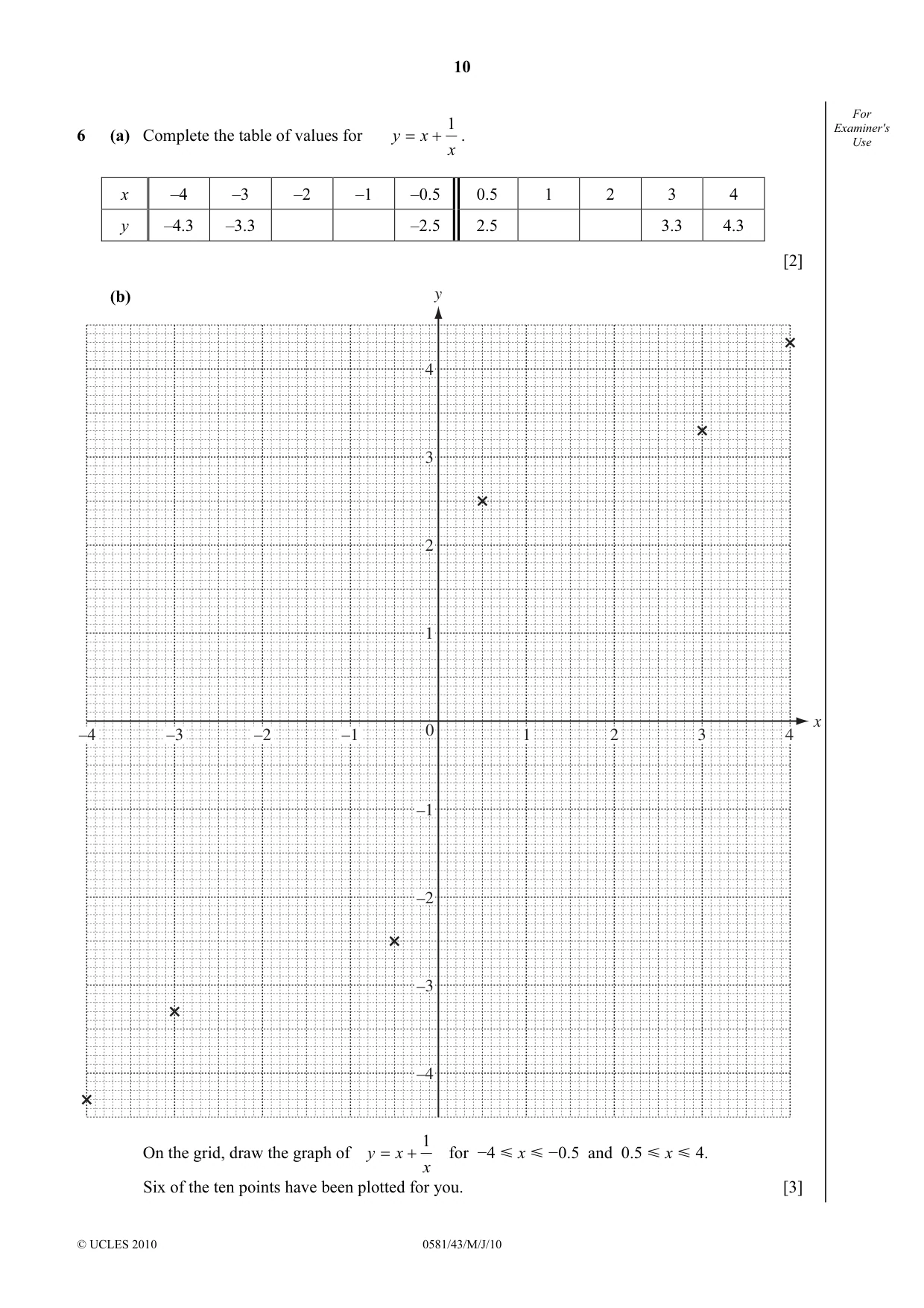
10 © UCLES 2010 0581/43/M/J/10 For Examiner's Use 6 (a) Complete the table of values for x x y 1 + = . x –4 –3 –2 –1 –0.5 0.5 1 2 3 4 y –4.3 –3.3 –2.5 2.5 3.3 4.3 [2] (b) On the grid, draw the graph of x x y 1 + = for −4 Y x Y −0.5 and 0.5 Y x Y 4. Six of the ten points have been plotted for you. [3] y x 4 3 2 1 –1 –2 –3 –4 0 –1 1 2 3 4 –2 –3 –4
Question paper, page 11
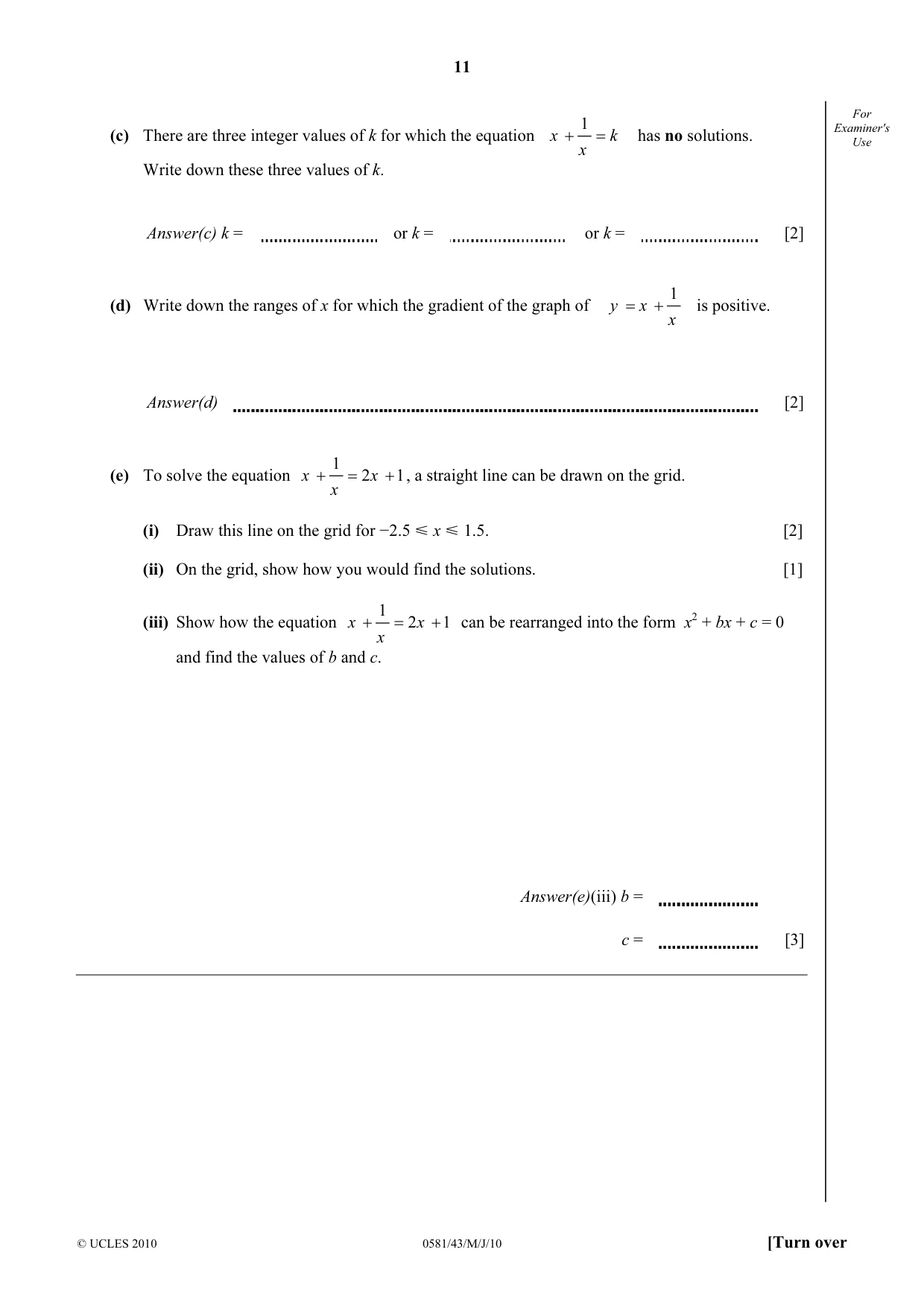
11 © UCLES 2010 0581/43/M/J/10 [Turn over For Examiner's Use (c) There are three integer values of k for which the equation 1 x k x + = has no solutions. Write down these three values of k. Answer(c) k = or k = or k = [2] (d) Write down the ranges of x for which the gradient of the graph of 1 y x x = + is positive. Answer(d) [2] (e) To solve the equation 1 2 1 x x x + = + , a straight line can be drawn on the grid. (i) Draw this line on the grid for −2.5 Y x Y 1.5. [2] (ii) On the grid, show how you would find the solutions. [1] (iii) Show how the equation 1 2 1 x x x + = + can be rearranged into the form x2 + bx + c = 0 and find the values of b and c. Answer(e)(iii) b = c = [3]
Question paper, page 12
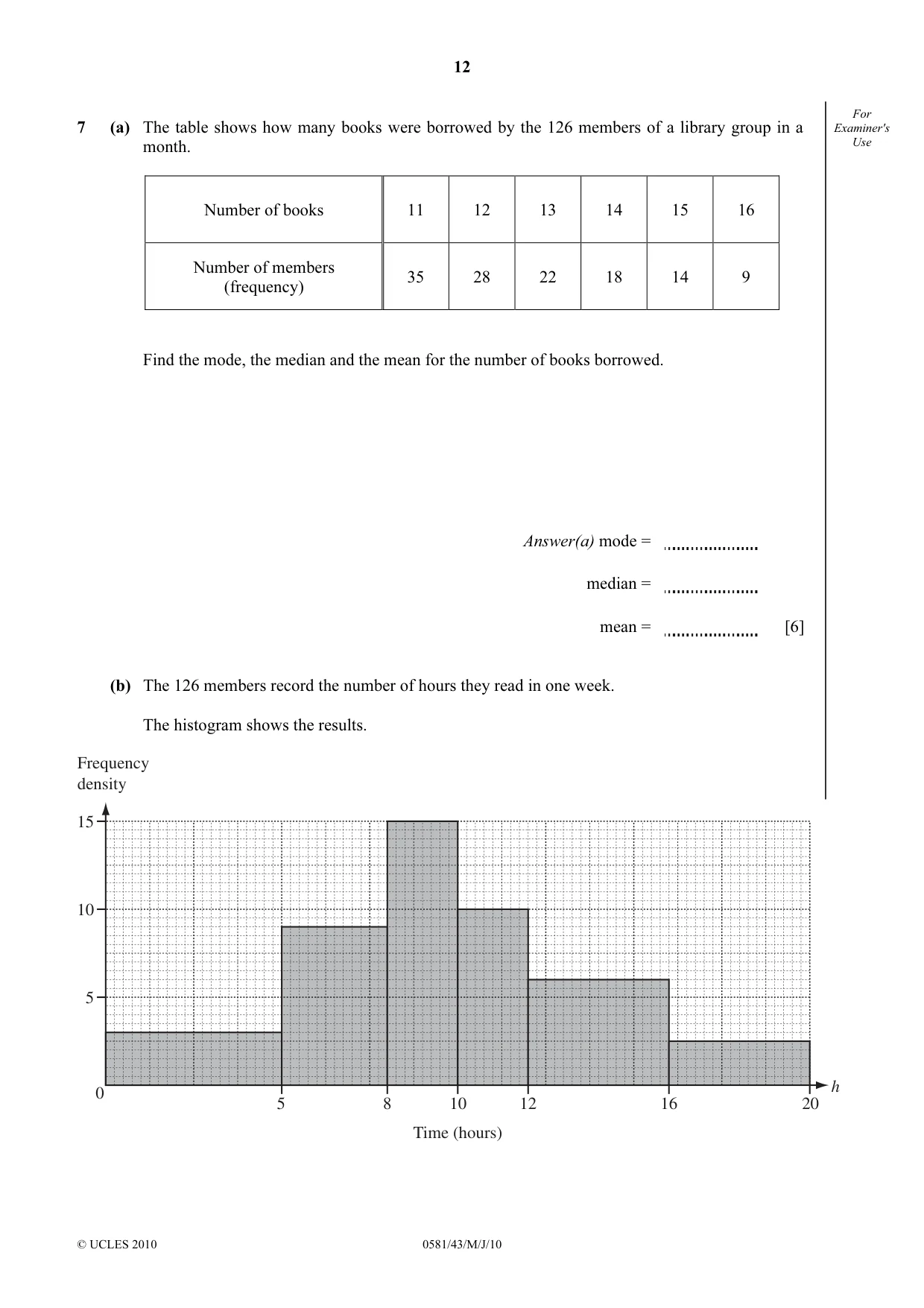
12 © UCLES 2010 0581/43/M/J/10 For Examiner's Use 7 (a) The table shows how many books were borrowed by the 126 members of a library group in a month. Number of books 11 12 13 14 15 16 Number of members (frequency) 35 28 22 18 14 9 Find the mode, the median and the mean for the number of books borrowed. Answer(a) mode = median = mean = [6] (b) The 126 members record the number of hours they read in one week. The histogram shows the results. h Frequency density 15 10 5 0 5 8 12 10 16 20 Time (hours)
Question paper, page 13
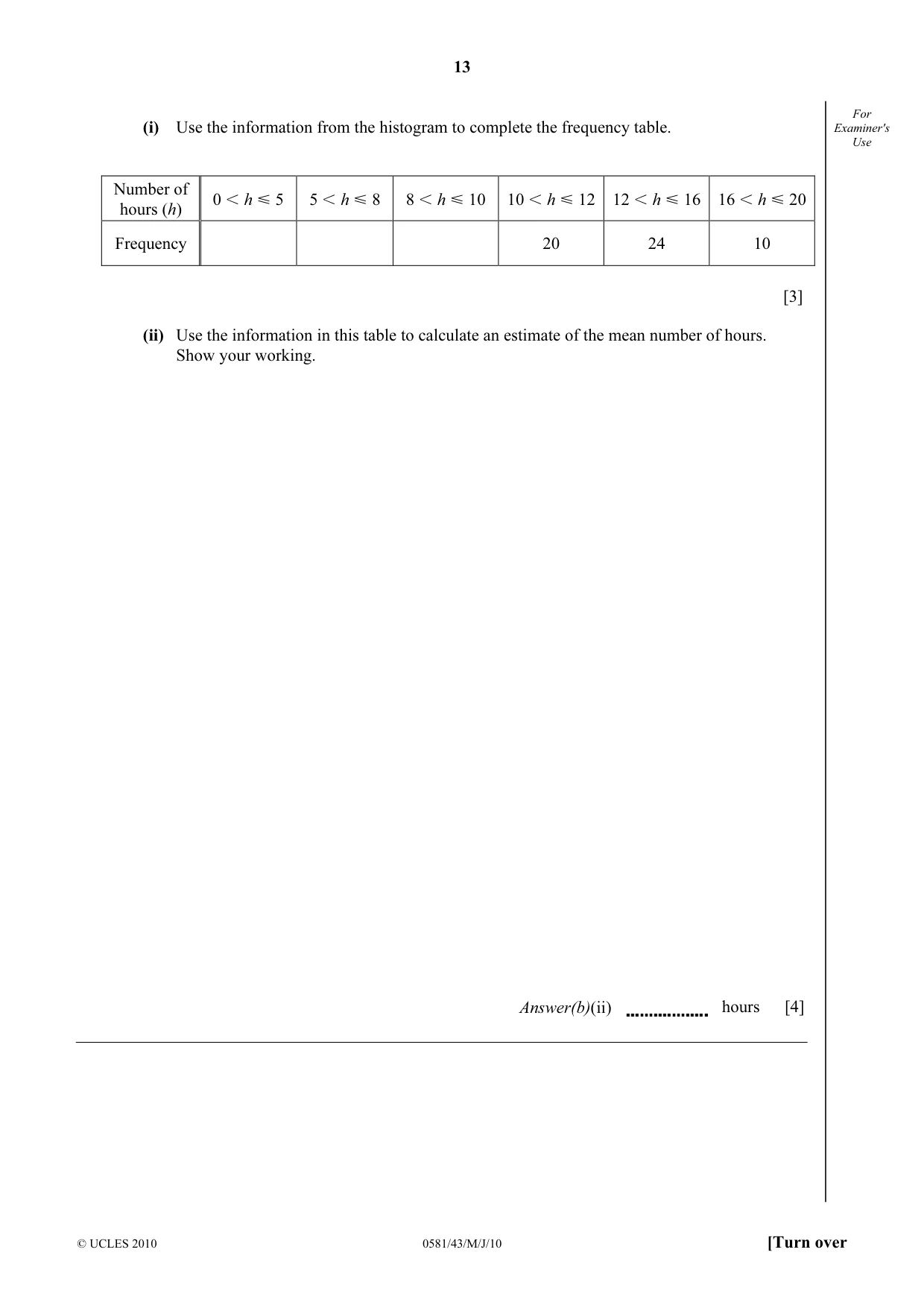
13 © UCLES 2010 0581/43/M/J/10 [Turn over For Examiner's Use (i) Use the information from the histogram to complete the frequency table. Number of hours (h) 0 I h Y 5 5 I h Y 8 8 I h Y 10 10 I h Y 12 12 I h Y 16 16 I h Y 20 Frequency 20 24 10 [3] (ii) Use the information in this table to calculate an estimate of the mean number of hours. Show your working. Answer(b)(ii) hours [4]
Question paper, page 14
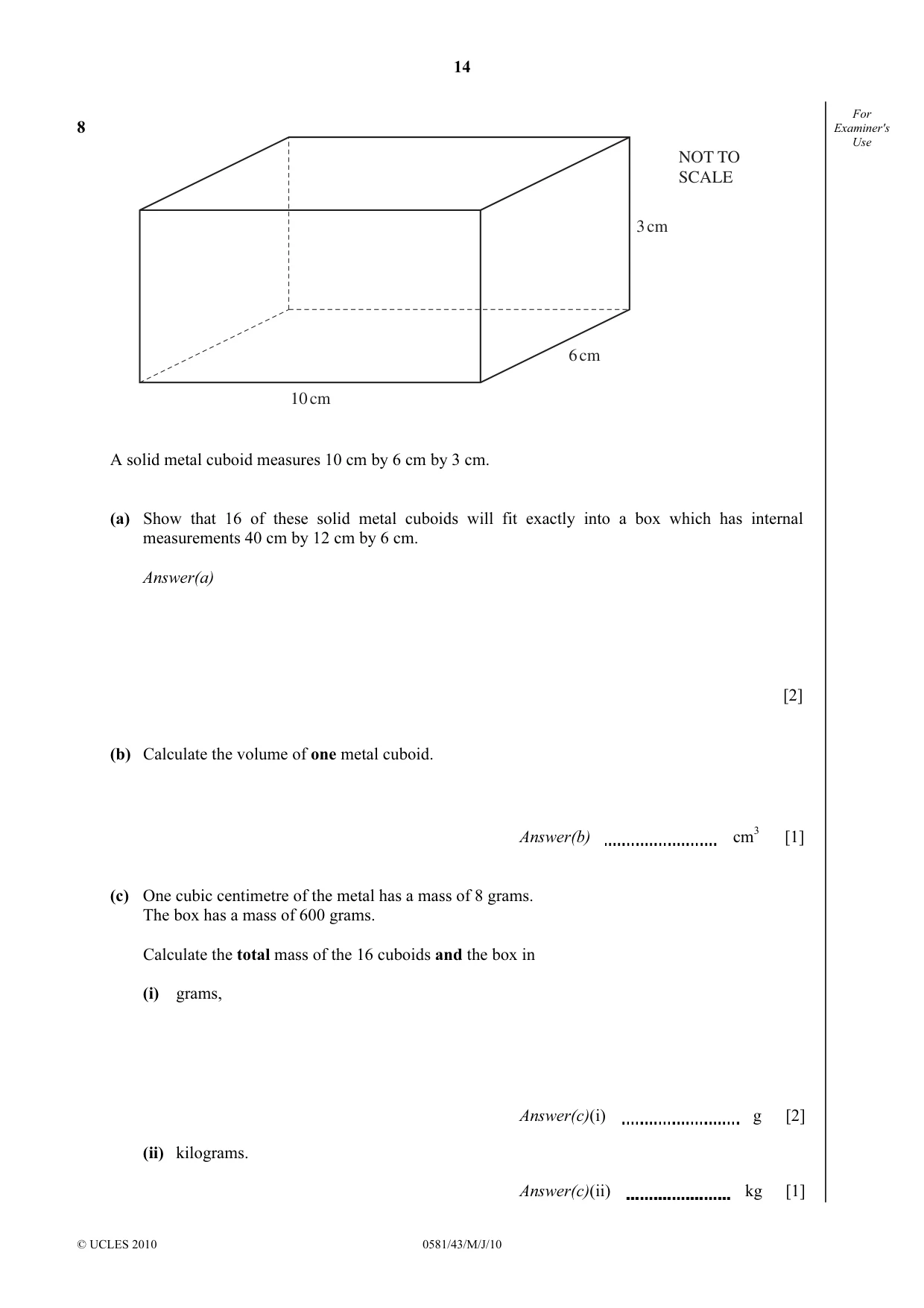
14 © UCLES 2010 0581/43/M/J/10 For Examiner's Use 8 3 cm 6 cm 10 cm NOT TO SCALE A solid metal cuboid measures 10 cm by 6 cm by 3 cm. (a) Show that 16 of these solid metal cuboids will fit exactly into a box which has internal measurements 40 cm by 12 cm by 6 cm. Answer(a) [2] (b) Calculate the volume of one metal cuboid. Answer(b) cm3 [1] (c) One cubic centimetre of the metal has a mass of 8 grams. The box has a mass of 600 grams. Calculate the total mass of the 16 cuboids and the box in (i) grams, Answer(c)(i) g [2] (ii) kilograms. Answer(c)(ii) kg [1]
Question paper, page 15
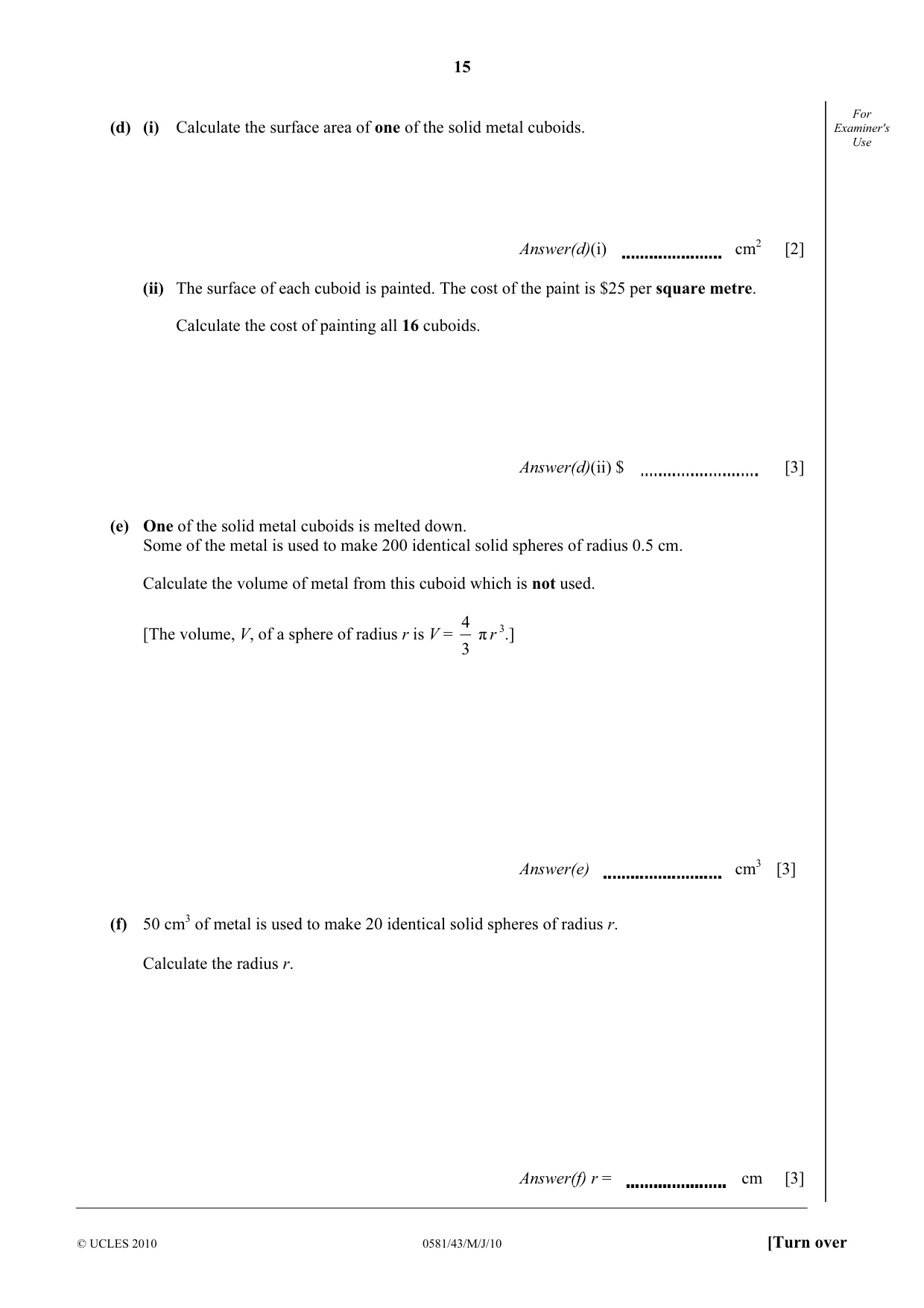
15 © UCLES 2010 0581/43/M/J/10 [Turn over For Examiner's Use (d) (i) Calculate the surface area of one of the solid metal cuboids. Answer(d)(i) cm2 [2] (ii) The surface of each cuboid is painted. The cost of the paint is $25 per square metre. Calculate the cost of painting all 16 cuboids. Answer(d)(ii) $ [3] (e) One of the solid metal cuboids is melted down. Some of the metal is used to make 200 identical solid spheres of radius 0.5 cm. Calculate the volume of metal from this cuboid which is not used. [The volume, V, of a sphere of radius r is V = 3 4 π r 3.] Answer(e) cm3 [3] (f) 50 cm3 of metal is used to make 20 identical solid spheres of radius r. Calculate the radius r. Answer(f) r = cm [3]
Question paper, page 16
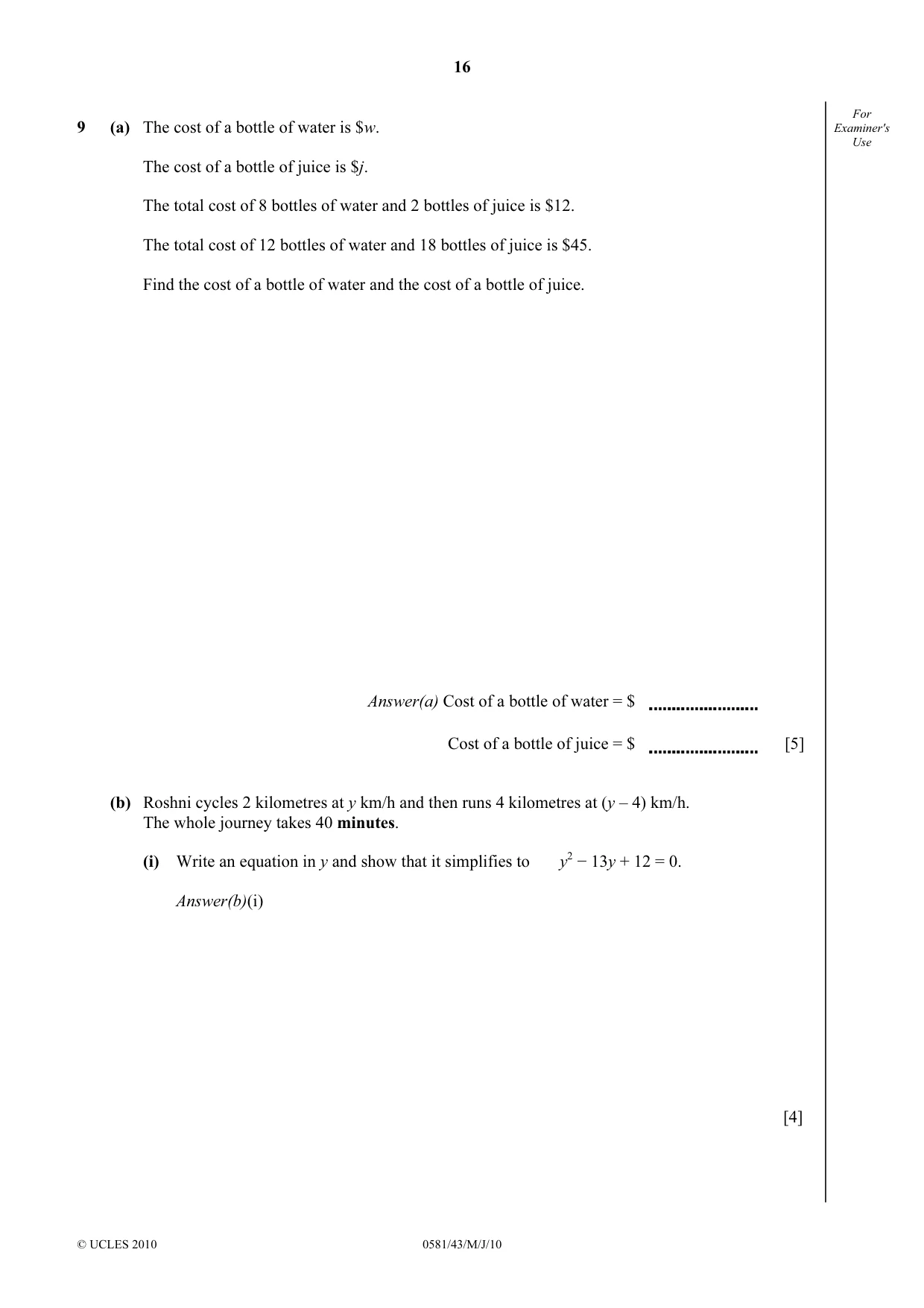
16 © UCLES 2010 0581/43/M/J/10 For Examiner's Use 9 (a) The cost of a bottle of water is $w. The cost of a bottle of juice is $j. The total cost of 8 bottles of water and 2 bottles of juice is $12. The total cost of 12 bottles of water and 18 bottles of juice is $45. Find the cost of a bottle of water and the cost of a bottle of juice. Answer(a) Cost of a bottle of water = $ Cost of a bottle of juice = $ [5] (b) Roshni cycles 2 kilometres at y km/h and then runs 4 kilometres at (y – 4) km/h. The whole journey takes 40 minutes. (i) Write an equation in y and show that it simplifies to y2 − 13y + 12 = 0. Answer(b)(i) [4]
Question paper, page 17
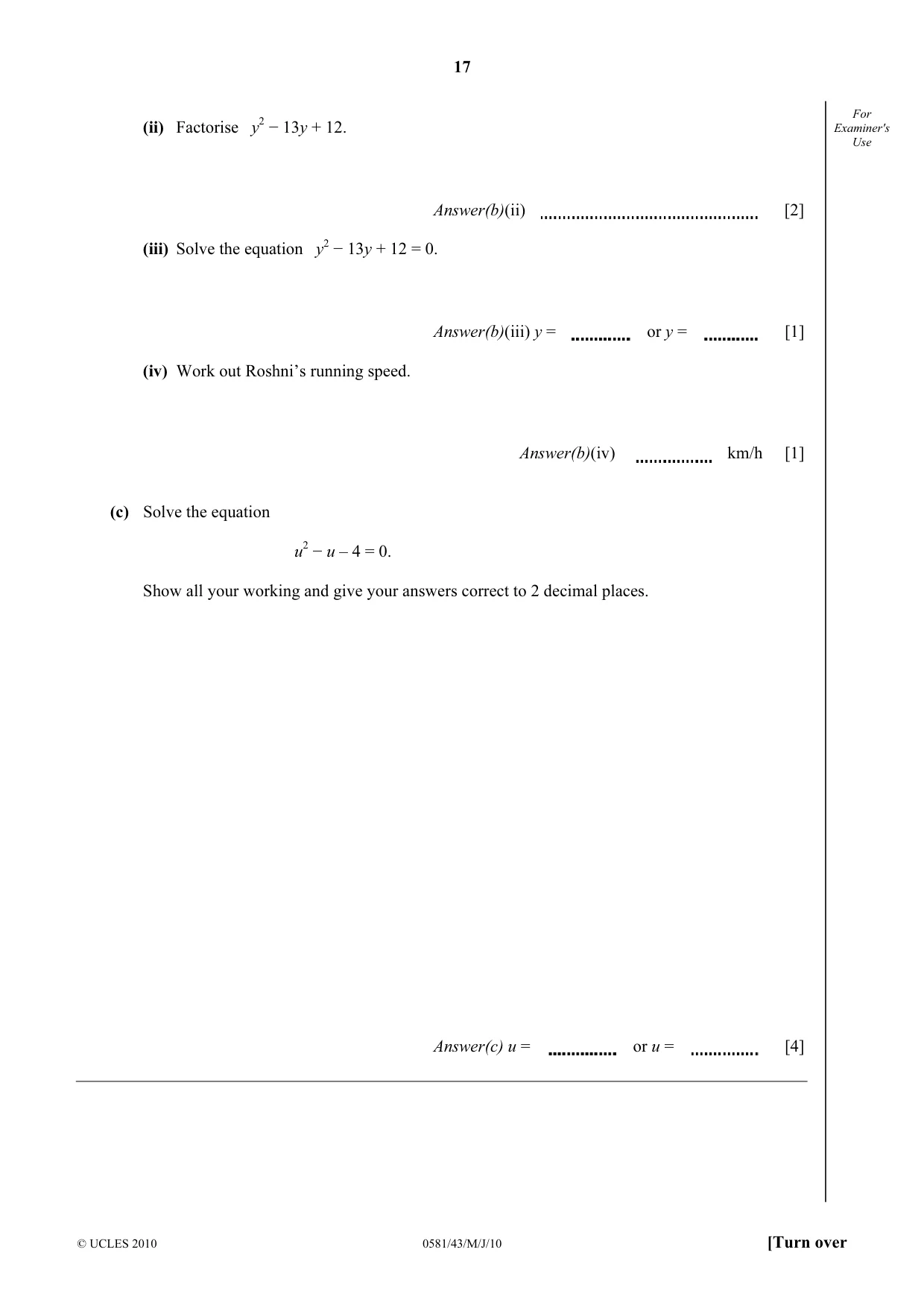
17 © UCLES 2010 0581/43/M/J/10 [Turn over For Examiner's Use (ii) Factorise y2 − 13y + 12. Answer(b)(ii) [2] (iii) Solve the equation y2 − 13y + 12 = 0. Answer(b)(iii) y = or y = [1] (iv) Work out Roshni’s running speed. Answer(b)(iv) km/h [1] (c) Solve the equation u2 − u – 4 = 0. Show all your working and give your answers correct to 2 decimal places. Answer(c) u = or u = [4]
Question paper, page 18
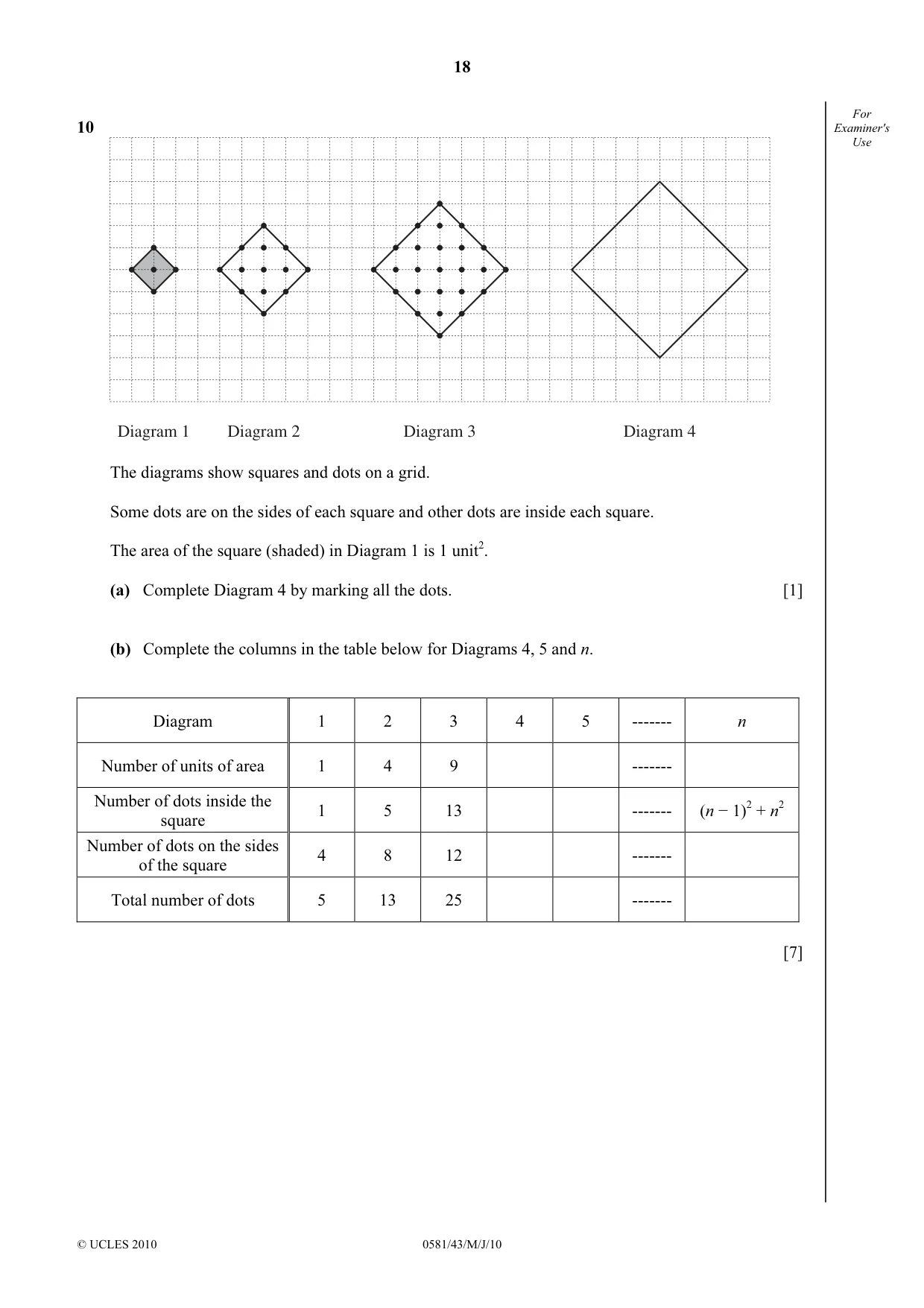
18 © UCLES 2010 0581/43/M/J/10 For Examiner's Use 10 Diagram 1 Diagram 2 Diagram 3 Diagram 4 The diagrams show squares and dots on a grid. Some dots are on the sides of each square and other dots are inside each square. The area of the square (shaded) in Diagram 1 is 1 unit2. (a) Complete Diagram 4 by marking all the dots. [1] (b) Complete the columns in the table below for Diagrams 4, 5 and n. Diagram 1 2 3 4 5 ------- n Number of units of area 1 4 9 ------- Number of dots inside the square 1 5 13 ------- (n − 1)2 + n2 Number of dots on the sides of the square 4 8 12 ------- Total number of dots 5 13 25 ------- [7]
Question paper, page 19
19 © UCLES 2010 0581/43/M/J/10 For Examiner's Use (c) For Diagram 200, find the number of dots (i) inside the square, Answer(c)(i) [1] (ii) on the sides of the square. Answer(c)(ii) [1] (d) Which diagram has 265 dots inside the square? Answer(d) [1]
Question paper, page 20
20 Permission to reproduce items where third-party owned material protected by copyright is included has been sought and cleared where possible. Every reasonable effort has been made by the publisher (UCLES) to trace copyright holders, but if any items requiring clearance have unwittingly been included, the publisher will be pleased to make amends at the earliest possible opportunity. University of Cambridge International Examinations is part of the Cambridge Assessment Group. Cambridge Assessment is the brand name of University of Cambridge Local Examinations Syndicate (UCLES), which is itself a department of the University of Cambridge. © UCLES 2010 0581/43/M/J/10 BLANK PAGE
Mark scheme, page 1
UNIVERSITY OF CAMBRIDGE INTERNATIONAL EXAMINATIONS International General Certificate of Secondary Education MARK SCHEME for the May/June 2010 question paper for the guidance of teachers 0581 MATHEMATICS 0581/43 Paper 43 (Extended), maximum raw mark 130 This mark scheme is published as an aid to teachers and candidates, to indicate the requirements of the examination. It shows the basis on which Examiners were instructed to award marks. It does not indicate the details of the discussions that took place at an Examiners’ meeting before marking began, which would have considered the acceptability of alternative answers. Mark schemes must be read in conjunction with the question papers and the report on the examination. • CIE will not enter into discussions or correspondence in connection with these mark schemes. CIE is publishing the mark schemes for the May/June 2010 question papers for most IGCSE, GCE Advanced Level and Advanced Subsidiary Level syllabuses and some Ordinary Level syllabuses. www.XtremePapers.com
Mark scheme, page 2
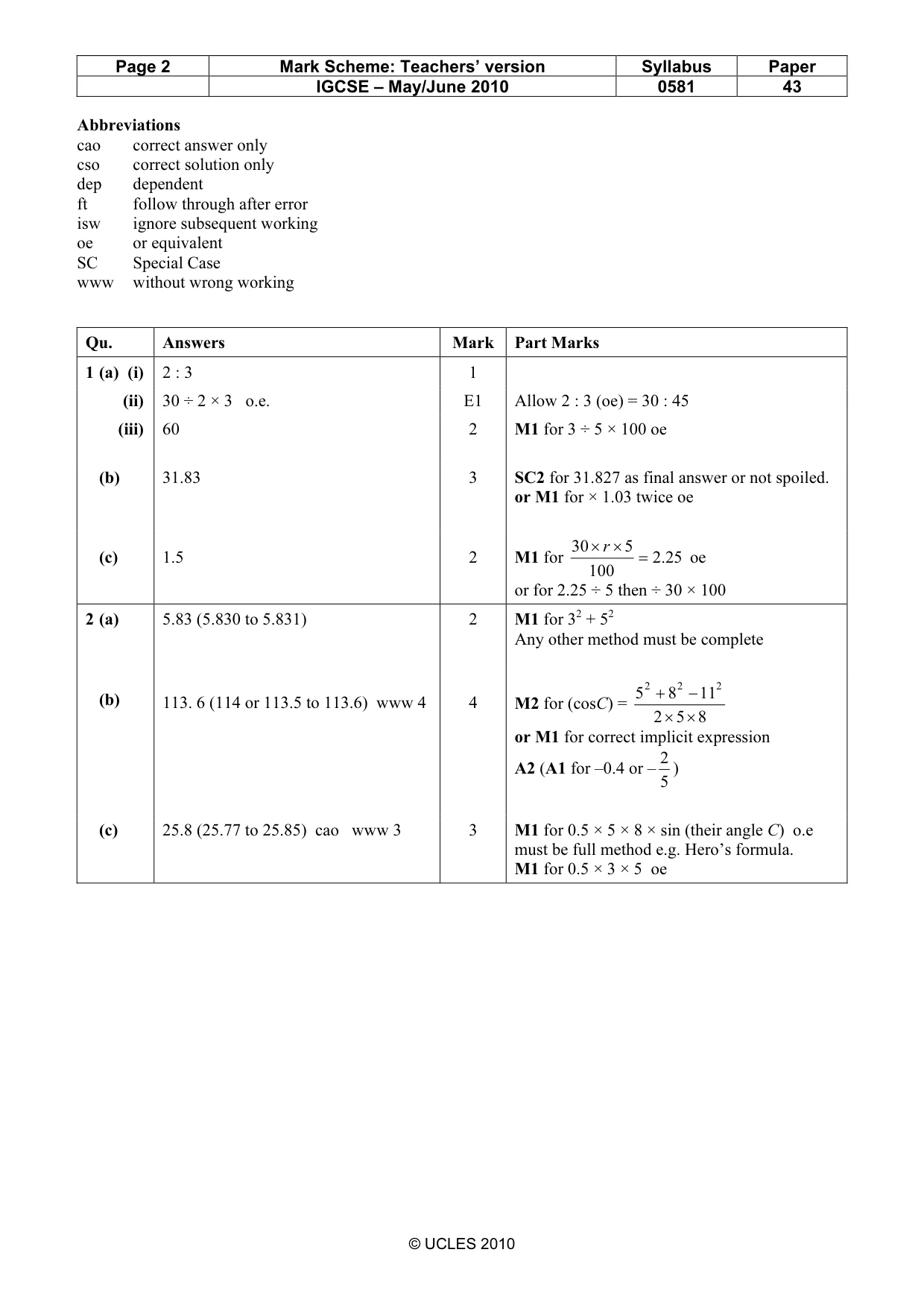
Page 2 Mark Scheme: Teachers’ version Syllabus Paper IGCSE – May/June 2010 0581 43 © UCLES 2010 Abbreviations cao correct answer only cso correct solution only dep dependent ft follow through after error isw ignore subsequent working oe or equivalent SC Special Case www without wrong working Qu. Answers Mark Part Marks 1 (a) (i) 2 : 3 1 (ii) 30 ÷ 2 × 3 o.e. E1 Allow 2 : 3 (oe) = 30 : 45 (iii) 60 2 M1 for 3 ÷ 5 × 100 oe (b) 31.83 3 SC2 for 31.827 as final answer or not spoiled. or M1 for × 1.03 twice oe (c) 1.5 2 M1 for 25 .2 100 5 30 = × × r oe or for 2.25 ÷ 5 then ÷ 30 × 100 2 (a) 5.83 (5.830 to 5.831) 2 M1 for 32 + 52 Any other method must be complete (b) 113. 6 (114 or 113.5 to 113.6) www 4 4 M2 for (cosC) = 8 5 2 11 8 5 2 2 2 × × − + or M1 for correct implicit expression A2 (A1 for –0.4 or – 5 2 ) (c) 25.8 (25.77 to 25.85) cao www 3 3 M1 for 0.5 × 5 × 8 × sin (their angle C) o.e must be full method e.g. Hero’s formula. M1 for 0.5 × 3 × 5 oe
Mark scheme, page 3
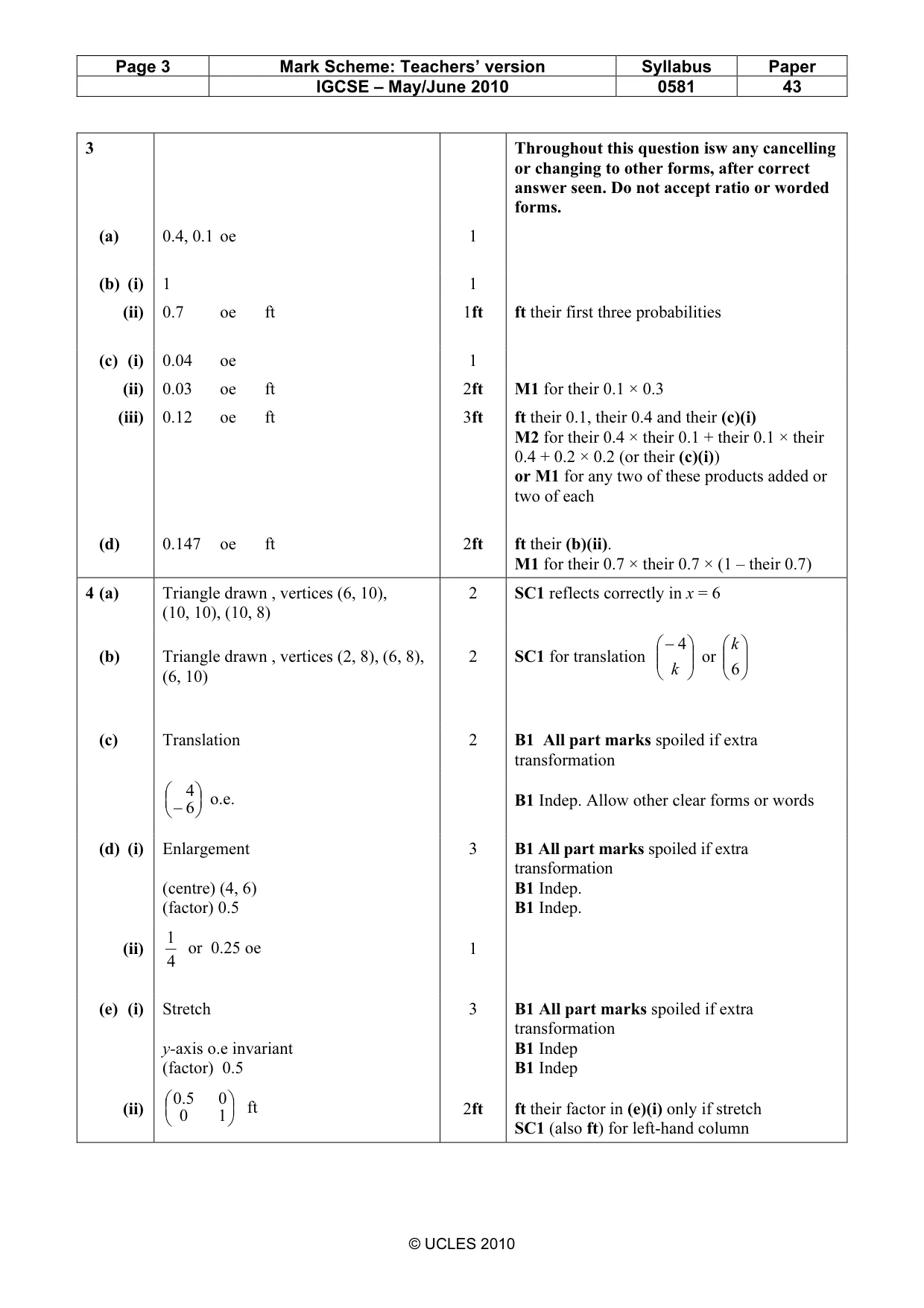
Page 3 Mark Scheme: Teachers’ version Syllabus Paper IGCSE – May/June 2010 0581 43 © UCLES 2010 3 Throughout this question isw any cancelling or changing to other forms, after correct answer seen. Do not accept ratio or worded forms. (a) 0.4, 0.1 oe 1 (b) (i) 1 1 (ii) 0.7 oe ft 1ft ft their first three probabilities (c) (i) 0.04 oe 1 (ii) 0.03 oe ft 2ft M1 for their 0.1 × 0.3 (iii) 0.12 oe ft 3ft ft their 0.1, their 0.4 and their (c)(i) M2 for their 0.4 × their 0.1 + their 0.1 × their 0.4 + 0.2 × 0.2 (or their (c)(i)) or M1 for any two of these products added or two of each (d) 0.147 oe ft 2ft ft their (b)(ii). M1 for their 0.7 × their 0.7 × (1 – their 0.7) 4 (a) Triangle drawn , vertices (6, 10), (10, 10), (10, 8) 2 SC1 reflects correctly in x = 6 (b) Triangle drawn , vertices (2, 8), (6, 8), (6, 10) 2 SC1 for translation − k 4 or 6 k (c) Translation 2 B1 All part marks spoiled if extra transformation −6 4 o.e. B1 Indep. Allow other clear forms or words (d) (i) Enlargement (centre) (4, 6) (factor) 0.5 3 B1 All part marks spoiled if extra transformation B1 Indep. B1 Indep. (ii) 4 1 or 0.25 oe 1 (e) (i) Stretch y-axis o.e invariant (factor) 0.5 3 B1 All part marks spoiled if extra transformation B1 Indep B1 Indep (ii) 1 0 0 5.0 ft 2ft ft their factor in (e)(i) only if stretch SC1 (also ft) for left-hand column
Mark scheme, page 4
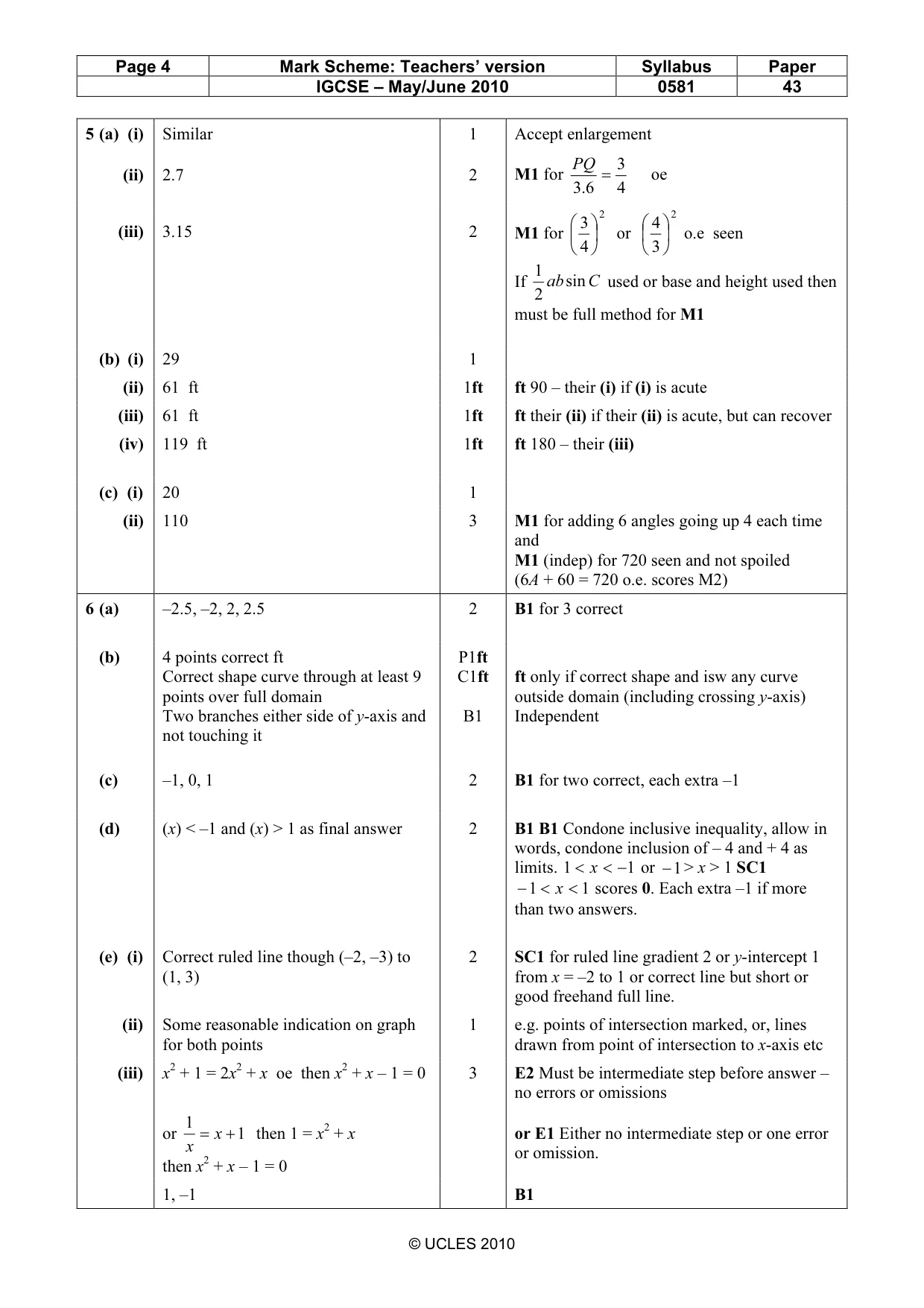
Page 4 Mark Scheme: Teachers’ version Syllabus Paper IGCSE – May/June 2010 0581 43 © UCLES 2010 5 (a) (i) Similar 1 Accept enlargement (ii) 2.7 2 M1 for 4 3 6.3 = PQ oe (iii) 3.15 2 M1 for 2 4 3 or 2 3 4 o.e seen If C absin 2 1 used or base and height used then must be full method for M1 (b) (i) 29 1 (ii) 61 ft 1ft ft 90 – their (i) if (i) is acute (iii) 61 ft 1ft ft their (ii) if their (ii) is acute, but can recover (iv) 119 ft 1ft ft 180 – their (iii) (c) (i) 20 1 (ii) 110 3 M1 for adding 6 angles going up 4 each time and M1 (indep) for 720 seen and not spoiled (6A + 60 = 720 o.e. scores M2) 6 (a) –2.5, –2, 2, 2.5 2 B1 for 3 correct (b) 4 points correct ft Correct shape curve through at least 9 points over full domain Two branches either side of y-axis and not touching it P1ft C1ft B1 ft only if correct shape and isw any curve outside domain (including crossing y-axis) Independent (c) –1, 0, 1 2 B1 for two correct, each extra –1 (d) (x) < –1 and (x) > 1 as final answer 2 B1 B1 Condone inclusive inequality, allow in words, condone inclusion of – 4 and + 4 as limits. 1 1 − < < x or 1 −> x > 1 SC1 1 1 < < − x scores 0. Each extra –1 if more than two answers. (e) (i) Correct ruled line though (–2, –3) to (1, 3) 2 SC1 for ruled line gradient 2 or y-intercept 1 from x = –2 to 1 or correct line but short or good freehand full line. (ii) Some reasonable indication on graph for both points 1 e.g. points of intersection marked, or, lines drawn from point of intersection to x-axis etc (iii) x2 + 1 = 2x2 + x oe then x2 + x – 1 = 0 3 E2 Must be intermediate step before answer – no errors or omissions or 1 1 + = x x then 1 = x2 + x then x2 + x – 1 = 0 or E1 Either no intermediate step or one error or omission. 1, –1 B1
Mark scheme, page 5
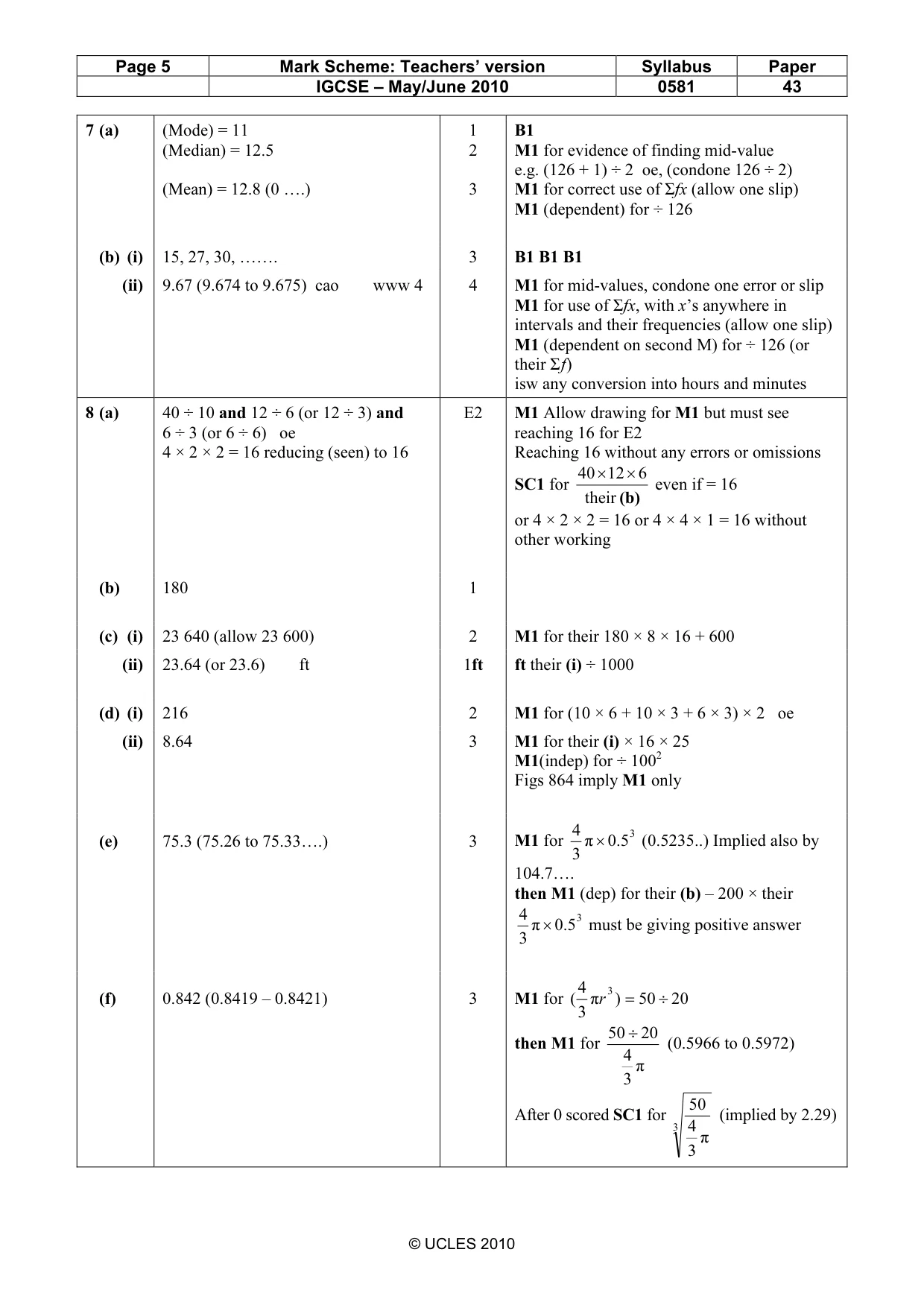
Page 5 Mark Scheme: Teachers’ version Syllabus Paper IGCSE – May/June 2010 0581 43 © UCLES 2010 7 (a) (Mode) = 11 (Median) = 12.5 (Mean) = 12.8 (0 ….) 1 2 3 B1 M1 for evidence of finding mid-value e.g. (126 + 1) ÷ 2 oe, (condone 126 ÷ 2) M1 for correct use of Σfx (allow one slip) M1 (dependent) for ÷ 126 (b) (i) 15, 27, 30, ……. 3 B1 B1 B1 (ii) 9.67 (9.674 to 9.675) cao www 4 4 M1 for mid-values, condone one error or slip M1 for use of Σfx, with x’s anywhere in intervals and their frequencies (allow one slip) M1 (dependent on second M) for ÷ 126 (or their Σf) isw any conversion into hours and minutes 8 (a) 40 ÷ 10 and 12 ÷ 6 (or 12 ÷ 3) and 6 ÷ 3 (or 6 ÷ 6) oe 4 × 2 × 2 = 16 reducing (seen) to 16 E2 M1 Allow drawing for M1 but must see reaching 16 for E2 Reaching 16 without any errors or omissions SC1 for (b) their 6 12 40 × × even if = 16 or 4 × 2 × 2 = 16 or 4 × 4 × 1 = 16 without other working (b) 180 1 (c) (i) 23 640 (allow 23 600) 2 M1 for their 180 × 8 × 16 + 600 (ii) 23.64 (or 23.6) ft 1ft ft their (i) ÷ 1000 (d) (i) 216 2 M1 for (10 × 6 + 10 × 3 + 6 × 3) × 2 oe (ii) 8.64 3 M1 for their (i) × 16 × 25 M1(indep) for ÷ 1002 Figs 864 imply M1 only (e) 75.3 (75.26 to 75.33….) 3 M1 for 3 5.0 π 3 4 × (0.5235..) Implied also by 104.7…. then M1 (dep) for their (b) – 200 × their 3 5.0 π 3 4 × must be giving positive answer (f) 0.842 (0.8419 – 0.8421) 3 M1 for 20 50 ) π 3 4 ( 3 ÷ = r then M1 for π 3 4 20 50 ÷ (0.5966 to 0.5972) After 0 scored SC1 for 3 π 3 4 50 (implied by 2.29)
Mark scheme, page 6
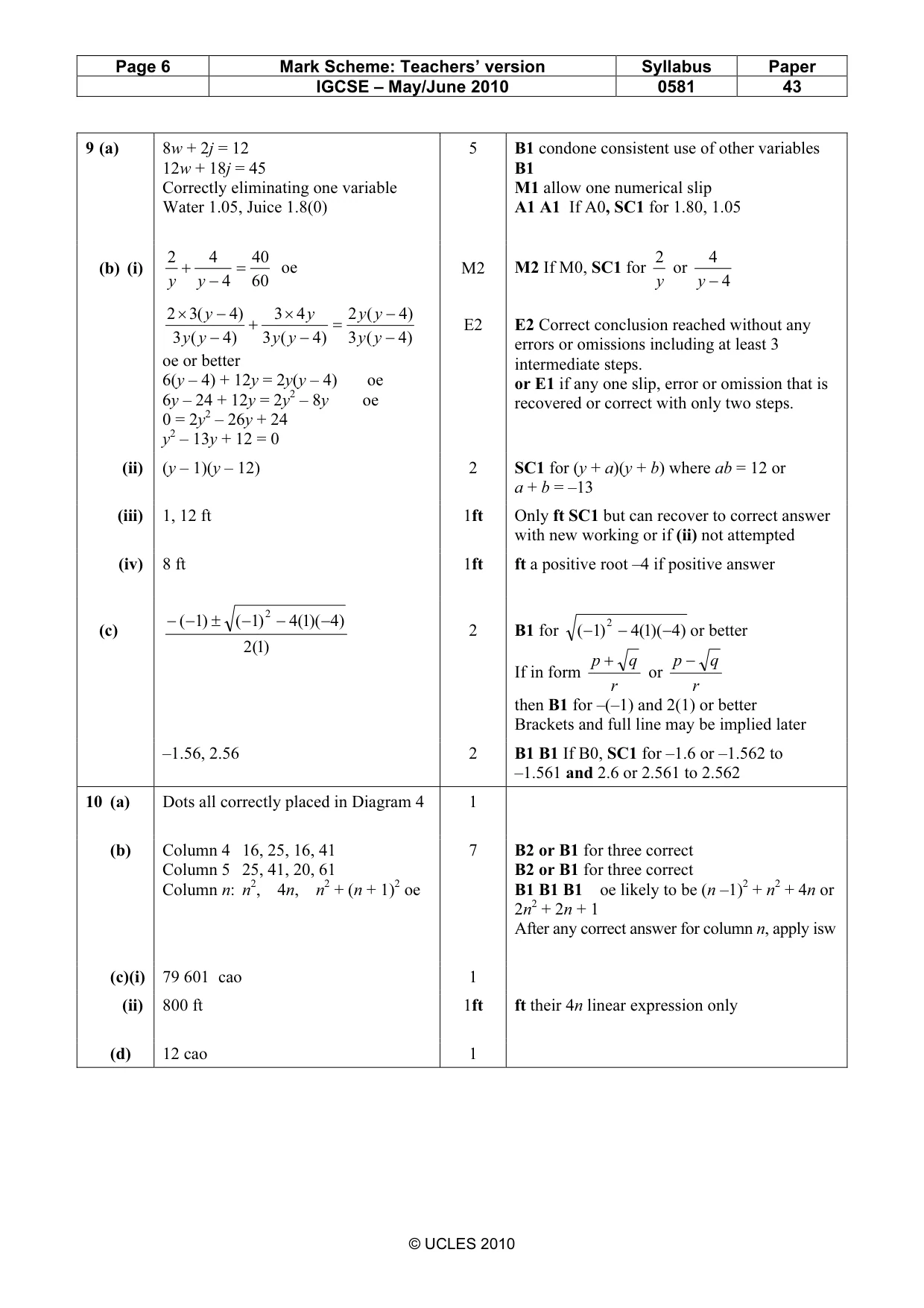
Page 6 Mark Scheme: Teachers’ version Syllabus Paper IGCSE – May/June 2010 0581 43 © UCLES 2010 9 (a) 8w + 2j = 12 12w + 18j = 45 Correctly eliminating one variable Water 1.05, Juice 1.8(0) 5 B1 condone consistent use of other variables B1 M1 allow one numerical slip A1 A1 If A0, SC1 for 1.80, 1.05 (b) (i) 60 40 4 4 2 = − + y y oe M2 M2 If M0, SC1 for y 2 or 4 4 − y ) 4 ( 3 ) 4 ( 2 ) 4 ( 3 4 3 ) 4 ( 3 ) 4 ( 3 2 − − = − × + − − × y y y y y y y y y y oe or better 6(y – 4) + 12y = 2y(y – 4) oe 6y – 24 + 12y = 2y2 – 8y oe 0 = 2y2 – 26y + 24 y2 – 13y + 12 = 0 E2 E2 Correct conclusion reached without any errors or omissions including at least 3 intermediate steps. or E1 if any one slip, error or omission that is recovered or correct with only two steps. (ii) (y – 1)(y – 12) 2 SC1 for (y + a)(y + b) where ab = 12 or a + b = –13 (iii) 1, 12 ft 1ft Only ft SC1 but can recover to correct answer with new working or if (ii) not attempted (iv) 8 ft 1ft ft a positive root –4 if positive answer (c) )1( 2 ) 4 )( 1( 4 )1 ( )1 ( 2 − − − ± − − 2 B1 for ) 4 )( 1( 4 )1 ( 2 − − − or better If in form r q p + or r q p − then B1 for –(–1) and 2(1) or better Brackets and full line may be implied later –1.56, 2.56 2 B1 B1 If B0, SC1 for –1.6 or –1.562 to –1.561 and 2.6 or 2.561 to 2.562 10 (a) Dots all correctly placed in Diagram 4 1 (b) Column 4 16, 25, 16, 41 Column 5 25, 41, 20, 61 Column n: n2, 4n, n2 + (n + 1)2 oe 7 B2 or B1 for three correct B2 or B1 for three correct B1 B1 B1 oe likely to be (n –1)2 + n2 + 4n or 2n2 + 2n + 1 After any correct answer for column n, apply isw (c)(i) 79 601 cao 1 (ii) 800 ft 1ft ft their 4n linear expression only (d) 12 cao 1