Cambridge IGCSE Mathematics (with coursework) 0581 — 2013 Oct/Nov Paper 4 · Variant 3
0581/43/O/N/13
The question paper and its mark scheme, free to read here and free to download. This is Cambridge’s own paper, exactly as it was sat.
Question paper20 pages
Mark scheme7 pages
Answers below. Sit the paper first if you are practising.
Paper as text
Question paper, page 1
READ THESE INSTRUCTIONS FIRST Write your Centre number, candidate number and name on all the work you hand in. Write in dark blue or black pen. You may use a pencil for any diagrams or graphs. Do not use staples, paper clips, highlighters, glue or correction fl uid. DO NOT WRITE IN ANY BARCODES. Answer all questions. If working is needed for any question it must be shown below that question. Electronic calculators should be used. If the degree of accuracy is not specifi ed in the question, and if the answer is not exact, give the answer to three signifi cant fi gures. Give answers in degrees to one decimal place. For π, use either your calculator value or 3.142. At the end of the examination, fasten all your work securely together. The number of marks is given in brackets [ ] at the end of each question or part question. The total of the marks for this paper is 130. MATHEMATICS 0581/43 Paper 4 (Extended) October/November 2013 2 hours 30 minutes Candidates answer on the Question Paper. Additional Materials: Electronic calculator Geometrical instruments Tracing paper (optional) UNIVERSITY OF CAMBRIDGE INTERNATIONAL EXAMINATIONS International General Certifi cate of Secondary Education This document consists of 20 printed pages. [Turn over IB13 11_0581_43/FP © UCLES 2013 *0136240300* www.XtremePapers.com
Question paper, page 2
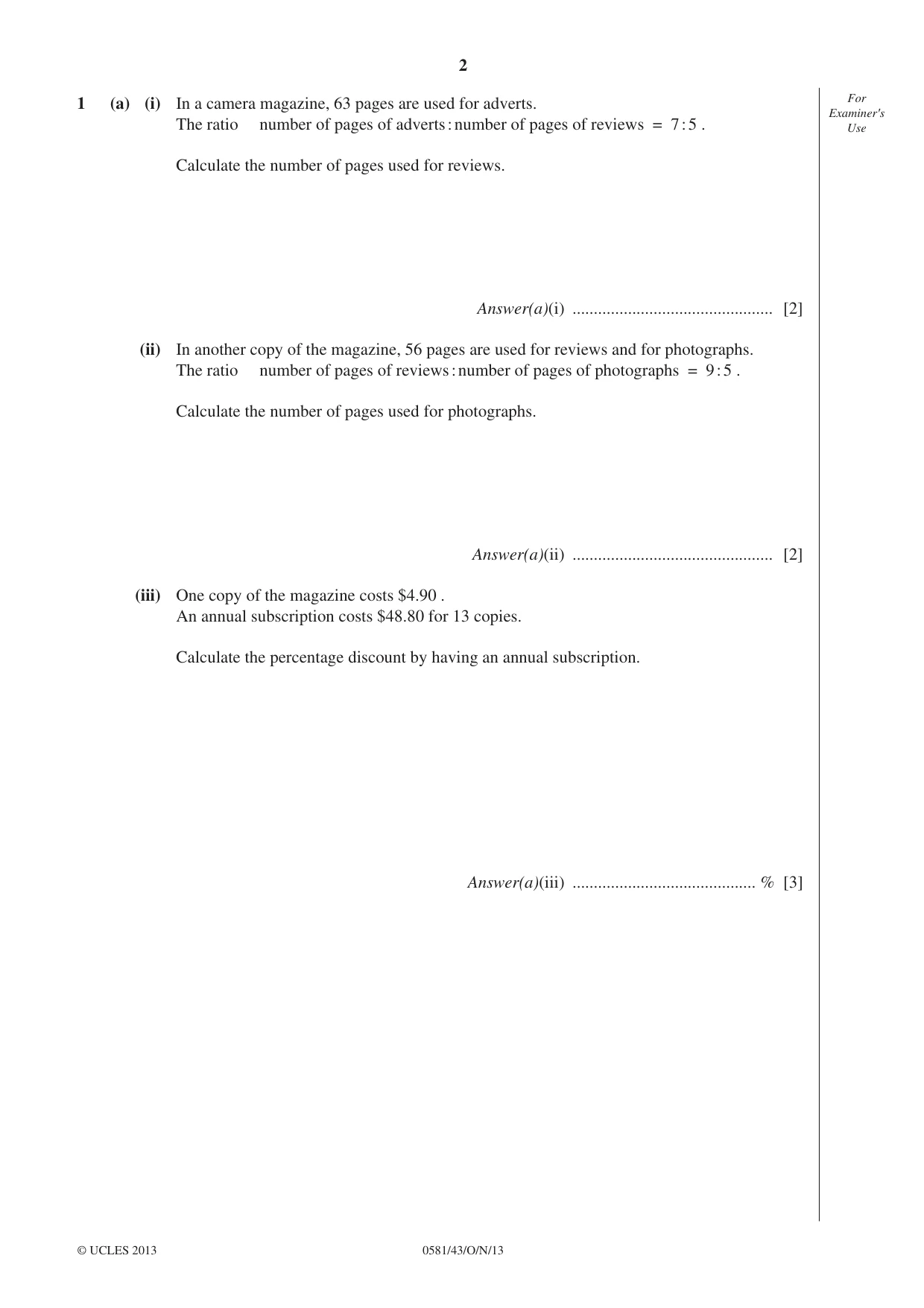
2 0581/43/O/N/13 © UCLES 2013 For Examiner′s Use 1 (a) (i) In a camera magazine, 63 pages are used for adverts. The ratio number of pages of adverts : number of pages of reviews = 7 : 5 . Calculate the number of pages used for reviews. Answer(a)(i) … [2] (ii) In another copy of the magazine, 56 pages are used for reviews and for photographs. The ratio number of pages of reviews : number of pages of photographs = 9 : 5 . Calculate the number of pages used for photographs. Answer(a)(ii) … [2] (iii) One copy of the magazine costs $4.90 . An annual subscription costs $48.80 for 13 copies. Calculate the percentage discount by having an annual subscription. Answer(a)(iii) … % [3]
Question paper, page 3
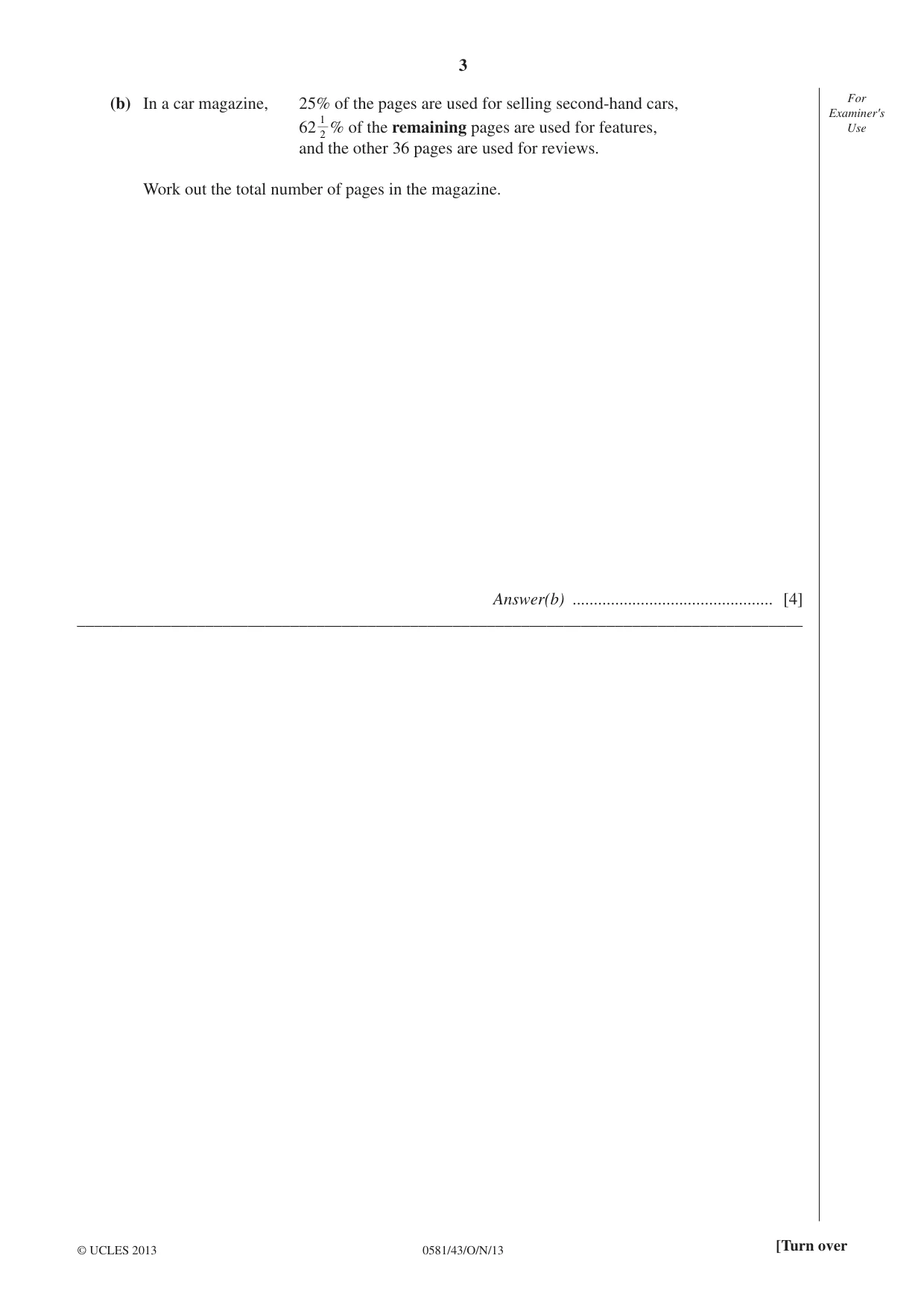
3 0581/43/O/N/13 © UCLES 2013 [Turn over For Examiner′s Use (b) In a car magazine, 25% of the pages are used for selling second-hand cars, 62 2 1 % of the remaining pages are used for features, and the other 36 pages are used for reviews. Work out the total number of pages in the magazine. Answer(b) … [4] _____________________________________________________________________________________
Question paper, page 4
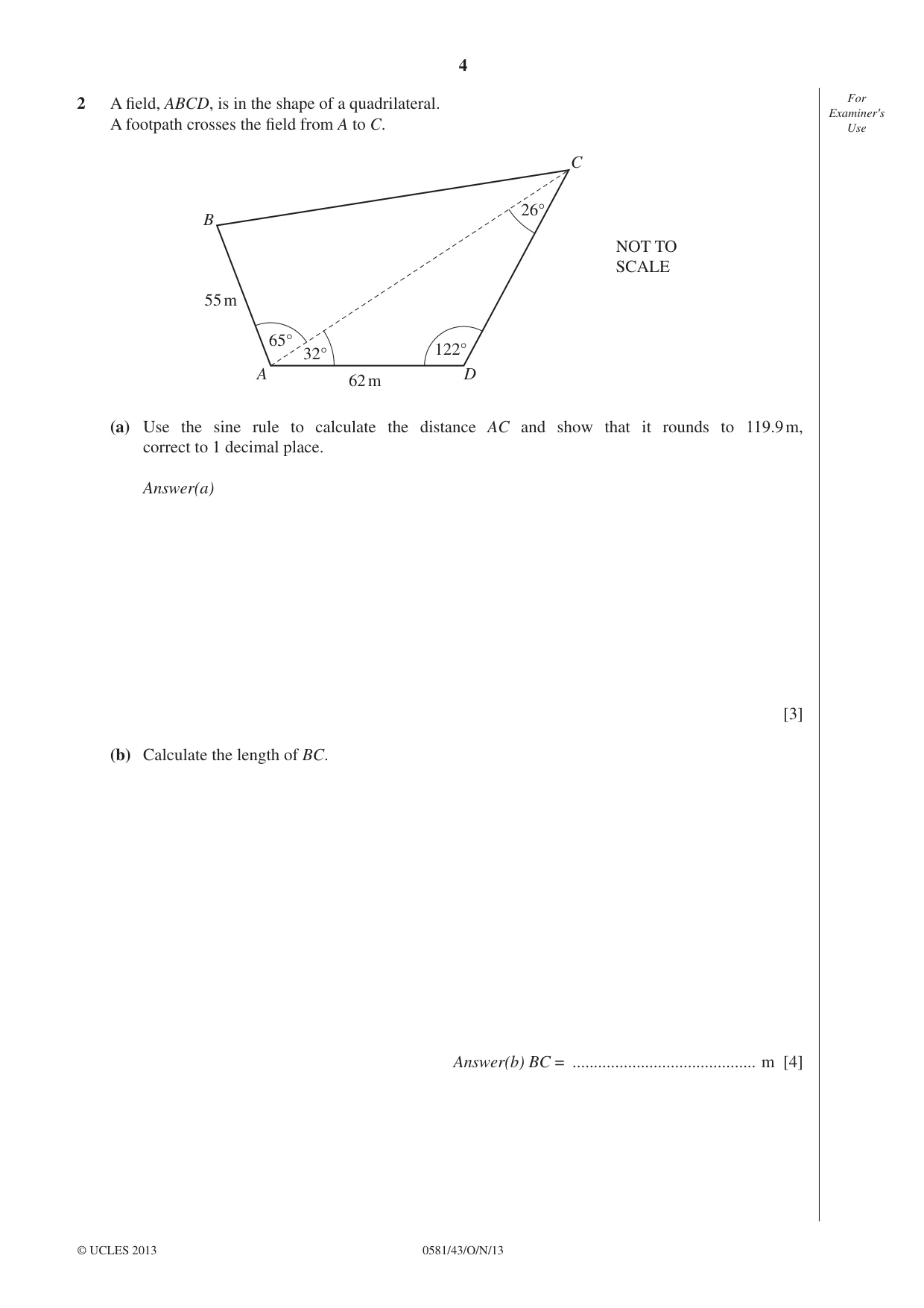
4 0581/43/O/N/13 © UCLES 2013 For Examiner′s Use 2 A fi eld, ABCD, is in the shape of a quadrilateral. A footpath crosses the fi eld from A to C. B A D C 26° 122° 32° 65° 55 m 62 m NOT TO SCALE (a) Use the sine rule to calculate the distance AC and show that it rounds to 119.9 m, correct to 1 decimal place. Answer(a) [3] (b) Calculate the length of BC. Answer(b) BC = … m [4]
Question paper, page 5
5 0581/43/O/N/13 © UCLES 2013 [Turn over For Examiner′s Use (c) Calculate the area of triangle ACD. Answer(c) … m2 [2] (d) The fi eld is for sale at $4.50 per square metre. Calculate the cost of the fi eld. Answer(d) $ … [3] _____________________________________________________________________________________
Question paper, page 6
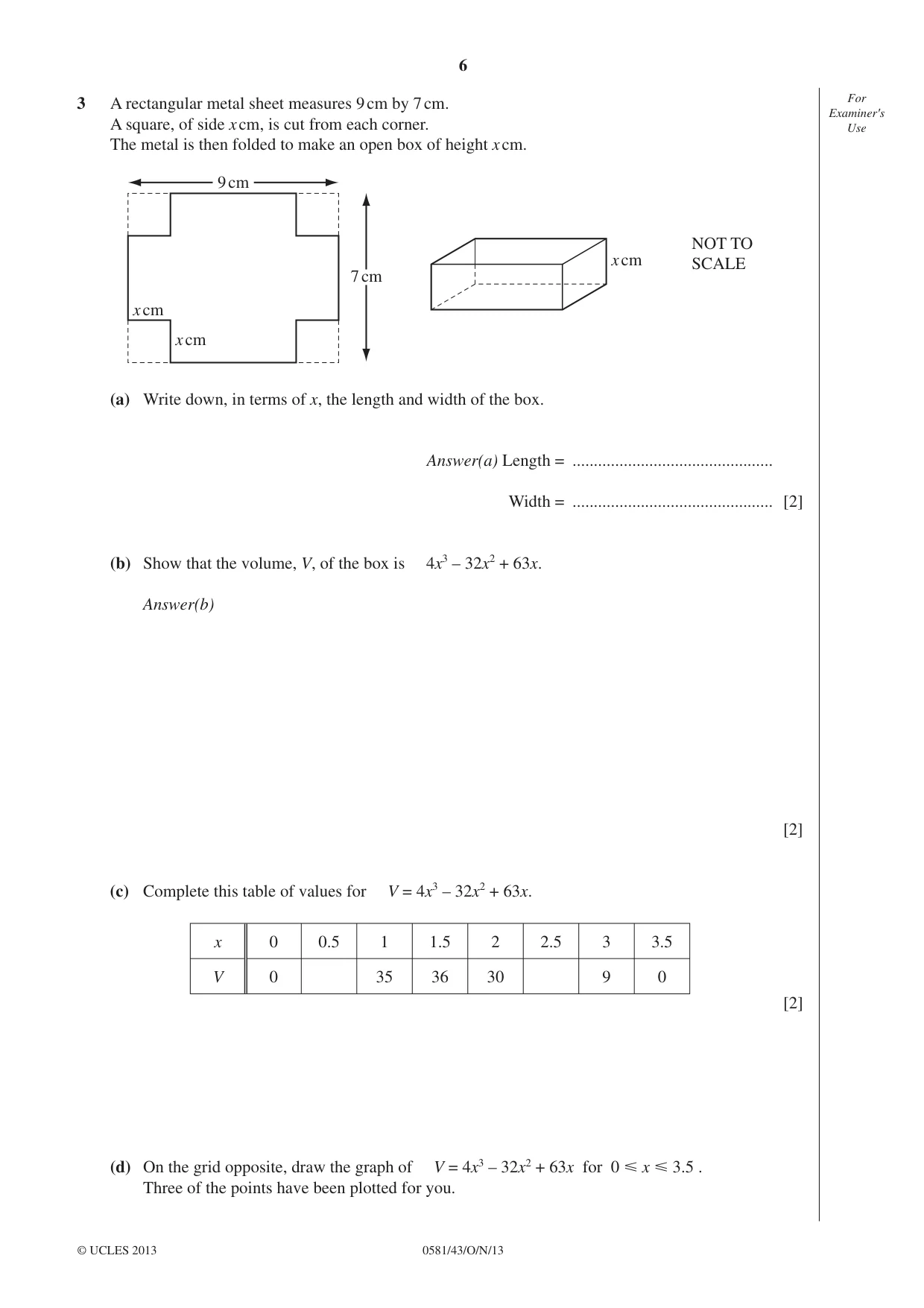
6 0581/43/O/N/13 © UCLES 2013 For Examiner′s Use 3 A rectangular metal sheet measures 9 cm by 7 cm. A square, of side x cm, is cut from each corner. The metal is then folded to make an open box of height x cm. x cm NOT TO SCALE 9 cm 7 cm x cm x cm (a) Write down, in terms of x, the length and width of the box. Answer(a) Length = … Width = … [2] (b) Show that the volume, V, of the box is 4x3 – 32x2 + 63x. Answer(b) [2] (c) Complete this table of values for V = 4x3 – 32x2 + 63x. x 0 0.5 1 1.5 2 2.5 3 3.5 V 0 35 36 30 9 0 [2] (d) On the grid opposite, draw the graph of V = 4x3 – 32x2 + 63x for 0 Y x Y 3.5 . Three of the points have been plotted for you.
Question paper, page 7
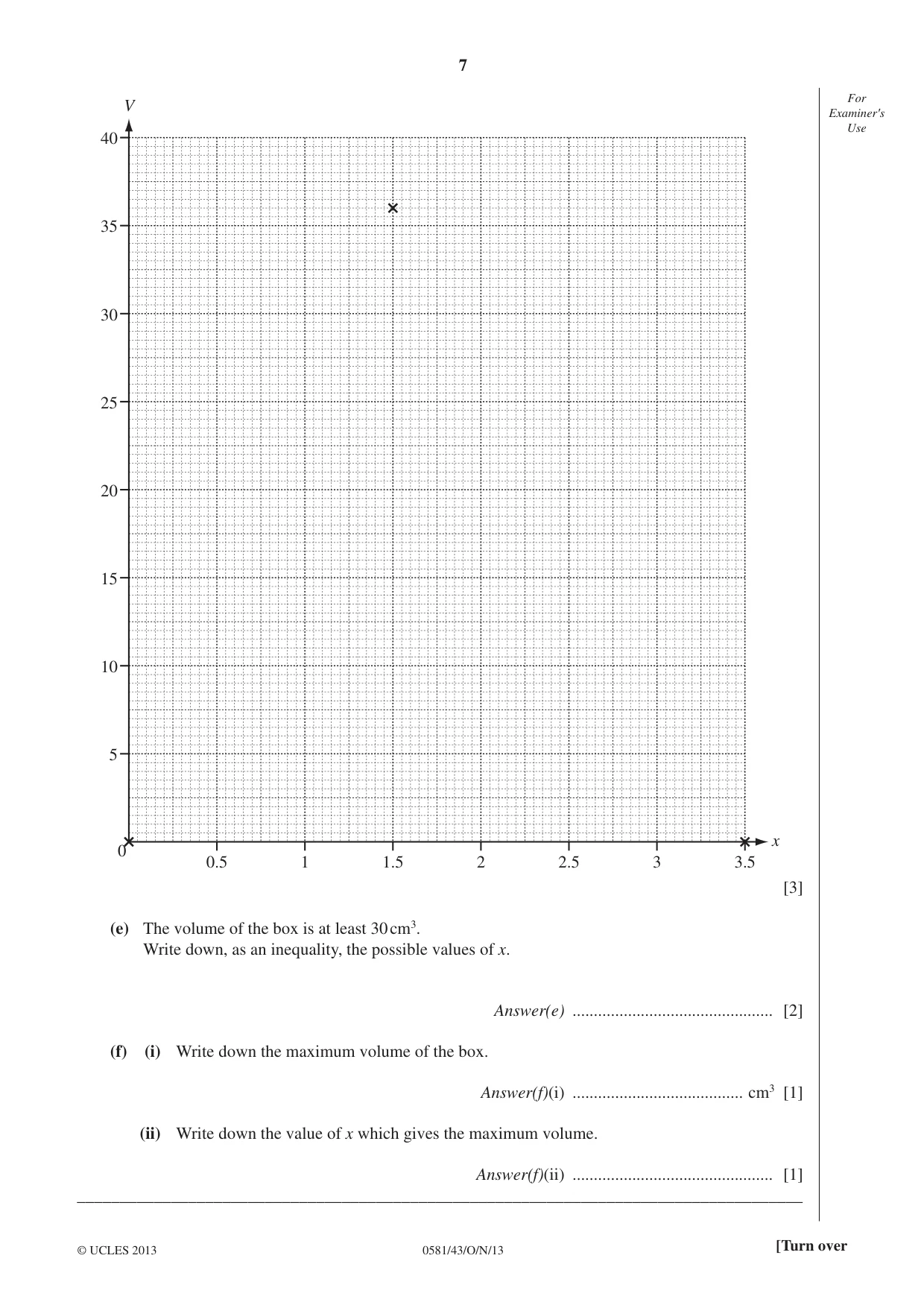
7 0581/43/O/N/13 © UCLES 2013 [Turn over For Examiner′s Use 0.5 1 1.5 2 2.5 3 3.5 0 40 35 30 25 20 15 10 5 V x [3] (e) The volume of the box is at least 30 cm3. Write down, as an inequality, the possible values of x. Answer(e) … [2] (f) (i) Write down the maximum volume of the box. Answer(f)(i) … cm3 [1] (ii) Write down the value of x which gives the maximum volume. Answer(f)(ii) … [1] _____________________________________________________________________________________
Question paper, page 8
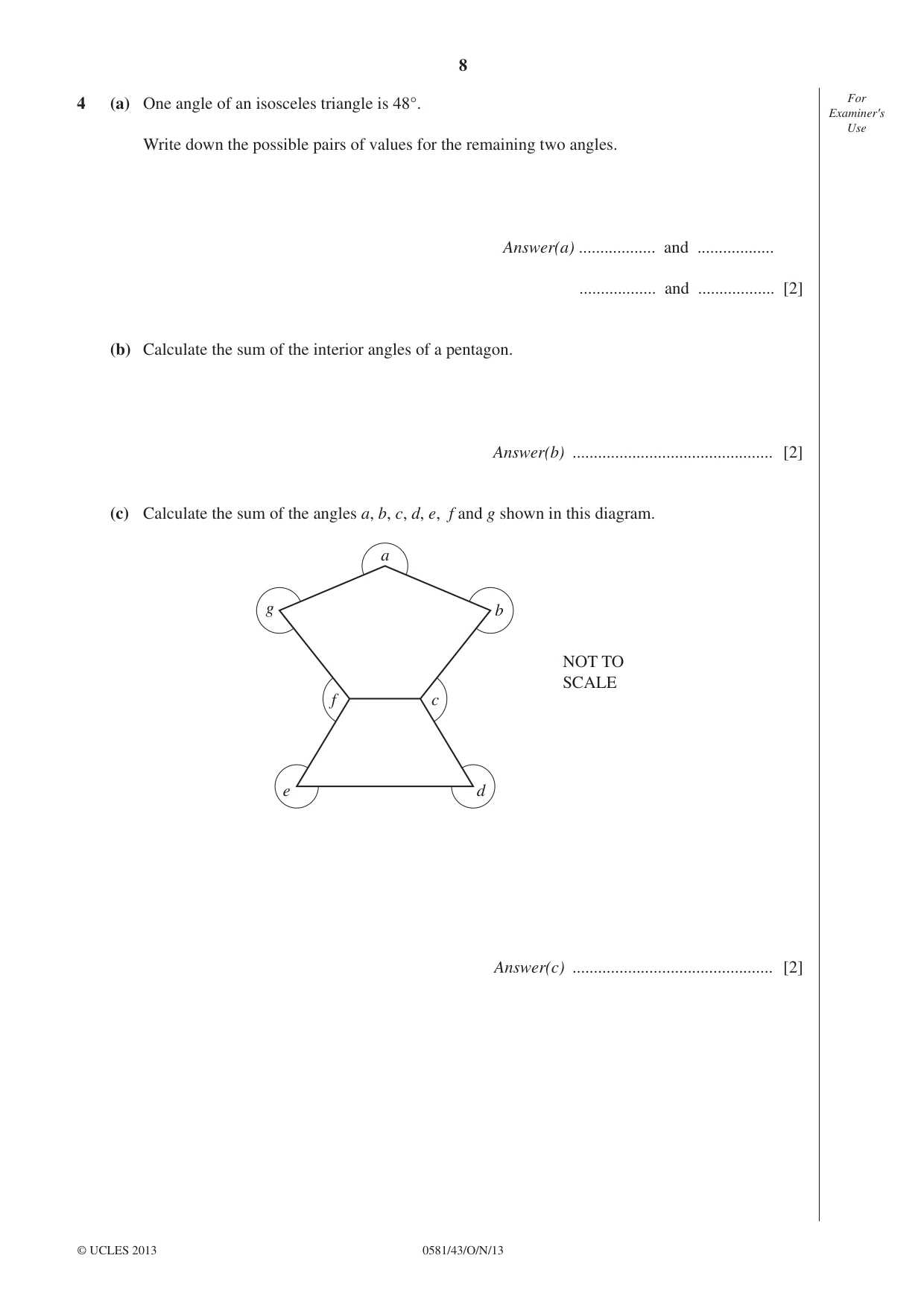
8 0581/43/O/N/13 © UCLES 2013 For Examiner′s Use 4 (a) One angle of an isosceles triangle is 48°. Write down the possible pairs of values for the remaining two angles. Answer(a) … and … … and … [2] (b) Calculate the sum of the interior angles of a pentagon. Answer(b) … [2] (c) Calculate the sum of the angles a, b, c, d, e, f and g shown in this diagram. f c g b a e d NOT TO SCALE Answer(c) … [2]
Question paper, page 9
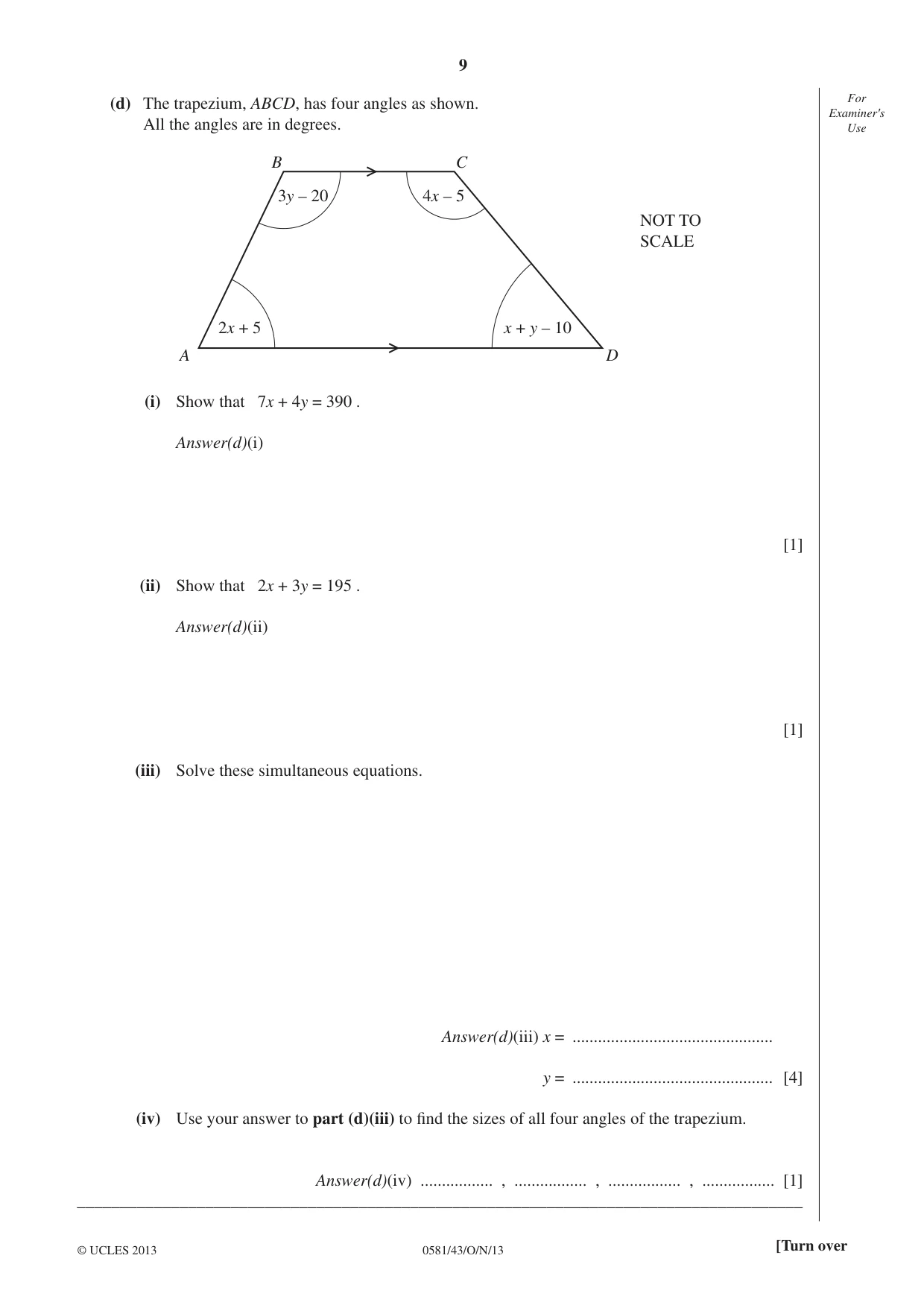
9 0581/43/O/N/13 © UCLES 2013 [Turn over For Examiner′s Use (d) The trapezium, ABCD, has four angles as shown. All the angles are in degrees. 3y – 20 4x – 5 2x + 5 x + y – 10 B C D A NOT TO SCALE (i) Show that 7x + 4y = 390 . Answer(d)(i) [1] (ii) Show that 2x + 3y = 195 . Answer(d)(ii) [1] (iii) Solve these simultaneous equations. Answer(d)(iii) x = … y = … [4] (iv) Use your answer to part (d)(iii) to fi nd the sizes of all four angles of the trapezium. Answer(d)(iv) … , … , … , … [1] _____________________________________________________________________________________
Question paper, page 10
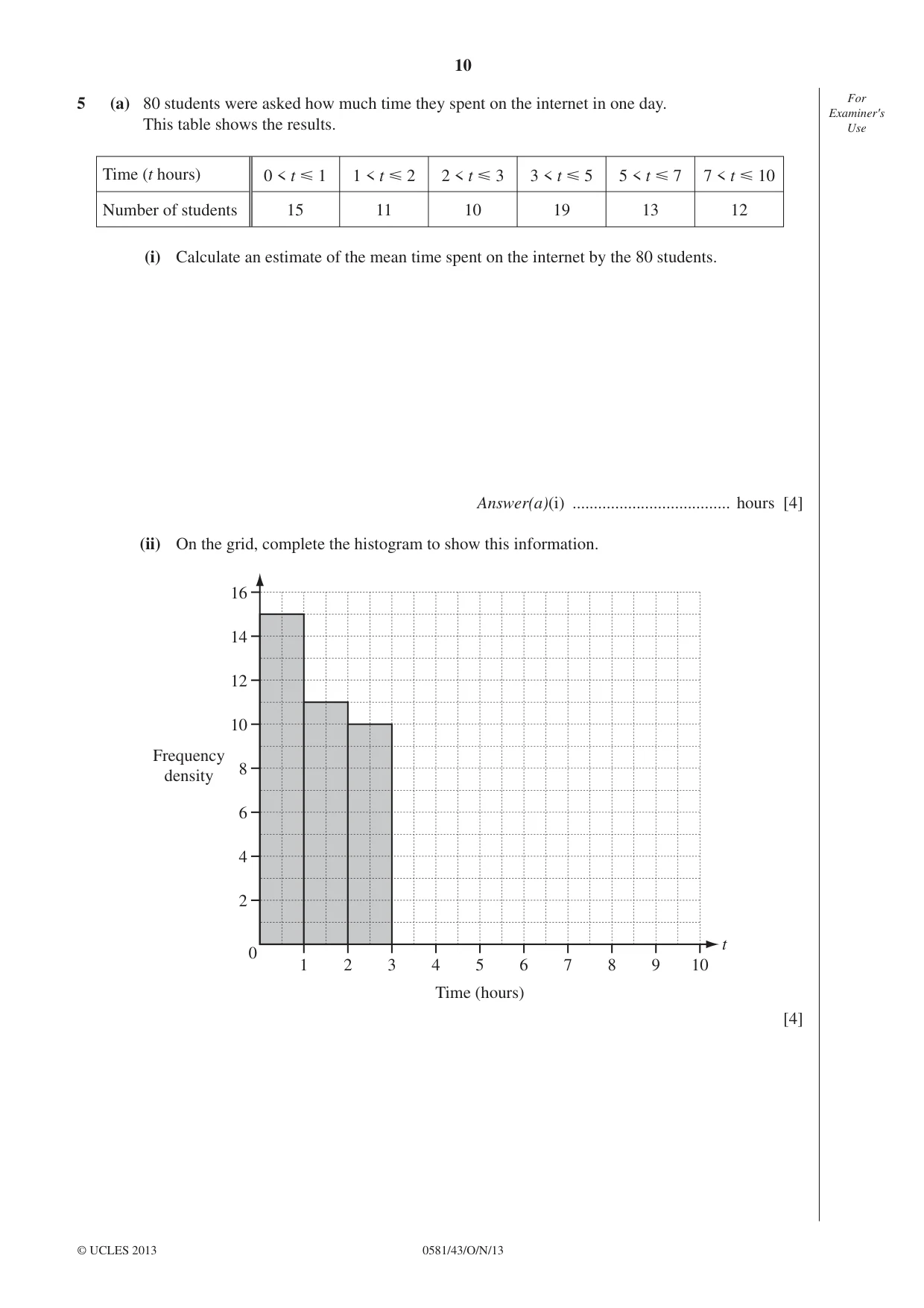
10 0581/43/O/N/13 © UCLES 2013 For Examiner′s Use 5 (a) 80 students were asked how much time they spent on the internet in one day. This table shows the results. Time (t hours) 0 < t Y 1 1 < t Y 2 2 < t Y 3 3 < t Y 5 5 < t Y 7 7 < t Y 10 Number of students 15 11 10 19 13 12 (i) Calculate an estimate of the mean time spent on the internet by the 80 students. Answer(a)(i) … hours [4] (ii) On the grid, complete the histogram to show this information. 16 14 12 10 8 6 4 2 0 2 4 6 Time (hours) 8 10 1 3 5 7 9 Frequency density t [4]
Question paper, page 11
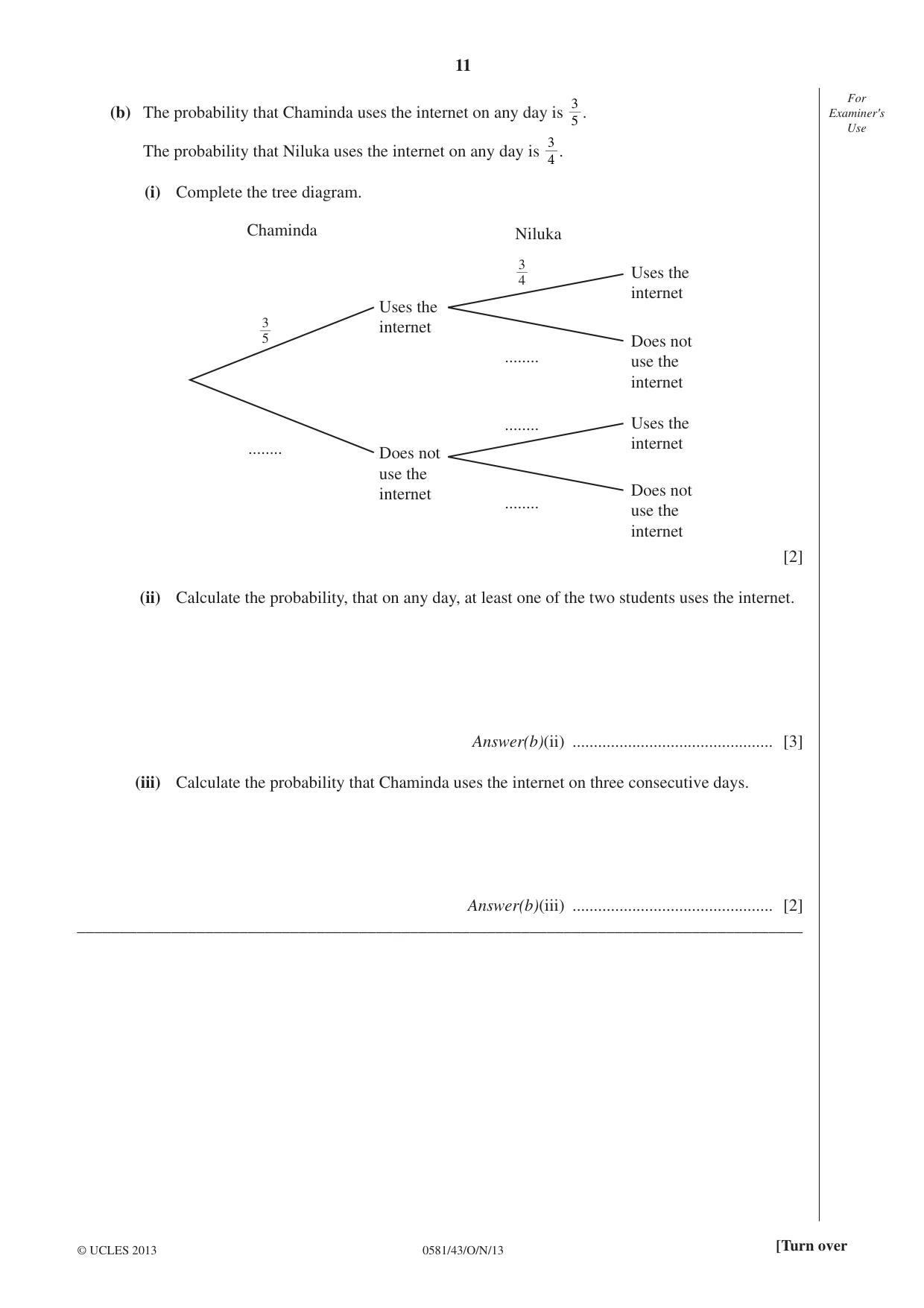
11 0581/43/O/N/13 © UCLES 2013 [Turn over For Examiner′s Use (b) The probability that Chaminda uses the internet on any day is 5 3 . The probability that Niluka uses the internet on any day is 4 3 . (i) Complete the tree diagram. Uses the internet Chaminda Niluka Does not use the internet Uses the internet Does not use the internet Does not use the internet Uses the internet … … … … 3 5 3 4 [2] (ii) Calculate the probability, that on any day, at least one of the two students uses the internet. Answer(b)(ii) … [3] (iii) Calculate the probability that Chaminda uses the internet on three consecutive days. Answer(b)(iii) … [2] _____________________________________________________________________________________
Question paper, page 12
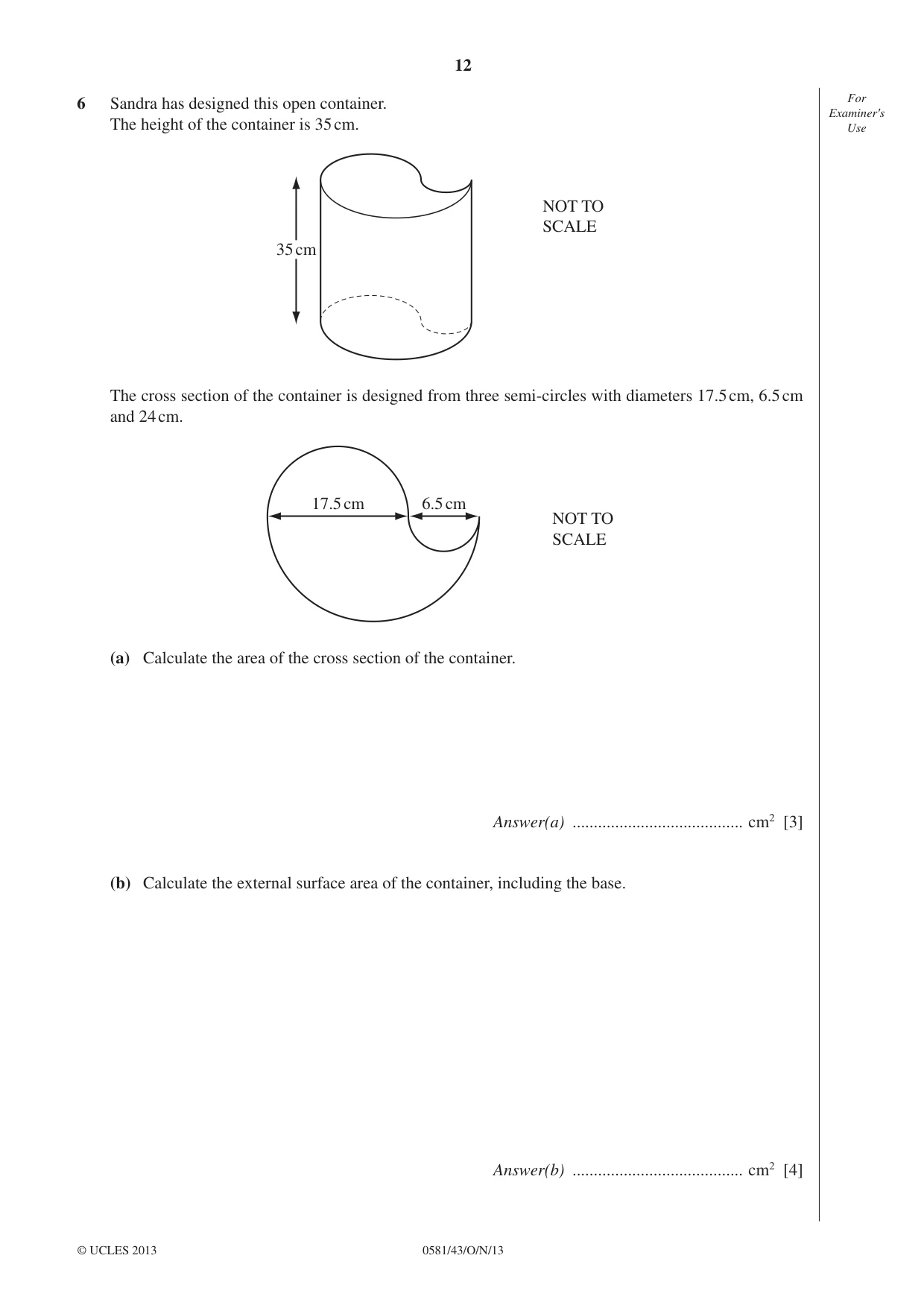
12 0581/43/O/N/13 © UCLES 2013 For Examiner′s Use 6 Sandra has designed this open container. The height of the container is 35 cm. 35 cm NOT TO SCALE The cross section of the container is designed from three semi-circles with diameters 17.5 cm, 6.5 cm and 24 cm. 17.5 cm 6.5 cm NOT TO SCALE (a) Calculate the area of the cross section of the container. Answer(a) … cm2 [3] (b) Calculate the external surface area of the container, including the base. Answer(b) … cm2 [4]
Question paper, page 13
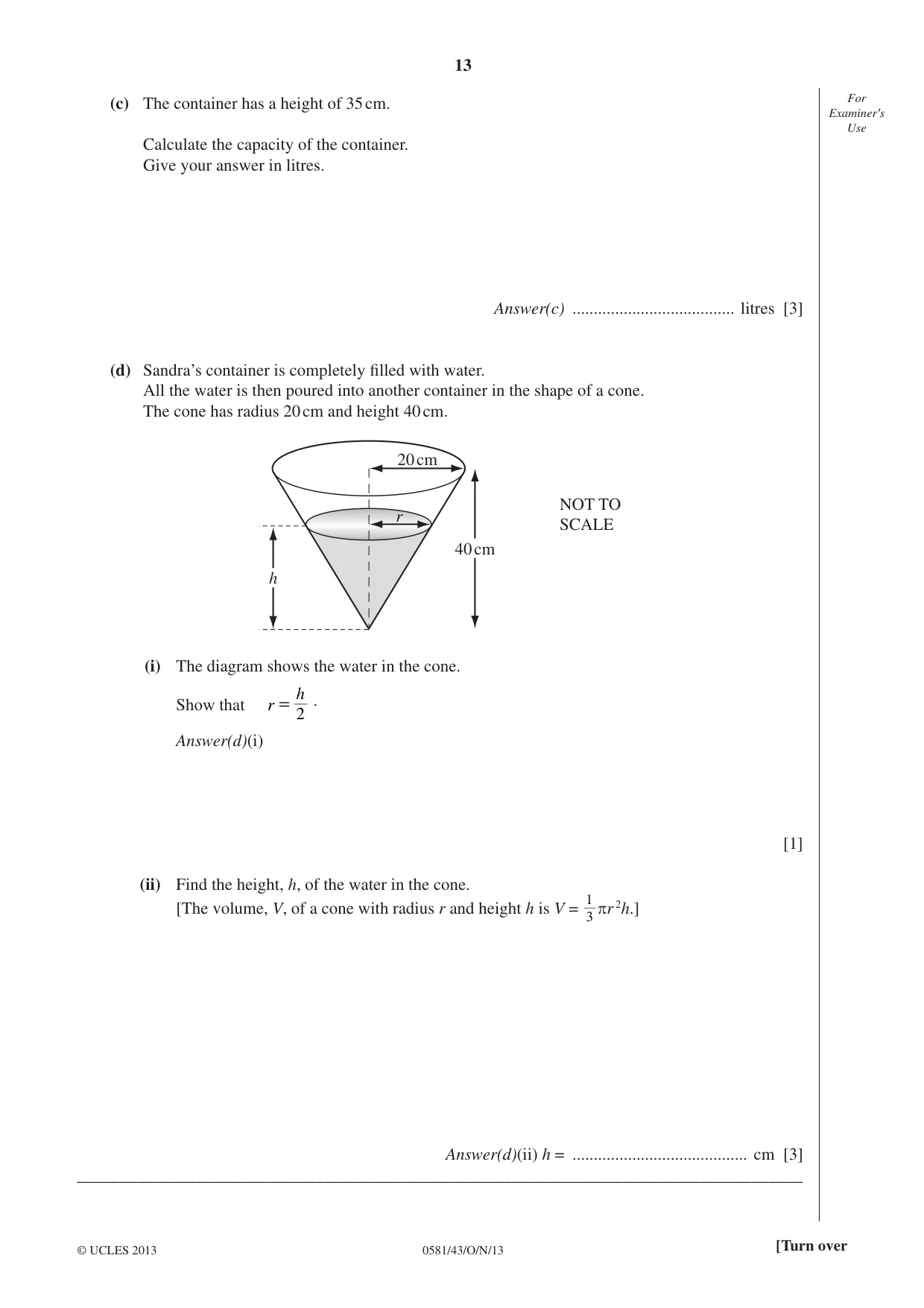
13 0581/43/O/N/13 © UCLES 2013 [Turn over For Examiner′s Use (c) The container has a height of 35 cm. Calculate the capacity of the container. Give your answer in litres. Answer(c) … litres [3] (d) Sandra’s container is completely fi lled with water. All the water is then poured into another container in the shape of a cone. The cone has radius 20 cm and height 40 cm. r 20 cm 40 cm h NOT TO SCALE (i) The diagram shows the water in the cone. Show that r h 2 = . Answer(d)(i) [1] (ii) Find the height, h, of the water in the cone. [The volume, V, of a cone with radius r and height h is V = 3 1 πr 2h.] Answer(d)(ii) h = … cm [3] _____________________________________________________________________________________
Question paper, page 14
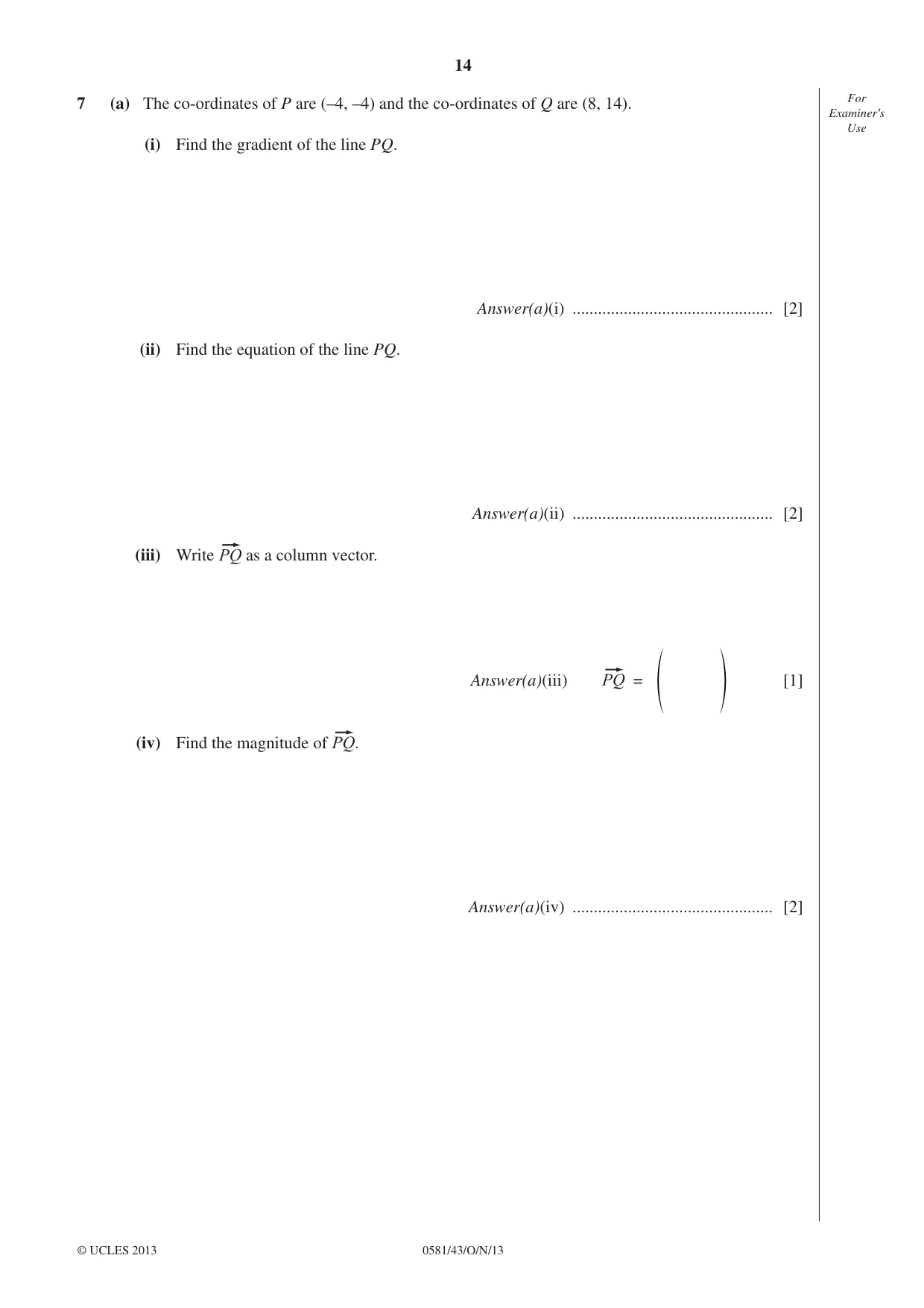
14 0581/43/O/N/13 © UCLES 2013 For Examiner′s Use 7 (a) The co-ordinates of P are (–4, –4) and the co-ordinates of Q are (8, 14). (i) Find the gradient of the line PQ. Answer(a)(i) … [2] (ii) Find the equation of the line PQ. Answer(a)(ii) … [2] (iii) Write as a column vector. Answer(a)(iii) = f p [1] (iv) Find the magnitude of . Answer(a)(iv) … [2]
Question paper, page 15
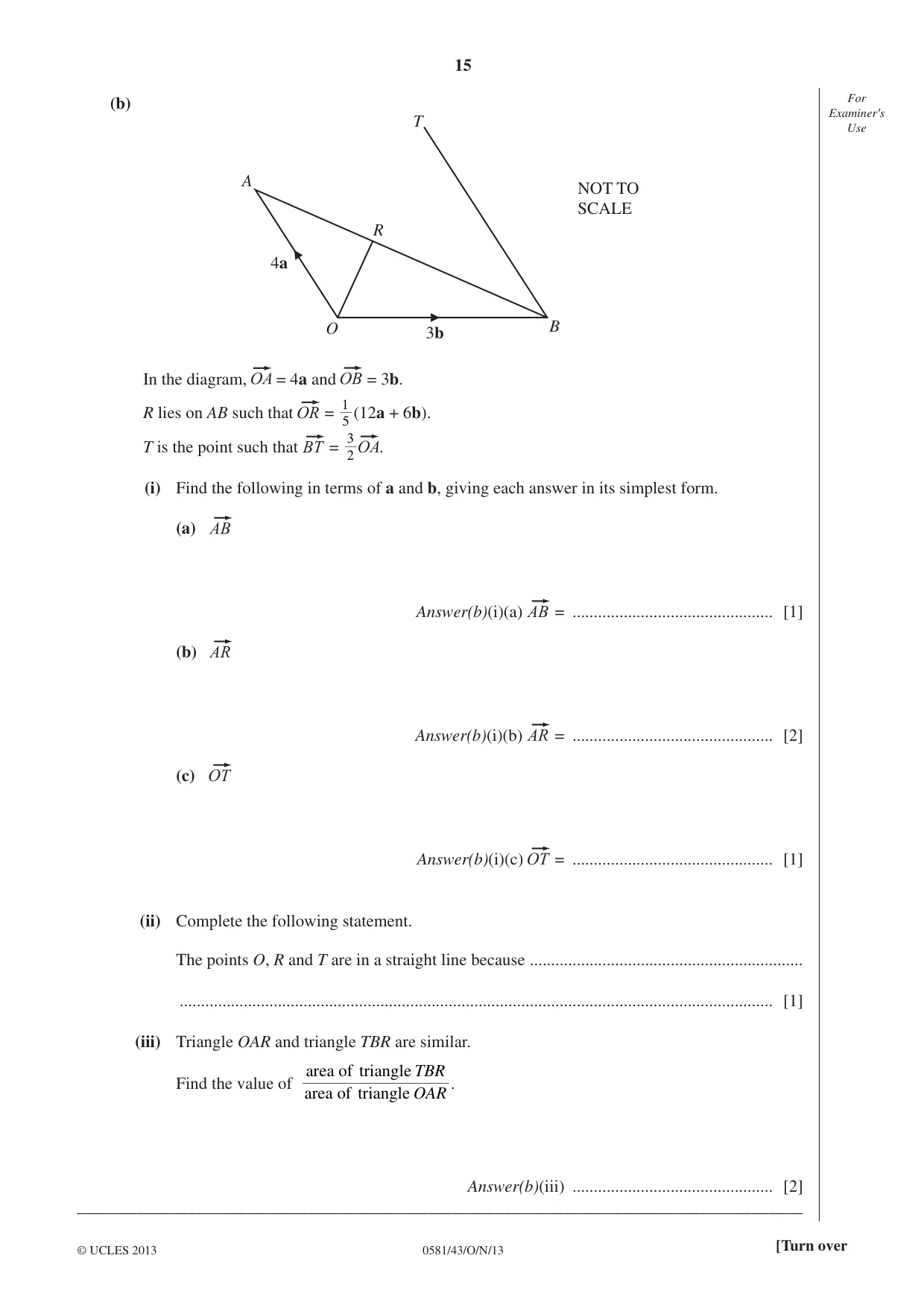
15 0581/43/O/N/13 © UCLES 2013 [Turn over For Examiner′s Use (b) R T A O B 3b 4a NOT TO SCALE In the diagram, = 4a and = 3b. R lies on AB such that = 5 1 (12a + 6b). T is the point such that = 2 3 . (i) Find the following in terms of a and b, giving each answer in its simplest form. (a) Answer(b)(i)(a) = … [1] (b) Answer(b)(i)(b) = … [2] (c) Answer(b)(i)(c) = … [1] (ii) Complete the following statement. The points O, R and T are in a straight line because … … [1] (iii) Triangle OAR and triangle TBR are similar. Find the value of area of triangle area of triangle OAR TBR . Answer(b)(iii) … [2] _____________________________________________________________________________________
Question paper, page 16
16 0581/43/O/N/13 © UCLES 2013 For Examiner′s Use 8 (a) Rearrange s = ut + 2 1 at2 to make a the subject. Answer(a) a = … [3] (b) The formula v = u + at can be used to calculate the speed, v, of a car. u = 15, a = 2 and t = 8, each correct to the nearest integer. Calculate the upper bound of the speed v. Answer(b) … [3]
Question paper, page 17
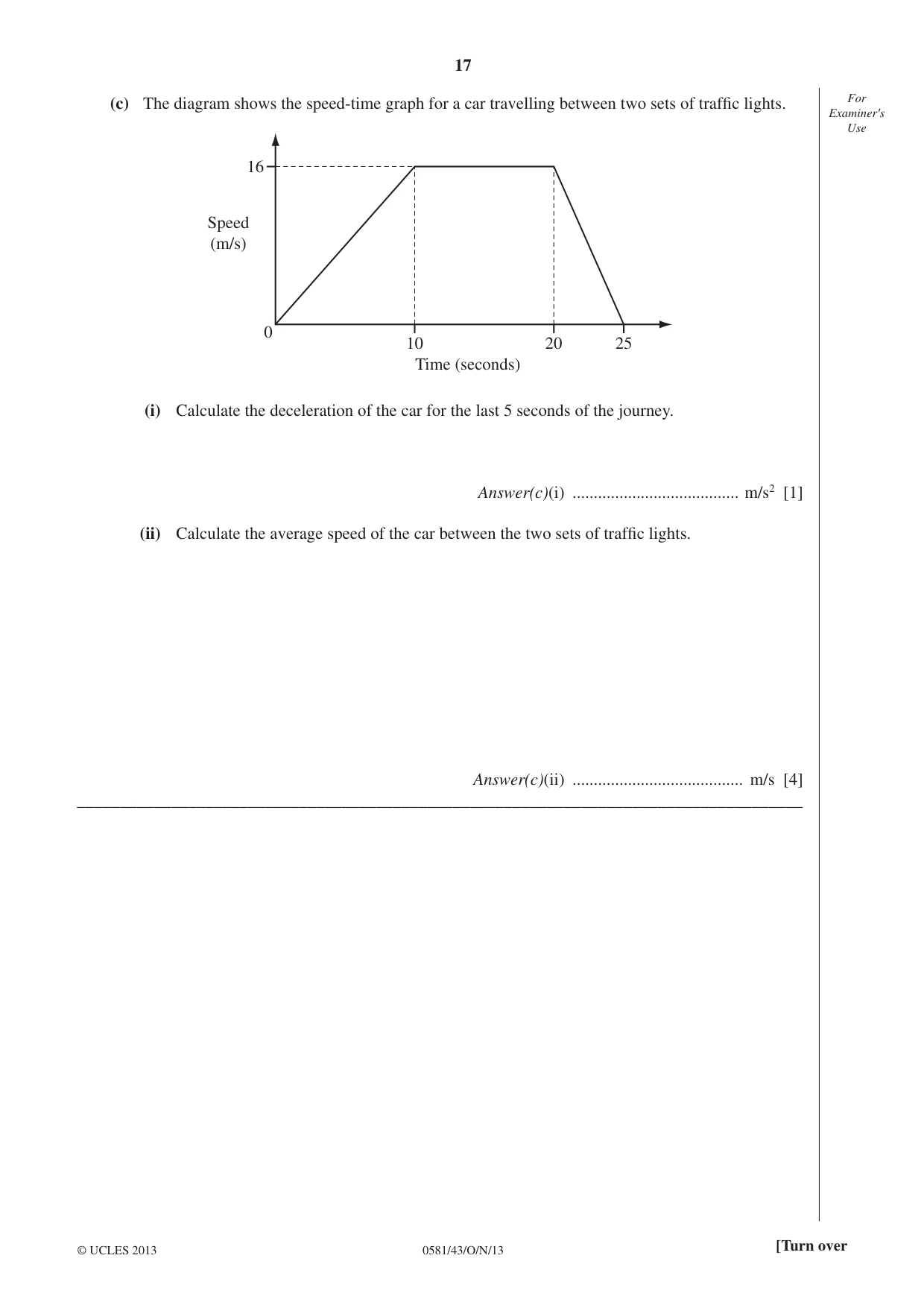
17 0581/43/O/N/13 © UCLES 2013 [Turn over For Examiner′s Use (c) The diagram shows the speed-time graph for a car travelling between two sets of traffi c lights. 0 10 16 20 25 Time (seconds) Speed (m/s) (i) Calculate the deceleration of the car for the last 5 seconds of the journey. Answer(c)(i) … m/s2 [1] (ii) Calculate the average speed of the car between the two sets of traffi c lights. Answer(c)(ii) … m/s [4] _____________________________________________________________________________________
Question paper, page 18
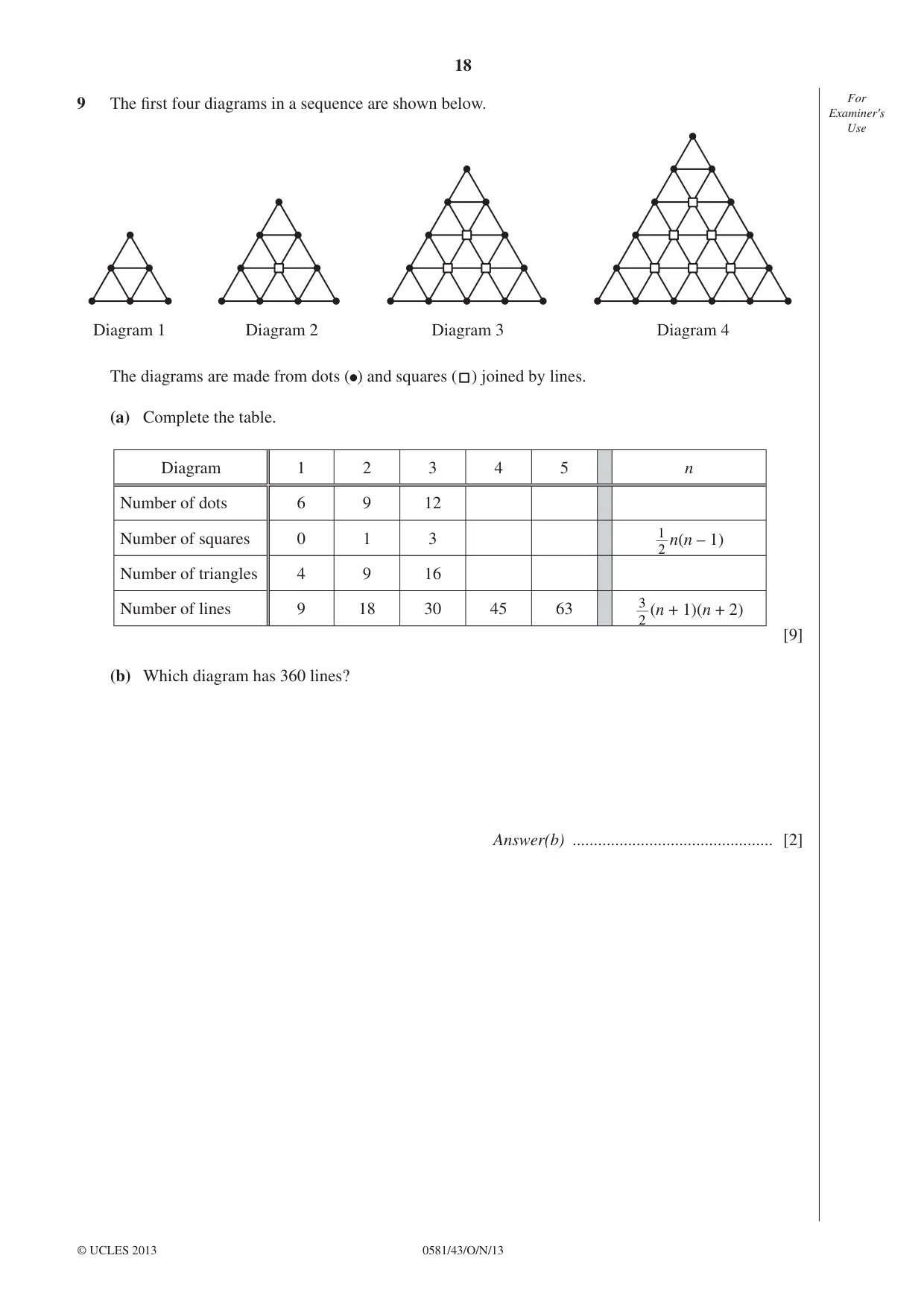
18 0581/43/O/N/13 © UCLES 2013 For Examiner′s Use 9 The fi rst four diagrams in a sequence are shown below. Diagram 1 Diagram 2 Diagram 3 Diagram 4 The diagrams are made from dots ( ) and squares ( ) joined by lines. (a) Complete the table. Diagram 1 2 3 4 5 n Number of dots 6 9 12 Number of squares 0 1 3 2 1 n(n – 1) Number of triangles 4 9 16 Number of lines 9 18 30 45 63 2 3 (n + 1)(n + 2) [9] (b) Which diagram has 360 lines? Answer(b) … [2]
Question paper, page 19
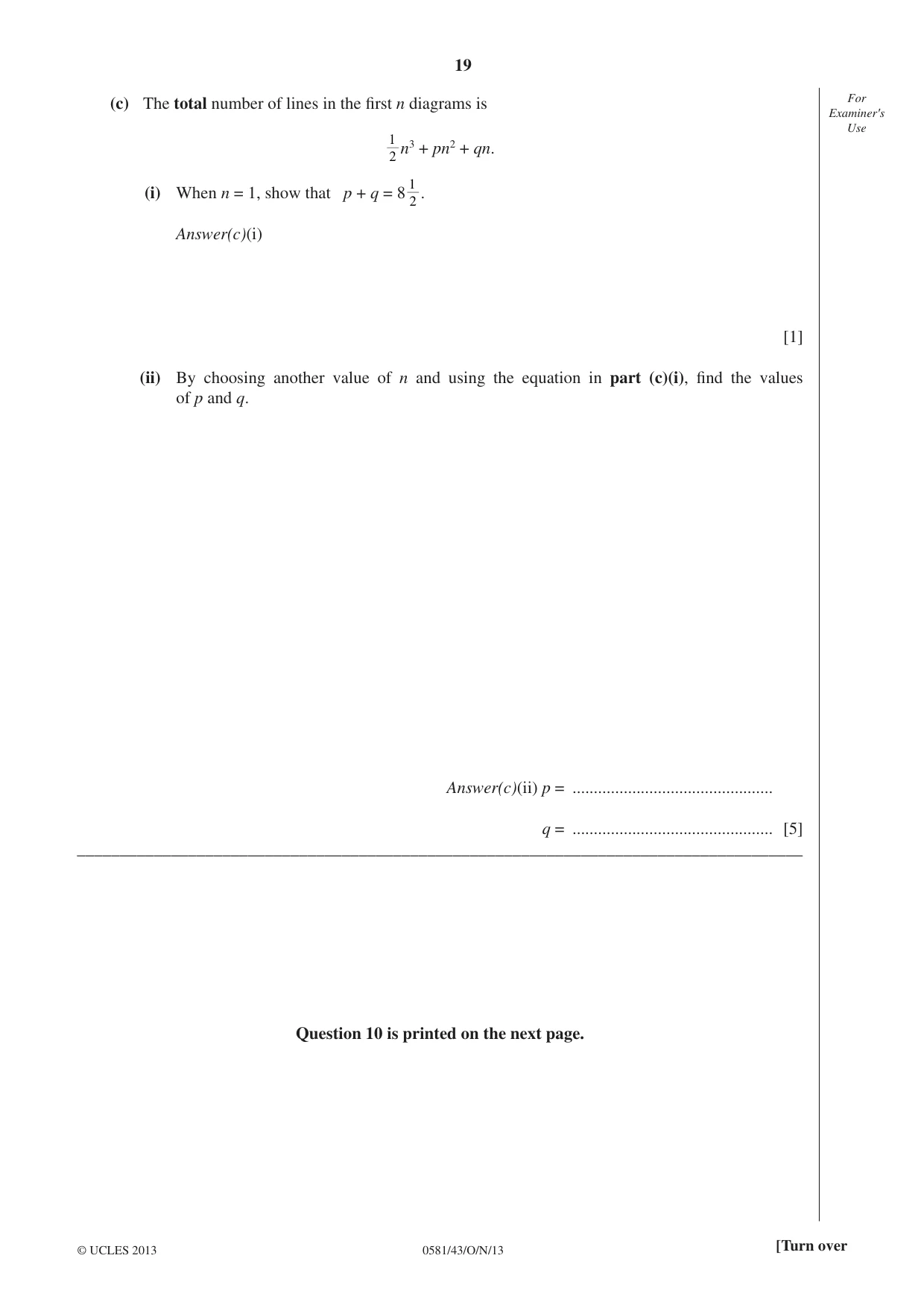
19 0581/43/O/N/13 © UCLES 2013 [Turn over For Examiner′s Use (c) The total number of lines in the fi rst n diagrams is 2 1 n3 + pn2 + qn. (i) When n = 1, show that p + q = 8 2 1 . Answer(c)(i) [1] (ii) By choosing another value of n and using the equation in part (c)(i), fi nd the values of p and q. Answer(c)(ii) p = … q = … [5] _____________________________________________________________________________________ Question 10 is printed on the next page.
Question paper, page 20
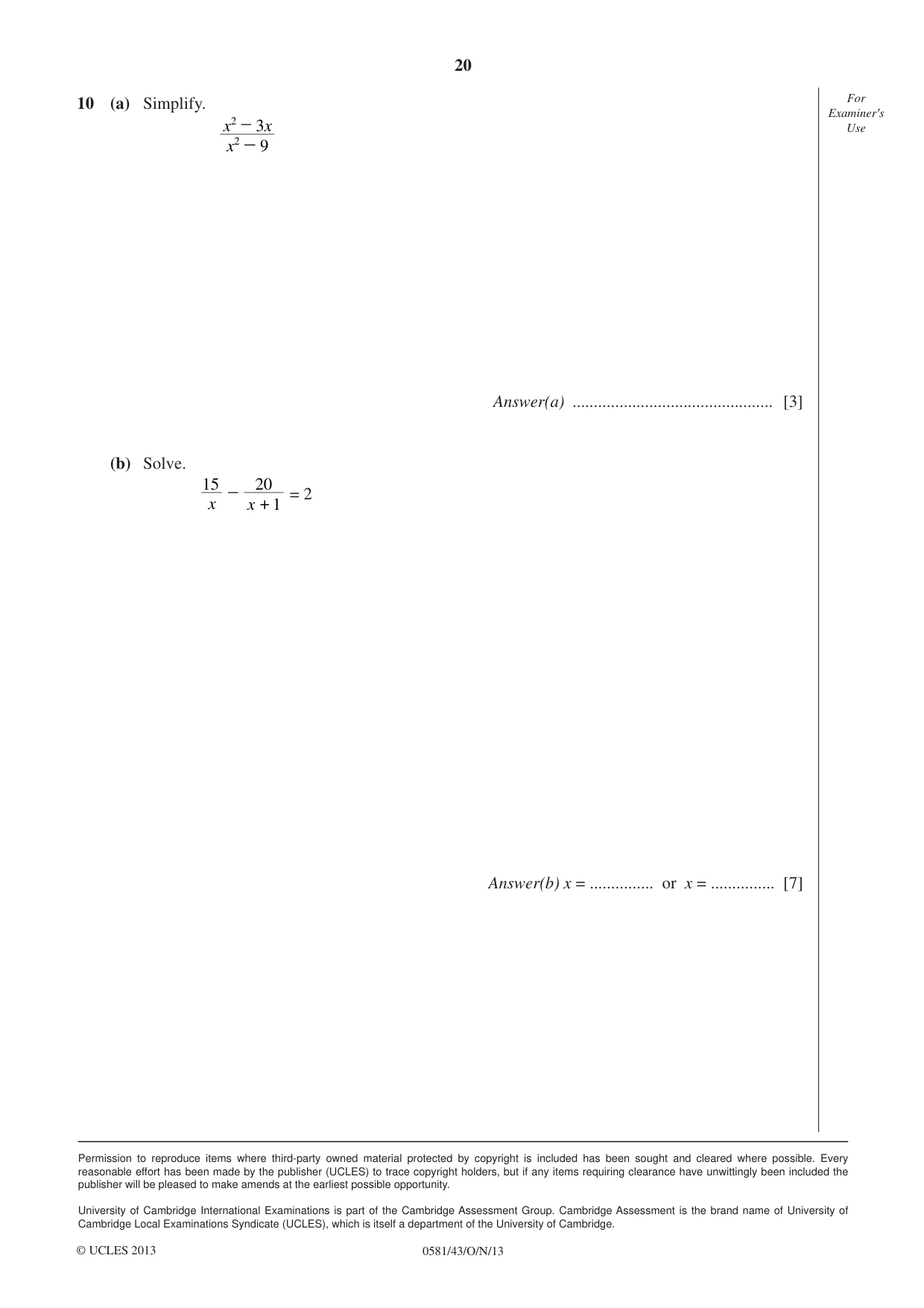
20 0581/43/O/N/13 Permission to reproduce items where third-party owned material protected by copyright is included has been sought and cleared where possible. Every reasonable effort has been made by the publisher (UCLES) to trace copyright holders, but if any items requiring clearance have unwittingly been included the publisher will be pleased to make amends at the earliest possible opportunity. University of Cambridge International Examinations is part of the Cambridge Assessment Group. Cambridge Assessment is the brand name of University of Cambridge Local Examinations Syndicate (UCLES), which is itself a department of the University of Cambridge. © UCLES 2013 For Examiner′s Use 10 (a) Simplify. 2 2 9 3 x x x - - Answer(a) … [3] (b) Solve. 15 x – 1 20 x + = 2 Answer(b) x = … or x = … [7]
Mark scheme, page 1
CAMBRIDGE INTERNATIONAL EXAMINATIONS International General Certificate of Secondary Education MARK SCHEME for the October/November 2013 series 0581 MATHEMATICS 0581/43 Paper 4 (Extended), maximum raw mark 130 This mark scheme is published as an aid to teachers and candidates, to indicate the requirements of the examination. It shows the basis on which Examiners were instructed to award marks. It does not indicate the details of the discussions that took place at an Examiners’ meeting before marking began, which would have considered the acceptability of alternative answers. Mark schemes should be read in conjunction with the question paper and the Principal Examiner Report for Teachers. Cambridge will not enter into discussions about these mark schemes. Cambridge is publishing the mark schemes for the October/November 2013 series for most IGCSE, GCE Advanced Level and Advanced Subsidiary Level components and some Ordinary Level components. www.XtremePapers.com
Mark scheme, page 2
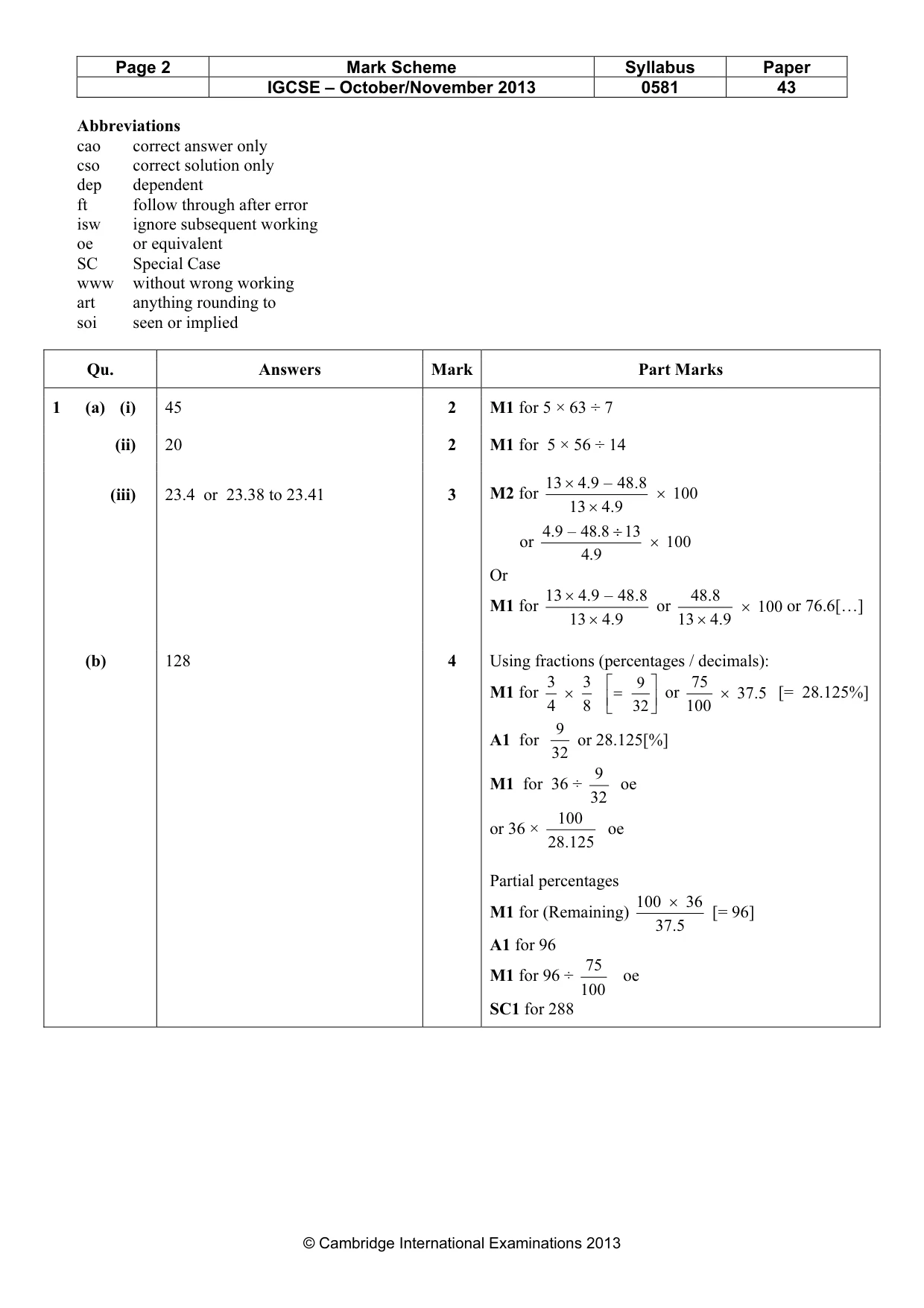
Page 2 Mark Scheme Syllabus Paper IGCSE – October/November 2013 0581 43 © Cambridge International Examinations 2013 Abbreviations cao correct answer only cso correct solution only dep dependent ft follow through after error isw ignore subsequent working oe or equivalent SC Special Case www without wrong working art anything rounding to soi seen or implied Qu. Answers Mark Part Marks 1 (a) (i) 45 2 M1 for 5 × 63 ÷ 7 (ii) 20 2 M1 for 5 × 56 ÷ 14 (iii) 23.4 or 23.38 to 23.41 3 M2 for 100 9.4 13 8. 48 – 9.4 13 × × × or 100 9.4 13 8. 48 – 9.4 × ÷ Or M1 for 9.4 13 8. 48 – 9.4 13 × × or 100 9.4 13 8. 48 × × or 76.6[…] (b) 128 4 Using fractions (percentages / decimals): M1 for 8 3 4 3 × = 32 9 or 5. 37 100 75 × [= 28.125%] A1 for 32 9 or 28.125[%] M1 for 36 ÷ 32 9 oe or 36 × 125 . 28 100 oe Partial percentages M1 for (Remaining) 5. 37 36 100 × [= 96] A1 for 96 M1 for 96 ÷ 100 75 oe SC1 for 288
Mark scheme, page 3
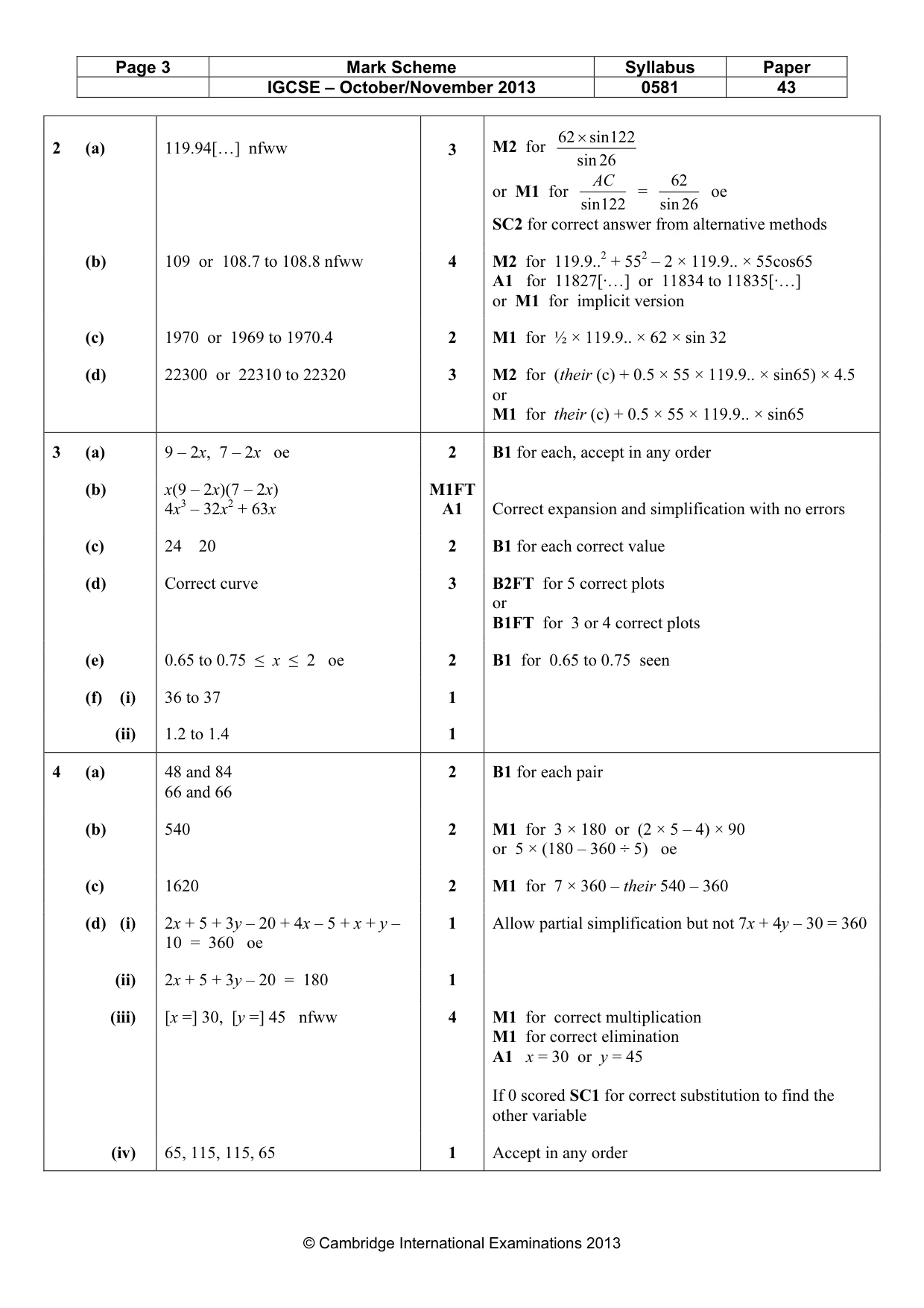
Page 3 Mark Scheme Syllabus Paper IGCSE – October/November 2013 0581 43 © Cambridge International Examinations 2013 2 (a) 119.94[…] nfww 3 M2 for 26 sin 122 sin 62 × or M1 for 122 sin AC = 26 sin 62 oe SC2 for correct answer from alternative methods (b) 109 or 108.7 to 108.8 nfww 4 M2 for 119.9..2 + 552 – 2 × 119.9.. × 55cos65 A1 for 11827[·…] or 11834 to 11835[·…] or M1 for implicit version (c) 1970 or 1969 to 1970.4 2 M1 for ½ × 119.9.. × 62 × sin 32 (d) 22300 or 22310 to 22320 3 M2 for (their (c) + 0.5 × 55 × 119.9.. × sin65) × 4.5 or M1 for their (c) + 0.5 × 55 × 119.9.. × sin65 3 (a) 9 – 2x, 7 – 2x oe 2 B1 for each, accept in any order (b) x(9 – 2x)(7 – 2x) 4x3 – 32x2 + 63x M1FT A1 Correct expansion and simplification with no errors (c) 24 20 2 B1 for each correct value (d) Correct curve 3 B2FT for 5 correct plots or B1FT for 3 or 4 correct plots (e) 0.65 to 0.75 ≤ x ≤ 2 oe 2 B1 for 0.65 to 0.75 seen (f) (i) 36 to 37 1 (ii) 1.2 to 1.4 1 4 (a) 48 and 84 66 and 66 2 B1 for each pair (b) 540 2 M1 for 3 × 180 or (2 × 5 – 4) × 90 or 5 × (180 – 360 ÷ 5) oe (c) 1620 2 M1 for 7 × 360 – their 540 – 360 (d) (i) 2x + 5 + 3y – 20 + 4x – 5 + x + y – 10 = 360 oe 1 Allow partial simplification but not 7x + 4y – 30 = 360 (ii) 2x + 5 + 3y – 20 = 180 1 (iii) [x =] 30, [y =] 45 nfww 4 M1 for correct multiplication M1 for correct elimination A1 x = 30 or y = 45 If 0 scored SC1 for correct substitution to find the other variable (iv) 65, 115, 115, 65 1 Accept in any order
Mark scheme, page 4
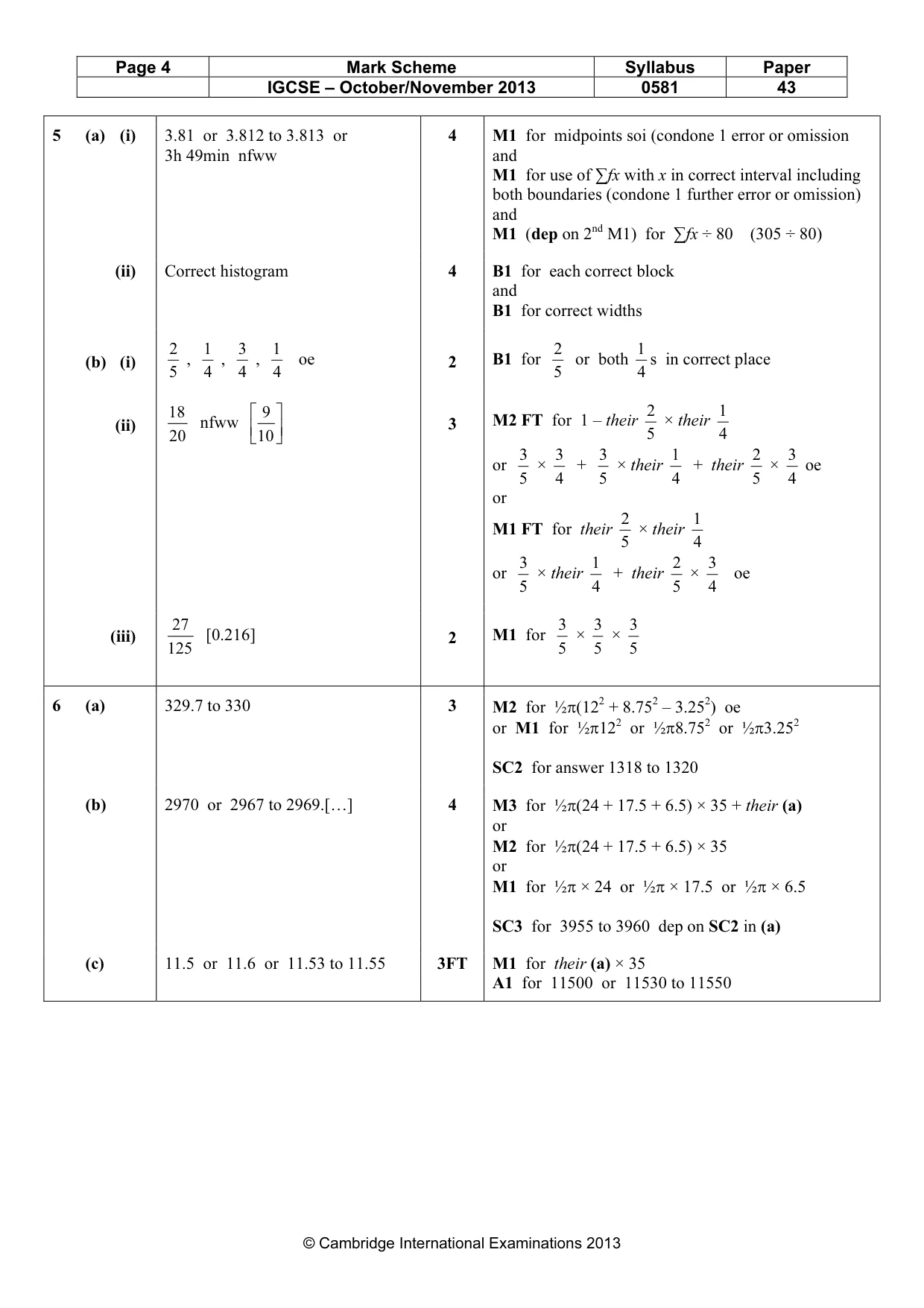
Page 4 Mark Scheme Syllabus Paper IGCSE – October/November 2013 0581 43 © Cambridge International Examinations 2013 5 (a) (i) 3.81 or 3.812 to 3.813 or 3h 49min nfww 4 M1 for midpoints soi (condone 1 error or omission and M1 for use of ∑fx with x in correct interval including both boundaries (condone 1 further error or omission) and M1 (dep on 2nd M1) for ∑fx ÷ 80 (305 ÷ 80) (ii) Correct histogram 4 B1 for each correct block and B1 for correct widths (b) (i) 5 2 , 4 1 , 4 3 , 4 1 oe 2 B1 for 5 2 or both 4 1 s in correct place (ii) 20 18 nfww 10 9 3 M2 FT for 1 – their 5 2 × their 4 1 or 5 3 × 4 3 + 5 3 × their 4 1 + their 5 2 × 4 3 oe or M1 FT for their 5 2 × their 4 1 or 5 3 × their 4 1 + their 5 2 × 4 3 oe (iii) 125 27 [0.216] 2 M1 for 5 3 × 5 3 × 5 3 6 (a) 329.7 to 330 3 M2 for ½π(122 + 8.752 – 3.252) oe or M1 for ½π122 or ½π8.752 or ½π3.252 SC2 for answer 1318 to 1320 (b) 2970 or 2967 to 2969.[…] 4 M3 for ½π(24 + 17.5 + 6.5) × 35 + their (a) or M2 for ½π(24 + 17.5 + 6.5) × 35 or M1 for ½π × 24 or ½π × 17.5 or ½π × 6.5 SC3 for 3955 to 3960 dep on SC2 in (a) (c) 11.5 or 11.6 or 11.53 to 11.55 3FT M1 for their (a) × 35 A1 for 11500 or 11530 to 11550
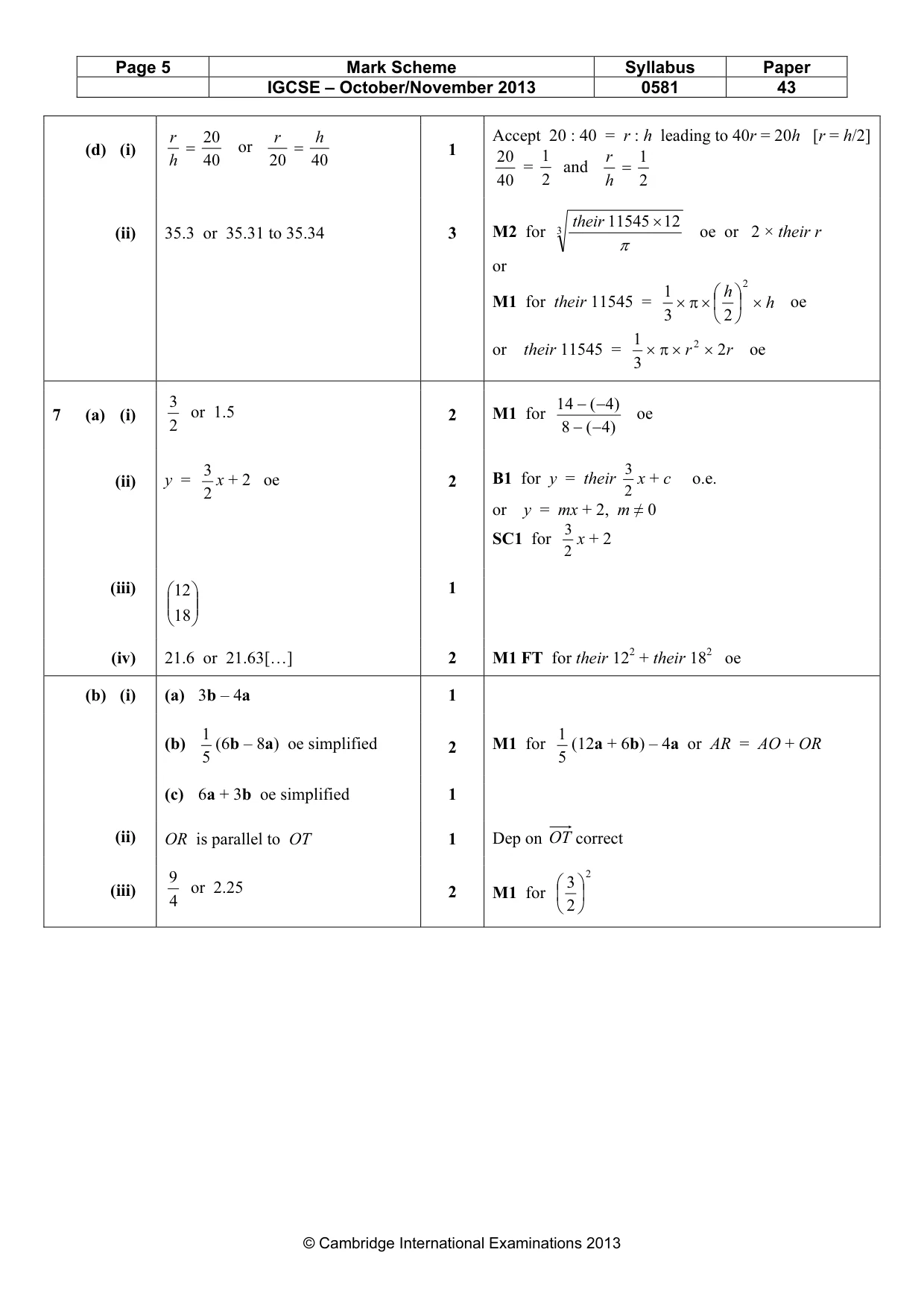
Mark scheme, page 5
Page 5 Mark Scheme Syllabus Paper IGCSE – October/November 2013 0581 43 © Cambridge International Examinations 2013 (d) (i) 40 20 = h r or 40 20 h r = 1 Accept 20 : 40 = r : h leading to 40r = 20h [r = h/2] 40 20 = 2 1 and 2 1 = h r (ii) 35.3 or 35.31 to 35.34 3 M2 for 3 12 11545 π × their oe or 2 × their r or M1 for their 11545 = h h × × π × 2 2 3 1 oe or their 11545 = r r 2 3 1 2 × × π × oe 7 (a) (i) 2 3 or 1.5 2 M1 for ) 4 ( 8 ) 4 ( 14 − − − − oe (ii) y = 2 3 x + 2 oe 2 B1 for y = their 2 3 x + c o.e. or y = mx + 2, m ≠ 0 SC1 for 2 3 x + 2 (iii) 18 12 1 (iv) 21.6 or 21.63[…] 2 M1 FT for their 122 + their 182 oe (b) (i) (a) 3b – 4a 1 (b) 5 1 (6b – 8a) oe simplified 2 M1 for 5 1 (12a + 6b) – 4a or AR = AO + OR (c) 6a + 3b oe simplified 1 (ii) OR is parallel to OT 1 Dep on OT correct (iii) 4 9 or 2.25 2 M1 for 2 2 3
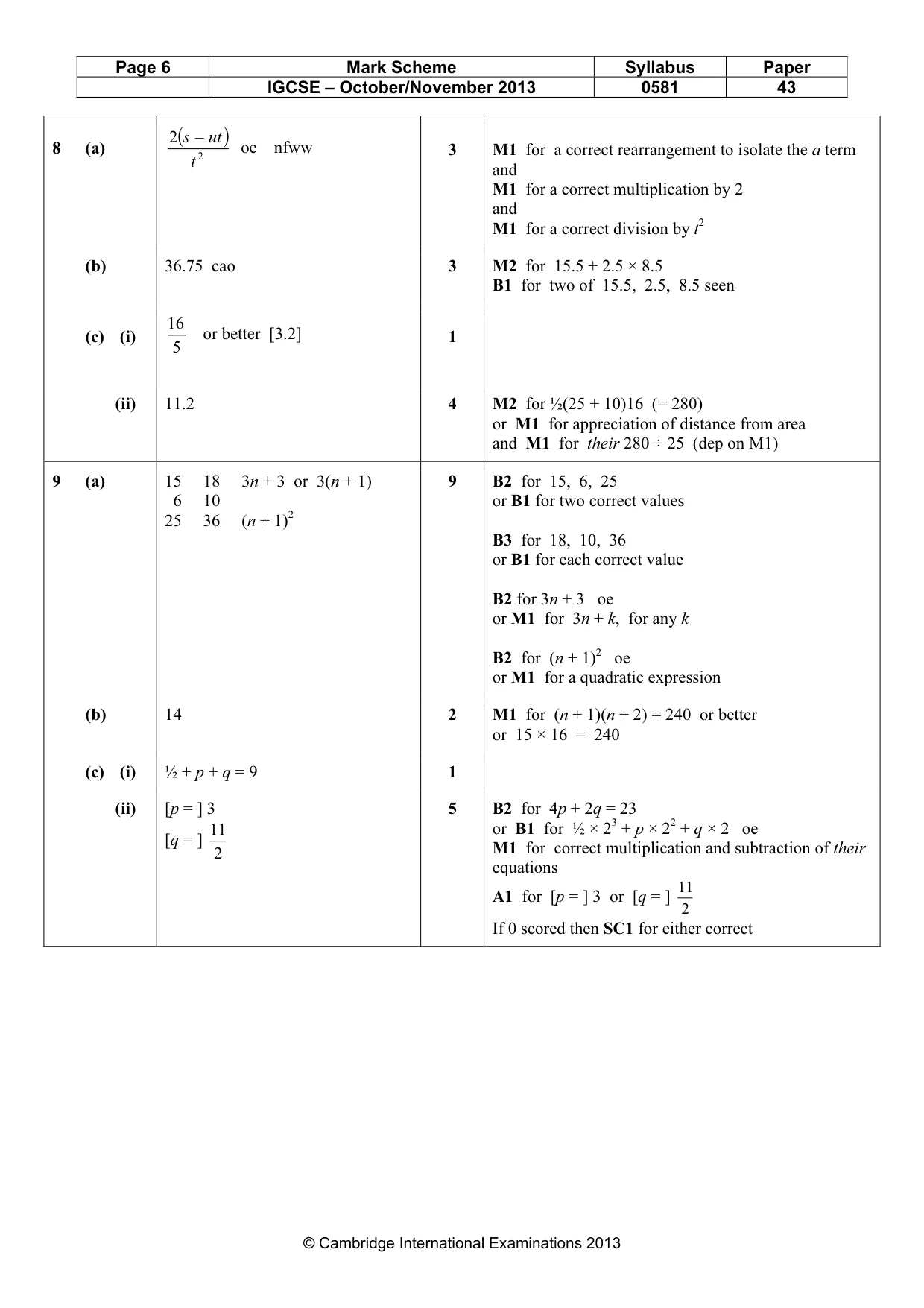
Mark scheme, page 6
Page 6 Mark Scheme Syllabus Paper IGCSE – October/November 2013 0581 43 © Cambridge International Examinations 2013 8 (a) ( ) 2 – 2 t ut s oe nfww 3 M1 for a correct rearrangement to isolate the a term and M1 for a correct multiplication by 2 and M1 for a correct division by t2 (b) 36.75 cao 3 M2 for 15.5 + 2.5 × 8.5 B1 for two of 15.5, 2.5, 8.5 seen (c) (i) 5 16 or better [3.2] 1 (ii) 11.2 4 M2 for ½(25 + 10)16 (= 280) or M1 for appreciation of distance from area and M1 for their 280 ÷ 25 (dep on M1) 9 (a) 15 18 3n + 3 or 3(n + 1) 6 10 25 36 (n + 1)2 9 B2 for 15, 6, 25 or B1 for two correct values B3 for 18, 10, 36 or B1 for each correct value B2 for 3n + 3 oe or M1 for 3n + k, for any k B2 for (n + 1)2 oe or M1 for a quadratic expression (b) 14 2 M1 for (n + 1)(n + 2) = 240 or better or 15 × 16 = 240 (c) (i) ½ + p + q = 9 1 (ii) [p = ] 3 [q = ] 2 11 5 B2 for 4p + 2q = 23 or B1 for ½ × 23 + p × 22 + q × 2 oe M1 for correct multiplication and subtraction of their equations A1 for [p = ] 3 or [q = ] 2 11 If 0 scored then SC1 for either correct
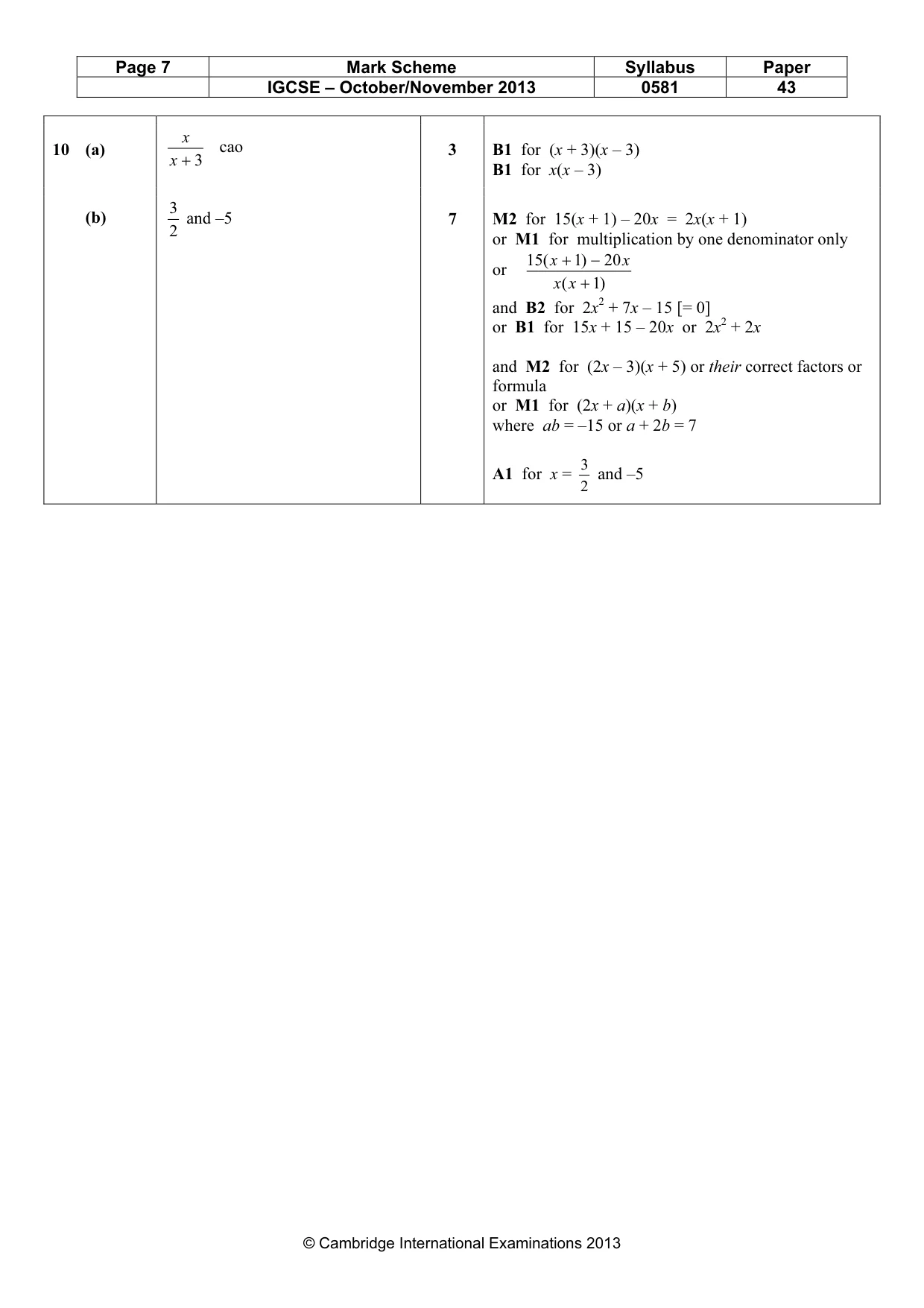
Mark scheme, page 7
Page 7 Mark Scheme Syllabus Paper IGCSE – October/November 2013 0581 43 © Cambridge International Examinations 2013 10 (a) 3 + x x cao 3 B1 for (x + 3)(x – 3) B1 for x(x – 3) (b) 2 3 and –5 7 M2 for 15(x + 1) – 20x = 2x(x + 1) or M1 for multiplication by one denominator only or )1 ( 20 )1 ( 15 + − + x x x x and B2 for 2x2 + 7x – 15 [= 0] or B1 for 15x + 15 – 20x or 2x2 + 2x and M2 for (2x – 3)(x + 5) or their correct factors or formula or M1 for (2x + a)(x + b) where ab = –15 or a + 2b = 7 A1 for x = 2 3 and –5