Cambridge IGCSE Mathematics (with coursework) 0581 — 2014 Oct/Nov Paper 4 · Variant 2
0581/42/O/N/14
The question paper and its mark scheme, free to read here and free to download. This is Cambridge’s own paper, exactly as it was sat.
Question paper20 pages
Mark scheme7 pages
Answers below. Sit the paper first if you are practising.
Paper as text
Question paper, page 1
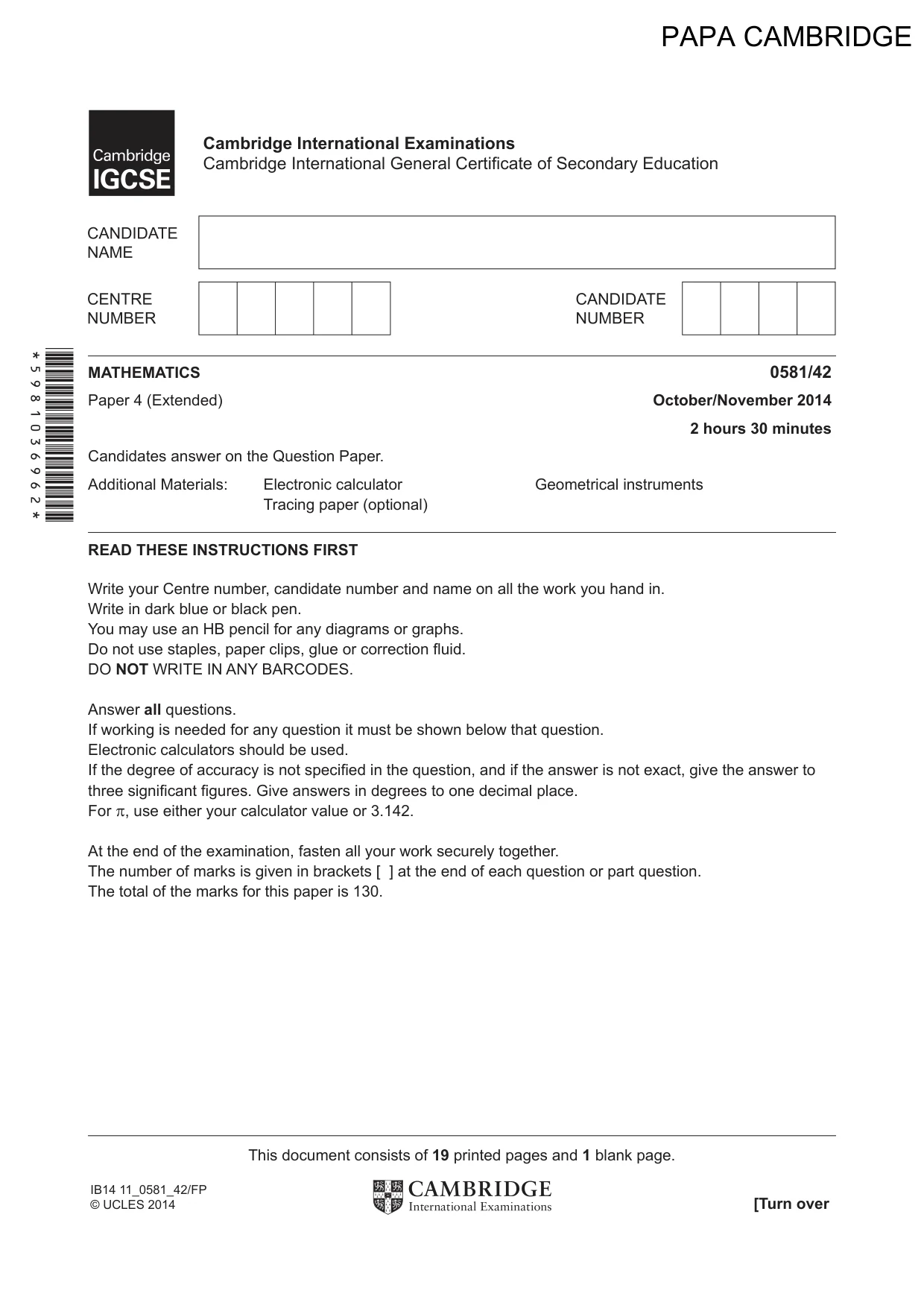
READ THESE INSTRUCTIONS FIRST Write your Centre number, candidate number and name on all the work you hand in. Write in dark blue or black pen. You may use an HB pencil for any diagrams or graphs. Do not use staples, paper clips, glue or correction fl uid. DO NOT WRITE IN ANY BARCODES. Answer all questions. If working is needed for any question it must be shown below that question. Electronic calculators should be used. If the degree of accuracy is not specifi ed in the question, and if the answer is not exact, give the answer to three signifi cant fi gures. Give answers in degrees to one decimal place. For π, use either your calculator value or 3.142. At the end of the examination, fasten all your work securely together. The number of marks is given in brackets [ ] at the end of each question or part question. The total of the marks for this paper is 130. MATHEMATICS 0581/42 Paper 4 (Extended) October/November 2014 2 hours 30 minutes Candidates answer on the Question Paper. Additional Materials: Electronic calculator Geometrical instruments Tracing paper (optional) Cambridge International Examinations Cambridge International General Certifi cate of Secondary Education This document consists of 19 printed pages and 1 blank page. [Turn over IB14 11_0581_42/FP © UCLES 2014 *5981036962* PAPA CAMBRIDGE
Question paper, page 2
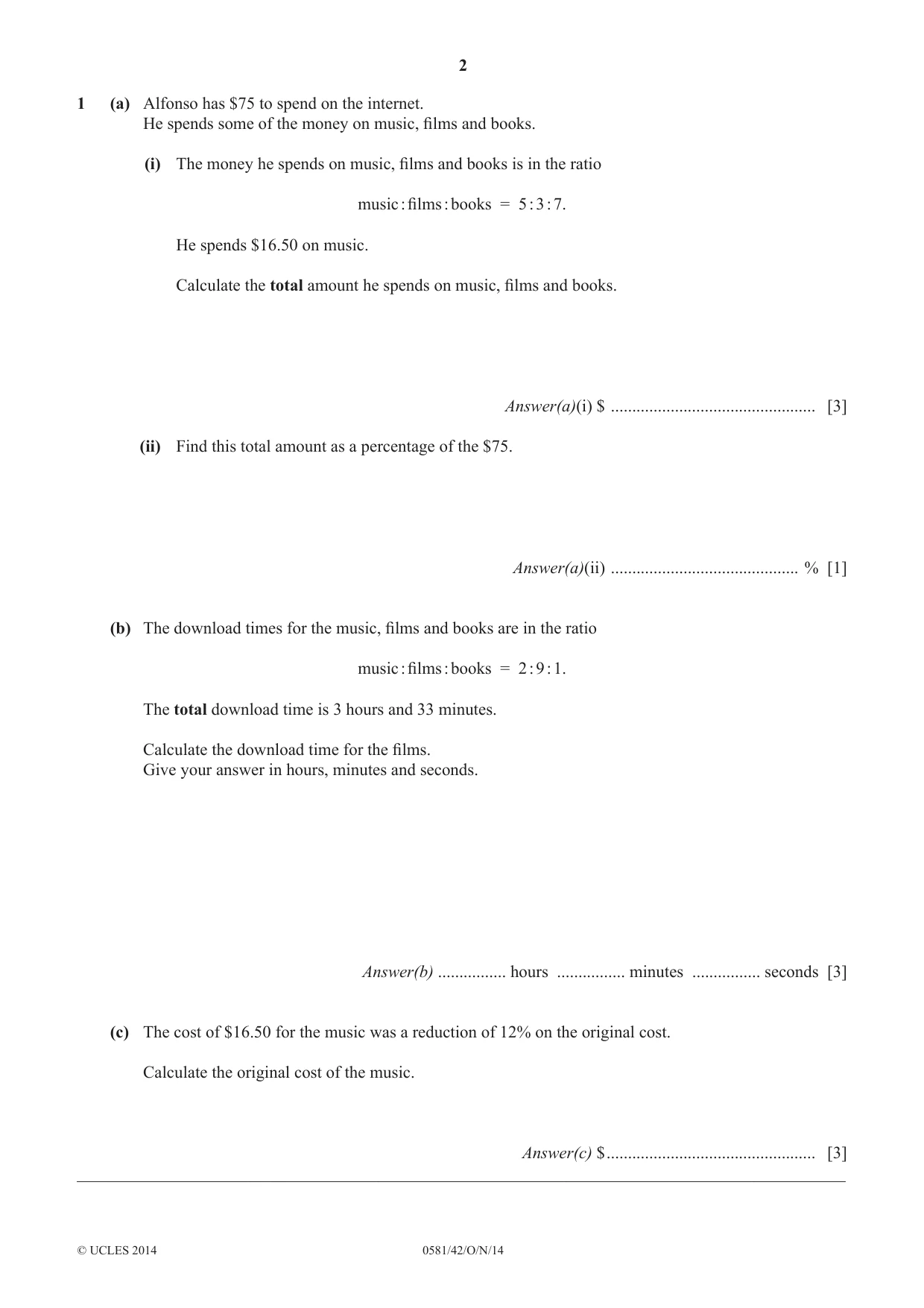
2 0581/42/O/N/14 © UCLES 2014 1 (a) Alfonso has $75 to spend on the internet. He spends some of the money on music, fi lms and books. (i) The money he spends on music, fi lms and books is in the ratio music : fi lms : books = 5 : 3 : 7. He spends $16.50 on music. Calculate the total amount he spends on music, fi lms and books. Answer(a)(i) $ … [3] (ii) Find this total amount as a percentage of the $75. Answer(a)(ii) … % [1] (b) The download times for the music, fi lms and books are in the ratio music : fi lms : books = 2 : 9 : 1. The total download time is 3 hours and 33 minutes. Calculate the download time for the fi lms. Give your answer in hours, minutes and seconds. Answer(b) … hours … minutes … seconds [3] (c) The cost of $16.50 for the music was a reduction of 12% on the original cost. Calculate the original cost of the music. Answer(c) $ … [3] __________________________________________________________________________________________
Question paper, page 3
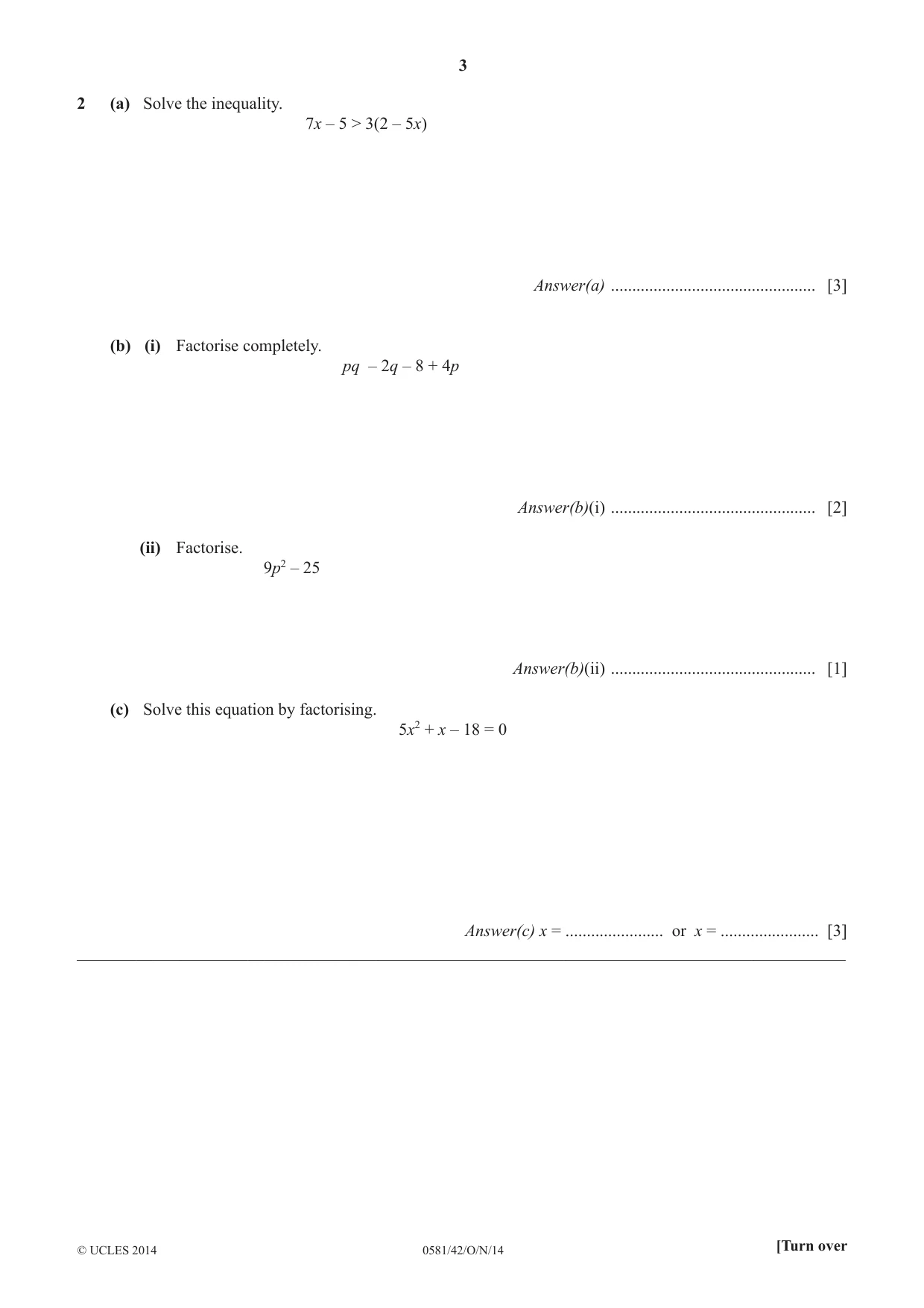
3 0581/42/O/N/14 © UCLES 2014 [Turn over 2 (a) Solve the inequality. 7x – 5 > 3(2 – 5x) Answer(a) … [3] (b) (i) Factorise completely. pq – 2q – 8 + 4p Answer(b)(i) … [2] (ii) Factorise. 9p2 – 25 Answer(b)(ii) … [1] (c) Solve this equation by factorising. 5x2 + x – 18 = 0 Answer(c) x = … or x = … [3] __________________________________________________________________________________________
Question paper, page 4
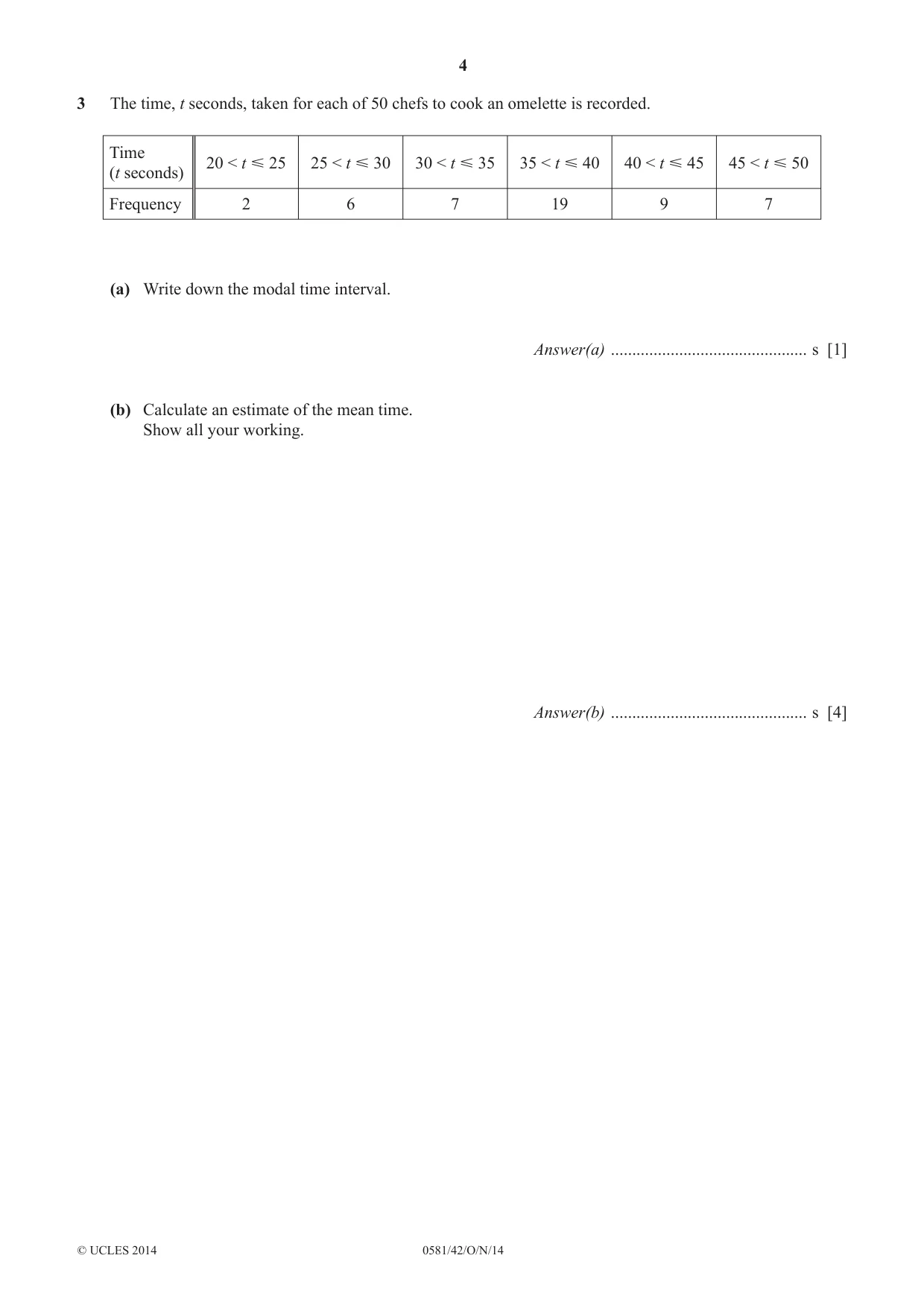
4 0581/42/O/N/14 © UCLES 2014 3 The time, t seconds, taken for each of 50 chefs to cook an omelette is recorded. Time (t seconds) 20 < t Y 25 25 < t Y 30 30 < t Y 35 35 < t Y 40 40 < t Y 45 45 < t Y 50 Frequency 2 6 7 19 9 7 (a) Write down the modal time interval. Answer(a) … s [1] (b) Calculate an estimate of the mean time. Show all your working. Answer(b) … s [4]
Question paper, page 5
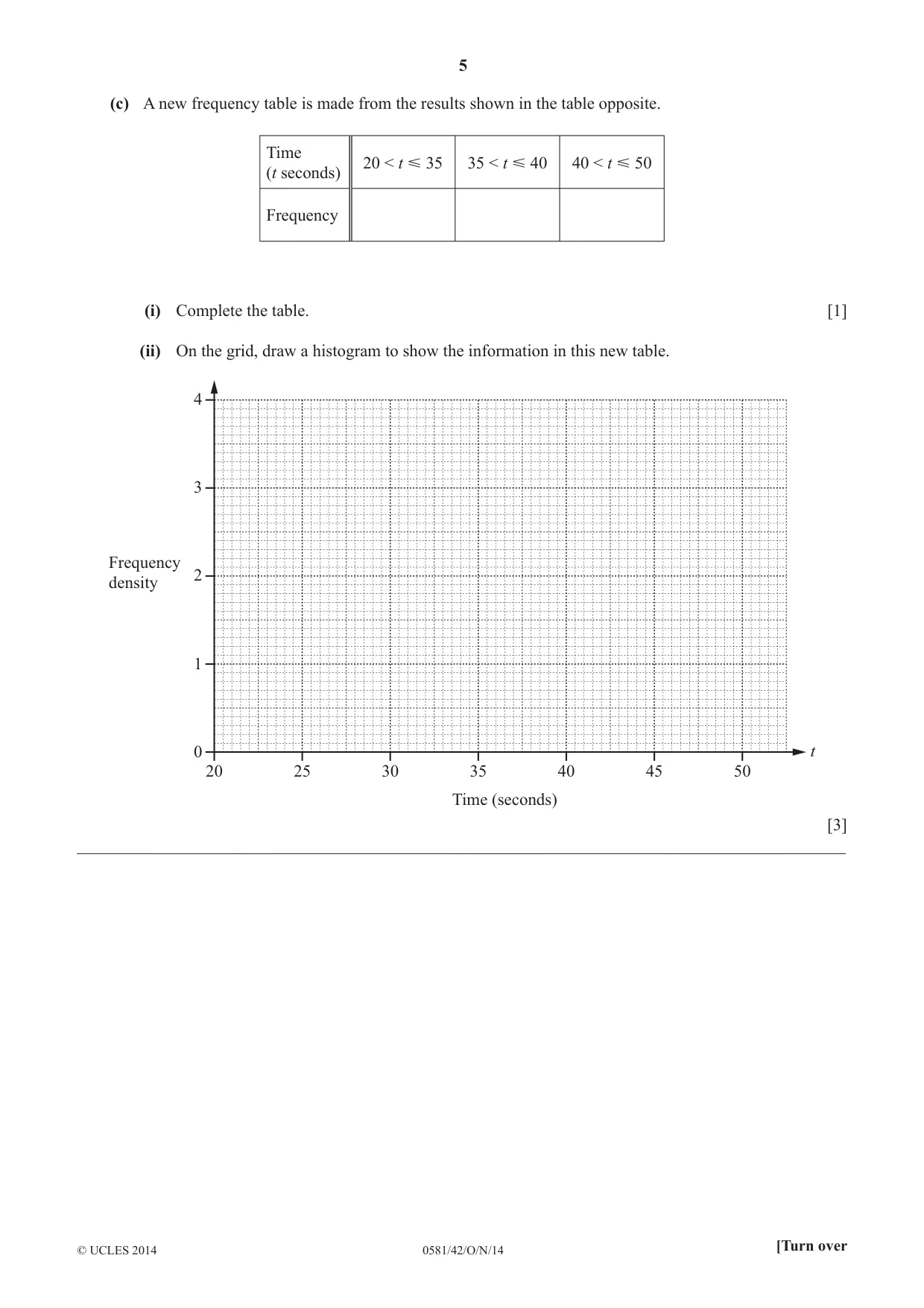
5 0581/42/O/N/14 © UCLES 2014 [Turn over (c) A new frequency table is made from the results shown in the table opposite. Time (t seconds) 20 < t Y 35 35 < t Y 40 40 < t Y 50 Frequency (i) Complete the table. [1] (ii) On the grid, draw a histogram to show the information in this new table. 4 3 2 1 0 20 25 30 35 Time (seconds) 40 45 50 t Frequency density [3] __________________________________________________________________________________________
Question paper, page 6
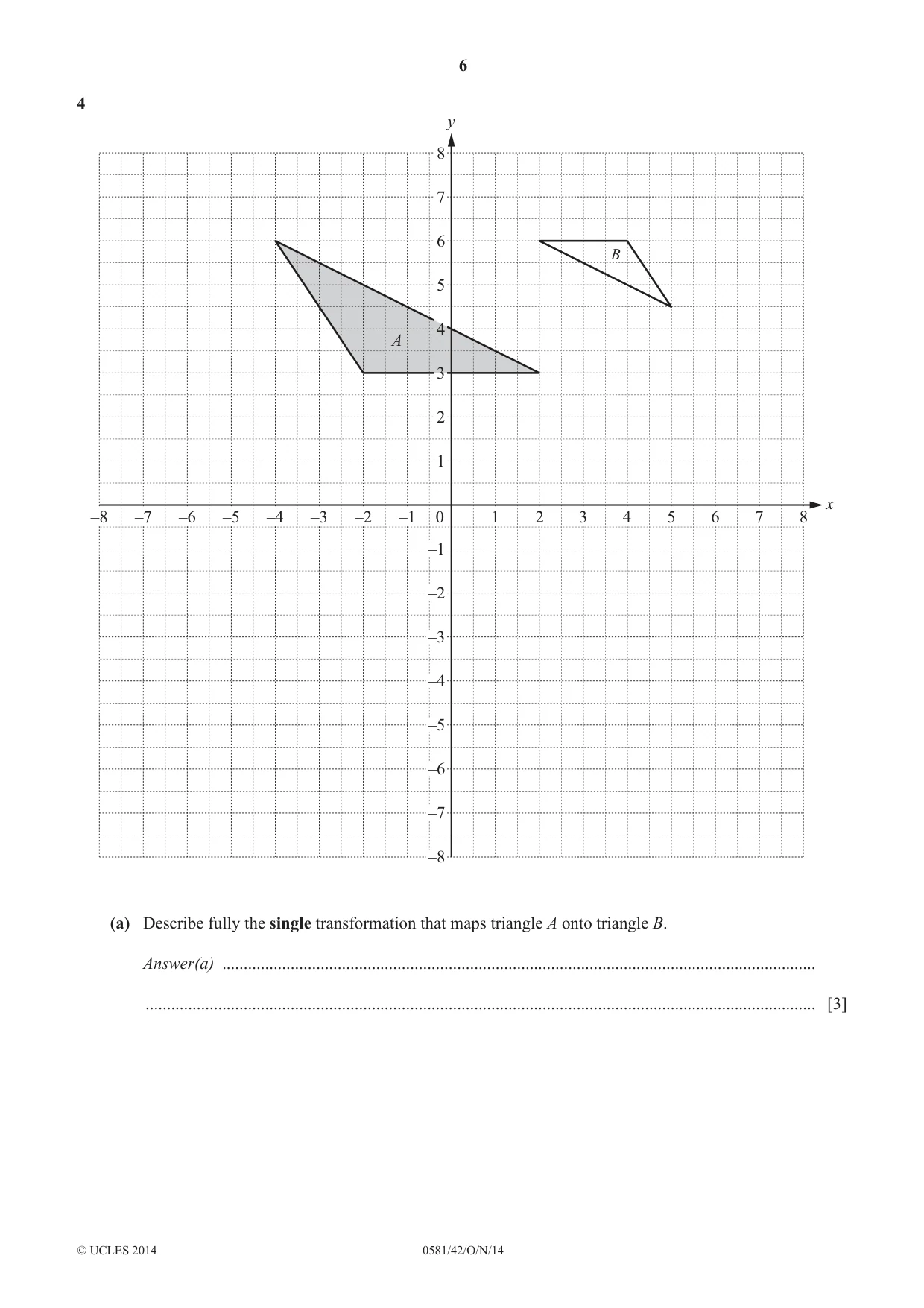
6 0581/42/O/N/14 © UCLES 2014 4 A B y x 8 7 6 5 4 3 2 1 –1 –2 –3 –4 –5 –6 –7 –8 0 –2 2 4 6 8 –4 –6 –7 –5 –3 –1 1 3 5 7 –8 (a) Describe fully the single transformation that maps triangle A onto triangle B. Answer(a) … … [3]
Question paper, page 7
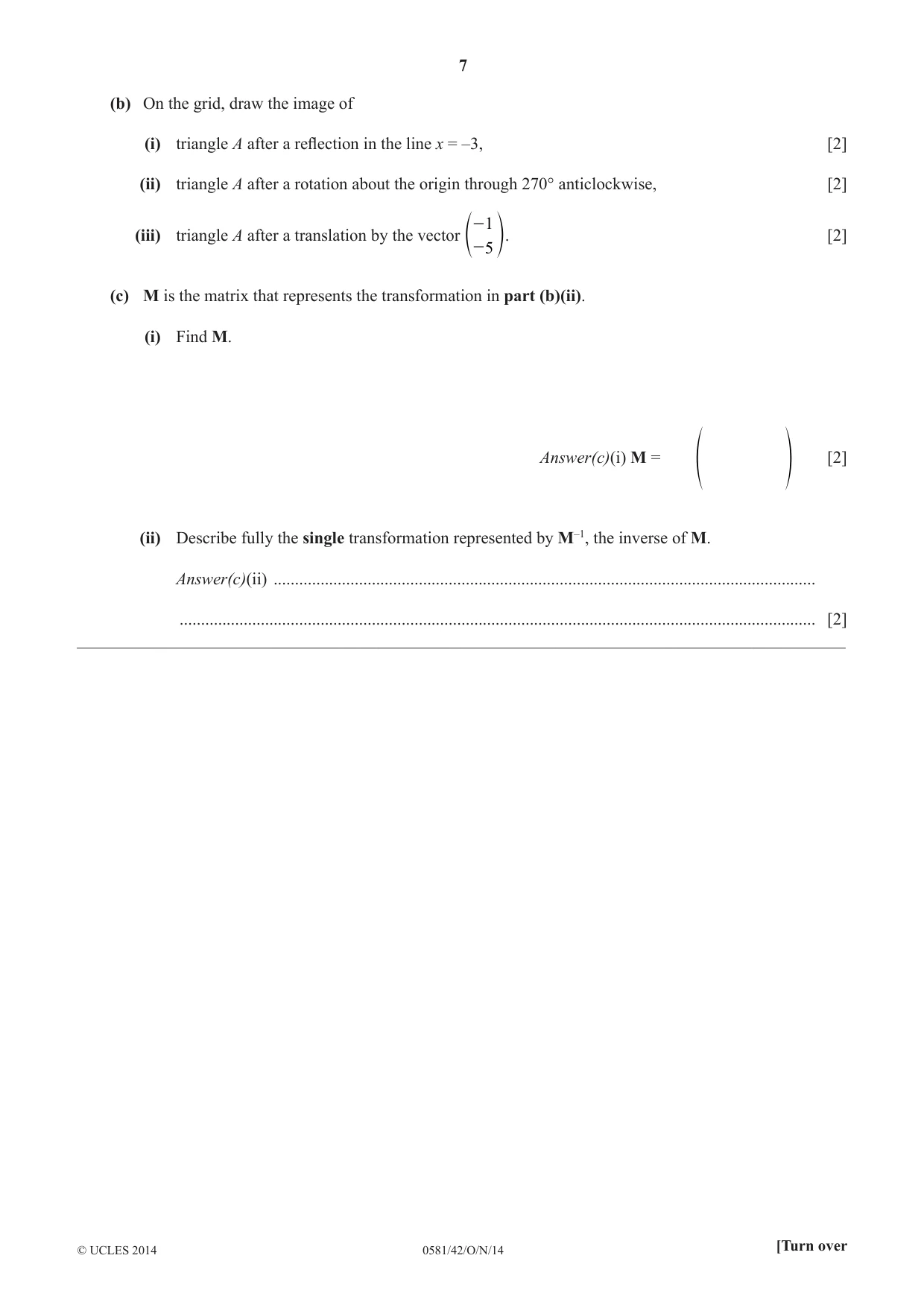
7 0581/42/O/N/14 © UCLES 2014 [Turn over (b) On the grid, draw the image of (i) triangle A after a refl ection in the line x = –3, [2] (ii) triangle A after a rotation about the origin through 270° anticlockwise, [2] (iii) triangle A after a translation by the vector 1 5 - - e o. [2] (c) M is the matrix that represents the transformation in part (b)(ii). (i) Find M. Answer(c)(i) M = f p [2] (ii) Describe fully the single transformation represented by M–1, the inverse of M. Answer(c)(ii) … … [2] __________________________________________________________________________________________
Question paper, page 8
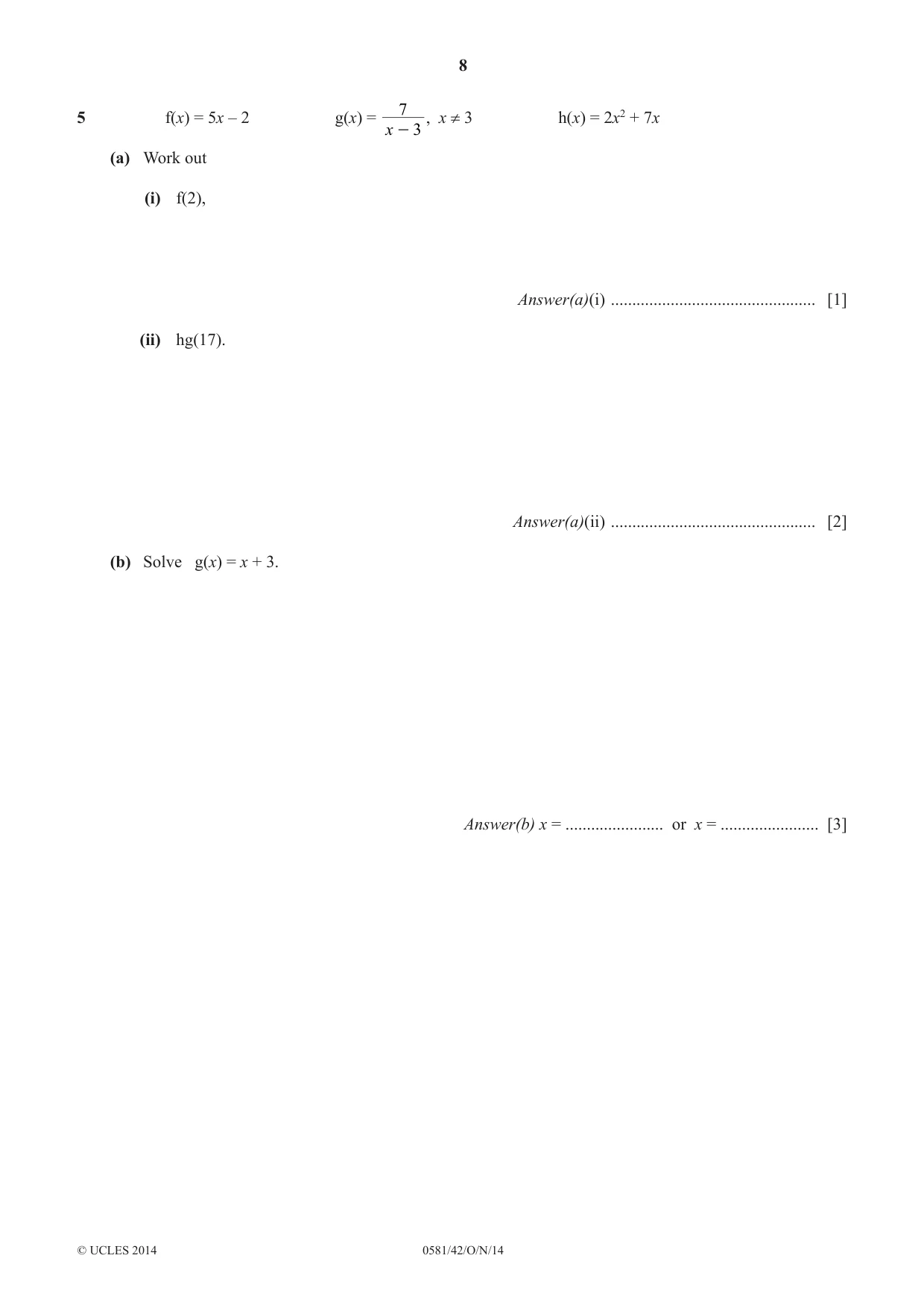
8 0581/42/O/N/14 © UCLES 2014 5 f(x) = 5x – 2 g(x) = 3 x 7 - , x ≠ 3 h(x) = 2x2 + 7x (a) Work out (i) f(2), Answer(a)(i) … [1] (ii) hg(17). Answer(a)(ii) … [2] (b) Solve g(x) = x + 3. Answer(b) x = … or x = … [3]
Question paper, page 9
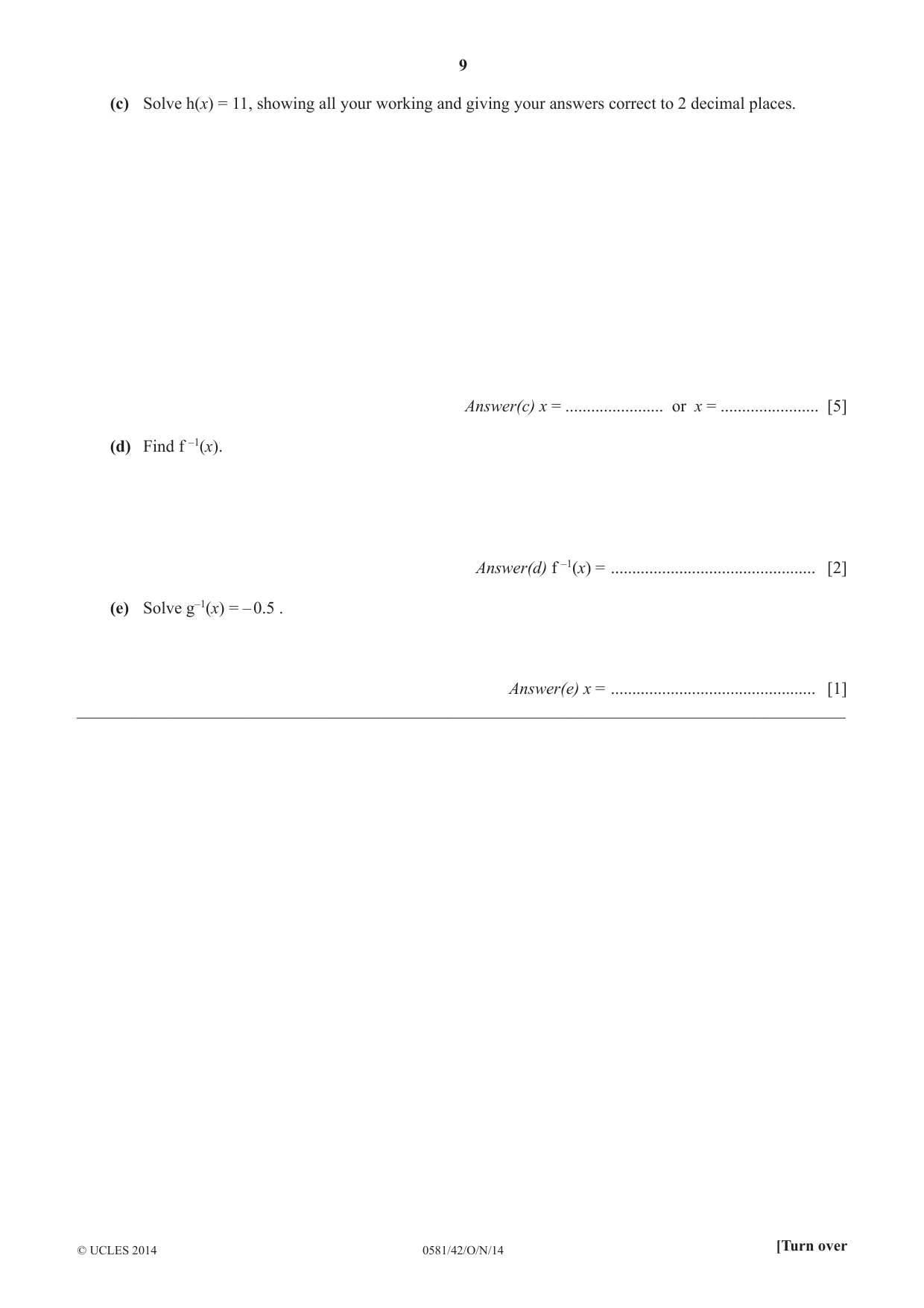
9 0581/42/O/N/14 © UCLES 2014 [Turn over (c) Solve h(x) = 11, showing all your working and giving your answers correct to 2 decimal places. Answer(c) x = … or x = … [5] (d) Find f –1(x). Answer(d) f –1(x) = … [2] (e) Solve g–1(x) = – 0.5 . Answer(e) x = … [1] __________________________________________________________________________________________
Question paper, page 10
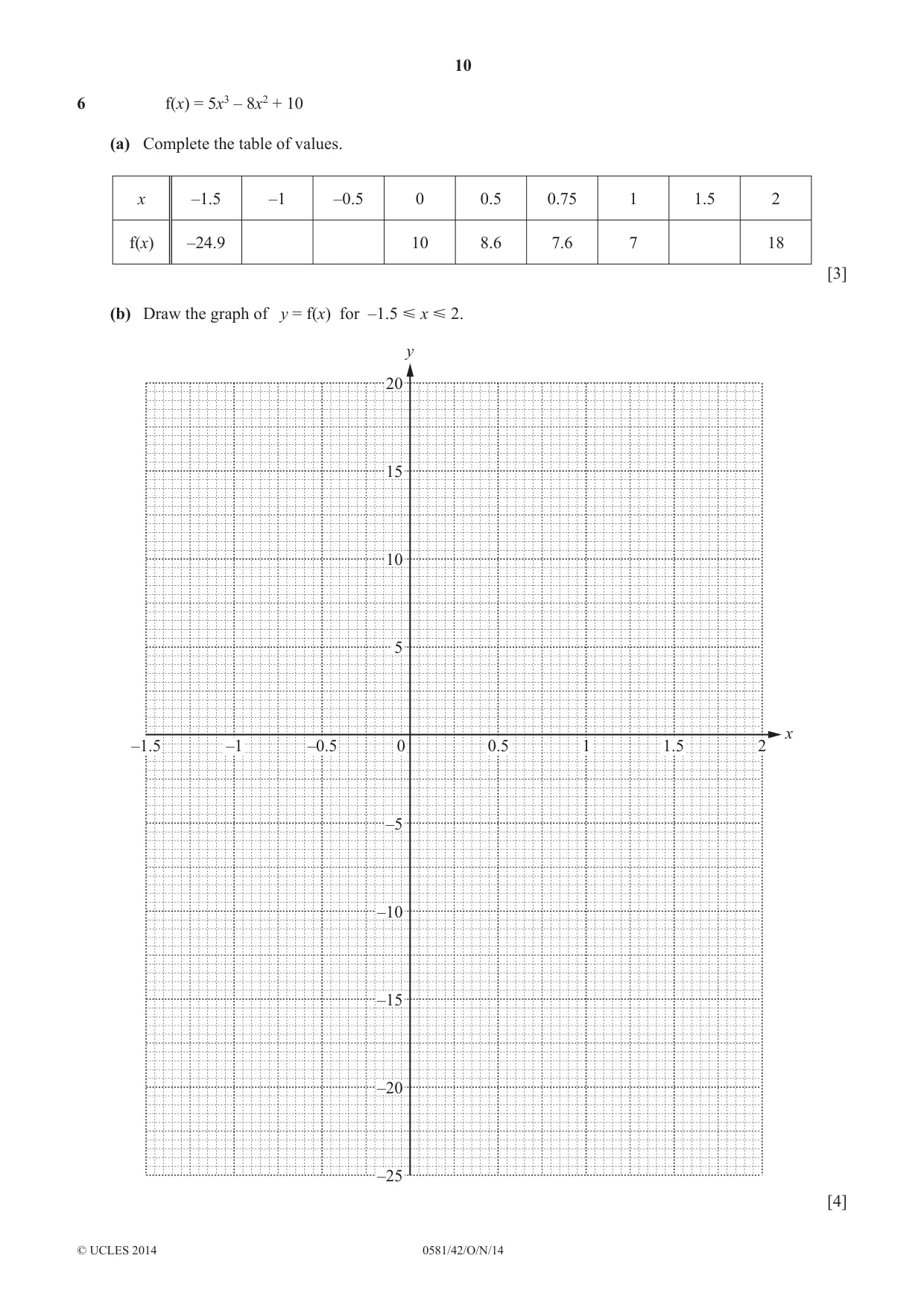
10 0581/42/O/N/14 © UCLES 2014 6 f(x) = 5x3 – 8x2 + 10 (a) Complete the table of values. x –1.5 –1 –0.5 0 0.5 0.75 1 1.5 2 f(x) –24.9 10 8.6 7.6 7 18 [3] (b) Draw the graph of y = f(x) for –1.5 Y x Y 2. y x 20 15 10 5 –5 –10 –15 –20 –25 0 –0.5 –1 –1.5 1.5 2 1 0.5 [4]
Question paper, page 11
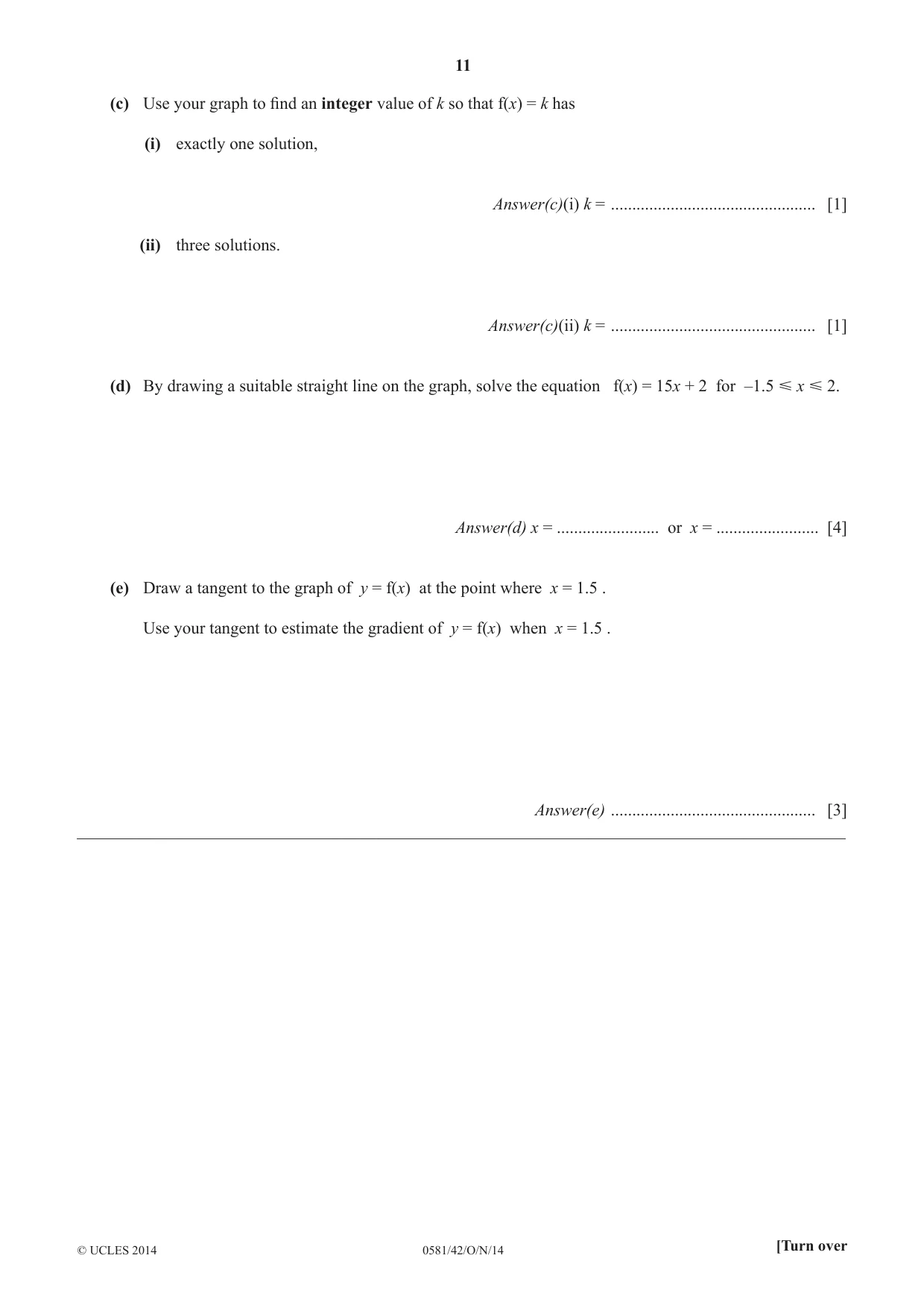
11 0581/42/O/N/14 © UCLES 2014 [Turn over (c) Use your graph to fi nd an integer value of k so that f(x) = k has (i) exactly one solution, Answer(c)(i) k = … [1] (ii) three solutions. Answer(c)(ii) k = … [1] (d) By drawing a suitable straight line on the graph, solve the equation f(x) = 15x + 2 for –1.5 Y x Y 2. Answer(d) x = … or x = … [4] (e) Draw a tangent to the graph of y = f(x) at the point where x = 1.5 . Use your tangent to estimate the gradient of y = f(x) when x = 1.5 . Answer(e) … [3] __________________________________________________________________________________________
Question paper, page 12
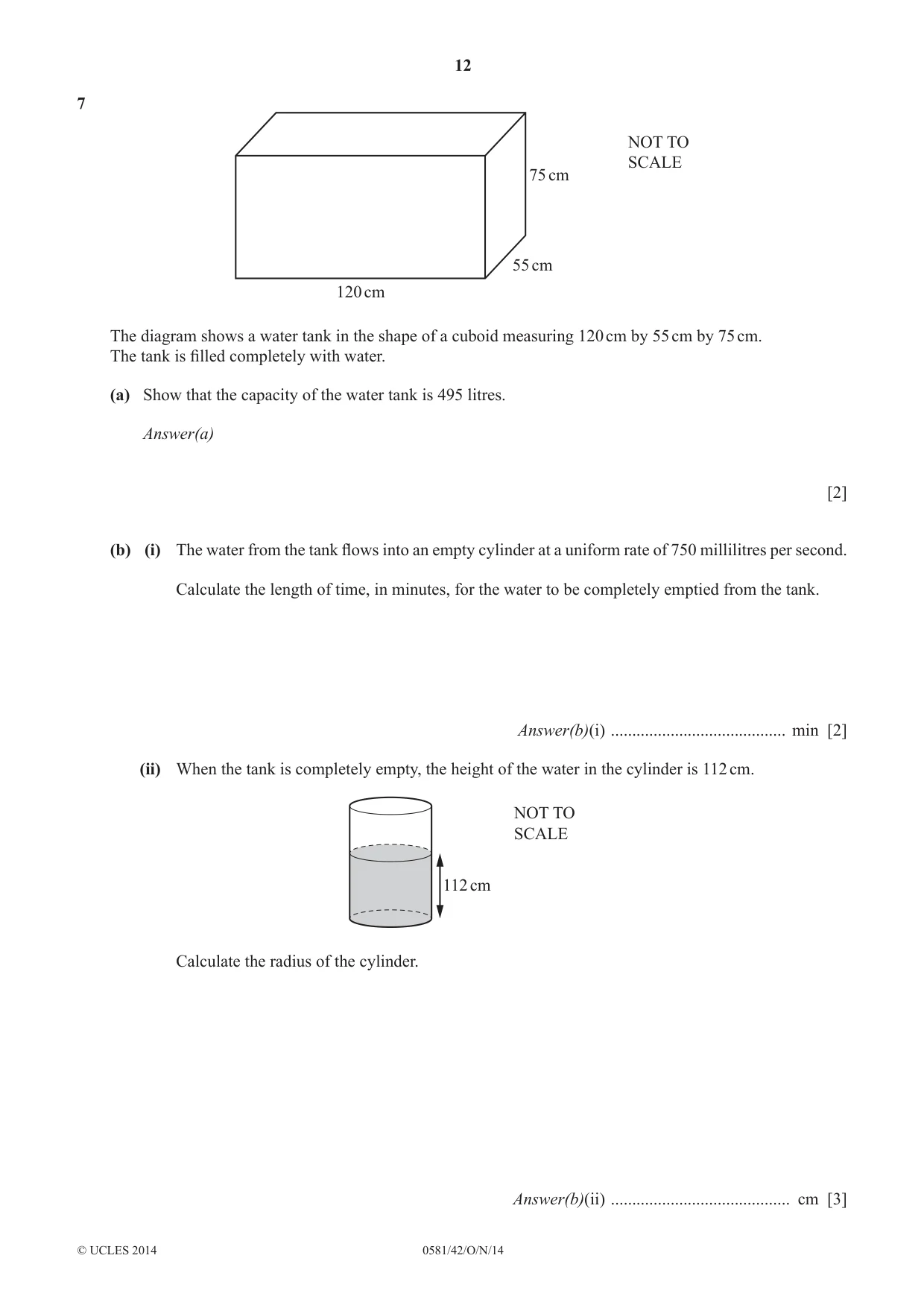
12 0581/42/O/N/14 © UCLES 2014 7 120 cm 55 cm 75 cm NOT TO SCALE The diagram shows a water tank in the shape of a cuboid measuring 120 cm by 55 cm by 75 cm. The tank is fi lled completely with water. (a) Show that the capacity of the water tank is 495 litres. Answer(a) [2] (b) (i) The water from the tank fl ows into an empty cylinder at a uniform rate of 750 millilitres per second. Calculate the length of time, in minutes, for the water to be completely emptied from the tank. Answer(b)(i) … min [2] (ii) When the tank is completely empty, the height of the water in the cylinder is 112 cm. 112 cm NOT TO SCALE Calculate the radius of the cylinder. Answer(b)(ii) … cm [3]
Question paper, page 13
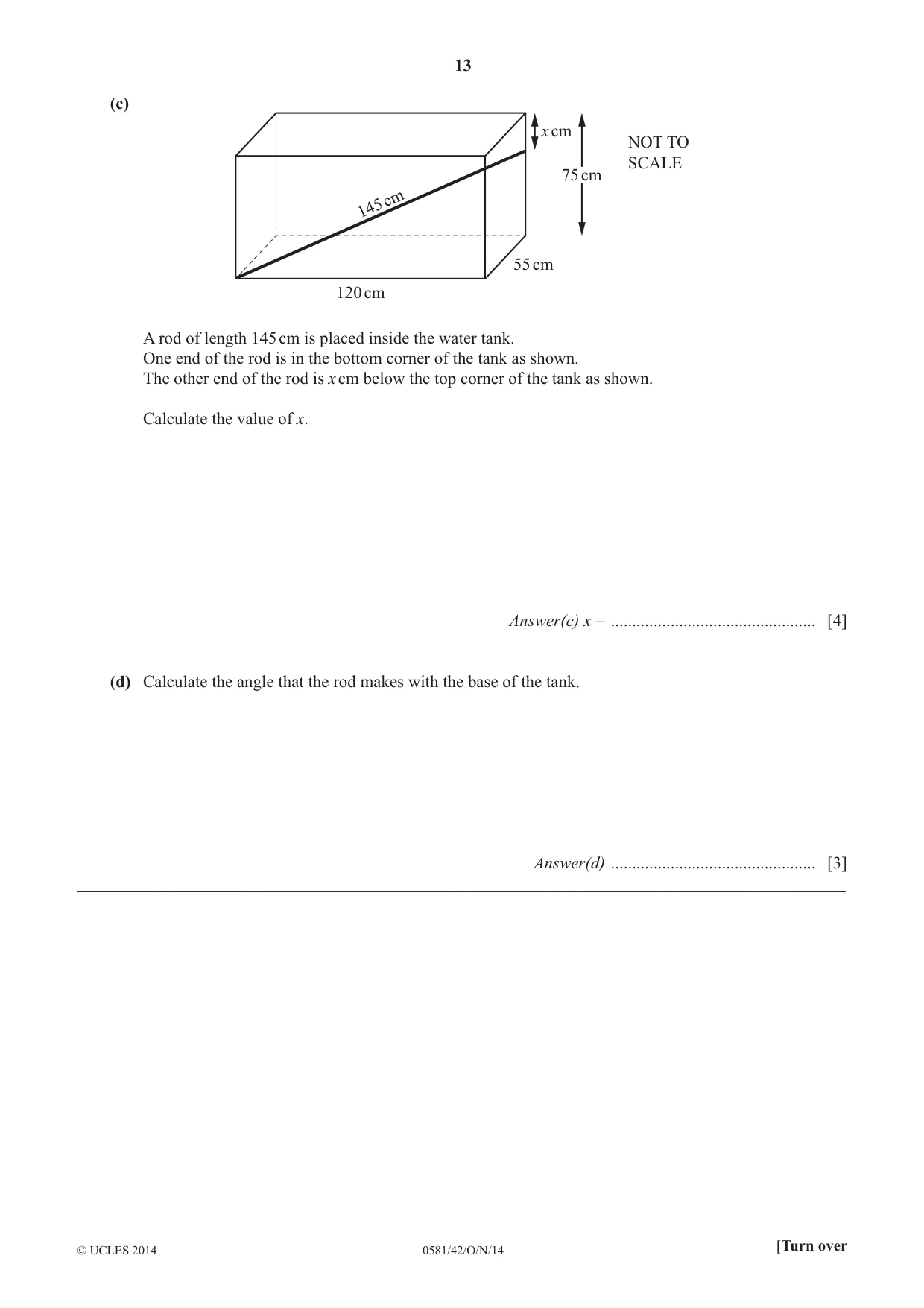
13 0581/42/O/N/14 © UCLES 2014 [Turn over (c) 120 cm 145 cm 55 cm x cm 75 cm NOT TO SCALE A rod of length 145 cm is placed inside the water tank. One end of the rod is in the bottom corner of the tank as shown. The other end of the rod is x cm below the top corner of the tank as shown. Calculate the value of x. Answer(c) x = … [4] (d) Calculate the angle that the rod makes with the base of the tank. Answer(d) … [3] __________________________________________________________________________________________
Question paper, page 14
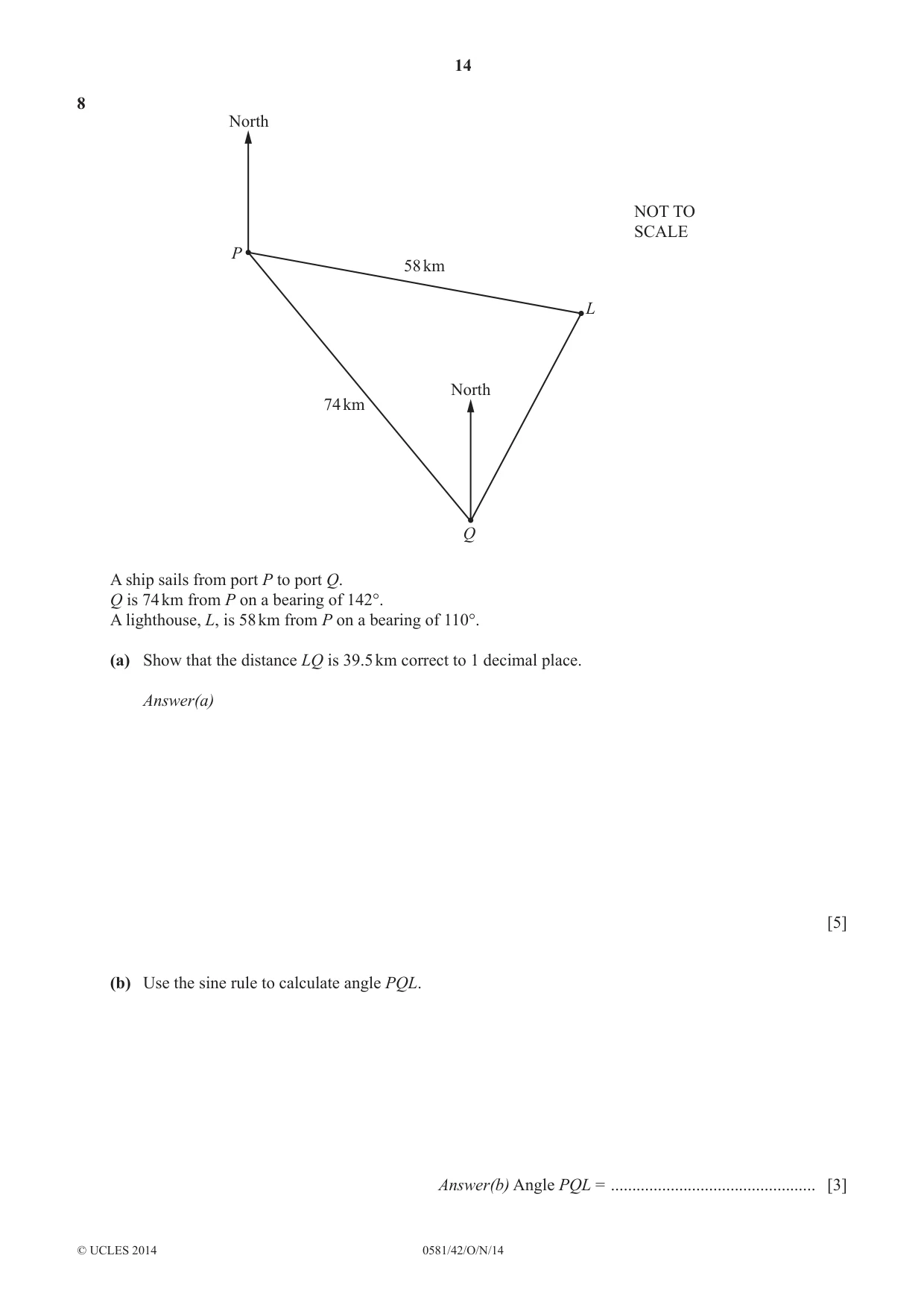
14 0581/42/O/N/14 © UCLES 2014 8 P Q L 58 km 74 km NOT TO SCALE North North A ship sails from port P to port Q. Q is 74 km from P on a bearing of 142°. A lighthouse, L, is 58 km from P on a bearing of 110°. (a) Show that the distance LQ is 39.5 km correct to 1 decimal place. Answer(a) [5] (b) Use the sine rule to calculate angle PQL. Answer(b) Angle PQL = … [3]
Question paper, page 15
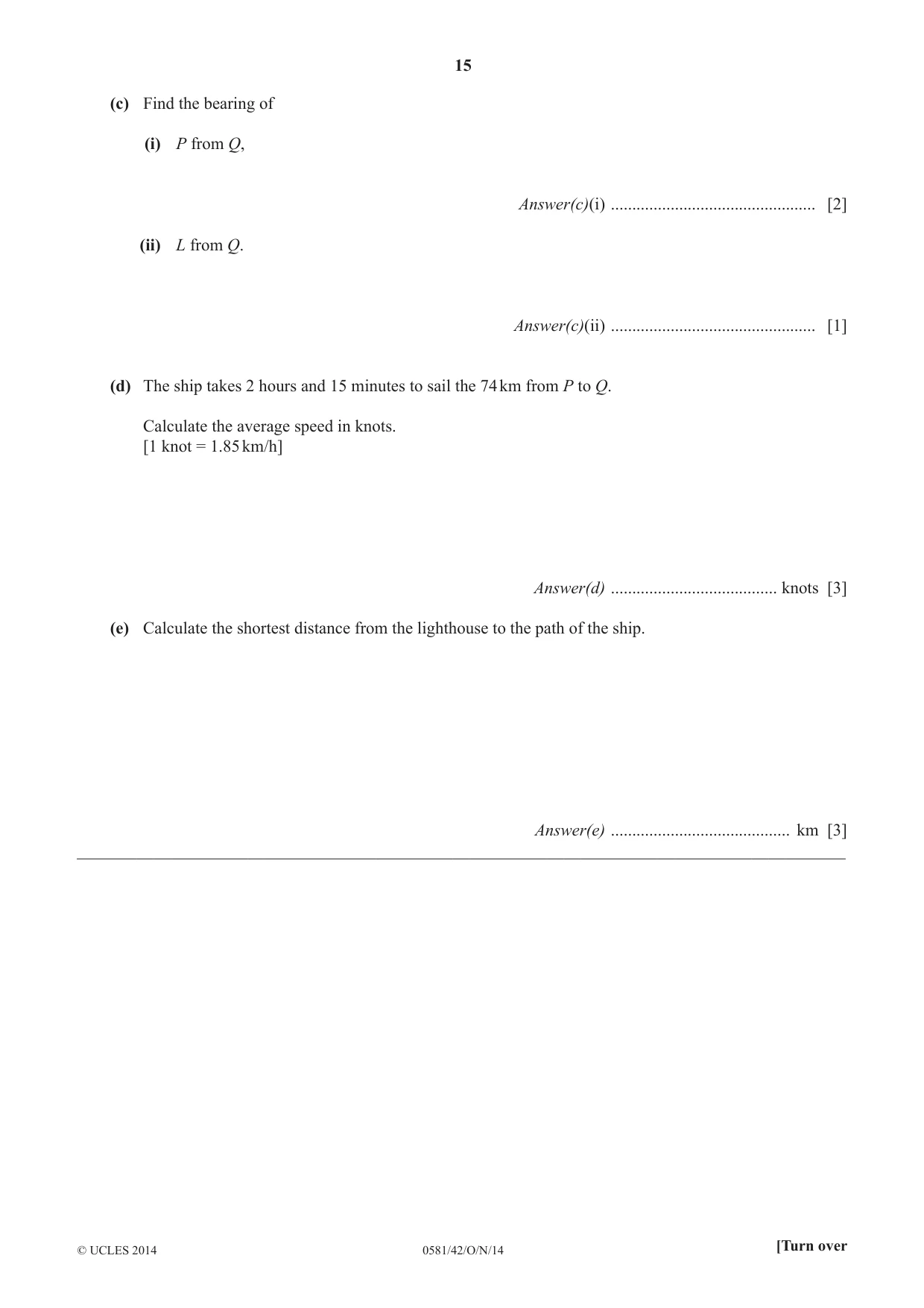
15 0581/42/O/N/14 © UCLES 2014 [Turn over (c) Find the bearing of (i) P from Q, Answer(c)(i) … [2] (ii) L from Q. Answer(c)(ii) … [1] (d) The ship takes 2 hours and 15 minutes to sail the 74 km from P to Q. Calculate the average speed in knots. [1 knot = 1.85 km/h] Answer(d) … knots [3] (e) Calculate the shortest distance from the lighthouse to the path of the ship. Answer(e) … km [3] __________________________________________________________________________________________
Question paper, page 16
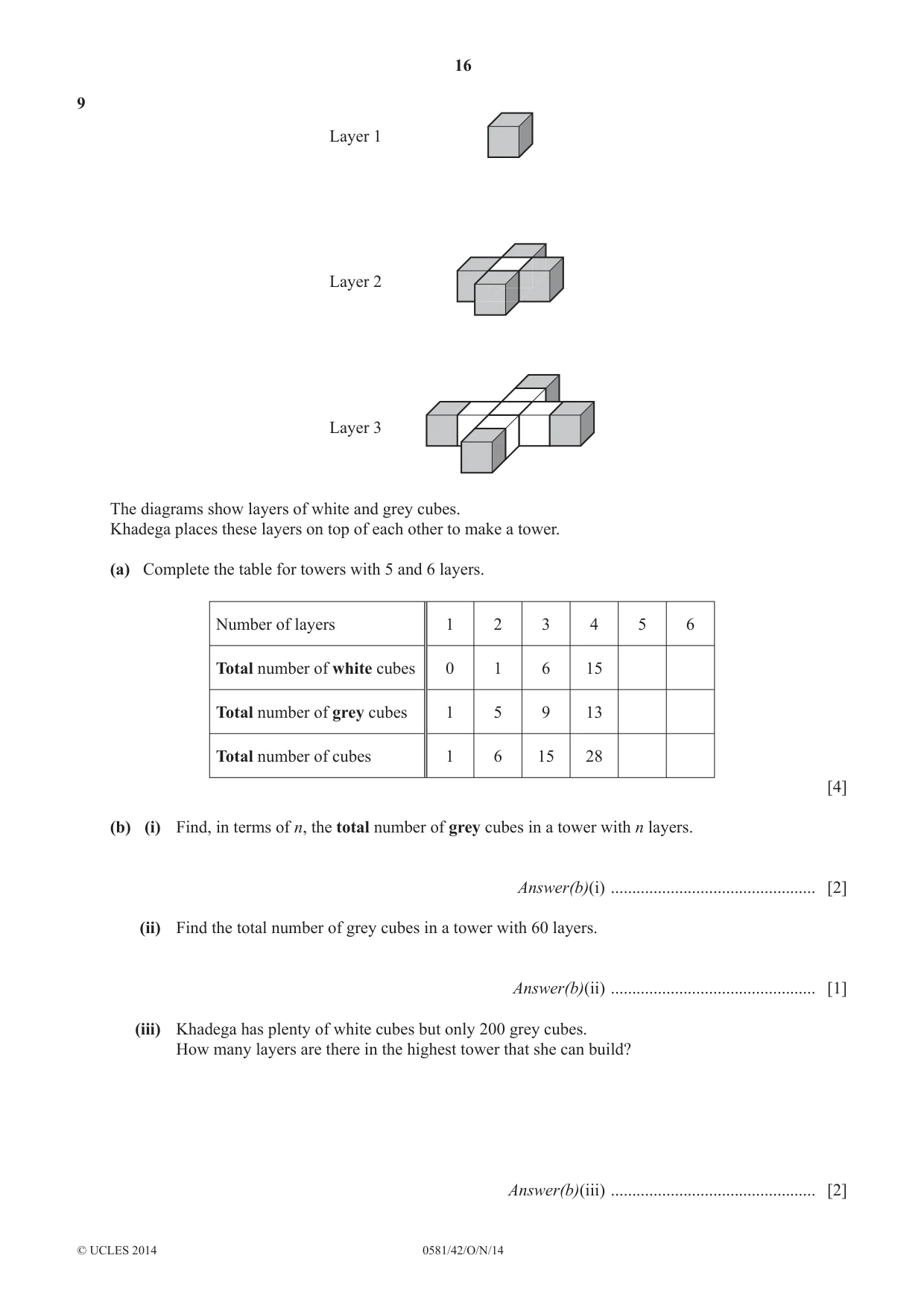
16 0581/42/O/N/14 © UCLES 2014 9 Layer 1 Layer 2 Layer 3 The diagrams show layers of white and grey cubes. Khadega places these layers on top of each other to make a tower. (a) Complete the table for towers with 5 and 6 layers. Number of layers 1 2 3 4 5 6 Total number of white cubes 0 1 6 15 Total number of grey cubes 1 5 9 13 Total number of cubes 1 6 15 28 [4] (b) (i) Find, in terms of n, the total number of grey cubes in a tower with n layers. Answer(b)(i) … [2] (ii) Find the total number of grey cubes in a tower with 60 layers. Answer(b)(ii) … [1] (iii) Khadega has plenty of white cubes but only 200 grey cubes. How many layers are there in the highest tower that she can build? Answer(b)(iii) … [2]
Question paper, page 17
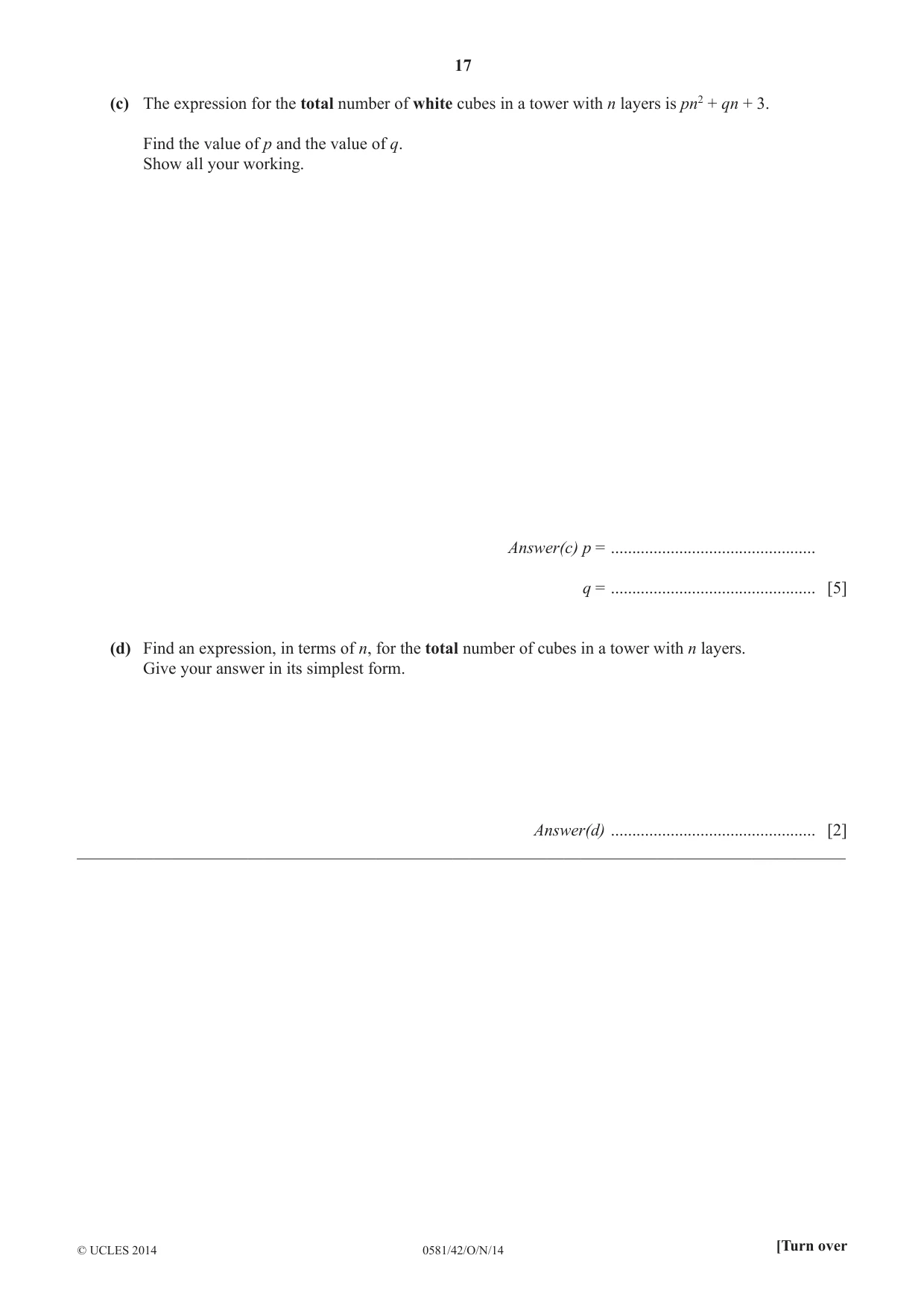
17 0581/42/O/N/14 © UCLES 2014 [Turn over (c) The expression for the total number of white cubes in a tower with n layers is pn2 + qn + 3. Find the value of p and the value of q. Show all your working. Answer(c) p = … q = … [5] (d) Find an expression, in terms of n, for the total number of cubes in a tower with n layers. Give your answer in its simplest form. Answer(d) … [2] __________________________________________________________________________________________
Question paper, page 18
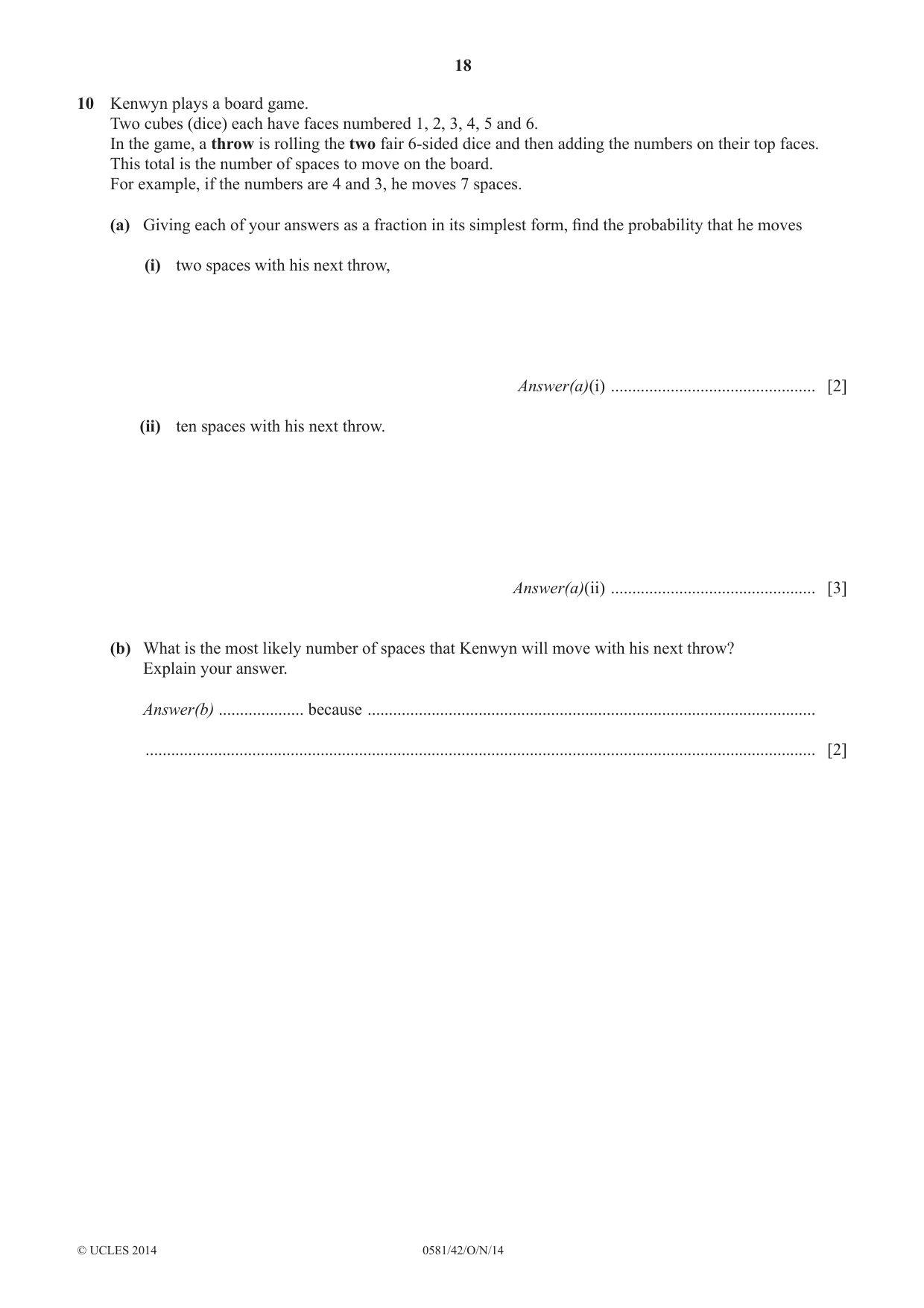
18 0581/42/O/N/14 © UCLES 2014 10 Kenwyn plays a board game. Two cubes (dice) each have faces numbered 1, 2, 3, 4, 5 and 6. In the game, a throw is rolling the two fair 6-sided dice and then adding the numbers on their top faces. This total is the number of spaces to move on the board. For example, if the numbers are 4 and 3, he moves 7 spaces. (a) Giving each of your answers as a fraction in its simplest form, fi nd the probability that he moves (i) two spaces with his next throw, Answer(a)(i) … [2] (ii) ten spaces with his next throw. Answer(a)(ii) … [3] (b) What is the most likely number of spaces that Kenwyn will move with his next throw? Explain your answer. Answer(b) … because … … [2]
Question paper, page 19
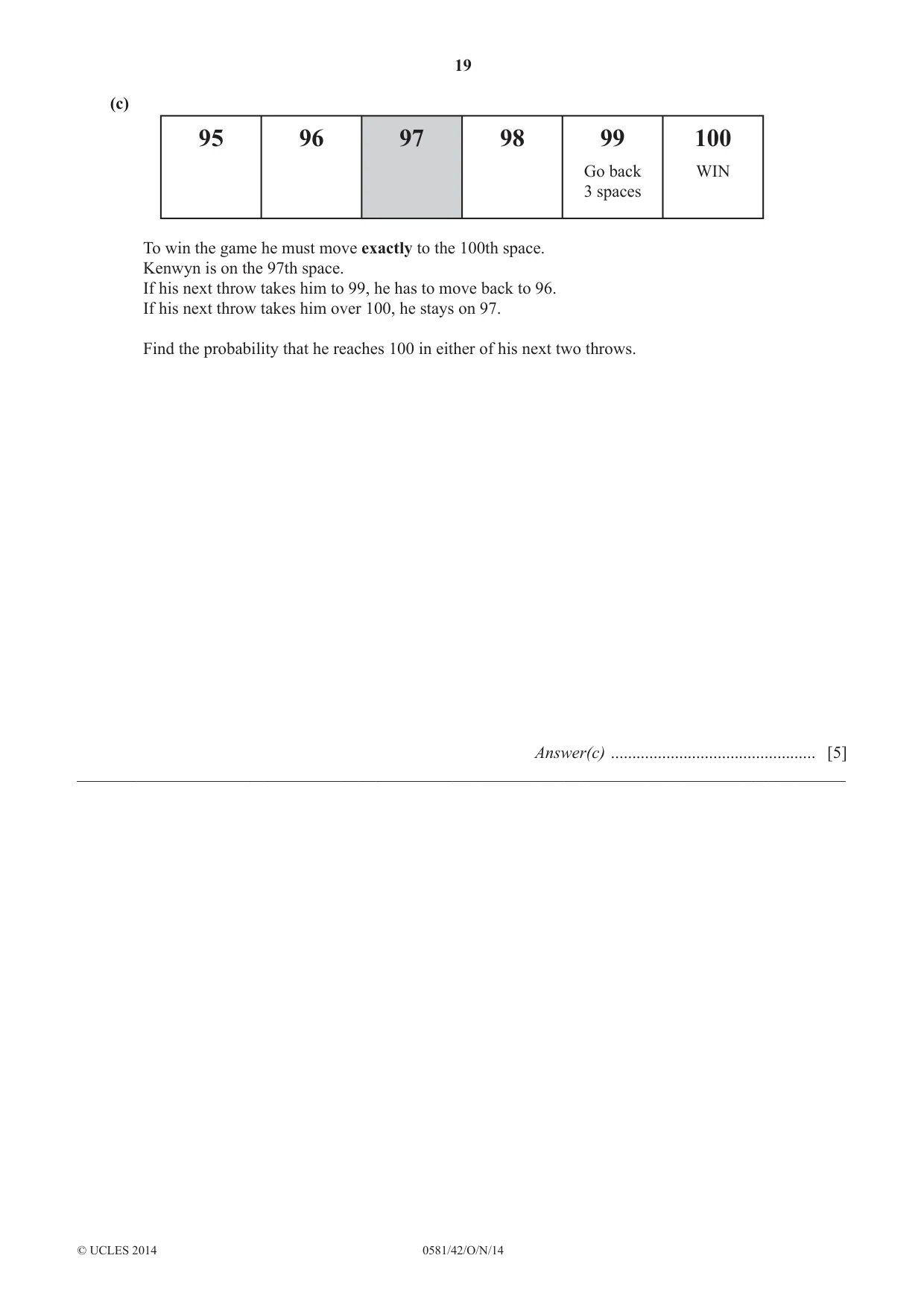
19 0581/42/O/N/14 © UCLES 2014 [Turn over (c) 95 96 97 98 99 Go back 3 spaces 100 WIN To win the game he must move exactly to the 100th space. Kenwyn is on the 97th space. If his next throw takes him to 99, he has to move back to 96. If his next throw takes him over 100, he stays on 97. Find the probability that he reaches 100 in either of his next two throws. Answer(c) … [5] __________________________________________________________________________________________
Question paper, page 20
20 0581/42/O/N/14 © UCLES 2014 BLANK PAGE Permission to reproduce items where third-party owned material protected by copyright is included has been sought and cleared where possible. Every reasonable effort has been made by the publisher (UCLES) to trace copyright holders, but if any items requiring clearance have unwittingly been included the publisher will be pleased to make amends at the earliest possible opportunity. Cambridge International Examinations is part of the Cambridge Assessment Group. Cambridge Assessment is the brand name of University of Cambridge Local Examinations Syndicate (UCLES), which is itself a department of the University of Cambridge.
Mark scheme, page 1
® IGCSE is the registered trademark of Cambridge International Examinations. CAMBRIDGE INTERNATIONAL EXAMINATIONS Cambridge International General Certificate of Secondary Education MARK SCHEME for the October/November 2014 series 0581 MATHEMATICS 0581/42 Paper 4 – Extended, maximum raw mark 130 This mark scheme is published as an aid to teachers and candidates, to indicate the requirements of the examination. It shows the basis on which Examiners were instructed to award marks. It does not indicate the details of the discussions that took place at an Examiners’ meeting before marking began, which would have considered the acceptability of alternative answers. Mark schemes should be read in conjunction with the question paper and the Principal Examiner Report for Teachers. Cambridge will not enter into discussions about these mark schemes. Cambridge is publishing the mark schemes for the October/November 2014 series for most Cambridge IGCSE®, Cambridge International A and AS Level components and some Cambridge O Level components. PAPA CAMBRIDGE
Mark scheme, page 2
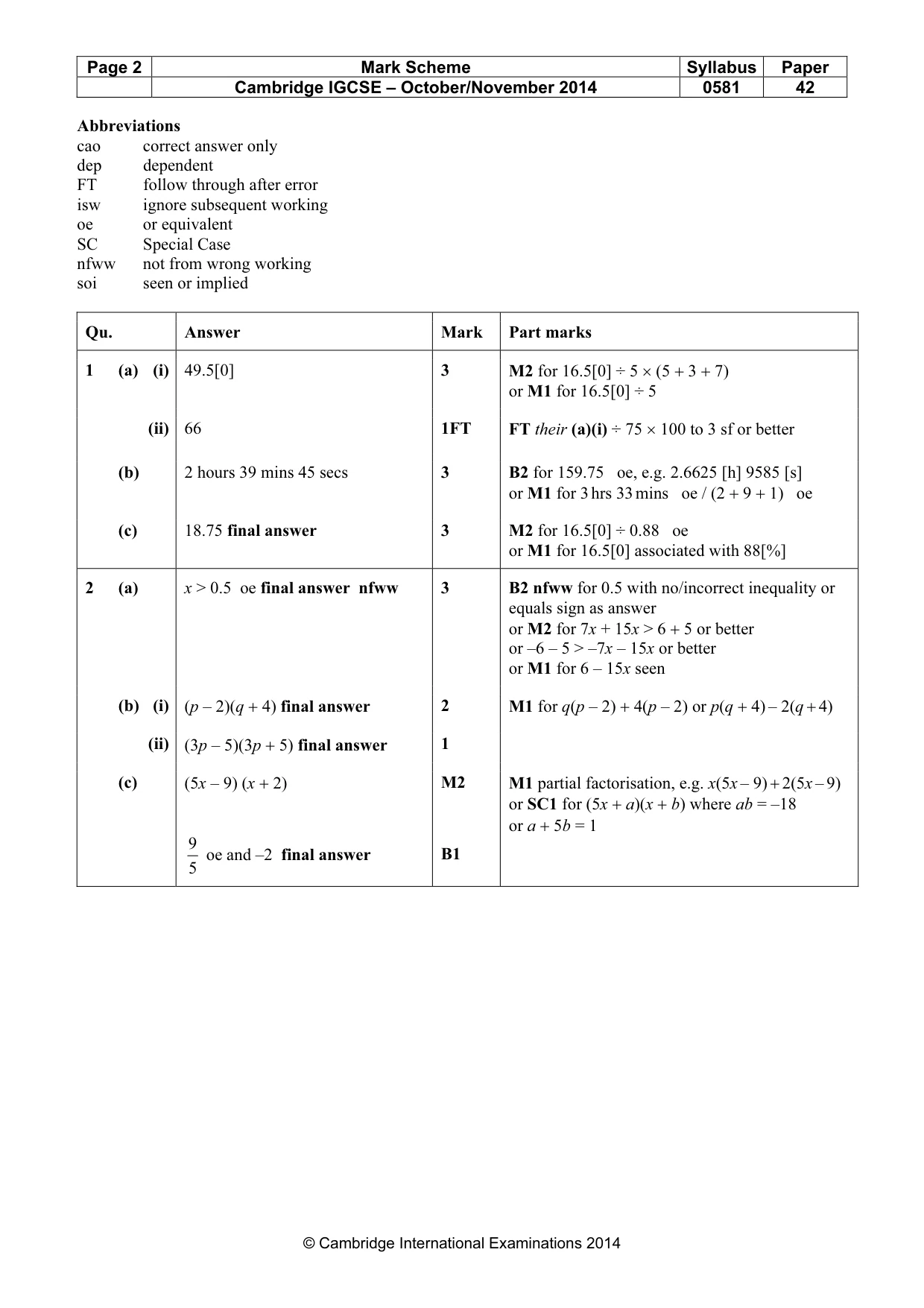
Page 2 Mark Scheme Syllabus Paper Cambridge IGCSE – October/November 2014 0581 42 © Cambridge International Examinations 2014 Abbreviations cao correct answer only dep dependent FT follow through after error isw ignore subsequent working oe or equivalent SC Special Case nfww not from wrong working soi seen or implied Qu. Answer Mark Part marks 1 (a) (i) 49.5[0] 3 M2 for 16.5[0] ÷ 5 × (5 + 3 + 7) or M1 for 16.5[0] ÷ 5 (ii) 66 1FT FT their (a)(i) ÷ 75 × 100 to 3 sf or better (b) 2 hours 39 mins 45 secs 3 B2 for 159.75 oe, e.g. 2.6625 [h] 9585 [s] or M1 for 3 hrs 33 mins oe / (2 + 9 + 1) oe (c) 18.75 final answer 3 M2 for 16.5[0] ÷ 0.88 oe or M1 for 16.5[0] associated with 88[%] 2 (a) x > 0.5 oe final answer nfww 3 B2 nfww for 0.5 with no/incorrect inequality or equals sign as answer or M2 for 7x + 15x > 6 + 5 or better or –6 – 5 > –7x – 15x or better or M1 for 6 – 15x seen (b) (i) (p – 2)(q + 4) final answer 2 M1 for q(p – 2) + 4(p – 2) or p(q + 4) – 2(q + 4) (ii) (3p – 5)(3p + 5) final answer 1 (c) (5x – 9) (x + 2) 5 9 oe and –2 final answer M2 B1 M1 partial factorisation, e.g. x(5x – 9) + 2(5x – 9) or SC1 for (5x + a)(x + b) where ab = –18 or a + 5b = 1
Mark scheme, page 3
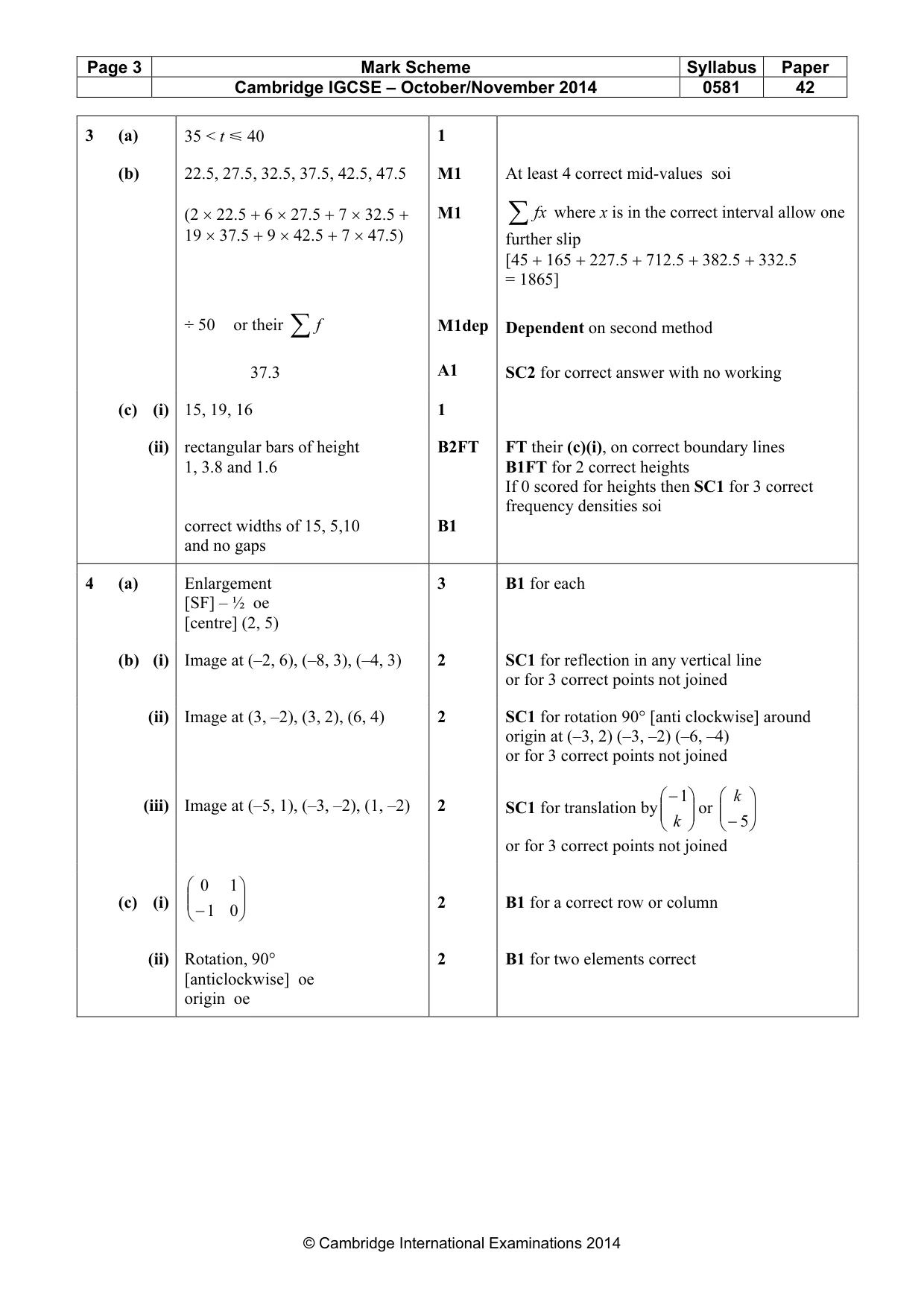
Page 3 Mark Scheme Syllabus Paper Cambridge IGCSE – October/November 2014 0581 42 © Cambridge International Examinations 2014 3 (a) 35 < t Y 40 1 (b) 22.5, 27.5, 32.5, 37.5, 42.5, 47.5 (2 × 22.5 + 6 × 27.5 + 7 × 32.5 + 19 × 37.5 + 9 × 42.5 + 7 × 47.5) ÷ 50 or their ∑f 37.3 M1 M1 M1dep A1 At least 4 correct mid-values soi ∑fx where x is in the correct interval allow one further slip [45 + 165 + 227.5 + 712.5 + 382.5 + 332.5 = 1865] Dependent on second method SC2 for correct answer with no working (c) (i) 15, 19, 16 1 (ii) rectangular bars of height 1, 3.8 and 1.6 correct widths of 15, 5,10 and no gaps B2FT B1 FT their (c)(i), on correct boundary lines B1FT for 2 correct heights If 0 scored for heights then SC1 for 3 correct frequency densities soi 4 (a) Enlargement [SF] – ½ oe [centre] (2, 5) 3 B1 for each (b) (i) Image at (–2, 6), (–8, 3), (–4, 3) 2 SC1 for reflection in any vertical line or for 3 correct points not joined (ii) Image at (3, –2), (3, 2), (6, 4) 2 SC1 for rotation 90° [anti clockwise] around origin at (–3, 2) (–3, –2) (–6, –4) or for 3 correct points not joined (iii) Image at (–5, 1), (–3, –2), (1, –2) 2 SC1 for translation by − k 1 or −5 k or for 3 correct points not joined (c) (i) − 0 1 1 0 2 B1 for a correct row or column (ii) Rotation, 90° [anticlockwise] oe origin oe 2 B1 for two elements correct
Mark scheme, page 4
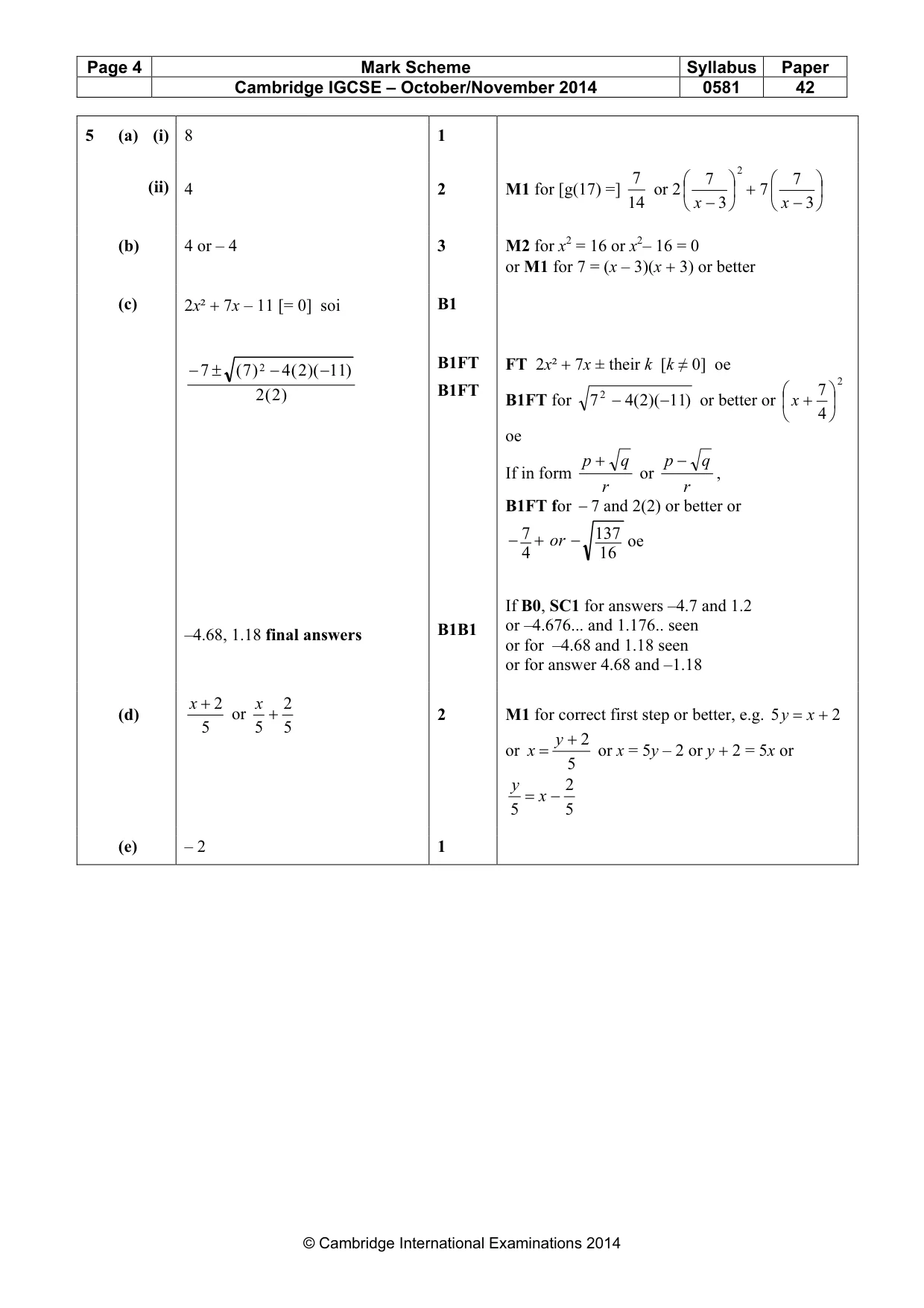
Page 4 Mark Scheme Syllabus Paper Cambridge IGCSE – October/November 2014 0581 42 © Cambridge International Examinations 2014 5 (a) (i) 8 1 (ii) 4 2 M1 for [g(17) =] 14 7 or 2 2 3 7 − x + 7 −3 7 x (b) 4 or – 4 3 M2 for x2 = 16 or x2– 16 = 0 or M1 for 7 = (x – 3)(x + 3) or better (c) 2x² + 7x – 11 [= 0] soi ) 2 ( 2 ) 11 )( 2 ( 4 ) 7 ( 7 2 − − ± − –4.68, 1.18 final answers B1 B1FT B1FT B1B1 FT 2x² + 7x ± their k [k ≠ 0] oe B1FT for ) 11 )( 2 ( 4 7 2 − − or better or 2 4 7 + x oe If in form r q p + or r q p − , B1FT for 7 − and 2(2) or better or 16 137 4 7 − + − or oe If B0, SC1 for answers –4.7 and 1.2 or –4.676... and 1.176.. seen or for –4.68 and 1.18 seen or for answer 4.68 and –1.18 (d) 5 2 + x or 5 2 5 + x 2 M1 for correct first step or better, e.g. 2 5 + = x y or 5 2 + = y x or x = 5y – 2 or y + 2 = 5x or 5 2 5 − = x y (e) – 2 1
Mark scheme, page 5
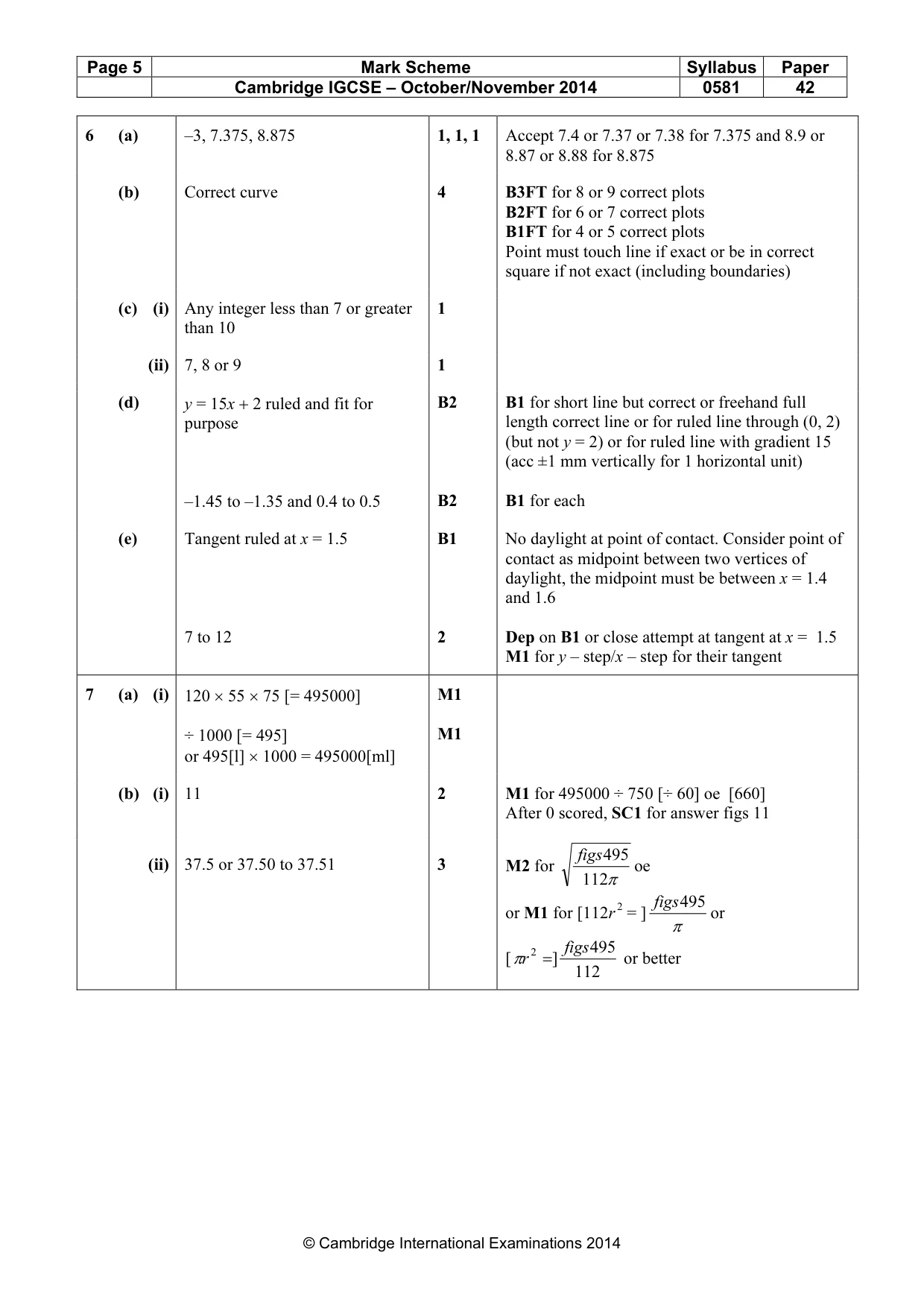
Page 5 Mark Scheme Syllabus Paper Cambridge IGCSE – October/November 2014 0581 42 © Cambridge International Examinations 2014 6 (a) –3, 7.375, 8.875 1, 1, 1 Accept 7.4 or 7.37 or 7.38 for 7.375 and 8.9 or 8.87 or 8.88 for 8.875 (b) Correct curve 4 B3FT for 8 or 9 correct plots B2FT for 6 or 7 correct plots B1FT for 4 or 5 correct plots Point must touch line if exact or be in correct square if not exact (including boundaries) (c) (i) Any integer less than 7 or greater than 10 1 (ii) 7, 8 or 9 1 (d) y = 15x + 2 ruled and fit for purpose –1.45 to –1.35 and 0.4 to 0.5 B2 B2 B1 for short line but correct or freehand full length correct line or for ruled line through (0, 2) (but not y = 2) or for ruled line with gradient 15 (acc ±1 mm vertically for 1 horizontal unit) B1 for each (e) Tangent ruled at x = 1.5 7 to 12 B1 2 No daylight at point of contact. Consider point of contact as midpoint between two vertices of daylight, the midpoint must be between x = 1.4 and 1.6 Dep on B1 or close attempt at tangent at x = 1.5 M1 for y – step/x – step for their tangent 7 (a) (i) 120 × 55 × 75 [= 495000] ÷ 1000 [= 495] or 495[l] × 1000 = 495000[ml] M1 M1 (b) (i) 11 2 M1 for 495000 ÷ 750 [÷ 60] oe [660] After 0 scored, SC1 for answer figs 11 (ii) 37.5 or 37.50 to 37.51 3 M2 for π 112 495 figs oe or M1 for [112r 2 = ] π 495 figs or [ 112 495 ] 2 figs r = π or better
Mark scheme, page 6
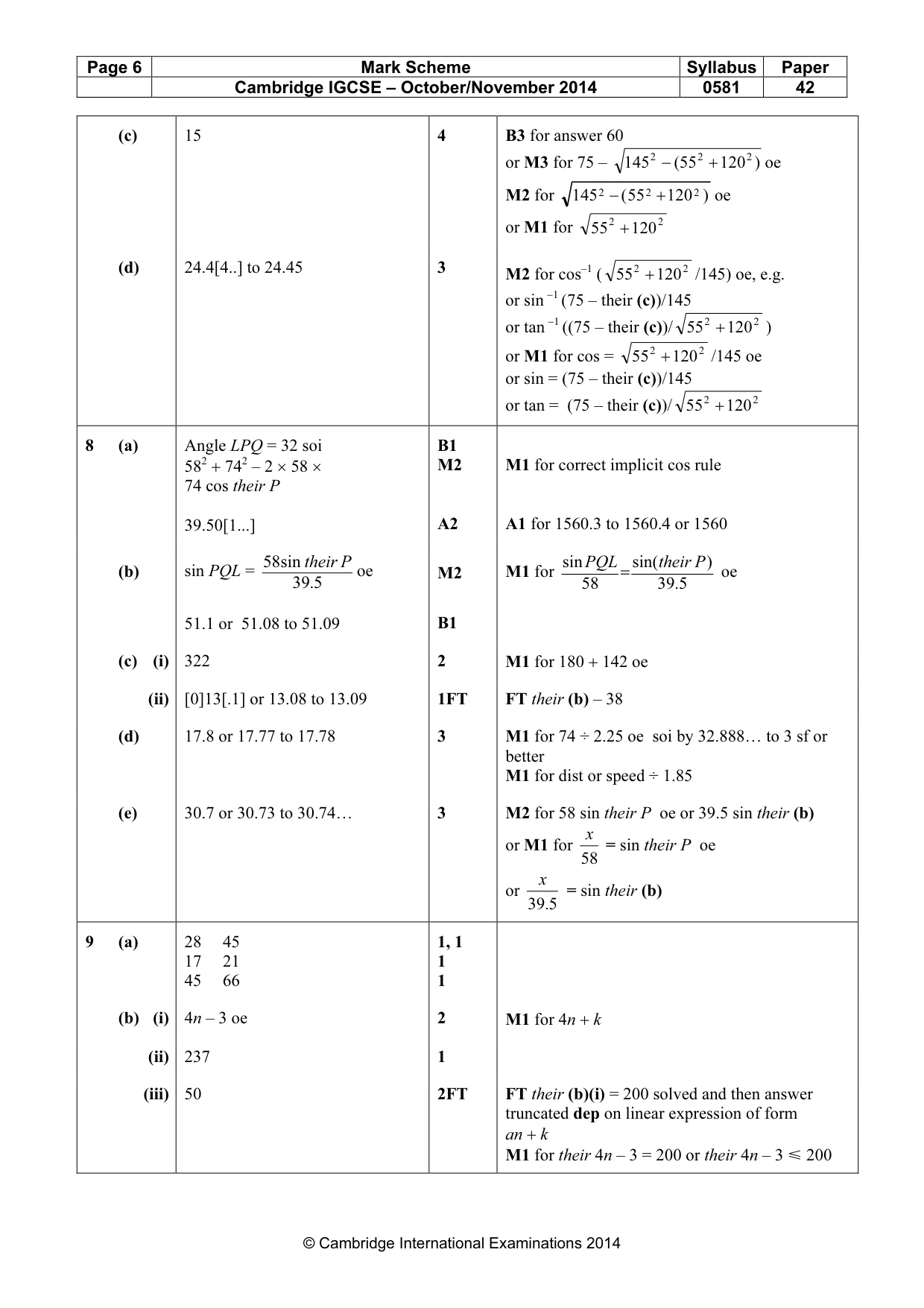
Page 6 Mark Scheme Syllabus Paper Cambridge IGCSE – October/November 2014 0581 42 © Cambridge International Examinations 2014 (c) 15 4 B3 for answer 60 or M3 for 75 – ) 120 55 ( 145 2 2 2 + − oe M2 for ) 120 55 ( 145 2 2 2 + − oe or M1 for 2 2 120 55 + (d) 24.4[4..] to 24.45 3 M2 for cos–1 ( 2 2 120 55 + /145) oe, e.g. or sin 1 −(75 – their (c))/145 or tan 1 −((75 – their (c))/ 2 2 120 55 + ) or M1 for cos = 2 2 120 55 + /145 oe or sin = (75 – their (c))/145 or tan = (75 – their (c))/ 2 2 120 55 + 8 (a) Angle LPQ = 32 soi 582 + 742 – 2 × 58 × 74 cos their P 39.50[1...] B1 M2 A2 M1 for correct implicit cos rule A1 for 1560.3 to 1560.4 or 1560 (b) sin PQL = 5. 39 sin 58 P their oe 51.1 or 51.08 to 51.09 M2 B1 M1 for 5. 39 ) sin( 58 sin P their PQL = oe (c) (i) 322 2 M1 for 180 + 142 oe (ii) [0]13[.1] or 13.08 to 13.09 1FT FT their (b) – 38 (d) 17.8 or 17.77 to 17.78 3 M1 for 74 ÷ 2.25 oe soi by 32.888… to 3 sf or better M1 for dist or speed ÷ 1.85 (e) 30.7 or 30.73 to 30.74… 3 M2 for 58 sin their P oe or 39.5 sin their (b) or M1 for 58 x = sin their P oe or 5. 39 x = sin their (b) 9 (a) 28 45 17 21 45 66 1, 1 1 1 (b) (i) 4n – 3 oe 2 M1 for 4n + k (ii) 237 1 (iii) 50 2FT FT their (b)(i) = 200 solved and then answer truncated dep on linear expression of form an + k M1 for their 4n – 3 = 200 or their 4n – 3 Y 200
Mark scheme, page 7
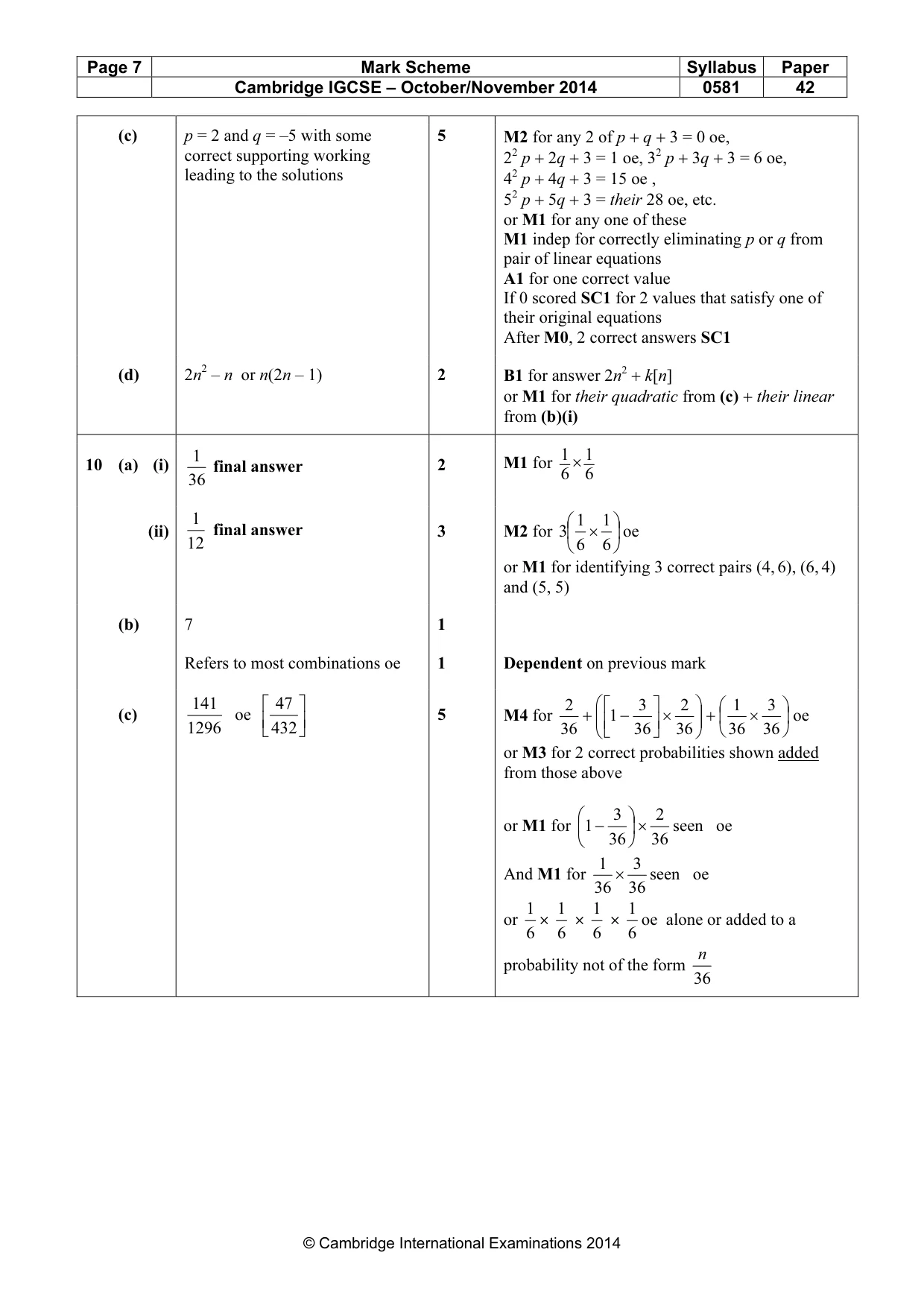
Page 7 Mark Scheme Syllabus Paper Cambridge IGCSE – October/November 2014 0581 42 © Cambridge International Examinations 2014 (c) p = 2 and q = –5 with some correct supporting working leading to the solutions 5 M2 for any 2 of p + q + 3 = 0 oe, 22 p + 2q + 3 = 1 oe, 32 p + 3q + 3 = 6 oe, 42 p + 4q + 3 = 15 oe , 52 p + 5q + 3 = their 28 oe, etc. or M1 for any one of these M1 indep for correctly eliminating p or q from pair of linear equations A1 for one correct value If 0 scored SC1 for 2 values that satisfy one of their original equations After M0, 2 correct answers SC1 (d) 2n2 – n or n(2n – 1) 2 B1 for answer 2n2 + k[n] or M1 for their quadratic from (c) + their linear from (b)(i) 10 (a) (i) 36 1 final answer 2 M1 for 6 1 6 1 × (ii) 12 1 final answer 3 M2 for × 6 1 6 1 3 oe or M1 for identifying 3 correct pairs (4, 6), (6, 4) and (5, 5) (b) 7 Refers to most combinations oe 1 1 Dependent on previous mark (c) 1296 141 oe 432 47 5 M4 for × + × − + 36 3 36 1 36 2 36 3 1 36 2 oe or M3 for 2 correct probabilities shown added from those above or M1 for 36 2 36 3 1 × − seen oe And M1 for 36 3 36 1 × seen oe or 6 1 × 6 1 × 6 1 × 6 1 oe alone or added to a probability not of the form 36 n