Cambridge IGCSE Mathematics (with coursework) 0581 — 2010 May/June Paper 4 · Variant 2
0581/42/M/J/10
The question paper and its mark scheme, free to read here and free to download. This is Cambridge’s own paper, exactly as it was sat.
Question paper20 pages
Mark scheme6 pages
Answers below. Sit the paper first if you are practising.
Paper as text
Question paper, page 1
This document consists of 19 printed pages and 1 blank page. IB10 06_0581_42/FP © UCLES 2010 [Turn over *9780718269* UNIVERSITY OF CAMBRIDGE INTERNATIONAL EXAMINATIONS International General Certificate of Secondary Education MATHEMATICS 0581/42 Paper 4 (Extended) May/June 2010 2 hours 30 minutes Candidates answer on the Question Paper. Additional Materials: Electronic calculator Geometrical instruments Mathematical tables (optional) Tracing paper (optional) READ THESE INSTRUCTIONS FIRST Write your Centre number, candidate number and name on all the work you hand in. Write in dark blue or black pen. You may use a pencil for any diagrams or graphs. Do not use staples, paper clips, highlighters, glue or correction fluid. Do NOT WRITE IN ANY BARCODES. Answer all questions. If working is needed for any question it must be shown below that question. Electronic calculators should be used. If the degree of accuracy is not specified in the question, and if the answer is not exact, give the answer to three significant figures. Give answers in degrees to one decimal place. For π use either your calculator value or 3.142. At the end of the examination, fasten all your work securely together. The number of marks is given in brackets [ ] at the end of each question or part question. The total of the marks for this paper is 130. www.XtremePapers.com
Question paper, page 2
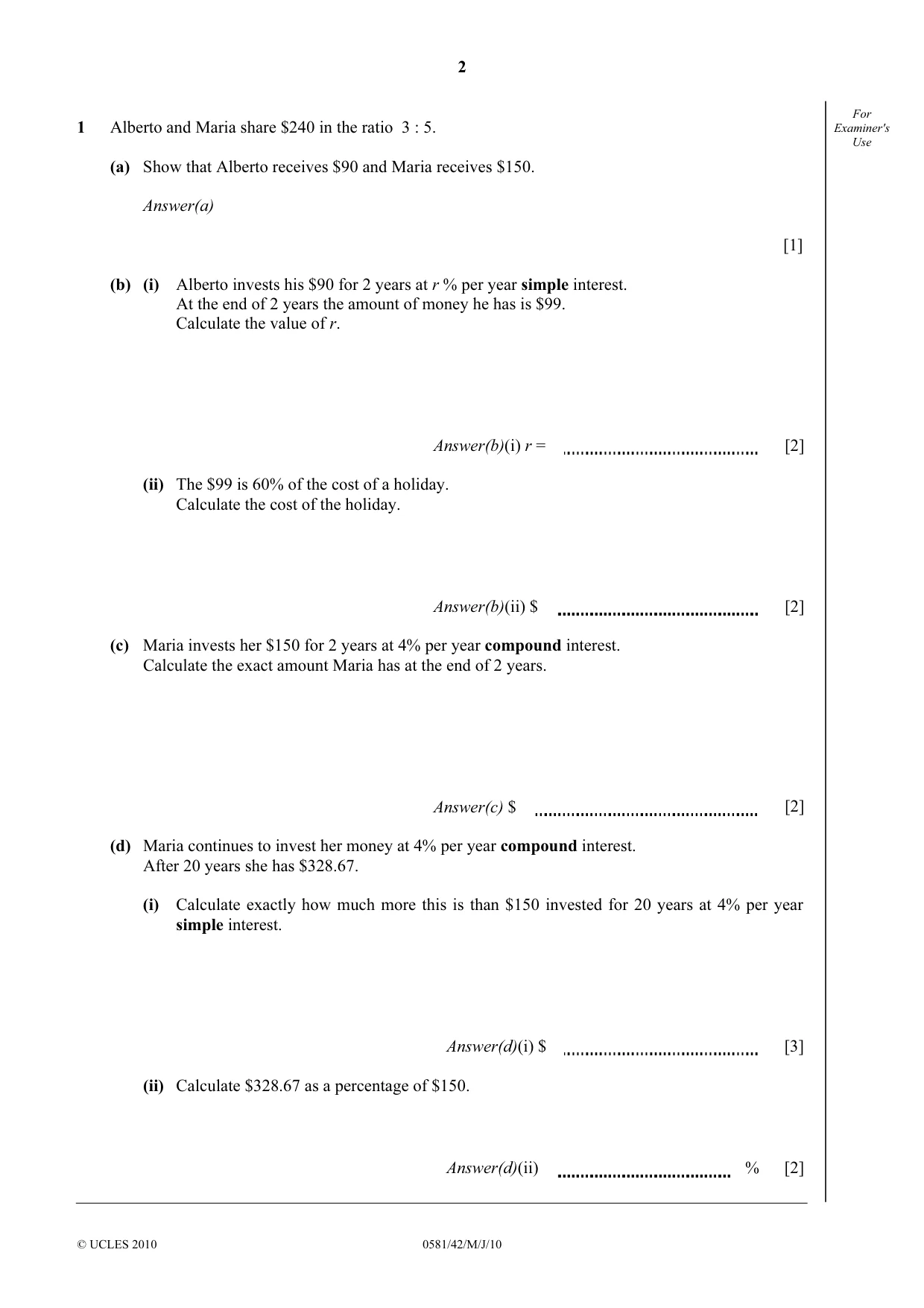
2 © UCLES 2010 0581/42/M/J/10 For Examiner's Use 1 Alberto and Maria share $240 in the ratio 3 : 5. (a) Show that Alberto receives $90 and Maria receives $150. Answer(a) [1] (b) (i) Alberto invests his $90 for 2 years at r % per year simple interest. At the end of 2 years the amount of money he has is $99. Calculate the value of r. Answer(b)(i) r = [2] (ii) The $99 is 60% of the cost of a holiday. Calculate the cost of the holiday. Answer(b)(ii) $ [2] (c) Maria invests her $150 for 2 years at 4% per year compound interest. Calculate the exact amount Maria has at the end of 2 years. Answer(c) $ [2] (d) Maria continues to invest her money at 4% per year compound interest. After 20 years she has $328.67. (i) Calculate exactly how much more this is than $150 invested for 20 years at 4% per year simple interest. Answer(d)(i) $ [3] (ii) Calculate $328.67 as a percentage of $150. Answer(d)(ii) % [2]
Question paper, page 3
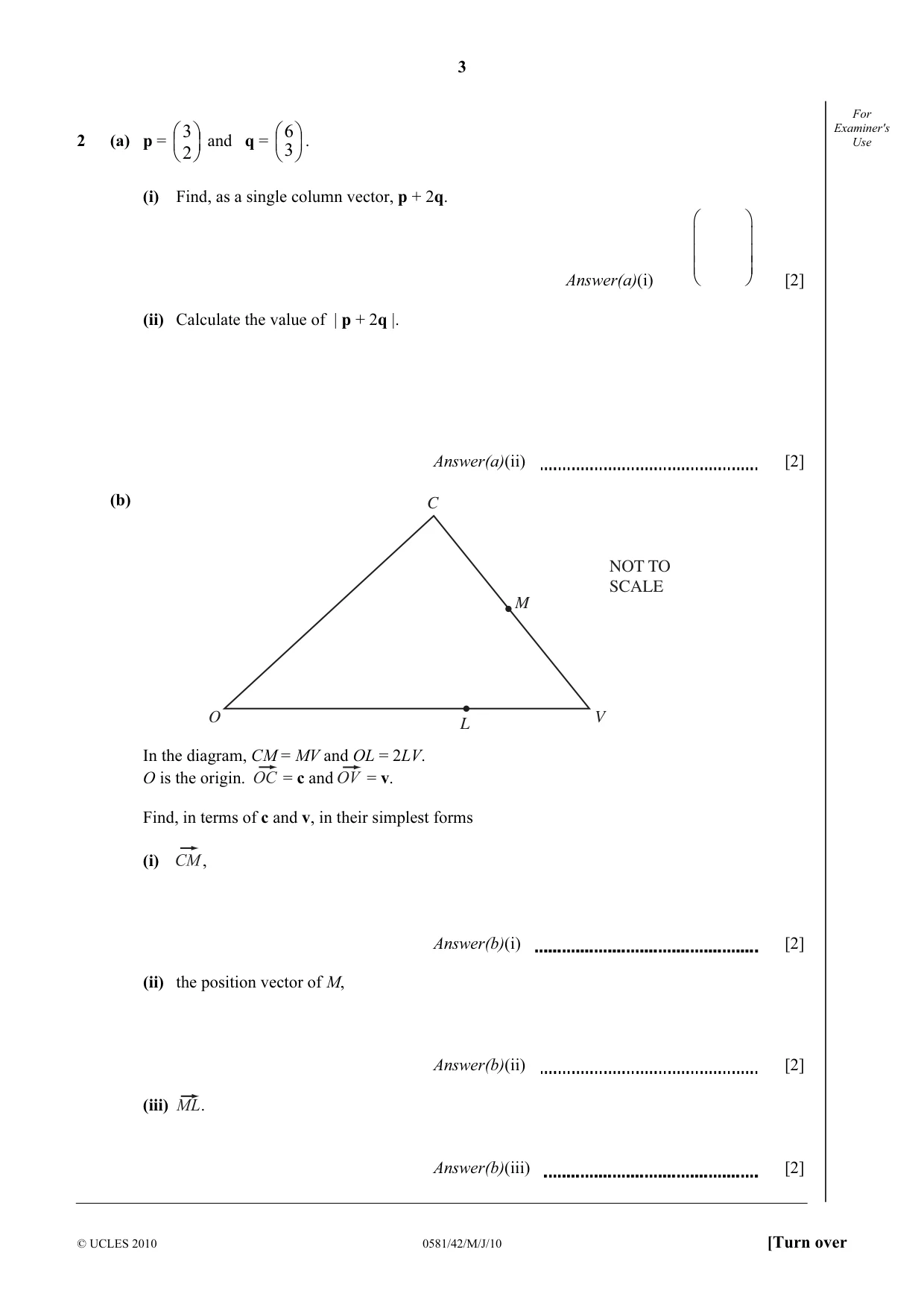
3 © UCLES 2010 0581/42/M/J/10 [Turn over For Examiner's Use 2 (a) p = 3 2 and q = 6 3 . (i) Find, as a single column vector, p + 2q. Answer(a)(i) [2] (ii) Calculate the value of | p + 2q |. Answer(a)(ii) [2] (b) In the diagram, CM = MV and OL = 2LV. O is the origin. = c and = v. Find, in terms of c and v, in their simplest forms (i) , Answer(b)(i) [2] (ii) the position vector of M, Answer(b)(ii) [2] (iii) . Answer(b)(iii) [2] C O V L M NOT TO SCALE
Question paper, page 4
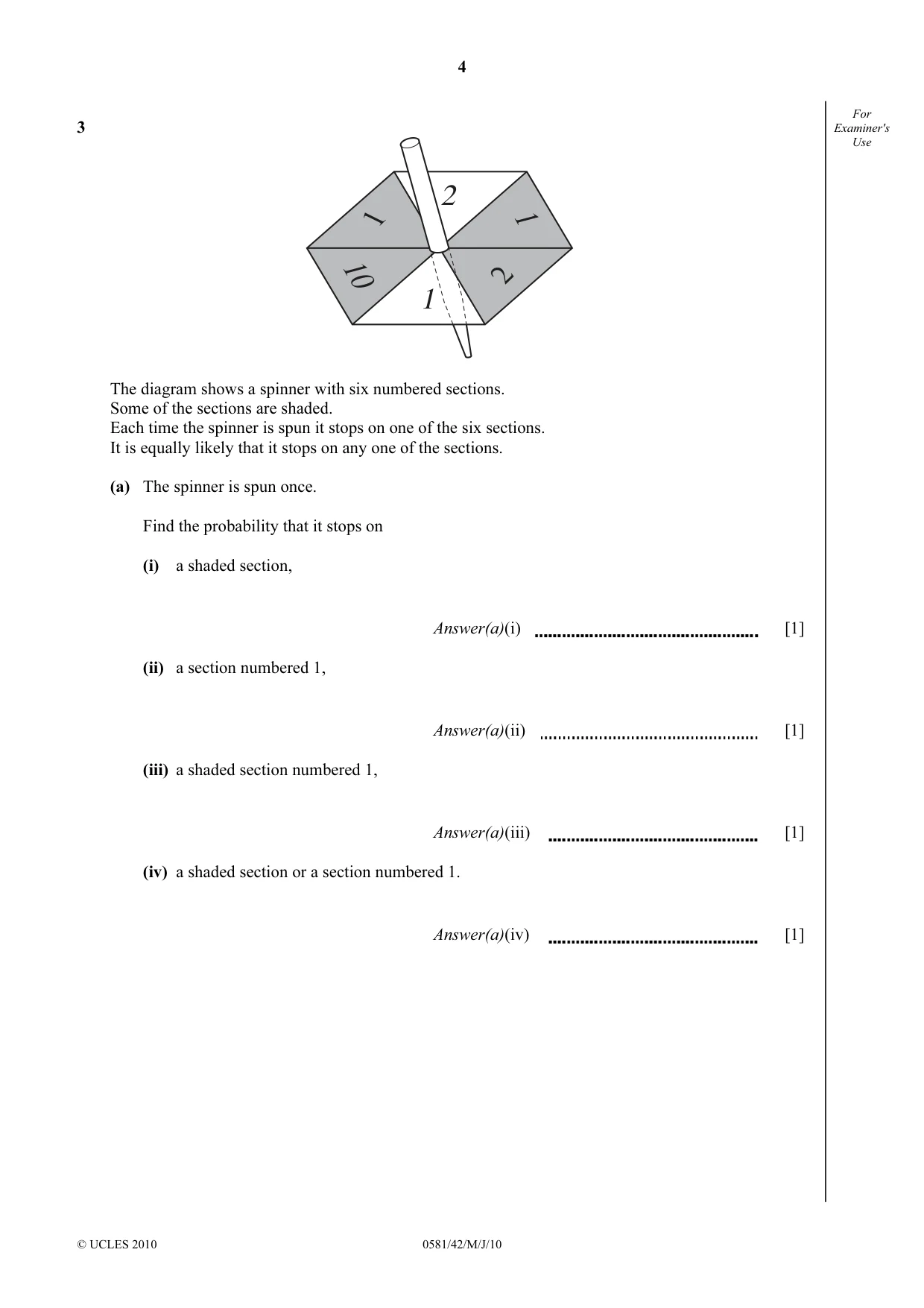
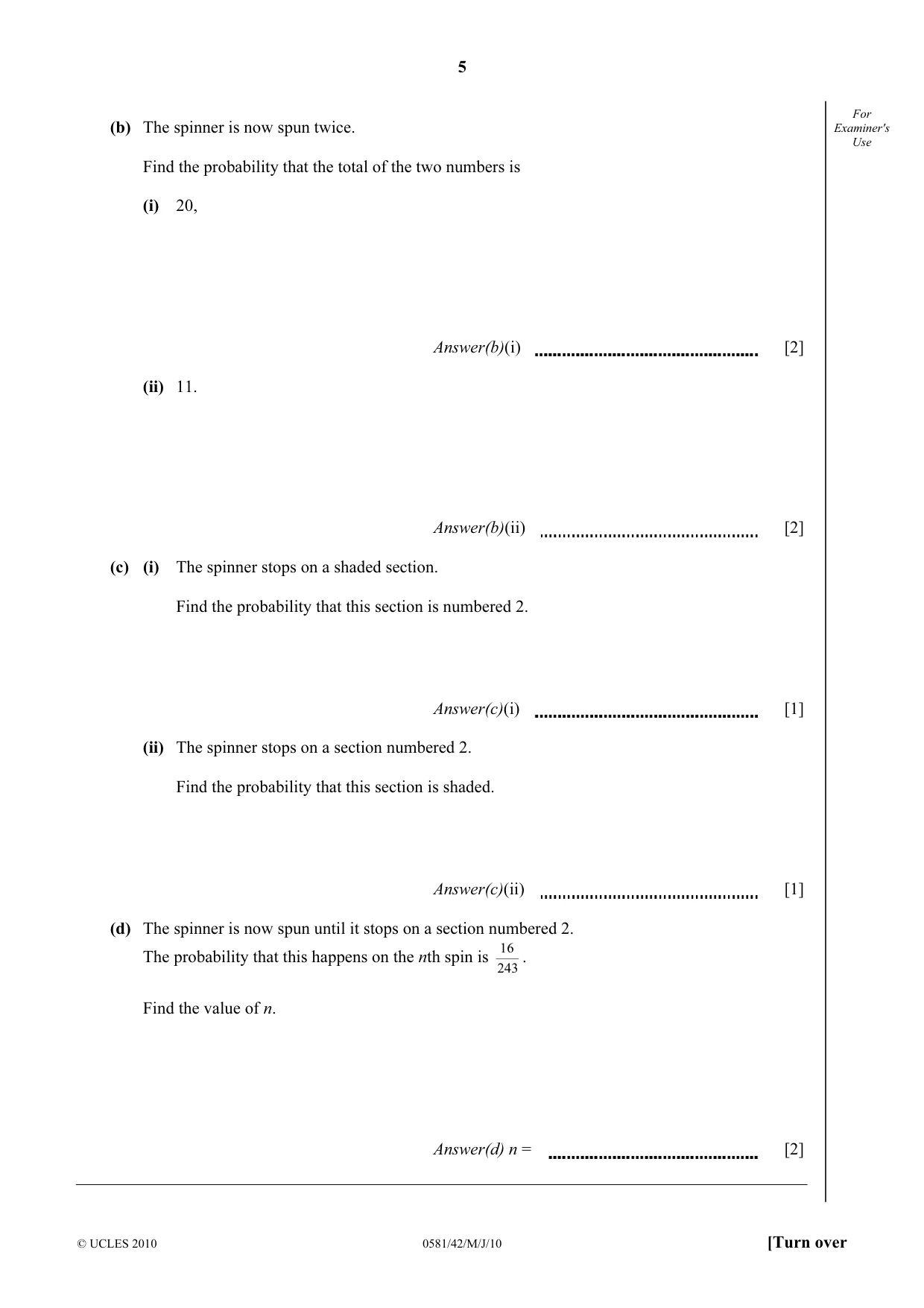
4 © UCLES 2010 0581/42/M/J/10 For Examiner's Use 3 1 10 1 2 2 1 The diagram shows a spinner with six numbered sections. Some of the sections are shaded. Each time the spinner is spun it stops on one of the six sections. It is equally likely that it stops on any one of the sections. (a) The spinner is spun once. Find the probability that it stops on (i) a shaded section, Answer(a)(i) [1] (ii) a section numbered 1, Answer(a)(ii) [1] (iii) a shaded section numbered 1, Answer(a)(iii) [1] (iv) a shaded section or a section numbered 1. Answer(a)(iv) [1]
Question paper, page 5
5 © UCLES 2010 0581/42/M/J/10 [Turn over For Examiner's Use (b) The spinner is now spun twice. Find the probability that the total of the two numbers is (i) 20, Answer(b)(i) [2] (ii) 11. Answer(b)(ii) [2] (c) (i) The spinner stops on a shaded section. Find the probability that this section is numbered 2. Answer(c)(i) [1] (ii) The spinner stops on a section numbered 2. Find the probability that this section is shaded. Answer(c)(ii) [1] (d) The spinner is now spun until it stops on a section numbered 2. The probability that this happens on the nth spin is 16 243 . Find the value of n. Answer(d) n = [2]
Question paper, page 6
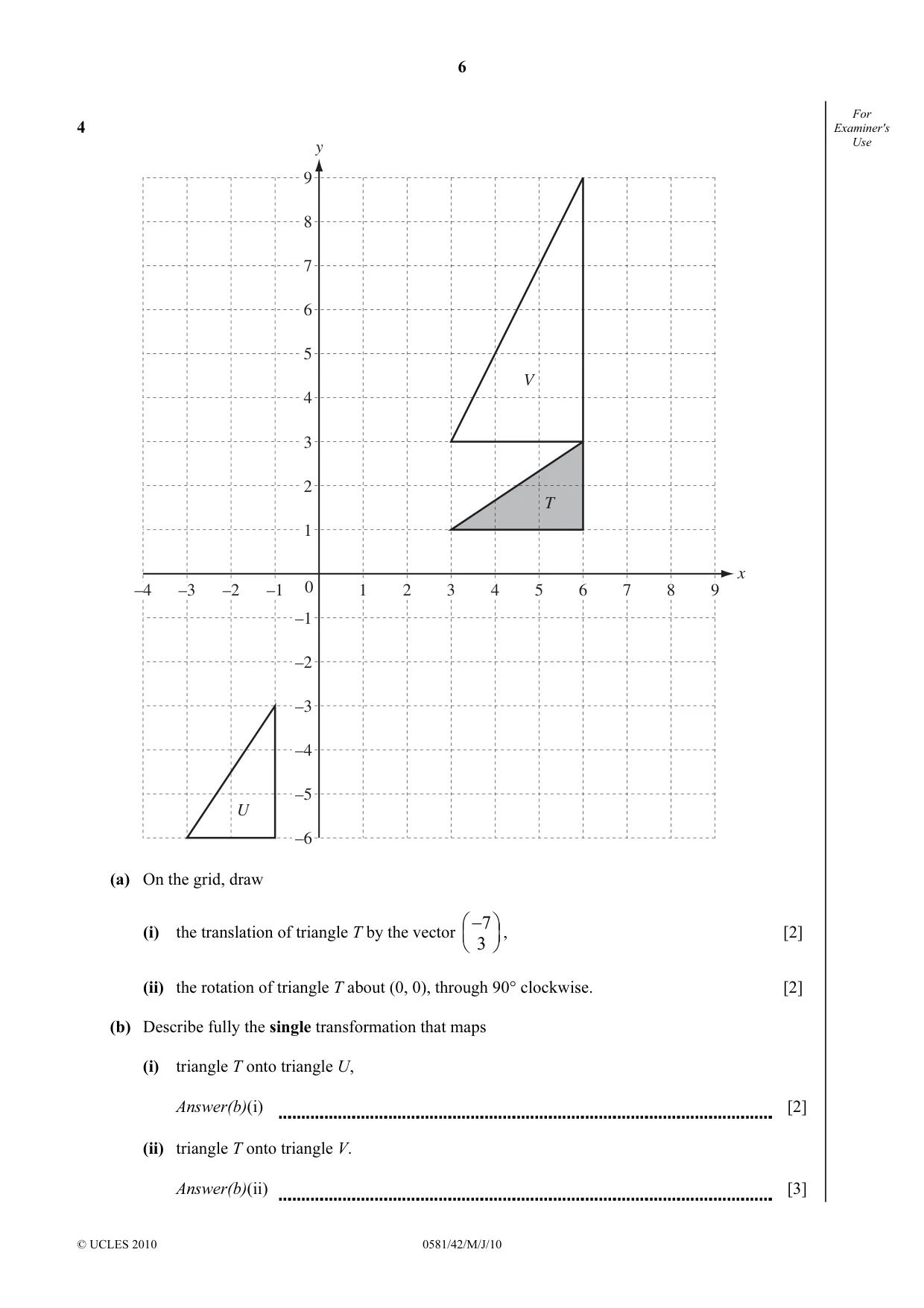
6 © UCLES 2010 0581/42/M/J/10 For Examiner's Use 4 T V U 9 8 7 6 5 4 3 2 1 –1 –2 –3 –4 –5 –6 0 –2 1 2 3 4 5 6 7 8 9 –3 –4 x y –1 (a) On the grid, draw (i) the translation of triangle T by the vector 7 3 − , [2] (ii) the rotation of triangle T about (0, 0), through 90° clockwise. [2] (b) Describe fully the single transformation that maps (i) triangle T onto triangle U, Answer(b)(i) [2] (ii) triangle T onto triangle V. Answer(b)(ii) [3]
Question paper, page 7
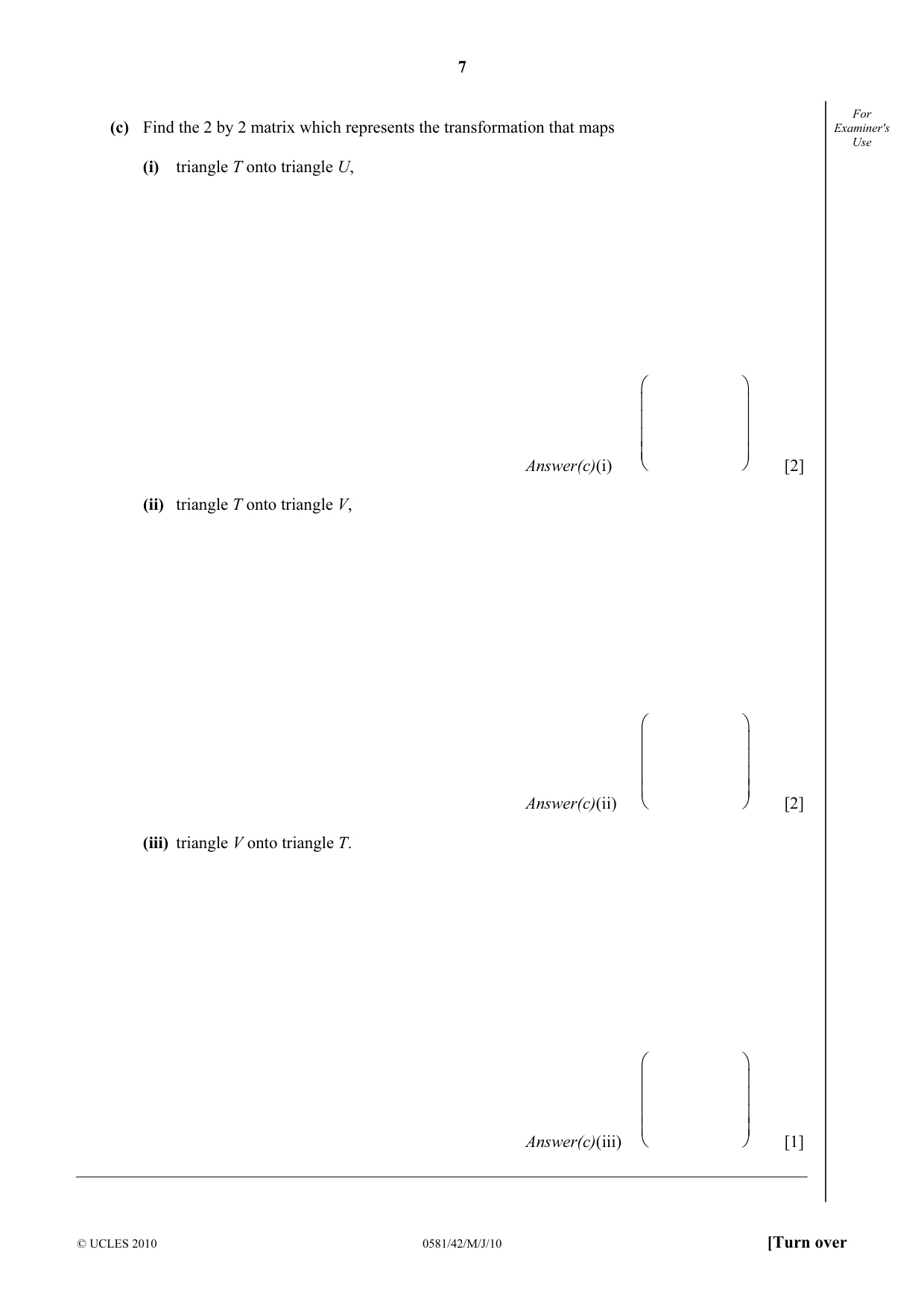
7 © UCLES 2010 0581/42/M/J/10 [Turn over For Examiner's Use (c) Find the 2 by 2 matrix which represents the transformation that maps (i) triangle T onto triangle U, Answer(c)(i) [2] (ii) triangle T onto triangle V, Answer(c)(ii) [2] (iii) triangle V onto triangle T. Answer(c)(iii) [1]
Question paper, page 8
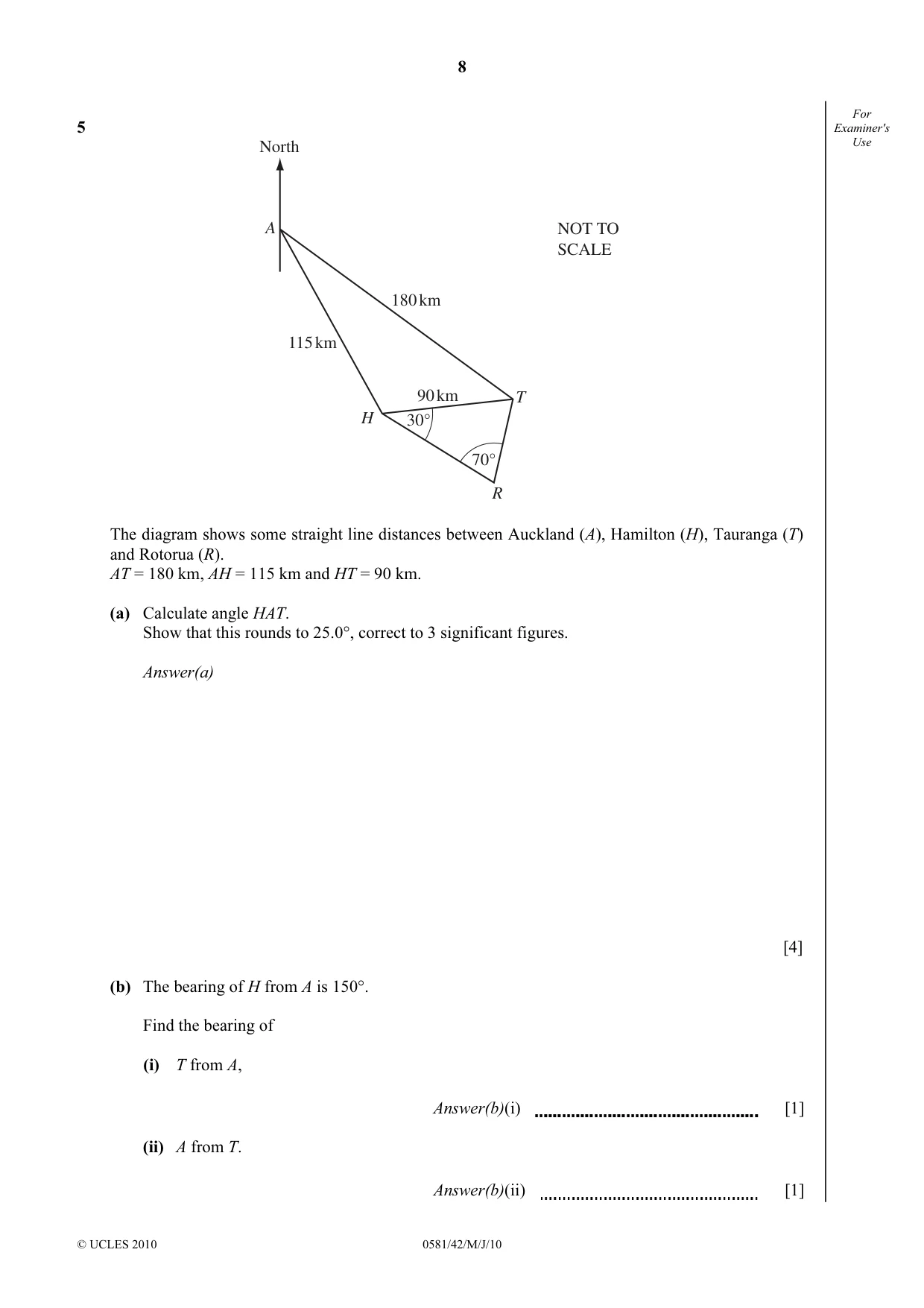
8 © UCLES 2010 0581/42/M/J/10 For Examiner's Use 5 North A H T R 180 km 90 km 115 km 70° NOT TO SCALE 30° The diagram shows some straight line distances between Auckland (A), Hamilton (H), Tauranga (T) and Rotorua (R). AT = 180 km, AH = 115 km and HT = 90 km. (a) Calculate angle HAT. Show that this rounds to 25.0°, correct to 3 significant figures. Answer(a) [4] (b) The bearing of H from A is 150°. Find the bearing of (i) T from A, Answer(b)(i) [1] (ii) A from T. Answer(b)(ii) [1]
Question paper, page 9
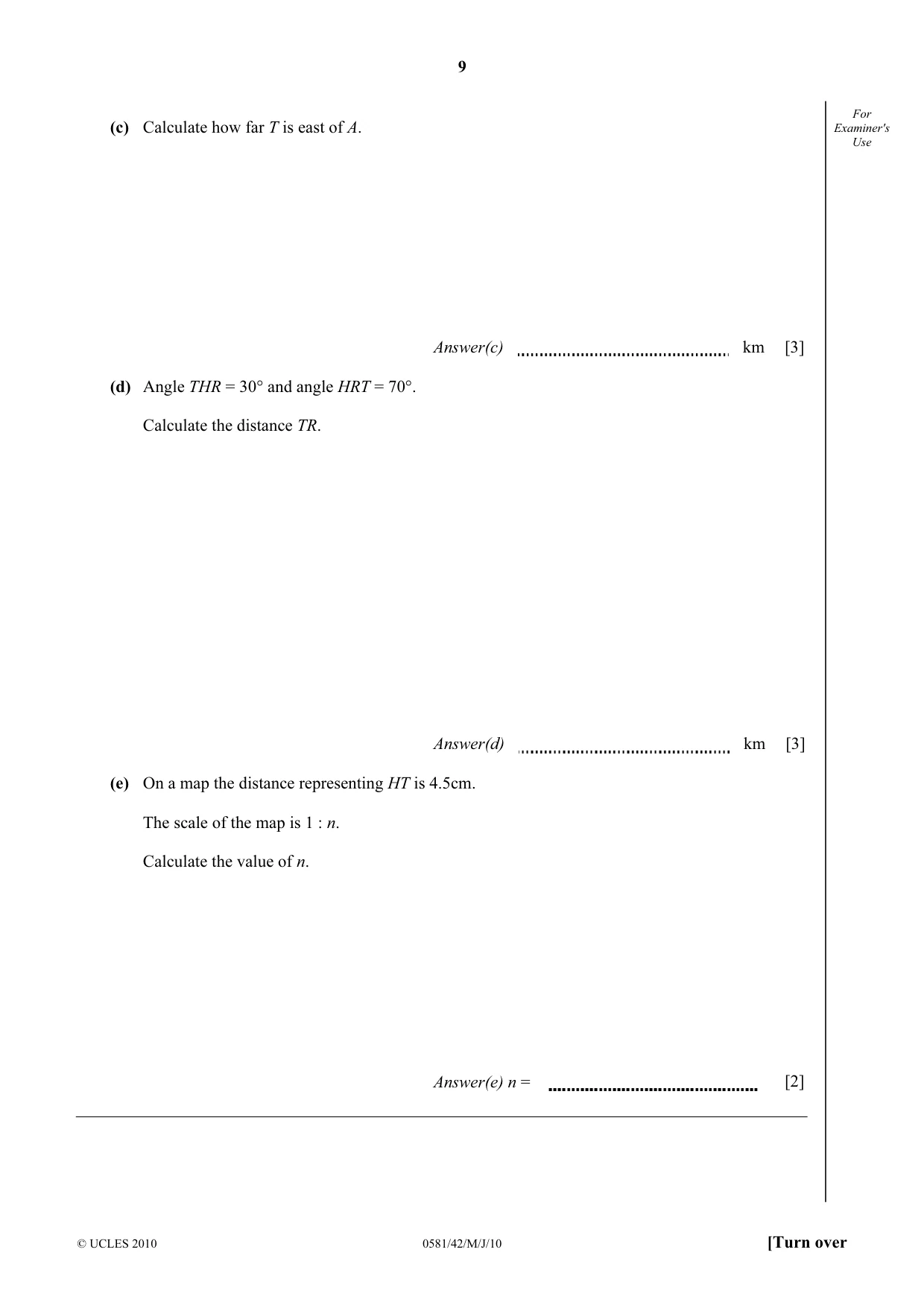
9 © UCLES 2010 0581/42/M/J/10 [Turn over For Examiner's Use (c) Calculate how far T is east of A. Answer(c) km [3] (d) Angle THR = 30° and angle HRT = 70°. Calculate the distance TR. Answer(d) km [3] (e) On a map the distance representing HT is 4.5cm. The scale of the map is 1 : n. Calculate the value of n. Answer(e) n = [2]
Question paper, page 10
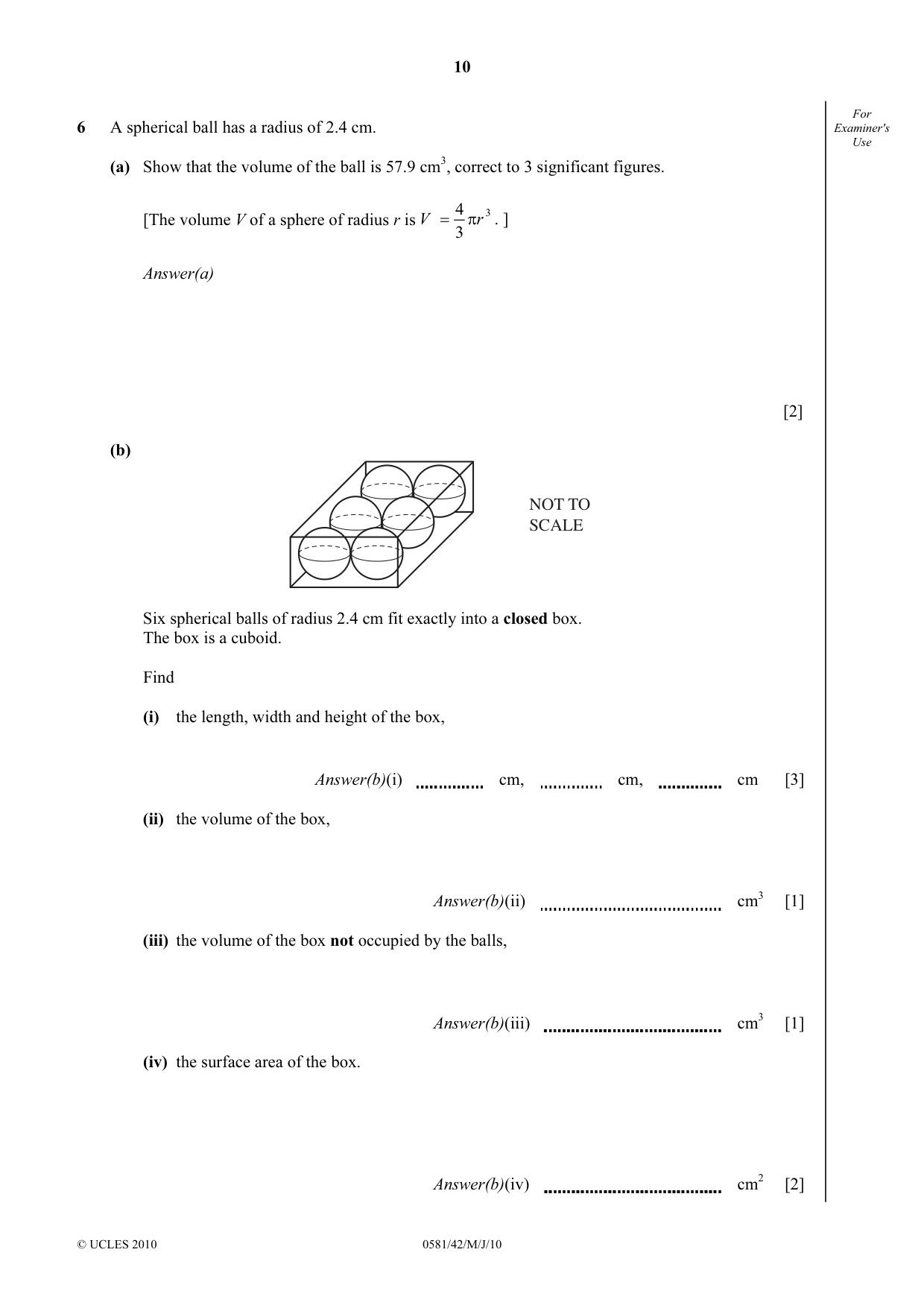
10 © UCLES 2010 0581/42/M/J/10 For Examiner's Use 6 A spherical ball has a radius of 2.4 cm. (a) Show that the volume of the ball is 57.9 cm3, correct to 3 significant figures. [The volume V of a sphere of radius r is 3 4 3 V r = π . ] Answer(a) [2] (b) NOT TO SCALE Six spherical balls of radius 2.4 cm fit exactly into a closed box. The box is a cuboid. Find (i) the length, width and height of the box, Answer(b)(i) cm, cm, cm [3] (ii) the volume of the box, Answer(b)(ii) cm3 [1] (iii) the volume of the box not occupied by the balls, Answer(b)(iii) cm3 [1] (iv) the surface area of the box. Answer(b)(iv) cm2 [2]
Question paper, page 11
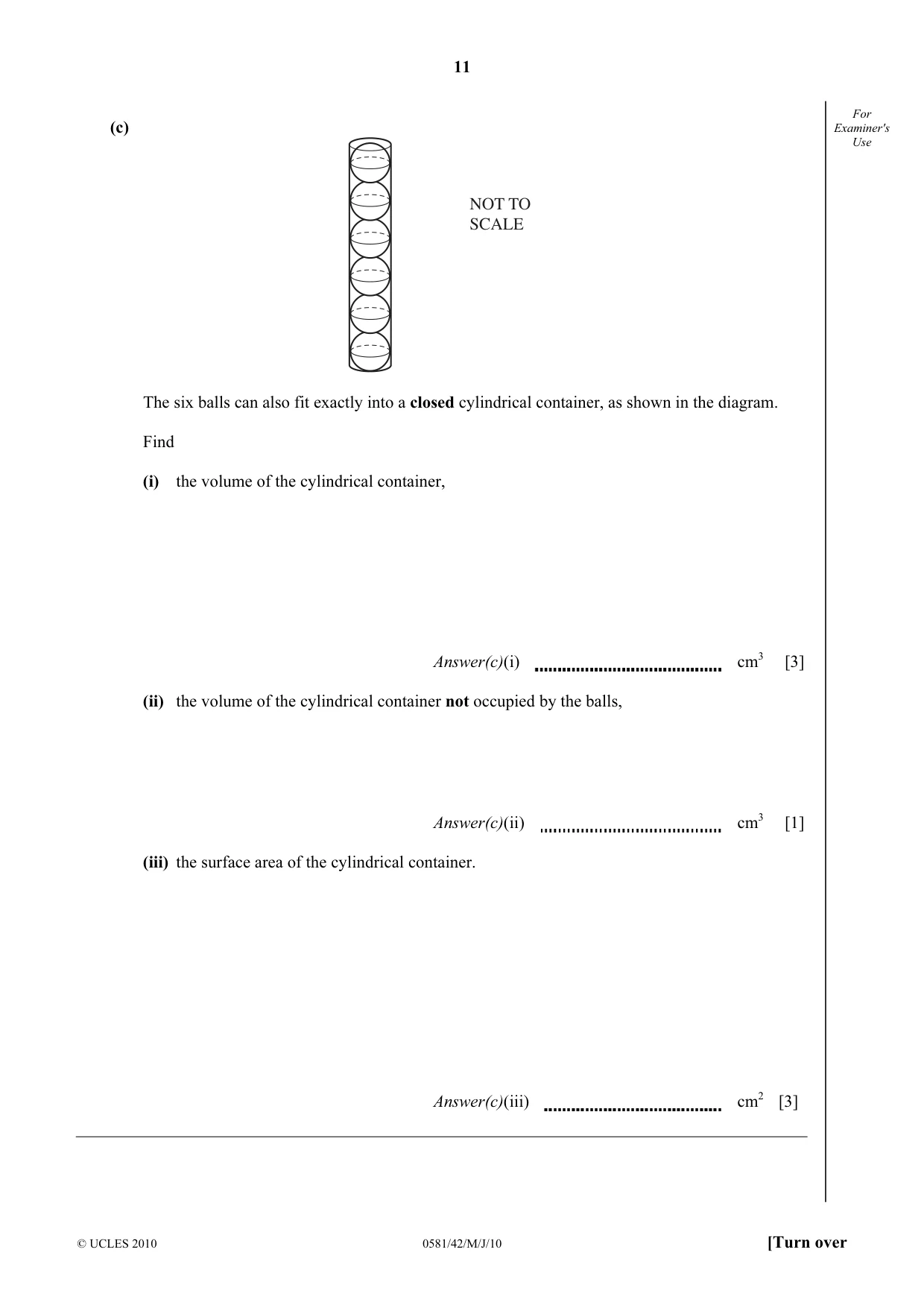
11 © UCLES 2010 0581/42/M/J/10 [Turn over For Examiner's Use (c) NOT TO SCALE The six balls can also fit exactly into a closed cylindrical container, as shown in the diagram. Find (i) the volume of the cylindrical container, Answer(c)(i) cm3 [3] (ii) the volume of the cylindrical container not occupied by the balls, Answer(c)(ii) cm3 [1] (iii) the surface area of the cylindrical container. Answer(c)(iii) cm2 [3]
Question paper, page 12
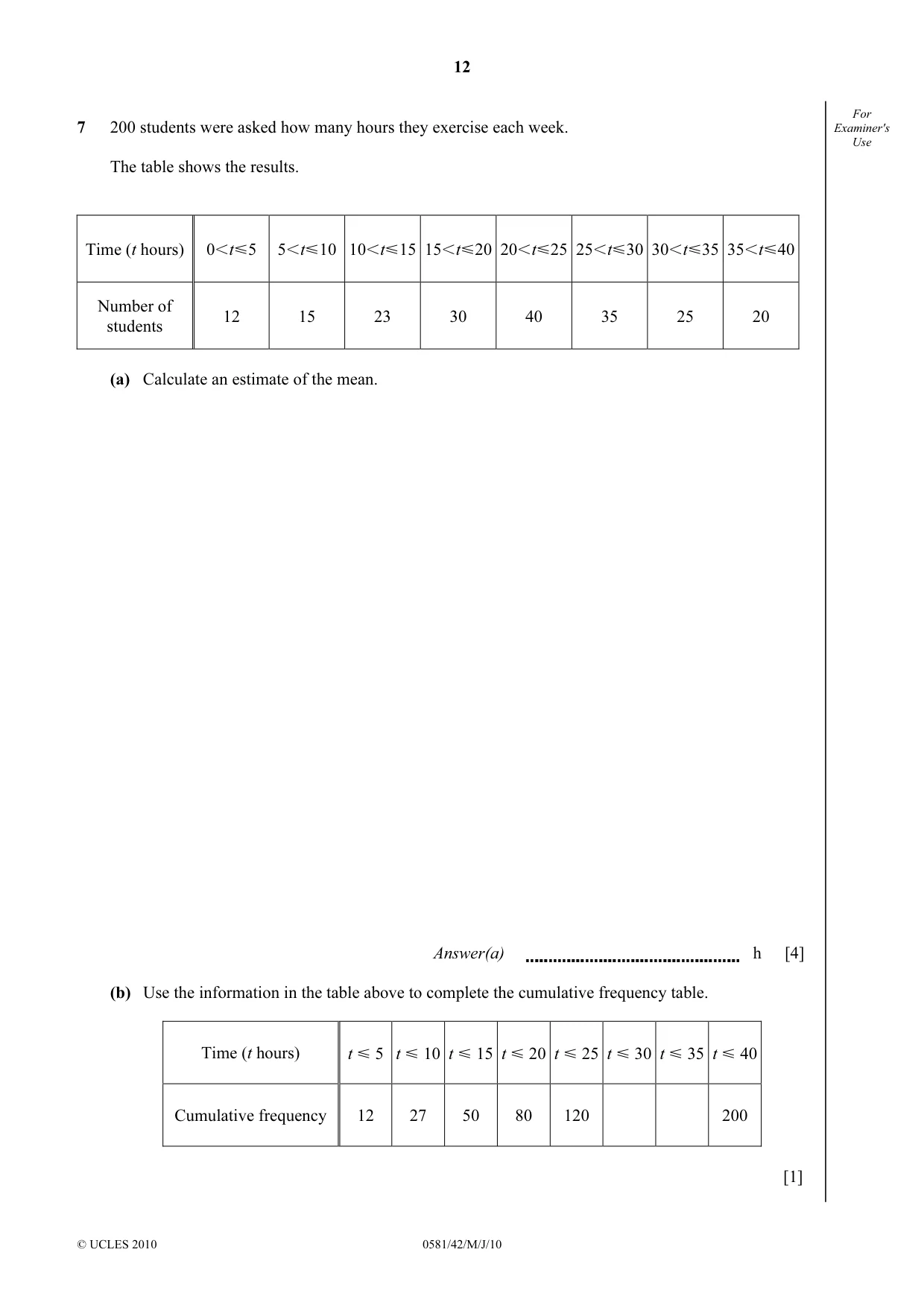
12 © UCLES 2010 0581/42/M/J/10 For Examiner's Use 7 200 students were asked how many hours they exercise each week. The table shows the results. Time (t hours) 0ItY5 5ItY10 10ItY15 15ItY20 20ItY25 25ItY30 30ItY35 35ItY40 Number of students 12 15 23 30 40 35 25 20 (a) Calculate an estimate of the mean. Answer(a) h [4] (b) Use the information in the table above to complete the cumulative frequency table. Time (t hours) t Y=5 t Y=10 t Y=15 t Y=20 t Y=25 t Y=30 t Y=35 t Y=40 Cumulative frequency 12 27 50 80 120 200 [1]
Question paper, page 13
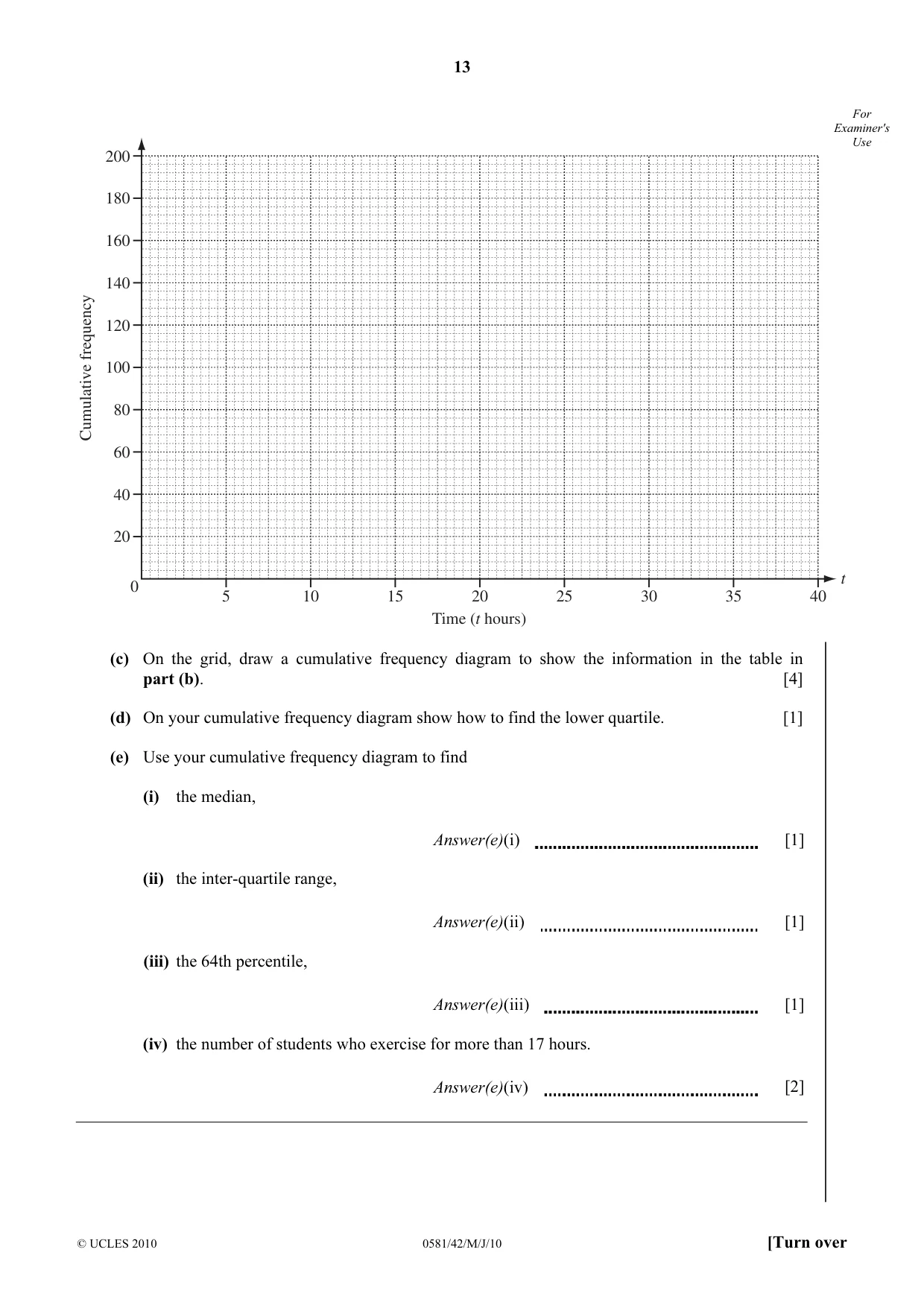
13 © UCLES 2010 0581/42/M/J/10 [Turn over For Examiner's Use 200 180 160 140 120 100 80 60 40 20 0 5 10 15 20 25 30 35 40 Cumulative frequency Time (t hours) t (c) On the grid, draw a cumulative frequency diagram to show the information in the table in part (b). [4] (d) On your cumulative frequency diagram show how to find the lower quartile. [1] (e) Use your cumulative frequency diagram to find (i) the median, Answer(e)(i) [1] (ii) the inter-quartile range, Answer(e)(ii) [1] (iii) the 64th percentile, Answer(e)(iii) [1] (iv) the number of students who exercise for more than 17 hours. Answer(e)(iv) [2]
Question paper, page 14
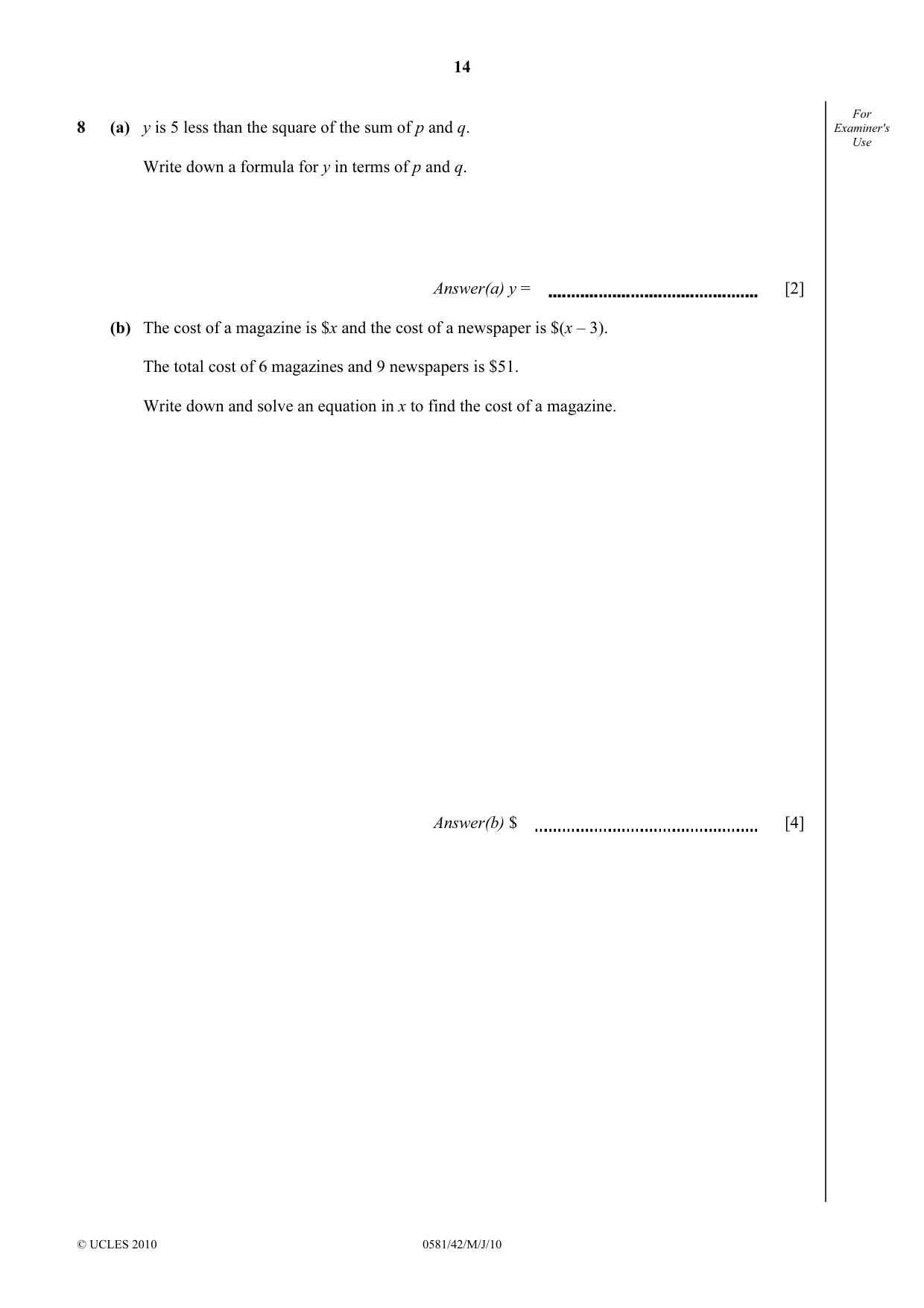
14 © UCLES 2010 0581/42/M/J/10 For Examiner's Use 8 (a) y is 5 less than the square of the sum of p and q. Write down a formula for y in terms of p and q. Answer(a) y = [2] (b) The cost of a magazine is $x and the cost of a newspaper is $(x – 3). The total cost of 6 magazines and 9 newspapers is $51. Write down and solve an equation in x to find the cost of a magazine. Answer(b) $ [4]
Question paper, page 15
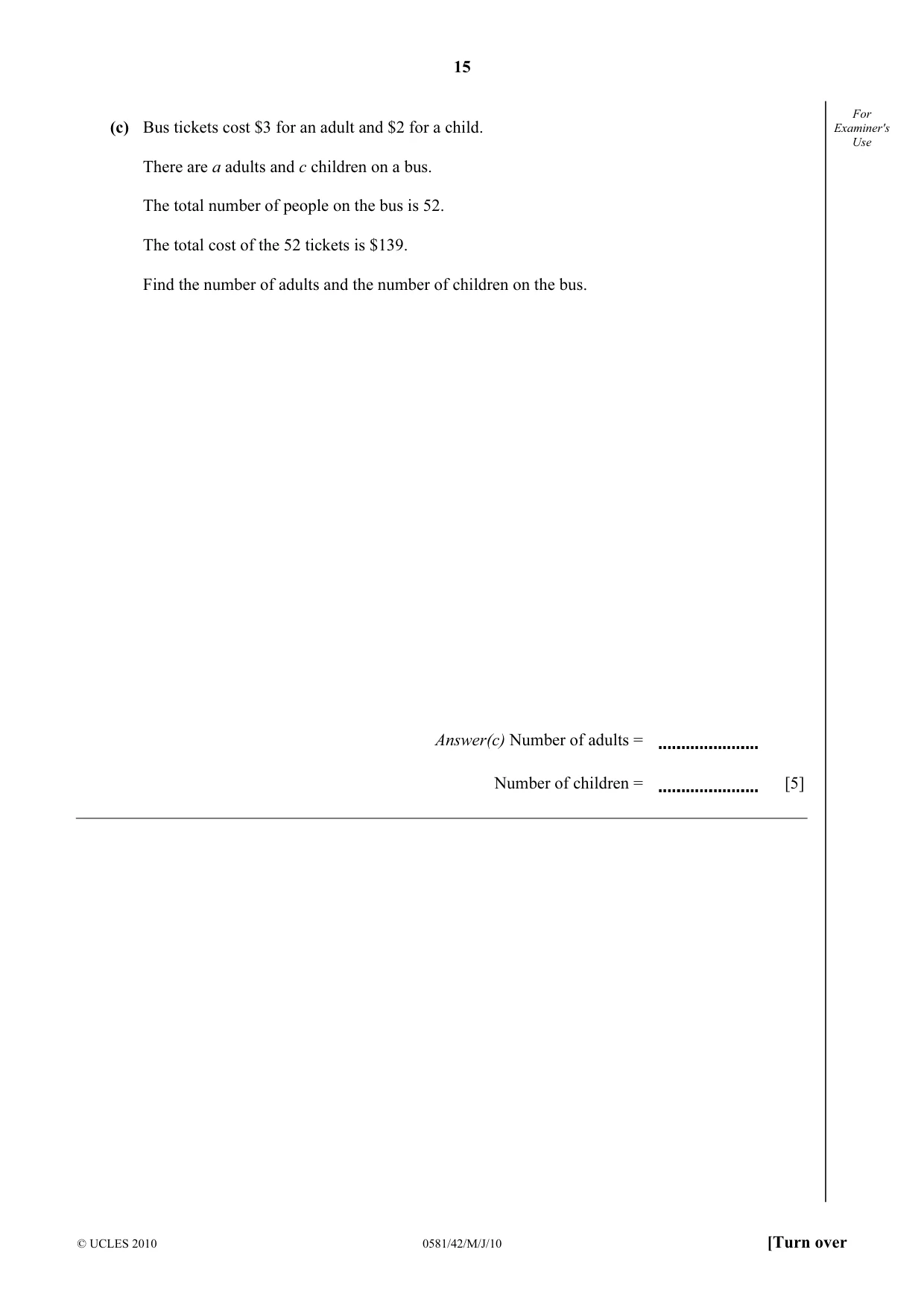
15 © UCLES 2010 0581/42/M/J/10 [Turn over For Examiner's Use (c) Bus tickets cost $3 for an adult and $2 for a child. There are a adults and c children on a bus. The total number of people on the bus is 52. The total cost of the 52 tickets is $139. Find the number of adults and the number of children on the bus. Answer(c) Number of adults = Number of children = [5]
Question paper, page 16
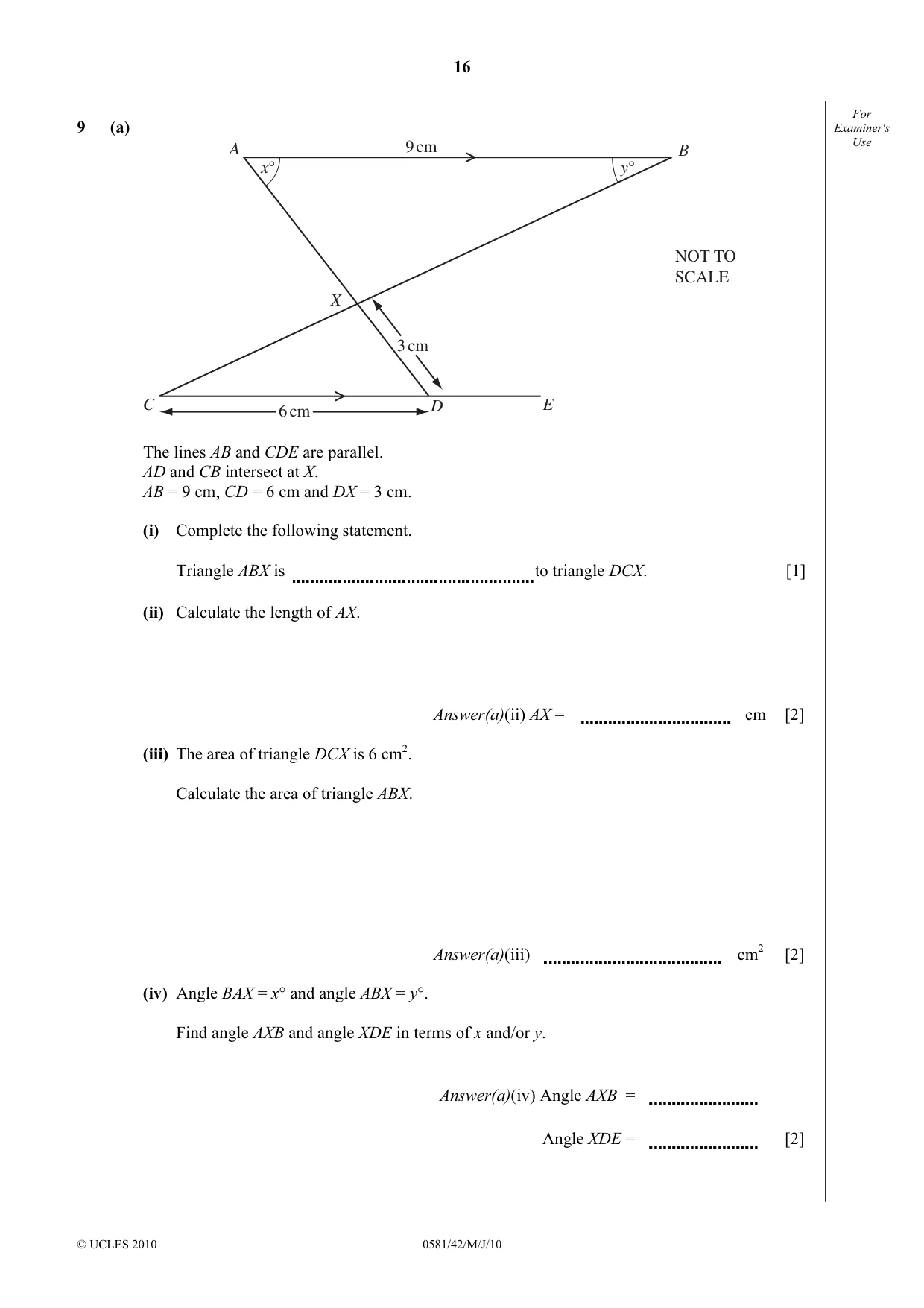
16 © UCLES 2010 0581/42/M/J/10 For Examiner's Use 9 (a) X A C E D B 9 cm 6 cm 3 cm x° y° NOT TO SCALE The lines AB and CDE are parallel. AD and CB intersect at X. AB = 9 cm, CD = 6 cm and DX = 3 cm. (i) Complete the following statement. Triangle ABX is to triangle DCX. [1] (ii) Calculate the length of AX. Answer(a)(ii) AX = cm [2] (iii) The area of triangle DCX is 6 cm2. Calculate the area of triangle ABX. Answer(a)(iii) cm2 [2] (iv) Angle BAX = x° and angle ABX = y°. Find angle AXB and angle XDE in terms of x and/or y. Answer(a)(iv) Angle AXB = Angle XDE = [2]
Question paper, page 17
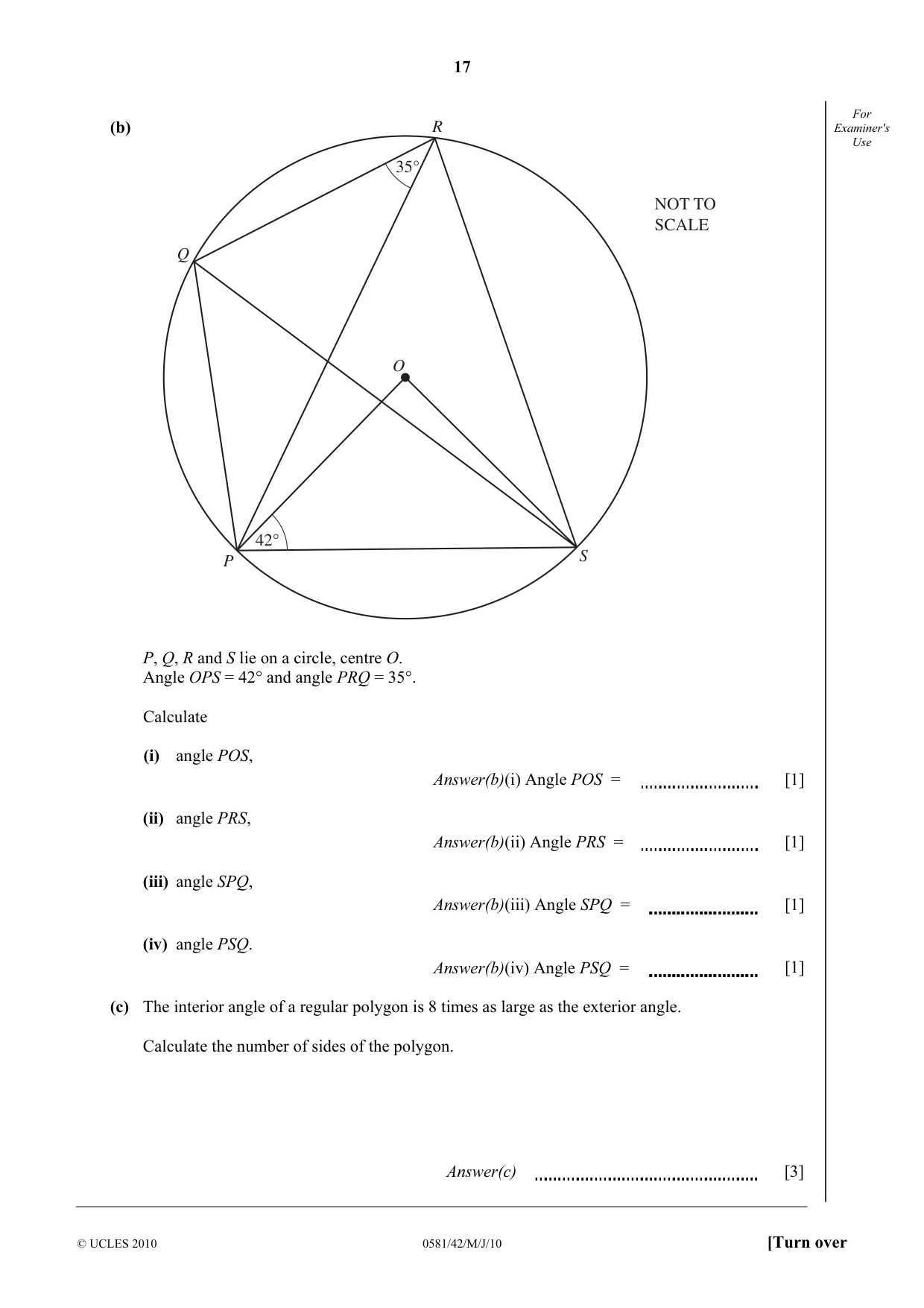
17 © UCLES 2010 0581/42/M/J/10 [Turn over For Examiner's Use (b) P, Q, R and S lie on a circle, centre O. Angle OPS = 42° and angle PRQ = 35°. Calculate (i) angle POS, Answer(b)(i) Angle POS = [1] (ii) angle PRS, Answer(b)(ii) Angle PRS = [1] (iii) angle SPQ, Answer(b)(iii) Angle SPQ = [1] (iv) angle PSQ. Answer(b)(iv) Angle PSQ = [1] (c) The interior angle of a regular polygon is 8 times as large as the exterior angle. Calculate the number of sides of the polygon. Answer(c) [3] 35° 42° P O S Q R NOT TO SCALE
Question paper, page 18
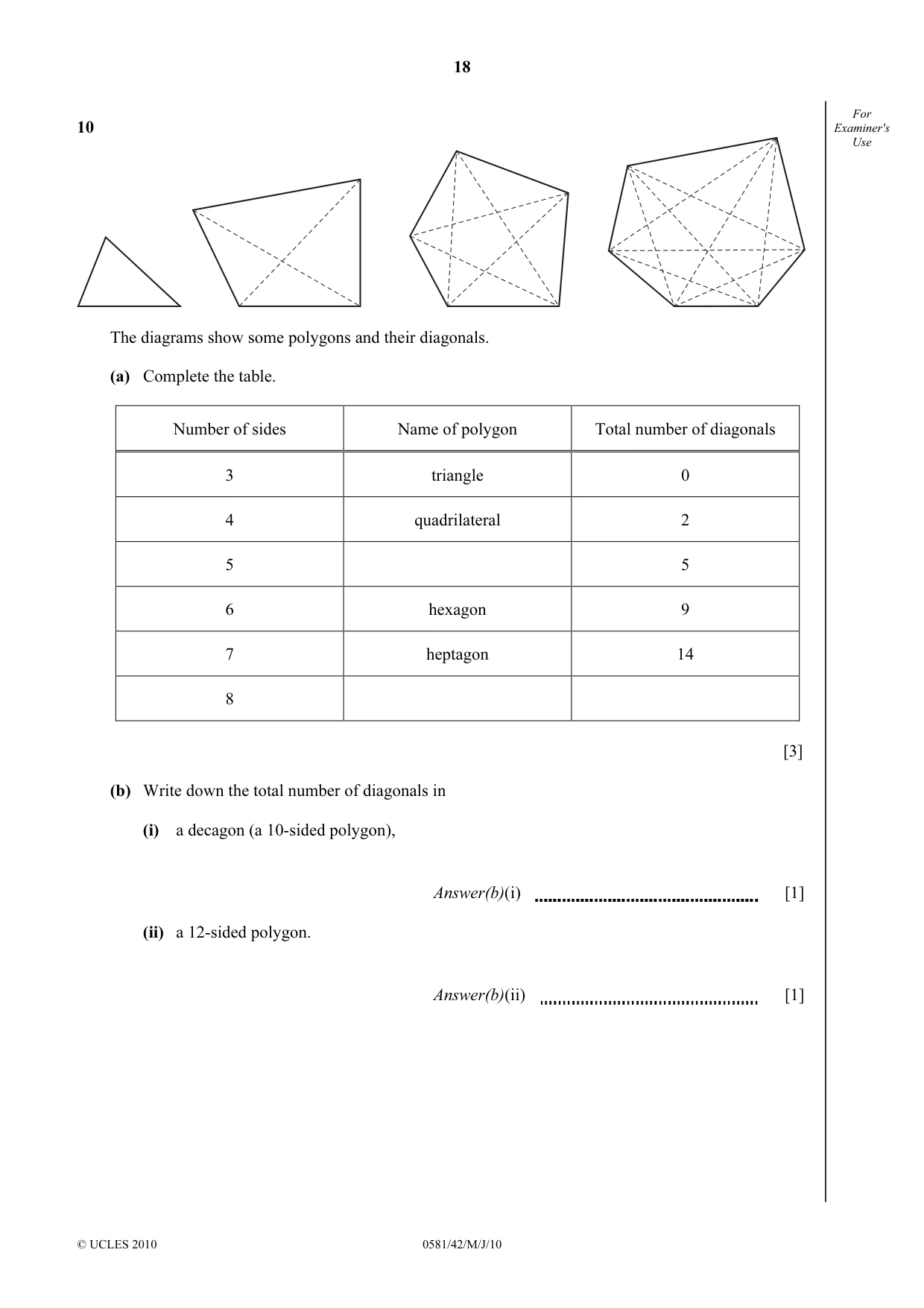
18 © UCLES 2010 0581/42/M/J/10 For Examiner's Use 10 The diagrams show some polygons and their diagonals. (a) Complete the table. Number of sides Name of polygon Total number of diagonals 3 triangle 0 4 quadrilateral 2 5 5 6 hexagon 9 7 heptagon 14 8 [3] (b) Write down the total number of diagonals in (i) a decagon (a 10-sided polygon), Answer(b)(i) [1] (ii) a 12-sided polygon. Answer(b)(ii) [1]
Question paper, page 19
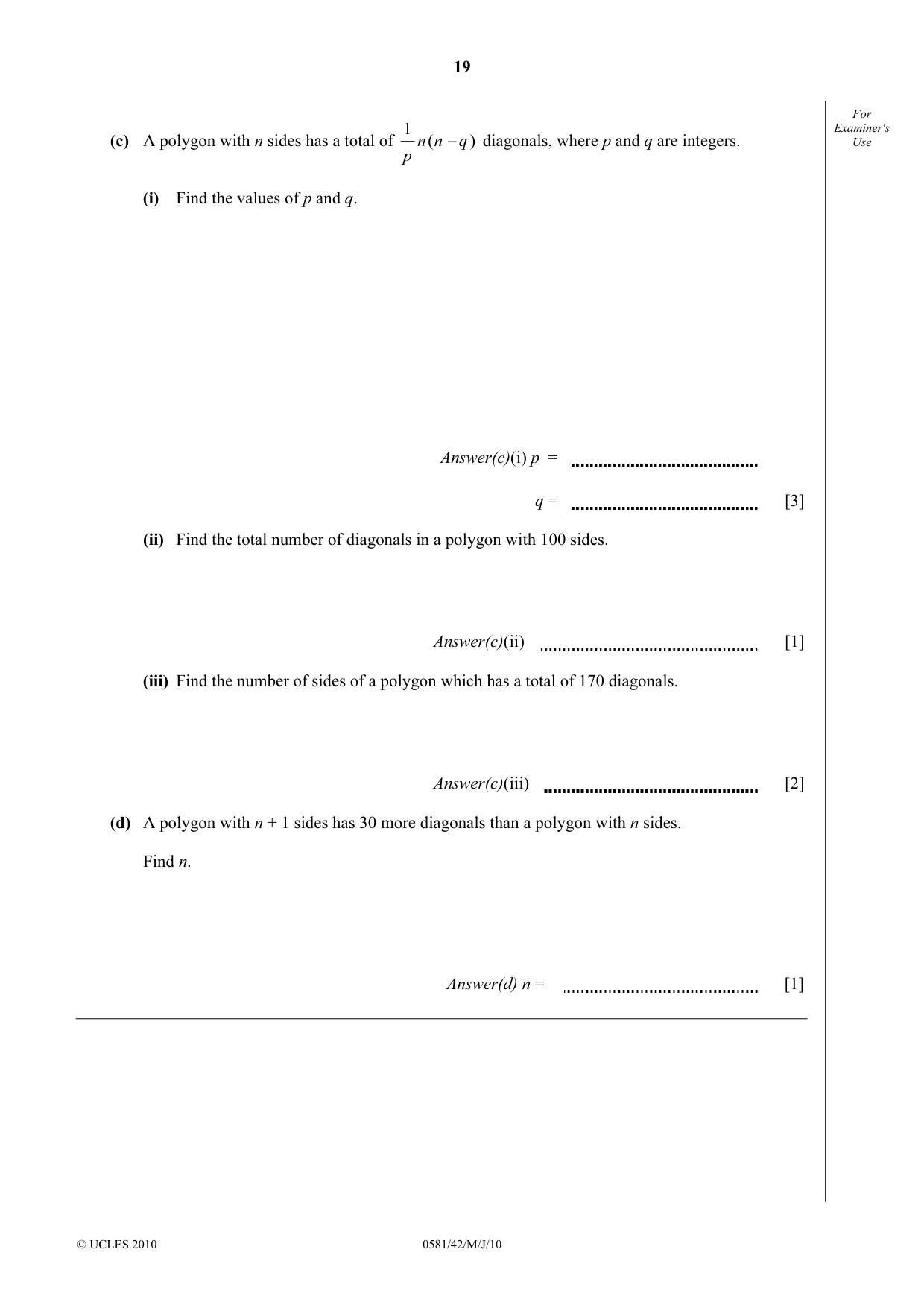
19 © UCLES 2010 0581/42/M/J/10 For Examiner's Use (c) A polygon with n sides has a total of 1 ( ) n n q p − diagonals, where p and q are integers. (i) Find the values of p and q. Answer(c)(i) p = q = [3] (ii) Find the total number of diagonals in a polygon with 100 sides. Answer(c)(ii) [1] (iii) Find the number of sides of a polygon which has a total of 170 diagonals. Answer(c)(iii) [2] (d) A polygon with n + 1 sides has 30 more diagonals than a polygon with n sides. Find n. Answer(d) n = [1]
Question paper, page 20
20 Permission to reproduce items where third-party owned material protected by copyright is included has been sought and cleared where possible. Every reasonable effort has been made by the publisher (UCLES) to trace copyright holders, but if any items requiring clearance have unwittingly been included, the publisher will be pleased to make amends at the earliest possible opportunity. University of Cambridge International Examinations is part of the Cambridge Assessment Group. Cambridge Assessment is the brand name of University of Cambridge Local Examinations Syndicate (UCLES), which is itself a department of the University of Cambridge. 0581/42/M/J/10 BLANK PAGE
Mark scheme, page 1
UNIVERSITY OF CAMBRIDGE INTERNATIONAL EXAMINATIONS International General Certificate of Secondary Education MARK SCHEME for the May/June 2010 question paper for the guidance of teachers 0581 MATHEMATICS 0581/42 Paper 42 (Extended), maximum raw mark 130 This mark scheme is published as an aid to teachers and candidates, to indicate the requirements of the examination. It shows the basis on which Examiners were instructed to award marks. It does not indicate the details of the discussions that took place at an Examiners’ meeting before marking began, which would have considered the acceptability of alternative answers. Mark schemes must be read in conjunction with the question papers and the report on the examination. • CIE will not enter into discussions or correspondence in connection with these mark schemes. CIE is publishing the mark schemes for the May/June 2010 question papers for most IGCSE, GCE Advanced Level and Advanced Subsidiary Level syllabuses and some Ordinary Level syllabuses. www.XtremePapers.com
Mark scheme, page 2
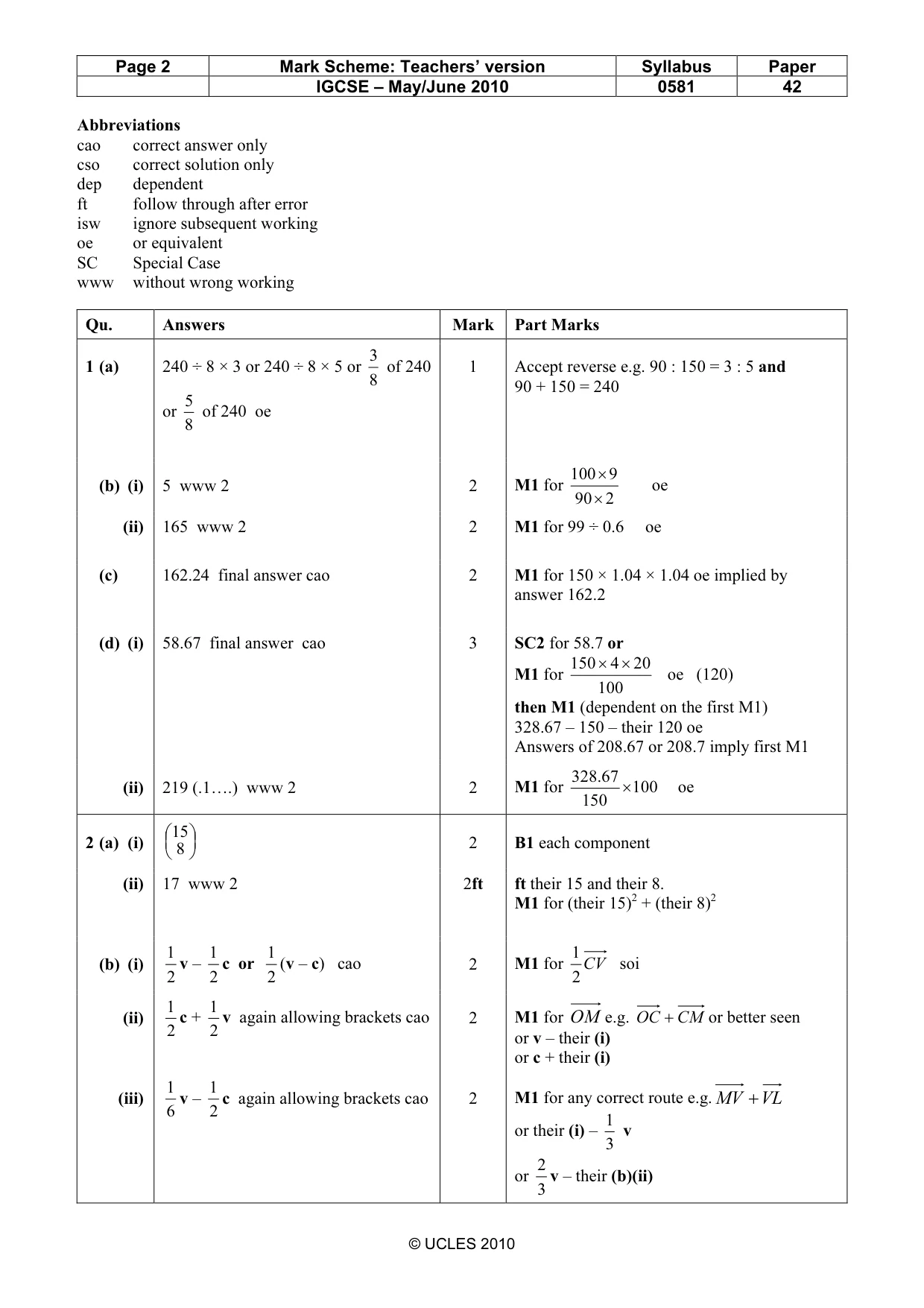
Page 2 Mark Scheme: Teachers’ version Syllabus Paper IGCSE – May/June 2010 0581 42 © UCLES 2010 Abbreviations cao correct answer only cso correct solution only dep dependent ft follow through after error isw ignore subsequent working oe or equivalent SC Special Case www without wrong working Qu. Answers Mark Part Marks 1 (a) 240 ÷ 8 × 3 or 240 ÷ 8 × 5 or 8 3 of 240 or 8 5 of 240 oe 1 Accept reverse e.g. 90 : 150 = 3 : 5 and 90 + 150 = 240 (b) (i) 5 www 2 2 M1 for 2 90 9 100 × × oe (ii) 165 www 2 2 M1 for 99 ÷ 0.6 oe (c) 162.24 final answer cao 2 M1 for 150 × 1.04 × 1.04 oe implied by answer 162.2 (d) (i) 58.67 final answer cao 3 SC2 for 58.7 or M1 for 100 20 4 150 × × oe (120) then M1 (dependent on the first M1) 328.67 – 150 – their 120 oe Answers of 208.67 or 208.7 imply first M1 (ii) 219 (.1….) www 2 2 M1 for 100 150 67 . 328 × oe 2 (a) (i) 8 15 2 B1 each component (ii) 17 www 2 2ft ft their 15 and their 8. M1 for (their 15)2 + (their 8)2 (b) (i) 2 1 v – 2 1 c or 2 1 (v – c) cao 2 M1 for CV 2 1 soi (ii) 2 1 c + 2 1 v again allowing brackets cao 2 M1 for OM e.g. CM OC + or better seen or v – their (i) or c + their (i) (iii) 6 1 v – 2 1 c again allowing brackets cao 2 M1 for any correct route e.g. VL MV + or their (i) – 3 1 v or 3 2 v – their (b)(ii)
Mark scheme, page 3
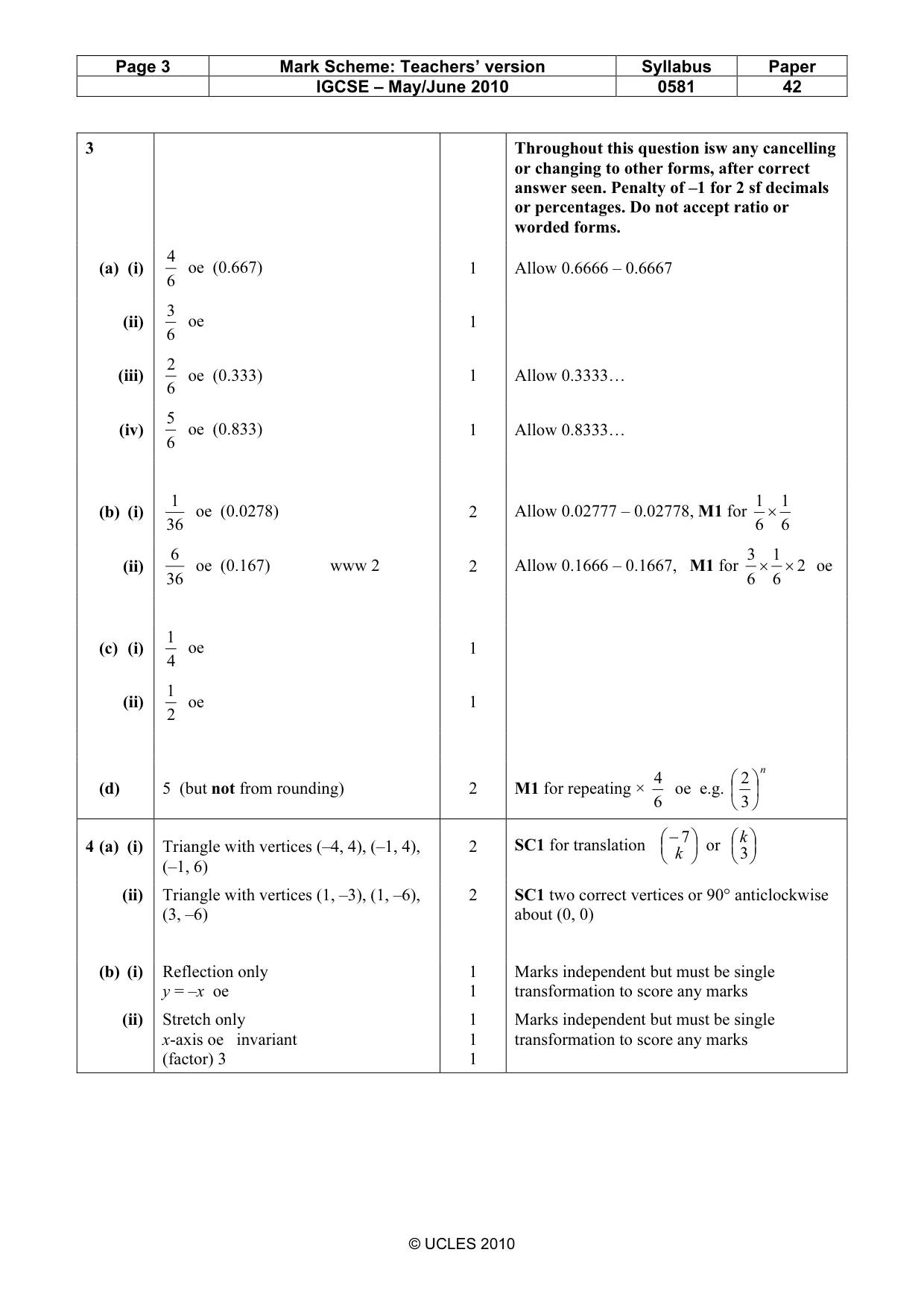
Page 3 Mark Scheme: Teachers’ version Syllabus Paper IGCSE – May/June 2010 0581 42 © UCLES 2010 3 Throughout this question isw any cancelling or changing to other forms, after correct answer seen. Penalty of –1 for 2 sf decimals or percentages. Do not accept ratio or worded forms. (a) (i) 6 4 oe (0.667) 1 Allow 0.6666 – 0.6667 (ii) 6 3 oe 1 (iii) 6 2 oe (0.333) 1 Allow 0.3333… (iv) 6 5 oe (0.833) 1 Allow 0.8333… (b) (i) 36 1 oe (0.0278) 2 Allow 0.02777 – 0.02778, M1 for 6 1 6 1 × (ii) 36 6 oe (0.167) www 2 2 Allow 0.1666 – 0.1667, M1 for 2 6 1 6 3 × × oe (c) (i) 4 1 oe 1 (ii) 2 1 oe 1 (d) 5 (but not from rounding) 2 M1 for repeating × 6 4 oe e.g. n 3 2 4 (a) (i) Triangle with vertices (–4, 4), (–1, 4), (–1, 6) 2 SC1 for translation − k 7 or 3 k (ii) Triangle with vertices (1, –3), (1, –6), (3, –6) 2 SC1 two correct vertices or 90° anticlockwise about (0, 0) (b) (i) Reflection only y = –x oe 1 1 Marks independent but must be single transformation to score any marks (ii) Stretch only x-axis oe invariant (factor) 3 1 1 1 Marks independent but must be single transformation to score any marks
Mark scheme, page 4
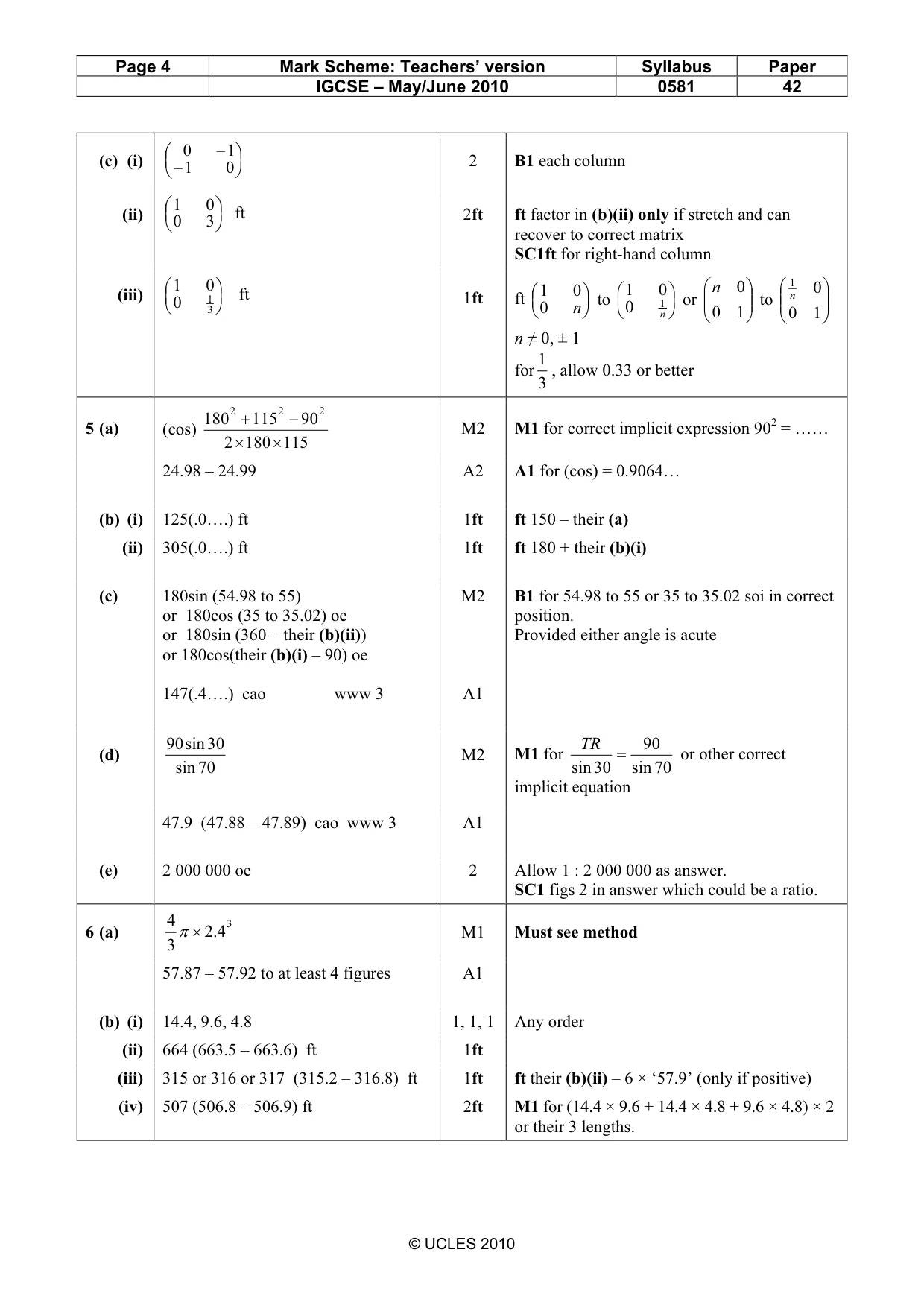
Page 4 Mark Scheme: Teachers’ version Syllabus Paper IGCSE – May/June 2010 0581 42 © UCLES 2010 (c) (i) − − 0 1 1 0 2 B1 each column (ii) 3 0 0 1 ft 2ft ft factor in (b)(ii) only if stretch and can recover to correct matrix SC1ft for right-hand column (iii) 3 1 0 0 1 ft 1ft ft n 0 0 1 to n 1 0 0 1 or 1 0 0 n to 1 0 0 1 n n ≠ 0, ± 1 for 3 1 , allow 0.33 or better 5 (a) (cos) 115 180 2 90 115 180 2 2 2 × × − + M2 M1 for correct implicit expression 902 = …… 24.98 – 24.99 A2 A1 for (cos) = 0.9064… (b) (i) 125(.0….) ft 1ft ft 150 – their (a) (ii) 305(.0….) ft 1ft ft 180 + their (b)(i) (c) 180sin (54.98 to 55) or 180cos (35 to 35.02) oe or 180sin (360 – their (b)(ii)) or 180cos(their (b)(i) – 90) oe 147(.4….) cao www 3 M2 A1 B1 for 54.98 to 55 or 35 to 35.02 soi in correct position. Provided either angle is acute (d) 70 sin 30 sin 90 M2 M1 for 70 sin 90 30 sin = TR or other correct implicit equation 47.9 (47.88 – 47.89) cao www 3 A1 (e) 2 000 000 oe 2 Allow 1 : 2 000 000 as answer. SC1 figs 2 in answer which could be a ratio. 6 (a) 3 4.2 3 4 × π M1 Must see method 57.87 – 57.92 to at least 4 figures A1 (b) (i) 14.4, 9.6, 4.8 1, 1, 1 Any order (ii) 664 (663.5 – 663.6) ft 1ft (iii) 315 or 316 or 317 (315.2 – 316.8) ft 1ft ft their (b)(ii) – 6 × ‘57.9’ (only if positive) (iv) 507 (506.8 – 506.9) ft 2ft M1 for (14.4 × 9.6 + 14.4 × 4.8 + 9.6 × 4.8) × 2 or their 3 lengths.
Mark scheme, page 5
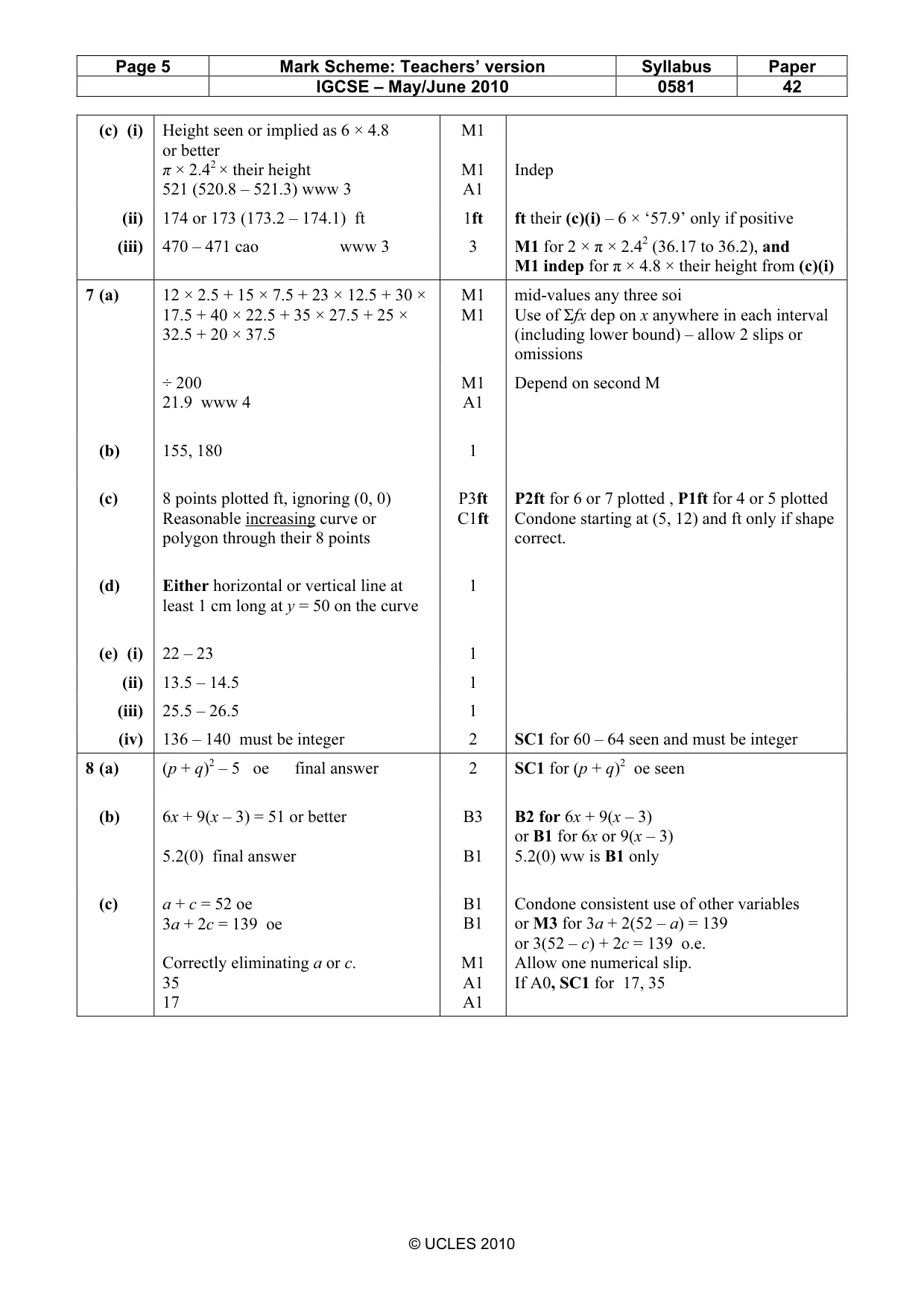
Page 5 Mark Scheme: Teachers’ version Syllabus Paper IGCSE – May/June 2010 0581 42 © UCLES 2010 (c) (i) Height seen or implied as 6 × 4.8 or better π × 2.42 × their height 521 (520.8 – 521.3) www 3 M1 M1 A1 Indep (ii) 174 or 173 (173.2 – 174.1) ft 1ft ft their (c)(i) – 6 × ‘57.9’ only if positive (iii) 470 – 471 cao www 3 3 M1 for 2 × π × 2.42 (36.17 to 36.2), and M1 indep for π × 4.8 × their height from (c)(i) 7 (a) 12 × 2.5 + 15 × 7.5 + 23 × 12.5 + 30 × 17.5 + 40 × 22.5 + 35 × 27.5 + 25 × 32.5 + 20 × 37.5 M1 M1 mid-values any three soi Use of Σfx dep on x anywhere in each interval (including lower bound) – allow 2 slips or omissions ÷ 200 21.9 www 4 M1 A1 Depend on second M (b) 155, 180 1 (c) 8 points plotted ft, ignoring (0, 0) Reasonable increasing curve or polygon through their 8 points P3ft C1ft P2ft for 6 or 7 plotted , P1ft for 4 or 5 plotted Condone starting at (5, 12) and ft only if shape correct. (d) Either horizontal or vertical line at least 1 cm long at y = 50 on the curve 1 (e) (i) 22 – 23 1 (ii) 13.5 – 14.5 1 (iii) 25.5 – 26.5 1 (iv) 136 – 140 must be integer 2 SC1 for 60 – 64 seen and must be integer 8 (a) (p + q)2 – 5 oe final answer 2 SC1 for (p + q)2 oe seen (b) 6x + 9(x – 3) = 51 or better 5.2(0) final answer B3 B1 B2 for 6x + 9(x – 3) or B1 for 6x or 9(x – 3) 5.2(0) ww is B1 only (c) a + c = 52 oe 3a + 2c = 139 oe Correctly eliminating a or c. 35 17 B1 B1 M1 A1 A1 Condone consistent use of other variables or M3 for 3a + 2(52 – a) = 139 or 3(52 – c) + 2c = 139 o.e. Allow one numerical slip. If A0, SC1 for 17, 35
Mark scheme, page 6
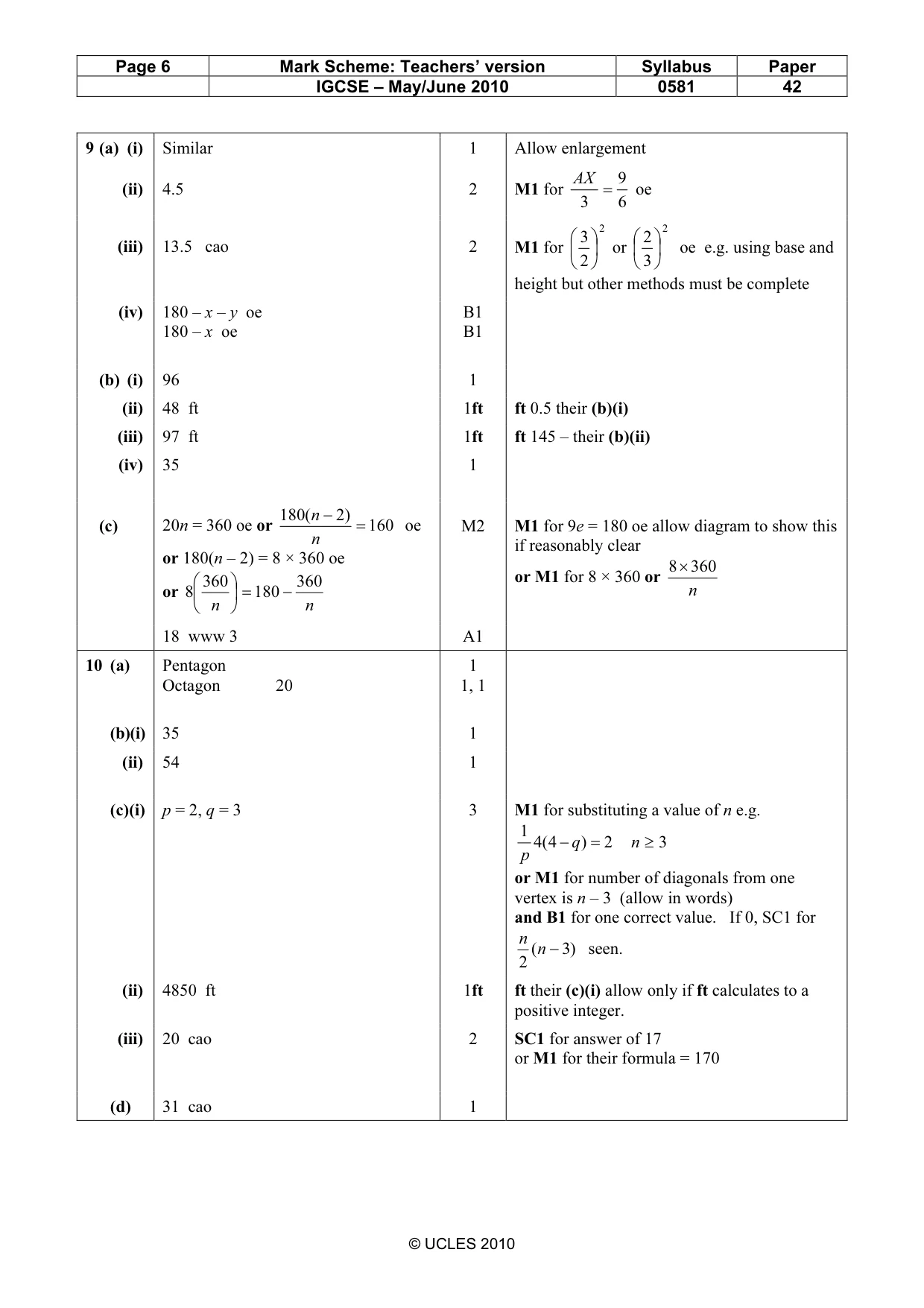
Page 6 Mark Scheme: Teachers’ version Syllabus Paper IGCSE – May/June 2010 0581 42 © UCLES 2010 9 (a) (i) Similar 1 Allow enlargement (ii) 4.5 2 M1 for 6 9 3 = AX oe (iii) 13.5 cao 2 M1 for 2 2 3 or 2 3 2 oe e.g. using base and height but other methods must be complete (iv) 180 – x – y oe 180 – x oe B1 B1 (b) (i) 96 1 (ii) 48 ft 1ft ft 0.5 their (b)(i) (iii) 97 ft 1ft ft 145 – their (b)(ii) (iv) 35 1 (c) 20n = 360 oe or 160 ) 2 ( 180 = − n n oe or 180(n – 2) = 8 × 360 oe or n n 360 180 360 8 − = M2 M1 for 9e = 180 oe allow diagram to show this if reasonably clear or M1 for 8 × 360 or n 360 8× 18 www 3 A1 10 (a) Pentagon Octagon 20 1 1, 1 (b)(i) 35 1 (ii) 54 1 (c)(i) p = 2, q = 3 3 M1 for substituting a value of n e.g. 2 ) 4 ( 4 1 = −q p 3 ≥ n or M1 for number of diagonals from one vertex is n – 3 (allow in words) and B1 for one correct value. If 0, SC1 for ) 3 ( 2 − n n seen. (ii) 4850 ft 1ft ft their (c)(i) allow only if ft calculates to a positive integer. (iii) 20 cao 2 SC1 for answer of 17 or M1 for their formula = 170 (d) 31 cao 1