Cambridge IGCSE Mathematics - International 0607 — 2022 May/June Paper 4 · Variant 2
0607/42/M/J/22 · 12 questions · 120 marks · ≈135 min
The question paper and its mark scheme, free to read here and free to download. This is Cambridge’s own paper, exactly as it was sat.
Question paper20 pages
Mark scheme10 pages
Answers below. Sit the paper first if you are practising.
Questions as text
Q1 · Y 8 7 6 5 A B 4 3 2 1 – 9 – 8 – 7 – 6 – 5 – 4 – 3 – 2 – 1 0 1 2 3 4 5 6 7 8 9 x – 1 – 2…
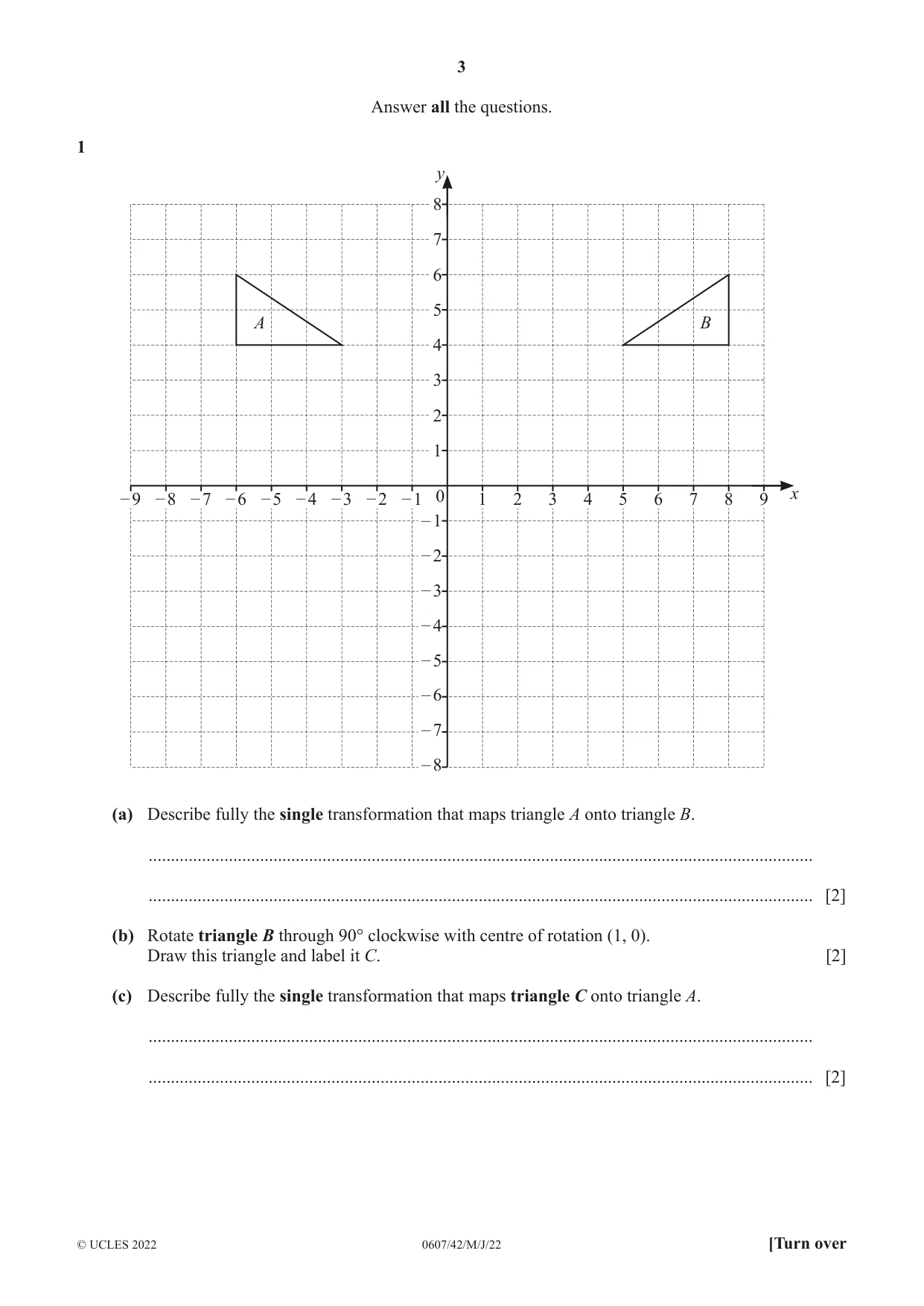
1 y 8 7 6 5 A B 4 3 2 1 – 9 – 8 – 7 – 6 – 5 – 4 – 3 – 2 – 1 0 1 2 3 4 5 6 7 8 9 x – 1 – 2 – 3 – 4 – 5 – 6 – 7 – 8 (a) Describe fully the single transformation that maps triangle A onto triangle B. ..................................................................................................................................................... ..................................................................................................................................................... [2] (b) Rotate triangle B through 90° clockwise with centre of rotation (1, 0). Draw this triangle and label it C. [2] (c) Describe fully the single transformation that maps triangle C onto triangle A. ..................................................................................................................................................... ..................................................................................................................................................... [2]
Mark scheme: Question Answer Marks Partial Marks 1(a) Reflection 2 B1 for each x = 1 oe 1(b) Correct triangle 2 B1 for correct rotation with incorrect centre (5, –4) (5, –7) (7, –7) or 90 rotation anticlockwise about correct centre 1(c) Reflection 2 B1 for each y = x – 1 oe
Q2 · The number of hours, x, spent revising and the mark scored, y, in an examination for each…
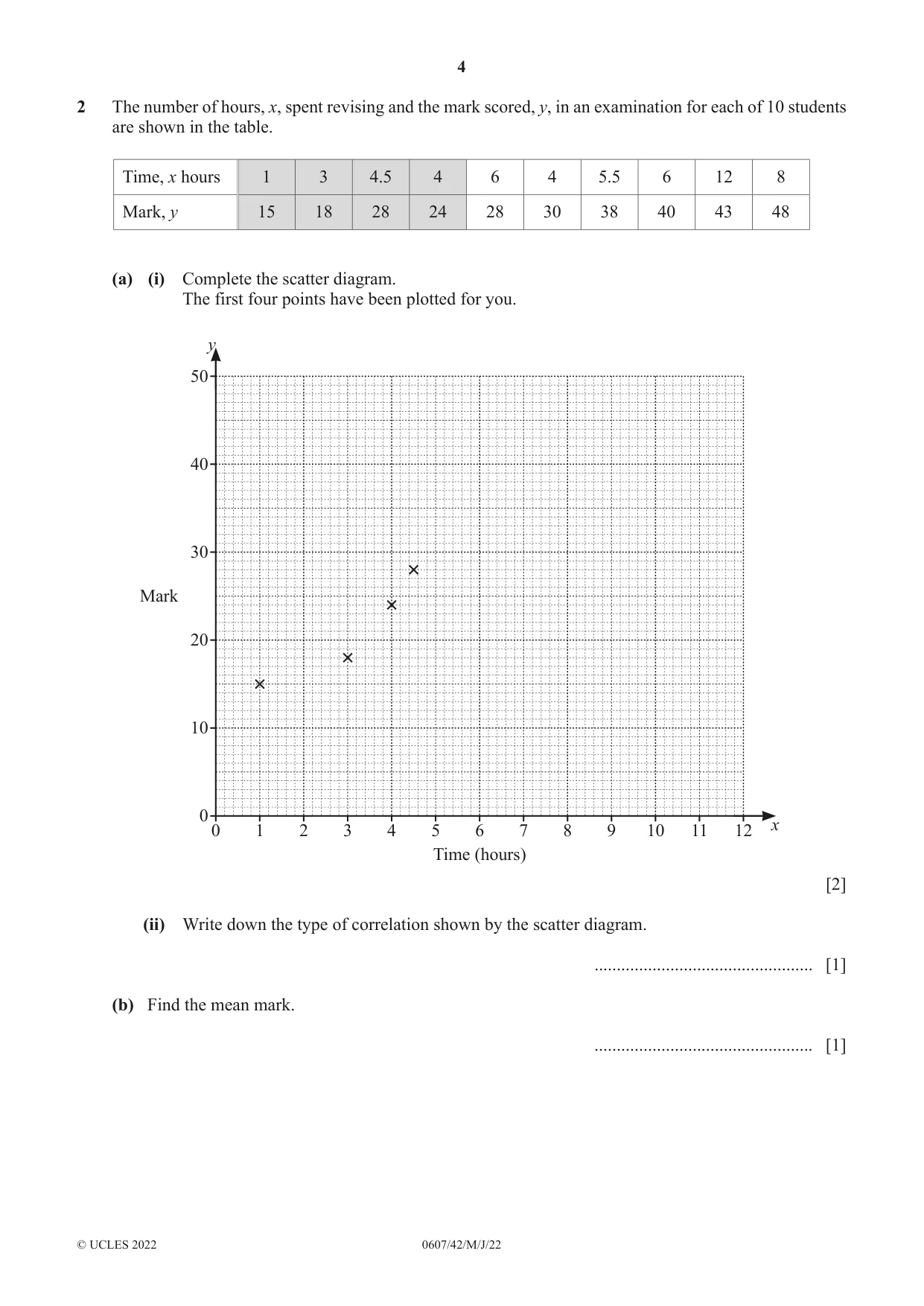
2 The number of hours, x, spent revising and the mark scored, y, in an examination for each of 10 students are shown in the table. Time, x hours 1 3 4.5 4 6 4 5.5 6 12 8 Mark, y 15 18 28 24 28 30 38 40 43 48 (a) (i) Complete the scatter diagram. The first four points have been plotted for you. y 50 40 30 Mark 20 10 0 x 0 1 2 3 4 5 6 7 8 9 10 11 12 Time (hours) [2] (ii) Write down the type of correlation shown by the scatter diagram. ................................................. [1] (b) Find the mean mark. ................................................. [1] (c) (i) Find the equation of the regression line for y in terms of x. Give your answer in the form y = mx + c. y = ................................................ [2] (ii) The value for m represents a connection between time and mark. Write down the units of m. ............................................................................... [1] (d) Use your answer to part (c)(i) to estimate (i) the mark scored for a student who revised for 10 hours, ................................................. [1] (ii) the number of hours spent revising for a student to score a mark of 36. ................................................. [1]
Mark scheme: 2(a)(i) Correct points 2 B1 for 4 or 5 points correct 2(a)(ii) Positive 1 2(b) 31.2 1 2(c)(i) y = 3.01x + 15[.0] 2 B1 for y = 3x + 15 or y = 3.01x + k or y = kx + 15[.0] 2(c)(ii) Marks per hour oe 1 2(d)(i) 45 1 FT their (c)(i) if linear and answer is positive 2(d)(ii) 7 1 FT their (c)(i) if linear and answer is positive
Q3 · NOT TO SCALE A Q x° P B ( x - 30)° O D C A, B, C and D lie on a circle centre O
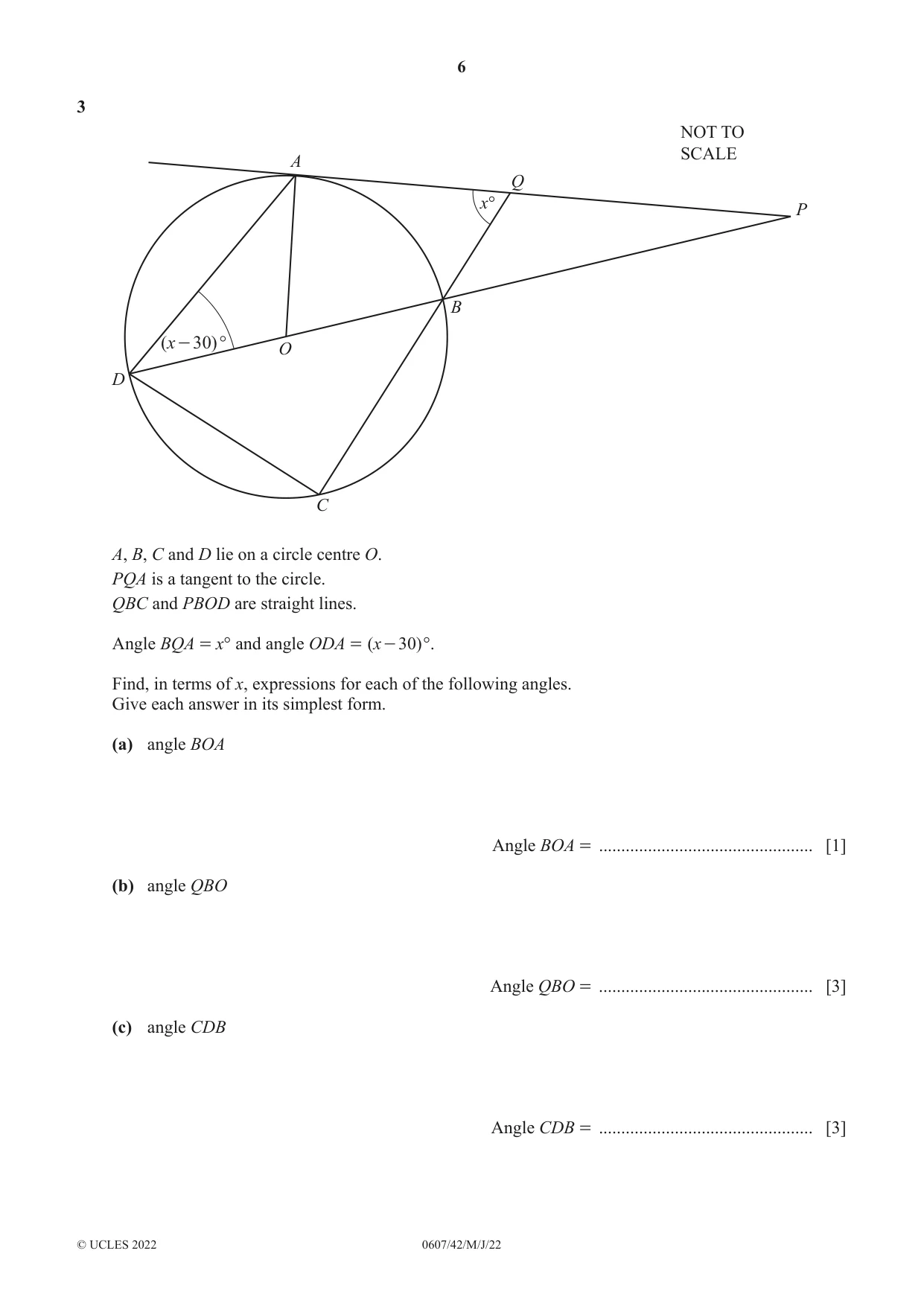
3 NOT TO SCALE A Q x° P B ( x - 30)° O D C A, B, C and D lie on a circle centre O. PQA is a tangent to the circle. QBC and PBOD are straight lines. Angle BQA = x° and angle ODA = ( x - 30) °. Find, in terms of x, expressions for each of the following angles. Give each answer in its simplest form. (a) angle BOA Angle BOA = ................................................ [1] (b) angle QBO Angle QBO = ................................................ [3] (c) angle CDB Angle CDB = ................................................ [3]
Mark scheme: 3(a) 2x – 60 or 2(x – 30) final answer 1 3(b) 330 – 3x or 3(110 – x) final answer 3 M2 for 360 – 90 – x – (their (a)) oe or B1 for OAQ = 90 3(c) 240 – 3x or 3(80 – x) final answer 3 M2 for 180 –90 – (180 – their (b)) oe or B1 for DCB = 90
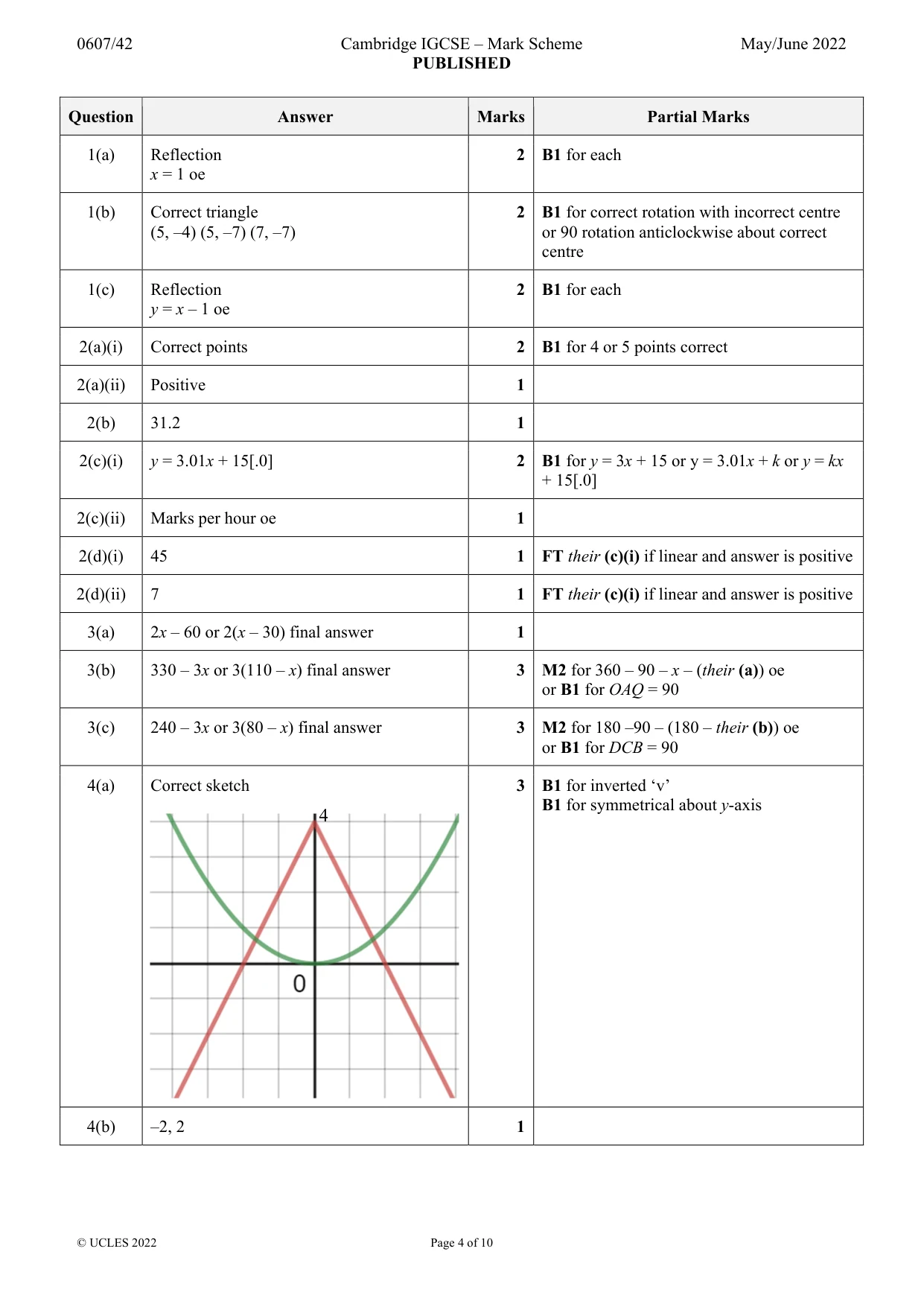
Q4 · Y 4 – 4 0 4 x – 4 (a) On the diagram, sketch the graph of y = f( x) , where f( )x = 4 - 2…
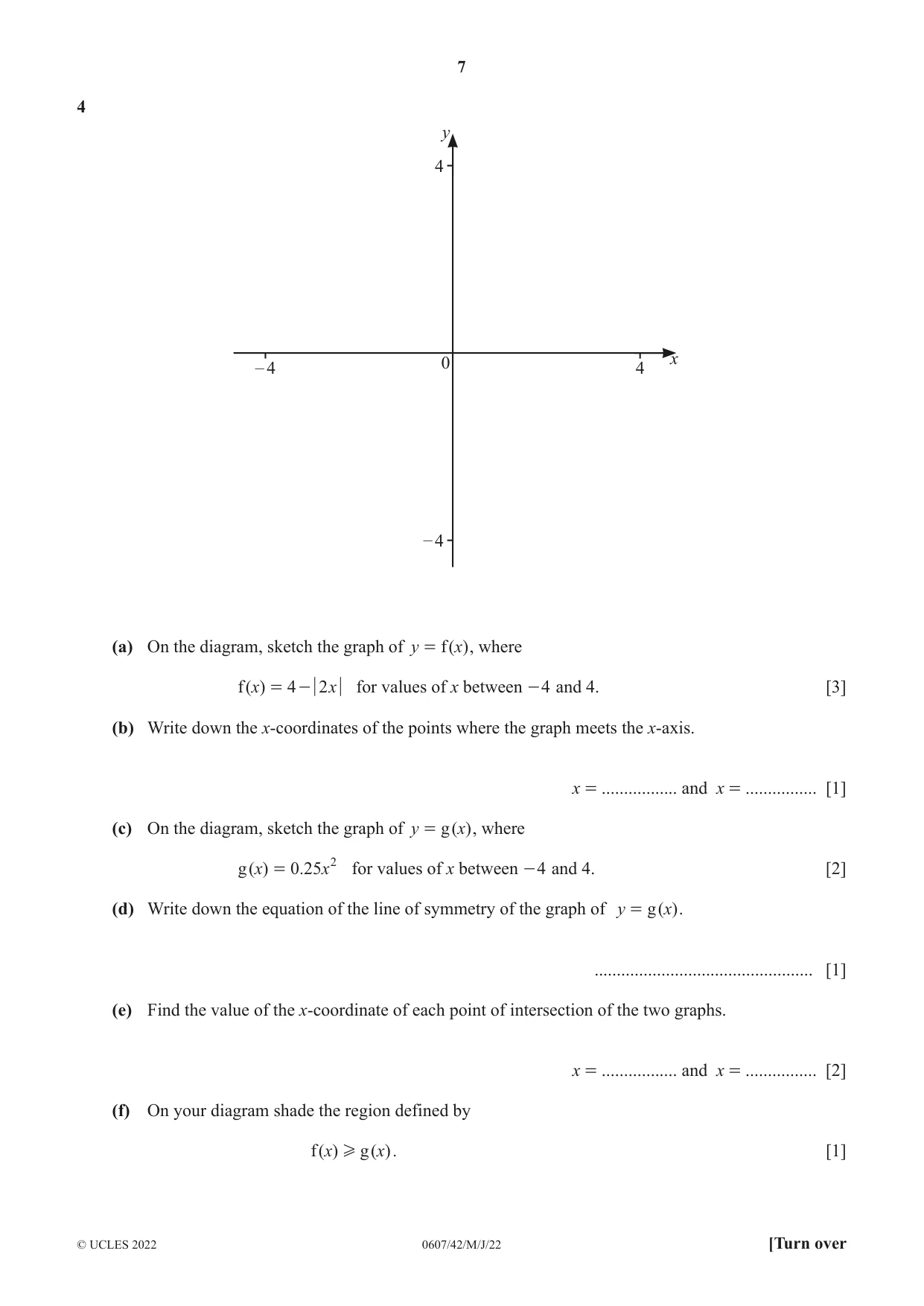
4 y 4 – 4 0 4 x – 4 (a) On the diagram, sketch the graph of y = f( x) , where f( )x = 4 - 2 x for values of x between - 4 and 4. [3] (b) Write down the x-coordinates of the points where the graph meets the x-axis. x = ................. and x = ................ [1] (c) On the diagram, sketch the graph of y = g( x) , where g ( x) = 0 .25 x 2 for values of x between - 4 and 4. [2] (d) Write down the equation of the line of symmetry of the graph of y = g( x) . ................................................. [1] (e) Find the value of the x-coordinate of each point of intersection of the two graphs. x = ................. and x = ................ [2] (f) On your diagram shade the region defined by f( x) H g( x). [1]
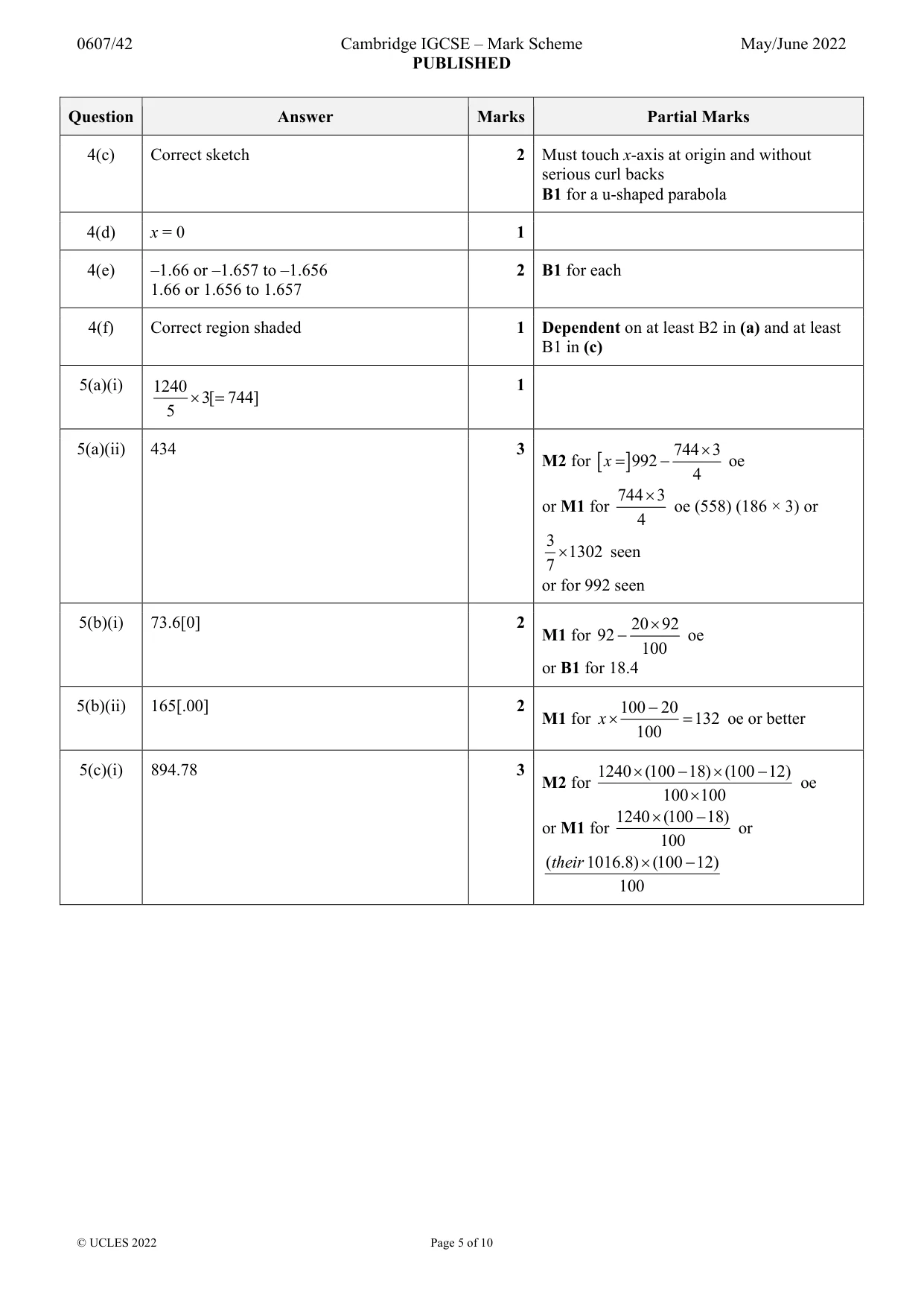
Mark scheme: 4(a) Correct sketch 3 B1 for inverted ‘v’ B1 for symmetrical about y-axis 4 4(b) –2, 2 1 4(c) Correct sketch 2 Must touch x-axis at origin and without serious curl backs B1 for a u-shaped parabola 4(d) x = 0 1 4(e) –1.66 or –1.657 to –1.656 2 B1 for each 1.66 or 1.656 to 1.657 4(f) Correct region shaded 1 Dependent on at least B2 in (a) and at least B1 in (c)
Q5 · Alenia, Bob and Cara share some money in the ratio 5 : 3 : 4
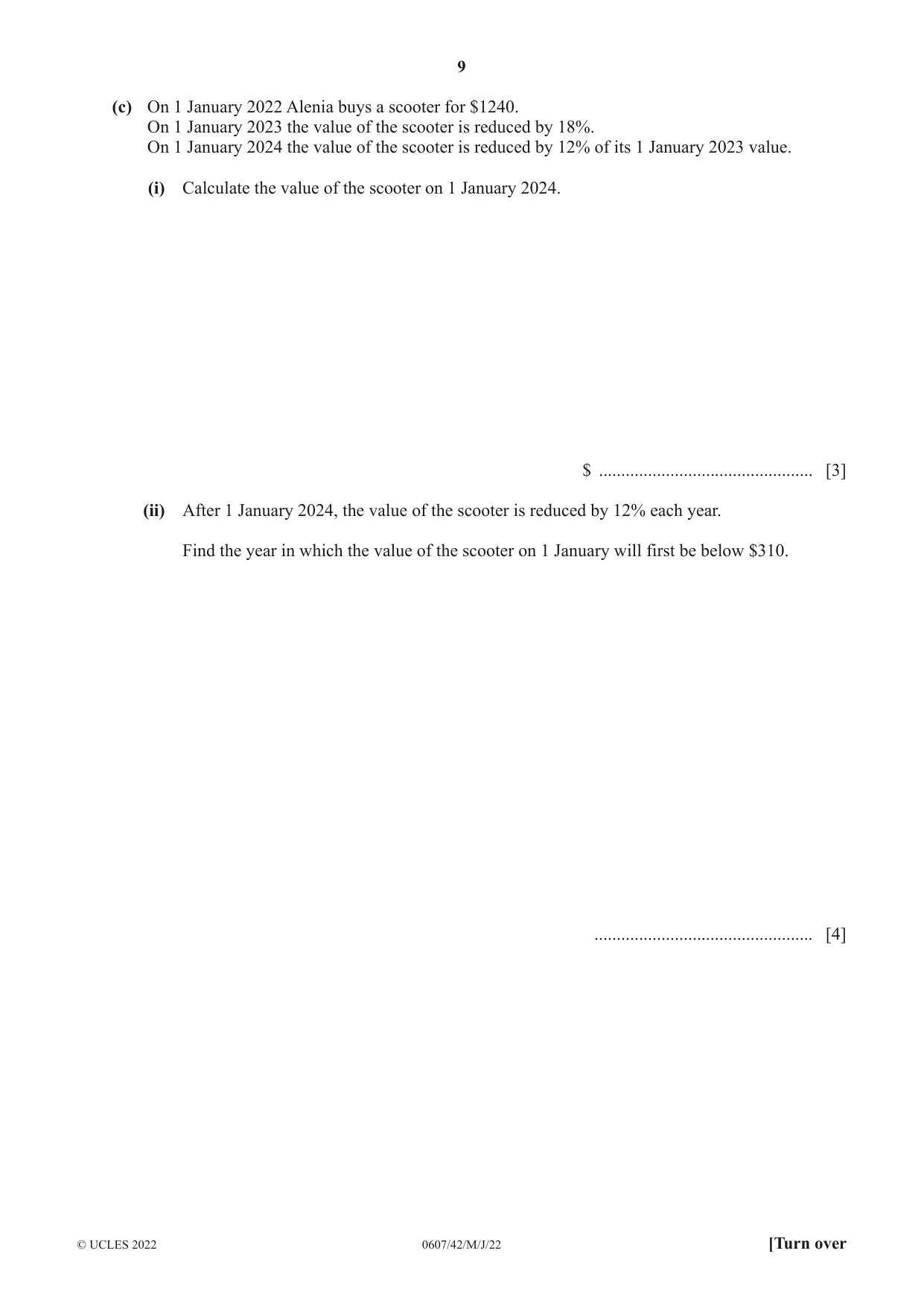
5 (a) Alenia, Bob and Cara share some money in the ratio 5 : 3 : 4 . Alenia’s share is $1240. (i) Show that Bob’s share is $744. [1] (ii) Cara spends $x from her share. The ratio of Bob’s money : Cara’s money is now 4 : 3 . Find the value of x. x = ................................................ [3] (b) A shop has a sale and all prices are reduced by 20%. (i) Bob buys a coat. The original price of the coat was $92. Work out the sale price of the coat. $ ................................................ [2] (ii) Cara buys a jacket in the sale for $132. Work out the original price of the jacket. $ ................................................ [2] (c) On 1 January 2022 Alenia buys a scooter for $1240. On 1 January 2023 the value of the scooter is reduced by 18%. On 1 January 2024 the value of the scooter is reduced by 12% of its 1 January 2023 value. (i) Calculate the value of the scooter on 1 January 2024. $ ................................................ [3] (ii) After 1 January 2024, the value of the scooter is reduced by 12% each year. Find the year in which the value of the scooter on 1 January will first be below $310. ................................................. [4]
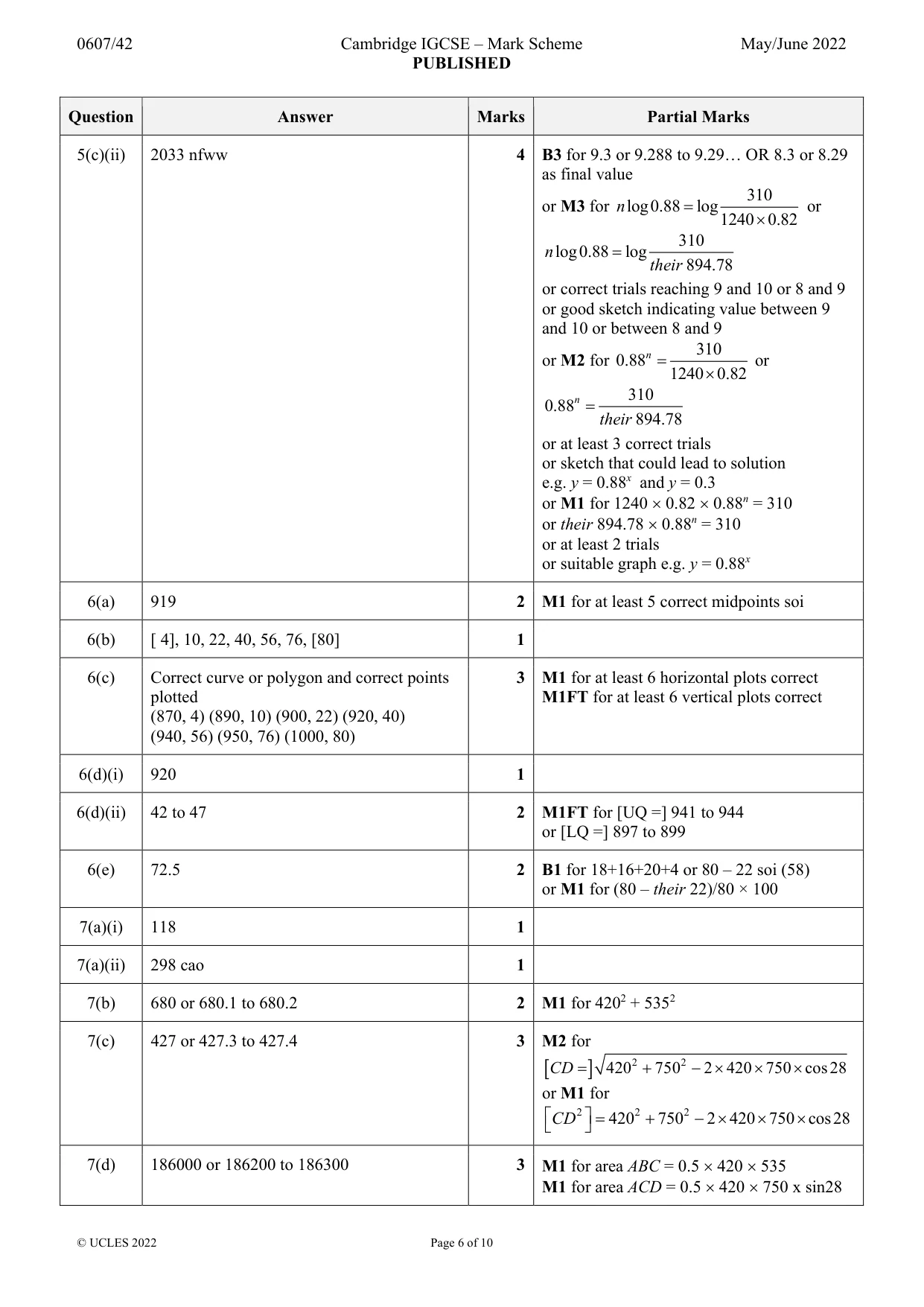
Mark scheme: 5(a)(i) 1240 1 3[ 744] 5 5(a)(ii) 434 3 744 3 M2 for x 992 oe 4 744 3 or M1 for oe (558) (186 × 3) or 4 3 1302 seen 7 or for 992 seen 5(b)(i) 73.6[0] 2 20 92 M1 for 92 oe 100 or B1 for 18.4 5(b)(ii) 165[.00] 2 100 20 M1 for x 132 oe or better 100 5(c)(i) 894.78 3 1240 (100 18) (100 12) M2 for oe 100 100 1240 (100 18) or M1 for or 100 (their 1016.8) (100 12) 100 5(c)(ii) 2033 nfww 4 B3 for 9.3 or 9.288 to 9.29… OR 8.3 or 8.29 as final value 310 or M3 for n log0.88 log1240 0.82 or 310 n log0.88 log their 894.78 or correct trials reaching 9 and 10 or 8 and 9 or good sketch indicating value between 9 and 10 or between 8 and 9 n 310 or M2 for 0.88 or 1240 0.82 n 310 0.88 their 894.78 or at least 3 correct trials or sketch that could lead to solution e.g. y = 0.88x and y = 0.3 or M1 for 1240 0.82 0.88n = 310 or their 894.78 0.88n = 310 or at least 2 trials or suitable graph e.g. y = 0.88x
Q6 · The lifetimes, x hours, of 80 electric light bulbs are shown in the table
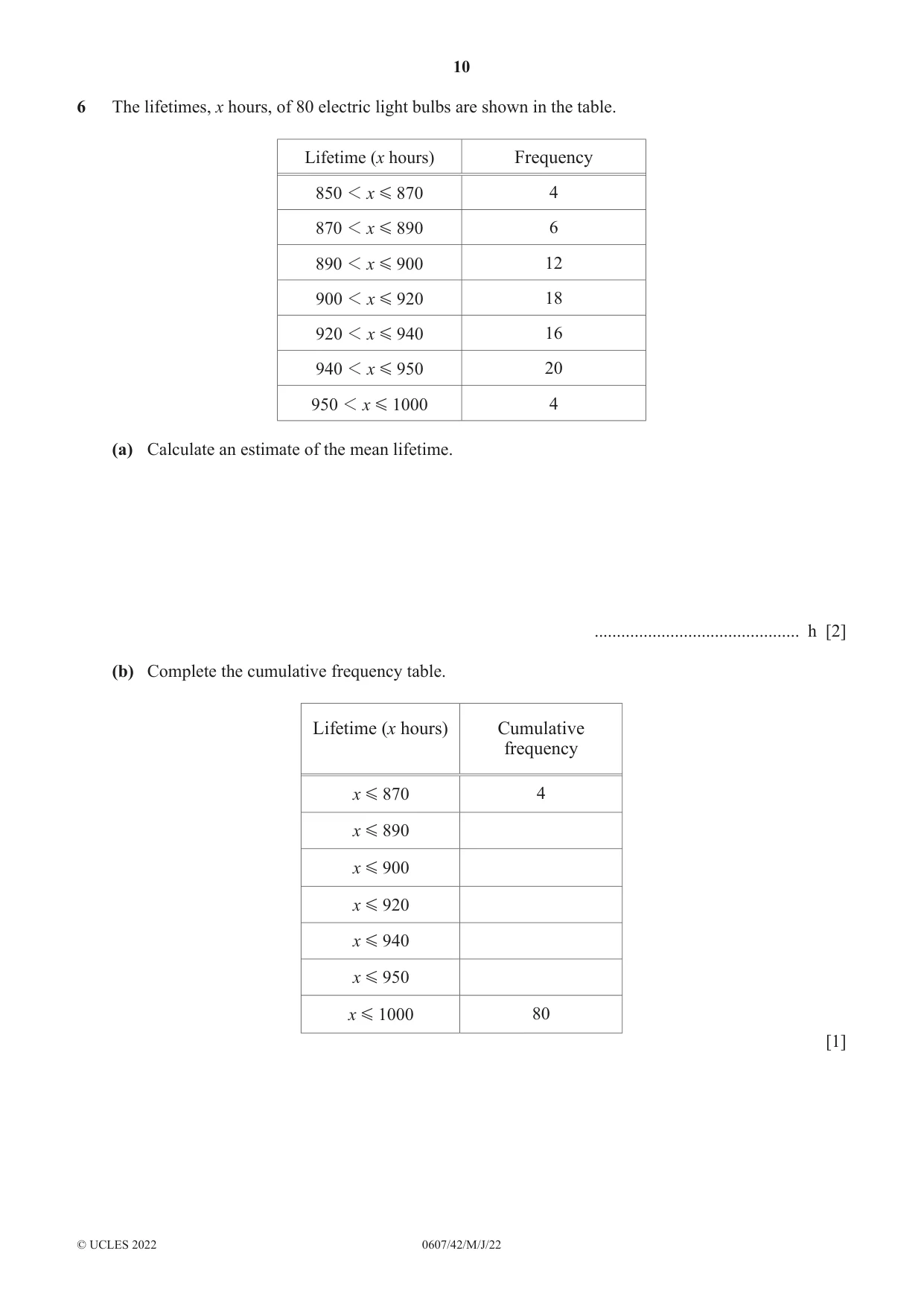
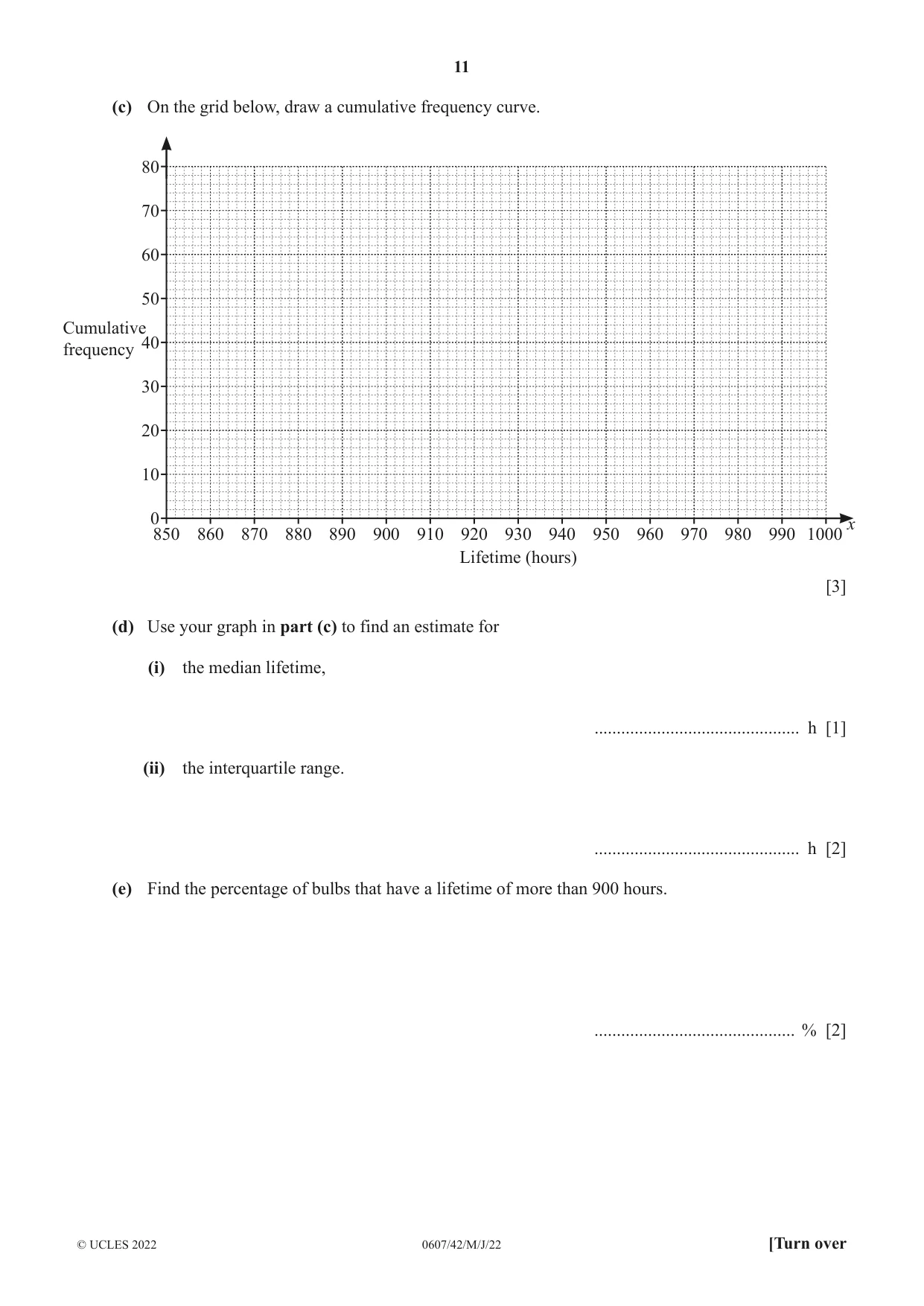
6 The lifetimes, x hours, of 80 electric light bulbs are shown in the table. Lifetime (x hours) Frequency 850 1 x G 870 4 870 1 x G 890 6 890 1 x G 900 12 900 1 x G 920 18 920 1 x G 940 16 940 1 x G 950 20 950 1 x G 1000 4 (a) Calculate an estimate of the mean lifetime. .............................................. h [2] (b) Complete the cumulative frequency table. Lifetime (x hours) Cumulative frequency x G 870 4 x G 890 x G 900 x G 920 x G 940 x G 950 x G 1000 80 [1] (c) On the grid below, draw a cumulative frequency curve. 80 70 60 50 Cumulative 40frequency 30 20 10 0 x 850 860 870 880 890 900 910 920 930 940 950 960 970 980 990 1000 Lifetime (hours) [3] (d) Use your graph in part (c) to find an estimate for (i) the median lifetime, .............................................. h [1] (ii) the interquartile range. .............................................. h [2] (e) Find the percentage of bulbs that have a lifetime of more than 900 hours. ............................................. % [2]
Mark scheme: 6(a) 919 2 M1 for at least 5 correct midpoints soi 6(b) [ 4], 10, 22, 40, 56, 76, [80] 1 6(c) Correct curve or polygon and correct points 3 M1 for at least 6 horizontal plots correct plotted M1FT for at least 6 vertical plots correct (870, 4) (890, 10) (900, 22) (920, 40) (940, 56) (950, 76) (1000, 80) 6(d)(i) 920 1 6(d)(ii) 42 to 47 2 M1FT for [UQ =] 941 to 944 or [LQ =] 897 to 899 6(e) 72.5 2 B1 for 18+16+20+4 or 80 – 22 soi (58) or M1 for (80 – their 22)/80 × 100
Q7 · North B NOT TO SCALE 535 m 420 m C A 28° 750 m D The diagram shows four points A, B, C…
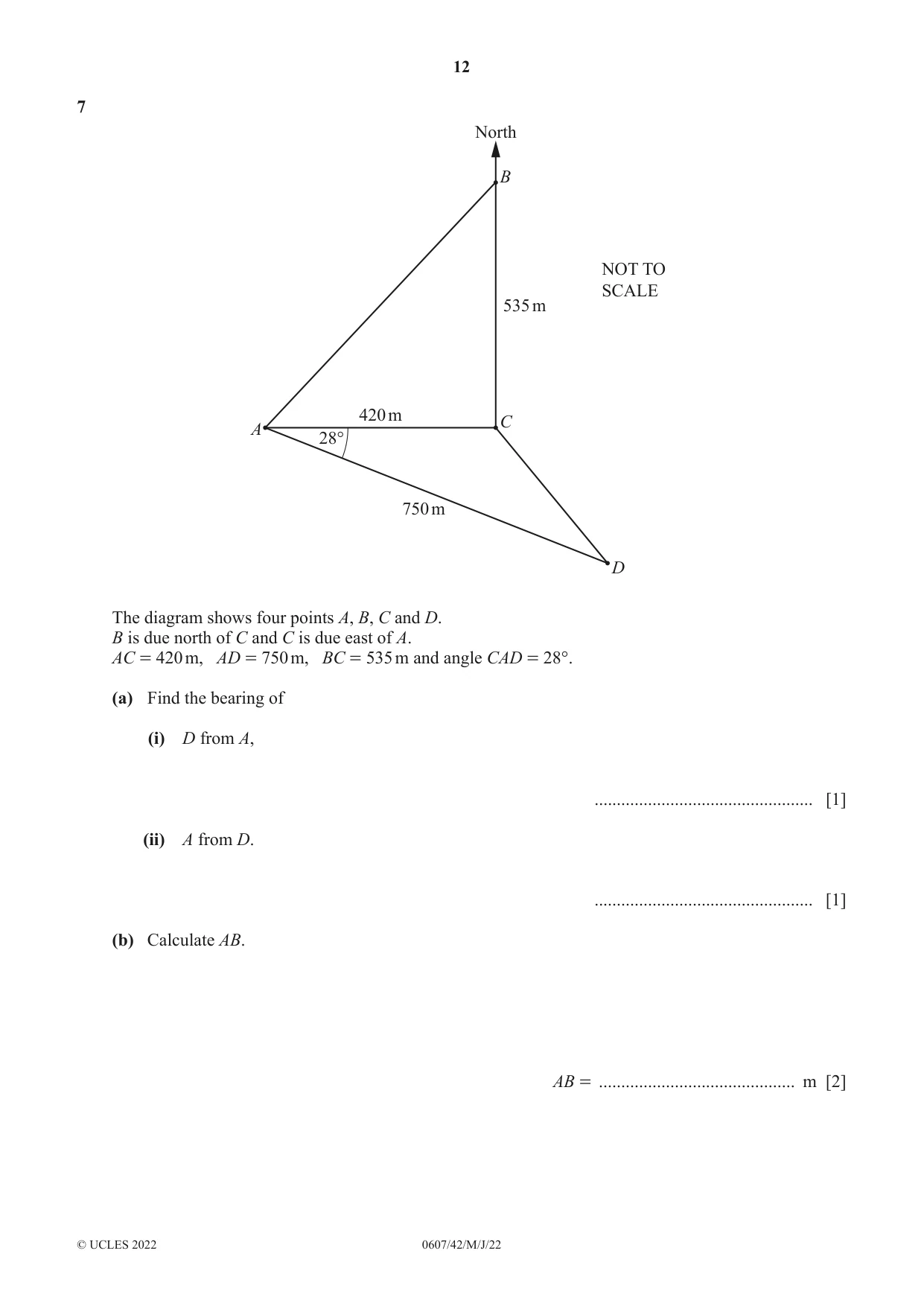
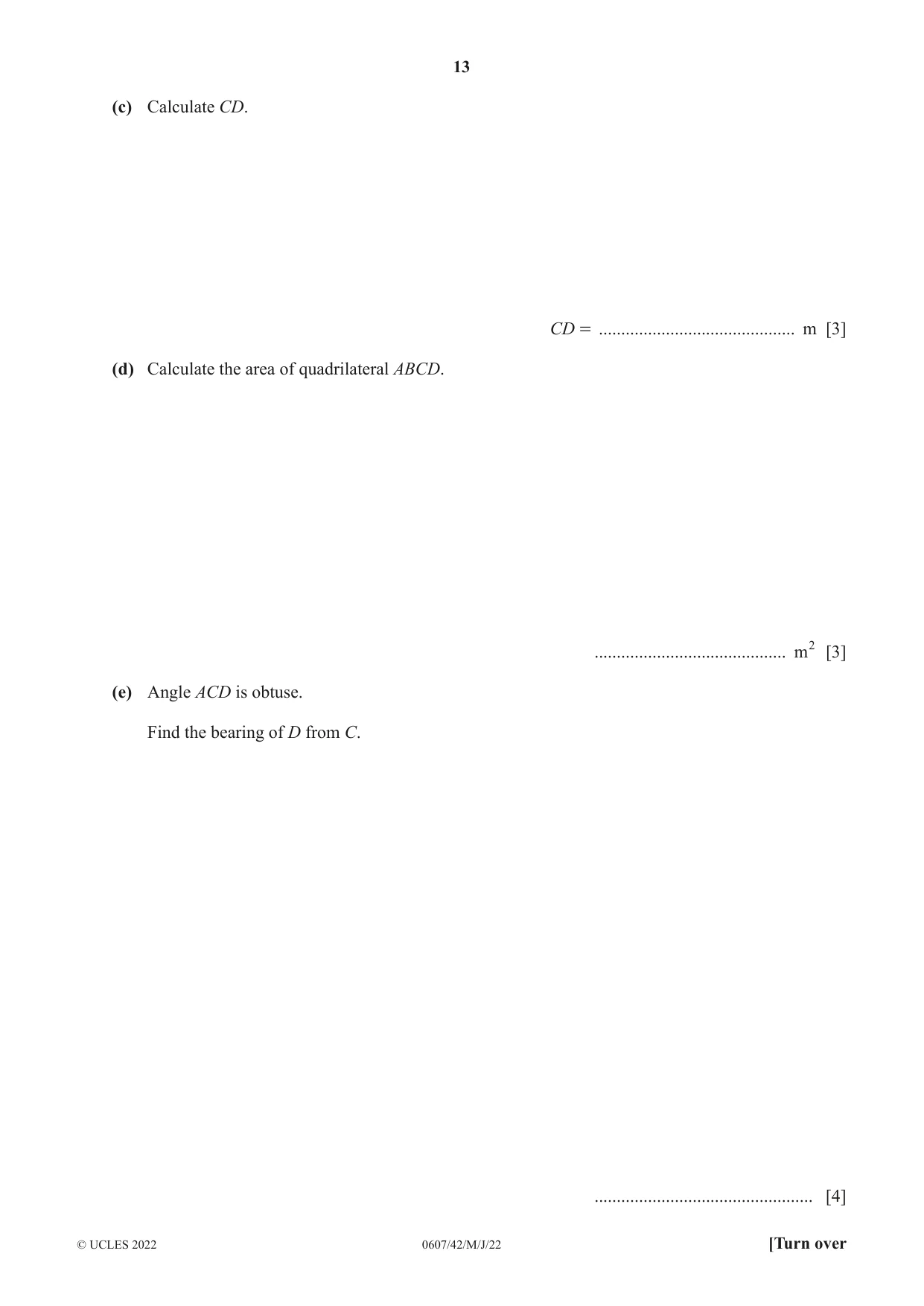
7 North B NOT TO SCALE 535 m 420 m C A 28° 750 m D The diagram shows four points A, B, C and D. B is due north of C and C is due east of A. AC = 420 m, AD = 750 m, BC = 535 m and angle CAD = 28°. (a) Find the bearing of (i) D from A, ................................................. [1] (ii) A from D. ................................................. [1] (b) Calculate AB. AB = ............................................ m [2] (c) Calculate CD. CD = ............................................ m [3] (d) Calculate the area of quadrilateral ABCD. ........................................... m2 [3] (e) Angle ACD is obtuse. Find the bearing of D from C. ................................................. [4]
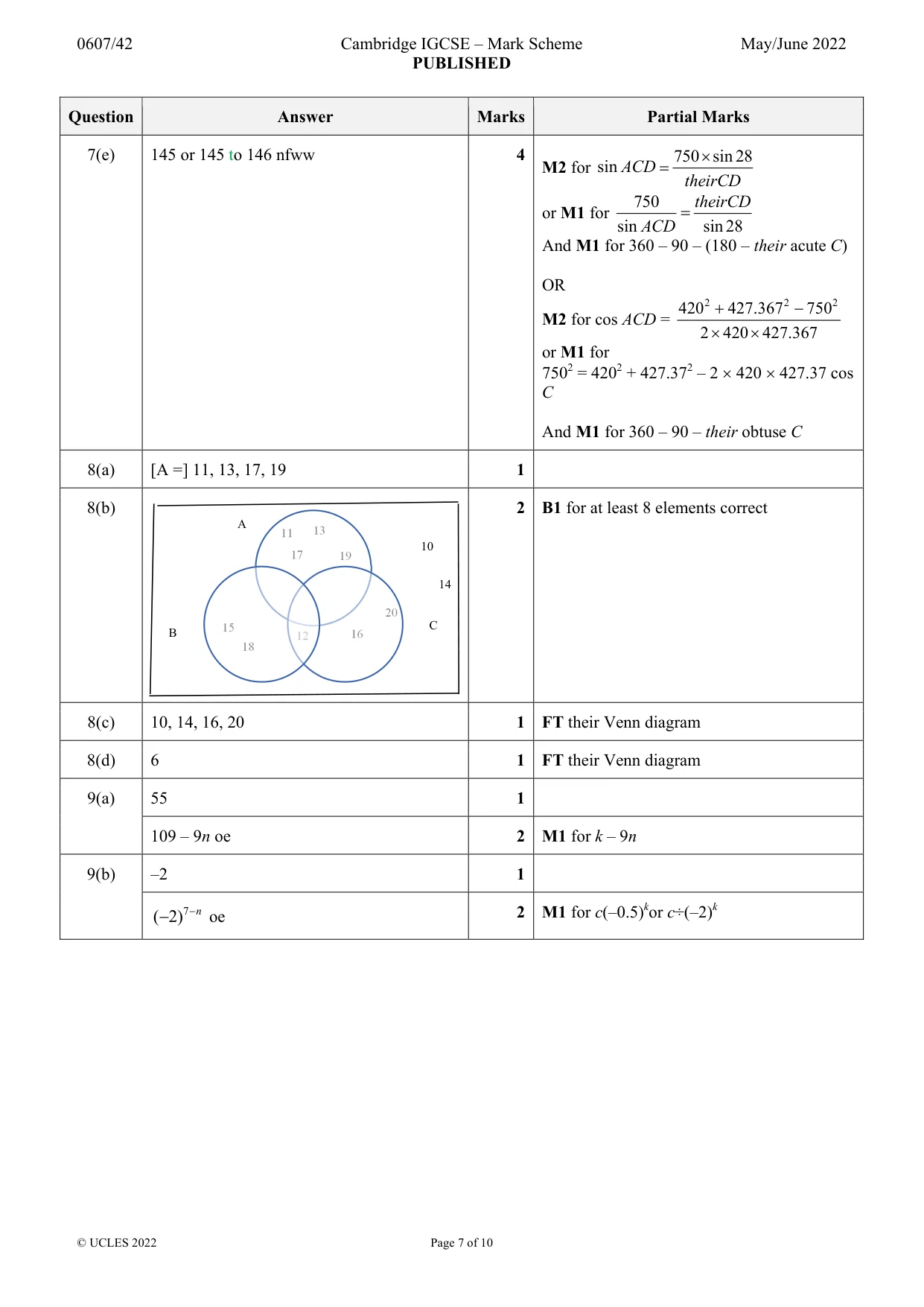
Mark scheme: 7(a)(i) 118 1 7(a)(ii) 298 cao 1 7(b) 680 or 680.1 to 680.2 2 M1 for 4202 + 5352 7(c) 427 or 427.3 to 427.4 3 M2 for CD 420 2 750 2 2 420 750 cos28 or M1 for CD 2 420 2 750 2 2 420 750 cos28 7(d) 186000 or 186200 to 186300 3 M1 for area ABC = 0.5 420 535 M1 for area ACD = 0.5 420 750 x sin28 7(e) 145 or 145 to 146 nfww 4 750 sin 28 M2 for sin ACD theirCD 750 theirCD or M1 for sin ACD sin28 And M1 for 360 – 90 – (180 – their acute C) OR 420 2 427.367 2 750 2 M2 for cos ACD = 2 420 427.367 or M1 for 7502 = 4202 + 427.372 – 2 420 427.37 cos C And M1 for 360 – 90 – their obtuse C
Q8 · The Venn diagram shows the sets A, B and C
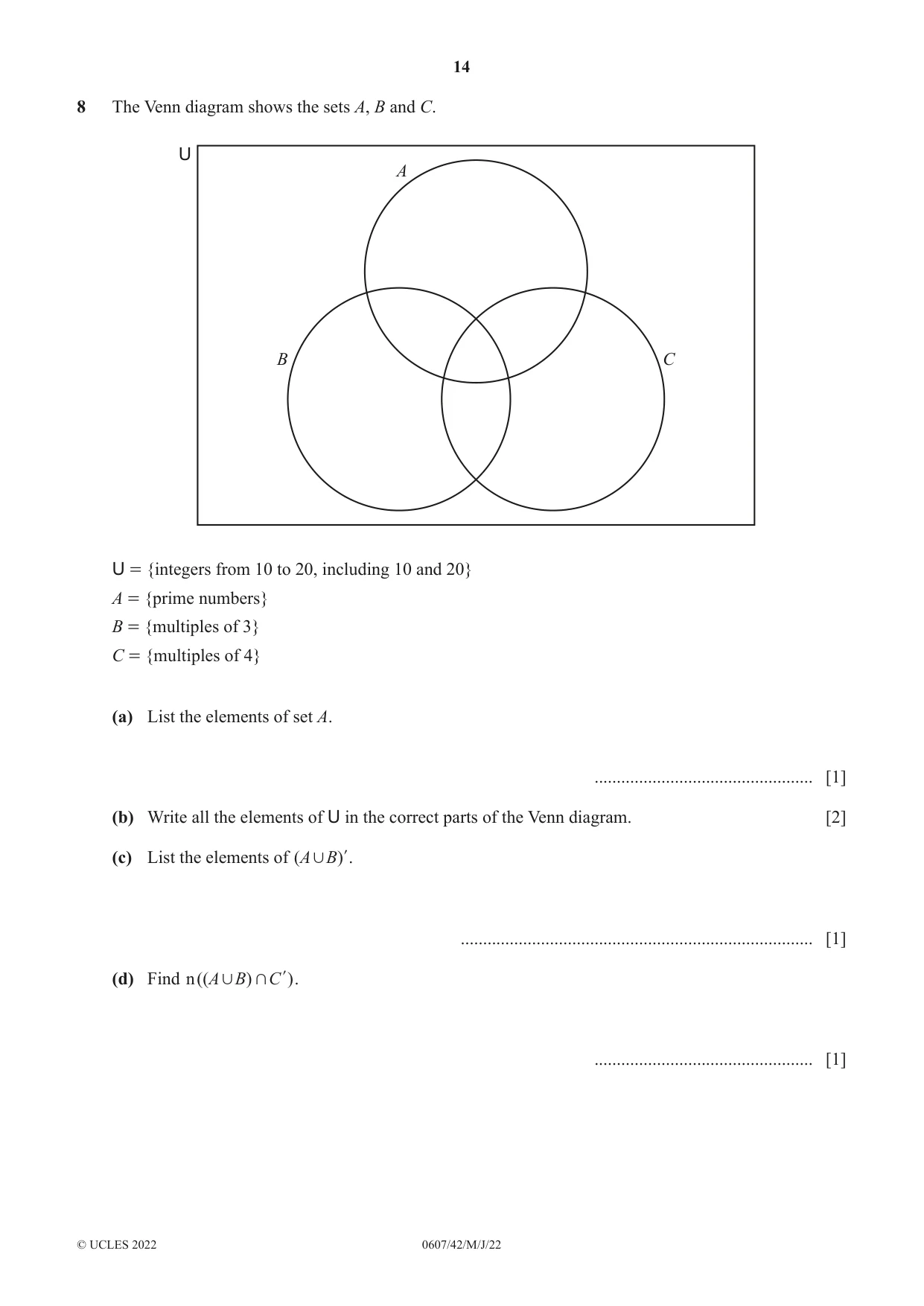
8 The Venn diagram shows the sets A, B and C. U A B C U = {integers from 10 to 20, including 10 and 20} A = {prime numbers} B = {multiples of 3} C = {multiples of 4} (a) List the elements of set A. ................................................. [1] (b) Write all the elements of U in the correct parts of the Venn diagram. [2] (c) List the elements of ( A , B ) l. ............................................................................... [1] (d) Find n(( A , B ) + C l ) . ................................................. [1]
Mark scheme: 8(a) [A =] 11, 13, 17, 19 1 8(b) 2 B1 for at least 8 elements correct A 11 13 10 17 19 14 20 B 15 12 16 C 18 8(c) 10, 14, 16, 20 1 FT their Venn diagram 8(d) 6 1 FT their Venn diagram
Q9 · Find the next term and the nth term in each of the following sequences
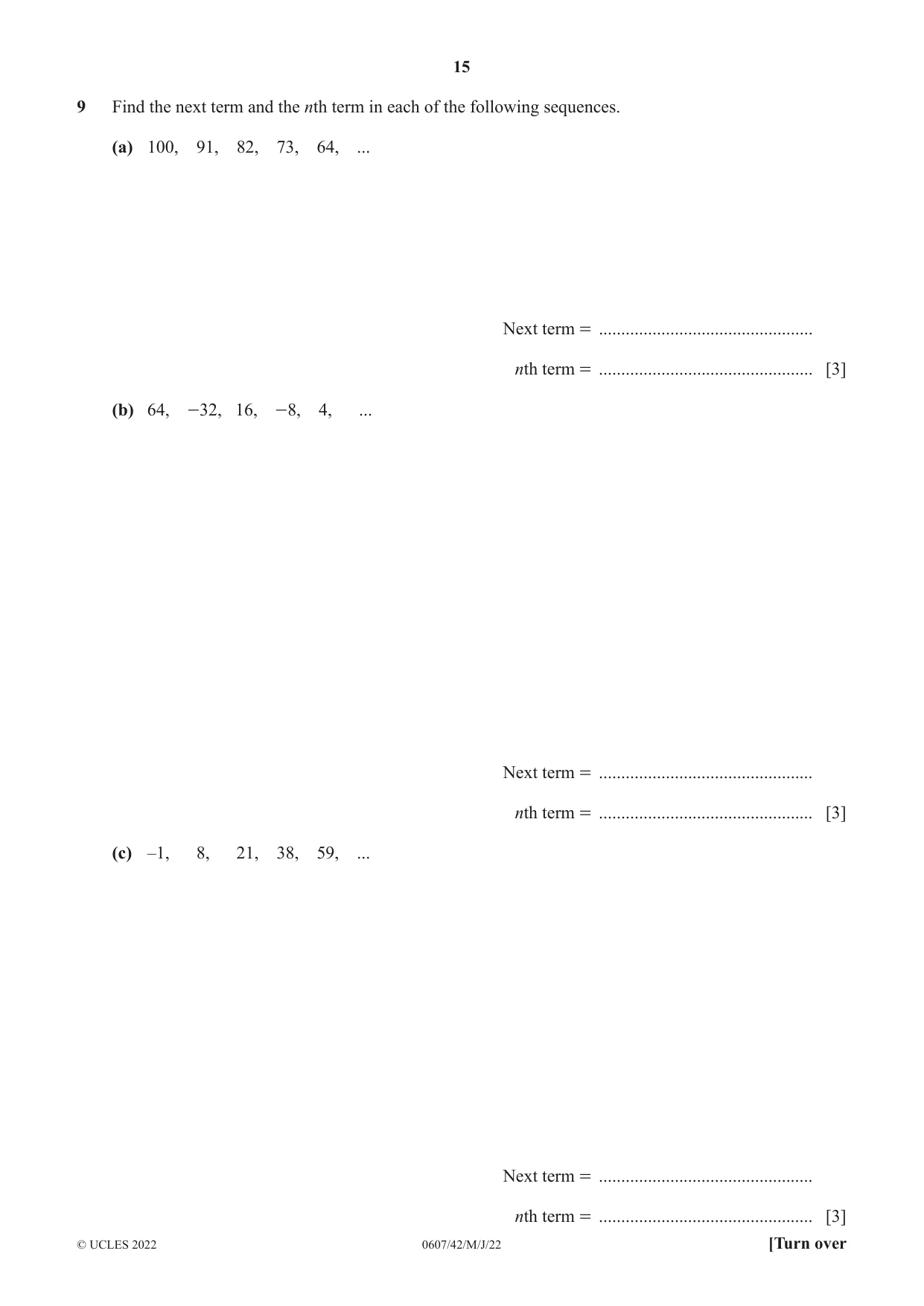
9 Find the next term and the nth term in each of the following sequences. (a) 100, 91, 82, 73, 64, ... Next term = ................................................ nth term = ................................................ [3] (b) 64, -32, 16, -8, 4, ... Next term = ................................................ nth term = ................................................ [3] (c) –1, 8, 21, 38, 59, ... Next term = ................................................ nth term = ................................................ [3]
Mark scheme: 9(a) 55 1 109 – 9n oe 2 M1 for k – 9n 9(b) –2 1 7 n 2 M1 for c(–0.5)kor c÷(–2)k ( 2) oe 9(c) 84 1 2n2 + 3n – 6 2 M1 for any 3 term quadratic or for 2nd differences of 4
Q10 · P = 5 Work out the value of P when x =- 18 and y = 28
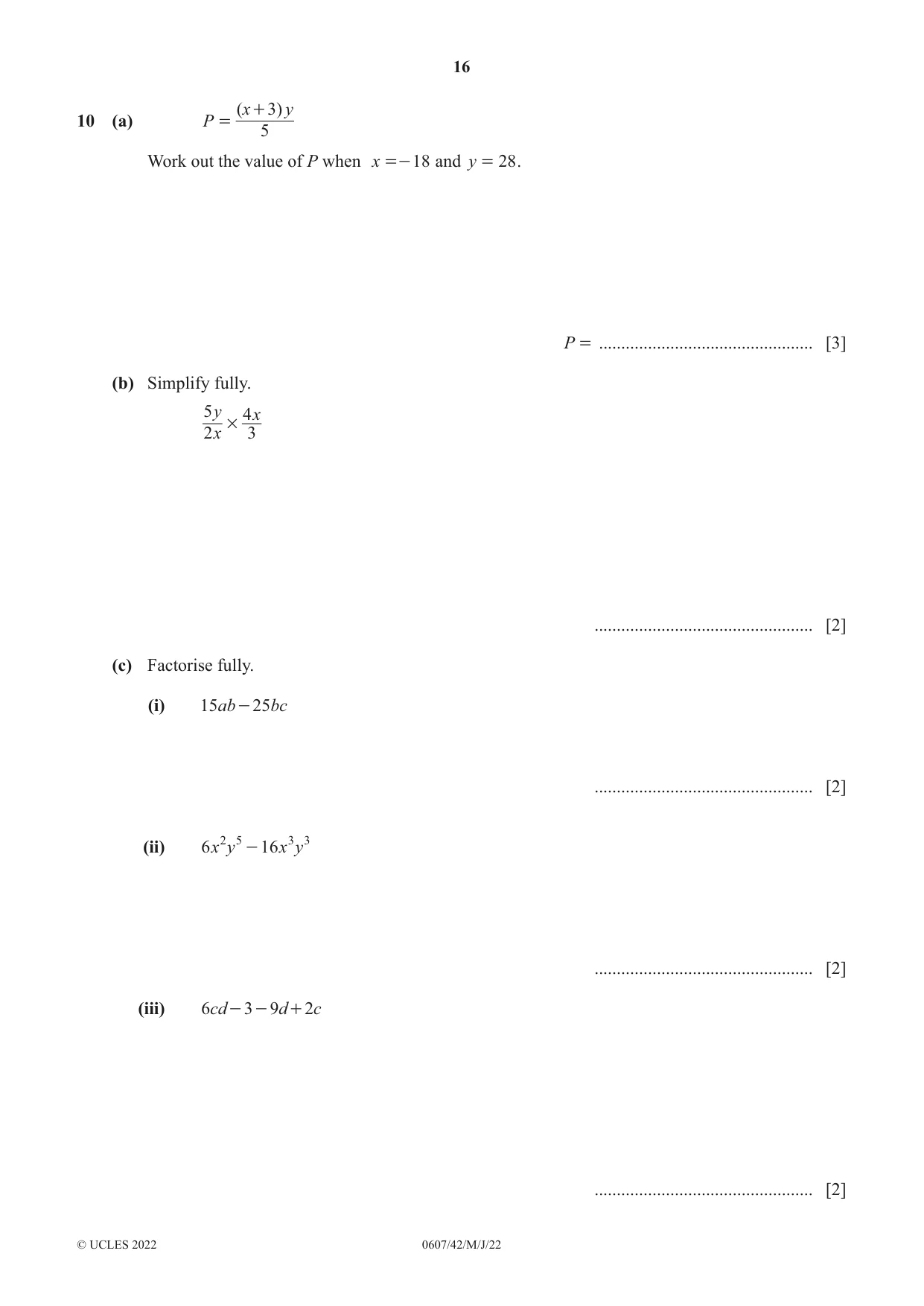
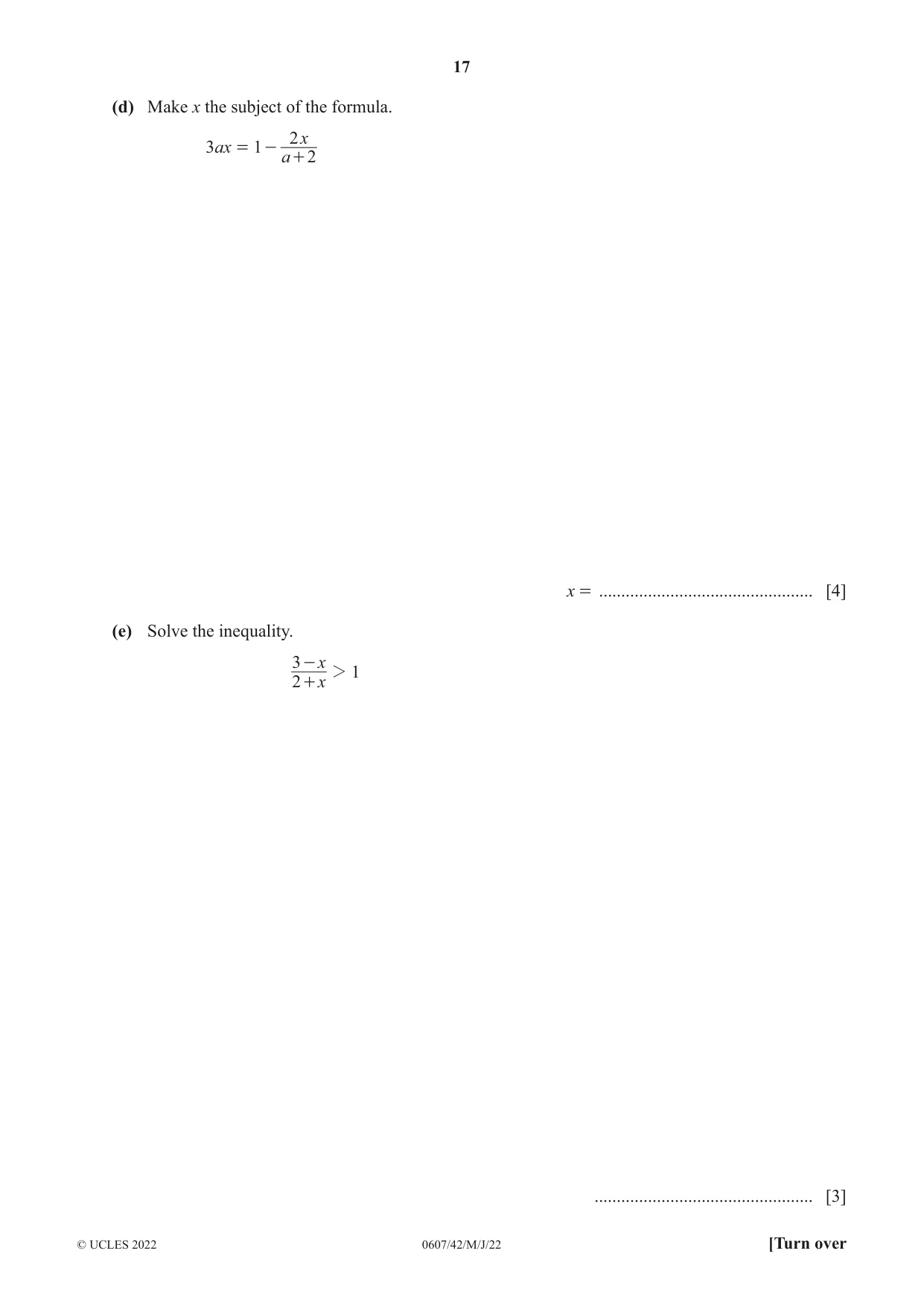
10 (a) P = 5 Work out the value of P when x =- 18 and y = 28 . P = ................................................ [3] (b) Simplify fully. 5 y 4 x # 2 x 3 ................................................. [2] (c) Factorise fully. (i) 15ab - 25bc ................................................. [2] (ii) 6 x 2 y 5 - 16 x 3 y 3 ................................................. [2] (iii) 6cd - 3 - 9d + 2c ................................................. [2] (d) Make x the subject of the formula. 2 x 3ax = 1 - a + 2 x = ................................................ [4] (e) Solve the inequality. 3 - x 2 1 2 + x ................................................. [3]
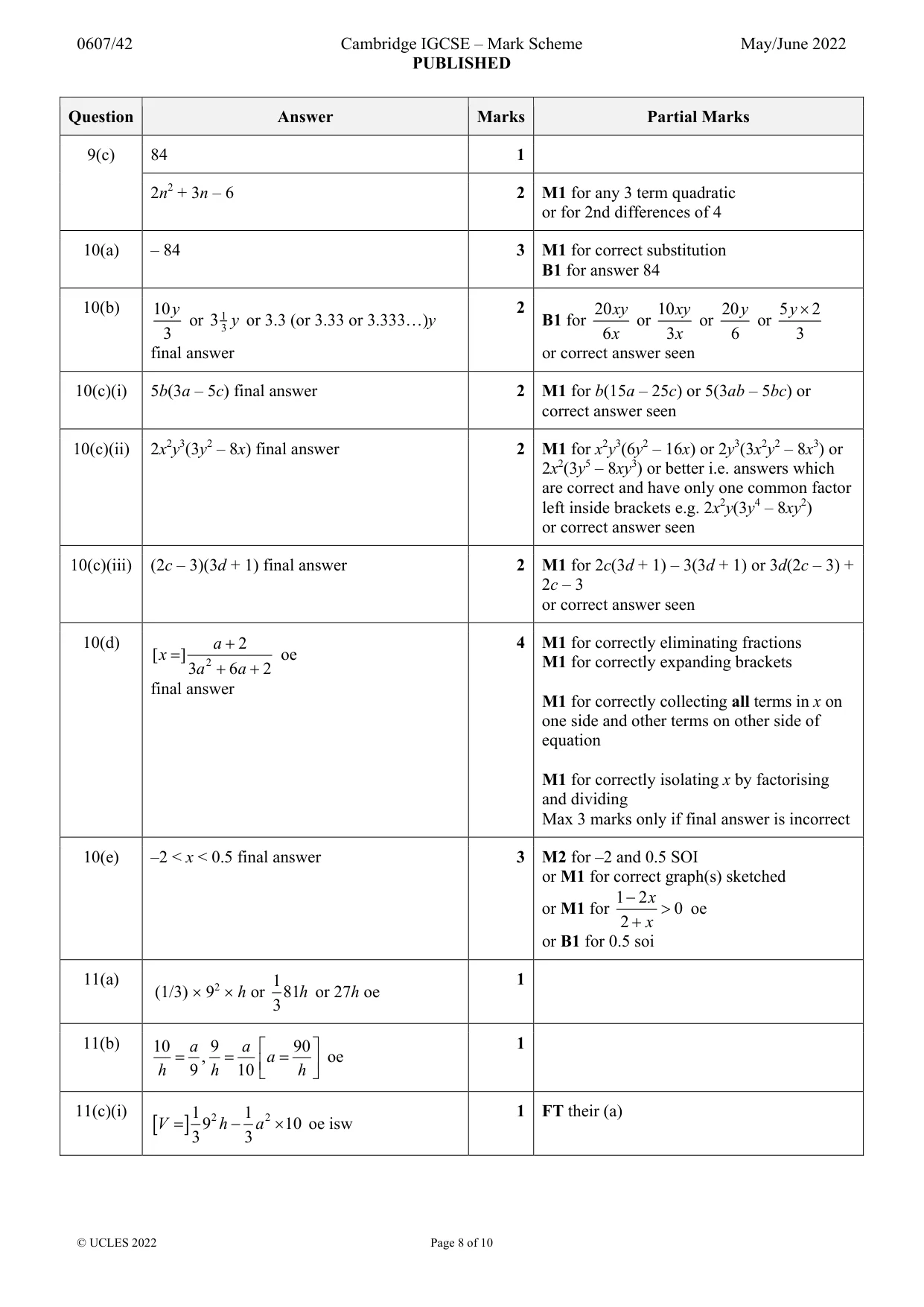
Mark scheme: 10(a) – 84 3 M1 for correct substitution B1 for answer 84 10(b) 10 y 1 2 20 xy 10 xy 20 y 5 y 2 or 3 3 y or 3.3 (or 3.33 or 3.333…)y B1 for or or or 3 6 x 3 x 6 3 final answer or correct answer seen 10(c)(i) 5b(3a – 5c) final answer 2 M1 for b(15a – 25c) or 5(3ab – 5bc) or correct answer seen 10(c)(ii) 2x2y3(3y2 – 8x) final answer 2 M1 for x2y3(6y2 – 16x) or 2y3(3x2y2 – 8x3) or 2x2(3y5 – 8xy3) or better i.e. answers which are correct and have only one common factor left inside brackets e.g. 2x2y(3y4 – 8xy2) or correct answer seen 10(c)(iii) (2c – 3)(3d + 1) final answer 2 M1 for 2c(3d + 1) – 3(3d + 1) or 3d(2c – 3) + 2c – 3 or correct answer seen 10(d) a 2 4 M1 for correctly eliminating fractions [ x ] oe 2 M1 for correctly expanding brackets 3a 6 a 2 final answer M1 for correctly collecting all terms in x on one side and other terms on other side of equation M1 for correctly isolating x by factorising and dividing Max 3 marks only if final answer is incorrect 10(e) –2 < x < 0.5 final answer 3 M2 for –2 and 0.5 SOI or M1 for correct graph(s) sketched 1 2 x or M1 for 0 oe 2 x or B1 for 0.5 soi
Q11 · A pyramid has a square base with sides of length 9 cm and vertical height h cm
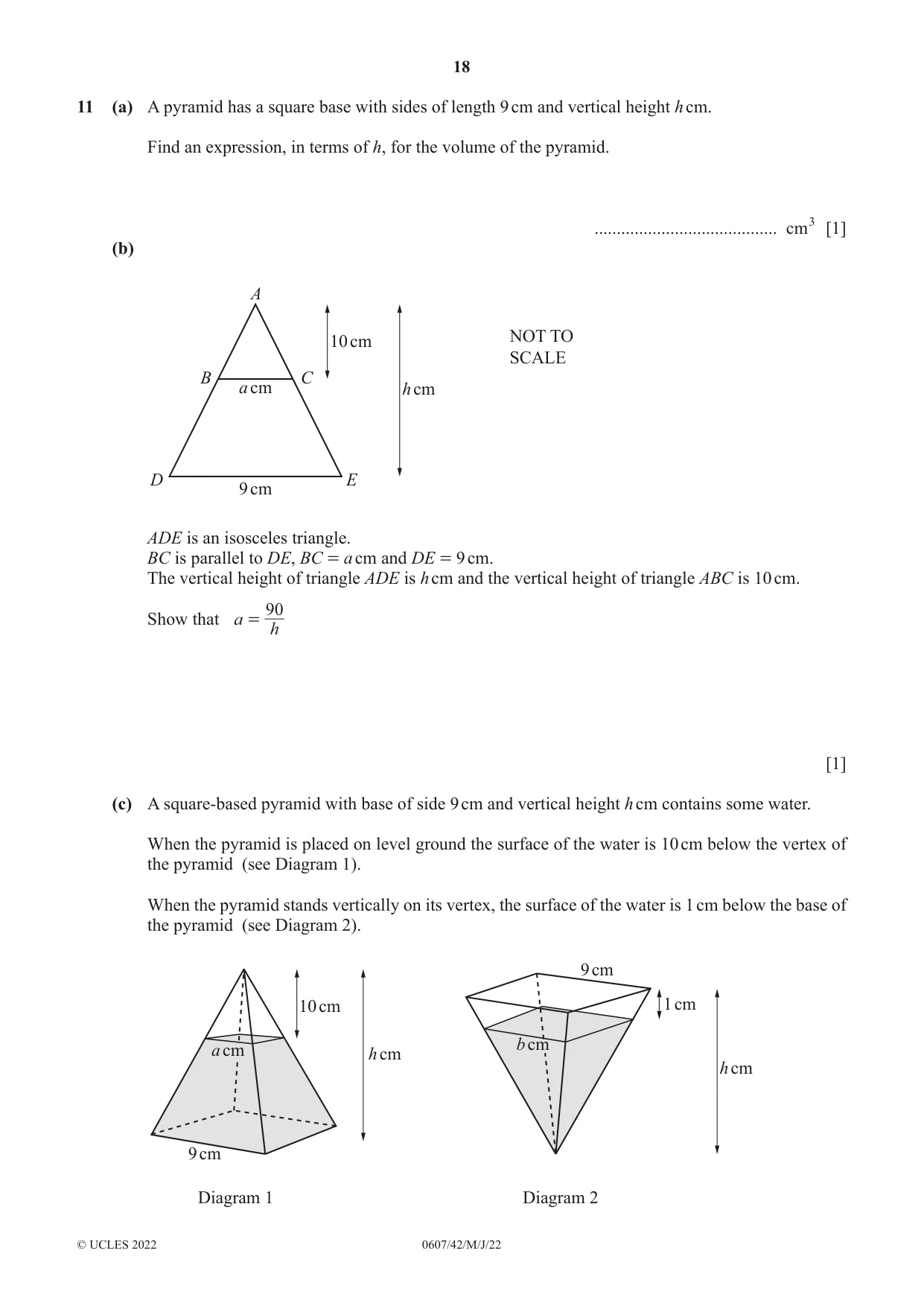
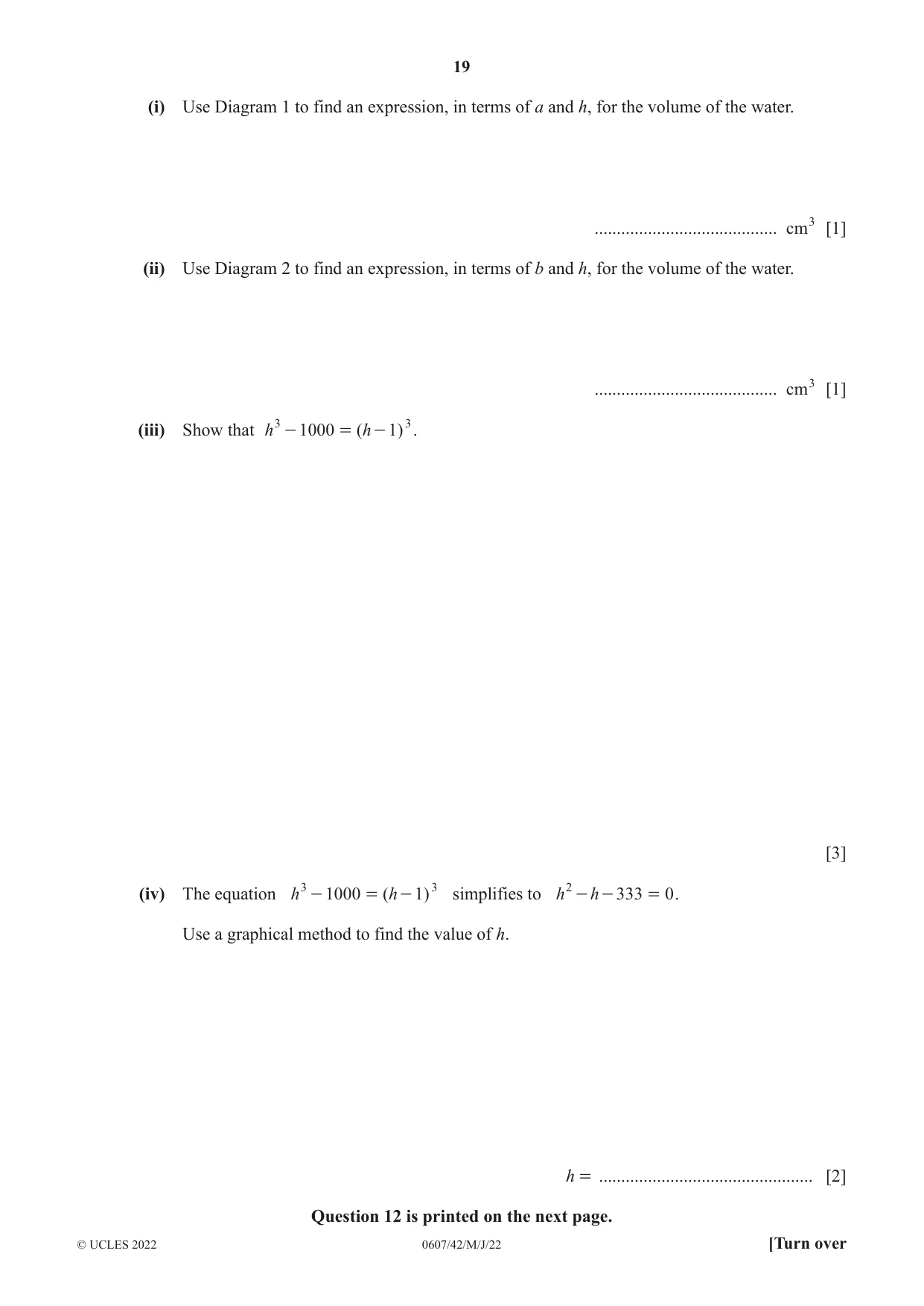
11 (a) A pyramid has a square base with sides of length 9 cm and vertical height h cm. Find an expression, in terms of h, for the volume of the pyramid. ......................................... cm3 [1] (b) A NOT TO 10 cm SCALE B C a cm h cm D E 9 cm ADE is an isosceles triangle. BC is parallel to DE, BC = a cm and DE = 9 cm. The vertical height of triangle ADE is h cm and the vertical height of triangle ABC is 10 cm. 90 Show that a = h [1] (c) A square-based pyramid with base of side 9 cm and vertical height h cm contains some water. When the pyramid is placed on level ground the surface of the water is 10 cm below the vertex of the pyramid (see Diagram 1). When the pyramid stands vertically on its vertex, the surface of the water is 1 cm below the base of the pyramid (see Diagram 2). 9 cm 10 cm 1 cm b cm a cm h cm h cm 9 cm Diagram 1 Diagram 2 (i) Use Diagram 1 to find an expression, in terms of a and h, for the volume of the water. ......................................... cm3 [1] (ii) Use Diagram 2 to find an expression, in terms of b and h, for the volume of the water. ......................................... cm3 [1] (iii) Show that h 3 - 1000 = ( h - 1) 3 . [3] (iv) The equation h 3 - 1000 = ( h - 1) 3 simplifies to h 2 - h - 333 = 0 . Use a graphical method to find the value of h. h = ................................................ [2] Question 12 is printed on the next page.
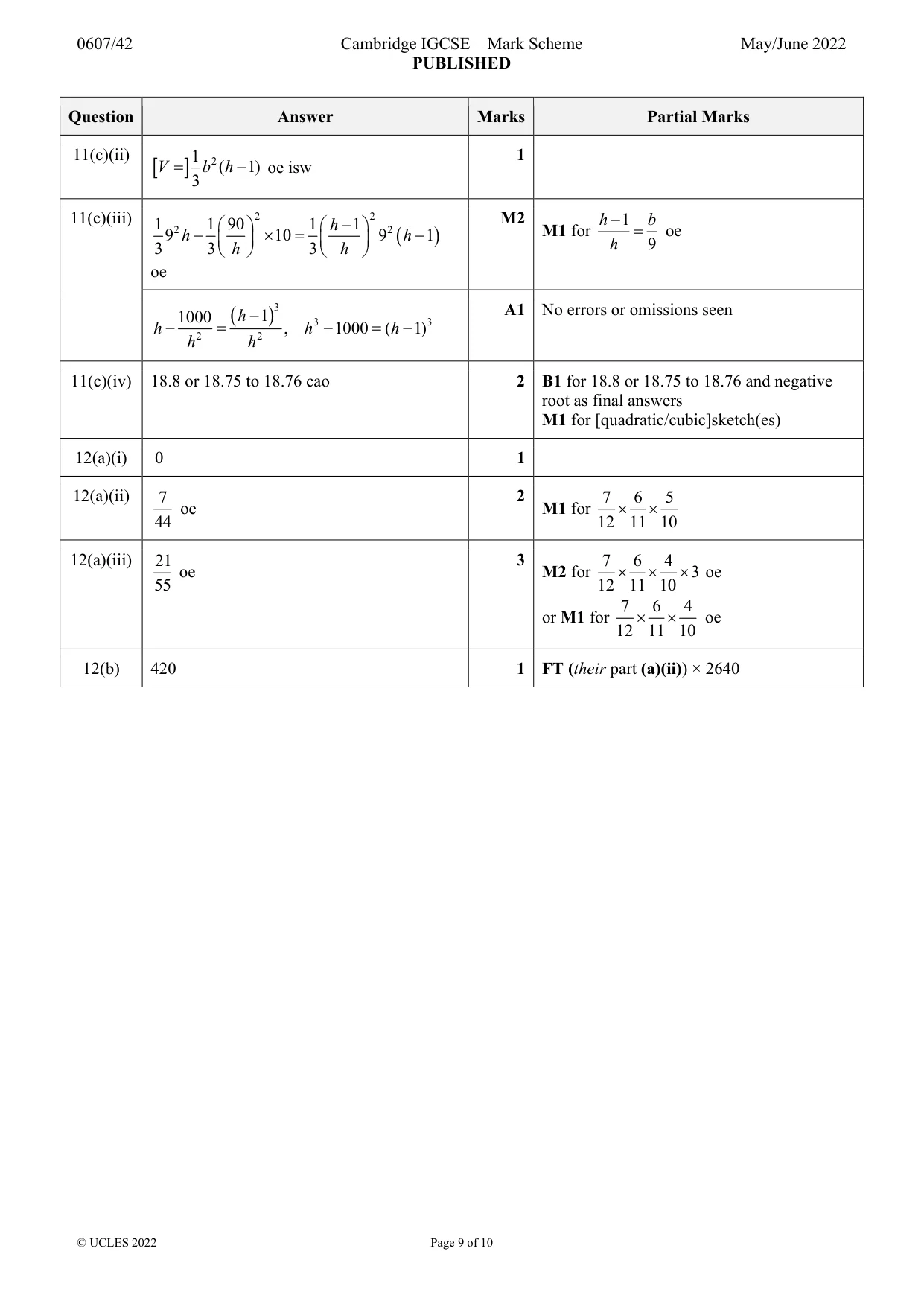
Mark scheme: 11(a) (1/3) 92 h or 181h or 27h oe 1 3 11(b) 10 a 9 a 90 1 , a oe h 9 h 10 h 11(c)(i) 1 2 1 2 1 FT their (a) V 9 h a 10 oe isw 3 3 11(c)(ii) 1 2 1 V b ( h 1) oe isw 3 2 2 M211(c)(iii) h 1 1 90 1 h 1 1 b M1 for oe 9 2 h 10 9 2 h 1 h 9 3 3 3 h h oe 3 A1 No errors or omissions seen 1000 h 1 3 3 h , h 1000 ( h 1) h 2 h 2 11(c)(iv) 18.8 or 18.75 to 18.76 cao 2 B1 for 18.8 or 18.75 to 18.76 and negative root as final answers M1 for [quadratic/cubic]sketch(es)
Q12 · A bag contains 7 red balls, 4 blue balls and 1 green ball
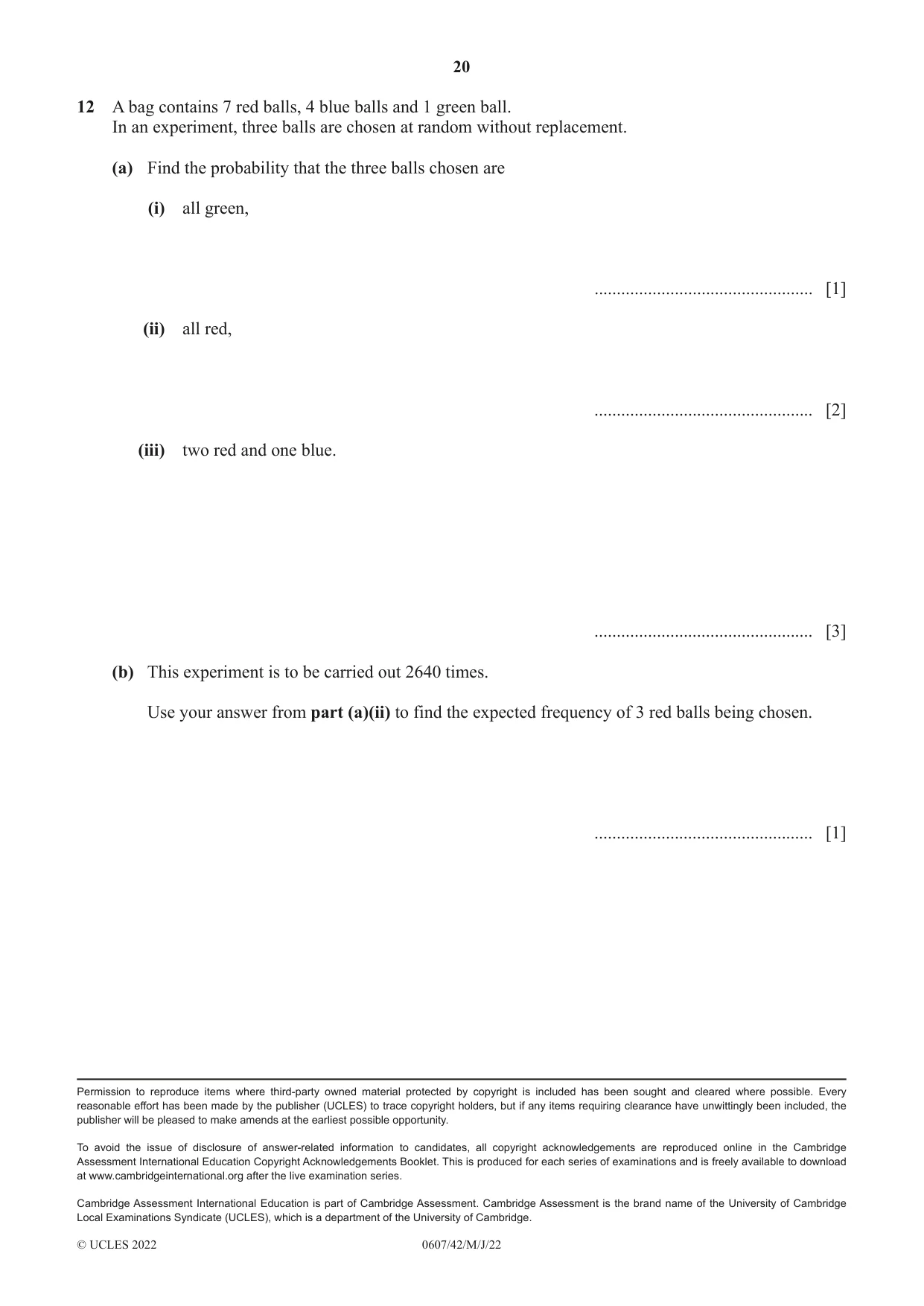
12 A bag contains 7 red balls, 4 blue balls and 1 green ball. In an experiment, three balls are chosen at random without replacement. (a) Find the probability that the three balls chosen are (i) all green, ................................................. [1] (ii) all red, ................................................. [2] (iii) two red and one blue. ................................................. [3] (b) This experiment is to be carried out 2640 times. Use your answer from part (a)(ii) to find the expected frequency of 3 red balls being chosen. ................................................. [1]
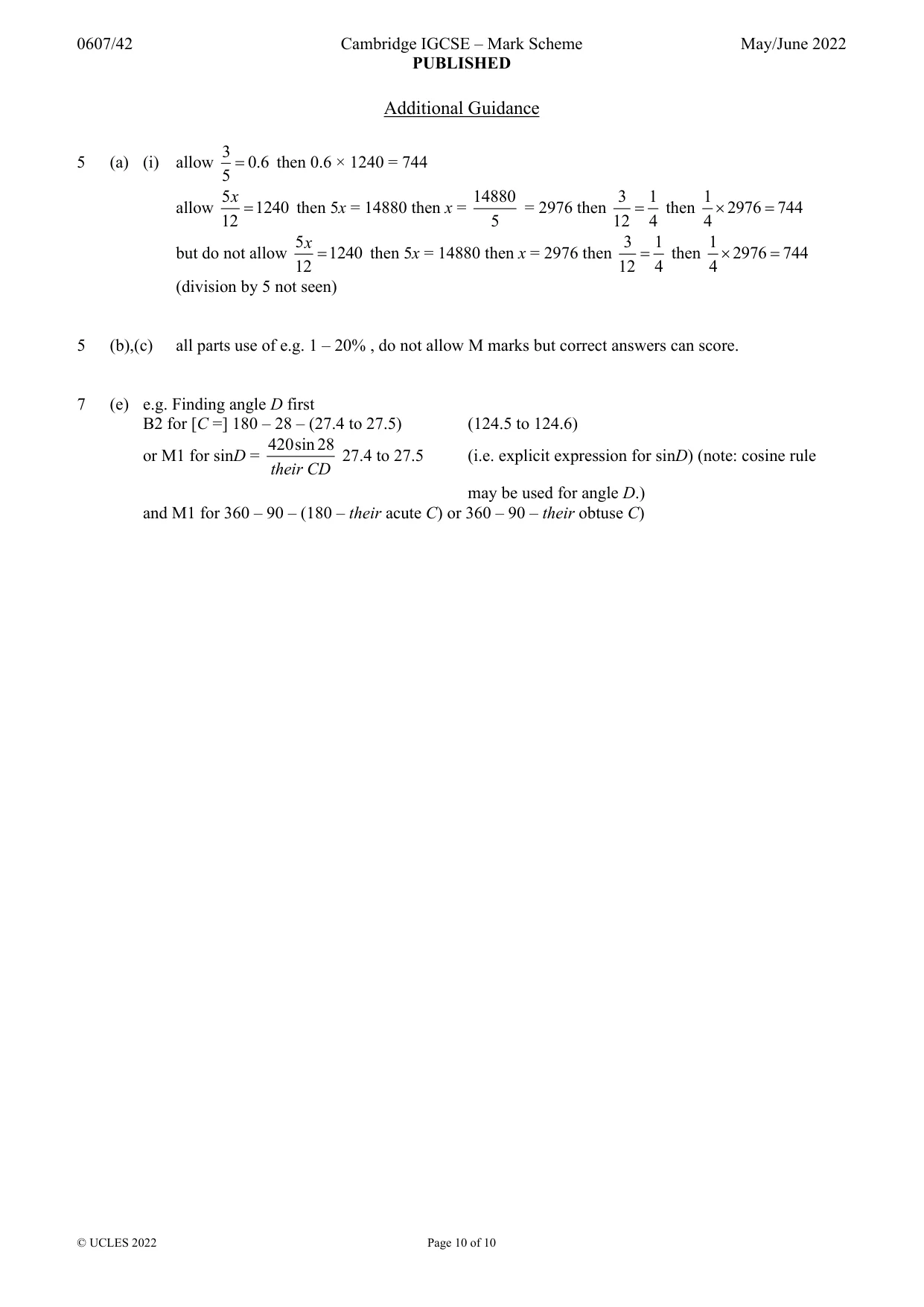
Mark scheme: 12(a)(i) 0 1 12(a)(ii) 7 2 7 6 5 oe M1 for 44 12 11 10 12(a)(iii) 21 3 7 6 4 oe M2 for 3 oe 55 12 11 10 7 6 4 or M1 for oe 12 11 10 12(b) 420 1 FT (their part (a)(ii)) × 2640 Additional Guidance 3 5 (a) (i) allow 0.6 then 0.6 × 1240 = 744 5 5 x 14880 3 1 1 allow 1240 then 5x = 14880 then x = = 2976 then then 2976 744 12 5 12 4 4 5 x 3 1 1 but do not allow 1240 then 5x = 14880 then x = 2976 then then 2976 744 12 12 4 4 (division by 5 not seen) 5 (b),(c) all parts use of e.g. 1 – 20% , do not allow M marks but correct answers can score. 7 (e) e.g. Finding angle D first B2 for [C =] 180 – 28 – (27.4 to 27.5) (124.5 to 124.6) 420sin 28 or M1 for sinD = 27.4 to 27.5 (i.e. explicit expression for sinD) (note: cosine rule their CD may be used for angle D.) and M1 for 360 – 90 – (180 – their acute C) or 360 – 90 – their obtuse C)
What was in this paper
The subtopics covered by these 12 questions, and how many questions each got. Open one in a new tab to see every Cambridge question on it.
What you needed in this session
Cambridge’s own grade thresholds for 2022 May/June, Paper 4 · Variant 2. A higher threshold means an easier paper — the bar moves with how the cohort did.