Cambridge IGCSE Mathematics - International 0607 — 2015 May/June Paper 4 · Variant 3
0607/43/M/J/15 · 120 marks · ≈135 min
The question paper and its mark scheme, free to read here and free to download. This is Cambridge’s own paper, exactly as it was sat.
Question paper20 pages
Mark scheme6 pages
Answers below. Sit the paper first if you are practising.
Paper as text
Question paper, page 1
This document consists of 20 printed pages. DC (ST/FD) 99285/4 © UCLES 2015 [Turn over Cambridge International Examinations Cambridge International General Certificate of Secondary Education * 5 6 5 0 4 7 5 9 6 2 * CAMBRIDGE INTERNATIONAL MATHEMATICS 0607/43 Paper 4 (Extended) May/June 2015 2 hours 15 minutes Candidates answer on the Question Paper. Additional Materials: Geometrical Instruments Graphics Calculator READ THESE INSTRUCTIONS FIRST Write your Centre number, candidate number and name on all the work you hand in. Write in dark blue or black pen. Do not use staples, paper clips, glue or correction fluid. You may use an HB pencil for any diagrams or graphs. DO NOT WRITE IN ANY BARCODES. Answer all the questions. Unless instructed otherwise, give your answers exactly or correct to three significant figures as appropriate. Answers in degrees should be given to one decimal place. For p, use your calculator value. You must show all the relevant working to gain full marks and you will be given marks for correct methods, including sketches, even if your answer is incorrect. The number of marks is given in brackets [ ] at the end of each question or part question. The total number of marks for this paper is 120.
Question paper, page 2
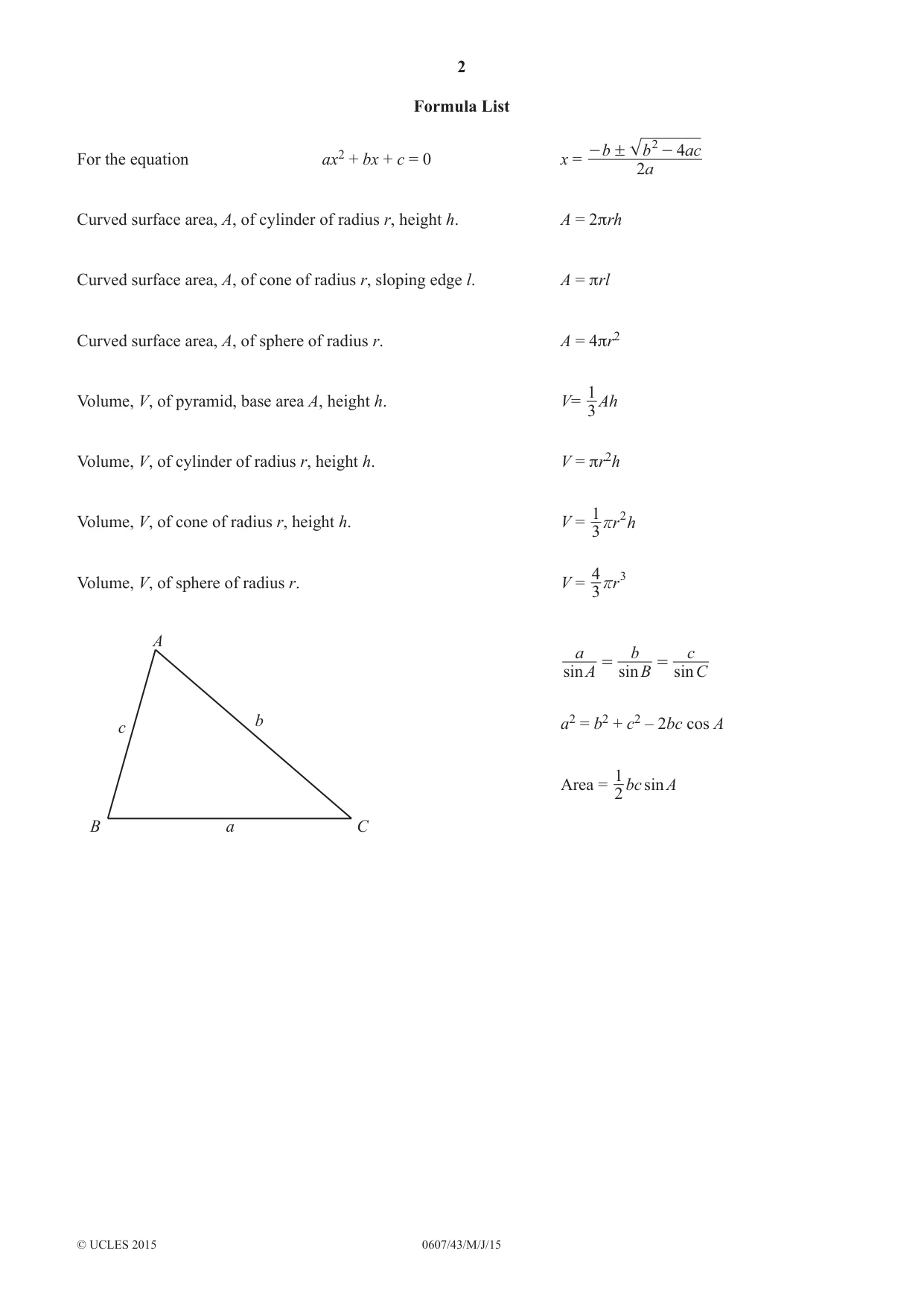
2 0607/43/M/J/15 © UCLES 2015 Formula List For the equation ax2 + bx + c = 0 x = a b b ac 2 4 2 ! - - Curved surface area, A, of cylinder of radius r, height h. A = 2prh Curved surface area, A, of cone of radius r, sloping edge l. A = prl Curved surface area, A, of sphere of radius r. A = 4pr2 Volume, V, of pyramid, base area A, height h. V= Ah 3 1 Volume, V, of cylinder of radius r, height h. V = pr2h Volume, V, of cone of radius r, height h. V = r h 3 1 2 r Volume, V, of sphere of radius r. V = r 3 4 3 r sin sin sin A a B b C c = = A C B c b a a2 = b2 + c2 – 2bc cos A Area = sin bc A 2 1
Question paper, page 3
3 0607/43/M/J/15 © UCLES 2015 [Turn over Answer all the questions. 1 Sancha flew from Santiago to Paris, a distance of 11 585 km. The average speed of the flight was 852.9 km/h. (a) Find the length of time for the flight. Give your answer in hours and minutes. Answer(a) … h … min [3] (b) The journey back from Paris to Santiago took 14 hours 30 minutes. The plane left Paris at 23 20. The local time in Santiago is 6 hours behind the local time in Paris. Find the local time this plane arrived in Santiago. Answer(b) … [2] (c) Find the overall average speed for the total journey from Santiago to Paris and back to Santiago. Answer(c) … km/h [3]
Question paper, page 4
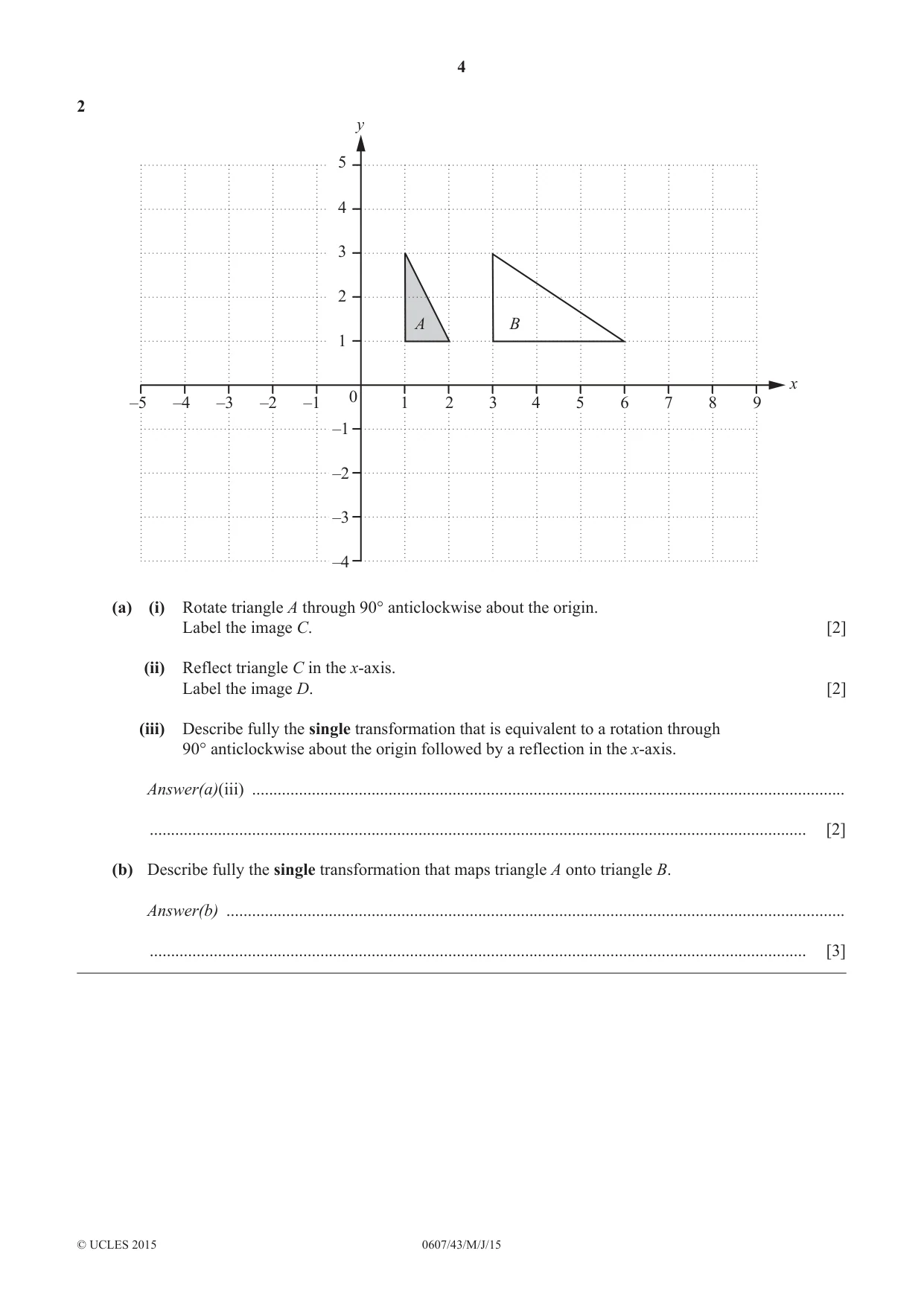
4 0607/43/M/J/15 © UCLES 2015 2 4 5 3 2 1 –1 –2 –3 –4 –5 –4 –3 –2 –1 1 0 2 3 4 5 6 7 8 9 A B x y (a) (i) Rotate triangle A through 90° anticlockwise about the origin. Label the image C. [2] (ii) Reflect triangle C in the x-axis. Label the image D. [2] (iii) Describe fully the single transformation that is equivalent to a rotation through 90° anticlockwise about the origin followed by a reflection in the x-axis. Answer(a)(iii) … … [2] (b) Describe fully the single transformation that maps triangle A onto triangle B. Answer(b) … … [3]
Question paper, page 5
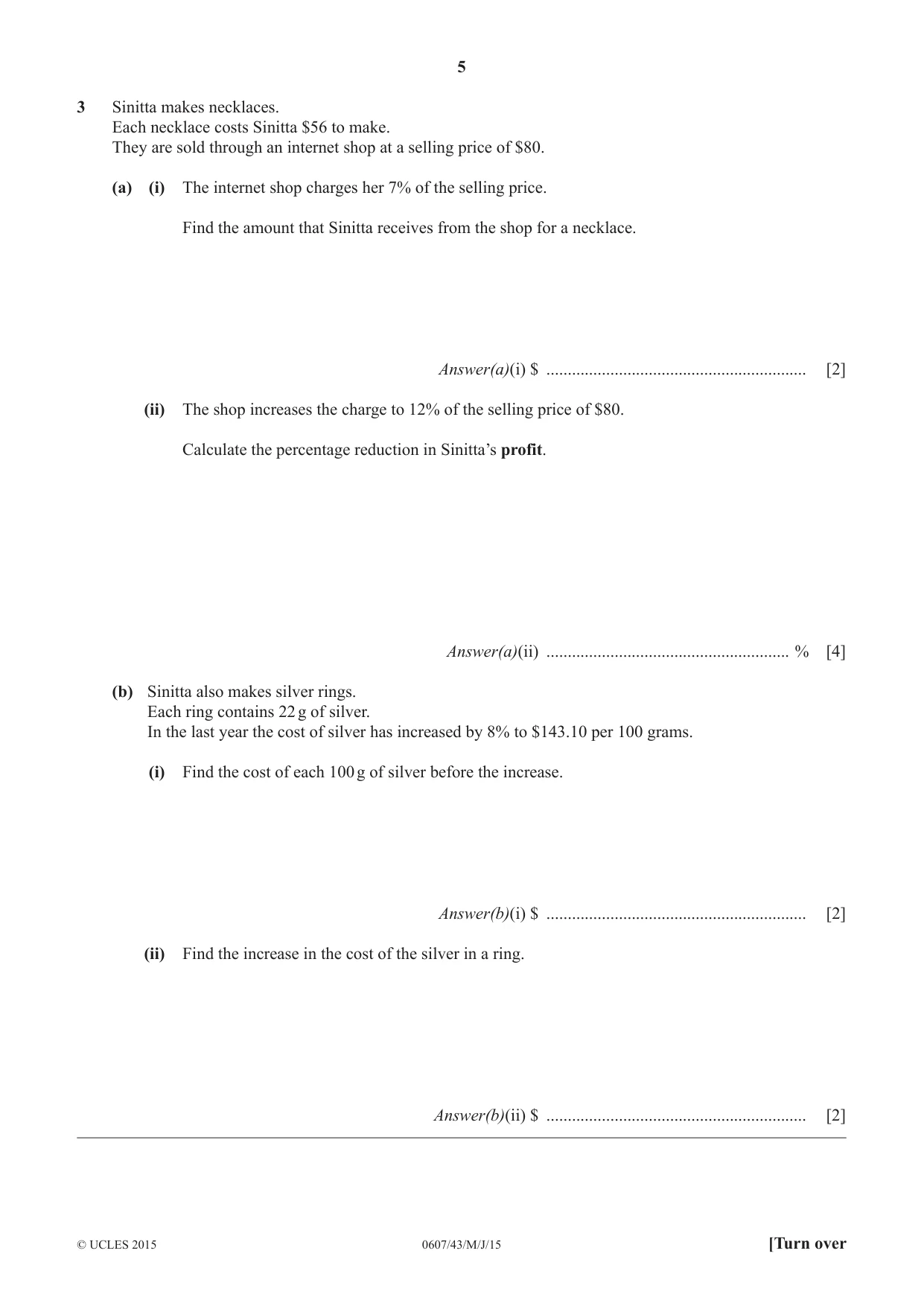
5 0607/43/M/J/15 © UCLES 2015 [Turn over 3 Sinitta makes necklaces. Each necklace costs Sinitta $56 to make. They are sold through an internet shop at a selling price of $80. (a) (i) The internet shop charges her 7% of the selling price. Find the amount that Sinitta receives from the shop for a necklace. Answer(a)(i) $ … [2] (ii) The shop increases the charge to 12% of the selling price of $80. Calculate the percentage reduction in Sinitta’s profit. Answer(a)(ii) … % [4] (b) Sinitta also makes silver rings. Each ring contains 22 g of silver. In the last year the cost of silver has increased by 8% to $143.10 per 100 grams. (i) Find the cost of each 100 g of silver before the increase. Answer(b)(i) $ … [2] (ii) Find the increase in the cost of the silver in a ring. Answer(b)(ii) $ … [2]
Question paper, page 6
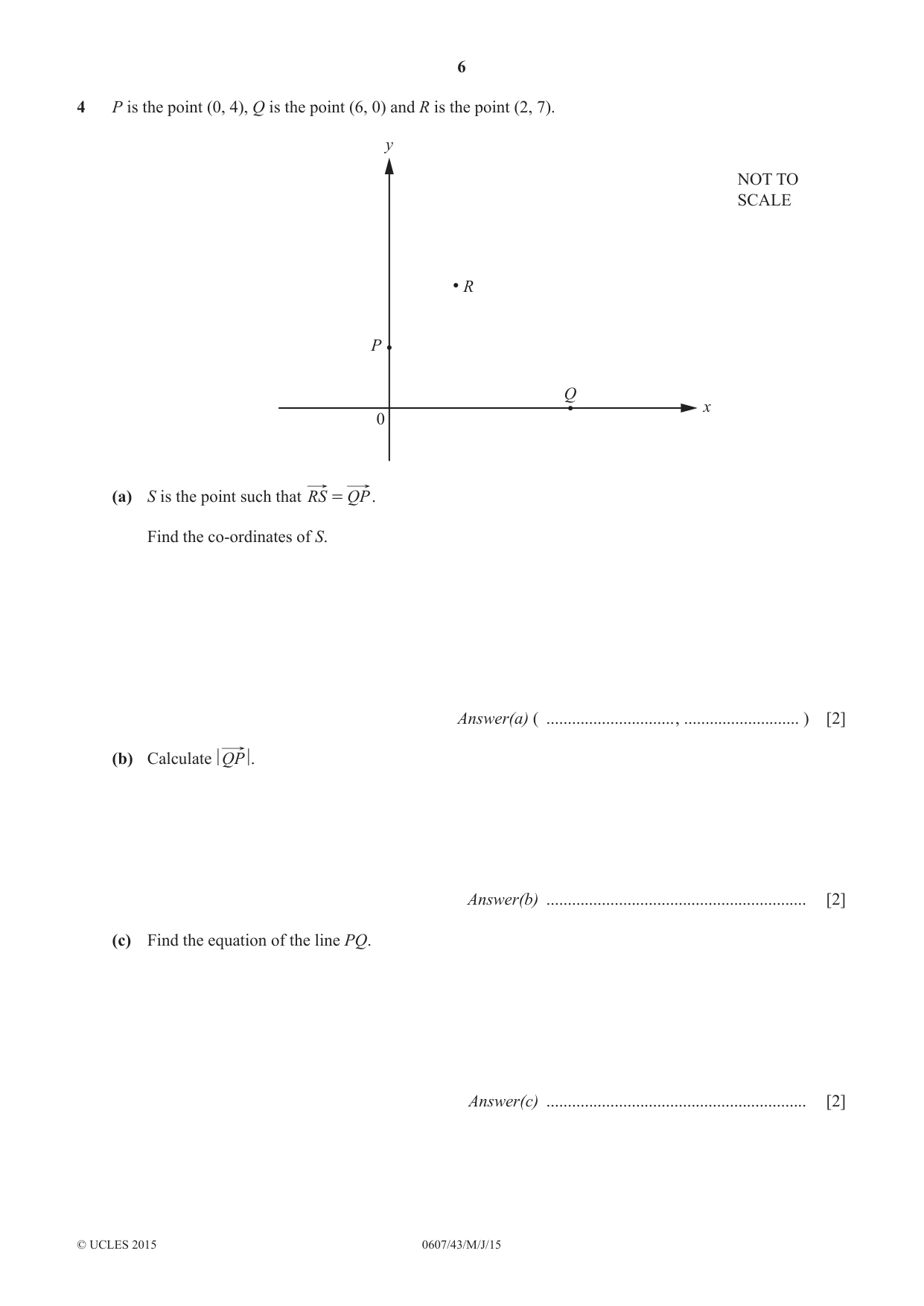
6 0607/43/M/J/15 © UCLES 2015 4 P is the point (0, 4), Q is the point (6, 0) and R is the point (2, 7). 0 NOT TO SCALE y x Q R P (a) S is the point such that RS QP = . Find the co-ordinates of S. Answer(a) ( …, … ) [2] (b) Calculate QP . Answer(b) … [2] (c) Find the equation of the line PQ. Answer(c) … [2]
Question paper, page 7
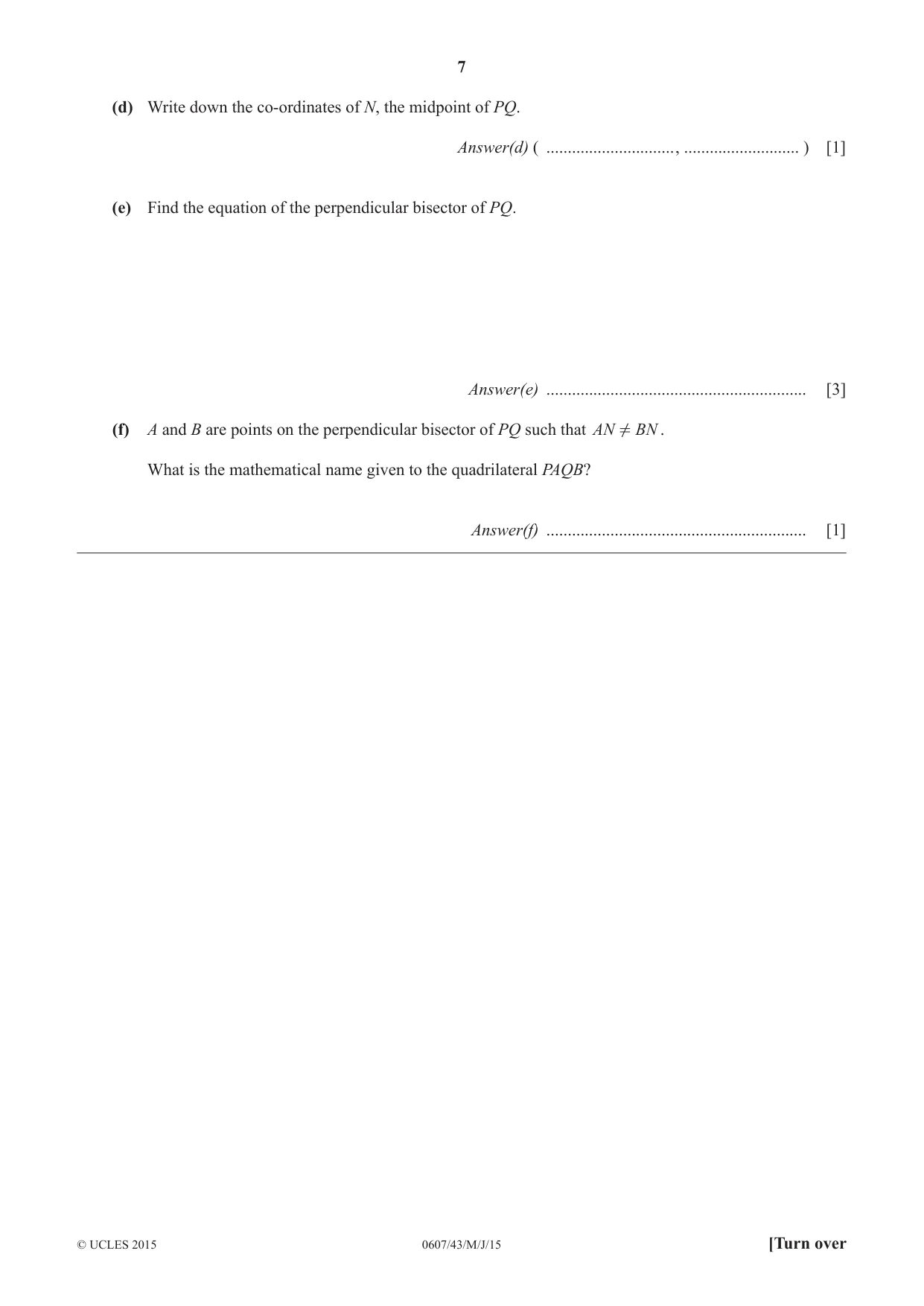
7 0607/43/M/J/15 © UCLES 2015 [Turn over (d) Write down the co-ordinates of N, the midpoint of PQ. Answer(d) ( …, … ) [1] (e) Find the equation of the perpendicular bisector of PQ. Answer(e) … [3] (f) A and B are points on the perpendicular bisector of PQ such that AN BN ! . What is the mathematical name given to the quadrilateral PAQB? Answer(f) … [1]
Question paper, page 8
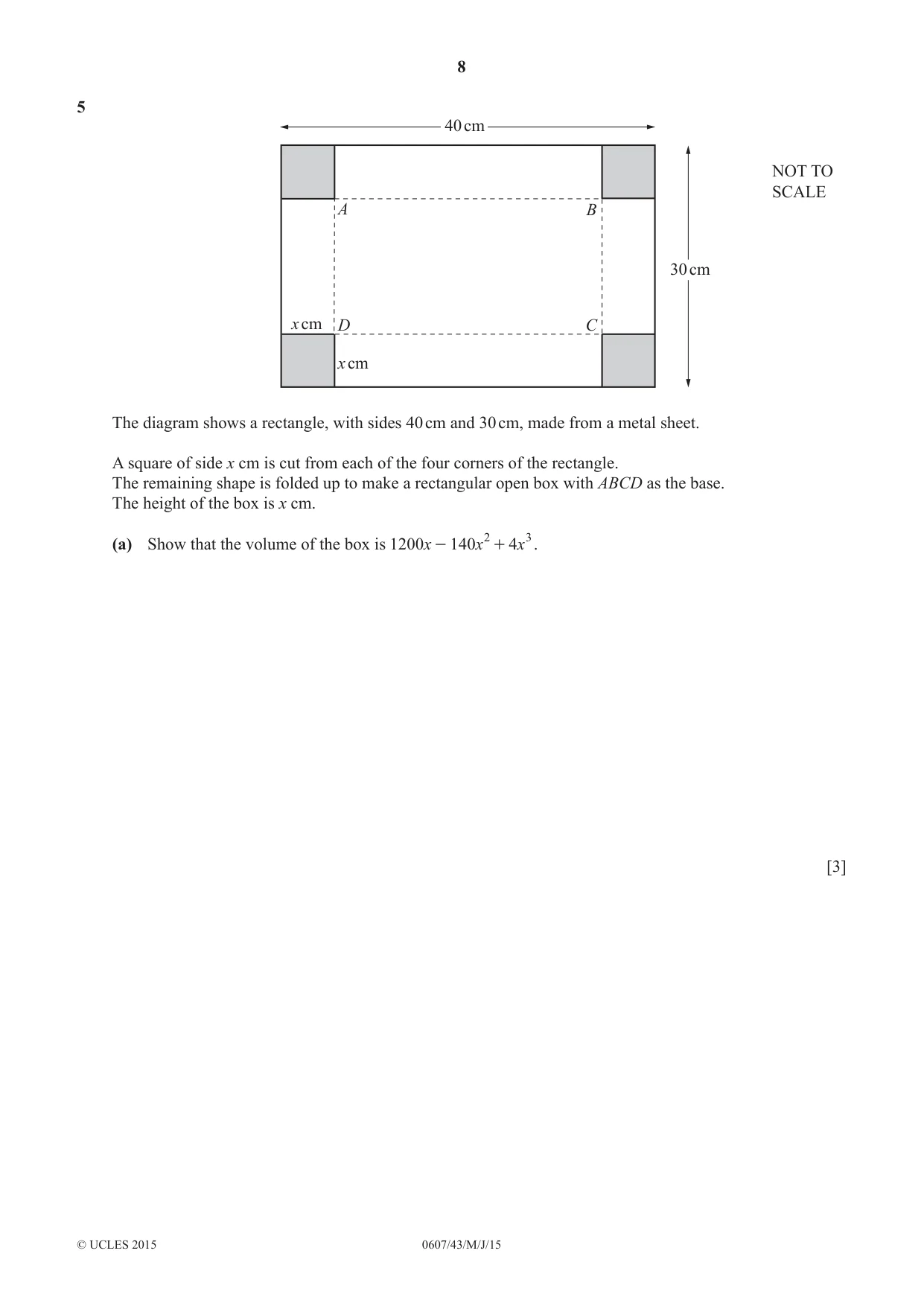
8 0607/43/M/J/15 © UCLES 2015 5 40 cm x cm x cm 30 cm A D C B NOT TO SCALE The diagram shows a rectangle, with sides 40 cm and 30 cm, made from a metal sheet. A square of side x cm is cut from each of the four corners of the rectangle. The remaining shape is folded up to make a rectangular open box with ABCD as the base. The height of the box is x cm. (a) Show that the volume of the box is x x x 1200 140 4 2 3 - + . [3]
Question paper, page 9
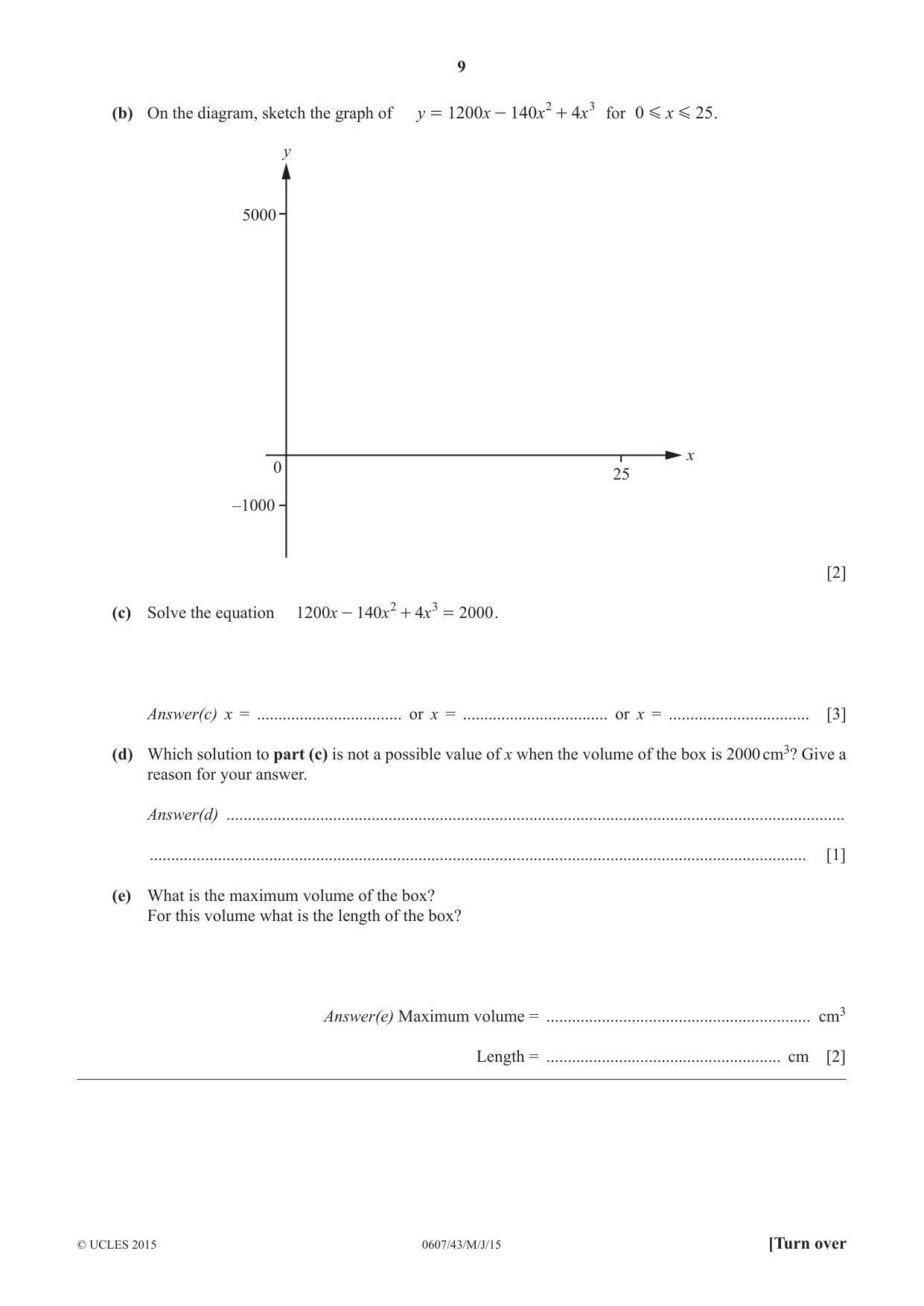
9 0607/43/M/J/15 © UCLES 2015 [Turn over (b) On the diagram, sketch the graph of y x x x 1200 140 4 2 3 = - + for x 0 25 G G . 0 25 x y –1000 5000 [2] (c) Solve the equation x x x 1200 140 4 2000 2 3 - + = . Answer(c) x = … or x = … or x = … [3] (d) Which solution to part (c) is not a possible value of x when the volume of the box is 2000 cm3? Give a reason for your answer. Answer(d) … … [1] (e) What is the maximum volume of the box? For this volume what is the length of the box? Answer(e) Maximum volume = … cm3 Length = … cm [2]
Question paper, page 10
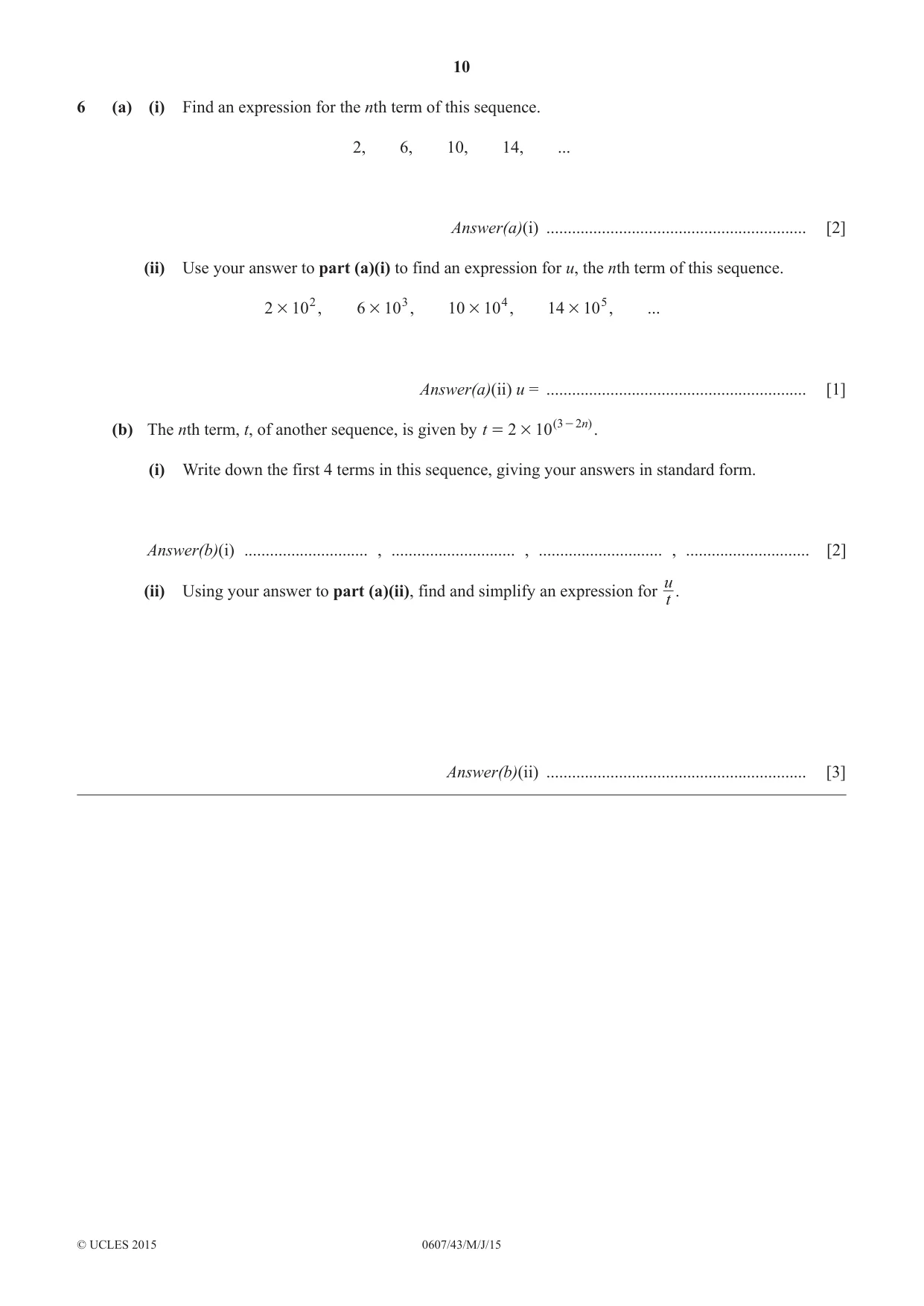
10 0607/43/M/J/15 © UCLES 2015 6 (a) (i) Find an expression for the nth term of this sequence. 2, 6, 10, 14, ... Answer(a)(i) … [2] (ii) Use your answer to part (a)(i) to find an expression for u, the nth term of this sequence. 2 102 # , 6 103 # , 10 104 # , 14 105 # , ... Answer(a)(ii) u = … [1] (b) The nth term, t, of another sequence, is given by t 2 10( ) n 3 2 # = - . (i) Write down the first 4 terms in this sequence, giving your answers in standard form. Answer(b)(i) … , … , … , … [2] (ii) Using your answer to part (a)(ii), find and simplify an expression for t u . Answer(b)(ii) … [3]
Question paper, page 11
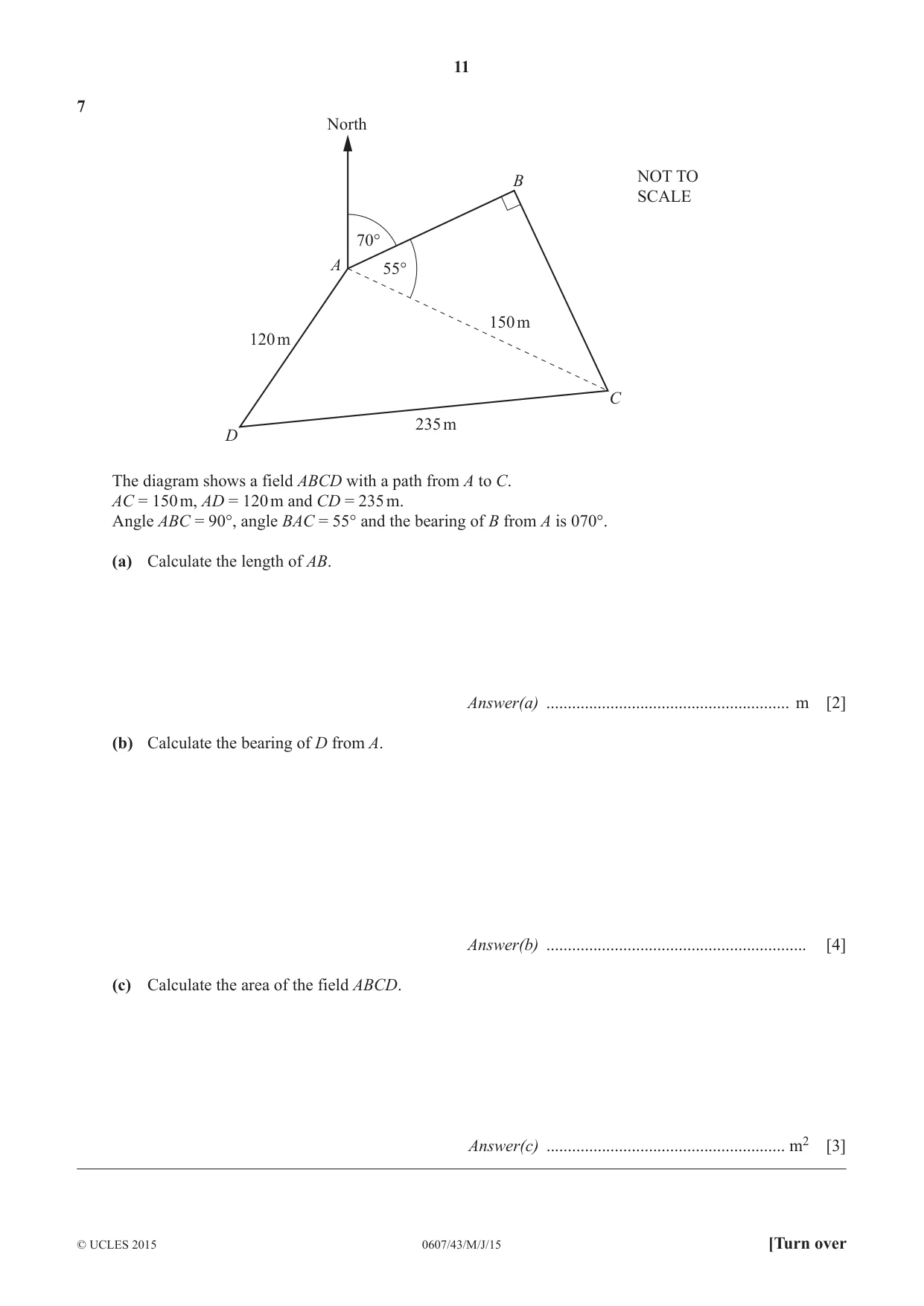
11 0607/43/M/J/15 © UCLES 2015 [Turn over 7 North B C D A 150 m 235 m 55° 70° 120 m NOT TO SCALE The diagram shows a field ABCD with a path from A to C. AC = 150 m, AD = 120 m and CD = 235 m. Angle ABC = 90°, angle BAC = 55° and the bearing of B from A is 070°. (a) Calculate the length of AB. Answer(a) … m [2] (b) Calculate the bearing of D from A. Answer(b) … [4] (c) Calculate the area of the field ABCD. Answer(c) … m2 [3]
Question paper, page 12
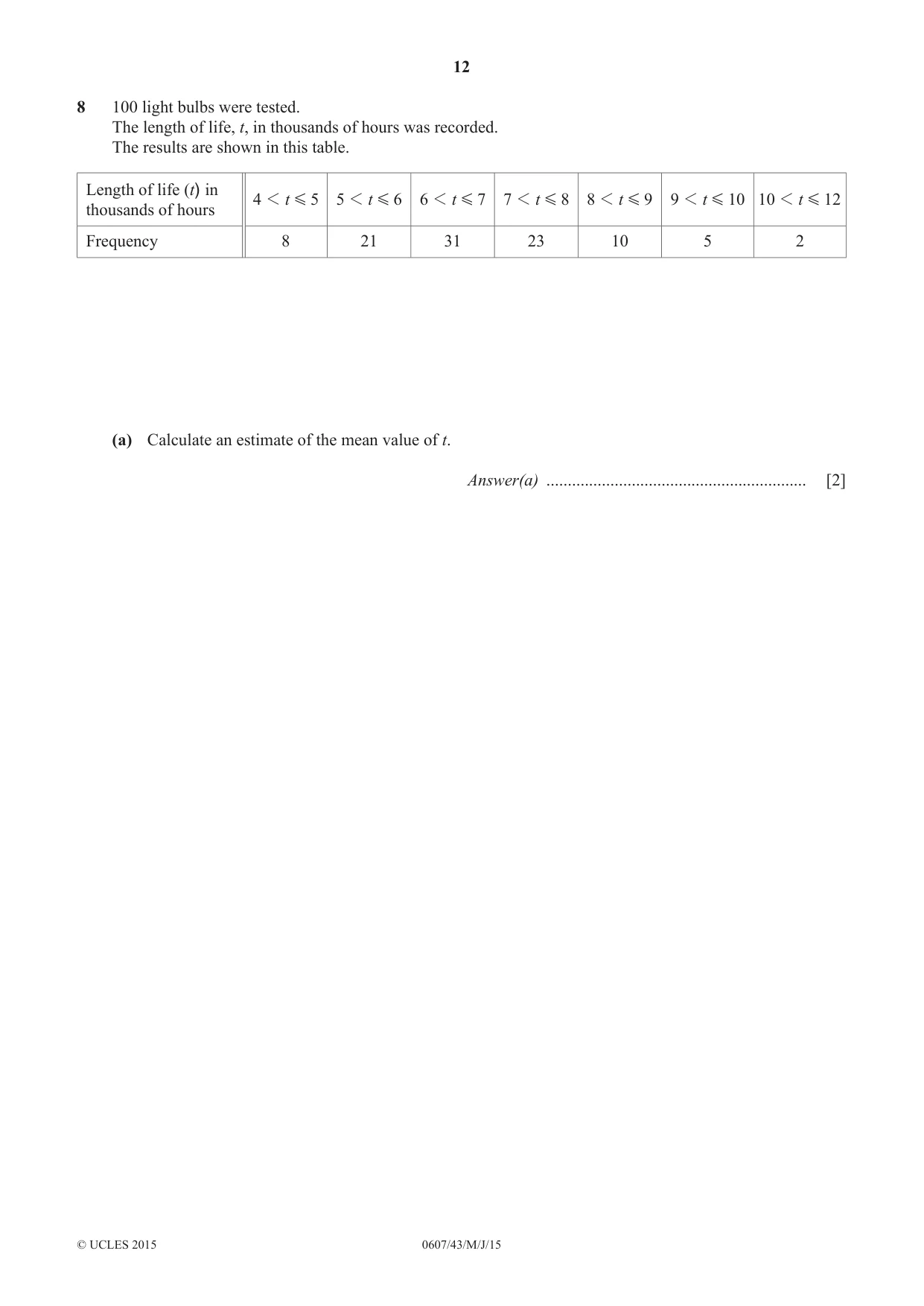
12 0607/43/M/J/15 © UCLES 2015 8 100 light bulbs were tested. The length of life, t, in thousands of hours was recorded. The results are shown in this table. Length of life (t) in thousands of hours t 4 5 1 G t 5 6 1 G t 6 7 1 G t 7 8 1 G t 8 9 1 G t 9 10 1 G t 10 12 1 G Frequency 8 21 31 23 10 5 2 (a) Calculate an estimate of the mean value of t. Answer(a) … [2]
Question paper, page 13
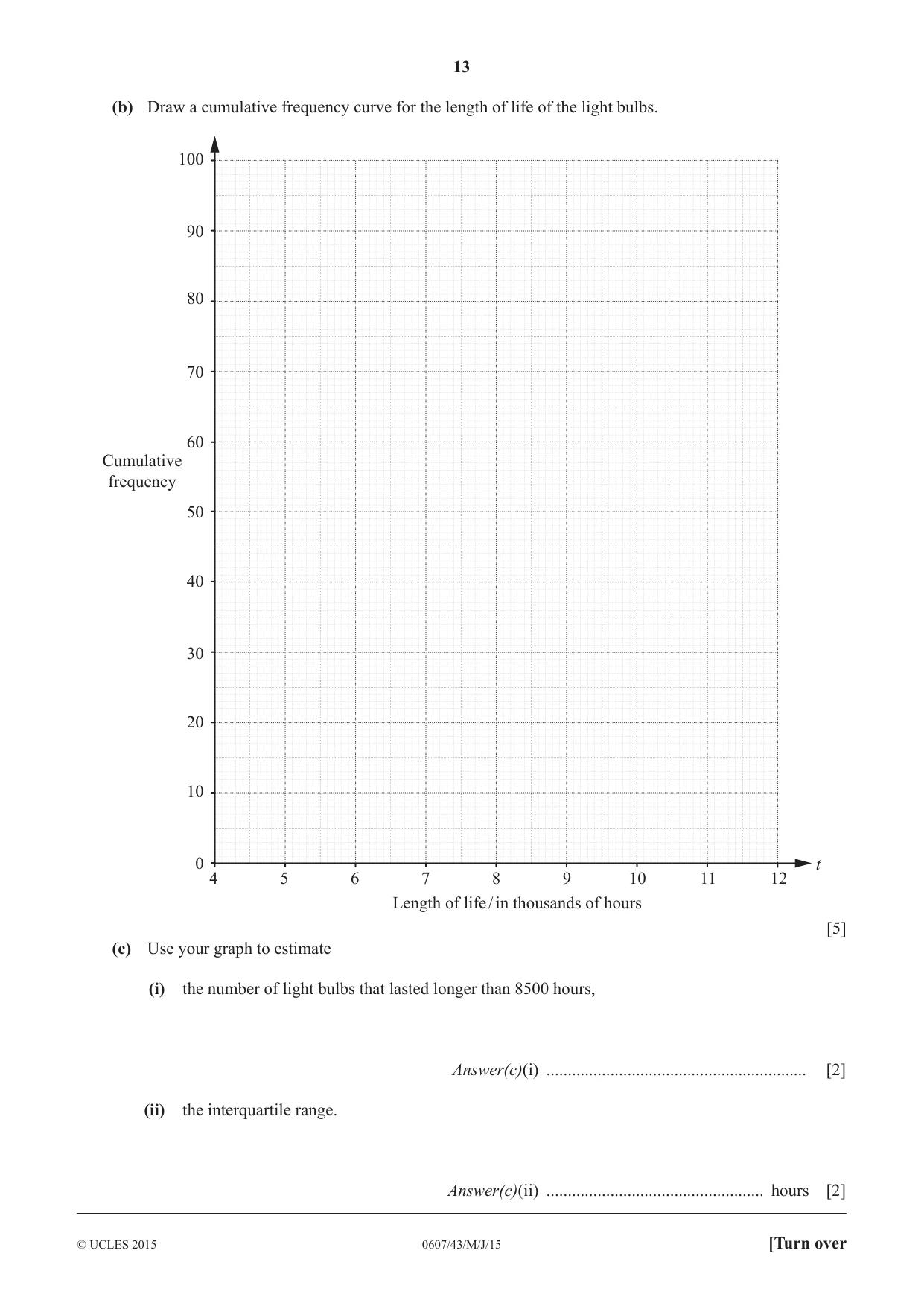
13 0607/43/M/J/15 © UCLES 2015 [Turn over (b) Draw a cumulative frequency curve for the length of life of the light bulbs. 4 0 10 20 30 40 50 60 70 80 90 100 5 6 7 8 Length of life / in thousands of hours Cumulative frequency 9 10 11 12 t [5] (c) Use your graph to estimate (i) the number of light bulbs that lasted longer than 8500 hours, Answer(c)(i) … [2] (ii) the interquartile range. Answer(c)(ii) … hours [2]
Question paper, page 14
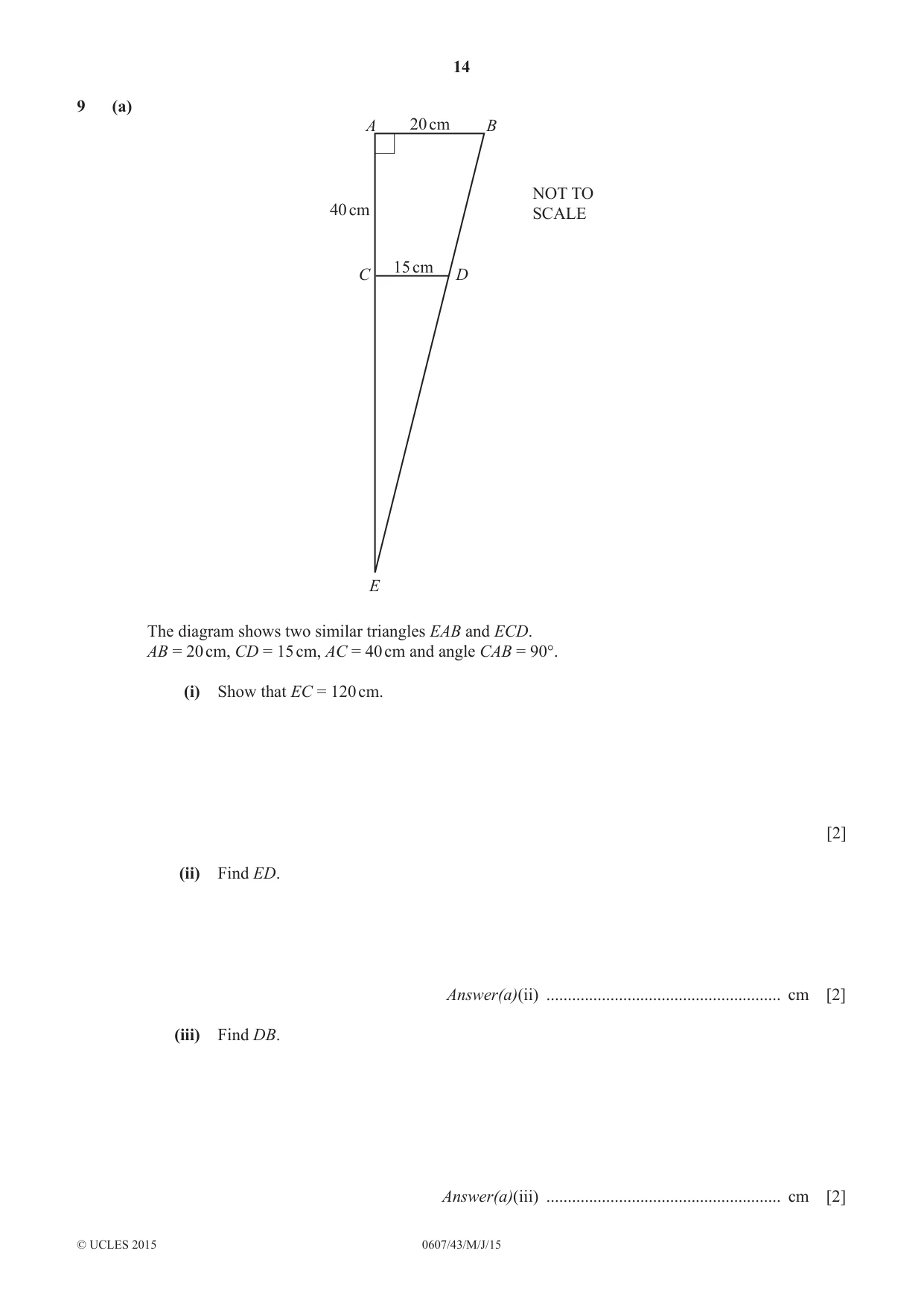
14 0607/43/M/J/15 © UCLES 2015 9 (a) A 20 cm 15 cm 40 cm B D C E NOT TO SCALE The diagram shows two similar triangles EAB and ECD. AB = 20 cm, CD = 15 cm, AC = 40 cm and angle CAB = 90°. (i) Show that EC = 120 cm. [2] (ii) Find ED. Answer(a)(ii) … cm [2] (iii) Find DB. Answer(a)(iii) … cm [2]
Question paper, page 15
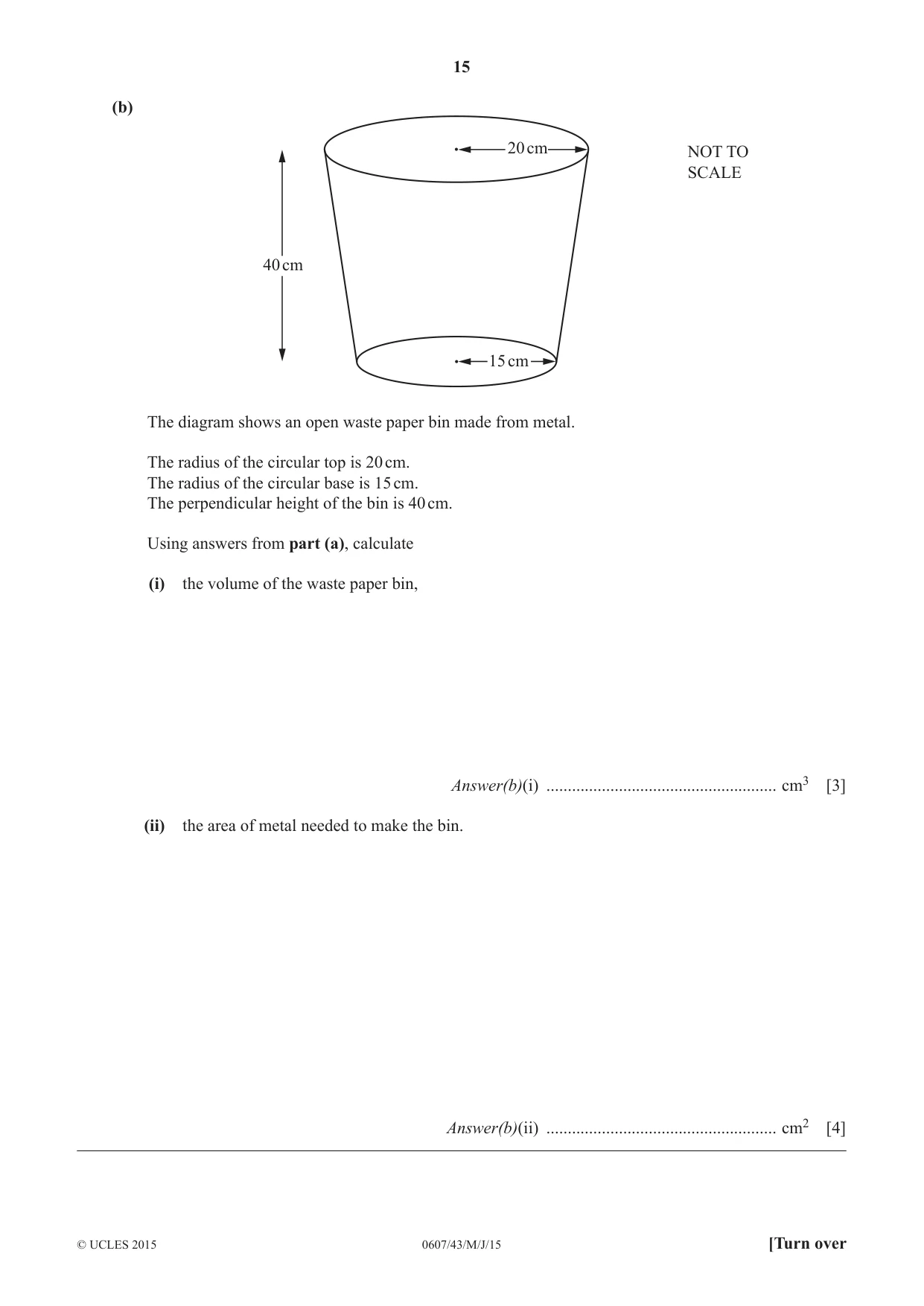
15 0607/43/M/J/15 © UCLES 2015 [Turn over (b) 15 cm 40 cm 20 cm NOT TO SCALE The diagram shows an open waste paper bin made from metal. The radius of the circular top is 20 cm. The radius of the circular base is 15 cm. The perpendicular height of the bin is 40 cm. Using answers from part (a), calculate (i) the volume of the waste paper bin, Answer(b)(i) … cm3 [3] (ii) the area of metal needed to make the bin. Answer(b)(ii) … cm2 [4]
Question paper, page 16
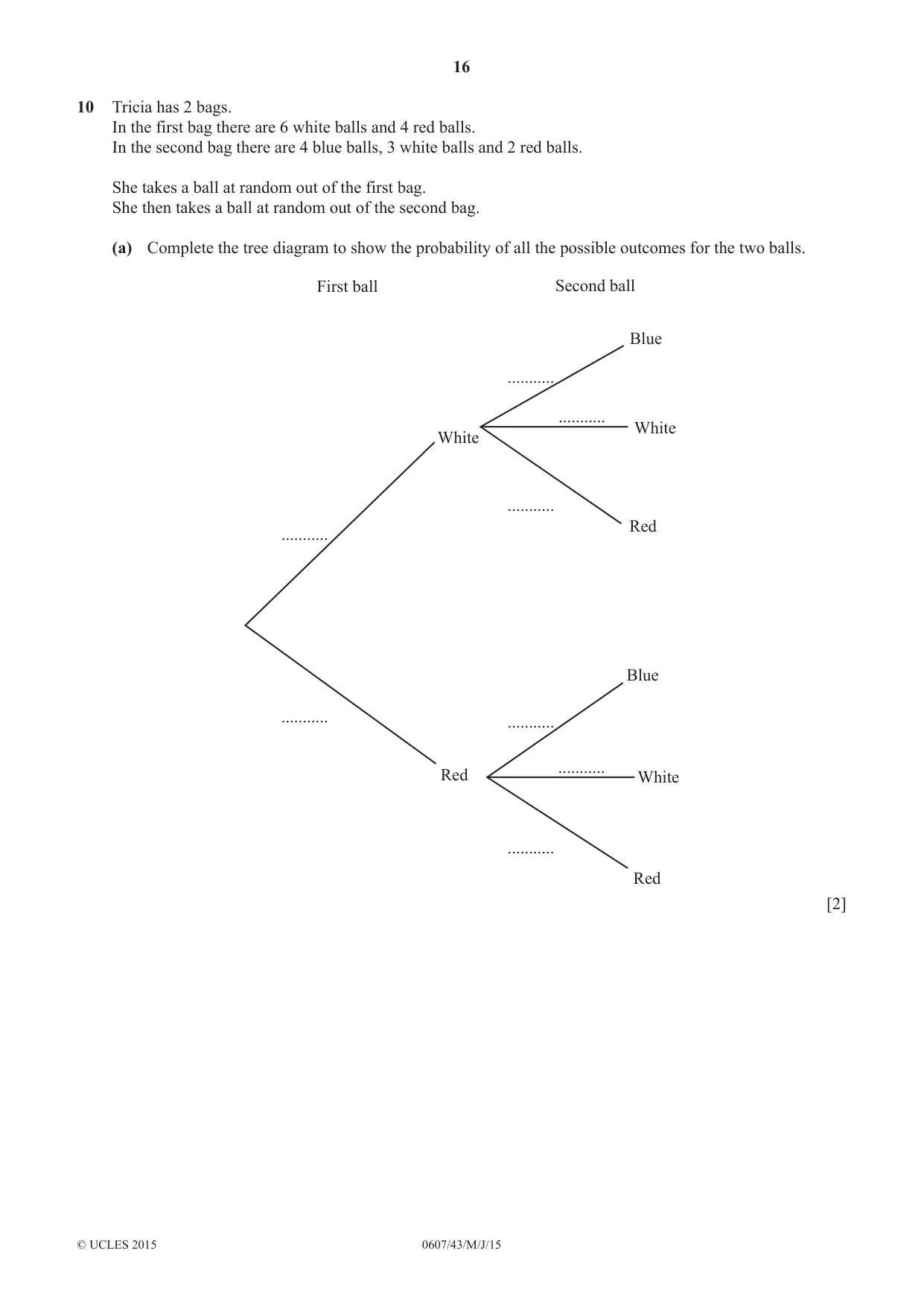
16 0607/43/M/J/15 © UCLES 2015 10 Tricia has 2 bags. In the first bag there are 6 white balls and 4 red balls. In the second bag there are 4 blue balls, 3 white balls and 2 red balls. She takes a ball at random out of the first bag. She then takes a ball at random out of the second bag. (a) Complete the tree diagram to show the probability of all the possible outcomes for the two balls. First ball Second ball … … … … … … … … Blue Blue White White White Red Red Red [2]
Question paper, page 17
17 0607/43/M/J/15 © UCLES 2015 [Turn over (b) Calculate the probability that Tricia’s two balls are (i) both white, Answer(b)(i) … [2] (ii) one white and one red, Answer(b)(ii) … [3] (iii) of different colours. Answer(b)(iii) … [3]
Question paper, page 18
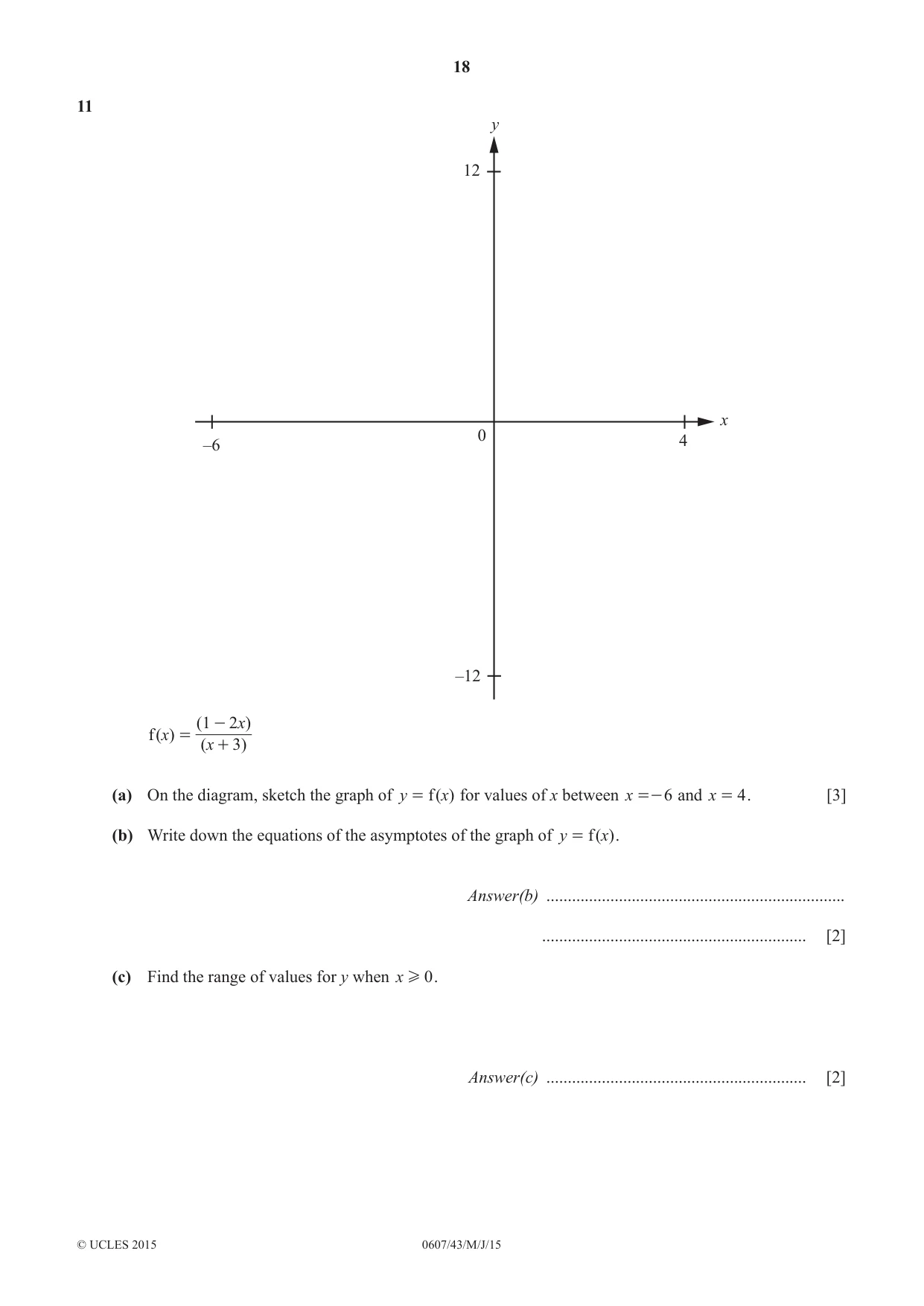
18 0607/43/M/J/15 © UCLES 2015 11 0 –12 –6 12 y x 4 ( ) ( ) ( ) f x x x 3 1 2 = + - (a) On the diagram, sketch the graph of ( ) f y x = for values of x between x 6 =- and x 4 = . [3] (b) Write down the equations of the asymptotes of the graph of ( ) f y x = . Answer(b) … … [2] (c) Find the range of values for y when x 0 H . Answer(c) … [2]
Question paper, page 19
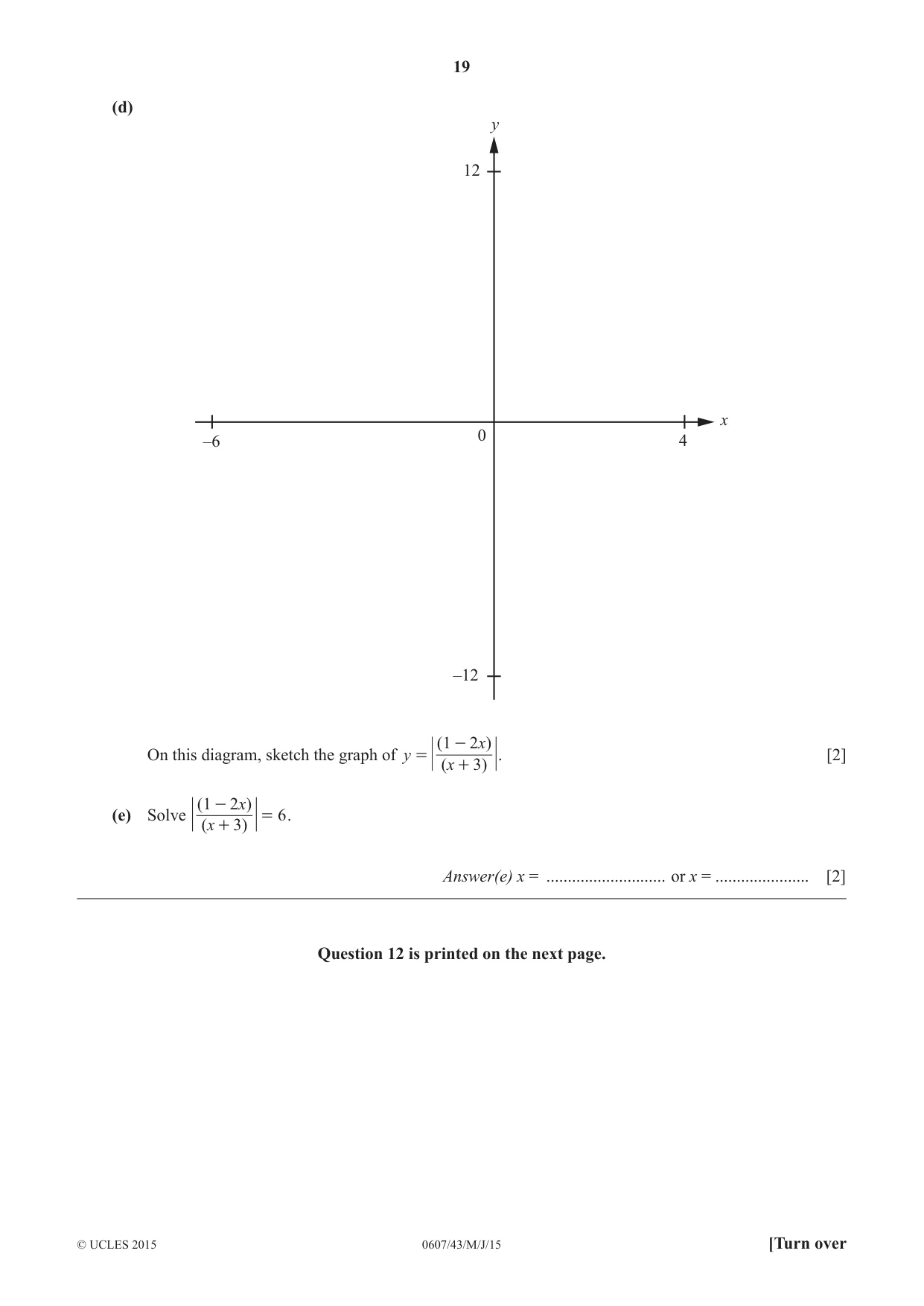
19 0607/43/M/J/15 © UCLES 2015 [Turn over (d) 0 –12 –6 12 y x 4 On this diagram, sketch the graph of ( ) ( ) y x x 3 1 2 = + - . [2] (e) Solve ( ) ( ) x x 3 1 2 6 + - = . Answer(e) x = … or x = … [2] Question 12 is printed on the next page.
Question paper, page 20
20 0607/43/M/J/15 © UCLES 2015 Permission to reproduce items where third-party owned material protected by copyright is included has been sought and cleared where possible. Every reasonable effort has been made by the publisher (UCLES) to trace copyright holders, but if any items requiring clearance have unwittingly been included, the publisher will be pleased to make amends at the earliest possible opportunity. To avoid the issue of disclosure of answer-related information to candidates, all copyright acknowledgements are reproduced online in the Cambridge International Examinations Copyright Acknowledgements Booklet. This is produced for each series of examinations and is freely available to download at www.cie.org.uk after the live examination series. Cambridge International Examinations is part of the Cambridge Assessment Group. Cambridge Assessment is the brand name of University of Cambridge Local Examinations Syndicate (UCLES), which is itself a department of the University of Cambridge. 12 ( ) f g x x x x 3 1 4 2 = - = - ^ h (a) Find (i) ( ) g 3 , Answer(a)(i) … [1] (ii) ( ( )) f g 3 . Answer(a)(ii) … [1] (b) Find and simplify expressions for (i) ( ( )) g f x , Answer(b)(i) … [2] (ii) g ( )x 1 - , Answer(b)(ii) … [2] (iii) ( ) ( ) f g x x 2 3 - . Answer(b)(iii) … [3]
Mark scheme, page 1
® IGCSE is the registered trademark of Cambridge International Examinations. CAMBRIDGE INTERNATIONAL EXAMINATIONS Cambridge International General Certificate of Secondary Education MARK SCHEME for the May/June 2015 series 0607 CAMBRIDGE INTERNATIONAL MATHEMATICS 0607/43 Paper 4 (Extended), maximum raw mark 120 This mark scheme is published as an aid to teachers and candidates, to indicate the requirements of the examination. It shows the basis on which Examiners were instructed to award marks. It does not indicate the details of the discussions that took place at an Examiners’ meeting before marking began, which would have considered the acceptability of alternative answers. Mark schemes should be read in conjunction with the question paper and the Principal Examiner Report for Teachers. Cambridge will not enter into discussions about these mark schemes. Cambridge is publishing the mark schemes for the May/June 2015 series for most Cambridge IGCSE®, Cambridge International A and AS Level components and some Cambridge O Level components.
Mark scheme, page 2
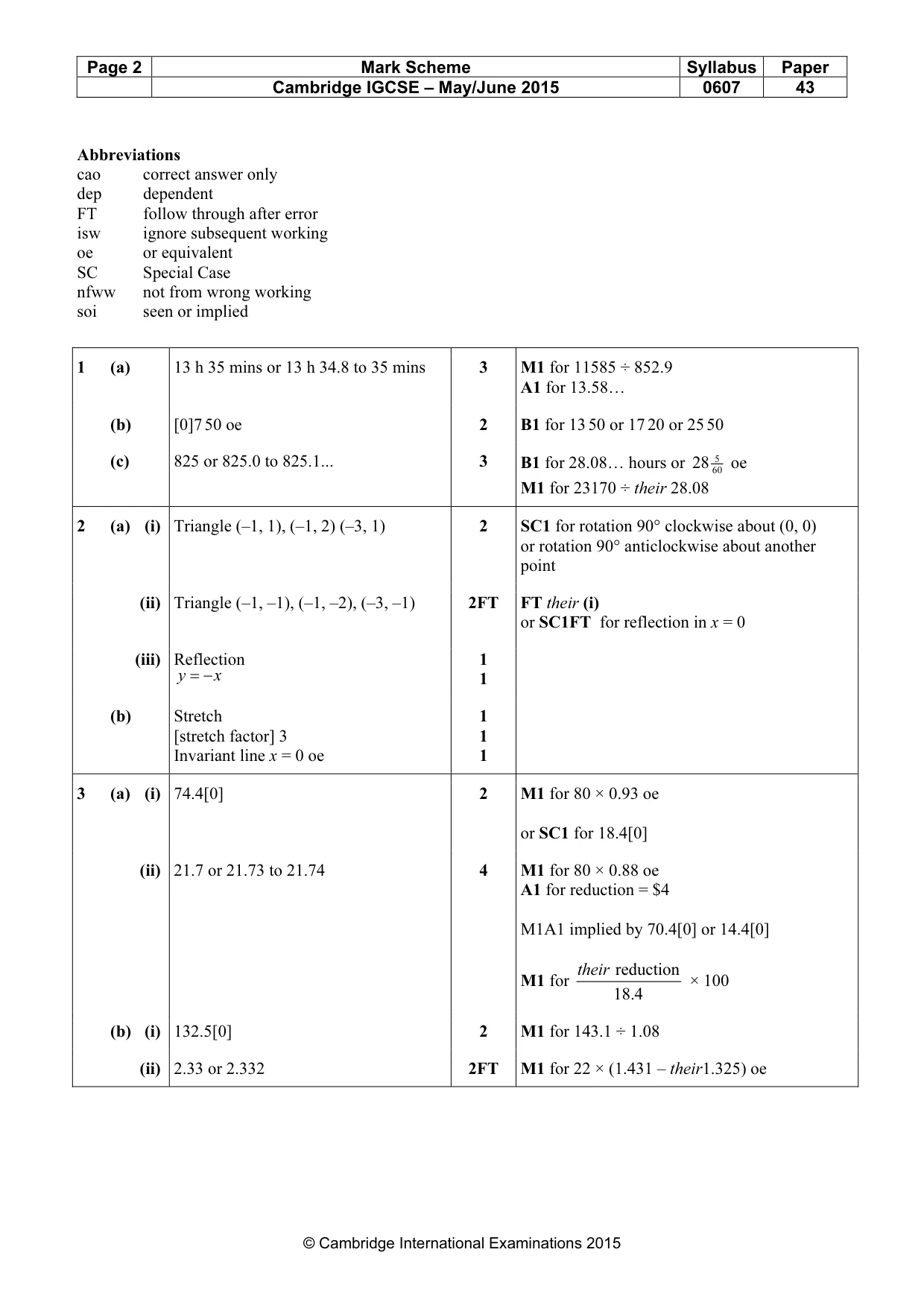
Page 2 Mark Scheme Syllabus Paper Cambridge IGCSE – May/June 2015 0607 43 © Cambridge International Examinations 2015 Abbreviations cao correct answer only dep dependent FT follow through after error isw ignore subsequent working oe or equivalent SC Special Case nfww not from wrong working soi seen or implied 1 (a) 13 h 35 mins or 13 h 34.8 to 35 mins 3 M1 for 11585 ÷ 852.9 A1 for 13.58… (b) [0]7 50 oe 2 B1 for 13 50 or 17 20 or 25 50 (c) 825 or 825.0 to 825.1... 3 B1 for 28.08… hours or 5 60 28 oe M1 for 23170 ÷ their 28.08 2 (a) (i) Triangle (–1, 1), (–1, 2) (–3, 1) 2 SC1 for rotation 90° clockwise about (0, 0) or rotation 90° anticlockwise about another point (ii) Triangle (–1, –1), (–1, –2), (–3, –1) 2FT FT their (i) or SC1FT for reflection in x = 0 (iii) Reflection y x = − 1 1 (b) Stretch [stretch factor] 3 Invariant line x = 0 oe 1 1 1 3 (a) (i) 74.4[0] 2 M1 for 80 × 0.93 oe or SC1 for 18.4[0] (ii) 21.7 or 21.73 to 21.74 4 M1 for 80 × 0.88 oe A1 for reduction = $4 M1A1 implied by 70.4[0] or 14.4[0] M1 for reduction 18.4 their × 100 (b) (i) 132.5[0] 2 M1 for 143.1 ÷ 1.08 (ii) 2.33 or 2.332 2FT M1 for 22 × (1.431 – their1.325) oe
Mark scheme, page 3
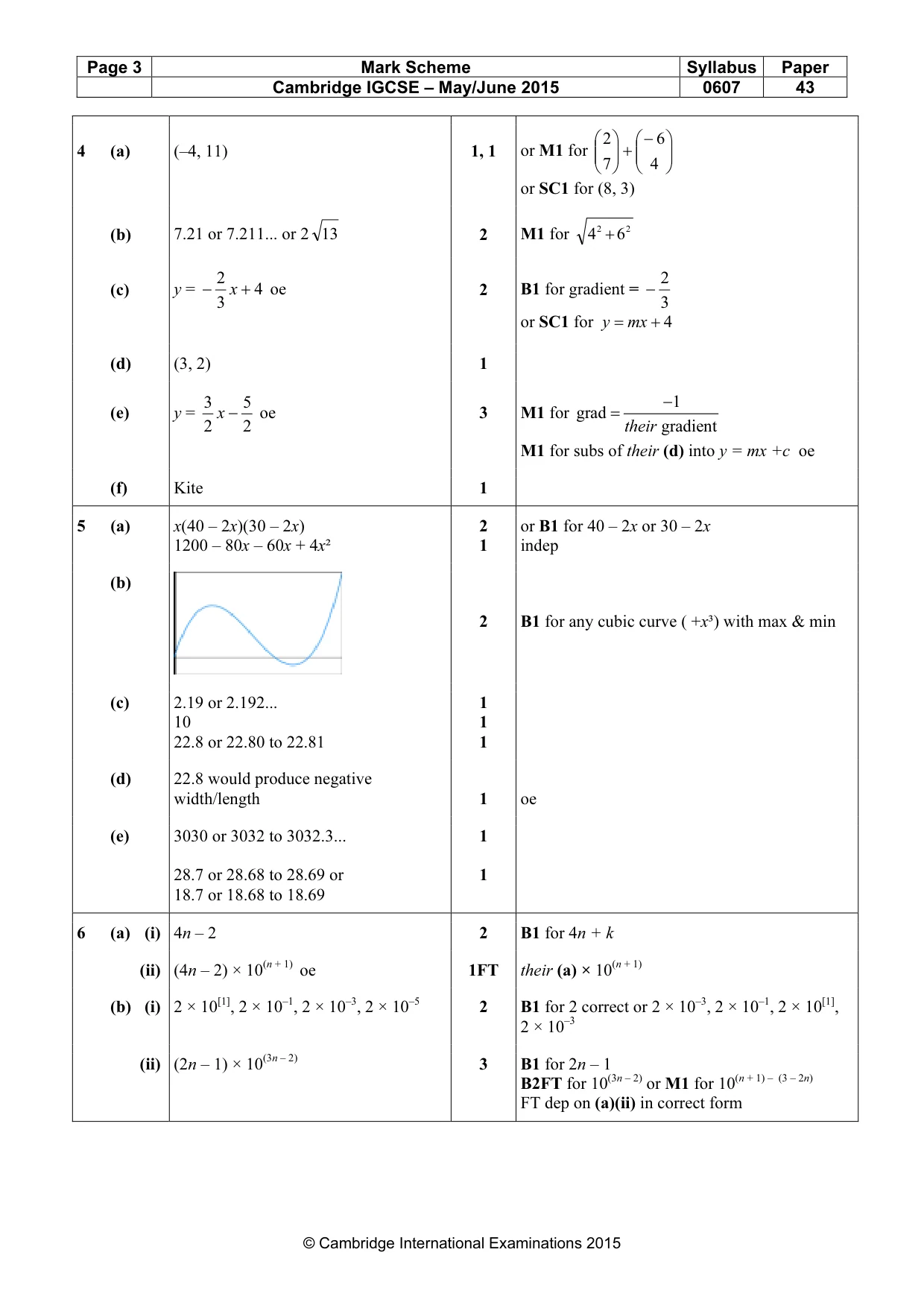
Page 3 Mark Scheme Syllabus Paper Cambridge IGCSE – May/June 2015 0607 43 © Cambridge International Examinations 2015 4 (a) (–4, 11) 1, 1 or M1 for − + 4 6 7 2 or SC1 for (8, 3) (b) 7.21 or 7.211... or 2 13 2 M1 for 2 2 6 4 + (c) y = 4 3 2 + − x oe 2 B1 for gradient = 3 2 − or SC1 for 4 y mx = + (d) (3, 2) 1 (e) y = 2 5 2 3 − x oe 3 M1 for 1 grad gradient their − = M1 for subs of their (d) into y = mx +c oe (f) Kite 1 5 (a) x(40 – 2x)(30 – 2x) 1200 – 80x – 60x + 4x² 2 1 or B1 for 40 – 2x or 30 – 2x indep (b) 2 B1 for any cubic curve ( +x³) with max & min (c) 2.19 or 2.192... 10 22.8 or 22.80 to 22.81 1 1 1 (d) 22.8 would produce negative width/length 1 oe (e) 3030 or 3032 to 3032.3... 28.7 or 28.68 to 28.69 or 18.7 or 18.68 to 18.69 1 1 6 (a) (i) 4n – 2 2 B1 for 4n + k (ii) (4n – 2) × 10(n + 1) oe 1FT their (a) × 10(n + 1) (b) (i) 2 × 10[1], 2 × 10⁻¹, 2 × 10⁻³, 2 × 10⁻⁵ 2 B1 for 2 correct or 2 × 10⁻³, 2 × 10⁻¹, 2 × 10[1], 2 × 10⁻³ (ii) (2n – 1) × 10(3n – 2) 3 B1 for 2n – 1 B2FT for 10(3n – 2) or M1 for 10(n + 1) – (3 – 2n) FT dep on (a)(ii) in correct form
Mark scheme, page 4
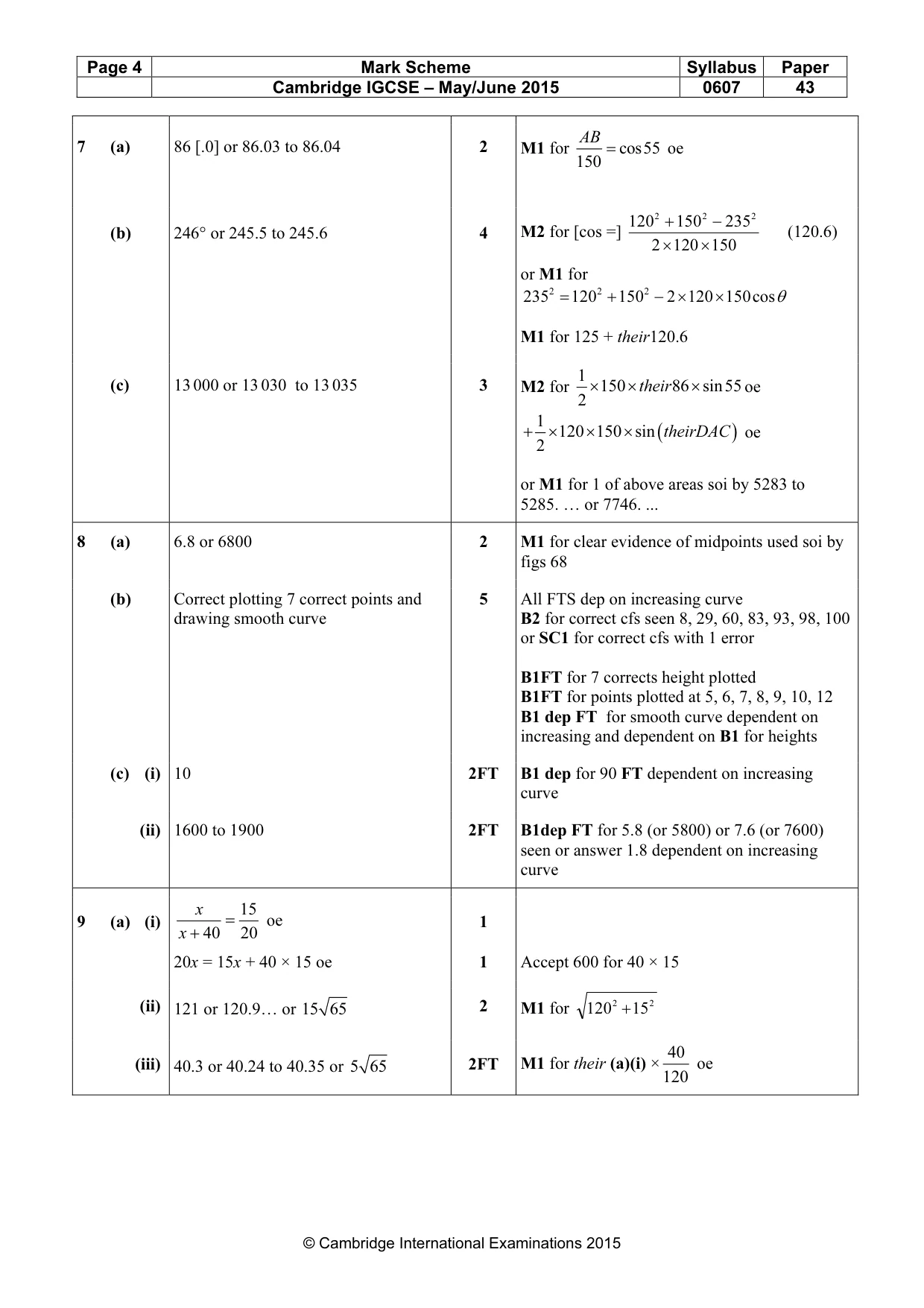
Page 4 Mark Scheme Syllabus Paper Cambridge IGCSE – May/June 2015 0607 43 © Cambridge International Examinations 2015 7 (a) 86 [.0] or 86.03 to 86.04 2 M1 for cos55 150 AB = oe (b) 246° or 245.5 to 245.6 4 M2 for [cos =] 150 120 2 235 150 120 2 2 2 × × − + (120.6) or M1 for 2 2 2 235 120 150 2 120 150cosθ = + − × × M1 for 125 + their120.6 (c) 13 000 or 13 030 to 13 035 3 M2 for 1 150 86 sin55 2 their × × × oe ( ) 1 120 150 sin 2 theirDAC + × × × oe or M1 for 1 of above areas soi by 5283 to 5285. … or 7746. ... 8 (a) 6.8 or 6800 2 M1 for clear evidence of midpoints used soi by figs 68 (b) Correct plotting 7 correct points and drawing smooth curve 5 All FTS dep on increasing curve B2 for correct cfs seen 8, 29, 60, 83, 93, 98, 100 or SC1 for correct cfs with 1 error B1FT for 7 corrects height plotted B1FT for points plotted at 5, 6, 7, 8, 9, 10, 12 B1 dep FT for smooth curve dependent on increasing and dependent on B1 for heights (c) (i) 10 2FT B1 dep for 90 FT dependent on increasing curve (ii) 1600 to 1900 2FT B1dep FT for 5.8 (or 5800) or 7.6 (or 7600) seen or answer 1.8 dependent on increasing curve 9 (a) (i) 20 15 40 = + x x oe 20x = 15x + 40 × 15 oe 1 1 Accept 600 for 40 × 15 (ii) 121 or 120.9… or 15 65 2 M1 for 2 2 15 120 + (iii) 40.3 or 40.24 to 40.35 or 5 65 2FT M1 for their (a)(i) ×120 40 oe
Mark scheme, page 5
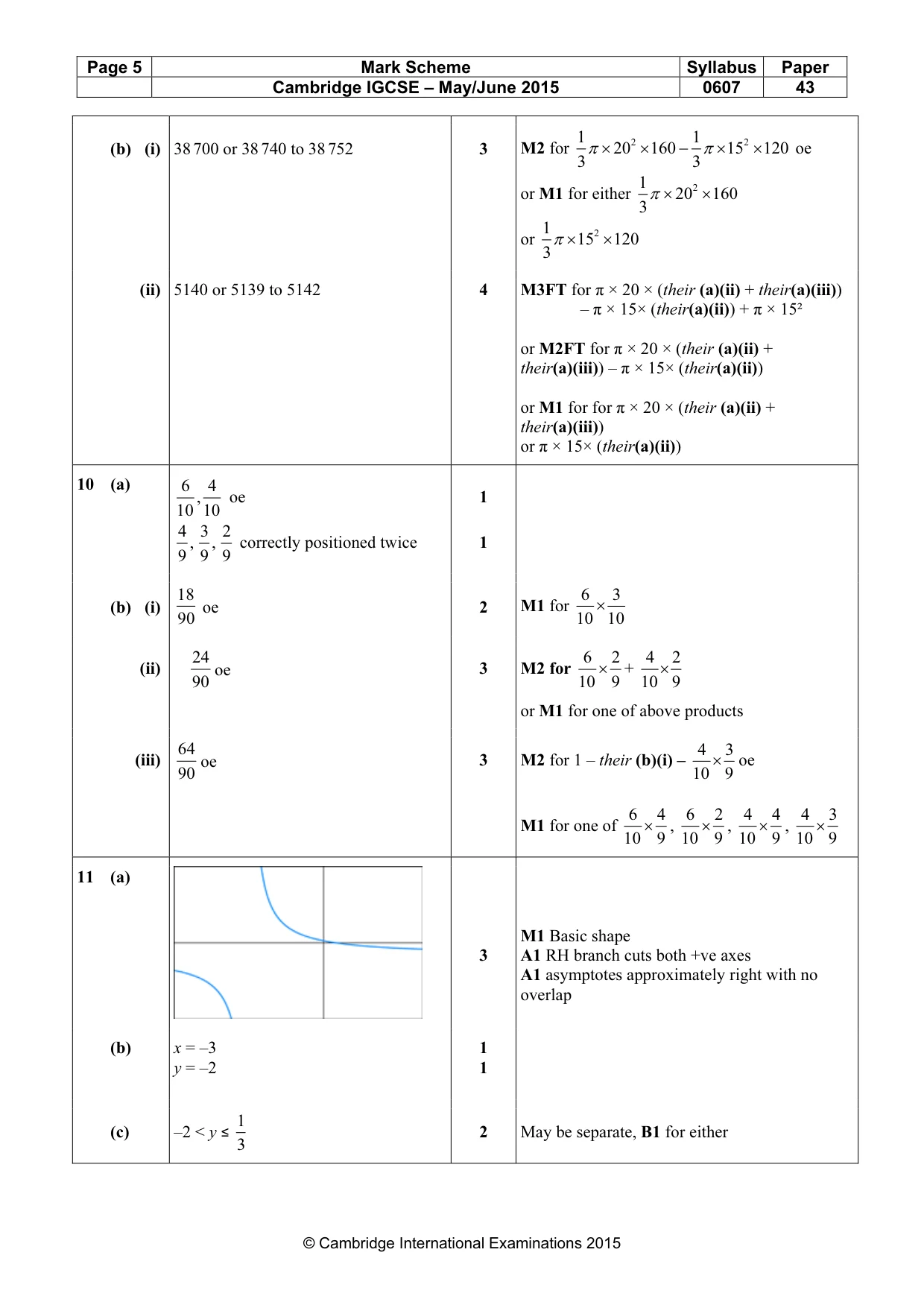
Page 5 Mark Scheme Syllabus Paper Cambridge IGCSE – May/June 2015 0607 43 © Cambridge International Examinations 2015 (b) (i) 38 700 or 38 740 to 38 752 3 M2 for 2 2 1 1 20 160 15 120 3 3 π π × × − × × oe or M1 for either 2 1 20 160 3π × × or 2 1 15 120 3π × × (ii) 5140 or 5139 to 5142 4 M3FT for π × 20 × (their (a)(ii) + their(a)(iii)) – π × 15× (their(a)(ii)) + π × 15² or M2FT for π × 20 × (their (a)(ii) + their(a)(iii)) – π × 15× (their(a)(ii)) or M1 for for π × 20 × (their (a)(ii) + their(a)(iii)) or π × 15× (their(a)(ii)) 10 (a) 10 4 , 10 6 oe 9 2 , 9 3 , 9 4 correctly positioned twice 1 1 (b) (i) 90 18 oe 2 M1 for 10 3 10 6 × (ii) 90 24 oe 3 M2 for 9 2 10 6 × + 4 2 10 9 × or M1 for one of above products (iii) 90 64 oe 3 M2 for 1 – their (b)(i) – 9 3 10 4 × oe M1 for one of 9 4 10 6 × , 9 2 10 6 × , 9 4 10 4 × , 9 3 10 4 × 11 (a) 3 M1 Basic shape A1 RH branch cuts both +ve axes A1 asymptotes approximately right with no overlap (b) x = –3 y = –2 1 1 (c) –2 < y ≤ 3 1 2 May be separate, B1 for either
Mark scheme, page 6
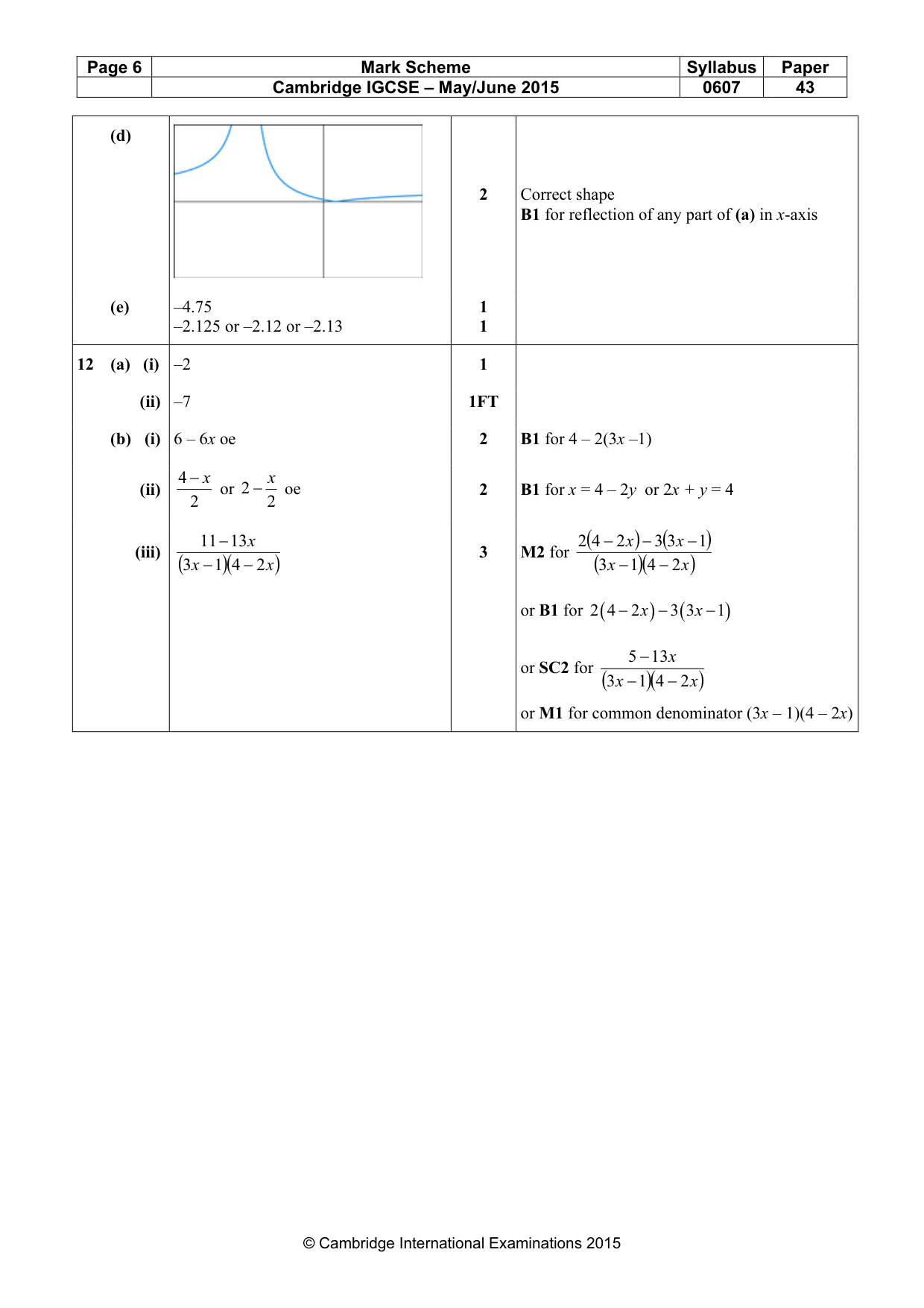
Page 6 Mark Scheme Syllabus Paper Cambridge IGCSE – May/June 2015 0607 43 © Cambridge International Examinations 2015 (d) 2 Correct shape B1 for reflection of any part of (a) in x-axis (e) –4.75 –2.125 or –2.12 or –2.13 1 1 12 (a) (i) –2 1 (ii) –7 1FT (b) (i) 6 – 6x oe 2 B1 for 4 – 2(3x –1) (ii) 2 4 x − or 2 2 x − oe 2 B1 for x = 4 – 2y or 2x + y = 4 (iii) ( )( ) x x x 2 4 1 3 13 11 − − − 3 M2 for ( ) ( ) ( )( ) x x x x 2 4 1 3 1 3 3 2 4 2 − − − − − or B1 for ( ) ( ) 2 4 2 3 3 1 x x − − − or SC2 for ( )( ) x x x 2 4 1 3 13 5 − − − or M1 for common denominator (3x – 1)(4 – 2x)
What you needed in this session
Cambridge’s own grade thresholds for 2015 May/June, Paper 4 · Variant 3. A higher threshold means an easier paper — the bar moves with how the cohort did.