Cambridge IGCSE Mathematics - International 0607 — 2015 May/June Paper 4 · Variant 2
0607/42/M/J/15 · 120 marks · ≈135 min
The question paper and its mark scheme, free to read here and free to download. This is Cambridge’s own paper, exactly as it was sat.
Question paper20 pages
Mark scheme7 pages
Answers below. Sit the paper first if you are practising.
Paper as text
Question paper, page 1
This document consists of 20 printed pages. DC (NH/SW) 99286/6 © UCLES 2015 [Turn over * 5 4 8 3 7 0 5 8 8 5 * CAMBRIDGE INTERNATIONAL MATHEMATICS 0607/42 Paper 4 (Extended) May/June 2015 2 hours 15 minutes Candidates answer on the Question Paper. Additional Materials: Geometrical Instruments Graphics Calculator READ THESE INSTRUCTIONS FIRST Write your Centre number, candidate number and name on all the work you hand in. Write in dark blue or black pen. Do not use staples, paper clips, glue or correction fluid. You may use an HB pencil for any diagrams or graphs. DO NOT WRITE IN ANY BARCODES. Answer all the questions. Unless instructed otherwise, give your answers exactly or correct to three significant figures as appropriate. Answers in degrees should be given to one decimal place. For π, use your calculator value. You must show all the relevant working to gain full marks and you will be given marks for correct methods, including sketches, even if your answer is incorrect. The number of marks is given in brackets [ ] at the end of each question or part question. The total number of marks for this paper is 120. Cambridge International Examinations Cambridge International General Certificate of Secondary Education
Question paper, page 2
2 0607/42/M/J/15 © UCLES 2015 Formula List For the equation ax bx c 0 2 + + = x a b b ac 2 4 2 ! = - - Curved surface area, A, of cylinder of radius r, height h. r A rh 2 = Curved surface area, A, of cone of radius r, sloping edge l. r A rl = Curved surface area, A, of sphere of radius r. r A r 4 2 = Volume, V, of pyramid, base area A, height h. V Ah 3 1 = Volume, V, of cylinder of radius r, height h. r V r h 2 = Volume, V, of cone of radius r, height h. r V r h 3 1 2 = Volume, V, of sphere of radius r. r V r 3 4 3 = sin sin sin A a B b C c = = cos a b c bc A 2 2 2 2 = + - sin bc A 2 1 Area = A C B c b a
Question paper, page 3
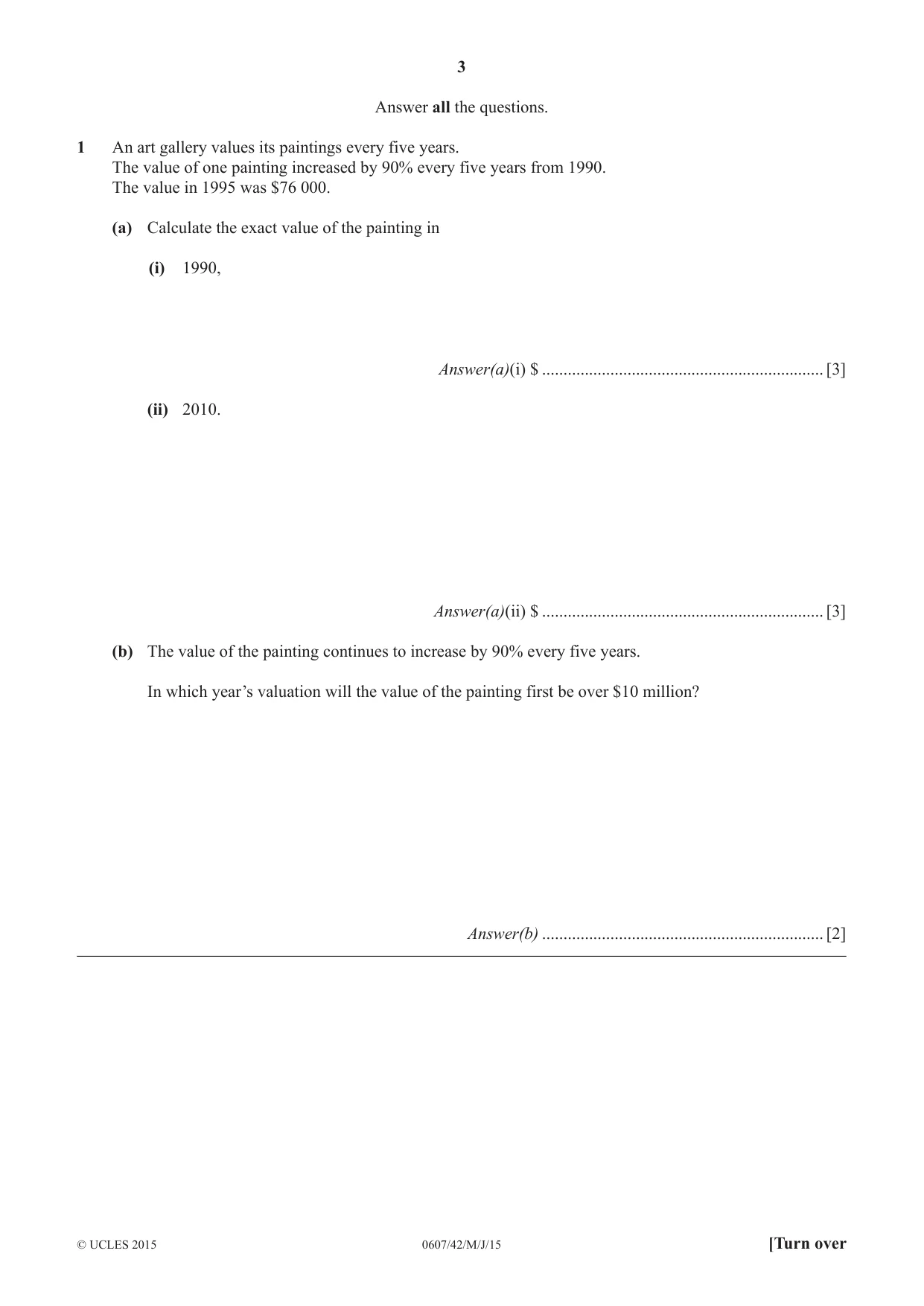
3 0607/42/M/J/15 © UCLES 2015 [Turn over Answer all the questions. 1 An art gallery values its paintings every five years. The value of one painting increased by 90% every five years from 1990. The value in 1995 was $76 000. (a) Calculate the exact value of the painting in (i) 1990, Answer(a)(i) $ … [3] (ii) 2010. Answer(a)(ii) $ … [3] (b) The value of the painting continues to increase by 90% every five years. In which year’s valuation will the value of the painting first be over $10 million? Answer(b) … [2]
Question paper, page 4
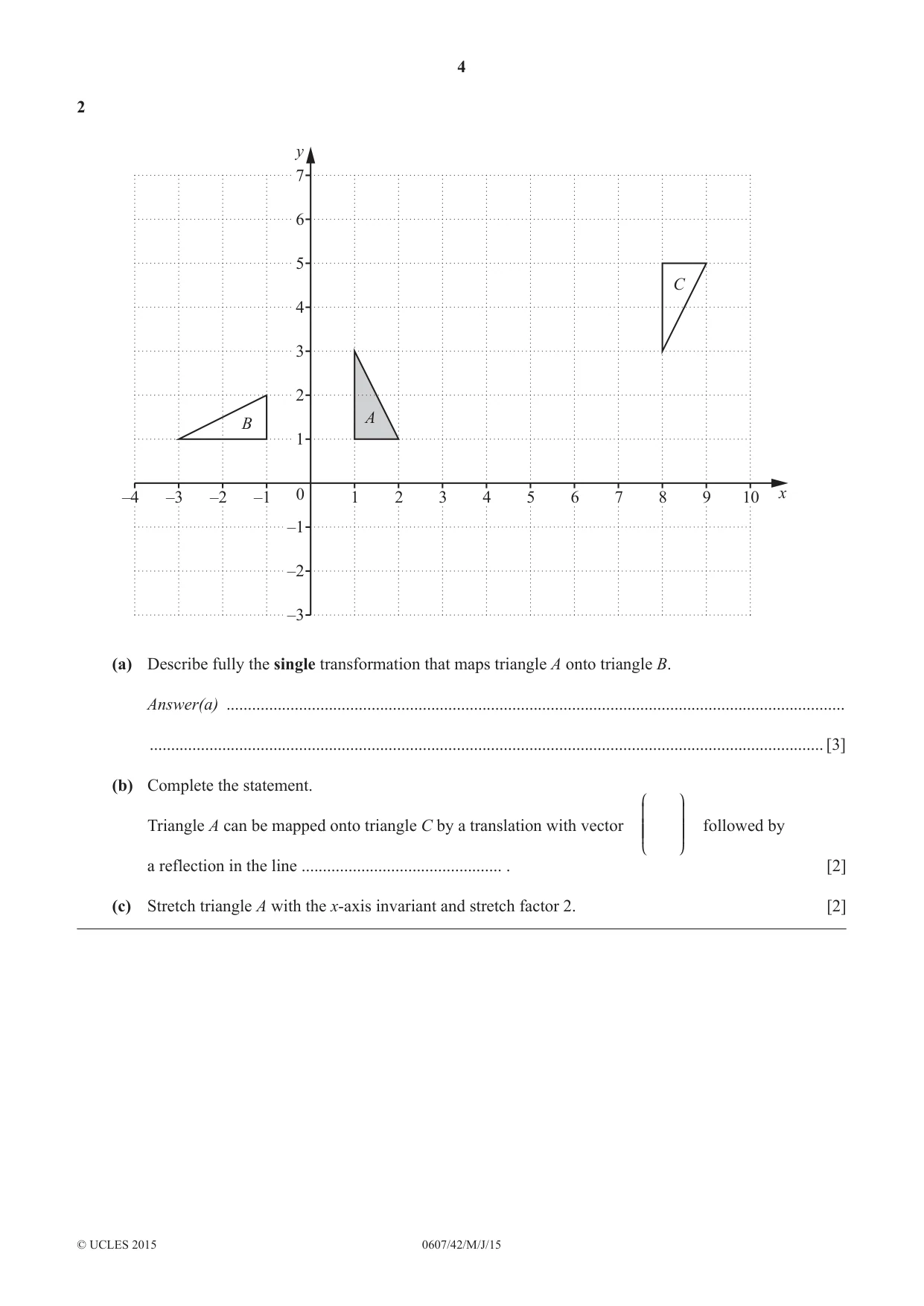
4 0607/42/M/J/15 © UCLES 2015 2 –3 –2 –1 1 2 3 4 5 6 7 –4 –3 –2 –1 1 0 2 3 4 5 6 7 8 9 10 x y B A C (a) Describe fully the single transformation that maps triangle A onto triangle B. Answer(a) … … [3] (b) Complete the statement. Triangle A can be mapped onto triangle C by a translation with vector J L K KK N P O OO followed by a reflection in the line … . [2] (c) Stretch triangle A with the x-axis invariant and stretch factor 2. [2]
Question paper, page 5
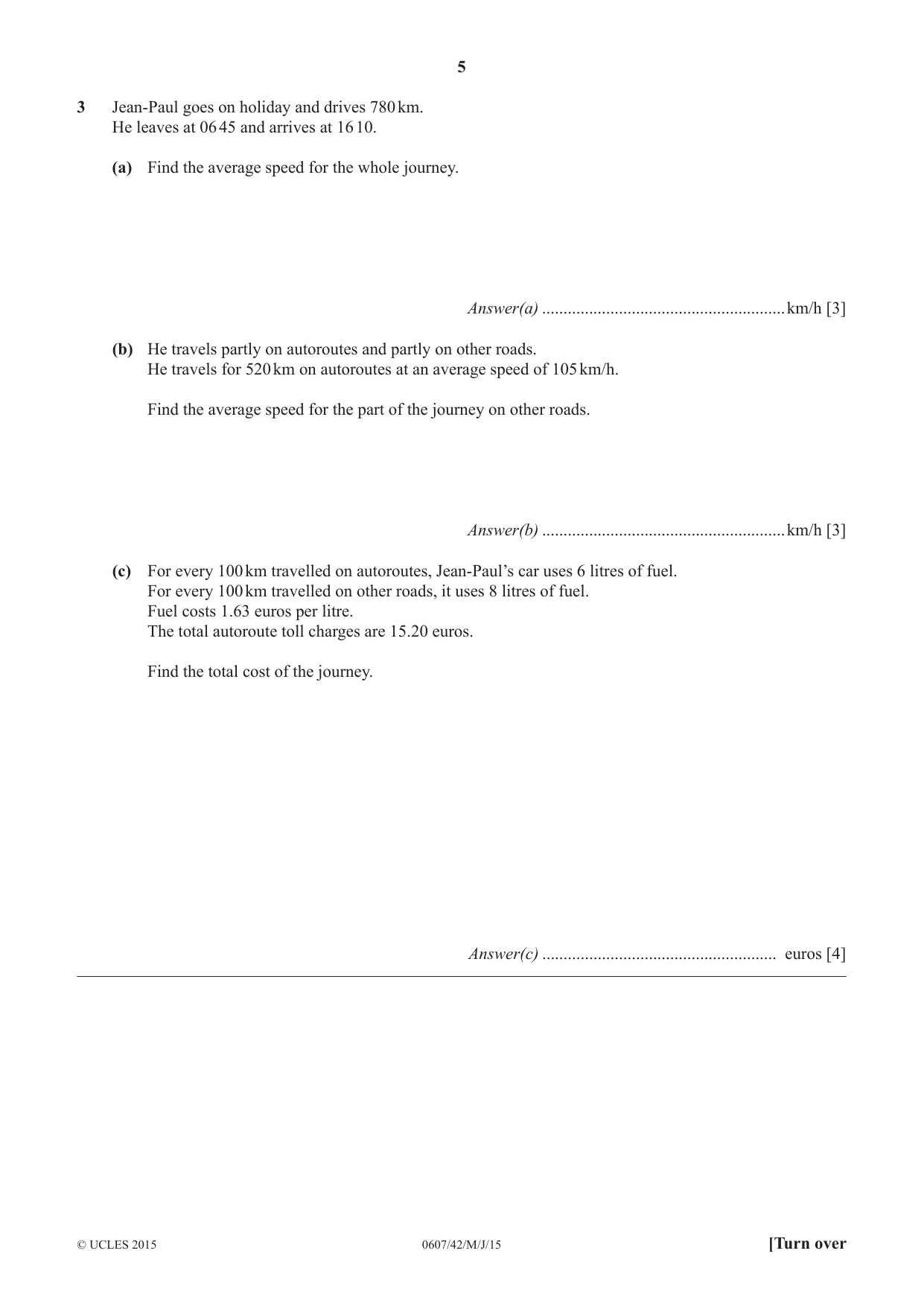
5 0607/42/M/J/15 © UCLES 2015 [Turn over 3 Jean-Paul goes on holiday and drives 780 km. He leaves at 06 45 and arrives at 16 10. (a) Find the average speed for the whole journey. Answer(a) …km/h [3] (b) He travels partly on autoroutes and partly on other roads. He travels for 520 km on autoroutes at an average speed of 105 km/h. Find the average speed for the part of the journey on other roads. Answer(b) …km/h [3] (c) For every 100 km travelled on autoroutes, Jean-Paul’s car uses 6 litres of fuel. For every 100 km travelled on other roads, it uses 8 litres of fuel. Fuel costs 1.63 euros per litre. The total autoroute toll charges are 15.20 euros. Find the total cost of the journey. Answer(c) … euros [4]
Question paper, page 6
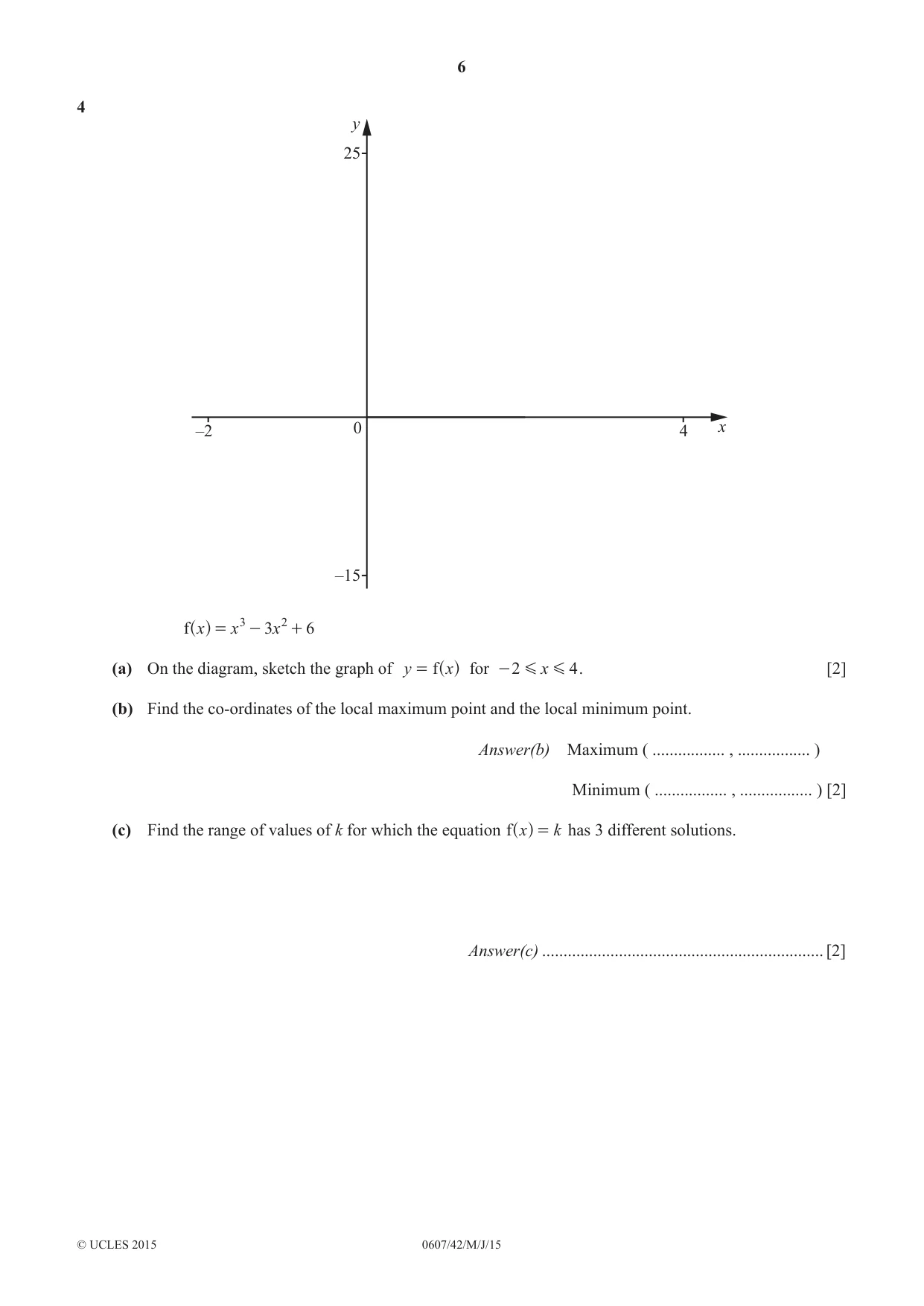
6 0607/42/M/J/15 © UCLES 2015 4 –15 25 –2 4 0 x y x x x 3 6 f 3 2 = - + ^ h (a) On the diagram, sketch the graph of y x f = ^ h for x 2 4 G G - . [2] (b) Find the co-ordinates of the local maximum point and the local minimum point. Answer(b) Maximum ( … , … ) Minimum ( … , … ) [2] (c) Find the range of values of k for which the equation x k f = ^ h has 3 different solutions. Answer(c) … [2]
Question paper, page 7
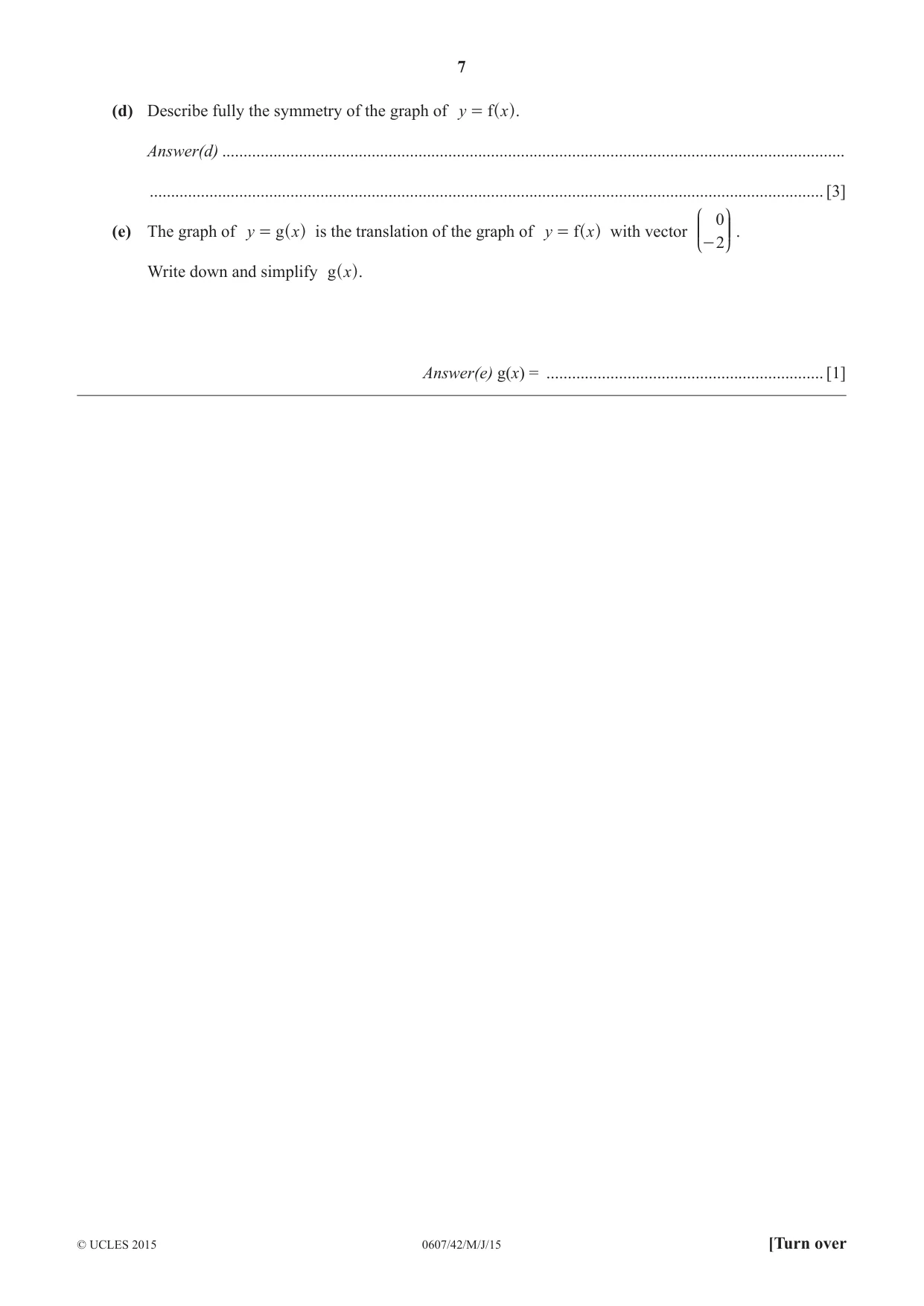
7 0607/42/M/J/15 © UCLES 2015 [Turn over (d) Describe fully the symmetry of the graph of y x f = ^ h. Answer(d) … … [3] (e) The graph of y x g = ^ h is the translation of the graph of y x f = ^ h with vector 0 2 - J L KK N P OO . Write down and simplify x g^ h. Answer(e) g(x) = … [1]
Question paper, page 8
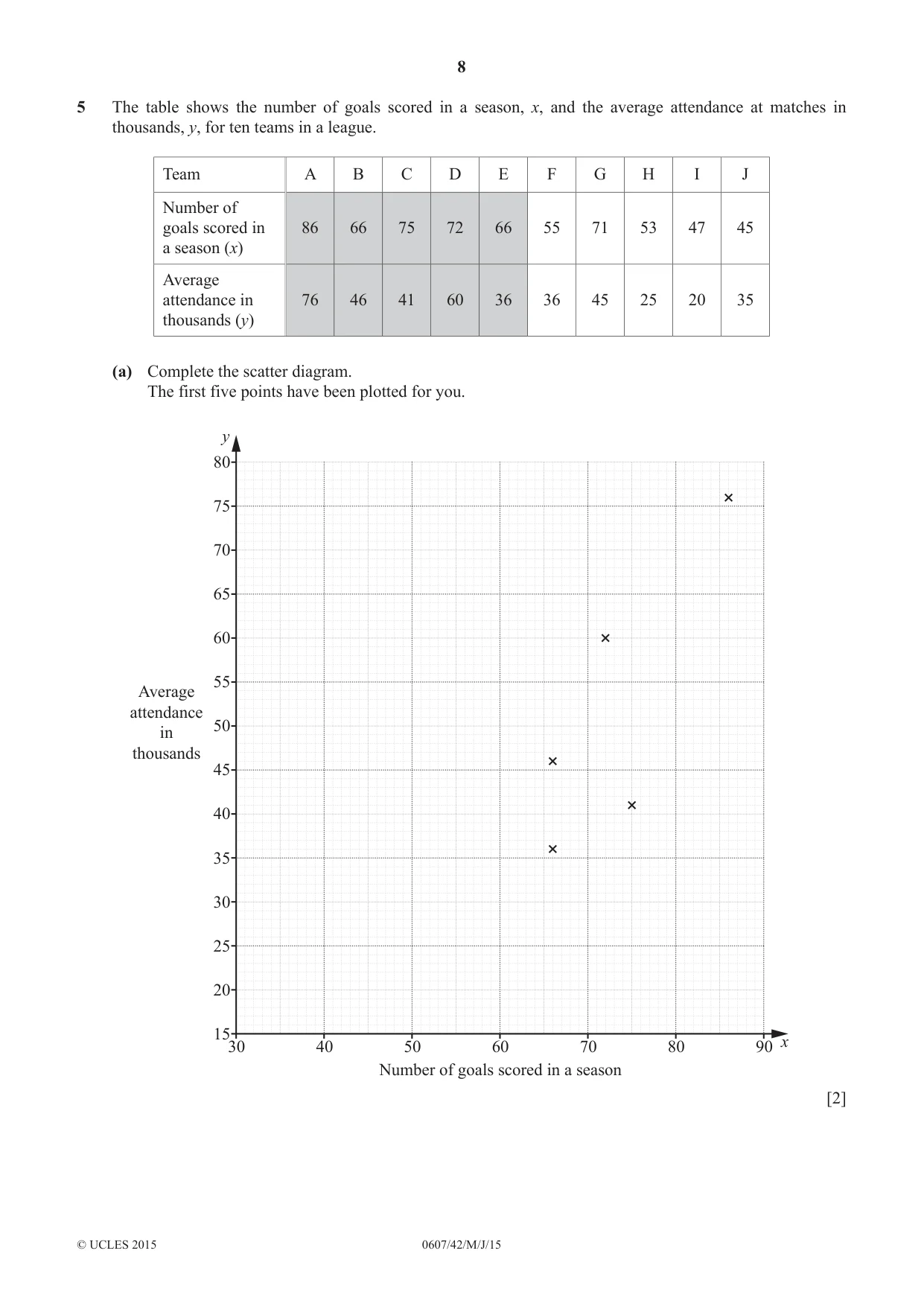
8 0607/42/M/J/15 © UCLES 2015 5 The table shows the number of goals scored in a season, x, and the average attendance at matches in thousands, y, for ten teams in a league. Team A B C D E F G H I J Number of goals scored in a season (x) 86 66 75 72 66 55 71 53 47 45 Average attendance in thousands (y) 76 46 41 60 36 36 45 25 20 35 (a) Complete the scatter diagram. The first five points have been plotted for you. 30 15 20 25 30 35 40 45 50 55 60 65 70 75 80 y x 40 50 60 Number of goals scored in a season Average attendance in thousands 70 80 90 [2]
Question paper, page 9
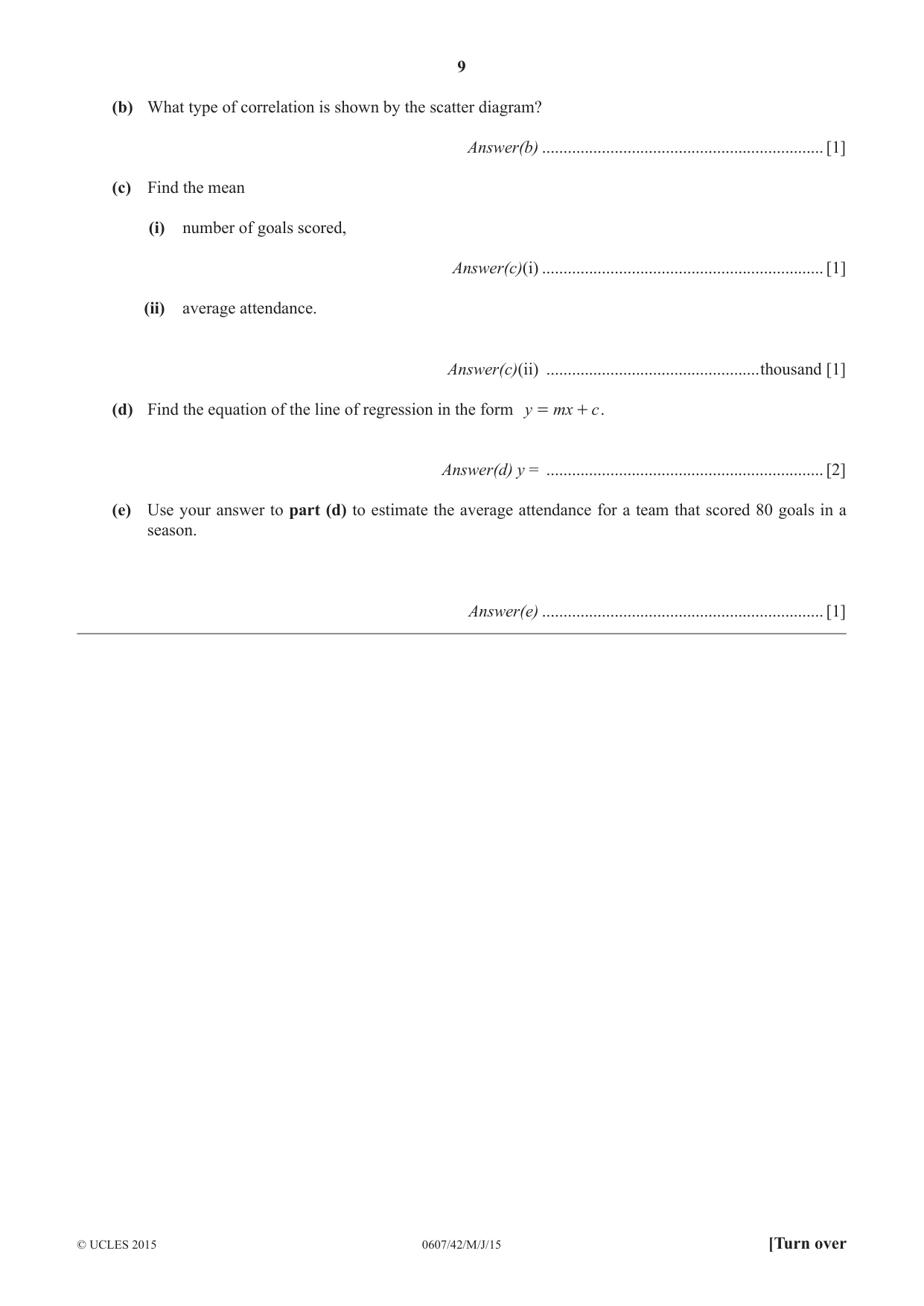
9 0607/42/M/J/15 © UCLES 2015 [Turn over (b) What type of correlation is shown by the scatter diagram? Answer(b) … [1] (c) Find the mean (i) number of goals scored, Answer(c)(i) … [1] (ii) average attendance. Answer(c)(ii) …thousand [1] (d) Find the equation of the line of regression in the form y mx c = + . Answer(d) y = … [2] (e) Use your answer to part (d) to estimate the average attendance for a team that scored 80 goals in a season. Answer(e) … [1]
Question paper, page 10
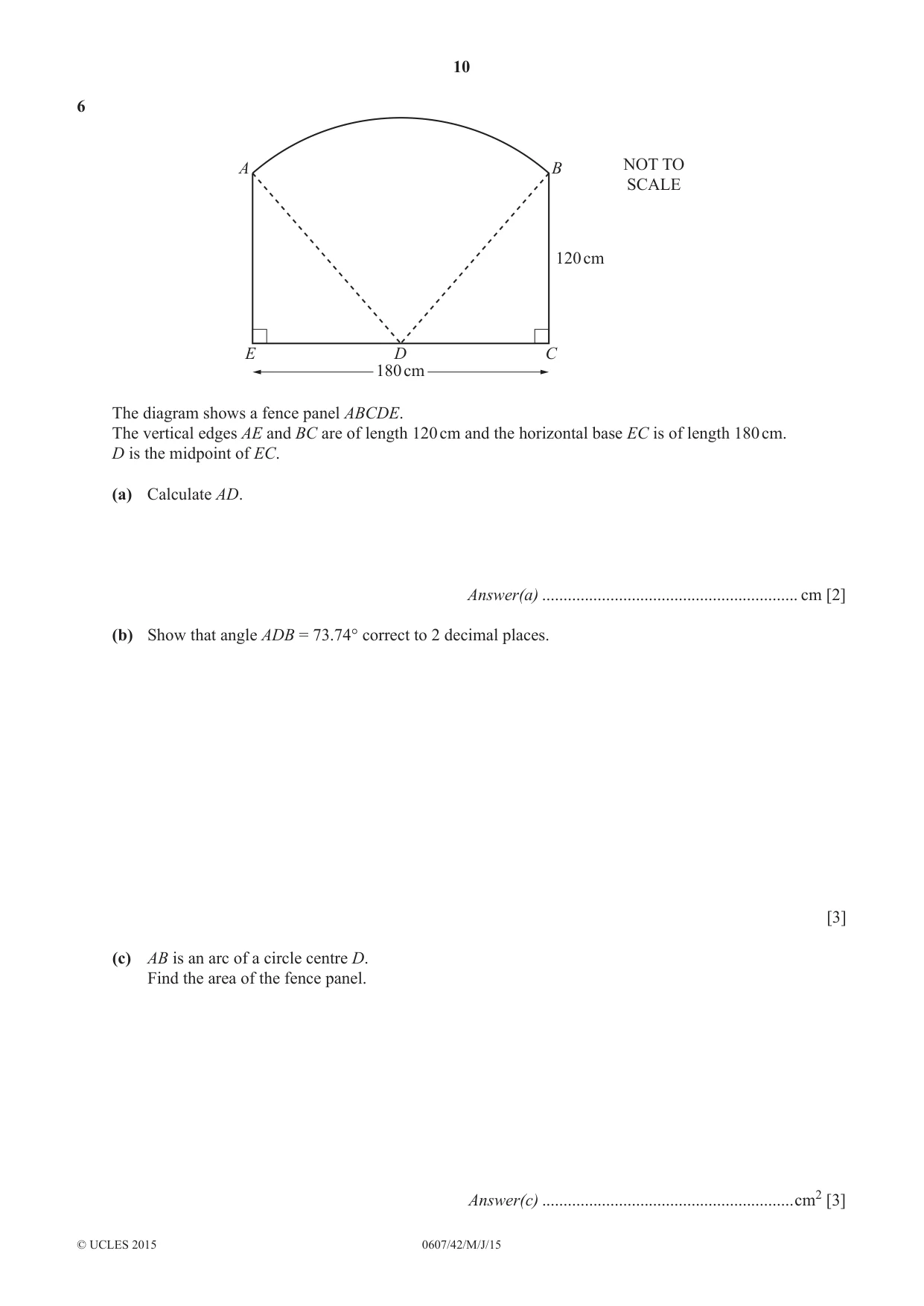
10 0607/42/M/J/15 © UCLES 2015 6 E D 180 cm 120 cm NOT TO SCALE C B A The diagram shows a fence panel ABCDE. The vertical edges AE and BC are of length 120 cm and the horizontal base EC is of length 180 cm. D is the midpoint of EC. (a) Calculate AD. Answer(a) … cm [2] (b) Show that angle ADB = 73.74° correct to 2 decimal places. [3] (c) AB is an arc of a circle centre D. Find the area of the fence panel. Answer(c) …cm2 [3]
Question paper, page 11
11 0607/42/M/J/15 © UCLES 2015 [Turn over (d) Stefan’s fence has 8 panels, each identical to ABCDE. He wishes to paint both sides of all the panels. Each litre of paint covers an area of 6 square metres. Calculate the number of litres Stefan needs to paint both sides of the whole fence. Answer(d) … litres [3]
Question paper, page 12
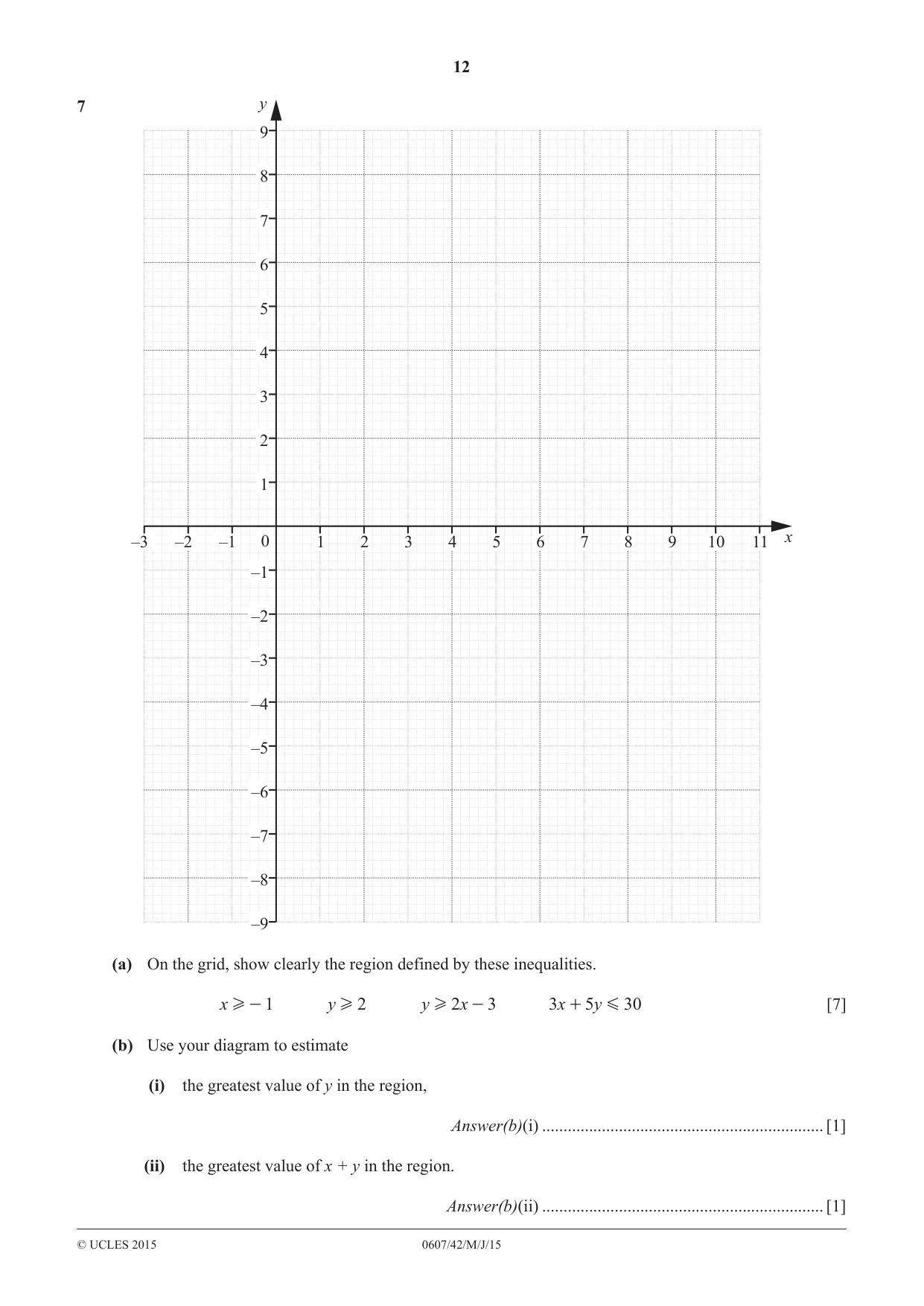
12 0607/42/M/J/15 © UCLES 2015 7 –1 0 1 2 3 4 5 6 7 8 9 10 11 x y –2 –3 –1 1 2 3 4 5 6 7 8 9 –2 –3 –4 –5 –6 –7 –8 –9 (a) On the grid, show clearly the region defined by these inequalities. 1 x H - 2 y H 2 3 y x H - 3 5 30 x y G + [7] (b) Use your diagram to estimate (i) the greatest value of y in the region, Answer(b)(i) … [1] (ii) the greatest value of x + y in the region. Answer(b)(ii) … [1]
Question paper, page 13
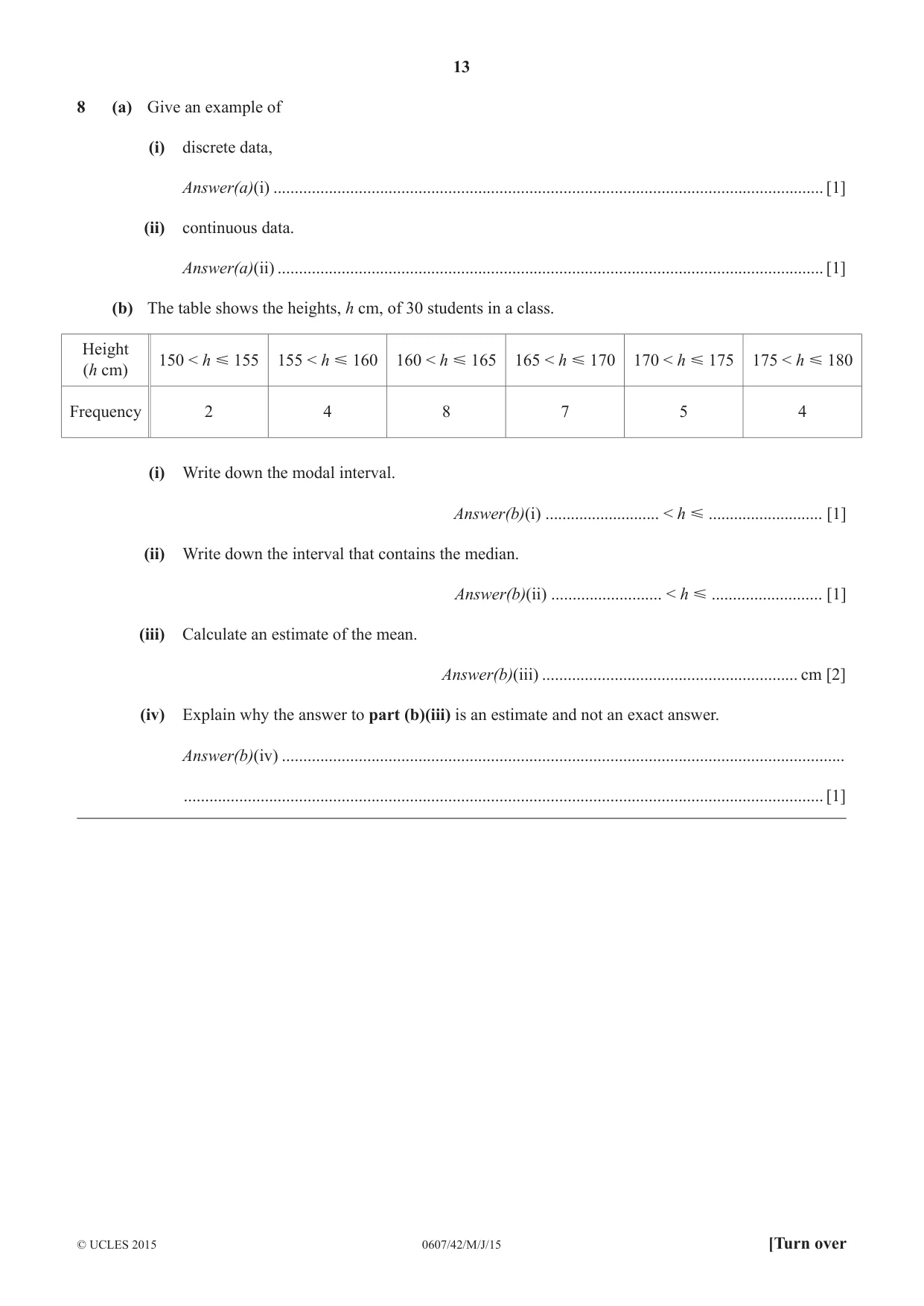
13 0607/42/M/J/15 © UCLES 2015 [Turn over 8 (a) Give an example of (i) discrete data, Answer(a)(i) … [1] (ii) continuous data. Answer(a)(ii) … [1] (b) The table shows the heights, h cm, of 30 students in a class. Height (h cm) 150 < h 155 155 < h 160 160 < h 165 165 < h 170 170 < h 175 175 < h 180 Frequency 2 4 8 7 5 4 (i) Write down the modal interval. Answer(b)(i) … < h … [1] (ii) Write down the interval that contains the median. Answer(b)(ii) … < h … [1] (iii) Calculate an estimate of the mean. Answer(b)(iii) … cm [2] (iv) Explain why the answer to part (b)(iii) is an estimate and not an exact answer. Answer(b)(iv) … … [1]
Question paper, page 14
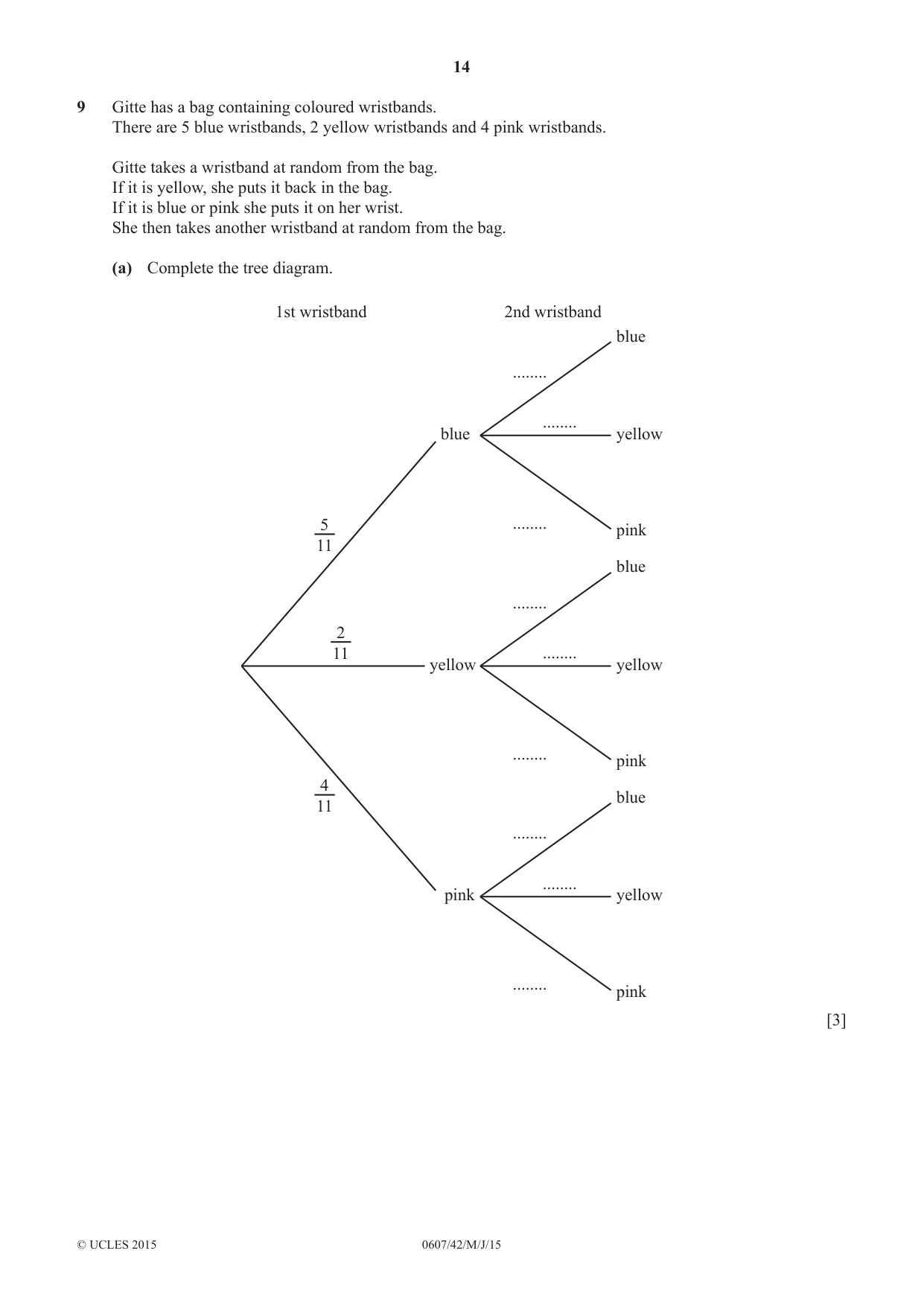
14 0607/42/M/J/15 © UCLES 2015 9 Gitte has a bag containing coloured wristbands. There are 5 blue wristbands, 2 yellow wristbands and 4 pink wristbands. Gitte takes a wristband at random from the bag. If it is yellow, she puts it back in the bag. If it is blue or pink she puts it on her wrist. She then takes another wristband at random from the bag. (a) Complete the tree diagram. 1st wristband 2nd wristband … … … blue blue 5 11 yellow pink … … … blue yellow yellow pink … … … blue pink yellow pink 4 11 2 11 [3]
Question paper, page 15
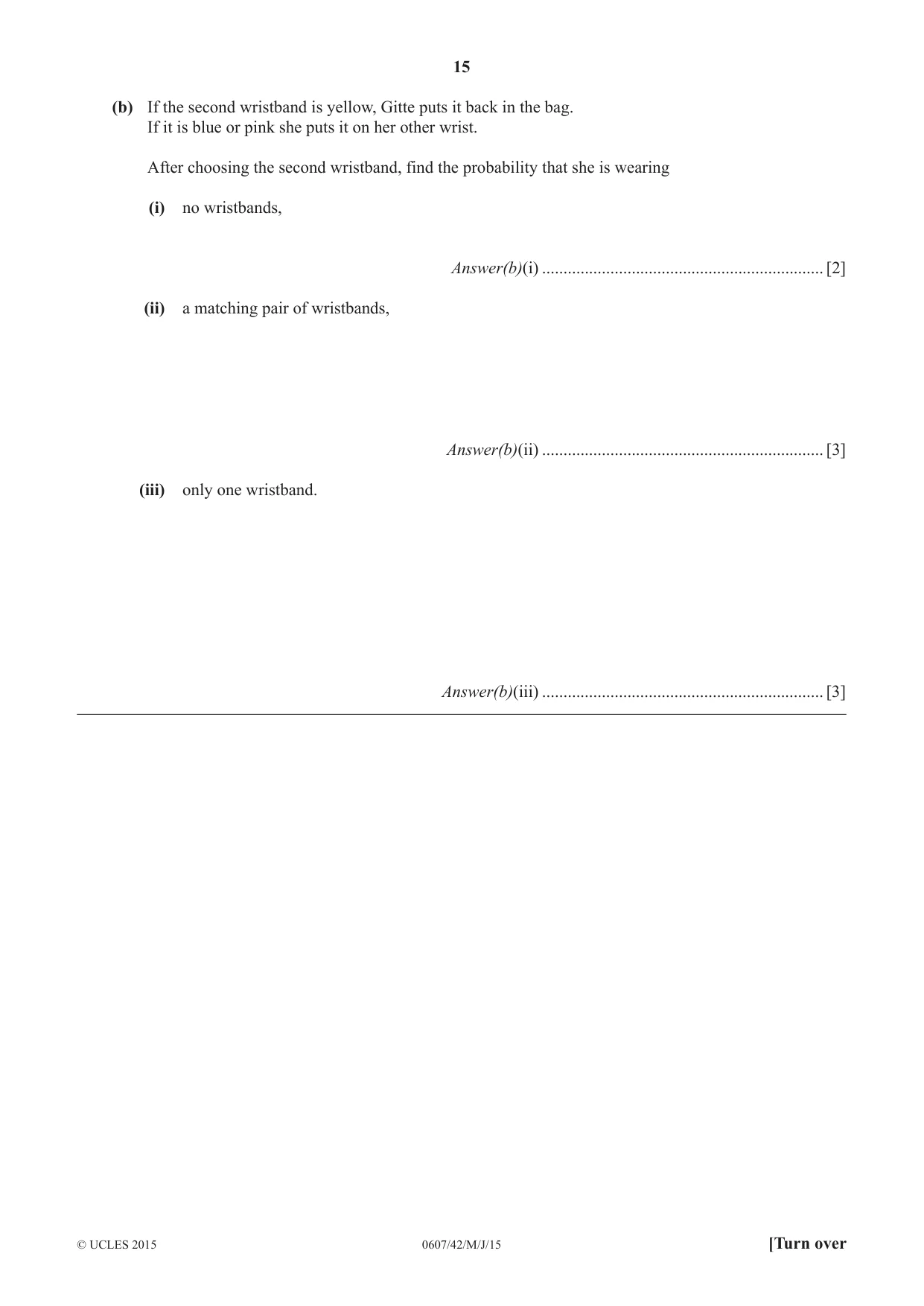
15 0607/42/M/J/15 © UCLES 2015 [Turn over (b) If the second wristband is yellow, Gitte puts it back in the bag. If it is blue or pink she puts it on her other wrist. After choosing the second wristband, find the probability that she is wearing (i) no wristbands, Answer(b)(i) … [2] (ii) a matching pair of wristbands, Answer(b)(ii) … [3] (iii) only one wristband. Answer(b)(iii) … [3]
Question paper, page 16
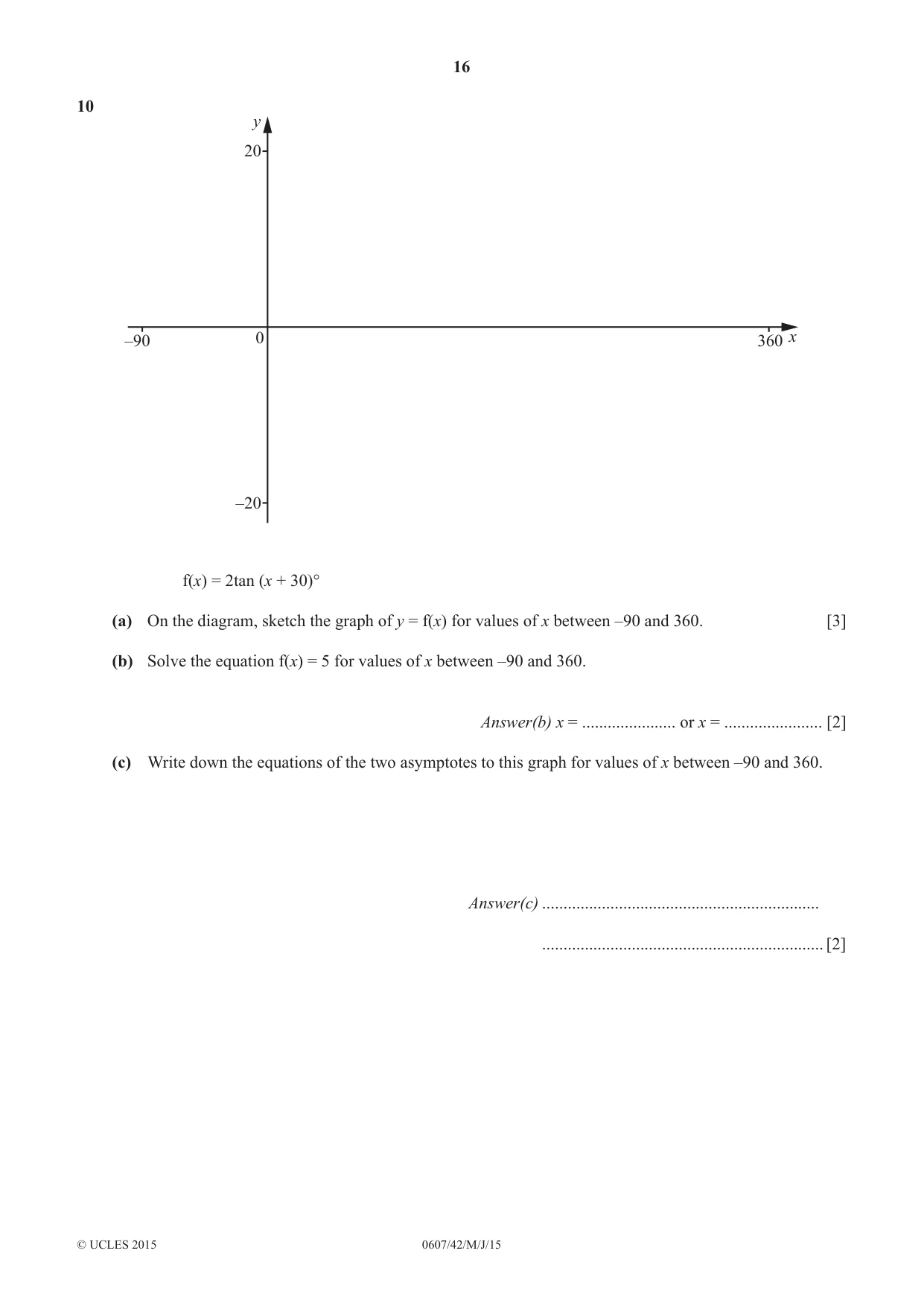
16 0607/42/M/J/15 © UCLES 2015 10 –20 20 –90 360 0 x y f(x) = 2tan (x + 30)° (a) On the diagram, sketch the graph of y = f(x) for values of x between –90 and 360. [3] (b) Solve the equation f(x) = 5 for values of x between –90 and 360. Answer(b) x = … or x = … [2] (c) Write down the equations of the two asymptotes to this graph for values of x between –90 and 360. Answer(c) … … [2]
Question paper, page 17
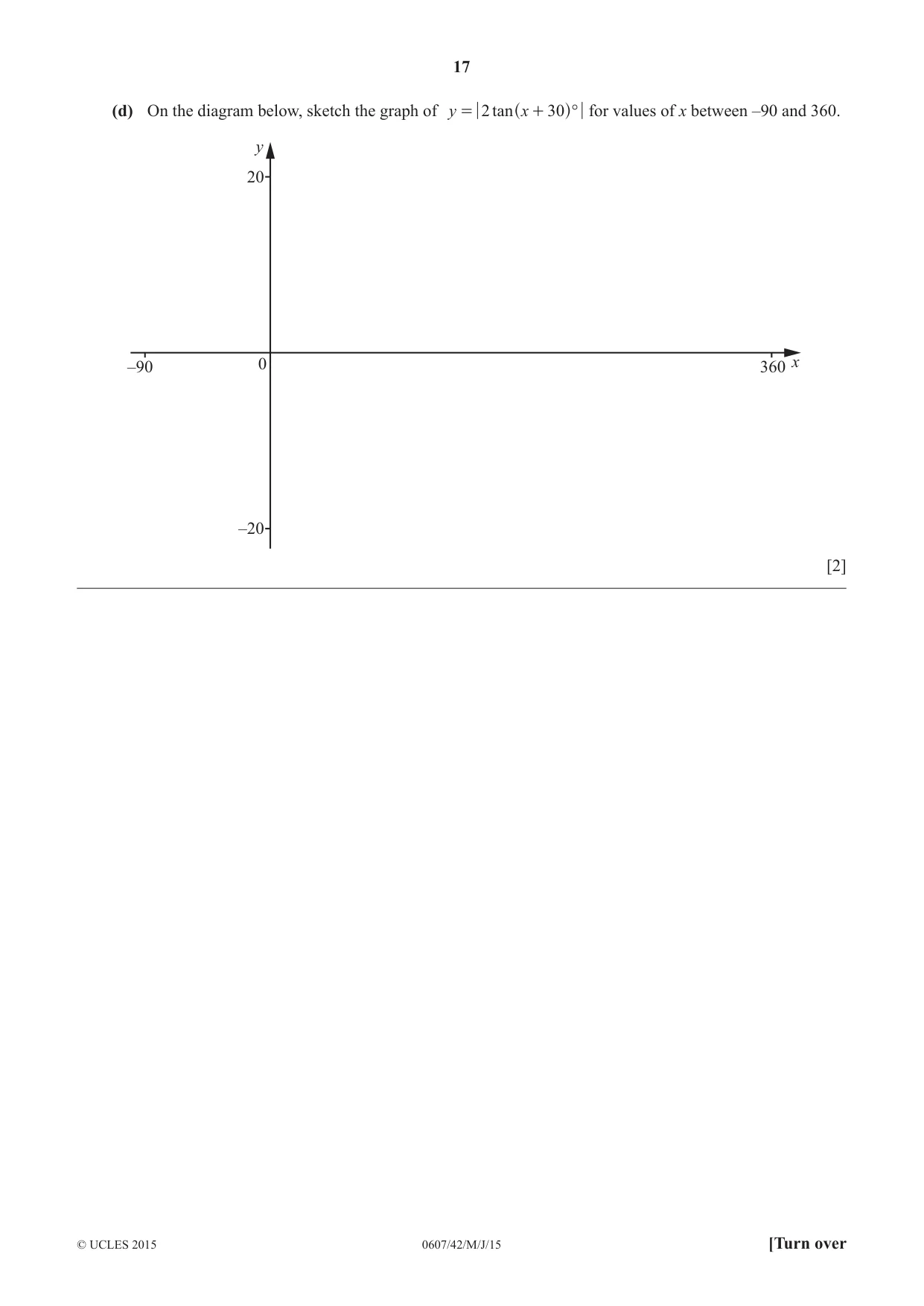
17 0607/42/M/J/15 © UCLES 2015 [Turn over (d) On the diagram below, sketch the graph of tan y x 2 30 ° = + ^ h for values of x between –90 and 360. –20 20 –90 360 0 x y [2]
Question paper, page 18
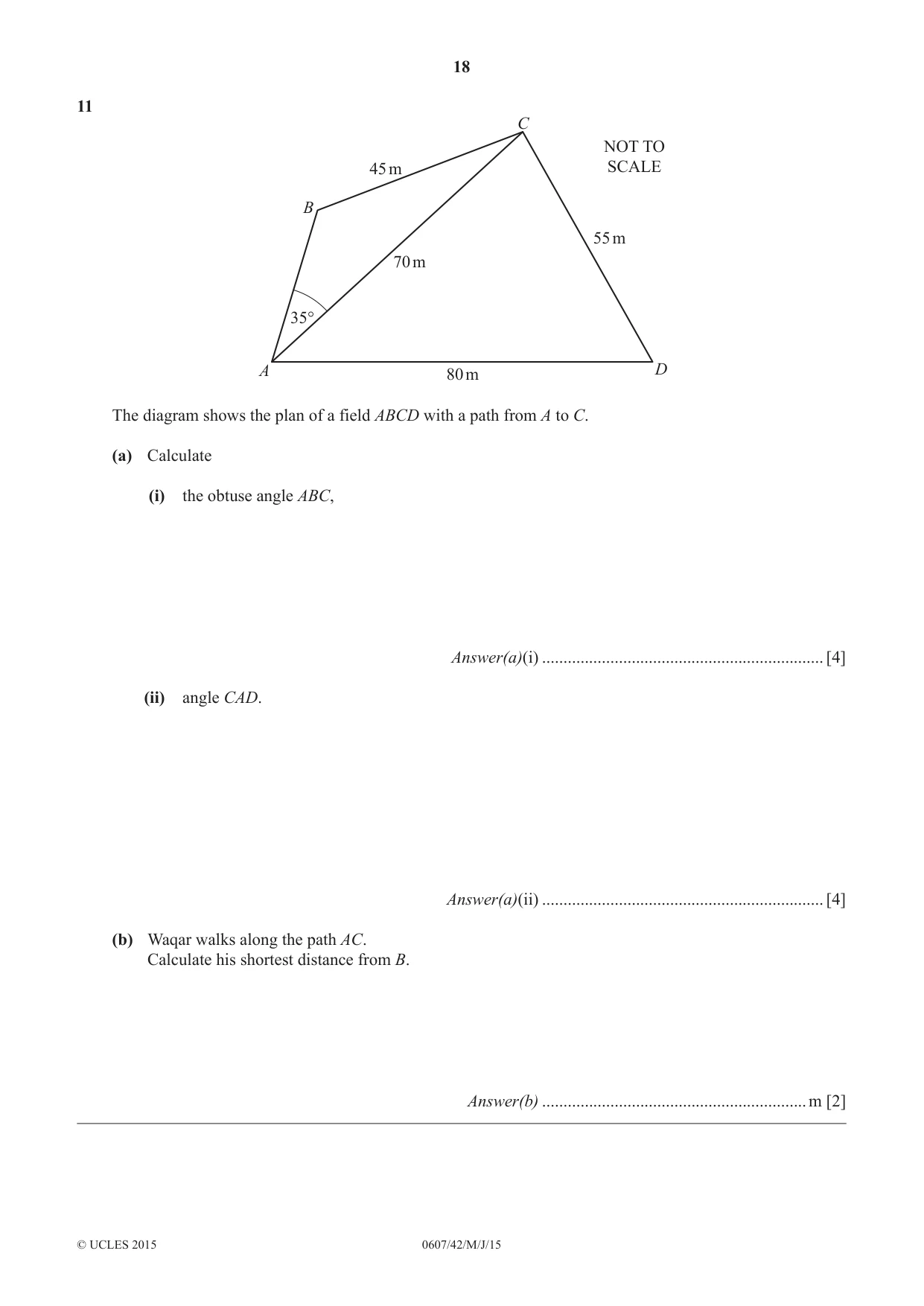
18 0607/42/M/J/15 © UCLES 2015 11 35° A D C 70 m 45 m 55 m NOT TO SCALE 80 m B The diagram shows the plan of a field ABCD with a path from A to C. (a) Calculate (i) the obtuse angle ABC, Answer(a)(i) … [4] (ii) angle CAD. Answer(a)(ii) … [4] (b) Waqar walks along the path AC. Calculate his shortest distance from B. Answer(b) …m [2]
Question paper, page 19
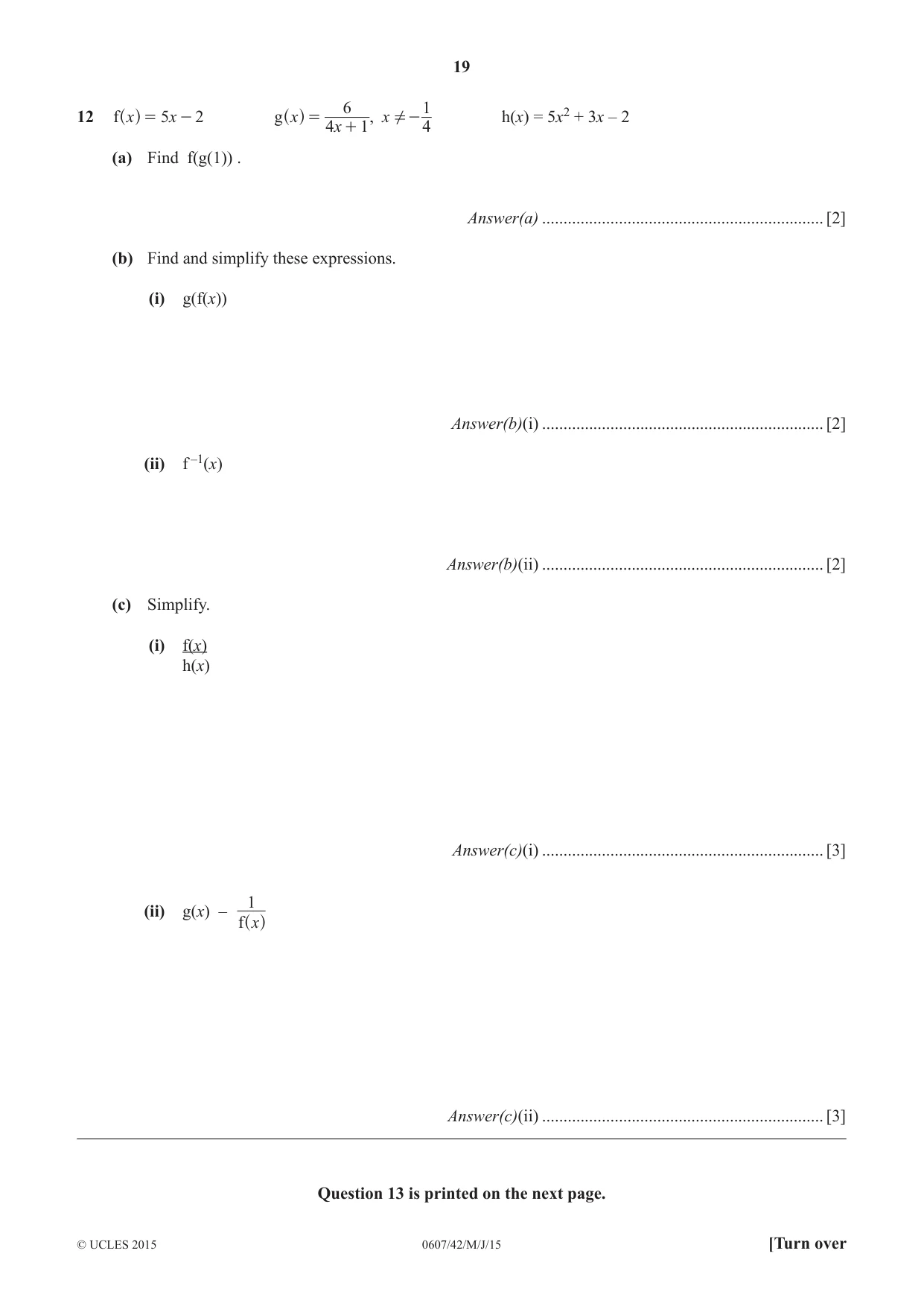
19 0607/42/M/J/15 © UCLES 2015 [Turn over 12 x x 5 2 f = - ^ h , x x x 4 1 6 4 1 g ! = + - ^ h h(x) = 5x2 + 3x – 2 (a) Find f(g(1)) . Answer(a) … [2] (b) Find and simplify these expressions. (i) g(f(x)) Answer(b)(i) … [2] (ii) f –1(x) Answer(b)(ii) … [2] (c) Simplify. (i) f(x) h(x) Answer(c)(i) … [3] (ii) g(x) – x 1 f^ h Answer(c)(ii) … [3] Question 13 is printed on the next page.
Question paper, page 20
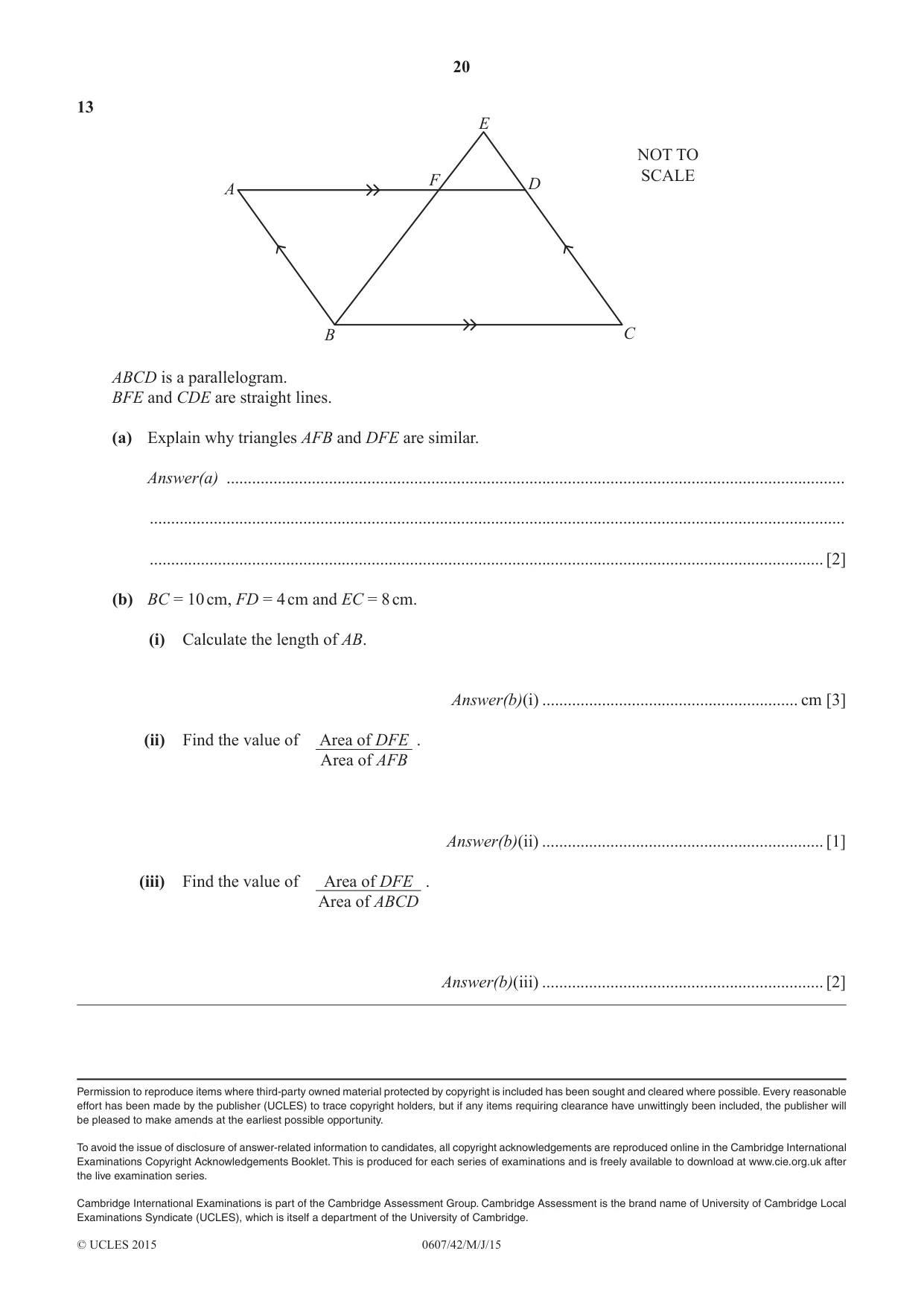
20 0607/42/M/J/15 © UCLES 2015 Permission to reproduce items where third-party owned material protected by copyright is included has been sought and cleared where possible. Every reasonable effort has been made by the publisher (UCLES) to trace copyright holders, but if any items requiring clearance have unwittingly been included, the publisher will be pleased to make amends at the earliest possible opportunity. To avoid the issue of disclosure of answer-related information to candidates, all copyright acknowledgements are reproduced online in the Cambridge International Examinations Copyright Acknowledgements Booklet. This is produced for each series of examinations and is freely available to download at www.cie.org.uk after the live examination series. Cambridge International Examinations is part of the Cambridge Assessment Group. Cambridge Assessment is the brand name of University of Cambridge Local Examinations Syndicate (UCLES), which is itself a department of the University of Cambridge. 13 A D C E F NOT TO SCALE B ABCD is a parallelogram. BFE and CDE are straight lines. (a) Explain why triangles AFB and DFE are similar. Answer(a) … … … [2] (b) BC = 10 cm, FD = 4 cm and EC = 8 cm. (i) Calculate the length of AB. Answer(b)(i) … cm [3] (ii) Find the value of Area of DFE Area of AFB . Answer(b)(ii) … [1] (iii) Find the value of Area of DFE Area of ABCD . Answer(b)(iii) … [2]
Mark scheme, page 1
® IGCSE is the registered trademark of Cambridge International Examinations. CAMBRIDGE INTERNATIONAL EXAMINATIONS Cambridge International General Certificate of Secondary Education MARK SCHEME for the May/June 2015 series 0607 CAMBRIDGE INTERNATIONAL MATHEMATICS 0607/42 Paper 4 (Extended), maximum raw mark 120 This mark scheme is published as an aid to teachers and candidates, to indicate the requirements of the examination. It shows the basis on which Examiners were instructed to award marks. It does not indicate the details of the discussions that took place at an Examiners’ meeting before marking began, which would have considered the acceptability of alternative answers. Mark schemes should be read in conjunction with the question paper and the Principal Examiner Report for Teachers. Cambridge will not enter into discussions about these mark schemes. Cambridge is publishing the mark schemes for the May/June 2015 series for most Cambridge IGCSE®, Cambridge International A and AS Level components and some Cambridge O Level components.
Mark scheme, page 2
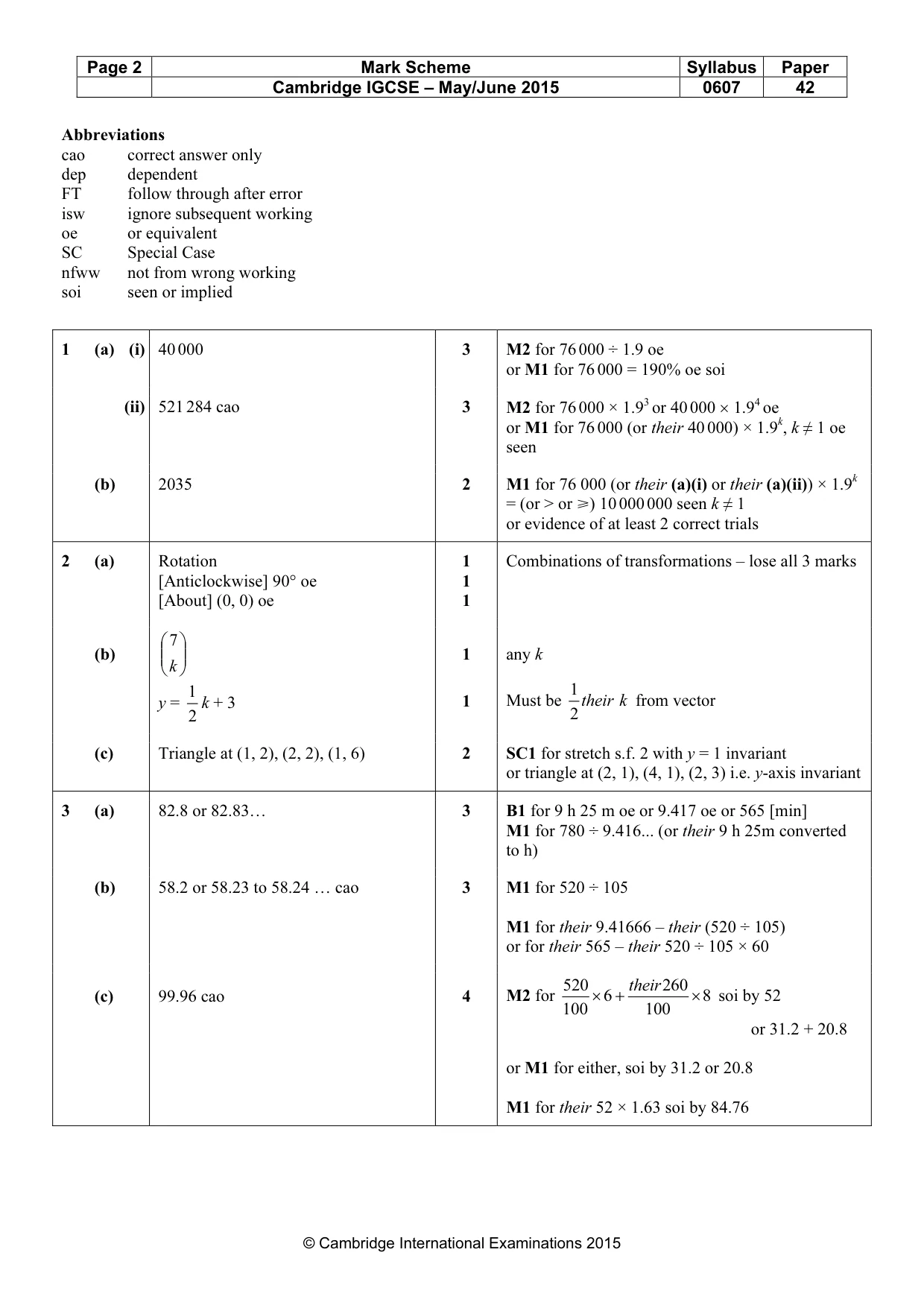
Page 2 Mark Scheme Syllabus Paper Cambridge IGCSE – May/June 2015 0607 42 © Cambridge International Examinations 2015 Abbreviations cao correct answer only dep dependent FT follow through after error isw ignore subsequent working oe or equivalent SC Special Case nfww not from wrong working soi seen or implied 1 (a) (i) 40 000 3 M2 for 76 000 ÷ 1.9 oe or M1 for 76 000 = 190% oe soi (ii) 521 284 cao 3 M2 for 76 000 × 1.93 or 40 000 × 1.94 oe or M1 for 76 000 (or their 40 000) × 1.9k, k ≠ 1 oe seen (b) 2035 2 M1 for 76 000 (or their (a)(i) or their (a)(ii)) × 1.9k = (or > or ù) 10 000 000 seen k ≠ 1 or evidence of at least 2 correct trials 2 (a) Rotation [Anticlockwise] 90° oe [About] (0, 0) oe 1 1 1 Combinations of transformations – lose all 3 marks (b) k 7 y = 1 2 k + 3 1 1 any k Must be 1 2 their k from vector (c) Triangle at (1, 2), (2, 2), (1, 6) 2 SC1 for stretch s.f. 2 with y = 1 invariant or triangle at (2, 1), (4, 1), (2, 3) i.e. y-axis invariant 3 (a) 82.8 or 82.83… 3 B1 for 9 h 25 m oe or 9.417 oe or 565 [min] M1 for 780 ÷ 9.416... (or their 9 h 25m converted to h) (b) 58.2 or 58.23 to 58.24 … cao 3 M1 for 520 ÷ 105 M1 for their 9.41666 – their (520 ÷ 105) or for their 565 – their 520 ÷ 105 × 60 (c) 99.96 cao 4 M2 for 520 260 6 8 100 100 their × + × soi by 52 or 31.2 + 20.8 or M1 for either, soi by 31.2 or 20.8 M1 for their 52 × 1.63 soi by 84.76
Mark scheme, page 3
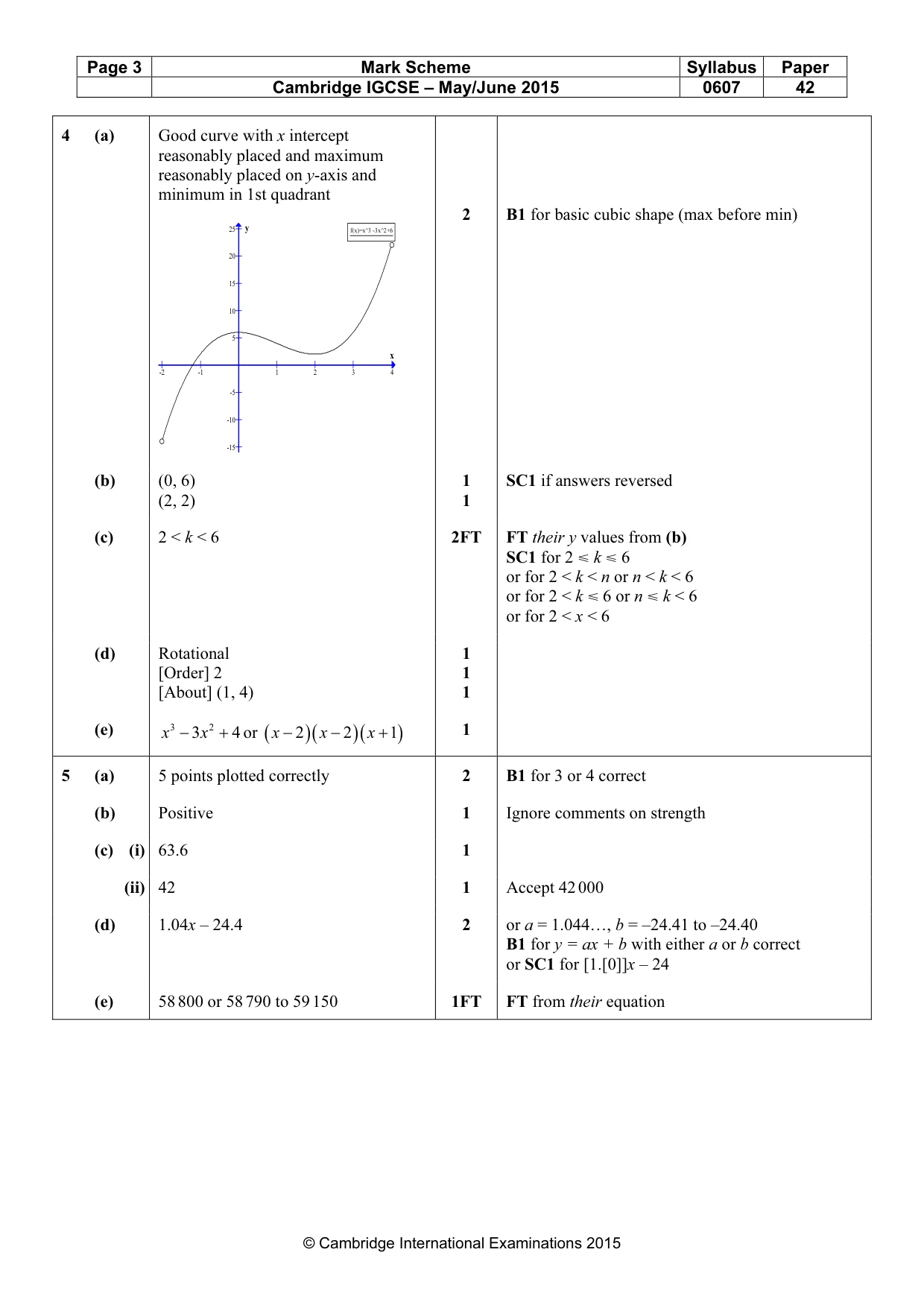
Page 3 Mark Scheme Syllabus Paper Cambridge IGCSE – May/June 2015 0607 42 © Cambridge International Examinations 2015 4 (a) Good curve with x intercept reasonably placed and maximum reasonably placed on y-axis and minimum in 1st quadrant f(x)=x^3 -3x^2+6 -2 -1 1 2 3 4 -15 -10 -5 5 10 15 20 25 x y 2 B1 for basic cubic shape (max before min) (b) (0, 6) (2, 2) 1 1 SC1 if answers reversed (c) 2 < k < 6 2FT FT their y values from (b) SC1 for 2 ø k ø 6 or for 2 < k < n or n < k < 6 or for 2 < k ø 6 or n ø k < 6 or for 2 < x < 6 (d) Rotational [Order] 2 [About] (1, 4) 1 1 1 (e) 3 2 3 4 x x − + or ( )( )( ) 2 2 1 x x x − − + 1 5 (a) 5 points plotted correctly 2 B1 for 3 or 4 correct (b) Positive 1 Ignore comments on strength (c) (i) 63.6 1 (ii) 42 1 Accept 42 000 (d) 1.04x – 24.4 2 or a = 1.044…, b = –24.41 to –24.40 B1 for y = ax + b with either a or b correct or SC1 for [1.[0]]x – 24 (e) 58 800 or 58 790 to 59 150 1FT FT from their equation
Mark scheme, page 4
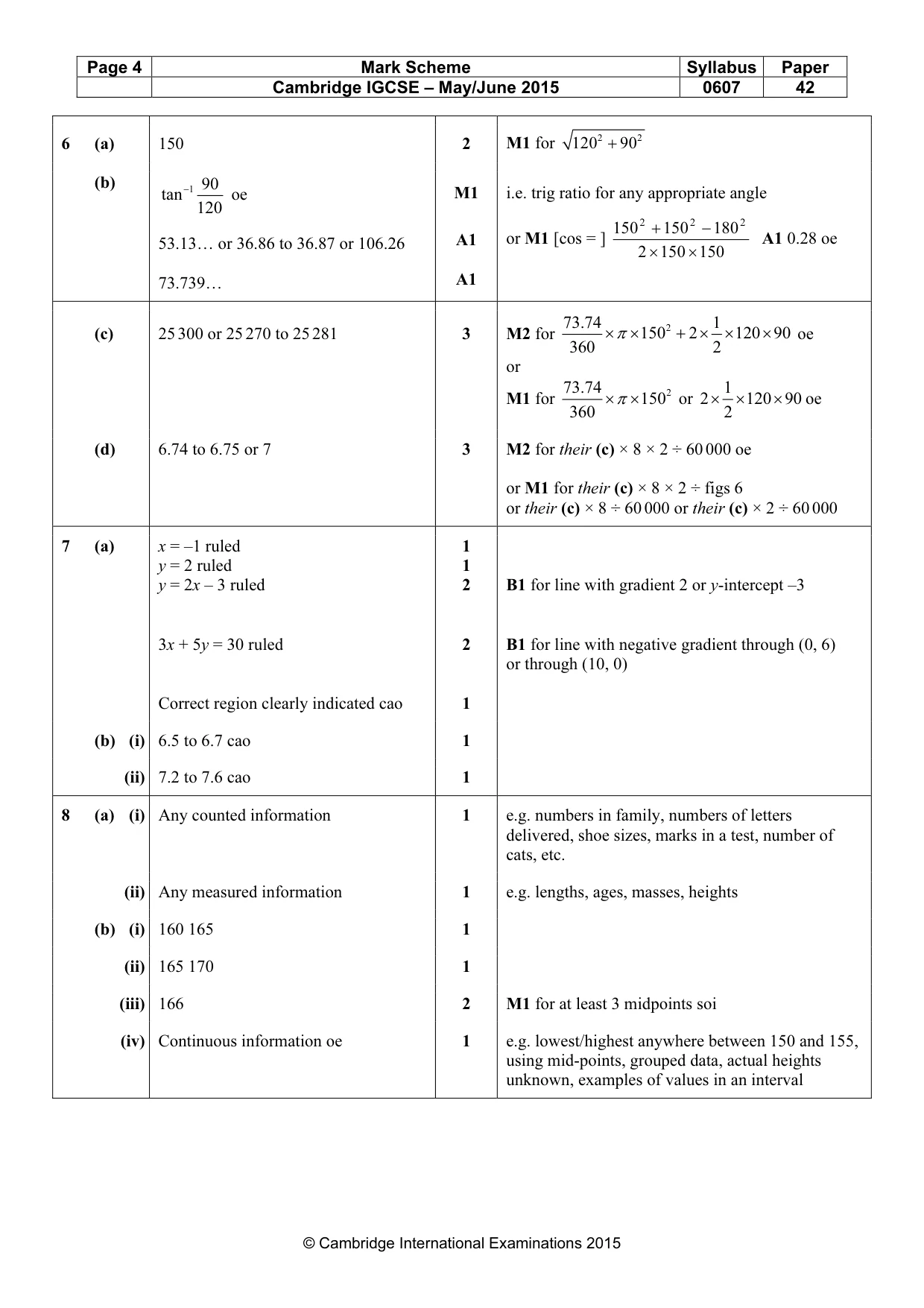
Page 4 Mark Scheme Syllabus Paper Cambridge IGCSE – May/June 2015 0607 42 © Cambridge International Examinations 2015 6 (a) 150 2 M1 for 2 2 120 90 + (b) 1 90 tan 120 − oe 53.13… or 36.86 to 36.87 or 106.26 73.739… M1 A1 A1 i.e. trig ratio for any appropriate angle or M1 [cos = ] 150 150 2 180 150 150 2 2 2 × × − + A1 0.28 oe (c) 25 300 or 25 270 to 25 281 3 M2 for 2 73.74 1 150 2 120 90 360 2 π × × + × × × oe or M1 for 2 73.74 150 360 π × × or 1 2 120 90 2 × × × oe (d) 6.74 to 6.75 or 7 3 M2 for their (c) × 8 × 2 ÷ 60 000 oe or M1 for their (c) × 8 × 2 ÷ figs 6 or their (c) × 8 ÷ 60 000 or their (c) × 2 ÷ 60 000 7 (a) x = –1 ruled y = 2 ruled y = 2x – 3 ruled 3x + 5y = 30 ruled Correct region clearly indicated cao 1 1 2 2 1 B1 for line with gradient 2 or y-intercept –3 B1 for line with negative gradient through (0, 6) or through (10, 0) (b) (i) 6.5 to 6.7 cao 1 (ii) 7.2 to 7.6 cao 1 8 (a) (i) Any counted information 1 e.g. numbers in family, numbers of letters delivered, shoe sizes, marks in a test, number of cats, etc. (ii) Any measured information 1 e.g. lengths, ages, masses, heights (b) (i) 160 165 1 (ii) 165 170 1 (iii) 166 2 M1 for at least 3 midpoints soi (iv) Continuous information oe 1 e.g. lowest/highest anywhere between 150 and 155, using mid-points, grouped data, actual heights unknown, examples of values in an interval
Mark scheme, page 5
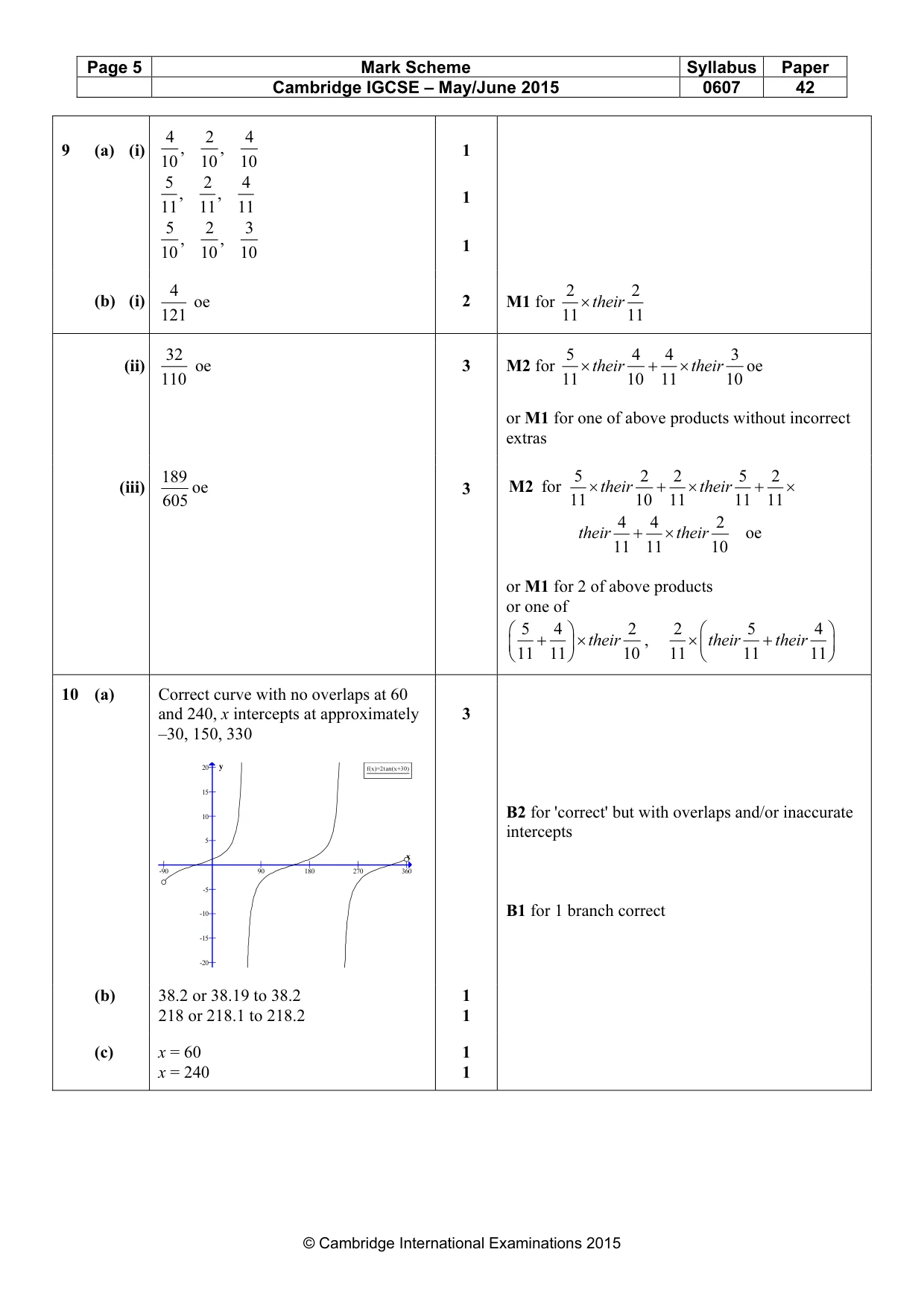
Page 5 Mark Scheme Syllabus Paper Cambridge IGCSE – May/June 2015 0607 42 © Cambridge International Examinations 2015 9 (a) (i) 4 2 4 , , 10 10 10 5 2 4 , , 11 11 11 5 2 3 , , 10 10 10 1 1 1 (b) (i) 121 4 oe 2 M1 for 2 2 11 11 their × (ii) 110 32 oe 3 M2 for 5 4 4 3 11 10 11 10 their their × + × oe or M1 for one of above products without incorrect extras (iii) 605 189 oe 3 5 2 2 5 2 for 11 10 11 11 11 4 4 2 oe 11 11 10 their their their their × + × + × + × M2 or M1 for 2 of above products or one of 5 4 2 2 5 4 , 11 11 10 11 11 11 their their their + × × + 10 (a) Correct curve with no overlaps at 60 and 240, x intercepts at approximately –30, 150, 330 f(x)=2tan(x+30) -90 90 180 270 360 -20 -15 -10 -5 5 10 15 20 x y 3 B2 for 'correct' but with overlaps and/or inaccurate intercepts B1 for 1 branch correct (b) 38.2 or 38.19 to 38.2 218 or 218.1 to 218.2 1 1 (c) x = 60 x = 240 1 1
Mark scheme, page 6
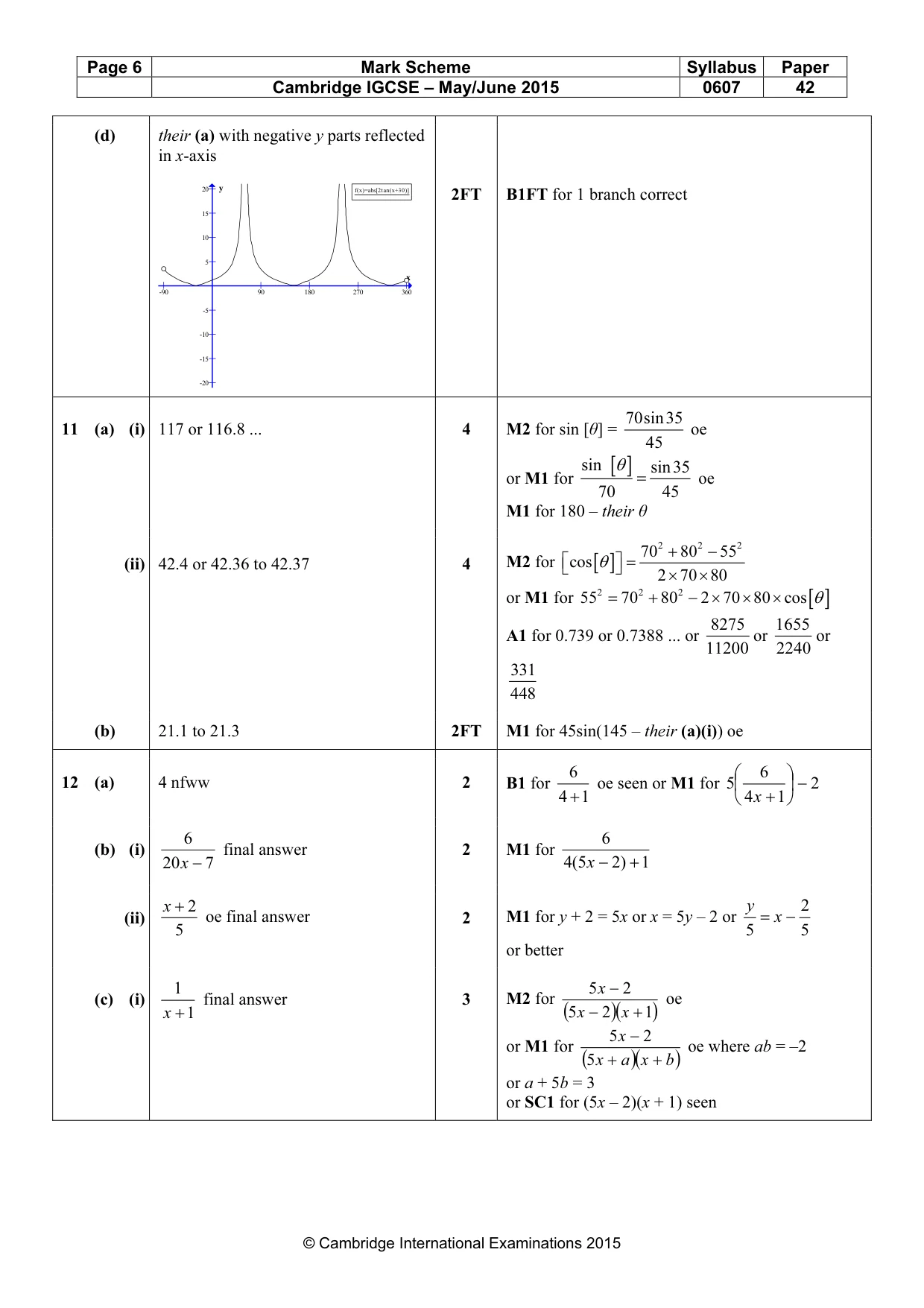
Page 6 Mark Scheme Syllabus Paper Cambridge IGCSE – May/June 2015 0607 42 © Cambridge International Examinations 2015 (d) their (a) with negative y parts reflected in x-axis f(x)=abs[2tan(x+30)] -90 90 180 270 360 -20 -15 -10 -5 5 10 15 20 x y 2FT B1FT for 1 branch correct 11 (a) (i) 117 or 116.8 ... 4 M2 for sin [θ] = 45 35 sin 70 oe or M1 for [ ] sin sin35 70 45 θ = oe M1 for 180 – their θ (ii) 42.4 or 42.36 to 42.37 4 M2 for [ ] 2 2 2 70 80 55 cos 2 70 80 θ + − = × × or M1 for [ ] 2 2 2 55 70 80 2 70 80 cos θ = + − × × × A1 for 0.739 or 0.7388 ... or 8275 11200 or 1655 2240 or 331 448 (b) 21.1 to 21.3 2FT M1 for 45sin(145 – their (a)(i)) oe 12 (a) 4 nfww 2 B1 for 6 4 1 + oe seen or M1 for 2 1 4 6 5 − + x (b) (i) 7 20 6 − x final answer 2 M1 for 1 ) 2 5 ( 4 6 + − x (ii) 5 2 + x oe final answer 2 M1 for y + 2 = 5x or x = 5y – 2 or 5 2 5 − = x y or better (c) (i) 1 1 + x final answer 3 M2 for ( )( )1 2 5 2 5 + − − x x x oe or M1 for ( )( ) b x a x x + + − 5 2 5 oe where ab = –2 or a + 5b = 3 or SC1 for (5x – 2)(x + 1) seen
Mark scheme, page 7
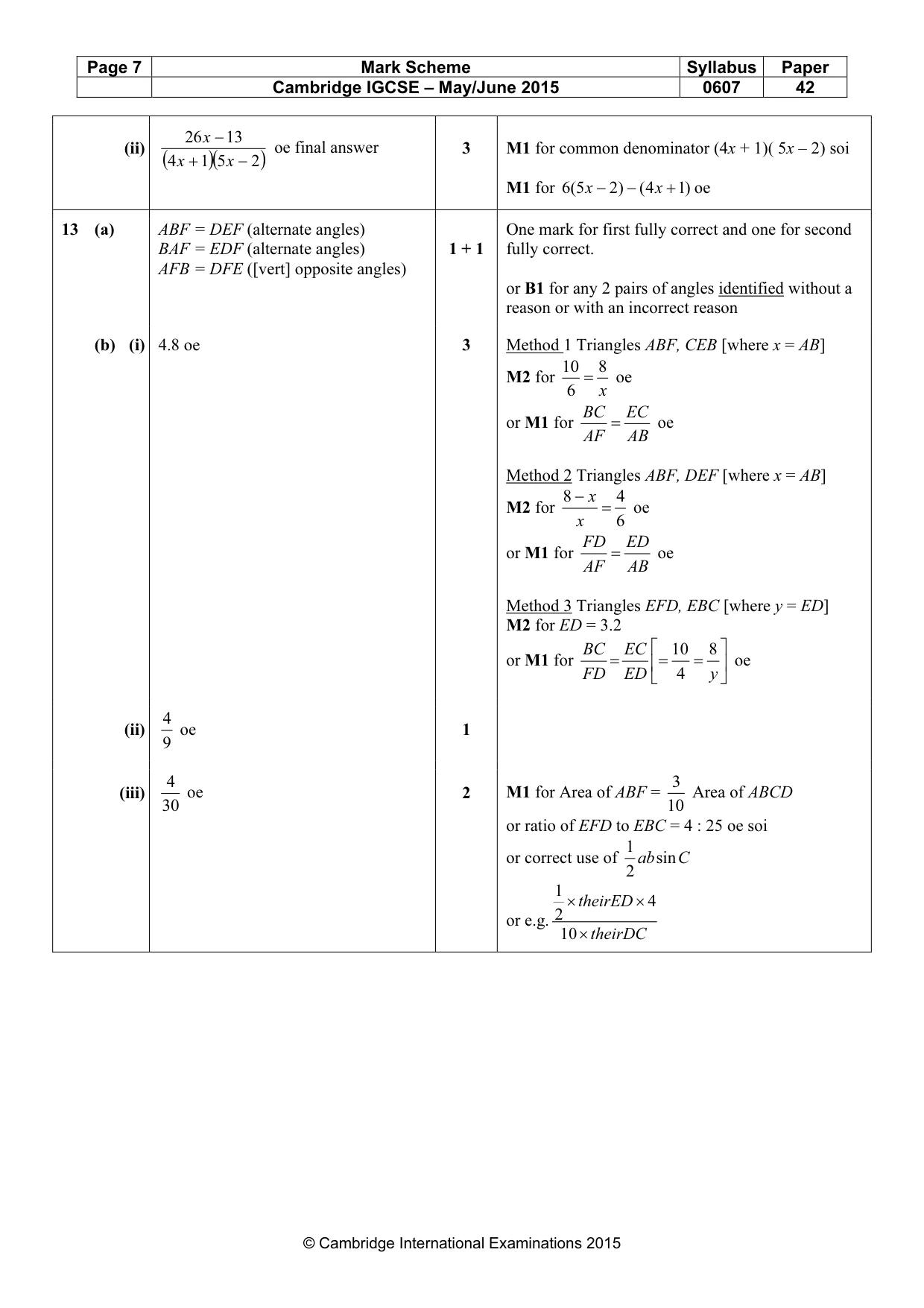
Page 7 Mark Scheme Syllabus Paper Cambridge IGCSE – May/June 2015 0607 42 © Cambridge International Examinations 2015 (ii) ( )( ) 2 5 1 4 13 26 − + − x x x oe final answer 3 M1 for common denominator (4x + 1)( 5x – 2) soi M1 for )1 4 ( ) 2 5 ( 6 + − − x x oe 13 (a) ABF = DEF (alternate angles) BAF = EDF (alternate angles) AFB = DFE ([vert] opposite angles) 1 + 1 One mark for first fully correct and one for second fully correct. or B1 for any 2 pairs of angles identified without a reason or with an incorrect reason (b) (i) 4.8 oe 3 Method 1 Triangles ABF, CEB [where x = AB] M2 for x 8 6 10 = oe or M1 for AB EC AF BC = oe Method 2 Triangles ABF, DEF [where x = AB] M2 for 6 4 8 = − x x oe or M1 for AB ED AF FD = oe Method 3 Triangles EFD, EBC [where y = ED] M2 for ED = 3.2 or M1 for = = = y ED EC FD BC 8 4 10 oe (ii) 9 4 oe 1 (iii) 30 4 oe 2 M1 for Area of ABF = 3 10 Area of ABCD or ratio of EFD to EBC = 4 : 25 oe soi or correct use of 1 sin 2 ab C or e.g. 1 4 2 10 theirED theirDC × × ×
What you needed in this session
Cambridge’s own grade thresholds for 2015 May/June, Paper 4 · Variant 2. A higher threshold means an easier paper — the bar moves with how the cohort did.