Cambridge IGCSE Mathematics - International 0607 — 2011 Oct/Nov Paper 4 · Variant 1
0607/41/O/N/11
The question paper and its mark scheme, free to read here and free to download. This is Cambridge’s own paper, exactly as it was sat.
Question paper20 pages
Mark scheme7 pages
Answers below. Sit the paper first if you are practising.
Paper as text
Question paper, page 1
This document consists of 18 printed pages and 2 blank pages. IB11 11_0607_04/2RP © UCLES 2011 [Turn over *8251556869* For Examiner's Use UNIVERSITY OF CAMBRIDGE INTERNATIONAL EXAMINATIONS International General Certificate of Secondary Education CAMBRIDGE INTERNATIONAL MATHEMATICS 0607/04 Paper 4 (Extended) October/November 2011 2 hours 15 minutes Candidates answer on the Question Paper Additional Materials: Geometrical Instruments Graphics Calculator READ THESE INSTRUCTIONS FIRST Write your Centre number, candidate number and name on all the work you hand in. Write in dark blue or black pen. Do not use staples, paper clips, highlighters, glue or correction fluid. You may use a pencil for any diagrams or graphs. DO NOT WRITE IN ANY BARCODES. Answer all the questions. Unless instructed otherwise, give your answers exactly or correct to three significant figures as appropriate. Answers in degrees should be given to one decimal place. For π, use your calculator value. You must show all the relevant working to gain full marks and you will be given marks for correct methods, including sketches, even if your answer is incorrect. The number of marks is given in brackets [ ] at the end of each question or part question. The total number of marks for this paper is 120. www.XtremePapers.com
Question paper, page 2
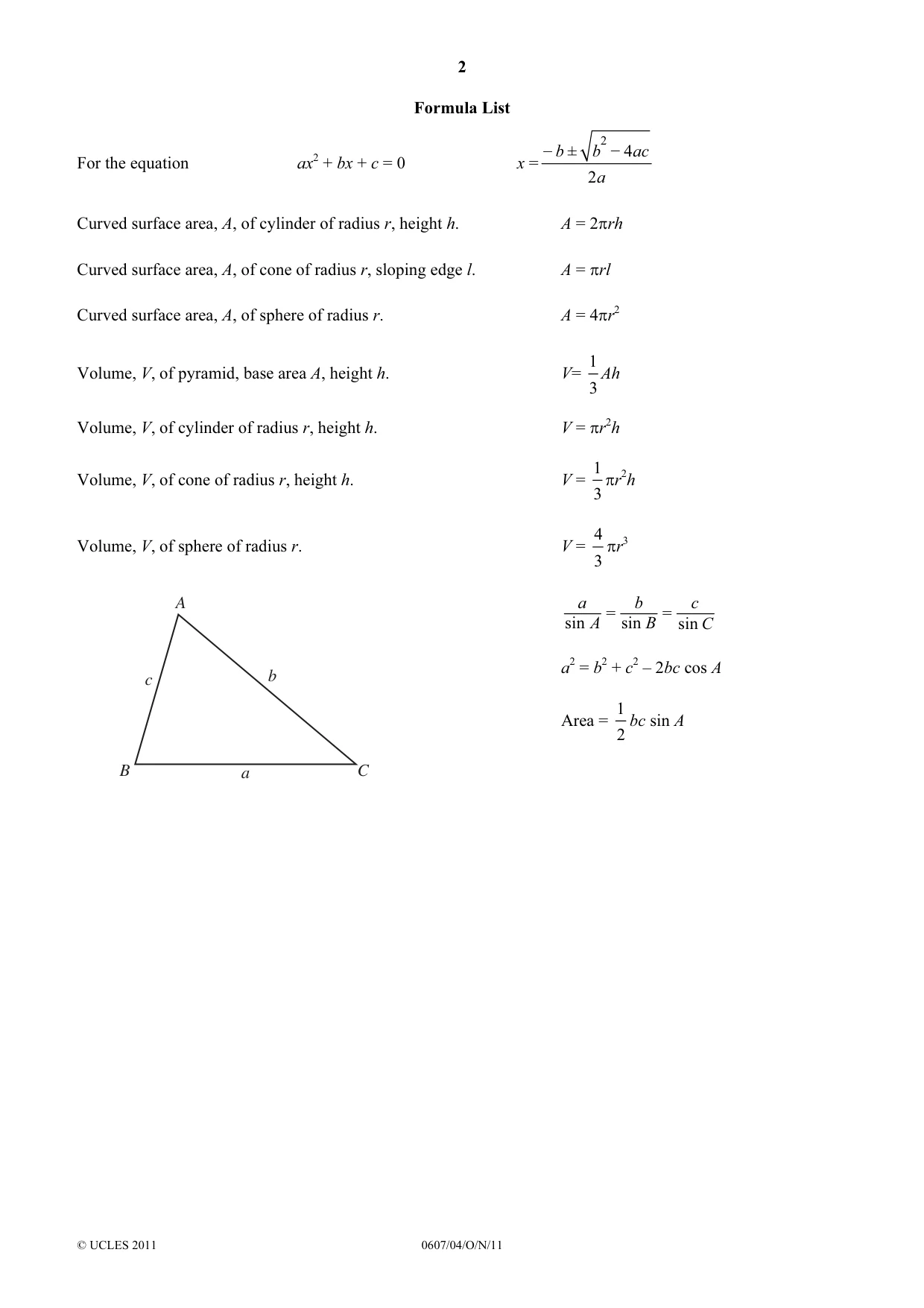
2 © UCLES 2011 0607/04/O/N/11 Formula List For the equation ax2 + bx + c = 0 x = 2 _ ± 4 2 _ b b ac a Curved surface area, A, of cylinder of radius r, height h. A = 2πrh Curved surface area, A, of cone of radius r, sloping edge l. A = πrl Curved surface area, A, of sphere of radius r. A = 4πr2 Volume, V, of pyramid, base area A, height h. V= 1 3 Ah Volume, V, of cylinder of radius r, height h. V = πr2h Volume, V, of cone of radius r, height h. V = 1 3 πr2h Volume, V, of sphere of radius r. V = 4 3 πr3 = = sin sin sin a b c A B C a2 = b2 + c2 – 2bc cos A Area = 1 2 bc sin A A a B C b c
Question paper, page 3
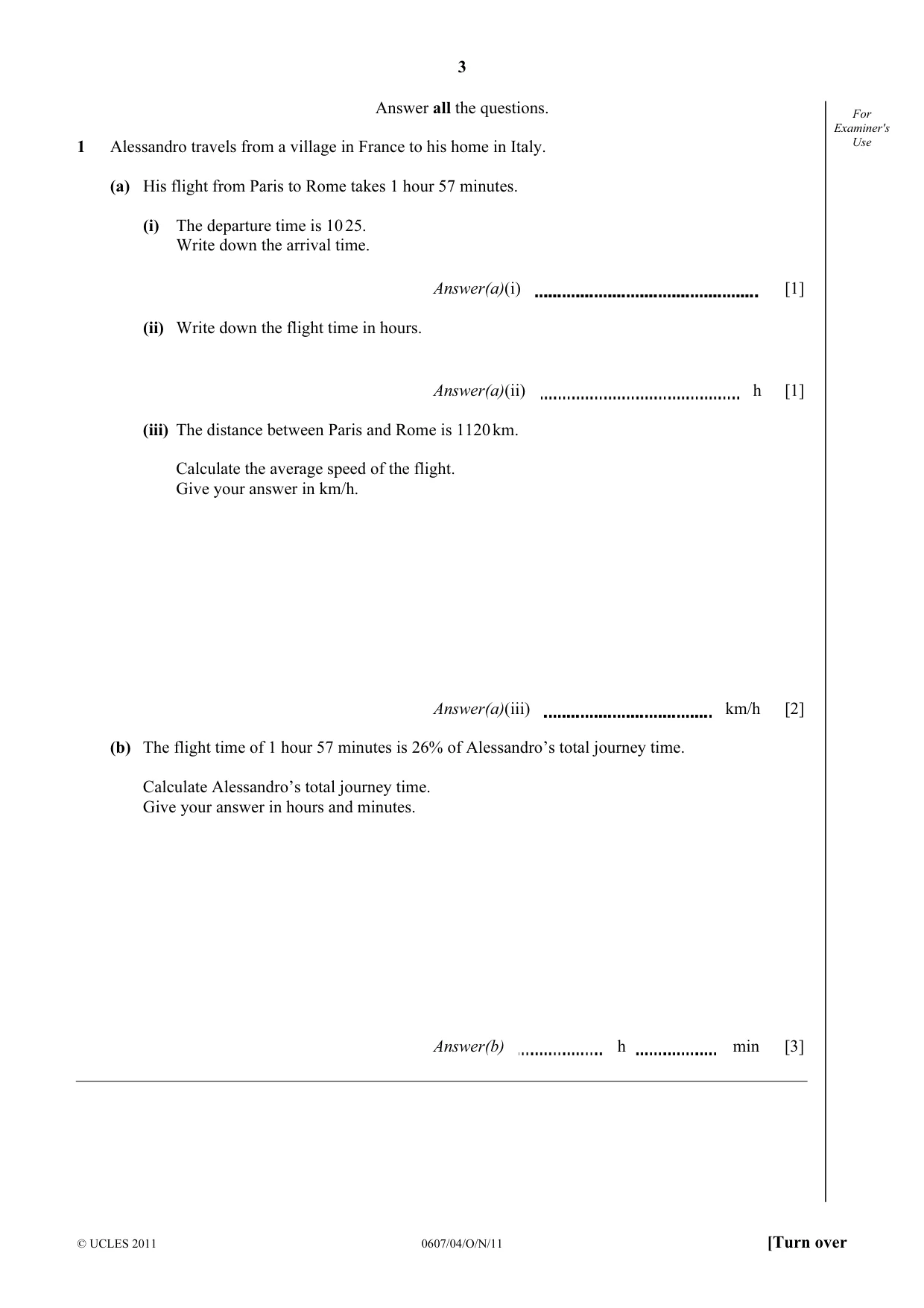
3 © UCLES 2011 0607/04/O/N/11 [Turn over For Examiner's Use Answer all the questions. 1 Alessandro travels from a village in France to his home in Italy. (a) His flight from Paris to Rome takes 1 hour 57 minutes. (i) The departure time is 10 25. Write down the arrival time. Answer(a)(i) [1] (ii) Write down the flight time in hours. Answer(a)(ii) h [1] (iii) The distance between Paris and Rome is 1120 km. Calculate the average speed of the flight. Give your answer in km/h. Answer(a)(iii) km/h [2] (b) The flight time of 1 hour 57 minutes is 26% of Alessandro’s total journey time. Calculate Alessandro’s total journey time. Give your answer in hours and minutes. Answer(b) h min [3]
Question paper, page 4
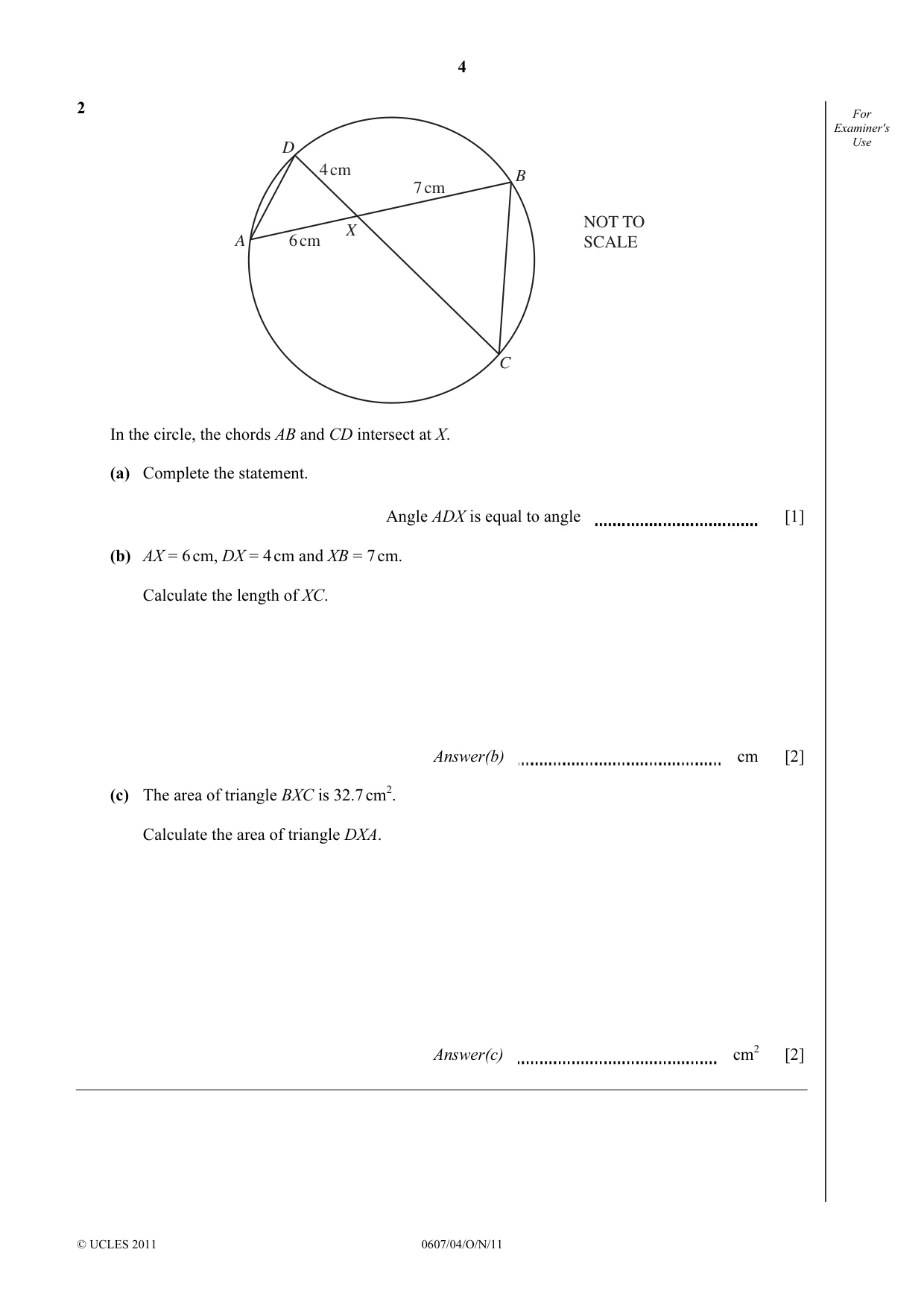
4 © UCLES 2011 0607/04/O/N/11 For Examiner's Use 2 D A X B C NOT TO SCALE 7 cm 4 cm 6 cm In the circle, the chords AB and CD intersect at X. (a) Complete the statement. Angle ADX is equal to angle [1] (b) AX = 6 cm, DX = 4 cm and XB = 7 cm. Calculate the length of XC. Answer(b) cm [2] (c) The area of triangle BXC is 32.7 cm2. Calculate the area of triangle DXA. Answer(c) cm2 [2]
Question paper, page 5
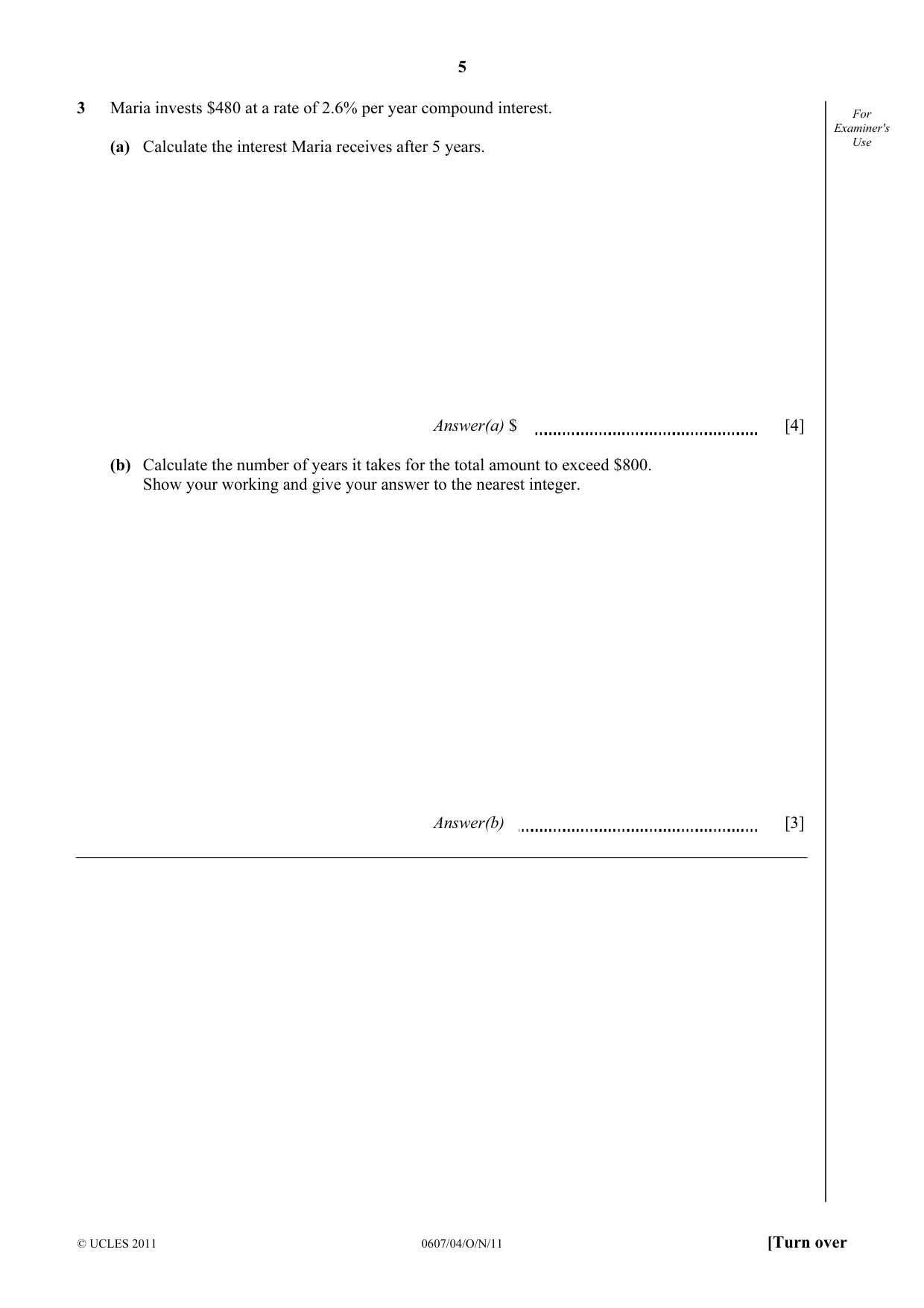
5 © UCLES 2011 0607/04/O/N/11 [Turn over For Examiner's Use 3 Maria invests $480 at a rate of 2.6% per year compound interest. (a) Calculate the interest Maria receives after 5 years. Answer(a) $ [4] (b) Calculate the number of years it takes for the total amount to exceed $800. Show your working and give your answer to the nearest integer. Answer(b) [3]
Question paper, page 6
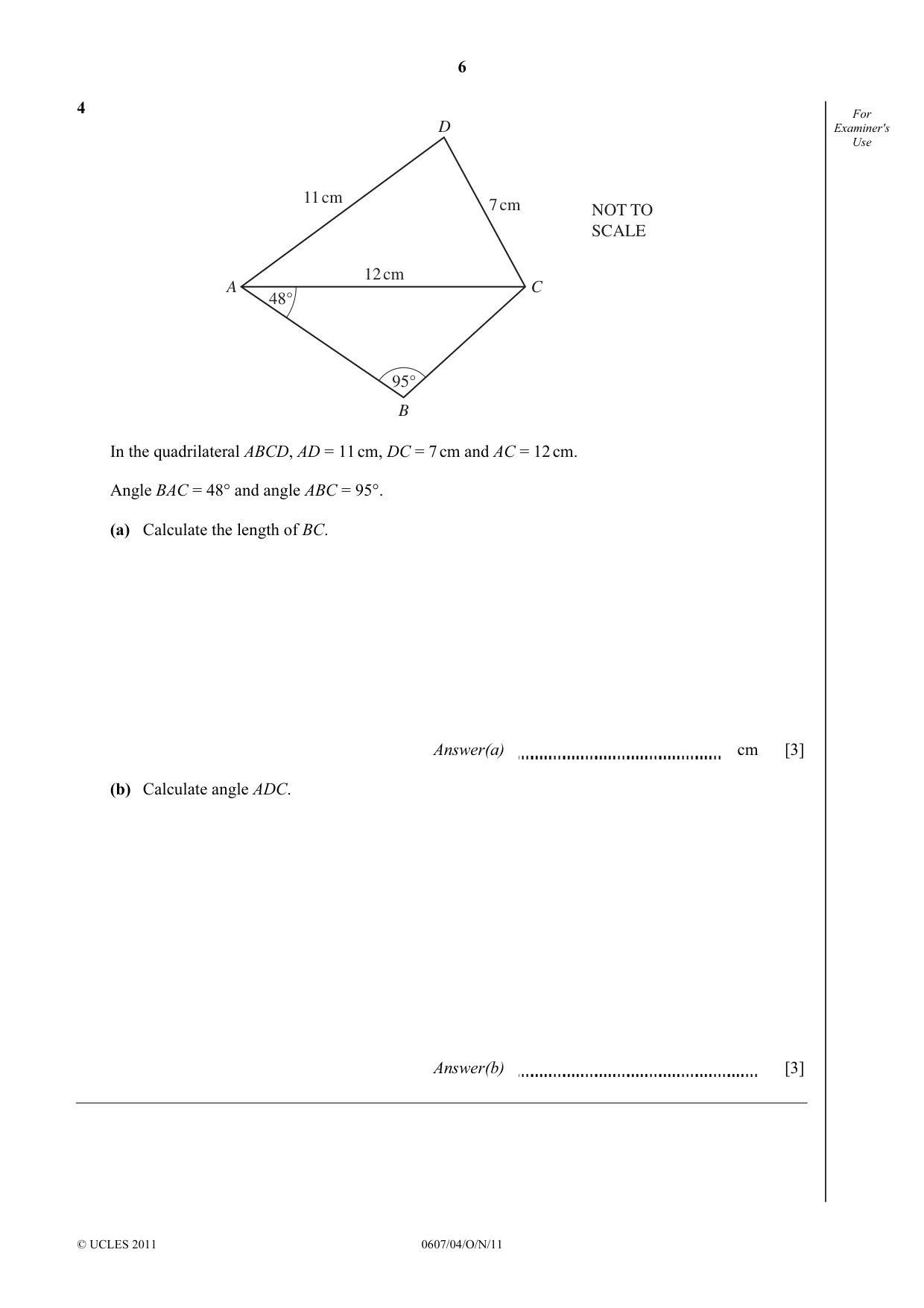
6 © UCLES 2011 0607/04/O/N/11 For Examiner's Use 4 D A C B 48° 95° 11 cm 12 cm 7 cm NOT TO SCALE In the quadrilateral ABCD, AD = 11 cm, DC = 7 cm and AC = 12 cm. Angle BAC = 48° and angle ABC = 95°. (a) Calculate the length of BC. Answer(a) cm [3] (b) Calculate angle ADC. Answer(b) [3]
Question paper, page 7
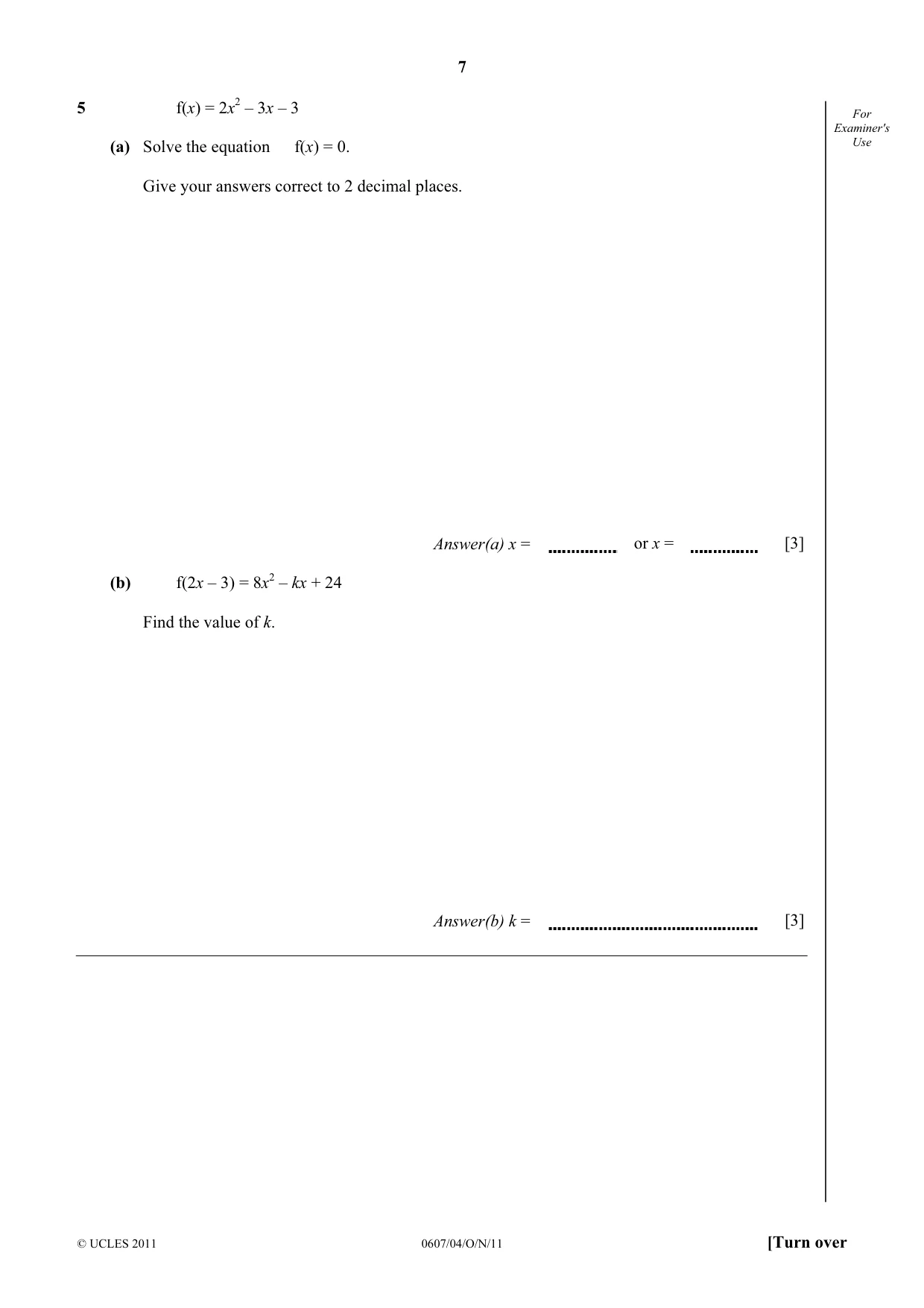
7 © UCLES 2011 0607/04/O/N/11 [Turn over For Examiner's Use 5 f(x) = 2x2 – 3x – 3 (a) Solve the equation f(x) = 0. Give your answers correct to 2 decimal places. Answer(a) x = or x = [3] (b) f(2x – 3) = 8x2 – kx + 24 Find the value of k. Answer(b) k = [3]
Question paper, page 8
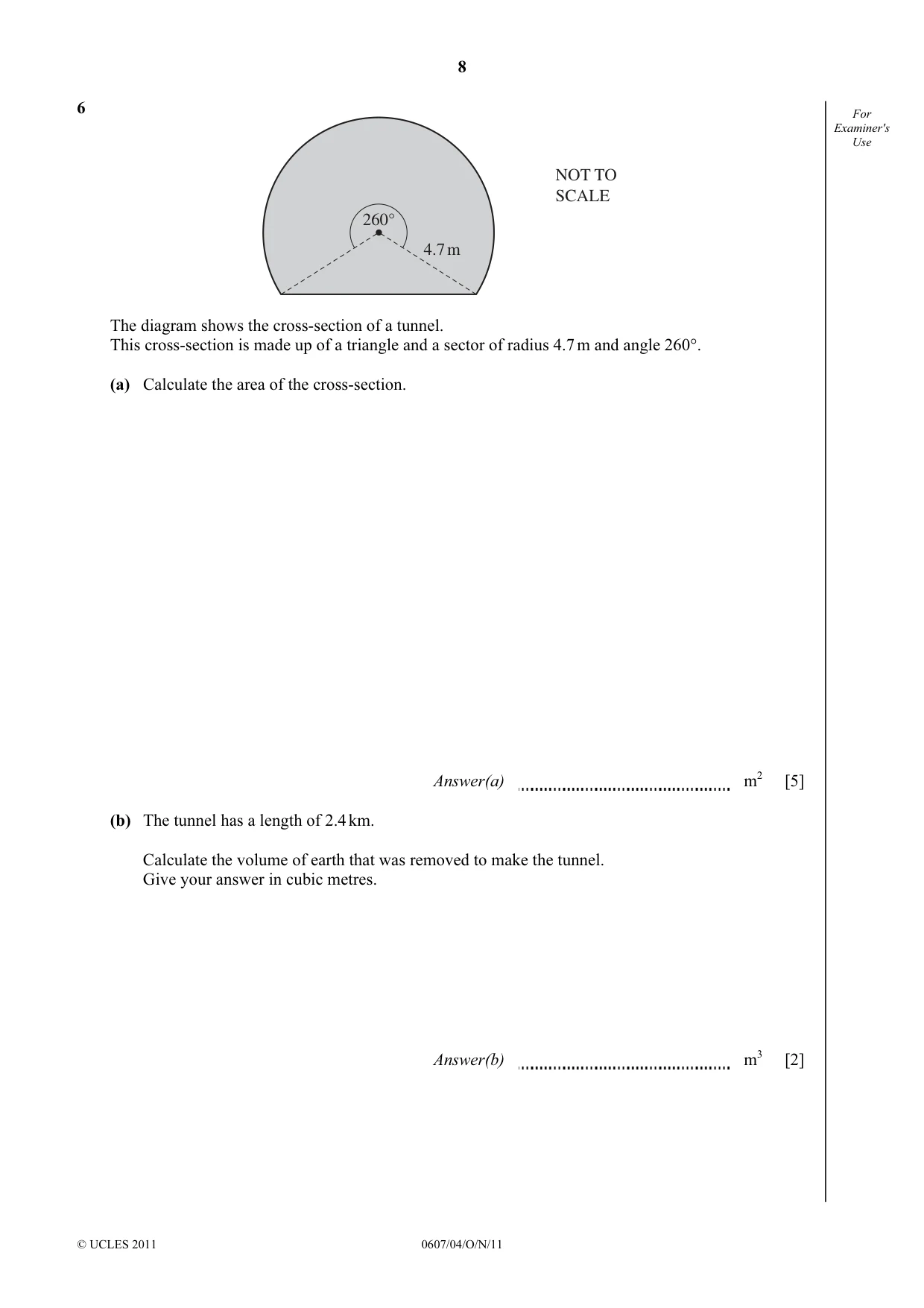
8 © UCLES 2011 0607/04/O/N/11 For Examiner's Use 6 260° 4.7 m NOT TO SCALE The diagram shows the cross-section of a tunnel. This cross-section is made up of a triangle and a sector of radius 4.7 m and angle 260°. (a) Calculate the area of the cross-section. Answer(a) m2 [5] (b) The tunnel has a length of 2.4 km. Calculate the volume of earth that was removed to make the tunnel. Give your answer in cubic metres. Answer(b) m3 [2]
Question paper, page 9
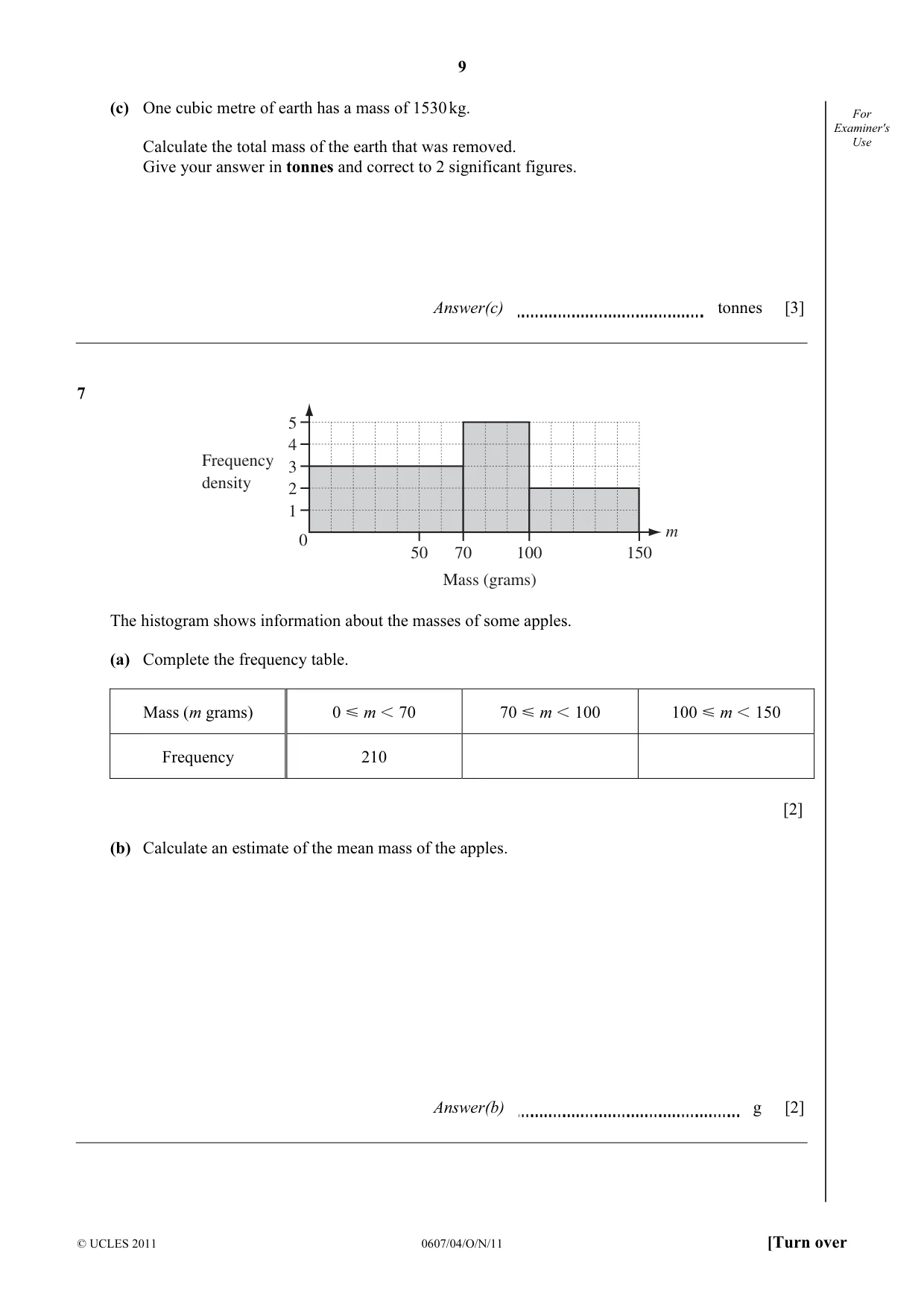
9 © UCLES 2011 0607/04/O/N/11 [Turn over For Examiner's Use (c) One cubic metre of earth has a mass of 1530 kg. Calculate the total mass of the earth that was removed. Give your answer in tonnes and correct to 2 significant figures. Answer(c) tonnes [3] 7 5 4 3 2 1 0 50 70 100 150 Frequency density Mass (grams) m The histogram shows information about the masses of some apples. (a) Complete the frequency table. Mass (m grams) 0 Y m I 70 70 Y m I 100 100 Y m I 150 Frequency 210 [2] (b) Calculate an estimate of the mean mass of the apples. Answer(b) g [2]
Question paper, page 10
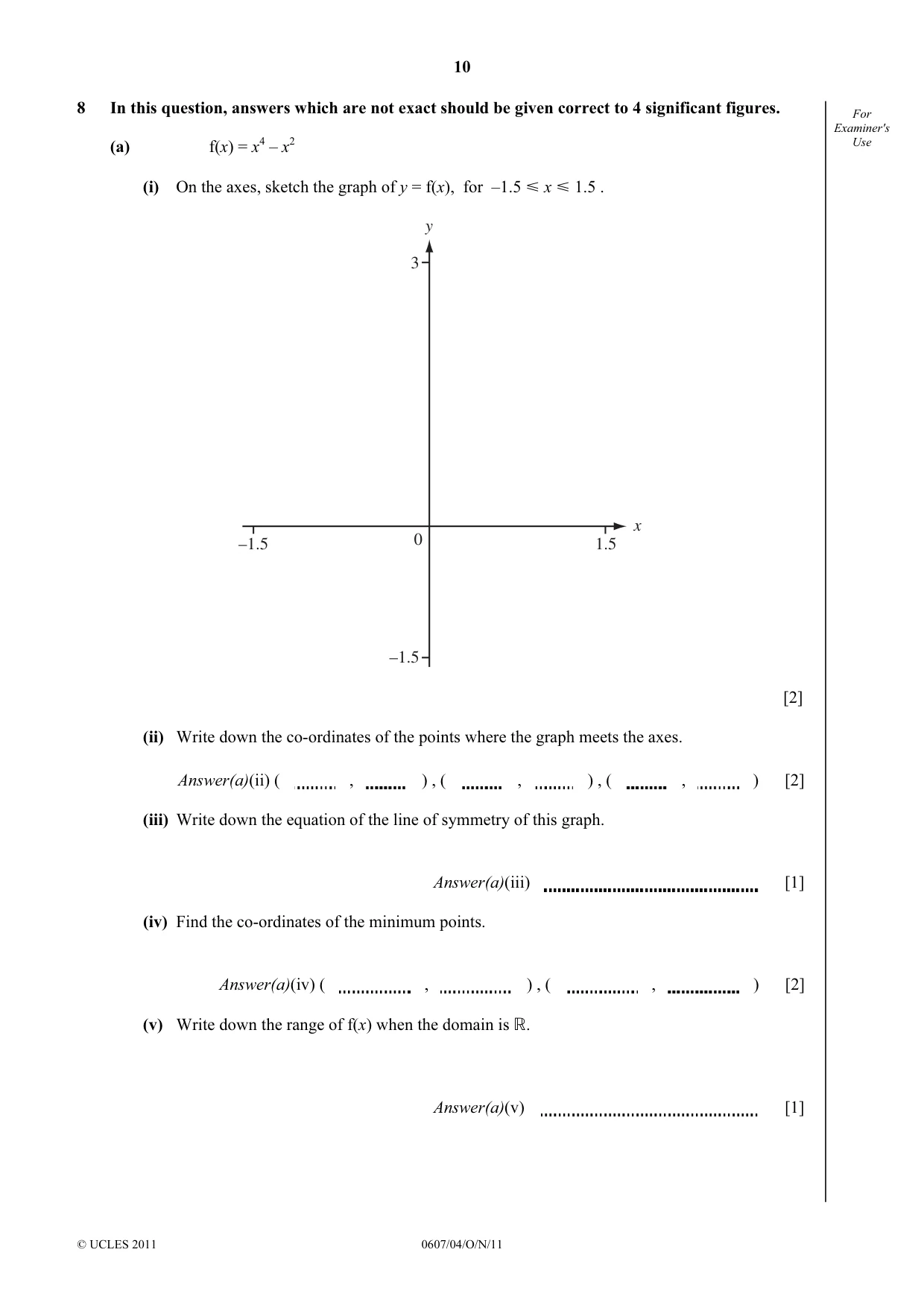
10 © UCLES 2011 0607/04/O/N/11 For Examiner's Use 8 In this question, answers which are not exact should be given correct to 4 significant figures. (a) f(x) = x4 – x2 (i) On the axes, sketch the graph of y = f(x), for –1.5 Y x Y 1.5 . 3 –1.5 –1.5 1.5 0 x y [2] (ii) Write down the co-ordinates of the points where the graph meets the axes. Answer(a)(ii) ( , ) , ( , ) , ( , ) [2] (iii) Write down the equation of the line of symmetry of this graph. Answer(a)(iii) [1] (iv) Find the co-ordinates of the minimum points. Answer(a)(iv) ( , ) , ( , ) [2] (v) Write down the range of f(x) when the domain is o. Answer(a)(v) [1]
Question paper, page 11
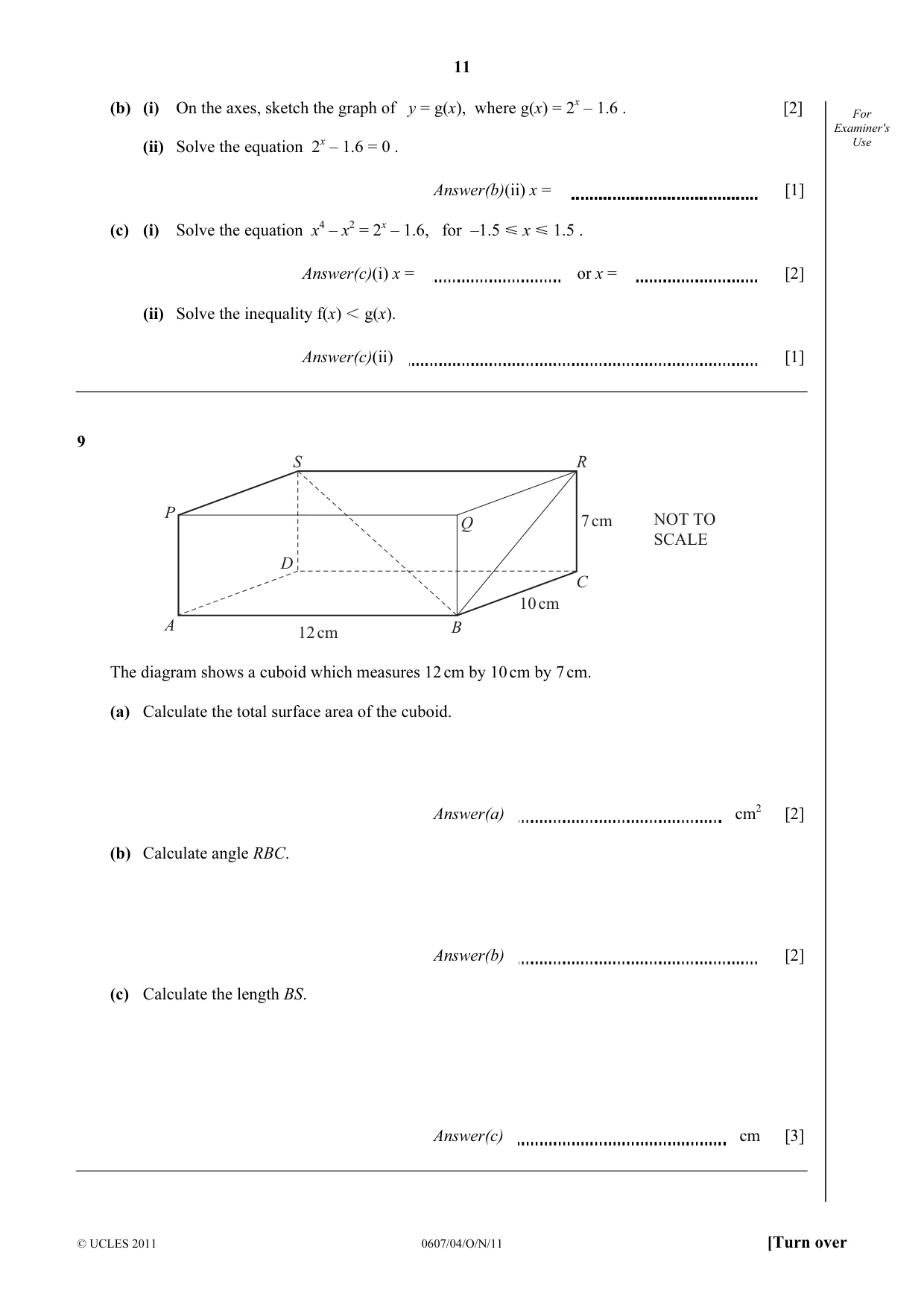
11 © UCLES 2011 0607/04/O/N/11 [Turn over For Examiner's Use (b) (i) On the axes, sketch the graph of y = g(x), where g(x) = 2x – 1.6 . [2] (ii) Solve the equation 2x – 1.6 = 0 . Answer(b)(ii) x = [1] (c) (i) Solve the equation x4 – x2 = 2x – 1.6, for –1.5 Y x Y 1.5 . Answer(c)(i) x = or x = [2] (ii) Solve the inequality f(x) I g(x). Answer(c)(ii) [1] 9 S R C B A P D Q 12 cm 10 cm 7 cm NOT TO SCALE The diagram shows a cuboid which measures 12 cm by 10 cm by 7 cm. (a) Calculate the total surface area of the cuboid. Answer(a) cm2 [2] (b) Calculate angle RBC. Answer(b) [2] (c) Calculate the length BS. Answer(c) cm [3]
Question paper, page 12
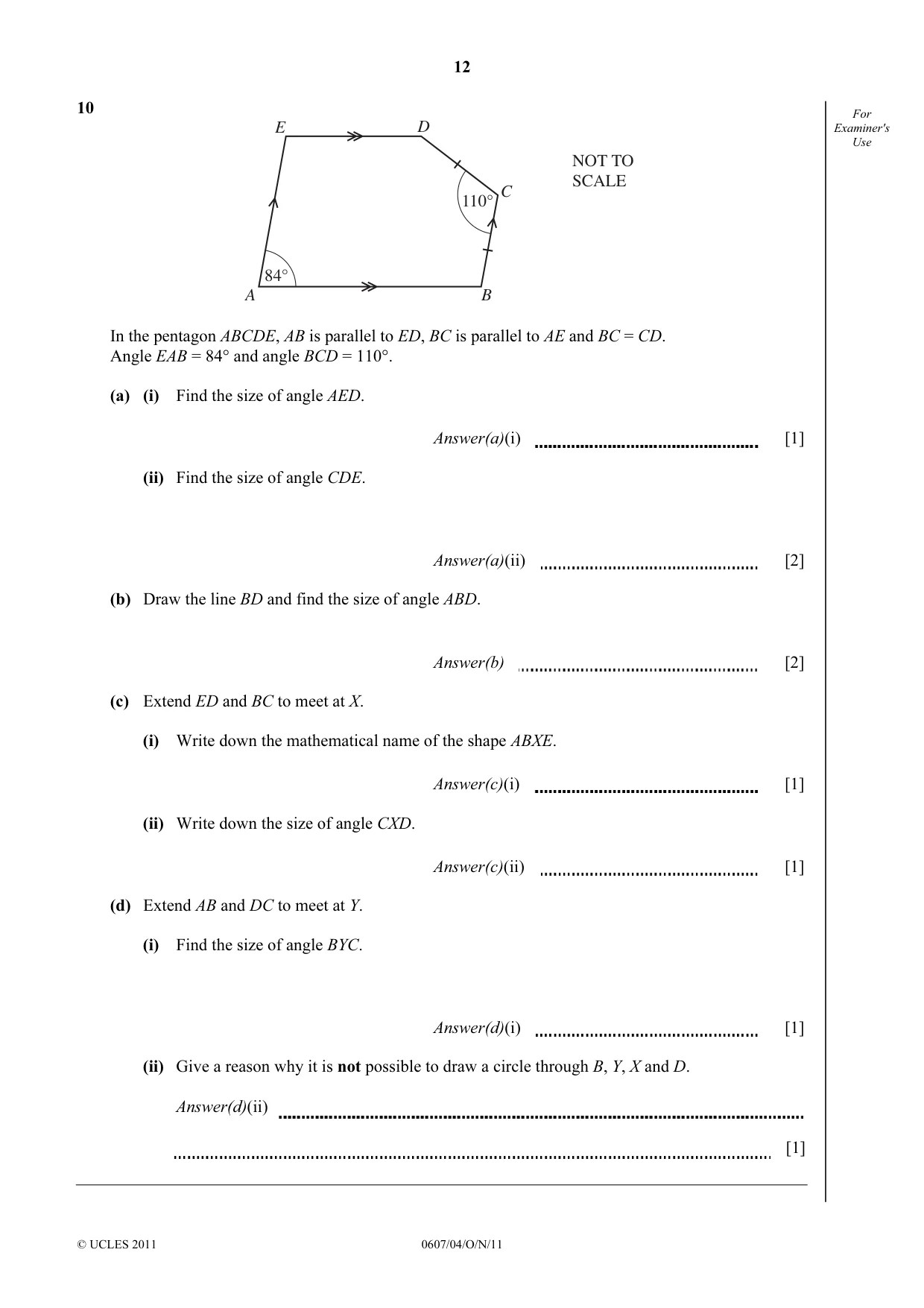
12 © UCLES 2011 0607/04/O/N/11 For Examiner's Use 10 E A B C D 84° 110° NOT TO SCALE In the pentagon ABCDE, AB is parallel to ED, BC is parallel to AE and BC = CD. Angle EAB = 84° and angle BCD = 110°. (a) (i) Find the size of angle AED. Answer(a)(i) [1] (ii) Find the size of angle CDE. Answer(a)(ii) [2] (b) Draw the line BD and find the size of angle ABD. Answer(b) [2] (c) Extend ED and BC to meet at X. (i) Write down the mathematical name of the shape ABXE. Answer(c)(i) [1] (ii) Write down the size of angle CXD. Answer(c)(ii) [1] (d) Extend AB and DC to meet at Y. (i) Find the size of angle BYC. Answer(d)(i) [1] (ii) Give a reason why it is not possible to draw a circle through B, Y, X and D. Answer(d)(ii) [1]
Question paper, page 13
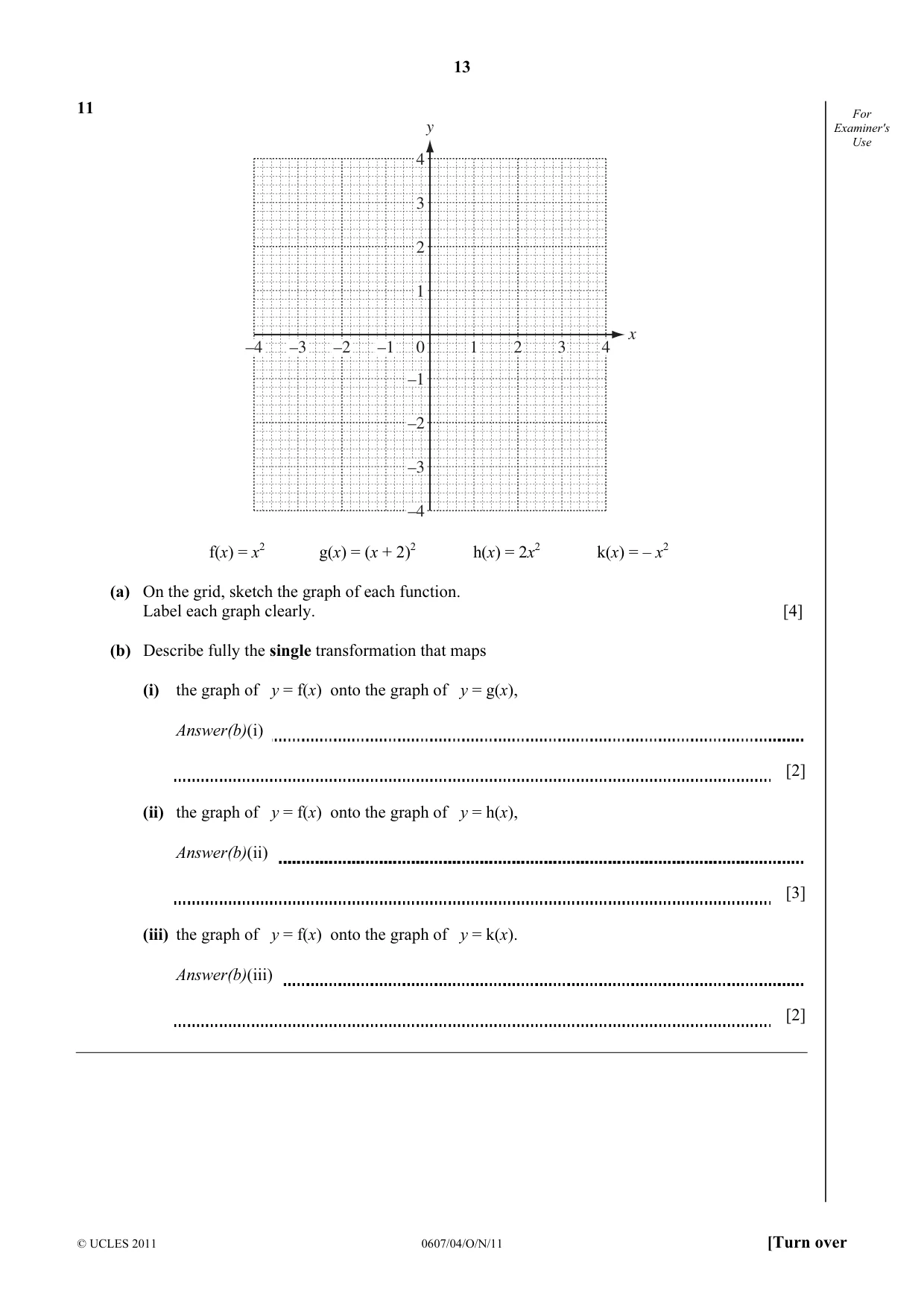
13 © UCLES 2011 0607/04/O/N/11 [Turn over For Examiner's Use 11 y x 4 3 2 1 –1 –2 –3 –4 0 –4 –3 –2 –1 1 2 3 4 f(x) = x2 g(x) = (x + 2)2 h(x) = 2x2 k(x) = – x2 (a) On the grid, sketch the graph of each function. Label each graph clearly. [4] (b) Describe fully the single transformation that maps (i) the graph of y = f(x) onto the graph of y = g(x), Answer(b)(i) [2] (ii) the graph of y = f(x) onto the graph of y = h(x), Answer(b)(ii) [3] (iii) the graph of y = f(x) onto the graph of y = k(x). Answer(b)(iii) [2]
Question paper, page 14
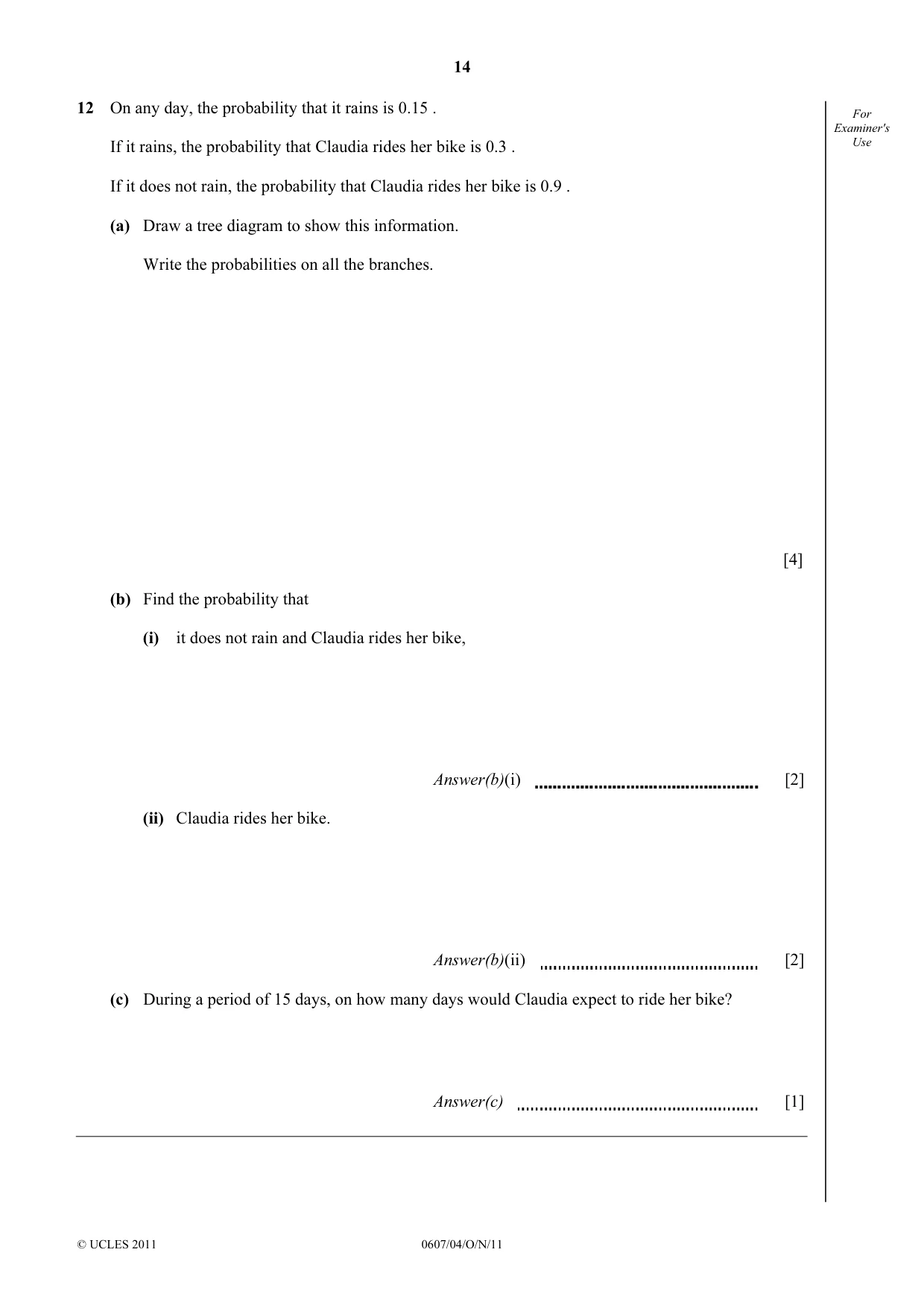
14 © UCLES 2011 0607/04/O/N/11 For Examiner's Use 12 On any day, the probability that it rains is 0.15 . If it rains, the probability that Claudia rides her bike is 0.3 . If it does not rain, the probability that Claudia rides her bike is 0.9 . (a) Draw a tree diagram to show this information. Write the probabilities on all the branches. [4] (b) Find the probability that (i) it does not rain and Claudia rides her bike, Answer(b)(i) [2] (ii) Claudia rides her bike. Answer(b)(ii) [2] (c) During a period of 15 days, on how many days would Claudia expect to ride her bike? Answer(c) [1]
Question paper, page 15
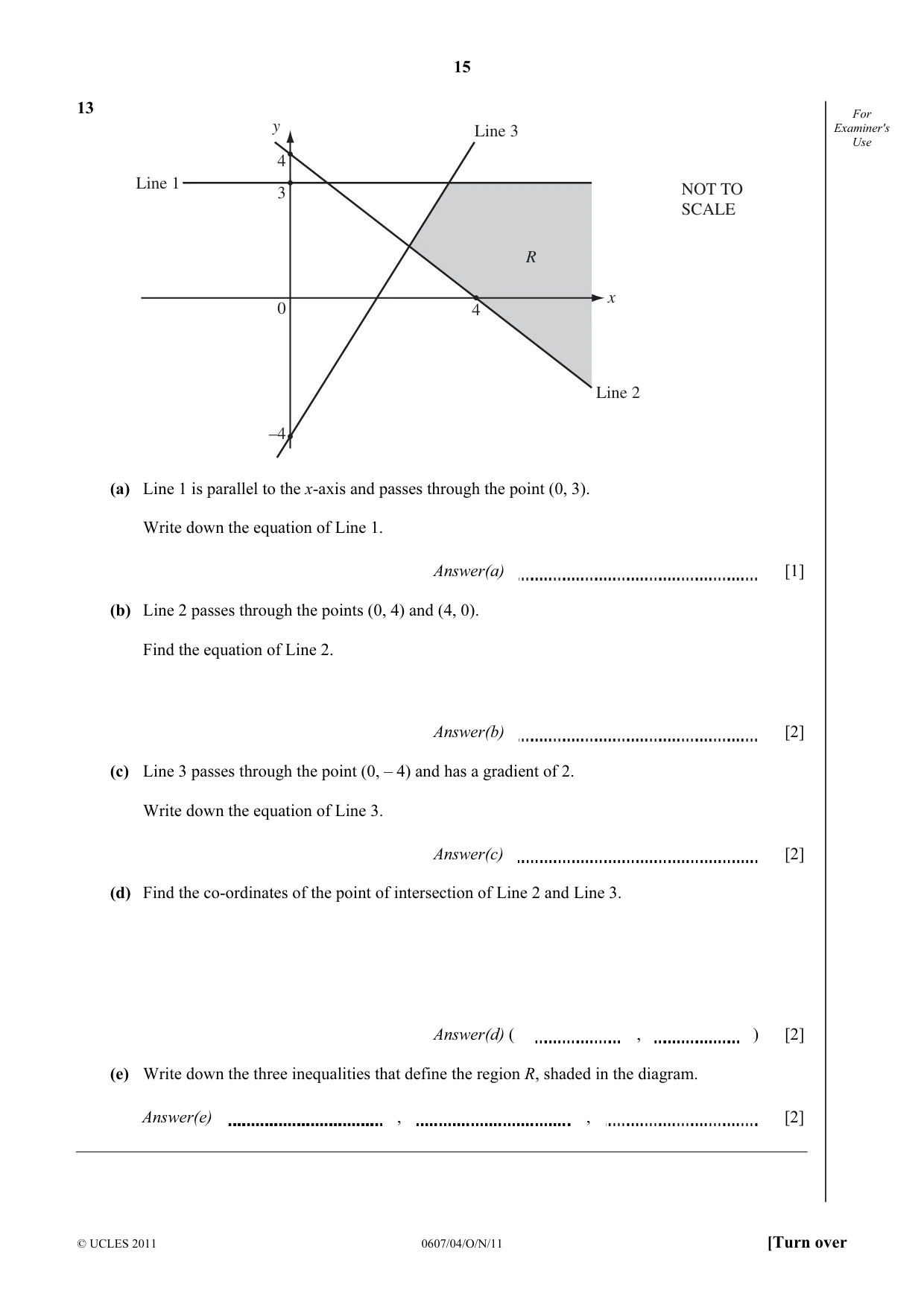
15 © UCLES 2011 0607/04/O/N/11 [Turn over For Examiner's Use 13 R 4 –4 4 3 0 x Line 1 Line 2 Line 3 NOT TO SCALE y (a) Line 1 is parallel to the x-axis and passes through the point (0, 3). Write down the equation of Line 1. Answer(a) [1] (b) Line 2 passes through the points (0, 4) and (4, 0). Find the equation of Line 2. Answer(b) [2] (c) Line 3 passes through the point (0, – 4) and has a gradient of 2. Write down the equation of Line 3. Answer(c) [2] (d) Find the co-ordinates of the point of intersection of Line 2 and Line 3. Answer(d) ( , ) [2] (e) Write down the three inequalities that define the region R, shaded in the diagram. Answer(e) , , [2]
Question paper, page 16
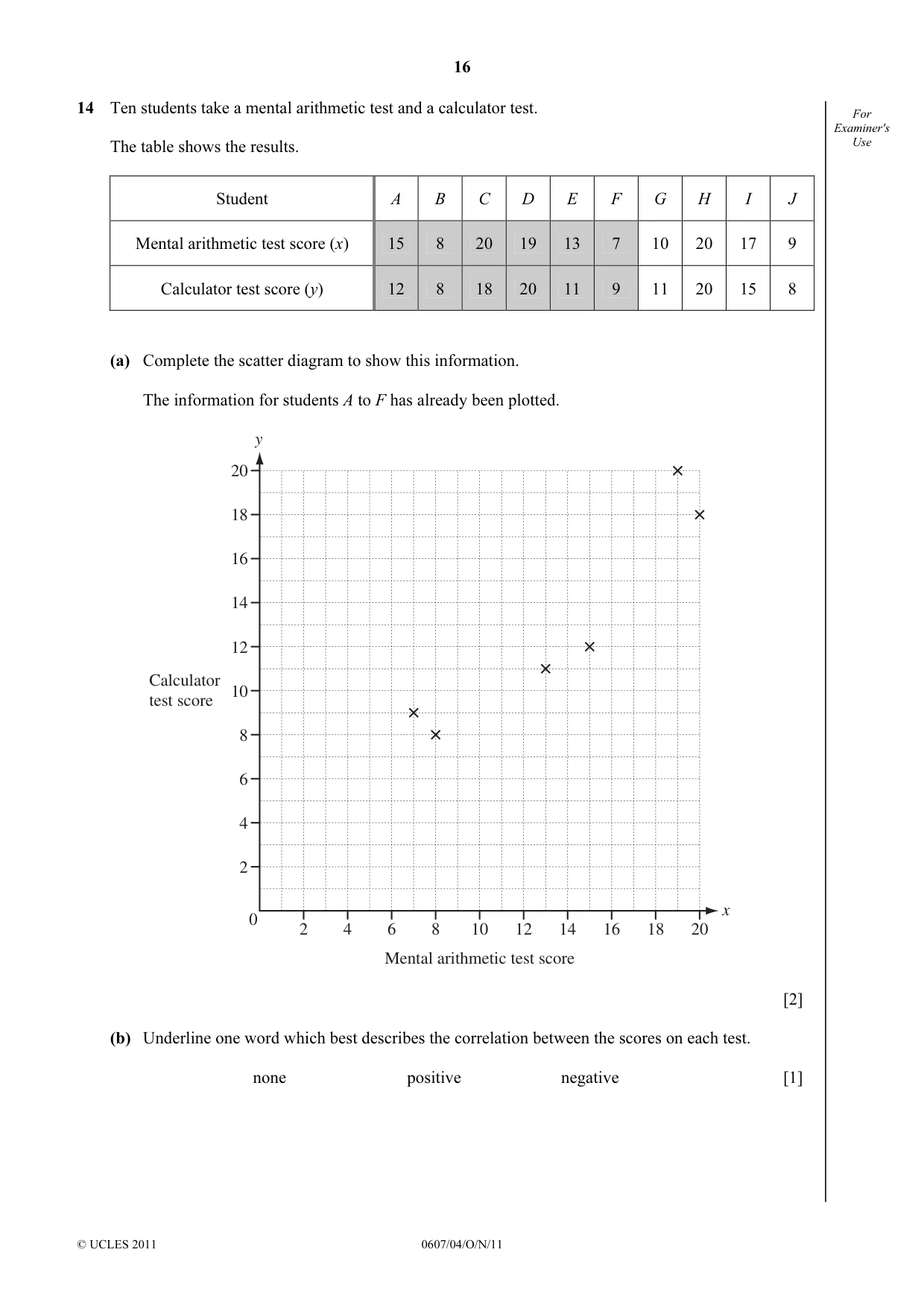
16 © UCLES 2011 0607/04/O/N/11 For Examiner's Use 14 Ten students take a mental arithmetic test and a calculator test. The table shows the results. Student A B C D E F G H I J Mental arithmetic test score (x) 15 8 20 19 13 7 10 20 17 9 Calculator test score (y) 12 8 18 20 11 9 11 20 15 8 (a) Complete the scatter diagram to show this information. The information for students A to F has already been plotted. 20 18 16 14 12 10 8 6 4 2 0 2 4 6 8 10 12 14 16 18 20 y x Mental arithmetic test score Calculator test score [2] (b) Underline one word which best describes the correlation between the scores on each test. none positive negative [1]
Question paper, page 17
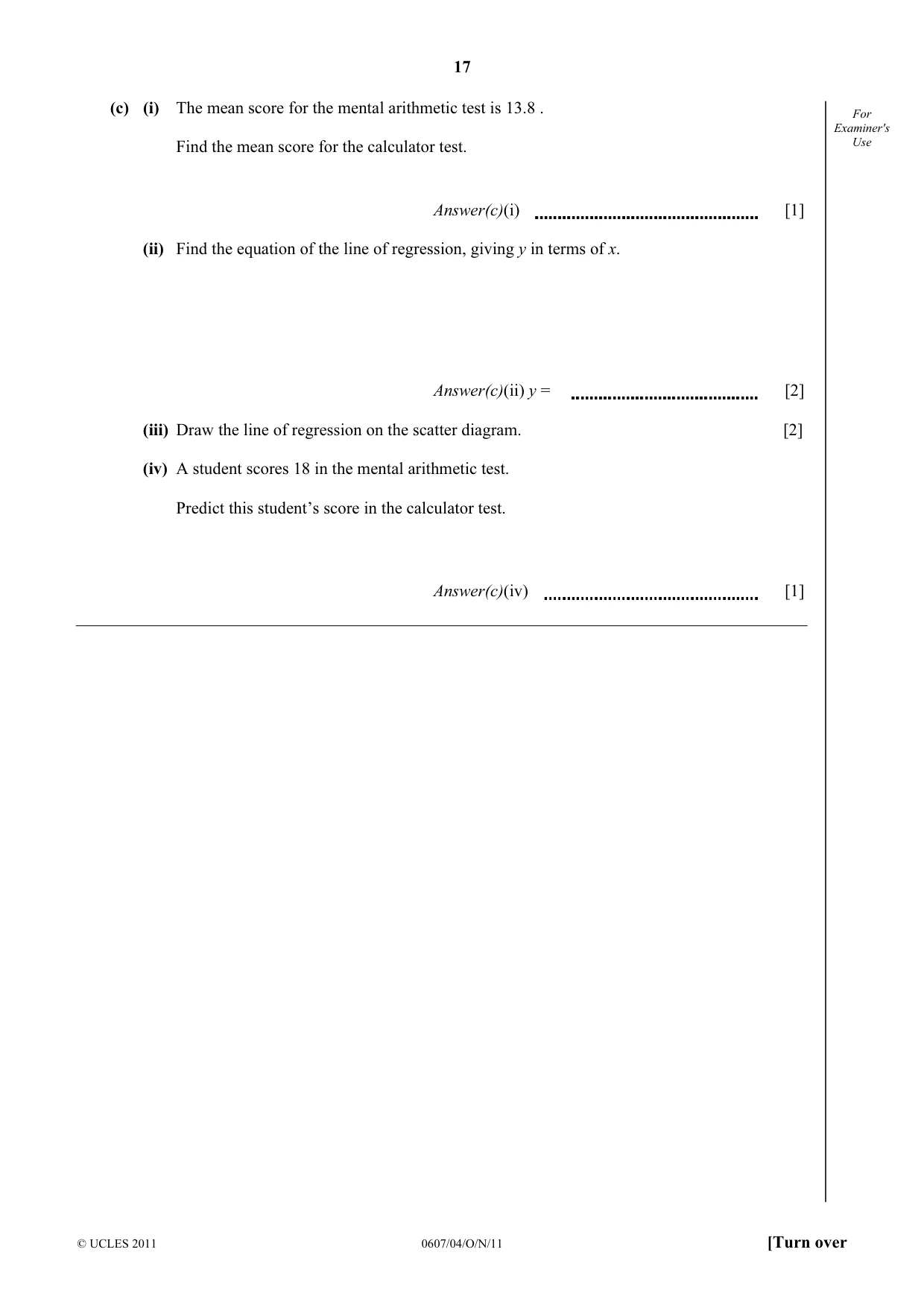
17 © UCLES 2011 0607/04/O/N/11 [Turn over For Examiner's Use (c) (i) The mean score for the mental arithmetic test is 13.8 . Find the mean score for the calculator test. Answer(c)(i) [1] (ii) Find the equation of the line of regression, giving y in terms of x. Answer(c)(ii) y = [2] (iii) Draw the line of regression on the scatter diagram. [2] (iv) A student scores 18 in the mental arithmetic test. Predict this student’s score in the calculator test. Answer(c)(iv) [1]
Question paper, page 18
18 © UCLES 2011 0607/04/O/N/11 For Examiner's Use 15 (a) (i) A circle is cut into n equal sectors. Write down, in terms of n, the angle at the centre of each sector. Answer(a)(i) [1] (ii) A circle is cut into n + 3 equal sectors. Write down, in terms of n, the angle at the centre of each sector. Answer(a)(ii) [1] (b) The angle in part(a)(ii) is 4° smaller than the angle in part(a)(i). Write down an equation in n and find the value of n. Answer(b) n = [5]
Question paper, page 19
19 © UCLES 2011 0607/04/O/N/11 BLANK PAGE
Question paper, page 20
20 Permission to reproduce items where third-party owned material protected by copyright is included has been sought and cleared where possible. Every reasonable effort has been made by the publisher (UCLES) to trace copyright holders, but if any items requiring clearance have unwittingly been included, the publisher will be pleased to make amends at the earliest possible opportunity. University of Cambridge International Examinations is part of the Cambridge Assessment Group. Cambridge Assessment is the brand name of University of Cambridge Local Examinations Syndicate (UCLES), which is itself a department of the University of Cambridge. © UCLES 2011 0607/04/O/N/11 BLANK PAGE
Mark scheme, page 1
UNIVERSITY OF CAMBRIDGE INTERNATIONAL EXAMINATIONS International General Certificate of Secondary Education MARK SCHEME for the October/November 2011 question paper for the guidance of teachers 0607 CAMBRIDGE INTERNATIONAL MATHEMATICS 0607/04 Paper 4 (Extended), maximum raw mark 120 This mark scheme is published as an aid to teachers and candidates, to indicate the requirements of the examination. It shows the basis on which Examiners were instructed to award marks. It does not indicate the details of the discussions that took place at an Examiners’ meeting before marking began, which would have considered the acceptability of alternative answers. Mark schemes must be read in conjunction with the question papers and the report on the examination. • Cambridge will not enter into discussions or correspondence in connection with these mark schemes. Cambridge is publishing the mark schemes for the October/November 2011 question papers for most IGCSE, GCE Advanced Level and Advanced Subsidiary Level syllabuses and some Ordinary Level syllabuses. www.XtremePapers.com
Mark scheme, page 2
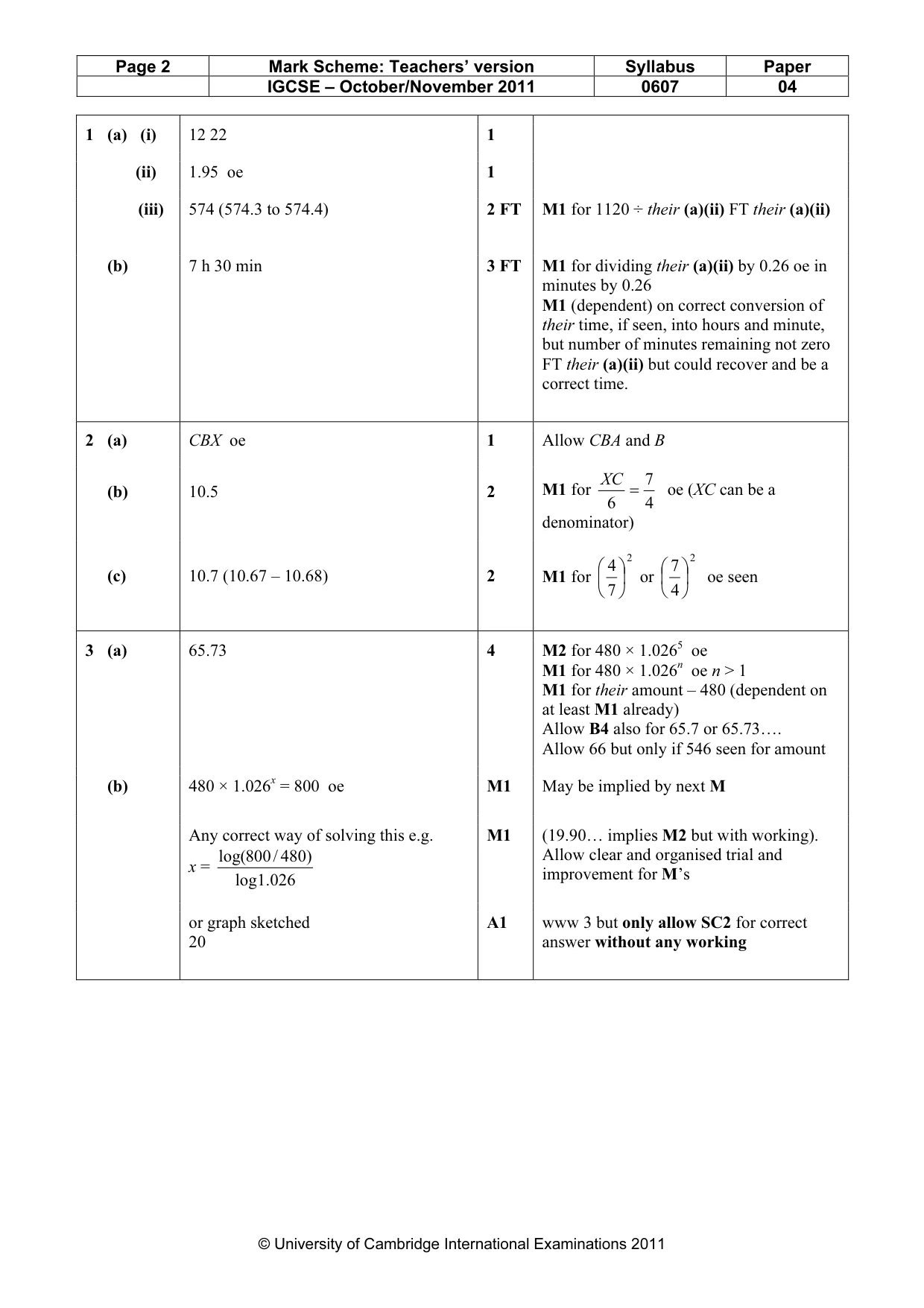
Page 2 Mark Scheme: Teachers’ version Syllabus Paper IGCSE – October/November 2011 0607 04 © University of Cambridge International Examinations 2011 1 (a) (i) 12 22 1 (ii) 1.95 oe 1 (iii) 574 (574.3 to 574.4) 2 FT M1 for 1120 ÷ their (a)(ii) FT their (a)(ii) (b) 7 h 30 min 3 FT M1 for dividing their (a)(ii) by 0.26 oe in minutes by 0.26 M1 (dependent) on correct conversion of their time, if seen, into hours and minute, but number of minutes remaining not zero FT their (a)(ii) but could recover and be a correct time. 2 (a) CBX oe 1 Allow CBA and B (b) 10.5 2 M1 for 4 7 6 = XC oe (XC can be a denominator) (c) 10.7 (10.67 – 10.68) 2 M1 for 2 7 4 or 2 4 7 oe seen 3 (a) 65.73 4 M2 for 480 × 1.0265 oe M1 for 480 × 1.026n oe n > 1 M1 for their amount – 480 (dependent on at least M1 already) Allow B4 also for 65.7 or 65.73…. Allow 66 but only if 546 seen for amount (b) 480 × 1.026x = 800 oe M1 May be implied by next M Any correct way of solving this e.g. x = 026 .1 log ) 480 / 800 log( M1 (19.90… implies M2 but with working). Allow clear and organised trial and improvement for M’s or graph sketched 20 A1 www 3 but only allow SC2 for correct answer without any working
Mark scheme, page 3
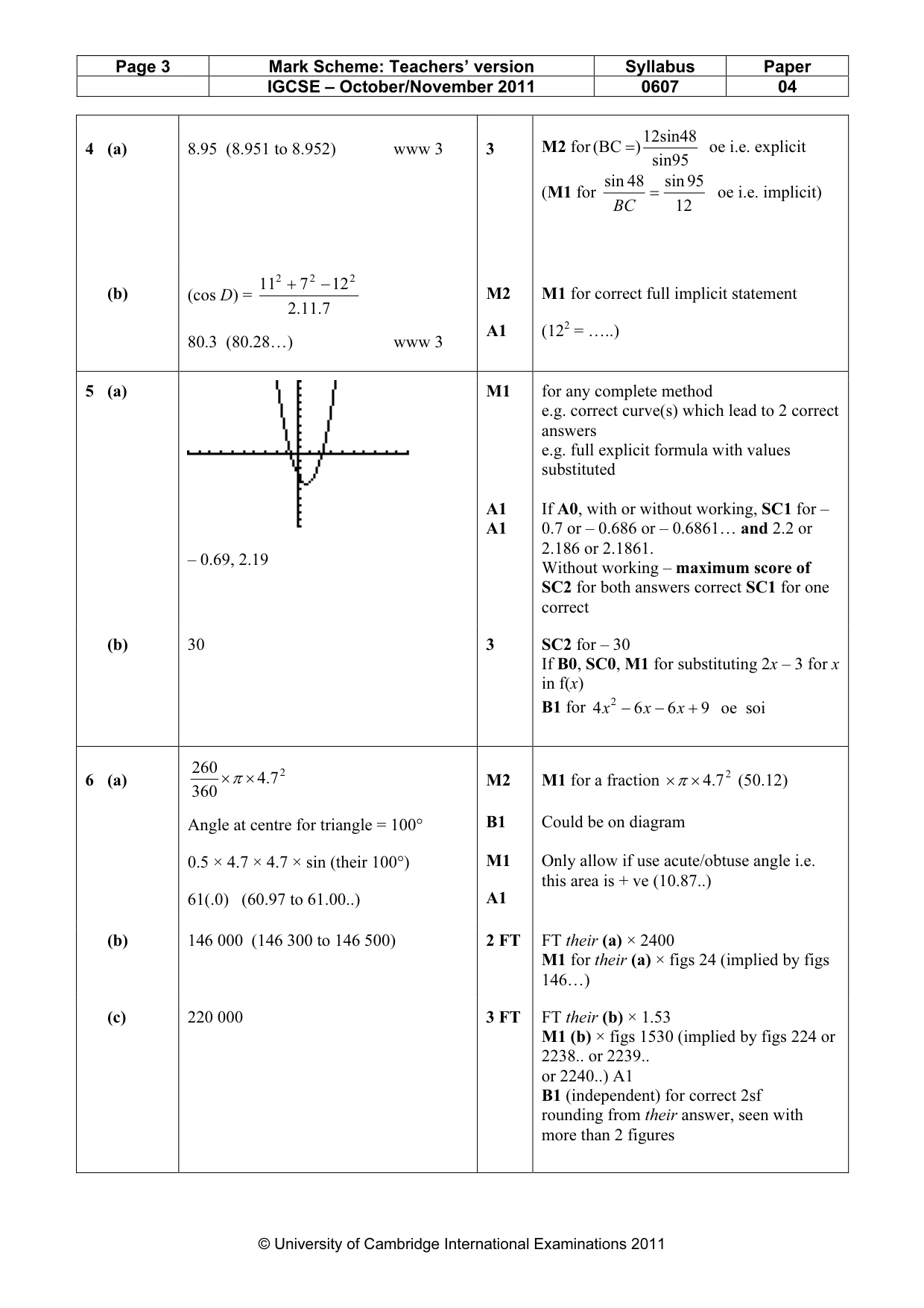
Page 3 Mark Scheme: Teachers’ version Syllabus Paper IGCSE – October/November 2011 0607 04 © University of Cambridge International Examinations 2011 4 (a) 8.95 (8.951 to 8.952) www 3 3 M2 for sin95 12sin48 ) (BC = oe i.e. explicit (M1 for 12 95 sin 48 sin = BC oe i.e. implicit) (b) (cos D) = 7. 11 .2 12 7 11 2 2 2 − + 80.3 (80.28…) www 3 M2 A1 M1 for correct full implicit statement (122 = …..) 5 (a) – 0.69, 2.19 M1 A1 A1 for any complete method e.g. correct curve(s) which lead to 2 correct answers e.g. full explicit formula with values substituted If A0, with or without working, SC1 for – 0.7 or – 0.686 or – 0.6861… and 2.2 or 2.186 or 2.1861. Without working – maximum score of SC2 for both answers correct SC1 for one correct (b) 30 3 SC2 for – 30 If B0, SC0, M1 for substituting 2x – 3 for x in f(x) B1 for 9 6 6 4 2 + − − x x x oe soi 6 (a) 2 7.4 360 260 × ×π Angle at centre for triangle = 100° 0.5 × 4.7 × 4.7 × sin (their 100°) 61(.0) (60.97 to 61.00..) M2 B1 M1 A1 M1 for a fraction 2 7.4 × ×π (50.12) Could be on diagram Only allow if use acute/obtuse angle i.e. this area is + ve (10.87..) (b) 146 000 (146 300 to 146 500) 2 FT FT their (a) × 2400 M1 for their (a) × figs 24 (implied by figs 146…) (c) 220 000 3 FT FT their (b) × 1.53 M1 (b) × figs 1530 (implied by figs 224 or 2238.. or 2239.. or 2240..) A1 B1 (independent) for correct 2sf rounding from their answer, seen with more than 2 figures
Mark scheme, page 4
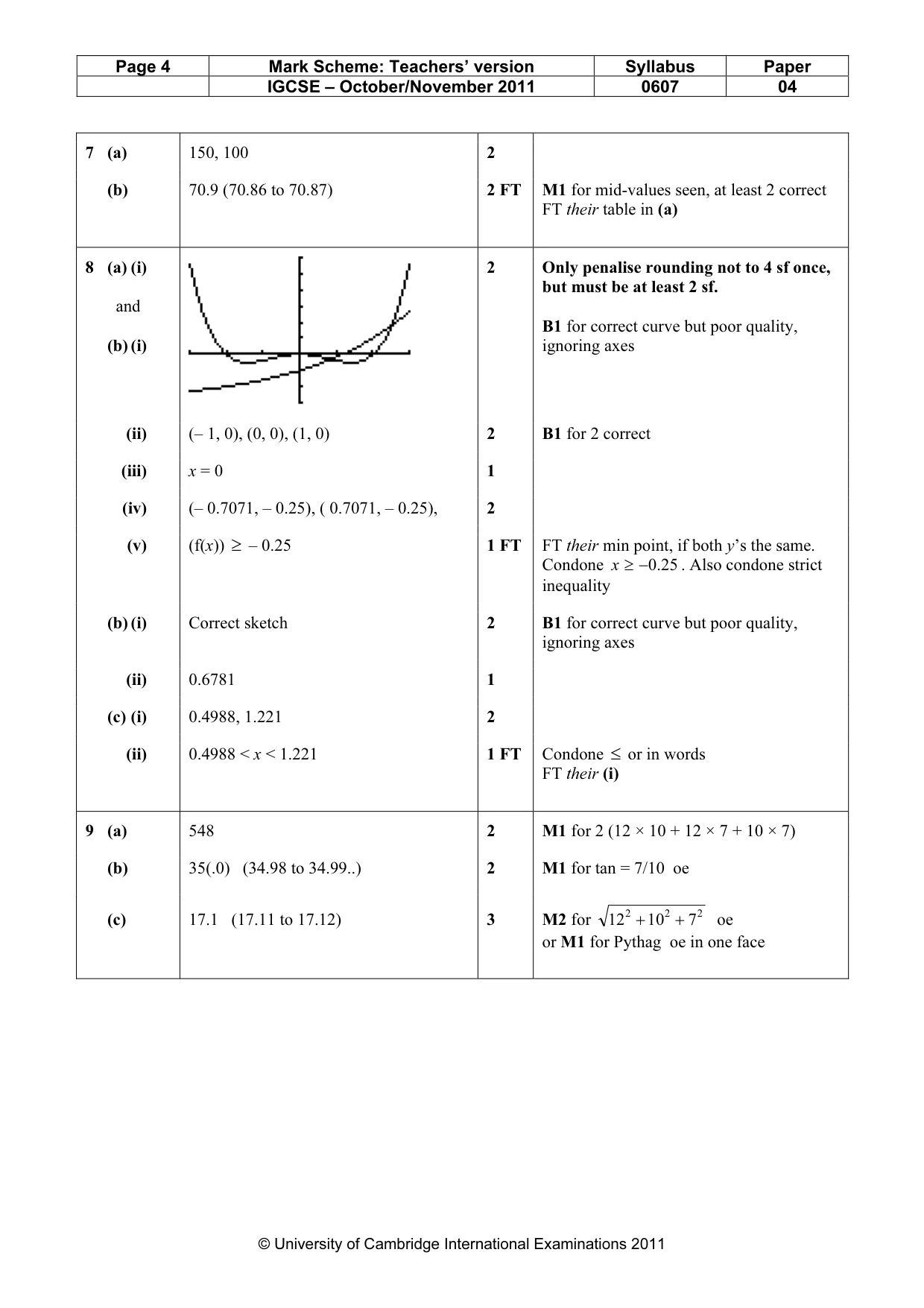
Page 4 Mark Scheme: Teachers’ version Syllabus Paper IGCSE – October/November 2011 0607 04 © University of Cambridge International Examinations 2011 7 (a) 150, 100 2 (b) 70.9 (70.86 to 70.87) 2 FT M1 for mid-values seen, at least 2 correct FT their table in (a) 8 (a) (i) and (b) (i) 2 Only penalise rounding not to 4 sf once, but must be at least 2 sf. B1 for correct curve but poor quality, ignoring axes (ii) (– 1, 0), (0, 0), (1, 0) 2 B1 for 2 correct (iii) x = 0 1 (iv) (– 0.7071, – 0.25), ( 0.7071, – 0.25), 2 (v) (f(x)) ≥ – 0.25 1 FT FT their min point, if both y’s the same. Condone 25 .0 − ≥ x . Also condone strict inequality (b) (i) Correct sketch 2 B1 for correct curve but poor quality, ignoring axes (ii) 0.6781 1 (c) (i) 0.4988, 1.221 2 (ii) 0.4988 < x < 1.221 1 FT Condone ≤ or in words FT their (i) 9 (a) 548 2 M1 for 2 (12 × 10 + 12 × 7 + 10 × 7) (b) 35(.0) (34.98 to 34.99..) 2 M1 for tan = 7/10 oe (c) 17.1 (17.11 to 17.12) 3 M2 for 2 2 2 7 10 12 + + oe or M1 for Pythag oe in one face
Mark scheme, page 5
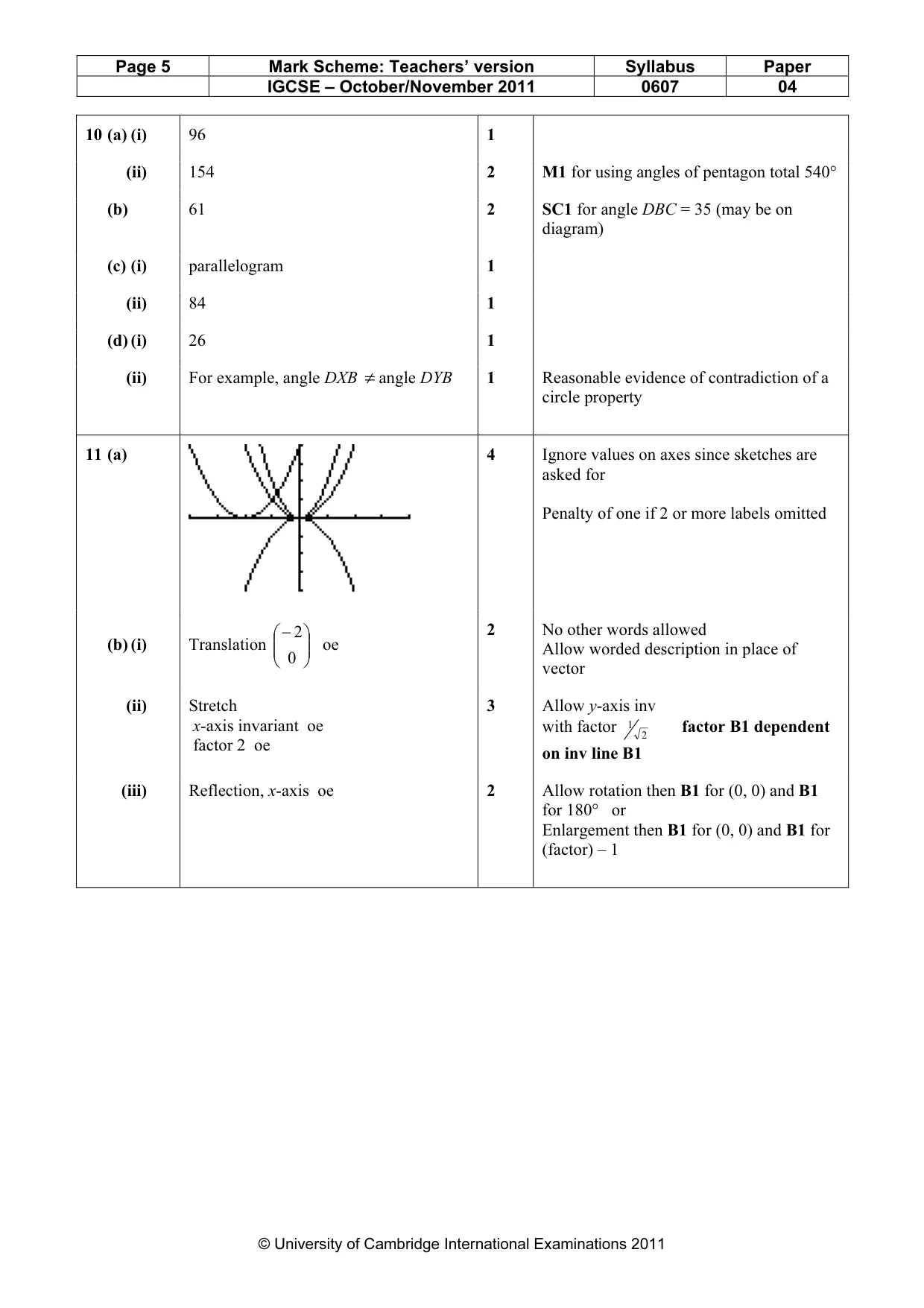
Page 5 Mark Scheme: Teachers’ version Syllabus Paper IGCSE – October/November 2011 0607 04 © University of Cambridge International Examinations 2011 10 (a) (i) 96 1 (ii) 154 2 M1 for using angles of pentagon total 540° (b) 61 2 SC1 for angle DBC = 35 (may be on diagram) (c) (i) parallelogram 1 (ii) 84 1 (d) (i) 26 1 (ii) For example, angle DXB ≠angle DYB 1 Reasonable evidence of contradiction of a circle property 11 (a) 4 Ignore values on axes since sketches are asked for Penalty of one if 2 or more labels omitted (b) (i) Translation − 0 2 oe 2 No other words allowed Allow worded description in place of vector (ii) Stretch x-axis invariant oe factor 2 oe 3 Allow y-axis inv with factor 2 1 factor B1 dependent on inv line B1 (iii) Reflection, x-axis oe 2 Allow rotation then B1 for (0, 0) and B1 for 180° or Enlargement then B1 for (0, 0) and B1 for (factor) – 1
Mark scheme, page 6
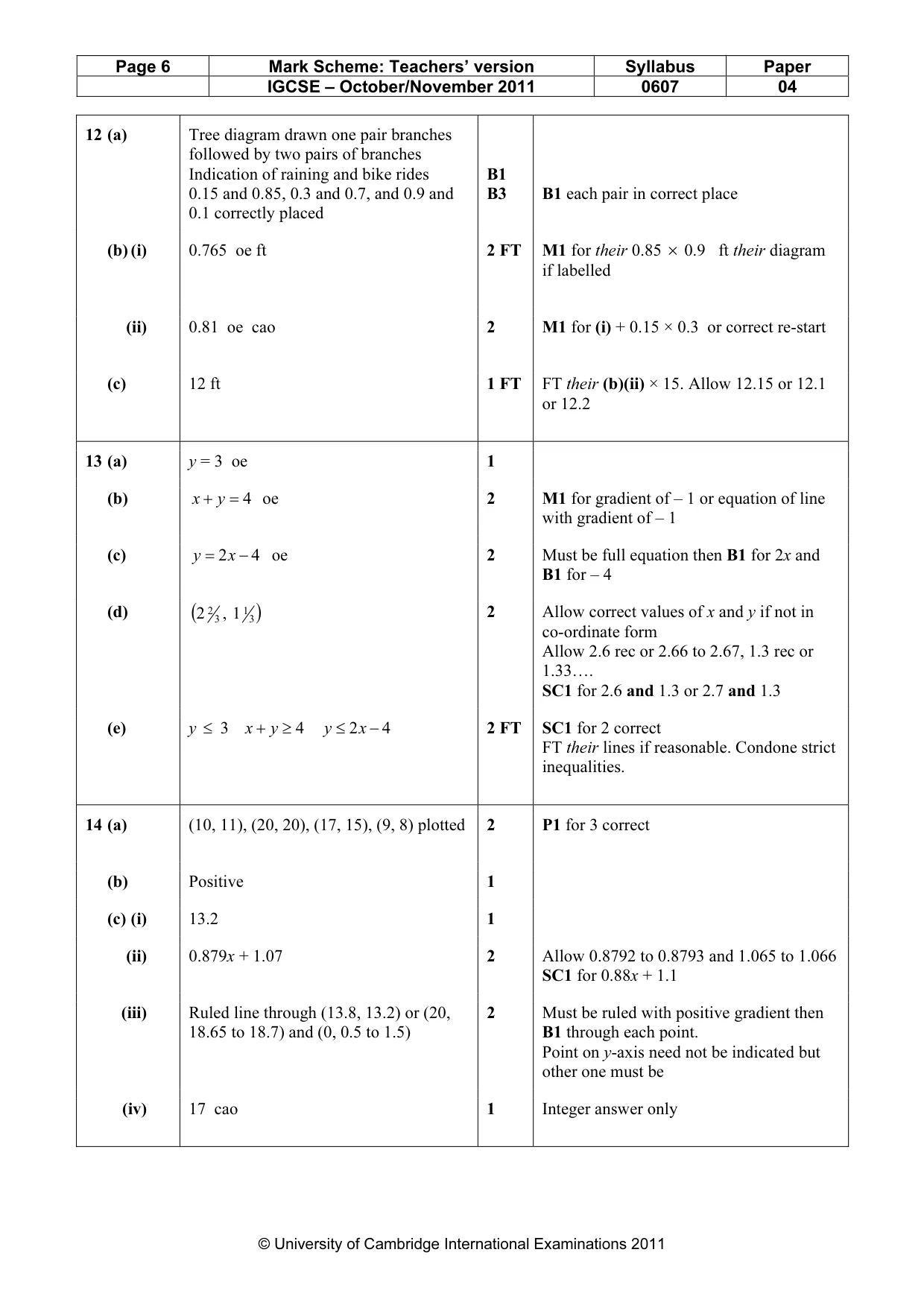
Page 6 Mark Scheme: Teachers’ version Syllabus Paper IGCSE – October/November 2011 0607 04 © University of Cambridge International Examinations 2011 12 (a) Tree diagram drawn one pair branches followed by two pairs of branches Indication of raining and bike rides 0.15 and 0.85, 0.3 and 0.7, and 0.9 and 0.1 correctly placed B1 B3 B1 each pair in correct place (b) (i) 0.765 oe ft 2 FT M1 for their 0.85 × 0.9 ft their diagram if labelled (ii) 0.81 oe cao 2 M1 for (i) + 0.15 × 0.3 or correct re-start (c) 12 ft 1 FT FT their (b)(ii) × 15. Allow 12.15 or 12.1 or 12.2 13 (a) y = 3 oe 1 (b) 4 = + y x oe 2 M1 for gradient of – 1 or equation of line with gradient of – 1 (c) 4 2 − = x y oe 2 Must be full equation then B1 for 2x and B1 for – 4 (d) ( ) 3 1 3 2 1 , 2 2 Allow correct values of x and y if not in co-ordinate form Allow 2.6 rec or 2.66 to 2.67, 1.3 rec or 1.33…. SC1 for 2.6 and 1.3 or 2.7 and 1.3 (e) y ≤ 3 4 ≥ + y x 4 2 − ≤ x y 2 FT SC1 for 2 correct FT their lines if reasonable. Condone strict inequalities. 14 (a) (10, 11), (20, 20), (17, 15), (9, 8) plotted 2 P1 for 3 correct (b) Positive 1 (c) (i) 13.2 1 (ii) 0.879x + 1.07 2 Allow 0.8792 to 0.8793 and 1.065 to 1.066 SC1 for 0.88x + 1.1 (iii) Ruled line through (13.8, 13.2) or (20, 18.65 to 18.7) and (0, 0.5 to 1.5) 2 Must be ruled with positive gradient then B1 through each point. Point on y-axis need not be indicated but other one must be (iv) 17 cao 1 Integer answer only
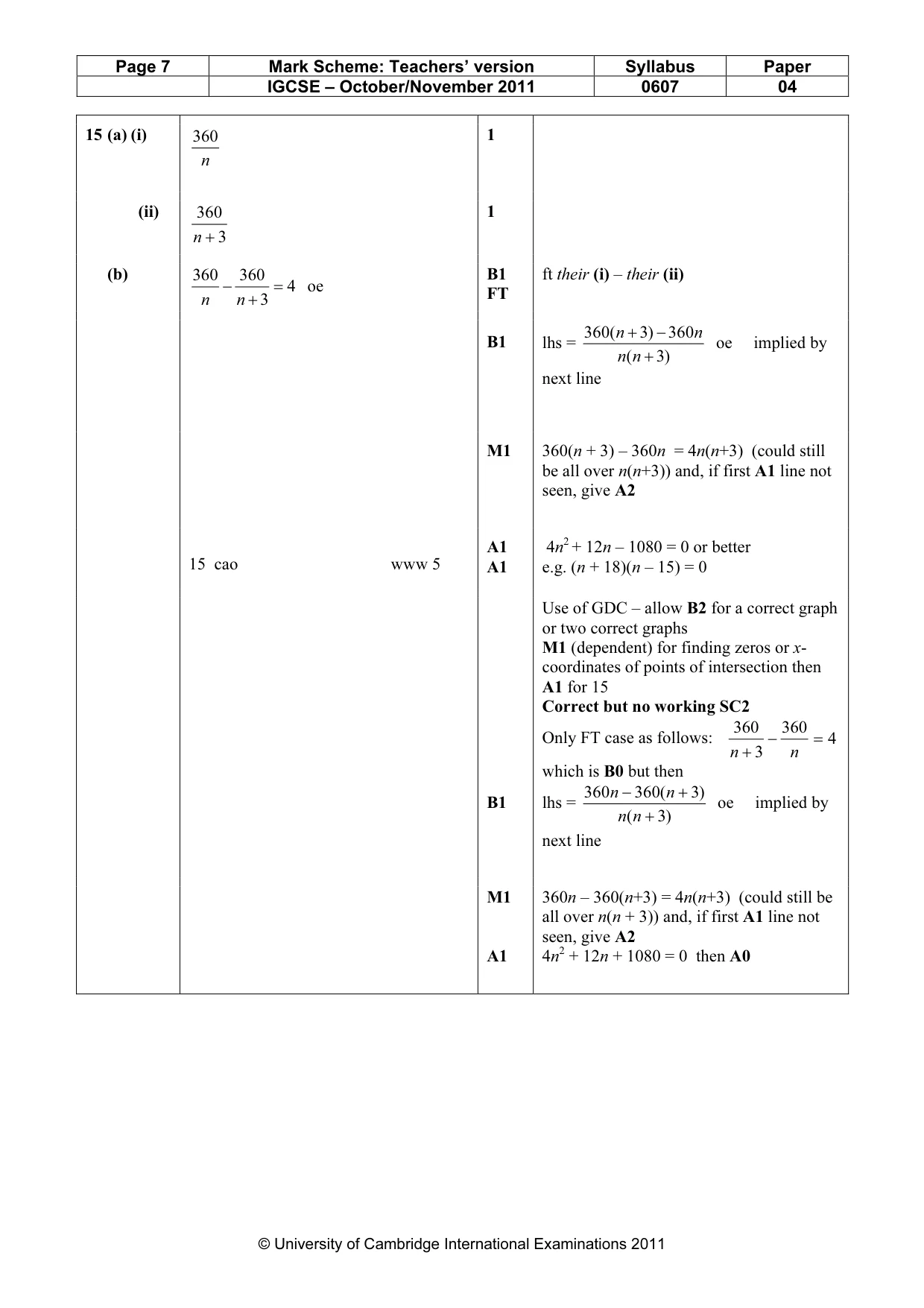
Mark scheme, page 7
Page 7 Mark Scheme: Teachers’ version Syllabus Paper IGCSE – October/November 2011 0607 04 © University of Cambridge International Examinations 2011 15 (a) (i) n 360 1 (ii) 3 360 + n 1 B1 FT ft their (i) – their (ii) B1 lhs = ) 3 ( 360 ) 3 ( 360 + − + n n n n oe implied by next line M1 360(n + 3) – 360n = 4n(n+3) (could still be all over n(n+3)) and, if first A1 line not seen, give A2 (b) 4 3 360 360 = + −n n oe 15 cao www 5 A1 A1 4n2 + 12n – 1080 = 0 or better e.g. (n + 18)(n – 15) = 0 B1 Use of GDC – allow B2 for a correct graph or two correct graphs M1 (dependent) for finding zeros or x- coordinates of points of intersection then A1 for 15 Correct but no working SC2 Only FT case as follows: 4 360 3 360 = − + n n which is B0 but then lhs = ) 3 ( ) 3 ( 360 360 + + − n n n n oe implied by next line M1 A1 360n – 360(n+3) = 4n(n+3) (could still be all over n(n + 3)) and, if first A1 line not seen, give A2 4n2 + 12n + 1080 = 0 then A0