Cambridge IGCSE Mathematics - International 0607 — 2010 Oct/Nov Paper 4 · Variant 1
0607/41/O/N/10 · 120 marks · ≈135 min
The question paper and its mark scheme, free to read here and free to download. This is Cambridge’s own paper, exactly as it was sat.
Question paper20 pages
Mark scheme5 pages
Answers below. Sit the paper first if you are practising.
Paper as text
Question paper, page 1
This document consists of 18 printed pages and 2 blank pages. IB10 11_0607_04/3RP © UCLES 2010 [Turn over *9202671358* For Examiner's Use UNIVERSITY OF CAMBRIDGE INTERNATIONAL EXAMINATIONS International General Certificate of Secondary Education CAMBRIDGE INTERNATIONAL MATHEMATICS 0607/04 Paper 4 (Extended) October/November 2010 2 hours 15 minutes Candidates answer on the Question Paper Additional Materials: Geometrical Instruments Graphics Calculator READ THESE INSTRUCTIONS FIRST Write your Centre number, candidate number and name on all the work you hand in. Write in dark blue or black pen. Do not use staples, paper clips, highlighters, glue or correction fluid. You may use a pencil for any diagrams or graphs. DO NOT WRITE IN ANY BARCODES. Answer all the questions. Unless instructed otherwise, give your answers exactly or correct to three significant figures as appropriate. Answers in degrees should be given to one decimal place. For π, use your calculator value. You must show all the relevant working to gain full marks and you will be given marks for correct methods, including sketches, even if your answer is incorrect. The number of marks is given in brackets [ ] at the end of each question or part question. The total number of marks for this paper is 120. www.XtremePapers.com
Question paper, page 2
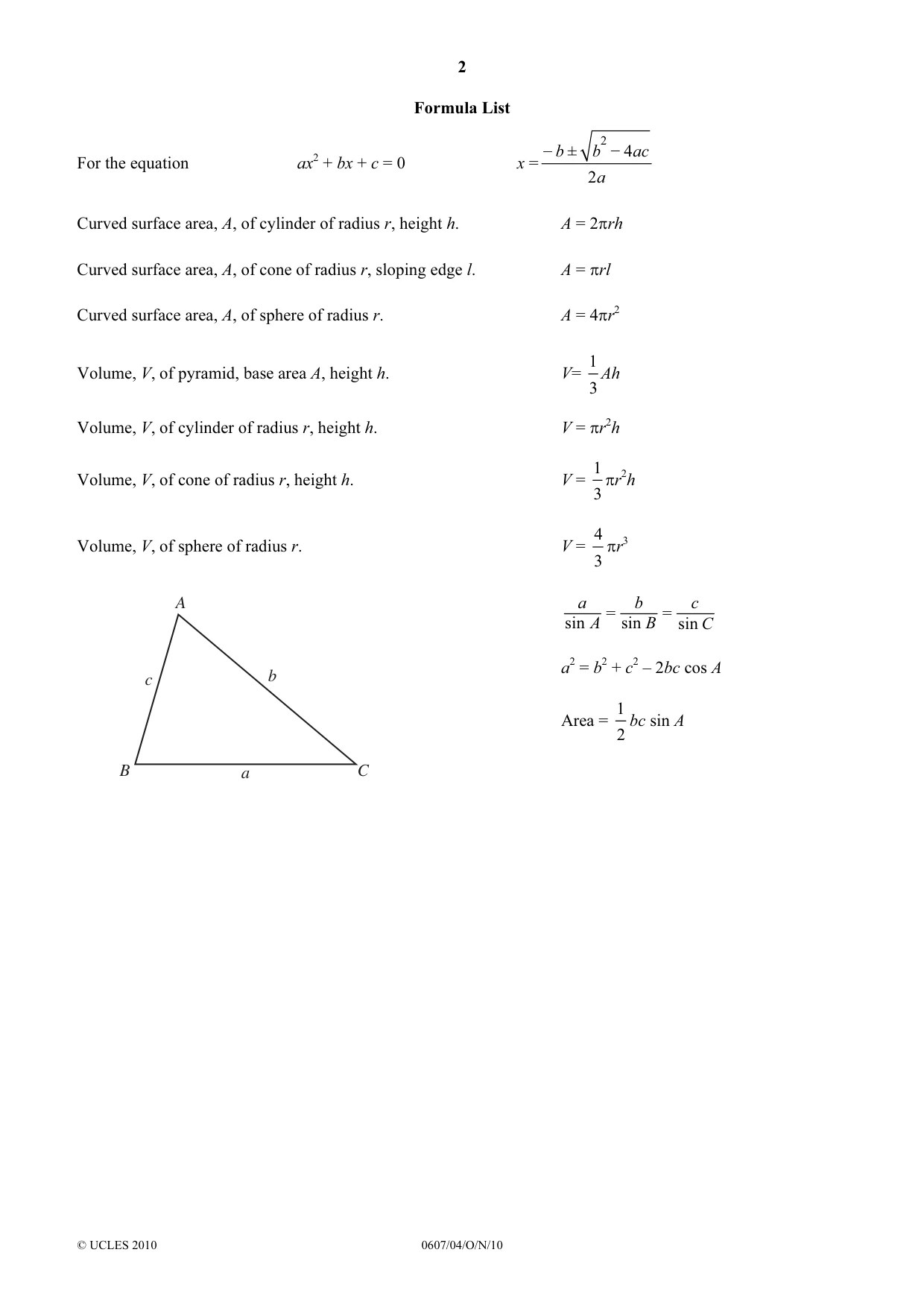
2 © UCLES 2010 0607/04/O/N/10 Formula List For the equation ax2 + bx + c = 0 x = 2 _ ± 4 2 _ b b ac a Curved surface area, A, of cylinder of radius r, height h. A = 2πrh Curved surface area, A, of cone of radius r, sloping edge l. A = πrl Curved surface area, A, of sphere of radius r. A = 4πr2 Volume, V, of pyramid, base area A, height h. V= 1 3 Ah Volume, V, of cylinder of radius r, height h. V = πr2h Volume, V, of cone of radius r, height h. V = 1 3 πr2h Volume, V, of sphere of radius r. V = 4 3 πr3 = = sin sin sin a b c A B C a2 = b2 + c2 – 2bc cos A Area = 1 2 bc sin A A a B C b c
Question paper, page 3
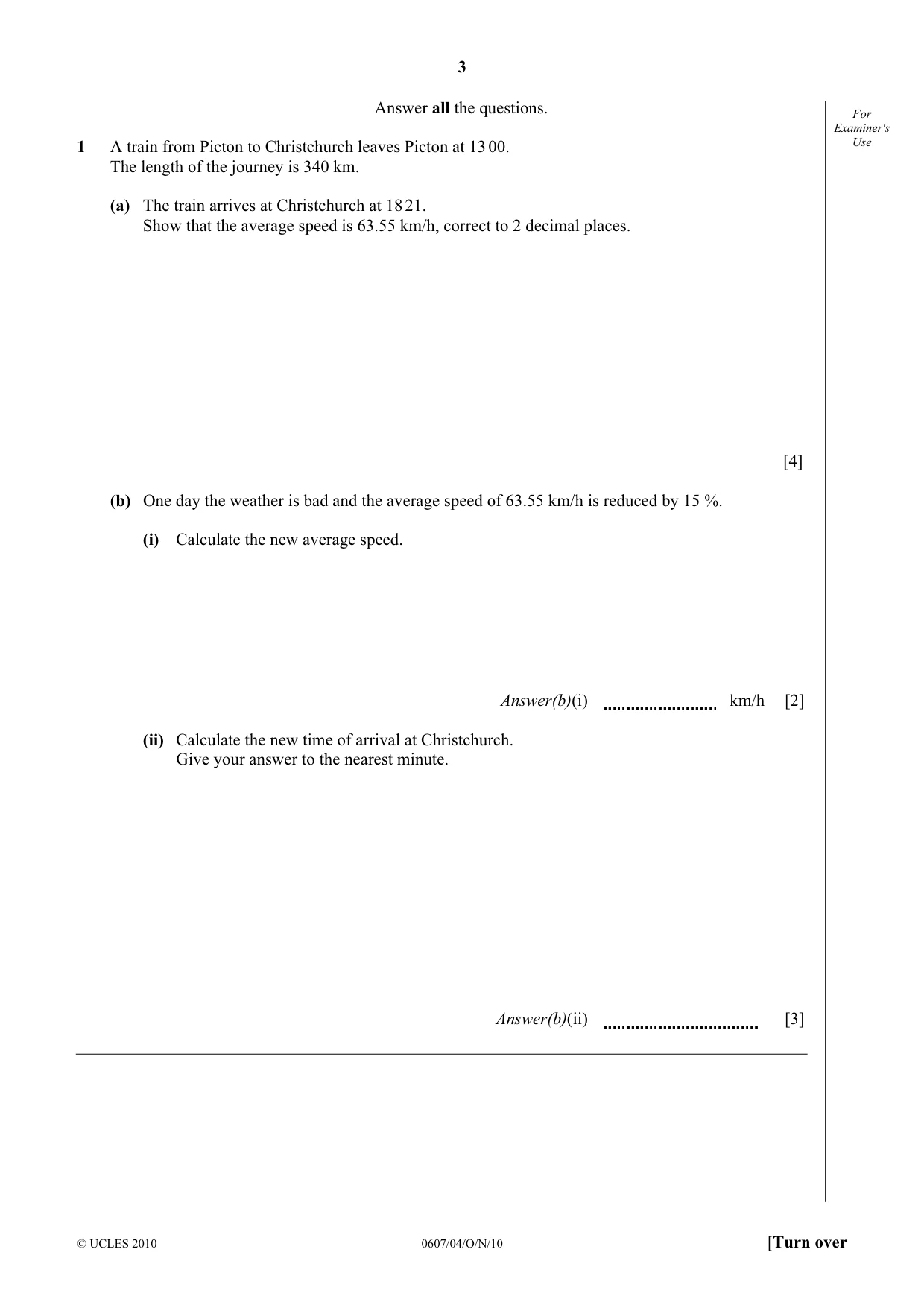
3 © UCLES 2010 0607/04/O/N/10 [Turn over For Examiner's Use Answer all the questions. 1 A train from Picton to Christchurch leaves Picton at 13 00. The length of the journey is 340 km. (a) The train arrives at Christchurch at 18 21. Show that the average speed is 63.55 km/h, correct to 2 decimal places. [4] (b) One day the weather is bad and the average speed of 63.55 km/h is reduced by 15 %. (i) Calculate the new average speed. Answer(b)(i) km/h [2] (ii) Calculate the new time of arrival at Christchurch. Give your answer to the nearest minute. Answer(b)(ii) [3]
Question paper, page 4
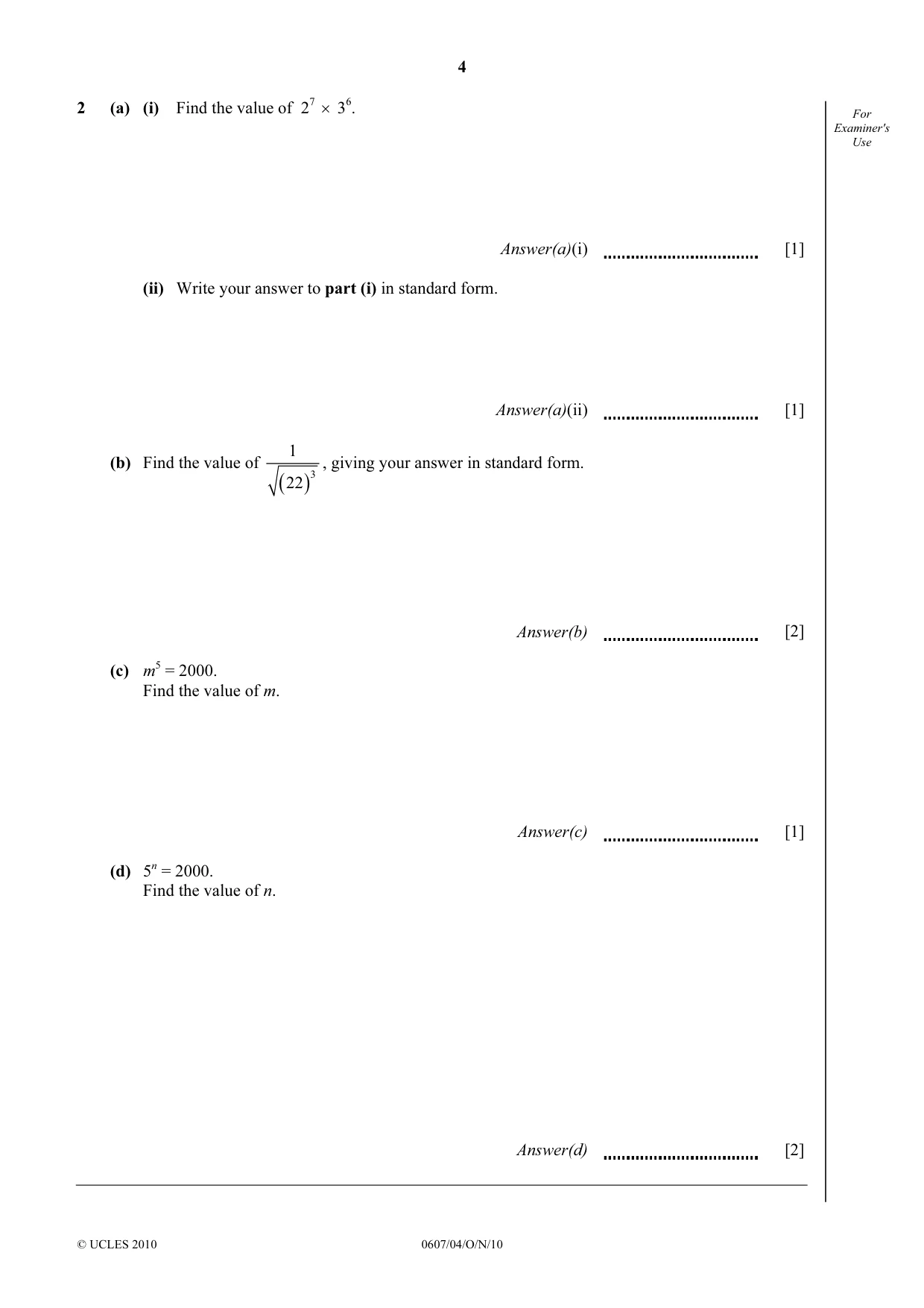
4 © UCLES 2010 0607/04/O/N/10 For Examiner's Use 2 (a) (i) Find the value of 27 × 36. Answer(a)(i) [1] (ii) Write your answer to part (i) in standard form. Answer(a)(ii) [1] (b) Find the value of ( ) 3 1 22 , giving your answer in standard form. Answer(b) [2] (c) m5 = 2000. Find the value of m. Answer(c) [1] (d) 5n = 2000. Find the value of n. Answer(d) [2]
Question paper, page 5
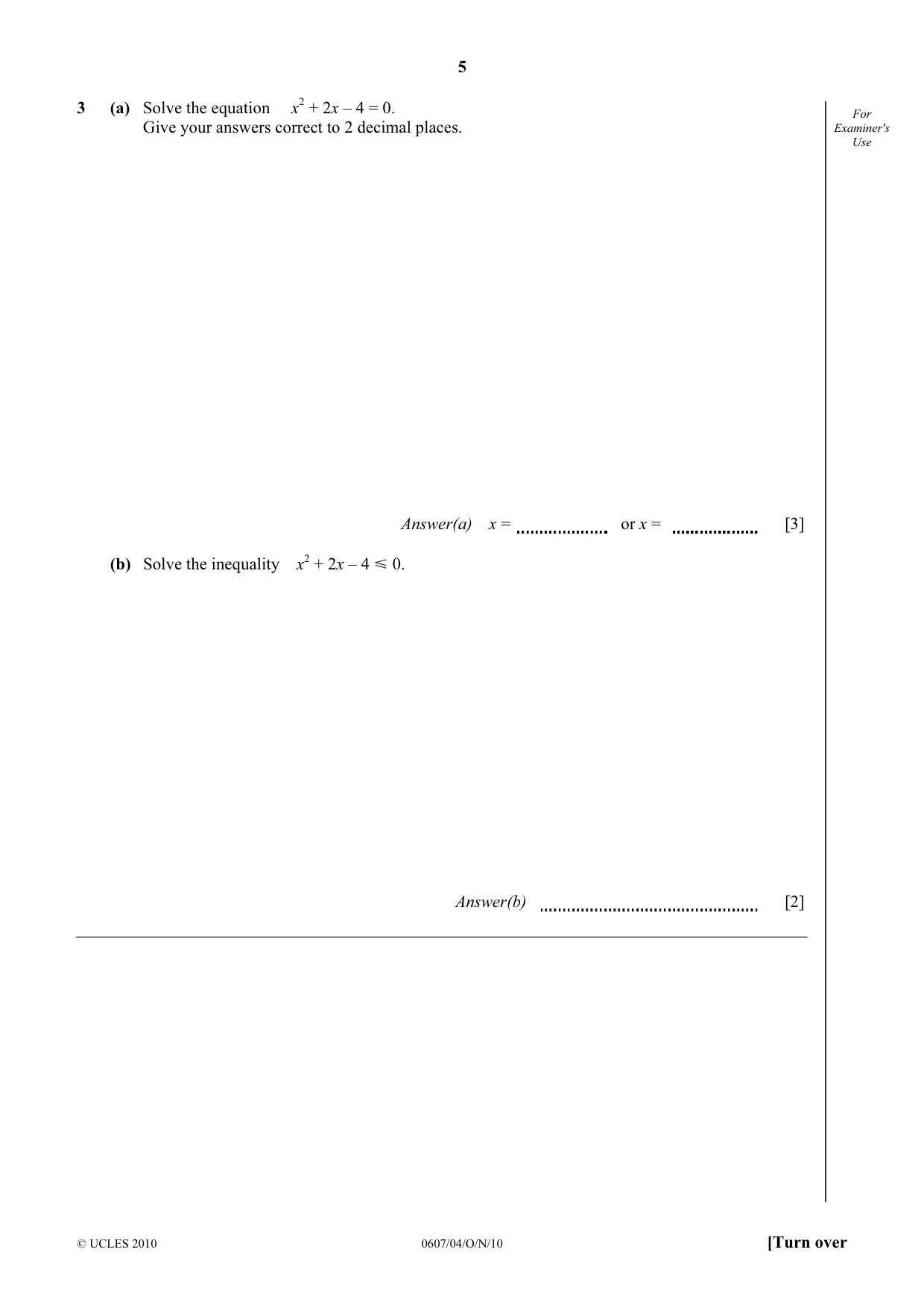
5 © UCLES 2010 0607/04/O/N/10 [Turn over For Examiner's Use 3 (a) Solve the equation x2 + 2x – 4 = 0. Give your answers correct to 2 decimal places. Answer(a) x = or x = [3] (b) Solve the inequality x2 + 2x – 4 Y 0. Answer(b) [2]
Question paper, page 6
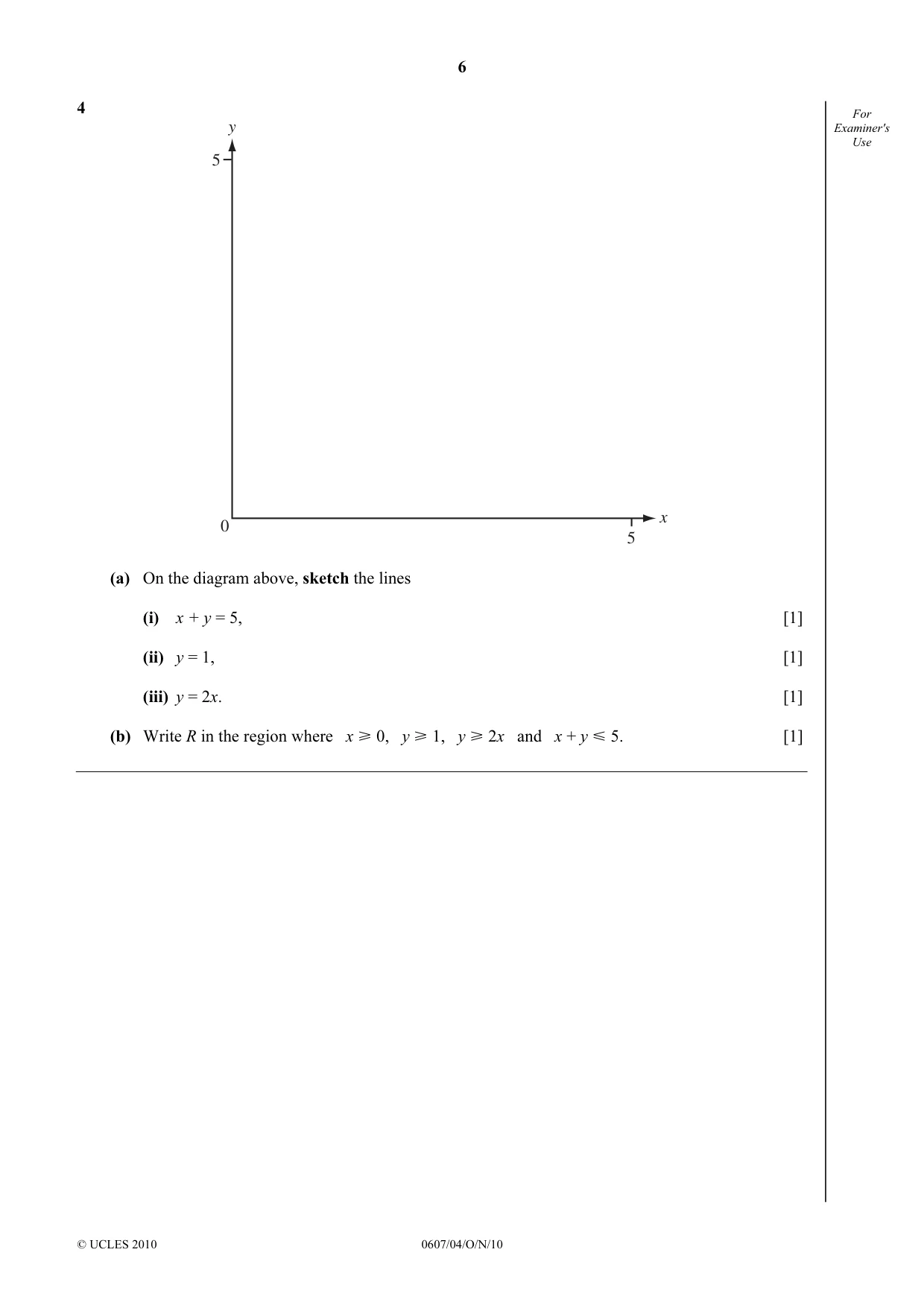
6 © UCLES 2010 0607/04/O/N/10 For Examiner's Use 4 0 5 5 y x (a) On the diagram above, sketch the lines (i) x + y = 5, [1] (ii) y = 1, [1] (iii) y = 2x. [1] (b) Write R in the region where x [ 0, y [ 1, y [ 2x and x + y Y 5. [1]
Question paper, page 7
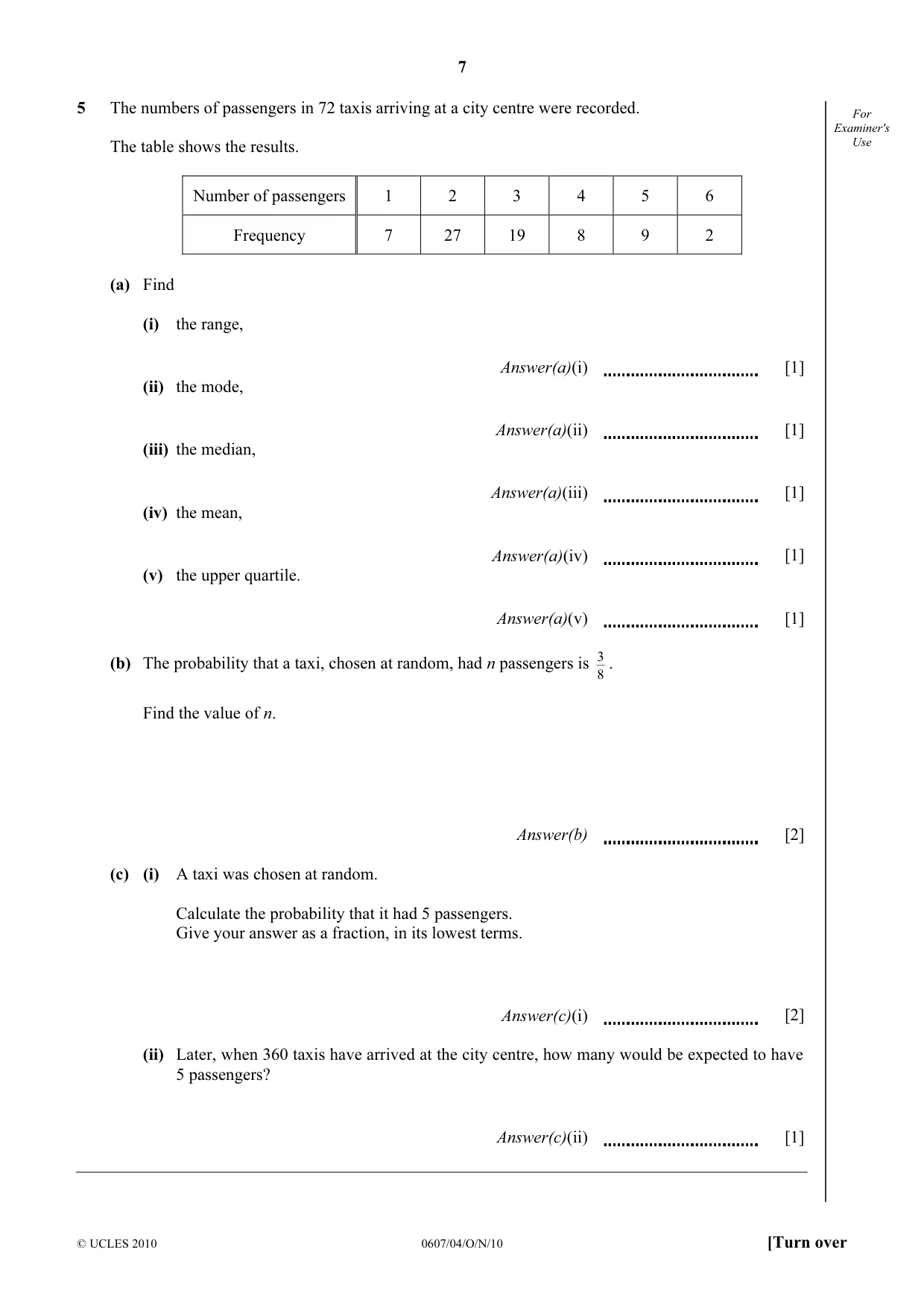
7 © UCLES 2010 0607/04/O/N/10 [Turn over For Examiner's Use 5 The numbers of passengers in 72 taxis arriving at a city centre were recorded. The table shows the results. Number of passengers 1 2 3 4 5 6 Frequency 7 27 19 8 9 2 (a) Find (i) the range, Answer(a)(i) [1] (ii) the mode, Answer(a)(ii) [1] (iii) the median, Answer(a)(iii) [1] (iv) the mean, Answer(a)(iv) [1] (v) the upper quartile. Answer(a)(v) [1] (b) The probability that a taxi, chosen at random, had n passengers is 3 8 . Find the value of n. Answer(b) [2] (c) (i) A taxi was chosen at random. Calculate the probability that it had 5 passengers. Give your answer as a fraction, in its lowest terms. Answer(c)(i) [2] (ii) Later, when 360 taxis have arrived at the city centre, how many would be expected to have 5 passengers? Answer(c)(ii) [1]
Question paper, page 8
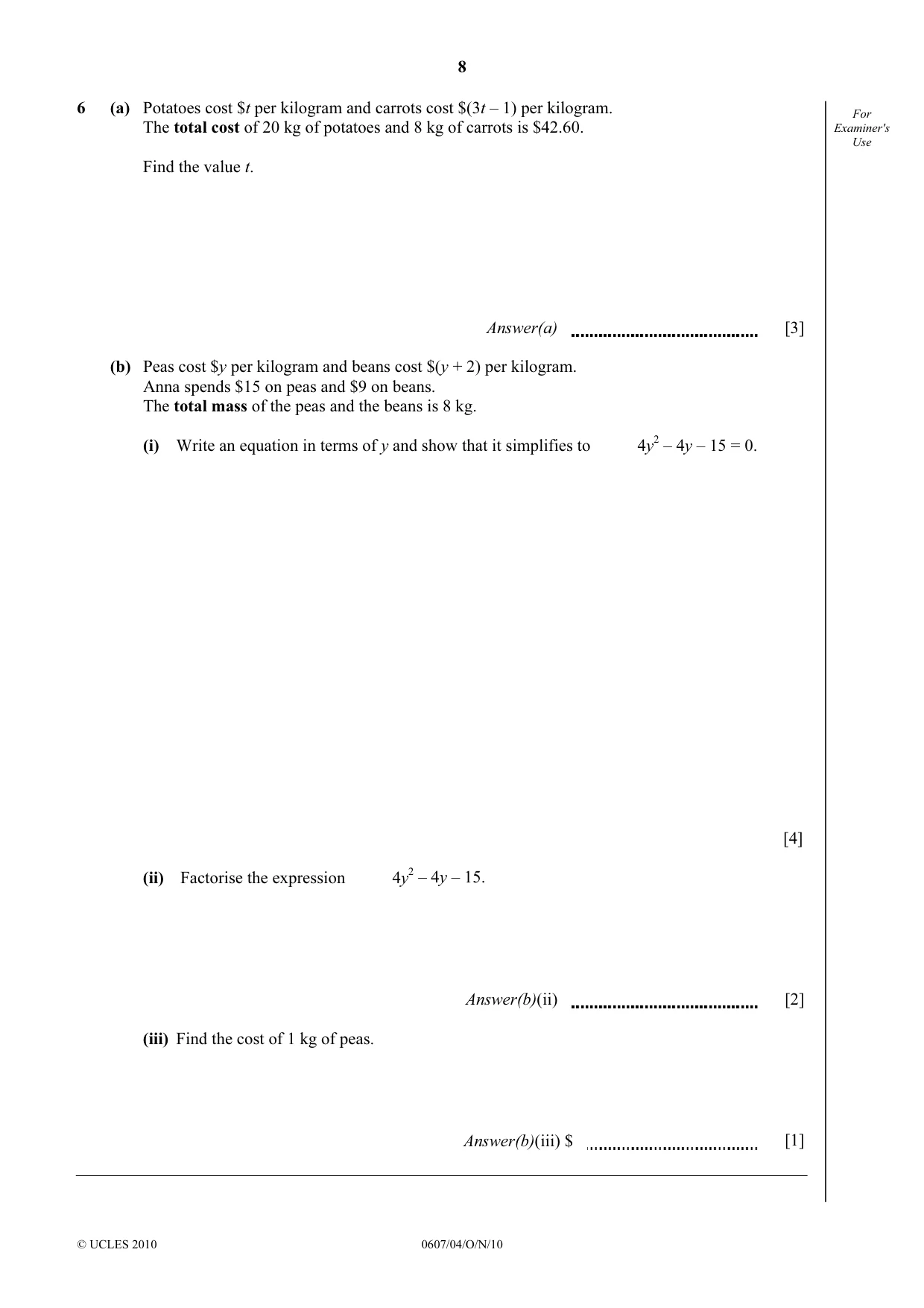
8 © UCLES 2010 0607/04/O/N/10 For Examiner's Use 6 (a) Potatoes cost $t per kilogram and carrots cost $(3t – 1) per kilogram. The total cost of 20 kg of potatoes and 8 kg of carrots is $42.60. Find the value t. Answer(a) [3] (b) Peas cost $y per kilogram and beans cost $(y + 2) per kilogram. Anna spends $15 on peas and $9 on beans. The total mass of the peas and the beans is 8 kg. (i) Write an equation in terms of y and show that it simplifies to 4y2 – 4y – 15 = 0. [4] (ii) Factorise the expression 4y2 – 4y – 15. Answer(b)(ii) [2] (iii) Find the cost of 1 kg of peas. Answer(b)(iii) $ [1]
Question paper, page 9
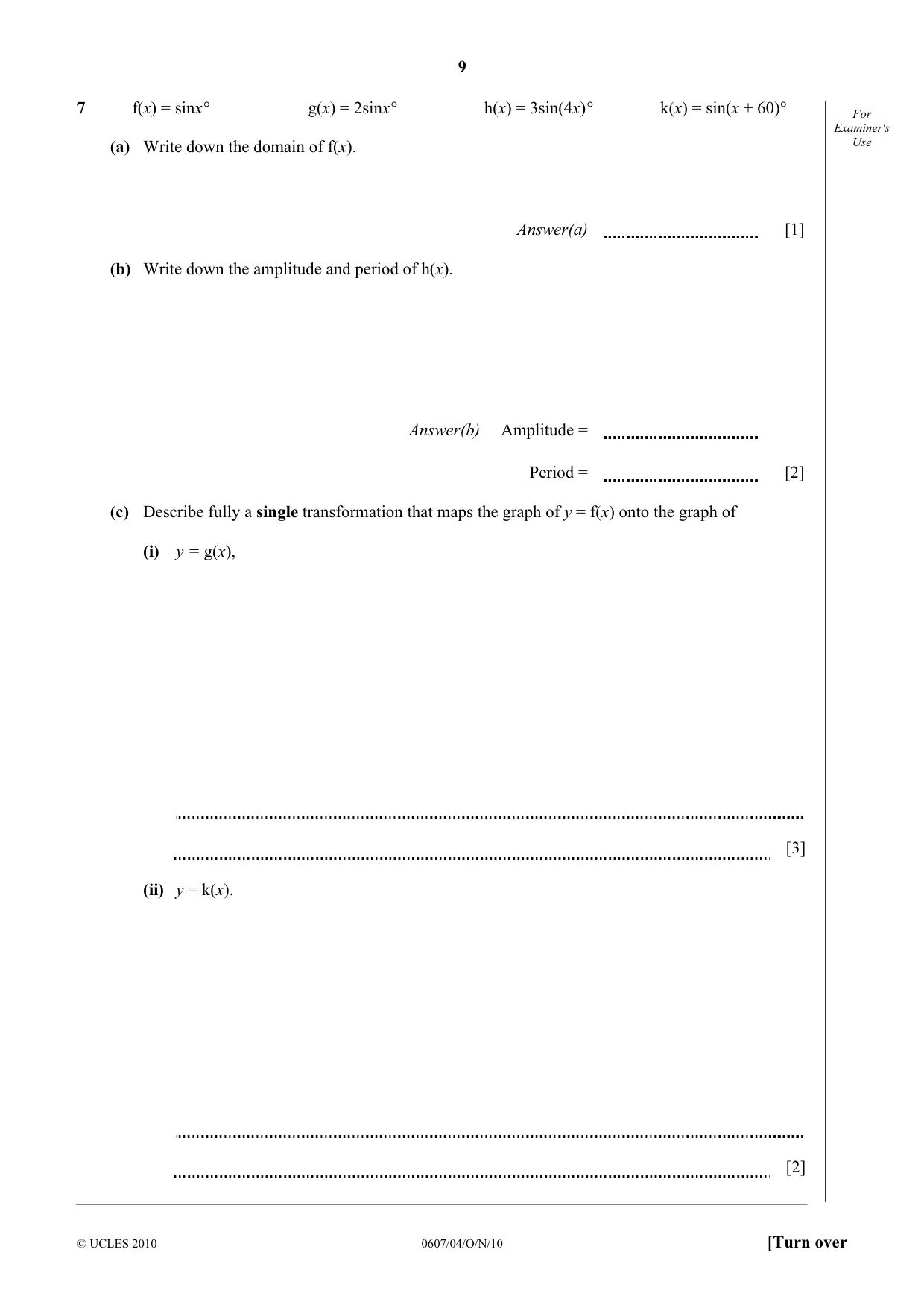
9 © UCLES 2010 0607/04/O/N/10 [Turn over For Examiner's Use 7 f(x) = sinx° g(x) = 2sinx° h(x) = 3sin(4x)° k(x) = sin(x + 60)° (a) Write down the domain of f(x). Answer(a) [1] (b) Write down the amplitude and period of h(x). Answer(b) Amplitude = Period = [2] (c) Describe fully a single transformation that maps the graph of y = f(x) onto the graph of (i) y = g(x), [3] (ii) y = k(x). [2]
Question paper, page 10
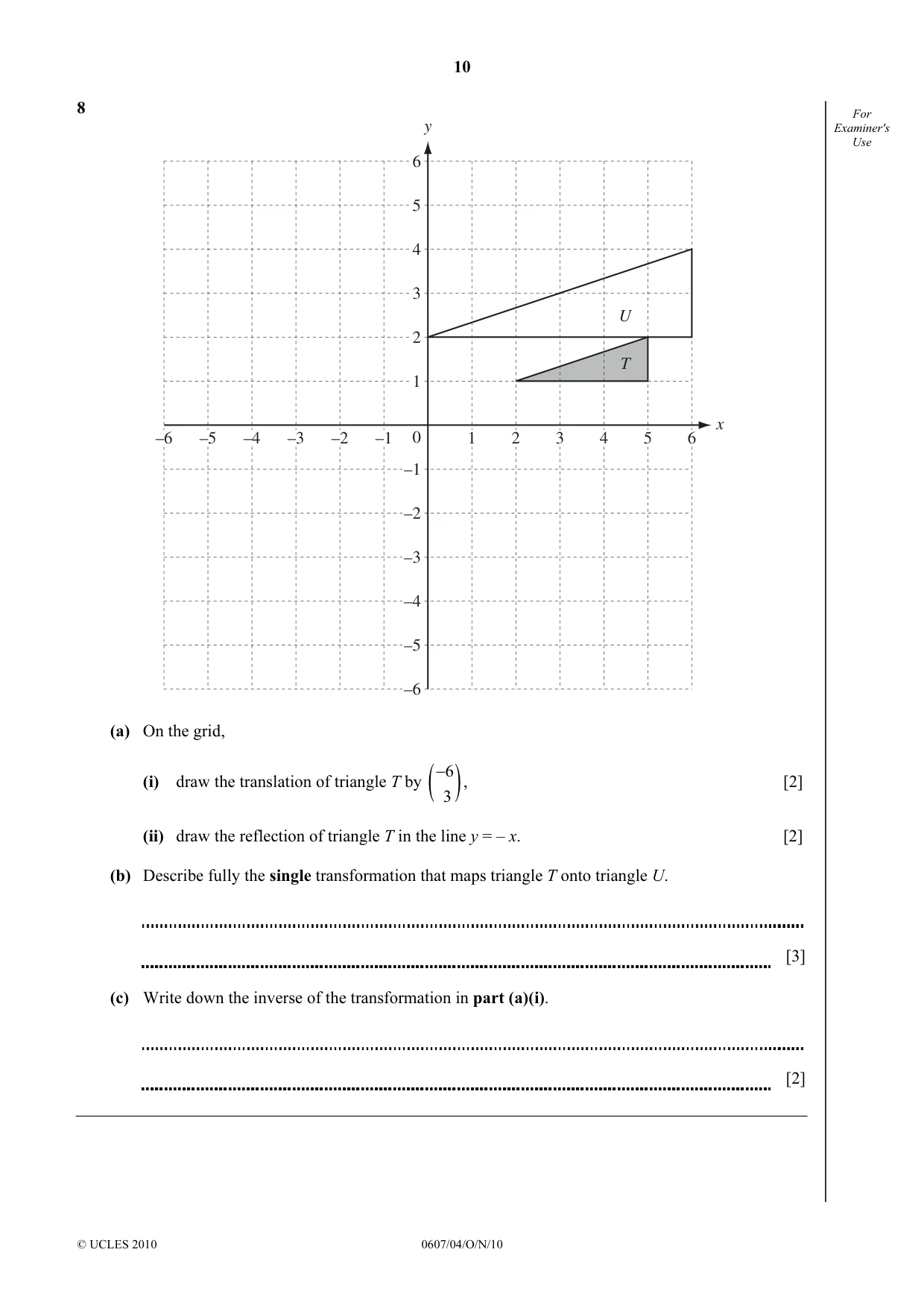
10 © UCLES 2010 0607/04/O/N/10 For Examiner's Use 8 U T y x 6 5 4 3 2 1 –1 –2 –3 –4 –5 –6 0 –6 –5 –4 –3 –2 –1 1 2 3 4 5 6 (a) On the grid, (i) draw the translation of triangle T by ( ) 6 3 − , [2] (ii) draw the reflection of triangle T in the line y = – x. [2] (b) Describe fully the single transformation that maps triangle T onto triangle U. [3] (c) Write down the inverse of the transformation in part (a)(i). [2]
Question paper, page 11
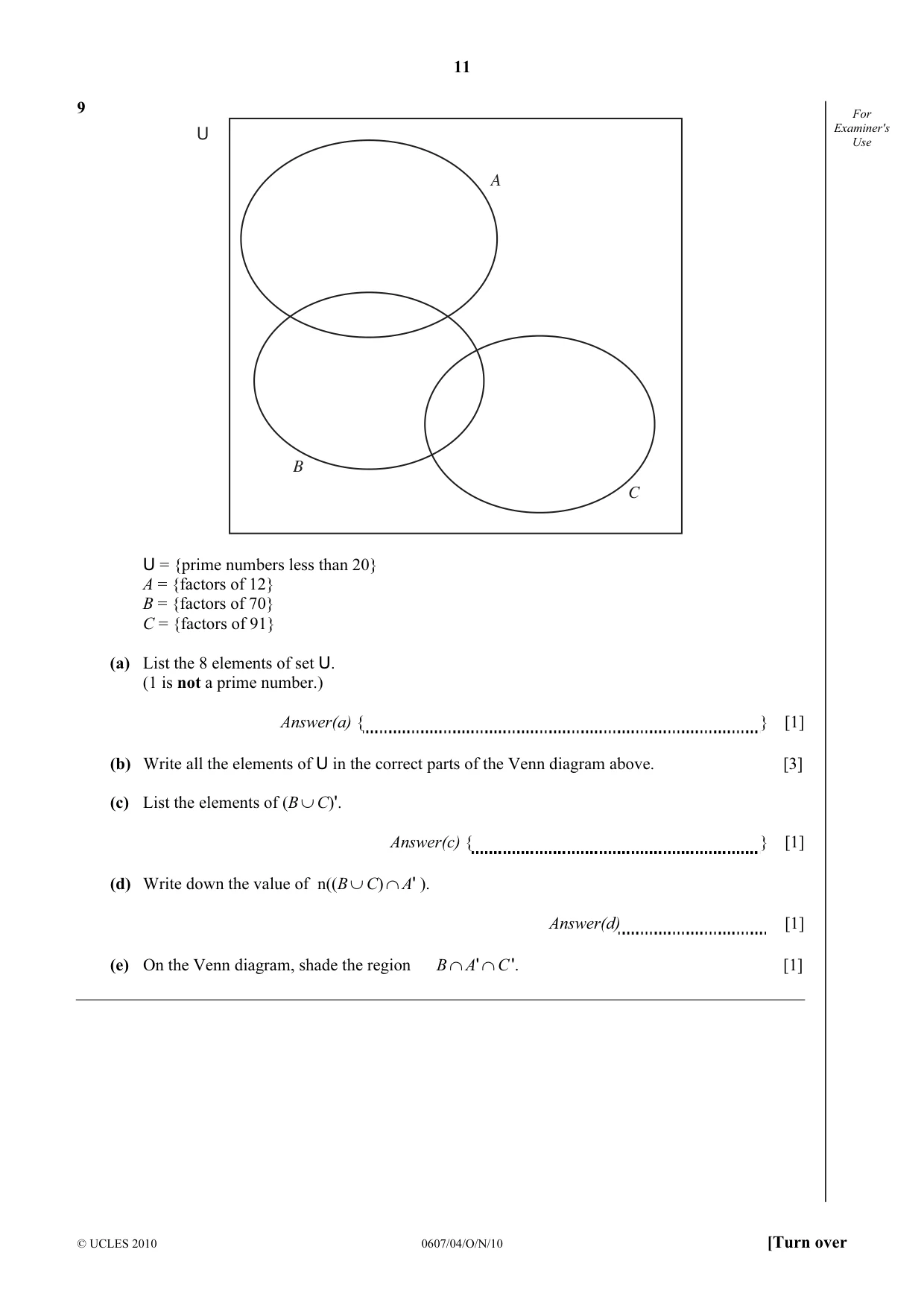
11 © UCLES 2010 0607/04/O/N/10 [Turn over For Examiner's Use 9 U A B C U = {prime numbers less than 20} A = {factors of 12} B = {factors of 70} C = {factors of 91} (a) List the 8 elements of set U. (1 is not a prime number.) Answer(a) { } [1] (b) Write all the elements of U in the correct parts of the Venn diagram above. [3] (c) List the elements of (B∪C)'. Answer(c) { } [1] (d) Write down the value of n((B ∪C)∩A' ). Answer(d) [1] (e) On the Venn diagram, shade the region B ∩A'∩C '. [1]
Question paper, page 12
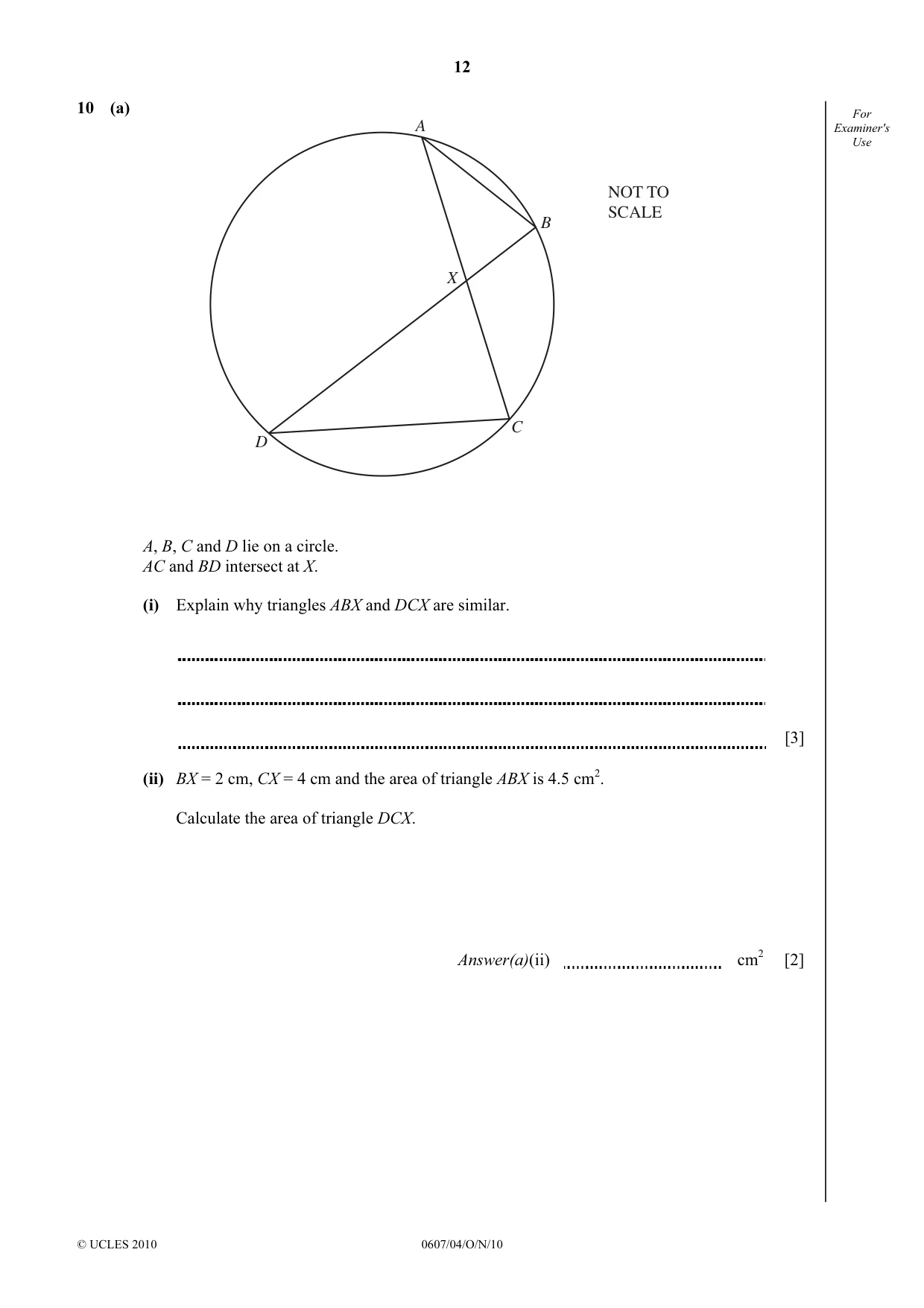
12 © UCLES 2010 0607/04/O/N/10 For Examiner's Use 10 (a) A B X D C NOT TO SCALE A, B, C and D lie on a circle. AC and BD intersect at X. (i) Explain why triangles ABX and DCX are similar. [3] (ii) BX = 2 cm, CX = 4 cm and the area of triangle ABX is 4.5 cm2. Calculate the area of triangle DCX. Answer(a)(ii) cm2 [2]
Question paper, page 13
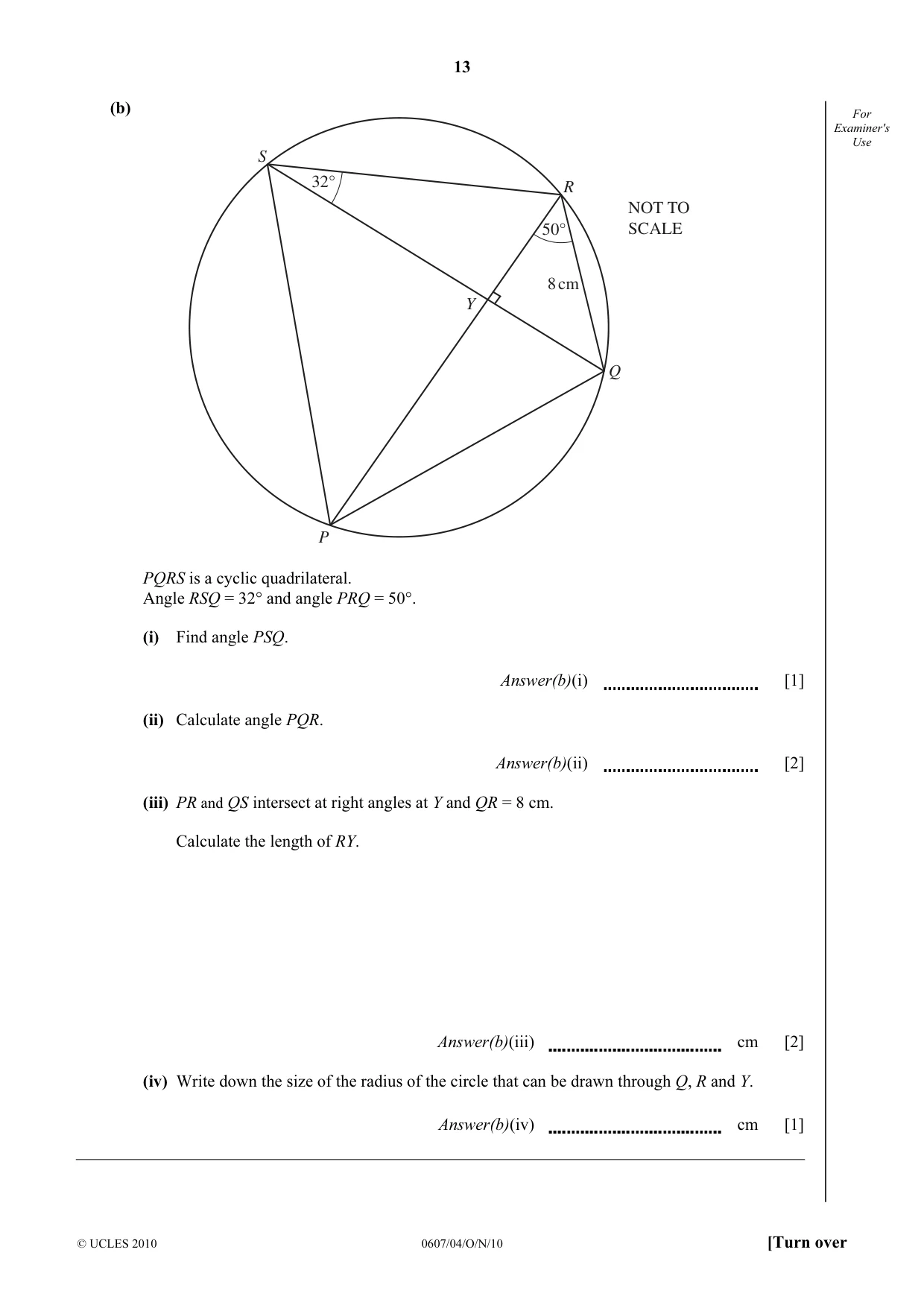
13 © UCLES 2010 0607/04/O/N/10 [Turn over For Examiner's Use (b) 50° 32° S P Y R Q 8 cm NOT TO SCALE PQRS is a cyclic quadrilateral. Angle RSQ = 32° and angle PRQ = 50°. (i) Find angle PSQ. Answer(b)(i) [1] (ii) Calculate angle PQR. Answer(b)(ii) [2] (iii) PR and QS intersect at right angles at Y and QR = 8 cm. Calculate the length of RY. Answer(b)(iii) cm [2] (iv) Write down the size of the radius of the circle that can be drawn through Q, R and Y. Answer(b)(iv) cm [1]
Question paper, page 14
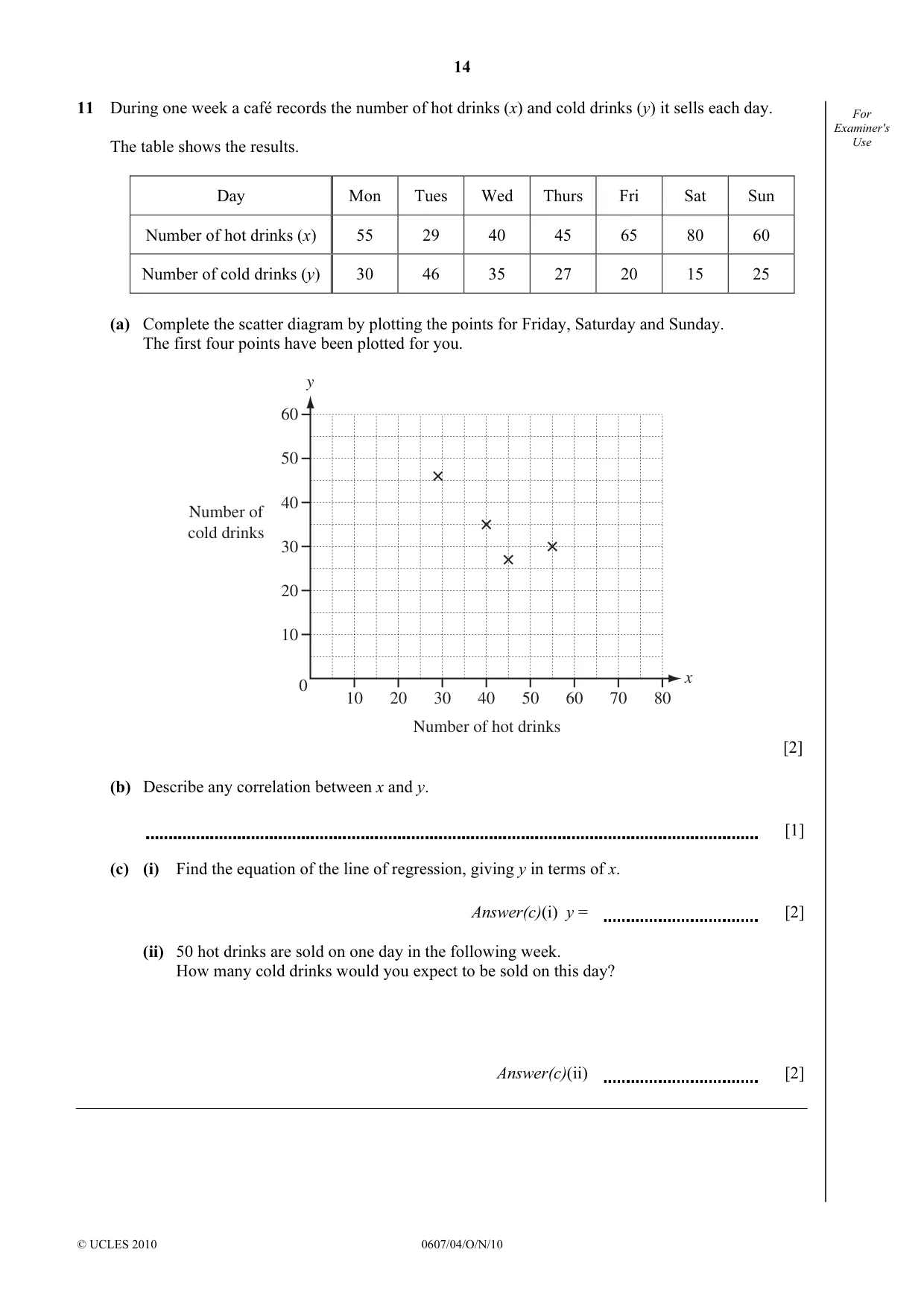
14 © UCLES 2010 0607/04/O/N/10 For Examiner's Use 11 During one week a café records the number of hot drinks (x) and cold drinks (y) it sells each day. The table shows the results. Day Mon Tues Wed Thurs Fri Sat Sun Number of hot drinks (x) 55 29 40 45 65 80 60 Number of cold drinks (y) 30 46 35 27 20 15 25 (a) Complete the scatter diagram by plotting the points for Friday, Saturday and Sunday. The first four points have been plotted for you. 60 50 40 30 20 10 0 10 20 30 40 50 60 70 80 y x Number of hot drinks Number of cold drinks [2] (b) Describe any correlation between x and y. [1] (c) (i) Find the equation of the line of regression, giving y in terms of x. Answer(c)(i) y = [2] (ii) 50 hot drinks are sold on one day in the following week. How many cold drinks would you expect to be sold on this day? Answer(c)(ii) [2]
Question paper, page 15
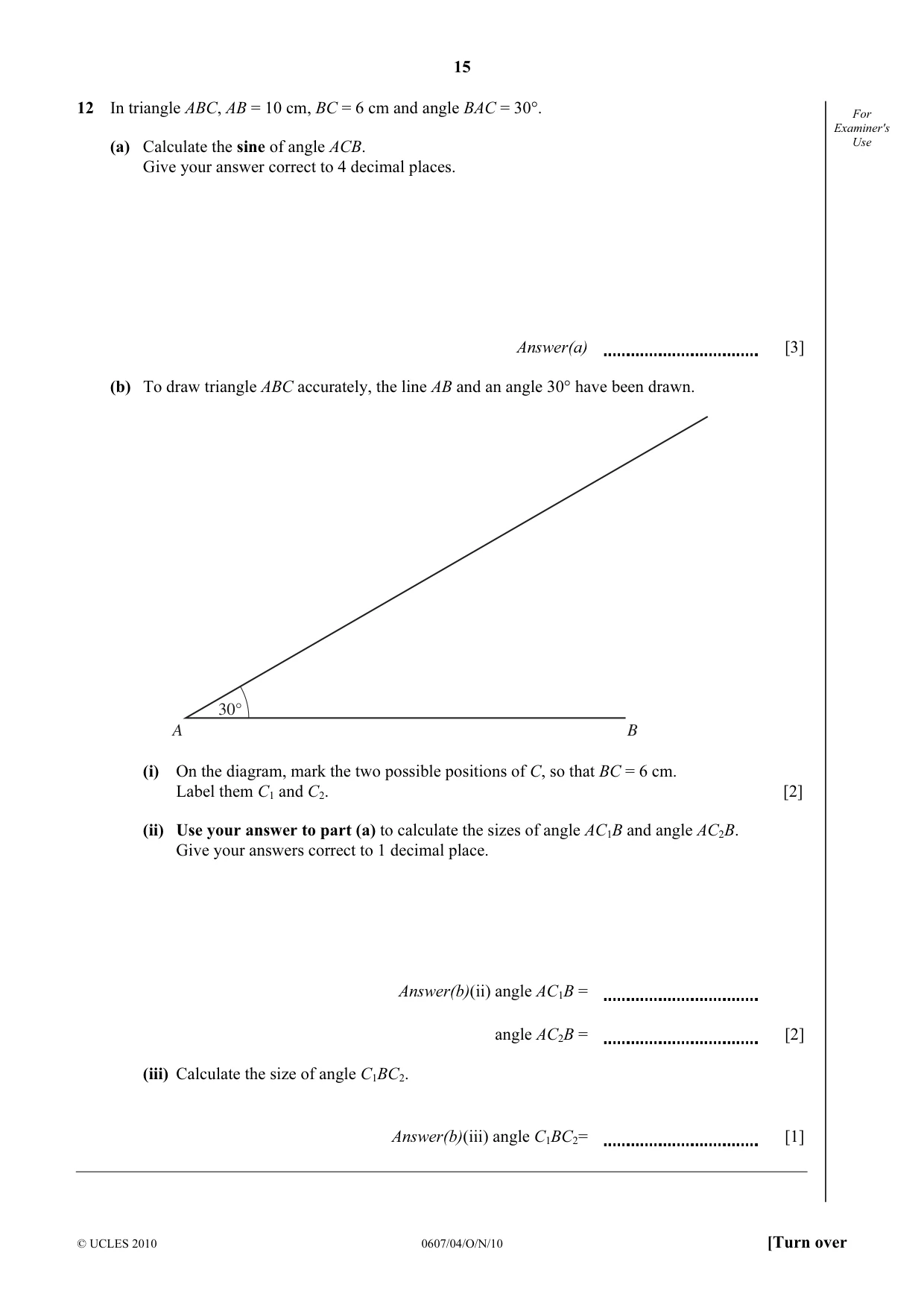
15 © UCLES 2010 0607/04/O/N/10 [Turn over For Examiner's Use 12 In triangle ABC, AB = 10 cm, BC = 6 cm and angle BAC = 30°. (a) Calculate the sine of angle ACB. Give your answer correct to 4 decimal places. Answer(a) [3] (b) To draw triangle ABC accurately, the line AB and an angle 30° have been drawn. A B 30° (i) On the diagram, mark the two possible positions of C, so that BC = 6 cm. Label them C1 and C2. [2] (ii) Use your answer to part (a) to calculate the sizes of angle AC1B and angle AC2B. Give your answers correct to 1 decimal place. Answer(b)(ii) angle AC1B = angle AC2B = [2] (iii) Calculate the size of angle C1BC2. Answer(b)(iii) angle C1BC2= [1]
Question paper, page 16
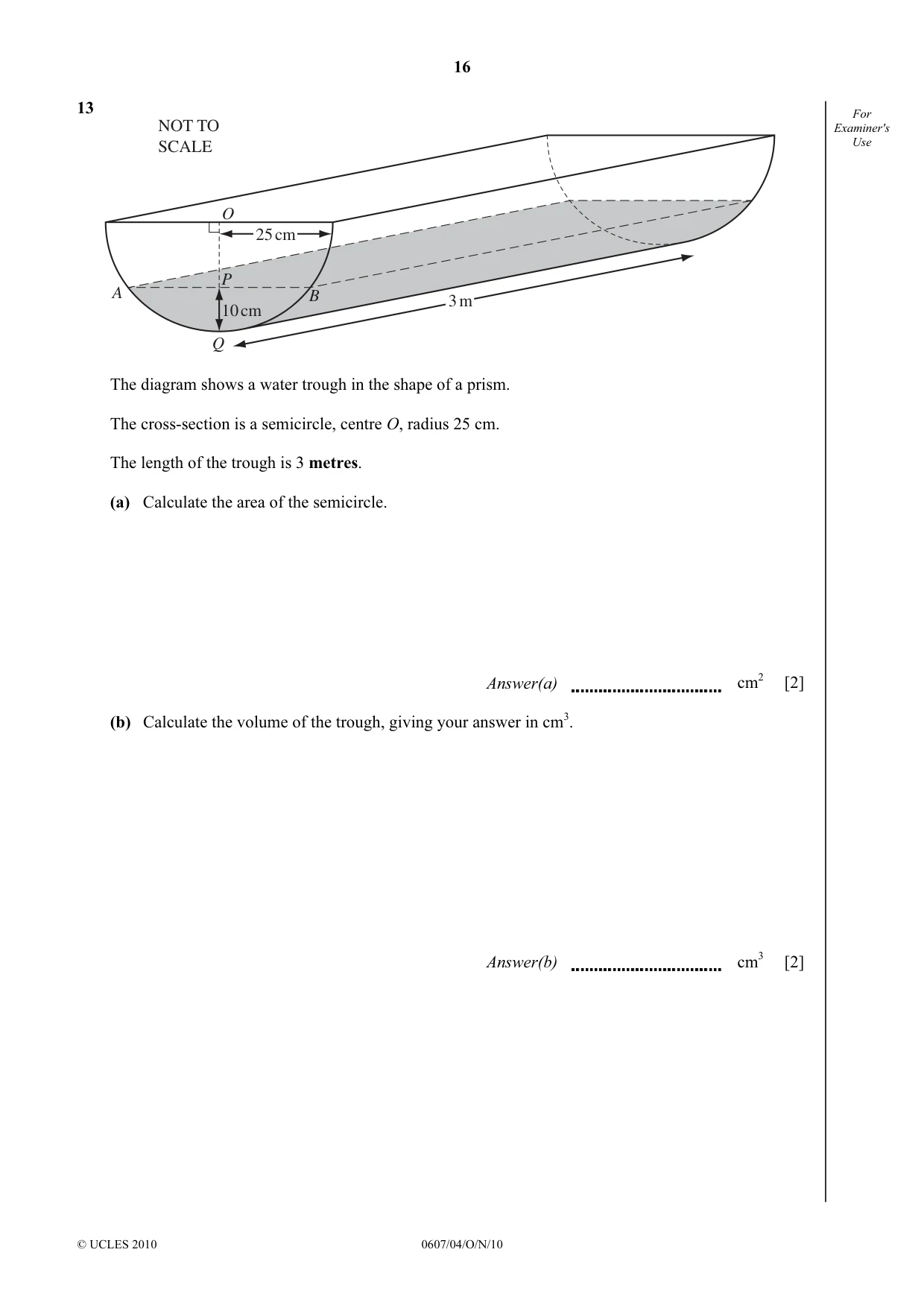
16 © UCLES 2010 0607/04/O/N/10 For Examiner's Use 13 10 cm 3 m 25 cm P O Q A B NOT TO SCALE The diagram shows a water trough in the shape of a prism. The cross-section is a semicircle, centre O, radius 25 cm. The length of the trough is 3 metres. (a) Calculate the area of the semicircle. Answer(a) cm2 [2] (b) Calculate the volume of the trough, giving your answer in cm3. Answer(b) cm3 [2]
Question paper, page 17
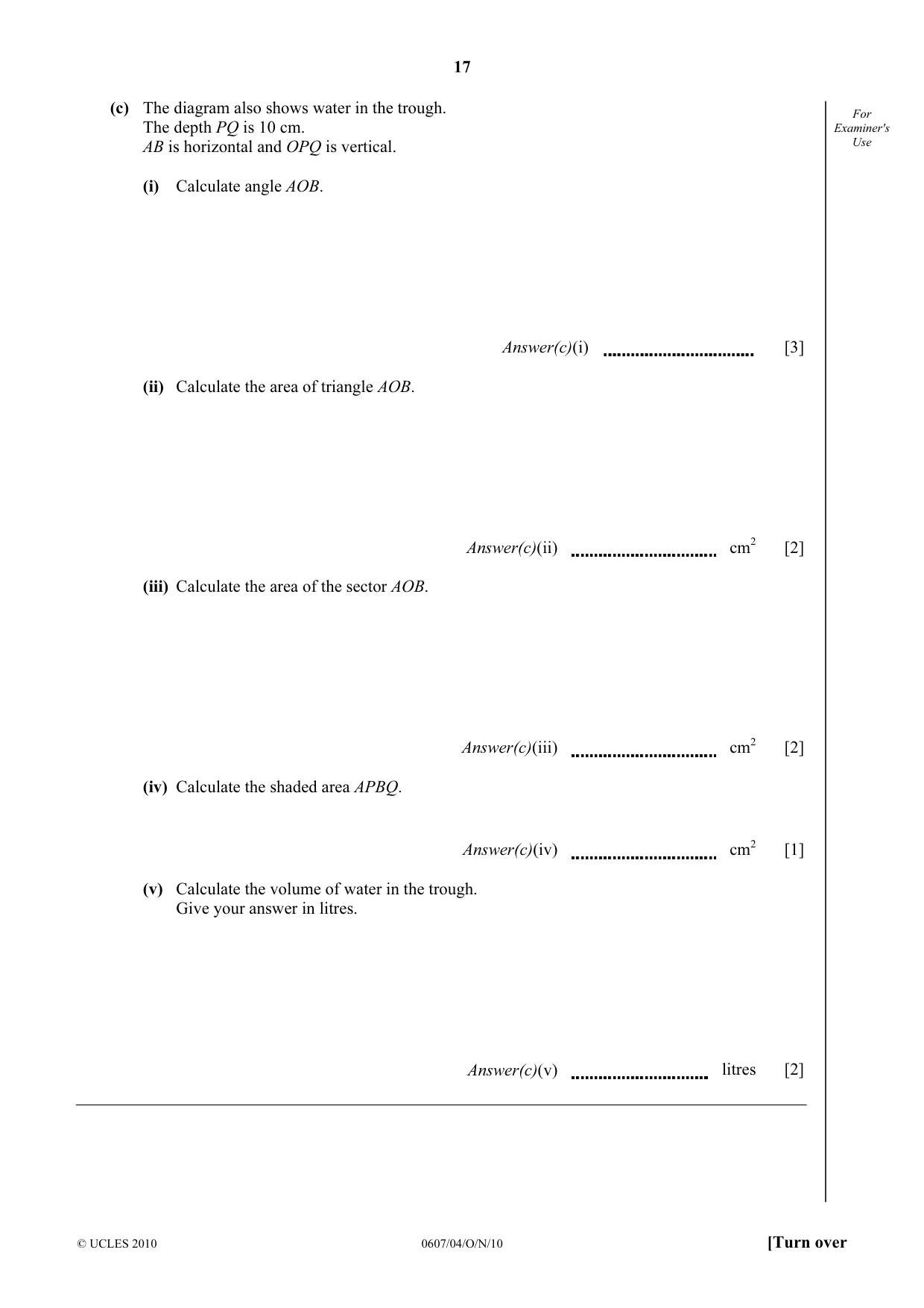
17 © UCLES 2010 0607/04/O/N/10 [Turn over For Examiner's Use (c) The diagram also shows water in the trough. The depth PQ is 10 cm. AB is horizontal and OPQ is vertical. (i) Calculate angle AOB. Answer(c)(i) [3] (ii) Calculate the area of triangle AOB. Answer(c)(ii) cm2 [2] (iii) Calculate the area of the sector AOB. Answer(c)(iii) cm2 [2] (iv) Calculate the shaded area APBQ. Answer(c)(iv) cm2 [1] (v) Calculate the volume of water in the trough. Give your answer in litres. Answer(c)(v) litres [2]
Question paper, page 18
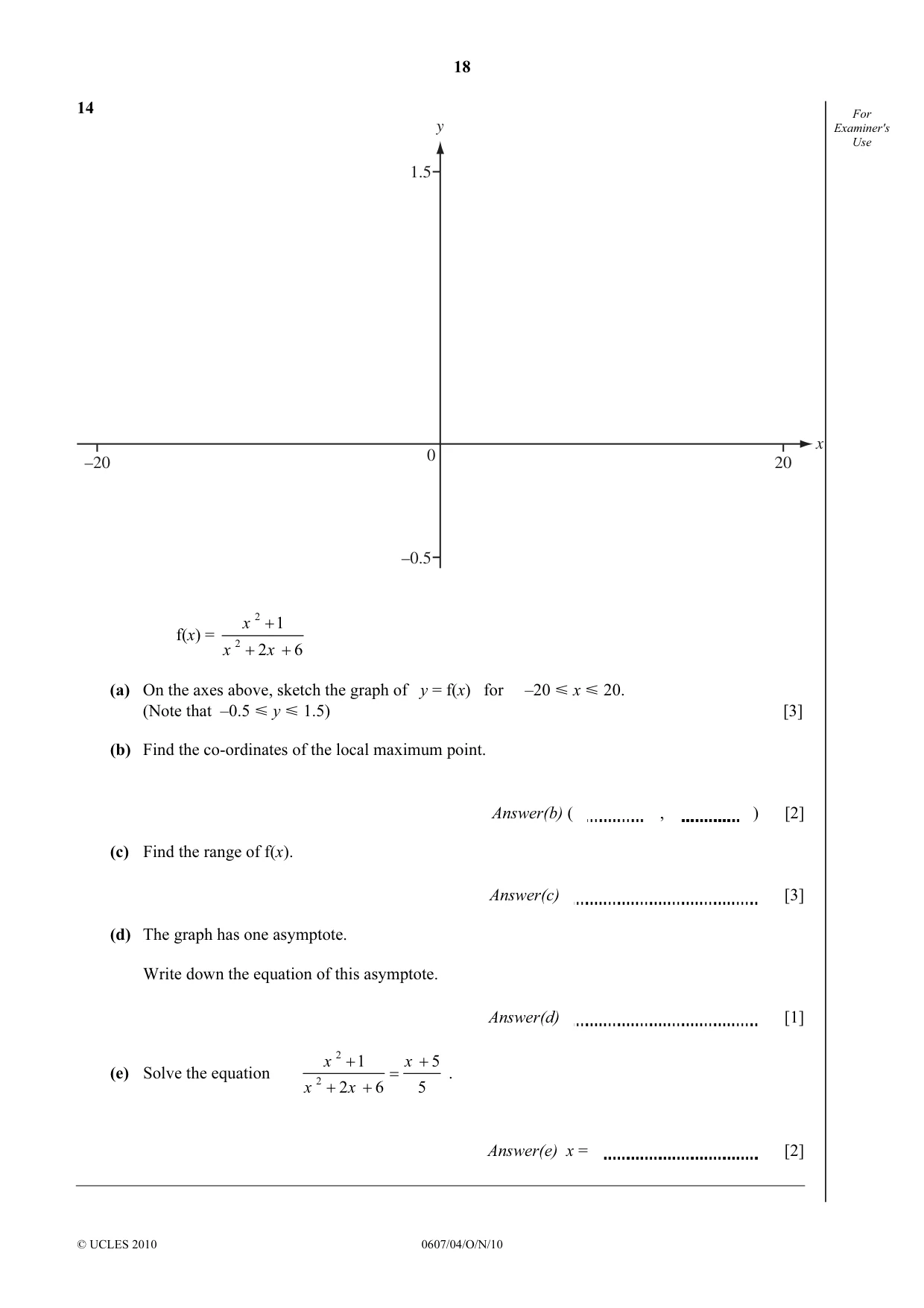
18 © UCLES 2010 0607/04/O/N/10 For Examiner's Use 14 20 –20 1.5 –0.5 0 y x f(x) = 2 2 1 2 6 x x x + + + (a) On the axes above, sketch the graph of y = f(x) for –20 Y x Y 20. (Note that –0.5 Y y Y 1.5) [3] (b) Find the co-ordinates of the local maximum point. Answer(b) ( , ) [2] (c) Find the range of f(x). Answer(c) [3] (d) The graph has one asymptote. Write down the equation of this asymptote. Answer(d) [1] (e) Solve the equation 2 2 1 5 2 6 5 x x x x + + = + + . Answer(e) x = [2]
Question paper, page 19
19 © UCLES 2010 0607/04/O/N/10 BLANK PAGE
Question paper, page 20
20 Permission to reproduce items where third-party owned material protected by copyright is included has been sought and cleared where possible. Every reasonable effort has been made by the publisher (UCLES) to trace copyright holders, but if any items requiring clearance have unwittingly been included, the publisher will be pleased to make amends at the earliest possible opportunity. University of Cambridge International Examinations is part of the Cambridge Assessment Group. Cambridge Assessment is the brand name of University of Cambridge Local Examinations Syndicate (UCLES), which is itself a department of the University of Cambridge. © UCLES 2010 0607/04/O/N/10 BLANK PAGE
Mark scheme, page 1
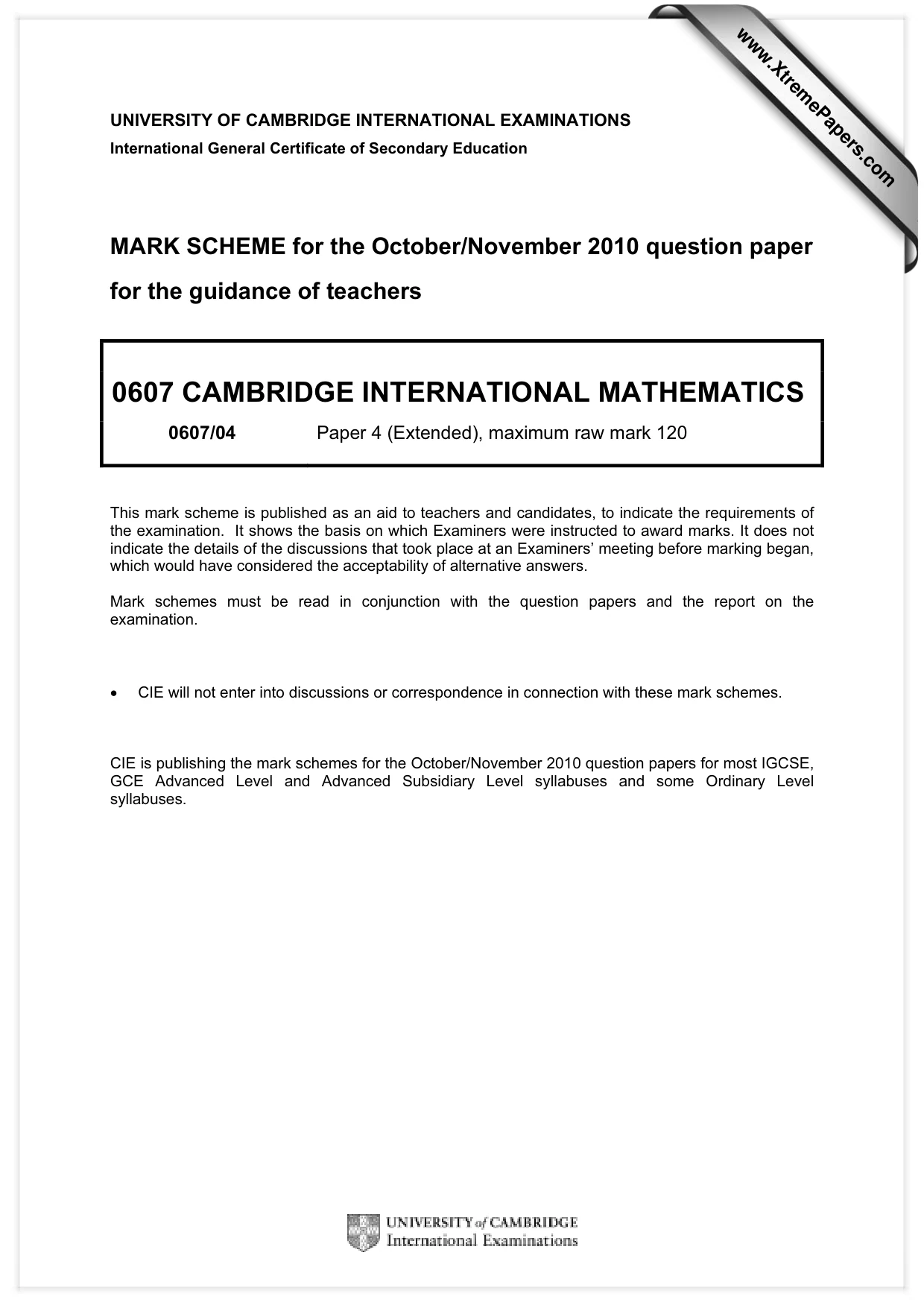
UNIVERSITY OF CAMBRIDGE INTERNATIONAL EXAMINATIONS International General Certificate of Secondary Education MARK SCHEME for the October/November 2010 question paper for the guidance of teachers 0607 CAMBRIDGE INTERNATIONAL MATHEMATICS 0607/04 Paper 4 (Extended), maximum raw mark 120 This mark scheme is published as an aid to teachers and candidates, to indicate the requirements of the examination. It shows the basis on which Examiners were instructed to award marks. It does not indicate the details of the discussions that took place at an Examiners’ meeting before marking began, which would have considered the acceptability of alternative answers. Mark schemes must be read in conjunction with the question papers and the report on the examination. • CIE will not enter into discussions or correspondence in connection with these mark schemes. CIE is publishing the mark schemes for the October/November 2010 question papers for most IGCSE, GCE Advanced Level and Advanced Subsidiary Level syllabuses and some Ordinary Level syllabuses. www.XtremePapers.com
Mark scheme, page 2
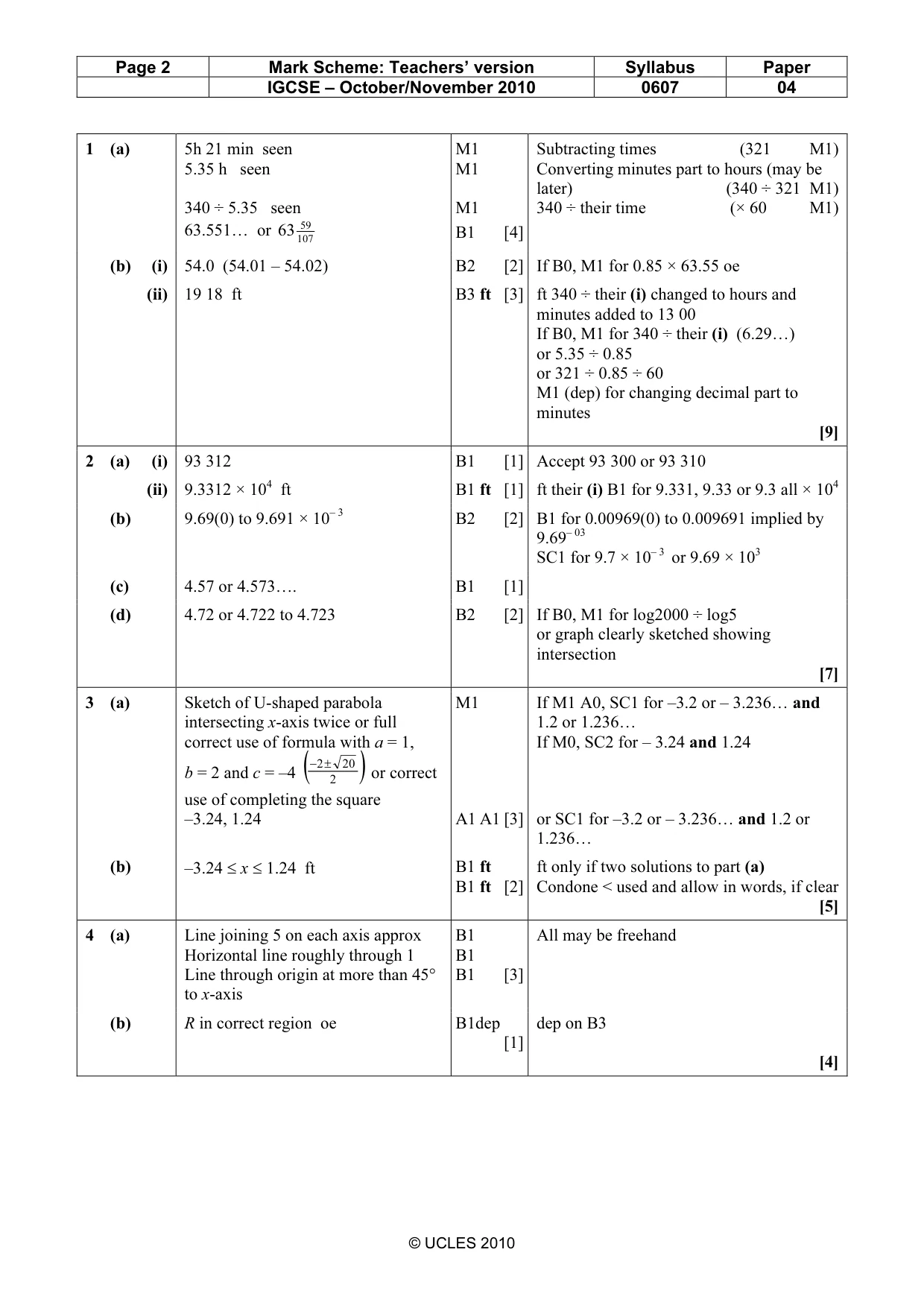
Page 2 Mark Scheme: Teachers’ version Syllabus Paper IGCSE – October/November 2010 0607 04 © UCLES 2010 1 (a) 5h 21 min seen 5.35 h seen 340 ÷ 5.35 seen 63.551… or 107 59 63 M1 M1 M1 B1 [4] Subtracting times (321 M1) Converting minutes part to hours (may be later) (340 ÷ 321 M1) 340 ÷ their time (× 60 M1) (b) (i) 54.0 (54.01 – 54.02) B2 [2] If B0, M1 for 0.85 × 63.55 oe (ii) 19 18 ft B3 ft [3] ft 340 ÷ their (i) changed to hours and minutes added to 13 00 If B0, M1 for 340 ÷ their (i) (6.29…) or 5.35 ÷ 0.85 or 321 ÷ 0.85 ÷ 60 M1 (dep) for changing decimal part to minutes [9] 2 (a) (i) 93 312 B1 [1] Accept 93 300 or 93 310 (ii) 9.3312 × 104 ft B1 ft [1] ft their (i) B1 for 9.331, 9.33 or 9.3 all × 104 (b) 9.69(0) to 9.691 × 10– 3 B2 [2] B1 for 0.00969(0) to 0.009691 implied by 9.69– 03 SC1 for 9.7 × 10– 3 or 9.69 × 10³ (c) 4.57 or 4.573…. B1 [1] (d) 4.72 or 4.722 to 4.723 B2 [2] If B0, M1 for log2000 ÷ log5 or graph clearly sketched showing intersection [7] 3 (a) Sketch of U-shaped parabola intersecting x-axis twice or full correct use of formula with a = 1, b = 2 and c = –4 ( ) 2 20 2± − or correct use of completing the square –3.24, 1.24 M1 A1 A1 [3] If M1 A0, SC1 for –3.2 or – 3.236… and 1.2 or 1.236… If M0, SC2 for – 3.24 and 1.24 or SC1 for –3.2 or – 3.236… and 1.2 or 1.236… (b) –3.24 ≤ x ≤ 1.24 ft B1 ft B1 ft [2] ft only if two solutions to part (a) Condone < used and allow in words, if clear [5] 4 (a) Line joining 5 on each axis approx Horizontal line roughly through 1 Line through origin at more than 45° to x-axis B1 B1 B1 [3] All may be freehand (b) R in correct region oe B1dep [1] dep on B3 [4]
Mark scheme, page 3
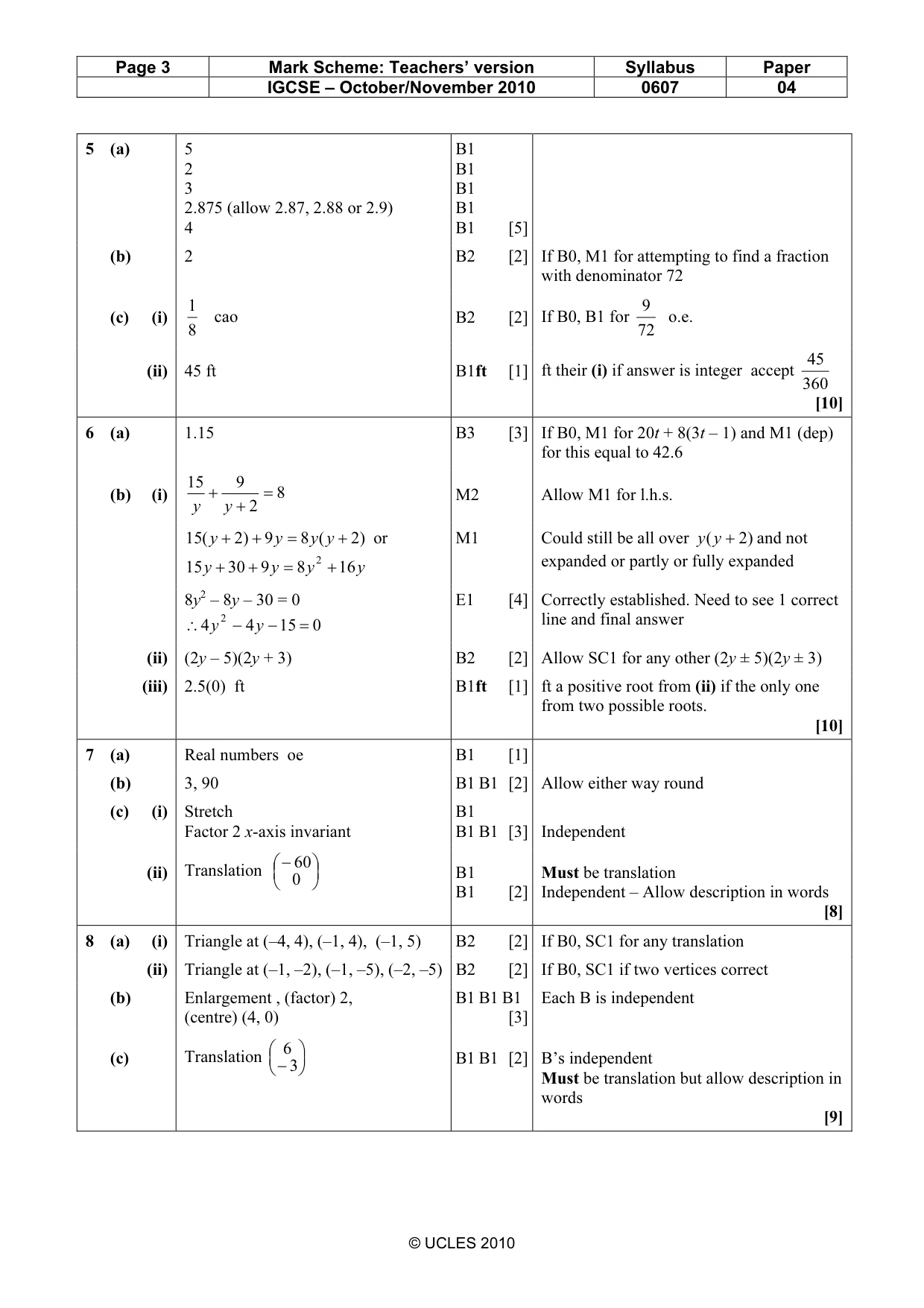
Page 3 Mark Scheme: Teachers’ version Syllabus Paper IGCSE – October/November 2010 0607 04 © UCLES 2010 5 (a) 5 2 3 2.875 (allow 2.87, 2.88 or 2.9) 4 B1 B1 B1 B1 B1 [5] (b) 2 B2 [2] If B0, M1 for attempting to find a fraction with denominator 72 (c) (i) 8 1 cao B2 [2] If B0, B1 for 72 9 o.e. (ii) 45 ft B1ft [1] ft their (i) if answer is integer accept 360 45 [10] 6 (a) 1.15 B3 [3] If B0, M1 for 20t + 8(3t – 1) and M1 (dep) for this equal to 42.6 (b) (i) 8 2 9 15 = + + y y M2 Allow M1 for l.h.s. ) 2 ( 8 9 ) 2 ( 15 + = + + y y y y or y y y y 16 8 9 30 15 2 + = + + M1 Could still be all over ) 2 ( + y y and not expanded or partly or fully expanded 8y2 – 8y – 30 = 0 0 15 4 4 2 = − − ∴ y y E1 [4] Correctly established. Need to see 1 correct line and final answer (ii) (2y – 5)(2y + 3) B2 [2] Allow SC1 for any other (2y ± 5)(2y ± 3) (iii) 2.5(0) ft B1ft [1] ft a positive root from (ii) if the only one from two possible roots. [10] 7 (a) Real numbers oe B1 [1] (b) 3, 90 B1 B1 [2] Allow either way round (c) (i) Stretch Factor 2 x-axis invariant B1 B1 B1 [3] Independent (ii) Translation − 0 60 B1 B1 [2] Must be translation Independent – Allow description in words [8] 8 (a) (i) Triangle at (–4, 4), (–1, 4), (–1, 5) B2 [2] If B0, SC1 for any translation (ii) Triangle at (–1, –2), (–1, –5), (–2, –5) B2 [2] If B0, SC1 if two vertices correct (b) Enlargement , (factor) 2, (centre) (4, 0) B1 B1 B1 [3] Each B is independent (c) Translation −3 6 B1 B1 [2] B’s independent Must be translation but allow description in words [9]
Mark scheme, page 4
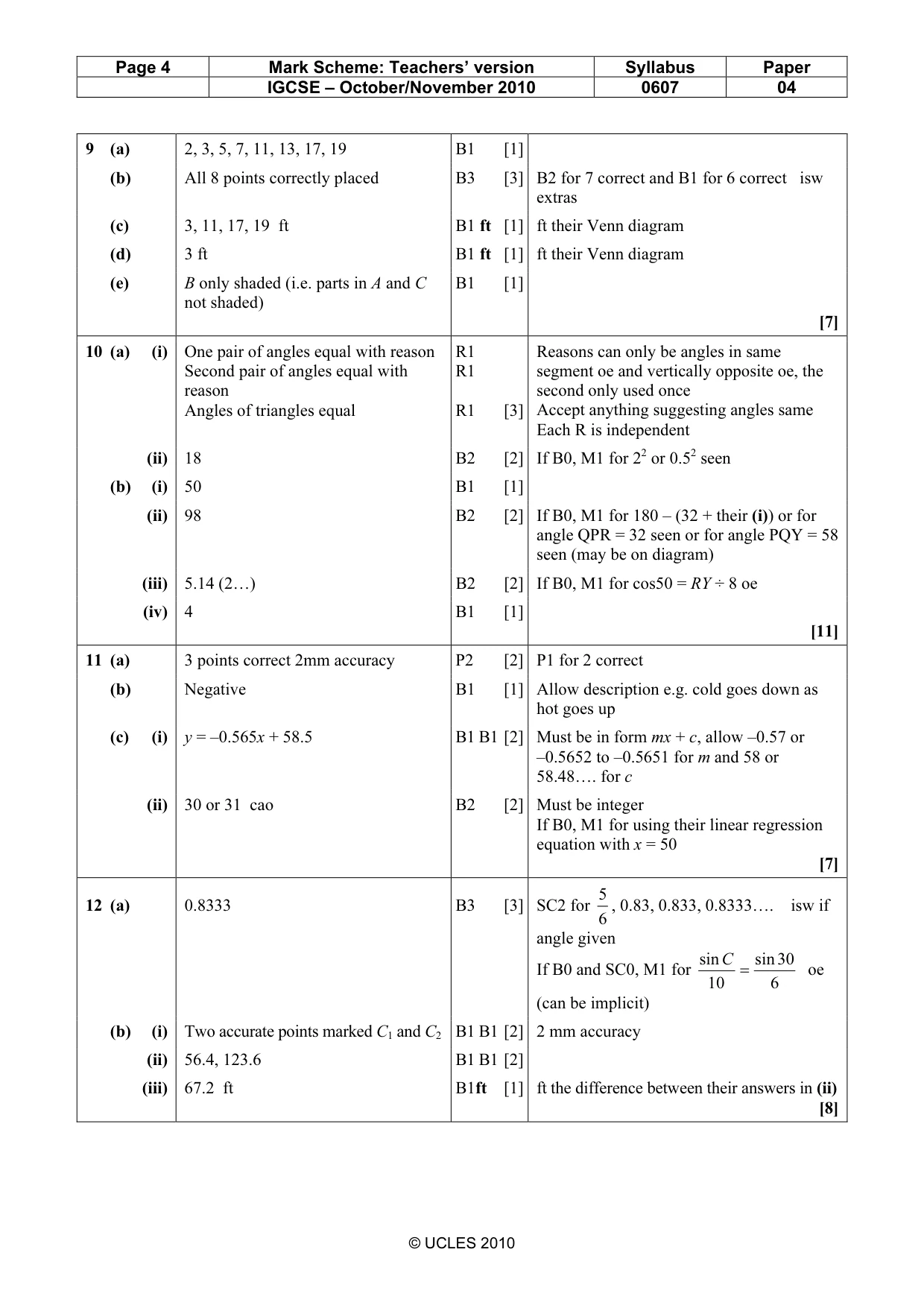
Page 4 Mark Scheme: Teachers’ version Syllabus Paper IGCSE – October/November 2010 0607 04 © UCLES 2010 9 (a) 2, 3, 5, 7, 11, 13, 17, 19 B1 [1] (b) All 8 points correctly placed B3 [3] B2 for 7 correct and B1 for 6 correct isw extras (c) 3, 11, 17, 19 ft B1 ft [1] ft their Venn diagram (d) 3 ft B1 ft [1] ft their Venn diagram (e) B only shaded (i.e. parts in A and C not shaded) B1 [1] [7] 10 (a) (i) One pair of angles equal with reason Second pair of angles equal with reason Angles of triangles equal R1 R1 R1 [3] Reasons can only be angles in same segment oe and vertically opposite oe, the second only used once Accept anything suggesting angles same Each R is independent (ii) 18 B2 [2] If B0, M1 for 22 or 0.52 seen (b) (i) 50 B1 [1] (ii) 98 B2 [2] If B0, M1 for 180 – (32 + their (i)) or for angle QPR = 32 seen or for angle PQY = 58 seen (may be on diagram) (iii) 5.14 (2…) B2 [2] If B0, M1 for cos50 = RY ÷ 8 oe (iv) 4 B1 [1] [11] 11 (a) 3 points correct 2mm accuracy P2 [2] P1 for 2 correct (b) Negative B1 [1] Allow description e.g. cold goes down as hot goes up (c) (i) y = –0.565x + 58.5 B1 B1 [2] Must be in form mx + c, allow –0.57 or –0.5652 to –0.5651 for m and 58 or 58.48…. for c (ii) 30 or 31 cao B2 [2] Must be integer If B0, M1 for using their linear regression equation with x = 50 [7] 12 (a) 0.8333 B3 [3] SC2 for 6 5 , 0.83, 0.833, 0.8333…. isw if angle given If B0 and SC0, M1 for 6 30 sin 10 sin = C oe (can be implicit) (b) (i) Two accurate points marked C1 and C2 B1 B1 [2] 2 mm accuracy (ii) 56.4, 123.6 B1 B1 [2] (iii) 67.2 ft B1ft [1] ft the difference between their answers in (ii) [8]
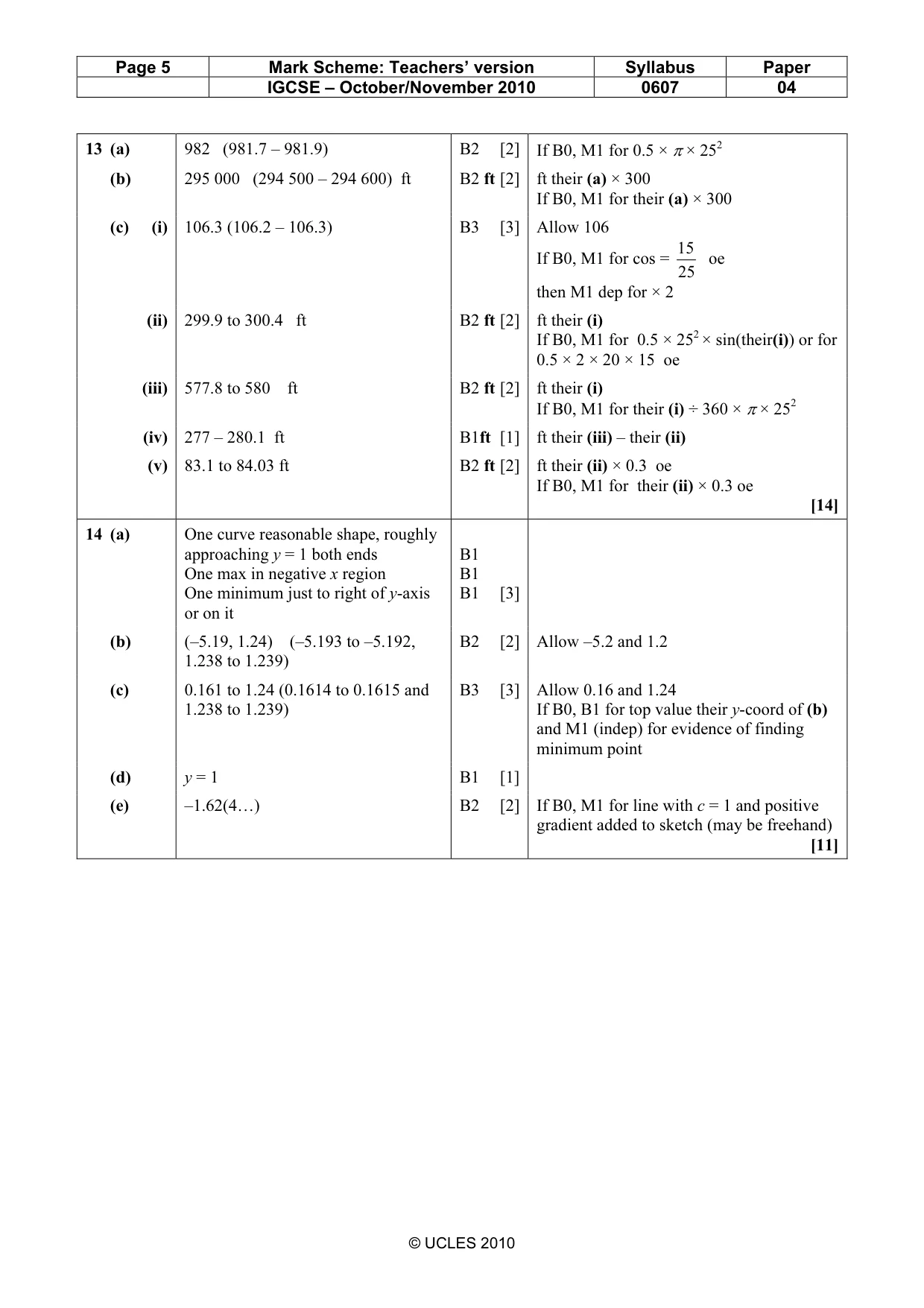
Mark scheme, page 5
Page 5 Mark Scheme: Teachers’ version Syllabus Paper IGCSE – October/November 2010 0607 04 © UCLES 2010 13 (a) 982 (981.7 – 981.9) B2 [2] If B0, M1 for 0.5 × π × 252 (b) 295 000 (294 500 – 294 600) ft B2 ft [2] ft their (a) × 300 If B0, M1 for their (a) × 300 (c) (i) 106.3 (106.2 – 106.3) B3 [3] Allow 106 If B0, M1 for cos = 25 15 oe then M1 dep for × 2 (ii) 299.9 to 300.4 ft B2 ft [2] ft their (i) If B0, M1 for 0.5 × 252 × sin(their(i)) or for 0.5 × 2 × 20 × 15 oe (iii) 577.8 to 580 ft B2 ft [2] ft their (i) If B0, M1 for their (i) ÷ 360 × π × 252 (iv) 277 – 280.1 ft B1ft [1] ft their (iii) – their (ii) (v) 83.1 to 84.03 ft B2 ft [2] ft their (ii) × 0.3 oe If B0, M1 for their (ii) × 0.3 oe [14] 14 (a) One curve reasonable shape, roughly approaching y = 1 both ends One max in negative x region One minimum just to right of y-axis or on it B1 B1 B1 [3] (b) (–5.19, 1.24) (–5.193 to –5.192, 1.238 to 1.239) B2 [2] Allow –5.2 and 1.2 (c) 0.161 to 1.24 (0.1614 to 0.1615 and 1.238 to 1.239) B3 [3] Allow 0.16 and 1.24 If B0, B1 for top value their y-coord of (b) and M1 (indep) for evidence of finding minimum point (d) y = 1 B1 [1] (e) –1.62(4…) B2 [2] If B0, M1 for line with c = 1 and positive gradient added to sketch (may be freehand) [11]
What you needed in this session
Cambridge’s own grade thresholds for 2010 Oct/Nov, Paper 4 · Variant 1. A higher threshold means an easier paper — the bar moves with how the cohort did.